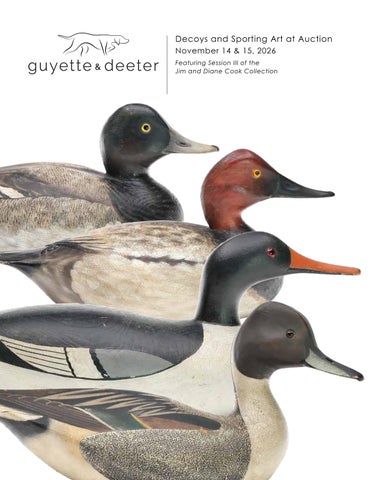
Decoys and Sporting Art at Auction November 14 & 15, 2026 Featuring Session III of the Jim and Diane Cook Collection
Decoys and Sporting Art at Auction The live auction will be held at the
The Country School 716 Goldsborough St Easton, Maryland 21601 Held in partnership with the Easton Waterfowl Festival
Friday, November 13, 2026 Cocktail Reception and Preview 5:00 PM - 7:00 PM EDT
Saturday, November 14, 2026 Preview 8:00 AM - 9:30 AM EDT Auction 10:00 AM EDT
Sunday, November 15, 2026 Preview 8:00 AM - 9:30 AM EDT Auction 10:00 AM EDT
For questions during the auction call 410-745-0485 If you are interested in viewing a particular piece at the office, please call to be sure it will be available there at the time you plan to visit. We may also be in your area, and so a private viewing may be available. Please contact us for our schedule.
Catalog $50. Subscription (3 catalogs) $100. Absentee, Phone & Online Bidding accepted call 410-745-0485 for arrangements. For free decoy appraisal call or email: Jon Deeter | jdeeter@guyetteanddeeter.com | 440-610-1768 Zac Cote | zcote@guyetteanddeeter.com | 207-321-8091 Riley Deeter | rdeeter@guyetteanddeeter.com | 440-708-4748
Jon & Leigh Ann Deeter 1210 S Talbot St, Unit A St. Michaels, Md 21663 Tel: 440-610-1768 jdeeter@guyetteanddeeter.com
Lacey & Zac Cote PO Box 347 Freeport, ME 04032 Tel: 207-321-8091 zcote@guyetteanddeeter.com
Riley Deeter
Alex Hascha
Colton Deeter
Stormi Lind
Mike Stevenson
Ed Kenney
Business Development St. Michaels, Maryland Tel: 440-708-4748 rdeeter@guyetteanddeeter.com
Business Development St. Michaels, Maryland Tel: 440-708-4747 cdeeter@guyetteanddeeter.com
Graphic Designer St. Michaels, Maryland Tel: 410-745-0485 michael@guyetteanddeeter.com
Weekly Auction Manager St. Michaels, Maryland Tel: 732-575-3829 alexhascha@guyetteanddeeter.com
Auction Manager St. Michaels, Maryland Tel: 410-745-0485 auction@guyetteanddeeter.com
Merchandise Manager & Shipping St. Michaels, Maryland Tel: 410-745-0485 shipping@guyetteanddeeter.com
Baylee Saulsbury
Mike Roberts
Administrative Assistant St. Michaels, Maryland Tel: 410-745-0485 admin@guyetteanddeeter.com
Shipping St. Michaels, Maryland Tel: 410-745-0485
Noah Christopher
Photography St. Michaels, Maryland Tel: 410-745-0485 photography@guyetteanddeeter.com
Bill Lapointe
Decoy Consultant and Essayist Swansea, Massachusetts Tel: 774-644-9426
Willow Kauffman
Bookkeeping St. Michaels, Maryland Tel: 410-745-0485 billing@guyetteanddeeter.com
Introducing Sallie Glover Sallie Glover is a USPAP-compliant appraiser specializing in Americana, including furniture, fine art, and folk art. She works closely with clients to provide comprehensive collections management and appraisal services across all collecting categories. Her expertise includes detailed inventories, database management, provenance research, and formal appraisals. Previously, Sallie served as a specialist in the Americana department at Christie’s, New York. Based in Raleigh, North Carolina, she works with clients nationwide and travels as needed.
Fine Sporting Arms Division
Josh Loewensteiner
Fine Sporting Arms Division Head 704-280-2382 guns@guyetteanddeeter.com
J. Wesley Dillon
Firearms Consultant 410-745-0485
Tim Carey
Firearms Specialist St. Michaels, Maryland 732-618-3833 tim@guyetteanddeeter.com
Important Notices: ■■ GUARANTEE - We have made a concerted effort to accurately catalog and describe the property to be sold. The decoys and paintings have guaranteed condition reports. Should the need arise, the auctioneer reserves the right to make verbal corrections and provide additional information from the block at the time of the sale. Absentee bids will not be executed on items that are found to be other than described in the catalog. Since opinions can differ, particularly in the matter of condition, the auctioneer will be sole judge in the matter of refunds. If we fail to identify a flaw that has an impact on the value, you can return the decoy. ■■ DURATION OF GUARANTEE - Requests for a refund on an item purchased through a Guyette and Deeter, Inc. auction must be made within 3 days of the time you take physical possession of your purchases. Whether your items are shipped, delivered, or picked up at the auction site, it is still 3 days from date of possession. This guarantee is null and void if payment is received or mail is postmarked more than 30 days from the sale end date. The guarantee is also null and void if you choose to not take possession of your purchases within the 30 days. If you have paid for your purchases within the 30 days but Guyette and Deeter, Inc is unable to ship your item within the guarantee period, the guarantee will be extended until 3 days from the shipping delivery date. This policy protects our consignors by enabling us to make consignor payments in a timely manner. ■■ Under no circumstances will we be responsible for damage to frames or glass, or damage caused by them. Paintings determined to be of high value or large size may be subject to special packaging at the buyer’s expense. Under no circumstances will we be responsible for damage to fragile decoratives. These items are marked in the catalog with an *. ■■ Stands are not included with the decoys or weathervanes unless specified in catalog. ■■ All duck calls have condition reports, but are sold “As Is”. ■■ Trade Up Program - A limited number of decoys purchased may be paid for by consigning decoys. To participate, please contact our office ahead of time to discuss details. ■■ Free appraisals are available with no obligation to consign and any correspondence is strictly confidential. ■■ Pick up hours are 1pm – 5pm beginning November 18, or by appointment. Please call ahead so we can have your items ready.
Future Auctions February 25 & 26, 2027 Fine Sporting Arms St. Michaels, Maryland
April 23 & 24, 2027 Decoys, Sporting Art & Americana
The Westin Lombard, Illinois In conjunction with the North American Vintage Decoy & Sporting Collectibles Show
July 23 & 24, 2027 Decoys, Sporting Art & Americana The Country School Easton, Maryland
September 9 & 10, 2027 Fine Sporting Arms St. Michaels, Maryland
CONSIGN TO CONSERVE TURN YOUR COLLECTION INTO CONSERVATION A Consign to Conserve Success Story I discovered duck hunting in high school, jump shooting small ponds in the woods we squirrel hunted. I was fortunate to find other avid waterfowlers in college and as my career took me to numerous states and eventually back to my native Minnesota. It was a passion that grew through my entire life.
CONSIGN TO CONSERVE Fresh out of college, I also discovered antique duck
Accepting consignments of decoys, spor ting ar t, decoys. My future wife and I liked going to antique shows spor ting ar ms, and Americana for future auctions
on the weekends and at one of them I met a man with a booth filled with them. I spent an hour there learning about antique duck decoys and had an instant attraction. It was also that day that I was told about decoy shows that were within driving distance and some sound advice as I entered that new world.
TURN YOUR COLLECTION INTO CONSERVATION
John Wilkes gun One of a kind true pair of John Wilkes 10 bore side by side • $75,000 - 125,000 My first decoy show was in Oshkosh, WI and there I Ward Selling in Feb. 27 auction To be sold February 27, 2025 Brothers • Selling in April 24 & 25 learned about others - like the Midwest Decoyauction Collectors show. I traveled forEdmund work and fly• Sold anywhere Ogden Pleissner • Sold for $57,000 Henrycould Osthaus for $66,000 at $70,000 – 100,000 at $75,000 – 125,000
in the country on business and my life centered around attending the decoy shows from coast to coast. Like most of us, it seems almost all our friends are folks and couples who also collect decoys.
DUCKS UNLIMITED AND GUYETTE & DEETER are working to transform your decoys, My passion for duck hunting and collecting decoys aretogether intertwined. The countless hunts from theart, pastand are great memories and living with the decoys on our shelves is simply part of our life. The hunting I was sporting arms into conservation dollars. When you consign, Guyette & Deeter will donate the proceeds lucky enough to experience was exceptional and seeing hundreds of ducks coming in almost every morning bolstered my respect for the birds we harvest. to Ducks Unlimited, funding vital wetland habitat protection. Preserve the past—protect the future! Accepting consignments of decoys, spor ting ar t, spor ting ar ms, and Americana for future auctions
I always knew I wanted to give something back.
CONTACT INFORMATION: Jon Deeter | jdeeter@guyetteanddeeter.com | of 440-610-1768 As we continue to collect, the admiration I have for waterfowl and my wife’s support my lifelong passion Ogden Pleissner • Sold $57,000
Edmund Henry Osthaus • Sold $66,000
are the basis of a legal commitment to Ducks Unlimited for our collection of duck and fish decoys, shot Ward Brothers •an $70,000 - 100,000 shell boxes and weathervanes through eventual future auction with Guyette and Deeter. To be sold April 24 & 25, 2025 - Jim and Julie Krebsbach Ogden Pleissner • Sold for $57,000
Selling the finest sporting art in America
John Wilkes gun One of a kind true pair of John Wilkes 10 bore side by side • $75,000 - 125,000 Ward 25 Selling in Feb. 27 auction To be sold February 27, 2025 Brothers • Selling in April 24 & 410-745-0485 • guyetteanddeeter.com Henry Osthaus • Sold for $66,000 auction at $70,000 – 100,000 at $75,000 – 125,000 1210 S Talbot St, Unit A Edmund • St. Michaels, MD 21663 Jon Deeter • 440-610-1768 | jdeeter@guyetteanddeeter.com Zac Cote • 207-321-8091 | zcote@guyetteanddeeter.com
DUCKS UNLIMITED AND GUYETTE & DEETER are working together to transform your decoys, art, and sporting arms into conservation dollars. When you consign, Guyette & Deeter will donate the proceeds to Ducks Unlimited, funding vital wetland habitat protection. Preserve the past—protect the future! Coastal Style 2-25.indd 1
2/6/2025 10:43:19 AM
CONTACT INFORMATION: Jon Deeter | jdeeter@guyetteanddeeter.com | 440-610-1768 Ogden Pleissner • Sold $57,000
Edmund Henry Osthaus • Sold $66,000
CONSIGNMENTS WANTED!
Some recent successes for our consignors!
TRULY SUPERIOR FRESH TO MARKET PARKER A1 SPECIAL GRADE DOUBLE TRAP. SOLD
$216,000!
TRUE PAIR OF 32 BORE W.W. GREENER SHOTGUNS WITH CASE. SOLD $87,000!
“OLD HOSS” A FRESH TO MARKET AND IMPORTANT PARKER AAH GRADE 12 GAUGE. SOLD $48,000! ONE OF A KIND, TRUE PAIR JOHN WILKES EXHIBITION QUALITY SIDELOCK 10 BORE SIDE BY SIDE. SOLD $102,000!
EXTREMELY RARE AND FINE PARKER AHE GRADE 12 GAUGE GAME GUN. SOLD
$45,600!
BROWNING MIDAS GRADE SUPERPOSED SUPERLIGHT .410 BORE SOLD $48,000!
SWIVEL PENNSYLVANIA LONG RIFLE BY ADAM ANGSTADT, c1800.
SOLD $30,000!
ABBIATICO & SALVINELLI JOREMA EXTRA LUSSO 28 GAUGE SIDELOCK OVER UNDER
SOLD $48,000!
Next Sale: February 2027 CONSIGNMENT DEADLINE DECEMBER 1 We are always accepting quality sporting arms consignments! Email guns@guyetteanddeeter.com for inquiries www.guyetteanddeeter.com | 410-745-0485 | 1210 S Talbot St, Unit A | St. Michaels, MD 21663 www.guyetteanddeeter.com | 410-745-0485 | 1210 S Talbot St, Unit A | St. Michaels, MD 21663
For Online Bidding The best way to bid online at Guyette & Deeter auctions with the lowest platform fee available : Save up to 4% using our app! Simply go to bid.guyetteanddeeter.com or use the QR code
Download the official Guyette & Deeter app: • Bid on all of our live and online weekly sales. • Search past sales in a large, ever growing prices realized database. • Watch live streaming video from all of our live sales.
Bid in our live and online weekly auctions. Search a huge, ever growing database of prices realized.
Scan QR code to download the Guyette & Deeter official App.
410-745-0485 • guyetteanddeeter.com 1210 S Talbot St, Unit A • St. Michaels, MD 21663 Jon Deeter • 440-610-1768 jdeeter@guyetteanddeeter.com Zac Cote • 207-321-8091 zcote@guyetteanddeeter.com Riley Deeter • 440-708-4748 rdeeter@guyetteanddeeter.com
A great bird dog is not only a trusted family companion, they are an indispensable part of a successful hunt. In November of 2024, we used for the first time a new graphic as part of our logo, a dog on point. Many asked, “Why not a duck or a retriever?” Although we have specialized in the marketing and auctioning of duck decoys and decorative carvings for over 40 years, we have also become a go-to auction house for fine sporting arms, having sold over $22 million in our first four years and breaking multiple records in that time. You will also see as a part of our offerings, fine watches, quality folk art, American art, and anything we understand our collector base to be hunting. You see we at Guyette and Deeter, are the bird dogs. We locate, vet, and point out the quarry that the market wants most. Like any good marketing firm, we understand what collectors are looking for, and we sift through thousands of options for inclusion in our live auctions, settling on those items collectors should seriously consider taking a shot at. Just as a good bird dog should not point a robin when his gunner is after quail, we often pass up more items than we include in our auctions. If you are a new collector or new to us, be sure to do what our long-time customers have done and let us know what you are hunting and solicit our advice when considering a new addition. Unlike a retriever that goes into action after the hunter has made their decision and taken the shot, a good bird dog creates opportunities for their hunter, vetting scents throughout the field and narrowing in on what is truly wanted. We are particularly proud of the opportunities we have put together in this year’s November catalog. Headlined by Session III of the Jim and Diane Cook collection, many of these pieces are the best examples of their kind in existence and may not be available again for decades. Decoys from the Oliver Smith and Don Leonard collections are sure to excite collectors of Maryland, Virginia, and North Carolina birds. Another excellent offering of miniatures from the Joe Ellis collection, as well as a small but quality offering of collectible duck calls can be found in this sale. Closing out the auction is a nice grouping of Native American related items, with lot 594 being a particularly nice example of a totem pole made for the early tourist trade. As always, we look forward to fielding your questions and inquiries, and we look forward to seeing you in Easton. We hope you end up with the quarry you are after. The shot has been set up, it’s now up to you to take it. Good luck and cheers to a successful hunt. The Guyette and Deeter Team
Session One Saturday, November 14, 2026 10:00 am EST Lots 1 - 359
Session Two Sunday, November 15, 2026 10:00 am EST Lots 360 - 611
The Cook Collection 1 - 58 A. Elmer Crowell 59 - 69A North Carolina 70 - 78 Maryland 79 - 103 Frank Finney 104 - 116 Virginia 117 - 141 Contemporary 142 - 163 Maryland 163A - 188 Shorebirds 189 - 213 New England 214 - 228 Maryland 229 - 239 Delaware River 240 - 254 Canadian 254A - 261A Michigan 262 - 267 Mason Decoy Factory 268 - 279 Duck Calls 280 - 304 Bronzes 305 - 307 Sporting Art 308 - 359
Jim Schmiedlin 360 - 368 Canoe Models 369 - 370 Contemporary/Decoratives 371 - 416 Miniatures 417 - 465 New England 466 - 469 Pacific Coast 470 - 479 Midwest 480 - 489 490 Louisiana Herons 491 - 492 Ward Brothers 493 - 502 Sinkboxes 503 - 508 New York 510 - 516 Shorebirds 517 - 524 Mason Decoy Factory 525 - 538 Flyers 539 - 542 Firearms 543 - 545A Fish Carvings 546 - 553 Folk Art 554 - 611
Please read conditions of sale in the back of catalog
Featuring Decoys From the Collections of: Jim and Diane Cook John Decesare Joseph Ellis Ted and Judy Harmon Dean Hyde Gene and Linda Kangas Don Leonard Chris Mackey Martin and Deborah Maloy George Meyer Chris Pitman Mike and Ginger Raffia Frederick Raymon Oliver Smith Philip Spalding Dr. M. Bagley Walker, Jr. Private Michigan collection
The James and Diane Cook collection
Andy Richter
In 1918, after discovering an old, red-breasted merganser hen decoy near his Long Island boat house, a New York City architect named Joel Barber began searching for and studying North American waterfowl decoys. Barber organized many of the first decoy carving competitions, as well as the first decoy exhibition in 1932. His love of the art form and early documentation of carvers from around the country culminated in the 1937 release of “Wild Fowl Decoys,” the first reference book on the subject. This early book inspired many of the “first generation” of collectors who scoured attics, barns, and boathouses for the hunting relics. This early period of discovery and documentation helped preserve many retired hunting decoys from being discarded or destroyed. In those early days of collecting, the gifting and trading of decoys was quite common. In 1973, however, an auction price of $10,500 was paid by Dr. James McCleery for a William Bowman curlew from the collection of William J. Mackey Jr. This world record price shook the antiques world, and decoys became recognized as a serious collectible art form. By 1985 the world record price had risen to $50,000 and in 1986 the collection of Dr. George Ross Starr Jr. was offered by the Richard A. Bourne Auction Company. When an extremely rare wood duck drake by Joseph Lincoln crossed the block, a new world record price of $205,000 was achieved, four times the previous record price for a decoy. It has been 40 years since that Lincoln wood duck was offered publicly, but it is one of many extremely rare and important decoys to be offered from the collection of Jim and Diane Cook. In the early 1980s, Jim Cook and advisor Joe Tonelli began visiting long-time collectors and dealers around the country, buying top examples by the most sought-after carvers. At auctions, when a potential addition to the collection was selected, Jim would often hold up his bid card and not lower it until the auctioneer sold the decoy his way. Many decoys in the collection were auction records for the maker when they were sold and some were only surpassed when Jim bid on a rarer and more pristine example, setting the highwater mark once again. Over the years Cook has set the world auction record for a shotshell box, duck call, as well as the highest price paid for a fish spearing decoy, on two separate occasions.
Cook
Collection
Jim and Diane didn’t just collect waterfowl decoys. The warehouse at Investment Rarities, Jim’s gold and silver business, was filled with collections of pristine 20th century collectibles. From children’s lunch pails, Coca-Cola memorabilia, and early concert posters to art pottery, baseball memorabilia, and movie props. Over the last decade the Cooks have been deaccessioning those collections. A Babe Ruth home-run bat, $600,000, a Marilyn Monroe photograph signed to and owned by Joe DiMaggio, $300,000, and a Mickey Mantle rookie card, $225,000. The current world record for a concert poster was achieved in November 2022 when Heritage Auctions sold the Cook’s concert poster collection. A Buddy Holly “Winter Dance Party” poster from the collection achieved $447,000, shattering the previous world record of $275,000 set in April of that year. The decoy collection, being the last of the Cooks’ collections to be sold and the only collection to get a custom designed display room in their home, attests to Jim’s passion and love of North American decoys. For 45 years, Jim’s aggressive pursuit of high-condition waterfowl decoys has led to the Jim and Diane Cook collection. A grouping of rare and important decoys, the likes we may never see again in a private collection. We at Guyette and Deeter are extremely honored and privileged to have been chosen to offer the Cook collection at auction in 2026 and 2027. Many of these pieces may not be available again for decades, if ever. Do not let this outstanding opportunity pass you by. We hope you enjoy.
Session One • Saturday, November 14, 2026 • 10:00am
Joseph Lincoln 1859 - 1938 | Accord, Massachusetts Joe was born the son of sailmaker George Lincoln and his wife Salome Whiting at the family home on Gardner St., in the Accord section of Hingham. The house was located on the shore of Accord Pond and afforded a lovely view out over the water as well as any passing wildlife. Sadly, his biological father passed away when he was only 9 and his brother, Wilbur, was 4. His Uncle, Joe Whiting, a cooper, moved into the home and helped to raise the two young boys. As a young man through 1894, Joe, typical for many in the area, worked in a shoe factory. By 1900 he was working as a poultry farmer with his brother. Joe was talented in anything requiring the use of his hands. He made and upholstered furniture, carved gunstocks and was reputed to be able to repair just about anything, including clocks and cameras. From at least 1908 through the 1920 census, he lists his occupation as “carpenter”. It is no surprise then that he also constructed a number of excellent lapstrake boats which he kept on the shore of the pond. If he had a passion, it was raising award winning dahlias (a flower). He also loved to hunt! There is no record as to exactly when he made his first decoy, but it is a safe assumption that it was at an early date.
16
By 1918, his fame in carving a very high-quality decoy, resulted in a lengthy article in a Boston newspaper where he is recorded as saying: “You’ve got to make them good enough to fool the sharp eyes of a duck or goose - - - - and you just bet that those birds have the sharpest eyes and the cunningest brains that there are in the bird family. A turn of the knife the wrong way, a peculiar tilt to the head, such as is not affected by the duck or goose family, and your work is spoiled.”
Orders poured in, allowing him to concentrate on carving as his primary occupation. By 1928, his production had grown to the point where he lists his occupation in the Hingham City directory as “decoy mfg”. Most of the orders were obtained through the mail but many hunters would drive directly to Joe’s tiny shop to place an order for the upcoming season. Occasionally he would stage an elaborate exhibit at the Boston Sportsman’s show.
1
Joseph Lincoln (1859-1938), Accord, Massachusetts. Exceedingly rare American merganser. Decoy was never rigged or weighted. Measures 18” long. Excellent original paint with only minor flaking and a small paint rub on top of head; minor blunting with two short hairline cracks on one side of tail tip, otherwise excellent structurally. Provenance: Jim and Diane Cook collection.
(100,000 - 150,000)
17
Ward Brothers Crisfield, Maryland
18
Some names in the world of decoys need no introduction. So it is with the Ward Brothers. Influenced by their environment on the eastern shore and the hunting and carving traditions of their father, Travis, and the various members of the Sterling family, they began to carve very early in their lives. Each had been hunting since their teens and Steve is said to have made his first crude decoy at the age of 12. By the time of WWI, they had begun to carve in earnest, following in the broadly defined parameters of the established Crisfield School. Their work is remarkable in a number of ways. It was always outstanding but unlike other carvers, the men seemed to never be satisfied. Most makers would develop a style of their own and then stick with that design with perhaps only minor modifications for the remainder of their careers. Not so the Wards. They possessed boundless creativity and over time, they carved a dizzying array of styles, each intended as an improvement on past efforts and always seeking the perfect decoy. These have been categorized in a number of ways, some based on form such as “fat jaw,” “Knot head,” or “humpback,” others by the style created for a particular club such as “Bishop Head,” and some by the time frame in which they were made, with their “classic 36” being a good example.
2
Ward Brothers, Crisfield, Maryland. Outstanding 1936 style pintail. Slightly turned and raised head. Thick stipple paint on back and sides. Maker’s banner label painted on underside. Also signed and dated 1936 at a later date. Two Mackey collection ink stamps on underside. Measures 17” long. Excellent original paint with almost no wear; filler above nail hole on top of head has risen slightly; excellent structurally. Provenance: William J. Mackey Jr. collection. Retained by the Mackey family until 1998, when it was sold through Guyette and Schmidt for $104,500, a world record price for any Ward decoy. A record that stood for nearly 20 years. Jim and Diane Cook collection.
(100,000 - 140,000)
19
A. Elmer Crowell 1862 - 1952 | East Harwich, Massachusetts
20
3
A. Elmer Crowell (1862-1952), East Harwich, Massachusetts. Rare and
Provenance: Dr. John H. Cunningham collection. Jim and Diane Cook collection..
outstanding canvasback. Made for Dr. John H. Cunningham. Maker’s oval brand on
Literature: “Top of the Line Hunting
underside. Relief tail feather carving and raised
Collectibles” by Donna Tonelli, page 84, exact
crossed wingtips. Measures 16” long. Original
decoy pictured. “Elmer Crowell – Father of
paint with tiny flakes on edge of bill and tail;
American Bird Carving” by Stephen B. O’Brien
very slight separation at a knot in tail; tiny chip
Jr. and Chelsie W. Onley, page 116, exact decoy pictured.
(150,000 - 250,000)
on edge of tail; defect in wood on underside from when the decoy was made.
21
The short but eventful life, and all the many accomplishments of John C Phillips have been well documented by numerous authors. Born into great wealth, he spent his early years surrounded by the privileges and trappings of Boston society. His businessman father, John C Phillips Sr., purchased a large property on the western shore of Wenham Lake in the town of Beverly, Massachusetts in 1880. He had a sumptuous summer home built there and had the grounds designed by the Father of American Landscape Architecture, Fredrick Law Olmstead. Olmstead chose to not follow the “high garden” design trends of the time and, rather, developed a concept which incorporated the best of the country garden, agricultural and forestry practices of the day. The elaborate estate, named “Moraine Farm” was ready for occupancy by 1882 but, regrettably, his father only enjoyed the property for a few years, dying in 1885. Phillips’ father did not seem to have a significant interest in hunting but it was at “Moraine” that the young John C Phillips could explore the wide open fields, the nearby forest, swamps and the lake itself, all whetting his appetite for a lifelong interest in the outdoors and in the budding conservation movement in America. He graduated with a degree from the Lawrence Scientific School of Harvard University in 1899 and graduated from the Medical School there in 1904. He did his internship at the Boston City Hospital and yet, other than a few years during WWI, never practiced medicine. It was during his prep school and college years that Phillips began to venture far beyond the bounds of Moraine Farm in pursuit of adventure and game. He and his Harvard classmates would escape the confines of Boston and the rigors of the University by traveling to hunting camps on Cape Cod, in Canada and numerous
22
other destinations. Many of these college acquaintances would develop into lifelong friendships. Dr. Phillips built a camp and gunning stand on Wenham Pond while he was at Moraine Farm and between the years of 1900 – 1905, he enjoyed the services of Elmer Crowell as “gunner” at the stand. This would be the beginning of a long friendship between the two. This association, as well as earlier connections with wealthy sportsmen at stands on Cape Cod, would launch Crowell on his extraordinary carving career. Crowell is universally recognized as producing his finest work for these early patrons.
4
A. Elmer Crowell (1862-1952), East Harwich, Massachusetts. Excellent bluebill. Made for Dr. John C. Phillips. Maker’s oval brand on underside. Slightly turned head and relief tail feather carving. Measures 14” long. Original paint with very minor flaking; mostly on breast and edge of tail; small area of paint shrinkage under tail; excellent structurally. Provenance: Dr. John C. Phillips collection. Philip Y. DeNormandie collection. John Delph collection. Jim and Diane Cook collection. Literature: “Top of the Line Hunting Collectibles” by Donna Tonelli, page 86, exact decoy pictured. “Elmer Crowell – Father of American Bird Carving” by Stephen B. O’Brien Jr. and Chelsie W. Onley, page 117, exact decoy pictured. (100,000 - 150,000)
23
Enoch Reindahl 1904 - 2000 | Tustin, Wisconsin Most decoy makers were primarily interested in making decoys that attracted ducks and satisfying the demand from local hunters. This is not how the early conservationist, artist and lover of all things nature from Stoughton, Wisconsin approached the activity. Reindahl was a fanatic about his love for decoys and how he approached making them. His work is considered far superior to his contemporaries, he left no detail unattended to. Making decoys with short thick necks because contented duck usually have their necks pulled into their breast. He painted small speculums noting that a resting duck usually has his wings tucked into his flanks. Reindahl was not born with this ability to capture waterfowl in such realistic forms, he earned it, and he spent years perfecting his skills. On his twelve-acre marsh near his home he fed, raised and photographed ducks. The marsh had three
24
duck ponds planted with wild rice, sago pondweed and other plants for wildlife food. He became such a distinguished photographer that many of his photos were published in nature magazines in the 1930s and 40s. Reindahl was a remarkable man who made some of the country’s best decoys in his time and these canvasbacks represent Reindahl at his best. His work is considered far superior to that of his contemporaries, as he left no detail unattended. He made decoys with short, thick necks because contented ducks usually pull their necks into their breasts. He also painted small speculums, noting that resting ducks typically tuck their wings against their flanks.
5
Enoch Reindahl (1904-2000), Tustin, Wisconsin. Outstanding rigmate pair of canvasbacks. Hollow carved with tucked heads and relief wingtip carving. Thick comb feather paint detail. Maker’s name painted on underside. Measure 14” long. Excellent original paint under the original coat of varnish that has darkened slightly; small amount of early touchup on edge of tail feathers and to a spot of roughness on one edge of drake’s bill, presumably by the maker. Provenance: Rig of the maker. Dave Spengler collection, purchased from Reindahl. Jim and Diane Cook collection. Literature: “Fish and Fowl Decoys of the Great Lakes” by Donna Tonelli, page 215, exact pair pictured.
(60,000 - 90,000)
25
6
A. Elmer Crowell (1862-1952), East Harwich, Massachusetts. Early golden plover in fall plumage. Relief wing carving and very rare slightly turned head. Measures 11.5” long. Original paint with very minor wear; some roughness on edge of stick hole, otherwise very good structurally. Provenance: Dr. Robin Hardy collection. Jim and Diane Cook collection. Literature: “Top of the Line Hunting Collectibles” by Donna Tonelli, page 87, exact decoy pictured. (70,000 - 100,000)
26
27
28
7
A. Elmer Crowell (1862-1952), East Harwich, Massachusetts. Extremely rare feeding golden plover in eclipse plumage. Relief wing carving. Measures 12” long. Original paint with very minor wear; lightly hit by shot in one side; small amount of filler and touchup where bill meets face. Provenance: Dr. Robin Hardy collection. Jim and Diane Cook collection. Literature: “Top of the Line Hunting Collectibles” by Donna Tonelli, page 88, exact decoy pictured. (80,000 - 120,000)
29
The Starr Canvas Covered Stickup Black Duck Maker unknown, Marshfield, Massachusetts Canvas covered decoys have been used throughout the various North American flyways for decades. One can certainly make the argument, however, that the finest originated in New England, specifically Massachusetts. The two primary types of canvas covered construction from the area, canvas over frame and canvas over slat, had a few disadvantages. They required a high level of skill to produce a quality example, and they tended to require greater care in handling when tossed about in the boat or storage shed. They did have one very obvious advantage over their wooden counterparts however, which counteracted any negative trait. They were lighter, far lighter. Weight was always a consideration when transporting a sack or string full of decoys across a marsh, and it was certainly, a factor when loading a small boat with men and gear in a stormy sea. Dissecting most New England canvas covered decoys, it is easy to see why this method of construction appealed to their makers. In almost all cases, the internal wooden parts needed to be bent or shaped, and steaming was a well known and common practice with the local builders of boats, barrels, firkins, baskets and lobster traps. In addition, the locals were intimately familiar with cutting and mending the sails which propelled practically all of the local watercraft, both large and small. On the coast of Massachusetts, the South Shore in particular, the shoe industry was a major component of the economy and numerous households had one or more family members engaged in the trade which, obviously, meant that they were familiar with cutting, shaping and sewing heavy materials. Floating ducks and geese were normally the subject of their canvas decoys but, on occasion, a “watcher” or stickup was constructed. Hunters were accustomed to seeing one or two lone members of a flock waddle ashore, while their brethren rested or fed in the shallows nearby. As one would expect, some men that set out to make a decoy either had the skill, perception or inclination to go beyond what would have been deemed merely sufficient, and thus is the case with the black duck from the Starr collection. This decoy came from a family in Marshfield, MA on the state’s south shore. It was initially discovered
30
as part of a rig of six in 1952 by antiques dealer and decoy collector, Winsor White (1902 – 1975). White went to great lengths to question the family to ascertain exactly who would have made the bird and when. Unfortunately, the best he could determine was that it “- - - had definitely been in the family’s possession for at least the last 94 years.” Oddly, he did not record the name of the family! White kept at least one of the decoys and sold one to Dr Starr (this exact bird). A few of the remaining four have since been accounted for in private collections. The Winsor White bird is pictured in page 12 of the Oct/Nov/Dec, 1965 issue of Hal Sorenson’s Decoy Collectors Guide where he describes the birds in the rig as being “framed like a ship,” but contradicts what he initially had apparently told Starr, dating the decoy to 1890. Another example, perhaps the same bird, is illustrated on page 15 of Johnson’s “Canvas Decoys of North America.” The decoy offered here is pictured in color in plate 11 of Decoys of the Atlantic Flyway” where Dr Starr observes that “Certain decoy makers were not only natural artist but had the feeling that each decoy they made should stand by itself as a work of art.” He further states that, in his opinion, it represents “One of the most artfully designed and constructed decoys ever found.”
8
Rare and important black duck, from Marshfield, Massachusetts, circa 1860. One of six found in a Marshfield, Massachusetts home in 1952. Canvas over wood frame stickup decoy for use in marsh grass. Wooden tail and applied wing detail. Head and tail are both made from three pieces of vertically laminated wood. Measures 22” long. Original paint with minor wear under an early coat of varnish; some areas of touchup; minor roughness on edge of tail; applied bill was cracked down at some point and reset with an old nail on underside. Provenance: Dr. George Ross Starr Jr. collection. The decoy was retained by the family and not included in the Starr collection sale. John Delph collection. Jim and Diane Cook collection. Literature: “Decoys of the Atlantic Flyway” by Dr. George Ross Starr Jr., plate 11, exact decoy pictured.
(30,000 - 50,000)
31
John English 1848 - 1915 | Florence, New Jersey
Only a small handful of John English decoys in original paint have survived. Born in 1848 and credited as the “father of the Delaware River style,” his decoys display consistent quality and style techniques. Characterized with two piece bodies, most have relaxed or resting head poses, carved wingtips, and carved, rounded tails. English set the standard for decoys made in his area, not only out of pride and ability, but also necessity. The hunting technique used on the Delaware River was known as sculling, which required that the decoys be lifelike so that the ducks would land and stay with the rig, until the hunter, anchored up stream, could drift down and flush the ducks at a close distance.
9
John English (1848-1915), Florence, New Jersey. Very rare and important pintail hen. Hollow carved with raised V wingtip and relief tail feather carving. This decoy was gifted by the maker to his close friend and neighbor Charles Whiley, who supplied wood to English. Willey was apparently not a hunter, and the decoy went unused, riding a shelf rather than the waters of the Delaware River. Measures 15.75” long. Original paint with very minor wear; under an early coat of varnish; old chip and roughness at tip of tail was darkened; an outstanding example. Provenance: Charles Whiley collection. Bob Trader collection. Harrison Huster collection. Bob and Pauline White collection. Jim and Diane Cook collection. Literature: “Decoys – North America’s One Hundred Greatest” by Loy S. Harrell Jr., page 138, exact decoy pictured. “Floating Sculpture” by H. Harrison Huster and Doug Knight, page 61, exact decoy pictured (in reverse).
(100,000 - 150,000)
34
10
A. Elmer Crowell (1862-1952), East Harwich, Massachusetts. Decorative feeding curlew. An early example with relief wingtip feathers and maker’s oval brand on underside of carved quahog base. Measures 16.25” long. Original paint with moderate crazing and minor flaking; tiny chip at tip of raised wingtips; tight cracks in original gesso thighs. Provenance: Jim and Diane Cook collection.
(25,000 - 35,000)
35
11
A. Elmer Crowell (1862-1952), East Harwich, Massachusetts. Feeding decorative yellowlegs. Maker’s rectangle stamp on underside of rock base. Signed and with an inscription “To a friend” in the maker’s script on underside. Measures 9” long, stands 8.5” tall. Excellent original paint; a few small rubs on base; hairline cracks in gesso thighs; thin line of touchup on front of head where the bill meets the face. Provenance: Jim and Diane Cook collection. (15,000 - 25,000)
36
12
A. Elmer Crowell (1862-1952), East Harwich, Massachusetts. Decorative Wilson tern. Relief wing and split tail carving. On carved oyster shell with maker’s rectangle stamp on underside. Signed “A.E Hardy” for Alice Eliza Hardy, wife of Charles Ashley Hardy. Carving was gifted to the Hardy’s granddaughter J. Ashley Dempsey with her name burned into the underside. Measures 11.25” long. Original paint under a slightly uneven coat of varnish that has darkened with age; very good structurally. Provenance: Jim and Diane Cook collection.
(10,000 - 14,000)
37
13
A. Elmer Crowell (1862-1952), East Harwich, Massachusetts. Early yellowlegs with slightly turned head and relief wing feather carving. Dr. George Ross Starr collection ink stamp on underside. Measures 11.75” long. Original paint with very minor wear; excellent structurally. Provenance: Dr. George Ross Starr collection. Jim and Diane Cook collection. Literature: “Decoys of the Atlantic Flyway” by Dr. George Ross Starr, plate 7, exact decoy pictured. “Top of the Line Hunting Collectibles” by Donna Tonelli, page 87, exact decoy pictured.
38
(25,000 - 35,000)
14
A. Elmer Crowell (1862-1952), East Harwich, Massachusetts. Running yellowlegs. Split tail carving and tack eyes. Measures 13.5” long. Original paint with very minor wear; under a thin coat of varnish that has darkened with age; very lightly hit by shot; hairline crack in bill. Provenance: Jim and Diane Cook collection. Literature: “Top of the Line Hunting Collectibles” by Donna Tonelli, page 87, exact decoy pictured. (12,000 - 18,000)
39
Charles Birch 1867 - 1956 | Willis Wharf, Virginia Charlie was only 13 when his family moved from Maryland to Chincoteague, Virginia. There, at age 24, he married 16-year-old Jennie Bloxom while he worked as an oysterman. By 1910, he moved his growing family to Willis Wharf where he continued to work in the oyster trade. By the time of the 1920 census, he began to list his occupation as a self-employed carpenter, either working in home construction or doing “piece work.” There is no written document that indicates exactly when Birch started making decoys. Photos in Fleckenstein’s “Southern Decoys of Virginia and the Carolinas” depict him as a young man, perhaps in his late twenties to early thirties with a few geese, brant, and bluebills. Another photo depicts him with a bench or table containing about fifty black ducks. In the latter photo, he appears to be in his sixties or seventies. Among his rarest and most desirable decoys are his swans.
40
15
Charles Birch (1867-1956), Willis Wharf, Virginia. Important working swan. Hollow carved with raised neck seat and tack eyes. Applied hardwood bill is splined through back of head. Outstanding form. Measures 28” long. Original paint with moderate flaking and gunning wear; slight separation at body seam and neck seat; reglued vertical crack on upper neck; many small spots of touchup to flaking; later varnish added to top of bill. Provenance: Jim and Diane Cook collection. Literature: “Decoys” by Gene and Linda Kangas, page 265, exact decoy pictured. “Top of the Line Hunting Collectibles” by Donna Tonelli, page 96, exact decoy pictured. (80,000 - 120,000)
41
Ward Brothers Crisfield, Maryland
42
16
Ward Brothers, Crisfield, Maryland. Rigmate pair of canvasbacks. 1936 style with slightly turned heads. Signed and dated 1936 at a later date. William Purnell brand on undersides. Measure 16.75” long. Original paint with minor gunning wear; minor roughness on one edge of hen’s bill and a thin chip on the same side of drake’s bill that was darkened; minor separation at drake’s neck seat; small chip on one side of hen’s tail; drying crack along the underside of each. Provenance: William Purnell collection. Jim and Diane Cook collection.
(40,000 - 60,000)
43
17
Ward Brothers, Crisfield, Maryland. Pair of greenwing teal. 1936 style with slightly turned heads and extended crest on drake. Both signed and dated 1936 at a later date. Hen with excellent paint detail. Measure 12” long. Excellent original paint with only minor flaking on one side of drake; tight crack on underside of hen, otherwise excellent structurally. Provenance: Jim and Diane Cook collection. Literature: “Decoys” by Gene and Linda Kangas, page 273, exact decoy pictured. “Top of the Line Hunting Collectibles” by Donna Tonelli, page 96, exact decoy pictured.
44
(40,000 - 60,000)
45
46
18
Ward Brothers, Crisfield, Maryland. Outstanding mallard. 1936 style with slightly turned head and excellent paint detail. Maker’s ink stamp on underside. Decoy was never rigged or weighted. Measures 17” long. Original paint with almost no wear; a few tiny paint flakes at back of neck seat; very small knots visible on one side; tight drying crack along the underside; x-ray shows a small screw added to the underside of the bill to secure a tight crack, this was likely done in the making before being painted as there is no touch-up or visible seem in the bill. Provenance: Jim and Diane Cook collection. Literature: “Top of the Line Hunting Collectibles” by Donna Tonelli, page 96, exact decoy pictured.
(25,000 - 35,000)
47
Ira Hudson 1873 - 1949 | Chincoteague, Virginia
Ira Hudson was born on June 19, 1873, in a small town between Maryland and Delaware. Soon afterward, his family moved to Chincoteague, Virginia. Hudson married around 1900, and he and his wife, Eva, had 12 children. By 1916, Hudson was well known for his skill in making gunning decoys and boats. According to an interview with Dan Trimper, whose family owned a boat yard in Ocean City, Maryland, Hudson left Chincoteague and moved to Ocean City in late 1936 and 1937, to assist his son, Norman, who had been making boats there for several years. Trimper remembered Ira as a model employee, talented craftsman, and a fine fellow who worked from sun up to sun down at the boat yard. Rather than taking a break for lunch, Ira would carve miniature ducks from the scrap lumber in the yard using a pocket knife that he kept on a him at all times. Hudson moved back to Virginia in late 1937 or 1938.
48
19
Ira Hudson (1873-1949), Chincoteague, Virginia. Exceedingly rare redhead hen. Raised neck seat and tack eyes. Measures 14” long. Original paint with very minor wear under an early coat of varnish that has darkened with age; hairline crack on each side of neck seat; filler has risen slightly on back of head. Provenance: Jim and Diane Cook collection. (25,000 - 35,000)
49
Daniel Lake Leeds 1852 - 1922 | Pleasantville, New Jersey Regrettably, some of the carvers of the very finest decoys in the late 1800’s through the early 1900’s left only a very minimal trail in the printed records which, occasionally, makes them difficult to trace. Such seems to be the case with Daniel Leeds. Part of the confusion is that the census records of the day were primarily focused on a county wide basis, and individual locations were often identified in relation to the nearest post office. Likewise, the census takers would often utilize the local vernacular for the address of the individual listed. In addition, if a man had multiple occupations or a second job, only the primary means of earning a living was normally recorded. Leeds spent his entire life in Atlantic County, New Jersey. He was born in Pleasantville and, by 1860, the family, including 7 children, was living in Egg Harbor where his father worked as an oysterman. His father died in 1867, and by age 18, Daniel was living with his widowed mother and four of his siblings in Atlantic City. Their home and real estate was valued at $3000, quite a substantial sum of money for its day, however, Daniel had no listed occupation. In 1877, he married Amy White in Egg Harbor and three years later, the couple had two children and were residing in Atlantic City, where Dan worked as a laborer in an unspecified trade. By the turn of the century, the family, now with three children, was recorded as being in Egg Harbor in the area of the Somers Point Post Office. Here, Leeds states his occupation as that of house carpenter, a trade he continued to work in for the remainder of his life. Between 1905 and 1910, the State and Federal Census records show him working as a carpenter and living in Linwood. At the same time, however, the 1910 Atlantic City Directory described him as being a bayman and living in Pleasantville. By 1920, he and his wife were in Linwood where they would remain until Dan’s death in 1922. Daniel L Leeds is buried in the Pleasantville Cemetery. Henry Fleckenstein, the only author who appears to have researched Leeds, describes him as being “a gunner and bayman from Pleasantville” but makes no mention of his carpentry skills. Leeds is perhaps best known for his shorebirds, but he also made a variety of duck decoys. His mergansers, in particular, exhibit a fine, racy pose and are realistically painted, suggesting that Leeds knew his quarry well.
50
20
Daniel Lake Leeds (1852-1922), Pleasantville, New Jersey. Rigmate pair of mergansers. Hollow carved, in slightly swimming pose. Drake with inserted horse hair crest. Measure 19” long. Original paint with minor gunning wear; paint flaking on bills; blunt on one edge of drake’s tail. Provenance: Jim and Diane Cook collection. Literature: “Fish and Fowl Decoys of the Great Lakes” by Donna Tonelli, page 60, exact decoy pictured.
(20,000 - 30,000)
51
52
21
American merganser from Massachusetts. High head pose with paddle tail carving. Two inlaid lead weights in underside. “S” carved in underside. Measures 17.75” long. Thick original paint under a thin coat of varnish that has caused an appealing tightly crazed surface; minor gunning wear; tight crack on one side of tail; crack on one side of neck seat; a few tiny puppy chews at tip of bill. Provenance: Joe and Donna Tonelli collection. Jim and Diane Cook collection. Literature: “Decoys – North America’s One Hundred Greatest” by Loy S. Harrell Jr., page 109, exact decoy pictured. “Top of the Line Hunting Collectible” by Donna Tonelli, page 91, exact decoy pictured. “New England Decoys” by Shirley and John Delph, page 71, exact decoy pictured.
(12,000 - 18,000)
53
Charles Perdew 1874 - 1963 | Henry, Illinois
G.K. Schmidt rig
Sometime in the late 1960s a small group of decoys began showing up at sales in Illinois and Michigan. All of the decoys were in mint condition and all were branded G.K. Schmidt. The condition of many was so perfect that some seasoned collectors in Michigan passed them up as being copies. They were of course genuine, but it would take almost forty more years until the owner of the G.K. Schmidt rig would finally be identified. Joe and Donna Tonelli can be credited with solving the mystery, but it took the help of Dave Galliher, who had purchased Charle Perdew’s order log at a Guyette & Schmidt auction. In his order log, Perdew had detailed an order from a G.K. Schmidt in 1928 for a dozen decoys which included a Chicago address. Armed with this information, the Tonelli’s were on the trail. The exact details of the story can be found in a Decoy Magazine article from the November/ December 2007 issue. In summary, G.K. Schmidt was a banker and owner of a successful brewery in Chicago. His obituary from 1939 stated that he was a “true sportsman and during duck season, he spent many days afield.”
54
The G. K. Schmidt branded decoys fall into three distinct groups. First there are the Robert Elliston’s that were repainted by Edna Perdew. These are part of the earlier rig and were hunted enough that they needed to be reconditioned by Edna at some point. Then there are one dozen near mint Mason Premier special order mallards, eight drakes and four hens. They were branded but never used. It is assumed that both the Ellistons and the Masons would have been purchased around 1905. The third group is the set of decoys ordered from Charles Perdew in 1928 - they never hit the water.
22
Charles Perdew (1874-1963), Henry, Illinois. Pair of mallards from the G.K. Schmidt rig. Hollow carved with comb feather paint detail on drake. Both branded “G.K. Schmidt” on lower side. Hen retains the original weight. Measure 17” long. Drake is near mint; dent on one side of hen’s back, a few spots of flaking and minor scratches to varnish layer. Provenance: Jim and Diane Cook collection. (30,000 - 50,000)
55
56
23
Charles Perdew (1874-1963), Henry, Illinois. Extremely rare bluewing teal hen. Hollow carved and in preening pose. “G.K. Schmidt” branded on underside. Measures 10.5” long. Tiny flake to filler above one nail at body seam; otherwise near mint. Provenance: Sandy Schmidt (no relation to the rig owner) purchased at the Schmidt Rig auction. Walter White collection. Tom Figge collection. Jim and Diane Cook collection. Literature: “Perdew – An Illinois River Tradition” by Ann Tandy Lacy, page 101, exact decoy pictured.
(30,000 - 40,000)
57
58
24
Charles Perdew (1874-1963), Henry, Illinois. Very rare redhead. Hollow carved with comb feather paint detail. “G.K. Schmidt” branded on lower side. Measures 13.5” long. Original paint under the original coat of varnish that has darkened slightly with age; a few tiny flakes and shallow dents; minor blunting on one side of tail tip. Provenance: Tom Figge collection. Jim and Diane Cook collection. Literature: “Perdew – An Illinois River Tradition” by Ann Tandy Lacy, page 104, exact decoy pictured. (25,000 - 35,000)
59
Bert Graves 1880 - 1956 | Peoria, Illinois
60
25
Bert Graves (1880-1956), Peoria, Illinois. Pair of mallards. Hollow carved with comb feather paint detail on drake. Hen in preening pose. Both retain the original Graves weight. Measure 14.5” and 17.25” long. Hen is near mint with a few shallow dents; drake with very minor separation at body seam and very minor wear. Provenance: Jim and Diane Cook collection. (25,000 - 35,000)
61
62
26
Charles Perdew (1874-1963), Henry, Illinois. Early mallard hen. Three piece hollow carved body. Maker’s stamp pressed into underside. Measures 16.5” long. Original paint with minor flaking and wear; a few small dents and shot marks; hairline crack on each side of neck seat. Provenance: Alan Haid collection. Jim and Diane Cook collection. (15,000 - 25,000)
63
Mason Decoy Factory 1889 - 1924 | Detroit, Michigan
64
27
Mason Decoy Factory (1889-1924), Detroit, Michigan. Important mallard. Early slope-breasted premier grade model. Hollow carved with slightly turned head. Measures 16.5” long. Original paint with minor flaking and wear; retains all the original neck filler with a few minor paint flakes; UV light shows no touchup or structural repairs. Provenance: Jim and Diane Cook collection. (30,000 - 50,000)
65
VL&A - “The Greatest Sporting Goods Retailer in the World” Inspired by the success of his older brother’s hunting and fishing supply store in New York, Oswald Van Lengerke and his hunting partner, Charles Antoine opened a similar business in Chicago in 1891. The name of the store would become famous as VL&A. Their reputation was centered on offering the very finest of whatever they sold, be it outstanding firearms, split bamboo fly rods, finely machined reels or carefully carved duck calls. Likewise, the decoys that they handled had to be the very best of their kind at the time, which meant the work of the Mason Decoy Factory. The business prospered for many years, catering to the most discriminating clientele. It also had a dark side for reportedly selling firearms to Al Capone’s mobsters, supposedly including the Thompson machine guns used in the infamous 1929 St Valentines Day Massacre, but this is disputed. The company was bought out by Abercrombie and Fitch around 1929, who continued the brand until 1960. For a more detailed discussion see Bob Christensen’s articles on VL&D and VL&A in the 2004 issues of Hunting and Fishing Collectibles Magazine
66
Antoine (L) and Van Lengerke c1885
28
Mason Decoy Factory (1889-1924), Detroit, Michigan. Outstanding pintail. Early premier grade model. Hollow carved with excellent paint detail. “VL&A Chicago” ink stamp on underside. Measures 18.5” long. Original paint with very minor wear; hairline crack through neck; tiny chip on one side of bill; small amount of early filler on top of tail tip. Provenance: Dave Spangler collection. Jim and Diane Cook collection Literature: “Mason Decoys – A Complete Pictorial Guide” by Russ J. Goldberger and Alan G. Haid, page 33, exact decoy pictured. “Fish and Fowl Decoys of the Great Lakes” by Donna Tonelli, page 43, exact decoy pictured. (15,000 - 25,000)
67
29
Mason Decoy Factory (1889-1924), Detroit, Michigan. Early canvasback. Hollow carved premier grade with slightly turned head. Original Mason factory weight and “VL&A Chicago” ink stamp on underside. Measures 14” long. Original paint with very minor wear; a thin coat of varnish that has worn down on parts of head from handling; excellent structurally. Provenance: Dave Spangler collection. Jim and Diane Cook collection. Literature: “Fish and Fowl Decoys of the Great Lakes” by Donna Tonelli, page 47, exact decoy pictured. “Top of the Line Hunting Collectibles” by Donna Tonelli, page 120, exact decoy pictured. (5,000 - 8,000)
68
30
Mason Decoy Factory (1889-1924), Detroit, Michigan. Outstanding rigmate pair of bluewing teal. Challenge grade with snakey head style. Double blue paint pattern on drake. Measure 12.5” long. Original paint with very minor wear; some shallow puppy chews on hen’s bill; otherwise excellent structurally. Provenance: Jim and Diane Cook collection. (20,000 - 30,000)
69
31
Mason Decoy Factory (1889-1924), Detroit, Michigan. Early pair of redheads. Challenge grade with incised bill carving. Measure 14” long. Original paint with minor flaking and wear; minor flaking to original neck filler on drake; hen’s neck filler has been professionally restored; a few dents and scratches on hen’s back have been touched up. Provenance: Jim and Diane Cook collection.
70
(6,000 - 9,000)
32
Mason Decoy Factory (1889-1924), Detroit, Michigan. Excellent early goldeneye. Challenge grade with upswept bill. Measures 13.75” long. Original paint with almost no wear; hairline crack in back and tail; short filled in-the-making crack in one side of head; some tiny spots of touchup to flaking on back and one side of head. Provenance: Jim and Diane Cook collection. Literature: “Fish and Fowl Decoys of the Great Lakes” by Donna Tonelli, page 49, exact decoy pictured.
(4,000 - 6,000)
71
33
Mason Decoy Factory (1889-1924), Detroit, Michigan. Rare lowhead bluebill. Challenge grade with wide bill carving. Measures 13” long. Excellent original paint protected under a thin coat of varnish; some flaking to filler near dowel at top of head; hairline crack in one side from when the decoy was made. Provenance: Jim and Diane Cook collection. Literature: “Mason Decoys – A Complete Pictorial Guide” by Russ J. Goldberger and Alan G. Haid, page 39, exact decoy pictured.
72
(5,000 - 8,000)
34
Mason Decoy Factory (1889-1924), Detroit, Michigan. Exceedingly rare and excellent black coot. Challenge grade with upswept tail and extra feather looping on back and tail. McCleery collection ink stamp and Sotheby’s sticker on underside. Measures 11.5” long. Original paint with very minor wear; slight separation at neck seat with flaking to paint and filler; very fine hairline crack in bill; tail is excellent and original. Provenance: Bill Humbracht collection. Dr. James McCleery collection. Jim and Diane Cook collection. Literature: “Mason Decoys – A Complete Pictorial Guide” by Russ J. Goldberger and Alan G. Haid, page 84, exact decoy pictured. (7,000 - 10,000)
73
Charles E. “Shang” Wheeler 1872 - 1949 | Stratford, Connecticut
74
35
Charles E. “Shang” Wheeler (1872-1949), Stratford, Connecticut. Excellent pair of working mallards. Hollow carved oversized bodies and slightly turned heads. Scratch feather paint detail on hen’s head. One of only two pairs known and the only pair in a private collection. The other pair is in the Shelburne Museum collection. Drake with copper tail sprig and fine comb feather paint detail. The original teardrop lead weights were removed. Measure 17.5” and 18.5” long. Excellent original paint with almost no wear; a few tiny paint rubs; small dent on one side of drake near breast; old chip on underside of hen’s bill tip was reglued with part of it missing. Provenance: Jim and Diane Cook collection. Literature: “Shang” by Dixon MacD. Merkt, page 62, exact pair pictured. “Top of the Line Hunting Collectibles” by Donna Tonelli, page 72, exact pair pictured. “The Great Book of Wildfowl Decoys” Joe Engers, editor, page 84, exact decoy pictured. (60,000 - 90,000)
75
76
36
Charles E. “Shang” Wheeler (18721949), Stratford, Connecticut. Rare and important pair of long-tailed ducks. Hollow carved with slightly turned heads. Inserted copper tail sprig on drake. Measure 12” and 16.5” long. Original paint with very minor wear; some flaking at a dent in copper tail; drake’s bill was cracked down and tightly reset with touchup. Provenance: Jim and Diane Cook collection. Literature: “Shang” by Dixon MacD. Merkt, page 179, exact pair pictured. “Connecticut Decoys” by Henry C. Chitwood, page 51, exact pair pictured.
(50,000 - 80,000)
77
37
Ralf Coykendal Sr. (1890-1968), Stratford, Connecticut. Important mallard. Hollow carved with slightly turned head and inserted copper tail sprig. Comb feather paint detail. Heavily influenced by the work of Shang Wheeler. Maker’s initials carved in underside. Also with the Donal C. O’Brien Jr collection ink stamp on underside. Measures 18.5” long. Original paint with a few very minor rubs at edge of tail; a few shallow dents, otherwise excellent structurally. Provenance: Donal C. O’Brien Jr. collection. Jim and Diane Cook collection. (7,000 - 10,000)
78
38
Fred Nickerson (1902-1980), Bourne, Massachusetts and Villagedale, Nova Scotia. Merganser. Hollow carved three piece body with relief wing carving. Head is turned 90 degrees. Applied horse hair crest. Measures 16.5” long. Original paint with minor wear; a few shot marks; hairline crack in back of neck seat; spots of sap bleed and fine drips of white paint on back and breast. Provenance: Gary and Dale Guyette collection. Jim and Diane Cook collection. Literature: “Decoys of Maritime Canada” by Dale and Gary Guyette, page 74, exact decoy pictured. “Top of the Line Hunting Collectibles” by Donna Tonelli, page 57, exact decoy pictured.
(4,000 - 6,000)
79
Allen Stewart 1866 - 1942 | Edgartown, Massachusetts Almost nothing has been written about Allen Stewart. Early in his collecting quest, “Doc” Starr was on Martha’s Vineyard looking for decoys and trying to document their makers. He was told that “About 1900, a man named Allen Stewart, over in Edgartown, was considered a good decoy maker.” He proceeded to picture a whistler that he was told was by Stewart in plate 81 of his “Decoys of the Atlantic Flyway.” The photograph is not the most detailed, but the paint pattern and overall body design roughly correspond to a number of other decoys now assigned to the hand of Stewart. The next reference that we have which mentions Stewart as a maker of decoys is in a short architectural article titled “Buildings of New England,” when a small half Cape on So Summer St. in Edgartown was cataloged as once belonging to “Allen P. Stewart, a fisherman, woodcarver and artist who made wooden ducks.” Somewhat surprisingly, Stanley Murphy in his “Martha’s Vineyard Decoys” makes absolutely no mention of Stewart as an Island carver. Allen Stewart was the son of Alfred Stewart and his wife, Lydia R Mayhew. The family farm encompassed around 80 acres and was located on the south shore of the Island, near Katama Bay, an area rich in waterfowling history. His father died in 1892, and, by 1900, Allen was supporting his mother while tending the land and, along with a large number of other local residents, engaged in controlling the herring fishery in the Mattakesset Creeks area of Town. By 1905, the demand for vacation property had begun on the Vineyard, and the Stewart family made the decision to sell their acreage and move into the center of Edgartown where, by 1910, Allen was working as a fisherman. He must have been an ambitious individual for he purchased a piece of land on South Summer St and moved a small half cape from So Water St to the property. Never married, he remained at the So. Summer St address until some point after 1920. His mother and sister had been living next door to Allen, and it has been speculated that, since he had no listed occupation in the 1920 census, he may have been ill, and they were serving as his unofficial caretakers. His sister died in 1923 and his mother in 1929. Sadly, by 1930, Allen was a patient at the Taunton (MA) State Hospital for the Insane. He remained there until his death in 1942 and is buried in the Hospital’s private cemetery in Tewksbury, MA. Interestingly, although never mention in any census, his death certificate states that his normal occupation was that of “carpenter,” certainly adding credence to his ability to carve decoys. We know that Allen was a hunter for records show that he purchased a used Fox double barrel shotgun from William Reed & Sons in Boston in October of 1904. In November of the same year, he sent, presumably the same gun, back to Reed for modifications. On April 3rd, 1908, he purchased another gun, this time using a quahog (clam) rake as partial payment. Eleven days later he had a gun repaired (again, presumably the same weapon) by a gunsmith in Boston.
80
39
Allen Stewart (1866-1942), Edgartown, Massachusetts. Outstanding red-breasted merganser. Raised neck seat and tack eyes. Measures 16.5” long. Original paint with very minor wear; a few shallow dents; some white paint added long ago to lower edge and underside. Provenance: Joe and Donna Tonelli collection. Jim and Diane Cook collection. Literature: “Top of the Line Hunting Collectibles” by Donna Tonelli, page 91, exact decoy pictured.
(15,000 - 25,000)
It certainly makes perfect sense that Allen Stewart would have made decoys. If Stewart was gunning in the 1904 – 1908 time frame and institutionalized by 1930, there was about a 25-year period when his birds could have been floated on Martha’s Vineyard waters. However, some in the decoy community question whether the birds assigned to him are, indeed, by his hand or someone else. It has been suggested (with some credibility) that the decoys may be the work of a member of the Mayhew family. Others argue that Stewart was simply influenced by the work of a Mayhew carver or the other way around. Regardless of the attribution, the decoys in question certainly rank among the very finest of their kind to have ever been carved on the Vineyard. Note: Guyette and Deeter wish to thank Dan Bruffee and acknowledge his research and valuable assistance.
81
George Boyd 1873 - 1941 | Seabrook, New Hampshire
82
40
George Boyd (1873-1941), Seabrook, New Hampshire. Red-breasted merganser. Slightly turned head and extended crest. Decoy was never rigged or weighted. Measures 18” long. Original paint with almost no wear; small knots around breast area with discoloration; drying split along the back and one side of neck seat area. Provenance: Jim and Diane Cook collection. (25,000 - 35,000)
83
41
Charles Bergman (1856-1946), Astoria, Oregon. Outstanding greenwing teal hen. Hollow carved with raised neck seat and scratch feather paint detail. Decoy was never rigged or weighted. Measures 12.75” long. Near mint original paint protected under an early coat of varnish; a few shallow dents; fine hairline separation at wood grain on top of head and bill, otherwise excellent structurally. Provenance: Jim and Diane Cook collection. (20,000 - 30,000)
84
Mark English 1872 – 1968 | Northfield, New Jersey William Mackey in his 1965 “American Bird Decoys” wrote that English was “a well-known market hunter” who had large rigs of both shorebirds and ducks. The “large rigs” statement has puzzled many for some time as has the comment that he made shorebirds. We must take Mackey at his word, for it is entirely feasible that he may have spoken to English directly or to one of his close associates. If English was a market hunter, both statements could have been very true but, today, no shorebirds have been assigned to him and the totality of his decoy production seems to comprise a relatively few red breasted mergansers and even rarer old squaws, neither species normally associated with shooting for the table. Mark was born in Bakersville which, today, is part of Northfield. His father was a teamster, and between 1880 and 1900, the family lived in Egg Harbor. By the turn of the century, English was employed as a grocer which may have provided him with an outlet for whatever birds he harvested. In 1901, he married Mattie Scull and, by 1905, the family was living in Northfield where Mark would begin his long career as a bricklayer. From 1922 until he retired, he worked in partnership with Edmund Somers under the business name of English and Somers Co.
42
Mark English (1872-1968), Northfield, New Jersey. Pair of long-tailed ducks. Hollow
Mattie died in 1927 and, until at least 1940, Mark had a live-in housekeeper named Florence Barrett who helped in raising his two young sons, Somers and Ralph. By the time of the 1950 census, his wife’s widowed sister, Lydia, had moved in with Mark, and he had left the construction trade and was employed as a manager at the County Farm. For the majority of his life in Northfield, English resided at 2419 Shore Road, directly across the street from the town’s extensive salt marshes bordering on both Lakes and Scull Bays. Neither of these environments would normally be considered habitat preferred by the Oldsquaw, which is traditionally a bird of the open ocean. If English was carving decoys for the species, it is only logical that, in order to pursue the birds, he would have had to travel across the inland waters by his home and set up, perhaps at Great Egg Harbor Inlet, or somewhere off the long protective barrier beach along the exposed Atlantic. Decoys for the long tail duck are rare from New Jersey and Mark English can rest knowing that his are among the very best from the Garden State.
Provenance: William J. Mackey Jr. collection. Jim and Diane Cook collection.
carved with “M.E.” painted under tails. Drake with Mackey collection ink stamp on underside.
Literature: “Top of the Line Hunting Collectibles” by
Both with carved eyes. Measure 13” and 13.5”
Donna Tonelli, page 66, exact decoy pictured.
long. Original paint with moderate wear;
(10,000 - 14,000)
surface has darkened with age; both have had filler and touchup around body seam; hen with some restoration on one side of neck seat; hen with a few shot strikes in back that were filled and touched up.
85
Harry V. Shourds 1861 - 1920 | Tuckerton, New Jersey
43
Harry V. Shourds (1861-1920), Tuckerton, New Jersey. Bluebill. Hollow carved with inlaid lead weight on underside. Measures 14.25” long. Original paint with minor flaking and wear; hairline separation at body seam; otherwise excellent structurally. Provenance: Jim and Diane Cook collection. (8,000 - 12,000)
86
H.V. Shourds, a house painter by trade and a part time guide, earned his livelihood by providing some of the finest decoys made in New Jersey. Considered to be the most prolific carver from the Tukerton school, Shourds produced Canada geese, brant, ducks, shorebirds, seagulls and even a blue heron. Any collector of Shourds decoys will quickly learn however, that examples in original paint are considered rare. His decoys were sold to hard hunting baymen that used them to harvest waterfowl in salt water.
44
Harry V. Shourds (1861-1920), Tuckerton, New Jersey. Black duck. Hollow carved with tack eyes and inlaid lead weight. Scratch feather paint detail. Measures 16.75” long. Original paint with minor wear; tiny blunting at tip of tail; very minor flaking at body seam. Provenance: Jim and Diane Cook collection. (12,000 - 18,000)
87
88
45
John English (1848-1915), Florence, New Jersey. Rare mallard hen. Hollow carved with raised V wingtips. Measures 16” long. Original paint with minor to moderate wear; old chip on one side of bill tip with some unpainted filler added. Provenance: Jim and Diane Cook collection. Literature: “Top of the Line Hunting Collectibles” by Donna Tonelli, page 66, exact decoy pictured.
(20,000 - 30,000)
89
46
Clark Madera (1883-1953), Pitman, New Jersey. Pair of pintails. Hollow carved with carved eyes. “DSC” stamped in underside for the collection of David Campbell. Measure 16.75” and 17.25” long. Original paint with very minor wear on drake; moderate wear on hen, mostly around breast area; hairline crack in one side of hen’s neck; otherwise very good structurally. Provenance: David Campbell collection. Jim and Diane Cook collection. (10,000 - 15,000)
90
Joe King (1905-1992), Edgely, Pennsylvania. Black duck.
47
Hollow carved with raised V wingtips. From the maker’s personal rig with name and town stamped in lead weight. Measures 16” long. Near mint. Provenance: Jim and Diane Cook collection.
48
(4,000 - 6,000)
Dan English (1883-1962), Florence, New Jersey. Black duck. Hollow carved with raised V wingtips and tucked head. Hillman collection ink stamp on underside. Measures 15” long. Original paint with very minor wear; small spot on one side down to bare wood that was darkened; excellent structurally. Provenance: John and Isabelle Hillman collection. Jim and Diane Cook collection. Literature: “Top of the Line Hunting Collectibles” by Donna Tonelli, page 66, exact decoy pictured.
(4,000 - 6,000)
91
49
John English (1848-1915), Florence, New Jersey. Mallard. Excellent English/Dawson decoy from the Mackey collection. Mackey collection ink stamp on underside. Hollow carved with raised V wingtips. Measures 15.75” long. Early in use repaint by John Dawson; with minor gunning wear; a thin coat of varnish has an appealing crazed surface; lightly hit by shot in one side; small chip on tip of tail. Provenance: William J. Mackey Jr collection. Jim and Diane Cook collection. Literature: “Top of the Line Hunting Collectibles” by Donna Tonelli, page 65, exact decoy pictured.
92
(20,000 - 30,000)
George Albert Kessler 1868 – 1956 | Pekin, Illinois If anything can be said about George Kessler’s personal life, it’s that he was remarkably consistent to the point of being boring. He was born in Pekin where his father worked as a butcher. Completing the 8th grade, George joined the workforce and, between the dates of 1900 and the 1930’s when he apparently retired, he worked as a yeast maker in a distillery, most likely the large American Distillery in Pekin. He married his wife Anna (1872 – 1948) in 1890 and the couple remained childless, living at 407 South Second Street in Pekin for their entire lives. His carving career is reported
to have spanned 40 years during which time he is said to have produced over 500 decoys of various species as well as numerous miniatures. His birds found their way into his own rig as well as those of other local hunters for use on the adjacent Illinois River.
50
George Kessler (1868-1955), Pekin, Illinois. Rare pair of widgeon. Hollow carved with lead weights that extend under tail area. Measure 12.5” long. Original paint with very minor gunning wear; minor roughness on edge of hen’s tail; hairline cracks on tip of drake’s tail. Provenance: Peter Van Tright collection. Governor Jim Thompson collection. and Diane Cook collection.
(5,000 - 8,000)
93
51
52
51
Fred Allen (1838–1912), Monmouth, Illinois. Rare
some shallow dents and shot marks; slight separation at
redhead. Hollow carved. Measures 13.5” long. Original
body seam and one side of neck seat.
paint with minor to moderate wear; tight drying cracks in tail with some spots of touchup.
Provenance: Joe French collection. Alan and Elaine Haid collection. Jim and Diane Cook collection.
Provenance: Jim and Diane Cook collection. (4,000 - 6,000)
Literature: “Fish and Fowl Decoys of the Great Lakes” by Donna Tonelli, page 100, exact decoy pictured. “Top of
52
94
Fred Allen (1838–1912), Monmouth, Illinois. Mallard
the Line Hunting Collectibles” by Donna Tonelli, page
hen. Hollow carved. Inventory number from the Joe
143, exact decoy pictured. “Decoys of the Mississippi
French collection painted on underside. Measures 16”
Flyway” by Alan G. Haid, page 86, exact decoy
long. Original paint with moderate flaking and wear;
pictured.
(2,000 - 4,000)
53
54
53
Bert Graves (1880-1956), Peoria, Illinois. Pair of
54
Ed Keller (1888–1963), Bartonville, Illinois. Pair of
canvasbacks. Hollow carved with comb feather paint
mallards. Hollow carved. Hen with slightly turned head.
detail. Both retain the original weight. Measure 16.5”
“EK” painted on underside. Measure 14.75” long. Original
long. Original paint with minor gunning wear; under an
paint with very minor flaking; hairline crack in front of
early coat of varnish that has darkened slightly; minor
hen’s neck, otherwise very good structurally.
roughness on tip of drake’s bill; a few spots of touchup to brown on hen.
Provenance: Jim and Diane Cook collection. (2,500 - 3,500)
Provenance: Jim and Diane Cook collection. (6,000 - 9,000)
95
55
56
55
Lou Kelly (1878-1958), Peoria, Illinois. Mallard hen. Hollow carved with excellent form. “L.P.K.” stamped in
Mallard by a member of the Gresser family, Blue Earth, Minnesota, circa 1930. Hollow carved. Heavily
underside. Measures 15.5” long. Original paint with very
influenced by decoys from Illinois. Measures 17” long.
minor wear; hairline crack on one side of neck seat and
Original paint with minor gunning wear under an early
along back.
coat of varnish; reglued crack through neck.
Provenance: Jim and Diane Cook collection.
Provenance: Jim and Diane Cook collection.
56
(1,500 - 2,500) Literature: “Fish and Fowl Decoys of the Great Lakes” by Donna Tonelli, page 128, exact decoy pictured. (5,000 - 8,000)
96
57
58
57
Charles Altoff (1859-1942), Princeton, Illinois. Mallard
58
Frank Buchner (1871-1947), Erie, Pennsylvania.
hen with deep relief wingtip carving. Hollow carved. “Ed
Oversized bluebill. Relief carved “Shield and Anchor”
Moore” stamped in underside. Measures 15.5” long. Mix of
pattern on back. Measures 16” long. Original paint with
original paint and significant restoration; minor flaking and
moderate flaking on back; excellent structurally.
wear; hairline crack through neck; bill was chipped and Provenance: Jim and Diane Cook collection.
reset with filler added on top.
(3,000 - 5,000) Provenance: Jim and Diane Cook collection. (1,500 - 2,500)
97
A. Elmer Crowell 1862 - 1952 | East Harwich, Massachusetts Dr. John Henry Cunningham (1877-1960) A surgeon at Boston’s City Hospital Harvard class of 1902 The words: “I can make better decoys than those” put Elmer Crowell in the business of making working decoys to supply local duck clubs, and wealthy duck hunters surrounding Boston and the Cape Cod area. Around 1900, Crowell was hired to manage a gunning camp at Wenham Lake for Dr. John C. Phillips. Phillips, along with his friend and hunting companion, Dr. John H. Cunningham, as well as wealthy sportsmen such as Charles Hardy, Harry V. Long and others would become some of Crowell’s most important patrons. Over the years, Crowell carved many decoys for Phillips and Cunningham, now commonly referred to collectively as the Phillips and Cunningham collections. Most of the duck decoys owned by Phillips are marked in pencil “JCP.” Cunningham marked his with three small drilled marks forming a triangle. Decoys from these two early collectors are considered to be Crowell’s best work. Many were made as full size ducks but were never intended to be used. Most have unpainted undersides with the oval brand burned in. Carving characteristics include carved primary feathers of the wings, carved tail feathers, rasped heads and breasts.
98
Dr. Cunningham, Barnstable Great Marsh, 1895
59
A. Elmer Crowell (1862-1952), East Harwich, Massachusetts. Outstanding mallard. Relief carved crossed wingtips and tail feathers. Slightly turned head. Maker’s oval brand on underside. Made for Dr. John C. Cunningham, with three small holes drilled in underside. Measures 16” long. Original paint with almost no wear; minor roughness and a tiny chip at tip of tail; a tight crack along one side from when the decoy was made has had a few small spots of filler and touchup added; small amount of filler and touchup around one eye; very fine hairline crack in one side of neck seat with small amount of touchup.
(120,000 - 180,000)
99
60
A. Elmer Crowell (1862-1952), East Harwich, Massachusetts. Very rare rigmate pair of widgeon. Slightly turned heads. Maker’s rectangle stamp under lead weights. This pair was part of an order of 8 barrels of Elmer Crowell decoys placed by Captain Amos Waterfield for use at the Cedar Point Club in Kent County, Maryland. Measure 13.75” and 15.25” long. Original paint with very minor wear; hairline crack in one side of hen’s neck seat; blunting at the tip of each tail; a few shot strikes and separation at a small knot in one side of drake; small spot of touchup on one side of hen’s head; filler and touchup on one side of drake’s neck seat and a tight neck crack repair on opposite side. Literature: “Chesapeake Bay Decoys”, R.H. Richardson, editor, page 65, exact decoys pictured.
100
(25,000 - 35,000)
101
61
A. Elmer Crowell (1862-1952), East Harwich, Massachusetts. Rare white wing scoter hen with maker’s oval brand on the underside and “C.M.” branded on underside for Clem Mayo of Orleans, Massachusetts. Mayo was a friend of the maker who owned many of the best Crowell scoters. Measures 17” long Original paint with very minor wear; small amount of neck filler restoration, otherwise very good structurally. Provenance: Purchased from Ted Harmon. Private Massachusetts collection. (15,000 – 25,000)
102
62
63
62
A. Elmer Crowell (1862-1952), East Harwich, Massachusetts. Excellent and early mallard hen. Pre-
63
A. Elmer Crowell (1862-1952), East Harwich, Massachusetts. Early goldeneye hen. Pre-brand
brand model with upswept bill. . “C.M.” branded on
model. Hollow carved with relief crossed wing carving
underside from Clem Mayo of Orleans, Massachusetts.
and slightly turned head. “Stanley” brand on underside.
Measures 17” long. Excellent original paint with very
Measures 13.75” long. Original paint with minor gunning
minor wear; drying crack along the underside; slight
wear; lightly hit by shot; split in bottom board was
separation at neck seat.
tightened with old screws; slight separation to body seam at breast.
Provenance: Chris Mackey collection. (10,000 - 15,000) Provenance: Chris Mackey collection.
(7,000 - 10,000)
103
64
A. Elmer Crowell (1862-1952), East Harwich, Massachusetts. Very rare flying wood duck. Applied wings and foot. Relief tail feather carving and extended crest. Identified and signed by the maker on back of top wing. Measures 18” long, with a 19” wingspan. Original paint with very minor flaking where wings join body; chip at tip of lower wing was reglued. Provenance: Richard Bourne auction, June 1988, lot 361. Private Michigan collection.
104
(20,000 - 30,000)
105
65
A. Elmer Crowell (1862-1952), East Harwich, Massachusetts. Flying barn swallow. The only known example. Relief tail carving and applied wings. Maker’s rectangle stamp and signature on backside. Measures 7” long, with an 11.5” wingspan. Tiny flake from gesso where bottom wing attaches to body; otherwise near mint. (20,000 - 30,000)
106
66
A. Elmer Crowell (1862-1952), East Harwich, Massachusetts. Decorative standing yellowlegs. Raised wingtips. Maker’s rectangle stamp on underside of base. Measures 11.5” long. Original paint with very minor wear; areas of fine crazing; paint restoration to one gesso thigh and leg; spot of touchup where bill meets the face and at flaking near one eye. Provenance: Deborah and Martin Maloy collection. (8,000 - 12,000)
107
67
A. Elmer Crowell (1862-1952), East Harwich, Massachusetts. Full size bluejay. Maker’s rectangle stamp on underside. Measures 9.5” long. Original paint with some fine crazing on one side; small spot of touchup on tip of crest feathers; some gesso restoration on thighs and one foot; two shallow dents on base. (6,000 - 9,000)
67
68
A. Elmer Crowell (1862-1952), East Harwich, Massachusetts. Full size Baltimore oriole. Relief tail carving. Maker’s rectangle stamp on underside. Also has “A.E. Crowell” painted on edge of base. Measures 7.25” long. Original paint with some fine crazing on head; gesso thighs have been restored; professional bill chip repair.
(6,000 - 9,000)
68
108
69
A. Elmer Crowell (1862-1952), East Harwich, Massachusetts. Rare full size goldfinch. Dropped wing carving and maker’s rectangle stamp on underside.
69
Measures 5” long. Surface has darkened slightly with age, otherwise excellent and original.
(4,000 - 6,000)
69A
69A
A. Elmer Crowell (1862-1952), East Harwich, Massachusetts. Outstanding pair of pintail heads. In reared back pose with excellent paint detail. Maker’s oval brand on undersides. Measure 7” long, stand 6” tall. Hairline crack in one side of hen’s neck with a paint flake missing on front of neck, otherwise excellent and original. (3,000 - 4,000)
109
Lee Dudley 1860 - 1942 | Knotts Island, North Carolina In the very opening pages of his 1934 “Wild Fowl Decoys,” seminal author and decoy historian, Joel Barber, introduces us to Lee Dudley. Dudley would have been an elderly gentleman, perhaps about 70 years old at the time Barber met him, but he was still active, cutting firewood on his farm. The house was described as being about half a mile off the road surrounded by cotton fields and some cattle. The house itself was “enclosed by weathered beaten boarding” and appeared to be “deserted, bleak and meager” but possessing a view looking “southward over the waters of Currituck.” Barber’s firsthand conversation with Dudley revealed much of what is known, and has been repeatedly printed for many years, about the man who, today, is widely regarded as the finest of North Carolina’s carvers. The passage of time and the notoriously vague and questionable records of the day have, unfortunately, clouded the story of Mr. Dudley. On January 9th, 1860, Walter Dudley, a farmer, and his wife, Elizabeth (nee West), had twin boys while living near the London Bridge Post Office in Princess Anne County, Virginia. By the time of the Federal census that same year, the two sons, age 6 months, were listed as Leonard and Delona L. Ten years later, the family had moved to a farm near the Powells Point Post office at the southern tip of Currituck County and the twins were listed as Delora and Leonora, both female (so much for accuracy). By 1880, Leonard had left the family farm, and the other son was listed as Leonidas. The 1890 census records were destroyed, so we next time we find the Dudley brother of interest, it was 1900 and he was still living with his parents on the family farm, now in Fruitville, Currituck County, finally listed as “Lee.” We can only assume that “Lee” stems from his middle initial as recorded in the 1860 census (Delona L). One of the first
110
appearances in the decoy literature of Lee’s brother, Leonard, was in 1965 when Bill Mackey published his “American Bird Decoys.” In that widely read reference, Len (Leonard) is erroneously referred to as “Lem.” Unfortunately, not only did Mackey record the man’s name incorrectly but, with the passage of the years, the story of his relation to the “LD” brand has also been proven incorrect. The final misconception about the Dudley brothers, especially Lee, is that they resided and worked ‘on’ Knotts Island. Technically, the community of Knotts Island is a hamlet on the eastern edge of the ameboid shaped peninsula of land extending from the Virginia / North Carolina border into Currituck Sound within the township of Fruitville. In truth, the Dudley family farm where Lee resided was on the narrow portion of the peninsula, west of the village of Knotts Island. Lee never married and he is remembered as a very quiet and private individual. In every public document from the1860 census to his official death certificate and obituary in 1942, there is no mention of any gunning or carving activities, and he is listed as being, simply, a “farmer.” Today, he is recorded in multiple decoy references as being a market hunter and commercial decoy carver, and this, certainly, seems to be validated by his discussions with Barber regarding hunting, the price of birds, and the making of decoys. It is believed that he began to carve around 1880 and, in his own words, “Since becoming a dirt farmer, he had made no decoys.” This transition from hunter to agriculturalist may have been around 1913 when Dudley sold his entire gunning rig to a local hunting club for the sum of 50 cents each. Other authors such as Johnson and Coopedge, however, state that Lee continued to “- - make decoys up to 1930 at least.”
We know that Lee Dudley did carve decoys, a great many of them. His brother, Len, also carved but these birds were probably for his own use, either in a market gunning rig or for use at the Dudley’s Island Club which he ran for a number of years before relinquishing control to his son, Linwood. Lee’s decoys were in great demand for use at the plethora of gun clubs that peppered the surrounding waters, and examples have surfaced at clubs such as the Pocahontas Fowling Club, the Pellitory Gunning Club, the Swan Island Club, the False Cape, Back Bay, North End, Newport News Club, the Dudley’s Island Club and, undoubtedly, others. The Dudley decoys made for use at the clubs do not bear the prized “LD” brand. Those with the legitimate brand indicate that they were from Lee’s personal rig. Lee Dudley carved a variety of species, all popular or profitable targets in the region. As one would reasonably expect, canvasbacks were in demand, as were bluebills and redheads. A few scattered puddle ducks are represented in collections as are, perhaps
70
singular, examples of teal and geese. Certainly, Lee’s most desirable species among collectors today are his extremely rare and sculptural ruddy ducks. Prior to circa 1890, these small ducks barely justified the price of the shells needed to shoot them, but, when the price began to soar in the 1890’s they commanded one dollar each and market gunners began to take serious notice. Even at the height of their use in working rigs, they were never carved in great numbers. When Barber made his initial find there were only “6 or 8” in the pile and most were beyond repair. Bill Mackey managed to locate a few, but today only a handful remain. The slightly undersized birds were rather delicate and prone to breakage resulting in many simply being tossed into the stove on a cold winter evening. The two ruddy ducks initially collected by Barber are now in the permanent collections of the Shelburne Museum in Vermont, while a few other samples of his work are in notable institutions such as the American Museum of Folk Art in New York. A few rare, singular, examples are in the most prestigious personal collections in the country.
Lee Dudley (1860-1942), Knotts Island, North Carolina. Exceedingly rare and important ruddy duck. Believed to be the best of only a handful known. With relief wingtip carving and reared back head. From the maker’s personal rig with “LD” branded in underside. Measures 9.5” long. Original paint with significant wear; lightly hit by shot; tight crack along back and tail; crack through neck; hairline crack along one side of head. Provenance: Don Leonard collection. (150,000 - 250,000)
111
71
Lee Dudley (1860-1942), Knotts Island, North Carolina. Extremely rare ruddy duck. From the maker’s personal rig with “LD” branded in underside. Measures 9” long. Original body with remnants of old paint; worn to mostly bare wood; head is a very early replacement; small dents and shot marks; large chip on tail; 1” drilled hole through a repurposed piece of wood; hairline drying cracks in breast. Provenance: Philip Spalding collection. Part of a group of three (lots 71-73) of Dudley’s recently discovered. All of which were collected close to Dudley’s home in North Carolina.
Guyette & Deeter is pleased to offer three important Lee Dudley decoys from the collection of Philip Spalding. Never before offered at public auction. Each decoy bears the “L D” brand associated with Dudley’s personal rig. Born in Philadelphia in 1902, Philip Spalding graduated from Harvard College in 1925 and held a seat on the New York Stock Exchange from 1930 until his retirement in 1962. He began collecting decoys in the 1960s, traveling extensively along the East Coast in search of rare and exceptional examples. His friendship with Bill Mackey, the influential decoy collector and author of American Bird Decoys, was an important association in his collecting life. Mackey’s writing and scholarship helped shape the field of American decoy collecting, and Spalding shared the passion for discovering and preserving exceptional birds that characterized that generation of collectors. Spalding’s collecting interests extended well beyond decoys. He became particularly distinguished for his collection and research on Australian Holey Dollars, the country’s original currency, and authored The World of the Holey Dollar, considered the definitive study of the subject. When he moved permanently to Australia in 1974, his decoy collection accompanied him. Following the death of his widow in 2023, these birds returned to the United States.
112
(15,000 - 20,000)
Lee Dudley (1860-1942), Knotts Island, North Carolina. Redhead drake, circa 1900. Branded “LD”
72
on underside indicating it was in Dudley’s personal rig. Measures 12” long. Old gunning paint with traces of original surface; tight crack in neck; lower portion of bill is a professional replacement by Cameron McIntyre. Provenance: Philip Spalding collection. Part of a group of three (lots 71-73) of Dudley’s recently discovered. All of which were collected close to Dudley’s home in North Carolina.
71
(20,000 - 30,000)
72
113
73
Lee Dudley (1860-1942), Knotts Island, North Carolina. Very rare black duck. From the maker’s personal rig with “LD” branded in underside. Measures 12.75” long. Old paint worn to mostly bare wood; moderately hit by shot; tight drying cracks along body; roughness on edge of tail with a small chip repair on one side; old repair to a chip in the underside of bill with another small piece added on one side where bill meets face. Provenance: Philip Spalding collection. Part of a group of three (lots 71-73) of Dudley’s recently discovered. All of which were collected close to Dudley’s home in North Carolina.
114
(15,000 - 20,000)
74
Alvirah Wright (1872-1951), Knotts Island, North Carolina. Large redhead with raised and reared back head. Measures 15.75” long. Early second coat of paint with moderate flaking and wear under an early coat of wax; crack through upper part of neck with nails added to secure. (20,000 - 30,000)
115
75
76
75
Redhead hen and drake from the Perry Family Market hunting rig, Kitty Hawk, North Carolina, circa 1910. Each with an “X” carved in the
Ben Salter, Portsmouth Island, North Carolina. Canada goose. Measures 22” long. Old paint was mostly stripped and the surface restored to look older;
underside. Measure 13.75” long. Original paint with
drying cracks and dents in body; tight crack in upper
significant wear; tight drying cracks along bodies;
part of neck; drying split along underside.
crack through drake’s neck; hairline drying cracks along each neck. Provenance: Kroghie Andresen collection. (1,000 - 1,400)
116
76
(3,000 - 4,000)
77
78
77
Andrew Mason (1889-1960), Stacy, North Carolina. Redhead. James Holly body. Re-headed
78
Benjamin O’Neal (1887-1953), Ocracoke, North Carolina. Important pair of yellowlegs. With wire legs
and painted by Andrew Mason. “AM” carved in
and applied wooden wingtips. Measure 12.5” and 13”
underside. Measures 14.25” long. Head in original
long. Original paint with moderate flaking and wear;
paint; body in a second coat by Mason with
tight drying cracks along bodies.
moderate wear; drying cracks along body; large defect in wood on one side was filled and has separated slightly; hairline drying cracks in back of neck.
Literature: “Gunnin’ Decoys”, Kroghie Andresen. (1,500 - 2,500)
(600 - 900)
117
Ward Brothers Crisfield, Maryland
In the 1930’s the Ward brothers were at the top of their game for several reasons. They had been making decoys since about 1918 so they had honed their skills of carving and painting. They were young and physically able to handle the grind of turning out large volumes of decoys but also mentally able to concentrate on the quality. They were still somewhat undiscovered as celebrities so they did not yet have the distractions that burdened them in their later years. The decoys made during these years are sought after by collectors from across the globe. The decoys in the style known as “1936” are iconic within the scope of the Wards Brothers work. This pattern was created, perfected, and produced from about the early 1930’s until about 1945.
118
79
Ward Brothers, Crisfield, Maryland. Outstanding rigmate pair of pintails. 1936 style with slightly turned heads. Signed and dated 1937 at a later date on underside. Measure 16.25” and 17.25” long. Excellent original paint with almost no wear; spot of touchup on one side of hen; fine crack in drake’s bill was professionally reset with small spot of restoration above nostril holes; an outstanding pair.
(70,000 - 100,000)
119
The “Hump Back” style is mostly associated with pintails, widgeon and, to some degree, goldeneyes. Thought to be made around 1925, the heads are usually bulbous, set against the back of the bird to simulate a resting bird. Quite often the heads are turned and the tails on the widgeon and pintails are long and slightly upswept
120
80
Ward Brothers, Crisfield, Maryland. Extremely rare pintail hen. Humpback style with slightly turned head and upswept tail. “L.T. Wards Decoys Crisfield, MD” painted under tail. Measures 17.25” long. Mostly original paint with some strengthening at wing patches; shows moderate flaking and wear; drying split along the underside; hairline drying cracks on back; eyes are later replacements. Provenance: Don Leonard collection. (30,000 - 40,000)
121
122
81
Ward Brothers, Crisfield, Maryland. Excellent working black duck. 1936 style with slightly turned head. Signed and dated 1930 at a later date. “Long” stamped in lead weight. Measures 17.5” long. Original paint with virtually no wear; drying crack along the underside; black paint added on underside where it was planed down for signature. Provenance: Oliver Smith collection. (20,000 - 30,000)
123
124
82
Ward Brothers, Crisfield, Maryland. Rare widgeon. Slightly turned head and thick stipple paint. Measures 14.75” long. Original paint with moderate wear; old chip at tip of tail; slight separation at neck seat. Provenance: Oliver Smith collection. (10,000 - 15,000)
125
83
Ward Brothers, Crisfield, Maryland. Canvasback hen. 1936 style with slightly turned head. Signed and dated at a later date with someone having removed two of the numbers in the date. Measures 15.25” long. Original paint with moderate wear; minor separation and flaking at neck seat; bill was cracked down and tightly reset with a small chip above nostril; tight drying crack along one side and in underside; tiny chip and blunting at tip of bill.
126
(5,000 - 8,000)
84
Ward Brothers, Crisfield, Maryland. Rare humpback pintail. Slightly turned and tucked head that is inlaid into body. Signed and dated 1929 at a later date. Measures 19” long. Old in use repaint with moderate flaking and wear; flaking and separation at neck seat; tight drying cracks in body; professional bill chip repair; much of the tail is a professional replacement. Provenance: Oliver Smith collection.
(5,000 - 8,000)
127
85
Ward Brothers, Crisfield, Maryland. Black duck. Bishops Head Gun Club style with slightly turned head. Measures 16” long. Original paint with minor gunning wear; varnish layer has darkened with age; slight separation and a small chip at neck seat; drying crack along the underside. Provenance: Oliver Smith collection. (5,000 - 8,000)
128
86
Ward Brothers, Crisfield, Maryland. Canvasback. Knot head style with deep ice groove carving and head turned 45 degrees. Thick stipple paint on body. Measures 15” long. Original paint with moderate to significant wear under a thick coat of varnish; drying cracks in breast and body; old chipping on underside of tail; hairline drying cracks in head and neck.
(3,000 - 5,000)
129
87
Ward Brothers, Crisfield, Maryland. Bluebill. 1936 style with slightly turned head. Signed and dated at a later date. Measures 15” long. Original paint with minor to moderate wear; very lightly hit by shot; minor roughness on edge of bill; old chip on one side of tail. Provenance: Don Leonard collection.
(7,000 - 10,000)
88
Ward Brothers, Crisfield, Maryland. Bluebill hen. Signed and dated 1940 at a later date on underside. Slightly turned head. Measures 15.25” long. Original paint with moderate flaking and wear; professional tail chip repair; paint strengthening on breast and back. Provenance: Oliver Smith collection.
130
(4,000 - 6,000)
Ward Brothers, Crisfield, Maryland. Goldeneye hen. Rare
89
1936 style. Measures 15.5” long. Original paint with moderate gunning wear; slight separation at neck seat; a few small dents and shot marks. Provenance: Oliver Smith collection.
89A
(8,000 - 12,000)
Ward Brothers, Crisfield, Maryland. Pair of pintails. Hollow carved with turned heads. “The last the Ward - Bro ever made,” signed and dated 1971. With metal tags on underside stating to be used as a model for porcelain reproduction. Measure 16” long. Very good and original.
(4,000 - 7,000)
131
At the southern end of Maryland’s eastern shore, in Crisfield, the “town built upon Oyster shells,” two brothers, Lem and Steve, followed in their father’s footsteps and became barbers. Obviously not a get rich quick scheme in a small waterfront community of working baymen. Like many of their neighbors on their remote peninsula, they hunted ducks. This required decoys and they, like others, carved their own. Theirs, however, were different – they were better- much, much better. Word of the quality of their work began to spread, first among their neighbors and soon, far beyond tiny Crisfield. Orders for decoys began to flow in from both stores such as VL&A, clubs, and individuals, to the point where the barbershop was abandoned and transformed into their workshop. Their work is remarkable in a number of ways. It was always outstanding but unlike other carvers, the men seemed to never be satisfied. Most makers would develop a style of their own and then stick with that design with perhaps only minor modifications for the remainder of their careers. Not so the Wards. They possessed boundless creativity and over time, they carved a dizzying array of styles, each intended as an improvement on past efforts and always seeking the perfect decoy. These have been categorized in a number of ways, some based on form such as “fat jaw,” “Knot head” or “humpback,” others by the style created for a particular club such as “Bishop Head,” and some by the time frame in which they were made, with their “classic 36” being a good example.
132
With the passage of time, “modern” materials greatly diminished the demand for the working wooden bird. Fortunately for the Wards, this happened at a time when their reputation and talent was reaching its apex. For them, it was a simple process to transition from decoys meant for the water to birds destined for the mantel. This was largely due to the rapidly growing number of collectors who were now flooding the men with orders. Fortuitously, this gave the Wards the opportunity to create some of their finest and most stylistic and dynamic works. Carvings began to emerge from their small shop that were basically unknown by others at the time. The Ward’s began to produce birds in forms previously only glimpsed in nature.
90
Ward Brothers, Crisfield, Maryland. Excellent and very rare preening Canada goose. Hollow carved cedar body with raised crossed wingtips. Signed and dated 1958. Inscription by Lem Ward indicates this goose was made for Somers G. Headly, “SGH” stamped three times in underside. Stickers from an exhibit at the Noyes Museum, as well as a 1987 Smithsonian Exhibit on underside. Measures 21.5” long. Original paint with almost no wear; two small spots of touchup on one edge of tail; a chip in each raised wing was tightly reset; two tight drying cracks on one side of head. Provenance: Somers G. Headley collection. Private Maryland collection. (35,000 - 55,000)
133
The vast majority, if not all, of their work through the 1950’s was destined for the water. With the introduction of alternate construction materials, the demand for the working wooden bird began to decrease rapidly. Fortunately for the brothers, by the time of this transition, their popularity with the collecting community was beginning its meteoric rise and the carving team began to focus more on purely decorative designs or requests for carvings, based on their past concepts. This period or transition away from working models produced incredible decorative models
134
91
Ward Brothers, Crisfield, Maryland. Decorative sunbathing pintail. Hollow carved with outstretched wings and in preening pose. Signed and dated 1968 on base. Measures 17.5” long, stands 12.25” tall. Original paint with a few very minor rubs; chip in tail and tip of raised wing were tightly reset; with a small piece of filler missing at tail seam; body seam along one side has opened slightly. Provenance: Private Michigan collection. (12,000 - 18,000)
135
92
Ward Brothers, Crisfield, Maryland. Pair of decorative widgeon. Both in preening pose with extended wings. “Carved in one block” written under each wing. Deep relief wing and tail feather carving. Signed on undersides. Measure 12.5” long. Original paint with very minor wear; areas of paint shrinkage and crazing; small amount of flaking on hen’s back; tiny chip at tip of hen’s raised wing, otherwise very good structurally. Provenance: Oliver Smith collection.
136
(8,000 - 12,000)
93
Ward Brothers, Crisfield, Maryland. Decorative preening mallard. Hollow carved with raised wings. Relief tail and wing feather carving. Signed and dated 1965 on underside. Measures 12.5” long. Original paint with a few spots of paint shrinkage; very slight separation at body seam on one side; a few small puppy chews at the tip of one wingtip. (5,000 - 8,000)
137
Ida Ward Linton holding this exact decoy.
94
Ward Brothers, Crisfield, Maryland. Decorative bufflehead. Made for Lem’s daughter, Ida, with “To Ida Evelyn from dad, 1967” on base. Hollow carved with tucked head and relief feather carving. Measures 10.25” long. Original paint that has darkened from cigarette smoke; bill was cracked down and tightly reset with small amount of restoration. Provenance: Ida Ward Linton collection. Oliver Smith collection.
138
(5,000 - 8,000)
95
Ward Brothers, Crisfield, Maryland. Very rare decorative chukar partridge. In preening pose with one extended wing. Deep relief wing feather carving. Applied horse hair feather details on thighs. Burl base is signed and dated 1965. Stands 11” tall including base. Excellent original paint; short hairline separation where wing joins body; small chip on one side of tail was touched up. Provenance: Don Leonard collection. Literature: “L.T. Ward & Bro. – Wildfowl Counterfeiters” by Byron Cheever, page 69, exact carving pictured.
(8,000 - 12,000)
139
96
Ward Brothers, Crisfield, Maryland. Excellent pair of flying mallards. Balsa bodies with applied wings. Excellent paint detail. Measure 17” long, with 19” wingspans. Tight crazing and a tiny flake from tip of top wing on drake; otherwise both are excellent and original. Provenance: Don Leonard collection. (8,000 - 12,000)
140
97
Ward Brothers, Crisfield, Maryland. Pair of 3/4 size flying pintails. Balsa bodies with applied cedar wings. Measure 11.5” and 14” long. Original paint with almost no wear; chip at tip of drake’s tail was darkened; tight crack through hen’s neck. Provenance: Don Leonard collection. (4,000 - 6,000)
141
98
Ward Brothers, Crisfield, Maryland. Pair of standing 2/3 size mallards. Balsa bodies with applied peach basket stave wings. Both with slightly turned heads. Signed and dated 1948 on sides of hardwood bases. Measure 10.75” long, drake stands 8.5” tall. Original paint with a few minor rubs; slight separation at hen’s neck seat and where legs join body; early repair to crack in hen’s bill. Provenance: Oliver Smith collection. (5,000 - 8,000)
142
99
Ward Brothers, Crisfield, Maryland. Decorative Canada goose. Hollow carved with head reared back and turned 90 degrees. Raised wingtips and relief feather carving. Signed and dated 1976 with a poem on underside. Measures 22” long. A few minor paint rubs and a tight drying crack along underside otherwise very good and original.
(8,000 - 12,000)
143
100
Oliver Lawson (b.1938), Crisfield, Maryland. Very rare and outstanding pair of decorative wood ducks. Hollow carved with slightly turned heads with extended crests. Relief wing and tail feather carving with raised wingtips. Signed and dated 1968 on undersides. Measure 13.5” long. Tiny dent on back of drake, otherwise both are near mint. (7,000 - 10,000)
101
Oliver Lawson (b.1938), Crisfield, Maryland. Excellent pair of decorative bluewing teal. Hollow carved with slightly turned heads. Deep relief wing and tail feather carving. Signed and dated 1966 on undersides. Measure 11” and 12” long. Near mint.
144
(4,000 - 6,000)
102 102
Oliver Lawson (b.1938), Crisfield, Maryland. Flying 2/3 size Canada goose. Hollow carved with outstretched neck and open bill. Relief wing and tail feather carving. Signed and dated 1962 on top of tail. Measures 19” long, with a 25” wingspan. Very minor paint rubs at wingtips; otherwise excellent and original.
(3,000 - 5,000)
103
103
Oliver Lawson (b.1938), Crisfield, Maryland. Pair of decorative 1/3 size Canada geese. Both with deep relief wing and tail feather carving. Raised and crossed wingtips. One with slightly turned head, the other in belligerent pose with open bill. Both are signed and dated 1970 under tails. Measure 10” and 12” long. Very minor paint flakes where legs meet thighs, otherwise near mint.
(3,000 - 5,000)
145
Frank Finney B. 1947 | Cape Charles, Virginia
104
Frank Finney (b.1947), Cape Charles, Virginia. A true Christmas masterpiece, Santa makes his way through the fresh snow with a walking stick in one hand and a tree in the other. The base, a richly paint-decorated candle box measuring 20.5” x 7” x 13.5”, is painted on three sides with a serene New England winter village beneath a twilight sky, while the fourth side features a drawer graced with a painted wreath. Atop this charming stage stands a 13” Santa, his pack basket overflowing with the most cherished of Christmas wishes: cats, rabbits, puppies, and a raccoon. He approaches a magnificent sleigh fashioned as a carved swan, laden with gifts for the children. No detail has been overlooked, from Santa’s footprints in the snow to the sleigh tracks extending past the swan’s tail. Mint in all respects. (25,000 - 35,000)
146
147
148
105
Frank Finney (b.1947), Cape Charles, Virginia. A heartwarming scene from a simpler time, lovingly carved and inspired by memories of his own mother rolling dough for the apple pies she baked every fall. This slide-top keepsake box features a cheerful baker rolling crusts at her table, apples and pies all around, with her loyal hound lounging below waiting for a taste. Slide it open and watch the magic: the top slides open, she wiggles forward to roll her dough in perfect rhythm with the dog’s bobbing head. Basswood, white pine, boxwood, and gum, painted in oil pigments, with blossom-decorated sides. Box measures 18” x 5.5” x 10”; lady stands 10” tall. Mint in all respects. (25,000 - 35,000)
149
106
Frank Finney (b.1947), Cape Charles, Virginia. Pair of quail. One with open beak. Both with relief feather carving and slightly turned head. Maker’s initials carved on base. Quails measures 8.75” long. Base is 15.5”. Very good and original.
150
(2,500 - 3,500)
108 107
107
Frank Finney (b.1947), Cape Charles, Virginia.
108
Frank Finney (b.1947), Cape Charles, Virginia.
Hummingbird on perch. Deep relief wing carving and
Full size hummingbird on perch. Dropped wing carving
extended wingtips. Maker’s ink stamp on underside.
and head turned 90 degrees. Maker’s ink stamp on
Stands 9.25” tall including base. Excellent and original.
underside. Measures 7.5” tall with base. Excellent and
(1,200 - 1,800)
original.
(1,200 - 1,800)
108 107
151
109
111
110
112
109
110
Frank Finney (b.1947), Cape Charles, Virginia. 2/3rd
Frank Finney (b.1947), Cape Charles, Virginia. Half
size Northern Cardinal with raised V wingtips and relief
size Baltimore oriole. Raised wingtip carving. Maker’s initials
feather carving. Maker’s initials carved in underside.
carved in underside. Measures 5.25” long. Excellent and
Measures 7” long. Excellent and original.
original.
(700 - 1,000)
Frank Finney (b.1947), Cape Charles, Virginia.
112
(600 - 900)
Frank Finney (b.1947), Cape Charles, Virginia.
Female Northern Cardinal with a turned head, raised
Scarlet tanager. Raised wingtips. Maker’s initials carved in
wingtips, and detailed relief feather carving. Maker’s
underside. Measures 5.75” long. Excellent and original.
initials carved in underside. Measures 6.75” long. Excellent and original.
152
111
(800 - 1,200)
(600 - 900)
113
115
114
116
113
Frank Finney (b.1947), Cape Charles, Virginia.
115
American goldfinch. Relief wing carving and extended
Painted bunting. Dropped wingtips. Maker’s initials carved
wingtips. Carved seed or grub in beak. Maker’s initials
in underside. Measures 6” long. Excellent and original.
carved in underside. Measures 5.75” long. Excellent and original.
(600 - 900)
(600 - 900) 116
114
Frank Finney (b.1947), Cape Charles, Virginia.
Frank Finney (b.1947), Cape Charles, Virginia. Pine
Frank Finney (b.1947), Cape Charles, Virginia.
grosbeak. Dropped wing carving. Maker’s initials carved in
Miniature Atlantic puffin. Deep relief wing carving. Maker’s
underside. Measures 6” long. Excellent and original.
initials carved in underside. Measures 4.5” long. Excellent and original.
(600 - 900)
(600 - 900)
153
Doughty Family Hog Island, Virginia
“Hog Island is, at certain seasons of the year, ideal ground for the sportsman. Machipongo Inlet and its channels is a famous feeding ground for wild geese. In the spring and summer, the curlew, willet and greybacks flock to the oyster shoals and ponds in the meadows. Fine bags can be made of these delicious birds that have all the flavor of the salt crustaceans on which they feed. The hotel, erected by Mrs. Stockton of Atlantic City is open all year for the accommodation of tourist, sportsmen and other visitors. Most of the prominent sportsmen of the north pay a visit to the island to shoot bay birds and waterfowl.” Many men in the Doughty family were avid waterfowl hunters, as this abundant harvest provided food and income for many local families. Their pursuit of waterfowl on the open waters surrounding the islands would have required the use of decoys with unique characteristics. For the most part, little is known about decoy carvers on Hog Island. However, those carved by the Doughty family are often described as being among the very finest representatives of what has become known as the “Hog Island Style.”
154
117
Doughty Family, Hog Island, Virginia, circa 1890. Important Canada goose with outstanding form. Possibly by Eli Doughty. With relief wingtip carving and down sloping neck seat. Splined hardwood bill. Was weighted, but also with a hole drilled in underside for use as a stick up. Measures 24.25” long. Original paint with moderate wear; under an early coat of varnish; minor roughness at wingtip; three very small spots of touchup to white on one side; large chip on one side of head was tightly reset with small amount of filler and touchup on back of head. Provenance: Don Leonard collection. Literature: “Wings of Wonder” by Dr. S. Lloyd Newberry, page 270, exact decoy pictured.
(80,000 - 120,000)
155
118
Large Canada goose found in Dorchester County, Maryland, last quarter 19th century. Raised neck seat, relief wing carving, and carved eyes. “RSS Jr” branded in underside. Measures 25” long. Worn old paint; numerous cracks in body and neck; age split in underside; shallow rough area on one lower side. Provenance: Don Leonard collection. Literature: “Decoys of the Atlantic Flyway” by Henry A. Fleckenstein Jr., page 187, exact decoy pictured. (8,000 - 12,000)
156
119
Elkanah Cobb (1852-1943), Cobb Island, Virginia. Early black duck. Solid body with inlaid neck seat and relief wingtip carving. Serifed “E” carved in underside. Measures 15.75” long. Early in use repaint with moderate flaking and wear; slight separation at neck seat with a few old nails added; chipping and roughness on edge of tail and raised wingtip; tight drying cracks along one side. Provenance: Dr. M. Bagley Walker, Jr. collection. (4,000 - 6,000)
157
120
121
120
George Isdell (1869-1932), Oyster, Virginia. Early black duck. Used on Cobb Island, Virginia.
Attributed to Eli Doughty (1860-1945), Hogg Island, Virginia. Brant. Solid body with relief
Solid body with relief wingtip carving and carved
wingtip carving and splined hardwood bill. “STN”
eyes. Long inlaid neck seat. Measures 16.5” long.
carved in underside. Measures 18” long. Very early
Old in use repaint with moderate wear; many
in use repaint with significant flaking and wear;
cracks in body and neck; old nails added on neck
tight drying cracks in body.
121
and head. Provenance: Oliver Smith collection. Provenance: Dr. M. Bagley Walker, Jr. collection. (1,000 - 1,500)
Literature: “Wings of Wonder” by Dr. S. Lloyd Newberry, page 275, similar decoy pictured.
158
(5,000 - 8,000)
122
123
122
Charles Jester (20th Century), Chincoteague, Virginia. Brant. Hollow carved. Measures 16.5” long.
123
Dave “Umbrella” Watson (1851-1932), Chincoteague, Virginia. Rare pintail. Hollow
Original paint on back and sides; black and white
carved with relief wingtip carving. Cat’s paw
areas in early repaint; moderate flaking and wear;
brand on underside. Measures 16.75” long. Original
good structurally.
paint on back and much of the head; the rest in earlier restoration; filled drying cracks in breast
Provenance: Oliver Smith collection.
(1,500 - 2,500)
and underside of tail; filler at body seams; bill was cracked down and tightly reset.
(1,000 - 1,500)
159
Ira Hudson 1873 - 1949 | Chincoteague, Virginia 124
Ira Hudson (1873-1949), Chincoteague, Virginia. Excellent flying pintail. Applied wings and feet. Incised feather carving on tail. Detailed scratch feather paint. Measures 22.5” long, with a 27” wingspan. Original paint under an early coat of varnish that has darkened with age; slight separation at neck seat and where wings join to body; minor chipping where lower wing joins body. Provenance: Made for the carver’s daughter, Mabel, who was married to Lester Fisher of Sanford, Virginia. The pintail was purchased from Eloise Fisher, Lester’s second wife. Oliver Smith collection.
160
(10,000 - 15,000)
125
Ira Hudson (1873-1949), Chincoteague, Virginia. Outstanding walking black duck. Metal legs and applied wings. Head is turned 70 degrees. Fluted tail and scratch feather paint detail. Slightly undersized at 14.5” long. Original paint with almost no wear; under an early coat of varnish that has crazed to an appealing surface; professional repair to cracks in one side of neck seat; that area of touchup covered in a later coat of varnish; tight crack where one wing attaches to body with small amount of touchup. Provenance: Oliver Smith collection. (8,000 - 12,000)
161
125A
Ira Hudson (1873-1949), Chincoteague, Virginia. Full size flying mallard, 1st quarter 20th century. With painted tack eyes. Mackey stamp on underside of wing. Extended wings spanning 25”. Original paint; with some flaking and crazing; pitch bleed seems to have accelerated some of the crazing on breast and tail area; one foot is broken and missing. Provenance: William J. Mackey Jr. collection. Private Michigan collection.
162
(5,000 - 8,000)
125B
Norman Hudson (1898-1980), Chincoteague, Virginia. Full size flying greenwing teal. With tack eyes, turned reaching head and spread wings. Shaved in belly area with holes there for mounting to a wall. Measures 13” long, with a 16” wingspan. Strong original paint with fancy scratch painting on tail and wings; old coat of varnish that has mellowed and crazed to create an appealing surface. Provenance: Collection of John Delph. Private Michigan collection.
(8,000 - 12,000)
163
126
Ira Hudson (1873-1949), Chincoteague, Virginia. Rare root head brant. Head is turned 90 degrees. Measures 15.5” long. Original paint with moderate gunning wear; drying cracks and small losses to wood on back; separation at neck seat with some old nails added to secure; x-ray shows this is the original head and that its always been turned. Provenance: Oliver Smith collection. Literature: “Southern Decoys of Virginia and the Carolinas” by Henry A. Fleckenstein Jr., page 57, exact decoy pictured.
164
(4,000 - 6,000)
127
Ira Hudson (1873-1949), Chincoteague, Virginia. Excellent black duck. Hollow carved with scratch feather paint detail and tack eyes. Decoy was rigged but never weighted. Measures 16.25” long. Original paint with very minor wear; tight crazing and paint shrinkage on much of the body; professional neck crack repair. Provenance: Don Leonard collection. Literature: “Ira D. Hudson and Family” by Henry H. Stansbury, page 64, exact decoy pictured.
(7,000 - 10,000)
165
128
129
128
166
Ira Hudson (1873-1949), Chincoteague, Virginia. Black duck. Partially inlaid neck seat and
129
Ira Hudson (1873-1949), Chincoteague, Virginia. Brant. Hollow carved with raised neck seat
fluted tail. Scratch feather paint detail. Measures
and tack eyes. Measures 16” long. Original paint
17.25” long. Original paint with moderate wear;
with moderate wear; reset crack through neck;
filler and touchup on one side and at neck seat;
small chip in one side of tail was tightly reglued;
professional bill repair.
area on breast with old filler and touchup.
Provenance: Oliver Smith collection. (2,500 - 3,500)
Provenance: Don Leonard collection. (3,000 - 5,000)
130
131
130
Ira Hudson (1873-1949), Chincoteague, Virginia. Bluebill. Fat body with partially inlaid
131
Ira Hudson (1873-1949), Chincoteague, Virginia. Bluebill hen. Partially inlaid neck seat and
neck seat and fluted tail. Bobby Richardson
tack eyes. Measures 13.75” long. Original paint
collection ink stamp on underside. Measures 14”
with moderate wear; hairline crack at neck seat;
long. Original paint with minor flaking and wear;
area of dry rot on one lower side was touched up;
drying split along the underside; flaking to filler at
early repair to a chip in one side of bill.
neck seat; tight drying crack along one side. Provenance: Oliver Smith collection. (1,200 - 1,800) Provenance: Bobby Richardson collection. Oliver Smith collection.
(1,500 - 2,500)
167
132
Ira Hudson (1873-1949), Chincoteague, Virginia. Swimming Canada goose. Raised neck seat and tack eyes. Measures 24” long. Original paint with moderate gunning wear; filled split along back and underside of tail; cracks at neck seat were filled and touched up long ago with one of them opening again; spot of old touchup on one side of tail with paint drips under tail; tight cracks in sides that were filled but not painted. Provenance: Oliver Smith collection.
168
(5,000 - 8,000)
133
134
133
Norman Hudson (1898-1980), Chincoteague, Virginia. Canvasback. Raised neck seat and tack
134
John Henry Downes (1863-1961), Townsend, Virginia. Black duck. Solid body with carved eyes.
eyes. Measures 17.25” long. Original paint with
“WHP Jr” branded in underside. Measures 16.5” long.
moderate wear; significant wear on breast; crack
Old paint has worn to much bare wood; tight drying
through neck; old coat of varnish on head and neck
cracks along body; some chipping and loss at back
has darkened with age and caused some tight
of neck with filler added; two small nails in one side of
crazing.
neck to secure a crack.
Provenance: Oliver Smith collection.
(1,000 - 2,000)
Provenance: William Purnell collection. Dr. M. Bagley Walker, Jr. collection.
(3,000 - 5,000)
169
135
Miles Hancock (1887-1974), Chincoteague, Virginia. Canada goose. Cottonwood construction with small tack eyes. Measures 24” long. Original paint with minor flaking and wear; very good structurally. Provenance: Oliver Smith collection. (500 - 800)
135
136
Miles Hancock (1887-1974), Chincoteague, Virginia. Rigmate pair of mallards. Cottonwood construction with tack eyes. Scratch feather paint detail. “EPK” branded on undersides for the rig of Emerson Polk Kellam. Measure 17” long. Hen is very good and original; drake has had some overpaint taken off of breast. Provenance: Oliver Smith collection. (800 - 1,200)
136
137
Miles Hancock (1887-1974), Chincoteague, Virginia. Hooded merganser hen and drake. Cottonwood construction with extended crest and tack eyes. Hen with scratch feather paint detail. Measure 15” and 15.5” long. Both in original paint; hen with very minor wear on back; area of filler was used in the making on one side of hen; drake with moderate wear; tight crack in drake’s neck; a few nails added to a piece of wood on back that separated at the wood grain; drake’s bill was cracked down and reset with some touchup. Provenance: Oliver Smith collection.
137
(1,200 - 1,400)
170
138
Miles Hancock (1887-1974), Chincoteague, Virginia. Excellent pair of pintails. Scratch feather paint on hen. Measure 17.5” and 18.5” long. Fine hairline crack on one side of drake’s neck; slight separation at wood grain on hen’s bill; otherwise excellent and original. (1,500 - 2,500)
138
139
Miles Hancock (1887-1974), Chincoteague, Virginia. Pair of canvasbacks. Cottonwood construction with tack eyes. Scratch feather paint detail on hen. Measures 16” long. Original paint with minor to moderate wear; tiny chip on one side of drake’s bill; small shot strike on tip of hen’s bill. Provenance: Oliver Smith collection. (600 - 900) 139
140
Miles Hancock (1887-1974), Chincoteague, Virginia. Two black ducks. Cottonwood construction with scratch feather paint detail. Both with tack eyes. Measure 18” and 19” long. One is very good and original; the other with moderate discoloration and wear and minor roughness on one edge of tail. Provenance: Oliver Smith collection. (600 - 900)
141
140
Miles Hancock (1887-1974), Chincoteague, Virginia. Yellowlegs. Relief wing carving and raised wingtips. Measures 10” long. Excellent and original. (1,000 - 1,400)
141
171
Cameron McIntyre B. 1968 | New Church, Virginia
142
Cameron McIntyre (b.1968), New Church, Virginia. Standing black duck. Hollow carved with relief wingtips and tucked head. Carved sleepy eyes. “CTM” carved in underside of duck. Measures 16.5” long, stands 11” tall. Mint. (4,000 - 6,000)
143
Cameron McIntyre (b.1968), New Church, Virginia. Black duck. Hollow carved with raised neck seat and reared back head. Outstanding form. “CTM” carved in underside. Measures 15.25” long. Made to appear older, excellent and original.
172
(2,500 - 3,500)
144
William Gibian (b.1946), Onancock, Virginia. Full size egret. Hollow carved with relief wing patch and wingtip carving. Split raised wingtips with signature on underside. Attached to metal legs on a wooden base. Stands 41” tall, and 33” long. Light paint scatter on base; otherwise excellent and original. (4,000 - 6,000)
144A
William Gibian (b.1946), Onancock, Virginia. Excellent hollow carved pair of pintails. Drake with raised crossed wingtips, relief wingpatch carving, and in a preening position. Hen with raised “V” wingtips and a turned head. Drake is signed and dated 1987 and measures 21”. Two small areas of pitchbleed on the underside of drakes tail; otherwise excellent and original. (2,000 - 3,000)
173
Eddie Wozny B. 1959 | Cambridge, Maryland
145
Eddie Wozny (b.1959), Cambridge, Maryland. “When Opportunity Knocks!” An excellent folk art carving of three raccoons stealing fish from a creel. Titled, signed, and with species of fish and raccoon on underside. Base measures 15.5” x 12”. Standing raccoon measures 4.5” tall. Mint. (5,000 - 8,000)
174
146
Eddie Wozny (b.1959), Cambridge, Maryland. Full size pheasant. Dropped wingtip and relief wing feather carving. Head is slightly turned with open beak and extended crest feathers. Signed and dated 1994. Measures 26” long. Excellent and original.
(2,000 - 3,000)
146
147
Eddie Wozny (b.1959), Cambridge, Maryland. Bullfrog. Signed and dated 2002, also “#1” on underside. Measures 6.25” long. Excellent and original.
(1,500 - 2,500)
147
148
Eddie Wozny (b.1959), Cambridge, Maryland. Standing Atlantic puffin. Relief wing carving with raised, crossed wingtips. Identified, signed, and dated 1991. Measures 11” tall. Excellent and original.
(1,500 - 2,500)
148
149
Eddie Wozny (b.1959), Cambridge, Maryland. Rare Eurasian widgeon. Flat bottom style with tucked head and relief feather carving. Identified, signed, and dated 1992 on underside. Measures 14.5” long. Excellent and original.
(1,500 - 2,500)
149
175
150
152
151
153
150
151
176
Eddie Wozny (b.1959), Cambridge, Maryland. Miniature osprey on metal perch.
152
Eddie Wozny (b.1959), Cambridge, Maryland. Miniature green heron. Relief
Deep relief wing carving and raised wingtips.
wing carving and slightly turned head with
“W” carved in underside. Bird is attached to
extended crest feathers. “W” carved in
metal stand. Measures 3.25” long, 8” tall with
underside. Stand included. Measures 3” long.
stand. Excellent and original.
Excellent and original.
(600 - 900)
Eddie Wozny (b.1959), Cambridge, Maryland. Miniature kingfisher. Relief wing
153
(600 - 900)
Eddie Wozny (b.1959), Cambridge, Maryland. Miniature night heron. Relief wing
carving and dropped wingtips. Extended
carving and slightly turned head with applied
crest feathers. “W” carved in underside. Stand
crest feathers. “W” carved in underside. Stand
included. Measures 4.25” long. Excellent and
included. Measures 3” long. Excellent and
original.
original.
(600 - 900)
(600 - 900)
154
156
155
157
154
Eddie Wozny (b.1959), Cambridge, Maryland. Miniature great blue heron.
156
Relief wing carving. Applied crest and breast
carving. “W” carved in underside. Stand
feathers. “W” carved in underside. Stand
included. Measures 5” long. Excellent and
included. Measures 4” long. Excellent and
original.
original.
(600 - 900)
(600 - 900) 157
155
Eddie Wozny (b.1959), Cambridge, Maryland. Miniature dove. Relief wing
Eddie Wozny (b.1959), Cambridge, Maryland. Miniature standing flamingo.
Eddie Wozny (b.1959), Cambridge, Maryland. Miniature turkey. Relief feather carving and excellent head detail. “W”
Relief feather carving. Signed and dated
carved in underside. Stand included.
2009. “W” carved in underside. Stands 4.25”
Measures 4.75” long. Excellent and original.
tall. Excellent and original.
(600 - 900)
(600 - 900)
177
Josh Brewer B.1982 | Little Deer Isle, Maine
157A
Josh Brewer (b.1982), Little Deer Isle, Maine. Early swan. Hollow carved with relief wingtip and tail feather carving. Slightly reared head with glass eyes. Maker’s initials carved in underside. Measures 27.5” long. Original paint with a few small dents and slight handling wear throughout; very light separation at body seam on one side; as well as a slight separation where bill meets face.
178
(3,000 - 4,000)
157B
Josh Brewer (b.1982), Little Deer Isle, Maine. Pintail. Hollow carved with raised V wingtips and relief feather carving. Splined hardwood bill. In a swimming pose. Maker’s name carved in underside. Measures 21.5” long. Excellent and original.
157C
(3,000 - 4,000)
Josh Brewer (b.1982), Little Deer Isle, Maine. Miniature grouse. Fanned
157B
tail and relief carving. Standing on a grapevine. Mounted to a base with maker’s signature dated 2026. Measures 6.75” tall, 7.5” long. Excellent and original.
(2,500 - 3,500)
157C
157D
Josh Brewer (b.1982), Little Deer Isle, Maine. Hump back whale carving attached to a wooden plaque. Detailed carving on underside of whale and around fins. Plaque measures 15.5” x 7.75”. Excellent and original. (2,000 - 3,000)
157D
179
Sean Sutton B. 1967 | Paulsboro, New Jersey Sean Sutton was born in 1967 and began carving in 1990. His early work focused primarily on fishing lures and fish. At the encouragement of his father, he soon turned his attention to carving decoys. What began as a hobby gradually grew into a passion. In 2006, Sean took the leap and became a full-time carver, dedicating himself to creating the work that inspires him. Rather than limiting himself to one particular subject or style, Sean follows his inspiration wherever it leads. Over the years, his work has evolved beyond traditional decoys to include miniatures, dioramas, dead mounts, hangers, flyers and flat work.
158
Sean Sutton (b.1967), Paulsboro, New Jersey. Full size flying turkey. Hollow carved with outstretched wings and fanned out tail. Deep relief feather carving and applied horse hair beard. Signed and dated 2019, also with inscription indicating it was the artist’s first turkey. Measures 30.5” long, with a 40” wingspan. A few very minor rubs, otherwise very good and original.
159
(1,200 - 1,800)
Sean Sutton (b.1967), Paulsboro, New Jersey. Canada goose. Hollow carved with slightly raised, crossed wingtips. Relief feather carving and a tucked down head. Signed on underside with cold stamp signature on weight as well. Measures 21” long. Excellent and original.
180
(1,200 - 1,800)
Rich Moretz B. 1976 | Havre de Grace, Maryland
160
Rich Moretz (b. 1976), Havre de Grace, Maryland. *A portion of the the proceeds from this piece will be donated to the Havre de Grace Decoy Museum. This eagle is on display at the museum currently, and will not be released to the buyer until January 1, 2027.* Highly decorated center piece of a bald eagle standing on an American flag. Eagle looking up with both wings spread. Detailed relief carving throughout. Measures 24” long, 17.5” tall, with a 21.5” wingspan. Made to appear older, excellent and original. (4,000 - 6,000)
181
160A
Mark McNair (b.1950), Craddockville, Virginia. Bufflehead. “McNair” carved in underside. Measures 8.75” long. Made to appear older; small amount of sap bleed on breast, otherwise very good and original. (1,200 - 1,800)
160A
160B
Mark McNair (b.1950), Craddockville, Virginia. Swimming brant. Hollow carved with relief wingtip carving and carved ridge down back. Slightly turned head and inlaid neck seat. “McNair” carved in underside. Measures 17” long. Made to appear older; excellent and original.
(2,000 - 3,000)
160B
160C
Mark McNair (b.1950), Craddockville, Virginia. Black duck. Hollow carved with raised V wingtips and scratch feather paint detail on head. “McNair” carved in underside. Measures 17.25” long. Original paint with very minor wear; a thin varnish layer has caused some paint shrinkage on breast and under tail area; excellent structurally. (1,500 - 2,500)
160C
160D
Mark McNair (b.1950), Craddockville, Virginia. Miniature black duck. Relief wingtip carving and slightly turned head. “McNair” carved in underside. Measures 4.5” long. Excellent and original. (1,000 - 1,500)
160D
182
161
Mark McNair (b.1950), Craddockville, Virginia. Canada goose. Hollow carved with raised wingtips and splined hardwood bill. “McNair 2001” carved in underside. Measures 23.5” long. Made to appear older, excellent and original. (2,000 - 3,000)
161
162
Mark McNair (b.1950), Craddockville, Virginia. Hooded merganser. Hollow carved with inlaid neck seat. Relief wing carving and extended crest. “McNair” carved in underside. Measures 13.5” long. Very good and original.
(2,000 - 3,000)
162
163
Mark McNair (b.1950), Craddockville, Virginia. Gunning black duck. Hollow carved with relief wing feather carving. “McNair” carved in underside. From the hunting rig of M. Bagley Walker Jr. with his name painted on underside. Measures 18” long. Original paint with minor gunning wear; weight was removed at some point. Provenance: Dr. M. Bagley Walker, Jr. collection.
(1,500 - 2,500)
163
183
James T. Holly 1855 - 1935 | Havre de Grace, Maryland James T. Holly was one of the most accomplished decoy carvers of the Upper Chesapeake region. Based in Havre de Grace, he refined the Harford County style established by his father, “Daddy” Holly. A skilled boatbuilder and waterman, James supplied decoys, boats, and sink boxes to prominent hunting clubs throughout the Susquehanna Flats. His decoys are celebrated for their elegant carving, exceptional paint, and Chesapeake character.
184
163A
James T. Holly (1855-1935), Havre de Grace, Maryland. Very rare bluewing teal, circa 1900. With fine scratch painting on back and brilliant teal blue wing patches. Measures 13” long. Strong original paint; with only light gunning wear; two shot scars, one at back of head and one at top of bill. (20,000 - 30,000)
185
The Schick Rig C. 1900 | Baltimore, Maryland The following is a synopsis of research conducted by Chad Tragakis and Kevin Peel for possible future publication. Guyette and Deeter gratefully acknowledge their scholarship as well as their willingness to share their findings with us for presentation here. Over the last 40 years, a small group of uniquely stylized decoys bearing the “J. Shick” brand have been found. Their first appearance at auction (apparently with little or no provenance), was at an early 1993 Richard W Oliver sale in Salisbury, MD, and some, again originating from an unknown location, appeared at a Virginia Beach show at about the same time. These two areas, basically at the mouth of the Chesapeake, would seem to be outliers because the source of many more examples of decoys by the same carver seems to be the general area of Baltimore, including Millers Island, The Gunpowder, Middle and Back Rivers, as well as examples from the rig of Henry George Krotee (1896 – 1974) that were used at the Dundee and Saltpeter Creeks. Subtle differences among the decoys would seem to indicate that the birds were carved at different times, and the presence of large marine spikes used as ballast on many, coupled with their superb construction and styling, have led many to suggest that they were from the hands of a boat builder or, at least, a competent carpenter. Many believe that they were carved by Schick for his own use,
163B
but it is also possible that Schick was merely the owner of the decoys bearing his name, since many others, more unbranded than branded, clearly by the same hand, have been found. The maker of these decoys carved a number of species, but it is the rare buffleheads in the rig that are the most admired and coveted by today’s collectors. While the exact creator of the birds cannot be ascertained with certainty at present, a growing consensus considers the most probable candidate as one John Schick (1854 – 1926), a German born saloon keeper from Baltimore who was a known deer hunter and, at some point, had owned a Chesapeake Bay retriever, a breed favored by local duck hunters. This John Schick lived and worked in an area very close to Point Breeze on the Patapsco River, which afforded him some of the best waterfowling near Baltimore. This information has led some to date the rig to circa 1870-90. In the opinion of both Chad and Kevin: “While - - - the maker and history of the Schick rig decoys remain a mystery - - - one thing that is absolutely not in dispute – they are incredible works by a master craftsman, rich in history and worthy of a place in the best collections of American decoys.”
Schick rig pair of buffleheads, Baltimore, Maryland, circa 1900. Fresh to the market and in the best condition of any Schick rig we have seen. Rigmate pair of swimming buffleheads with carved eyes, extended crests. Heads are tilted forward and a tiny upswept paddle tail. Measure 11.5” long. Excellent original paint with a few rubs; and small dents from light gunning wear.
186
(20,000 - 30,000)
187
John Graham 1822 - 1912 | Charlestown, Maryland
164
John Graham (1822-1912), Charlestown, Maryland. Canvasback hen. Raised neck seat and carved eyes. Mackey collection ink stamp on underside. Measures 15” long. Old in use repaint was cleaned off most of the decoy; exposing some of the original pattern; moderate gunning wear with scattered dents; slight separation at neck seat; otherwise very good structurally. Provenance: William J. Mackey Jr. collection. Don Leonard collection.
188
(6,000 - 9,000)
165
John Graham (1822-1912), Charlestown, Maryland. Rare ruddy duck. Raised neck seat and tack eyes. Measures 9.5” long. Early in use repaint with moderate wear; bill is a professional replacement; slight separation at neck seat; filled drying crack along back. Provenance: Oliver Smith collection. (8,000 - 12,000)
189
166
167
166
Ed Parsons (1856-1937), Oxford, Maryland.
167
Ed Parsons (1856-1937), Oxford, Maryland.
Very rare bufflehead. Round inlaid lead weight
Classic canvasback. Round inlaid lead weight on
on underside. Measures 9” long. Original paint
underside. Measures 15.5” long. Original paint with
with minor to moderate flaking and wear; slight
moderate discoloration and wear; heavy paint
separation at neck seat; filler and touchup added
shrinkage on breast and tail area; drying split along
to a small chip on underside of bill tip.
the underside; tight drying cracks along back; filler (5,000 - 8,000)
above nail holes at neck seat has flaked away. (800 - 1,200)
190
Josiah Franklin Travers 1886 – 1965 | Vienna, Maryland Travers was somewhat obscure during his lifetime and history has not been very specific when referring to the gentleman since his passing. Over the years, various writers have identified him as “Captain Josiah,” “Josh,” “Joe,” “Uncle Joe,” “Isaiah,” and “Isiah.” Practically all authors use 1900 as his date of birth as assigned to him by early writer, Henry Fleckenstein. In fact, by his own testimony, he was born on December 2, 1886, to Nicholas and Anne Travers in Vienna. At that time Vienna was a prosperous agricultural community, heavily engaged in the production of tomatoes and sweet potatoes. These commodities were processed locally and shipped by rail to community centers throughout the mid-Atlantic. By the time of the 1900 census, his brothers and, possibly, his father, like other men in the community, were engaged as “farm laborers.” As was typical of the period, Josiah received only a rudimentary education and quickly joined the workforce. What happened to his parents is unknown but, by 1910, Travers was residing with his brother and his family, employed as a “laborer” doing “odd jobs.” His exact occupation for much of his life is unclear. He repeatedly lists his trade as simply a laborer or, in 1918, as employed by the large vegetable packing plant of Winfield and Webster in Vienna and then, circa 1942, as working at the Phillips Packing plant in
nearby Cambridge. By 1950, he claimed that he was working as a “fisherman” - “seine fishing.” Although never referenced in any public document, his obituary clearly states that his primary occupation was that of a “carpenter.” Apparently, Mr. Travers sought out whatever work was available and most lucrative at any given moment in order to support his family. At some time around 1915, he married Miss Mildred H Lloyd and together, they had three children. From the time of the 1920 census through the time of his death, the family lived on Middle St in Vienna, only one block from the shore of the Nanticoke River. Travers is well known for his cork ducks and geese, but he also made a small number of wooden decoys. These were, undoubtedly, primarily intended for his own use and certainly not common today. As noted by authority Henry Fleckenstein, his work ranks him as “- - - one of Dorchester County’s better makers.”
167A
Josiah Franklin Travers (1886-1965), Vienna, Maryland. A very rare widgeon drake. Tack eyes. Measures 13.5” long. Strong original paint with typical feather pattern on body; some small rubs to bare wood at head and bill; and a portion of underside. (5,000 - 8,000)
191
John “Daddy” Holly 1819 - 1892 | Havre de Grace, Maryland The Narrows Island Club – Currituck County, North Carolina Organized as the Kitty Hawk Bay Sportsman’s Club on July 18, 1881 by 24 charter members, including Daniel Giraud Elliott and George Bird Grinnell, the club reported to control 240,000 acres and 170 miles of waterfront to be used for hunting and fishing. Most of the early members were men of means from New York City, Massachusetts, and Connecticut. In 1882, the first annual meeting was held, and the name was changed to the Narrows Island Club. The following summer, Capt. E.H. Ryder, from Long Island, New York, began as club superintendent. A clubhouse on Narrows Island was completed and furnished in 1884 for the sum of $20,000. Daniel Giraud Elliott (1835-1915) was elected the Narrows Island Club’s vice-president from 1882-1884 and president from 1884-1890. Elliott was a wealthy zoologist and ornithologist who co-founded the American Museum of Natural History in New York City in 1869 and founded the Ornithologists Union, serving as its president in 1890. He was named the first curator of zoology at the Field Museum in Chicago. In 1869 the American Museum of Natural History received Elliott’s collection of nearly 1,000 bird specimens, covering most of the described species of North America, and thought to be the best private collection extent. Since 1917 The National Academy of Sciences has awarded the Daniel Giraud Elliot Medal “for meritorious work in zoology or paleontology.” George Bird Grinnell (1849-1938) was a naturalist, anthropologist, historian and writer with a PhD from Yale. He was owner and editor of Forest and Stream magazine from 1880-1911. In 1886 Grinnell organized the Audubon Society and published the first Audubon Magazine the following year. In 1887, he along with Theodore Roosevelt, founded the Boone and Crockett Club, dedicated to the restoration of America’s wildlands. Grinnell’s efforts were instrumental in the passage of the 1894 National Park Protective Act and to the protection and recovery of the wild American Bison herd, which had fallen to 23 in 1902. The collaboration of Grinnell and John Lacey, an eight-term Republican Congressman from Iowa, resulted in the Lacey Act of 1900, essentially ending market hunting. Grinnell was influential in establishing Glacier National Park in 1910. A glacier and a mountain in the park now bear his name.
Daniel Giraud Elliot
George Bird Grinnell
Both Elliott and Grinnell were part of the Harriman Alaska Expedition of 1899. Financed by railroad magnate Edward Harriman and organized by Clinton Hart Merriam, one of the founders of the National Geographic Society, the expedition explored and documented the Alaskan coast. With over 30 elite American scientists, artists, photographers and writers of the time, many new species of animals, fossils, and geographic features were discovered on the expedition. Harriman self-financed the publication of 14 sizeable volumes dedicated to these discoveries.
168
John “Daddy” Holly (1819-1892), Havre de Grace, Maryland. Excellent redhead. Inlaid lead weight on underside. “G.B.G.” and “D.G.Elliot” branded on underside. Used at the Narrows Island Club, Currituck County, North Carolina. Measures 13” long. Dry original paint with minor to moderate wear; crack through neck, otherwise excellent structurally. Provenance: Don Leonard collection.
(8,000 - 12,000)
169
John “Daddy” Holly (1819-1892), Havre de Grace, Maryland. Canvasback. Mostly illegible brand in underside, possibly “Whistler”. Retains the original iron keel weight. Measures 14” long. Early in use repaint; with moderate flaking and wear; multiple cracks in neck and back of head. Provenance: Don Leonard collection. (2,000 - 3,000)
169 170
James T. Holly (1855-1935), Havre de Grace, Maryland. Canvasback. Measures 15.5” long. Original paint with minor wear; very good structurally. Provenance: Don Leonard collection. (2,000 - 3,000)
170
171
Robert McGaw (1879-1958), Havre de Grace, Maryland. Black duck. Scratch feather paint detail. Measures 16.5” long. Original paint with minor wear; small chip at tip of tail; slight separation at neck seat.
(1,500 - 2,500)
171
172
Ben Dye (1827-1896), Perryville, Maryland. Bluebill. Branded “A.H. Taylor” twice in underside. Measures 12.75” long. Original paint with significant wear; many small dents and shot marks; crack through neck with small nails added to secure; small chips and roughness on top of head. Provenance: Don Leonard collection.
172
194
(2,000 - 3,000)
In 1929, on one of Joel Barber’s trips to Havre de Grace, Maryland, he was presented with a pair of canvasback decoys by Robert F. McGaw. That pair of decoys is illustrated in the style of architectural renderings in Barber’s book, Wild Fowl Decoys, published in 1934. Today, those decoys are in the permanent collection of the Shelburne Museum in Vermont. Interestingly, in 1985, the U.S. Postal Service included the Barber/McGaw canvasbacks in its folk-art postage stamp series. The canvasback decoys given to Barber are different from other McGaw decoys, in that they have an added feature of a raised neck shelf to which the decoy head is attached. The Barber/McGaw decoy pair is not unique , as the remainder of this canvasback rig was obtained by Joel Pusey. Pusey branded a portion of the decoys to use in his extensive gunning rig. Unlike most of the decoys in the Pusey rig, a group of 14 of these wonderful decoys were stored away. The unused canvasbacks went to the attic of the Pusey’s “Brickhouse” Farm and then were later stored in large corrugated barrels covered with burlap. In my many years of friendship with John M. M.
Pusey and after I had acquired the gunning rig of 1929 McGaw cans, I was given the opportunity to buy one of the unused decoys. Several years passed and then one morning on one of my many visits, just outside the Pusey canning warehouse, the rest of the unused McGaws were lined up. John had spent some time arranging the birds, as in other visits. It was all about the presentation and the impact it would have on this collector. I left the farm that day with the 13 remaining unused McGaw cans. If I were to rate that day as a collector, it would certainly be near the top of my list. - C. John Sullivan
172A
Robert McGaw (1879-1958), Havre de Grace, Maryland. Canvasback. So called “Postage Stamp” rig. Raised neck seat and maker’s typical dogbone weight. Measures 15” long. Original paint with light wear; scattered paint rubs; tight crack on underside; a few small areas of flaking on head.
(4,000 - 6,000)
195
173
John Glenn (1876-1954), Rock Hall, Maryland. Black duck. Wide body with down sloping neck seat. Copper rig tag on underside of breast. Measures 15.5” long. Original paint with minor wear; slight separation and flaking at neck seat.
(600 - 900)
173
174
William Heverin (1860-1951), Charlestown, Maryland. Excellent redhead. Decoy was rigged but never weighted. Measures 14.5” long. Original paint with very minor wear; separation at a knot on underside; excellent structurally.
(600 - 900)
174
175
William Heverin (1860-1951), Charlestown, Maryland. Black duck. Slightly raised head pose. Measures 15.5” long. Original paint with moderate wear; tight drying cracks along underside; an early coat of varnish has darkened slightly. (1,200 - 1,800)
175
176
William Heverin (1860-1951), Charlestown, Maryland. Excellent pair of bluebills. “LP” carved on the underside of drake for the Lou Pennock rig. Measure 14.75” long. Original paint with minor wear; a few shot strikes on hen; thin coat of varnish on each with drips visible on one side of hen. (1,200 - 1,800)
176
196
177
Madison Mitchell (1901-1993), Havre de Grace, Maryland. Rare, early cork body swan. .75” wooden bottom board and inserted cedar tail. Signed and dated 1955 at a later date on underside. Henry Fleckenstein collection ink stamp on underside. Measures 31.5” long. Original paint with moderate gunning wear; some flaking to cork; slight separation and roughness around neck seat.
178
(2,500 - 3,500)
177
Sam Barnes (1851-1926), Havre de Grace, Maryland. Pair of redheads. Measure 15” long. Original paint with minor wear; hen was moderately hit by shot with an old chip on one side of bill; slight separation at hen’s neck seat; drying cracks with flaking on drake; wooden patch on underside of drake from when the decoy was made. (2,000 - 3,000)
179
178
William Heverin (1860-1951), Charlestown, Maryland. Canvasback hen. “LP” carved twice in underside for the rig of Lou Pennock. Measures 16” long. Original paint with moderate flaking and wear; tight cracks through neck; lightly hit by shot.
(1,000 - 1,500)
179
180
Madison Mitchell (1901-1993), Havre de Grace, Maryland. Classic swan. Retains the swing keel weight. Measures 30” long. Original paint with minor wear; hairline crack in upper neck. (2,000 - 3,000)
180
197
181
Robert McGaw (1879-1958), Havre de Grace, Maryland. Miniature swan. Measures 8” long. Very good and original. (1,500 - 2,500)
181
182
Robert McGaw (1879-1958), Havre de Grace, Maryland. Pair of miniature mallards. Hen with scratch feather paint detail. Measure 6” long. Hairline separation on one side of neck seats, otherwise excellent and original. (800 - 1,200)
182
183
Robert McGaw (1879-1958), Havre de Grace, Maryland. Pair of miniature redheads. Measure 6” long. Excellent and original.
(800 - 1,200)
183
184
Robert McGaw (1879-1958), Havre de Grace, Maryland. Pair of miniature canvasbacks. Measure 6” long. Small paint flake and a rub to bare wood on one side of drake, otherwise excellent. (800 - 1,200)
184
198
185
187
186
188
185
Robert McGaw (1879-1958), Havre de Grace, Maryland. Miniature goose. Measures 7” long. Excellent and original.
187
(1,000 - 1,500)
Robert McGaw (1879-1958), Havre de Grace, Maryland. Miniature bluebill on a base. Measures 5.75” long. Excellent and original. (400 - 600)
186
Robert McGaw (1879-1958), Havre de Grace, Maryland. Miniature black duck. Excellent scratch feather paint detail. Measures
Robert McGaw (1879-1958), Havre de Grace, Maryland. Miniature hen pintail with fine
6.25” long. Tiny paint flakes at neck seat;
scratch feather paint detail. Measures 6.75” long.
otherwise near mint.
Strong original paint with a few scratches in one
(400 - 600)
188
side; neck has been cracked down and reset. (300 - 500)
199
John Dilley Quogue, Long Island
189
190
189
John Dilley, Quogue, Long Island, New York.
190
John Dilley, Quogue, Long Island, New York.
Dowitcher in emerging plumage. Slight relief wing
Black bellied plover. Smooth body style. Measures
carving. McCleery collection ink stamp on underside.
10.25” long. Original paint with minor wear; heavily
Measures 10.25” long. Original paint with minor to
hit by shot; minor roughness on edge of tail.
moderate wear; bill is a professional replacement. Provenance: Dr. M. Bagley Walker, Jr. collection. Provenance: Dr. James McCleery collection.
(5,000 - 8,000)
Deborah and Martin Maloy collection. (6,000 - 9,000)
189
200
190
192
191
191
John Dilley, Quogue, Long Island, New York.
192
John Dilley, Quogue, Long Island, New York.
Golden plover in emerging plumage. Relief wing
Plover in winter plumage. Simpler carving and paint
carving. Measures 10.25” long. Original paint with minor
style. Measures 10” long. Original paint with minor
flaking and wear; under a thick coat of varnish that has
flaking; hairline crack in top of head; small shot mark
darkened with age; significant flaking on bill with the
near one eye; area of staining on underside.
bare wood being darkened. Provenance: Martin and Deborah Maloy collection. Provenance: Deborah and Martin Maloy collection.
(3,000 - 4,000)
(6,000 - 9,000)
191
192
201
193
Obediah Verity (1813-1901), Seaford, Long Island, New York. Small sanderling. In running pose with deep relief wing carving and carved eyes. Measures 6.5” long. Original paint with minor flaking and wear; excellent structurally. Provenance: Philip Spalding collection. (8,000 - 12,000)
202
194
Thomas Gelston (1850-1924), Quogue, Long Island, New York. Large willet with deep relief wing carving. Two stick holes drilled in underside. Measures 17” long. Original paint with moderate flaking and wear; one eye is missing; bill is a professional replacement.
(2,000 - 3,000)
194
195
Wilbert Corwin (1852-1914), Bellport, Long Island, New York. Yellowlegs with slight relief wing carving and shoe button eyes. “WC” branded in underside. Measures 13” long. Original paint with very minor wear; lightly hit by shot; tiny chip at tip of tail; bill is a professional replacement. Provenance: Martin and Deborah Maloy collection.
(1,500 - 2,500) 195
196
Thomas Gelston (1850-1924), Quogue, Long Island, New York. Walking yellowlegs. Relief wingtip carving. Measures 13.25” long. Original paint with minor to moderate wear; lightly hit by shot; very minor roughness where bill meets face.
(3,000 - 5,000)
196
197
Obediah Verity (1813-1901), Seaford, Long Island, New York. Rare robin snipe in spring plumage. Relief wing carving and carved eyes. Measures 10.5” long. Original paint with significant wear; lightly hit by shot; bill is a professional replacement by Russ Allen.
(2,500 - 3,500)
197
203
198
Daniel Demott (1847-1930), East Rockaway, New York. Black bellied plover. Sam Dyke collection ink stamp on the underside. Measures 11” long. Original paint with good patina and very minor wear; a few shot strikes; reglued crack runs the length of the bill. Provenance: Sam Dyke collection. Mike and Ginger Raffia collection.
(6,000 - 9,000)
198
199
200
199
Black bellied plover from Long Island, circa 1900. Upright pose. Measures 11” long. Original paint with minor wear; excellent structurally. (2,500 - 3,500)
200
Dowitcher from Long Island, circa 1900. Relief wing carving and carved eyes. Measures 10” long. Original paint with moderate to significant flaking and wear; bill is a professional replacement. (800 - 1,200)
204
201
Harry V. Shourds (1861-1920), Tuckerton, New Jersey. Robin snipe. Measures 9” long. Original paint under a thick coat of varnish; shot marks; holes on underside where wire legs were added at some point. Provenance: Deborah and Martin Maloy collection.
(3,000 - 5,000)
201 202
Harry V. Shourds (1861-1920), Tuckerton, New Jersey. Yellowlegs. Measures 10.5” long. Original paint with moderate gunning wear; lightly hit by shot; roughness on tip of bill; two holes on underside where wire legs were added at some point. Provenance: Deborah and Martin Maloy collection.
(1,200 - 1,800)
202 203
Dowitcher from New Jersey. Split tail carving and metal tack eyes. Measures 11” long. Original paint with moderate flaking and wear under a thick coat of varnish; areas of flaking on sides and back have been touched up; very good structurally. Provenance: Martin and Deborah Maloy collection.
(1,200 - 1,800)
203
203A
Lou Barkalow (1875-1960), Forked River, New Jersey. Small sanderling with applied metal legs and base. Measures 5.25” long. Tiny paint flake on back of head; and minor wear on edge of tail, otherwise excellent. (800 - 1,200)
203A
205
204
205
204
Unknown maker, eastern shore of Virginia, late 19th century. Black bellied plover with relief wingtip
Robin snipe from the eastern shore of Virginia. Deep relief wing carving and carved eyes. Donal O’Brien
carving and distinctive ridge down the back. “JB
collection ink stamp on underside. Measures 9” long. Old
French” ink stamp on underside. Measures 10.25” long.
in use repaint with moderate gunning wear; heavily hit
Appears to have had over paint taken down to mostly
by shot; some chipping where bill meets face.
original surface; lightly hit by shot; early repair to a chip in one side of head and one eye; bill appears original but was broken off and glued back. Provenance: Deborah and Martin Maloy collection. (3,000 - 5,000)
206
205
(3,000 - 4,000)
206
Ira Hudson (1873-1949), Chincoteague, Virginia. Yellowlegs. Measures 9.75” long. Original paint with moderate wear under an early coat of varnish that has darkened; some puppy chews on tail were filled but not touched up; bill is an early replacement. Provenance: Oliver Smith collection. (2,000 - 3,000)
206
207
Charles Clark (1869-1947), Chincoteague, Virginia. Yellowlegs. Measures 10.5” long. Original paint with very minor wear; under an early coat of varnish; shallow chip in one side of tail, otherwise very good structurally. Provenance: Oliver Smith collection. (2,500 - 3,500)
207
208
Dave “Umbrella” Watson (18511932), Chincoteague, Virginia. Rare peep. Relief wingtip carving. Measures 5.75” long. Original paint with moderate to significant flaking and wear; lightly hit by shot; some roughness on tip of bill. Provenance: Oliver Smith collection. (3,000 - 5,000)
208
207
209
Dowitcher from Cobb Island, Virginia, late 19th century. Relief wingtip carving and typical ridge down back. “CWL” branded in underside. Measures 10” long. Old paint has worn to mostly bare wood; heavily hit by shot; bill is an early replacement with some chipping and roughness at back of head. Provenance: Dr. M. Bagley Walker, Jr. collection.
(1,200 - 1,800)
209
210
Luther Lee Nottingham (1852-1942), Capeville, Virginia. Rare curlew. With relief wingtip carving. Measures 12” long. Early in use repaint with significant flaking and wear; small dents and shot strikes; old chip at stick hole; bill is a professional replacement. Provenance: Dr. M. Bagley Walker, Jr. collection.
(1,500 - 2,500)
210
211
Black bellied plover from Long Island, New York, circa 1900. “W” carved in underside. Hard ridge on sides of head with slight eye groove carving. Measures 10.25” long. Original paint with moderate gunning wear; heavily hit by shot. Provenance: Martin and Deborah Maloy collection.
211
208
(1,000 - 1,500)
212
Charles F. Coffin (1835-1919), Nantucket, Massachusetts. Large curlew with two piece head and body. Measures 15.25” long. Original paint with minor to moderate wear; significant flaking to the original hardwood bill; tiny chip on the underside of bill tip and a fine hairline crack on top of bill; separation at neck seat; with a tiny chip at back of neck seat. Provenance: Ted and Judy Harmon collection. Private collection. (12,000 - 18,000)
212
213
Edward Franklin Besse (1852-1934), Westport, Massachusetts. Feeding yellowlegs with shoe button eyes. Measures 1.25” thick, with flat sides, and 13.25” long. Original paint with moderate flaking and wear; very small chip on edge of tail and in one eye. Provenance: Deborah and Martin Maloy collection.
(1,500 - 2,500)
213
209
210
215
Excellent pair of mergansers from Stratford, Connecticut, circa 1900. Thinly hollowed with 3/8” bottom board. Very detailed feather carving and tack eyes. Measures 16” and 16.5” long. Strong original paint with almost no wear; protected under a thick coat of early varnish that has darkened with age; excellent structurally. Provenance: Don Leonard collection.
(30,000 - 50,000)
211
Charles Hart 1862 - 1960 | Gloucester, Massachusetts Charles Hart was a stonemason by trade but was also a very talented woodworker. Growing up, he hunted the Essex marshes and later built a hunting camp that he worked with his brother Nat Hart and friend Henry Oakes. He was selftaught, so his wonderful decoys have a unique style. He is known to have carved blackducks, mallards, goldeneye, scoters, brant, teal, oldsquaws, wood ducks, and geese. Hart became intrigued with Admiral Richard R. Byrd after reading about his 1926 polar exploration, and he began to carve penguins. He became known for them and carved most all species in several sizes. Hart was also well regarded as a musical instrument maker, creating banjos, fiddles, and mandolins. To supplement his income, he briefly supplied decoys to the Iver Johnson Sporting Goods Store. His earliest work, from about 1900, is considered to be his best in terms of form, carving detail, and paint.
212
216
Charles Hart (1862-1960), Gloucester, Massachusetts. Extremely rare stick up Canada goose. Hollow carved with two piece head and neck. “McCleery” ink stamp on the underside. Believed to be one of only two known. Measures 20.5” long. Excellent original paint with minor gunning wear; separation at body seam on front part of body; an outstanding example. Provenance: Dr. James McCleery collection. Mike and Ginger Raffia collection. Literature: “Call to the Sky – The Decoy Collection of James M. McCleery, M.D.” by Robert Shaw, page 27, exact decoy pictured. “The Great Book of Wildfowl Decoys” Joe Engers, editor, page 63, exact decoy pictured.
(25,000 - 45,000)
213
George Boyd 1873 - 1941 | Seabrook, New Hampshire For a man who would become the Granite State’s most noteworthy carver, recognition and fame came late. Early decoy historian Bill Mackey recognized his exceptional talent and described his decoys as “Finely carved and nicely painted” created “by a prolific but unknown carver.” George Boyd’s entire life was one dominated by the surrounding coastal
217
environment and its wildlife. In his early years, he shot for the market and worked the marsh for clams and fish. Perhaps as early as 1895, he began carving decoys both for his own use and, presumably, for sale locally. By 1910, he was selling his shorebird decoys through the wellknown Boston sporting goods store, Iver Johnson and, later, he also sold some of his miniatures through Macy’s and Abercrombie & Fitch in New York. From about 1900 through about 1920, like many other men in the community, he augmented his income by working in the shoe industry and as a cobbler, operating out of a small building on his property.
George Boyd (1873-1941), Seabrook, New Hampshire. Rare swimming Canada goose. Canvas over wood slat construction with tack eyes. One of a few known in original paint. Measures 30.25” long. Original paint with minor gunning wear; lightly hit by shot; 1” tear in canvas behind neck seat; hairline crack in bottom board; the original head was reset at some point with small amount of glue visible at neck seat; minor roughness on edge of bill and tail. Provenance: Jim and Pat Doherty collection. Russ and Karen Goldberger collection. Private collection. Literature: “Finely Carved and Nicely Painted”, Jim Cullen, cover, a similar example pictured (30,000 - 40,000)
214
Eventually, all of his income would be derived from his carving efforts. He produced miniatures and full size decoys for the species then in demand in New Hampshire and the north shore of Massachusetts. His decoys were made in wood as well as canvas over frame construction. Geese, being large and somewhat weighty, lent themselves to this latter form of design, and Boyd’s experience in the shoe industry gave him the tools and expertise to produce some of the finest of these. Rigs of geese produced by him surely must have been very realistic on the water.
215
218
219
218
Merganser hen from Massachusetts, early 20th century. In slightly forward head pose with high neck
219
Joseph Lincoln (1859-1938), Accord, Massachusetts. Rare widgeon hen. Measures 16”
seat. Measures 17.75” long. Mostly original paint with
long. Original paint with strengthening to the white
minor wear; some paint restoration on head and one
area under tail; wing patches, and small brown areas
lower side; shot strike in bill.
on side have been darkened; wear mostly on top and back of head, bill, and tail, and a long rounded area
Provenance: Don Leonard collection.
(1,500 - 2,500)
on the underside; small areas of paint flaking mostly on back expose bare wood.
216
(2,000 - 3,000)
219A
A. Elmer Crowell (1862-1952), East Harwich, Massachusetts. Goldeneye. Maker’s rectangle stamp on underside. Measures 14” long. Original paint with light gunning wear throughout; knot and dent on one side of body; roughness to tip of bill and tail; head has been cracked down and reset with glue visible.
(3,000 - 5,000)
219A
220
Louis C. Rathmell (1898-1974), Danbury, Connecticut. Black duck. Cork body with wooden tail and head. Head is slightly turned with scratch feather paint detail. Inlaid lead weight on underside. Measures 17” long. Original paint with minor gunning wear; under a thick coat of varnish; small chip in underside of bill tip that was darkened, otherwise excellent structurally. Provenance: Martin and Deborah Maloy collection.
(3,000 - 5,000)
220
221
Dr. George Ross Starr (1915-1985), Duxbury, Massachusetts. Oversized mallard. Hollow carved in preening pose. With deep relief wing and tail feather carving. Maker’s brand on underside. Also with the maker’s two collection ink stamps. Measures 18” long. Original paint with very minor wear; under an early coat of varnish that has darkened slightly; small dent on top of head; some sap bleed at a long defect in wood on one lower side near tail. Provenance: Dr. George Ross Starr collection. Charlie Hunter collection. Private Massachusetts collection.
(1,500 - 2,500)
221
217
222
Attributed to Everett Squires. Preening black duck, circa 1890. Deep relief wing carving. Measures 14.25” long. Original paint with moderate wear; mostly on back and one side; hairline crack along back; underside was planned down at some point. Provenance: Don Leonard collection.
(1,500 - 2,500)
222
223
Roger Williams (1784-1851), Long Island, New York. Root head merganser with extended crest and carved eyes. “5 Ryder” painted on underside. Measures 16.5” long. Original paint with significant wear under an early coat of varnish; separation at neck seat; hairline drying cracks in back and one side of head. Provenance: Don Leonard collection.
(2,500 - 3,500)
223
224
Working gull from Long Island, New York, early 20th century. Was used as both a stickup and a floater. Illegible collection ink stamp on underside. Measures 17.5” long. Mix of original and early working repaint; with moderate flaking and wear; tight horizontal cracks at neck seat; half inch piece of wood at center of neck, likely as an early neck repair. Provenance: Private Michigan collection.
224
Literature: “Decoys” by Gene and Linda Kangas, page 260, exact decoy pictured.
218
(300 - 500)
225
Everette Sinnett (1863-1943), Harpswell, Maine. Oversized eider with inlaid neck seat and relief bill carving. Measures 24.5” long. Very early in use repaint with moderate flaking and wear; heavily hit by shot; hairline cracks in body; tight cracks in neck with old nails added to secure.
(1,500 - 2,500)
225
226
Eider from Massachusetts, circa 1920s. Raised neck seat and relief bill carving. Iron swing weight on underside. Measures 18.25” long. Original paint with moderate wear; drying cracks along back and neck seat were filled and have opened slightly since; a few old nails added to one side to secure a crack; some old glue visible at neck seat. (800 - 1,200) 226
227
Rare early working loon from midcoast Maine. Inlaid neck seat with dowel through head and body. Measures 26” long. Original paint with moderate gunning wear; scattered dents and drying cracks; a wooden wedge was added to one side of neck seat; some filler and touchup on bill. (1,500 - 2,500) 227
228
Pair of eiders from Maine, circa 1950s. Inlaid neck seats. Measure 17” and 21.5” long. Original paint with minor wear; dowel on top of drake’s head has risen slightly; hen’s bill was cracked down and reset with small amount of touchup.
(1,500 - 2,500)
228
219
William “Pied” Jones 1880 - 1953 | Crisfield, Maryland Crisfield’s African American Carvers Willam Henry (Pied”) Jones (1882 – 1954) and Sherman Jones (1902 – 1965) Pied and his son, Sherman, have the distinction of being among the first of the documented black carvers of decoys from anywhere in North America. That is not to say that others did not precede them, but they are the first to be studied in any depth. Both resided in the predominantly black community of Freemantown on the outskirts of Crisfield. Mike Targuini, writing in a 2024 issue of “The Canvasback,” states that both were accomplished woodworkers and that Pied “actually built boats.” The official records indicate that each earned their living in the local seafood industry, mostly harvesting the local oysters or shucking them. Pied undoubtedly began work at an early age, for the census records indicate that he only obtained a 5th grade education. Even this is in doubt because he was unable to write his name on his WWII draft registration and signed it with his mark (an “X”). In 1899 he married African American Sarah Tull, and they had five children while residing with her parents through at least 1910. Sadly, Sarah died sometime between 1910 and 1920. By 1930, Pied was boarding with Nellie Scarboro who, too, was black, nine years younger than Pied, and like Pied, a shucker at an oyster house. Presumably, she had taken in a boarder to help with her daily living expenses as she claimed a home value far lower than that of her neighbors. The two must have gotten along quite well because from time of the 1940 census through his death, even though there does not seem to be any formal record, he claimed Nellie as his wife. Late in his life he was still working as an oyster shucker, at companies such as Hickman and Sterling in Crisfield. Unfortunately, no one seems to know how he acquired his unique nickname. Sherman, like his father and other black children of the day, received a basic 5th grade education and began to work in the seafood industry early in life. Various authors state that he augmented his oystering with hunting, fishing and trapping and, for a brief stint around 1930, he worked as a farm laborer. An old photograph appears to show him when he was in his 20’s or 30’s, and portrays him as a strong, handsome, and healthy individual, yet he never married. From the 1940 census through the time of his death, he describes his occupation as that of “opening oysters” or “shucking oysters.” For a period, he worked for the Herman Riggens Seafood Company in Crisfield. Both men carved decoys. It is believed that “Pied” did so purely for his own use with, perhaps, a few given or traded away. Like others in Crisfield at the time, he was strongly influenced by the work of Travis Ward (1863 – 1926), father
220
Sherman Jones Courtesy Havre de Grace Decoy Museum Archives
of the now well-known Ward brothers, Lem and Steve. Sherman, undoubtedly, learned to carve from his father but he was also influenced by the work of local Crisfield carver, Lloyd Tyler (1898 – 1970), for whom he worked for a period. While with Tyler, he chopped out decoy bodies for his employer and carved miniatures, shorebirds and decoratives which Tyler finished and often sold as his own work. Tyler was very supportive of Sherman and defended him in the racially charged Crisfield of the period. Sherman apparently had difficulties with alcohol and would occasionally disappear for a time and was bailed out of jail on multiple occasions by Tyler. His obituary in the Salisbury Daily Times states that he died in the McCready Memorial hospital “after a long illness.” Both Pied and Sherman carved distinctive decoys and, Sherman, decorative objects as well, As noted by the Ward Foundation, they “are two of the most recognizable African American carvers of the Mid- Atlantic.”
229
William “Pied” Jones (1880-1953), Crisfield, Maryland. Excellent redhead. Classic Crisfield decoy with wide body and large bulbous head. Signed and dated 1923 by Lem Ward on underside. Measures 18.5” long. Original paint with significant wear down to much bare wood; tight drying cracks in body; with two corrugated metal staples to secure one small wooden plug on back. Provenance: Don Leonard collection. (4,000 - 6,000)
221
230
231
230
Ward Brothers, Crisfield, Maryland. Mallard. 1948
231
Ward Brothers, Crisfield, Maryland. Mallard hen.
balsa body style with slightly turned head. Signed on
1948 style with balsa body and tucked head. Slight
the underside. Measures 17” long. Original paint with
relief wingtip carving. Signed and dated 1948 on
very minor wear; a few short cracks at tip of tail; a
underside. Measures 17” long. Excellent original paint
scratch on one side of head where bill meets face.
with almost no wear; a few tiny dents and paint rubs;
(3,000 - 4,000)
slight separation at a small knot on back. Provenance: Don Leonard collection.
222
(4,000 - 6,000)
232
Ward Brothers, Crisfield, Maryland. Pair of redheads. Balsa bodies 1948 style with slightly turned heads and thick stipple paint. Bobby Richardson collection ink stamp on underside of hen. Measure 15” long. Original paint with moderate wear; many shallow dents; slight separation at neck seats; fine crack on one side of drake’s head; one of hen’s eyes is replaced. Provenance: Don Leonard collection. Literature: “Decoys of the Atlantic Flyway” by Henry A. Fleckenstein Jr., page 133, exact hen pictured. (4,000 - 6,000)
233
232
Ward Brothers, Crisfield, Maryland. Pintail. Heavy cedar body with slightly turned head. Maker’s ink stamp on underside of tail. Measures 18.25” long. Original paint with minor wear and moderate discoloration from an early coat of varnish; tight drying cracks along body; slight separation at neck seat; some paint restoration along one side with a later coat of varnish to conceal. Provenance: Don Leonard collection. (2,000 - 3,000) 233
234
Ward Brothers, Crisfield, Maryland. Pair of mallards. Balsa bodies with slightly turned heads. Signed and dated 1953 on undersides. Measure 16.5” and 17.25” long. Original paint with moderate wear; dowel in drake’s back has risen slightly; old chip in underside of hen’s bill was reset with glue visible. Provenance: Oliver Smith collection. (3,000 - 5,000)
234
223
235
236
235
Ward Brothers, Crisfield, Maryland. Hollow carved
236
Lloyd Sterling (1880 - 1964), Crisfield, Maryland.
Canada goose. Wide body with .25” bottom board
Black duck. Slightly turned head and scratch feather
and wooden keel. Head is slightly turned. Measures
paint detail. Measures 17” long. Original paint with
26” long. Original paint with moderate gunning wear;
moderate flaking and wear; some filler and touchup
fine hairline cracks in one side; otherwise very good
at neck seat.
structurally. Provenance: Don Leonard collection. (8,000 - 12,000) Provenance: Oliver Smith collection.
224
(4,000 - 6,000)
237
Lloyd Tyler (1898-1971), Crisfield, Maryland. Excellent widgeon. Unknown collection ink stamp on underside. Measures 13” long. Original paint with very minor gunning wear; minor roughness on edge of tail; otherwise excellent structurally. (800 - 1,200)
237
238
Lloyd Tyler (1898-1971), Crisfield, Maryland. Swimming merganser hen. Raised wingtips and extended crest. Signed and dated 1961 on underside. Never rigged or weighted. Measures 19.5” long. Excellent and original. Provenance: Bob Coleman collection. Private Maryland collection. Literature: “Lloyd J Tyler Folk Artist Decoy Maker” by Henry H. Stansbury, page 86, exact decoy pictured. (2,000 - 3,000) 238
239
Sherman Jones (1902-1965), Crisfield, Maryland. Rare standing turkey. In walking pose with dropped wing carving. Measures 23” long. Original paint under an early coat of varnish; small chip on one side of tail; small amount of glue and touchup where legs meet body; reglued cracks at lower legs; tight drying cracks in breast.
(2,000 - 3,000)
239
225
240
Nathan Rowley Horner (1882-1942), West Creek, New Jersey. Excellent bluebill. Hollow carved. Measures 13.75” long. Original paint with very minor wear; small spot of roughness on edge of bill; filler flaked above small screw at front of neck seat; otherwise excellent structurally.
226
(15,000 - 20,000)
241
Harry V. Shourds (1861-1920), Tuckerton, New Jersey. Canada goose. Hollow carved with tack eyes. Inlaid lead weight on underside. Measures 23.5” long. Original paint with moderate wear; reglued crack through neck; bill was cracked down and reset with small nails on underside; minor roughness on edge of tail; slight separation at body seam.
(7,000 - 10,000)
227
242
Mark English (1872-1968), Northfield, New Jersey. Merganser hen. Hollow carved with extended crest and carved eyes. Measures 16.5” long. Original paint with moderate wear; some white added to wing patches at some point; slight separation at body seam. (2,000 - 3,000)
242
243
Nathan Rowley Horner (1882-1942), West Creek, New Jersey. Swimming brant. Hollow carved. Measures 17.5” long. Original paint with moderate gunning wear; tight crack through upper part of neck; an old nail added under face, possibly as a rig marker; thin coat of varnish has crazed and flaked slightly; small cracks on tip of tail. Provenance: Deborah and Martin Maloy collection.
(4,000 - 6,000)
243
244
Chris Sprague (1887-1982), Beach Haven, New Jersey. Early swimming Canada goose. Hollow carved with 1” bottom board. “Philler” branded in underside. Measures 25” long. Original paint with moderate flaking and wear; crack through part of neck was secured with old nails; some very early touchup to white cheek patches; bill was cracked down and tightly reset; white paint added to underside at some point. Provenance: Deborah and Martin Maloy collection.
244
228
(1,500 - 2,500)
245
John English (1848-1915), Florence, New Jersey. English/Dawson bluebill. Hollow carved with incised tail feather carving. “DSC” stamped in underside for the Dave Campbell collection. Measures 14” long. In use repaint by John Dawson with very minor wear; minor roughness on edge of tail; white wing patches were done after Dawson’s varnish layer. Provenance: Dave Campbell collection. Private Pennsylvania collection.
(10,000 - 15,000)
229
246
John Blair, Sr. (1843-1929), Philadelphia, Pennsylvania. Black duck. Hollow carved, flat-bottom style in slightly forward head pose. Measures 17.5” long. Original paint with minor wear; thin coat of varnish has darkened with age; slight separation at one side of neck seat; otherwise very good structurally. Provenance: Dave Campbell collection. Private Pennsylvania collection. (10,000 - 15,000)
230
247
248
247
Mallard from the Delaware River, circa 1920s.
248
Joe King (1905-1992),Edgely, Pennsylvania. Low
Hollow carved with tucked head. Raised V wingtip
head black duck. Hollow carved with raised V wingtip
carving and carved wooden tail sprig. Measures
carving. From the maker’s personal rig with name
16” long. Original paint with minor flaking and wear;
and town stamped in lead weight. “DSC” stamped
moderate flaking on underside; thin coat of varnish has
in underside for the collection of David Campbell.
darkened with age; very good structurally.
Measures 14.75” long. Original paint with very minor wear; a few very shallow dents; slight separation at neck
Provenance: Don Leonard collection.
(3,000 - 5,000)
seat. Provenance: Dave Campbell collection.
(4,000 - 6,000)
231
249
Robert Freirich (1912-1971), Tullytown, Pennsylvania. Low head black duck. Hollow carved with raised V wingtip carving. Maker’s name and town stamped in lead weight. Remnants of an ink collection stamp on underside. Measures 15.5” long. Original paint with very minor wear; under the original coat of varnish; minor roughness on tip of bill and edge of tail; tight crack near one nail at body seam. Provenance: John Decesare collection.
249
250
(4,000 - 6,000)
John English (1848-1915), Florence, New Jersey. Black duck. Hollow carved with raised “V” wingtips and relief tail feather carving. Measures 15.75” long. Old overpaint was taken down and repainted, possibly by John Dawson; moderate gunning wear; filler added to a chip in wood on one side. (1,200 - 1,800)
250
251
Philadelphia School black duck, early 20th century. Solid body with slightly forward head pose and tack eyes. Measures 18” long. Original paint with minor wear; under a coat of varnish that has darkened with age; shallow dents and tight cracks in back; otherwise good structurally. (800 - 1,200)
251
232
251A
Howard Bacon Jr (20th century), Delanco, New Jersey. Black duck. Hollow carved cedar body with tucked head and bill inlaid to breast. Measures 15.25” long. A few minor dents and paint rubs; otherwise excellent and original. Literature: “Floating Sculpture” by H. Harrison Huster and Doug Knight, page 17, exact decoy pictured. (1,200 - 1,800)
252
251A
John McLoughlin (1911-1985), Bordentown, New Jersey. Pair of canvasbacks. Hollow carved with relief wingtip and tail feather carving. Both signed on the underside. Measure 16” and 17” long. Both excellent and original. (1,500 - 2,500)
252
253
John McLoughlin (1911-1985) Bordentown, New Jersey. Hollow carved preening mallard with raised crossed wingtips and detailed relief carving. Measures 15”. Strong original paint with very light handling marks; otherwise excellent. (400 - 600)
253
254
John McLoughlin (1911-1985), Bordentown, New Jersey. Black duck. Hollow carved with raised, extended wingtips. Signed on the underside. Measures 17.5” long. Original paint with minor gunning wear; lightly hit by shot.
(600 - 900)
254
233
George Warin 1830 - 1904 | Toronto, Ontario George was a young man in his twenty’s when his family immigrated to Canada from England. The group, including George’s brother, James, and his wife Sarah, settled in Toronto. In need of work, they found ample opportunities on the city’s thriving waterfront, teaming with business’s catering to the boating industry. Large commercial craft plied the waters of Lake Ontario and recreational boating was extremely popular. Smaller boats were in demand by canoeists, fishermen, sailors, and hunters. Racing of all sorts was a particularly fashionable pastime. By 1868, George is found in the city directory, listed as a “boat builder” (his younger brother James is similarly listed as early as 1863). Both men were talented craftsmen, and this trade would sustain them for the remainder of their lives. Both found employment with a boat building company owned by Bob Renardson and, by 1876, they had bought the company from him while retaining Renardson as an employee. The new company became “G & J Boatbuilders.” Both brothers applied for, and were granted, a number of Canadian patents for various improvements they made in the industry, George for a “Warin’s shooting skiff” and James for an “Improvement in oars” among others. George himself was a very talented rower and was the person who taught Ned Hanlon who would go on to become five-time world champion. Hanlon was subsidized by wellknown Toronto decoy maker David Ward (1838 – 1912), so Warin was very likely familiar with him and his decoys. George was, for the longest time, a bachelor who boarded with his brother, his wife, children, and a “servant.” When James died in 1884, George married Sarah a short three years later. He was 57 and she, 33. Sarah had five children with James and would go on to have an additional five with George, resulting in the obvious necessity of the large home which they owned on 116 Seaton St. George was an avid duck hunter and, apparently, a very good one. He became one of the founding members of The Saint Clair Flats Shooting Company in 1874 and, in 1901, was selected to guide, and supply the decoys for, the Prince of Wales (who became King George V) and his party on a trip to Lake Manitoba. Unfortunately, one of his hunting trips involved an accidental gun discharge resulting in the loss of his left hand and portion of his lower forearm.
234
Being a master woodworker and boatbuilder, Warin obviously possessed the skills, tools, and materials necessary to carve his own decoys. He sold a few of his decoys locally, but most found their way into the rigs of wealthy sportsmen at the prestigious clubs of the day, such as the Saint Clair Flats Club and the Long Point Club. His birds closely adhered to the accepted local standard, both in form and construction. His, however, with their finely applied painted surfaces, are considered among the best. His success allowed him to enjoy a comfortable life. In addition to his large, nicely appointed home in Toronto, he maintained a fine retreat at Hanlan’s Point on Toronto Island in Toronto Harbor where he enjoyed his later years. He named his home on the Island, “Fort Warin” and it was there that he passed away.
254A
George Warin (1830-1904), Toronto, Ontario. Canada goose, circa 1875. Branded “C.H.G.” for Charles Gooderham and “F.H.Wal.” for F.H. Walker. Hollow with bottom board. Measures 23” long. Strong original paint with light in use wear; some flaking at cheek patch, around neck seat, and a few other small spots on body; small area of paint missing along a very tight crack that runs along one side of back. Literature: “Decoys of Michigan and Lake St. Clair,” Walsh and Jackson, plates 12 and 13 and p. III, top, exact decoy pictured. “Decoy Magazine,” May/June 1997, cover, exact decoy pictured.
(12,000 - 18,000)
235
255
John R. Wells (1861-1953), Toronto, Ontario. Rare mallard. Hollow carved with .25” bottom board. Measures 16.5” long. Original paint with moderate gunning wear under an early coat of varnish that has darkened with age; small dents and shot marks, with three of the marks being filled and touched up; professional neck and tail repair. Provenance: Dean Hyde collection. (6,000 - 9,000)
236
256
James Harper (1857-1948), Hamilton, Ontario. Bluebill hen. Hollow carved with bottom board. Swing weight attached that bares the “H” brand. “H” brand in tail and breast. Glass eyes. Measures 14” long. Original paint with worn spots at edges; a few shot marks, a few of which have wood putty filled likely by the hunter. Provenance: Recently found in a home in Florida. (8,000 - 12,000
237
257
Thomas Chambers (1860-1948), Toronto, Ontario. Long body canvasback. Hollow carved .25” bottom board and comb feather paint detail. “AH Buhl” branded on underside. Measures 17.25” long. Original paint with minor flaking and wear; wooden patch on center of back from when the decoy was made; otherwise very good structurally. Provenance: Frederick Raymon collection.
(3,000 - 5,000)
257
258
John R. Wells (1861-1953), Toronto, Ontario. Redhead. Hollow carved short body style. Branded “T. H. Newberry,” St. Clair Flats member, 1900-1914. Newberry was a US Senator and Secretary of the Navy. Measures 14” long. Original paint with very minor wear; hit by shot in one side; very minor blunting at tip of tail. Provenance: Peter Brown collection. Private Colorado collection. (2,000 - 4,000)
258
258A
Billy Ellis (1865-1963), Whitby, Ontario. Bluewing teal hen. Fine scratch feather paint detail on head. Measures 13” long. Excellent and original.
258A
238
(1,000 - 1,400)
259
George Warin (1830-1904), Toronto, Ontario. Bluebill hen. Thinly hollowed with .25” bottom board. Branded “F.T.M.” for the rig of Fred Murphy. Also branded “Bunbury” twice on underside. Measures 14.5” long. Original paint with moderate flaking and wear; lightly hit by shot; slight separation at neck seat. Literature: “Decoying,” Crandall p. 199. (1,200 - 1,800) 259
260
William Chrysler (1870-1940), Belleville, Ontario. Black duck. Thinly hollowed with .25” bottom board and scratch feather paint detail. Measures 17” long. Original paint with minor gunning wear; under a thin coat of varnish; small dents and shot marks; very fine hairline crack in neck. Provenance: Peter Brown collection. Private Colorado collection. (2,000 - 3,000)
261
260
Thomas Chambers (1860-1948), Toronto, Ontario. Hollow carved canvasback with .25” bottom board. Short body style. Branded “H.M.J.” and “WLM” in underside. Measures 15.25” long. Original paint with moderate flaking and wear; old wooden patch where damage in breast was repaired long ago, with small amount of filler added at neck seat; some early touchup along bottom board on one side of breast. (1,500 - 2,500)
261A
261
John Ramsey (1858-1934), Summerside, Prince Edward Island. Hollow carved standing field goose. In breast preening pose, with large tack eyes. Measures 26.5” long. Mix of original and early working repaint with moderate flaking and wear; many drying cracks in body; separation at body seam; tight crack in neck; the bill and part of face were replaced. Provenance: Deborah and Martin Maloy collection.
(1,000 - 1,400) 261A
239
262
Benjamin Schmidt (1884-1968), Detroit, Michigan. Canada goose. Hollow carved from the underside. Relief wingtip carving and feather stamping. “Hy Dahlka” brand on underside. Measures 25.5” long. Original paint with very minor wear; a few minor dents, otherwise excellent structurally. Provenance: Len Carnaghi collection. (1,500 - 2,500)
262
263
Ben Schmidt (1884-1968), Detroit, Michigan. Rigmate pair of mallards. Relief wing and incised feather carving. “HLR” branded in undersides. Measure 17.5” long. Original paint with very minor wear; slight separation at drake’s neck seat; otherwise very good structurally.
(1,500 - 2,500)
263
264
Ben Schmidt (1884-1968), Detroit, Michigan. Black duck. Relief wing and incised feather carving. Slightly turned head. Measures 16.5” long. Original paint with almost no wear; under a thin coat of varnish; professional tail chip repair, otherwise very good structurally.
264
240
(500 - 800)
265
William Finch (20th century), Port Huron, Michigan. Black duck. Solid body with raised neck seat and scratch feather paint detail. From the maker’s personal rig, with “W.H.Finch” branded in underside. Measures 16.5” long. Original paint with minor to moderate wear; a few small dents and shot marks; small amount of filler and touchup on underside of bill tip; head and neck area with later coat of varnish.
(800 - 1,200)
265
266
Rigmate pair of bufflehead, from Michigan, circa 1950. Balsa bodies with slight relief wing carving. “A” branded twice on undersides for the rig of Stanley Alexander from Mt. Clemens, Michigan. Measure 11” long. Original paint with minor wear; under a thick coat of varnish; small dents and shot marks.
(1,200 - 1,800)
266
267
Nate Quillen (1839-1908), Rockwood, Michigan. Redhead. Thinly hollowed with tucked head and inlaid neck seat. Measures 13.5” long. Very early in use repaint; with minor gunning wear; very good structurally. (800 - 1,200)
267
241
268
Mason Decoy Factory (1889-1924), Detroit, Michigan. Very rare greenwing teal. Challenge grade. “HB” stamped in lead weight. Measures 11.5” long. Original paint with moderate wear; small chips on edge of tail; early chip and roughness on tip of bill; eyes are professional replacements.
242
(10,000 - 14,000)
269
Mason Decoy Factory (1889-1924), Detroit, Michigan. Exceedingly rare rigmate pair of pintails. One of only 3 hollow carved challenge grade model pairs known. Hollow carved challenge grade models. Hillman collection ink stamp on the undersides. Measure 17” and 18” long. Original paint with minor to moderate gunning wear; hen is lightly hit by shot in one side; very minor roughness on edge of bills; hairline cracks in eyes. Provenance: John and Isabella Hillman collection. Chris Mackey collection. Literature: “Mason Decoys – A Complete Pictorial Guide” by Russ J. Goldberger and Alan G. Haid, page 35, similar pair pictured. “Top of the Line Hunting Collectibles” by Donna Tonelli, page 66, similar pair pictured. (12,000 - 18,000)
243
270
271
270
Mason Decoy Factory (1889-1924), Detroit, Michigan. Excellent redhead. Hollow carved premier
Mason Decoy Factory (1889-1924), Detroit, Michigan. Bluewing teal. Hollow carved premier grade
grade. McCleery collection ink stamp and Sotheby’s
with double blue paint pattern. Measures 12.25” long.
sticker on underside. Also with the Jim and Diane Cook
Original paint with minor flaking and wear; flaking down
collection sticker. Measures 13.5” long. Original paint
to bare wood along lower edge of decoy; tip of bill is
with very minor wear under an early coat of varnish that
professionally restored.
has darkened with age; a few tiny spots of touchup on body; tight crack in one side of neck seat was filled and touched up; restoration to neck filler on much of the neck seat. Provenance: Dr. Jim McCleery collection. Jim and Diane Cook collection. Don Leonard collection.
244
271
(3,000 - 5,000)
(3,000 - 5,000)
272
Mason Decoy Factory (1889-1924), Detroit, Michigan. Rigmate pair of pintails. Hollow carved premier grade. Measure 16.75” and 18.75” long. Original paint with moderate wear; a thick coat of varnish was cleaned off of both decoys; with some paint strengthening on drake’s back; roughness on one side of drake’s bill; very slight separation at hen’s body seam. Provenance: Chris Mackey collection.
(8,000 - 12,000)
245
273
Mason Decoy Factory (18891924), Detroit, Michigan. Oversize canvasback. Premier grade Back Bay model. Roger Ludwig collection tag on underside. Small brand was carved out of underside. Measures 20” long. Original paint with moderate wear under an early coat of varnish; tight drying cracks in body; minor roughness and chipping at tip of bill; minor roughness on one side of neck seat.
(2,500 - 3,500)
273
274
Mason Decoy Factory (18891924), Detroit, Michigan. Canvasback. Hollow carved premier grade. Branded “HHB” on underside for Point Mouillee Club member Harvey Huntington Brown. Measures 15.25” long. Original paint with minor wear; small dents and shot marks; professional restoration to a chip in lower part of bill with touchup on most of the bill; restoration to neck filler. (1,000 - 1,500)
274
275
Mason Decoy Factory (18891924), Detroit, Michigan. Canvasback hen and drake. Premier grade, Seneca Lake models. “HEB” carved in underside of drake. “OHM” branded in underside of hen. Measure 16” long. Original paint with minor wear; hen is heavily hit by shot with some of the shot strikes being filled; slight separation at neck seat; one eye is replaced; drake with a few spots of touchup on body; tight crack at base of neck; professional bill chip repair.
275
246
Provenance: Chris Mackey collection.
(1,500 - 2,500)
276
Mason Decoy Factory (1889-1924), Detroit, Michigan. Mallard hen. Hollow carved premier grade. Measures 17.75” long. Original paint with minor wear; tiny chip and roughness on edge of tail; slight separation at neck seat; one eye is missing.
(1,500 - 2,500)
276
277
Mason Decoy Factory (1889-1924), Detroit, Michigan. Mallard hen. Early hollow carved premier grade model. With excellent paint detail. “VL&A Chicago” ink stamp on underside. Measures 17” long. Original paint with very minor wear; old chip and minor roughness on tip of tail; minor flaking at neck seat and a crack through lower part of neck.
(1,500 - 2,500) 277
278
Mason Decoy Factory (1889-1924), Detroit, Michigan. Black duck. Hollow carved premier grade. Bold feather paint detail. Premier ink stamp on underside. Measures 17.75” long. Original paint with minor crazing and wear; very small tail chip repair; a few shot strikes in one side; hairline crack along each side of back. (1,500 - 2,500)
278
279
Mason Decoy Factory (1889-1924), Detroit, Michigan. Black duck. Challenge grade with snakey head style. Round inlaid weight on underside. Measures 16.5” long. Original paint with minor wear; small tail chip repair; restoration to neck filler; drying crack along the underside.
(1,200 - 1,800)
279
247
Joseph Victor Glodo, Jr. 1845 - 1910 | Reelfoot, Tennessee/Southern Illinois The early work of call maker “Vic” Glodo Jr is considered by many to be the Holy Grail of duck calls. Unfortunately, even after years of studied research, much still remains unanswered about this famous family of makers. Glodo’s father was born in France and immigrated to the United States in 1840, settling outside of St Louis. He had three sons, Joseph Victor Jr, John Nicholas and Henry Albert. All of the brothers (and possibly the father) are known to have made duck calls, as have many of their descendants. Joseph Victor Jr, however, has been recognized as being the most important of the group. The printed records are not entirely clear on the life history of Victor Glodo Jr. Apparently, he was born in St Clair County and raised on the family farm in or near the town of American Bottom. In 1862, at age 17, he enlisted in the Union Army along with his father. Victor Sr was discharged 4 months later due to health reasons and Victor Jr is listed as deserting in August of 1863. By 1870, Victor Sr was farming in Murphysboro, Jackson County but there is no mention of his namesake. In 1874, Victor Jr married Amanda Woolrick in Jackson County,
248
and by 1880, the couple were living in Fountain Bluff, Jackson County, while Victor Jr worked as a farmer. In 1881, a marriage license from Fountain Bluff, signed by Victor Glodo Jr, listed him as the Justice of the Peace. From this point, we must rely on what has been printed in the decoy literature. Robert Christensen in “Duck Calls of Illinois” states that, at some point after 1880, the rich waterfowling habitat near where Victor lived in Jackson County was drained and a levee constructed. Since Victor was a serious market hunter, as well as a farmer, the family relocated to Reelfoot Lake in Tennessee. This is somewhat substantiated by Russell Caldwell in his 1988 “Reelfoot Lake – History – Duck Call Makers – Hunting Tales” where he states that Glodo was a “- - - market hunter, guide and duck call maker (who) arrived in the Reelfoot Lake area in the 1875 – 1880 period and lived in a tent camp on Starve Island- - - .” Caldwell continues to write that, at some point, Glodo left the Island and moved to an area known as Glodo Hollow where he remained until 1908, when he moved to a home in Samburg on the shore of the lake. His publishedl death record locates him in Samburg, officially listing him as being married and a “carpenter.” Glodo’s first calls were hand made without the use of a lathe. His fame rests not only on the sheer quality and tone of his calls but the fact that he is one of the very earliest documented call makers. He is credited as being the originator of the “Reelfoot Lake” style of call and is recognized as being the first to hand checker his work. Those privileged few that own one of his exceedingly rare masterpieces are fortunate indeed.
Louis (Lewis) Ivanhoe Hammell 1880 – 1976 | New Madrid, Missouri and Tulot, Arkansas Born in Pike, Illinois, as a young man, Louis lived and worked on his father’s various farms, initially in Pike, then in Sherman, Kansas and, after his mother died in 1899, in New Madrid, Missouri. With only a rudimentary 3rd grade education, this rural upbringing apparently suited the young man quite well, and it appears that it certainly influenced his choice of occupations for much of his life. By 1900, Louis was living in New Madrid, working as a hunter, presumably for the market. In 1910, he was living just southwest of New Madrid, in Pascola, listed as head of household with two of his brothers, all working as fishermen. By 1918, he had moved back to New Madrid, still fishing for a living. In 1922, at age 42, he married 19-year-old Ethel Matilda Meggs in Tulot, Arkansas and, between 1930 and 1940, he and Ethel and their three children resided in Willis, Arkansas while Louis worked in the logging industry. The forty years that we know he worked in laborious outdoor occupations must have begun to take a toll on Hammell and, on his WWII draft registration, he wrote that he was “self-employed” in Tulot, Arkansas. In 1950, he noted that he was a clerk in a grocery store there, and family history indicates that this was a private enterprise that he and Ethel had established. Newspaper articles confirm that in 1959 he was still in Tulot, but he disappears from the records after that date. He is buried in the Pine Hill Cemetery in Jonesboro, Arkansas. Tulot, Arkansas abuts the St Francis River and its extensive bottomlands. Today a portion of these comprise the 30,574-acre St Francis Sunken Lands Wildlife Management Area. The region was a mecca for waterfowl and certainly provided excellent shooting in the extensive flooded timber. A note accompanying the duck call being offered here states that it was purchased directly from Victor Glodo (“Gloto”) in 1907. This would have been around the time Hammell was in New Madrid, Missouri and working as a hunter and/or fisherman. At this same time, Glodo was at Reelfoot Lake in Tennessee also working as a hunter and guide. The distance from New Madrid, Missouri to Reelfoot Lake in Tennessee is only about 20 miles. Separated by a land mass known as “The Kentucky Bend” the two locales are easily within travel distance via the Mississippi River which both men would have known intimately. The now very rare call became one of Louis’ treasured possessions and almost assuredly would have seen use on the St Francis flood lands near Tulot. The call has remained in the Hammell family until today.
“As in most contrivances, our best calls spring from those most early modes. The
Joseph Victor Glodo, Jr., Reelfoot, Tennessee and Southern Illinois, circa 1900. Duck call with three checkered panels. With
most noted of early calls was the Glodo,
Reelfoot style stopper with “L.H.” lightly carved at end of stopper.
made, I think, by a Frenchman famed for his prowess with gun and call on a once well-known Southern Illinois marsh. My friend, Guy Ward, of Reelfoot Lake and trap shooting fame, is the proud possessor of an original Glodo. I have heard that as a reed producer and toner, Glodo’s experimental turn for metal manipulation was a little short of marvelous.” - Nash Buckingham 1928
280
Cardboard note written in pencil attached reads “This call is valued at $50. Do not keep too tight. December 2, 1963. Glodos. In my possession since 1908. Louis Hammel Sr.” Call measures 5.5” long. Surface shows a very warm patina; with more wear closer to the mouth piece, which had the impact of lightening the wood color in that area; barrel has been wrapped with a very tight cotton cord, probably to prevent further cracking in one side of barrel where a tight hairline crack appears to run from the top of the barrel about 3/4 of the length; tape and metal was used to secure a wedge block and reed from falling; appears to have been done a very long time ago.
(20,000 - 40,000)
249
The Kinney Harlow Duck Head Calls Clement Laird V (“Clem”) Kinney 1863 – 1930 | Newark, OH
F. Harlow c1954
William Fredrick (“Fred”) Harlow 1880 – 1970 | Newark, OH and Lakeland, FL
Some of the most sought-after American duck calls are the work of two men whose lives crossed at a busy manufacturing plant in Newark, Ohio. The Wehrle Company (see note one) was founded in 1883, and by the turn of the century, it was well on its way to becoming the largest stove foundry in the world. By 1900, both Kinney and Harlow were employed at the manufacturing facility and the two would remain at Wehrle through at least 1920, with Kinney working as a pattern maker and draftsman. Harlow became a moulder, briefly listing himself as a pattern maker in the WWI draft registration. The position of pattern maker is one of the most skilled of the woodworking trades and he is the person responsible for making the exact molds from which the finished parts would be cast. Kinney had an inventive side as well, for he is known to have received at least one patent for his improvements to a piece of farm equipment. As a draftsman, Kinney had to be very precise in his drawings to ensure that the finished products would be accurately produced. The two gentlemen were both hunters and trapshooters, and their professional skills would be put to the test when the pair decided to join forces in producing their unique duck calls. Harlan and Anderson in their “Duck Calls – An Enduring American Folk Art” state that Harlow was also an owner of the Farquhar and Steinburg Sporting Goods Store in Newark “- - - where he made duck calls beginning around 1918.” This cannot be confirmed and, as mentioned, he is listed in the WWI Draft registration of 1918 as working at the Wehrle Co. By 1924, Harlow had left the stove company and began his long career with the Ohio Department of Conservation, first as a game warden, then as a superintendent at their pheasant farms. Kinney died in 1930 and Harlow remained with the Ohio Division of Conservation until retiring in 1949. In 1952, he and his wife moved to Florida, and a 1954 newspaper article shows Harlow, still trap shooting, making crow calls for sale, and gunstocks and other hunting and fishing equipment for his personal use. The phenomenal duck head calls produced by Messrs. Kinney and Harlow are exceedingly rare, with only a handful known. Those that do not bear the stamp of both men on the barrel are considered to be the earliest models and, as such, are the rarest of the rare. The calls were very likely constructed as a labor of love to showcase the men’s creative abilities and their passion for the outdoors. One call is reported to have been made, at least partially, of gold as a present to the president of the Wehrle company and another was constructed with an ivory bill. One would have to assume that these few calls were intended as presentation pieces and not likely intended for any heavy use afield. Note 1: The company has previously been mislabeled as Worley.
250
281
Kinney & Harlow, Norwalk, Ohio, circa 1900. Duck call. Carved wood and cast iron wrapped in a thin coat of leather. The head was stained green to indicate a drake mallard. Early high quality glass eyes. Measures 6” long. Excellent patina; only one small piece of leather missing between metal shell and duck’s bill, making this one of the finest examples we have handled. (15,000 - 25,000)
“The workmanship is surpassed by none, and the detail is exact to the finest point. - - - some of the finest examples of folk art to be found.” - Harland and. Anderson, “Duck Calls”
251
282
283
282
284
Charles Perdew (1874-1963), Henry, Illinois. Duck call. With three mallards with glass eyes and “WPS” carved in barrel. With amber inset mouth piece. Original German silver reed. Measures 6” long. Excellent and original.
283
(4,000 - 6,000)
Charles Perdew (1874-1963), Henry, Illinois. St Francis style duck call with checkered panels. One panel which is made for personalizing with initials. Original wedge block and German silver reed. Measures 6” long. Two very minimal rubs, otherwise excellent and original.
284
(2,500 - 3,500)
Charles Perdew (1874-1963), Henry, Illinois. Duck call. St. Francis style. Raised, checkered panels with “VL&A” carved in one side. German silver reed. Measures 6” long. Very good and original.
252
(2,000 - 3,000)
285
286
285
287
John Sandy Morrow, Flint Michigan, and Arkansas. Duck call. A rare checkered four panel barrel. Call made of cedar. Arkansas style stopper. Measures 7”. Very good and original. (1,500 - 2,500)
286
John Sandy Morrow, Flint Michigan, and Arkansas. Duck call. Mahogany with Arkansas style stopper. Measures 6.5” long. Excellent and original.
287
(800 - 1,200)
John Sandy Morrow, Flint Michigan, and Arkansas. Duck call. Walnut or mahogany barrel. Measures 5.75” long. Light wear, mostly around mouth piece; missing reed.
(600 - 900)
253
288
289
288
290
Johnny Marsh, Nashville, Tennessee. Duck call. Three checkered panels. Measures 6.5” long. Appears to be original; very light in use wear.
289
(750 - 1,000)
Tom Turpin (1871 - 1957). Memphis, Tennessee. Duck call. Three ducks branded on barrel. “S” stamped on stopper and wedge block. Original reed. Measures 7”. Very good and original.
290
(800 - 1,200)
John F. Cochran (son), Reelfoot Lake, Tennessee. Burl walnut duck call. Appears to be all original. Measures 6.5” long. A few small scratches in the barrel. (200 - 500)
291
Tom May, Dyersburg, Tennessee. Duck call with a flying mallard carved in barrel. Copper reed. Measures 6” long. Small areas of discoloration; tiny scrapes from light in use wear.
(2,000 - 3,000)
291
254
292
293
292
294
Fred Jolly (b.1932), Proctor, Arkansas. Four paneled checkered duck call. “FW Jolly” carved at top of barrel. With backwards “3 206.” Measures 7” long. Near mint. (750 - 1,000)
293
Claude Stone, Hornersville, Missouri. Raised, checkered duck call. With copper reed. Call measures 6.5” long. A few small stress cracks near mouth piece; otherwise very good. (5,000 - 10,000)
294
E.V. Iverson, California. Goose call. Measures 5.25” long. Light in use wear; appears to be original.
294A
(500 - 1,000)
Elam Fisher, Detroit, Michigan. Rare duck call. Patent date May 10-70. Hardwood with horn construction. Retains original reed. Measures 5.75”. Rough edges at end of horn barrel.
(500 - 800) 294A
255
295
296
295
297
Dan Crooks, Louisiana. Duck call. Carved barrel with three flying ducks. Stamped “Crooks” four times at top of barrel. Original wedge block and reed. Measures 6.75”. Very good and original.
296
(400 - 600)
Dan Crooks, Louisiana. Duck call. Three checkered raised panels. With original wedge block and reed. Measures 6.25”. Very light wear.
297
(300 - 500)
Mike Pahl, Ohio. Duck call. Walnut with checkering on barrel and stopper. Arkansas style stopper. Measures 5.5” long. Very good and original.
298
(300 - 400)
Glynn Scobey (1932-2011), Newbern, Tennessee. Two goose calls in original boxes. Canada goose call has two painted geese on barrel and is signed. Snow goose call has landing snow goose on barrel and is signed. Box measures 7.25”. Both are mint.
(400 - 600)
298
256
300
299
299
Sean Mann (21st century), Trappe, Maryland.
300
Sean Mann (21st century), Trappe, Maryland.
Early world champion goose call. “The Eastern
Early world champion goose call. “The Eastern
Shoreman.” With its original box and green
Shoreman” with patent number. “For Frank
lanyard. Maker’s band on one side. Measures
Heidelmabuer by Sean Mann” written on barrel.
10.25”. Small chip at mouth piece; very light
Measures 10.25” long. Light wear from age and
gunning wear throughout; otherwise very good.
use; very tight cracking in varnish by mouth piece;
(1,500 - 2,500)
a few tight cracks on barrel near brass. (1,500 - 2,500)
257
Neil Cost 1923 – 2002 | Greenwood, South Carolina
“The Dean of American Callmakers” - (Sporting Classics Daily)
Born into a military family in Ft Sill, OK, Cost was drafted into the Army during WWII and, after his honorable discharge, went on to enlist once again during the Korean War. After 22 years of service, he relocated to Greenwood and began a second career with the US Postal Service. His callmaking began as a hobby and quickly grew into a profitable business spanning roughly a fifty-year career. His fame closely aligned with the rise in popularity of the National Wild Turkey Federation and his calls were eagerly sought by sportsmen from across the country. A number of books have chronicled his work including a trilogy, as well as a coffee table volume picturing the scope of his art. The National Wild Turkey Federation Museum features a permanent display of his life and work and, in 2002, shortly before his death, he was awarded the Jean Landry Harris Folk Heritage Award by the State of South Carolina. His are among the most coveted of any American turkey calls.
301
Neil Cost, Greenwood, South Carolina. Collectors set of 12 turkey box calls. “To complete his personal collection of my calls. These 12 calls are the last order filled by The Gobbler Shop.” Made for Earl Mickel. All calls are numbered in order, with maker’s signature and dated September 1995. Longest call measures 9.75”. Excellent and original. (8,000 - 12,000)
258
302
302
Neil Cost, Greenwood, South Carolina. Collectors set of six turkey box calls. Made for Mark Kirks. “My last collector’s set” written on underside. Each call is numbered 1 through 6, signed and dated 1993. Longest measures 10” long. Excellent and original.
303
(4,000 - 6,000)
303
Neil Cost, Greenwood, South Carolina. Turkey box call. Made for Earl Mickel with cedar from Alaska that Mickel acquired. “At this time this is the only one I have made with this wood,” signed and dated 1992. Measures 9.75”. Very good and original.
304
(1,000 - 1,500)
Neil Cost, Greenwood, South Carolina. One sided turkey box
304
call. Made for Earl Mickel. “For the last 100 yards,” signed and dated 1993. Measures 8” long. Excellent and original.
(1,000 - 1,500)
259
305
Sandy Scott, bronze sculpture. Large bronze bear standing on a rock over a stream fishing. Signed on back. Numbered 4/35. Measures 34” long x 22” tall. Very good and original. (3,000 - 5,000)
260
306
306
Walter Matia (b.1953), bronze sculpture. Titled “A Sure Thing”. Signed “Matia” and numbered 10/24. Setter measures 16” long, 12.5” tall with base. Excellent and original.
307
(3,000 - 4,000)
William Turner, Onley, Virginia. Gray seals bronze. Bronze base with relief fish of different species. Titled, signed, and dated 1989 on base. Also numbered 3/10. Measures 34” tall. Excellent and original.
(1,500 - 2,500)
307
261
Owen Gromme | 1896 - 1991 “America’s finest upland bird artist” - Roger Tory Peterson
Peterson is certainly not the only notable authority to laud the artistic accomplishments of Owen Gromme. Born on a farm in Fond du Lac, Gromme learned to hunt, fish, and appreciate nature from his father. Self-taught, Owen never received any formal art education and began to hone his craft by drawing the local wildlife as a young man. He learned taxidermy from a local fur buyer which enabled him to obtain his first job as taxidermist at the Field Museum of Natural History in Chicago. After serving in the Army from 1918 to 1919, his artistic abilities and taxidermy skills allowed him to gain employment with the Milwaukee Public Museum where he would spend the next 43 years, ultimately retiring as curator of Birds and Mammals. While at the museum, he traveled extensively. His drawings of wildlife in their native habitat would later serve as the basis for the realistic paintings of dioramas back in Milwaukee. An ardent sportsman, his intimate knowledge of his subjects allowed him to create scene that were not only true to life, but appealing to anyone who had similar life experiences.
In 1978 his entry was the unanimous choice for Wisconsin’s inaugural State Duck Stamp which echoed the design of his 1945 federal work and pictured three wood ducks in flight. Today, his work hangs in many prestigious collections, notably the Leigh Yawkey Woodson Museum in Wausau, WI. He was a member of numerous professional groups including The Seven Arts Society of Milwaukee, The Art Commission of Milwaukee and The Wisconsin Academy of Arts, Science and Letters. In addition to his artistic accomplishments, Gromme was a passionate conservationist for his entire life and a champion of numerous causes. He was a member of The International Crane Foundation, The Wisconsin Society of Ornithology, The Wetlands Society, The Audubon Society of New York and others. In addition, he was an ardent supporter of other organizations such as Ducks Unlimited, Pheasants Forever and Quail Forever. Although Gromme had dropped out of high school in his senior year, he would go on to receive no fewer than five honorary doctorates for his environmental work.
His art first gained national attention when he won the 1945 Federal Duck Stamp contest for his painting of shovelers. He remained somewhat obscure until the publication of his monumental 1963 ,“Birds of Wisconsin,” a project which had taken years to complete. In 1965, he was commissioned to paint a series of wildlife scenes for the Marshall and Ilsey Bank of Milwaukee which brought him international recognition. Upon retirement he began his second career as a full-time wildlife artist at his studio on his 160-acre property in rural Briggsville. His commissions were numerous and he would often have a typed, single spaced, list of backlogged orders that was a page and a half long.
His many accomplishments have earned Owen Gromme the well-deserved title of “Dean of U.S. Wildlife Artists.”
262
308
308
Owen Gromme (1896-1991), Milwaukee, Wisconsin. Oil on canvas depicting three ruffed grouse in the snow.
Owen Gromme (1896-1991), Milwaukee, Wisconsin. Oil on canvas depicting a setter on
Signed and dated 1956 below the log on the left. Image
point. Signed and dated 1974 on the lower left
measures 29.5” x 39.5”. Frame measures 35” x 45”. Not
corner. Image measures 23.75” x 31.75”. Frame
removed from frame for examination; crazing throughout.
measures 28.25” x 35.75”. Not removed from frame
Under UV: small area of varnish loss to upper right corner.
for examination; otherwise very good and original.
Provenance: Ducks Unlimited Consign to Conserve.
Provenance: Ducks Unlimited Consign to Conserve.
(8,000 - 12,000)
309
(4,000 - 6,000)
309
263
309A
Roland Clark (1874-1957), Oil on Canvas. “Before the Blow” painting depicting three black ducks landing in a protected area in the marsh. Image measures 15.75” x 19.75” Frame measures 20” x 24”. Signed lower left corner. Not removed from frame for examination. Very light crazing in the white part of the sky; otherwise very good and original.
264
(6,000 - 9,000)
309B
Unknown artist (circa 1890), two oils on canvas. A matched pair of dead game birds. A brace of woodcock and a brace of snipe. Each measure 18.5” x 13.5”. Both are unsigned but are possibly by Richard Labarre Goodwin. Retain Opfer Auctioneer stickers. Both do not show any structural damage when viewed under blacklight; both are in original period frames with original canvas and stretcher. Provenance: David Fannon collection. Private Colorado collection. (3,500 - 4,500)
265
310
Owen Gromme (1896-1991), Milwaukee, Wisconsin. Oil on canvas portrait of a dog. Signed and dated 1974 in the lower right corner. Image measures 20” x 16”. Frame measures 25.25” x 21”. Not removed from frame for examination; otherwise very good and original. Provenance: Ducks Unlimited Consign to Conserve.
(1,000 - 2,000)
310
311
Paul Jones (UK, 1855-1888), oil on canvas. Depicting a retriever with pheasant in mouth. Signed and dated lower left. Image measures 7.75” x 9.75”, frame is 13” x 15”. Original paint with areas of inpainting; two cracks in canvas that have been repaired; light stretching to canvas around edges; otherwise very good. (400 - 600)
311
312
Paul Jones (UK, 1855-1888), oil on canvas. Pointer and grouse. Signed lower left. Measures 7.75” x 9.75”, frame measures 12.75” x 14.5”. Professionally restored with scattered inpainting and being revarnished; faint stretcher marks; minor rubbing from frame.
312
266
(400 - 600)
313
Colin Graeme (England 18581910), oil on canvas. Portrait of a setter. Signed lower left. Old paper label from I.Fairiey’s Art Gallery on back. Measures 11.75” x 17.75”. Frame measures 16.5” x 22.25”. In professionally restored condition; having been wax lined with scattered inpainting and being re-varnished.
(800 - 1,200)
313
314
Colin Graeme (England 18581910), oil on canvas. Portrait of a pointer. Signed lower left. Old paper label from I.Fairiey’s Art Gallery on back. Measures 11.75” x 17.75”. Frame measuers 16.5” x 22.25”. In professionally restored condition; having been wax lined with scattered inpainting and being re-varnished.
(800 - 1,200)
314
314A
Kenneth Gayosso How (18831950) Oil on Canvas. Painting depicts an early New York Cityscape. Signed in the lower left corner. Image measures 31.5” x 35.5”. Frame measures 39” x 43”. Not removed from frame for examination, backing not removed either. Old label preserved on backing. Some crazing on the bottom edge.
(2,000 - 3,000)
314A
267
William Henry Machen | 1832 - 1911 Machen was a man of extraordinarily diverse talents. Born on the shores of the Lower Rhine River in Arnhem, Holland, by the time he was eight years old he was being tutored in Dutch, French and German. Eventually, he would also become fluent in English, Latin and Spanish. He studied art as a youngster and, by age ten, was accomplished in sketching and drawing. The family emigrated to the United States in 1847 and the following year his father bought a farm in Toledo, Ohio where the young William would utilize his rare spare time to develop his natural talent for painting in oils. He would
315
roam the local fields and forest, observing nature and hunting for upland birds and other species of wild game. Returning from his forays, he would hang what game he had shot on the wall and use them as subjects for his next painting. By the age of twenty, he had progressed to large landscapes, notably his early 1852 panorama of Toledo. By 1854, Machen was a serious painter, honored with awards by the Ohio State Board of Agriculture for his work in watercolor and oils. At age 29, he married Mary Ann Short of Buffalo, NY and they would go on to have ten children.
William Henry Machen (1832-1911), oil on canvas. image depicts two hanging canvasbacks, signed in the lower right corner. Image measures 29.75” x 24.75”. Frame measures 35.75” x 30.75”. Not removed from frame for examination. Crazing throughout. Under UV: Some areas with varnish applied; area of inpainting near neck and head of the hen with a small area near body of drake. (3,000 - 5,000)
268
Multi-faceted, his talents and knowledge of architecture enabled him to enter a 1865 national contest for the design of a monument to Abraham Lincoln where his submission was noted by the judges as “being highly meritorious.” Reportedly, if Machen had been a member of the political party in power at the time, he would have won the competition. In addition to his paintings of game scenes and landscapes, he executed a number of still life’s and portraits, such as his life size rendition of Peter Navarre, well known guide and scout. Devoutly religious, he directed the choir and played the organ at his church where, between 1866 and 1873, he completed fourteen large “Stations of the Cross” which hang today in St Francis de Sales Church in Toledo.
316
In 1881, Machen relocated to Detroit where he taught art and painting at Detroit College and the Sacred Heart Convent at Grosse Point. In 1894, he moved again, this time to Washington, DC where he continued to paint, executing portraits of numerous prominent figures. Prolific, Machen kept a meticulous handwritten inventory of the 2290 oil paintings he completed between 1852 and 1907 and the 254 watercolors he produced between 1889 and 1902. He exhibited at the Pennsylvania Academy, the 1876 Centennial Exposition in Philadelphia, the Detroit Artist Association and the Detroit Museum of Art. He was commissioned to paint a number of portraits of bass and perch for the U.S Fish Commission. Today, Machen is remembered as a pioneering Dutch – American painter and Toledo, Ohio’s first prominent artist.
William Henry Machen (1832-1911), oil on canvas. Image depicts quail and grouse on a table, signed in the lower right corner. Image measures 13.75” x 21.5”. Frame measures 25.25” x 33”. Not removed from frame for examination. Pinpoint areas of surface darkening throughout; frame abrasion along top edge and one side; frame with wear, cracking and some small losses. (3,000 - 5,000)
269
317
Antoine Drury (French, 1819-1896), oil on board. Depicting a pair of redheads hanging on a board. Signature on lower left. Image measures 27.25” x 20.5”, frame is 33.5” x 27”. Light bubbling with small flakes missing on bottom of painting; crack in lower righthand corner; professionally restored crack near hen’s head; otherwise very good. (600 - 800)
317
318
Colin Graeme (English 1858-1910), oil on canvas. Depicting a pointer finding a dead pheasant. Signed and dated lower left. Image measures 29.5” x 24.5”, frame is 35.5” x 30.5”. Image is very good and original; frame with some chipping and light handling wear. (700 - 1,000)
318
319
Tom Hold (British, b.1843), oil on canvas. Depicts a dead grouse. Signed bottom right. Image measures 16.5” x 20.5”, frame is 27” x 31”. Two areas of inpainting, one on each side of image; frame carries moderate wear from age.
319
270
(700 - 1,000)
320
320
Brett Smith (b.1958), Oil on Board. Texas whitetail scene, signed in the lower right corner. Image measures 19.5” x 29.5”. Frame measures 27.75” x 37.5”. Not removed from frame for examination. Under UV: small area of varnish loss near signature that is visible in natural light.
320A
(2,000 - 3,000)
John James Audubon (1785-1851), Barnacle Goose. Audubon engraving/ aqua-tint. Plate CLXXVII, No. 56. Elephant Folio Engraving from John James Audubon’s “The Birds of America.” Drawn in Great Britain (1834-1835). Engraved, printed, and handcolored by Robert Havel, London England. Sheet size 26.5” x 21/75”. Spot of foxing about the size of pencil eraser near gooses head. (1,000 - 2,000)
320A
271
321
Stanley Meltzoff (1917-2006), oil on linen canvas laid to board. Two wahoo chasing lures. Initialed lower left. Measures 15.5” x 27.25”. Frame measures 23.25” x 35.25”. A few scattered flakes and some earlier flakes that were touched up; surface is slightly dirty. Provenance: Dr. M. Bagley Walker, Jr. collection.
272
(4,000 - 6,000)
322
323
322
“Creeping Shadows” depicting an underwater
Charles Frederick Tunnicliffe (1901 -1979), watercolor. Titled “The Disc Harrow”. Depicting
bonefish scene. Signed and dated 2015 in the
gulls following a disc harrow. Signed lower right.
lower left corner. Image measures 10” x 14.5”.
Early paper labels, included including a Royal
Frame measures 19” x 23”. Not removed from
Academy Exhibition 1971 label. Measures 15.25”
frame for examination. Backing paper not
x 27.25”. Frame measures 24.25” x 36.25”. Very
removed. Under UV: no apparent inpainting.
minor toning from age, otherwise excellent.
Mark Susinno (b. 1957), oil on board.
Overall very good condition.
(2,000 - 3,000)
323
(2,500 - 3,500)
273
324
325
324A
324
John Moll (1910-1991) Oil on Canvas. Image depicts four sailboats on the Chesapeake Bay with the Hooper Strait Lighthouse in the background. Image measures 23.75” x 35.75” frame measures 30” x 42”. Rot removed from frame for examination; otherwise very good and original.
324A
(2,500 - 3,500)
Frank Butler (20th Century) Oil on Canvas. Fishing painting depicting a man with his catch. Canvas measures 28” x 20.25”. Canvas has been relined; small dents to canvas near center; Under UV: Extensive inpainting to sky, at stretchers near figures hip.
325
(1,500 - 2,500)
Jim Foote (1925-2004), acrylic on board. Of an Ibis. Signed lower right. Measures 29.5” x 19.5”, frame measures 39.25” x 29.5”. As viewed under UV light very good and original.
274
(1,200 - 1,800)
326 328 327 328A
326
Jim Foote (1925-2004), watercolor. Grouse
328
Early oil on canvas. Signed “G. Shouds,” and
scene, signed in the lower right corner. Image
dated 1869. Depicting a hunter and setters.
measures 17.5” x 23” Frame measures 26” x 32”.
Measures 19” x 16.5”, frame measures 24” x 21.5”.
Light handling marks on frame; otherwise very
Professionally restored, having been relined; with
good and original.
scattered inpainting and being revarnished.
(1,200 - 1,800)
(600 - 900) 327
John William Bottomley (Germany, 18161900), oil on board. Depicts a dog standing by
328A
Vintage tavern sign. Reads “The Plough
four dead game birds. Signed lower right. Image
Bullards”. Encased in metal strapping. Paint on
measures 11.75” x 13.75”, frame is 16.75” x 18.5”.
board Two sided. Measures 42” x 32”. Paint and
Light crazing around dog’s front legs; some areas
flaking appears stronger on one side than the
of light spotting around edges of image; frame
other; sign appears to have been strengthened in
has light handling wear.
areas over time.
(400 - 600)
(700 - 1,000)
275
329
329
K. Rizo (20th century), oil canvas. Depicting two setters on point. Signed lower right. Image measures 29.5” x 39.25”, frame is 38.5” x 48”. Small area of inpainting around the head and neck of the front dog, otherwise very good and original. (500 - 800)
330
330
K. Rizo (20th century), oil canvas. Depicting two setters on point. Signed lower right. Image measures 29.5” x 39.25”, frame is 38.5” x 48”. Excellent and original.
331 331
(500 - 800)
Robert Cleminson (British, 1864– 1903), oil on canvas. Depicts image of two gun dogs and a pony with dead game in between the dogs. Signed lower left. Canvas with ink stamp Winsor & Newton on back. Image measures 15.75” x 23.75”, frame is 21” x 29.5”. Painting is very good and original; frame has light wear from age and handling. (700 - 1,000)
276
334
332
335
333
332
Image depicts three setters resting after a long day.
Fritz Moritz (Germany, 1922-1994), oil on canvas. Depicting a hunting scene with riders and
Signed lower left corner. Image measures 15.75” x
hounds. Signed lower right. Image measures 23.5”
23.75”. Frame is 27” x 34.5”. Some inpainting around
x 19.5”, frame is 27.5” x 23.5”. A few small areas of
edges and by one dog’s face; mostly protected
inpainting in the tree and shrub area; canvas has
by a layer of varnish; light crazing throughout entire
darkened around edges; areas of light crazing
image; frame with cracking and chipping; few
throughout; otherwise very good.
Robert Cleminson (1864–1903), oil on canvas.
334
pieces are very loose, with some pieces missing. Provenance: Ducks Unlimited Consign to Conserve.
(500 - 700)
(600 - 900) 333
Large oil on canvas, 21st century. Image depicting a dog with pheasant in its mouth. Image
335
James Bateman (UK, 1815-1849), oil on canvas.
measures 29.5” x 47.5”, frame is 38” x 56”. Very good
Titled “A False Scent.” An early fox hunting scene.
and original.
Signed and dated 1845 lower right. Measures 8.5” x 11.5”, frame measures 16” x 19”. Professionally
Provenance: Ducks Unlimited Consign to Conserve. (500 - 700)
restored; having been relined; with scattered inpainting and being revarnished.
(800 - 1,200)
277
336
336
David Hagerbaumer (1921-2014), watercolor on paper. Of turkeys. Signed and dated 1966 on lower right. Measures 13” x 16.75”, frame measures 21.75” x 25.75”. Minor toning from age; faint spots of foxing in trees. Provenance: Dr. M. Bagley Walker, Jr. collection.
337
337
(1,200 - 1,800)
David Hagerbaumer (1921-2014), watercolor on paper. Depicting incoming mallards. Signed and dated 1981 lower left. Image measures 22” x 29”. Excellent and original.
338
338
(2,500 - 3,500)
Chet Reneson (b. 1934), watercolor. Two hunters with setter and a flushing woodcock. Signed lower right. Measures 16” x 28”, frame measures 24.5” x 36.5”. Some foxing in sky left of woodcock, otherwise very good and original. (1,500 - 2,500)
278
341
339
340
342
339
Early unknown watercolor. Image depicts
341
Gary E. Neel (20th century), watercolor. Picture
hunters with hounds in the Scottish Highlands. Image
depicts Canada geese landing in marsh. Signed and
measures 12” x 16”, frame is 20.5” x 24”. Very good
dated lower right corner. Image measures 27” x 35”,
and original.
frame is 33.75” x 41.75”. Very good and original.
(300 - 500)
(400 - 600) 340
Art LaMay (b.1938), watercolor on paper board. Five Canada geese on water. Professionally framed
342
A. Elmer Crowell (1862-1952), oil on board.
and matted. Image measures 21.5” x 51”, frame
Portrait of a sailor boy. Maker’s rectangular stamp in
is 32.5” x 62”. Frame carries light wear, otherwise
lower left corner. Image measures 17.5” x 12.5”, frame
excellent and original.
is 22” x 16.5”. A few areas of inpainting on face;
(500 - 700)
light flaking on lower half with very tight cracking throughout. Provenance: Ted and Judy Harmon collection. (400 - 600)
279
343
345
344
346
343
C.D. Clark (b.1959), watercolor. Image depicts
345
Brett Smith (b. 1958), watercolor. A winter
fishing in the canyons. Signed lower right corner.
hunting scene. Signed lower right corner. Image
Image measures 12.5” x 17.5”, frame is 22.75” x
measures 10.5” x 16”, frame is 21” x 26.5”. Light
28”. Excellent and original.
handling wear on frame, otherwise very good and
(400 - 600)
original. 344
trout fishing in the mountains. Signed lower right
346
Roy Martell Mason (1886-1972), watercolor.
corner. Image measures 11.5” x 15.5”, frame is 21”
Ducks in marsh. Signed lower right corner. Image
x 24.5”. Excellent and original.
measures 14.5” x 21.75”, frame is 25.75” x 33”.
(400 - 600)
Excellent and original.
280
(600 - 900)
C.D. Clark (b.1959), watercolor. Image depicts
(800 - 1,200)
350
347
348
351 351
349
347
Arthur Burdett Frost (1851-1928), pencil drawing.
Image measures 20” x 29”, frame is 32.5” x 40”. Very
Depicting a fisherman in the back country. Signed
good and original.
lower left corner. Image measures 7.75” x 10”, frame is 17.25” x 19”. A few light stains on picture from
350
(200 - 300)
Douglas Adams (1853-1920, UK), print. London Published 1896 by Henry Graves and Co. Picture depicts
age, otherwise very good and original.
wild game resting in the highlands. Titled “Peace”. Image measures 20” x 29”, frame is 32.5” x 40”. Very
Provenance: Ducks Unlimited Consign to Conserve.
good and original.
(1,500 - 2,500) 348
Aiden Lassell Ripley (1896-1969), etching. Titled
351
(200 - 300)
A set of federal migratory game stamps. Featuring
“Goose Shooting.” Image measures 10.5” x 14.5”, frame
1934 - 1996, missing 1984 and 1985. Framed in two
is 20” x 24”. Very good and original.
individual frames. All stamps are unsigned. Largest
(2,000 - 3,000)
frame measures 28.5” x 29”. Other measures 12” x 26”. 349
Douglas Adams (1853-1920, UK), print. London Published 1896 by Henry Graves and Co. Picture depicts two hunters shooting birds in the highlands. Titled “War”.
Remains in very good to excellent condition. (1,500 - 2,500)
281
354
352
355 353
352
Roger Tory Peterson (1908-1996), gouache on a paper board. Sparrows. Unframed. Measures 16.5”
16.5” x 10”. From Roger Tory Peterson’s “Mexican
and Europe”. Plate 91. Dated 1993. Overall good
Guide.” Plate 24. Dated 1973. Overall good condition.
(800 - 1,200)
Roger Tory Peterson (1908-1996), gouache on a paper board. Bustards, Sand Grouse, and Stone
(800 - 1,200) 355
Roger Tory Peterson (1908-1996), gouache on a paper board. Larks. Unframed. Measures 16.5” x
Curlew. Unframed. Measures 16” x 10”. From Roger
10”. From Roger Tory Peterson’s “Birds of Britain and
Tory Peterson’s “Birds of Britain and Europe”. Plate 36.
Europe”. Plate 70. Dated 1993. Few small rips in tissue
Dated 1993. Tear in corner of tissue paper; otherwise
paper; otherwise good.
good.
282
Roger Tory Peterson (1908-1996), gouache on a paper board. Woodcreepers. Unframed. Measures
x 10”. From Roger Tory Peterson’s “Birds of Britain condition. 353
354
(800 - 1,200)
(800 - 1,200)
356
358
357
356
359
Roger Tory Peterson (1908-1996), gouache on a paper board. Shrikes. Unframed. Measures 16”
358
Roger Tory Peterson (1908-1996), gouache on a paper board. Robins Chat Nightingales. Unframed.
x 10.5”. From Roger Tory Peterson’s “Birds of Britain
Measures 16” x 10.5”. From Roger Tory Peterson’s “Birds
and Europe”. Plate 85. Dated 1993. Overall good
of Britain and Europe”. Plate 76. Dated 1993. Tissue
condition.
paper has wear and tearing; otherwise good.
(800 - 1,200)
(800 - 1,200) 357
Roger Tory Peterson (1908-1996), gouache on a paper board. Leaf Warblers, Tree Warblers. Unframed. Measures 16” x 11”. From Roger Tory
Roger Tory Peterson (1908-1996), gouache over a light blue tissue applied to paper board. Long
Peterson’s “Birds of Britain and Europe”. Plate 81.
Legged Marsh Birds. Unframed. Measures 15.5” x
Dated 1993. Overall good condition.
9.5”. From Roger Tory Peterson’s “Birds of Britain and
(800 - 1,200)
359
Europe”. Plate 7. Dated 1993. Overall very good. (800 - 1,200)
End of session one 283
Session Two • Sunday, November 15, 2026 • 10:00am
Jim Schmiedlin 1945 - 2015 | Bradfordwoods, Pennsylvania
360
Jim Schmiedlin (1945-2015), Bradfordwoods, Pennsylvania. Preening widgeon. Hollow carved with relief wing carving and extended wingtip. Signed and dated 1985. Also with a painted remarque of flying widgeon which was added in 2009. Measures 17” long. Mix of original paint and later touchup done when the remark was added on the underside; shallow dent in back, otherwise excellent structurally.
284
(6,000 - 9,000)
361
362
361
Jim Schmiedlin (1945-2015), Bradfordwoods, Pennsylvania. Greenwing teal. Hollow carved with
362
Jim Schmiedlin (1945-2015), Bradfordwoods, Pennsylvania. Widgeon. Hollow carved with
turned head and relief wingtip carving. Maker’s
slightly turned head and relief wingtip carving.
Reward for Return label and “JAS” brand on
Maker’s Reward For Return label and “JAS” brand
underside. Measures 14” long. Excellent and original.
on underside. Dated 1995. Measures 17” long. Small
(5,000 - 7,000)
area of flaking on tip of bill and one side of tail; otherwise very good and original.
(5,000 - 7,000)
285
363
Jim Schmiedlin (1945-2015), Bradfordwoods, Pennsylvania. Pair of greenwing teal. Hollow carved with slightly turned heads and relief wingtip carving. Signed and dated 1984. Also with the maker’s “JAS” brand on underside. Measures 12.5” and 13.5” long. Minor paint flake on tip of hen’s tail, otherwise near mint.
(6,000 - 9,000)
363
364
Jim Schmiedlin (1945-2015), Bradfordwoods, Pennsylvania. Pair of ringnecks. Hollow carved with slightly turned heads. Maker’s Reward for Return label and “JAS” brand on underside. Measure 13.5” and 14.5” long. Original paint with minor gunning wear; some working touchup by the maker and a small bill repair to the drake. (6,000 - 9,000)
364
365
Jim Schmiedlin (1945-2015), Bradfordwoods, Pennsylvania. Pair of bluebills. Hollow carved with slightly turned heads and relief wing patch carving. Maker’s Reward for Return label and “JAS” brand on underside. “From my own offshore gunning rig,” the story of the decoys written on undersides. Measure 16” long. Mostly original paint with a few areas of touchup on hen’s bill and head; light gunning wear throughout with flaking on both decoys. (6,000 - 9,000)
365
286
366
Jim Schmiedlin (1945-2015), Bradfordwoods, Pennsylvania. Canvasback hen. Hollow carved with slightly raised wingtips and a tucked head. Maker’s Reward for Return label, “JAS” brand, and decoy’s story written on underside. Measures 18.5” long. Original paint with moderate gunning wear throughout; areas of flaking on bill, body, and tail; tight cracking at body seam on one side. (2,500 - 3,500)
366
367
Jim Schmiedlin (1945-2015), Bradfordwoods, Pennsylvania. Rare hollow carved long-tail duck. “JAS” brand on underside. Signed and dated 1984 with an inscription indicating it was among Jim’s first working decoys of this species. Measures 15.25” long. Tiny paint rubs at tip of tail and a hairline crack in breast, otherwise excellent and original. (4,000 - 6,000)
367
368
Jim Schmiedlin (1945-2015), Bradfordwoods, Pennsylvania. Decorative gadwall. Slightly turned head and highly detailed relief feather carving. Raised, crossed wingtips. Signed and dated 1982 on underside. Measures 14.5” long. Near mint.
(3,000 - 4,000)
368
287
Charles Stiver and the Dowmetal Watercraft Co. Saginaw, Michigan Charles William Stiver (1865 – 1941) was both a businessman and an innovator. Born on the family farm in Burlington, not a great deal is known of his early years. In 1895 he married Lena A Durant in West Bay City and the couple would remain there until at least 1908, while Charles became active in the coal industry, first with the Saginaw Coal Company and then becoming Comptroller for the Consolidated Coal Company. At some point around 1910, the family moved to Saginaw and took up residence on Holland Court where they lived for the remainder of Charles’ life. Here, he continued with Consolidated, ultimately rising through the ranks to become secretary of the firm. According to his obituary, around 1917, he began his shipbuilding career with F.W. Wheeler Shipbuilders in Bay City. By 1918, he and a group of men joined to organize the Saginaw Shipbuilding Co, which furnished many ocean-going vessels to the government for use during WWI. Ambitious, he ultimately became President and General Manager of the Company. The firm ceased operations in 1921, and Stiver went on to become the President of the Saginaw/ Bay City Steamship Company. For some unknown reason, he would leave the shipbuilding business and, by the time of the Great Depression, in1930, he was listed as a clerk in a bank. Boat building, however, was apparently still in his blood and, in 1935, he applied for a patent for a canoe utilizing an aluminum/ magnesium base alloy called Dowmetal, which he marketed as being one third lighter than aluminum and of an unsinkable design. The company had its offices in the Schirmer Building in Saginaw and a manufacturing plant at 2100 Holland Ave. It prospered until the time of Stiver’s untimely death of a sudden stroke in 1941.
288
Stiver was not the first to experiment with metal canoes. One utilizing all tin construction was built by Reverend James Evans in the 1840’s which he called “The Island of Light.” Stiver’s design, however, was the first to be successfully marketed nationally, and receive widespread acceptance by the sporting public. His craft preceded the widely acclaimed models produced by the Gruman Corporation by nearly a decade. One of the last, if not the last, remaining intact, full-sized boats by the company was discovered at an estate sale in Oklahoma in 1918 and it is identical in every respect to the miniature version being offered here. Like the wood and canvas canoe companies that preceded Stiver, he chose to make an advertising model to promote sales of his canoes. It is highly likely that this is the singular example of his efforts in that regard and, as such, is an extremely important relic of canoe history.
369
Exceedingly rare aluminum canoe model by Charles W. Stiver (1865-1941). Stiver was the founder of the Saginaw Shipbuilding Company and inventor of a lightweight dowmetal magnesium alloy canoe. His dowmetal watercraft were manufactured at his factory in 1937 - 1941. He sold approximately 100 full size canoes before passing away in 1941. This boat was likely used as a sample of his full-size boats. Measures 48” long and 10” wide. A later coat of paint that was added at some point has been cleaned down to the original surface; the oak seats are professional replacements; an extremely rare boat model.
(4,000 - 6,000)
289
Old Town Canoe Company
While often erroneously referred to as “Salesman Samples,” these small canoes are more accurately called “Display Models.” At 4’ in length or longer, they would have been extremely awkward for the traveling salesman of the day to carry around under his arm with an order form in the other hand. Rather, they were intended as promotional or advertising pieces to be hung or displayed by retail merchants as point of sale “eye catchers.” In fact, they are referred to as “Sign Canoes” on early factory inventories and shipping invoices. They were constructed using the same methods and materials and were meant as faithful representatives of the full size versions.
models. Kennebec made a total of approximately 60 samples between 1916 and 1926 and Old Town made at least 81 recorded samples (ie; given serial numbers on the company ledgers) between 1912 and 1931. It is reasonable, however, to believe that total production by Old Town could be higher as examples are known with no serial numbers. They were considered incentives to vendors, and company legend has it that any outfitter placing an order for a boxcar load (40) of full size canoes would be given a 4’ model free as a premium. Whatever the reason, advertising or incentive, these samples truly served the purpose of the manufacturer – more sales.
Many of the early makers used them to draw attention to their product. Known “Display” or “Sample” canoes by early Canadian manufacturers are extremely scarce. In the United States, Old Town Canoe and the Kennebec Canoe Companies led the pack in the production of these
Many of these display models have fallen by the wayside as children’s toys or have been lost to the ravages of time. In any event, any example extant today, regardless of condition, should be considered rare.
290
370
Rare Old Town Canoe model, 1st quarter 20th century. Measuring 48” long. “Old Town Canoe CO genuine canoes” is painted on both sides. One side the O and the E in the word canoe have been repainted, possibly where a hole was punctured in the canvas; other side the word canoe has been repainted; paint strengthening also occurs on both ends; as well as what appears to be a couple of canvas repairs to the underside of the boat. One thwart is missing; does retain original cane woven seats; wire has been used a very long time ago to secure structure from slight separation.
(15,000 - 25,000)
291
371
Robert “Bob” White (b. 1939), Tullytown, Pennsylvania. Pair of wood ducks. Hollow carved with maker’s bobwhite quail lead weight on underside. raised “V” wingtip carving and tail feather carving. Drake with a slightly turned head and hen in a preening pose. Signed and dated 1993. Measure14.75”. Excellent and original.
(3,000 - 4,000)
371
372
Robert “Bob” White (b. 1939), Tullytown, Pennsylvania. Pair of pintails. Hollow carved with maker’s bobwhite quail lead weight on underside. slightly turned heads, raised “V” wingtips, and tail feather carving. Signed and dated 1993. Measure 18.75”. Two small spots on one side of drake’s breast; otherwise excellent and original.
(2,000 - 3,000)
372
373
Robert “Bob” White (b. 1939), Tullytown, Pennsylvania. Pair of tucked head mallards. Hollow carved with maker’s bobwhite lead weight on underside. Crossed raised wingtips and tail feather carving. Signed and dated 1995. Measure 16.5”. Excellent and original. (1,500 - 2,500)
373
374
Robert “Bob” White (b. 1939), Tullytown, Pennsylvania. Pair of black ducks. Hollow carved with maker’s bobwhite lead weight on underside. raised “V” wingtips with tail feather carving. Drake in a preening pose. Signed and dated 1995. Measure 15.5”. Excellent and original.
374
292
(1,500 - 2,500)
375
Robert “Bob” White (b. 1939), Tullytown, Pennsylvania. Pair of mallards. Hollow carved with maker’s gunning brass tag on undersides from one of the makers personal gunning rigs. Tail feather and wingtip carving. Hen with tucked head and drake in a swimming pose. Measure 16”. Light wear from age and use; structurally excellent. (1,200 - 1,800)
375
376
Robert “Bob” White (b. 1939), Tullytown, Pennsylvania. Black duck. Hollow carved with maker’s gunning brass tag on underside from one of the makers personal gunning rigs. Raised “V” wingtips and tail feather carving. Measures 16.25”. Excellent and original. (1,000 - 1,500)
376
377
Robert “Bob” White (b. 1939), Tullytown, Pennsylvania. Pair of widgeon. Hollow carved with tucked heads and raised “V” wingtips. Signed and dated 1984 on underside. Measure 13.5” long. Tight crack in underside of drake; otherwise very good and original.
(1,500 - 2,500)
377
378
Robert “Bob” White (b. 1939), Tullytown, Pennsylvania. Very rare rainbow trout plaque. Open mouth and gills. Signed on back of plaque. Trout measures 16” long. Glass eye on backside of fish was never applied; excellent and original. (1,200 - 1,800)
378
293
381
Tan Brunet (1938-2019), Galliano, Louisiana. Mallard drake. Signed on underside “Collection of Coleman Adler. This is the longest I’ve ever worked on a decoy. From 12/25/1982 - 12/25/1988.” Raised, carved crossed wingtips with carved curlicue tail. Surface is textured to create a soft realistic look. Head is slightly turned. Measures 17.5”. Excellent and original.
294
(5,000 - 7,000)
382
Tan Brunet (1938-2019), Galliano, Louisiana. Gadwall. Signed and dated 1987 on underside. Raised, carved crossed wingtips. Surface is textured to create a soft realistic look. Head is slightly turned. Mounted on a wooden base. Measures 14.5”. Excellent and original. (4,000 - 6,000)
295
383
384
383
Willie Badeaux, Des Allemands, Louisiana. Pintail. Signed and dated 1989 on underside. Preening position with raised, carved, crossed wingtips and decorative tail feather carving. Surface is textured to create a soft realistic look. Measures 15.5”. Excellent and original. (2,000 - 3,000)
384
Willie Badeaux, Des Allemands, Louisiana. Pair of mallards. Signed and dated on underside. Raised, carved split wingtips with carved curlicue tail. Surface
383
is textured to create a soft realistic look. Head is slightly turned on drake and tucked on the hen. Measure 15.25”. Drake’s lower bill is loose; otherwise very good
296
and original.
(2,500 - 3,500)
385
386
385
Willie Badeaux, Des Allemands, Louisiana. Pair of
386
Roy Legaux, Jr., Braithwaite, Louisiana. Excellent
redheads. Signed and dated on underside of drake.
decorative shoveler. Tucked head and highly detailed
Raised, carved crossed wingtips on drake with raised
relief carved wing feathers. Primaries are raised and
split wingtips on hen. Surface is textured to create a
extended. Maker’s name and remark burned into
soft realistic look. Head is turned on both birds. Measure
underside. Measures 14.5” long. Near mint.
13.5”. Very light handling wear on drake’s head; otherwise very good and original.
(1,000 - 1,400)
(2,000 - 3,000)
297
387
Gary Eigenberger (b. 1960), Green Bay, Wisconsin. Decorative saw-whet owl attacking a mouse. Highly detailed carving. Signed and dated 2011 on underside of base. Piece measures 26” x 14”, and stands 23” tall. Two small chips in tail feathers; piece of mushroom just below mouse is missing.
(2,500 - 3,500)
387
388 388
Gary Eigenberger (b. 1960), Green Bay, Wisconsin. Decorative eastern bluebird. Raised, crossed wingtips and detailed feather carving. Identified, signed, and dated 10/03. Stands 16.5” tall. Excellent and original.
298
(2,000 - 3,000)
389
Gary Eigenberger (b. 1960), Green Bay, Wisconsin. Loggerhead shrike and broad-billed hummingbird. Highly detailed feather carving. Signed and dated 2009 on underside. Shrike measures 9” long, 21.5” tall with base. Excellent and original.
(1,500 - 2,500)
389
390
Decorative saw-whet owl attacking chickadee. Unsigned, but by a talented carver. Highly decorative feather carving. Piece measures 17” x 15”, and stands 12” tall. Owl is excellent and original; top of chickadee’s beak is chipped; a few chips at tips of wing feathers; green felt removed from underside of base.
(800 - 1,200)
390
299
391
Gordon Hare (b.1956), Canada. Pair of cardinals mounted on branches attached to contemporary base. Cardinals have glass eyes. Excellent detailed feather carving that has created an almost puffy, soft texture. Each bird’s tail is extended and slightly spread. Full height stands 20.5” tall. Very good and original. (3,000 - 5,000)
392
Craig Mortimore. Decorative mourning dove. Raised wingtips and highly detailed feather carving. Signed and dated 89 on underside. Dove measures 10” long, stands 11.5” tall with base. Chip in bill was tightly reset and only noticeable under UV light, otherwise excellent and original.
393
391
(600 - 900)
Tad Beach (1956-2015), Eastville, Virginia. Decorative half-size yellowlegs and hermit crab. Detailed feather carving. Signed and dated 1981 on underside of base. Measures 7.75” long. Yellowlegs is excellent and original; a few of the wooden spikes on hermit crab are missing.
393 392
300
(800 - 1,200)
395
394
394
Casey Edwards (20th century), Manitowoc, Wisconsin. Full size grouse. In drumming pose with relief feather carving. Signed on the underside of tail. Stands 15.5” tall with base. 13” wingspan. Excellent and original. (600 - 900)
395
Maurice Decker (1871-1945), Dark Harbor, Maine. Carved wooden eagle with talons grasping freshly killed fish. Carved cross hatching on eagle with carved eyes and raised wings. Decker was known for making decoys and carved eagles. Measures 10” tall. Original paint that has darkened with age; structurally good.
(2,000 - 3,000) 396
396
Jeffrey Moore (b.1966), Rising Sun, Maryland. Full size decorative mute swan with chick resting on back. Detailed feather carving. Identified, signed, and dated 1997 on underside. Measures 31” long, 18.5” tall. Excellent and original.
(1,500 - 2,500)
301
397
Jim Sprankle (b.1934), Conklin, New York. “The Odd Couple.” Decorative ibis on alligator head. Dated 2007 on base. Highly detailed feather carving. Measures 32” x 22”, and stands 25” tall including base. Two reglued cracks in toes and a tiny paint flake on tip of one wing feather, otherwise excellent and original.
397
(4,000 - 6,000)
398
Jim Sprankle (b.1934), Conklin, New York. Titled “Get Off My Back.” Decorative carving of a little blue heron and tri-colored heron. Highly detailed feather carving. Dated 2002 on base. Measures 31” x 24”, and stands 35” tall including base. A chip at tip of one wing on little blue heron was professionally repaired, otherwise excellent and original.
(4,000 - 6,000)
398
302
399
John Viola, Louisiana. Standing decorative shoveler. Outstretched wings and open bill. Highly detailed feather carving. First place ribbon from the 1979 Louisiana Wildfowl Carvers and Collectors Guild competition. Piece measures 28” across, shoveler measures 18.5” long with an 18” wingspan. Chip in one wingtip and very minor roughness on edge of another wing feather, otherwise excellent and original. Provenance: Jim and Diane Cook collection. (4,000 - 6,000)
303
400
401
400
304
Keith Mueller (b.1956), Killingworth, Connecticut.
401
Keith Mueller (b.1956), Killingworth, Connecticut.
Outstanding harlequin duck. Thinly hollowed. In
Excellent shoveler. Hollow carved with tucked head
preening pose with bill buried into feathers. Deep
and deep relief wing carving. Primaries are raised and
relief wing feather carving. Maker’s name branded in
crossed. Maker’s name branded in underside. Measures
underside. Measures 13” long. Near mint. (3,000 - 4,000)
15” long. Near mint.
(3,000 - 4,000)
402
Keith Mueller (b.1956), Killingworth, Connecticut. Pair of red-breasted mergansers. From the maker’s personal rig. Relief carved crossed wingtips. Hen in side preening pose. Both with extended crests. Signed and dated ‘97 on undersides. Measure 17.5” and 15” long. Some tiny white paint spots on hen’s back, otherwise near mint.
(2,500 - 3,500)
402
403
403
404
Keith Mueller (b.1956), Killingworth, Connecticut.
404
Keith Mueller (b.1956), Killingworth, Connecticut.
Early pair of redheads. Hollow carved with comb
Ruddy turnstone. Two piece body with tucked head
feather paint detail on drake. Signed and dated
and raised, crossed wingtips. Maker’s name carved
1983 and branded on side of keel. Measure 13” long.
on underside of bird and base. Measures 8.5” long.
Original paint with minor gunning wear; very good
Excellent and original.
(800 - 1,200)
structurally. Literature: “The Art in Making Decoys” by Keith Mueller, page 36, exact decoy pictured.
(800 - 1,200)
305
405
Ben Heinemann (b.1954), Durham, North Carolina. Excellent pair of gadwall. Hollow carved with raised wingtips. Drake in preening pose. Thick comb feather paint detail on drake. Signed on the undersides. Measure 14.5” long. Near mint.
(1,200 - 1,800)
405
406
Ben Heinemann (b.1954), Durham, North Carolina. Pair of widgeon. Hollow carved with slightly turned heads and raised wingtips. Excellent paint detail. Signed on the underside, and stamped “Kobli rig”. Measure 15.5” long. Near mint.
(1,200 - 1,800)
406
407
Ben Heinemann (b.1954), Durham, North Carolina. Excellent pair of pintails. Hollow carved with slightly turned heads and raised wingtips. Signed on the underside and stamped “Kobli rig”. Measure 15.5” and 18” long. Hen’s bill was cracked and tightly reset by the maker, otherwise near mint. (1,200 - 1,800)
407
408
Ben Heinemann (b.1954), Durham, North Carolina. Pair of oversized black ducks. Hollow carved with slightly turned heads and raised wingtips. Signed on the undersides. Also stamped “Kobli rig”. Measure 17.5” long. Near mint.
408
306
(1,200 - 1,800)
409
George Strunk (b.1958), Glendora, New Jersey. Pair of hooded mergansers. Hollow carved with slightly turned heads. Raised V wing and relief tail feather carving. Fine comb feather paint detail on drake. Maker’s name and “R. Kobli” stamped in lead weights. Measure 14” long. Very minor discoloration to white on drake, otherwise near mint. (800 - 1,200)
409
410
George Strunk (b.1958), Glendora, New Jersey. Pair of ruddy ducks. Hollow carved with upswept tails and slightly turned heads. Raised V wing and relief tail feather carving. Maker’s name stamped in lead weights. Measure 11.5” long. Near mint.
(800 - 1,200)
410
410A
George Strunk (b.1958), Glendora, New Jersey. Full size standing grouse. Hollow carved with relief wingtip and tail feather carving. Chip carved base. Signed and dated 2023 on underside. Stands 13.5” tall. Excellent and original.
(1,500 - 2,500)
410A
411
John “Jack” Wood, Hamilton, New Jersey. Excellent pair of wood ducks. Hollow carved with raised wingtips and relief tail feather carving. Drake with tucked head and hen with reared back, slightly turned head. Signed on the underside. Also stamped “Kobli.” Measure 13” and 13.5” long. Near mint.
(800 - 1,200)
411
307
412
Frank Finney (b.1947), Cape Charles, Virginia. Large swan. Hollow carved with elongated upward looking head pose. Maker’s initials carved in underside. Measures 41” long, 41” tall. Very good and original. (2,000 - 3,000)
412
413
413
Frank Finney (b.1947), Cape Charles, Virginia. Decorative Canada goose. Hollow carved with slightly turned head and deep relief wing feather carving. Raised, crossed wingtips. Modeled after the Ward Foundation logo bird that was carved by the Ward Brothers. Measures 23” long. Original paint with some very fine crazing; area of sap bleed on breast; excellent structurally. (2,500 - 3,500)
308
414
Frank Finney (b.1947), Cape Charles, Virginia. Pair of pintails. Hollow carved with raised wingtips. Drake in preening position. Maker’s “F” carved in underside. Measure 19.5” long. Made to appear older; original paint with light handling wear throughout; hen’s neck has been cracked down and reset. (1,500 - 2,500)
414
415
Contemporary black duck made in the style of Ira Hudson. Standing black duck on lead feet. Both wings are raised and head is turned heavily. Measures 16” long, stands 9.75” tall. Original paint with light flaking in neck and at tip of wings; one wing has been cracked down and reset; professional restoration to both feet. Provenance: Oliver Smith collection. (1,200 - 1,800)
415
416
Frank Finney (b.1947), Cape Charles, Virginia. Full size swan. Reared head with glass eyes and ice groove on back. Measures 30” long. Made to appear older with layers of thick paint; paint carries wear, cracking, and crazing throughout; crack in neck. Provenance: Oliver Smith collection. (1,000 - 2,000)
416
309
417 419
418 420
417
418
A. Elmer Crowell (1862-1952), East Harwich, Massachusetts. Rare miniature eider. Maker’s
A. Elmer Crowell (1862-1952), East Harwich, Massachusetts. Miniature hooded merganser
blue paper label on underside. Measures 4” long.
hen. Maker’s blue paper label on underside.
Original paint; a few tiny paint rubs and a shallow
Measures 3” long. Original paint; tiny paint rubs
flake on top of head; very minor flaking on edge of
on tip of bill and top of head; a few tiny flakes on
base.
edge of base.
(2,000 - 3,000)
A. Elmer Crowell (1862-1952), East Harwich, Massachusetts. Rare miniature Barrow’s
420
(1,200 - 1,800)
A. Elmer Crowell (1862-1952), East Harwich, Massachusetts. Miniature brant. Maker’s blue
goldeneye. Maker’s blue paper label on underside.
paper label on underside. Measures 5.5” long.
Measures 4.25” long. Excellent and original.
Very fine crazing on breast and neck, otherwise
(2,000 - 3,000)
310
419
excellent and original.
(1,000 - 1,500)
421
423
422
421
424
A. Elmer Crowell (1862-1952), East Harwich, Massachusetts. Miniature merganser hen. In
423
walking pose with extended crest. Maker’s blue
blue paper label on underside. Measures 4” long.
paper label on underside. Measures 4.5” long.
Tiny amount of old glue or filler at back of neck
Tiny paint rub at tip of bill, otherwise excellent and
seat; otherwise near mint.
original.
(1,200 - 1,800)
(1,500 - 2,000)
A. Elmer Crowell (1862-1952), East Harwich,
A. Elmer Crowell (1862-1952), East Harwich, Massachusetts. Miniature wood duck. Extended
Massachusetts. Miniature widgeon hen. Maker’s
crest and maker’s white painted underside with
blue paper label on underside. Measures 3.25”
faint ink stamp. Measures 4” long. Very minor rubs
long. Tiny paint rubs at tip of bill and tip of tail,
on edge of base and very minor blunting at tip of
otherwise excellent and original.
tail; otherwise excellent and original. (1,200 - 1,800)
424 422
A. Elmer Crowell (1862-1952), East Harwich, Massachusetts. Miniature redhead hen. Maker’s
(1,500 - 2,000)
311
425
427
426
425
428
A. Elmer Crowell (1862-1952), East Harwich, Massachusetts. Miniature running brant. Paper
427
A. Elmer Crowell (1862-1952), East Harwich, Massachusetts. Miniature long-tailed duck.
label from Abercrombie & Fitch Co., New York on
Maker’s rectangular stamp on the underside. Also
the underside. Identified as brant and numbered
numbered 22. Measures 4” long. Tiny blunting on tip
16 on the paper label. Measures 5.75” long. Tiny
of tail, otherwise very good and original.
paint flake at tip of bill and tip of tail; feet are loose
(800 - 1,200)
inside of base; light crazing around bottom of base; otherwise very good. 426
312
(1,200 - 1,800)
428
A. Elmer Crowell (1862-1952), East Harwich, Massachusetts. Miniature ruddy duck. “JF”
A. Elmer Crowell (1862-1952), East Harwich, Massachusetts. Miniature bufflehead hen. Maker’s
stamped in underside for the collection of Joe
white painted underside. Measures 2.25” long. Near
side of neck that were darkened; otherwise very
mint.
good and original.
(1,200 - 1,800)
French. Measures 2.5” long. Small dents on each (800 - 1,200)
429
431
430
429
432
Joseph Lincoln (1859-1938), Accord, Massachusetts. Miniature pair of greenwing teal.
431
A. Elmer Crowell (1862-1952), East Harwich, Massachusetts. Miniature pintail hen. Maker’s
Maker’s ink stamp on undersides. Measure 3.5”
rectangular stamp on underside. Measures 3.75”
long. A few tiny paint rubs, otherwise excellent and
long. Minor paint rub on one side of head and two
original.
small rubs on base, otherwise excellent and original.
(2,500 - 3,500)
(800 - 1,200) 430
A. Elmer Crowell (1862-1952), East Harwich, Massachusetts. Pair of miniature canvasbacks. Drake in feeding pose. Maker’s rectangular stamp
A. Elmer Crowell (1862-1952), East Harwich, Massachusetts. Miniature greenwing teal.
on the underside. Measure 4.5” and 5” long.
Extended crest and maker’s rectangular stamp on
Original paint with tight crazing on heads; otherwise
underside. Measures 4” long. Original paint with a
excellent.
tiny rub on one side of head and on one foot; very
(2,500 - 3,500)
432
minor blunting at tip of tail.
(800 - 1,200)
313
435
433
436
434
433
437
Steve Weaver (b.1950), Cape Cod, Massachusetts. Miniature great blue heron. Titled
435
of miniature shoveler. Both with slightly turned heads
“Motionless” and signed on underside. Maker’s initials
and maker’s ink stamp on undersides. Drake with
burned on carved shell base. Relief wing feather
raised crossed wingtips. Measure 4” long. Excellent and
carving and excellent paint detail. Stands 6” tall.
original.
Excellent and original.
(700 - 1,000)
(1,800 - 2,200) 436
434
Marty Hanson (b. 1965), Hayward, Wisconsin. Pair
Marty Hanson (b. 1965), Hayward, Wisconsin. Pair
Steve Weaver (b.1950), Cape Cod, Massachusetts. Miniature walking curlew. Split tail
of miniature bluewing teal. Both with raised wingtips
carving. Influenced by Elmer Crowell. Maker’s initials
swimming pose with slightly turned head. Measure 3.5”
branded in base. Signed on underside. Measures 6.25”
and 4” long. Excellent and original.
long. Excellent and original.
and maker’s ink stamp on underside. Drake in slight (700 - 1,000)
(1,200 - 1,800) 437
A.J. Dittman, Williamstown, Massachusetts, 2nd quarter 20th century. Pair of miniature valley quail. Mounted on chip carved bases. Drake with Abercrombie & Fitch stamp on the underside. Measures 4.25” tall. Original paint with light handling wear throughout; topknot on drake has been cracked down and reset with some glue visible.
314
(400 - 600)
438
439
438
440
439
441
Jess Blackstone (1909-1988), Concord, New Hampshire. Miniature Savannah sparrow. Raised wingtips
440
Jess Blackstone (1909-1988), Concord, New Hampshire. Miniature black-and-white warbler. Raised
and feather rasping. Identified, initialed, and numbered
wingtips and feather rasping. Identified, initialed, and
7 on underside. Measures 3.75” long. Minor sap bleed on
numbered 7 on underside. Measures 3.5” long. Excellent
edge of base, otherwise excellent and original.
and original.
Provenance: Joseph Ellis collection.
Provenance: Joseph Ellis collection.
(700 – 1,000)
Jess Blackstone (1909-1988), Concord, New Hampshire. Miniature vesper sparrow. Raised wingtips
441
(700 – 1,000)
Jess Blackstone (1909-1988), Concord, New Hampshire. Miniature purple finch. Raised wingtips and
and feather rasping. Identified, initialed, and numbered
feather rasping. Identified, initialed, and numbered 195
14 on underside. Measures 3.75” long. Excellent and
on underside. Measures 3.75” long. Excellent and original.
original. Provenance: Joseph Ellis collection. Provenance: Joseph Ellis collection.
(700 – 1,000)
(700 – 1,000)
315
442
444
443
445
442
Jess Blackstone (1909-1988), Concord, New Hampshire. Miniature redpoll. Feather rasping. Identified,
316
Jess Blackstone (1909-1988), Concord, New Hampshire. Miniature ovenbird. Feather rasping.
initialed, and numbered 21 on underside. Measures 3.5”
Identified, initialed, and numbered 6 on underside.
long. Excellent and original.
Measures 3.25” long. Excellent and original.
Provenance: Joseph Ellis collection. 443
444
(700 – 1,000)
Jess Blackstone (1909-1988), Concord, New Hampshire. Miniature bay-breasted warbler. Feather
Provenance: Joseph Ellis collection. 445
(700 – 1,000)
Jess Blackstone (1909-1988), Concord, New Hampshire. Miniature song sparrow. Feather rasping.
rasping. Identified, initialed, and numbered 3 on
Identified, initialed, and numbered 36 on underside.
underside. Measures 3.75” long. Excellent and original.
Measures 4” long. Excellent and original.
Provenance: Joseph Ellis collection.
Provenance: Joseph Ellis collection.
(700 – 1,000)
(700 – 1,000)
446
446
448
447
449
Jess Blackstone (1909-1988), Concord, New Hampshire. Miniature Canada warbler. Dropped wing
448
Jess Blackstone (1909-1988), Concord, New Hampshire. Miniature European goldfinch. Feather
carving and feather rasping. Identified, initialed, and
rasping. Identified on the underside in English and
numbered 631 on underside. Measures 3.25” long. Tiny
German, as this was carved while Blackstone was
paint flake at tip of bill, otherwise excellent and original.
stationed in Germany. Initialed on underside. Measures 3.75” long. Very tiny paint flake at tip of bill and one edge
Provenance: Joseph Ellis collection. 447
(700 – 1,000)
of tail; chip on one edge of tail was very tightly reset.
Jess Blackstone (1909-1988), Concord, New Hampshire. Miniature wood thrush. Dropped wing
Provenance: Joseph Ellis collection.
(700 – 1,000)
numbered 9579 on underside. Measures 3.75” long.
Jess Blackstone (1909-1988), Concord, New Hampshire. Miniature black-throated blue warbler.
Excellent and original.
Feather rasping. Identified, initialed, and numbered 22 on
carving and feather rasping. Identified, initialed, and
449
underside. Measures 3.5” long. Very tiny paint flake on tip Provenance: Joseph Ellis collection.
(700 – 1,000)
of beak, otherwise excellent. Provenance: Joseph Ellis collection.
(700 – 1,000)
317
450
452
451
453
450
Jess Blackstone (1909-1988), Concord, New Hampshire. Miniature loon. Raised wingtip carving
452
Jess Blackstone (1909-1988), Concord, New Hampshire. Miniature redhead. Floating style, with
and slightly turned head. Identified, initialed, and
raised wingtips and slightly turned head. Identified,
numbered 33 on underside. Also dated 10/31/50. Very
initialed, and numbered 7 on underside. Measures
minor discoloration from an early coat of varnish; minor
3.5” long. Surface has darkened with age; otherwise
blunting and flaking at tip of bill with some touchup to
excellent.
one side. Provenance: Joseph Ellis collection. Provenance: Joseph Ellis collection.
453 451
(700 – 1,000)
(700 – 1,000)
Jess Blackstone (1909-1988), Concord, New Hampshire. Miniature greenwing teal. Floating style
Jess Blackstone (1909-1988), Concord, New Hampshire. Miniature Canada goose. Raised wingtips and feather rasping. Head is slightly turned. Identified,
with slight relief wingtip carving and extended crest.
initialed, and numbered 108 on underside. Measures 4.5”
Identified, initialed, and numbered 106 on underside.
long. Tiny paint rub at tip of bill, otherwise excellent.
Measures 4” long. Excellent and original. Provenance: Joseph Ellis collection. Provenance: Joseph Ellis collection.
318
(700 – 1,000)
(700 – 1,000)
454
456
455
457
454
Harold Gibbs (1886-1970), Barrington, Rhode Island. Miniature Elliot’s pheasant. Identified, initialed,
456
and dated 1958. Measures 5.75” long. Excellent and
Harold Gibbs (1886-1970), Barrington, Rhode Island. Miniature green heron. Measures 2.25” long. Excellent and original.
original. Provenance: Joseph Ellis collection. Provenance: Joseph Ellis collection.
457 455
(500 - 800)
(500 - 800)
Harold Gibbs (1886-1970), Barrington, Rhode Island. Miniature black pheasant. Identified and initialed on the underside. Measures 4.75” long. Very good and
Harold Gibbs (1886-1970), Barrington, Rhode Island. Miniature surf scoter with open bill. Identified, initialed, and dated 1947 on the underside. Measures 3.75” long. Very good and original.
original. Provenance: Joseph Ellis collection. Provenance: Joseph Ellis collection.
(500 - 800)
(500 - 800)
319
458
460
459
461
458
Harold Gibbs (1886-1970), Barrington, Rhode Island. Miniature purple gallinule. Identified, initialed,
and initialed on underside. Measures 2” long. Excellent
original.
and original. (500 - 800)
Harold Gibbs (1886-1970), Barrington, Rhode Island. Miniature mute swan. Deep relief wing carving.
Provenance: Joseph Ellis collection. 461
(400 - 600)
Harold Gibbs (1886-1970), Barrington, Rhode Island. Miniature red-breasted merganser. Extended
Signed and identified on underside. Measures 3.25” long.
crest feather carving. “HN Gibbs” on underside.
Excellent and original.
Measures 3.75” long. Excellent and original.
Provenance: Joseph Ellis collection.
320
Harold Gibbs (1886-1970), Barrington, Rhode Island. Miniature puffin. Relief wingtip carving. Identified
and dated 1958. Measures 2.75” long. Excellent and
Provenance: Joseph Ellis collection. 459
460
(500 - 800)
Provenance: Joseph Ellis collection.
(400 - 600)
462
462
464
463
465
Harold Gibbs (1886-1970), Barrington, Rhode Island. Miniature hooded merganser. Extended crest
464
Harold Gibbs (1886-1970), Barrington, Rhode Island. Miniature pintail. Relief wingtip carving. Initialed
carving. Identified and initialed on underside. Measures
on underside. Measures 4” long. Tiny paint flake at tip of
2.75” long. Chip on one side of base was reglued;
tail, otherwise excellent and original.
otherwise excellent and original. Provenance: Joseph Ellis collection. Provenance: Joseph Ellis collection.
465 463
(400 - 600)
(400 - 600)
Harold Gibbs (1886-1970), Barrington, Rhode Island. Miniature shoveler. Raised extended wingtips. Signed and dated 1966. Measures 3” long. Small chip
Harold Gibbs (1886-1970), Barrington, Rhode Island. Miniature bluewing teal. Relief wingtip carving. Initialed on underside. Measures 3” long. Excellent and original.
repair at one wingtip; otherwise excellent. Provenance: Joseph Ellis collection. Provenance: Joseph Ellis collection.
(400 - 600)
(400 - 600)
321
466
Charles Hart (1862-1960), Gloucester, Massachusetts. Penguin. With tack eyes. Measures 8” tall. Original paint that has darkened with age; some moderate discoloration.
(2,000 - 2,500)
466
467
Charles Hart (1862-1960), Gloucester, Massachusetts. Miniature robin. Relief wing carving and slightly turned head. Tiny tack eyes. Measures 5” long. Original paint with very minor flaking on back; some scattered flaking on base; an early coat of varnish with fine crazing; beak is a professional replacement. Literature: “Massachusetts Masters: Decoys, Shorebirds, and Decorative Carvings” an exhibition curated by John Clayton, Ward Museum of Wildfowl Art, page 15, full-size examples pictured.
467
322
(1,200 - 1,800)
468
469
468
Charles Hart (1862-1960), Gloucester, Massachusetts. Excellent black duck. Two
469
Willie Ross (1878-1954), Chebeague Island, Maine. Red-breasted merganser hen.
piece body hollowed from the underside. Relief
Inlaid neck seat and applied paintbrush bristol
wing feather carving. Measures 17.5” long.
crest. Tom Eastland collection ink stamp on
Original paint with minor gunning wear; hairline
underside. Measures 17.25” long. Original paint
crack in back; drying crack in breast; small
with moderate wear; tight drying cracks along
amount of early touchup at back part of neck
body and tail; drying crack on one side of head;
seat.
professional neck crack repair; small spot of filler
(2,500 - 3,500)
at touchup on top of head.
(1,500 - 2,500)
323
Jerry Mastin 1880 - 1959 | Portland, Oregon In 1989, Miller and Hanson writing in “Wildfowl Decoys of the Pacific Coast,” noted that a group of nine wonderful stickup geese were carved by a “Jerry Mastin of Portland Oregon in 1937.” They went on to record his birth and death dates as “1880 – 1959.” This information was an elaboration of the limited provenance as printed earlier by others, and appears to be about the minimal research available in print regarding either the decoys or the carver. Since then, the story has been repeated multiple times by multiple sources. Unfortunately, a diligent search of the commonly available genealogical records cannot find any such individual! It should be noted, however, that this is not unusual. Decoys change hands and their actual history is seldom written down and passed along with them. Often, years later, researchers must rely on vague verbal recollections, which can easily be distorted with time.
Reportedly, Mastin’s hunting partner was Robert Eaton and it was he that commissioned the decoys. There was a man by that name, born in 1908 and who died in 1997, that resided in Portland, OR. This individual worked as an agent for The Great Northern Railroad between at least 1934 and 1942 and was later employed as a salesman for a whiskey distribution company. Obviously, being engaged in a management or sales position, he conceivably would have had the funds to purchase a custom rig of decoys. At the same time, there was a John G. Masten (1890 – 1959) who lived in Portland with dates at least similar to those quoted by Miller and Hansen. This Masten was originally from Montana and had served with the Army engineers between 1913 and 1915. From the time of his marriage in 1917 through the time of the 1940 census, he worked as an auto mechanic, then for the Parker Schram Construction Co in Portland. He had at least one nickname (“Jack”) so he may also have been known as “Jerry.” Obviously, he was comfortable working with his hands, and he may have been the individual credited with carving the geese, although this is purely speculative until further research can be done. Whoever carved these geese was extremely talented. Reportedly, only eight of the original group have ever been found. In addition to the geese, Mastin is said to have also carved about one dozen mallards but only a few of these have been accounted for. This pintail is one of only two known by him and must be considered exceptionally rare
470
Jerry Mastin (1880-1959), Portland, Oregon. Extremely rare pintail hen. Hollow carved with “MCC” stamped in underside. Measures 13.75” long. Original paint with minor rubbing on extremities; excellent structurally.
324
(10,000 - 14,000)
471
472
471
Richard Janson (1872-1951), Sonoma Creek, California. Very nice pintail. Raised neck seat and
472
Richard Janson (1872-1951), Sonoma Creek, California. Rigmate pair of canvasbacks. Rare smooth
four relief wing feathers. Decoy was never rigged or
body style without the typical wooden skeg or wingcuts.
weighted. Measures 17.5” long. Original paint with
From Janson’s personal rig. Measure 15” long. Original
scattered rubs; minor roughness at tip of tail; otherwise
paint with minor to moderate wear; many shallow dents
excellent.
on bodies; hairline crack in drake’s neck and one of
(2,000 - 3,000)
hen’s eyes.
(4,000 - 6,000)
325
473
Ed Snyder (1928-2011), Rio Vista, California. Rare early pair of mallards. Raised shoulder carving and wide tails. Drake with slightly turned head. Measure 15” and 16” long. Original paint with minor gunning wear; scattered dents; minor roughness on edge of tails; fine hairline crack through drake’s neck.
326
(2,000 - 3,000)
474
Horace “Hi” Crandall (1892-1969), Westwood, California. Very rare mallard hen feeder. Deep relief wingtip carving and excellent paint detail. Measures 13” long. Some very minor paint flaking, otherwise excellent and original. Literature: “Wildfowl Decoys of California” by Michael R. Miller, page 582, exact decoy pictured. “Wildfowl Decoys of the Pacific Coast” by Michael R. Miller and Frederick W. Hanson, page 364, exact decoy pictured.
(1,200 - 1,800)
474
475
Larry Zalesky (1913-1989), Vallejo, California. Pintail. Very similar to the work of Richard Janson with slightly turned head and four relief wing feathers. Measures 17.75” long. Original paint with minor discoloration and wear; shallow dents; coat of varnish has darkened slightly.
(700 - 1,000)
475
476
Tule Lake Decoy Company, Sacramento, California. Very rare rigmate pair of widgeon. Hollow carved from the breast with 2” plugs. Scratch feather paint detail. Factory ink stamp on undersides. Measure 13.5” long. Original paint with moderate wear; tight cracks and flaking from neck filler; drake with a single shot strike on head.
(800 - 1,200)
476
327
477
477
Fred Lefever (1889-1959), Stockton, California. Three canvas field decoys. Includes a feeding snow goose and a pair of specklebellied geese. Stuffed canvas construction with wire framed tails and wooden inserts for receiving stickup sticks. Measure 23” - 26” long. Original paint with very minor wear; some creasing where necks meet body. Literature: Pacific Coast.
478
(800 - 1,200)
Charles Bergman (1856-1946), Astoria, Oregon. Pair of mallards. Hollow carved with scratch feather paint detail on hen. Measure
478
16.5” long. Original paint with moderate wear; small dents and shot marks; hairline crack in hen’s neck; reglued cracks in drake’s neck; hen’s bill was cracked down and reset with touchup in that area. 479
(1,500 - 2,500)
Percy Bicknell (1897-1959), Richmond, British Columbia. Rigmate pair of mallards. Hollow carved with .25” bottom boards. Relief wingtip carving and scratch feather paint detail. Measure 17” long. Original paint with minor wear; second coat of paint on undersides; very good structurally. (1,200 - 1,800)
479
328
480
Bert Graves (1880-1956), Peoria, Illinois. Pintail hen. Hollow carved. Retains the original Graves weight. Measures 17.5” long. Original paint with very minor gunning wear; tiny chip at tip of bill. Provenance: John Decesare collection.
(4,000 - 6,000)
329
481
Robert Elliston (1849-1915), Bureau, Illinois. Bluebill. Hollow carved with comb feather paint detail. Measures 14” long. Original paint with moderate wear; spot of touchup on back of head; small spots and a drip of a light brown substance on one side; a few shallow dents and shot marks, otherwise very good structurally.
330
(5,000 - 8,000)
482
Charles Perdew (1874-1963), Henry, Illinois. Mallard. Hollow carved with comb feather paint detail. Original lead weight on underside. Measures 15.5” long. Excellent original paint under a thick coat of varnish that has darkened with age; a few small dents and a tiny chip at tip of bill, otherwise excellent structurally.
(2,500 - 3,500)
482
483
Bert Graves (1880-1956), Peoria, Illinois. Mallard. Hollow carved with comb feather paint detail. Original Graves weight on underside. Measures 17.25” long. Original paint with minor wear under an early coat of varnish that has darkened; very good structurally.
(1,200 - 1,800)
483
484
Fred Allen (1838-1912), Monmouth, Illinois. Mallard. Hollow carved. “Burkhard St Paul” stamped in lead weight. Measures 14.75” long. Original paint with moderate wear; small chip at tip of tail; very slight separation at neck seat. Provenance: Don Leonard collection. (3,000 - 5,000)
484
331
485
485
Bert Graves (1880-1956), Peoria, Illinois. Rigmate pair of mallards. Hollow carved. Both retain the original Graves weight. Both with “F.Cuneo” stenciled on underside. Measure 17” long. Original paint with minor gunning wear; thin coat of uneven varnish shows under UV light; fine hairline crack in hen’s neck; small dent in drake’s back.
486
(2,000 - 3,000)
Swisher & Soules, Decatur, Illinois. Exceedingly rare mechanical owl. Twopiece cast metal with wings that extend from body when a metal wire is pulled. Company’s name cast into faux wooden perch. One of only a few mechanical owls known in original paint. Patented in 1920. Measures 12.5” tall. Original paint with very minor flaking; a few areas of very early touchup.
486
Swisher and Soules with some of their non-mechanical owls, circa 1940.
332
(3,000 - 5,000)
487
Enoch Reindahl (1904-2000), Tustin, Wisconsin. Rare sleeping black duck. Hollow carved. Bill is buried in feathers. Carved crossed wingtips. Measures 13.5” long. Original paint with good detail and minor wear; crack in underside; small chip missing from one wingtip. (12,000 - 18,000)
333
488
489
488
Evans Decoy Factory, Ladysmith, Wisconsin. Rocking
489
Owen Gromme (1896-1991), Milwaukee, Wisconsin.
duck toy. Recessed holes in underside to receive wooden
Papier-mâché Canada goose. Head and body are hollow
legs that allow the bird to rock. Evans Factory stamp on
with relief wing feathers. Signed and dated 1944-45 on
underside. Included are unused shipping labels from the
underside of tail. Measures 23.5” long. Appears to be a
Evans Factory. Measures 13.5” long. Original paint with
mix of original and early repaint by Gromme with minor
minor wear; small puppy chews at bill tip; large chip on
flaking; very good structurally.
top of tail; and a bore hole drilled in back near tail. Provenance: Dr. Michael Shannahan collection. Provenance: Consigned by the great grandson of Cloyd Ellingboe from Evans Decoys. This item has never been out of the Evans family.
334
(2,000 - 3,000)
(6,000 - 9,000)
490
Mitchell LaFrance (1882-1979), New Orleans, Louisiana. Very rare preening pintail by Mitchell LaFrance, Charles Frederick, and Charles Joefraue. Relief wing carving and extended neck. Measures 13.75” long. Paint on head, back, and wings is original; the rest in early working repaint; moderate flaking and wear; slight separation at neck seat; one glass eye is mostly missing; crack through one wing patch; shallow chip in top of head; very old chip in tail appears to have been whittled down and repainted. Provenance: Don Leonard collection. (8,000 - 12,000)
335
491
Captain Al Ketchum, Long Island, New York, 2nd half 19th century. Early and important working great blue heron decoy. Three piece construction with two piece head and neck. Glass eyes. The large body has a dowel for the lower piece of the neck to sit on. Hole is drilled in underside so bird can be positioned on a stake. Body length is 24”. Old overpaint was partially removed exposing some of the original surface; original paint on bill; moderate to significant wear; many drying cracks and imperfections in body; many nails used to attach the head at neck seat have been removed allowing the head to be removable; large drying split along the underside; one glass eye is a professional replacement. Provenance: Malcom Fleming collection, Fleming collection written on underside. Gene and Linda Kangas collection. Literature: “Decoy Collector’s Guide,” 1963. Exact decoy shown in article by Malcom Fleming. “Decoys - A North American Survey” by Gene and Linda Kangas, page 306, exact decoy pictured (in reverse).
336
(8,000 - 12,000)
492
Blue heron, Long Island or New Jersey. Full body blue heron. Glass eyes. Separate legs. Carved wing outline. From base measures 36” tall. Retains original surface; bill has been broken and reattached with a nail. Provenance: Gene and Linda Kangas collection. Literature: “Bird Decoys of North America” by Robert Shaw, page 184, exact heron pictured. “Decoys - A North American Survey” by Gene and Linda Kangas, page 17, exact decoy pictured.
(4,000 - 6,000)
337
493
494
493
Ward Brothers, Crisfield, Maryland. Pair of
Ward Brothers, Crisfield, Maryland. Ruddy duck. Signed and dated 1966. Measures 12” long. A few minor
turned heads with extended crests. Signed and dated
paint rubs, otherwise excellent and original.
1966. Measure 15.75” long. A few very minor paint rubs, otherwise excellent and original.
338
494
mergansers. Hollow carved shooting stool models. Slightly
(4,000 - 6,000)
(2,000 - 3,000)
495
496
495
Ward Brothers, Crisfield, Maryland. Pair of redheads.
496
Ward Brothers, Crisfield, Maryland. Pair of
Hollow carved shooting stool models with turned heads.
goldeneyes. Hollow carved shooting stool models with
Relief wingtip carving and thick stipple paint on back.
slightly turned heads. Drake is signed and dated 1969.
Signed and dated 1967. Measure 14.5” long. Tight drying
Hen signed and dated 1967, with both inscribed “To
crack on hen’s back; otherwise excellent and original.
Dr. Peck by Lem Ward.” Measure 13.5” and 15.5” long.
(3,000 - 5,000)
Tightly reglued crack in hen’s bill, otherwise excellent and original.
(3,000 - 5,000)
339
497
498
497
Pair of canvasbacks in the style of the Ward Brothers by an unknown carver. Carved in the 1936
498
Ward Brothers, Crisfield, Maryland. Black duck. Balsa body with reared back head and hardwood tail.
style with slightly turned heads and hen with stipple paint
Measures 17.5” long. Original paint; roughness to tip of bill
on back. Both signed and dated 1936 at a later date.
and top of head; typical denting throughout balsa body;
Drake with remnants of the maker’s ink stamp under tail
crack in neck seat; light crazing throughout entire body.
area. Measure 16.5” long. Working paint with minor wear; drake with crack in neck and along back; roughness to bill, head, and tail; hen’s neck has been cracked down and reset with roughness to bill; chip in underside of tail on both decoys. Provenance: Oliver Smith collection.
340
(1,500 - 2,500)
Provenance: Oliver Smith collection.
(2,500 - 3,500)
499
Ward Brothers, Crisfield, Maryland. Pair of miniature widgeon. Balsa bodies with split raised wingtips and slightly turned heads. Signed on undersides. Measure 9” long. Original paint; tiny chip at tip of drake’s tail; otherwise very good. Provenance: Oliver Smith collection. (1,200 - 1,800) 499
500
Ward Brothers, Crisfield, Maryland. Pair of miniature pintails. Cedar bodies with raised wingtips and turned heads. Signed and dated 1963 on underside. Measure 10.5” long. Original paint with light handling wear throughout; flaking to hen’s bill and head; structurally very good. Provenance: Oliver Smith collection. (1,200 - 1,800) 500
501
Ward Brothers, Crisfield, Maryland. Pair of 1/3 size hooded mergansers. Balsa bodies with slightly turned heads. Signed and dated 1950. “SGH” stamped in underside. Measure 7.75” long. Original paint with very minor wear; excellent structurally. (1,000 - 1,500)
501
502
Ward Brothers, Crisfield, Maryland. Pine body mallard with split raised wingtips, open mouth, and a slightly turned head. “BEST GRADE MINIATURE” stamp on the underside. Measures 10” long. Original paint with a layer of varnish that has darkened over time; some crazing to the back of head; structurally excellent.
(1,200 - 1,800)
502
341
503
Pair of canvasbck sinkbox decoys. By Scott Jackson. Measure 16” long. Original paint with moderate flaking and wear. (2,000 - 3,000)
503
504
Cast iron sinkbox decoy, 20th century. Made in the style of a factory duck with a slim body. Measures 13.5” long. Light rusting and pitting throughout, otherwise very good.
(200 - 400)
504
505
Cast iron sinkbox decoy, 20th century. From the Eastern Shore of Maryland. Slightly raised wingtips. Measures 12” long. Overall very good.
505
342
(200 - 400)
506
Cast iron sinkbox decoy, 20th century. Possibly a canvasback. Measures 13.5” long. Significant rusting and pitting; otherwise very good.
(200 - 400)
506
507
Cast iron sinkbox decoy, circa 1900. Modeled after a Monroe style Dodge Decoy Factory bluebill. Measures 16.5” long. Old paint with flaking and wear. (300 - 500)
507
508
Cast iron sinkbox decoy, circa 1900. Measures 13” long. Very worn and pitted.
(250 - 350)
508
343
510
Chauncey Wheeler (1888-1937), Alexandria Bay, New York. Rare flying black duck. Applied wing and foot. Duck measures 21.5” long, plaque is 26.5” wide. Original paint with very minor wear; under an early coat of varnish with tight crazing; some flaking to filler where wing joins body, otherwise excellent structurally. (6,000 - 9,000)
344
511
Chauncey Wheeler (1888-1937), Alexandria Bay, New York. Pair of 2/3 size flying goldeneye. Each with one applied wing and foot. Measure 15” long. Original paint under a thin coat of varnish; each with professional chip repairs to feet; minor flaking to filler where wings attach to body; drake’s wingtip was professionally restored; area of touchup on back of drake’s neck. Provenance: Dean Hyde collection.
(6,000 - 9,000)
345
512
513
512
Chauncey Wheeler (1888-1937), Alexandria Bay, New York. Brant. Slightly turned head and incised
Julius Middlesteadt (1888-1957), Rochester, New York. Pair of mallards. Comb feather paint detail on
carved torn heart pattern on back. .25” bottom board
drake. Both with tack eyes. Measure 17” long. Original
was added in the making. Branded “W.F.B.” in the
paint with moderate wear; separation at seams in
underside for William Francis Beal from Long Island.
undersides and back; professional neck repair on hen;
Measures 17.5” long. Original paint with moderate wear;
some touchup on one side of hen’s bill and underside of
under an early coat of varnish; hairline drying cracks in
face.
breast; rust staining at nails on lower edge; professional neck crack repairs with some touchup in that area. Provenance: Dean Hyde collection.
346
513
(4,000 - 6,000)
(1,000 - 1,500)
514
Harvey Stevens (1847-1894), Weedsport, New York. Canvasback. Glass eyes. Comb painting on back which appears to be original. Measures 17” long. Black areas on body and all of head have been repainted; wood imperfection at underside. (800 - 1,200)
514
515
George Stevens (1856-1905), Weedsport, New York. Black duck with loop feather paint detail. “TJ” stamped in underside. Measures 18” long. Original paint with moderate flaking and minor wear; old cracks through neck with small nails added to secure; hairline crack in underside and in tail; thin coat of dark paint added to much of the bill. Provenance: Chris Pitman collection. (2,000 - 3,000)
515
516
Ed Dingman, Alexandria Bay, New York. Merganser hen with extended crest and painted eyes. Measures 13.5” long. Original paint with moderate discoloration and very minor wear; a few shot marks, otherwise excellent structurally. Provenance: Dean Hyde collection. (1,200 - 1,800)
516
347
518
Small red knot from Long Island, New York, late 19th century. Similar to those from the Rogers rig. Measures 7.25” long. Original paint with moderate wear; under a coat of varnish; bill is an early replacement. (600 - 900)
518
519
Plover from Seaford, Long Island, early 20th century. Carved in the style of the Verity family. Measures 12” long. Original paint with minor wear; dowel through body with flaking to the original filler on one side. (1,500 - 2,500)
519
520
Yellowlegs, unknown maker, Long Island, New York. Tack eyes. Two piece head and body. Measures 12” long. Thin original paint; rubs to bare wood at some areas.
520
348
(1,500 - 2,500)
521
Sleeping yellowlegs. A copy of the Melvin Gardner Lawrence sleeping shorebirds from Massachusetts. Mackey stamp on underside. Glass eyes and split tail. Measures 10” long. Thin original paint that is artificially worn to indicate age.
(500 - 800)
521
522
Black bellied plover, unknown maker, probably South Shore of Cape Cod. Tack eyes. Mackey stamp on underside. Measures 12” long. Paint is a mix of original with some strengthening; moderate gunning wear.
(1,200 - 1,800)
522
523
Yellowlegs, possibly Massachusetts. Carved shoulders and rounded wingtips on back. Glass eyes and iron bill which is likely a replacement. Measures 11.5” long. Worn old paint.
(800 - 1,200)
523
524
Attributed to Captain Wyer, Massachusetts. Yellowlegs. With hatpin eyes. Measures 10.5” long. Replaced bill with original paint showing light wear and in some areas a red primer shows through; a few shot scars mostly on one side. (1,250 - 1,750)
524
349
525
Mason Decoy Factory (1889-1924), Detroit, Michigan. Canada goose. Premier grade with feather loop paint detail on back. Measures 24” long. Original paint with moderate wear under an old coat of varnish; small dents in one side; filled drying crack along back and tail with a few small chips on edge of tail restored; white overpaint on cheek patches was taken down to the original; tight crack through neck; restoration to base of neck and neck seat area where head was reset. Provenance: Chris Mackey collection. (4,000 - 6,000)
525
526
Mason Decoy Factory (1889-1924), Detroit, Michigan. Rigmate pair of late Mason or early Hays Factory pintails. Standard grade glass eye models. Measure 17.5” long. Original paint with very minor wear; under a thin coat of varnish that has darkened with age; drying cracks along undersides; flaking to the original neck filler; hairline crack in one side of hen’s head. Provenance: Chris Mackey collection. (2,000 - 3,000)
526
527
Mason Decoy Factory (1889-1924), Detroit, Michigan. Pair of low head bluebills. Hollow carved premier grade. Hen with Mackey collection stamp on underside. Both with “WTB” decoy collection stamp on underside. Measure 13.5” long. Both in original paint with moderate wear; scattered shot scars throughout; drake with roughness on bill, head, and one side of body; some neck filler visible on hen. (2,500 - 3,500)
527
350
528
Mason Decoy Factory (1889-1924), Detroit, Michigan. Rare bufflehead. Challenge grade. Measures 12.5” long. Original paint that has had varnish removed; scattered areas of inpainting including underside of tail, neck seat area, and center of back.
(3,000 - 4,000)
528
529
Mason Decoy Factory (1889-1924), Detroit, Michigan. Merganser hen. Challenge grade with extended crest. Measures 16.75” long. Original paint with moderate wear; a few small dents and shot marks; some filler and touchup to roughness on edge of tail; professional neck filler restoration; bill is a professional replacement; tight drying cracks in underside.
(3,000 - 4,000)
529
530
Mason Decoy Factory (1889-1924), Detroit, Michigan. Bluebill. Hollow carved premier grade. Retains the original Mason weight on underside. Measures 14” long. Original paint with very minor wear; under an early coat of varnish that has darkened; a few spots of touchup to black on one side of breast and to white on the same side; very good structurally. (1,200 - 1,800)
530
351
531
Mason Decoy Factory (1889-1924), Detroit, Michigan. Early mallard. Hollow carved premier grade with slightly turned head. Measures 16.5” long. Mostly original paint with areas of touchup; an old coat of varnish was cleaned down; many dents and shot marks; professional tail chip repair; professional neck repair; roughness on edge of bill.
(800 - 1,200)
531
532
Mason Decoy Factory (1889-1924), Detroit, Michigan. Mallard hen. Early premier grade. Branded “RCW” and “DS” on underside. Hollow carved body with early style head. Measures 17” long. Original paint under a thick coat of varnish with minor wear; moderate flaking on back; typical professional tail chip repair; small area of touchup near each wing patch and at neck seat; chip in one side of bill is professionally restored.
(1,000 - 1,500)
532 533
Mason Decoy Factory (1889-1924), Detroit, Michigan. Brant. Challenge grade with round inlaid lead weight on underside. Measures 19” long. Original paint with moderate gunning wear; separation and flaking at neck seat; tight drying crack along the underside.
(1,500 - 2,500)
533
534
Mason Decoy Factory (1889-1924), Detroit, Michigan. Black duck. Hollow carved premier grade. Measures 17.5” long. Original paint with minor flaking and wear; in-factory filled crack along back; very small amount of neck filler restoration; some dents and roughness on top of bill and head. (1,200 - 1,800)
534
352
535
Mason Decoy Factory (1889-1924), Detroit, Michigan. Rare goldeneye drake. Premier grade. Measures 15” long. Original paint protected by a coat of varnish that is visible under UV light; decoy was exposed to heat which caused some pin-size paint popping, mostly to one side; has a small scratch. Provenance: Chris Mackey collection. Collection stamp on underside. (3,000 - 4,000) 535
536
Mason Decoy Factory (1889-1924), Detroit, Michigan. Redhead hen. Measures 14” long. Strong original paint; a few small rubs at tail and around edge of bill; some paint missing at neck seat.
(800 - 1,200)
536 537
Mason Decoy Factory (1889-1924), Detroit, Michigan. Bluewing teal. Early challenge grade with double blue paint pattern. Measures 11.5” long. Original paint with moderate flaking and wear; lightly hit by shot; hairline crack in each side; crack through one side of neck.
(1,200 - 1,800)
537
538
Mason Decoy Factory (1889-1924), Detroit, Michigan. Canvasback. Hollow carved premier grade. Branded “Durant” on underside. Measures 15.25” long. Original paint with moderate gunning wear; lightly hit by shot; head has turned slightly with flaking at neck seat.
(1,200 - 1,800)
538
353
539
Mike Borrett (b.1960), Madison, Wisconsin. Rare flying snow goose. Hollow carved with open bill. Deep relief feather carving and applied feet. “Borrett 04” carved in back.
539
Measures 26.5” long, with a 30” wingspan. Excellent and original. (1,500 - 2,500)
540
540
Mike Borrett (b.1960), Madison, Wisconsin. Excellent pair of flying bluebills. Deep relief feather carving and applied feet. Drake with a metal bird band. “Borrett 09” carved in one wing of each. Measure 15.5” long, with a 16” wingspan. Short crack where lower wing attaches to body on hen; otherwise near mint. (1,200 - 1,800)
541
Phillipe Sirois (1893-1980), Arrowsic, Maine. Full size flying mallard with applied wooden legs and incised feather carving on wings. Measures 23.5” long, with 26.5” wingspan. Original paint with very minor wear; separation where one wing meets body; chips missing in applied wooden tail sprig; professional repair at neck seat; filled
541
split in underside with touchup in the area. (1,200 - 1,800)
542
Decorative gull standing on small bench. Gull with spread wings. “Tcall” brand in underside. Wingspan measures 46.5”. Standing 24” tall. Thick original paint
542
with cracking on both sides where wings meet body; cracking at both legs where they meet body; bench appears as if it was made to look older. Provenance: Don and Mary Elizabeth Snyder collection. (800 - 1,200)
354
543
Vintage gunning box with a mix of paper and brass shells, some of which are full. A copy of the 1939 New Jersey Game Law. 1955 and 1952 New Jersey resident hunting tags. Gunpowder tin, measuring tools, a 1929 and 1928 New Jersey license pinback. Measures 9.5” x 18” x 4”. (300 - 500)
544
543
Large fowling punt gun. Measures 71” in length. Appears to have good age. Percussion mechanism and barrel both show considerable rust. Strapping that secures the barrel to the oak frame is well made and also shows considerable age; it is possible this gun was not intended for use, if it is a replica it is a darn good one. Inside barrel measurement is 1.25”. Provenance: Oliver Smith collection.
(1,000 - 2,000)
544
545
CUSTOM SXS MUZZLELOADER RIFLE, UNKNOWN ORIGIN c1880+. +. 49” OA, 16 Lbs. 40 cal. Rifled. Percussion back action locks by George Goulcher, Philadelphia. Striped maple half-stock with pewter cap. Ramrod is decorative only. The barrels came from two other rifles and were welded together with center ribs and brass ramrod pipes added – all possibly homemade. The gun would have been specially used as a bench target rifle or a fixed small game rifle. CONDITION:
545
The wood around the locks is cracked and repaired, locks do not cock. Lock faces and hammers are corroded. Bores are pitted. ANTIQUE
545A
(250 - 450)
RARE LONG BARRELED MUZZLELOADING SHOTGUN BY CHARLES FOLSOM - APPROXIMATELY 11 BORE. SN. NVSN. Cal. Approximately 11ga. Built with 41-1/2” laminated brls that have concave top rib with steel front bead. Rib engraved “CHARLES FOLSOM 203 BROADWAY NEW YORK”. Bottom of brls with laminated ferrules and what appears to be its original ram rod. Stock with fully engraved
545A
finials and is checkered in point pattern with double wedge fasteners. Back action locks are nicely scroll engraved with maker’s name at top. Blued long tang trigger guard with scroll on bow and floral engraved edges. Forward portion of trigger plate with fully engraved pineapple finial. Fiddleback figured butt is point pattern checkered with silver shield on toeline and terminates with its original full steel buttplate. WEIGHT: Approximately 14lbs.+ Bore Diameter: .837(Both). DAC: 2”. DAH: 2-7/8”. LOP: 14-1/8”. Very good as found. Brls with 70-80% original pattern remaining. Stock is generally very good and retains most of an early period of use restoration. There is a repaired grain separation off of right lock and some minor flakes on left side of forearm towards tip. Locks have toned to gray. A very respectable American double fowler! ANTIQUE.
(2,000 - 3,500)
355
546
Jim Foote (1925-2004), Gibraltar, Michigan. Decorative rock bass spearing decoy. Deep relief mouth, gill, and fin carving. Detailed scale incising. Signed on underside. Measures 8” long. Excellent and original.
(1,200 - 1,800)
546
547
Jim Foote (1925-2004), Gibraltar, Michigan. Decorative walleye spearing decoy. Deep relief mouth and gill carving. Detailed scale incising. Signed and dated 1993 on belly weight. Measures 10.5” long. Original paint protected by a thin layer of varnish; tip of tail has been cracked down and
547
reset; overall very good. (1,200 - 1,800)
548
Jim Foote (1925-2004), Gibraltar, Michigan. Decorative bluegill spearing decoy. Relief mouth, gill, and tail carving. Detailed scale incising. Signed on underside. Measures 6” long. Excellent and original.
(1,200 - 1,800)
548
549
Rick Beyer (b.1956), Racine, Wisconsin. Decorative walleye diorama. Highly detailed walleye carving chasing a smaller carved fish. One carved rock signed and dated ‘91. Includes a 107 page book on the maker and his carvings. Walleye measures 19” long. Some glue visible where one fin attaches to rock; otherwise excellent and original. (800 - 1,200)
356
549
550
Double sided fish carving, Salmo Salar. Weathervane style fish carving on base. Each side painted to depict two different fish. Detailed scaling and fin carving. Measures 33” long. Very good and original. (300 - 500) 550
551
Large folky fish carving. Marble eyes with metal fins. Fish appears to be looking up at the surface of the water. Measures 39.5” long. Original paint that has worn down to mostly bare wood; a few drying cracks with a few knots throughout; one fin detached but included.
552
(500 - 700)
551
Ben Heinemann (b.1954), Durham, North Carolina. Rainbow trout plaque. Carved from a single piece of wood with open mouth and relief carved gill. Thick comb feather paint detail. Signed on front of plaque. Plaque measures 15” x 33”. Very good and original. (600 - 900)
553
552
Ellen McCaleb (20th/21st century), Barrington, New Hampshire.. Carved salmon plaque. Relief mouth and gill carving. Signed on top right of board. Salmon measures 33” long. Board is 14” x 41”. A few light scratches and dents to plaque; salmon is excellent and original.
(1,000 - 1,500)
553
357
554
Pair of miniature snow shoes, 2nd half 20th century. Nicely made pair of miniature snowshoes. Wound tight with good wood. Measure 15.25” long. Very good and original. Provenance: Private Michigan collection. (300 - 500)
554
555
Hartford Minnow Float by W.M. Shinners. Maker’s brass tag on one side. Door mechanics are operable. Measures 29” long. Original paint has worn down in some areas to bare metal; tip at one end appears to have been repaired some time ago; light to moderate denting throughout from age and use. (300 - 500)
555
556
Vintage fishing creel. Center hole with blue painted top and fancy hinges. Appears to be 19th century. Measures 9” tall, 12” wide. Old surface with rust around nails typical scratches and wear for its age. Provenance: Private Michigan collection. (200 - 400)
556
358
558
Woven splint wood basket for eels. Late 19th or early 20th century. Decorative weaving. Remains in good condition. Stands 13” x 15”. Provenance: Private Michigan collection. (200 - 300)
558
559
Backpack creel, 1st quarter 20th century. Tightly woven with dome top enclosure. Hardwood brace woven on front and back with backpack straps. Measures 15.5” tall, 13” wide. All original with moderate wear throughout from age and use; some splitting around seams and in straps. Provenance: Private Michigan collection. (150 - 300)
559
559A
Side hole creel, Ken Haggard, Doniphan, Nebraska. Very nice tightly woven basket. Dark brown heavy leather throughout. Top has four jumping trout with fly on leather along with a 10” ruler. Zipper pocket on front with trout design. Wool pad sewn on embossed shoulder strap carrying a Kabar knife and sheath. Measures 16” wide, 11.5” tall. Very good and original.
(400 - 600)
559A
359
560
Side hole creel, Ken Haggard, Doniphan, Nebraska. Top of creel has a fishing scene as well as a 12” ruler. Two pouches on front with maker’s brand in leather. Branded “68” on inside. Wool pad sewn on embossed shoulder strap. Measures 16” wide, 11” tall. Very good and original.
(400 - 600)
560
561
Side hole fishing creel, Ilhan New, Turtle trademark. 7” measuring tool branded in leather on top. With a clasp closing system. Leather carries stamped designs throughout. Measures 13” wide, 8” tall. Light handling wear throughout; excellent structurally. (300 - 500)
561
562
Early side hole turtle creel. Carved turtle closing latch with 7” wooden measure on top. Measures 13” wide, 7.5” tall. Very light wear from age and use; structurally excellent. (300 - 500)
562
563
Center hole backpack fishing creel, Jacobson & Co. Woven creel with peg and loop closure system. Enclosed with leather straps to make this a backpack. Measures 17.5” wide, 13.5” tall, and 11” deep. Basket appears to be in very good shape; leather straps with moderate wear and discoloration.
563
360
(800 - 1,200)
564
Woven side hole fishing creel, George Lawrence. Rare lowboy creel. “6AL” brand below hole on top. Number 0-12 branded on top as if to be used as a ruler. Measures 15” wide, 7.75” tall, and 6” deep. Signs of wear throughout from age and use; appropriate amount of surface wear and cracking on inside; otherwise good.
(400 - 600) 564
565
Center hole creel, Fred Goose. Made for Earl Heminger, Harbor Springs, Michigan. With a closing loop hatch. Measures 15” wide, 8.5” tall. Very good and original. (300 - 500)
565A
Kate Adams, set of three fine miniature quilts. Set of three patriotic quilts inside of frame
565
with glass protector. Tag on back stating one of four. Signed 2001. Frame 17.25” x 31.75”. Frame made to appear older, otherwise excellent and original. 565B
(200 - 300)
Early period gunning light. Light made from an early dove tailed Western Cartridge Co crate with sides that open with mirrors to reflect the light. Original gunning lights are very rare. Measures 15.5” tall, 9.5” wide, and 9” deep.
565A
(1,500 - 2,500)
565B
361
566
Red fish weathervane. Redfish jumping out of water with hook and line at mouth. Measures 23” long, stands 36” tall on base. Original paint with heavy flaking throughout down to bare metal; structurally very good.
567
(1,000 - 2,000)
Two sided blue eagle lodge sign. Metal sign of an eagle with gold lettering. Measures 34.75” long, 18” tall. Heavy
567
wear throughout from age and
566
weathering.
(300 - 500)
Kokajo Cabins rental sign. One side early
568
568
wooden sign with whitetailed deer and black bear painted on each side. Measures 16.5” x 51”. Mostly original paint with some inpainting as touchup; moderate wear throughout from weathering and use; multiple staple holes throughout; a few areas of flaking inside of letters. (300 - 500)
568A
Matched pair of Victorian lighting globes. Originally set for gas, but have been converted to electric with bulb fixtures for indoor use. Each measures 38” tall. Maintain original multi colored glass with fine green patina over some of the metal pieces; structurally and mechanically good. (1,500 - 2,500)
362
568A
569
Alpheus Keech (1855-1926), Clayton, New York. Four tourist canoe paddles from The Thousand Islands. Two titled “A Fishing Dinner”, one “A Shore Dinner”, and the other “Lighthouse and Moonlight”. Measure 21.75” long. Scattered flaking and wear; chipping on top edge of one blade, that same paddle with dents and scratches on shaft; a small hole drilled in another shaft.
569
Provenance: Dean Hyde collection. (1,000 - 1,500)
570
Alpheus Keech (1855-1926), Clayton, New York. Group of nine tourist paddles from the Thousand Islands. One titled “A Shore Dinner”. Measure from 15.5” to 26.5” long. Good to excellent, with no structural issues. Provenance: Dean Hyde collection. (1,000 - 1,500) 570
571
Alpheus Keech (1855-1926), Clayton, New York. Group of four souvenir paddles from the Thousand Islands. Titled “Camping,” “Autumn Scenery,” “Moonlight,” and “Calumet.” Measure 21.75” long. Minor discoloration and edge wear; structurally good. Provenance: Dean Hyde collection. (1,200 - 1,800) 571
572
Alpheus Keech (1855-1926), Clayton, New York. Group of five tourist canoe paddles from The Thousand Islands. Measure 21.75” long. Scattered flaking and wear; structurally good. Provenance: Dean Hyde collection. (1,000 - 1,500)
572
363
573
Hand holding snake antique walking stick, last quarter 19th century. Personalized cane. “W. J. Gugerty Cohoes New York”. Painted leaves, alligator, and snake. With a snake head popping out of a knot hole. Measures 36” long. Provenance: From the Tom Delach
American Eagle and Vine antique walking stick, circa 1890-1910. Eagle head
574
collection, found in Cohoes, New York. George H. Meyer collection.
(400 - 800)
carved at top. Foliage pattern with crosshatch negative space. Measures 36” long. Provenance: From the Robert Sutter collection. George H. Meyer collection.
573 574
364
(400 - 800)
575
Figural antique walking stick, 1st quarter 20th century. Personalized cane
576
with “James Waddell” carved near top.
High heels antique walking stick, 1st quarter 20th century. Decorative cane with several African
Two snakes opposing on staff and other
American lady figures in high heels.
decorative items. Measures 36.5” long.
Also several animals and other lodge type carvings. Two ladies are
Provenance: From the Don Walters
approximately 10” long. Polychrome
collection, found in Mechanicsburg,
paint with a thick and darkened
Virginia. George H. Meyer collection.
coat of varnish. Measures 36” long.
(400 - 800)
Provenance: From the Mark Keily collection. George H. Meyer collection.
(400 - 800)
575
576
365
Snake antique walking stick, last quarter 19th to 1st quarter 20th century. A polychrome rattlesnake
578
cane. Featuring a push button at top which forces the tongue of the snake 577
to move forward. Snake has carved
Poodle antique walking stick, early 20th century. Carved dog head at top
scales, painted entire piece has darkened coat of varnish. Measures
which resembles a poodle. Excellent aged
35” long.
and darkened varnish over entire surface. Measures 37” long.
Provenance: From the Joan Townsend collection, found in Eaton, Ohio.
Provenance: From the Michael Rivizoto
George H. Meyer collection.
collection, found in Chester County, Pennsylvania. George H. Meyer collection.
Literature: American Folk Art Canes”
(400 - 800)
by George H. Meyer, page 34, exact cane pictured.
577
366
578
(400 - 800)
579
Antique walking stick, 1st quarter 20th century. Carved with scene familiar to a farm. Including man with cane, rooster, man plowing field behind ox-drawn wagon, man using a shovel, ducks and sheep. Measures 33” long. Shows appropriate wear for piece of this age, please review photos for condition. Provenance: From the Gregory Berry collection. Found in Michigan. George H. Meyer collection.
(400 - 800)
580 579
Ram figural antique walking stick, 1st quarter 20th century. Paint decorated figure of a ram’s head with carved mouth and eyes from a root. Polychrome paint. Measures 37” long. Rough edges at ends of roots; small portions are missing. Provenance: From Old Town Antiques, found in Upper Marlboro, Maryland. George H. Meyer collection.
(400 - 800)
580
367
581
Carousel horse by the Armitage-Herschell Company, North Tonawanda, New York, circa 1890’s. Glass eyes and leather applied ears. Carved mane and inset horse hair tail. Measures 60” in length, and approximately 45” tall. Old crazed surface with some separations at laminate seams; hole drilled through the saddle for pole handle; most of the surface appears to be original with strengthening to areas with color. (2,000 - 3,000)
581
582
582
Clementine Hunter, acrylic on board. Folk painted plantation scene. Artist’s initials center right. Paper label above the artist on back. Frame measures 16.5” x 25”. Tiny dent in sky, otherwise very good.
(2,500 - 3,500)
583
583
A pair of carved wooden patriotic eagles, 19th century. Made of pine. Surface was covered in gesso then painted and probably varnished all of which has darken and aged to create an appealing surface. Measure 36” long. A few small repairs at tips of wing feathers; beak has been broken and reattached.
583A
(4,500 - 6,500)
Trade sign of a tobacco pipe. Possibly 19th century. Carved wood with gold polychrome and the word “Pleasant Smokes” written on stem. Original surface
583A
with slight wear on underside and some flaking to one side of bowl. Measures 15” long.
368
(800 - 1,200)
584
Les Evans (1894-1984), Redding, California. Oil on board with carved shorthair pointer and flushing quail, circa 1940s. Frame measures 14.5” x 18.25”. Pointer measures 6.5” long. Excellent and original.
(1,200 - 1,800)
584
585
Les Evans (1894-1984), Redding, California. Oil on board with carved flying pintails, circa 1940s. Applied wings and tack eyes. Frame measures 14.5” x 18.25”. Tip of one of hen’s wingtips was chipped and darkened, otherwise excellent and original.
(1,200 - 1,800)
585 586
Les Evans (1894-1984), Redding, California. Oil on board with carved black-tailed deer, circa 1940s. Paper label on back reads, “The Whittler Master Craftsman, 1352 Oregon St, Redding, California.” Frame measures 14.75” x 18.25”. Tight crazing to paint on board; a few tightly reglued cracks on buck’s hind legs and antler, otherwise very good and original.
(1,200 - 1,800)
586 586A
Carved wooden dog. From one piece of wood. Appears to be 1st or 2nd quarter 20th century. Possibly walnut. Measures 9” long, 7.5” tall. Structurally good; tail has been broken and reset. (300 - 500)
586A
369
587
587
587
Evelyn Dubiel (1922-2019), three watercolors on paper. Three side-
588
587
588
view portraits. All signed in the lower right corner. Largest image measures 10.25” x 7.75”, frame is 13.25” x 10.75”. Very good and original. (200 - 400) 588
Evelyn Dubiel (1922-2019), two watercolors on paper. Two images of a lady in a red dress. Signed lower right corner. Images measure 11.25” x 8.75”, frames are 14.5” x 12”. Very good and original.
589
(200 - 400)
Attributed to Prior Hamblin School (1837-1856), Oil on Board. Depicts a child holding a buggy whip. Image measures 13.5” x 9.5”. Frame measures 16.5” x 12.5”. Frame carries some wear from age and handling; otherwise very good. (600 - 900)
590
Early Small Portrait (1835), watercolor. Portrait of a man in a chair holding a small book. Signed “Green 1835.” Image measures 5.25” x 4.25”, frame is 7.5” x 6.5”. Not removed from frame for examination; some discoloration from age, otherwise good. (300 - 500)
370
589
590
591
591
592
591
Evelyn Dubiel (1922-2019), two watercolors. Both images depicting
593
outdoor scenes by water. Signed in lower right corner. Small image dated 1997 on back, large image dated 1979. Larger image measures 11” x 12.25”, frame is 14.5” x 16”. Very good and original. 592
(200 - 400)
Blue painted storage bench, 1st half 20th century. Lift top with double hinge and lock at center. One till on inside. Measures 49” wide x 14.5” deep x 20” tall. Heavy wear from age and use with top surface showing bare wood.
593
(600 - 900)
Rectangular storage box, 2nd half 20th century. Lift top with double hinge. Measures 21.5” wide x 19” deep x 27” tall. Dry old surface; typical wear around corners and edges from age and use. Provenance: Gene and Linda Kangas collection.
593A
(200 - 400)
593A
Small red storage chest, 2nd half 20th century. Lift top with double hinge. Small till inside. Measures 18.25” long x 9” tall. Structurally sound with dry surface; chips, cracks, and rubs consistent wear from age and use.
(200 - 400)
371
594
An excellent early Native American tourist totem. Remnants of the original sticker on back with a Seattle, Washington address. Measures 49.5” tall. Original paint with minor wear; warm patina to natural surfaces; tight vertical drying cracks and a few small chips at top.
372
(2,000 - 3,000)
595
Large chainsaw carving of a totem pole. Applied outstretched wings and sheet copper eyes. Stands 34.5” tall and 28” wide. Original paint with minor wear; drying cracks that have opened, one of which was filled, with much of the filler missing. (800 - 1,200)
596
Totem pole, 2nd half 20th century. Most likely carved by chainsaw. Depicting a man with a bird on top. Measures 76.5” tall. Drying cracks in wood throughout, otherwise very good.
597
(800 - 1,200)
Totem pole, 2nd half 20th century. Appears to be carved by chainsaw with three inserted pieces. Four wings and beak. Measures 70” tall. Drying cracks throughout with a larger crack on top and in face of
595
596
bird, otherwise very good.
(800 - 1,200)
597
373
598
598
Al Schumacher, oil on heavy card stock. Depicting Native ice fishermen. Signed AL Schumacher and dated 1954 lower right. Frame measures 16” x 26”. Minor flaking and rubs; surface is slightly dirty. (200 - 300)
599
599
Early Native American vest made from hide. Entire vest decorated with small beads and fringe around all edges. Measures 22” long. Shoulder measures 17”. Very good and original. (700 - 1,000)
600
601
600
374
Native American beaded moccasins, circa 1900. Probably
601
Native American beaded moccasins, circa 1900. Measure
Sioux. Even the underside is
11” long. A few green beads
beaded. Measure 10” long. Very
missing on right shoe; otherwise
good and original.
good and original.
(800 - 1,200)
(300 - 500)
602
Vintage Native American totem pole. “To our chief, from his Vancouver Indians, Xmas 1924” written on back. Stands 24.75” tall. Original paint with minor wear; fin on fish and beak of bird are replacements; base appears to be added at a later date.
603
(600 - 900)
Early Native American totem pole. Made for the tourist trade, circa 1920. Measures 26.5” tall. Original paint with moderate flaking and wear; old chips and tight cracks at top of totem.
602
(600 - 900)
603
604
Pair of Native American medicine men carvings, circa 1940s. Pine or cedar carvings with deep relief detail. Stand 12” and 13” tall. Original paint with minor wear; crack in one arm was reglued and touched up; chips on both feet were reglued on man without base. (800 - 1,200)
604
605
Carved Inuit in sealskin kayak, circa 1900. Measures 21” long. A few broken leather straps on top of kayak in front of man;
605
some missing pieces on back of boat; overall very good.
(600 - 900)
375
606
Native American basket, 1st quarter 20th century. Tightly woven with scattered designs throughout. Measures 14.75” wide, 6.75” tall. Light wear in a few areas on inside of basket, otherwise very good.
607
(150 - 300)
Native American basket, 1st quarter 20th century. Tightly woven with scattered designs throughout. Measures 16” wide,
606
and 7” tall. Basket carries light wear and discoloration from age and use; areas torn and missing around rim.
608
(150 - 300)
Group of five Native American baskets, 1st quarter 20th century. Each tightly woven with decorative designs. Longest measures 12.25” wide, tallest basket 3.25” tall. Very good and original with no major signs of wear.
607
608
376
(400 - 600)
609
609
Group of three Native American baskets, 1st quarter 20th century. Tightly woven with individual designs. Largest basket measures 15.5” wide, tallest basket measures 3.5” tall. Medium size basket has some wear and tearing around rim; otherwise very good and original.
610
(400 - 600)
Native American basket, 1st quarter 20th century. Tightly woven basket with star-like designs throughout. Measures 13” tall, top
610
hole measures 6.5” wide. Very good and original.
611
(150 - 300)
Nice grouping of 65 decoy and sporting reference books. Most hardbound with dust jackets. A few short tears at edges of dust jackets, otherwise excellent and original. (1,200 - 1,800)
End of session two 611
377
Index of Carvers Adams, Douglas.................................................................. 349,350 Adams, Kate............................................................................ 565A Allen, Fred......................................................................... 51,52,484 Altoff, Charles...............................................................................57 Armathe Hersechel Factory....................................................... 581 Bacon, Jr., Howard.................................................................. 251A Badeaux, Willie.................................................................... 383-385 Barkalow, Lou.......................................................................... 203A Barnes, Sam................................................................................ 178 Bateman, James.. ....................................................................... 335 Beach, Tad.. ................................................................................ 393 Bergman, Charles.. ................................................................ 41,478 Beyer, Rick.................................................................................. 549 Bicknell, Percy.. ........................................................................... 479 Birch, Charles................................................................................15 Blackstone, Jess.. ................................................................. 438-453 Blair, Sr., John.. ............................................................................ 246 Borrett, Mike.. ....................................................................... 539,540 Bottomley, John William............................................................. 327 Boyd, George........................................................................ 40,217 Brady, Walter.............................................................................. 121 Brewer, Josh.. .................................................................. 157A-157D Brunet, Tan........................................................................... 381,382 Buchner, Frank..............................................................................58 Butler, Frank............................................................................. 324A Chambers, Thomas.. ............................................................ 257,261 Chrysler, William.. ........................................................................ 260 Clark, C.D. .. .......................................................................... 343,344 Clark, Charles............................................................................. 207 Clark, Roland........................................................................... 309A Cleminson, Robert............................................................... 331,332 Cobb, Elkanah.. .......................................................................... 119 Cochran, John F......................................................................... 290 Corwin, Wilbert........................................................................... 195 Cost, Neil.. ............................................................................ 301-304 Coykendal, Ralph.. .......................................................................37 Crandall, Horace “Hi”................................................................ 474 Crooks, Dan......................................................................... 295,296 Crowell, A. Elmer.................. 3,4,6,7,10-14,59-69A,219,342,417-432 Decker, Maurice.. ....................................................................... 395 Demott, Daniel........................................................................... 198 Dilley, John .. ......................................................................... 189-192 Dingman, Ed............................................................................... 516 Dittman, A.J................................................................................ 437 Doughty Family.. ......................................................................... 117 Downes, John Henry.. ................................................................. 134 Drury, Antoine.. ........................................................................... 317 Dubiel, Evelyn............................................................... 587,588,591 Dudley, Lee.. ............................................................................70-73 Dye, Ben.. .................................................................................... 172 Edwards, Casey.......................................................................... 394 Eigenberger, Gary............................................................... 387-389 Ellis, Billy.................................................................................... 258A Elliston, Robert............................................................................ 481 English, Dan..................................................................................48
English, John............................................................9,45,49,245,250 English, Mark.......................................................................... 42,242 Evans Decoy Factory................................................................. 488 Evans, Les.. ........................................................................... 584-586 Finch, William.............................................................................. 265 Finney, Frank....................................................104-116,412-141,416 Folger Family. . ............................................................................. 212 Foote, Jim...............................................................325,326,546-548 Frerich, Robert............................................................................ 249 Frost, Arthur Burdett.................................................................... 347 Gelston, Thomas.................................................................. 194,196 Gibbs, Harold. . ..................................................................... 454-465 Gibian, William. . .................................................................144,144A Glenn, John................................................................................ 173 Glodo, Victor.............................................................................. 280 Goose, Fred................................................................................ 565 Graeme, Colin.............................................................. 313,314,318 Graham, John.. .................................................................... 164,165 Graves, Bert......................................................... 25,53,480,483,485 Gresser Family.. .............................................................................56 Gromme, Owen. . .......................................................... 308-310,489 Hagerbaumer, David.......................................................... 336,337 Haggard, Ken....................................................................559A,560 Hancock, Miles.................................................................... 135-141 Hanson, Marty.. .................................................................... 435,436 Hare, Gordon. . ............................................................................ 391 Hart, Charles................................................................. 216,466-468 Heinemann, Ben........................................................... 405-408,552 Heverin, William............................................................ 174-176,179 Hold, Tom.................................................................................... 319 Holly, James T....................................................................163A,170 Holly, John “Daddy”.. .......................................................... 168,169 Horner, Nathan Rowley....................................................... 240,243 How, Kenneth Gayosso........................................................... 314A Hudson, Ira............................................................... 19,124-132,206 Hudson, Norman. . ....................................................................... 133 Hunter, Clementine.................................................................... 582 Isdell, George............................................................................. 120 Iverson, E.V... ............................................................................... 294 Jacobson & Co.. ......................................................................... 563 Janson, Richard................................................................... 471,472 Jester, Charles............................................................................ 122 Jolly, Fred.................................................................................... 292 Jones, Paul. . ......................................................................... 311,312 Jones, Sherman.......................................................................... 239 Jones, William “Pied”.. ................................................................ 229 Keech, Alpheus................................................................... 569-572 Keller, Ed.......................................................................................54 Kelley, Lou. . ...................................................................................55 Kessler, George.. ...........................................................................50 Ketchum, Captain Al.. ................................................................ 491 King, Joe................................................................................ 47,248 Kinney & Harlow......................................................................... 281 Lafrance, Mitchell...................................................................... 490 LaMay, Art.. ................................................................................. 340
Lawrence, George..................................................................... 564 Lawson, Oliver..................................................................... 100-103 Leeds, Daniel Lake.......................................................................20 Lefever, Fred............................................................................... 477 Legaux, Jr., Roy.......................................................................... 386 Lincoln, Joseph................................................................. 1,219,429 Machen, William Henry....................................................... 315,316 Madera, Clark.. .............................................................................46 Mann, Sean.. ........................................................................ 299,300 Marsh, Johnny.. ........................................................................... 288 Mason, Andrew............................................................................77 Mason, Roy Martell..................................................................... 346 Mason Decoy Factory. .................................27-34,268-279,525-538 Mastin, Jerry.. .............................................................................. 470 Matia, Walter.............................................................................. 306 May, Tom.................................................................................... 291 McCaleb, Ellen........................................................................... 553 McGaw, Robert................................................... 171,172A,181-188 McIntyre, Cameron............................................................. 142,143 McLoughlin, John................................................................ 252-254 McNair, Mark.................................................................... 160A-163 Meltzoff, Stanley......................................................................... 321 Middlesteadt, Julius.. .................................................................. 513 Mitchell, Madison................................................................ 177,180 Moll, John.. .................................................................................. 324 Moore, Jeffrey............................................................................ 396 Moretz, Rich................................................................................ 160 Moritz, Fritz.................................................................................. 334 Morrow, John Sandy.. .......................................................... 285-287 Mortimore, Craig........................................................................ 392 Mueller, Keith....................................................................... 400-404 Neel, Gary E... ............................................................................. 341 New, Ilhan................................................................................... 561 Nickerson, Fred.............................................................................38 Nottingham, Luther Lee............................................................. 210 Old Town Canoe Co.................................................................. 370 O’Neil, Benjamin.. .........................................................................78 Pahl, Mike.. .................................................................................. 297 Parsons, Ed........................................................................... 166,167 Perdew, Charles.............................................22-24,26,282-284,482 Perry Family.. .................................................................................75 Peterson, Roger Tory.. .......................................................... 352-359 Quillin, Nate................................................................................ 267 Rathmell, Louis C........................................................................ 220 Reindahl, Enoch...................................................................... 5,487 Reneson, Chet............................................................................ 338 Ripley, Aiden Lassell................................................................... 348 Rizo, K................................................................................... 329,330 Ross, Willie................................................................................... 469 Salar, Salmo................................................................................ 550 Salter, Ben.....................................................................................76 Schick Rig.. ................................................................................ 163B Schmidt, Ben.. ...................................................................... 262-264 Schmiedlin, Jim.................................................................... 360-368 Schumacher, Al.......................................................................... 598 Scobey, Glynn............................................................................ 298 Scott, Sandy.. .............................................................................. 305 Shinners, W.M... ........................................................................... 555
Shourds, Harry V... ................................................ 43,44,201,202,241 Sinnett, Everette......................................................................... 225 Sirois, Phillipe............................................................................... 541 Smith, Brett........................................................................... 320,345 Snyder, Ed................................................................................... 473 Sprague, Chris............................................................................ 244 Sprankle, Jim. . ...................................................................... 397,398 Starr, Dr. George Ross................................................................ 221 Sterling, Lloyd. . ............................................................................ 236 Stevens, George. . ....................................................................... 515 Stevens, Harvey.......................................................................... 514 Stewart, Allen.. ..............................................................................39 Stiver, Charles W......................................................................... 369 Stone, Claude. . ........................................................................... 293 Strunk, George. . ................................................................ 409-410A Susinno, Mark.............................................................................. 322 Sutton, Seat.. ........................................................................ 158,159 Swisher & Soules.. ........................................................................ 486 Travers, Josiah. . ........................................................................ 167A Tule Lake Decoy Company....................................................... 476 Tunnicliffe, Charles Frederick..................................................... 323 Turner, William. . ........................................................................... 307 Turpin, Tom.. ................................................................................ 289 Tyler, Lloyd........................................................................... 237,238 Verity, Obediah................................................................... 193,197 Viola, John.................................................................................. 399 Ward Brothers.................................. 2,16-18,79-99,230-235,493-502 Warin, George...................................................................254A,259 Watson, Dave “Umbrella”................................................... 123,208 Weaver, Steve..................................................................... 433,434 Wells, John R........................................................................ 255,258 Wheeler, Charles E. “Shang”.................................................. 35,36 Wheeler, Chauncey............................................................ 510-512 White, Robert “Bob”............................................................ 371-378 Williams, Roger.. .......................................................................... 223 Wood, John Jack....................................................................... 411 Wozny, Eddie....................................................................... 145-157 Wright, Alvirah..............................................................................74 Zalesky, Larry. . ............................................................................. 475
Weekly Weekly Online Decoy and Sporting Art Auctions Canada goose from North Carolina. Sold! $6,840
Black duck by the Ward Brothers. Sold! $6,120
New Excitement Every Week! Guyette & Deeter’s weekly online auctions deliver the finest in decoys, folk art, and sporting collectibles, right to your screen. Super Sale: December 10th & 11th Now Accepting Super Sale Consignments - Deadline is Nov 20th. One piece or an entire collection, we want to hear from you. Call today. Alex Hascha : 732-575-3829
Canada goose by Ira Hudson Sold! $3,840 Goldene ye by Frank Coombs Sold! $3,240
Premier grade pintail by the Mason Decoy Factory Sold! $3,120
Box call by Neil Cost. Sold! $1,920
410-745-0485 • guyetteanddeeter.com • 1210 S Talbot St, Unit A • St. Michaels, MD 21663
Collection Planning Program
Collect Today, Plan for Tomorrow While you continue to enjoy collecting today, you can rely on Guyette & Deeter to collaborate with you on your estate planning and collection management needs. Whether it’s for tax purposes, estate planning, gifting, charitable giving, or insurance, we can develop and periodically update a comprehensive written appraisal of your collection. We have extensive experience working closely with banks, attorneys, trustees, estate officers, probate court, private clients and family members responsible for the dispersal of collections as part of larger estates. Our unmatched market understanding allows us to more accurately document the value and description of each item in your collection. We know that working together to ensure that your wishes are established now will make it easier to administer your estate later. Contact Jon or Zac to discuss our Legacy Planning Program today. Jon Deeter | 440-610-1768 jdeeter@guyetteanddeeter.com
Zac Cote | 207-321-8091 zcote@guyetteanddeeter.com
Featured Artist Ray Brown “Reservoir Dogs”
FOLLOW US TO THE FESTIVAL! NOV. 13-15, 2026 HISTORIC EASTON, MD
STORYTELLING & TALL TALES These have always been time-honored traditions, passed from generation to generation. Nowhere is this more evident than at the iconic Waterfowl Festival in Easton, Maryland. Since 1971, artisans and artists, musicians, craftsman, decoy carvers, hunters, and callers have gathered to share the rich heritage of the Eastern Shore culture lifestyle. The festival began with a determined group of hunters and conservationists, who knew that unless they worked to preserve the landscape they loved, they would be lost forever. Over the decades, these remarkable men and women–and now in many cases, their children and grandchildren–have worked tirelessly to educate, entertain, and inspire. For 55 years, the Waterfowl Festival has been a must attend event celebrating the best of wildlife art, sporting traditions, and conservation. Visitors can enjoy decoy carving, calling demonstrations, retriever and raptor exhibitions, live music, and delicious Eastern Shore food that keeps them coming back year after year. Join us this year and discover why the Waterfowl Festival remains a legendary celebration of art, heritage, and the wild spirit of the Eastern Shore.
November 13-15, 2026 For information, and to purchase tickets, visit waterfowlfestival.org
SAVE THE DATE 61st North American Vintage Decoy & Sporting Collectibles Show
April 20-24, 2027 • Room to Room Trading • Ballroom Dealer Event • Guyette & Deeter Auction • Seminars • Displays • Carving Demonstrations • Free Appraisals • Silent Auctions
SCAN ME
For more show information, scan here or call 586-530-6586
The Westin Chicago Lombard – LOMBARD, IL –
Sponsored by the
A once in a life-time auction event
The Jim and Diane Cook Collection For 45 years, Jim and Diane Cook’s aggressive pursuit of high-condition waterfowl decoys has resulted in the finest collection of rare and important decoys ever assembled. Many examples were auction records for the maker when they joined the collection and some were only surpassed when Jim bid on a rarer and more pristine example, setting the highwater mark once again. Over the years when a potential addition to the collection was selected, Jim would often hold up his bid card and not lower it until the auctioneer sold the decoy his way. The Jim and Diane Cook collection will be sold in its entirety over the next five Guyette and Deeter auctions, commencing on April 23 & 24 at the Westin Chicago Lombard, held in conjunction with the annual North America Decoy Collectors Association show. The opportunity to acquire some of the most important decoys known should not be overlooked.
YOUR ORDERTODAY! COPY
A 364-page, hardbound book of the entire collection can be purchased for $100 by calling Guyette and Deeter at 410745-0485. The book features over 75 carver biographies, as well as extended writeups about the Cooks and their collecting journey. It is extensively illustrated with over 700 photos of the collection, as well as vintage photos to accompany the many carver bios. If you have questions about any of the upcoming items or would like to consult with a specialist on starting your collection, call Jon Deeter at 440-610-1768 or Zac Cote at 207-321-8091.
www.guyetteanddeeter.com | 410-745-0485 | 1210 S Talbot St, Unit A | St. Michaels, MD 21663
BOOK TO BE LAUNCHED FOR PUBLIC SALE AND EXHIBIT TO OPEN ON AUGUST 1, 2025 - FEATURING Decoys from the Peterson Collection
Havre De Grace • Maryland 45TH ANNUAL
Decoy
Wildlife May 1 2, 2027
STAR Centre 700 Congress Avenue Havre de Grace, Maryland 21078
Saturday, May 1 9:00 am - 5:00 pm
Sunday, May 2 9:00 am - 3:00 pm
www.decoymuseum.com For more information contact the Havre de Grace Decoy Museum 215 Giles Street • Havre de Grace, MD 21078 410.939.3739 • information@decoymuseum.com • OPEN YEAR-ROUND
The Best Decoy Stands Available
•
Black anodized aluminum construction.
•
Rubber padded tops & bottoms. Will not mar your furniture or decoys.
•
3 post and 4 post styles to choose from.
•
1 in to 4 in heights in 1/4 in increments
Custom Sizes and Colors Upon Request $30 each
plus shipping and handling
To order call Ken Cole at: (810) 845-2434 E-mail: kencole3@aol.com
Or write to: Ken Cole 201 W. Rising St Davison, MI 48423
CONDITIONS OF SALE ‑- PLEASE READ 1.
GUARANTEE ‑ We have made a concerted effort to accurately catalog and describe the property to be sold. The decoys have guaranteed condition reports. Should the need arise, the auctioneer reserves the right to make verbal corrections and provide additional information from the podium at the time of the sale. Since opinions can differ, particularly in the matter of condition, the auctioneer will be sole judge in the matter of refunds. If we fail to identify a flaw that has a significant impact on the value, you can return the decoy. 2. DURATION OF GUARANTEE ‑ Requests for a refund on an item purchased through a Guyette and Deeter, Inc. auc‑ tion must be made within 3 days of the time you take physical possession of your purchases. Whether your items are shipped, delivered, or picked up at the auction site, it is still 3 days from date of possession. This guarantee is null and void if payment is received or mail is postmarked more than 14 days from the sale end date. The guarantee is also null and void if you choose to not take possession of your purchases within the 30 days. If you have paid for your purchases within the 30 days but Guyette and Deeter, Inc is unable to ship your item within the guarantee period, the guarantee will be extended until 3 days from the shipping delivery date. 3. PROTESTED BIDS ‑ In the case of a disputed bid, the auctioneer is the sole determinant as to who the successful bidder is, and at his discretion, may reoffer and resell the article in dispute. If a dispute arises after the sale, the auctioneer’s sales records shall be conclusive as to who the purchaser was, and the purchase price. 4. BIDDING - BIDDING - Bidding usually starts below the low estimate and advances in increments of approximately 10% of the opening bid subject to the auctioneer’s discretion. The auctioneer reserves the right, at his sole discretion, to refuse any bids that he deems unreasonable. The minimum bid increment guideline is as follows: $500 to $1000 - $25 $10,000 to $20,000 - $500 $100,000 and above - $2,000 $1000 to $10,000 - $100 $20,000 to $100,000 - $1,000 5. ABSENTEE BIDS ‑ Phone or mail bids, at the discretion of the Auctioneer, will be accepted with a 20% deposit. In such case, the auctioneer will execute such bids competitively. Absentee bids are executed by the auctioneer on behalf of the bidder in accordance with the bid increment policy shown above. 6. TERMS ‑ All items are to be paid for in U.S. funds. No items will be released until they are paid for. The Auctioneer reserves the right to hold merchandise paid for by personal check, until the check has cleared the bank. PAYMENT IS DUE UPON RECEIPT. A late charge will be accessed on all balances not paid, at the rate of 12% A.P.R. commencing 30 days after the auction. Merchandise not paid in full withing 30 days will be considered unsold. 7. PAYMENT FOR PURCHASES CAN BE MADE WITH CREDIT CARD (VISA, MasterCard, American Express, or Discover), CASH, CHECK, OR WIRE TRANSFER. 8. BUYERS PREMIUM- The buyer’s premium, assessed on each selling lot, is 20% of the hammer price up to and includ‑ ing $1,000,000. For payments made using a credit card, the buyer’s premium is 23% up to and including $1,000,000. ONLINE BIDDING: We incorporate several internet bidding services that are provided by separate companies that host our auctions live from their web platforms. They charge our auction company a substantial fee to upload the auction materials to their platforms. Bid.guyetteanddeeter.com has a 1% fee, while Invaluable, LiveAuctioneers, and Proxibid each have a 5% fee. This amount is added on to your Buyers Premium on your invoice if you utilize any of the online bidding platforms that carry this auction. 9. TAX ‑ THERE IS AN 6% SALES TAX IN MARYLAND. Tax is waived if buyer presents a valid resale certificate from any state or has purchases shipped outSIDE of MARYLAND. 10. ACCEPTANCE OF CONDITIONS ‑ Bidding on any articles in this sale indicates your acceptance of all of the conditions of sale. 11. BIDDING AGENT RESPONSIBILITY ‑ If you are registering for someone or if you execute a bid for someone else under your number, you are responsible for the settlement of that account. You are also responsible for examining the items for your client regarding the guarantee. 12. WITHDRAWAL ‑ We reserve the right to withdraw any property before the sale and shall have no liability whatsoever for such withdrawal. 13. TITLE ‑ Title passes when the auctioneer strikes the gavel AND verbally announces the sale of the item. It will then be the responsibility of the buyer to make full payment, according to terms and conditions, prior to removing the goods from the premises. Removal is at the buyer’s risk and expense and must be made at the conclusion of the sale, unless other arrangements are made with the Guyette & Deeter. 14. LEGAL DISPUTE ‑ Any legal disputes arising from this auction shall be settled in the court system of the State of Maryland. UNIFORM COMMERCIAL CODE - The Maine Uniform Commercial Code, Title II, Section 2328 applies to this auction. 15. Stands are not included with the decoys or weathervanes unless specified in catalog. Cases are not included with shotgun shell boxes. All dimensions are approximate and are not guaranteed. All calls are sold “As Is”. 16. Under no circumstances will we be responsible for damage to frames or glass, or damage caused by them. Paintings determined to be of high value or large size may be subject to special packaging or special delivery at the buyer’s expense. Under no circumstances will we be responsible for damage to fragile decorative carvings. These items are marked in the catalog with an *. 17 The acceptance of the successful (winning) and final bid by Guyette and Deeter shall occur when the auctioneer strikes the gavel AND verbally announces the sale of the item. The auctioneer retains absolute discretion in determining the successful bid and bidder.
THE OFFICE WILL NOT BE OPEN UNTIL WEDNESDAY AFTER THE AUCTION.
ABSENTEE, PHONE, AND ONLINE BIDS 1. Absentee bids are a service provided to our customers free of charge. Every effort is made to execute all absentee bids, however, in the event of an error or omission, or failure to properly execute absentee bids, the Auctioneer shall not be held liable. 2. All absentee bids must be accompanied by a 20% deposit, which will be refunded immediately after the auction if your bid is unsuccessful. If your bid is successful, the deposit will be applied to the purchase price and the balance due upon presentation of your bill. All absentee bidders are notified by mail, whether successful or unsuccessful. 3. Visa and Mastercard numbers can be given in place of a check deposit, if your bid is submitted by phone. Your card number will not be used to make payments for purchases, it is only used as collateral. Your card number will only be used to make payment for purchases if you default on payment. 4. To execute an absentee bid, fill out the enclosed form listing catalog number, description, and your top bid price (not including the 20% buyer’s premium). Send this together with your deposit as soon as possible. If your bids are sent seven days or less prior to the auction, you should call our office three days prior to the auction, to confirm that we have received your bids. If they have not been received at that point in time, we will take your bid over the phone. We cannot guarantee that bids received after the auction has started will be executed. 5. If two or more bids are received on the same item from different people, the bidding will open at the next logical raise above the second highest bid. If two absentee bids are received with the exact same amount, the first one received will take precedence. 6. All bids must be in even dollar amounts. Bids in fractions of dollars will be considered the next lower even dollar amount. 7. Bid increments: The bid increment policy, which also applies to both absentee and phone bidders, is listed under “CONDITIONS OF SALE” (item #4), in the front of the catalog. 8. Open bids, bids with no set top amount, or orders to just simply buy the lot, cannot be accepted. You must have a definite top limit before we can execute your bid. Alternatives to this are as follows: a. To bid over the telephone. This can be done by simply sending a 20% deposit for what you wish to bid on the object. This will bind whatever bid amount you wish to bid over the telephone. (NOTE: There are only 8 phone lines into the auction room and phone bids will be handled on a first come, first serve basis.) b. Some bidders concerned that a lot might just go for one bid above their top limit, leave a top bid plus one bid. This works as follows: the top bid submitted might be $1,000, but not wishing to lose the lot for simply $25 more, the party might bid $1,000 + 1 bid if they definitely don’t want to go over a certain price, they would indicate $1,000 +1 ($1,025) (NOTE: One possible problem that occasionally arises with absentee bids is when someone in the audience bids exactly the amount, which you specify is your limit. In such a case, we would not go one extra bid unless your bid sheet indicates “plus one” bid.). 9. If you are a successful bidder, a bill will be sent a few days after the auction. Purchasers should indicate their desired method of shipment, if such is necessary. There is a charge for shipping, labor, materials, and insurance. Please provide notice in writing if items are covered under your own insurance policy. Shipping is done on a first come, first serve basis, and can take up to 4 weeks. Please note that a certified check, Visa, Mastercard, or any other form of guaranteed funds will expedite shipping. 10. For expensive oil paintings and delicate carvings, we need a written statement from the purchaser, assuming the responsibility of pursuing any claims, in the event of damage incurred during shipping. Valuable lots need to be sent 2 day air UPS due to values. Under no circumstances will we be liable for damage to glass or frames, or fragile decoratives, regardless of cause. 11. TERMS — Phone and absentee bidders — You will be notified one week after the auction of your results. Payment is due upon receipt. Interest will be charged on all balances not paid within 30 days after the bill is sent at the rate of 12% APR. If any accounts become more than 60 days overdue, the consignor will be given the name of the buyer who is responsible for holding up their funds. If an account is 75 days overdue, the items may be returned to the consignor and overdue buyer will pay the buyers premium and commission from the sale, if they wish to participate in future Guyette and Deeter auctions. 12. Bidding on any article(s) indicates your acceptance of these terms above. 13. If you would like any additional information on any of the lots, please contact: Jon Deeter at (440) 610-1768, or Zac Cote at (207) 321-8091. If you have any questions concerning absentee bids, please call us. nd
ABSENTEE AND PHONE BID FORM OFFICE USE ONLY
REG :
Jon
Time Date
Zac Bookkeeper
Auction Manager
Computer Bid Builder
Absentee OR Telephone
NAME
Customer ID
ADDRESS CITY
STATE
TELEPHONE
ZIP
DEPOSIT $
Check Amount or credit card # and Exp.)
I Desire to bid on the following items in the sale. The bids are to be executed by Guyette & Deeter, up to but not exceeding the amount(s) specified on the below bids. All bids will be executed and accepted subject to the Terms of Sale and Absentee Bids Procedure outlined in the catalog. (Please be sure that you understand our procedures before using this Absentee and Phone Bid Form.) The office will not be open until Wednesday after the auction.
SIGNATURE A premium of 20% will be applied to all items sold, to be paid by the buyer OFFICE USE
LOT
DESCRIPTION
BID AMOUNT
A second page is provided on back, should you require additional space Total Bids $
x 20%
Equals deposit enclosed
Page 2
NAME OFFICE USE
PHONE IN CATALOG # ORDER
AUCTION DATE DESCRIPTION
BID AMOUNT