Decoys and Sporting Art at Auction
July 24 & 25, 2026
Featuring Session II of the Jim and Diane Cook Collection
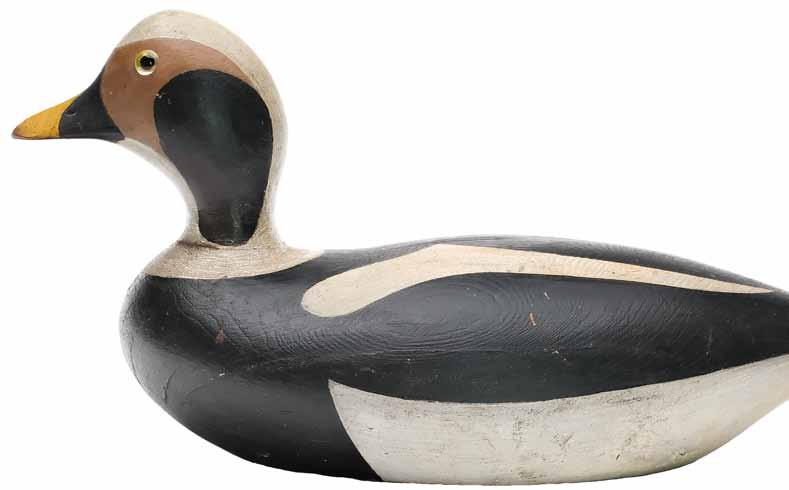
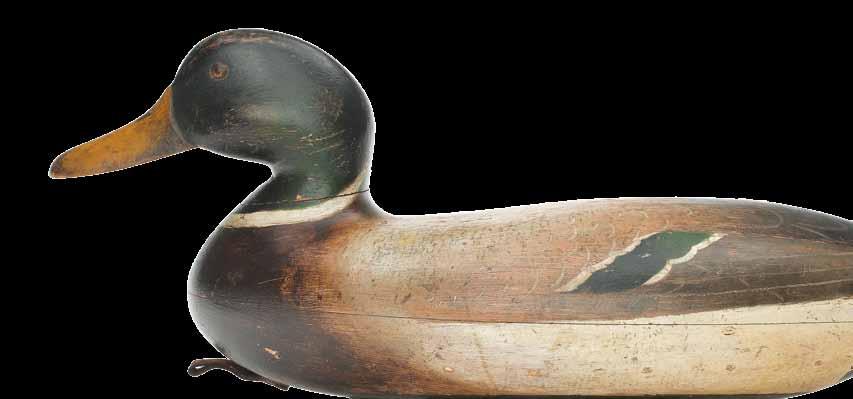
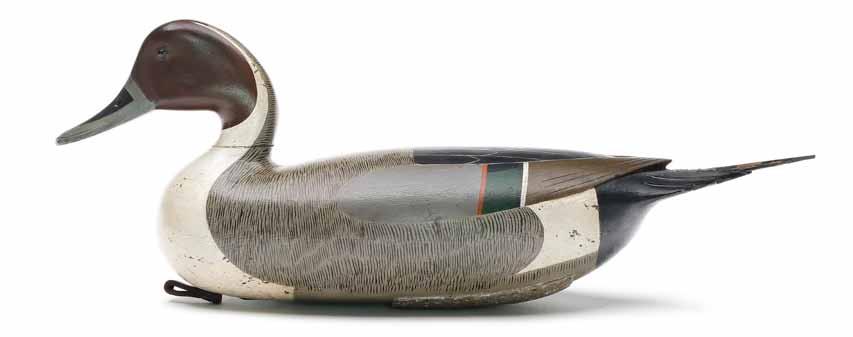
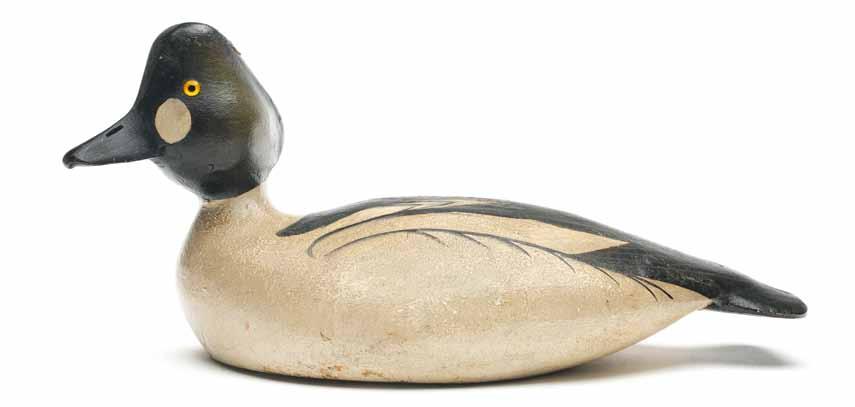
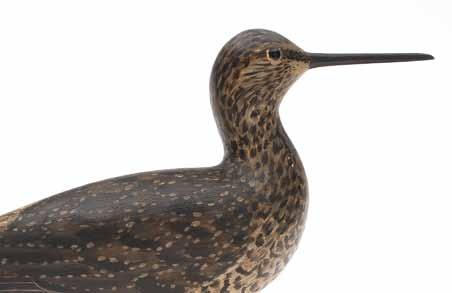
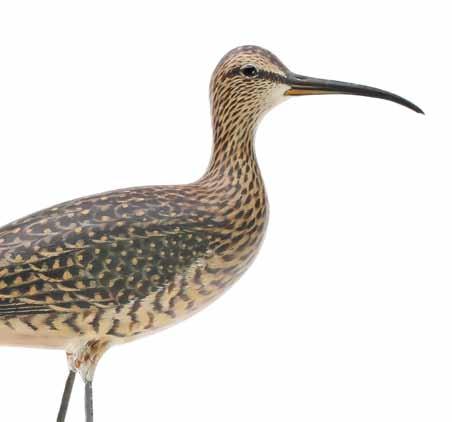
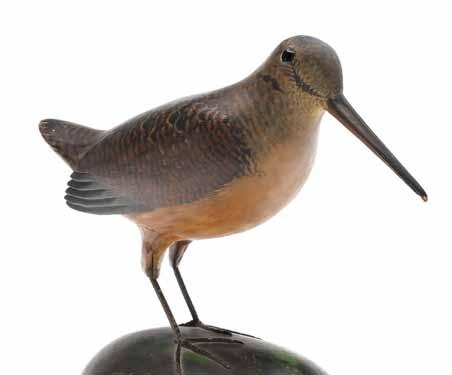
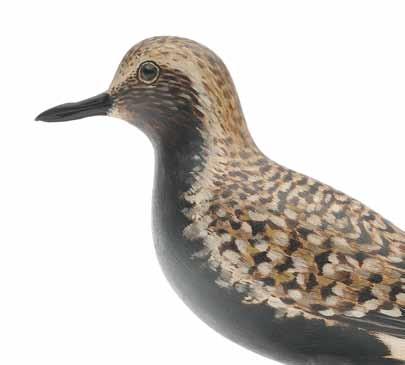
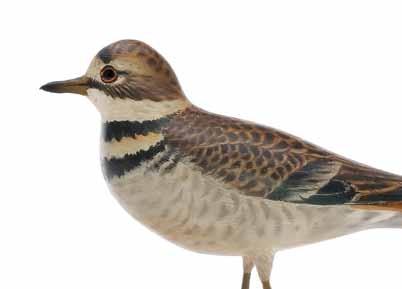
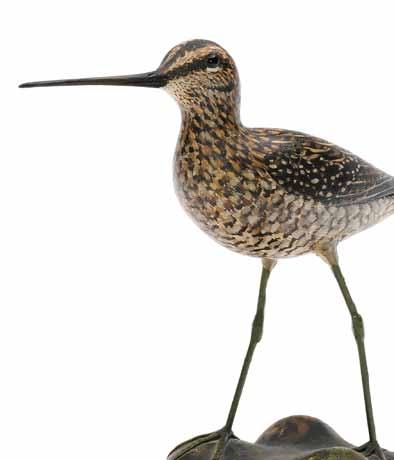
Decoys and Sporting Art at Auction
July 24 & 25, 2026
Featuring Session II of the Jim and Diane Cook Collection
The live auction will be held at the The Country School
716 Goldsborough St Easton, Maryland 21601
Thursday, July 23, 2026
Cocktail Reception and Preview
5:00 PM - 7:00 PM EST
Friday, July 24, 2026
Preview 8:00 AM - 9:30 AM EST
Auction 10:00 AM EST
Saturday, July 25, 2026
Preview 8:00 AM - 9:30 AM EST
Auction 10:00 AM EST
For questions during the auction call 410-745-0485
If you are interested in viewing a particular piece at the office, please call to be sure it will be available there at the time you plan to visit. We may also be in your area, and so a private viewing may be available. Please contact us for our schedule.
Catalog $50. Subscription (3 catalogs) $100. Absentee, Phone & Online Bidding accepted call 410-745-0485 for arrangements.
For free decoy appraisal call or email:
Jon Deeter | jdeeter@guyetteanddeeter.com | 440-610-1768
Zac Cote | zcote@guyetteanddeeter.com | 207-321-8091
Riley Deeter | rdeeter@guyetteanddeeter.com | 440-708-4748

Jon & Leigh Ann Deeter
1210 S Talbot St, Unit A
St. Michaels, Md 21663
Tel: 440-610-1768
jdeeter@guyetteanddeeter.com



Riley Deeter
Business Development
St. Michaels, Maryland
Tel: 440-708-4748
rdeeter@guyetteanddeeter.com
Mike Stevenson
Graphic Designer
St. Michaels, Maryland
Tel: 410-745-0485
michael@guyetteanddeeter.com

Lacey & Zac Cote PO Box 347
Freeport, ME 04032
Tel: 207-321-8091
zcote@guyetteanddeeter.com


Stormi Lind
Auction Manager
St. Michaels, Maryland
Tel: 410-745-0485
auction@guyetteanddeeter.com

Alex Hascha
Weekly Auction Manager
St. Michaels, Maryland
Tel: 732-575-3829
alexhascha@guyetteanddeeter.com
Michael Geleta
Finance Manager
St. Michaels, Maryland
Tel: 410-745-0485
billing@guyetteanddeeter.com
Ed Kenney
Merchandise Manager & Shipping
St. Michaels, Maryland
Tel: 410-745-0485
shipping@guyetteanddeeter.com


Mike Roberts
Shipping
St. Michaels, Maryland
Tel: 410-745-0485
Noah Christopher
Photography
St. Michaels, Maryland
Tel: 410-745-0485
photography@guyetteanddeeter.com



Baylee Saulsbury
Administrative Assistant
St. Michaels, Maryland
Tel: 410-745-0485
admin@guyetteanddeeter.com
Bill Lapointe
Decoy Consultant and Essayist
Swansea, Massachusetts
Tel: 774-644-9426
Sallie Glover is a USPAP-compliant appraiser specializing in Americana, including furniture, fine art, and folk art. She works closely w ith clients to provide comprehensive collections management and appraisal services across all collecting categories. Her expertise includes detailed inventories, database management, provenance research, and formal appraisals.
Previously, Sallie served as a specialist in the Americana department at Christie’s, New York. Based in Raleigh, North Carolina, she works with clients nationwide and travels as needed.

Josh Loewenstein er F ine Sporting Arms Division Head
704-280-2382
guns@guyetteanddeeter.com

J. Wesley Dillon Fir earms Consultant 410-745-0485

Tim Carey Fir earms Specialist
St. Michaels, Maryland 732-618-3833
tim@guyetteanddeeter.com
■ GUARANTEE - We have made a concerted effort to accurately catalog and describe the property to be sold. The decoys and paintings have guaranteed condition reports. Should the need arise, the auctioneer reserves the right to make verbal corrections and provide additional information from the block at the time of the sale. Absentee bids will not be executed on items that are found to be other than described in the catalog. Since opinions can differ, particularly in the matter of condition, the auctioneer will be sole judge in the matter of refunds. If we fail to identify a flaw that has an impact on the value, you can return the decoy.
■ DURATION OF GUARANTEE - Requests for a refund on an item purchased through a Guyette and Deeter, Inc. auction must be made within 3 days of the time you take physical possession of your purchases. Whether your items are shipped, delivered, or picked up at the auction site, it is still 3 days from date of possession. This guarantee is null and void if payment is received or mail is postmarked more than 30 days from the sale end date. The guarantee is also null and void if you choose to not take possession of your purchases within the 30 days. If you have paid for your purchases within the 30 days but Guyette and Deeter, Inc is unable to ship your item within the guarantee period, the guarantee will be extended until 3 days from the shipping delivery date. This policy protects our consignors by enabling us to make consignor payments in a timely manner.
■ Under no circumstances will we be responsible for damage to frames or glass, or damage caused by them. Paintings determined to be of high value or large size may be subject to special packaging at the buyer’s expense. Under no circumstances will we be responsible for damage to fragile decoratives. These items are marked in the catalog with an *.
■ Stands are not included with the decoys or weathervanes unless specified in catalog.
■ All duck calls have condition reports, but are sold “As Is”.
■ Trade Up Program - A limited number of decoys purchased may be paid for by consigning decoys. To participate, please contact our office ahead of time to discuss details.
■ Free appraisals are available with no obligation to consign and any correspondence is strictly confidential.
■ Pick up hours are 1pm – 5pm beginning July 29, or by appointment. Please call ahead so we can have your items ready.
September 10 & 11, 2026
Fine Sporting Arms
St. Michaels, Maryland
November 14 & 15, 2026
Decoys, Sporting Art & Americana
The Country School Easton, Maryland
In conjunction with the Easton Waterfowl Festival
February 2027
Fine Sporting Arms
St. Michaels, Maryland
April 2027
Decoys, Sporting Art & Americana
The Westin Lombard, Illinois
In conjunction with the North American Vintage Decoy & Sporting Collectibles Show
The best way to bid online at Guyette & Deeter auctions with the lowest platform fee availa ble : Sa ve up to 4% using our app!
Simply go to bid.guyetteanddeeter.com or use the QR code
Download the official Guyette & Deeter app:
• Bid on all of our live and online weekly sales.
• Search past sales in a large, ever growing prices realized database.
• Watch live streaming video from all of our live sales.
Bid in our live and online weekly auctions.
Search a huge, ever growing database of prices realized.


QR
Jon Deeter • 440-610-1768 jdeeter@guyetteanddeeter.com Zac Cote • 207-321-8091
Deeter
440-708-4748
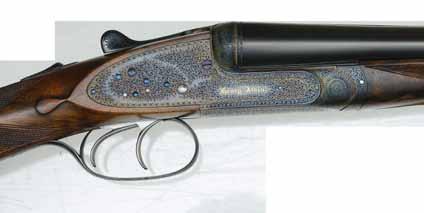
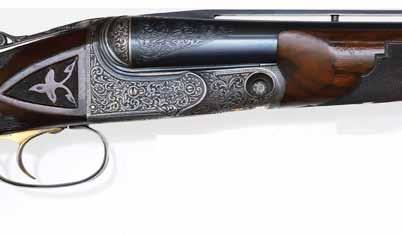
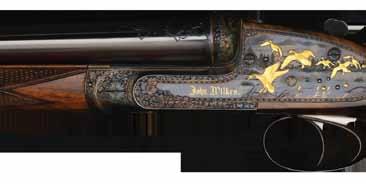
STUNNING HENRY ATKIN BEST QUALITY 28 BORE SHOTGUN WITH CASE.
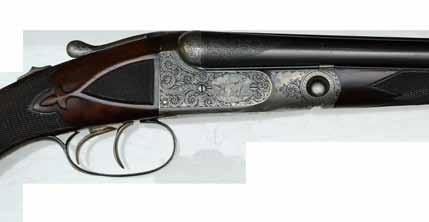
SUPERB AND TRULY UNIQUE FACTORY DOCUMENTED PARKER DHE GRADE 28 GAUGE WITH SPECIAL ORDER FEATURES.
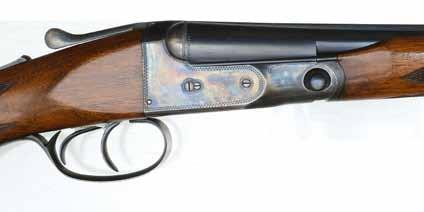
RARE TRANSITION ERA HIGH ORIGINAL CONDITION PARKER VH GRADE .410 BORE.
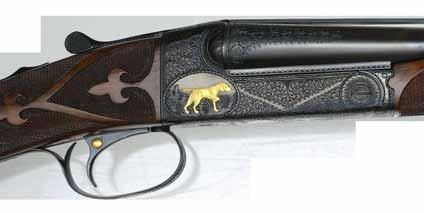
EXCEPTIONALLY FINE RARE AND DESIRABLE FACTORY DOCUMENTED WINCHESTER MODEL 21-6 WITH GOLD .410 BORE WITH CASE.
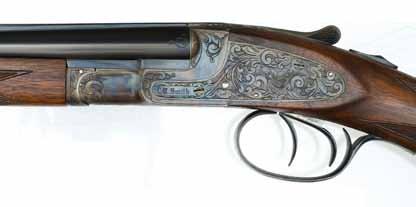
TRULY EXCEPTIONAL AND EXCEEDINGLY RARE NEAR MINT ORIGINAL CONDITION L.C. SMITH SPECIALTY GRADE .410 BORE WITH CASE.
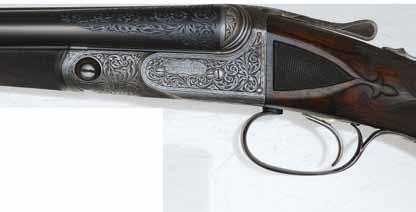
EXCEEDINGLY RARE AND HISTORICALLY SIGNIFICANT FIRST EVER PRODUCED PARKER AAHE 20 BORE SHOTGUN.
G&D Weekly will continue to host auctions every week throughout the year. Those interested in consigning items are encouraged to contact our new Weekly Auction Manager, Alex Hascha at (732) 575-3829.
• Fast hassle free in house shipping.
• Comprehensive guaranteed descriptions and high-quality image s.
• Easy and accessible bidding on our own platform.
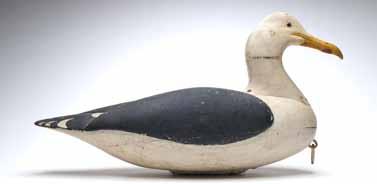
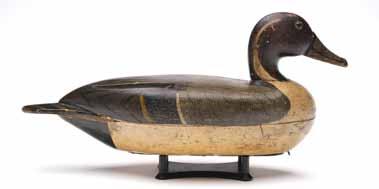
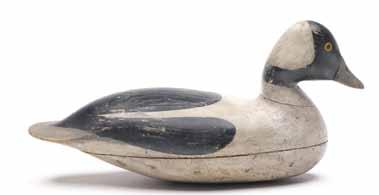
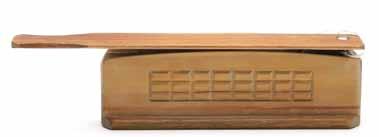
With nearly a year of preparation, processing, and promotion by the Guyette and Deeter team prior to Session I of the Jim and Diane Cook collection in April, it was a pleasure to see the market respond in such a tremendous way, to such a tremendous offering. Setting that amount of World Record prices for makers and raising the highwater mark for any decoy ever sold, doesn’t happen easily. A hardbound reference book, public exhibitions, and private presentations. Thousands of man-hours, many flights taken, and many more miles driven to put these treasures in the hands of those who appreciate them. When collectors put substantial time, effort, and resources into building their collections, we at Guyette and Deeter will likewise put all our efforts and resources into making the dispersal of those collections as enjoyable and successful as possible.
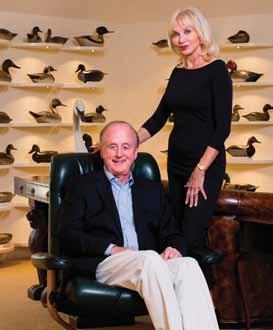
We are honored to offer Session II of the Jim and Diane Cook collection. Not since the early 1970’s, with the series of auctions featuring the extensive collection of William J. Mackey Jr, has the collecting community had such an outstanding opportunity to acquire rare and important North American waterfowl decoys. While Mackey was known for quantity, the Cooks have been and always will be known for quality and rarity. Over the last 45 years, Jim and Diane have been tremendous stewards of these important artifacts and now the caretaking of these works will be spread among the collecting community. Like many important pieces from the Mackey auctions, some of these decoys may not be offered again for decades, if ever.
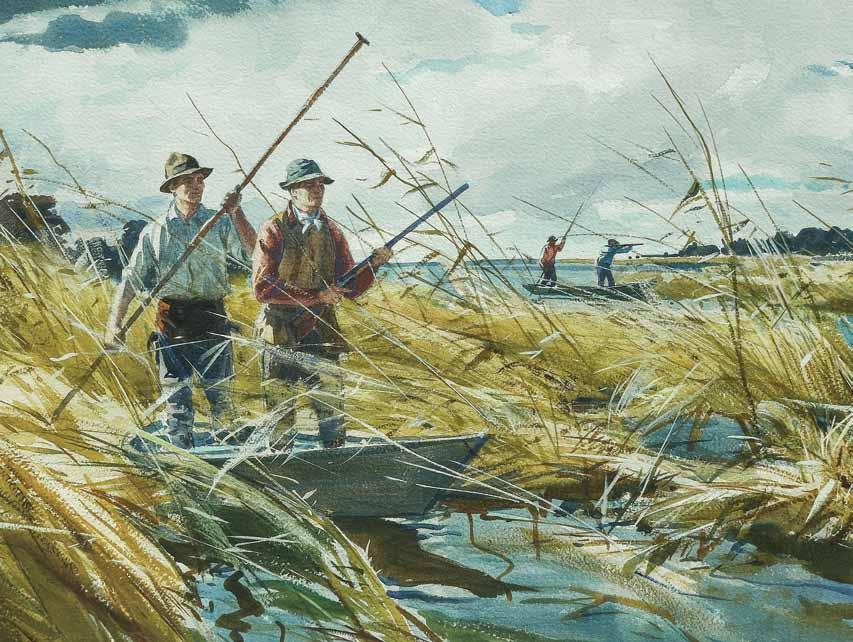
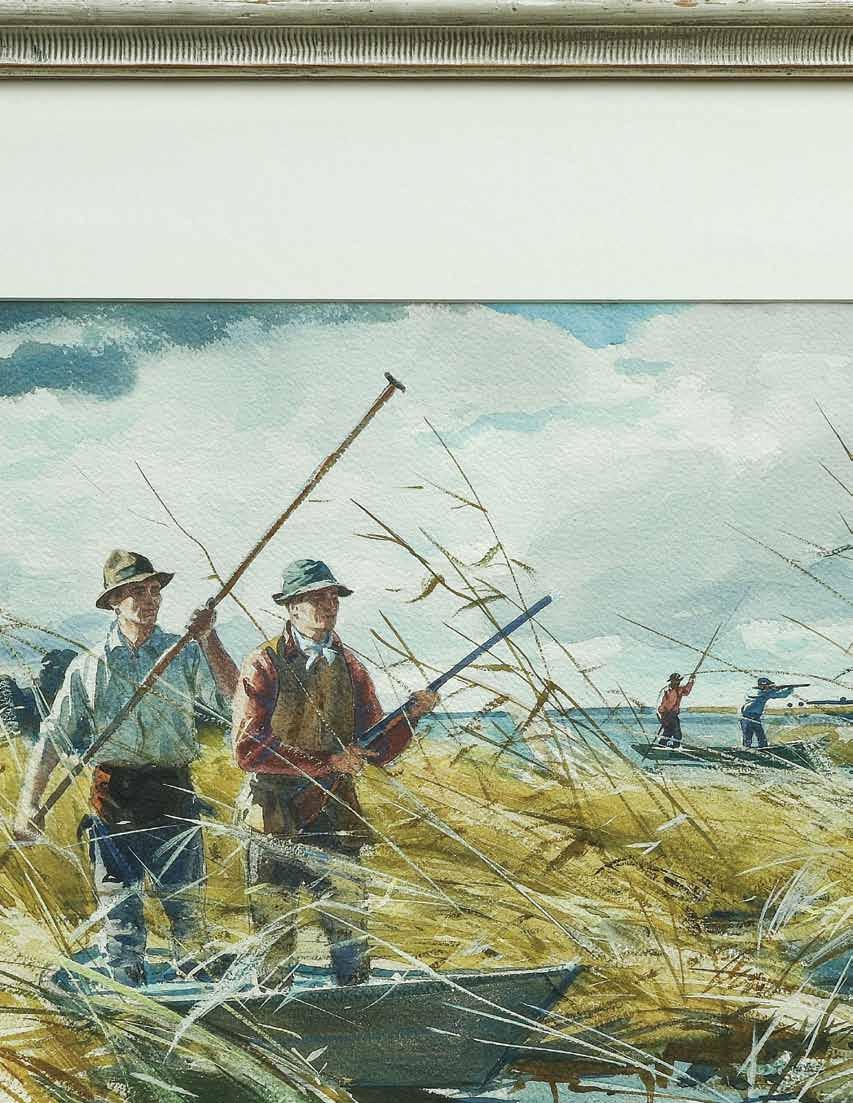
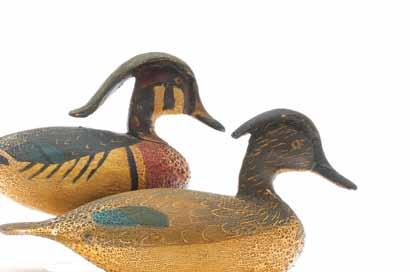
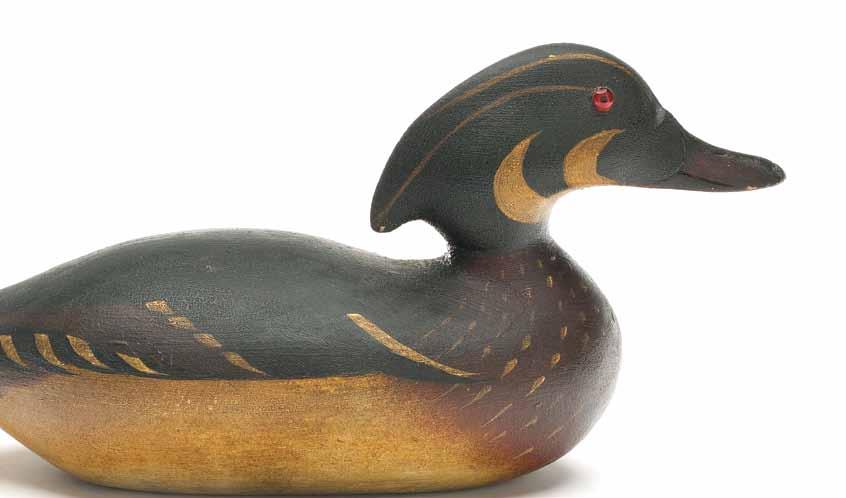
Many more exciting offerings from the collections of Oliver Smith, Don Leonard, John Decesare, Martin and Deborah Maloy, Joseph Ellis, Chris Mackey, and Frederick Raymon are also among these pages. A never before offered and fresh to the market wood duck by the Mason Decoy Factory, which was passed down in the Mason family, is an important highlight. Collectors of sporting art should take note of the rail shooting scene by Ogden Pleissner, perhaps the only of its kind. Fun and exciting objects for you to consider.
We hope you enjoy this catalog and the offerings within it. Good luck and we’ll hopefully see you at the sale!
The Guyette and Deeter Team
Friday, July 24, 2026
10:00 am EST
Lots 1 - 301
Saturday, July 25, 2026
10:00 am EST
Lots 302 - 574
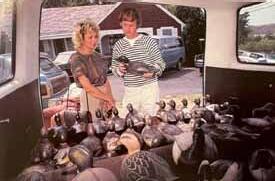
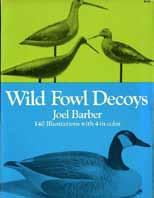
In 1918, after discovering an old, red-breasted merganser hen decoy near his Long Island boat house, a New York City architect named Joel Barber began searching for and studying North American waterfowl decoys. Barber organized many of the first decoy carvi ng competitions, as well as the first decoy exhibition in 1932. His love of the art form and early documentation of carvers from around the country culminated in the 1937 release of “Wild Fowl Decoys,” the first reference book on the subject. This early book inspired ma ny of the “first generation” of collectors who scoured attics, barns, and boathouses for the hunting relics. This early period of discovery and documentation helped preserve many retired hunting decoys from being discarded or destroyed.
In those early days of collecting, the gifting and trading of decoys was quite common. In 1973, however, an auction price of $10,500 was paid by Dr. James McCleery for a William Bowman curlew from the collection of William J. Mackey Jr. This world record price shook the antiques world, and decoys became recognized as a serious collectible art form. By 1985 the world record price had risen to $50,000 and in 1986 the collection of Dr. George Ross Starr Jr. was offered by the Richard A. Bourne Auction Company. When an extremely rare wood duck drake by Joseph Lincoln crossed the block, a new world record price of $205,000 was achieved, four times the previous record price for a decoy.
It has been 40 years since that Lincoln wood duck was offered publicly, but it is one of many extremely rare and important decoys to be offered from the collection of Jim and Diane Cook.
In the early 1980s, Jim Cook and advisor Joe Tonelli began visiting long-time collectors and dealers around the country, buying top examples by the most sought-after carvers. At auctions, when a potential addition to the collection was selected, Jim would often hold up his bid card and not lower it until the auctioneer sold the decoy his way. Many decoys in the collection were auction records for the maker when they were sold and some were only surpassed when Jim bid on a rarer and more pristine example, setting the highwater mark once again. Over the years Cook has set the world auction record for a shotshell box, duck call, as well as the highest price paid f or a fish spearing decoy, on two separate occasions.
Jim and Diane didn’t just collect waterfowl decoys. The warehouse at Investment Rarities, Jim’s gold and silver business, was fill ed with collections of pristine 20th century collectibles. From children’s lunch pails, Coca-Cola memorabilia, and early concert posters to art pottery, baseball memorabilia, and movie props. Over the last decade the Cooks have been deaccessioning those collections. A Babe Ruth home-run bat, $600,000, a Marilyn Monroe photograph signed to and owned by Joe DiMaggio, $300,000, and a Mickey Mantle rookie card, $225,000. The current world record for a concert poster was achieved in November 2022 when Heritage Auctions sold the Cook’s concert poster collection. A Buddy Holly “Winter Dance Party” poster from the collection achieved $447,000, shattering the previous world record of $275,000 set in April of that year.
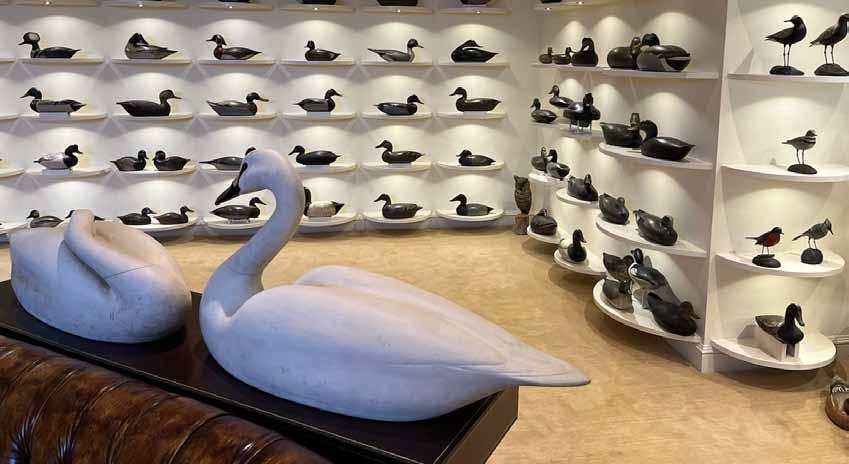
The decoy collection, being the last of the Cooks’ collections to be sold and the only collection to get a custom designed display room in their home, attests to Jim’s passion and love of North American decoys. For 45 years, Jim’s aggressive pursuit of high-condition waterfowl decoys has led to the Jim and Diane Cook collection. A grouping of rare and important decoys, the likes we may never see again in a private collection.
We at Guyette and Deeter are extremely honored and privileged to have been chosen to offer the Cook collection at auction in 2026 and 2027. Many of these pieces may not be available again for decades, if ever. Do not let this outstanding opportunity pass you by.
We hope you enjoy.
Session One • Friday, July 24, 2026 • 10:00am
A. Elmer Crowell
1862 - 1952 | East Harwich, Massachusetts
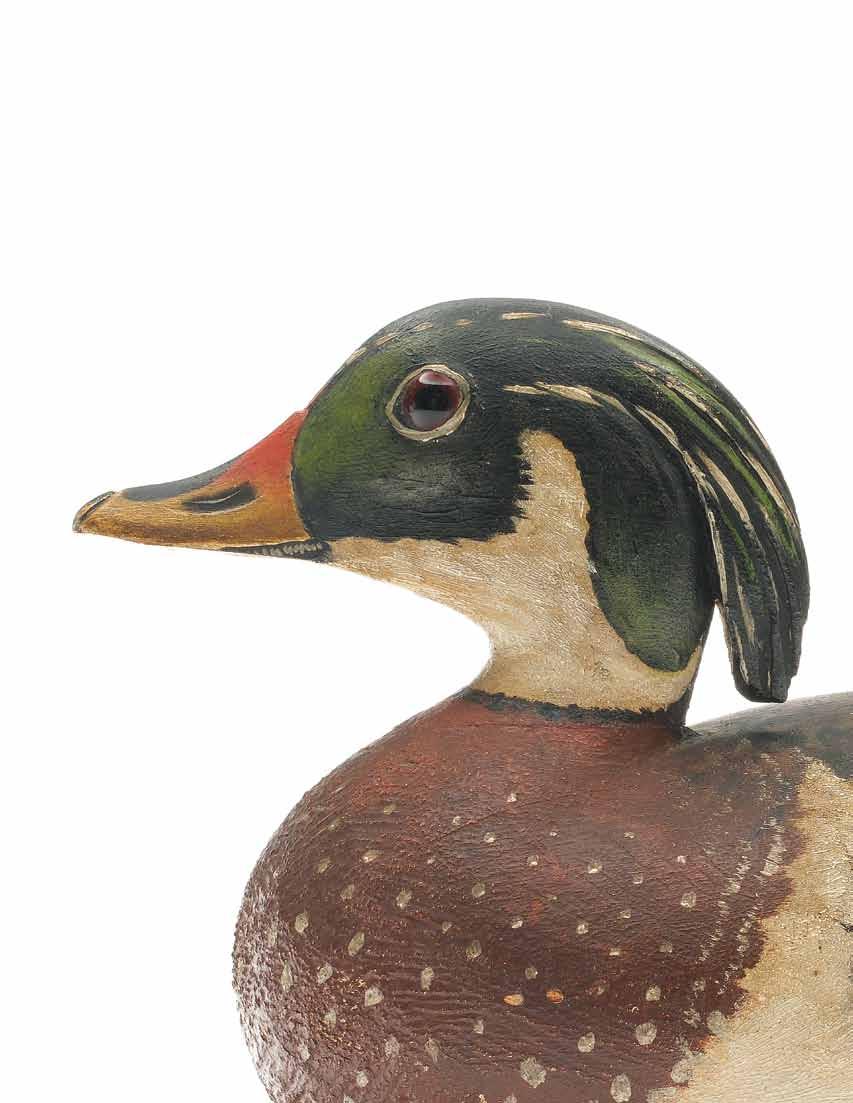
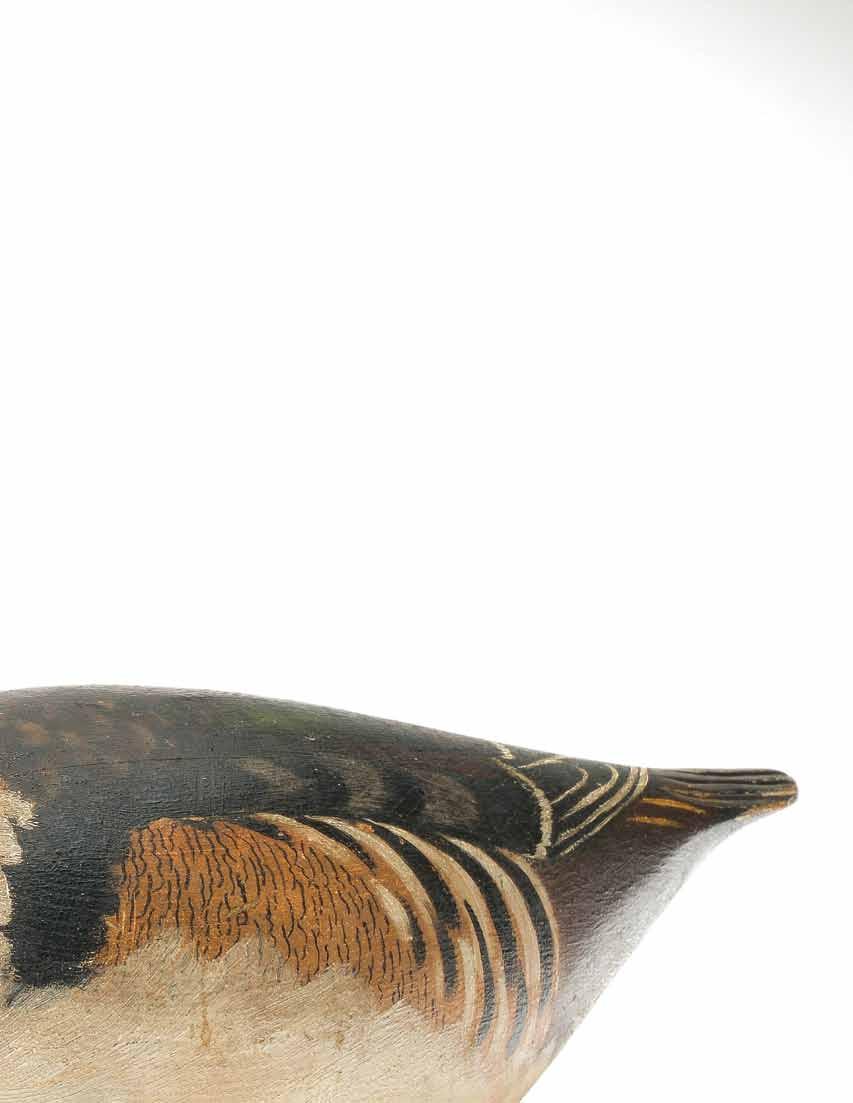
Wood ducks by Crowell are especially rare, and the example in the Cook collection, unrigged and in superb original condition, has an impeccably documented provenance. Originally purchased from Crowell, the decoy was found in a home in Westport, MA in the late 1970s and acquired by Tony Waring. It was held in his personal collection until he sold it to Jim and Diane in 1983.
Anthony A. (“Tony”) Waring (1928 – 2021) of Bay Point in Swansea, MA, was one of the earliest collectors in New England. His first old bird was acquired as a souvenir of a hunting trip to North Carolina in 1951. There were to be many more hunting trips and many more souvenirs! His collection quickly grew and, by 1966, he had amassed over 400 decoys. A trained architect (BS Rhode Island School of Design 1953), Tony had a keen eye for form and function, and, from the very beginning, his collection was focused on history, rarity and condition. Locally, he sought out the decoys at their source, but he was not averse to purchasing or trading with those of similar interest throughout the Atlantic seaboard and the Midwest and he befriended other, more well-known early collectors such as Mackey, Starr, and French. Some of his early exploits are documented in numerous issues of Hal Sorenson’s 1960s and 70s “Decoy Collectors Guide.”
One of Tony’s favorite hunting and collecting areas were the marshes, sheds and boatyards near his home in neighboring Westport and Dartmouth, MA, as well as Little Compton, RI. This area had a long tradition of duck hunting, both by the locals and by visiting sportsmen such as Shang Wheeler and Lou Rathmell of Connecticut. The region held numerous private blinds and small clubs, as well as a few of the larger,
more famous gunning stands. Decoys by Crowell were fairly common, such as those used at the “Pequaw Honk” Club and the Allens Pond stands. Lincoln was well represented in the spreads at the Quicksand Pond Gun Club and in the well-known Brayton rig. Mason factory decoys in all grades, both ducks and shorebirds, were also present in quantity, as were smaller numbers of well-done decoys by talented local carvers.
Many of Waring’s “finds” were truly memorable. The sleeping black duck by “Shang” Wheeler in the Cook collection was acquired by Tony from Wheeler’s fishing guide on Westport Point. As mentioned, the Crowell wood duck also came off a mantel in Westport. The three Crowell “dust jacket” plovers pictured alongside the wood duck on the cover of Shirley and John Delph’s “New England Decoys” were found floating in the Westport River after the 1938 hurricane and purchased by Tony from Herb Hadfield. The photo on the cover of the New England book was taken at the sea wall in front of the Waring home on Mount Hope Bay.
Decoys carrying the Tony Waring provenance should be treasured as coming from not only one of the premier pioneering collectors and historians but an equally fine gentleman.
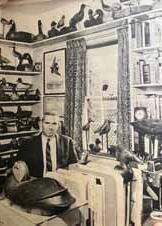
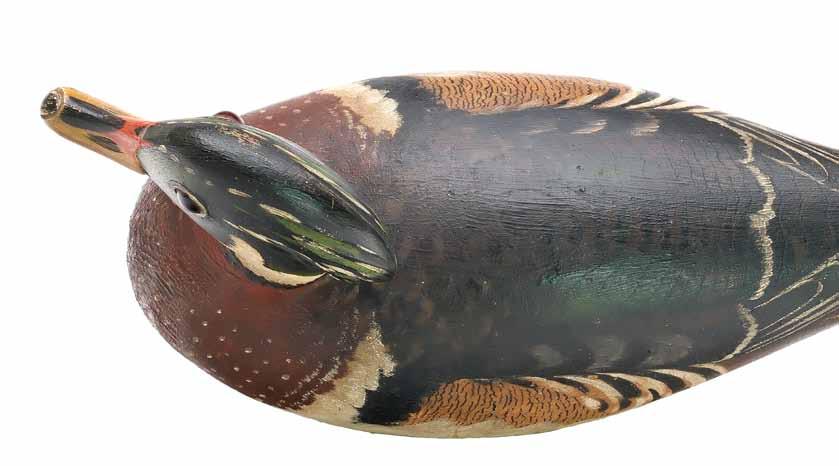
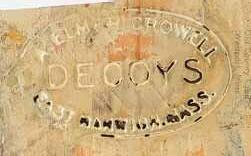
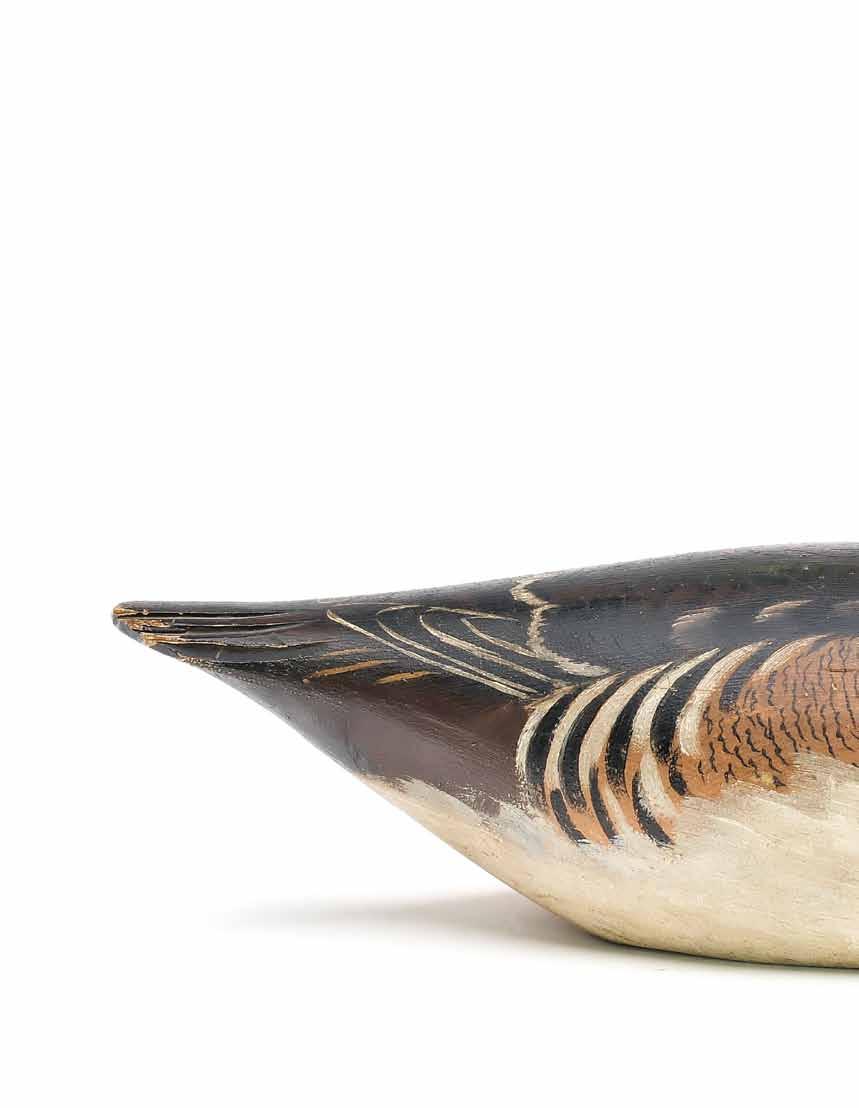
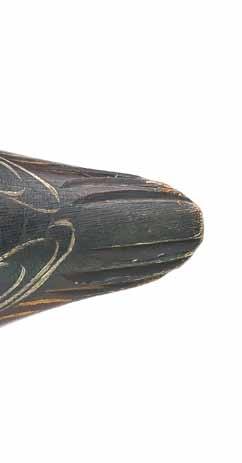
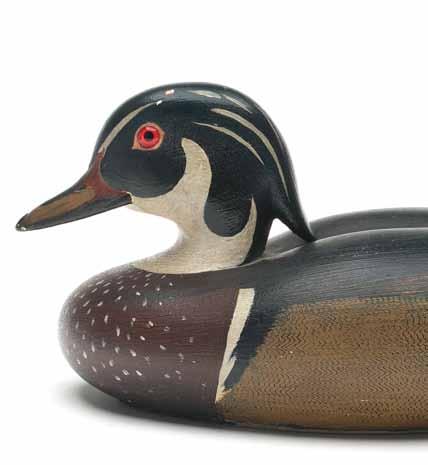
1 A. Elmer Crowell (1862-1952), East Harwich, Massachusetts. Excellent wood duck. Slightly turned head with relief tail feather carving. Extended crest has relief feather carving. Maker’s oval brand in underside. Measures 13.5” long. Original paint with very minor wear on edge of tail and tip of bill; dent in one lower side of breast; otherwise excellent structurally.
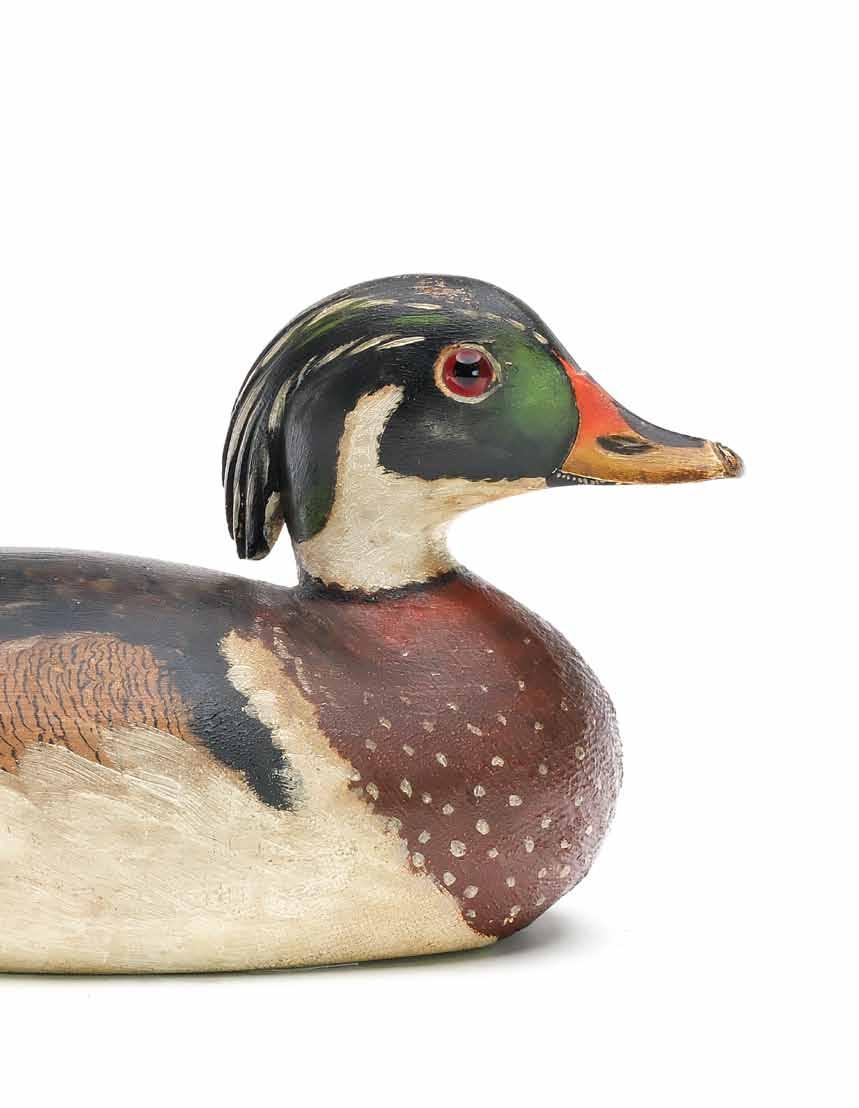
Provenance: Tony Waring collection. Jim and Diane Cook collection.
Literature: “New England Decoys” by Shirley and John Delph, front cover and page 119, exact decoy pictured. “Decoys” by Gene and Linda Kangas, page 286, exact decoy pictured.
(120,000 - 180,000)
“Was Blair a portrait painter? A banker? The wealthy owner of a carriage manufacturer?”
The genesis of this mystery begins with Bill Mackey’s claim that Blair himself was the portrait painter in question, even though John Blair, Jr. identified his father as a “sportsman” in Barber’s book. Sorenson argues against Mackey’s conclusion and then shares his belief that Blair was a banker.... Some years later, the narrative takes another turn, courtesy of the Bible of Delaware River decoys, “Floating Sculpture.” In it, the authors recount a visit to the Blair family farm in Elkton, MD. and with its current occupant, Colonel John Blair III. Col. Blair remembered his grandfather well, stating that he was a wheelwright, and the birds were painted by a trolley painter. The authors go on to postulate that Blair, based on his alleged acquaintances, gun club memberships and purchase of the 138-acre Elkton farm must have been the owner of a carriage manufacturer.
And there the lead goes cold, and the mystery remains. However some new information has come to light very recently, that seemingly clears up some long-held misconceptions.
Extensive research conducted through The Carriage Museum of America, “The Hub” of 1890, which was the preeminent trade journal carriage builders, and “Gopsill’s Philadelphia Business Directory of 1879, 1887 & 1890 indicate that John Blair was not the wealthy owner of a carriage manufacturer, as his name is not included in any business name or advertisement. In fact, searching the Gopsill directories more deeply reveals there are no John Blairs listed for the following occupations: Carriage & Coach Makers; Wagon Builders; Wheelwrights; Wood Turners; Carvers; Sporting Goods; Shipbuilders; Frame Makers; Clock Makers; Trimmers; Hubs & Spokes; Doll Heads; Engineers; Mechanics; or Painters.
However, upon closer inspection of the US Census of 1900, we can see in the far-left margin that John Blair’s address is penciled in as 4936 Franklin Street, Philadelphia, Pa. How do we know this is the correct “John Blair” we are looking for? Because the entry includes what we know to be his wife (Susie) his sons (John Jr. and Walter) and his daughter, Maude.... Interestingly, John Blair also had a younger daughter, Annie, a sickly girl who passed away at age 15.... I mention this as Blair was initially investigated (found not guilty) of contributing to her death by disciplining her with a severe whipping for misbehavior ( The Times of Philadelphia , 1/17/1899).
John Blair resided in the Frankford section of Philadelphia, ward 23, at 5034 Franklin Street (1879) and then 4936 Franklin Street from 1883 until 1905, when the family moved to Elkton where he lived until his death. This period encompasses 50 years (age 36 - 86) certainly the prime of his life. Using records from the U.S. City Directory 1822-1995 in each case shows his occupation as “Carpenter.” This record, without deviation, is the closest thing we currently have as evidence of Blair’s occupation.
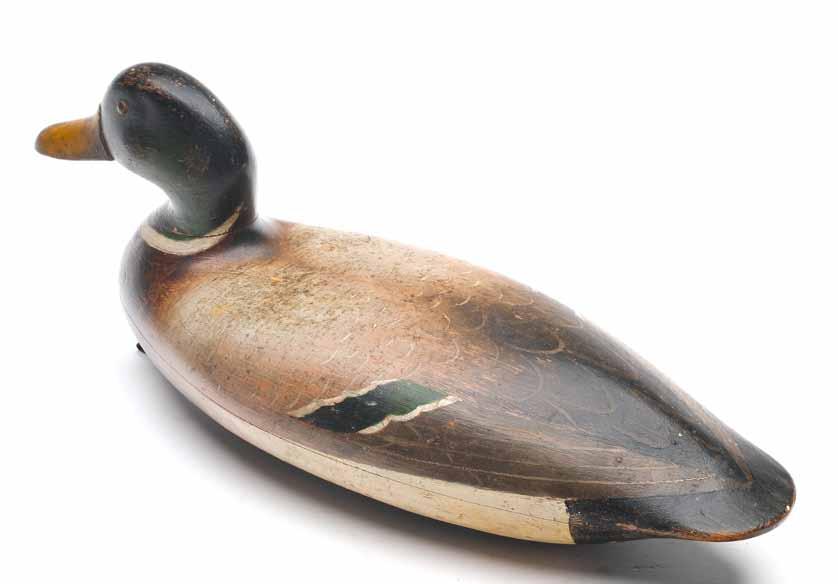
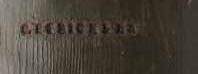
Of interest though, is an F. W. Swope resided at 4364 Franklin Street at the same time as John Blair lived at 4936 Franklin; who was an active member of the Frankford-Bridesburg gun club, and who owned a carriage manufacturer! It is quite possible, even likely, that Blair was employed by Swope and through that relationship became associated with the well-heeled patrons whose names are stamped on many of the Blair classics.
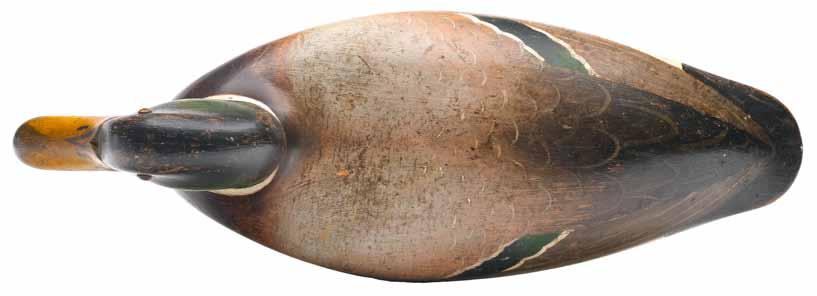
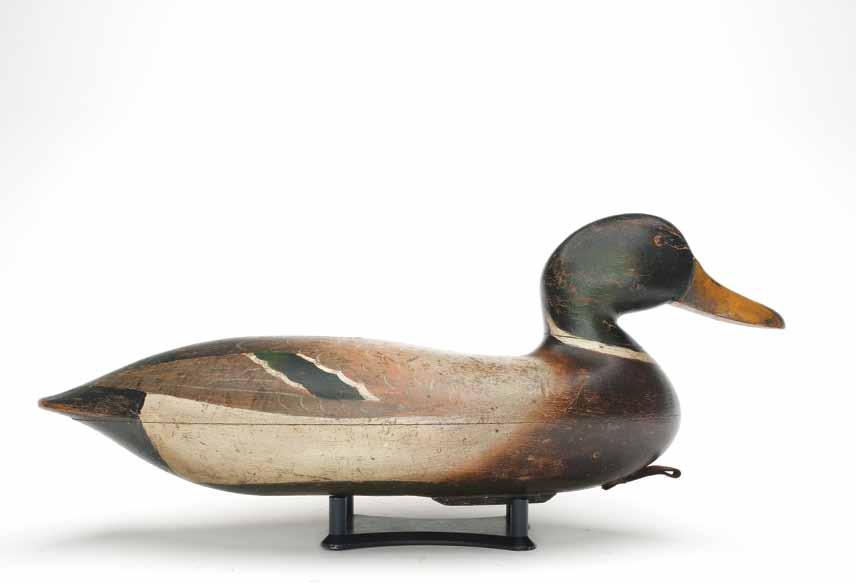
2 John Blair, Sr. (1843-1929), Philadelphia, Pennsylvania. Rare mallard. Hollow carved with tack eyes and raised neck seat. “C. Sprickles” branded on the underside. Measures 17” long. Original paint with minor flaking and wear, mostly on head and edge of tail; like most Blair decoys the dark green paint on underside was added after the decoy was rigged; excellent structurally.
Provenance: Part of a group of 11 Blair decoys purchased by Bob White from Cass Bains, caretaker for the Biddle family. Bob sold it to Lloyd Johnson, who in turn sold it to Bill Mackey. Bill Mackey lent it to Adele Earnest for use in her book, Art of the Decoy. Bob White traded it back from Bill Mackey for a dozen Bob White decoys from his personal rig. Bob White collection. Bruce Williams collection. Jim and Diane Cook collection.
Literature: “The Art of the Decoy” by Adele Earnest, page 114, exact decoy pictured. “The Great Book of Wildfowl Decoys”, Joe Engers, editor, page 124, exact decoy pictured. “Floating Sculpture” by H. Harrison Huster and Doug Knight, page 4 and 32, exact decoy pictured. “Delaware River Decoys: The Bob White Collection,” The Noyes Museum, 1/24/88-4/10/88. “Ducks, Decoys and the Delaware: A Regional Hunting Tradition,” Bucks County Historical Society, 4/17/04- 1/3/05. (60,000 - 90,000)
Joseph Lincoln never left the home where he was born on Gardner St, in the Accord section of Hingham. As a young man, from about 1880 through 1895, he, like many others in the area, worked in a shoe factory or he occasionally worked on a piece rate basis out of a small 10’ x 12’ “tinker’s shop” behind his home. After his father’s death, he lived with his mother and brother, Wilbur, who worked as a farmer and/or raised poultry on the family homestead. By 1910 through the early 1920s, Joe was a “carpenter” and he was remembered by his neighbors as being extremely talented when it came to building or repairing almost anything from furniture and boats to clocks.
He was a life-long, avid hunter and his home was conveniently situated directly on the shore of Accord Pond. It was here in 1904, that he became instrumental in the operation of the North Shore Gun Club. This group, like ones before it on the site, maintained one of the famous Massachusetts shooting stands, utilizing live decoys as well as numerous carved blocks. The complex consisted of a comfortable club house, an elaborate, long blind, storage sheds and live bird pens. John C Phillips in his “Shooting Stands of Eastern Massachusetts” states that “Relative to its size, I think that more fowl have been shot in this pond than any other in the State.” Joe had been making decoys for his own use since 1885. He expanded his production to include carving birds for friends and club members, which eventually would spread his reputation far beyond Accord Pond. A 1918 article in a Boston newspaper recognized him as one of only two (commercial) decoy carvers in the State (the other being Cape Cod’s A.E. Crowell). Demand for his decoys became great enough that by the early 1920s, he is listed in the Town Directories as “Decoy Mfg” and this would be his trade for the remainder of his working life. All of his decoys were produced in or, weather permitting, in front of his tiny “tinker’s shop” at his home. His business cards advertised his work locally, while contemporary articles about him in numerous periodicals spread his fame beyond the State’s borders. As late as 1933, he staged an elaborate exhibit in the annual Boston Sportsman’s Show.
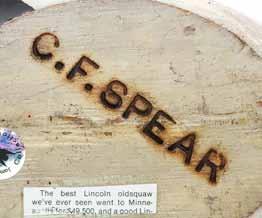

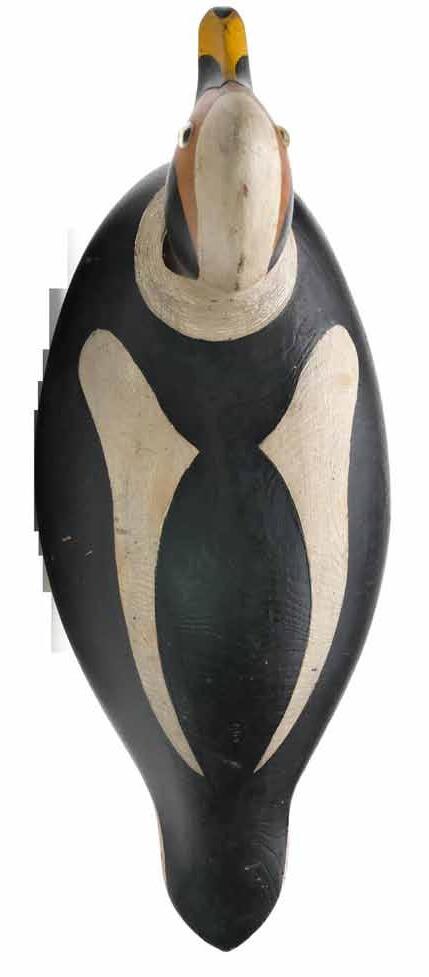
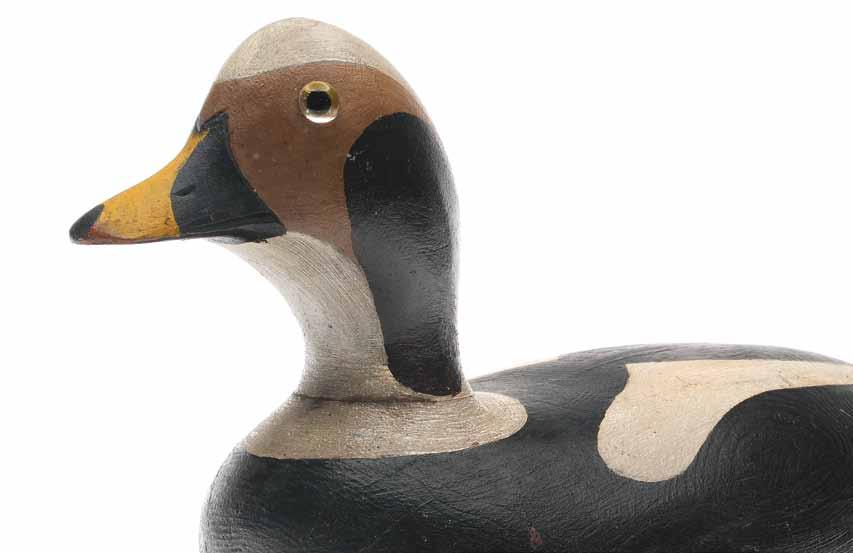
3 Joseph Lincoln (1859-1938), Accord, Massachusetts. Rare and important long-tail duck. A rigmate to the world record wood duck sold in April of 2026. Branded “C. F. Spear” on underside. Decoy was never rigged or weighted. Measures 15” long. Excellent original paint with scattered minor rubs; hairline crack in one eye; some very old glue visible on front of neck seat.
Provenance: Jim and Diane Cook collection.
Literature: “Decoys” by Gene and Linda Kangas, page 218, exact decoy pictured. (120,000 - 180,000)
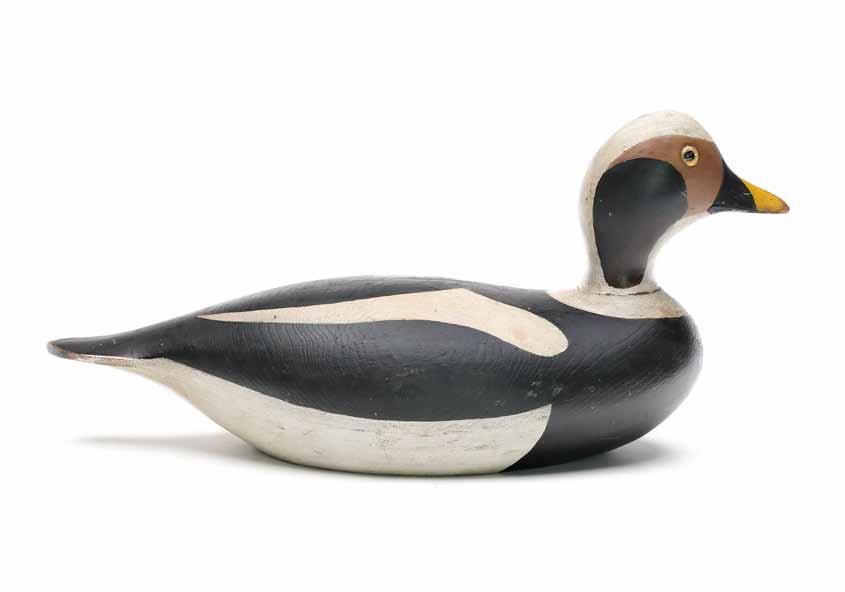
Joe’s decoys are elegant in their simplicity. There were no wasted knife or brush strokes. As a minimalist, he captured the essence of the live bird as few others have on the Atlantic coast. The range of his work included solid, as well as hollow (1 known) decoys, as well as canvas over frame models, and his unique “self-bailers.” His relatively few miniature carvings are tiny replicas of his working decoys.
Elmer started to carve his first decoys as early as 1876 when he proclaimed “At fourteen my father bought a large tract of land on the south shore of Pleasant Lake in East Harwich. I had only six live decoys that first season. I made nine block decoys and put them off about thirty yards in the lake.” This was to be the start of a long and fruitful career that would, ultimately, earn him the title of “Father of American Bird Carving.”
Until the 1890s Elmer, like his father, listed himself as a “Mariner,” a common label on the outer Cape at the time. From the 1900 census through at least the 1920 Federal record he states that he was a “cranberry farmer.” What does not seem to appear in any genealogical record is that he was also a well-known market hunter and an exceptional trainer and handler of live decoys. These two skills brought him into contact with a number of wealthy sportsmen who sought him out to manage their private “Gunning Stands.” These were elaborate hunting clubs complete with a comfortable camp, extensive blinds, pens for live decoys and storage sheds. These operations required a full-time manager during the lengthy hunting season. Fortunately for Elmer, this schedule fit rather well with his cranberry farming.
Wooden decoys were certainly well-known during Elmer’s younger years and, in fact, one early author states that at an early age “He had made hundreds of decoys and he had orders to make more.” At some point around 1905, however, he pondered, “Why not make some good ones and charge accordingly.” His creativity unleashed, he made birds with heads turned in a variety of poses, used better eyes and accurately imitated their natural plumage and coloring. When finished, he shipped the order to a wealthy customer explaining why the amount of his bill was considerably greater than his former bills had been. “The result was that almost immediately, he received orders for more decoys of that kind from that customer and more and still more from that customer’s friends.” Starting around 1898, these early affluent customers would include such well known names as John C Phillips at his Wenham Lake and Oldham Pond stands, “The Three Bears,” Charles Ashley Hardy, H Windeler and L Underwood at their stand on Pleasant Lake and Horatio duMont at his Cliff Pond stand. As his fame and influence spread, the number of stand locations and names expanded to include a long list of influential men from New Hampshire to the Massachusetts - Rhode Island border, including names such as Cunningham, Nickerson, Long, Williams, Willard, French and scores of others.
These patrons demanded (and could afford) the finest of hunting accoutrements, including decoys, and it was for these individuals that Elmer produced some of his very finest carvings.
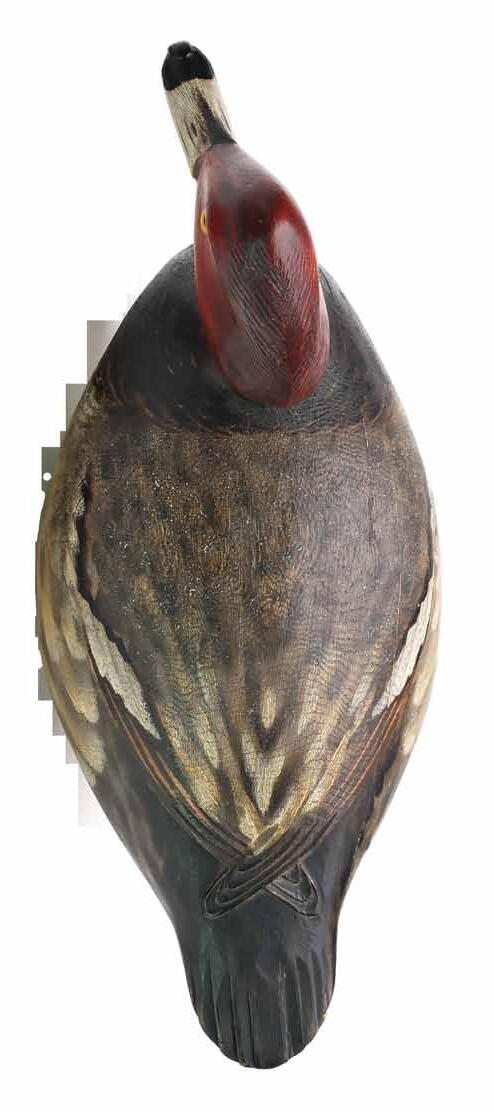
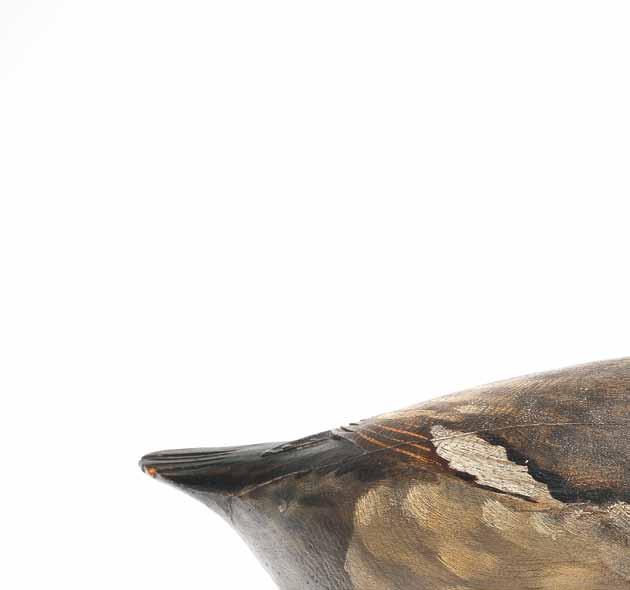
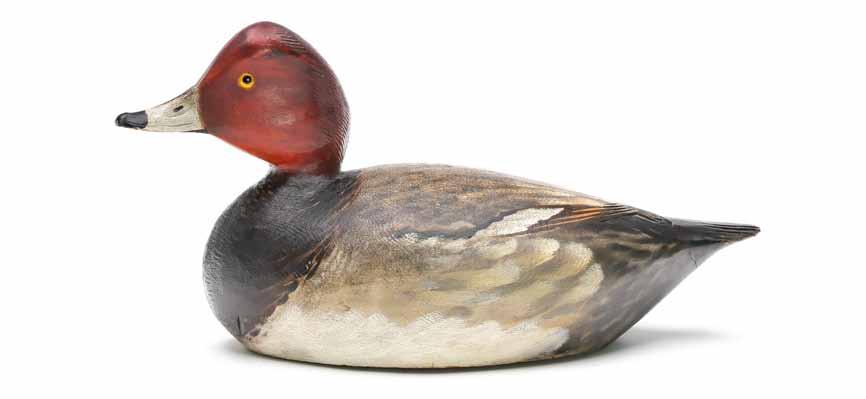
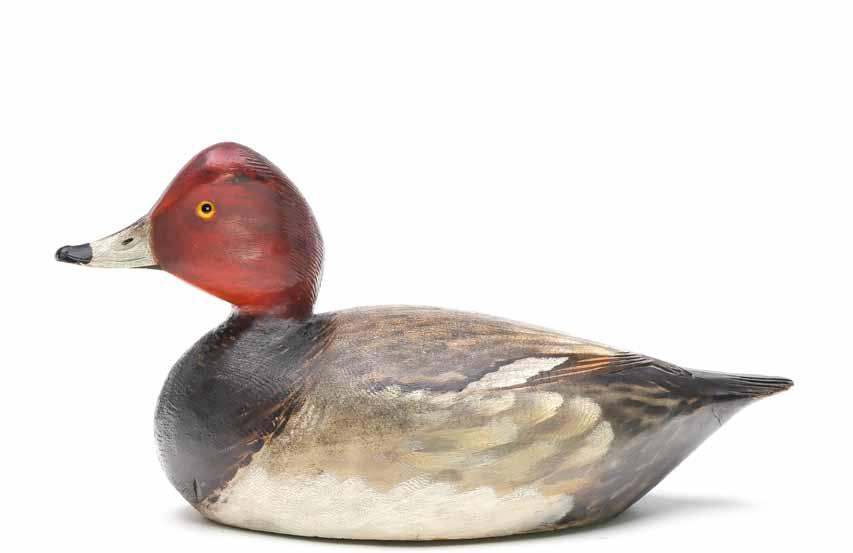
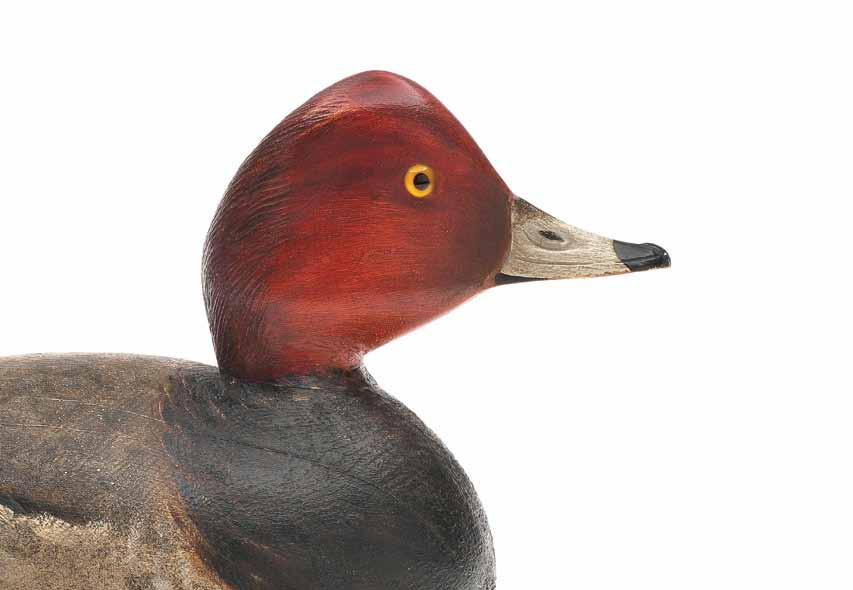
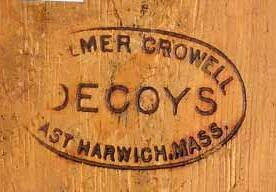
4 A. Elmer Crowell (1862-1952), East Harwich, Massachusetts. Outstanding redhead. Made for Dr. John Cunningham. Slightly turned head, relief crossed wingtips, and relief tail feather carving. Oval brand in underside. Decoy was never rigged or weighted. Measures 15.75” long. Excellent original paint with only tiny rubs and flakes to edge of tail and bill; the piece of wood used had a tight crack along one side of back that was filled in the making; dent in one lower side of breast.
Provenance: Jim and Diane Cook collection. (120,000 - 180,000)
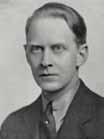
Dr Edgar Burke | 1889 – 1950 | Jersey City, New Jersey
The Burke family immigrated to the US from Germany in 1897, but little is known of Edgar’s youth or educational background. By the time of the 1930 census, he was a practicing surgeon at the Jersey City Hospital in Jersey City, NJ and, by 1933, he was the Assistant Medical Director at that institution. Never married, he resided for most of his working career on the hospital grounds.
In addition to his medical expertise, Burke was one of the most widely known, accomplished, well-rounded, sportsmen and artist of his day. He was fond of trout fishing in the Rangely area of western Maine, the same region frequented by Shang Wheeler. Like Wheeler, he became adept at tying flies, and his “Dr Burke” streamer is still fished in the area today. His knowledge of the sport allowed him to be chosen by the Anglers Club of New York to author “American Flies and How to Tie Them” which was published in 1931 by the Derrydale Press, whose creator was Eugene Connett. This would serve to catapult Burke’s illustrating career, and he would go on to produce the drawings for other fishing titles, including Ray Bergman’s “Just Fishing” as well as his most recognized work, “Trout.” Burke also enjoyed upland shooting, and he was selected by John Alden Knight to illustrate two of his widely read books, “Woodcock” and “Grouse.” The Doctor’s fondness for the outdoors, however, also included a passion for waterfowling. Connett called upon him again to illustrate his “Duck Decoys,” as well as some of the plates in his “Duck Shooting Along The Atlantic Tidewater” which also included a chapter by Burke on shooting in the Carolinas, notably, Pamlico Sound, Currituck, Pea Island and, at the Green Island Club in Ocracoke, a favored haunt of the Dr. Burke would go on to add oil paintings to his repertoire, and he is a recognized sporting artist as well as illustrator. Later in life, he served as a judge at various decoy contests alongside William Mackey and Lynn Bogue Hunt.
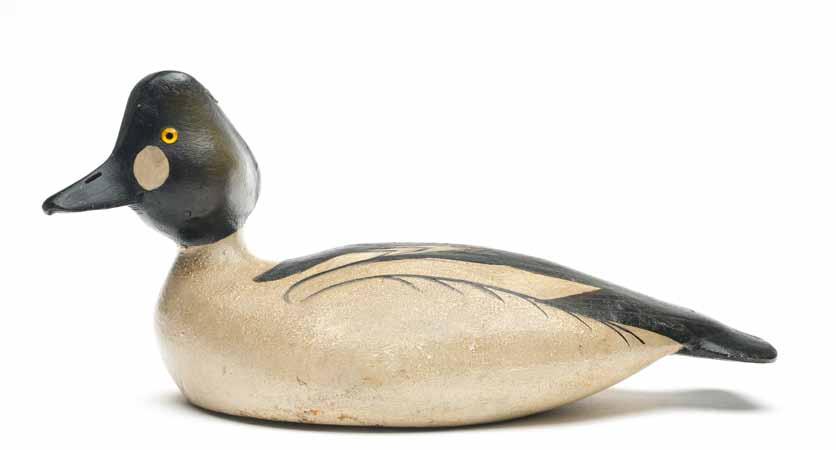
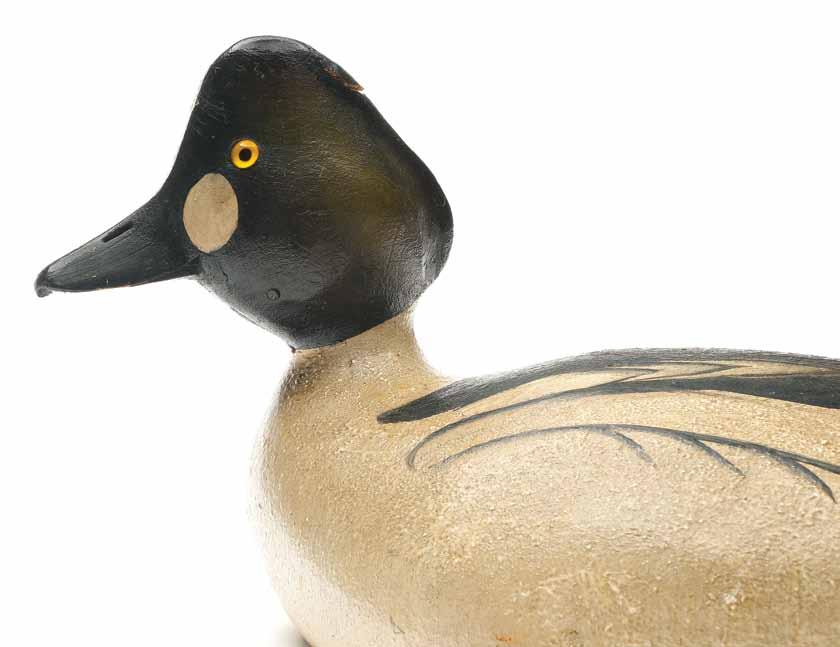
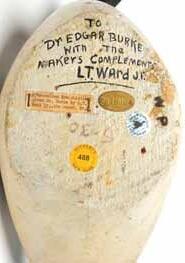
It is uncertain how it occurred, but Burke’s interest in gunning somehow brought him into contact with the Ward brothers. The friendship between the three men must have been quite strong for the Wards carved a number of special decoys for the doctor which they inscribed with the notation, “To Dr Edgar Burke with the makers compliments - L.T. Ward,” certainly implying that they were intended as a gift. Three pairs of these, bluebills, canvasbacks and pintails, are picture opposite page 129 in “Duck Shooting Along The Atlantic Tidewater.” The drake goldeneye in the Cook collection is a mate to these six decoys and represents the great care that the Ward brothers instilled into these extraordinarily special carvings intended for a dear friend. Undoubtedly, they represent the best of the Wards’ celebrated “1936 style.”
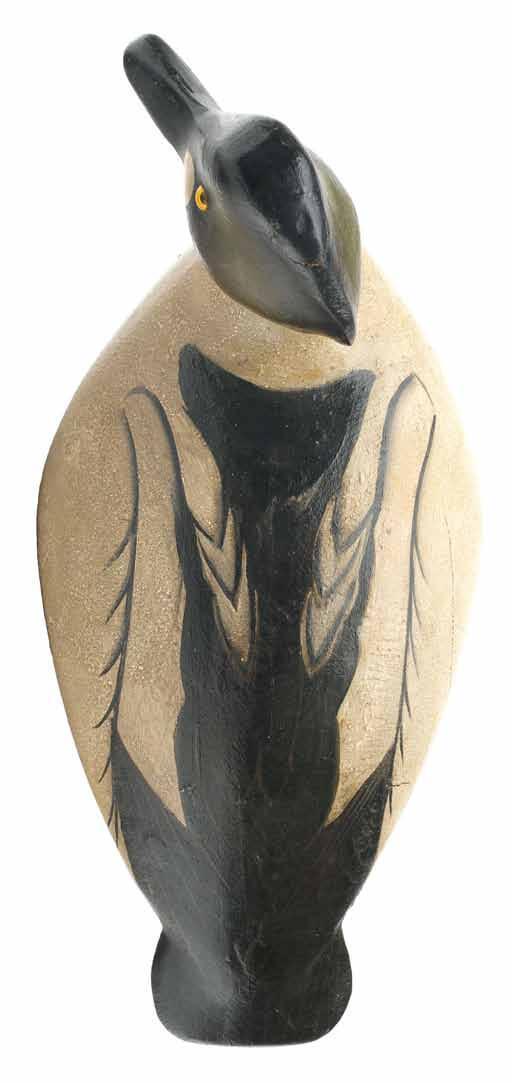
5 Ward Brothers, Crisfield, Maryland. Important goldeneye. Head is turned 45 degrees. “To Dr. Edgar Burke with makers compliments L.T. Ward Jr” painted on underside. Also with the McCleery collection ink stamp and Sotheby’s sticker. Branded “WP” for the Winward Prescott collection. Measures 15” long. Original paint with a few minor rubs; an early coat of
varnish has darkened with age; slight separation at filler on top of head; remnants of newspaper wrapping on underside and breast.
Provenance: Winward Prescott, Jr. collection. Dr. James McCleery collection. Jim and Diane Cook collection. (80,000 - 120,000)
Winward (“Bud”) Prescott Jr. 1917 – 1978 | Swansea, MA
Bud Prescott was a neighbor and close friend of Tony Waring. Both were early collectors, beginning to study and amass their decoys in the 1950s, and both were early contributors to Hal Sorenson’s “Decoy Collectors Guide.” Prescott’s interest in hunting stems from his family members, especially his cousin, Dr. Ralph French, and uncle, Everett Mills, both founders of the Pequaw Honk goose stand in Little Compton, RI. Bud branded many of his decoys with his bold “WP” imprint.
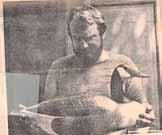
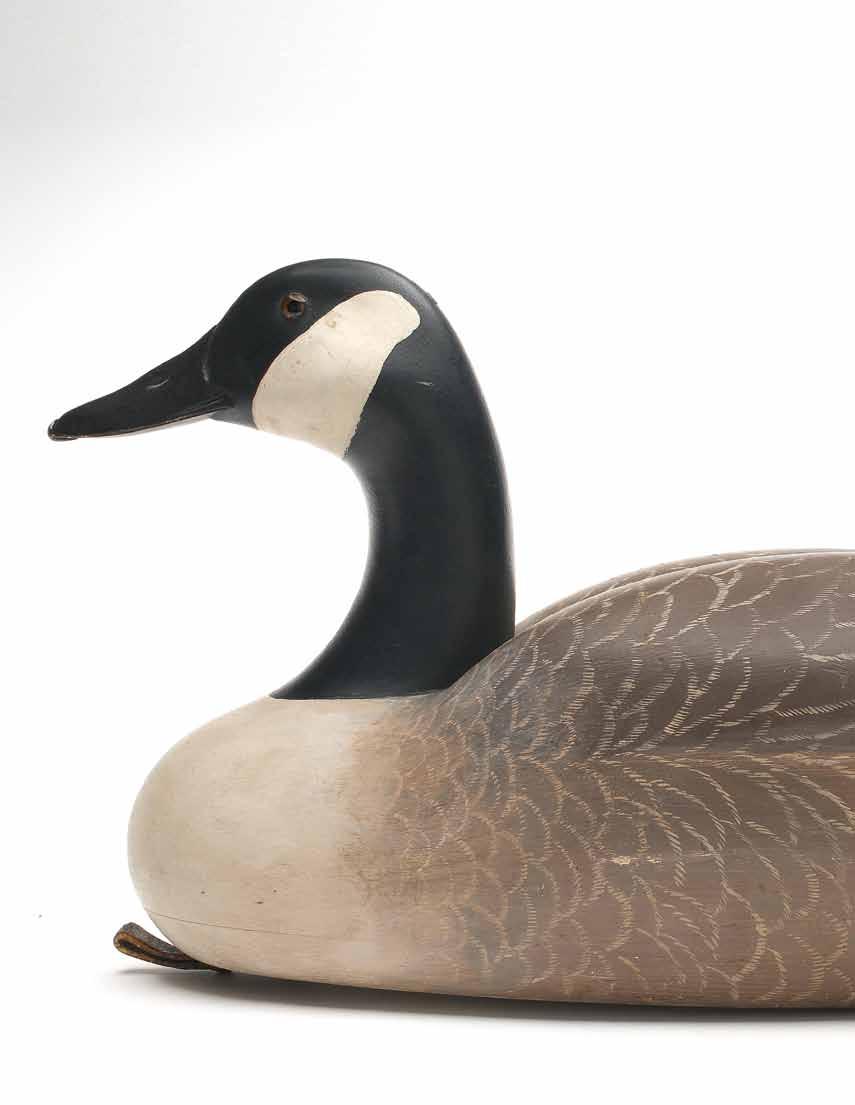
Charles E. “Shang” Wheeler (1872-1949), Stratford, Connecticut. Rare and important Canada goose. Hollow carved with relief wing and highly detailed bill carving. Measures 26” long. Original paint with very minor wear; small spots of discoloration near tail; drip of white along one side near wingtip; large teardrop weight was removed at some point; excellent structurally.
Provenance: Estate of the maker. Connecticut Audubon Society collection. Jim and Diane Cook collection.
Literature: “Wild Fowl Decoys” by Joel Barber, 1954 edition, front cover (in reverse) and page 104, exact decoy pictured. (80,000 - 120,000)
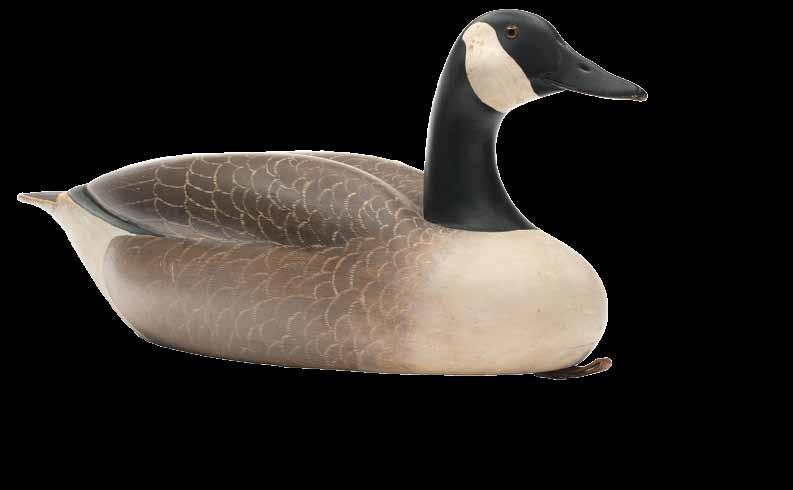
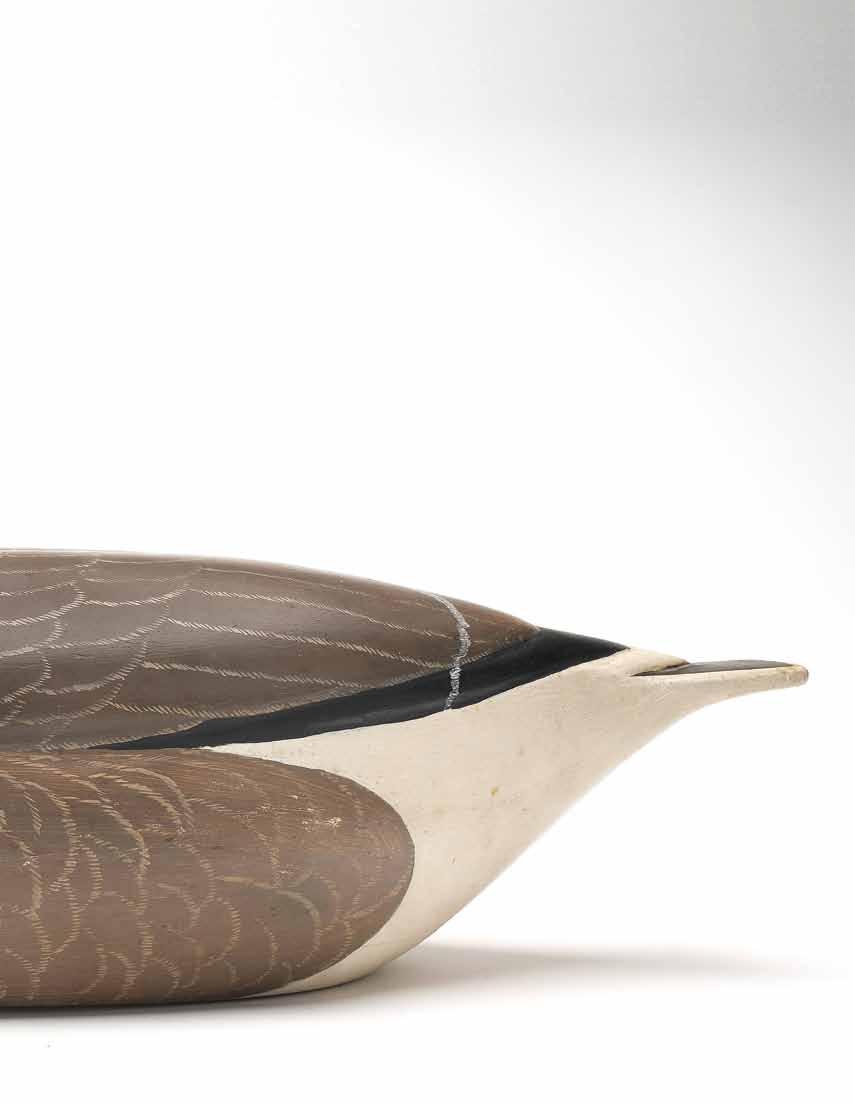
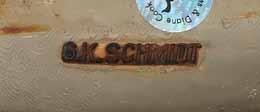
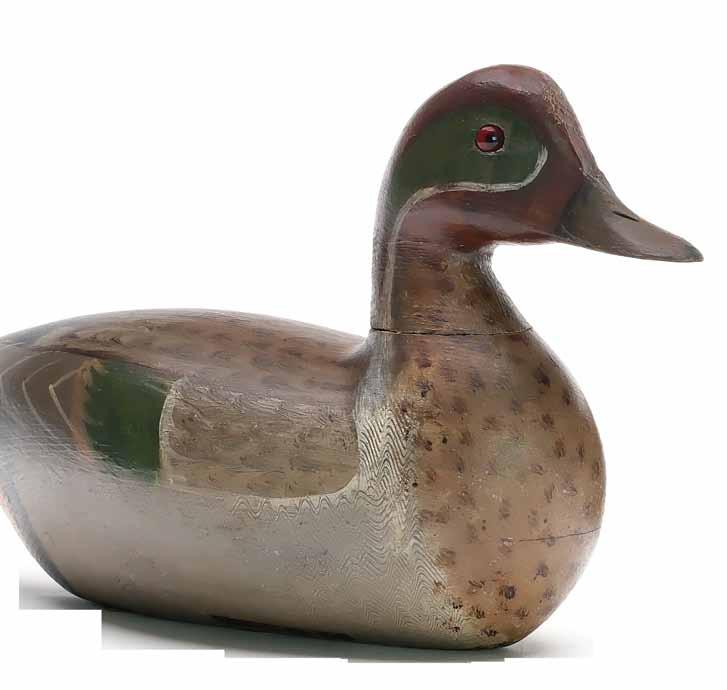
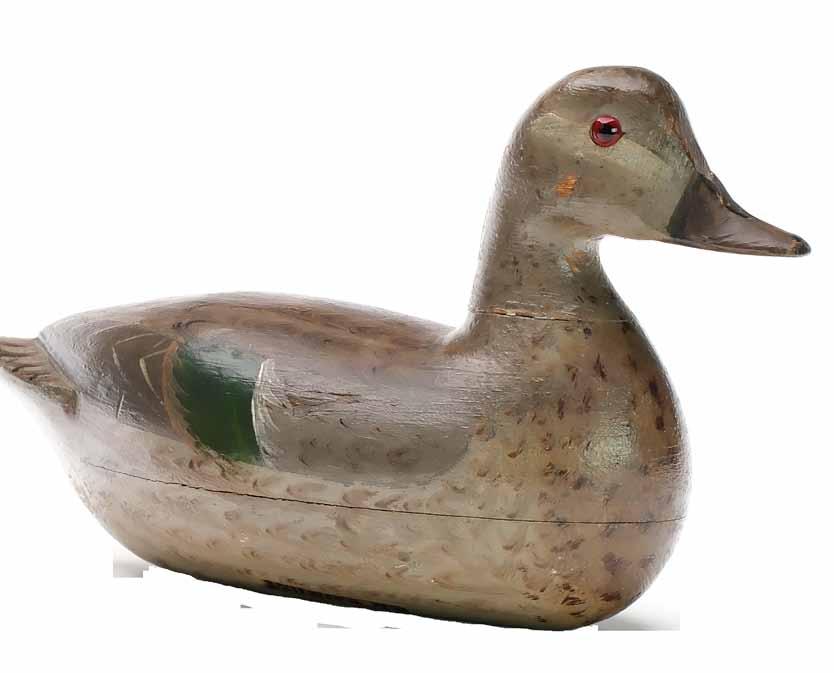
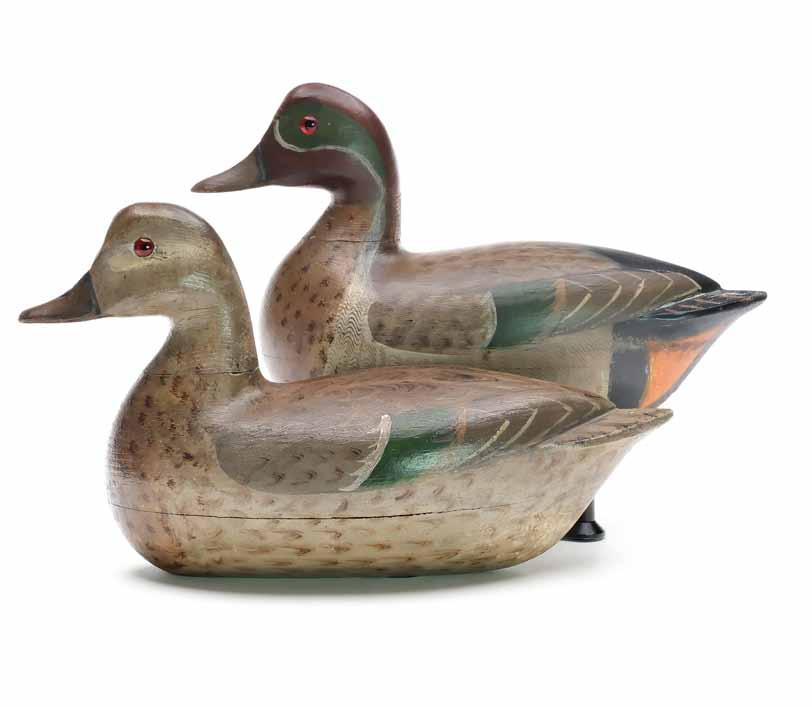
7 Charles Perdew (1874-1963), Henry, Illinois. Very rare and important rigmate pair of greenwing teal. Hollow carved with comb feather paint detail on drake. Both branded “G.K. Schmidt” on lower side. Measure 10.5” long. Original paint with very minor flaking and wear; dent on one side of hen’s head and body near wing patch; minor roughness on one side of hen’s bill; very slight separation at body seams and neck seats; thin line of varnish added around hen’s neck seat; chip in one side of drake’s bill was professionally restored; some filler and touchup to a small chip on one side of drake’s neck seat.
Provenance: Jim and Diane Cook collection. (20,000 - 40,000)
Few collaborations in American decoy history have achieved the enduring respect and fascination commanded by the decoys of John English and John Dawson. Collectors have long placed a premium on these dual-effort works—decoys that combine the refined carving of English with the bold, stylized painting of Dawson. The result is a rare marriage of craftsmanship and artistry: two great makers, one great decoy.
John Gleason English (1848 – c.1911), Florence, New Jersey
John English was among the most talented and prolific carvers of the Delaware River school. His decoys are celebrated for their exceptional form, near-perfect proportions, and finely rendered detail. English was not only a master carver but also a gifted painter—his plumage patterns were applied with remarkable precision and subtlety, placing his work among the finest from the region. English’s total lifetime output is estimated at roughly 500 decoys, representing a wide variety of species. Like many dedicated waterfowlers of his time, English regularly refreshed his hunting rig—selling used birds once they began to show wear and carving new ones for himself. As a result, many of his older decoys passed into the hands of other hunters who
occasionally touched them up or repainted them. After English’s death, a younger craftsman named John Dawson acquired a large portion of his rig. Rather than simply repairing the birds, Dawson reimagined them—bringing a new visual life to English’s already elegant forms. Around 1920, Dawson repainted roughly one hundred of English’s decoys, creating what collectors today recognize as the English/Dawson decoys—some of the most distinctive and desirable examples from the Delaware River tradition.
John Dawson (1886 – 1959), Trenton, New Jersey
John Dawson was a remarkable talent in his own right—a craftsman, painter, and outdoorsman whose creative vision left a lasting mark on the American decoy tradition. Born into a family of early settlers in Trenton, Dawson spent most of his life working as a kiln operator for the Scammel Pottery Company. Like many who lived along the Delaware, he was an avid hunter and waterman, and it was this connection to the river that shaped his artistic sensibilities. Dawson’s painting style stood apart from his contemporaries. Strongly influenced by the Art Nouveau movement, his work was highly stylized and abstract, yet still evocative of the living bird. His brushwork transformed utilitarian hunting tools into objects of sculptural grace. The collaboration between English and Dawson began when Dawson inherited or was gifted a rig of English decoys that needed “sprucing up.” Some of these birds were stripped and repainted entirely; others were painted directly over the original
surfaces. In both cases, Dawson’s work brought renewed vitality to English’s masterful carving. Later in life, Dawson carved and painted his own decoys—often sold through local hardware stores for just $2.00 each. These self-made examples, known as Dawson/Dawson decoys, include divers such as redheads, bluebills, canvasbacks, and mergansers, as well as a rare bufflehead.
The English/Dawson decoys remain among the most compelling examples of artistic collaboration in American folk art. English’s balanced, fluid forms provide the ideal foundation for Dawson’s expressive, flowing paintwork. Together, they embody the transition between the purely functional working decoy and the emerging recognition of decoys as works of art. To collectors, these birds represent more than just fine craftsmanship—they tell the story of two generations of New Jersey makers, united by the river, the hunt, and the timeless pursuit of beauty in utility.
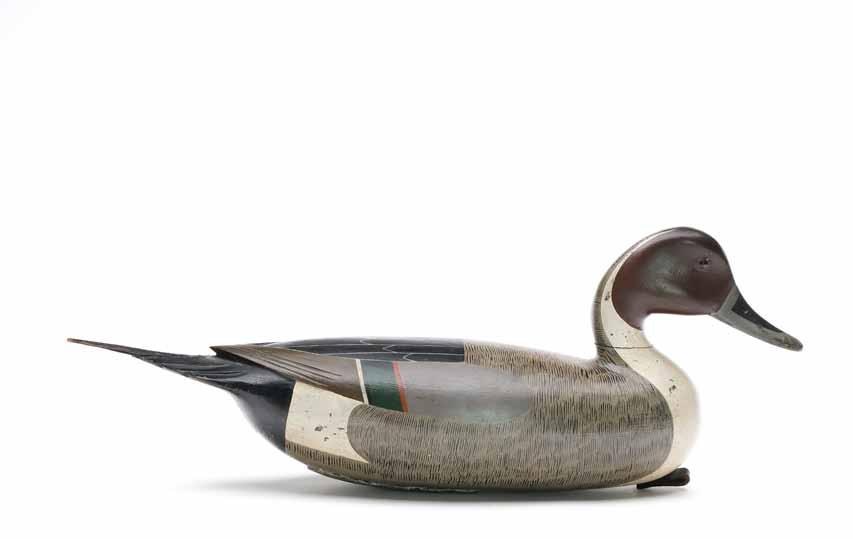
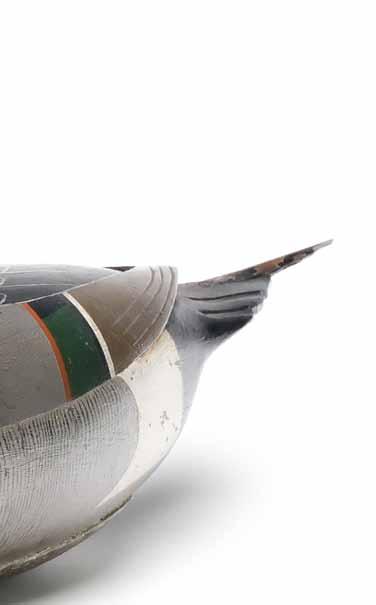
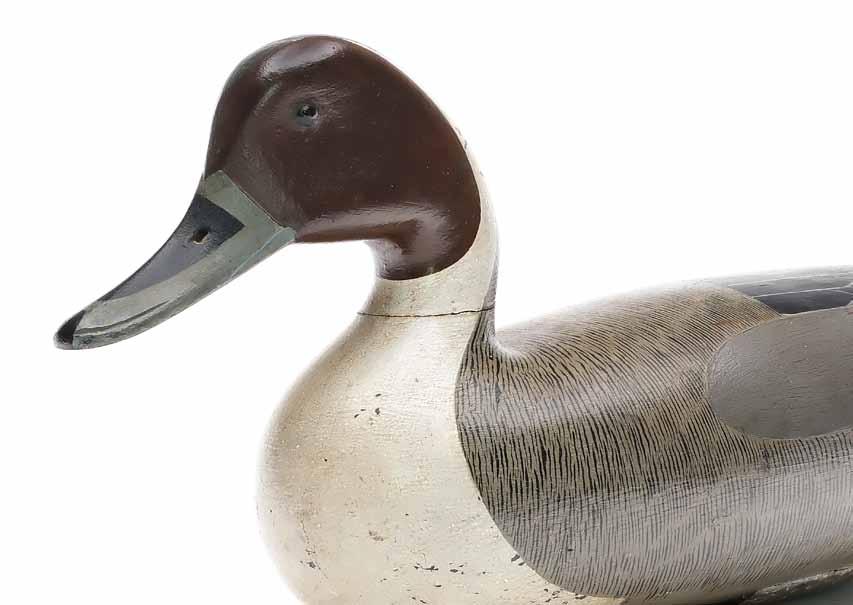
8 John English (1848-1915), Florence, New Jersey. Exceedingly rare English/Dawson pintail. One of only two known. Hollow carved with raised neck seat and raised V wingtip carving. Relief tail feather carving and inlaid hardwood tail sprig. Hillman collection ink stamp on underside. Measures 18.25” long. Early in use repaint by John Dawson with very minor flaking and wear; old chip at tip of tail sprig, otherwise excellent structurally.
Provenance: John and Isabelle Hillman collection. Jim and Diane Cook collection.
Literature: “Floating Sculpture” by H. Harrison Huster and Doug Knight, page 121, exact decoy pictured. “Decoys of the mid-Atlantic Region” by Henry A. Fleckenstein Jr., page 67 and 144, exact decoys pictured. (80,000 - 120,000)
Bach was born in Switzerland and is reported to have been trained as an architect and draftsman although he listed his education as ending after three years in high school. This is a relatively insignificant detail, since art and creativity, as was to become apparent, can often be innate. After serving 6 years in the Swiss Infantry, he left his homeland and traveled to Denmark where he boarded the Hellig Olav and set sail for the United States. He was fluent in several languages, but not English and, upon his arrival to the States, he settled briefly in a German speaking community in Pennsylvania. Here, he polished his English and bought his first book in this country – one on the American Indian. This formed a fascination with the Native Americans that would remain with him for his entire life.
By 1917/18, he had migrated to Michigan where he is listed as a “draftsman.” Here he began to live in two separate and distinct worlds. He yearned for, and dreamt of, a life in the rugged north woods. However, even though he wielded a pen and not a wrench, for the remainder of his working life, he would be embroiled in the smoke and grit of Detroit’s renowned “motor city.” He found employment, first as a draftsman, and ultimately, head designer for a number of that city’s largest automobile manufacturers in their heyday including Studebaker, Rickenbacker, Chrysler and Dodge. In 1929, he married Margaret K Watson and lived in a very blue-collar neighborhood with her parents. They had a son, also named Ferdinand, but the union was dissolved in 1936 with Margaret being granted an (uncontested) divorce on the grounds of “nonsupport and extreme cruelty.” Ferdinand had to briefly pay alimony until Margaret remarried later that same year. Strangely, they must have remained somewhat friendly since she is listed as the person to notify in his 1942 WWII draft registration. Until this time, Bach had been living as a “lodger” or “boarder.” By the late 1940s, however, he had purchased his own suburban home on Kramer St in St Claire Shores, a suburb of Detroit, and only a stone’s throw from Lake St Clair. Here he transformed his surroundings into a miniature interpretation of a north woods cabin, complete with its own tiny birch and evergreen forest. He had always enjoyed the outdoors, including hunting and fishing. Early in his life he traveled to the West to study the Native Americans and later, would annually make an extended pilgrimage to Golden
Lake, Ontario to live among the Pikwakanagan members of the First People. He mastered a number of rural skills such as snowshoe making and basketry, but he particularly excelled at the construction of Birch Bark Canoes. He died unexpectedly when his body was found floating in the waters near his home.
His decoy carving was limited but, as one would expect from someone with his design background, always of the highest standard, both in terms of form and finish. As early as the 1920s, he carved a small rig of detailed black ducks for a local policeman whose territory included the Detroit riverfront where the men may have met. He would later carve at least one other rig for an automotive associate. Other than these two known rigs, Bach carved only for his own use. His first rig was finished by the 1930s but these were all lost in a tragic boat house fire. Undeterred, he set out to carve a second rig for himself and these have since been crowned his “classics.” These are muscular with and without detailed wing tips and designed to be visible to high flying flocks. He achieved a great deal of realism in this rig by utilizing 44 different head patterns in their construction. His work is usually identified with his name either signed or carved with a flourish on the bottoms, often with a conjoined “c” and “h” in “Bach.” History had taught him a painful lesson and he lavished great care on his new creations.
Bach exhibited his talents in a number of ways. Not only did he carve majestic decoys, but he also produced some miniatures, classic birch bark canoes (both in museum displays and today, recognized as some of the finest of their kind), duck boats, sailboats, skiffs and at least one miniature boat model complete with decoys. In addition, at least one piece of attractive, impressionistic, flat art is signed by him.
His decoys are now included in a select few private collections and have been described as “powerfully stylized” and “possessing both freshness and spontaneity.”
Bach did live in two worlds, the industrial complex of downtown Detroit and the wild, open freedom of the northern woods. We must assume that he far preferred the latter.
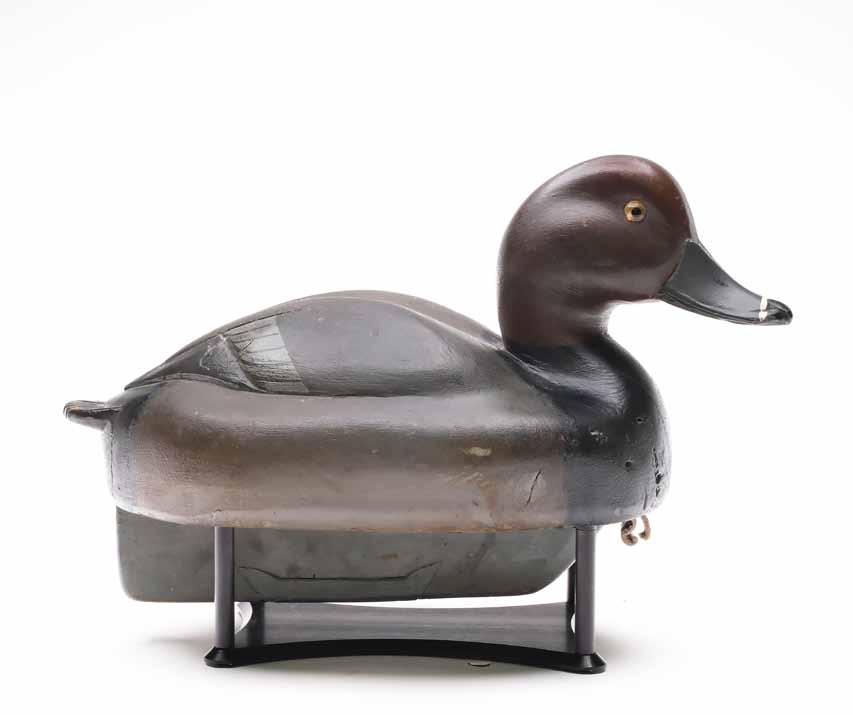
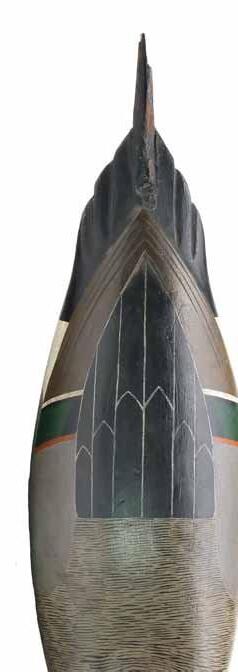
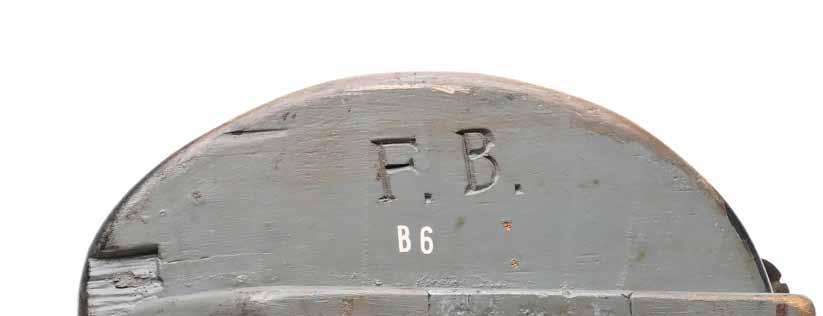
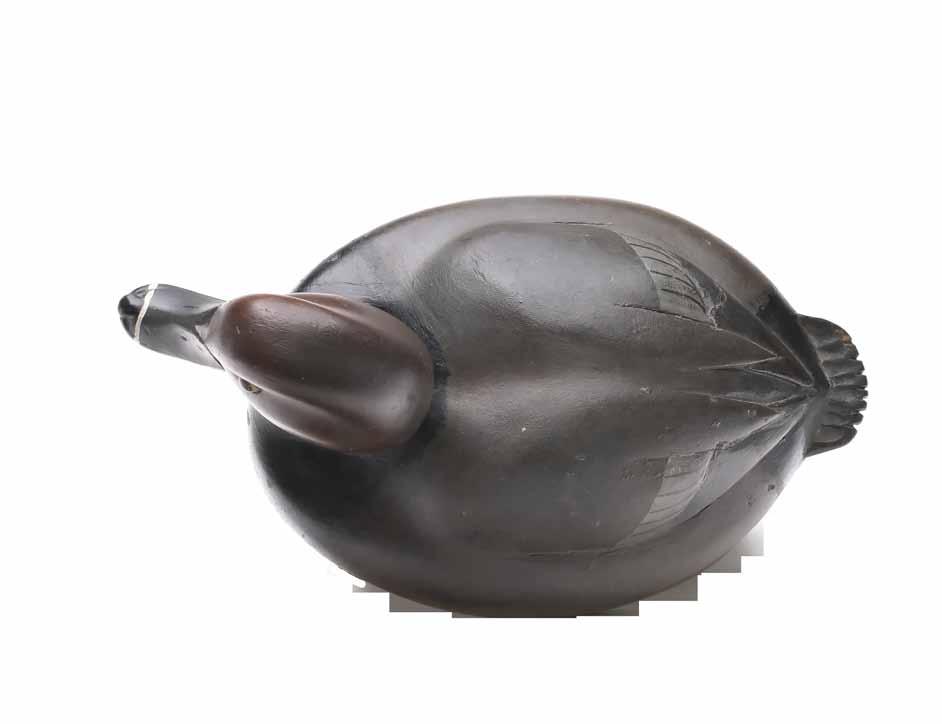
9 Ferdinand Bach (1888-1967), Detroit, Michigan. Very rare redhead. One of only a few known. Deep relief wing carving and slightly turned head. From Bach’s personal rig with F.B. carved in underside. Measures 14.5” long. Original paint with very minor wear; tight drying cracks in breast were secured with four added nails on one side of breast.
Provenance: Jim and Diane Cook collection.
Literature: “Waterfowl Decoys of Michigan and the Lake St. Clair Region” by Clune Walsh Jr. and Lowell G. Jackson, page 47, exact decoy pictured. (40,000 - 60,000)
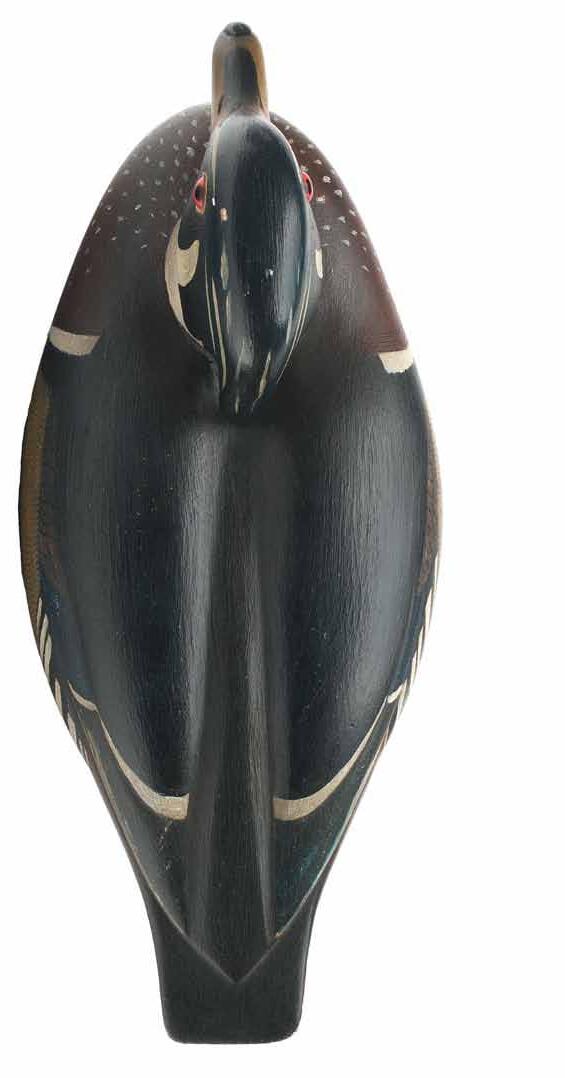
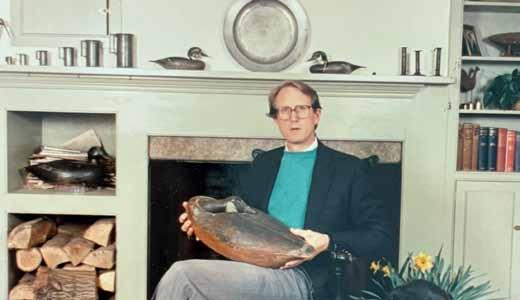
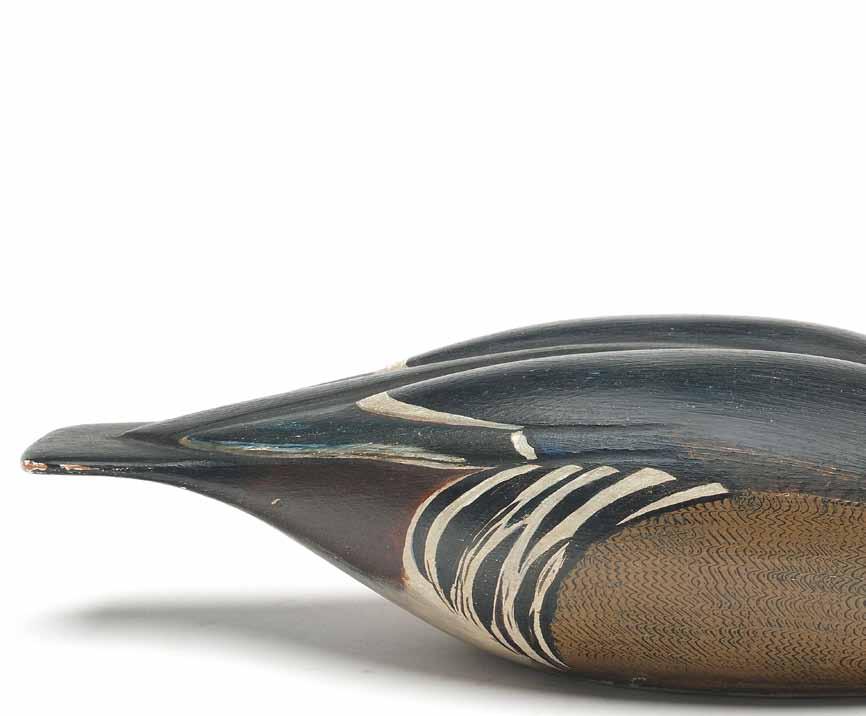
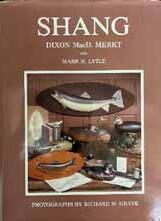
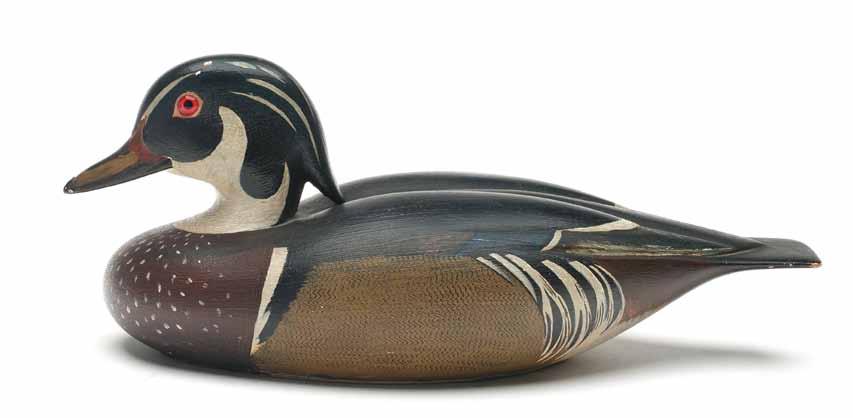
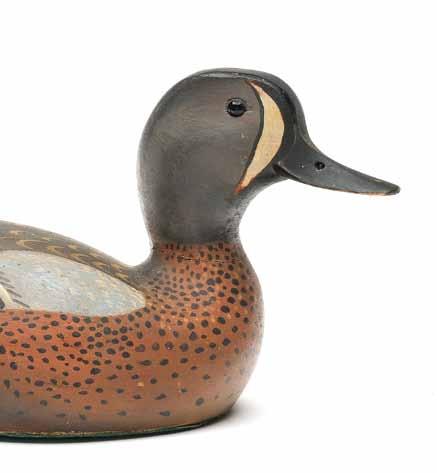
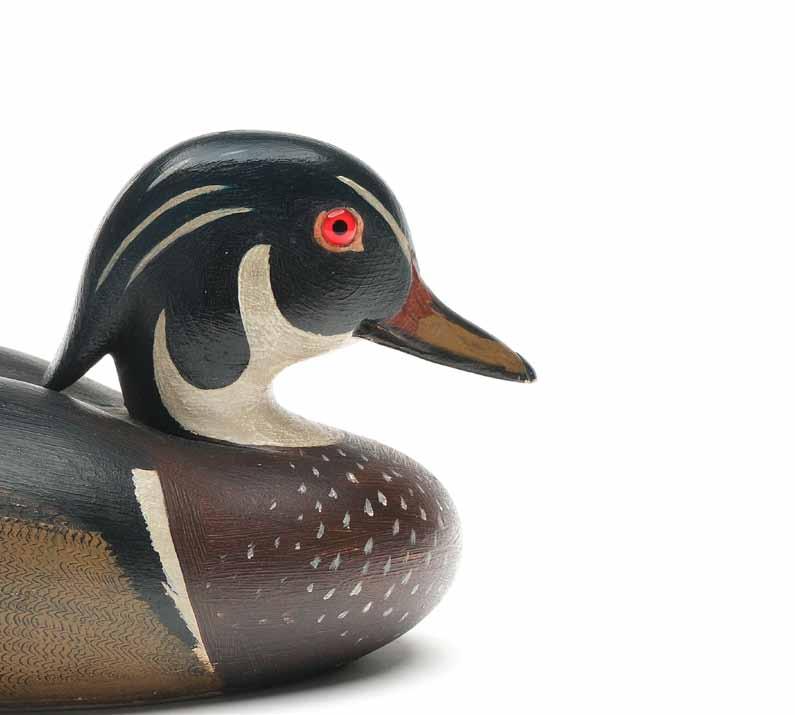
10 Charles E. “Shang” Wheeler (18721949), Stratford, Connecticut. Important wood duck. Relief wing carving and extended crest. Comb feather paint detail on sides. Measures 12.75” long. Original paint with a few paint flakes on top of head and very minor wear on edge of tail and bill tip; thick felt added to underside with some paint added along lower edge; excellent structurally.
Provenance: Dixon Merkt collection. Jim and Diane Cook collection.
Literature: “Shang,” Dixon Merkt, front cover, exact decoy pictured. “Decoys” by Gene and Linda Kangas, page 290, exact decoy pictured.
(40,000 - 60,000)
If any one name is synonymous with Illinois River Decoys, it must be that of Charles Perdew. Volumes have been written about the man, and his life and work are well known to almost anyone with an interest in decoys. He carved his first decoy as a young man of fifteen, and a letterhead of his indicates that he was producing decoys for sale by at least 1898. At one point, over 600 decoys per year left his shop located behind his home. His was a truly remarkable carving career that spanned over sixty years.
In about 1901, Charlie was operating a gunsmith store and making decoys and calls in Henry. At that time, a young woman named Edna Maude Haddon was hired to paint the decoys that Charlie produced. She had worked previously as a “compositor,” setting type for a printer, and her father was a painter and decorator by trade. The patience needed to accurately set type, coupled with what artistic leanings she may have inherited from her father, would have lent themselves to painting decoys. Charlie must have admired more than just her painting skills for, on Thanksgiving evening in 1902, the couple were wed in the home of her parents. He was 28 and she, only 20.
This would become the beginning of a loving relationship that would last for sixty-one years.
Charlie would carve and, for over forty years, Edna would paint decoys. In “Perdew - An Illinois River Tradition,” Edna is described as “a quiet and strong woman, artistic, loving, and devoted to Charlie.” As Charlie often commented –“they were a team – a two-some - - -.” Her painting abilities became legendary and, without a doubt, were a significant factor in the desirability of the Perdew’s finished product. They lived in a handsome home that Charlie and she had built for themselves in 1909 - 1910 on a bluff overlooking the river. In 1910, Edna presented Charlie with a son, Charles Haddon Perdew, who too, would eventually work in the family business. Oddly, Edna is rarely listed in any document as being involved with the decoy operation. Only in the 1940 census does she appear as “repainting decoys.” In the winter, the couple would read together, or Edna would listen as Charlie played his fiddle. In the summer, the couple raised a large vegetable garden as well as some flowers, fruit trees and a few bee hives. Eventually, Edna suffered the effects of lead poisoning and had to stop painting. A stroke in 1960 ended Charlie’s carving career and he passed away a few years later. Edna outlived her husband but, with failing memory, she died in a nursing home in El Paso, Illinois at age 92. This extraordinary couple are buried together in the Henry Cemetery in Henry.
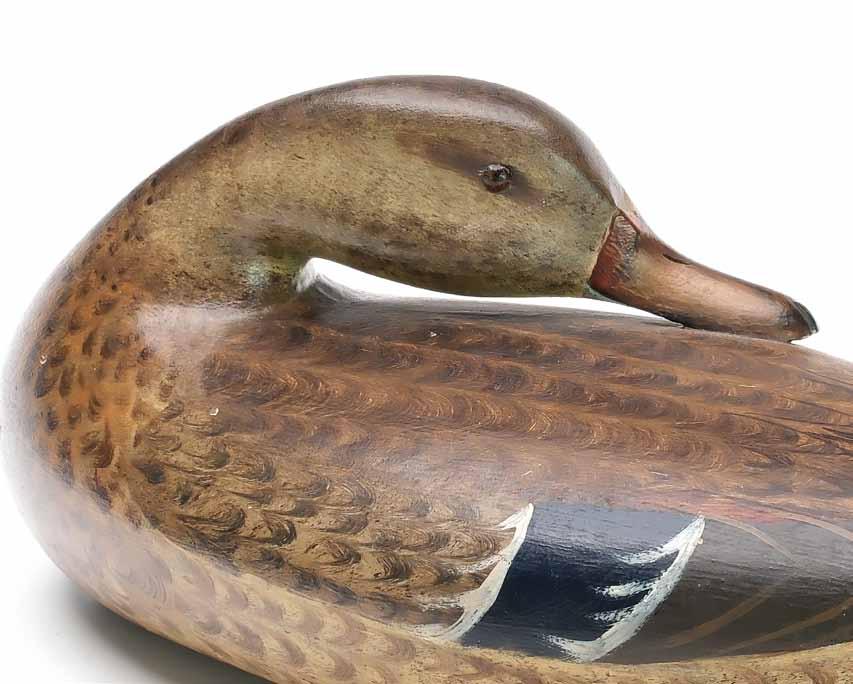
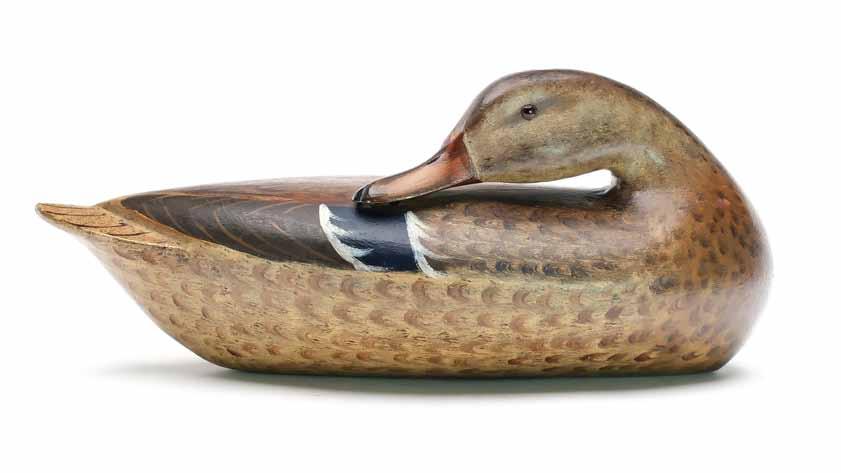
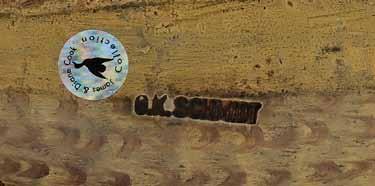
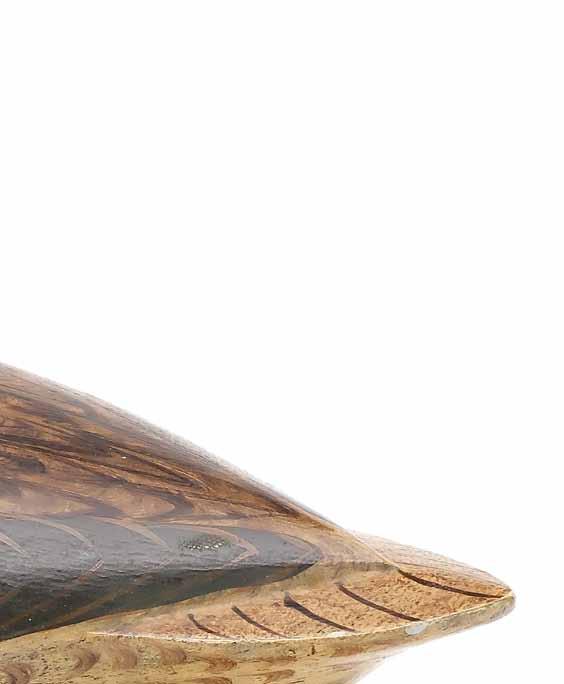
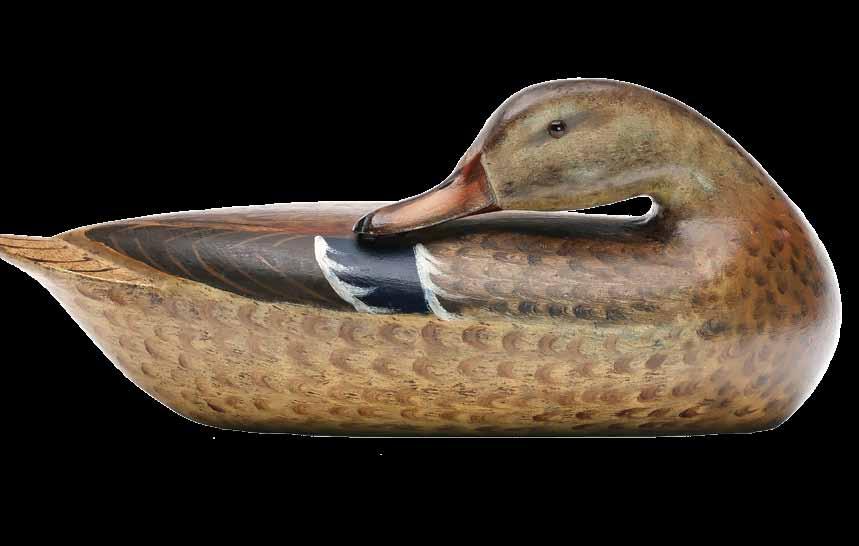
11 Charles Perdew (1874-1963), Henry, Illinois. Important and outstanding preening mallard hen. Hollow carved with excellent paint detail. “G.K. Schmidt” branded in underside. Measures 14.75” long. A few tiny dents and paint rubs, otherwise near mint.
Provenance: Sandy Schmidt collection, purchased at the original sale of the G.K. Schmidt rig. Walter White collection. Thomas Figge collection. Jim and Diane Cook collection.
(100,000 - 140,000)
Elmer Crowell (1862 – 1952) made a number of life size decorative carvings. The majority of these were of waterfowl or shorebird species which, due to his market gunning and stand management background, he had an intimate working knowledge of. He also executed a much smaller number of carvings for upland species such as Northern bobwhite quail, Ruffed grouse, and American woodcock. Each of these, like all wildlife, have rather specific habitat requirements and their population numbers are largely determined by the abundance and quality of those environmental conditions. In Elmer’s day, the lands near his home on outer Cape Cod were largely defined by an early stage, second growth forest of pitch pine and scrub oak or open grassy plains, all growing on deep, dry, sandy soils. The land and the relative abundance of upland game birds in his time can best be described by Elmer himself who, in 1946/47 wrote:
“- - - in my teens, there were many farms around my house, and quail or Bob Whites were in goodly numbers.” “Grouse were not plentiful here at any time - - - .” “The farms have all gone to waste timberland now- - - . The farmers gave it all up and began to grow cranberries. And all the cedar swamps had to go under the hammer.”
Even though he bemoans the lack of grouse, he goes on to write that, “The most grouse I ever shot in one day was nine and on many an all day hunt would get but two or three.” Photographs of the day attest to the abundance of quail and, by Elmer’s own testimony, grouse were certainly present in huntable numbers. What is noteworthy, however, is the fact that he fails to make any mention of woodcock.
The apparent paucity of timberdoodlers on the outer Cape was probably a result of multiple causes, not the least of which is that the area is well off the bird’s primary migration route. The most important contributing factors, however, were the scarcity of suitable habitat
and a downward trend in the bird’s population numbers throughout Massachusetts. Writing about their relative abundance, Elliot in 1895 recorded that the woodcock is “gradually becoming scarcer within our limits.” Howe and Allen in 1901 stated that the bird was “now rare in the eastern part of the State” (with no birds being reported from any correspondent in Barnstable County, Cape Cod). Fisher in 1902 listed the woodcock and wood duck as the two species most in danger of extinction. And Forbush, in 1912, noted that “ - - comparatively few were seen in Barnstable County - - - “ and, again in 1925, listing them as “ rare in Barnstable.”
If the birds were rare or certainly not abundant on the outer Cape, why then did Crowell carve some exquisite examples of them? The answer may lie in his association with noted north shore sportsman Dr John C Phillips (1876 – 1938). Crowell had a long-standing personal and professional relationship with the Doctor, beginning in 1898 when he became Phillips’ manager at his stand at Wenham Lake in Beverly. Phillips is best known for his fondness of goose hunting but, as the years progressed, he became more and more passionate about gunning for grouse and woodcock, first near his home in Essex County, then on innumerable trips to coverts in New Hampshire, Maine and Canada. His own journal testifies that, between 1897 and 1935, he shot 1118 grouse and 719 woodcock. In 1935 alone, he visited New Hampshire a total of 24 times, shooting 69 grouse and 46 woodcock.
After his death, a tribute to the Doctor in the Proceedings of the American Academy of Arts and Sciences gives some indication of the lofty status that Phillips placed on his upland shooting:
“On a bleak November afternoon not long ago there stood with bowed heads on a little knoll in the Wenham woods a cluster of heavy hearted, sadeyed people as a minister read the committal service and John Phillips was laid to rest. Nearby a small brook wound its way through lo w bushes and the roots of scattered hardwoods. It was just the so rt of cover in which a woodcock might have been most at home. The surroundings could not have been more perfect for the burial place for this beloved true New Englander. As we turned away from the grave, we heard the sound of a shot close by. When its echo had died away many of us thought how pleased John would have been at this unconscious tribute.”
Of course we will probably never know, but it is certainly a possibility that it was Phillips that was responsible for Crowell carving h is first woodcock. The two men had become very close friends and, certainly, Elmer would have taken great pains to accurately portray the beauty of the small birds that the Doctor held in such high esteem.
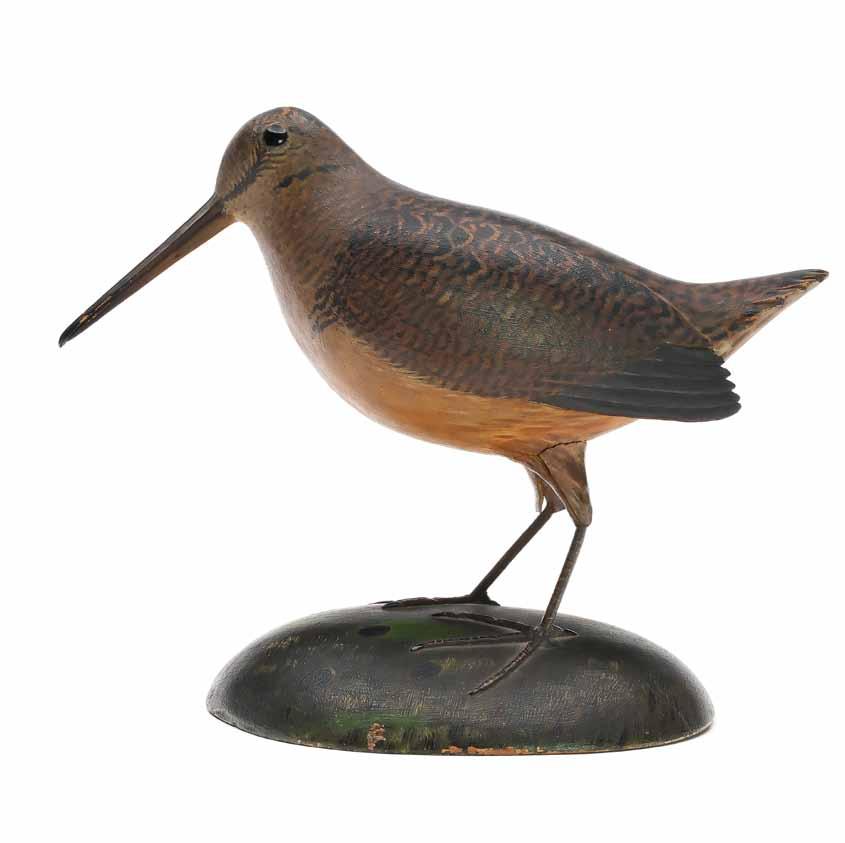
12
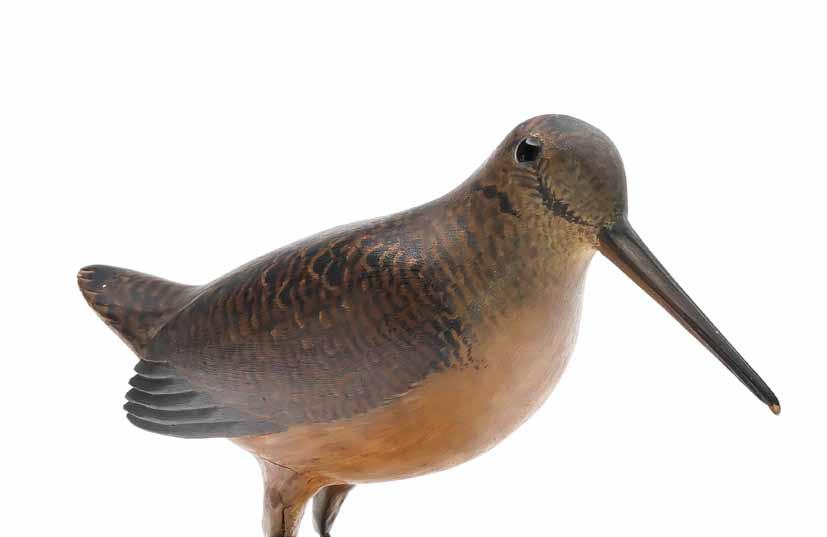
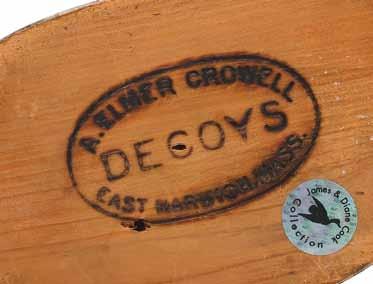
A. Elmer Crowell (1862-1952), East Harwich, Massachusetts. Excellent decorative woodcock. Dropped wing carving with relief tail and wing feather detail. Maker’s oval brand on underside. Base is painted with holes where woodcock was digging for worms with its bill. Measures 10.5” long. Original paint with very minor flaking on bill; cracks and minor separation at gesso thighs, otherwise excellent.
Provenance: John Delph collection. Jim and Diane Cook collection.
Literature: “Elmer Crowell: Father of American Decoy Carving” by Stephen O’Brien Jr and Chelsie W. Olney, page 16, exact carving pictured.
(30,000 - 50,000)
Numerous carvings by Elmer Crowell in the Cook collection, both working birds and full-size mantel carvings, can trace their roots to purchases made directly from the artist or gifts by him to some of his personal associates, patrons and benefactors. Many of these have descended through multiple generations in the family of their original owners and represent Crowell at the peak of his creative genius.
Several important examples were purchased by Charles Ashley Hardy (1874 – 1929) of Boston and Chatham, MA, his wife Alice Eliza (1874 – 1953) or other family members, and bear their names or initials on the bottom of the bases. Charles was Harvard educated and made his fortune in the mining industry and, later, real estate development and stocks. He befriended Elmer Crowell and hired him to run his gunning stand, “The Three Bears,” on Cape Cod. He is most famous for his 1914 construction of the Chatham Bars Inn on the outer beach of the Cape. This was originally intended as a luxurious hunting lodge for discriminating sportsmen, advertising itself as offering “ The best deepsea fishing, harbor fishing and shorebird shooting. ” His daughter, Alison (1909 – 1987), married Justin Dempsey who became president of the Henley Brewing Co. in Providence, Rhode Island. Dempsey’s daughter, Jane Ashley, wed Eugene B Doggert and they, in turn, acquired carvings from earlier family members and continued to collect in the Hardy tradition. Many of the family’s carvings display Crowell’s full, crisp, oval hot brand indicating that they were carved by Elmer c1912.
A number of unique and significant carvings by Elmer are marked with a small triangle of tiny, neat, drilled holes indicating that they were in the collection of Dr John Henry Cunningham (1877 – 1960) of Boston and Cape Cod. Cunningham met Crowell when they hunted together at Dr. John C Phillips (1876 – 1938) gunning stand at Wenham Lake from 1900 through at least 1918. The friendship between Cunningham and Crowell would last a lifetime. In 1947, even as a man of advanced age and now seldom carving, Crowell would often write Cunningham, referring to him as “My Dear Doc” and reminiscing on their friendship with comments such as “ How often I think of the good times we had in the day gone by. (No) one can take them from us now. ” Crowell would, obviously, lavish additional efforts on the carvings destined for the Cunningham collection.
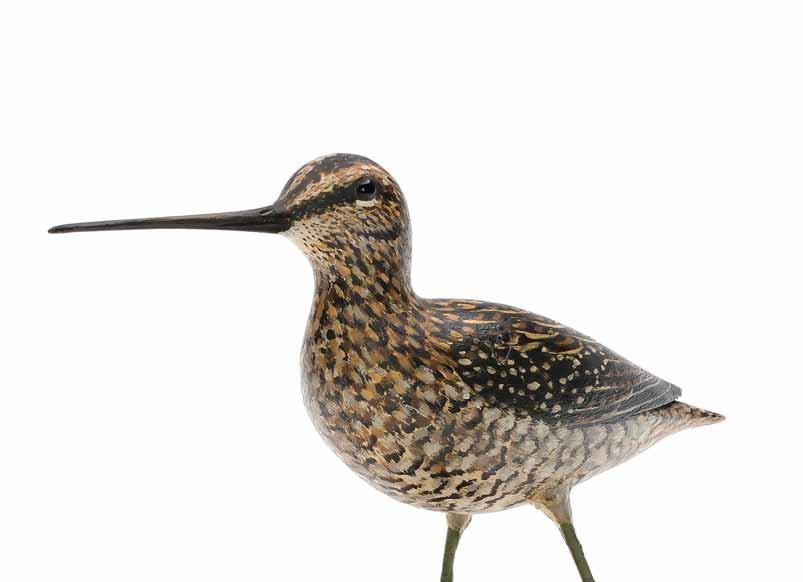
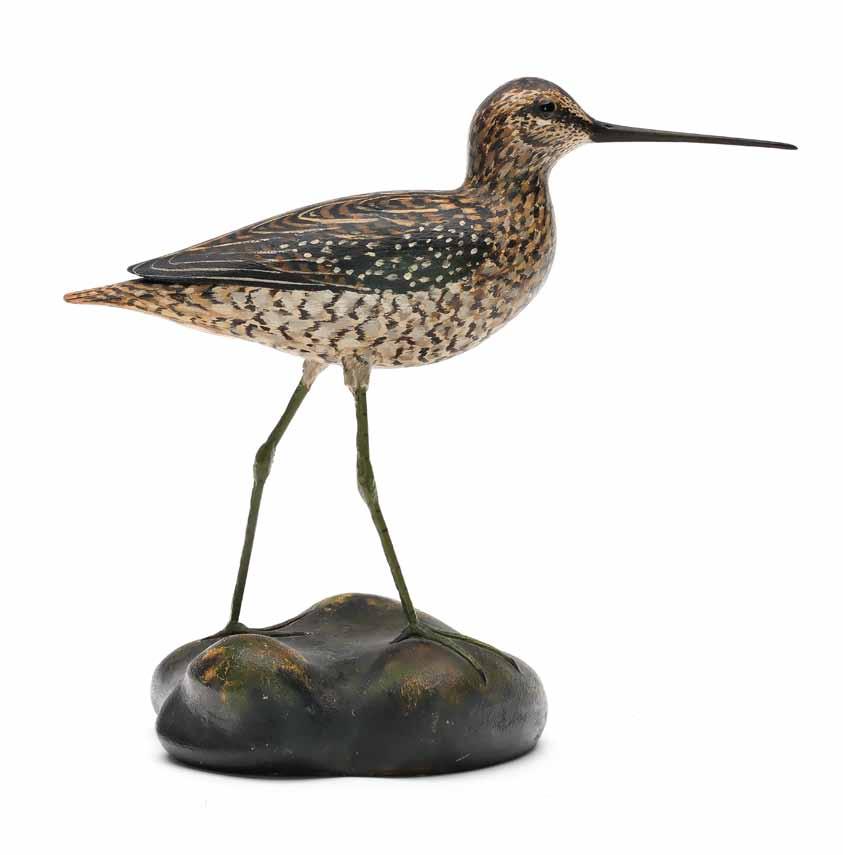
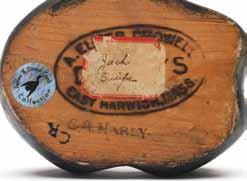
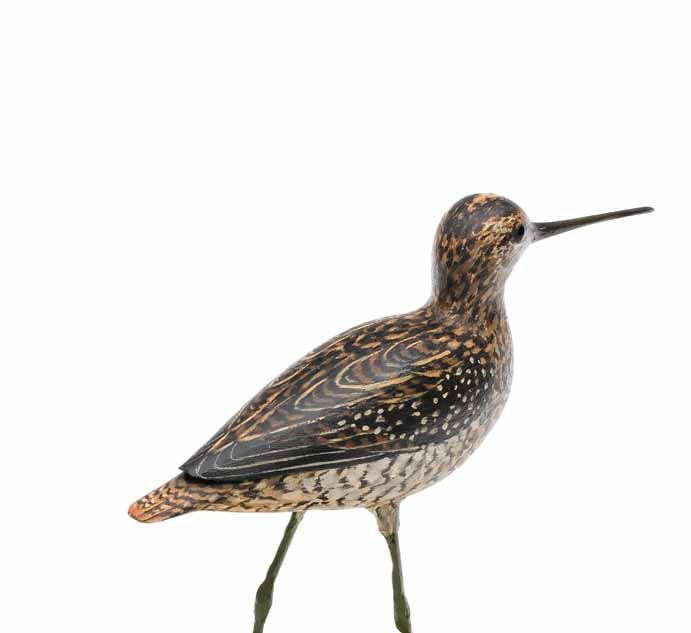
Still other carvings by Crowell in the collection bear the initials “CR” for Carolyn Crossett Rowland (1916 – 2012) of Boston and Osterville on Cape Cod. Independently wealthy, (inheriting the equivalent of almost 3 million dollars in 1937), Carolyn studied art and photography under Ansel Adams and she, with her Yale educated husband, George, purchased many of their Crowell carvings directly from Elmer. They had impeccable taste and exercised a connoisseur’s selectivity when, over a 50year period, they went on to curate one of the very finest collections of Elmer’s decorative shorebirds in the country.
A. Elmer Crowell (1862-1952), East Harwich, Massachusetts. Rare decorative jack snipe. Relief tail feather carving and early mottled base style. Crisp oval brand on underside. “CA Hardy” in pencil on underside. Also has “CR” carved in underside for the Carolyn Rowland collection. Measures 10.5” long, stands 9.25” tall. Excellent and original.
Provenance: The maker to Charles Ashley Hardey. Carolyn Rowland collection. Jim and Diane Cook collection. (50,000 - 80,000)
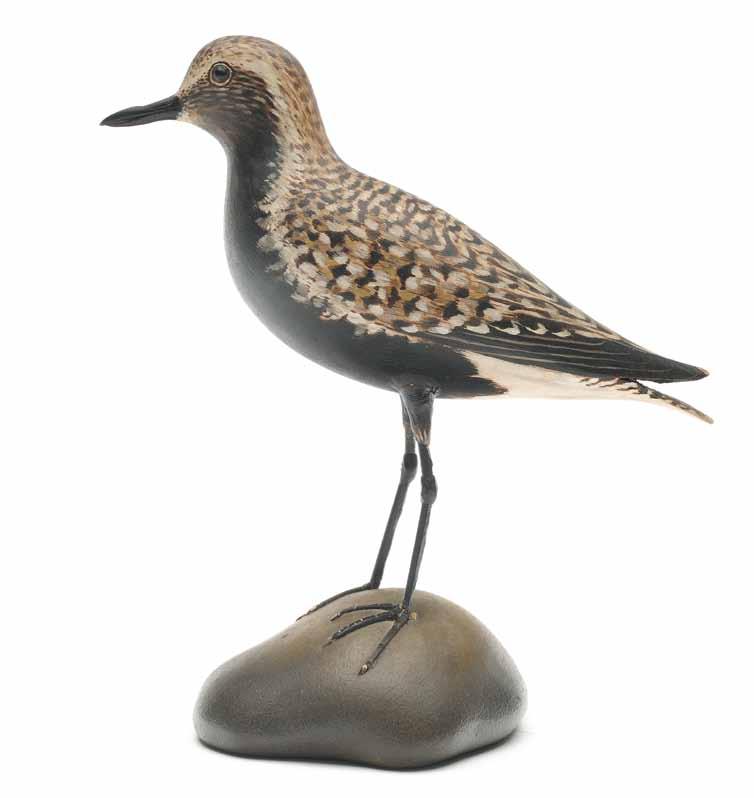
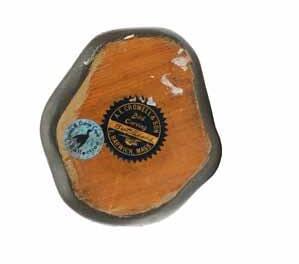
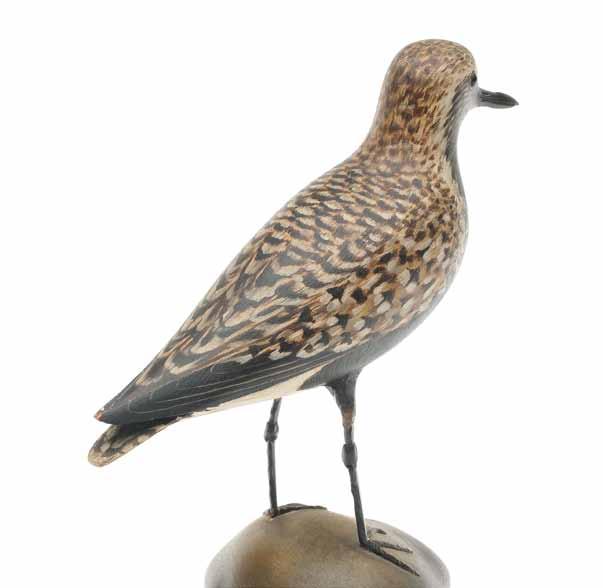
A. Elmer Crowell (1862-1952), East Harwich, Massachusetts. Decorative plover. Slight relief wingtip carving and excellent paint detail. Maker’s blue paper label on underside. Measures 10” long. Original paint; tiny flakes at wingtips and very tip of bill; a few minor flakes at gesso thighs and where metal legs join to feet.
Provenance: John Delph collection. Jim and Diane Cook collection. (20,000 - 30,000)
15
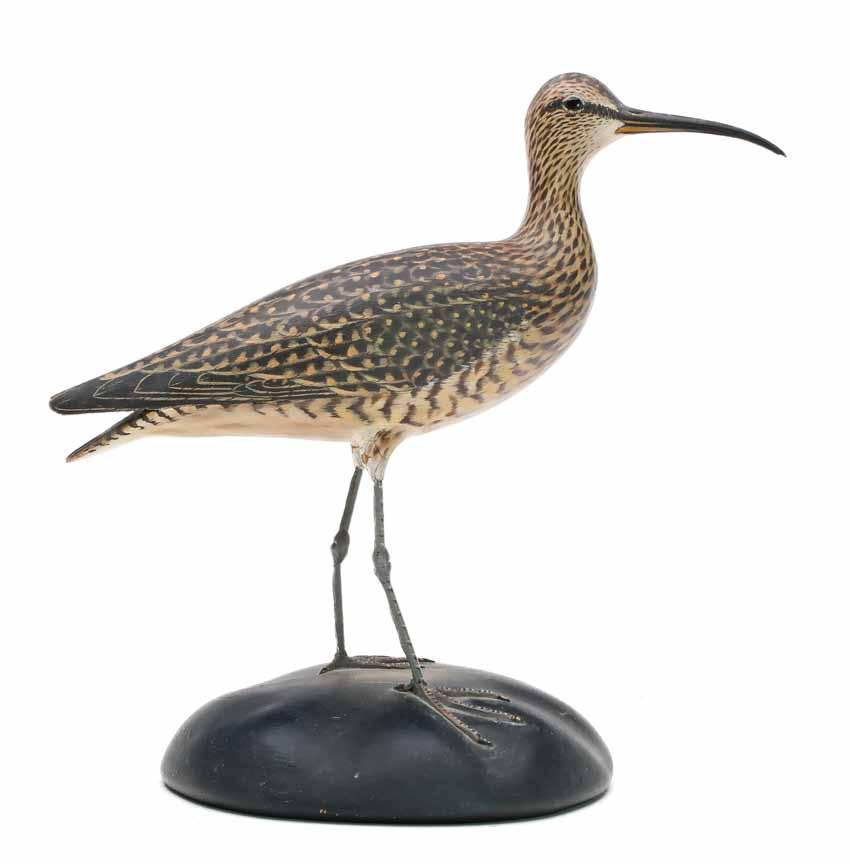
A. Elmer Crowell (1862-1952), East Harwich, Massachusetts. Decorative curlew. Upright pose with slightly turned head and relief tail feather carving. Maker’s rectangle stamp in underside. Measures 12” long, stands 12” tall. Excellent original paint with some minor paint flakes on toes; fine cracks and paint flakes on gesso thighs; very tiny chip at the underside of bill tip.
Provenance: Dr. John Dinan Jr collection. Jim and Diane Cook collection. (20,000 - 30,000)
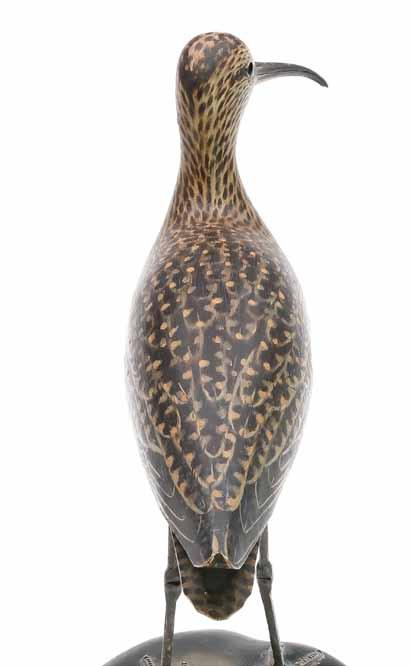
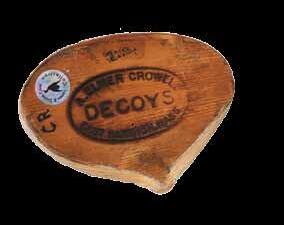
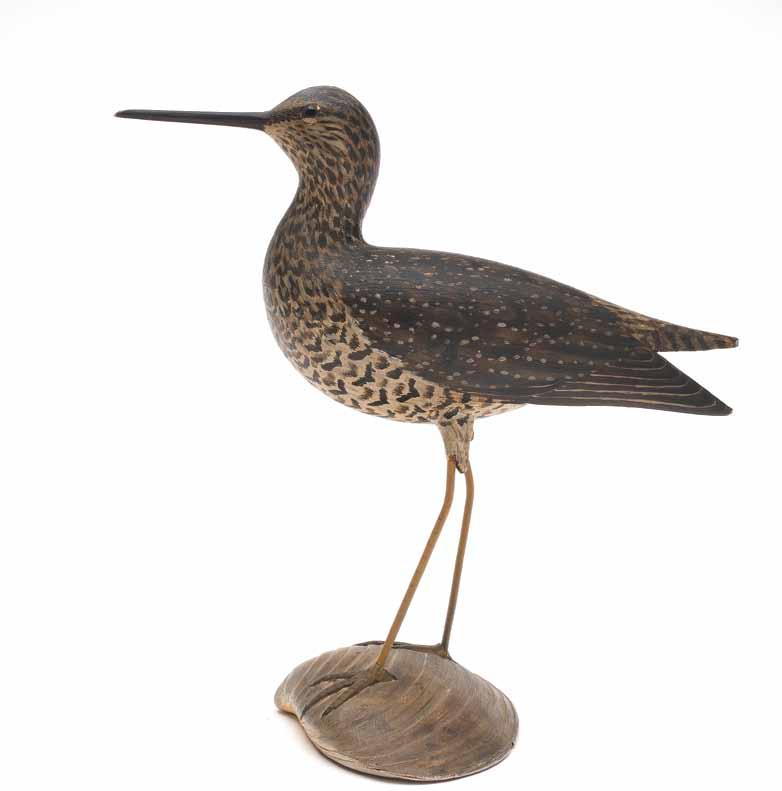
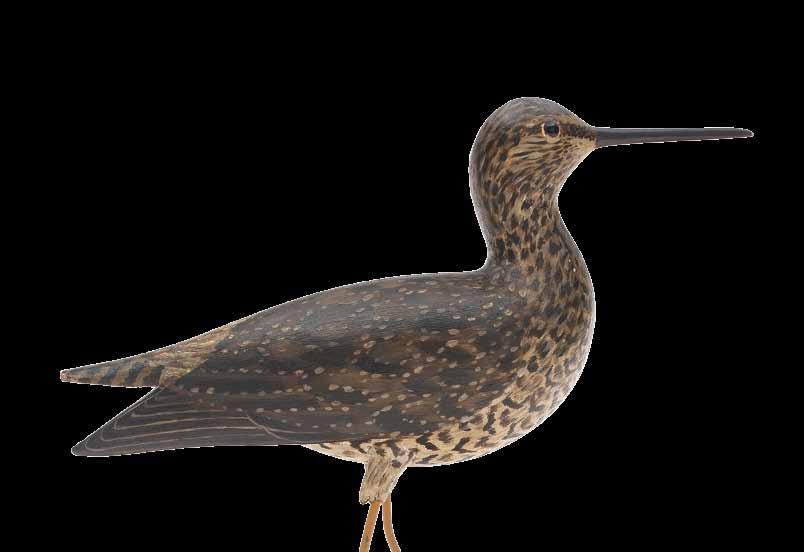
A. Elmer Crowell (1862-1952), East Harwich, Massachusetts. Decorative yellowlegs. Dropped wing style. Maker’s oval brand on the underside of carved quahog base. “CR” carved in the underside for the collection fo Carolyn Rowland. Measures 11.5” long. Original paint with very minor wear on tip of tail and dropped wingtips; tiny paint flakes near eyes; hairline cracks in gesso thighs.
Provenance: Carolyn Rowland collection. Jim and Diane Cook collection. (20,000 - 30,000)
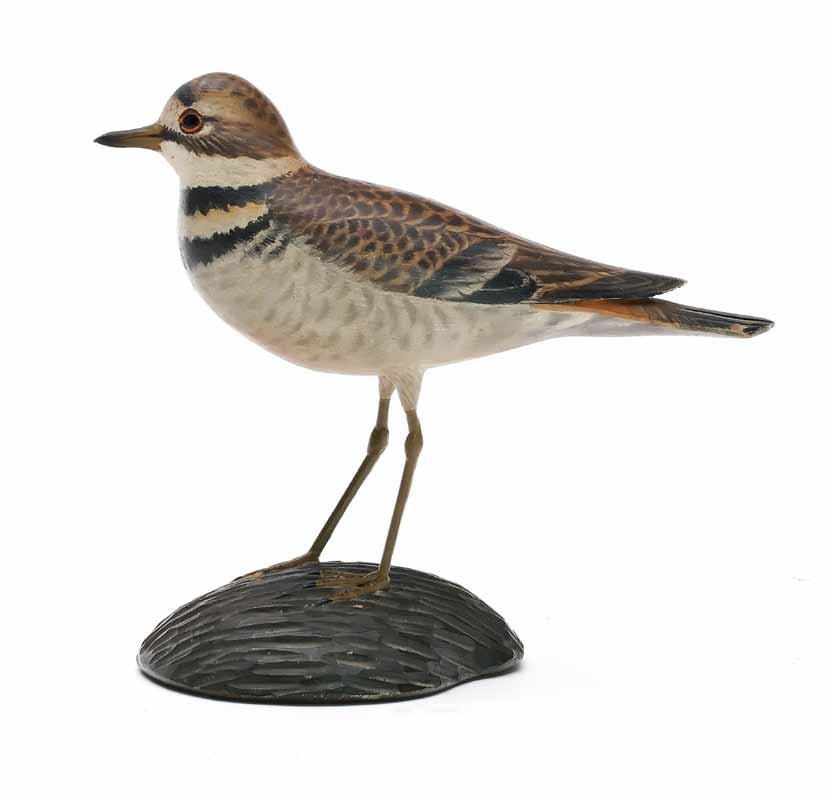
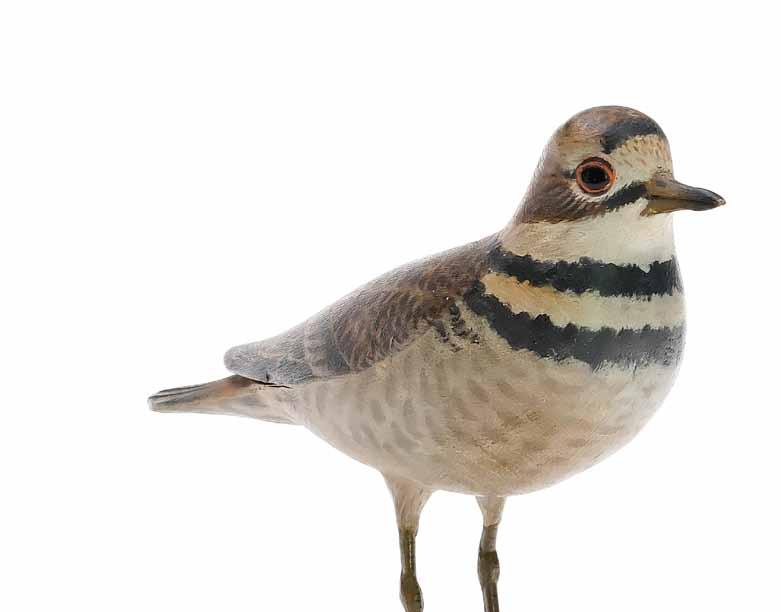
17 A. Elmer Crowell (1862-1952), East Harwich, Massachusetts. Decorative killdeer. Relief tail feather carving and excellent paint detail. Gouge carving on base. Identified in pencil on underside. Maker’s rectangle stamp under a paper newspaper clipping taped to underside. Measures 8.75” long. Tiny paint flake at tip of bill and tip of one toe, otherwise near mint.
Provenance: John Delph collection. Jim and Diane Cook collection. (15,000 - 25,000)

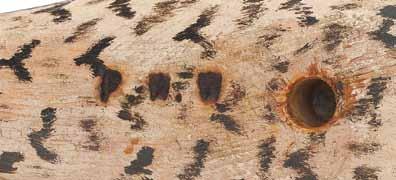
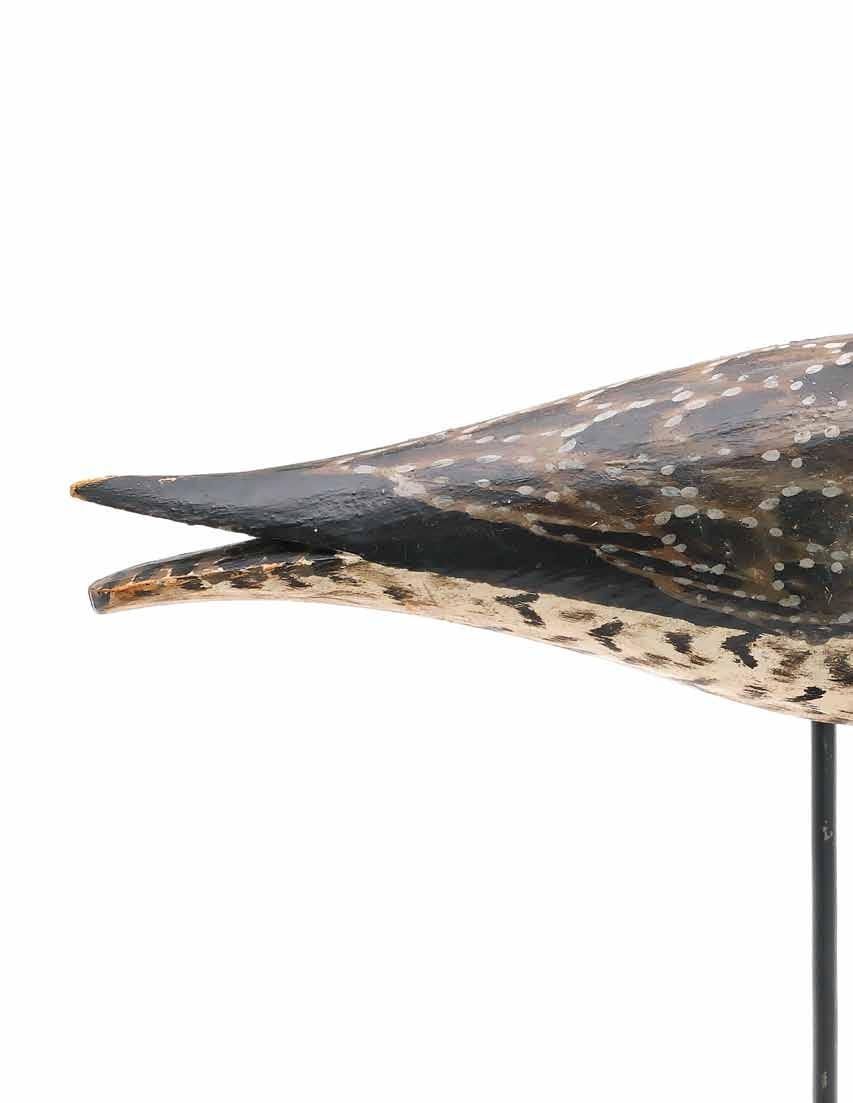
18 A. Elmer Crowell (1862-1952), East Harwich, Massachusetts. Willet, circa 1900. Large working decoy. Branded “PWW” on underside. Split tail carving and shoe button eyes. Measures 14” long. Strong original paint with crazing around neck and breast area; small portion of tip of tail and edges have bare wood exposed.
Provenance: Jim and Diane Cook collection. (25,000 - 35,000)
William (“Buck”) Whittemore 1872 – 1959 | Boston and Gloucester, Massachusetts
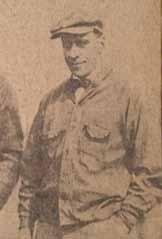
Harvard educated, Whittemore became a successful Boston businessman, with the financial means to become one of Crowell’s early patrons. By 1922 he had purchased a summer home in Gloucester on Cape Ann where he enjoyed sailing and became the Commodore of the Eastern Point Yacht Club. He excelled at the game of golf and won numerous championships throughout Massachusetts and beyond. A devoted trap and wingshooter, he enjoyed hunting on Cape Cod as well as at his second estate in Wareham (MA).
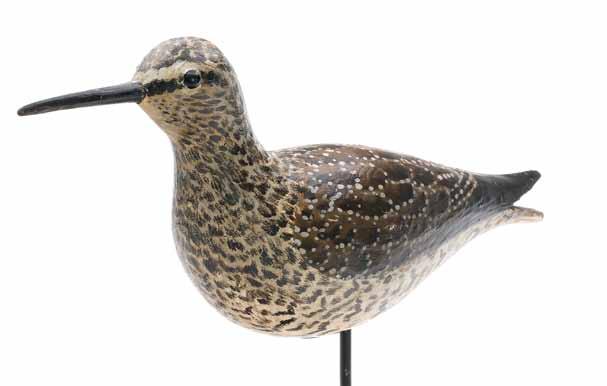
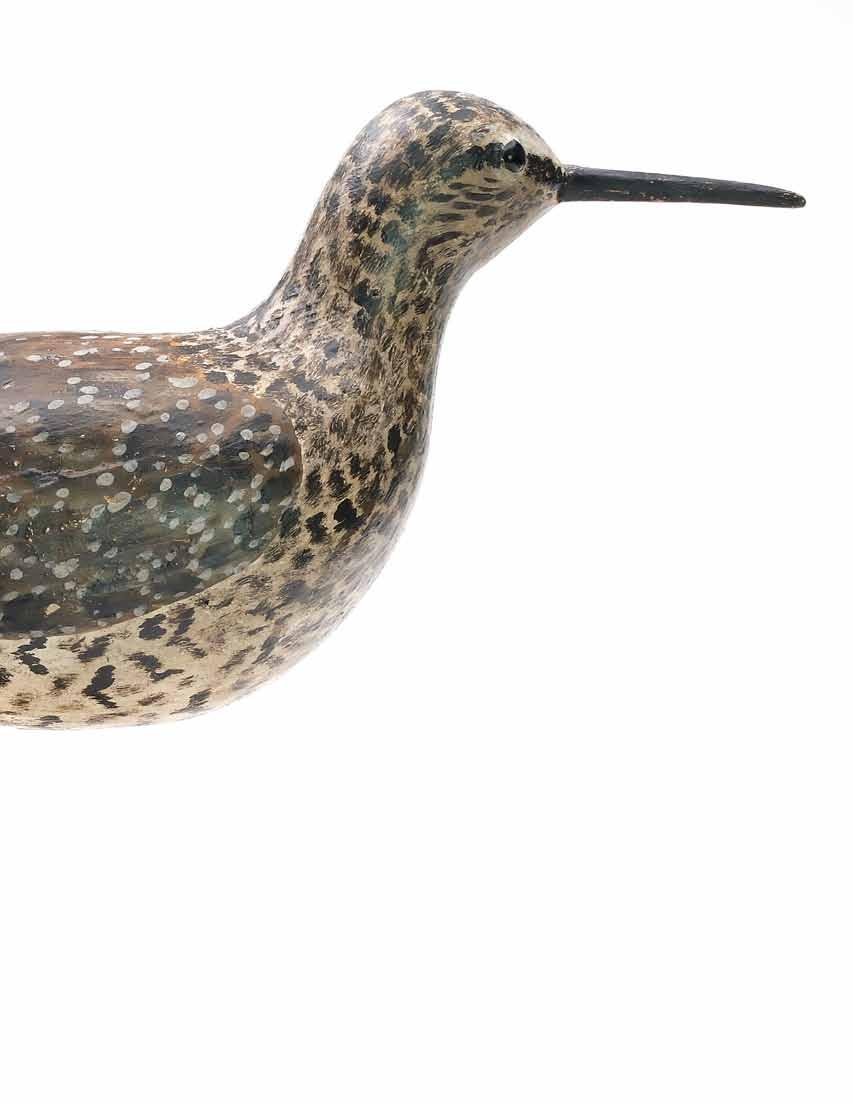
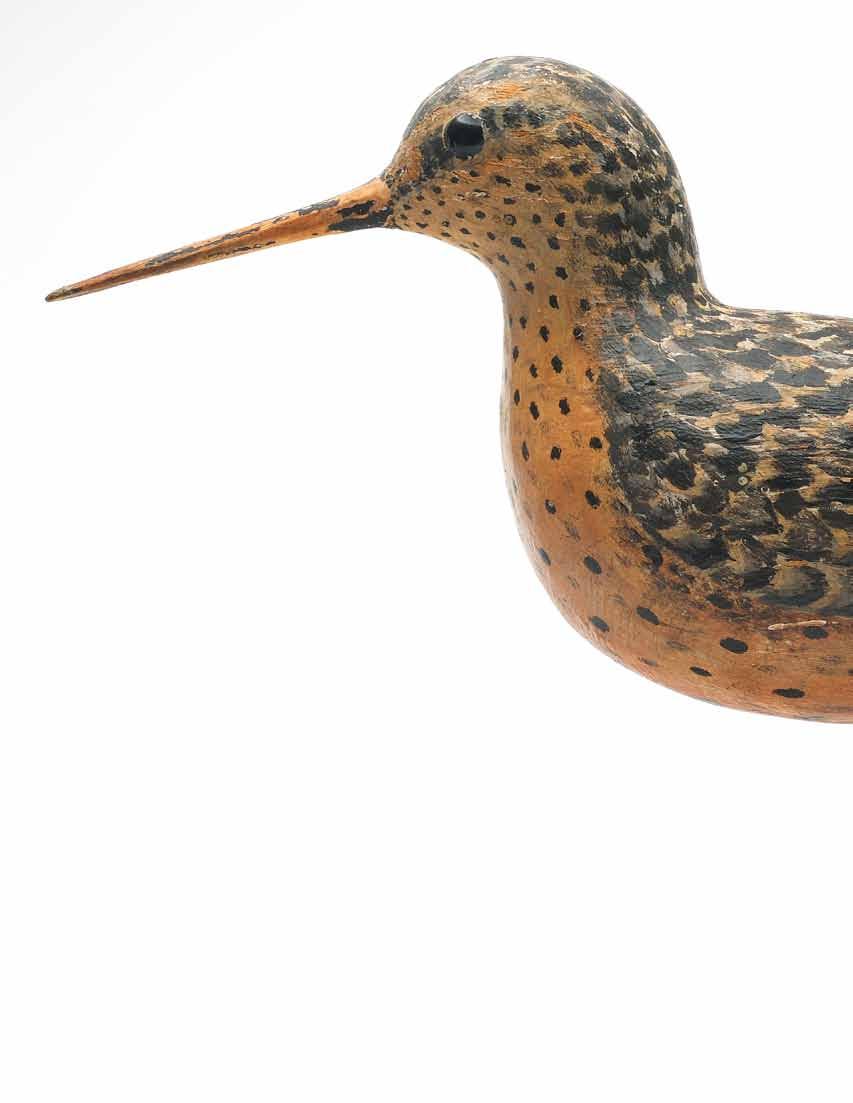
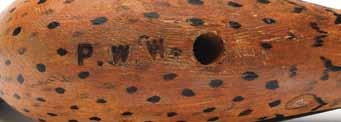
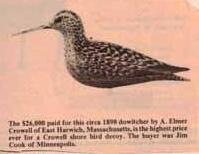
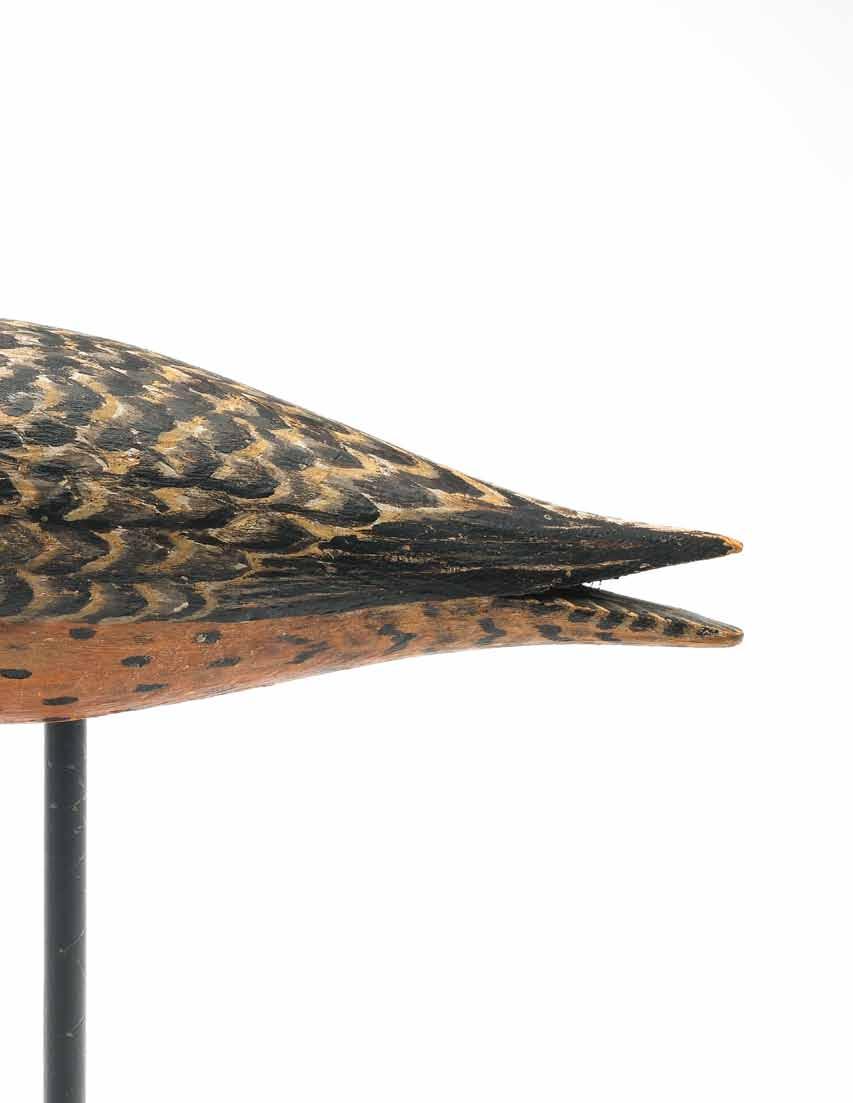
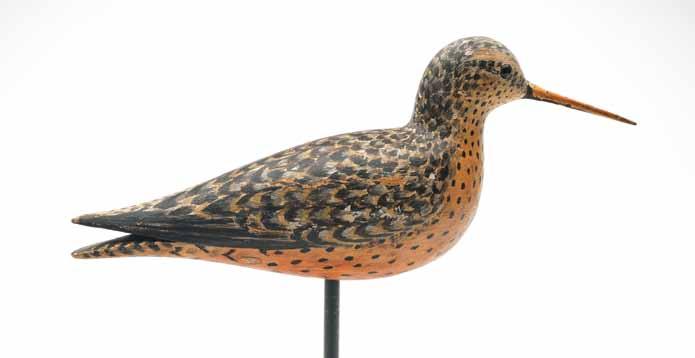
19 A. Elmer Crowell (1862-1952), East Harwich, Massachusetts. Exceedingly rare dowitcher in summer plumage. The only one known. Split tail carving and shoe button eyes. “P.W.W.” branded in underside for the rig of Parker Whittemore. Measures 11.25” long. Original paint with minor to moderate flaking and wear; dent in one side; much of the original paint has flaked off of the hardwood bill; excellent structurally.
Provenance: Jim and Diane Cook collection.
Literature: “Decoys” by Gene and Linda Kangas, page 307, exact decoy pictured. (30,000 - 50,000)
A small town just south of Madison is where three of Wisconsin’s best decoy carvers lived and hunted. The impressive decoys made by these three famous carvers, Ferd Homme, Mandt Homme and Enoch Reindahl, are sought after by serious collectors across the country. Their style, now known as the “Stoughton Style,” can be characterized by realistic full body sculptures, often in a resting or sleeping pose. Ferd carved decoys as a hobby and probably completed only 100 decoys in his lifetime. Raised crossed wing tips are a common characteristic of most of Ferd’s carved decoys, along with hand carved primary feathers. Ferd preferred to hand carve during the winter months and paint in the spring, using live ducks on the lake as models. The painting techniques vary with combinations of wet on wet blending with areas of heavy combing. Ferd painted in a highly realistic style and took great care to capture the finer details. The combination of these attributes works to create life like characteristics that can be enjoyed either on the water or on a shelf.
Ferd Homme had an outgoing, engaging personality. In school, he was socially active in the class play, glee club, debate team, and drama club. Ferd was also the art editor of the yearbook. Stoughton was filled with smart ambitious people. Frank Lloyd Wright’s father William Carey Wright, for example, taught music there. Ferd memorialized a number of such citizens in his book, “Oak Opening: The Story of Stoughton.”
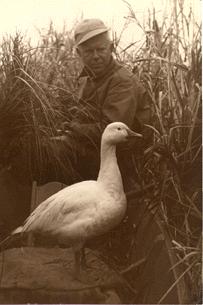
Ferd was an ardent lover and observer of nature and an accomplished photographer. His wife, Elsie, was the town’s librarian, and he served on the library board. His obituary stated, “He knew the birds by their calls and the animals by their tracks. He knew which country roads had the prettiest views of every season.” Following publication of “OAK OPENING,” Ferd chuckled and said, “You know, it feels kind of good to see your name on the cover of a book.” His decoys were often signed with bold, hand painted letters.
Ferd Homme was not a recluse. He studied, read, observed, and interacted with a wide cross section of people. His decoys reflect an extraordinary individual awareness and sensitivity.
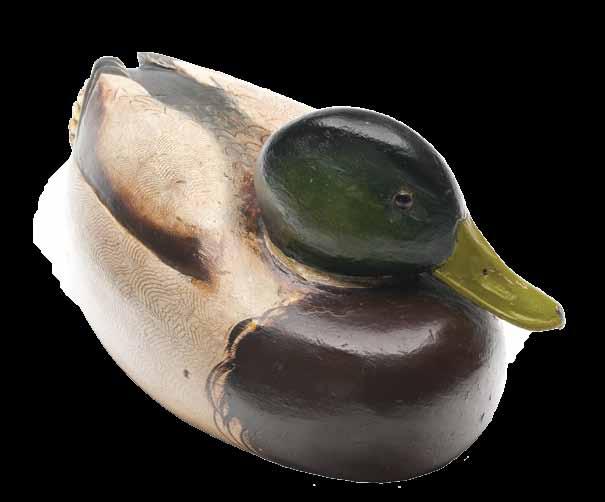
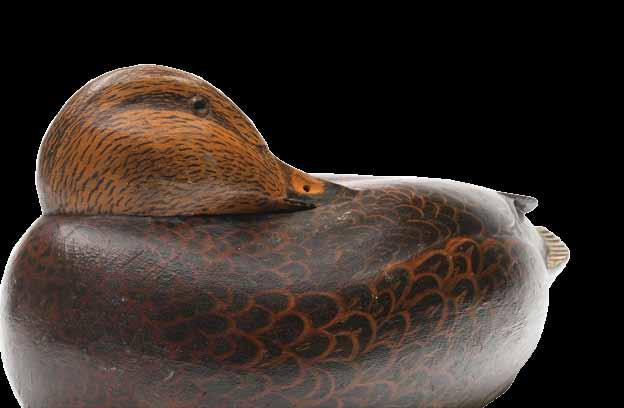
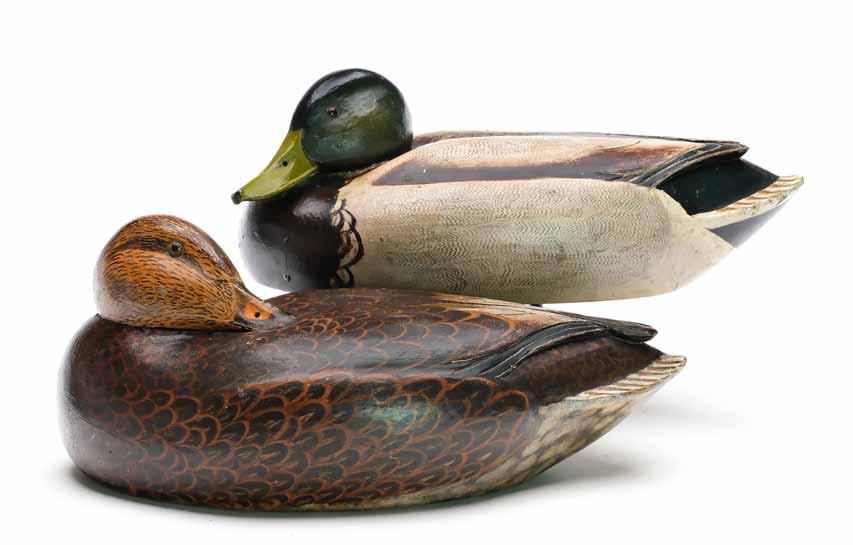
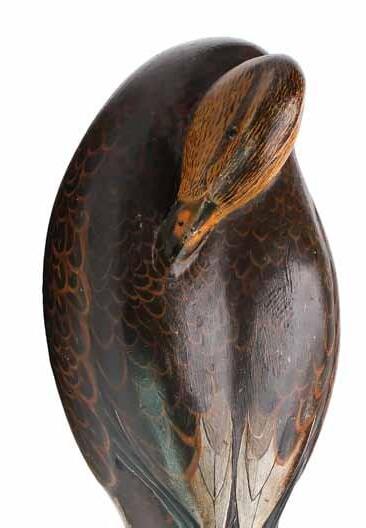
20 Ferd Homme (1901-1963), Stoughton, Wisconsin. Rigmate pair of mallards. Hollow carved with raised wingtips and relief tail feather carving. Drake’s head is tucked and slightly turned. Hen in sleeping pose. Maker’s name painted on undersides. Measure 15” long. Original paint with minor gunning wear under a thick coat of varnish; scattered small dents; fine hairline crack in drake’s bill with a small chip at tip being tightly reset.
Provenance: Jim and Diane Cook collection.
(40,000 - 60,000)
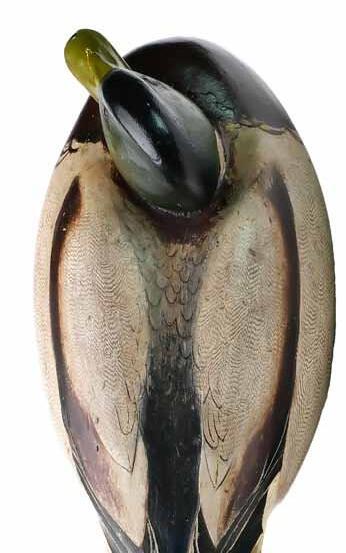
21 Charles Perdew (1874-1963), Henry, Illinois. Very rare rigmate pair of canvasbacks. Hollow carved with comb feather paint detail on both. “JF” branded in underside of hen for the collection of Joe French. Like most Joe French birds, there is writing visible only under UV light. Measure 15.75” long. Original paint with very minor flaking, mostly on bills; spot of discoloration on one side of hen’s head; both are excellent structurally.
Provenance: Two of a dozen made for the Senachwine Club in 1918. Joe French purchased from the club’s caretaker, Frank Cotton Echard, in 1955. Joe French collection. Jim and Diane Cook collection. (40,000 - 60,000)
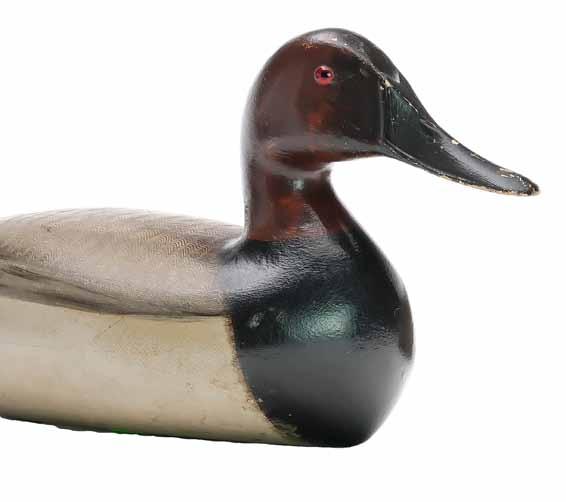
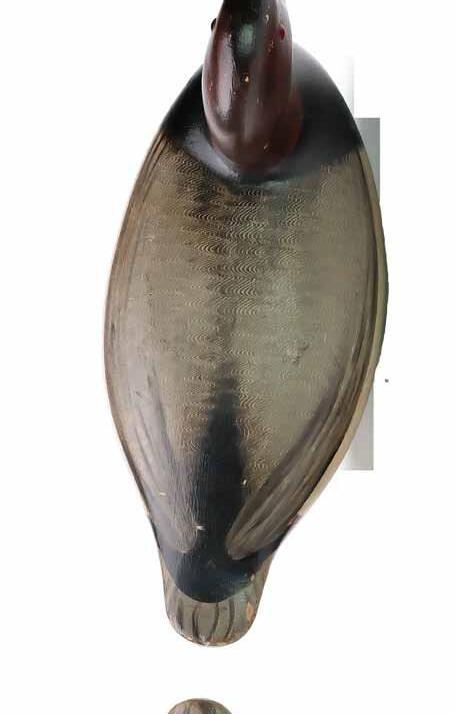
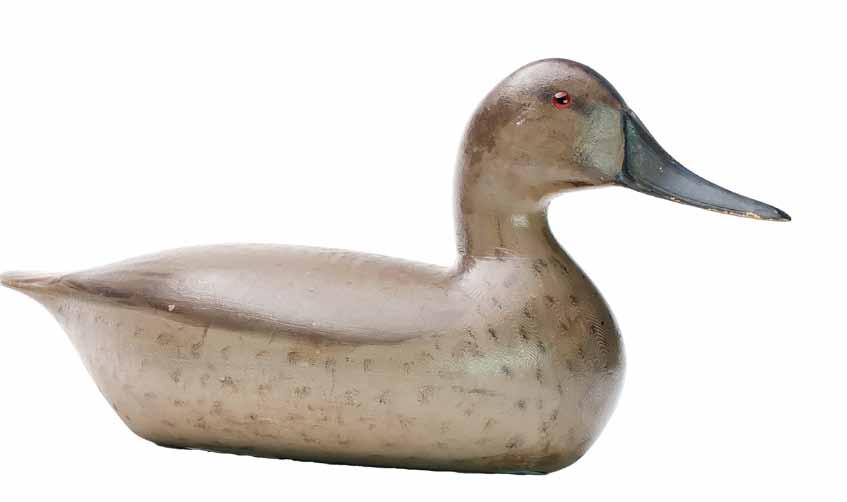
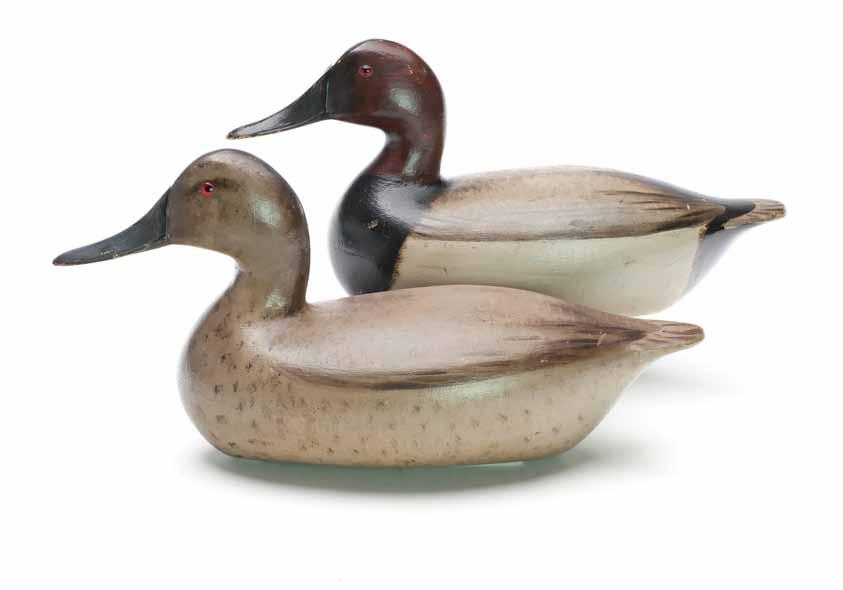
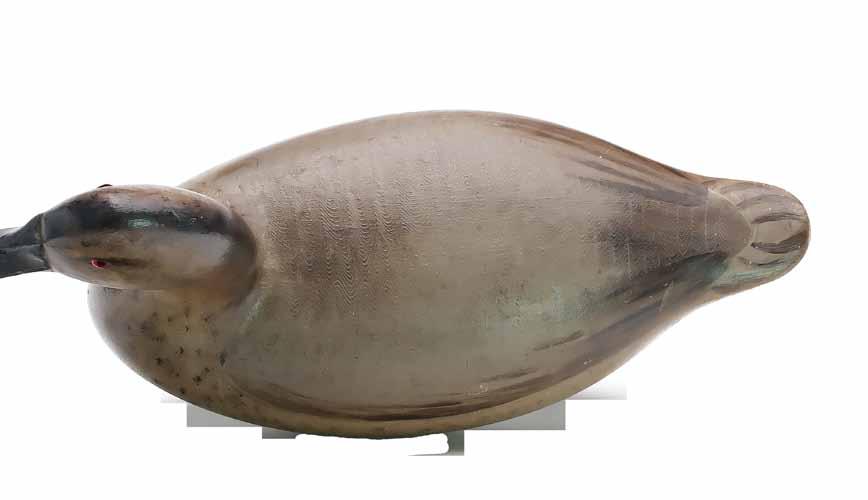
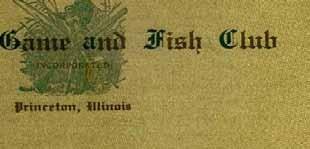
On Sept 10, 1887, over concern that wealthy hunters from Chicago were purchasing lands on both sides of the Illinois River in Bureau County, 39 local sportsmen met and signed an agreement to donate $2.00 each “To secure leases of hunting and fishing grounds on and around ‘Goos e Pond’ in Leepertown Township, Bureau County. ” Another meeting was held in October of the same year and 43 men signed up as charter members of the newly formed Princeton Game and Fish Club. Dues were two dollars per year, and annual assessments were capped at two dollars unless otherwise authorized by the membership. Formal incorporation occurred in 1892, and the PG&F Club is still in existence today as one of the oldest and most prestigious duck clubs along the river. Dues and assessments have increased over the years, but membership is still limited to 50 shareholders, all of whom must be residents of Bureau County.
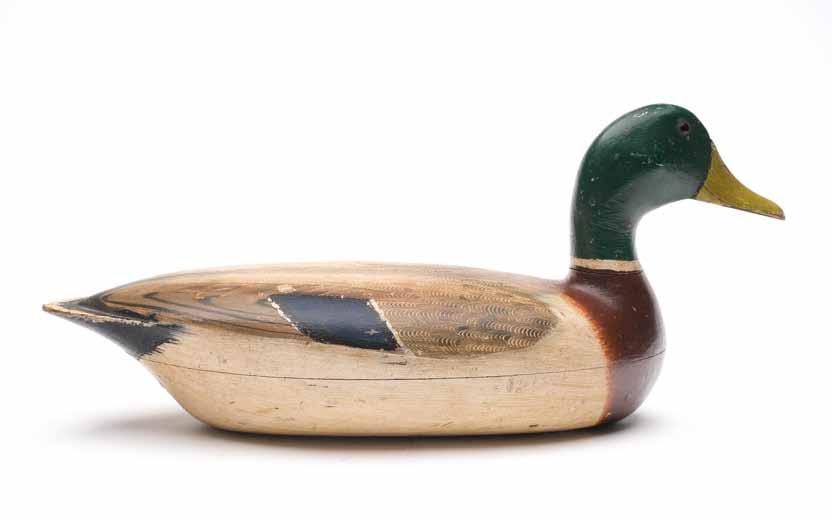
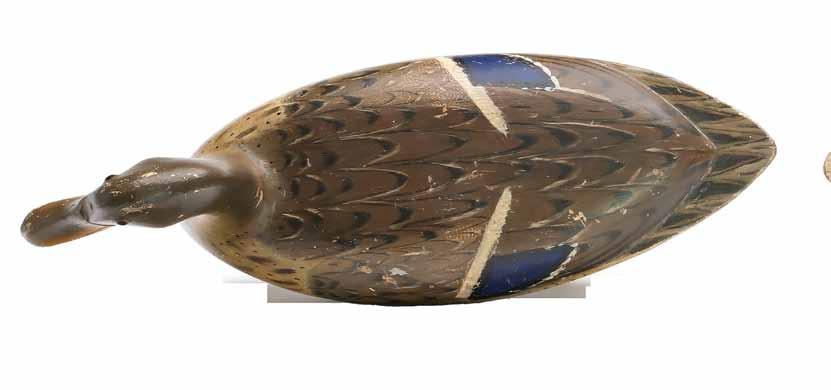
22 Charles Walker (1873-1954), Princeton, Illinois. Rare mallard. Hollow carved with comb feather paint detail on back. “34” painted on underside for the Watson Lawton rig. Also stamped “Ed Moore.” Measures 17” long. Original paint with minor flaking and wear; one eye was replaced long ago, the other with hairline cracks.
Provenance: Rig of Watson Lawton. Joe Tonelli collection. Ed Moore collection. Jim and Diane Cook collection. (15,000 - 25,000)
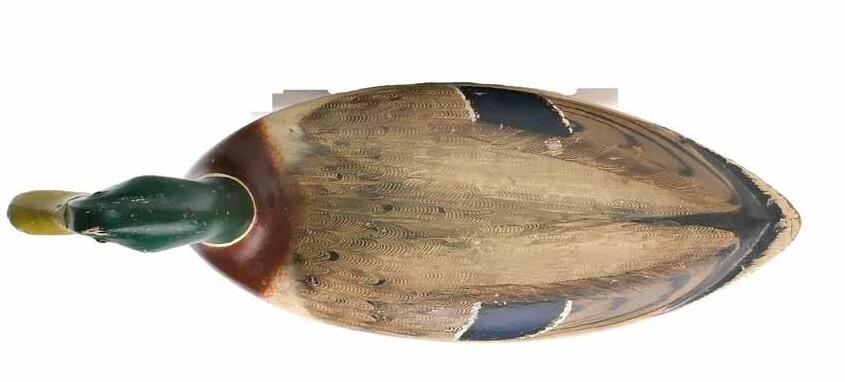
One such member, with share #34, was Watson Freeman Lawton (1910 – 2004) of Princeton, IL. An avid hunter, Watson became a member in 1939 and held his share until 1986. Not a great deal is known about Mr. Lawton other than that he was a graduate of Lake Forest Military Academy and the University of Illinois. From the time he wed Ellen Ruth Stevens in 1938 through the time of the 1950 census, he was employed in various forms of agriculture, including asparagus farming and working as a “ farm manager on (an) estate.” What we do know for certain is that he, like many other PG&F Club members, hunted over a rig of Charles Burr Walker’s decoys. Walker (1873 – 1953) had once been a shareholder of the club and continued to hunt there as a guest when the annual assessments forced him to relinquish his membership. Walker had made decoys for his own use and, as the years progressed, Princeton Club members sought him out to carve rigs for them as well. Practically his entire lifelong output of about 300 or fewer decoys went to the appreciative club members who were willingly purchasing them for $100 per dozen when those of Charlie Perdew could be had for $36. Walker decoys that have survived in fine original condition are considered rare and are among the finest of the many great Illinois River carvings.
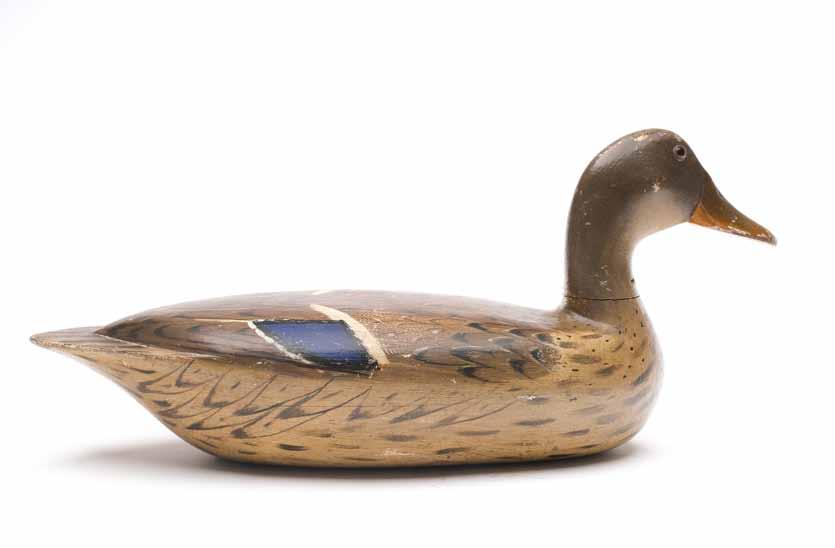
23 Charles Walker (1873-1954), Princeton, Illinois. Very rare mallard hen. Hollow carved with “34” painted on underside for the Watson Lawton rig. Also stamped “Ed Moore.” Measures 17” long. Original paint with minor flaking and wear; small dents and shot marks; fine crack on tail; fine cracks in eyes.
Provenance: Rig of Watson Lawton. Joe Tonelli collection. Ed Moore collection. Jim and Diane Cook collection. (15,000 - 25,000)
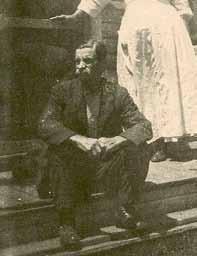
Harry V Shourds must certainly be considered New Jersey’s most celebrated carver. Ironically, he never listed that he was a decoy maker in any formal document. By the time he was 19, he was still living with his father and mother but, while his father was a yachtsman, there was no occupation recorded for his son. In 1884, he married Mary Agnes Bartholomew in Tuckerton, but we still have no record of how he was earning a living. In 1910 he begins to list himself as a carpenter, and from 1915 through 1920, he states that his primary occupation was that of a painter (see note 1) . Conceivably, it is possible that the census taker simply did not have a convenient heading for “decoy maker” so he/she listed a second or part time occupation. Certainly, he had been making decoys in great numbers by the early part of the 20th century and perhaps earlier. Collector/historian William Mackey stated that “- - - from his (Shourds) shop flowed decoys by the hundreds of dozens and this continued for over 20 years” and that “- - - he (Shourds) was the largest shipper on the railroad serving Tuckerton.” It has been written multiple times that he could take a roughed-out decoy head and whittle out a finished product in the time it took his barber to give him a sh ave. His grandson and namesake estimated that he was making about 1 dozen finished birds per week and that his yearly production was “probably 500 – 600 per year.” Using Mackey’s estimate that he had been carving for over 20 years this would indicate that Shourds’ total production would have been an astounding 10,000 – 12,000 decoys and perhaps more. More astonishingly, all of his decoys were entirely hand carved and hollowed out using only the most simple and basic hand tools. If Shourds was indeed a carpenter and/or painter at some point in his life, these skills would have been called into play as he produced his decoys. He must have also had experience with boatbuilding because he used a similar caulking technique when attaching the two halves of his decoys. For all of this work, his decoys were priced at $6 per dozen including the inlet poured lead weights. Geese were more expensive and shorebirds would have been less.
Surprisingly, there has been little, if anything, written about Harry’s experience as a waterfowler. Author Joe French states that he was “ a part time guide ” and his grandson has commented that “he preferred to hunt and fish more than anything else and spent much of his time on the water near his home. ” At least this tidbit can be substantiated by the fact that his home on Water St. included a boat slip on Tuckerton Creek.
Harry Vinuckson Shourds left little in the way of a footprint in this world during his lifetime. Based on the numbers he sold, his decoys were certainly appreciated by the sportsmen and women of his day. His work is equally valued and appreciated by knowledgeable collectors today, especially the rarer species and poses he produced.
Notes: 1. In the 1915 State census he was living in Ocean City, otherwise he lived his life in Tuckerton.
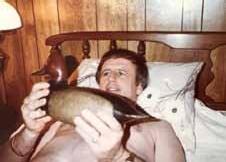
“Johnny Hillman promised Joe that he would get me this Redhead someday. It was the best of a group of four. In 1989, Diane and I picked it up from Johnny at the Stony Brook show in New York and flew to Jamaica with it on vacation. I later told people I went to Jamaica with a blonde and a redhead.”
- Jim Cook
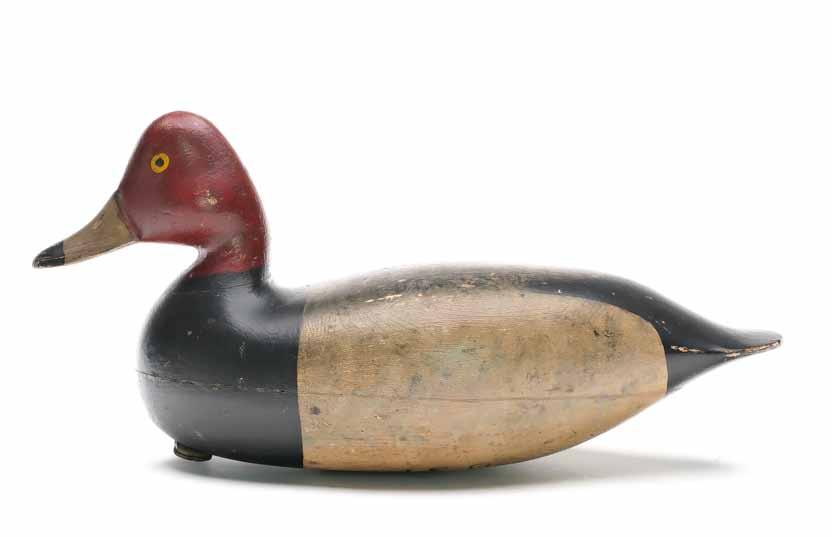
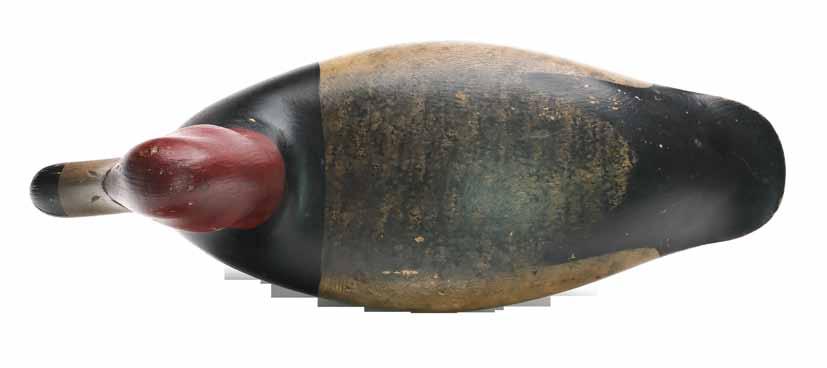
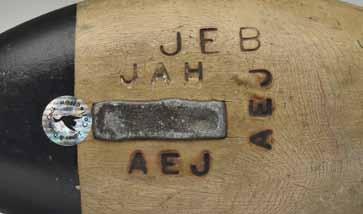
24 Harry V. Shourds (1861-1920), Tuckerton, New Jersey. Excellent redhead. Hollow carved with inlaid lead weight on underside. Branded “JEB” for the rig of John Edward Barnes. Also branded “AEJ” and “JAH” on underside. Measures 14.75” long. Original paint with very minor flaking and wear; thin coat of varnish has darkened slightly with age; excellent structurally.
Provenance: John and Isabelle Hillman collection. Jim and Diane Cook collection.
Literature: “Classic New Jersey Decoys” by James R. Doherty, page 50, exact decoy pictured. (30,000 - 50,000)
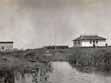

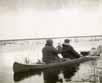
In 1905 a group of 12 wealthy sportsmen from the Brandon, Manitoba and surrounding areas purchased 5,275 acres at the south end of Oak Lake, in the southwestern portion of the Province. A comfortable lodge was constructed and a gamekeeper, Walter Jiggens, lived in a separate cottage on the property. Strict bylaws were created which mandated daily bag limits and limited the number of guns on the marsh at any given time. Gambling was prohibited and drinking was not allowed during daytime hours. Many of the members shot over decoys carved by John R Wells of Toronto and each man identified their personal rigs with their initials. The club enjoyed very good shooting with records indicating that, in 1907, the members shot 53 geese and 2,319 ducks on the club grounds. Prominent among the founding fathers was Brandon resident, Joseph Blythe Whitehouse (J.B.W.) (1865 – 1941).
Whitehouse was typical of the affluent members of the club. Born and raised in Blyth, Ontario, he was educated at Tilson, Ontario and St John’s College in Winnipeg. In 1894 he married Edythe H Christie (1869 – 1959) and they had three children. His early employment was at the Western Union Telegraph company as a bookkeeper. He left that job to accept a position at the Merchants Bank in Brandon and, shortly thereafter, was appointed treasurer of the City of Brandon. In 1903, he and three other men, acquired the Brandon Sun Newspaper and Whitehouse became the managing editor. In 1905 he bought out his partners, securing control of the business. His success made the Sun one of the most influential newspapers in the west.
Active in the civic and social affairs of Brandon, he was a Mason, a member of the Brandon Board of Trade, The Brandon Club, and the Canadian Press Association. He and Edythe are buried in the Brandon Cemetery.
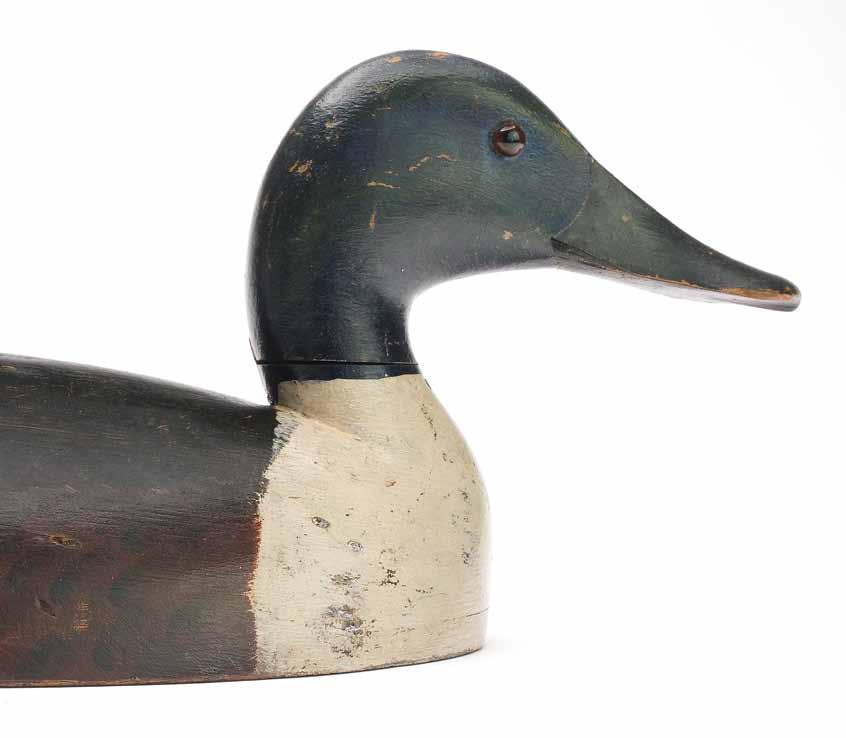
It is unknown how the club members became aware of the decoys carved by Wells, located in far off Toronto. Some have conjured that since Whitehouse and Wells were contemporaries, perhaps they met during Whitehouse’s early years in Toronto. Others have suggested that members of the club may have had business interests that required them to travel to Toronto where they may have met Wells while he was employed at McCready’s Sporting Goods. Whatever the reason, The Oak Lake Shooting Club enjoyed the privilege of gunning over some of Canada’s finest decoys.

The son of a Scottish immigrant, John initially became a plumbing contractor and, in 1887, married Mary Ironside. At some point in the 1890’s, he left the plumbing trade and, with a background as an avid waterfowler and trapshooter, found employment with the R.A. McCready Sporting Goods store in Toronto. In 1904, he transitioned again, this time to work at the Aykroyd Brothers Boat Shop and he would remain with this prestigious small boat builder for the next 43 years. The boatyard gave him ready access to a variety of tools and materials, and his background in waterfowling undoubtedly led him to carve decoys. His birds are among the finest of their kind to em erge from the Toronto area. Of the many quality decoys he carved, his crowning achievement occurred in 1919 when he was honored to have been selected as the supplier of decoys for the visiting Prince of Wales on his trip to Manitoba’s Delta Marsh.
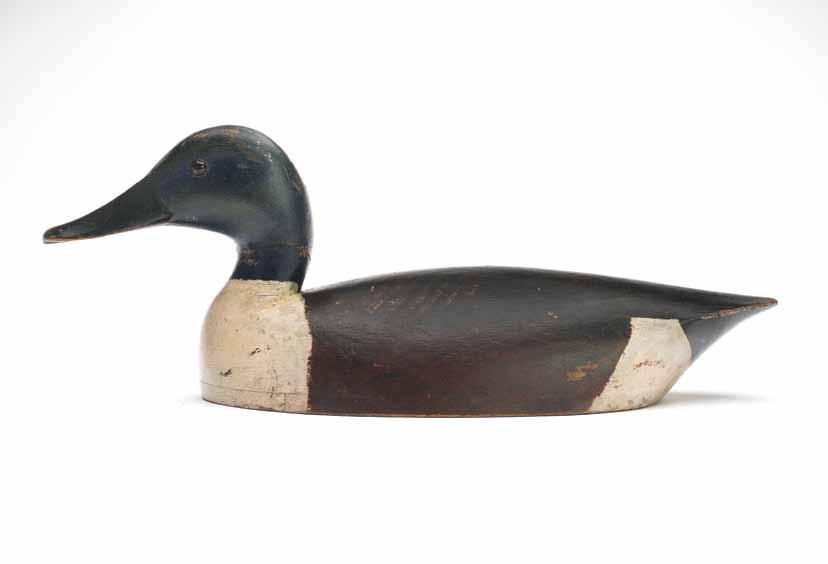
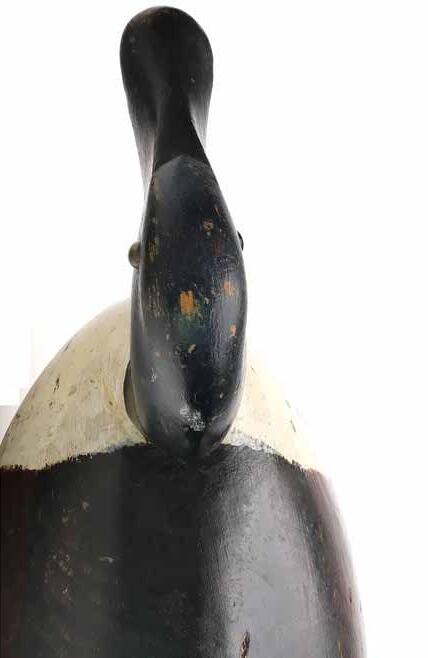
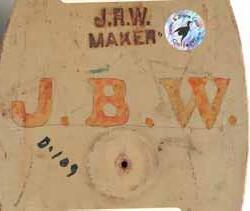
25 John R. Wells (1861-1955), Toronto, Ontario.
Extremely rare shoveler. Hollow carved with .25” bottom board and wide bill carving. “J.R.W. Maker” branded on underside. Also initialed “J.B.W.”. Measures 16.5” long. Original paint with minor gunning wear; lightly hit by shot with two of the shot holes on one side of breast being filled; crack in one side of neck; hairline crack in one eye; decoy had a thin coat of early varnish with a thin layer of later varnish applied unevenly that is visible under UV light.
Provenance: Rig of Joseph Blythe Whitehouse. Acquired by Torry Ward from the decoy shed at the Oak Lake Shooting Club in 1972. Sold to Joe Tonelli. Bill Umbracht collection. Jim and Diane Cook collection. (30,000 - 50,000)
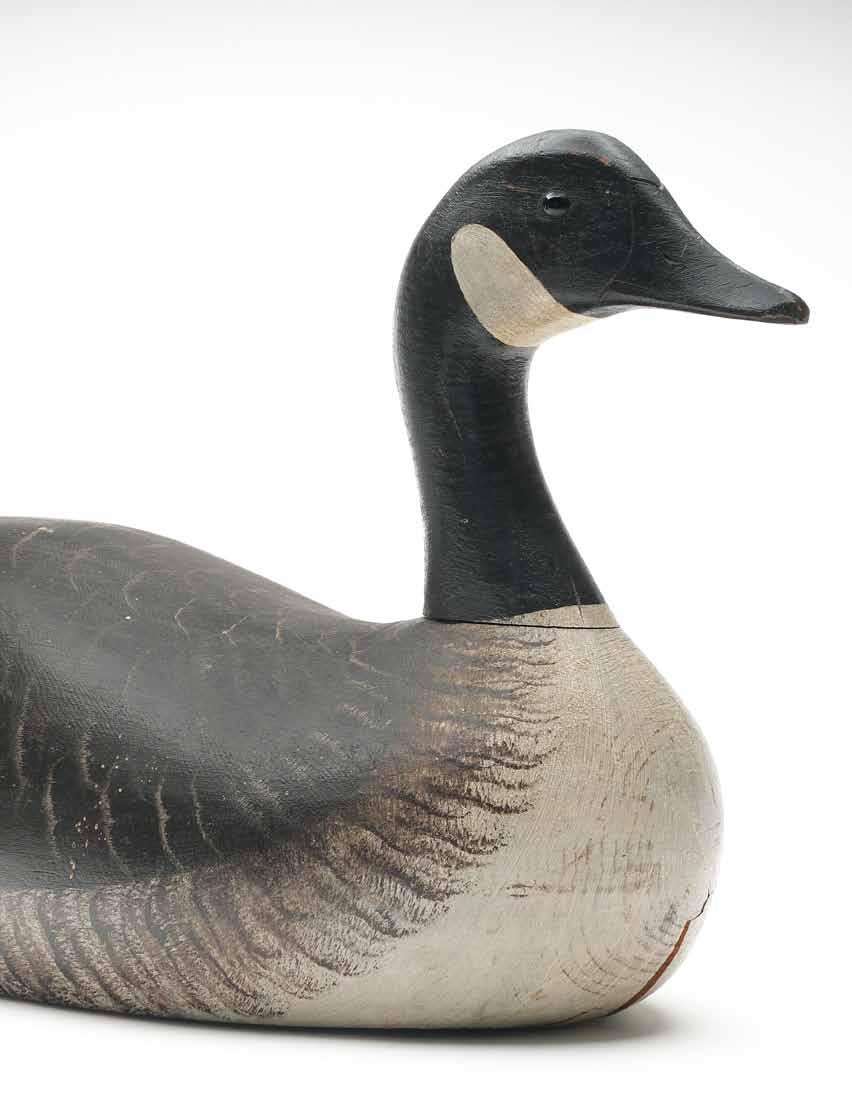
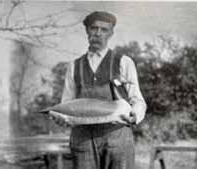
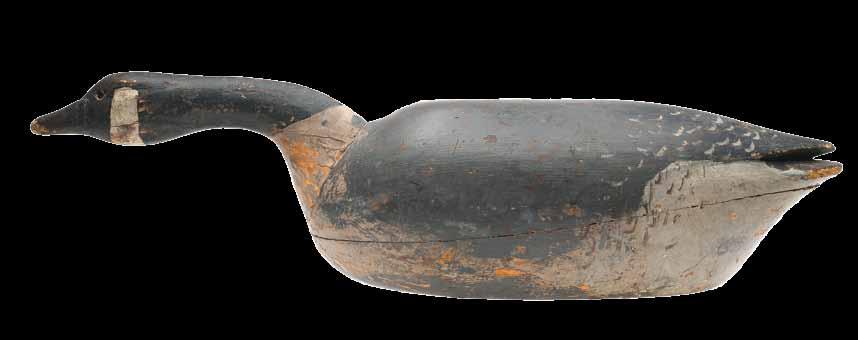
Joseph Lincoln (1859-1938), Accord, Massachusetts. Outstanding Canada goose. Branded “Chouteau” for the rig of Pierre Chouteau. George Thompson collection ink stamp on underside. Measures 26” long. Near mint original paint with a few very minor rubs; typical drying split along the underside that extends onto breast and under tail area.
Provenance: Pierre Chouteau Jr. collection. Robert Clifford collection. George Thompson collection. Jim and Diane Cook collection. (30,000 - 50,000)
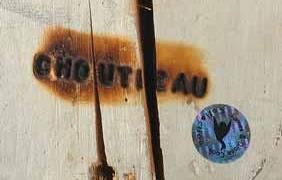
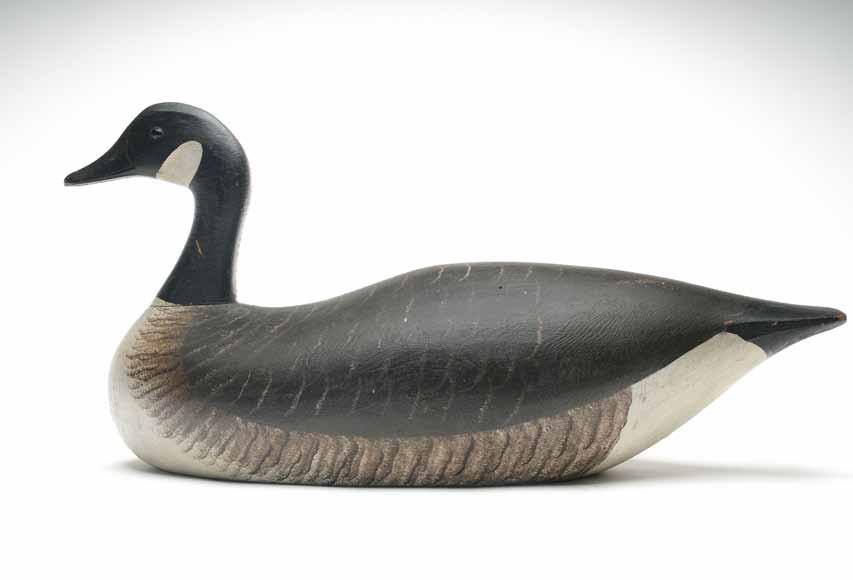
Often, the provenance tucked away on the bottom of a decoy can be almost as interesting as the carving itself. Such is the case with the early history of the Lincoln goose in the Cook collection.
Joseph Lincoln (1859 – 1938) needs no introduction to those interested in decoys. One of Joe’s favorite pastimes was “stand shooting” for geese at the North Shore stand adjacent to his property on Accord Pond in Hingham. These elaborate “stands” were quite numerous throughout the state of Massachusetts, and all required large numbers of both live and wooden decoys. Lincoln became justly famous throughout the South Shore and beyond for producing what many consider, the finest wooden goose decoys ever crafted. The stands were popular with groups of hunters which, in turn, made them popular with the local game wardens.
Two such men were MA Conservation officers Pierre (“Pete”) Chouteau Jr. (1898 – 1967) and Robert Francis (“Bob”) Clifford (1897 - 1987). Both gentlemen led remarkably similar lives. As young men, they resided in adjacent towns immediately west of Boston and worked in trades such as a car salesman (Chouteau) or railroad employee (Clifford). Both served honorably in WWI, Chouteau in the Army, and Clifford in the Marines. Their lives became closely entwined in 1933 when both joined the Massachusetts Department of Conservation (now Fish and Wildlife), each serving in neighboring districts in Plymouth County, Chouteau in Plymouth (Town), and Clifford in Whitman. Clifford’s district would have included Lincoln’s home and stand in Hingham, and both
men would have, inevitably, known of each other. In 1953, Chouteau became Supervisor of the entire Inland District which would have made him Clifford’s immediate supervisor. The two wardens worked together until they retired, Clifford in 1962 and Chouteau in 1963.
As noted in newspaper articles of the day, both men were ardent shooters, and both enjoyed waterfowling. At some point, Chouteau became the owner of the Lincoln goose being offered here and branded it as he did with other birds he owned, either in his personal rig or on his mantle. He may have obtained it directly from Lincoln before Joe’s death in 1938 or on one of his official visits to the local stands after that date. The bird again changed hands when Chouteau gifted the decoy to his friend and associate, Bob Clifford.
After his retirement, Clifford moved to Brewster on Cape Cod and, by the mid 1960’s, had begun to collect, as well as carve and sell his own birds out of his home. Eventually, ownership of the decoy transferred from Clifford to George W Thompson who displayed it in his collection at Rolling Ridge Farm in Cazenovia, New York. Upon his death, the Thompson collection, one of the very finest of its day, was sold through Ted and Judy Harmon’s, Decoys Unlimited auction in July of 1990. This exact decoy, lot 125 and pictured on the cover of the catalog, was described by Ted as “ The finest upright Lincoln Goose decoy I have ever seen in the thirty years I have been handling decoys. ” It remains an exemplary and splendid example today.
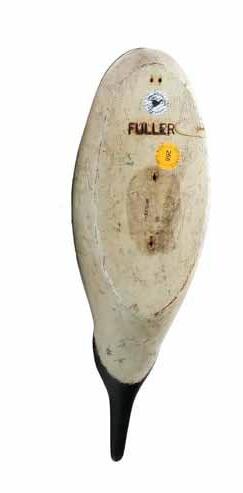
Other than the fact that Mr. Fuller was an affluent sportsman from Milwaukee, Wisconsin, nothing more is known about the man. Whoever the individual was, he owned a rig of about 30 premier and challenge grade decoys from the Mason Decoy Factory in Detroit. The group consisted of bluebills, canvasbacks, pintails and perhaps a few other species, including both low-head and slope breast models. Apparently, Mr. Fuller either rarely used the decoys, or did so carefully, because they remained in remarkably fine, original condition. Around 1950, a Mr. Kirt Whaley, also from Milwaukee, went to a local estate sale, presumably Fuller’s or one of his relatives, and purchased all of the decoys from the Fuller rig. He went on to hunt over them in Ontario and Wisconsin, again exercising great care when doing so. On one particular trip to Ontario, one bag of the decoys was mistakenly not loaded on the plane for the return trip, and roughly half of the decoys were lost. The decoys remained with Mr. Whaley until purchased by Joe Tonelli for Jim Cook c1982-83.
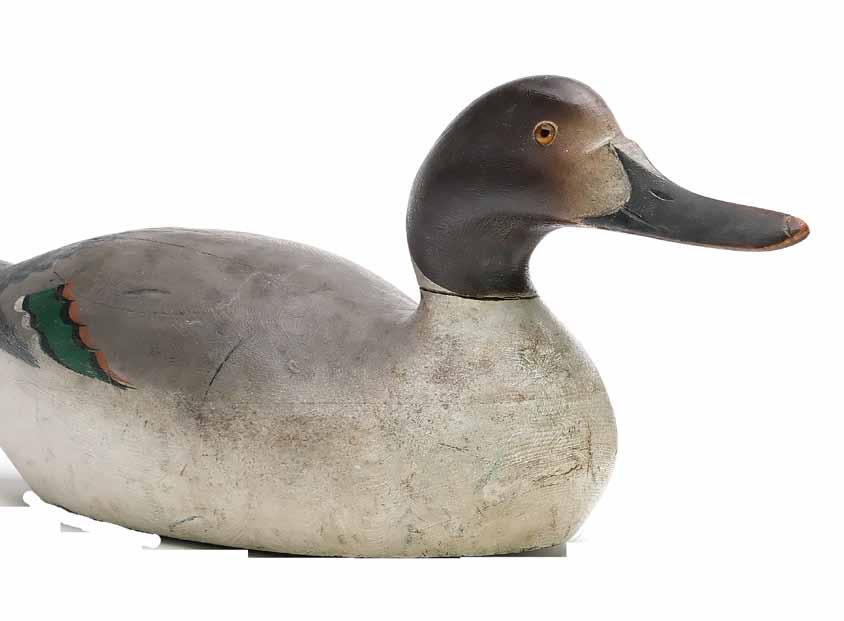
27 Mason Decoy Factory (1889-1924), Detroit, Michigan. Rare rigmate pair of pintails. Hollow carved premier grade with early snakey head style. Both branded “Fuller” on underside. Also with the McCleery collection ink stamp and Sotheby’s auction sticker on undersides. Measure 17” and 19.5” long. Original paint with minor gunning wear; slight separation at neck seats; tight crack in one side of drake’s head; hairline crack in drake’s back and tail; spot of roughness on drake’s back was filled and touched up; some flaking to filler around a knot on one edge of tail.
Provenance: Dr. James McCleery collection. Jim and Diane Cook collection. (20,000 - 30,000)
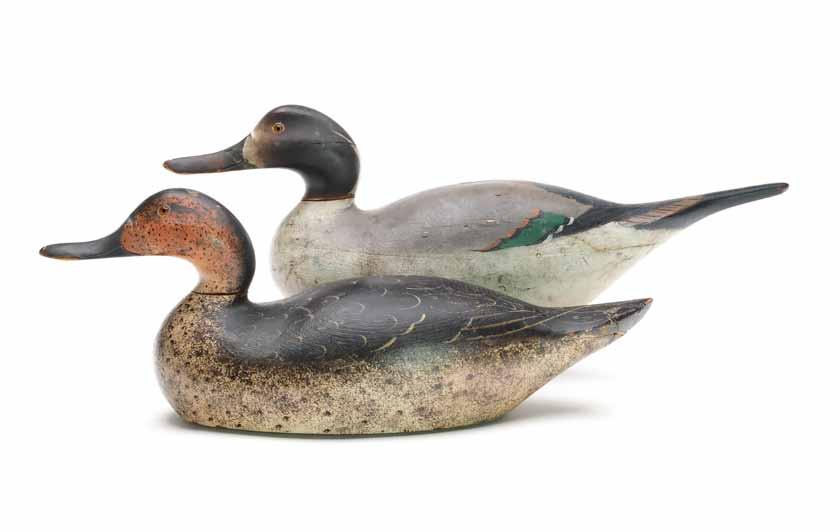
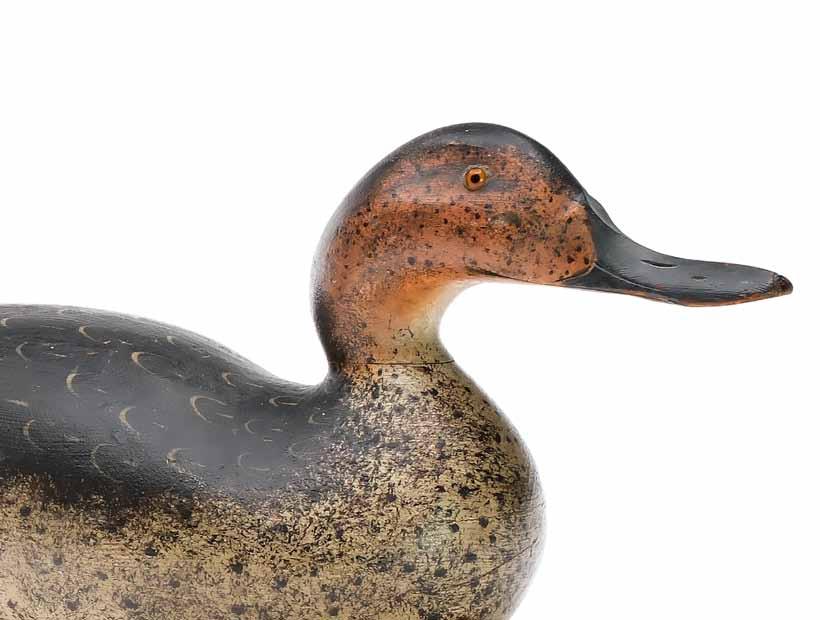
28 Mason Decoy Factory (1889-1924), Detroit, Michigan. Rare rigmate pair of mergansers. Challenge grade models with snakey head style. Measure 17.25” long. Original paint with minor flaking and wear; some flaking to hen’s neck filler; minor discoloration where tannins in wood has bled through paint.
Provenance: Jim and Diane Cook collection. (20,000 - 30,000)
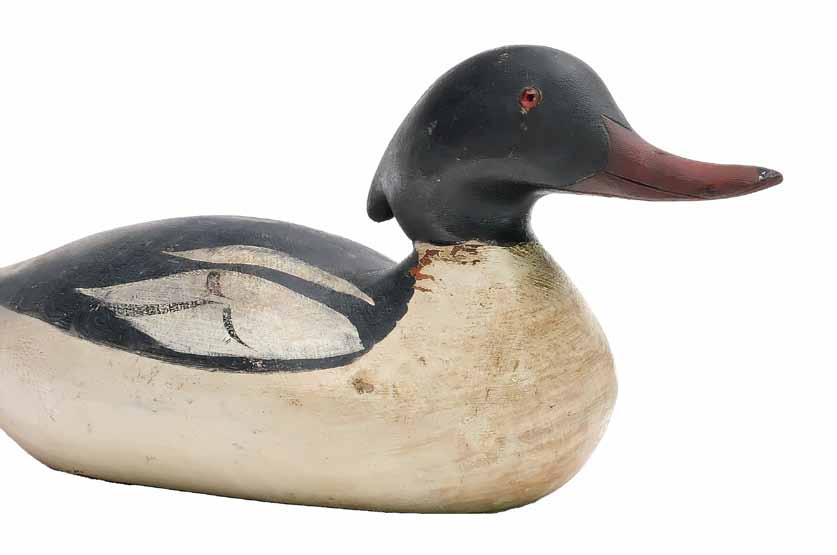
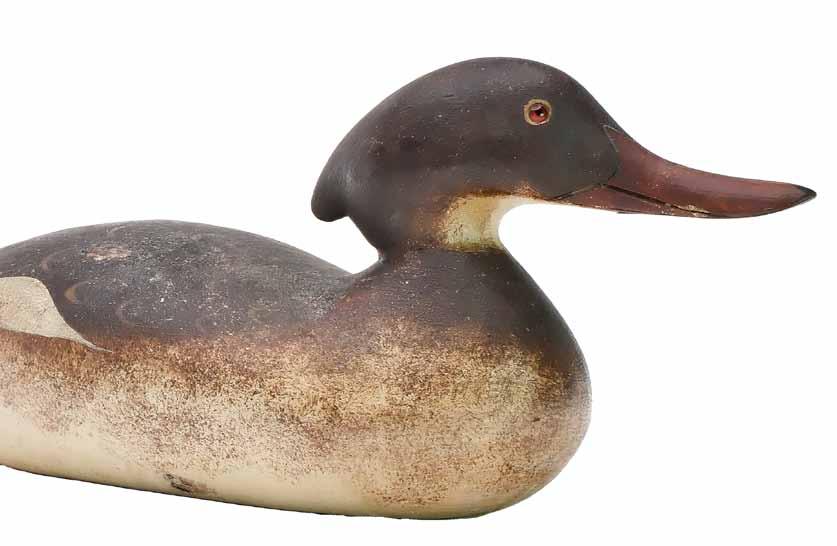
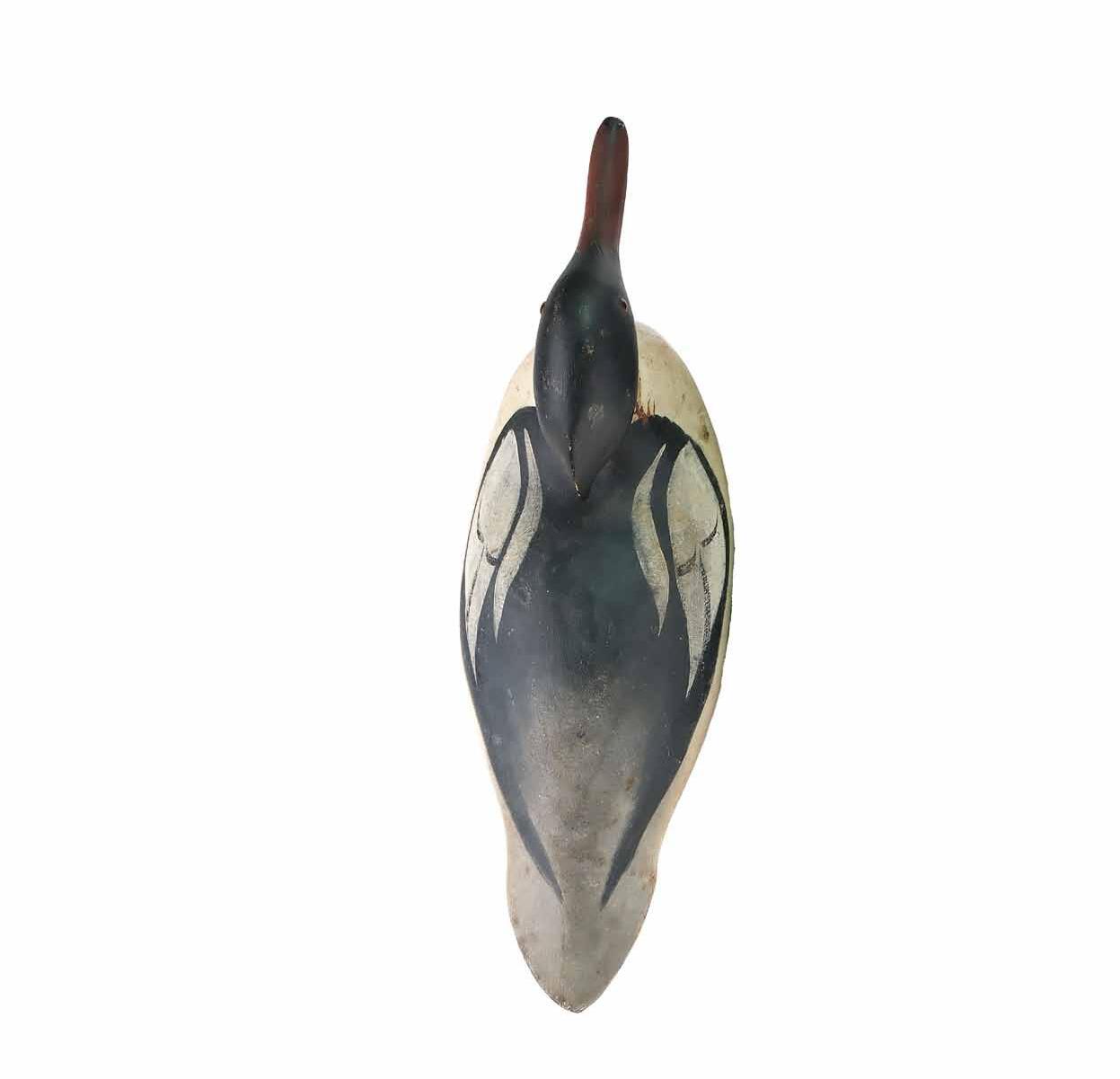
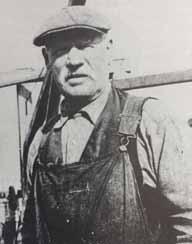
Charles Bergman enjoyed duck hunting, and it may be possible that, while it was legal, he sold some of his excess game in the Portland (OR) markets. There were few, if any, locally produced decoys at the time so Bergman’s earliest decoys were Mason factory birds. His first attempts at making his own decoys clearly reflect the Mason influence but he rapidly developed a unique style of his own.
Citing Miller and Mortensen, all of Bergman’s decoys are hollow and very light. All were carved from the locally available western red cedar. Until about the age of 70, the bulk of Bergman’s production was for his own use but, upon his retirement, he began to carve in earnest for the commercial trade. His grandson estimates that he produced about a dozen decoys per week that he sold for $1.25 each. He carved a variety of species, all noted for their table quality and, as such, only one rig of bluebills (locally considered trash ducks) is known. Bergman’s work is widely recognized for the quality of his carving and construction, but he is probably best known for his outstanding painting. His plumage is crisp and accurate but often varies decoy to decoy within the same rig. As pointed out by Hugh Chatham, “It is ironic that a man may labor all his life at “serious” work but be best remembered for a few artifacts created while ‘at play’.”
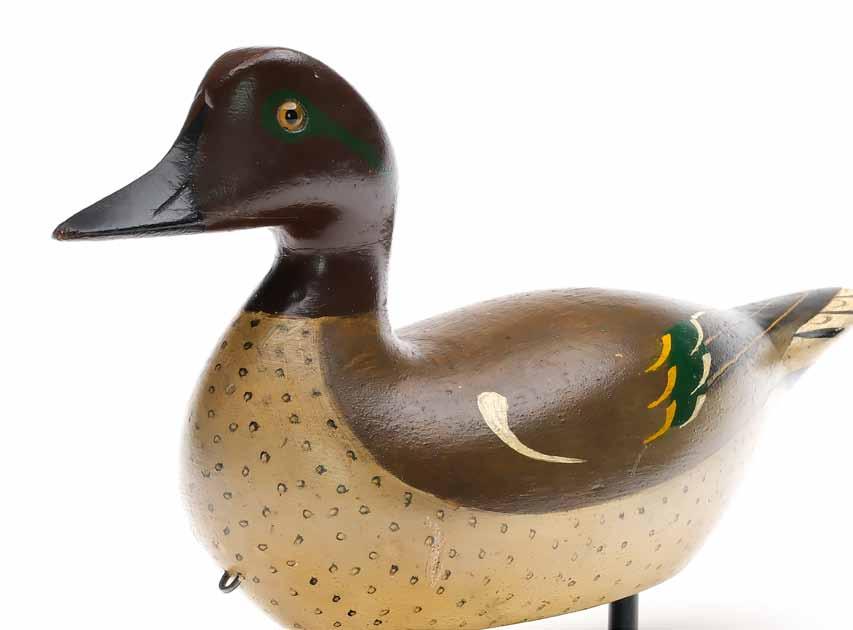
His craftsmanship speaks volumes about a man who took great pride in his work. His lasting legacy rests firmly, not only on his own efforts, but on the influence he had on regional carvers to follow. His work was the subject of a year long exhibit at the Columbia River Maritime Museum and was included in an exhibit at the Houston Museum of Natural Science (TX). His carvings are a part of the prestigious permanent collection of the Shelburne Museum (VT) and are represented in numerous, well known, private collections.
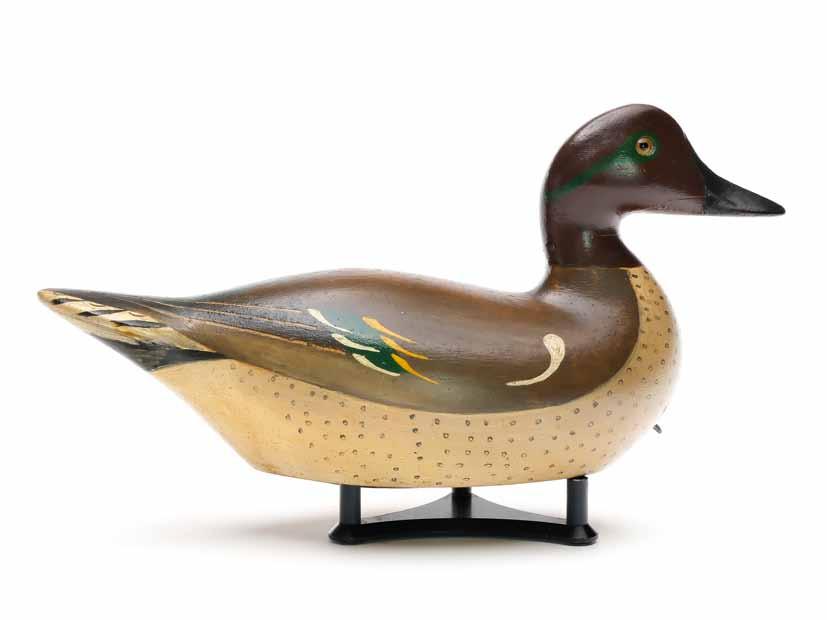
29 Charles Bergman (1856-1946), Astoria, Oregon. Outstanding greenwing teal. Hollow carved with excellent color blending on sides and appealing polka dot paint detail. Measures 13” long. Original paint with virtually no wear protected under the original coat of varnish; very minor discoloration under tail; 1” dent in one side of breast; fine hairline crack in neck and a hairline seam where bill was cracked down and reset with a very small amount of touchup to the seam.
Provenance: Jim and Diane Cook collection.
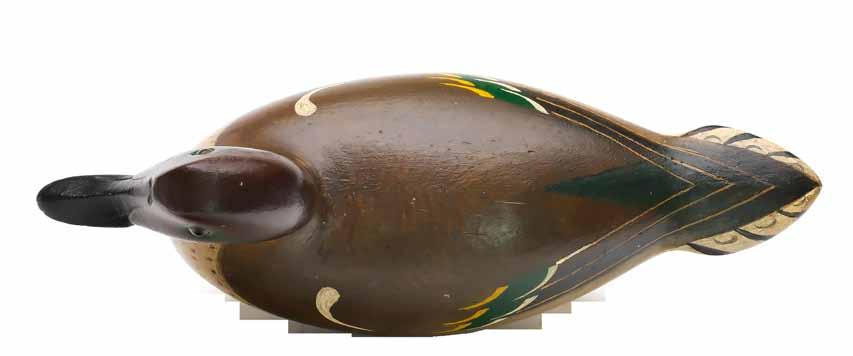
(35,000 - 45,000)
1872 - 1949 | Stratford, Connecticut
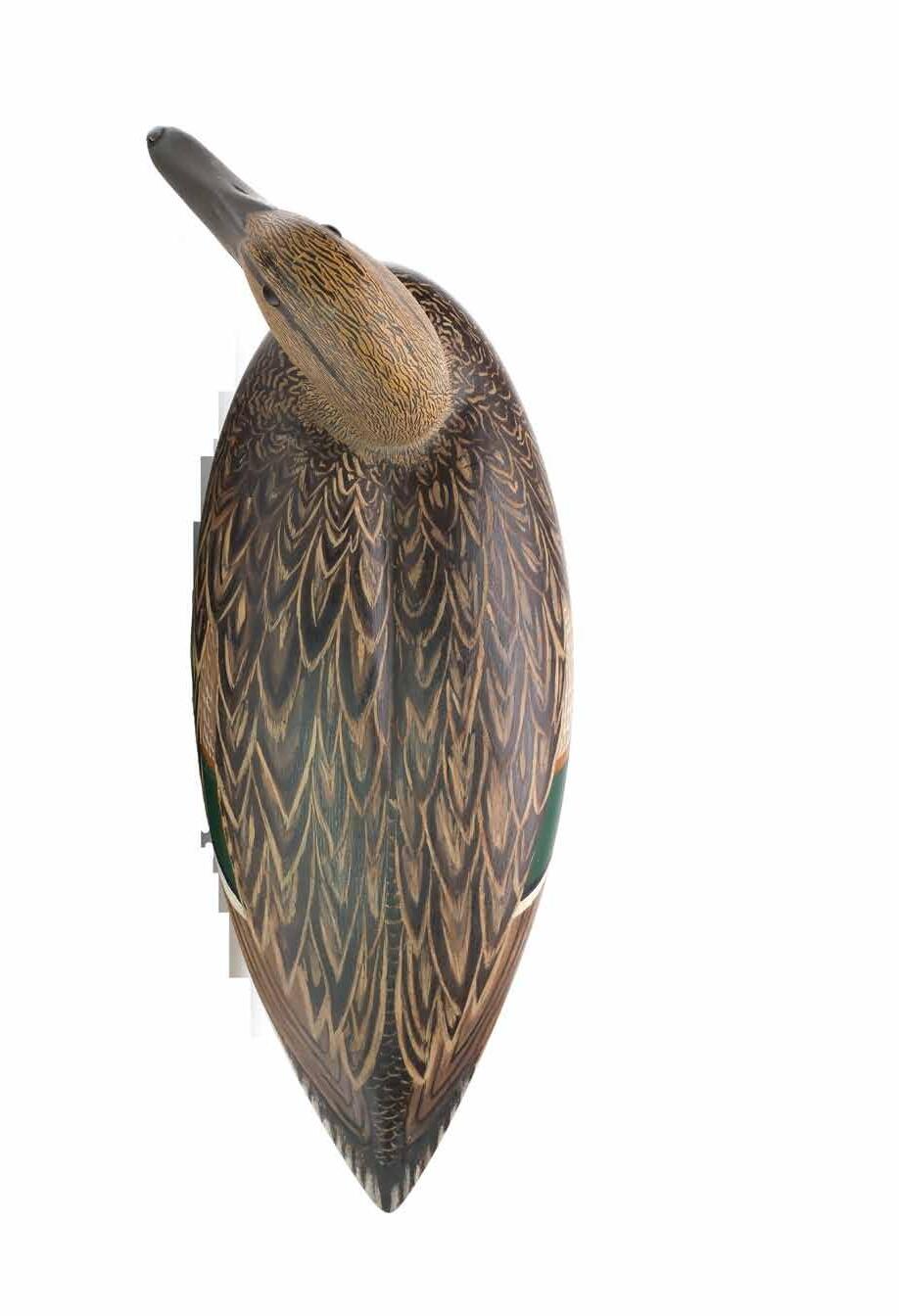
Wheeler carved only for his own use or enjoyment, so his decoy production was limited. While he was influenced by the work of his predecessors, Albert Laing (1811 – 1886) and Ben Holmes (1843 – 1912), he became the recognized master of the Stratford School of Carving. His decoys were, in turn, the inspiration for a series of noted area carvers that followed. He first sprang onto the carving scene when he astonished local decoy makers at the first Decoy Show ever held at Bellport, Long Island. His first place, winning pair of mallards, were ultimately gifted to noted decoy collector, carver and historian, Joel Barber. He, along with legend Elmer Crowell, were among the very finest of the early carvers to produce decoys meant for the mantel rather than the marsh. Wheeler’s fame rapidly spread, and he won numerous contests, notably repeated wins in the decoy competition at the National Sportsman’s Show in New York. Eventually he did not enter, claiming “it was someone else’s turn.” He continued to exhibit at the show, however, as well as at other locations such as Abercrombie and Fitch in New York City. Upon his death, his exhibition birds were acquired by the Connecticut Audubon Society for its Birdcraft Museum in Fairfield. His winning 1923 Bellport pair ar e now one of the cornerstones in the collection of the Shelburne Museum in Vermont. Other examples of his work (a sandhill crane) are in the collections of the Abby Aldrich Rockefeller Folk Art Museum at Colonial Williamsburg and examples of his work are found in the very finest collections in the country.
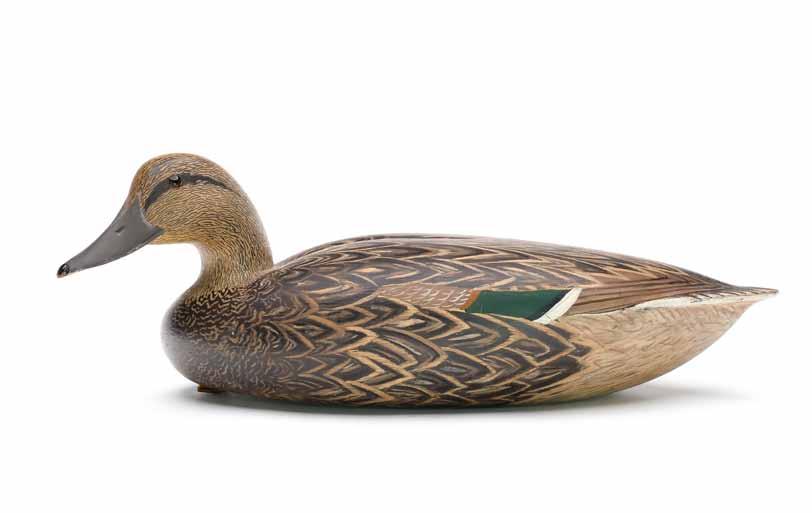
30 Charles E. “Shang” Wheeler (1872-1949), Stratford, Connecticut. Working pintail hen with outstanding paint detail. Hollow carved with slightly turned head and scratch feather paint detail. Weight was removed. Measures 17” long. Minor paint rubs on edge of bill and tip of tail; otherwise near mint.
Provenance: Estate of the maker. Connecticut Audubon Society collection. Jim and Diane Cook collection. (25,000 - 35,000)
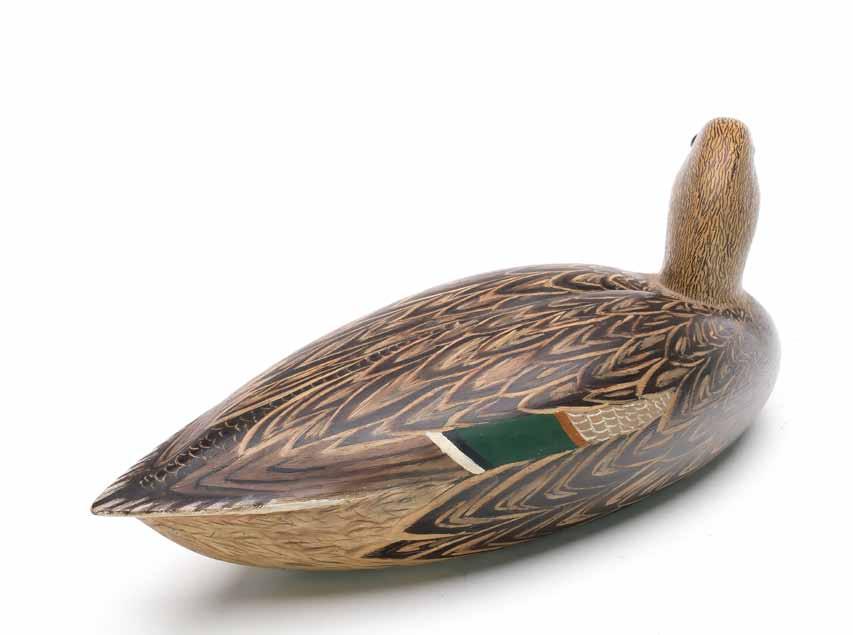
A group of fine, Toronto style, decoys dubbed “The Markham Rig” are well known to collectors, but their story is a puzzling one. The label is the result of the fact that they were first discovered by collectors when, in 1969, three barrels or crates full of the birds were offered in an estate auction in Markham, Ontario, a city northeast of Toronto. The story relates that they had been stored for many years in a local barn. Some of the decoys were unfinished and, of those that were finished and painted, many had never been rigged. The group contained decoys from more than one carver with some today suggesting up to 4 or possibly even 5 different makers. All of the birds possessed a surface and patina that suggested a c1900 date of origin. Many of the decoys in the group share certain similarities such as being hollow carved with a thin, (usually) brown painted bottom board, a pronounced high back profile, and detailed bill carving that is quite distinctive.
Over the last 50 plus years, numerous attempts have been made to sort out the story. It appears that the barn where they had been found was once the property of the Morley family. It has been suggested that a brick manufacturer, Walker T Morley (1833 – 1922), or perhaps
one or more of his sons, Walter, George, William, Henry, and Alfred were the makers of at least some of the rig. Walker lived in nearby York, roughly halfway between Markham and the Toronto waterfront. The name George Laing has also been bantered about. To add to the confusion, birds by the same hand(s) have since appeared at additional locations. Conceivably, different family members or associates gunned over all or portions of the rig at various times and locations and, at some point prior to 1969, shipped them to the Morley barn in Markham for storage. At this juncture, only the decoys themselves know the full story.
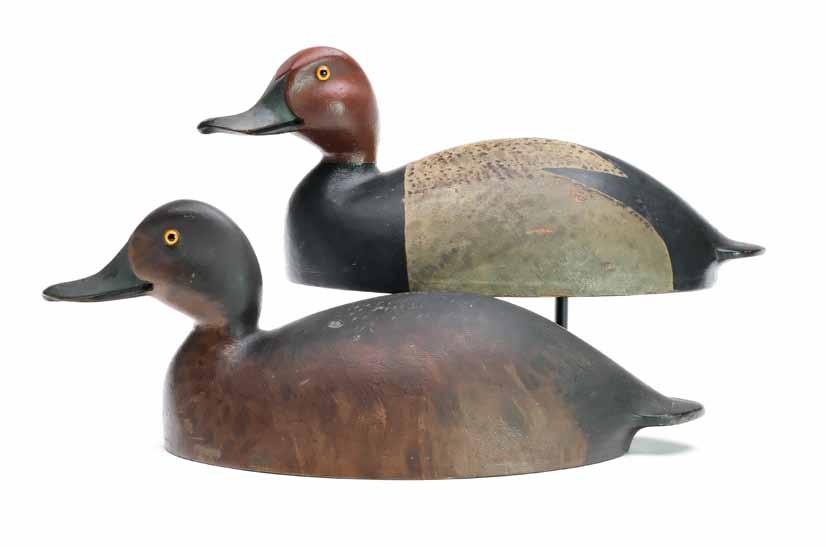
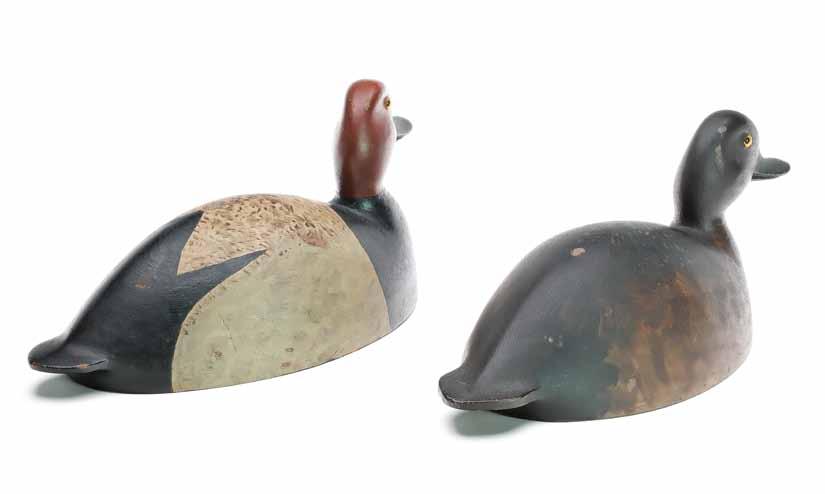
31 Rare rigmate pair of redheads, Toronto, Ontario, circa 1900. From the Markham rig with wide bill carving. Thinly hollowed with .25” bottom boards. Drake with slightly turned head. Decoys were never rigged or weighted. Measure 15.25” and 16” long. Excellent original paint protected under a thin coat of original varnish that has darkened slightly with age; scattered minor paint pulls from when the decoys were being made; both are excellent structurally.
Provenance: Jim and Diane Cook collection. (15,000 - 25,000)
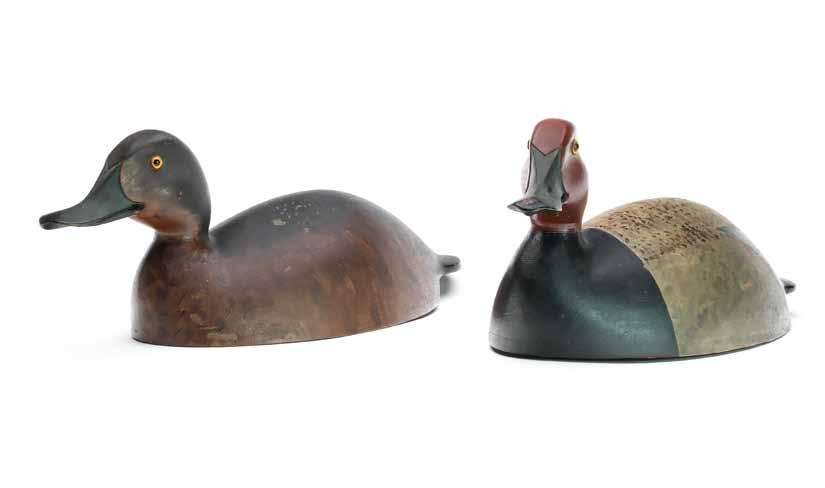
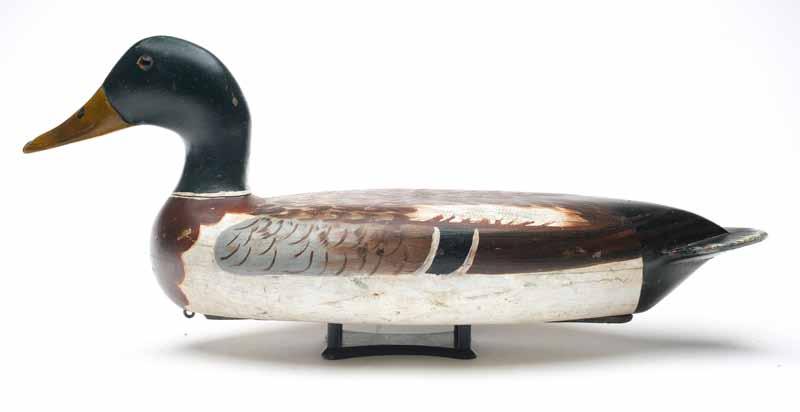
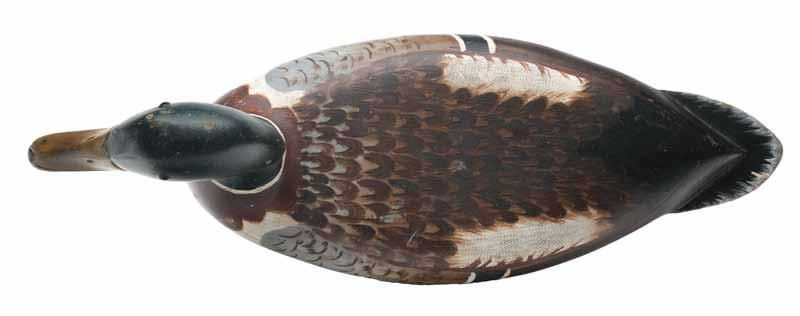
32 Bert Graves (1880-1956), Peoria, Illinois. Excellent oversized mallard. Hollow carved with comb feather paint detail. Retains the original Graves weight. “F.A.H.” painted on underside. Measures 23” long. Original paint with minor gunning wear; excellent structurally.
Provenance: Jim and Diane Cook collection. (20,000 - 30,000)
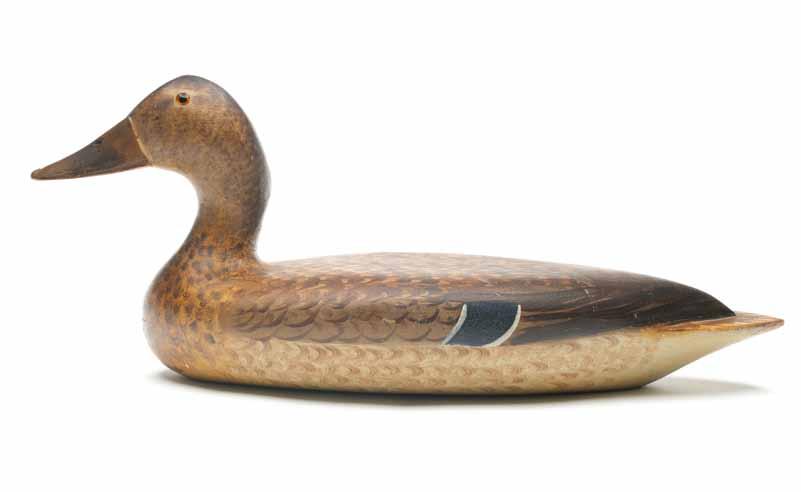
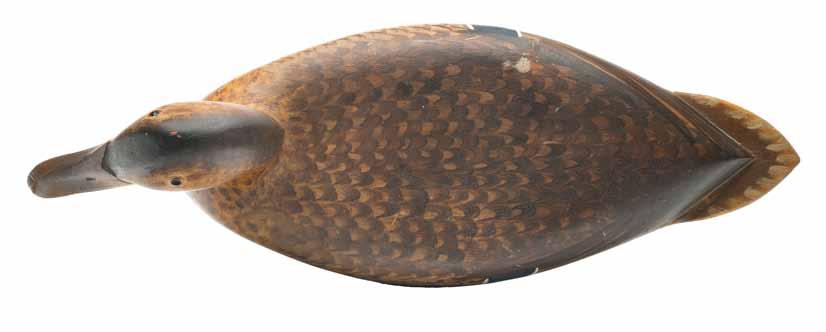
33 Bert Graves (1880-1956), Peoria, Illinois. Outstanding oversized mallard hen. Hollow carved with excellent paint detail. Measures 22.5” long. Near mint original paint with scattered minor rubs; a spot of paint loss near one wing patch; hairline crack in one eye, otherwise excellent structurally.
Provenance: Jim and Diane Cook collection. (20,000 - 30,000)
34 Harvey Stevens (1847-1894), Weedsport, New York. Important goldeneye. Maker’s paint stencil on underside. Also identified in pencil. “S” branded near inlaid lead weight that is stamped “W.J.S.”.
Measures 14.25” long. Original paint with very minor flaking; some filler loss and minor separation at a knot in one side; a later coat of varnish added that has darkened slightly; head swivels as it should.
Provenance: Shane Newell collection. Jim and Diane Cook collection.
Literature: “The Essential Guide to Stevens Decoys” by Shane Newell, log 101, exact decoy pictured.
(15,000 - 25,000)
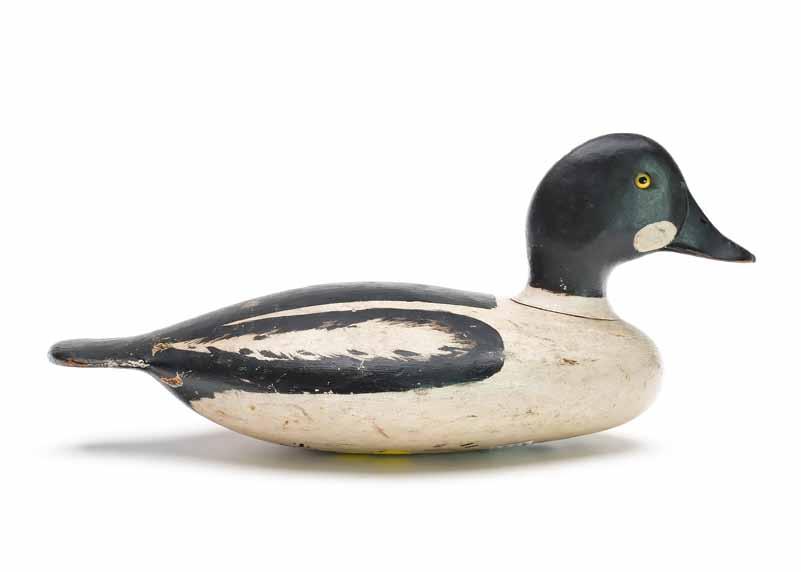
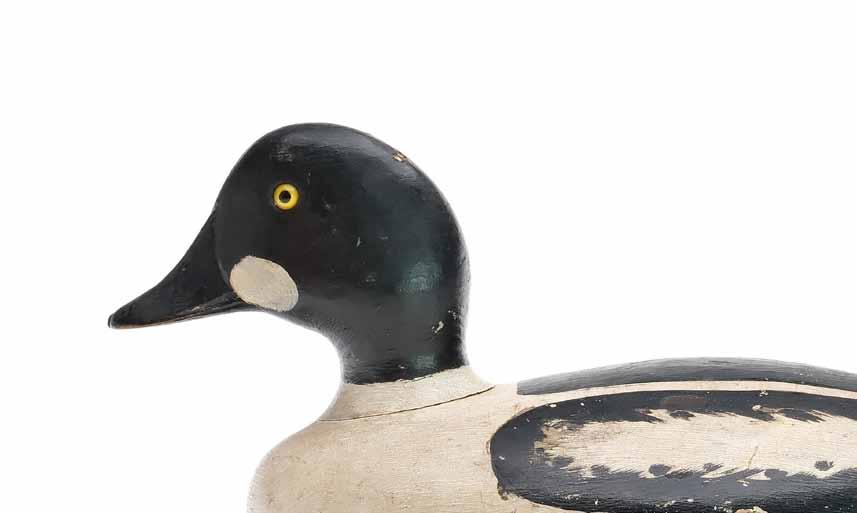
35 Harvey Stevens (1847-1894), Weedsport, New York. Redhead. Fine comb feather paint detail on back. Maker’s painted stencil on underside. Measures 14.5” long. Original paint with very minor wear; flaking to patches in heartwood on underside that were done when the decoy was made; head swivels as it should.
Provenance: Phil Mott collection. Jim and Diane Cook collection.
Literature: “The Essential Guide to Stevens Decoys” by Shane Newell, log 273 , exact decoy pictured. (8,000 - 12,000)
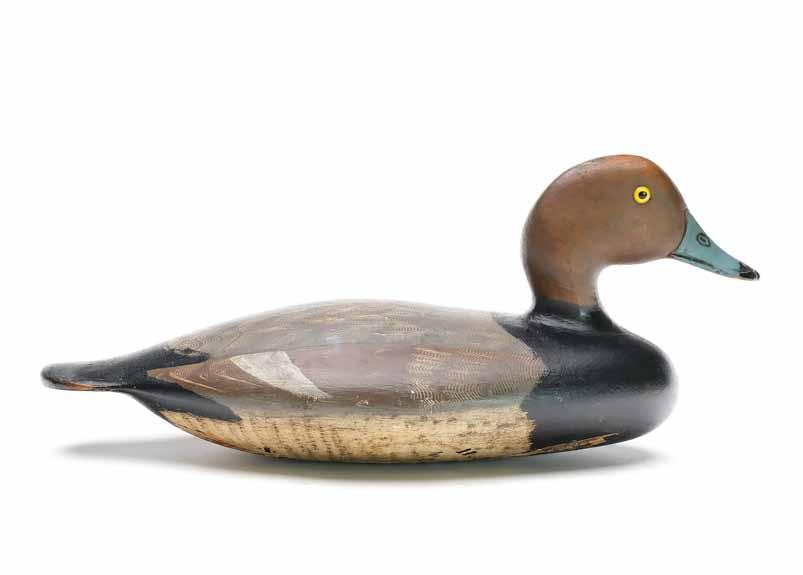
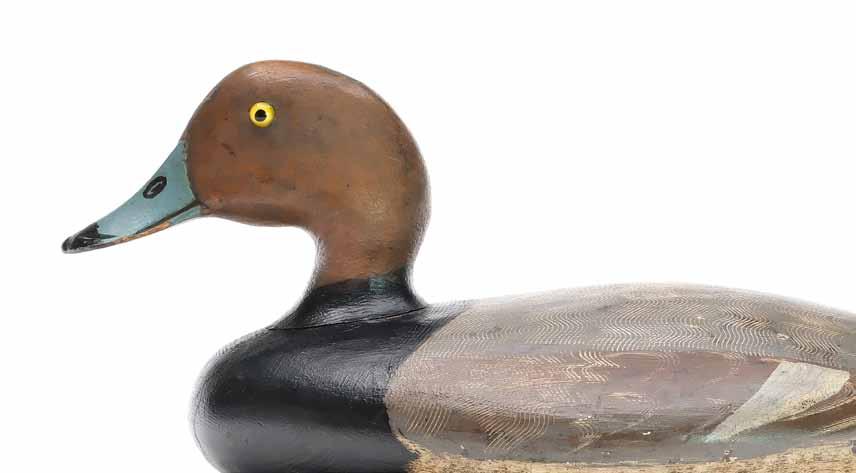
1942
It’s no coincidence that Horner’s decoys are similar in style to those made by HV Shourds. Shourds was, in fact, a neighbor, and it is said that young Rowley would visit Shourds’ shop on a regular basis. Learning to make decoys in the “Tuckerton style,” Horner would go on to perfect both his carving and painting, which would eventually earn him the reputation of making the finest decoys on the New Jersey coastline. His decoy-making career spanned approximately 40 years, but the majority was made from the turn of the century until about 1930.
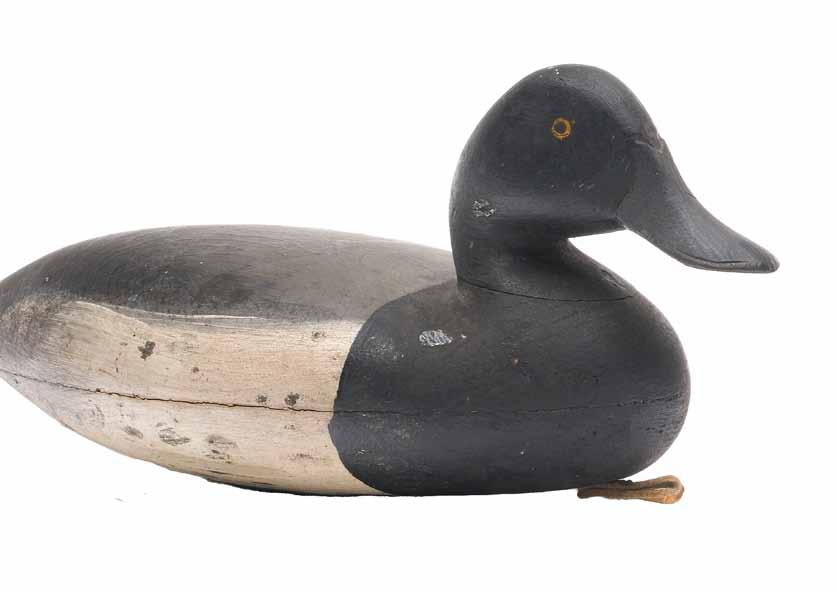
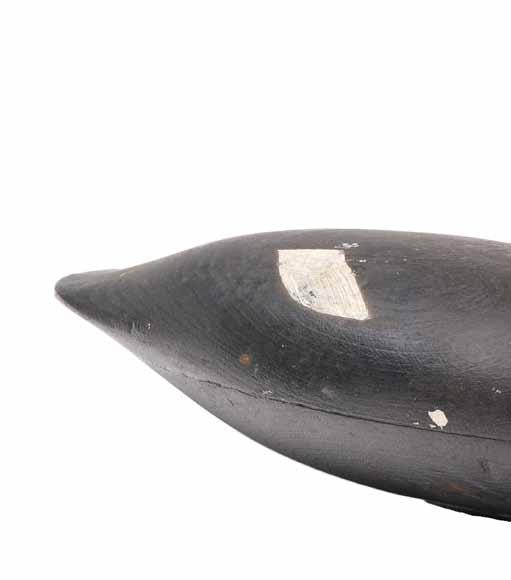
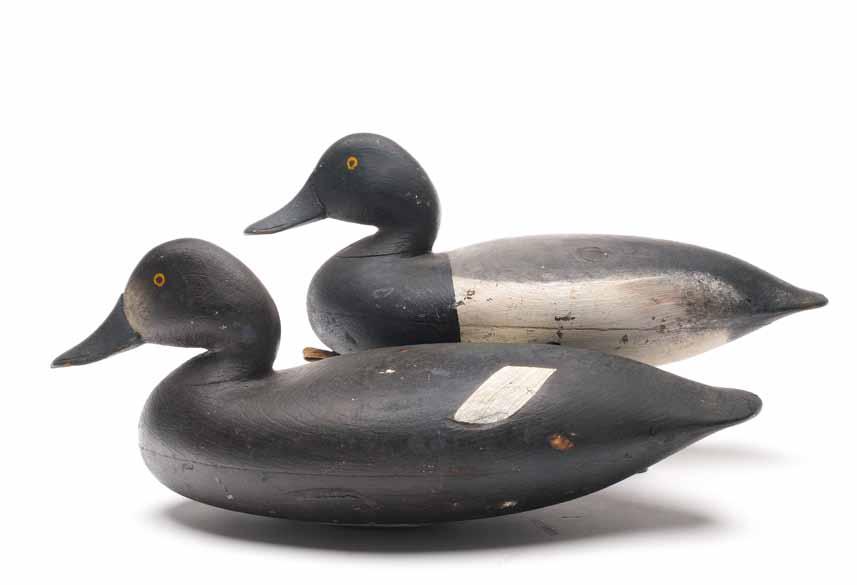
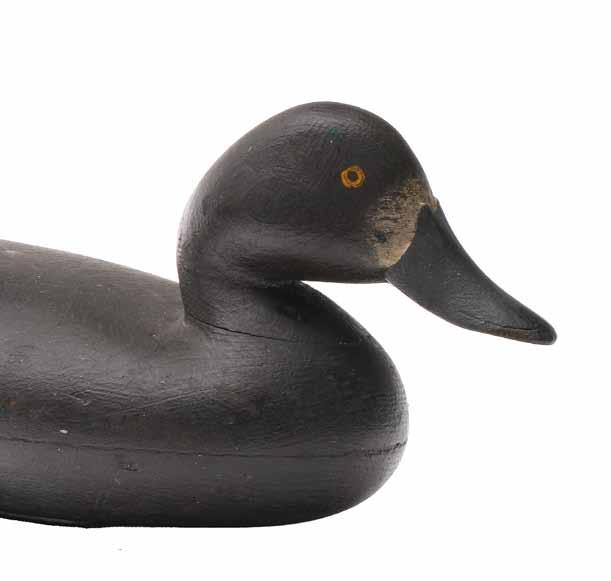
36 Nathan Rowley Horner (18821942), West Creek, New Jersey. Rare rigmate pair of bluebills. Hollow carved. Mackey collection ink stamps on undersides. Measure 13.5” long. Excellent original paint with very minor wear; scattered rubs from when the paint was still wet; small chip in drake’s tail has been darkened; tiny spot on each side of drake’s breast has been darkened.
Provenance: William J Mackey Jr collection. Jim and Diane Cook collection.
Literature: “Classic New Jersey Decoys” by James R. Doherty, page 105, exact decoys pictured. (20,000 - 30,000)
A skilled carpenter by trade, Heisler is estimated to have made between 1500 and 2500 decoys in his lifetime. His birds were executed in the classic Delaware River style and represent some of the very finest of their kind. He was an avid hunter as well as live pigeon and trap shooter. These activities allowed him to frequently be a guest at the prestigious Philadelphia Club which brought him into contact with some of the more affluent sportsmen in the Philadelphia area. It is presumed that it was through this association that he began to offer his decoys through the Edward K Tryon Sporting Goods store in Philadelphia which was a favored shop of club members. Tryon’s was established in 1811 as a maker of fine guns, eventually expanding into offering a wide range of the finest sporting goods. At one point, it was the largest retailer of hunting and fishing goods in the country. The firm prospered until finally closing its doors in the late 1950’s. The fact that Tryon’s chose to offer Heisler decoys attests to the esteem with which they were held by the local gunners.
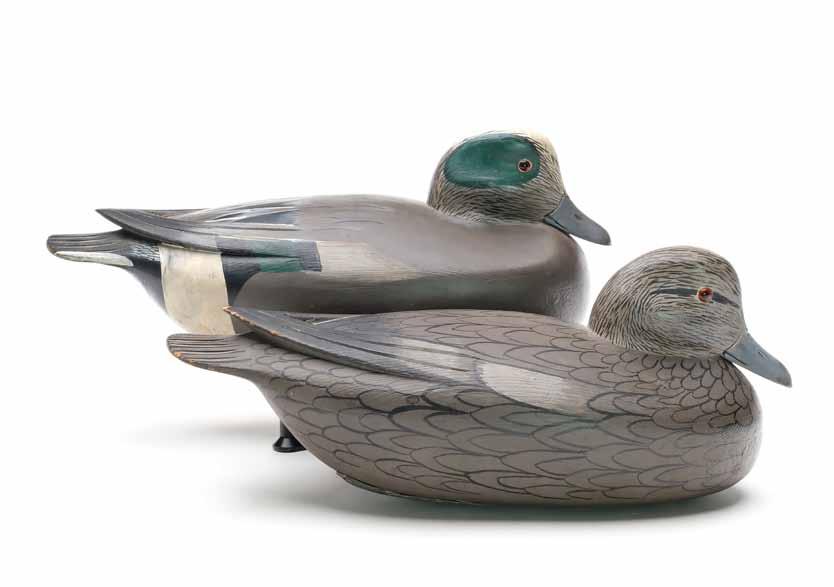
37 Jess Heisler (1891-1943), Burlington, New Jersey. Very rare rigmate pair of widgeon. Hollow carved three-piece body style with tucked heads and raised V wingtip carving. From the rig of A. Hounslow, Bordentown, New Jersey which is painted on underside. Measure 14” long. Excellent original paint with very minor wear on edge of tails and hen’s raised wingtip; weights were moved at some point and the holes on underside filled, but not painted.
Provenance: Jim and Diane Cook collection. (30,000 - 50,000)
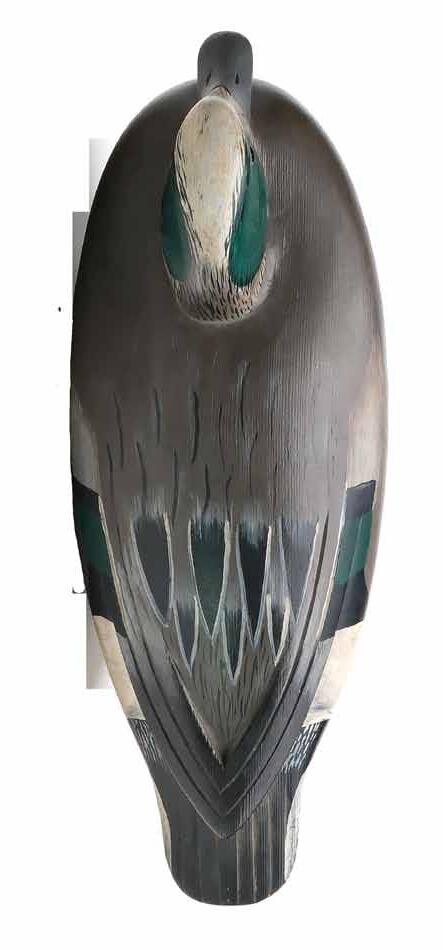
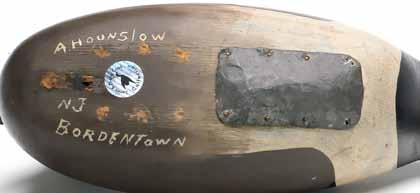
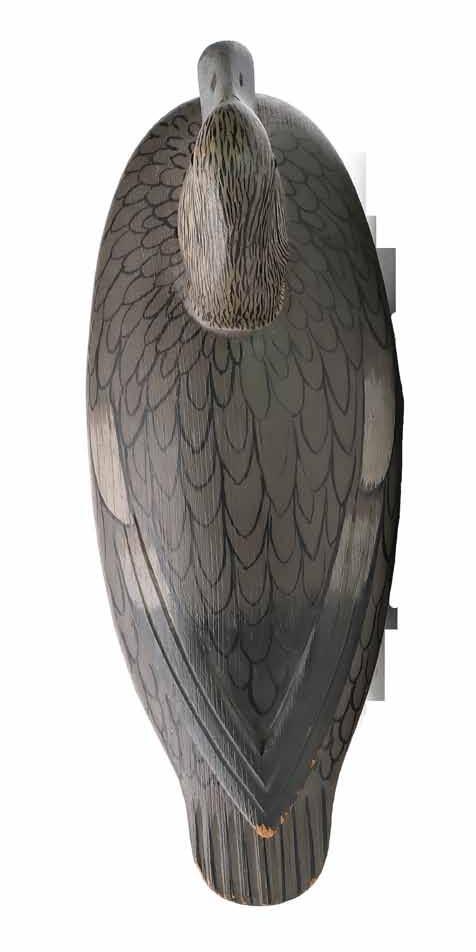
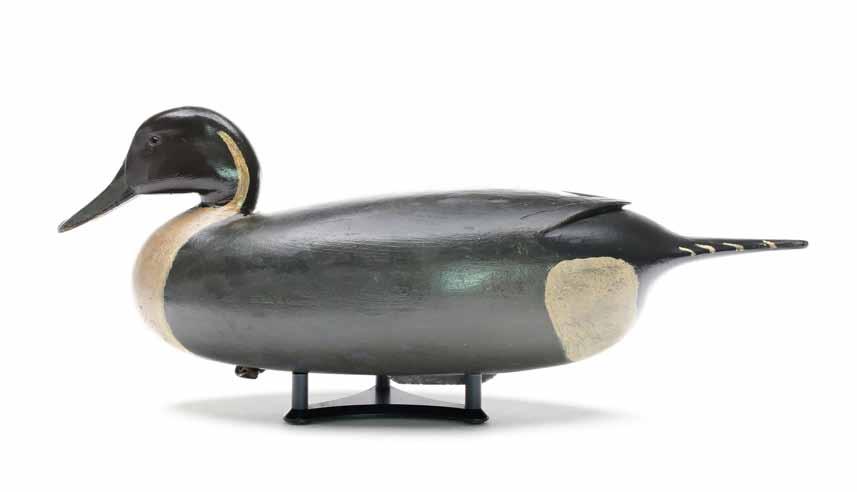
38 Joe King (1905-1992), Edgely, Pennsylvania. Extremely rare pintail circa 1930’s. One of 6 made. Hollow carved with raised V wingtip carving. Maker’s name and town stamped in lead weight. Hillman collection ink stamp on underside. Measures 17.75” long. Original paint with almost no wear; protected under an early coat of varnish that has darkened with age; hairline crack in one side of neck; black on tail area was added after the original varnish coat, likely before it left the maker’s shop.
Provenance: John and Isabelle Hillman collection. Jim and Diane Cook collection.
Literature: “Decoys of the mid-Atlantic Region” by Henry A. Fleckenstein Jr., page 70, exact decoy pictured.
(10,000 - 14,000)
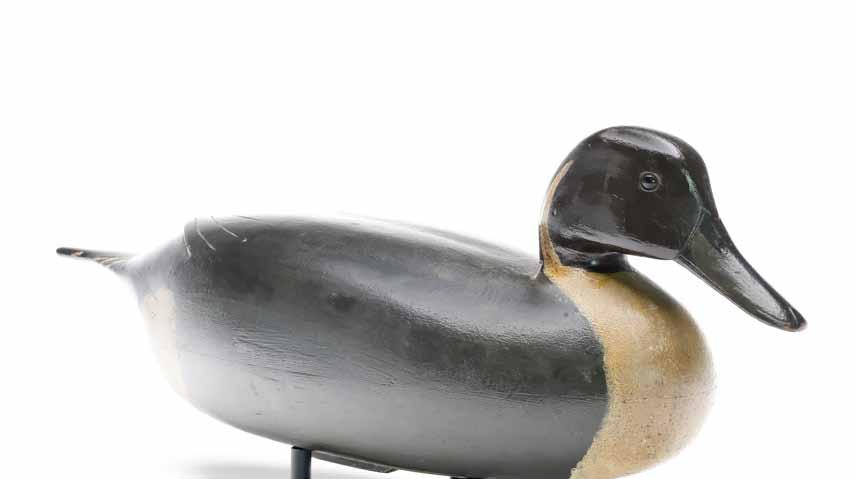
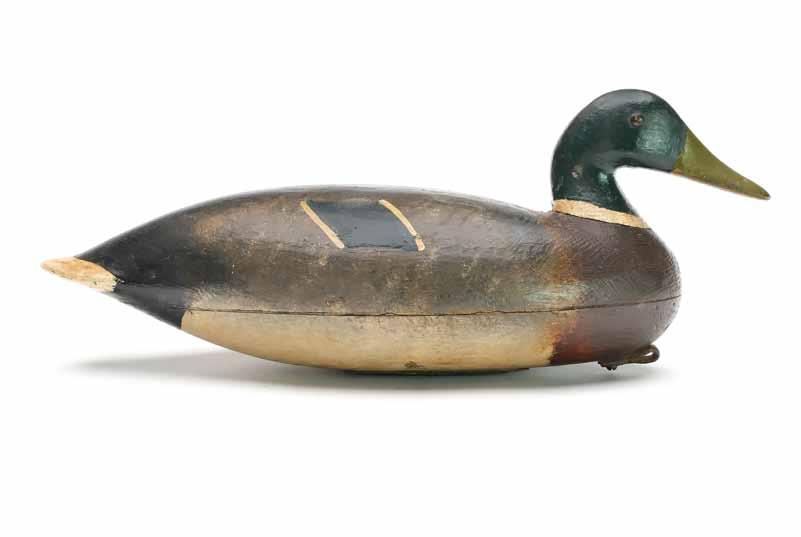
39 Ellis Parker (1890 - 1950), Surf City, New Jersey. Very rare mallard. Hollow carved with brass tack eyes. Hillman collection ink stamp and Kirby Roberts collection sticker on underside. Measures 17.25” long. Original paint with very minor wear; an old coat of varnish has darkened with age; slight separation at body seam; some spots of flaking on one side.
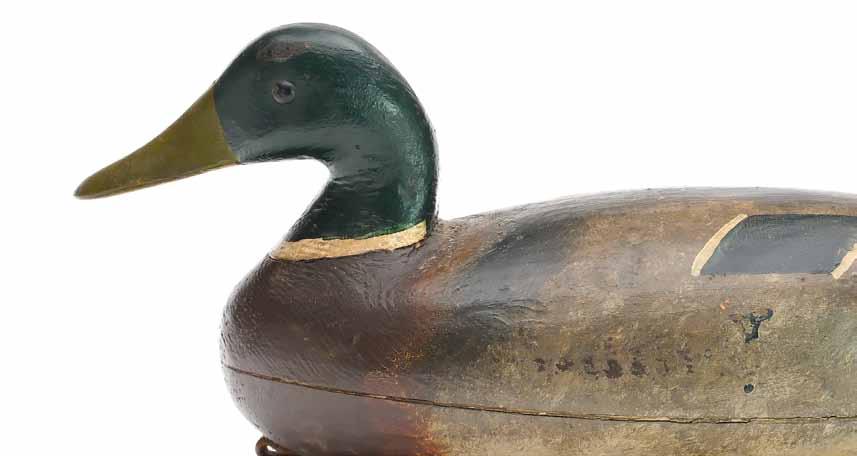
Provenance: John and Isabelle Hillman collection. Kirby Roberts collection. Jim and Diane Cook collection. (3,000 - 5,000)
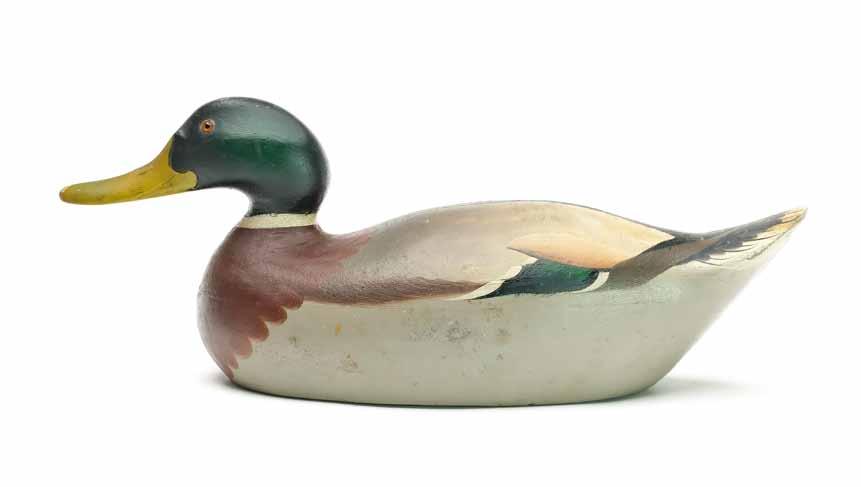
40 Mason Decoy Factory (1889-1924), Detroit, Michigan. G.K. Schmidt rig mallard. Hollow carved with relief bill carving and outstanding paint detail. Branded “G.K. Schmidt” twice on underside. Measures 17.5” long. Original paint with a few tiny flakes; ink from newspaper wrapping visible on sides; the original tail was chipped and reset with filler and touchup to that area.
Provenance: Jim and Diane Cook collection. (15,000 - 25,000)
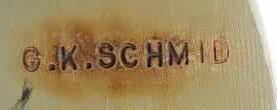
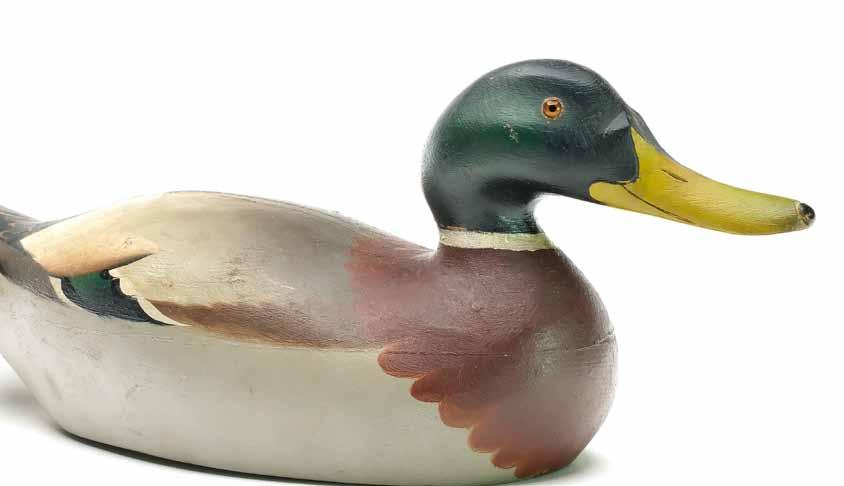
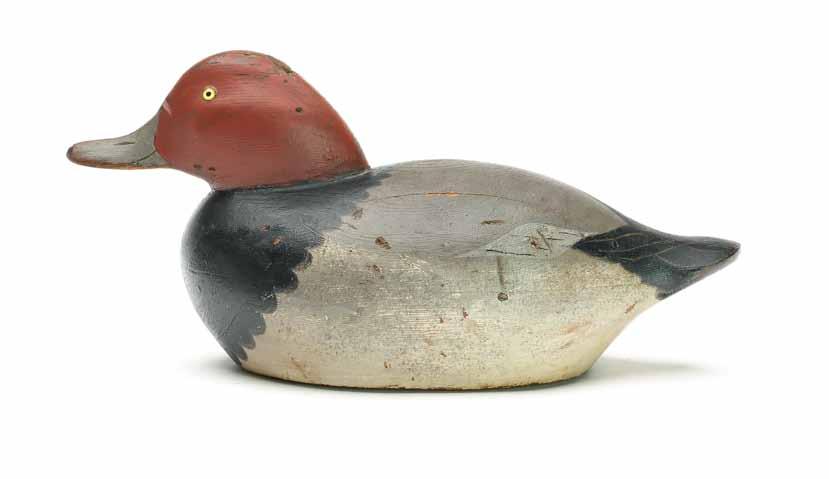
41 Mason Decoy Factory (1889-1924), Detroit, Michigan. Very rare lowhead redhead. Hollow carved premier grade with relief bill carving. Measures 14” long. Original paint with minor to moderate wear; many shot marks; hairline drying cracks in back; filler and paint restoration around neck seat; small chip in one side of bill was professionally restored.
Provenance: Bill Umbracht collection. Jim and Diane Cook collection.
(7,000 - 10,000)
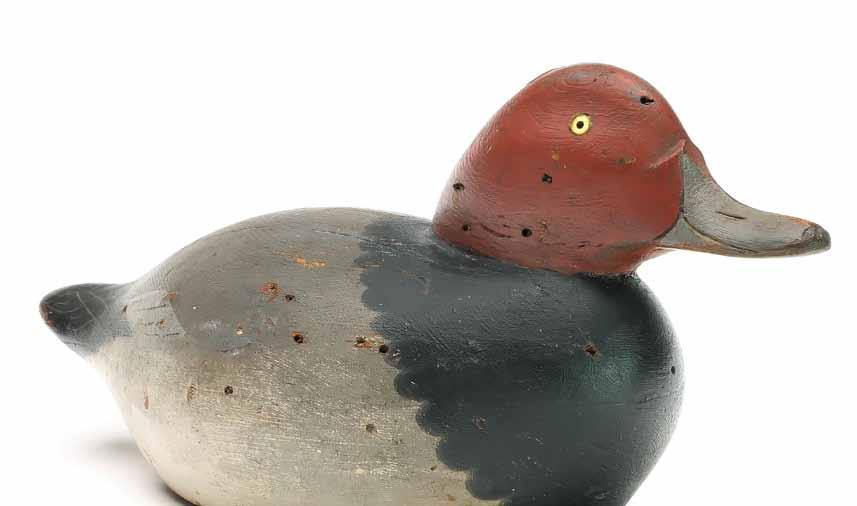
42 Louis C. Rathmell (1898-1974), Danbury, Connecticut. Very rare black duck. Hollow carved cedar body with slightly turned head. Scratch feather paint detail on head and neck. Signed and dated 1951 on underside. Measures 17.5” long. Some very minor flaking to filler on front of neck seat, otherwise near mint.
Provenance: Jim and Diane Cook collection. (15,000 - 25,000)
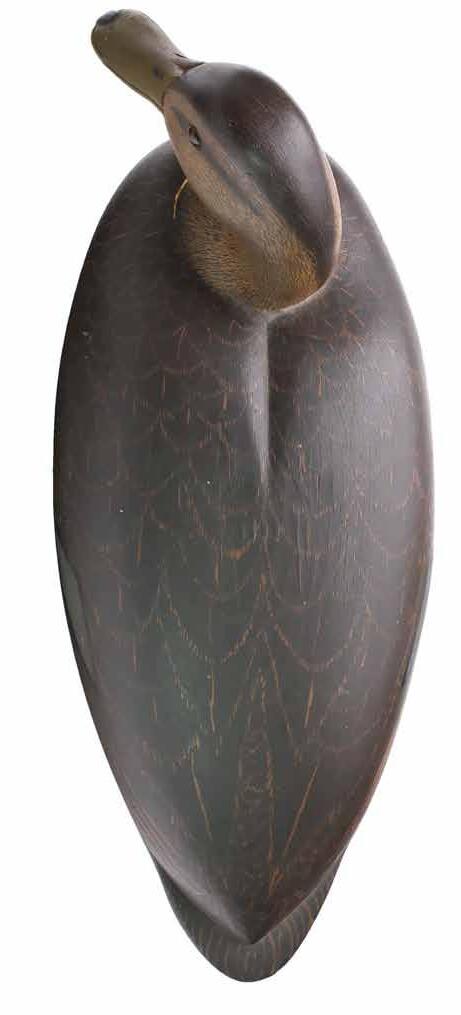
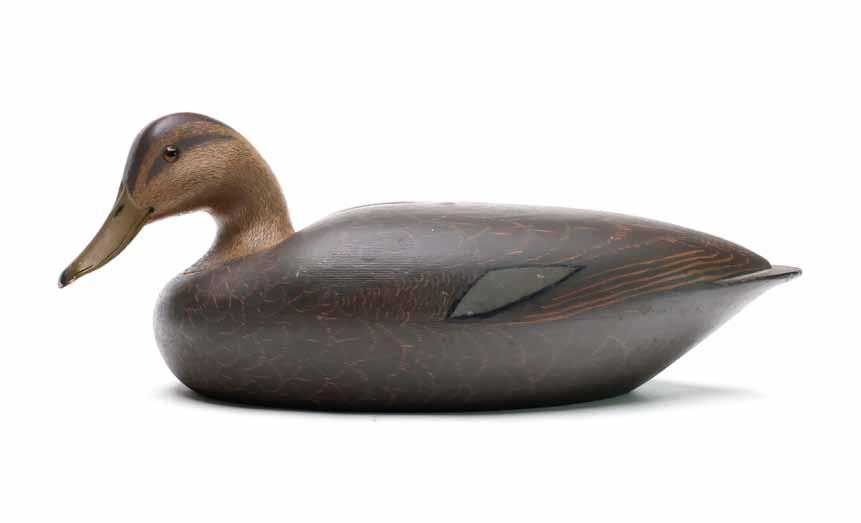
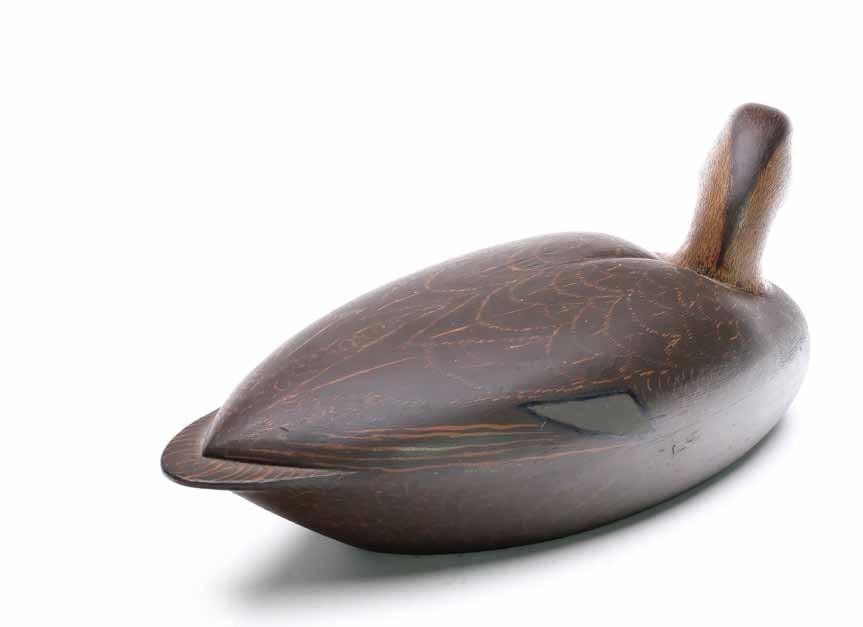
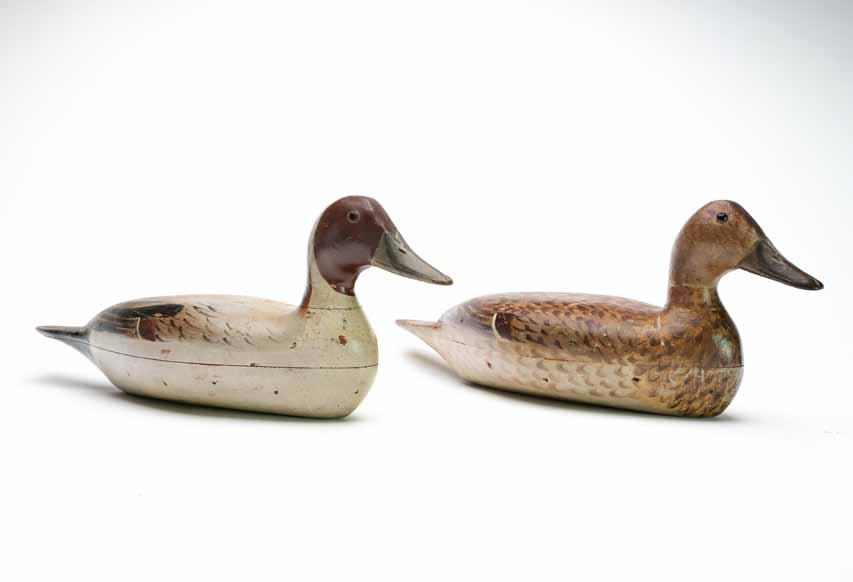
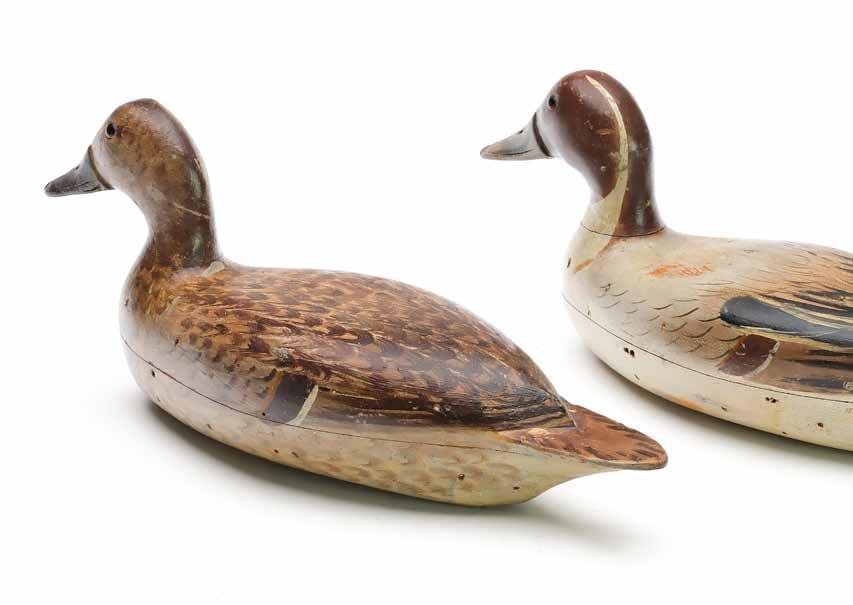
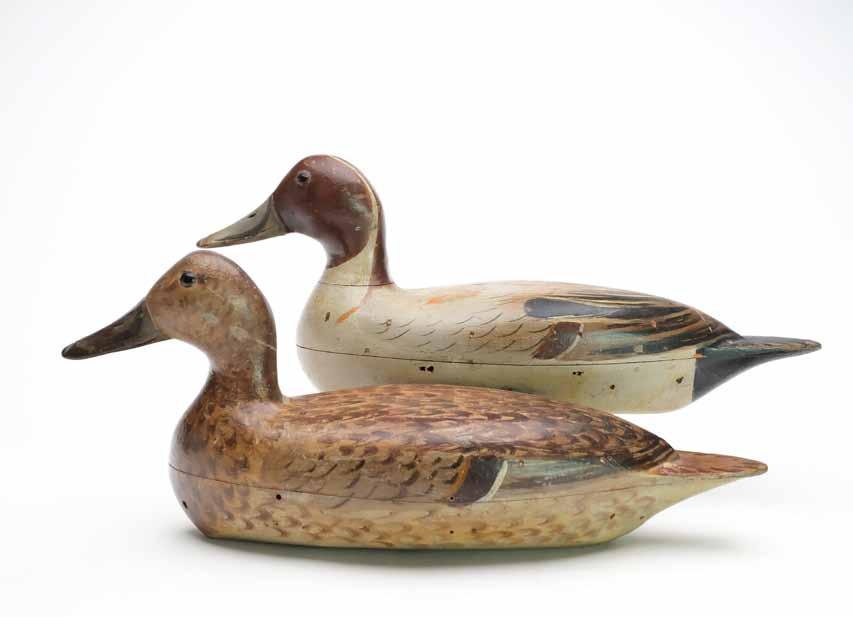
Rigmate pair of pintails used at the Puckaway Club. Hollow carved with comb feather paint detail on drake. “P” branded on the undersides. Measure 18” long. Original paint with minor to moderate wear; lightly hit by shot; some flaking to filler at nail holes; chip in tip of hen’s bill was restored.
Provenance: Jim and Diane Cook collection. (8,000 - 12,000)
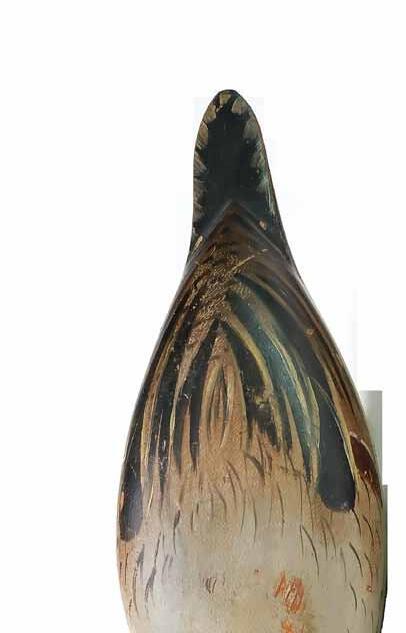
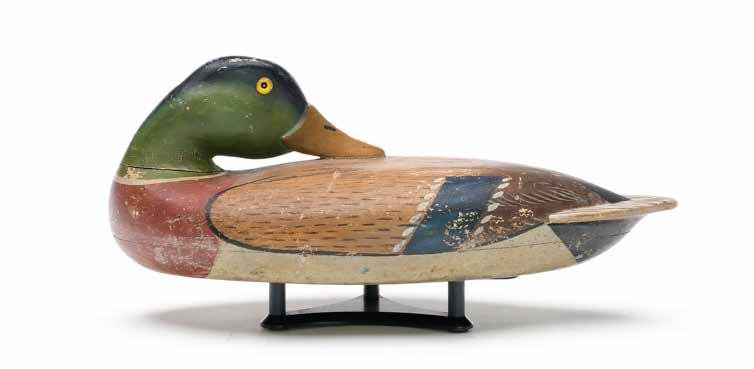
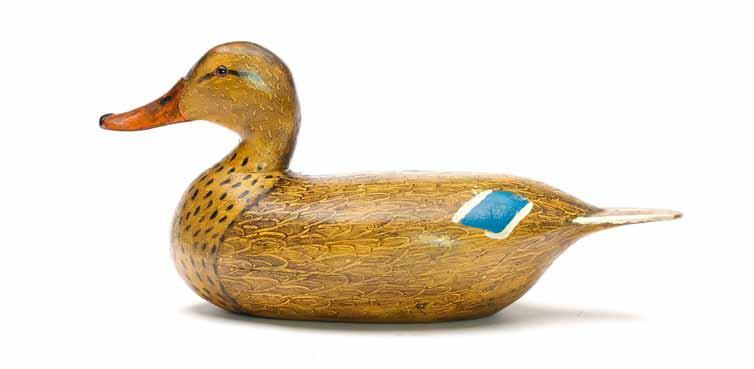
43 Fred Allen (1838–1912), Monmouth, Illinois. Exceedingly rare preening mallard. One of only two preeners known. Hollow carved. “Burkhard St. Paul” stamped in lead weight. Measures 13” long. Original paint with minor to moderate flaking and wear; lightly hit by shot in one side.
Provenance: Jim and Diane Cook collection. (6,000 - 9,000)
44 Otto Garren (1890-1968), Canton, Illinois. Outstanding mallard hen. Hollow carved with appealing scratch feather paint detail. Measures 16” long. Decoy was never used; original paint protected under an early coat of varnish; with a few minor rubs on back; excellent structurally.
Provenance: By decent in the family to maker’s grandson. Joe and Donna Tonelli collection. Gov. Jim Thompson collection. Jim and Diane Cook collection. (6,000 - 9,000)
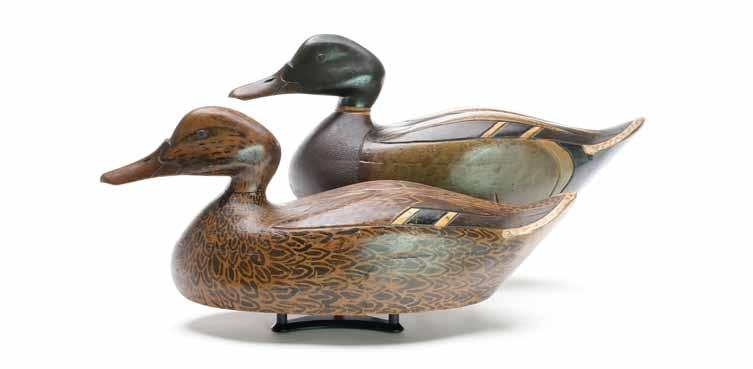
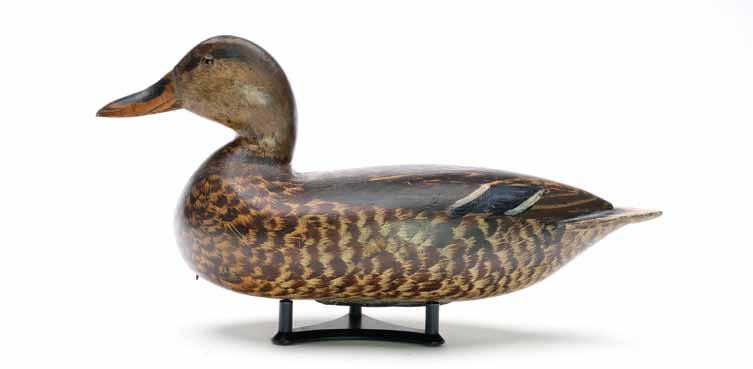
45 Al Ries (1899-1978), Chicago, Illinois. Very rare pair of mallards. Hollow carved with incised wing carving. Heavily influenced by the Mason factory premier grade model decoys. Heads are doweled in and removable. Al Ries at his best. Measure 17” long. Original paint with very minor wear under an early coat of varnish that has darkened with age; a few small dents otherwise very good structurally.
(5,000 - 8,000)
46 Judge Glen Cameron (1882-1958), Chillicothe, Illinois. Excellent mallard hen. Hollow carved. Branded “G.J.C.” for rig of the maker. Measures 16” long. Original paint by John Franks with very minor wear; hairline crack on one side of neck seat and very minor flaking to filler at back of neck seat.
Provenance: Jim and Diane Cook collection.
(3,000 - 5,000)
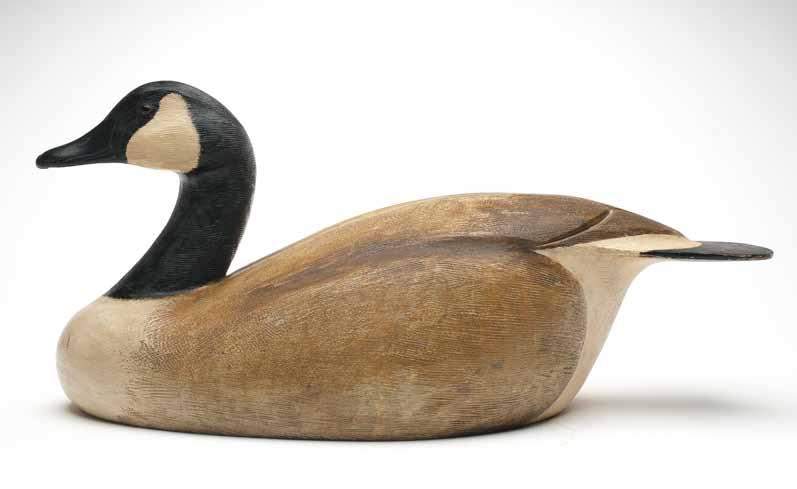
47 Ken Anger (1905-1961), Dunnville, Ontario. Early Canada goose. Hollow carved with low breast and high tail. Head is slightly turned. Incised wingtip carving. Measures 23” long. Original paint with very minor wear; a few small shot marks; otherwise excellent structurally.
Provenance: Kirby Roberts collection. Jim and Diane Cook collection. (6,000 - 9,000)
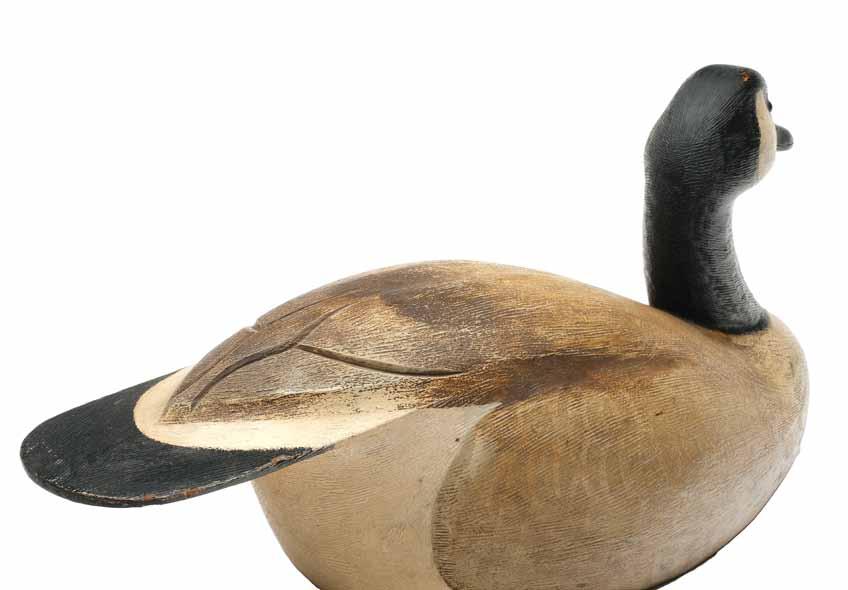
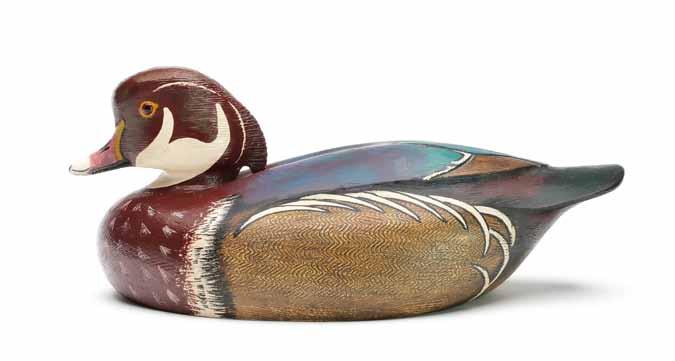
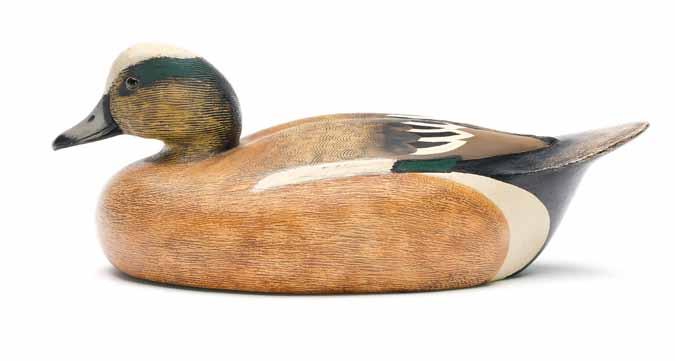
48 Ken Anger (1905-1961), Dunnville, Ontario. Rare wood duck. Relief wing and incised feather carving. Extended crest and comb feather paint detail. Measures 12.75” long. Original paint with very minor wear; two dents in back, otherwise excellent structurally.
Provenance: Jim and Diane Cook collection. (3,000 - 5,000)
49 Ken Anger (1905-1961), Dunnville, Ontario. Important widgeon. Hollow carved with relief wing carving and comb feather paint detail on back. Decoy won first place for the carver at the 1949 National Decoy Contest in New York City. Measures 13.75” long. Thin coat of varnish has crazed slightly, otherwise excellent and original.
Provenance: Gordon and Ginny Hayes collection. Jim and Diane Cook collection. (4,000 - 6,000)
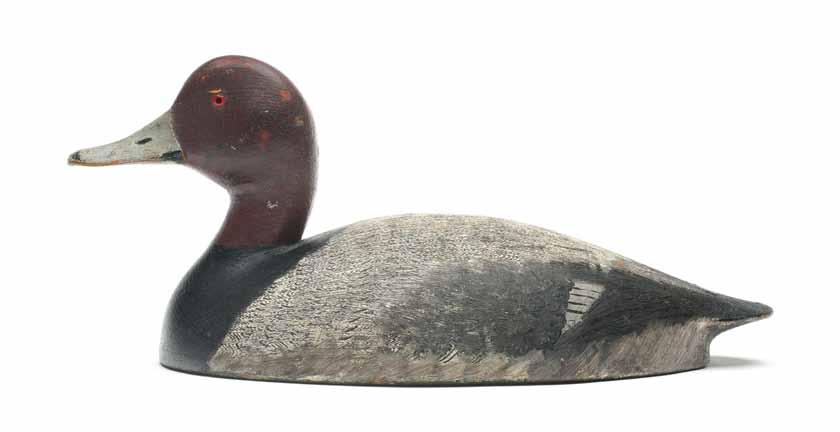
50 Ivar Fernlund (1881-1933), Hamilton, Ontario. Excellent redhead. Thinly hollowed with .25” bottom board and thick comb feather paint detail. Head is very slightly turned. Measures 14.25” long. Original paint with very minor wear; three shot strikes on one side of tail were filled but not painted; hairline crack in tail.
Provenance: Jim and Diane Cook collection.
(5,000 - 8,000)
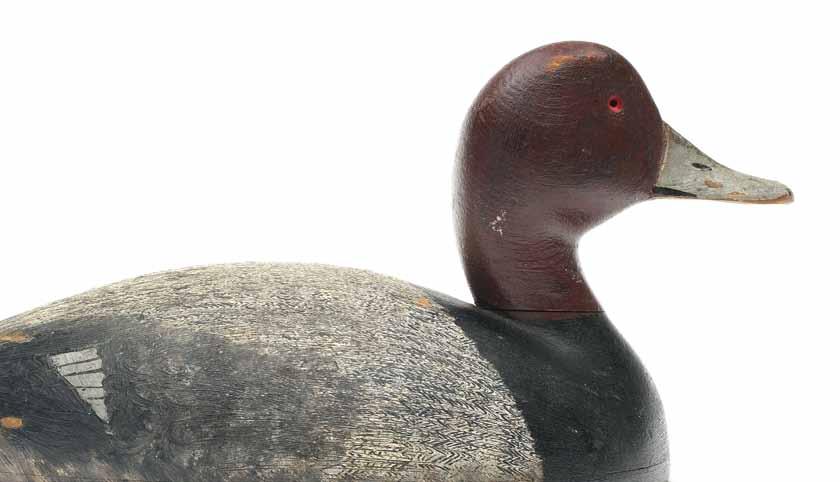
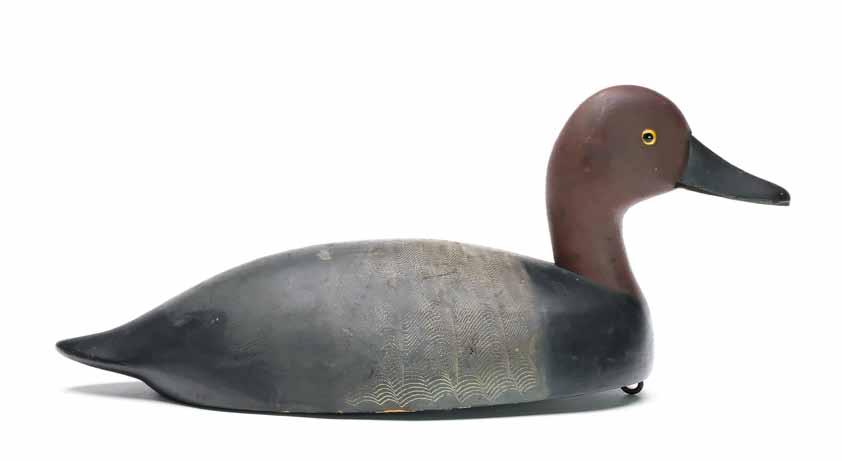
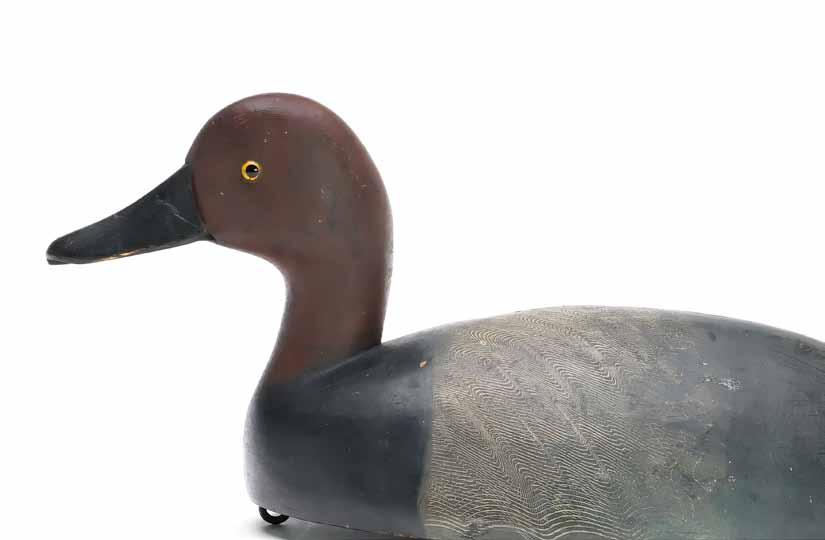
51 Walter Humphries, Toronto, Ontario. Rare redhead. Very thinly hollowed with .25” bottom board and fine comb feather paint detail. Measures 16.5” long. Original paint with very minor wear, under a thin coat of early varnish; very minor roughness on one edge of bill.
Provenance: Jim and Diane Cook collection. (4,000 - 6,000)
52 Warren Dettman (1904-1979), Milwaukee, Wisconsin. Rigmate pair of bluebills. Relief wing carving and raised wingtips. Hen with tucked head. Both with slightly turned heads. Hen with “L VI” carved in underside, drake with “L VII”. Measure 10.5” and 11.5” long. Original paint with moderate wear; lightly hit by shot; tight crack along underside of drake; large spot of filler and touchup on one side of drake; crack in hen’s tail; some old glue visible at hen’s neck seat; hen’s bill was cracked down and reset with some touchup in that area.
Provenance: Jim and Diane Cook collection.
(5,000 - 8,000)
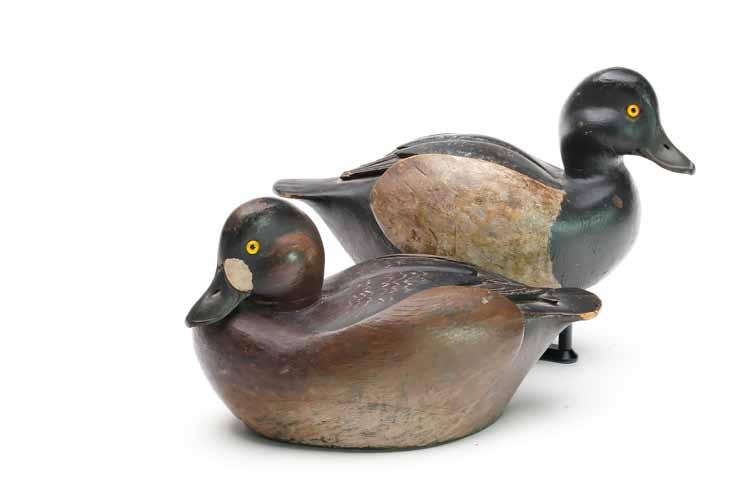
53 Paul Lipke (1892-1970), Whiting, Indiana. Excellent pair of bluewing teal. Hen with slightly turned head. Measure 11.75” long. Original paint with minor gunning wear; tiny chip in one side of drake’s bill; hairline crack in one of drake’s eyes.
Provenance: Jim and Diane Cook collection.
(4,000 - 6,000)
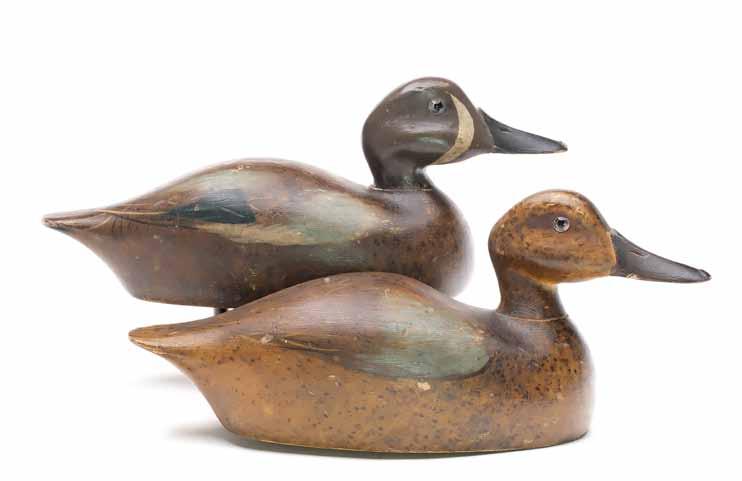
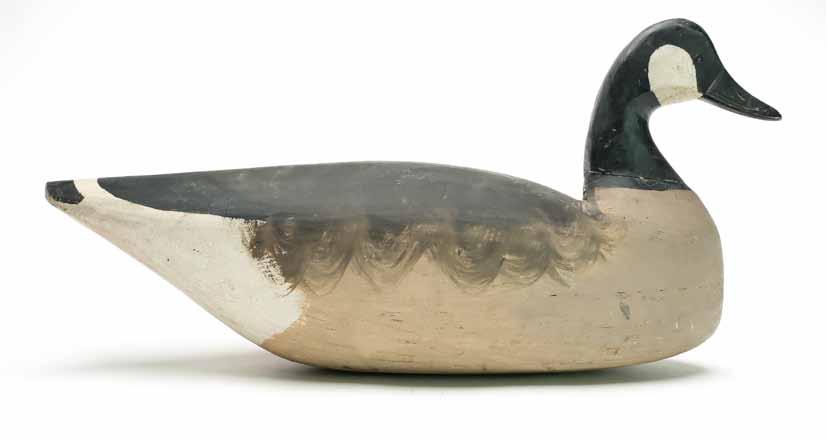
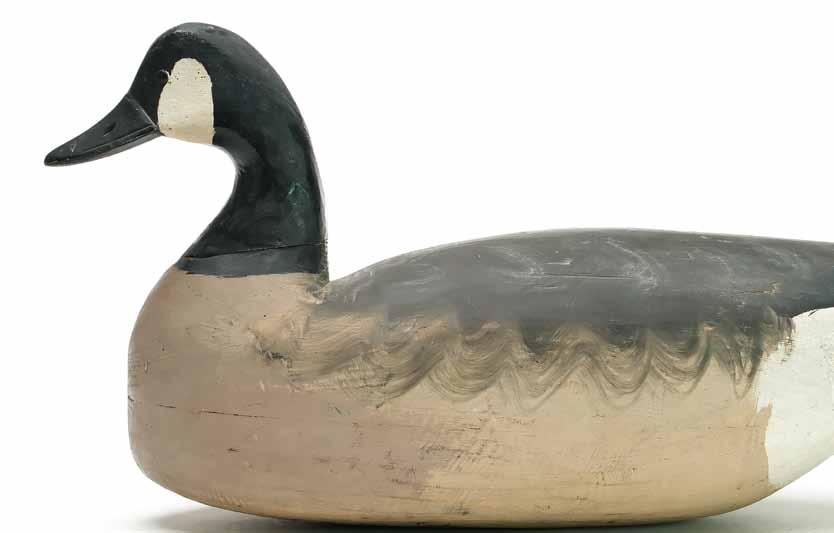
54 Doug Jester (1876-1961), Chincoteague, Virginia. Outstanding Canada goose. Two piece body with raised neck seat and tack eyes. Decoy was never rigged or weighted. Measures 24” long. Excellent and original.
Provenance: Jim and Diane Cook collection. (7,000 - 10,000)
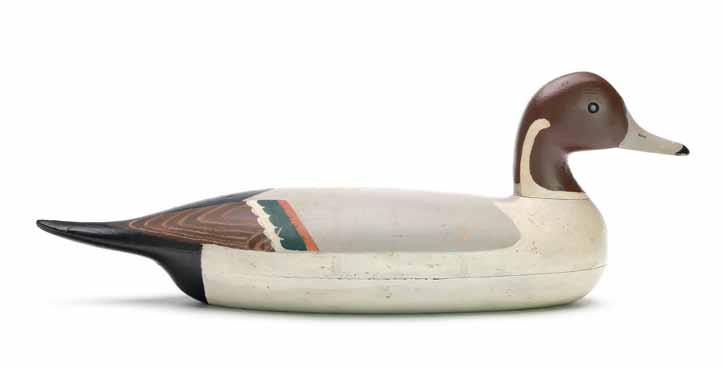
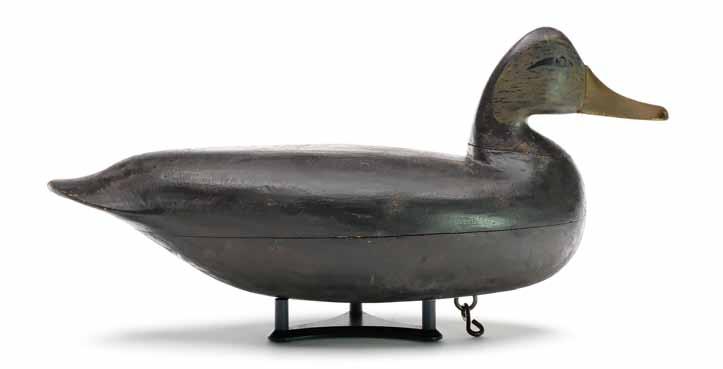
55 Leonard Pryor (1876-1967), Chesapeake City, Maryland. Rare pintail. Three piece body and carved eyes. Maker’s name and town stamped in underside. Dr. Mort Kramer collection ink stamp on underside. Measures 18” long. Original paint with almost no wear; coat of varnish has darkened slightly; small spots of discoloration; very good structurally.
Provenance: Jim and Diane Cook collection. (5,000 - 8,000)
56 Charles Birch (1867-1956), Willis Wharf, Virginia. Hollow carved black duck with tack eyes. Measures 17” long. Original paint with minor wear under a thin coat of varnish; scattered shallow dents, otherwise excellent structurally.
Provenance: Jim and Diane Cook collection. (3,000 - 5,000)
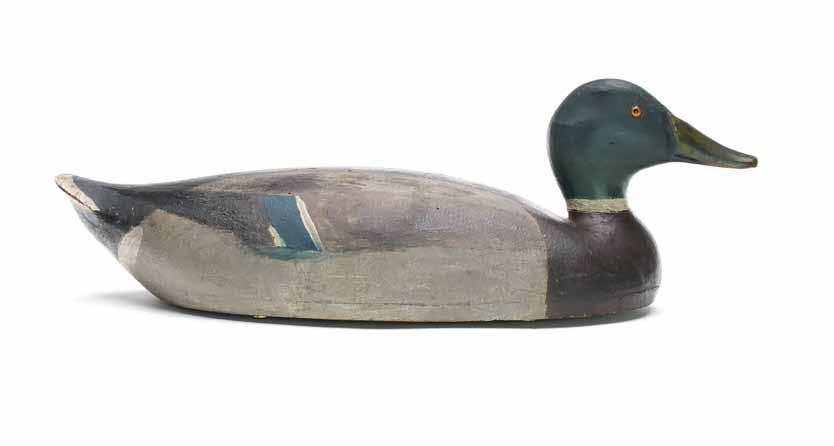
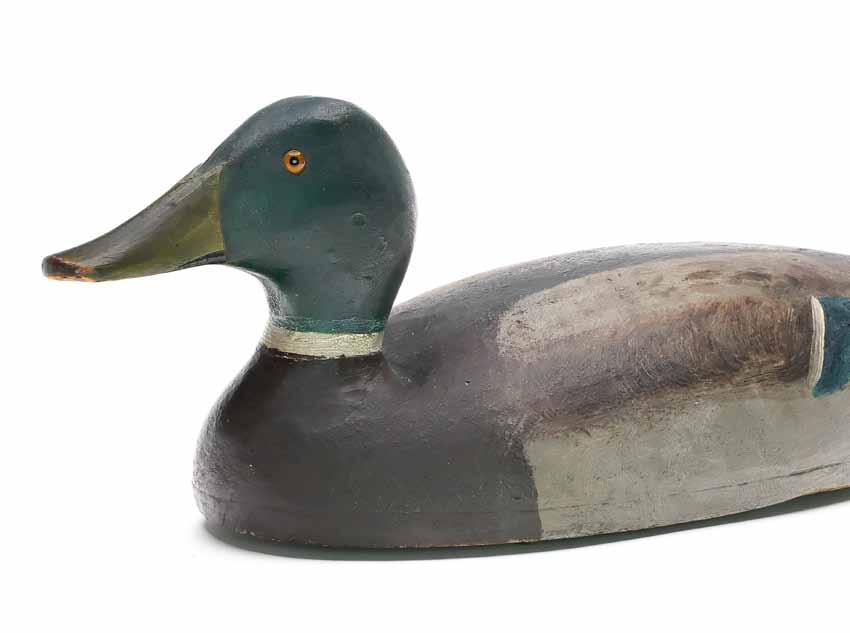
57 Hayes Finkle (1876-1953), Port Huron, Michigan. Very rare and important oversized mallard. Hollow carved with .25” bottom board that is dated “Sept. 1 1905” in pencil. Measures 19” long. Very minor dents and paint rubs; minor chipping on edge of tail, otherwise excellent structurally.
Provenance: Jim and Diane Cook collection. (4,000 - 6,000)
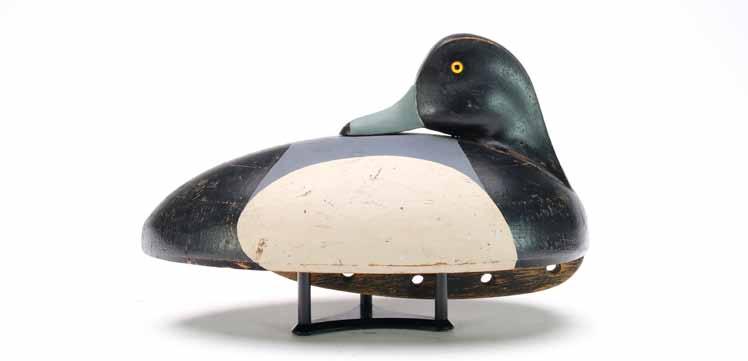
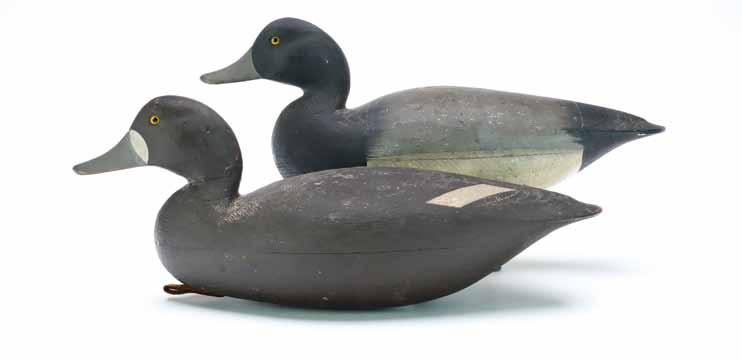
58 Joel Barber (1877 - 1952), Wilton, Connecticut. Preening bluebill with inlaid neck seat and wooden keel. “Barber Decoys” branded in underside. Measures 13” long. Original paint with minor gunning wear; minor blunting at tip of tail, otherwise very good structurally.
Provenance: Jim and Diane Cook collection.
(4,000 - 6,000)
59 Stanley Grant (1877 - 1953), Barnegat, New Jersey. Rigmate pair of bluebills. Hollow carved with inlaid lead weights. Maker’s initials stamped in lead weights. Measure 15” long. Original paint with very minor wear; under an early coat of varnish that has darkened with age; reglued crack in hen’s neck; otherwise very good structurally.
Provenance: Jim and Diane Cook collection. (2,000 - 3,000)
60 Seymour Smith (1878-1947), Seneca, New York. Pair of redheads. With slightly reared back heads. Measure 12.75” long. Original paint with minor flaking and wear; piece of wood used for drake had a separation at a large knot in tail with a few minor flakes otherwise both excellent structurally.
Provenance: Jim and Diane Cook collection. (600 - 900)
61 Frank Schmidt (1879 - 1960), Detroit, Michigan. Large mallard hen. Slight relief wing carving. Measures 18” long. Original paint with very minor wear; excellent structurally.
Provenance: Jim and Diane Cook collection. (600 - 900)
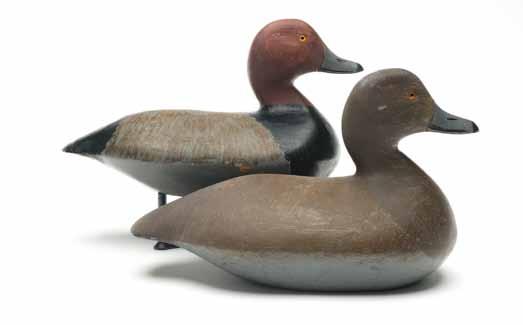
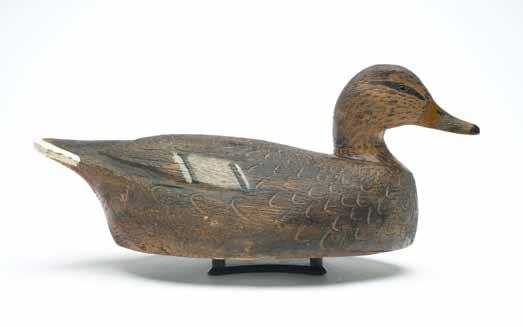
62 William Cranmer (1917-2008), Beach Haven, New Jersey. Sleeping bluebill hen. Hollow carved with .25” bottom board. Relief wingtip and tail feather carving. Signed and dated 1948 on the underside. Also stamped “SGH” for the collection of Somers Headley. Measures 13” long. Original paint with a few minor rubs; some minor sap bleed on back half of decoy.
Provenance: Somers Headley collection. Dick and Lynn Gove collection. Jim and Diane Cook collection. (800 - 1,200)
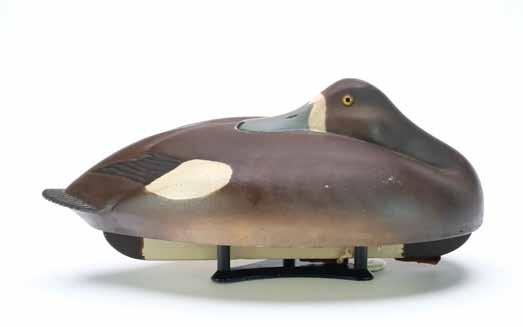
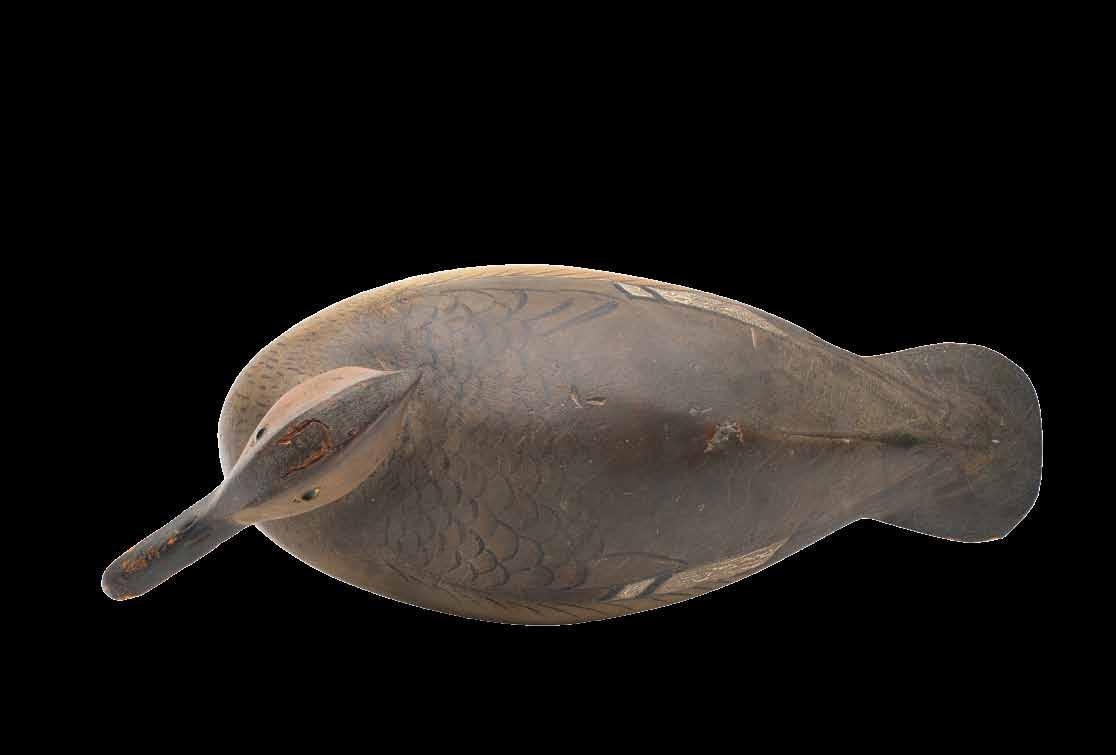
John Hudson (“Jack”) Moore 1890 - 1967 | New York, NY
Moore was born near Boston, MA, and after attending college for two years, he married Agnes Yerrington in Concord, New Hampshire in 1911. They had two sons while John worked first as a salesman for a toothbrush company, then a salesman in men’s toiletries in Boston. Here he found his niche, and he would spend the remainder of his career in that field. In 1930, he was working in New York City as a manager for an importing firm. At some point in the mid 1930s he divorced or separated from Agnes and, in 1938, married his second wife, Louise. She was a widow and associate beauty editor for the Ladies Home Journal in New York City. By 1940, he was the Vice President of London House Ltd Importers and the Vice President of the Sales Executive Club of NY. He went on to form the firm of John H Moore and Co Importers and
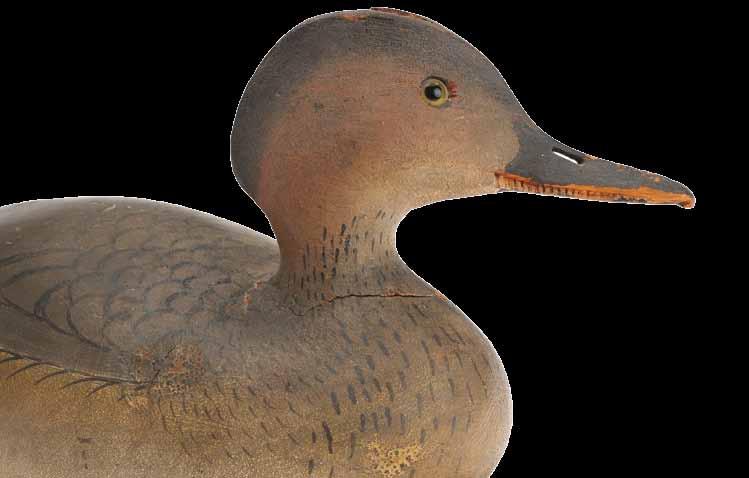
Distributers, specializing in men’s toiletries, grooming items and a few leisure items which were marketed as his “Sportsman’s Line” of merchandise. The company had offices at 663 Fifth Ave in the City, while he and Louise lived quite comfortably at a prestigious Park Avenue address. In retirement, he moved to Connecticut where he died. It is unknown if he actually hunted over them but, reportedly, he ordered decoys from the Ward’s for use at his New York offices.
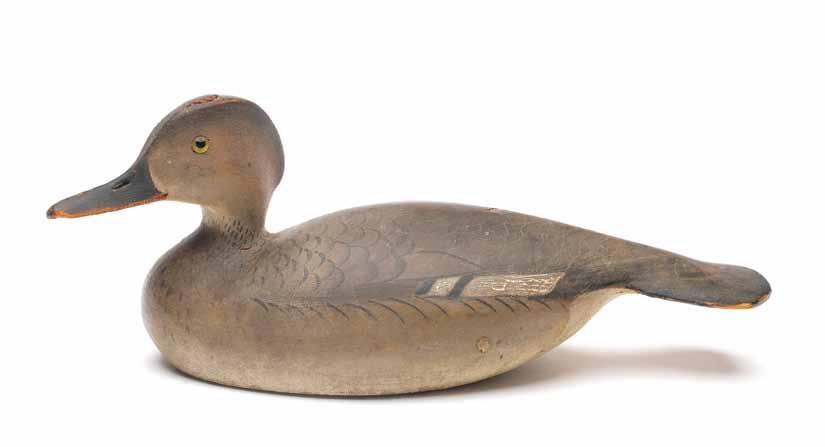
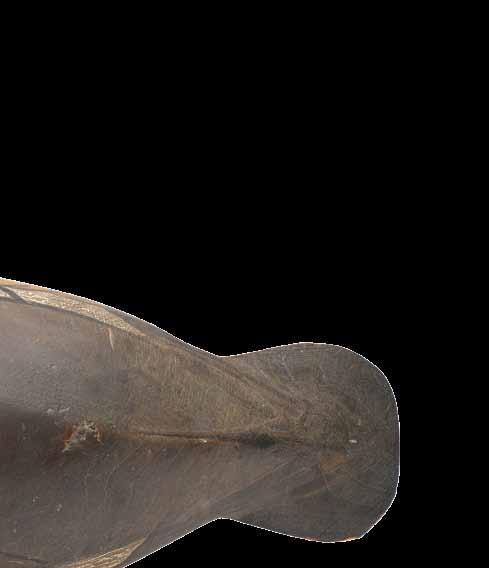
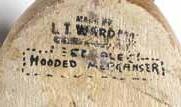
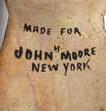
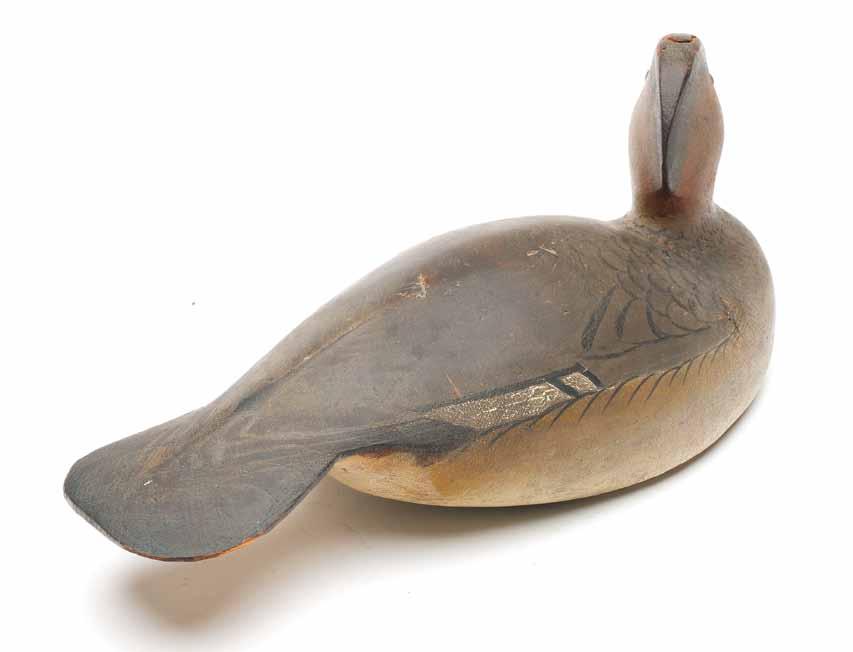
64 Ward Brothers, Crisfield, Maryland. Exceedingly rare hooded merganser hen. 1936 style with slightly turned head, extended crest, and wide tail carving. Maker’s ink stamp on underside. Also identified and inscribed “Made for John H. Moore, New York”. The only example known. Measures 14.25” long. Original paint with very minor wear on edge of tail and bill; some flaking to filler on top of head; slight separation at neck seat; small dents in back.
Provenance: Don Leonard collection. (40,000 - 60,000)
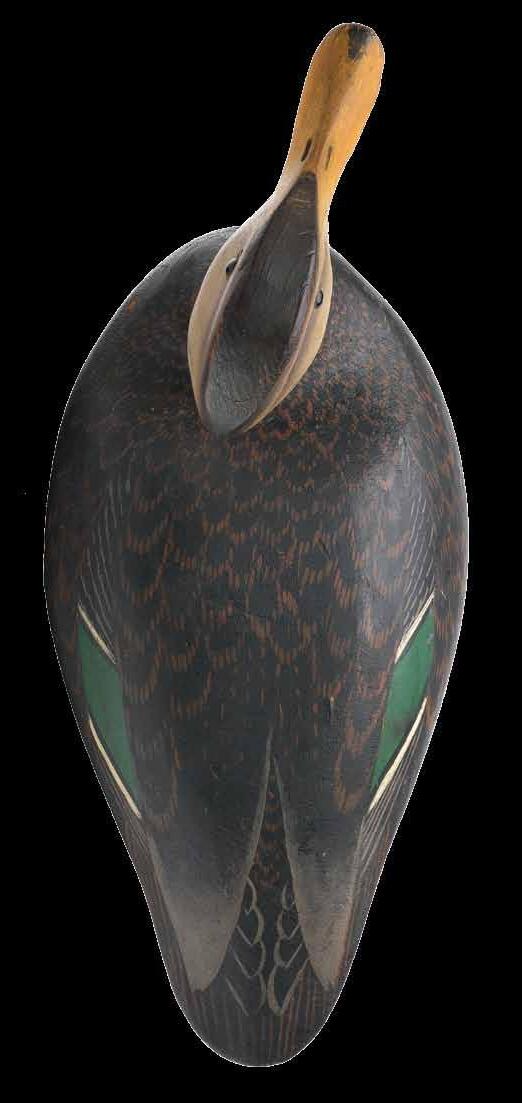
65 Ward Brothers, Crisfield, Maryland. Excellent black duck. Slightly turned head and wonderful form. Area on underside was planned down then signed and dated 1930 with black paint added around that area. “Long” stamped in lead weight. Measures 17” long. Original paint with very minor wear; slight separation at neck seat; otherwise excellent structurally.
(20,000 - 30,000)
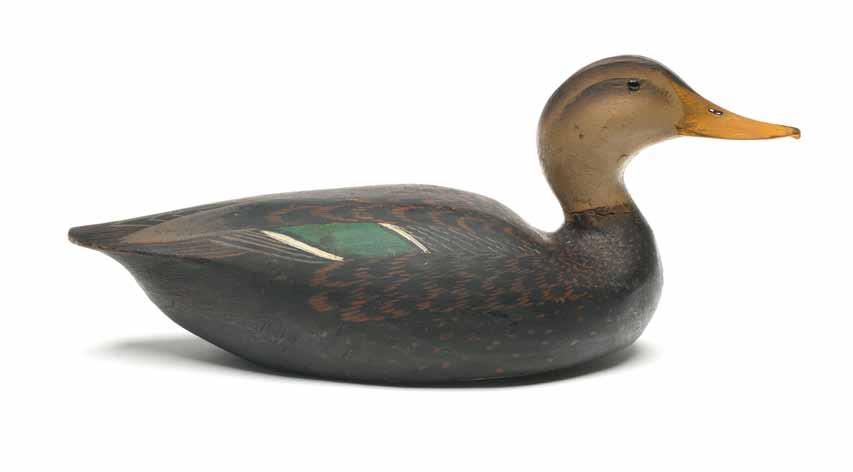
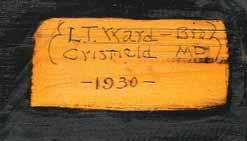
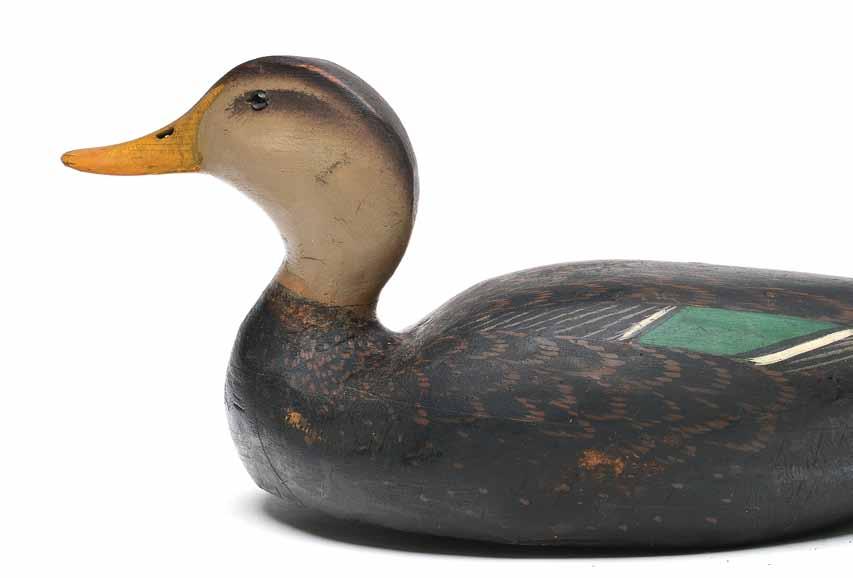
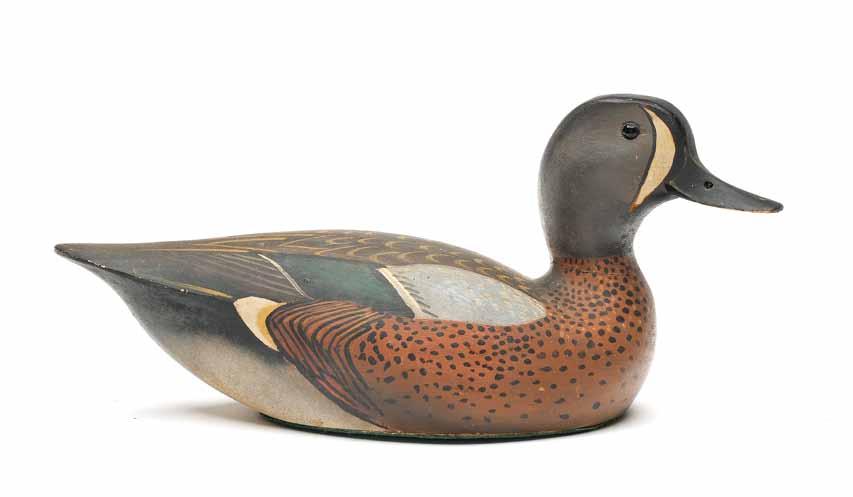
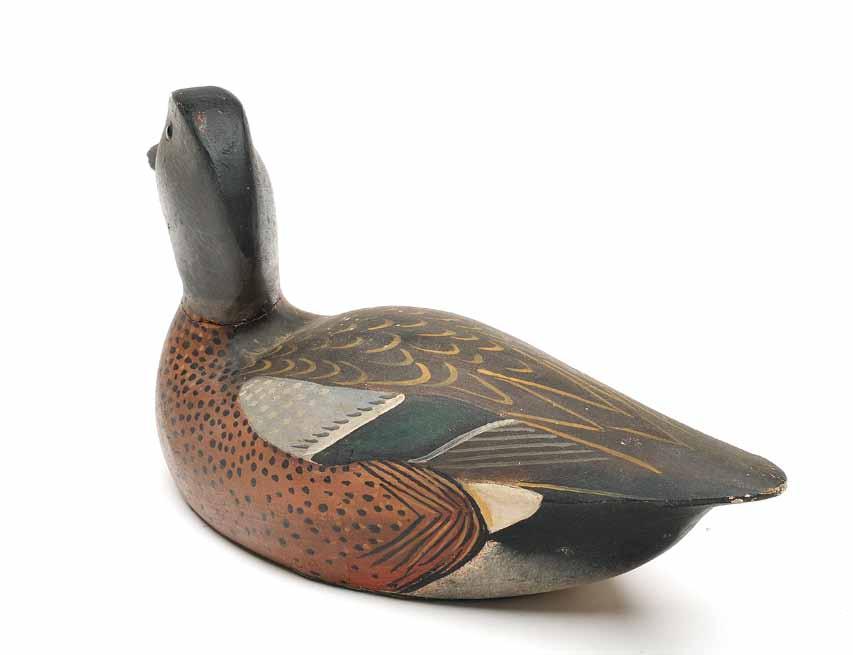

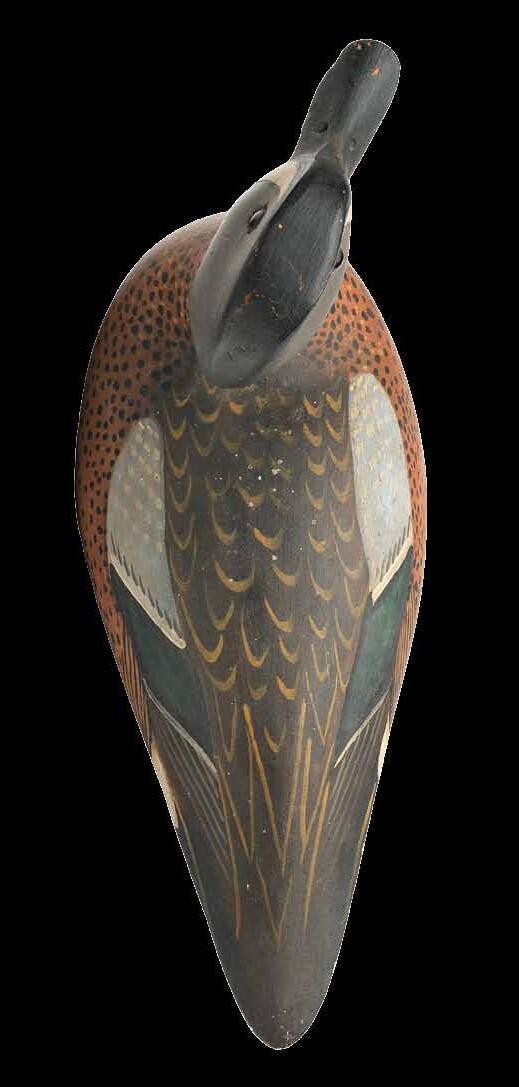
66 Ward Brothers, Crisfield, Maryland. Exceedingly rare bluewing teal. This is one of only two known cedar bluewing teal drakes. 1936 style with slightly turned head. Measures 12.5” long. Near mint original paint with a few spots of flaking; very slight separation at neck seat; shallow dent in one side of bill was darkened. (40,000 - 60,000)
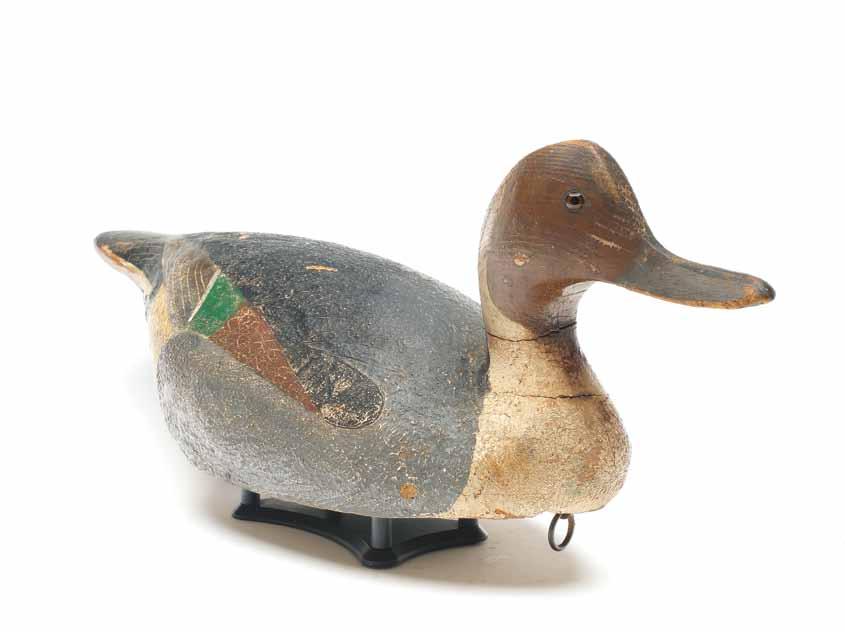
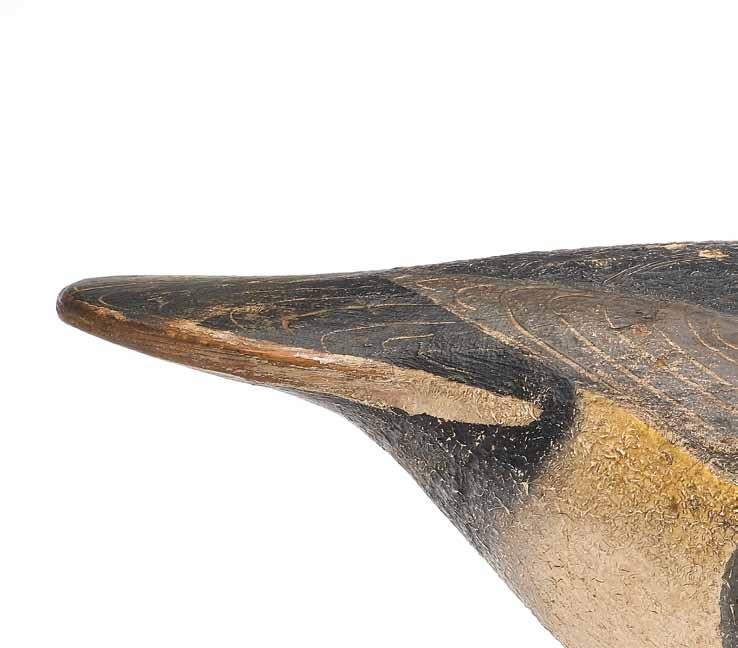
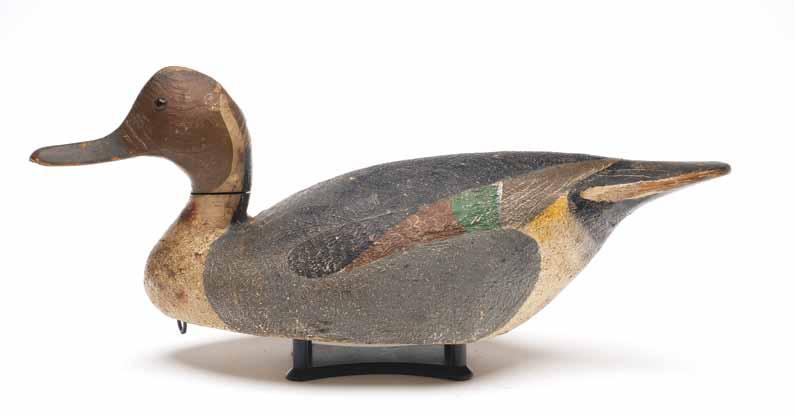
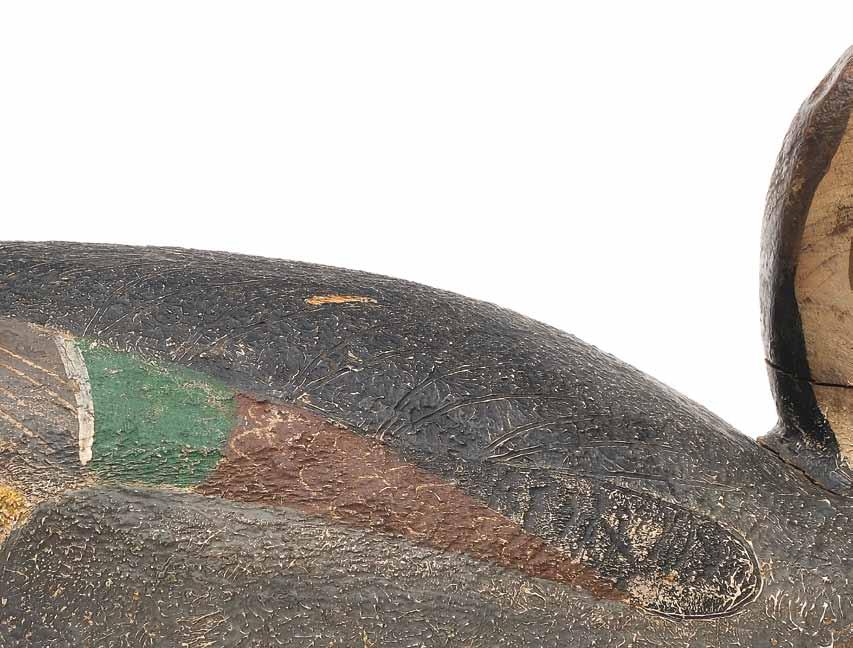
67 Ward Brothers, Crisfield, Maryland. Very early and appealing pintail. With low breast and humped back style. Scratch feather paint detail. Measures 18” long. Original paint with moderate gunning wear; crack through neck; minor roughness on one edge of bill; professional tail chip restoration; both eyes are replaced. (35,000 - 45,000)
68 Ward Brothers, Crisfield, Maryland. Excellent knot head style canvasback. Deep ice groove carving and knot head detail. Very thick stipple paint typical of this style. Measures 17” long. Original paint with moderate flaking and wear; tight cracks in head and neck; some flaking to filler at neck seat.
Provenance: Oliver Smith collection. (20,000 - 30,000)
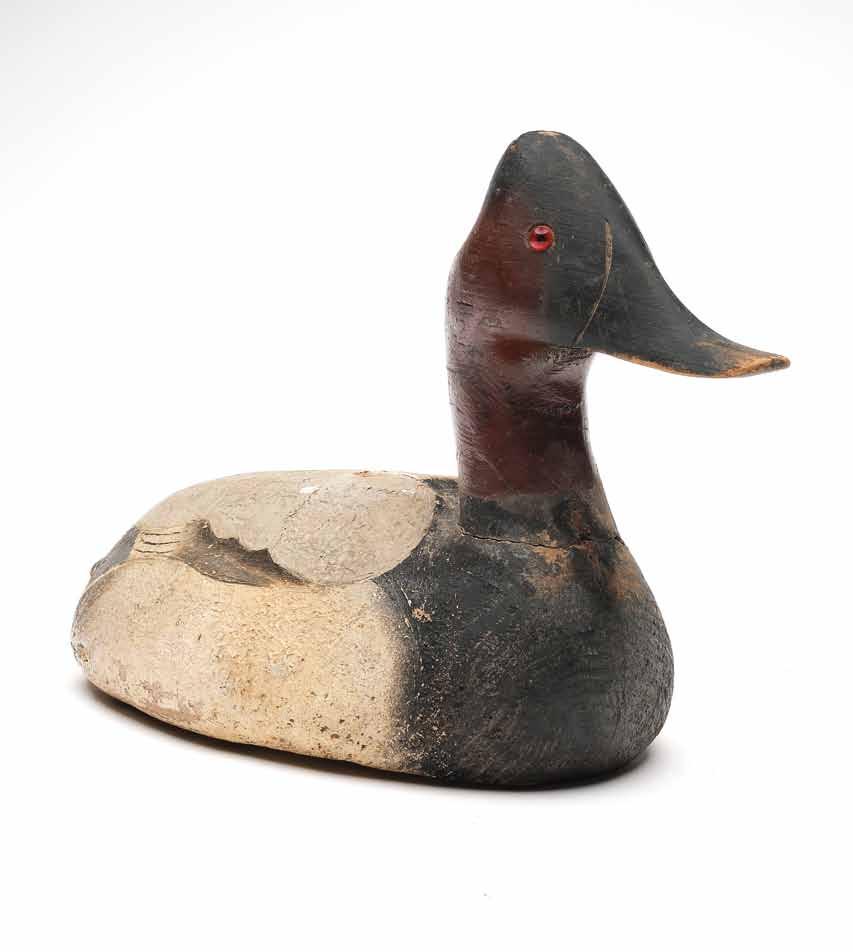
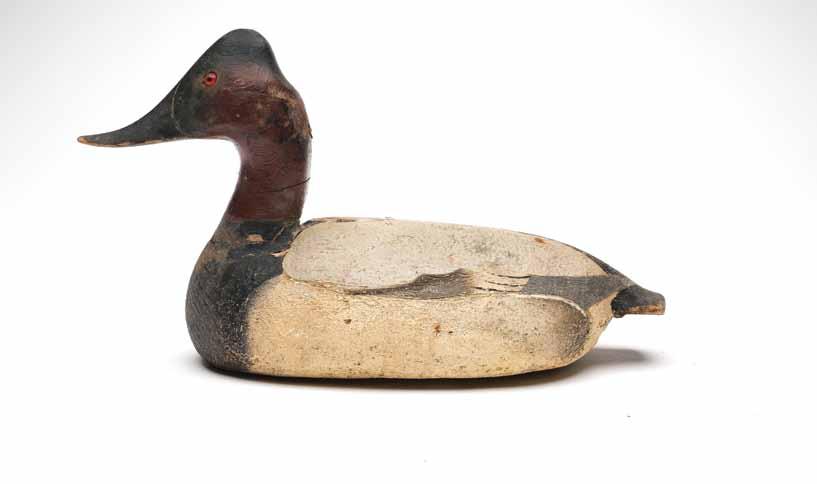
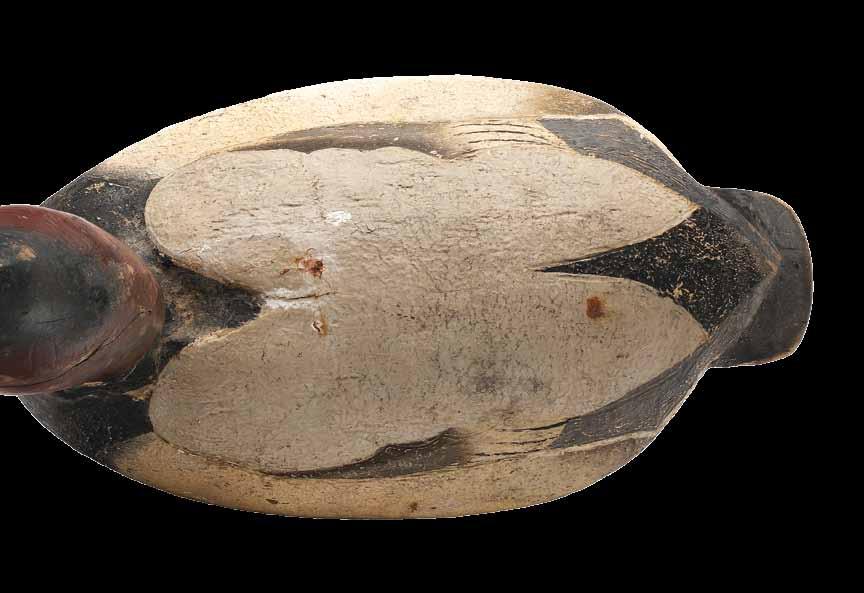
69 Ward Brothers, Crisfield, Maryland. Pintail hen. 1936 style with slightly turned head. Maker’s ink stamp on underside. Also signed and dated 1936 at a later date. Measures 17.25” long. Original paint with minor gunning wear; shallow dents in back; very minor separation at neck seat and filler on top of head; flaking to the thick stipple paint on the underside of tail area and on breast. (30,000 - 50,000)
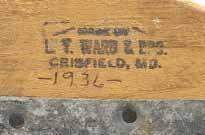
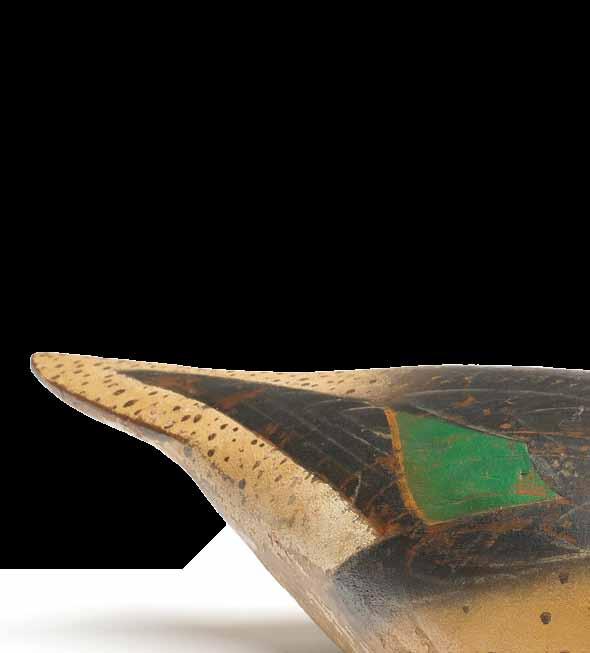
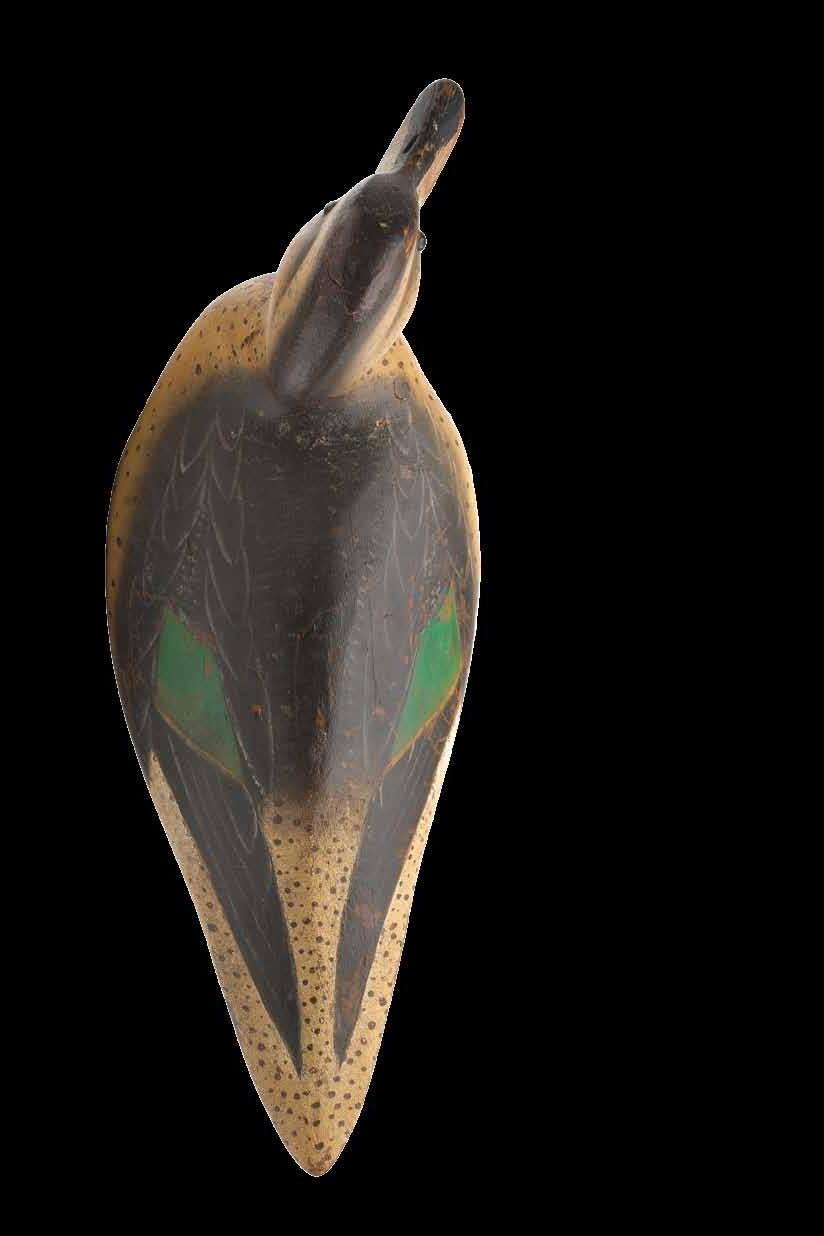

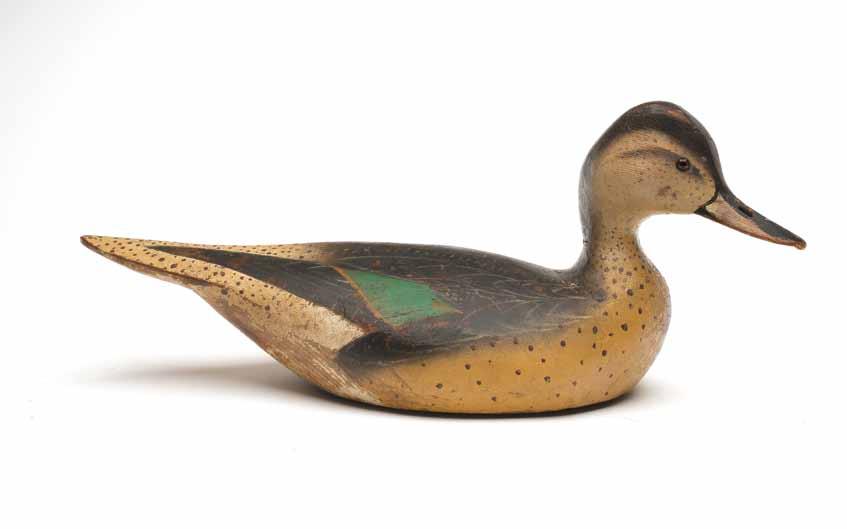
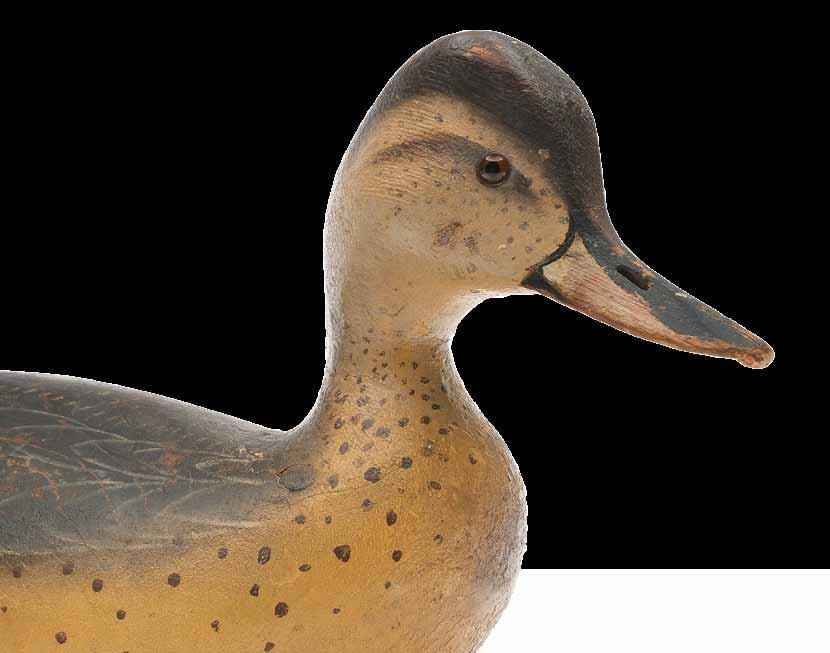
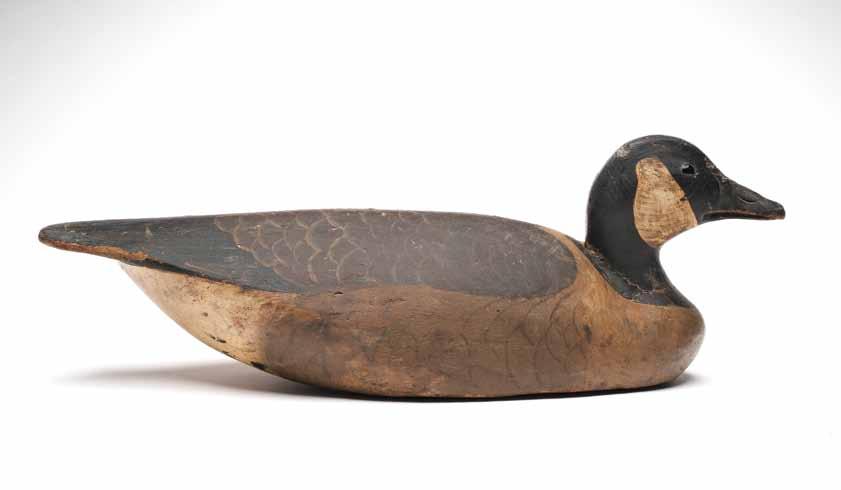
70 Ward Brothers, Crisfield, Maryland. Circa 1930. Canada goose. With a rare tucked head position. Glass eyes. Slightly turned head. Feather painting on body. Signed on underside. Measures 24” long. Good original paint; crack running length of underside up in to the breast; a few dents and scratches from light gunning wear; rubs at tail; cracking to putty at one side of neck.
Provenance: Oliver Smith collection.
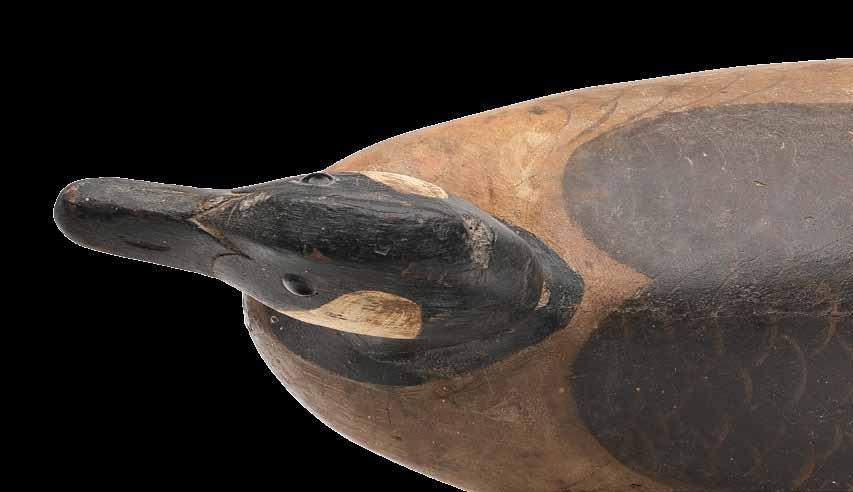
(18,000 - 22,000)
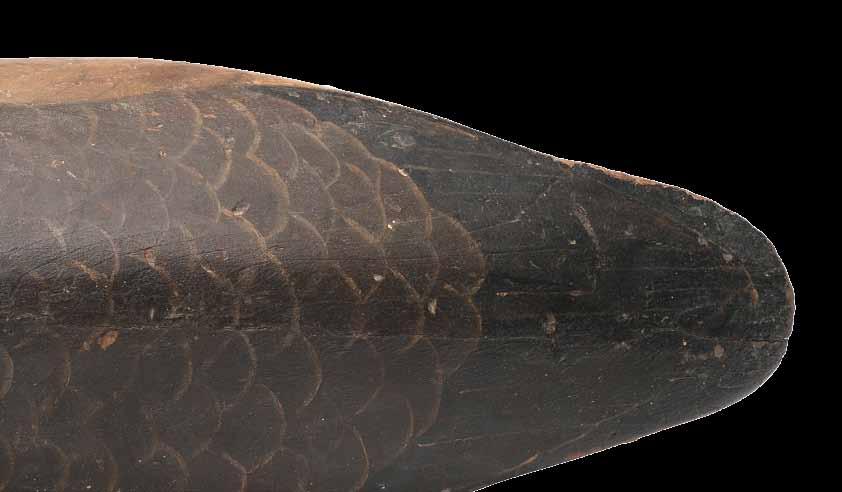
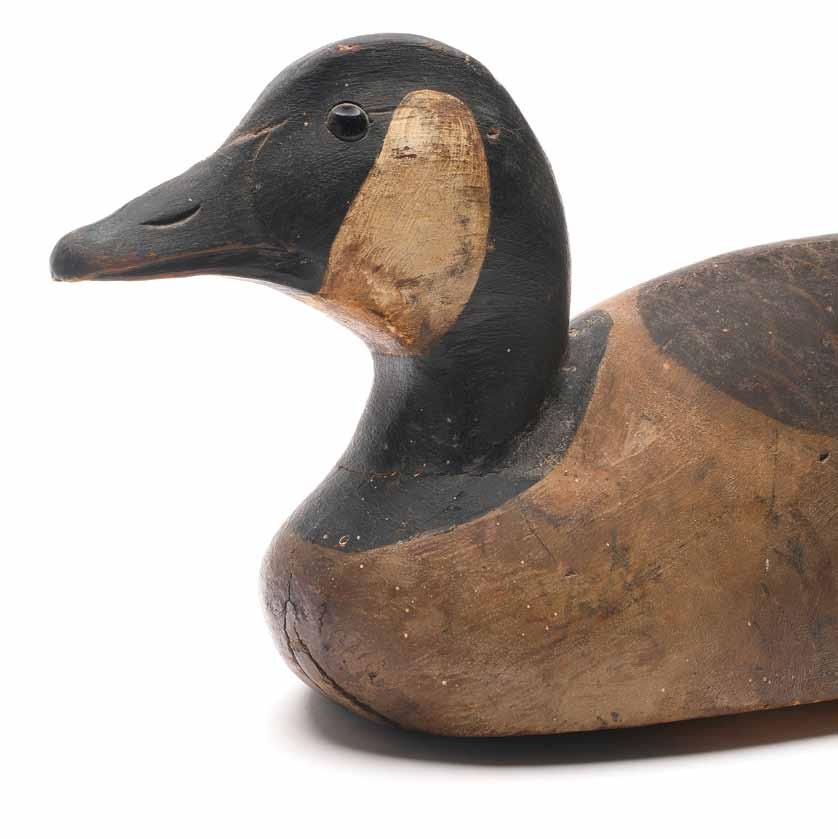
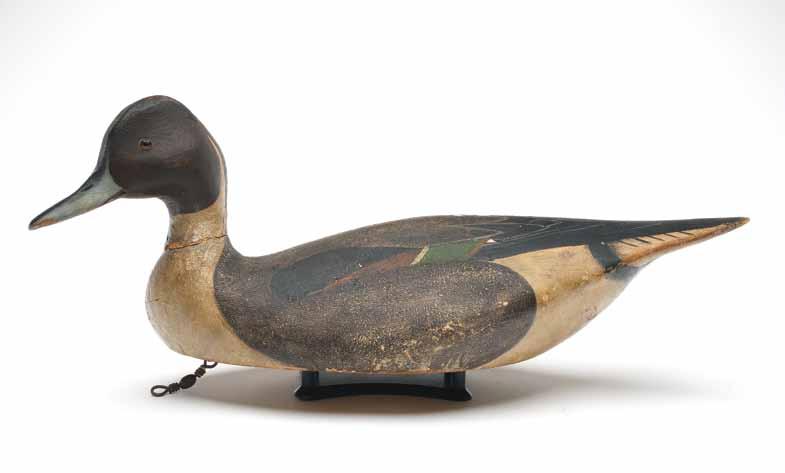
71 Ward Brothers, Crisfield, Maryland. 1936 style pintail. Slightly turned head and thick stipple paint. Signed and dated 1936. Measures 19” long. Mostly original paint with moderate wear; 3/4 of the bill and the tip of tail were restored by the Ward Brothers; with some of the paint on tail area and head restored at that time; drying split along the underside; minor separation at neck seat and roughness at top of head; a thin coat of varnish was added after the restoration and has darkened slightly with age.
(8,000 - 12,000)
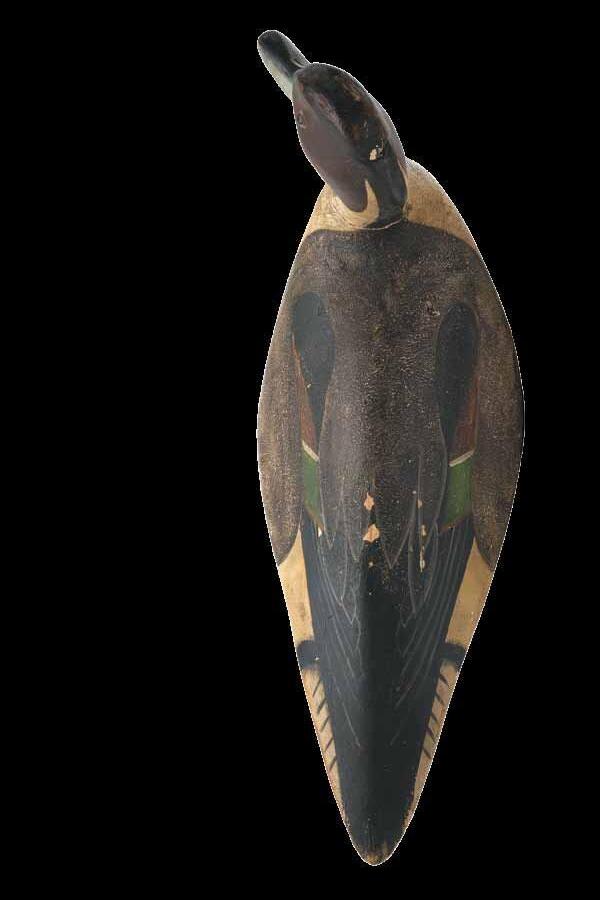
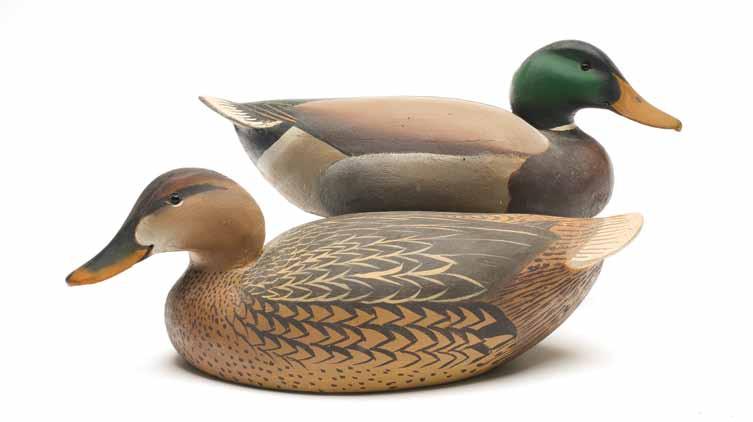
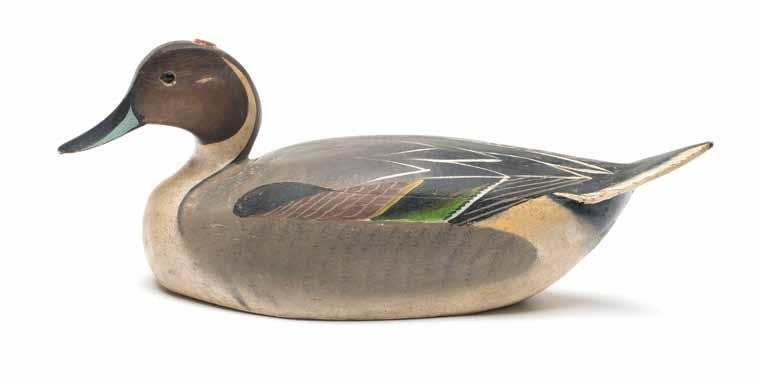
Ward Brothers, Crisfield, Maryland. Pair of mallards. 1948 style with slightly turned heads and balsa bodies. Signed and dated 1948. Measures 16.5” long. Original paint with a few minor rubs; fine separation at body seam on one side of drake; small dent in one side of hen’s bill tip and at tip of drake’s bill.
Provenance: Frederick Raymon collection. (5,000 - 8,000)
73 Ward Brothers, Crisfield, Maryland. Pintail. Balsa body 1948 style. With slightly turned head and inserted cedar tail. Signed and dated 1948 on underside. Measures 16.5” long. Original paint with very minor wear; wooden dowel at top of head has risen slightly.
Provenance: Frederick Raymon collection. (4,000 - 6,000)
Many of the more famous American carvers of decoys who did so commercially began to see a reduction in demand for their products as a result of the passage of the Migratory Bird Treaty Act and the development of technologies and materials that evolved due to WWII. To address this decline, men such as Crowell, Lincoln, Perdew, Boyd, the Wards and others, found an emerging market for their decorative carvings and miniatures. Ira Hudson was one such boat builder and decoy carver on the island of Chincoteague. He had undoubtedly produced a few decoratives and minis at an earlier date, but these initial attempts, almost assuredly, were meant as gifts or tokens of appreciation for family members or close friends. Noted Hudson authority and biographer, Henry Stansbury, writes that most of Ira’s miniatures were carved in the 1930’s, notably from late 1936 through 1937, when Hudson was working at Dan Trimper’s Boatyard in Ocean City, Maryland. Not wanting to be idle, Ira would carve the miniatures during his lunch break utilizing scraps of lumber from the yard. His son Delbert also worked there, and he and his father would often collaborate on the birds, eventually selling them for 50 cents to one dollar apiece. The vast majority of the Hudson minis were small replicas of their working counterparts, some mounted on metal legs and feet. Like his full-size decoys, Ira’s miniatures and, certainly his full size decoratives, exhibited a level of artistic merit that went beyond what would have been deemed necessary to attract the passing live birds or simply appeal to tourists. Contemporary artist, Cameron McIntyre has stated that, “To assume that artistry was far from Hudson’s mind when he carved is absurd.” In retrospect, Henry Fleckenstein noted that, “Hudson is almost as well known for his decorative pieces as he is for his working decoys.” Perhaps Stansbury describes them best when he declares that “They are tiny gems indeed.”
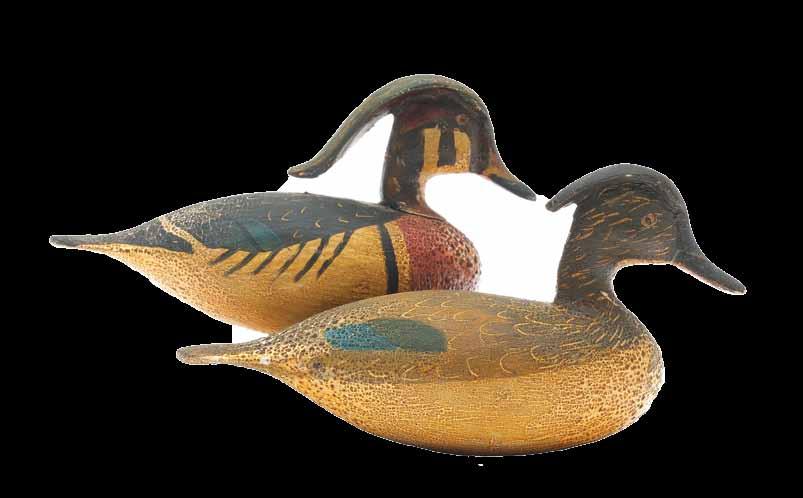
74 Ira Hudson (1873-1949), Chincoteague, Virginia. Very rare pair of miniature wood ducks. Drake with exaggerated, extended crest. “MAS” in pencil on undersides. Measure 5.25” long. Original paint with significant crazing to the varnish layer that has caused some paint shrinkage; hen’s bill was cracked off and tightly reset.
Provenance: Oliver Smith collection. (4,000 - 6,000)
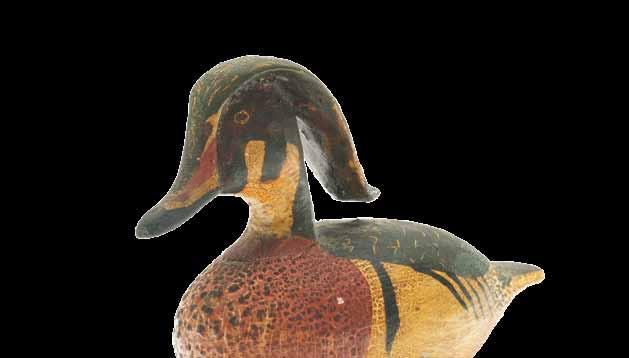
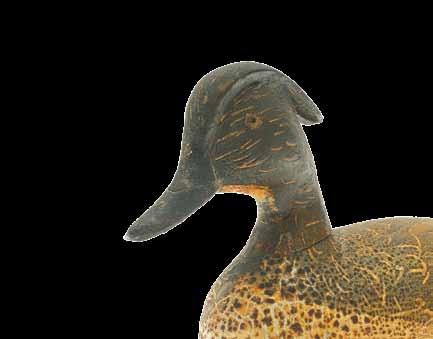
75 Ira Hudson (1873-1949), Chincoteague, Virginia. Pair of miniature pintails. Scratch feather paint detail. Measure 4.75” and 5.75” long. Original paint with very minor flaking; hairline crack in each neck; small amount of touchup on top of drake’s tail.
Provenance: Oliver Smith collection. (2,000 - 3,000)
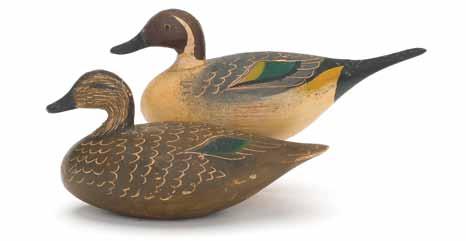
76 Ira Hudson (1873-1949), Chincoteague, Virginia. Miniature mallard. Scratch feather paint detail at wing patches. Measures 5” long. Original paint with very minor flaking under a thick coat of varnish; vertical crack in neck.
Provenance: Oliver Smith collection. (800 - 1,200)
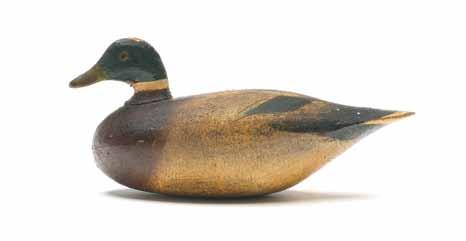
77 Ira Hudson (1873-1949), Chincoteague, Virginia. Miniature black duck. Scratch feather paint detail. Measures 5” long. Original paint with very minor wear under a thick coat of varnish; hairline crack in neck; a few spots that varnish did not cover that show up under UV light but are not touchup.
Provenance: Oliver Smith collection. (800 - 1,200)

78 Ira Hudson (1873-1949), Chincoteague, Virginia. Miniature canvasback. Fluted tail carving. Measures 6” long. Original paint protected by a thick coat of varnish that has darkened over time; slight separation at neck seat that has been touched up; small amount of touchup on top of tail; small knot missing on underside.
Provenance: Oliver Smith collection. (800 - 1,200)
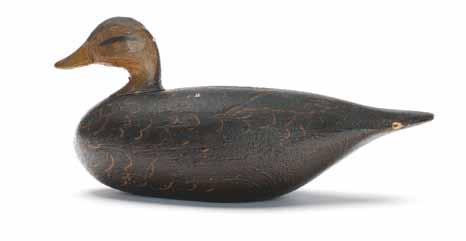
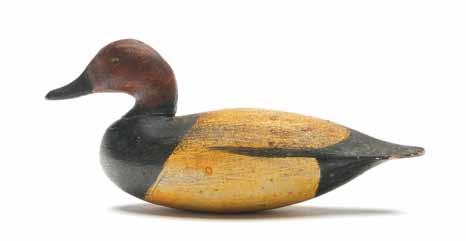
In 1837, Nathan Cobb, Sr. was working in the shipbuilding business in Cape Cod, Massachusetts. When his wife, Nancy Doane, contracted tuberculosis, Nathan decided to seek out a warmer climate in the hopes that the change would be beneficial to her health. He sold his interest in the shipbuilding business, purchased a sailing vessel, and set sail with his wife and three sons, Nathan Jr., Albert, and Warren.
As they reached the barrier islands off Virginia’s Eastern Shore, an Atlantic storm forced them ashore where they took shelter near the town of Oyster. They were so enamored with the local people who welcomed them with open arms that they decided to make this their permanent home.
Nathan and Nancy opened a small general store which they operated for the next couple of years providing them a modest living. In 1839, Nathan, bored with life on the
mainland, purchased Great Sand Shoal Island and moved his family to the island which was to become known as Cobb Island. This move proved too much for the ailing Nancy who passed away the following year.
Nathan and his sons operated a successful ship salvage business from the island and ultimately got involved in market hunting. As word spread of the superb waterfowl hunting, the Cobbs found themselves guiding sport hunters who came from up and down the East Coast. To accommodate these hunters, they opened a hotel which was large enough to handle not only the Cobb family and their employees, but up to 100 guests as well. When Nathan Sr. died in 1890 at the age of 92, the island had been developed into a thriving year round resort village frequented by the well-to-do from all parts of North America as well as France and England. The abundance and variety of waterfowl on the island provided for the highly successful market and sport hunting. Continued...
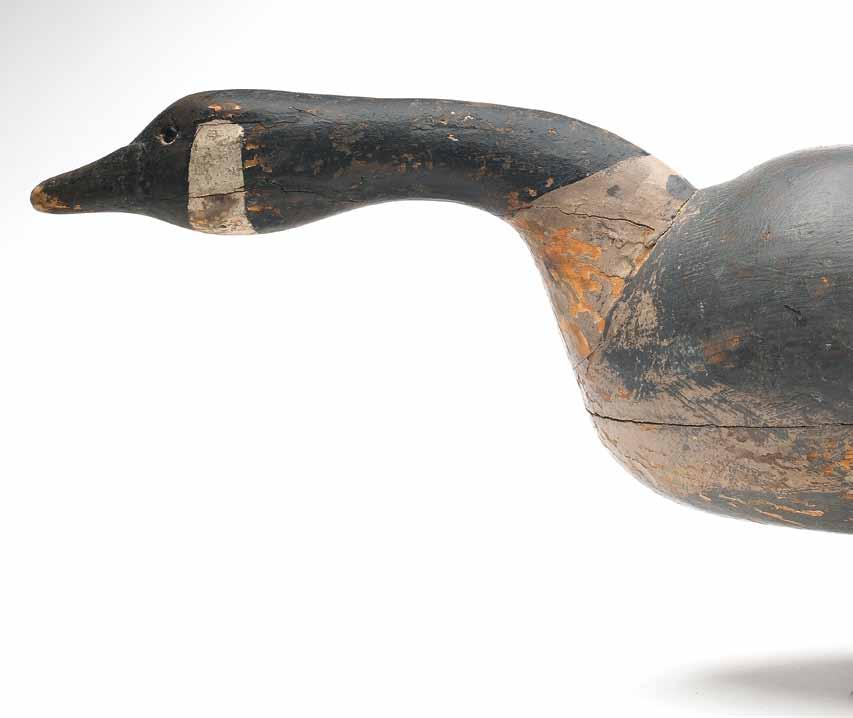
79 Nathan Cobb, Jr. (1825-1905), Cobb Island, Virginia. Swimming Canada goose. Hollow carved with inlaid neck seat and relief wingtip carving. Serifed “N” carved in underside. Measures 29.5” long. Very early in use repaint with moderate flaking and wear; slight separation at body seam; hairline cracks in head and neck base.
Provenance: Oliver Smith collection. (50,000 - 80,000)
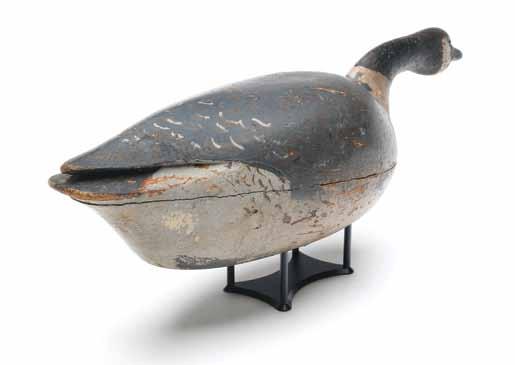
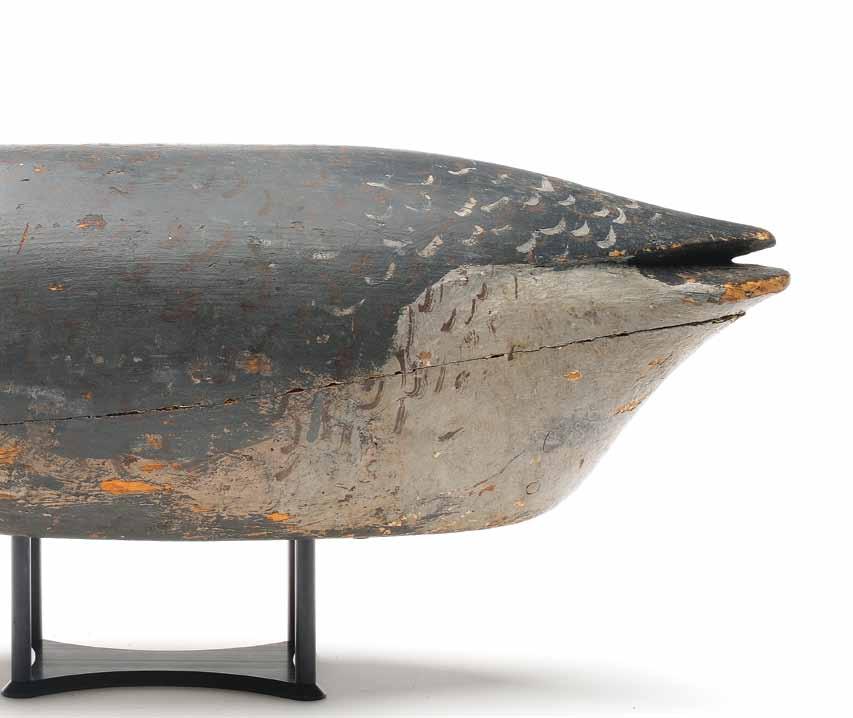
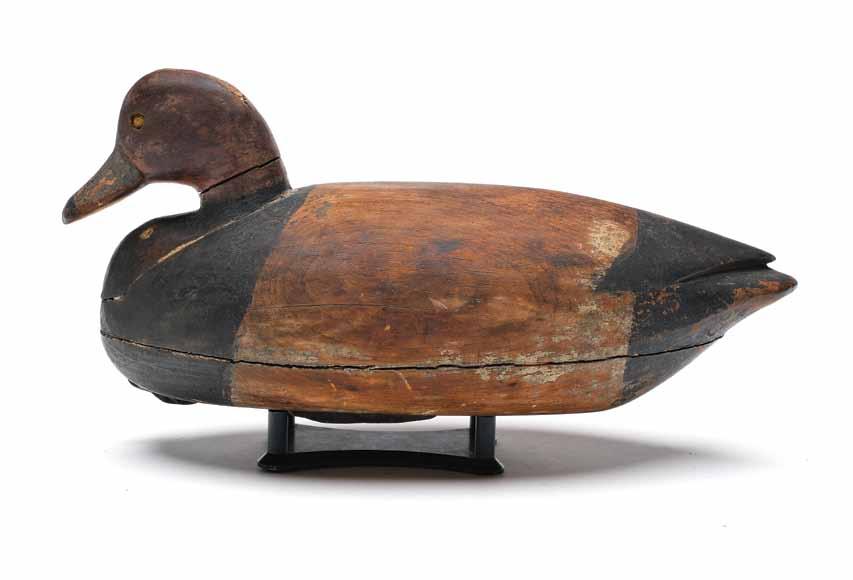
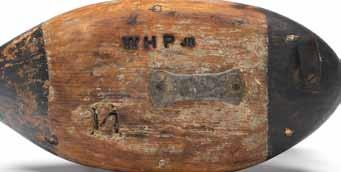
80 Nathan Cobb, Jr. (1825-1905), Cobb Island, Virginia. Important redhead. Hollow carved with inlaid neck seat and carved eyes. “WHP Jr” brand on underside. Also with the maker’s serifed “N”. Measures 14.5” long. Original paint with significant wear; separation at body seam; crack through neck that was secured long ago with a large nail in top of head; old filler above nail head.
Provenance: Don Leonard collection. (30,000 - 50,000)
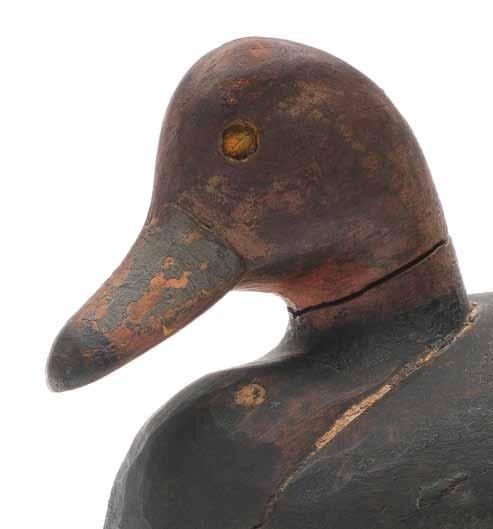
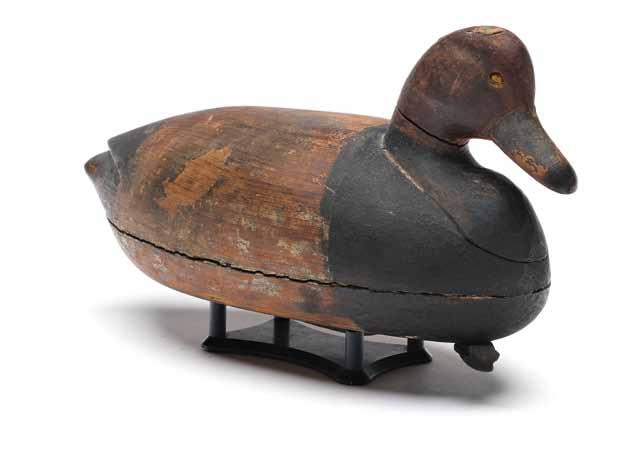
The decoys the Cobbs made were of rugged construction consistent with the severe conditions that often plagued Cobb Island over the years. Nathan Jr. produced ducks, geese, and shorebirds in a multitude of poses which created a sense of movement and realism to the rig. Curved and twisted necks with cantered heads, notched tails, and inlet heads are but a few of the characteristics which set Cobb decoys apart from other Virginia makers and established the tremendous folk art appeal that attracts collectors today.
The Cobb family business prospered on the island for over 50 years, but finally in 1896, one of the major Atlantic storms that constantly plagued the island destroyed everything that was left, forcing the remainder of the family to abandon their island home for good.
Today, Cobb Island is little more than a salt marsh bordered by a narrow deserted beach almost six miles long, varying in width from a few hundred feet to more than a half-mile. The majesty of the rolling dunes, salt-sprayed grasses, the sound of the surf, the cry of the shorebirds, and the ever-changing pattern of the treacherous inlets remain characteristic of Cobb Island, barren now, but still beautiful.
The Coast Guard rebuilt its station, the sea gave back some of its land, but the era of the Cobb Island Resort was gone forever.
The geese and brant made and used by the Cobb family can exhibit complicated design structures created to suggest animation in form. Whether interpreted as hissing, chasing, feeding, breeding, or belligerence, collectors have long been attracted to the folk art appeal of the highest grade hollow Cobb carvings
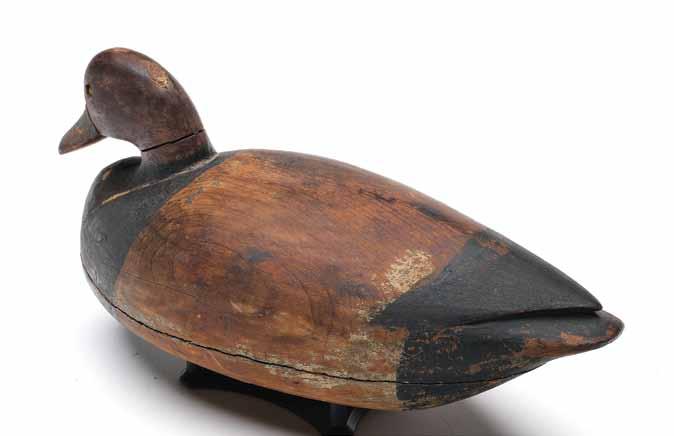
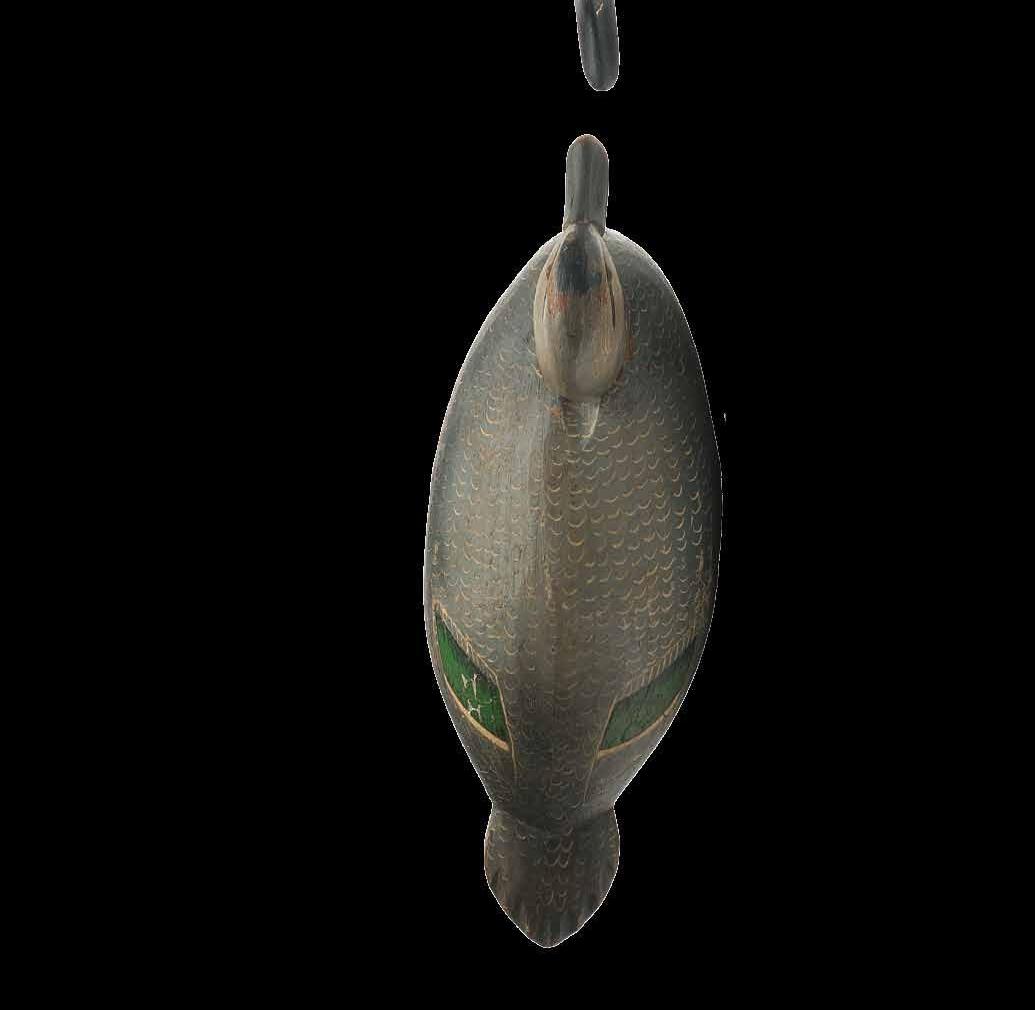
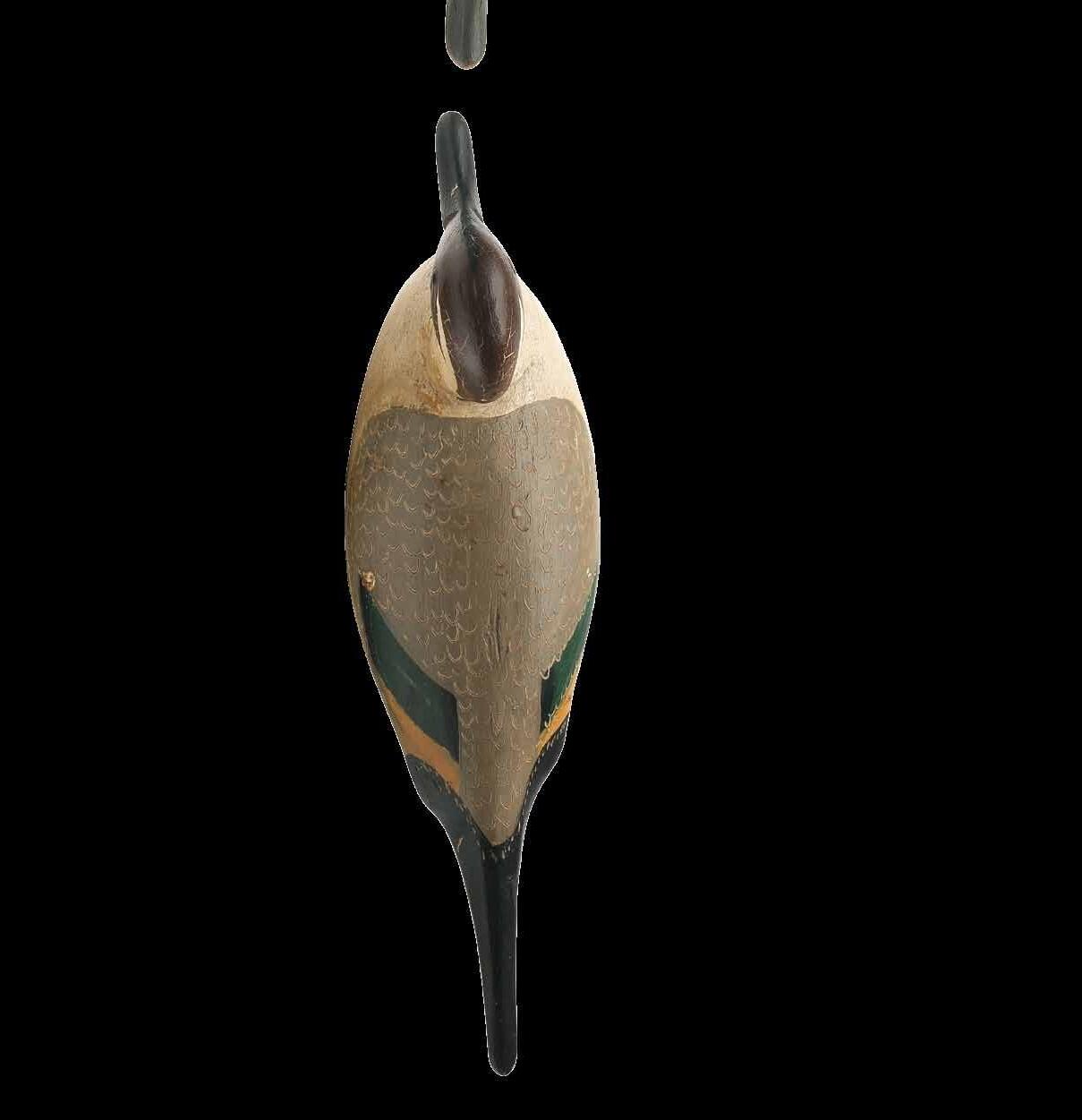
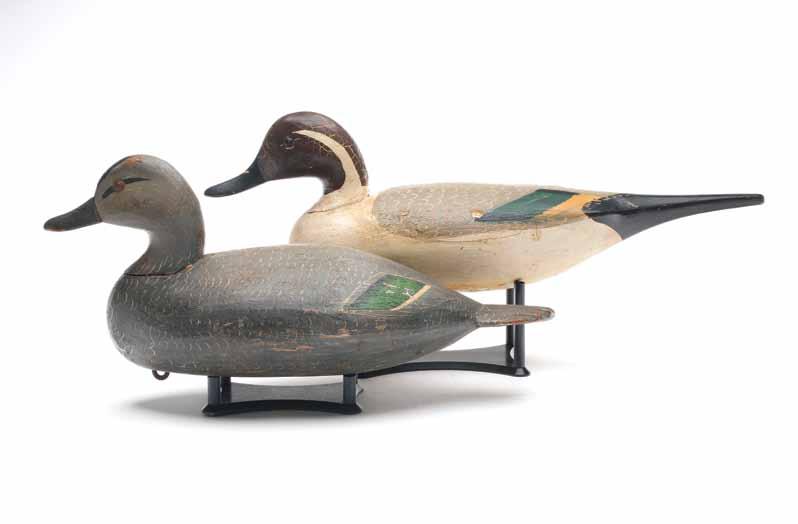
81 Ira Hudson (1873-1949), Chincoteague, Virginia. Pintail hen and drake. Both with scratch feather paint detail and tack eyes. Hen with partially inlaid neck seat and fluted tail. Drake was never rigged or weighted. Measure 15.5” and 19” long. Original paint with very minor wear; some paint shrinkage on hen’s breast and one wing patch; small amount of flaking to hen’s neck filler; paint shrinkage on drake’s head and some filler and touchup on one side of drake’s neck seat and a separation at wood grain in the same area.
(30,000 - 50,000)
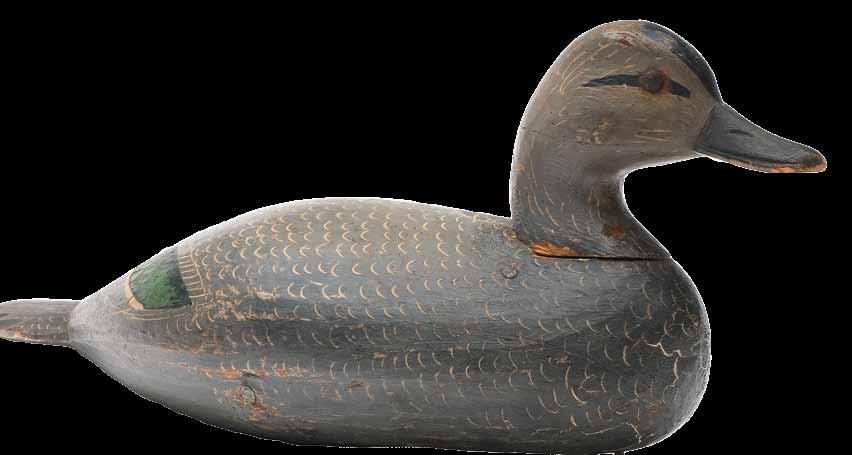
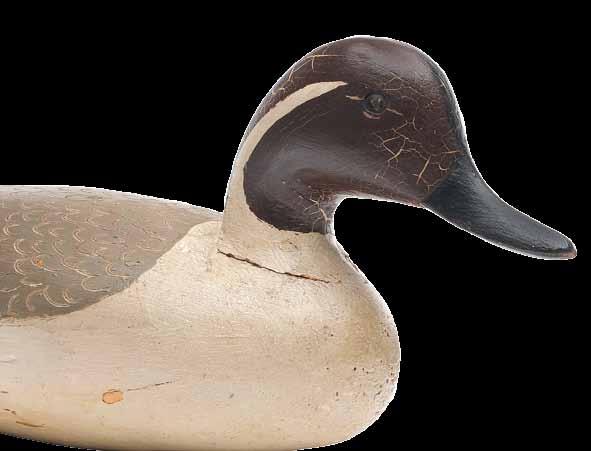
82 Ira Hudson (1873-1949), Chincoteague, Virginia. Swimming Canada goose. Fluted tail and ice groove carving. Excellent head carving and tack eyes. Measures 26.5” long. Original paint with moderate flaking and wear; in the making filled crack along one side of back; large split along one lower side was professionally filled and touched up; minor roughness on one edge of bill; tight drying crack along top of head and neck.
Provenance: Don Leonard collection. (12,000 - 18,000)
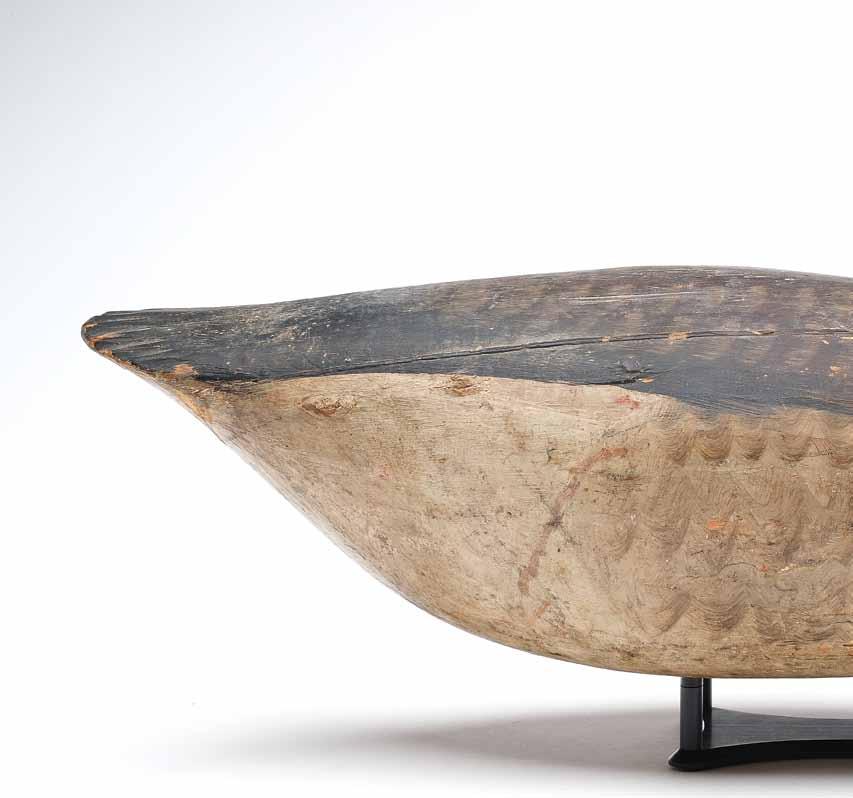
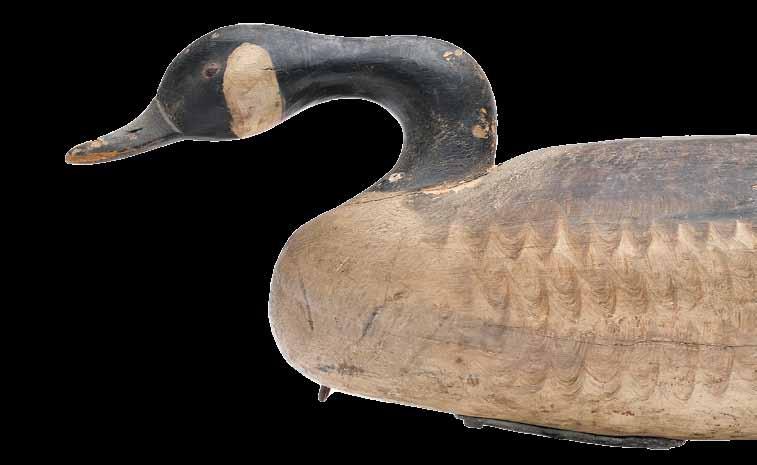
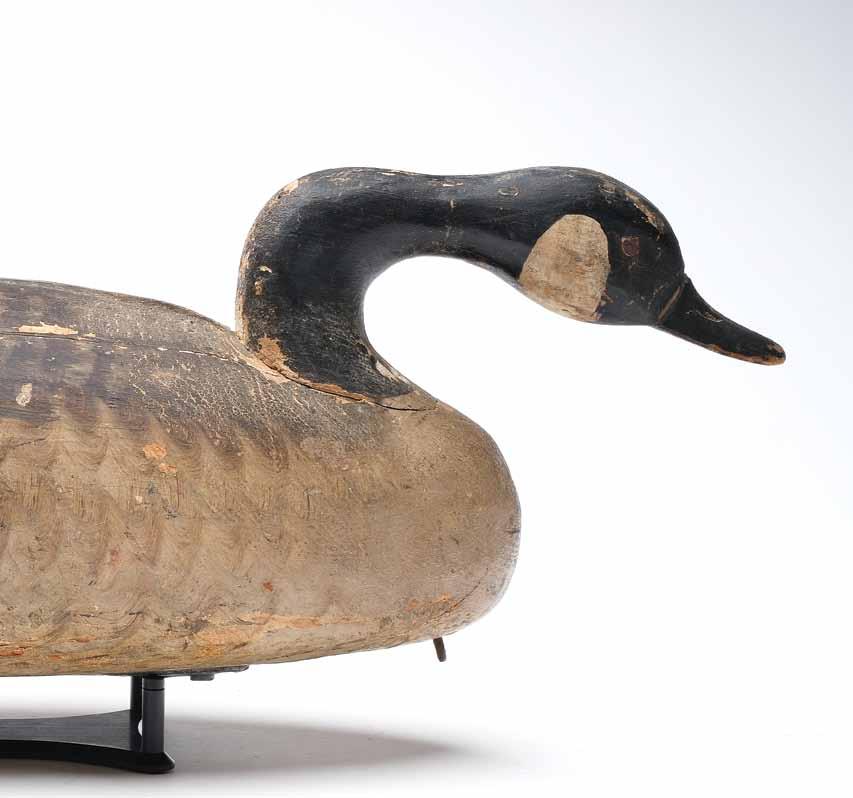
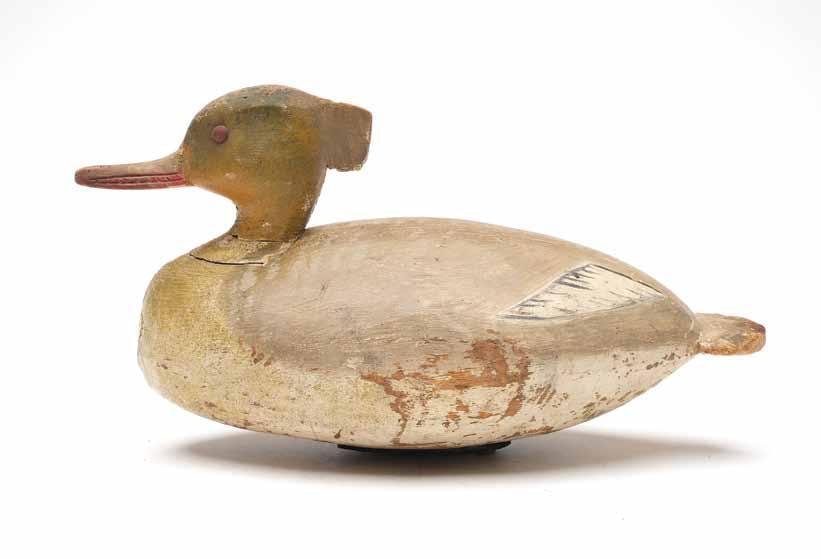
83 Ira Hudson (1873-1949), Chincoteague, Virginia. Merganser hen. Football body style with fluted tail and partially inlaid neck seat. Painted tack eyes and extended crest. Philadelphia Wildfowl Exhibition ink stamp on underside. Measures 15” long. Original paint with moderate flaking and wear; drying crack along underside; significant iron staining at nails on underside; crack through one side of neck with head slightly loose; flaking to filler at neck seat.
Provenance: Oliver Smith collection.
(12,000 - 18,000)
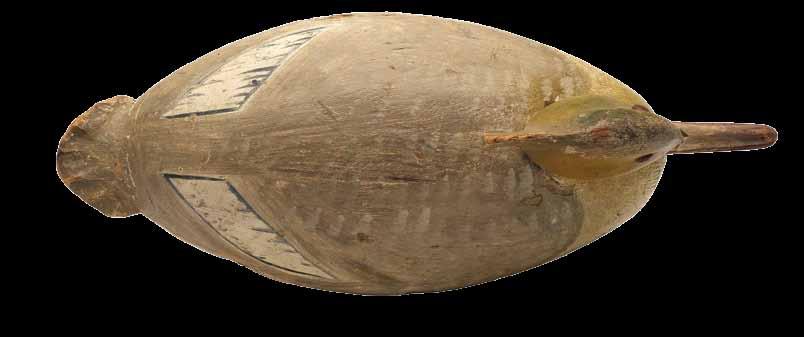
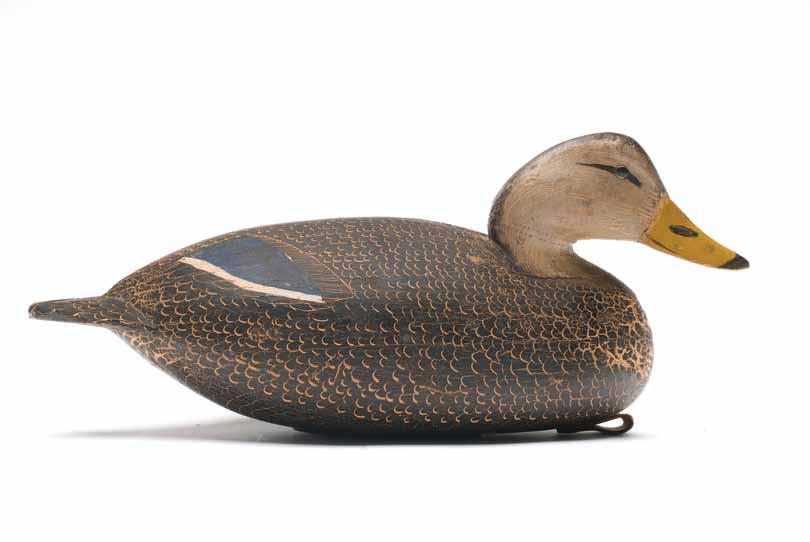
84 Ira Hudson (1873-1949), Chincoteague, Virginia. Rare hollow carved black duck. One from a group that were carved with turned heads and turned tails. Scratch feather paint detail, partially inlaid neck seat, and ice groove carving. Measures 16.75” long. Original paint with almost no wear; significant crazing and paint shrinkage on parts of body; excellent structurally. (20,000 - 30,000)
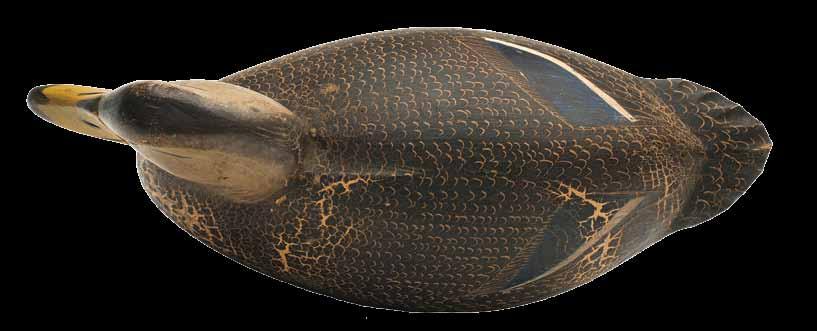
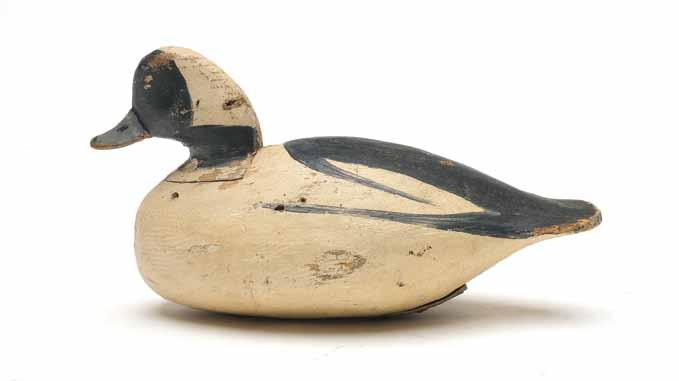
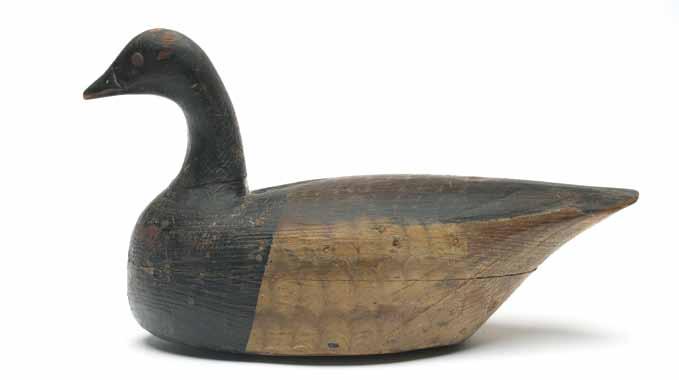
85 Ira Hudson (1873-1949), Chincoteague, Virginia. Rare bufflehead. Partially inlaid neck seat. Measures 10.75” long. Original paint with moderate flaking and wear; lightly hit by shot; hairline crack in bill; minor chipping and roughness on edge of tail.
Provenance: Oliver Smith collection. (3,000 - 5,000)
86 Ira Hudson (1873-1949), Chincoteague, Virginia. Hollow carved brant with raised neck seat and tack eyes. Measures 16.5” long. Original paint with moderate wear; minor roughness on edge of tail; vertical cracks in neck.
Provenance: Oliver Smith collection. (2,500 - 3,500)
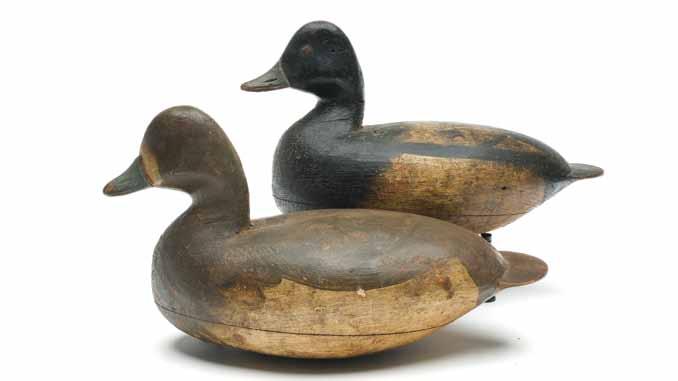
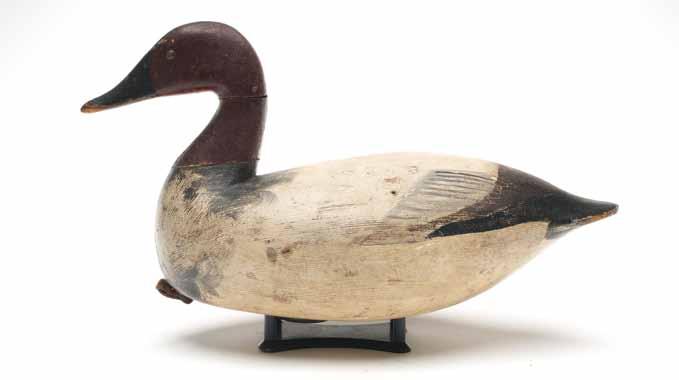
87 Ira Hudson (1873-1949), Chincoteague, Virginia. Rigmate pair of bluebills. Hollow carved with raised neck seats and tack eyes. Measure 12.5” long. Original paint with moderate flaking and wear; an early coat of varnish was darkened with age; lightly hit by shot; hairline cracks at neck seats; professional tail chip repair on hen.
Provenance: Oliver Smith collection. (2,500 - 3,500)
88 Norman Hudson (1898-1980), Chincoteague, Virginia. Canvasback. Raised neck seat and tack eyes. Measures 17.25” long. Original paint with moderate wear; significant wear to black on breast; crack through neck; second coat of red paint on head.
Provenance: Oliver Smith collection. (1,500 - 2,500)
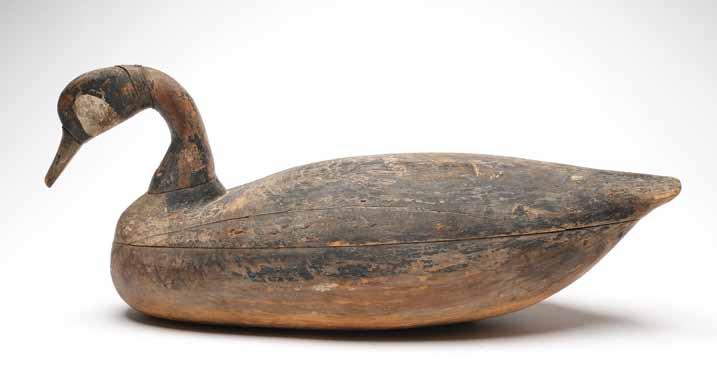
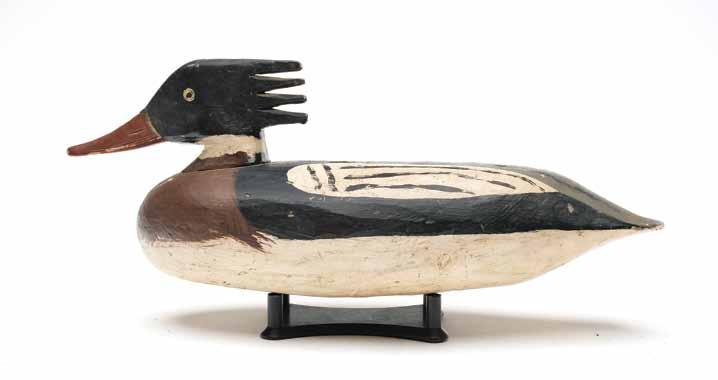
89 Canada goose, attributed to John Henry Downes. Hollow carved with raised neck seat and splined hardwood bill. Measures 24” long. Old in use repaint with significant flaking and wear; multiple drying cracks along the back; piece of wood missing at body seam under tail area; vertical cracks through upper part of neck with head being slightly loose; head is a very early replacement.
Provenance: Oliver Smith collection. (2,000 - 3,000)
90 Doug Jester (1876-1961), Chincoteague, Virginia. Red-breasted merganser. Extended crest carving. Never rigged or weighted. Measures 15.75” long. Original paint with scattered rubs; some paint shrinkage on breast and tail area; very good structurally.
Provenance: Oliver Smith collection. (2,000 - 3,000)
91 Doug Jester (1876-1961), Chincoteague, Virginia. Red-breasted merganser hen. Scratch feather paint detail and extended crest carving. Measures 16” long. Original paint with moderate flaking and wear; drying crack in tail area; bill was cracked down and tightly reset with small amount of touchup.
Provenance: Oliver Smith collection.
(2,000 - 3,000)
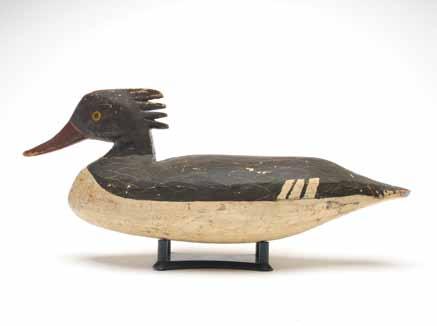
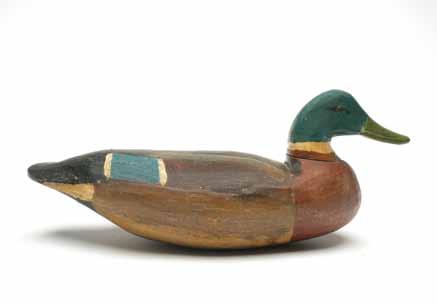
93 Doug Jester (1876-1961), Chincoteague, Virginia. Excellent pintail. Cottonwood body with scratch feather paint detail. Decoy was never rigged or weighted. Measures 17.25” long. Near mint original paint that has darkened slightly under a thin coat of varnish; excellent structurally.
Provenance: Oliver Smith collection.
(4,000 - 6,000)
92 Doug Jester (1876-1961), Chincoteague, Virginia. Rare mallard. Cotton wood with slightly raised neck seat and tack eyes. Decoy was never rigged or weighted. Measures 17” long. Original paint under a coat of uneven varnish that has crazed and caused some paint shrinkage on back; slight separation at wood grain on top of head, otherwise excellent structurally.
Provenance: Oliver Smith collection. (2,000 - 3,000)
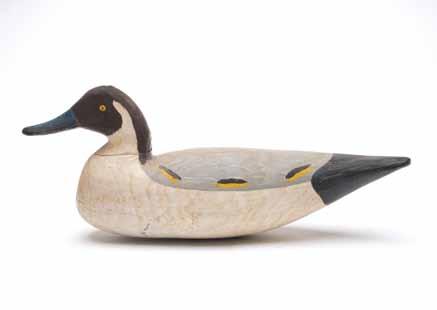
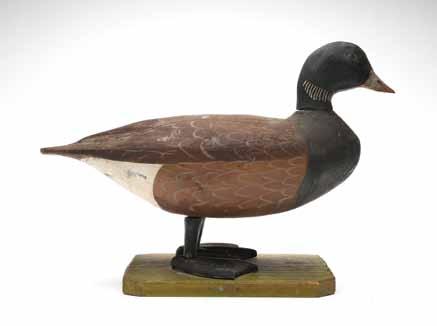
94 Lloyd Tyler (1898-1971), Crisfield, Maryland. Possibly unique full size standing brant. Carved legs and feet on green painted bottom board. Slight relief wingtip carving. Measures 18” long, stands 12” tall. Original paint with minor wear; hairline cracks in body; old chip in underside in of bill tip.
(4,000 - 6,000)
95 Miles Hancock (1887-1974), Chincoteague, Virginia. Exceedingly rare swimming swan. Cotton wood construction with tack eyes. Measures 24.74” long. Remnants of old paint on back and tail area; the rest in a later very thin wash of white; many tight drying cracks; roughness on edge of tail and at neck seat with small chips and old nails added; tight cracks in neck; professional bill chip repair.
Provenance: Oliver Smith collection.
(2,000 - 4,000)
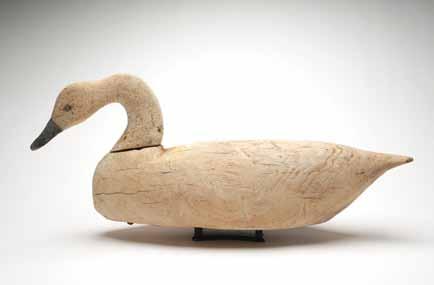
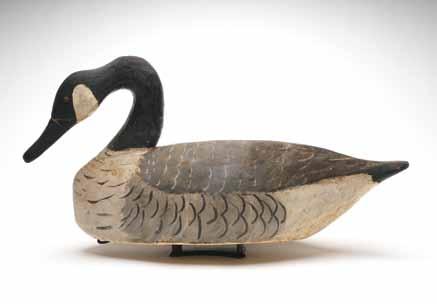
96 Miles Hancock (1887-1974), Chincoteague, Virginia. Down-looking Canada goose. Tack eyes and slightly turned down-looking head pose. Measures 23.5” long. Original paint with minor gunning wear; reset crack through neck; bill and lower portion of head were cracked off and reattached with small nails at underside; second coat of white on underside.
Provenance: Oliver Smith collection. (3,000 - 5,000)
97 Norman Hudson (1898-1980), Chincoteague, Virginia. Pair of flying widgeon. Applied outstretched wings with relief feather carving. Both with slightly turned heads. Signed and dated 1974. Measure 19” long, with 24” wingspans. Original paint under the original coat of varnish; hen with small amount of touchup on underside of bill tip; each with a chip missing from one wing tip.
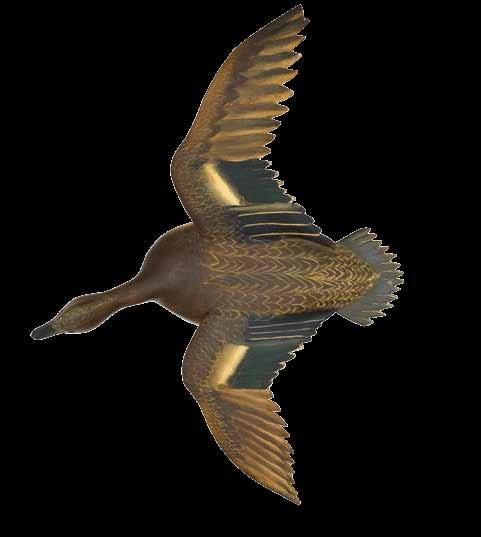
Provenance: Oliver Smith collection. (1,500 - 2,500)
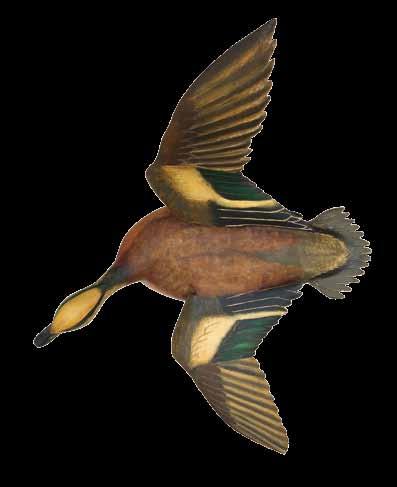
98 Ira Hudson (1873-1949), Chincoteague, Virginia. Yellowlegs with thin neck and scratch feather paint detail. Measures 11.5” long. Original paint with moderate to significant crazing and wear; may have had over paint taken off of white areas; bill was reset with a small chip where it meets the face.
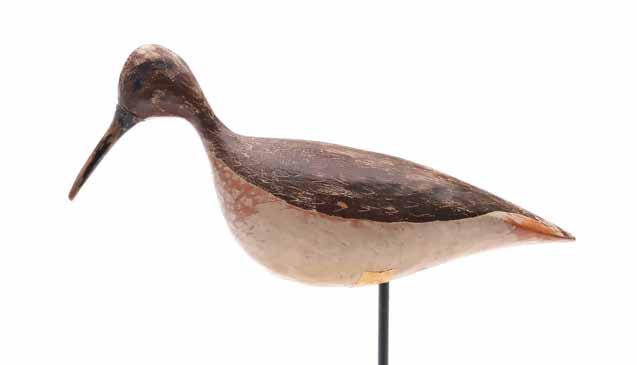
Provenance: Deborah and Martin Maloy collection. (1,500 - 2,500)
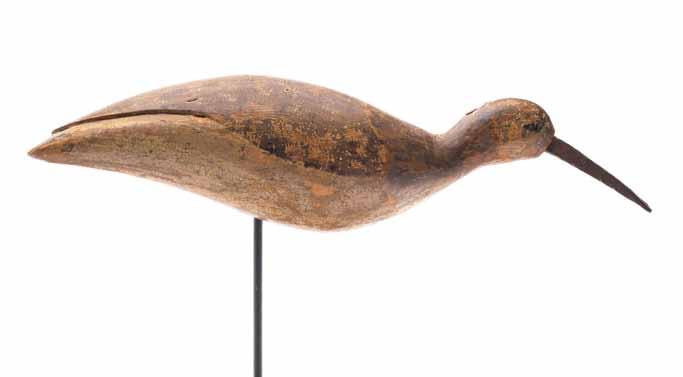
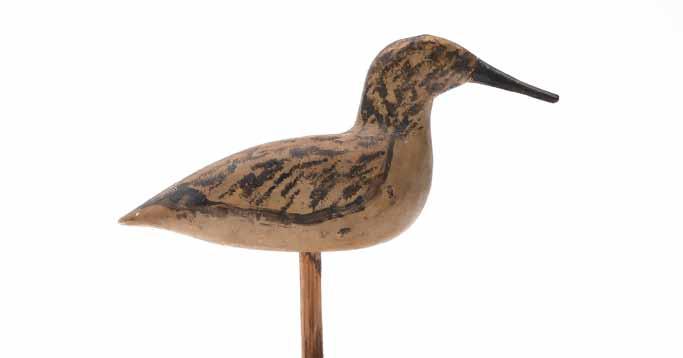
99 Robert Andrews (19th century), Smith Island, Virginia. Large running curlew with relief wingtip carving. Maker’s initials carved in underside.
Measures 16.5” long. Mix of original and very early working repaint with moderate crazing and wear; area at neck and around front part of body was whittled down at some point and repainted; iron spike bill is an early replacement.
Provenance: Deborah and Martin Maloy collection. (1,200 - 1,800)
100 Small sanderling from the eastern shore of Virginia. Original oak stick was glued in to decoy. Hardwood bill spline through back of head.
Measures 7.75” long. A few tiny paint flakes in one side; otherwise excellent and original. (1,500 - 2,500)
101 Black bellied plover from Chincoteague, Virginia. Very similar to the work of Doug Jester. Measures 9.25” long. Original paint with minor wear; minor loss and wood grain separation at a defect in wood on one side of body, otherwise very good structurally. (1,000 - 1,400)
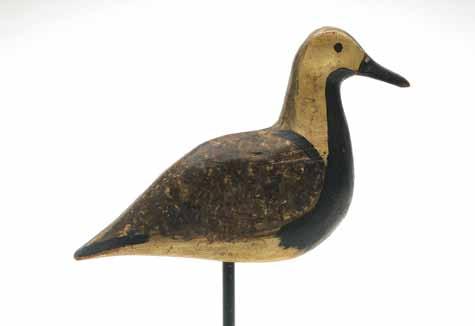
102 Miles Hancock (1887-1974), Chincoteague, Virginia. Oyster catcher. Balsa body with relief wing carving and raised wingtips. Original painted oak stake is attached to hardwood base. Signed on the underside. Measures 13” long. Fine hairline crack in one eye, otherwise excellent and original. (1,200 - 1,800)
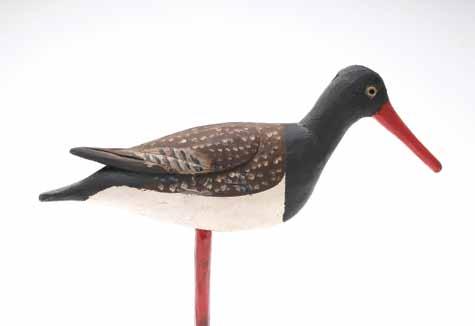
103 Miles Hancock (1887-1974), Chincoteague, Virginia. Blackbellied plover with split raised wingtips. Makers signature on the underside, measures 10.75” long. Original paint with minor wear and discoloration from age and use; small areas of flaking to paint on bill and tail.
Provenance: Oliver Smith Collection. (1,200 - 1,800)
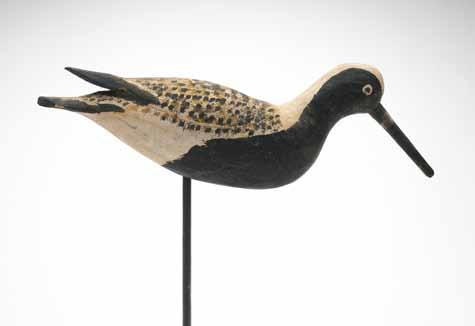
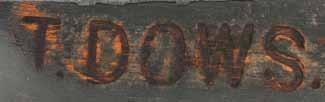
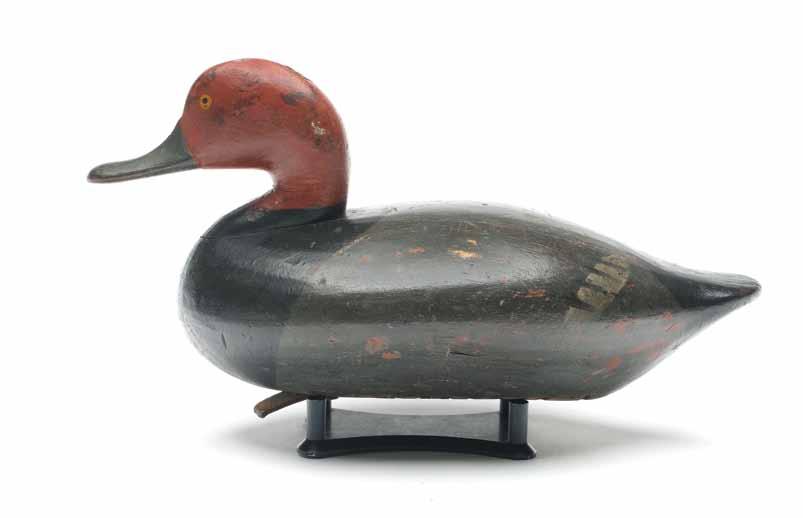
104
John “Daddy” Holly (1819-1892), Havre de Grace, Maryland. Excellent redhead. Branded “T. Dows” twice in underside. Also branded “D.G. Elliott”. Inlaid lead weight. Measures 13.5” long. Original paint with minor to moderate wear under a thick coat of varnish; tight crack in neck; filler above holes in neck seat appear to have been redone before the bird was varnished.
Provenance: Dr. Lloyd Griffith collection. Private Maryland collection.
(10,000 - 15,000)
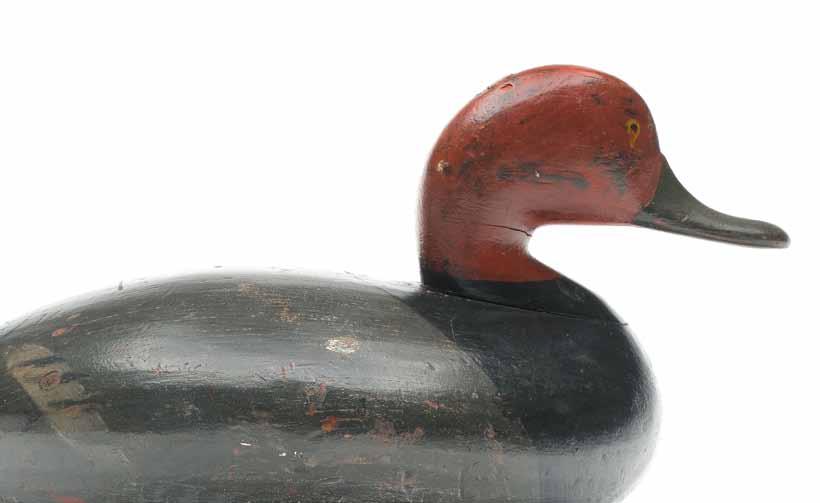
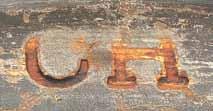
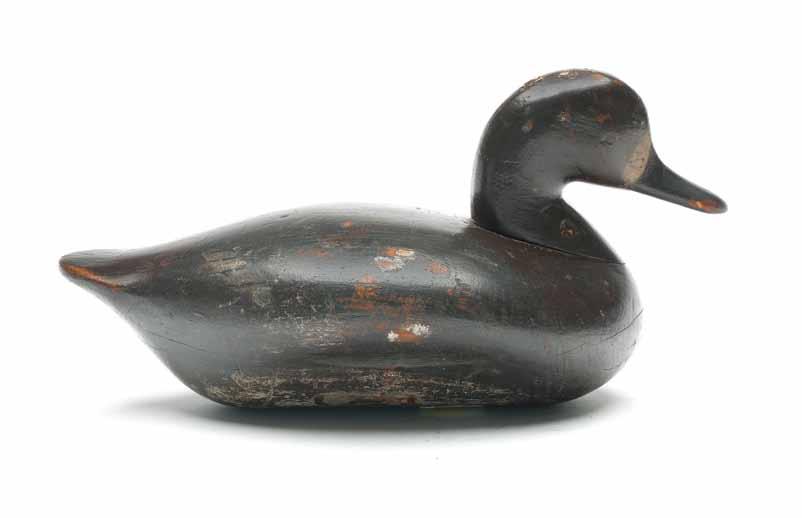
105 John “Daddy” Holly (1819-1892), Havre de Grace, Maryland. Redhead hen. Branded “CH”. Inlaid lead weight. Measures 12.5” long. Original paint with moderate wear; under a thick coat of varnish that has darkened with age; slight separation at neck seat; tight crack in one side of neck; appears to have had some white overpaint removed from wing patch areas.
Provenance: Dr. Lloyd Griffith collection. Private Maryland collection. (7,000 - 10,000)
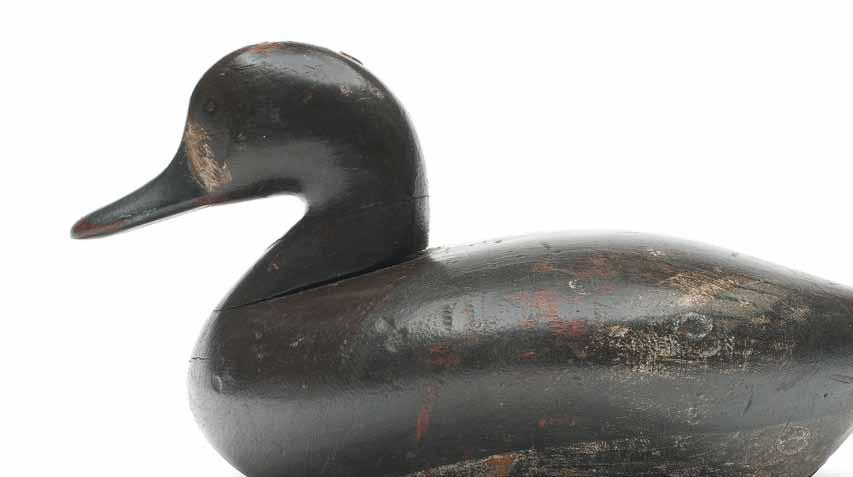
Born in Charlestown, John descended from a family of successful farmers and boat builders. Unfortunately, as a young man, his life got off to what could be viewed as a rather shaky start. On June 21, 1844, at age 22, he married 11-year-old Elizabeth Cooper and, ten months later, they had a son, John C Graham. Sadly, Elizabeth died in 1864 at only 13 years of age. Recovering from the loss, in 1850, John married Caroline M Richardson (1829 – 1920) and proceeded to become one of Charlestown’s most prominent and affluent citizens.
His obituary in the Rising Sun Midland Journal gives only scant acknowledgement of his business successes. From the time of the 1850 census through that of 1880, he listed himself as either a carpenter, master carpenter or cabinet maker and, from the 1900 to 1910, he is recorded as being, simply, a “farmer.” In reality, he must have employed a number of men in his carpentry business for he received a number of lucrative contracts
to construct wharfs and bridges among other large structures. He owned his own wharfs and an ice house on the North East River and his boats, some as large as 50 tons, were engaged in a variety of commercial interests, transporting both his own goods and products and those of others to and from Charlestown. After his father’s death in 1854, his agricultural activities expanded to include interests in forest products and mining. In 1869, he joined with a few other local men to form a new Bank in Charlestown. With all of this economic activity, he still found time to be keenly involved in the educational, civic and social activities of the community.
The statement in his obituary that he was “- - - also engaged in --ducking, etc.” gives little indication of the extent of his involvement in that line of work. Interestingly, it has been written that he only pulled one gunning license under his name during his lifetime, yet his name is mentioned repeatedly as owning his own gunning scow and sink box rig(s) for use on the Susquehanna Flats. It appears that this was a rather elaborate operation, even in its day, and Graham probably utilized the services of others as guides in the business. Likewise, it seems that, based on the variety of styles of decoys attributed to him, that others in his carpentry shop may also have been involved in the decoy making process. He has often been credited with being the originator of the Cecil County style of decoys but, as noted by C. John Sullivan, just as Graham learned his carpentry and boatbuilding skills from his father and grandfather, it is understandable that they may have also established the carving tradition that John later carried on.
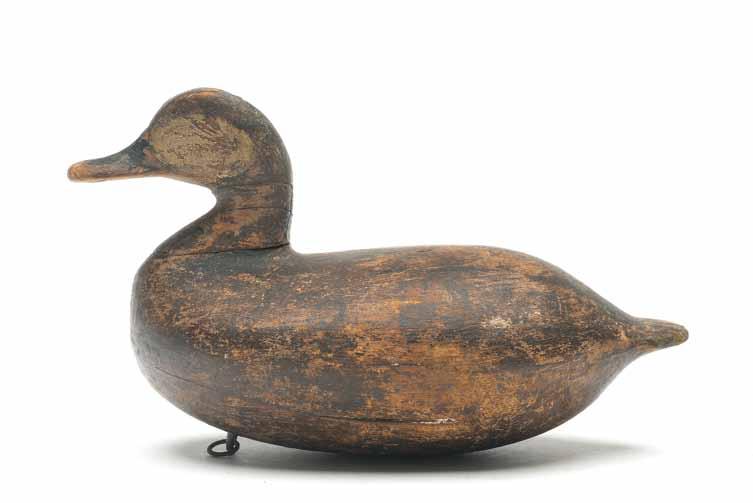
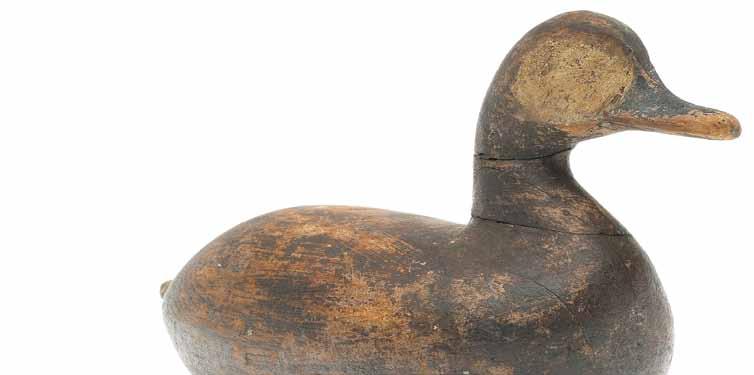
105A John B. Graham (1822-1912), Charlestown, Maryland. Very rare ruddy duck. “L” carved in underside. Measures 10.5” long. Older paint restoration by Cameron McIntyre; minor roughness and a short crack in tail; re-secured cracks in neck.
Provenance: Oliver Smith collection. (5,000 - 8,000)
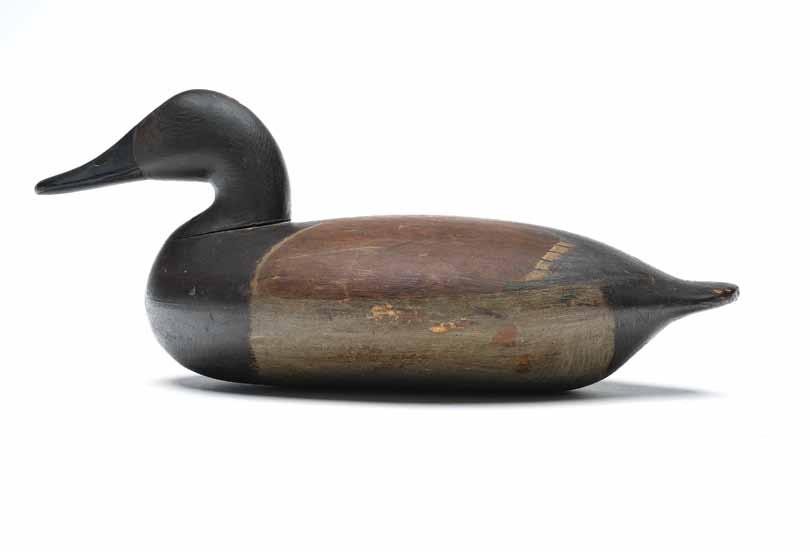
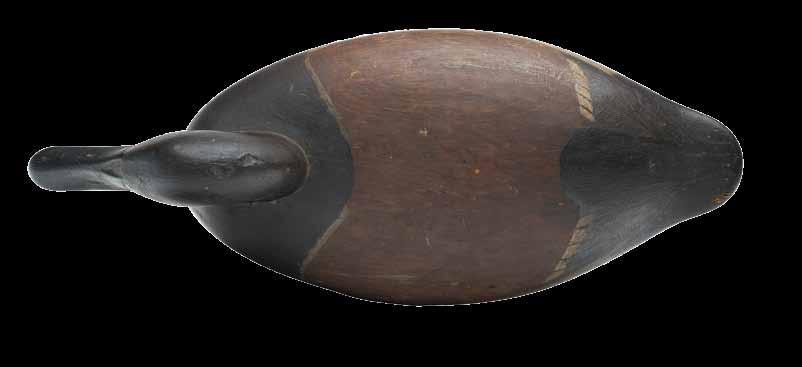
106 Leonard Pryor (1876-1967) Chesapeake City, Maryland. Canvasback hen. Decoy was never rigged or weighted. Measures 15.5” long. Original paint with very minor wear under an early coat of varnish that has darkened; some shallow dents and slight separation on one side of neck seat.
Provenance: Oliver Smith collection. (2,000 - 3,000)
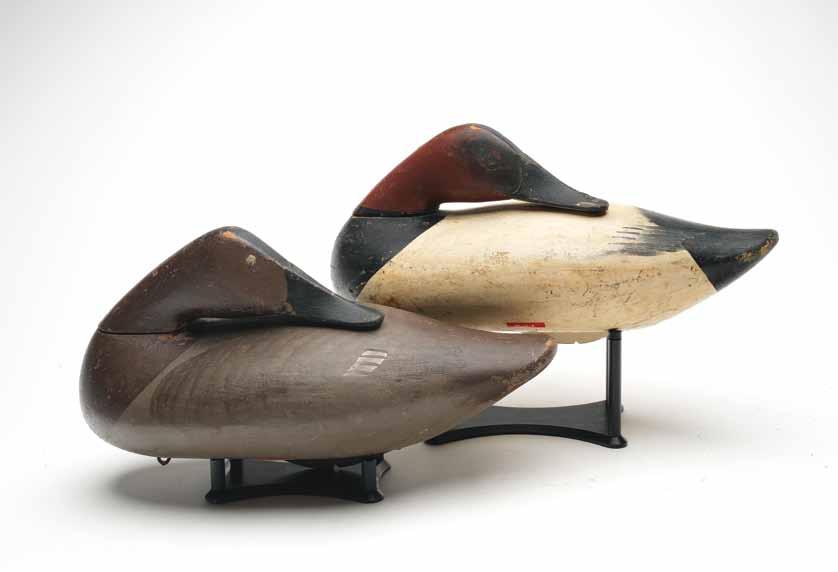
107 Madison Mitchell (1901-1993), Havre de Grace, Maryland. Early rigmate pair of sleeping canvasbacks. Circa 1940’s with north-south line tie staples. Measure 13.25” long. Original paint with moderate flaking and wear; separation at neck seats; otherwise very good structurally.
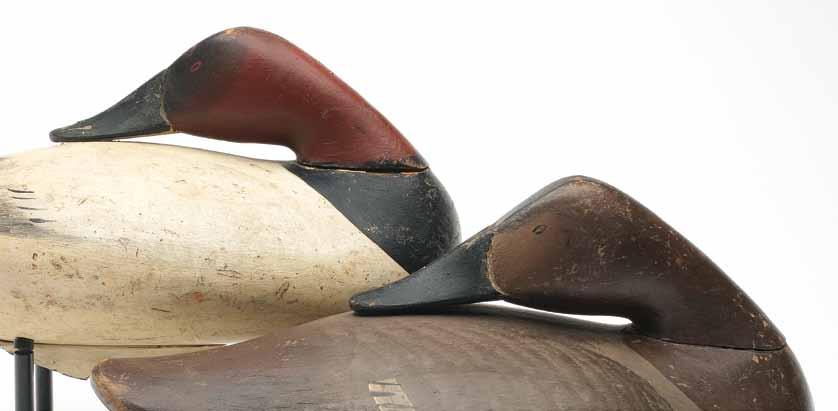
Provenance: Oliver Smith collection. (2,000 - 3,000)
108 Madison Mitchell (1901-1993), Havre de Grace, Maryland. Early sleeping black duck. From the rig of “E. Brummett, Morrisville, PA,” with the copper tag on underside. Circa 1940’s with north-south line tie staple that was removed and a smaller staple added by the gunner. Scratch feather paint detail. Measures 13.25” long. Original paint with minor flaking and wear; a few small dents; filler and touchup around weight on underside.
Provenance: Don Leonard collection. (1,500 - 2,500)
109 Madison Mitchell (1901-1993), Havre de Grace, Maryland. Early black duck. From the rig of “E. Brummett, Morrisville, PA,” with the copper tag on underside. Circa 1940’s with north-south line tie staple. Scratch feather paint detail. Measures 16.25” long. Original paint with minor flaking and wear; separations at wood grain in one side had nails and filler added in the making; seam has opened with minor flaking to filler.
Provenance: Don Leonard collection. (1,000 - 1,500)
110 Madison Mitchell (1901-1993), Havre de Grace, Maryland. Early high head pintail. Copper rig tag from “E. Brummett, Morrisville, PA” on underside. Circa 1940’s with northsouth line tie staple. Measures 17.5” long. Original paint with moderate discoloration and minor wear; flaking and separation at a knot in one side, and another in underside; crack through neck.
Provenance: Don Leonard collection. (2,000 - 3,000)
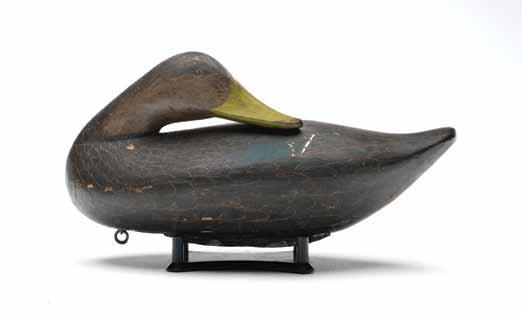
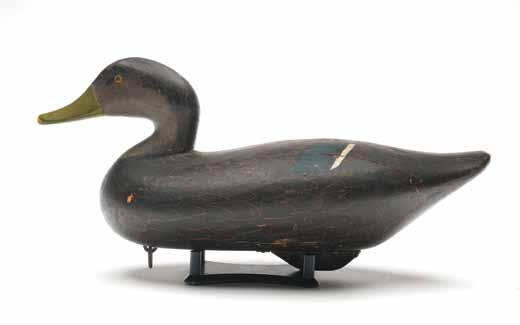
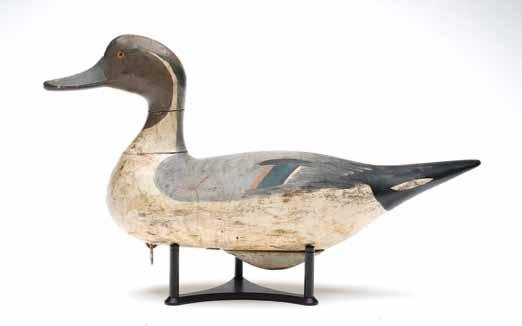
111 Madison Mitchell (1901-1993), Havre de Grace, Maryland. Full size swan with barn door weighted keel. Signed and dated 1965 in electro pen on underside. Measures 33” long. Original paint with flaking on metal hinges and lead weight; spots of flaking on edge of tail, back, and neck seat area with spots of touchup; very good structurally.
(2,500 - 3,500)
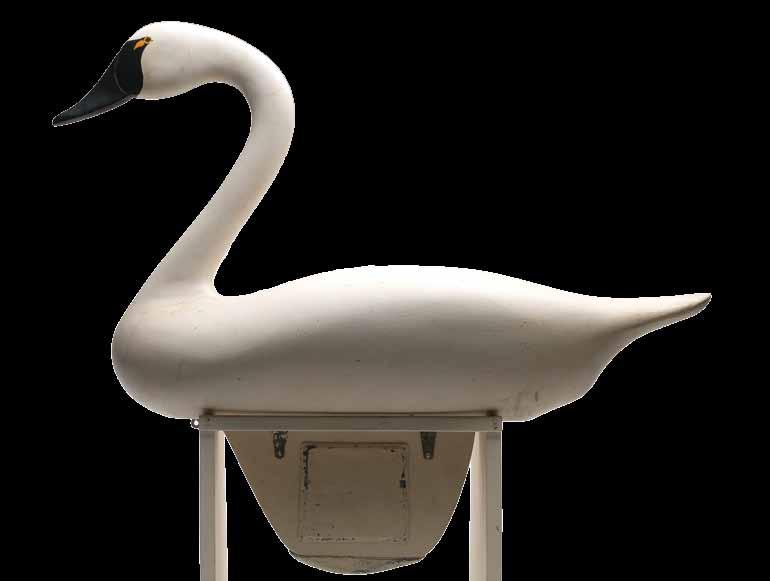
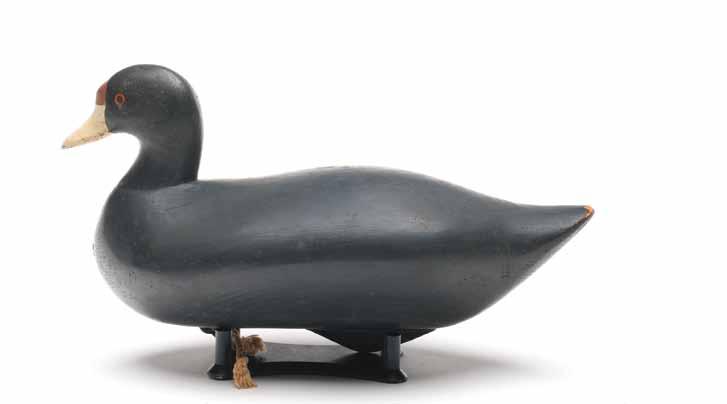
(600 - 900)
112 Madison Mitchell (1901-1993), Havre de Grace, Maryland. Early coot. North-South line tie staple. Signed and dated 1948 in electro-pen. Measures 13” long. Original paint with very minor wear; mostly on tip of tail; small wooden plug in breast has risen slightly, otherwise excellent structurally.
113 Charlie Joiner (1921-2015), Chestertown, Maryland. Extremely rare early swan. Narrow breast and wide body. Signed and dated 1955 at a later date. Measures 33.5” long. Original paint with moderate wear; hairline cracks in neck; tight cracks along the back with one having been filled in the making; slight separations at knots in body.
Provenance: Oliver Smith collection. (4,000 - 6,000)
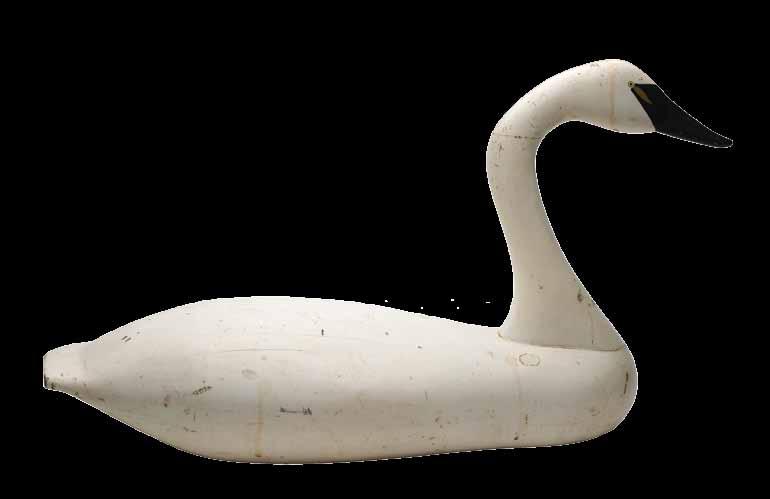
114 Charles Nelson Barnard (1876-1958), Havre de Grace, Maryland. Rigmate pair of bluebills. “SGH” stamped in undersides. Measure 12” long. Early in use repaint with minor gunning wear; lightly hit by shot; hairline crack near drake’s tail and one side of neck.
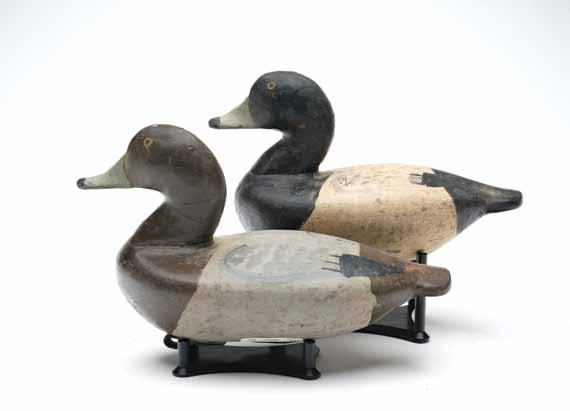
Provenance: Don Leonard collection. (1,500 - 2,500)
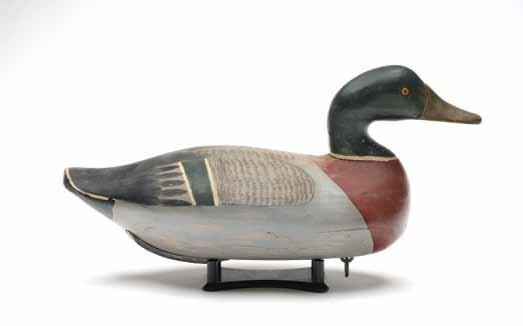
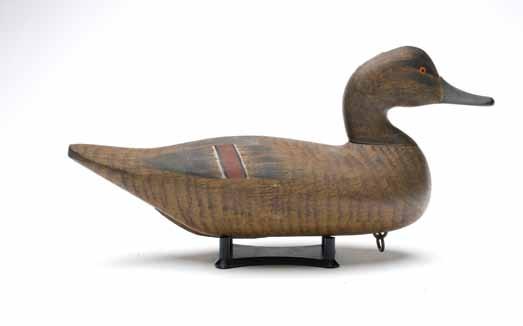
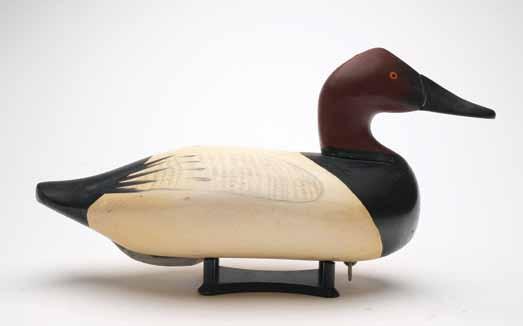
115 Robert McGaw (1879-1958), Havre de Grace, Maryland. Excellent mallard. Measures 16” long. Original paint with almost no wear; separation at wood grain in one side, with nails added to secure from when the decoy was made; area on underside with a thin wash of grey.
Provenance: Oliver Smith collection. (2,000 - 3,000)
116 Robert McGaw (1879-1958), Havre de Grace, Maryland. Excellent pintail hen. Scratch feather paint detail and dog bone weight on underside. Measures 18.5” long. Original paint with almost no wear; slight separation and flaking to filler on top of head; flaking and separation to large knot on one lower side near breast.
Provenance: Don Leonard collection. (2,000 - 3,000)
117 Robert McGaw (1879-1958), Havre de Grace, Maryland. Excellent canvasback. Branded “R.F. McGaw” on underside. Measures 15.75” long. Decoy appears to be unused with very minor flaking to filler on top of head and one side of neck seat; small dent in back.
Provenance: Frederick Raymon collection. (3,000 - 5,000)
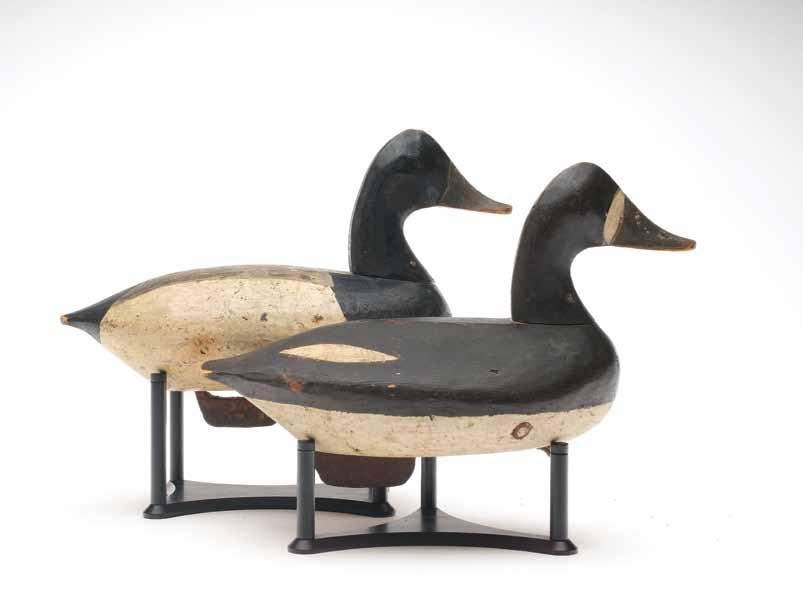
118
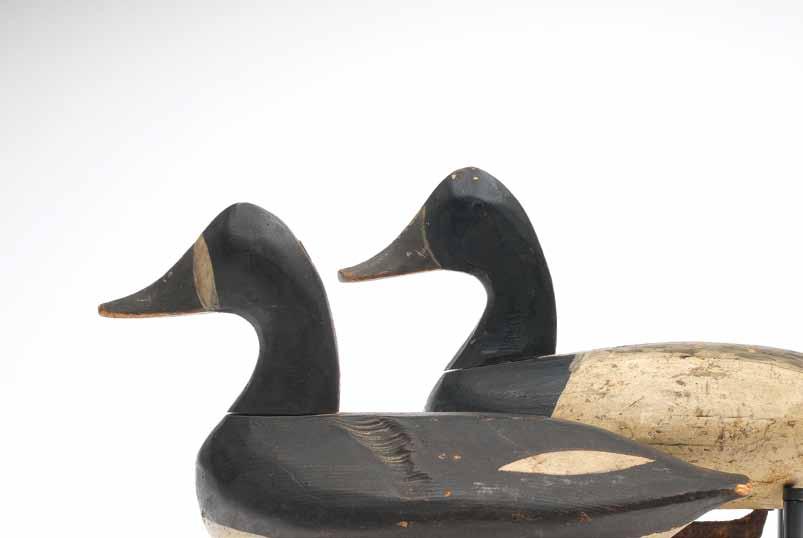
Excellent rigmate pair of bluebills from Dorchester County, Maryland. Iron keel weights. Measure 11” and 11.5” long. Original paint with minor wear; defect in wood used on one side of hen’s body; hairline drying cracks and very minor roughness on edge of tails.
Provenance: John Decesare collection.
Literature: “Decoys of the mid-Atlantic Region” by Henry A. Fleckenstein Jr., page 159, exact decoys pictured. (5,000 - 8,000)
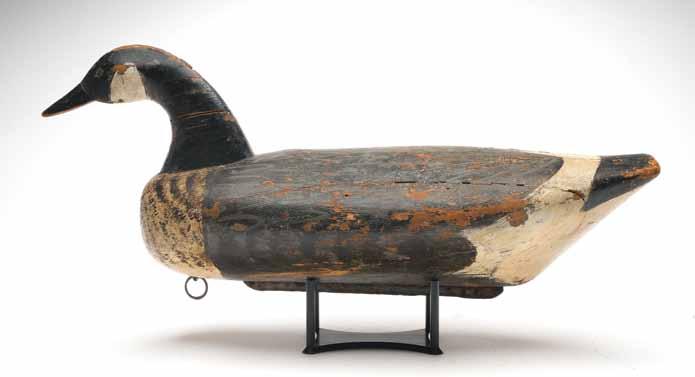
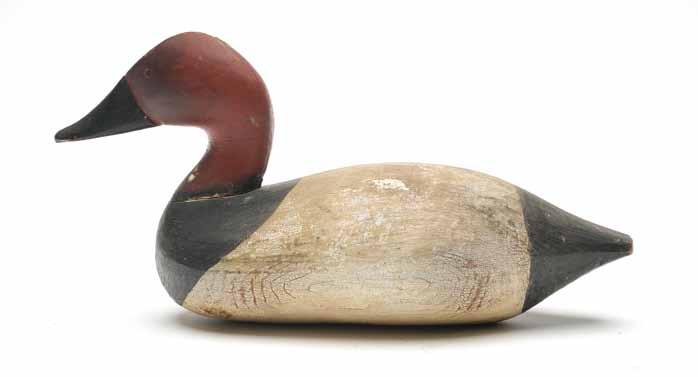
119 Rare Canada goose from Hoopers Island, Maryland, early 20th century. Slightly swimming head pose. With carved eyes and large iron keel weight. Measures 26” long. Mix of original and very early in use repaint with moderate to significant flaking and wear; drying cracks along body; crack through neck; bill was cracked down and tightly reset at some point. (3,000 - 5,000)
120 Ed Parsons (1856-1937) Oxford, Maryland. Canvasback. Round inlaid weights on underside. Measures 15.5” long. Original paint with very minor wear; an early coat of varnish has crazed and caused scattered paint shrinkage; minor flaking to filler at neck seat and at a knot in back; hairline drying cracks in back and underside. (800 - 1,200)
121 Captain Ed Phillips (1901-1964), Cambridge, Maryland. Canvasback.
Measures 15” long. Original paint with moderate flaking; old chip in underside of bill tip; flaking above two knots on one lower side.
Provenance: Oliver Smith collection. (1,500 - 2,500)
122 Captain Ed Phillips (1901-1964), Cambridge, Maryland. Redhead.
Measures 12.5” long. Original paint with minor flaking; spot of discoloration on back; very good structurally.
Provenance: Oliver Smith collection. (3,000 - 5,000)
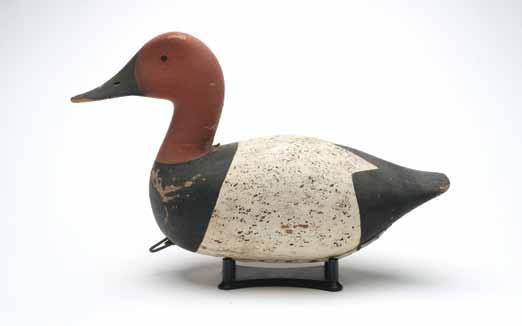
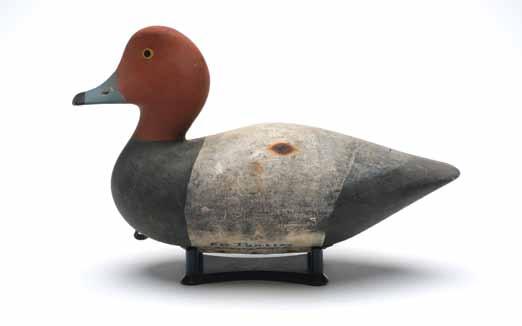
123 Captain John Smith, Ocean City, Maryland. Rare swimming black duck. Cotton wood body and tack eyes.
Scratch feather paint detail. Measures 17” long. Original paint with significant wear; crack through neck was secured with old nails at one point, those nails were since removed and the seam tightly glued; roughness on edge of bill and tail. (600 - 900)
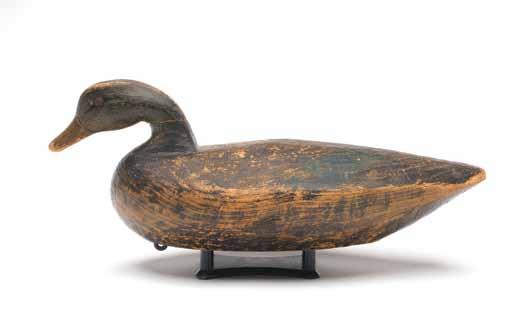
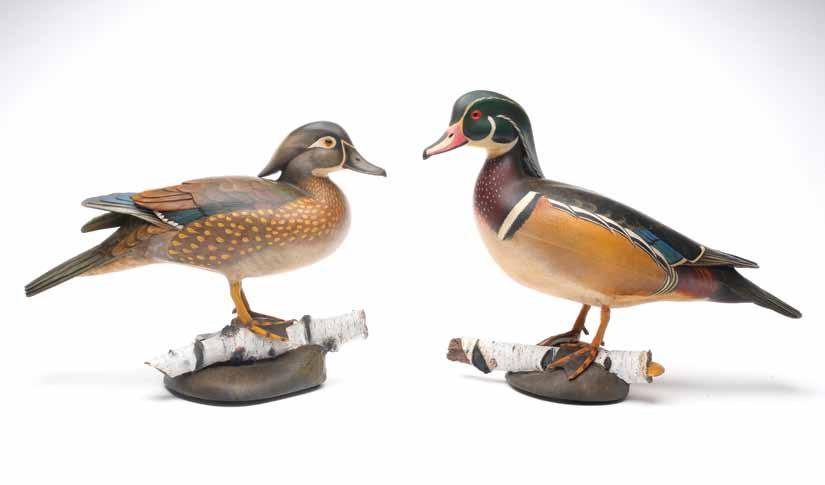
124 William Gibian (b.1946), Onancock, Virginia. Excellent pair of standing wood ducks. Hollow carved with slightly turned heads and extended crests. Hen with raised crossed wingtips. Both with relief wing and tail feather carving. Carved bases with simulated birch limbs. “Gibian” carved in
underside of each. Maker’s business card on underside of bases, indicating these were the first featuring this design. Measure 16” and 17” long. Drake stands 12.25” tall. Some discoloration from the tannins bleeding through paint on underside, otherwise excellent and original. (5,000 - 8,000)
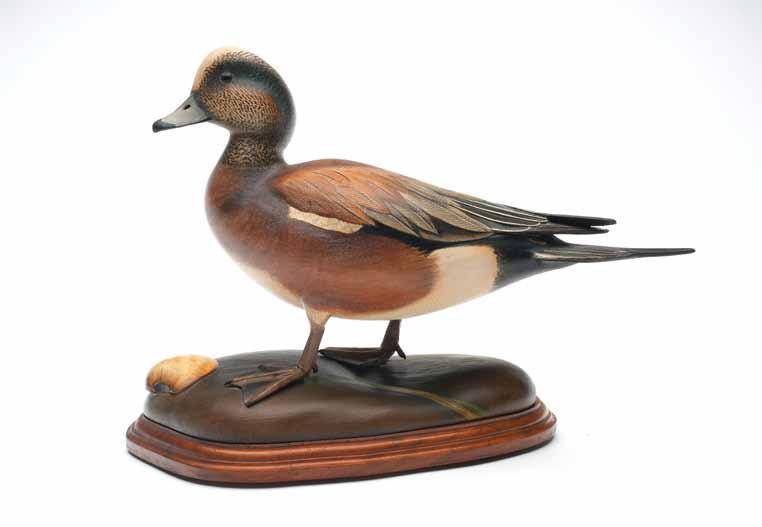
125 William Gibian (b.1946), Onancock, Virginia. Beautiful decorative widgeon. Hollow carved with slightly turned head and raised, crossed wingtips. Relief wing and tail feather carving. Comb feather paint detail on back. Maker’s business card on underside indicates this was his first standing widgeon. Measures 15.5” long. Near mint. (2,500 - 3,500)
126 William Gibian (b.1946), Onancock, Virginia. Pair of labrador ducks. Both are hollow carved with relief wing carving and rocking heads. Drake’s bill is open with a painted leather piece of eel grass in bill. “Gibian” carved on the undersides. Maker’s business card on underside indicates the drake is the first rocking head style decoy by the maker. Drake is dated 9/11, hen dated 8/13 and was made to match the drake. Measure 16” and 17” long. Excellent and original. (2,500 - 3,500)
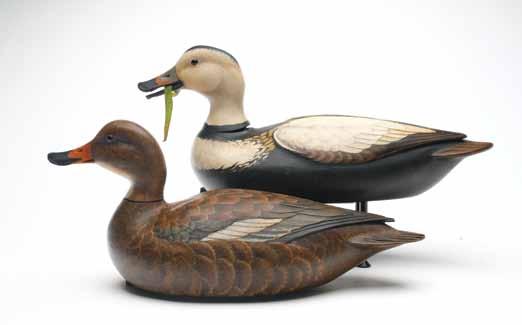
127 William Gibian (b.1946), Onancock, Virginia. Preening pintail. Hollow carved with raised, crossed wingtips and head twisted in breast preening pose. Gibian carved in underside. Maker’s business card is signed and dated 5/15. Measures 20” long. Excellent and original. (1,200 - 1,800)
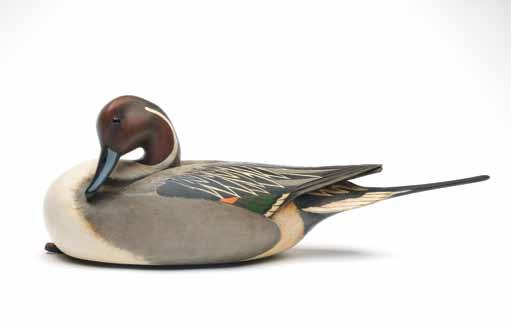
128 William Gibian (b.1946), Onancock, Virginia. Large curlew. Deep relief wing carving and raised wingtips. “Gibian” carved in underside. Measures 20.5” long. Very good and original. (1,000 - 1,500)
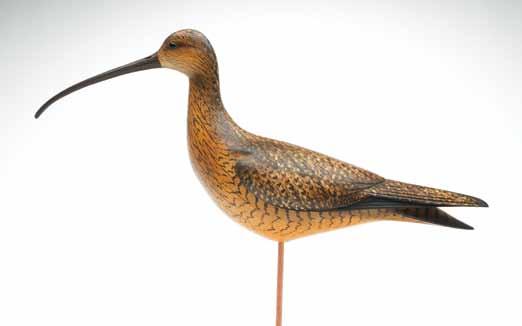
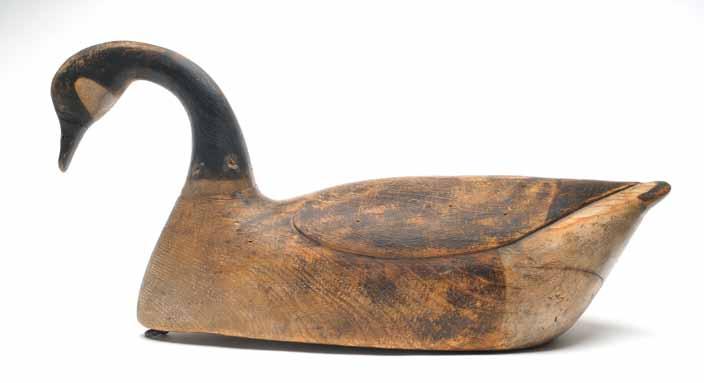
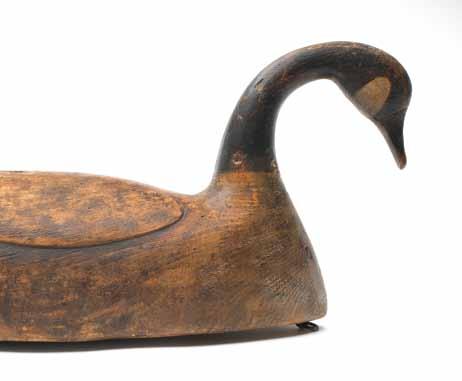
129 Cameron McIntyre (b.1968), New Church, Virginia. Canada goose. Relief wing carving and down-looking head pose. “CTM 1998” carved in underside. Applied bill. Measures 24.5” long. Made to appear older, excellent and original. (4,000 - 6,000)
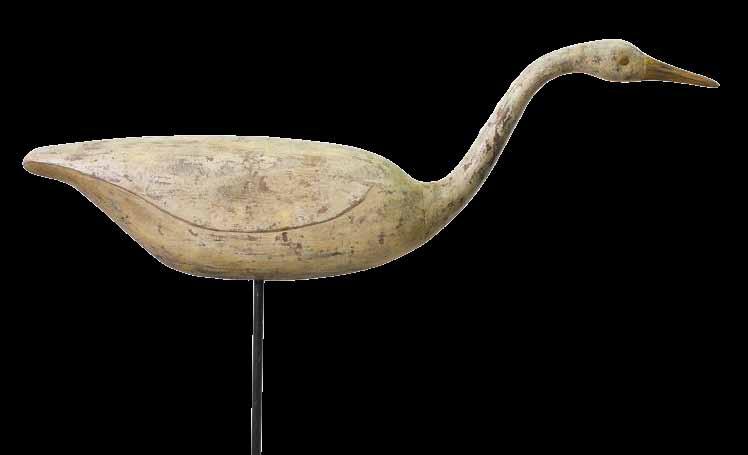
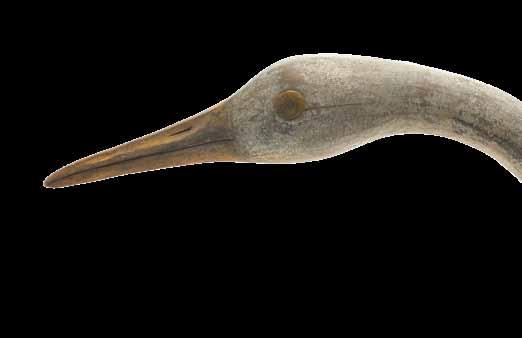
130 Cameron McIntyre (b.1968), New Church, Virginia. Great white heron. Hollow carved with slight relief wing carving. “CTM” carved in underside. Stand included. Measures 36.25” long. Made to appear older, with hairline drying cracks; excellent and original. (3,000 - 5,000)
131 Cameron McIntyre (b.1968), New Church, Virginia. Swimming brant. Hollow carved with relief wingtip carving. Swimming pose with carved eyes. “CTM” carved in underside. Measures 25” long. Made to appear older, excellent and original. (3,000 - 5,000)
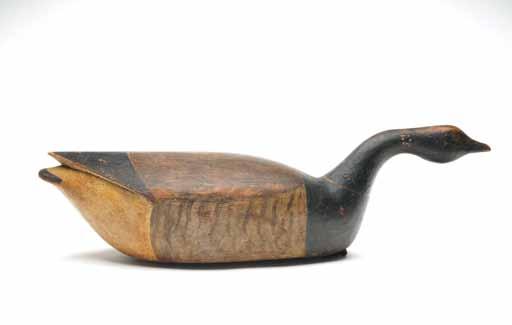
132 Cameron McIntyre (b.1968), New Church, Virginia. Black bellied plover. Relief wing carving and carved eyes. “CTM” carved in underside. Measures 12.5” long. Made to look older, with many small shot marks; excellent and original. (1,200 - 1,800)
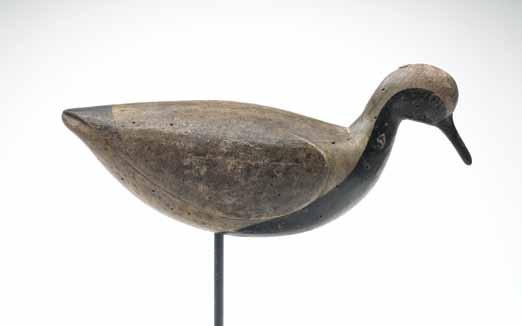
133 Cameron McIntyre (b.1968), New Church, Virginia. Excellent canvasback in the style of Robert McGaw. Measures 15.5” long. Original paint that has darkened slightly with age; minor flaking above nails at neck seat and top of head; hairline cracks and rust staining on underside.
Provenance: Oliver Smith collection. (1,500 - 2,500)
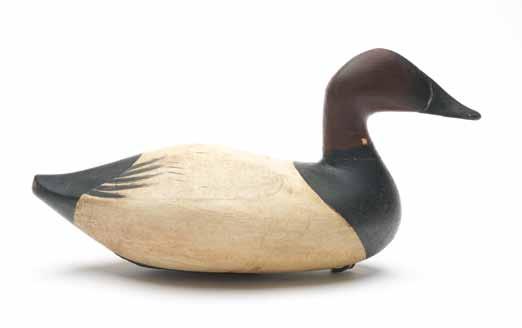
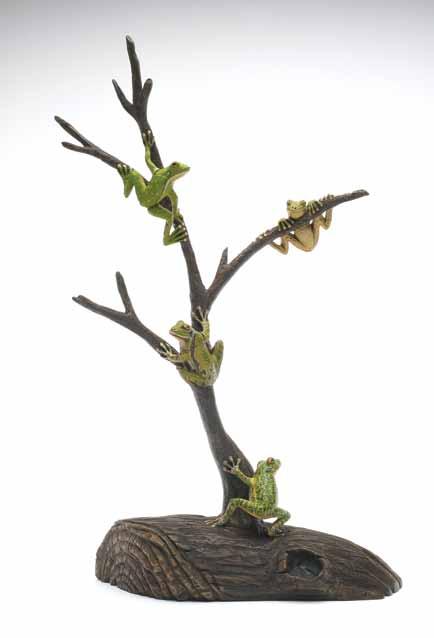
134 Eddie Wozny (b.1959), Cambridge, Maryland. “An Army of Tree Frogs!” Excellent frog tree with four species of tree frogs. Species identified on underside of base. Signed by the maker. Tree measures 16” tall. Frogs measure 2.5” long. Mint. (2,500 - 3,500)
135 Eddie Wozny (b.1959), Cambridge, Maryland. American bull frog on lily pad. Highly detailed carving. Identified and signed on the underside. Frog measures 5.5” long, lily pad is 10” wide. Mint. (1,500 - 2,500)
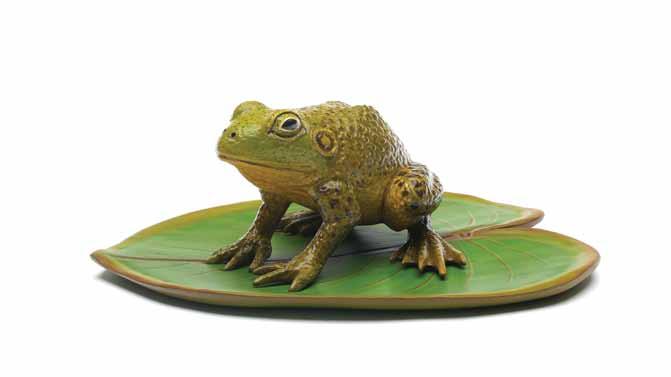
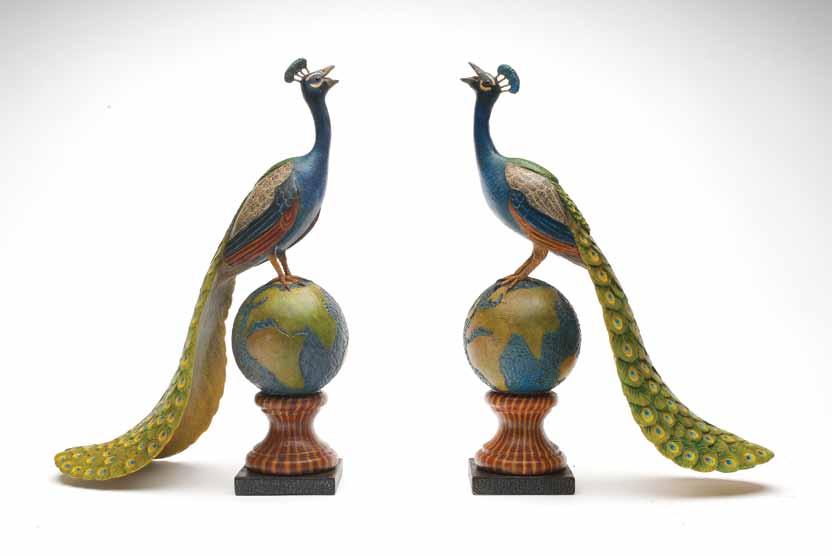
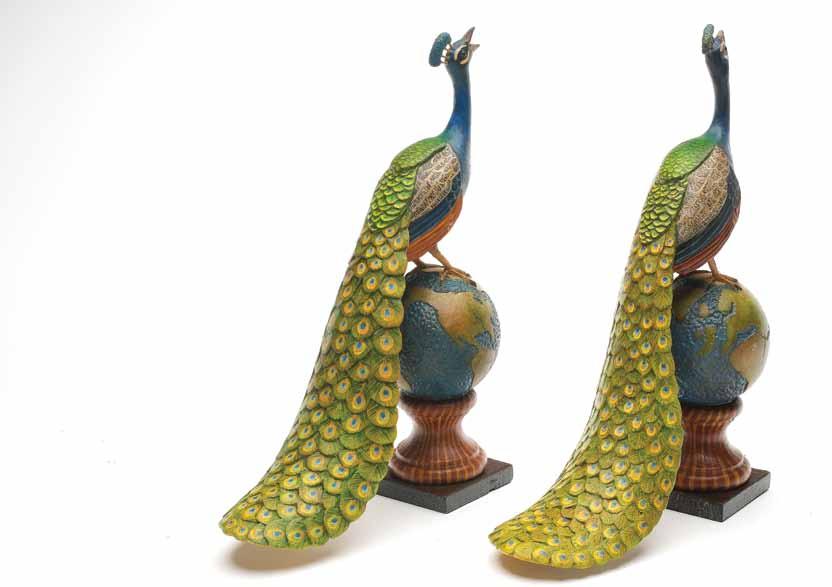
136 Frank Finney (b.1947), Cape Charles, Virginia. Outstanding pair of peacocks on terrestrial globe bases. Up looking heads with open beaks and graceful tails. Relief feather carving. Measure 13.5” tall including base. Excellent and original. (8,000 - 12,000)
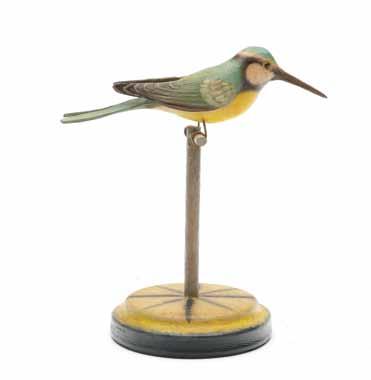
138 Frank Finney (b.1947), Cape Charles, Virginia. Bee-eater. Raised wings and split tail carving. Maker’s ink stamp on underside. Measures 7” long, piece stands 7.75” tall. Excellent and original. (1,000 - 1,400)
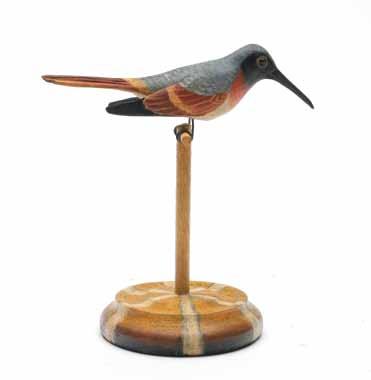
139 Frank Finney (b.1947), Cape Charles, Virginia. Hummingbird. Outstretched, dropped wings and relief tail feather carving. Maker’s ink stamp on underside. Measures 7” long, piece stands 7.75” tall. Excellent and original. (1,000 - 1,400)
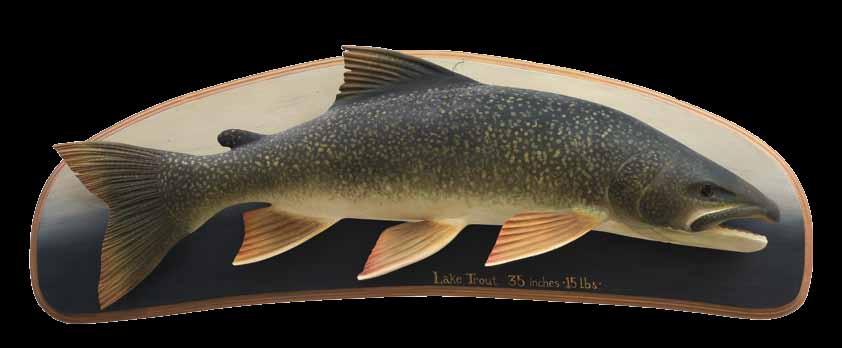
140 Frank Finney (b.1947), Cape Charles, Virginia. Large lake trout fish plaque. Full round hollow carved body with deep relief gill carving and open mouth. Trout’s length and weight painted on backboard. Maker’s initials carved on back of board. Trout measures 35”, plaque is 39”. Minor separation at a knot on top of backboard; otherwise excellent and original. (5,000 - 8,000)
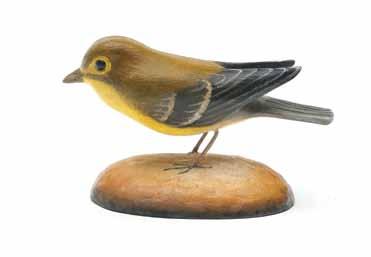
142 Frank Finney (b.1947), Cape Charles, Virginia. Yellow throated vireo. Raised, extended wingtips and relief tail feather carving. Identified and with maker’s initials carved in underside. Measures 5.25” long. Excellent and original. (500 - 800)
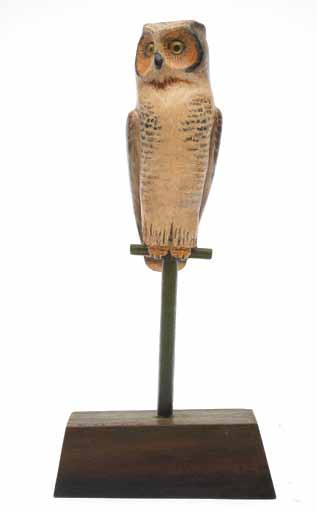
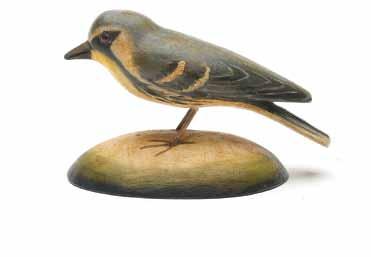
143 Frank Finney (b.1947), Cape Charles, Virginia. Yellow throated warbler. Relief tail feather carving. Identified and with maker’s initials carved in underside. Measures 4.75” long. Excellent and original. (500 - 800)
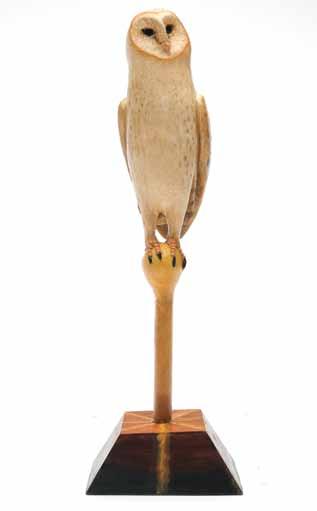
145 Frank Finney (b.1947), Cape Charles, Virginia. Miniature owl. Deep relief wing carving and slightly turned head. Maker’s ink stamp on underside. Owl measures 6” long, full piece is 11.5” tall with base. Excellent and original. (1,200 - 1,800)
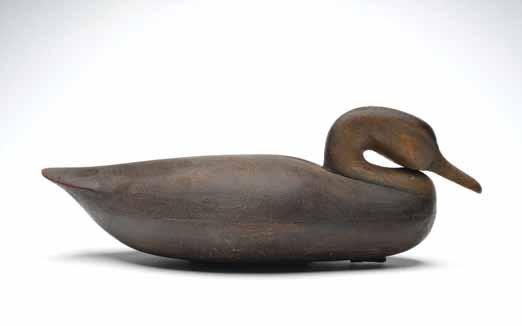
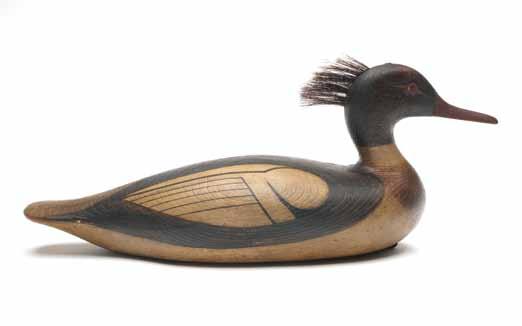
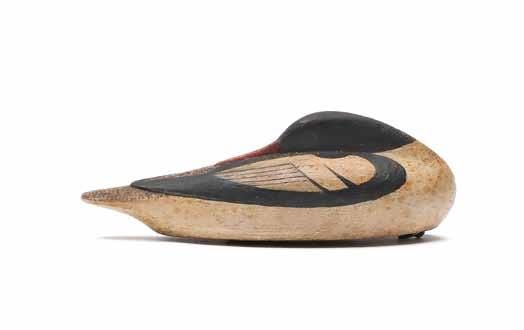
146 Mark McNair (b.1950), Craddockville, Virginia. Oversized black duck. Hollow carved with tucked head influenced by the Cobb family. “McNair” carved in underside and “5” carved under tail. Measures 22” long. Made to appear older; excellent and original.
Provenance: Don Leonard collection. (1,500 - 2,500)
147 Mark McNair (b.1950), Craddockville, Virginia. Red-breasted merganser. Inlaid neck seat and carved eyes. Applied paint bristle crest. “McNair” carved in underside. Measures 20.5” long. Made to appear older with a few tight drying cracks in body; bill was cracked down and professionally reset with a small amount of touchup. (2,000 - 3,000)
148 Mark McNair (b.1950), Craddockville, Virginia. Miniature sleeping merganser. Relief wingtip carving. “McNair” carved in underside. Rigged and weighted with coffin style weight. Measures 4” long. Small spots of discoloration on white areas, otherwise excellent. (1,000 - 1,400)
149 Mark McNair (b.1950), Craddockville, Virginia. Long-tail duck. Slightly turned head and inlaid hardwood tail sprig. “McNair” carved in underside. Measures 15.5” long. Excellent and original.
(1,000 - 1,500)
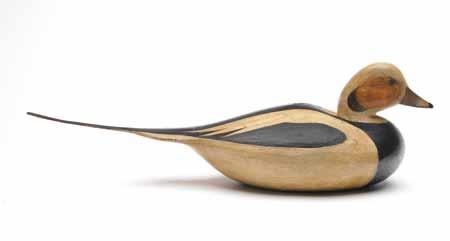
150 Mark McNair (b.1950), Craddockville, Virginia. Pair of folky red knots. Plump little birds with deep relief wing carving and heads turned 90 degrees. “McNair” carved in undersides. Measure 6.5” and 7” long. Excellent and original.
(1,500 - 2,500)
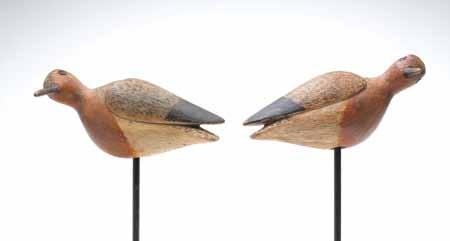
151 Mark McNair (b.1950), Craddockville, Virginia. Feeding curlew. Deep relief wing carving and raised wingtips. “McNair” carved in underside. Measures 17.5” long. Very minor roughness at tip of bill, otherwise excellent and original.
(1,200 - 1,800)
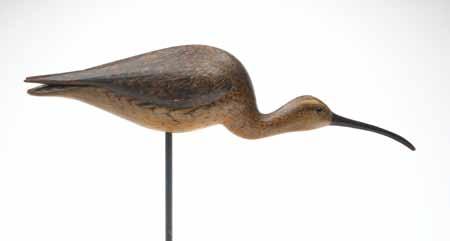
152 Mark McNair (b.1950), Craddockville, Virginia. Yellowlegs. Carved in the style of Ira Hudson, with scratch feather paint detail. “McNair” carved in underside. Measures 11.5” long. Original paint with minor wear to the varnish layer on underside, otherwise excellent.
(400 - 600)
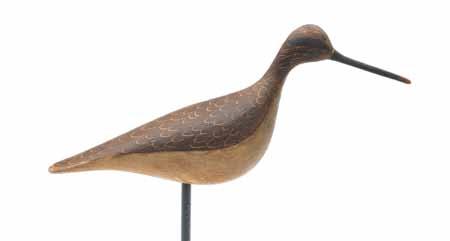
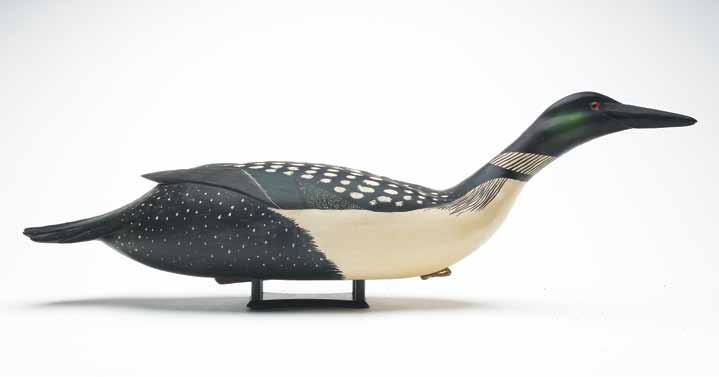
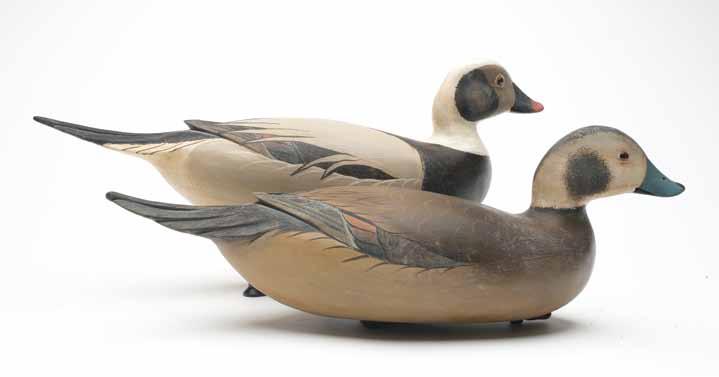
Rare
loon in summer plumage. Hollow carved with raised wingtips. Head is slightly turned. Signed and dated 1994 on underside. Measures 26” long. Excellent and original.
(1,200 - 1,800)
1939), Tullytown, Pennsylvania. Pair of hollow carved long-tailed ducks with raised wing tips and glass eyes. Signed and dated 2006. Maker’s signature weight on bottom. Drake measures 17.5” long. Excellent and original. (1,500 - 2,500)
155 Bob White (b. 1939), Tullytown, Pennsylvania. Brant with raised crossed wing tips and slightly turned head. Maker’s typical lead weight on underside. Measures 17” long. Excellent and original.
(1,200 - 1,800)
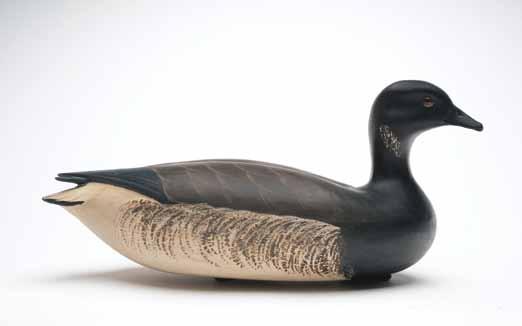
156 Bob White (b. 1939), Tullytown, Pennsylvania. Hollow carved snakey neck Brant with tack eyes. Maker’s oval brand on bottom. Measures 17.5” long. Made to appear older; excellent and original. (1,000 - 1,500)
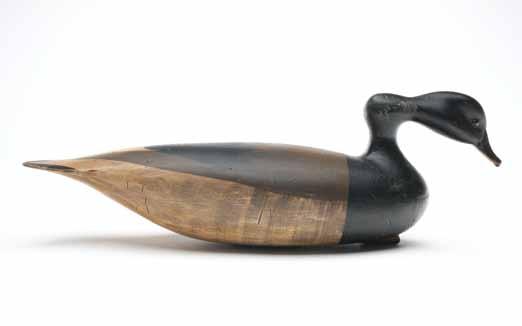
157 Bob White (b. 1939), Tullytown, Pennsylvania. Pair of hollow carved wigeon with raised wing tips and glass eyes. Signed and dated 1995. Maker’s typical weight on underside. Drake measures 14” long. Excellent and original.
(1,500 - 2,500)
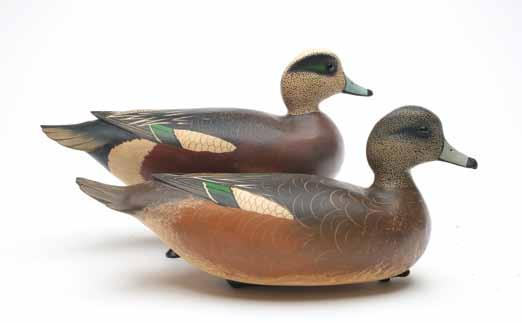
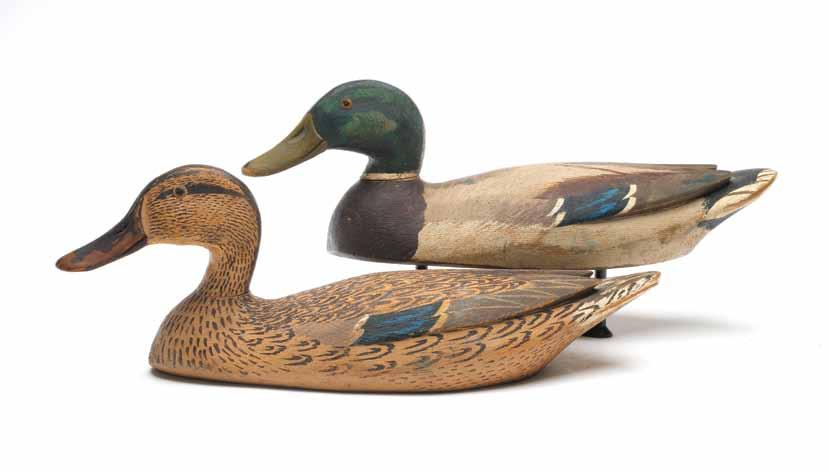
157A Horace “Hi” Crandall (1892-1969), Westwood, California
Rigmate pair of mallards. Relief wingtip carving and slightly turned heads. Measure 15.25” and 15.75” long. Original paint with very minor gunning wear; fine hairline cracks in eyes; hairline crack along one side of hen; drake’s head swivels slightly. (8,000 - 12,000)
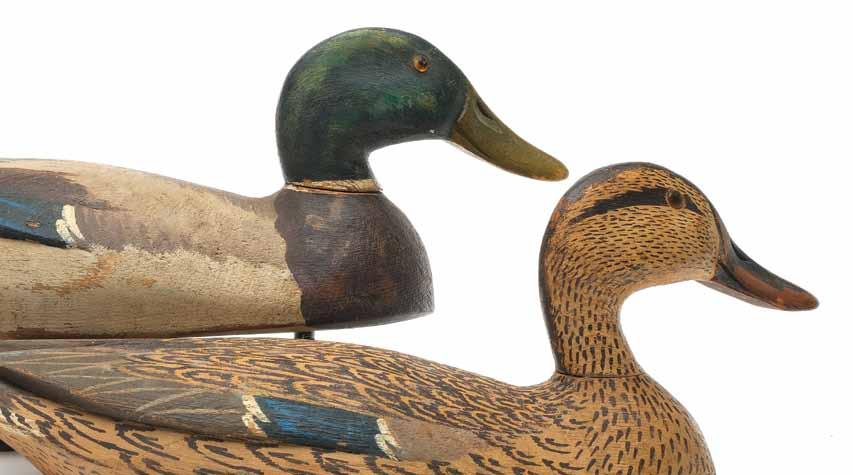
157B Charles Bergman (1856-1946), Astoria, Oregon. Pintail. Large hollow carved decoy with appealing paint pattern on back. Measures 20.25” long. Original paint with moderate gunning wear; an early coat of varnish has crazed with age; lightly hit by shot; otherwise very good structurally.
Provenance: Don Leonard collection. (2,500 - 3,500)
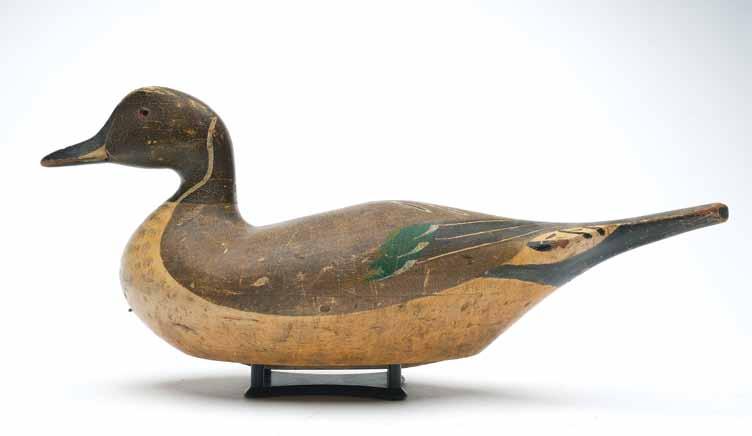
157C Horace “Hi” Crandall (1892-1969), Westwood, California. Pintail. Relief wing carving with raised wingtips. Chamfered lower edge of body, typical of the maker. Measures 16.5” long. Second coat of paint to white areas; and to two small spots on edge of bill; the rest in original paint; with moderate wear; hairline cracks in each eye; much of the neck is an early replacement. (1,000 - 1,500)
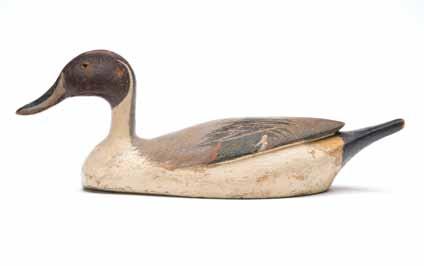
157D Charles Pice (1886-1957), Astoria, Oregon. Pintail. Hollow carved with .5” bottom board. Measures 18.75” long. Second coat of paint to white areas on breast and lower part of body; the rest in original paint with minor flaking and wear; hairline drying crack in breast; small amount of glue visible at neck seat. (1,000 - 1,500)
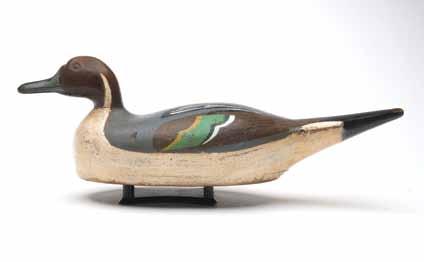
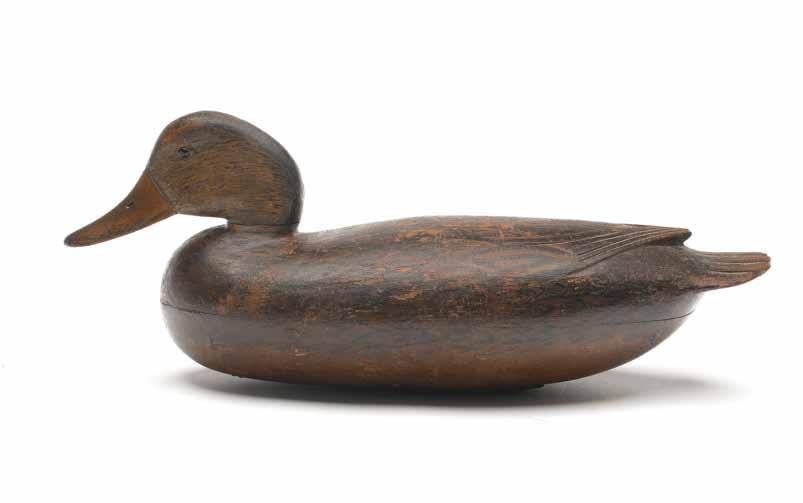
158 John English (1848-1915), Florence, New Jersey. Rare mallard hen. Hollow carved with raised V wingtip carving and relief tail feather carving. Measures 16” long. Original paint with moderate flaking and wear; an early coat of varnish has darkened with age; very good structurally. (8,000 - 12,000)
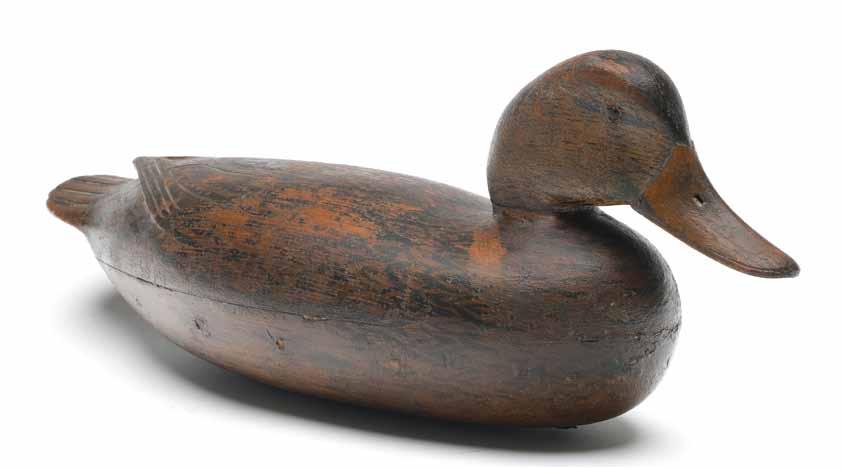
When the early authors such as Gosner and Huster & Knight did their research on decoys from the Delaware River in the early to mid-1980’s, the work of “R Freirich” was well known, and acknowledged as representing exceptionally fine examples of the region’s carvings. Unfortunately, no biographical information of the man was known at the time. This remained the case for over the next decade and a half until Allen Linkchorst published a well-researched article on Freirich in Decoy Magazine in 1999. With the advent of newer genealogical research tools, we can now fill in a few of the blanks in Freirich’s life.
He was born in Asbury Park, NJ to Julius and Violet (Hibbs) Freirich. Sadly, his father died when he was eight years old, and his mother when he was ten. He was raised by his aunts in Edgely, PA and he remained there until marrying Helen Borsch in Florence in 1933. His wedding announcement indicated that he planned to operate a gas station after the wedding, but if he actually did so is unknown. By 1940, the couple and their young
son, Robert Jr, were living in Tullytown while Robert worked as a crane operator in a steel mill. This may well have been the J.A. Roeblings & Sons steel factory in nearby Trenton, NJ, for that is where he was employed two years later as indicated by his WWII draft registration. The company was a major manufacturer of steel rope. He served in the US Navy from February through October in 1944 and, after his service, by the time of the 1950 census, he and his family were in Lost Valley, Oregon where Freirich was working in a plumbing shop. He was still employed as a plumber in the 1960 Eugene, OR city directory and, the next indication of his employment comes from his death certificate in Klamath Falls, OR. where Helen recorded his occupation as a “steamfitter – welder” in the “construction industry”.
Freirich’s decoy production was very limited and intended purely for his own use. He is said to have only made between 25 to 35 decoys from the late 1920’s through the time he left for Oregon c1942, at which time he sold his rig to other local hunters. He made a small number of birds after his move to the west, but these are of a different quality than those carved when he was hunting on the Delaware. His birds are distinguished for their detailed carving and the above average quality of their painted surface. He is notable for being one of the very few Delaware River carvers to alter the head position on a few of his birds. Bob Freirich rightfully deserves his place in the hierarchy of the fine Delaware River carvers.
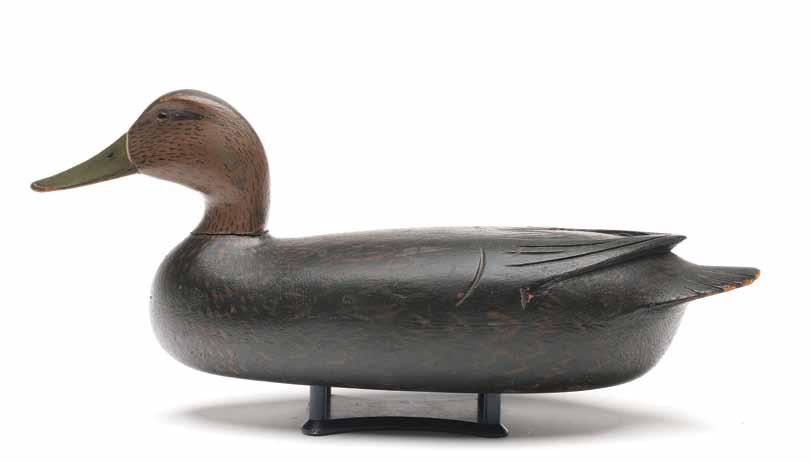
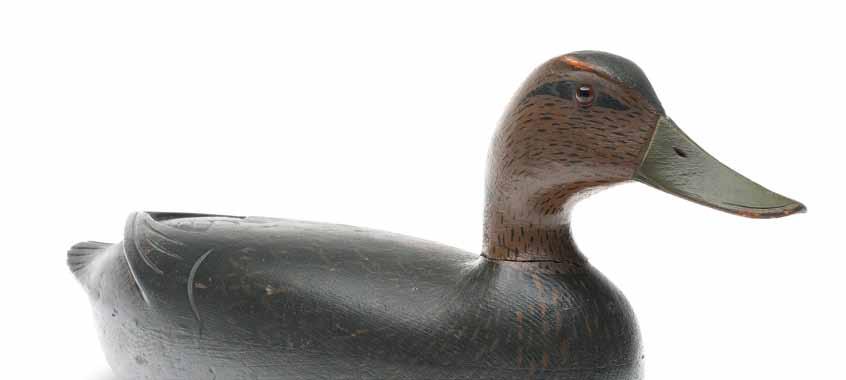
159 Robert Freirich (1912-1971), Tullytown, Pennsylvania. Black duck. Hollow carved with raised V wingtip carving. Incised wing and tail feather carving. From the maker’s personal rig, with his name and town stamped in lead weight. Measures 17” long. Original paint with very minor wear; a few shallow dents; separation at neck seat; a few drips of dark green paint on sides of neck. (8,000 - 12,000)
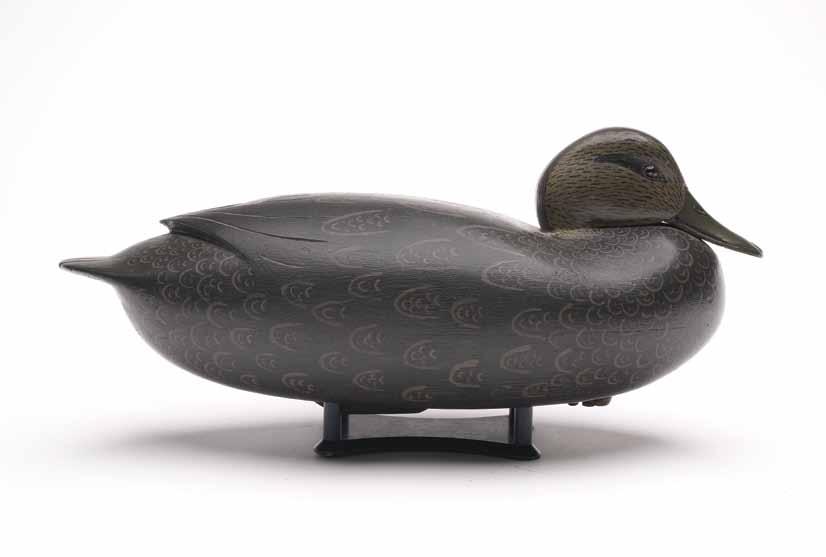
160 Joe King (1905-1992), Edgely, Pennsylvania. Tucked head black duck. Hollow carved with raised V wingtip carving. From the maker’s personal rig with name and town stamped in lead weight. Measures 15.25” long. A few very shallow dents, otherwise excellent and original. (5,000 - 8,000)
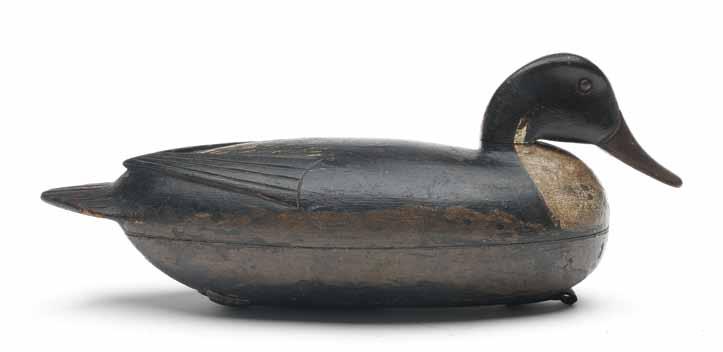
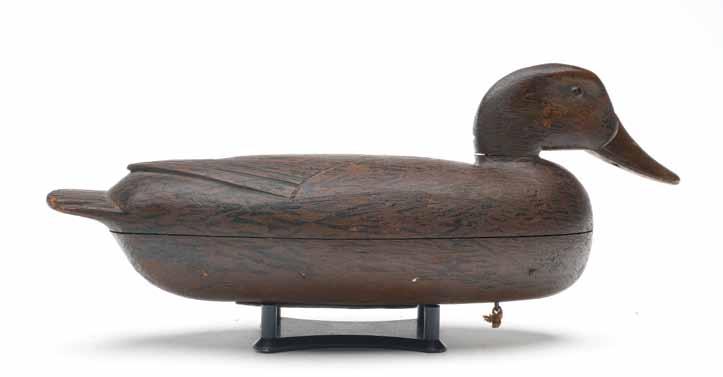
161 John English (1848-1915), Florence, New
Jersey. Rare pintail. Hollow carved low head model with raised V wingtip carving. Measures 16” long. Mix of original and early in use repaint with moderate wear; an early coat of varnish has darkened with age; very good structurally.
(4,000 - 6,000)
162 John English (1848-1915), Florence, New
Jersey. Rare mallard hen. Hollow carved with raised V wingtip carving. “DSC” stamped in underside for the Dave Campbell collection. Measures 16” long. Original paint with moderate flaking and wear; an early coat of varnish has darkened with age; heavily hit by shot in one side; minor chipping and roughness on edge of tail.
(2,000 - 3,000)
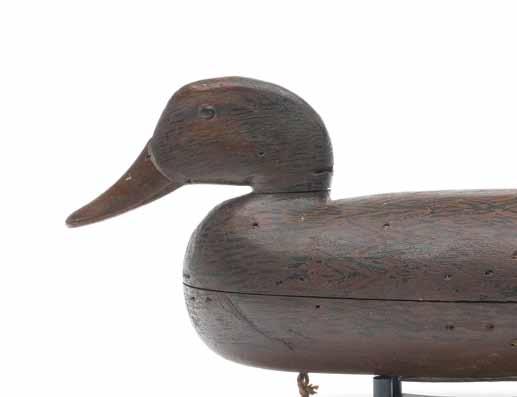
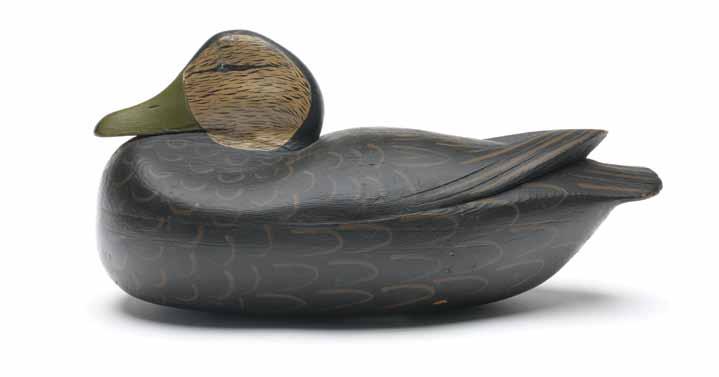
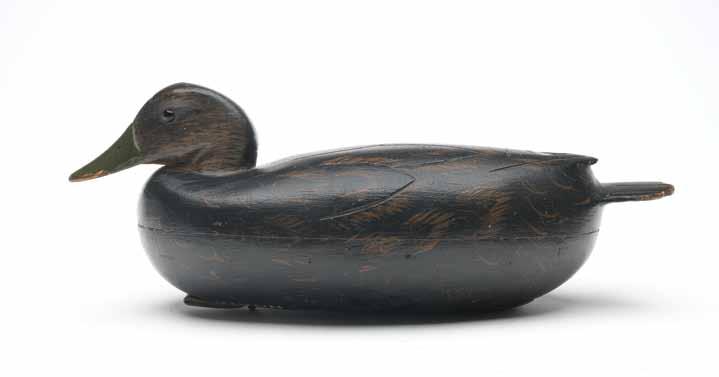
Jess
Burlington, New Jersey. Tucked head black duck. Hollow carved three-piece body with raised V wingtip carving. Measures 14.5” long. Scattered shallow dents, otherwise very good and original.
(800 - 1,200)
164 Dan English (1883-1962), Florence, New Jersey. Low head black duck. Hollow carved with incised feather carving and raised V wingtips. “H. Lynn Bristol, PA” painted on underside. Measures 15.5” long. Original paint under a thin coat of varnish with very minor wear; roughness on edge of bill and tail; otherwise very good structurally.
Provenance: John Decesare collection. (2,500 - 3,500)
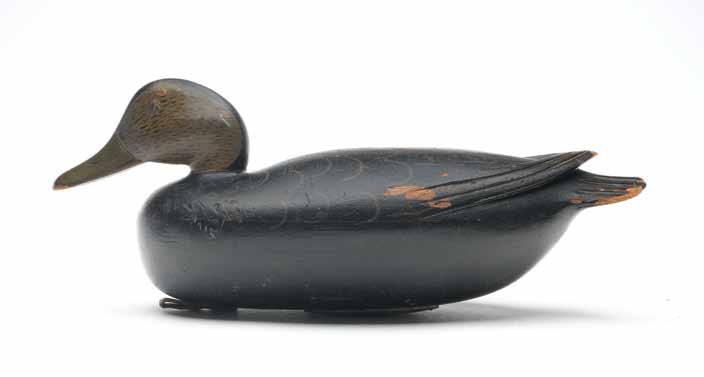
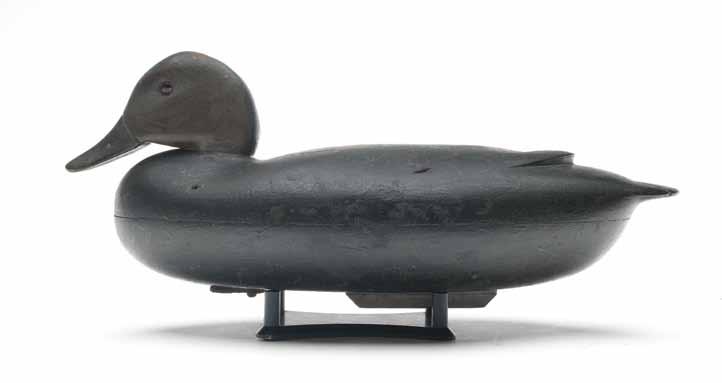
165 Jess Heisler (1891-1943), Burlington, New
Jersey. Black duck. Three piece hollow carved body with raised V wingtips and relief tail feather carving. Measures 16.25” long. Original paint with minor flaking and wear; chipping and roughness on edge of tail and raised wingtips.
Provenance: John Decesare collection. (2,000 - 3,000)
166 John H. Baker (1916-2004), Bristol, Pennsylvania. Early style black duck. Hollow carved with relief wingtip carving and tucked head. Maker’s name and town stamped in lead weight. Measures 15.25” long. Original paint with very minor wear; under an early coat of varnish that has darkened with age; small dents and shot marks; extra nails were used at body seam near tail area; with slight separation to filler above nail holes.
Provenance: John Decesare collection. (1,200 - 1,800)
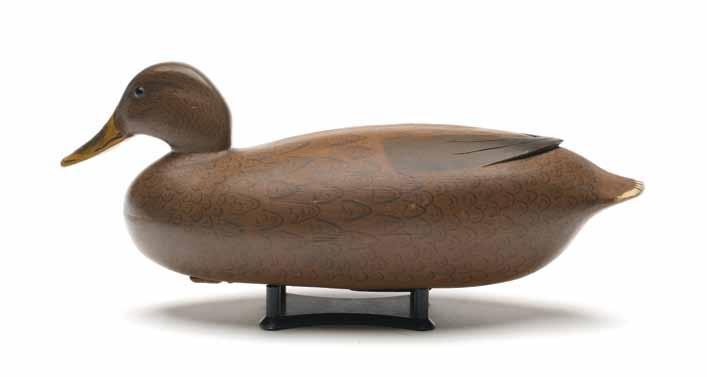
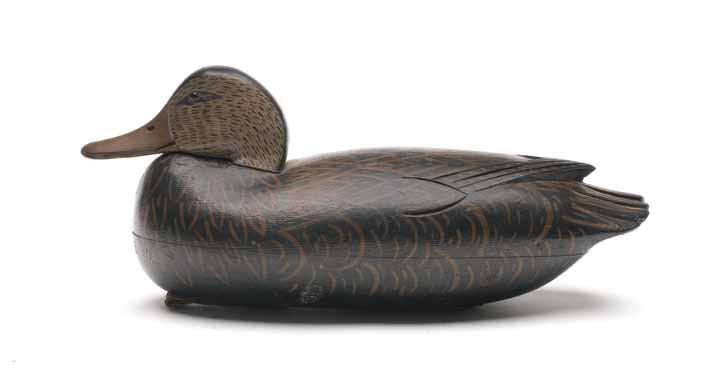
167 Joe King (1905-1992), Edgely, Pennsylvania. Mallard hen. Hollow carved with raised V wingtip carving. From the maker’s personal rig with name and town stamped in lead weight. Measures 16.5” long. Excellent and original.
Literature: “The Great Book of Wildfowl Decoys”, Joe Engers, editor, page 131, exact decoy pictured. (5,000 - 8,000)
168 Thomas Fitzpatrick (1887-1958), Delanco, New Jersey. Tucked head black duck. Hollow carved with raised V wingtip carving and relief tail feather carving. From the Appleton rig, Bristol Pennsylvania. Copper rig tag on underside. Measures 15” long. A few minor paint rubs and a tiny chip at raised wingtip, otherwise excellent and original. (1,200 - 1,800)
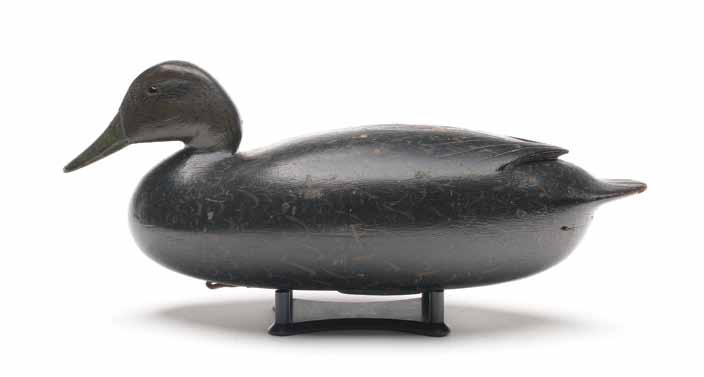
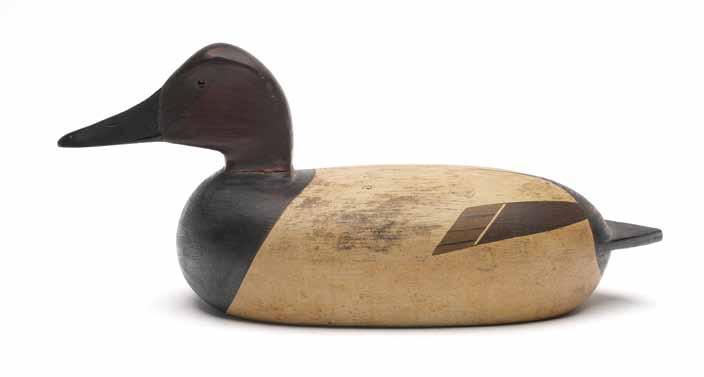
170
169 Joe King (1905-1992), Edgely, Pennsylvania
Black duck. Retains original weights stamped “J.King, Edgely, PA.” Signed “Jos. S. King” in underside. Measures 15” long. Original paint with light gunning wear; a few rubs at top of back; tight chip at bill was reset with some inpainting in that area.
Provenance: John Decesare collection. (3,000 - 5,000)
170 John Dawson (1889-1959), Duck Island, New Jersey. Canvasback. Hollow carved with raised neck seat. Never rigged or weighted. “JD” stamped in underside. Writing in ink about the history of this decoy written on underside. Measures 16” long. Original paint that has darkened slightly with age; flaking to filler at neck seat, otherwise excellent. (1,500 - 2,500)
A. Elmer Crowell
1862 - 1952 | East Harwich, Massachusetts
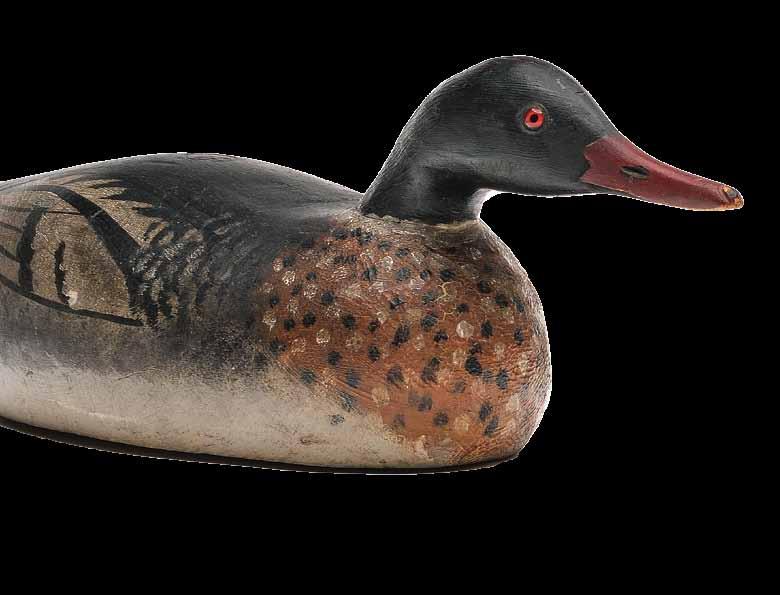
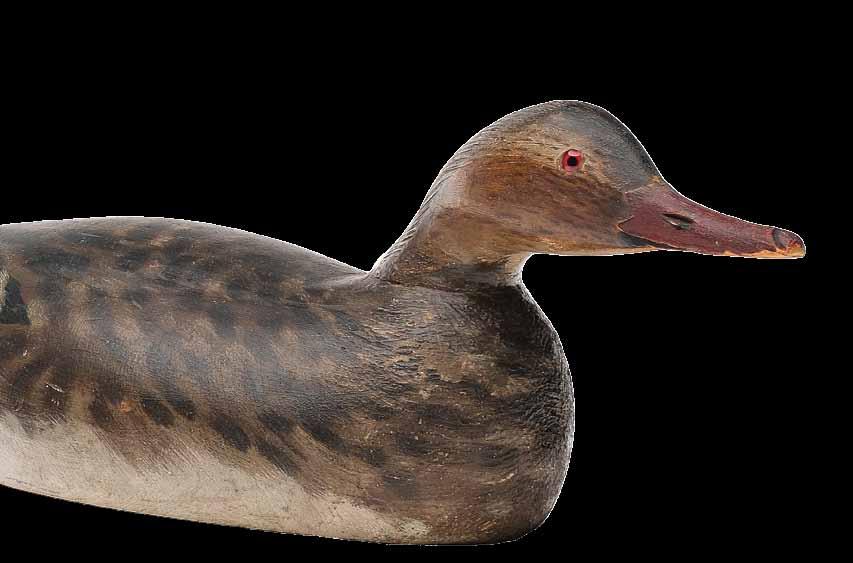
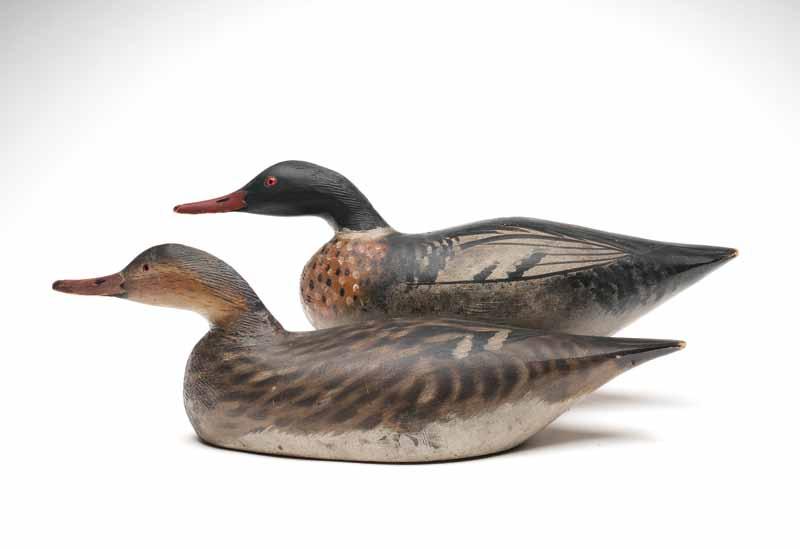
171 A. Elmer Crowell (1862-1952), East Harwich, Massachusetts. Excellent rigmate pair of swimming mergansers. Working birds with maker’s oval brand on underside. Hen’s head is slightly turned. Measure 19” long. Original paint with very minor wear; minor roughness at tip of drake’s tail; short hairline crack on one side of drake’s neck seat; small spot of flaking on one side of hen’s breast; old glue visible under UV light around hen’s neck seat with a fine hairline crack at back of neck seat.
Provenance: Over time this pair has been passed down in the same family and has never been offered for sale. (80,000 - 120,000)
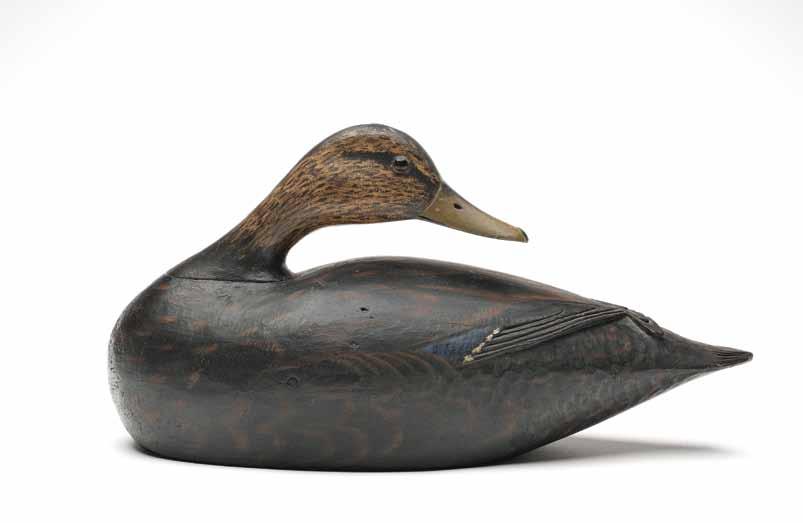
172 A. Elmer Crowell (1862-1952), East Harwich, Massachusetts. Early preening black duck. Deep relief crossed wingtips and relief tail feather carving. Chip carving on tail area. Maker’s rectangle stamp on underside. Measures 16.5” long. Paint was restored by the maker after years of use, with shot marks, scattered dents, and a large drying split along the underside; Crowell added his rectangular stamp to underside at that time.
Provenance: Carolyn Rowland collection. Deborah and Martin Maloy collection. (20,000 - 30,000)
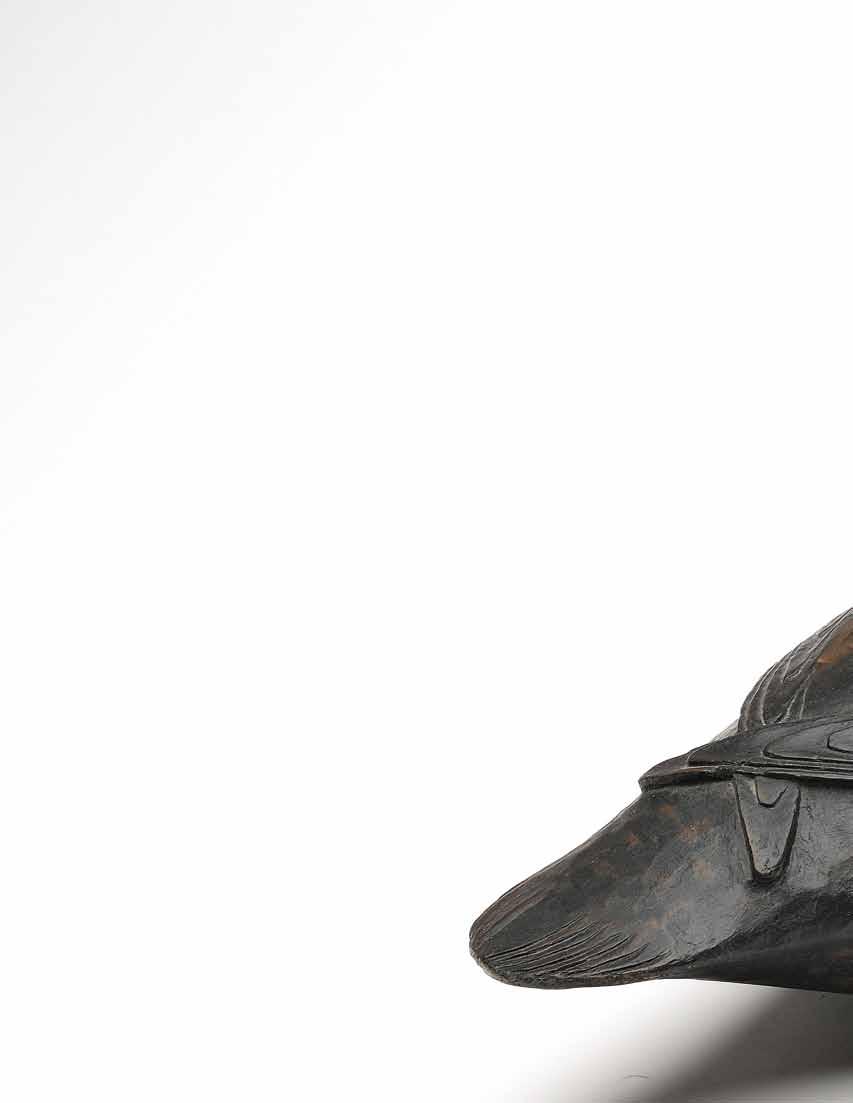
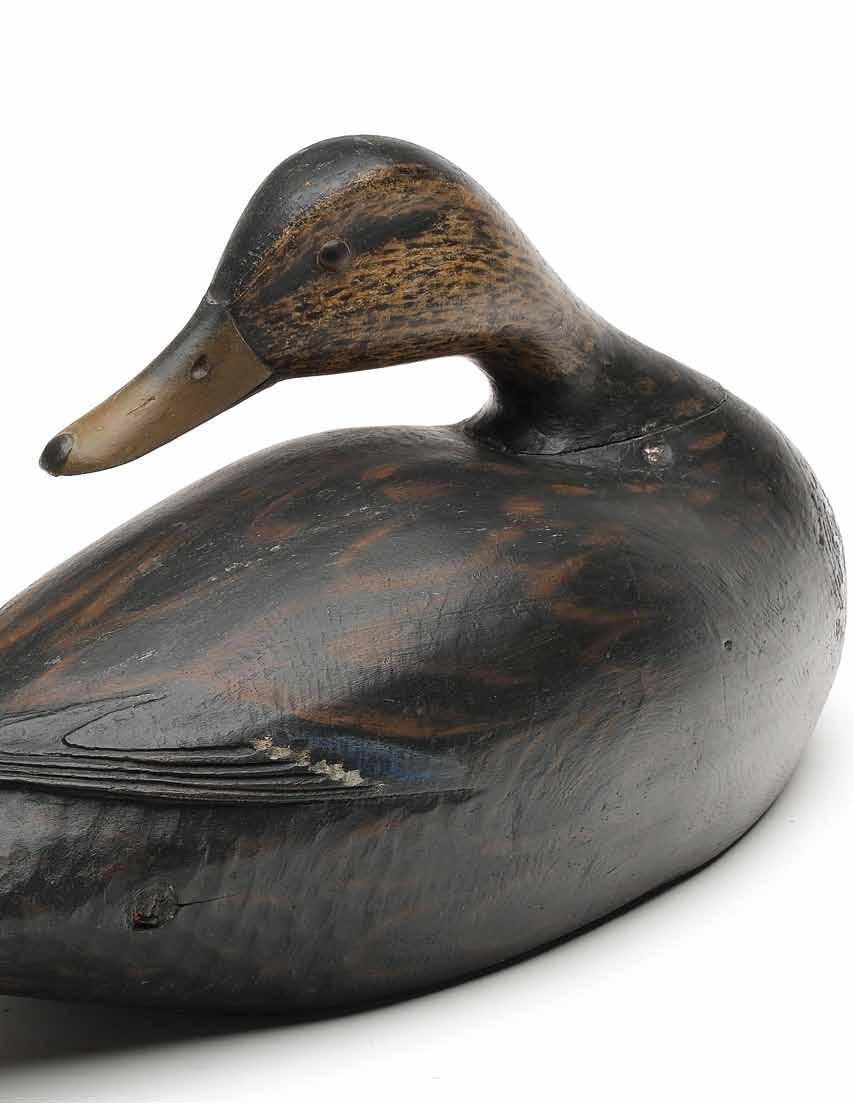
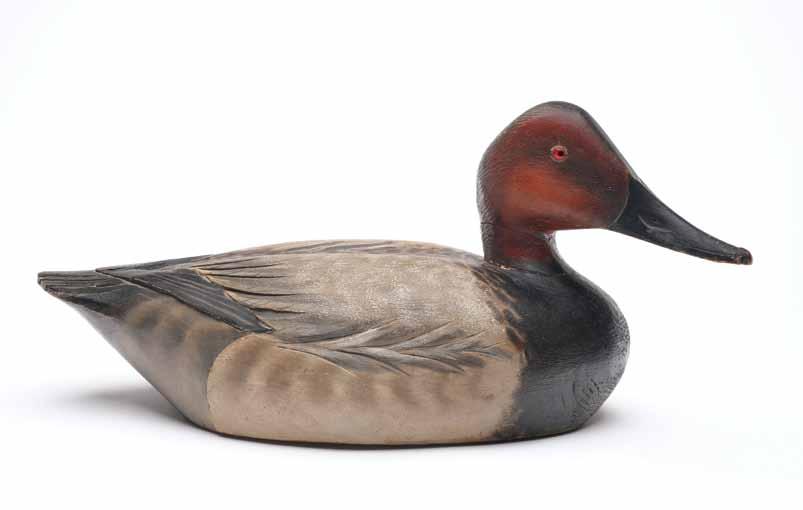
173 A. Elmer Crowell (1862-1952), East Harwich, Massachusetts. Canvasback with deep relief wing and tail feather carving. Maker’s rectangle stamp on underside. Also signed and dated 1937 by the maker. George Thompson collection ink stamp on underside. Measures 15.75” long. Original paint with very minor wear; tight cracks in neck; small dents in tip of bill and a small chip in top of head were darkened; drying crack along the underside.
Provenance: George Thompson collection. Frederick Raymon collection. (15,000 - 20,000)
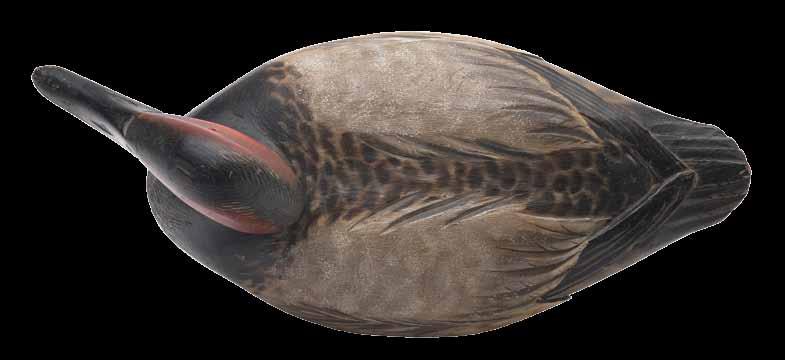
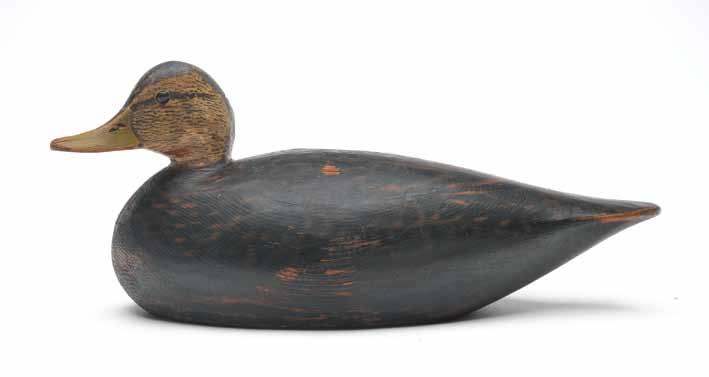
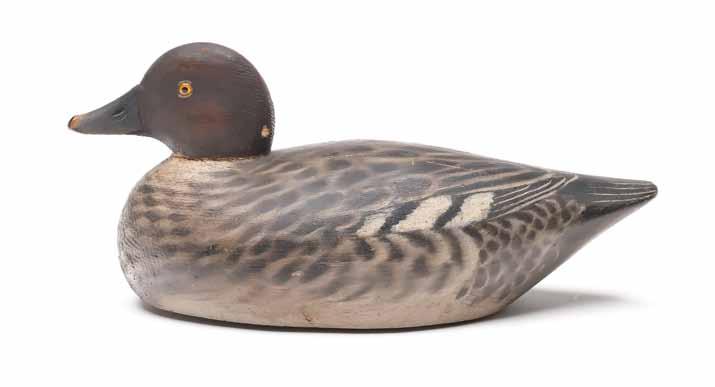
174 A. Elmer Crowell (1862-1952), East Harwich, Massachusetts. Large body black duck. Slightly turned head and maker’s oval brand on underside. Measures 17” long. Original paint with minor to moderate gunning wear; lightly hit by shot; hairline crack in tail and bill; some neck filler restoration.
Provenance: John Decesare collection.
(5,000 - 8,000)
175 A. Elmer Crowell (1862-1952), East Harwich, Massachusetts. Low head goldeneye hen. Prebrand model. “Q” branded in underside for the Quandy collection. Measures 13.5” long. Original paint with very minor wear; some flaking to filler at neck seat and above two small nails on back of neck.
Provenance: Chris Mackey collection. (5,000 - 8,000)
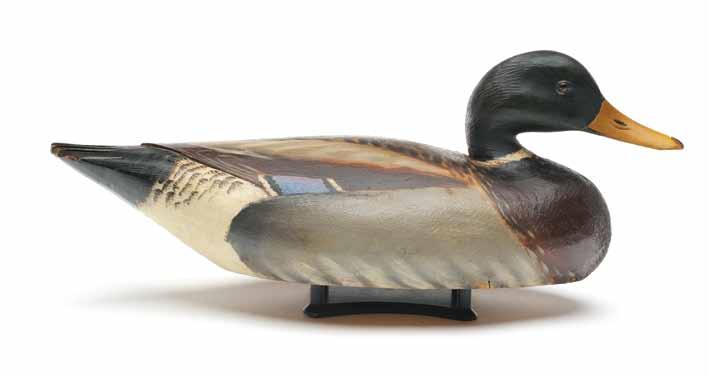
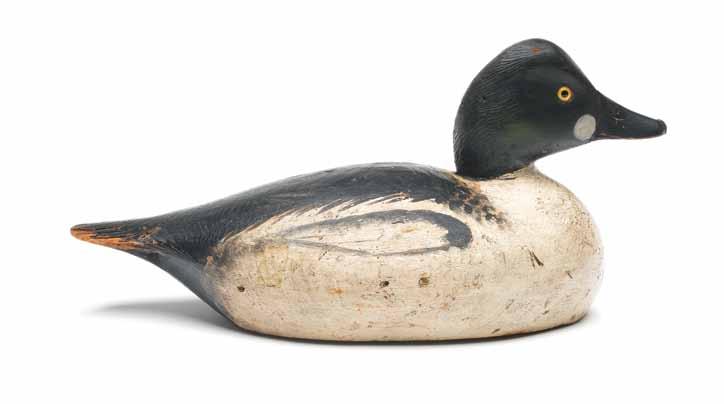
176 A. Elmer Crowell (1862-1952), East Harwich, Massachusetts. Mallard. Maker’s rectangle stamp on underside. Slightly turned head and relief tail and wingtip carving. Measures 17.25” long. Original paint with minor wear; some flaking to filler used near one wing patch; crack through neck was tightly reglued; minor flaking at neck seat.
(5,000 - 8,000)
177 A. Elmer Crowell (1862-1952), East Harwich, Massachusetts. Goldeneye. Maker’s oval brand on underside. Relief tail feather carving. Measures 15” long. Original paint with moderate wear; lightly hit by shot; some roughness on edge of tail; some scattered shot marks on breast, back, and one side were filled and touched up; some filler restoration on one side of neck seat.
Provenance: John Decesare collection.
(5,000 - 8,000)
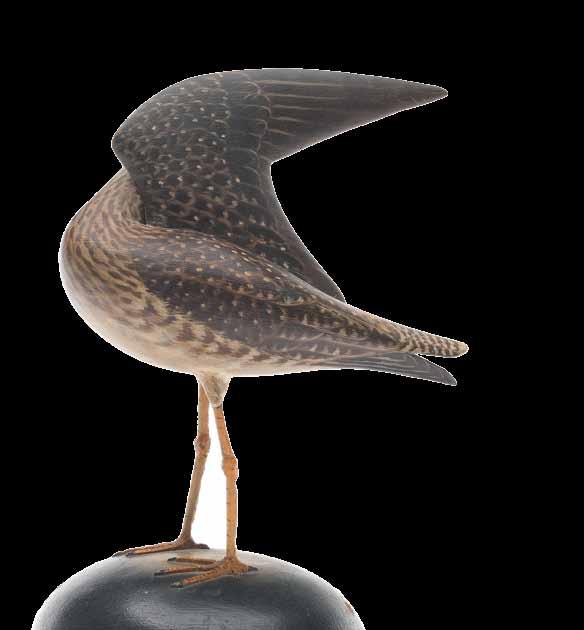
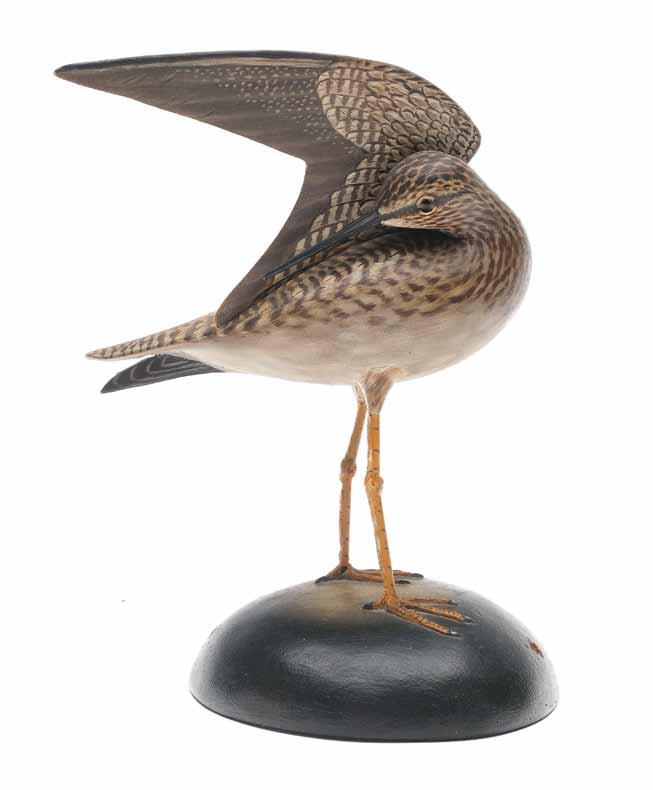
178 A. Elmer Crowell (1862-1952), East Harwich, Massachusetts. Decorative “wing-up” lesser yellowlegs. One applied uplifted wing with head turned to preen. Maker’s rectangle stamp on underside. Measures 6.25” long, stands 8.5” tall. Excellent original paint with minor flaking on back of one leg; fine seam at lower part of applied wing where it was professionally reset with a tiny flake missing along the seam; a small hole was drilled on each side of base for attaching to a shelf. (12,000 - 18,000)
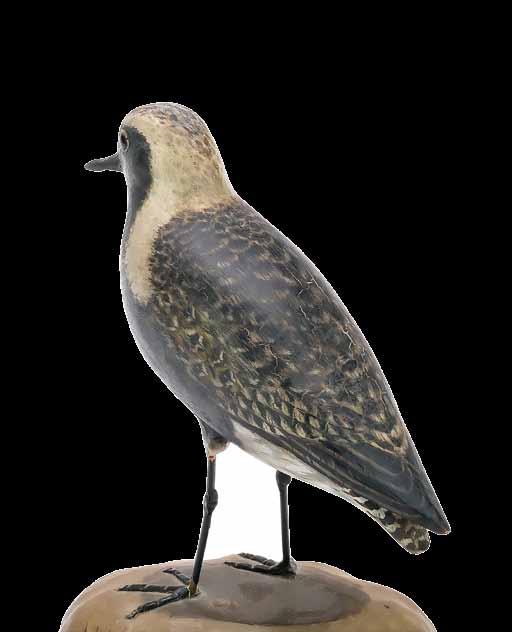
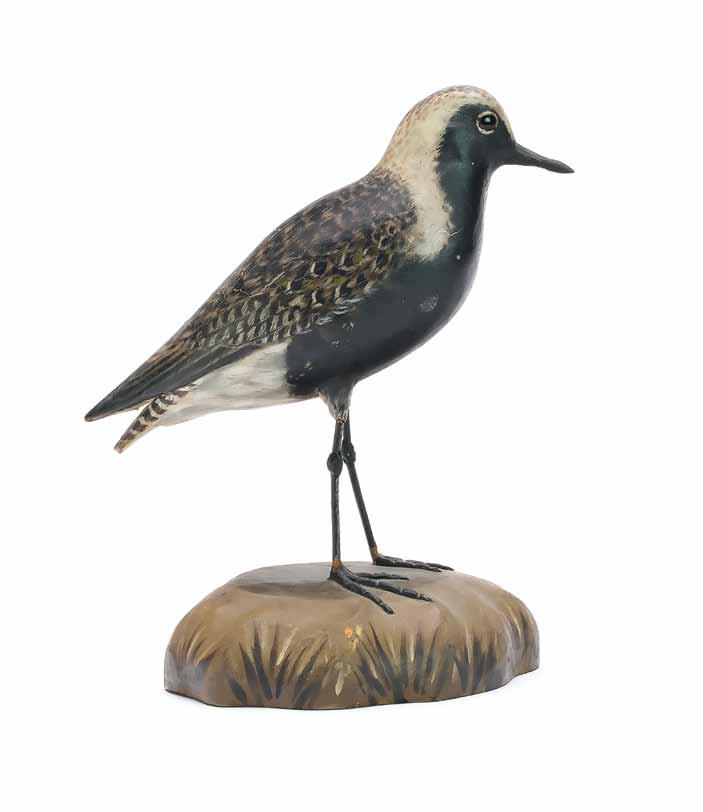
179 A. Elmer Crowell (1862-1952), East Harwich, Massachusetts. Black bellied plover. Mounted to decorative base. Signed “AE Crowell Cape Cod” with maker’s rectangle stamp. Measures 9.5” long. Excellent original paint with a few spots of crazing on back; gesso at thighs has been replaced quite some time ago.
Provenance: Martin and Deborah Maloy collection. (8,000 - 12,000)
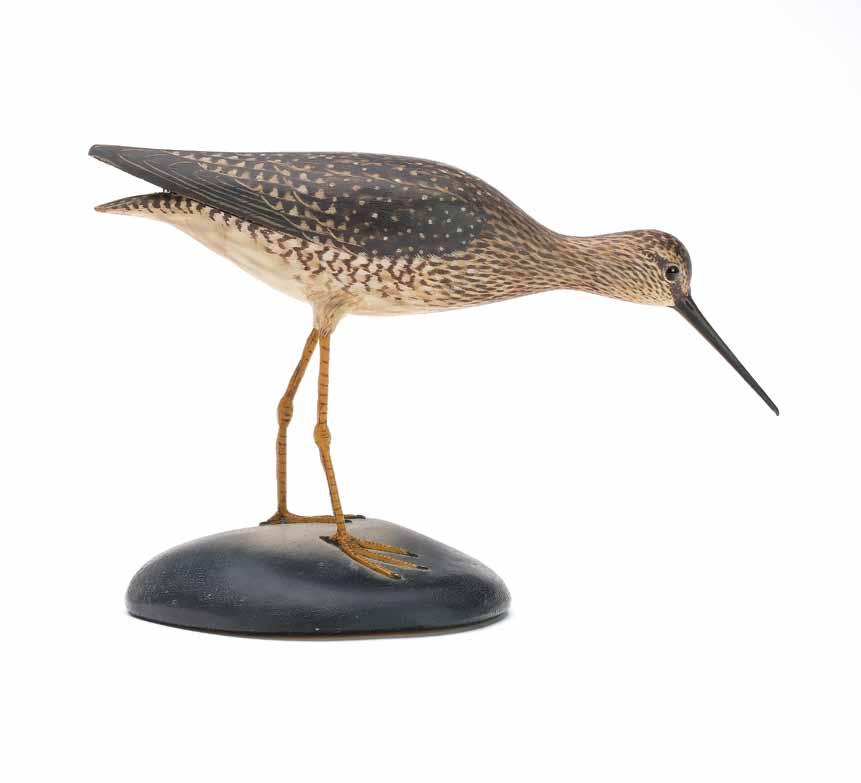
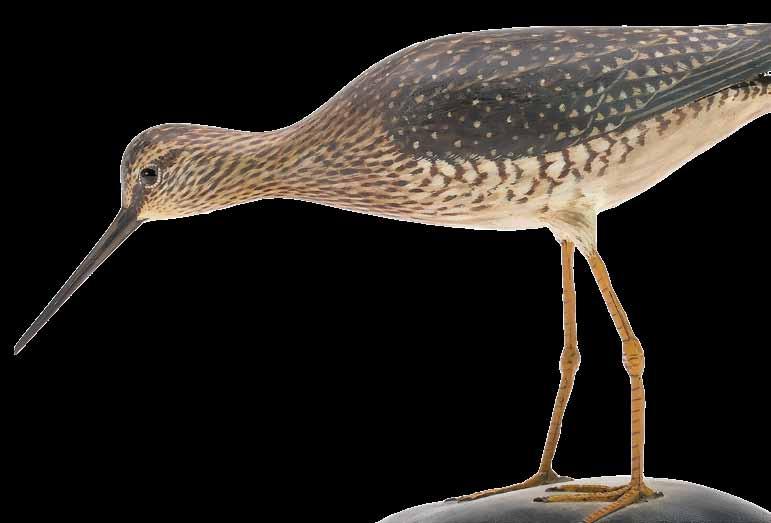
179A A. Elmer Crowell (1862-1952), East Harwich, Massachusetts. Decorative walking yellowlegs. Raised wingtips and relief tail feather carving. Maker’s signature and rectangle stamp on underside of base. Measures 13.25” long. Excellent original paint; some paint restoration at gesso thighs and legs; small amount of filler and touchup on top of where bill meets face.
Provenance: Martin and Deborah Maloy collection. (12,000 - 18,000)
The well known “Foote” brand appears on many excellent decoys by Henry Keyes (“Keyes”) Chadwick (1865 – 1958) of Oak Bluffs, Martha’s Vineyard, MA. Oddly, very little effort has been expended to research the owner(s) of the imprint.
A photo on page 152 in Stanley Murphy’s “Martha’s Vineyard Decoys” features a “ proud young West Tisbury hunter, Charles Foote” with a string of shorebirds he had shot. A conversation with Mr. Murphy’s son indicates that “ he was the owner of the Foote rig .” An article in a 1963 issue of The Dukes County Intelligencer, however, states that “ - - - Keyes Chadwick made up a whole lot of decoys of different kinds and sold them to Captain Robert Foote of West Tisbury .” It has been written that, in fact, “ one of Chadwick’s last orders was for Capt Robert Foote of West Tisbury .” Apparently, Capt Foote “ had the money to buy lots of Chadwick decoys ” because the article goes on to state that “ He bought 500 and some dollars worth in one lot.” Chadwick was only charging around $2.00 apiece for his decoys at the time, so the order could have accounted for around 250 decoys. Correspondence with well known advanced Massachusetts collectors only indicated that Foote “ came from Rhode Island .” As it turns out, all sources seem to have been correct!
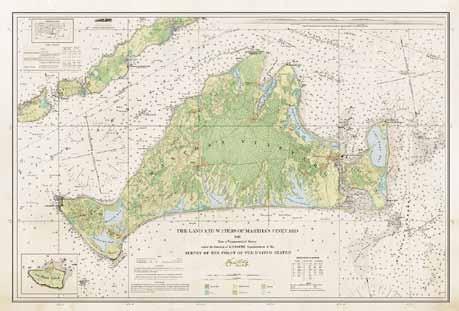
Enoch Warren Foote (1860 – 1926) was an affluent banker from Newton, MA who served as treasurer for the State Street Bank and Trust in Boston. He was actively involved in social and religious organizations such as the Boston Museum of Fine Arts and The Emanuel Church. By 1920, he had retired from the bank and he and his wife were living on property they had purchased in West Tisbury, Martha’s Vineyard. Whether he ever hunted or purchased decoys from Chadwick is unknown. By 1920, however, Chadwick would have been actively carving and was the most prominent person doing so commercially on the Island. If Enoch was a hunter, it would have been logical that he would have purchased decoys from Chadwick. It would not be unreasonable to assume that, because his son Charles was shooting shorebirds, that hunting was a family tradition on the Island. Likewise, it would seem reasonable to believe that, upon his death, the Vineyard property descended in the family.
E. Warren Foote, as he preferred to be known, had four sons, Warren Cleveland (1886 – 1934), Richard Whittier ( 1890 – 1954), Charles Lincoln (1893 – 1975) and Robert Whittier (1901 – 1953). The two oldest, Warren and Richard, may have visited the family home on the Vineyard occasionally but apparently they had little or no interest in hunting. Warren lived on the mainland in Fairhaven and Newton where he was employed in the cotton brokerage business in New Bedford. Initially working in banking, Richard spent some time in Little Compton, RI while he worked in a textile brokerage in Fall River, MA, and as an agent for a New York textile firm. By 1950, he had moved to South Carolina where he continued in the textile business, passing away in Georgia. The youngest son, Robert, had strong ties to Little Compton, RI. In 1925 he married there and, by WWII, it became his home while he served as a Lieutenant Commander in the Naval Reserve, stationed in Newport, Rhode Island. After his service he became vice president and editor of Yankee Magazine and The Old Farmer’s Almanac. Robert may have summered at the ancestral Tisbury home, but he also owned “ a large property at Tiah’s Cove in West Tisbury. ” Tiah’s Cove is a part of Tisbury Great Pond, an area rich in duck hunting clubs and home to James Look of decoy fame. As noted, we have documentation that Robert purchased large
quantities of decoys from Chadwick and these, undoubtedly, were stored and used at his Tiah ‘s Cove property. Sadly, Robert died young at only 52 years of age. His older brother, Charles, lived in the elite Boston suburbs of Brookline and Concord and, by 1955, he was president of The Sawyer – Tower Co. Inc. in Boston, one of the largest manufacturers of rainwear in the country, employing around 600 workers. Outliving Robert, he retired from business, and the family moved to Old County Rd in West Tisbury where he remained active in the Town’s affairs, becoming Chief of Police there. As documented by his photo with shorebirds in Stanley Murphy’s book, we know that Charles visited the Island as a young man and enjoyed hunting. Photos of him as an older gentleman indicate that he continued to enjoy a sporting life as an adult. Both he and Robert are buried in the West Tisbury Cemetery.
The most likely scenario regarding the story of the Foote brand is that a few of the family decoys may have been purchased from Chadwick by the patriarch, Enoch, but more likely, most were purchased


by Robert who people remember, simply, as “ being from Rhode Island. ” When Robert died, the family rig was passed to Charles who did reside in West Tisbury and Murphy remembers as being “the owner of the rig.” If Robert was buying decoys by the hundreds from Chadwick, it is unlikely that Charles had a need to purchase any additional blocks himself.
What is somewhat unique about the decoys bearing the Foote brand is that a number of them appear to have never been rigged and remain in outstanding original condition. Conceivably, Robert or Enoch simply over-ordered or, more likely, since Chadwick stopped carving in 1951 and, if “ one of Chadwicks last orders was for Capt Foote,” he may simply have never had the opportunity to use them. Robert died on November 3rd of 1953 and his obituary states that it “ was after a lengthy illness. ” Charles and his family may have only used the remaining decoys sparingly or simply enjoyed them in their homes as mementos of Island life and the long tradition of duck hunting on Tisbury Great Pond.
180 Keyes Chadwick (1865-1958), Oak Bluff, Massachusetts. Pair of red-breasted mergansers. Both with slightly turned heads and round inlaid lead weights. Drake from the Foote rig and so branded. Hen with Q brand for the Quandy collection. Measure 17.25” and 18” long. Original paint with very minor wear; tight drying cracks along the undersides, otherwise excellent structurally; some sap bleed at two knots on one side of hen; paint pulls on hen’s back from when the decoy was made.
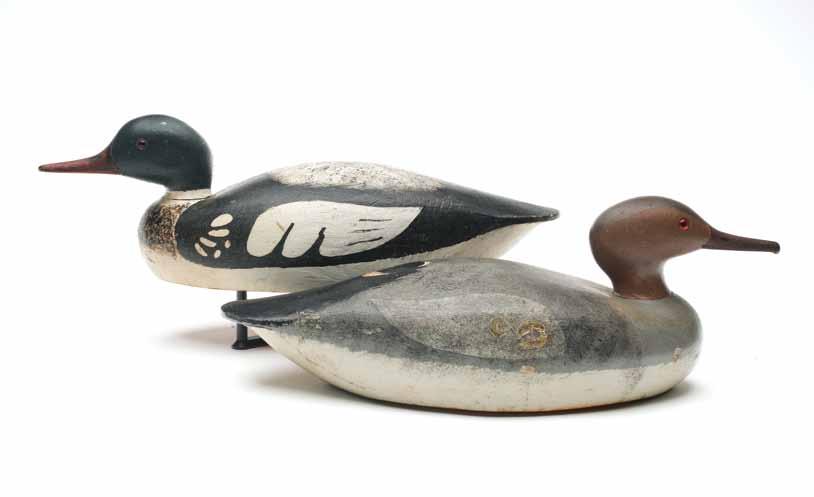
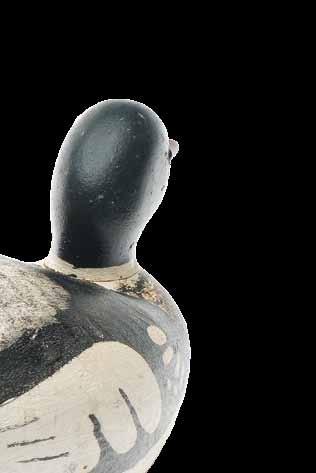
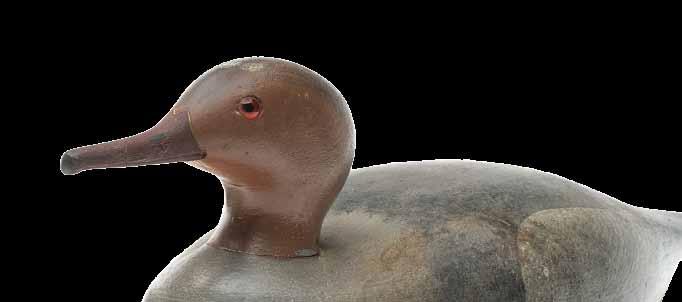
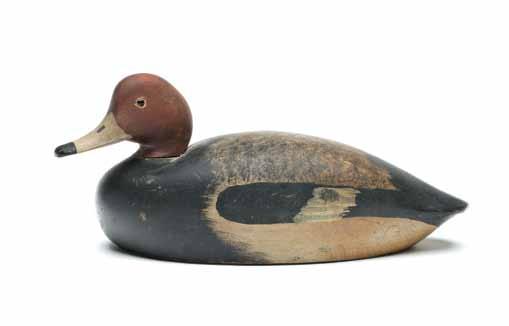
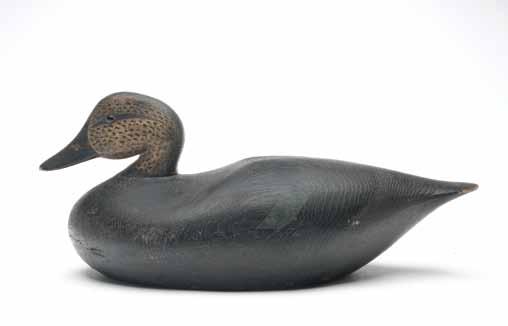
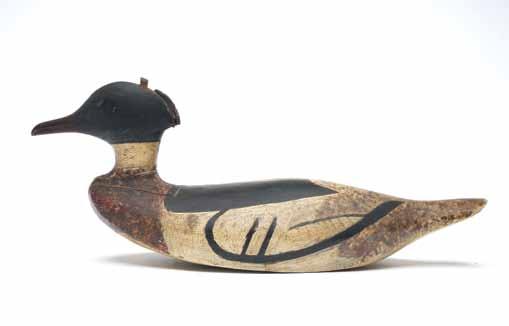
181 Keyes Chadwick (1865-1958), Oak Bluff, Massachusetts. Redhead. Slightly turned head and round inlaid weight on underside. Measures 14.5” long. Original paint with very minor wear; an early coat of Vanrish has darkened with age; drying split along the underside; flaking to filler around eyes. (1,500 - 2,500)
182 Joseph Lincoln (1859-1938), Accord, Massachusetts. Classic oversized black duck with reared back head and slight shoulder carving. Mackey collection ink stamp on the underside. Measures 18” long. Original paint with moderate flaking and wear; small dents and marks; typical drying split along the underside that runs up the breast slightly; minor separation at neck seat.
Provenance: William J. Mackey Jr collection. Ted and Judy Harmon collection. (5,000 - 8,000)
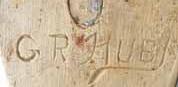
182A George Huey (1866-1947), Friendship, Maine. Red-breasted merganser. Slightly turned, inlaid head with carved eyes and applied leather crest. Maker’s name carved in underside. Measures 19.25” long. Thick original paint under an early coat of varnish shows minor crazing and wear; tight cracks in tail; reglued cracks in lower neck; dowel has risen on top of head; some old glue at leather crest. (4,000 - 6,000)
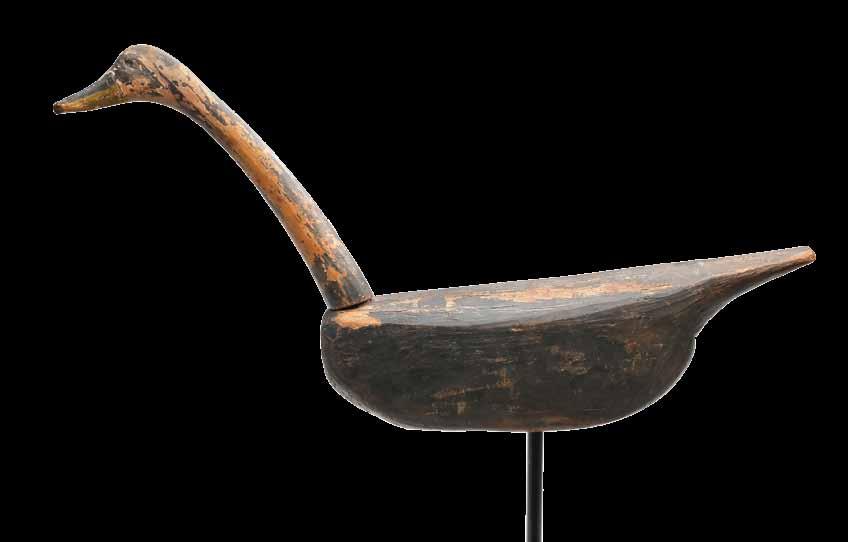
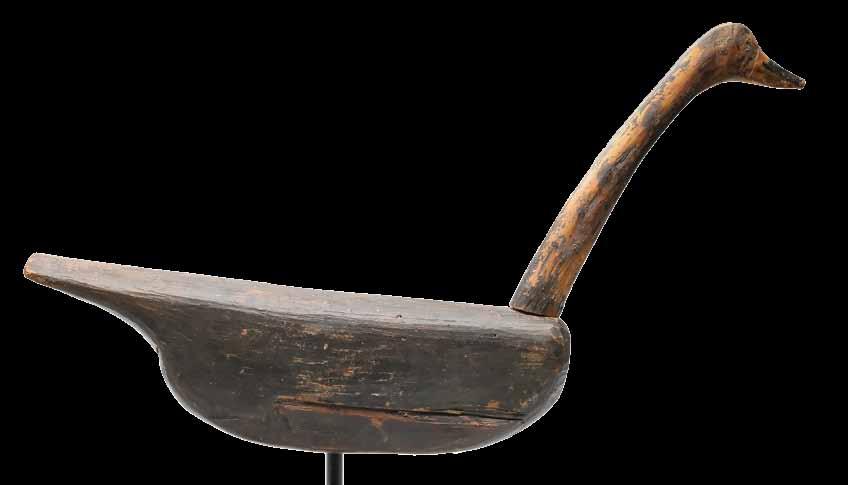
183 Henry Ellison, Long Island, New York, circa 1880. Rare root head heron. Removable head with carved eyes and slight relief bill carving. Measures 27” long. Original paint with moderate flaking and wear.
Literature: “The Decoys of Long Island” curated by Timothy R. Sieger, page 53 and 66, exact decoy pictured. (12,000 - 18,000)
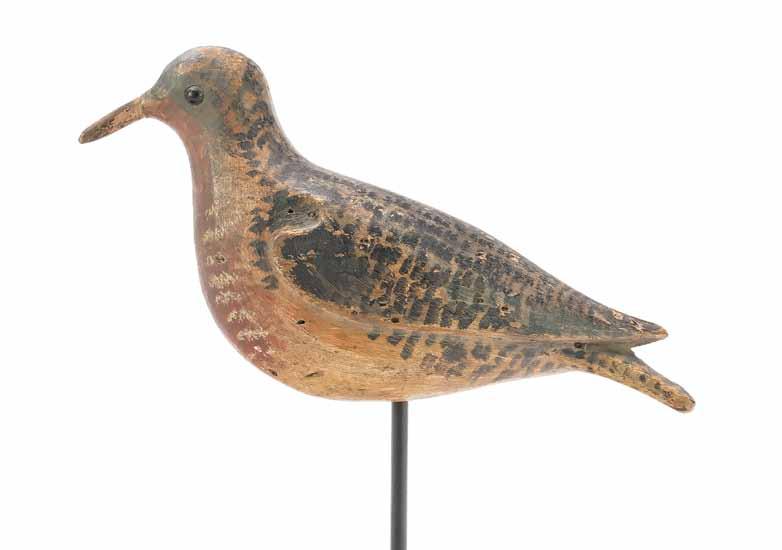
184 Captain Al Ketchem (1845-1926), Amityville, New York. Very rare red knot. With deep relief wing carving and raised wingtips. Measures 9.5” long. Original paint with moderate flaking and wear; heavily hit by shot; retains the original bill. (6,000 - 9,000)
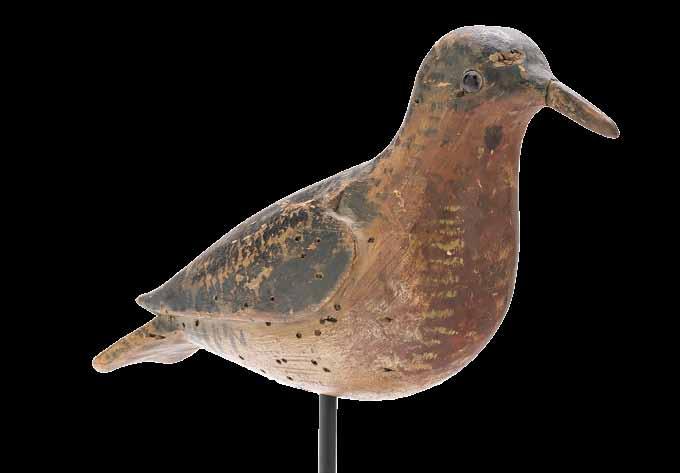
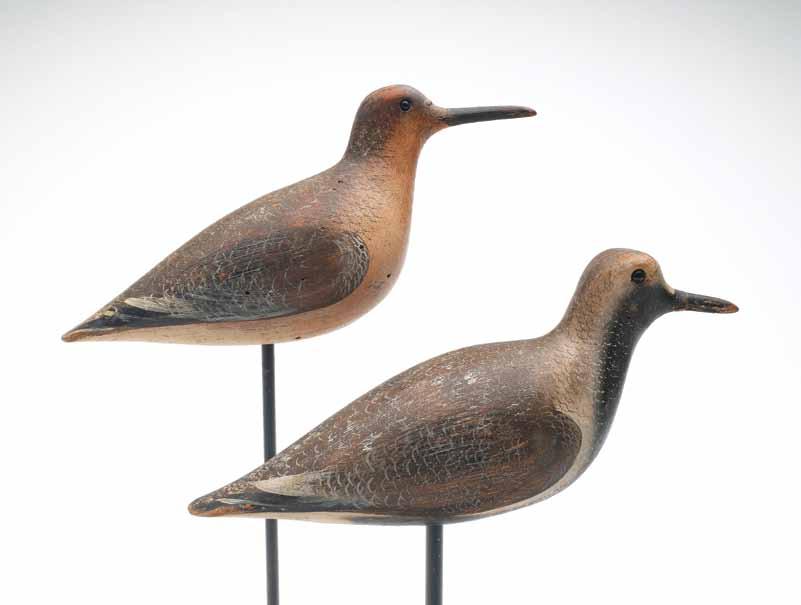
185 John Dilley, Quogue, Long Island, New York. Dowitcher in summer plumage. Smooth body style. Measures 10” long. Original paint with moderate gunning wear; moderately hit by shot; some filler was used around one eye and appears to be original.
Provenance: Martin and Deborah Maloy collection. (5,000 - 8,000)
186 John Dilley, Quogue, Long Island, New York. Black bellied plover. Smooth body style. Measures 10.25” long. Original paint with moderate to significant wear, mostly on one side; hit by shot on the same side; bill was never broken, but has some roughness where it meets the face.
Provenance: Deborah and Martin Maloy collection. (5,000 - 8,000)
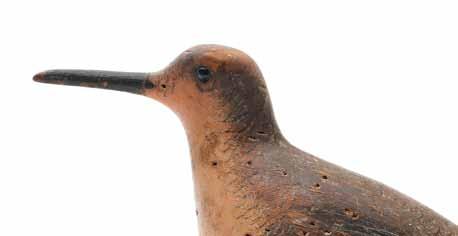
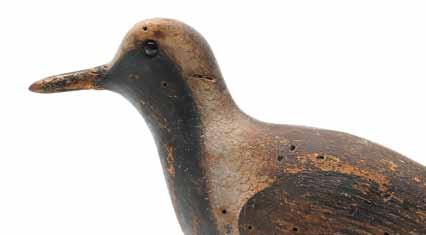
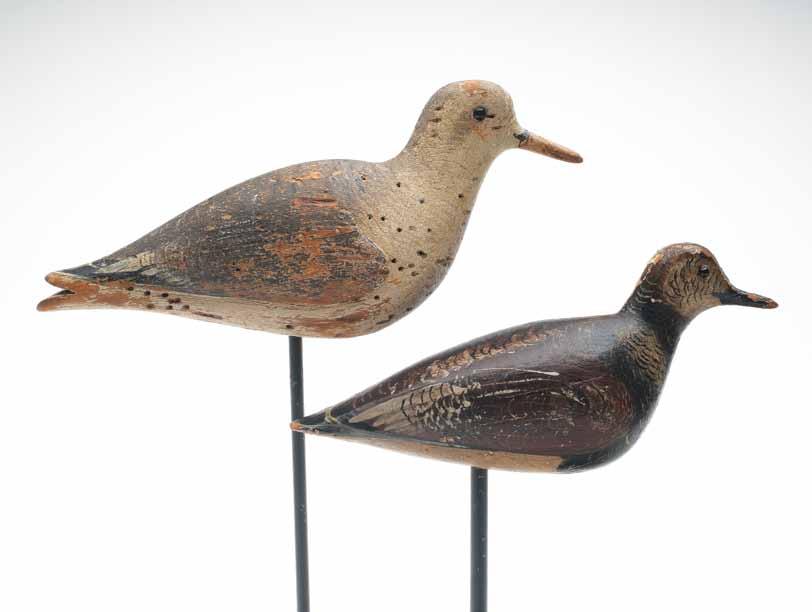
187 John Dilley, Quogue, Long Island, New York.
Black bellied plover in winter plumage. Relief wing and rare split tail carving. Illegible name in underside appears to be “C.A.L...” Measures 10” long. Original paint with moderate to significant wear; heavily hit by shot. (4,000 - 6,000)
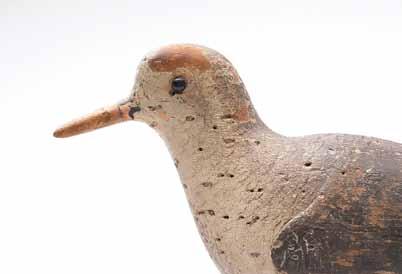
188 John Dilley, Quogue, Long Island, New York. Rare ruddy turnstone. Smooth body style. Measure 9” long. Original paint with moderate flaking and wear; tightly reglued crack in bill.
Provenance: Deborah and Martin Maloy collection. (6,000 - 9,000)
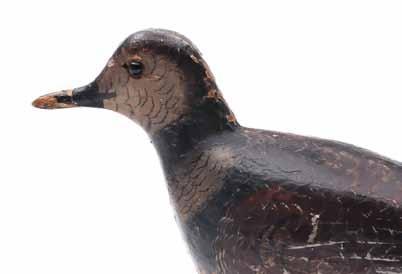
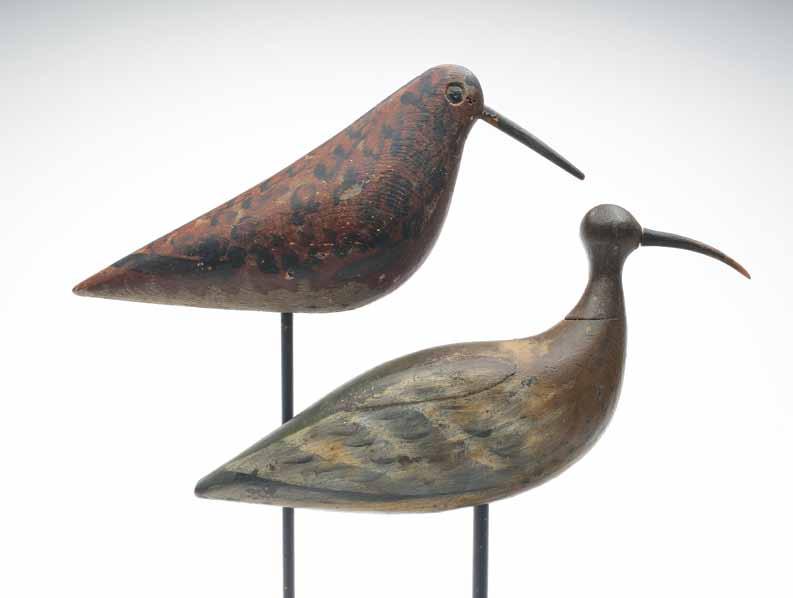
189 Dowitcher from Long Island, late 19th century.
From the Rogers rig but unbranded. A plump bird in rare spring plumage with deeply carved eyes.
“JS Fosdick” scratched in to the paint in underside. Measures 11” long. Original paint with minor flaking under an early coat of varnish that has darkened with age; bill appears original but was likely loose at one point, with a tiny nail added on one side of face to secure a long time ago.
Literature: “Shore Bird Decoys” by Henry A. Fleckenstein Jr., page 63, exact decoy pictured.
(6,000 - 9,000)
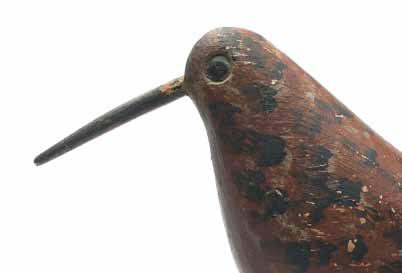
190 Alonzo Foster (1841-1913), Hampton Bays, Long Island, New York. Two piece curlew with bulbous head and appealing paint detail. Museum inventory number in red paint on underside. Measures 11.5” long. Original paint with very minor gunning wear under a thin coat of varnish that has darkened with age; separation at wood grain on one side had nails and small amount of filler added long ago; bill is a professional replacement with old touchup where bill meets face.
Provenance: Mike and Ginger Raffia collection.
(4,000 - 6,000)
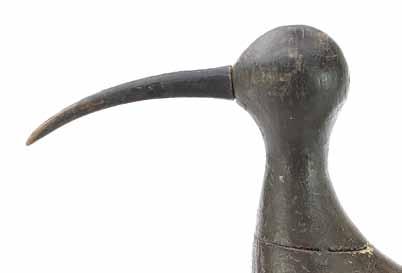
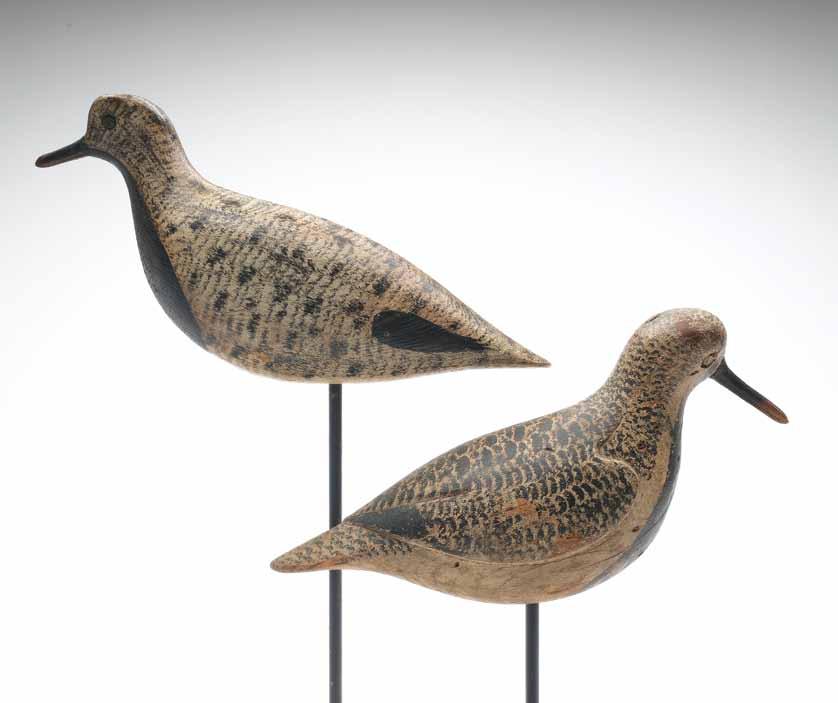
191 Daniel Demott (1847-1930), East Rockaway, New York. Black bellied plover. Carved eyes. Measures 10.5” long. Small defects in wood from when the decoy was made; excellent original paint under a thin coat of varnish. (7,000 - 10,000)
192 Obediah Verity (1813-1901), Seaford, Long Island, New York. Plump black bellied plover with deep relief wing carving. Very wide head style with carved eyes on front of head. Measures 9.75” long. Original paint with moderate wear; scattered shot marks; tight drying crack along one side; bill is a professional replacement.
Provenance: Mike and Ginger Raffia collection. (3,000 - 5,000)
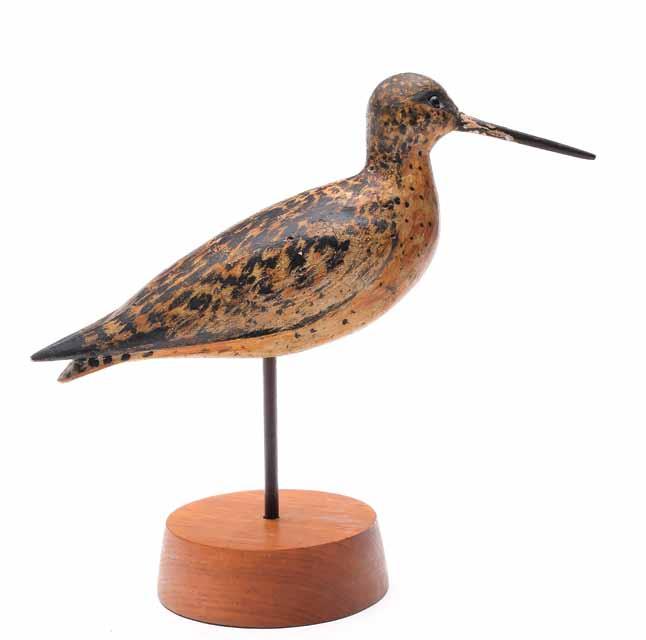
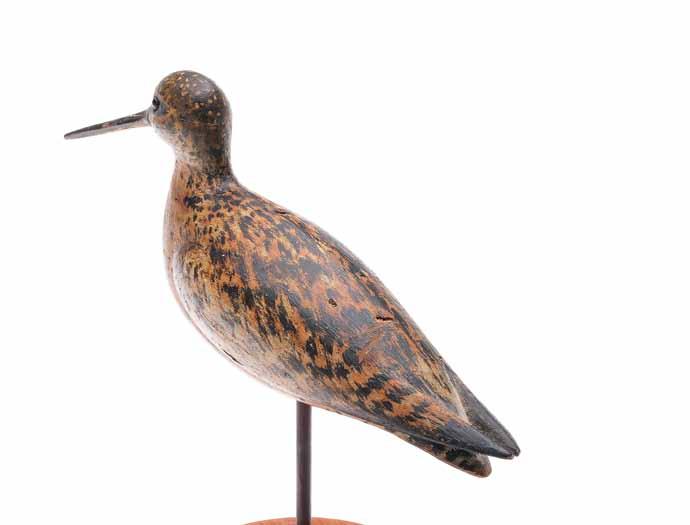
193 William Bowman (1824-1906), Lawrence, Long Island. Dowitcher with relief wing carving and raised wingtips. McCleery collection ink stamp on underside. 10.25” long. Original paint with moderate wear; lightly hit by shot; restoration to each raised wingtip; filled shot strike with touchup on one side of neck.
Provenance: Dr. James McCleery collection. Deborah and Martin Maloy collection. (8,000 - 12,000)
194 William Bowman (1824-1906), Lawrence, Long Island. Dowitcher with relief wing carving and raised wingtips. “H” branded in underside. McCleery collection ink stamp in underside. Measures 9.75” long. Original paint with significant wear; heavily hit by shot; old chips in wingtips; bill is original, but has early touchup and a tight crack in one side.
Provenance: Dr. James McCleery collection. Deborah and Martin Maloy collection.
(3,000 - 5,000)
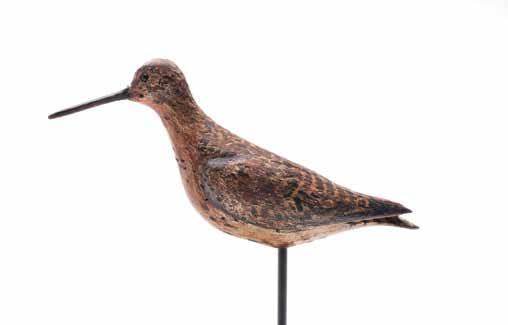
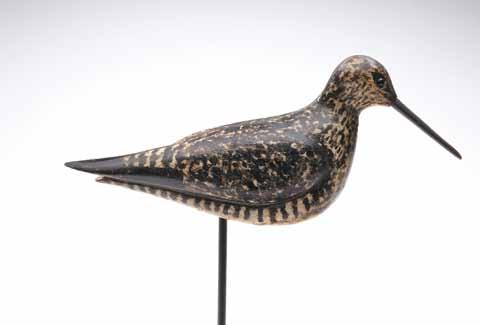
196 Attributed to Charles Sumner Bunn. Dowitcher. Relief wing carving and small bead eyes. Measures 10.75” long. Original paint with moderate wear; a thin coat of wax was cleaned off; minor chipping at stick hole, otherwise very good structurally.
(800 - 1,200)
195 Valentine Watts, Lawrence, New York. Black bellied plover. Deep relief wing carving and extended wingtips. Very similar to the work of William Bowman. Measures 11.25” long. Original paint with very minor wear; lightly hit by shot (10,000 - 15,000)
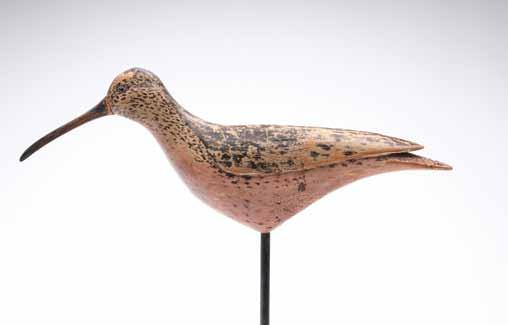
197 Feeding greater yellowlegs from Long Island, New York. Iron bill and eyes. “S” carved in underside. Measures 16.5” long. Original paint with very minor flaking and wear; lightly hit by shot; hairline cracks where bill meets face. (2,000 - 3,000)
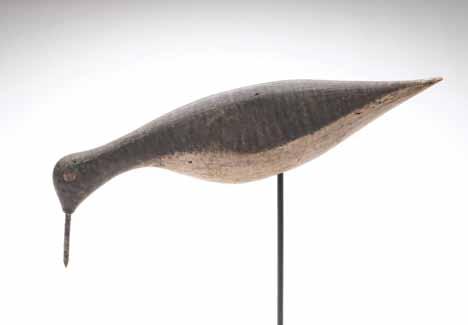
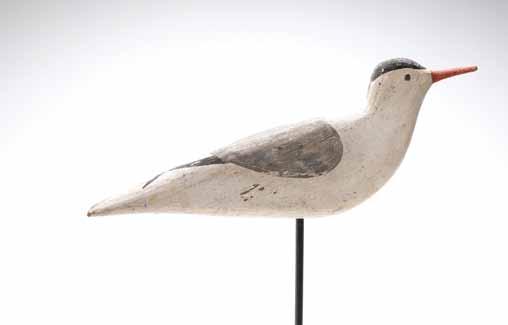
198 Tern from Long Island, New York, circa 1900. Flat sided with split tail carving. Measures 12.5” long. Original paint with minor wear; old chip at stick hole, otherwise good structurally. (2,000 - 3,000)
199 Captain Al Ketchem (1845-1926), Long Island, New York. Rare cork body dowitcher with relief wing carving and shoe button eyes. Nelson collection ink stamp on underside. Measures 9.5” long. Original paint with minor wear; tail area with professional restoration; most of the bill is a professional replacement; spot of touchup on side of head above one eye.
Provenance: Deborah and Martin Maloy collection. (1,200 - 1,800)
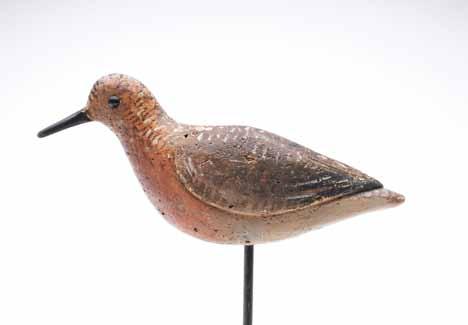
1889 - 1924 | Detroit, Michigan
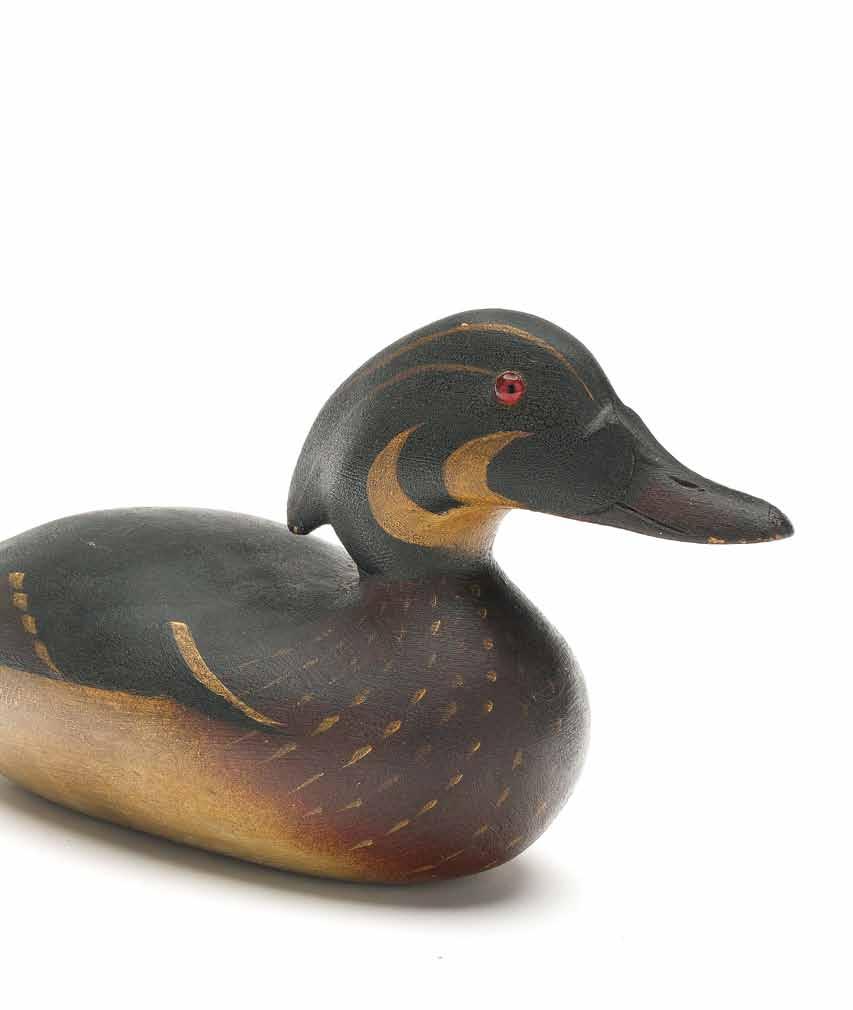
200 Mason Decoy Factory (1889-1924), Detroit, Michigan. Exceedingly rare wood duck. Solid body premier grade model with extended crest. Decoy was never rigged or weighted and was passed down in the Mason family. Measures 12.5” long. Original paint under an early coat of varnish that has darkened with age; very minor flaking and wear mostly at edge of tail; small dent in back; a small chip in top of bill tip was professionally filled and touched up.
Provenance: By descent in the Mason family. (50,000 - 80,000)
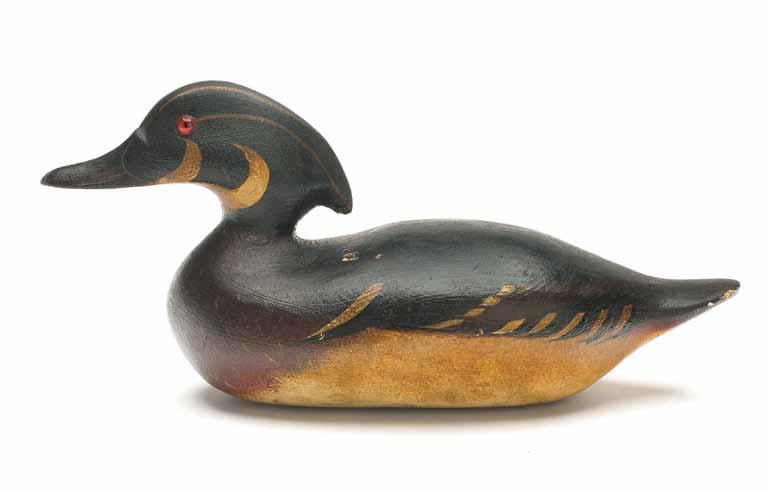
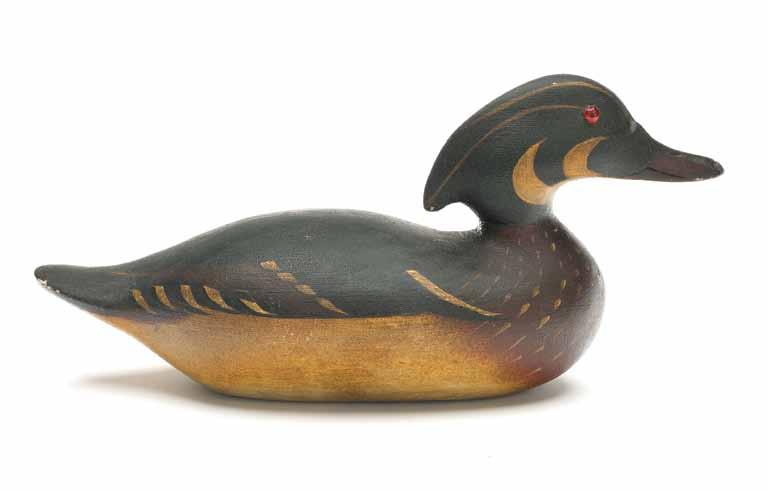
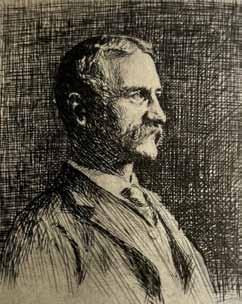
Dr. Arthur Tracy Cabot 1852 – 1912, Boston, Massachusetts
Dr. Arthur Cabot was the maternal grandson of Patrick Tracy Jackson, who in 1832 introduced the power loom to the U.S. cotton industry. His father was a surgeon. Cabot graduated from Harvard in 1872 and its medical school in 1876. Beginning in 1904, he began to focus on the prevention of tuberculosis. By 1910, he had closed his surgery practice to dedicate himself entirely to the effort. Cabot understood that the tuberculosis bacterium survived on surfaces and could be spread by surface contact. Accordingly, he advocated for better hygiene and cleanliness in schools. Additionally, he advanced the policy that when a state made schooling compulsory, it became responsible for the care of children who became infected. Cabot sold his Long Point Company shares the year before his death and may have used the proceeds for philanthropy. He died in 1912.
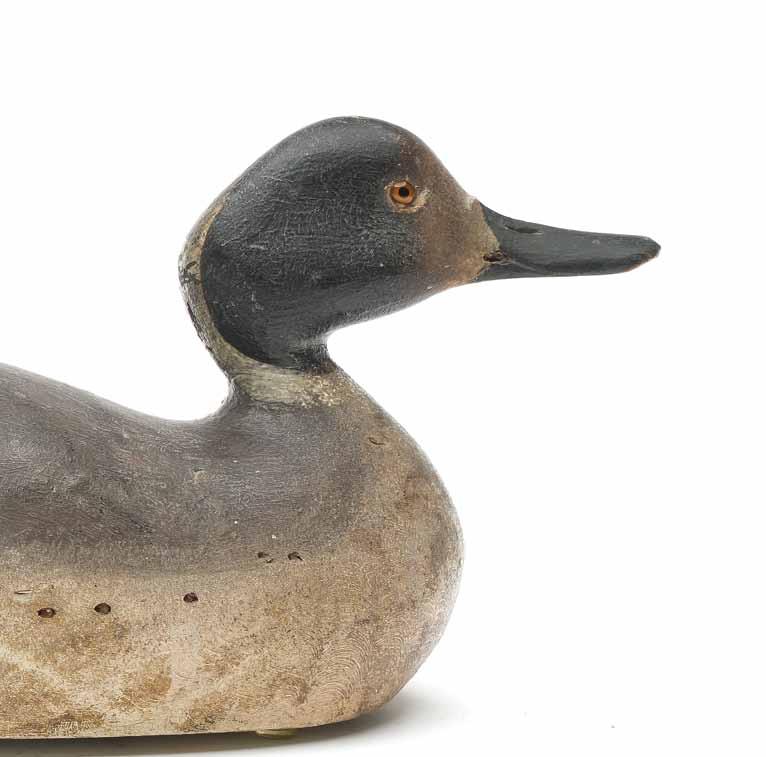
The son of financier John Pierpoint Morgan, Junius came from almost unimaginable wealth. After attending Harvard, he wed Emma Louise Converse in Dedham, MA in 1915. The couple enjoyed a honeymoon cruise on the 304 Ft family yacht, the Corsair III. Four years later, his father presented the couple with a home and 30 acres in Glen Cove on Long Island. Junius followed in the family businesses and maintained extensive banking interests, as well as sitting on the boards of some of the largest corporations in America such as US Steel and General Motors.
In addition to being the Commodore of the New York Yacht Club, his sporting activities included membership in The Long Point Company. He was a member from 1929 through 1960 serving as its president from 1940 to 1960. Sadly, he became gravely ill when at the club in 1960, and was taken to a hospital in Simcoe where he died.
201 Mason Decoy Factory (1889-1924), Detroit, Michigan. Early pintail. Hollow carved premier grade with extended tail sprig and early uplooking head style. “JSM, GGH, A.T. Cabot” branded in underside for Junius Morgan (1929-1960) and Arthur Cabot (1852-1912, Boston). Measures 20” long. Original paint with very minor wear; hit by shot in one side; an early coat of varnish has darkened with age and has worn off of parts of the decoy; tiny chip in tip of bill.
Provenance: Len Carnaghi collection. (12,000 - 18,000)
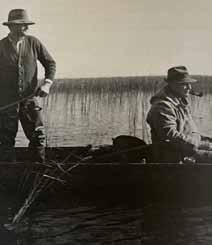
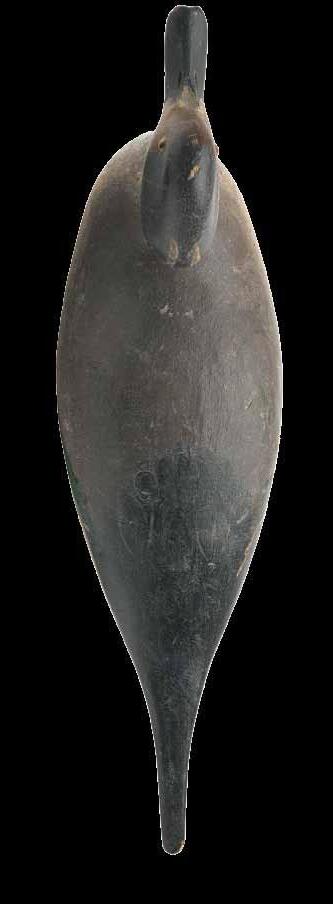
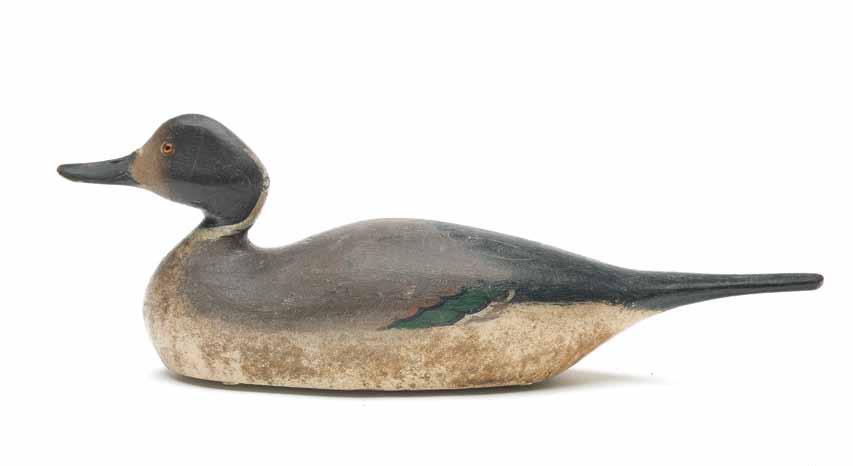
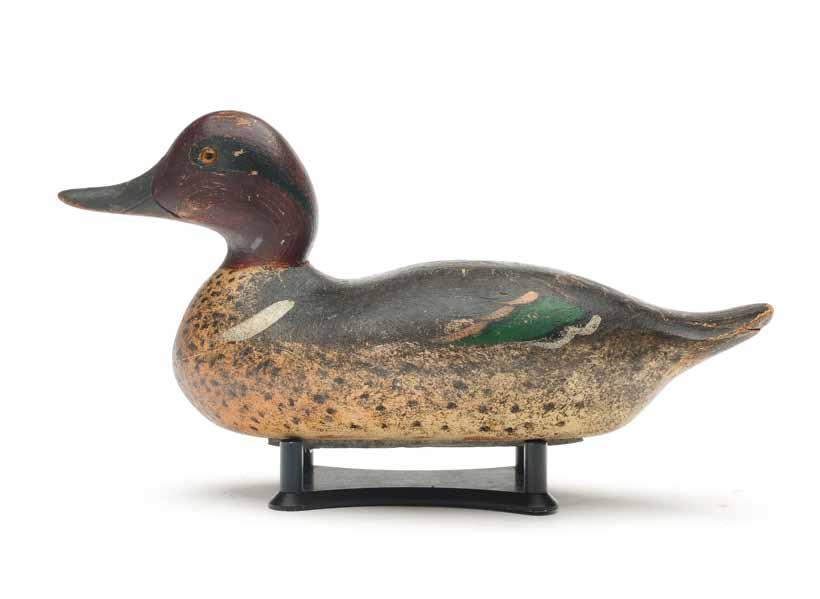
201A Mason Decoy Factory (1889-1924), Detroit, Michigan. Very rare greenwing teal. Challenge grade with upswept head pose. “HB” stamped in lead weight. This model and species is described by Russ J. Goldberger and Alan G. Haid, in “Mason Decoys – a Complete Pictorial Guide”, as exceptionally rare. Measures 12.25” long.
Original paint with moderate flaking and wear; an early coat of uneven varnish on back and head; roughness on edge of tail; cracks in tail where it was chipped up but not broken off; one eye is a professional replacement. (10,000 - 15,000)
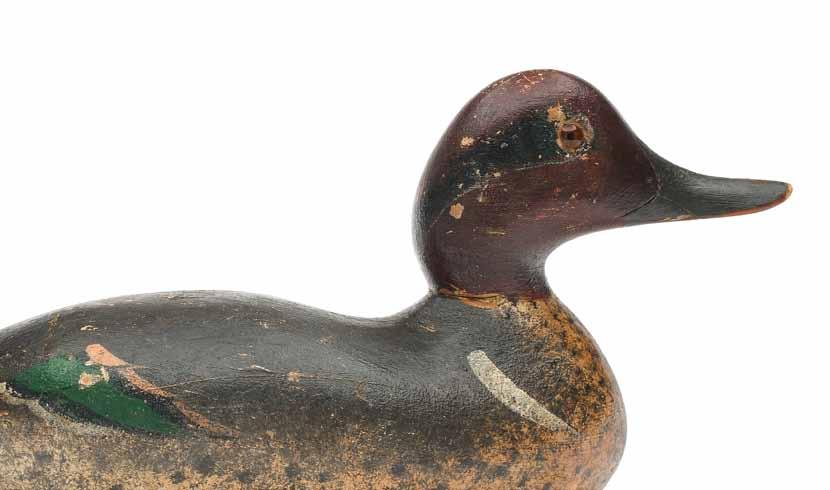
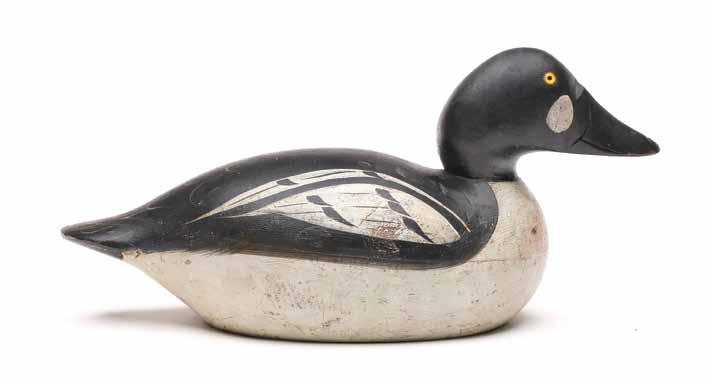
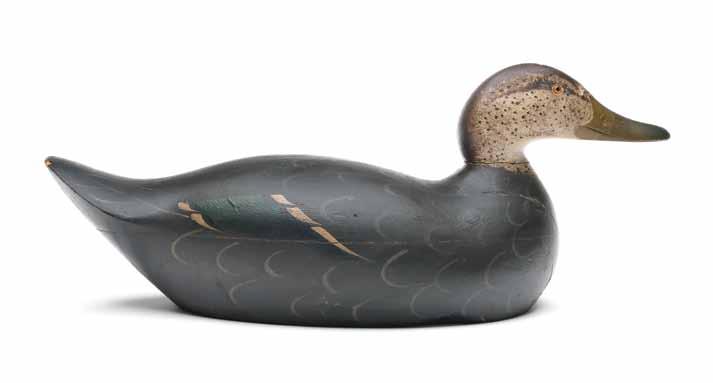
Mason Decoy Factory (1889-1924), Detroit, Michigan. Goldeneye. Hollow carved premier grade. Measures 14.75” long. Original paint with minor gunning wear; tight crack in one side of neck; professional neck filler restoration; bill was cracked down and tightly reset; some paint restoration to black near one wing patch; dent in one side of neck. (3,000 - 5,000)
203 Mason Decoy Factory (1889-1924), Detroit, Michigan. Black duck. Hollow carved premier grade. Premier ink stamp on underside. Measures 17.5” long. Excellent original paint with very minor wear; minor roughness on edge of tail; small dent at one wing patch; fine hairline crack on each side of back from when the decoy was made; minor separation at neck seat.
Provenance: Chris Mackey collection. (4,000 - 6,000)
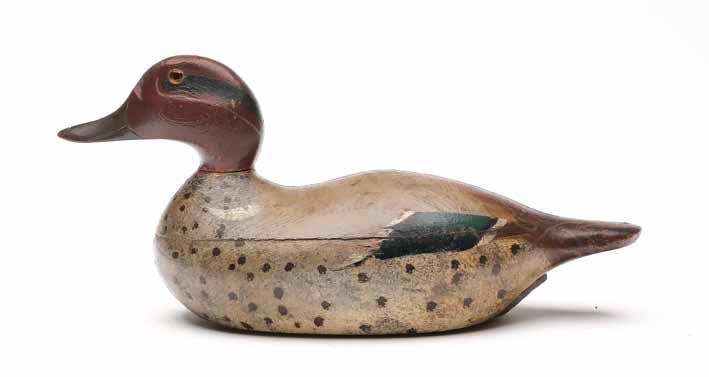
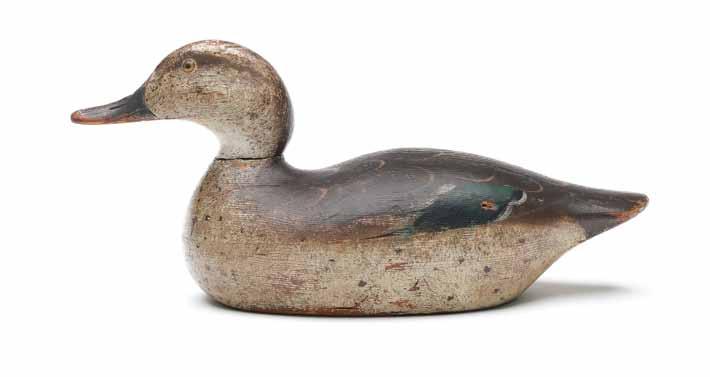
204 Mason Decoy Factory (1889-1924), Detroit, Michigan. Greenwing teal. Hollow carved premier grade. “FB & C” branded on underside. Measures 13” long. Original paint with minor wear under a coat of varnish that has darkened with age; slight separation at body seam; tight crack in top of tail; in-factory filled crack in back has opened slightly; head is slightly loose with minor roughness at neck seat; hairline crack in one eye. (4,000 - 6,000)
205 Mason Decoy Factory (1889-1924), Detroit, Michigan. Greenwing teal hen. Hollow carved premier grade. “HCW” painted on underside. Measures 12.5” long. Original paint with moderate wear under a thin coat of varnish; small dents and shot marks; minor roughness on edge of bill; small amount of touchup on part of a in-factory filled crack in back.
Provenance: Chris Mackey collection. (3,500 - 4,500)
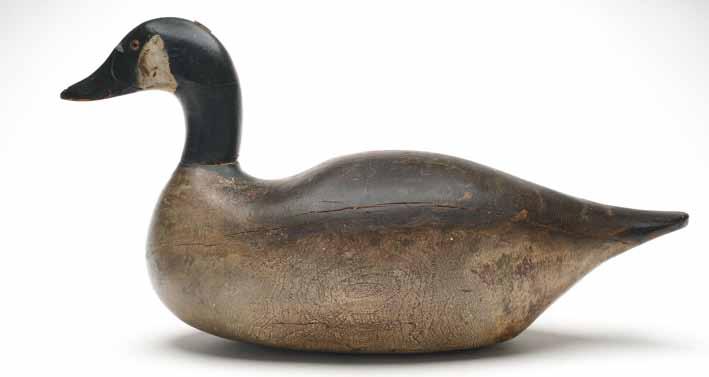
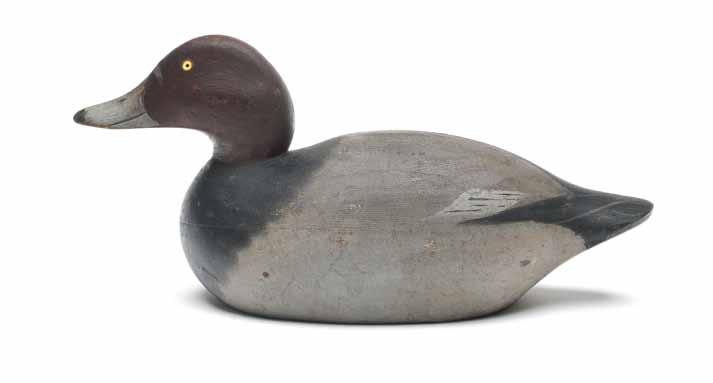
Mason Decoy Factory (1889-1924), Detroit, Michigan. Canada goose. Premier grade model. Measures 25” long. Original paint with moderate wear; under an early coat of varnish; old glue visible at neck seat; hairline drying cracks in back and neck; professional filled split in one side that has opened slightly.
Provenance: Chris Mackey collection. (5,000 - 8,000)
207 Mason Decoy Factory (1889-1924), Detroit, Michigan. Redhead. Hollow carved premier grade. Branded “S.B. Gavitt” on underside. Measures 14.75” long. Original paint with very minor wear; shot strike on one side of breast; paint flake at one wing patch that was darkened; some flaking at lower edge near tail. (1,500 - 2,500)
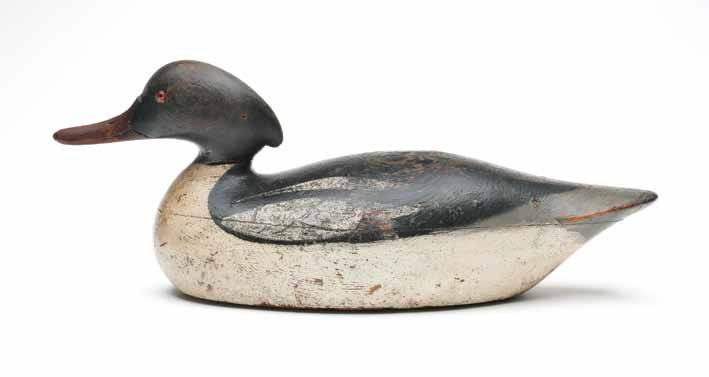
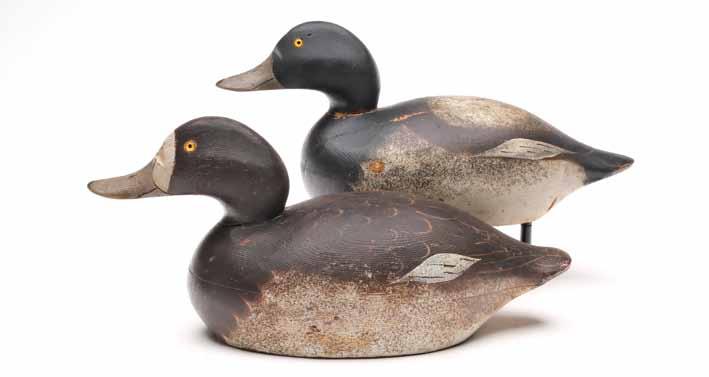
208 Mason Decoy Factory (1889-1924), Detroit, Michigan. Common merganser. Hollow carved premier grade with snakey head and extended crest. Measures 18” long. Original paint with moderate flaking and wear; under a later coat of varnish; filled drying crack in breast and along back with touchup; otherwise very good structurally.
Provenance: Chris Mackey collection. (6,000 - 9,000)
209 Mason Decoy Factory (1889-1924), Detroit, Michigan. Pair of bluebills. Hollow carved premier grade models. Measure 13.75” long. Original paint with minor gunning wear; some flaking at drake’s neck seat and to a hairline crack in back; hen has had a layer of varnish removed; lightly hit by shot; professional bill chip repair.
Provenance: Chris Mackey collection. (3,000 - 4,000)
210 Mason Decoy Factory (1889-1924), Detroit, Michigan. Rigmate pair of mallards. Challenge grade with snakey head style. Measure 17” long. Original paint with very minor wear; drying cracks along underside; very minor blunting at tip of drake’s bill; each with a small tail chip repair; fine hairline cracks along each that were filled in the making.
Provenance: Chris Mackey collection. (3,000 - 5,000)
211 Mason Decoy Factory (1889-1924), Detroit, Michigan. Bluewing teal. Premier grade with snakey head style. “NWE” carved in underside. Measures 12.5” long. Original paint with minor to moderate wear; small dents and shot marks; roughness on edge of bill; some restoration at neck seat; chip in tail was tightly reset. (1,500 - 2,500)
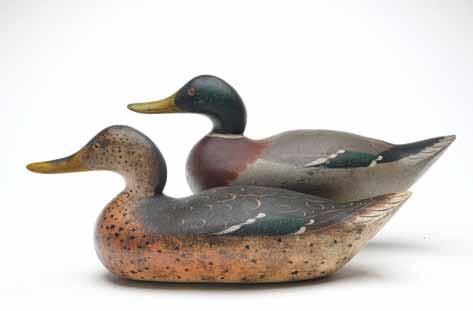
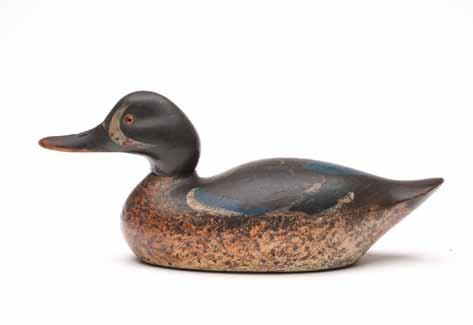
212 Mason Decoy Factory (1889-1924), Detroit, Michigan. Brant. Challenge grade. Measures 20.25” long. Original paint with moderate wear under a coat of varnish; long scratch on one side; head is slightly loose.
Provenance: Chris Mackey collection. (2,000 - 3,000)
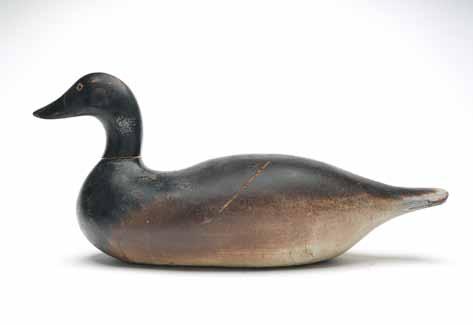
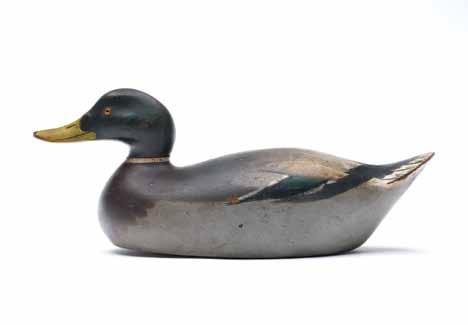
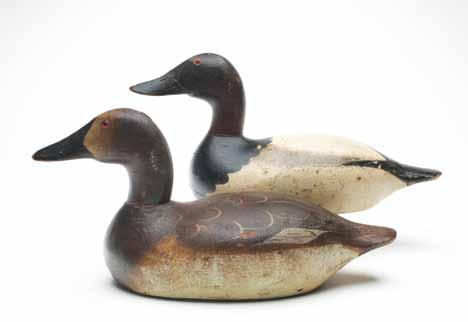
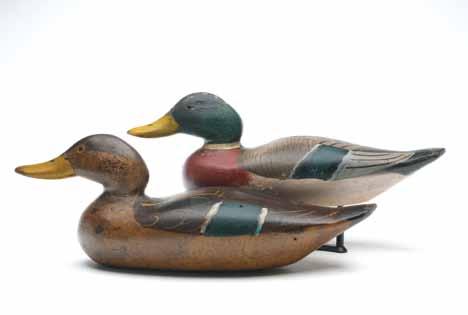
213 Mason Decoy Factory (1889-1924), Detroit, Michigan. Mallard. Hollow carved premier grade. Measures 17” long. Original paint with minor wear; very minor roughness on edge of tail; a few small dents in body; chip in tip of tail was professional restored. (1,000 - 1,400)
214 Mason Decoy Factory (1889-1924), Detroit, Michigan. Pair of canvasbacks. Premier grade Seneca Lake models. Measure 16” and 16.5” long. Original paint with minor to moderate wear; small dents and shot marks; crack in hen’s bill was tightly reset; larger dent in one side of hen; drying cracks along undersides; crack at base of drake’s neck was tightly reset.
Provenance: Chris Mackey collection. (2,000 - 3,000)
214A Dodge Decoy Factory (1883-1893), Detroit, Michigan. Pair of mallards. Hen with metal tack eyes. Drake with shoe button eyes. Measure 16.25” long. Both in original paint with very minor wear; hen is slightly hit by shot; hen with professional neck filler restoration; drake with a professional neck crack repair and 60% of the neck filler restored; drake with professional tail chip repair. (2,000 - 2,500)
214B Mason Decoy Factory (1889-1924), Detroit, Michigan. Bluewing teal hen. Tack eye model with round inlaid weight in underside. Measures 11.5” long. Original paint with moderate flaking and wear; minor chipping and roughness on edge of bill; shallow chip in one side; professional neck filler restoration.
Provenance: Chris Mackey collection. (600 - 900)
214C Mason Decoy Factory (1889-1924), Detroit, Michigan. Bluewing teal. Painted eye model. Measures 12” long. Original paint with very minor wear; fine hairline crack in back; professional neck filler restoration.
Provenance: Chris Mackey collection. (1,000 - 1,500)
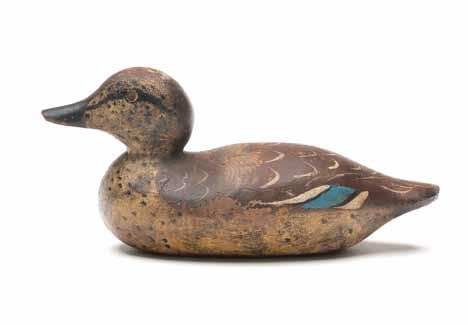
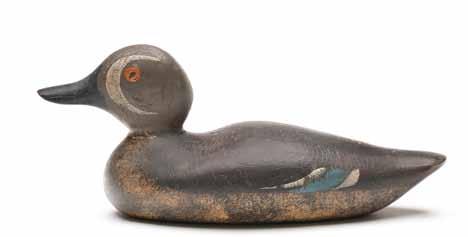
214D Mason Decoy Factory (1889-1924), Detroit, Michigan. Bufflehead. Standard grade glass eye model. “W” branded on underside. Measures 12.75” long. Original paint with moderate gunning wear under a thin coat of varnish; hit by shot in one side; drying crack along the underside; cracks in each eye; roughness on edge of bill was darkened; retains most of the original neck filler.
Provenance: Chris Mackey collection. (2,000 - 3,000)
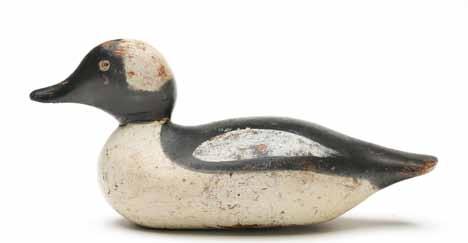
While still practiced by a few dedicated followers, from the early 1800’s through the turn of the century, gunning for the four species of rails, the Sora, Clapper, Virginia and King, was an extremely popular pastime, firmly rooted in history, tradition, and the coastal lifestyle. They were pursued by members of all levels of society including Presidents Benjamin Harrison and Teddy Roosevelt. Migrants, the rails arrived before the larger ducks and geese and provided welcome early season action. The birds favored both fresh and salt or brackish marshes where they could often be shot in great numbers. The favored hunting method was for a pusher to guide a shallow, flat bottom skiff through the marsh vegetation at high tide while the gunner in the bow would take aim at the flushing targets. One report claims that on September 8, 1846, one shooter in the tidal marshes below Philadelphia tallied 195 rails in a single tide—with a muzzleloading shotgun. In the last decades of the 19th century, hunters killed more than 100,000 sora rails each year along the rice meadows of New Jersey’s Maurice River. A 1908 article in the Virginia Pilot reported that two men, Messrs Chapman and Gwaltney killed 204 and 164 respectively on one tide. The abundance of the little birds meant that the game markets would often be flooded with them resulting in their commanding only a dollar or less per dozen.
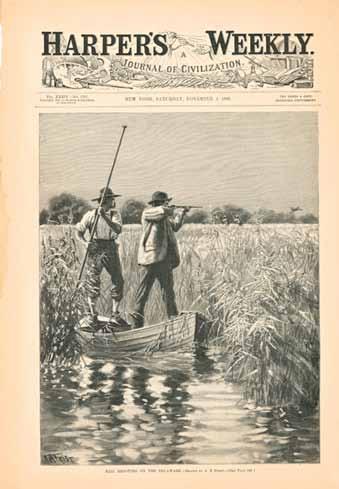
As popular as the sport was, the birds presented rather easy targets and competition was often keen as noted in 1848 by Henry William Hebert under the pen name Frank Forester:
“Although rail shooting scarcely deserves to be rated as a sport or honored with a place among the nobler kinds of waterfowling, it is a pretty pastime and when birds are abundant and rising well, the rapid succession of shots creates much excitement, which is often compounded by competition with rival boats and gunners. There is also the stimulating apprehension of being peppered soundly by a stray chance of shot, followed by variations of vituperation and recrimination.”
Over 100 years later sporting author Robert Ruark writing in his popular 1953 classic, “The Old Man and the Boy”, expressed similar thoughts when he wrote:
“I don’t suppose today that there is a great deal of sport in shooting the big rails we call marsh hens, but you’d be surprised how many you can miss.”
Rail hunting has long been a traditional subject of period artists and illustrators dating back to Audubon, and images of the sport have long graced the covers of popular sporting journals.
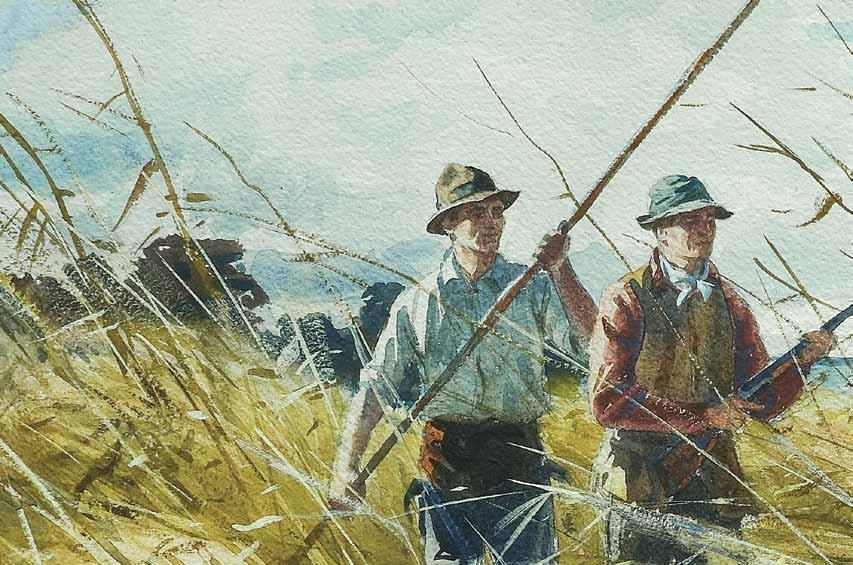
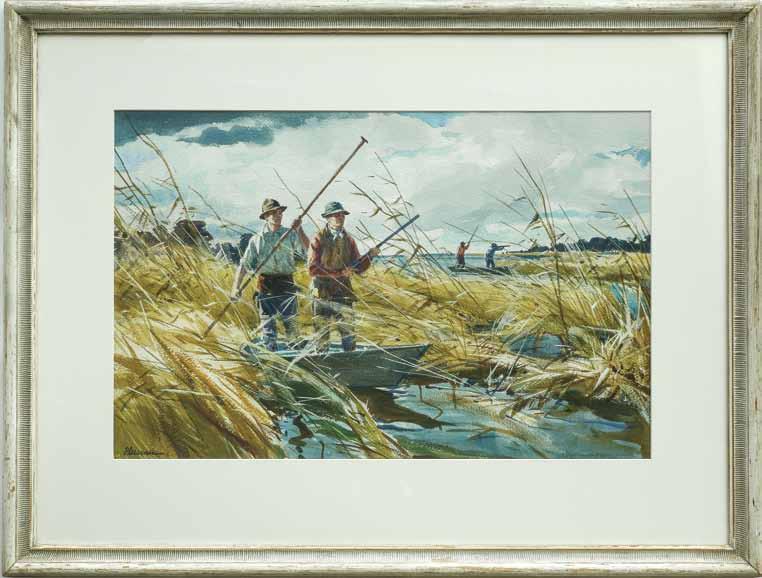
215 Ogden Pleissner (1905-1983), watercolor. Signed lower left. Image measures 16 ½ x 25 ½ in. Frame measures 27 1/4 x 36 in. Not removed from frame for examination. Retains strong colors. Overall very good condition.
(30,000 - 50,000)
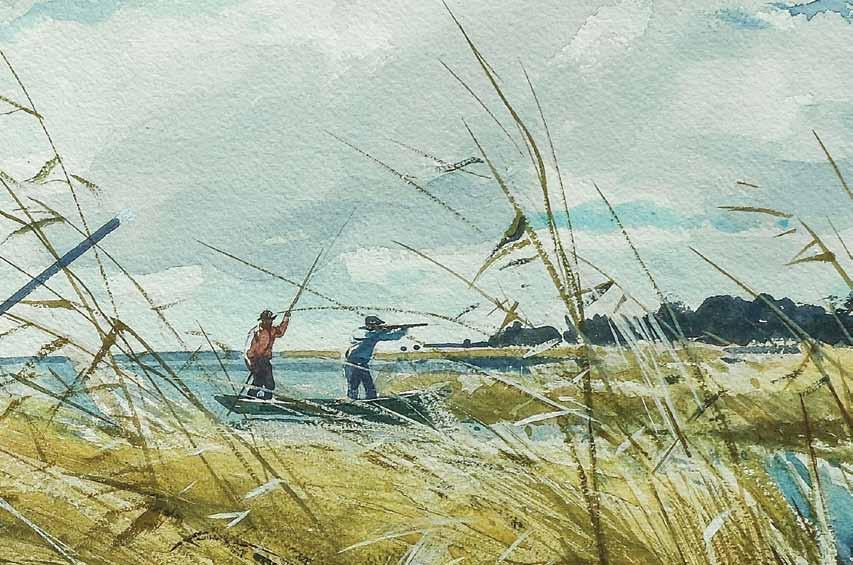
215A Edmund Osthaus (1858-1928), watercolor on paper. Image size 22” x 30”. Signed. Two setters on point. In gilded period frame. Image remains very good and original; no visible staining or inpainting. (35,000 - 45,000)
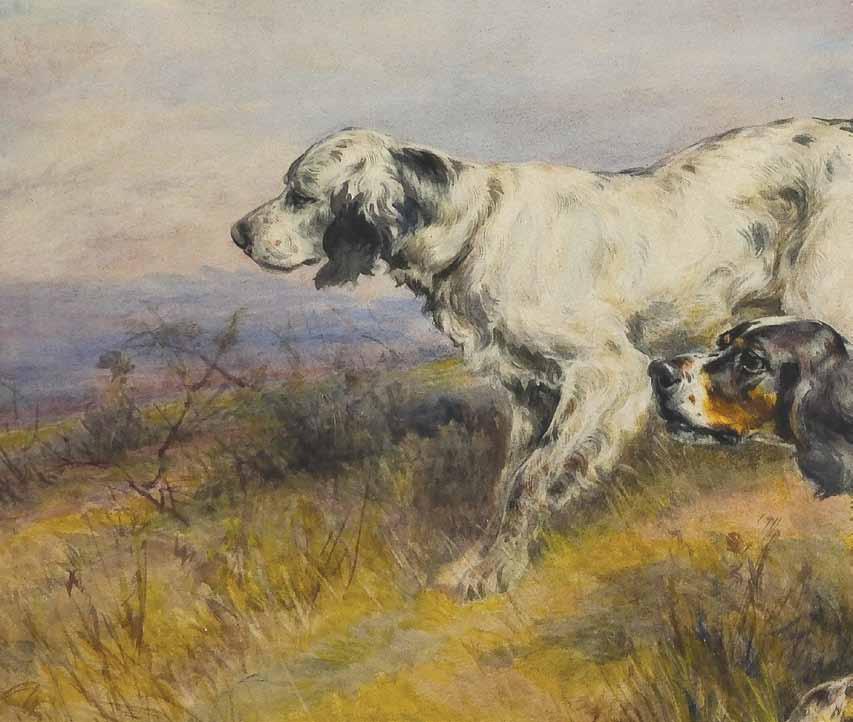
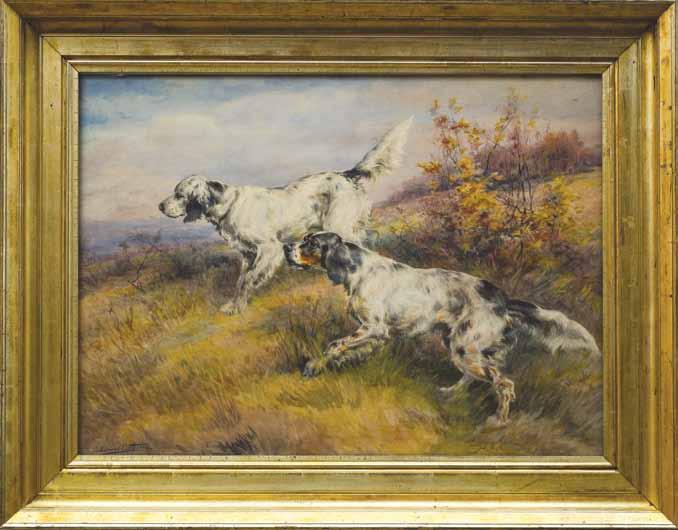
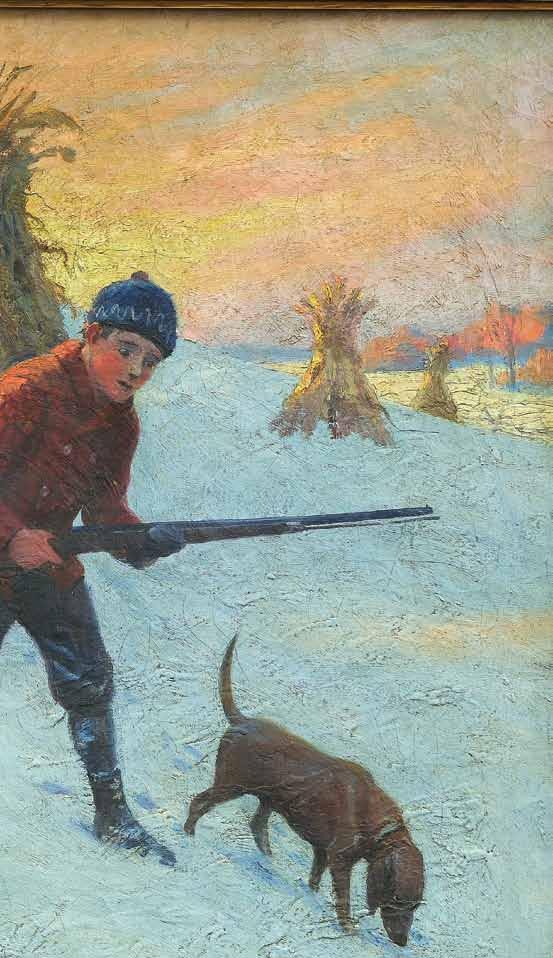
216 Frank Stick (1884-1966), oil on canvas. Signed lower left. Image measures 27 ½ x 19 ½ in. Frame measures 33 ½ x 26 in. Not removed from frame for examination. Heavy impasto consistent with artist’s style. Very minor crazing. Slightly dirty surface. Under UV: no apparent inpainting. (8,000 - 12,000) DuPont company advertising by Frank Stick with same boy and gun
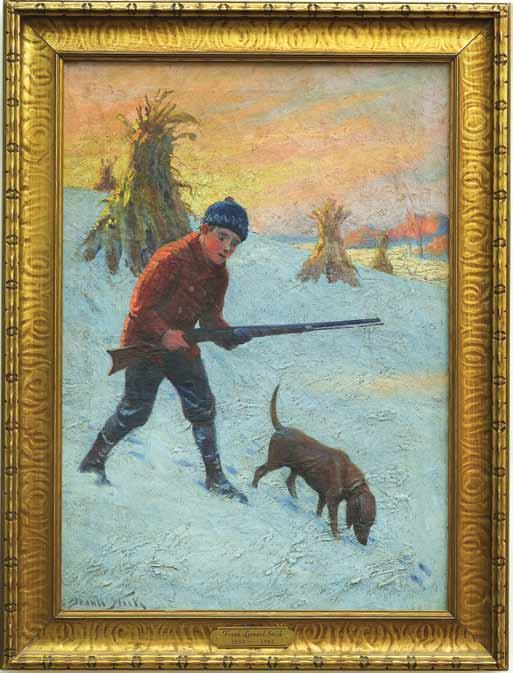
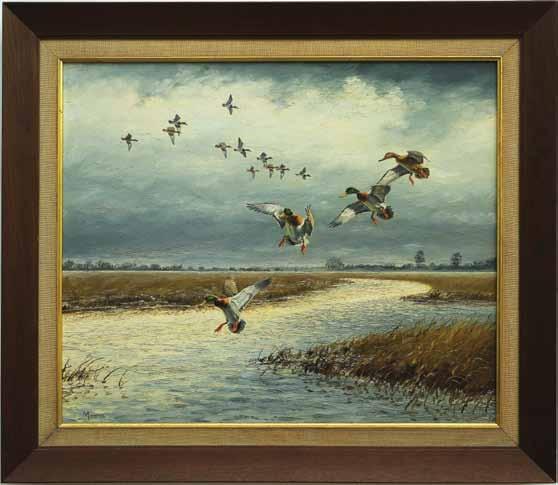
217 David Maass (b.1929), oil on board. Image measures 19.5” x 23.5”. Frame measures 25.5” x 29.5”. Signed. Not removed from frame for examination. Slight yellowing to light colors. One small pinpoint paint loss. No apparent retouching when examined under UV. (5,000 - 8,000)
218 David Maass (b.1929), oil on board. White wing scoter, titled “Cruising the Coast”. Image measures 23.5” x 32”, frame measures 30.5” x 38.5”. Signed. Excellent in all respects.
(5,000 - 8,000)
219 Lem Ward (1896-1984), oil on canvas. Image measures 17.5” x 23.5”, frame is 22” x 27.5”. Signed and dated 1955. Inscription on back reads “To my best friends Louis and Elaine, Lem.” A small amount of craquelure and darkened varnish; canvas remains tight; with no damage as viewed under UV light.
(4,000 - 6,000)
220 David Hagerbaumer (1921-2014), watercolor on paper. Depicting incoming mallards. Signed and dated 1981 lower left. Image measures 22” x 29”. Excellent and original. (3,500 - 5,500)
221 John Whorf (1903-1959), watercolor on paper. After a painting by Frank Benson. Image measures 20.5” x 29”. Frame measures 32” x 40”. Signed. Not removed from frame for examination. Mat burn evident on lower left edge. Minor areas of discoloration. Paper backing not removed from frame. (2,500 - 3,500)
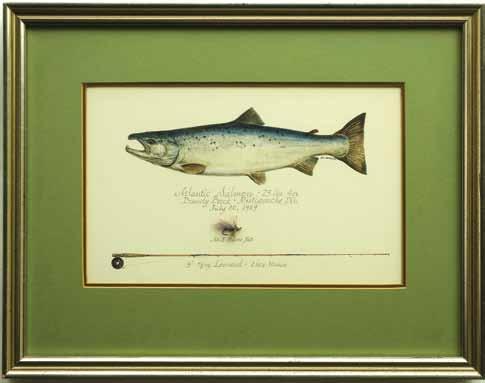
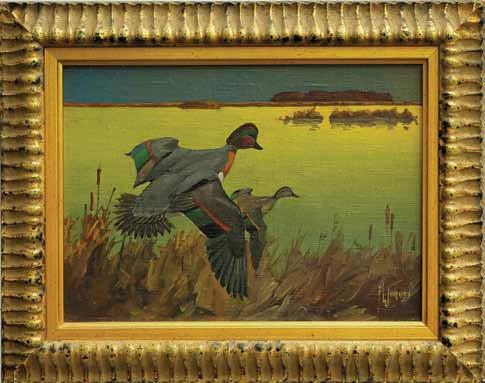
222 Milton Weiler (1910-1974), watercolor on paperboard. Signed below tail. Silver wrapped fly used to catch the fish is mounted on work. Image measures 7 ¼ x 12 in. Frame measures 14 ¼ x 18 in. Not removed from frame for examination. Retains strong colors. (1,500 - 2,500)
223 Frances Lee Jaques (1887-1969), oil on canvas board. Image measures 7.75” x 10.75”. Frame measures 11.5” x 14.5”. Signed. Not removed from frame for examination; contact our office for full condition report.
Provenance: Joseph Ellis collection. (3,000 - 5,000)
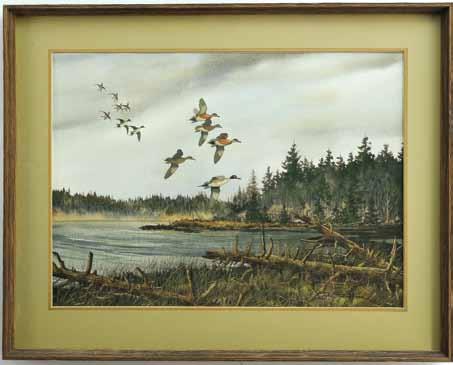
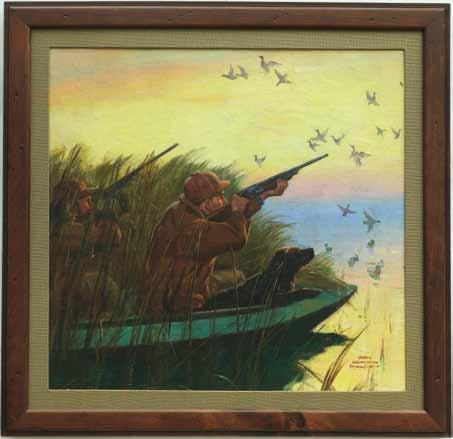
224 David Hagerbaumer (1921-2014), watercolor on paper. Of landing pintails and widgeon. Signed lower right. Image measures 20.75” x 29”. Very minor toning and faint spots of foxing in sky, otherwise excellent. (2,300 - 3,500)
225 John Newton Howitt (1885-1958), oil on canvas
Signed lower right. Image measures 24 x 25 in. Frame measures 30 ½ x 31 ½ in. Not removed from frame for examination. Minor crazing to surface. Under UV: areas of inpainting in corners, near dog and figures head and in sky. Canvas relined. (1,200 - 1,800)
227 Peggy Watkins, oil on canvas. Signed. Titled “Yellowlab”. Image measures 13.5” x 17.5”. Frame measures 22.5” x 26.5”. Excellent in all respects. (700 - 1,000)
226 Arthur T. Hutchins (18871919), oil on canvas. Signed lower left. Image measures 29 ¼ x 20 ¼ in. Frame measures 33 ½ x 24 in. Not removed from frame for examination. Very clean surface. Under UV: repair to upper right corner of sky. Patch to same area on reverse. (700 - 1,000)
228 William Schaldach (18961982), watercolor on paper. Signed lower left. Image measures 11 ½ x 8 ¼ in. Frame measures 19 ¼ x 15 in. Removed from frame for examination and to clean glass. Very slight discoloration with age. (700 - 1,000)
229 Jim Foote (1925-2004), oil on canvas. Image size 24” x 48”, frame is 32” x 55”. Signed and dated ‘03. Fishing the Au Sable River in Northern Michigan from an Ausabel river boat. Excellent in all respects. (2,000 - 4,000)
230 Lynn Bogue Hunt (18781960), oil on canvas. Signed lower right with personal inscription for wedding day. Image measures 9 ¾ x 11 ¾ in. Frame measures 12 ¾ x 14 ¾ in. Outer portion of frame missing. Not removed from frame for examination. Slightly dirty surface. Under UV: cleaning in area of inscription. (2,000 - 3,000)
232 Robert Genn, oil on canvas. Image measures 21.5” x 29.5”. Signed. Native American boy in headdress with teppee camp in background. Titled “A Call to Told Poetry Bill Window-Rock” Painting remains very good and original with only very slight darkening to varnish. (1,500 - 2,500)
231 Harry Antis (1942-2002), oil on board. Signed lower left. Dated 1982 with copyright. Large image, measures 29.5” x 19.5”. Well executed fine detail on geese. Professionally matted and framed. Not removed from frame for examination; contact our office for full condition report. (1,000 - 1,500)
233 John Seery Lester, oil on board. Image measures 7.25” x 4.75”. Frame measures 19” x 16.5”. Signed. Dated ‘85. Prelim study written lower left. Not removed from frame for examination. No apparent inpainting revealed under UV. (800 - 1,200)
234 Ambrose Webster (1869-1935), oil on canvas. Image measures 9” x 12.25”, frame measures 16.75” x 20.25”. Signed and dated 1887. Not removed from frame for examination; very light staining and discoloration from age; typical wear to frame from age and handling; otherwise very good. (1,500 - 2,500)
235 Ambrose Andrews (1805-1859), oil on canvas. Image measures 22” x 30”. Signed. Titled “Sunset Along the Hudson”. Retains Boston Canvas stamp. Period frame. Painting has been conserved over time, remains in good condition for its age; inpainting to stabilize craquelure is visible under UV light.
Provenance: Covington Fine Arts Gallery, Tucson, Arizona. Tom Karras collection (6,000 - 9,000)
237 Ralph Crosby Smith (19071962), oil on board. Image measures 16.5” x 11.75”, frame measures 29.25” x 23”. Not examined out of frame; light staining around center of image; frame carries light handling wear throughout, otherwise very good. (600 - 900)
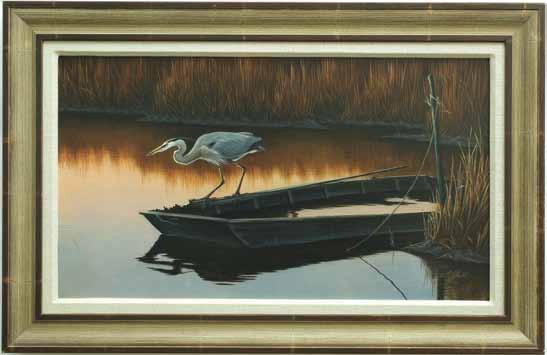
238 Will Goebel, oil on canvas. Image measures 15.5” x 27.5”. Frame is 22” x 34”. Signed and copyrighted. Image remains excellent. (800 - 1,200)
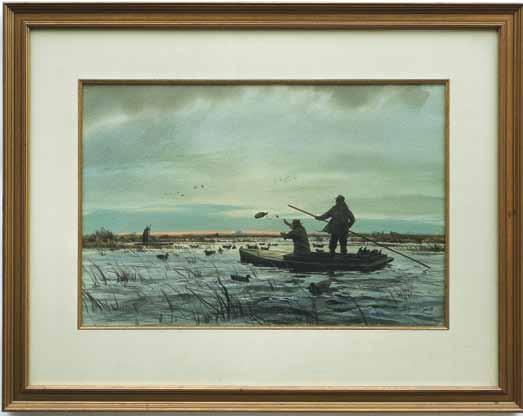
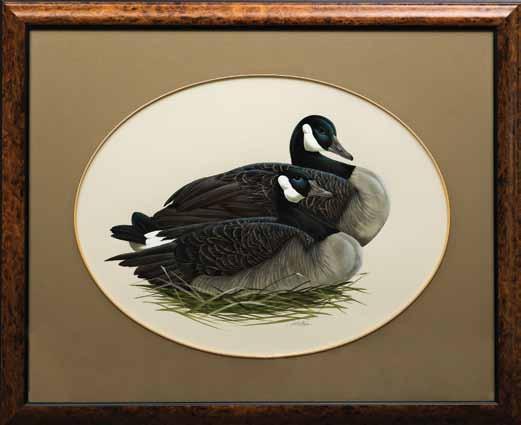
(1,500 - 2,500)
board. Canada geese. Signed. Professionally framed and matted. Image measures 24” x 32”. Frame measures 36” x 44”. Excellent in all respects. (800 - 1,200)
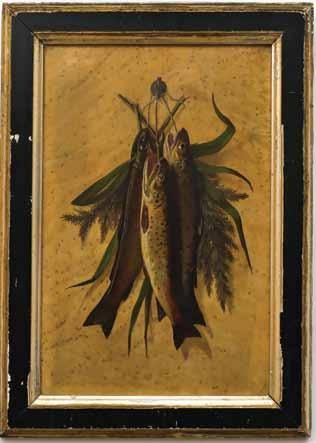
242 Maynard Reece, Federal Duck Stamp. Etching and stamp. Professionally framed and matted. From the season of 1959-1960. Frame is 15” x 13.5”. Light wear and flaking to frame; very slight darkening to etching. (1,500 - 2,000)
241 Unknown artist, circa 1900, oil on board. Of hanging trout. With faux birds eye maple background. Unsigned. Image measures 18” x 11.5”. Scattered crazing and spots of wear to varnish; tiny paint flake in pine bow. (400 - 600)
243 A set of federal migratory game stamps. Featuring 1934-2025. Framed in two individual frames. Most stamps are unsigned. Only one stamp appears to have been signed 1937. Largest frame measures 33.5” x 32”. Other measures 18” x 22”. Remains in very good to excellent condition, one seam at frame has opened slightly.
(1,500 - 2,500)
244 William Schaldach (1896-1982), watercolor. Titled “Grouse Flushing”. Signed at lower edge. Image measures 17.25” x 21.25”. Glass was cracked and removed; a faint hairline scratch in center of image, otherwise excellent. (1,000 - 1,500)
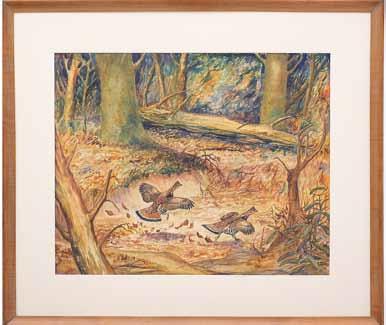
245 Frank Benson (1862-1951), Massachusetts. Etching of ducks landing, signed lower left, frame measures 15.75” by 18.5” Excellent; not examined out of frame. (200 - 400)
246 Benson B. Moore (1882-1974), etching. Titled “Canvasbacks.”
Signed in lower left with “50” in lower right. Image measures 7” x 7.5”, frame measures 13.75” x 14”. Image not examined out of frame; very good and original. (400 - 600)
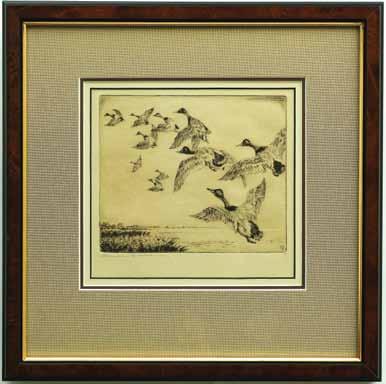
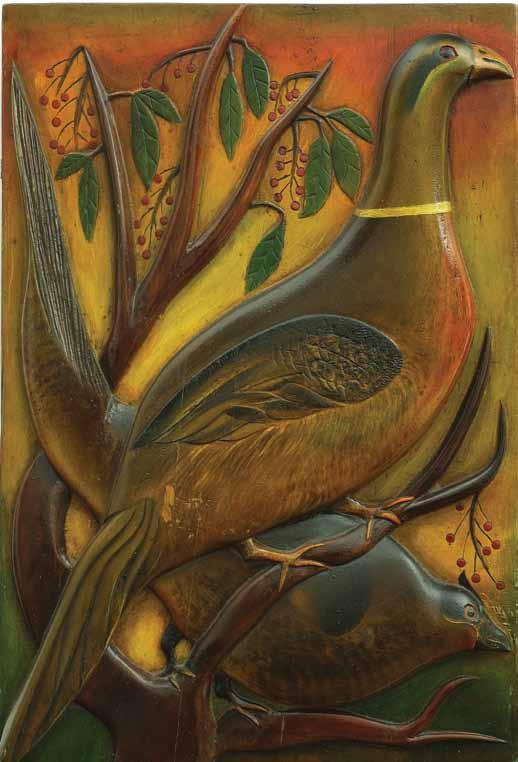
247 Oscar Peterson (1887-1951), Cadillac, Michigan. First half 20th century. Carved wooden plaque of two pheasants rooster and hen. Board measures 22” x 15” x 1 1/2” deep. Heavy relief carving. Carved eyes. Early dove tail strapping support on back. Original paint protected by a coat of varnish; a few small rubs and paint crazing.
Provenance: David Fannon collection.
Literature: “Master Carver : Oscar W. Peterson 1887-1951,” Ronald J. Fritz, p. 73 (15,000 - 20,000)
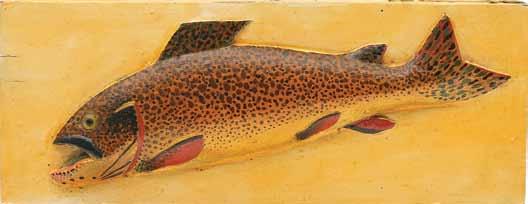
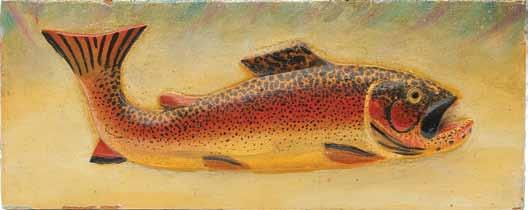
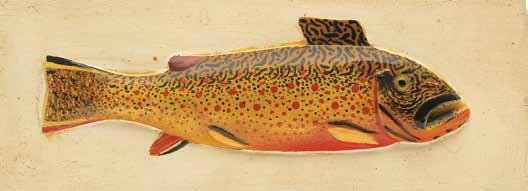
248 Oscar Peterson (1887-1951), Cadillac, Michigan.
Relief carved jumping German brown trout. Glass eye, metal strapping on back and sides. Written in pencil “Made by Oscar Peterson 223 Cadillac, Michigan, German brown trout.” Plaque measures 2 3/4” x 6 3/4” x 1/2”.
Original paint with slight crazing to the brown area.
Provenance: Ex David Fannon collection. (4,000 - 6,000)
249 Oscar Peterson (1887-1951), Cadillac, Michigan.
Relief carved rainbow trout with desirable flip tail. Glass eye, metal strapping on back and sides. Written in pencil “Made by Oscar Peterson 223 Cadillac, Michigan,
Rainbow trout.” Plaque measures 2 3/4” x 6 3/4” x 1/2”. Original paint with a very tiny bit of edge wear and paint loss on sides.
Provenance: Ex David Fannon collection. (4,000 - 6,000)
250 Oscar Peterson (1887-1951), Cadillac, Michigan.
Relief carved brook trout. Glass eye, metal strapping on back and sides. Written in pencil “Made by Oscar Peterson 223 Cadillac, Michigan, brook trout.” Plaque measures 2 3/4” x 6 3/4” x 1/2”. Original paint with crazing to the white areas.
Provenance: Ex David Fannon collection. (4,000 - 6,000)
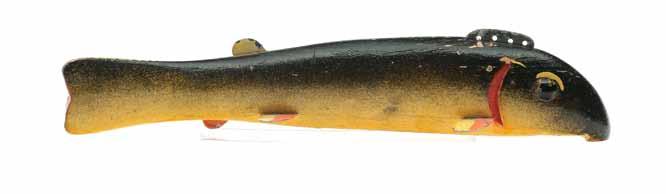
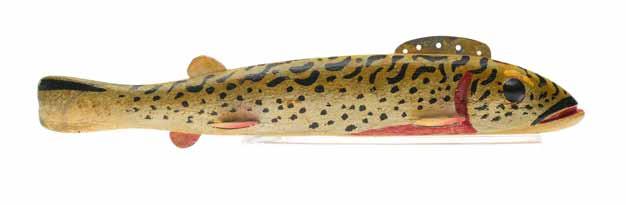
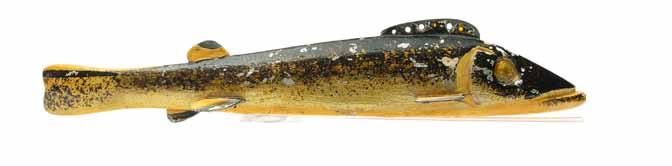
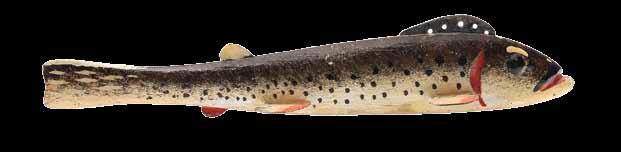
251 Oscar Peterson (1887-1951), Cadillac, Michigan. 2nd quarter 20th century. Fat sucker fish decoy. With tack eyes. Measures 9 1/2” x 1 1/4” x 1 1/5”. Strong original paint with very light wear; very small flaking areas on top of back and fins.
(1,500 - 2,500)
252 Oscar Peterson (1887-1951), Cadillac, Michigan. Brook trout with tack eyes and so called cut gill, 1st half 20th century. Measures 9.5” x 1.25” tall x .75” wide. Strong original paint protected by a light coat of varnish; tail has been broken and reset; small amount of paint loss at fins.
(1,500 - 2,000)
253 Oscar Peterson (1887-1951), Cadillac, Michigan. 2nd quarter 20th century. Walleye fish decoy with carved eyes. Measures 8 1/2” x 3/4” wide x 1 1/4” tall. Original paint with small areas of flaking, mostly at fins and two spots on head and weights at under belly.
Literature: “Master Carver : Oscar W. Peterson 1887-1951,” Ronald J. Fritz, p. 52.
(800 - 1,200)
253A Oscar Peterson (1887-1951), Cadillac, Michigan. Brown trout, 1st half 20th century. Measures 8.25” x 1.25” x 5/8”. Original paint protected by a light coat of varnish; varnish has slightly worn away from one side of body; some paint loss at fins and belly weight. (800 - 1,200)
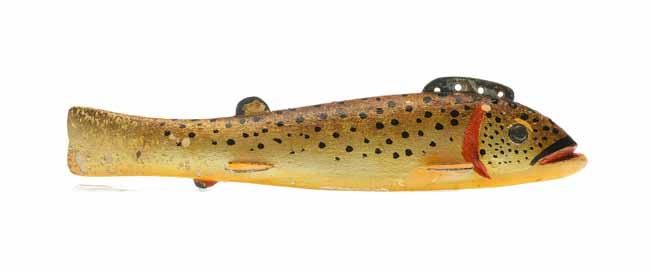
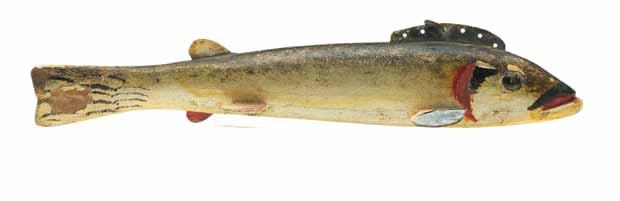
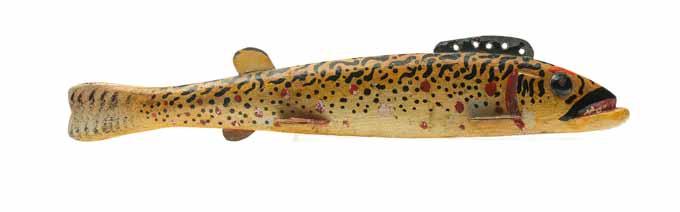
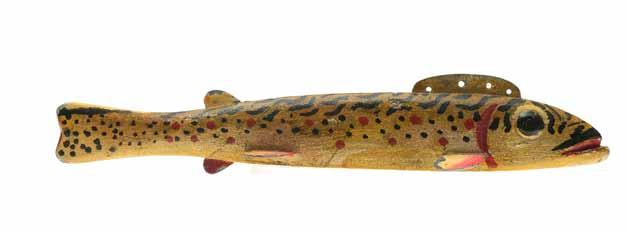
254 Oscar Peterson (1887-1951), Cadillac, Michigan. Trout fish decoy. 2nd quarter 20th century. Brown trout with tack eyes. Measures 7” long x 3/4” wide x 1 1/8” tall. Excellent original paint with some small amounts of flaking mostly at tail area and edges of fins. (800 - 1,200)
255 Oscar Peterson (1887-1951), Cadillac, Michigan. 2nd half 20th century. Shiner fish decoy with tack eyes.
Measures 9” x 3/4” x 1 1/4”. Light in use wear with some flaking to bare wood on tail, underside, and fins; varnish has darkened slightly. (500 - 800)
256 Oscar Peterson (1887-1951), Cadillac, Michigan. 1st half 20th century. Brook trout with tack eyes.
Measures 8” x 5/8” x 1 1/8”. Light in use wear; some varnish voids covering the original paint; flaking at fins and underside mostly. (500 - 800)
257 Oscar Peterson (1887-1951), Cadillac, Michigan. Brook trout fish decoy. 1st half 20th century. Tack eyes. Measures 7” x 1/2” x 1”. Original paint; small amount of flaking at edge of fins and underside. (600 - 800)
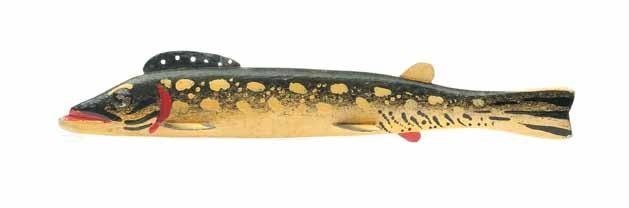
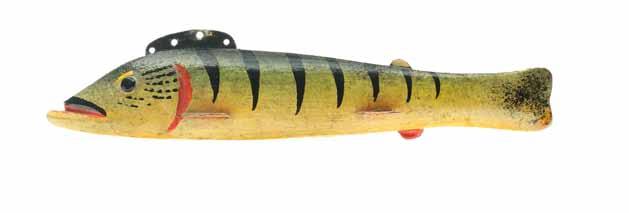
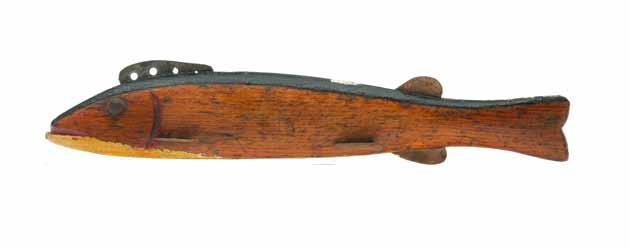
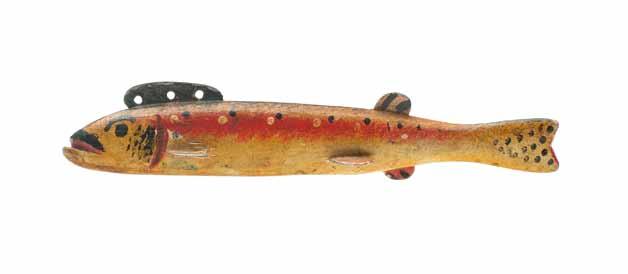
258 Oscar Peterson (1887-1951), Cadillac, Michigan. Pike fish decoy with tack eyes. Measures 8” x 5/8” x 1 1/8”. Original paint with some light in use wear; flaking at metal fins and small amount on underside.
(800 - 1,200)
259 Oscar Peterson (1887-1951), Cadillac, Michigan. 2nd quarter 20th century. Perch fish decoy. With tack eyes. Measures 7” x 3/4” x 1 1/8”. Strong original paint with very little wear; small amount of flaking at two fins.
(800 - 1,200)
260 Oscar Peterson (1887-1951), Cadillac, Michigan. 2nd quarter 20th century. Tack eye with natural side fish decoy. Measures 7 1/2” x 3/4” x 1 1/4”. Original paint varnish on sides has darkened; light in use wear; and a hairline crack underneath one eye. (700 - 1,000)
261 Oscar Peterson (1887-1951), Cadillac, Michigan. 1st half 20th century. Rainbow trout fish decoy with painted eyes. Measures 5” x 1/2” x 3/4”. Original paint with a coat of darkened varnish; small areas of paint loss at fins and little bit on underside. (800 - 1,200)
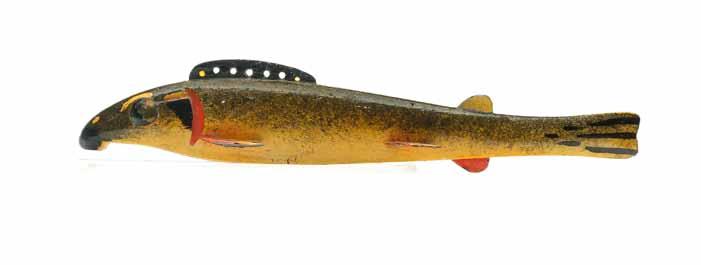
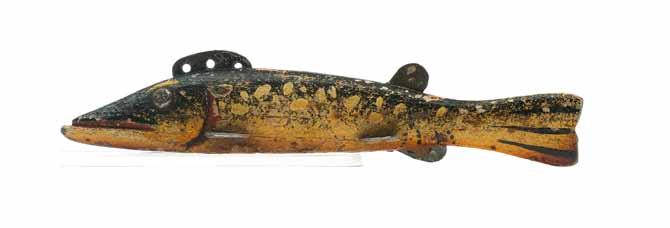
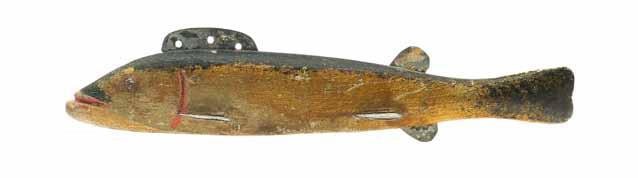
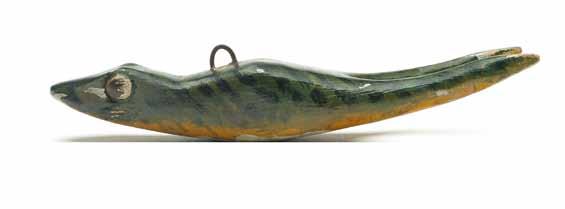
262 Oscar Peterson (1887-1951), Cadillac, Michigan. Sucker fish decoy with tack eyes. Measures 7 1/4” x 5/8” x 1”. Original paint protected by a coat of varnish that was not evenly applied; one side is darkened yellow the other has stayed more gray due to lack of varnish; some areas of flaking on fins and underside.
(500 - 800)
264 Oscar Peterson (1887-1951), Cadillac, Michigan. Shiner fish decoy with small tack eyes. Measures 5 1/4” x 1/2” x 3/4”. Original paint with in use wear; a few small rubs and flaking at fins and underside. (500 - 800)
265 Frog spearing decoy. Possibly by Oscar Peterson. Tack eyes. Measures 6.5” long. Original paint; some rubs exposing an early primer coat of silver, mostly on underside and between line tie holes. (500 - 800)
(300 - 500)
263 Oscar Peterson (1887-1951), Cadillac, Michigan. Pike fish decoy with tack eyes. Measures 5” x 5/8” x 3/4”. Original paint with light wear; some flaking and discoloration from a burn, mostly on underside; paint missing from fins.
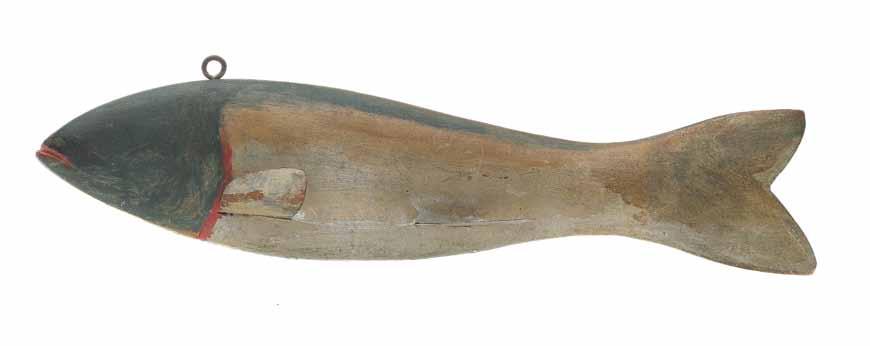
266 Hans Janner (1917-1985), Mt. Clemens, Michigan. Fish decoy, Shad circa 1935. One of only two or three known. Thoughtfully blended paint. Metal fins and what appears to be carved from a piece of Mahogany. Original surface has mellowed nicely; fish shows very little wear.
Literature: A rigmate similar to this was exhibited at the Cranbrook Museum of arts exhibit 1987. Illustrated in the exhibition book on page 49. At that time it was in the collection of Michael Hall. (10,000 - 15,000)
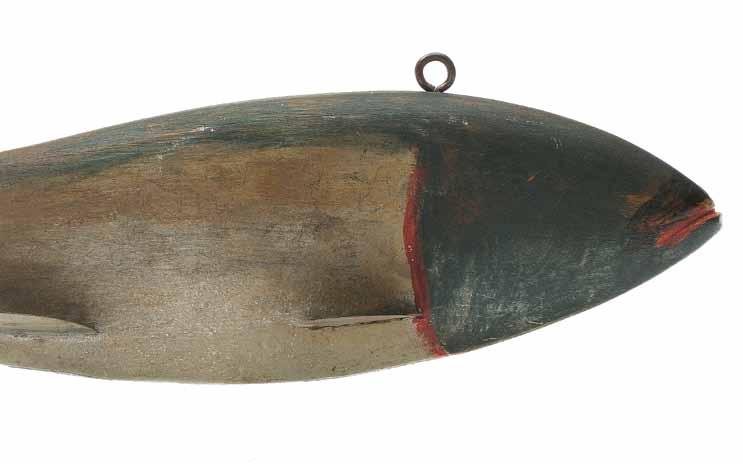

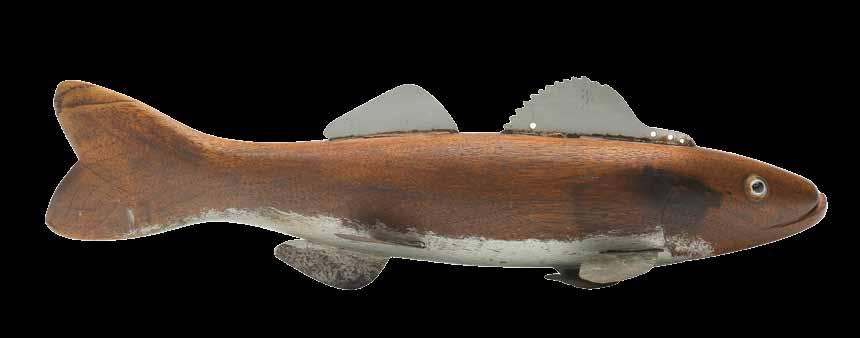
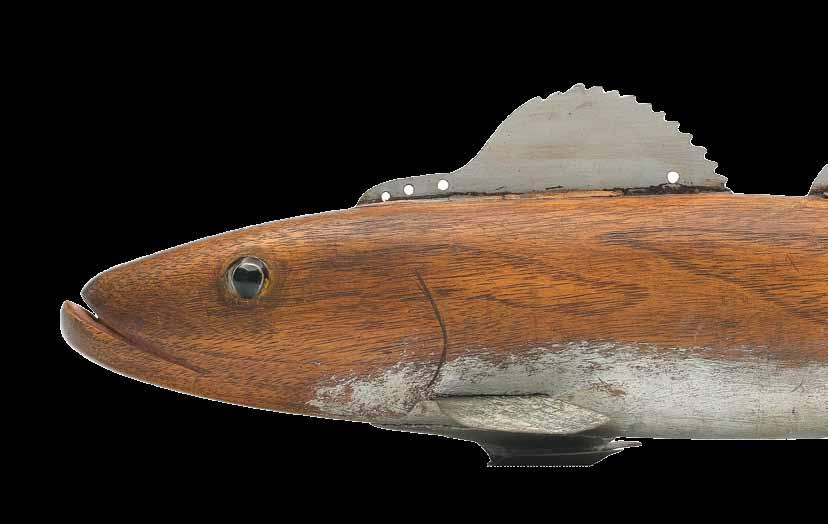
267 Hans Janner (1917-1985), Mt. Clemens, Michigan. Walleye fish decoy, 1st half 20th century. Made from a piece of walnut. Glass eyes. Metal fins. Belly is painted silver. Measures 15.25” long. Light in use wear; with a few tight cracks; tip of tail has been broken and reset; stain on one side of body near gill.
Provenance: Private Michigan collection. (6,000 - 9,000)
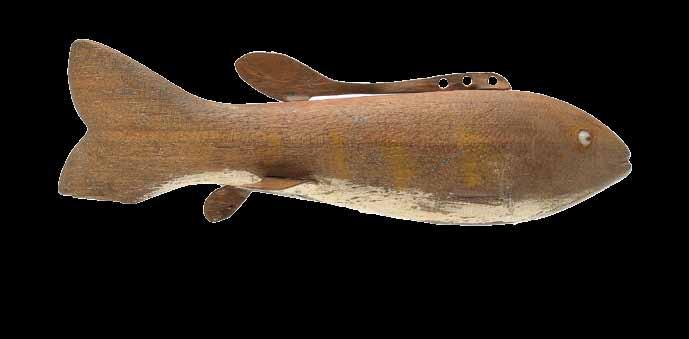
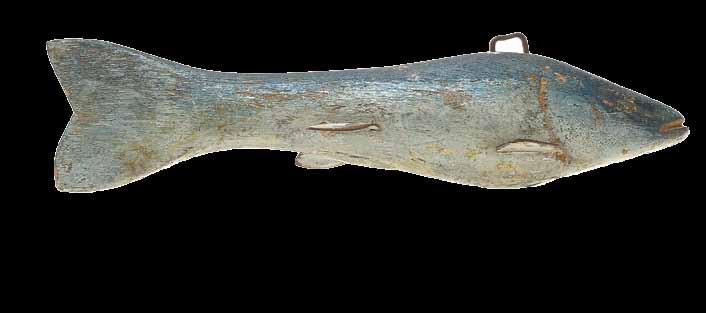
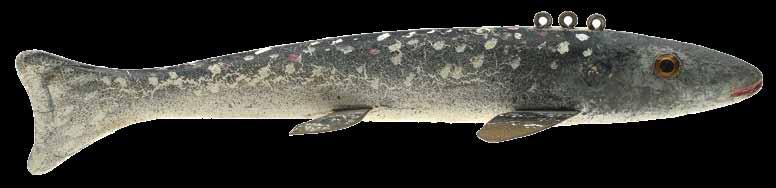
268 Hans Janner (1917-1985), Mt. Clemens, Michigan. Fish decoy, 1st half 20th century. Perch with copper metal fins and bead and copper nail eyes. Measures 6” long. Original paint with light wear; some rubs to white belly paint; chip missing from lower tail.
Provenance: Private Michigan collection.
(1,500 - 2,500)
269 Auggie Janner, Mt Clemens, Michigan, 2nd to 3rd quarter 20th century. Shiner fish decoy. Made from mahogany or walnut. Carved open mouth. Metal fins and wooden tail. Slight gill carving. Paint pattern is very similar to those found on Hans Janner fish decoys. Measures 5.25” long. Light in use wear with some flaking to fins and small spots of wear on body.
Provenance: Private Michigan collection. (1,250 - 1,750)
270 Auggie Janner, Mt Clemens, Michigan, 2nd to 3rd quarter 20th century. Fish decoy, circa 1950. With glass eyes, metal fins, and wooden tail. Carved mouth. A working second coat of paint probably by Janner; done quite some time ago as the surface has crazed.
Provenance: Private Michigan collection. (800 - 1,200)
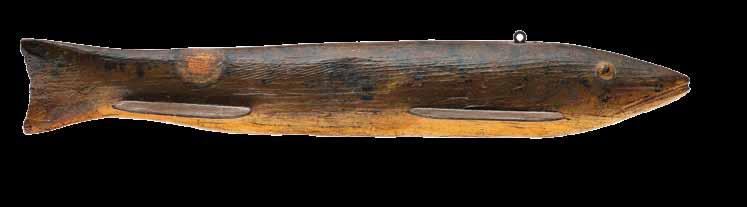
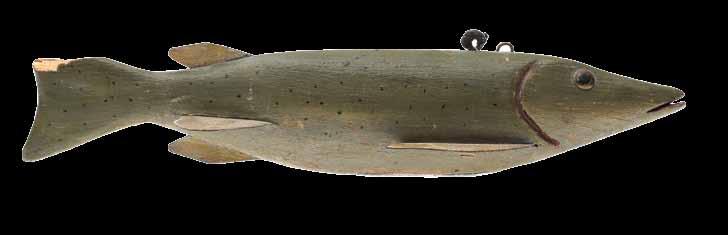
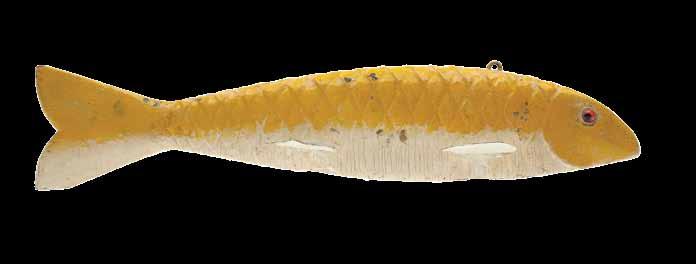
271 Frank Kuss (1871-1950), Mt. Clemens, Michigan. Fish decoy, 1st quarter 20th century. Bass with tack eyes, carved mouth, and metal fins. 13” long. Original paint protected by a coat of varnish that has darkened; crack at tail that has been reglued and a round spot that has disturbed the paint and the surface in that area.
Provenance: Private Michigan collection. (1,500 - 2,500)
272 Ted Vandenbosch (1887-1953), Mt Clemens, Michigan. Fish decoy, 1st quarter 20th century. Pike with tack eyes, carved gills, and open mouth. Metal fins and wooden tail. Measures 9.5” long. Original paint with small dot decoration on sides of body; slightly darkened varnish; tail chip missing from top of tail; minor flaking and rubs.
Provenance: Private Michigan collection. (2,000 - 2,500)
273 Cross hatched sucker fish decoy, Lake St. Clair, circa 1900. Intricate cross hatch carving on body. With inserted glass eyes, one of which is a replacement. Measures 13” long. Fish is in an old working repaint with an appealing surface.
Provenance: Private Michigan collection. (600 - 900)
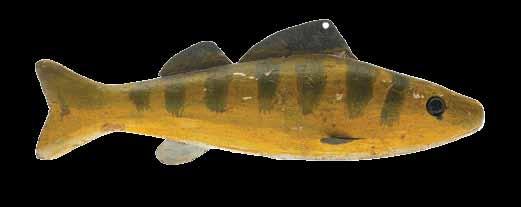
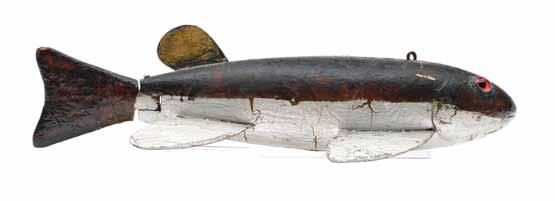
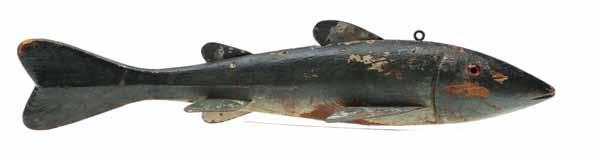
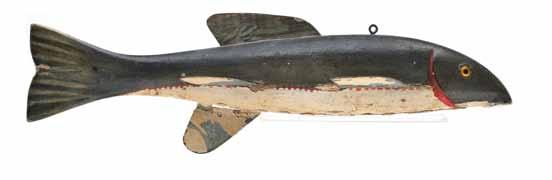
274 Tom Schroeder (1886-1976), Detroit, Michigan. Perch fish decoy, 1st half 20th century. Four metal fins. Carved painted eyes. Measures 7” long. Original paint with in use wear that has a few small areas of flaking, otherwise very good.
Provenance: Private Michigan collection. (1,250 - 1,750)
275 Alexander Yock Meldrum (1887-1971), Mt. Clemens, Michigan. Early fish decoy with articulated tail. A catfish with red glass eyes, carved gills and mouth. Metal fins. Collection sticker on underside indicates it was in the Ron Swanson collection. 9” long. Old paint that appears to be original; heavily varnished and crazed; lower portion of fish is painted a silver color that has also crazed.
Provenance: Private Michigan collection. (800 - 1,200)
276 Fish decoy, Lake St. Clair, Michigan. Fish decoy, unknown maker. Glass eyes, carved gills and mouth. Metal fins and wooden tail. Measures 12” long. A heavy fish with original paint; moderate wear from use; some flaking at fins; a few small gouges or spear hits.
Provenance: Private Michigan collection.
Literature: “The Fish Decoy,” Art, Brad, and Scott Kimball, p. 35. (1,200 - 1,500)
277 Early sucker fish decoy, Lake St. Clair, Michigan. 1st or 2nd quarter 20th century. Glass eyes and carved gills. Metal fins and wooden tail. Measures 12.25” long. Old original paint that is worn, discolored, and flaked slightly from use.
Provenance: Private Michigan collection. (1,500 - 2,500)
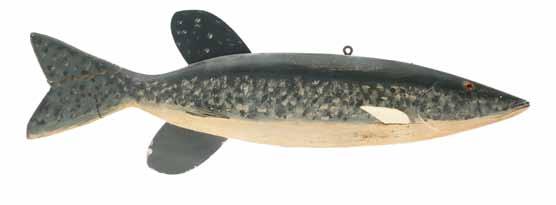
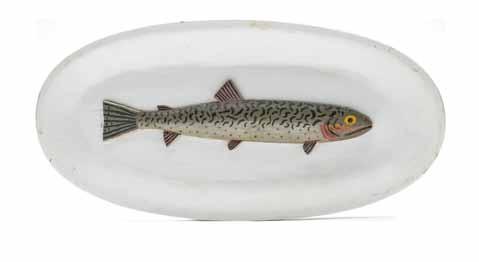
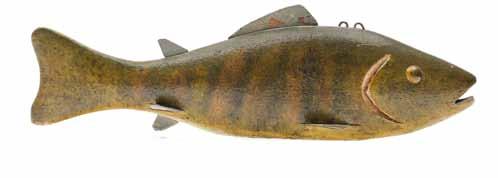
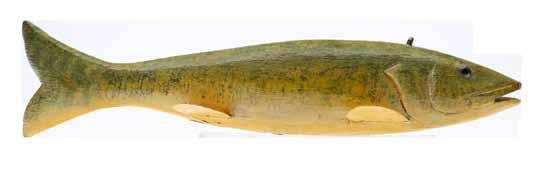
278 Isaac Gouellet, Mt Clemens, Michigan. Pike fish decoy. Glass eyes, carved gills and mouth. Measures 19” long. Original paint with some small amount of flaking; one fin appears to be a replacement; break at tail has been reset.
Provenance: Private Michigan collection. (1,200 - 1,800)
279 Jess Ramey, Cadillac, Michigan. Carved fish plaque of a brook trout. Written in pencil, “December 25, 1955. To Floyd and Gloria best wished for a merry Christmas, mom and dad. Made by Jess Ramey.” Measures 8.25”, plaque is 6.25” x 12.5”. Very good and original.
Provenance: Private Michigan collection. (800 - 1,200)
280 Abe Dehate (1890-1968), Mt. Clemens, Michigan. Fish decoy, 1st quarter 20th century. Bass with tack eyes. Deeply carved gills and open mouth. Side of fish is painted with a blend of gold, green, and darker tones of black. Metal fins with wooden tail. Measures 10” long. Strong original paint protected by an old coat of varnish; chip and piece missing from mouth; rough edge at bottom of tail; small flaking at top metal fin.
Provenance: Private Michigan collection. (2,500 - 3,000)
281 Gordon Pecor Fox, Mt. Clemens Michigan, 1st half 20th century. Fish decoy. Glass eyes and open mouth. Signed on underside and dated 1982. Measures 10.5” long. Original paint protected by a coat of varnish that has darkened slightly; some flaking at fins and a small amount under side of body.
Provenance: Private Michigan collection. (1,500 - 2,500)
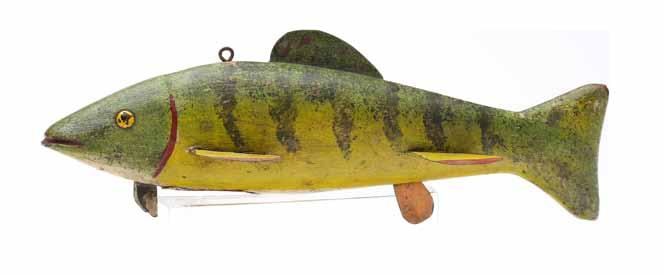
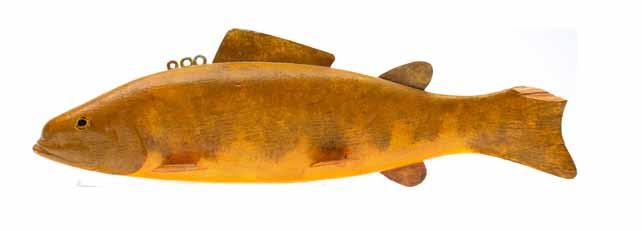
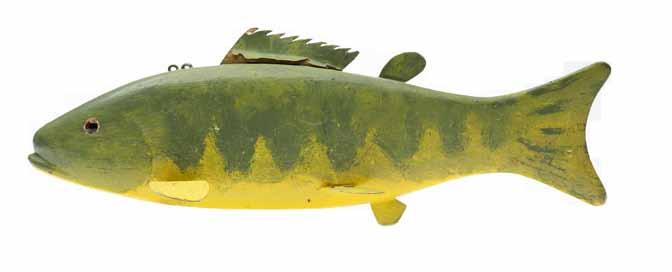
282 Gordon Pecor Fox, Mt. Clemens Michigan, 1st half 20th century. Perch fish decoy, circa 1950. Tack eyes, carved gills and mouth. Metal fins and wooden tail. Measures 10”. Original paint with light in use wear; one side fin is missing; small areas of flaking on other fins.
Provenance: Private Michigan collection.
(1,250 - 1,750)
283 Abe Dehate (1890-1968), Mt. Clemens, Michigan. Fish decoy, circa 1950. Perch fish decoy with carved eyes, double carved gills and mouth. Metal fins with wooden tail. Measures 10.5” long. Original paint with a chip broken and reattached lower portion of tail and a chip broken and missing at upper tail.
Provenance: Private Michigan collection.
(1,000 - 1,500)
284 Abe Dehate (1890-1968), Mt. Clemens, Michigan. Perch fish decoy with glass eyes, and carved gills and mouth. Metal fins and wooden tail. Measures 11” long. Original paint with some flaking at fins.
Provenance: Private Michigan collection.
(1,250 - 1,750)
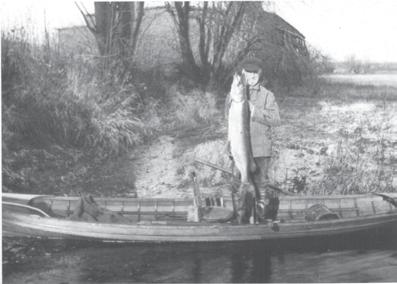
Born July 1st 1843, it has been said that Ed Irwin caught more musky on Lake Chautauqua than any other man, past or present.
Raised on what is now known as the Chautauqua Institute property, Irwin loved to hunt and fish. Around 1860, he left the area to a ttend Bryant & Stratton Business College in Buffalo, New York. Upon his return to the Chautauqua area, he accepted a job in Mayville as a bookkeeper for a local mill. The call of the wild was too much for Irwin to manage. He eventually gave up his job at the mill to become a full time hunter and fis herman.
In the fall, Irwin would travel to the Kankakee Marsh in Indiana to hunt ducks for the Chicago market. He would then return to his home on the north end of Ch autauqua Lake to ice fish throughout the winter, then fish and guide for musky in the spri ng and summer months. Irwin began to gain a local reputation for his spearing decoys, casting spoons, and double-ended rowboats. He chronicled each fish he caught and in one season his total muske llunge haul was 300. An undated newspaper clipping from the Mayville Sentinel found in the Mayville Historical Center related that Ed Irwin captured no fewer than 14,219 muskellunge from the waters of Lake Chautauqua since 1872.
- “Saving Chautauquas Muskies”, Fletcher Ward
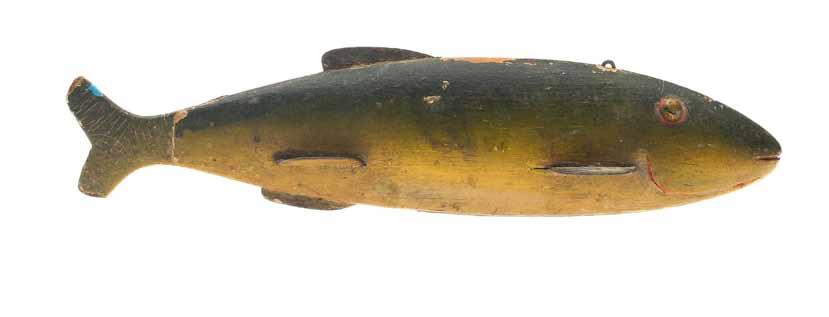
285 Ed Irwin, Lake Chautauqua, New York. Tack eyes with carved gill and mouth. Metal fins and leather tail. Measures 7.5” long. Original paint that has crazed and worn from use; largest portion is near top of back; small spot of blue paint at tail.
Provenance: Private Michigan collection. (4,000 - 6,000)
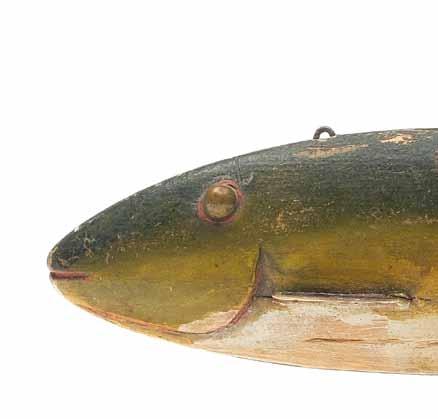
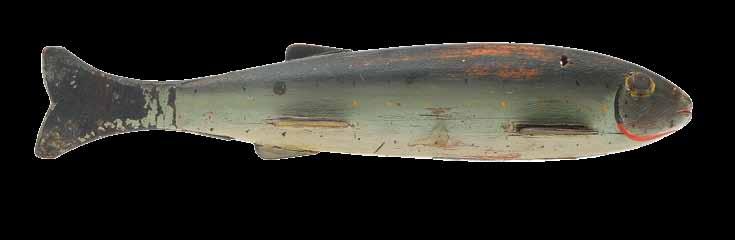
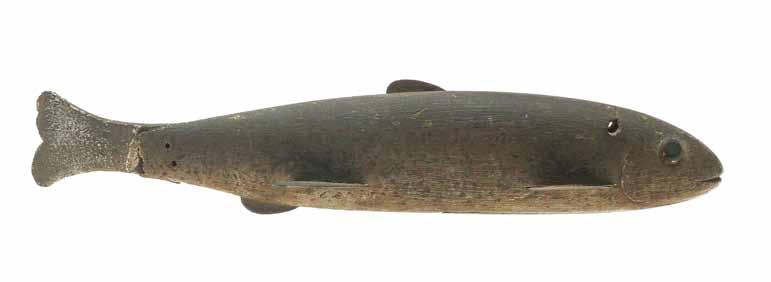
286 Harry Seymour, Bemus Point, New York. Fish decoy. Wonderfully blended sides from dark back to multiple shades of green to white on belly. Carved mouth and gills with tack eyes. Leather fins. Finely placed dots, probably applied with a single horse hair. Measures 7.25” long. Paint flaking at tail; small rubs form light in use wear. (4,000 - 6,000)
287 Ed Irwin, Lake Chautauqua, New York. Brown trout fish decoy, last quarter 19th century. Carved mouth and gills. Tack eyes. Leather tail. Measures 7” long. Original paint with very light in use wear.
(5,000 - 8,000)
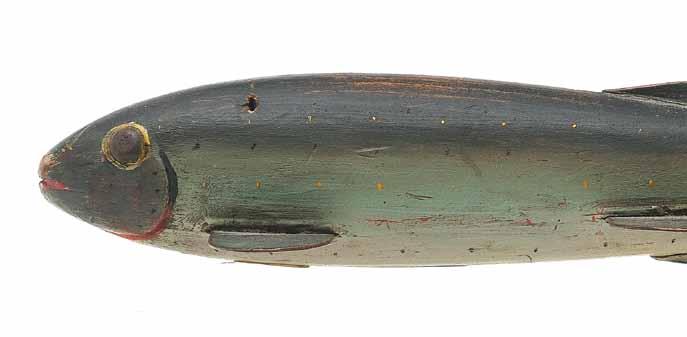
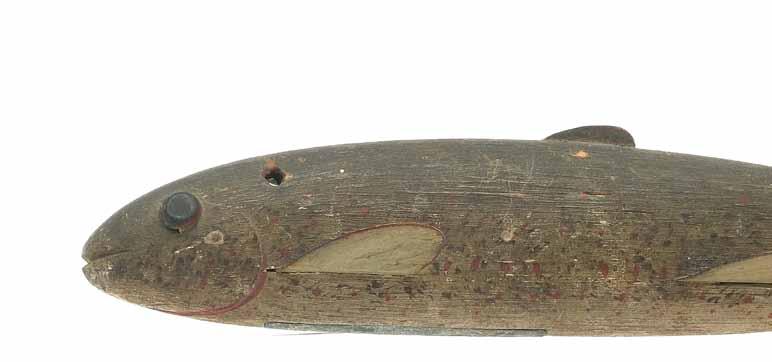
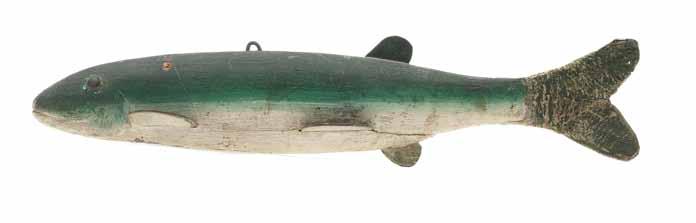
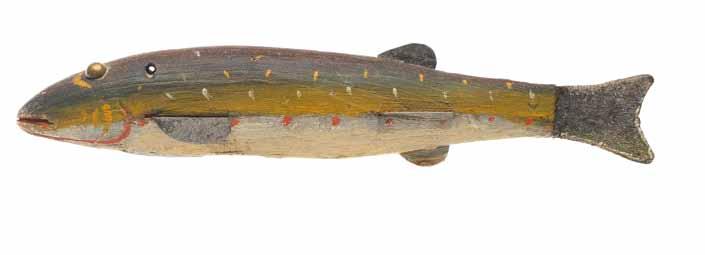
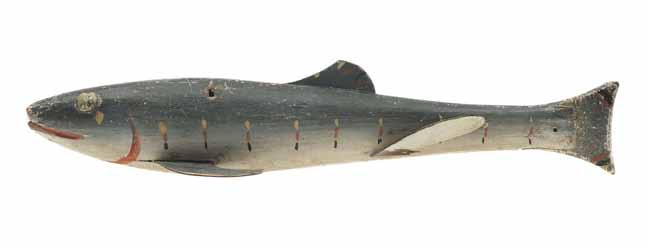
288 Ed Irwin, Lake Chautauqua, New York. Fish decoy, last quarter 19th century. Tack eyes and carved mouth and gill. Leather tail. Measures 7.25” long. Strong original paint; some flaking at leather tail; very light wear on body (5,000 - 8,000)
289 Fish decoy, Lake Chautauqua, New York, last quarter 19th century Tack eyes and carved mouth and gill. Leather tail. Similar to work of Harry Seymour. Measures 7” long. Original paint on body with strengthening coat of white to underside; tail has been broken and reset. (1,500 - 2,500)
290 Fish decoy, Lake Chautauqua, New York, 3rd quarter 19th century. Tack eyes with carved gill, mouth, line tie drilled through back. Leather tail. Measures 7.25” long. Strong original paint with light wear and rubs; a few small spots missing from paint. (1,500 - 2,500)
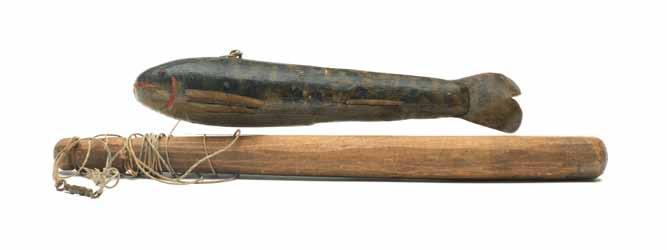
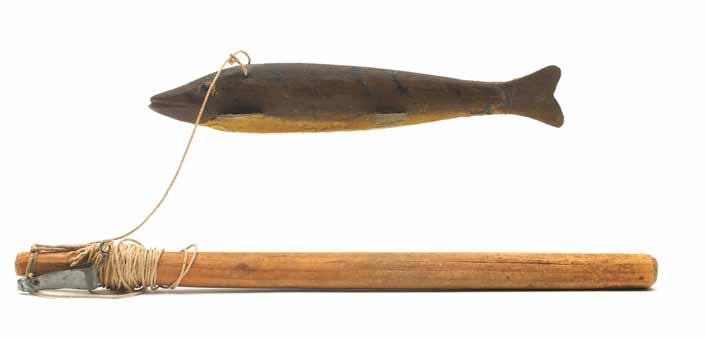
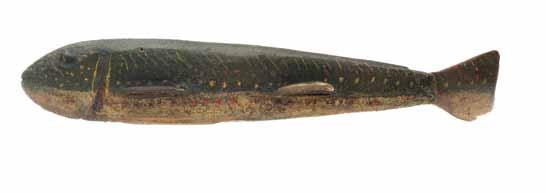
291 Fish decoy, Lake Chautauqua, New York, circa 1900. Possibly a catfish. Carved gills and mouth. Tack eyes. Leather tail. Measures 9” long. Old repaint with tail that has been replaced; restoration where it is attached; retains jig stick.
(500 - 800)
292 Fish decoy, Lake Chautauqua, New York, circa 1900. Perch fish decoy.
Carved mouth. Tack eyes and leather tail. With attached jig stick. Measures 6.5” long. Original paint with some flaking at belly, otherwise very good.
(1,500 - 2,500)
294 Fish decoy, Lake Chautauqua, New York, 2nd half 19th century. Trout fish decoy with tack eyes, carved gills and mouth. Leather tail. Measures 7.75” long. Old paint that appears to be original; lower portion of tail is missing; wear to bare wood on underside below fins.
(800 - 1,200)
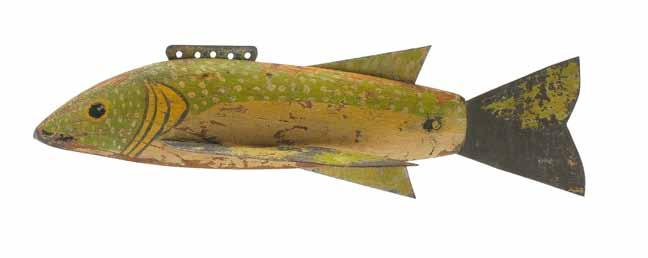
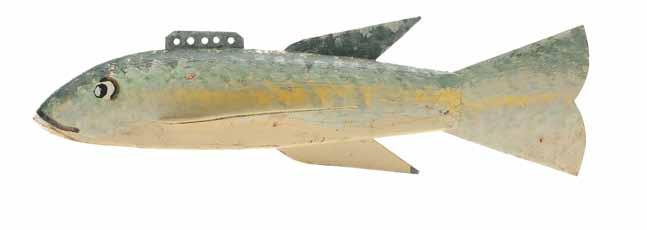
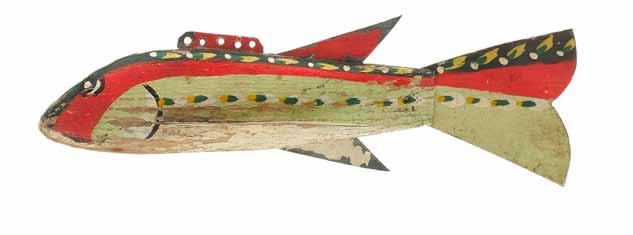
295 William Faue (1878-1950), Hanover, Minnesota. 1st half 20th century. Fish decoy. Measures 6.5” long. Original paint with moderate wear; flaking at fins and evenly throughout body. (800 - 1,200)
296 William Faue (1878-1950), Hanover, Minnesota. Fish decoy. $1.25 cents written on underside of one fin. Measures 7” long. Strong original paint; near excellent condition. (1,200 - 1,800)
297 William Faue (1878-1950), Hanover, Minnesota. Multi-colored trout fish decoy. 1st half 20th century. Measures 5.5” long. Original paint with flaking mostly at lower half of body and around mouth area; some fin paint loss. (800 - 1,200)
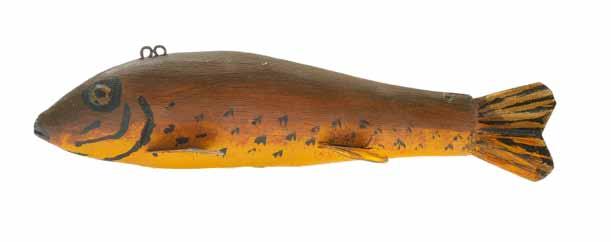
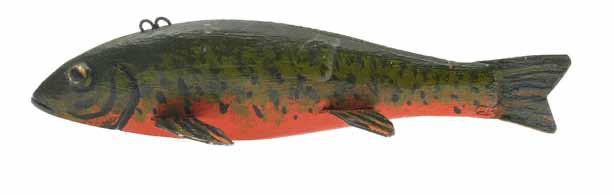
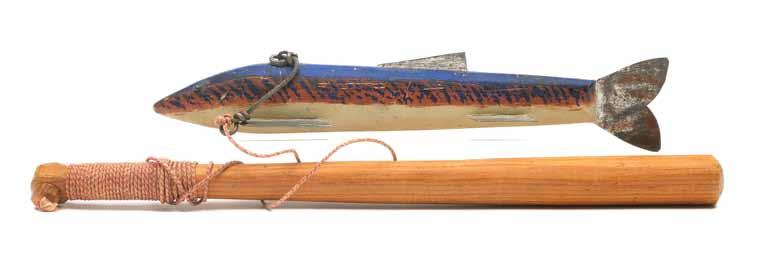
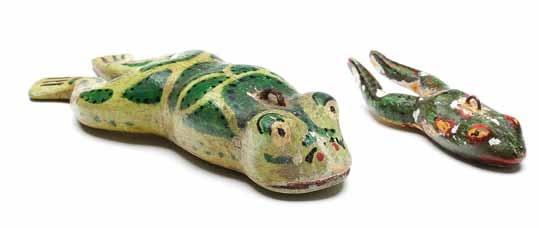
298 John Ryden, Atikin, Minnesota. Trout fish decoy, 1st quarter 20th century. With tack eyes. Measures 7” long. Excellent original paint; near mint. (1,500 - 2,000)
299 John Ryden, Atikin, Minnesota. Trout fish decoy, 1st quarter 20th century. Tack eyes with carved gill. Measures 6.5” long. Excellent original paint, unused condition; small spot of white on one side of body. (1,500 - 2,000)
300 Alfred/Andrew, Helmer, Wisconsin. Trout fish decoy with tack eyes and metal fins. Jig stick included. Measures 7.5” long. Original paint with light in use wear. (400 - 600)
301 Two frog spearing decoys. Both vintage. Largest measures 4”. Original paint with light in use wear; circa 1930-1950. Other measures 2.25” long. Worn original paint with areas of flaking that has exposed bare wood.
Provenance: Private Michigan collection. (500 - 700)
Session Two • Saturday, July 25, 2026 • 10:00am
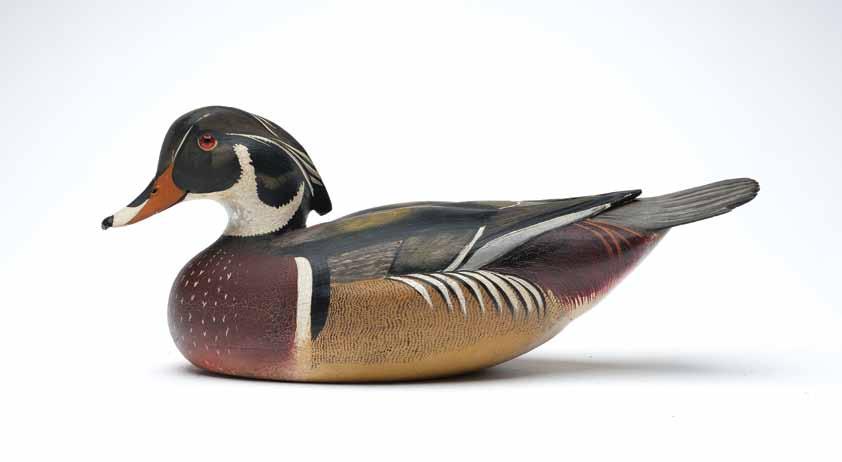
302 Ward Brothers, Crisfield, Maryland. Decorative wood duck. Hollow carved with slightly turned head and extended crest. Relief wingtip and tail feather carving. Signed and dated 1960. “SGH” stamped four times on underside. Decoy was made for Somers Headley. Measures 14.25” long. Tight crazing on red areas of breast and body; otherwise excellent and original.
Provenance: Somers Headley collection. Don Leonard collection. (6,000 - 9,000)
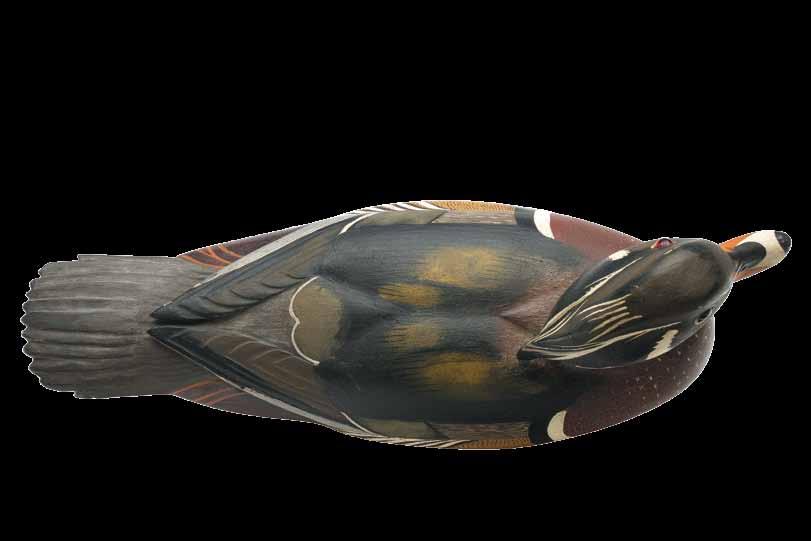
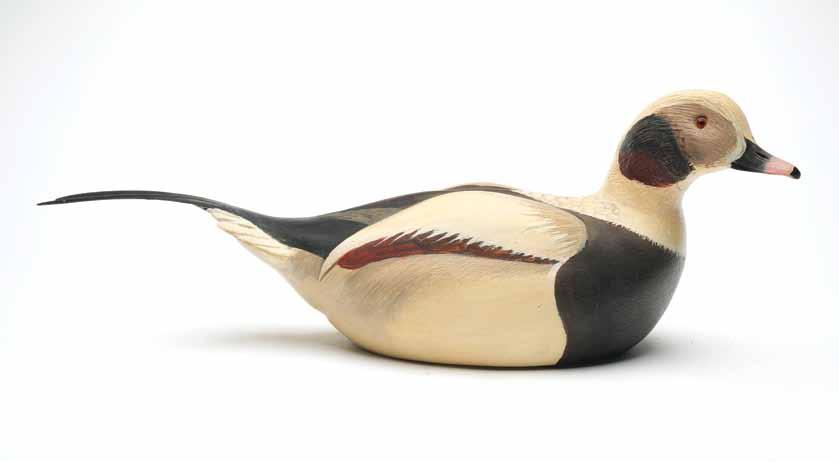
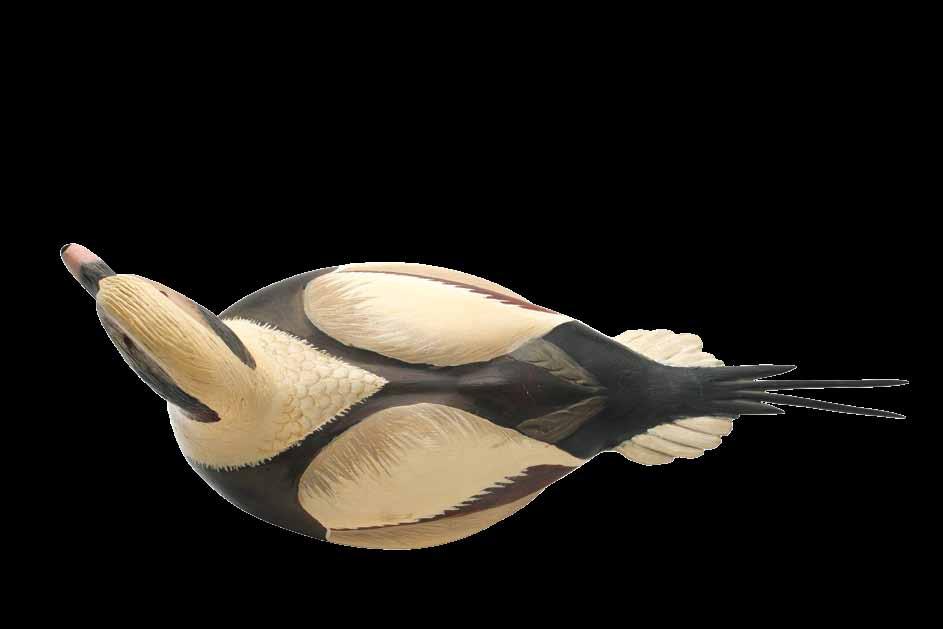
303 Ward Brothers, Crisfield, Maryland.
Decorative long-tail duck. Hollow carved in swimming pose with slightly turned head and deep relief wing carving. Four extended wooden tail sprigs. Signed and dated 1971. Measures 20.5” long. Original paint that has darkened slightly with age; some minor flakes to filler on front of neck were touched up, otherwise near mint.
Provenance: Frederick Raymon collection. (5,000 - 8,000)
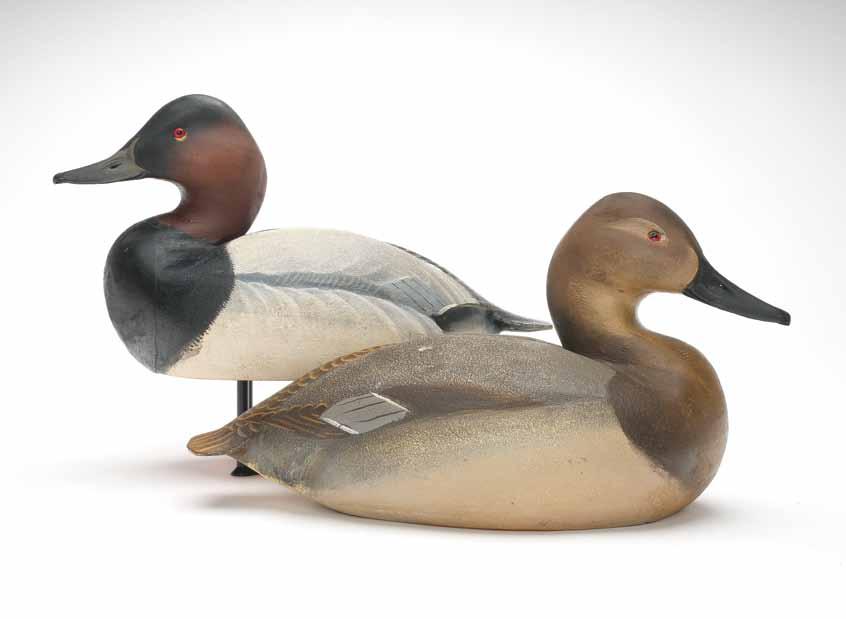
304 Ward Brothers, Crisfield, Maryland. Excellent pair of canvasbacks. Hollow carved open water shooting stool models with reared back, slightly turned heads, and relief wing carving. Signed and dated 1971 on undersides. Measure 16” and 16.5” long. A few very minor rubs and shallow dents, otherwise excellent and original.
(10,000 - 15,000)
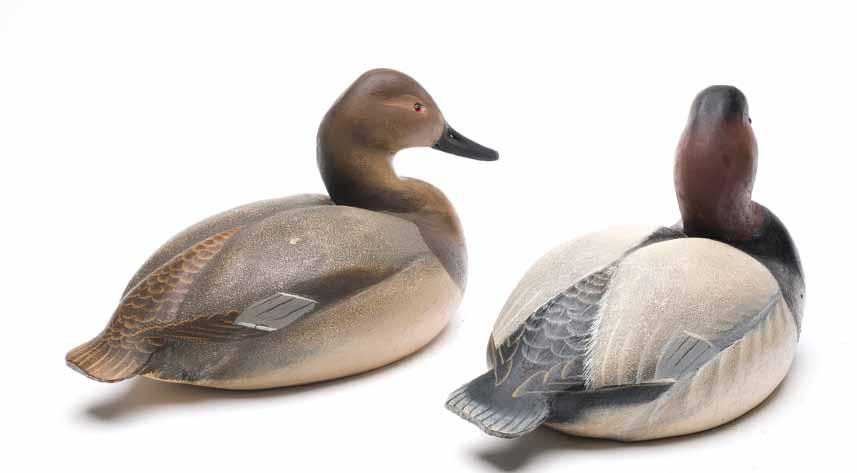
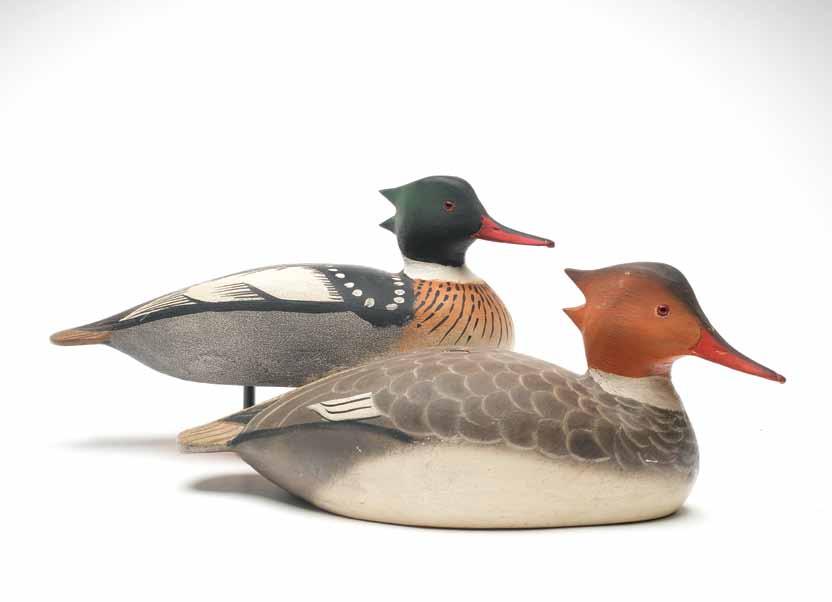
305 Ward Brothers, Crisfield, Maryland. Pair of red-breasted mergansers. Hollow carved shooting stool models with slightly turned heads. Signed and dated 1966 on the unpainted undersides. Measure 15.75” long. Drake is excellent and original; hen with spots of flaking, two knots in back that have separated, hairline crack along back, and separation to filler at back of neck seat.
Provenance: Frederick Raymon collection. (5,000 - 8,000)
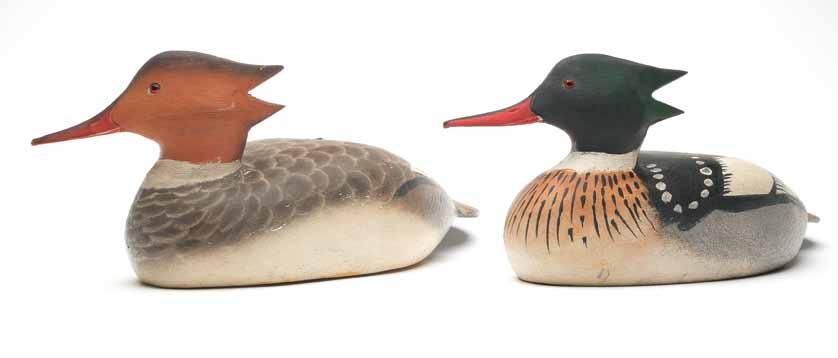
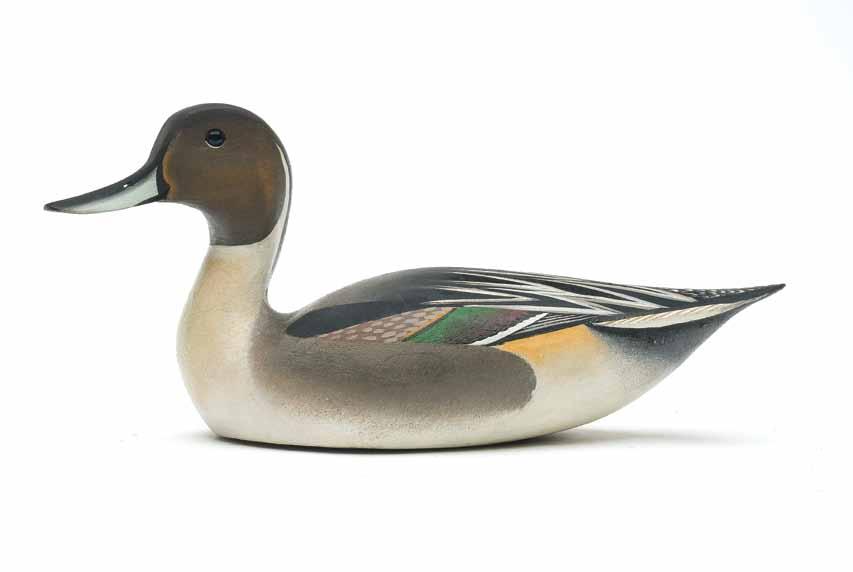
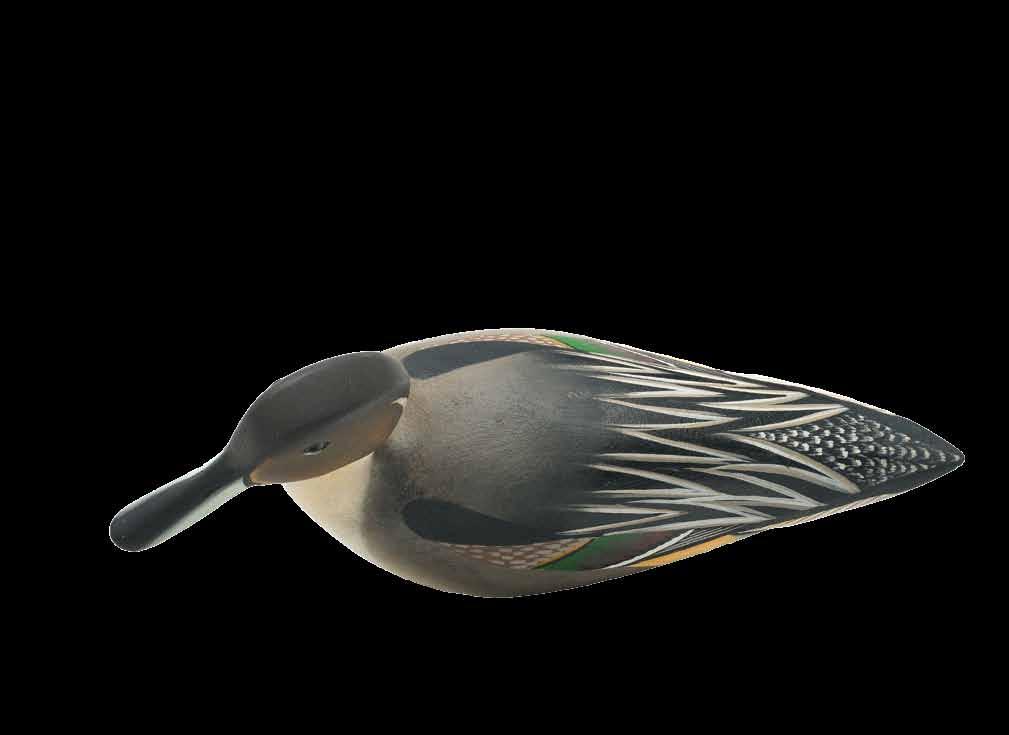
305A Ward Brothers, Crisfield, Maryland. Pintail drake, circa 1940. Made slightly undersized, but in the 1936 model style. Carved from cedar. Slightly turned head. Measures 13” long. Near mint. (6,000 - 9,000)
305B Ward Brothers, Crisfield, Maryland. Snow goose. Rare, hollow carved shooting stool decoy. Slightly turned head. Signed and dated 1966 on underside. Measures 18.75” long. Original paint with minor rubs; wooden keel was removed at some point.
(5,000 - 8,000)
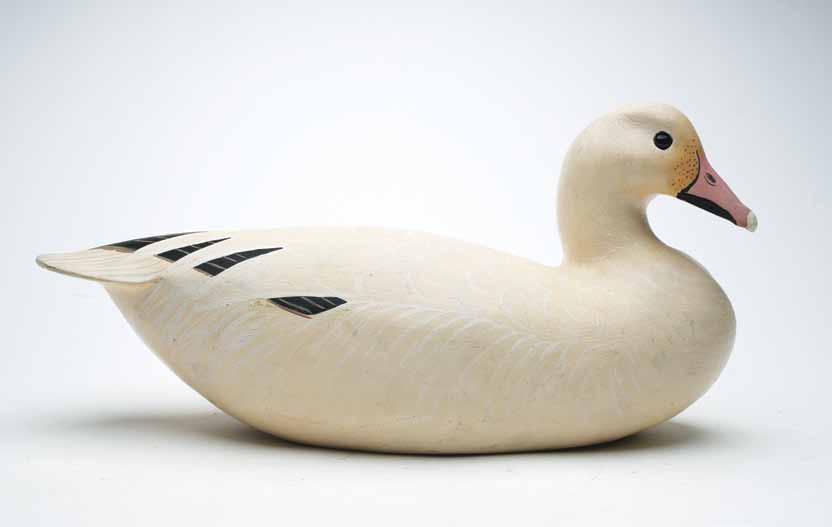
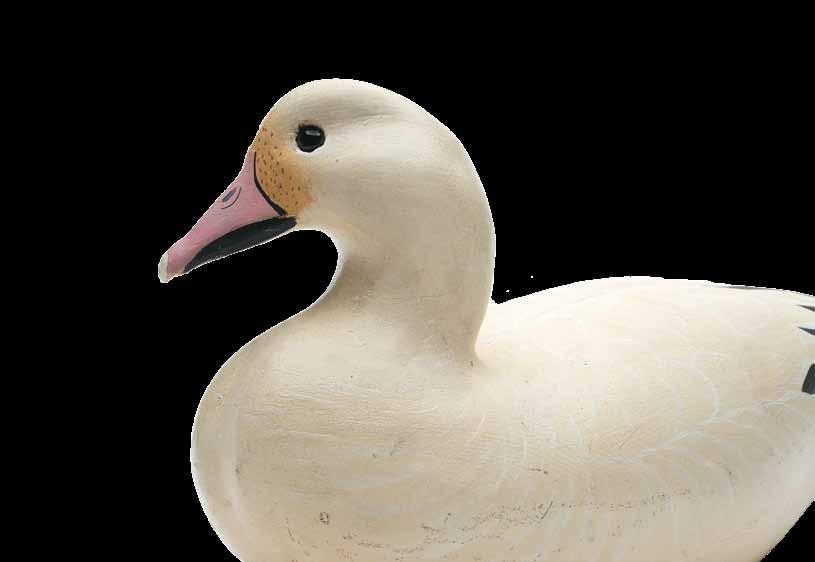
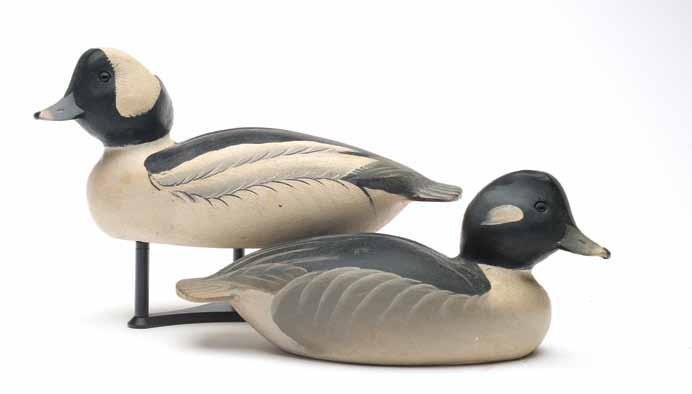
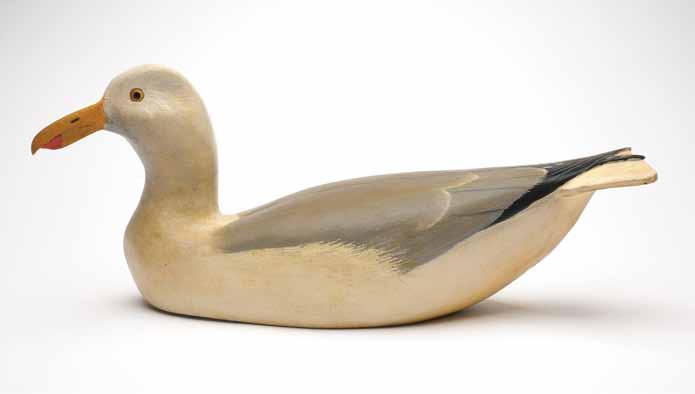
Ward Brothers, Crisfield, Maryland. Pair of buffleheads. Shooting stool models with slightly turned heads. Signed and dated 1966 on undersides. Measure 10.5” and 11.5” long. Very good and original.
Provenance: Frederick Raymon collection. (5,000 - 8,000)
Ward Brothers, Crisfield, Maryland. Gull. Hollow carved shooting stool model with slightly turned head and relief wingtip carving. Signed and dated 1968 on underside. Measures 20” long. Original paint with very minor wear; filled seam along back and tail from when the decoy was made has opened slightly; early coat of varnish has darkened with age. (2,500 - 3,500)
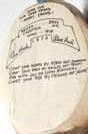
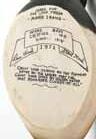
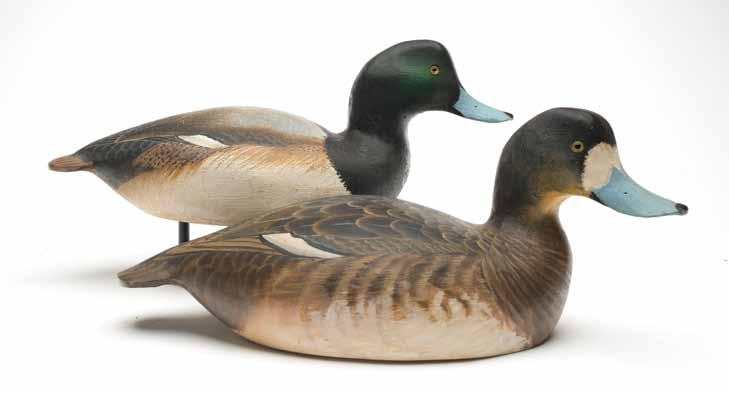
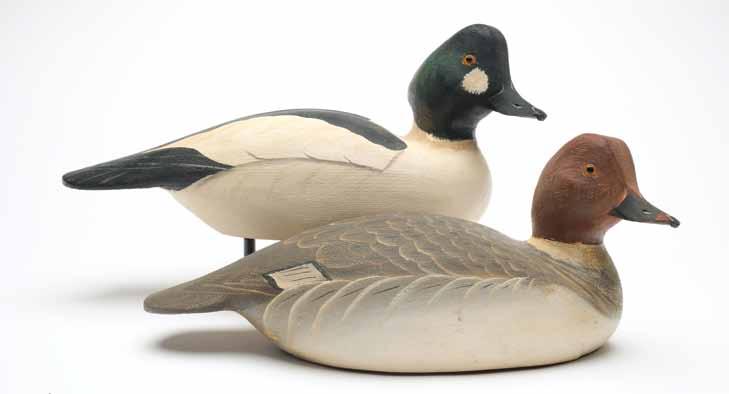
Ward
Maryland. Pair of
Shooting stool models with slightly turned heads and wide bill carving. Signed and dated 1972 on underside. Each with a short poem by the maker on underside. Measure 16” long. Fine hairline crack on one side of hen’s neck seat; otherwise both excellent. (3,000 - 5,000)
Ward Brothers,
Maryland. Pair of goldeneyes. Shooting stool model with slightly turned heads. Signed and dated 1965. Each with a short poem on the underside. Measure 14.5” and 15.5” long. Early touchup around neck seat of drake, tight drying crack along underside of hen, otherwise excellent.
Provenance: Frederick Raymon collection. (3,000 - 5,000)
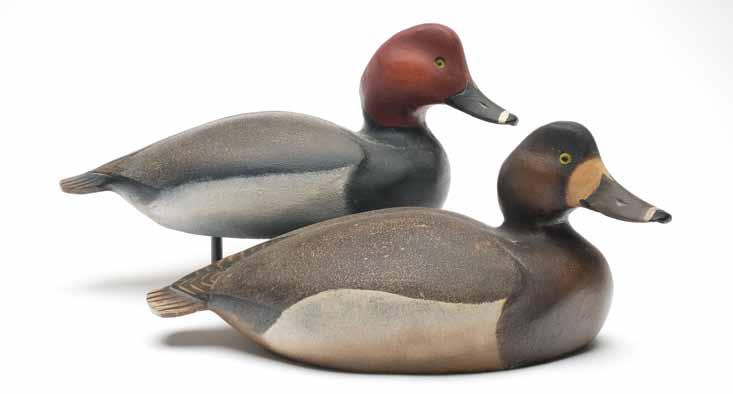
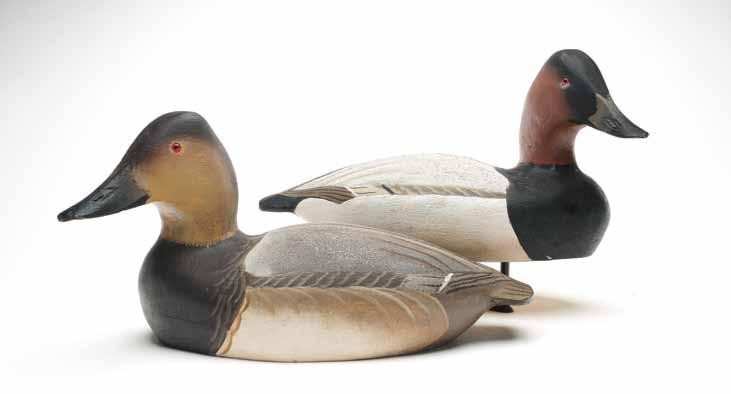
310 Ward Brothers, Crisfield, Maryland. Pair of redheads. Shooting stool models with slightly turned heads. Relief wing carving and thick stipple paint. Signed and dated 1969. Measure 14.5” and 15.5” long. Very good and original.
Provenance: Frederick Raymon collection. (5,000 - 8,000)
311 Ward Brothers, Crisfield, Maryland. Pair of canvasbacks. Shooting stool models with slightly turned heads. Signed and dated 1974. Poem on underside of drake and a short idiom on underside of hen. Measure 16” long. Very good and original. (3,000 - 5,000)
312 Ward Brothers, Crisfield, Maryland.
Pair of bluebills. Shooting stool models with slightly turned heads. Signed and dated 1972. Each with a poem by Lem Ward. Measure 15.5” long. Excellent and original.
Provenance: Frederick Raymon collection. (4,000 - 5,000)
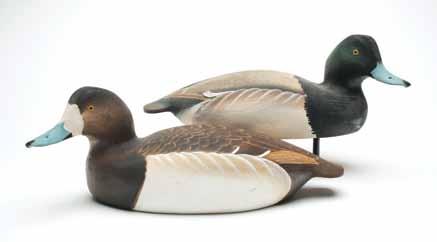
313 Ward Brothers, Crisfield, Maryland. Pair of 1/3 size pintails. Balsa bodies with raised wingtips and slightly turned heads. Both are identified and signed on blue painted undersides. Drake is dated 1960. Measure 10.25” and 8.75” long. Excellent original paint with very minor chipping and paint flakes at tip of drake’s tail and wingtips; tiny spot of touchup to flaking at one of hen’s wingtips. (1,200 - 1,800)
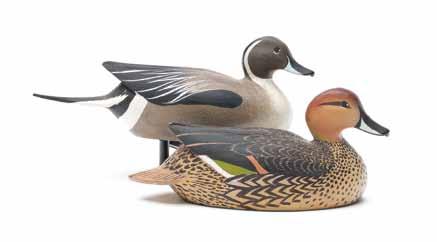
314 Ward Brothers, Crisfield, Maryland.
Pair of 1/3 size mallards. Pine bodies with raised wingtips and slightly turned heads. Identified, signed, and dated 1962 on underside. Measure 8.25” long. Excellent original paint; tiny flake at tip of hen’s bill; dent in top of drake’s head. (1,200 - 1,800)
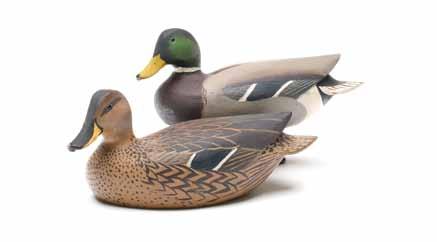
315 Ward Brothers, Crisfield, Maryland. Pair of 1/3 size hooded mergansers. Balsa bodies with slightly turned heads. Signed and dated 1950. “SGH” stamped in underside. Measure 7.75” long. Original paint with very minor wear; excellent structurally. (1,000 - 1,500)
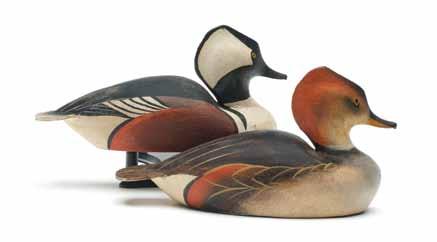
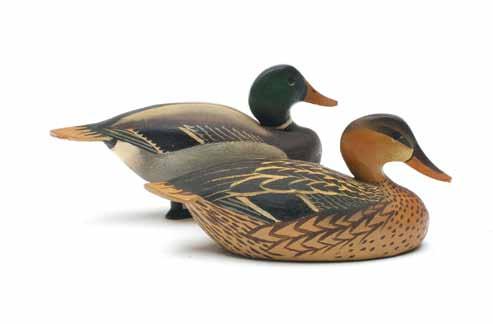
315B Ward Brothers, Crisfield, Maryland. 1/3 size snow goose. Hard balsa body with slightly turned head. Thick stipple paint on back of head and neck. Signed on the underside. Measures 9.5” long. Very good and original.
Provenance: Oliver Smith collection. (800 - 1,200)
315A Ward Brothers, Crisfield, Maryland. Pair of 1/3 size mallards. Balsa bodies with slightly turned heads. Signed on the underside. Measure 8.5” long. Surface has darkened with age, otherwise excellent and original. (800 - 1,200)
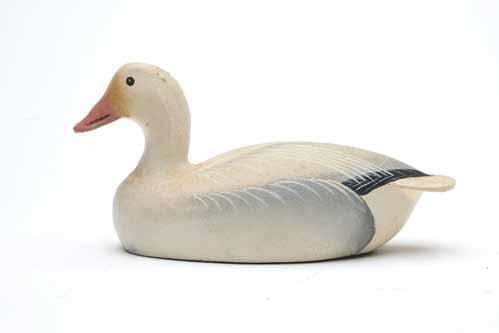
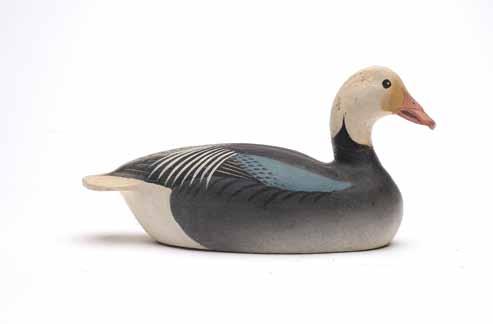
Ward Brothers, Crisfield, Maryland. 1/3 size blue goose. Hard balsa body with slightly turned head. Thick stipple paint on back of head and neck. Signed on the underside. Measures 10” long. Reglued crack through neck; bill was chipped off and reglued with cracks visible.
Provenance: Oliver Smith collection. (800 - 1,200)
315D Ward Brothers, Crisfield, Maryland. Pair of 1/3 size widgeon. Balsa bodies with slightly turned heads. Signed on the underside. Measure 7.25” long. An early coat of varnish has darkened with age; otherwise excellent.
Provenance: Oliver Smith collection. (800 - 1,200)
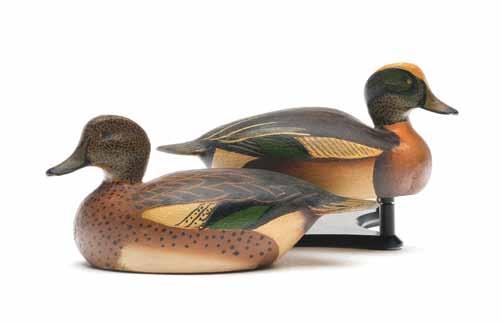
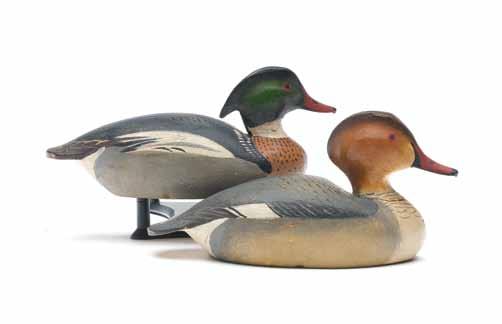
315F Ward Brothers, Crisfield, Maryland. Pair of 1/3 size canvasbacks. Balsa bodies with slightly turned heads and raised wingtips. Identified and signed on the underside. Measure 9” long. Original paint under a thin coat of varnish; minor chipping at wing tips; hairline crack along hen’s bill; small dent in one side of hen’s breast.
Provenance: Oliver Smith collection. (800 - 1,200)
315E Ward Brothers, Crisfield, Maryland. Pair of 1/3 size redbreasted mergansers. Balsa bodies with slightly turned heads. Extended crest carving. Identified on the undersides. Measure 8” long. Original paint under an early coat of varnish that has darkened; small dent near hen’s tail; tight seam and old glue visible at hen’s neck seat; area of restoration near one of drake’s wing patches.
Provenance: Oliver Smith collection. (800 - 1,200)
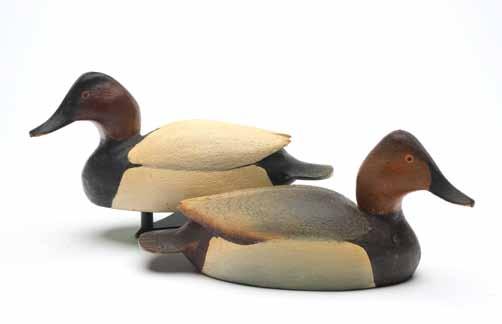
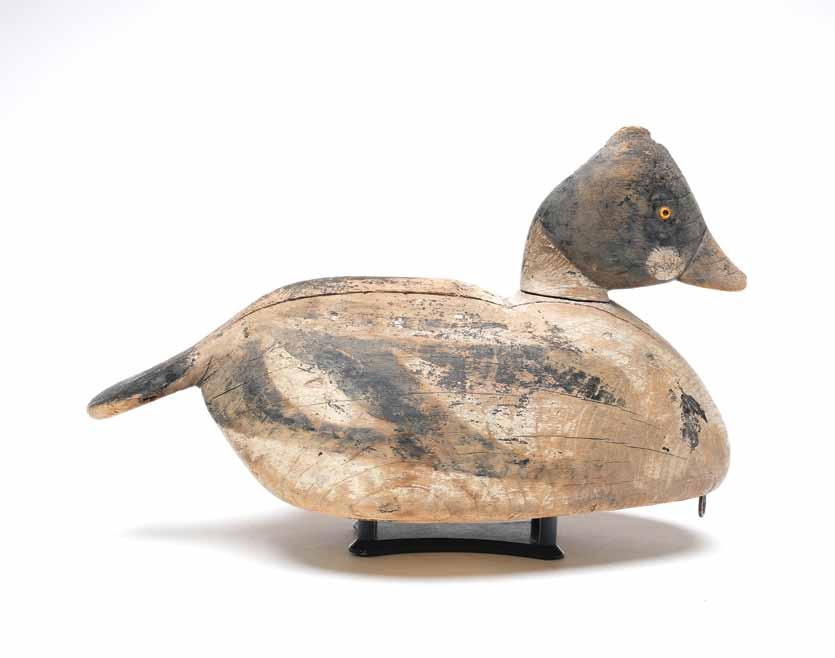
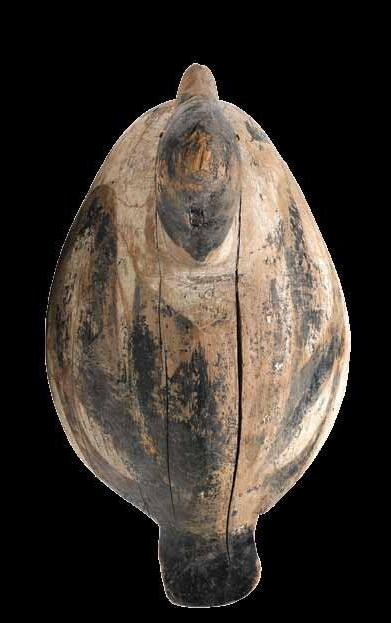
316 Noah Sterling (1884-1954), Crisfield, Maryland. Rare and important early goldeneye. Wide body with sloped breast and wide paddle tail. Measures 15.5” long. Very worn paint appears to be mostly original; some remnants of gray overpaint to lower sides and breast area that have mostly flaked away; many drying cracks in body and head; old chip in underside of bill and one side of tail.
Provenance: Don Leonard collection. (8,000 - 12,000)
1880 - 1964 | Crisfield, Maryland
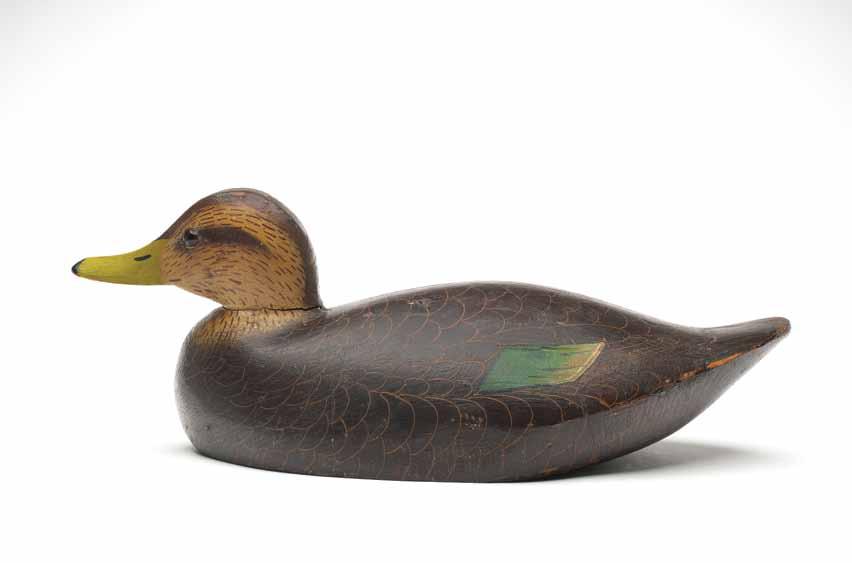
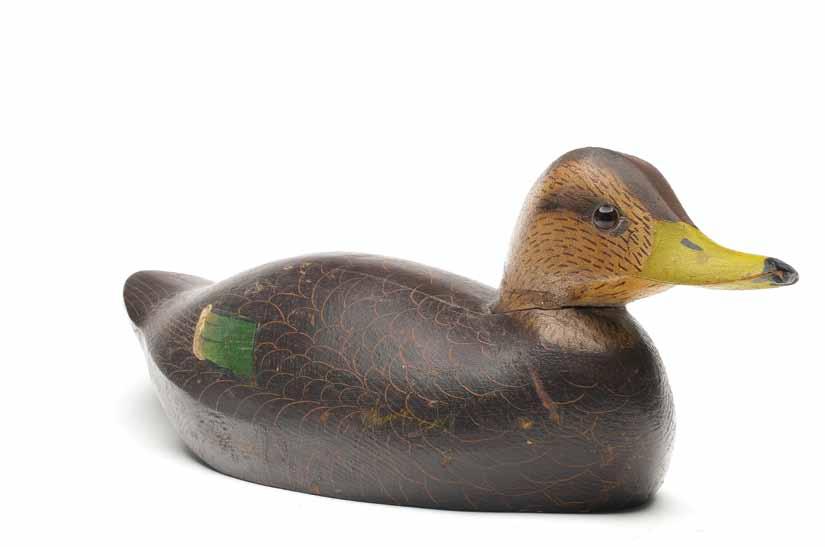
317 Lloyd Sterling (1880 - 1964), Crisfield, Maryland. Lowhead black duck. Scratch feather paint detail and large glass eyes. Measures 17.25” long. Original paint with very minor wear; split along back and tail was filled and touched up; slight separation at neck seat; filler restoration on one side of neck seat. (4,000 - 6,000)
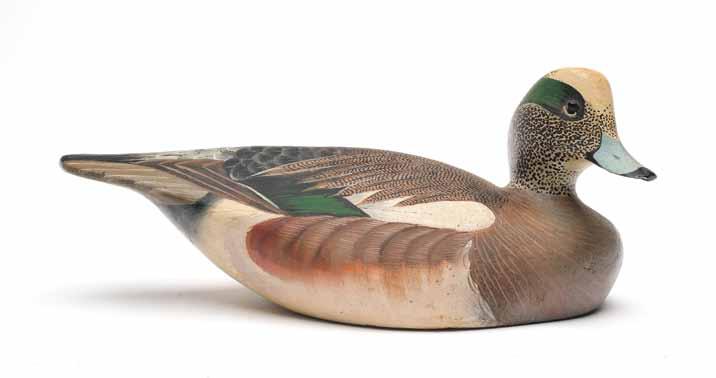
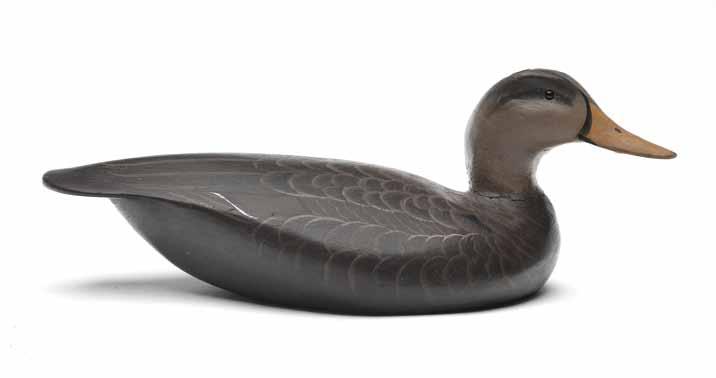
Ward Brothers, Crisfield, Maryland. Widgeon. Circa 1937 with turned head and fancy paint detail. Decoy was repainted by the Ward Brothers in 1967 and signed and dated at that time. Measures 14” long. Very appealing repaint by the Wards; a few shallow dents; tight drying crack along underside; later head by the Wards from when the decoy was repainted. (2,000 - 3,000)
319 Ward Brothers, Crisfield, Maryland. 1936 style black duck. Slightly turned head. Part of underside was planed down and signed and dated 1936 by the makers. Measures 17” long. Paint was restored in the 1970s by the Ward Brothers; slight separation at neck seat; bill was cracked down and tightly reset. (1,200 - 1,800)
320 Travis Ward (1864-1926), Crisfield, Maryland. Early Canada goose. Scratch feather paint detail and head turned 45 degrees. Typical large tack eyes. Measures 24” long. Original paint with significant flaking and wear; many tight drying cracks along body; nails added at neck seat; some old over paint to black on neck and head was sanded off of much of the neck with some repairs at base of neck.
Provenance: Oliver Smith collection. (2,000 - 4,000)
321 Lloyd Tyler (1898-1971), Crisfield, Maryland. Early widgeon. Head is slightly raised. Measures 17” long. Original paint with significant wear; second coat to white areas; chipping and roughness on tail and lower edge of body; vertical cracks in neck; small chip at tip of bill.
Provenance: Oliver Smith collection. (800 - 1,200)
322 Lloyd Tyler (1898-1971), Crisfield, Maryland. Large pintail. Slightly turned head. Measures 22.5” long. Original paint with moderate flaking and wear; professional neck crack repair with touchup in that area; drying cracks along the underside.
Provenance: Oliver Smith collection. (1,200 - 1,800)
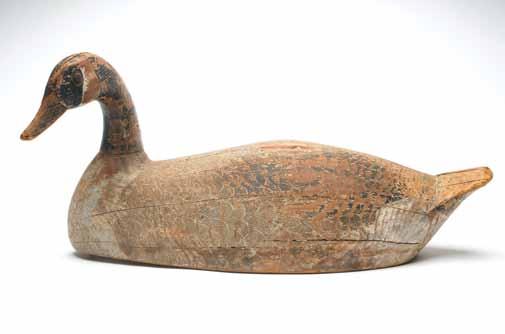
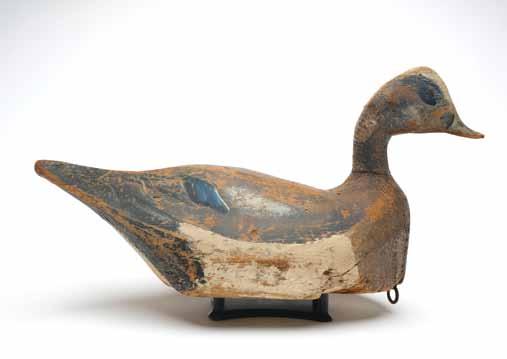
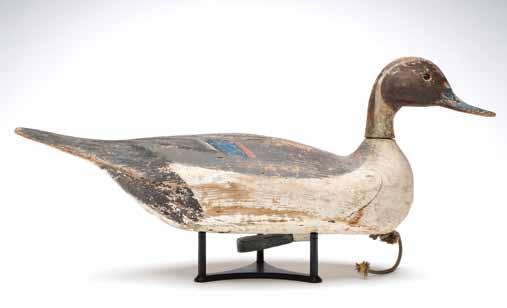
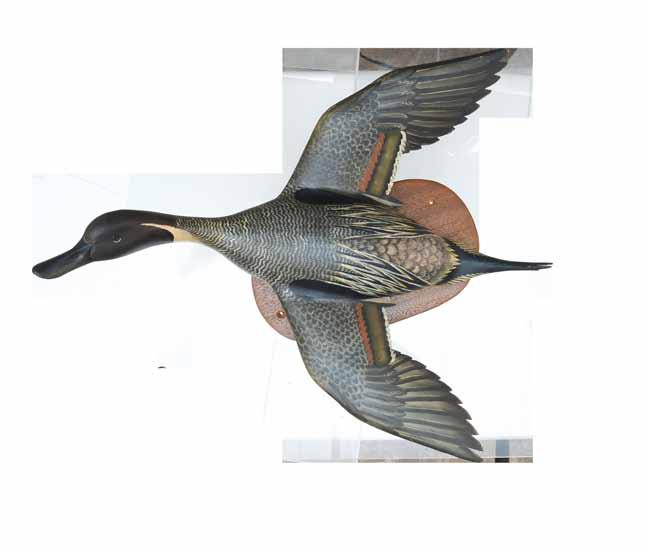
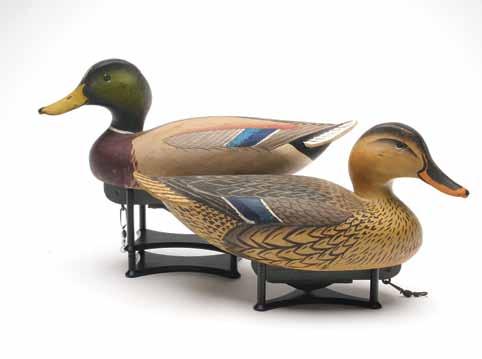
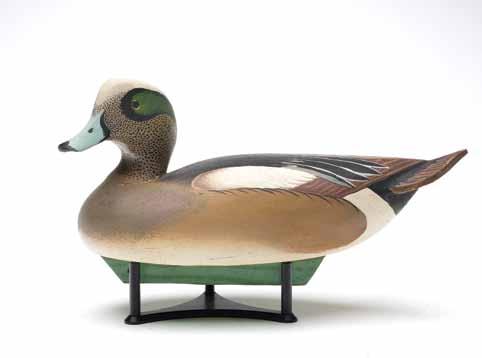
323 Oliver Lawson (b.1938), Crisfield, Maryland. Excellent flying pintail. Signed and dated 1959 at a later date on back of plaque. Balsa body and wings with excellent paint detail. Measures 22” long, with a 19.5” wingspan. Chip in one tail sprig was reglued off center; an older chip of both tail sprigs were professionally reset with touchup. (3,000 - 4,000)
324 Oliver Lawson (b.1938), Crisfield, Maryland. Early working pair of mallards. Balsa body with slightly turned head and inserted cedar tail. Signed and dated 1957 on underside. Measures 15.25” and 16” long. Original paint with very minor gunning wear; drake has reglued crack through neck; small dents in bodies, otherwise structurally good.
Provenance: Oliver Smith collection. (2,500 - 3,500)
325 Oliver Lawson (b.1938), Crisfield, Maryland. Early working widgeon. Balsa body with slightly turned head and inserted cedar tail. Signed and dated 1963 at a later date. Measures 14.25” long. Minor flaking and separation at neck seat, otherwise excellent and original.
Provenance: Oliver Smith collection. (2,500 - 3,500)
326 Oliver Lawson (b.1938), Crisfield, Maryland. Early working black duck. Balsa body with slightly turned head and inserted cedar tail. Signed and dated 1957. Measures 16” long. Original paint with very minor wear; a few very shallow dents on one lower side; otherwise very good structurally.
Provenance: Oliver Smith collection. (1,500 - 2,500)
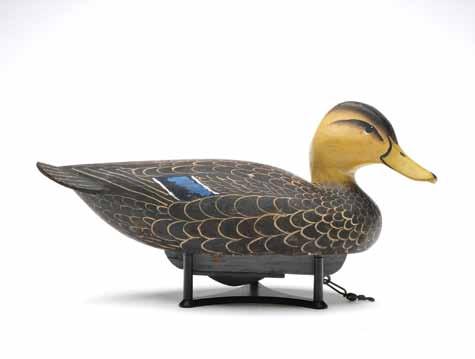
327 Oliver Lawson (b.1938), Crisfield, Maryland. Shoveler pair. Both signed and dated 1981. Measure 15” long. Near mint. (1,000 - 1,500)
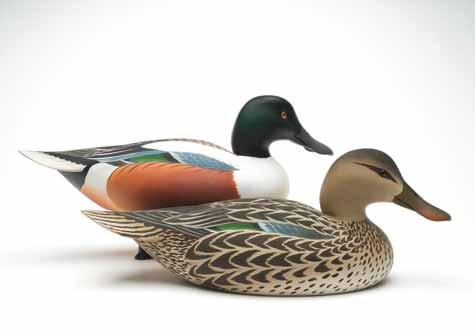
328 Oliver Lawson (b.1938), Crisfield, Maryland. Pair of canvasbacks with turned heads and great stipple painting. Signed and dated 1985 with “L” carved in underside. Drake measures 15”. Original paint; tight crack in drake’s back; otherwise excellent.
Provenance: Frederick Raymon collection. (1,000 - 1,500)
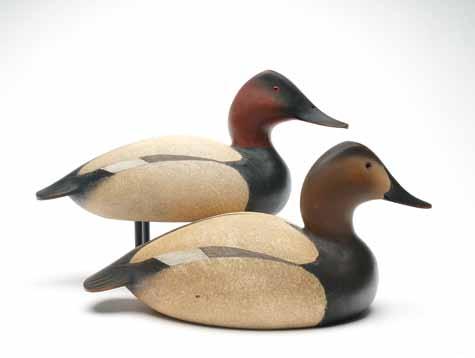
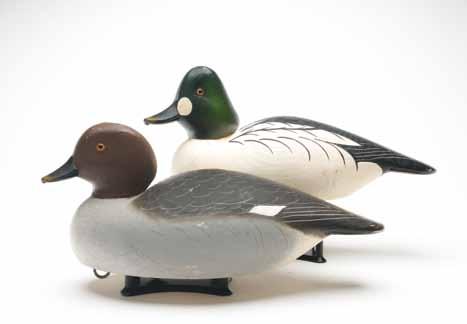
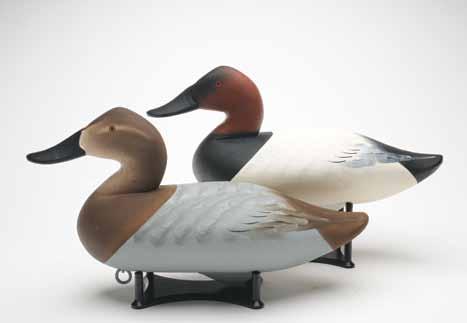
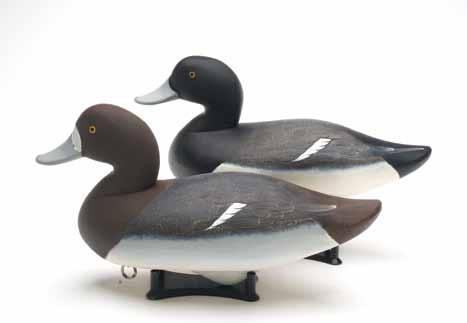
329 Charlie Joiner (1921-2015), Chestertown, Maryland. Pair of goldeneye. Flat bottom style with slightly turned heads. Signed and dated 1967. Measure 15” long. Original paint with very minor gunning wear; hairline crack in each of drake’s eyes; small spot of touchup at a separation to knot in one side of neck seat.
(1,000 - 1,500)
330 Charlie Joiner (1921-2015), Chestertown, Maryland. Pair of canvasbacks. Measure 16” long. Small dent on one side of drake; and a small loss to wood at a knot on the other side of drake from when the decoy was made, otherwise excellent.
(800 - 1,200)
331 Charlie Joiner (1921-2015), Chestertown, Maryland. Pair of bluebills. Thick stipple paint on backs. Measure 14.5” long. Near mint.
(800 - 1,200)
332 Charlie Joiner (1921-2015), Chestertown, Maryland. Pair of miniature goldeneye. Balsa body with slightly turned heads and raised wingtips. Identified, signed, and dated 1962. Measure 7.75” long. Tiny spot of roughness was touched up at drake’s wingtip, otherwise near mint.
(1,000 - 1,400)
333 Charlie Joiner (1921-2015), Chestertown, Maryland. Pair of miniature bluebills. Balsa body with slightly turned heads and raised wingtips. Identified, signed, and dated 1962. Measure 7.75” long. Tiny chips at wingtips that were touched up; small amount of touchup to flaking at hen’s tail. (800 - 1,200)
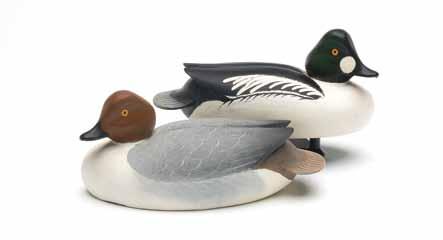
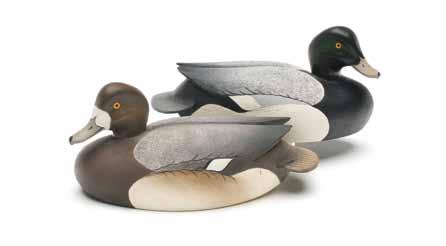
334 Charlie Joiner (1921-2015), Chestertown, Maryland. Pair of miniature canvasbacks. Balsa body with slightly turned heads and raised wingtips. Maker’s early ink stamp on underside. Measure 9” long. Drake is excellent and original; hen has a few shallow dents and minor blunting at wingtips. (800 - 1,200)
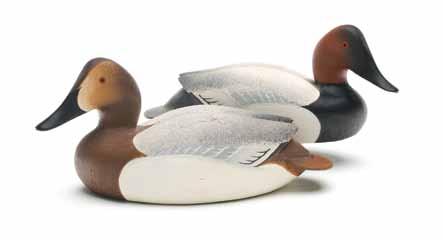
335 Charlie Joiner (1921-2015), Chestertown, Maryland. Miniature Canada goose. Balsa body with slightly turned head. Identified, signed, and dated 1962. Measures 8.5” long. Original paint with no wear; some touchup and filler at base of neck; and fine hairline cracks at neck seat.
(500 - 800)
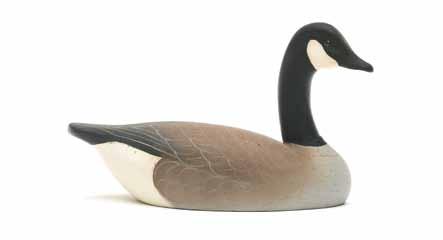
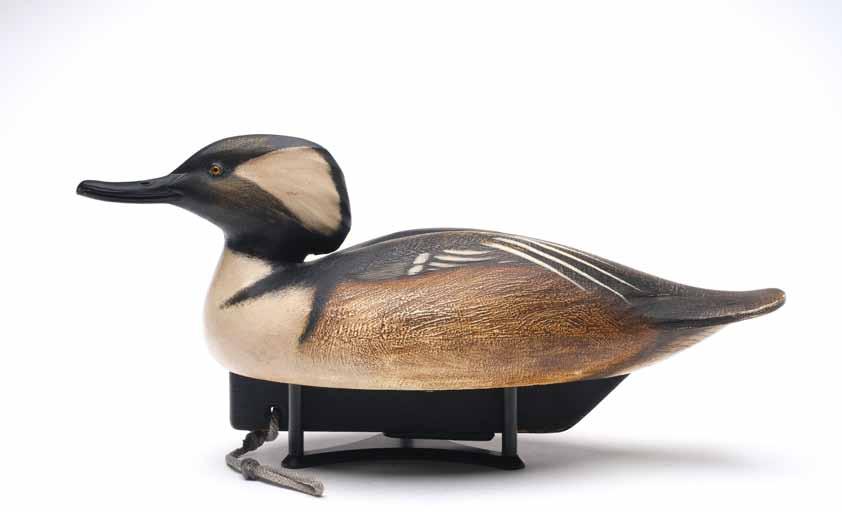
335A Jim Schmiedlin (1945-2015), Bradfordwoods, Pennsylvania. Hooded merganser. Hollow carved with slightly turned head and extended crest. Relief wingtip carving. Maker’s Reward for Return label and “JAS” brand on underside. Dated 10/90. Measures 17.25” long. Original paint with minor gunning wear; very good structurally. (5,000 - 8,000)
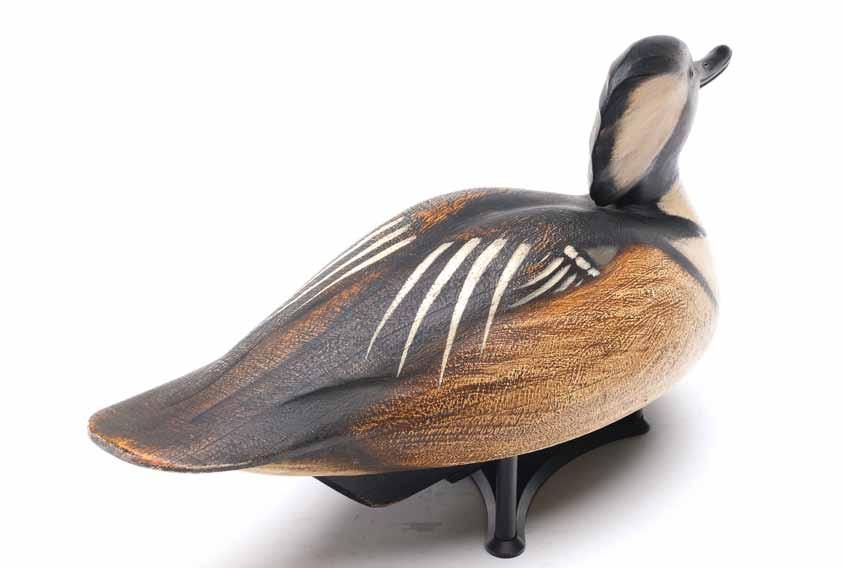
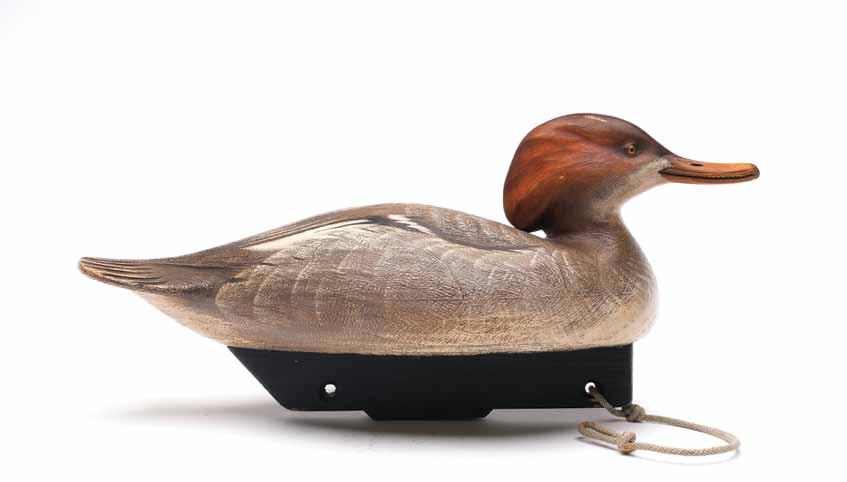
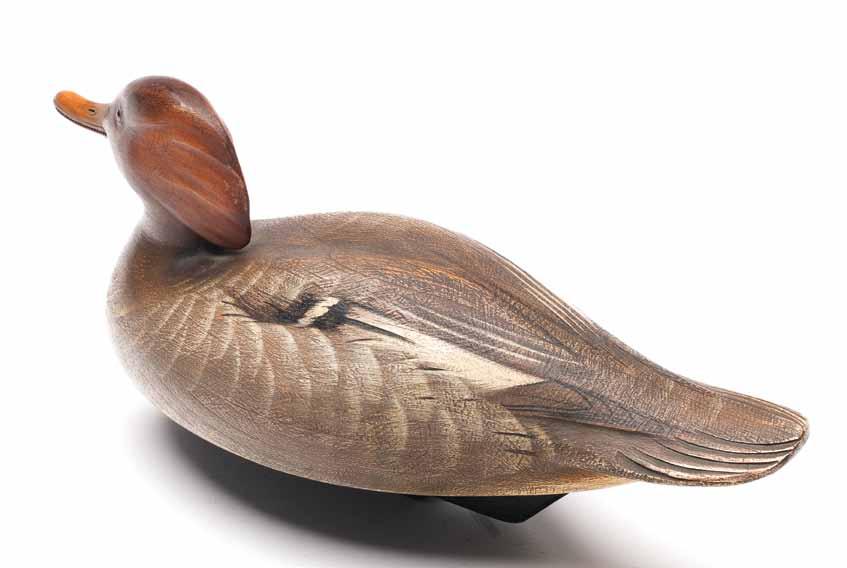
336 Jim Schmiedlin (1945-2015), Bradfordwoods, Pennsylvania. Hooded merganser hen. Hollow carved with slightly turned head and extended crest. Relief wingtip and tail feather carving. Maker’s Reward for Return label and “JAS” brand on underside. Dated 10/90. Measures 16.75” long. Original paint with minor gunning wear; excellent structurally. (5,000 - 8,000)
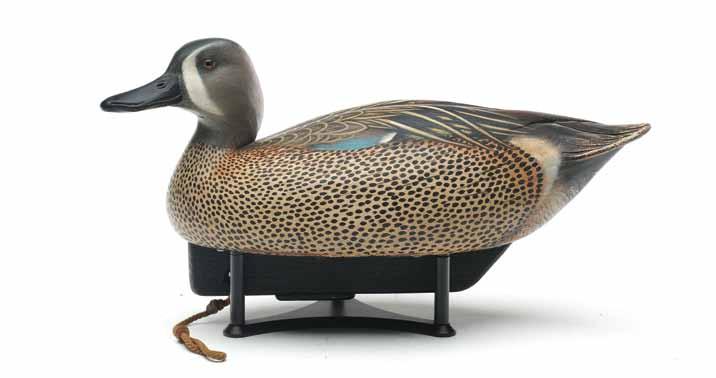
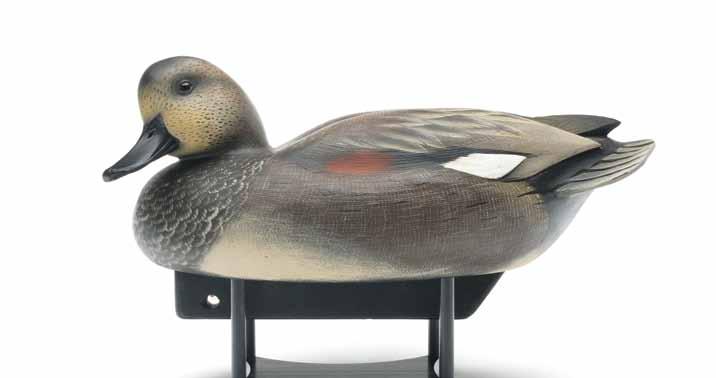
337 Jim Schmiedlin (1945-2015), Bradfordwoods, Pennsylvania. Bluewing teal. Hollow carved with slightly turned head and relief feather carving. Maker’s Reward for Return label and “JAS” brand on underside. Dated 10/88. Measures 14.25” long. Original paint with very minor wear; excellent structurally. (5,000 - 8,000)
338 Jim Schmiedlin (1945-2015), Bradfordwoods, Pennsylvania. Gadwall. Head is tucked and slightly turned. Deep relief wingtip and tail feather carving. “JAS” brand and Schmiedlin collection ink stamp on underside. Identified, signed, and dated 1983. Measures 14” long. Near mint. (3,000 - 5,000)
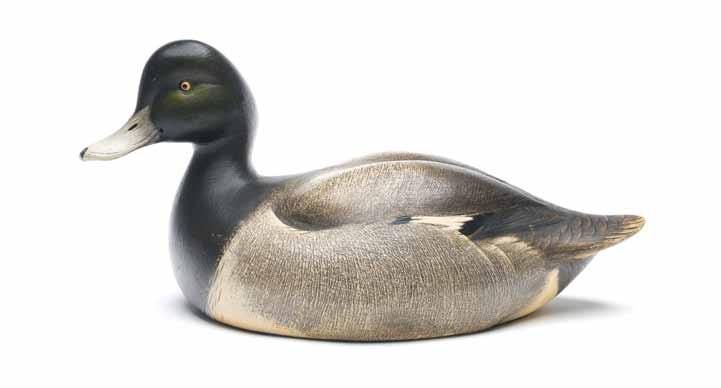
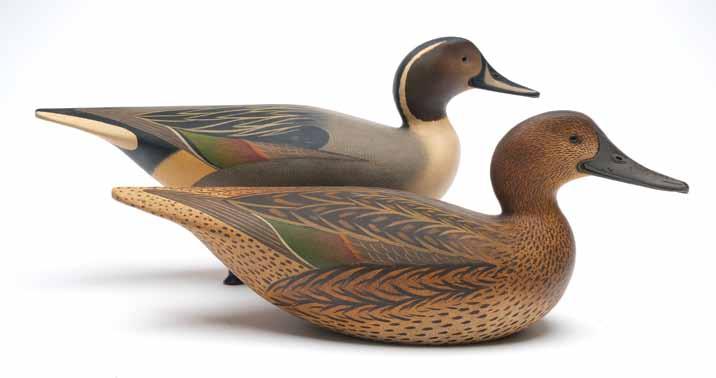
339 Jim Schmiedlin (1945-2015), Bradfordwoods, Pennsylvania. Bluebill. Hollow carved with slightly turned head and relief wingtip carving. Maker’s Reward for Return label and “JAS” brand on underside. Also with Schmiedlin Collection ink stamp on underside. Dated 2011. Keel was removed. Measures 14.75” long. Original paint with very minor rubs; hairline crack through neck; small amount of flaking on one side. (2,500 - 3,500)
340 Leo McIntosh (1953-2007), Adams, New York. Excellent pair of pintails. Slightly turned heads with very detailed bill carving and comb feather paint detail on drake. Signed and dated 1995 on undersides. Measure 16.25” and 17.5” long. Near mint. (2,500 - 3,500)
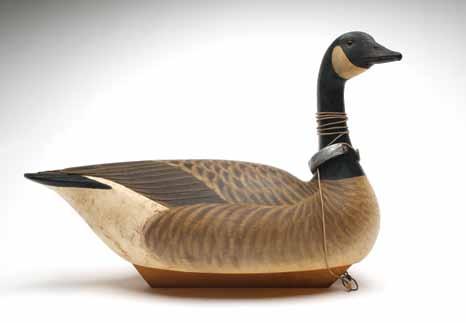
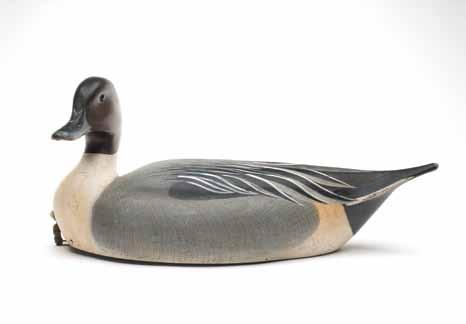
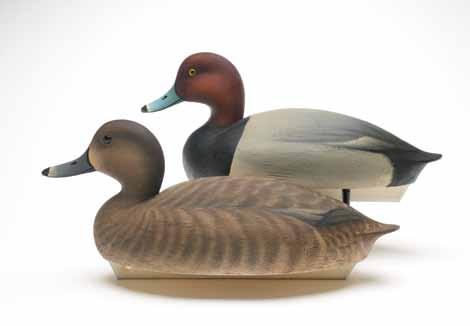
341 Marty Hanson (b. 1965), Hayward, Wisconsin. Canada goose. Hollow carved with slightly turned high head pose. Relief wingtip carving. Maker’s ink stamp and signature on underside. Measures 22.5” long. Minor discoloration to white under tail, otherwise excellent and original.
Provenance: Dr. Michael Shannahan collection. (1,200 - 1,800)
342 Marty Hanson (b. 1965), Hayward, Wisconsin. Pintail. Hollow carved with head turned 90 degrees. Maker’s ink stamp on underside. Measures 17.5” long. Original paint with minor gunning wear; slight separation at a small knot in lower breast; otherwise excellent structurally. (600 - 900)
343 Marty Hanson (b. 1965), Hayward, Wisconsin. Pair of redheads. Solid body with slight relief wingtip carving. Signed and dated 1994. Also with maker’s ink stamp on underside. Measure 15” long. Excellent and original. (800 - 1,200)
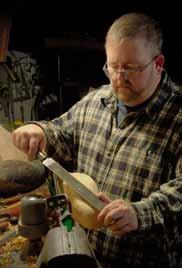
Rich Moretz is a carver from Maryland whose work is grounded in the waterfowling and folk art traditions of the Chesapeake Bay. He’s been drawing inspiration from the historic decoy makers, bird carvers, and folk artists of the region for decades, ever since he started carving at age twelve. Rich has developed a style that blends traditional craftsmanship with his own artistic vision. Created with traditional hand tools and artist oils, his work includes waterfowl carvings, relief carvings, and bird sculptures that honor the natural world and the rich traditions of American folk art. Whether working in relief or in the round, Rich attempts to produce work that is interesting in form and that alludes to the enduring appeal of hand-crafted American folk art.
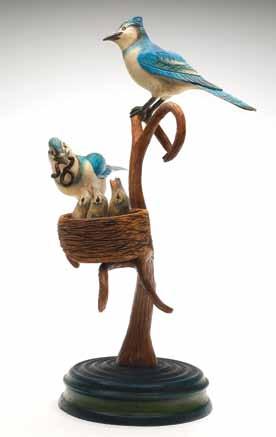
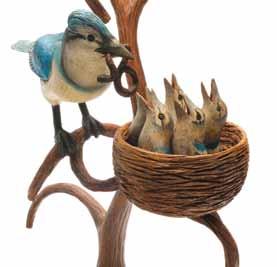
344 Rich Moretz (b.1976), Havre de Grace, Maryland. Whimsical bird tree carving with pair of blue jays in bent wood tree. Feeding a nest of five young jays. Mounted to decorative turned base with “RM” carved in underside. Stands 20” tall. Excellent and original. (1,200 - 1,800)

(1,200 - 1,800)
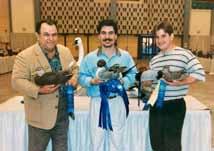
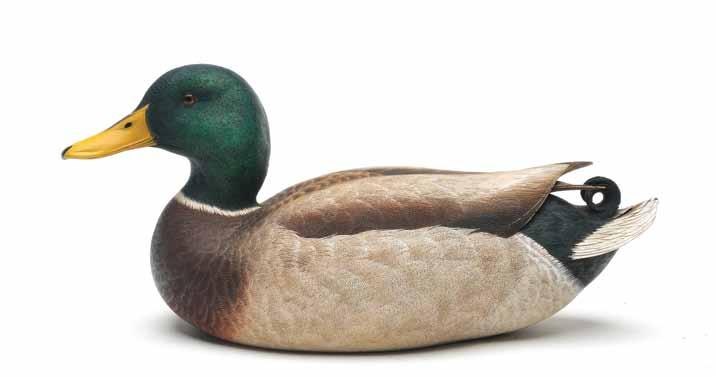
Tan, Jett, and Jude Brunet at the Ward World Championship in 1994, Ocean City, Maryland.
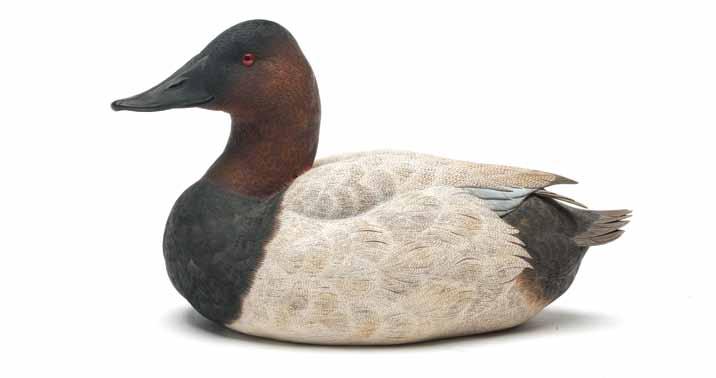
346 Tan Brunet (1938-2019), Galliano, Louisiana. Mallard drake. Signed on underside “Merry Christmas. Beryl Anthony Sr. from Beryl Jr. by Tan Brunet. 12/25/86.” Raised, carved crossed wingtips with carved curlycue tail. Surface is textured to create a soft realistic look. Head is slightly turned. Remains excellent.
Provenance: Retains ribbon for 2nd in marsh duck open class, 1987, Ocean City. (6,000 - 9,000)
347 Jett Brunet (b.1964), Galliano, Louisiana. Canvasback drake. Signed and dated 10/7/84 on underside. Turned head with crossed raised wingtips. Extended tail. Feather carved to create a soft texture. Measures 13.5” long. Remains excellent and original.
Provenance: Retains ribbon for 2nd in show decorative life size floating waterfowl open class, 1987. (4,000 - 6,000)
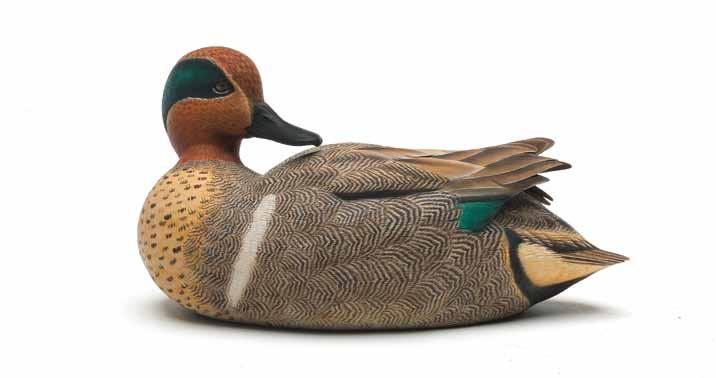
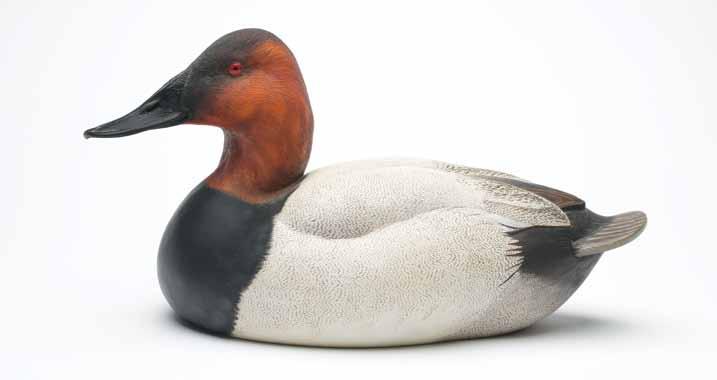
348 Jude Brunet (b.1969), Galliano, Louisiana. Greenwing teal with turned preening posture. Raised wings and delicately carved tail. Surface is feather carved to create a soft texture. Underside reads “2000. Louisiana duck stamp edition.”
Signed “Jude Brunet. Ducks Unlimited 15/15. event Merhaanides original.” Near mint. (4,000 - 6,000)
349 Tan Brunet (1938-2019), Galliano, Louisiana. Decorative canvasback. Deep relief wing carving and raised wingtips. Slightly turned head with excellent bill and feather carving. Inscription on underside for the collection of Fred Raymon and dated 9/15/1989. Measures 13.5” long. Near mint.
Provenance: Frederick Raymon collection. (3,000 - 5,000)
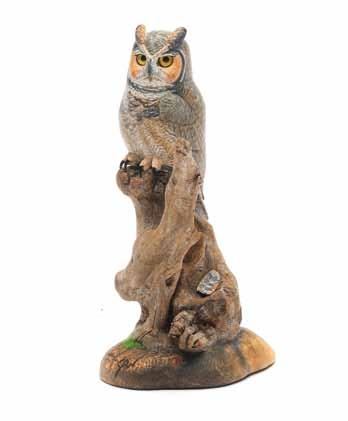
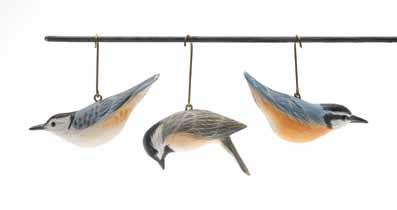
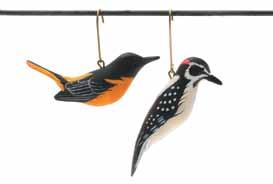
350 Steve Weaver (b.1950), Cape Cod, Massachusetts. Miniature great horned owl. Slightly turned head and deep relief wing carving. Maker’s initials carved in base. Identified, signed, and titled “In the Still of the Night” on the underside. Measures 8” tall including base. Very good and original. (3,000 - 5,000)
351 Steve Weaver (b.1950), Cape Cod, Massachusetts. One of approximately 8 sets of carved Christmas tree ornament birds. Different species with brass hanging hooks. Many with dropped wing carving. All initialed and dated with the year that that bird was gifted. Measure from 2.25” to 3.5” long. A few tiny paint rubs, otherwise excellent and original. (3,000 - 5,000)
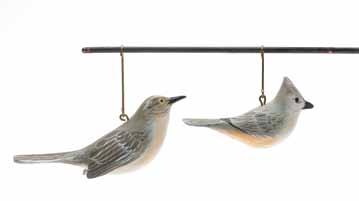
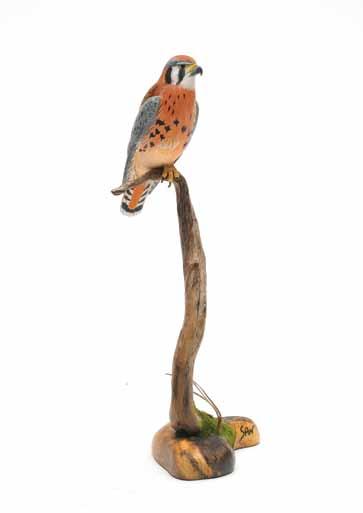
352 Steve Weaver (b.1950), Cape Cod, Massachusetts. Miniature kestrel. Standing on perch with one foot tucked in to feathers. Deep relief wing carving and slightly turned head. Maker’s initials and carved wooden feather on base. Signed and titled “Commanding Vantage Point” on underside. Bird measures 4” long, carving stands 9” tall with base. Excellent and original.
(1,500 - 2,500)
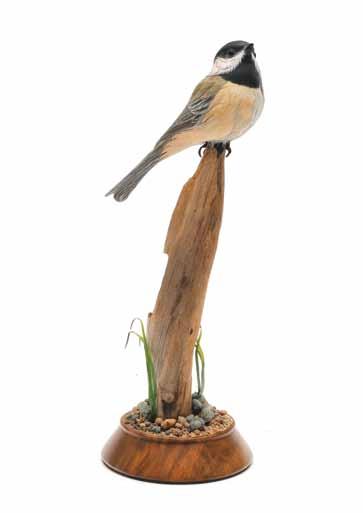
353 Steve Weaver (b.1950), Cape Cod, Massachusetts. Full size black-capped chickadee. Plump bird with slightly turned head and relief crossed wingtips. Highly detailed feather carving. Signed and identified on underside. Bird measures 4.5” long, carving stands 9” tall with base. Excellent and original. (1,200 - 1,800)
354 Earl Federine (1928 - 2015), Cut Off, Louisiana. Decorative bluewing teal. Slightly turned head and raised wingtips. Painted scene of a flying bluewing teal hen on underside. Maker’s initials and ‘89 on underside. Measures 11” long. One of the inserted primary feathers was chipped off and missing, otherwise excellent.
(800 - 1,200)
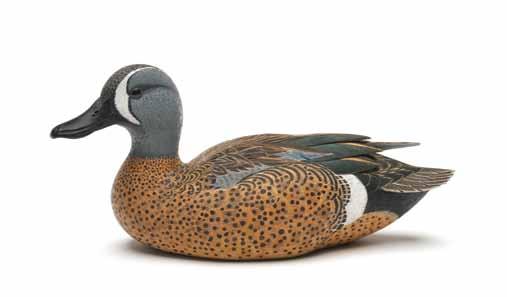
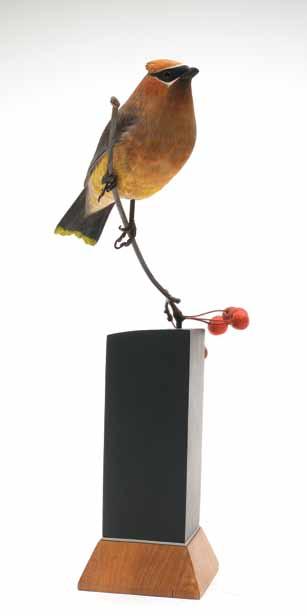
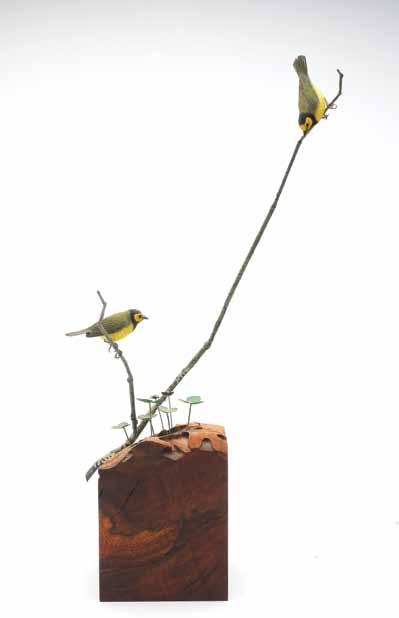
355 Gary Eigenberger (b. 1960), Green Bay, Wisconsin. Decorative cedar waxwing with raised wingtips and detailed feather carving. Identified, signed, and dated 9/00 on the underside. Measures 6” long, stands 14” tall. Excellent and original. (1,200 - 1,800)
356 Gary Eigenberger (b. 1960), Wisconsin. Pair of miniature decorative hooded warblers on a tree branch, wooden base with carved leaves on top. Measures 16.5” tall and 8” wide between branches. Signed and dated 2003 on the underside. Very good and original. (500 - 700)
357 Dick Bonner, New Orleans, Louisiana. Excellent decorative ruffed grouse on carved birch bark base. Head turned 90 degrees and one leg lifted. Dropped wing carving and highly detailed feather carving. Signed and dated 2000 on underside. Grouse measures 12” long. One crest feather is professionally restored, otherwise excellent and original. (3,000 - 5,000)
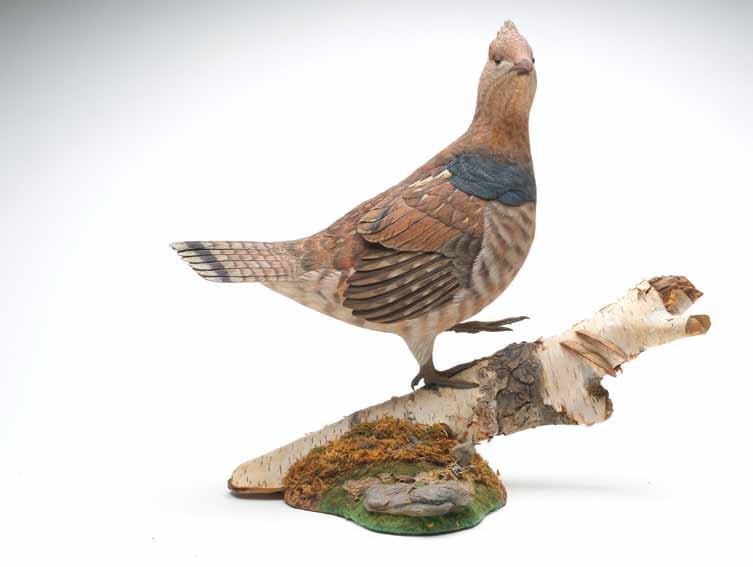
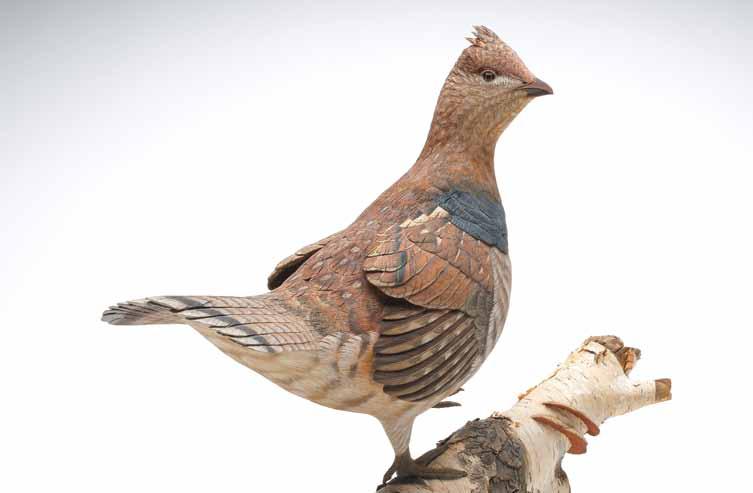
358 Dick Bonner, New Orleans, Louisiana. Highly decorative and impressive pair of mallards. Both are dated 2002 on the underside. Drake is mounted, standing on wooden base with highly detailed feet and inserted legs. This decoy is made at the highest level of competition in all respects. Measures 13” tall. Hen with turned head, raised, ruffled feathers. Drake remains in near mint to excellent condition; approximately 1/3” of crossed wingtip was broken and reset; hen with strong original paint; near excellent; approximately 1” repair was made to the two edge tail feathers. (6,000 - 9,000)
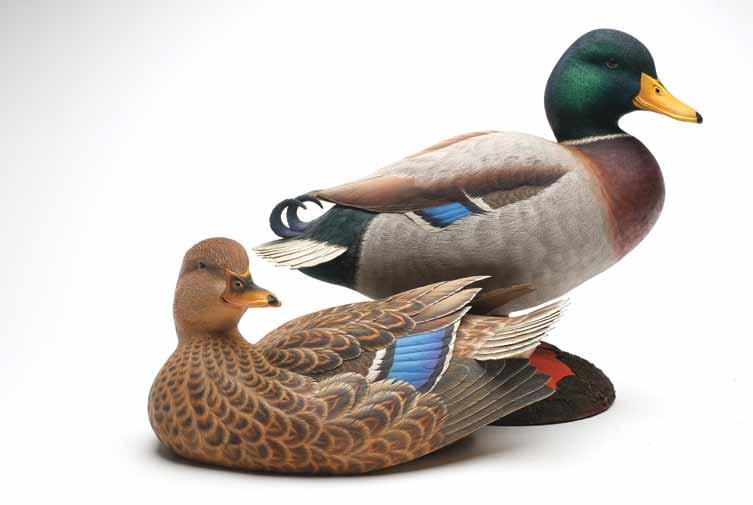
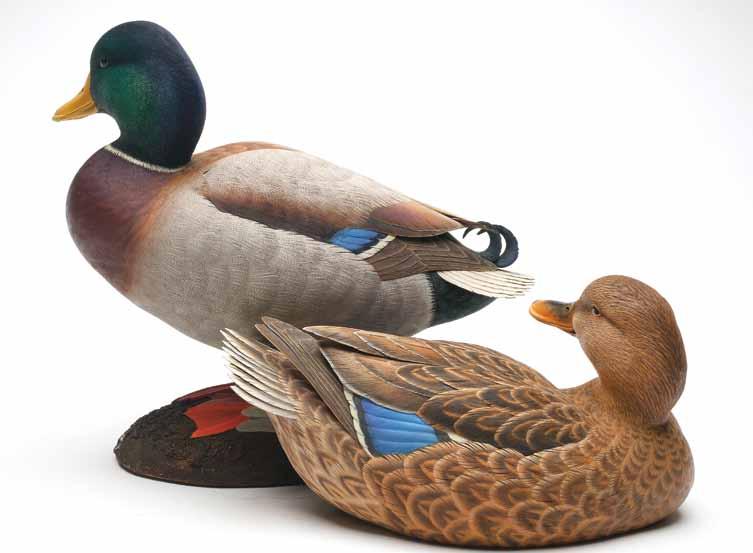
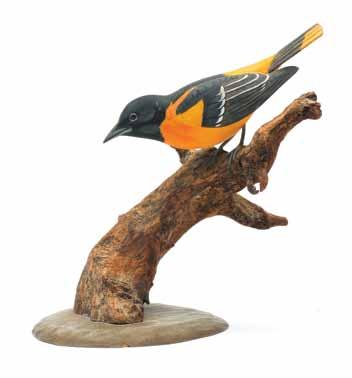
358A Wendell Gilley (1904-1983), South West Harbor, Maine. Full size oriole. Deep relief wing carving and dropped wingtips. “Gilley” painted on top of base. Maker’s ink stamp on underside. Bird measures 7.5” long, 9.25” tall including base. Tiny drip of white on one side of head and a tiny chip on edge of base, otherwise excellent. (1,000 - 1,400)
358B Wendell Gilley (1904-1983), South West Harbor, Maine. Pair of chickadees. Relief wing carving. Maker’s ink stamp on underside. “Gilley” painted on top of base. Birds measures 3.25” and 4.25” long. Very good and original. (1,000 - 1,400)
358C Wendell Gilley (1904-1983), South West Harbor, Maine. Miniature pintail. Slightly turned head. Measures 6.5” long. Original paint with very minor discoloration; very good structurally. (600 - 900)
358D Wendell Gilley (1904-1983), South West Harbor, Maine. Miniature semipalmated plover. Standing on one leg. Identified on underside of base. Measures 3” long. Original paint with minor wear on tip of tail and tip of beak; minor flaking to metal legs on top of head. (300 - 500)
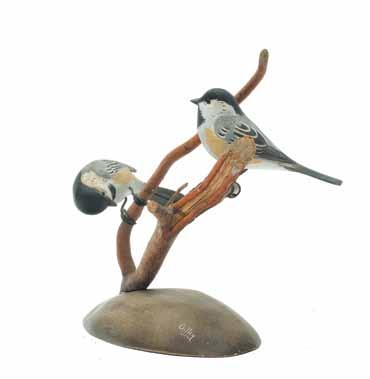
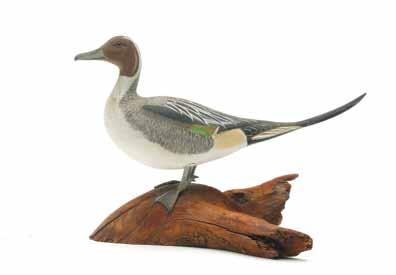
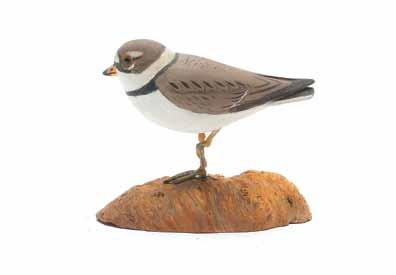
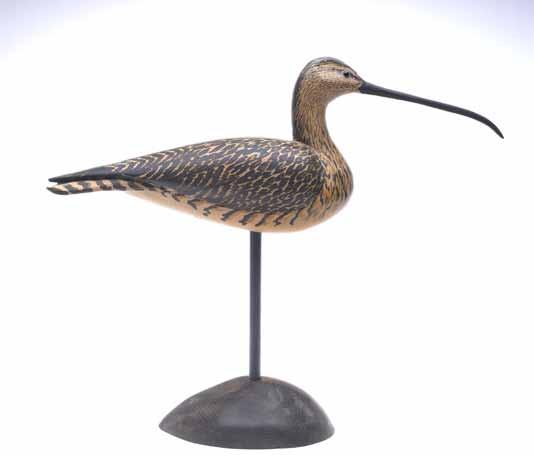
359 Grayson Chesser (b. 1947), Jenkins Bridge, Virginia. Curlew on wooden base with split tail carving and glass eyes. Makers “C” carved in underside. Measures 19” long. few tight cracks in neck and chest; otherwise excellent.
Provenance: Fredrick Raymond Collection. (400 - 500)
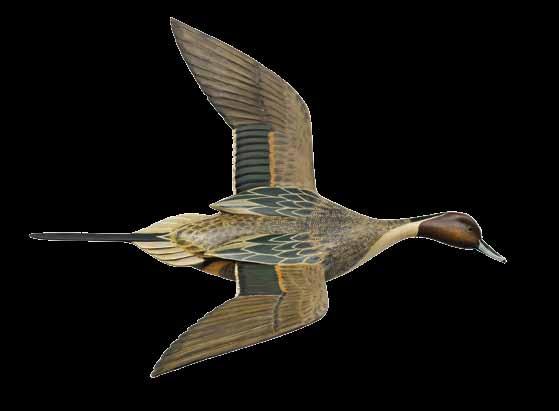
360 Grayson Chesser (b. 1947), Jenkins Bridge, Virginia. Excellent pair of flying pintails. Outstretched wings with relief wing and tail feather carving. Drake with extended tail sprig. “C” carved on the back of each. Measure 29” and 23” long, 25” wingspan. Original paint with moderate sap bleed; excellent structurally.
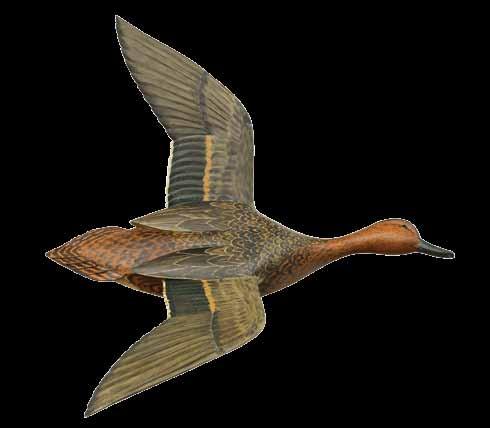
Provenance: Deborah and Martin Maloy collection. (1,200 - 1,800)
361 Mike Borrett (b.1960), Madison, Wisconsin. Flying pintail. Applied wings and feet. Relief wing and tail feather carving.
“Borret 01” carved in back. Applied lead tail sprig. Measures 26” long, with a 18” wingspan. Minor bending and flaking to lead tail sprig; shallow chip on edge of one wing was touched up, otherwise excellent.
Provenance: Martin and Deborah Maloy collection. (500 - 800)
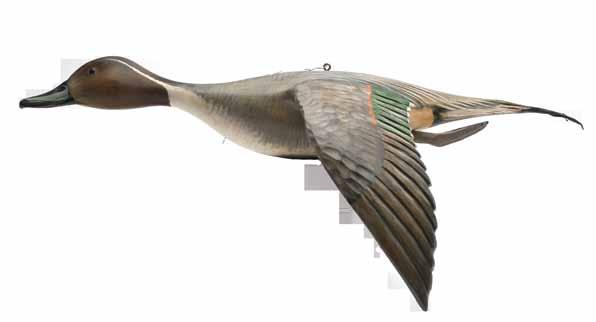
362 Mike Borrett (b.1960), Madison, Wisconsin. Pair of flying cinnamon teal. Outstretched wings with relief feather carving. Maker’s name carved in back of wing. Measure 16” long, with 17” wingspans. Very minor blunting at tip of wing feather on drake; otherwise excellent. (1,200 - 1,800)
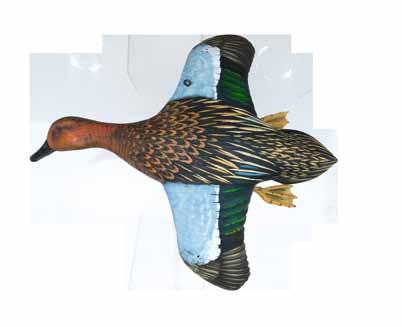
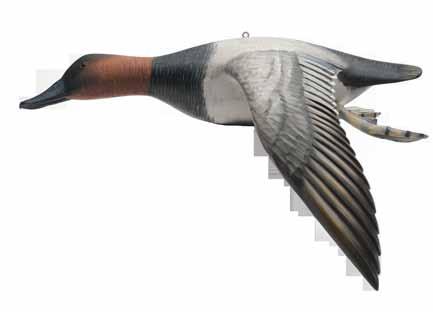
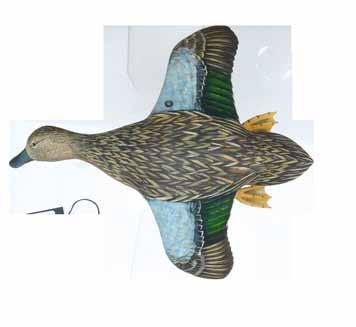
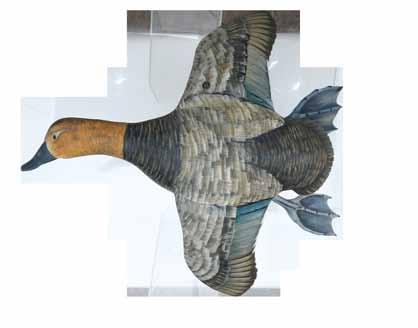
363 Mike Borrett (b.1960), Madison, Wisconsin. Pair of flying canvasbacks. Outstretched wings with relief feather carving. Maker’s name carved in back of wing. Measure 18” and 21” long, with 23” wingspans. Very good and original. (1,200 - 1,800)
364 Mike Borrett (b.1960), Madison, Wisconsin. Pair of flying pintails. Outstretched wings with relief feather carving. “Borrett” carved on back of wings. Drake with inserted metal tail sprig. Measure 21” and 24” long, with 23.5” wingspan. Excellent and original. (1,200 - 1,800)
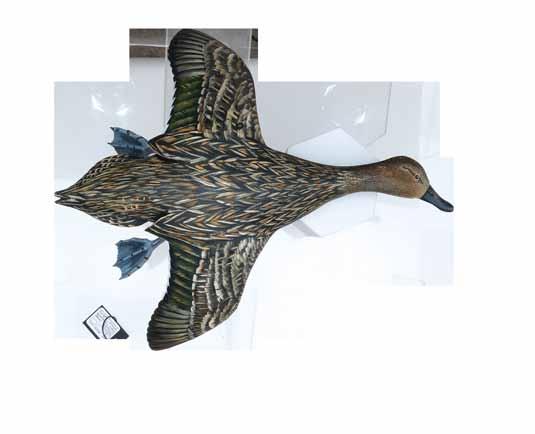
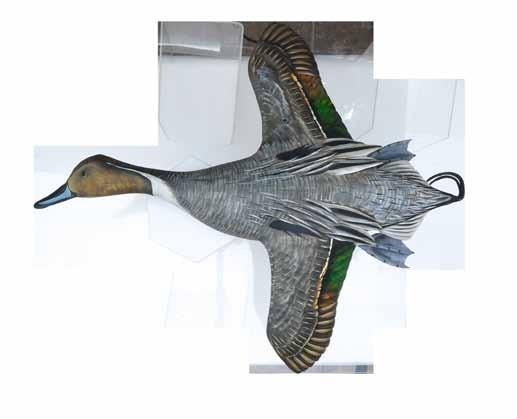
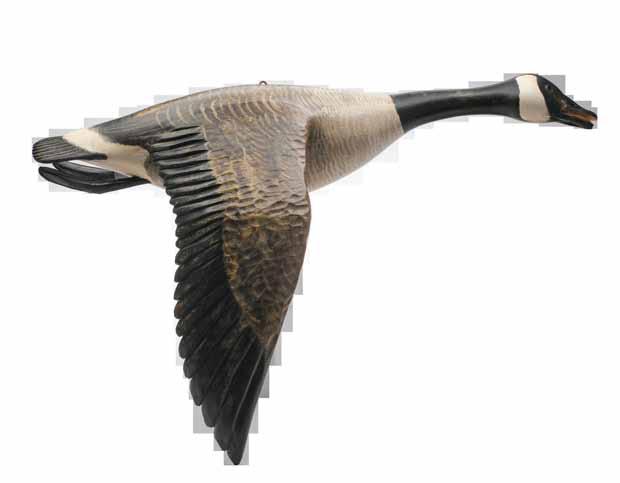
365 Mike Borrett (b.1960), Madison, Wisconsin. Rare flying Canada goose. Applied wings and feet. Open bill with carved tongue. “Borret 01” carved on back of wing. Carved wooden bird band on one leg. Measures 32” long, with a 25” wingspan. Two small spots of touchup on one wingtip otherwise excellent.
Provenance: Dr. Michael Shannahan collection. (1,500 - 2,500)
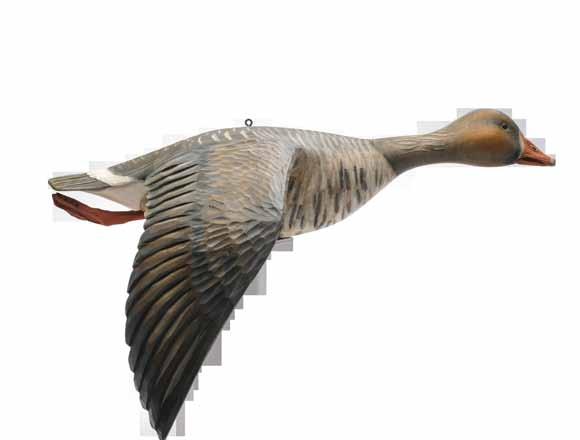
366 Mike Borrett (b.1960), Madison, Wisconsin. Flying speckled bellied goose. Applied wings and feet. Relief wing and tail feather carving. “Borret 00” carved in back. Measures 25.5” long. with a 20.25” wingspan. Shallow chip at one wingtip was touched up; otherwise excellent. (1,200 - 1,800)
367 Mike Borrett (b.1960), Madison, Wisconsin. Very large full body musky. Full round hollow carved body. Deep relief gill carving and open mouth. Applied teeth and wooden fins. Maker’s name carved in one side. Measures 51” long. Excellent and original. (600 - 900)
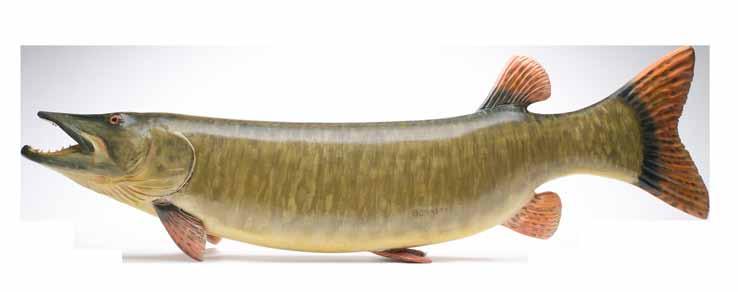
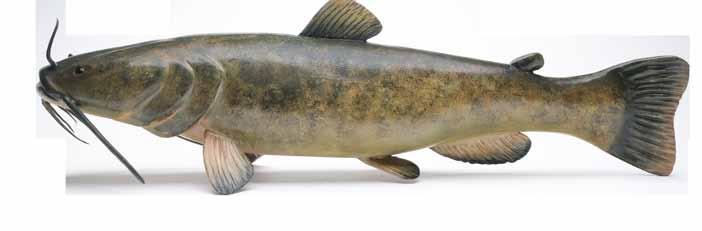
368 Mike Borrett (b.1960), Madison, Wisconsin. Very large catfish. Full round hollow carved body. Deep relief gill carving and applied leather whiskers. Measures 36” long, 11” wide at pectoral fins. Excellent and original. (600 - 900)
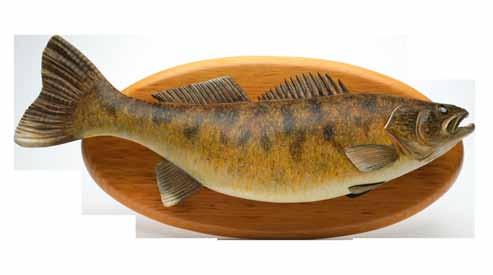
369 Mike Borrett (b.1960), Madison, Wisconsin. Large full body walleye. Deep relief gill carving and open mouth. Signed on the back of board. Measures 26” long, 4.5” wide. Excellent and original. (500 - 800)
An excellent summary of Bert’s life was published in a March/April 1997 issue of Decoy Magazine by Donna Tonelli. Subsequent scrutiny can add little or nothing to her research and most of what is presented here is a result of her article.
Graves was born in rural Magnolia, IL, somewhat removed from the east side of the river and approximately 45 miles NE of Peoria. Through at least his twenties, he, and his brother, like their father, worked as teamsters. This hardworking blue-collar lifestyle would remain with him for his entire life. Around 1905, he married the widow Anna Riley Corbin who brought her young son, Bransford, to the union and Graves would raise the boy as his own (see note 1). For a few years after the marriage, Bert would support the family as a carpenter in Peoria. By about 1915, he either bought or (more likely) built for himself and Anna, a comfortable home and workshop at 706 McReynolds St and this would be his address for the remainder of his life. For whatever reason, between at least the dates of 1918 and 1920, he lists his primary occupation as “fishermancommercial” working at the “foot of Bridge St.” This was to be a short-term venture, for between the dates of 1921 through 1949 he returned to describing himself as a “carpenter” or “contractor.” This was interrupted briefly when on the WWII draft registration, he states that he worked for the “City Hall Maintenance crew.” By 1950 he was unable to work and had applied for his social security benefits. He died one year later.
It is unclear when Graves began to carve decoys. We can only assume that he may have begun to carve a few for his own use while working on the river circa 1918. We do know that, upon the death of Robert Elliston, Graves approached his widow and purchased the remaining Elliston patterns, decoys, and orders. By the 1930’s he had printed, and was distributing, a business card advertising his decoys as well as boats, and this little piece of ephemera clearly lists “Elliston Pattern Decoys.” He did sell some of his carvings through the Portman’s Sporting Goods store and orders flowed in from sportsmen around the country with quality rigs having been located throughout the Midwest, as well as Manitoba and elsewhere. At the pricey sum of between $75 and $100 per dozen in the 1940’s and 50’s, his decoys would have comprised a significant portion of Graves’ income.
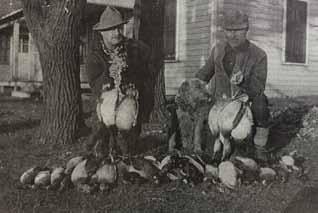
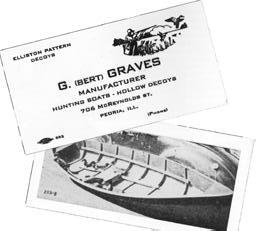
The Graves decoy carving operation was based out of his garage and was, by all accounts, somewhat of a low keyed, factory type, operation. The work was accomplished through the joint efforts of Graves, his brother Orville, Orville’s wife Effie, their sister Nellie and at least three or four other individuals. As late as the mid 1930’s he was still shipping unpainted birds to Elliston’s wife (now living in Chicago) to paint. She, in turn, ultimately taught Effie and Nellie how to accomplish this delicate task. Other than perhaps a small number of decoys produced initially by Graves for his own use, as Donna Tonelli notes, of the “hundreds produced over a thirty-year period, it’s quite possible that nary a one exists that was made solely by him.”
Graves himself is remembered as a local “river rat,” and an excellent shot with a fondness for fighting gamecocks. It is his decoys, however, that have justly earned him his rightful place in the Illinois River decoy carving hierarchy.
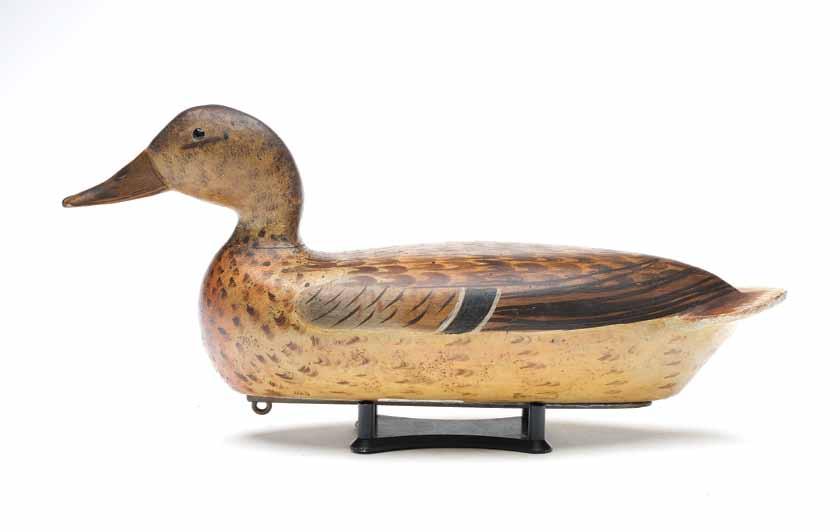
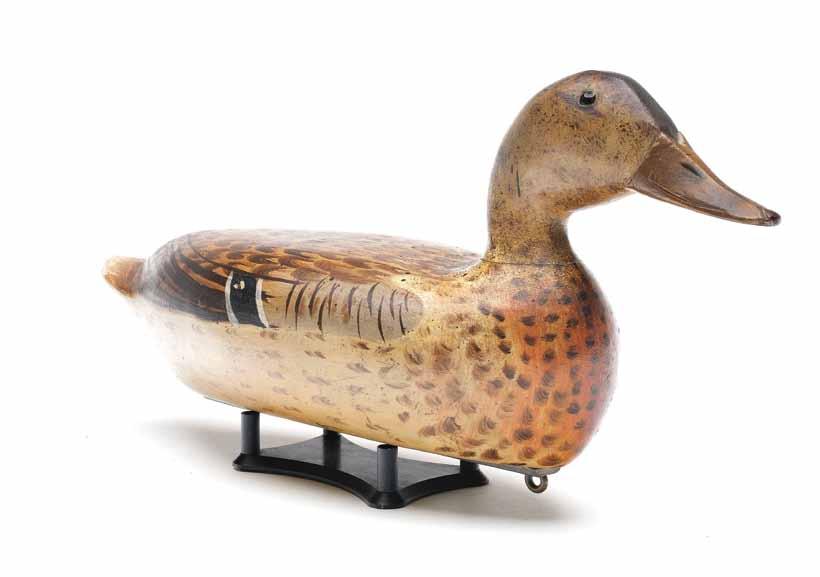
370 Bert Graves (1880-1956), Peoria, Illinois. Near mint mallard hen. Hollow carved with thin neck style and head cocked slightly to one side. Retains the original Graves weight. Measures 17” long. Fine drips of black paint on back and neck; small paint flake at one wing patch, otherwise near mint. (10,000 - 14,000)
The carvers of many fine decoys remain anonymous. Some of these unknowns are referenced only through the rigs in which they were found, examples being the Mary Janes Farm rig in North Carolina and the Pumpkin Farm rig in Massachusetts. Such is the case with “The Carriage House rig”. This group of birds was found in the mid 1980’s in a carriage house on the property known as Longwood in Lake Villa, Illinois. The 1,100-acre estate was built in 1912 as the summer home of Edward John Lehmann (1876 – 1954). Edward was the son of Ernst Johann Lehmann (1849 – 1900). Ernst’s life reads as a classic rags to riches story. At age 8 he arrived in New York with his German born parents aboard the sailing vessel Howard. The family settled in Wisconsin, but by about 1870, Ernst was in Chicago where he began his sales business in a very limited way by peddling a variety of wares from his horse drawn wagon. In 1874 the ever-industrious Lehmann transitioned to a small storefront on Clark St where he added jewelry to his expanding line of offerings. In 1875 he relocated to the corner of State and Adams Streets and the business, known as “The Fair”, began its meteoric rise in success. The venture flourished and, in 1897, Lehmann completed construction of a modern 12 story building containing 286,000 square feet of sales space. Unfortunately, the rise in success had taken its toll on Ernst and his labors ended with his death in the Bloomingdale Asylum for the Insane in White Plains, NY. Management
371 Very rare pintail from the Carriage House rig, Lacon, Illinois, circa 1890. Hollow carved with turned head and relief wing carving. Measures 15.5” long. Original paint with moderate gunning wear; slight separation at body seam; some modern touchup on sides of neck and one side of neck seat; professional bill chip repair.
Provenance: Don Leonard collection. (8,000 - 12,000)
of The Fair fell to his son, Edward, who continued to grow the business, increasing the sales area to almost 800,000 square feet and employing almost 5,500 workers, making Lehmann one of the largest employers in Chicago and one of its wealthiest citizens. In 1925, the business was sold to S.S. Kresge of K Mart fame. The family’s fortune continued to grow over the ensuing years with numerous successful dealings in real estate. Longwood remained in the family as a retreat to be enjoyed by a number of Ernst’s grandsons and their families. The only, very tenuous, indication of any sporting activity by any member of the family is that Edward’s son Robert (1916 –1984) is pictured as a young man with a pair of spaniels suggesting that he may have enjoyed hunting.
Decoys in the Carriage House rig seem to have been carved by a number of individuals with a few attributed to Brink Lane (1875 – 1954) of Lacon, IL. It would appear that the rig was put together over a period of time, perhaps by different family members. Where the rig was used is, like the birds themselves, a mystery. The estate was on the shore of Sun Lake, with Deep and Cedar Lakes close by but the family certainly had the finances to hunt where they chose or to join any number of private clubs.
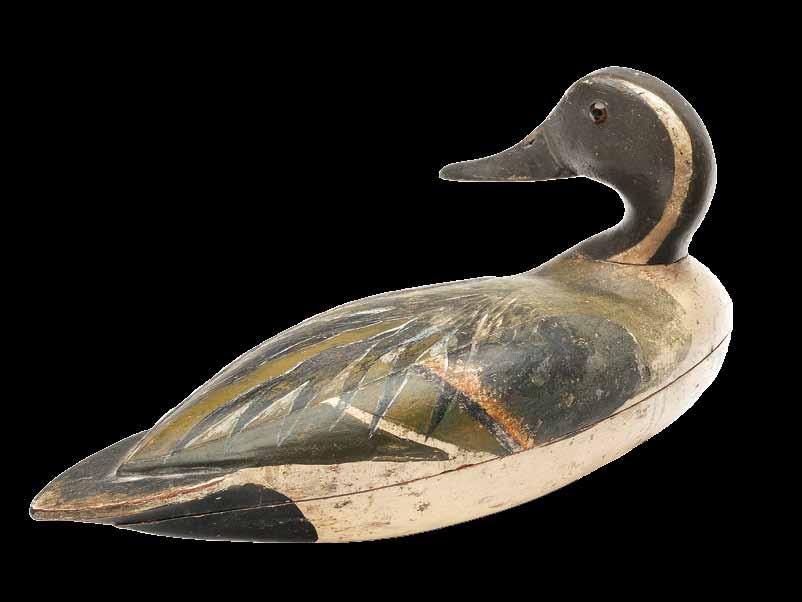
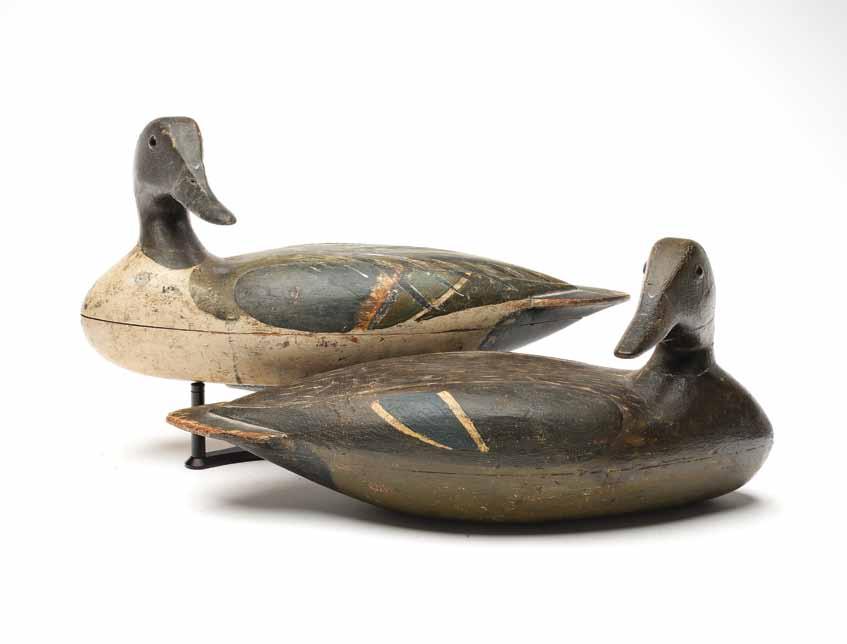
372
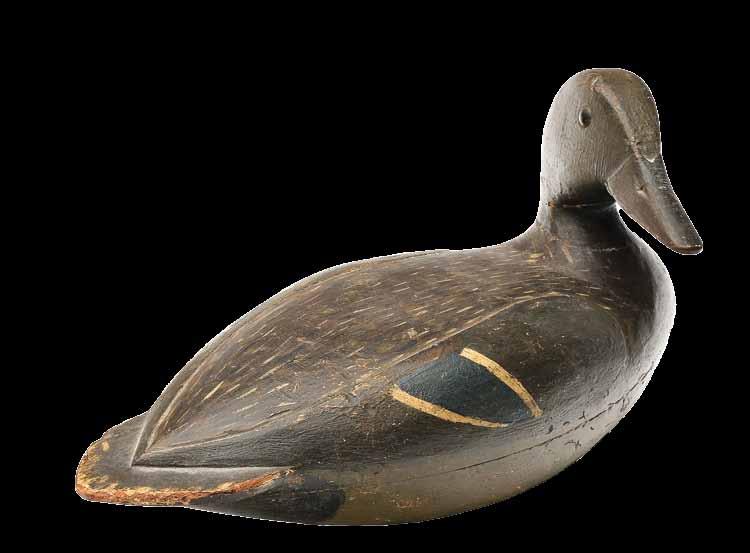
Very rare mallard hen from the Carriage House rig, Lacon, Illinois, circa 1890. Hollow carved with turned head and relief wing carving. Measures 15.5” long. Very early working repaint with moderate gunning wear; roughness on edge of tail; seam through neck where head was off and tightly reset.
Provenance: Don Leonard collection. (5,000 - 8,000)
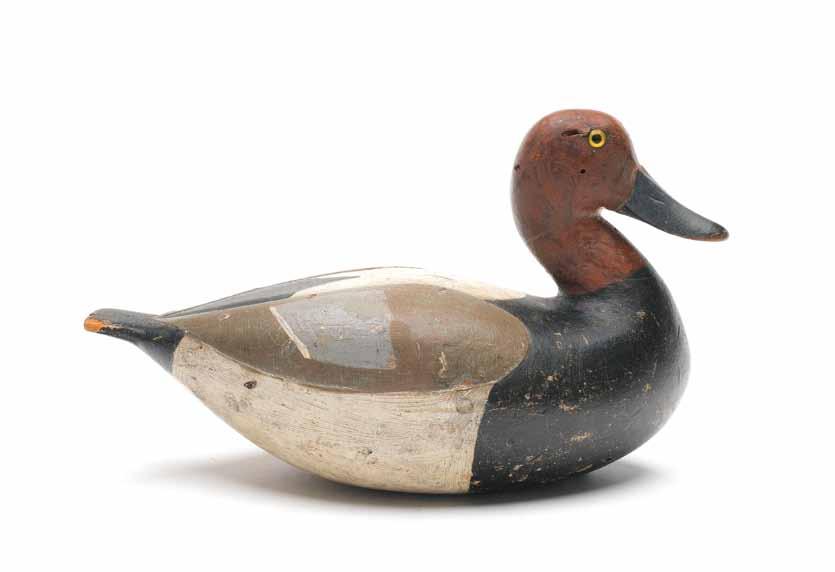
373 Rare Carriage House redhead, Lacon, Illinois, circa 1890. Hollow carved with relief wing carving. Slightly turned, reared back head. Donal O’Brien Jr collection ink stamp on underside. Measures 12.75” long. Very early in use repaint with moderate gunning wear and fine crazing; lightly hit by shot; minor roughness on edge of tail; much of the bill is a professional replacement; a few spots of modern touchup near one wing patch.
Provenance: Don Leonard collection.
(6,000 - 9,000)
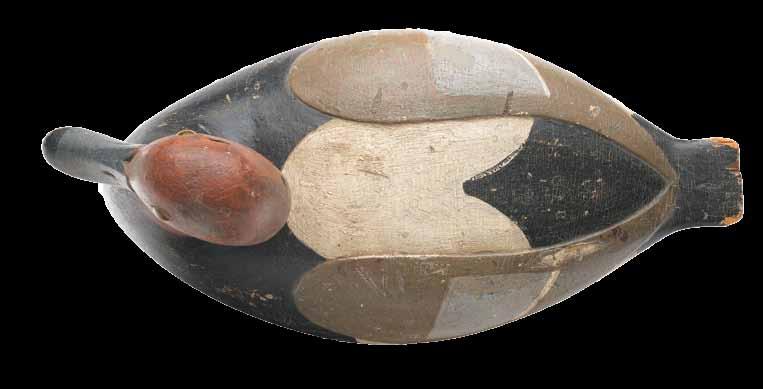
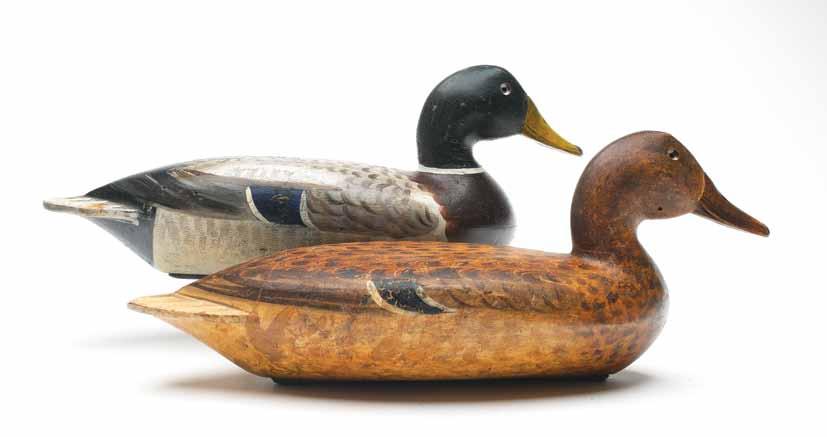
374 Robert Elliston (1849-1915), Bureau, Illinois. Mallard. Hollow carved comb feather paint detail. “W.H. Dupee” branded in underside. Retains the original Elliston weight. Measures 16.5” long. Original paint with minor crazing and wear; moderately hit by shot; hairline cracks in tail.
Provenance: John Decesare collection. (5,000 - 8,000)
375 Robert Elliston (1849-1915), Bureau, Illinois. Mallard hen. Hollow carved. “W.H. Dupee” branded in underside. Retains the original Elliston weight. Measures 17.5” long. Original paint with minor crazing and wear; moderately hit by shot; spots of discoloration on one side near tail; excellent structurally.
Provenance: John Decesare collection. (4,000 - 6,000)
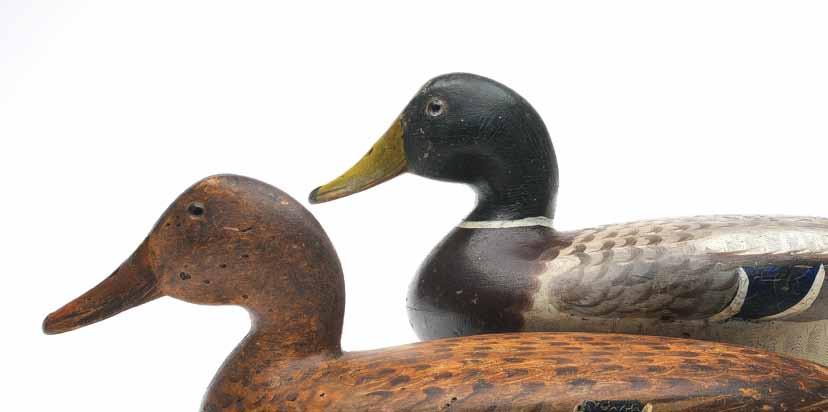
376 Charles Walker (1873-1954), Princeton, Illinois. Mallard. Hollow carved with slightly turned head and relief wing carving. 28 stenciled on underside for the rig of Merle Brown and Tad Vance. Measures 16.5” long. Original paint with minor to moderate wear; lightly hit by shot; minor roughness and a slight separation at a small knot on edge of tail.
Provenance: Merle Brown rig. Tad Vance rig. Joe Tonelli collection. Alan Haid collection. John Decesare collection. (6,000 - 9,000)
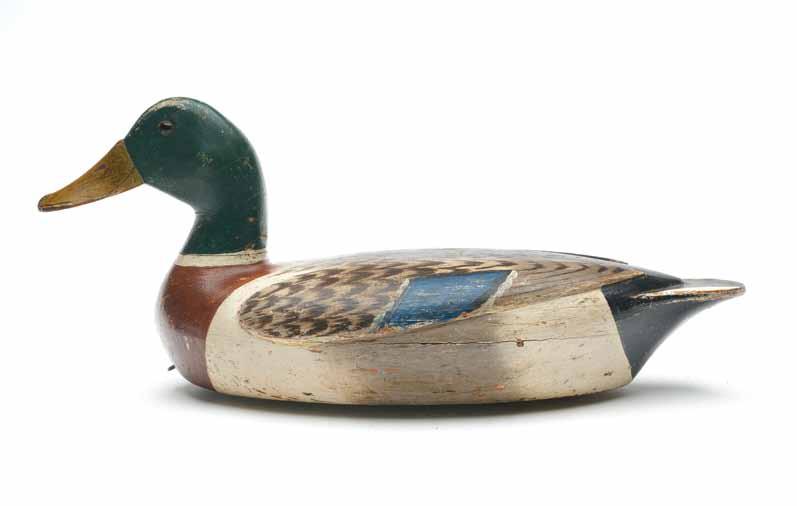
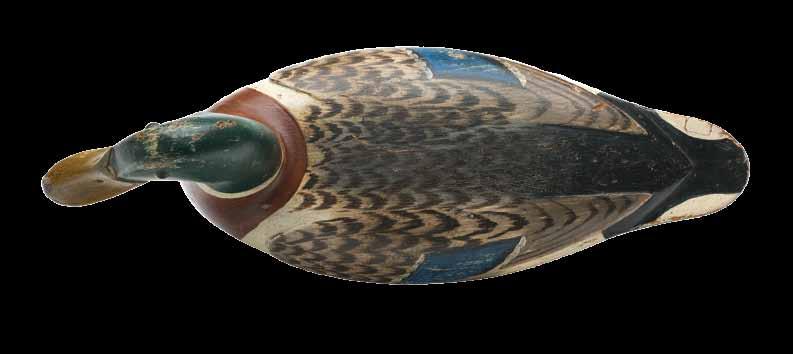
Charles Walker is widely recognized as one of the premier Illinois River carvers, and a great many of his decoys were destined for members of the Princeton Fish and Game Club. One such member was Merville Lee Brown (1904 – 1957) who marked his rig with his share number 28. Brown was a successful attorney in Princeton and served as the Secretary/Treasurer for the club for over twenty years. Upon his death, his share was acquired by a Mr. Clyde Raymond Vance (1908 – 1995) and, as was the custom of the club at the time, Brown’s hunting gear too was included with the transfer of the share.
Vance, like Brown, was a resident of Princeton. He originally worked with his father selling appliances at the “Vance Maytag Store” before becoming a manager at a local retail and wholesale florist shop in town. Upon his death, his share, #28, was sold, and the rig dispersed.
Created in 1887, the Princeton Fish and Game Club is still an active organization today and its members continue to carry on the rich traditions of its founders.
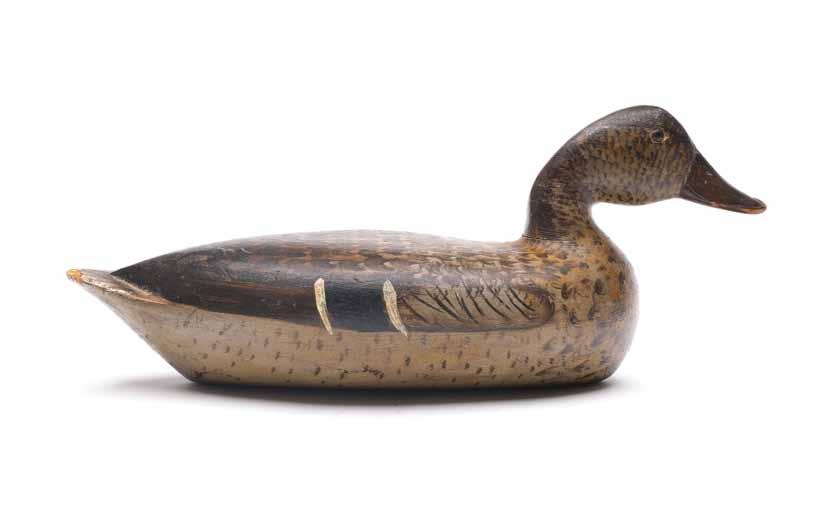
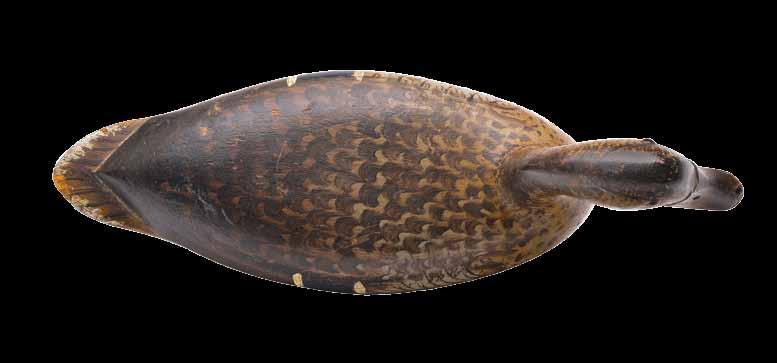
377 Bert Graves (1880-1956), Peoria, Illinois. Rare swimming mallard hen. Hollow carved with slightly forward head pose. Measures 17” long. Original paint with minor flaking and wear; old chipping at tip of tail; hairline crack through neck was tightly reset and is almost unnoticeable; minor discoloration on neck from line tie. (3,000 - 5,000)

Francis John (“Frank”) Cuneo Jr (1935 – 2024) was born in Chicago and, after his marriage, resided in Naperville, IL. A very successful lawyer, he first hunted ducks with his father when he was five years old. When his father died, the family rig of mallards by Bert Graves (1880 – 1956) bearing the D.F. Rice brand was passed down to him. According to his obituary, Frank was an enthusiastic sportsman who “ - - - enjoyed duck hunting and, in his later years, big game hunting in Wyoming for elk and antelope.”
Frank’s father was Francis John (“Fran”) Cuneo Sr (1896 – 1993). A graduate of Northwestern University, Fran became a highly successful lawyer in Chicago with an influential private law practice, and a residence on prestigious Lake Shore Drive. He became very close friends with Daniel Francis Rice (1896 – 1975) and the two men traveled in the same business and social circles and they often hunted together. The pair were so close that Frank Jr, who inherited the rig, considered Rice his second father.
Daniel Rice was extremely wealthy. After completing only three years of college, at age 21, he was running his own business at the Illinois Board of Trade. He was to become one of the most successful grain brokers and commodity traders in Chicago. In 1920, he married Ada L Bousman and, in 1928, the couple purchased farmland in Wheaton, Il as a working farm and a family retreat. Eventually the property encompassed roughly 800 acres, and they named the estate “Danada.” In 1939 Rice built a 19-room house on the land and, in 1943, Ada mentioned to her husband that “ it would be nice if they had a few horses.” Accordingly, Dan purchased her 8 yearling thoroughbreds from breeders in Kentucky. Mrs. Rice became engrossed in the sport of horse racing,
and she and Dan bought another property in Lexington, Kentucky which they also named “Danada.” Here the horses could be bred and then trained in Illinois. Through 1974 her horses won 883 races and earned $8,770,989. 1965 was probably her most successful year when her “Lucky Debonair” won not only the Kentucky Derby, but the Santa Anita Derby, The Blue Grass Stakes and numerous other races. The Rices thoroughly enjoyed entertaining, and the Wheaton property was designed with that in mind. The main house boasted elegant living and dining rooms, a bar, billiards, dance floor, wine cellar and changing rooms for the outdoor swimming pool, a luxury in its day. The grounds featured extensive formal gardens, reflective pools and skeet and trap fields where both Dan and Ada could enjoy the shooting sports. Reportedly Ada was the better shot!
It is unknown if it was Fran Cuneo or Dan Rice who purchased the decoys from Graves. Both certainly had the financial means to buy the finest in hunting equipment. The Illinois Danada included large areas of wetlands, so the decoys could have been used there. A period photo of the two men with a rather large group of fellow hunters would seem to indicate that they were members of a large duck club but, if so, which one is unknown. What is remarkable is that a rig of Graves decoys, presumably bought c1930’s, has remained in the same family from the time of their initial purchase through their being consigned to Guyette and Deeter in 2026, almost 100 years later.
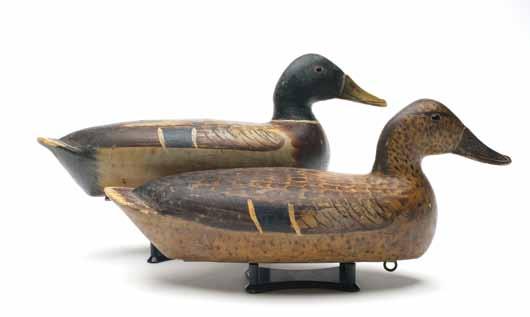
378 Bert Graves (1880-1956), Peoria, Illinois. Rigmate pair of mallards.
Hollow carved with comb feather paint detail on sides of drake. Both stenciled “D.F. Rice”. Both retain the original Graves weight. Measures 17” long. Original paint with minor gunning wear; under an uneven coat of varnish that has darkened with age; tight crack in one side of drake’s neck seat. (3,000 - 5,000)
379 Otto Garren (1890-1968), Canton, Illinois. Pair of wood ducks. Hollow carved with exaggerated extended crests and scratch feather paint detail. Measure 12.75” long. Drake’s head swivels slightly with minor paint flaking at neck seam, otherwise excellent and original. (6,000 - 9,000)
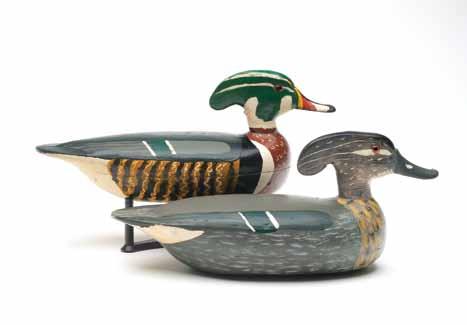
380 Robert Elliston (1849-1915), Bureau, Illinois. Pintail. Hollow carved with comb feather paint detail. Branded “H.C. Gardner”. Retains the original Elliston weight. Measures 17.5” long. Original paint with moderate flaking and wear under a thick coat of varnish; small dents and shot marks, otherwise excellent structurally.
Provenance: John Decesare collection. (2,000 - 3,000)
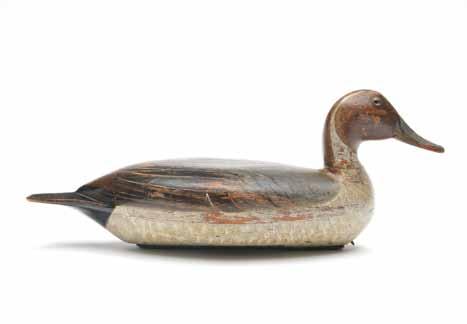
381 Charles Perdew (1874-1963), Henry, Illinois. Pintail. Hollow carved with slightly turned head and comb feather paint detail. Retains the original Perdew weight. Measures 16” long. Original paint with moderate flaking and wear; an old coat of varnish has darkened with age; small dents and shot marks; hairline crack in neck was tightly reset with area of touchup on area of front of neck.
Provenance: John Decesare collection. (2,000 - 3,000)
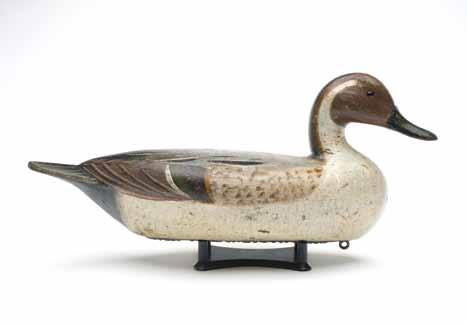
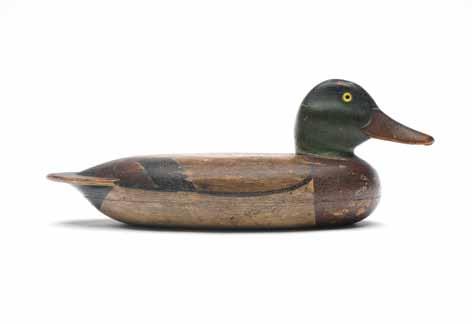
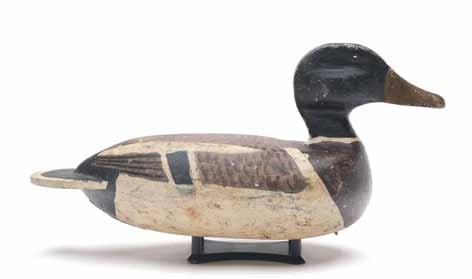
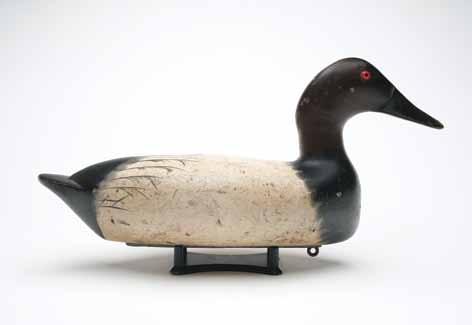
382 Fred Allen (1838–1912), Monmouth, Illinois. Mallard. Hollow carved with slightly turned head. Measures 14.75” long. Original paint with moderate flaking and wear; surface has darkened with age and has tight crazing over much of the decoy; minor blunting at tip of tail; lightly hit by shot.
Provenance: John Decesare collection.
(2,000 - 3,000)
383 Henry Schlottman, Pekin, Illinois, Circa 1930. Hollow carved Mallard. Measures 17” long. Original paint with light gunning wear; good structurally.
(500 - 700)
384 Bert Graves (1880-1956), Peoria, Illinois. Canvasback. Hollow carved with comb feather paint detail. Retains the original Graves weight. Measures 17.25” long. Original paint with minor to moderate wear; lightly hit by shot, otherwise very good structurally.
(2,000 - 3,000)
385 Stephen Lane (1843-1900), Lacon, Illinois. Mallard. Hollow carved. Measures 16” long. Original paint with moderate gunning wear and fine crazing over much of the decoy; flaking to green on head with thin touchup; very good structurally.
(1,200 - 1,800)
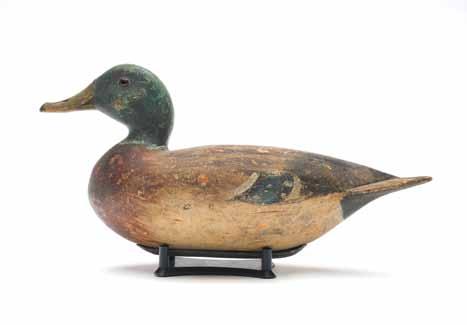
386 Charles Perdew (1874-1963), Henry, Illinois. Hollow carved crow. Three piece vertically laminated body. Metal legs glued in to modern pine base. Measures 15.5” long. Original paint with minor flaking and wear; mostly on edge of tail; hit by shot in one side; some filler was used at body seams when the decoy was made; thin line of touchup at one seam on underside where it has opened slightly.
(1,200 - 1,800)
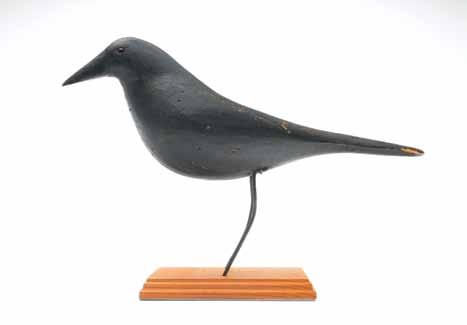
387 Leonard Doren (1895-1965), Pekin, Illinois. Owl. Balsa body with deep relief face carving and applied wooden perch with painted feet. Stands 18.5” tall including base. A few small dents and some roughness on edge of ear tuft; otherwise near mint. (4,000 - 6,000)
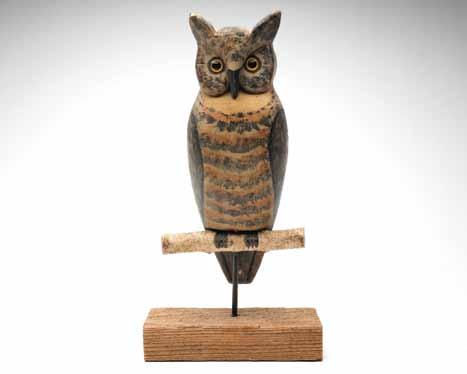
1896 - 1991 | Milwaukee, Wisconsin
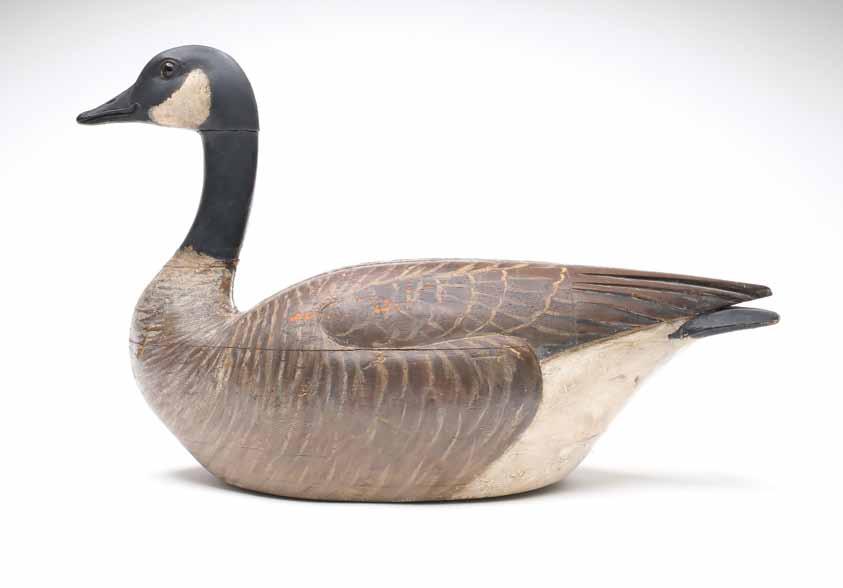
388 Owen Gromme (1896-1991), Milwaukee, Wisconsin. Canada goose. Four piece hollow carved body with deep relief wing carving and upright head pose. Measures 24.5” long. Mix of original and early in use touchup by the maker; flaking to filler on back; crack in back near tail; some restoration at neck seat; head is slightly loose.
Provenance: Herb Desch collection. (8,000 - 12,000)
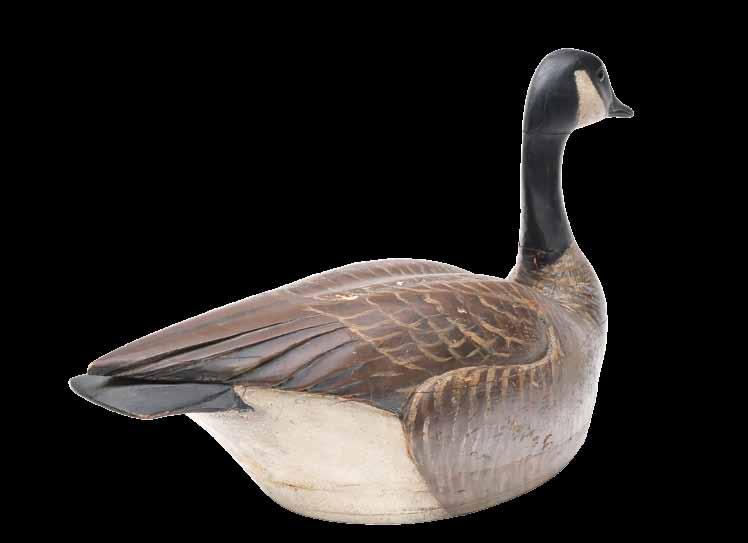
1901 - 1963 | Stoughton, Wisconsin
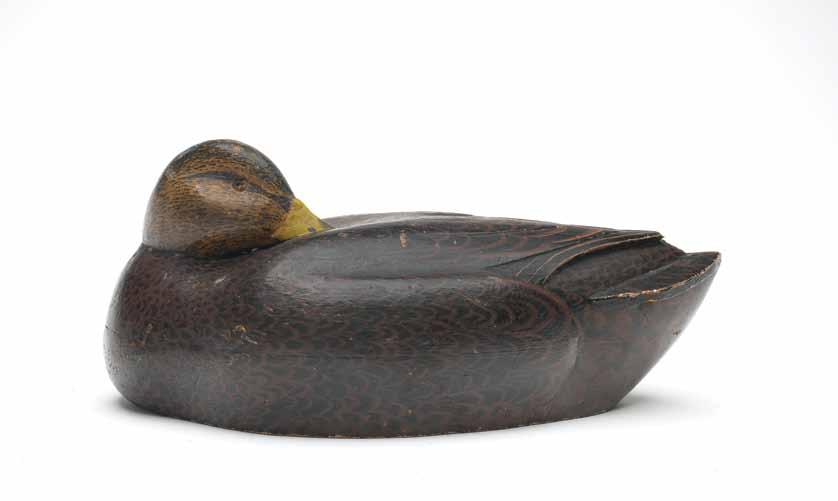
389 Ferd Homme (1901-1963), Stoughton, Wisconsin.
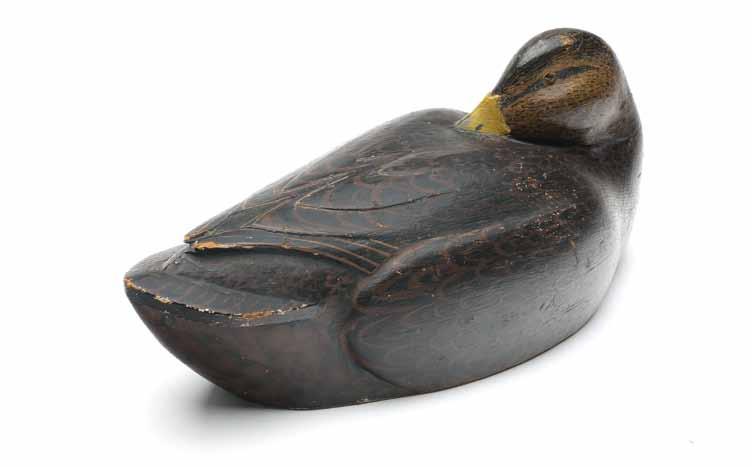
Sleeping black duck. Hollow carved with deep relief wingtip carving. Maker’s name painted on underside.
Measures 15.5” long. Original paint with moderate gunning wear; small dents; chips in each eye; minor roughness at raised wingtips. (10,000 - 14,000)
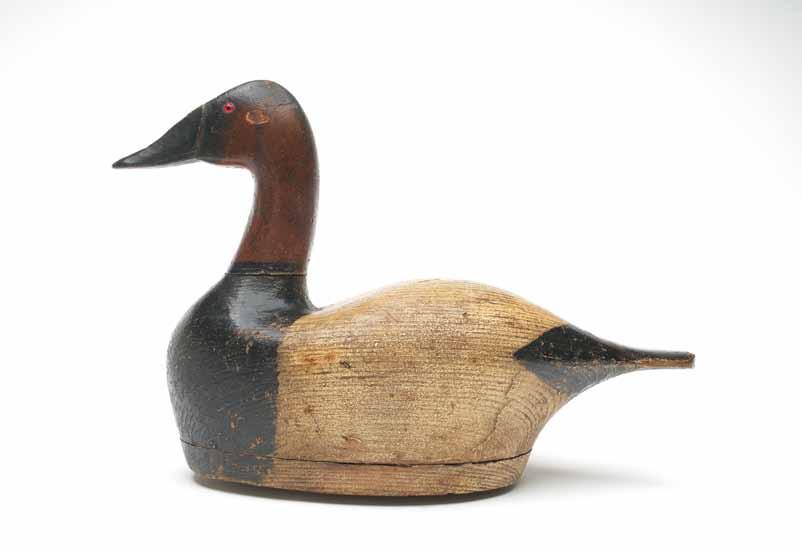
390 Joseph Sieger (1871-1959), Tustin, Wisconsin. High head canvasback. Hollow carved. Measures 16.5” long. Original paint with moderate flaking and wear; an early coat of thick varnish has darkened with age; slight separation at bottom board; minor roughness on edge of tail; chip in underside of bill was professionally restored with some touchup along one side. (5,000 - 8,000)
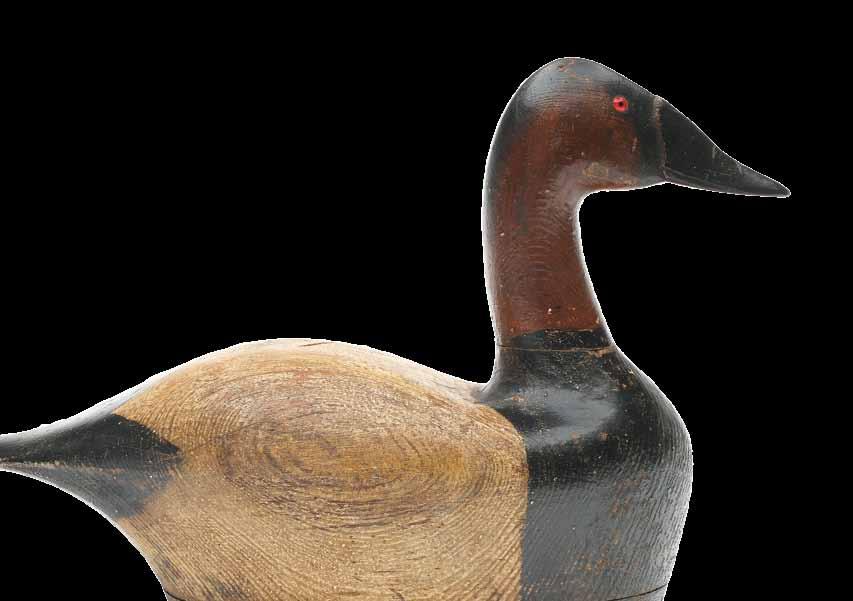
391 Gus Moak (1852-1942), Tustin, Wisconsin. Canvasback. Hollow carved with slightly turned head. “D” painted on underside. Measures 17.75” long. Original paint with minor wear under a thin coat of varnish; some restoration at neck seat; lightly hit by shot. (4,000 - 6,000)
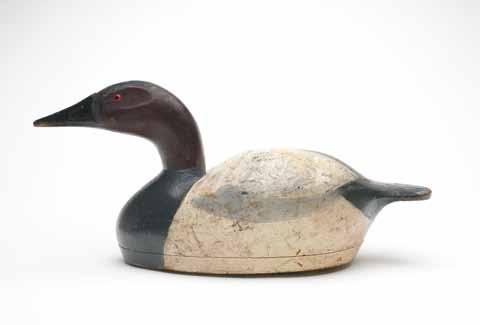
392 William Schultz (1923-2009), Milwaukee, Wisconsin. Pair of pintails. Relief wing carving and slightly turned heads. Both identified, signed, and dated 1966. Measure 15.5” and 20” long. Surface has darkened slightly with age; otherwise excellent and original. (1,500 - 2,500)
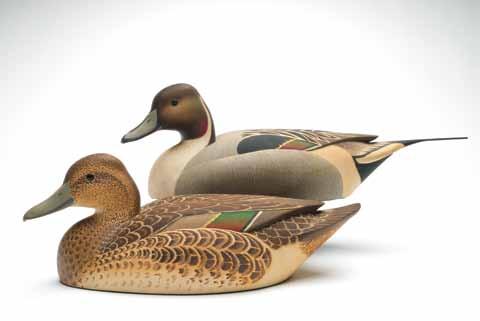
393 Early flying mallard hen decoy from Wisconsin. Applied wings. Inserted metal stick hole lining. Measures 22.5” long, with a 30” wingspan. Original paint with minor wear; under an early coat of varnish that has darkened with age; fine crazing; minor flaking to filler where wings join to body; brass tack eye on right side to replace the original glass eye. (800 - 1,200)
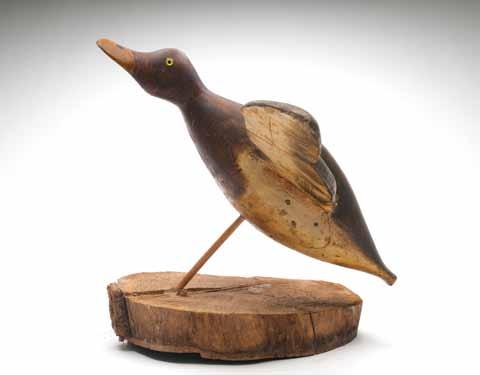
Born in Tuckerton, Harry M (aka “Mitchell”) attended the local schools, attaining a basic 6th grade education. As a young man, he apprenticed under the watchful eye of his father, master decoy carver Harry V Shourds. In 1910, at age 19, he was working as a painter in Tuckerton, living with his parents while his father worked as a carpenter. In 1912, he married Luetta Loder from Ocean City. Unfortunately, Luetta became sickly and eventually, a family friend, Martha Clemenson, was called upon to nurse the ailing young woman. Sadly, Luetta passed
away in 1922 and, one year later, Harry married Martha and they would raise a family of four children of their own.
Initially, Shourds did whatever was necessary to provide for the family. He hunted and fished, harvested shellfish, and trapped, both for additional income and food. By 1922 he had established himself as a successful painter in Ocean City. He loved the outdoors, especially enjoying small game and upland birds over his beagles and setters. He had duck hunted with his father and this would eventually lead to his providing guiding services. Obviously, this required decoys and he began to carve
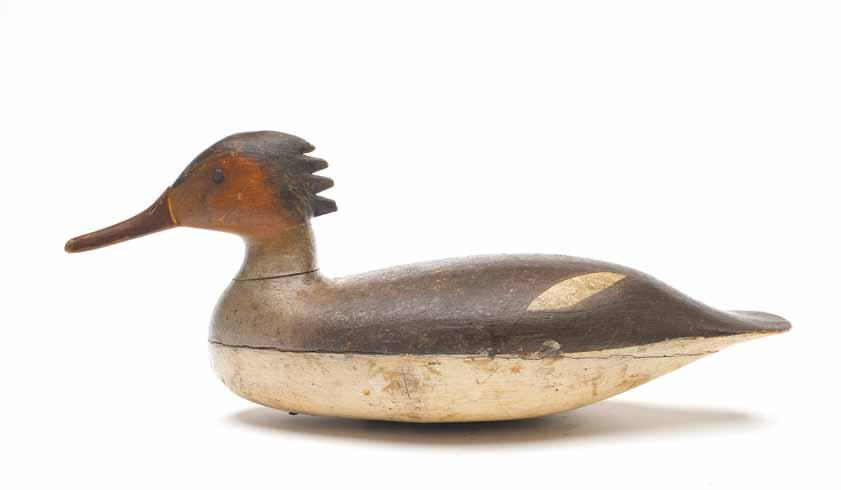
394 Harry M. Shourds (1890-1943), Ocean City, New Jersey. Merganser hen. Hollow carved with tack eyes and extended crest carving. Branded “I.A. Powell” twice on underside. Also with “P” branded in underside. Measures 16.5” long. Original paint with minor gunning wear; slight separation at body seam; two center tines of crest with professional restoration.
Provenance: John Decesare collection. (8,000 - 12,000)
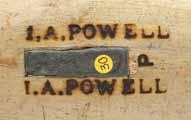
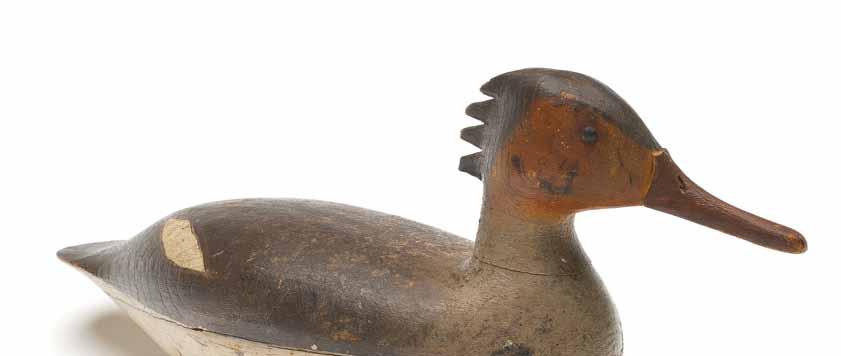
his own. As one would expect, his carvings very closely followed the patterns developed so successfully by his father. Harry worked out of a small fisherman’s shack which he had relocated to the rear of his home. Lacking power tools, he would rough out the bodies and use a simple coping saw to fashion the basic head shape. The decoys were then carefully finished, hollowed out and finely painted. Although he made far fewer decoys than
did his father, he carved most of the species commonly sought in southern New Jersey. Unlike his mentor, however, he altered the pose of many of his decoys. Of all the decoys he produced, his geese must be considered quite rare. Many familiar with his work suggest that he probably only made a few small rigs (perhaps only 2) of this species.
He is remembered as a social individual who greatly enjoyed time with his wife and children. Unfortunately, he died young, suffering a stroke at the age of 52
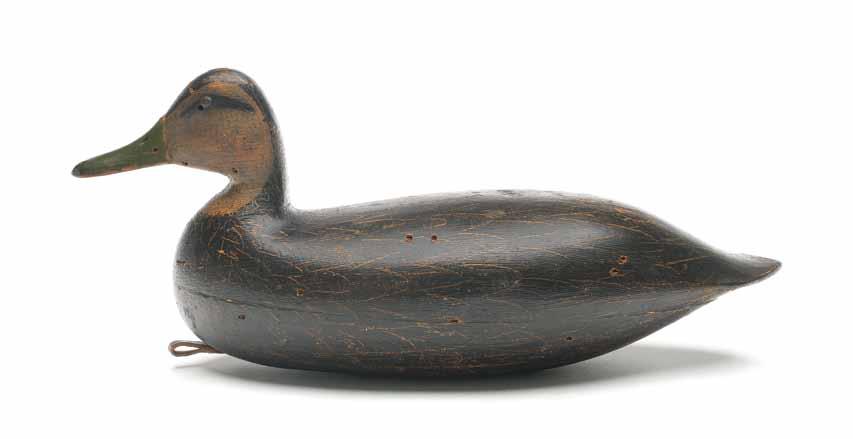
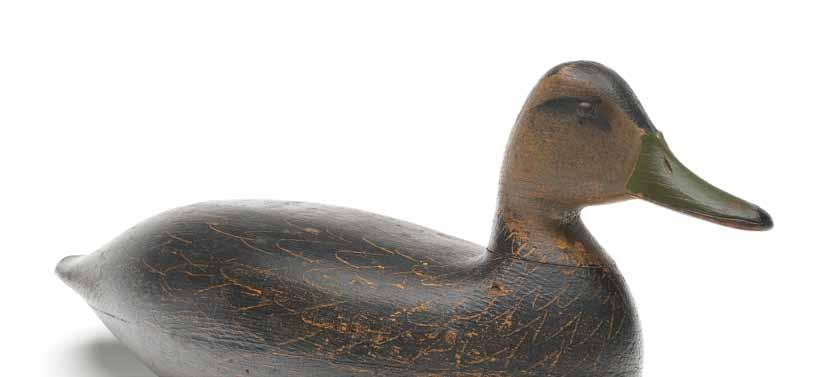
395 Harry M. Shourds (1890-1943), Ocean City, New Jersey. Excellent black duck. Hollow carved with tack eyes and scratch feather paint detail. Measures 16.5” long. Original paint with minor flaking and wear; lightly hit by shot mostly in one side, otherwise excellent structurally.
Provenance: John Decesare collection. (6,000 - 9,000)
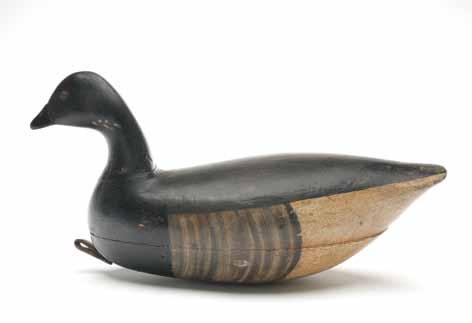
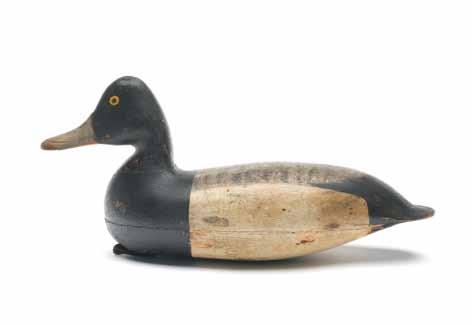
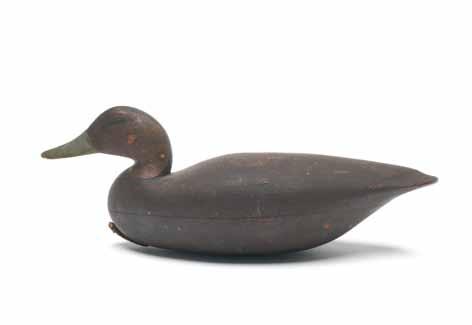
396 Harry V. Shourds (1861-1920), Tuckerton, New Jersey. Brant. Hollow carved with tack eyes and inlaid lead weight. Measures 16.5” long. Original paint with moderate wear under a thick coat of varnish that has darkened; white areas with a thin second coat; separation at body seam with one side being filled; tightly reset crack through neck; shallow chip in top of head was touched up long ago. (1,200 - 1,800)
397
Harry V. Shourds (1861-1920), Tuckerton, New Jersey. Bluebill. Hollow carved with inlaid lead weight. Measures 14.75” long. Original paint with minor wear; iron staining at nails around body seam; some touchup at neck seat; hairline crack in one side of neck that was tightly reset; spot of touchup on front of head where bill meets face; lightly hit by shot; tight crack in tail.
Provenance: John Decesare collection. (1,200 - 1,800)
398 Stanley Grant (1877 - 1953), Barnegat, New Jersey. Excellent black duck. Hollow carved with inlaid lead weight. Measures 16.5” long. Original paint with very minor wear; filled shot strike in one side was sanded down which removed a spot of paint.
Provenance: John Decesare collection. (1,500 - 2,500)
399 Thomas Robinson (1866-1939), South Seaville, New Jersey. Merganser hen. Hollow carved with tack eyes and extended tines of crest. Measures 14” long. Original paint with very minor wear; an old coat of varnish has darkened with age; large paint flake and minor separation at neck seat; slight separation at bottom board.
Provenance: John Decesare collection. (1,500 - 2,500)
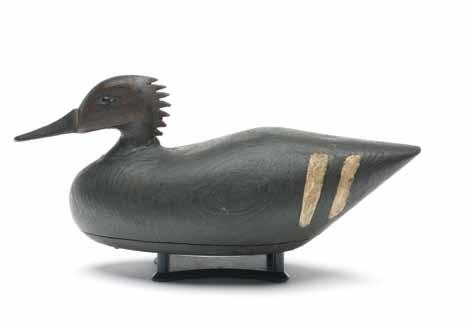
400 John “Jack” Updike (1886-1955), Wading River, New Jersey. Black duck. Hollow carved with inlaid lead weight on underside. Measures 16” long. Original paint with very minor flaking, mostly around neck seat; paint worn to bare wood at tip of bill; very good structurally. (800 - 1,200)
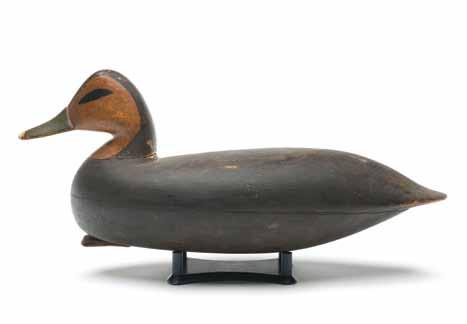
401 Bradford Salmons, Mayetta, New Jersey. Black duck. Hollow carved with raised extended wingtips. Hillman collection ink stamp on underside. Measures 18” long. Original paint with moderate wear; under an early coat of varnish; hairline crack in back; minor separation at body seam with some filler added near tail area; filled crack in tail; lightly hit by shot. (1,500 - 2,500)
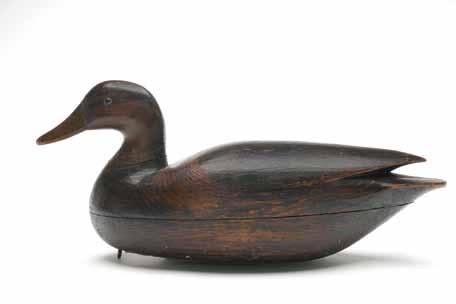
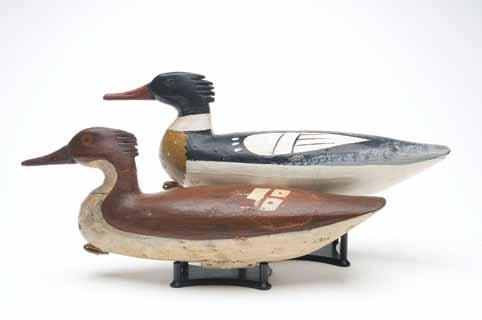
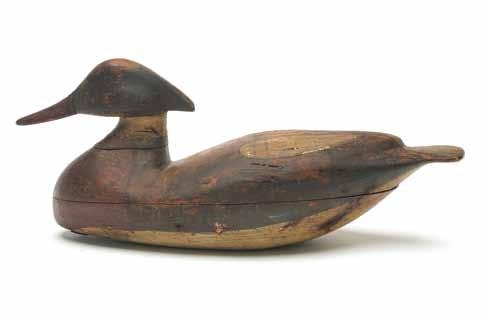
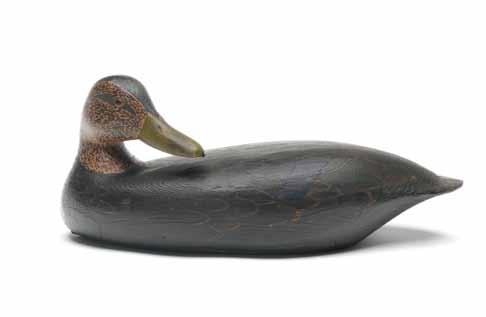
401A John Horn, New Gretna, New Jersey. Pair of mergansers. Hollow carved with extended crest. “SGH” stamped in the undersides. Drake with ink stamp from the Noyes Museum, exhibited 7/10/87. Measure 17” and 18” long. Appealing in use repaint with minor crazing and wear; minor chipping at tines of crest; filler missing above two body seam nails near drake’s tail; hen’s bill is a professional replacement.
(600 - 900)
402 Jack Inman, Bay Head, New Jersey, circa 1880. Early redbreasted merganser. Hollow carved with relief wingtip carving and extended crest. Measures 15.5” long. Very old paint appears original with significant flaking and wear; separation at body seam with a chip and roughness on one side of breast; crack in one side of neck seat; roughness on one side of head; bill is a working replacement, likely by the maker.
Literature: “Classic New Jersey Decoys” by James R. Doherty, page 134, exact decoy pictured.
(1,500 - 2,500)
403 Rare preening black duck from New Jersey. Hollow carved with inlaid lead weight. “FS” carved twice in underside. Measures 15” long. Original paint with minor wear; spots of touchup near wing patches, a few spots on bill and at a professional tail chip repair.
Provenance: John Decesare collection. (1,200 - 1,800)
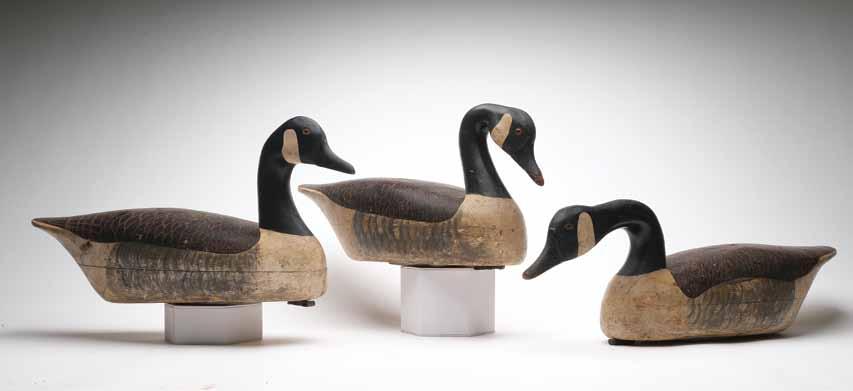
404 Jay C. Parker (1882-1967), Parkertown, New Jersey. Set of three rigmate Canada geese in different head poses. Hollow carved with detailed feather paint on backs and sides. Measure from 22” to 26.5” long. Original paint with minor discoloration and wear; moderate crazing on upper breast of one; slight separation at body seams; regular head style goose with professional neck crack repairs; appear to have an early second coat to black on head and bills; fine hairline cracks in three of the eyes.
Literature: Decoy Magazine, May/June 2016, front cover, exact set pictured. Article inside magazine exact decoys pictured. (3,000 - 5,000)
405 Clark Madera (1883-1953), Pitman, New Jersey. Rigmate pair of pintails. Hollow carved. Measure 16.75” long. Appealing repaint by Lem Ward with almost no wear; hairline crack in hen’s head; minor roughness on edge of bills from before the birds were repainted.
(2,000 - 3,000)
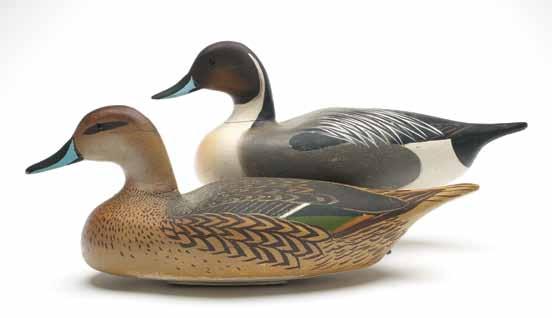
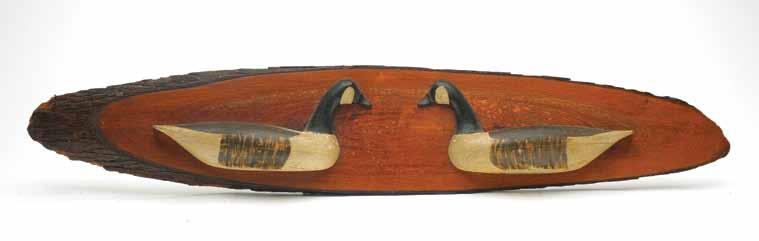
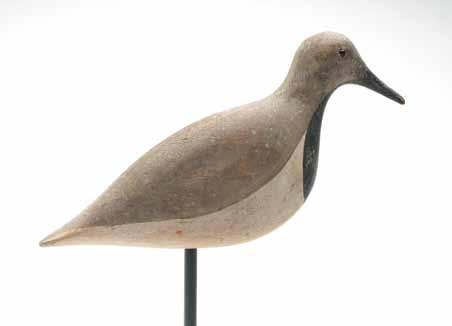
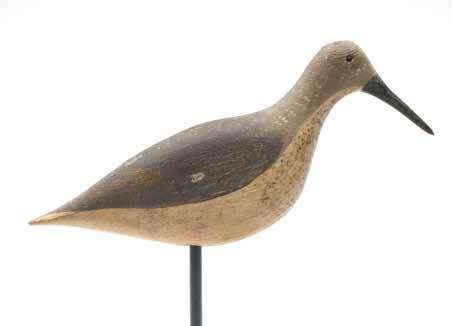
406 Attributed to Harry Mitchell Shourds, Ocean City, New Jersey. Early plaque with mounted miniature Canada geese. Geese are 9.25” long, plaque measures 31” long. Original paint under a thick coat of early varnish that has crazed and has areas of flaking; very good structurally.
(800 - 1,200)
407 Levi Rhodes Truex (1860-1934), Atlantic City, New Jersey. Black bellied plover. Tiny bead eyes. Measures 9.25” long. Very good and original.
(700 - 1,000)
408
Rhodes
(1860-1934), Atlantic City, New Jersey. Yellowlegs. Tiny bead eyes. Measures 10.25” long. Very good and original.
(700 - 1,000)
409 Rare Hudsonian godwit from New Jersey, circa 1900. Large two-piece shorebird with tack eyes and Mackey collection ink stamp on underside. Measures 20.5” long. Old overpaint was taken down to the current surface; moderate crazing; hairline cracks and small dents in one side; bill is a professional replacement. (2,000 - 3,000)
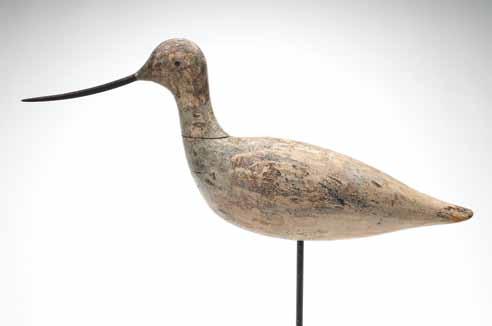
410 Daniel Lake Leeds (1852-1922), Pleasantville, New Jersey. Curlew. Relief wing carving and tack eyes. Measures 15.25” long. Original paint with moderate flaking and wear; filled drying cracks in body; an old coat of varnish has darkened with age; small nail added on top of head to secure bill.
(1,500 - 2,500)
411 Three shorebirds, New Jersey. Dowitcher from New Jersey, circa 1900. Measures 10.75” long with original paint that has darkened with age; very minor flaking and wear; bill is a professional replacement. Lesser yellowlegs by Taylor Johnson, Point Pleasant, New Jersey. Measures 9.75” long with original paint with very minor wear; bill is a professional replacement. A second lesser yellowlegs by Taylor Johnson. Measures 9.75” long with original paint on the light areas; brown appears to be an early second coat with minor wear; appealing twine neck crack repair around neck; bill was cracked off and reset off of center; minor roughness in one side.
Provenance: Davis Pearson collection. (2,000 - 3,000)
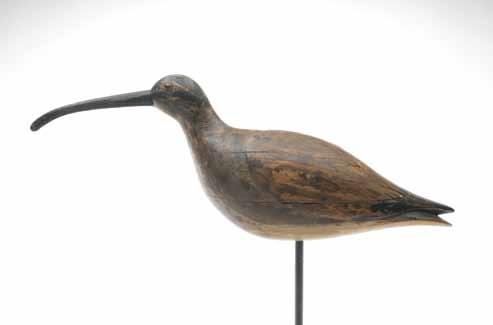
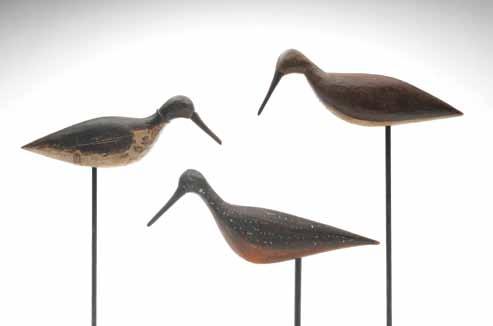
The general consensus among decoy historians is that all of these carvings, with their meticulous cross hatching and finely carved wings, originated from an area surrounding two rural villages, not far from Jones Falls where the Hutchins family farms were located. Sam is the family member often credited with being the architect of these outstanding examples of Canadian folk art. Sam followed his father in the dairy business and worked a 100-acre plot of land with his wife, Jean. Upon the death of his father, he bought a dump truck and backhoe and went into the construction business. In the off season, he trapped and produced maple syrup. It is believed that the decoys credited to him were made between 1908 and 1914 consisting of one or two small rigs of mergansers and several pairs of goldeneyes. What the family didn’t use for their own rig, Hutchins sold for $4 apiece to local hunters. His favorite duck blind was on Crow Lake, and he often would store his decoys nearby in a trapping shack rather than haul them the required three miles back home. Unfortunately, 20 of the decoys were stolen from the shack in 1970. Today, the quality of the decoys produced by this maker firmly places them in the upper tier of designs to emerge from the Rideau Canal Waterway.
412 Sam Hutchins, Jones Falls, Ontario. Rare hooded merganser hen. Deep relief wing carving and extended crest. Maker’s typical cross hatch feather carving detail. “Kangas” branded in underside and one side. Measures 11” long. Original paint with moderate gunning wear; lightly hit by shot; shot strike on one side of bill has caused a small chip.
Provenance: Gene and Linda Kangas collection. (8,000 - 12,000)
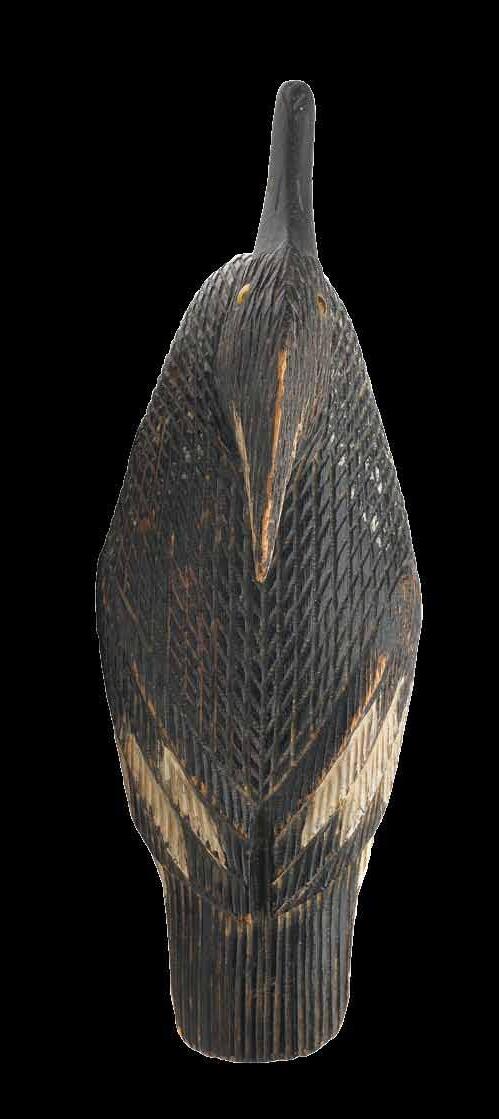
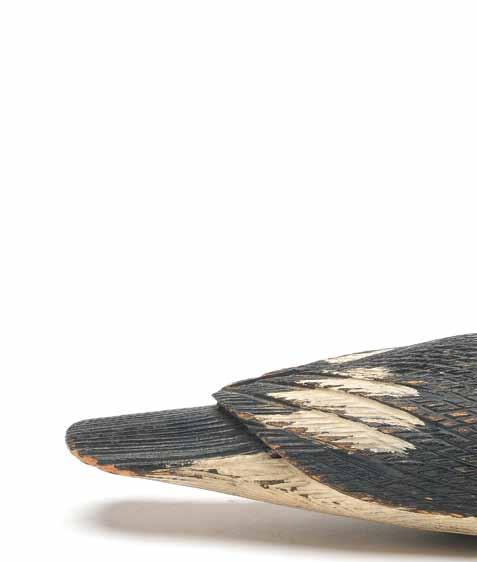
412A Sam Hutchins, Jones Falls, Ontario. Rare hooded merganser. Deep relief wing carving and exaggerated extended crest. Maker’s typical cross hatch feather carved detail. Measures 12” long. Original paint with moderate gunning wear; some roughness on edge of tail and top of crest; 3/4 of the bill was professionally restored.
Provenance: Gene and Linda Kangas collection. (8,000 - 12,000)
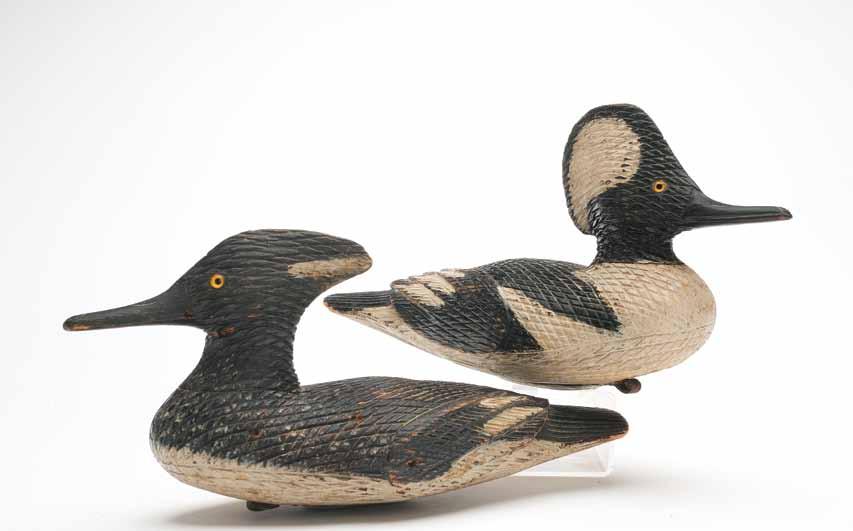
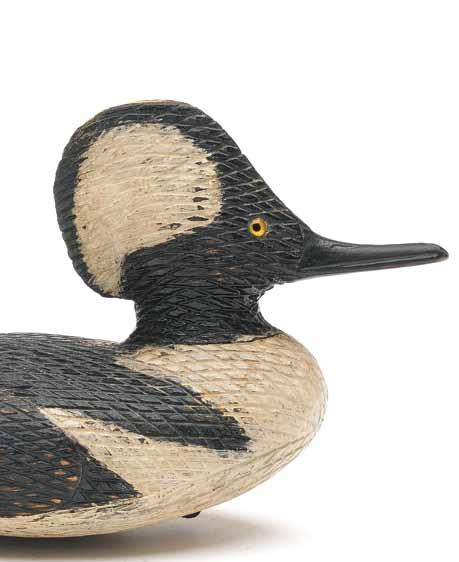
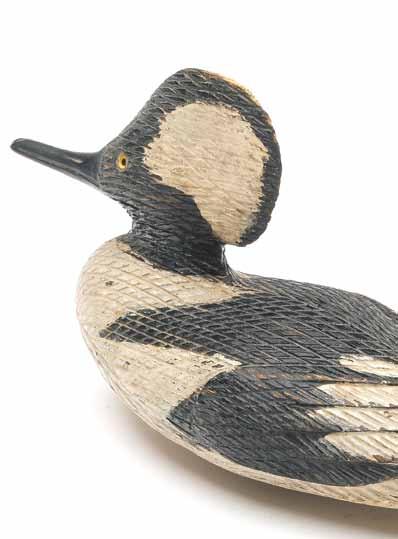
“The Green Bottom Rig”
Frenchman’s Bay is located on the north shore of Lake Ontario, just east of Toronto, in the city of Pickering. Today, it is a vibrant community of light industry and suburban homes and condos on the waterfront which boast a popular marina and beachfront. It was not always this way.
As noted in “The History of the Frenchman’s Bay Marina,” “In 1853, some 14 years before Canadian Confederation, an Act to incorporate the Pickering Harbour Company was assented to by Queen Victoria. With this Act, Pickering Harbour Company was deeded the water rights and ownership of the land under the water of Frenchman’s Bay and out into Lake Ontario, entitling it to operate the harbour and to charge and collect tolls. This original charter remains in place to this day- - - .” The area was rich in resources and, by the early 19th century, loggers had cleared the forest, and the land began to produce bountiful agricultural crops, mainly grains. Businesses around the harbor began to flourish. This rural nature continued through the late 19th and into the early 20th century. By this time, tourism began to develop and dance halls, swimming, and boating became popular pastimes. The harbor itself was bounded on multiple sides by a barrier beach and areas of protected wetlands which, in turn, attracted migrating waterfowl. This did not go unnoticed by sportsmen, both local and from Toronto, who could now conveniently reach the Bay by train.
A local entrepreneur was quick to take advantage of the influx of people wanting to fish or hunt on the Bay and in the marshes. During roughly the 1890 to 1920 timeframe, he owned and operated the ‘Pickering Bay Boat Livery’, renting small craft to the visiting sportsmen. During the duck season, many of these hunters would return to the
docks with their birds and, remarkably, many would leave one or more decoys in the boats when they departed. Eventually, these amounted to three full grain bags of decoys, including Ontario wire leg shorebirds, a black, two mallards and a pintail by John R Wells (1861 – 1953) of Toronto, and assorted carvings by other makers. The owner of the livery collected these derelicts and would then rent them out to future groups of hunters. To eliminate any confusion when these clients returned, he painted the bottom of “his” decoys a distinctive shade of green to indicate ownership. With this gentleman’s death, the birds descended through multiple generations of his family, ultimately to be stored in the attic of a garage in Pickering (now Ajax). In 2005, a well-known Ontario collector/dealer was approached by the attorney of the family and asked to dispose of the carvings for his clients. The decoys have since passed through various hands and represent a wonderful story of duck hunting in its heyday in southern Ontario.
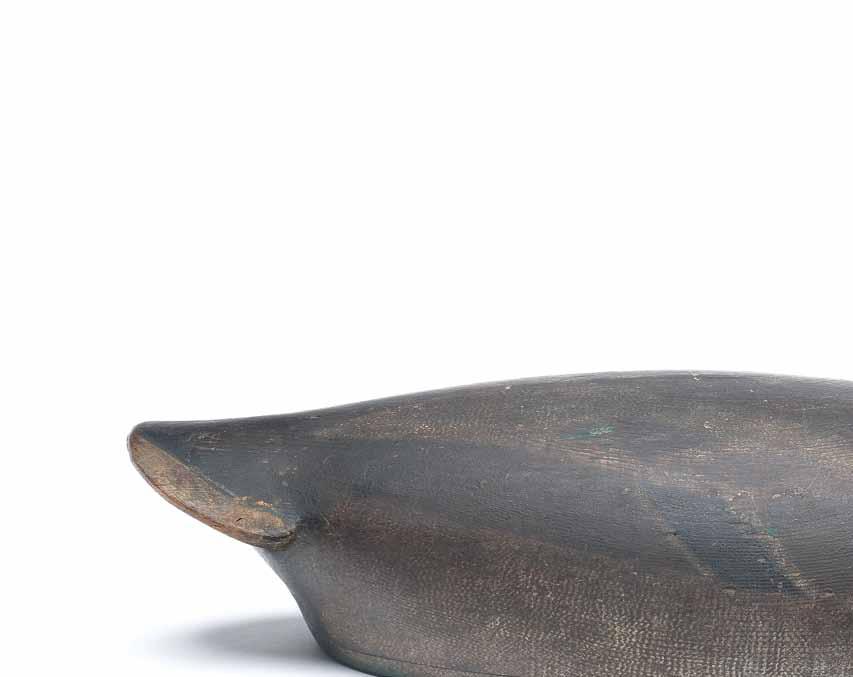
Pickering waterfront c1930. Note small boats on shore
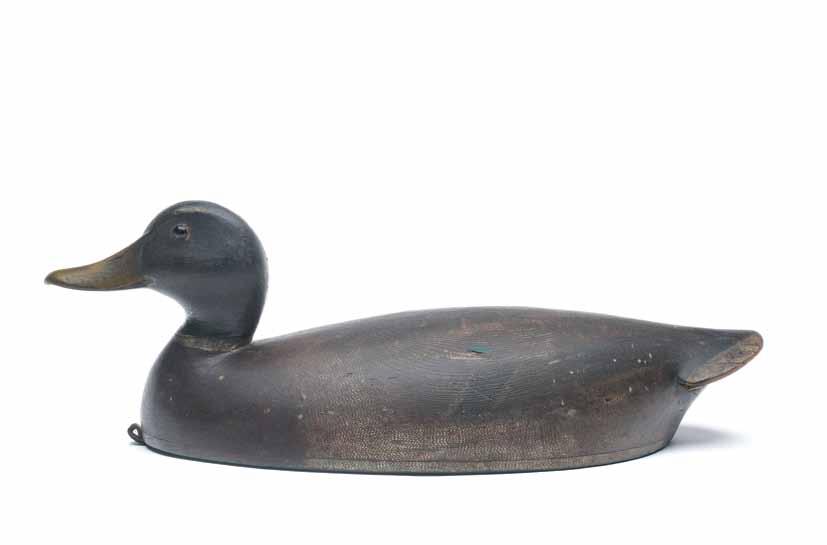
413 John R. Wells (1861-1953), Toronto, Ontario. Rare mallard. Thinly hollowed with .25” bottom board and excellent head carving. Measures 17” long. Original paint with minor gunning wear; under a coat of early varnish that has darkened with age; lightly hit by shot; professional tail chip repair; old green overpaint on underside. (8,000 - 12,000)
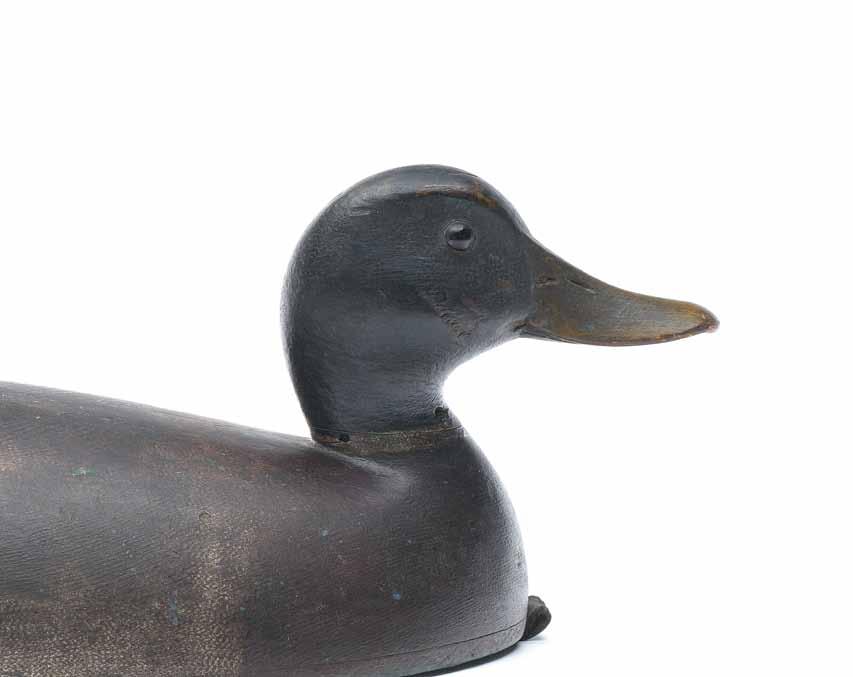
As the 19th century rolled into the 20th, Prince Edward County’s economy was strongly reliant on agriculture. Like many on the peninsula, Will Loney was raised on the family farm where it abutted Lake Ontario and, as a child, surely must have helped in the daily chores of the homestead. Research by Jim Stewart indicates that, as he grew into a young man, William learned the blacksmith trade and worked in Sault Ste. Marie as well as in Chicago and Detroit. By 1912 he had returned to Prince Edward County and married a local schoolteacher, North Marysburg resident, Selena (“Lena”) May Martin in Bloomfield. Two years later they had a daughter, Margaret Irma, but sadly she died from the flu a short 6 years later. Until at least the time of the 1931 Canadian census, Loney had returned to his roots and was working as a farmer, first in South Marysburg, then in neighboring North Marysburg. He somewhat disappears from the official records after 1931. In 1943 his wife died in Bloomfield so we must assume he was living there at the time and, likewise, he passed away in 1956 while living in Picton. His exact occupation during this latter period in his life is not exactly clear.
With the exception of a rig of black ducks he is reported to have made for his brother-in-law, Loney only made decoys for his own use and, thus, his production was limited, estimated at no more than several dozen birds. He is justly famous for his elegant teal, but he also made small numbers of blacks, mallards, whistlers and at least one bluebill.
A true folk artist, Loney is also recognized for his elaborate dioramas and intricate bird houses. Both have been referenced in McKendry’s “Folk Art, Primitive and Naïve Art in Canada” and examples of his work are included in the collection of the Canadian Museum of History in Quebec.
William Loney can rest knowing that his are some of the finest of the many wonderful decoys to come from the talented hands of Prince Edward County carvers.
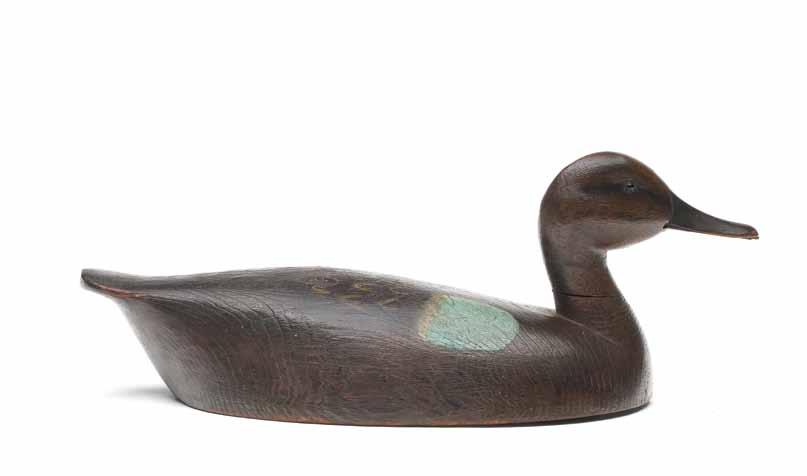
414 William Loney (1878-1956), South Marysburg, Ontario. Bluewing teal hen. Scratch feather paint detail on head and neck. Excellent form. Measures 11.25” long. Original paint with very minor wear; small tail chip repair; professional neck crack repair; two small spots of touchup to wear on top of head.
Provenance: Dean Hyde collection. (5,000 - 8,000)
Dean (“Fierce Dean”) Sage Sr. (The “DS” brand) 1841 – 1902 | Brooklyn and Albany, New York
Sage was an extremely wealthy lumberman, who owned and operated H.W. Sage and Co, in addition to other financial ventures. A dedicated sportsman, he was a member of the Long Point Company between 1897 and 1902. In addition to his love of waterfowling, he enjoyed boxing, breeding trotting horses, dogs and fighting cocks. His true passion, however, was salmon fishing. In 1879 he built his private camp at the confluence of the Restigouche and Upsaguitch Rivers in New Brunswick which he named “Camp Harmony.” In 1895 The lodge and grounds were redesigned and greatly expanded by noted New York architect Stanford White. A dedicated bibliophile, he amassed one of the finest angling libraries of his day and, in 1888 he penned his, now classic, “The Restigouche and Its Salmon.” He suffered a heart attack and died after fishing at his beloved Camp Harmony.
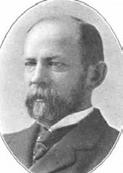
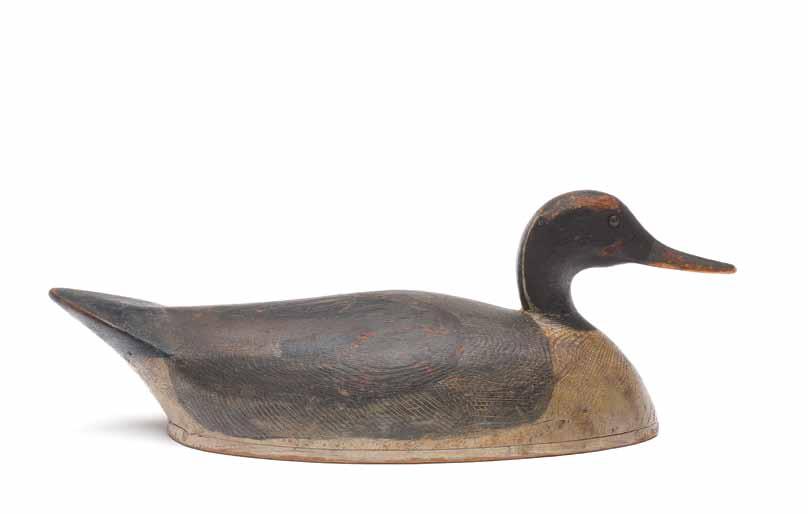
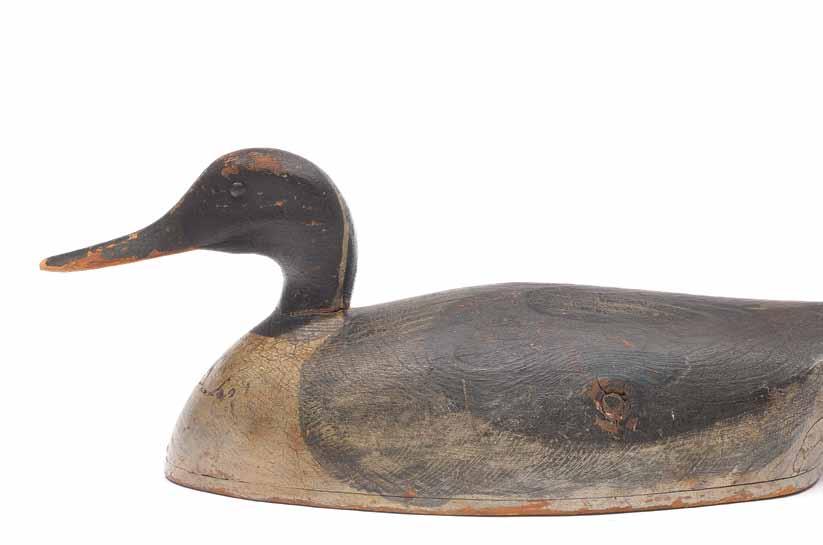
415 Appealing pintail from a member of the Reeves family. Thinly hollowed with .25” bottom board and tack eyes. “J.S.,” “ Whms” and “DS” branded on underside. Measures 15” long. Original paint with moderate flaking and wear; an old coat of varnish has darkened with age; minor losses at a small knot in one side; some roughness on edge of bill; head is slightly loose; small professional tail chip repair. (5,000 - 8,000)
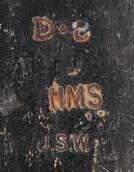
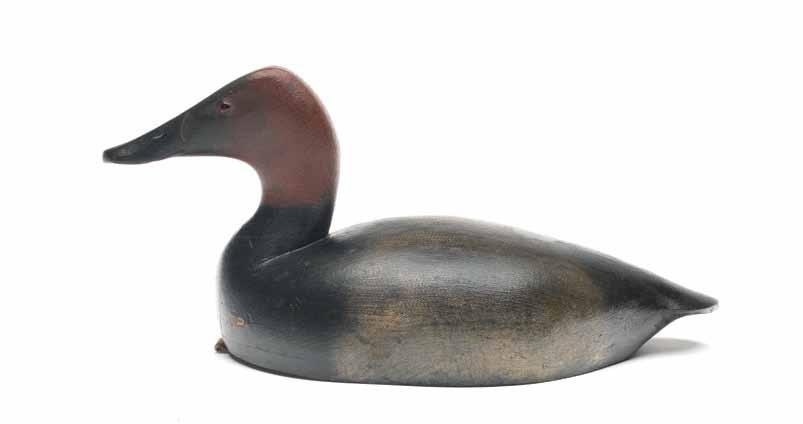
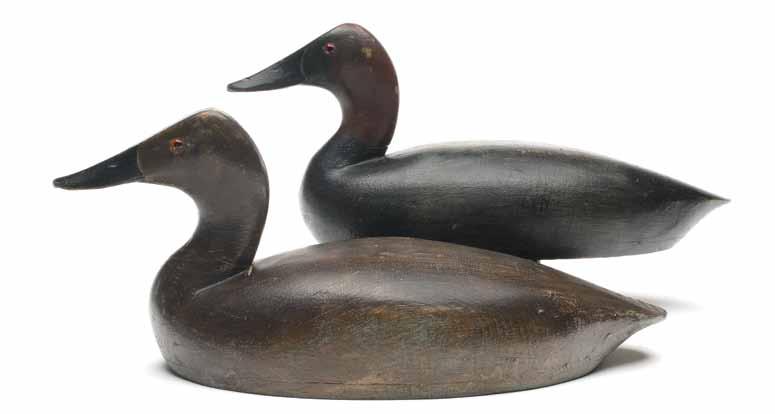
416 Thomas Chambers (1860-1948), Toronto, Ontario. Excellent canvasback. Hollow carved short body style with fine comb feather paint detail. Measures 15.25” long. Original paint with very minor wear; an early coat of varnish has darkened with age; one shot strike on side of neck seat, otherwise excellent structurally.
Provenance: John Decesare collection.
(2,500 - 3,500)
417 Thomas Chambers (1860-1948), Toronto, Ontario. Pair of long body style canvasbacks. Hollow carved with .25” bottom boards and fine comb feather paint detail. “P.H.D.” branded in underside of drake. Also stenciled “P.H.Deming”. Measure 17” long. Original paint with minor to moderate wear; early coat of varnish on each; small dents and shot marks on drake; wooden patch on one side of hen from when the decoy was made; underside of drake’s bill was reshaped at some point. (5,000 - 8,000)
418 George Warin (1830-1904), Toronto, Ontario. Redhead. Solid body with “JL Rhoades” painted on underside. Measures 14.5” long. Original paint with moderate gunning wear; heavily hit by shot; an old coat of varnish has darkened.
Provenance: John Decesare collection. (1,200 - 1,800)
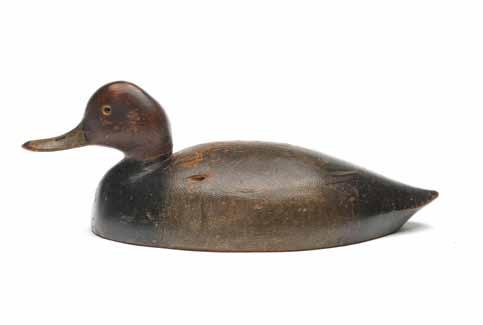
419 Gorsline family, Demorestville, Prince Edward County, Ontario. Black duck. Thinly hollowed with scratch feather paint detail on head and neck. Measures 17.5” long. Original paint with moderate to significant flaking and wear; thick coat of varnish has flaked off of much of the decoy; old chip on underside of bill tip. (3,000 - 5,000)
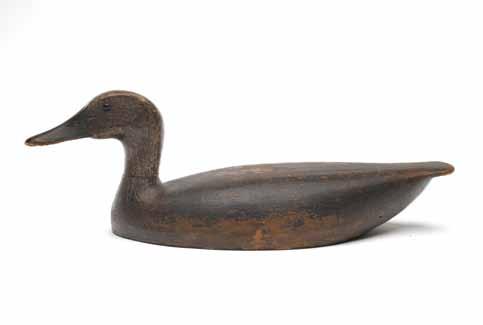
420 Nicely carved black duck from Ontario. Two piece body with excellent head carving. Made by the same maker as the famous stickup wood ducks from Ontario. Measures 15.5” long. Original paint with moderate wear; under multiple coats of varnish; a few spots of touchup on back; and one lower side; crack through neck with a few small nails added; some filler and touchup at the back of base of neck. (3,000 - 4,000)
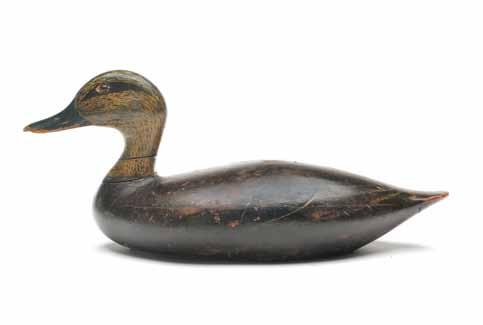
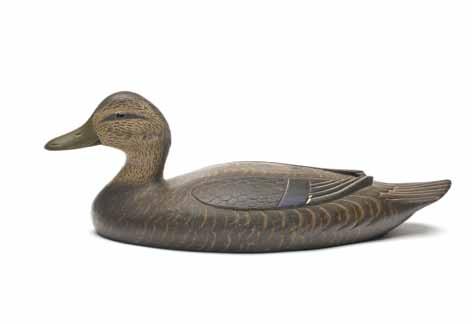
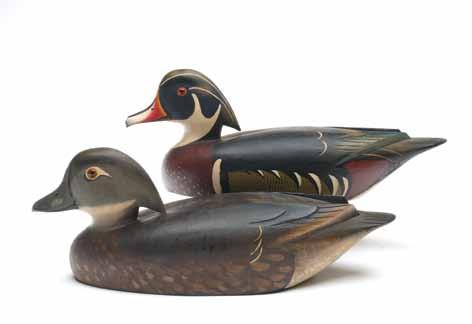
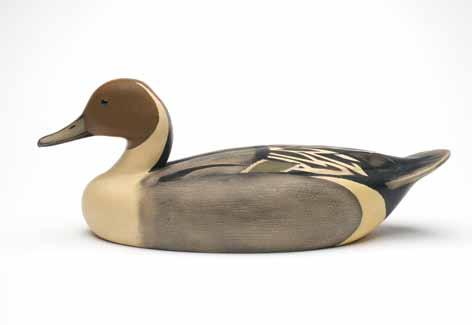
421 D.K. Nichol, Smith Falls, Ontario. Black duck, circa 1900. Impressive wing, tail, and side pocket carving. Hollowed from underside with bottom board which reads “Black duck made by DK Nichol about 1900 Smith Falls, Ontario”. This decoy was restored by DW Nichol in the 60’s from the collection of George Thompson 1984. Measures 16” long. Structurally excellent; second coat of paint has dried and mellowed nicely.
Provenance: Frederick Raymon collection. (1,200 - 1,500)
422 David W. Nichol (1890-1977), Smith Falls, Ontario. Pair of wood ducks. Relief wing and tail feather carving. Both with extended crests. Measures 13.5” long. Excellent and original.
Provenance: Dean Hyde collection. (1,500 - 2,500)
423 Ken Anger (1905-1961), Dunnville, Ontario. Pintail. Relief wing and incised feather carving. Comb feather paint detail. Does not appear to have been rigged or weighted. Measures 16” long. An early coat of varnish has darkened slightly with age, otherwise excellent and original. (2,500 - 3,500)
424 Ken Anger (1905-1961), Dunnville, Ontario. Canvasback hen and drake. Hollow carved with relief wing and incised feather carving. Measure 16.25” long. Hen is very good and original; drake with minor gunning wear; small chip and roughness on edge of bill; tight crack through one eye. (800 - 1,200)
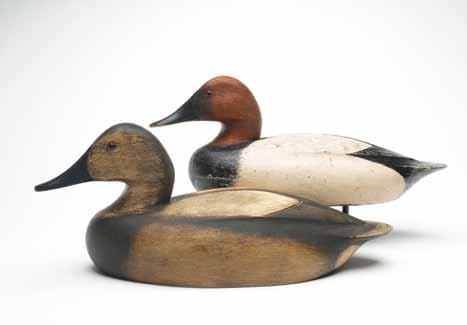
425 Ken Anger (1905-1961), Dunnville, Ontario. Pair of mallards with relief wing and incised feather carving. Measure 16” long. Original paint with very minor wear; hen with a few small dents and black over paint on underside.
Provenance: Deborah and Martin Maloy collection. (1,200 - 1,800)
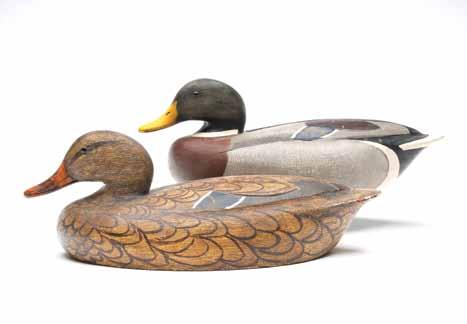
427 John R. Wells (1861-1953), Toronto, Ontario. Pair of canvasbacks. Solid body style. Measure 17” long. Original paint with minor gunning wear; hen is lightly hit by shot; slight separation at hen’s neck seat; drake has had some overpaint cleaned off of white areas. (3,000 - 5,000)
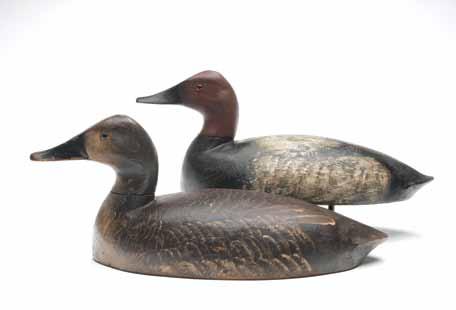
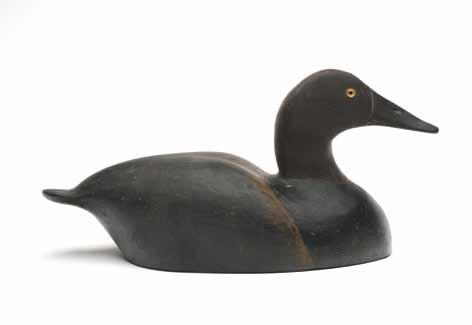
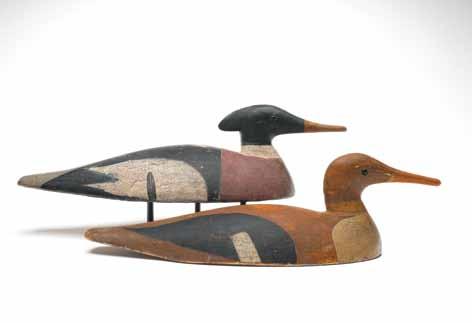
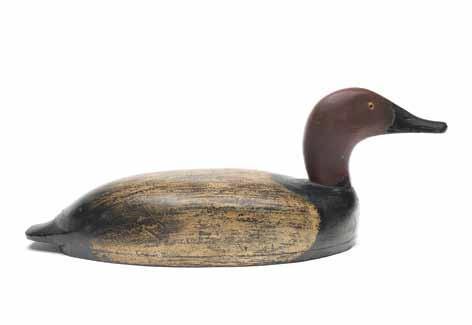
428 Frank Dolsen (1900-1981), Lake St. Clair, Ontario. Canvasback hen. Maker’s conjoined initials carved in underside. Measures 15” long. Original paint with minor wear; surface has darkened with age; wooden keel was removed; otherwise very good structurally.
Provenance: Frederick Raymon collection. (1,500 - 2,500)
429 Pair of mergansers from Nova Scotia. Drake with extended crest. Measure 18” and 19” long. Original paint with moderate wear; scattered crazing and paint shrinkage; filler restoration around drake’s neck seat; touchup on top of drake’s head around each eye and on one side of crest.
Provenance: John Decesare collection. (1,500 - 2,500)
430 Canvasback from Southwestern Ontario. Hollow carved with .25” bottom board and comb feather paint detail. Measures 17” long. Original paint with moderate wear; under a thick coat of varnish; lightly hit by shot; some roughness on tip of bill that was darkened. (600 - 900)
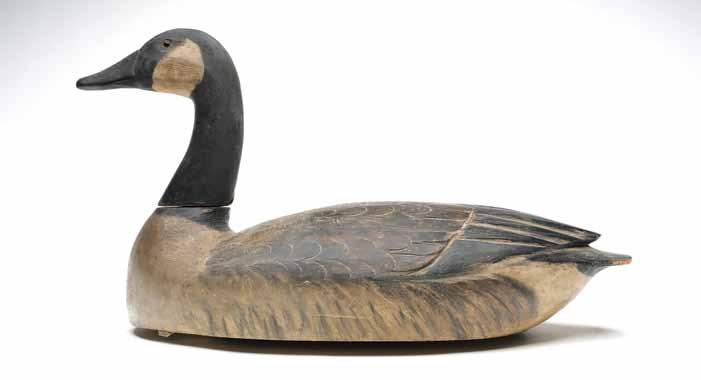
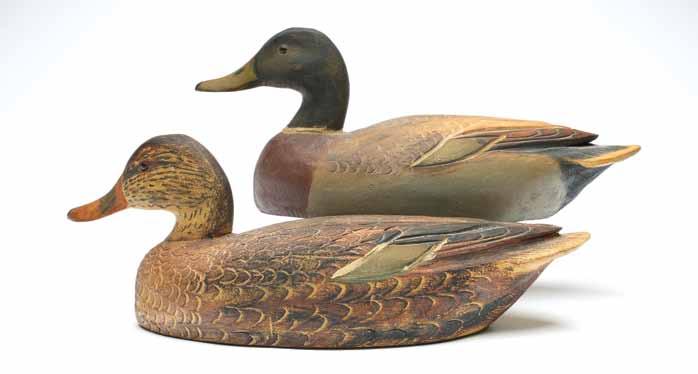
Benjamin Schmidt (1884-1968), Detroit, Michigan. Canada goose. Decoy was hollow carved from the underside and has removable head. Relief feather carving. Measures 22” long. Original paint with minor gunning wear; tiny chip at tip of tail; some filler and touchup on tip of bill.
Provenance: Jim and Patti Aikin collection. (2,000 - 3,000)
432 Benjamin Schmidt (1884-1968), Detroit, Michigan. Pair of mallards. Relief wing and incised feather carving. Both with slightly turned heads. Measure 17.5” long. Near mint original paint under a thin coat of varnish that has darkened with age; excellent structurally. (1,500 - 2,500)
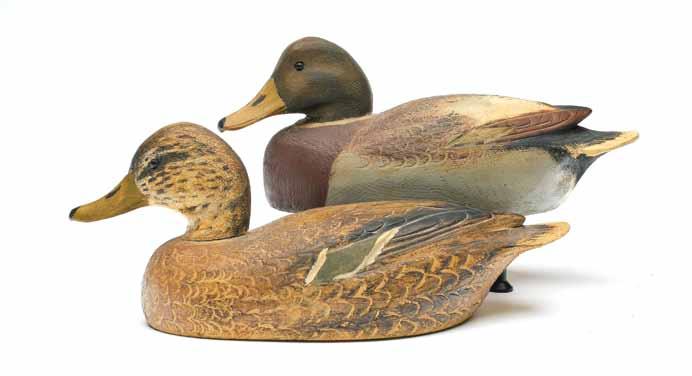
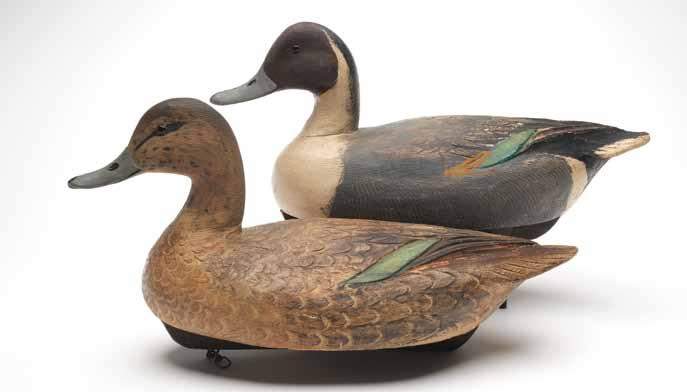
433 Benjamin Schmidt (1884-1968), Detroit, Michigan. Rare pair of 3/4 size mallards. Relief wingtip and incised feather carving. Drake with slightly turned head. Measure 12” and 13” long. Near mint paint protected under an early coat of varnish that has darkened with age; excellent structurally. (1,000 - 1,400)
434 Benjamin Schmidt (1884-1968), Detroit, Michigan. Pair of pintails. Relief wing and incised feather carving. Len Carnaghi collection ink stamp on undersides. Measure 16.5” long. Original paint with minor gunning wear; hen’s bill was cracked down and tightly reset with some touchup to that area. (2,000 - 3,000)
435 Ferdinand Bach (1888-1967), Detroit, Michigan. Pair of 1/3 size canvasbacks. Tucked and slightly turned heads. Relief wingtip and tail feather carving. Measure 9.5” long. Very good and original.
(1,000 - 1,500)
436 Tom Schroeder (1886-1976), Detroit, Michigan. 1/3 size goldeneye. Tucked head and relief wingtip carving. Measures 7” long. Original paint has darkened under the original coat of varnish; very good structurally.
Provenance: Private Michigan collection. (250 - 350)
437 Tom Schroeder (1886-1976), Detroit, Michigan. 1/3 size bluebill. Slightly turned head and relief wingtip carving. Measures 6.75” long. Original paint has darkened slightly under the original coat of varnish; very good structurally.
Provenance: Private Michigan collection. (250 - 350)
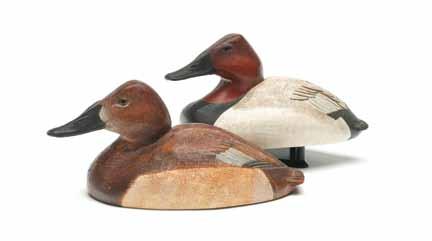
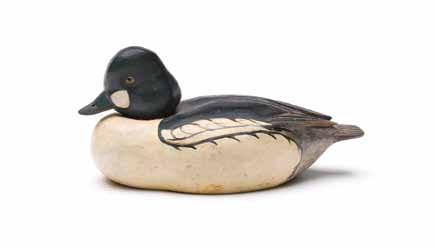
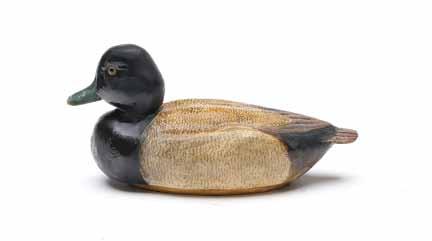
438 Tom Schroeder (1886-1976), Detroit, Michigan. 1/3 size greenwing teal. Tucked head and relief wingtip carving. Measures 6.5” long. Original paint has darkened slightly under the original coat of varnish; scattered flaking on head and edge of tail; very good structurally.
Provenance: Private Michigan collection. (300 - 500)
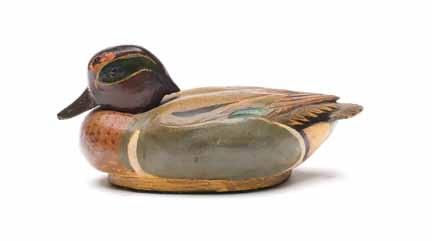
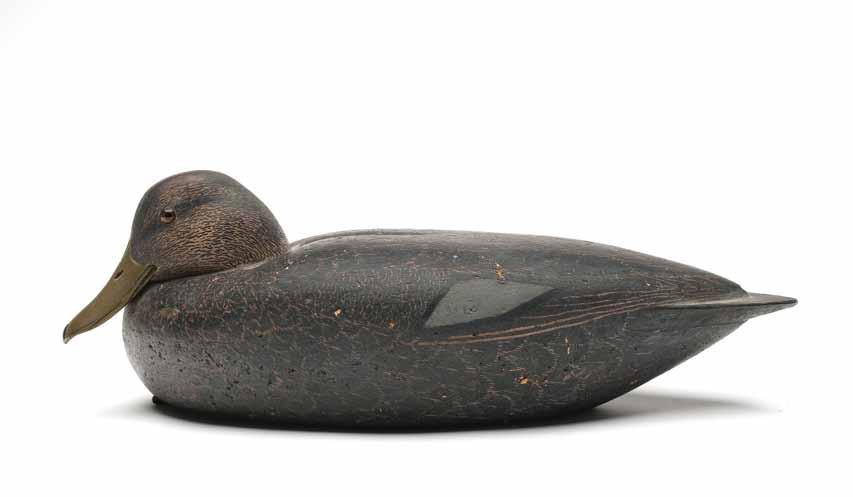
439 Louis C. Rathmell (1898-1974), Danbury, Connecticut. Excellent cork body black duck. Tucked head is slightly turned and with scratch feather paint detail. Inlaid weight on underside with maker’s name stamped in to it. Dr. Lloyd Griffith collection ink stamp on underside. Measures 17.5” long. Excellent original paint with very minor flaking; excellent structurally. (10,000 - 15,000)
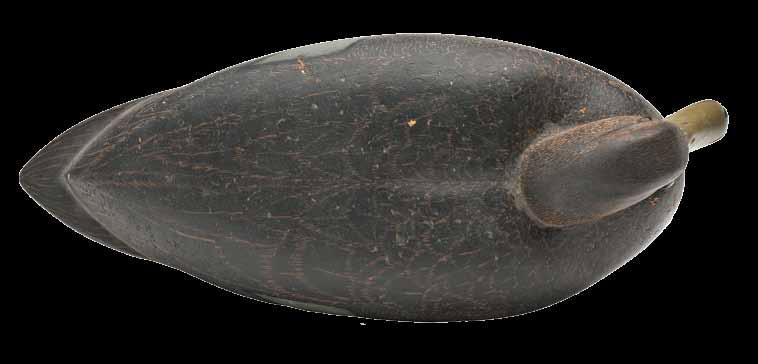
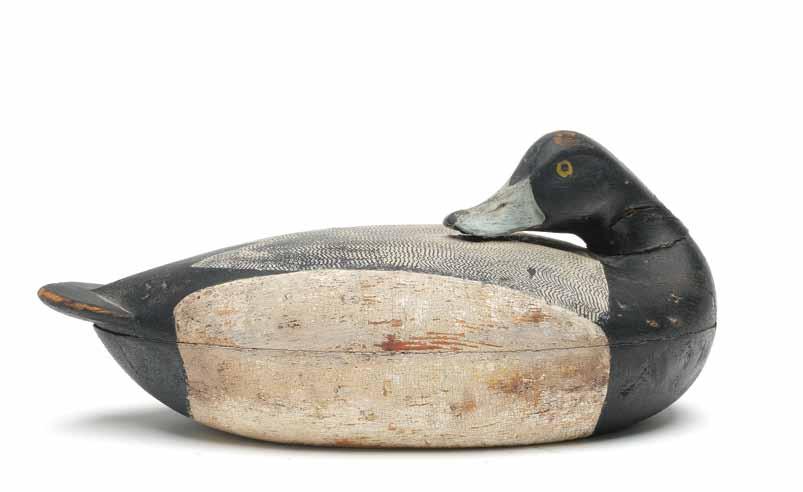
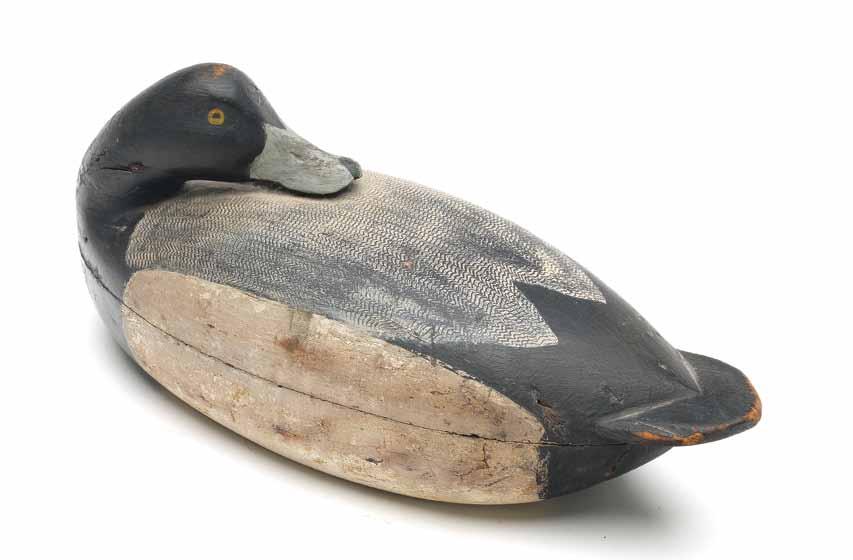
440 Albert Laing (1811-1886), Stratford, Connecticut. Sleeping bluebill. Hollow carved with comb feather paint detail. “Laing” branded in underside. Measures 13.5” long. Early in use repaint by Shang Wheeler shows moderate gunning wear; moderately hit by shot; multiple cracks at neck seat with small nails to secure; wooden patch at lower center of breast. (10,000 - 15,000)
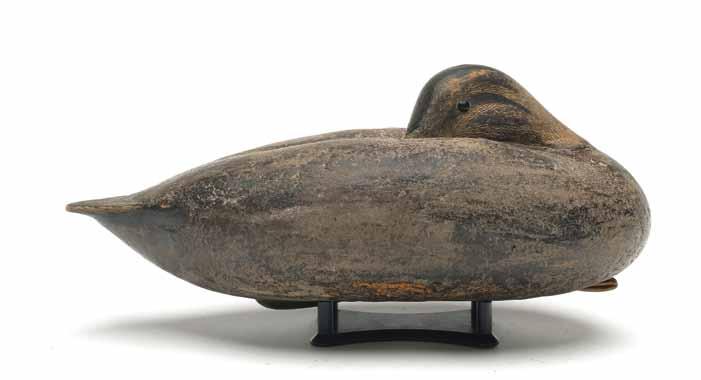
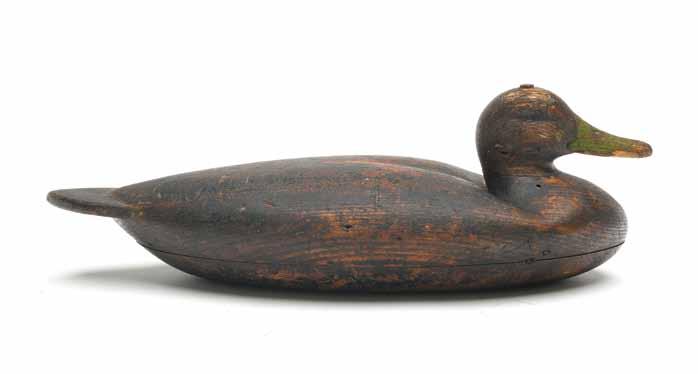
441 Charles E. “Shang” Wheeler (1872-1949), Stratford, Connecticut. Rare sleeping black duck. Cork body with applied cedar tail and head in sleeping pose. Measures 15” long. Original paint with moderate to significant wear; some spots of touchup on head. (3,000 - 5,000)
442 Albert Laing (1811-1886), Stratford, Connecticut. Thinly hollowed lowhead black duck. Measures 15.5” long. Very early in use repaint has flaked away to much bare wood; scattered dents and shot marks; roughness on edge of bill and top of head; bill was cracked down and tightly reset; the tail is a professional replacement.
Provenance: Gene and Linda Kangas collection. (4,000 - 6,000)
443 Reginald Culver (1897-1975), Stratford, Connecticut. Bluebill. Hollow carved with comb feather paint detail and Stratford style teardrop weight. “R.I. Culver” branded in underside. Measures 13.5” long. Original paint with minor to moderate gunning wear; thin coat of varnish has darkened with age; excellent structurally.
Provenance: John Decesare collection.
Literature: “The Great Book of Wildfowl Decoys”, Joe Engers, editor, page 89, exact decoy pictured. (1,200 - 1,800)
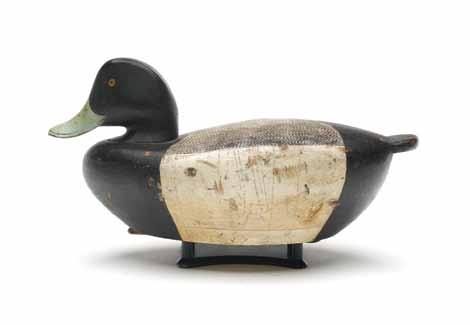
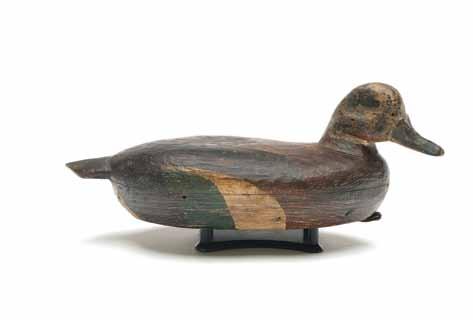
445 Homer Lawrence (1889-1968), Norwalk, Connecticut. Standing ruddy duck hen. Slightly turned head with relief wing and tail feather carving. Measures 13.5” long, stands 11” tall. Very minor separation where legs meet body; fine hairline crack in tail; otherwise excellent. (1,200 - 1,800)
444 Rare widgeon from Connecticut. Hollow carved with slightly turned head. Tim Eastland collection ink stamp on underside. Measures 14” long. Original paint with minor wear; surface has darkened with age; lightly hit by shot; small chip in one side of bill tip professionally restored.
Provenance: John Decesare collection. (800 - 1,200)
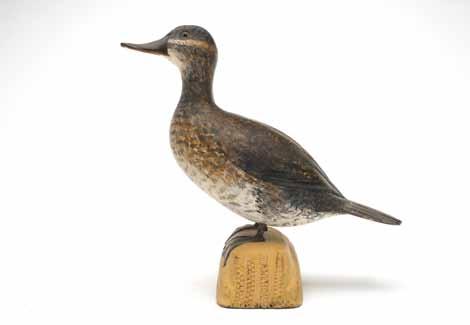
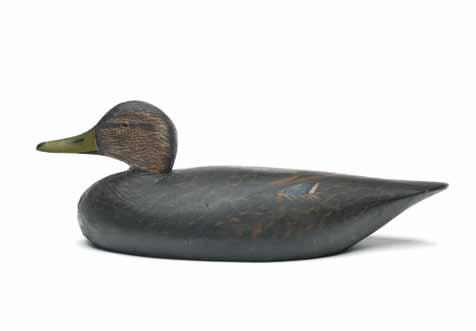
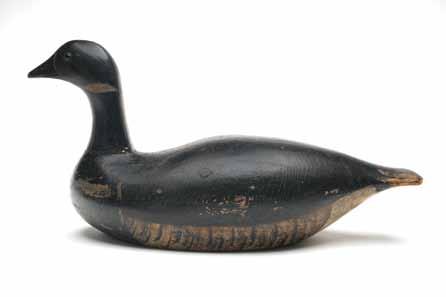
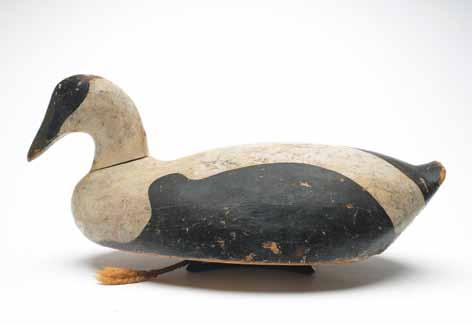
446 A. Elmer Crowell (1862-1952), East Harwich, Massachusetts. Black duck. Maker’s oval brand on underside. Measures 17.25” long. Original paint with very minor gunning wear; small dents and shot marks on body; hairline crack in one side of neck seat. (3,000 - 4,000)
447 Joseph Lincoln (1859-1938), Accord, Massachusetts. Brant. Slightly forward head pose. Measures 19.5” long. Original paint with moderate flaking under a thick coat of varnish that has darkened; large split along underside is filled; 3/4 of the bill is a professional replacement. (700 - 1,000)
448 Unknown maker, Maine, circa 1900. Eider drake with wide body, slightly raised neck seat, and up swept tail. Measures 19.5” long. Original paint with moderate flaking and wear; thin wash to the white areas likely done in the making; small dents and shot marks; chipping and roughness on edge of tail; slight separation at neck seat.
Provenance: Deborah and Martin Maloy collection. (3,000 - 5,000)
449 Pair of golden plover from Nantucket, Massachusetts, late 19th century. Carrying holes drilled in tails. Measure 9.5” and 10” long. Original paint with moderate wear; four filled dents or shot marks on side of one; hairline crack along one bill; bills appear original.
Provenance: John Decesare collection. (2,000 - 3,000)
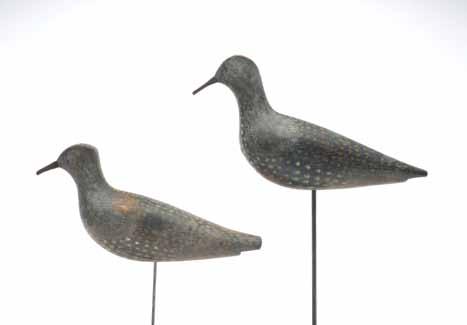
450 Black bellied plover windbird from Massachusetts, late 19th century. Thinly hollowed from the underside and meant to move in the wind. Deep relief wing carving with the shoulder area and wingtips separated from body. George Ross Starr ink stamp on underside of tail. Measures 10.25” long. Original paint with very minor wear; bill is an early replacement.
Provenance: Dr. George Ross Starr Jr collection. Ted and Judy Harmon collection.
Literature: “Decoys of the Atlantic Flyway” by Dr. George Ross Starr Jr., page 54, exact decoy pictured. (4,000 - 6,000)
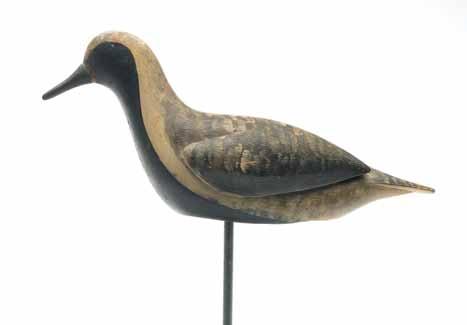
451 Unknown maker, Massachusetts, early 20th century. So called Fox rig curlew with split tail carving and painted eyes. This example does not have the Fox rig brand and appears to be unused. Measures 14.5” long. Near mint original paint; shallow dent in one side; bill is a professional replacement.
Provenance: Ted and Judy Harmon collection. (5,000 - 8,000)
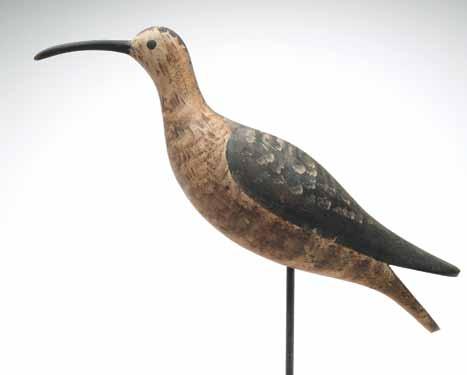
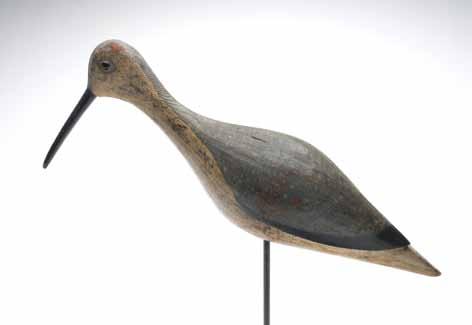
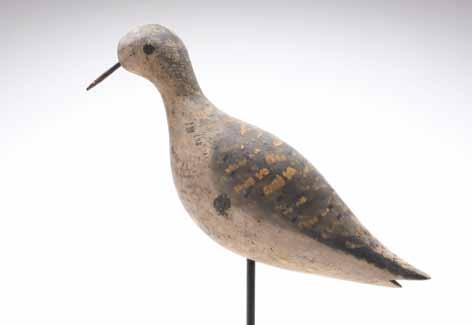
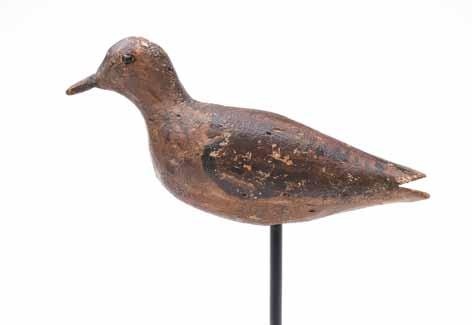
452 Charles Thomas (b. 1875), Assinippi, Massachusetts. Large willet. Deep relief wing carving. Two Dr. George Ross Starr collection ink stamps on underside. Measures 14.5” long. Original paint with minor to moderate wear; lightly hit by shot; drying split along the underside with an old chip near stick hole; eyes were replaced at some point with touchup around them.
Provenance: Dr. George Ross Starr Jr collection.
Literature: “Decoys of the Atlantic Flyway” by Dr. George Ross Starr Jr., page 54, exact decoy pictured.
(3,000 - 4,000)
453 Golden plover from Massachusetts, 19th century. Split tail carving and painted eyes. Measures 11” long. Original paint with almost no wear; black smudge on one side; tiny crack where bill meets face. (1,200 - 1,800)
454 Rare working sanderling from Massachusetts. Split tail carving and shoe button eyes. Measures 7” long. Original paint with moderate gunning wear; lightly hit by shot. (1,000 - 1,500)
455 Elisha Burr (1839-1909), Hingham, Massachusetts. Feeding black bellied plover with relief wing carving and extended wingtips. “E Burr” branded in underside. Two different George Ross Starr collection ink stamps on underside. Measures 11” long. Mix of original and early in use touchup with moderate flaking and wear; bill and front area of face professionally restored; applied wingtips appear original, but may be early replacement by the maker; minor chipping at stick hole.
Provenance: Dr. George Ross Starr Jr. collection. Ted and Judy Harmon collection.
Literature: “Decoys of the Atlantic Flyway” by Dr. George Ross Starr Jr, page 24, exact decoy pictured. “The Bird Decoy” by Paul A. Johnsgard, page 170, exact decoy pictured. (2,500 - 3,500)
456 Unknown maker, Massachusetts, late 19th century. Golden plover with applied metal wings and tack eyes. Holes in underside where metal legs may have been used. Also with a hole drilled through body for flapping wing mechanism. Measures 11.5” long. Original paint with very minor wear; one small metal staple missing on one flapping wing.
Provenance: Ted and Judy Harmon collection. (1,200 - 1,800)
457 Unknown maker, Massachusetts, late 19th century. Black bellied plover with relief wing carving and raised wingtips. “87 Garland” carved in underside. Carrying hole drilled through tail. Measures 11.5” long. Original paint with moderate wear under an early coat of varnish; lightly hit by shot; bill is a professional replacement; old second coat of white on sides of neck and breast were taken down.
Provenance: Ted and Judy Harmon collection. (2,000 - 3,000)
458 Plover windbird from Massachusetts. Hollow carved from the underside. Carved eyes. Measures 10.75” long. Original paint with minor flaking and wear under an early coat of varnish; old chip on underside at edge of hollowed out hole. (800 - 1,200)
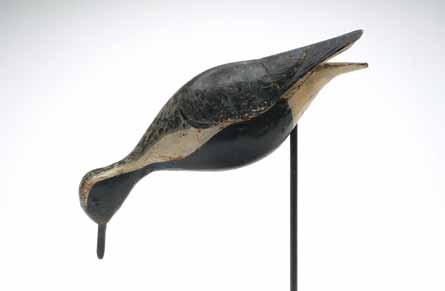
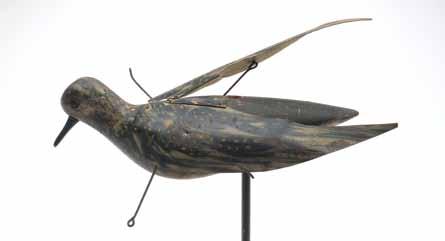
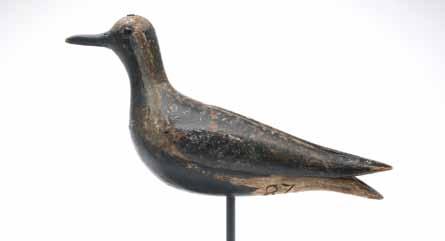
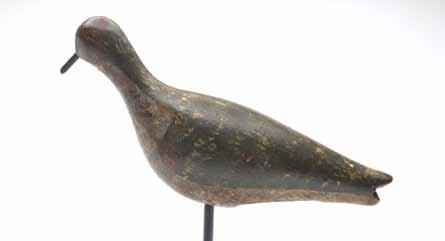
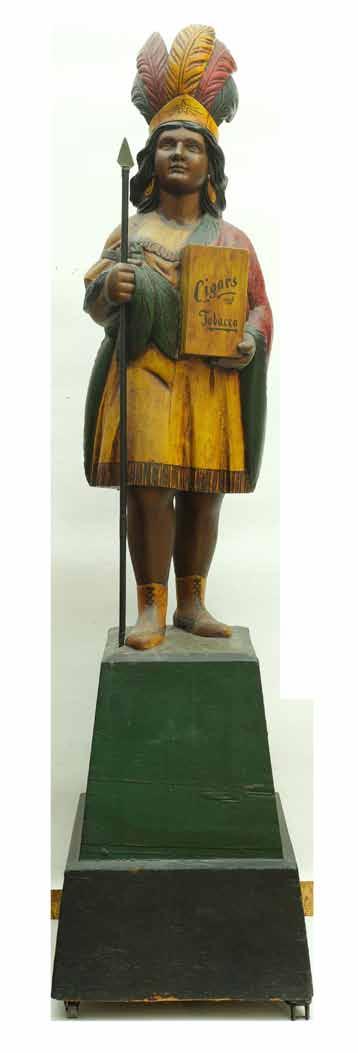
In 1956, Parke-Bernet in New York City, auctioned off the collection of industrialist Rudolf F. Haffenreffer. The impressive collection of cigar store trade figures that was sold in April and October of that year, represented one of the most famous selections of American folk art and tobacco advertising ever auctioned. These sales remain highly regarded in the art and antiques world. Many cigar store trade figures that currently reside in major institutions (like the Smithsonian’s National Museum of American History) trace their provenance back to the Haffenreffer auctions.
459 Samuel Robb (1851-1928), New York City. Maiden cigar store trade figure with flowing head dress. Left arm holding box of cigars and tobacco. Right hand has clutched a spear with tobacco leaves and a box. Figure stands 45” tall, 69” tall with base included. Some age cracks that remain tight; yellow appears to be an early restoration; green and black surface appear to be older; both colors have crazed from age.
Provenance: Rudolph F. Haffenreffer collection. Mark Goldman collection. (30,000 - 50,000)
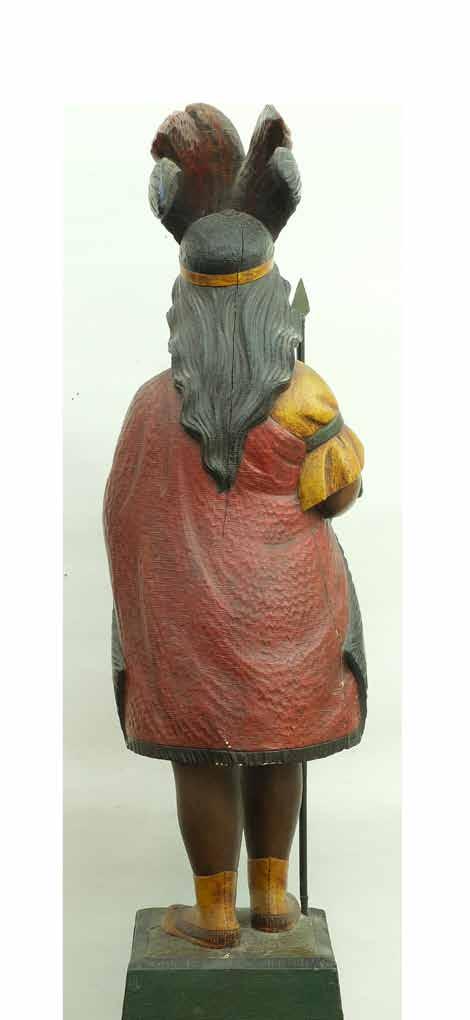
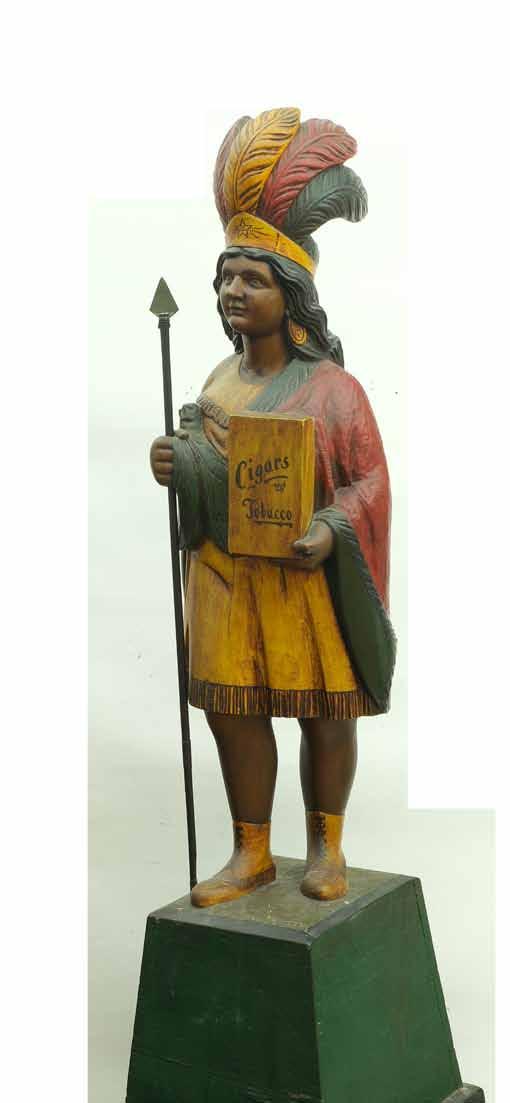
The oar is one of man’s earliest forms of aquatic propulsion, and rowing as a sport has a rich and storied history. Early competition between oarsmen can be dated to the Egyptians and other early societies, but its initial purpose was primarily to improve commerce or as training for warfare.
By the early 18th century, rivalries among small ferry barges on the Thames River in England gave rise to the sport we know today as rowing, and the first formal event was in 1715 between apprentice English watermen. Over time, amateur competition continued throughout Europe, and by the beginning of the 19th century, the sport was an integral part of English collegiate life. In 1815 Oxford University organized its first crew, with Cambridge University following shortly thereafter. The two schools held the first intercollegiate race in 1829.


460 Excellent early boat model. A square sterned rowing boat. With carved wooden rudder and seats. Metal oar locks. Measures 52” long. Early varnish has darkened with age; cracks and minor losses to seat brackets; small chip in one gunwale; rudder handle is missing. (2,000 - 3,000)
On the other side of the pond, the first recorded rowing race in the United States was in 1811 between professional ferrymen in NY using 4-oared barges. in 1838, seven influential men in Providence, Rhode Island founded the Narragansett Boat Club, and soon, amateur clubs were being formed in New York, Detroit and elsewhere. As in England, the sport was quickly adopted by elite colleges, predominantly those in the Ivy League. In 1843 students at Yale University started the first college boat club in America, followed in 1846 by Harvard University. The two schools first competed against one another in 1852, establishing the first intercollegiate athletic event in the US, a contest preceding the first football game by 17
years. The late 1800’s saw women entering the sport with clubs on both coasts, Wellesley College in MA c1885 and the ZLAC club in San Diego in 1892. By 1900, rowing had officially become a part of the international Olympics. These early years marked the beginnings of rowing as a cultural as well as athletic phenomenon in America and the sport flourished in popularity and prestige, spurring many of the developments in boat design which continue to this day. In 1872 the sliding seat was first used in the Yale-Harvard race and hull design and materials have continually advanced but, at its core, the ingrained spirit of the sport remains.
Exceedingly rare, early models of sculls document the evolution of the boats used in the sport and are material reminders of the rich history of rowing in this country and the revered place it holds in the hearts of those who have participated in it.
461
Excellent early boat model. A four person racing boat. With four shaped seats that slide. Decking fore and aft of seating area is a thin canvas layer. Measures 60” long. Varnish layer has darkened with age; a few missing seat brackets and other small parts on interior; chip at one tip; few short tears in canvas. (2,000 - 3,000)
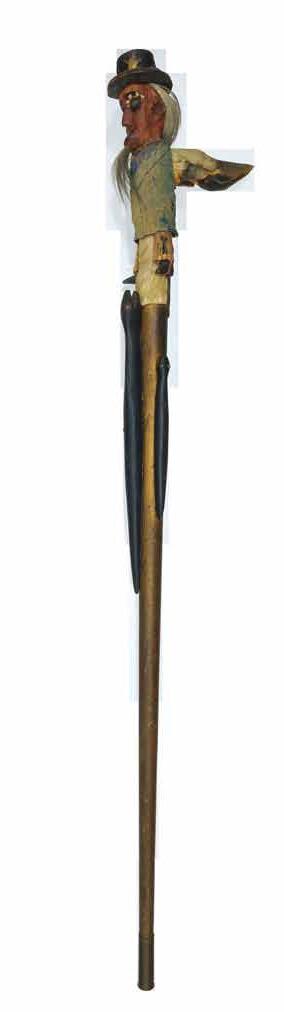
A selection of walking sticks from the collection of George Meyer.
462 Antique walking stick, 1st quarter 20th century. Uncle Sam walking stick. Highly decorated with Patriotic or 4th of July woven clothing. A leather top hat that is star studded. Horse or goat hair in head and chin of figure, with goat foot used as handle. Three applied snakes with tack eyes crawling up the staff, which is polychrome paint. Bottom of stick is capped with a 16 ga. Winchester shot shell. Measures 41” long. Typical wear for the age, please review photos for age and use.
Provenance: From Tom Delach. (2,000 - 3,000)
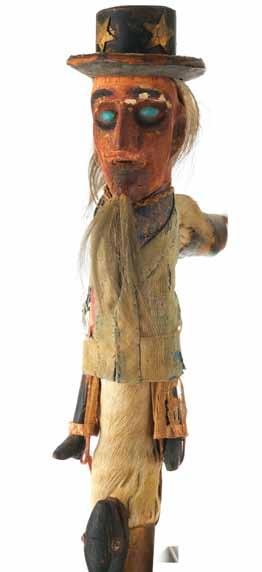
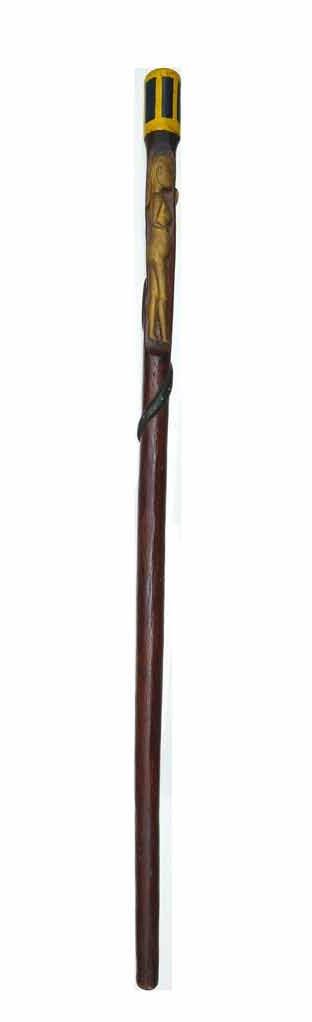
463 Antique walking stick, 1st quarter 20th century. With a gold painted figure of Eve, which measures 7.5” tall. And a carved painted snake on staff, with decorative painted top end. Measures 36.5” long. Typical wear for the age, please review photos for age and use.
Provenance: From Betty Turnely.
Literature: “American Folk Art Canes: Personal Sculpture,” George Meyer, p. 79. (400 - 800)
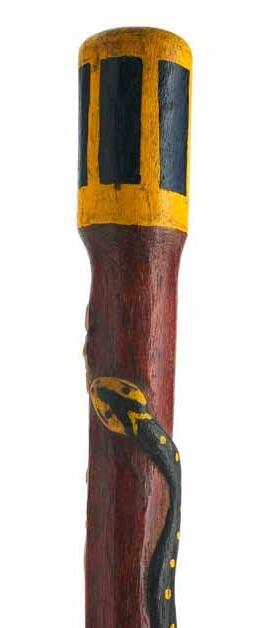
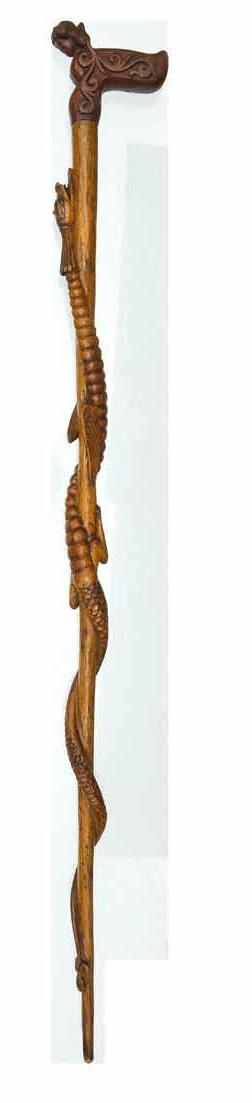
464 Antique walking stick, 1st quarter 20th century.
Serpent and mast head. Two piece carving with a serpent extending most of the length of the staff with wings and legs. Masthead resembles a ship carving. Measures 32” long. Damage at mouth of dragon and headdress on ladies head, otherwise typical wear for the age, please review photos for age and use.
Provenance: From Robert Sutter.
Literature: “American Folk Art Canes: Personal Sculpture,” George Meyer, p 79. (400 - 800)
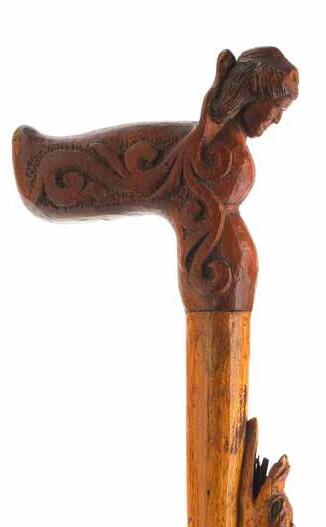
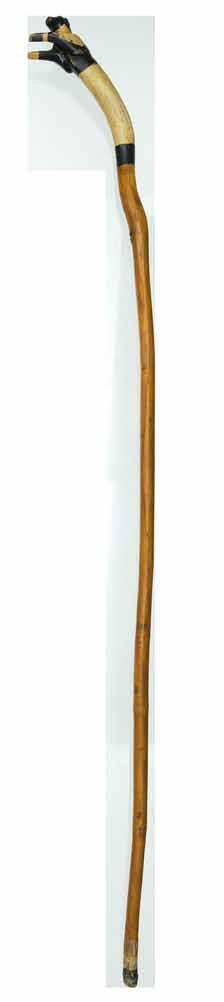
465 Antique walking stick, 1st quarter 20th century. Leaping dog in polychrome black, white, and red paint. A root carving. Measures 40.5” long. Rough edge at one paw and highpoints at dog; otherwise typical wear for the age, please review photos for age and use.
Provenance: From Arnie Anton, found in Maine. (400 - 800)
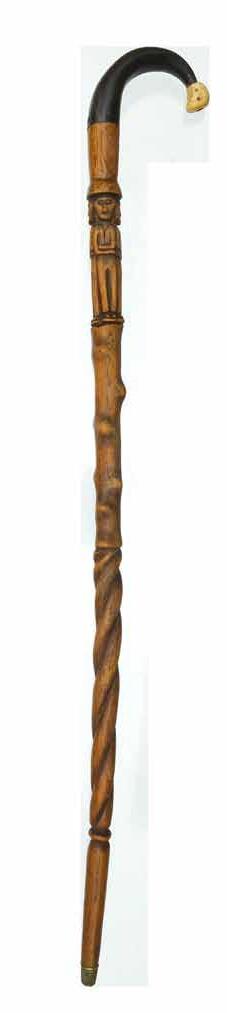
466 Antique walking stick, 1st quarter 20th century. Four male figures standing side by side. “1888” carved above their heads. Handle is both horn and bone. Measures 33” long. Typical wear for the age, please review photos for age and use.
Provenance: From Kenneth Galloway, found in Barbeau, Wisconsin. (400 - 800)
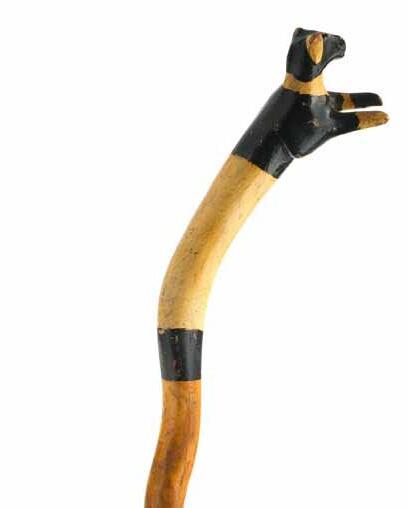
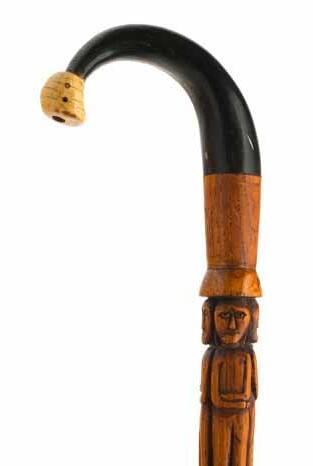
467 Antique walking stick, 1st quarter 20th century. Hand grasping corn. Measures 32” long. Some tight drying splits otherwise typical wear for the age, please review photos for age and use.
Provenance: From Richard Walters, found in Battle Creek, Michigan. (400 - 800)
468
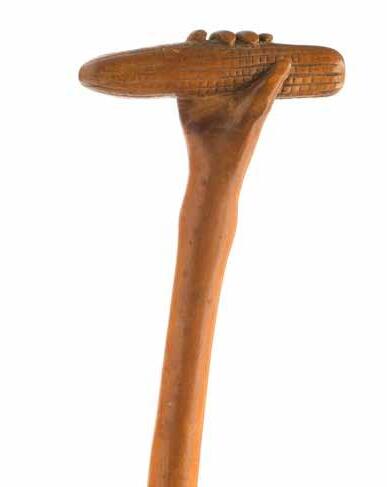

Antique walking stick, 1st quarter 20th century. Alligator and snake with june bug. Rattle snake and alligator carved on staff, in the middle is some type of beetle. Also a shield carved where presumably initials would have been carved. Warm patina. Measures 35” long. Typical wear for the age, please review photos for age and use.
Provenance: From Tim Hill.
Literature: “American Folk Art Canes: Personal Sculpture,” George Meyer, p. 28. (400 - 800)
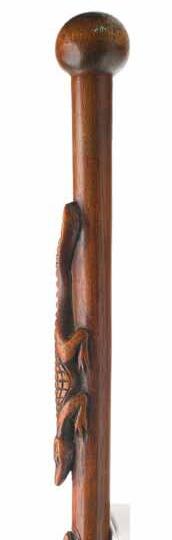
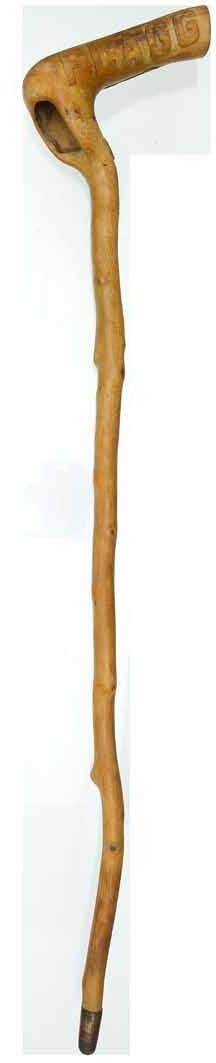
468A Antique walking stick, 1927. With carved fish, donkey head, and the name “Flagg” carved in handle. Fish and donkey both have brass tack eyes. Fish has painted scales. 1927 is carved in staff. Measures 36” long. Typical wear for the age, please review photos for age and use.
Provenance: From Roberta Holcumb.
Literature: “American Folk Art Canes: Personal Sculpture,” George Meyer, p. 45, similar example by same maker. (400 - 800)
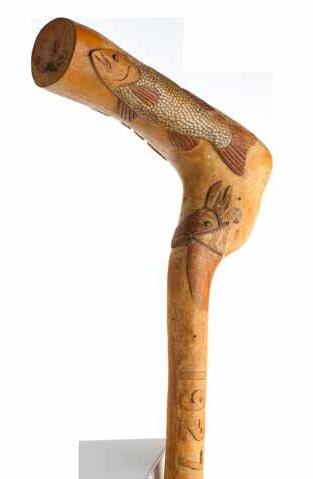

469 Antique walking stick, 1st quarter 20th century. Well carved story cane. A dragon head with tack eyes at the top. Many figures carved in staff including a bust of George Washington, a rooster, horse and jockey, an early automobile, a horse towing a car, multiple farm animals, and a lady in a bathing suit. Measures 36” long. Typical wear for the age, please review photos for age and use.
Provenance: Fine Arts Ancient Man.
Literature: “American Folk Art Canes: Personal Sculpture,” George Meyer, p. 118.
(400 - 800)
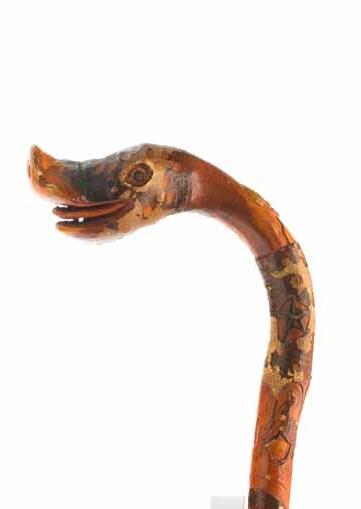
470 Antique walking stick, circa 1900 or earlier. Eagle and clown. A root and burl stick with a patriotic eagle head carved at top and two heads with exaggerated characteristics carved near the burl. One with carved eyes, one with bead eyes. A third smaller owl head with brass tack eyes below those. Measures 28” long. Typical wear for the age, please review photos for age and use.
Provenance: From Paula Vandest, found in Illinois.
Literature: “American Folk Art Canes: Personal Sculpture,” George Meyer, p. 92.
(400 - 800)
471 Antique walking stick, circa 1900. A figural handle with a lady’s head on one side, with her legs sticking out near the top of cane, which also doubles as a smoking utility. There is a hole drilled in to the side with a pipe bowl directly above. Measures 32” long. Lower portion is wrapped with a vintage electrical tape; nice warm patina; expected wear for a piece of this age, please review photos.
Provenance: From Gene Rappaport. (400 - 800)
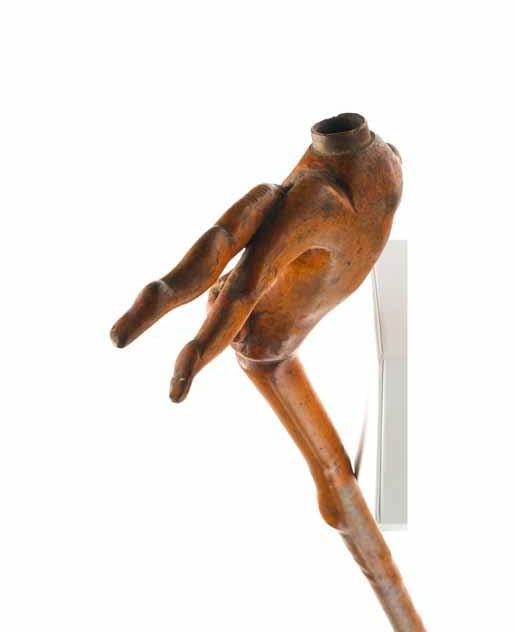
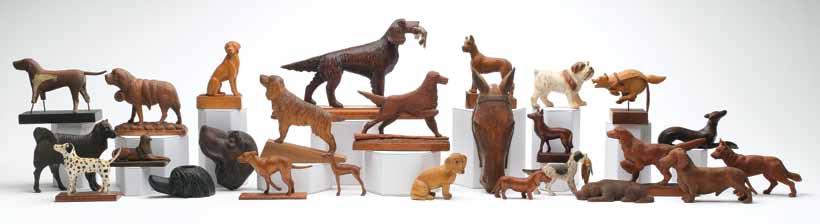
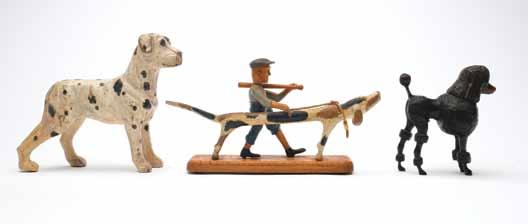
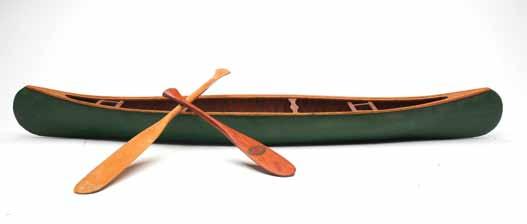
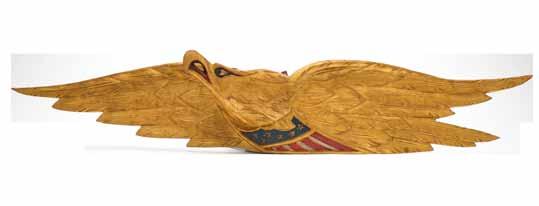
472 A collection of 26 carved wooden dogs and one horse head. Conditions vary. Some are painted, some are natural surface. Most have a vintage appearance. One is dated as early as 1918. A fancy poodle has a tail that is broken, but piece has been retained. Tallest measures 8”. (1,500 - 2,500)
473 Three folk art dog carvings. A poodle, a great dane, and a long dog and man stamped “Emery Papp, Aurora Ohio”. Measure from 4.5” long to 10” long. Poodle’s tail was cracked and tightly reset; old repairs to two front paws of great dane; crazed uneven varnish on Papp carving.
Provenance: Gene and Linda Kangas collection. (500 - 800)
474 Vintage canoe model. Green canvas over wood. Includes two small paddles from the Peterborough Canoe Company. Measures 35.5” long. Very good condition. (500 - 800)
475 Artistic Design Company, Boston, Massachusetts. Patriotic eagle plaque. Relief feather carving and American flag shield. Measures 35.5” long. Original paint with minor wear; very good structurally. (1,000 - 1,500)
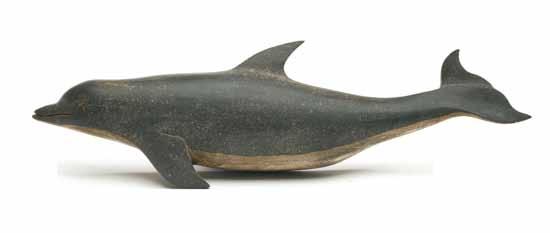
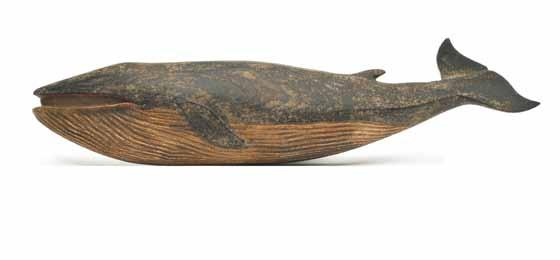
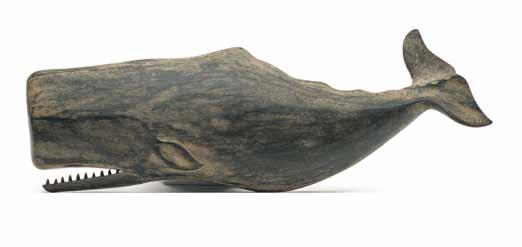
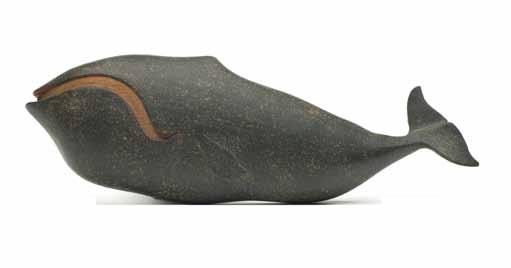
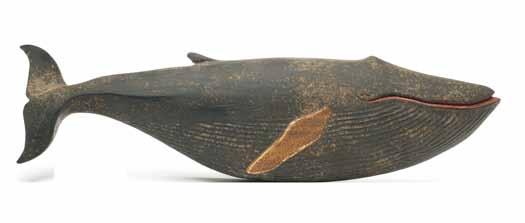
476 Clark Voorhees (1911-1980), Weston, Vermont. Dolphin plaque. Maker’s stamp on back. Measures 18.5” long. Original paint under a coat of varnish that has darkened; chip in top part of tail was very tightly reset with thin line of touchup. (1,500 - 2,500)
477 Clark Voorhees (1911-1980), Weston, Vermont. Sperm whale. Open mouth with metal teeth and relief fin carving. Maker’s initials carved on back. Measures 17.5” long. Original paint that has darkened with age; chip in top of tail was tightly reset. (1,500 - 2,500)
478 Clark Voorhees (1911-1980), Weston, Vermont. Blue whale plaque. Relief mouth and fin carving. Maker’s name and town stamped on back. Measures 18.5” long. Original paint that has darkened with age; very good structurally. (1,500 - 2,500)
479 Clark Voorhees (1911-1980), Weston, Vermont. Right whale plaque. Relief fin and mouth carving. Measures 18.5” long. Original paint under a coat of varnish that has darkened with age; chip in bottom part of tail was tightly reset with thin line of touchup. (1,500 - 2,500)
480 Clark Voorhees (1911-1980), Weston, Vermont. Humpback whale plaque. Relief mouth and fin carving. Maker’s name and town stamped in back. Measures 18.5” long. Original paint that has darkened with age; hairline crack on backside of tail, otherwise very good structurally. (1,500 - 2,500)
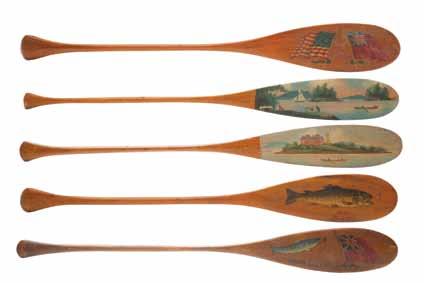
482 Alpheus Keech (1855-1926), Clayton, New York. Three souvenir paddles from the Thousand Islands. Titled “Sunset,” “Camping,” and “Calumet Island.”
Measure 21.75” and 27.75” long. Scattered flaking and heat bubbling; surface scratches and wear from age; one with two holes drilled in shaft for hanging to a wall.
Provenance: Dean Hyde collection. (800 - 1,200)
481 Alpheus Keech (1855-1926), Clayton, New York. Group of five souvenir paddles from the Thousand Islands. Includes two scenes. Titled “A Fishing Dinner” and “Calumet”. Measure 21.75” long. Discoloration and wear from age; with small dents and short scratches.
Provenance: Dean Hyde collection.
(1,000 - 1,500)
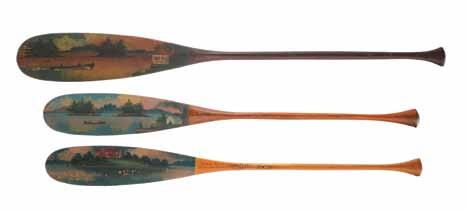
484 Pilot house eagle, circa early 19th century. Applied outstretched wings and slightly turned head. Deep relief feather carving. Measures 20” long, with a 33” wingspan. Stands 17” tall. Layers of old paint have worn away to much bare wood; old filler to loss in wood at back of one leg; tips of beak were restored long ago; old cracks in wings secured with metal sheets on backs of wings. (4,000 - 6,000)
483 Cast iron and sheet metal index horse, Rochester Iron Works Factory, last quarter 19th century. Measures 24” in length, 19” tall. Weighs approximately 25 lbs. Some very tight cracks to surface behind right front leg; repair at tail and to one side of body behind left shoulder; what appears to be plaster repair to tail and left shoulder.
(4,000 - 6,000)
485 Large and rare 19th century oyster bucket with lock and key. Two handles with metal strapping over top for locked security. “G.C. Buck” is painted on top and both front and back. “Fairhaven Connecticut” also appears on front and back. TBucket remains in old paint which has been strengthened over time; surface is old flaking some areas and shows good age.
(1,200 - 1,800)
487 Excellent two sided trade sign. Excellent two-sided metal trade sign. Reads “Fry Lunches” with painted fish on both sides. One side is decorated with a lake trout, other with a brook trout. Measures 19.5” x 56”. Contemporary frame to protect edges. (1,500 - 2,500)

Full body copper weathervane. Figure of a grasshopper. With applied legs and antenna. Some guilded surface remains. Measures 25” long. Structurally good.
Provenance: Deborah and Martin Maloy collection.
(800 - 1,200)
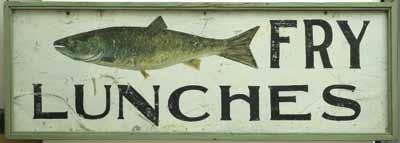
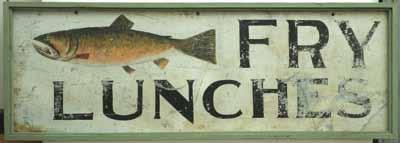
488 Vintage tavern sign. Reads “The Plough Bullards”. Encased in metal strapping. Paint on board. Two sided. Measures 42” x 32”. Paint and flaking appears stronger on one side than the other; sign appears to have been strengthened in areas over time.
(800 - 1,200)
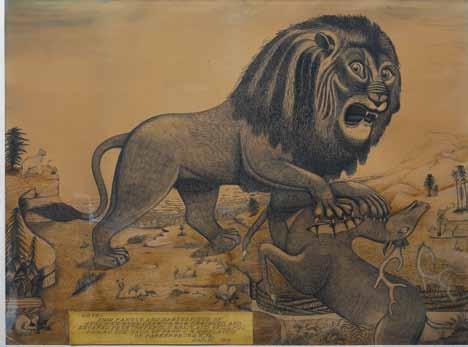
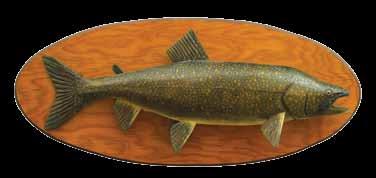
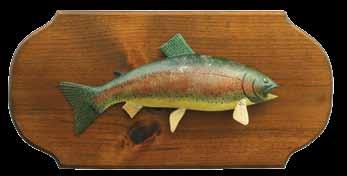
489
Spectacular pen and ink drawing of a wild life scene. Nine different animals in a highly detailed landscape with this paper board plaque at lower left. “Note - This famous, and masterpiece of realpen-work-drawing, was designed, and escaped from the fertile brain, and skillful pen, by the hand of Prof, J.M. Whitlatch. of Parkersburg, W, VA. Jan, 22’ 1911.”. Image measures 29” x 39”. Professionally framed and matted, 38” x 49”. Good condition; approximate 1” triangle missing at lower left; 1.5” tear on left side in sky; tear that is approximately 5” middle center, otherwise just a few spots of discoloration.
Provenance: Gene and Linda Kangas collection. (500 - 800)
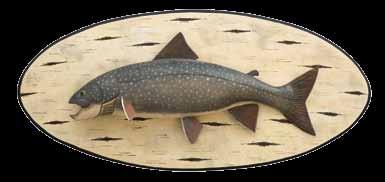
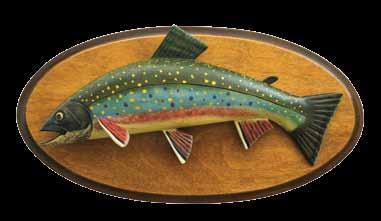
490 Lawrence Irvine (1918-1998), Winthrop, Maine. Lake trout fish plaque with open mouth and relief gill carving. Fish measures 26”, board measures 13” x 29”. Excellent and original. (1,000 - 1,500)
491 Paul Mailman, Lowell, Maine. Togue or lake trout plaque. Carved and painted wood mounted on painted backboard. Fish measures 26”, backboard is 17” x 39”. Excellent and original; a small spot of glue is visible near front side fin; pectoral fin was tightly reset with small amount of touchup, otherwise mint.
(600 - 900)
492 Paul Mailman, Lowell, Maine. Rainbow fish plaque. Carved rainbow trout mounted on board. Trout measures 15”, board is 24”. Excellent and original.
(300 - 400)
493 Paul Mailman, Lowell, Maine. Brook trout plaque is signed and dated 1986. Trout measures 13”, plaque is 7.5” x 14.5”. One fin has been reset; with inpainting in that area.
(300 - 400)
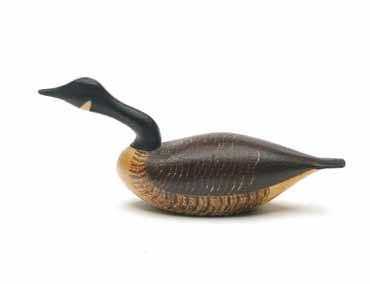
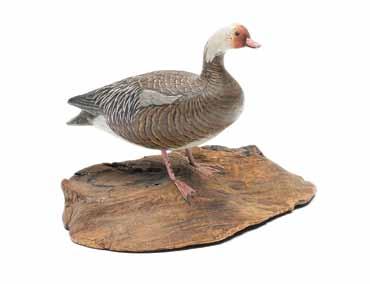
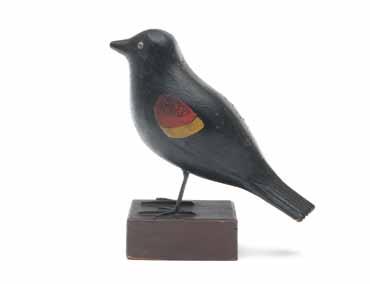
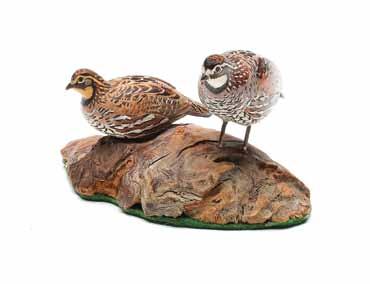
494 Joseph Lincoln (1859-1938), Accord, Massachusetts. Miniature swimming Canada goose. Measures 6.5” long. Original paint under an early coat of varnish that has darkened; small amount of touchup at edge of tail; professional repair to a crack at base of neck. (1,500 - 2,500)
495 Charles Hart (1862-1960), Gloucester, Massachusetts. Rare red-winged blackbird. Relief wing and tail feather carving. Tack eyes. Typical chamfer on edge of base. Measures 7.5” long. Original paint with very minor wear under an old coat of varnish; tiny chip and blunting at tip of bill.
Provenance: John Decesare collection.
(1,500 - 2,500)
496 Jess Blackstone (1909-1988), Concord, New Hampshire. Miniature blue goose. Slightly turned head and raised wingtips. Maker’s initials on underside of base. Also identified and numbered 4. Measures 4.5” long. Original paint that has darkened slightly with age; fine hairline crack through base of neck; spot of varnish on tail area; some white paint added on sides of head and neck, likely done by the maker. (800 - 1,200)
497 Alan James King (1881-1963), North Scituate, Rhode Island. Miniature pair of quail. Relief wingtip carving. Signed on one side of base. Quail measures 1.75” long. Excellent and original. (1,500 - 2,000)
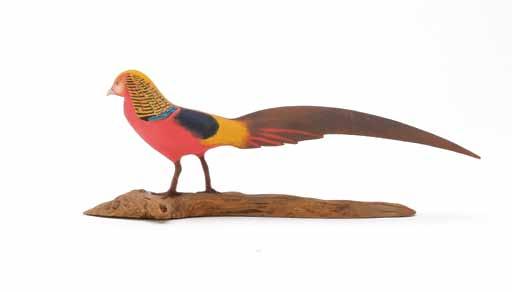
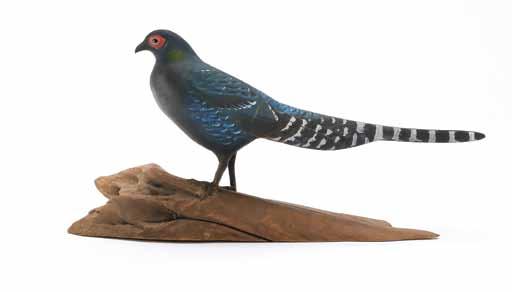
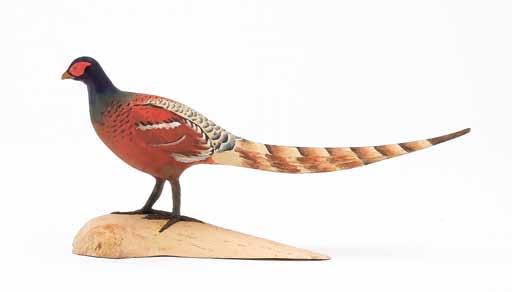
498 Harold Gibbs (1886-1970), Barrington, Rhode Island. Miniature golden pheasant. Identified and initialed on underside. Measures 6.25” long. Excellent and original.
Provenance: Joseph Ellis collection. (500 - 800)
499 Harold Gibbs (1886-1970), Barrington, Rhode Island. Miniature black pheasant. Initialed and dated 1942. Measures 5” long. Excellent and original.
Provenance: Joseph Ellis collection. (500 - 800)
500 Harold Gibbs (1886-1970), Barrington, Rhode Island. Miniature Burmese barred back pheasant. Identified, signed, and dated 1968. Measures 5.5” long. Excellent and original.
Provenance: Joseph Ellis collection. (500 - 800)
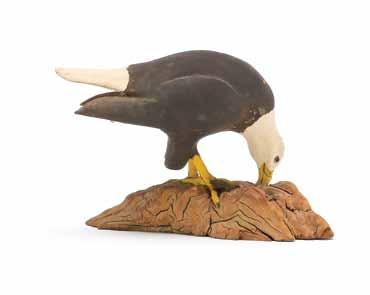
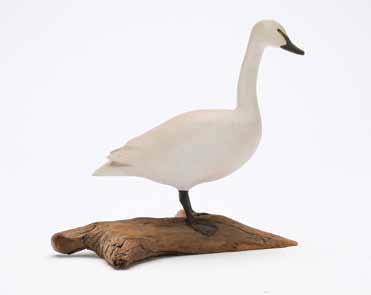
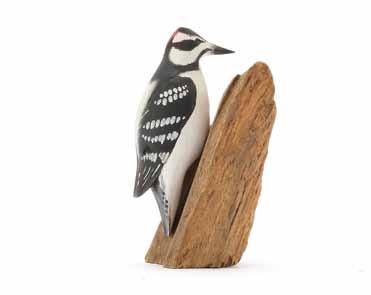
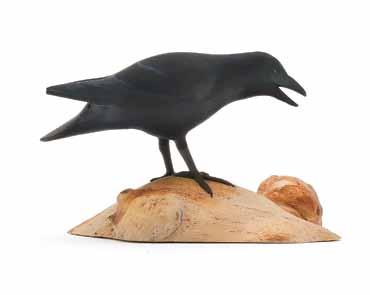
501 Harold Gibbs (1886-1970), Barrington, Rhode Island. Miniature feeding bald eagle. Eagle feeding from a carved trout that is attached to base. Deep relief wing carving and dropped wingtips. Signed and dated 1969. Eagle measures 4” long. Excellent and original.
Provenance: Joseph Ellis collection. (500 - 800)
502 Harold Gibbs (1886-1970), Barrington, Rhode Island. Miniature hairy woodpecker. Identified on underside. Measures 3” long. Very good and original.
Provenance: Joseph Ellis collection. (500 - 800)
503 Harold Gibbs (1886-1970), Barrington, Rhode Island. Miniature whistling swan with raised wingtips. Identified, initialed, and dated 1957. Measures 5” long. Very minor discoloration from age, otherwise very good and original.
Provenance: Joseph Ellis collection. (500 - 800)
504 Harold Gibbs (1886-1970), Barrington, Rhode Island. Miniature crow with raised wingtips and open beak. Identified and initialed on underside. Measures 3.5” long. Tiny chip in one raised wingtip, otherwise excellent.
Provenance: Joseph Ellis collection. (500 - 800)
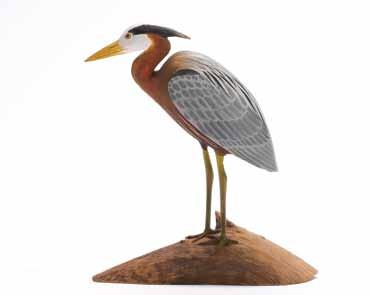
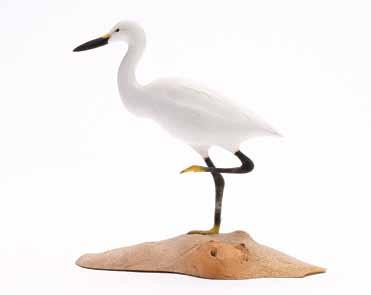
505 Harold Gibbs (1886-1970), Barrington, Rhode Island. Miniature great blue heron with deep relief wing carving. Identified and initialed on underside. Measures 3.5” long. Excellent and original.
Provenance: Joseph Ellis collection. (500 - 800)
506 Harold Gibbs (1886-1970), Barrington, Rhode Island. Miniature roseate spoonbill with deep relief wing carving. Identified and initialed on underside. Measures 3.5” long. Excellent and original.
Provenance: Joseph Ellis collection. (500 - 800)
507 Harold Gibbs (1886-1970), Barrington, Rhode Island. Miniature snowy egret on one leg. Identified and signed on underside. Measures 3.5” long. Professional repair to leg; otherwise very good and original.
Provenance: Joseph Ellis collection. (500 - 800)
508 Harold Gibbs (1886-1970), Barrington, Rhode Island. Miniature stork with deep relief wing carving. Signed and dated 1966. Measures 3” long. Excellent and original.
Provenance: Joseph Ellis collection. (500 - 800)
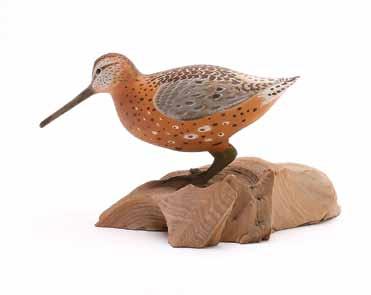
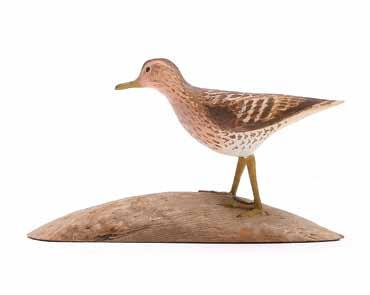
509 Harold Gibbs (1886-1970), Barrington, Rhode Island. Miniature ptarmigan. Slight relief wingtip carving. Identified, signed, and dated 1966. Measures 2.25” long. Excellent and original.
Provenance: Joseph Ellis collection. (500 - 800)
510 Harold Gibbs (1886-1970), Barrington, Rhode Island. Miniature dowitcher. Identified, initialed, and dated 1950. Measures 2.75” long. Excellent and original.
Provenance: Joseph Ellis collection. (500 - 800)
511 Harold Gibbs (1886-1970), Barrington, Rhode Island. Miniature red knot. Identified and initialed on underside. Measures 2” long. Excellent and original.
Provenance: Joseph Ellis collection. (500 - 800)
512 Harold Gibbs (1886-1970), Barrington, Rhode Island. Miniature upland plover. Identified, initialed, and dated 1941. Measures 2.5” long. Excellent and original.
Provenance: Joseph Ellis collection. (500 - 800)
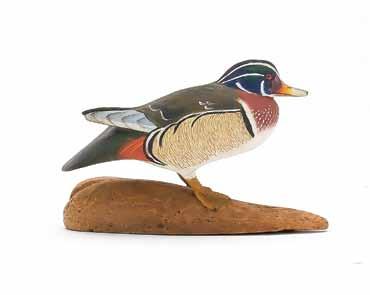
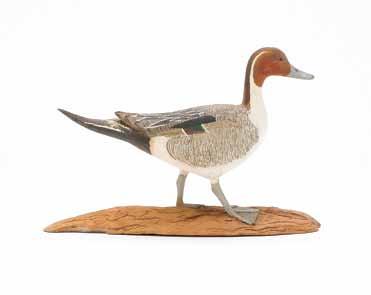
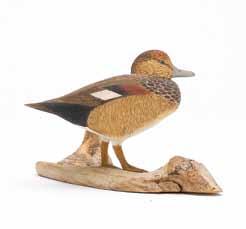
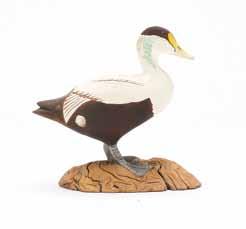
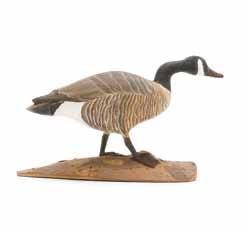
513 Harold Gibbs (1886-1970), Barrington, Rhode Island. Miniature wood duck. Tucked head and extended wingtips. Signed and dated 1965. Measures 3” long. Tiny spot of touchup to a paint flake on tip of one wing, otherwise excellent and original.
Provenance: Joseph Ellis collection. (500 - 800)
514 Harold Gibbs (1886-1970), Barrington, Rhode Island. Miniature pintail. Raised wingtips. Signed and dated 1969. Donald B. Howes collection ink stamp on underside. Measures 3.75” long. Tiny paint flakes at wingtips and small amount of touchup where one leg meets body, otherwise excellent.
Provenance: Joseph Ellis collection. (500 - 800)
515 Harold Gibbs (1886-1970), Barrington, Rhode Island. Miniature gadwall. Tucked head pose. Signed and dated 1965. Measures 3” long. Excellent and original.
Provenance: Joseph Ellis collection. (500 - 800)
516 Harold Gibbs (1886-1970), Barrington, Rhode Island. Miniature eider. Relief wing carving. Signed and dated 1969. Measures 3.25” long. Excellent and original.
Provenance: Joseph Ellis collection. (500 - 800)
517 Harold Gibbs (1886-1970), Barrington, Rhode Island. Miniature Canada goose. Head forward pose and relief carved wingtips. Signed and dated 1967. Measures 4.5” long. Excellent and original.
Provenance: Joseph Ellis collection. (500 - 800)
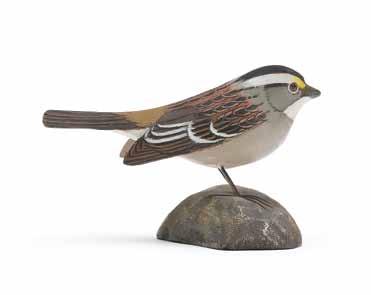
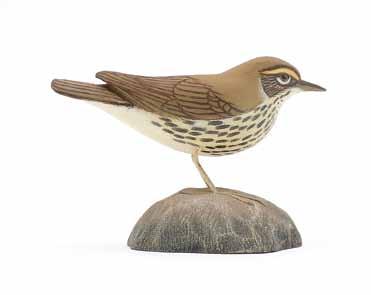
518 Jess Blackstone (1909-1988), Concord, New Hampshire. Miniature white throat sparrow. Dropped wing carving and feather rasping. Identified, initialed, and numbered 109 on underside. Measures 3.75” long. Excellent and original.
Provenance: Joseph Ellis collection. (1,000 - 1,400)
519 Jess Blackstone (1909-1988), Concord, New Hampshire. Miniature northern water thrush. Raised wingtips and feather rasping. Identified, initialed, and numbered 3 on underside. Measures 3.5” long. Excellent and original.
Provenance: Joseph Ellis collection. (1,000 - 1,400)
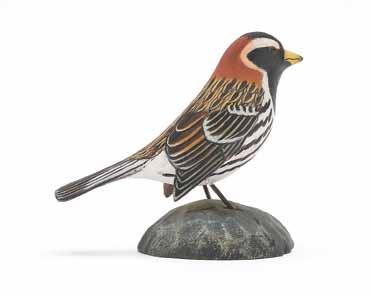
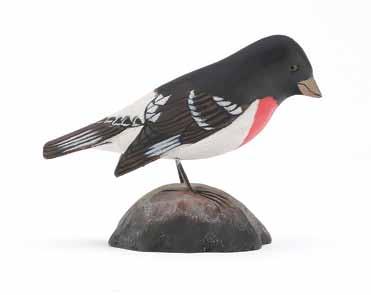
520 Jess Blackstone (1909-1988), Concord, New Hampshire. Miniature lapland longspur. Dropped wing carving and feather rasping. Identified, initialed, and numbered 14 on underside. Measures 3.75” long. Very minor paint rub on tip of bill, otherwise excellent and original.
Provenance: Joseph Ellis collection. (1,000 - 1,400)
521 Jess Blackstone (1909-1988), Concord, New Hampshire. Miniature rose breasted grosbeak. Dropped wing carving and feather rasping. Identified, initialed, and numbered 74 on underside. Measures 3.75” long. Excellent and original.
Provenance: Joseph Ellis collection. (1,000 - 1,400)
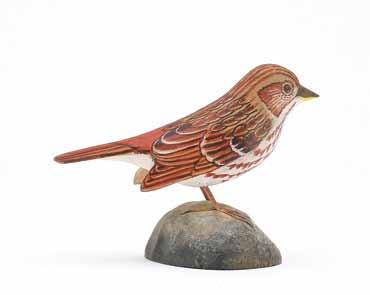
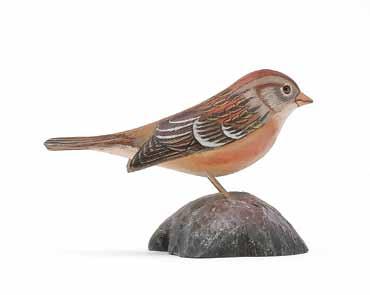
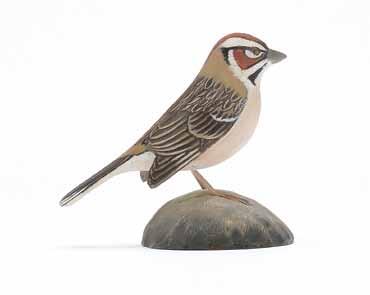
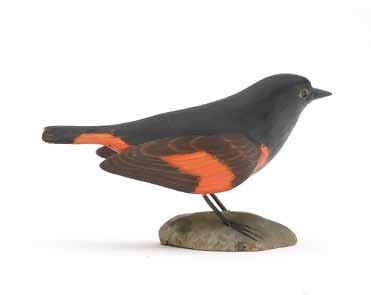
522 Jess Blackstone (1909-1988), Concord, New Hampshire. Miniature fox sparrow. Dropped wing carving and feather rasping. Identified, initialed, and numbered 40 on underside. Measures 3.75” long. Excellent and original.
Provenance: Joseph Ellis collection. (1,000 - 1,400)
523 Jess Blackstone (1909-1988), Concord, New Hampshire. Miniature lark sparrow. Dropped wing carving and feather rasping. Identified, initialed, and numbered 14 on underside. Measures 3.75” long.
Excellent and original.
Provenance: Joseph Ellis collection. (1,000 - 1,400)
524 Jess Blackstone (1909-1988), Concord, New Hampshire. Miniature field sparrow. Dropped wing carving and feather rasping. Identified, initialed, and numbered 19 on underside. Measures 3.75” long. Excellent and original.
Provenance: Joseph Ellis collection. (1,000 - 1,400)
525 Jess Blackstone (1909-1988), Concord, New Hampshire. Miniature redstart. Relief wing carving with dropped wingtips and feather rasping. Identified and with maker’s paper label on underside. Measures 3.75” long. Minor paint flakes on lower edge of wings and edge of tail; bill is a professional replacement.
Provenance: Joseph Ellis collection. (1,000 - 1,400)
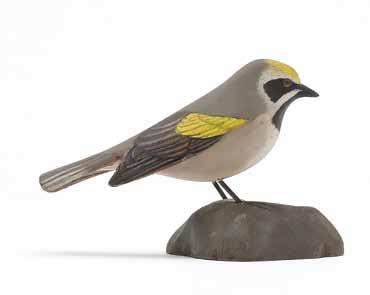
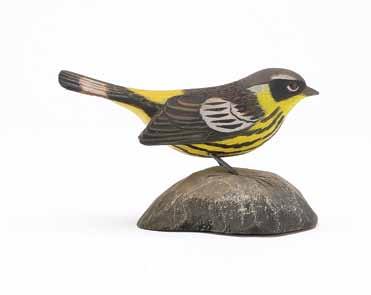
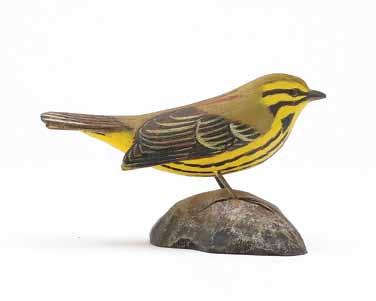
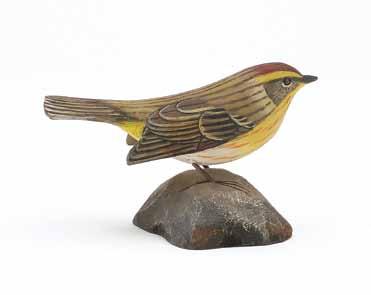
526 Jess Blackstone (1909-1988), Concord, New Hampshire. Miniature golden winged warbler. Dropped wing carving and feather rasping. Identified, initialed, and numbered 29 on underside. Measures 3.5” long. Very good and original.
Provenance: Joseph Ellis collection. (1,000 - 1,400)
527 Jess Blackstone (1909-1988), Concord, New Hampshire. Miniature magnolia warbler. Dropped wing carving and feather rasping. Identified, initialed, and numbered 57 on underside. Measures 3.5” long. Tiny paint flake at one wingtip; separation at wood grain in underside of base, otherwise excellent.
Provenance: Joseph Ellis collection. (1,000 - 1,400)
528 Jess Blackstone (1909-1988), Concord, New Hampshire. Miniature prairie warbler. Dropped wing carving and feather rasping. Identified, initialed, and numbered 631 on underside. Measures 3.5” long. Excellent and original.
Provenance: Joseph Ellis collection. (1,000 - 1,400)
529 Jess Blackstone (1909-1988), Concord, New Hampshire. Miniature palm warbler. Dropped wing carving and feather rasping. Identified, initialed, and numbered 631 on underside. Measures 3.5” long. Very tiny paint rub on tip of bill, otherwise excellent.
Provenance: Joseph Ellis collection. (1,000 - 1,400)
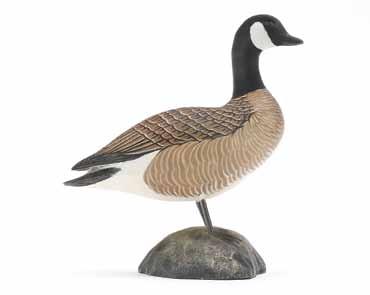
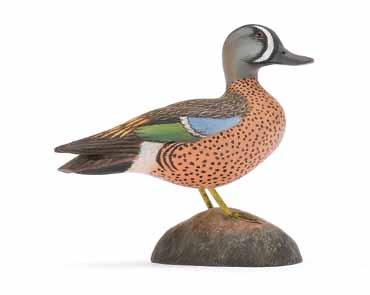
530 Jess Blackstone (1909-1988), Concord, New Hampshire. Miniature Canada goose. Raised wingtips and feather rasping. Head is slightly turned. Identified, initialed, and numbered 64131 on underside. Measures 4.5” long. Excellent and original.
Provenance: Joseph Ellis collection. (1,000 - 1,400)
531 Jess Blackstone (1909-1988), Concord, New Hampshire. Miniature bluewing teal. Raised wingtips and feather rasping. Head is slightly turned. Identified, initialed, and numbered 38 on underside. Measures 4.25” long. Raised wingtips were chipped and professionally restored, otherwise excellent.
Provenance: Joseph Ellis collection. (1,000 - 1,400)
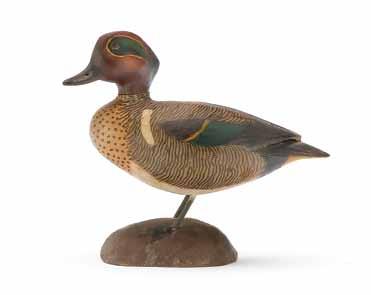
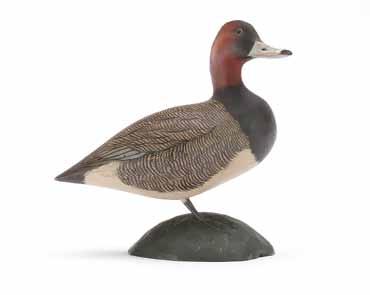
532 Jess Blackstone (1909-1988), Concord, New Hampshire. Miniature greenwing teal. Relief wingtips carving and feather rasping. Head is slightly turned. Identified and initialed on underside. Measures 4” long. Surface has darkened with age; otherwise excellent and original.
Provenance: Joseph Ellis collection. (1,000 - 1,400)
533 Jess Blackstone (1909-1988), Concord, New Hampshire. Miniature redhead. Feather rasping and slightly turned head. Identified, initialed, and numbered 11 on underside. Measures 4” long. Very slight separation at neck seat; bill was cracked down and reset with small amount of touchup.
Provenance: Joseph Ellis collection. (1,000 - 1,400)
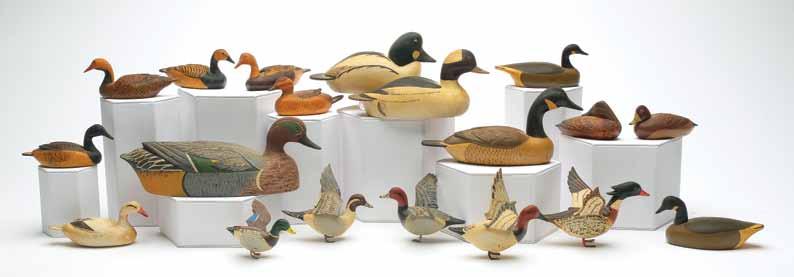
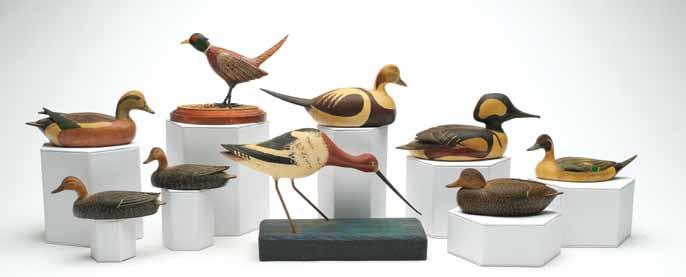
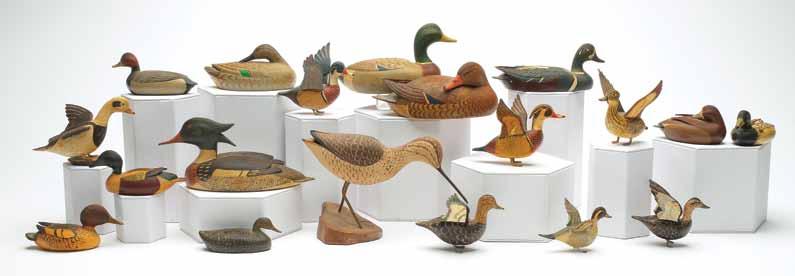
534 Edward D. Goslin, Jr. Group of 50 miniature and decorative carvings. Includes many different styles and species. Most are signed and dated. Measure from 3” to 11” long. A few reglued cracks in necks; hooded merganser with reglued chip in bill; overall very good and original. (2,000 - 3,000)
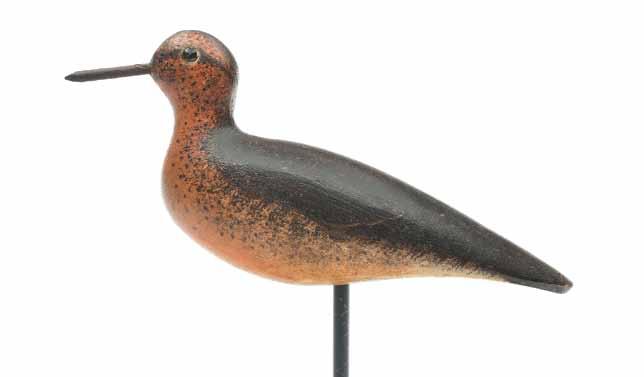
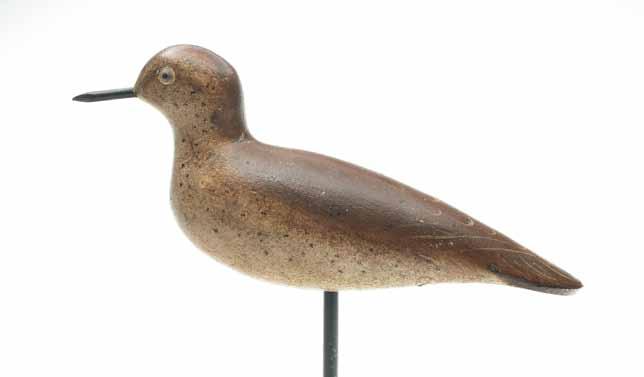
Rare
in fall
Original paint with very minor wear; some typical paint flaking where bill meets face; excellent structurally. (2,500 - 3,500)
Glass eye model with iron bill and extra feather paint detail on tail area. Measures 10.75” long.
Excellent original paint with a few minor rubs; thin coat of varnish; excellent structurally. (2,500 - 3,500)
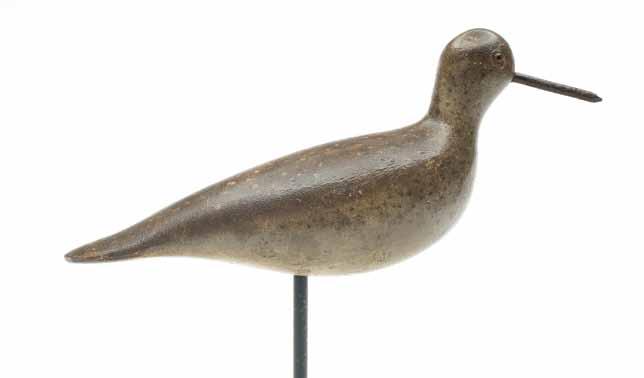
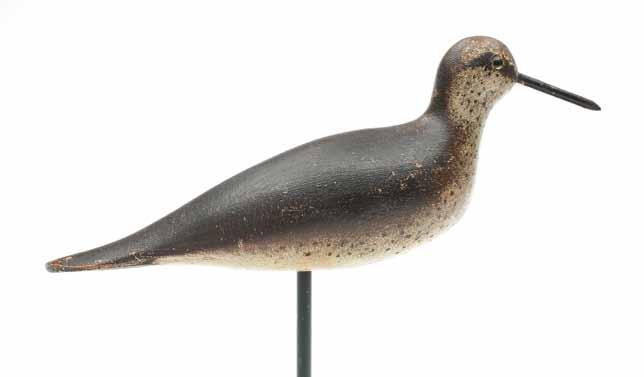
eye model with iron bill. Measures 11.5” long. Original paint with very minor wear under at thick coat of varnish; a few spots of touchup on top of tail area; very good structurally. (1,500 - 2,500)
Glass eye model with iron bill. Measures 12” long. Original paint with minor wear under a thin coat of varnish; hairline crack in one lower side; otherwise very good structurally. (1,200 - 1,800)
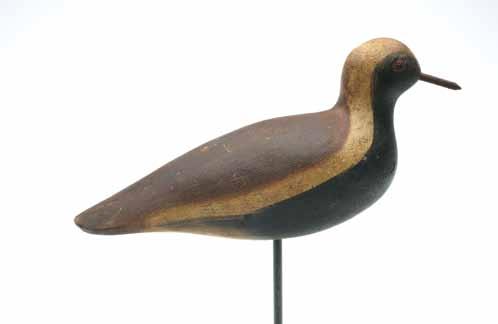
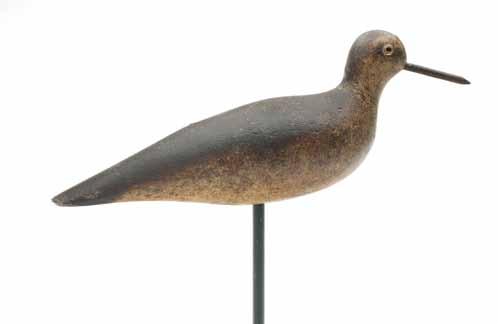
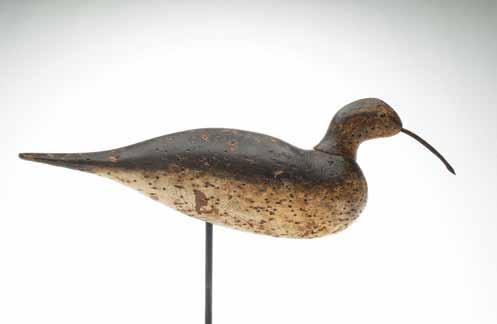
539 Mason Decoy Factory (18891924), Detroit, Michigan. Black bellied plover. Tack eye model with iron bill. Measures 10.75” long. Original paint with very minor wear; surface has darkened with age; small rust spot on one side of breast; excellent structurally. (2,000 - 3,000)
540 Mason Decoy Factory (18891924), Detroit, Michigan. Lesser yellowlegs. Glass eye model with iron bill. Measures 11” long. Original paint with very minor wear; a thin coat of varnish has darkened slightly with age; fine hairline crack in one eye; otherwise very good structurally. (1,500 - 2,500)
541 Mason Decoy Factory (18891924), Detroit, Michigan. Large two piece curlew. Glass eye model with iron bill. Measures 18.5” long. Original paint with moderate flaking and wear; significantly hit by shot on both sides and back; drying split along the underside; some old touchup to brown on back and at neck seat. (3,000 - 4,000)
542 Mason Decoy Factory (1889-1924), Detroit, Michigan. Excellent black duck. Hollow carved premier grade model. Bold feather looping and premier ink stamp on underside. Measures 17.75” long. Near mint original paint with a few small spots of flaking; small chip on underside near breast and minor roughness on one lower edge from when the decoy was made; almost unnoticeable professional tail chip repair.
(5,000 - 8,000)
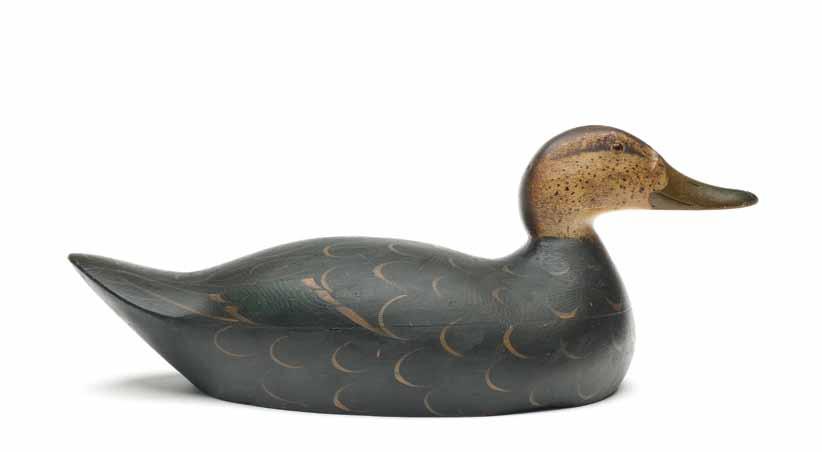
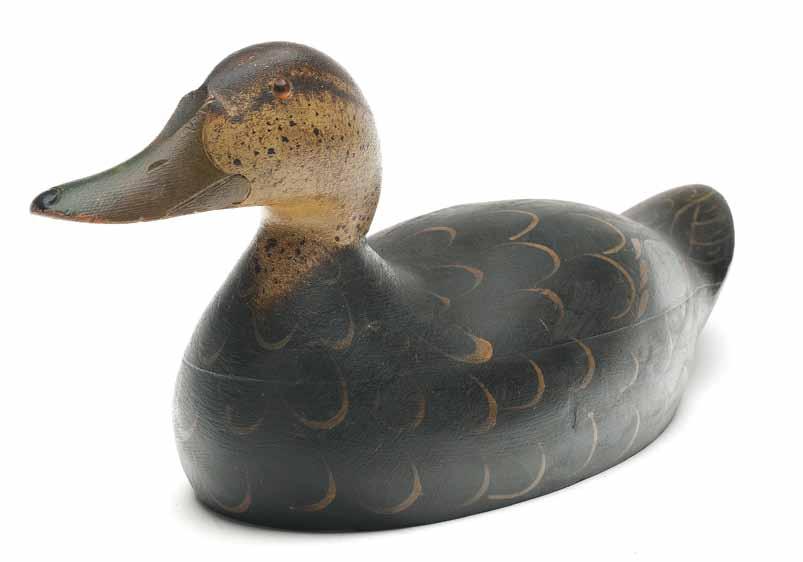
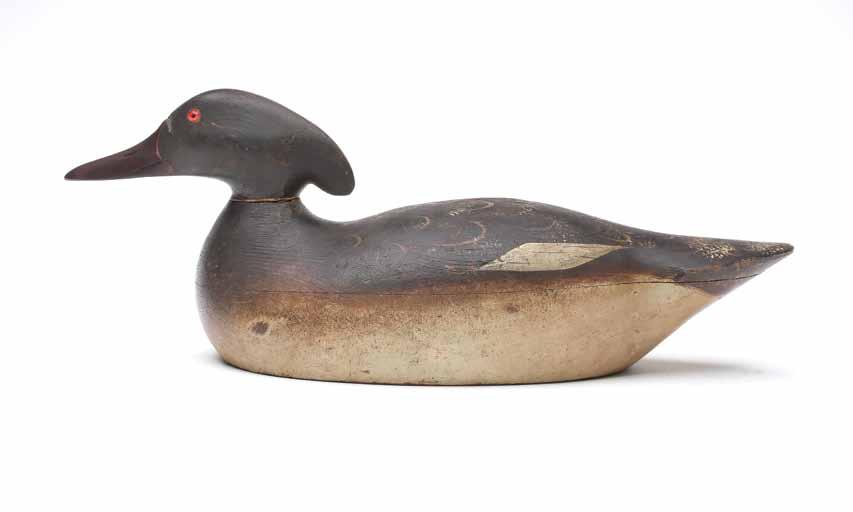
543 Mason Decoy Factory (1889-1924), Detroit, Michigan. Merganser hen. Hollow carved premier grade with extended crest carving. Measures 18.5” long. Original paint with minor gunning wear; tiny chip in one side; minor roughness at neck seat; much of the bill is a professional replacement.
Provenance: Chris Mackey collection.
(6,000 - 9,000)
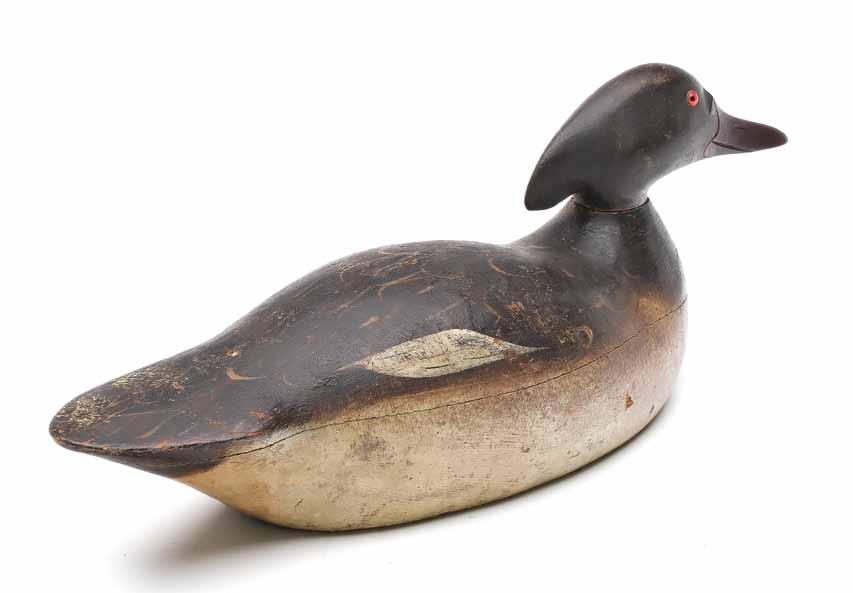
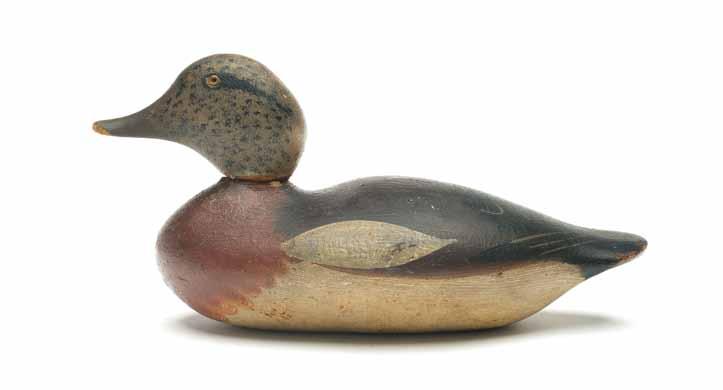
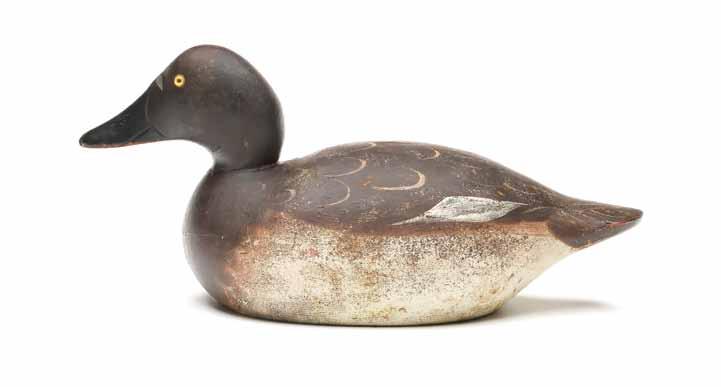
Mason Decoy Factory (1889-1924), Detroit, Michigan. Early widgeon. Standard grade glass eye model with slope breast. Mackey collection ink stamp on underside. Measures 14.5” long. Original paint with minor wear under an early coat of varnish that has darkened with age; minor roughness on edge of tail and tip of bill; neck filler is missing.
Provenance: Dr. Michael Shannahan collection. (2,000 - 3,000)
545 Mason Decoy Factory (1889-1924), Detroit, Michigan. Goldeneye hen. Hollow carved premier grade. Measures 15” long. Original paint with moderate wear; decoy was cleaned at some point; professional neck filler restoration; tight crack in bill was reset; minor roughness on edge of bill.
Provenance: Chris Mackey collection. (2,000 - 3,000)
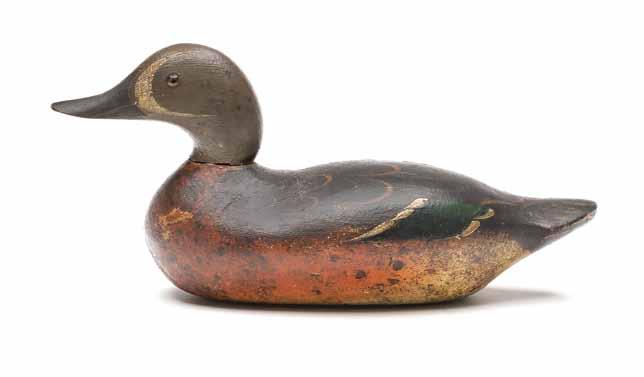
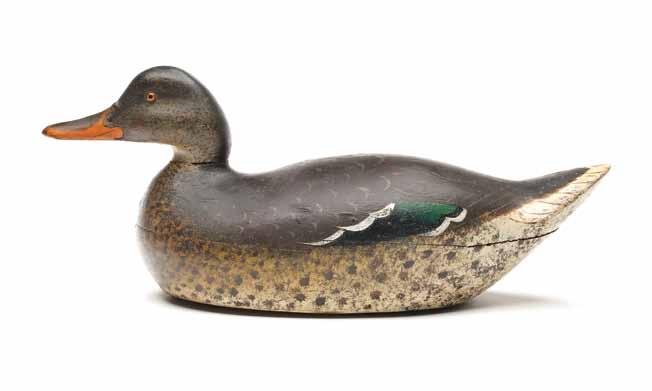
Factory
Detroit, Michigan. Bluewing teal. Challenge grade. Measures 12.5” long. Original paint with minor flaking and wear; varnish layer has darkened with age; drying crack along back and tail; slight separation at neck seat. (2,500 - 3,500)
Decoy Factory (1889-1924), Detroit, Michigan. Mallard hen. Hollow carved premier grade. Measures 17” long. Original paint with minor wear; slight separation at body seam; fine hairline crack at one side of neck seat; professional tail chip repair; fine separation at wood grain at top of head.
Provenance: Chris Mackey collection. (3,000 - 4,000)
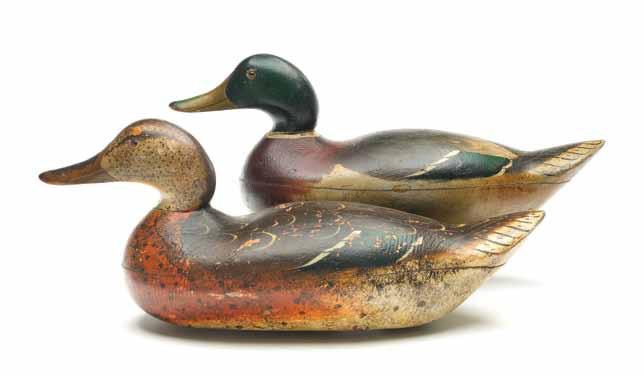
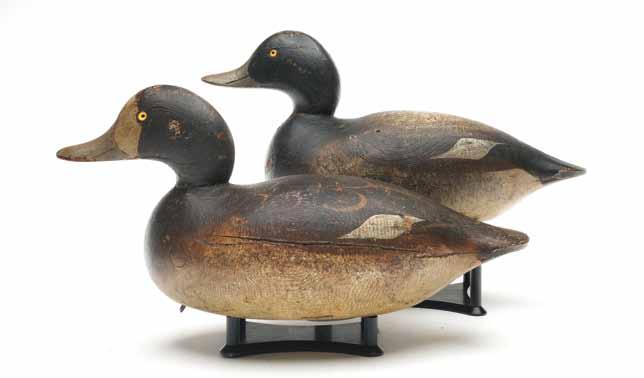
Mason Decoy Factory (1889-1924), Detroit, Michigan. Rigmate pair of mallards. Hollow carved challenge grade models. Measure 16.75” long. Original paint with minor wear on drake; moderate flaking on hen, mostly on back; thick coat of varnish has darkened with age; slight separation at body seams; otherwise very good structurally.
(1,200 - 1,800)
549 Mason Decoy Factory (1889-1924), Detroit, Michigan. Rigmate pair of bluebills. Branded “SS Gavitt”. Hen displays feathering on back. Measures 13” long. Original paint; wood imperfection at breast of drake; knot in one side of hen; tight crack side of hen with glue visible with uv light. (1,200 - 1,800)
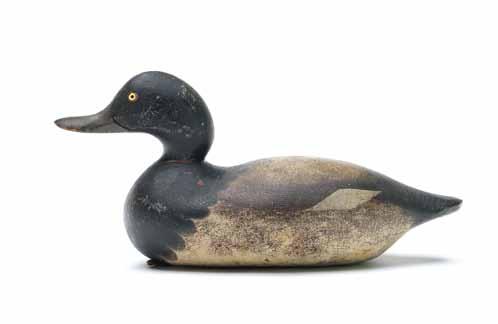
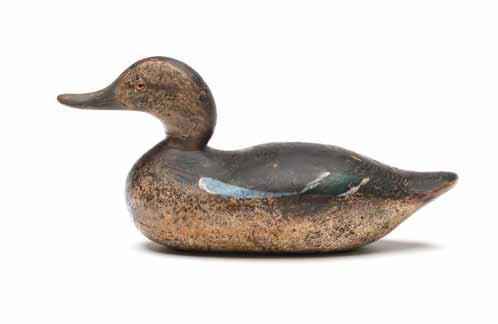
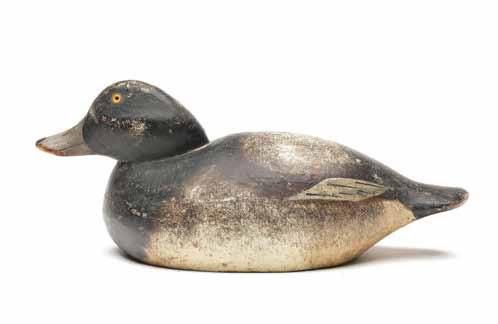
550 Mason Decoy Factory (1889-1924), Detroit, Michigan. Bluebill. Challenge grade with snakey head style and wide bill carving. Measures 14” long. Original paint with minor wear; mostly to black on head and breast; some flaking to the original neck filler; very minor roughness on one edge of bill.
(1,000 - 1,500)
551 Mason Decoy Factory (1889-1924), Detroit, Michigan. Bluewing teal hen. Challenge grade. “DWH” branded in underside. Measures 12.5” long. Original paint with moderate wear; heavily hit by shot; small chip in tail; some touchup at one wing patch; hairline crack in one side of head with small amount of touchup; chip at base of neck was restored with touchup around the neck seat; drying crack in underside was filled with glue.
(1,000 - 2,000)
552 Mason Decoy Factory (1889-1924), Detroit, Michigan. Lowhead bluebill. Hollow carved premier grade. “HAC” branded on underside. Measures 14.5” long. Original paint with moderate wear; minor roughness on edge of bill and tail; slight separation at body seam on one side with small amount of flaking to filler; a shot strike in one side of head was darkened.
Provenance: Chris Mackey collection. (1,500 - 2,500)
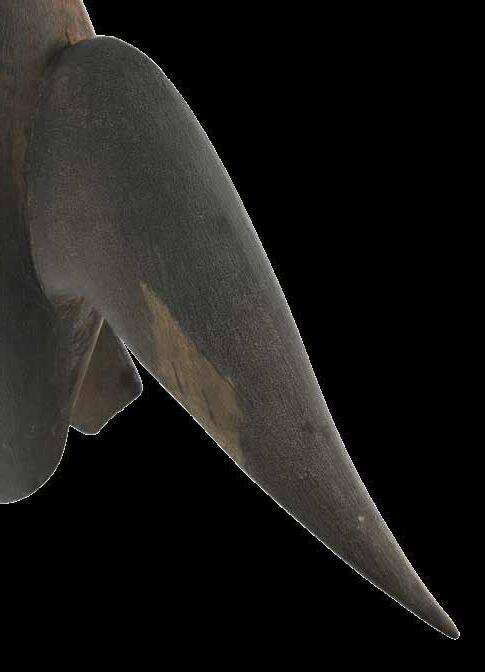
1888 - 1937 | Alexandria Bay, New York
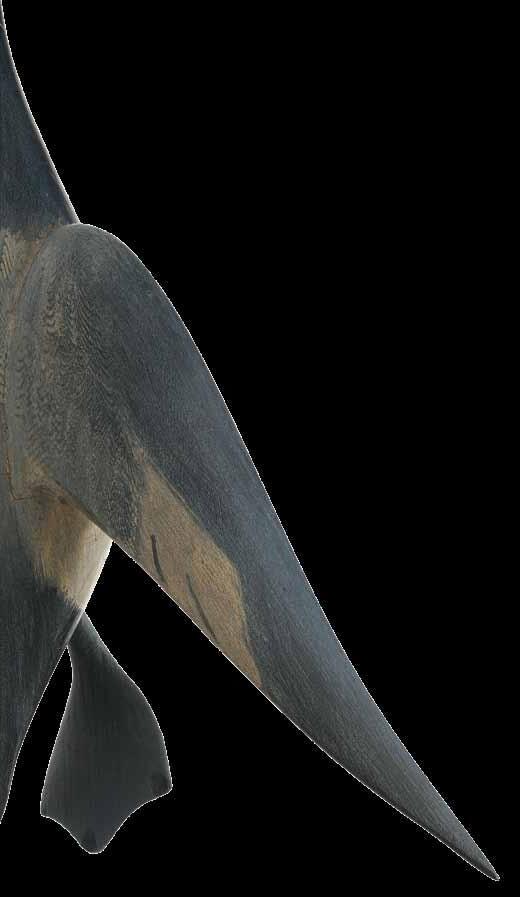
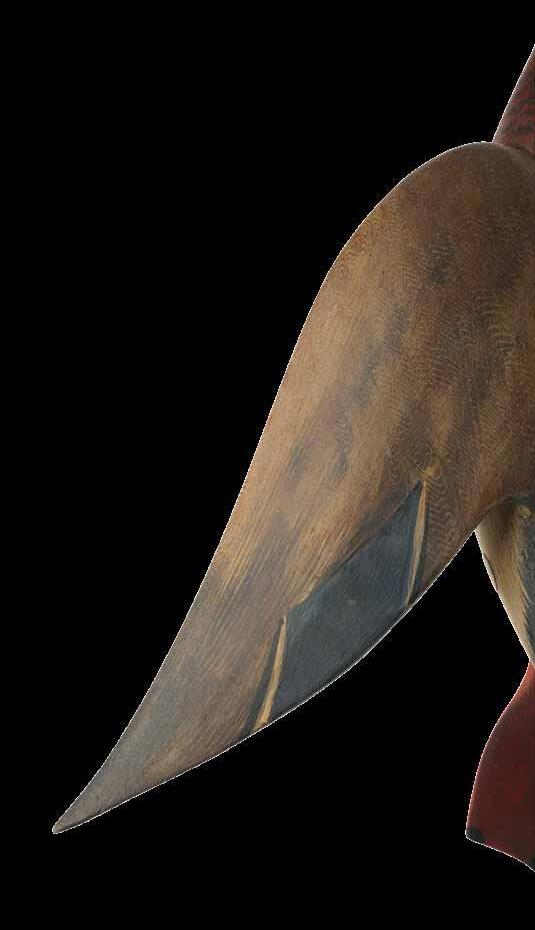
553
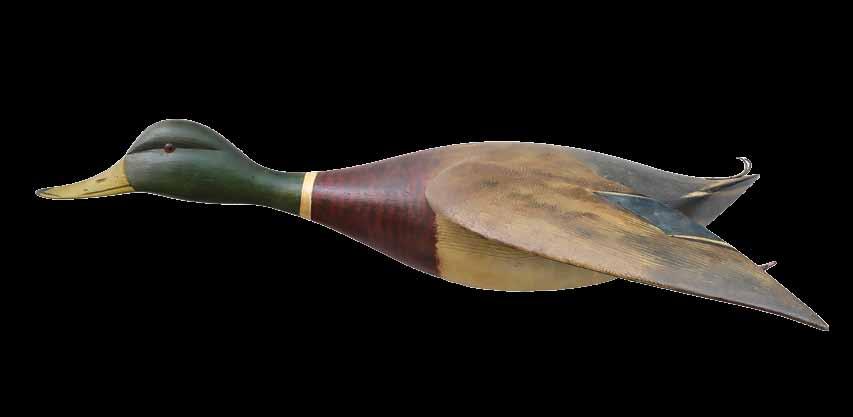
Chauncey Wheeler (1888-1937), Alexandria Bay, New York. Full size flying mallard plaque. Applied wing with comb feather paint detail and applied wooden foot. Typical eye groove carving and applied metal curly tail feather. Measures 22.5” long. Original paint under a thin coat of varnish that has darkened with age; a few tiny flakes to filler where wing joins body; half of the foot was a professional replacement; otherwise excellent structurally.
Provenance: Dean Hyde collection.
(12,000 - 18,000)
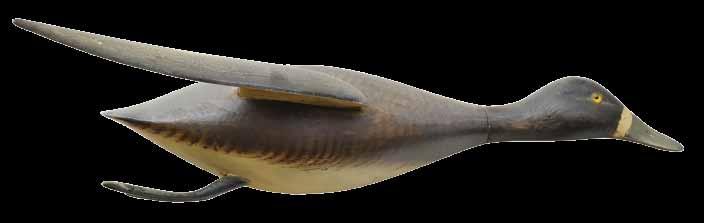
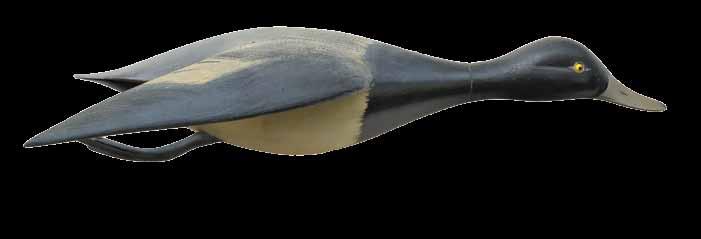
554
Chauncey Wheeler (1888-1937), Alexandria Bay, New York. 2/3 size pair of flying bluebills. Each with applied wing and foot. Measure 15.5” long. Original paint with very minor wear; tiny chip restored at hen’s wingtip; drake’s foot is a professional replacement.
Provenance: Dean Hyde collection. (6,000 - 9,000)
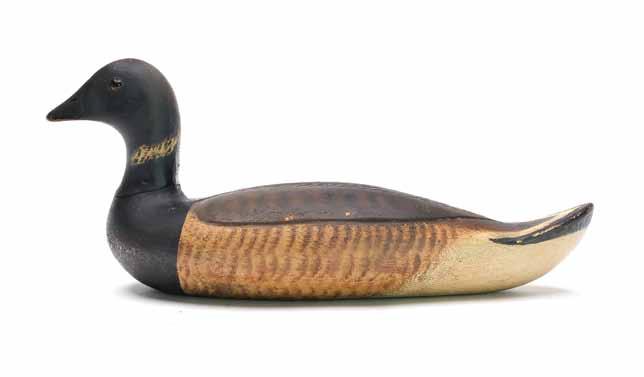
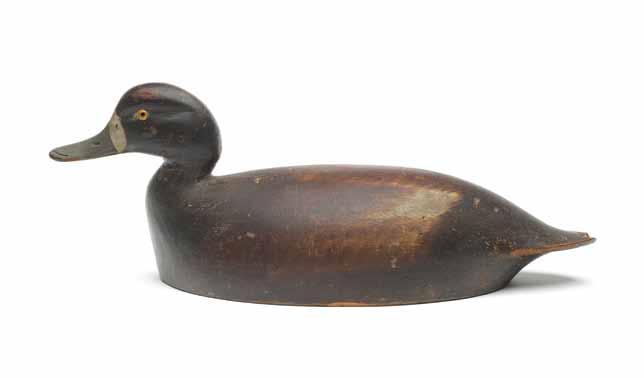
Chauncey Wheeler (1888-1937), Alexandria Bay, New York. Brant. Incised torn heart wing detail. Measures 18.5” long. Original paint with minor wear; under a coat of varnish; some filler and touchup on edge of tail; head swivels slightly.
Provenance: Dean Hyde collection. (3,000 - 5,000)
556 Chauncey Wheeler (1888-1937), Alexandria Bay, New York. Bluebill hen. Long body style with typical eye groove carving. Measures 17” long. Original paint with minor to moderate flaking and wear; moderately hit by shot; old chip in tail that was darkened; thin sliver of wood missing on one side of neck seat with some old glue visible.
Provenance: Frederick Raymon collection. (1,200 - 1,800)
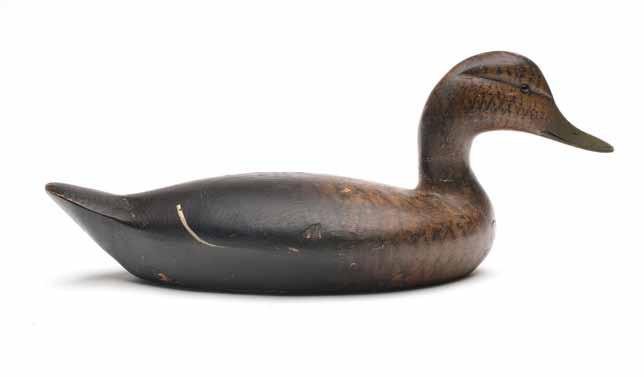
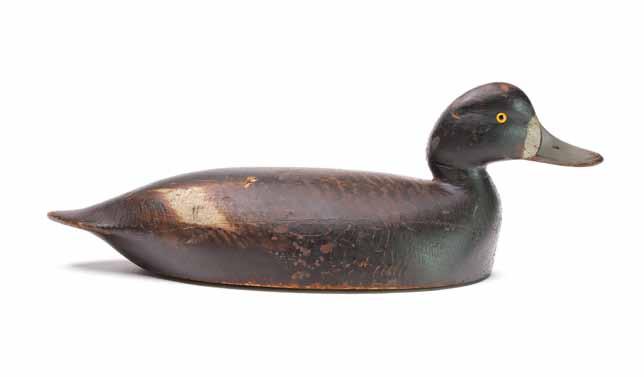
558
Typical eye groove carving.
“R.D.” stamped in lead weight. Measures 17” long. Original paint with minor flaking and wear; hairline cracks in breast; small loss of wood at a knot near tail from when the decoy was made; a coat of varnish has darkened with age. (1,500 - 2,500)
(1888-1937), Alexandria
York. Bluebill hen with typical eye groove carving. Measures 16.5” long. Original paint with moderate flaking and wear; under an early coat of varnish that has crazed; small dents and shot marks; hairline crack on each side and at lower part of neck.
Provenance: Chris Pitman collection. (1,200 - 1,800)
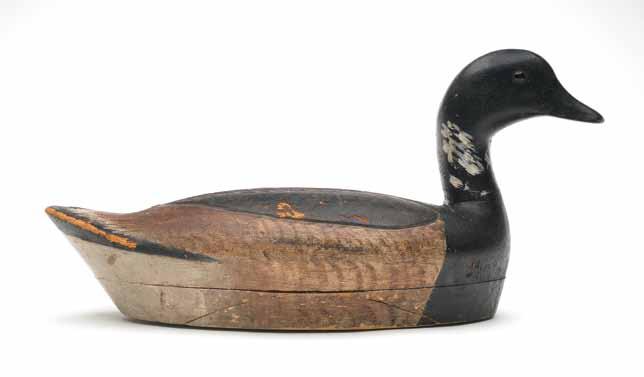
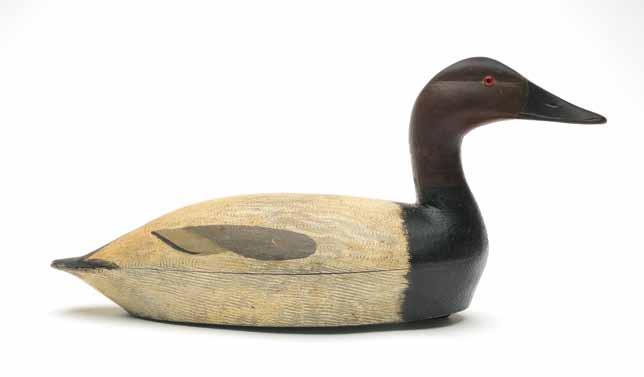
559 Chauncey Wheeler (1888-1937), Alexandria Bay, New York. Brant. Hollow carved with slightly turned head and incised torn heart wing pattern. Measures 18.25” long. Original paint with moderate flaking and wear; crack at base of neck was tightly reset with some touchup to that area; professional bill chip repair; some added white feather detail on sides of neck; small dents and shot marks; old chip and roughness on edge of tail; slight separation at body seam. (4,000 - 6,000)
560 Chauncey Wheeler (1888-1937), Alexandria Bay, New York. Canvasback. Two-piece long body style. Comb feather paint detail. “KW” branded on underside. Measures 18.25” long. Original paint with minor wear; an early coat of varnish has darkened with age; a 1.5” piece was added to base of neck with paint restoration in that area; professional bill chip repair.
Provenance: Frederick Raymon collection. (1,200 - 1,800)
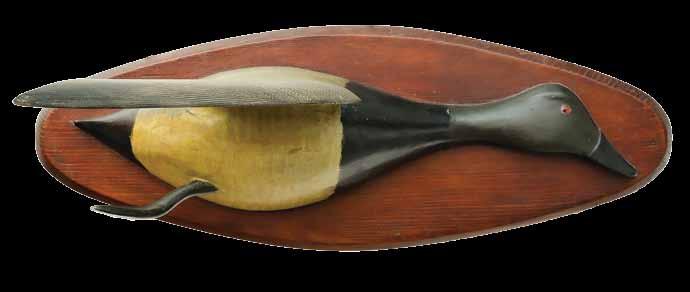
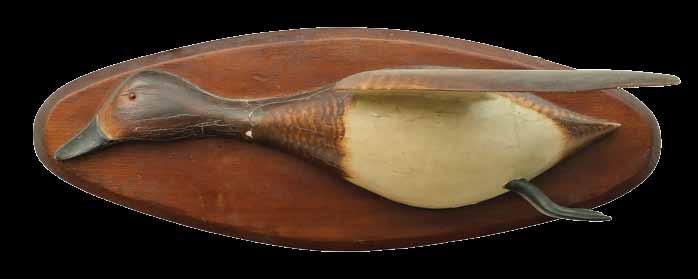
561 Pair of canvasback flyers, upstate New York. Similar to the work of Chauncey Wheeler. Full size canvasback pair mounted to backboards. Boards measures 8.5” x 24”. Both are in original paint; drake has had some restoration work to neck seam, at break in foot where it was reset, and where wing was strengthened on both underneath and topside; hen is structurally good with crazing over head and back.
Provenance: Bill and Alice Walsh Collection. Obtained from Parker Conner, Richmond, VA.
(2,500 - 4,500)
562 Chauncey Wheeler (1888-1937), Alexandria Bay, New York. Black duck. Measures 16.75” long. Dry original paint with very minor wear; some flaking under tail and at breast; minor flaking to neck filler.
Provenance: Dean Hyde collection. (2,000 - 3,000)
563 Frank Coombs (1882-1958), Alexandria Bay, New York. Bluebill hen with slightly raised head pose. Measures 14.75” long. Original paint with minor crazing and wear; lightly hit by shot; split in one side was filled and secured by nails in the making; hairline crack in neck.
Provenance: Chris Pitman collection.
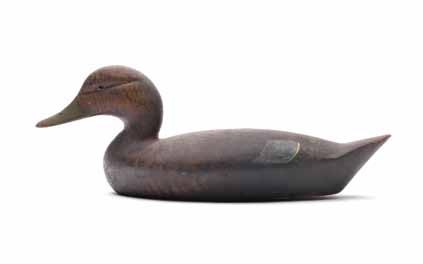
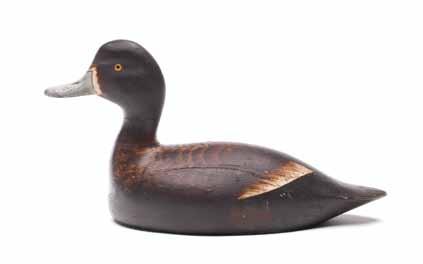
564 Sam Denny (1874-1953), Clayton, New York. Canvasback. Slightly raised neck seat and eye groove carving. Measures 16.75” long. Original paint with moderate gunning wear; some areas of touchup under a thin, somewhat uneven coat of varnish; lightly hit by shot. (1,000 - 1,500)
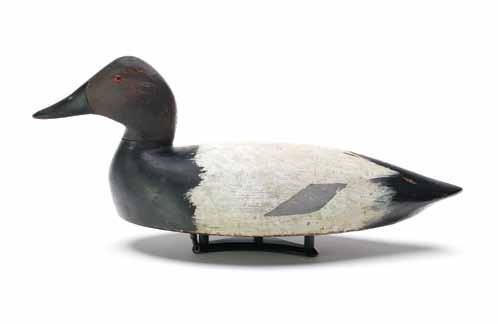
565 Unknown maker, Alexandria Bay, New York, 1st half 20th century. Bluebill hen similar to the work of Chauncey Wheeler. With eye groove carving and painted eyes. Two piece body with half inch bottom board. Measures 15” long. Original paint with very minor wear; crack through neck with small amount of glue visible on one side.
Provenance: Bill and Alice Walsh Collection. Bought at Bourne Auction #397, July 1986. (1,000 - 1,400)
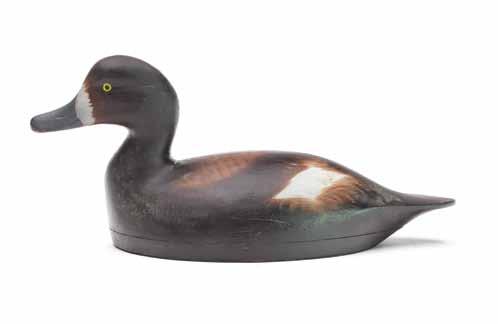
566 Chauncey Wheeler (1888-1937), Alexandria Bay, New York. Goldeneye hen. Slightly raised neck seat and eye groove carving. “JJF” and “19” painted on underside. Measures 12.5” long. Original paint with moderate wear under a coat of varnish; drying crack through one side of neck seat and breast; tight crack in underside of tail area with old glue added.
Provenance: Dean Hyde collection. (800 - 1,200)
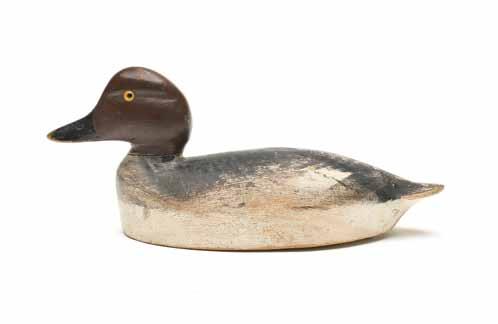
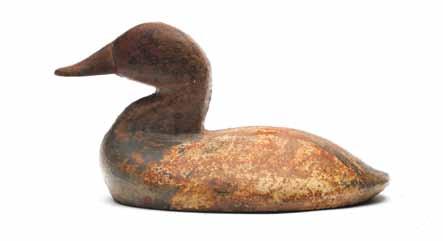
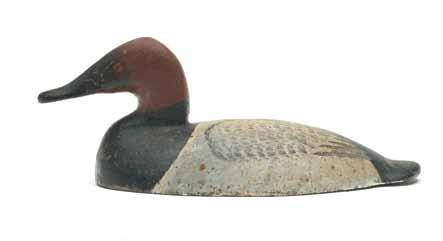
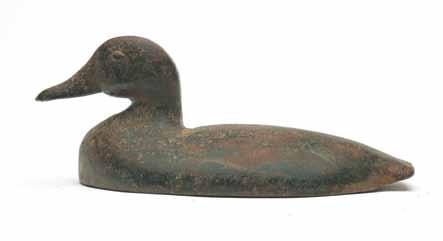
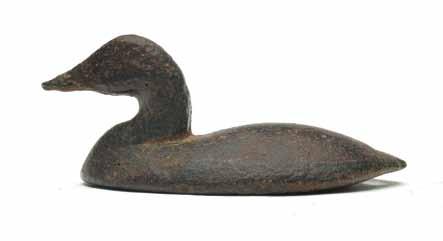
567 Early cast iron sinkbox decoy. Modeled after a Cecil County decoy. With slightly reared back head. Small hole in tail for securing to sinkbox. Measures 13.25” long. Multiple coats of paint have worn down to bare iron; a very nice example. (500 - 800)
568 John D. Graham (1822-1912), Charlestown, Maryland. Excellent canvasback cast iron sinkbox decoy. Measures 15.25” long. Original paint with minor flaking; some small spots of rust; excellent structurally. (3,000 - 5,000)
569 Cast iron wingduck, Maryland. Measures 13.25” long. Paint has worn away to bare iron; very good structurally. (300 - 500)
570 Cast iron wingduck, Maryland. Measures 13.5” long. Paint has worn to bare iron; mold was slightly offset near head and neck; otherwise very good. (300 - 500)
571 Cast iron wingduck, Maryland. Measures 14.25” long. Remnants of old paint; good structurally. (300 - 500)
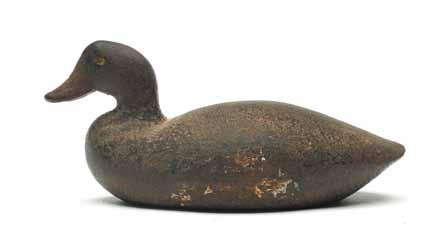
572 Cast iron sinkbox decoy. Modeled from a Dodge Factory decoy. Painted as a redhead. Measures 14” long. Paint appears original with discoloration and wear; very good structurally. (300 - 500)
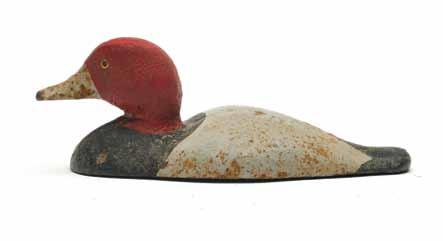
573 Cast iron wingduck, Maryland. Measures 13.5” long. Remnants of old paint; good structurally. (300 - 500)
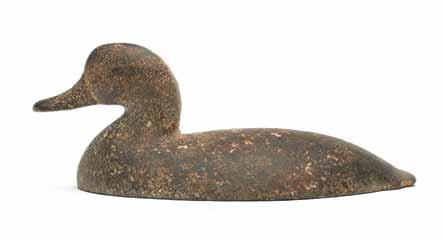
574 Cast iron sinkbox decoy. Does not appear to have ever been painted. Measures 13.75” long. Scattered surface rust; good structurally. (300- 500)
End of Session Two
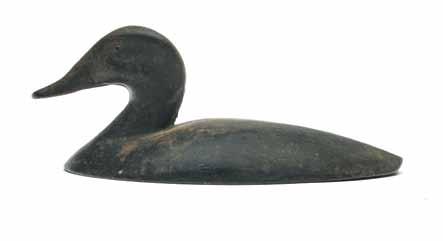
Allen, Fred
Andrews, Ambrose
Andrews, Robert
Anger, Ken
Antis, Harry ................................................................................. 231
Artistic Design Company 475
Bach, Ferdinand 9,435
Baker, John H. 166
Barber, Joel 58
Barnard, Charles Nelson 114
Benson, Frank ............................................................................. 245
Bergman, Charles ............................................................... 29,157B
Birch, Charles 56
Blackstone, Jess
Blair, Sr., John 2
Bonner, Dick 357,358
Borrett, Mike 361-369
Bowman, William ................................................................
Brunet, Jett
Brunet,
Brunet, Tan
Burr, Elisha
Chadwick, Keyes ................................................................ 180,181
Chambers, Thomas ............................................................. 416,417
Chesser, Grayson 359,360
Cobb, Jr., Nathan 79,80
Coombs, Frank 563
Crandall, Horace “Hi” 157A,157C
Cranmer, William 62
Crowell, A. Elmer ....................................... 1,4,12-19,171-179A,446
Culver, Reginald 443
Dawson, John
Demott, Daniel 191
Denny, Sam 564
Dettman, Warren 52
Dilley, John .......................................................................... 185-188
Dodge Decoy Factory 214A
Dolsen, Frank 428
Doren, Leonard 387
Eigenberger, Gary 355,356
Ellison, Henry 183
Elliston, Robert ............................................................. 374,375,380
English, Dan ............................................................................... 164
English, John 8,158,161,162
Faue, William 295-297
Federine, Earl 354
Fernlund, Ivar 50
Finkle, Hayes 57
Finney, Frank ....................................................................... 138-145
Fitzpatrick, Thomas 168
Foote, Jim 229
Foster, Alonzo 190
Fox, Gordon Pecor 281,282
Freirich, Robert 159
Garren, Otto ......................................................................... 44,379
Genn, Robert ............................................................................. 232
Gibbs, Harold 498-517
Gibian, William 124-128
Gilley, Wendell 358A-358D
Goebel, Will 238
Gorsline Family 419
Goslin, Jr., Edward D. ................................................................ 534
Gouellet, Issaac 278 Graham, John D. 105A,568 Grant, Stanley 59,398 Graves, Bert 32,33,42A,370,377,378,384
Gromme, Owen 388
Hagerbaumer, David ......................................................... 220,224 Hancock, Miles ................................................................ 95,96,102
Hanson, Marty 341-343
Hart, Charles 495
Heisler, Jess 37,163,165
Holly, John “Daddy” 104,105
Homme, Ferd 20,389
Horn, John ............................................................................... 401A
Horner, Nathan Rowley 36 Howitt, John Newton 225 Hudson, Ira 74-78,81-87,98
Hudson, Norman 88,97
Huey, George 182A
Humphries, William ...................................................................... 51 Hunt, Lynn Bogue ...................................................................... 230
Hutchins, Arthur T. 226
Hutchins, Sam 412,412A
Irvine, Lawrence 490 Irwin, Ed 287,288
Janner, Auggie 269,270
Janner, Hans ....................................................................... 266-268
Jaques, Frances Lee 223
Jester, Doug 54,90-93
Joiner, Charlie 113,329-335
Keech, Alpheus 481,483
Ketchem, Captain Al 184,199 King, Alan James 497
King, Joe .................................................................. 38,160,167,169
Kuss, Frank 271
Laing, Albert 440,442
Lane, Stephen 385
Lawrence, Homer 445
Lawson, Oliver 323-328
Leeds, Daniel Lake .................................................................... 410
LeMay, Art .................................................................................. 240
Lester, John Seery 233
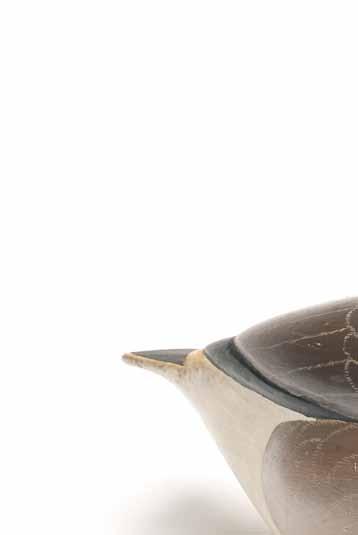
Lincoln, Joseph ..................................................... 3,26,182,447,494
Lipke, Paul 53
Loney, William 414
Maass, David 217,218
Madera, Clark 405
Mailman, Paul 491-493
Mason Decoy Factory, .................... 27,28,40,41,200-214,535-552
McGaw, Robert .................................................................. 115-117
McIntosh, Leo 340
McIntyre, Cameron 129-133
McNair, Mark 146-152
Meldrum, Alexander Yock
Mitchell, Madison
Moak, Gus ..................................................................................
Moore, Benson B.
Moretz, Rich
Nichol, D.K.
Nichol, David W.
Edmund 215A Parker, Ellis
Jay
Perdew, Charles 7,11,21,381,386
Peterson, Oscar 247-264
Pice, Charles 157D
Pleissner, Ogden
Ramey, Jess
Rathmell, Louis C.
Reece, Maynard
Ryden, John ........................................................................ 298,299
Salmons, Bradford 401
Schaldach, William 228,244
Schlottman, Henry 383
Schmidt, Benjamin 431-434
Schmidt, Frank 61
Schmiedlin, Jim ................................................................ 335A-339
Schroeder, Tom............................................................ 274,436-438
Schultz, William 392
Seymour, Harry 286
Shourds, Harry M. 394,395
Shourds, Harry V. ............................................................ 24,396,397
553-560,562,566, White, Robert “Bob” 153-157 Whorf, John 221 Wozny, Eddie 134,135
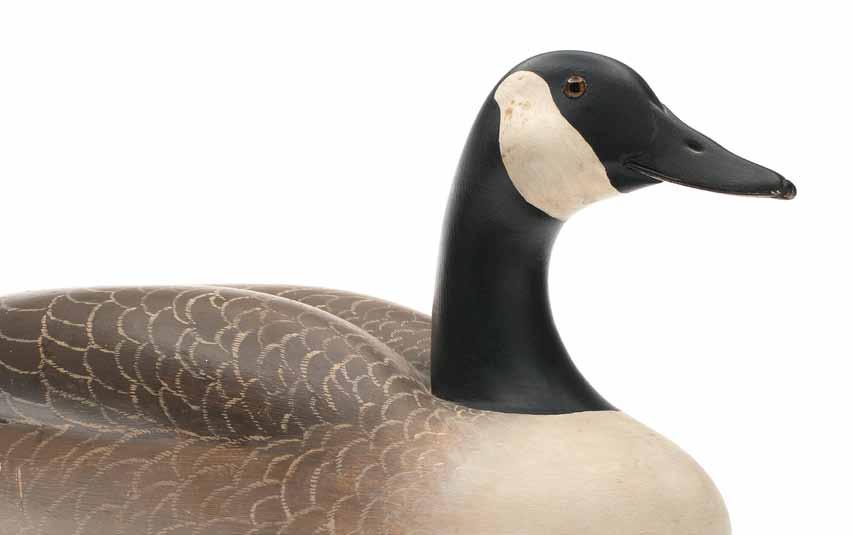

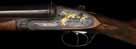

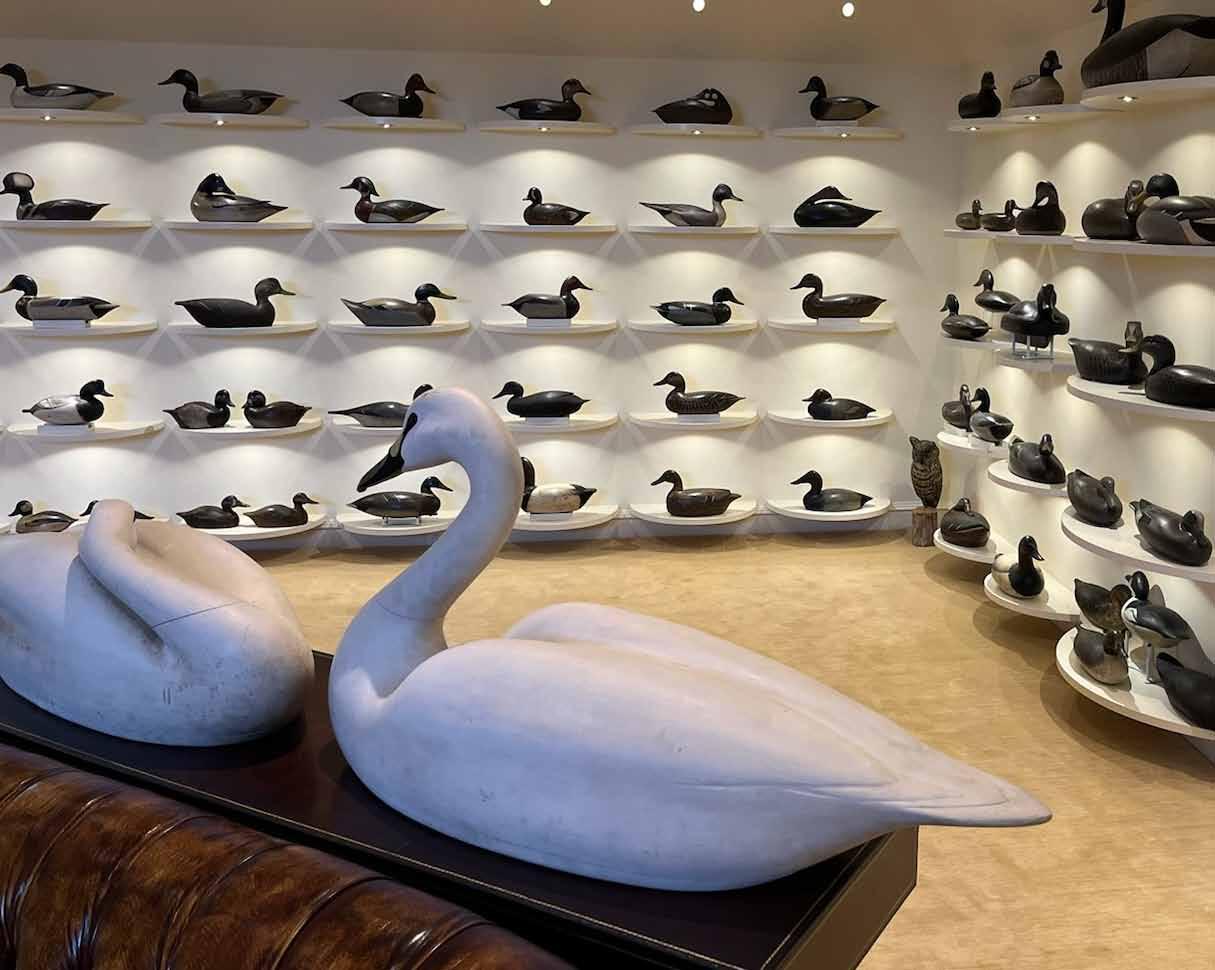
While you continue to enjoy collecting today, you can rely on Guyette & Deeter to collaborate with you on your estate planning and collection management needs. Whether it’s for tax purposes, estate planning, gifting, charitable giving, or insurance, we can develop and periodically update a comprehensive written appraisal of your collection. We have extensive experience working closely with banks, attorneys, trustees, estate officers, probate court, private clients and family members responsible for the dispersal of collections as part of larger estat es.
O ur unmatched market understanding allows us to more accurately document the value and description of each item in your collection. We know that working together to ensure that your wishes are established now will make it easier to administer your estate lat er.
Co ntact Jon or Zac to discuss our Legacy Planning Program today.
Jon Deeter | 440-610-1768 jdeeter@guyetteanddeeter.com
Zac Cote | 207-321-8091 zcote@guyetteanddeeter.com


These have always been time-honored traditions, passed from generation to generation. Nowhere is this more evident than at the iconic Waterfowl Festival in Easton, Maryland.
Since 1971, artisans and artists, musicians, craftsman, decoy carvers, hunters, and callers have gathered to share the rich heritage of the Eastern Shore culture lifestyle The festival began with a determined group of hunters and conservationists, who knew that unless they worked to preserve the landscape they loved, they would be lost forever.
Over the decades, these remarkable men and women–and now in many cases, their children and grandchildren–have worked tirelessly to educate, entertain, and inspire. For 55 years, the Waterfowl Festival has been a must attend event celebrating the best of wildlife art, spor ting traditions, and conservation.
Visitors can enjoy decoy carving, calling demonstrations, retriever and raptor exhibitions, live music, and delicious Eastern Shore food that keeps them coming back year after year. Join us this year and discover why the Waterfowl Festival remains a legendary celebration of art, herit age, and the wild spirit of the Eastern Shore.





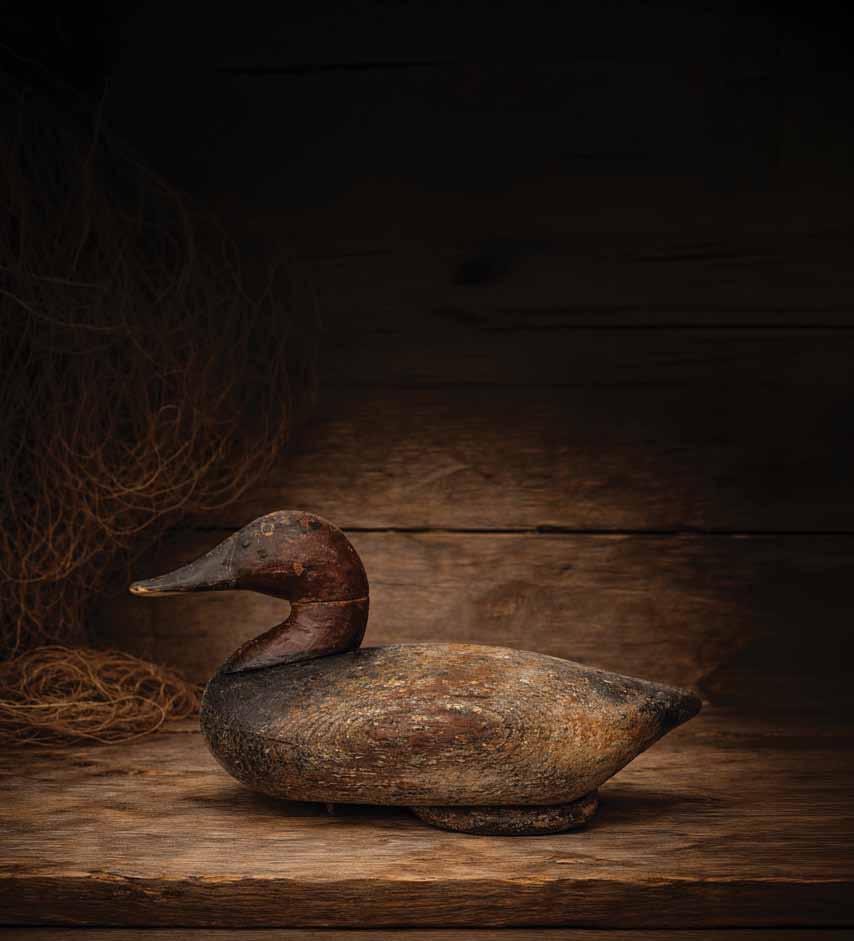
• Black anodized aluminum construction.
• Rubber padded tops & bottoms. Will not mar your furniture or decoys.
• 3 post and 4 post styles to choose from.
• 1 in to 4 in heights in 1/4 in increments
Custom Sizes and Colors Upon Request $30 each plus shipping and handling
To order call Ken Cole at: (810) 845-2434 E-mail: kencole3@aol.com

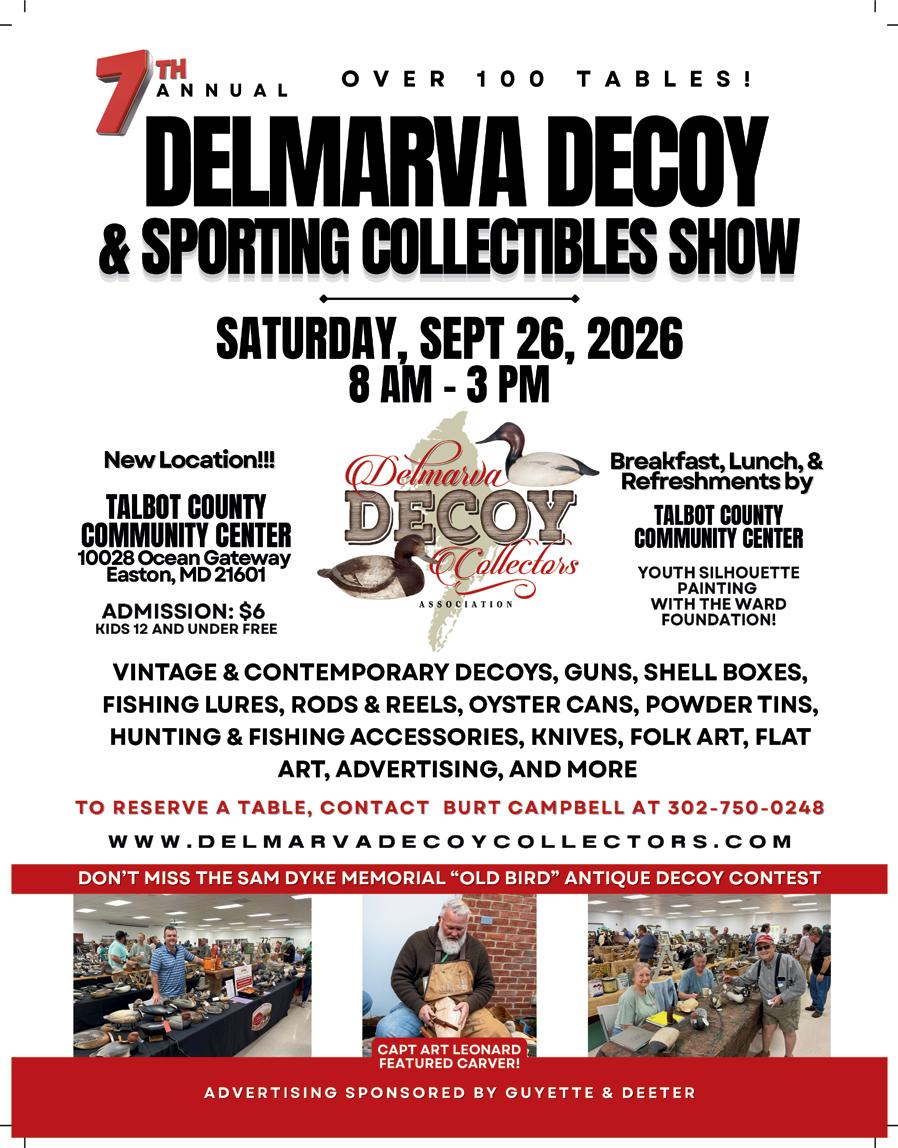

For 45 years, Jim and Diane Cook’s aggressive pursuit of high-condition waterfowl decoys has resulted in the finest collection of rare and important decoys ever assembled. Many examples were auction records for the maker when they joined the collection and some were only surpassed when Jim bid on a rarer and more pristine example, setting the highwater mark once again. Over the years when a potential addition to the collection was selected, Jim would often hold up his bid card and not lower it until the auctioneer sold the decoy his way.
The Jim and Diane Cook collection will be sold in its entirety over the next five Guyette and Deeter auctions, commencing on April 23 & 24 at the Westin Chicago Lombard, held in conjunction with the annual North America Decoy Collectors Association show. The opportunity to acquire some of the most important decoys known should not be overlooked.
A 364-page, hardbound book of the entire collection can be purchased for $100 by calling Guyette and Deeter at 410745-0485. The book features over 75 carver biographies, as well as extended writeups about the Cooks and their collecting journey. It is extensively illustrated with over 700 photos of the collection, as well as vintage photos to accompany the many carver bios. If you have questions about any of the upcoming items or would like to consult with a specialist on starting your collection, call Jon Deeter at 440-610-1768 or Zac Cote at 207-321-8091.
1. GUARANTEE ‑ We have made a concerted effort to accurately catalog and describe the property to be sold. The decoys have guaranteed condition reports. Should the need arise, the auctioneer reserves the right to make verbal corrections and provide additional information from the podium at the time of the sale. Since opinions can differ, particularly in the matter of condition, the auctioneer will be sole judge in the matter of refunds. If we fail to identify a flaw that has a significant impact on the value, you can return the decoy.
2. DURATION OF GUARANTEE ‑ Requests for a refund on an item purchased through a Guyette and Deeter, Inc. auc tion must be made within 3 days of the time you take physical possession of your purchases. Whether your items are shipped, delivered, or picked up at the auction site, it is still 3 days from date of possession. This guarantee is null and void if payment is received or mail is postmarked more than 14 days from the sale end date. The guarantee is also null and void if you choose to not take possession of your purchases within the 30 days. If you have paid for your purchases within the 30 days but Guyette and Deeter, Inc is unable to ship your item within the guarantee period, the guarantee will be extended until 3 days from the shipping delivery date.
3. PROTESTED BIDS ‑ In the case of a disputed bid, the auctioneer is the sole determinant as to who the successful bidder is, and at his discretion, may reoffer and resell the article in dispute. If a dispute arises after the sale, the auctioneer’s sales records shall be conclusive as to who the purchaser was, and the purchase price.
4. BIDDING BIDDING Bidding usually starts below the low estimate and advances in increments of approximately 10% of the opening bid subject to the auctioneer’s discretion. The auctioneer reserves the right, at his sole discretion, to refuse any bids that he deems unreasonable. The minimum bid increment guideline is as follows:
$500 to $1000 ‑ $25 $10,000 to $20,000 ‑ $500 $100,000 and above ‑ $2,000
$1000 to $10,000 $100 $20,000 to $100,000 $1,000
5. ABSENTEE BIDS ‑ Phone or mail bids, at the discretion of the Auctioneer, will be accepted with a 20% deposit. In such case, the auctioneer will execute such bids competitively. Absentee bids are executed by the auctioneer on behalf of the bidder in accordance with the bid increment policy shown above.
6. TERMS ‑ All items are to be paid for in U.S. funds. No items will be released until they are paid for. The Auctioneer reserves the right to hold merchandise paid for by personal check, until the check has cleared the bank. PAYMENT IS DUE UPON RECEIPT. A late charge will be accessed on all balances not paid, at the rate of 12% A.P.R. commencing 30 days after the auction. Merchandise not paid in full withing 30 days will be considered unsold.
7. PAYMENT FOR PURCHASES CAN BE MADE WITH CREDIT CARD (VISA, MasterCard, American Express, or Discover), CASH, CHECK, OR WIRE TRANSFER.
8. BUYERS PREMIUM The buyer’s premium, assessed on each selling lot, is 20% of the hammer price up to and includ ing $1,000,000. For payments made using a credit card, the buyer’s premium is 23% up to and including $1,000,000. ONLINE BIDDING: We incorporate several internet bidding services that are provided by separate companies that host our auctions live from their web platforms. They charge our auction company a substantial fee to upload the auction materials to their platforms. Bid.guyetteanddeeter.com has a 1% fee, while Invaluable, LiveAuctioneers, and Proxibid each have a 5% fee. This amount is added on to your Buyers Premium on your invoice if you utilize any of the online bidding platforms that carry this auction.
9. TAX ‑ THERE IS AN 6% SALES TAX IN MARYLAND. TAX IS WAIVED IF BUYER PRESENTS A VALID RESALE CERTIFICATE FROM ANY STATE OR HAS PURCHASES SHIPPED OUTSIDE OF MARYLAND.
10. ACCEPTANCE OF CONDITIONS ‑ Bidding on any articles in this sale indicates your acceptance of all of the conditions of sale.
11. BIDDING AGENT RESPONSIBILITY ‑ If you are registering for someone or if you execute a bid for someone else under your number, you are responsible for the settlement of that account. You are also responsible for examining the items for your client regarding the guarantee.
12. WITHDRAWAL ‑ We reserve the right to withdraw any property before the sale and shall have no liability whatsoever for such withdrawal.
13. TITLE ‑ Title passes when the auctioneer strikes the gavel AND verbally announces the sale of the item. It will then be the responsibility of the buyer to make full payment, according to terms and conditions, prior to removing the goods from the premises. Removal is at the buyer’s risk and expense and must be made at the conclusion of the sale, unless other arrangements are made with the Guyette & Deeter.
14. LEGAL DISPUTE ‑ Any legal disputes arising from this auction shall be settled in the court system of the State of Maryland. UNIFORM COMMERCIAL CODE The Maine Uniform Commercial Code, Title II, Section 2328 applies to this auction.
15. Stands are not included with the decoys or weathervanes unless specified in catalog. Cases are not included with shotgun shell boxes. All dimensions are approximate and are not guaranteed. All calls are sold “As Is”.
16. Under no circumstances will we be responsible for damage to frames or glass, or damage caused by them. Paintings determined to be of high value or large size may be subject to special packaging or special delivery at the buyer’s expense. Under no circumstances will we be responsible for damage to fragile decorative carvings. These items are marked in the catalog with an *.
17 The acceptance of the successful (winning) and final bid by Guyette and Deeter shall occur when the auctioneer strikes the gavel AND verbally announces the sale of the item. The auctioneer retains absolute discretion in determining the successful bid and bidder.
1. Absentee bids are a service provided to our customers free of charge. Every effort is made to execute all absentee bids, however, in the event of an error or omission, or failure to properly execute absentee bids, the Auctioneer shall not be held liable.
2. All absentee bids must be accompanied by a 20% deposit, which will be refunded immediately after the auction if your bid is unsuccessful. If your bid is successful, the deposit will be applied to the purchase price and the balance due upon presentation of your bill. All absentee bidders are notified by mail, whether successful or unsuccessful.
3. Visa and Mastercard numbers can be given in place of a check deposit, if your bid is submitted by phone. Your card number will not be used to make payments for purchases, it is only used as collateral. Your card number will only be used to make payment for purchases if you default on payment.
4. To execute an absentee bid, fill out the enclosed form listing catalog number, description, and your top bid price (not including the 20% buyer’s premium). Send this together with your deposit as soon as possible. If your bids are sent seven days or less prior to the auction, you should call our office three days prior to the auction, to confirm that we have received your bids. If they have not been received at that point in time, we will take your bid over the phone. We cannot guarantee that bids received after the auction has started will be executed.
5. If two or more bids are received on the same item from different people, the bidding will open at the next logical raise above the second highest bid. If two absentee bids are received with the exact same amount, the first one received will take precedence.
6. All bids must be in even dollar amounts. Bids in fractions of dollars will be considered the next lower even dollar amount.
7. Bid increments: The bid increment policy, which also applies to both absentee and phone bidders, is listed under “CONDITIONS OF SALE” (item #4), in the front of the catalog.
8. Open bids, bids with no set top amount, or orders to just simply buy the lot, cannot be accepted. You must have a definite top limit before we can execute your bid. Alternatives to this are as follows:
a. To bid over the telephone. This can be done by simply sending a 20% deposit for what you wish to bid on the object. This will bind whatever bid amount you wish to bid over the telephone. (NOTE: There are only 8 phone lines into the auction room and phone bids will be handled on a first come, first serve basis.)
b. Some bidders concerned that a lot might just go for one bid above their top limit, leave a top bid plus one bid. This works as follows: the top bid submitted might be $1,000, but not wishing to lose the lot for simply $25 more, the party might bid $1,000 + 1 bid if they definitely don’t want to go over a certain price, they would indicate $1,000 +1 ($1,025) (NOTE: One possible problem that occasionally arises with absentee bids is when someone in the audience bids exactly the amount, which you specify is your limit. In such a case, we would not go one extra bid unless your bid sheet indicates “plus one” bid.).
9. If you are a successful bidder, a bill will be sent a few days after the auction. Purchasers should indicate their desired method of shipment, if such is necessary. There is a charge for shipping, labor, materials, and insurance. Please provide notice in writing if items are covered under your own insurance policy. Shipping is done on a first come, first serve basis, and can take up to 4 weeks Please note that a certified check, Visa, Mastercard, or any other form of guaranteed funds will expedite shipping.
10. For expensive oil paintings and delicate carvings, we need a written statement from the purchaser, assuming the responsibility of pursuing any claims, in the event of damage incurred during shipping. Valuable lots need to be sent 2nd day air UPS due to values. Under no circumstances will we be liable for damage to glass or frames, or fragile decoratives, regardless of cause.
11. TERMS Phone and absentee bidders You will be notified one week after the auction of your results. Payment is due upon receipt. Interest will be charged on all balances not paid within 30 days after the bill is sent at the rate of 12% APR. If any accounts become more than 60 days overdue, the consignor will be given the name of the buyer who is responsible for holding up their funds. If an account is 75 days overdue, the items may be returned to the consignor and overdue buyer will pay the buyers premium and commission from the sale, if they wish to participate in future Guyette and Deeter auctions.
12. Bidding on any article(s) indicates your acceptance of these terms above.
13. If you would like any additional information on any of the lots, please contact: Jon Deeter at (440) 610-1768, or Zac Cote at (207) 321-8091. If you have any questions concerning absentee bids, please call us.
OFFICE USE ONLY REG : Time Date Auction Manager
Jon Zac
Bookkeeper Computer Bid Builder
Absentee OR Telephone
NAME
ADDRESS
DEPOSIT $
I Desire to bid on the following items in the sale. The bids are to be executed by Guyette & Deeter, up to but not exceeding the amount(s) specified on the below bids. All bids will be executed and accepted subject to the Terms of Sale and Absentee Bids Procedure outlined in the catalog. (Please be sure that you understand our procedures before using this Absentee and Phone Bid Form.) The office will not be open until Wednesday after the auction.
A premium of 20% will be applied to all items sold, to be paid by the buyer