HURRICANE HELENE. ONE YEAR LATER. WEDNESDAY, SEPTEMBER 24, 2025 | A5
WWW.ASHEPOSTANDTIMES.COM
HURRICANE HELENE. ONE YEAR LATER.
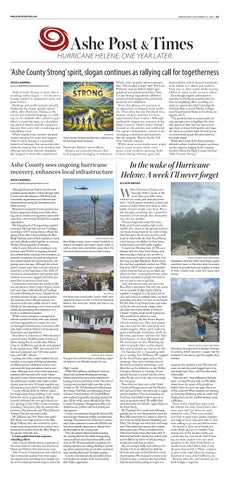
‘Ashe County Strong’ spirit, slogan continues as rallying call for togetherness While other popular advertisements, like “The Coolest Corner” and “The Lost Province,” sum up Ashe County’s geo‘Ashe County Strong’ is more than a graphical and environmental lure, “Ashe trending online slogan — it’s become a County Strong” engendered a different lasting symbol of community unity and mood and local zeitgeist that prioritized perseverance. humanity over selfishness. Hashtags and profile pictures proudly Short, hip phrases are common in displaying the slogan quickly spread an ephemeral, overhyped social media online after Hurricane Helene, as the era. They often become Facebook bios, concise but powerful language is a rallybumper stickers, and bios for more ing cry for residents who refused to genopportunistic Etsy vendors. Although uflect, or bend the knee, to a destabilizmarketable slogans are common in the ing natural disaster and the conspiracy High Country, “Ashe County Strong” theories that come with a confusing and focused on the positive and celebrated befuddling event. the region’s intrepidness, instead of disFILE PHOTO couraging community participation, While neighboring counties adopted Ashe County Strong has become a rallying cry like the popular “Boone Sucks, Tell similar mantras for unity and support, for the local storm recovery. ‘Ashe County Strong’ is a powerful, Your Friends” stickers. hyperlocal message that transcends platWhile many social media users might itudes by staying true to its wording and Hurricane Helene’s worst effects. find it easier to post cliche stateoffering help from whoever displayed Slogans are powerful phrases that ments, local residents sporting ‘Ashe the imagery to those who experienced send poignant messaging to audiences. County Strong’ rhetoric, gear, and JESSE CAMPBELL
jesse.campbell@ashepostandtimes.com
Ashe County sees ongoing hurricane recovery, enhances local infrastructure JESSE CAMPBELL
memorabilia, which moved seamlessly from online to t-shirts and stickers, lived true to their words while moving offline to assist in the recovery effort. Even though negative information is common on Facebook, positivity bias can have an amplifying effect, according to a study on ucpress.edu, titled Unveiling the Positivity Bias on Social Media: A Registered Experimental Study on Facebook, Instagram, and X. “The positivity bias on social media not only prompts users to highlight the favorable aspects of their lives but also encourages them to frame both positive and negative facets in a positive light. Several factors on social media propel this phenomenon,” the study stated. While kind words don’t always portend altruistic actions, localized slogans can drown out the negative. Judging by the ongoing recovery efforts, the High Country remains “Ashe County Strong.”
In the wake of Hurricane Helene: A week I’ll never forget
jesse.campbell@ashepostandtimes.com
ALLISON NEAVES
Although Hurricane Helene was the most powerful natural disaster to blow through Ashe County since the infamous 1940 flood, local community organizations and infrastructure departments are laying the foundations for a better recovery. Riverview Community Center received new kitchen equipment, dining room chairs, flooring, and an overall more ergonomic layout after more than a foot of water flooded the nonprofit organization. The Department of Transportation repaired more than 500 road sites and over 70 bridges, according to DOT transportation officials this spring. Many other roads, including the Blue Ridge Parkway, received fresh asphalt, as county and state officials worked together to overcome Mother Nature’s gauntlet of adversity. Ashe County Schools, in working in conjunction with FEMA, is repairing baseball and softball fields, ensuring that recreation, an essential component of youth development and mental health, isn’t deprioritized in mitigating storm damage. Although the school system missed more than a month of instructional time at the beginning of the 2024-25 school year, administrators and teachers said students seem more engaged and better prepared than in previous school years. Construction crews have also resurfaced the taxi and apron at Ashe County Airport, which held more than 2,400 takeoffs and landings for weeks following the storm. Despite the tremendous amount of rain, a recurring theme this summer, school officials continue construction on the new middle school. County officials are also planning a new county animal shelter, demonstrating their dedication to a return to continued normalcy. While county emergency management officials worked fervently with state, federal, and local organizations to repair the county’s damaged infrastructure, conservancy officials didn’t overlook Helene’s environmental destruction and degradation. New River Conservancy’s 900 volunteers removed nearly 56,000 pounds of trash and debris during the six months after Helene. Close to 34,000 trees and shrubs were planted in the riparian areas. NRC also removed 434 tires and conducted over 100 water quality tests, said NRC officials. Lansing, one of the county’s hardest hit communities, is once again thriving and planning an official recovery celebration event to commemorate the long and arduous road to normalcy. Although most of the town’s businesses reopened after the storm, Pie on the Mountain and Country House restaurant were among the unfortunate casualties that could not find reprieve post-recovery. A Google snapshot says the long-time pizza joint is “temporarily closed.” County officials didn’t let Helene siphon the burgeoning energy building in the county before the storm, as agricultural officials recently celebrated the new agricultural center’s opening in July. Other county mainstays, including Christmas in July, the annual Independence Day fireworks, and West Jefferson’s Antique Fair, also returned locally. Mt. Jefferson and New River state parks, Elk Shoals, and large sections of the Blue Ridge Parkway have also returned to operational status, faring better than outdoor recreational spots further down the Blue Ridge in the greater Asheville area. County guides hurricane response, rebuilding efforts Ashe County officials remain cognizant of the area’s return to normalcy and recovery as Hurricane Helene’s first anniversary nears. Ashe County Commissioners have relied on vital community updates from their respective departments, providing keen insight into the storm’s disproportionate impact across the
hen Hurricane Helene tore through Ashe County, it left more than just fallen trees, washed-out roads, and downed power lines—it left people stranded, scared, and unsure of where their next meal or clean bottle of water would come from. But it also brought something else: a powerful reminder of how deeply this community cares for one another. I’ll never forget that week. My mom, Ruth, and I found ourselves right in the middle of it—boots on the ground, hearts in our hands, doing whatever we could to help. And through it all, we were proud to work hand-in-hand with the Ashe Food Pantry, which became our lifeline for food boxes, bottled water, and shelf-stable supplies. It started on Monday, Sept. 30. We coordinated with the Ashe Food Pantry early that morning to load up our car with as many boxes and water as we could fit. Our first stop was Jake Blackburn Road, where the road had completely washed out. With help from DOT workers and a makeshift culvert someone had set up, we hiked supplies in by foot—carrying food boxes, water, and basic essentials to people who had no way out and no way to get help. Later that day, we made our way to the Bent River community. The only way across was an unstable bridge, barely holding together. I strapped on a life jacket just in case, and crossed it multiple times, my heart pounding each time I set foot on the boards. We left Ashe Food Pantry boxes and water on the far side, and made a larger dropoff under the church shelter at Greene’s Chapel—hoping word would spread and folks would know where to come. That evening, Shelter Home Baptist Church reached out. They were preparing a hot meal for the community and needed supplies. Mom and I loaded up again and brought food boxes, shelf-stable items, and water—all from the Ashe Food Pantry—to their fellowship hall. We arrived just in time. Watching the relief on people’s faces as they shared that meal reminded me why we do this. On Tuesday, Oct. 1, I teamed up with my co-worker, Tara Williams. We stopped by the Food Pantry again early in the morning—they were working around the clock, constantly restocking—and filled the car for deliveries to the Molley Chomper Brewery in Lansing. It had quickly become a central hub for storm relief. By the end of the day, every single box was gone. From there, we drove over to the United Chemicon/Sprague area to visit the Dennys, who had turned their own home into a supply post for neighbors. They were handing out food boxes and bottled water to anyone in need, no questions asked. We refilled their stock from what we had left—again, thanks to the Food Pantry. By Thursday, Oct. 3, roads were still barely passable, but we were determined to reach the Rich Hill community in Creston to check on two of mom’s elderly friends, Magdalene and Mary. The damage was worse than we’d imagined. They hadn’t seen anyone from outside their road in days. When we handed them Ashe Food Pantry boxes, they both cried. A kind soul had built a sharing box in their yard, and we filled it up before we left, knowing it would serve more than just them. But one moment really stuck with me. On Tuesday, Oct. 8, we still had two shelf-stable boxes and some cat food left from a local church partner. We returned to a home in the Chemicon area—a woman who had refused help the week before, asking us to give it to
W
PHOTO COURTESY BRE
Blue Ridge Energy crews worked tirelessly to replace damaged and broken power poles as well as clear trees and debris away from the electrical infrastructure across Ashe County.
FILE PHOTO
The Riverview Community Center thrift store opened its doors on Feb. 14. Due to Hurricane Helene, the store was closed and had to be renovated.
PHOTO BY JESSE CAMPBELL
The gym floor at Riverview is awaiting a repolish before it can officially reopen for use.
High Country. While West Jefferson and Beaver Creek sustained only moderate flooding and damage, Helene reserved her most severe impunity for Lansing, Creston, and Horse Creek.The town of Lansing was inundated with more than six feet of water on NC 194, flooding several businesses, the Creeper Trail Park, and submerging dozens of homes. Several portions of Campbell Road were rendered impassable, stranding residents for days. All the while, county officials, led by Ashe County’s Emergency Management office, coordinated recovery efforts with local, federal, and state agencies. County commissioners frequently discussed the storm’s impact during bimonthly commissioners meetings.They learned how Riverview Community Center continues to work with FEMA and how the nonprofit might have to relocate from the flood plain in the coming years. They also relayed citizen frustration during the meeting, like how the debris cleanup along county road had caused hazardous traffic conditions on NC 88 and residential complaints concerning capricious tree cutting, alluding to prevailing citizen suspicions that out-of-state contractors were “padding their loads” for higher paydays. County commissioners also reminded citizens to look after one another as the second winter after Helene approaches.
PHOTO COURTESY ASHE FOOD PANTRY
Volunteers with the Ashe Food Pantry spent countless hours in the days after Hurricane Helene to provide food and supplies to many in Ashe County that could not leave their homes.
PHOTO COURTESY ASHE FOOD PANTRY
Volunteers brought food to Molley Chomper in Lansing, which became a supply hub for residents in the area to get the supplies they needed.
someone who needed it more. This time, she came out onto the porch, hugged each of us, and simply said, “I love y’all. I love this whole community.” That moment—that selflessness, that gratitude—is what I’ll carry with me. We didn’t always know the names of the people we helped. Some we never saw again. But none of that mattered. What mattered was showing up. Listening. Delivering what we could. And trusting that even the smallest kindness made a difference. None of this would have been possible without the Ashe Food Pantry, who never once said “no” when we came asking for more. Their team worked non-stop to pack boxes, gather supplies, and support local volunteers like us who were willing to go out and deliver them. I’m proud to have stood beside my mom, Ruth, and my co-worker, Tara, during one of the hardest weeks our community has ever faced. And if sharing our story inspires even one more donation to the Ashe Food Pantry or another local relief effort, then it was all more than worth it. Please continue to give to the relief efforts by making a donation at www.AsheFoodPantry.org. Because when the road washed out, we built bridges—together.