The Motor Trade Association (Inc) (MTA) is not responsible for statements, opinions or factual matters published in Radiator magazine, nor do they necessarily reflect the views of MTA, its Board of Directors or its advisory/specialty committees, unless expressly so stated, and does not endorse advertisers.
Radiator magazine is available free to all members of the MTA. Information on products and services contained in the editorial and advertising pages of this magazine is published as a service and no responsibility will be taken for inaccurate information.
Radiator magazine does not imply the endorsement of any product or service. The publisher reserves the right to refuse advertising and editorial at any stage.
Copyright: No part of Radiator magazine may be reproduced in part or in whole without the written permission of the publisher.
Chief Executive’s comment
This centenary issue of Radiator is all about longevity. We celebrate solidity and success within our industry at one of the most difficult periods in our history. While hard times, wars and pandemics have all been endured by our parents and grandparents –this sudden and dramatic yank on the reins of the world’s economy is a first. While many members went through the Global Financial Crisis (GFC) 10 years ago, the Covid crisis is much higher on the Richter scale.
It’s becoming clear that this is a time when people must work ON their business – not just in it. Staying on top of every line item in your financials is critical to survival. Knowing what is making you money and what is not, where your expenses are, what can be cut, and taking action early and decisively are crucial.
Economist Tony Alexander recently canvassed the business community for the lessons they learned during the GFC. He shares some of that with us on page 20. Specialist advice and information are always available via your accountant, business mentors, MTA staff and others. I urge all members to seek out that support when needing to make important decisions over the coming months.
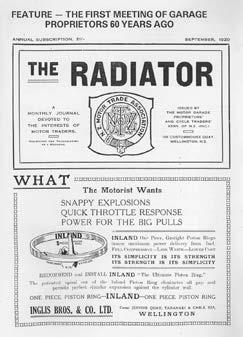
Radiator centenary
It may be a bit self-congratulatory, but there’s something very satisfactory about being part of an organisation that has managed to continuously publish the oldest trade magazine in the country. As far as we can discover, Radiator is one of the oldest print magazines in New Zealand – the School Journal holds the actual title by a couple of years, but we are very proud of our tradition and longevity. While May 1920 was the first issue, we are marking the anniversary in June 2020, thanks to a little disruption caused by Covid-19. MTA has used the magazine to keep its members up to date with the news, views and information relevant to them and their businesses for a century and we continue to do that. It is also part of our historical record, and that of the country, so I hope you enjoy the peek at the past that this issue reveals. Note we have also moved with the times, and a digital version of Radiator is now posted each month on the Toolbox. So if the office copy has disappeared, you can read it on your tablet, phone, or computer.
Apprenticeship retention
Sadly, in hard times, it is often the apprentices who are first to be let go. However, we would urge members to take a wider and long-term view when making staffing decisions over the next few months. New Zealand has an aging population, and there is a dwindling number of young people within the motor trades. If businesses are to continue well into the future, we will need younger qualified people to take over from the ‘boomers’ who are now either retiring or are close to it. I was pleased to see the Government put aside over $400 million in the Budget to help retain apprentices in the workforce. There are few details on how this will be done, but I can assure you, MTA will be talking to officials about our ideas. More on this in later issues of Radiator
Keeping up the information flow
I want to thank the 185 members who answered the second survey we pumped out to get a feel for how Level 3 was impacting on businesses. It was a similar number to those who responded to the survey on Level 4. At Level 3, most responding members (80 percent) had opened with their usual hours; the rest were operating on shorter hours. Almost everyone had a safe work plan in place which was very heartening. It was good to see that just under half were as busy as usual, or even busier. Once again, many of the responding members took the time to thank MTA for its flow of information and phone support. We’ll be keeping the pedal down over the coming months to make sure members get useful and timely advice, support and information as the situation unfolds.
Craig Pomare
2020 NATIONAL Awards recommendations
Are you aware of a member who deserves recognition for their service to the New Zealand motor trade?
Nominations for national: Life, Honorary Membership or an Outstanding Service Award for 2020 are now available: See the insert in this magazine for details.
Or visit the MTA website: www.mta.org.nz You can also contact Jennie Mills–email: jennie.mills@mta.org.nz or telephone: 04 870 4820.
Nominations close: 5pm, 9 September 2020.
Hunkering down for winter
Many mechanical and collision repair workshops got off to a flying start in Level 2 after lining up bookings and putting in new anti-viral processes during lockdown and Level 3. Car dealerships also made enough sales to bring the smiles back. There are more cars back on the roads, so even the pumps are busier.
However, it’s all comparative. Trade is still down on pre-Covid-19 levels and business owners are expecting sluggish times ahead.
Focus on cashflow
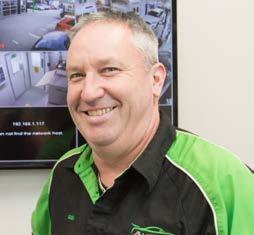
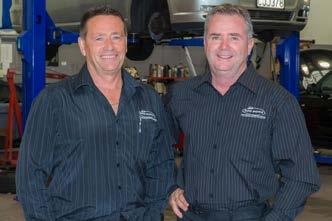
Auto Super Shoppes Chief Executive Officer, Jonathan Onyszkiewicz says this is the time for workshops to work with their customers and keep up the conversations about what repairs are needed, what can be prioritised and exactly how much each step will cost.
“If a customer’s cash flow is tight, there are many credit options available. But it is not an option for workshops to offer credit directly. A workshop is not a bank,” he says.
The Auto Super Shoppes network has a long list of preferred suppliers who are being supportive.
“None have changed their terms for us,” says Jonathan.
“It’s a different story for some dealerships and smaller parts suppliers. Some members are telling us they’ve been asked for payment on delivery from suppliers outside our preferred network – even when the member has had a long standing relationship with that supplier.”
However, such moves are not unexpected, with all businesses now needing to take tighter control on their cash flow.
Meanwhile, it’s important to bring in the customers.
The group hopes its new advertising campaign, running on TV and digital platforms in May and June, will give the brand a boost.
“We were already filming in early March for an online campaign so we have re-angled this to reflect the Covid-19 situation,” says Jonathan. “We will be particularly promoting Covid-19 safety measures and finance options to deal with unexpected expenses.”
With more cost-effective pricing for television advertising now available, the group was able to extend its campaign to television.
Auto Super Shoppes also ramped up its peer-to-peer webinar sessions during lockdown to allow members to share ideas and information that would help their businesses once they opened their doors again.
“A workshop is not a bank.”
Hamilton humming
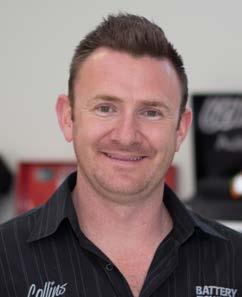
Jason Land spent the lockdown working on his business, Collins Automotive Technicians and preparing for reopening. He’s invested in fog machines that use an aerosol disinfectant to sanitise a car in seconds, installed acrylic screens in the reception area, and brought in other new processes to keep staff and customers safe. In the week before reopening, Jason sent out an email to all customers telling them about the measures he was taking, and began booking in as much work as possible.
The changes he’s made are permanent. “They’ll just be part of our usual routine.” He’s also having constant conversations with staff so there is no complacency, and making sure they too feel safe at work. The conversations about what was happening started with staff back in lockdown and Jason is making a point of keeping his team informed and involved.
“I’ve been getting lots of ideas and feedback and we’re working together really well. I keep thinking how lucky we are to have such a great team.”
He says customers have also reacted well to the new way of working.
Trucking on
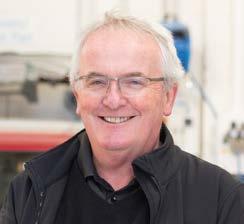
David Clark, Director of Wadsco Trucks in Blenheim, says the team is hunkering down for winter. “We are generally quieter in winter but even more so now.” He says the company has gone through good years and slow years depending on the economy, earthquakes and infrastructure project activity.
“Since the lockdown, local infrastructure projects have been slow to get going again, so things in the workshop are steady but there’s no overtime needed. We are working 8am to 5pm and if someone’s off for a day’s training, we are easily able to cope,” he says.
Parts are expected to become an issue in the coming months. “Air freight has become very expensive so parts are coming in by sea, which means the distributors will need to keep more stock in the country. If a part isn’t available, it could mean that if something breaks down on a truck we may have to rob another truck to keep it going until a replacement arrives.”
He’s expecting Wadsco Trucks to be able to weather the coming year without having to take drastic measures. “We’re cutting expenditure where we can, and we’ll get to the point where staff with lots of leave will be asked to take a holiday to get that debt off the books. We’ve got a good team here and we’ll hunker down together.”
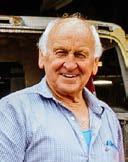
Auto Super Shoppes Chief Executive Officer, Jonathan Onyszkiewicz.
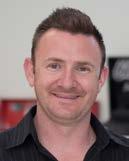
Jason Land, owner of Collins Automotive Technicians.
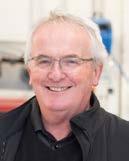
David Clark, Director Wadsco Trucks, Blenheim.
Delays to repairs
Collision repairers are warning customers to ‘expect delays’. Those delays could be anywhere from a week to three months as parts delivery becomes a growing problem.
Glen August, owner of Wellington’s August Panel & Spray, says word from the distributors is that airfreight has become cost-prohibitive. “A small capsule of goods that used to cost $4,000 to fly in is now $40,000. We’re being told to expect a 30 percent air freight charge for each item.” He says even Toyota is largely only shipping in parts, which could mean a 12-week delivery time frame. For parts already in the country, instead of an overnight delivery, repairers now have to wait three to five days, or longer, for their parts to make it through the clogged courier system.
Glen got off to a good start post-lockdown, having put a lot of effort into his new Covid-19 processes and booking in cars and parts for repair during the quarantine period. But he’s expecting business to slow as the economy tightens, and he thinks many repairers will struggle with the ‘new normal’. “We won’t be able to store cars for 12 weeks while we wait for parts, or have loan cars out for that long and hourly rates will need to be reviewed as costs increase.”
There may need to be some serious conversations about expectations with both customers and insurance companies. Some insurance companies now pay out a sanitation fee but repairers say it varies from company to company, with one paying just $25, which won’t cover costs.
Good news
IAG will now pay for parts directly, to help repairers’ and parts supplier cash flows. Repairers need to apply to IAG for this arrangement and the margin is unaffected. The sector is hoping that other insurers will follow suit.
CRA (Collision Repair Association) General Manager, Neil Pritchard says doing business in the new environment is less efficient and therefore more costly and there’s also less work coming in through the doors. “Over the coming months, we are guessing that workloads will level out at about 80 percent of normal. It is just a guess, but a business can’t take 20 percent out of their revenue without it impacting on staff.”
He says it’s vital employers keep consulting with their staff and work with them to find ways to reduce hours, reduce pay, or take leave and other measures. “Older staff may want shorter hours, or even be willing to retire, young people living at home might be happy to work a four-day week.”
But he expects there to be casualties, with cash flow likely to be a serious issue in June, when the wage subsidy runs out and the few invoices for the April and May lockdown period have been paid. The whole picture is compounded by a big drop in the number of road crashes.
CRA is hosting a series of ‘roadshow’ panel discussions in towns around the country in June. It includes HR, a health and safety advisor and experienced people from within the sector able to offer advice and share ideas with repairers.
Kaikoura hit again
Three years ago, an earthquake decimated business in Kaikoura, but locals believe the impact of Covid-19 will be much worse. Ian Walker runs a mechanical repair business – much of it focused on the trucks and machinery used in the road and transport sectors. With the slow start on major projects, and the loss of tourist activities, things are very quiet. “We are doing a few WoFs but local people are not spending much and the place has emptied out now the tourists are gone.”
Southern chill
Terry and Michelle Walsh own Mobil service stations in Omarama and Twizel. The Twizel site includes a busy convenience store, while Omarama is supported by its workshop. Nationally, fuel sales are slowly building up after the lockdown but are still well down on the same time last year. Terry received his usual weekly delivery just before lockdown and says he only sold the last of the petrol in mid May – at a heavily discounted price to reflect the drop in oil price.
He now spends his time analysing his costs, daily and line by line, to get rid of slow-moving items and take out any unnecessary spending. His approval is now needed for every stock purchase and reps can no longer automatically restock shelves.
The opening hours have been adjusted to better match the public’s spending patterns. He’s also extending his pay-at-the-pump options. “We are expecting more drive-offs as time goes on, so we need to be ready.”
Growing the business is important, as is getting the most out of every customer who comes in the door.
“We are getting the staff to upsell wherever we can.”
Terry is confident his business will weather the storm and be ready to grab the tourists once they start travelling through the MacKenzie country again.
“When the borders reopen, we will be seen as a safe country by tourists. They’ll want to come here, rather than America or many other countries,” he says.
Neil Pritchard, General Manager, Collision Repair Association.
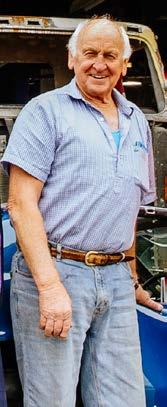
Ian Walker.
Glen August, owner of August Panel & Spray.
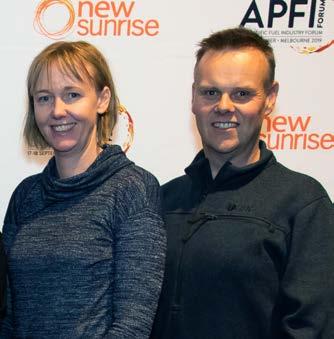
Michelle and Terry Walsh.
A few words from the first editor
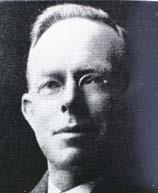
J F Cousins was General Secretary of MTA and the first editor of Radiator for 21 years.
In 1945, for the 25th anniversary of Radiator, he was asked to contribute an article about how he set up the journal.
Mr Cousins said, “I had already visited every town of any importance in New Zealand and made personal contact with the members of the motor trade, but such visits could be repeated only at long intervals and members were soon out of touch with the activities of the Association.
After very careful consideration I came to the conclusion that some regular means of communication between the Association and each of its members was the best way of meeting this difficulty and set about winning the approval of the Council to a plan for publishing a monthly journal by the Association”. He said they were “sympathetic but doubtful about the ability of the Association to finance such a project and to carry it on without interfering with the other work”.
In response, J F Cousins (his Christian names are not mentioned in any historical documents), offered to handle the work himself in his own time and find financing from the wholesale trade. He visited the principal of each wholesale company and asked for written contracts for quarterly advertising.
The main print companies in Wellington were asked for quotes; just one of them called in personally for a discussion –
Mr L T Watkins “who showed interest in the plan and made several helpful suggestions.” He got the job and printed over 500 copies of the first 54-page issue, with a copy mailed to every MTA member.
He praised the pioneers of the motor businesses who “for the betterment of future generations gave their time and money so freely. That the members of the
motor trade made continue to reap the benefits of the work of the pioneers and experience prosperity in the future, is my dearest wish”.
J F Cousins General Secretary of MTA, 1918 -1941.
Extract from the 90th Anniversary edition of Radiator
Colin Stone (Radiator editor 1950-1988).
I think Radiator has a fairly high standard for a trade journal and an important means of communication when you have such a big wide-spread membership. Its changed significantly. In my day the meetings of the Dominion Council and executive meetings were all reordered in the Radiator verbatim. Today it’s a more interesting journal.
I would be up and down to the printers L T Watkins on Cuba Street taking them copy and all this while I was travelling around the branches with the President from up north down to Invercargill. I was on the road up to 10 weeks per year. I was responsible for providing copy and proofing the magazine all by myself.
In 1975 I became Chief Executive of the Motor Vehicle Dealers Institute so I handed the job over to Dan O’Connor.
Radiator – the first year
The first issues of Radiator focused heavily on the need for automobiles post-war – with factories in Europe only very slowly gearing up to produce automobiles after being tooled up for war supplies. Belgium’s former car factories were repairing German and allied motor vehicles left behind by the war.
After six years of war, there were shortages of raw materials and international labour strikes as workers, many newly returned from war, fought now for better conditions and higher wages. The global shortage of benzine/petrol were so bad that there were calls for alcohol fuel production (ethanol) to be made from everything from potatoes to sugarcane and molasses. Radiator regularly featured articles mentioning the heavily regulated amounts that could be imported and sold. Regulations also covered the sale prices and profit margins. South Africa and other African countries began producing a motor spirit called Natalite (made from molasses) which was quickly licensed for manufacture in other countries. Numerous articles were published about the use and performance of ‘alcohol fuel’, its effect on the engine and carburetor (engines needed a higher compression ratio) and so on.
The October issue reported on the annual conference and establishment of a trade training incorporated society by the association.
Imports
In 1920, 10,541 cars and 804 trucks were imported, valued at just under £1 million and £150,000 respectively. The imported tyres and spare parts was £860,000 and £118,724 respectively. There was an emerging issue on how to sell and value secondhand cars. There was a lot of discussion around a formula that could be used by all vehicle dealers, with independent assessors setting the price using that formula.
Meanwhile, tyres were being re-vulcanised by garage owners and other businesses and sold at varying prices. There was much discussion locally and, internationally about mileage guarantees and later in the year, an over-supply as production took off in the US.
Training
The October and November issues reported on the setting up of the Motor Trade Association’s first technical training scheme –the executive had decided not to wait for the Government to fill the training gap but to take charge as an industry.
The reports discussed the local and international shortage of well-trained mechanics. The executive realised immigration could not solve the problem and reported “difficulties technical colleges had in properly preparing apprentices and coordinating with industry”.
Members had already promised £1,200 for the project and agreed to an ongoing annual levy. In return, training would be provided free to employees.
“New Zealand must undoubtedly endeavour to train its own recruits for its own industries”.
Roads
There were several mentions of MTA’s push for an Anzac highway the length of the country. There was even encouragement for its local associations to help fund such a project as a war memorial. The executive began talking to Government about the need for such a highway –effectively, this grew into State Highway 1.
What it cost to live in 1920
A Model T Ford sold for around £300 (about $3,500 in today’s money).
Wages for a qualified mechanic were just over £5 a week (about $60 today). A year’s salary would almost match the cost of a new car.
Weekly rent was around £1 a week – or a few shillings more or less depending on the size of the house. To spend one fifth of your income on rent is pretty good by today’s standards.
Original member
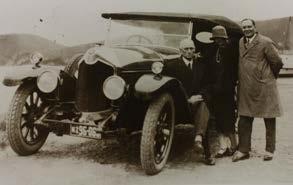
J R Perry was one of the founding members of MTA – one of the nine garage owners of Feilding to attend the meeting to set up a national association.
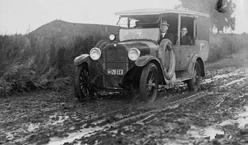
He established his business in 1912, Perry’s Ltd Feilding, and was President of the Association 1919/20 when Radiator was set up. In 1926 he went on a tour of New Zealand with the Duke of Gloucester to help promote British cars in New Zealand. He was the NZ agent for Crossley Cars, selling new and used cars. All cars went the whole way. New Zealand roads very primative compared with England, many of which date back to Roman times.
Helping others
The second issue of Radiator (June) reported on the death of a young MTA member who died after a surgical operation. He left a widow and 10 children. Canterbury MTA members rallied – determined to do something to help. Initially, local members considered helping the widow to sell the business and offered the two older boys an apprenticeship. Then they realised her dire straits and decided to do more by way of fundraising. The Canterbury businesses raised 72 pounds for her, but they felt the family’s case was deserving of a wider appeal within the national association. After one formal appeal in Radiator, the Editor reported a few months later that 296 pounds had been sent in from members around the country. By November, the journal reported more funds had arrived bringing the total to 316.19 pounds, This is equal to around $40,000 in 2020. The appeal was then closed. Over the decades, MTA has supported or initiated many different charitable efforts for members in this country and overseas. In World War II, funds were raised to send meat and dairy products to fellow motor trade associations in England for distribution. After the hugely damaging Christchurch earthquake in 2011, MTA Regions and National Office provided grants and welfare support to affected members. And today, MTA is reaching out to members hit by the impact of the Covid-19 virus, which highly contagious and for which there is no community immunity. The national lockdown and closure of most member businesses to the public, will continue to be felt for many months to come.
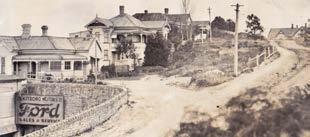
Motors, Hamilton.
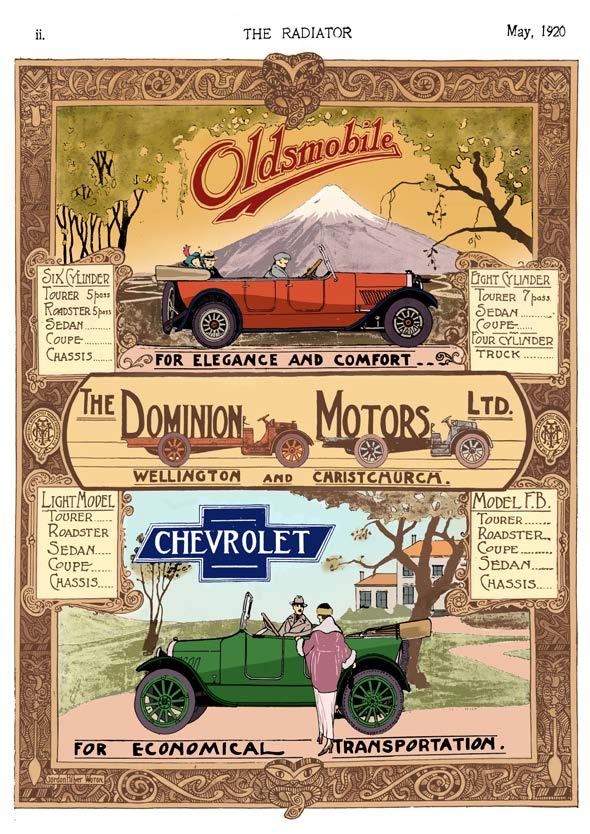
First advertisement
Advertising has always been important to Radiator as it covers the cost of publication.
Some of the biggest supporters over the century have been the dealerships and the suppliers of the products that keep the vehicles running. The advertisement on the opposite page, was one of those used by Dominion Motors used to promote its brands to the industry and the public. The advert was hand drawn and etched or engraved onto a printing plate. While it was printed in black in white in the first copy of Radiator, we have colourised it to show how it might have looked when used in a glossy magazine of the 1920s.
Dominion Motors was one of the dozen or so large car companies that signed up to support Radiator in its first year of publication – giving Editor J F Cousins the confidence to launch the publication and drum up further advertising.
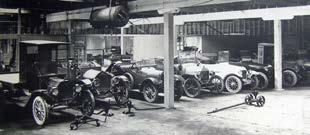
Typical early workshop.
Armstrong
100 years of print
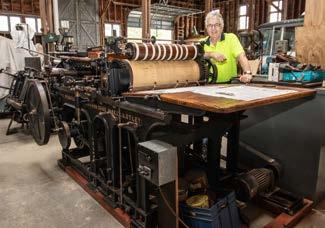
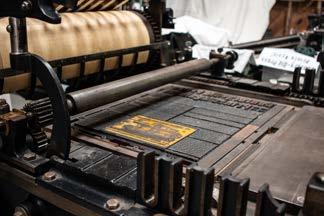
For its first 50 years, Radiator magazine was printed by L T Watkins Ltd in Wellington. During the early years, the magazine was typeset, printed and bound in the central city and copies were mailed out to each member.
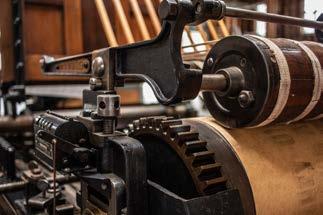
It was printed on a Wharfedale printing press like this one (pictured right), which has been restored to working order by volunteers at the New Zealand Printing Museum in Upper Hutt.
President of The Printing Museum John Nixon, says the magazine would have been printed on a large broadsheet of paper, four pages to each side, and then assembled and stapled together by hand in the Watkins binding room.
“Back in those days, this was a sizeable magazine and there would have been a continuous process. A batch of pages would be written by the editor and delivered to the printer, who would then set the type, print a proof copy for checking, and then print those pages. They would be held to one side until all of the magazine was printed, then they would be bound together ready for delivery.”
John says as many as 20 staff at the printers would be involved with the production of each issue of the magazine.
Today Radiator magazine is printed by the Blue Star Group in Wellington.
Petrol Regulations
Official notification has been received from the secretary of the Board of Trade that Section C of the Clause 8 of the Petrol Regulations has been suspended. This means that petrol may now be bought and sold without restriction as to quantity, and declarations which have been required with orders in the past will now not be necessary.
Training of apprentices
The scheme Inaugurated
The Arbitration Court has issued the apprenticeship order for the Auckland district. The order has, so far, been confined to the one district because it is the only one that is ready, and with the necessary equipment to provide for the training called for in the order. The N.Z. Motor Trade Association has made a substantial grant to provide extra equipment at the Auckland College out of the funds held for that purpose. The representatives of the workers are desirous that the order should be made general throughout the Dominion, but until necessary equipment and facilities for training can be provided in other centres, the employers are anxious that no further orders should be made.
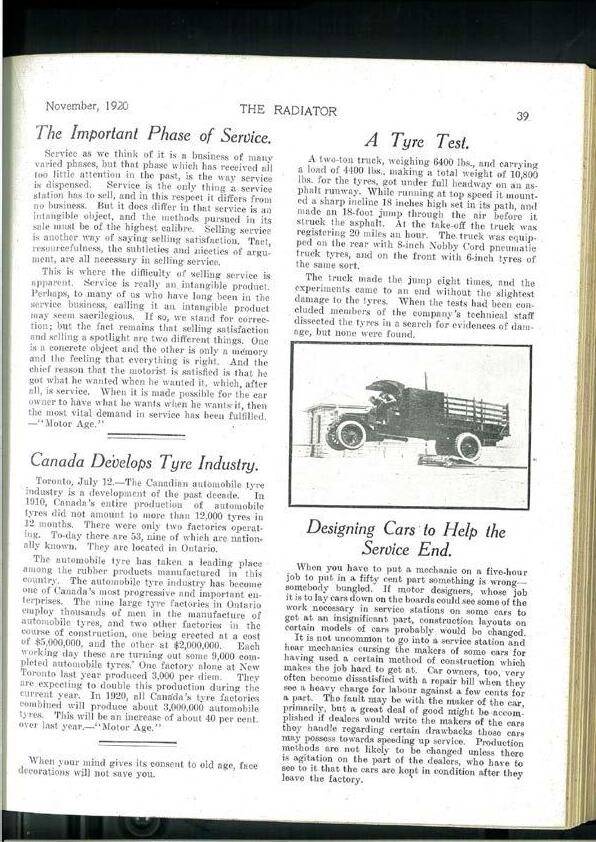
The Important Phase of Service
Service as we think of it is a business of many varied phases, but that phase which has received all too little attention in the past, is the way service is dispensed. Service is the only thing a service station has to sell, and in this respect it differs from no business. But it does differ in that service is an intangible object, and the methods pursued in its sale must be of the highest calibre. Selling service is another way of saying selling satisfaction. Tact, resourcefulness, the subtleties and niceties of argument are all neccessary in selling service. This is where the difficulty of selling service is apparent. Service is really an intangible product. Perhaps, to many of us who have long been in the service business, calling it an intangible product may seem sacriligeous. If so, we stand for correction; but the fact remains that selling satisfaction and selling a spotlight are two different things. One is a concrete object and one is a memory and the feeling that everything is right. And the chief reason that the motorist is satisfied is that he got what he wanted when he wanted it, which after all is service. When it is made possible for the car owner to have what he wants when he wants it, then the most vital demand in service has been fulfilled.
“Motor Age”.
A cheap and effective fire extinguisher
Dilute 11lbs of ammonia salts and 22lbs of common salt in about seven and a half gallons of water. Put the solution in bottles, and place around the shop. This chemical solution will extinguish a fire immediately. A good thing to carry around in an automobile.
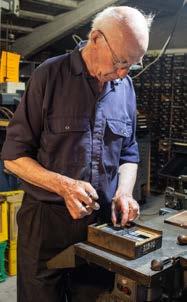
John Nixon with the Wharfedale printing press.
Bill Nairn in the typesetting room.
Colonial legacy
The Colonial Motor Company (CMC) has been a integral part of Radiator magazine, MTA and the New Zealand motor industry since the early 1900s.
The company grew out of a Wellington-based blacksmith business that evolved into Rouse & Hurrell, a coach-building business in the 1880s. It was taken over in 1918 by Tasmanian-born Hope Gibbons, who with his sons Hope, Norman, Robert and Alfred, owned farms, breweries, flax mills and quarries largely in the Whanganui area. CMC was importing Model T Fords when the Gibbons bought the majority shareholding and began expanding. In 1920 they built a nine-storey Ford assembly building in Courtney Place and later added smaller assembly plants in Auckland and Timaru.
Seated at right: Hope Gibbons and his sons (from left) Hope Jnr, Norman, Robert and Alfred.
Over the decades the privately-owned company has continued to grow and now holds 18 dealerships across the country. CMC has advertised in Radiator since the beginning, its directors have played key roles within the industry and its current chairman, Jim Gibbons (pictured below), is a former director and Vice President of MTA.
100 years and counting!
From the team at MITO.
Useful advice from GFC veterans
By Tony Alexander (NZ independent economist)
‘Be decisive and act fast’ is just one of the key pieces of advice that has come through in a survey of businesses owners who have been through previous recessions.
I sent an email to subscribers to my free weekly Tony’s View publication, asking some simple questions. What have you learnt from past recessions? What worked, what was a waste of time?
The responses provided deep insight into how to handle the current recession. These are the main points which 89 recession veterans wanted put across to those going through the Covid crisis.
Trim costs
Cash flow is king during a recession, so act as soon as possible to trim expenses, many of which have accumulated as luxuries during better times. Make staff cuts early, negotiate with landlords for rent reductions or holidays, negotiate with suppliers for temporary price discounts, trim excess stock, offload surplus assets, and collect receivables as quickly as possible. Falling asset values rarely cause a business to close down, but loss of cash flow almost always does.
Contact your bank ... before they contact you Go in armed with completely revised projections of cash flows, identify what you will do, when and how to improve cash flows, and specify the sort of assistance you are looking for from your banker and over what time frame. The bankers will be very busy and working under newly tight financing criteria set at higher levels, and the more detailed and structured a plan you can present the easier it will be for them to get the approval they need from management above their grade
Adjust production
Many businesses produce loss-making outputs, and maintain loss-making clients, or locations in anticipation that they will one day turn a profit. During a recession these are luxuries that can no longer be afforded and loss-makers will need to be cut. Be prepared to offer discounts to keep some good clients on board. However, be quick to shut off clients who have suddenly become late-payers, and move away from those who traditionally have caused problems during even the good times.
Behaviour and state of mind
We humans have a biological bias toward paying more attention to negative news than positive developments. Excessive focus on the negatives that a recession clearly brings risks producing not just inaction but bad decisions affecting staff and customers. Seek balanced insight into what is happening, recognise that media will naturally highlight statistics illustrating weakness, and be especially wary of social media. Look after your physical health and that of your staff and family where possible. Be completely upfront with staff and family regarding your business’s
position. The natural tendency we have to assist those in need will bring forth ideas for changes and a commitment to support you getting through which would not appear if you try to keep all your problems to yourself.
Planning for the future
A surprisingly large number of survey respondents noted that after getting cash flows under control they remained too negative for too long and missed out on some good longterm purchase and investment opportunities. Many wished they had kept looking outward to conditions in their markets and acted on opportunities they could see appearing. Most highlighted the benefits of developing a plan to prepare for the next recession involving better debt management, building up some cash reserves, knowing what to trim quickly, and building flexibility into some core expenses such as premises leasing and staff hiring arrangements.
What was a waste of time?
Everyone has ideas about what to do when hard times strike. But some ideas are a lot worse than others. Things which the recession veterans found did not work included the following:
• Paying excessive attention to descriptions of the downturn and ideas for setting things right in the economy, society, or country.
• Diversifying too far from one’s area of expertise in the hope of finding a new miracle product.
• Spreading cuts and layoffs out over time. It is better to get changes made as quickly as possible to both save cash flow and avoid demoralising the morale of good staff.
• Listening to high-level executives, politicians, and public servants who did not have their family homes on the line and could not grasp the specific challenges facing a typical SME owner.
Helpful tips
“We sent a letter or called all of our creditors and told them we can’t pay. Either come and take stock back or work with us and we will pay when we can. No supplier took stock back and all suppliers supported us. We told our landlord we can’t pay the rent and he gave us rent relief for 6 months. We sold our near-new Ford Falcon car and traded down to a $3,000 car. We stopped spending on everything but the necessities to live: food, power etc.”
“Marketing, if you can, is important in a recession as your voice becomes disproportionately loud by all means cut any unproductive marketing, but narrow your focus and pour the resources in where the likelihood of success is greatest.”
“Doing endless cuts (we did 10 different rounds) is painful for the organisation and of course the people that remain – nothing really gets done and it literally is death by a thousand cuts… Lesson learnt was if you’re going to cut, probably err on the side of going deeper then you need too – so it’s done once, then look to build as the environment gets better – this really is the best way for staff morale and keeping the team motivated.”
“If you have a client that is late paying and there has been no prior communication the red lights are flashing. Stop trading with them and be polite and persistent in following up settlement of the account.”
“Not all the decisions you make will be right, that is ok and it is ok to make mistakes. There is no blueprint for change in recessions. If you do lay staff off leave the door open for them to come back if and when the economy resumes. They still have skills and you want to be able to be in position where you don’t burn bridges on the way out. Keep open communication and lead through the recession with confidence. You also have to fake it for your staff. They are looking to you for leadership.”
“It’s important in severely constrained times to keep one’s eye on the long game. If your firm/ company has and can hold on to a relevant and valued service or product offering, better times will come again.”
“As a business person, you need to rise above the gloom and understand that recession does not mean negative outcomes for all. In fact, some businesses are totally unaffected or even boom during recessions, New businesses arise in response to changed conditions. For the more adventurous, cashed-up business people, opportunities to purchase impaired businesses/ assets at bargain basement prices abound. In addition to this, a range of people are generally unaffected by a recession.”
“Try and restrain from blanket discounting, however discount old and slow-moving stock more heavily to attract customers in store (and hopefully results in purchases of other products). Customers will be looking for deals, so convert that old stock to cash.”
“Every day we are touching base with some clients who are in affected areas such as tourism, retail, forestry just to preserve the relationship (and not just the business). Checking they are ok and if we can be of assistance – not with business sales but just trying to offer them some help.”
“Don’t hold onto the past; what was normal is no longer normal.”
“Have a plan B, C, and D and be prepared to be flexible. If something is not working, then change quickly.”
Be open-minded to opportunities and if it makes sense to you, then try it. Opportunities are there, we just need to recognise them.”
Email me at tony@tonyalexander.nz to subscribe to my free weekly “Tony’s View” for easy-to-understand discussion of wider developments in the New Zealand economy and housing market.
MEMBER PROFILE: COOKE HOWLISON, DUNEDIN
125 years of looking ahead
When the Cooke Howlison dealership showrooms locked their doors in March/April to prevent the spread of Covid-19, it was the first time that business had been suspended in the Dunedin company’s 125 years of trading history.
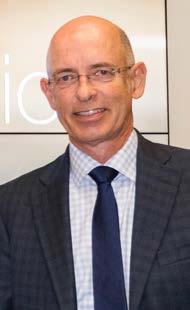
Cooke Howlison is one of 11 dealerships in the Oakwood Motor Group. Managing Director John Marsh says “Our loyal and talented staff are our greatest asset and we are very focused on protecting their future employment as much as possible during this difficult time.
“Cooke Howlison went through two World Wars, the Depression and the GFC without closing.” It also weathered the 1918 Spanish Flu pandemic. Another of the Oakwood Motor Group dealerships, trading under the Blackwell Motors brand, had two sites badly damaged in the 2011 Christchurch earthquake. “But we got them up and running the
next day from temporary facilities, so this type of closure was a new experience,” John says.
Cooke Howlison was founded by Frederick Cooke and Edward Howlison in 1895, and was one of the first businesses to join the new national Garage Proprietors’ Association (later MTA) when it was set up in 1917. The company was bought in 1963 by brothers Graeme and Eric Marsh and became part of the Marsh familyowned Oakwood Motor Group. Graeme’s son John has been the Group’s managing director for 30 years and says while the history of Cooke Howlison is important to the company, his focus is very much on the future.
Double whammy
“Holden made its announcement in February that it was pulling out of vehicle sales in New Zealand and then a month or so later the Level 4 national lockdown was put in place,” says John. The Oakwood Motor Group has five sites with Holden franchises. “Cookies” as it is known to many Dunedinites, sold its first Holden back in 1955.
John says, “The combination of the Holden announcement and the impact of Covid-19 means we have to look closely at our overheads. This will include downsizing and potentially bringing in replacement franchises for Holden (there are several options in the pipeline). The Holden service and parts business will continue for the next 10 years. At this stage we are not
planning to close dealerships –rather, we will match resources to demand.”
He says Holden’s decision wasn’t totally unexpected but it was disappointing and created a lot of uncertainty for staff. “On the other hand, the compensation package is fair and there is good pricing for the sale-down of Holden stock.”
Covid challenge
The Group’s truck workshops kept operating for essential services during the lockdown, while the management team stayed busy planning and working on strategies for their response to the changing environment. Staff were encouraged to take up online training during this period and most staff returned to work at Level 3. “Having dedicated health and safety managers in
Christchurch and Dunedin worked well for us as we put protocols in place for contactless service.”
John says that now the doors are open, there’s a positive vibe among staff. While the company is expecting to take a serious hit on its new and used sales until at least the end of the year, fixed operations have remained strong, and the Oakwood Motor Group is in a good financial position to weather the storm. “We have a very strong balance sheet; we own all our own sites, so we have a solid asset base.” The company has taken up the government wage subsidy and this has given staff the comfort of knowing their jobs are safe until at least the end of the subsidy period.
He says the franchisors have also taken the long view and adjusted targets and expectations to reflect the changed world.
John Marsh, Managing Director, Oakwood Motor Group.
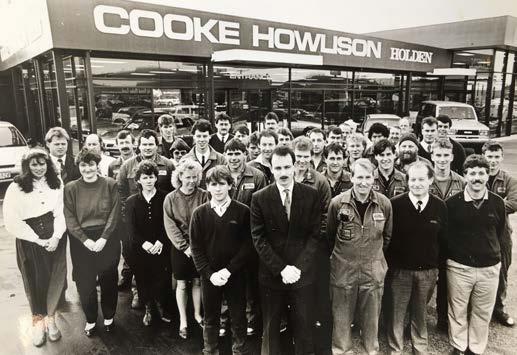
The Cooke Howlison team photographed in the 1980s.
Online sales
While there has been a massive growth in online sales for many products as a result of Covid-19 restrictions, John Marsh doesn’t see this taking off with many of his South Island vehicle customers. “We may be more conservative in the South but while online vehicle sales are increasing, face to face, in-dealership sales are still more prevalent.” He says there was a big spike in traffic on the company’s websites during lockdown, which shows there are still people in the market. But he says while people do their initial research online, they still like to touch, feel and drive a car before they buy.
“Online sales will be there as an option but customers are showing a keenness to come into the showroom and we predict a return to more normal buying behaviour.”
He believes there is still a strong future for bricks and mortar dealership showrooms.
Covid lessons
The importance of being flexible was the big lesson to come out of the lockdown for the Oakwood Motor Group, its management and staff.
“We had to take on Zoom meetings, reassign roles, work from home, take leave in some cases and so on.” He says it meant new ways of working
and he’s pleased with how staff and management pulled together and supported each other.
Knowing that tough times are ahead, he was also heartened by the Budget investment in apprenticeships, which will help ensure the future of careers within the sector.
The $1.6 billion package includes $412 million for employers to retain and keep training their apprentices.
“There is growing awareness that motor trades are a good career path; we have about 30 apprentices, including a number of females, which is a good trend. We are pleased to see government support for the trades.”
Cooke Howlison history in brief
Frederick Cooke – an engineer specialising in bicycle manufacturing and Edward Howlison, a champion cyclist, started the company to manufacture and sell bicycles in 1895. Seven years later they began adding motors to the bikes and in 1907 they turned their attention to cars. They started out selling Rovers, then moved to Buicks and Chevrolets. Business was tight during and after World War II, with a huge shortage of new cars and restrictions on imports. The arrival of the Australian-made Holden in 1955 proved a huge boost to Cooke Howlison.
The business was sold to the Marsh brothers in 1963, and has continued to expand with the addition of Blackwell Motors in 1979 and Wrightcars Toyota in 1989. The Oakwood Motor Group now holds 11 dealerships; the latest to be added were Campbell’s Toyota in Balclutha and Cooke Howlison Cromwell. The company has invested heavily in its sites in recent years, opening new post-earthquake
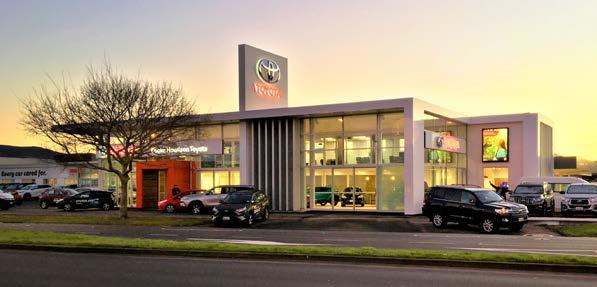
showrooms for Blackwell Holden and Mazda in Christchurch in 2016. In 2019 it built a new Toyota showroom on its Anderson Bay site in Dunedin, and this year it redeveloped its Isuzu site in Teviot Street, Dunedin.
The Oakwood Motor Group holds franchises for Toyota, Hyundai, Mazda, Holden, HSV, BMW, Mini, Isuzu trucks and Suzuki motorbikes. They employ 370 full-time staff and last year sold a total of 4,800 vehicles.
The Cooke Howlison staff in 1914.
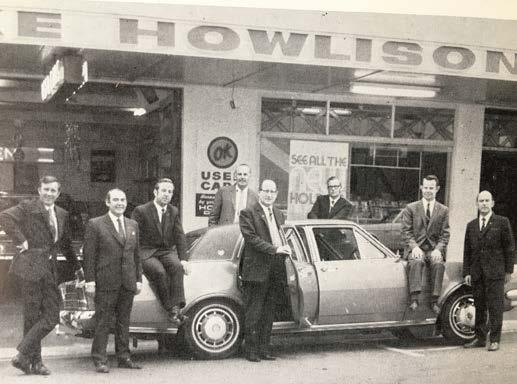
Key management and sales staff with a luxury version of the Holden Brougham.
Frederick Cooke and Edward Howlison in a photo believed to have been taken on Great King Street in 1904.
REGION NEWS - EASTLAND
‘Good Sort’ Award
In tough times, people pull together to get through. In the MTA Eastland Region, members are giving a shout out to those in their businesses are going above and beyond the usual team effort.
The Region executive committee is launching its ‘Good Sort’ monthly award to recognise people within member businesses who stand out in their commitment and contribution to the job, customers, or their team.
Other Region executive committees are considering whether they should follow suit.
In Eastland, they’re planning monthly awards for the next nine months, with the most outstanding ‘Good Sort’ selected as the end-of-year overall winner. The Region is putting up a gift card and smoko shout for each monthly winner. The overall award is more substantial and worth a total of $1,500 (it includes $1,000 toward a team celebration).
Contact Eastland Region Coordinator Annie Van Wyk (annie.vanwyk@mta.org.nz) to grab the link for the nomination form and get ready to tell the story of why your person is a ‘Good Sort’.
Mastersofworkwear rental&cleaning.
Mastersofworkwear rental&cleaning.
If you want your staff to look clean and professional and save your company money with the least amount of hassle, talk to Apparelmaster. We buy any kind of workwear and rent it back to you, professionally launder and repair it and make sure you get the right gear where and when you need it.
If you want your staff to look clean and professional and save your company money with the least amount of hassle, talk to Apparelmaster. We buy any kind of workwear and rent it back to you, professionally launder and repair it and make sure you get the right gear where and when you need it.
NEW ZEALAND, COVERED AT WORK
To find out more, call 0800 808 820 or visit online at apparelmaster.co.nz
NEW ZEALAND, COVERED AT WORK
To find out more, call 0800 808 820 or visit online at apparelmaster.co.nz
“We were selling Fresh Air”
When Geoff Harper and David Storey look back on the Auto Super Shoppe journey, they freely admit that in the early days “we were selling fresh air.” In 2006 they had a concept, but it was just an idea… would anyone else see their vision? It didn’t fit into a box. It wasn’t a franchise; it was close to but not quite a co-op. It was more than a buying group, and it would offer more than just marketing assistance – but it didn’t have a name. And it still doesn’t.
What it does have, 14 years down the track, is nearly 100 of New Zealand’s very best automotive workshops banded together as one united network of premium repairers. That was their vision and as it turned out, plenty of people got it!
So why is this network so successful?
Some say it’s because it was thought up by two mechanics that may have lacked the university degrees but they had the kiwi ingenuity and entrepreneurial spirit in spades. But in reality, (and taking nothing away from those two mechanics), the success is really down to the fact that it is genuinely beneficial to those workshop owners that meet the criteria to belong to the group.
With nearly 100 workshops from Whangarei to Invercargill there will be more than a dozen different reasons why they belong to the group. For some it’s the rebates, for others it’s the assistance with marketing their business. Most enjoy the increase in fleet work and everyone appreciates the pricing offered by the
groups valued preferred suppliers. These are typically the motivations for joining the group, but what keeps them a member year in year out is the far less tangible benefits.
The network
Being a part of a group of like-minded business owners – none of which want to be told how to run their business, but all of them love being part of a bigger picture where they can get involved as much or as little as they like. The Auto Super Shoppe culture is all about not telling anyone how to run their business - they are Members because they already run a good business! What they do want is new options on how to run a better business. With innovative marketing strategies, exclusive training opportunities for all levels of staff, peerto-peer discussion groups, a nationwide referral network, and most importantly access to over 100 other workshop owners that they can bounce things off anytime
they want. Those are the benefits money can’t buy.
As the Auto Super Shoppe network approaches the 100-member mark David and Geoff may not be the ones going around promoting the concept these days – they’ve passed that mantel on the others, but they do have a lot to be proud of. They have seen so many great workshops around the country go from strength to strength – including the five that they own. They can also take a great deal of pride in the highly successful automotive training academy that is now into its third year and has turned out some great young pre-trade graduates giving them a massive head start in their careers.
It’s a kiwi success story of a business model that doesn’t fit into a box. Perhaps that’s where the expression “thinking outside of the box’ comes from!
Allan Clark – Auto Super Shoppe Morrinsville Grant Wenzlick – Penrose Motors Carol Bradley – Auto Super Shoppe Burnside
MEMBER PROFILE: GISBORNE MOTORS
Gisborne Motors hits 100
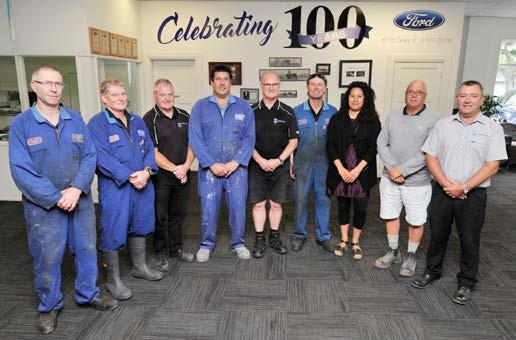
The Gisborne Ford dealership recently celebrated its first century.
For the past 100 years, Fords have been sold from the Grey Street site by a succession of different business owners. However, this may be the last year for the original concrete building that has been at the heart of the business.
Dealer Principal Brian Read says the building, which survived the 1931 Napier earthquake, has been altered and added to over past decades. “But it may not meet the current earthquake building code. We’ll know within the next few months whether it’s economic to strengthen it, or whether we should demolish and build something modern. It may give us the opportunity to build something better, as the layout is not the most effective for today’s needs.”
Brian is one of several staff in the business who’ve notched up a few decades working on the site.
He’s been there for 56 years, starting out as an apprentice, and he’s now the dealer principal.
“Things have changed a lot over that time. We used to have a heap of apprentices when I started out. We would work two on a job and there was a great team of office ladies typing away. And apprentices were treated quite differently – lots of practical jokes and silly errands back then.”
He remembers the complexities of sales back in the 1970s and ‘80s when people needed to have overseas funds if they wanted to buy a new car.
“In those days, if farmers sold their wool overseas, they could leave the money in their offshore bank account and use it to buy a new car. They could drive it for a year and still sell it at a profit. At the time, we also sold Ford tractors and people who bought a new tractor qualified to also buy a new car.
So, some farmers would buy one of each. We were allocators of vehicles under that regime, rather than sales people,” says Brian.
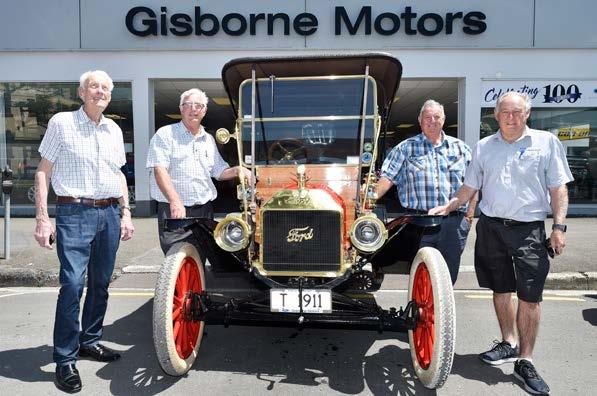
Dealer principals from the past and present. From left: Warrick Bain, Tim Macphee, Ted Stone and Brian Read, with the iconic Model T Ford. Photo: Gisborne Herald.
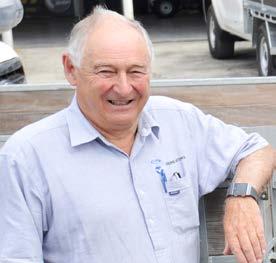
Dealer Principal Brian Read.
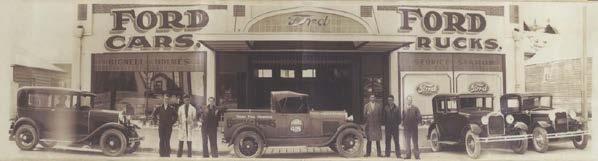
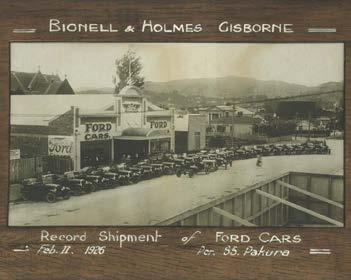
A Ford line-up outside Bignell & Holmes premises in 1926.
The present day
In 2020 the firm has four apprentices in training but the tradition of practical joking has long gone.
However, there is a tradition of local loyalty to the Ford brand. Brian says many of today’s clients are the great-grandchildren of original customers.
“Some may even be fifth-generation customers.”
Gisborne Motors officially celebrated the 100th birthday of Ford on the Grey Street site in December 2019. There was an impressive lineup of vintage and classic Fords, lots of entertainment and a few special moments remembered by customers and staff.
Some of the long-serving staff. From left: Mark Hatwell (18 years), Lindsey Cockburn (16 years), Burt Norman (21 years), Michael Glassford (35 years), Peter Eccles-Smith (30 years), Aaron Manson (18 years), Lee-Michaele Kingi (23 years), Murray Pearse (14 years), Barry Brown (44 years). Photo: Gisborne Herald
ROAD TEST - Go Auto News
Mercedes-AMG A45 S
Remember when a Mercedes A-Class was a tall and dorky city hatch that once infamously failed a swerving manoeuvre known as the Moose Test?
That was more than 20 years ago, because the ultimate version of the fourth-generation Benz baby has gone all superfly, with its cool threads, lairy looks and – most importantly – Defcon One 2.0-litre turbo wallop. That’s the long and short of the Mercedes-AMG A45 S, the most superhot hatch Australasia has ever seen.
BYRON MATHIOUDAKIS
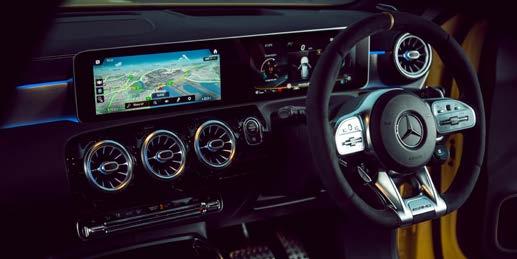
The same goes inside, which already benefits from the small-car world’s mosttalluring/brazen dashboard presentation, thanks to the dazzling MBUX multimedia system, variable digitised instrumentation, striking shades of back lighting and lashings of metallic and man-made microfibre materials.
Quality cabin
In stark contrast to the previous A45, this cabin looks and largely feels like a million dollars. The quality uplift is real. That there are decent levels of legroom up front and actually usable space for adults out back will be music to the ears for many ruing the old W176’s interior limitations.
Beware, however, that the bodyhugging buckets – while comfy and supportive – are on the firm side; that vision out is hindered by high shoulder lines and fat pillars (thank goodness for surround-view cameras); that the chunky steering wheel’s remote controls are fiddly and even intimidating at first to get your head around; the columnmounted auto selector shifter is wildly at odds with the boyracer hyper-hatch image; and the ‘Hey, Mercedes!’ voice actuating system can be infuriatingly ignorant to some simple commands.
Minor points all, however, because we’re
here to drive what may be the world’s greatest-ever hatchback, certainly as far as performance is concerned.
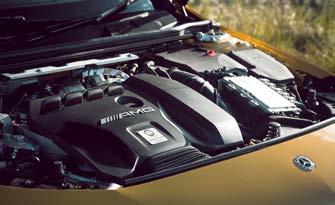
Mr Moers’ M139 1991cc four-cylinder turbo petrol engine is, without a doubt, the heart and soul of the A45 S 4Matic+, providing a mesmerising, memorable experience that will stay with you long after you leave the car if you’re game enough.
Burbling enthusiastically at idle, in default ‘Comfort driving mode, the AMG hatch is reassuringly docile at regular urban speeds, providing measured, controlled and ultra-smooth progress without drivetrain clunkiness,
transmission snatch or overall lumpiness – as you might expect of something wearing the Three-Pointed Star.
Where the M139’s talents shine is in its extraordinary ability to alter character in line with the driver’s moods and desires, be they delicate or devilish. Even before selecting Sport, pivoting your right heel forward will immediately bring dramatic acceleration, accompanied by seamlessly swift ratio shifts that can be controlled manually via the excellent wheel-sited paddles; choose Sport and there’s an instantly obvious
First drive impressions
Nowadays, there are tepid, warm and hot hatches encompassing everything from an Abarth 500 to a Volkswagen Golf R. And then there is the latest Mercedes-AMG A45 S 4Matic+.
Superficially, you’d be forgiven for thinking it’s just a tarted-up latestgen A-Class, which has exorcised most of the previous version’s issues of patchy interior quality and poor rear-seat and cargo area packaging,
but hasn’t blown us away as a definitively better proposition than the ageing Golf 7.5 or Audi A3.
The AMG flagship version, however, is something else entirely. As Mercedes-AMG CEO Tobias Moers puts it, “…we have completely redesigned our 45 models – from the engine and transmission through the chassis, the elaborately constructed drivetrain to the body structure and, of course the design itself – all with one goal:
to raise vehicle dynamics and the sporty driving experience to a level previously unimaginable in the compact class”.
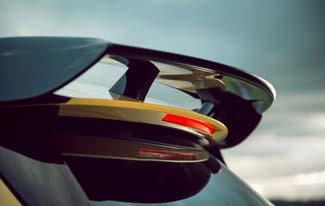
Stylistically, the designers have judged the AMG upgrades well, with details such as the vertical grille strakes, flared wheel arches accommodating the wide track stance and myriad spoilers, diffusers and aero aids providing very promising clues as to what lies beyond.
ROAD TEST - Go Auto News
edge to the sound and speed that’s being summoned, accompanied by a definitive hardening of the chassis below; and going S+ is like adding Dolby stereophonics to the orchestral exhaust whilst simultaneously opening another floodgate of throttle thrust, for seriously and deliriously fast responses.
The magic here is that the official 3.9-second 0-100km/h time seems pessimistic (we recorded 3.81s), given the sheer bandwidth of power that’s available. Up in the top end, nearing the 7,000rpm red line, it feels as if there’s a housefalling-off-a-cliff well of torquey momentum to plunder. The amount of muscle on offer is biblical for something as prosaic as a hatch, resulting in an endless hunger for speed if you just plant the pedal to the metal.
Of his own cars, Enzo Ferrari once said “you pay for an engine and the rest is thrown in for free”, and that springs to mind here too – if it wasn’t for the other magnetic talents of the A45 S.
Braking
Try, for instance, the towering braking ability – handy in a chassis that, come rain or shine, sticks to the chosen line through corners, whether at incredibly high speeds or dawdling around like there’s a pesky cop following behind.
Or the speed-dependent steering that might be a little weighty dawdling around town for some but firms up beautifully and is always whip-smart precise without erring into nervousness when you’re hammering along.
Tenacious grip and reassuring control when you need it, yet with built-in play when you want that too.
That the Merc offers Race and Drift modes that suspend most or all of the traction safeties for tyre-smoking and/ or tail-wagging shenanigans underlines the wide personality spectrum that’s been engineered inside the ultimate A-Class.
Laser-guided ballistic the A45 S may be, but it isn’t perfect. While commendably compliant over most roads, the adaptive dampers don’t always keep the hard thuds from crashing through inside.
There’s some rack rattle over craggier surfaces, as well as occasional torque tug in damper conditions.
And on coarse chip surfaces, the level of road-noise intrusion varies from droning to distracting at times. You can’t quite have it all, clearly.
The verdict
So, what do we make of the MercedesAMG A45 S 4Matic+?
The name might sound like characters chosen randomly for an automated password, but the W177 pushes the hot-hatch game up into an entirely higher league, while palpably improving the ride comfort and cabin quality experience compared with the patchy old one. Job well done then, Mr Moers.
QUIZ time
As the VIRM Modification Tables can be complicated to understand, we decided that this month, we would do something different, and that is to quiz you on your knowledge of it. The answers to all of the below questions can be found by checking the ‘Tables and Images’ tab of each appropriate section of the VIRM, although we would like to think that most WoF inspectors would be able to answer the questions below without needing to look them up. To allow you to check your answers, we’ve included them on the next page too. Maybe it’s time to see who in your workshop has the best VIRM Modification Table knowledge? There are no prizes, nor any need to submit your answers.
Question 1:
A 1998 Honda Civic is presented for inspection with a fibreglass body kit that sits 85mm above the road surface. The vehicle has been lowered with bolt-inreplacement springs and shock absorbers, the lowest structural part of the vehicle is 110mm. Is LVV certification required?
Question 2:
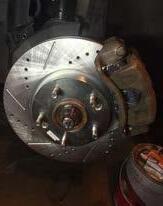
A Mitsubishi Lancer GSR has been presented for inspection that has been fitted with aftermarket drilled and slotted brake rotors of the same size as the factoryfitted items. Is LVV certification required?
Question 3:
A Ford Ranger that has been LVV certified for larger wheels and tyres is presented for inspection. You notice that it has aftermarket springs, shocks and strut spacers fitted, the suspension field of the certification plate says ‘OE’. Should it pass WoF inspection?
Question 4:
A Toyota Hiace van is presented for WoF inspection. It has been LVV certified for eight additional seating positions but is now being used as a tradie van with all the seats permanently removed and tool racks fitted. Should it pass inspection?
Question 5:
A Subaru Impreza Rally car is presented for WoF inspection. It has been LVV certified for adjustable suspension, engine modifications, and a brake conversion. There is no mention of the roll cage or race seats and harness seatbelts on the LVV certification plate. What would be required for this vehicle to pass inspection?
Question 6:
A Nissan Skyline that was manufactured with an RB20DE engine has been presented for WoF inspection fitted with an RB20DET engine from an identical year Skyline. The conversion is a direct bolt-in that only uses factory parts. Should it pass inspection?
Question 7:
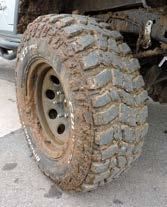
A Toyota Hilux Surf is presented for WoF inspection with 33/10R16 tyres. The vehicle’s tyre plaque has been painted over, but the tyre fitted to the (factory) spare wheel is a 265/70R15. Does it require LVV certification?
Question 8:
A Triumph Herald-based kit car is presented for WoF inspection. The vehicle matches the Modification Declaration which is dated 2002. Can the Modification Declaration Certificate be accepted in place of an LVV certification plate?
Answers:
1: No. LVV certification is not required, as non-structural parts of the vehicle may be within 100mm of the ground. (Section 9-1 of the VIRM)
2: No. LVV certification is not required if the substitute rotors are the same size as the OE rotors, and catalogued aftermarket items for that make and model of vehicle, and attached to unmodified OE parts. If the vehicle had been fitted with larger calipers, or rotors and calipers from a different model of vehicle, LVV certification would be required.
3: No. An LVV certified vehicle must match its certification plate, and ‘OE’ means Original Equipment, so the suspension has been changed since LVV certification. The vehicle must be referred to an LVV certifier.
4: No. Temporary removal of seating positions can be accepted, however, permanent removal cannot. The vehicle must be referred to an LVV certifier who can complete the paperwork required to have the vehicle legally deemed as returned to standard. (Duties and Responsibilities section 3-1
scratch-built). The WoF inspector should ask to see the vehicle owner’s Motorsport Authority Card to confirm it covers these items. (Section 7-1 of the VIRM). The LVV certification plate will have the comment ‘CURRENT MSNZ AUTHORITY CARD REQUIRED’ so this must be asked for as part of the WoF inspection.
6: No. The VIRM Modification Tables specifically states that the addition of a turbocharger, or supercharger, or the upgrading of a turbocharger, supercharger or wastegate requires LVV certification. (Section 13-1 of the VIRM)
7: Yes. LVV certification is required as the tyres fitted have a diameter that is 11 percent greater than OE – way more than the five percent threshold*. If unsure, inspectors should confirm what the factory-fitted tyre size was. Often the spare wheel will help with this. (Section 10-1-1 of the VIRM)
*The easiest way to check the size is to use an online tyre size calculator such as www.tiresize.com
8: No. Modification Declarations were phased out by the LVV certification system in 1992, and superseded completely
DIESEL PARTICULATE FILTER CLEANING
l Improve fuel economy
l Reduce downtime
l No cutting and welding
l No lengthy baking
EV graduate a Tesla technician
In 2019 MITO launched the New Zealand Certificate in Electric Vehicle Automotive Engineering (Level 5). Available to qualified automotive technicians, the programme provides learners with the skills and knowledge required to inspect, service and repair light electric vehicles safely.
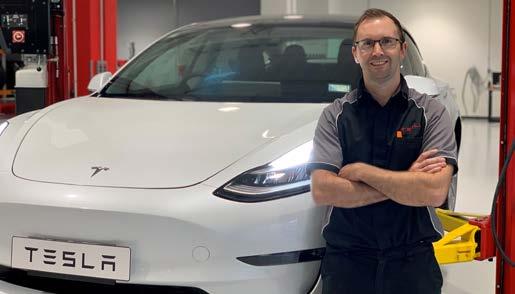
35-year-old Chris Pearson, a senior service technician at Tesla in Auckland, was the first in the country to complete the training programme.
The achievement was one of many for Chris, who after completing his apprenticeship with BMW in the United Kingdom, worked his way up the ranks to Master Technician.
While Chris enjoyed his work in more traditional workshops, he was always interested in hybrids and fully electric vehicles. “Before I was here, I was always putting my hand up for EV or hybrid courses,” he says. “So, when the opportunity came for me to take up a position with Tesla, it was a no-brainer for me. I could see that electric vehicles were the future, and I wanted exposure to them every day.” Now, after being with Tesla for two and a half years, Chris says working for the company is a “dream”. “I get to solely concentrate on electric vehicles every day, and practice honing my skills.”
Working on electric cars each day is
considerably different to working on petrol and diesel vehicles. “It’s all very clean,” says Chris. “We very rarely work with oil or coolant – a lot of it is more computer programming, so our floors stay pretty white!”
Chris emphasises the importance of knowing exactly what you’re doing when working on electric vehicles. “One mistake while working can be fatal, so it’s really important for our industry that technicians are properly trained and understand the inherent risks of certain components when they’re live.”
The programme is made up of both practical and eLearning elements, something which Chris really enjoyed.
“The eLearning was great for me, it allowed me to balance my work and family life,” he says. “It would save all my work, so it made it easy for me to jump on for an hour or so in between family things. I found that much easier than trying to find the time to set three or four hours aside.”
Chris also appreciated the management elements of the programme. “I was surprised that the programme incorporated management and self-awareness skills, but I definitely got a lot out of them,” he says. “It made me look at where I was, how I am received by other people, and how I can get the best out of myself and my colleagues.”
New Heavy Wheel Alignment training programme
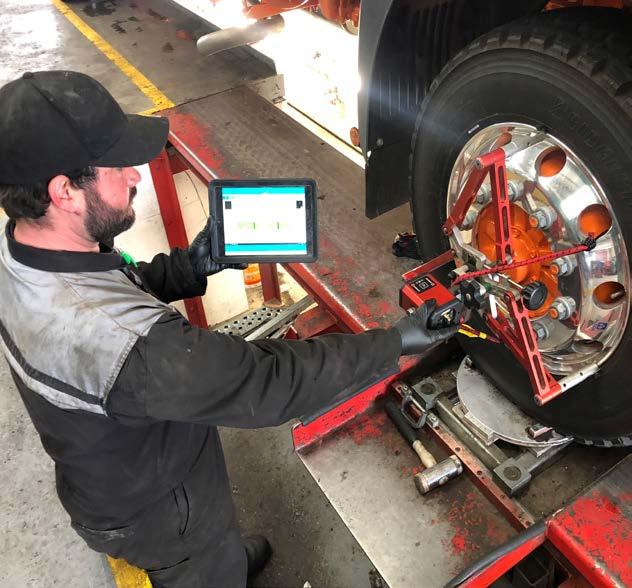
A new apprenticeship training programme for the automotive industry has been launched by MITO. The New Zealand Certificate in Heavy Wheel Alignment (Level 4) provides the knowledge and skills required to complete heavy vehicle and trailer wheel alignment – and offers a formal qualification for individuals working in this important sector of the industry.
The training programme has been developed in collaboration with industry to ensure it meets their specific training requirements. John Bates, founder of the New Zealand Heavy Transport Wheel Aligners Association, says “It is critical that our sector has a training programme that specifies the exact procedures that should be adhered to and ensures that there is a gold standard we all work to.”
Although Chris already had experience working on electric vehicles, he benefited from the practical side of the programme also. “The practical work gave me more of a chance to really read into the systems and understand the background behind everything in far more detail,” he says.
Now a fully qualified electric vehicle technician, Chris is eager to help foster more young talent in the industry. “I was quite interested in the management side of things that the programme covered,” he says. “I’ve taken apprentices through their programmes in the past and I really enjoyed it, so training and management both really appeal to me.”
As technology continues to advance, so to do the capabilities of electric vehicles –something that Chris is pleased he can be a part of. “Tesla started producing cars in 2008, so we’re still a young company in the scheme of things,” he says. “There’s so much room for growth, and it’s definitely an exciting time to be in the industry!”
Boost your business with MITO’s on-thejob training. Visit mito.nz.
“We’re delighted that MITO has developed a training programme that does just that. It provides learning outcomes responding to health, safety and technical issues to ensure we have productive and safe workplaces. Outcomes also importantly cover diagnostic procedures in steering, suspension, braking, driveline, hydraulics, electrical and electronic systems.”
MITO Chief Executive Janet Lane says, “It is really exciting that we can respond to the education and training needs of the industry sectors we represent through robust programme design and innovative delivery, as well as managing the ongoing pastoral care of each apprentice. Working together, we are equally committed to workforce development strategies that future-proof these individual sectors.” The 20-month training programme
includes both practical training in the workplace and eLearning.
“The eLearning component of the training programme is a fantastic tool,” adds John. “It provides technicians with the ability to complete theory elements in their own time using a mobile phone, tablet or computer. Combined with hands-on practical training in the workplace, this blended learning approach offers the best of both worlds.”
John continues, “The partnership between industry and MITO to develop this programme reinforces MITO’s enduring commitment to support our sector. We now look forward to attracting the next generation of talent to our industry!” For more information, or to enrol, visit mito.nz.
Refrigerant Gas Disposal
Operating a national refrigerant gas cylinder collection service for the Automotive A/C Industry, Recovery aims to maximise the recovery and safe destruction of unwanted synthetic greenhouse gas refrigerants, to minimise damage to our environment.
safe pick-up of your cylinder Dispose of unwanted refrigerant safely Return your cylinders to you
To arrange pick-up, contact Lionel on 027 445 6337 or email admin@recovery.co.nz
Chris Pearson was the first in New Zealand to complete the New Zealand Certificate in Electric Vehicle Automotive Engineering.
NAPA Auto Parts opens its first branch in New Zealand.
June 2020 marks the opening of the first NAPA Auto Parts store in New Zealand.
NAPA Auto Parts is the new combined entity of GPC Asia Pacific’s trade specialist businesses in New Zealand including Ashdown-Ingram, Appco, Automotive Supplies and Sulco.
These businesses have over 250 years combined experience in the New Zealand market. NAPA Auto Parts will bring these businesses together in a full amalgamation, under one roof. Far more than a simple aggregation, NAPA Auto Parts is the complete consolidation of the best of these well established automotive, industrial and commercial supply businesses.
“The expertise of our existing teams and a significant injection of inventory into these big NAPA Auto Parts sites will enable us to service the local market and gain market share through a worldclass offering’, said Jonathon Maddren, Executive General Manager of
GPC New Zealand.
Built in expanded and revamped premises on the site of the former Appco New Plymouth, inventory at the New Plymouth branch is set to almost double in range size, with a branch investment of close to half a million dollars to create a one-stop site for trade, right sized for the future needs of automotive and commercial supply in the region.
“Our existing businesses have a rich heritage and local staff with invaluable know how. Building on this strong foundation, NAPA Auto Parts will harness the power of the global NAPA brand with its racing pedigree, access to leading international brands and well developed technology, training and solutions”. said Jonathon.
NAPA Auto Parts offers a wide span of products and services, including
Under car, Under bonnet, Automotive Electrical, Tools and Equipment, Thermal Control, 4x4 Specialist, Engines, Fuel, Suspension and Steering, Braking and Oils and Consumables ranges.
NAPA Auto Parts
the first of a national network set to roll out over the next two years, with more branches to follow before the end of July.
The New Zealand branches will join a fast-growing Australasian network that includes 15 branches in Australia and 6,000 in the US.
“It’s this kind of scale that means we can bring the best value and a marketleading range to New Zealand trade,” said Jonathon, “At a tough time for everyone, we are pleased to be able to bring investment and growth to our team and our customers”.
SAM + XERO ONLINE ACCOUNTING
Now the ultimate workshop software system is integrated with the ultimate online accounting solution.
ABOUT US
The acclaimed SAM suite has been NZ’s number one Automotive Workshop Software for over 25 years.
SAM enables business owners to control and analyse their workshop business more effectively and efficiently than ever before.
SAM can be scaled to any business size with a range of proven solutions to meet every budget and performance expectation.
SAM’s online version (SAM X) has a seamless integration to Xero which provides business owners with another dimension of financial control and visibility.
WHY CHOOSE XERO
It’s all online, so you can work when and where you want to.
Your bank statements are automatically imported and catergorised.
Invite your team and work together on financials.
SEAMLESS
SAM X and Xero communicate on a two-way basis and transactions are live. Invoices, payments and purchase orders completed in SAM appear in Xero immediately.
INCREASE YOUR SALES
SAM provides benchmarking to the industry. We will maximise your labour sales and allow you to closely control your parts margins.
TAKE CONTROL
SAM’s simple but comprehensive reporting and analysis will give you a better bottom line and peace of mind.
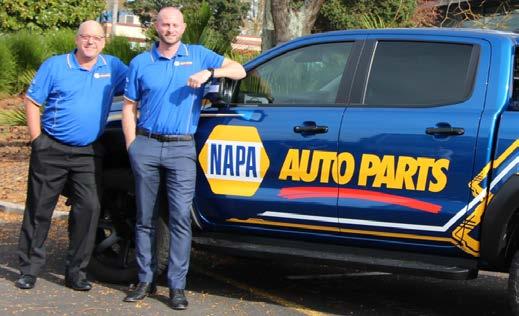
Tony Walker, GM Sales & Operations, NAPA NZ with Phil Hughes, GM Ashdown-Ingram NZ.
DIAGNOSTICS - ADAS
So what is ADAS?
I’m sure you have heard about ADAS and know what it does. Some of you would have driven cars with some form of ADAS, be it a simple auto headlight-dimming function - or full self-drive cars.
ADAS stands for Advanced Driver Assist System. It is not the name of a new type of ECU or something, it is simply the name of several control units that when combined, assist the driver.
WoF/CoF?
ADAS is a safety function, one I expect will become part of WoF and CoF soon. Just imagine that a person has a radar distance controller on their truck (or car). For example, after a job on the radiator, the bracket that holds the radar unit just behind the grill is out by a mere millimetre. You would possibly not even notice, without fault codes or warning lights to let you know. The angular change of the radar reflection is now such that, a motorbike, for example, not driving exactly in the middle of its lane would be undetected by the radar distance controller so the motorbike and its rider could simply be squashed.
An oncoming vehicle with an uncalibrated ADAS system, driving perfectly in its lane will trigger a totally unexpected emergency braking action in the vehicle equipped with ADAS, causing a head to tail collision with the car following the ADAS car. It’s only a matter of time before the authorities are catching on that ADAS must work correctly.
Who is doing what?
So, what are we as an industry doing about it? Are we just waiting to be told what we need to do? The team at AECS have taken the proactive step of distributing one of the most advanced ADAS calibration systems in the world. We searched for overseas training and developed our own additional training modules.
Keeping in mind this is not your average two minute YouTube promotional/instructional video, in this set of in-depth seminars you can learn as much as you want about ADAS.
So what does it cover?
We start with covering what the names of the various ADAS systems are on a particular vehicle and what their functions are. We deal with several vehicles in detail.
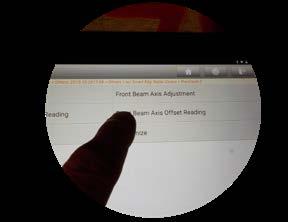
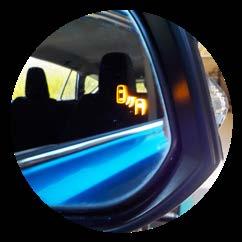
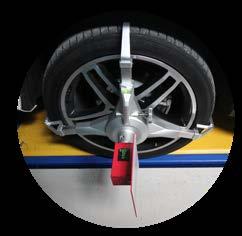
After we have covered the basics so that you are comfortable knowing the difference between, for example, MFK, DTR and BSM, to name a few, we deal with the calibration of individual units. We deal with both static and dynamic calibration. Finally, we deal with simple diagnostics.
Dynamic or static
Some industry ‘experts’ seem to think and teach that dynamic or static calibration is optional, that with most systems you simply need to drive around and they will ‘self calibrate’… yeah right!
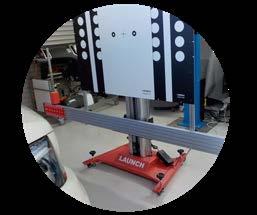
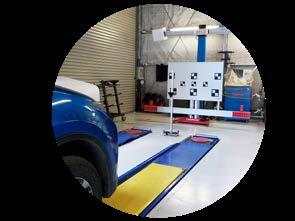
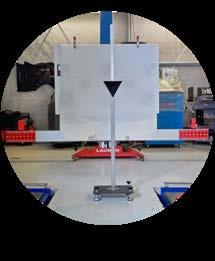
Let’s get this straight, some systems can only be calibrated statically, that is in a specially laid-out workshop with dedicated equipment such as the often-advertised camera targets, or with radar reflectors of various shapes and sizes (you hardly see those in advertisements as they don’t look sexy).
Some systems can only be calibrated dynamically. Dynamic calibration is in some cases a specific two-car affair, in which a certain set of precise rules needs to be followed; sometimes it is as simple as driving around for 15 minutes at 30 km/h.
Simple diagnostics
This is where things become interesting for us at AECS. Using simple diagnostics, we can deal with your customer complaints such as these:
• Your customer comes in after the windscreen has been replaced. The complaint is that at night with high beam on (auto), the ‘black area’ around the car in front of you is too big and not following the car properly.
• Your customer comes in and tells you to “remove that #$^% beeper from the dash” as every time when they are about 50mm away from the precise centre of their lane the beeper goes off, and after about 5 kilometres of driving, the dash tells the driver they need to take a break.
• When following the car in front while in cruise control mode, my car only brakes when I am about 10cm away from the bumper of the car in front of me.
• In auto steering mode the car is swerving like I am drunk and frequently crosses the centreline before it pulls back into its lane again, to overshoot into the berm: “it is unusable!”
• The light in the wing mirror keeps flashing orange, we cannot turn it off.
• When we drive through town through narrow streets the beeper in the car keeps going off, warning me of something. No, it’s not the parking sensor warning, that sounds different.
• When we reverse, we cannot see what happens on the right-hand side of the car on the overview monitor. We have already hit some obstacles as a result. The above is only a small list of complaints we have dealt with indirectly through tech support. What would you do when this comes your way?
Do you shrug your shoulders and tell your customer “I don’t know”, or “just turn the system off every time you start a trip”? Are you the automotive ‘go-to’ expert? Or are you there to tell your customer to go somewhere else?
Simply training!
Simply start with our unique and comprehensive training. You will learn how to answer and deal with each of the complaints outlined above and a lot more. Our training helps you to determine firstly of all in which system the problem is, secondly, it will teach you if you can calibrate the complaint away, or if you need to realign items. You will be taught how to measure if ADAS items are out, or are still in calibration’s ‘reach’.
What equipment and how much?
Not everybody is going to want to spend big $$ on equipment straight away. Well, do not let that hold you back! Our training will teach you exactly what you need and for what type of job. For some calibrations, you simply need a decent scan tool; for some jobs you need ADAS calibration equipment. Start with the simple diagnostic and calibration jobs if you are on a budget, and let the market determine what you need to purchase next. Let us guide you through the steps. Do you simply work with strings and marker to draw lines on the floor, or are you working with laser accuracy, reducing your calibration time from 4 hours to 20 minutes?
There are too many salespeople telling you what you need, shortly after the sale is completed, the equipment is just sitting in the corner doing nothing. You are left untrained or with a link to YouTube videos and unsure why you ended up with equipment that doesn’t work for you, not to mention the danger you are putting your customer in.
Train first
Make informed decisions when purchasing capital equipment, as there are many differences between various brands of ADAS calibration gear. Some ADAS calibration gear works with strings and weights. Our gear works with five lasers (no mirrors) as we deal with workshops where it is sometimes windy and dusty, but most of all because, as an automotive engineer, I like it! Do the training first so you are knowledgeable before you buy.
Train, anytime, anywhere
Our Training Academy is now online, and you will be able see all available training seminars including our ADAS training. We are adding more seminars weekly, across our other training seminars.
With our ever-growing list of training seminars, you can start learning 2x ADAS training: ADAS Euro (ADAS 1-1) and Asian cars (ADAS 1-2).
The exam at the end will generate an achievement certificate with your score (if you are good enough to pass).
Costs
Our pricing structure is simple. Choose your training seminar and pay for it online as you would normally come to one of our training seminars. You will get the same material presented, keeping in mind that it won’t be hands-on or contain the practical aspects of our training seminars that we are known for.
Since with video training you won’t be able to interact with us or to ask questions, we have included a live online and interactive training seminar (webinar) that will be held at set intervals (you will need to enrol). This is all included in the purchase of your online training. To enable us to do this, we will be using the popular Zoom Meetings software.
We highly recommend enrolling in our practical ADAS training seminars, which are being delivered throughout New Zealand as per normal. This will reinforce what you’ve learnt online and give you further experience in calibrating ADAS systems. The only extra cost that you will have when attending the AECS practical training is a small fee to cover our travel and conference room costs.
Next steps
Below are the links to start watching and learning more about ADAS systems. You will be able to see a short overview of the training seminar by watching the trailer. We look forward to seeing you online and at our next practical training seminar.
To see more about AECS online training: Online Training Academy: aecs.net.nz/academy ADAS Online Training: systems.aecs.net AECS Website: aecs.net
Business is holding up well for Woolston Auto Surgery
As the industry emerges from COVID-19 lockdown, Ross Davids and the team at Woolston Auto Surgery are relishing having the roller doors up and to be back working as a VTNZ Certified Repairer.
After joining the nationwide network earlier this year, Woolston Auto Surgery is back offering their customers in-house mechanical expertise alongside the independence of a VTNZ WoF inspection. And that’s proving to be a big hit with the locals.
“People love the peace of mind they get from a VTNZ WoF” says Ross. “We have a qualified VTNZ Automotive Technician who carries out all our WoF assessments. Customers know their vehicle is being inspected by a safety expert, and they value that.” And it’s not just customers who are liking the change. “Everyone gets on and there’s always banter. A huge plus for me is not having to worry about scheduling if the VTNZ Technician is sick. The local VTNZ branches here in Christchurch have a pool of qualified Automotive Technicians, so if someone is sick or can’t come in, they organise for another Technician to be here.”
Ross bought Woolston Auto Surgery last year and is keen to build strong relationships in his local community. “Becoming a VTNZ Certified Repairer was an easy decision for me. I want to work with organisations who have a great reputation, and who our customers trust. You don’t get any better than VTNZ – they’re the vehicle safety experts and they’re independent. It’s important to the success of our business that we continue to promote and grow our working relationship, to keep our customers cars operating safely and efficiently.”
He’s also focused on growing his repairs business.
“Our Workshop Manager takes care of the day to day operations. On our busiest days, we’re almost doubling the amount of WoFs we do. After an inspection, the VTNZ technician lets us know the results. We can then talk to our customer and see what they want to do. It’s quicker and easier for the
customer and it’s great for us because we can get on with what’s needed.”
Woolston Auto Surgery is one of 24 VTNZ Certified Repairers nationwide. “More workshops want to put their resources into their repairs and maintenance work.” said Greg O’Connor, VTNZ’s Country Manager.
“VTNZ carry out more than 600,000 WoF inspections every year. More than 40% of those customers have told us they specifically choose VTNZ for our independent inspections, but they’d really like to be able to get their repairs and servicing at the same time.
VTNZ Certified Repairer offers them the ease and convenience of an independent WoF and servicing and repairing in one location” he said.
Keen to get on with business in the new normal, Ross is focusing all his efforts on repairs and servicing.
“We’re continuously looking at ways to help make our customers lives a bit easier. As a Certified Repairer our workshop now has ongoing repairs and servicing work and our customers have the reassurance of a VTNZ WoF. It works for everyone.”
For more information or to find out how to join VTNZ Certified Repairer programme contact certifiedrepairer@vtnz.co.nz.
VTNZ Certified Repairer is Driving Business Continuity
Safeguard your workflow with the VTNZ Certified Repairer programme.
c Improve your bottom line
c Transfer your WoF risk
c Grow your customer database
c Build your servicing revenue
For more information or to find out how to join the VTNZ Certified Repairer programme, contact certifiedrepairer@vtnz.co.nz today.
Auckland
Taupo
Whangarei
Matamata
Hamilton
Hastings
Feilding
Nelson
Christchurch
Dunedin
Tauranga
RIGHT PART. GREAT VALUE. BEST RESULT!
MARKET OVERVIEW
New vehicles
This months graphs clearly show the impact of Covid-19 and its influence on the April 2020 market.
For context purposes dealers were in lockdown and only able to open on the last three working days of the month - about 15 percent of the normal working day count.
The market of 1,039 was down 90 percent in April 2020.
With a total of 707 new passenger/SUV registrations, there was a 90 percent drop on April 2019 and down 29 percent YTD.
There were 332 new commercial registrations - down 91 percent for the month and also down 36 percent YTD.
Rental activity was non-existent in April due to lockdown restrictions.
Brand performance
The impact of the Covid-19 shutdown had a big effect, nothwithstanding dealers were only able to open for the last three working days of the month.
No brand had a positive result when compared to the same month last year.
Model performance
SUV led the market in April with 481 units, followed by 327 commercial and 224 passenger.
The top five models overall were: Seltos 95, Hilux 59, Colorado 38, Swift 35, and Ranger 29 - one SUV, three utes and one car.
Top Three New Models By Segment - April 2020
Kia Seltos, helping to put the Kia brand into first place with 95 units.
MARKET OVERVIEW - April 2020
Used import vehicles
In April there were 622 used passenger imports, which was down 94 percent for the month and also down 30 percent YTD.
Used import commercial registrations totalled 87, down 90 percent on April 2019 and down 34 percent YTD.
Used import arrival volumes in April (6,410) were 54 percent below the same month last year.
Arrival volumes were 5,701 units above registrations for the month, creating a substantial net increase in stock levels.
Over a rolling 12-month period, theoretical stock levels are up 8,122 units.
Model performance
Numbers were extrordinarily low under Covid-19 lockdown restrictions.
Only Aqua is running ahead YTD.
In the commercial sector, used import vans are up 110 percent in the first four months, despite low April numbers. This reflects advanced buying pending the impact of the ESC rule.
Top 10 Used Import Models
Motorcycles
There were 78 new motorcycle registrations in April, down 87 percent on April 2019.
A total of 38 used import motorcycle registrations for the month, down 77 percent on 2019.
Overall, the combined new and used import road market of 116 was down 85 percent in April.
Brand performance
Like the car world, there were no bright spots for Motorcycles in April.
Honda claimed the top spot from Suzuki for the month. Suzuki holds the top position for the year to date to April.
April 2020 market performance in regions
Honda’s venerable postie bike (C1110X) took out the top spot in April
The Advocacy & Strategy Team works with Sector Managers and members to monitor issues across the automotive industry. This column updates you on recent and proposed law changes, MTA meetings with stakeholders, and MTA Advisory Group activity.
Where to from here?
We’ve all been knocked sideways by the Covid-19 situation. Now, under Level 2, MTA members have reopened their doors and are rebuilding connections with customers and staff.
The MTA advocacy team in Wellington is also back into all the issues that are important to members. We will continue to press for more awareness of vehicle safety. To us, that means a skilled workforce is working on quality vehicles maintained by responsible owners.
The lockdown period has left tens of thousands of vehicles with expired WoFs. We know from past surveys that around half of all drivers do no maintenance between inspections. So, it is important that the Government and MTA encourage owners to check the condition of their vehicle.
Also front and centre in our minds is the sustainability of the industry. What more can be done to help stem the damage done to businesses by the shutdown and how do we stimulate activity in the sector? The Government has exhausted many of its direct, financial support mechanisms, such as low interest loans, wage subsidy support, and debt relief.
Businesses need customers. With unemployment expected to peak at just under 9 percent and settle at around 6-7 percent, some customers will face financial hardship. People may also avoid public transport, which could translate to more vehicle use (and thus wear and tear).
For those with secure employment, it could mean replacement or additional cars for the household. For others, it may be selling and downgrading their vehicles. At the same time, the Government will want to return to its ‘business as usual’ plan to address climate change and rebalance social inequality.
We will need to show the Government how its policies can achieve its environmental goals and still support the automotive sector. Ideas include:
• grants to help owners pay for WoF inspections and critical repairs
• incentives to buy fuel efficient and high-safety-rated vehicles
• a properly resourced scrappage scheme to encourage people into newer vehicles.
If there is something that you think we should be talking to Government about, we’d love to hear from you. You can contact the Advocacy team – myself or Stephanie – or you can call your Sector Manager, details below.
MTA SECTOR MANAGERS
Tony Everett Dealers tony.everett@mta.org.nz - 04 381 8827
Ian Baggott Energy and Environment ian.baggott@mta.org.nz - 04 381 8843
Emergency planning
Emergencies can happen anytime, anywhere. It’s up to you to make sure you’re prepared. Check out www.getready.govt.nz for some resources.
Virtual meetings and engagement
What’s all the chatter about?
STAKEHOLDER PURPOSE OF ENGAGEMENT
NZ Transport Agency Regular Zoom calls about operating under Alert Level 3 and 2 conditions. Regular calls and emails.
NZ Automotive Safety Forum Discussion on how best to work with NZTA on returning to (MTA, VTNZ, VINZ, AA ‘normal’ WoF inspections.
VIA Industry working group Regular conference calls about the shift between alert levels and the effect on vehicle traders.
PartsTrader Attended virtual PartsTrader advisory group meeting to update industry on specific sector issues.
Newstalk ZB Interviews on the impact of Covid-19 restrictions on service station and repairer sectors.
What’s new?
Here are a few things you should know about:
Clean Car Proposals: Please refer to the MTA Toolbox website to keep up with developments on this important issue. News reports that the ‘feebate’ policy has been cancelled could not be confirmed before Radiator went to print. We expect a Government announcement on both the import standards and the feebate shortly.
Impounded vehicles rebate: Waka Kotahi NZ Transport Agency recently announced an increase to the rebate offered for vehicles that have been impounded and subsequently deregistered. The old rebate of $100 was set 18 years ago, the new rebate now sits at $250.
28-day recheck period: When we entered Level 4 lockdown, the clock stopped on the 28-day WoF recheck period. The clock started again on Thursday 14 May when we went into Level 2. If a vehicle had seven days left for a recheck when the clock stopped, the customer has seven days to present the vehicle for a recheck starting the first day of Level 2.
What we have submitted on
The Advocacy & Strategy Team and Sector Manager submissions include: Submission to the Economic Development, Science and Innovation Select Committee on the Fair Trading Amendment Bill.
MTA supports this Bill because it aims to extend unfair contract terms (UCT) to business-to-business
relationships. However, the proposed Bill limits challenges of UCT between businesses to annual values of less than $250,000. MTA thinks this threshold is too low. For example, many service stations have fuel contracts worth significantly more than that amount, but some of these service station members still find themselves in a very one-sided relationship with their fuel supplier which routinely offers ‘take it or leave it’ contracts. It also wouldn’t apply to the typical franchise dealers either (car or motorcycle).
Submissions to MBIE on the Retail Fuel Bill closed 29 May. See the report on page 57.
Talk to an MTA Sector Manager if you want to have your say on these issues or join our Advisory Groups. Contact advisorygroups@mta.org.nz.
53
7
114
REPAIRER SECTOR
A tale of two months
While many people were forced to shut the doors on their businesses for much of April, auto repairers were able to operate under Level 3 and 4 restrictions.
Keeping our doctors, nurses, emergency personal, freight companies and farming communities moving played a vital role in helping to keep the country ticking over during the lockdown.
Some vehicle inspections were still able to take place under Levels 3 and 4 but only if the vehicle was ‘esssential’.
Figures released by Waka Kotahi NZ Transport Agency show that WoF and CoF inspections dropped by a staggering 83 percent in April 2020.
The numbers began rising in May, with 341,590 vehicle inspections completed by 24 May, but there is still a backlog of missed inspections from April.
During the first couple of weeks of May, members reported being booked three to four days in advance, but as the month has gone on they say activity has slowed.
If you haven’t already sent out service and WoF reminders to existing customers, now is the time. Also consider emails and Facebook posts to remind everyone that you are open for business.
Retail Fuel Market
Bill update
Consultation on proposed fuel market regulations closed at the end of May. These regulations follow on from the Commerce Commission study recommendations to Government to improve competition within the fuel market.
MTA has members across all fuel brands and business operating models; however, the focus of our submission was on representing the independent service stations throughout the complicated consultation process.
The aim of the regulations is to free up fuel supply agreements, improve competition at the wholesale level, and introduce a disputes resolution process that will allow market participants to resolve issues related to fuel supply agreements. Some minor changes that relate to matters like price board content and fuel grade stickers for vehicles are also proposed.
The Commerce Commission study had found the wholesale fuel market was not as competitive as it could be. It recommended this side of the market should be the focus of any regulatory intervention.
Another priority was to improve the transparency of fuel pricing throughout the supply chain.
MTA’s consultation with members revealed the proposed regulatory intervention could result in unintended consequences that further disadvantaged independent service stations.
A major issue was the possibility of independents being precluded from accessing competitive fuel supply arrangements. This would place them in a position where their buy prices were dictated by their supplier and they had no room for fair negotiation. Our submission focused on this issue and we remain hopeful that Government will adjust the proposed regulations accordingly.
As a final note, with fuel prices dropping as a result of the pandemic and tension between OPEC and Russia, the Government tax on fuel now makes up the largest component of the price.
For transparency’s sake, this needs to be highlighted.
Having a plan for an emergency
An interesting scenario was brought to light just prior to the late-March Covid-19 lockdown with the release of the Civil Defence National Fuel Plan.
The plan described a Civil Defence response to disruption of New Zealand’s fuel supply chain caused by various hazards in different locations.
During lockdown, service stations kept essential workers supplied with fuel but were hit hard by the sudden halt in road traffic. At the same time, Government was concerned about how they could support ‘critical infrastructure’ businesses so they weren’t lost as a result of Covid-19. They were talking about airlines, bus operators and utility service companies that were suffering massive drops in income.
This got us thinking that perhaps the service station network should also be classed as ‘critical infrastructure’.
Certainly, the Civil Defence National Fuel Plan refers to fuel supply being a critical resource that needs to be managed in the event of a national emergency.
The National Fuel Plan sets out directions for managing a dire fuel supply shortage, but it relies on a strong network of suppliers. How would this supply be affected in a future emergency if, as a result of the current situation, many service stations were permanently closed?
Exploring how Government could identify the fuel supply network as a critical infrastructure is something MTA will look at building into our discussions with Government.
MTA WoF TRAINING CALENDAR 100
Course update
We are well into another round of MTA Technical Update Courses that cover new topics, including recent VIRM updates, technical items of interest and VIRM navigation exercises.
This course has been developed for technicians training to become an NZ Transport Agency appointed Vehicle Inspector (VI) or technicians wishing to regain their authority. It covers an overview of the NZTA rules and regulations, how to correctly navigate the VIRM, the WoF inspection processes, correct beam setter usage, code of conduct, correct use of test equipment and recording and completion of information on WoF checksheets.
TECHNICAL UPDATE COURSE
June 2020
Wednesday 10 June Feilding
Thursday 11 June Palmerston North
Monday 15 June Masterton
Tuesday 16 June Waipukurau
Wednesday 17 June Hastings
Monday 22 June Dargaville
Tuesday 23 June Kerikeri
Wednesday 24 June Whangarei
Monday 29 June Warkworth
Tuesday 30 June Silverdale
July 2020
Thursday 2 July North Shore
Monday 6 July Parnell
Tuesday 7 July Henderson
Thursday 9 July Waipuna
Monday 13 July Pukekohe
Wednesday 15 July Morrinsville
Thursday 16 July Hamilton
Monday 20 July Matamata
Tuesday 21 July Katikati
Wednesday 22 July Tauranga
Wednesday 29 July Thames
Thursday 30 July Whitianga
Course pricing
Update course - member pricing
$165 + GST for all employees from a member business
Update course - non-member pricing
$330 + GST for all employees from a non-member business
Inspector course - member pricing
$375 + GST for all employees from a member business
Inspector course - non-member pricing
$699 + GST for all employees from a non-member business
NEW INSPECTOR COURSE
June 2020
Friday 12 June Palmerston North
Thursday 18 June Hastings
Thursday 25 June Whangarei
July 2020
Wednesday 8 July Henderson
Friday 10 July Waipuna
Tuesday 14 July Pukekohe
Friday 17 July Hamilton
Thursday 23 July Tauranga
Note: All public health guidelines relating to physical distancing, hygiene standards, agreed maximum numbers and record keeping will be observed.
Course times
Update course: 6.30pm–9.30pm
Inspector course: 8.15am–5.00pm
Please note: Inspector Courses are for mechanics wanting to become inspectors.
Update Courses are designed for already qualified inspectors.
Bookings
To book courses, visit MTA’s eventbrite page: http://mta-wof.eventbrite.com
Alternatively, go to the MTA events page: www.mta.org.nz/events.
Or call us on: 0800 00 11 44
MTA WoF training partnership
MEMBER SUPPORT 100
contact your dedicated Member Support Officer or call 0800 00 11 44 if you want some advice, help, or a sounding board for a problem in your business.
Clark (04) 381 8821 @ bianca.clark@mta.org.nz
jenny.foy@mta.org.nz
(04) 381 8845 @ tom.wilkins@mta.org.nz
SITUATIONS VACANT
Automotive technician – Palmerston North
We are a busy workshop who pride ourselves on quality workmanship and customer service. Needs to be able to work unsupervised, have good diagnostic skills and be able to work on a wide range of vehicles. Full drivers licence is a must and WoF authority is preferred. Please e-mail your cv to: info@transpecservices.co.nz. Or drop it into the office at 18 Connolly Place, Palmerston North.
Qualified panelbeater – North Shore
Would you relocate to Auckland with expenses paid? Are you ready to join our great team? Start earning the money you’ve only dreamt about. Phone: 09 444 9292 or 027 252 4747.
Automotive technician – Whitianga
Qualified with current WoF authority. We service all makes and models. Please email Chris - admin@pencars.co.nz with your CV.
Diesel mechanics - Taranak i
We require qualified diesel mechanics at our New Plymouth, Hawera and Bell Block dealerships. Email info@mccurdy.co.nz.
Mechanic – Woodville
We’re looking for a qualified mechanic to join our busy country workshop. Focused on friendly service, we cover diagnostics to engineering. WoF certification beneficial but not essential. Phone: 06 376 5239.
Mechanic / WoF inspector – Kaikohe
Looking for a qualified automotive technician with WoF authority to issue WoFs, servicing and mechanical repairs. Clean New Zealand driver licence. Phone Richard 09 401 0155 or email CV to office@kaikohepanelbeaters.co.nz.
Automotive technician - Northland
Busy workshop looking for an Automotive Technician preferably with WoF authority. Contact Luke on 021 111 5683.
Diesel mechanic – Otahuhu, Auckland
We are seeking a qualified diesel mechanic to work on both light and heavy trucks in our Otahuhu workshop. Phone Metua on 021 817616
Automotive technician – Devonport North Shore
Qualified mechanic wanted for our busy workshop. Must be able to work on all makes and models. Phone Vic on 09 445 0045.
Automotive technician - Kaiapoi
A busy general repair workshop looking for an experienced technician, with a current WoF certificate. Contact Jason on 027 918 8685.
Automotive technician – Henderson
Experienced qualified automotive technician required. Minimum five years experience, WoF certified, Full drivers licence. Can-do attitude, great skills, quality workmanship, reliable. Email: service@autolab.co.nz. Phone: 0274 582064 or 09 837 0600.
Mechanic/WoF Inspector - Palmerston North
Qualified mechanic with WoF authority wanted for a great workshop in Palmerston North. Please email CV to mainstreetautos@xtra.co.nz. Phone Peter 06 357 2913.
Motorcycle mechanical assistant – Hamilton
Road and Sport Motorcycles are seeking an experienced Mechanical Assistant. Previous experience of Harley-Davidson motorcycles would be an advantage, including fitting and balancing of tyres, fitting of accessories. Monday-Friday and every second Saturday. Email CV to: employment@roadandsport.co.nz
Automotive dismantler – Hamilton
We are looking for a reliable Automotive Dismantler for our yard, very handson. A common sense mechanical aptitude is required and removal of parts with damage. A forklift licence would be beneficial. Email: Liz@4wdpartsworld.co.nz or phone 07 847 7419.
Mechanic – Taupo area
Qualified mechanic required for busy workshop. Must be able to work unsupervised. A WoF authority is preferred but not essential. Great team with new, well-equipped workshop. Contact Heather on 027 244 2331.
WoF Inspector - Christchurch
We are seeking a WoF inspector with mechanical knowledge and a love of classic cars with experience to join a friendly team and takes pride in their work. We are looking for either a part-time person possibly full-time. Applicants must have level 4 trade qualifications or five or more years of experience. Please contact Sandra Harper on 021 128 3136
Motorcycle technician– Nelson
We require a qualified technician to work us in our well-established Honda dealership. The successful applicant will need to be honest and hardworking, have a clean driver’s licence, attention to detail and the ability to work with our existing staff of nine. Contact Ian on 027 221 9162.
Repair Centre Manager – Wellington
Enthusiastic manager wanted to join Wellington’s leading collision repair specialists. If you have panel/paint shop management experience combined with quoting and assessing skills, call Stuart on 021 987 039.
Qualified technician - Wanaka
Mechanic or mechanically minded auto electrician wishing to step back from full-time electrical work with a variety of both. Able to do/or go through approved WoF inspector course; role would include running the workshop while owners are away. We are able to help with relocation costs for the successful applicant. Phone: 03 443 6586. Email: glengyleauto@xtra.co.nz.
Mechanic – West Auckland
Looking for a knowledgeable and experienced mechanic, punctual and reliable. Must have FULL NZDL, recognised qualification in the automotive industry or acceptable time served. Phone Sam on 021 055 3899.
Automotive technician – Pukekohe/Tuakau
Qualified, experienced technician required for busy workshop, preferably with WoF authority. Honest and reliable, attention to detail and good communication skills. Monday to Friday, no weekends. Call 09 238 8324 or email CV to Bucklandmotors@xtra.co.nz
Auto electrician – Taranaki
Located in New Plymouth on Molesworth St, Merv Lucas Auto Electrical is a bustling business providing auto electrical services to retail and the trade throughout Taranaki. Seeking a motivated individual to help us deliver the best service to our customers and efficiently manage the flow of jobs though the workshop. Phone Brent 06 758 5277 or email your CV to merv07@xnet.co.nz.
Qualified automotive technician - Rotorua
We are looking for a qualified technician to join our team. Experience required, competitive rates. Contact Glenn or Alastair at Rotorua Toyota - 07 345 9199.
Parts, sales and workshop reception- North Shore
Spectrum Motorcycles needs a tidy, reliable, honest and friendly employee for this role. Must have minimum motorcycle learner licence. Some computer skills required, full training provided. Email: Sales@spectrum-motorcycles.co.nz. Phone: 09 486 2873.
Experienced mechanic - Christchurch
We are seeking a Qualified technician with WoF authorisation to help with day to day running of workshop. Busy , fun working environment. Competitive pay. Email: michael.aachch@gmail.com. Phone: 027 960 2560.
Automotive technician - Drury, Auckland
Seeking a qualified and experienced mechanic to join small team, servicing and repairs to all makes/models. Must be competent and able to work unsupervised. Please forward details and CV to admin@druryauto.co.nz.
Service department coordinator – Hamilton
Road and Sport Motorcycles are seeking a highly motivated person who has aninterest in serving Harley-Davidson customers. You must have the ability to co-lead, motivate and support a team of trained Harley-Davidson technicians. Computer knowledge at no less than Intermediate level and great administrative skills. Mon-Fri and every second Sat. Email CV to: employment@roadandsport.co.nz.
Auto Technician – Mangonui, Doubtless Bay, Northland
Qualified automotive technician required for busy automotive and marine workshop. Contact: Hamish on 021 139 6326 or hamish@wgm.co.nz.
Mechanics – Whangarei, Tauranga and Gisborne
Responsible for a range of automotive services, WoFs, servicing, mechanical repairs, brakes and suspension. Trade cert qualified, certified to issue WoFs. Full clean driver’s licence. Phone Andrew on 021 190 2634
Automotive Technician - Whakatane
Applicant must have suitable experience to work unsupervised, WoF ticket would be advantage, full current drivers licence. Wages negotiable depending on qualification. Phone: 07 308 9240 or email: clintboon70@gmail.com.
Automotive mechanic/technician – Manukau City
We are a busy workshop who prides themselves on quality workmanship and customer service. The right candidate needs to be able to work unsupervised, have good diagnostic skills and be able to work on a wide range of vehicles and a good command of English and a full driver licence along with NZ residency or a valid work visa. Email: workshop@autoking.co.nz or phone: 09 262 1271.
Automotive technician – Mount Roskill
Talented Automotive technician wanted to join our team. Purpose built workshop, great environment and team culture. Call Danica - 0274 746 598.
Automotive technician - Penrose
We need an experienced, trade qualified auto technician who has had at least five years experience in diagnostics, servicing and repair Japanese and European vehicles to join the team in our workshop, Must have a WoF certification. Email: ranga@autoconnection.co.nz. Phone: 09 525 0762.
Qualified mechanic - Dannevirke
An opportunity has arisen to join our locally well know, family owned garage and Goodyear Auto Care. We’re looking for someone who has pride in their work and initiative to get the job done. • A relevant trade qualification • WoF certificate an advantage. • Full drivers licence. • Work related references. • NZ residency. Contact 06 374 8855. jontelford@xtra.co.nz.
Automotive technician - Motueka, Nelson
Seeking an experienced person to carry out vehicle repairs and servicing on all makes and models. Ideally will have: • WoF ticket (or able to get one) • NZ or equivalent automotive qualifications or proven experience. • Full drivers licence. Accommodation and vehicle can be offered short-term if needing assistance with relocation. Send your C.V to:marketingautossmot@ xtra.co.nz. Applicants should have NZ residency or a valid NZ work visa.
WoF Inspector - Gisborne
Must hold a current AVIC cert or be prepared to gain the necessary qualifications. We require a team player with an outgoing manner and high standard of personal presentation, applicants must have Level 4 trade qualification or at least 5 years automotive history. Please contact Rebecca Houia 021 165 5819 or email rebecca@gisborneholdings.co.nz.
Qualified motorcycle technician – Hamilton Road and Sport Motorcycles are seeking a qualified technician who is motivated and has a natural interest in working with Harley-Davidson motorcycles. WoF authorisation preferable. You will responsible in maintaining a high level of service, repair and customisation of both customer and dealer owned motorcycles. Monday-Friday and every 2nd Saturday. Email CV to: employment@roadandsport.co.nz.
Qualified technicians – Queenstown
Qualified Audi, Volkswagen, Subaru Technicians required urgently for our multi franchise dealership. We are paying top dollar to come to exciting Queenstown. All enquiries treated confidentially. Please enquire to Ken Cummings on 0274 320 478.
Automotive Mechanic - Ohakune
Love rural lifestyle, no traffic jams? Now is your opportunity to make a lifestyle change. Auto Service Centre in Ohakune offers a great work environment in heartland New Zealand. The successful applicant will have: Appropriate licences and trade qualifications - Enjoy working in a small team - Have a current WoF authority - Excellent time management skills. Apply by email including current CV to autoservicecentre@hotmail.co.nz.
Automotive technician - Waipukurau
We require a qualified mechanic who can turn their hand to a range of different tasks and responsibilities. Ideally the applicant will be a qualified diesel or petrol mechanic with the ability to work on a wide range of heavy vehicles from general servicing to diagnostics and repairs. Must be able to work within a small team. Please apply with CV to Vaughan on 0274 219800 or 06 858 9935. email: vcmotors@xtra.co.nz.
Automotive technician - Napier
If you enjoy a wide variety of work from servicing, warrant and general repairs to engine builds and gearboxes, then this may be the job for you. Opportunity to advance and assist in some aspects of the day-to-day running of the business. We are an AA and MTA approved vehicle service centre and pride ourselves on providing top service to our wide client base. Phone Phill on 021 263 9222 to discuss.
Businesses for sale 100
Workshop - Manukau Central
Top location. Modern 265m2 building with good access, general repairer, WoFs, tyres, brakes, loyal customer base, private and business. Four hoists, three-phase compressor. Heavy duty press, scan tool, tyre and wheel balancing machines. Current owner/operator for 25 years. Phone 021 702 143.
Automotive repair business - Whanganui Mechanical, Electronic and Air Conditioning. Good service equipment in workshop. Reasonable rent. Run by husband and wife team for 40 years. Time to retire! Phone/text 0274 455 419.
Automotive workshop – Opotiki WoFs. servicing, wheel alignments, general repairs. Enzed hydraulic hose repairs. Turnkey business - includes parts stock, workshop and office plant and equipment including 4x 2 post and 1x4 post hoists, scan tools and more. Last 12 years turnover averaged $1.14m per annum. Email barbs@xtra.co.nz.
Established mechanical business - Whangarei
Established Automotive Workshop with a 290m2 building on 2,400m2 section. Two 2-post Hoists, One in-floor hoist. WoF and servicing plus floor space to do longer time repairs. Phone: 09 430 0006 or dplace@xtra.co.nz.
Automotive repair business – Central Hawke’s Bay With accommodation in small rural township for sale due to health reasons. Workshop is complete: 3 hoists, 3D wheel aligner, new tyre machine, new wheel balancer and everything needed to run a very good auto repair business. Includes welders, tools, oil drains, jacks, too much to list. WoF complied. Large customer base. Accommodation is new and modern, fully fenced yard. To be sold as freehold land and buildings. Offers around RV. Please call 0274 748 121.
Balmoral Auto Repairs – Mt Eden
Busy, small, excellent location, great reputation with large well established loyal customer base. Run by husband and wife team. Includes: full set up with office plant, stock and equipment, stock, 1 x 4 post, 1 x 2 post hoists, 6 bays, scan tools, 2 courtesy vehicles, WoF authorised site. Full details provided subject to signing a confidentially agreement. Contact Debs 021 203 9111
Services
VIRM In-Service Certification Questionnaire Pack
Training resource for prospective & current VIs. 14 questionnaires, marking & certificate of completion. Contact Fliss, Business Systems Sorted - 022 151 1243; bssorted@gmail.com; www.businesssystemssorted.co.nz
WoF inspector
Available for relief work up to 3 weeks at a time please call 027 332 3564
Tulmac carburettor specialists
Full reconditioning service, carburettor body rebushing and shafts supplied. Specialising in Weber, Dellorto, Su Stromberg etc. Phone 06 368 2202.
MTA AUTO EXCHANGE
MTA Directors 2020
Region coordinators and chairs 100 100
Left to right: Tony Allen: tonysauto@xtra.co.nz, Sturrock Saunders: sturrockcsaunders@gmail.com, Dave Harris: President: dave@matamata.co.nz, Bob Boniface: Vice President: bob@rabon.co.nz, Samantha Sharif: samanthahsharif@gmail.com , Andrea Andrew: andrea@probars.co.nz
MTA Regions: assigned MTA Directors
Northern: Bob Boniface. Central West and Eastland: Tony Allen Kaimai and Aoraki East Coast: Andrea Andrew. Cook Strait: Samantha Sharif. Coast to Coast and Southern Mainland: Sturrock Saunders.
Welcome new members
Area 51 Automotive Ltd - Dargaville
AutoCare - Blenheim
Automatic Transmission Specialists (1996) Ltd - Nelson
Autozone Gisborne Ltd - Gisborne
DriveSmart Muffler Shop - Hamilton
Euro Garage - Tauranga
Kats Rolleston Ltd - Rolleston
The Oil Express - Dunedin
Tordoff Auto’s - Morrinsville
4WD & Commercial PartsWorld - Hamilton
We encourage all members to attend the training courses, professional development opportunities or networking events taking place in their areas. Our region coordinators will let you know what’s on and when. They are also keen to hear your ideas for other training or get-togethers that you’d like to take part in.
The region executive committees meet every six weeks or so and all MTA members are more than welcome to attend. The more you get involved, the more you can benefit from membership. Just contact your coordinator or region chair to check the dates of the meetings in your region.
Kim Preston Region Coordinator 027 280 0707 kim.preston@mta.org.nz
Annie Van Wyk Region Coordinator 021 072 6790 annie.vanwyk@mta.org.nz
Dan Taylor Region Chair 022 014 7802 dan.taylor@toiohomai.ac.nz
Jessica Josephson Region Coordinator 022 277 6275 jessica.josephson@mta.org.nz
region
Rob Wilson Region Chair 021 268 1781 rob@supershoppealbany.co.nz
Annie Van Wyk Region Coordinator 021 072 6790 annie.vanwyk@mta.org.nz
Andrew Holtham Region Chair 0274 855 028 aholtham@repco.co.nz
Chris Dittmer Region Chair 06 323 4252 gull@manfeildauto.co.nz
Jordan Thompson Region Coordinator 04 381 8874 jordan.thompson@mta.org.nz
Katrina Garrett Region Coordinator 021 225 5528 katrina.garrett@mta.org.nz
Leslie Baxter Region Chair 03 208 1234 leslie@carnabycars.co.nz
Region Coordinator mel.tukapua@mta.org.nz
Mel Tukapua Region Coordinator 027 682 4191 mel.tukapua@mta.org.nz
motorworksmasterton.co.nz
Region Chair 0800 00 11 44
Kaimai
Trucks, Earthmoving and Transport are Gulf Westerns Largest Market. Gulf Western Oil Offers A Huge And Ever Growing Product Range To Service These Industries.
• Diesel Engine Oil
• Petrol Engine Oil
• Hydraulic Oil
• Transmission Fluid
• Gear Lubricants
• Specialities Oil
• Grease
Premium Grade Long Life Organic Coolant For Use in All Makes and Models of Vehicle Including Automotive and Heavy-Duty Diesel
Available from these Sellers: Available from these Sellers: