WOODLANDS & HIGH PLAINS POWWOW

By Dr. Caitlin Johnson, Assistant Professor of Educational Leadership, MSUM
This year’s powwow celebrates the deep connections that ground our Nations. “Connected by Our Roots: We Remain Resilient” honors the teachings, stories, and ancestral knowledge that continue to shape our identities and guide our paths.
As we gather in the circle, we celebrate the resilience that has carried our peoples through generations. Every drumbeat reflects the heartbeat of our ancestors, and every dancer affirms that our cultures remain strong and alive. From our youth to our Elders, we acknowledge the relationships—between our lands, languages, families, and traditions— that keep us rooted.
This powwow is a place for unity, healing, and cultural pride. It brings together Nations and generations to strengthen community bonds, uplift one another, and honor the beauty of who we are. May this gathering remind us that our roots bind us, our stories empower us, and our resilience carries us forward.
MSUM acknowledges that it occupies the ancestral land of the Anishinaabe (Ah-nish-in-ah-bay) Ojibwe (Oh-Jib-Way), Dakota (DahKoh-ta) Sisseton (Siss-eh-ton) / Wahpeton (Wah-peh-ton) and Yanktonai (Yank-tone-i) Dakota First Nations. With respect, we honor the elders, past and present, who have stewarded this land through generations. We acknowledge that we are on these traditional lands as a demonstration of our respect and understanding of where we are. We will continue to strive towards building a better relationship between our university and the Indigenous community.
SPONSOR
Celebrating identities, empowering students, and advancing success for all.
FIRE Tuition-free Pathways reduce financial barriers for qualifying MN, ND, and SD families.
FIRE Scholarship Resources include the American Indian Scholars Program for eligible students.
FIRE SMART Start Program supports new students from underrepresented backgrounds.
FIRE Cultural & Identity Centers foster community and belonging.
FIRE Support Services help students achieve academic and personal success.
FIRE Programs & Events promote empowerment and cultural awareness.
Questions? Contact the Minnesota State Moorhead Office of Diversity, Inclusion, and Global Engagement: mnstate.edu/odi | 218.477.2652 | diversity@mnstate.edu
12:40 p.m. DRUM ROLL CALL
1 p.m. GRAND ENTRY
Invocation
Flag Song
Veterans Song – Posting of Colors
Intertribal Songs – Open to Everyone
SPECIALS
Potato Dance
Head Dancer Giveaway – Anna Sheppard
5 - 6 p.m. COMMUNITY MEAL (free meal open to the public)
6:45 p.m. DRUM ROLL CALL
7 p.m. GRAND ENTRY
Invocation
Flag Song
Veterans Song – Posting of Colors
Honor Song for Graduating Students
Intertribal Songs – Open to Everyone
SPECIALS
Delores Gabbard Dance Special – All Categories
The Woodlands & High Plains Powwow (WHPP) does not and shall not discriminate on the basis of race, age, national origin, tribal affiliation, religion, gender identity, sexual orientation, disability, or military status, in any of its activities or operations. These activities include, but are not limited to, selection of head staff, vendors, and volunteers, provision of services, and participation of dancers and drummers. The WHPP is committed to providing an inclusive and welcoming environment for all attendees, dancers, drummers, head staff, vendors, and volunteers.






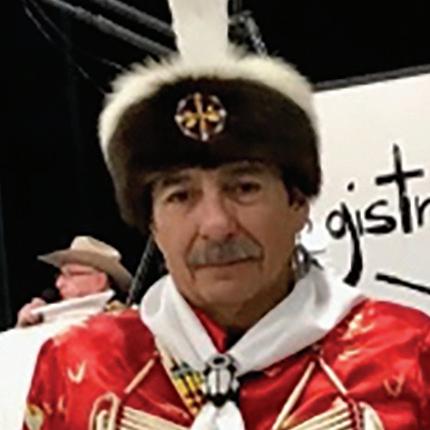
Mickey is an enrolled member of the White Earth Nation, Ottertail Pillager Band, in Northwestern Minnesota, of the Sturgeon Clan. He is a combat wounded Vietnam Veteran, 67-70 and 72-74. Mickey has a double major B.A. in Native American Studies and Cultural Anthropology from Bemidji State University. Mickey has been a cultural speaker, dancer, and singer all of his life.
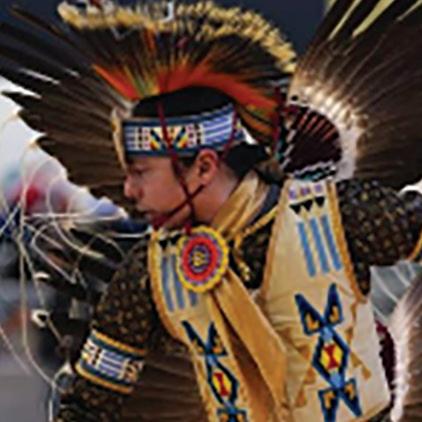
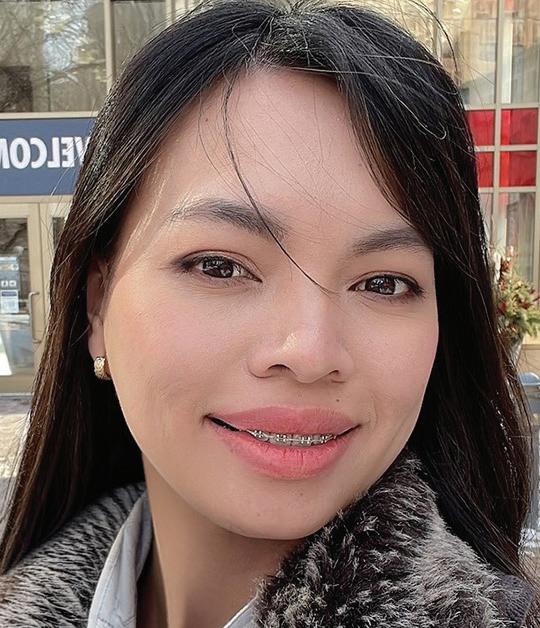
Shorty is an enrolled member of the Sisseton-Wahpeton Oyate and also represents the Leech Lake Band of Ojibwe. He enjoys traveling to powwows throughout the country with his children, where he participates as a Fancy Feather dancer and a singer. Shorty has had the opportunity to serve on various head staff roles as well, including Host Drum, Head Dancer, Head Dance Judge, Head Singing Judge, Arena Director, and Master of Ceremonies. Shorty has also shared his gift of song and dance with various dance troupes in places such as the National Museum of the American Indian, Hard Rock Live, Target Center, Target Field, US Bank Stadium, and many schools and theaters across the country. Shorty is humbled and honored to be invited to serve as this year’s Arena Director.
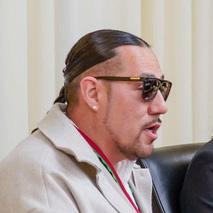
Spiritual Advisor Fred Desjarlait
At Sanford Health, primary care is about building a relationship with a provider who partners with you for a lifetime of care. Someone who knows you, your concerns and what matters most. Because when we understand every aspect of your health, your care is always the best care for you.

Find a primary care provider. ◄ Scan to find yours.
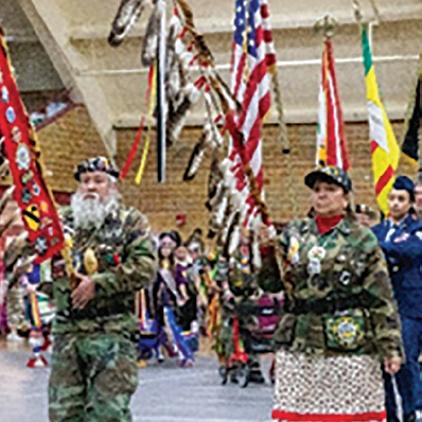
The White Earth Veterans Honor Guard is comprised of volunteer veterans from the White Earth Reservation area who have served in various areas of military forces. The Honor Guard serves as the guardians of the colors by displaying and escorting national, state, military, and tribal flags on ceremonial occasions as well as providing honors at veteran funerals.
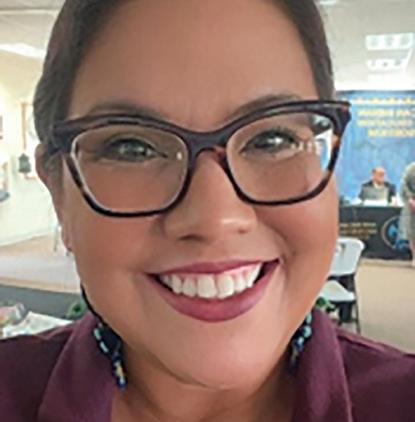
Anna is an Anishinaabe woman and enrolled member of the White Earth Nation. She proudly carries her culture and traditions through her dancing and artistry. Anna dances the Old Style Jingle, a healing dance rooted in prayer and strength. Each step she takes is offered in gratitude—to honor her ancestors, family, and community, and to bring healing and good feelings to those around the circle. Anna also continues the teachings passed down from her mother, who taught her the art of beadwork and the importance of carrying herself with humility and respect. Through her dance, her beadwork, and her connection to community, Anna strives to honor those teachings and help keep Anishinaabe traditions alive for future generations.
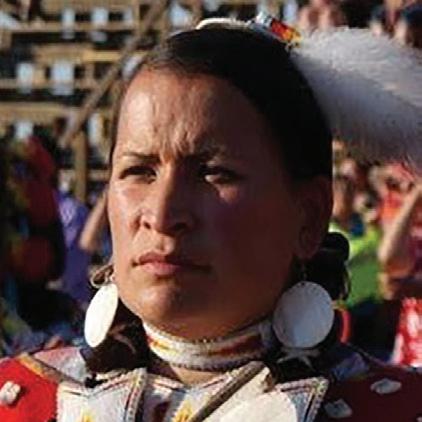
Delores Gabbard is a student at MSUM majoring in Social Work. She is currently pursuing her undergraduate degree while working for Moorhead Area Public Schools as an Indian Education Home School Liaison. In this role, she also coordinates Title VI and Johnson O’Malley funding. Delores is an enrolled member of the Sioux Valley Dakota Nation in Manitoba, Canada, and grew up primarily in British Columbia. Throughout her youth, Delores traveled across Canada and parts of the United States to attend powwows and ceremonies. In 2006, she moved to the U.S. and started a family, eventually settling in the FargoMoorhead area around 2008. She describes her move to the United States as a “return to the original lands of the Dakota Oyate.” Delores has since continued her travels on the powwow trail, reaching across the majority of North America.
Delores’s father, Alden Pompana, was a survivor of the residential school system in Canada and was well known for his work as a spiritual advisor focusing on drug and alcohol recovery. Delores continues his legacy through her work with youth and hopes to expand her reach once she earns her degree.
In closing, Delores encourages Indigenous youth to pursue higher education, noting the abundance of opportunities and work within Indigenous communities. She also emphasizes that it is never too late for mature students to return to school and complete their degrees.
FIRE Everyone can take part. You don’t need to be in regalia; you can dance in your street clothes. There are no spectators at a powwow – everyone is considered a participant even if all you do is lend your presence.
FIRE Everyone has a place in the circle of people. When the Master of Ceremonies calls “intertribal” dance, everyone can take part. Listen carefully to the announcer so you know what is happening. Announcers will request silence, ask people to stand, remove hats and not take pictures at certain times during the powwow.
FIRE Do not photograph participants close up without asking permission. Introduce yourself and get to know that person a little. Listen to the announcer for cues about when it is appropriate to take a photograph. Remember, it is impolite to bother the performers or those preparing to sing and dance.
FIRE Do not allow your children to run through or play in the dance arena. As explained before, the circle is sacred and to allow this is very disrespectful.
FIRE Many people mark their sitting places with blankets or personal items. Do not remove items or sit in someone else’s spot.
FIRE Do not touch a dancer’s regalia or pick up feathers that may have dropped on the floor; everything stops until the feather has been properly returned to its owner.
FIRE Alcohol and drugs are not permitted on campus or at the powwow.
FIRE Smoking is not allowed in Minnesota State Moorhead buildings.
FIRE Everyone should always stand and remove caps and hats during the Grand Entry, Flag Songs and Invocations.

The Center for Community and Belonging is dedicated to assisting the NDSU community by:
Fostering a welcoming and supportive campus environment.
Hosting events and programs
Referring students to resources and services
Cultivating spaces the encourage connection and community
Visit www.ndsu.edu/community_belonging to learn more about our services

Some say the Grand Entry originates from old-time victory dances signifying the war party’s victorious return home. The warriors would line up and dance throughout the village while uncles and grandfathers announced the good deeds the warriors performed. Also honored were the young warriors. Their mothers, aunts, wives or sweethearts, who danced in the honor of them, followed them.
Others say the Grand Entry is a recent adaptation of the ancient traditional celebrations and gatherings. In the Great Lakes region, indigenous ceremonies such as the Big Drum Societies, Grand Medicine Lodge, Longhouse Ceremonies or other traditional gatherings never had Grand Entries. But, Indian people were influenced by one another and have adapted and changed to meet their needs. Another possibility or origin derives from rodeos and Wild West Shows.
While some contend the Grand Entry is not an ancient tradition, it still demonstrates longstanding cultural values – tradition, respect for elders and honor to veterans. Whatever the origin, the Grand Entry begins all powwows today.
The eagle staff is the first to make the entrance in the circle, followed by the American, state, tribal and POW flags. Then the titleholders from tribal pageants enter. Other invited dignitaries are next, followed by the men: traditional dancers are first, followed by grass dancers, then fancy dancers.
Women are next. Traditional dancers are first, followed by jingle dress dancers and fancy shawl dancers. They are followed by teen boys, teen girls, junior boys, then junior girls in the same order as the adults. The last to enter the dance floor are the little boys and girls, usually referred to as “tiny tots.”
The dancers dance “sunwise” (clockwise) around the arena, showing they are dressed and ready to dance, showing off their steps and tribal regalia (please note that “costume” is considered derogatory by many), and letting those who watch know who they are and what they can do.
When the Grand Entry song ends, a flag song and veteran’s song are followed by an invocation blessing the gathering. Then the eagle staff is tied to the pole in the center of the arena or brought to the announcer’s stand. Originally the U.S. flag was raised to show that the people gathered under it were not enemies of the United States. During the Indian Wars, the federal government required Indian gatherings to display the U.S. flag to show they were peacefully assembled so the U.S. military would not attack.



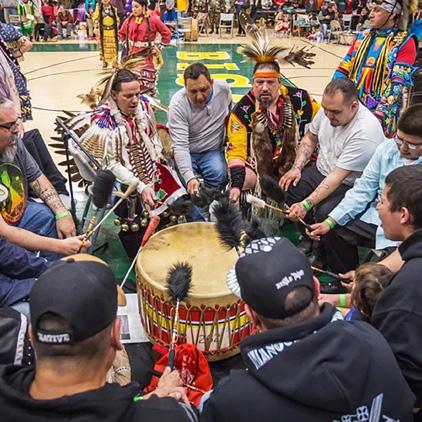
The drum is used to accompany most dances. The legend continues with each new generation. Drums once were living beings – the tree and the deer – that gave up their lives to contribute to our happiness and life. The materials pay homage to the life forces: animal hides, wood, clay and water. In some traditions, the drum symbolizes the heartbeat of mother earth, and in others, the powerful medicine of thunder. Whatever the legend, each drum has a spirit inside and the drummer must move these spirits to come out for the dancers.
The drum is more than just a musical instrument to those who play it. Some drum groups have had their drums blessed and named at ceremonies. The drum is regarded sacred with its own spirit. Gifts are made to the drum, and some drums even have their own sacred medicine pipes.
Regardless of the tradition, the drum must always be treated with respect as a sacred entity. Nothing is ever set on a drum, nor does anyone reach across it. Many drums even have their own song, which is frequently sung as a warm-up at the beginning of the powwow. The beat of the drum is a heartbeat starting slowly and then beating more quickly as the singers get further into the song. The drumsticks connect the singers to the power of the drum as they sing.
The drumming is judged in contest by the rhythm of the song. Usually the drum group is judged only on the songs they sing for the dancing contests and on intertribal songs. There are different kinds of rhythms and drumbeats played and each type of song requires a different one. The drumbeats must be in perfect time and each play must be in perfect unison.
The basic drumbeats include the roll, a very fast drumbeat; the parade beat, a slow steady processional beat; the Omaha beat, the most frequently used dance beat; and the social dance beat, which is a strongly accentuated beat and ranges from medium to fast. The term “drum” also can refer to the drum group itself.
Different types of songs are sung for different events: grand entry, dance categories, honoring ceremonies. Songs are made for a variety of reasons: songs of happiness, songs of thanks or songs of sadness. Although they differ in tempo, words and emotion, powwow songs follow a similar structure. Many of the songs have been passed down from generation to generation, having never been written down. The songs help people remember their ancestors and traditions.
The lead singer selects the song to be sung. He may hit the drum once to let the dancers and the other singers know the song is about to begin. The lead singer sings a phrase or a tune called the “lead” or “push up.” The rest of the group repeats the lead (this is called a “second”). Then all the singers sing the melody called a “push up.” If the announcer asks a drum for four push-ups, they will sing the grouping of lead, second, first part and second part four times.
There are three kinds of songs: all words, all melody (these songs are sung with vocables, syllables without meaning used to carry the melody), and those with vocables for the lead, second and first parts, and words for the second part.
Many times at the end of the second push up, four or five slow “honor beats” or “accent beats” are heard from the drum. It is said that at one time they represented gunshots. Other stories say the four beats represent the four directions and the fifth is to Mother Earth and the Great Spirit. The honor or accent beats are a signal to the dancers and singers that another push up is about to begin or the song is about to end.
As previously mentioned, there are songs for all occasions – honor songs, veteran songs, war party songs – but many of the pre-reservation songs have been put aside in favor of the flood of new songs being composed. Some singing groups only sing their own songs; others borrow songs and perform their own. The songs are not written down but are tape recorded or kept by a keeper of songs –someone who has a great talent for remembering songs, their stories, when and why they are sung and who can sing them. Singers and dancers learn from these recordings and people.
Singers, unlike pop stars, are not judged by the sweetness of their voices. In the Northern Plains, the higher parts of the song are sung falsetto and the melody gains energy and rhythm as the voice descends. The sound it produces at the back of an open mouth and throat with the volume and quality of the voice depends largely on well-developed abdominal muscles. Singers are judged on range, volume, strength and expressive quality of their voices and the way they blend with the rest of the group.
Women sing an octave higher than the men and may sometimes join in the later part of each rendition. Women also may “trill” at special places in the song to indicate deep feelings such as joy or appreciation of the song.
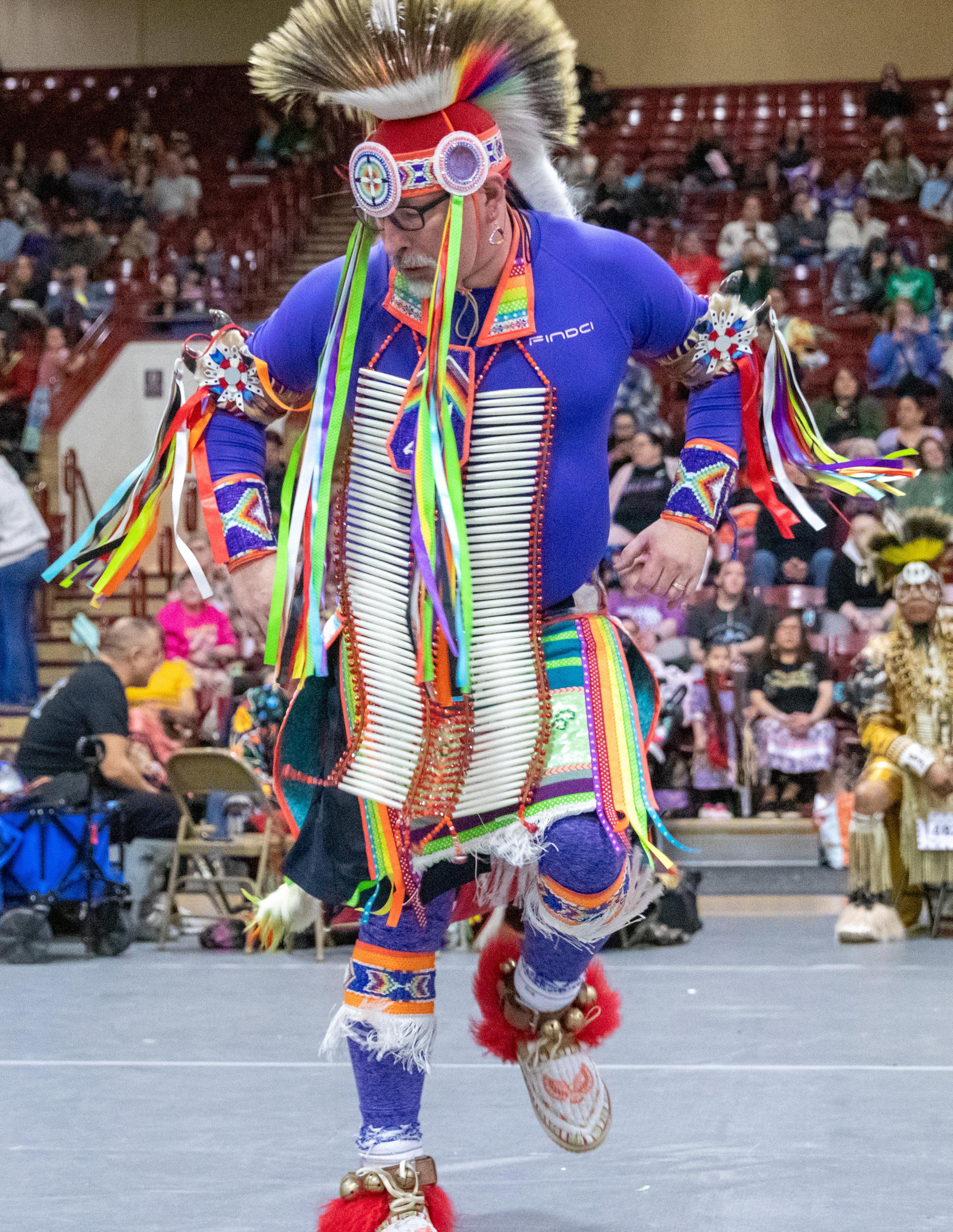
Fancy dancers are easily recognizable by their energetic tempo and colorful, distinct outfits, which features very large, vividly colored double bustles worn on the dancer’s back. Smaller bustles adorn the arms. Brightly colored beadwork and accessories are color coordinated with the color of the bustles.
The fancy dancer is a recent addition to the contemporary warrior of today. The fancy dancer has agility, speed and determination. The dance originated as a competitive dance style born of the Wild West shows, where the more colorful and agile the dancer, the better chance of prestige and winning. Yet the fancy dance still epitomizes the warrior who is committed to protecting his people, tribe and family.
ln the days of our ancestors, the legend tells of a young man who longed to dance. Although he was lame in one foot, he walked out onto the prairie. There he came upon a small hill, which he climbed to pray for guidance. He looked down the prairie and saw long prairie grass swaying in the wind. This, he knew, was the answer to his prayer. He would adorn himself with the sweet grass and imitate its graceful swaying motion.
Another story says the elders would ask young men to lay down the tall grasses to prepare a clearing for their ceremonies and for the other dancers. Many wore tufts of sweet grass in their belts. Today, men adorn themselves with strands of colorful yarn, leather, fabric, fringe or ribbon, to represent the grass; the motion of the dance flows like the rippling prairie grass.
Congratulations to all graduates. Your dedication, resilience, and achievements inspire our whole community.
WE ARE PROUD OF YOU. Woodlands and High Plains Powwow Committee
Anna Sheppard – MSUM
Delores Gabbard - MSUM
Caitlin Johnson – MSUM
Jered Pigeon - MSUM
Jeff Salinas-Jenni - MSUM
Erienne Fawcett - MSUM
Stephanie Rispa - MSUM
Jody Steile – MSUM
Heather Keeler – MSUM Alum; Community Representative
Glory Ames - Concordia
Kelly Laframboise -Concordia
Dilvin Habib - NDSU
Vanessa Rabitaille-Kinney - NDSU
Darlene Boyle – Fargo/West Fargo Indian Education Program
Jean Ostrom – White Earth Tribal & Community College
Joy Annette – Community Representative
In a stately manner, women move slowly about the circle (the Plains traditional woman dancer most often stays in one place), rhythmically dipping and swaying to the beat of the drum. The traditional deerskin or trade cloth dresses are often heavy and elaborately decorated with bead and quill work.
The dresses often are adorned with elk ivories or cowrie shells, or simply with ribbon. A traditional Annishanabe (Ojibwe/Chippewa) dress can be black/red velvet decorated with detailed and intricate floral design beadwork and buckskin fringe.
The woman’s jingle dress has its own legend of being “the healing dress.” The Annishanabe say an old man on his death bed dreamed of his daughter clothed in a dress, the likes of which he had never seen, a dress with cones (jingles) sewn around the cloth (365 cones – a prayer for each day of the year). The spirits told him how to make the cones (originally made from deer hooves; later, rabbit bones were used until the coming of tobacco lids). Then he dreamed of his daughter and three of her friends dancing in those dresses. After having this vision, he recovered, and recalling the sight and sound of the cones, he taught his daughter how to make those special dresses.
In the old man’s vision, the spirits also told him that when his daughter danced she was not to lift her feet far from the ground, dance backwards or turn around. She also was not to pass another jingle dress dancer while dancing in the circle. In addition, the jingle dress dancer had certain responsibilities to be a role model. If you listen closely, you can hear the tinkling of the cones and their calming effect.
The fancy shawl dance is a fairly new addition to the competitive style of dance at the powwow. Prior to the turn of the century, women performed the fancy dance, or “butterfly dance” in their traditional regalia, with blankets and buffalo robes. Then it is told that in the 1930s or 1940s young girls would show off their colorful shawls by doing fancy footwork at the powwow, imitating the butterfly and its graceful movements.
The dance itself is very similar to the men’s fancy dance, but with more grace. The footwork is definitely more the element of the fancy shawl dance. The dancer must follow the beat of the drum, then stop with both feet on the ground, on the last beat of the drum.
The fancy shawl regalia consist of knee-length dresses, beaded moccasins with matching leggings, a fancy shawl, beaded jewelry, hair ties and barrettes usually adorned with an eagle plume. The outfits are flashy and colorful.
would like to thank the following sponsors for their generous donations:
The event requires the effort of many individuals.
Thank you to those who have made this event a success!