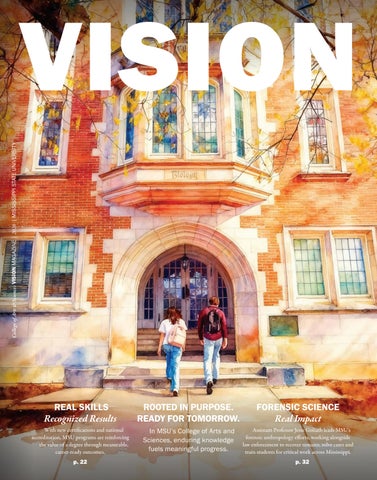
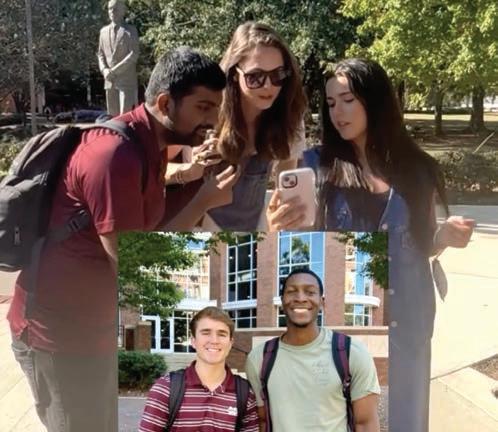
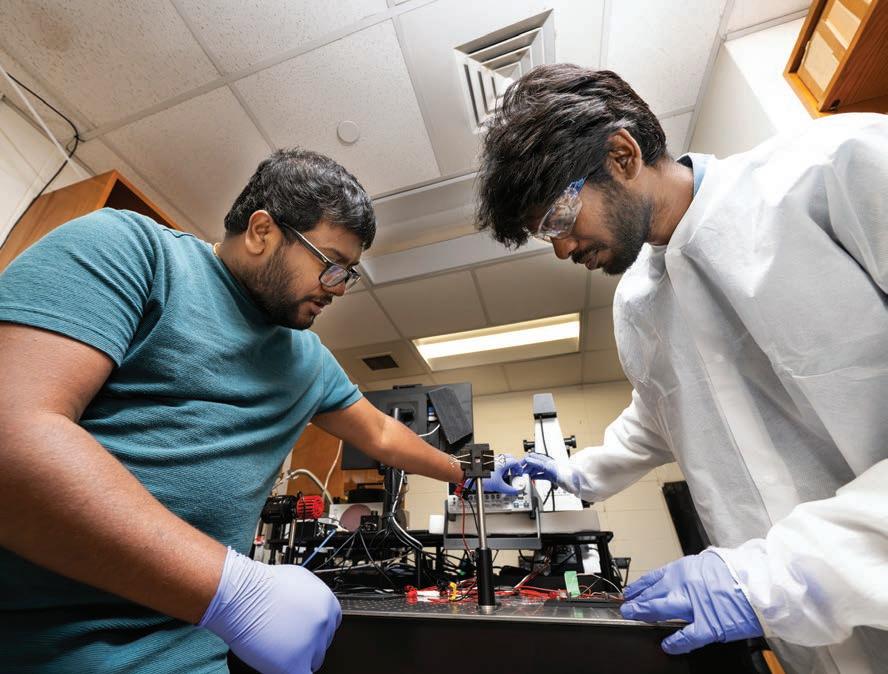
With new certifications and national accreditation, MSU programs are reinforcing the value of a degree through measurable, career-ready outcomes. p. 22
ROOTED IN PURPOSE. READY FOR TOMORROW.
In MSU’s College of Arts and Sciences, enduring knowledge fuels meaningful progress.
FORENSIC SCIENCE
Real Impact
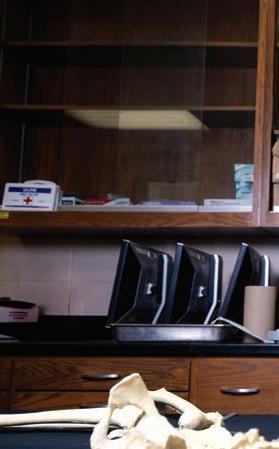
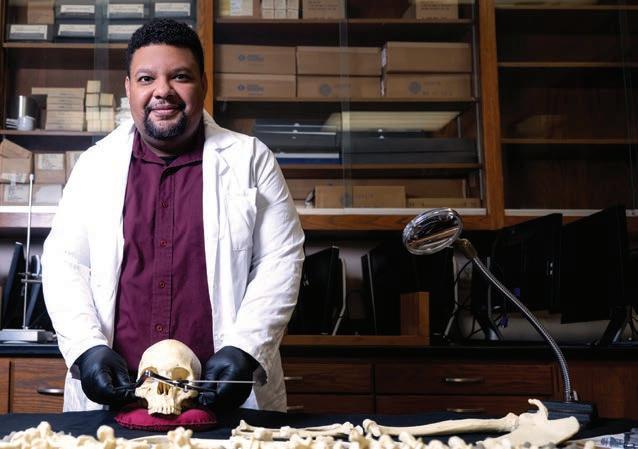
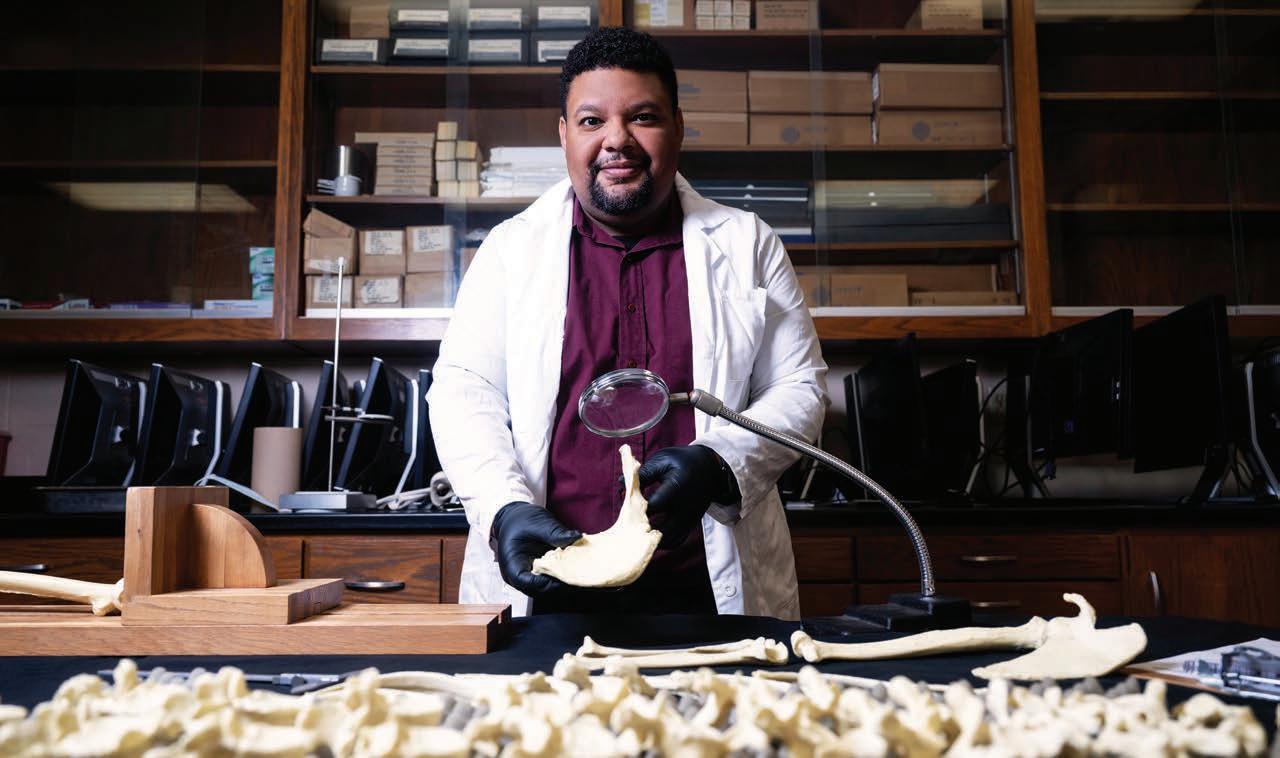
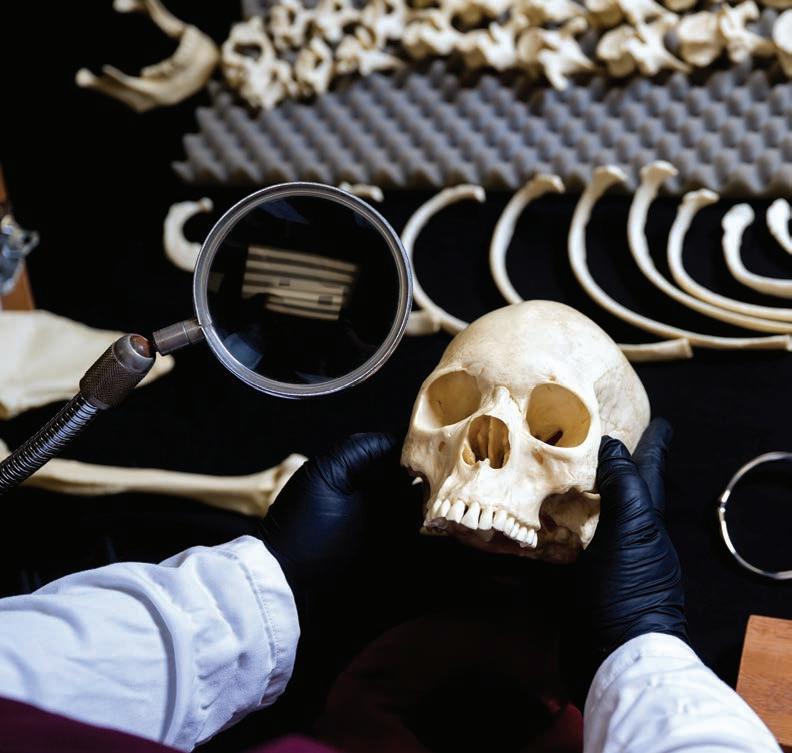
Assistant Professor Jesse Goliath leads MSU’s forensic anthropology efforts, working alongside law enforcement to recover remains, solve cases and train students for critical work across Mississippi. p. 32
Mississippi State University is an equal opportunity institution. Discrimination is prohibited in university employment, programs or activities based on race, color, ethnicity, sex, pregnancy, religion, national origin, disability, age, sexual orientation, genetic information, status as a U.S. veteran, or any other status to the extent protected by applicable law. Questions about equal opportunity programs or compliance should be directed to the Office of Civil Rights Compliance, 231 Famous Maroon Band Street, P.O. 6044, Mississippi State, MS 39762, (662) 325-5839.
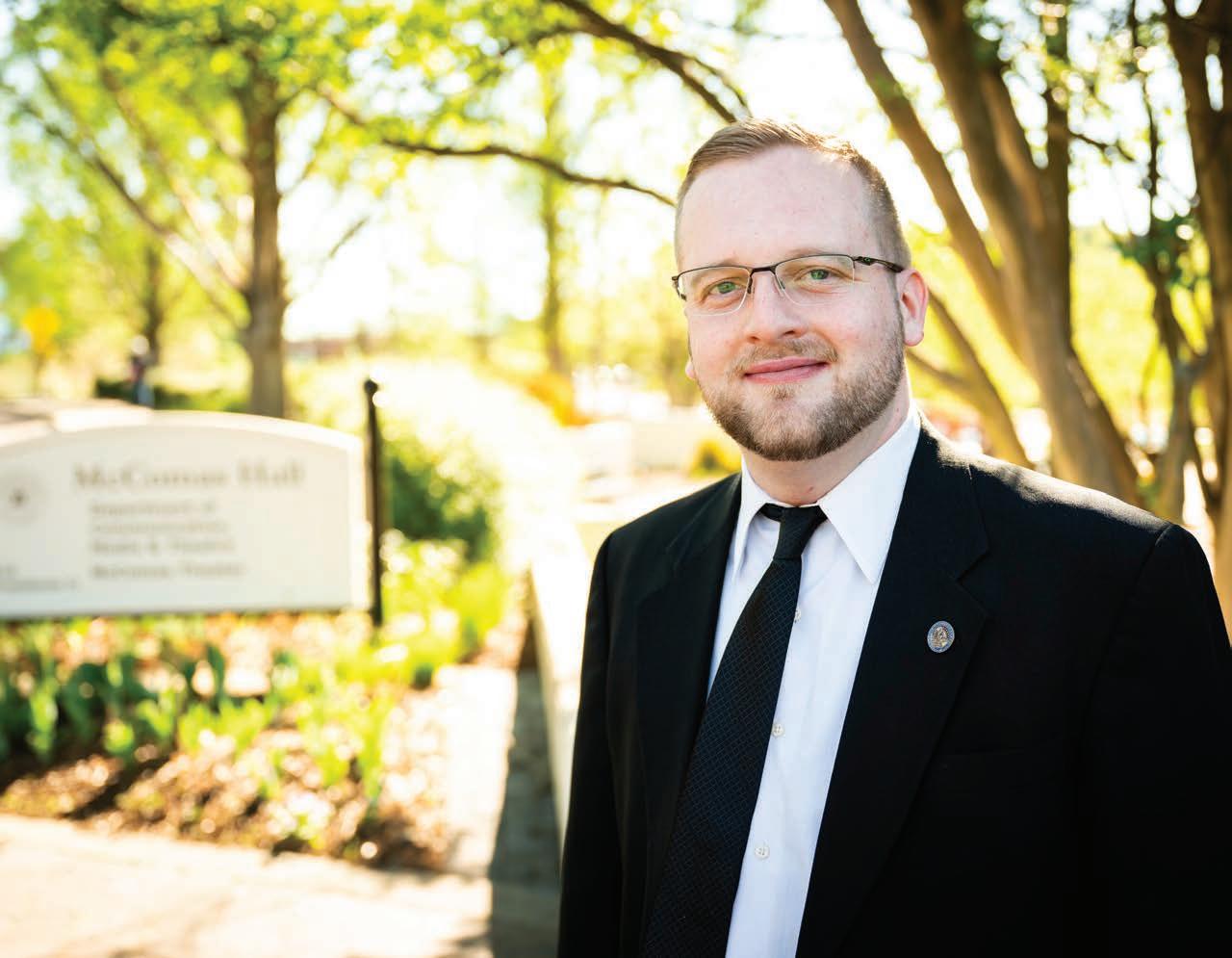
Mississippi State’s Department of Communication, Media and Theatre rebrands to reflect its expanded programs and growing focus on storytelling across disciplines.
BREAKING BARRIERS IN EVOLUTIONARY SCIENCE
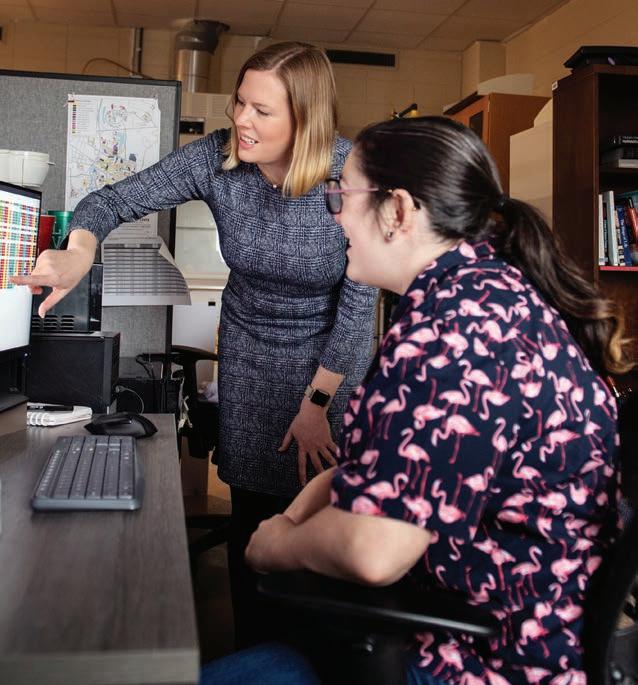
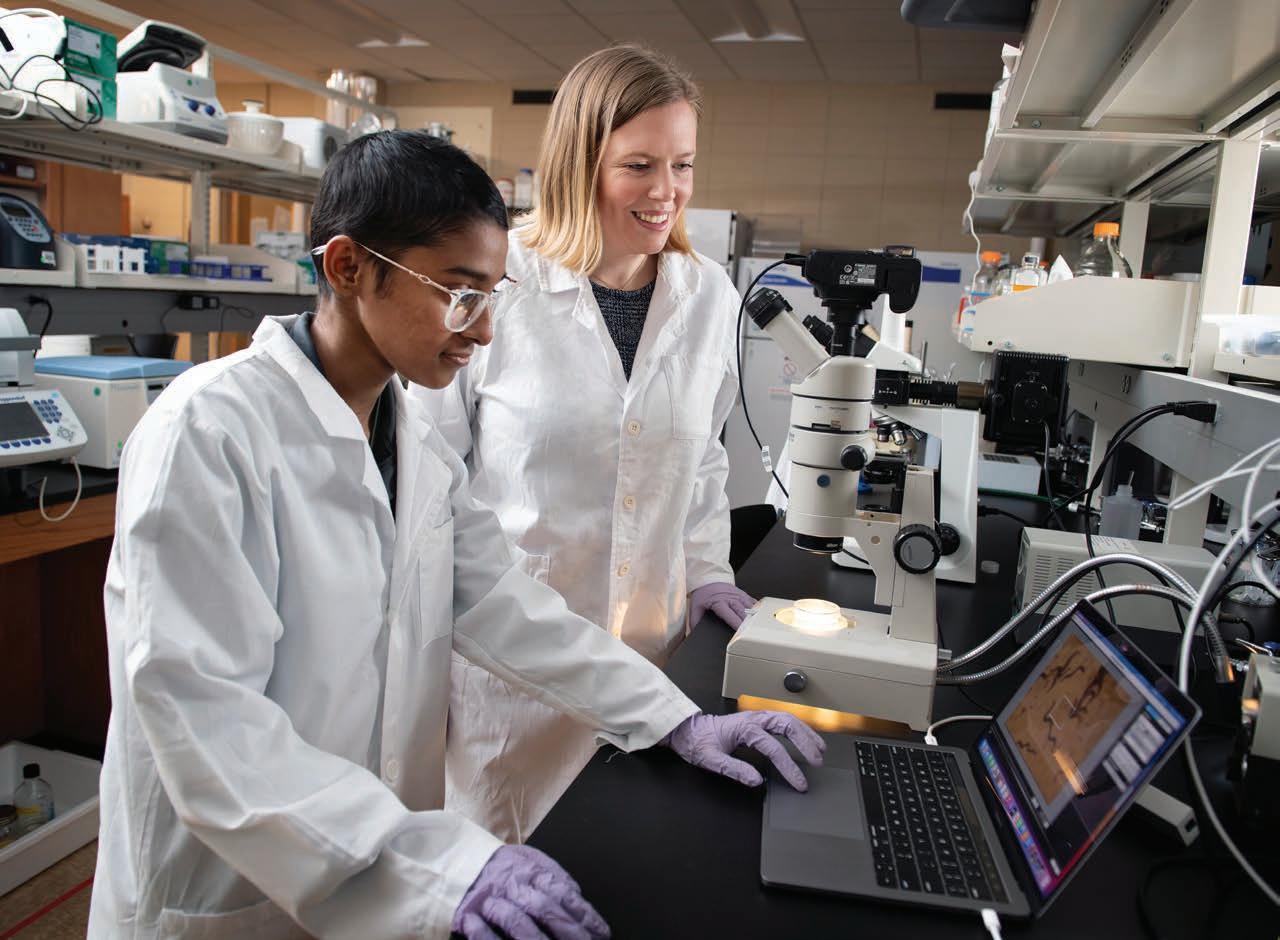
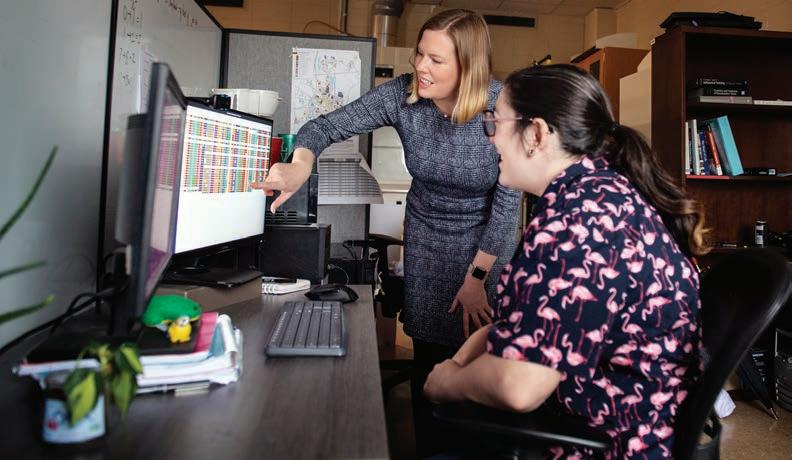
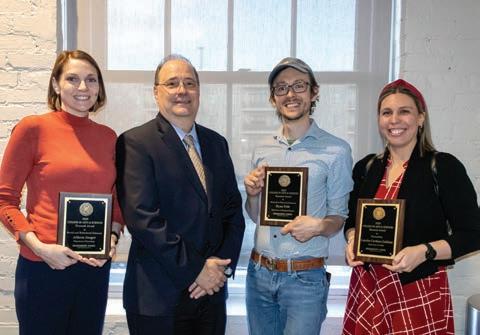
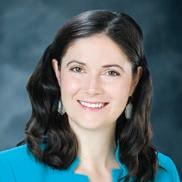
Mississippi State’s Amy Dapper earns top earlycareer honors while advancing evolutionary genetics and mentoring future scientists.
GLOBAL ADVENTURES CLOSE TO HOME
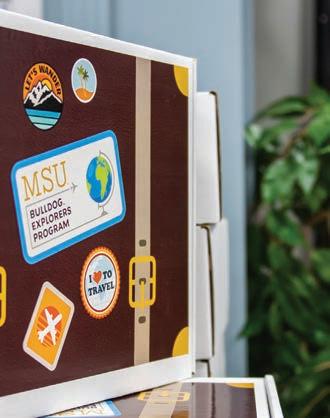
Mississippi State’s Bulldog Explorers program brings hands -on cultural learning to Starkville families through interactive, travelinspired activity kits.
MSU’s Jesse Goliath leads forensic efforts across Mississippi, using science to assist investigations, train students and bring answers to families.
VISION 2026
Writers
Sam Kealhofer
Sarah Nicholas
Marianne Todd
Kaitlyn Yeatman
Karlee Woods
Josephine Hanegan
Editors
Karyn Brown
Sarah Nicholas
MSU Office of Public Affairs
Designer
Heather Rowe
Photographers
Megan Bean
Grace Cockrell
Emily Grace McCall
Beth Wynn
Direct comments or questions to:
Karyn Brown
662.325.6650
kbrown@deanas.msstate.edu
P.O. Box AS
Mississippi State, MS 39762
DEAN & LEADERSHIP
DEAN
Dr. Rick Travis – Dean
ASSOCIATE DEANS
Dr. Giselle Thibaudeau (Munn) – Associate Dean for Research
Dr. Robert West, Interim Associate Dean for Academic Affairs
ASSISTANT DEANS
Karyn Brown – Assistant Dean for Communication and Media
Dr. Mitch Berman – Assistant Dean for Graduate Academic Affairs
Emily Cain – Assistant Dean, Curriculum and Enrollment
Dr. Matt Lavine – Assistant Dean for Undergraduate Academic Affairs
Dr. Kimberly Kelly – Faculty Fellow for Strategic Initiatives
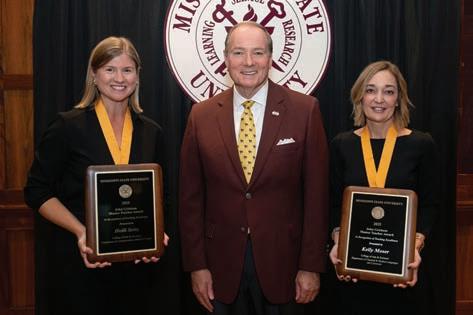
Dr. Kelly Moser – Director of Teaching Initiatives
ADMINISTRATIVE SUPPORT
Alisa Semmes – Administrative Assistant to the Dean
ACADEMIC AFFAIRS
Kasondra Harris, Director of Academic Relations, BSIS
Kate Sawaya, Director of Academic Relations—Advising and Student Success
Hannah Coleman, Admissions Coordinator
Kennedi Akins, Academic Advisor, BSIS
Kyndal James, Administrative Assistant I
RESEARCH
Jeremy Figgins – Contract and Grant Specialist III
Sam Kealhofer – Coordinator, Communications and Research Support
Silas Knox – Senior Contract and Grant Specialist
Ahsia Temple – Business Coordinator 1
COMMUNICATION
Kelli Anthony – Graphics and Web Designer
Sam Kealhofer – Coordinator, Communications and Research Support
Sarah Nicholas – Communication Specialist
DEVELOPMENT & ALUMNI RELATIONS
Sara Frederic – Director of Development
Keisha Knox – Advancement Coordinator
Livingston Sykes – Events Coordinator
BUSINESS AFFAIRS
Sheryl Kinard – Sr. Fiscal Operations
Business Manager
Latoya Rogers – Business Coordinator
Michia Williams – Business Manager I
DEPARTMENT HEADS &
DIRECTORS
DEPARTMENTS
African American Studies –Director Donald M. Shaffer, Jr.
Anthropology & Middle Eastern Cultures –Department Head James Hardin
Biological Sciences – Department Head
Angus Dawe
Chemistry –Department Head Carl Lovely
Classical & Modern Languages and Literatures – Department Head Robert West
Communication, Media & Theatre –Department Head Terrence Likes
English – Department Head Lara Dodds
Gender Studies – Director Kimberly Kelly
Geosciences – Department Head John C. Rodgers
History – Department Head Alan I. Marcus
Mathematics & Statistics – Department Head Christian Wolf
MSU Meridian – Division Head of Arts and Sciences Richard V. Damms
Philosophy & Religion – Department Head
Robert Thompson
Physics & Astronomy – Department Head Jeffry Winger
Political Science & Public Administration –Department Head Brian Shoup
Psychology – Interim Department Head Jarrod Moss
Sociology – Department Head Nicole Rader
INSTITUTES & CENTERS
Cobb Institute –Director James Hardin
Institute for the Humanities – Director
Morgan Robinson
John C. Stennis Institute of Government –Executive Director Joseph Dallas Breen
IN FOCUS
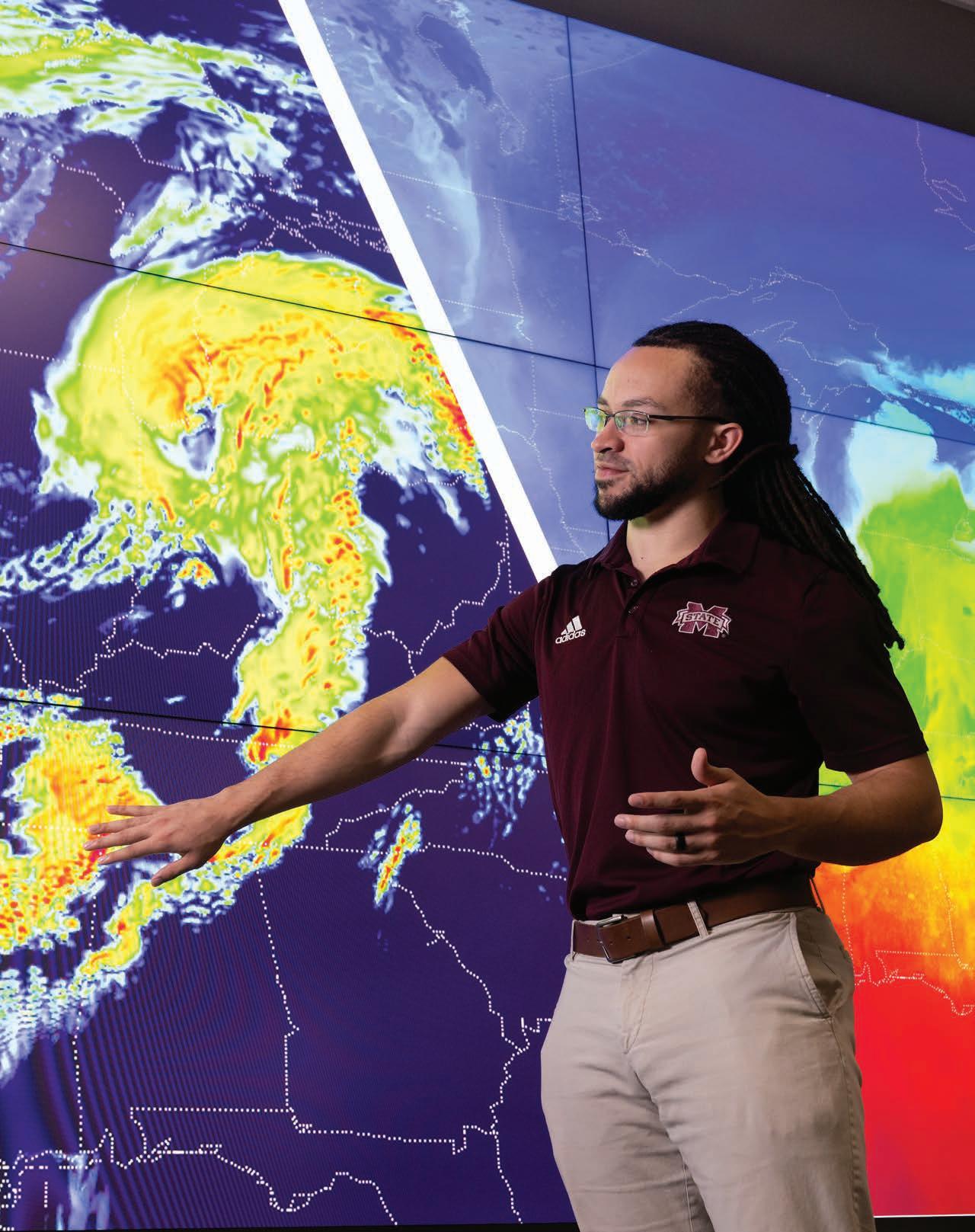
CHASING EXTREMES
Treven Knight, a Mississippi State graduate in geosciences with a focus on professional meteorology, has turned a lifelong curiosity about extreme weather into a career. Now a computational scientist at MSU’s High Performance Computing Collaboratory, he uses advanced modeling to help researchers better understand and predict severe weather, while continuing his studies as a doctoral student in earth and atmospheric sciences.
MSU’S COLLEGE OF ARTS AND SCIENCES Invested and
Dear Alumni and Friends,
Higher education is one of the most powerful longterm investments an individual can make, but its value extends far beyond one person. Long after grades fade and diplomas find their place on a wall, the real return shows up in the kind of people our students become and the impact they make on their communities. That is the true ‘return on investment’ of higher education.
While national conversations often focus on the cost of a degree, the deeper measure of value is not found in a dollar figure. It is found in lives shaped by mentorship, in discoveries that push society forward and in students who leave Mississippi State ready to meet the world’s challenges. In the College of Arts and Sciences, that return is visible every day. It is present in classrooms where curiosity is sparked, in labs where breakthroughs take shape and across communities transformed by the work of our faculty and students. This is what it means to be rooted, resilient and ready for what comes next.
This year’s Vision magazine highlights that impact through stories that reflect the breadth and strength of our college. Though the subjects vary widely, they share the same foundation: an investment in people and ideas that lead to lasting change.
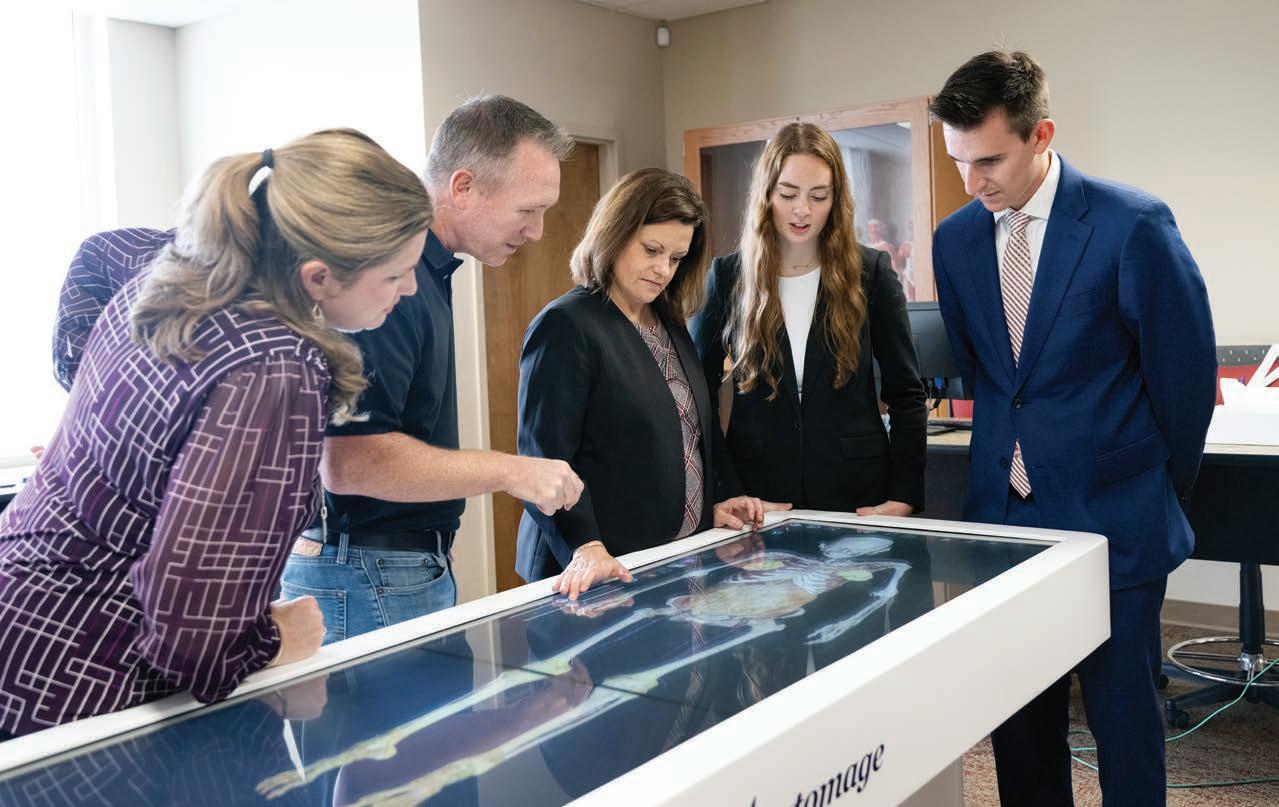
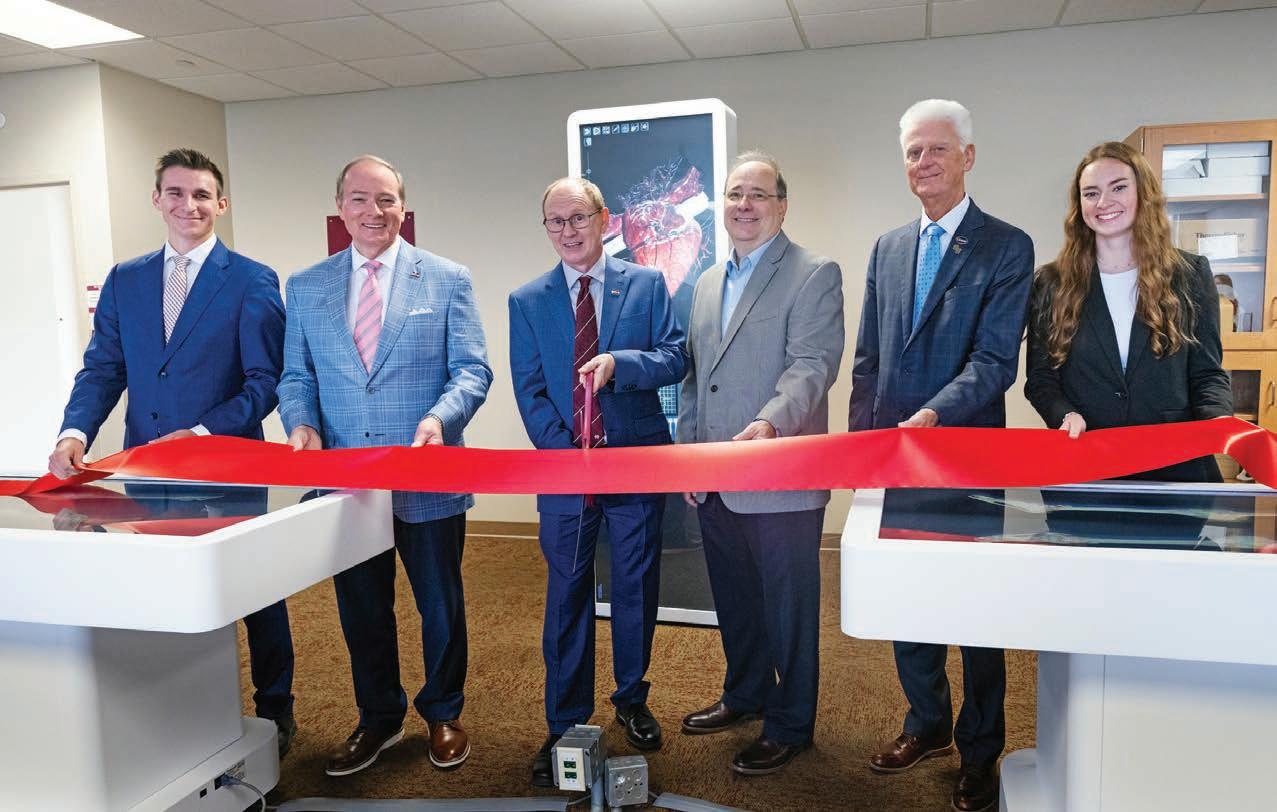
You will see how deeply we are rooted in innovation. In the natural sciences, faculty are expanding what students can experience and understand. The new Anatomage Tables in biological sciences bring anatomy to life through full-scale virtual cadavers, giving students an immersive, hands-on view of the human body. Tools like this are more than enhancements. They represent our commitment to ensuring students graduate prepared for the complex fields they will enter.
You will also see work that strengthens resilience within our society. From evolutionary genetics and sustainable lighting to the discovery of a record-breaking mosasaur fossil in Mississippi, our researchers continue to push knowledge forward. Their efforts remind us that universities are not simply places of learning. They are engines of innovation that improve lives across the state and far beyond.
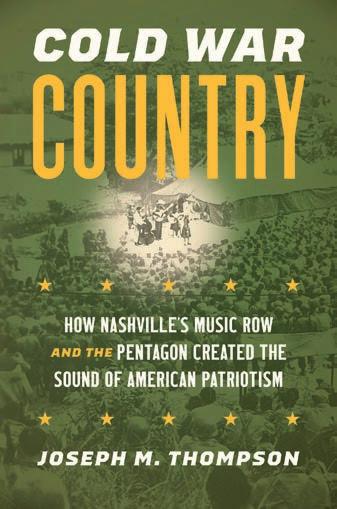
Our humanities scholars demonstrate why their work matters in today’s world. Projects exploring the ties between Nashville’s music industry and the Pentagon,
Impactful
the cultural memory of Mississippi, or the narratives that shape national identity show the vital role the humanities play in helping us understand a complicated world. These perspectives teach students to think critically, communicate effectively and adapt to change—skills that remain essential no matter their career path.
As one of the largest and most academically diverse colleges at Mississippi State, we carry both opportunity and responsibility. We prepare students who become scientists, writers, innovators, public servants and leaders. We advance research that strengthens industries, communities and understanding.
As you read this issue, I hope you see what I see every day: a college invested in people, resilient through change and ready for the future. That is the real ROI of higher education, and it is the promise we renew with every student who walks through our doors.
Thank you for your support of our mission and the remarkable people who make it possible.
Hail State! Rick Travis Dean, College of Arts and Sciences
BY THE NUMBERS College of Arts & Sciences
Seventy years. Thirteen departments. Twenty-seven majors. More than 5,000 current students. Since 1956, the College of Arts and Sciences at Mississippi State University has advanced knowledge across the arts, humanities, social and behavioral sciences, and natural and physical sciences. Ranked among the nation’s Top 100 research institutions by the National Science Foundation—and
first in Mississippi—MSU’s impact continues to grow. One in three on-air broadcast meteorologists in the United States is an MSU graduate. In FY2024 alone, Arts and Sciences faculty secured more than $16 million in research funding. For seven decades, our college has prepared leaders, scholars and innovators whose work shapes communities across the state and beyond.
One college. Dozens of disciplines. Unlimited possibilities.
1 The College of Arts and Sciences is officially established at Mississippi State University.
13
Thirteen academic departments spanning the humanities, social and behavioral sciences, and natural and physical sciences.
38,762
Living alumni in the College of Arts and Sciences network
1956
70
Seventy years of educating leaders, thinkers, scientists and artists.
27
Twenty-seven majors preparing students for careers and advanced study.
Top 100
Ranked among the nation’s Top 100 research institutions by the National Science Foundation.
5,000+
More than 5,000 students currently enrolled—one of MSU’s largest academic colleges.
First among Mississippi’s research institutions in NSF research rankings. #1
Research funding secured by Arts and Sciences faculty in FY2024 alone. $16M+
100+
Faculty recognized with major national or international awards in the past decade.
1st
First at Mississippi State: Amy Dapper, College of Arts and Sciences, earns the Presidential Early Career Award for Scientists and Engineers
SOCIAL STATS
First NSF CAREER Award in the psychology department’s history (Dr. Hossein Karimi, 2024).
One in three on-air broadcast meteorologists in the United States is an MSU graduate.
100+
Hurricanes making U.S. landfall since 1956—many tracked and analyzed by MSU-trained meteorologists.
1965
Richard E. Holmes becomes MSU’s first Black student, majoring in biology.
1968
Johnny L. Barnes becomes the university’s first Black graduate, earning a degree in economics.
15
Dr. Donald W. Zacharias, an Arts and Sciences faculty member, becomes MSU’s 15th president in 1985.
TOP POST
MOST WATCHED
Dr. Bonnie O’Neill
In this episode of Vision TV (April), we’re joined by Dr. Bonnie O’Neill, a professor in the Department of English, to discuss American poetry in celebration of National Poetry Month.
MOST LISTENED
Max Wamsley
Episode 87 – Max Wamsley and CLARUS Labs
In this episode of the Vision Podcast, we hear from Max Wamsley, a Mississippi State chemistry doctoral graduate and MBA student, as he discusses his company, CLARUS Labs, and his journey as an entrepreneur developing innovative testing systems for pet food manufacturers.
MSU’s Department of Communication, Media and Theatre EMBRACES NEW NAME, BOLD ERA
By Karley Woods
Mississippi State University’s Department of Communication has a new name—and a renewed sense of identity. Now known as the Department of Communication, Media and Theatre, the new moniker reflects both the breadth of its programs and the bold direction it is charting for the future. Announced in late April of 2025, the change brings fresh clarity and visibility to one of MSU’s most dynamic, interdisciplinary and creative academic units.
While the rebranding reflects the department’s scope and direction, its greatest strength remains the dedication of those who teach, mentor and guide students every day.
“What students will remember are the relationships, the mentoring and the opportunities provided by faculty.”
“What makes us unique—not just in name but in experience—is our faculty and staff,” said Terrence D. “Terry” Likes, department head since 2019. “President Mark Keenum talks about MSU as a family. Our faculty truly care about the success of our students as if we are their extended family.”
and 20 graduate students annually. With undergraduate concentrations in communication and media studies, print and digital journalism, broadcast and digital journalism, public relations, and theatre, the department now reflects a broader vision of communication as storytelling in all forms.
According to Likes, while communication programs differ in structure across institutions, the university’s offerings are distinctive in several important respects.
~ TERRY LIKES
“As for other Southeastern Conference programs, every school is different,” Likes said. “But some of the many things that make MSU’s Department of Communication, Media and Theatre different include unique course offerings and opportunities, award-winning faculty and students, the ability to take courses across our many concentrations and a culture where we strive for excellence every day.
The department, which began as the Department of Speech in 1962, serves more than 400 undergraduate majors
“The name change allows us to better identify and promote who we are and what we do,” he continued.
Likes spoke proudly of the department’s internal
environment—a space where faculty culture plays a pivotal role in student success.
“The culture in the unit has always been strong,” he said. “In early 2025, when faculty met with an accreditation site team, faculty volunteered information saying the culture and climate of the department is better than ever. This culture stems from faculty dedicated to the craft of teaching, to their research and creative scholarship, and to service. Faculty across all professorial ranks have great respect for each other as a team.”
According to Likes, the updated name gives faculty the recognition they deserve for their contributions across diverse disciplines.
“The name change reinforces a strong culture, as faculty feel recognized and supported—that what we offer is better reflected by the new name,” he said. “One of the many reasons for the name change was to squelch any misconceptions about this unit. Many did not know, under the old name, that we had a theater program or where the theater is located—McComas Hall. Many, when they hear ‘communication,’ think we only teach public speaking.”
When asked about the future, Likes laid out a clear vision
for growth and a deep commitment to student success.
“What I hope comes to mind is a program that helps students excel, makes students feel welcomed, encouraged, mentored and successful,” he said. “When people look back on their college days, they won’t remember the day-to-day subjects of every class. What they will remember are the lessons learned, the relationships forged, the mentoring and opportunities provided by faculty, the long hours spent at The Reflector, Take 30 News, WMSV, the work on a play or a PR campaign, and the friendships which may last a lifetime.”
Likes believes the name change will help open new doors for students in their academic and professional paths.
“I am hopeful the new name will draw more students to MSU,” he said. “Since more employers and students will know who we are and what we do, my goal is to increase opportunities for students to intern, be placed in jobs and consider options for graduate school.
“With all the monumental technological changes in recent years, one thing that has not changed is the ability to tell an effective story,” Likes continued. “Hardware and software may change, but storytelling remains constant.” u
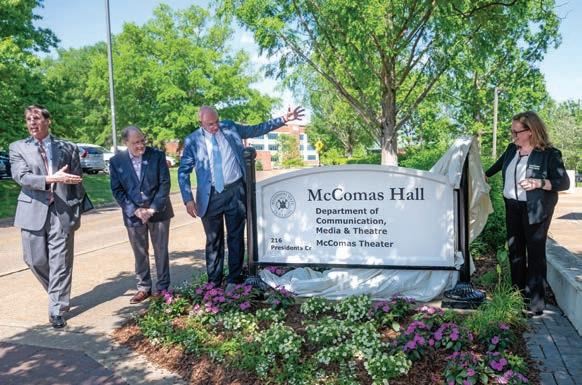
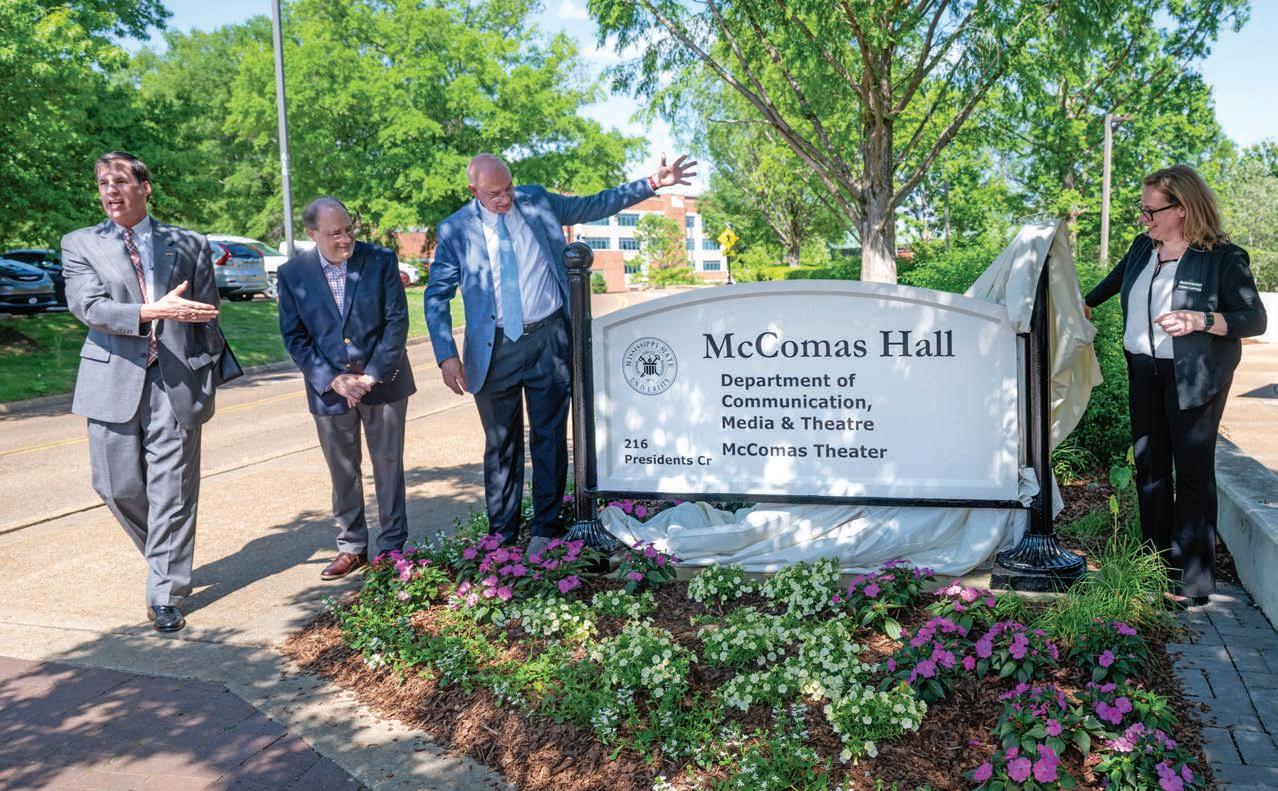
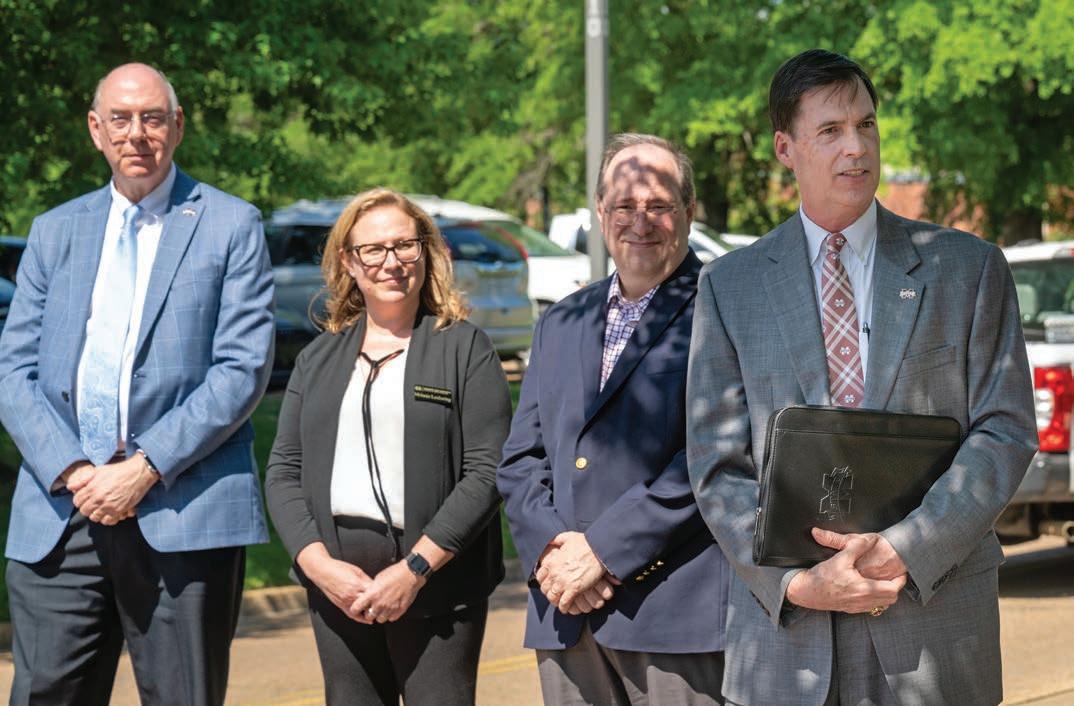
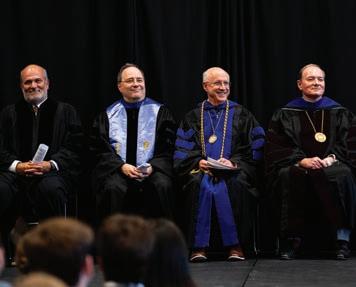
Mississippi State’s Department of Communication unveiled its new name in April 2025 as the Department of Communication, Media and Theatre. From left, John Forde, professor emeritus and former department head; Melanie Loehwing, College of Arts and Sciences professor of communication; Rick Travis, dean of the College of Arts and Sciences; and Terry Likes, department head. (Photo by Emily Grace McCall)
“When you make history tactile, it erases the gulf between past and present.”
~ TOBY BATES
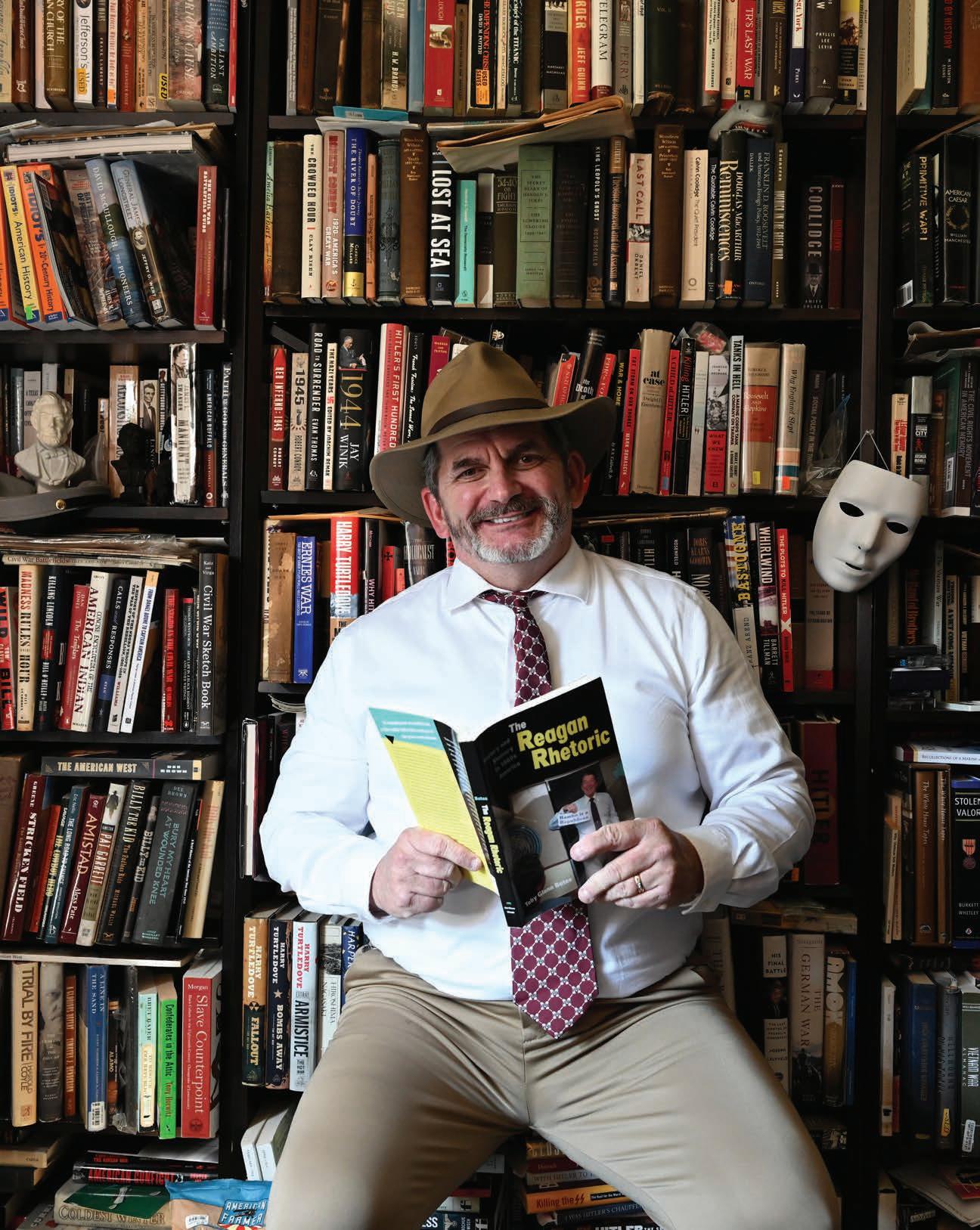
TOBY BATES, associate professor in MSU-Meridian’s Division of Arts and Sciences, surrounds himself with history, using artifacts, pop culture and a vast personal library to help students connect the past to the present.
IN HISTORY’S FADED FOOTSTEPS
MSU-Meridian professor makes the past come alive
By Marianne Todd
Micah Mills peered over the high cliff, studying the small, white dots below.
“I got my phone and zoomed in as far as I could. It was kayakers!” he said. “You don’t realize how high up you are.”
Mills had heard about the historic landmark, Horseshoe Bend in Glen Canyon near the ArizonaUtah border, as a Mississippi State University-Meridian student in Associate Professor Toby Bates’ history class, but nothing could have prepared him for what he saw. Nor was he truly ready for the sights of Monument Valley or Bryce Canyon, the remnants of the Oregon Trail or the former stomping grounds of Wyatt Earp. They were landmarks that had come to life for the high school history teacher, who is taking a graduate-level class in Meridian showing history teachers how to best teach the subject.
Once back home in Laurel, Mills revised his teaching curriculum for the fall semester.
“I completely reinvented my first chapter,” he said, grateful for a recent Mississippi Department of Education change that no longer requires 11th graders to pass a state history test. “Where I used to have to follow exact state standards in what the state thinks students need to be taught, I now can teach from experience things that are hard to describe from a textbook.”
He hopes his investment, both seeking a specialist degree in secondary education at MSU-Meridian and exploring his own real-world education, will encourage others to also walk the path of history’s faded footsteps.
Bates, an MSU faculty member, said “When you make history tactile, it erases the gulf between past and present.”
While looking for a place to set a replica dinosaur skeleton among the dozens of curios gracing his office, Bates finds space near a Ronald Reagan bust donned by a Batman mask. To the right is a full-scale Darth Vadar figure wearing a “Got History?” hat. A large C3PO sits in another corner.
“Oh, that. I teach a class on pop culture,” laughed Bates.
Since Bates can’t take the student to the sacred ground, he brings the sacred ground to the student. He has ballistics from the Civil War, a 1924 box of foot cream with an original swastika from World War II,
numerous busts and figurines, Captain America’s shield, books on almost every historical subject and a halfdozen posters, including one advertising “The Reagan Rhetoric,” a book he authored in 2011.
“If I am discussing World War I and the amazement of American soldiers to electricity and indoor plumbing, I bring in a collection of letters written by actual soldiers … where these young men describe such amazing inventions in comical ways,” said Bates, noting days of the week are also important.
“We just passed the 70th anniversary of Emmitt Till’s death. It was a Sunday night when they pulled up to Moses Wright’s house,” he said. “In 1955 and especially in the African American community, Sunday was a quiet, holy day. But then there was a knock at the door and flashlights in the face.”
He lists other Sunday events: the bombing of Pearl Harbor, Robert E. Lee’s surrender and three civil rights workers suddenly missing in a case that became known as the Freedom Summer murders. Anniversaries are special, too, like Edgar Ray Killen’s conviction of the Freedom Summer murders exactly 41 years to the day after the event.
“Not knowing your history is like not knowing your identity,” Bates said. “Our return on our investment is that history protects us from the very worst of those who are trying to influence us—to sway us—so it’s not so easy to get us revved up to support a particular policy, war or emotion. In a world that makes us go faster and faster, history is the wisdom and the warning. It forces us to slow down. I think Micah found that centering as an individual.”
Without a textbook in hand, Mills meandered through the American West, feeling the same breezes that once blew against the skin of the indigenous people who fought and died for their sacred lands. He felt the dry prairies and walked in the footsteps of those who had nobly braved the crossing for a better life.
“For the last 10 years, I’ve taught the American West, and it was the textbook version,” Mills said. “But when you see it and get the real-life story—looking down at a canyon and imagining what life must have felt like on the Oregon Trail with the heat and no water for days, to cross this plain and this mountain—it adds a completely new perspective to your teaching.” u
GIANT DISCOVERY State’s largest mosasaur vertebra unearthed near Mississippi State
By Sarah Nicholas
In the outskirts of Starkville, an extraordinary fossil find is making waves in the paleontology world—and Mississippi State University-linked scientists are at the center of the discovery.
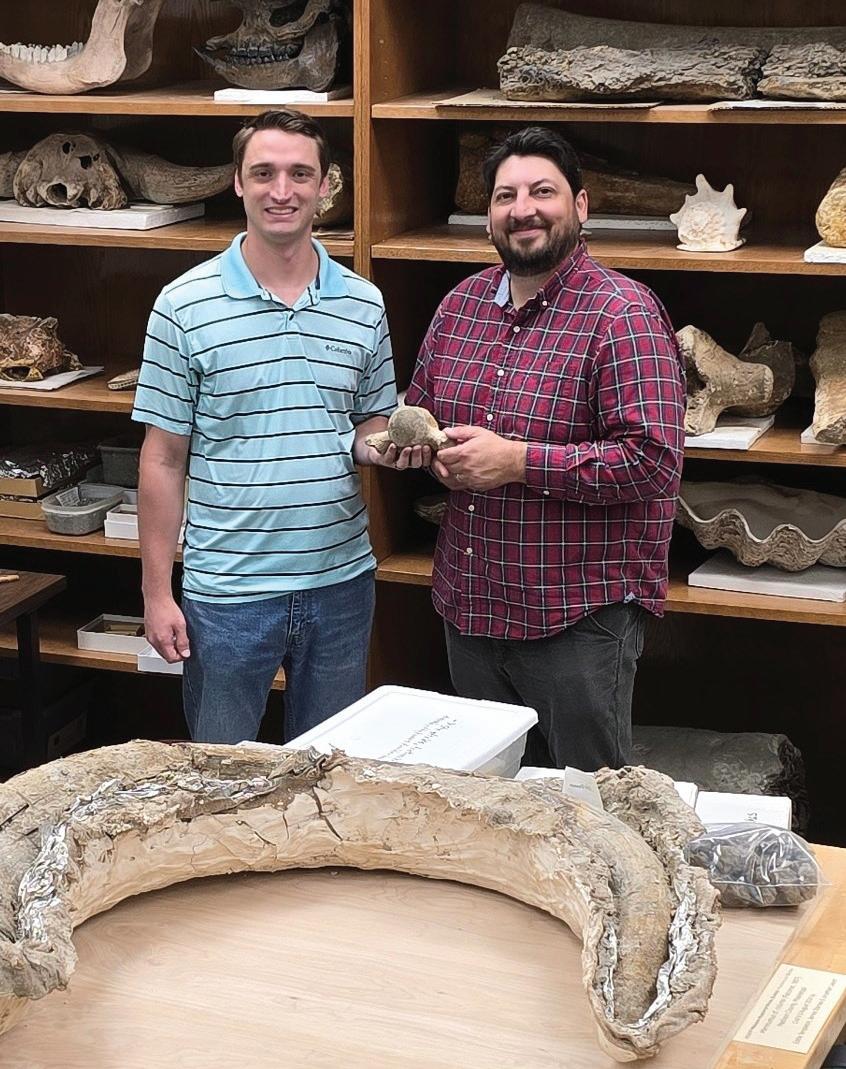
Jonathan Leard and Tim Palmer—both full-time professional geologists with the Mississippi Geological Survey who also are MSU doctoral researchers—recently helped identify and recover a massive, fossilized mosasaur vertebra, the largest backbone of its kind found in the state. They were working on a project with James Starnes, director in the Mississippi Department of Environmental Quality’s geological division.
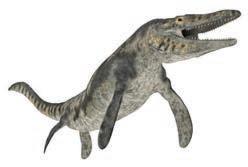
While mapping the region’s geology, Leard and Palmer uncovered the fossil belonging to Mosasaurus hoffmannii, a marine reptile that dominated the ancient seas of the Late Cretaceous period near the end of the Mesozoic Era.
“The mosasaur find is one of many examples that reminds me of the choice I made long ago to do what I love,” Palmer said. A native of Wichita, Kansas, he is a U.S. Navy veteran and earned his master’s degree from MSU in 2018.
Leard, from Madison, completed his MSU master’s in 2022 after earning his undergraduate degree at the University of Southern Mississippi.
“The mosasaur find is one of many examples that reminds me of the choice I made long ago to do what I love.” ~ TIM PALMER
“When we found the fossil, only the ball was exposed,” said Leard. “It alone was the size of a baseball. I carefully dug the marl away from the weathered vertebral processes and pulled it out of the ground. Our hearts were racing as we passed it around in disbelief at the size.”
The vertebra measures more than seven inches across and hints at a creature more than 30 feet long—roughly the length of a school bus. With the body of a crocodile, the hunting instincts of an orca, and paddle-like limbs built for speed, the mosasaur was the apex predator of its time.
Leard and Palmer are pursuing doctoral degrees through MSU’s Department of Geosciences. Leard completed his Ph.D. in December 2025, and Palmer expects to complete his in May 2026.
The fossil was transferred to the Mississippi Museum of Natural Science in Jackson, where experts confirmed the vertebra’s species and size. Fossils from Mosasaurus hoffmannii are rare in the state, though Mississippi’s fossil record is rich thanks to the warm, shallow sea that once covered the region—a prime ecosystem for marine reptiles, sharks and other prehistoric predators. The discovery also reinforces MSU’s ongoing contributions to geology and paleontology in the state. On campus, the Dunn-Seiler Museum— housed in Hilbun Hall— offers a window into Mississippi’s ancient past. The museum welcomes more than 1,000 visitors each year, including school groups, and showcases fossils like a cast of a Triceratops skull, a Cretaceous crocodile skull, and other specimens that spark curiosity and exploration.
Founded in the late 1800s and named in 1962 for former department head Paul Dunn and WWII veteran Franklin Seiler, the museum continues to serve the university’s mission of education, research and outreach through tours, fossil excursions and public engagement.
For Leard and Palmer, this latest find is more than a scientific milestone—it’s a personal reminder of why they chose this work. And for Mississippi State, it’s another chapter in a growing legacy of discovery.” u
“When we found the fossil, only the ball was exposed—it alone was the size of a baseball. Our hearts were racing as we passed it around in disbelief at the size.”
~ JONATHAN LEARD
From left, Jonathan Leard and Tim Palmer, geologists with the Mississippi Geological Survey who both have done research as part of their Mississippi State doctoral programs, stand with the mosasaur fossil discovered recently near campus. (Photo submitted).
BULLDOG ACHIEVERS BULLDOG ACHIEVERS
CRITICAL LANGUAGE SCHOLAR
Alexis Ellison – accounting and foreign languages double major (Woodland, Mississippi)
Madelynn Green – anthropology and philosophy double major (Russellville, Alabama)
FOX WEATHER SCHOLARSHIP
Isabelle Stewart – geosciences major with a concentration in professional meteorology; minor in communication (North Fayette, Alabama)
FULBRIGHT SCHOLARSHIP FINALISTS
Alijah Jones – political science (Greenwood, Mississippi); Bill Collins and Charles Menifield Scholar
Alyssa Williams – biochemistry and psychology double major (Franklin, Tennessee)
FULBRIGHT UK SUMMER INSTITUTE
Hays Romano – political science and foreign languages double major (Alabaster, Alabama)
GOLDWATER SCHOLARSHIP RECIPIENT AND ASTRONAUT SCHOLAR
Spencer Lile – physics and biomedical engineering double major (Benton, Arkansas)
NATIONAL OCEANIC AND ATMOSPHERIC ADMINISTRATION’S ERNEST F. HOLLINGS SCHOLARSHIP
Jake Kasitz – meteorology (Gainesville, Florida)
RHODES SCHOLARSHIP FINALISTS
Christopher Jolivette – psychology and English double major (McCalla, Alabama)
Tafada Wright – communication major with a concentration in broadcast and digital journalism (Spanish Town, Jamaica)
SPRING 2025 GRADUATES WHO RECEIVED FULBRIGHT U.S. STUDENT PROGRAM AWARDS
Julian Dedeaux – business administration; minor in Spanish (Biloxi, Mississippi)
Alijah Jones – political science; TESOL certificate (Greenwood, Mississippi)
Alyssa Williams – biochemistry and psychology (Franklin, Tennessee)
Ellison
Green
Stewart Jones
Williams
Romano
Lile
Kasitz
Jolivette Wright Dedeaux
MHONORING EXCELLENCE
MSU’s 2025 Phi Beta Kappa Inductees
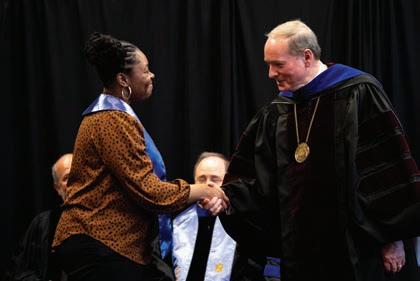
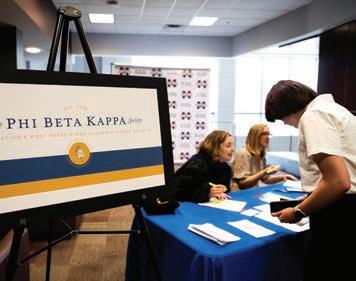
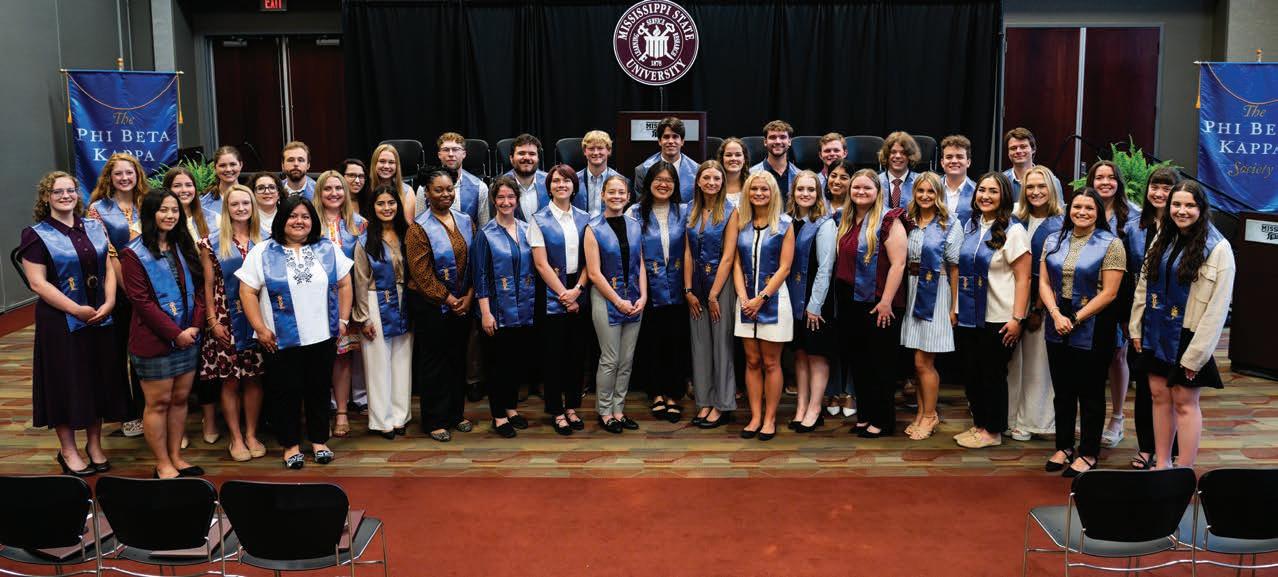
ore than 45 Mississippi State seniors are 2025 inductees into the Gamma of Mississippi Chapter of Phi Beta Kappa, the nation’s most prestigious academic honor society.
Among the top 10% of their graduating class, Phi Beta Kappa inductees have completed a broad range of liberal arts and sciences
coursework, including foreign language and mathematics.
The Phi Beta Kappa Society was founded in 1776. Only 10% of U.S. colleges and universities have PBK chapters. Noteworthy members include 17 U.S. presidents, 42 U.S. Supreme Court justices and more than 150 Nobel laureates.
Caden Andrews
Angela Ayala
Rayana Brown
Maggie Buck
Abby Byrnes
Wendy Campbell
Sydnee Carew
Campbell Carter
Avery Culbertson
Karlene Deng
Emily Dew
Katherine Farm
Rowan Feasel
Alaina Franks
Yesenia Gonzalez
Madelynn Green
Emma Hardy
Sarah Beth Heard
David Heson
Madelyn Horn
Benjamin Kahle
Anamica Khadgi
Kore Larry
Jacob Matkin
Holden Mattison
Carson May
Gillian May
Adeline McKowen
Mackenzie Miller
Emma O'Bryant
Sophie Perrigin
Lauren Perrigo
Joshua Phillips
Jackson Prince
Erin Quinn
Abby Reeves
J.D. Saulters
Anabelle Silvas
Gaia del Sordo
Caroline Stiefvater
Ty Stricklin
Colby Tavares
Anna Valenzuela
Emma Vaughn
Madison Warren
Alexandra Williams
More than 45 Mississippi State seniors are 2025 inductees into the Gamma of Mississippi Chapter of Phi Beta Kappa, the nation’s most prestigious academic honor society. (Photo by Grace Cockrell)
CHAMPIONS OF SERVICE AND SPIRIT
The College of Arts and Sciences Ambassadors (CASA) are more than just student representatives— they are leaders, mentors and passionate advocates for Mississippi State University’s College of Arts and Sciences. Selected for their academic excellence and commitment to service, these outstanding
undergraduate students serve as guides for prospective students, mentors for their peers and champions of the college’s mission and values. Their leadership, dedication and Maroon and White pride set the bar for what it means to be an exemplary A&S student.
A Message from the CASA Staff Advisor
Serving as the staff advisor for CASA is one of the most meaningful parts of my role. I have the opportunity to work alongside an incredible group of students who bring both heart and dedication to everything they do. Their positivity shows up in the way they welcome prospective students, support college events and connect with future Bulldogs. They consistently go above and beyond, and it doesn’t go unnoticed. They make this work fun, they challenge me to be better, and they represent our college with pride. Watching them grow into confident leaders is something I truly value.
CASA is a special group, and I’m thankful every day to be part of it.
Skyler Aldy, Victoria Alip, McKenzie Armstrong, Annie Arnold, Kyle Austin, Molly Baldwin, Mitzi Bass, Hannah Baxter, Grace Belk, Reaghan Boone, Ra'Maya Brown, Gabe Campbell, John
Wesley Cochran, Katlyn Cousins, Nina Gault, Fatima Gonzalez, Norah Hill, Madison Holcomb, Jake Kasitz, Lacy Lockey, Duffy McKenzie, Mary Evelyn McLemore, Austin Meredith, Julianna Medeiros, Luke Mitchell, Mary Virginia Miller, Kate Myers, Kendall Nolan, Michael Odie, Jeremy Padilla, Siddhi Pathak, Ava Poe, Lauren Rounds, Janiya Rutherford, Sarah Swift, Brianna Teer, Luke Turner, Anna Lacy Ward, Anna Wooten, Karley Woods
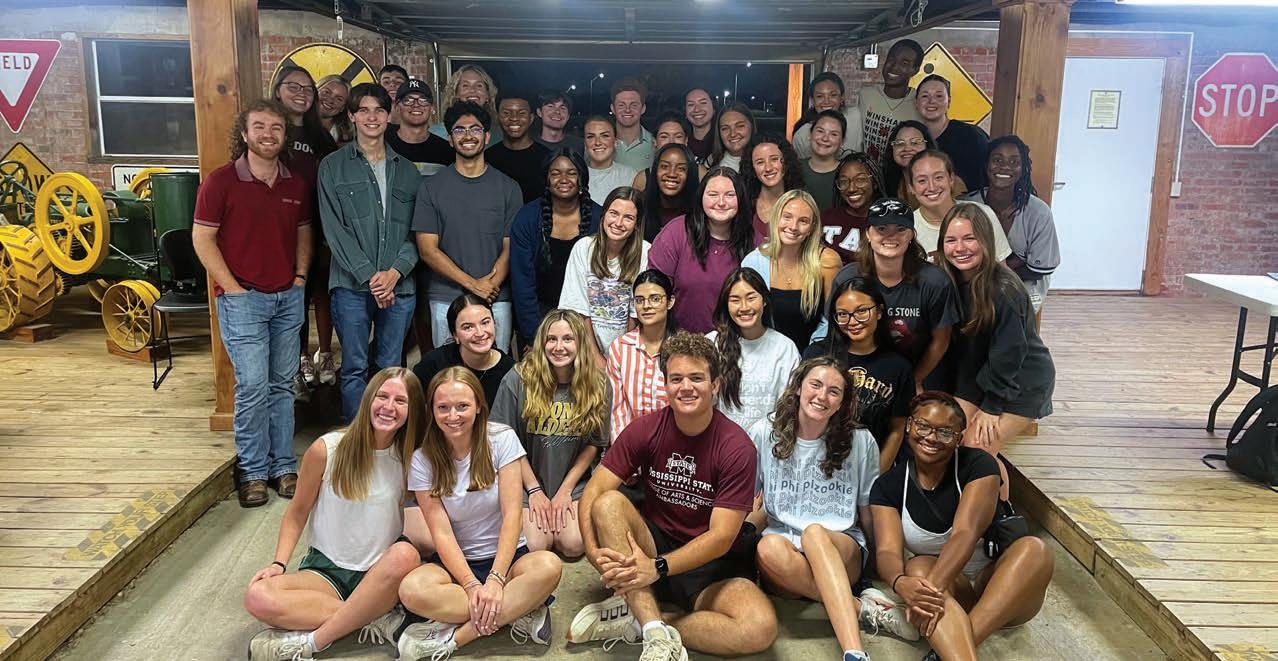
CASA members at their fall retreat at the Bull Barn.
CAPTURING STORIES THROUGH WORDS AND IMAGES
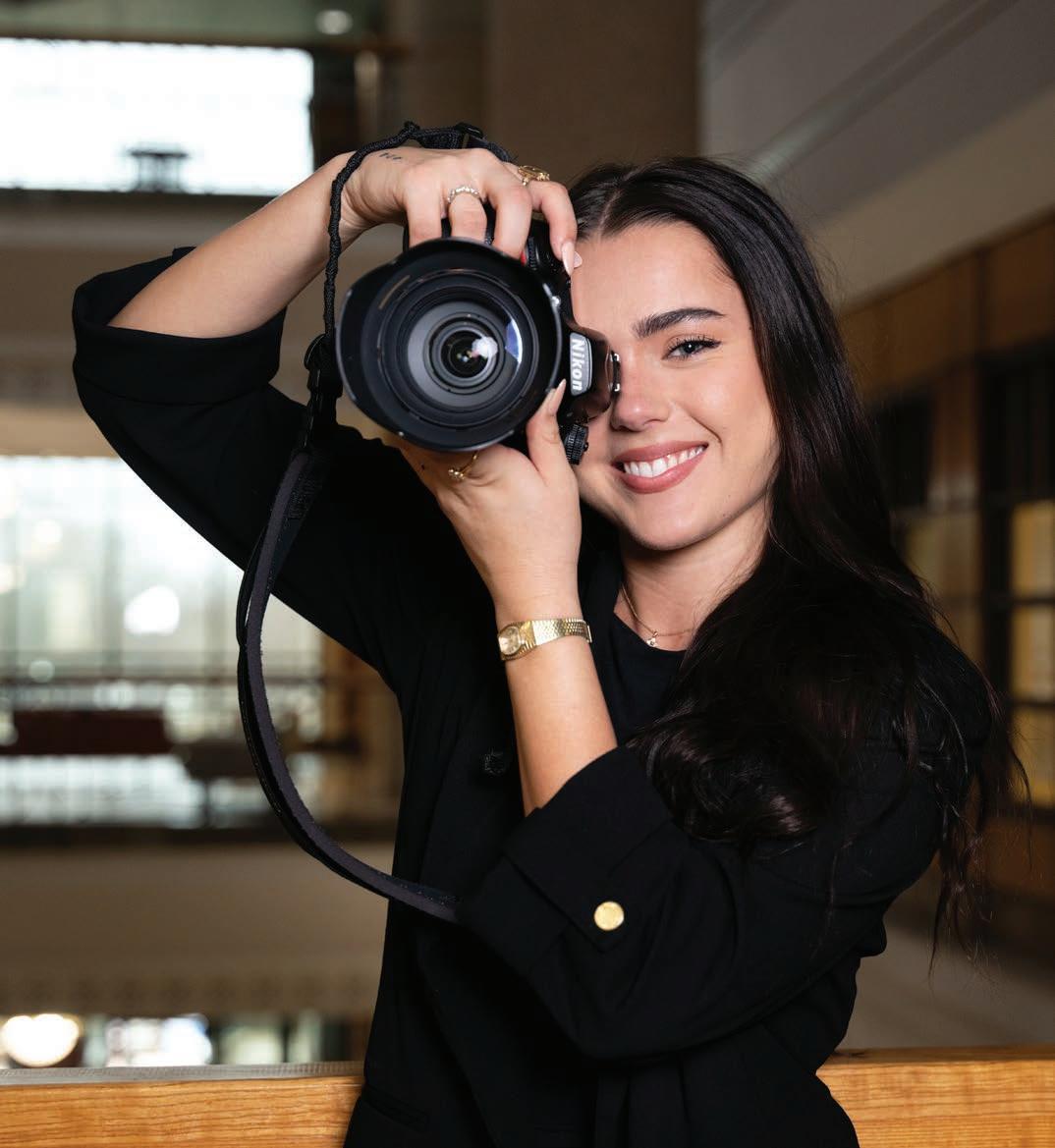
Karley Woods, a communication major with a concentration in print and digital journalism from Florence, Mississippi, is driven by a passion for storytelling through photography, writing and social media. A senior at Mississippi State, she has balanced internships, campus work and academics while building strong interviewing and content creation skills. Woods has already secured a role as a writer and photographer after graduation, with plans to grow into a leadership position in media and storytelling.
Global Adventures Await LOCAL FAMILIES WITH ‘BULLDOG EXPLORERS’
By Kaitlyn Yeatman
“This project is all about sparking curiosity and a love for learning languages and cultures.” ~ KELLY MOSER
Mississippi State’s Bulldog Explorers program is turning a trip to the local library into a world tour for children and families in Starkville—without ever boarding a plane.
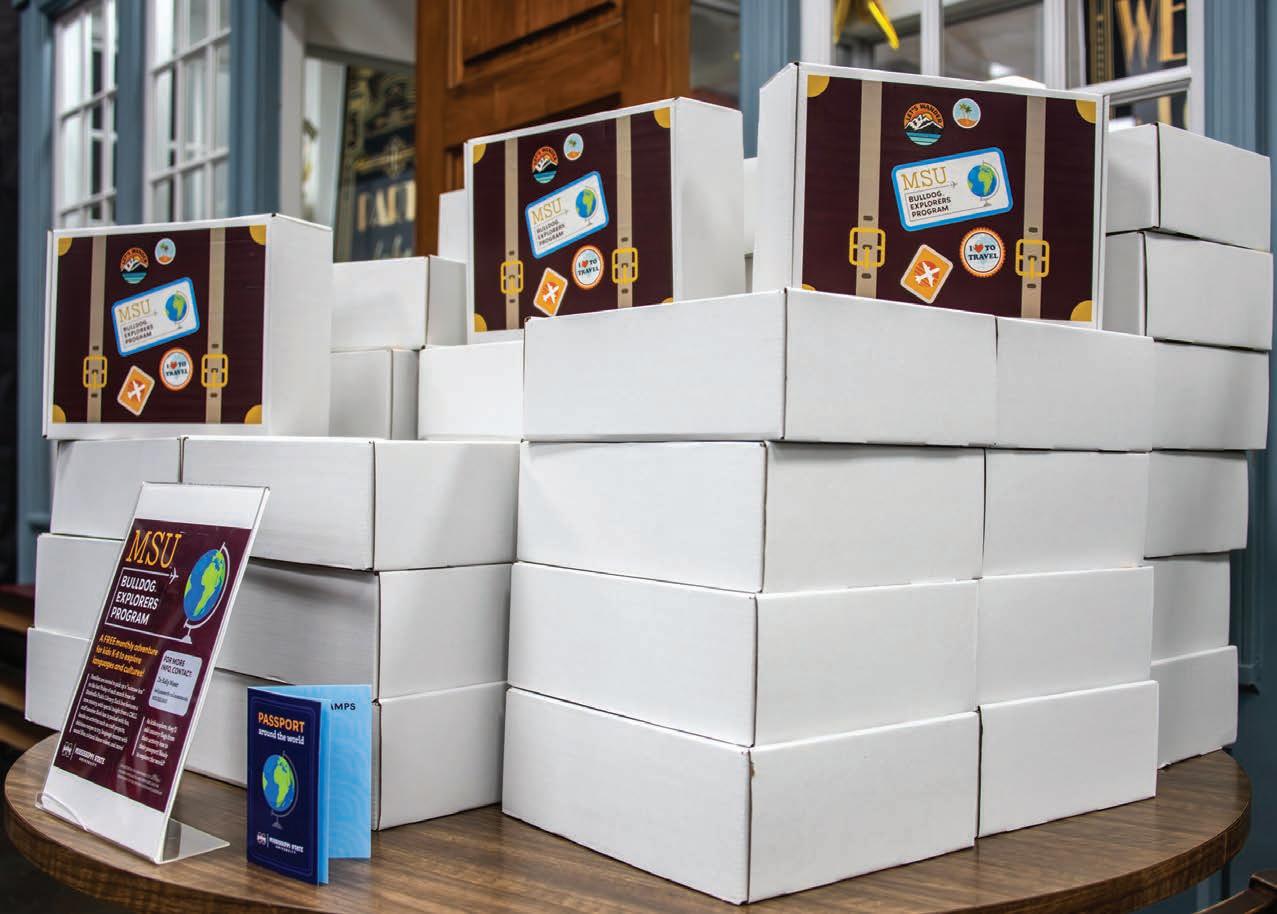
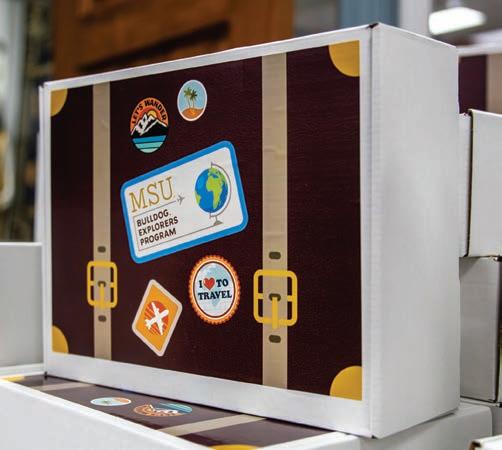
Led by Associate Professor Kelly Moser in MSU’s Department of Classical and Modern Languages and Literatures, this one-of-a-kind program offers a growing collection of activity suitcases filled with interactive lessons about different cultures. Each box includes language exercises, traditional recipes, games and crafts, all designed to make cultural exploration engaging, hands-on and accessible for children of all ages.
“We hope families will enjoy this
journey around the world—one suitcase at a time,” Moser said.
The first suitcase, unveiled in February 2025, focused on the Dominican Republic, allowing children to learn Spanish food vocabulary, make a traditional drink called morir soñando, craft a faceless muñeca sin rostro, and even learn the steps to the popular Dominican bachata. Each subsequent suitcase has highlighted a different country or culture, featuring a CMLL faculty member or graduate student alongside its materials.
“We really wanted to emphasize that people in Starkville come from all over the world. This is something to be incredibly proud of,” Moser said.
The Bulldog Explorers began with a $500 grant provided by the Community Engagement Fellowship but has since received additional support from the Department of Teacher Education and Leadership, or TEAL, in MSU’s College of Education, as well as funding from a College of Arts and Sciences donor, as it continues to grow.
“Bulldog Explorers was a project I designed specifically for my course, Advanced Foreign Language Pedagogy,” Moser said. “However, because the $500 was used so quickly, and because families really seemed to love the suitcases, I needed more money. I reached out to Dr. Kenneth Anthony, the head of TEAL, because I thought that he and
his students would be able to support the project. Their department trains future elementary teachers, so his input has been incredibly valuable. TEAL financially supported the project for the months of March, April and May.”
“Sometimes smaller programs get forgotten about in the funding fray,” said the College of Arts and Sciences donor, who prefers to remain anonymous. “Funding through these types of ‘pay as you go’ gifts are just as critical in my mind as the endowment funding. In a way, they are as important, if not more so, because they expose the next Bulldogs to what MSU can be for them as well as learning about new places.”
Anthony, who teaches social studies education in the elementary education program, sees the project as a way to fill a growing gap in children’s education.
“Elementary teachers spend less than three hours per week on social studies. The lack of consistent social studies programming denies many students opportunities to learn about the world, including the diverse people that inhabit it, each with their unique cultures and perspectives,” Anthony said. “This narrowing of the elementary school curriculum adversely affects students’ understanding of themselves and others, which is even more critical today as global problems require confronting and addressing challenges from multiple lenses.
“I think a great idea can start with limited funding from a small grant.
Then you can convince others, like my department, to support it, and now we have support from other donors,” Anthony said. “I think over time the support will continue to grow.”
The program’s popularity reflects its wide appeal. All the activity boxes are gone each month within hours of their release, and families frequently call in advance to reserve their box.
“My class went to the library on the day we delivered the suitcases for Guatemala. A family came in that day, and their boys were so excited about picking up their suitcases. It was fantastic to see how they opened each suitcase as if it were a Christmas present,” Moser said.
“One positive thing we have learned from feedback so far is that families are engaged in these activities together. They become curious about what they are reading, and they are looking up more information about the topics in each suitcase. So, it is not just about children. Additionally, the librarian has been seeing families that she has not seen before. Kids are checking out books related to the suitcase topics.
“At its heart, Bulldog Explorers is about planting seeds—curiosity, empathy and the joy of learning about others,” Moser said. “If even one suitcase sparks a lifelong interest in another culture or inspires a child to see the world differently, then we’ve done something meaningful. And we’re just getting started.” u
ABOUT KELLY MOSER
Kelly Moser is an associate professor of Spanish and world language teaching in Mississippi State’s Department of Classical and Modern Languages and Literatures. Her research focuses on language teacher development, teacher cognition, and rural education, with particular interest in how educators adapt to evolving classroom environments. Moser has led externally funded initiatives supporting K–12 language teachers and is recognized for her work on teacher preparation, instructional innovation, and improving outcomes in world language education. Moser is a 2025-2026 Grisham Master Teacher.
ABOUT THE AUTHOR
Kaitlyn Yeatman is a December 2025 Mississippi State graduate, holding a bachelor’s degree in communication with a concentration in public relations. The Starkville native worked as a communication intern in the College of Arts and Sciences from January 2025 until her graduation in Fall 2025. She currently works as the tourism assistant at Visit Columbus MS with the Columbus Convention and Visitors Bureau. College of
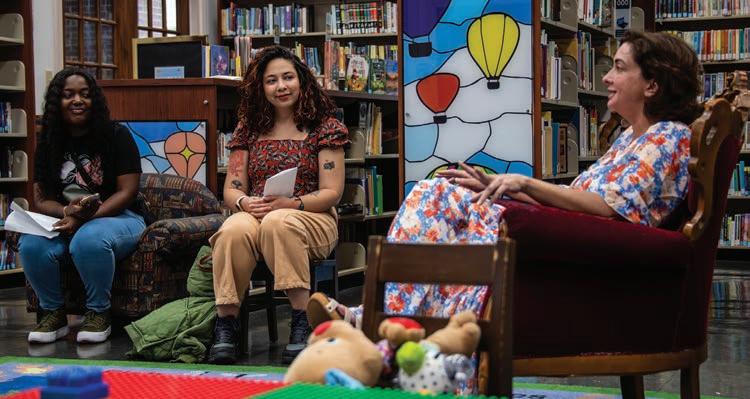
Loraine Walker, the children's librarian at Starkville Public Library, discusses the Bulldog Exporer's Program with participants.
CERTIFIED FOR SUCCESS
How MSU’s College of Arts and Sciences raises the bar for student opportunity
By Sarah Nicholas
Across Mississippi State University’s College of Arts and Sciences, new opportunities are emerging that connect classroom learning with real-world credentials. Through targeted certifications and national accreditations, two units—the Department of Classical and Modern Languages and Literatures as well as the Department of Communication, Media and Theatre—are proving academic rigor and professional readiness go hand in hand.
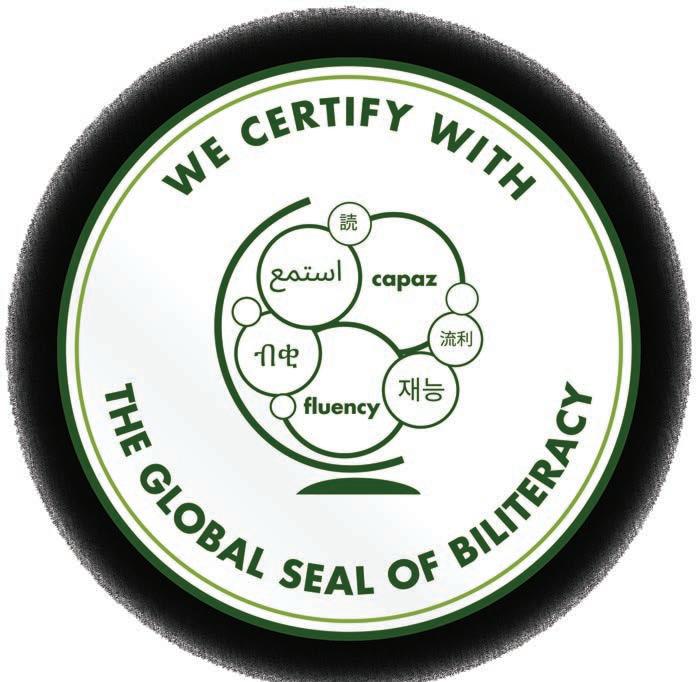
This year, both departments achieved major milestones that directly enhance the value of an MSU degree: CMLL became the first university department in Mississippi to offer the Global Seal of Biliteracy, and CMT received national accreditation from the Accrediting Council on Education in Journalism and Mass Communications, or ACEJMC.
Each achievement reflects a larger commitment to evolving with the needs of students and the demands of the modern workforce.
A Seal That Speaks Volumes
The Global Seal of Biliteracy certifies an individual’s proficiency in English and
at least one other language. Recognized in over 60 countries, it’s a credential that helps students demonstrate their language skills to employers, graduate schools and international organizations.
CMLL now sponsors the certification, offering students a chance to add it to their resumes, regardless of their major.
Robert M. West, professor and head of CMLL said the department works hard to help students translate academic work into real-world value.
“We are sponsoring the Global Seal of Biliteracy to help MSU students see language education as an opportunity for professional development, not merely as a requirement to check off,” he said. “We want to help students attain a meaningful, internationally recognized credential that can help them get good jobs and advance professionally in an increasingly interconnected, multilingual world.
“The seal gives students official, international recognition of their language proficiency,” West continued. “It’s one more way we’re helping our students show the world what they know.”
The certification is offered at three levels—functional, working and
professional fluency—and is earned through an online exam administered through Avant Assessment. Once certified, students receive a document and unique serial number they can proudly display on LinkedIn or include in application materials.
Amie Russell, instructor and undergraduate coordinator in CMLL, sees the seal as more than a credential—it’s an invitation.
“This partnership will help any MSU student, not just language majors, gain a distinguishing credential,” Russell said. “We also hope it brings students into our department to explore how language and cultural knowledge can enhance their lives both personally and professionally.”
National Accreditation, National Advantage
Meanwhile, the Department of Communication, Media and Theatre is celebrating a distinction placing it among an elite group of programs nationwide. After a multiyear review process including a comprehensive self-study and site visit, the department earned national accreditation from ACEJMC, becoming
one of only 120 programs in the U.S. to hold the credential.
This marks a major step forward for undergraduate programs in broadcast, print and digital journalism, and public relations—and a huge win for students.
According to Department Head Terrence D. “Terry” Likes, accreditation means students benefit from a modern, relevant curriculum that aligns with professional expectations, preparing them for a competitive job market with confidence.
“ACEJMC accreditation is a mark of excellence that signifies our program meets high academic standards,” Likes said. “Accredited programs enjoy an enhanced reputation benefiting their institutions, graduates and communities.”
Likes said accredited programs offer a challenging curriculum, scholarships, internships, competitive prizes—such as competing in the national Hearst Journalism Competition—and other activities often unavailable in nonaccredited programs.
“Parents want to know their students will have an educational experience of high quality that will help prepare them for a career. Accredited programs in journalism
and mass communication offer the assurance that they have been evaluated by academic peers and leading practitioners,” Likes said. “Employers seeking to hire entry-level candidates know accredited programs prepare students with a solid professional education and a firm grounding in the liberal arts and sciences.
“Ultimately, it’s about ensuring our graduates are ready for what comes next,” he continued, “and it shows prospective students and employers we take that responsibility seriously.”
Innovation in Every Discipline
Though the certifications come from different accrediting bodies and serve distinct academic disciplines, both reflect the same guiding principle: giving students the best tools possible to succeed beyond the classroom.
“These advancements are part of a broader movement within the College of Arts and Sciences to continuously evolve,” said CAS Dean Rick Travis. “We’re always asking, ‘How can we add value to a Mississippi State degree?’ These two departments offer powerful answers.” u
To register for the Global Seal of Biliteracy, scan QR code and visit:
ROBERT WEST is professor and head of Mississippi State’s Department of Classical and Modern Languages and Literatures. A specialist in American and British literature after 1900, his work spans scholarship, editing, and creative writing. West has played a key leadership role in the university’s Phi Beta Kappa chapter and previously served in honors college leadership. His teaching and research focus on world literature, poetry, and advancing humanities education. West recently stepped into the role of interim associate dean for academic affairs in the dean's office.
AMIE RUSSELL is an instructor of Spanish and associate department head in Mississippi State’s Department of Classical and Modern Languages and Literatures. She also serves as undergraduate coordinator, overseeing advising and curriculum for language majors. Her teaching focuses on Spanish language and culture as well as TESOL, with experience in both in-person and online instruction. Russell is dedicated to student success through advising, mentorship, and innovative approaches to world language education.
The heart behind the numbers AN EQUATION FOR SUCCESS
By Karley Woods
At Mississippi State, where formulas and figures fill the syllabus, Instructor II Kim Walters brings something less measurable, but just as essential, to her mathematics classroom: confidence.
“I began teaching because I enjoy helping people learn,” Walters said. “I enjoy teaching them about something that I like and helping them be successful and confident.”
A faculty member in the Department of Mathematics and Statistics for more than 30 years, Walters has taught thousands of students—many of whom started off afraid of math but left her class with a sense of pride.
“Most of my students are not big fans of math, so I get to try to find ways to make it interesting and maybe even entertaining for them,” she said.
Her effort shows. Walters is known for her ability to connect with students and adapt her teaching to meet their needs—qualities that earned her the 2013 MSU Grisham Master Teacher Award and the 2023 College of Arts and Sciences’ Robert Wolverton Legacy Award.
One of her favorite teaching moments happened during a summer business calculus class. “I was explaining something and a student looked at me and said, ‘This is what we talked about in economics and now it all makes sense,’” Walters said.
“The goal is for students to see where math can be used in their world.”
~KIM WALTERS
To her, the satisfaction isn’t just in seeing students understand—it’s watching them apply that knowledge in real-time. Whether it’s a nod, a smile or a quiet fist pump, Walters said these are the moments that fuel her love for the job.
She also credits students with shaping her into the teacher she is today.
“I have learned patience with both students and myself,” she said. “I have learned that I can teach the same course semester after semester, but every time it is different because the students are different. They are what make each semester and each course unique and special.”
That openness to change has led her to reimagine what a college math course can look like. A few years ago, she was asked to design an alternate pathway for students who either didn’t need college algebra or didn’t want to take it.
“At the time, I truly believed that everyone should take algebra,” she said. “But as I designed this course and as I teach this course, I have been reminded that there is a lot of math besides algebra that students use.”
The result was Math in Your World, a course grounded in practical applications, with an emphasis on accessibility and real-life relevance. Walters developed it to help students build mathematical confidence while engaging in meaningful work beyond the classroom. Each semester, students partner with local organizations to
gather and analyze real data. They conduct surveys at community events, asking questions about financial need, volunteer experience and accessibility. The students then create tables, graphs and presentations to deliver insights that can inform future community programs.
“One of the topics covered in this course is data collection and displays, so the students get a chance to practice creating tables and graphs using real data. Then they have a chance to create a presentation to share with someone who will actually use the information they have collected,” Walters said.
She recalled one student who wanted to open an art shop and, through the class project, realized how surveys could help identify customer preferences and popular designs.
“The name of this course is Math in Your World, so the real goal of this and all of my projects is for my students to see where math can be used in their world,” she said.
Her courses also include intentional strategies to ease math anxiety. From
writing math autobiographies to creating opportunities for students to connect with one another, Walters believes that confidence in math starts with feeling seen and supported. “In Math in Your World, I intentionally do not do math on the first day. We just talk. We talk about the course and how to be successful in the course. I have them introduce themselves to at least one other person.”
When she’s not teaching or prepping lessons, she finds joy in running, hiking with her husband and photographing waterfalls. Conferences with other math educators offer another kind of professional inspiration.
“I enjoy attending conferences where I can connect with other teachers from across the country. It is a different recharge time.”
But personally, the real reward is simple. “I am proud when I run into a student and they remember me and make an effort to let me know that I was their teacher. It might be the next semester or it might be years later.” u
KIM WALTERS is an instructor of mathematics in Mississippi State’s Department of Mathematics and Statistics, where she has taught for more than 25 years. Her courses include college algebra, business calculus, and quantitative reasoning, with a focus on helping students build confidence and succeed in math. Walters is widely recognized for excellence in teaching, earning multiple university awards, and is known for her commitment to student success and real-world application of mathematical concepts.
ABOUT THE AUTHOR
Karley Woods of Florence, Mississippi, is pursuing a degree in communication with an emphasis on print and digital journalism. She is on track to graduate in May 2026 and hopes to use her skills behind the camera to capture stories for a publication or to serve a greater purpose by sharing the stories of others through photography. Woods also has a passion for marketing and social media, and she views the digital world as another path to combine creativity with communication.
OLD WEAPONS, NEW INSIGHTS MSU joins elite defense network, helps redefine global security
By Sarah Nicholas
Mississippi State Associate Professor of Political Science
Benjamin Tkach said people often tend to think of military strength in terms of stealth jets and billion-dollar tech, but the reality of how most of the world arms itself is quite different.
“The global security regime is underpinned by value arms,” Tkach explained.
That premise drives a major MSU research project he is leading, Engaging in Strategic Competition in the Value Arms Market: Enhancing U.S. Defense Industrial Engagement with Allies and Partners. It was recently funded by one of only seven inaugural grants awarded by the Defense Security Cooperation University, a training institution of the Defense Security Cooperation Agency. The nearly $400,000 grant supports research into R2D2 arms—refurbished, reused, dated or discounted weapons systems—which make up a vast, often overlooked portion of the global arms trade.
Tkach developed the R2D2 concept after reviewing decades of Russian equipment sales.
“Like the plucky droid from Star Wars, value arms capabilities may not be
the newest or highest end, but that does not determine their effectiveness,” he said.
The project is in partnership with Vasabjit Banerjee, a former MSU faculty member now at the University of Tennessee, Knoxville.
“Value arms can be either new or old, but their defining trait is that they are not at the cutting edge of technology,” Tkach said. “These are the weapons used
“Most states rely on value arms to equip parts or all of their military, yet these systems remain largely understudied.”
~ BENJAMIN TKACH
by most of the world, yet they remain understudied. Current research often focuses on high-cost, advanced systems, but from Ukraine to ongoing conflicts globally, our study addresses significant gaps in understanding military supply ecosystems.”
Understanding the value arms market
The value arms market, or VAM, is dominated by countries like Russia and increasingly China. These nations export stockpiled or domestically produced systems at lower cost, appealing to developing countries or nations with constrained defense budgets.
“Most states rely on VAM to equip parts or all of their military,” said Tkach, whose team is building datasets to track production capacity, stockpiles and transfer patterns globally, analyzing how VAM affects conflicts and how the U.S. can strengthen partnerships and counter adversaries.
Russia’s invasion of Ukraine highlighted VAM in contemporary conflicts. Despite being a top-five defense spender and the first to deploy a hypersonic missile in combat, Russia has relied heavily on refurbished tanks, trucks and armored personnel carriers, some originally taken out of service in the 1960s.
“The use of a hypersonic missile to demonstrate capability does not reflect the reality that both sides rely extensively on VAM equipment,” Tkach said.
Tkach cited U.S. strikes against Iran in July 2025 as another example. Israel initially used American-made F-35s to target air defenses, then deployed fighters, missiles and drones, many within the VAM ecosystem.
“VAM is not synonymous with cheap or ineffective,” he said. “It’s like the used car lot—lots of fully capable vehicles that accomplish their goal, so long as the goal aligns with the capability.”
Building knowledge, shaping policy
Beyond data collection, the project provides hands-on training for college students. Through hybrid MSU seminars with peers from the University of Tennessee joining virtually, students gain experience in coding, translation and
research practices. Once coding reliability checks are complete, they are fully integrated into the research process.
“We have research teams at both universities and research support from DSCU. This project puts MSU students front and center as they develop technical knowledge and research skills to excel in our changing environment,” Tkach said.
For many, the VAM project is their first deep dive into structured research. Levi Davis, a Spring 2025 political science graduate from Lake Cormorant, said she came in with little experience in coding or defense studies but has learned quickly. One of her primary responsibilities was comparing student data for consistency across sources—a process that gave her a strong appreciation for the role of checks and
balances in producing credible research.
“This job has significantly expanded my skills in both research and coding,” she said.
Freshman business administration major Keller Brown from Dahlonega, Georgia, said the work has been both challenging and rewarding. As a transfer student, Brown said he initially felt overwhelmed by the amount of information to sift through but soon grew more confident in identifying variables and tracking updates to military systems.
“When I first began, I was a bit lost in the sea of information,” Brown said, “but as time went on, I got more comfortable searching for the proper variables and clues.”
He said the project not only strengthened his research skills but also
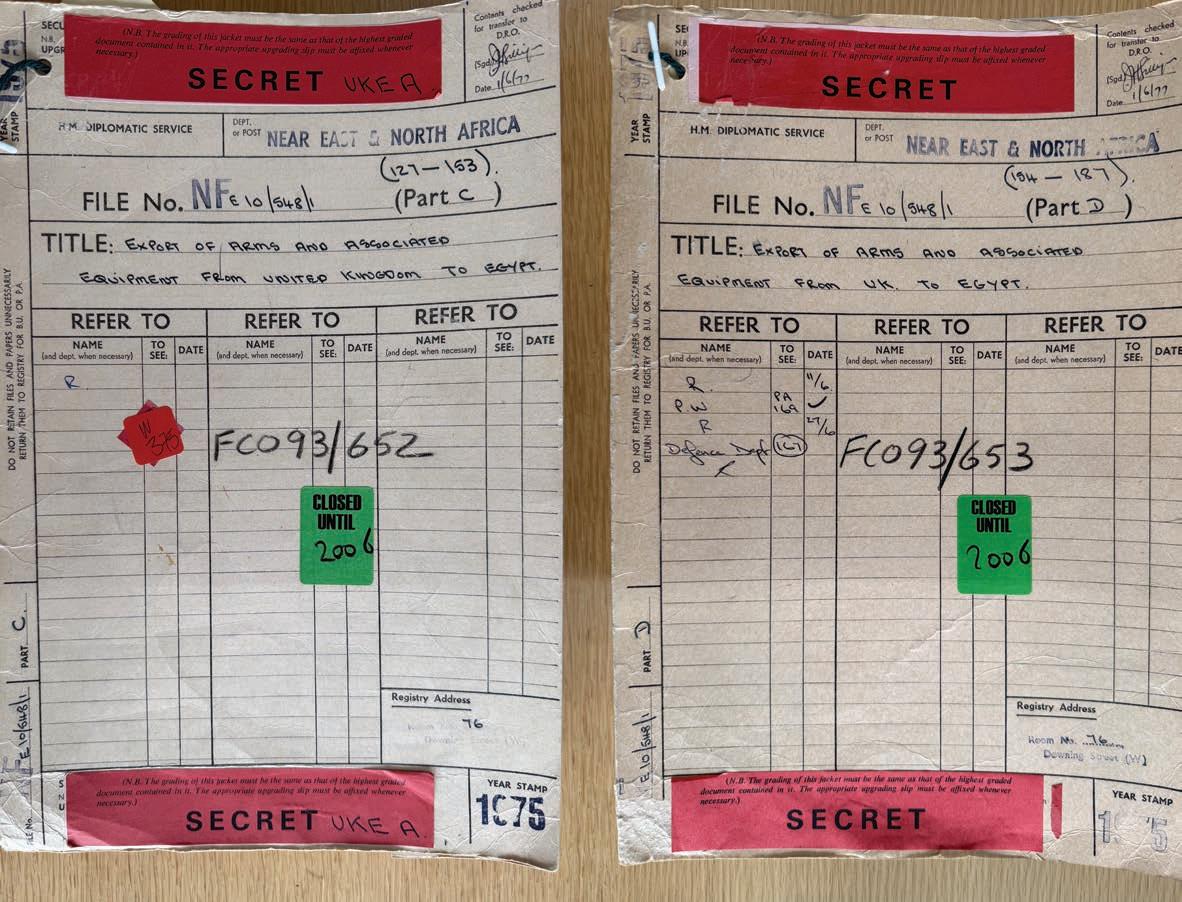
Front of previously classified file folders documenting U.K. arms sales to Egypt in the 1970s at the National Archives at Kew, U.K., which houses records spanning the past 1,000 years.
helped him feel more connected to MSU and its faculty. Today, Brown said, he is confident in his skills developing a web-scraping tool using Python web development.
For Jeremy Padilla, a junior political science major from Bay Springs, the work is meticulous but meaningful. His weekly tasks often involve coding dozens of cases from a single country, grappling with language barriers or obscure records along the way. Padilla likened it to detective work that sharpened his attention to detail.
“Initially, coding was very tough,” he said, “but once you get going, it becomes a pretty standard process— until you get a very obscure case that throws you off.”
With time, he grew to enjoy the challenge, noting the skills he has developed are ones he hopes to carry into future projects and professional opportunities.
Lindsey Tyson, a Smithville native and graduate student in MSU’s Department of Sociology, said her work with the VAM project offered her a chance to build critical research experience while still an undergraduate. She explained classifying weapons through the R2D2 framework taught her how to “operationalize four terms—refurbished, resold, discounted, dated—as they apply to coding military arms by using databases.”
Tyson said the project not only strengthened her academic toolkit but also positioned her as a stronger candidate for graduate research.
Students also develop countryspecific expertise, producing profiles on nations from Russia and India to Nigeria and Peru. Along the way, they explore AI applications, using programs like ChatGPT to process archival images and organize complex datasets.
“The project offers a unique introduction to AI-powered research methods within the social sciences,” Tkach said.
Beyond campus, Tkach examined records at London’s National Archives at Kew to study the U.K.’s role in VAM.
“By evaluating transaction-specific debates and how states were assessed for arms sales, we’re beginning to reconstruct the network relations central to VAM,” he explained.
As MSU joins the ranks of prestigious universities advancing U.S. security cooperation strategy, Tkach emphasized the project’s dual impact.
“We are adding security cooperation research to Mississippi’s prominent role in U.S. national security,” he said. “This grant places MSU at the forefront of security cooperation research and, just as critically, workforce development as we train the next generation of Bulldogs to shape and implement U.S. national security policy.” u
Initially, coding was very tough,” he said, “but once you get going, it becomes a pretty standard process—until you get a very obscure case that throws you off.”
~ JEREMY PADILLA
ABOUT THE DSCU’S YOUNG INSTITUTE
The Defense Security Cooperation University’s Young Institute oversees this sponsored research, ensuring it delivers practical, policy-relevant insights for global practitioners. Dedicated to advancing highquality research on security cooperation, the institute funds projects that directly inform both strategy and practice.
TKACH is an associate professor of political science in Mississippi State’s Department of Political Science and Public Administration. He teaches international relations, with research focusing on government decentralization, security privatization, and the role of nonstate actors in conflict. Tkach has collaborated with national and international agencies and earned multiple teaching awards, reflecting his commitment to both scholarship and student success in the study of global politics.
BENJAMIN
Jeremy Padilla, a junior political science major at MSU, works closely on research projects with Tkach.
SUCCESS STARTS HERE Creating a culture of writing excellence
By Josephine Hanegan
Although writing is often seen as a daunting challenge for both students and faculty, many resources are available at Mississippi State to alleviate these worries and anxieties, empowering students to approach writing with confidence and success.
“We do not meet writers with expectations or judgments, meaning writers can just be themselves and express themselves freely. At the end of the day, we are all just people who are doing our best, and that’s where we want to meet them,” said Loreeda Rios, director of the Mississippi State Writing Center and instructor in the Department of English. “We see [our clients] as people, and we understand their concerns.”
Rios leads the Writing Center alongside Assistant Directors Karen Schmidt and Greg Marcus, both English department instructors. Open to the entire university community—including students, faculty and staff—the center most often serves students through a team of peer tutors which includes undergraduates, English graduate students, instructors and lecturers.
Rios said, “Our team does a great job of relating to students—either because they currently are students themselves or they have been in their shoes. While many of our consultants are English majors, we also have had consultants with backgrounds in finance, psychology, communication, computer science, political science, philosophy and more.”
“We do not meet writers with expectations or judgments. We see them as people, and we understand their concerns.”
~ LOREEDA RIOS
Rios notes shifts in writing habits over the years, which range from the writing process to the use of artificial intelligence.
“A lot of students will go straight to their laptop and jump into their paper, which sometimes can lead to writer’s block and a sense of being overwhelmed,” she said. “To help with this, I’ve seen many consultants utilize our dry-erase boards to brainstorm ideas with students and make connections in different colors so they can create a basic outline for their assignment and build their paper in a productive way.
“AI tools can be helpful, but they can’t replace an individual’s voice,” Rios continued. “With regard to the Writing Center, AI can’t replace someone who offers a tissue when you’re upset, offer a smile of encouragement when you’re making a good choice for your thesis statement or give you a high-five after you make an A on a paper you’ve been working on for three weeks. AI has its place, but it can’t replace an important piece of a student’s development as a
writer and the support a writer receives in a writing center.”
Rios acknowledges going to the Writing Center sometimes can be a fearful endeavor.
“Low-stakes, writingto-learn activities strengthen students’ writing while helping with retention of course content.”
~ LATOYA BOGARD
“It’s understandable to feel anxious or intimidated about going to a new place to discuss your work with someone you
don’t know. However, we have a great team waiting to work with you without the pressure of judgment or grading,” she said. “We’re just here to have a productive conversation and to help however we can. Our staff will go at a pace that works for you and will focus on your concerns and goals.”
While the Writing Center is an invaluable tool for the entire university community, other helpers, including MSU writing coordinators, offer writing support and guidance specifically for faculty and staff across the university.
MSU Writing Coordinator LaToya Bogard said she and Ashley Leonard, both instructors in the Department of English, work to “ensure faculty members who might not otherwise implement writing in their classrooms consider the value.”
For instructors who feel they lack the time or expertise to teach writing, Bogard said she introduces “low-stakes, writing-to-learn activities that strengthen students’ writing while helping with retention of course content.” Ultimately,
Bogard said she hopes more faculty will “buy into seeing writing as more than a skill that is covered in the English department’s writing program.”
Although based in the department, Bogard and Leonard extend their roles as writing coordinators across the university, supporting faculty in all disciplines and ultimately enhancing student success.
“I assist faculty members with creating or revising assignments, rubrics and syllabi that incorporate elements of writing to make course content more accessible for students’ retention,” Bogard said. “As a writing coordinator, a common challenge I see is students sometimes do not do well on writing assignments because the assignments or rubrics are not clear. It is my job to assist faculty in making those documents clearer, so students understand requirements and hopefully perform better.”
The MSU Writing Center and the university’s writing coordinators ensure writers across campus—whether students, staff or faculty—have the tools and support they need to thrive. u
ABOUT THE AUTHOR
Josephine Hanegan is a graduate student in the Department of English at Mississippi State University. A native of Meridian, she received bachelor's degrees in anthropology and English at Louisiana State University before returning to Mississippi to continue her education. Working as a graduate teaching assistant for the Department of English, she is both a composition instructor and consultant at the MSU Writing Center. After graduation she hopes to pursue a Ph.D. and continue teaching at the collegiate level.
THE WRITING CENTER AT MSU
Free writing support for all MSU faculty, specifically for technical material but available for all faculty questions.
MSU WRITING COORDINATORS
• LATOYA BOGARD: Instructor II, Department of English, Writing Coordinator, Lee Hall 2507, Ldw3@msstate.edu
• ASHLEY LEONARD: Instructor II, Department of English, Writing Coordinator, Lee Hall 2513, Anb9@english.msstate.edu
WRITING CENTER AT MSU
Free writing support for all MSU students, faculty, and staff for personal, professional, academic or other writing.
WHAT WE OFFER:
• 30- and 60-minute consultations
• Walk-in appointments available
• Support for class assignments, resumes, cover letters, scholarship essays, CVs and more
• Help at any stage of the writing process—brainstorming, developing, revising
HOW WE HELP:
• Develop and support ideas for class and professional writing
• Summarize and synthesize research
• Understand discipline-specific writing conventions and style guides
• Address audiences effectively
Note: The Writing Center is not an editing service. Instead, consultants help writers create a plan to continue improving after the session.
LOCATION:
• Main office: Room 2335, second floor, Mitchell Memorial Library
• Library location provides access to research librarians and resources
ONLINE SUPPORT:
• Join online sessions through the Writing Center scheduler
• Access tutorials, handouts, and troubleshooting guides on the website
• Attend appointments from anywhere with a computer and internet
DAYTIME HOURS (FALL & SPRING):
• Monday–Thursday: 10 a.m.-4 p.m.
• Friday: 10 a.m.-1 p.m.
EVENING HOURS (FALL & SPRING):
• Sunday–Thursday: 6-9 p.m.
MORE INFO?
Email: writingcenter@msstate.edu
Visit: http://www.writingcenter.msstate.edu
MSU’S GOLIATH BRIDGES SCIENCE AND JUSTICE, leads forensic anthropology in Mississippi
By Sarah Nicholas
In the high-stakes world of criminal investigations, law enforcement officers face the difficult task of locating or recovering human remains. At Mississippi State, Assistant Professor Jesse Goliath stands at the forefront of this work, applying his expertise in forensic anthropology to help solve some of the state’s most challenging cases, while training the next generation of specialists.
Goliath is a fellow of the American Academy of Forensic Sciences and a faculty member in MSU’s Department of Anthropology and Middle Eastern Cultures. He has spent years working alongside law enforcement agencies across the Magnolia State and beyond. Through MSU’s Forensic Recovery Unit, he and his team provide vital support in missing persons investigations, clandestine burial assessments and cold case recoveries. Goliath’s work is transforming the intersection of science and public service, offering answers in cases where families and communities have long waited for resolution.
Forensic anthropology is the study of
human skeletal remains, with applications that reach far beyond the lab.
“We provide law enforcement with specialized expertise in the search, recovery and analysis of human remains,” Goliath explained. “This includes distinguishing human bones from animal bones, analyzing trauma and interpreting
“We are training students for vitally important jobs in the state.”
~ JESSE GOLIATH
outdoor crime scenes where remains may be scattered, buried or severely decomposed.”
The unit’s work is often meticulous, requiring both patience and advanced technology. Tools such as groundpenetrating radar, or GPR, which sends electromagnetic pulses into the ground to detect soil disruptions, allow investigators to identify possible gravesites without
immediate excavation. Other methods, including soil probes and stratigraphy analysis, help confirm whether a site merits further investigation.
“Our goal is to provide an objective, methodical evaluation that can either identify or rule out the presence of human remains,” Goliath said. “Both outcomes are valuable—finding a burial provides critical evidence, but ruling out a site can help law enforcement narrow their search.”
Cold cases present unique challenges for forensic anthropologists. Through the years, environmental factors such as soil acidity, temperature, flooding and animal activity can move or degrade remains. Bones may be incomplete or heavily weathered, complicating efforts to estimate biological profiles—age-atdeath, biological sex, population affinity and height—or determine trauma.
“Each case requires careful contextual reconstruction,” Goliath said. “We may only recover partial remains, but every piece contributes to the larger picture of what happened.”
Despite these challenges, the team approaches their work with determination and compassion.
“We’re always aware that our findings impact families, communities and the larger pursuit of justice,” Goliath said. “Balancing scientific objectivity with the human side of the work is what motivates us, even when conditions are difficult or cases remain unresolved for years.”
Collaboration is central to Goliath’s work. MSU’s Forensic Recovery Unit is a partnership between the Department of Anthropology and Middle Eastern Cultures and the MSU Police Department, drawing on the expertise of both academic researchers and law enforcement professionals. The team regularly works with local sheriffs’ offices, the Mississippi Bureau of Investigation, the FBI, and even the Bureau of Indian Affairs Missing and Murdered Unit.
Last spring, MSU President Mark E. Keenum formalized the university’s commitment by signing a Memorandum of Agreement with the Mississippi Department of Public
Safety, strengthening the partnership to assist with recovery and identification of remains. Already, the agreement has yielded results, with MSU teams assisting in multiple cases across the state.
Goliath founded and directs the Mississippi Repository for Missing and Unidentified Persons, a searchable database at missinginms.msstate.edu designed to support law enforcement and the public in locating missing individuals.
At MSU, forensic anthropology is not just about research and service— it’s also about education. Fieldwork is a core component of the program, giving students practical experience in survey and excavation. Undergraduate and graduate students are required to participate in field schools, where they practice hands-on recovery techniques under professional supervision.
“We emphasize applied learning,” Goliath said. “When our students step into the field, they’re prepared for realworld investigations. We are training students for vitally important jobs in the state.”
JESSE R. GOLIATH is an assistant professor of biological anthropology at Mississippi State University.
A skeletal biologist and forensic anthropologist, his research explores how bone structure develops and responds to mechanical stress and environmental factors across the human lifespan. His work integrates skeletal biology, bioarchaeology, and forensic science, with an emphasis on bone histology and age estimation. Goliath has conducted fieldwork internationally and contributed to forensic investigations. He earned his bachelor’s degree from the University of Notre Dame and his master’s and doctoral degrees from The Ohio State University.
Beyond solving cases, Goliath believes forensic anthropology plays an important role in building public trust.
“We bring a unique skillset that contributes to transparency and accountability,” he said. By providing independent, science-based assessments, his team ensures investigations are “thorough and credible, offering families confidence that every possible lead is being pursued.”
“MSU is the state’s flagship university, promoting research, public engagement and community service. Mississippi State is one of the only universities that has both the law enforcement expertise and the forensic anthropology training to make this work,” Goliath continued. “That combination allows us to serve the state in ways that are both practical and impactful.”
Through every search, recovery and training session, Goliath and his team demonstrate how science can bridge truth, resolution and hope—helping families find answers and ensuring justice is served. u
AT THE HELM
2025 NEW FACULTY HIRES
Mississippi State University welcomed new faculty members in 2025, including new department heads and faculty across various disciplines.
New Department Heads
Christian Wolf, professor and head, Department of Mathematics and Statistics
New Faculty Members
AMEC
Allison Stuewe, assistant professor
Biological Sciences
Phillip Davidson, assistant professor
Benjamin Stone, assistant professor
Chemistry
Rajat Maji, assistant professor
Classical and Modern Languages and Literatures (CMLL)
Jingyi Guo, assistant professor
Communication, Media and Theatre
Zahedur Arman, assistant professor
Kristen Cockrell-Barnett, Instructor I
Heather Gholson, Instructor I
Martin Lang, assistant professor
Rubaiya Zannat, Instructor I
English
John Burnside, Instructor I
Craig Gentry, Instructor I
Brett Hanley, Instructor I
Shertok Lama, assistant professor
Geosciences
Andrew Birkey, assistant professor
Mei Yang, assistant professor
2025 FACULTY PROMOTIONS
Mississippi State University congratulates faculty members across various departments who have earned promotions in recognition of their excellence in teaching, research and service.
Anthropology and Middle Eastern Cultures
Shawn Lambert, associate professor with tenure
Biological Sciences
Ryan Folk, associate professor with tenure
Chemistry
Sidney Creutz, associate professor with tenure
Whitnee Nettles, associate clinical professor
Communication
Terri Hernandez, associate professor with tenure
Christopher Misun, Instructor II
Joshua Foreman, Instructor II
Classical and Modern Languages and Literatures
Cody Fondren, Instructor II
English
Theodore Atkinson III, professor and director
Loreeda Rios, Instructor II
Dhanashree Thorat, associate professor with tenure
Geosciences
Padmanava Dash, professor
Christa Haney, associate teaching professor
Sarah Lalk, associate teaching professor
Qingmin Meng, professor
History
Elizabeth O’Neil, assistant professor
Philosophy / Religion
John Dyck, assistant professor
Giorgi Lebanidze, assistant teaching professor
Seth Waite, instructor
Danielle Wylie, assistant teaching professor (also Honors)
Physics and Astronomy
Yukai Ai, visiting assistant professor
Sarah Nagel, assistant teaching professor
Political Science and Public Administration (PSPA)
Aaron Hitefield, assistant professor
Psychology
Samuel Murphy, assistant professor
Sociology
Jenna DePasquale, assistant teaching professor
History
Joseph Thompson, associate professor with tenure
Mathematics and Statistics
Amanda Diegel, associate professor with tenure
Vaidyanathan Sivaraman, associate professor with tenure
Jennifer Beckman, Instructor II
Matthew Kilpatrick, Instructor II
Amber Robinson, Instructor II
Jaclyn Smith, Instructor II
Danielle Young, Instructor II
Philosophy and Religion
Anthony Neal, professor
Physics and Astronomy
Angelle Tanner, professor
Psychology
Mary Dozier, associate professor with tenure
FINDING HOME in Language
For Lourdes Cardozo Gaibisso, “home” is not a fixed place—it’s something people create.
“I believe el lugar lo hace uno—‘the place is made by the person,’” she said. “I try to foster a sense of belonging for students who are far from home by creating a welcoming environment where they feel valued and respected.”
An assistant professor of TESOL and linguistics in Mississippi State’s Department of English, Cardozo Gaibisso draws from her own experience adapting to a new culture and language. Raised in Montevideo, Uruguay, she learned English as a child through television and reading, sparking a lifelong interest in language learning that led to a career teaching English to speakers of other languages.
Early on, she felt the pressure many secondlanguage speakers face to sound “perfect.” Over time, she embraced her accent as part of her identity—an approach she now encourages in her students.
“Everyone has an accent,” she said. “It doesn’t define your abilities. It’s simply part of who you are.”
That perspective shapes her classroom at MSU, where she invites students to bring their cultural backgrounds and experiences into their learning. She teaches both undergraduate students and practicing educators pursuing TESOL certification, with a focus on helping them build confidence and community.
Her own academic path reflects that same sense of purpose. After earning degrees in Uruguay, a teacher exchange program in Virginia inspired her to pursue doctoral study in the United States. She arrived at the University of Georgia in 2014 as a Fulbright scholar and joined MSU’s faculty in 2021.
Cardozo Gaibisso’s work extends beyond the classroom. She leads SEMBRAR, a bilingual research and advocacy initiative focused on rural communities, and recently launched BRIDGE TESOL, an international partnership between MSU and Universidad ORT Uruguay that supports English teachers abroad. Her career also includes work with the World Bank and UNESCO on teacher development and curriculum design.
While her accomplishments have earned national and university recognition, she measures success through her students.
“I am most proud of my students’ achievements,” she said. “Seeing them succeed reminds me of the importance of our roles as professors and mentors.” u
TABLE TALK Virtual cadavers bring anatomy to life at MSU
By Sarah Nicholas
Thanks to the recent installation of Anatomage Tables in Mississippi State’s Department of Biological Sciences, students in anatomy and physiology courses now have access to one of the most advanced 3D anatomy tools available.
These full-body, interactive digital cadavers are transforming the way students engage with the human body.
“The Anatomage Table offers students a hands-on, interactive lab experience with the human body,” said Mike Aaron, an assistant teaching professor who directs MSU’s Anatomage program. “They’re full-body scans of real human cadavers, which provide a realistic, visual representation of structure and function. The goal of any lab is to connect lecture to the
real thing, and this helps make that connection clear.”
The technology allows students to rotate and dissect virtual bodies, drill down to tissues and cells, and
“Our students gain hands-on knowledge that other institutions in the state can’t currently offer.”
~ Mike Aaron
engage with physiological modules that simulate real-world scenarios.
“From a student’s perspective, the repeatability is a real advantage,” Aaron explained. “They can do and redo dissection work without any damage or
degradation to the specimens.”
MSU is currently the only university in the Magnolia State using Anatomage Tables—a distinction giving students a significant edge.
“Our students gain hands-on knowledge that other institutions in the state can’t currently offer,” Aaron said. “That kind of experience not only prepares them for professional entrance exams but can also spark a lasting interest in a medical career.”
The tables debuted in MSU labs in Spring 2025, and the student response has been overwhelmingly positive.
“One student told me that BIO 3004 was the best lab experience she’s had at Mississippi State,” Aaron said. “Students are staying longer in the lab and working harder. The excitement is
there, and that can only enhance their understanding.”
As a teaching tool, the Anatomage Tables have already shifted Aaron’s own classroom approach.
“I’m constantly referencing the lab experience during lecture,” he said. “It’s an ongoing process, but the goal is always to integrate the lab and lecture in a way that maximizes learning.”
Although the tables currently are used exclusively in high-enrollment anatomy courses, they’ve also become a standout recruiting tool for the department.
“We’ve hosted demonstrations for alumni and student groups from all over Mississippi,” Aaron said.
From a career preparation standpoint, the benefits are clear.
“This technology gives our students a strong foundation in visual learning,” Aaron said. “It makes them more competitive for medical school and research careers, and it
familiarizes them with the kind of cutting-edge tools they’ll encounter in clinical settings.”
Aaron encourages high school students interested in science and healthcare careers to consider beginning their journey at MSU.
“Mississippi needs bright, driven people to help shape the future of medicine, research and public health, and MSU is one of the best places to start,” he said. “You’ll have access to modern labs, student-centered faculty and meaningful research opportunities, even as an undergrad.”
Looking ahead, the Anatomage Tables are only expected to grow more sophisticated.
“There’s a major upgrade coming with enhanced physiology modules, improved imagery and more case studies,” Aaron said. “The company is committed to continuing these innovations, and that’s exciting for faculty and students alike.” u
MICHAEL “MIKE”
AARON is an assistant teaching professor in the Department of Biological Sciences at Mississippi State University, where he focuses on undergraduate instruction in core biology and laboratory courses. His teaching emphasizes clear concepts, hands-on learning and helping students build a strong foundation in biological sciences. Aaron has experience teaching a range of biology courses and is known for an engaging classroom approach that supports student success. At MSU, he contributes to instructional programs that prepare students for careers in science, health professions and related fields.
MSU’s Dapper earns national, international RECOGNITION FOR EVOLUTIONARY WORK
At Mississippi State University,
Associate Professor Amy Dapper is helping shape the future of evolutionary genetics and inspiring the next generation of scientists along the way.
As a computational biologist who has steadily built a research program of national and international impact, Dapper now is being recognized with some of the highest honors awarded to early career researchers in the U.S. and beyond.
In 2025, Dapper made history at MSU as the university’s first recipient of the Presidential Early Career Award for
By Sarah Nicholas
Scientists and Engineers, or PECASE, the highest U.S. government honor for early career researchers. Months later, she was selected by the National Academy of Sciences to join the prestigious Kavli Frontiers of Science Symposium, where she collaborated with scientists from across the world on emerging global challenges.
A faculty member in MSU’s Department of Biological Sciences, Dapper’s scientific excellence and leadership highlight how her career reflects a broader mission: advancing
innovative research while mentoring students who will become tomorrow’s trailblazers.
Breaking Barriers and Building a Legacy
The PECASE, established in 1996 by President Bill Clinton, is widely regarded as one of the nation’s most distinguished recognitions for early career scientists and engineers.
“I am incredibly honored to receive this award. It is amazing as an early career scientist to receive this type of
recognition and affirmation that the research program I am building here is important and exciting. Nothing in my lab would be possible without the super-talented trainees I am so lucky to mentor,” said Dapper.
Angus Dawe, head of MSU’s Department of Biological Sciences, said the award was fitting for Dapper’s cutting-edge work.
“Her research on understanding how genetic variation is maintained in populations really gets at fundamental questions of critical importance to our understanding of evolutionary processes. We are incredibly proud of her achievements and thrilled to see her program recognized on such a significant stage,” Dawe said.
Connecting Science Across Borders
In Fall 2025, Dapper was named a Kavli Frontier of Science by the National Academy of Sciences, an honor that connects her with some of the brightest early career scientists across the globe.
their potential to shape the future of science.
“The goal is to identify researchers doing innovative work across a broad range of scientific fields. It’s an incredible honor to be recognized among such a diverse and talented group of scientists. I hope to learn about inspiring science that will generate fresh ideas and collaborations,” said Dapper.
Her involvement doesn’t end in California. Dapper also was invited to join the planning group for the 2026 symposium in Berlin, where she will help organize one of the scientific sessions alongside peers from Japan, Germany and the U.S.
For Dapper, this is more than professional recognition; it is an opportunity to showcase her lab’s research on an international stage while continuing to build a worldclass program at MSU. However, she acknowledges that charting new scientific territories comes with challenges and opportunities.
AMY L. DAPPER
As a member of the program, she participated in the JapaneseAmerican-German Kavli Frontiers of Science Symposium in California, an invitation-only program designed to foster cross-disciplinary dialogue and spark new collaborations. Chosen through a highly competitive selection process, participants are evaluated on both their past accomplishments and
“Science is not done in a vacuum,” she continues to tell students, emphasizing collaboration and persistence. “This is a phenomenal opportunity to showcase my lab group’s research on an international stage, but it’s also about building something bigger—contributing to a community of scientists who will continue to push the boundaries of what we know.” u
is an associate professor of biological sciences at Mississippi State University, specializing in evolutionary biology, genetics and computational biology. Her research uses evolutionary genetic approaches to understand how genetic variation originates and is maintained, with a particular focus on the evolution of reproductive traits from behavior to cellular processes. She integrates theoretical modeling with empirical data to study patterns across diverse species. Dapper earned her bachelor’s degree from the College of William & Mary and her Ph.D. from Indiana University. She is a recipient of the Presidential Early Career Award for Scientists and Engineers, the nation’s highest honor for early-career researchers.
AT THE GENETIC CORE
At the heart of Dapper’s recognition is her groundbreaking research in evolutionary genetics. Supported by a five-year, $740,645 National Science Foundation CAREER grant awarded in 2022, her lab explores how reproductive traits shape patterns of genetic diversity within and between species. By examining the genetic underpinnings of variation, her team is uncovering how species evolve and adapt, offering a clearer picture of life’s complexity. These fundamental questions lie at the core of understanding evolutionary processes—insights that have broad implications across biology, from conservation to human health.
MSU RESEARCHER SHINES BRIGHT with $1.2M in federal grants
By Sarah Nicholas
Big ideas shine brighter when they attract big support. At Mississippi State University, Assistant Professor Mahesh K. Gangishetty has secured more than $1.2 million in new federal funding to push his LED research further than ever.
The back-to-back awards—a 2025 $550,000 National Science Foundation CAREER award and a $708,000 U.S. Department of Energy grant in 2023— are significant milestones not only for Gangishetty, but also for the university. These competitive grants are reserved for researchers shaping their fields and investing in the next generation of scientists. For Gangishetty, who holds joint appointments in both MSU’s Department of Chemistry and Department of Physics and Astronomy, they mean added resources, expanded lab capacity and national recognition
that his work on next-generation LED technology is a game-changer.
From the glow of a cellphone to a TV and virtual-reality screens, LEDs quietly power daily life. Today’s versions often rely
“This growing demand necessitates the development of lowcost LED technologies based on earthabundant materials.” ~ Mahesh Gangishetty
on expensive and rare-earth ingredients, which are limited in supply and could become increasingly scarce with continued use, potentially driving up future production costs. Gangishetty wants to
change that. His research explores two promising classes of materials—copper halides and lead halide perovskites—that are earth-abundant and could completely reinvent light use.
“The global market size for LED-based displays, including OLEDs and QLEDs— types of LED-based display technologies that use organic materials or quantum dots to create high-resolution, energyefficient screens—surpassed an estimated $100 billion in 2024 and is projected to exceed $800 billion by 2030, underscoring the transformative and economically impactful potential of these technologies,” Gangishetty said.
“This growing demand necessitates the development of low-cost LED technologies based on earth-abundant materials. Therefore, strategic investment in this area, supporting both fundamental and applied research, could spark major
Palani Ganesh Karthikeyan, a second-year Ph.D. student in Assistant Professor Mahesh K. Gangishetty’s lab, contributes to research advancing next-generation LED technologies using earth-abundant materials.
economic growth while addressing the long-term sustainability and scalability of LED manufacturing,” he continued. “This funding from the NSF and DOE is very critical, not only for advancing this technology within the state of Mississippi, but also for training the next generation of scientists and engineers with the specialized skills required to meet future industry demands.”
His metal halide research, supported by the NSF, aims to create transparent LEDs that glow in a full spectrum of colors while staying clear and lightweight. His DOE-funded work digs into the inner workings of perovskites— unusual materials that shine brighter when impurity atoms slip into their structure. Understanding that brightness boost could pave the way for more energy-efficient displays with less toxic ingredients.
Equally important is the ripple effect of the funding. Both grants include strong outreach and education components. Gangishetty’s team will continue partnering with 4-H and K-12 schools across Mississippi, especially in rural areas, to bring science alive through interactive experiments. By giving students an early look at the science behind everyday technologies, he hopes to spark curiosity and inspire future innovators.
Carl Lovely, professor and head of MSU’s Department of Chemistry, said the funding signifies the national importance of Gangishetty’s work.
“Our undergraduate students are learning from faculty who are truly at the frontier of science,” he said. “Recognition at this level shows the kind of environment MSU provides and the impact our faculty can have.” u
“This funding is very critical, not only for advancing this technology within the state of Mississippi, but also for training the next generation of scientists and engineers.”
~ Mahesh Gangishetty
MAHESH KUMAR
GANGISHETTY
is an assistant professor of chemistry at Mississippi State University, where his research centers on advanced materials for energy and optoelectronic applications. His work focuses on organic–inorganic hybrid systems, quantum dots and nanomaterials to better understand light–matter interactions and improve technologies such as solar cells, LEDs, and photocatalysis. He uses a combination of spectroscopy, microscopy and materials design to study structural and electronic properties at the nanoscale. Gangishetty earned his master’s degree from the Indian Institute of Technology Roorkee and his Ph.D. from the University of Saskatchewan.
Inside his lab, Mahesh K. Gangishetty’s low-cost LED technology takes shape as researchers explore new materials that could transform how everyday displays are powered.
‘COLD WAR COUNTRY’ How Nashville found a partner in the Pentagon
By Josephine Hanegan
Country legends Roy Acuff and Lee Greenwood aren’t often mentioned in the same breath, but Joseph Thompson, an assistant professor in Mississippi State’s Department of History, has uncovered a surprising link that connects them.
Thompson’s book “Cold War Country: How Nashville’s Music Row and the Pentagon Created the Sound of American Patriotism” unpacks an unlikely alliance: how the U.S. Department of Defense and the country music industry forged a partnership during the Cold War that spanned more than half a century.
From Acuff’s “old-timey” sound at the Grand Ole Opry to Greenwood’s patriotic anthem “God Bless the U.S.A.,” Thompson’s book shows how artists performed for troops across multiple conflicts, aligned themselves with conservative politicians and helped sell military service to the American public.
Earning national and international acclaim, the 2024 book published by University of North Carolina Press was named Country Music Book of the Year by the International Country Music Conference, selected by Rolling Stone as one of the Best Music Books of 2024 and honored as a finalist for the Los Angeles Times Book Prize in history. It also received a 2025 certificate of merit from the Association for Recorded Sound Collections.
“Acuff was a staple of the Grand Ole Opry for decades, sticking to a consciously ‘old-timey’ sound that recalled the string bands of the 1930s, while Greenwood embraced the popcountry sounds of the 1980s. Yet both toured heavily for the United Service Organizations, playing in front of troops across multiple conflicts,” Thompson said.
That connection transformed both
Nashville’s music industry and the DoD.
“Because of the country’s ties to American roots music, Nashville’s businesspeople and politicians leaned into the idea of the genre as a link to an idealized pioneer past. The music fit well with the military’s mission and the Cold War belief in a unique American heritage that stood in opposition to communism,” Thompson said.
“The Nashville-Pentagon connection represents a longstanding partnership among politicians, businesspeople, artists and military officials spanning 50 years.”
Thompson’s interest in the topic stemmed from both his professional and personal experiences. He grew up in rural Alabama, where country songs were part of the cultural wallpaper.
“It seemed like country music was always around, whether I actually liked it or not,” he said. “When I was a kid, I associated country with old people like
my grandparents. That began to change in high school when I started listening to bluegrass, and my love for that gradually evolved into an appreciation of country music’s history and its connection to all kinds of American roots music.”
By the time he was an undergraduate at the University of Alabama, Thompson was learning to play bluegrass, cohosting a country music radio show and writing research papers on country songwriters. That blend of personal passion and scholarly curiosity eventually led him to graduate studies at the University of Virginia, where his fascination with the Cold War South began to take shape.
“I started with the vague goal of understanding how Cold War defense spending shaped the culture of the U.S. South,” he said. “After World War II, white Southern politicians and business leaders boosted the region’s economy by welcoming military installations and defense contractors, sparking what became known as the Sunbelt economy by the late 20th century.”
As a cultural historian with a focus on popular music, Thompson had a hunch country music could provide a unique lens for understanding that history. What he didn’t expect was how deeply intertwined the genre was with the military’s public relations and recruitment efforts.
“My biggest challenge was learning how to find evidence of country music in the military records housed at the National Archives,” he said. “I spent months combing through military files looking for country music in places you might not expect to find it. It was a bit of a needle in-a-haystack situation.
“I held a research fellowship at the Smithsonian National Museum of American History while finishing my dissertation at the University of Virginia,” Thompson continued. “My time in that position gave me access to oral history interviews with the founders of Memphis rockabilly housed in the museum’s archives, and I worked under the guidance of John Troutman, curator
of music and musical instruments at NMAH. He also directed me to important oral histories at the Country Music Hall of Fame, which became a treasure trove of information for ‘Cold War Country’ and provided firsthand accounts of military life.”
Thompson said his story really begins after World War II, when radio personality and concert promoter Connie B. Gay saw the potential of marketing country music to service members and their families in the Washington, D.C., area.
“In the early 1950s, he made smart business moves that allowed him to use the military to promote the artists he managed and the radio stations he owned,” Thompson said. “He also connected with the Army and Air Force Recruiting Service, which used one of his radio shows as a recruitment program. Those shows led to more country music recruitment programming in the 1950s and ’60s, and the Army recorded many of those shows in Nashville’s studios. Meanwhile, country musicians toured military installations worldwide, and the Armed Forces Radio and Television Service played significant amounts of country music—laying the groundwork for the Nashville-Pentagon connection my book documents.
“Public perception is hard to measure for a historian, but it’s safe to say the Nashville-Pentagon connection benefited both sides. The country music industry gained a government endorsement that boosted record sales and improved the genre’s image,” he continued. “Once dismissed as hillbilly music, country began its ascent out of the holler. The military, in turn, gained a direct line to an audience it could recruit in disproportionate numbers, helping to transform country music into a style suitable for middle-class, suburban consumption.”
Thompson said the book highlights “the unquantifiable gain the country industry received when Uncle Sam gave his stamp of approval to the genre.” u
JOSEPH THOMPSON is an associate professor of history at Mississippi State University whose work explores the intersections of culture, politics and power in the modern United States. Specializing in the U.S. South and 20th-century America, his research highlights how music, identity and national narratives shape public life. His award-winning book Cold War Country examines the ties between Nashville’s music industry and American patriotism, earning national recognition for its fresh perspective on cultural history. At MSU, Thompson also serves as graduate recruiting coordinator and history club advisor, mentoring the next generation of scholars.
FACULTY AWARDS & RECOGNITION
EIGHT ARTS AND SCIENCES FACULTY MEMBERS RECOGNIZED FOR EXCELLENCE IN TEACHING, RESEARCH AND SERVICE FOR 2025
Mississippi State’s College of Arts and Sciences honored eight faculty members for outstanding achievements in teaching, research and service during its annual spring awards ceremony in March 2025.
“These faculty members exemplify the dedication and excellence that define our college,” said Rick Travis, dean of the College of Arts and Sciences. “Their achievements in research, teaching and service not only advance their respective fields but also enrich the academic experience for our students and the university as a whole. We are proud to celebrate their hard work and commitment.”
The College of Arts and Sciences’ Distinguished Service Award, established last year to recognize faculty who have demonstrated exemplary institutional service, was presented to
EXCELLENCE IN RESEARCH AWARDS
Annual research awards, which recognize faculty who elevate the visibility and impact of MSU’s research programs, were presented to:
• Allison Jaeger, assistant professor in the Department of Psychology, social and behavioral sciences
• Ryan Folk, assistant professor in the Department of Biological Sciences, natural and physical sciences
• Lourdes Cardozo Gaibisso, assistant professor in the Department of English, humanities
Emily Stafford, associate clinical professor and director of the Psychology Clinic. The award honors meritorious contributions that have made a lasting impact on the college’s mission.
The Robert E. Wolverton Legacy Award, created in 2014 in honor of the longtime classics professor, recognizes individuals who have made sustained contributions to the college while championing the value of a liberal arts education. The 2025 award was presented posthumously to Debra “Deb" Mlsna, associate professor of chemistry. Her husband, Professor Todd Mlsna, accepted the award on her behalf.
OUTSTANDING TEACHING AWARDS
Outstanding teaching awards, honoring excellence in the classroom and in advancing pedagogy, were presented to:
• Amy Knight, Instructor II in the Department of Communication, humanities
• Gary Ervin, professor in the Department of Biological Sciences, natural and physical sciences
• Stacy Haynes, professor in the Department of Sociology, social and behavioral sciences
Mississippi State University’s College of Arts and Sciences recognized four outstanding faculty members in Fall 2025 for their exemplary achievements in teaching, research and service, honoring their lasting impact on students, colleagues and the university community.
“Our faculty embody the excellence that defines Mississippi State,” Travis said. “Their work inspires new scholarship and strengthens the educational experience for every student. Recognizing these award winners reminds us how deeply their dedication shapes our college and advances the university’s mission.”~ Dean Rick Travis
Ben Crider, associate professor of physics and astronomy, received the Sanderson Dean’s Eminent Scholar Award for the natural and physical sciences.
Scott DiGiulio, associate professor in the Department of Classical and Modern Languages and Literatures, was honored with the Gulmon Dean’s Eminent Scholar Award for the humanities.
Allison Jaeger, assistant professor of psychology, was recognized with the Shoemaker Dean’s Eminent Scholar Award for the social and behavioral sciences
Amanda Patrick, associate professor of chemistry, received the Phil and Kari Oldham Faculty Mentor Award
Qian Michelle Zhou, associate professor of mathematics and statistics, was recognized with the Sanderson Dean’s Eminent Scholar Award for the natural and physical sciences.
COLLEGE OF ARTS AND SCIENCES FACULTY RECOGNIZED IN 2025 FOR EXCELLENCE
Mississippi State honors its exceptional faculty and staff with annual awards for their outstanding teaching, mentoring, advising and contributions to the university’s students.
“At Mississippi State University, excellence in teaching and academic advising is crucial to our students' success,” Executive Vice Provost Peter Ryan said. “High-quality teaching, academic advising, and career guidance are essential for students to complete their degrees on time and secure quality jobs. The university is committed to enhancing teaching and advising skills and acknowledges individuals for their achievements. We are fortunate to have talented early career teachers and academic advisors, and
From left: Amanda Patrick, Allison Jaeger, Scott DiJiulio, Jeff Winger (on behalf of Ben Crider), Dean Rick Travis
Alumni Association Outstanding Graduate Student Mentor Award: Mary Dozier (left), assistant professor, Department of Psychology
2025 Donald Zacharias Early Career Undergraduate Teaching Excellence Award: Abigail Good (second from right), instructor, Department of Mathematics and Statistics
Irvin Atly Jefcoat Excellence in Advising Award: Terri Hernandez (left), assistant professor, Department of Communication
CELEBRATING EXCELLENCE
MSU FACULTY EARN STATEWIDE HUMANITIES RECOGNITION
MSU Associate Professor SOL PELAEZ was the university’s 2025 Mississippi Humanities
Council Teacher of the Year. Pelaez is a faculty member in the Department of Classical and Modern Languages and Literatures.
MSU Assistant Professor of English KEMESHIA RANDLE SWANSON has been named the university’s 2026 Mississippi Humanities Council Teacher of the Year. Swanson holds joint appointments in English and African American Studies.
This prestigious recognition celebrates faculty members’ outstanding contributions to scholarship and teaching in the humanities, as well as their significant impact on advancing the humanities mission across the state.
MSU RECOGNIZES UNIVERSITY RESEARCHERS, INNOVATORS
MSU MATTHEW BROWN, Donald L. Hall Professor in the Department of Biological Sciences, was presented the 2025 Ralph E. Powe Research Excellence Award. The Powe Award is a memorial to the MSU alumnus and longtime research vice president who died in 1996. It is selected at the university level from nominations received from the MSU community.
A broadly recognized researcher exploring the independent origins of multicellularity and comparative genomics, Brown has published more than 70 peer-reviewed papers with nearly 9,000 citations and has secured more than $3.4 million in research funding. He also has served as president of the International Society of Protistologists.
MSU recognizes researchers who developed new intellectual property and patented/licensed new technology in 2025. Among the recognized researchers is COLLEEN SCOTT, associate professor of chemistry, for her work, “Design, Synthesis, and Photophysical Properties of a Novel MIR II Dye for Biological Imaging and Optoelectronic Devices”
Also receiving patents, were Department of Chemistry
Professors Dennis Smith and David Wipf, for their work, “Polymeric-Coated Electrodes for Sensing Analytes in Liquid and Methods of Making the Same.”
Vice President for the Division of Agriculture, Forestry and Veterinary Medicine Keith Coble, from left, MSU President Mark E. Keenum, and Senior Advisor for AI and Data Governance Julie Jordan, right, congratulate Associate Professor Colleen Scott for her patent work in biological imaging and optoelectronic devices.
Matthew Brown
MOSER AND SEITZ JOIN ELITE GROUP OF MSU GRISHAM MASTER TEACHER
Joining a highly select group of role models and mentors at Mississippi State, College of Arts and Sciences faculty members KELLY MOSER and HOLLI SEITZ are recipients of the 2025 John Grisham Master Teacher Award–the most prestigious teaching honor awarded at MSU.
Moser, a Knoxville native, joined MSU’s faculty in 2007 and is an associate professor in the Department of Classical and Modern Languages and Literatures. She also serves as an assistant dean in the College of Arts and Sciences and leads the college’s TEAMS initiative—Teaching Excellence and Motivating Succes—which supports faculty in reflecting on and applying best teaching practices.
Seitz, a Tuscaloosa native, joined MSU’s faculty in 2016 and is an associate professor in the Department of Communication, Media and Theatre. She directs The Message Laboratory at the Social Science Research Center and mentors MSU Presidential Scholars through the university’s Judy and Bobby Shackouls Honors College.
SNYDER EARNS ONE OF MSU’S HIGHEST FACULTY DISTINCTIONS
CHRIS SNYDER, a professor in the Department of History and director of British studies in the Shackouls Honors College, is the university’s newest William L. Giles Distinguished Professor. The William L. Giles Distinguished Professor distinction is one of the highest honors the university can bestow upon a faculty member in recognition of outstanding research, teaching and service. The title is conferred only on an MSU faculty member who has attained national or international recognition.
First presented in 1993, the Grisham Master Teacher honor is a tribute to classroom and instruction excellence named for the MSU alumnus and internationally recognized author John Grisham who provided funds to endow the award.
DONALD W. ZACHARIAS DISTINGUISHED STAFF AWARDS
Mississippi State recognized 12 staff members for their exceptional dedication to service and contributions with this year’s Donald W. Zacharias Distinguished Staff Awards. Among them: MICHELLE MARTIN, business manager, Department of Geosciences; and EMILY CAIN, Assistant Dean, Curriculum and Enrollment
MSU President Mark E. Keenum present Kelly Moser and Holli Seitz with the 2025 Grisham Master Teacher awards.
Emily Cain (back row, center) and Michelle Martin (front row, center, yellow hat), both with Mississippi State’s College of Arts and Sciences, are pictured during the university’s Staff Appreciation event in May 2025.
Mississippi State University President Mark E. Keenum presents Chris Snyder with the William L. Giles Distinguished Professorship, joined by Provost and Executive Vice President David Shaw.
Global Impact, Local Excellence WORK THAT REACHES BEYOND CAMPUS
From groundbreaking scientific discovery to influential scholarship in the humanities, faculty in Mississippi State’s College of Arts and Sciences are shaping conversations well beyond campus. Through national awards, competitive grants and high-impact research, their work continues to expand the college’s influence and reputation.
ADVANCING SCIENCE AND RESEARCH
Amy Dapper, an MSU associate professor, became the university’s first recipient of the Presidential Early Career Award for Scientists and Engineers (PECASE), the highest U.S. government honor for early-career scientists and engineers. She also was named as a Kavli Frontier, a distinction awarded by the U.S. National Academy of Sciences that connects outstanding scientists in an international forum to develop new solutions to global challenges.
Dipangkar Dutta, an MSU professor in the Department of Physics, is a principal investigator on a groundbreaking experiment published in Physics Letters B that challenges long-held assumptions by revealing that symmetry in physics does not always behave as previously believed. Dutta also was published in an October 2025 issue of The Conversation for his work on virtual particles.
Jean-Francois Gout, an assistant professor in the Department of Biological Sciences, is credited with the discovery of a new asteroid—the first discovered in the state of Mississippi. He named the asteroid “Commodorecochran = 2025 BN9,” honoring Commodore Shelton Cochran (1902–1969), a 1923 MSU graduate and the first MSU athlete to win an Olympic gold medal.
Mahesh K. Gangishetty, an MSU assistant professor with appointments in both the Department of Chemistry and the Department of Physics and Astronomy, has earned a prestigious $550K National Science Foundation CAREER award to develop the next generation of energyefficient, transparent and environmentally friendly LED lighting.
Matthew W. Brown, MSU’s Donald L. Hall Professor of Biology, received this fall new support from the Gordon and Betty Moore Foundation, which awarded an $870,000 collaborative grant to Brown’s MSU lab and one at Texas Tech University, led by Brown’s former MSU graduate student and Texas Tech Assistant Professor Alexander K. Tice.
Renee M. Clary, a professor in the Department of Geosciences, was named the 2025 recipient of the Geological Society of America’s Mary C. Rabbitt Award, honoring her distinguished scholarship and contributions to advancing the history of the geological sciences.
MAJOR RESEARCH AND NATIONAL COLLABORATIONS
Lourdes Cardozo-Gaibisso, an assistant professor specializing in teaching English to speakers of other languages and linguistics and a member of the Department of English, is serving as coprincipal investigator (with Principal Investigator Ayca Fackler of the University of Missouri) on a $427,478 grant from the Gulf Research Program of the National Academies of Sciences, Engineering and Medicine. The project aims to help disadvantaged communities in Mississippi explore and learn more about water and climate challenges, and their effects on local environments.
Emily Stafford, an MSU associate clinical professor of psychology, and Michael Nadorff, an MSU professor of psychology, developed research on statewide youth suicide prevention and intervention that was featured in a documentary aired on Mississippi Public Broadcasting in January 2025.
EXCELLENCE IN ARTS, HUMANITIES AND COMMUNICATION
Chris Little, an MSU instructor in the Department of Classical and Modern Languages and Literatures, earned international Quality Matters certification for his Spanish I course, recognizing its excellence in curriculum design.
Joseph M. Thompson, an MSU associate professor in the Department of History, has earned national and international recognition for his book Cold War Country, which was named a finalist for
the Los Angeles Times Book Prize in history, honored as Country Music Book of the Year by the International Country Music Conference, and selected by Rolling Stone as one of the Best Music Books of 2024. It also received a certificate of merit from the Association for Recorded Sound Collections.
Lara Dodds, professor and head of the Department of English, won the 2025 Collaborative Project Award from the Society for the Study of Early Modern Women and Gender for her recent book “Early Modern Women’s Writing and the Future of Literary History.” Dodds’ book presents new scholarship spotlighting early modern women writers and women’s voices who often were sidelined in history.
Marty Lang, an assistant professor in Mississippi State University’s Department of Communication, Media and Theatre, is gaining national recognition, earning a Best of Show award in the Broadcast Education Association’s 2025 Creative Media Competition for “Stay With Me.”
EXCELLENCE IN TEACHING, THEATRE AND CREATIVE WORK
Tonya S. Hays, an MSU assistant professor of theater, was honored with the Tom Behm Award from the Southeastern Theatre Conference, which provides professional development funds for individuals working or studying in Theatre for Youth.
Jesse Wade, an MSU assistant clinical professor of theater, received the Meritorious Achievement in Scenic Design award from the Kennedy Center American College Theater Festival for his contributions to the play A Piece of My Heart.
LEADERSHIP, SERVICE AND PROFESSIONAL RECOGNITION
Shrinidhi Ambinakudige, an MSU professor of geography and geographic information systems, has been named a fellow of the Mississippi Academy of Sciences, one of the organization’s highest honors recognizing significant contributions to geographical science.
John E. Forde, an MSU professor emeritus and former head of the Department of Communication, was honored with the inaugural John E. Forde Mentorship and Service Award at the 2025 Bulldog PRism Awards, presented by the StarkvilleMSU Chapter of the Public Relations Association of Mississippi.
Jada Johnson, a social work instructor in the Department of Sociology, was awarded the 2025 Mississippi Field Educator of the Year award at the 53rd annual AlabamaMississippi Social Work Education Conference held at Auburn University.
Karyn Brown, an assistant dean for communication and media in the College of Arts and Sciences, has been reelected to a prestigious three-year term on the Board of Directors for the Council of Colleges of Arts and Sciences. CCAS is the national association representing arts and sciences colleges across the country.
Jesse Goliath, an assistant professor in the Department of Anthropology and Middle Eastern Cultures, was named the 2026 recipient of the American Academy of Forensic Sciences Community Connections Mosaic Award, a national honor recognizing individuals who advance advocacy and positive change in the forensic sciences.
EXCELLENCE IN SOCIAL AND BEHAVIORAL SCIENCES
Nicole E. Rader, professor and head of MSU’s Department of Sociology, was named the 2025 recipient of the Robert Jerin Book Award for her influential 2023 publication, “Teaching Fear: How We Learn to Fear Crime and Why It Matters.” Presented by the Division of Victimology of the American Society of Criminology, the award recognizes a book that significantly advances knowledge and scholarship in the study of victims and victimization.
Thalia H. Vrantsidis, an assistant professor in the Department of Psychology, received the Psychonomic Society’s 2025 Best Article Award for her paper exploring why people often favor simpler explanations, even when more complex explanations may be more accurate.
MSU INSTITUTE FOR THE HUMANITIES FELLOWS
EXPLORE RHETORIC, MILITARY HISTORY AND SOUTHERN FAMILY FORMATION
Mississippi State University’s Institute for the Humanities announces its newest cohort of Faculty Fellows whose scholarship spans rhetorical practice, early modern French military history and the educational and workforce experiences of early married young adults in Mississippi.
Awarded annually to three MSU faculty members to support their research, the fellowship includes a $1,000 stipend and one course release in the spring semester designed to give scholars focused time to advance major research and writing projects.
This year’s Institute for the Humanities Fellows include:
ELIZABETH ELLIS MILLER, associate professor in the Department of English. Her project, The Mothers of Rhetorical Invention: Women, Inquiry, and the Body, looks at how women throughout history have used their everyday experiences to spark new ideas. By studying examples that range from cooking to civil rights activism to time spent in nature and motherhood, Miller examines how feelings, movement and personal experience influence the way people think and create. Her work highlights the human side of ideamaking and shows how creativity often begins in ordinary moments of life.
JULIA OSMAN, associate professor in the Department of History. Her book project, In Their Own Words: French Soldiers and the Making of the Army, Nation, and Empire, 1648-1789, uses soldiers’ letters, poetry, testimony and personal accounts to challenge long-held assumptions about early modern French military life. Drawing from newly cataloged archives and soldier-generated texts, Osman reveals soldiers as literate, expressive individuals who actively shaped the French army and the broader political world of the seventeenth and eighteenth centuries. Her work uncovers the lived experiences of rank-and-file soldiers, their influence on military reform and their surprising role in defining the French nation and empire on the eve of the Revolution.
RACHEL ALLISON, associate professor in the Department of Sociology. Her project, First Comes Marriage: Educational and Workforce Trajectories of the Early Married in Mississippi, is a longitudinal qualitative study of young adults who marry between the ages of 18 and 23. Drawing on six years of interviews with 125 participants, Allison investigates how early marriage influences college pathways and entry into the workforce in the rural South. Her research highlights how regional context, economic constraints and cultural expectations shape both decisions about marriage and young adults’ subsequent opportunities. With data collection complete and analysis underway, her fellowship period supports the drafting of a book manuscript under consideration by the Russell Sage Foundation.
FROM THE CLASSROOM TO THE CAPITOL
For GIL CARTER, a career in political communication began with a single moment—walking the halls of Washington, D.C., as a high school student and meeting the president. That experience sparked a lasting curiosity about how words, messaging and persuasion shape democracy.
Now an assistant professor in Mississippi State University’s Department of Communication, Media and Theatre, Carter brings that same sense of discovery into his classroom. He teaches courses in persuasion, political communication and influential historical rhetoric, helping students understand how communication drives public opinion and political outcomes.
Carter joined MSU in 2024 after teaching and leading debate programs at the University of Florida and earning his graduate degrees at the University of Alabama, where he was recognized for excellence in teaching. His academic
work centers on rhetoric and political messaging, with a particular interest in the U.S. Senate and how institutions communicate power.
His passion extends beyond campus. Carter regularly returns to Washington to observe government in action and connect theory with real-world experience. A recent visit to the White House—nearly a decade after his first trip as a student—offered a full-circle moment, reinforcing the impact of the spaces and systems he studies.
That blend of scholarship and lived experience defines his approach to teaching. By grounding complex ideas in realworld context, Carter encourages students to think critically about the messages they encounter and the voices they use.
For Carter, communication isn’t just an academic field— it’s a powerful tool for understanding and participating in democracy.
FACULTY BOOK PUBLICATIONS
College of Arts and Sciences faculty continue to make significant contributions to scholarship with recent and upcoming book publications across various disciplines.
HISTORY
Ryan P. Semmes, historian and director of research at the MSU Ulysses S. Grant Presidential Library
Exporting Reconstruction: Ulysses S. Grant and a New Empire of Liberty University of South Carolina Press (November 2024)
Anne Marshall, executive director of the MSU
Ulysses S. Grant Presidential Library and associate professor of history
Cassius Marcellus Clay: The Life of an Antislavery Slaveholder and the Paradox of American Reform University of North Carolina Press (September 2025)
Courtney E. Thompson, associate professor of history
Do Less Harm: Ethical Questions for Health Historians (co-editor with Kylie M. Smith, Emory University)
Johns Hopkins University Press (August 2025)
COMMUNICATION, MEDIA & THEATRE
Josh Foreman, Instructor II, Department of Communication, Media and Theatre
Hidden History of Vicksburg Arcadia Publishing (March 2025)
Marty Lang, associate professor, Department of Communication, Media and Theatre
Stay With Me (feature-length film written, directed, produced and acted by Lang)
Freestyle Digital Media, a division of Allen Media Group (May 2025)
PHILOSOPHY
AND RELIGION
Candace Lukasik, assistant professor of philosophy and religion
Anthropologies of Orthodox Christianity: Theology, Politics, Ethics (co-editor with Sarah Riccardi-Swartz) Fordham University Press (November 2025)
PSYCHOLOGY
Michael R. Nadorff, professor of psychology
The Nightmare and Sleep Disorder Toolkit: A Workbook to Help You Get Some Rest Using Imagery Rehearsal Therapy and Other EvidenceBased Approaches (co-author with Courtney Worley) New Harbinger Publications (October 2025)
ENGLISH
Ted Atkinson, professor of English and editor of Mississippi Quarterly
Monumental Designs: Infrastructure and the Culture of the Tennessee Valley Authority
University Press of Mississippi (September 2025)
Lara Dodds, professor and head, Department of English
Early Modern Women’s Writing and the Future of Literary History (co-author with Michelle Dowd)
Oxford University Press (June 2025)
Daniel Punday, professor of English Infrastructure in Video Games
Palgrave MacMillan (November 2024)
Samyak Shertok, assistant professor of English
No Rhododendron
University of Pittsburgh Press (October 2025)
Kemeshia Randle Swanson, assistant professor of English
Conversations with Jesmyn Ward University Press of Mississippi (August 2025)
CLASSICAL AND MODERN LANGUAGES AND LITERATURES
Fumiko Jōo, associate professor of classical and modern languages and literatures
Peony Lantern Tales: Ghostly Encounters in the Early Modern Sinosphere
University of Hawaii Press (March 2025)
INTERDISCIPLINARY / OTHER
James Chamberlain, associate professor of political science
Living Through Capitalism
Edinburgh University Press (October 2025)
HONORING OUR RETIREES
The College of Arts and Sciences proudly recognizes the dedication and service of our retiring faculty and staff. Their contributions have shaped the university and enriched the lives of countless students. We celebrate their achievements and wish them the best in this new chapter.
DR. CAROLYN ADAMS-PRICE Professor, Department of Psychology
DR. JINWU YE Professor, Department of Physics
DR. MOHSEN RAZZAGHI Professor and Head, Department of Mathematics and Statistics
MARY ANN DEAN
Academic Coordinator, Department of Sociology and Social Work
DR. SHU-HUI WU Professor, Department of History
DIANA BROWN
Business Manager, Department of English
PAMELA WASSON
Business Manager, Department of History
Your savings, your legacy
You have worked hard and saved for retirement. Now use your savings to create your legacy by making an IRA charitable rollover gift to the Mississippi State University Foundation. If you are 70½ or older:
• You can avoid taxes on IRA transfers up to $108,000;
• You may satisfy some or all of your required minimum distribution for the year;
• You can reduce your taxable income, even if you don’t itemize deductions;
• You can make a gift that is not subject to the deduction on limits on charitable gifts; and
• You can use your rollover to make payments on an existing pledge to MSU
For more information on IRA charitable rollover giving, contact the MSU Foundation Office of Gift Planning or visit our website at www.msugiftplanning.org
Wes Gordon, Director of Gift Planning (662) 325-3707 | wgordon@foundation.msstate.edu
Dear Alumni and Friends,
As we end another year, I am reminded of how much the College of Arts and Sciences depends on the generosity, encouragement and loyalty of our alumni and friends. Your support is the steady force that allows our students to dream bigger, our faculty to pursue bold ideas and our programs to grow in ways that strengthen the entire Mississippi State community. Every scholarship created, every mentorship offered and every gift invested has a ripple effect that reaches far beyond campus.
This issue of Vision reflects that impact at every turn. And woven through these pages is the reminder that our history guides our future. The story of Johnny L. Barnes, Mississippi State’s first African American graduate, is more than a milestone. It is a testament to what perseverance can achieve and a reminder of our shared responsibility to create opportunities for all students who call MSU home. His legacy continues to inspire the work we do and reinforces the importance of ensuring that every student has the chance to succeed.
You also read about the Bulldog Explorers project, an initiative made possible because one of our alumni saw an opportunity to open doors for future scholars. That generosity helped transform a creative idea into a hands-on, interdisciplinary program that brings science to life for young learners across Mississippi. Support like this does more than fund a project. It sends a message to students that someone believes in their potential, their curiosity and their future. These stories remind us that philanthropy is never abstract. It is personal, meaningful and deeply felt by those who benefit from it.
Our college is strong because our graduates continue to stay connected, continue to give and continue to invest in the next generation of Bulldogs. Whether you supported a scholarship, funded a research opportunity, shared your professional experience or simply encouraged a student who needed it, you made a difference this year. Please know how grateful we are for every act of kindness and every contribution that helps shape the future of our college.
I also hope you will return to campus whenever you can. There is always something new happening in Arts and Sciences, and we would love to welcome you back. If you find yourself in Starkville, please stop by and visit us. We enjoy hearing your stories, learning where life has taken you and sharing how your support continues to change lives.
Thank you for believing in our mission, for standing with our students and for helping us remain rooted, resilient and ready for what comes next. Your commitment ensures that the legacy of Mississippi State grows stronger with each passing year.
Hail State and all my sincere gratitude,
Sara Jurney Frederic ’08, ’10, ’11 Director of Development College of Arts and Sciences
2025 College of Arts and Sciences ALUMNI FELLOW
Dr. Paul J. (PJ) Moore III of Spring, Texas, is an accomplished geoscientist with more than 20 years of experience in geological research and exploration. A Vancleave, Mississippi, native, he earned a bachelor’s degree in geology from Mississippi State University in 2002 and a doctorate in geological sciences from the University of Florida, specializing in aqueous geochemistry and hydrogeology. Inspired by his aunt, a geologist, and guided at MSU by mentor Dr. John Mylroie, PJ credits the university with laying the foundation for his scientific career. For the past 16 years, PJ has worked for ExxonMobil, most recently spending four years overseas as a research lead at ExxonMobil Research Qatar. There, he led projects focused on understanding coastal aquifers. Beyond his professional work, PJ has remained engaged in the scientific community. He has written more than 20 articles in peer-reviewed journals and served on the board of directors for the Karst Waters Institute for 15 years. He is a longtime member of the American Association of Petroleum Geologists, the Geological Society of America and the National Speleological Society. A dedicated supporter of MSU, PJ has established an endowed fund to benefit the geosciences department. He remains passionate about inspiring the next generation of scientists and representing MSU with pride wherever his career takes him.
2025 College of Arts and Sciences ALUMNUS OF THE YEAR
Douglas Anthony Crawford, a native of Warren, Ohio, and longtime Starkville resident, has spent his life devoted to science, service and education. He earned a Master of Science in chemistry from Mississippi State University in 1968, following a bachelor’s degree in chemistry and math from Hiram College in Ohio.
Throughout a 50-year career as an analytical chemist, Crawford worked at MSU’s State Chemical Lab and Southern Ionics in Columbus. A generous supporter of both MSU and Hiram College, he has funded scholarships in fields ranging from chemistry and aerospace engineering to social work and the arts, along with special project support.
His decades of community service include volunteering with the Episcopal Church of the Resurrection, Habitat for Humanity, and various charities. He has also helped maintain George Evans Park and participated in local cleanup efforts.
An amateur violinist, Crawford played with the Starkville-MSU Orchestra and often appeared in the Starkville Christmas Parade driving his red 1953 MG on behalf of the Independent Order of Odd Fellows. Inspired by the mentorship of Dr. Donald Emerich, Crawford has spent more than five decades giving back to the university and town that welcomed him.
When Johnny L. Barnes crossed the Mississippi State graduation stage on June 2, 1968, he became the institution’s first African American graduate—a milestone reached 90 years after the university’s founding. A Tallahatchie County native who grew up just north of Charleston, Barnes had already proven himself to be a scholar, graduating as valedictorian of Allen-Carver High School’s Class of 1964.
Barnes enrolled at MSU in September 1966, just one year after Richard Holmes became the university’s first African American student. Entering at a time of great social change, Barnes continued the progress Holmes began and helped strengthen the path toward inclusion at MSU. He graduated in 1968, with Holmes following the next year. Barnes’ brother Aaron became the third African American graduate of MSU.
While Barnes acknowledged facing challenges of the era, he recalls the support of MSU’s faculty, who he said treated him with dignity and respect. One professor, recognizing Barnes’ difficulty in securing interviews after earning
FIRST ACROSS THE STAGE
Johnny L. Barnes and a Defining Moment in MSU History
his bachelor’s degree in economics, personally intervened, providing him with a plane ticket and a connection to an opportunity in New York City. That connection led to his first position with Western Electric Corporation and the launch of what would become an accomplished corporate career.
While in New York City, Barnes pursued graduate study at the State
One connection led to his first opportunity— and the launch of an accomplished corporate career.
University of New York and later earned an MBA from Columbia University with sponsorship from General Motors, where he was employed as a financial analyst. Over the course of his career, Barnes held leadership positions with some of the nation’s most recognized companies, including PepsiCo, General Motors, American Broadcasting Corporation and United Media, where he served
as chief financial officer. Among his career highlights, Barnes helped lead the financial team that oversaw ABC’s acquisition of ESPN.
In retirement, Barnes continues to embody leadership and service. He has lent his expertise to nonprofit boards, including Phelps Memorial Hospital, the Girl Scouts of America for Westchester and Putnam counties and the American Management Association’s Financial Advisory Board, all in the state of New York. He also is the coauthor of “BLG Ventures 2002 Guide to Venture Capital & Angel Investors for Women & Minorities.”
During his career, Barnes has earned numerous distinguished honors, including the Harlem YMCA’s Black Achievers Award twice—nominated by PepsiCo in 1978 and by ABC in 1982.
Barnes acknowledges the hardships he faced during college but credits perseverance, mentorship and a steadfast commitment to education for propelling him forward. His story stands as a testament not only to personal achievement but also to the progress and promise of MSU. u
A) Rasheda Boddie-Forbes (front, third from left) and staff at MSU’s Division of Access, Opportunity and Success hosted Barnes for a welcome breakfast. B) MSU faculty, staff and students treated Barnes to a luncheon celebration at The Mill. C) Barnes was welcomed back to MSU by President Mark E. Keenum. D) Barnes was treated to a campus tour, exploring the buildings and places he fondly remembers. E) Johnny L. Barnes toured MSU’s campus during a personal homecoming visit in June 2025. F) State Representative Cheikh Taylor provided Barnes with a proclamation from the MS House of Representatives declaring his graduation date and accomplishments. A similar proclamation also was provided from the MS Senate.
FROM ROCKS TO REALMS
John Mylroie
By Sam Kealhofer
The dim, silent chambers of a cave are not so different from a blank page. Both are daunting, demand exploration and promise discovery for those willing to take the first step.
For years, John Mylroie’s steps led him deep below the earth. Now, they lead the Mississippi State professor emeritus into worlds of his own making.
A geologist by trade and passion, Mylroie spent decades mapping, studying and crawling through caves on remote islands or under the plains of Kentucky and the plateaus of New York. Yet in retirement, the man who once made his living documenting Earth’s mysteries has found a new frontier in fiction.
He attended Syracuse University, graduating in 1971 with a degree in zoology, earning Phi Beta Kappa and Summa Cum Laude honors. Along the way, Mylroie met and married fellow student Joan Saxon, who would later become his research partner.
After college, Mylroie was drafted into the U.S. Navy Reserve, spending a year on active duty—his only stint away from academia—before returning to New York and working as a biology lab technician. It
was during that time he stumbled into what would become a lifelong passion: caves.
“I got seriously deep into recreational caving,” Mylroie said. “I decided to get paid to go caving and went to Rensselaer Polytechnic Institute in the fall of 1974 for my geology Ph.D., graduating May 1977. I chose to switch from zoology to geology as it was more cave-centered and interesting. I have never regretted it.”
Mylroie came to Mississippi State University from another MSU— Kentucky’s Murray State University—in 1985. By the time he retired in 2014, Mylroie had built an international reputation for his research. His work, often conducted in challenging field conditions, pushed forward the scientific understanding of coastal cave systems and island geology. But with retirement came the chance to revisit another dream.
Writing fiction always hovered in Mylroie’s background. He tried a few times—in 1981 and again in 1996—but academic life and family responsibilities left little room for stories.
“I sat down to finally write in November 2019,” Mylroie said. “The Bahamas had changed their research permit system, and
working there became near impossible. After I finished my first book in January 2020, COVID-19 hit, and Joan and I were not going anywhere. So, having done one book and enjoying the process immensely, I just carried on. By December 2022, there were 22 books. Joan said I needed to publish, so I formed my own publishing company, hired my own editors and have been at it ever since.”
Seventeen of the novels were published through his company, Conference on Information and Knowledge Management, or CIKM, Publishing, with the rest in the pipeline. His catalog spans spy thrillers, science fiction, fantasy and mysteries. He writes quickly, sometimes completing a novel in just weeks.
“I decided to just do it, and once started, it was addictive. Your characters become like your children—enjoyable and frustrating, both at the same time,” he said.
Geology and caving often find their way into his stories, though not always at center stage.
“About eight of my books have a significant caving component in them,” he said. “I have written about places around the world I’ve been—The Bahamas, New
Zealand, Guam, India and across the U.S.”
“There are a number of scenes in my books drawn directly from my personal experiences in the field,” he said. “Bringing a cave into the plot enhances the sense of mystery. People are ignorant of caves, and many are fearful—claustrophobic, scared of bats, afraid of the dark. Caving has been described as mountain climbing in the dark in a rainstorm.”
The parallels between science and fiction, in his view, are natural. Both start with ideas demanding exploration. Where science requires proof, fiction demands plausibility. Both, however, tell stories. Mylroie approaches worldbuilding with the same careful eye he once brought to mapping cave systems.
“For spy thrillers and mysteries, you take the known world and add twists and turns. For science fiction, you extrapolate what we know. For fantasy, you make up everything,” he said. “My travels and my documentation of those events gave me the tools to write with specifics about places most people never see.”
For Mylroie, writing is both entertainment and exploration. He hopes readers leave his stories not only fascinated
“Your characters become like your children—enjoyable and frustrating, both at the same time.” —John Mylroie
but also more aware about science, the natural world and human resilience.
“I hope they were entertained and learned something,” he said.
The research he and Joan conducted continues to be cited in scientific literature, shaping the work of new generations of geologists. That, he said, is a kind of immortality.
Yet fiction has given him something equally valuable: freedom. Unlike his years as a professor bound by teaching schedules and peer review, writing novels allows him to chart his own course.
Asked which of his novels he would most like to see on the big screen, Mylroie didn’t hesitate.
“‘Discriminator’ is the book I would like to see made into a movie, with Tom Hanks as the protagonist,” he said.
It’s a fitting choice. Just as Hanks often plays the everyman rising to extraordinary challenges, Mylroie himself has lived multiple lives—scientist, teacher, explorer and now storyteller. His journey from rocks to realms may not have followed a straight line, but it was driven by curiosity, creativity and the thrill of discovery. u
JOHN MYLROIE, professor emeritus of geology, taught at MSU from 1985 until his retirement in 2014. He served as department head for the Department of Geosciences for four years. Throughout his MSU career, he taught more than 15 courses, ranging from introductory geology to graduate seminars, and mentored numerous master’s and doctoral students. An internationally recognized expert in caves, karst and carbonate geology, he has published more than 260 scholarly works and delivered more than 300 professional presentations. He continues to conduct fieldwork worldwide with his wife and collaborator, Joan Mylroie.
HONOR ROLL OF DONORS
We are deeply grateful for the generosity of our alumni and friends who support the College of Arts and Sciences. Their contributions help advance academic excellence, research and student success. This list recognizes those who have made a meaningful impact through their support.
Dr. and Mrs. Stephen Klein
Mr. and Mrs. Michael Bograd
Judge Kelly and Lynn Mims
Mr. Paul E. Kinsey and Dr. Gavin P. Thompson
Dr. Gary L. Permenter
Mr. and Mrs. Paul D. Speyerer
Mrs. Dia L. Welch and Mr. Dennis C. Welch
Mr. and Mrs. Malcolm B. Lightsey, Sr.
Mr. Phillip R. Rafferty
Drs. James and Shannon Warnock
Mr. and Mrs. Charlie V. Sanders
Colonel and Mrs. Robert L. Barnes, Jr.
Mr. and Mrs. White Gan Jee
Dr. and Mrs. Alan Meierhoefer
Dr. Garrett A. Fratesi
Mr. Ray L. Bellande
Mr. Ken K. Chen and Mrs. Betty J. Chen
Mr. and Mrs. Robert D. King
Mrs. Paula C. Mabry
Dr. and Mrs. Kelly R. O'Neal, Jr.
Mr. and Mrs. John E. Hughes, III
Dr. Timothy N. Thomas and Dr. Katie D. Thomas
Dr. and Mrs. Daniel B. Stevens
Mrs. Ashley N. Willson and Mr. Mark B. Willson
Ms. Sally Agrawal
Dr. and Mrs. Tommy P. Anderson
Mr. Frank Imbruglia and Mrs. Elaine Akers Imbruglia
Mr. Nathan H. Elmore
Ms. Colleen D. Kennedy
Mr. and Mrs. Tommie S. Cardin
Mr. Armstrong E. Mbi
Julie V. Hepp
Dr. and Mrs. Larry R. Grillot
Ms. Carol J. Levy
Mr. Byron R. Dong and Dr. Tracy L. Skipper
Dr. Sue C. Lauderdale
Dr. and Mrs. Edward E. Rigdon
Mr. and Mrs. W. Dan Jee
Dr. and Mrs. Jeremiah Holleman
Dr. and Mrs. Charles Guyton
Dr. and Mrs. James W. Hardin
Mr. Dewitt Uptagrafft
Tommy L. and Sally Brumfield
Mrs. Tonya Sanders Hays
Mr. Lincoln Kern
Mr. and Mrs. Robert S. Banks
Mrs. Jennifer D. Schroeder and Mr. David L. Schroeder
Dr. Kermit L. Carraway and Dr. Coralie C. Carraway
Mr. and Mrs. Mark J. Shapley
Dr. and Mrs. Richard Carter, Jr.
Dr. and Mrs. Michael Thorne
Mr. Michael E. Richardson and Mrs. Michelle B. Richardson
Dr. David E. Wigley
Ms. Lyndsi P. Naron
Mr. Chad M. Jones
Dr. Jeannette E. Given and Mr. Steven J. Kroner
Ms. Julia A. Kelly
Mr. Danny E. Hardin
Dr. and Mrs. William Harris, III
Mr. and Mrs. Stanley S. Owen
Dr. and Mrs. H. Jason Blalock
Dr. and Mrs. Richard C. Raymond
Mr. and Mrs. George Butler, Jr.
Dr. Mitchell E. Berman
Ms. Rachel M. Lee
Mrs. Judy Arnold
Mr. and Mrs. John P. Jaap, Jr.
Mr. James R. Stogner
Major and Mrs. Tommie Ray, Jr.
Mr. and Mrs. Alan C. Geolot
Dr. Dale G. Read, Sr.
Mr. and Mrs. Alan Kurtzberg
Dr. Stephen D. Shaffer
Dr. and Mrs. John William Elliott
Dr. and Mrs. Jerome A. Gilbert
Dr. and Mrs. John O. Roach
Dr. Svein Saebo
Dr. and Mrs. Barry W. Herring
Mr. Brian L. Fuller and Mrs. Meg Montgomery Fuller
Mr. and Mrs. James Smith, Jr.
Mr. and Mrs. Turner A. Wingo
Dr. Fred G. Corley, Jr.
Dr. Jason A. Craft and Dr. Barbara S. Craft
Dr. and Mrs. George G. Murphy
Dr. and Mrs. Robert McMillen
Mr. and Mrs. Anthony D. Hubbard
Mr. James H. Rule and Mrs. Lettye A. Rule
Mrs. Susan Bennett
Dr. and Mrs. Ralph W. Alewine, III
Mr. and Mrs. Samuel C. Griffie
Mr. Harold D. Walker, III and Mrs. Amy L. Walker
Mr. and Mrs. Howard E. Patrick
Ms. Deborah G. Smith
Mr. and Mrs. Samuel P. Guyton
Mr. Jonathan L. Jackson
Dr. and Mrs. William C. Hamilton, Jr.
Mr. and Mrs. William D. Vanderbrink
Jack and Cherri Musser
Dr. James P. Pate
Mrs. Anita Bologna
Mr. and Mrs. Donald D. Lawrence
Mrs. Page D. Dickerson
Mr. and Mrs. John P. Elliott
Mr. and Mrs. Theron V. Griffin
Dr. Ruth J. Haug
Mr. and Mrs. Philip T. Anderson
Ms. Gretchen Gulmon
Mr. Jeffrey W. Hardy
Mr. and Mrs. J. Harry Adams
Ms. Judy K. Morris
Mrs. Jeanne R. Boykin
Dr. Lee E. Williams, II
Dr. and Mrs. W. Lawrence Croft
Mr. and Mrs. Neal A. Konstantin
Mr. Thomas E. Tidwell and Dr. Diane K. Tidwell
Dr. and Mrs. Everette I. Howell, Jr.
Mrs. Angela K. Hammack
Col. and Mrs. Jeffery L. Donald
Mr. and Mrs. Roy D. Thaggard
Dr. David Michael Kahn
Drs. Karen and William Hulett
Mr. and Mrs. Patrick F. Guyton
Mr. and Mrs. Richard R. Brann
Mr. and Mrs. James D. Rowe
Dr. and Mrs. James E. Pierce
Mrs. Deborah K. Cryan and Mr. Gary K. Cryan
Dr. and Mrs. Gerald A. Emison
Mrs. Jennifer M. Mahne and Mr. Jamie L. Mahne
Mr. and Mrs. Jeff Kleckley
Dr. and Mrs. David H. Irwin, Jr.
Mr. and Mrs. Billy B. Wilemon, Jr.
Mr. and Mrs. Robert K. Barnett
Ms. Nancy P. Farmer
Dr. and Mrs. A. Randle White
Mr. and Mrs. Thomas J. Freeman
M. F. Barnett, PhD (USF 1997) and Ledon Hitch
Mrs. Rebecca Harbor Jones
Dr. and Mrs. John D. Davis, IV
Mr. and Mrs. Henry C. Dodge, Jr.
Mr. and Mrs. Jason D. Cook
Dr. Joseph Davenport, III and Dr. Judith A. Davenport, Ph.D.
Dr. Christopher L. Behr and Mrs. Bette L. Behr
Dr. Daniel B. Gingerich
Mr. and Mrs. Henry Shurlds, III
Mr. and Mrs. Greg J. Barker
Mr. and Mrs. Gus Colvin, Jr.
Keith and Camille Young
Mr. and Mrs. John J. McGeehan
Dr. Lara A. Dodds and Mr. Chris Gottbrath
Mr. Junrui H. Qian
Mr. and Mrs. R. L. Vaughan, Jr.
Mr. Jesse A. Gaydon and Mrs. Robyn B. Gaydon
Mrs. Carol R. Elliott
Mr. and Mrs. Steven L. Grizzle
Dr. and Mrs. Alex G. Waterson
Dr. Clark Cutrer
Mr. and Mrs. Steven Killen
Mr. and Mrs. Nathaniel Leathers
Mr. Steven L. Mayo
Judge and Mrs. William Haskell Alsup, II
Jani Purvis
Mrs. Deborah A. Copeland and Dr. George E. Copeland, III
Mrs. Misty Webb Griffith
Congressman David R. Bowen
Mr. and Mrs. Richard W. Slay
Kay and Richard McRee
Dr. Mary Jo Craine
Governor Haley Barbour and Mrs. Marsha D. Barbour
Mrs. Lindy R. Deen
Mr. and Mrs. Matthew J. Peloquin
Mr. and Mrs. William A. Friday
Dr. Gary L. Bradshaw
Dr. and Mrs. Perisco Wofford
Mr. and Mrs. Christopher Lake
Mr. Caleb E. Zumbro
Mr. Douglas A. Crawford and Dr. Letitia Crawford
Arville and Linda Slaughter
Mr. and Mrs. Bryan L. Mensi
Mr. Nicholas K. Thompson
Drs. Richard and Patricia Weddle
Dr. and Mrs. Frank J. Whittington
Mrs. Cynthia R. Greeley
Mr. Robert R. Roberts, Jr.
Mrs. Franceska Kyle Sybil
Dr. Gensheng Shi
Ms. Sabrina A. Smith
Mr. and Mrs. Ernie Plummer
Mrs. Megan T. Daly
Laura and Aubrey Sprabery
Mr. Ryan O. MacKie
Mr. Samuel F. Buchanan
Mrs. Becca L. McAlpin
Ms. Lynda M. Samp
Rev. Dr. Richard C. Nourse, Jr.
Ms. Cynthia M. Stevens and Mr. Linwood Cotman
Mr. and Mrs. Laurence Mellen
Mr. Chess Rybolt and Mrs. Carrie C. Rybolt
Mr. Xingluan Cao
Mrs. Deborah W. Duncan and Mr. Wallace
G. Duncan
Dr. and Mrs. Kyle S. Bateman
Dr. Yancy B. McDougal
Mr. and Mrs. Andrew Reese
Mrs. Jean Walrath Ferguson and Dr. Joe L. Ferguson
Michael and Sarah Taylor
Tammy Strange-Thom
Mr. and Mrs. Eddie Thames, Jr.
Mr. Mark A. Worthey and Ms. Rhonda O. Farrow
Mr. Homer F. Wilson, Jr.
Mr. and Mrs. Henry E. Johnston
Mr. Hunter Jones and Mrs. Emily N. Jones
Mr. and Mrs. J. H. Stringer
Dr. and Mrs. Byron Clay May
Dr. Jeffrey A. Blakely and Ms. Brauna J. Hartzell
Dr. and Mrs. Thomas R. Byrd
Mr. and Mrs. William R. Morgan
Mr. and Mrs. Julius McIlwain
Mr. and Mrs. Larry E. Sanders
Mr. and Mrs. John Holliday, Jr.
Dr. and Mrs. Malcolm Portera
Mrs. Cecilia A. Dawson
Dr. and Mrs. Gordon E. Jones
Dr. Sam Maxwell
Mrs. Laurie R. Williams
Ms. Dianna N. Dollar
Michael and Ginny Boyd
Rev. Dr. and Mrs. Olin McBride, Sr.
Dr. James F. Williamson, Jr. and Mrs. Linda B. Williamson
Mr. and Mrs. F. Ewin Henson, III
Mr. K. Lane Burrell
Dr. and Mrs. Donald Hunt
Dr. Howard E. Shook, Jr.
Dr. Katrina N. Poe-Johnson and Mr. Calvin D. Johnson
Dr. Deborah D. Rabinowitz and Dr. Philip D. Rabinowitz
Mr. and Mrs. James A. Shaw III
Mr. and Mrs. Richard C. Edmonson
Brig.Gen. Walter A. Bryan, Jr. and Mrs. Mary K. Bryan
Ms. Kathryn R. Butler
John M. and Myna Dickerson Sowell
U.S. Charitable Gift Trust
Vanguard Charitable
Fidelity Charitable
The National Academies of Sciences, Engineering and Medicine