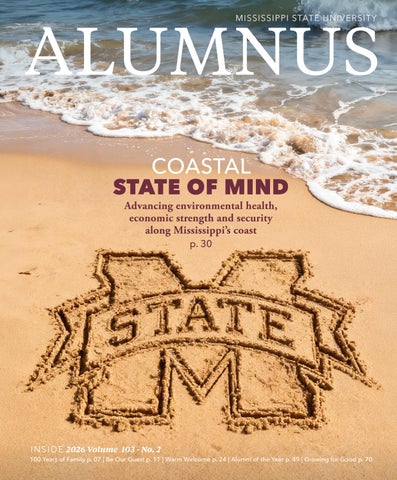
COASTAL STATE OF MIND Advancing environmental health, economic strength and security along Mississippi’s coast p. 30
I N S I D E 2026 Volume 103 - No. 2
100 Years of Family p. 07 | Be Our Guest p. 11 | Warm Welcome p. 24 | Alumni of the Year p. 49 | Growing for Good p. 70
Powering PROGRESS
ARTE
IS
Bulldogs helping take mankind farther than it's ever gone before
From Apollo engineers and MSU simulations that rescued John Glenn’s STS95 mission to managing the Artemis II project that is defining the future of space flight, Mississippi State Bulldogs have long been instrumental in the American space program. Were you part of the Golden Age of Space Exploration or more recent missions to further humanity’s knowledge of the universe? Let us know. Your response will help us document and celebrate the Bulldog family’s out-of-this-world accomplishments. alumni.msstate.edu/artemis-bulldogs
FROM THE MOUND TO THE MOON Former Diamond Dawg leads NASA in big swing toward long-term exploration By Harriet Laird, Photo by Hallie Walker & Submitted
F
ormer Diamond Dawg Matthew Ramsey wrapped NASA’s latest mission in Maroon and White as mission manager for Artemis II—the first crewed mission since 1972. The 10-day expedition from Earth around the moon marked a major step toward returning humans to the lunar surface, setting the stage for long-term exploration. A native of Hernando, Ramsey enrolled at Mississippi State in the early 1990s as a pitcher for MSU baseball while earning 1992 bachelor’s and 1993 master’s degrees in aerospace engineering. He began his work with NASA in 2002. He said in one of the agency’s website stories, “There are a lot of similarities between mission management and pitching. You control many aspects of the tempo, and there’s a lot of weight on your shoulders.” On this history-making mission, that responsibility included pre-launch daily preparations, addressing issues as deputy of the Artemis II management team, and resolving any flight changes. One of his NASA interview comments about his immeasurable duties was, “Most of my time is focused on making sure we’re ready to fly astronauts Reid, Victor, Christina and Jeremy to the moon and bring them home safely.” Joining Ramsey in the success of Artemis II is Parker Glass, who works for NASA’s Exploration Ground Systems and oversaw budget development, project plans and resource allocation in preparation for launch. Glass was exposed to NASA and space exploration during most of his childhood in Yorktown, Virginia, where his dad worked at Langley Research Center for many years. Glass became enamored with becoming an astronaut, but as he got older his interests changed. He discovered the prestigious PGA Golf Management program at Mississippi State, one of just 16 in the nation. He said in a NASA article, “I first visited MSU in 2014 and fell in love with Starkville.” After eventually changing his major to finance, he was surprised to discover there were internship opportunities with NASA and that brought him back to his original passion. Glass wants students interested in NASA and the agency’s work to know that being an astronaut doesn’t have to factor into the equation of working in space exploration. “NASA needs everybody,” he said. He graduated from MSU in 2018 with a bachelor’s in business administration and earned an MBA in 2022. n
TOP: Artemis II Mission Manager Matthew Ramsey pitched for the Diamond Dawgs while earning the aerospace engineering degrees that would eventually lead him to NASA. CENTER: Ramsey returned to the mound at Dudy Noble to throw the ceremonial first pitch before the Bulldogs took on LSU in April. BOTTOM: Parker Glass, part of NASA’s Exploration Ground Systems team for the Artemis II mission, celebrates its successful and historic journey around the moon.
Table of CONTENTS
14 Geosystems Research Institute engineers Daniel and Paige McCraine use advanced uncrewed aerial and surface vehicles to study the health of the Mississippi Coast. The married duo collects critical data on water movement, seafloor changes and local environmental shifts in the region.
FEATURES
24 Warm Welcome
Alumnus helps shape veterinary education at Mississippi State University
30 Coastal State of Mind
Mississippi State works to understand, secure and advance Mississippi’s Gulf Coast
36 ‘It Changed Everything’
Alumna’s intern experience leads to movie-worthy career
Mississippi State University is an equal opportunity institution. Discrimination is prohibited in university employment, programs or activities based on race, color, ethnicity, sex, pregnancy, religion, national origin, disability, age, sexual orientation, genetic information, status as a U.S. veteran, or any other status to the extent protected by applicable law. Questions about equal opportunity programs or compliance should be directed to the Office of Civil Rights Compliance, 231 Famous Maroon Band Street, P.O. 6044, Mississippi State, MS 39762, (662) 325-5839.
2026 | VOL. 103 | NO. 2 PRESIDENT
Mark E. Keenum, ’83, ’84, ’88
VICE PRESIDENT FOR DEVELOPMENT AND ALUMNI John P. Rush, ’94, ’02
16
07
ALUMNI ASSOCIATION EXECUTIVE DIRECTOR Jeff Davis
VICE PRESIDENT FOR STRATEGIC COMMUNICATIONS AND DIRECTOR OF PUBLIC AFFAIRS Sid Salter, ’88
EDITORS
Susan Lassetter, ’07 Harriet Laird
WRITERS
42
44
Camille Carskadon, ’12 James Carskadon, ’12 Bonnie Coblentz, ’96, ’00 Mialani Garcia, ’28 Meg Henderson, ’10 Harriet Laird Susan Lassetter, ’07 Mary Pollitz, ’16 Shunecy “Shun” Pounds, ’14, ’18 Carl Smith, ’10 Kevin Tate, ’94 Anna Welborn, ’25, ’26
DESIGNER
Heather Rowe
49 DEPARTMENTS
04 Campus News 14 Discoveries 22 State Snapshot 42 Our People 49 Alumni News 64 Giving Back 74 Class Notes 76 Forever Maroon 78 Back Story
70 COVER As a land-grant institution, Mississippi State’s impact reaches far beyond Starkville. This statewide commitment to taking care of what matters reaches from the Delta to the Gulf Coast, where academic, research and service programs help to safeguard the state’s environment, economy and future. – AI-assisted illustration. Pg. 30
CONNECT X.COM/MSSTATE FACEBOOK.COM/MSSTATE INSTAGRAM.COM/MSSTATE
PHOTOGRAPHERS Grace Cockrell Kevin Hudson Emily Grace McCall, ’23, ’24 Hallie Walker Beth Wynn
EDITORIAL OFFICE
P.O. Box 5325 Mississippi State, MS 39762 662.325.0630 slassetter@opa.msstate.edu
ADVERTISING
Jeff Davis jdavis@alumni.msstate.edu 662.325.7000
Mississippi State University’s Alumnus magazine is published three times a year by the Office of Public Affairs and the Mississippi State University Alumni Association. Send address changes to Alumni Director, P.O. Box AA, Mississippi State, MS 39762-5526. Call 662.325.7000, or email cturner@advservices.msstate.edu.
Campus NEWS
ONE COLLEGE, TWO LOCATIONS
Engineering on the Coast expands availability of MSU degrees By Camille Carskadon, Photos by Emily Grace McCall & Submitted
F
or future engineers living on the Mississippi Gulf Coast, earning a degree in their field can happen in their backyard thanks to Mississippi State and Engineering on the Coast— an idea shaped by place as much as by purpose. The program was the brainchild of MSU President Mark E. Keenum, who wanted to address Magnolia State industries’ need for more Coastbased engineers. Finding a solution required rethinking how an engineering curriculum is delivered, but from the beginning the vision was clear: one college, two locations. “Mississippi State is uniquely called to serve the entire state, and that certainly includes the Coast," Keenum said. "Engineering on the Coast exemplifies MSU’s commitment to meet critical needs and provide innovative, high-quality academic programs our students and Mississippi’s employers want and need.
4
2 0 2 6 Volume 103 - No. 2
“We’re grateful to have this opportunity to work with our friends and partners across the region to offer an outstanding engineering education," he continued. "I also appreciate the worldclass faculty and staff who teach, mentor and support our students as they earn their Mississippi State degree.” Now in its 10th year, Engineering on the Coast brings the quality of MSU’s nationally recognized engineering education to the South’s coastal communities, putting an MSU engineering degree within reach of those whose roots and responsibilities keep them close to the Gulf. Bagley College of Engineering Associate Dean Robert Green said ensuring the satellite program had the same rigor as the Starkville campus’ curricula was central to the development of Engineering on the Coast. “We wanted everything to be in sync,” Green explained. “The idea was that the same courses offered in
Starkville would be offered on the Coast, with students moving through the same degree programs, just in a different place and at times that would better serve the students on the Coast, many of whom are nontraditional students with full-time jobs.” The program creates a pathway for transfer students to earn an MSU degree in either electrical, mechanical or industrial and systems engineering with just two additional years of study. Flexible course delivery—including a mix of in-person and online instruction—means students can fit their classes around the demands of work and family. Green said this flexibility is opening the door to many who might not have otherwise considered an engineering degree, giving them career opportunities they wouldn’t have had. “One of our recent graduates owns a business, and that business enabled his children to earn engineering degrees,”
A decade after its launch, Engineering on the Coast continues to bring Mississippi State's engineering education to the Gulf Coast through flexible delivery, hands-on learning and personalized support. Shown are alumnus Micah Fairley, upper left; students in the program; and program coordinator Deena Kuntz, lower right. Green recalled. “He had always wanted to earn an engineering degree, too, but his business and family responsibilities meant he couldn’t move to Starkville to enroll. “Engineering on the Coast gave him the opportunity to finally get that degree he wanted, which will allow him to expand the services his company offers,” Green explained. The program’s location on Mississippi Gulf Coast Community College’s Gautier campus makes it easily accessible for students from south Alabama, south Mississippi and Louisiana, as well as those who work for industries located in the region. Micah Fairley said the proximity to home was his main reason for choosing Engineering on the Coast. After completing two years at community college, he seamlessly transitioned into MSU’s electrical engineering program. With only a 45-minute commute from his home in Lucedale and the flexibility of taking night classes, he was not only
able to work but also benefit from the cost savings of living at home, which he credits for allowing him to graduate without loan debt.
“I had a village. The faculty and staff were constantly working to make sure we had access to everything we needed.” ~ Micah Fairley “It was a big deal to me to graduate without loans,” Fairley, a 2022 alumnus, said. “Engineering on the Coast made that happen.” In addition to cost effectiveness, Fairley said the smaller campus appealed to him—helping him to find his footing as he moved through the demanding courses. Now, his sister is following in his footsteps. She is on track to graduate in mechanical
engineering through Engineering on the Coast next year. “I had a village,” Fairley said. “The faculty and staff were constantly working to make sure we had access to everything we needed, so our experience was as robust as the program in Starkville. The faculty and staff were always accessible, and the classes that streamed to us from Starkville were engaging, so we felt as much a part of the discussion as anyone.” Deena Kuntz, Engineering on the Coast program coordinator, said that feeling of community and support is intentional and something they start to build before students enroll in their first class. “We’re involved from the very beginning,” Kuntz explained. “From high school visits and facility tours to helping students stay on track while they’re completing those first two years of foundational work, we’re there every step of the way.” Kuntz said Engineering on the Coast faculty and staff are available to ALUMNUS.MSSTATE.EDU
5
Campus NEWS prospective students, guiding them through the transition into the upperlevel engineering coursework. That built-in advising ensures future students are on track and can connect with both educational and career opportunities. Once enrolled, coastal students can find support for career readiness, with programs that include resume workshops, mock interviews and direct engagement with industry—just like what Starkville campus students can access. Kuntz also noted that working, Coast-based engineers serve as adjunct instructors, mentor students and participate in career-focused events giving students a clear picture of what their future careers may look like. Some Coast-based industries’ support goes even further through direct investment in student opportunities and employment. Economydefining organizations like Chevron, International Paper and Mississippi Power have partnered with Engineering on the Coast to support students and ensure talented local graduates are prepared to step into critical roles across the region. “Engineering on the Coast is greatly enriched by our partners,” Kuntz said. “Their investment in our program and student-engagement opportunities help launch our graduates into highly soughtafter engineering careers.” For Fairley, these coastal connections led to a student internship with a local power utility, which informed and supported his capstone seniordesign project. Now, he is a technical representative with Gresco, using his knowledge and experience to support power companies across Mississippi and Louisiana. He said he can trace his career success directly to his time with Engineering on the Coast. “It kick-started my career and showed me that if you’ve got a good attitude and you’re willing to work, great things can happen for you,” Fairley said. “I love the Coast. I love taking care of it and being a part of it, so it’s a huge blessing to be so close to home.” n
6
2 0 2 6 Volume 103 - No. 2
BECOME A BULLDOG STUDENT WHEREVER YOU ARE
F
rom VHS tapes delivered by mail in the 1980s to today’s satellite campuses and dedicated Starkville-based online classrooms outfitted with the latest recording and streaming technology, Mississippi State University has been educating students beyond the Starkville campus for decades. In the Bagley College of Engineering, a continued partnership with Mississippi State Online allows students across the world, including active military and working professionals, to pursue degrees without relocating or pausing their careers. Online students receive the same rigorous instruction as their on-campus peers while benefiting from flexible scheduling and technical support, as well as the same robust academic advising and career services available on campus. In addition to accessibility, MSU’s online courses are affordable as they maintain in-state tuition rates regardless of residency. “Our online programs ensure even those who can’t come to campus have access to our nationally recognized programs, which can enhance their careers,” explained Robert Green, associate dean of academics for the Bagley College of Engineering. “If you have a job or family commitments that keep you from joining us in Starkville or on the Coast, our online programs may be the opportunity you’ve been waiting for.”
MSU’s online engineering degree offerings include:
• Bachelor of Science degrees
in electrical and industrial and systems engineering, and a Bachelor of Applied Science in cybersecurity
• Master of Science degrees in
aerospace engineering, artificial intelligence, chemical engineering, civil engineering, computational engineering, computer science, cyber security and operations, data science, electrical and computer engineering, industrial and systems engineering, and mechanical engineering, as well as a Master of Engineering and Master of Science in engineering
• Doctor of Philosophy degrees in
computer science, computational engineering, electrical and computer engineering, industrial and systems engineering, and engineering with concentrations in aerospace, chemical, civil, engineering education and mechanical engineering
These programs are among more than 100 degrees of all levels from a variety of colleges and specialties offered by MS State Online. The distance-learning unit also facilitates a number of professional certificates and endorsements for continuing learners. To learn more about the Bagley College of Engineering, visit bagley.msstate. edu. Find more about MSU’s online degree programs across all colleges at online.msstate.edu. n
'15 '80
'84 '09
'88
'76 '14
'84
MSU Orientation celebrates milestone, looks to future of welcoming new Bulldogs
A
s an incoming transfer student in 2010, Jake Hartfield sat in Lee Hall’s Bettersworth Auditorium among hundreds of other new students. There, Mississippi State’s Orientation Leaders turned these strangers into Bulldogs and helped them take their first steps into life at a large, Southeastern Conference school. “By the end of Orientation, I no longer felt like an outsider,” he recalled. “I left Orientation that day feeling like I had found my people before I even started classes.” Hartfield now serves as director of Orientation and Events at Mississippi State, ensuring that new generations of Bulldogs find that same foundation when they begin their Maroon and White
By Mialani Garcia, Photos by University Archives journeys. While Orientation is celebrating 100 years at MSU and has changed a lot in that century, he says its purpose remains the same: Help students feel prepared and welcomed to their new home.
“By the end of Orientation, I no longer felt like an outsider. I left Orientation that day feeling like I had found my people before I even started classes.” ~ Jake Hartfield “Orientation sets the tone,” explained Hartfield, who completed a political science bachelor’s in 2012 before continuing to earn master’s and doctoral
degrees in education, also from MSU. “Outside of official campus tours or recruitment events, Orientation is the first experience students and their families share as they begin their Bulldog journey. Our staff and Orientation Leaders want to ensure it’s a memorable and effective experience." Across the generations, MSU Orientation Leaders all have shared similar traits. They’re welcoming, energetic, approachable and extremely passionate about Mississippi State. Hartfield said that is intentional as their tasks can include anything from creating and performing a welcome skit and hosting Dawg Talks to one-on-one conversations that put someone’s mind at ease. ALUMNUS.MSSTATE.EDU
7
Campus NEWS
'25 '99
'92
Everything Orientation Leaders do, he said, is about helping the transition to Mississippi State feel less intimidating— something he experienced firsthand as an Orientation Leader in 2011. While standing in Lee Hall that summer—the same building where his Orientation Leaders made him feel at home—Hartfield noticed a mother who seemed overwhelmed. “She was nervous about her son— her first child—going off to college and was struggling with the transition,” he recalled. “What started as a quick checkin turned into a 30-minute conversation which helped ease her concerns.” Hartfield remained connected to the family, watching as her son became a resident assistant and his two siblings joined him at MSU. Even now, he said he enjoys watching their careers bloom postgraduation.
8
2 0 2 6 Volume 103 - No. 2
He explained that moments and connections like those help families and their students feel more confident about the transition to college—and that’s what Orientation is about at its heart. Still, while the mission remains the same, Orientation
“Everything they do— both the Orientation Leaders and MSU staff—is designed to help students feel like they belong.” ~ Emma Grace Allen has changed—and not just compared to its beginnings in 1926, but from decade to decade as well. To remain relevant and be of service to incoming Bulldogs, Orientation must evolve as technology and people’s expectations change.
'96
Jay Allen, a 1992 Orientation Leader, said the Orientation sessions he led were very different from what his daughter, Emma Grace, experienced in 2023 as the contact with students and their families had shifted to more emails, texts and other tech-based communication. But he said that is part of what makes Orientation successful—meeting the students where they are in a way they’re comfortable with. “You make students feel at home,” said Jay, who holds two degrees from MSU and serves as president of Itawamba Community College. “You share your own experiences and find ways to connect with them.” He also noted significant changes in the slate of events planned for recent Orientation sessions. Where he and his 18 team members in 1992 scheduled things like movie watch parties and ice cream
AN APP FOR THAT A new app will soon make Orientation at Mississippi State more personalized and easier to navigate for students and their families. Chris Mackey, a 2023 business administration and 2025 MBA graduate, helped develop the app for the Office of Orientation and Events. He said the goal is to reduce confusion, help attendees feel more independent, allow staff to assist more efficiently and make the most up-todate and important information easily accessible.
'19
“We want the app to answer every question a student or parent might have before they even think to ask it,” Mackey explained. “It’s all available at their fingertips.” Titled Mississippi State Guides, the Orientation app offers: • Personalized and customizable schedules • Interactive campus maps
iOS
• Comprehensive information and updates '23
socials, more recent Orientations have featured events like Dawgs After Dark, which includes games, music and a silent disco—which Emma Grace, a former 2024 Orientation Leader herself who serves as coordinator in the Office of Orientation and Events, now helps oversee. Emma Grace said everything they do—both the Orientation Leaders and MSU staff—is designed to help students feel like they belong. That’s why, she said, having a designated team of outgoing, approachable students to lead Orientation events is important. “A lot of students won’t come up and say they’re nervous,” she said, explaining how Orientation Leaders are trained to identify people in need of reassurance. “So, as an OL, I would just go up and ask them if they needed help.” She said that small act often made a bigger difference than she expected. In one instance, Emma Grace said a student
• Quick answers to common questions Available for iPhone and Android, Mississippi State Guides can be downloaded for free from your app store.
she spoke to was unsure of his major. She explained it was OK to not have everything figured out and encouraged him to take his time.
“You make students feel at home. You share your own experiences and find ways to connect with them.” ~ Jay Allen Later, he came back to tell her he’d found a major he truly enjoyed and he credited it to that conversation during Orientation. He later became an Orientation Leader himself. “Seeing him thrive now, that’s something I’ll never forget,” the 2025 science alumna said. Inspired by her father, Emma Grace says she first joined the organization
Android
to gain leadership experience and build her resume. But she says she quickly discovered it was much more than that. Like her father, she says she came away with lifelong friendships, personal development and a much stronger connection to Mississippi State University. Hartfield said the Allens’ experiences, though decades apart, show Orientation is not just important to new students and families but has an invaluable impact on the lives of Orientation Leaders and the university as a whole. “What makes Mississippi State special is that we haven’t lost sight of what matters,” Hartfield said. “Whether it’s making students feel at home, developing them into leaders or helping them find their career paths, we’re here to make sure they know they’re not alone and made the right choice to join the Maroon and White family.” n ALUMNUS.MSSTATE.EDU
9
Campus NEWS “Growing up on the Coast, you really have a personal connection with the land, water and people. It's very important to me because I want to protect the region—my home—so my kids and grandkids can have the same experiences I had growing up.” ~ Riley Kempner
FOCUSED LEARNING
Gulf Scholars Program provides holistic education to burgeoning ‘change agents’ By Carl Smith, Photos by Emily Grace McCall
A
degree from Mississippi State can take a graduate anywhere in life, but Riley Kempner wants her Bulldog education to take her back home to the Gulf Coast. “Growing up on the Coast, you really have a personal connection with the land, water and people,” the senior geoscience major from Moss Point said. “It’s very important to me because I want to protect the region—my home—so my kids and grandkids can one day have the same experiences I had growing up.” A recipient of the Mississippi Gulf Coast Alumni Chapter Scholarship, Kempner enrolled in MSU’s Gulf Scholars Program, an initiative housed in the College of Integrative Studies that provides aspiring coastal professionals a well-rounded, tailor-made education focused on the region. The program launched in 2023 thanks to a five-year award from the National Academies of Sciences, Engineering and Medicine. MSU
10 2 0 2 6 Volume 103 - No. 2
developed specific classes central to understanding the Gulf Coast through various lenses, including those focused on history, multimedia storytelling and problem-solving through purposeful team-building and design.
“When you see students put history and science together, their eyes open.” ~ Jim Giesen Jamie Dyer, dean of the college, said it is truly an academic collaboration designed to serve students and a part of the state that faces unique challenges. “If we want to take care of what matters, we have to first define why it matters,” Dyer said. “True problemsolving requires a holistic approach. I want this program to develop change agents for the entire area, from Texas to Florida. When our future scientists take courses focused on the social sciences and human aspects of the Gulf Coast,
they’re going to be more well-rounded experts who excel in critical thinking and provide pathways to solutions that truly make a difference.” Associate Professor Jim Giesen, a Grisham Master Teacher, leans into this latitudinal thinking—asking students to look at things in a different light for his course on the history of the Gulf Coast. “History makes us better citizens because it gives us a sense of empathy for other people and helps us see how interconnected all of these different forces—both local and very far away— are to getting us to where we are today," he said. "This can be particularly helpful for STEM students. “The best scientists often have humanities backgrounds,” he continued. “When you see students put history and science together, their eyes open. It’s my hope that they take history with them into their science classes and start to connect the ways that all these forces interact on the Gulf Coast.”
PASSPORT PORT
PASS
BE OUR GUEST
New MSU tourism minor places Bulldogs at the center of Mississippi’s fourth-largest industry
Gulf Scholars Program faculty help students explore the Gulf Coast through interdisciplinary learning. Associate Professor Jim Giesen, top, teaches a course on the history of the Gulf Coast, while Jamie Dyer, dean of the College of Integrative Studies, bottom right, meets with Gulf Scholar Riley Kempner.
“True problem-solving requires a holistic approach.” ~ Jamie Dyer The Gulf Scholars Program is working toward developing a minor available to students across campus, which will be a major milestone in the program’s growth. Dyer said he’s hopeful to continue building pathways to additional degrees, minors and certifications in the future. He also wants to use his position as the associate director of the Northern Gulf Institute, a NOAA Cooperative Institute led by MSU, to help link undergraduates, who historically are not involved in as much handson research, to opportunities at the research center. “My goal is to get undergraduates aware of interdisciplinary thinking and research,” he said. “When we normalize these things earlier in their academic careers, the more
benefits they receive. When you see the possibilities, you can then see yourself achieving them.” With the establishment of the College of Integrative Studies in 2025, MSU remains at the forefront of true collaboration by creating interdisciplinary academic pathways and offering students new ways to think about the world and its future. “We have advisors and faculty who listen to students and say, ‘It’s not about what you want a degree in; it’s about what you’re interested in,’” said Dyer, who comes from a diverse academic background including physics, hydrology and meteorology. “Our goal is to make sure we have programs that benefit students no matter where they’re coming from or where they’re going." n
From the Delta to the Coast to Mississippi’s College Town, the tourism industry brings people, and their spending money, to the Magnolia State. Now, a new Mississippi State minor in tourism and destination development will equip Bulldogs for vital roles in this growing Mississippi industry and economic driver. Drawing on expertise from across campus, the 15-credit-hour minor housed in MSU’s College of Integrative Studies provides practical skills in the classroom and hands-on learning experiences with tourism-focused services including visitor centers, hotels and event-planning organizations. “This minor prepares students to become highly capable, industry-ready professionals by combining foundational knowledge with immersive learning,” said program director Rachael Carter, an Extension specialist with MSU’s Center for Government and Community Development. “They’re gaining experience shaping destinations, developing authentic visitor experiences and promoting places in ways that drive engagement and repeat visitation. “Through internships and applied projects, they build essential skills in leadership, communication and problem-solving—graduating with the experience, confidence and professional portfolio needed to deliver immediate value to employers and communities,” she added. In 2024, Mississippi welcomed an estimated 44.2 million visitors, whose spending generated almost $12 billion for the state economy and supported more than 136,000 jobs—making tourism the state’s fourth-largest industry. Visit www.cois.msstate.edu/academics/minors/ minor-tourism-destination-development to learn more about the new program. ALUMNUS.MSSTATE.EDU
11
Campus NEWS
MSU LIBRARIES EARNS Association of Research Libraries membership
Mississippi State University marked its admission into the Association of Research Libraries with a campus celebration. Joining the occasion were, from left, Provost and Executive Vice President David R. Shaw, President Mark E. Keenum and MSU Libraries Dean Lis Keith. Effective July 1, MSU becomes the only Mississippi institution represented in the prestigious organization.
M
ississippi State University Libraries has earned membership in the prestigious Association of Research Libraries, making MSU the only Mississippi university included in the elite group of 125 research university libraries to hold ARL status in the U.S. and Canada. The ARL membership voted at its Spring 2026 Association Meeting to invite the MSU Libraries to join ARL, effective July 1. “Achieving Association of Research Libraries membership has been a top priority and central focus for our outstanding university library system, and I am thrilled to see our MSU Libraries leadership, faculty and staff achieve this goal,” MSU President Mark E. Keenum said. “We are proud to be Mississippi’s leading research university, and ARL status reflects and enhances the incredible research our students, faculty and staff are engaged in every day,” he added.
12
2 0 2 6 Volume 103 - No. 2
Keenum noted ARL membership is the culmination of years of effort and investment on the part of many faculty, staff and friends of the MSU Libraries. The ARL is a nonprofit membership organization of research libraries and archives in major public and private universities, federal government agencies, and large public institutions in Canada and the U.S. ARL champions research libraries and archives, develops visionary leaders, and shapes policy for the equitable advancement of knowledge. MSU Provost and Executive Vice President David R. Shaw said the selection of the MSU Libraries for ARL status “is a validation of the caliber of research conducted daily at MSU and of the scientists and researchers who do that hard and relevant work.” “MSU scholars depend on the quality of our library and our librarians to advance their research,” Shaw said. “ARL represents the best of the best in university research libraries.”
MSU Libraries advance the university’s land-grant mission of teaching, research and service. The libraries support a growing research enterprise through robust collections, digital scholarship services, and a strong commitment to open access and datainformed research. Through technology-rich, studentcentered spaces, including 24/7 learning environments, and integrated services such as advising, writing support, and undergraduate research, the libraries play a vital role in student success. The libraries also steward nationally significant special collections, including the Ulysses S. Grant Presidential Library and the Frank and Virginia Williams Collection of Lincolniana. Committed to innovation, student success, and global impact, MSU Libraries are a key partner in advancing research and scholarship at the landgrant university. n
Three Mississippi State students were named national Barry Goldwater Scholars. Hannah Henson of Jonesboro, Arkansas, Jessica “Rayne” Rutherford of Huntsville, Alabama, and India “Alex” White of Saltillo are receiving one of the nation’s premier undergraduate scholarships for STEM students who have significant research experience and a passion for making important research contributions in graduate school and their careers.
Dr. Jack Smith, associate dean for academic affairs in Mississippi State University’s College of Veterinary Medicine, has been named the Mississippi Veterinary Medical Association’s 2026 Veterinarian of the Year. Smith received the honor during the recent MVMA Winter Conference. The award recognizes a Mississippi veterinarian whose career reflects excellence in practice, leadership in service and a lasting impact on the profession.
MSU’s 2026 William A. Demmer Scholars spending this summer in Washington, D.C., include, front row, left to right: Hallie Smith, Union; Katie Hardwick, Starkville; Charles Treadwell, Memphis, Tennessee; back row, left to right: Justin Hunt, Kosciusko; Tanner Beasley, Guntown; Savannah Jones, Grand Prairie, Texas; and Adrian Horstead, Helena, Alabama. Not pictured: Steven Berry, Pinola. Program participants gain experience in natural resource policy and federal governmental operations.
Mississippi State University’s Center for Entrepreneurship and Outreach is expanding support for aspiring entrepreneurs thanks to a grant from the Regions Foundation. The $100,000 award will support two accelerator initiatives led by the MSU Center for Entrepreneurship and Outreach, the MSU VentureCatalyst program in Starkville and the Million Dollar Checklist program in Vicksburg. It also will power Startup Summit, Mississippi State’s premier entrepreneurial pitch event. MSU has introduced Major Maps, a year-by-year roadmap containing information about each undergraduate major at the university. The online tool can help prospective students and their families understand what a major offers and what to expect from each academic pathway toward a bachelor’s degree. The information guide also is useful for
career planning as it shows how each major positions graduates for future opportunities. Major Maps supports several MSU goals, including serving as a strong support system to recruit prospective students to the state’s leading university, improve student retention and further increase employability by helping students better articulate the value of each degree. It also supports academic advising, giving students and advisors a shared, easy-to-read reference outlining important curricular milestones, suggested co-curricular experiences and ways students can stay on track academically. MSU is celebrating 15 years of the International Institute, the university’s connection to dynamic worldwide partnerships, competitive international academic opportunities and impactful research collaborations. ALUMNUS.MSSTATE.EDU
13
Discoveries
MAPPING THE FUTURE OF THE GULF COAST
GRI continues coastal impact By Mary Pollitz, Photos by Beth Wynn
I
n 2004, a group of Mississippi State researchers began digitizing land and water records for communities along the Mississippi Coast—documenting water movement, watersheds, topography and topology. A year later, those digital files proved invaluable when Hurricane Katrina decimated the state’s Gulf Coast. Since then, that research, spearheaded by MSU’s Geosystems Research Institute, has evolved into a vital ecological and economic lifeline for the state. GRI Director Robert Moorhead, who also serves as director of the Northern Gulf Institute, said the value in this research carries weight for those who live on the Coast and rely on it economically. “Hurricane Katrina destroyed a lot of those paper records,” Moorhead said. “The Coast needed a lot of help, so we started teaching a lot of classes at Stennis Space Center on how to process raw data and research, then turn it into maps. This information, these records, are vital and we’ve actively worked to get those records in the public’s hands.” These records do more than fill archives. By creating an understanding of the historical movement of water, GRI provides the data necessary to bolster both
14 2 0 2 6 Volume 103 - No. 2
the environment and the local economy, providing an understanding of the “what” and “why” of the Mississippi coastline and bridging the gap between raw data and real-world recovery.
Eyes in the sky and water Established in 2000, the mission of GRI remains the same. However, the methods it employs continually evolve, leveraging new technologies to increase research effectiveness and impact. For instance, the institute has swapped invasive, traditional methods of measurement for a high-tech fleet of uncrewed vehicles, or drones, that monitor the environment from both the air and the sea. Daniel McCraine, a GRI research engineer and MSU alumnus, uses Uncrewed Aerial Systems to monitor the seafloor. Using single beam dual frequency downward looking sonar, Daniel’s drones measure bathymetry, or the distance from the water’s surface to the seafloor. “What we’re doing is comparable to a sea vessel getting information on depth and seafloor composition,” explained the 2018 and 2020 engineering graduate. “The difference is, we can use UAS in hard-toreach areas that traditional vessels, even uncrewed ones, can’t explore.” Even in areas that can be explored
more traditionally, Moorhead said the benefits of using these advanced UAS can give coastal researchers a much more detailed ecological look. “We are able to fly over and measure the rise and fall of the water without harming the environment,” he explained. “We are giving researchers sub-inch resolution in 20 minutes compared to submeter resolution over the span of hours.” The institute continues to explore datacollection methods from all angles. Paige McCraine, also a GRI research engineer and MSU graduate, conducts her coastal research from the water via the SeaTrac, a fully automated, remote-controlled surface vessel. “From the time we launch it into the water until the time we take it out, it’s collecting data,” the 2016 engineering graduate said. “We use a real-time dashboard that shows the variation in different metrics during each mission. So, we’re not only getting spatially dispersed targets across the coast, we’re getting miles of continuous data.” The McCraines represent the multidisciplinary spirit of the GRI. By pairing aerial drones with aquatic uncrewed vessels, they can pinpoint environmental concerns to very specific
areas. The husband and wife duo plan to partner for future projects as well, relying on each other’s expertise. “We have the potential to use UAV to identify an area of interest and then put the SeaTrac in the water to gather verifiable data,” Daniel said. “So we can canvass a large area and find specific areas to use the SeaTrac to get high-resolution data in those localized areas.”
All hands on deck Moorhead said GRI’s strength lies in its “all-hands” approach. With a staff of roughly 20 experts ranging from plant pathologists to electrical engineers, the institute ensures that no problem is viewed through a single lens. “We don’t have engineers trying to solve a science problem alone,” Moorhead explained. “We all work together to get a full scope of the answer.” This collaboration was put to the test in 2019, when a massive influx of freshwater was diverted into the Mississippi Sound via the Bonnet Carré Spillway. While the levee system succeeded in its primary goal of flood
“We don’t have engineers trying to solve a science problem alone. We all work together to get a full scope of the answer.” ~ Robert Moorhead control, it resulted in an ecological disaster that saw the water’s salinity drop to nearly zero, leading to hundreds of sea turtles and dolphins washing ashore. By deploying the SeaTrac and UAS technology, researchers like the McCraines, plant pathologist Gray Turnage and mapping expert John Cartwright were able to track salinity plumes and water movement in real time. Working with the Mississippi Department of Marine Resources and other key partners, MSU provided critical data and expertise needed to analyze the devastating impacts of the Bonnet Carré Spillway opening. This type of data serves as the primary defense for the Sound’s health, protecting the fishing and tourism industries that the region depends on. “We need to understand the environment in which we live to make the best use of what it provides and to maintain it for future generations,” Moorhead said. “The research that MSU does on the Coast, the most dynamic environment in the state, specifically helps us piece everything together. Each finding helps refine our understanding of how the soil, water, plants and air interact within the environment.” n
Mississippi State Geosystems Research Institute engineer Paige McCraine, top, launches a SeaTrac autonomous surface vessel used for continuous data collection from the water. Fellow GRI engineer Daniel McCraine, center, surveys environments from airborne drones. Together, the married duo collects environmental data on the Coast from above and below.
ALUMNUS.MSSTATE.EDU
15
Discoveries
MSU HELPS COASTAL NEIGHBORHOOD SHORE UP HOMES AND HISTORY THROUGH COMMUNITY-ENGAGED DESIGN
By Meg Henderson, Photos by Grace Cockrell
David Perkes, director of Mississippi State’s Gulf Coast Community Design Studio, has worked alongside Turkey Creek residents since 2013 to develop long-term strategies that support the historic community’s preservation and resilience.
I
n 1866, a group of formerly enslaved individuals on Mississippi’s Gulf Coast established a community where they could build a future on their own land. Now, 160 years later, Mississippi State University has partnered with the once prosperous community to ensure its future and preserve its history. Known as the Turkey Creek community, the area consists of a 320-acre section of wetland along its namesake waterway in present-day Gulfport. It started with a church, school and modest homes, built by families who supported themselves—even prospered—by farming and working in the forest products industry. That changed in the late 20th century when economic growth along the Mississippi Coast saw the Turkey Creek community fall victim to neglect and urban encroachment. Interstate highways, an airport and new retail stores began to press against the once isolated settlement. By 2001, Turkey Creek found itself on the Mississippi Heritage Trust’s “Ten Most Endangered Historic Places” list. Then Hurricane Katrina had her say. Floodwaters unmasked mounting problems in the community including erosion, poor water quality and unsteady structures, further imperiling its future. Two years later, Turkey Creek was named to the National Register of Historic Places.
16
2 0 2 6 Volume 103 - No. 2
Despite that designation and being adjacent to the Coast’s hub of trade and tourism, it still lacked the support needed to preserve its history and improve its resilience to the impacts of nature and humanity. That began to change in 2013, when David Perkes, longtime director of MSU’s Gulfport-based Gulf Coast Community Design Studio, began a collaboration with Turkey Creek residents to help revive the community. “Disinvestment in low-income neighborhoods is not unique to the Mississippi Coast, but the fragmentation caused by Hurricane Katrina has lingering effects on our communities today,” Perkes said. “That’s why we began partnering with Turkey Creek residents to develop a long-term community improvement plan.” As part of those ongoing efforts, Department of Landscape Architecture and Environmental Design Assistant Professor SaMin Han and Professor Chuo Li joined Perkes to create a graduate-level landscape design course meant to help address the Turkey Creek community’s needs. Grounded in scientific analysis and community engagement, the studio course gives students real-world experience in creating water-management solutions while supporting Turkey Creek’s mission of resiliency and historic preservation. The course builds on the Gulf Coast
Community Design Studio’s practice of bringing students to the Coast to assist with projects that tackle the region’s omnipresent challenge of flood risk and stormwater management. Throughout the semester, Han’s students applied their research to create a deliverable, professional proposal, using specialized software to analyze the landscape and construct a landscapedesign prototype. They then presented their community-ready proposals and justified their strategies through a public exhibition and formal presentation to community stakeholders. “The work in this course goes beyond a typical classroom design exercise,” explained Han, MSU’s Michael L. and Mary B. Hatcher Endowed Professor. “Our students conducted field visits, community interviews and site observations to better understand the lived experiences of neighborhood residents. Those conversations and observations allowed them to develop plans and help residents visualize possible futures for Turkey Creek.” Mississippi State received support for the project as one of only eight universities nationwide awarded the inaugural Envision Resilience National Design Studio Grant, established to support immersive student projects that blend climate science modeling with history and public policy.
EXTENSION TAKES bats under its wing
Having resilient communities doesn’t just mean having infrastructure that can weather what nature dishes out. It also means supporting the local ecosystem and native species. “One of the principles of resilience is redundancy, which in the natural world means biodiversity,” explained David Perkes, director of MSU’s Gulfport-based Gulf Coast Community Design Studio. “A diverse system is more resilient, so understanding how different species affect our environment is important to a strong community.” To help better understand biodiversity along the Mississippi Gulf Coast, the MSU Coastal Research and Extension Center’s Master Naturalist program has launched a community service project focused on monitoring bat populations. SaMin Han, holder of the Michael L. and Mary B. Hatcher Endowed Professorship, guides students in creating landscape design solutions that support Turkey Creek’s future while honoring its history. “This recognition reflects both the strength of our interdisciplinary approach and the urgency of the issues we are addressing on the Gulf Coast,” Han said. Along with the interdisciplinary academic knowhow and experience in practical application, MSU also consulted with partners from the Land Trust for the Mississippi Coastal Plain and Audubon Mississippi, which provided insight for protecting the natural and cultural resources of Turkey Creek and its watershed. Derrick Evans, founder of Turkey Creek Community Initiatives, coordinates with the university on behalf of the historic community and ensures the residents’ voices are heard. “Having a network of local and statewide partners makes this collaboration especially meaningful,” Han said. “The partnership with Turkey Creek has given our students an experience that can’t be simulated in the classroom. “It allowed them to work with a real community, facing real challenges, and taught them not only design skills but also how to listen, how to build trust, how to work across disciplines and how to understand a place through the people who live there,” she continued. Perkes said the Turkey Creek project, and the Gulf Coast Community Design Studio as a whole, are integral parts of Mississippi State’s network of resources dedicated to Mississippi’s Coast. “Mississippi State sees the value of the Gulf Coast as a key part of the state economically, culturally and environmentally,” he said. “Projects like this enable MSU to create a local impact while expanding knowledge and applied research to address global problems—a true example of the far-reaching effects a land-grant institution can have on the world.” n
Extension Associate Mandy Rigsby said Mississippi is home to 14 species of bats. The project’s goal is to identify how many and which species use bat houses in Hancock, Harrison and Jackson counties—data that, when applied, can help boost the numbers of the winged insectivores. “Mississippi’s bats provide an invaluable service as nature’s pest control. They protect our forests, crops, livestock and even humans from disease-carrying insects,” Rigsby explained. “Unfortunately, they are very misunderstood, and people don’t realize they can and should help support the bat population.” Rigsby said bat roosts keep their populations stable by providing protection from weather and predators, as well as a place to raise young. Natural roosts include caves or trees, but bats will also roost in man-made structures such as buildings, bridges or culverts. You can encourage bats in your backyard by placing a bat house in your landscape. Both premade bat houses and building plans for DIYers are available online. Rigsby offers the following advice for maintaining a successful bat roost at home:
• • • • • •
Make sure your bat house is sized appropriately for the species native to your area. Your local Extension office can help you with that information. Larger bat houses offer a greater temperature range, allowing the mammals to find a space that meets their needs. Multiple houses of varying colors, sizes and sun exposure can make your efforts more successful. Avoid mounting your bat houses on trees as these are vulnerable to predators. Place them on buildings or freestanding poles instead. Be patient. It can take six months or even years for bats to establish a successful colony in a bat house. Use winter months to clean or repair your man-made roosts to keep bats healthy and protected.
Live in one of the included counties and want to get involved? Scan and learn more.
ALUMNUS.MSSTATE.EDU
17
Discoveries
Jobs Well Done
COASTAL EXTENSION FINDS SOLUTIONS TO EMPOWER COASTAL PARTNERS By Bonnie Coblentz, Photos by Kevin Hudson
F
or MSU’s Coastal Extension program in Biloxi, success means its associates have worked themselves out of a job. One such job came up when commercial shrimpers on the Mississippi Gulf Coast got tired of losing time and money to ghost pots, or abandoned crab traps. “When they were pulling their nets, they would scoop up derelict crab traps,” explained Eric Sparks, director of Mississippi State’s Coastal and Marine Extension Program. “This debris damages nets and takes a lot of time to untangle. The shrimpers would lose most of the catch on that side of the net.” Sparks said it was common practice for fishermen to gather the derelict crab traps and dump them overboard in an out-ofthe-way location. But storms and currents would redistribute this marine debris, making the problem never-ending. Then MSU’s Extension Service got involved. Coastal Extension personnel worked with shrimpers to collect data on marine debris hot spots. Then they secured funding in partnership with
18
2 0 2 6 Volume 103 - No. 2
Mississippi Commercial Fisheries United to incentivize shrimpers to turn in those traps at locations near where they docked. Fishermen got on board quickly and began collecting the $5 reward offered for each derelict trap tossed into the collection kennels. The program began
“Once a program is set up and running, we work out the kinks so we’re not needed anymore. Then we pass it along and move on to another need.” ~ Eric Sparks running smoothly, permanently removing debris from the trawling grounds where nets are dragged for shrimp. “We found over time that once the shrimpers started depositing traps at the collection points for us to recycle, a lot of them did not even turn in the paperwork to get reimbursed,” Sparks said. With proof that shrimpers were adopting the practice of recycling the ghost pots, Coastal Extension was no
longer needed. Mississippi Commercial Fisheries United now manages this successful program. This, Sparks said, is the ultimate goal of the unit. The MSU Extension Service as a whole focuses on putting science into practice. On the Mississippi Gulf Coast, this happens through a variety of research and outreach efforts and partnerships with dozens of agencies and organizations. “We figure out what the needs are and adjust and adapt our program to meet those needs,” Sparks said. “We identify what is significant to fisheries managers, environmental managers or some other group, then we find a way to address those needs. Once a program is set up and running, we work out the kinks so we’re not needed anymore. “Then we pass it along and move on to another need,” he said. Coastal Extension has 55 employees and is based at the Coastal Research and Extension Center in Biloxi. It is closely aligned with the Mississippi-Alabama Sea Grant Consortium. The majority of its work happens through partnerships. Since 2015, the MSU
E XT E N S IO N ’S Coastal Reach Coastal communities have a variety of unique needs. MSU Extension Service’s Coastal and Marine branch offers a variety of programs to fill each one. Through these programs, Extension agents assist coastal residents and industries in finding solutions to the issues they face, as well as ways to better their environment, work more efficiently and improve coastal resiliency overall. In addition to traditional Extension programs like Master Naturalists and 4-H and providing resources to local communities, the MSU Coastal and Marine Extension also supports coast-specific programs.
When abandoned crab traps became a costly nuisance to Gulf shrimpers, MSU Coastal Extension developed a program that encourages the removal and recycling of ghost pots to both improve shrimping conditions and reduce marine debris.
Coastal and Marine Extension Program has received more than $90 million in grant funding. There are five main Coastal Extension groups that oversee a variety of other programs. These are Marine Fisheries Ecology, headed by Marcus Drymon; Program for Local Adaptation to Changing Environments, headed by Ali Rellinger; Coastal Upland Restoration and Ecology, headed by Jonathan Pitchford; Mississippi Sound Estuary Program, headed by Sparks; and Coastal Conservation and Restoration, also headed by Sparks. “Under each of these main program areas are subprograms like Mississippi Master Naturalists, Mississippi Coastal Cleanup, Native Plant Producers and the shoreline program,” Sparks said. “We have significant stakeholder engagement within these.” James Henderson, head of MSU’s Coastal Research and Extension Center, said work by MSU Coastal and Marine Extension personnel ranges from sharks to coastlines. “Our programs affect the lives and livelihoods of a large percentage of the people on the Gulf Coast,” Henderson said. “We are proud of the fact that there is widespread knowledge among the people of the Coast as to what Extension is doing here.” n
Mississippi Sound Estuary Program is a collaboration meant to increase awareness of and participation in conservation and restoration of the Mississippi Sound and its contributing watershed. Coastal Conservation and Restoration puts science into practice by sharing the knowledge needed to make sound environmental, economic and resilient decisions. Program for Local Adaptation to Changing Environments, or PLACE, is a network working to improve coastal response to rising sea levels and climate change. Marine Fisheries Ecology provides science-based solutions to common issues affecting commercial and recreational fishing in the northern Gulf. Coastal Upland Restoration and Ecology, or CURE, focuses on conserving and managing imperiled coastal grassland habitats.
For more information about MSU’s Coastal and Marine Extension, visit msucoastal.com. More information about the MSU Extension Service, including a directory of county offices and agents, can be found at extension.msstate.edu. ALUMNUS.MSSTATE.EDU
19
Discoveries Mississippi State President Mark E. Keenum, fourth from left, participated in a ribbon-cutting ceremony for the university’s automated composite stitching cell. Installed in MSU’s Advanced Composites Institute, the integrated industrial system is the first commissioned, U.S.-based automated structure of its kind. Pictured, from left, are MSU’s Wayne Huberty, ACI associate director; Jim Martin, associate vice president for Corporate Engagement and Economic Development; Scott Willard, interim vice president for Research and Economic Development; Keenum; Chris Bounds, ACI director; Inteva Products President and CEO Gerard Roose; Appalachian Regional Commission Director of Mississippi Andrea Rose; and MSU’s Crisler Herndon, ACI assistant director. A recent article in the British Journal of Cancer from MSU SSRC Giles Distinguished Professor Emeritus Arthur G. Cosby and a team of researchers analyzed cancer deaths in almost 3,000 U.S. counties from 1981 to 2019, finding urban and affluent counties were more likely to experience a significant decline in cancer mortality. The American Association for the Advancement of Science named Mississippi State University Professor John Bickle an AAAS Fellow for his distinguished contributions to the philosophy of science and neuroscience. Mississippi State Assistant Professor Candace Lukasik has received the Alixa Naff Prize in Migration Studies for her debut book “Martyrs and Migrants: Coptic Christians and the Persecution Politics of US Empire,” published last year by NYU Press. The annual prize, awarded by the Khayrallah Center for Lebanese Diaspora Studies at North Carolina State University, recognizes outstanding scholarly work examining migration, refugees and diasporas connected to the Middle East.
20 2 0 2 6 Volume 103 - No. 2
Jaspreet Randhawa, assistant professor in MSU’s Department of Physics and Astronomy, achieved a significant scientific advancement, producing a direct laboratory measurement of a key nuclear reaction believed to occur during explosive bursts on neutron stars. These bursts forge heavier elements— the building blocks of planets and life on Earth. The findings appear in The Astrophysical Journal, a top-rated peerreviewed journal in astrophysics.
boundaries through safe, high-resolution deep tissue imaging.
Jason Barrett, an awardwinning Mississippi State Extension specialist with an extensive background in agriculture, is the new director of MSU’s Water Resources Research Institute.
Mississippi State’s Rani Sullivan, head of the university’s Department of Aerospace Engineering, is beginning a two-year term as president of the prestigious American Society for Composites.
Mississippi State University chemist Colleen Scott has received the Bayh-Dole Coalition’s 2026 American Innovator Award, a national honor recognizing researchers whose federally funded work creates real-world impact. Nominated by U.S. Senator Cindy Hyde-Smith, Scott was recognized for her patented shortwave infrared dye technology, which helps clinicians more clearly identify cancer cells and tumor
Mississippi State University biologist Matthew W. Brown is part of an international research team whose latest findings, published this spring in the Proceedings of the National Academy of Sciences, are reshaping scientific understanding of how parasitic organisms evolve and ultimately spread disease.
Mississippi State’s African American Studies Director Donald M. Shaffer explores the hopes and hardships of the Great Migration in his latest book, Though There Be Giants: The Ghetto Pastoral Mode in Black Migration Novels. Published by the University Press of Mississippi, the book examines Harlem Renaissance and Jazz Age literature and how Black authors portrayed Northern cities as both places of opportunity and struggle for African American migrants.
Mississippi State landscape architecture faculty and students are partnering with the city of Starkville to design a new public arboretum at Cornerstone Park, creating a future outdoor space focused on native plants, research and community access. The project is led by retired landscape architecture Professor Bob Brzuszek. It brings together city leaders and MSU’s Department of Landscape Architecture and Environmental Design to develop a long-term vision for the site, which includes young forest, grassland and wetland systems.
Mark Keever, a veteran information technology and research computing administrator, has been named Mississippi State University’s executive director of high-performance computing, leading the university’s nationally recognized advanced computing initiatives.
Mississippi State’s College of Forest Resources has established a new National Wild Turkey Federation Distinguished Endowed Professorship to support research benefiting wild turkey populations and addressing key challenges facing wildlife managers, natural resource agencies and private landowners. The professorship also advances shared MSU and NWTF conservation priorities through sciencebased research and outreach.
A Mississippi State faculty team received a $3 million National Science Foundation Research Traineeship grant to support the Smart Agriculture Energy Innovation Network, a program focused on resilient rural energy infrastructure and smart agriculture technologies. Team members include, front row from left, Jian Zhao, Jay McCurdy, Tonya Stone and John Davis; and back row, from left, Jesse Morrison, Carley Morrison, Leyla Rios de Alvarez, Santee Ezell and Gang Li.
Mississippi State’s Raspet Flight Research Laboratory has received a TALON uncrewed aircraft system from COLSA Corp., supporting ongoing research in uncrewed systems, flight operations and national UAS policy. The TALON UAS provides Raspet with an adaptable, remotely piloted aircraft system capable of carrying a range of equipment and of conducting a variety of missions. The aircraft will assist with a variety of applied research projects.
ALUMNUS.MSSTATE.EDU
21
State SNAPSHOT
MAKING WAVES The Mississippi State softball team celebrates after defeating the University of Oklahoma 6-0 in the NCAA Super Regional championship game May 24. With the win, the Bulldogs clinched their first-ever trip to the Women’s College World Series, snapping the No. 2-ranked Sooners’ fiveyear WCWS streak and becoming the first team to shut out Oklahoma in 399 games. Photo by Hallie Walker
22 2 0 2 6 Volume 103 - No. 2
ALUMNUS.MSSTATE.EDU
23
ALUMNUS HELPS SHAPE VETERINARY EDUCATION AT MISSISSIPPI STATE UNIVERSITY By Kevin Tate, Photos by University Photographers & Submitted
I
n the more than 30 years since Dr. Todd Henderson sat for his MSU veterinary school interview, one detail has stayed fresh in his mind: the homemade chocolate chip cookies. “That’s where I want to go,” he remembers thinking. He had earned acceptance to other vet schools but, “they greeted me with homemade chocolate chip cookies. That attracted me all the way from Maryland to Mississippi State." It sounds like a small thing but, for Henderson, that gesture of warmth has never faded in significance. It spoke of something that is baked into Mississippi State’s culture: a family atmosphere, a genuine welcome and a desire to nurture the whole person. Now, as a leader in the animal-health industry, Henderson and his company, Nutramax, are working to ensure Mississippi State has all the ingredients to maintain its place as a national leader in veterinary education, research and practice.
24 2 0 2 6 Volume 103 - No. 2
A Fresh Idea While Henderson worked to complete his veterinary education at MSU, his father Robert—who holds a Doctor of Pharmacy—was reviewing scientific publications about human pharmaceuticals as part of his work.
“They greeted me with homemade chocolate chip cookies. That attracted me all the way from Maryland to Mississippi State.” ~ Dr. Todd Henderson When Todd read those same studies from a veterinary perspective, the duo found an untapped area of study they were uniquely positioned to explore. In 1992, the year Todd completed his MSU degree, Robert founded Nutramax
Laboratories. Drawing from Robert’s pharmacy background and Todd’s veterinary expertise, the company specializes in translating established human medical innovations for use with animals. Today, Nutramax is one of the most respected animal health companies in the nation with nearly 900 employees, a portfolio of products trusted by veterinarians and pet owners across the country, and a career-defining mission to provide quality-of-life improving products for people and their pets. “We make sure our products are of the highest quality and manufactured to the highest standards,” Todd Henderson said. “We took both of our trainings and blended them. The Lord has continued to bless the company. My dad and I developed a culture around honoring the Lord and doing everything with excellence. That’s what the Lord calls us to do.”
The Nutramax Laboratories Pharmacy serves as a central hub for the College of Veterinary Medicine, dispensing approximately 300 prescriptions each day while providing training opportunities for pharmacy and veterinary students. Pictured, from left, are Alexandria Bubnash, clinical instructor and junior pharmacist, with Lulu; and Katherine Raines, assistant clinical professor and pharmacist-in-charge.
Goodness Baked In With a company culture founded on faith, Nutramax operates more like a mission than a corporation. This philosophy also shapes its approach to partnerships, including a hands-on, personal and remarkably wide-ranging relationship with Mississippi State’s College of Veterinary Medicine. “He has supported numerous initiatives, including research studies, renovation of pharmacy facilities, establishment of a surgical training program and community events,” said Dr. Nicholas Frank, dean of the MSU CVM. “Faculty, staff, interns, residents, students, clients and patients have all benefited from it, and the college is growing because of it.” Henderson said supporting Mississippi State is a natural fit, because the education he received as a Bulldog helped shape the success of his career and business. “Mississippi State was integral in
helping me have the background to evaluate compounds and bring them to market,” said Henderson, who is president and CEO of Nutramax. “I want to do what I can to support the students and the school that helped me.”
The Ingredients for Success Among the most significant physical investments Nutramax has made at MSU is the 2019 renovation of the pharmacy within the vet school’s animal health center. The pharmacy dispenses approximately 300 prescriptions daily and provides consultations for faculty, staff, students and veterinary practitioners across the region. It also offers clinical clerkships for pharmacy students and a clinical pharmacy elective for veterinary students—work that is training the next generation at the intersection of the two disciplines that define Nutramax itself. “The pharmacy is the heartbeat of
the clinic,” Henderson said. “Students and faculty go through the pharmacy. It was the perfect place for us to invest in Mississippi State and make sure they have one of the premier pharmacies of all veterinary schools.” Nutramax has also invested in training students in best-practice surgical techniques through recent support for a new surgery facility. It will support the college’s spay and neuter training initiative, which is part of its broader Shelter Medicine program. Henderson said he sees the program as going beyond improving animal health and future practitioners’ technical skill. He said it also builds students’ confidence, which is essential for young veterinarians entering the profession. “As a vet, the practice of medicine is as much an art as it is a science,” Henderson said. “If students graduate and don’t feel confident doing a spay or neuter or a standard surgery, they’re not going to feel confident in other surgeries or other areas ALUMNUS.MSSTATE.EDU
25
“The pharmacy is the heartbeat of the clinic. Students and faculty go through the pharmacy. It was the perfect place for us to invest in Mississippi State and make sure they have one of the premier pharmacies of all veterinary schools.” ~ Dr. Todd Henderson of medicine. They lose that confidence.” He explained graduates of many well-respected, top-level vet schools across the nation go into practice having only done one surgery, or half a surgery. Those graduating from Mississippi State’s vet school, by contrast, will have done 90 surgeries on average, largely thanks to the access created by the Shelter Medicine program. To help address that imbalance, Henderson’s gifts bring recently graduated veterinarians from other schools across the country to Mississippi State where they work alongside skilled mentors, complete high volumes of surgeries and leave as better, more confident clinicians. “When they leave, they go as ambassadors for Mississippi State,” Henderson said. “They go back and say, ‘MSU had one of the best programs I’ve ever seen.’" Some of the most meaningful ways Nutramax Laboratories supports MSU’s CVM are less visible. For more than two decades, the company has sponsored the annual Christmas luncheon at the college. The company also sponsors an orientation breakfast to welcome incoming students. It sponsors the Pegasus Ball, a formal event for faculty, staff and students to casually interact. There are also monthly lunch-and-learn sessions where Nutramax Laboratories provides speakers and meals. The company also provides scrubs to veterinary technical staff annually, supports Research Day with lunch, gifts and awards, and invests in the Clinical Research Fund, which channels proceeds from product gifts to the pharmacy into grants awarded through
26 2 0 2 6 Volume 103 - No. 2
the college’s Office of Research and Graduate Studies, benefiting residents, interns and faculty. In 2014, Nutramax made its first major gift to the MSU College of Veterinary Medicine through a memorial fund established in honor of Paul Farmer, Henderson’s vet school roommate who died of pancreatic cancer in 2011. The scholarship funds veterinary students’ travel to countries around the world for humanitarian service, allowing them to hone their clinical skills while giving back globally. Henderson also makes a point of supporting the Christian Veterinary Fellowship group on campus, sponsoring events that range from worship nights and Bible studies to trivia nights and pumpkin carving. The efforts reinforce the well-being of young veterinary professionals. “Confidence and empathy go together,” he said. “The fellowship group is very important to us.” He explained it’s an investment not just in future clinicians, but in whole human beings. “We want to help them in their future and their family lives,” he said. “We want them to be good, solid citizens, and these are different ways we can help them work toward that.”
More Cookies in the Jar Henderson and Nutramax’s support for Mississippi State doesn’t stop at the College of Veterinary Medicine. He and the company are always looking for ways to support the Maroon and White family and increase the visibility of Mississippi State.
From its state-of-the-art facilities (center) to its family-led leadership team (top), Nutramax Laboratories continues to build on the vision established more than three decades ago. Top: Dr. Robert “Bob” Henderson stands between his sons, Dr. Todd Henderson (left) and Dr. Troy Henderson (right). Bottom: Mississippi State President Mark E. Keenum joins Dr. Todd Henderson during the university's 2018 Alumni Awards ceremony, where Todd Henderson was recognized for his professional achievements and service to his alma mater.
Nutramax Laboratories’ investments in Mississippi State’s College of Veterinary Medicine help support hands-on learning from the pharmacy to the operating room. The company’s support of the college’s pharmacy and Shelter Medicine surgical training program helps prepare future veterinarians through real-world clinical experience. ALUMNUS.MSSTATE.EDU
27
TOP LEFT: Dr. Todd Henderson visits with Dak, Mississippi State’s live mascot, during the AKC Diving Dogs Premier Cup on campus. LEFT: Earlier this spring, MSU Police swore in two Nutramax-sponsored K-9 teams, doubling the university’s K-9 unit and expanding hands-on training opportunities for veterinary students. Pictured, from left, are Officer Makenna Foster with Quinn, a German shorthaired pointer trained in explosive detection; Assistant Chief Brian Locke; and Officer William Bowling with Cosey, a German shepherd trained in narcotics detection.
28 2 0 2 6 Volume 103 - No. 2
The American Kennel Club Diving Dogs Premier Cup made a splash at Mississippi State in 2025. Supported by Nutramax Laboratories and Cosequin, the nationally televised event brought elite canine athletes to campus and showcased the university to audiences nationwide. In 2025, Henderson helped Mississippi State University become host of the American Kennel Club Diving Dogs Premier Cup, presented by Nutramax Laboratories and Cosequin, a brand of joint health supplements that is one of the company’s most well-known products. Henderson said when he was approached by the AKC to sponsor the event, he realized hosting it on MSU’s campus was a natural fit. “I look for things that marry different areas of the company,” he said. “Diving dogs are athletic dogs and their joint health is vital. What better place to host this event than on the campus of my alma mater? It was on national television. That helps increase visibility for MSU and Nutramax both.” In another marriage of purpose, Nutramax Laboratories made possible the purchase, training and equipment outfitting of two K-9 officers for the MSU Police Department. That gift not only doubled the size of the university’s K-9 force but also provided a built-in opportunity for MSU students to gain hands-on experience caring for working
dogs—a fundamentally different clinical challenge than caring for a family pet. “An old yellow Lab who mainly sits on a couch is a very different dynamic in the exam room than a trained police dog,” Henderson explained. “It’s important for veterinary students to learn how to work with that difference, a different bedside manner.”
Homemade It has been more than 30 years since a plate of homemade chocolate chip cookies helped steer a young man from Maryland to a veterinary program in Starkville, Mississippi. In the time since, that young man has built a company of nearly 900 people, brought life-changing human and animal health products to market, earned the respect of his industry, and returned to the place that first made him feel at home. “Mississippi State was integral in helping me have the background to evaluate compounds and bring them to market,” Henderson said. “I want to do what I can to support the students and the school that helped me.”
From the operating room to the K-9 unit, from the pharmacy counter to the nationally televised diving dog competition, the fingerprints of Dr. Todd Henderson’s generosity are everywhere
“We want to help them in their future and their family lives. We want them to be good, solid citizens, and these are different ways we can help them work toward that.” ~ Dr. Todd Henderson at Mississippi State, and they all speak of the appreciation he has for the university’s impact on his life. Some places give you more than an education. They give you a home. And some people never stop finding ways to say “thank you.” n ALUMNUS.MSSTATE.EDU
29
COASTAL STATE OF MIND Mississippi State works to understand, secure and advance Mississippi’s Gulf Coast By James Carskadon
Photos by Grace Cockrell, Emily Grace McCall and Submitted
30 2 0 2 6 Volume 103 - No. 2
AI-generated image created for illustrative purposes.
M
ississippi State University’s home lies in central Mississippi, but its land-grant mission means supporting the state beyond its Black Prairie roots—from its Appalachian counties, through the Delta and on to the Gulf Coast. Those coastal counties account for an estimated $53.2 billion in economic output, according to economists with MSU’s Extension Service—meaning that region alone is responsible for just shy of 15% of the entire state’s economic output. To support these coast-based economic drivers, Mississippi State has made strategic investments and developed programs designed to help the region prosper. When a storm barrels toward the shoreline, when seafood harvests rise or fall, when coast-based industries succeed, the ripple effects extend far beyond the water’s edge. That’s why MSU continues to support efforts on the Gulf Coast to protect natural resources, support jobs and strengthen the state’s long-term resilience. “Mississippi State is committed to positively impacting all areas of our state,” said MSU President Mark E. Keenum. “Our work on the Gulf Coast reflects the landgrant mission at its best. We are applying research, technology and collaboration to safeguard and enhance the coast’s future for the people and communities we have been called to serve.” MSU’s coastal programs are designed to make an impact and improve quality of life throughout the region and beyond. These programs are working to grow fishing and tourism industries through better aquatic health in the Mississippi Sound; protect life and the coastal environment through advanced computing and data collection capabilities; and defend our state and nation from rapidly increasing cyber threats in business, government and defense. MSU’s projects and investments on the Coast illustrate the power of longterm commitment and collaboration with a wide range of local, state and federal partners. This integrated and expansive
presence positions the university not just to respond to coastal needs but also to help shape what comes next.
PROTECTING AQUATIC LIFE AND ENSURING A HEALTHY SOUND On the Mississippi Gulf Coast, water conditions affect fishing, tourism and the long-term health of ecosystems that support coastal communities. One way Mississippi State researchers measure that health is by studying animals such as bottlenose dolphins and endangered sea turtles that serve as a barometer for the broader ecosystem.
“OUR WORK ON THE GULF COAST REFLECTS THE LAND-GRANT MISSION AT ITS BEST. WE ARE APPLYING RESEARCH, TECHNOLOGY AND COLLABORATION TO SAFEGUARD AND ENHANCE THE COAST’S FUTURE FOR THE PEOPLE AND COMMUNITIES WE HAVE BEEN CALLED TO SERVE.” — President Mark E. Keenum Through MSU’s Gulf Coast Aquatic Health Lab in Gautier, scientists blend veterinary care with applied research as they respond to stranded animals while collecting information that helps agencies understand broader environmental patterns. “Really, what we’re working to do is identify sustainable solutions, whether that’s helping the state manage waterways better, helping the federal government manage the Gulf, or any number of ways we work to provide solutions for different stakeholders on the Coast,” explained Mark Lawrence, a William L. Giles Distinguished Professor in the College of Veterinary Medicine and director of MSU’s Global Center for Aquatic Health and Food Security, which manages the lab.
Funded by grants through the Mississippi Department of Environmental Quality and the National Oceanic and Atmospheric Administration, the lab’s team treats live, stranded sea turtles— including Kemp’s ridleys, the most critically endangered sea turtle species in the world—and conducts cause-of-death investigations on dolphins that wash ashore. “Bottlenose dolphins are apex predators,” Lawrence said. “They’re a sentinel species like the canary in the coal mine. What’s happening to them reflects what’s happening throughout the Mississippi Sound.” Dolphins provide valuable insight because they tend to remain in the same waters throughout their lives, Lawrence explained. When their health changes, it can signal changes in water quality, food availability or other environmental stresses. Each year, MSU researchers and veterinarians complete dozens of dolphin investigations and sea turtle rehabilitation cases. The findings help partners answer practical questions about emerging patterns and what those trends mean for the Sound’s overall health, which impacts industries like fishing and aquaculture. Researchers in the lab also identify bacteria and pathogens present in the environment and support broader monitoring of fish and shellfish health. “We’re not just interested in marine mammals,” Lawrence said. “The oyster industry is reopening after being pretty decimated in 2019. We’re interested in working with our state partners to expand the ways we support the health of many species found in the Sound.” Students also play a central role in the Gulf Coast Aquatic Health Lab’s work. Community college, undergraduate, graduate and veterinary students assist with sea turtle rehabilitation, laboratory analysis and field research. For MSU veterinary students, the lab offers the uncommon opportunity to work directly with marine animals as part of their professional training. “The veterinary students at Mississippi State have the opportunity to work with ALUMNUS.MSSTATE.EDU
31
TOP LEFT: Northern Gulf Institute director Robert Moorhead stands with one of the institute’s autonomous surface vehicles used in coastal research and environmental monitoring. TOP RIGHT: Mark Lawrence, director of Mississippi State’s Global Center for Aquatic Health and Food Security, leads research focused on aquatic animal health and the Mississippi Sound. BOTTOM: Stephen Reichley, associate director of the Global Center for Aquatic Health and Food Security, works with Ryanne Murray, a research associate in Mississippi State’s Gulf Coast Aquatic Health Lab.
“THE PROBLEMS WE’RE WORKING ON ARE COMPLEX. THEY REQUIRE MULTIDISCIPLINARY APPROACHES. WHAT WE LEARN HERE CAN HELP INFORM SOLUTIONS ELSEWHERE.” ~ Stephen Reichley 32 2 0 2 6 Volume 103 - No. 2
marine animals, and that’s pretty unique,” explained Stephen Reichley, assistant professor in the College of Veterinary Medicine and associate director of the Global Center for Aquatic Health and Food Security. “We’re one of the only veterinary schools in the nation that can say that. It’s something we’re proud of and it adds one more way our graduates can contribute to the field after graduation.” Looking ahead, lab leaders see the Mississippi Sound as a model for understanding coastal health, driven in part by the lab’s multidisciplinary approach that involves veterinary medicine, ecology and social considerations like business and tourism that impact the community. “The problems we’re working on are complex,” Reichley said. “They require multidisciplinary approaches. What we learn here can help inform solutions
elsewhere. If we can understand what’s happening in the Gulf and in the Sound, that allows us to inform policymakers and researchers in other parts of the U.S. and the world. “We have collaborators internationally, so we can compare a sea turtle that was stranded in the Gulf to one stranded in the Black Sea, for example, to better understand what is causing the issue,” he continued. “We’re able to find solutions locally but then also work on the global stage to implement solutions in other parts of the world.”
TURNING DATA INTO DECISIONS Understanding the Coast also depends on turning the vast amounts of data the environment provides into usable
Buoying the State’s Seafood Industry MSU DEVELOPS FIRST-OF-ITS-KIND AQUATIC FOOD LAB Work is underway on a nearly $8 million Mississippi State laboratory that will enhance and protect the safety of the state’s seafood industry, which is estimated to contribute more than $300 million annually to the Magnolia State’s economy. Located in Jackson County, the Northern Gulf Aquatic Food Research Center will be the first of its kind in Mississippi dedicated to aquatic food safety, quality assessment, processing and product development. In addition to the seafood industry, the center will also support the state’s catfish producers who in 2025 managed 29,900 acres of freshwater ponds, with an estimated production value of $196 million. The aquatic-food research center is the first of a three-phase plan that includes construction of a commercially equipped pilot plant for processing and shelf-life research and product development, and development of an incubator space that will aid in transferring new technology to industry for implementation. The Northern Gulf Aquatic Food Research Center is a joint effort of MSU’s Mississippi Agricultural and Forestry Experiment Station and the university’s Coastal Research and Extension Center. It is made possible by funding from the Mississippi Legislature, the RESTORE Act and the Gulf of Mexico Energy Security Act. Mississippi State is seeking funding for the completion of phases two and three.
information. Forecasts for hurricanes, flooding and environmental conditions all rely on complex datasets and powerful computing systems—one of Mississippi State’s well-known areas of expertise. With that computing prowess, MSU leads the Northern Gulf Institute, a NOAA Cooperative Institute established in 2006 to support Gulf Coast-based scientific investigations. NGI staff help manage scientific data collected during NOAA’s major research cruises and longterm monitoring efforts, ensuring the information is accurate, accessible and usable over decades. “That’s probably what I’m most proud of,” said NGI co-director Paul Mickle. “What we do with data management has century-based timelines.” On the Coast, Mississippi State and NOAA personnel have shared a building at the Stennis Space Center since 2012, creating a hub of coastal research. In Starkville, NOAA has invested in supercomputing systems managed by MSU, two of which have been ranked among the most powerful in the world. NOAA uses these powerful computing
systems to run hurricane, flood and weather models. These models inform the tools that guide emergency planning and response for coastal communities. Robert Moorhead, NGI director and a Billie J. Ball Professor in the Department of Electrical and Computer Engineering, said another NOAA system is planned for MSU’s newly constructed High Performance Computing Data Center. “We work with NOAA to model and predict hurricane paths and intensity better,” Moorhead said. “Better prediction of these storms helps coastal communities everywhere.” In addition to predicting storms, NGI researchers also work with federal partners to establish new uses for large, uncrewed aircraft systems, or drones, in storm response. By combining drones and advanced capabilities in sensing and data processing, NGI has helped NOAA and the Federal Emergency Management Agency better understand what areas will be impacted during flooding events. In the aftermath of Hurricane Helene in 2024, personnel from NGI and MSU’s Raspet Flight Research Lab supported
MSU leaders attending the groundbreaking for the Northern Gulf Aquatic Food Research Center include, from left, Interim Vice President for Research and Economic Development Scott Willard, President Mark E. Keenum, Vice President for the Division of Agriculture, Forestry and Veterinary Medicine Keith Coble, and Head of the Coastal Research and Extension Center James Henderson.
FEMA with real-time imagery and data from hard-hit regions of Georgia. “We’ve been on the cutting edge of NOAA’s autonomy efforts, which has directly led to missions that protect life and property,” Moorhead said. “Over the years we have helped position the state as a leader in autonomous systems research.” NGI researchers are also developing AI tools to make coastal science faster and less disruptive, such as using artificial intelligence to identify fish species from underwater imagery. Another initiative uses environmental DNA to detect different species and ecosystem changes. As MSU leads multiple universities through NGI, Moorhead said Bulldogs everywhere should be proud of what the university is doing to advance coastal science, including how data can be collected and processed autonomously, growing the scale of real-time monitoring to support commercial and recreational fishing industries. “There are only 16 NOAA Cooperative Institutes, and they are highly competitive,” Moorhead said. “I’m very proud of what we’ve been able to ALUMNUS.MSSTATE.EDU
33
MSU, ALUMNI INVEST IN CYBERSECURE FUTURE Becoming a national leader in cybersecurity research and education didn’t happen overnight. It’s a reputation Mississippi State has built through foresight, planning and strategic investments. Before cybersecurity was something that affected people’s daily lives, pioneering faculty in MSU’s Bagley College of Engineering began researching and building expertise in keeping networks safe from malicious attacks and unauthorized access. Today, Mississippi State is a National Center of Academic Excellence in Cybersecurity—a National Security Agency designation it's continuously held since 2001. MSU is one of only 12 universities— and the only one in Mississippi—to hold all three NSA designations: Cyber Defense, Cyber Research and Cyber Operations. It is also home to the fourth-largest National Science Foundation CyberCorps program, which provides financial support to students who will eventually join the federal information-assurance workforce. In 2021, Mississippi State launched the Mississippi Cyber Initiative to coordinate the state’s cybersecurity assets, and the university houses the Center for Cyber Innovation—a division of MSU’s Applied
accomplish on behalf of NOAA and the people of the Coast since this institute started 20 years ago.”
CYBERSECURITY TO PROTECT OUR STATE AND NATION The Mississippi Gulf Coast is also home to shipyards, energy providers, hospitals, schools and defense installations that are important not only to coastal communities but the state as a whole. And they all depend on digital systems that face constant cyber threats. Mississippi State launched the Mississippi Cyber Initiative in 2021 to address cybersecurity gaps and workforce shortages that could affect these digital systems. A statewide consortium, MCI
34 2 0 2 6 Volume 103 - No. 2
Research Collaboratory that works to research and develop next-generation cyber solutions for the defense and intelligence communities. Mississippi State is also home to the Mary Lyn and Niles Moseley Endowed Chair in Cybersecurity. Established in 2017, this alumnus-funded endowment enables the university to attract and retain top cybersecurity faculty—ensuring that MSU remains at the forefront of the field and provides a world-class education to its students. For those interested in cybersecurity, Mississippi State’s Department of Computer Science and Engineering offers multiple degree options—which can be pursued in-person or online—including Bachelor of Science and Bachelor of Applied Science degrees in cybersecurity and a master’s in cyber security and operations. The department also offers two cybersecurity certificate programs: the Information Assurance Professional Endorsement and the Graduate Certificate in Cyber Operations.
Mary Lyn Moseley and Niles R. Moseley
To learn more about cybersecurity research and education at Mississippi State, visit www.cse.msstate.edu.
will soon be housed at the Mississippi Cyber and Technology Center, under construction adjacent to Keesler Air Force Base in Biloxi. The air base serves as a major training hub for the Air Force, preparing the men and women responsible for defending military networks and conducting operations across contested digital domains. In addition to MSU and Keesler, the initiative brings together partners from law enforcement, education, private industry and the Mississippi National Guard to address the shared cyber challenges that face the state. MCI Director Martin Rivera said collaboration is at the heart of protecting critical digital systems from hacks and other breaches. “Mississippi’s cyber challenges mirror the nation’s,” Rivera said. “By
strengthening collaboration and capacity locally, the state is better prepared to address its own challenges and be a leader in cybersecurity for the country.” One of MCI’s most immediate impacts has been in the field of digital forensics. By providing advanced tools and expertise through the establishment of a Digital Forensics Lab, MCI helped eliminate major backlogs of digital evidence for crimes ranging from fraud and violent crime to child exploitation. The lab now supports more than 50 law enforcement agencies across the state as they investigate crimes that depend on evidence stored in phones and computers. The forensics lab currently operates out of MCI’s space on the Mississippi Gulf Coast Community College’s Harrison County Campus, serving as a hub where
LEFT: Northern Gulf Institute co-director Paul Mickle, left, speaks with Karen Grissom of NOAA’s National Centers for Environmental Information at Stennis Space Center, where Mississippi State and NOAA collaborate on coastal research and data management. RIGHT: At the future Mississippi Cyber and Technology Center in Biloxi, Lynn Soots, far right, joins U.S. Air Force personnel involved with the project’s oversight and development. Pictured, from left, are Capt. Steven Edwards, Maj. James Ferguson and Master Sgt. Eric Herbert, all with the 333rd Training Squadron at Keesler Air Force Base.
“WE LISTEN TO OUR PARTNERS, WE BRING PEOPLE TOGETHER AND WE APPLY KNOWLEDGE IN WAYS THAT STRENGTHEN COMMUNITIES AND ADVANCE THE PUBLIC GOOD.” ~ Scott Willard law enforcement partners can have devices processed and be trained on digital investigation techniques. “It’s not just about having tools,” Rivera said. “It’s about knowing how to use them correctly, sustainably and legally.” MCI also operates a cyber-training ecosystem, often called a cyber range, that allows students and professionals to practice defending against and responding to cyber incidents in realistic scenarios such as a breach at a school or hospital. Participants range from high school students to National Guard cyber teams. Slated for completion in 2027, the 100,000-square-foot Mississippi Cyber and Technology Center will include space for Air Force training, an events center, collaboration areas and private industry suites. In addition to state funding, the project has received private support from Southern Company and Mississippi Power. Marc McGee, who has led the planning and construction of the building as director of the MSU Research and
Technology Corp., said the project will serve as a catalyst for economic development on the Coast. “This building provides a space for companies in the cyber and technology sectors to grow on the Mississippi Gulf Coast,” McGee said. “With secured and controlled space available, it is a great opportunity for companies that want to be on the cutting edge and work with cyber leaders in academia and defense.” Col. Chris Robinson, commander of the 81st Training Wing, said the facility gives personnel from all military branches the opportunity to leverage state-of-the-art technology and collaborate with academic and state experts. “We are most looking forward to the MCTC’s role as a catalyst for innovation,” Robinson said. “By integrating with our civilian and academic counterparts, we are providing our students with growth opportunities that exceed traditional standards. This collaboration enables modernization of our mission sets and will
advance the way we maintain security in the cyber domain.”
A COAST SHAPED BY COLLABORATION Together, these initiatives show how Mississippi State’s investment on the Coast translates into real-world impact. The work protects natural resources, strengthens essential industries, supports public safety and prepares the next generation of professionals. Scott Willard, MSU interim vice president for research and economic development, said the university’s initiatives on the Coast, like elsewhere in the state, are driven by strong partnerships that strengthen their impact. “We listen to our partners, we bring people together and we apply knowledge in ways that strengthen communities and advance the public good,” Willard said. “Our work on the Coast is addressing local, state and national priorities, and that’s something we are very proud of.” n ALUMNUS.MSSTATE.EDU
35
'IT CHANGED EVERYTHING’
Alumna’s intern experience leads to movie-worthy career By Susan Lassetter, Photo by Emily Grace McCall and Submitted
36 2 0 2 6 Volume 103 - No. 2
H
olley Muraco enrolled at Mississippi State planning to become a veterinarian. Then her roommate visited SeaWorld and set off a chain reaction that would change not only Muraco’s future but that of worldwide marine research as well. A native of Potts Camp, Muraco grew up around the animals of her grandparents’ small farm. When it came time for college, she naturally found herself drawn to veterinary medicine and enrolled at Mississippi State as an animal and dairy science major on a preveterinary track. While she was doing all she could academically to prepare for vet school, she knew animal-based work experience would help her boost her application. Her degree path gave her exposure to cows and horses, but Muraco said she wanted something more to stand out from the crowd. Her roommate’s family vacation helped inspire the out-of-the-box thinking she needed. “My roommate came back from a trip to SeaWorld and said, ‘Holley, the dolphins were amazing. They could jump and do all these things!’” Muraco recalled. “I thought they sounded really interesting. Out of sheer curiosity, I went online to see if there were any job opportunities available with dolphins. “There was behavioral research with dolphins at Epcot. I applied but didn’t think for a second I would get it,” she continued, “and I didn’t. But they sent me a letter saying they thought I’d be a better fit for the husbandry internship, which was paid. I did the interviews and got the job.”
GOING UNDER THE SEA WITH DISNEY In the spring of 1996, Muraco moved to Orlando, Florida, to begin a six-month term working with Disney World’s Epcot aquarium, a large attraction with fish, dolphins and other marine animals located at what is now The Seas with Nemo and Friends pavilion. “I had barely ever left the state, but I headed down to Orlando and it changed everything,” Muraco said. A certified but admittedly inexperienced scuba diver, Muraco was tasked with diving in the large tanks to feed and care for fish and sharks and aid in training the dolphins. She also got a taste of performing through Disney’s diving shows at the aquarium—scheduled feedings during which crowds could watch and
ask questions of the divers, and she charmed visitors with her Southern accent. “I was very scared, very young, completely overwhelmed and absolutely not capable of doing the job they wanted me to do, but they were so supportive,” Muraco said. “The whole intern experience was life changing, and it showed me you could work with animals without being a veterinarian,” Muraco continued. “I realized the work I did there with the marine mammals and fish—that was what I wanted to do.”
EXPLORING THE MAGIC OF ANIMAL HUSBANDRY With her eyes open to new animal-related careers, Muraco changed her major to biology. Following her MSU graduation in 1998, she returned to the Sunshine State to begin her career in animal husbandry, including a stint at SeaWorld and a return to Disney World where she was an aquarist at Epcot and later an elephant keeper and primate caretaker at Animal Kingdom. While at Disney, she also met her husband, fellow animal trainer Mike Muraco. When he received a once-in-a-lifetime offer to be director of animal care for Siegfried and Roy’s Secret Garden and Dolphin Habitat at the Mirage, the couple relocated to Las Vegas, Nevada. Muraco, who was pregnant with the couple’s first child at the time, took the move as an opportunity to pause her physically demanding career and focus on raising a family. Her passion for animal husbandry soon pulled her back. Mike told her that he and the Mirage staff were facing a problem: a genetic bottleneck in their dolphin population due to an overproductive male. “He mentioned trying artificial insemination to diversify the gene pool, but that had only been successfully tried on dolphins like one time,” Muraco explained. “I said, ‘I used to inseminate cows all the time as a dairy science major. I bet I can figure out how to do it on dolphins.’ I wrote a proposal to the president of the Mirage and that’s how I got my first research grant.” She began working with the Mirage dolphin trainers and soon realized she was collecting a lot of useful information about dolphin reproduction. Muraco reached out to Mississippi State with her findings and found ALUMNUS.MSSTATE.EDU
37
herself on the path to a doctoral degree in animal and dairy science. “It took eight years, but I got my Ph.D. with a focus in dolphin reproduction, and that has led to so many experiences around the world,” she explained.
CHASING A DREAM With her work and education, Muraco made a name for herself as a leading consultant on animal reproduction. Over the years she has worked with sea lions, harbor seals, walruses, beluga whales, polar bears, African elephants, gorillas, mandrills, gibbons and a variety of hoofstock, birds, sharks, rays and fish— publishing her findings along the way. Muraco’s work with walruses and the Siberian Yupik and Inuit of Alaska, and the Aleut of the Aleutian Islands is the subject of a BBC documentary. She also has been featured by PBS and National Geographic. She was approaching a decade of work with China on one of the largest animal collections in the world when the COVID-19 pandemic brought everything to a halt and presented her with an opportunity to return to her home state. She joined the then-new Mississippi Aquarium in Gulfport to help start its research program. “I was very happy to get to move back to Mississippi and stay put for a while,” Muraco said. In 2023, life opened another door: Muraco’s “dream job” at Mississippi State. “I had maintained a really good relationship with Mississippi State my whole career,” she explained. “When they had this cool position available to be an assistant research professor based on the Coast, it was exactly what I wanted, and I’m really happy to be here.”
MAKING A SPLASH Through her position with MSU, Muraco tackles some of Mississippi’s most vexing marine-life problems while
38 2 0 2 6 Volume 103 - No. 2
making new discoveries and publishing it all to benefit the wider field of marineanimal science. She credits her early career and experiences across the globe with giving her necessary perspective to help identify the state’s research needs. “Having been away from Mississippi for so long, I developed a huge new appreciation for the state and can see it now with almost an outsider’s perspective,” Muraco said. “One thing I now recognize is that there’s still so much we need to understand about our coastal habitats and the marine animals that live there.” For instance, she said, Mississippi has a population of sperm whales that live off the Coast—something many don’t know and that hasn’t received a lot of study. The state’s Coast also has one of the world’s largest populations of bottlenose dolphins, which she notes has received only a fraction of the scientific attention and research dollars that places like Florida receive, even though those are smaller geographic areas with smaller populations of the species. “The Mississippi Sound is huge and home to an amazing number of species. There are 21 species of marine mammals alone in the northern Gulf,” Muraco explained. “Our coast just hasn’t received the same attention as others.” To help address that imbalance, Muraco is exploring the use of uncrewed aircraft, or drones, to better understand what’s happening in the murky, turbid waters of the Mississippi Sound. While river input muddies the waters and prevents bare-eyed observation of underwater animal behaviors, drones equipped with thermal cameras can “map” the activities. Muraco first used the technology with a known, trained dolphin pod to explore the effectiveness and accuracy of the thermal mapping. “The thermal imaging shows us the ‘footprints’ of the dolphins, kind of like the Marauder’s Map from Harry Potter
Holley Muraco’s lifelong love of animals began on her grandparents’ small farm in Potts Camp, where she grew up surrounded by livestock and first imagined a future in animal care (top). Muraco’s career in animal husbandry has included work with a variety of species—including bottlenose dolphins (center)—and has taken her and her family around the world (bottom).
with these dolphins leaving long trails showing where they’ve been,” Muraco explained. “We can understand what they’re doing underwater even though you can’t see it with your own eyes.” She also has used drones to prove the presence of manatees and obtain footage of the first confirmed incident of manatee mating in Mississippi. While this confirmation of sea cows in Mississippi waters is news, Muraco hypothesizes that the buoyant mammals have been here a while—likely unseen due to the low visibility of the water. “I’m trying to get people to understand that we live in an amazing place—a very productive place,” she said. “The Gulf Coasts of Alabama, Mississippi and Louisiana are sometimes called the Amazon of America because of that biodiversity, and our coast is the most dynamic of those estuary systems because of all the river input. “By taking care of and studying that biodiversity, we can ensure it continues to thrive,” she added.
‘HOPPING’ INTO ONE HEALTH
Much of Muraco’s work, including the research that fueled her doctoral degree, has centered on bottlenose dolphins (top), but her newest undertakings involve North American beavers. A licensed wildlife rehabilitator, she found viral fame as she nursed a beaver kit named Tulip (center) back to health. That platform allowed her to partner with Disney to promote the movie “Hoppers” (bottom) and spread the message of One Health.
Muraco said understanding the complex coastal ecosystems and maintaining their balance is part of One Health—a World Health Organization initiative that recognizes the interconnectedness of human, animal and environmental health and works to understand that relationship for better disease control. For example, Muraco said dolphins are a good indicator of water quality. If their health declines, it can indicate an unhealthy water system. Those harmful conditions could affect humans if they drink or play in the water or consume its fish. It could also indicate the presence of zoonotic diseases, which are illnesses that spread between animals and humans. To help increase understanding of the One Health mission, Muraco is
starting a Coastal One Health program. She even returned to her Disney roots to help promote that message through a partnership with the studio’s new movie “Hoppers,” which “stars” beavers. A licensed animal rehabilitator, Muraco gained Disney’s attention due to the viral popularity of Tulip, a beaver pup she rescued and nursed back to health. With a built-in beaver-loving audience, she used her social media to promote the animated movie, which through traditional Disney humor and child-friendly themes, explores the importance of keystone species to the health of the environment. “The song ‘We’re All In This Together’ is one of my favorite parts of ‘Hoppers,’ and there’s probably no better poster child for that than the beaver,” Muraco explained. “It’s considered a nuisance species in the South, but they are native and important to a healthy ecosystem. We have to learn to coexist with them when possible because beavers help ensure a healthy habitat. A healthy habitat means the environment can support the deer, turkey, ducks and fish that people like to hunt. “If we can let them do their thing, these natural, environmental caretakers do such a better job at maintaining the environment than us,” she continued. “‘Hoppers’ does a great job of explaining that.” Though the six beavers currently in her care had to stay home, Muraco was invited to the world premiere of “Hoppers” where she walked the red carpet with celebrities and other prominent figures from the world of animal health. A Hollywood movie premiere might seem a world away from a small farm in Potts Camp, but Muraco said it’s part of her journey and a testament to how far a little curiosity can take you. “If you’re not afraid to take chances, you never know what you might end up doing,” Muraco said. “I was blessed to be able to travel the world and learn so much. Now, I get to share that with Mississippi State students and help people understand how important Mississippi’s waters are.” n ALUMNUS.MSSTATE.EDU
39
Through an internship at Walt Disney World, Holley Muraco discovered her passion for animal husbandry—specifically the care and research of marine animals. After earning a bachelor’s degree from MSU, she turned that passion into a career that has brought her into contact with a remarkable range of species and a variety of environments across the globe.
In the past 25 years, more than 600 Bulldogs have participated in the highly competitive Disney College Program, just like Holley Muraco did in 1996. In that time, Mississippi State students have “made magic” in a variety of guestfacing positions that include attractions, merchandise, food and beverage, and even performance roles. Jeff Hickman, senior manager for Disney programs, said while their interns may go on to find careers in other industries, working at the Happiest Place on Earth provides not only a unique work experience but also a resume entry bound to catch attention. “The Disney College Program is truly the definition of a life experience,” Hickman explained. “Our past participants are not shy about sharing the profound impact the program has had on them. Our program alumni soar to successful careers in a multitude of industries, and I’m so
40 2 0 2 6 Volume 103 - No. 2
very proud of the impact we get to make every day.” Hickman said the program’s success in finding impactful cast members at Mississippi State has kept the company coming back to campus to recruit. But the House of Mouse isn’t the only employer helping Bulldogs earn their cheddar. Each semester, MSU’s Career Center helps students find internship and cooperative education positions to match their career goals, fit their financial needs and provide immersive experiences that flesh out a resume and provide real-world, hands-on learning. “We continue to hear about the value of internships from employing organizations as students enter the job market," said Bethany Mills, Career Center executive director. “These hands-on experiences not only enhance the students’ resumes but also help sharpen the skills needed to thrive in the workplace. The Career Center takes pride in playing a small role in helping our students achieve career success.” To get started, students can create an account through the center’s Connections portal that links job seekers with opportunities. They also can search through active job listings on the Career Center website.
Mills said the center also offers opportunities for Bulldog alumni to support current students and recruit to fill vacant positions in their industries. The center’s Bulldog Mentor Program connects alumni to students with similar interests, allowing past generations of MSU graduates to help future generations find their paths. Employer accounts on the Connections website allow alumni to post job openings and become involved in oncampus recruiting events. The MSU Career Center Partner Program helps employers form more formal partnerships with the university, which not only support the center’s endeavors but also provide partners with enhanced visibility and recognition at events. The Career Center also maintains a gift-backed Summer Internship Support Fund that enables more students to pursue internship experiences by providing $500-$2,000 grants to offset the costs associated with experience-based student employment. To learn more or to support the MSU Career Center’s programs, visit www.career.msstate.edu or contact Bethany Mills at 662.325.3355 or bmills@career.msstate.edu to get started.
The Lifelong Perks of Being a Bulldog
SENIOR LIVING:
Call us at (866) 749-7445 or drop in for a visit and mention “Bulldogs” to learn more. For more details, visit brookdale.com/msu. Applicable to all discounts: Residents under a Life Care Agreement are not eligible for the discounts. These discounts do not apply to any room, board or services which are paid for all or in part by any state or federally funded program. Discounts are available to members and their spouse, adult children, siblings, parents, grandparents, and corresponding in-law or step adult children. Subject to availability. Discounts cannot be combined with any other offer or discount. Further restrictions may apply. * The Senior Living discount is only applicable to new residents of a Brookdale independent living, assisted living, or memory care community admitting under an executed residency agreement. Discount applies only to the basic service rate, excluding care costs and other fees and is calculated based on the initial basic service rate. ** The In-Home Services discount is only applicable to new clients of personal assistance services by a Brookdale agency under an executed service agreement. *** A Short-Term Stay discount is only applicable to new residents of a Brookdale assisted living or memory care community admitting under an executed respite agreement. Discount applies to the daily rate.
brookdale.com
basic service rate*
IN-HOME SERVICES:
10% OFF service rate**
SHORT-TERM STAY: DISCOUNTED RATES VARY
%
by community***
©2026 Brookdale Senior Living Inc. All rights reserved. BROOKDALE SENIOR LIVING is a registered trademark of Brookdale Senior Living Inc.
1746200 JA
As a Mississippi State Alum, you may be eligible for exclusive discounts that can help you and your family get the lifestyle and care you deserve. Unlock your exclusive savings today and check senior living off of your list.
7.5% OFF
ALUMNUS.MSSTATE.EDU
41
Our PEOPLE
Bulldog bounces from injury to Lockheed FORMER NFL RUNNING BACK FINDS CAREER IN ENGINEERING By Mary Pollitz, Photos from MSU Archives and Submitted
42 2 0 2 6 Volume 103 - No. 2
V
ick Ballard didn’t expect to lead the Southeastern Conference in touchdowns his first year as a Bulldog running back. The junior transfer from Pascagoula had made a name for himself at Mississippi Gulf Coast Community College, but said stepping onto Mississippi State’s campus felt like starting over. “I wasn’t really anticipating becoming a starter. So, I was thinking to myself, let me put down some realistic goals— like 600 rushing yards and a handful of touchdowns,” he said. He scored 20. In 2010, Ballard emerged as the Bulldogs’ featured back, averaging more than five yards per carry and cracking Mississippi State’s top-10 for rushing touchdowns in a single season. It was a breakout he hadn’t planned, but one that launched him toward the next level. Mississippi State, he said, was the foundation for everything that followed. After earning a degree in business administration, Ballard was selected in the fifth round of the NFL Draft by the Indianapolis Colts. A promising rookie season gave way to a string of injuries, including a torn ACL followed by a torn Achilles tendon, which altered the trajectory of his football career. “It turned into a nightmare,” he said. “I had season-ending injuries. So, it turned something really enjoyable into something that gave me a lot of anxiety. “My livelihood was essentially at stake,” he continued. “That’s the nature of the NFL. It’s a job. If you can’t perform the job, you get fired.” The instability forced Ballard to start planning for a life after football. “I had to figure out what I wanted to do the rest of my life,” Ballard said. “I could have done something in the athletics industry, but I felt like I could do something different; that I had the ability and I didn’t have to stay inside of that box.” That “something different” had always been in the back of his mind. Ballard said he had always liked to understand how things work and find
Mississippi State alumnus Vick Ballard, who dominated the SEC with a 20-touchdown season in 2010 before heading to the NFL, credits his time in Starkville for preparing him for his current role as a Lockheed Martin aeronautical engineer.
ways to improve them, and that interest drew him to engineering. He knew that path would require a return to the classroom, but he said he knew he wasn’t starting from scratch.
“Those injuries I had helped me develop my superpower: grit.” ~ Vick Ballard “I had dedicated myself 1,000% to getting back on the field to continue the success I had before. It just didn’t work out that way,” he said. “I told myself if I can commit to anything else in life with that same rigor, there’s no telling where I’ll end up. Those injuries I had helped me develop my superpower: grit.” Ballard went back to school, earning both a bachelor’s and a master’s degree in industrial systems engineering, as well as an MBA. Today, he works in the Dallas-Fort Worth area as an aeronautical engineer for Lockheed Martin focusing on aircraft safety. He credits Mississippi State with giving him the foundation that not only supported his career change but also shaped the life he has now. “Mississippi State was the start,” he
said. “I took a microeconomics class, and the first thing the professor said was, ‘This is not an economics class. This is a class on analytical thinking.’ That was the start of me being able to process large amounts of information and spit out answers. It’s what I do now every day. “Without Mississippi State, I wouldn’t have met my wife. I wouldn’t have done a lot of the things that I’ve done in life,” he continued. “Mississippi State gave me an opportunity to make it to the NFL. The NFL gave me the opportunity to play and that gift just kept giving because even when I went back to school, my schooling was paid for because I had played in the NFL. So, Mississippi State is the foundation of my life.” In May, Ballard married Brittany Pernell, a fellow Mississippi State graduate who now works in commercial real estate. To him, every step—even the injuries and uncertainty in his professional career—led him to a place he’s happy to be. “I’m years away from where I started,” he said. “There’s a huge lake in my neighborhood. Sometimes, I’ll just go out and sit on the bench, look at the lake and realize how far I’ve come from the apartments I lived in my whole life. “That alone, the tangible things, brings me a level of peace. I’m happy,” he continued. “There are still a couple things that I want, but I am so happy with where I am today.” n ALUMNUS.MSSTATE.EDU
43
Our PEOPLE
‘It’s called play for a reason’ HAYS, HARRIS BUILD FRIENDSHIP, CAREERS OFF COASTAL YOUTH THEATER COLLABORATION Story by Carl Smith, Photos by Beth Wynn
Mississippi State faculty members Tonya Hays, left, and Melanie Harris sit on the McComas Hall stage surrounded by puppets and props from children's theater productions. Their decades-long collaboration reflects their passion for art education and children's theater.
A
lmost 30 years ago, Tonya Hays answered the phone at the Gulfport Little Theater. Hays, a theater director with big plans but a shoestring budget, wore many hats at the small organization. On the other line was Melanie Harris. A recent transplant to the Coast, she hoped to find a way to plug in to the local creative community. “I called the Gulfport Little Theater because it was closest to my house,” Harris joked. “Tonya was in such a need that I never had a chance to call any of the others.” Hays quickly accepted Harris’ offer to help make costumes for an upcoming production in partnership with the Boys and Girls Clubs of the Gulf Coast.
44 2 0 2 6 Volume 103 - No. 2
“I was super excited to have someone volunteering like that and roped her in immediately,” Hays said. “The cast changed a lot over the next few weeks, so Melanie had to make things that anybody could wear because we were never sure who was doing which part. It was a very fluid situation, but just like everything else we’ve done together, we made it work.” Neither realized how intertwined their lives would become after that one phone call. That simple act led to a decades-long friendship and working relationship that gave hundreds of children and young adults on the Gulf Coast space to create art and support to discover themselves. Now, Harris and Hays are supporting students, the arts and each other as faculty at Mississippi State University.
Terry Likes, head of MSU’s Department of Communication, Media and Theatre, said the duo’s skills complement each other to make the university’s theater program a well-rounded, well-oiled venture. “They bring different things to the table that work so well together,” Likes said. “Melanie, with her technical experience— she’s wonderful at working with students on the complex ideas that contribute to the bigger picture of a main-stage production. And then Tonya—when you add her experience and compassion, there’s just no one better to truly inspire others. “Theater is a different beast than any other art or discipline. Our faculty have a dedication to their craft—to teaching and applying it—like no other,” he continued.
"Charlotte’s Web" (2024)
"The Pirates of Penzance" (2014)
Harris said their approach to teaching Bulldog students is an extension of the partnership she and Hays honed on the Coast while they poured their creativity into children’s theater. After their first collaboration, Hays joined the Lynn Meadows Discovery Center in Gulfport where she created the WINGS Performing Arts program—the realization of a dream to create a theater program specifically for children. She quickly brought Harris on board, and the pair began navigating the difficulties of creating theater with a limited budget. “There was no blueprint for what we were doing,” Harris said. “It was guerrilla theater, or fly-by-the-seats-of-our-pants theater. We were making stuff up left, right and center.”
"The Lion, the Witch, and the Wardrobe" (2016)
With no money for royalties, the two theater professionals and their students wrote their own plays and took the
“I believe everyone is creative deep down, and if you’re not feeding that part of your soul, then you will lose the joy of life.” ~ Tonya Hays performances to schools, community centers and even tree houses—whatever they had to do to bring the performing art to area youth.
“Our students really had ownership of their work,” Harris explained. “We had a kid who wrote a symphony and two girls who came up with a USO-style, 1940s show set to WWII-era music and went to a retirement home for veterans and performed it.” That spirit of service—taking art to the community—became a hallmark of the program. “We knew we had talented kids with good hearts, and that’s what we wanted to focus on,” Hays said. “They were born with the privilege of having talent and creativity, and we wanted to make sure we used it to give back.” While Harris left the Coast in 2003 and began teaching technical theater classes at MSU, the WINGS program flourished ALUMNUS.MSSTATE.EDU
45
Our PEOPLE
"Banner: A Sea Turtle Saga" (2021) under Hays’ continued guidance. During that time, it received numerous local, regional and national honors including the Coming Up Taller Award, now known as the National Arts and Humanities Youth Program Awards, from the President’s Council on the Arts and Humanities; the Mississippi Governor’s Award for Excellence in Arts Education; and the Mississippi Humanities Educator Award. Building on the foundation laid by Hays and Harris, WINGS now boasts more than 500 annual student participants, from first graders to seniors. Approximately 10 yearly productions reach combined audiences of more than 40,000 people, including traditionally underserved demographics of the young and elderly. When Hays eventually bowed out from Lynn Meadows Discovery Center in 2019, the museum honored her by naming its theater space after her. Before her departure, however, another phone call planted the seeds for a life-changing reunion. This time Harris called not needing a creative outlet but having one to share: an adjunct instructor role in MSU’s communication department. Hays soon began commuting from the Coast to Starkville once a week. Likes said she was a natural teacher—an obvious choice for a full-time role in 2020. “Tonya is the big dreamer and big ideas person, while I’m very pragmatic and more
46 2 0 2 6 Volume 103 - No. 2
"The Light Princess" (2022) about the details,” Harris said. “We’re like an old married couple now. We’ve had the same arguments for 30 years now, but I love having her around.” Since joining the MSU faculty, Hays has taught acting, directing and playwriting. She also teaches a special theater-for-young-audiences class and shares her passion for children’s theater with Bulldog thespians. She helps lead Theatre MSU, serves as advisor of MSU’s Alpha Psi Omega Eta Pi Chapter of the national theater honor society. She also received the Penny Wallin Lifetime Achievement in Arts Education Award from the Mississippi Alliance for Arts in Education, which previously recognized Theatr MSU as a School of Excellence. “Our original ideas about how theater can make changes in audiences, artists and the world—they’re so much a part of what we do here at Mississippi State,” Hays said. “I believe everyone is creative deep down, and if you’re not feeding that part of your soul, then you will lose the joy of life. “It’s called play for a reason, and we invite students from every walk of life to join us,” she added. Many WINGS alums who have found success in theater visit Hays’ and Harris’ classes, imparting their experience and knowledge to burgeoning writers, directors, actors and techs. One of those former guests is Cayson Miles, who joined WINGS as a rising high
school freshman. Now an award-winning, nationally established playwright, Miles credits Hays for encouraging his creative drive. As a rising freshman, Hays pushed Miles to enter a regional competition with an original play that ultimately won second place. “And that was that,” Miles said. “Eighth grade me, who was writing ideas in a small notebook thinking nobody would ever read them, could not have fathomed having those plays performed in different states. WINGS did that for me. “I’ve never been someone who has a lot of self-confidence, but Tonya was incredible and pushed me,” Miles continued. “That led me to Vassar College’s Powerhouse Training Company, and that program was the most transformative experience I’ve ever had. I went there and realized I could do this as a career.” Coming full circle, Miles was recently hired by the discovery center to spearhead its WINGS programming, giving today’s coastal youth the same support and guidance Hays and Harris envisioned when developing the program. “I was such a shy, quiet and reserved kid going through some rough times in many different ways when I entered the program,” Miles said. “Having that space where we could come in, make art, feel supported and be outside of all the noise of life changed my life.” n
SEAL BROTHERS CONTINUE TRADITIONS WITH MISSISSIPPI STATE FAMILY
S
By Kevin Tate, Photos by Grace Cockrell and from University Archives
upporting both academics and athletics at Mississippi State University is something of a tradition in the Seal family. Twin brothers Leo III and Lee have recently reaffirmed their commitment to the cause, endowing a scholarship for students headed to Starkville from Harrison or Hancock counties. The Seal Family Mississippi Gulf Coast Endowed Scholarship Program is meant to share what the Seals love most
about their second home with those who also hail from the Mississippi Coast. “We had discussed the possibility of this scholarship with Dr. Keenum many times,” Lee said. “We were in agreement that we didn’t want to lose students to any other university due to a scholarship issue.” The twin brothers were students and football lettermen at Mississippi State in the late 1990s, graduating in 2000. “We’re from Bay Saint Louis,” Lee
said. “We went to high school there and lots of folks in our high school class went on to college, but not many of them came to Mississippi State. Most of the folks we attended St. Stanislaus with wound up at other colleges and universities in the region. “Our scholarship is meant to fill in the gaps for students from the Gulf Coast if they are considering going to other schools for financial reasons,” he continued.
ALUMNUS.MSSTATE.EDU
47
Our PEOPLE
The Seal family’s connection to Mississippi State spans more than a century. At upper left, Leo W. Seal Sr. (center), a 1911 graduate and two-year football letterman, built a legacy of leadership that began at Mississippi A&M and continued through his presidency at Hancock Bank. At lower right, his son Leo W. Seal Jr. and wife, Kathryn, celebrate the opening of the Leo W. Seal Family Business Complex with their twin sons, Leo III and Lee—continuing the family’s tradition of supporting academics and athletics at MSU.
Lee and his brother are especially passionate because their own time at Mississippi State was so personally meaningful. The Seals have now been part of the Mississippi State family for four generations. Their grandfather, Leo W. Seal Sr., was a 1911 graduate and two-year football letterman of what was then Mississippi A&M College. After serving in WWI, he returned to Hancock County and went to work for Hancock Bank, eventually rising to president. Leo W. Seal Jr. succeeded him in that role in 1963, after wrapping his time as a Bulldog football player around his own years of service in WWII. The generosity of Leo W. Seal Jr. is responsible for the education of hundreds of young Mississippians. His philanthropy and leadership stand at the core of a family foundation that surrounds his legendary character.
48 2 0 2 6 Volume 103 - No. 2
Leo Jr. was a member of the freshman football team in 1942. In the wartime Army, he rose to the rank of sergeant and served his country for 40 months—20 in the U.S. and 20 in Europe. After the war, he was a tackle on the varsity teams of 1946-48. He graduated in 1949 with a degree in banking and finance and, in 1963, succeeded his father as president of the Gulfport-based Hancock Bank, holding that position for the next 45 years. In that time, he guided the growth of the business from a $14 million local operation to a $7 billion financial corporation. He also grew his personal impact at MSU universitywide, supporting the Presidential Endowed Scholarship Program, as well as a broad variety of scholarships in business, engineering and forestry. His gifts founded an excellence fund for Mitchell Memorial Library and created the Leo Seal Family
Business Complex, expanding the university’s business college and school of accountancy. Additionally, he was a major supporter of athletics, making gifts to establish facilities that anchor the university’s athletic programs today. “Some of our earliest memories are of our dad bringing us to football games at Mississippi State,” Lee said. “He made sure we understood the responsibility we had to serve our community. His experiences of the Great Depression and WWII gave him a great passion for humanity and a respect for his fellow man. I know he would be proud of what Leo and I are doing now. “Mississippi State has been a home for us. We wanted people from the Gulf Coast area to experience what we’ve experienced," he continued. "We each went to school at Mississippi State, and we work to make our home communities and state better.” n
ALUMNI News
Mike McDaniel, MSU’s 2026 National Alumnus of the Year, takes in the view from Dudy Noble Field.
MSU celebrates national Alumnus of the Year, COLLEGE ALUMNI OF THE YEAR By Kevin Tate, Photos by Emily Grace McCall & Beth Wynn
M
ike McDaniel of Houston, Texas, was honored by Mississippi State University as its National Alumnus of the Year during the MSU Alumni Association 2026 Awards Banquet this spring. A native of Cleveland, McDaniel graduated from MSU in 1979 with a Bachelor of Science in mechanical engineering and started his career with Dow Chemical at its Freeport, Texas, complex. He advanced rapidly over 10 years at Dow, and then bought Electrical Controller Products, or ECP, a specialty electrical distributor in Houston tied to the petrochemical industry. Under his guidance, ECP grew quickly. By 1991, he and his company launched ECP Tech Services, which did high-voltage electrical testing and construction. The wholly owned subsidiary soon grew to be the largest and most successful of its kind in the South, with five offices in two states. In 2008, ECP Tech Services was sold to Square D Company. Since that time, McDaniel has founded, grown and sold another company: Saber Power, a Houston giant in the electrical world as well. The lessons and skills he learned at MSU have been
critical to McDaniel’s business success. He is a proud second-generation MSU mechanical engineering graduate as his father, George O. McDaniel Jr., graduated from MSU in 1949. The George O. McDaniel Jr. Endowed Scholarship in Mechanical Engineering was established to help support future generations of Mississippi State students. McDaniel is married to Laura Moreton McDaniel, and they are supporters of a broad array of MSU programs, including engineering, study abroad and the Grant Presidential Library. They have four children and three grandchildren. McDaniel said being named MSU’s 2026 Alumnus of the Year is an honor he never expected or imagined he would receive and is humbly grateful for this recognition from a place he calls home. “We are delighted to honor Mike McDaniel on behalf of Mississippi State University for his outstanding professional achievements and dedication to his alma mater,” said Jeff Davis, executive director of the MSU Alumni Association. “Mike embodies the spirit of the Bulldog community, and his remarkable accomplishments highlight the commitment and excellence that MSU proudly fosters in its graduates.” ALUMNUS.MSSTATE.EDU
49
ALUMNI News Along with McDaniel, the MSU Alumni Association recognized other outstanding alumni at the annual awards event. Individual academic college Alumni of the Year for 2026 include (by college):
L-R: Interim Dean Darrell Sparks and Margaret P. Applewhite
providing quality performance consultation to the program. She is a member of the College of Agriculture and Life Sciences advisory board for biochemistry, nutrition and health promotion. Now living in San Antonio, Texas, Applewhite credits MSU with providing the strong academic foundation and professionalism that launched her successful career.
COLLEGE OF AGRICULTURE & LIFE SCIENCES L-R: Charles Richards Stephenson and Dean David M. Ford
BAGLEY COLLEGE OF ENGINEERING
Charles Richards Stephenson is a native of Meridian and resides in West Point. He earned a Bachelor of Science in petroleum engineering from Mississippi State University in 1981. Stephenson is an entrepreneur and energy executive, serving as chairman of Indiana Geothermal Inc. and Nature’s Air & Water, LLC, and as chief executive officer of Heartland Natural Resources, LLC. Mechanically inclined from an early age, he gravitated toward engineering, where his strengths in math and problem-solving aligned with opportunities in the energy sector. Early international roles helped him advance quickly and navigate industry volatility as he was grounded by a hands-on work ethic shaped by his family and upbringing in Mississippi. Stephenson remains deeply engaged with Mississippi State, having served as past president of the Bulldog Club, a former member of the MSU Foundation board, and a current member of the Bagley College of Engineering dean’s advisory council. He also serves as a trustee of the Institutions of Higher Learning. A lifelong Bulldog inspired by his father, an MSU graduate, Stephenson credits Mississippi State with instilling a rigorous problem-solving discipline in him. His mindset of optimizing whole systems rather than isolated parts continues to guide his entrepreneurship, innovation and scalable operations today.
50 2 0 2 6 Volume 103 - No. 2
Margaret P. Applewhite was born in Camp Hanford, Washington, to a military family. Her father, Russell Weathersby, was a Mississippi State University graduate and an active-duty Army officer. After multiple moves across the U.S. and Europe, Applewhite graduated from high school in Stuttgart, Germany. She then enrolled at MSU, where she earned a Bachelor of Science in foods and nutrition in 1976. Upon graduation, Applewhite was commissioned as a second lieutenant, beginning 25 years of distinguished service as an Army dietitian. While on active duty, she continued her passion for lifelong learning by completing a Master of Science in health professions from Texas State University and a Master of Science in nutrition from the University of the Incarnate Word in Texas. Recognized for her leadership, she was selected to attend the prestigious U.S. Army War College and was subsequently promoted to colonel. Having excelled in a wide variety of challenging positions, Applewhite was assigned to U.S. Army Medical Command to serve as the nutrition consultant to the Army surgeon general and assistant corps chief of the Army Medical Specialist Corps. After retiring from the military in 2001, she became program manager for the Department of Defense Women, Infants and Children program, which was contracted to the Choctaw Nation of Oklahoma. Managing the program for 20 years, she ensured vital nutrition education and nutritious foods were available to military families stationed overseas. Currently, she travels extensively to overseas military installations,
L-R: Michael Warren Boerner and Interim Dean Bimal Balakrishnan
COLLEGE OF ARCH, ART & DESIGN
Michael Warren Boerner is a native of Brookhaven and resides in Jackson. He earned a Bachelor of Business Administration from Millsaps College in 1998 and a Bachelor of Architecture from Mississippi State University in 2002. Boerner is the founder and managing principal of Wier Boerner Allin Architecture, PLLC, a nationally recognized firm with offices in Jackson, as well as Nashville, Tennessee. A registered architect in eight states, he has led awardwinning projects across the Southeast, including the redesign of Polk-DeMent Stadium at Dudy Noble Field. His work has earned numerous honors from the American Institute of Architects and Mississippi Heritage Trust, and he was named a Mississippi Top 40 Under 40 honoree in 2015. Boerner is deeply engaged in civic and professional service, currently serving on multiple boards spanning healthcare, finance, sports and community development. He is also an active supporter of Mississippi State through the MSU Alumni Association, Bulldog Club, and Bully Bloc. In addition to his architectural practice, Boerner is a cofounder or co-owner of several
real estate, fitness and entertainment ventures in the Jackson area. Boerner credits Mississippi State’s architecture school with shaping his design philosophy and work ethic and bolstering his professional network, which is anchored by many skilled alumni who continue to form the foundation of his firm today. Boerner cherishes the firm’s excellent partners and values the work they’ve done to create an outstanding culture, which has enabled them to work with incredible clients and staff.
holds a commercial pilot’s license. As a third-generation MSU graduate, he remains deeply connected to Mississippi State through his support of multiple geosciences endowments and student initiatives, as well as MAD DAWG Rugby. Pace also mentors service members transitioning from military to civilian careers through the American Corporate Partnership. He credits his education and field study experiences at Mississippi State, including early international research in the Bahamas, with laying the foundation for a life of global exploration and meaningful work.
and sustained philanthropic support, including an endowed entrepreneurship scholarship. His professional and civic involvement also includes service with regional business, community and faith-based organizations, including the Senior Bowl Committee, Alabama/ Germany Partnership, Chamber of Commerce advisory board and Spring Hill Baptist Church. The College of Business recognized Hunter as its 2019 Alumni Fellow, and MSU named him among the Top 100 MSU Business Alumni over 100 Years. He credits his father, a Mississippi State graduate, with instilling a lifelong connection to the university. Hunter says his experience at the university provided the practical business foundation, leadership skills, and lasting relationships that continue to support his success today.
L-R: Dean Rick Travis and Michael C. Pace
COLLEGE OF ARTS & SCIENCES
Michael C. Pace is a native of Tomball, Texas, and resides in St. Paul Cap de Joux, France. He earned a Bachelor of Science in microbiology and immunology from Texas A&M University in 1988 and a Master of Science in geology and earth science from Mississippi State University in 1992. Pace spent his professional career with Anadarko Petroleum Corp., where he pursued his goal of building a career that would take him around the world. Beginning as an exploration geologist in Houston, Texas, he went on to hold senior leadership roles across Africa and Europe, including operations supervisor, general manager, country manager and director of international business development. His work included managing multinational teams, overseeing complex operations, and building relationships with host governments and national oil companies. Pace also served as general manager and country chairperson for Algeria before retiring from the company. Beyond his corporate career, he has volunteered as a licensed EMT-paramedic and
L-R: Associate Dean Parker Ellen III, Shawn M. Hunter
COLLEGE OF BUSINESS
Shawn M. Hunter is a native of Memphis, Tennessee, and resides in Mobile, Alabama. He earned a Bachelor of Business Administration in real estate and mortgage finance from Mississippi State University in 1992. Hunter is the CEO of Industry Services Refractory Group, a leading provider of industrial maintenance services operating across North America and the Caribbean. After graduating, he joined his family’s business, the Lynn Whitsett Corp., in Memphis, and in 1995 bought D.A. Collins Refractories Inc. in Atlanta, Georgia. By 2000, he had purchased Industry Services Company Inc. and moved the company’s headquarters to Mobile, Alabama. Under his leadership, the company has expanded significantly, partnering with Osceola Capital Group in 2020 and completing multiple acquisitions that established a nationwide footprint. Hunter remains engaged with Mississippi State through service on the College of Business executive advisory board
L-R: Patricia A. Cunetto and Dean Teresa Jayroe
COLLEGE OF EDUCATION
Patricia A. Cunetto is a Columbus native and resides in Starkville. She earned a Bachelor of Science in elementary education from Mississippi State University in 1986. Cunetto spent more than 25 years as an early childhood educator, teaching kindergarten and shaping young learners’ lives with a passion inspired by her own early teachers. In 2011, she began a second career as director of development for the MSU College of Education. In this role, she worked closely with alumni and friends to establish scholarships and programs that support future educators. During her tenure, the college achieved significant milestones, including the construction of a new music building, designation as an All-Steinway School, establishment of the MET scholarship, and a substantial ALUMNUS.MSSTATE.EDU
51
ALUMNI News expansion of private scholarships. Cunetto also represented the university at alumni events, chapter gatherings and special engagements across the region. She remains active in the community as a board member of the Friends of the Oktibbeha Heritage Museum and a member of the Town and Country Garden Club. Cunetto credits Mississippi State with providing the confidence, mentorship and sense of family that shaped both her professional journey and her lifelong connection to the university.
and The Wildlife Society, as well as service on local church and city boards. She has earned numerous state and national honors, including conservation, education, leadership, and professional excellence awards spanning more than three decades. Godwin attributes her early passion for wildlife to her time camping, fishing, and learning from her game warden grandfather. She chose Mississippi State after being recruited to a landmark white-tailed deer research project, a decision that quickly made Mississippi her home. Godwin credits MSU with shaping her professional success, personal life, and lifelong commitment to mentoring the next generation of wildlife professionals.
L-R: Kristina Casscles Godwin and Dean Wes Burger
COLLEGE OF FOREST RESOURCES
Kristina Casscles Godwin is a native of Highland, New York, and a longtime Starkville resident. She earned a Master of Science in wildlife ecology from MSU in 1992, following earlier degrees in wildlife management and applied sciences from institutions in New York. Godwin retired in September 2025 after a 34-year career with USDA, including 26 years as the state director for APHIS Wildlife Services and eight years with the USDA Forest Service. As the state director, she led a complex statewide program overseeing personnel, multimillion-dollar budgets, legislative coordination, wildlife disease surveillance, aviation operations and human-wildlife conflict management across Mississippi. She also served as an adjunct faculty member in MSU’s College of Forest Resources, teaching humanwildlife conflict techniques and mentoring and hiring numerous students throughout her career. Godwin has been deeply engaged in conservation and civic service, including long-standing leadership with the Mississippi Wildlife Federation
52 2 0 2 6 Volume 103 - No. 2
L-R: Dr. Dennis Alen Clark II and Heath King
COLLEGE OF VETERINARY MEDICINE
Dr. Dennis Alen Clark II is a native of Roanoke, Virginia. He grew up as an Army brat, allowing him to live across the United States and abroad. Now residing in Moody, Texas, he earned a Bachelor of Science degree in 1995 and a Doctor of Veterinary Medicine in 1997 from MSU. He is president and CEO of Equine Performance Veterinarians, PLLC. Over the course of his career, Clark has become a respected leader in veterinary medicine, particularly within the equine community. He has served on committees for the American Veterinary Medical Association, Texas Veterinary Medical Association, and the Texas Equine Veterinary Association. He serves on the TVMA Executive Committee as the council chair of Association Affairs. His professional excellence has been recognized with the TVMA Presidential Award in 2023 and the TVMA Equine Practitioner of the Year honor in 2024.
He was named to the Texas Health Professions Workforce Coordinating Council in September 2025 to represent veterinary medicine. In addition to his service to the veterinary community, he was elected as the McLennan Community College District 7 trustee in May 2025. Clark credits Mississippi State with providing the rigorous academic foundation and hands-on training that shaped his approach to veterinary medicine. His MSU experience prepared him to lead with integrity, innovation and a lifelong commitment to service in his field.
ALUMNUS.MSSTATE.EDU
53
EMBARK ON AN ADVENTURE Traveling Bulldogs 2026 & 2027 Trips Whether by land or sea, explore the world with the MSU Alumni Association
through
the
Traveling
Bulldogs program. We have partnered with trusted travel providers to offer a variety of exciting, educational destinations
and
seamless
travel
experiences. These tours are open to alumni and friends of the university. Visit
alumni.msstate.edu/travel
for
more
information
us
or
contact
BOOKING TRIPS FOR 2026 & 2027* SEPTEMBER 2026
APRIL 2027
Scotland: Highlands and Islands
Portrait of Italy
Landscapes & Lighthouses of Coastal Maine
The Masters Tournament
Great Trains & Grand Canyons OCTOBER 2026 Rivieras of France & Italy
Kentucky Derby MAY 2027
Bali, Singapore, Thailand & Angkor Wat
Flavors of Tuscany
Bordeaux to Lisbon NOVEMBER 2026 Macy's Thanksgiving Day Parade DECEMBER 2026 A Royal English Christmas
help you start planning your next
Holiday Markets
adventure!
Montreal and Quebec City Christmas JANUARY 2027 Wolves & Wildlife of Yellowstone
National Parks of the Southwest Brazil from Shore to Soul The Rise and Fall of Hitler’s Germany Scottish Isles & Norwegian Fjords West Virginia Rails & Williamsburg Village Life French Alps Indianapolis 500 JUNE 2027 Alpine Splendor - Switzerland and Austria
Antarctica Discovery
SEC Cruise - Baltic Sea Beauty
Panama Canal to Caribbean Joy
Great European Journey
Experience the Victory
Easy Company: England to the Eagle's Nest
FEBRUARY 2027 Journey to Southern Africa
JULY 2027
Exploring Australia & New Zealand
Cape Cod & the Islands
Mysteries of Peru and Machu Picchu MARCH 2027 Japan
54 2 0 2 6 Volume 103 - No. 2
Holland & Belgium
Intriguing India
at 662.325.7000. We would love to
SCAN ME
Grand Seine River & Normandy Passage
Pacific Northwest Discovery
*All trips and dates are subject to change. Visit our website for the most current information.
ALUMNI News
Outstanding
FACULTY & STAFF
Awards
The quality of the people at the heart of Mississippi State sets the university apart. “Our core mission of learning, service and research comes about through the work of the women and men who dedicate their lives to these jobs," said Jeff Davis, executive director of the MSU Alumni Association. "They’re passionate about what they do, they’re passionate about doing it well, and that passion shines through. It’s really a privilege to be part of honoring their work.” This year’s Alumni Association Faculty and Staff Award honorees include: Alumni Association Graduate and Professional Teaching Excellence Award: WILL DAVIS, assistant professor in agricultural economics
Front Row (L-R): Amy McMinn, Ryan Folk, Emily Marett. Back Row (L-R): Will Davis, Jenna Johnson, Shannon Bacot, Aswathy Rai.
Alumni Association Outstanding Graduate Student Mentor Award: RYAN FOLK, associate professor in biological sciences Online Teaching Award: EMILY MARETT, instructor in management and information systems Irvin Atly Jefcoat Excellence in Advising Award-Staff: AMY MCMINN, student services coordinator, Sonny Montgomery Advising and Career Center Irvin Atly Jefcoat Excellence in Advising Award-Faculty: ASWATHY RAI, associate teaching professor in biochemistry, nutrition and health promotion Wesley A. Ammon Outstanding New Staff Advisor Award: SHANNON BACOT, advising lead, Center for Advising Donald Zacharias Early Career Outstanding Undergraduate Teaching Excellence Award: JENNA JOHNSON, assistant teaching professor in industrial and systems engineering. ALUMNUS.MSSTATE.EDU
55
ALUMNI News
BU LLDOG S IN THE CITY
Alumni and friends of Mississippi State celebrated two delightful events this summer: Mississippi on the Mall in Washington, D.C., hosted by the Mississippi Society of D.C., and Mississippi in the Park in New York City, hosted by the Mississippi Society of NYC. Attendees gathered to celebrate the rich heritage, culture and traditions of their cherished state and alma mater.
New York Chapter Summer Social
A
B
C
D
E
F
G
H
A: Bulldogs gather for a family-style reunion at Mississippi in the Park. B: The Mississippi in the Park welcome tent offers a taste of home in the heart of New York City. C: Grenada County Bulldogs show their Maroon and White pride in New York City. D: Alumni and friends enjoy an afternoon of fellowship at Mississippi in the Park. E: New York Chapter volunteer leaders help bring Bulldogs together in the city. F: Volunteer leaders welcome a new student from New York and her family to the Bulldog community. G: New York Chapter volunteers share good company and Bulldog spirit. H: Alumni cheer for the Bulldogs at Mississippi in the Park.
56 2 0 2 6 Volume 103 - No. 2
Washington, D.C. Chapter Summer Social
I
K
J
L
M
P
Q
N
O
I: Bulldogs gather for fellowship at the Washington, D.C., Chapter Summer Social. J: Alumni and friends represent the Maroon and White at the 35th annual Mississippi on the Mall. K: Bulldogs reconnect and celebrate their shared Mississippi State ties at the chapter social. L: Keith Coble, left, visits with Scott Hutchins, USDA undersecretary for research, education and economics, at the Washington, D.C., Chapter Summer Social. M: Alumni enjoy an evening of conversation and connection with fellow Bulldogs. N: The Washington, D.C., Chapter welcomes alumni and friends to its summer social, sponsored by DAFVM, MAFES and Mississippi Farm Bureau. O: Bulldogs share good company and Maroon and White spirit at the chapter gathering. P: Young alumni come together for an evening of fellowship in Washington, D.C. Q: MSU President Mark E. Keenum, center, joins Bulldogs at Mississippi on the Mall.
ALUMNUS.MSSTATE.EDU
57
ALUMNI News
SPRING SENIOR
Celebration
58 2 0 2 6 Volume 103 - No. 2
The MSU Alumni Association hosted its annual spring Senior Celebration at The Mill in May. More than 500 graduating seniors celebrated with lively music, delicious food, fun photo opportunities, exciting door prizes
and an overall atmosphere of joy as the alumni association embraced them as the soon-to-be newest members of the alumni family. Congratulations to the spring 2026 graduates!
Spring Ring CEREMONY The MSU Alumni Association hosted the official ring ceremony at the Chapel of Memories in May. Held twice a year, before the fall and spring commencement ceremonies, The Ring at MSU is a cherished tradition. MSU President Mark E. Keenum served as the keynote speaker and presented participants with their rings.
MSU’s ROTC and Black Voices Gospel Choir also delivered special presentations during the ceremony. The MSU Alumni Association honored dedicated alumnus David Purvis during the event. A 1983 summa cum laude chemical engineering graduate, Purvis spent 28 years in progressive roles with Shell Oil before retiring. He then joined BHP Petroleum and ultimately retired as vice president of engineering in 2019. If you or someone you know is interested in a class ring, contact the MSU Alumni Association at info@alumni.msstate.edu.
ABOVE: Honoree David Purvis and his wife, Susanne, stand on either side of MSU President Mark E. Keenum. Their children, Rebecca, far left, and Timothy, far right, joined them at the ceremony.
ALUMNUS.MSSTATE.EDU
59
ALUMNI News
LEGACY RECEPTIONS The Mississippi State University Alumni Association hosted Legacy Receptions at The Mill for parents of incoming students. During these sessions, parents connected with other parents and met with MSU faculty and staff while enjoying light refreshments. These receptions allow the university and the alumni association to welcome parents to campus and help them support their young Bulldogs as they begin their journeys.
60 2 0 2 6 Volume 103 - No. 2
ALUMNUS.MSSTATE.EDU
61
ALUMNI News
Traveling Bulldogs Reunion
The MSU Alumni Association hosted its second annual Traveling Bulldogs Showcase at The Mill as part of Super Bulldog Weekend festivities. With more than 200 alumni and guests in attendance, the event featured a vibrant atmosphere of fellowship, food and special voucher giveaways. The highlight of the gathering was the official unveiling of the 2027 Traveling Bulldogs tour lineup, presented by the association’s trusted tour operators.
62 2 0 2 6 Volume 103 - No. 2
Our partners facilitate group travel to locales all around the world, building fellowship among our alumni while exploring cultures and visiting landscapes that bring us all closer together. We believe travel is more than a change of scenery—it’s an opportunity to expand perspectives, build lasting friendships and discover the extraordinary experiences that lie just beyond our front doors. Every trip is designed to inspire. The iconic landmarks and hidden gems combine with moments that foster deeper understanding and connection—to the culture, the landscape, and fellow travelers alike. Each trip with friends is a new adventure to be anticipated and enjoyed. ALUMNUS.MSSTATE.EDU
63
GIVING Back
Alumni Association WELCOMES OFFICERS, DIRECTORS FOR 2026-27 NATIONAL BOARD
BURWELL
T
NELSON
he MSU Alumni Association welcomed its officers and directors for the 2026-27 national board in July. The association’s national officers continuing in their roles are: LYNN BURWELL of Gulfport, a 1980 graduate with Bachelor of Science degrees in home economics and child development, as president; RILEY NELSON of Vicksburg, a 1999 Bachelor of Accountancy and 2001 Master of Taxation graduate, as vice president; and DAVIS “DAVE” DICKSON of Monticello, Arkansas, a 1987 Bachelor of Business Administration graduate, as treasurer. TERRI RUSSELL of Helena, Alabama, who earned bachelor’s and master’s degrees in industrial engineering in 1984 and 1986, continues as immediate
64 2 0 2 6 Volume 103 - No. 2
DICKSON
RUSSELL
The Mill at MSU, home to the Mississippi State University Alumni Association and the MSU Foundation.
past president. The association also welcomed the following returning and new directors to its national board.
Distinguished Service Award in 2012 and has been honored as the Atlanta Chapter’s Alumnus of the Year.
RETURNING BOARD MEMBERS
KIM FANDEL of Belden remains on the board as MS North Region 2 director. She holds a 1987 bachelor’s degree in marketing and a 1994 master’s degree in education from MSU, along with an educational specialist degree from Delta State. A retired educator, Fandel has been active in early childhood initiatives and community organizations in Lee County. She previously served multiple terms on the MSU National Alumni Board and has been a longtime volunteer with the Lee
MICHAEL CRISWELL
of Atlanta, Georgia, continues on the board as Out of State Region 3 director. A 1980 graduate in business statistics and data processing, he is a senior systems analyst with Unisys. Criswell has held numerous leadership roles in the Atlanta Alumni Chapter since 1999, including treasurer and chapter representative to the national board. He received the MSU
County Alumni Chapter. She is active in the Alumni Recruitment Network and was a 2017 recipient of the MSU Distinguished Alumni Award.
TONY JAMES of Clinton will serve a second term as MS Central 3 director. A 1994 fitness management graduate, he is the director of wellness at Mississippi Baptist Medical Center and is active in community health initiatives and youth programs. A former MSU football player, James is an active M-Club member and Alumni Recruitment Network volunteer. He has supported Central Mississippi Alumni Chapter events for more than a decade. He was named to the MSU All-Century Football Team.
MARY ANN LATHAM of Starkville continues as MS North Region 3 director. She holds both a 2008 bachelor’s and 2025 master’s in business administration from Mississippi State. She serves as a program and grant development specialist in MSU’s Mississippi Agricultural and Forestry Experiment Station. Latham is an active member of the Oktibbeha County Alumni Chapter, having served as president and currently as secretary. She received the chapter’s Distinguished Service Award in 2021 and has enjoyed representing the National Alumni Board at local chapter events.
JAMES “JOSH” THOMPSON of Meridian remains on the board as MS South Region 1 director. A 2003 finance graduate, Thompson is an agent/producer with Insurance Solutions of Mississippi and previously served as a development officer for MSU Meridian with the MSU Foundation. He began his alumni involvement with the Oktibbeha County Alumni Chapter and has been a longtime volunteer. He serves as scholarship chairman for the Lauderdale County Alumni Chapter.
J.P. WALKER of Greenwood will serve a second term as MS Central 1 director. A 2005 communication graduate, he serves as vice president and city manager for CB&S Bank and is active in the Greenwood Leflore County Chamber of Commerce and Main Street Greenwood. Walker previously served multiple terms on the National Alumni Board and led the Leflore Carroll Alumni Chapter for six years. He has been active in the Bulldog Network Mentor program and recognized with CB&S Bank’s Leadership Circle Award.
NEW BOARD MEMBERS JAMES “JIMMY” BLACK of Montclair, New
Jersey, joins the board as Out of State Region 2 director. A 2007 graduate in architecture, he is a partner at Solaris Construction Services and active in the AAIA and NCARB professional architecture associations. He serves on the board of directors for All Hallows High School and has been active in the ACE Mentor Program of Greater New York. He also volunteers with the Interfaith Food Pantry. Black is president of the New York Alumni Chapter, which has earned national recognition, and helped reestablish Mississippi Picnic in the Park in New York City. He also serves as treasurer of the Mississippi Society of New York.
BRAD BOUNDS of Philadelphia will join the MSU Alumni Association Board as MS Central 2 director. A 1991 graduate in real estate/mortgage finance, he is the president of Working Solutions LLC and has served on several state and local boards. Bounds is active in the Bulldog Club, the Neshoba County Alumni Chapter and the Executive Board of Bully Bloc. He is also the cochairman and cofounder of Outdoor Neshoba, a non-
profit dedicated to supporting youth and special-needs individuals. He has been honored as National Deer Association Volunteer of the Year.
JOHNNIE BUTLER of Nashville will join the board as director for the State of Tennessee. A 1983 petroleum engineering graduate, Butler has completed graduate coursework in engineering management at the University of Louisiana at Lafayette and MBA studies at Mississippi College. His career includes extensive leadership roles in the energy sector and significant service across Mississippi and Tennessee through organizations such as the American Red Cross, United Way, Rotary Club, Junior Achievement and the Boy Scouts of America. Butler has been an active MSU volunteer for many years and served as president of the MSU Nashville Alumni Chapter, earning Silver Cowbell recognition for his leadership.
HOMER “BRACKY” BRETT of Starkville joins the board as MS North 3 director. He holds 1978 bachelor’s and 1980 master’s degrees in health and physical education and retired in 2023 after more than 20 years leading MSU’s athletic compliance office, most recently as senior deputy athletic director and interim athletic director. Brett has served on the Mississippi Association of Coaches Board and is active in Ducks Unlimited, the Starkville Rotary Club and Oktibbeha County Alumni Chapter. He has served as a speaker for the association over the past 20 years at chapter events across the state. He received the Frank Kara Leadership Award, the top national honor in athletic compliance.
CAMERON “CAMMIE” BULLOCK of Long Beach will join the board as MS South 3 director. A 2003 business administration graduate, she serves ALUMNUS.MSSTATE.EDU
65
GIVING Back as an executive assistant and property management specialist with NAI Sawyer Real Estate. Bullock has been active in community service across Mississippi, including Relay for Life and multiple coastal non-profit and church-based initiatives. She has held numerous leadership roles in the Harrison Stone Alumni Chapter including serving as president and a key leader in reorganizing the chapter after Hurricane Katrina. She remains active in the Gulf Coast Chapter, including recruitment and mentoring initiatives. She received the MSU Alumni Association’s Distinguished Service Award in 2020.
TENIKA CARTER of Jackson will join the board as the MS Central 3 director. A 1998 business administration graduate, she also holds a master’s degree in healthcare administration from Capella University and serves as a benefit program specialist with the Mississippi Division of Medicaid. Carter is active in extensive community service efforts, including health awareness initiatives, youth mentorship and volunteer leadership within her church and local organizations. She has held multiple leadership roles in the Central MS Alumni Chapter including serving as president and currently serves on the Black Alumni Advisory Council. She is also an Alumni Recruitment Network volunteer and a dedicated representative for MSU at college fairs and alumni events across the state.
WILL GRIFFIN of Water Valley will join the board as MS North Region 1 director. A 1996 graduate in agricultural business, he also holds an MBA in
marketing innovation from the University of Sioux Falls. Griffin has more than 25 years of experience in agriculture and business leadership and currently serves as row crop marketing lead for Valent USA, guiding national strategy, product development and market growth. He is active in Kappa Alpha Order, Sacred Heart Catholic Church, the Irrigation Association and multiple community organizations. He previously served on the MSU National Alumni Board and is an Eagle Scout and U.S. patent holder.
SONJA MURPHY of D’Iberville will join the board as South Region 3 director. A 1993 business administration graduate, she is a quality systems specialist with Uniphar and is active in community organizations including the Pink Hearts Fund and Like Minded Ladies. Murphy has served in leadership and mentoring roles with Pi Sigma Epsilon and has been involved in the Atlanta Alumni Chapter in various roles, including as president, and in the Mississippi Gulf Coast Alumni Chapter since returning to Mississippi. She received MSU’s Distinguished Service Award in 2015.
MICHAEL MOORE of Orlando will join the board as director for the State of Florida. He earned 1993 bachelor’s degrees in chemistry and physics education from MSU and later completed graduate degrees from Mississippi College and the University of Nevada, Las Vegas. Moore is a diagnostic physicist with Orlando Health, an active member of the American Association of Physicists and has been awarded multiple teaching awards, certifications and honors. He has served as
president of the Greater Orlando Alumni Chapter since 2013, strengthening MSU’s presence across Florida.
VERLECHIA “EVETTE” PORTER of Olive Branch will join the board as MS North Region 1 director. She earned a 1998 bachelor’s degree in general science from MSU and a professional degree in clinical laboratory sciences. Porter is a scientist with St. Jude Children’s Research Hospital and is active in Delta Sigma Theta Sorority, Inc. She is a former MSU Women’s Basketball standout, four-year starter, and Academic All-SEC and community service recipient. She has been active in the MSU M-Club, the Alumni Recruitment Network, and has served on the Black Alumni Weekend Executive Committee since 2020 and cochaired the event in 2026.
MICHELLE SHERMAN of Fulton will join the MSU Alumni Association Board as MS North Region 2 director. A 2003 psychology graduate, she is vice president of human resources for IMS Legal Strategies and has held leadership roles in multiple SHRM International chapters. She has presented and served as a panelist at various professional events and seminars and holds SHRM Sr. Professional and Sr. Professional in HR certifications. Sherman served more than a decade on the Atlanta Alumni Chapter Board, including as president when the chapter earned Most Outstanding Out of State Chapter. Sherman was also a key stakeholder in establishing an MSU license plate in Georgia. She was honored with the MSU Alumni Association’s Distinguished Service Award in 2018.
The MSU Alumni Association was founded on June 17, 1885, by the first three graduating classes of then Mississippi Agricultural and Mechanical College. A full-service organization, the association now includes over 100 chapters and clubs. Mississippi State currently has more than 174,000 living alumni. For more information about the MSU Alumni Association, contact Executive Director Jeff Davis at 662.325.7000. 66 2 0 2 6 Volume 103 - No. 2
Park RVs for MSU Home Football Games at the
MISSISSIPPI HORSE PARK
869 East Poor House Road - Starkville, MS - 662-325-9350 -
$225 flat fee Thursday-Sunday Power and water hook ups at site 50 and 30 amp sites available Shuttles provided on game day Online reservations start July 14
Visit www.mshorsepark.com for more details.
The Mississippi Horse Park is a partnership of MSU, the City of Starkville & Oktibbeha County.
Get exclusive discounts at participating businesses
Make your impact and make a gift to Mississippi State University
Find your alumni chapter or club & catch up on alumni and MSU news
Stay connected & share your #HailStateAlumni experience
ALUMNUS.MSSTATE.EDU
67
GIVING Back
BULLDOG VOLUNTEER NETWORK The MSU Alumni Association is powered by Bulldog volunteers who give of their time and talent on behalf of Mississippi State University. Their work strengthens our Bulldog family, advances MSU and builds lifelong connections with fellow alumni and friends. Volunteers can serve through a variety of roles and opportunities to bring the Bulldog spirit to life. Opportunities include connecting with prospective students through the Alumni Recruitment Network, organizing MSU engagement opportunities, gathering for game watch parties, operating chapters and clubs, mentoring current students, serving on reunion committees or boards and more. To learn more and connect, visit alumni.msstate.edu. Check out what our volunteers have been doing in the last year.
ALCORN COUNTY MISSISSIPPI GULF COAST
KANSAS CITY, KS
GREATER NEW ORLEANS, LA
MOBILE, AL
SCHOLARSHIP PRESENTATION
ACADEMIC SIGNING DAY
BULLDOG NETWORK MENTOR
OKTIBBEHA COUNTY
LOWNDES COUNTY
ACADEMIC SIGNING DAY
68 2 0 2 6 Volume 103 - No. 2
DALLAS, EAST TEXAS AND GREATER FORT WORTH
DALLAS, TX
GREATER ORLANDO, FL
CENTRAL MISSISSIPPI
GREATER HOUSTON, TX
GREATER RALEIGH-DURHAM, NC
ROCKY MOUNTAIN COLORADO
GREATER HOUSTON, TX
CENTRAL MISSISSIPPI
GREATER CINCINNATI-DAYTON, OH ALUMNUS.MSSTATE.EDU
69
GIVING Back
Growing for Good
How one MSU graduate is investing in the next generation of landscape professionals By Anna Welborn and Kevin Tate, Photos by University Photographers & Submitted
M
ichael Hatcher’s grandmother told him any morning that begins with bubbles in your coffee is bound to be a good day, teaching him attitude is ours alone to establish. The practice, one he still follows, has helped him become his own success story while enjoying life along the way. “She said, ‘Honey, when you pour that cup of coffee, if you see bubbles in that cup, you just remember it’s gonna be a good day,’” Hatcher said. The 1982 landscape contracting and management graduate is the founder of one of the most successful landscaping firms in the South. He and his wife recently returned the investment made in him by Mississippi State University with the creation of the Michael L. and Mary B. Hatcher Endowed Professorship
70 2 0 2 6 Volume 103 - No. 2
in the Department of Landscape Architecture and Environmental Design. The endowment supports outstanding faculty who prioritize environmental design systems in their research, teaching and contributions to the landscape architecture profession. In the summer of 1976, a teenage Hatcher from Brookhaven boarded a bus bound for MSU, his first visit to campus. He had been selected to represent Lincoln County at a week-long horticulture seminar sponsored by the Garden Clubs of Mississippi. The program sent two students from each of the state’s 82 counties to MSU for a week of learning and exposure to the application of the science’s art. By the end of the week, he knew he’d found his calling in life. Nearly five decades later, he and his wife have
created the first endowed professorship in the Department of Landscape Architecture and Environmental Design. His company, Michael Hatcher & Associates, based in Olive Branch just outside of Memphis, Tennessee, employs more than 600 people in Tennessee, North Carolina, Alabama and Mississippi. The education Hatcher received at MSU, combined with the fellow alumni he has employed throughout the company’s history, has proven to be vital to its success. “That really had a big influence on the gift because I realize the value the university provided for our growth,” he said. “Our company has employed more than 90 Mississippi State alumni in the 40 years we’ve been in business including both full-time and internship programs.”
Michael Hatcher, left; Hatcher with family at the groundbreaking of the Landscape Center in Olive Branch, in 2016, top right; and Michael and Mary Hatcher, bottom center. Family members pictured at the groundbreaking are Shawn Hatcher, Steve Strickland, Michael Hatcher, Mary Hatcher, Lindsey Uithoven and Luke Uithoven.
Hatcher started working in what he now calls “the green industry” at age 14, at Brookhaven Nurseries. That experience, along with the week-long horticulture visit to MSU at age 17, set him on his path. He pursued landscape architecture, then transferred into the landscape contracting and management program, which included classes in accounting and business law. He says now those business courses proved to be among the most valuable subjects he learned at MSU. Although he never became an accountant or an attorney, understanding the language of finance and knowing when to seek qualified legal counsel became foundational to building a successful enterprise. He graduated in 1982 and soon arrived in Memphis shortly afterward
with a stack of resumes and a maroon pick-up truck. Memphis, as it turned out, was simply the city close enough to home that felt big enough to offer opportunity and the potential to feel like a second home to him. He knocked on doors, found work, and by 1986 had launched a landscape contracting business on his own. His wife Mary joined the company in 1990, the same year they hired their first MSU landscape architecture graduate, a moment Hatcher describes as something of a turning point. “As MSU’s Department of Landscape Architecture and Environmental Design continues to grow, I often think back on my time as a student,” Hatcher said. “I’ve watched the department evolve and strengthen, and our company’s success
“Our company has employed more than 90 Mississippi State alumni in the 40 years we've been in business including both fulltime and internship programs.” ~ Michael Hatcher ALUMNUS.MSSTATE.EDU
71
GIVING Back
“When Mary and I discussed a gift with the MSU Foundation, establishing an endowed professorship felt natural.” ~ Michael Hatcher is deeply tied to that journey. When Mary and I discussed a gift with the MSU Foundation, establishing an endowed professorship felt natural.” The steady pipeline of MSU-educated talent, he says, is a direct reason the gift felt not just appropriate but necessary. Staying close to the university shaped both the company’s culture and its growth, and Hatcher wanted to give something back that would sustain that relationship for generations to come. The inaugural holder of the professorship is SaMin Han, an assistant professor in the department whose research and writing center on climate resilience, environmental planning, and communitycentered design. Her research has appeared in highly ranked international journals and has been supported by external funding from the National Academies of Sciences, Engineering and Medicine Gulf Research Program.
72
2 0 2 6 Volume 103 - No. 2
She teaches undergraduate and graduate-level studios and courses in grading for construction, watershed management and proposal writing. “This is an honor I receive with deep gratitude and humility, and I am committed to building a strong and thoughtful foundation that carries forward the Hatchers’ legacy within and beyond our department and university,” Han said. Department head Anne Spafford described the Hatchers’ gift as “monumental in rewarding and supporting faculty in continuing their impactful work in the classroom and in communities across Mississippi,” and noted the department’s enthusiasm at receiving its inaugural endowed professorship. For Michael Hatcher, the most important elements remain, at heart, the people their gift will touch. He stepped
into a founder’s role at his company about 18 months ago, leaving day-to-day operations to others but remaining a visible presence. He tells students today to “think bigger than they can imagine,” because “the future is a big place.” Hatcher refers frequently to a motivational novel written by his friend, Jim Paluch. “Five Important Things,” published in 1996, connects setting goals, continuing to learn, appreciating people, choosing your attitude, and not quitting. It is a formula that has helped guide Hatcher and his company well along its way. Remembering his grandmother’s words, Hatcher intentionally pours his coffee every morning in a way that leaves bubbles, choosing his attitude. That way, he’s making certain he’ll see good things ahead. Thanks to the Michael L. and Mary B. Hatcher Endowed Professorship, today’s students will be seeing them too. n
Make your event unforgettable by choosing
For your next unforgettable event, choose The Mill—a beautifully restored 90,000-square-foot venue built in 1902 and listed on the National Register of Historic Places. The Grand Ballroom, perfect for large events, accommodates up to 1,000 guests. For more intimate gatherings of up to 100 people, consider the Randy and Nina Cleveland Gallery. With stunning backdrops perfect for celebrations and photography, the choice is yours at The Mill. Contact The Mill Event Management Staff at 662.325.7300 for more information, or visit our website www.themillatmsu.com.
CLASS Notes
1970s
STEPHEN P. COHEN (B.S. economics, ’74; M.S. computer science, ’78; MBA management and information technology, ’92) received his private pilot certificate this year, passing the checkride on his first attempt. He retired from the Arkansas Supreme Court Administrative Office of the Courts in 2011. He holds a graduate certificate in trumpet performance from the University of Central Arkansas and performed as part of the UCA Wind Ensemble at Carnegie Hall. He continues to take courses of interest in his retirement.
DR. ROBERT D. MARKS (B.S. economics, ’74; M.S. computer science, ’78; MBA ’82) has released a new book. “The Crucible of Illness: A Doctor’s Story of Faith, Hope and Healing” weaves together patient stories, medical insight and a faith-centered perspective on finding hope and growth through life’s most difficult health challenges. He is a former Student Association senator and member of the Famous Maroon Band.
member of the football team and credits that experience with teaching him the value of preparation, strategy and trusting those around him.
EVAN PEACOCK (B.A. anthropology, ’88; Emeritus faculty) has a new book available from the University Press of Mississippi. “Return to Elkins Creek: A Fishing Odyssey” is a compilation of fishing stories, descriptions of changing cultural norms and the peculiar history of freshwater fishing gear. It is his third book and is available from online booksellers. Peacock retired from MSU’s Department of Anthropology and Middle Eastern Cultures and the Cobb Institute of Archaeology in 2018.
1990s DR. JEFFREY LEVY (DVM, ’94) was named
recently published “The Bearcat Way,” about the historic athletic championships and other significant events of Forest High School. This is Johnston’s second book following the out-of-print “Thunder of Elephants: From Bayonets to Ballots.”
Veterinarian of the Year by the Veterinary Medical Association of New York City. He is founder of House Call Vet NYC, a mobile veterinary practice providing certified veterinary acupuncture services to companion animals in the New York City metro area. He has worked on behalf of the American Veterinary Medical Association to advocate for animal care on Capitol Hill and travels widely to build a community of veterinary medicine practitioners.
1980s
2000s
MELVIN TURNER (BBA, ’84) retired
MIRANDA REITER (BBA marketing, B.A. French, ’03) was recently awarded
ERLE E. “BUBBY” JOHNSTON (B.S. general business, ’75)
in late 2025 after 42 years in municipal finance in Alabama. He worked for the cities of Birmingham and Fairfield before being hired as Vestavia Hills’ finance director in 2003. At Mississippi State, he was a
74 2 0 2 6 Volume 103 - No. 2
the Chancellor’s Council Distinguished Research Award, the highest honor in the Texas Tech University System. In March, she earned tenure and promotion to associate professor in the School of Financial Planning at Texas Tech University.
LINDA KAY CHANDLER (B.S. interdisciplinary studies, ’06) shared her art with the 2026 Black Alumni Weekend silent auction. She donated both the artwork “Lourdes Zillah Composition” and a copy of her book “Linda Kay’s Book of Poetry” to the auction, proceeds from which benefited the BAW Fund for Scholarships and the university’s emergency student fund.
R.J. MORGAN (B.S. secondary education, ’07; M.S. school administration, ’12) received the James F. Paschal Award from the Columbia Scholastic Press Association for his outstanding service to journalism education, including his leadership of the Mississippi Scholastic Press Association. The award was presented at the association’s annual awards luncheon in New York City. A former sports editor for The Reflector, Morgan is an instructional associate professor of journalism at the University of Mississippi.
WADE PATTERSON (B.A. communication, ’08) now has a feature film streaming on Tubi. He is credited as both writer and director of the film, “Death Cipher,” and is currently working on his second feature.
AMEKA COLEMAN (B.S. microbiology, ’09) was named Person of the Year for Mississippi by the Small Business Association. She was honored at a May ceremony in Washington, D.C. A 2024 Reveille 25 honoree and active member of the Bulldog Network, she has built a seven-figure beauty brand from the ground up.
Know a Bulldog who has news or a recent promotion? Send an email to alumnus@msstate.edu.
2010s
FREDDIE CARMICHAEL (B.A. communication, ’10) is now vice president of customer solutions and corporate communications at Mississippi Power. He is also now serving on the company’s management council. He brings more than 26 years of experience in communications, customer strategy and leadership to the position. He most recently served as vice president of corporate affairs at Georgia Power. A native of Lauderdale County, he began his career in journalism, working as a reporter in Mississippi and Florida before serving as executive editor of The Meridian Star. He later worked as a regional economic development manager at the Mississippi Development Authority. In addition to his MSU degree, he completed the True South Economic Development Program at the University of Southern Mississippi and is a graduate of the Executive Leadership Program at Cornell.
CHRIS HOAL (B.Arch., ’12) is now
director of architectural design with Gresham Smith, a Nashville, Tennesseebased architecture, engineering and consulting firm. In his 14 years with the company, he has been instrumental in shaping Gresham Smith’s award-winning healthcare portfolio. In his new role, he will guide the firm’s overall design excellence while continuing to influence strategy for the healthcare market.
MATTHEW CROSBY DEBERRY (BBA business management, ’16) is now staff director, investor relations for FedEx Corp. in Memphis, Tennessee. He is primarily responsible for investor relations in Canada, Europe, the U.S. Midwest and East Coast. During his time with FedEx, he has completed an MBA from Louisiana State University at Shreveport and most
recently received a Master of Arts from Notre Dame. In 2025, he received the FedEx Five Star Award and was selected as National Investor Relations Institute Rising Leader Under 40.
CHRISTOPHER LADNER (B.S. industrial and systems engineering, ’17) worked as an avionics engineer at Stennis Space Center supporting electrical assembly and final checkouts for all Artemis I-IV engines, including testing on the engine that flew on Artemis II. He was a Space Flight Awareness Honoree for his role in Artemis I troubleshooting and helping to resolve an issue with one of the main engines prior to launch. A physician assistant specializing in orthopedic spine care, BARRETT
SCHOCK (B.S. biochemistry, ‘19) recently
published a book on spinal health and injury prevention. “Back in Action” is available from online retailers.
2020s JE’TORIE GRACE (BBA, MBA, ’19) and HUNTER CLOUD (B.A. communication, ’20) graduated from the Mississippi State Fire Academy. Cloud is now serving as a certified firefighter in Brookhaven while Grace is with the Meridian Fire Department.
the bank in 2023 and has served as a loan operations assistant, credit analyst and management trainee.
CHRISTOPHER JOLIVETTE (B.A. English; B.S. psychology, ’26) is a 2026 Ertegun Scholar and will continue his studies at the University of Oxford. Selected from a global pool of more than 1,500 applicants, the competitive scholarship is awarded to approximately 15 students each year. A former Louis A. Hurst Jr. Presidential Endowed Scholar in MSU’s Shackouls Honors College, he is a native of McCalla, Alabama. He previously received the Fulbright UK Summer Institute scholarship and was a Rhodes finalist. Amory native WILL MCCOMB (B.S. biomedical engineering, ’26) was awarded UMMC’s William K. Purks, M.D., Merit Scholarship for the upcoming academic year. He was a 4.0 GPA student during his four years at MSU.
STAY CONNECTED. SHARE YOUR NEWS.
KATHARINE “KATY” HAYES (B.S. educational psychology, ’22) is working toward a master’s in clinical mental health counseling at the University of Tennessee at Martin. She is completing an internship providing drug and alcohol use counseling to individuals in the justice system.
LOWERY SKINNER (BBA finance, ‘25) is now a consumer lender with First State Bank, Quitman. A native of Waynesboro, he joined
SCAN ME & SHARE
ALUMNUS.MSSTATE.EDU
75
Forever MAROON Frances Hodgins (B.S. education, ’57) 96, Tuscaloosa, Alabama — A native of Neshoba County, she earned an associate degree from East Central Junior College before moving to Starkville where she graduated from MSU and raised a family. She was an accomplished pianist and devoted time to her church. She also taught English as a second language, or ESL, in the Golden Triangle and tutored many international students. — Jan. 19, 2026 Glenn Stone (B.S. agriculture, ’70) 78, Brandon — He was a member of Phi Kappa Tau while at State and returned to his hometown of Clarksdale following his graduation. He began his career as a systems analyst at Coahoma County Bank. In 1979, he moved to the technology and analytics department of what was then the Deposit Guaranty Bank in Jackson. He later worked at Trustmark Bank, Premier Bank in Baton Rouge, Louisiana, and BancorpSouth in Tupelo before retiring in 2014. — March 18, 2026 Clayborne Dudley Taylor (B.S. physics, ’61) 87, Starkville — A native of Kokomo, he attended Pearl River Community College on a music scholarship before transferring to MSU. He later earned master’s and doctoral degrees in physics from New Mexico State University. He spent his career as a university professor, holding positions at the University of Mississippi, Mississippi State and Ohio University. He was an active researcher and consultant, and held leadership positions. — March 18, 2026 Bradford J. “Brad” Tucker (B.S., M.S., Ed.D. education, agriculture, school administration, ’49, ’55, ’72) 99, Decatur — A native of Leake County, he joined the Navy out of high school. He served in the Pacific from 1944-45 aboard the USS Winston. He graduated from what was then East Central Junior College before coming to MSU. He began teaching in Yazoo City in 1949 then returned to East Central in 1951. He was named academic dean in 1961 and remained in that role until his retirement in 1991. He was a charter and senior member of the Mississippi Junior College Deans Association. He was named Alumnus of the Year by what is now East Central Community College in 1987 and was honored with the renaming of its Applied Technology Center in his name in 1991. He was a past president of the Decatur Exchange Club, past master of Evergreen Masonic Lodge and past chairman of the Deacons at Clarke Venable Baptist Church. — Dec. 26, 2025
76 2 0 2 6 Volume 103 - No. 2
In Memory of Doug Hutton Doug Hutton, a multisport Bulldog standout, died May 9. He was 84. A graduate of Clinton High School, he excelled in
basketball,
baseball
and track. He broke the Mississippi
record
for
scoring the most points in a high school state championship game with 54 points in the 1960 finals. The record he broke was his own, set earlier that day in a semi-final. Hutton was recruited to Mississippi State by coach Babe McCarthy. He turned down a minor league baseball contract from the Baltimore Orioles organization to accept the MSU scholarship. While at State, Hutton lettered all four years in basketball, posting a career of highlights including SEC Championships in 1962 and 1963. In 1963, he was part of MSU’s first NCAA Tournament bid that saw MSU sneak out of the state under the threat of arrest to face eventual national champions Loyola University, Chicago. The contest, the first in which a team from Mississippi played an integrated team, became known as the “Game of Change.” Hutton was a 1964 All-SEC third-team guard and led Mississippi State in scoring for basketball. On the diamond, he was a pitcher and earned MVP honors and a spot on the All-SEC Western Division team in 1963 with a 5-0 record, 2.15 ERA and 38 strikeouts. In track, he won SEC outdoor championships for the 4x110 relay in 1962 and 1963. Following his 1965 graduation with a bachelor’s in physical education, he stayed at Mississippi State as a graduate assistant and freshman basketball coach while he worked toward completing a master’s in physical education in 1969. He then began a high school coaching career as a basketball and baseball coach at Hazlehurst High School before spending 14 years at Florence High, where he earned state titles in both girls’ and boys’ basketball. Hutton spent the remainder of his 32-year teaching and coaching career at his alma mater, Clinton High, where he coached the team to a baseball state championship. Hutton earned Coach of the Year honors in 1989 and holds a place in the Mississippi Sports Hall of Fame, Mississippi State Sports Hall of Fame and the Mississippi Association of Coaches Hall of Fame. He was also honored as an SEC Basketball Legend.
Know someone who should be remembered in Forever Maroon? Send an email to alumnus@msstate.edu.
REMEMBERING CLYDE MUSE Clyde Muse, who served as president of Hinds Community College for 42 years, died April 15. He was 96 years old. Often called the “Godfather” of Mississippi’s community colleges, he retired from Hinds in 2020. Throughout his presidency, he was at the forefront of establishing community colleges as the primary workforce training entities in the state. Muse and his wife, Vashti, who died in 2010, were known as champions of the underdog who fought for equitable education opportunity. A native of Benton County, Muse attended East Central Junior College in Decatur, which he paid for with a job milking cows before joining the basketball team and securing a campus job. He then earned another basketball scholarship from Delta State Teachers College, where he met his wife. Muse became a teacher and coach at Canton High School before moving to Starkville in 1959. While teaching and coaching the 1961 state champion boys’ basketball team, he earned a master’s in school administration from MSU. He later became principal at Starkville High School and assistant superintendent. He completed a doctoral degree in administration, with a dissertation on early childhood education, from MSU in 1969 and was named superintendent of the Hinds County school system, the second-largest in the state at the time.
For more info about purchasing a Mississippi State University car tag, please visit alumni.msstate.edu/cartag
During his two years in that position, Muse guided the system through the turbulent integration process. In 1971, Muse then became superintendent in Meridian and led the district for seven years before returning to Raymond as president of Hinds. ALUMNUS.MSSTATE.EDU
77
Back STORY with NARON REMILLARD In the fall of 2002, I walked out of Lee Hall with an envelope in my hand, hesitant to open it. Inside was the answer to a question that felt bigger than I could fully articulate at the time: Would I be a 2003 Orientation Leader? I only made it to the word “Congratulations” before I stopped and called my parents to share the news. Growing up, I loved everything about Mississippi State. I always knew I wanted to serve the university during my time as a student. What I didn’t understand at the time was how profoundly that opportunity would shape me. Becoming an Orientation Leader as a freshman did more than give me a role on campus— it provided the foundation for the professional I would become. Those who served as Orientation Leaders often remember the visible parts of the experience: classes on Mondays, Wednesdays, and Fridays; staff development on Tuesdays and Thursdays; early morning skit practices; secret pals; Candy Bar Fridays; and the ever-present flip charts. While those traditions built community, it was the less visible lessons that left the deepest impact. We were taught that being on time meant already being late, that listening required intention, that every student deserved to feel seen and valued, and that people may forget what you say but they will never forget how you made them feel. At the time, I didn’t recognize these as foundational professional principles. I simply saw them as expectations of the role. Looking back, however, it is clear we were being trained in something much greater: the practice of intentionality. We were learning that meaningful work— whether in education, leadership or service—requires presence, empathy and consistency. While the tools of the program have evolved—flip charts replaced by PowerPoint presentations, landline calls
78 78 2 0 2 6 Volume 103 - No. 2
by text messages and social media—the core values have remained steadfast. They continue to shape each new generation of Orientation Leaders, just as they once shaped me. Today, those same principles guide how I lead, serve and connect with others. What began as a moment of anticipation outside Lee Hall became a defining experience—one that not only influenced my time at Mississippi State but ultimately charted the course of my career.
A native of Cleveland, Naron Remillard is Mississippi State’s director of undergraduate student recruitment and marketing. During her time as a student, she was an MSU Diamond Girl, member of Delta Gamma Sorority and president of the Panhellenic Council, in addition to being an Orientation Leader. She earned a bachelor’s in communication, with an emphasis in public relations, in 2008 and served the university as an admissions counselor before assuming her current role in 2013.
TOP: Naron Remillard helped welcome new Bulldogs as a member of the 2003 Orientation Leader team. MIDDLE: Today, she serves as MSU’s director of undergraduate student recruitment and marketing. BOTTOM: Orientation Leaders continue to guide students and families across campus, introducing them to the opportunities and traditions that define the MSU experience.
This 1981 photo from the University Archives shows an Orientation Leader in action helping new Bulldogs navigate their first steps as members of the Maroon and White family. Do you remember your Orientation? Let us know about your first introduction to MSU’s Starkville campus. Share your story by emailing alumnus@msstate.edu or scanning the QR code. Be sure to include your name, major(s) and graduation year(s). Your memory could be featured in a future issue. ALUMNUS.MSSTATE.EDU
79
Back Story RESPONSES I might mention that I lived in Old Main when it burned in January 1959.
Bobbie Hinman (’69) – I well remember the ordeal of registration, not in the Hump but the Cow Barn. There were small square tables scattered in a circle. We went from table to table to register for each individual class. If you had a conflict you had to go back to rearrange schedules. No computers at all. Afterwards we went to Lee Hall for more lines to pay our fees. This was 1964-69. Bill Martin (’71) – The picture of
Students register for classes inside Humphrey Coliseum in this archival photograph. Before online registration, building a class schedule often meant long lines, paper forms and plenty of patience.
Jennifer Brown Beasley (’84) – I moved
William D. Burgess (’62) – In the fall of
into Cresswell in fall 1980 to begin my education at MSU. My parents drove me up from Hattiesburg which was about a three-and-a-half-hour drive back then on mostly two-lane roads. They helped me lug all my dorm furnishings in, make up the bed and decorate my shelves. I had packed some clothes in an old Samsonite suitcase so when done, they took the big suitcase back to Hattiesburg since I had no room to store it. About 4 p.m. I started looking for my registration papers that had come in the mail, the ones I needed to have at registration the next day. It didn’t take long to realize they were in the little netting part of cardboard divider of the suitcase—which had gone back to Hattiesburg! I used the 1-800 calling card we had to use for long distance calling and my dad, Charles Brown, class of 1960 and 1979 alumni president, turned around and drove all the way back to Starkville to hand me my papers, get a goodbye hug and drive back to Hattiesburg that night. Fourteen hours of car time total for him to save his freshman from a late registration!
1958 there weren’t long lines of students seeking perfect schedules—there were only a few students. I was feeling my way through the few options available for some 18 required hours. Classes began at 7 a.m. and also were held on Saturday morning. I had the good luck to get classes at 7 a.m., six days a week. I thought that was bad until the next semester, when I managed to have only five days of 7 a.m. classes—all in one course on the top floor of Lee Hall. Same professor each morning speaking in a monotone. I also had the good fortune to have 11 a.m. class on Saturday. The good news is that, since the course was two former math department courses combined, I was only required to have 17 hours.
RIGHT: IBM punch cards like this one, shared by Bill Martin ('71), were used in MSU's early computerized registration process during the late 1960s.
80 2 0 2 6 Volume 103 - No. 2
Humphrey Coliseum looks just like my first day at class registration in fall 1967. As I recall, we were told this was the first time MSU was using a computer in the registration process. There were stations for the various classes being offered. Each student had to obtain an IBM punch card for each class, making sure they did not collect cards for different classes that were scheduled for the same days and time. If you got to the station for a desired class, only to learn the class was full, you had to choose a class scheduled for a different time. If that time conflicted with a class card you had earlier collected, you had to return to the previous station and swap the earlier collected card for a class that did not conflict. Once you had all your cards, you stopped at a final station where the cards were reviewed to make sure there were no conflicting times. If there were no conflicts, the cards were left with that station for processing through MSU’s computer mainframe. This was before we had personal computers.
Sociology 101
Take a masterclass in taking it easy. You’re always welcome in Starkville:: Mississippi’s College Town. starkville.org ALUMNUS.MSSTATE.EDU
81
NON-PROFIT ORG US POSTAGE
PAID
MISSISSIPPI STATE 39762 PERMIT NO. 81
P.O. Box AA Mississippi State, MS 39762 www.alumni.msstate.edu
MAKING A SPLASH Mississippi State alumna and researcher Holley Muraco seeks to unlock the secrets of marine animals in Mississippi’s coastal waters.
P. 36