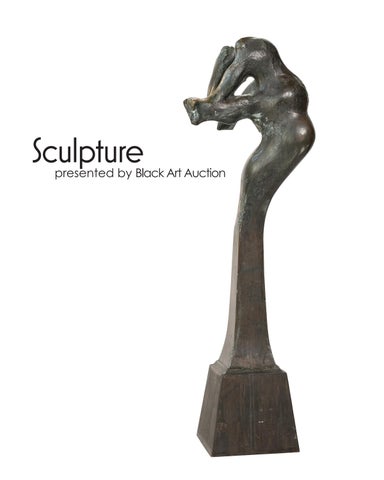
Sculpture
presented by Black Art Auction
William Ellsworth Artis (1914-1977) Head of a Young Girl, c. 1945 terra cotta on a wood base 4-1/2 inches (sculpture) 5-1/2 inches (overall height, including base) signed WArtis
Prominent African American sculptor, ceramicist, and educator, William Ellsworth Artis was born in Washington, North Carolina in 1914. He relocated to Harlem in 1926 where he studied sculpture and pottery at the Augusta Savage Studio of Arts and Crafts in the early 1930’s. Artis won the John Hope prize, in association with the Harmon Foundation for his terra cotta sculpture, Head of a Girl. This allowed him to receive further instruction at the Art Student’s League in New York in 1933. Two years later he was awarded a second John Hope prize which he used to continue his education at the Craft Student’s League. It was his work of this period that he is best known for – a series of terra cotta and stoneware heads of African American youths, Art Deco in style, which according to the St. James Guide to Black Artists, possess an “introverted impassivity and spiritual appeal.”
2
Sculpture • BLACK ART AUCTION
Sculpture • BLACK ART AUCTION
3
Richmond Barthé (1901-1989) David, 1961 dental stone, with a painted patina 17 x 8 x 10 inches (sculpture only) on a wooden base, 2-1/2 x 9 x 9 inches (making the total height 19 inches) signed
It wasn’t until Richmond Barthé’s senior year at the Art Institute of Chicago that he was introduced to sculpting, in an effort to improve his skill at fleshing out three dimensional forms on canvas. A bust completed in his introductory class was included in the Art Institute’s juried exhibition, The Negro in Art, in 1927. This led to commissions for busts of Henry O. Tanner and Toussaint L’Ouverture. He had been awarded two Rosenwald Fellowships in 1929 and 1930, and so, after graduation, he moved to New York, focused on establishing himself as a sculptor, set up a studio in Harlem, and continued studying at the Art Student’s League. Both the Whitney Museum of American Art and the Metropolitan Museum of Art purchased sculptures for their permanent collections. Throughout his career he created intimate portrait busts, large scale public commissions, and studies of the human figure. Many examples of his work may be found in public collections which include, Fisk University, Smithsonian American Art Museum, and the Museum of Fine Arts, Boston; as well as the aforementioned Whitney Museum of American Art and the Metropolitan Museum of Art, NY.
4
Sculpture • BLACK ART AUCTION
Sculpture • BLACK ART AUCTION
5
Amir Bey (contemporary) Awakening, 1974 carved and glazed stone 7-1/2 x 6-1/2 x 4 inches signed, dated, and titled Provenance: The Collection of the James Parker Art Trust, Chicago, IL
Amir Bey is a New York–based mixed-media sculptor, curator, performance artist, writer, radio producer, teaching artist, and occult practitioner. His practice spans stone, wood, silkscreen, papier-mâché, video, copper, bronze, life casts, and large-scale mixed-media installations. From 1989 to 1999, he served as curator at the Bronx River Art Center and Gallery, where he fostered an environment of experimentation and community engagement. Myth and history form the foundation of Bey’s artistic vision, with the face and mask recurring as central motifs. As he observes, “the face has a vocabulary comprised of a small number of simple components uniquely arranged that are universally recognized.” This philosophy underpins many of his series, including The Procession of Folk, a body of work centered on carved stone faces and masks designed both as performance objects and as exhibition pieces. A highlight of the series, Procession of Folk #3, consists of twelve faceted glass windows permanently installed at the Metropolitan Transit Authority’s Mount Eden Station on the Bronx’s #4 train line. Bey has collaborated with numerous multidisciplinary artists and curated a wide range of exhibitions. His performance with JD Parran, Elevated Moon, has been described as a “ritualistic happening with a combination of sound, movement, visual vibrance, and light projections.” Beyond visual art, Bey is also a practitioner of astrology and tarot; he authored the Equinox Celebration Tarot, published in both English and Japanese. In addition to his visual and performance practice, Bey produces the online newspaper The New Times Holler, extending his creative voice into the literary and journalistic realm.
6 Sculpture • BLACK ART AUCTION
Sculpture • BLACK ART AUCTION
7
Kehinde WIley (b. 1977) Louis XVI, The Sun King, 2006 cast marble dust and resin 10 inches (Height) signed, dated, numbered 64/250 in marker underneath by artist
Kehinde Wiley is an American painter best known for his large-scale portraits that reimagine the conventions of European Old Master painting through contemporary Black subjects. Born in Los Angeles, Wiley received his BFA from the San Francisco Art Institute and his MFA from Yale University. His practice centers on the elevation of everyday individuals, often young Black men and women encountered in urban spaces, whom he depicts in poses drawn from canonical Western art. By inserting these figures into richly patterned, decorative backgrounds and historically authoritative compositions, Wiley interrogates power, visibility, and representation within art history. His work has been exhibited internationally and is held in major museum collections. In 2018, Wiley was selected to paint the official portrait of President Barack Obama for the Smithsonian’s National Portrait Gallery, further cementing his influence on contemporary portraiture and cultural discourse. Kehinde Wiley’s Louis XVI, The Sun King is a collaboration with Cerealart Multiples, a Philadelphia publisher known for limited-edition artist multiples. The work is a cast marble dust and resin sculpture produced in an edition of 250, each hand signed and numbered by Wiley and published by Cerealart Multiples. In Louis XVI, The Sun King (2006/2007), Wiley reimagines a young Black man dressed in contemporary urban attire posed as a seventeenth-century monarch, borrowing from the grand, Baroque style of historical sculpture (with Bernini-like drama) while inserting his own contemporary subjects. The dynamic figure, clad in a hoodie and styled as royalty, speaks to Wiley’s broader practice of interrogating classical motifs and power structures by placing modern Black bodies into traditional symbols of elite authority
8
Sculpture • BLACK ART AUCTION
Sculpture • BLACK ART AUCTION
9
Harold Cousins (1916-1992) The Winner (Le Gagnant), 1974 various metals on a granite base 27-3/4 x 7 x 7-3/4 inches signed and dated on base, inscribed BXL (Brussels)
A pioneering modernist sculptor, Harold Cousins (1916–1992) was born and raised in Washington, DC, where early exposure to the cultural vitality of U Street’s “Black Broadway” shaped his artistic ambitions. After studying psychology and sociology at Howard University under influential figures including Alain Locke, Cousins pursued sculpture while working for the U.S. Post Office and serving in the Coast Guard during World War II. In 1948 he moved to New York to study at the Art Students League, then relocated to Paris in 1949 on the GI Bill to study privately with Ossip Zadkine. In Paris, Cousins immersed himself in European modernism and global sculptural traditions, developing a lifelong engagement with African art and direct metal techniques. A decisive turning point came in the early 1950s when he learned oxyacetylene welding, leading him to abandon traditional modeling for welded steel abstraction. By 1952 he had created his first direct-metal sculptures, soon exhibiting widely in Paris and becoming associated with the École de Paris. His linear welded works, described as “drawings in space, and his later Plaiton sculptures, constructed from repeated metal plates, explored the dynamic relationship between form, space, light, and structure. While rooted in abstraction, Cousins’ work increasingly addressed political, social, and existential themes, particularly in figurative sculptures responding to the civil rights movement and, later, his Human Comedy series. From 1967 onward he lived and worked in Brussels, exhibiting extensively throughout Europe. Though long celebrated abroad, his work gained broader recognition in the United States later in his career, including inclusion in the Studio Museum in Harlem’s Explorations in the City of Light (1996) and the Metropolitan Museum of Art’s acquisition of Torso (1951).
10
Sculpture • BLACK ART AUCTION
Sculpture • BLACK ART AUCTION
11
Earl J. Hooks, Sr. (1927-2005) Man of Sorrows 1950 unglazed terracotta sculpture on wooden base 11 x 6-1/2 x 3 inches (sculpture) 7-5/8 x 4-7/8 x 2-1/4 inches (base only) Signed on interior COA from family of the artist Exhibited: A Homecoming: Selected Works of Art by Earl J. Hooks (1927-2005), The Reginald F. Lewis Museum of Maryland African American History and Culture, Sept 12, 2006-Feb 16, 2007. Literature: Two Centuries of Black American Art, David Driskell, (catalog accompanying the exhibition, Los Angeles County Museum of Art, 1976), p. 202 (marble version) This unique example of Hooks’ iconic image in ceramic is arguably the most important version. While the artist successfully worked in virtually every medium, it might be fair to say he thought in clay. Whether he was painting, taking photos or creating sculpture in other materials, the vast majority of his work references, directly or indirectly, his work in ceramics.
12
Sculpture • BLACK ART AUCTION
Sculpture • BLACK ART AUCTION
13
Sargent Johnson (1888-1967) Misery, 1941 glazed terra cotta on a new wooden base 7 x 5 x 2-3/4 inches Provenance: The Melvin Holmes Collection of African American Art, CA Literature: The Melvin Holmes Collection of African American Art, p. 176. Sargent Johnson (1888-1967) Works in the Melvin Holmes Collection of African American Art , Tyler Fine Art, 2019, p. 30-31.
Sargent Johnson was a modernist sculptor whose work was deeply influenced by the artistic traditions of Mexico, Latin America, and West Africa. Born to a father of Swedish descent and a mother of Cherokee and African American heritage, Johnson strongly identified with his African American roots, stating that his artistic aim was to show Black people “how beautiful they were to themselves.” Orphaned at a young age, he was raised by an uncle whose wife, sculptor May Howard Jackson, provided an early and formative exposure to the arts. Johnson received formal training at the Worcester Art School in Boston before relocating to California in 1915, where he studied at the A.W. Best School of Art and the California School of Fine Arts in San Francisco. Influenced by artists such as Ralph Stackpole and Benjamin Bufano, his early sculptural work focused on small-scale ceramic heads, often depicting children. During this period, he exhibited regularly in the Harmon Foundation exhibitions from 1926 to 1935. In the 1930s, Johnson’s practice expanded in both scale and material, encompassing terra cotta, wood, copper, marble, terrazzo, and porcelain. Employed by the California WPA, he produced major public commissions, including architectural reliefs and sculptures for institutions and for the 1939 Golden Gate International Exposition. Travel to Mexico in the 1940s further shaped his work, which grew increasingly abstract while retaining references to indigenous form. Johnson’s legacy has been affirmed through major retrospectives and is represented in the collections of the Museum of Modern Art, San Francisco, and the Smithsonian American Art Museum.
14
Sculpture • BLACK ART AUCTION
Sculptures • BLACK ART AUCTION
15
Herbert House (20th century) untitled c. 1970s welded chrome elements including car bumpers 16 x 42 x 16 inches signature not found Provenance: The Collection of the James Parker Art Trust, Chicago, IL
Herbert House’s art is grounded in material transformation, turning discarded chrome into lyrical, reflective forms that bridge the industrial and the corporeal. The gleaming curves of bumpers carry both machine logic and sensual contours; in House’s hands, scrap becomes ritual. Though overshadowed in many public art narratives, House’s sculptures contribute meaningfully to the tradition of Black metal sculpture and to an aesthetic of reuse and resilience. His apprenticeship under Richard Hunt, his community-rooted practice, and his responsive approach to material all position House as a sculptor worthy of further study, preservation, and recognition.
16
Sculpture • BLACK ART AUCTION
Sculpture • BLACK ART AUCTION
17
Richard Hunt (1935-2023) Hybrid Muse, 1985 bronze sculpture on a wooden base 19-1/2 x 9 x 6 inches (overall height with base is 23 inches) This work was originally commissioned in 1985 by the Illinois Arts Council Foundation, for The Governor’s Award, and is pictured on p. 225 of Richard Hunt (published by Gregory R. Miller & Co., New York). It was also featured on the cover of the program for the May 26, 1986, Lill Ave performance.
For more than seven decades Richard Hunt’s status as the foremost AfricanAmerican abstract sculptor and artist of public sculpture has remained unchallenged. Executed in welded and cast steel, aluminum, copper, and bronze, Hunt’s abstract creations make frequent references to plant, human, and animal forms. Hunt grew up in the South Side of Chicago and attended art classes at the historic South Side Community Center and the Junior School of the Art Institute of Chicago. As an enrolled student at the Art Institute of Chicago, he taught himself to weld, and the Museum of Modern Art purchased his sculpture, Arachne. Since then, Hunt’s work has been exhibited extensively. His first public commission was completed in 1959. His most recent public commission, The Light of Truth, at the Ida B. Wells National Monument, was unveiled in Chicago’s Bronzeville neighborhood. Throughout his career, Hunt has created Swing Low for the National Museum of African American History and Culture; I Have Been to the Mountaintop, MLK Memorial, Memphis; Hero Construction, Art Institute of Chicago; Spiral Odyssey, Romare Bearden Park, Charlotte, NC, among others. Although Hunt’s name is widely recognized and regarded as ubiquitous in the field of sculpture, he also produced a variety of remarkable works on paper, including drawings, screenprints, and lithographs. His work was recently the subject of a major exhibition held at the Amon Carter Museum of American Art, October 12, 2024 - March 2, 2025.
18
Sculpture • BLACK ART AUCTION
Sculpture • BLACK ART AUCTION
19
Richard Hunt (1935-2023) untitled, Hybrid Form, 1974 cast bronze 65 x 24 x 18 inches signed and dated with AP Exhibited: Somewhere There’s Music, An Exhibition Honoring Richard Howard Hunt; Visual Arts Gallery at Governors State University, August 24th-September 26th, 2015. University Park, IL. Illustrated in accompanying catalog (a digital copy of this catalog accompanies the lot). Provenance: The Collection of the James T. Parker Art Trust, Chicago, IL
20
Sculpture • BLACK ART AUCTION
Sculpture • BLACK ART AUCTION
21
Marion Perkins (1908-1961) untitled, Head, c. 1940 carved stone 7 x 7 x 7 inches unsigned Provenance: The Collection of the James T. Parker Art Trust, Chicago, IL
Marion Perkins (1908–1961) was a largely self-taught sculptor associated with the mid-20th-century Chicago art scene. Born near Marche, Arkansas, and raised in Chicago after the death of his parents, Perkins settled in Bronzeville (Chicago), where he supported his family through various jobs while pursuing sculpture independently. His wife, Eva, served as a frequent muse and model for his figurative works. Perkins received his first formal instruction through the Illinois Art Project under sculptor Si Gordon and exhibited publicly for the first time in 1938. Working primarily in direct-carved stone and wood, he embraced a figurative modernism aligned with European precedents such as Brancusi and Modigliani. A committed Marxist, Perkins rejected abstraction in favor of recognizable imagery, believing figurative sculpture was a more democratic and socially effective form. During the 1940s and 1950s, Perkins exhibited regularly at the Art Institute of Chicago, received a Rosenwald Grant, and won multiple awards, including prizes for Ethiopia Awakening, Man of Sorrow, and Dying Soldier. His politically charged sculptures and writings affirmed his belief in art as a vehicle for social conscience. REF: Schulman, Daniel. “Marion Perkins: A Chicago Sculptor Rediscovered.” Art Institute of Chicago Museum Studies, vol. 24, no. 2, 1999, p. 220-243+267-271.
22
Sculpture • BLACK ART AUCTION
Sculpture • BLACK ART AUCTION
23
Hayward Oubré (1916-2006) Pondering, c. 1955 plaster 20-1/2 x 12 x 13 inches signed and dated on base Exhibited: Atlanta University Art Annuals: Exhibitons of Paintings, Sculptures, and Prints by Negro Artists, 1955
Hayward Louis Oubre Jr. was an American artist and educator whose work bridges Southern cultural memory and modernist innovation. Born in New Orleans to a family of African and French descent, Oubre drew early inspiration from African American life in his hometown, themes that informed his paintings and prints. He is best known, however, for his pioneering wire sculptures, celebrated for their structural ingenuity, balance, and expressive use of space. Oubre studied at Dillard University, becoming its first art major, and continued his training at Atlanta University under Hale Woodruff and Nancy Elizabeth Prophet. After serving with the Army Corps of Engineers during World War II, he earned a master’s degree from the University of Iowa through the GI Bill. Oubre devoted much of his career to teaching at historically Black colleges and universities, including Alabama State College and Winston-Salem State University, where he founded the studio art program. During the 1950s, Oubre developed his signature wire sculptures, transforming ordinary materials into airy, linear forms in which light and air play an integral role. His technical mastery and pedagogical influence earned him recognition as both an innovative sculptor and a formative mentor to generations of artists. For a comprehensive biography of Hayward Oubré, please visit, Hayward Oubré: Works on Paper, Paintings, and Sculpture.
24
Sculpture • BLACK ART AUCTION
Sculpture • BLACK ART AUCTION
25
John T. Scott (1940-2007) untitled, 1971 bronze 14 x 8 x 1 inches signed and dated Provenance: the artist to his friend and fellow artist, Earl Hooks, Sr.
John T. Scott was a New Orleans–based sculptor and printmaker whose work fused African diasporic traditions, music, and modernist abstraction. Born and raised in the city’s Lower Ninth Ward, Scott drew deeply from New Orleans’ AfricanCaribbean culture, Catholic iconography, and musical heritage. He was especially known for his vibrant kinetic sculptures and large-scale woodcuts depicting jazz funerals, second-line parades, and legendary figures such as Louis Armstrong. Scott earned his MFA from Michigan State University in 1965 and returned to Xavier University of Louisiana, where he taught for more than four decades and became a central figure in the city’s artistic life. His breakthrough Diddlie Bow series of the early 1980s transformed a West African string instrument into a kinetic sculptural vocabulary rooted in rhythm, movement, and spiritual ritual. Major commissions followed, including Spiritgates (1994) for the New Orleans Museum of Art. Often described as practicing “jazz thinking,” Scott’s work balances narrative, structure, and improvisation. Widely celebrated during his lifetime, he was praised by The New York Times as a sculptor whose kinetic art filtered the spirit of the African diaspora through a modernist lens.
26 Sculpture • BLACK ART AUCTION
Sculpture • BLACK ART AUCTION
27
after Augusta Savage (1892-1962) Gamin, 1929 (year of original design; recent casting) bronze with black patina 8 1/2 (h) x 5 (w) x 4 (d) inches (bronze) 6 x 6 x 1 1/2 inches (base) Provenance: private collection, Atlanta, GA
Augusta Savage was born in Green Cove Springs, Florida. She had a knack for sculpting even as a small child, making mud ducks and selling them at the local fair. She married at the age of 15, but her husband died the following year, after they had a child together. In 1915, her family moved to West Palm Beach, where she met a potter and acquired 25 pounds of clay. Her sculpture received much local attention, and through a series of events and support of teachers, Savage traveled to New York City in her quest to become a professional sculptor. Savage was admitted to the Cooper Union School, which was tuition-free, and finished her four-year program in three years. Among her earliest and most celebrated works was Gamin (1929), a small bust of an African American boy in a cap. Modeled with a sensitive naturalism that captured both character and spirit, the sculpture drew critical acclaim and helped secure Savage a Julius Rosenwald Fellowship. The recognition of Gamin marked a turning point in her career, propelling her into the national spotlight. With the fellowship, she traveled abroad to France, where she joined a group of Black artists and intellectuals, including Hale Woodruff, Henry Ossawa Tanner, and Countee Cullen. She studied with Félix Benneteau at the Académie de la Grande Chaumière and had two works accepted for the Salon d’Automne. Savage also exhibited at the Grand Palais in Paris. By the early 1930s, Savage was living in Harlem and had created a school, the Savage Studio of Arts and Crafts. In 1933, she founded The Vanguard, a group of Harlem intellectuals who met in her studio to discuss politics, art, and the condition of African Americans. In 1938, she was commissioned to create a sculpture for the 1939 New York World’s Fair. Inspired by the hymn written by Rosamond and James Weldon Johnson, she produced the 16-foot painted plaster Lift Every Voice and Sing (also known as The Harp), installed near the Contemporary Art Museum. Funds to have the work cast in bronze never materialized, and the sculpture was bulldozed at the close of the fair. Only the small maquettes remain. Despite many professional losses, Savage held a one-woman show at the Argent Galleries in New York in 1939. She later moved to Saugerties, New York, where she lived in relative obscurity, but continued to teach and mentor artists as well as write fiction. Augusta Savage passed away after a long battle with cancer in 1962.
28
Sculpture • BLACK ART AUCTION
Sculpture • BLACK ART AUCTION
29
©2025 Black Art Auction