
MSF The Pulse Autumn 2026 NZ

Page 1


AUTUMN 2026

MOBILE CLINICS

Finding the gaps

FACES OF MSF

A world of difference

OUR NEW DIRECTOR

Introducing Tom Roth
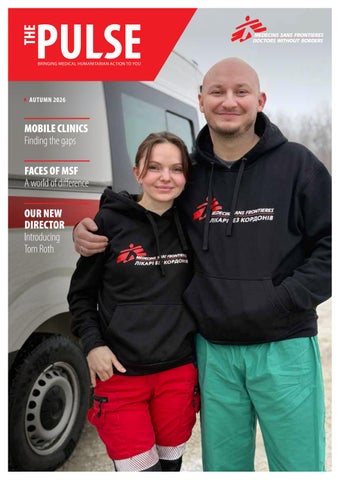
Cover: Olha Horenko, left, is an MSF ambulance doctor in eastern Ukraine, bringing patients from frontline Ministry of Health hospitals to medical facilities in quieter areas. Her husband, Roman Horenko, right, is an MSF anaesthesiologist at the MSF-supported hospital in Dnipropetrovsk region. This past 24 February marked four years since Russia’s full-scale invasion of Ukraine. © MSF

MEDECINS SANS FRONTIERES

Médecins Sans Frontières is an international, independent, medical humanitarian organisation that was founded in France in 1971. The organisation delivers emergency medical aid to people affected by armed conflict, epidemics, exclusion from healthcare and natural disasters. Assistance is provided based on need and irrespective of race, religion, gender or political affiliation.

Today Médecins Sans Frontières is a worldwide movement of 24 associations, including one in Australia. In 2024, 125 Australians and New Zealanders filled roles in our medical humanitarian projects.

Nāu te rourou, nāku te rourou, ka ora ai te iwi - With your basket and my basket, the people will thrive

This whakataukī encompasses the idea that when people work together and combine resources, we can all flourish. It was chosen by our Māori partners Deborah Harding and Tracey Poutama.

CONNECT WITH US

Call 0508 633 324

Email contact.us@nz.msf.org

msf.org.nz

facebook.com/MSFANZ

@msf_anz

MSF’s role is more critical than ever
Our new executive director on coming back to MSF, and looking ahead.

It is a great privilege to be joining Médecins Sans Frontières Australia and Médecins Sans Frontières New Zealand as executive director.

While this role is new for me, MSF is not. I have spent many years working with the organisation in different parts of the world and across a range of roles. Those experiences shaped not only my professional and personal life, but specifically my commitment to ensuring humanitarian responses –even in the most dangerous and challenging circumstances. Returning to MSF now, and doing so from Australia and New Zealand, feels both deeply familiar and newly challenging.

Having worked with MSF in South Sudan and Pakistan and supported operations in many other contexts, I have witnessed first-hand the plight of populations caught up in violent conflict and constant displacement. That connection stays with you. When I meet South Sudanese people now living in Australia, for example, it’s a chance to hear about what they’ve been through to get here. It’s a reminder of the part we have to play in bringing a bit of humanity to people caught in crisis. As a member of MSF’s national association, I’ve also kept informed about what’s happening on the ground in the places we work.

We are living through a period of extraordinary challenge for MSF and the humanitarian sector.

Across the globe, conflicts are becoming longer and more complex, with civilians bearing the brunt of violence and instability. Protracted crises are now the norm rather than the exception. Targeting of humanitarian workers and health infrastructures has become all too common. Forced population movements combined with malnutrition and food insecurity further challenge resources in affected countries and create the conditions for epidemics. At the same time, neglected diseases continue to cause unnecessary suffering and death, an issue I am passionate to take on.

Speaking out about what we see is not optional; it is central to our mission.

Access to essential medicines is profoundly unequal. Unaddressed medical needs led to the launch of the MSF Access Campaign in 1999 to overcome the problems that stood in the way of better treatment for our patients. I served for three years as deputy director of Access, and I’ve seen how despite progress, the Ebola outbreak and the COVID pandemic laid bare the need not just for improved emergency response, but also for access to new treatments and vaccines. Climate change is amplifying all these pressures, increasing the frequency and severity of disasters and placing additional strain on already fragile health systems.

As humanitarian needs grow, funding for aid has been dramatically cut and respect for humanitarian space and action is being challenged, forcing difficult decisions, including the closure of vital programs, most recently in Gaza and Sudan.

It is against this backdrop that MSF’s role is more critical than ever. Since MSF started working in humanitarian emergencies more than 50 years ago, the aid system has changed dramatically: reforms, resolutions, new coordination mechanisms, and increasing politicisation of aid. We have also seen growing dangers for humanitarian staff, particularly for national colleagues working in their own communities.

Throughout all of this, MSF has remained independently funded and guided by clear principles – neutrality, impartiality, independence and medical ethics. These are not abstract values. They are practical tools that allow us to reach people others cannot, and to stay when others are forced to leave.

Here in Australia and New Zealand, our most recent funding results show continued donor commitment, even in a difficult global environment. That trust is something we must earn every day – through impact, transparency and integrity.

On a personal level, my confidence in MSF comes from experience.

I’ve seen what MSF can do in very different contexts –in China, in South Sudan, in Pakistan. I’ve seen what it takes to negotiate humanitarian access in highly sensitive environments, and what it means when access is achieved: lives saved, dignity preserved, suffering reduced.

I’ve seen teams adapt quickly, innovate under pressure, and deliver care in places where there were few other options. Those experiences showed me not only what is possible, but what is necessary.

Looking ahead, the challenges before us are stark.

The human consequences of conflict in places like Gaza, Sudan and Ukraine demand sustained attention and action. At the same time, there are many other emergencies – forgotten, neglected, underreported –where people continue to suffer largely out of view, such as in the Central African Republic, in Haiti, and in the Rohingya refugee camps of Bangladesh.

Closer to home, the Pacific Islands face growing humanitarian and health challenges linked to climate change, geographic isolation and a noncommunicable disease crisis. Infectious diseases and access to essential medicines remain critical issues, as does the inclusion of people with disabilities in humanitarian response – an area where we still have much to learn and improve.

MSF also has an important role and ethical responsibility to tell what we are seeing and doing on the ground, and to speak out with a sense of urgency to prevent greater harms. We must continue to bear witness – to practise témoignage.

Speaking out about what we see is not optional; it is central to our mission. This issue of The Pulse testifies to how much we in Australia and New Zealand value this aspect of our work – and how our international colleagues honour this responsibility.

We must continue to earn the trust and support of the public here at home. We must draw on the extraordinary professional talent in this region and inspire a new generation to serve with MSF projects around the world. And we must be a strong, credible voice for those who are marginalised, vulnerable and too often unheard.

Above all, we must continue to respond – quickly, effectively and with humanity – when crisis strikes.

I am grateful for the opportunity to do this work alongside all of you, and I look forward to what we can achieve together.

New Zealand

Tom Roth at an MSF primary health unit in Thonyor, Unity state, South Sudan, November 2003. © David Levene/MSF

SEARCH AND RESCUE

Saving lives in the Mediterranean

Every day five people on average die or go missing while trying to cross the central Mediterranean Sea, from North Africa to Europe, the deadliest migration route globally. MSF has been involved in search and rescue (SAR) activities on this stretch of sea since 2015, working on eight different vessels, alone or in partnership with other NGOs and rescuing more than 94,000 people. In late 2025, MSF relaunched its lifesaving SAR activities, with a smaller, faster boat, Oyvon, almost a year after being forced to terminate operations with its last rescue vessel, following restrictive and obstructive laws imposed by the Italian government. The MSF crew onboard includes a doctor and a nurse to treat people for hypothermia, fuel inhalation, fuel burns, as well as wounds they might have sustained in the cycle of abuse and detention in Libya. “As a medical and humanitarian organisation, our commitment to being present at sea and supporting people on the move is unwavering,” said Juan Matias Gil, MSF SAR representative. “We have returned to carry out the duty of rescue for those who find themselves in distress at sea, forced to take unseaworthy boats, after having endured deplorable and inhumane conditions, detention, abuse and extortion in Libya.”

The new photovoltaic solar installation at Niafounké hospital has a capacity of 90kWp, with a 210kWh lithium battery storage systrem, plus an 80kVA generator.

26,000 people have been confirmed dead or missing attempting to cross the Mediterranean, since 2014.

Powering hospitals with solar

In the Timbuktu region of northern Mali, a new solar energy system is powering the remote hospital of Niafounké. The project is part of MSF’s Green Initiative, aimed at reducing the environmental footprint of its activities while improving operational efficiency. Until recently the hospital relied almost entirely on a dieselpowered thermal power plant prone to frequent outages, forcing MSF teams to use a back-up generator, which was expensive and unreliable. The photovoltaic solar installation now covers 60 per cent of the hospital’s energy needs, significantly reducing this dependence.

“This energy transition makes it possible to reduce expenses related to the generator, its maintenance, and the purchase of diesel, allowing more resources to be allocated to patient care,” said Soulemane Outtara, Timbuktu project coordinator. “It supports the continuity of vital care such as the operation of oxygen concentrators in neonatology and paediatrics, surgical and obstetric emergencies, as well as power supply for the laboratory, ultrasound equipment and the cold chain essential for blood transfusions.”

For several years MSF has been deploying hybrid photovoltaic solar systems in various countries, particularly in the Sahel region, to limit dependence on diesel, an expensive and polluting energy source.

MSF’s new search and rescue vessel, Oyvon. © Lisa Veran/MSF
The hospital in Niafounké, northern Mali, supported by MSF since 2021. © Lamine Keita/MSF
MALI

The alarming rise of sexual violence

Emergency response near the front line HAITI

For thousands of civilians in Haiti’s capital, daily life is marked by extreme violence, gunfire and drone strikes, in a city controlled by rival armed groups that regularly clash with the Haitian National Police. In recent years, sexual and gender-based violence (SGBV) has been surging and is being used to terrorise communities in many parts of the city. This crisis is occurring as infrastructure, public services and living conditions have deteriorated dramatically amid widespread insecurity. MSF’s Pran Men’m clinic in Port-au-Prince is providing medical and psychosocial care to sexual violence survivors and has seen admissions triple over a four-year period. MSF’s recently released report Sexual and genderbased violence in Port-au-Prince, Haiti is based on 10 years of medical data and testimonies collected from MSF’s clinic.

“This report shows how the explosion of violence in Haiti in recent years has had a direct impact on the bodies of women and girls in Port-au-Prince,” said Diana Manilla Arroyo, MSF head of mission in Haiti.

The report calls for urgent action by Haitian authorities, service providers, donors, United Nations agencies and security actors to implement survivor-centered response focused on long-term recovery.

Monthly admissions at MSF’s SGBV clinic increased from 95 per month in 2021 to 250 per month in 2025. From 2015 to 2025 MSF supported 17,000 people, 98% of whom are women and girls.

Displaced people wait in line to get drinkable water in AlMina Al-Muwahad, the largest displacement camp near El-Obeid city, Sudan. © MSF

SUDAN

As violence continues to spread across Sudan, the Kordofan region has remained one of the most active conflict zones. At the heart of this vast area, the city of El Obeid is a major refuge for displaced families fleeing violence. Living conditions are precarious: access to healthcare is limited, safe drinking water is scarce, and sanitation facilities are insufficient to meet rapidly growing needs. In response, MSF has launched emergency activities in Al-Mina AlMuwahad, the main displacement site of El Obeid, which hosts around 25,000 people. MSF teams are strengthening water and sanitation services by constructing latrines, installing water bladders and supporting communitybased disease and nutrition surveillance through Ministry of Health community health volunteers.

“El Obeid lost many of its original residents, but today it hosts tens of thousands of displaced people who settled here in different moments of the war,” says Al Tayeb Mahmoud Mahammed, MSF’s team leader in El Obeid.

“With the frontline less than 40 kilometres away, the city continues to receive new arrivals almost daily. People arriving here are deeply scared as the fighting draws closer. Yet they still feel safer than where they came from, where they were exposed to violence, looting, and beatings.”

15 million people have been forced from their homes since the start of the Sudan conflict in April 2023

11.5 million displaced within Sudan and approximately 4 million who fled across borders.

A 27-year-old survivor, mother of two, confides in a member of MSF staff in Haiti. After her husband was killed in an armed attack in their neighbourhood, she was subjected to sexual violence. © MSF

Mobile clinics go where the gaps are

In many places where MSF works, people lack access to basic healthcare for a range of reasons, such as conflict, disaster, displacement, poverty, exclusion or sheer distance. As Australian nurse Shelley Cook explains, mobile clinics – flexible, quick and low-cost – are ideally suited to reaching them with medical aid.

In February 2025, MSF mobile clinics went to remote localities in North Kivu, Democratic Republic of Congo. Their aim was to assess needs and provide support to displaced people who returned to their villages of origin after the M23 rebel group took control of the provincial capital Goma.

© Daniel Buuma/MSF

In late November 2025, Cyclone Senyar unleashed extreme rainfall in parts of Indonesia and caused devastating floods in Aceh, North Sumatra and West Sumatra provinces. Official figures would eventually record more than 1,000 deaths and over 130,000 people displaced across the three provinces. MSF launched an emergency response, arriving in Aceh Tamiang, a district of Aceh, on 5 December.

After floodwaters receded, 17 out of 19 health facilities in Aceh Tamiang, including 12 general healthcare centres, were left covered in heavy mud and were no longer functional.

MSF helped to clean up and reactivate two healthcare centres, distributed relief packages, and supported the District Health Office’s Emergency Operation Centre.

MSF also ran mobile clinics in eight subdistricts of Aceh Tamiang, and one subdistrict in Aceh Timur, where the team travelled by boat for five hours and camped overnight to bring care to hard-to-reach villages.

The mobile clinics had a significant impact. When the emergency response finished at the end of January this year, mobile clinic teams had treated 2,430 patients, many for upper respiratory tract infections, generalised aches and pains, and chronic hypertension. They also provided mental healthcare to 429 people to help them cope with trauma following the disaster.

Anyone following MSF’s work in recent years will likely have heard about mobile clinics. They are often highlighted in updates about projects around the world. But what are they? How do they work? What’s so special about them?

The description alone might conjure an image of a 4x4 packed with medicines and equipment rolling into a faraway community –and sometimes that might be the case. But what defines a mobile clinic is not so much the place or the structure, which can be all kinds of things – it’s really about the people in it.

In short, an MSF mobile clinic is a small team that goes to remote or hard-to-reach areas to provide essential, free primary healthcare to populations lacking access to hospitals or other medical facilities.

Teams set up basic operations to treat common diseases, offer nutritional support, and provide vaccinations, mental health consultations and other services, depending on needs identified and the makeup of the team. They can also refer patients for higher-level care.

Flexibility is the key – adapting to local conditions, figuring out how to get to people and providing essential care. Mobile clinics are often deployed in conflict or postdisaster situations as a way – often the only way – for underserved communities to access healthcare.

It’s so flexible, and that’s part of the beauty of it.

“It’s a perfect model, because it fills a gap that we can’t fill any other way,” says Shelley Cook, an Australian nurse who returned home in February from Sudan, where she was a project medical referent based in White Nile state. “There are different models, and you fit the model to what the need is where you are. It’s so flexible, and that’s part of the beauty of it.”

Left top: MSF staff in a mobile clinic of the People on the Move project prepare for consultations in Agrigento, in southwestern Sicily, Italy, 11 September 2025. The team provides healthcare and psychosocial support to young migrants who have survived the deadly Mediterranean crossing.

© Giuseppe La Rosa/MSF

Left bottom: Valerii Bureiko (left) at the MSF mobile clinic in Pavlohrad, Dnipropetrovsk region, Ukraine, 19 September 2025. Valerii, 68, fled Kostiantynivka in Donetsk region with his wife and her mother and arrived at a transit centre in Pavlohrad. He came to MSF because of gout and joint pain, and to get the necessary medication before his family moves on.

© Yuliia Trofimova/MSF

An MSF medical staff member explains medication dosage to a patient during a mobile clinic in Paya Awe village, Aceh Tamiang district, Indonesia, 9 January 2026. MSF deployed the mobile clinics after flooding from Cyclone Senyar. © Sania Elizabeth/MSF

The structure can be many things. A basic tent can be set up to provide a shaded, private space and quickly taken down. Thatched huts or other shelters made from local materials might be an option. Sometimes a large truck or a bus is all that is used, just enough to provide room to work and a bit of shelter. Or sometimes a local building – a community centre or a school, for example – has available space, and arrangements are sought with local authorities to conduct operations.

On assignments in Sudan, South Sudan, Palestine, Nigeria and Yemen, Shelley has experienced first-hand the variety and effectiveness of mobile clinics operated by MSF as well as our partners.

She points out that in a context like Sudan, where ongoing conflict creates so much displacement, mobile clinics are uniquely suited to respond: “If the population moves, you can move to where they are, because it’s not a big structure. There’s not a lot of investment in infrastructure. You can follow the population.”

The typical staffing requirements are streamlined and simple.

“You always need a doctor, a nurse and health promotion. And then you should have a midwife, because family planning, antenatal care and postnatal care are so hard to access,” Shelley says. “So you need those four profiles and then usually an international mobile staff member to be the security focal point to help give the team access and coordinate the activities.”

Health promotion plays an essential part in running an effective mobile clinic. “You need community engagement, because that’s how you let people know,” she says. “One, you have the acceptance, and two, people know that you’re there and that they can access free medical care.”

MSF’s mobile clinics in Palestine’s West Bank provide a vivid example of how teams adapt to complex challenges to respond to local health needs, and the multiple functions the teams perform.

“My second assignment with MSF was in Hebron in the West Bank, and they already had mobile clinics set up there for a while. It was our only access to Masafer Yatta, to lots of Palestinian communities, and we had to go to them because they couldn’t pass checkpoints,” she says.

“We ran clinics in three different areas, and they were quite established. One was in a community centre, and we’d rent that for the day we were there, and others we’d just erect tents and that’s where we went. We packed the ute or the pick-up and go and set up. You run the clinic for the day and then you pack up and go home. It was really our only access.”

Through the mobile clinics, the teams could provide residents a range of basic healthcare services, including paediatric care, treatment for chronic communicable and non-communicable diseases, reproductive health, mental health for survivors of violence, and nutritional screening. The teams would typically see more than a hundred patients a day.

“We had two doctors, and one had a strength in gynaecology,” Shelley says. “We had a shortage of midwife activity managers, but we had a local midwife. Ideally you want someone who has experience with children – a lot of our population was children, and we had one doctor who was strong in paediatrics.”

An MSF staff member supports with organising the medical box at the MSF mobile clinic in Jinba, Masafer Yatta, in Hebron governorate, Palestine, May 2025. © MSF
Ahmad Fares Al Hajjeh, 7, is seen by a doctor at an MSF mobile clinic in the village of Maydaani, near Damascus, Syria, May 2025. Ahmad’s mother heard about the mobile clinic through the community and decided to bring Ahmad, who had been ill for several days. © Philémon Barbier/Hors Format

Residents of Masafer Yatta, in the southern hills of Hebron Governorate, have faced expulsion threats and demolition orders since 1981, when the Israeli army designated the area as a firing zone – a closed military zone. Israeli authorities put extraordinary pressure on the residents to leave the area, limiting their access to electricity, water, food and education, as well to freedom of movement and medical care. In such a tightly restricted environment, reaching communities is a serious challenge.

The mobile clinic was also our eyes.

“Every morning there was this process that had been set up with the authorities,” Shelley says. “The field coordinator would liaise with the authorities. We’d get the green light, then we could move. I think there were a couple of times when we were stopped at checkpoints and told we couldn’t pass, and then you make the phone call to the field coordinator, who clears it up with the head of IDF [Israel Defence Forces] and then we’re allowed to pass.”

Shelley acted as the security focal point for the team. “You’re completely vulnerable, really. You’re the only international staff. You’ve got Palestinians in an area where they’re not welcome. And so you’re their protection. You need to have an idea of how you can protect them and what you need to look out for and what you would do, because you’re literally in a car or in a tent, and that’s it.”

In such a scenario, a mobile clinic can serve another essential function: bearing witness. The MSF teams in the West Bank saw first-hand the consequences of the measures enforced by Israeli authorities. As well as installing checkpoints, the authorities confiscated residents’ vehicles, enforced curfews, and put other movement restrictions in place. Homes, schools and other structures were demolished.

The constant fear of aggression and violence committed by Israeli settlers and armed forces took a massive toll on the mental health of Palestinians, especially those living in areas like Masafer Yatta, where threats of forcible transfer, injury and possible death were ever-present.

“The mobile clinic was also our eyes. No one was watching what was happening or could watch what was happening in Masafer Yatta,” Shelley says. “It was MSF that could do that through the mobile clinics – seeing the behaviour of the settlers, what people did in an emergency, the difficulties getting anywhere. Even travelling by donkey, people were harassed and stopped.”

The clinics are also about human connections. Shelley is struck by the bond built with communities through the mobile clinics. She recalls while working at the community centre in Hebron an incident forced the team to shelter in place.

“There was a security situation, and we needed to hibernate. And people came, neighbours came on foot – even though there was active shooting going on – to give us food. It was so valued, and they were so grateful that we would come once a week, and that’s all we did,” she says. “It was amazing.”

An MSF health promotion officer refers people to the mobile clinic in Ndava refugee camp in Cibitoke, in the northwest of Burundi, December 2025. More than 88,000 refugees from the Democratic Republic of Congo fled escalating violence in South Kivu province but faced desperate conditions in the camps. © Dorine Niyungeko/MSF

Faces of MSF

The people who make up MSF – people who rely on our care, locally hired staff members who support their communities, and international staff who travel to projects far and wide –reflect our common humanity that knows no borders, and the difference we can make together in a divided world.

In South Sudan, Rebecca holds a handful of syringes, showing the supply of insulin she has for her 12-yearold son, Ajou, until their next hospital visit. Ajou suffers from type 1 diabetes, and each syringe is carefully used to draw insulin from vials stored in clay pots at home. © Isaac Buay/MS

Above left: Jorge Martín, MSF project coordinator in Mexico City, leads MSF’s effort to reshape its strategy in Mexico City following major changes in US immigration policy. As routes north become harder, migrants are transforming the city’s humanitarian landscape. © Maria Chavarria/MSF

Above right: In December 2025, MSF wrapped up its activities in northern Brazil after nearly three years providing healthcare to indigenous communities in the Yanomami territory. Xilausoma, community advisor and member of the Kalisse community, said, “For us, having MSF here in our community means a lot. MSF helped us understand malaria – how to prevent it, how to recognise the signs, and how to follow the treatment. We feel included, respected and grateful, because the team explained things in a way we could truly understand.” © Marília Gurgel/MSF

Jinnathun Nesa Jinnat, 30, is the only female driver in the MSF drivers’ team at Kutupalong refugee camp in Cox’s Bazar, Bangladesh. She is selfconfident and passionate about her job. Kutupalong refugee camp, near the border of Myanmar, is the world’s largest refugee camp, with more than a million Rohingya refugees from Myanmar. ©Ante Bussmann/MSF

Water and sanitation specialist Hamid Ullah checks the water tanks at MSF’s Jamtoli primary healthcare centre at Kutupalong Refugee Camp in Bangladesh. Hamid, from the Rohingya community, has been a camp-based team member of MSF since 2023. © Ante Bussmann/MSF

“Nowadays even six-month-old babies are affected by kala azar,” says Ntare Bagajo a mother from Loglogo, Kenya, whose son had kala azar, or visceral leishmaniasis, a neglected tropical disease that is almost always fatal if untreated. © Lucy Makori/MSF

Above right: Sunita*, an HIV survivor, gazes out from a balcony with hope for a brighter future after her regular follow-up at MSF’s advanced HIV care centre at Guru Gobind Singh Hospital, in Patna, Bihar state, India. There are limited treatment options and a high mortality rate for HIV in Bihar, as well as persistent social stigma. © Deepak Bhatia/MSF

Above left: Giulia Chiopris, an MSF paeditrician from Italy at Tawila Hospital in North Darfur, Sudan. By late 2025, the prevalence of moderate and severe acute malnutrition among children reached alarming levels as war continued in Sudan amid global inaction. © Aurélie Lécrivain/MSF

Dr Mohamed Javid Abdelmoneim at MSF international headquarters in Geneva, Switzerland. Dr Javid, a SudaneseIranian emergency medicine doctor born in the UK, started as MSF’s international president in September 2025. © Pierre-Yves Bernard/MSF

The ‘golden time’ The lifesaving window in trauma care

Dr Mohammad Qaher Poya shares a recent experience that shows the importance of taking quick action to treat trauma – and the dedication of MSF’s locally hired staff in the places where we work. Just over 10 years ago, on 3 October 2015, the Kunduz Trauma Centre run by MSF in Afghanistan came under intense US airstrikes. The attack killed 42 people, including 24 patients, 14 MSF staff members and four patient caretakers. It remains the deadliest attack ever perpetrated against an MSF facility. Dr Poya is one of the survivors of that attack. A new trauma centre was built and opened in 2021, where he now works as deputy nursing director.

Dear Friends,

Our hospital in Kunduz, in northern Afghanistan, is in a largely rural province where lots of people have agricultural livelihoods. We are a specialised trauma centre, so we are used to seeing patients with open wounds from falls, traffic accidents and explosives.

One day, a young boy arrived in critical condition. He was around eight years old. Ishaq* had been playing near his home when he picked up an unfamiliar object. When he tried to open it to see what it was, it exploded.

Ishaq’s family acted fast. They used a scarf, desperately trying to stop the bleeding as they rushed him to our trauma centre. In our emergency room, we assessed Ishaq quickly. He had many penetrating wounds, multiple fractures, and part of his hand had been blown off. The injuries to his torso were so extensive that his intestines were exposed.

His family’s rapid actions kept him alive long enough to get to the hospital, and as a team we raced to stabilise him.

When we assess a patient in a condition like Ishaq’s, we use the C-ABCD approach – catastrophic bleeding, airways, breathing, circulation, disability. This not only helps prioritise the actions most likely to save someone’s life, it also helps us monitor for changes in their condition. But the explosion meant Ishaq’s wounds were covered in dust and dirt and penetrated deeply –the chance of infection was extremely high.

In the following days, Ishaq developed sepsis and went into septic shock. In sepsis, the infection causes a patient’s blood vessels to expand, creating more space inside them. The extra space means the pressure that allows the blood to be pumped around the body starts to drop.

Faizullah, a minibus driver from Afghanistan’s Takhar province, was seriously injured after a road accident. Unable to pay for treatment in his province, he came to MSF’s Kunduz Trauma Centre to receive free treatment for his injured leg. He returns once a week from his province for medical follow-up and physiotherapy sessions.

© Alexandre Marcou/MSF

Dr Mohammad Qaher Poya

© Tasal Khogyani/MSF

The heart starts to beat faster to try to compensate, but the body cannot sustain this for long. Over time, the heart starts to tire, and it can’t pump enough blood around the body, so the organs don’t get enough oxygen. They start to fail.

Ishaq was coming dangerously close to organ failure. We gave him rapid doses of resuscitation fluids and opened his airway. We gave him antibiotics to fight the infection and medication to try to allow the heart to resume pumping blood around the body at a steady beat.

Ishaq needed multiple surgeries for his extensive wounds, but he was still too unstable for the operating theatre.

We monitored him closely. He was in a critical condition, and his chances of survival were very low. We spoke to Ishaq’s family about how extensive his injuries were and that it was possible he would not survive. It is never easy to have these conversations with loved ones, especially when a patient is so young. We tried to keep Ishaq as comfortable as possible and manage his pain.

As days passed, Ishaq remained unstable. But he was still with us.

After seven days, Ishaq slowly began to come out of septic shock. Eventually, he became stable enough for surgery. Ishaq had multiple surgeries requiring over 200 stitches. We observed him carefully for complications.

Gradually, Ishaq began to recover. He grew stronger and stronger. After four weeks, he was well enough to be discharged from our hospital.

Our team was overjoyed. For a while we had been unsure that Ishaq would survive, but he was a strong little boy. Seeing him walk through the hospital, talking with his family and smiling gave me a huge sense of pride. In that moment, I was proud of the hospital, proud of our team and proud of myself. Our care meant that Ishaq was able to return home and go back to being a child again.

In trauma care, we often talk about the “golden time” – a critical moment where rapid actions can save a patient’s life. For Ishaq, his family’s quick reaction meant that he made it to the hospital in time for our team to give him the specialist care he needed.

Carol Glamuzina

Location: Auckland (Tāmaki Makaurau)

When Carol Glamuzina signed up for this year’s Southern Cross Round the Bays fun run in Auckland in March, she chose MSF as her fundraising recipient – the same as she did for 2024 Round the Bays. She registered in mid-February and got right to it.

“I sent out a WhatsApp message to lots of people: friends, family, work colleagues, a couple of businesses I’ve got good relationships with, some new neighbours – pretty random,” she says with a laugh. Setting up the fundraising page was “really good, really user friendly”, she says.

Carol’s initial goal was to raise $500. “Once I got over that, I sent out messages to a few people and said, ‘Hey, I’d like to double my goal,’ and then that got doubled quite quickly.” At the starting line on the day, she went through her contact list and messaged four people she had not messaged before – just before the race –and all of them made a donation. By the close of the event, she had raised $1,920.

A monthly donor to MSF since 2018, Carol is looking forward to the next community fundraising opportunity to support MSF.

“It’s an organisation that I admire, the actual ‘no borders’. You go to the really hard places,” she says. “I just want to do the bit I can.”

Carol Glamuzina at the 2026 Round the Bays on 8 March in Auckland (Photo supplied)

To learn more about community fundraising, please visit fundraise.msf.org.nz, or contact our team at community.fundraising@nz.msf.org

Logistics team leader

Home: Auckland (Tāmaki Makaurau)

MSF experience:

Liberia, Yemen, Sudan

How did you start out in MSF?

I had an engineering degree and then did a lot of work with USAID and a few others doing natural disaster, post-disaster reconstruction in the Caribbean and Africa. The work opportunities were quite limited, and they were moving towards a model where internationals were just based in big cities, and national staff in the field. Someone said you would probably prefer the MSF model – there’s more work, more interesting work, and you get to be in the field. They thought it would be a good fit. Originally I was looking at roles as an engineer, but I ended up doing logistics team leader and operations roles. I absolutely love it. It’s a perfect fit right now.

Your first MSF assignment was in Liberia. How was that?

It was a closure project. There was a logistics manager role, and it was a very good one to sort of get running. We didn’t really have an active hospital; we were just doing outreach projects. Socially it was a lot of fun – we had an MSF football team and every Saturday we would drive into the mountains and play these little communities. Because of the closure, it was a bit tricky, but it was a good way to get to know the MSF systems without a huge amount of pressure. Then I went to Yemen, and there was the operational hospital, with very experienced national staff, so progressing to something considerably more difficult. I’ve been lucky to go through these steps.

And now in Sudan – is it more of a challenge?

It is. It’s a logistics team leader role, as opposed to logistics manager. The coordination team is busy looking after what’s happening in the west – in the Kordofans and in Darfur. So it’s for you to make the decisions and get on with it. Also, because of the war, the skilled workforce, the experienced people – they went to Egypt, Dubai, Uganda, and they have not returned. So a high portion of my role is coaching, managing, upskilling, training – more than I would do elsewhere. And the hospital we’re in [in South Khartoum] was a really good hospital built in the ’90s, but after two years of war in and around Khartoum, everything – the electrics, the building, all the biomedical equipment, the water system, the waste system – is just ruined. We’re trying to fix the worst bits, but it’s extremely hard, and we can’t get spare parts into the country. A huge amount of the people we’re seeing in the south of Khartoum are mothers with their children. Each week our numbers are going up, but our staff numbers are remaining somewhat the same, so we’re getting busier and busier.

MSF logistics team leader Grant Clark (Photo supplied)
Grant Clark, right, with MSF colleagues on the banks of the Nile in Khartoum (Photo supplied)

Can you explain what a logistics specialist does? I always put it to friends like this: imagine the doctors and the nurses as the ones physically doing the work, the ones on the front line. If a doctor goes to work, what do they need to work all day without disruption? Electricity, water, clean drinking water for their patients, biomedical equipment that works, security, ambulances or vehicles for staff. Wi-Fi and comms technology. Removing all the different forms of waste from the hospital. All these things enable the medical team to do their job.

What about supply?

One of the big things is the market in Khartoum has not come back. We don’t have access to good electrical equipment, furniture, biomedical equipment. The exchange rate is changing constantly, so the cost of items, getting fuel, all these things that were probably quite easy and straightforward before are very difficult now.

What are you dealing with in terms of security and conflict?

When you’re in Omdurman here at night, it seems very calm. In September, October, there were some drone strikes, but for the last three months, almost nothing. There’s a very big police presence and military presence in the city. We don’t see street crime, domestic issues, protesting, demonstrations. It’s not seen.

We live in Omdurman in the northwest, but we work in the south, and every day we drive for one hour through the city of Khartoum, and the city has been completely annihilated. In the past it would have been three hours because of the traffic, and now it’s nothing. We’re one of the only cars on the street. And a lot of our national staff, where we drive through, they tell us, “That’s where I went to school”, “That’s where we went to university, “That’s my uncle’s house”. It looks like it’ll be a generational rebuild. It’s extremely sad.

What do you do in your downtime?

I’m doing like 12-, 13-hour days, it’s so heavy with work. But I don’t mind it – the work is super interesting. We’re very lucky though, because we have all five sections of MSF living on the same road. We’re all over the city with our work, but we all live on this road, so every weekend we all hang out together. It’s really nice and very unique. And I play football on the pitch behind our house.

What’s next?

I’ll come back to New Zealand in May. I was trying to be home for summer, but three years in a row I’ve been home for winter. I keep timing it wrong. I come home for about two months – two months is perfect, and then I get itchy feet and I want to go again. The next plan is to go home for a time, then go on a French immersion and then do a French-speaking assignment. That’s my 2026 plan.

RECRUITMENT

Working with MSF: Essential criteria

Watch our recent webinar to learn about the skills and experience MSF looks for in all our international staff, and why these criteria are essential to work overseas with us.

Scan the QR code

ARE YOU A PAEDIATRICIAN?

Keen to make a meaningful impact on the health and well-being of children in vulnerable communities?

MSF is recruiting paediatricians. Please apply at msf.org.nz/joinour-team/work-overseas

ON ASSIGNMENT

An MSF team travels on foot to access hard-to-reach areas during an assessment in Aceh Tamiang district, in Aceh province, Indonesia, 23 January 2026. MSF launched an emergency response in December 2025 following the devastating floods caused by Cyclone Senyar. © Ivan Sinaga/MSF)

During the last quarter, 46 staff from Australia and seven from New Zealand covered 58 assignments with MSF.

This list of project staff comprises only those recruited by MSF Australia who have given permission for their names to be published. We also wish to recognise other Australians and New Zealanders who have contributed to MSF programs worldwide but are not listed because they joined the organisation overseas.

Afghanistan

Timothy Pont, mobile implementation officer (TACTIC)

Lisa Noonan, antimicrobial stewardship focal point

Andrew Wallace, paediatrician

Bangladesh

Julia Stuart, clinical support nurse

Annie Lee, hospital director

Central African Republic

Anne Lickliter, infection prevention and control manager

Chad

Patrick Baffoun, deputy project coordinator/project coordinator

Noni Winkler, epidemiology activity manager

Democratic Republic of Congo

Ian Hayes, surgeon

Ethiopia

Jairam Kamala Ramakrishnan, mental health activity manager

Haiti

Alec Kelly, deputy head of mission

msf.org.nz facebook.com/MSFANZ @msf_anz

Iraq

Christopher Williams, paediatrician

Jamaica

Alec Kelly, deputy head of mission

Kenya

Naomi Thomson, logistics manager

Philip Burke, logistics manager

Kiribati

Peter Clausen, head of mission

Neil McNulty Cooper, medical doctor

Leahanne King, finance/HR manager

Lebanon

Thienminh Dinh, medical activity manager

Louisa Cormack, head of mission

Libya

Adam Mangal, mission logistics manager

Myanmar

Samuel Templeman, medical coordinator

Claire Manera, project coordinator

Nigeria

Shelley Harris-Studdart, midwife activity manager

Rodney Miller, project coordinator

Amy Kaukiainen, psychologist

Occupied Palestinian Territories

Michael Hoey, deputy HR coordinator

Aidan Yuen, epidemiology activity manager

Ben Shearman, logistics coordinator

Kathrine Charlton, medical coordinator

Abbie Hamilton, nursing activity manager

Rebecca Smith, nursing activity manager

Prue Coakley, project coordinator

Emily Young, project medical referent

Kaylene Tomkins, project medical referent

Pakistan

Hana Badando, WoW facilitator

Papua New Guinea

Ivo Juliao Valente Dias, deputy head of mission

Philippines

Megan Graham, finance/HR coordinator

Sonam Kalon, regional advocacy representative

South Sudan

Anna Negus, anaesthetist

Helmut Schoengen, anaesthetist

Matthew Calissi, hospital facilities manager

Sudan

Paul Maclure, anaesthetist

Louise Timbs, head nurse

Grant Clark, logistics team leader

Jim Cutts, logistics team leader

Malaika El Amrani, nursing activity manager

Tara Pollock, project coordinator

Amy Neilson, project medical referent

Shelley Cook, project medical referent

Malcolm Hugo, mental health activity manager

Syria

Aidan Yuen, epidemiology activity manager

Brian Moller, head of mission

Caterina Schneider-King, HR coordinator

Ukraine

Hannah Whetham, mental health supervisor

Yemen

Adam Mangal, logistics manager

Naomi Thomson, logistics manager

Turn static files into dynamic content formats.

Create a flipbook