Issue 27 Winter 2010
SMarT The newsletter of the Sarah Matheson Trust
From the executive director
Contents From the executive director
Nickie Roberts introduces herself
1
The role of the SMT’s specialist nurse 2 Samantha Pavey gives a round-up of her work for the Trust An update on the progress of the Bill through Parliament
Care in the Home
3
How would you like to help with the Trust’s information resources?
Information resources 4
Information for professionals
Feeding difficulties
5
Nerve cell mechanism explored; pain and quality of life
Research update
6-8
Respite holidays on offer
9
Carer news
Reports from around the country
Regional support 10-12 Running, cycling, canoeing... and other fundraising ideas
Fundraising
News
13-15
How to get involved 16 Sarah Matheson Trust provides a support and information service to people with Multiple System Atrophy (MSA), their families and carers, healthcare professionals and social care teams. We also sponsor and support research into MSA.
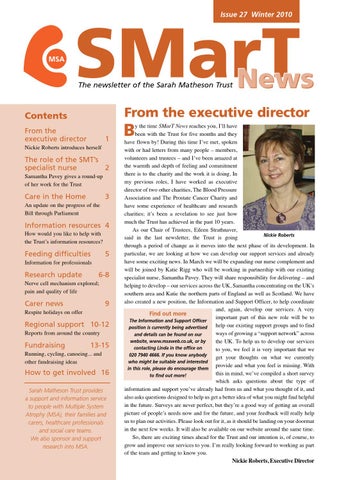
y the time SMarT News reaches you, I’ll have been with the Trust for five months and they have flown by! During this time I’ve met, spoken with or had letters from many people – members, volunteers and trustees – and I’ve been amazed at the warmth and depth of feeling and commitment there is to the charity and the work it is doing. In my previous roles, I have worked as executive director of two other charities, The Blood Pressure Association and The Prostate Cancer Charity and have some experience of healthcare and research charities; it’s been a revelation to see just how much the Trust has achieved in the past 10 years. As our Chair of Trustees, Eileen Strathnaver, Nickie Roberts said in the last newsletter, the Trust is going through a period of change as it moves into the next phase of its development. In particular, we are looking at how we can develop our support services and already have some exciting news. In March we will be expanding our nurse complement and will be joined by Katie Rigg who will be working in partnership with our existing specialist nurse, Samantha Pavey. They will share responsibility for delivering – and helping to develop – our services across the UK, Samantha concentrating on the UK’s southern area and Katie the northern parts of England as well as Scotland. We have also created a new position, the Information and Support Officer, to help coordinate and, again, develop our services. A very Find out more important part of this new role will be to The Information and Support Officer help our existing support groups and to find position is currently being advertised ways of growing a “support network” across and details can be found on our website, www.msaweb.co.uk, or by the UK. To help us to develop our services contacting Linda in the office on to you, we feel it is very important that we 020 7940 4666. If you know anybody get your thoughts on what we currently who might be suitable and interested provide and what you feel is missing. With in this role, please do encourage them this in mind, we’ve compiled a short survey to find out more! which asks questions about the type of information and support you’ve already had from us and what you thought of it, and also asks questions designed to help us get a better idea of what you might find helpful in the future. Surveys are never perfect, but they’re a good way of getting an overall picture of people’s needs now and for the future, and your feedback will really help us to plan our activities. Please look out for it, as it should be landing on your doormat in the next few weeks. It will also be available on our website around the same time. So, there are exciting times ahead for the Trust and our intention is, of course, to grow and improve our services to you. I’m really looking forward to working as part of the team and getting to know you. Nickie Roberts, Executive Director
B
Specialist nurses
Examining the role of the Trust’s specialist nurse Telephone helpline
I run the helpline across the week from Monday to Friday from 09.30-16.30 and while I’m away from my desk the answerphone picks up messages which I reply to as quickly as I can. I receive calls about many different aspects of living with MSA, from people with the disorder and also from carers and family members. Sometimes calls are about the physical issues of MSA, helping people to think through the practical changes that might make life easier, such as how to adapt the functional rooms at home such as kitchens or bedrooms, and sometimes they can be more about helping people with any emotional concerns they may have. If you would like to call me, my number is 020 3371 0003.
“Sometimes calls are about the physical issues of MSA, helping people to think through the practical changes that might make life easier.”
2
Email enquiries Many people prefer to have their questions answered by email, perhaps because it means they can get in touch at any time of the day or night and my answer (I usually try to get back to people within a few days) can be read when it is most convenient to them. Contacting me in this way can also provide time for people to think through their query, and time to reflect on the content of my answer. If you would like to email me, my address is samantha.msa@googlemail.com. Liaising with your healthcare professional Often when people join the Trust they ask me to visit them. Unfortunately I’m not able to do this, but I can liaise by telephone with your Parkinson’s Disease Nurse Specialist and any other professional involved with your care. I’m also very happy for you to pass on my contact details to any of the professionals involved in your care package. If you need assistance with continuing health care funding, I am also happy to write a letter of support. Trust support groups The Trust has a number of support groups around the UK run by an incredible band of volunteers. They provide an opportunity for people with MSA and their families and carers to
Samantha Pavey
meet, chat and share support and ideas on living with multiple system atrophy. My aim is to attend each support group once a year to look at any MSA topics of interest to people at the group, and to update everybody on current thinking regarding treatment and research. Education and awareness A role considered very important by the Trust, is that of improving education and awareness of MSA amongst health professionals. Because MSA is not common, some health professionals may meet an MSA patient only once or twice in their whole career. I offer teaching sessions to hospitals, hospices and care homes supporting somebody living with MSA. I organise awareness days where a wide range of health professionals attend a morning of updates and then the afternoon is available for people with MSA and their families to attend. I also currently attend special MSA clinics in Manchester on a regular basis, and will soon be starting clinics in Brighton and Cambridge. Our new nurse, Katie Rigg, will be writing about her role with the Trust in a future issue of the magazine, and we will keep you posted about general developments of the service.
Please note, the telephone number for Samantha Pavey (Specialist Nurse) has changed but her email address remains the same. Her contact details are: Samantha Pavey (Specialist Nurse) 020 3371 0003 Email: samantha.msa@googlemail.com
SMarT News – The newsletter of the Sarah Matheson Trust
Personal care
An overview of government plans for care in the home Prime Minister, Gordon Brown, announced at the Labour Party Conference in October last year that people in England with the “highest care needs” would receive free personal care at home. This Bill has been brought before Parliament to make this a reality for people beginning 1 October 2010. he Personal Care at Home Bill has just finished its Second Reading in the House of Commons. It now enters Committee Stage which is followed by a report and then a Third Reading in the House of Commons. This process is echoed in the House of Lords with a final consideration of amendments in both houses. Labour aim to pass this law before Parliament dissolves for a General Election. However, if passed it could still be repealed by a new government.
T
Definition of who will benefit Those with “highest care needs” is defined in two parts: • The person must fall into the Critical band as set out in current Fair Access to Care Services (FACS) Guidance They must also require significant • help with four or more activities of daily living (ADLs). Examples of ADLs include personal toilet, eating and drinking or managing urinary and bowel functions During the Second Reading, Secretary of State for Health, Andy Burnham MP,
“A further 130,000 people will benefit from extra six-week reablement programmes that are part of the proposals.”
advised that 170,000 people currently receive free personal care at home, so would be unaffected by the change; 110,000 people currently pay and could benefit if they fit the definition of “highest care needs”. A further 130,000 people will benefit from extra six-week reablement programmes that are part of the proposals. The role of reablement in receiving free care Councils will have the function of deciding whether or not free personal care should be conditional on a person undergoing a period of intensive support or reablement for up to six weeks before a formal community care assessment. This reablement process will not be charged and may be a criterion for free care. This could include physiotherapy, occupational therapy and the installation of telecare or adaptations. Will carers benefit? The Princess Royal Trust for Carers fears that the Bill as it currently is could exclude the option of the family receiving new support to improve the situation in which unpaid personal care is given and received. Furthermore, a service provided to the cared-for to meet a need assessed of the carer, will not be eligible for free personal care at home for more than six weeks. The Princess Royal Trust for Carers’ recommendations for inclusion in the Bill:
SMarT News – The newsletter of the Sarah Matheson Trust
• That carers who currently provide •
personal care to a family member should be able to reduce the amount of care they provide, with the care-receiver able to take up free personal care instead That where a carer currently provides personal care to a family member and wishes to continue to do so, their family will nevertheless be able to take advantage of new free support, to an equivalent value of the new support that would be offered to the family if there was no carer, or if the carer decided to stop caring
What you can do Contact your local MP with your views on the Bill (see www.parliament.uk/ mpslordsandoffices/inde.cfm). You can also contribute or start a discussion forum about how you feel about this Bill on www.carers.org. To find more information about the Bill and the role The Princess Royal Trust for Carers is taking in pushing for more support to carers and their families, contact Gordon Conochie (email gconochie@carers.org) or write to him at The Princess Royal Trust for Carers, Unit 14, Bourne Court, Woodford Green, Essex IG8 8HD. We would also be grateful for a copy of any comments forwarded to Gordon to help us get a better sense of your own experiences and views.
Article reproduced with the kind permission of The Princess Royal Trust for Carers
3
Information resources
Would you like an opportunity to help shape the Trust’s information resources?
recently heard someone say, “The only thing that’s certain in life is that nothing stays the same”. This is particularly true for those of us living with the effects of MSA. When my husband, Graham, first developed symptoms in 2003, I was serving as the British Consul in Zambia and Graham was running training camps for wildlife officers in remote parts of the Zambian bush. Seven years down the line and Graham is now a permanent resident of The Queen Alexandra Hospital Home for disabled ex-service personnel on the Sussex coast and I have recently taken voluntary early retirement from the Diplomatic Service. Throughout this often turbulent time, one of the few constants has been the wealth of information and support provided by the Sarah Matheson Trust and its support group network. I know that many members share the same positive view that Graham and I have of the Trust’s services. However,
I
there is always room for improvement and the Trust believes that some of their information material would be even
Lyn and Graham
better if it had the input of those who ultimately read it. So in the coming months the Trust would like to form a user panel comprising a representative selection of those who use their services. The idea is that the panel will review the whole range of material provided, how it’s written and formatted and make recommendations for developing it in a way that meets the needs of as many current and future
users as possible. If you would like to volunteer to take part in this project, please contact the office on 020 7940 4666 or email office@msaweb.co.uk. It isn’t essential for volunteers to have internet access so there’s no need to be put off if you don’t have a computer, and there will be no meetings to travel to. The project will be undertaken by post and/or email as suits each volunteer best. The key consideration is that the panel should reflect the broadest possible geographical spread and range of backgrounds/ages, both of those who have been diagnosed with MSA and their carers. There will be a limited number of places on the panel, so please hurry up and volunteer! Lyn Shaw, Trust Office Volunteer, Feltham, Middlesex
Helping children to understand disability “Sometimes, when people are unwell, they need help from people or pieces of equipment that we call gadgets. These gadgets can look a bit strange and a bit scary but really there is nothing to be worried about. They will help the person you care about to do the things they couldn’t otherwise do.” The Trust has recently produced a very special leaflet written and designed to help children understand disability in the family. Using comic-style, colourful drawings, it explains in simple terms how different equipment can help those who are less ablebodied go about their daily lives, and looks in particular at equipment for use in the kitchen, bathroom and with talking and sleeping. Copies of this, and our other material, can be obtained from the office by emailing us at office@msaweb.co.uk or by calling on 020 7940 4666. “Gadgets” was made possible by the generous support of the Dunkerley family in memory of Peter
4
SMarT News – The newsletter of the Sarah Matheson Trust
Feeding difficulties
Health teams receive expert advice on oral feeding
working party set up by the Royal College of Physicians and the British Society of Gastroenterology has published a guide on oral feeding difficulties and dilemmas. The aim of the report is to improve care by providing healthcare professionals, patients, their families and carers with practical advice that has a sound legal and ethical basis. The report’s authors (a multi-disciplinary team of healthcare professionals with an interest in nutrition matters, medico-legal experts and patient representatives) have reviewed the clinical and ethical arguments surrounding the tube feeding of patients who experience swallowing difficulties either as a result of neurological illness or other disabilities. The report’s recommendations are: • Oral intake, modified as necessary, should be the main aim of a nutrition strategy. Even if a patient is deemed to have an “unsafe swallow”, a risk management approach may offer the best quality of life; “nil by mouth” should be a last resort, rather than the initial default option. Where tube feeding is necessary, this should be additional whenever possible and done with clear clinical objectives in mind. • To ensure patient-centred decisions about artificial nutrition and hydration are being taken, there needs to be a clear agreement about the aims of any regimen. Such decisions should not be based on the convenience of staff or carers. Nor should artificial feeding ever be required as a criterion for admission to any kind of institution providing care.
A
“This report brings considerable and much over-due clarity to a very challenging area.”
• All primary care trusts and care •
homes should ensure there are sufficient staff, especially at meal times, to assist and feed those patients who require a longer time to eat an adequate meal. When oral feeding difficulties occur, a nutrition support team, ideally but not inevitably led by a doctor with special expertise in nutrition, should be made available to work with patients and their families.
Dr Rodney Burnham, co-chair of the working party, said, “This report brings considerable and much over-due
SMarT News – The newsletter of the Sarah Matheson Trust
clarity to a very challenging area. Feeding difficulties can create great uncertainties and even confusion among healthcare professionals as well as patients and relatives.” The working party expects the report’s recommendations to be disseminated widely amongst the professional bodies who have endorsed its contents. In addition to the Royal College of Physicians and British Society of Gastroenterology, these include: The Association of British Neurologists, the British Dietetic Association, the British Geriatrics Society, the Royal College of Nursing and the Royal College of Speech and Language Therapists. 5
Research update
Trust researchers explore nerve cell mechanism Dr Janice Holton, one of the Trust’s research grant recipients based at the Queen Square Brain Bank in London, describes her research project, “The central role of oligodendroglia in the pathogenesis of multiple system atrophy”.
Q: Could you give a summary
Glossary
of the project’s objectives?
A: Multiple system atrophy (MSA) is
a neuro-degenerative disease affecting adults. Its clinical features include parkinsonism, cerebellar signs and autonomic failure. It is expected that this project will contribute to improving the understanding of the disease process which is essential for the development of future treatments of MSA.
About cells – Glial cells: The central nervous system (CNS) consists of neurons and glial cells. Neurons constitute about half the volume of the CNS and glial cells make up the rest. Glial cells provide support and protection for neurons. They are therefore known as the ‘supporting cells’ of the nervous system. They supply nutrients and oxygen to neurons, insulate one neuron from another and clean-up their surrounding area. There are three types of CNS supporting cells, Astrocytes, Oligodendrocytes and Microglia. Astrocyte: A supporting ‘glial cell’ with an important role in nourishing nerve cells and cleaning up the area around them. Alpha-synuclein: A cell protein. Axons: In effect the transmission lines of the nervous system, making contact with other cells at junctions called synapses in order to pass signals from one nerve cell to another.
Q: What have been the main
Myelin sheath: The insulation around an axon.
areas you have concentrated on since starting the project in March last year?
Oligodendrocytes: A type of ‘glial cell’ whose main function is to form the insulating myelin sheath around axons in the brain and spinal chord.
This project will use tissue sections from the brains of patients who have died from MSA, and it is essential that we can accurately visualise different cell types in these sections when viewed using a microscope. We do this by using
A:
Neurons: Also known as a nerve cell, these electrically “excitable” cells are the core component of the brain. A common feature of neuro-degenerative diseases is the loss of connections between nerve cells and their eventual death. Pathogenesis: The step-by-step process leading to the development of a disease.
a technique called immunohistochemistry, which relies on the use of an antibody that sticks to a
A group of oligodendrocytes
6
particular type of cell. We can then use coloured dyes to see where the antibody has bound. Antibodies that identify nerve cells and astrocytes are readily available, but it is much more difficult to find antibodies that will stick to different types of oligodendrocytes. The first part of the project has been devoted to developing the method to do this, and we have had increasing success in this area but there is still further work to do. We are also establishing a straightforward method to characterise the pattern of disease in MSA cases as
SMarT News – The newsletter of the Sarah Matheson Trust
Research update this means that we can see whether there is a relationship between different patterns and genetic risk factors as we begin to understand more about these.
Q: Why has this been important to the progress of the project?
A: Developing this staining method is crucial for the project as it provides the essential tool for the next phase of our work. Q: What will your focus be for the next 6-12 months, and why?
We will continue to develop our methods for immuno-histochemistry and apply this to the collection of MSA cases available to us. We will also begin to develop the methods required for the next part of the project, which will be to find out whether the amount of a-synuclein made by oligodendrocytes is increased in MSA. We will approach this using a technique called in-situ hybridization.
A:
Q: What are you anticipating from this?
We expect to be able to find out whether damage to oligodendrocytes in MSA results in immature forms of these cells being increased in number in affected parts of the brain which
A:
Janice Holton
“Developing this staining method is crucial for the project as it provides the essential tool for the next phase of our work.” could indicate an attempt by the brain to repair damage. If this happens, we would like to know whether it occurs all the time throughout the course of the disease, or whether such a repair mechanism is overcome as time goes on and the disease progresses. We will also find out whether the damage to
London research study: volunteers with MSA-P – Thank you! I am very grateful to those people who replied to my call in the Autumn SMarT News for volunteers for the research project in MRI scanning we’re undertaking here. We had an excellent response, and this means that I’ve been able to fill all the remaining slots. I’m very grateful to all of you who expressed an interest in this work and will, of course, give you an update on our future progress. With best wishes for 2010! Luke Massey, Clinical Research Fellow, Institute of Neurology, London
SMarT News – The newsletter of the Sarah Matheson Trust
oligodendrocytes and the myelin sheath that they make around axons causes axons to be damaged, and whether inflammatory cells are involved in this process.
Q: How do you feel the project will contribute to the understanding of MSA?
At present very little is known about how the accumulation of a-synuclein in oligodendrocytes in MSA leads to the death of the nerve cells. If we understood the mechanism of this better, it might be possible in the future to develop drugs that can interfere with the process and prevent nerve cell death.
A:
7
Research update
Helping people to get the best quality of life Kathryn McDonald, senior research practitioner at the Greater Manchester Neurosciences Centre, explains her involvement with a pain assessment study and its anticipated role in finding new treatments.
any people with MSA, PSP and Parkinson’s disease report their experiences of pain to medical professionals. However, there are few formal reports of pain in these conditions published in medical journals. Documented evidence that outlines who feels pain, and the location and type of their pain, is needed to secure funding for investigations into which treatments may be beneficial. In addition to holding specialist movement disorder clinics and support meetings for people with MSA and PSP, Salford and Manchester based neurologists and specialist nurses have joined together with neuroscientists to form the Greater Manchester Movement Disorder Group. Our group is an active research team, currently investigating and characterising pain in people with MSA, PSP and Parkinson’s disease. This particular project is led by Dr Monty Silverdale, a consultant neurologist and movement disorder specialist. When people attend their clinic appointments at Salford Royal (formerly Hope) Hospital, they may be invited to take part in a 30-45 minute one-off pain assessment. If a person decides to take part, they are seen by one of the researchers working on the project, Dr Chris Koylecki or myself, either on the day or by appointment. Our team encourages involvement of students, where possible, to enable future doctors and researchers to become better informed of the practicalities and issues that people with diseases like MSA face. As such, we are sometimes assisted by a medical or psychology student.
M
8
We have already had great support from people attending clinics. In fact, we recently analysed information collected from the first 29 people with Parkinson’s disease who experienced pain. We found that nearly 40 per cent reported a type of pain called neuropathic pain, which requires different treatment to the kind of pain that typical over-the-counter preparations are designed for. The presence of neuropathic pain was also associated with increased levels of anxiety. We now aim to perform the same assessments in people with MSA and PSP, which will allow us to
compare types of pain in these conditions to those in Parkinson’s disease. In the longer term, we will use the research findings to support funding applications for clinical trials of medicines to treat pain. As the British philosopher, Alan Watts, once said, “We cannot be more sensitive to pleasure without being more sensitive to pain”. Alleviating pain and anxiety would certainly play a role in helping an individual reach the best quality of life possible. We hope that our multi-disciplinary team can achieve a step towards this goal.
Are you interested in being involved in this study?
• must be under the care of a consultant neurologist or specialist nurse at
People who want to be involved:
• must be able to give informed consent to be involved in the study • must have a diagnosis of either MSA, PSP or Parkinson’s disease the Salford Royal (formerly Hope) Hospital
The only ethical issue stopping people being involved is if they have dementia. People will need to be able to express opinions in response to many questions, so people with very severe speech difficulties may struggle. However, the researchers are experienced in working with people who have speech difficulties and will do their very best to accommodate those with such problems who do wish to take part. It may be helpful for a relative or carer to attend.
• Answering questions about demographics (age, medication, etc) • Answering questions about pain (type, location, frequency, etc) • Answering questions about mood and anxiety • Answering questions about how disease is perceived • Completing a short assessment of movement, like that carried out in
What is involved?
Up to 45 minutes spent:
clinic appointments
A Participant Information Leaflet can be obtained from Kathryn McDonald, Senior Research Practitioner, Greater Manchester Neurosciences Centre, Salford Royal NHS Foundation Trust, Manchester. You can also email Kathryn on Kathryn.mcdonald@srft.nhs.uk or telephone on 0161 206 8508.
SMarT News – The newsletter of the Sarah Matheson Trust
Carer news
Nominations invited for respite holidays
espite breaks are being offered to carers in an initiative run by Saga. The Saga Respite for Carers Trust will cover the cost of holidays for people who care for their relatives and will ensure continuity of care for the person with MSA. Hundreds of holidays are provided, including river and ocean cruises, UK and European breaks and more exotic locations further afield. Saga will also provide spending money and travel insurance where required. People will be able to nominate themselves or can be nominated by others. Key criteria for nomination are: • The carer must be over 50 (although the person they look after can be any age) • The carer should have been caring for someone for over 12 months • The carer should not have taken a holiday away from their caring responsibilities within the last year
R
Nominations can be made online at www.saga.co.uk/health/carers from January to August 2010. Alternatively, nomination forms can be obtained by writing to: Saga Respite
for Carers Trust, Saga Building, Enbrook Park, Folkestone, Kent CT20 3SE, or by calling 01303 771111 and asking for the Saga Respite for Carers Trust.
Sharing the caring Our second contribution to our new Sharing the Caring column has been sent in by Mr E Sparrow from Dorset. I provided care for my wife mainly at our own home for eight years before she was eventually diagnosed as an MSA sufferer. She then became a full-time resident in a nursing home to ensure her receipt of 24-hour care. She remained there for the last two years’ of her life, but I visited daily to continue my share of the caring. I learned many useful facts and improved my caring skills by researching on the internet about her multitude of ailments. Since my wife’s death, I have learned that a number of the useful facts, which I only discovered through tedious enquiries, are now contained in the booklet It’s all free for seniors by John Clarke (new edition 2008 - ISBN 1-903904-16-1), published by the Windsor Group, Hamilton House, 2 Station Road, Epping CM16 4NA. It can be purchased on Amazon for £7.50. The booklet contains so much good advice which I had managed to acquire the hard way in dribs and drabs. I strongly recommend every senior citizen to possess, read and follow its recommendations as necessary for their personal needs. If you would like to share your tips and recommendations for making the caring of a loved one with MSA a little easier, please send them to the office or email to office@msaweb.co.uk. Please keep your contributions to no more than 100 words. We look forward to hearing from you!
SMarT News – The newsletter of the Sarah Matheson Trust
9
Regional support
Reports from our support groups Essex Our last meeting took place in the Great Tey Village Hall on Monday, 26 October when 38 of us sat down to our shepherd’s pie and pavlova or bread and butter pudding, and three more
joined us after lunch. That is not counting Sue, Christopher, Marian and Amanda who were so busy looking after us that they didn’t have time to sit down! On this occasion five new families joined us and were warmly
welcomed. Unfortunately the Trust’s specialist nurse, Samantha Pavey, was unable to join us, but having previously warned everyone that she was not coming, it was encouraging that so many turned up on the
Regional Support Group Contacts Further information on support groups can be found on the SMT website (www.msaweb.co.uk/) under ‘our services’.
10
Region
Contact point
Contact details
Cornwall Group
Mrs Jane Handy Tel: 01726 74792 Or, Ms Jan Pearce Tel: 01726 861361
In the first instance, please phone or email Moonbeams@ymail.com
Devon Group Next meeting in March
Dennis Westrip Tel: 01271 378273
In the first instance, please phone
East Midlands Group Meets twice per year, next meeting in April
Mrs Elizabeth Brackenbury Tel: 0115 933 3083 Or, Mr Ian Jones Tel: 0115 919 9294 i.jones5@ntlworld.com
Holme Pierrepont Hall Holme Pierrepont Notts NG12 2LD
Essex Group Meets twice per year, next meeting in April
Lady Laurelie Laurie Tel: 01206 210 410
The Old Rectory, Little Tey, Colchester, Essex CO6 1JA
Gloucester Group Meets (possibly) twice per year
Ms Janice Davies Tel: 01242 224617 www.thehewlett.co.uk/index.htm
The Hewlett, Harp Hill Cheltenham, Gloucester GL52 6QG
Greater Manchester Group Meets (possibly) 3 times per year, next meeting in March
Samantha Pavey Tel: 020 3371 0003 Samantha.msa@googlemail.com
In the first instance, please phone or email
Lancashire & Merseyside Group Meets 4 times per year, next meeting in March
Mrs Ann McLennan Tel: 01704 568 353 annandon@btinternet.com See information on page 12
72 Lynton Road Hillside, Southport PR8 3AP
Yorkshire & Humber Group Meets twice per year, next meeting in April
Ms Karen Walker Tel: 077103 12552 Or, 01274 861 947
In the first instance, please phone or email karenwalker@BH-CC.co.uk
SMarT News – The newsletter of the Sarah Matheson Trust
Regional support day and the meeting went very well. This was largely due to Helen Dunnell, to whom we are all extremely grateful, who offered, with the help of her daughter Claire, to hold a roundtable discussion. This proved to be a most useful exercise. Everybody joined in and many helpful hints were exchanged. This lasted well over an hour and was finally brought to a close at 4 pm by the arrival of tea and cakes. We held a small raffle which raised £97 for the Trust and, during the afternoon we also sold nearly 50 packets of SMT Christmas cards. We had a very jolly meeting. We were very pleased to welcome a new member, and some for the second time, as well as our old-timers. Eileen Strathnaver, Chair of the Trustee Board, came from London and talked about the history and growth of the Trust. She told us about the appointment of our Executive Director, Nickie Roberts, and about the move from St Mary’s Hospital to Black Prince Road in Vauxhall, London. This is such exciting news, and means we will really be able to grow and be far more
Our final guests left the building at 5 pm, from which we gathered it had been a happy and successful party. We are looking forward to the next one
East Midlands
If you are interested in borrowing a Lightwriter, please ask your speech and language therapist to contact the Trust office
help to sufferers from MSA throughout the country. I want to highlight here the existence of communication aids. There have been
which will probably be on Monday, 12 April, but this will be confirmed nearer the date. Lady Laurelie Laurie articles in SMarT News on the subject, and I believe the earlier you get a Lightwriter the longer it can go on being of use to you. With modern technology they are improving all the time. They really are such a help to people suffering from the frustration of difficulties of long and difficult conversations. We had our usual tea and raffle, to which everyone gave very generously. We meet again here on Wednesday, 28 April from 2-4 pm. We are looking forward to seeing you all. Elizabeth Brackenbury, SMT Trustee
We held our second meeting at the Baptist Church Hall in Cullompton on Friday, 6 November, and had a very successful turnout with 12 people. It was good to see four new members, two from Plymouth and two from Wedmore in Somerset. A lot of
ideas and different aids were discussed to help with the care of MSA sufferers. Tea, coffee and light refreshments were laid on for everyone, and many thanks to Brenda and all the carers for their help. It was agreed that these informal meetings were a great help and a
chance for everyone to meet socially. A suggestion was made that we could invite a local healthcare professional to talk at a future meeting, and it was agreed that the next meeting would be held in March at Cullompton. Dennis Westrip
Since the last SMarT News we have not held a meeting although we have each received telephone calls. We have a problem in that we have MSA families at each end of Cornwall – some in the Lands End direction and
others near the Cornwall-Devon border. This is almost 100 miles apart so there is no mutually convenient meeting place. We would like anyone who would like a meeting to contact us so that we can make arrangements in the right
location for them. Any other suggestions to keep our group going are also welcome. We are still available by telephone and email for anyone who would like to contact us in that way. Jan Pearce & Jane Handy
Devon
Cornwall
SMarT News – The newsletter of the Sarah Matheson Trust
11
Regional support
The Yorkshire group tried out a new venue in October 2009, meeting in the Lady Chapel at St. Leonard’s Church in Scawsby, Doncaster. It is hoped to use this venue for our next meeting in April. Our thanks to Reverend Pay who very graciously let us use the hall for our meeting without charge. The venue is close to the A1(M) on the A635 Doncaster Road. There is good access for wheelchairs and the hall was lovely and warm when we were there. Hopefully at our next meeting we will be enjoying warmer weather. We welcomed some new members to the group at our last meeting and hope they found it helpful to be able to share their experiences with other members.
Yorkshire and Humber
Thanks also to one of our new members who provided home baked buns! Some of the issues discussed at this meeting included how to find out about and share information about which hospitals offer better services for MSA patients, and how they’re provided. The group shared their concerns that they can only find out about types of services that might be available to them when they hit a particular problem, and felt that often they do not get information that would help them to prepare for a problem if it was given to them in advance. One of our group members also highlighted to us the service offered by the Royal British Legion to exservicemen and women, which is to
provide a mobile scooter to any who require one. Not only do they pay for it, they will also service the scooter annually. This seemed a very good offer of extra support for those MSA patients that have enough mobility to use a scooter and some of our members thought they might look into this scheme. The date for the next meeting will be in April. As soon as the meeting is confirmed, a letter will be circulated for all members in the area. I look forward to welcoming some of you at the next meeting; whether you are seasoned attendees or new members, a warm welcome awaits. Karen Walker, SMT Trustee
If this is something you think you might be interested in, please contact Ann on 01704 568353 or email her at annandon@btinternet.com and she will be happy to let you know what’s involved! You can also call the Trust’s office on 020 7940 4666 for further details.
Lancashire & Merseyside The very popular Lancashire & Merseyside Group is looking for a new Support Group Leader to carry on Ann McLennan’s fantastic work in setting up the group and establishing its solid foundations.
For information on future support group meetings, please see our regularly updated Events Diary on the website. Please go to www.msaweb.co.uk/events.htm
These support groups are run entirely by members of the Trust for the benefit of those whose lives have been affected by a diagnosis of MSA. If you are interested in the possibility of running your own local support group, we would warmly welcome your enquiries and will assist in providing relevant information and guidance on how to start one up. Please contact the office on 020 7940 4666.
In Memory
If you have informed the SMT of a loved one’s death and their name does not appear below, please accept our apologies. Let us know and we will rectify this in the next edition. Some members passed away earlier than 2009/10 and the corresponding year is shown in brackets next to their name. G G G G G G G G G G G G G G G
12
Derek Bayliss Lesley Boulton George Bryan Terry Buckland Ann Chandola Barbara Davis Brian Dunning David Edge Anne Edler Malcolm Ford (2008) Tony Foster-Taylor Carole Grig Doreen Hatfield Alex Hay Beryl Herridge
G G G G G G G G G G G G G G G
Wendy Horniman Brian Howes Terry Jones John Joyce Duncan MacDougal Colm Maguire George Moorhouse John Muir Eileen Mullarkey Kathleen Nunn Ramesh Prajapat Donald Price Carole Reade Graham Roberts Brian Rodgers
G G G G G G
Sandra Scholes (2008) JiePie Schouppe Denis Sharp Penelope Sheppard Shirley Smith Jennifer Thomas
G G G
Michael Werrett Mary Wheeler (2008) Clifford Wright
This edition of SMarT News covers the period until midJanuary 2010.
muchloved.com muchloved.com is a website dedicated to offering personalised website tributes in memory of a loved one. MuchLoved is a UK registered charity set up to help with grieving and healing. The website can be used without charge or obligation. To visit the website go to www.muchloved.com
SMarT News – The newsletter of the Sarah Matheson Trust
Fundraising
Yet again, SMT members have proved themselves to be fantastic fundraisers! We are always amazed and genuinely appreciative of the wide-ranging efforts that SMT members and their families make in fundraising. Here are some recent achievements... Kate swims Lake Windermere for her Dad! Kate Grimshaw braved the waters of Lake Windermere in Cumbria as part of the 2009 Great North Swim, and raised over £1,116 for the Trust. Kate’s Dad, Eric Tarrant, was diagnosed with MSA as he was about to retire some four years ago. Kate was keen to raise money for the Trust, so she entered last September’s Great North Swim covering one mile of Lake Windermere. She was one of about 6,000 people taking part over two days. The first wave of 250 swimmers entered the water at 9 am on Saturday, 12 September and the final wave of 250 swimmers entered at 3.30 pm on the Sunday, so it must have been quite a spectacle on the usually calm waters of the lake! Congratulations go to Kate who was successful in raising over a thousand pounds, and managed to complete the swim in 40 minutes and one second! Great North Run London SMT member, Allan Comette, has yet again amazed us with his combined running and fundraising skills! Allan has raised over £1,488, having taken part in last year’s Great North Run. With Gift Aid, that sum increases to £1,894 which really demonstrates the value of encouraging your sponsors to consider supporting you with Gift Aid too. Thank you again, Allan!
A place to remember Wendy Wendy Horniman spent many happy hours with her family and friends in Bridlington where she had a caravan. Now a bench has been placed overlooking the sands and sea in memory of Wendy, who passed away in January of last year. Our thanks to Wendy’s daughter, Nicola Davison, for sharing this lovely photograph of her Mum’s bench and also to her family and friends for raising an impressive £212.59 for the Trust at a recent car boot sale.
The view from Wendy’s bench...
(l-r) Alison Clifton, Louise Eichert, Gavin Brett, Daniel Vigar and Nicki Hawkins
... and the Great South Run Five determined runners joined forces to take part in last October’s Great South Run, one of the group having already participated in the Great North Run! Alison Clifton says, “We were all
SMarT News – The newsletter of the Sarah Matheson Trust
... and the back of Alison’s vest
running for your charity in memory of Gavin’s Mum, Paula, who sadly lost her life to MSA, and I was also running for my Uncle who also lost his life to MSA a couple of years ago. Between us we believe we may have raised just over £1,200.” 13
Fundraising
Paddlers choose SMT as their Charity of the Year
The Port of Plymouth Canoeing Association (PPCA) chose the Trust as its 2009 Charity of the Year and to-date has raised nearly £2,000 at its annual major fundraising event, a sponsored paddle. Watchers from the shore saw a colourful array of kayaks crossing the Sound as 27 paddlers set off on a “long paddle” heading out to Cawsands, skirting the back of the Breakwater to Bovisand and ending up on Mountbatten Beach – covering just under 12 miles and taking five hours to complete. Twenty-five equally intrepid paddlers took part in a “short paddle” of three miles to encourage those new to the sport to participate. All in all, a fantastic turnout of 52 paddlers in short kayaks, long kayaks and other boats made a colourful and impressive sight. Many thanks to everyone at the canoeing association, and in particular to Club member and senior coach, Malcolm Gilbert, who nominated the Trust as the Club’s 2009 Charity of the Year.
Malcolm Gilbert receives a cheque from PPCA Club leader, Terry Calcott, on behalf of the Sarah Matheson Trust
Cakes and raffles go down well in County Durham Alan Alderson’s raffle fundraising event has so far raised over £400 for the Trust. Alan’s wife, Rita, has MSA and family and friends got together to support the work of the Trust by holding raffles at two local clubs. One raffle was held in the local Ladies Club, organised by Rita’s sister who is the Club Secretary, and the other in the local over-60s club run by Alan and Rita’s local councillor. Both 14
were also donated by Alan, Rita, their families and friends. Thank you to all in Country Durham... the cakes look delicious!
organisers are cake decorators, and each decorated and donated an iced Christmas cake to the raffle. Prizes Winning ways with cakes
We are very grateful for all your fundraising activities. The Treasurer puts in a small plea however. Could any cheques be made payable to ‘Sarah Matheson Trust’ (not MSA).
SMarT News – The newsletter of the Sarah Matheson Trust
Fundraising
Putting the “fun” into fundraising! Are you interested in taking part in a fundraising event, but are not sure what to do? Well, you might get some ideas from “Just Events”, fundraising challenges run by Across The Divide, which allow you to raise money for the charity of your choice. Their flagship event is Just Walk, which sees hundreds of fundraisers take to the glorious South Downs each year. Further afield, they suggest a charity dog sledding adventure that will take you and your team of dogs into the Arctic Circle with the chance to see the famous Northern Lights. Their Just Trek adventures take you to Everest Base Camp, to the top of Mount Kilimanjaro or to the ancient Inca Capital of Machu Picchu in Peru. In their words, “The choice is yours!” If you’d like to know more about fundraising through Just Events, contact Across the Divide on 01460 30456 or email them at events@acrossthedivide.com. Further information can also be found on their website www.acrossthedivide.com.
Cycling from England to France in six days It’s not too late to get involved with the Cycle to Cannes charity challenge! This amazing fundraising event runs from 11-16 March and tests the endurance and stamina of riders as they travel from the South Coast of England, across France to Cannes. Cyclists will ride a minimum of 130 kms a day. Nick Hanmer, chief
There are still spaces available for a walking event across the South Downs, and you can choose to participate in a 10km, 20km, 40km or a whopping 60km fundraising walk. There is a registration fee, but apart from that all funds go to your chosen charity. The event organiser, Across The Divide, provide help in preparing you for the walk with training and fundraising advice. During the event, they provide a medical support team, safety back-up, eight power stations along the route with food, drinks, support and toilets, a packed lunch and a Just Walked t-shirt. The Trust’s executive director, Nickie Roberts, is training hard in preparation for the 26 mile marathon walk. She will be walking the 40km (26 miles) on her 50th birthday in May and says, “I’m looking forward to the challenge and will feel I’ve really earned my birthday celebration champagne at the end of the walk!” Nickie has set up a fundraising page on www.justgiving.com/nickieroberts and hopes to raise funds for the Trust. If you’re interested in joining one of the walks on Saturday, 15th May, contact Gemma at Across The Divide on 01460 30456. There’s still time to train and fundraise!
executive of Cycle to Cannes, says “The ride is fantastic fun - an adventure with great camaraderie and is designed for fit commuters as well as hardened roadies.” The Trust is very fortunate to be one of the challenge’s core charities, and received £20,000 from the 2009 ride. If you’d like to find out more, please write to Cycle to Cannes, c/o Wordsearch, 85 Clerkenwell Road,
Past celebrations in Cannes
London EC1R 5AR or email Nick at info@cycle2cannes.org.
Posters for fundraising events
nd remember, the Trust has produced an A3 size MSA/SMT poster for anyone wishing to use it for fundraising. We send them out in protective cardboard tubes. The posters have been welcomed by those who have requested a display that describes MSA and the work of the Trust. Please feel free to phone the office if you would like one: 020 7940 4666.
A
...and don’t forget we have boxes and badges available too! SMarT News – The newsletter of the Sarah Matheson Trust
15
Ways to support the SMT and help the Trust grow Donations can be made to the Trust by setting up a monthly or annual direct debit. Regardless of size, all donations help us maintain and improve upon our services. Don’t forget to Gift Aid any donations to increase the value of the donation generously given.
Become a regular donor
Information, Support, Education and Research in Multiple System Atrophy. Providing services to people with MSA, families, carers and professionals. G G G G G G G
Information leaflets and newsletters Specialist nurses Telephone help line Regional support meetings Training and education sessions MSA research Communication aid loans Welfare gift scheme
Patrons: Sir Roger Bannister CBE FRCP Professor CJ Mathias DPhil DSc FRCP
Link with the SMT office and independently run a group to provide local group support.
Form a local SMT group
Raise awareness about MSA
Did you know that if you are a UK tax payer, we can increase the value of any donations made to the SMT. This Gift Aid could raise the SMT’s income by as much as £20,000 extra per year. We have Gift Aid forms available at the SMT office.
Gift Aid It!
Don’t forget: the SMT is your charity.
If you would like to make a donation to the Sarah Matheson Trust please complete the form below and send to the office. If you are a UK taxpayer we can increase the value of your donation by 28% by reclaiming the tax as Gift Aid.
Donate now!
Executive Director and SMarT News Editor: Nickie Roberts All correspondence and enquiries to: Sarah Matheson Trust Southbank House Black Prince Road London SE1 7SJ Tel: 020 7940 4666 Fax: 020 7940 4664 www.msaweb.co.uk
Name Address Post code Signature
The Trust is financed entirely by voluntary donations. Registered Charity Number 1062308
Membership Numbers as of January 2010
16
Sharing your experiences and tips with other members helps keep it your newsletter.
Contribute to SMarT News
Share our information with family, friends and the health professionals you meet.
Trustees: Nicholas Bunt Mrs Robin Brackenbury Michael Evans Valentine Fleming Ms Darcy Hare Alexander Loehnis Geoffrey Murray Eileen Lady Strathnaver OBE Lady Harriot Tennant Karen Walker
Current MSA members Other patient members Relatives and carers Professionals Others Total
We have the facility for you to use an online fundraising package on: www.justgiving.com. This facility can be used for anything from a personal occasion to an in memorium for a person’s life.
Use our online fundraising/donation facility
836 35 478 1444 178 2971
J J J
Date
I would like to make a regular donation by standing order. Please send me the appropriate form. I would like to make a donation of £ and enclose a cheque made payable to ‘Sarah Matheson Trust’. I am a UK taxpayer and wish all gifts of money that I have made in the past six years and all future gifts of money that I make from the date of this declaration, until I notify you otherwise, to be treated as Gift Aid donations.
PLEASE MAKE ALL CHEQUES PAYABLE TO ‘SARAH MATHESON TRUST’
Next issue
All articles to be received by the office by 30th April 2010
The Sarah Matheson Trust endeavours to ensure the accuracy of articles in SMarT News. Please note, however, that personal views and opinions expressed are not necessarily endorsed by the Trust.
Designed, laid out and printed by INQ Design. Call Martin on 020 7737 5775
G
Events such as coffee mornings, car boot sales and a wide variety of sponsorship opportunities bring the SMT valuable income every year. New ideas are always welcome.
Become a fundraiser