SMART News
Our mission is to provide support and information to patients with Autonomic Disorders, including Multiple System Atrophy, and their carers. We also strive to support all health care workers who are dealing with or have an interest in MSA.
Issue No. 10, June 2002
Content
page
Going into hospital Fundraising The secretary writes Research news Our trustees carers Tips & Hints Dates for your dairy Contact scheme
2 5 5 6 6 7 8 8 8
Going to the hospital
page 2
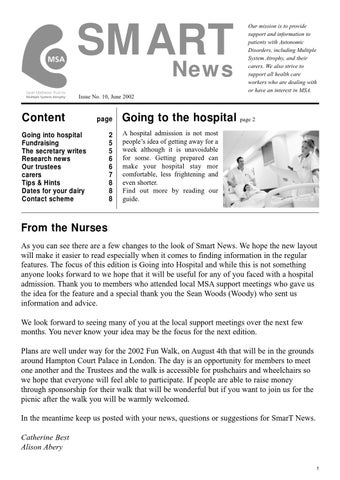
A hospital admission is not most people’s idea of getting away for a week although it is unavoidable for some. Getting prepared can make your hospital stay mor comfortable, less frightening and even shorter. Find out more by reading our guide.
From the Nurses As you can see there are a few changes to the look of Smart News. We hope the new layout will make it easier to read especially when it comes to finding information in the regular features. The focus of this edition is Going into Hospital and while this is not something anyone looks forward to we hope that it will be useful for any of you faced with a hospital admission. Thank you to members who attended local MSA support meetings who gave us the idea for the feature and a special thank you the Sean Woods (Woody) who sent us information and advice. We look forward to seeing many of you at the local support meetings over the next few months. You never know your idea may be the focus for the next edition. Plans are well under way for the 2002 Fun Walk, on August 4th that will be in the grounds around Hampton Court Palace in London. The day is an opportunity for members to meet one another and the Trustees and the walk is accessible for pushchairs and wheelchairs so we hope that everyone will feel able to participate. If people are able to raise money through sponsorship for their walk that will be wonderful but if you want to join us for the picnic after the walk you will be warmly welcomed. In the meantime keep us posted with your news, questions or suggestions for SmarT News. Catherine Best Alison Abery 1
Going into hospital Going into hospital can be an anxious time for everyone. People with long standing medical conditions like Multiple System Atrophy or Pure Autonomic Failure have additional considerations that can increase this anxiety. Being in hospital means a change of routine, new people and a new environment, which are all potentially stressful. You may also have concerns about being cared for by people who are not familiar with your condition. The two ways of being admitted into hospital are through a planned (sometimes called a booked) admission, or as an emergency. The admission can be related to your existing condition, but could be for a non-related problem (e.g. hip replacement). In any event your existing condition will be an important consideration for both your nursing care and medical treatment.
Are you prepared? If you have a planned admission you may have some time to get prepared, but it is worth thinking about planning even for an emergency admission. A successful hospital visit will depend on a good level of understanding of your condition. Take all the relevant information about your condition and current medication whenever you go to hospital, this includes out-patient appointments. Lots of people find it handy to use a folder to store all this information. Know your medication. Your doctor or pharmacist should be able to give you a printed list of all your current medication, which will be very useful to show to the doctors looking after you. You must also let doctors know if you are on any trial drugs, unlicensed medication (e.g. midodrine), or complementary therapies. Take a supply of your usual medications with you when you go into hospital, as not all wards will routinely stock all your medications. Making life easier. Think about which equipment you may want to take into hospital with you (walking frame, wheelchair, lightwriter, 2
CPAP). Make sure all your equipment is clearly labelled. You may want to think about adding valuable pieces of equipment to your household insurance.
from admission to discharge. You might find it helpful to write your daily routines in your MSA information folder.
What is your normal routine? The waiting game Some emergency admissions can be arranged through your GP, who will contact the appropriate hospital doctor to see you in the Accident and Emergency department. This will save you having to see the Accident & Emergency department doctors first. In the event of emergency admissions it is essential that those looking after you are made aware of your condition as soon as possible to ensure appropriate treatment is given. It is worth considering wearing a “medic alert” bracelet or pendant – these are internationally recognised jewellery which you can record your particular vital information – and this will alert people to your health issues if you are unable to communicate for any reason (e.g. language barriers, loss of consciousness).
On the ward A ward is a unique environment with its’ own routines, some of which will be different from your normal daily routines. The nursing staff will try to help to maintain your usual routine. You will need to tell staff about your routine so that they can include this in your “care plan” (written instructions for nurses to follow). The nurse who writes your care plan may be your “named nurse”, a nurse who is allocated to you to get to know you and your family
Think about the following things you do every day (daily activities) Communicating If you have a soft, quiet voice this may be a problem in a noisy place like a ward. You may have to talk more than usual which can tire your voice. Different people may take a while to get used to your speech patterns. To get the attention of staff, make sure you know how to operate the nurse-call buzzer. Tell the staff you will need time to speak and answer their questions. You may find writing or using picture board useful especially if you are tired. The Speech and Language Therapist may be able to help find other methods of talking to staff. Sleeping Wards can be busy places even at night, and you may find your usual sleep routine difficult to keep to. Sleep is essential to your well being and lack of sleep will slow your recovery. Staff need to know your usual sleep routine, and stick to it including not getting up early in the morning! What position do you sleep in? Do you have your head-up, an adjustable backrest or plenty of pillows? Staff will also need to know if you need help turning in bed during the night to get comfortable, or if you have nocturia (frequency of urine at night) and will need help to get up several times. Nurses will also need to know if you usually snore or
use equipment like CPAP for breathing difficulties over night. Moving around Floor surfaces are different, furniture is different, the distances you need to walk are different (e.g. to bathroom), and there may be extra people and obstacles to negotiate. All these can make it difficult to maintain your independence moving around the ward. Moving your bed closer to the bathroom, introducing new equipment (e.g. wheelchair) or getting assistance from the nurses will all help keep you mobile which is vital. Staff will need to be aware that you may need more help at times if your ability to move around fluctuates because of changes in your blood pressure, medication, or fatigue. A physiotherapist can advise you and the nursing staff on the best ways to keep you mobile. Eating Mealtimes on hospital wards are different from at home. The type of food available can differ from what you usually eat. Order small meals from the ward menu and have extra snacks that your family and visitors may be able to bring for you. If you usually have a special diet (e.g. thickened fluids, pureed meals, PEG feed) this will need to be ordered through the dietician. It may be worth bringing in your own salt and sauces, as these are not always readily available. The staff will need to know if you use special cutlery to help you eat, or what help you have at mealtimes. Drinking It is important that you keep drinking. Some of your symptoms (blood pressure, constipation) will be affected if you become dehydrated. What do you need to drink, a straw, a special cup, to be able to reach your locker to pour a drink or a nurse to help you? If you don’t ask for anything else ask for drinks Bathrooms Do you use handrails at home or a raised toilet seat? Can you get to the toilet or will you need help. What routine do you have using intermittent catheters? The changes in routine, mobility and diet whilst in hospital can result in constipation. Don’t leave it too long and ask for a gentle laxative. Medicines Staff need to be aware that the timing of your medication is important for them to remain effective. These times may differ from the usual ward drug rounds. In order to take them at your usual times you may be able to keep your medication to take
yourself. If not, some nurses may have pill timers, which buzz or bleep to remind them to give your medication.
Investigations and Surgery Surgery and some investigations can have an effect on how well controlled all your symptoms are. It is important to find out as much as you can about the procedure before the investigations or surgery, what preparation is involved, how long the procedure will be and what the planned aftercare is. Pre-assessment clinics You may be asked to attend this type of clinic as part of the preparation for surgery or investigation. This is the ideal opportunity to get the information you need and to let the staff know in more detail about your condition. This clinic should help staff to prepare themselves for your admission. They may discuss: Nil-by-mouth This is the term that describes the period of fasting (usually 6-8hours) before an anaesthetic or procedure. Being nil-bymouth can mean that you become dehydrated which can worsen your symptoms. You may need replacement fluids, by intravenous infusion, ‘a drip’. Even though you may be nil-by-mouth you may be able to take some of your medication e.g. drugs that help your mobility or blood pressure, which will help you. The anaesthetist can discuss this with you. Blood pressure People who have postural hypotension (fall in blood pressure when sitting or standing) often have higher blood pressure recordings when laid flat. This is something the anaesthetist needs to be aware of. The usual advice of raising the head of the bed may not be possible for some procedures or surgery and you may feel dizzy when you try to sit up you have been laid flat. Your blood pressure control can also be affected by lack of activity or exercise. Doing leg exercises (as described in postural hypotension leaflet) before you attempt to get out of bed is advisable, as well as sitting up slowly. Mobilising One of the priorities of nursing staff and physiotherapists is getting people up and about after surgery. This is to reduce the possible complications and help your
recovery. However you may find that your progress is slower than other patients because of your existing condition. If you tire more easily, plan short periods of exercise and activity frequently. Avoid being in the same position for several hours. Try to be active whilst in bed or sitting in a chair by doing gentle leg exercises. Breathing It is important while you are less active to keep up the breathing exercises that the physiotherapists and nurses will show you. You may have your breathing and oxygen levels monitored, especially if you have any breathing problems when laid flat. You will need to continue using any equipment (e.g. CPAP) that helps you breath at night. Infection Staff should know that you are prone to infection (urine or chest) because of your condition. They will monitor this and may even use preventative antibiotics. Recovery times Being in hospital and having surgery are major events for anybody. If you consider the additional factors related to your condition, don’t be alarmed if you need longer time to recover. Convalescence will be an important part of your recovery. Discharge planning Making preparations for going home often start at admission. To ensure that everything is in place to get you home safely, information, including telephone numbers of the people who help you at home, will be useful. It is advisable to avoid discharge over a weekend if you rely on home care services. You should go home with a supply of medication. Follow-up care may include visits from community nurses and therapists, as well as a hospital appointment.
Other places where information may be useful
this
Respite care This is an organised admission to allow you carer time to recharge their batteries. This can be in a community hospital, nursing home or even a hospice, on a regular basis. Day centres or day hospitals These local centres have a range of activities and therapists that you can access during your visit. continuing on the next page 3
Going into hospital:
A Doctor’s view
Rehabilitation units This is a planned admission where a team of doctors, nurses, and therapists will Dr Tim Young work with you on specific problems presented by your condition. There are many concerns that face a person who has to be admitted to hospital. In the case of a patient with MSA these Key Points concerns may be compounded by a worry Nurses at the Sarah Matheson Trust can that the treating doctors may not have be contacted during working hours by any heard much about MSA or its treatments. staff involved in your care. We can I hope to outline some of the areas you should raise with admitting doctors. provide information and advice. Be prepared – keep all the relevant information about your condition and Firstly let us consider the underlying current medication together in one place diagnosis of MSA itself. Clearly depending on the individual, there will be to take with you to hospital. Make a list of the equipment you will a wide spectrum of severity. In patients without swallowing or breathing need to take into hospital with you. Highlight any discharge requirements you problems who are mobile, MSA itself is have (e.g. restarting home care) with staff unlikely to require any management change on behalf of the admitting at the start of your admission. Be prepared to explain how your doctors. The admitting team will tend to condition affects your daily routines. concentrate treatment of whatever illness has brought you into hospital much as Write it down if you can. Talk to the doctors, surgeons and they would with any other patient. anaesthetists about any concerns you have about your blood pressure, medication, In patients more severely affected by MSA, especially those using wheelchairs and recovery. Get the Going into Hospital leaflet from or with swallowing/breathing problems, the Sarah Matheson Trust to include in then the MSA itself can influence subsequent management. Both these your folder. factors can be very important in patients who may need to undergo surgery. The Useful addresses immobility aspects should be fairly selfMedic Alert evident to the admitting team, but the 1 Bridge Wharf swallowing/breathing problems are much 156 Caledonian Road more subtle problems to a doctor meeting London N1 9UU you for the first time. If you know you Tel: 0207 833 3034 have even mild impairment of your Fax: 0207278 0647 breathing or swallowing (then you Email: info@medicalert.co.uk should let your admitting doctors and Website: www.medicalert.co.uk nurses know this. Talman Ltd (SOS Talisman) 21 Grays Corner The reasons for letting the doctors know Ley Street this is because any illness (even if Ilford apparently unrelated ones) can cause a Essex IG2 7RQ temporary worsening in any pre-existing Tel: 0208 554 5579 swallowing/breathing problems. Fax: 0208 554 1090 Breathing problems in any patient due to Email: sostalisman@btinternet.com undergo surgery will require particular care to be taken by the medical team The information in this feature is usually one of the anaesthetists will available as the ‘Going into Hospital’ review you prior to any surgery. leaflet from SMT. Swallowing problems can sometimes cause chest infections (by food/drink going down the ‘wrong way’), and so letting the doctors know will allow for their appropriate treatment. If your swallowing has temporarily got worse then it may need to be assessed by Speech 4
and Language Therapists This assessment is usually carried out by asking you to swallow special foods of different consistencies which can be seen on a continuous x-ray (video-fluoroscopy). Until this investigation is done, if there is any doubt about your ability to swallow safely, you may need to be restricted to thickened fluids, or even be kept nil by mouth. Although this can be very inconvenient for you it is only done to maximise your safety.
Now let us consider medications that you may be taking for your MSA, I will focus on two broad categories of medications; those used to treat Parkinsonian aspects of MSA, and those used to treat postural hypotension. Many patients with MSA have at least a degree of stiffness and sometimes tremor associated with their condition. Such movement problems sometimes require treatment with drugs such as Sinemet and Madopar (L-DOPA containing drugs). These medications can exacerbate some symptoms such as confusion and nausea, and as such may need changing by the doctors admitting you; they may reduce or even stop these medicines. Oxybutinin, a medication often used to help MSA patients with urinary symptoms can also lead to acute confusion in patients and may also need to be stopped in these circumstances. Several medications are employed to improve the standing blood pressure of people with MSA. One of the commonest of these is fludrocortisone. This medicine helps to retain sodium and water in the body but tends to reduce overall body level of potassium. These properties can sometimes lead to, or complicate an admission to hospital. In such patients there can (rarely) be excessive fluid retention in the lungs causing shortness of breath, or excess loss of potassium (causing weakness or even palpitations). Palpitations can sometimes be caused by another medicine often used to bolster the blood pressure in MSA, namely Ephedrine. Clearly, if the admitting team feels that some or all of your symptoms may be related to side effects of these medications they may need to reduced or stopped. However, more usually these medications do not usually cause any additional problems. In these cases it is important that the medical team
continue giving them to you, especially when you are discharged from hospital, unless there are specific reasons not to do so. Bearing the above points in mind may help the admitting teams during your admission. If possible keep a list of your current medicines with you at all times together with the phone number of your GP’s surgery. Finally, please be assured that even if the doctors admitting you are not that familiar with MSA, like any doctor admitting any patient they will always be ready to take previous medical history and current medications into account when deciding on your management. The few simple points outlined above should help that process.
The Secretary writes
In the last issue of SMarT News I explained that we had included a recently produced two sided piece on the Trust’s history and plans for the future. We also enclosed a copy of our Gift Aid form, more for interest than with the expectation of instant support for the Trust. I was wrong! Thank you all; I hope that your wonderful donations have been acknowledged, this being my intention.
Fundraising Hats off to all of you raising funds in various events around the country for the Sarah Matheson Trust. It all goes towards supporting the work of the charity in offering information, support and research into MSA. London Marathon - 14th April 2002 This year we had a total of nine runners for SMT, five with Golden Bond places allocated to SMT and four independent runners. Good luck to them all. More news about the runners in the next edition. Nottingham Marathon 2002 - Sunday 15th September 2002 This year the SMT has been offered unlimited places at this event, the route of which runs through the grounds of Holme Pierrepont Hall. If you, or anyone you know, is interested in running for SMT then please contact Chris Marsden (SMT Trustee) on 0207 659 9790 Fun Walk – Change of Date!! Due to limited availability of the intended course the new date will be Sunday 4th August 2002 The walk will be along the River Thames in the grounds of Hampton Court, and very importantly is accessible for wheelchairs and pushchairs. The walk is an opportunity to meet Sarah Matheson Trust members and trustees for a family day out, together with a spot of sponsored mile crunching for those who feel up to the challenge! The walk will finish with a byo picnic. If you are interested in joining us for this event - either as a fundraiser or a supporter - further details are available from Alison. Sponsored Cycle Ride - July 2002 In response to our suggestions for other events around the UK to coincide with the Fun Walk, Lynette Ambler will be
undertaking a sponsored cycle ride in her local gym in Milton Keynes in memory of her father, Daniel Toomey. She anticipates cycling between 75-100km in one sitting. Happy pedalling Lynette! Parachute Jump [see picture] Julian Thirsk, and his friend Mark Dickens, marked the occasion of his 30th Birthday with a sponsored parachute jump in memory of his father James Thirsk. The jump raised £650 for SMT congratulations Julian and Mark. The Croft Singers Linda Stone’s parents are members of the Croft Singers; the choir raised £125 for SMT this last Christmas singing at a store in Cromer. Well done all! Direct Debits to SMT In response to our several enquirers here are the details you would require to give your bank or building society if you wanted to arrange a regular donation to SMT. Account Name:Autonomic Disorders Association Sarah Matheson Trust (ADASMT) Sort Code: 16-57-10 Account Number: 49935951 Bank: Fleming Premier Banking If you are going to do this and are a current taxpayer it would help SMT even further if you signed a Gift Aid form further copies available from Alison. Thinking ahead Anyone wanting to hold a sponsored event can get sponsorship forms and general information on MSA for publicity purposes, from us here at the SMT. We do have some collecting boxes and are currently getting some banners made to help with fundraising. For help with sponsorship packs please contact Alison.
For those respondents who are uncertain, I am also the treasurer of SMT and Val is for Valentine rather than Valerie. It happens often and I don’t mind at all. Val Fleming The Croft singers
Julian Thirsk, Mark Dickens 5
Research SMT Research Fellow Dr Tim Young Tim Young qualified as a doctor in 1997. Since then he has completed his higher medical training (MRCP) in hospital medicine and worked as a doctor within neurology - a speciality where he anticipates spending his foreseeable future. Tim’s other interests include running, drawing and learning Cantonese - something he professes to doing very badly! Ed. Since starting his research fellowship last year with SMT, Tim has found time within his research schedule to help us by writing for the newsletter, providing information for our support meeting, and by giving us the answers to helpline questions. Although he has enjoyed all these activities which he says keep him in touch people and families affected by MSA we are very grateful for his contribution. New ResearchTrials Multiple System Atrophy Quality of Life Study Dr Anette Schrag, Institute of Neurology. Sponsored by the Sarah Matheson Trust One of the purposes of medical treatment of Multiple System Atrophy (MSA) is the improvement of symptoms. Currently there is no way to measure the impact of such improvements on the lives of people with MSA. The aim of this project is to develop a questionnaire specific to MSA. The questionnaire will enable people with MSA to report from their own point of view the difficulties created through having MSA. At the same time it will incorporate some measurement of how these difficulties affect your quality of life. The study will also involve people caring for someone with MSA, asking about their experiences as carers. The questionnaire would provide information that has never before been collected about the experience of living with MSA and has potential for use in assessing the effect on quality of life of any new treatment. Dr Anette Schrag and her colleagues have been working with the Sarah Matheson Trust to design such a 6
questionnaire. These initial questionnaires are rather long at present but with the help of your answers we will be able to delete any questions that do not appear to be relevant. In the next few weeks you will be receiving the questionnaires through the post. To complete and return them will take time and effort and we do appreciate your participation, which will allow researchers and doctors to have your views incorporated into their assessments. Naturally you are under no obligation to complete them. The Sarah Matheson Trust nurses will continue to work with Dr Schrag during the study and will be happy to answer any questions you may have. OT Study A Trial of Synthetic Growth Hormone in Patients with Multiple System Atrophy A new trial is about to begin at the Institute of Neurology, Queen Square, London, under the supervision of Professor Niall Quinn. The aim of this trial is to investigate whether or not synthetic human Growth Hormone has a useful effect in patients with Multiple System Atrophy. We are looking for patients between 30 and 75 years of age who have been diagnosed with MSA. If you are interested in the study and wish to receive further information, please contact:
A brief profile of our Trustees In response to people wanting to know a little more about the Trustees we got them to write a few lines about themselves. All the Trustees have personal knowledge of MSA some of them though Sarah Matheson herself or other family members and are committed to continuing the current work of the Trust and evaluating new opportunities to provide help and support to members, promoting research and raising awareness and funds. Elizabeth Brackenbury Elizabeth is Sarah’s sister. Elizabeth and her husband live in an ancient house near Nottingham, Sarah lived here with them for the last fifteen months of her life. They are proud grandparents and keepers of a flock of Jacob sheep. Michael Cook Michael is Sarah’s brother in law. Now retired from the Australian Diplomatic Service, his last post was as Australian Ambassador in Washington. He and his wife live in London, where they helped to look after Sarah till the time when she moved to Nottinghamshire to live with her sister Elizabeth.
Final call for entry onto NNIPP’s (Natural History and trial Neuroprotection in Parkinsonian Syndromes)
Valentine Fleming Val met Sarah in the early 1960’s and was also in the group of eight friends who spent nearly a month trekking in Nepal in 1974 (he has been back to the Himalayas five times since that first trek). He had just retired from banking when in 1997 he was made aware by Sarah of the desperate need for a support group for sufferers of MSA. He was instrumental, with Sarah and the original Trustees, in the formation of the Sarah Matheson Trust. He is a keen gardener at his home in Kent and, with his wife, is an enthusiastic follower of Kent’s cricketers.
Professor Leigh, the trial co-ordinator, is encouraging the fourteen existing trial centres and the two new centres, in Aberdeen and Mansfield, in their final recruitment push. Entry to this study will be closing shortly and if you want to discuss entry speak to the trial coordinator, Caroline Murphy, on 020 7848 5155 or e-mail c.murphy@iop.kcl.ac.uk
Chris Marsden Chris is 36 and has his own commercial property company. He plays most sports badly and is currently training for his third assault at a reasonable time in the London Marathon. Chris’ mother, who worked with various charitable concerns in the South East of England, particularly the Citizen’s Advice Bureau, had MSA.
Professor N. Quinn, Institute of Neurology, Queen Square, London WC1N 3BG 0207 837 3611 ext 4253 or Dr Maria Bozi/ Dr Noemi Russo Clinical research Fellows of Professor Quinn at the same address 0207 837 3611 ext 4124
Sarah’s brother Hugh lives in North Nottinghamshire. He is Chairman of the National Trust for the East Midlands and sits on the executive committee of Portland Training College for the Carers UK Free Membership Disabled. Hugh is an Olympic oarsman SMT has an organisational membership to Carers UK but free individual and won a silver medal. membership is available throughout 2002. Membership will give you Peter Murray Peter is an architectural writer and access to a range of support services for exhibition curator. He is managing carers and keep you updated on director of Wordsearch, a company developments in the Carers UK specialising in the communication of campaign to raise carer recognition and architecture to a public and professional financial welfare. For free membership audience. As Honorary Secretary of the contact: Architectural Association, he worked closely with Sarah Matheson for a Carers UK number of years. His brother, John, Membership Department suffered from MSA. 20-25 Glasshouse Yard London EC1A 4JT Eileen Strathnaver Eileen has lived in Notting Hill for over Carers UK is going on-line 30 years, during which time she has May 2002 sees the website launch of raised two daughters. For the past Carers UK. The address is: fifteen years she has worked, first as a www.carersonline.org.uk P.A., then as a Special Adviser, to Their free carers helpline continues on Michael Heseltine M.P. Eileen first met 0808 808 7777. Sarah at Heathrow in the autumn of 1974 on their way to a magical adventure in Caring in Later Life Nepal, where they shared a tent and Help the Aged commissioned a review many laughs together - and became on carers aged sixty years and over to friends. be carried out by the University of Kent
Carers
Harriot Tennant Harriot is married with two grown up children, she lives in London and Aberdeenshire. In 2000 she retired after 12 years as a Special Assistant at the British Museum. She had previously worked at the National Portrait Gallery, Lambeth Palace Library, the Chelsea Physic Garden and the Royal College of Art – where she was succeeded by Sarah Matheson. Harriot is currently chairman of the Management Council of Chelsea Physic Garden, which has an extensive collection of medicinal plants. This year she is working in the Lord Chamberlain’s office helping with the Golden Jubilee celebrations.
and Canterbury. There are an estimated 2million carers in the UK aged 60 years and over and: this number is increasing generally caring for an older person most live in the same house as the person they care for, one third are caring for spouses many carers have a disability themselves. The consequences of caring include: older carers are amongst the poorest in the UK stress and depression are common experiences for carers many carers have not had a break of more than two days (sometimes when
caring for up to 14 years) carers can feel isolated with few opportunities for hobbies or social interests The report made it clear that the physical, financial, social and emotional consequences of caring are not fully appreciated and their recommendations included: change to carers’ benefits to reflect the value of the care they offer and the personal cost of caring improved housing to accommodate the lives of disabled people and their carers improved local services to support carers in their roles, including respite care and injury prevention assessments Do you recognise yourself anywhere in this feature? If so, don’t wait to be asked, help yourself by: requesting a carers assessment from Social Services visit an advice/welfare officer to review your benefits for caring, including housing and council tax rebates ask for OT and physiotherapy advice on injury prevention whilst caring talk to your GP, Carers UK and SMT about the highs and lows of caring. That way we can all help.
In Memory Donations received with gratitude in memory of:
Derek Armory Josephine Barrett Ted Barter Stephen Batley Janet Bingham & Ida Shrimpton Christine Burridge Elizabeth Crawley Paul Galgut Michael Hamill Christine Hampson Jean Hood Moreen Lascelles Mr A Reeves Ernest Reffold Jean Rowles Gordon Smith James Thirsk Margaret Walton Audrey Watson
Hugh Matheson 7
Tips & Hints Slips, trips & broken hips. This is the catch phrase of a series of useful leaflets produced by the Department of Trade and Industry that address the problems of falls and how to avoid them. If you have MSA or an autonomic disorder you may need specialist help to control blood pressure or balance (common causes of falling), but these three leaflets are a good focus with straight forward practical measures to prevent falls and injury. You can obtain free copies of these leaflets by ringing 0870 1502 500 (charged at local rates) Communication aids If your speech therapist is unable to source a Lightwriter locally then as previously mentioned in January 2002 SMarT News, we run a small loan scheme which your therapist put you on the waiting list for. At SMT we see communication as an important issue, and are concentrating our equipment expenditure on provision of communication aids. We would gratefully receive any previously owned, or new, Lightwriters (approx. cost £2,500) to add to our loan scheme. For those looking to buy themselves a less expensive communication aid, then we have some information on a ‘Go Talk’ machine which costs about £140. ‘Go Talk’ is a robust electronic touch board that can be personalised with key words and messages.
Dates for your Diary
Contact Scheme
30th October 2002 Room 4, Education Centre Norfolk & Norwich University Hospital Norwich Morning: MSA Update for Health and Social Care Professionals Afternoon: MSA Support Meeting - open to anyone with MSA, their families and friends
If you would like to consider joining this scheme, information leaflets and registration forms are available from Alison.
The SMT has been running its Contact scheme for several years now. The 14th June 2002 scheme offers people the opportunity to RVI be put in touch with someone else (people Newcastle with MSA and carers) to exchange news Morning: MSA Update for Health and and information either by telephone, eSocial Care Professionals mail or letter. Feedback from participants Afternoon: MSA Support Meeting - open suggests they find it beneficial talking to to anyone with MSA, their families and someone else in the same boat. friends Limited numbers so book early! People are matched using the information available from your forms, our telephone 4th August 2002 conversations with you and any Fun Walk opportunities we have had to meet you. London This may take a little time as we An opportunity for some exercise and a sometimes have to wait for enough people picnic in a park along the Thames. to be on the request list.
6th November 2002 MSA Study Day for Professionals London More support days being planned for Wales, Scotland, Kent, Liverpool, & South West
Coming up in the next SmarT News…. Benefits, a guide to what’s available New MSA guide A week in the life of the SMT nurses Details of the Fun Walk
Sarah Matheson Trust Support, Information & Research in Multiple System Atrophy and other autonomic disorders. Providing services to people with MSA, families, carers and professionals. Information leaflets and newsletters. Specialist nurses. Telephone advice line. Regional support meetings. Training and education sessions. MSA research.
Patrons: Sir Roger Bannister CBE FRCP Professor CJ Mathias DPhil DSc FRCP Trustees: Mrs Robin Brackenbury Michael Cook AO Valentine Fleming Christopher Marsden Hugh Matheson Peter Murray Eileen Lady Strathnaver OBE Lady Harriot Tennant
All correspondence and enquiries to: Alison Abery Sarah Matheson Trust Pickering Unit St Mary’s Hospital Praed Street London W2 1NY 020 7886 1520 020 7886 1540 (fax)
The Trust is financed entirely by voluntary donations. Registered Charity Number 1062308 8