SYSTEM AT
R O
PH B EM
G
M
AZ
Y TRUST
INE | MULT IP
LE
ERSHIP MA
ISSUE 33, 2012 | WWW.MSATRUST.ORG.UK
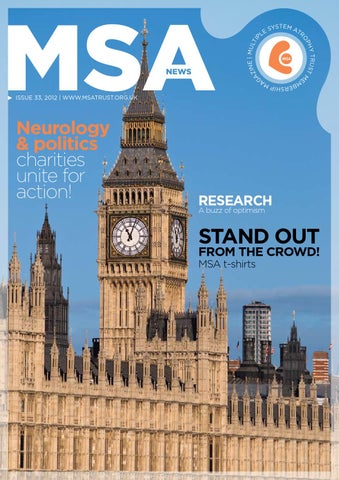
Neurology & politics charities unite for action!
RESEARCH A buzz of optimism
STAND OUT FROM THE CROWD! MSA t-shirts
CONTENTS
Follow us on Twitter & Facebook and help raise awareness of MSA. See our website, www.msatrust.org.uk PATRONS:
Multiple System Atrophy Trust
Sir Roger Bannister CBE FRCP Professor CJ Mathias DPhil DSc FRCP TRUSTEES:
Information, support, education and research. Free services for people with MSA, carers, family, health and social care professionals.
Michael Evans (Chairman) Valentine Fleming
NEUROLOGY & THE NHS POLITICAL AGENDA
03
Chris Marsden (Honorary Treasurer)
SHARING EXPERIENCES
04
Hugh Matheson
Helping with the problems of a weak voice
Professor Clare Fowler CBE FRCP Ms Darcy Hare Alexander Loehnis
Geoffrey Murray Hon Mrs Clare Powell
NEWS ROUND-UP
05
IST UK MSA RESEARCHERS’ MEETING
06
Eileen Lady Strathnaver OBE Karen Walker
A buzz of optimism
EXECUTIVE DIRECTOR AND MSA NEWS EDITOR:
CALCULATING YOUR BENEFITS
Nickie Roberts
09
Are you missing out? ALL CORRESPONDENCE AND ENQUIRIES TO:
FUNDRAISING
Multiple System Atrophy Trust
Riding, running, baking and dancing!
10
Southbank House, Black Prince Road London, SE1 7SJ
MSA & THE “LOO”
Tel: 020 7940 4666
The second part of our series - managing your bladder
12
www.msatrust.org.uk
THE INSURANCE MAZE The Trust is financed entirely by
16
Finding your way around it
voluntary donations. Registered Charity Number 1137652. Company Number 7302036.
MEMBERSHIP AT FEBRUARY 2012 Current MSA members
877
IN MEMORY
17
EQUIPMENT - OUR SNAPSHOT GUIDE
18
SUPPORT GROUP DIRECTORY
19
Carers, relatives & friends
1,143
Healthcare professionals
1,595
MSA T-SHIRTS
Total
3,615
Stand out from the crowd!
New MSA Members since 1 October 2011
87
20
NEUROLOGY & THE NHS POLITICAL AGENDA As members of the Neurological Alliance, we’re urging the government to take on board the recommendations of a report published by the National Audit Office in December last year into the state of neurological services in England.
T
his showed that despite an £800 million increase in spending on neurological services since 2006, both quality of care and availability of vital services remain patchy, and that people do not always receive the care and treatment they need. The Alliance wants the government to commit to a neurology strategy - along the lines of cancer and stroke - including the establishment of a national clinical director for neurology. The Alliance is asking all its members to help this drive by getting as many MPs as possible to sign up to a House of Commons Early Day Motion (EDM) calling for the above. Alliance members - including the Trust - have also written to the Secretary of State for Health asking for neurology to become a government priority. Hopefully you’ll want to act too, and you can do this by contacting your local MP
urging him or her to sign up to the EDM - you can also do this through our website www. msatrust.org.uk. You might like to get your family and friends to do the same - the more people that get their MPs to act, the more chance there is of getting the government to make neurology a priority. This is a fantastic opportunity to raise your concerns with your MP in the knowledge that many other people with different neurological difficulties are doing the same together we can get neurology on the political agenda, and with it MSA. You might like to consider a letter similar to the one on the right. If you get a response from your MP, please let us know by email lyn.shaw@msatrust. org.uk or call us on 020 7940 4666.
Don’t neglect neurology A recent report, written by the National Audit Office, found that the health and social care system poorly supports those with neurological conditions. Now we have a chance to change this. Please help to ensure that neurology is a government priority by: • Signing an Early Day Motion (EDM) calling for a national strategy for neurology. • Writing to the Secretary of State for Health, urging him to implement the report’s recommendations. You may also like to add your own personal message... why not let your MP know a little about MSA and your local experience? Good luck! MSA
www.msatrust.org.uk | ISSUE 33, 2012
03
Sharing EXPERIENCES Surrey Trust member, Peter Turvey, offers a tip to help with the problems of a weak voice.
M
y wife Louise had a problem letting me know when she needed help - her voice is no longer strong enough to be heard if we are at opposite ends of the flat. Following a suggestion from a fellow member, we solved the problem simply and cheaply by purchasing a wireless doorbell. The battery-powered press button, normally mounted on a door frame, is on a ribbon which Louise wears around her neck. It is light and she is not aware of it during the day. (For someone who is wheelchair bound, it could be taped 04
onto the arm rest.) The bell end looks like a large 13 amp plug and needs to be plugged to work. It normally lives in a socket near the centre of our home so I can hear it wherever I am, but it can easily be moved if necessary. When Louise needs to grab my attention, she presses the button and the chime sounds. Our system offers a choice of 16 tunes to suit most tastes! Our machine cost £10.49 from Amazon (www.amazon.co.uk) - there are lots of models and we used the cheapest I could find.
ISSUE 33, 2012 | www.msatrust.org.uk
When I’m not around, Louise wears an Aid-call button similar to, but neater than, the bell-push and connected to an emergency centre. No use for making coffee, just back-up in the case of a fall. Thankfully, it’s never been tested in real life. MSA
If you’d like to share your experiences of living with MSA, tips and ideas, please email nickie. roberts@msatrust.org.uk.
NEWS ROUND UP £20 million grant for neurological research
Introducing our new Honorary Treasurer
R
C
GPs identify rare diseases as a clinical priority
Trustee recognised in New Year Honours
T
T
esearch into neurological issues has taken a significant step forward with the recent announcement of a £20 million grant made by the Wolfson Foundation. The grant will be used to establish The Leonard Wolfson Experimental Neurology Centre to be based at the heart of the National Hospital for Neurology and Neurosurgery (NHNN), the partner hospital of the UCL Institute of Neurology, reflecting the importance of bringing together clinical and scientific excellence in the search for effective treatments. The Centre will accelerate the development of treatments and identify future therapeutic targets for neurodegenerative diseases, with the aim of earlier intervention for patients.
he Royal College of General Practitioners’ (RCGP) clinical programme has high profile, UK-wide projects in eight clinical areas aimed at raising the profile and awareness of these areas within general practice and the wider primary health care community. From April, the RCGP will be adding three new areas to this portfolio. Following a rigorous selection process, it has been announced that the third clinical priority area for April 2012 to March 2015 will be rare diseases and they are now seeking a GP “clinical champion” to lead the programme of work. Hopefully this will help to build awareness of MSA amongst general practitioners.
hris Marsden, the founder and managing director of international real estate and fund management company, Aggmore, has been working alongside fellow Trustees and staff in preparing development plans. Chris says, “This is a very significant time for all of us at the Trust as we strive to further improve both the outlook for those whose lives are affected by MSA, and to helping people with their individual journeys. I’m committed to working and supporting the Trust in delivering its vital work. My thanks go to my predecessor, Nick Bunt, for all his hard work and for ensuring a very smooth handover.”
rustee, Professor Clare Fowler, received a CBE in the 2012 New Year Honours Awards for services to Uro-Neurology. Congratulations from all at the Trust!
Professor Clare Fowler
www.msatrust.org.uk | ISSUE 33, 2012
05
1ST UK MSA RESEARCHERS’ MEETING On Friday, 4 November 2011 the first UK meeting of researchers working in MSA took place, led by MSA Trustee, Professor Clare Fowler. It was an inspiring event, as Trust member, John Telford, reports. A STIMULATING ATMOSPHERE It was a great event. You might imagine that 100 scientists talking research without making any concessions to those who did not speak their language would elicit a mighty yawn from most people. But this first UK MSA Researchers’ Meeting had a surprising vibrancy and relevance for everyone living with MSA. I am comparatively new to the Trust and so it was heartening to meet so many friendly Trustees, staff and MSA specialist nurses who clearly had such a strong commitment. But the same openness applied to the researchers themselves. They clearly saw each other as colleagues and collaborators in a very important task - of conquering this devastating condition.
06
THE STORY SO FAR “How we got to where we are” was the theme of the first presentation by Professor Niall Quinn who has been active in the field of MSA and neurological diseases for many years. He traced how the understanding of MSA has grown and how it had taken a long time to appreciate that patients presenting with a wide range of symptoms could be seen as having essentially the same condition. The complicating factor was realised to be that three or more centres in the brain were affected to extents which varied from patient to patient, but it was essentially the same disease. Thus two classifications have now been decided upon known as MSA-P (ie, like Parkinson’s) and MSA-C (ie, where the effects were predominantly in the cerebellum and the brain stem). The range of clinical features and
ISSUE 33, 2012 | www.msatrust.org.uk
the way the disease progresses (ie, what is referred to as its natural history) are now very much better understood. Dr Janice Holton from the Queen Square Brain Bank in London, a researcher the Trust has funded, outlined what had been discovered about the neuropathology of MSA, the devastating changes in the cells of the brain. This is not the place to go into the technical details, suffice to say that the problems of movement and balance and autonomic symptoms relating to the bladder, bowel and hypotension have been traced to degeneration in the supporting cells of the nervous system. ELUCIDATING MSA Professor Gregor Wenning of the University of Innsbruck who is a world leader in MSA research, gave a fascinating talk which presented the latest discoveries about the nature
of the disease and how it progresses at the cell biology level. It is apparent that important insights have been gained very recently. Both he and other speakers explained how it was distinguished from Parkinson’s in being primarily a ‘white matter’ disease - meaning the driving force was in the glial, or supporting and nourishing cells of the nervous system rather than in the nerve cells themselves. The biochemical mechanisms were being unravelled giving hope that targets for therapeutic intervention could be identified and drugs developed to interrupt the pathological process. The nature of the disease strongly suggested that any treatment would be most effective if it were caught early on.
Hence throughout the meeting it was noted that a lot of work was going on to detect the disease and to distinguish it from other neurological diseases which it resembles, particularly in the early stages. This implies that samples of biological fluids and tissue from patients should be routinely collected in order to identify substances that might serve to indicate the presence of the disease or the stage it has reached. In a later talk, John Hardy, Professor of Neuroscience at UCL, London, explored what needed to be done to move the basic science forward. More work was needed on the causes of the disease, and he believed the evidence was that there was a genetic predisposition which needed an environmen-
tal trigger for the disease to be expressed. In the next talk MSA Trust grant recipient, Henry Holden who, since the meeting, has become Professor of Molecular Neuroscience at UCL, London went into further details of genes that had been explored. TRIALS AND STUDIES Another recurrent theme at the meeting was the need to design effective clinical trials. MSA is a comparatively rare disease and is often called an “orphan” disease because there are more prominent diseases which gain the bulk of attention and funding. Its rarity, along with its comparatively short duration, means there are few patients available for clinical trials. The power of
www.msatrust.org.uk | ISSUE 33, 2012
07
those engaged in basic science in laboratories, and the result was a buzz of optimism. The MSA Trust must be congratulated on organising such a valuable and positive meeting which everyone said must be repeated! Editor: Many thanks to John for producing such a thorough account of the day! MSA
Trust Patrons Sir Roger Bannister and Professor Chris Mathias
a trial is proportional to the number of patients that can be enrolled on it. This means that some MSA trials have given encouraging results, but not to the degree of statistical significance needed to encourage pharmaceutical companies to invest sufficiently in further work to develop a treatment. Dr Wassilios Meissner, Associate Professor at the Institute of Neurodegenerative Diseases in France, gave details of about a dozen potential treatments which suffered from this sort of impediment. His talk was a thorough exposition of what constituted the weak and the strong points of trials. The role that MSA patients can practically play by participating in trials was explained by Professor of Neurology Movement Disorders at Newcastle University, David Burn, as he described DeNDRoN, the Dementias and Neurodegenerative Diseases Research Network www.dendron.org.uk. This network represents an 08
attempt to put clinical trials on a systematic and much more co-ordinated footing. It was having notable success in a number of regions in the UK, but was not yet a comprehensive network. It was noted that patients who wanted to participate in studies did not know how to do so, and it was therefore proposed that the first step would be for them to submit their names to the MSA Trust. THE LAB AND THE CLINIC The programme of the meeting allowed for a number of shorter presentations which dealt with a variety of topics. Some addressed the perceived needs of patients, including better treatment of the most distressing symptoms such as bladder problems and a look at the real prevalence of cognitive decline. The meeting brought together people from many disciplines ranging from those with daily contact with patients to
ISSUE 33, 2012 | www.msatrust.org.uk
TRUST SUPPORTS RESEARCH The Trust has awarded two new MSA research project grants starting this year. Dr Janice Holton in London and Dr Christopher Kobylecki in Manchester, were successful in their respective applications. They will be reporting throughout the year on progress. Watch this space!
CALCULATING & ACCESSING your benefits Like many people, you may be missing out on financial help you are entitled to through welfare benefits. National charity Elizabeth Finn Care provides direct financial support to people. Through their Turn2us scheme, they help millions more gain access to money available to them in welfare benefits, charitable grants and other financial help. THEY CAN HELP BY: • Considering grants to, eg, replace essential household equipment building repairs • Finding alternative sources of financial help through their Turn2us services by checking your benefits entitlement or searching for help from other grant giving charities. You can also check your benefits entitlement by using their online calculator • Providing care and individual attention through contact with their experienced caseworkers and volunteer case
consultants. In their words, “This enables the people we help to feel valued and cared for once again.” The final part of their family is Elizabeth Finn Homes Limited, a wholly owned subsidiary of Elizabeth Finn Care. They operate a group of nine award-winning care homes in England and ten almshouse cottages near Birmingham.
For information on benefits and grants, contact Turn2us at: www.turn2us.org.uk.
For information on care homes, contact: T 020 8834 9200 E enquiries@efhl.co.uk W www.efhl.co.uk
www.msatrust.org.uk | ISSUE 33, 2012
09
FUNDRAISING OUR INCREDIBLE MEMBERS IN ACTION
50 miles of cycling
Howard Baines, his son Nathan, along with friends Rob, Phil, Terry and Paul held a 50 mile cycle ride in September 2011 in recognition of the support and advice the Trust has given Howard’s mother, Joyce, who has MSA. Using a mixture of national cycle and off road routes, the ride started from Streatham in South London through to Carshalton Beeches in Surrey before returning to Streatham. Thanks to their efforts, over £1,000 was raised for the Trust.
Cyclists unite!
Riding, running & baking for Terry
The family and friends of Terry Jackson got their creative fundraising heads together to raise over £2,800 in his memory and for the work of the Trust. In an event which would have made the King of Rock himself proud, friends Rebecca Jackson-Hunt and Larissa Clarke, known as the Pressley Pedlars, crossed the Irish Sea to tackle a cycle ride from Mizen in County Cork and thought to be Ireland’s most southerly point, to Malin, Ireland’s most northerly point in County Donegal, in memory of Rebecca’s dad. The ride, held in August 2011, took a total of five and a half days, and covered up to 75 miles daily. To give the ride an added twist, the duo completed the whole event dressed as Elvis! Camping all the way, the Pedlars were assisted by their support team of Sophie Kostin and Rebecca’s husband, Gareth. The team raised over £800. Sophie continued her fundraising efforts when, accompanied by Gareth and Rebecca, she took part in the Inverness Marathon completing the race in a time of four hours and 25mins raising £1,700 for the Trust. Moving into a more mellow mode, Sophie and her colleagues at Glasgow Museums organised a bake sale in December last year raising £339 - that’s a lot of baking!
Baking for Terry
The Pressley Pedlars
DOES YOUR COMPANY OFFER MATCHED FUNDING?
Jacqueline Lawrence from Reading organised a cakes and drinks sale and made and sold cards in memory of her mother, Primrose Batstone, who had MSA. Thanks to her efforts, Jacqueline raised £250 which her company, Lloyds TSB Foundation, then matched. Please ask your company to see if they offer Matched Funding. Please contact mike.coffey@msatrust.org.uk for more details. 10
ISSUE 33, 2012 | www.msatrust.org.uk
Across England cycle ride
Katy Nicholson-Lord and her friend Bethan Turner undertook a 300 mile cycle ride across England in November 2011. Katy’s father, David, has MSA and Katy was determined to take on the “ride of a lifetime” to raise funds for the Trust. The pair cycled 300 miles across England in three and a half days, travelling a specially devised route that mapped out David’s life from Manchester where he was born, past a childhood home in Sheffield, his university town of Cambridge and ending in South London where he currently lives. Supported by a few close friends, they made it to London with only one broken bike and one dislocated shoulder within the group! Thanks to extremely generous sponsorship, the team raised £7,400 for the Trust’s work.
Katy (floral dress) and Bethan with top UK cyclists Russell and Dean Downing. Photo courtesy of Crankphoto.
Putting on the glitz
Middlesex based dance school, Dansicality, run by Anna-Louise Mederson-Desborough and Marie-Carmen Mederson-Kearon, held three shows in December last year at The Cotterell Theatre, Kingston University in Surrey in memory of family friend, Liz Baverstock. The shows featured a choir and modern, jazz, ballet and tap dances, and thanks to the efforts of 120 performers, who ranged in age from two and half years old to 80, £600 was raised for the Trust.
The show in full swing
MAKING A REGULAR DONATION If you would like to make a regular donation to support our work, please complete the form below and send to the Trust office. If you are a UK taxpayer we can increase the value of your donation by 25% by reclaiming the tax as Gift Aid. Regardless of size, all donations help us to maintain and improve our services.
Name:...................................................................................................................................................................................................... Address:.................................................................................................................................................................................................. ................................................................................................................................................ Postcode:............................................. Signed:................................................................................................................................ Date:........................................................
□ □ □
I would like to make a regular donation. Please send me a form. I would like to make a donation of £............................... and enclose a cheque.
I am a UK taxpayer and wish all gifts of money that I have made in the past six years and all future gifts of money that I make from the date of this declaration, until I notify you otherwise, to be treated as Gift Aid donations. PLEASE MAKE ALL CHEQUES PAYABLE TO ‘MULTIPLE SYSTEM ATROPHY TRUST’
www.msatrust.org.uk | ISSUE 33, 2012
11
MSA & THE “LOO” THE SECOND PART OF OUR SERIES
Nowadays it is possible to manage the bladder problems of MSA even if they cannot be cured. HOW THE BLADDER WORKS Urine is produced in the kidneys and passes down tubes called ureters into the bladder. The bladder is balloon shaped, in which urine is stored. It is situated low in the abdomen behind the pubic bone. From the bladder the urine leaves the body through another tube, the urethra. The valves or “sphincters’” at the base of the bladder makes it watertight and stop leakage of urine. In health the bladder can hold about 1pint (500mls) of urine but a reduction in its ca12
pacity is a common feature of many bladder disorders. The first sensation of needing to go to the toilet happens when the bladder is about two thirds full. It used to be thought that the bladder was merely a “waterproof bag” but in the last 15 years it has been shown that the walls of the bladder are made up of several layers, some of which have the sole function of generating nerve signals to convey information about the bladder’s contents to the spinal cord and the brain. If it is socially appropriate to go to
ISSUE 33, 2012 | www.msatrust.org.uk
the toilet, the brain sends messages down the spinal cord to relax the sphincter, the valve which opens the bladder, and to contract the bladder wall muscle (the detrusor) so that urine is expelled from the urethra. It is normal to pass urine between four to seven times during the day and once at night. This may sound straightforward, but it is a very complex process and needs the bladder, the brain and all the nerves between them to be working in co-ordination. Being able to control this process is what is
required for continence. WHAT GOES WRONG? Bladder problems are very common in people with MSA and are often the first symptoms of the illness. However, because bladder problems can occur for other reasons such as prostatic outflow obstruction in men and stress incontinence in women, it is important to think about other possible causes and not put it all down to MSA. This article concentrates on the common problems in MSA. MSA seems to attack the neurological controlling centres of the bladder in quite a selective way. This is why bladder symptoms occur as an early feature of the disease, and why they may become particularly troublesome over ensuing years. People with MSA get a combination of an overactive bladder, incomplete emptying and sphincter weakness. • Urgency, needing to go to the toilet suddenly and quickly. This is due to the bladder contracting of its own accord - “bladder overactivity”. If you cannot reach the toilet in time you may suffer urge incontinence. However, urgency incontinence is a common symptom in the general population, not just in people with MSA. • Frequency, going to the toilet a lot (more than eight times in 24 hours) but only passing small amounts of urine. This can either be due to the bladder’s overactivity or because you are
not emptying it completely. • Double voiding, needing to pass urine again very soon after just doing so indicating your bladder was not completely empty the first time, sometimes accompanied by a feeling of incomplete emptying. • Urine infections, especially if you have incomplete bladder emptying. Urine infections often make people feel very unwell and can make other symptoms, such as postural hypotension, worse. Although there is a general need to reduce the use of antibiotics in the general public, the early use of antibiotics to treat urine infections is very important for people with MSA. • Constipation adding to problems of poor bladder function. Other problems with going to the toilet can also be affected by other MSA symptoms: • Passing lots of urine during the night; this usually happens in people who also have postural hypotension as a symptom. • Accidental leakage, because of difficulty or slowness getting to the toilet or adjusting clothing in time. WHAT INVESTIGATIONS MIGHT BE DONE? Trying to find out exactly what the problem is, is an important starting point for getting appropriate treatment. When you see a nurse or a doctor they will ask you questions about your general health, how much
you drink, the colour or smell of your urine and your bladder problems, including whether you have had any accidental leakage. You may be asked to produce a sample of urine to test for a number of different things, including signs of infection. The sample can be sent to a laboratory for detailed testing or tested immediately with special urine testing sticks. The sticks give quite a good indication as to whether or not the urine is infected, but a more reliable result comes from the laboratory, although if it is necessary to grow the germs in the urine on a special plate to test for antibiotic sensitivity, it will take longer to get a result (several days). Measuring the volume and frequency of passing urine can help determine what your exact problem is, so that you may be asked to keep a diary for a few days recording everything you drink and how often you pass urine and even measuring the volumes. The other investigation that is very useful is checking how much urine is left in your bladder after you have passed urine, using either a small ultrasound machine or a catheter. Any urine left is called “the post-micturition residual urine volume”. All these tests can be done at your home or the GP’s surgery. If more detailed testing is needed, you may be referred for urodynamics at the hospital. Urodynamics are a range of procedures that tests how well your bladder fills and empties.
www.msatrust.org.uk | ISSUE 33, 2012
13
Urological treatments for several common bladder problems may involve surgery, but operations in people with MSA are rarely the solution. It is not uncommon for patients with MSA to have had some urological surgery, which may not have helped very much, before the neurological diagnosis is recognised. Further surgery is probably inadvisable. WHO CAN HELP? Continence advisors are nurses who have specialist training and experience in managing bladder and bowel problems. Continence advisors work in hospitals, health centres and in the community. Many accept self-referrals over the telephone, although some may ask that your GP write to them. The Bladder and Bowel Foundation helpline will have details of your nearest advisor (see ‘Useful Contacts’). Your GP or specialist will also be able to help. The Trust’s MSA specialist nurses are available to discuss bladder problems and treatment. ADVICE Sensible advice about fluid, toilet habits or diet is often very useful in preventing problems and managing symptoms. Maintaining a healthy bladder means drinking plenty of fluid (about eight large cups/ glasses each day). Drinking too little fluid can irritate your bladder and cause problems. There is some evidence that drinking cranberry juice may reduce urinary tract infections 14
a bit, and continence advisors recommend reducing your intake of caffeine and fizzy drinks. Be comfortable on the toilet, especially in public lavatories. Ladies should sit rather than hover (carry some wipes with you to do this) and men should use cubicles which provide privacy. Some people find bending forward, gently pressing or slow firm tapping over the bladder at the end of the flow helps to squeeze out any urine left in the bladder. Advice or help in choosing clothes that are easy to get to the toilet for your particular situation, for example Velcro fastenings rather than a zip, can provide valuable time which may prevent accidental leakage. MEDICATION Medication, called anti-muscarinic drugs (also known as “anti-cholinergics), allows the bladder to relax and fill better to capacity before needing to empty. These can reduce the symptoms of urgency and frequency. DDAVP (desmopressin) is a hormone that prevents urine production for several hours after it has been taken. It can be useful if taken at night as it can stop the need to get up to go to the toilet, which improves sleep. It comes in a tablet and nasal spray but it must only be used once a day and is not recommended in those over 65 years as it can cause water intoxication. It may be useful for people who have postural
ISSUE 33, 2012 | www.msatrust.org.uk
hypotension as a symptom. There is some research being carried out to see if injecting botulinum toxin A into the bladder muscle, a treatment that has been found to be very effective in other neurological conditions causing an overactive bladder, might benefit patients with MSA. It is known, however, to make bladder emptying worse and intermittent catheterisation is usually necessary after the treatment. Regular or daily laxatives may be required if constipation is contributing to bladder problems. EQUIPMENT An occupational therapist can help to make it easier to use the toilet at home. Adjusting the height of the toilet, adding grab rails or even creating a downstairs toilet, are all worth thinking about. Community nurses can help provide urinals or commodes to make toileting easier. There is a wide range of continence pads now available with varying absorbency suitable for day or night use by men and women and which can be either disposable or washable. Some are available on prescription and the continence nurse or community nurse can arrange to supply them to you. Although not strictly a catheter, some men find urinary sheaths useful. They fit over the penis like a condom and attach to a urine collection bag via a tube. These are not usually used for the whole day, as they can cause skin irritation, but they can be useful when
out and about or overnight. Catheters are thin plastic tubes that can be passed into the bladder to drain it and can either be “intermittent” or “indwelling” (ie, left in for some days or weeks). Intermittent catheters are inserted into the urethra to reach the bladder, the urine is drained (which only takes a few minutes) and then the catheter is removed. A continence advisor will teach you how to do this for yourself or possibly show your carer how to do it for you. Intermittent catheterisation is a very useful means of improving bladder control if not emptying is a significant part of what has gone wrong. In-dwelling catheters are also inserted via the urethra or through the abdomen (a supra pubic catheter). The catheter drains urine either into a drainage bag or has an attached valve that allows the bladder to be drained at regular intervals. Although no one likes the idea of using a catheter many people are surprised at how easy they are to use and how they can improve bladder problems. Both types of catheter can be discreet and can give people more freedom from needing to use the toilet. However, for many people the decision to use any kind of catheter needs to be given plenty of thought and discussion. OTHER HELP ‘Can’t wait’ card: This credit card sized card can be
shown discreetly to gain easy access to toilets when you are away from home. It is free and copies are available from the Trust office. The National Key Scheme: Initiated by RADAR, this offers independent access for disabled people into over 4,000 locked public toilets around Britain. Ideally all accessible toilets should be kept unlocked, but the scheme is used where it is necessary to lock the toilets to maintain their cleanliness and to protect them from vandalism and misuse. Keys can be purchased - see “Helpful Contacts”. Social Services: In some cases financial assistance towards laundry equipment, eg, a washing machine or to have clothes and bedding laundered, may be available. A social worker or benefit advisor can provide more details. Sexual activity and continence: Bladder problems don’t mean the end of intimate or sexual relationships. Some continence advisors are experienced in offering advice or treatment to enable sexual activity to be maintained. They recognise that for some people this is a very important part of life so will not be surprised or embarrassed if you want to talk about this with them. During a visit, they may even ask you directly if you are experiencing any problems with sexual function so you may want to prepare your reply.
HELPFUL CONTACTS:
The Bladder and Bowel Foundation (B&BF) The Foundation provides information, advice and expertise to anyone with bladder and bowel problems. Telephone: 0800 011 4623 (Nurse Helpline) By post: The Helpline Nurse, The Bladder & Bowel Foundation, SATRA Innovation Park, Rockingham Road, Kettering, Northants, NN16 9JH Website: www. bladderandbowelfoundation.org RADAR National key scheme for locked toilets. Telephone: 020 7250 3222 By post: RADAR, 12 City Forum, 250 City Road, London, EC1V 8AF Website: www.radar.org.uk Disabled Living Foundation This is a national charity providing equipment advice and information for disabled people. Telephone: 0845 130 9177 (Helpline) By post: DLF, 380-384 Harrow Road, London, W9 2HU Website: www.dlf.org.uk Constipation Information A leaflet on prevention and management of constipation is available from the Trust office.
www.msatrust.org.uk | ISSUE 33, 2012
15
FINDING YOUR WAY AROUND
THE INSURANCE MAZE MSA is a rare and little understood disease, so perhaps it isn’t too surprising that dealing with insurance companies can sometimes be challenging when the claimant has MSA.
A member of the Trust was recently rejected when he tried to claim under a critical illness policy organised by his trade union. Fortunately, he asked the Trust for help and we were able to introduce him to another member who is a retired insurance expert, who advised how best to appeal the ruling. The insurance company reconsidered, paying the very useful sum of £10,000 (in an earlier case, the expert won £50,000 for somebody with Parkinson’s). Our member very kindly offers his help on a 16
ISSUE 33, 2012 | www.msatrust.org.uk
voluntary basis and, where possible, is happy to guide members in a similar position. If you have an insurance problem and would like to find out if he can help you, please send a summary of your situation to Neil Hunter at the Trust - neil.hunter@msatrust.org.uk - and he will let you know if anything can be done. We are also producing a factsheet looking at insurance issues for people living with MSA, and please let Neil know if you would like to be sent a copy. MSA
TRUST APPEAL OFF TO GREAT START
Our Remember MSA Appeal has got off to a flying start with an incredible £100,000 donation from the Welton Foundation.
W
elton Trustee, Dr Michael Harding, attended the Trust’s research symposium (see pages 6-8) and was impressed by the enthusiasm and commitment of scientists working in the field. The symposium, coupled with the sense that so much more could be done with suf-
ficient funding in place, led Dr Harding and his fellow trustees to making the substantial and very welcome donation. If you’d like information on how to get involved with the Trust’s Appeal, please contact Mike Coffey on 020 7940 4666 or email him at mike.coffey@ msatrust.org.uk. MSA
Appeal GARDEN PARTY Please save the date - 17th June 2012! Peter and Clare Bevan (aka Trustee Professor Fowler) are planning a garden party in Ockham, Surrey in aid of MSA research. Tickets and further information will be available soon through the Trust’s website.
IN MEMORY Susan Jarvis Colin Hewitt John Compton Joan Grech Frank Steer William Hopwood Dave Mead Fred Critchley Denis Bray Derrick Cooper Richard Burke Brenda Tempest Jim Connor
Kenneth Starr Stewart Allardyce Harold Horne Sally Shipp Henry Leeves Lynn Pree June Drew Anthony Holland Tom Cursley Hilary Bracegirdle Roger Lancashire Raymond Bourton Ian Atkinson
Colin Griffin Peter Daniels Carol Garofolo Leonard Moor Nicola Jones Jean MacIntosh Trevor Standen Pam Bartlett George Welch Brian Miller Claire Emberson Hilary Mervin John Dimeck
Desmond Robinson Janet Bourne Bryan Sharpe Deryck McLean Brian Buckwell Jean Devine Rita Alderson Terence Hambleton Roger Beadle Sue Parson Dennis Andrews
www.msatrust.org.uk | ISSUE 33, 2012
17
APPS & iPADS TABLET DRIVEN COMMUNICATION iPads have quickly established themselves as a ‘must have’ gadget and their light and portable nature has led many to explore their wider use. One such use is as a communication device to assist with speech difficulties.
T
he iPad is a ‘tablet’ device, a little handheld computer with a touch screen interface. It is light and portable and, like a computer, it needs software. Software for tablets are known as ‘apps’ (short for applications), which is a programme written for a specific purpose. So the right app on a tablet can offer a low cost and portable communication device similar to a Lightwriter. Apple dominates the tablet market with its iPad, although other tablets with different operating systems are closing the gap in terms of performance and range of apps. They are small and lightweight and come with a variety of accessibility options. The basic version costs around £400. Apps can be free, but most have a cost. Several text to speech apps are available such as Proloquo2go or Predictable, which cost around £110 to £130 but the price of apps 18
varies greatly according to functionality. They generally use a combination of words and pictures to build up sentences that are then ‘spoken’ by the tablet. The following website www.appsforaac.net lists many different apps for helping with communication. The main advantages of using a tablet are the lower cost, portability and their availablility. The iPad isn’t for everyone and, as with any equipment, it is down to what the individual best copes with. This is why it is always important to talk through any equipment you are thinking of buying with the relevant healthcare professional first: Contact your speech and language therapist and discuss options available to you. They may have equipment for long term loan or equipment, such as the iPad, on a short term basis to trial first. The Trust has developed a series of information guides on
ISSUE 33, 2012 | www.msatrust.org.uk
equipment to help with every day living - these cover eating and drinking, communication and mobility. If you would like copies of these factsheets, please contact us on 020 7940 4666 or by email at office@ msatrust.org.uk. We will also be adding a section to our website forum where you will be able to discuss equipment with other users, swap stories of what works and what doesn’t and find out what has been useful for other people. The forum is free to use and provides valuable online support; it can be found at www.msatrust.org. uk/our-forum.
SUPPORT GROUP DIRECTORY CORNWALL
FIFE
NORTHUMBERLAND
Jane Handy/Jan Pearce
Kim Carr
Aileen Tuff
moonbeams@ymail.com
office@msatrust.org.uk
office@msatrust.org.uk
01726 861 361
020 7940 4666
020 7940 4666
(No meetings currently scheduled for
21/03/12 (12.30 - 2.30pm)
14/03/12 (1.30 - 3.30pm)
2012)
Burnside Hall, Balmullo, Fife,
Blyth Library, Bridge Street, Blyth
CUMBRIA
KY16 0AW
SHROPSHIRE
Katie Rigg
INVERURIE
katie.msa@cybermoor.org.uk
Gill Campbell
cch64@myway.com
01434 382 931
office@msatrust.org.uk
16/03/12 (1.30 - 3.30pm)
12/03/12 (1.30 - 3.30pm)
020 7940 4666
The Lantern, Meadow Farm Drive,
Eden Valley Hospice, Durdar Road,
03/04/12 (11 - 1pm)
Shrewsbury, SY1 4NG
Carlisle, CA2 4SD
St Mary’s Church, Inverurie,
DERBYSHIRE Karen White/Kulwant Sehmbi
Cathy Hopkins
Aberdeenshire,
SOUTHERN IRELAND
AB51 3NW
George Hunter george@georgehunter.biz
karen@karenwhite7.wanadoo.co.uk
KENT
01283 735 847
Linda Nicolaides
22/04/12 & 23/04/12 (time TBC)
Date & time TBC
marlin.michris@virgin.net
The Royal Marine Hotel, Dun Laoghaire,
Doveside Social Club, Hatton, Derby,
020 7940 4666
Dublin
DE65 5DT
19/04/12 (2 - 4pm)
DEVON Dennis Westrip denniswestrip@btinternet.com
00353 872 525252
Medway Campus, University of
SOUTHPORT
Greenwich, Central Avenue, Chatham
Jo Hans / Fraser Gordon
Maritime, Kent, ME4 4TB
hansjj@talktalk.net 01253 821 693
01271 378 273
LONDON (NORTH)
Date TBC (2 - 4pm)
Penny Stokes
St. James Church Hall, Lulworth Road,
Baptist Church, High St, Cullompton,
pennystokes@hotmail.co.uk
Southport, PR8 2BQ
Devon, EX15 1AJ
020 7940 4666
EAST MIDLANDS Elizabeth Brackenbury holmepierrepont@aol.com
19/03/12 (2 - 4pm)
SURREY
Southgate Hockey Centre, Snakes Lane,
Peter Turvey
Oakwood, London, EN4 0PS
peterturvey@waitrose.com
25/04/12 (2 - 4pm)
GREATER MANCHESTER
Holme Pierrepont Hall, Holme
Katie Rigg
Pierrepont, NG12 2LD
katie.msa@cybermoor.org.uk
01159 333 083
Date & time TBC
01483 827 395 15/03/12 (from 1pm) Shalford Village Hall, Kings Road, Shalford, Guildford, GU4 8JU
01434 382 931
WARRINGTON
19/03/12 (1 - 3pm)
Linda Moss
Lady Laurelie Laurie
Mayo Building, Salford Royal Hospital,
linda.moss@warrington-pct.nhs.uk
Sir Bay Laurie
Manchester, M6 8HD
01925 867 710
ESSEX baylaurie331@btinternet.com
Date & time TBC
01206 210 410
NORTHERN IRELAND
02/04/12 (from 12.30pm)
Rosemary Arbuthnott
Project, Fairfield Street, Warrington WA1
Great Tey Village Hall, Great Tey, Essex,
roseyart@gmail.com
3AJ
CO6 1JQ
028 377 88386
Fairfield & Howley Neighbourhood
24/04/12 (Time & venue TBC) www.msatrust.org.uk | ISSUE 33, 2012
19
MSA TRUST T-SHIRTS
STAND OUT FROM THE CROWD! Our new T-shirts are so bright you’ll be noticed wherever you go... in fact, we want you to be noticed wherever you go! If you wear one of our T-shirts out and about, please take a picture of yourself and send it to us. The more far flung or unusual the place the better! We’ll publish them on our website or in MSA News and together we can spread awareness of MSA.
To order a T-shirt, please complete and return the form below. T-shirts cost £10 each, plus £1.50 postage & packing.
MULTIPLE SYSTEM ATROPHY TRUST T-SHIRT ORDER FORM: Name:...................................................................................................................................................................................................... Address:.................................................................................................................................................................................................. Postcode:.................................................................. Telephone:.................................................................................................... Email address:..................................................................................................................................................................................... T-shirts cost £10 each plus £1-50 for postage and packaging. Quantity required:.............................................................. Size(s): (S, M, L, XL)................................................................ Total payment enclosed £...............................................
Please make cheques payable to: Multiple System Atrophy Trust and send to: Multiple System Atrophy Trust, Southbank House, Black Prince Road, London, SE1 7SJ For more information contact Mike Coffey on 020 7940 4666 or email at mike.coffey@msatrust.org.uk. We endeavour to ensure the accuracy of articles in MSA News. Please note, however, that personal views and opinions expressed are not necessarily endorsed by the Trust. Designed by Base Media 020 7840 0150. Printed by INQ Design 020 7737 5775.