The MSA Trust was formed in 1997 and our vision is a world free of MSA.
How we help:
We are committed to making this happen by researching MSA t o increase understanding, find the cause and, ultimately, a cure.
We are committed to making this happen by promoting and supporting research into MSA to increase understanding, find the cause and, ultimately, its cure.
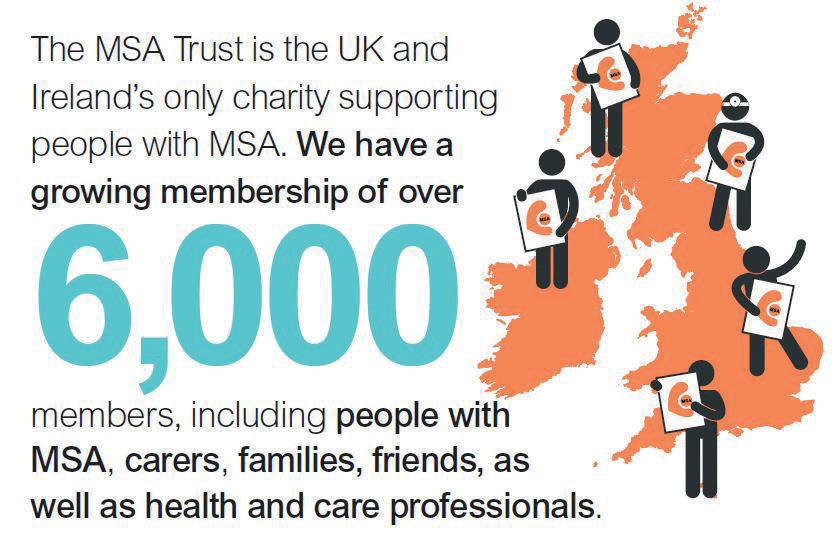
The Multiple System Atrophy Trust is the UK and the Republic of Ireland’s leading charity supporting people affected by multiple system atrophy (MSA).
We also work to support those affected by MSA, thei r carers, family and friends throughout their journey. We do this by providing:
M ultip le Sy s te m A tro ph y Trust
Information, support, education and research
Multiple System Atrophy Trust
• Specialist MSA Nurse telephone and email To join
We work to support people living with MSA, their carers, family and friends throughout their journey. We do this by providing:
• MSA Nurse Specialist telephone and email support service.
support service
• An MSA Health Care Specialist telephone and email support service.
• Information and fact sheets about living with MSA.
• Social Welfare Specialists providing support with obtaining benefits, entitlements, care needs assessments and related issues.
• Information and factsheets about living with MSA.
• AnetworkoflocalSupport Groups located
• Information resources, factsheets and webinars about living with MSA.
around the UK and Eire and a supportive online forum.
• A network of local Support Groups located around the UK and Eire and supportive online forums.
• Accurate up - to - date information through ‘MSA News’, our regular magazine, and
• A network of digital and in-person Support Groups located around the UK and Eire and the peer-led online forum www.healthunlocked.com/msa-trust
through our website.
• Accurate up- t o -date information through ‘MSA News’, our regular magazine, and through our website.
• Education and support to health and care professionals working with people with MSA. and Twitter.
• Accurate, up-to-date information through our website and MSA News, our regular magazine.
• Education and support for health and care professionals working with people with MSA.
The MSA Trust is funded entirely by voluntary
• Education and support for health and care professionals working with people with MSA.
The MSA Trust is funded entirely by voluntary donations and all our services to people affected by MSA are offered free of charge.
We are committed to promoting and supporting research into MSA to increase understanding, find the cause and, ultimately, its cure.
The MSA Trust is funded entirely by voluntary donations and all our services to people affected by MSA are offered free of charge.
Information, support, education and research
To join the Trust please visit our website, telepho ne, email or write to us:
To register with the Trust please visit our website, telephone or e-mail us





• healthunlocked.com/msa-trust


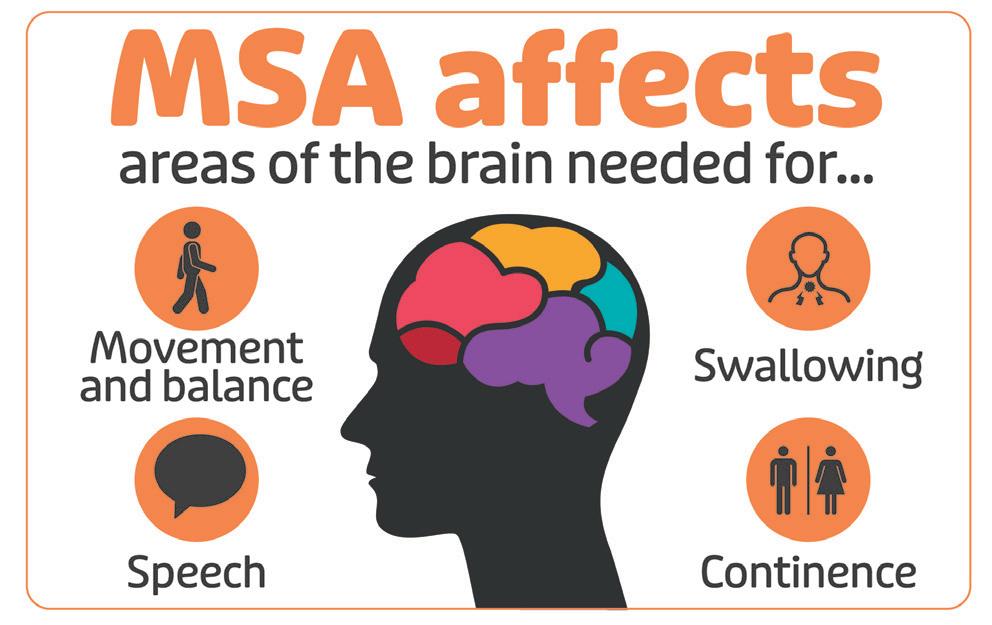
Multiple system atrophy is a progressive neurological disease that causes nerve cells to shrink in different areas of the brain. This leads to problems with movement, speech, balance and autonomic body functions such as bladder and blood pressure control.
• MSA affects around 4.5 people per 100,000, meaning around 3,300 people are living with it in the UK and Eire.
• It affects males and females and symptoms usually start between 40 - 60 years of age.
What is MSA? What are the symptoms of MSA?
MSA affects three different regions of the brain and this is why each person with MSA has individual symptoms.
Damage to the area affecting movement (Parkinsonism) may lead to:
• loss of balance and lack of coordination
• feeling slow and stiff when moving
• noticeable changes to handwriting.
Damage to the area for coordination and balance can lead to symptoms such as:
• feeling clumsy or dropping things
• feeling unsteady in crowds
• inability to balance without support
• slurred speech.
Damage to the area controlling bodily functions which occur without us being aware (autonomic), can lead to symptoms that include:
• various bladder issues which may change over time
• sexual dysfunction
• feeling dizzy or fainting because of blood pressure problems
• pain around the neck and shoulders.

Diagnosis of MSA is made by a neurologist recognising a combination of symptoms and signs. This is known as a clinical diagnosis.
In its early stages it is extremely difficult to diagnose MSA, as the symptoms are common to other neurological diseases such as Parkinson’s disease and Cerebellar Ataxia.
It is quite normal to be diagnosed with another disease before being diagnosed with MSA. This reflects the progress of the condition and not the skill of the specialist.
How is MSA Diagnosed? Treatment of MSA

Unfortunately, there is currently no cure for MSA. Its complex nature means that the best treatment is likely to include a combination of medication, specialised equipment and various therapies to manage individual symptoms.