The Official Newspaper of the Cooper Yeshiva High School for Boys
Volume 19, Issue 9
Trivia Corner
Page 2
Annual CYHSB Steak
Dinner: An Impactful Success
Page 3
Doors and Locks: The Potential Downsides
Page 4
Just Love Them
Page 6
Cooper Clicks
Page 7
To sponsor an issue and lend support to the next installment of the CYHSB Weekly, please reach out to Nadav.Lowell@mhafyos.org
issuu.com/mrsashleybrown
@cyhsb_weekly
Source: MHAFYOS Instagram
The Hostage Deal: CYHSB
Akiva Levine (’26) The release of Israeli hostages in recent months has been a defining moment not just for Israel, but for Jewish communities worldwide including at the CYHSB. As the news broke that another group of hostages had been freed, CYHSB students reacted with a mix of joy, gratitude, and concern over the broader implications of the deal.
“I was very excited when I heard the news of hostages being released!” said freshman Yakir Rovner. “Apart from the hostages reuniting with their families, I believe that it represents Israel’s priority to protect its citizens and gives a glimpse into a future of peace in the Middle East.”
The most recently released group, which included Keith Siegel, Ofer Kalderon, and Cont’d on next page.
Cont’d fom previous page. Yarden Bibas, is just part of a larger effort to bring home those taken by Hamas on October 7. While the reunions have been emotional and deeply meaningful, the reality of the hostage deal is complex. In exchange for their freedom, Israel has had to release Palestinian prisoners some of whom have a history of terrorism.
Senior Jonathan Ardestani voiced his concerns about this aspect of the agreement. “It’s great that the hostages are being released, but the fact that potentially dangerous Palestinians are being freed is not ideal. For example, one prisoner previously released in the 2011 Gilad Shalit Exchange was Yahya Sinwar former leader of Hamas and lead orchestrator of the October 7th massacre.”
At the CYHSB , the hostage crisis has been personal. Many students have followed these stories closely, davening for those in captivity and hoping for their safe return. For senior Ethan Vanderwalde, the news was deeply moving: “I was very happy, more than words can describe. I had been davening for Agam Berger, one of the hostages, since Adi Brown told us about her last year, and it was amazing to see mine and
Trivia Corner
Cooking Edition
the rest of the Jews’ prayers being answered.”
Beyond the joy of her release, hostages like Agam Berger have served as powerful sources of inspiration. During her captivity, Agam deepened her religious observance, refusing to cook on Shabbat, even under the threat of Hamas. Her unwavering faith resonated deeply within our school, reminding many of the importance of spiritual resilience. Rabbi Rossman, the menahel of the CYHSB, addressed the student body, reflecting on the strength of Berger’s actions: “To keep Shabbat as a Jew in captivity, surrounded by those wanting to destroy us, is a testament to the power of Jewish faith. Her story is a reminder that no matter where we are, our connection to Hashem should never be broken.”
The return of hostages has been an emotional and moral challenge for Israel, balancing the immediate priority of saving lives with the risks posed by releasing convicted terrorists. Still, the overwhelming feeling among students is one of relief and renewed faith. These moments remind the Jewish community, both in Israel and abroad, of the power of resilience, unity, and the unwavering
Last Issue:
Answer: Stephen Curry. Winner: No one.
First one to email Yitzy.Ryp@mhafyos.org gets a shout out in the next issue! What vegetable is also known as a ‘sunchoke’?
commitment to bring every hostage home.
As the community reflects on these events, Rosh Torah Mitzion, Rabbi Ilai Grunwald, offered a powerful message that reminded students of the importance of resilience and perseverance: Ufeduyei Hashem yashuvun uva'u Tzion berinah. (Isaiah 51:11) “So let G-d’s ransomed return, and come with shouting to Zion, crowned with joy everlasting.”
Rabbi Grunwald further reflected: “We have already been waiting and praying for over a year and three months to see our captives back home in Israel. We know that every one of them who returns is a miracle, and we are aware that they will go through a long process of physical healing and, most importantly, emotional recovery. It pains us to see many terrorists with blood on their hands being released. We pray to Hashem that He will perform miracles for us and that we will soon see all the captives safely back in their homes in Israel. We believe that we are on the way to full redemption soon. Even in times when it seems far away, we are on our way.”
For now, celebrations continue, but the work is far from over. The ceasefire and hostage exchanges have provided a temporary pause in the conflict, but as Israel and its allies know very well, the battle for security, justice, and peace is ongoing.
Annual CYHSB Steak Dinner: An Impactful Success
Tzvi Steiner (’26)
The 30th Annual Steak Dinner has just recently concluded, and what a dinner it was. The students were dedicated to setting up the dinner, the guests were delighted to eat our delicious steaks, and everyone had a great time. But all good events call for preparation and a lot of dedication, and at the CYHSB, we have that in bulk.
CYHSBers began to organize this event months before the guests began to enter the building. Students were instructed to contact people from around the community, in order to secure their reservations and ensure that the dinner was a success. The steaks and supplies then needed to be ordered for the dinner.
for an objective unlike what is available anywhere else.”
The moment that the dinner began, everyone was ready. Waiters walked around holding platters of hors d'oeuvres, and the kitchen staff prepared the fried wing appetizers. After a short introductory speech,
Flack, who was truly deserving of the award for her tremendous work managing our school’s logistical needs. Jojo Ardestani commented on his thought process for the video: “The steak dinner video this year we tried to keep short and to the point, and so far we've received a lot of positive reviews. ”
Soon after, it was time for the physical setup of the dinner. Throughout the days leading up to the event students could be seen working diligently around the clock: from bringing supplies, setting up tables, cooking the food for the dinner, to making the video presentation. Students committed lots of time and effort to ensure that the event went smoothly,. As Nadav Lowell (’25) said, “It was a truly remarkable experience, one where students could encounter opportunities for leadership, responsibility, and teamwork
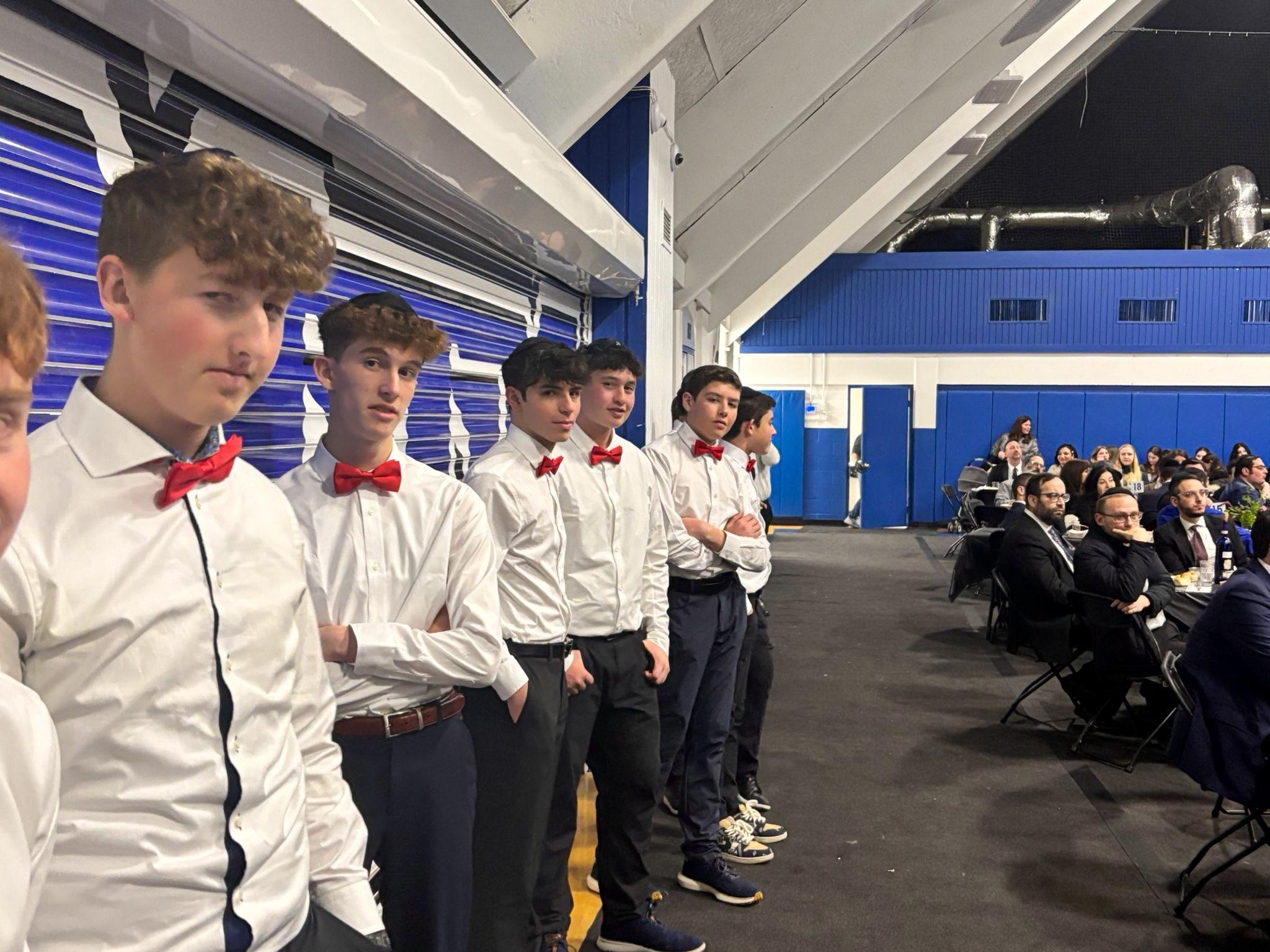
Benny Freiden (‘26) gave his beautiful Dvar Torah, and Eitan Braverman (’28) played a few songs on the piano. Then the main course was served. The waiters split into groups and served the guests by table.
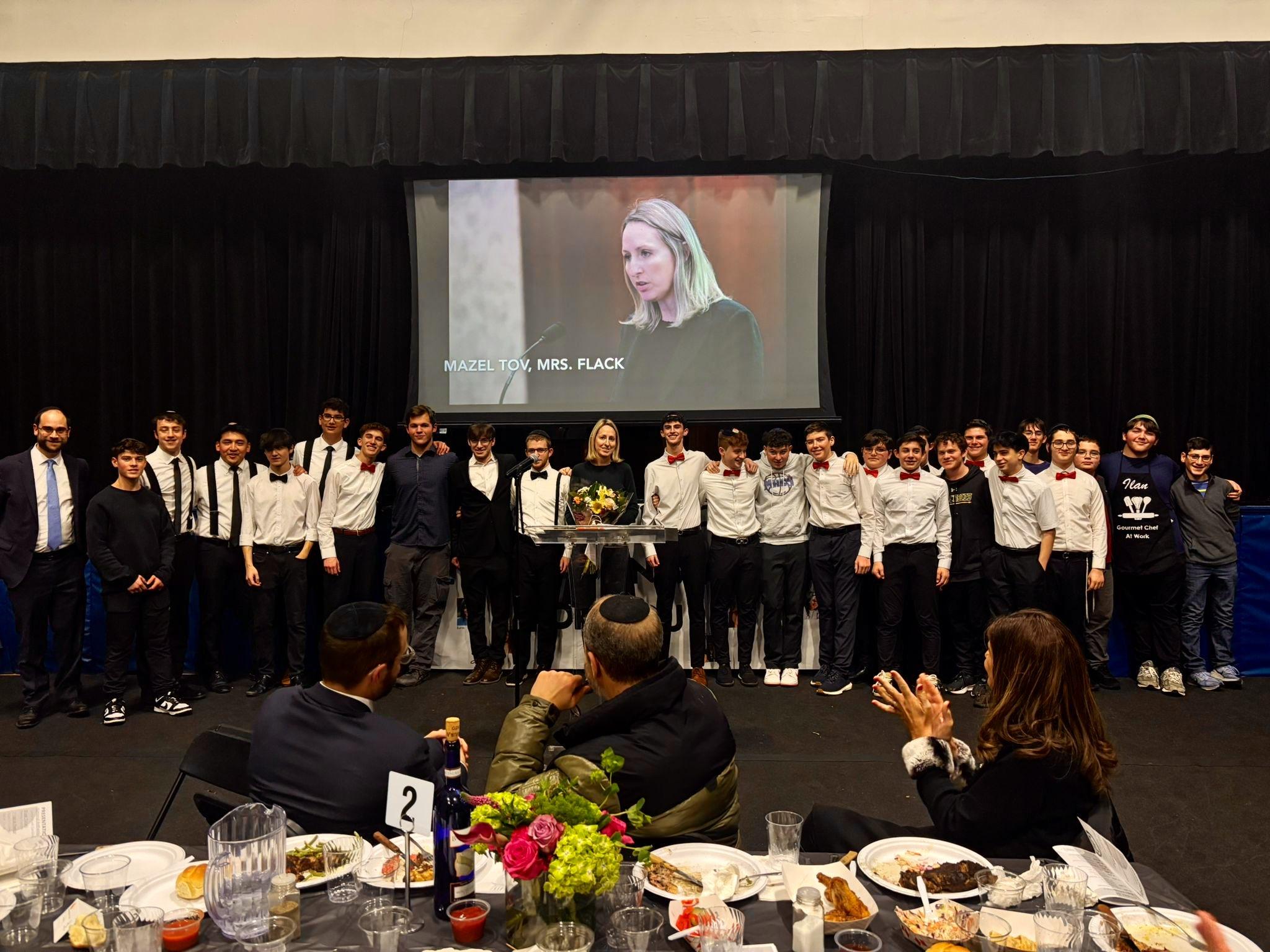
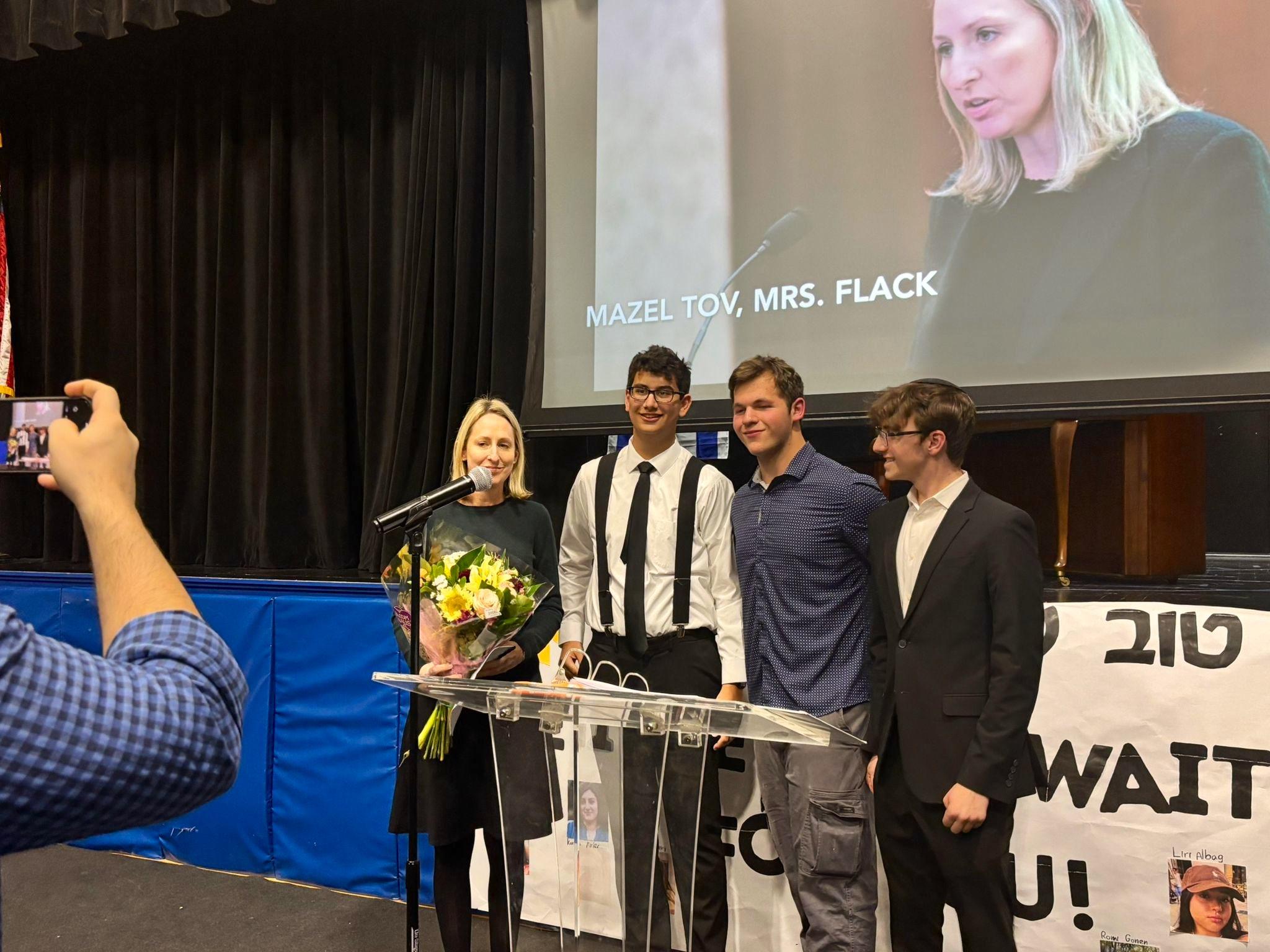
With the steaks served, the video presentation began to play. This year, the Steak Dinner video presentation was led by Co-President Jojo Ardestani (’25) and Chief of Video JJ Stein (’25). After the advertisements, the video announced this year’s Steak Dinner Honoree, Mrs. Brandy
After the guests began to leave, the students remained until late hours of the night, cleaning the gym and lunch room, washing dishes, moving materials, and doing all manners of tasks. And once it was done we had our famous steak afterparty and returned home satisfied with our hard work.
With the 30th annual steak dinner completed, it is safe to say that this year’s event was better than ever, and although it took a lot of time, effort, and preparation, it was well worth it. When asked about his experience at the dinner, Raanan Vanderwalde (’25) said, “The Steak Dinner helped me gain experience in organizing and running a large event. While it was a lot of work, the lessons I learned were worth every second.”
Thank you everyone who attended this year’s CYHSB Steak Dinner. We loved serving you, and we hope that you come back for the 31st Steak Dinner next year.
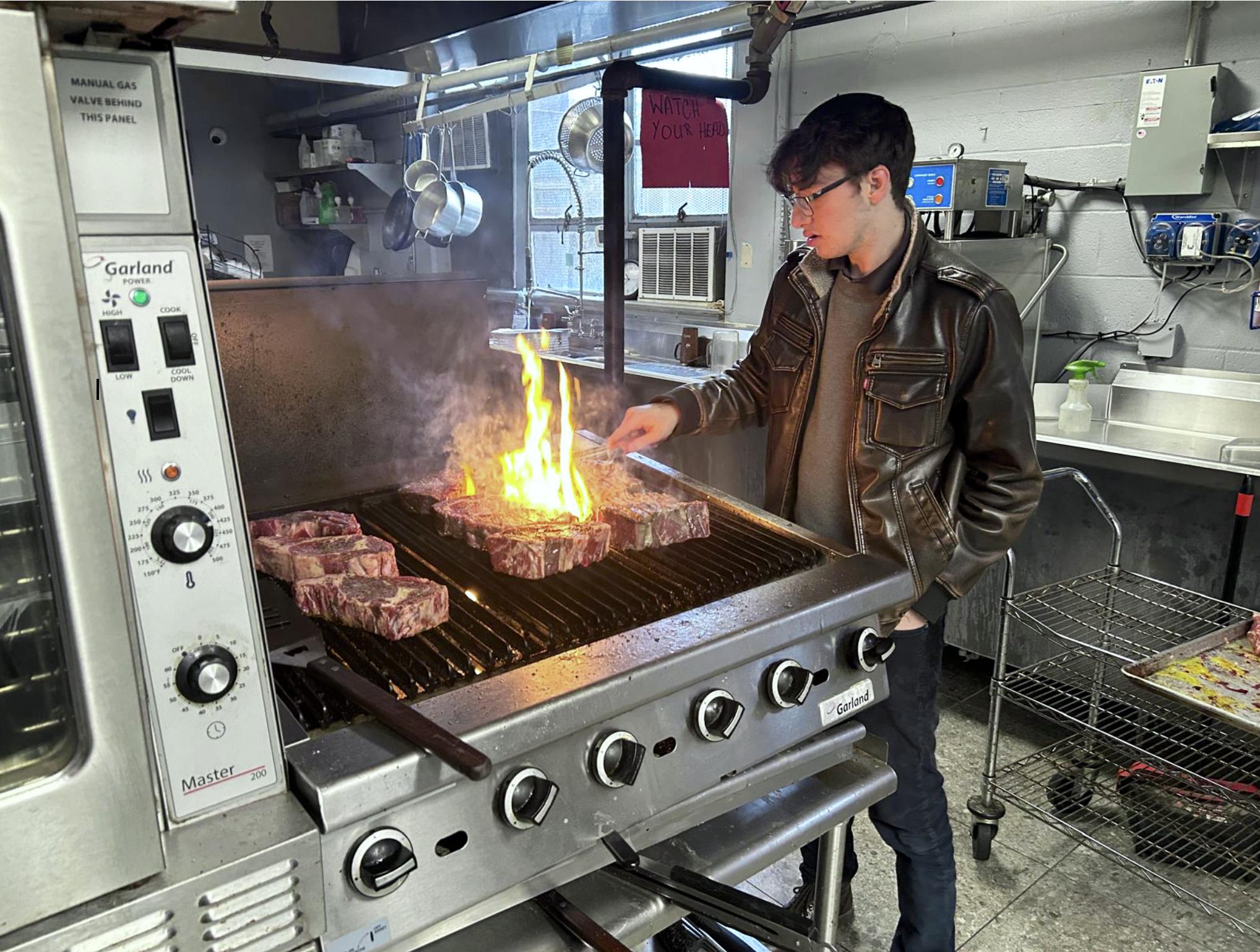
Caption: Jojo Ardestani grils steaks the morning before the dinner in preparation for an amazing event.
Photo by Raanan Vanderwalde
Doors and Locks: The Potential Downsides
Ilan Lowell ('25)
A few weeks ago, students at CYHSB noticed a change: the lounge, which had been without a door for some time, now has one along with a lock, as part of an update to several other classroom doors. While locking classroom doors during davening has been a practice for some time, the decision to lock the newly installed lounge door has sparked conversations among the student body.
While the administration's goal is to ensure that students remain focused during class time and davening, students have expressed concerns about the practical implications of these measures. From needing to find a teacher to access classrooms or the lounge to difficulty accessing lockers for items like chargers or medications, some students feel these policies may create unnecessary disruptions.
To better understand the reasoning behind these changes, I spoke with Rabbi Rossman, the Judaics Studies Principal at CYHSB, about the motivations for these policies and how they aim to balance student needs with the school's goals for discipline and decorum.
1. What was the main reason behind reinstalling the lounge door with a lock, and how does this fit with the school's overall approach to student behavior during class and davening time?
“The school was recently able to replace all of the interior doors in the high school with quality wood doors that have windows. The lounge originally had a door, and the decision was made that once the doors were being replaced to replace that door as well. While the classroom and lounge doors remain open throughout the school day from breakfast and on, the ability to restrict access at times when there is limited teacher supervision or, chas veshalom, during a security incident, is important.”
2. The policy of locking classroom doors during davening has been in place for a while now. What do you believe are the main benefits of this practice, and how has the student body responded to it?
“During the school day classrooms are all open, and we have a pretty open policy of allowing students to use unoccupied classrooms for studying, socializing, and other activities when they do not have class. Unlike the lower school, in the high school students are permitted to use spaces when there isn’t a teacher actively present, but there are still teachers and administrators in nearby rooms and halls providing general
supervision. Davening is a unique time of the day when all students and teachers are in the same room at the same time, so there aren’t teachers to supervise the classrooms where students aren’t supposed to be at that time to begin with, so they are only opened after davening.”
3. Some students have raised concerns about the inconvenience of having to track down keys for the lounge or classrooms. Are these concerns something the administration is aware of, and if so, how do you plan to address them?
“While most students go from davening straight to the
The CYHSB dreams of feedom. Source: Nadav Lowel, Yakir Rovner.
lunchroom for breakfast, there are some students who prefer to study or relax in the classrooms during this time. At the beginning of the year there were some concerns regarding the pace at which the classroom doors were opened during breakfast, and due to student feedback we have gotten into a good routine where they get opened in a timely fashion.”
4. Another concern students have mentioned is the difficulty of accessing lockers during class, especially for items like chargers or medications. Do you think these policies might impact students’ ability to get what they need, and if so, how
can the administration address those concerns?
“Like classroom doors, the lounge is only locked during davening. Every teacher has a key to the lounge so if the lounge is ever locked by accident or for some other reason, there should be no difficulty finding a teacher with the key. If there were an unlikely situation where the room is locked during class hours and a student is unable to find a teacher, there is always a key in the front office as well should the room need to be accessed.”
Should the school be locking the lounge door during class time?
5. What would you say to students who feel that locking the lounge door is limiting their ability to find quiet spaces to study or work on projects during school hours?
“As mentioned above, the high school is very open in allowing students to use pretty much all unoccupied learning spaces throughout the day. The only time that
the lounge is not open, like classrooms, is during davening time where supervision is limited and all students are supposed to be in the same location.”
6. Looking forward, do you anticipate any changes or adjustments to the policies regarding locked doors? Is there room for flexibility if students express specific needs?
“Certainly. For example, when we got feedback from students at the beginning of the year that they would like the classrooms opened earlier during breakfast I think we were able to respond pretty well to that. Additionally, when the lounge door was first installed, there was some thought that perhaps it should only be open between classes. However, we realized there are many valid reasons why students need regular access to the room throughout the day, especially with the lockers being there. So, we quickly adjusted that based on student feedback, deciding that the lounge should remain open at all times during the school day when there is teacher supervision.”
Just Love Them
Rafi Goldkin ('25)
Parshat Beshalach marks the beginning of the journey for the Jews in the desert, and it all builds up to them receiving the Torah at Mount Sinai. There is a very famous story from the Talmud in Shabbos 31A, that tells of a gentile who came before Shammai and asked him to teach him the whole Torah while standing on one foot. Shammai kicked him out and scolded him, but the gentile was persistent, so he came before Hillel and asked him the same thing. Hillel responded simply, “Love your neighbor like you love yourself.” He then said that the rest of the Torah was just an interpretation of this rule. This Gemara implies multiple lessons but their are two in particular that I believe we can take a message from now. One, that the point of Torah study is to identify what is right and wrong in the eyes of G-d, and to apply that in our own lives by acting kindly to the people around us. As the Talmud in Kiddushin 40B states, “Great is learning that leads to action.” Learning is amplified to new hights if the lessons one takes from it are applied to his actions as well. And the second lesson we learn from the story of Hillel is that if one in the first place does not care about his friends, his family, and his fellow Jew, then how can he learn Torah? The first step is to love your fellow Jew, and then after you can go learn what the
right and wrongs of the Torah are. But what are the parameters of this rule?
The verse states, “V'ahavta l'reakha kamokha”, love your fellow Jew as much as yourself. The commentators point out that this is impossible to uphold because one can never truly equate the love he feels for his friend to the love he feels to himself. Rather it means that you should put yourself in your fellows shoes. Feel what he is feeling. Experience what is going on inside his head, and, as if you were him, act to him according to how you would want to be treated. Many times throughout the Talmud, the verse is brought as a proof for deciding on the death penalty. The court will have to decide between two different types of death, and the sages tell us that you should choose the quicker and more compassionate one because of this verse. This is a huge lesson that if your friend did something wrong, even totally against what the Torah says is right, this verse still applies to him, and you are still required to love him. The midrash tells us that if we go against the rule of loving your fellow, you should know that you are truly disgracing G-d because each and every person was created in the image of G-d. The Chofetz Chaim puts this into perspective for us. He says that each and every one of us know our individual
Source: revryanstratton.com
shortcomings that other people don’t know about us. And we are still perfectly capable of loving ourselves to the fullest. Yet when we see our fellow Jews do something wrong or maybe a few things wrong, we somehow begin to hate them. Yet if we did the same things, we wouldn’t mind and would still be able to live with ourselves. This is a lesson that can be learned from the episode of Noach getting drunk and his sons covering him up- it doesn’t matter what your fellow Jew does, if you were in his shoes, your self-love would sweep away all sins and be able to act kindly to yourself. So too, we need to ignore what our friends do and just love them.
Rabbi Dovid Trenk was a living model of this lesson. There is one story that I heard about him that exemplified this rule. Rav Trenk would always visit the same car shop to get repairs done on his car. There was this one other guy who would also frequent the shop, a very buff and burly guy with tattoos all over himself. Every time this man would enter the
store, everyone would take a few steps back because of how intimidating he was. One time, Rav Trenk happened to be in the store at the same time as this guy entered. Rav Trenk looked up, and as everyone took a step back, Rev Trenk
walked over to this guy, gave him a big hug, and said “My brother, how are you?” The people around him were shocked, they asked Rav Trenk, “Rebbe you know this guy?” Rav Trenk responded, “No, but don’t you see the Magen David
he is wearing around his neck, he too is my brother.” We too need to try to be like Rav Trenk, ignore the external factors, and emulate this huge mitzvah of V'ahavta l'reakha kamokha. Ani Hashem. Have a good Shabbos!
The Steak Dinner was a massive success! Thank you to our amazing community for participating and supporting the dinner every step of the way. To our dedicated administrators, generous teachers who donated their time, and parents who provided unwavering support, we extend our heartfelt appreciation. We look forward to many more successful events in the future.
We would like to extend a special recognition to Mrs. Brandy Flack, the esteemed Honoree of this 30th Steak Dinner. This honor is a testament to her unwavering dedication and commitment to the smooth operation of our school. From overseeing repairs and security to ensuring daily functionality, Mrs. Flack’s invaluable contributions have been instrumental in the school’s success. We extend our heartfelt gratitude to Mrs. Flack for her exceptional service, and Mazel Tov on this well-deserved recognition.
The hostage deal. The Tanzman Basketball Tournament. Upcoming shabbatons, and the excitement of the AJA football team. It's amazing, from a student body standpoint and from an Editor-in-Chief standpoint to see these events unfold. What students want to report about, the interests of the student body to see these topics in the Weekly. The juxtaposition of it all. From seeing the life of Am Yisrael given new hope in Israel, to the next generation of high school basketball players, playing in tournaments, one can only think of the connection. We move forward with our busy lives but slow down enough to recognize the miracles around us and appreciate our people coming home. Bezrat Hashem there will only be good things to come.