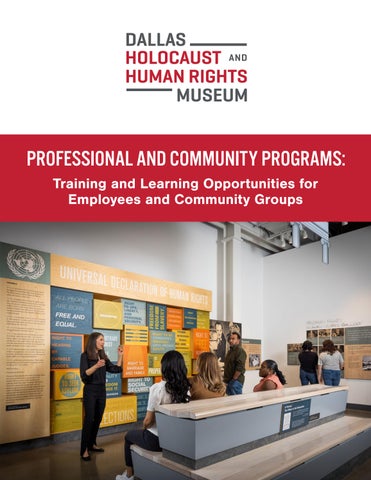
PROFESSIONAL AND COMMUNITY PROGRAMS: Training and Learning Opportunities for Employees and Community Groups
At the Dallas Holocaust and Human Rights Museum, we are dedicated to our mission to teach the history of the Holocaust and advance human rights to combat prejudice, hatred, and indifference. Since our founding in 1984, we have held a deep-rooted responsibility to ensure that history lives on through education. We inform about the lessons of the Holocaust, the emergence of the Universal Declaration of Human Rights, historical genocides, and America’s journey for human and civil rights. Connect with the Museum and our mission by engaging in our learning opportunities for professionals and community groups. We are pleased to offer a range of opportunities designed to support professional growth and meaningful connection. Our team can design a customized experience that supports your goals and aligns with your organization’s values. Through our programs, we help participants deepen their understanding of history, reflect on its relevance today, and build leadership skills to be an Upstander.
TABLE OF CONTENTS Programs, Speakers, and Specialty Tours..................................................... 2-3 Speakers Bureau................................................................................................. 4-7 Upstander Training................................................................................................. 9 Continuing Education for Professionals........................................................... 10 Community Tours and Programs...................................................................... 13
PROFESSIONAL AND COMMUNITY PROGRAMS Arrange an interactive learning opportunity that sparks conversations. Choose from one of the options below or let the Museum curate a customized experience. Programs are available seven days a week and can be hosted at the Museum, offsite at the location of your choosing, or virtually through your online platform. Looking for more than one engagement opportunity? Create a learning series that mixes and matches programs, speakers, and specialty tours. The Museum provides personalized options with flexibility for quarterly, bi-monthly, or monthly content.
PROGRAMS, SPEAKERS, AND SPECIALTY TOURS Survivor and Historical Speakers Hear from survivors and historical speakers as they share their experiences. Speakers cover stories about the Holocaust and other genocides, and U.S. civil rights. See pages 4-7 to view the Museum’s Speakers Bureau. Upstander Mindset: Shaping a Positive Workplace and Community Culture This program challenges conventional views of Upstander and bystander behaviors, using historical examples to explore key differences and real-world applications. The session emphasizes proactive decision-making, accountability, and the role of leadership in fostering a positive workplace and community environment. The Power of Perspective: Sharpening Decision-Making & Communication In this dynamic and interactive session, we use an engaging activity to explore how perspectives are formed and how they shape our decision-making and communication. Through thought-provoking discussions, participants gain deeper insights into the impact different viewpoints can have, strengthening their ability to collaborate effectively in the workplace and community. History 101 Talks: Insights from the Past for Today’s Leaders These presentations led by experts connect historical topics from the Museum’s exhibitions to today’s world, offering powerful insights into how the past shapes the present and drives future success. Designed to inspire reflection and foster critical thinking, these talks help participants gain fresh perspectives. History and Impact of Antisemitism In a climate of rising antisemitism, this program offers tools to help people better understand the complexity of antisemitism and its long history. The session concludes with the impact of today’s antisemitism and strategies to stand up against it. 2
Confronting Prejudice and Hatred This program explores the underlying factors that drive prejudice and hatred, examining four key influences behind these behaviors. Through historical case studies, participants gain practical strategies to identify, address, and mitigate prejudice and hatred. Designed for professional and community leaders, this session equips learners with actionable insights to cultivate a respectful and positive workplace culture. Understanding Equality: A Historical Perspective Drawing on key moments in U.S. legislative and judicial history, participants gain a greater appreciation for how the pursuit of equality has influenced the nation’s laws and policies, driven progress, and strengthened the American principles of freedom and fairness. Uncovering Dallas Civil Rights Learn about the history of civil rights in Dallas by viewing a historical film, hearing directly from local civil rights leaders, and discussing the importance of knowing local civil rights history. Permanent Exhibition Tour Be encouraged to think about the most fundamental questions of human nature through an experience of our permanent exhibition. Tours are led by guides taking you through all three exhibition wings – Holocaust/Shoah, Human Rights, and Pivot to America – or a specialized themed tour. Special Exhibition Program and Tour The Museum hosts different travelling exhibitions twice a year that expand upon lessons and stories from the permanent exhibition. Click HERE to view our current special exhibition. Artifact Interaction Interact with replica artifacts and photographs, learning about the Holocaust and human rights directly from primary source materials. Preserving Family Memories Learn how to care for family heirlooms, photographs, letters, and artifacts through this handson workshop that addresses the most common challenges of in-home preservation. 3
SPEAKERS BUREAU Survivor and Historical Speakers Each speaker offers unique insight into history. Their powerful stories highlight accounts of the Holocaust and other genocides, and U.S. civil rights. Magie Furst, Holocaust Survivor Magie Furst was born in Astheim, Germany in 1929. In 1938, her mother planned for the family to escape to England by obtaining a visa for herself and securing spots for Furst and her brother on the Kindertransport, a rescue mission that allowed thousands of Jewish children to live with British citizens.
Paul Kessler, Holocaust Survivor Paul Kessler was born in Vranov Nad Toplou, Slovakia in 1939. After his father was captured by the Nazis in 1944, he and his family escaped the village and sheltered until they were again forced to flee. Kessler and his mother hid in a neighbor’s field covered with dirt, grass, leaves, and manure for approximately eight months. He was the only Jewish child in his village to survive the war.
Andras Lacko, Holocaust Survivor Andras Lacko was born in Budapest, Hungary in 1936. In a twist of fate, Lacko contracted scarlet fever in 1944 which saved him from ghettoization and subsequent deportation to Poland. He survived the Holocaust in a military hospital and was later reunited with his mother and father after the Soviet liberation of Budapest.
Dale Long, 16th Street Church Bombing Survivor Dale Long was born in Tuskegee, Alabama and grew up in segregated Birmingham, Alabama. There, he regularly attended the Sixteenth Street Baptist Church. He was at the church on September 15, 1963, when it was bombed by white supremacists. The bombing killed four of his friends and injured 27 others. 4
Patricia Perez, American Civil Rights Speaker Patricia Perez moved to Dallas in 1965 with her brother and began working with Juanita Craft and the South Dallas NAACP Youth Council. She graduated from high school in 1971 and attended North Texas State University, now the University of North Texas. Perez is a co-founder of the steering committee that renovated and reopened the Juanita J. Craft Civil Rights House and Museum in 2023.
Hanna Schrob, Holocaust Survivor Hanna Schrob was born in 1936 in Maastricht, Holland. After the Nazis invaded Holland, Schrob and her family were arrested by the Gestapo and deported to Westerbork Transit Camp where they were held for six months. After transfer to other camps in Western Europe, Schrob and her family were liberated by the U.S. Army in France in late 1944.
Rosian Zerner, Holocaust Survivor Rosian Zerner was born in Kaunas (Kovno), Lithuania, in 1935. When Germany invaded in 1941, Zerner and her family were confined to the Kovno Ghetto. When she was 6, her parents helped her escape through a hole they dug under the ghetto fence. Met by her father’s secretary, Zerner was hidden by several rescuers before being liberated by Soviet troops in 1944.
5
SPEAKERS BUREAU Generation Speakers At the Museum, “Generations” is the term used to refer to individuals who are descendants of Holocaust victims, survivors, refugees, hidden children, and Kindertransportees. These speakers share their parents’ survival and life stories to preserve their memory and legacy. Julie Meetal Berman, Daughter of Holocaust survivors Magda and Les Mittelman Z”L Magda and Les were born in Hungary in 1923 and 1919, respectively. During the war, Les was conscripted into forced labor for the Hungarian army but escaped and joined a resistance group. Magda and her family were ghettoized before being sent to Auschwitz. She was liberated in Germany. Phillip (Phil) Glauben, Son of Holocaust survivor Max Glauben Z”L Born in 1928, Max was 11 when the Nazis invaded Poland. In 1940, he and his family were confined to the Warsaw Ghetto. Max smuggled food and supplies into the ghetto. Deported to Majdanek Death Camp and then to other concentration camps, he was liberated by the U.S. Army Mark Jacobs, Son of Holocaust survivor Mike Jacobs Z”L Mike was born in Poland in 1925. In 1939, he and his family were confined to the Ostrowiec Ghetto. His parents, two brothers and two sisters, were murdered at Treblinka Death Camp. Mike survived several camps, including Auschwitz and was liberated from Mauthausen-Gusen II by the U.S. Army in 1945. Lisa Kanarek, Daughter of Holocaust survivor Dr. Joseph Kanarek Z”L Joseph was born in Poland in 1926. He and his family were confined to the Plonsk Ghetto after the Nazi invasion and deported to Auschwitz-Birkenau in 1942. There he worked in forced labor at Buna Concentration Camp. In 1945, Joseph was liberated from Dora-Mittelbau Concentration Camp by the 101st American Army. Ron Schwarz, Son of Holocaust survivor Charles Schwarz Z”L Charles was born in Germany in 1926. In 1939, his parents sent him to France. During the war he was hidden by the Oeuvre de Secours aux Enfants, a Paris-based Jewish aid organization. Through a very risky border crossing, Charles escaped to Switzerland. 6
Museum Ambassadors Museum Ambassadors deliver engaging presentations on institutional history and curatorial topics for adult audiences. Mary Pat Higgins, President and CEO Mary Pat Higgins leads the Dallas Holocaust and Human Rights Museum in its mission to teach the history of the Holocaust and advance human rights to combat prejudice, hatred, and indifference. Under her leadership, the Museum opened its permanent home in 2019 and expanded its educational reach. A CPA and EMBA graduate of SMU, Mary Pat is a civic leader serving on numerous nonprofit boards. Sara Abosch-Jacobson, Ph.D., Barbara Rabin Chief Education Officer Sara Abosch-Jacobson oversees all content at the Museum. An expert in modern European and Jewish history, she holds a Ph.D. and two MAs in related fields. She speaks widely on Holocaust history, Jewish culture, and the Museum’s exhibitions, bringing deep scholarship and accessible insight to diverse audiences. Charlotte Decoster, Ph.D., Senior Director of Education Charlotte Decoster is a Holocaust historian and educator who leads numerous educational initiatives at the Museum. She holds a Ph.D. in History from the University of North Texas and frequently lectures nationwide on Holocaust history, including child rescue and the life of Anne Frank. Latricia Davis, Ackerman Family Director of Education Latricia Davis oversees the Museum’s kindergarten through adulthood educational programming, including curriculum development, teacher training, and student engagement. A former secondary educator and college instructor with nearly 15 years of experience, she designs transformative learning that fosters empathy, historical understanding, and civic responsibility. Felicia J. Williamson, MLIS, CA, Director of Library & Archives Felicia Williamson manages the Museum’s growing collection of rare books, artifacts, and oral histories. A certified archivist, she holds an MLIS from LSU and a BA in History, German, and European Studies. She is committed to preservation and expanding public access to these vital resources. 7
8
UPSTANDER TRAINING Expand your leadership skills further through this year-long immersive training program that brings asynchronous learning and interactive programs together. Participants engage in historical and cultural discussions to better understand the past and its relevance to current issues, and they explore how choices and actions impact their professions and roles in the community. The Museum’s staff will work closely with you on developing a customized program designed to meet your organization’s needs. The complete 12-month package offers: • Kick-off event for participants to learn about the program and scope. • Online asynchronous learning platform curated based on your organization’s needs that includes a digital library of resources from the Museum and other trusted sources. • Facilitated quarterly or monthly programs hosted live online on select topics and recorded for on-demand access. • Completion certificate provided at the end of the training program. Participants will walk away with: • Stronger critical thinking and leadership skills. • Deeper understanding of historical and cultural concepts. • Greater insight into the complexity of human behaviors. • Ability to apply lessons from history to personal and professional life. • Tools to continue the learning journey beyond our training.
Up-stand-er (n) • Stands up for other people and their rights. • Combats injustice, inequality, or unfairness. • Sees something wrong and works to make it right. 9
CONTINUING EDUCATION FOR PROFESSIONALS Advance your team’s professional development with the Museum’s continuing education programs. Our ethics training sessions offer opportunities for professional credit, and we can provide documentation or assist with credit approval as needed. Program can include: • Guided tour of the Museum’s permanent exhibition. • Facilitated exhibition debrief with Museum educators. • Historical analysis activity. • Guided perspectives discussion. Accreditation opportunities are available for professionals in fields such as: • Healthcare • Legal • Law Enforcement • Architecture • Financial and Accounting
Ethics Training: Lessons from the Holocaust Using the Holocaust as a historical framework, this ethics training encourages participants to discuss the concepts of personal and professional choice. The program explores the role and impact of their profession during the Holocaust and fosters reflection on professional, ethical, and personal responsibilities in society today.
“
I have attended many trainings at the Dallas Holocaust and Human Rights Museum and each time I come away with something new. It helps me remember why I chose my profession and about how individual decisions, which may seem inconsequential, can accumulate and alter my path and the path of those I encounter.
”
- Corporal Knight, Arlington Police Department
The Dallas Holocaust and Human Rights Museum is a non-accredited CLE course sponsor. This course can be applied for Minimum Continuing Legal Education credit by the State Bar of Texas Committee on MCLE in the amount of up to 3 credit hours, of which the credit hours can apply to legal ethics/professional responsibility credit.
10
11
12
COMMUNITY TOURS AND PROGRAMS The Museum offers group tour reservations for community organizations at a discounted rate. Our Group Tours Team can support your organization in creating a memorable experience for your participants. For more information, click HERE. We also offer interactive, on-site programs specially designed for seniors, adult learners, or youth groups. These sessions are perfect for engaging minds, sparking conversation, and deepening understanding of history. Popular programs include: Survivor and Historical Speakers Hear from survivors and historical speakers as they share their experiences. Speakers cover stories about the Holocaust and other genocides, and U.S. civil rights. See pages 4-7 to view the Museum’s Speakers Bureau. History 101 Talks These expert-led presentations connect historical topics from the Museum’s exhibitions to today’s world, offering powerful insights into how the past shapes the present. Designed to inspire reflection and foster critical thinking, these talks help participants gain fresh perspectives. Permanent Exhibition Tour Be encouraged to think about the most fundamental questions of human nature through an experience of our permanent exhibition. Tours are led by guides taking you through all three exhibition wings – Holocaust/Shoah, Human Rights, and Pivot to America – or a specialized themed tour. Special Exhibition Program and Tour The Museum hosts different travelling exhibitions twice a year that expand upon lessons and stories from the permanent exhibition. Click HERE to view our current special exhibition.
13
DHHRM.ORG 214-741-7500 300 N. Houston Dallas, Texas 75202 education@dhhrm.org