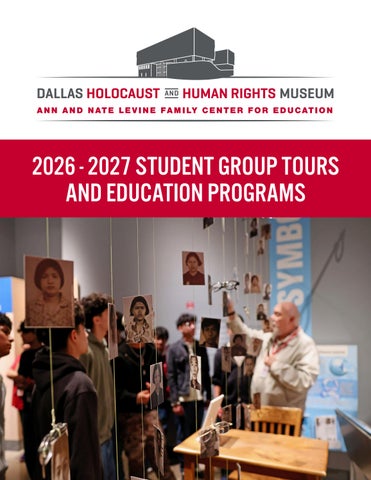
2026 - 2027 STUDENT GROUP TOURS AND EDUCATION PROGRAMS
TABLE OF CONTENTS 2 Mission of The Museum 3-4 Field Trips to the Museum 5 Virtual Field Trips 6-8 Education Programs: Virtual, At School, or At Museum 9 Speakers Bureau 9 Homeschool Groups and Days 10 How To Book Your Tour or Program 11 Prepare For Your Tour or Program 13-16 Standard Alignment Chart 16 Contact Information 17 Thank You to Our Generous Supporters
Cover photo by Kim Leeson
2
2025-2026 Group Tours & Education Programs
MISSION OF THE MUSEUM To teach the history of the Holocaust and advance human rights to combat prejudice, hatred, and indifference. The Dallas Holocaust and Human Rights Museum does more than most history museums. Here students encounter the history of the Holocaust and America’s journey for equal rights. Through lessons that are grade appropriate and aligned to State of Texas curriculum standards, we inspire students to consider the real consequences of their choices and develop skills to become UPSTANDERS.
Up-stand-er (n) • Stands up for other people and their rights • Combats injustice, inequality, or unfairness • Sees something wrong and works to make it right
Photo by Kim Leeson
Dallas Holocaust and Human Rights Museum
2
FIELD TRIPS TO THE MUSEUM FIELD TRIP EXPERIENCES Standard Tour (minimum 3 hours) A field trip to the Museum includes a 90-minute self-guided tour of the permanent exhibition, 30-minute flex time in the Museum store, courtyard, or special exhibition, and the 45-minute survivor-based film, Voices of Courage, in the Cinemark Theater. The permanent exhibition tour includes: 1. Orientation Wing: A brief theater experience prepares students for their exhibitionary journey. They are introduced to key concepts and asked: What kind of person am I? 2. Holocaust/Shoah Wing: This wing provides an expanded look at the history of the Holocaust. It features original artifacts, survivor testimony stations, historical films, and photography. 3. Human Rights Wing: Students are introduced to representational justice through the International Military Tribunals. They also will explore the Universal Declaration of Human Rights and the 10 Stages of Genocide. 4. Pivot to America Wing: Students explore our nation’s founding ideals and learn about Upstanders from Texas and across the United States who worked to bring those principles to reality.
Wing Focused Tour (minimum 60 minutes) A wing-focused tour is a 60-minute self-guided experience focused on Holocaust or human/civil rights history. These tours are designed for groups that want to explore a particular wing of the permanent exhibition. They are mostly available in the afternoon. • Holocaust/Shoah: This tour provides students with an in-depth look at the history of the Holocaust. The tour starts in the Holocaust/Shoah Wing and ends in the International Military Tribunal Gallery. • Human Rights and Pivot to America: This tour provides students with an expanded look at the development of human rights after World War II and civil rights in U.S. history. The tour starts in the Universal Declaration of Human Rights Gallery and ends in the Pivot to America Wing.
3
2025-2026 Group Tours & Education Programs
Tour Add Ons • Dimensions in Testimony (30 minutes): In this interactive experience from the USC Shoah Foundation, students meet a holographic Holocaust survivor in a special theater. The survivor shares their personal story and then responds to questions from the audience using voice recognition technology, inviting one-on-one ‘conversation.’ Groups up to or divided into 40 students can add on this experience. • Speakers Bureau (60 minutes): Hear from a Holocaust survivor, child of a Holocaust survivor, or a civil rights speaker as they share their life story with your students. View our Speaker Bureau bios Here. • Education Program (60 minutes): Join a Museum Educator for an interactive program in our classroom to further explore historical or Upstander topics covered in the Museum’s exhibition. See brochure pages 6-8 for education program descriptions.
FIELD TRIP INFORMATION Field Trip Length: Grades: Group Size: Chaperone Requirement: Fee:
Standard: Minimum 3 hours | Wing-focused: 60 minutes 6+ Min. 15 guests / Max. 480 guests per arrival time 1 adult chaperone per 10 students $8 per school group guest Scholarships for qualified schools are available upon request.
Dallas Holocaust and Human Rights Museum
4
VIRTUAL FIELD TRIPS A Museum Educator will lead your students on a live virtual tour of the Museum’s permanent exhibition. Students connect individually on their own devices or as a group from their classroom. As the Museum Educator walks through the exhibition, students can explore the exhibition and ask questions in real time. Virtual tour options: Holocaust/Shoah Wing This tour is great for groups seeking an expanded look at the history of the Holocaust. Human Rights Wing This tour explores the International Military Tribunal, Human Rights, and 10 Stages of Genocide galleries. It’s ideal for educators wanting to explore into post-war world history. Pivot to America Wing This tour turns to Upstanders who drove change in American and Texas history.
VIRTUAL FIELD TRIP INFORMATION Field Trip Length: Grades: Group Size: Program Fee:
5
Wing-specific tour: 45-60 minutes | Full exhibition tour: 90 minutes 5+ Suggested maximum of 90 participants per session $200 up to 25 participants per session $400 up to 50 participants per session $720 up to 90 participants per session Scholarships for qualified schools are available upon request. We can provide multiple sessions per day.
2025-2026 Group Tours & Education Programs
EDUCATION PROGRAMS: VIRTUAL, AT SCHOOL, AT MUSEUM Join a Museum Educator for an interactive program to explore historical or Upstander topics covered in the Museum’s exhibition. All programs are grade- and TEKS-aligned to invite student participation and allow for group and self-reflection. Education programs can be held virtually, provided at your school, or added to your in-person field trip to the Museum.
Inspirations: An Upstander Shadow Puppet Theater Grades: K-3 Through a shadow puppet theater experience, students explore the lives of three American Upstanders. Each Upstander teaches students important Upstander skills. Upstander examples include Dorie Miller, Jovita Idar, and Rosa Parks.
Inventing Change: How Upstanders Inspire Future Innovators Grades: K-3
Scientist George Washington Carver in his laboratory at Tuskegee Institute, Alabama. Schomburg Center for Research in Black Culture, Photographs and Prints Division, The New York Public Library. (1925 - 1940).
In this creative and exploratory program, students learn how Upstander behavior influenced famous inventors and scientists to better their community. After a short Upstander introduction, students put on their inventive hats and create something to help their community.
Be Your Own Curator Grades: 4-8 This interactive and creative program allows students to explore a historical topic by curating their own exhibition panel. This program pairs well with Civil Rights studies or novels such as Number the Stars, Diary of A Young Girl, or Night.
What is an Upstander? Grades: 4+ This discussion-based interactive program allows students to explore what it means to be an Upstander and reflect on the impact of bystander behavior through historical examples in American and/or Holocaust history. Dallas Holocaust and Human Rights Museum
6
EDUCATION PROGRAMS (CONTINUED) Reporting on History: Local Civil Rights Grades: 5+ Students go back in history as journalists to better understand the Dallas Civil Rights Movement. Through event photos, film footage, and eyewitness reports, they write their own front-page news stories on the Piccadilly Cafeteria civil rights sit-in or the Crystal City walkout.
History Talk: What are Human Rights? Grades: 6+ What are human rights and where do they begin? Students will learn how the concept of human rights has developed over time and understand how Upstanders have made a difference.
The Power of Perspective Grades: 6+ This interactive program introduces students to the impact of perspective. They participate in a fun visual thinking activity unpacking how perspectives are formed in our daily lives.
History Talk: Holocaust 101 or 10 Stages of Genocide Grades: 6+ This lecture-style program reviews the basic concepts of Holocaust history or genocide awareness through the 10 Stages of Genocide model. It is followed by a 10-minute Q&A that allows students to ask questions.
Confronting Prejudice and Hatred Grades: 8+ This discussion-style program introduces students to the concepts of prejudice and hatred, analyzes the 4 factors that drive these behaviors, and using historical examples teaches them how to confront hatred and prejudice. 7
2025-2026 Group Tours & Education Programs
History and Impact of Antisemitism Grades: 8+ In a climate of rising antisemitism, this program offers tools to help students better understand the complexity of antisemitism and its long history. The session concludes with the impact of today’s antisemitism and strategies to stand up against it.
The Science of Preservation Grades: 6+ (only at the Museum) This program engages students in scientific exploration and the care of artifacts. Led by Archive staff, students learn about 10 primary threats to artifacts and how to complete a condition report.
Artifact Interaction Grades: 6+ (only at the Museum) Join Museum Archivists for an interactive program featuring Holocaust and human rights artifacts from our collections. Students will examine artifacts, report on their condition, and learn about historical preservation techniques.
EDUCATION PROGRAM INFORMATION Length: Program Fee:
Travel Fee: (only for at school programs)
45 to 60 minutes per session Up to 40 participants: $320 41 to 75 participants: $600 Over 75 participants, please contact group tours. Program fees are per session. Scholarships for qualified schools are available upon request. 15 miles radius: $25 30 miles radius: $45 Over 30 miles, please check availability with group tours. Dallas Holocaust and Human Rights Museum
8
SPEAKERS BUREAU Speakers offer unique insights into history for student groups at the Museum or on your campus. Their powerful stories highlight accounts of the Holocaust and U.S. civil rights. For speaker biographies, go to Speaker Bureau bios.
Length: Grade Level:
Program Fee: Travel Fee: (only for at school programs)
60 minutes per session Holocaust survivor: 6+ Generations speaker: 6+ Civil rights speaker: 5+ Fieldtrip add-on at the Museum: no cost On-Campus fee: $500 Based on private transportation travel. Usually under $350 in the DFW Metroplex.
HOMESCHOOL GROUPS Homeschool Days Join the Education Team for a day of learning designed for homeschool families including a tour of the Museum’s permanent exhibition, a Dimensions in TestimonySM experience, and an interactive classroom program. Homeschool Day tickets are $15 per participant and can be purchased online. 2025-2026 Homeschool Days • Tuesday, September 15 • Tuesday, October 27 • Tuesday, December 8 • Tuesday, February 9 • Tuesday, March 9 • Tuesday, May 11 Homeschool Group Tours Homeschool groups and co-ops with more than 15 participants may also book a student group tour and program to visit the Museum on their preferred date. Click Here to book your student tour. 9
2025-2026 Group Tours & Education Programs
HOW TO BOOK A TOUR OR PROGRAM Please review our student field trip and program FAQ sheet and Group Tour and Program Resource Portal for additional information before submitting your request. SCHOLARSHIPS Museum Experience Fund scholarships are based on Title I eligibility, economically disadvantaged status, or location in ESC Regions 7 or 8. They cover admission for students and accompanying chaperones and/or education program costs. Groups with limited transportation funds can also apply for partial transportation assistance. You will have the opportunity to apply for an admission scholarship when submitting the Tour and Program Request Form. REQUEST YOUR TOUR OR PROGRAM: 1. Gather your information: Have your preferred tour/program dates, arrival/start time, number of students and chaperones, lunch needs, and desired add-on options ready. 2. Verify your dates and approvals: Check that your preferred dates do not conflict with your school’s calendar and are approved by your administration. Make sure to check arrival and departure time restrictions with your transportation department. 3. Submit your Tour and Program Request Form: Forms must be submitted at least three weeks prior to your requested tour/program date. You will find the online form on our Student Group Tours page or use the following direct link: https://www.dhhrm.org/visit/student-group-tours/. RESERVATION PROCESS Requests are processed in the order that they are received. Therefore, availability cannot be confirmed in advance. 1. The Group Tours Team will email you within 7 business days to confirm the availability of your requested tour/program date and logistics. Reply to this email to continue with the reservation process. 2. The Group Tours Team will send you a Reservation Agreement. Sign and submit the Reservation Agreement upon receipt. Paid groups will also receive an Invoice with the Reservation Agreement. 3. Payment must be received at least two weeks prior to your tour/program date to receive final reservation confirmation. 4. One week prior to your tour/program the Group Tours Team will send a final reminder email with the tour schedule. For any reservation questions, please email grouptours@dhhrm.org.
Dallas Holocaust and Human Rights Museum
10
PREPARE FOR YOUR TOUR OR PROGRAM GROUP TOURS AND PROGRAM RESOURCE PORTAL This portal provides key information you need to prepare for your visit with your students. Here you will find practical information, such as parking maps and student guidelines. There are also resources to help prepare your students, including a Museum introduction video, pre-visit materials, and topics to discuss afterward. Access the Portal at https://dhhrm.canto.com/v/tours/ UPSTANDER EDUCATION DATABASES Our Learning and Curriculum Team assists educators in preparing students. To prepare students for a visit or program, we recommend that you sign up for the Upstander Education Database. This free database gives you access to exhibition films and testimonies, student guides, classroom lessons, and other resources. SIGN UP FOR THE UPSTANDER EDUCATION DATABASE 1. Go to https://dhhrm.canto.com/v/TeachUpstanders/ and click on any item on the landing page. 2. You will be taken to the login page. Below the login box, click the “register now” button. 3. Fill out the registration form AND in the bottom left corner of the form check “use an invitation code” AND enter: wlte3lnns7q7 4. Check your email for a registration email from Canto noting your access is approved. For any curricular information, please contact: Education@dhhrm.org. EDUCATOR PROFESSIONAL DEVELOPMENT During professional development, we help prepare teachers for a visit to the Museum and/or support them in teaching the historical topics covered in the exhibition. All our workshops are TEKS-aligned and come with CPE credit. • Candy Brown Holocaust and Human Rights Educator Series: This Series allows educators to connect on historical and literary topics related to the Museum's educational mission. • Teaching About the Holocaust Series: During the summer, we come to your local TEA Education Service Center to provide our resources and lessons on how to teach Holocaust history. This Series is in partnership with Echoes and Reflections. • Inspire Upstander Elementary Professional Development: This annual professional development provides K-5 educators, counselors, and librarians the learning tools, resources, and confidence to teach students the importance of empathy, acceptance, and kindness through historical Upstanders. For more information on our professional development options, please visit: https://www.dhhrm.org/educators/educator-professional-development/ 11
2025-2026 Group Tours & Education Programs
Dallas Holocaust and Human Rights Museum
12
TEKS ALIGNMENT AND UPSTANDER SKILLS The Education Team ensures that all our tours and programs are Texas Essential Knowledge and Skills (TEKS)-aligned and grade appropriate.
Positive Character Traits Education In all our tours and programs, we focus on strengthening Upstander skills defined by the Texas Education Agency (TEA) as Positive Character Traits Education TEKS. We included the following Positive Character Traits TEKS in our alignment: courage, trustworthiness, integrity, respect, responsibility, fairness, caring, and good citizenship.
ELEMENTARY PROGRAM ALIGNMENT Program
K-2
3rd
Inspirations: A Shadow Puppet Theater
Social Studies: K.2; K.11; K.14B; 1.2B; 1.12; 1.17C&E; 2.2; 2.10; 2.16D RLA: K.1A-B&D; 1.1.A-B&D-E; 1.7A&D; 2.1; 2.7A&D; 2.13A&D-E Character Traits: 1. A & C; 2. A & B 3. C; 4. A & C-D
Social Studies: 3.9A-C; 3.11; 3.14B; 3.15A&D; 3.16 RLA: 3.1; 3.7A&G; 7.13A&D-E Character Traits: 1. B & C; 2. A-B & D 3. A-C; 4. B&C
Inventing Change: How Upstanders Inspire Future Innovators
Social Studies: K.2; K.11; K.14B; 1.2B; 1.12; 1.15; 1.17C&E; 2.2; 2.10; 2.13; 2.14; 2.16D RLA: K.1A-B&D; 1.1.A-B&D-E; 1.7A&D; 2.1; 2.7A&D; 2.13A&D-E Character Traits: 1. A & C; 2. A & B 3. C; 4. A & C-D
Social Studies: 3.9A; 3.11; 3.13; 3.14B; 3.15A&D; 3.16 RLA: 3.1; 3.7A&G; 7.13A&D-E Character Traits: 1. B & C; 2. A-B & D 3. A&B; 4. B&C
4th
Social Studies: 4.18; 4.21A-B; 4.22 RLA: 4.2; 4.3; 4.13 Character Traits: 1. B & C; 2. A-B & D 3. A&B; 4. B&C
Social Studies: 5.22; 5.25A&C RLA: 5.2; 5.13 Character Traits: 1. B & C; 2. A-B & D 3. A&B; 4. B&C
Be Your Own Curator
Social Studies: 4.5A; 4.21A-B, 4.22 RLA: 4.2; 4.3 Character Traits: 1. B & C; 2. A-B & D 3. A&B; 4. B&C
Social Studies: 5.5A&C; 5.25A&C RLA: 5.2; 5.3 Character Traits: 1. B & C; 2. A-B & D 3. A&B; 4. B&C
What is an Upstander?
Social Studies: 4.5; 4.15D; 4.21A-B, 4.22 RLA: 4.1A; 4.3 Character Traits: 1. B & C; 2. A-B & D 3. A&B; 4. B&C
Social Studies: 5.5A&C; 5.17A, 5.25A&C RLA: 5.1A; 5.3 Character Traits: 1. B & C, 2. A-B & D 3. A&B; 4. B&C
Reporting on History
Social Studies: 4.4; 4.5; 4.19D; 4.21 RLA: 4.2; 4.3; 4.13 Character Traits: 1. B & C; 2. A-B & D 3. A&B; 4. B&C
Social Studies: 5.5A&C; 5.23D; 5.25 RLA: 5.2; 5.13 Character Traits: 1. B & C; 2. A-B & D 3. A&B; 4. B&C Social Studies: 5.5A RLA: 5.1A; 5.7D-G; 5.10F Character Traits: 1. B & C; 2. A-B & D 3. A&B; 4. B&C
Holocaust/Shoah Wing (virtual)
13
5th
2025-2026 Group Tours & Education Programs
ELEMENTARY PROGRAM ALIGNMENT (continued) Program
K-2
3rd
4th
5th
Human Rights Wing (virtual)
Social Studies: 5.5A; 5.21 RLA: 5.1A; 5.7D-G; 5.10F Character Traits: 1. B & C; 2. A-B & D 3. A&B; 4. B&C
Pivot to America (virtual)
Social Studies: 5.4; 5.5A; 5.14; 5.17A; 5.19; 5.21; 5.23D&E RLA: 5.1A; 5.7D-G; 5.10F Character Traits: 1. B & C; 2. A-B & D 3. A&B; 4. B&C
SECONDARY PROGRAM ALIGNMENT U.S. History from 1877
U.S. Govt.
4D; 9D; 10C; 11A-B; 12; 13A; 15A&C; 17B-D; 18B; 19B; 20; 21; 22AC; 29B; 30A&D
6B; 7AD; 28, 29B, 31
1B; 6F; 11A; 19A&D; 20A; 21
5A; 7B; 10A; 12B; 14B-C; 15B; 17B-D; 21A&E; 22C&E; 23A&D
6A; 8B&C; 9A&D; 10D; 13A-C&E; 14; 15A&C; 18; 19A-B&D; 20; 21B-D&F; 30A
4A; 8A-B&D; 9D; 11A; 28; 29B; 31
1B; 6F; 11A; 12A&C ; 19A&D; 20A; 21
3C&F; 5G; 10B; 17; 18B; 20
5A; 7B; 15B; 16A; 17C-D; 21E; 22C&E; 23A&D
4H; 7C; 9A&D; 12C; 19B; 20; 28B-D; 30A
1A&B; 2A&B; 3A&C; 5A&B; 6; 7C&F; 9; 15C; 17A&D; 20; 21; 22; 23A; 25; 28; 29D, 31
1B; 6F; 11A; 12A&C 13A; 14B; 15; 16; 19A&D; 20A; 21
Program/ Tour
6th: World Cult.
7th: Texas Hist.
8th : U.S. Hist. to 1877
World Geo.
World History
Holocaust/ Shoah Wing (virtual/ in-person)
6.2; 6.3D; 6.9; 6.10A-B; 6.11A, 6.12B; 6.13D; 6.19; 6.20A&C; 6.21A; 6.22
7.7D-E; 7.10A; 7.20; 7.22A; 7.23
8.9C; 8.23A&D; 8.29A-D; 8.30A; 8.31
5A; 7B; 13A-B; 14B; 15B; 17B; 18A; 21A&E; 22C&E; 23A&D
Human Rights Wing (virtual/ in-person)
6.2; 6.3D; 6.9; 6.10; 6.11A; 6.12; 6.13D; 6.19; 6.20A&C; 6.21A; 6.22
7.2B-C& E-F; 7.6A; 7.7C; 7.10A; 7.15A; 7.20; 7.22A; 7.2
8.6B-C; 8.21B; 8.25A&C; 8.29; 8.30A; 8.31
Pivot to America (virtual/ in-person)
6.2A; 6.9; 6.11A; 6.12; 6.19; 6.21; 6.22
7.2A&E-F; 7.3A&C; 7.4A; 7.6A; 7.7D; 7.10A; 7.13; 7.15; 7.17; 7.18B; 7.19F; 7.20; 7.22A; 7.23
8.3C; 8.4A-B; 8.5G; 8.6B-C; 8.7C; 8.8B&D; 8.9; 8.15CD; 8.16; 8.18B&C; 8.19; 8.21B; 8.22; 8.23; 8.24; 8.25A&C; 8.29; 8.30A; 8.31
Ethnic Ethnic Studies: Studies: Mex. Af. Am. Am.
ELAR/ English
TEA Positive Character Traits
6.3; 6.5; 7.3; 7.5; 8.3; 8.5; E1-4; E2-4; E3-4; E4-4
6-8: 1A&B; 2B&D; 3B&C; 4A&B 9-12: 1; 2A&B; 3C; 4A&B
6B&C; 12A&D
6.3; 6.5; 7.3; 7.5; 8.3; 8.5; E1-4; E2-4; E3-4; E4-4
6-8: 1A&B; 2B&D; 3B&C; 4A&B 9-12: 1; 2A&B; 3C; 4A&B
2D; 3; 4A; 8; 4C&F-I; 9A-C; 5B-C&F; 12A&D 6; 9A-D; 10; 11A; 15; 17; 18B; 20
6.3; 6.5; 7.3; 7.5; 8.3; 8.5; E1-4; E2-4; E3-4; E4-4
6-8: 1A&B; 2B&D; 3B&C; 4A&B 9-12: 1; 2A&B; 3C; 4A&B
Dallas Holocaust and Human Rights Museum
14
SECONDARY PROGRAM ALIGNMENT (continued) Program/ Tour
6th: World Cult.
Be Your Own Curator
6.1; 6.2; 6.9; 6.11A; 6.12; 6.19; 6.21; 6.22
Reporting on History
6.19; 6.21; 6.22
8th : U.S. Hist. to 1877
World Geo.
8.3; 8.8; 8.9; 8.23; 8.30A; 8.31
15B&C; 18B; 21A&B; 22C; 23A-C
World History
7.1A; 7.7D; 7.20; 7.22; 7.23
U.S. History from 1877
U.S. Govt.
Ethnic Studies: Af. Am.
Ethnic Studies: Mex. Am.
ELAR/ English
TEA Positive Character Traits
6.9; 6.13; 7F; 8F; 8.13; 8.19
6-8: 1A-B &D; 2B&D; 3B&C; 4 9-12: 1; 2A-B&C; 3C; 4A-B&D
9; 13B; 18B;20; 25A&C; 28; 29A&B; 31
6F; 13A&B; 15; 16A; 19; 20A; 21
9A-D; 17; 18B; 19A; 20
4; 6D&E; 7C; 8; 12
7.1; 7.6; 8.1; 8.6; E112AC, 15D; E4-15D
6-8: 1A-B &D; 2B&D; 3B&C; 4 9-12: 1; 2A-B&C; 3C; 4A-B&D
What is an 6.2A&B, Upstander? 6.11B; 6.12; 6.13D; 6.19; 6.21A; 6.22
7.4; 7.6; 7.7; 7.16; 7.17; 7.20; 7.22A, 7.23
8.6C; 8.8; 8.30A; 8.31
15B&C; 18B; 21A&B; 22C; 23A-C
12C; 20; 21E&F
6; 7; 9C; 25A
13A-B; 14A-B; 20A
4C-D&F; 5C; 6; 9A-D; 10; 11A; 17; 18B; 20
4A; 8; 9A-C; 12A&D
6.9; 6.13; 7F; 8F/ 8.13; 8.19
6-8: 1A-B &D; 2B&D; 3B&C; 4 9-12: 1; 2A-B&C; 3C; 4A-B&D
What are Human Rights?
7.7D; 7.15A&B; 7.20; 7.22A; 7.23
8.19A-C; 8.30A; 8.31
14B&C; 15A; 22C; 23C
9D; 12C; 19A-B&D; 21
7C; 9D; 22C; 25A-D
11A; 13B; 20A&B
3C&F; 5G; 10B; 17; 18B; 20
9A-C; 12A&D
6.2; 6.5H; 6.9; 7.5H; 7.9; 8.2; 8.5H; 8.9; E12, 6, 7, 8; E2-2, 6, 7, 8; E32, 6, 7, 8; E4-2, 6, 7, 8
6-8: 1A&B; 2B&D; 3B&C; 4A&B 9-12: 1; 2A&B; 3C; 4A&B
7.20D
8.30A&D; 19D; 8.31 21A; 22C
28D
28E
20
7.12H, 8.12H, E1-11G, E2-11G, E3-11G, E4-11G
6-8: 1B&D; 2; 3A&B; 4A&B 9-12: 6-8: 1A; 2; 3; 4A-B&D
6.2A&B; 6.9B&C; 6.11B; 6.12; 6.19; 6.21A; 6.22
Power of Perspective
15
7th: Texas Hist.
The Science of Preservation
6.19A; 6.21; 6.22
7.20; 7.22A; 7.23
8.29; 8.30A; 8.31
21A; 22B&C; 23A&C
28C
28A
20A&B
Artifact Interaction
6.4; 6.11; 6.19; 6.21A; 6.22
7.21; 7.22A; 7.23
8.29; 8.30A; 8.31
21A; 22B-C; 23A&C
28C
28A
19A&D
2025-2026 Group Tours & Education Programs
6-8: 1A&B; 2B&D; 3B&C; 4A&B 9-12: 1; 2A&B; 3C; 4A&B 6.12D-H; 7.12E-H, 8.12D-H; E111F&G; E211F&G, E311F&G, E411F&G
6-8: 1A&B; 2B&D; 3B&C; 4A&B 9-12: 1; 2A&B; 3C; 4A&B
SECONDARY PROGRAM ALIGNMENT (continued) Program/ Tour
6th: World Cult.
7th: Texas Hist.
8th : U.S. Hist. to 1877
History Talk
6.2B; 6.4; 6.9; 6.11; 6.13D; 6.19; 6.21A; 6.22
7.2E&F; 7.7D&E; 7.12; 7.21; 7.22A; 7.23
Confronting Prejudice and Hatred
U.S. History from 1877
U.S. Govt.
10C; 11B; 12A&C; 12B; 29; 30; 31
7C-E; 29B; 30B
11A; 13A&B; 20A&B
6.2; 7.2; 8.2; E12; E2-2; E3-2; E4-2
6-8: 1A-B &D; 2B&D; 3B&C; 4 9-12: 1; 2A-B&C; 3C; 4A-B&D
1F; 12; 14A&C; 20A&B; 28; 30A
3C; 6A; 7C; 9; 10C; 11A; 28; 29B
11A; 13A&B; 20A&B
8.12D-H; E111F&G; E211F&G, E311F&G, E411F&G
6-8: 1A-B &D; 2B&D; 3B&C; 4
World Geo.
World History
8.6; 8.29A; 8.30A; 8.31
5; 10B; 13A; 14; 15B; 16; 17; 18B; 21A&B; 22C; 23C
9C; 30A
5A; 15A; 18A&B; 21E; 22C
Ethnic Studies: Af. Am.
Ethnic Studies: Mex. Am.
ELAR/ English
TEA Positive Character Traits
9-12: 1; 2A-B&C; 3C; 4A-B&D
CONTACT INFORMATION Learning and Curriculum Team Education@dhhrm.org
Group Tours Team Grouptours@dhhrm.org
Dallas Holocaust and Human Rights Museum
16
THANK YOU TO OUR GENEROUS SUPPORTERS In Appreciation
The Museum is grateful for the generosity of the following donors whose support helps to fund educational programs and Museum Experience Fund student scholarships.
Named Endowment Funds
Stuart Altman Memorial Scholarship Fund Theodore and Beulah Beasley MEF* Endowment Fund Fran and Mark Berg Family MEF* Endowment Fund Candy Brown Educator Endowment Fund Crystal Charity Ball MEF* Dallas County Endowment Fund East Texas Initiative Endowment Fund Fenves Family Education Endowment Fund Funk Family Student Education Endowment Fund Louise and Charles Gartner Student Education Memorial Endowment Fund Cathey and Don Humphreys Education Endowment Fund Mike Jacobs Endowment Fund Margot and Ross Perot MEF* Endowment Fund Jacob Piekarevich and Morris Levy Endowment Fund Radnitz MEF* Endowment Fund Edward W. "Rusty" Rose III Endowment Fund Melissa and Matthew Rubel MEF* Endowment Fund * Museum Experience Fund
Foundations and Corporations
Anonymous (2) Edward and Wilhelmina Ackerman Family Foundation The Leslie Allen Charitable Foundation Amazon The Ninnie L. Baird Foundation The Theodore and Beulah Beasley Foundation Alice E. and Joseph C. Blewett Foundation BNSF Railway Foundation Communities Foundation of Texas Crowley-Carter Foundation The Crystal Charity Ball The Dudley T. Dougherty Foundation Garvey Texas Foundation The Hirsch Family Foundation Humanities Texas Jewish Federation of Fort Worth and Tarrant County Junior League of Dallas Carl B. and Florence E. King Foundation Lupe Murchison Foundation The Aileen & Jack Pratt Foundation Sam Roosth Foundation The Rosewood Foundation
17
Foundations and Corporations (continued)
JHCA Housing Foundation Central Market/H-E-B The Rainwater Charitable Foundation Santander Consumer USA Foundation Dennis Schuman Charitable Foundation State Fair of Texas Temple Shalom Brotherhood Texas Bar Foundation Texas Capital Foundation Toyota M.B. and Edna Zale Foundation
Annual Donors
Anonymous Lynette Aguilar Lisa Albert, Katherine Albert, and Sara and Mark Albert in honor of Ginette Albert Rivka and Bradley Altman Candy and Ike Brown Sandra and Gary Fernandes Marsha Gaswirth Liz and Tom Halsey Ynette and Jim Hogue Nancy Ann and Ray L. Hunt Ronit and Haviv Ilan Veronique and Hylton Jonas Leslie and David Katz Mindy Kobrin Kristin and Sandy Lobenstein Bobbi and Richard Massman Carol and Harold Pinker Sheri and Andrew Rosen Sylvia Cespedes and Hernan Saenz The Honorable Florence Donald Shapiro and Howard Shapiro Daphne and Jay B. Shipowitz Alice and Jim Skinner Laurie and David Sokolsky Geraldine Acuña-Sunshine and Gabe Sunshine Daphne and David Sydney Keitha Wright
2025-2026 Group Tours & Education Programs
Donors as of 8/1/2025
Dallas Holocaust and Human Rights Museum
18
STUDENT GROUP TOURS & EDUCATION PROGRAMS
REGISTER
dhhrm.formstack.com/forms/student_tour_program_request_form
SCHOLARSHIPS
dhhrm.formstack.com/forms/student_tour_program_request_form (select "yes" for "scholarship requested" on the form)
QUESTIONS? Please contact our Education Team: Education@dhhrm.org | 214.741.7500
300 N. HOUSTON ST. DALLAS, TX 75202
DHHRM.ORG