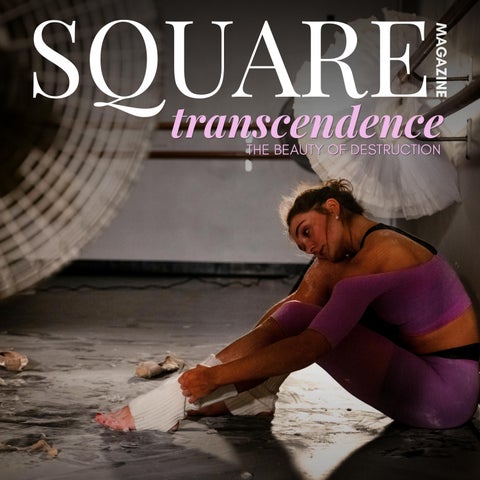
Square Magazine | Sixth Edition | 2026

Page 1


SQUARE

THE BEAUTY OF DESTRUCTION

a special thank you to

Morgan Brett, Lily Gisclair, Ellis Nichols, Addie Harkleroad, Alison Gordon, Malee Davidson, Isabella Nolen, Gracie Vanek, Makayla Stripling, Joe Hogue, Sophie Pitts, Emma Schwieger, Farai Masoha, Kamdin Montagne, Shambri, Lea

Saputo, David Yancy, Brent Hale, Ole Miss Dance Department, Joe Jackson, Chi Omega Tau, Prior Waste, The Powerhouse Oxford, Mina Oxford, Phi Mu Alpha Delta, The Velvet Ditch, Corinne Jackson, MacKenzie Ross, Dr. Debora Wenger, and every reader, follower, and supporter of Square. We cannot thank you enough. Square Magazine would be nothing without you and your loyalty.

letter from the editors

It’s human nature to transform, transmute, and transcend. It’s also human nature to destroy, and in that destruction, we learn a lot about ourselves, others, and the world. We break things down to build back up again, hoping we'll reach our end goal, a better something. But to get to every goal, there’s always a darker journey. This year, Square Magazine focused on that journey through the beauty of loss and growth. It’s been such an honor to lead this year’s team of wonderful creatives as we highlighted the beautiful things in life, whether they make us comfortable or uncomfortable. It’s always been my goal alongside Ava to gather community in the best way I know how: to bring reality and persistence to the forefront of our creative outlets. Being co-editor-inchief my senior year has truly been something I could’ve never imagined, and it has impacted my life in so many ways. I hope everyone enjoys this year's issue of Square Magazine. Thank you to everyone who supported us. We couldn’t have done it without you.

Transcendence, at its core, is the act of rising beyond limitations and expectations. This year, that definition transformed from merely just a word and became the foundation for everything we created. As a team, we challenged ourselves to celebrate fashion through beauty found in destruction and place emphasis on what could be created from something worn down, broken, or destroyed. This destruction is actually not the means to an end but an opportunity for something even more beautiful and intentional to evolve beyond its limits. For the past two semesters, our team has devoted countless hours of dedication to making this organization stronger, despite many unexpected obstacles along the way. To say that I am proud of this team and all that we have accomplished this year would be an understatement. Being co-editorin-chief has been the highlight of my time here at Ole Miss, and I am forever grateful for this team’s creativity and determination. It has been such an honor to lead this team with Gage.

Thank you to our amazing team and every reader and supporter of Square. We are forever grateful for each one of you.

Square Magazine

Ava Rosetti and Gage Hillman

Co-Editors-in-Chief

Suzie Brown

Creative Director

Addy Ezell

Creative Planner

Abby Fulmar

Copy Editor

Gracie Hudson

Digital Director

Kamryn Reed

Social Media Director

HG Crain

Casting Director

Margaret French

Business Director

DIGITAL TEAM

Kirsten Arnsdorff

Myers Foxworth

Lauren James

Madelynn Liberto

Sophia Swanger

CREATIVE TEAM

Lucy Allen

Amelia Andrews

Helena Cifarelli

Samantha Ermold

Ellie Eubanks

Olivia Gehrke

Eliza Hollingsworth

Kathryn Hosp

Annabelle Lawson

Mailynn Nguyen

Sierra Sharp

2025 - 26

EDITORIAL TEAM

Sophie Amen

Campbell Bensley

Olivia Blackwell

Audrey Cooper

Kelly Hoang

Brooklyn Hoffmann

Madeleine New

MacKenna Sherer

Penelope Sandlin

Emily Smith

Morgan Toporek

Emma Williams

DESIGN TEAM

Kirsten Arnsdorff

Suzie Brown

Myers Foxworth

Abby Fulmar

Gage Hillman

Gracie Hudson

Lauren James

Madelynn Liberto

Ava Rosetti

Sophia Swanger

SOCIAL TEAM

Morgan Brett

Wil-Lasha Jones-Garner

Finley Claire McKern

Annie Phelps

Maggie Beth Pinnix

Emma Schwieger

Gracie Brooke

Amelia Sweeney BUSINESS TEAM

CASTING TEAM

Kamryn Steinroeder

ARTISTS

Lucy Allen

Helena Cifarelli

Eliza Hollingsworth

Annabelle Lawson

Mailynn Nguyen

Sophia Swanger

Square'sOriginalArtwork

Beauty is

The coexistence of beauty and pain is a longstanding paradox. If you ask almost anyone about the first time they wore high heels, you are sure to hear a similar story of them coming home with blisters forming, violently kicking off their shoes as soon as they entered the door. If not heels, there is always an eyebrow wax gone wrong, a ponytail-induced headache, or an accidental burning of an ear while styling hair. “Beauty is pain” is not just an overused cliché; for many, it is a daily reality. However, these practices remain as popular as ever. Is it possible that over the years, many have redefined pain, using it to feel confident, expressive, and unique? In the 16th century, the corset made many unable to breathe, resulting in a loss of oxygen to their brains all in the name of obligation. Today, the standards have shifted. What has changed is not the pain involved in the practices, but the way they are approached.

They are not done in the name of tradition or approval. Instead, they

When coupled with is pain obligation is

no

longer the main intention priority.

At the end of the day, it is empowering to define beauty in one’s own terms. Beauty means something different for everyone, but feeling confident, whether that involves painful heels, itchy glitter, or none of the above, is what makes one undeniably beautiful.

To be at the intersection of an athlete and an artist is to exist beyond ordinary limits: enduring the physical strain on one’s body to perfect an art. For a ballerina, they must display the refined beauty of ballet by pushing the body’s limits and the mind’s capabilities.

Beyond hours of rigorous training and mental preparation lies the poise a ballerina attains through discipline, teaching her to place passion above all else while pursuing perfection in the face of challenge.

Square Magazine wanted to uncover the truth behind a ballerina’s complex relationship with the art of ballet, the kind that looks elegant from afar, but physically is anything but.

“Ballet is easy to learn, but very hard to master,” said retired pre-professional ballerina Lea Saputo. “I think anybody can put on a pair of ballet shoes and learn the general basics of ballet: memorize the terms and the layout of what you do in the classroom, but becoming a master at it is the hardest. You’re never really done learning.”

Soon after Saputo began her ballet journey, she recognized that it would not be without sacrifice. It is a commitment that demands everything. She remembers the resentment that accompanied long practice hours and tired muscles, yet Saputo admits she found unmatched joy through ballet. A joy worth chasing.

Ballet gave Saputo pure bliss: a feeling so rewarding that it masked the quiet destruction she endured. Whether she was competing at a national level or performing in front of loved ones, her devotion to ballet outweighed every demand it placed upon her. The reward was never relief, but rather fulfillment.

As a ballerina, you learn to overcome the body, training yourself to push past fatigue and injury. The practice floors watch a ballerina fall time and time again before mastering a new skill, often leaving marks and bruised limbs.

The body not only bears the weight of the dancer but also the pressure of the performance. “You’re constantly pushing yourself to be better, even when your body is exhausted,” Saputo said. “There’s always something to fix, something to improve to be the best of the best.”

Everything in ballet has a cost. With every graceful line and movement, the destruction of a pointe shoe reflects the depth of a ballerina’s passion.

Pointe shoes must break for a ballerina to create. The shank of a new shoe is intentionally bent and broken, while satin ribbons are cut to fit the width of the ankle, sewn with elastic bands to hold the slipper in place. Inner padding cushions the toes as the dancer perches upon the shoe’s platform, coexisting with the pain that comes with being en pointe. The blush material of the shoe wears away with each performance, exposing the wooden skeleton beneath its delicate exterior.

Saputo fondly recalls the day she received her first pair of slippers, a milestone that rewarded her years of dedication to pre-pointe training.

“It was such a dreamy feeling. You get your first pair of pointe shoes, and you’re so excited, like it’s your birthday.”

Her initial excitement was quickly dampened by the physical truth of what being ‘en pointe’ really demands. “You put them on and start to dance in them and realize ‘oh wait, these don’t feel as pretty as they look.’ That was fine with me: I was over the moon excited.”

Throughout lengthy studio rehearsals, mirrors stare back, reflecting a dancer whose resilience has achieved mastery from ruin. Slicked-back buns and tight bobby pins loosen through trial and error, and baby pink tights and fitted leotards stretch from constant movement. The uniform evolves alongside the ballerina.

“My favorite part of performing ballet?” Saputo contemplated. “Honestly, the costumes, the makeup, and the hair. You really feel like such a princess and embrace the full beauty of [ballet].”

Imperfections in a ballerina’s uniform showcase their hard work and dedication. Their personal destruction, ultimately masked in silk and sparkles, displays the true level of discipline that comes with the ballerina role.

Destruction and beauty are also intertwined in the stories the dancers tell. The audience watches as ballerinas leap and turn, conveying stories composed of love and destruction. Despite the glamour of stage makeup and embellished tutus, ballerinas beautifully exhibit these dark storylines.

“The amount of hard work and dedication that goes into [ballet] is really hidden behind all the beauty of it, right?” explained Saputo.

“When you’re watching a ballet, you think of the effortlessness of the dancer, not their exhaustion. That takes a special person to perform.”

Through every blistered foot, worn-down pointe shoe, and exhausted muscle, the path to transcendence is paved by passion and perfection. Forged through the destruction of the body, the shoe, and the mind, a ballerina emerges as a creator, a storyteller, and an athlete. They display the perfect balance of discipline, beauty, and triumph, a physical interpretation of the power within their body and soul.

Art byAnnabelle Lawson

Metamorphosis

Metamorphosis shows butterflies emerging from a classical statue of the Greek philosopher Marcus Aurelius. It suggests that something living and evolving can come from something rigid and fixed. The statue represents stoicism: the idea that control, discipline, and the acceptance of hardship are necessary for growth. In Stoic philosophy, personal transformation often requires the destruction of the old self, letting go of ego, fear, and illusion to become stronger and more aligned. The butterflies act as a visual metaphor for that rebirth, showing that from restraint and internal struggle, a newer, better self can emerge.

DeliberatelyDeliberatelyDeliberately Undone Undone Undone

The Designers Of Destruction The Designers Of Destruction The Designers f Destruction

he only reason I’m in fashion is to destroy conformity,” said the brilliant Vivienne Westwood. Her statement was not an exaggeration; it was a reflection of her work and her undeniable influence as a pioneer of fashion.

In an industry built on the pursuit of perfection clean lines, luxury tailoring, and status symbols destruction has emerged as a creative force: a way of staying alive, relevant, and utterly human. Many of the industry’s most influential designers have used destruction to challenge traditional approaches and redefine norms. Instead of weaponizing destruction, it has become a tool of precision.

Behind every raw hem, torn seam, and deliberate imperfection lies intentional and meticulous artistry, even if it may not seem so at first glance. What appears as imperfect and careless is often the result of intentional designing, planning, and tailoring.

Vivienne Westwood was an originator of the punk fashion movement in the 1970s and often transformed everyday objects into symbols of rebellion. Safety pins were used as embellishments and fasteners, while torn shirts became a powerful political statement. She wasn’t afraid to address what society didn’t want to hear. Bondage elements like straps and zippers made powerful statements against convention, authority, and consumerism. For Westwood, fashion was about fighting back against social and political conformity to prove that destruction could be high fashion. Something disheveled and uneven could be just as valuable as couture, maybe even more, because it truly meant something.

Similar to Westwood, Japanese ashion designer Rei Kawakubo didn’t just challenge traditional deals of beauty and couture: she demolished them.

Her focus on “unfinished” garments posed an uncomfortable question to he fashion world: What if fashion needs destruction to have depth?

Her 1982 collection, Destroy, is still one of the most confrontational presentations fashion has ever seen. It featured garments that were intentionally destroyed: long, ragged black skirts, and bulky knitwear full of holes. These details weren’t accidental; they were exquisitely sewn by hand.

Her work divided critics, as her tactics rebelled against the fashion world’s obsession with perfect silhouettes and glamour.

Martin Margiela emerged in the late 1980s with an instantly recognizable, avant-garde, and unconventional approach to fashion.

He infused luxury with conceptual depth, making it exposed and brutally honest. He left seams frayed and exposed for everyone to see, and he explored themes that no other designers dared.

Considering Margiela once transformed a leather butcher’s apron into a dress, it’s safe to say that at the core of his fashion journey was a focus on recycling, upcycling, and sustainability; concepts now fundamental to the fashion industry.

The topic of destructive design would be incomplete without exploring Alexander McQueen’s theatrical destruction. His 1998 collection Joan tackled historical trauma through the story of Joan of Arc. It featured blood-red, silver, and black palettes, defying traditional approaches and leaving a legacy of emotional and provocative fashion.

His 1999 collection, No. 13, was a performance art show with an unforgettable finale in which robots spraypainted a dress. McQueen demonstrated destructive, emotional performances, showing that fashion can unveil emotions unlike any other medium.

Destruction challenges everything we think we know about beauty, luxury, and identity. These designers wielded deconstruction as a tool for cultural commentary, forcing us to question what we value and why. It’s not just an aesthetic act, but a social one. At the heart of it all lies a paradoxical truth: by tearing things apart, these designers actually made them whole. Their work shows that destruction doesn’t have to be a negative connotation: instead, it can be where creation begins.

Alexander McQueen

kintsugi

Kintsugi, the Japanese art of repair, captures the raw and honest complexity of human emotion. Translated to “join with gold”, the idea of Kintsugi is a broader philosophy that embraces the beauty in the broken and flawed. Many stoic philosophers encourage not succumbing to your emotions, but instead accepting yourself for who you are, chipped and all.

To create this piece, the ceramic pottery was restored and brought together with gold epoxy. The porcelain pieces and abstract cybersigilism drawings enhance the gold coloring. There is no effort to conceal the damage, as it highlights the piece’s flaws, transforming the damage into beauty. That is the true idea with kintsugi: every difficult moment and life experience is beautiful, despite its flaws.

STORIES IN

“IWASA 14-YEAR-OLD PUNKROCK SKATEBOARDKIDIN TUPELO,”HESAID. “ONEAFTERNOON, ONEOFMYFRIENDS SHOWEDUPWITH AFRESHTATTOO HIS AFTERGETTING UNCLEHADDONE OUTOFPRISION.

LATERTHAT DAY

WEALL HAD

ILOOKATMY TATTOOS ISEE40 TATTOOS. WHEN YEARSOFME, DIFFERENTPEOPLE, DIFFERENT MOMENTS,ALL THETHINGSTHAT MADEME WHO IAM.”

ETCHED

SKIN

attoos have long served as a quiet form of rebellion, as the act of permanently marking your body has historically been taboo in many cultures. Tattoos were associated with society’s margins, worn by outcasts who were comfortable being misunderstood.

Yet, despite the negative connotation often attached to the art form, tattoos and the artists behind them have endured. Today, tattoos are increasingly recognized for what they have always been: physical expressions of memory, identity, and storytelling.

Tattoos are a story etched onto the skin, where we decide what parts of ourselves are worth carrying forever. Photographs and journals are often stored away, easily forgotten and lost to the chaos of life, while tattoos continue to live on, aging and moving with us through every part of our lives.

Lines soften, and ink fades, yet the meaning behind each tattoo remains intact. Thus, tattoos offer a uniquely intimate experience, evolving with the body rather than separating from it.

For many, the pain associated with getting tattooed isn’t an obstacle, but a sought-after part of the experience. The sharp repetition of the needle puncturing the skin activates the body’s natural release of endorphins, a euphoric sensation similar to a runner’s high. Tattoos provide an escape for those willing to let the body be broken in order to create something lasting.

David Yancy, a Memphis-based tattoo artist and the owner of Ink Therapy 901, described the pain as a form of personal therapy, a way to better understand yourself on a deeper level. “If you can endure it, you can endure more. The pain has taught me what I’m capable of,” Yancy said.

For Yancy, the pain is not simply something to survive; it’s a measure of resilience, and even a privilege to endure.

EX

IFor some, the meaning behind a tattoo is immediately visible; for others, it can hide beneath the surface. Brent Hale is a tattoo artist with over 30 years of experience and the owner of Bluff City Tattoo in Memphis. He recalled, with much nostalgia, the story of his first tattoo.

“I was a 14-year-old punk rock skateboard kid in Tupelo,” he said. “One afternoon, one of my friends showed up with a fresh tattoo his uncle had done after getting out of prison. Later that day, we all had tattoos.”

Hale’s first tattoo was far from carefully planned. “I got a really horrible black sun on my ankle because that’s all the guy could draw,” Hale said.

His motivation was simple: “I got it because I knew I wasn’t supposed to.”

What began as an impulsive decision has since become one of his most meaningful tattoos. “It’s one of the most horrible tattoos I have on my body, but I love it because it was my first. It’s a love-hate relationship. It’s ugly, impulsive, and perfect,” Hale said.

To an outsider, the tattoo might seem insignificant, but to Hale, it’s far more than just faded ink. “Other people might see silly little tattoos,” he said. “I see my life.”

It’s clear that Hale’s tattoos are inseparable from his understanding of his own life: a personal archive that spans decades. From impulsive childhood tattoos to the professional pieces he gets today, his collection of tattoos reflects someone fully comfortable being himself.

“When I look at my tattoos, I see 40 years of me, different people, different moments, all the things that made me who I am.”

PERMANENCE.

Reclaimingyour SUPERSTITIONS

In other words, is even real or is it the power of our own decisions and mindsets that dictate how we interact with the world?

We can completely alter our experiences with the world around us when we choose to tame the black cat, scale the ladder to reach new heights, or dance in the rain.

Heartbreak Muse is the

A

The pain following a loss, especially of love, is often viewed as a temporary, inconvenient emotion. However, heartbreak can also be the most powerful muse of all.

Many successful musicians have turned their worst heartbreaks into powerful displays of creativity. These works are often considered the artist’s magnum opus, as underst beliefs.

Heartbr degrees perform destruct aestheti trade th

Volume One: Grief as Creative Fuel

RumoursbyFleetwoodMac(1977)

In 1977, Fleetwood Mac’s keyboardist and vocalist Christine McVie succinctly described the making of their hit album Rumours to Rolling Stone, saying, “Drama. Dra-ma.”

When work on the album began in 1976, members Christine and John McVie married for almost eight years were on the verge of divorce. Fleetwood Mac’s lead singers and longtime lovers, Stevie Nicks and Lindsey Buckingham, had recently broken up, and drummer Mick Fleetwood was in emotional turmoil after learning of his wife’s affair, leading Fleetwood and Nicks to have their own short-lived romance.

Despite the tension, the band worked together to produce the raw and deeply personal masterpiece Rumours a title suggested by John McVie to acknowledge that they were writing about one another. The album includes legendary tracks such as “The Chain,” “Dreams,” and “Go Your Own Way.” It also led to the legendary 1997 live performance of “Silver Springs.” Nicks sings the song, originally cut from the album, directly to Buckingham in a display of anger and catharsis. The band breaking apart while recording an album about love fueled the creation of one of the best-selling albums of all time.

SOSbySZA (2022)

Almost six years after the release of her debut album, SZA cryptically announced her second album, inspired by the well-known distress signal in Morse code SOS.

The cover art features SZA sitting on the edge of a diving board in the middle of the ocean, inspired by the famous picture of Princess Diana

PunisherbyPhoebeBridgers(2020)

Phoebe Bridgers’ sophomore album, Punisher, continued to shape her image as a profound artist with impactful, vulnerable

Bridgers is known for the dull s in her music and themes of ex and mortality. In Punisher, emo rendered through quiet apocaly

Bridgers uses mundane anecdo imagery to relate situations. In she compares the longing state her lover to being “a dog with door.” She sings about her insp Smith, and fantasizes about the in the title track “Punisher.”

Bridgers speaks about her abs father against a juxtaposing upbe

The album concludes with the c “I Know The End,” which b melancholic evocation of n isolation before famously e screaming metal. Punisher is a explores finding solace and overwhelming and painful situat personal struggle with social anx

Volume Two: Heartbreak as Performance Art UltraviolencebyLanaDelRey(2014)

Lana Del Rey has always known how to perfect an aesthetic, and her third album, Ultraviolence, was no different.

Del Rey’s usual themes of devotion and the “Americana” aesthetic blended seamlessly, creating a cinematic universe with laidback basslines and dreamy guitar riffs.

The black-and-white album cover features Del Rey standing in her driveway in a white T-shirt, staring blank-faced at the camera. The image immediately sets the scene for the 60s Californian dreamscape developed in “West Coast,” which parted from Del Rey’s typical sound. The title track, “Ultraviolence,” garnered criticism due to its depiction of a passionate, yet physically and emotionally violent relationship.

Ultraviolence showcases Del Rey not only as a renowned vocalist and lyricist but also as an artist who is not afraid to stray away from the public’s perception of her. The dysfunctional relationships, infidelity, and power-hungry greed Del Rey sings of engulf the listener in the grayscale world of Ultraviolence.

BacktoBlackbyAmyWinehouse(2006)

Inspired by her tumultuous split from Blake Fie Civil, Amy Winehouse’s Back to Black is a raw, so album that tackles heartbreak, infidelity, and addic

It blended Winehouse’s jazz roots with classic Mo sounds to produce a timeless masterpiece. The a title is derived from the track “Back to Black,” w references returning to a depressive, addi emotional state after a tragic loss.

The accompanying black-and-white music symbolized Winehouse mourning the relation featuring a funeral procession and fellow mourne Winehouse lays flowers on a small burial presumably for her heart. Back to Black kicks off “Rehab,” the hit song inspired by her defiant refu rehab. It reveals Winehouse’s underlying pain denial of her alcohol addiction, which would be her ultimate downfall as she died of alcohol poiso about five years later.

Back to Black continues to be a monumental suc with over 20 million worldwide sales, making i UK’s second best-selling album of the 21st cen Winehouse’s cultural impact and enduring legac upheld through this defining career peak and heartbreak that fueled both her life and downfall.

Volume Three: Undoing the Male Ego

BlondebyFrankOcean(2016)

Frank Ocean’s Blonde is an introspective album that uses fragmented, non-linear storytelling to mimic flashes of memory. The album’s title ‘Blonde’ contradicts the cover art that says ‘Blond’–an intentional choice referencing the French addition of an ‘e’ that makes the word feminine.

This contradiction reflects the album’s themes: gender fluidity, duality of self, and sexual ambiguity. Ocean uses a high-pitched and autotuned voice throughout the album to depict adolescence, beginning with the opening track “Nikes.” Blonde uses tracks “Be Yourself,” a voice note from Ocean’s mother advising him against the vices of drugs and alcohol, and “Solo,” a depiction of Ocean’s various experiences with drugs, to symbolize the betrayal of family values during youthful self-discovery.

In Blonde, Ocean tackles the realization of life’s fragility and impermanence a juxtaposition between bittersweet reflection and peaceful acceptance of the experiences that shape identity in adulthood.

AfterHoursbyTheWeeknd(2020)

Abel Tesfaye, known as The Weeknd, unveiled his album After Hours along with a redjacketed, villainous alter ego. As the After Hours era continued, this character’s appearance became more mutilated.

The album cover displays an up-close shot of Tesfaye’s bloodied face, and he performed at the Super Bowl wrapped in head bandages to symbolize the superficiality of Hollywood and its overwhelming plastic surgery culture. The alter ego depicted Tesfaye’s struggle to separate the “real” him from his unhealthy Hollywood lifestyle.

The first few tracks narrate conflicting emotions following a recent breakup: fear of being alone, acknowledgement of personal faults that led to the separation, and desire to reconcile, despite the relationship being unhealthy. “Snowchild” delves into the complicated aspects of stardom; Tesfaye is thankful for the financial gain but remains unsatisfied with the emptiness of his luxury life in Los Angeles.

The alter ego takes over after the musical shift in “Escape from LA,” and continues with “Heartless” and “Blinding Lights,” which include upbeat instrumentals and dark lyrics. The final track, “Until I Bleed Out,” is a final cry for help in which the narrator realizes this lifestyle will lead to his demise. The Weeknd creates a stunning musical narrative through his unique exploration of fame in After Hours.

LemonadebyBeyoncé(2016)

Reeling from marital problems caused by J infidelity, Beyoncé turned her personal pain sonic and visual landscape of the co experiences of Black womanhood.

Lemonade is divided into 12 “chapters,” chronicling the healing process and accomp by poetry and a visual. These stages include apathy, reconciliation, and reformation. Lem merges the personal and political by crea dialogue about how acknowledging sy injustice and generational trauma is instrum in moving forward.

The album symbolizes generational resilien turning lemons into lemonade. Beyoncé que her husband’s loyalty in “Pray You Catch willing him to catch her listening in to ea paranoia. “Hold Up” and “Don’t Hurt You mirror the stages of grief by moving from de anger. Lemonade ends with the powerful and hit “Formation,” where Beyoncé sings abo worth ethic, self-beliefs, womanhood, and r to be swayed by critics.

Lemonade is a powerful examination of liberation, and triumph over hardship whet the aftermath of infidelity or the Black cu experience.

1989byTaylorSwift(2014)

In the wake of public breakups and media scrutiny, Taylor Swift transformed heartbreak into a sonic reinvention that mirrored her emotional reset. Named after the year of her birth, 1989 marks Swift’s complete departure from country music and her arrival into synth-driven pop.

The album was written in New York City, a place that represents freedom and reinvention. In “Welcome to New York,” Swift embraces the thrill of starting over. “Out of the Woods” captures the anxiety of a relationship constantly on the brink of collapse, its repetitive questioning mirroring the cyclical nature of emotional uncertainty. “All You Had to Do Was Stay” and “I Wish You Would” mourn missed chances and unresolved longing. “Clean” serves as the album’s emotional resolution, portraying healing as a gradual, almost imperceptible process.

Most significantly, however, is the way 1989 reframes heartbreak as a source of empowerment rather than defeat. “Blank Space” satirizes the media’s caricature of Swift as boy-crazy and manipulative. “Shake It Off” and “Bad Blood” reject the emotional weight of betrayal and public judgment. 1989 proves that the aftermath of love can be just as transformative and powerful as love itself.

Art by Lucy Allen

Ostreidae

Ostreidae, Latin for “true oyster,” uses the oyster as a central symbol to explore how beauty can emerge from environments often perceived as harsh or uninviting. Inspired by the cultural and physical landscape of Long Island, New York, the exterior of the oyster reflects the idea that struggle, resistance, and even ugliness are necessary conditions for growth and refinement. It contrasts with the meaning it holds, represented by the woman inside of it, suggesting that first impressions rarely capture the depth of value within. By portraying the oyster as a vessel, the work emphasizes how resilience and attachment can transform discomfort into something enduring and beautiful.

Art by Helena Cifarelli

A Q&A With Upcycling Designer Kamdin Montagne

The sound of rip fingertips use a sing For those who upcyc of-a-kind pieces de catalyst for creation.

Designing original p ki d d t

paired with a love of fashion and t her become a flourishing business star in the fashion industry.

Her cutting-edge brand, Prior W founded on the idea of comb fashion and decreasing waste. In a years, Montagne has built a succes and career on the philoso ‘Sustainable Is Sexy.’ Through Pr she creates one-of-one desig discarded materials and display truly means to have a passion for by destruction.

Square sat down with Montagne more about her creative journe understand why she’s driven to from waste and ruin.

ClothingbyKamdinMontagne

k with waste and reworked materials instead of going the oute?

ccessible to me. When I was around 17 or 18, my grandma and I started learning how to use it on clothes I thrifted, abric. In 2020, I was painting on jeans and making old love with the ability to express myself through fashion. It me to be able to afford to create…so it was alized how well it fit with me and the message cessible to people the same way creating it wa g to overconsumption, it’s c learn and get innovative, an

How do you choose the materials you use? Do you ever material and immediately imagine it as fashion?

I source everything myself, pretty much all directly Goodwill bins a warehouse where Goodwill takes al unsold donations, and you dig through bins full of random stuff and pay by the pound as well as a local th in Austin, called Austin Creative Reuse. I definitely get in what I find versus imagining something and then trying I do get stuck sometimes trying to thrift the perfect what I’m picturing in my head, and it's a bit more stre f th t t I just find pieces and let them speak thing and see how it could be rew make things based on what I like…so ith whatever I find and let it unfold.

It’s definitely really freeing to create this way. Going to school wasn’t really an option for me, so learning as I go has always been a big part of my process, and using the materials I do allows me to make mistakes and learn from the pieces I’m working on.

It’s never that serious, and there's a lot of freedom in that. I can take something that was trash and make it into something new, so there isn’t much pressure to do anything other than just be, and that authenticity in the creative process always makes the end product better.

SM: Do you think something would be lost if these materials were ‘clean’ or ‘new’?

Definitely. I think, firstly, hand-picking second-hand m means everything is unique, which is priceless when through fashion. Secondly, I think it’s really import mean something especially in today's world of overc just push something out, but to be intentional with it materials allows me to create with the purpose of not another thing in the world, but breathing new life int that creates a sense of purpose in the piece.

SM: Why do you think destruction often leads huma

I think that it forces us to. People are often ‘troubled’ facing internal or external battles that are so destruc state of being that we have to create something outsid ourselves to channel it into. I know that I personally s creating as an outlet for what was going on within my It really gives me a sense of purpose and something t on and build outside of my head. Creating also helps build the confidence to face that ‘destruction’ I’m bat In the absence of something, we look to fill that space Whatever destruction humans are facing, whether it’ internal or external, leads us to create something to rebuild that missing piece; whether it's with art, or w space, anything to build instead of destroy. It’s impor remember that discomfort breeds action and destruc breeds creation.

“ “

In a world where people tirelessly chase perfection, the success of brands like Prior Waste exposes a universal truth: We are all drawn to destruction.

Whether it is because this art form rejects perfection or because people are tired of being limited by the traditional rules of fashion, one thing is certain: With creativity, passion, and patience, one man’s trash can always be another’s treasure.

All content aims to entertain the Square audience within the realms of fashion, beauty, and lifestyle. While remaining experimental and forwardthinking, we at Square hope to deliver high-quality content, showcasing the best the world of fashion has to offer. As a team and a publication, we value creativity, excellence, and innovation. Our goal is not to mimic the content of other publications, but rather to take note of what those before us have done to create respectable original work that depicts the range of abilities our team holds.

SquareMagazi

We do not want to merely be a part of the herd. We are selective in what we create and feature to protect our mission, recognizing that the most clickable story or image is not always the most important. We do not want to follow the masses through replication. The most buzzworthy names and styles are not necessarily the most fashionable or intriguing. At Square, our goal is to motivate others to create with content that is as aspirational as it is inspirational.

transcendence

Square’s Sixth Print Edition sponsored by

Turn static files into dynamic content formats.

Create a flipbook