

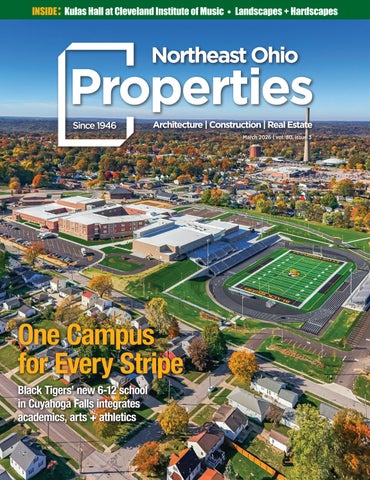
One Campus for Every Stripe
Black Tigers’ new 6-12 school in Cuyahoga Falls integrates academics, arts + athletics


Smarter Air Starts Up Here
• Smart controls
• Application-driven design
• Inverter-driven efficiency
• Quality construction


ACP On Site keeps your systems efficient, reliable, and ready when it matters most, because consistent performance isn’t a luxury, it’s a need.
Start up & Commissioning Services include:
• Equipment Testing to verify proper operation
• Performance Verification against design intent
• System Optimization for long-term efficiency
Start-up & Commissioning
Bringing new HVAC equipment online and verifying proper operation per manufacturer specifications.
Maintenance Team Training
Teaching in-house staff how to inspect, clean, and maintain equipment for optimal performance.
Adjustments & Calibrations
Fine-tuning equipment settings, sensors, or control systems to ensure accurate and reliable operation across all components.
Issue Troubleshooting
Diagnosing irregular fan speeds, airflow imbalances, or equipment alarms on-site.
Fans (Supply, Exhaust, Recirculation)
Louvers & Dampers


Mike Hicks President
info@propertiesmag.com www.propertiesmag.com
EDITOR-IN-CHIEF
Mark Watt mwatt@propertiesmag.com 216.251.2655
OFFICE MANAGER
Lisa Larissey llarissey@propertiesmag.com 440.429.6153
CONTRIBUTING WRITERS
Doug Bardwell, Scott Esterly, Dan Holland, Christopher Johnston, Alec Pacella
MEDIA CONSULTANTS
Matt Lehnert mlehnert@propertiesmag.com 216.251.6753
Larry Overbey loverbey@propertiesmag.com 216.251.6649
OWNER
Real Estate Publishing Corporation
Jeff Johnson, CEO jeff.johnson@rejournals.com
Cover photo: Cuyahoga Falls 6-12 Campus, by Dan Pollock
FEATURES

9 Standing on Strong Shoulders
Contractors Assistance Association honors trailblazers during Black History Month
12 One Campus for Every Stripe
Black Tigers’ new 6-12 school in Cuyahoga Falls integrates academics, arts + athletics
25 Taking Center Stage Cleveland Institute of Music raises the curtain on Kulas Hall after $22 million renovation 46 Special Section: Landscapes + Hardscapes 46 Breaking the Mulch Volcano Cycle: Why more isn’t better when it comes to tree health + site performance 49 Product Profile: Econ-O-Wall Retaining Wall System
ACAR Corner: Adding Value + Beauty to Front Yard Landscapes 54 Legal Perspectives: Who Owns the Dirt? Subsurface risk allocation in landscape + hardscape construction
57 Naturally Found: Considering the sustainable benefits of native plants for landscaping projects
DEPARTMENTS
Photo by Ed Debono/Michaelangelo’s Photography
PROPERTIES PEOPLE


1 Courtney
2 Andre Husin, Bob Bajko, Bobby Rinehart and Peter Kamis (HSB Architects + Engineers)
3 Winning team Colton Wright, Nick Jackson, Emily Henceroth, Imad El Hajjar and Mike Haut (ECS)
4 Colton Kaufmann and Matt Kusanke (Whiting-Turner)
SMPS Rock N’ Bowl
The Northeast Ohio chapter of Society for Marketing Professional Services (SMPS NEO) recently filled SPINS Bowl Independence for its annual Rock N’ Bowl event, drawing 31 teams and more than 160 participants. The event raised over $3,000 for an ACE Mentor Cleveland scholarship and collected 881 pounds of food donations for the Cleveland Food Bank.


ULI Cleveland recently held its annual Emerging Trends in Real Estate event at the Union Club in Cleveland, convening industry leaders to examine the forces shaping real estate and land use in 2026 and beyond. Anchored by the ULI/PwC Emerging Trends in Real Estate 2026 report, the program featured keynote insights from Haley Anderson of PwC, followed by a moderated discussion led by Sean Dittoe of Stark Enterprises with regional leaders Andrew Ross Bailey (CHN Housing Partners), Jeff Epstein (Port of Cleveland), and Christine Nelson (Team NEO).

1 Cathryn Greenwald (Thompson Hine LLP), Kaitlyn Carlin (August Mack Environmental) and Rachael Price (DiGeronimo Companies)
2 Jonah Conway (Allegro Real Estate Brokers & Advisors) and Eli Rosner (Redwood Living)
3 Ken Mather (Paul Davis Restoration), Michael Konrad (American Structurepoint) and Thomas Christy III (The Fedeli Group)
4 Panelists Jeff Epstein (Port of Cleveland), Christine Nelson (Team NEO) and Andrew Ross Bailey (CHN Housing Partners)
5 Marisa Razi (SmithGroup), Hillary Lyon (Regency Construction) and Chad Brintnall (SmithGroup)
6 Sean Dittoe (Stark Enterprises), Jack Newton (GBX Group) and Imanu Lewis (Real Property Management Valor Team)


Methods and Materials Mania, hosted by Design Ohio – Akron-Canton at Quaker Station in Akron, brought architects, product reps and industry partners together for a full day of learning, conversation and hands-on exploration of various building products and processes.
2 Elenore Huntley (PRIME), Sara Stucky Sayner (Stucky Atchitects) and Pat Pinchot (Suntrol)
3 Tim Vance (Soprema)
4 Bonnie Smith (Smith Architects) with Sydney Garske (W. L. Tucker Supply Co.)
5 Eric Droll
Brandi Miller (Hasenstab Architects)
Van Ostran, Mark Ghazzoul, Mike Ferrante, Ben Wyand and Joe Parkinson (TEC Engineering)


CAA MEMBERS
Diverse member businesses in white
Adrian Maldonado & Associates
The AKA Team, Inc.
Higley Construction


HR Construction Services
Independence Excavating, Inc.
International Construction Solutions

Embracing and strengthening business operations and relationships to improve diversity, inclusion, and equity in the Northeast Ohio Construction Industry.
A.I.R Concrete Solutions
Alert Pioneer Plumbing
Alternalite Electric, Inc
Bialosky Cleveland
Bolton Pratt Company, Inc.
Brunswick Companies
CBIZ / Marcum
Chas Phipps

Our members include construction companies, specialty contractors, suppliers, professional, service firms and owners.
– all of whom are among the best in the industry.
Cleveland Building Restoration
Cleveland Cement Contractors
Cleveland Drones
Cleveland Port Authority
Cleveland State University
Construction Smith
Cook Paving & Construction
Cortez Construction
CAA PROGRAMS

CONTRACTING
Cosmos Technology
Cuyahoga Community College
Donley’s, Inc.
Dunlop & Johnston

Support CAA members via business development mentorship and capacity building.
Eagle Abatement & Demolition
Euell Construction & Consulting
Federal Reserve Bank of Cleveland
First Invest Inc.

Strengthen relationships with public and private owners and CEA members.
EDUCATION
Support education and training to enhance diverse companies.
EMPLOYMENT (WORKFORCE)
Partner and support diverse construction management and trade workforce.

Forest City Erectors, Inc.
Frantz Ward, LLP
G. Stephens, Inc.
Gilbane Building Company
Gilbert & Gilbert Construction and Masonry
Great Lakes Construction Co.
Hahn Loeser
Halle's Engineering & Design
Hatzel and Buehler
Howse Solutions


Irizar Electric
Kameron Anthony Construction
Lawler Construction
Legacy Piping
M. Rivera Construction Co.
Meaden & Moore
MetroHealth
Mont Surfaces
Next Generation
Norris Brothers
North Coast Concrete
North Star Contracting
Ohio TurnKey
Ozanne Construction Company
Panzica Construction Co.
Precision Environmental
Regency Construction Services
Resitech
RL Cole Enterprises
RL Hill Management
Rycon Construction
The Ruhlin Company
Shook Construction Co.
The Cora Ruth Group
T.H. Martin
TSG Interior
Tucker-Grubbs Construction
Turner Construction Company
Vallejo
VMI
Whiting-Turner Contracting
W. Paris Electrical
WTD Mechanical
2B Engineering

Standing on Strong Shoulders
Contractors Assistance Association honors trailblazers during Black History Month
By Rhonda Crowder | Photos by Alaina Battle
Contractors Assistance Association (CAA), an organization dedicated to strengthening contracting, education and employment opportunities for minorities and women in the construction industry, recently honored five industry leaders and advocates during their Black History Month celebration at Karamu House in Cleveland.
This year’s honorees included Lonnie Coleman, president/CEO of Coleman Spohn Corporation; Dominic Ozanne, president/CEO of Ozanne Construction Company, Inc.; Ralph Tyler, of Ralph Tyler Companies; Raphael L. Hill, president/owner of RL Hill Management, Inc.; and Frank G. Jackson, former City of Cleveland Mayor (2006-2022).
“We are recognizing these champions for their contributions in the advancement of equity and inclusion in the construction industry,” says Tommy L. Farmer Jr., CAA’s newly elected president, and president of The Cora Ruth Group.
The evening consisted of a networking hour with cuisine from Del’s Catering, spoken word by Poet Keisha Chavers – who set the tone for the evening – and the award presentations.
“Honoring these champions allows us to recognize their collective contributions, highlight the shared values they represent, and celebrate the impact they’ve made together,” Farmer says. “It reinforces a sense of unity and appreciation, reminding everyone that their combined efforts matter and that their work strengthens the community as a whole. By acknowledging them as honorees, we not only express gratitude but also inspire others through the example they set.”
Throughout the event, the influence and impact many of the honorees have had on each other as well as other industry professionals, their careers and businesses were mentioned in both private conversations and acceptance speeches.

now be considered a colleague as well as a mentee of Ozanne, someone she once admired from a far.
“He encouraged me to work on projects that changed the trajectory of my business,” she said.
Ozanne, during his acceptance remarks, talked about how CAA is an
“Honoring these champions allows us to recognize their collective contributions, highlight the shared values they represent, and celebrate the impact they’ve made together”
While introducing Dominic Ozanne, Rhoni Thompson, vice president of CAA and vice president of R.L. Cole Enterprise, shared how delighted she is to
Ozanne referred to a recent article from Cleveland.com revealing that an Ohio-based think tank has sued for records related to Cleveland’s Office of Equal Opportunity, created in 1977 to ensure city contracts included minority-owned, female-owned and small businesses. He went on to mention the struggle to maintain the gains earned over the years.
Tommy Farmer CAA/The Cora Ruth Group
important institution in his life as he –with others – worked to establish it. He even noted the significance of hosting the event at Karamu House, a project that Raphael Hill worked on.
“This coming together is necessary now,” Ozanne said to an audience consisting of a who’s who in Cleveland’s architecture, construction and engineering community. “We have the structures in place with CEA [Construction Employers Association] and CAA and the building trades.
The partnerships are in place.”
He said the thing to be done right now is to let the City of Cleveland Office of Economic Opportunity Director Tyson Mitchell know that “we have his back.”
LEGACY + LEADERS Honor award recipients included (from left) Dominic Ozanne (Ozanne Construction Company); Halle Capers, representing Ralph C. and Ralph S. Tyler (Ralph Tyler Companies); Raphael L. Hill (RL Hill Management, Inc.), Nick Jackson, representing brother and former Cleveland Mayor Frank Jackson; and Lonnie Coleman (Coleman Spohn Corporation).


1 Diego Cortez (Cortez Construction) and Joe DiGeronimo (Precision Environmental)
2 Tim Linville (Construction Employers Association) with Honoree Dominic Ozanne I and Dominic Ozanne II (Ozanne Construction)
3 Glen Shumate (CEA/CAA), Honoree Lonnie Coleman (Coleman Spohn) and Louie Moore (Brick City Productions)
Ozanne called for CEA to continue supporting CAA and stated, “We will figure out how to [implement] a raceneutral program. I don’t know how but we will.”
Halle Capers, P.E., owner and president of Halle’s Engineering & Design, LLC, provided some historical context behind the development of Ralph Tyler Companies, and then accepted on behalf of Ralph C. and Ralph S. Tyler.
Ralphael Hill was introduced by Marcus Henry, program director at Next Generation Construction. Henry mentioned that Hill used to be his boss and said Hill’s high expectations build careers, standards and opportunities across Northeast Ohio. He referred to Hill as a “builder of spaces and people.”
Hill said he was honored to be recognized among very established men and went on to speak about how both Ozanne and Coleman played a critical role in his entry into the industry.
“These men helped me to see success was possible,” Hill said, who also noted he wouldn’t be here without CAA as they keep their pulse on the industry.
Nicholas Jackson accepted the award on behalf of his brother, former Cleveland Mayor Frank Jackson, as he was unable to attend. “Anyone who has ever listened to my brother speak knows he always talks

4 Donyae James (International Construction Solutions) and Dean Vaughn (Gilbane)
5 Nick Jackson accepts an honor award for his brother and former Cleveland Mayor Frank Jackson
6 Darryl Thomas, Jennifer Blair, Wendy Harris and Honoree Ralphael Hill (RL Hill Management)
about the inclusion of minorities on projects and making sure the least of us have opportunities so things like this are very important to him,” said Jackson.
Lonnie Coleman said it is always great to be honored by your peers.
“In my case, for so long, I stood on the shoulders of those who came before me,” he said. “Now, 50 years later, here I am with others standing on my shoulders, coming to me for guidance, direction, insight that can help them as they grow and develop their business.”
He went on to say the evening was about recognition, hard work and perseverance. He also recognized CAA for the role the organization plays in helping contractors advance.
Executive Director Glen Shumate provided closing remarks and spoke about how both Ozanne and Coleman “have been critical in supporting [his role as CAA executive director and CEA executive vice president],” in addition to championing diverse contractors and professionals.
“Tari Rivera, Tony DiGeronimo and Tim Linville, as CEA leadership, your continued support for CAA and diverse contractors is essential,” Shumate added.
“CAA provides the connectivity where peer relationships can be formed,
people can learn from one another and learn from the experts in the industry to run their companies better and set themselves up for success,” said Tim Linville, CEO of CEA.
When asked to speak to the importance of the continued existence of an organization such as CAA, prior to the start of the program, Tyson Mitchell, director of Equal Opportunity with the City of Cleveland’s Office of Equal Opportunity, said, “Historically, we have not been at the table. We’ve always had to fight to be included.”
Mitchell went on to say, minority contractors are now making an impact, adding value to projects while he always advises them to lead with qualifications as opposed to certifications.
He also said, “We need organizations like CAA to continue fighting for those who have historically been left out to receive a fair share.”
Contractor Assistance Association (CAA) was reorganized from the 1970-‘80s Cleveland Contractors Association as a Construction Employers Association (CEA) affiliate in 2008. CAA is committed to leading, learning and making a difference in the Ohio construction industry. Members include construction companies, specialty contractors, suppliers and associations.


by
One Campus for Every Stripe
Black Tigers’ new 6-12 school in Cuyahoga Falls integrates academics, arts + athletics
By Dan Holland | Photos by Kim Adams, Ryan Caswell & Dan Pollock
Built into a dramatic slope that once served as a neighborhood sledding hill, Cuyahoga Falls’ new 6-12 campus rises in tiers with academic spaces at its core, stadium seating carved into the landscape and a performing arts wing featuring a black box theatre and 1,400-seat auditorium.
The $139 million, 365,000-squarefoot facility – which opened in January 2026 by the Cuyahoga Falls City School District (CFCSD) – replaces the former Cuyahoga Falls High School on Fourth Street and the former Bolich and Roberts middle schools. Situated at 2630 13th St. between Silver Lake Avenue and Portage Trail, the campus was designed to consolidate students, community activity and diverse programming under one roof.
The project was funded through an $80 million bond issue, a locally funded initiative of $32.8 million, an additional state amendment of $6.3 million and $20 million in certificates of participation (COPs).
Long overdue
The now-closed high school was considered the oldest suburban high school building in Summit County.
“The original structure was built in 1922, and there were multiple renovations and additions to that campus,”
“Our students were going to a building that was more than a century old, and our maintenance team worked very hard to maintain our buildings, as it was metaphorically being held together with duct tape and hot glue to get us to the finish line.”
Christine Stewart CFCSD
explains Christine Stewart, coordinator of community relations for the district. “The next major addition was the auditorium, competition gym, high
school offices, the Board of Education offices and more classrooms that were added in 1960.”
“Our students were going to a building that was more than a century old, and our maintenance team worked very hard to maintain it, as it was metaphorically being held together with duct tape and hot glue to get us to the finish line,” she adds. “With the technology that is expected of 21st century classrooms, we were frequently adjusting our electrical panels and repairing the aging roof, along with the plumbing.”
Vision takes shape
Ideas for the direction of the new campus began to take shape in 2018, when a series of community meetings were held to garner input, according to Stewart.
“A group of stakeholders, comprised of community members, staff mem-
Photo
Dan Pollock


Cuyahoga Falls 6-12 Campus


ATRIUM ANCHOR A three-story central atrium forms the architectural heart of the new 6-12 campus, with north-facing, floorto-ceiling windows, plus doors that open directly to the stadium outside.
bers, administrators and students came together and decided what the future campus would look like for 6th through 12th graders,” she says. “We knew that our buildings needed to be upgraded, and we went through the process of having them evaluated – whether to renovate or build new. The [Ohio Facilities Construction Commission’s] evaluation report indicated that it would not be wise financially to renovate the existing buildings.”
ThenDesign Architecture (TDA), of Willoughby, was brought onboard as the design team, along with Hammond Construction, of Uniontown, which served as construction manager at risk (CMR). Groundbreaking took place in September 2022, with substantial completion being reached in October 2025.
Early site considerations
The district’s 45-acre parcel, its largest property, was selected as the site for the new 6-12 school, eliminating the need to consider alternative locations. Early discussions focused on how best to position the building on the sloping terrain and maximize use of the site, according to Rhonda Franklin, interior designer for TDA.
“At the end of 2020 we had an educational visioning process for community members, students and staff who got
by Kim Adams
Photo

by Ryan


Photo
Caswell


CONVENE + CONNECT Shared campus amenities include tiered dining areas in the atrium for high school students (top) and middle school students below (middle), along with a multi-purpose media center serving the entire student body (bottom).
of the early surveys asked residents what their favorite building was in Cuyahoga Falls.”
“Some of the ideas gathered indicated how much residents liked how there are villages and communities aesthetically along Front Street and Portage Trail,” he continues. “A lot of the exterior of this building was designed to break down the scale of it, so that, rather than seeing a giant monolith, you’re seeing these pushand-pulls on the face to mimic what can be seen along Portage Trail.”
That community input extended to the selection of materials for the exte-
“A lot of the exterior of this building was designed to break down the scale of it, so that, rather than seeing a giant monolith, you’re seeing these push-andpulls on the face to mimic what can be seen along Portage Trail.”
Ryan Caswell
TDA
rior, which consists of varied colors of split-faced block, storefront systems, metal panels and CMU.
“There was a lot of community interest in having brick in those early visual preference exercises,” adds Franklin. “So, a lot of care went into the size of the block and the colors, so that it would read more like brick.”
The site includes new lighted and paved asphalt parking lots, drives and extensive landscaping.
Inside the campus
The main high school entrance off 13th street opens into a three-story atrium that serves as the school’s focal point. Featured spaces within the atrium include upper- and lowerlevel student dining areas, learning


Photo by Kim Adams
Photo by Ryan Caswell


ARTISTIC AVENUES The new campus supports a broad range of arts education, from visual arts studios (top) to music rehearsal spaces (middle) and a flexible black box theatre designed for intimate performances (bottom).
stairs, access to the middle and high school administrative offices, a kitchen/serving area and a studentled marketing store.
High school and middle school academic areas are organized around the courtyard but segregated into individual “pods” by grade level.
“They wanted to keep the high school and middle school somewhat separated from each other to provide some comfort to the middle school parents,” explains Franklin. “The academic areas are laid out in the two wings around the courtyard, with the
“One of the early thoughts was that the career-tech component should be spread out around the building – not segregated to just one area – so that other students could see what was going on in the various programs.”
Rhonda Franklin TDA
middle school on one side and the high school on the other.”
The middle school is vertically organized by grade level, with eighth grade on the third floor and grades 7 and 6 below. High school students occupy adjacent academic areas, with grade 9 located on the third floor and grades 10 through 12 situated on lower floors.
Each middle school grade includes three pods of approximately 100 students. Four classrooms in each pod consist of social studies, math, science and English language arts, plus a small group instruction classroom, arranged around a central gathering space with lockers and varied seating. An operable wall partition can be opened to allow for team collaborations.
High school classrooms are similarly arranged around two main collaborative spaces.
Photo by Kim Adams
Photo by Mark Watt
Photo by Ryan Caswell

The student dining area is centrally positioned between the main high school gymnasium and the auxiliary gym on the first level of the building’s northeast corner. The middle school gymnasium is located on the lower level at the northwest corner. Each gymnasium is supported by dedicated locker rooms, restrooms, storage areas, athletic offices and training rooms, with a weight room situated adjacent to the middle school gym.
At the north end of the student dining area, a floor-to-ceiling storefront window system fills the space with natural light and offers unobstructed views of the adjacent stadium. Exterior doors from both the upper and lower dining levels open to patios that connect directly to
the top of the stadium bleachers, creating a seamless transition between indoor and outdoor spaces.
The south wing of the building encompasses the visual and performing arts spaces, anchored by a modern, state-of-the-art 1,400-seat auditorium. The auditorium features an exterior entrance and vestibule, concessions area, main lobby, ticket booth, coatroom and restrooms. Dressing rooms and a storage room are situated behind the stage.
A black box theatre sits catty-corner from the main auditorium, adjacent to multiple music rooms, practice rooms, instrument and uniform storage rooms and a music library. Also located at the south end of the building are dedicated
studios for 2-D and 3-D art, visual arts and fine arts.
The district’s career technical education (CTE) offerings include seven in-house programs that are strategically situated in various locations around campus. These include the Academy of Medical Office and Business Management; Cosmetology; Criminal Justice; Interactive Marketing and Design; IT Academy with CISCO Cyber Security STEM; Community Agriculture for Local Impact; and Modern Communication through Media Production. The programs are part of the Six District Educational Compact, with students from other school districts having access to the new CFHS facilities.
“One of the early thoughts was that the career-tech component should be


READY TO PERFORM A 1,400-seat auditorium anchors the performing arts wing, providing a state-of-the-art venue for concerts, theatrical productions and large community events.
Photo by Kim Adams

TIGER TERRITORY The main high school gymnasium provides a large, competition-ready venue for basketball, volleyball and school assemblies, supported by adjacent locker rooms, training spaces and athletic offices.
spread out around the building – not segregated to just one area – so that other students could see what was going on in the various programs,” says Franklin.
The cosmetology lab is situated on the lower level, near the middle school’s exterior entrance, while the media production classroom space is located on the second floor, and incorporates a north-facing press box that overlooks the stadium.
Health classrooms, chemistry labs and a maker space are located on the second floor, as is a media center featuring a two-story reading room with floor-to-ceiling windows.
Science labs, including an astronomy classroom with a planetarium dome, are located on the third floor.
Colored with purpose
Beyond programming and layout, the design team also focused on creating an interior environment that reflects the school district’s identity. Its familiar black and gold colors can be found throughout the facility, while the design team also added complementary shades of blue, gray and green to the color palette, with each grade being defined by an individual hue.
“I think it’s very important for students, especially in the middle school, to feel a sense of progression when they move from grade to grade, so they’re not moving from one space that looks just like another space,” says Franklin. “So, the colors are the same, but there’s a different accent in each grade level.”
The student dining area serves as the visual hub of the building, with its
“Both TDA and Hammond primarily build schools – and we’ve worked on projects all over Northeast Ohio – and I would say this community stands out in their pride and support of the schools.”
Kim Adams Hammond Construction
mural, floor pattern and acoustic panel graphics establishing a cohesive design language that extends into adjacent spaces. The angular elements, inspired by the mascot’s tiger stripes, along with layered blues, were carried throughout the building to soften the intensity of
the school’s primary colors, Franklin explains.
The mural itself was a collaborative effort among the school’s art department, students, community members and visiting artist Mac Love. The process was supported by TDA, who provided material and color samples used in the dining space, ensuring a unified aesthetic, while elevating student-generated imagery as a central design feature.
Building up
The project was completed in phases, beginning with the demolition of Newberry Elementary School. Bolich Middle School is scheduled to be razed during the final phase.
“Newberry Elementary School, which sat at the bottom of the hill, was demolished along with a track and soccer field on the upper part of the site,” explains Lucas Goehler, project manager for Hammond Construction. “We stripped all the topsoil, and we were able to move soil around the site to establish the building pad elevations without having to bring in any fill.
“We began developing the building pad all through that first fall and installed utilities through the winter,
Photo by Kim Adams


Integrated Project Solutions


HANDS-ON LEARNING Throughout the campus, specialized environments such as the planetarium (top), cosmetology lab (middle) and podcast studio (bottom) provide students with immersive, careerfocused learning experiences.
and then we bid out the entire new building. When the GMP passed in February, that allowed us to move forward with the project. We started concrete foundations in May 2023.”
The building was generally built from the center out, with the main academic wing going up first and getting “under roof” during summer 2023, Goehler says.
The central academic portion of the building consists of steel frame structure, while much of the north and south wings of the campus consist of CMU walls. A white, TPO roofing membrane tops the structure.
Flooring in much of the academic areas includes vinyl enhanced tile (VET), while luxury vinyl tile (LVT) spreads throughout administrative areas and the cosmetology lab. Other flooring includes carpet tile; sheet vinyl in restroom and locker rooms; sealed concrete in art rooms and wood shops; and maple athletic flooring in gyms.
The campus’s HVAC needs are served by a hydronic system consisting of 16 air handler units.
Navigating challenges
One of the site challenges included how to best incorporate the natural topography, which includes the steep slope that was formerly used as a local sledding hill. The site also includes a number of retaining walls.
“From the [new] football field to the first floor is a 30-foot change in elevation,” explains Jim Bihlman, project superintendent for Hammond Construction. “And as you walk out, there is a retaining wall with a different elevation there. So, we have a retaining wall that runs down through the back of the cosmetology section that takes in the levels, which was a big challenge, and as you go back toward the auditorium, there’s another six-foot retaining wall there. So, we had some retaining walls in here that were unique.”
In total, the site includes more than 800 linear feet of interior retaining walls and 750 linear feet of
Photo by Kim Adams
Photo by Ryan Caswell

CENTERING ATTENTION Just as the middle school’s pods bring students together around central spaces, the high school features collaborative hubs designed to foster teamwork and connections.
exterior walls, ranging from six to 16 feet in height.
With Bolich Middle School remaining in operation throughout construction, only 25 feet separated the existing building from the new facility. Coordinating bus traffic in and out of the constrained site added another layer of complexity, Bihlman says.
Kim Adams, communications director with Hammond Construction, notes that another challenge faced on the project came from pandemic-related market conditions.
“The bond issue passed in November 2019, and then COVID happened in March of 2020, which changed everything,” Adams says. “We were selected in 2020 to join as CMR, and at first, everything seemed fine, but then labor shortages happened, along with inflation, and that put a lot of pressure on the design and planning in the beginning.”
“We had the academic portions covered, but we still had to address the performing arts and athletics needs,” she explains. “There is a very strong arts program in this community, and there’s also athletic team needs. And so, it was almost like having to pick one over the
delivering a state-of-the-art facility that will serve the community’s needs for decades to come.
“Both TDA and Hammond primarily build schools – and we’ve worked on projects all over Northeast Ohio – and I would say this community stands out in their pride and support of the schools,” Adams says.
“[The new campus] provides our community with a sense of pride and has given us a renewed sense of optimism and enthusiasm for the future of education in the Cuyahoga Falls City School District.”
Andrea Celico CFCSD
other, but the district administration did a phenomenal job of finding additional funding and being able to make both of those pieces happen, as they were both very important to the community.”
Caswell notes that a goal of the project was for the campus to function not just as an educational facility, but also as a community hub.
“As we look at the end of the process, there’s not a space here that doesn’t touch some facet of the community,” Caswell says.
“In achieving a goal of this space becoming a hub of the community, I think the district did that very well.”
With changing cost factors, it seemed that the district might have to choose between building the new football stadium or the performing arts wing, notes Adams.
A community effort
Ultimately, collaboration among the district, design team and construction manager proved critical in
“The new campus didn’t just change our skyline; it changed our outlook,” adds CFCSD Superintendent Andrea Celico. “It provides our community with a sense of pride and has given us a renewed sense of optimism and enthusiasm for the future of education in the Cuyahoga Falls City School District.”
Photo by Kim Adams


Taking Center Stage
Cleveland Institute of Music raises the curtain on Kulas Hall after $22 million renovation
By
Cleveland Institute of Music (CIM) recently unveiled a complete renovation of Kulas Hall, an 8,000-square-foot performance hall situated at the physical center of its University Circle campus – and at the core of its educational mission.
Founded in 1920, CIM is an internationally recognized conservatory that focuses on classical music performance, composition and conducting, preparing musicians for careers as soloists, orchestral performers, chamber artists and educators. CIM regularly partners with neighboring institutions, including the Cleveland Orchestra and Case Western Reserve University.
Plans for the $22 million upgrade to the hall, originally built in 1961, were initiated in 2020 following receipt of a $1 million grant from the Kulas Foundation. An additional $5 million gift from Kevin and Kristen Stein and family followed soon thereafter.
“The president of the Kulas Foundation told me that it was time to upgrade the space,” explains CIM President and CEO Paul Hogle. “They were very generous and gave us a planning grant, which allowed us to do some modeling and planning.”
As the school’s flagship performance hall, Kulas Hall serves as a vital tool for the recruitment and retention of students, Hogle explains.
“This school competes for students from all over the world, with a third of our students coming internationally,” he says. “And when they come to our campus, they want to see where they’re going to do their work in comparison
with all of our competing schools. So, for us, this was a required business decision.”
Assembling a team
“In June 2022, our board met on the original stage at the hall and discussed the priorities for the project,” Hogle says. “There were 12 different priorities. They worked for three hours on all the variables, and out of that came acoustical performance, aesthetic ‘wow’ and improved audience experience. Those became the three top priorities.”
Due to the exacting nature required of a music performance hall, the school brought Threshold Acoustics on board as acoustician in late 2022.
Dan Holland | Photos by Ed Debono/Michaelangelo’s Photography & Mark Watt

“At the end of the day, this room is all about the acoustics,” says Hogle. “We did a national search, and we ended up choosing Threshold Acoustics out of Chicago, who has a very fine reputation.”
The design team of J. Kurtz Architects was also brought aboard in 2022, followed by Turner Construction Company, who served as general contractor.
Construction began in May 2024.
The venue hosted a ribbon-cutting and grand reopening concert, featuring the CIM Orchestra, in early October 2025.
Critical updates needed
The original configuration of Kulas Hall had become outdated, according to Hogle.
“The hall formerly had several different architectural languages in it,” he explains. “It had swooping, drop-plaster ceilings and cantilevered walls that jutted in and out. It had a lot going on. In addition to its acoustical challenges, it felt very dated. It had a deep-orange velour stage curtain and painted offwhite walls. It also had very worn and uncomfortable seats. It just didn’t feel world-class.”
Removal of the original plaster ceiling allowed for an extra 30 feet of open space above the stage in the 45-foothigh room.
“The single biggest thing we needed to accomplish in this room was more volume,” says Hogle. “Above the stage
was a drop-plaster ceiling, and above that was a temporary type of rigging system and a full steel framework above that ceiling. That was all volume that we wanted to recapture.”
Preplanning
Full mockups of the space began 18 months prior to the start of construction.
“We were doing mockups to understand how these walls react to sound – to make sure that we were on the right path,” says Rob Taras, project manager for Turner Construction Company. “It was ‘plan, do, check, adjust process,’ and everything we did resulted in a slight change or modification to make sure the end result would be where it is now.”

HISTORIC HALL RENEWAL Originally built in 1961, Cleveland Institute of Music’s 8,000-square-foot Kulas Hall received a $22 million renovation that modernizes the facility while preserving its legacy.


“During the shop drawing process, we went to Toronto, and we had a full-scale mockup of the actual panels with the mounted hardware applied,” he continues. “We did some soundchecks there and added some additional tie-back points to make sure we had a flat and uniform sound across the whole face of the entire wall without any hollow dead spots.”
During the planning stages, building information modeling (BIM) was utilized to identify design conflicts prior to construction.
“Based on those models, including all the structural steel, the HVAC components and ductwork, you had the conduits and main switch gear that allowed us to make some adaptations to the space we had,” says Taras. “Working with that, we were able to change some ductwork to make it fit into the spaces we had.”
Complete remodel
The project included a full tear-down of the entire room to its foundational elements: walls, floor and ceiling. An original pipe organ, mounted partway up one of the side walls, had to be disassembled and stored during construction. One upgrade includes provisions for ADA-accessibility.
“It was not configured for ADA entry, since you would enter the hall onto a ramp area,” explains Taras. “There were a lot of complex ramps that tied together, but with this new tiered system, we have a nice solid, flat and level entry point for ADA.”


Photo by Mark Watt


We are proud to be a part of the team working with Forest City Erectors & Turner Construction to provide the structural steel for Cleveland Institute of Music’s Kulas Hall


Our members represent the largest investment in fixed assets in the Northeast Ohio Area
Our members represent the largest investment in fixed assets in the Northeast Ohio Area.
Becoming a member gives you the tools to increase ROI and access the most up-todate information, training, education and members only benefits and savings
FROM DATED TO DYNAMIC Kulas Hall has been completely transformed, with soaring ceilings, state-of-the-art acoustics and new seating (top) replacing old velour curtains, worn seats and dated design details (bottom). The result is a world-class music venue for performers and audiences alike.
The project included installation of 460 new white oak seats with integrated padding, which are designed to support acoustic performance and audience comfort. The seats operate virtually silently when raised or lowered, minimizing disruption during performances.
“The seats were picked by the community and designed by the architect and acoustician,” says Hogle. “Every part of these seats – the wood, cushioning and fabric – all absorb the sound. Like everything in the room, the seating was designed to be part of the acoustics.”
The upper seating tier was altered from a gradually sloping concrete floor to low risers to accomplish better sightlines and spacing for audience members.
A new wooden stage contains a series of white oak box lids that conceal a 40-person orchestra pit beneath. Six portable white oak sound reflection walls can be moved and adjusted to the rear of the stage to suit each performance. A concealed stairwell, leading from the house floor to the stage, was installed stage-left behind a side wall.
A new steel frame catwalk that extends along the sides and rear of the hall, including a crossover walk above the lower seating, was installed to improve performance access points for stage crews. Removal of the original steel frame grid ceiling system was necessary to install the catwalk, which consists of approximately 300 linear feet of walkways with safety railings.
“The previous structure had ropes that you would have to climb up above the plaster to get to the different lighting fixtures, and they had chicken wire across the back of it to sure up your grip,” notes Taras.
“The ceiling itself had weight to it, as it was six-inch-thick plaster supported by a grid system that also supported the ductwork,” he adds. “Removing all of that and opening up the free space and providing that additional catwalk space was essential.”
“Before, you had to lie down, and there were very small positions for the light-


ing,” adds Cassie Goldbach, assistant vice president of artistic administration and operations for CIM. “So, for this to be our new option is a significant improvement that offers an amazing amount of flexibility when compared with what was available in the 1960s.”
The original precast concrete roof deck in the hall did not require any alteration.
Sound design
Chris Springthorpe, senior consultant with Threshold Acoustics, notes that Kulas Hall serves a wide range of uses – solo pianists, full symphony orchestras, string quartets, opera productions, lectures and even graduation ceremonies – and that each variation calls for a different acoustic environment to sound its best.
“The primary tool for adjusting the room is a set of nine large fabric banners made of wool serge, which deploy from the upper walls of the hall,” he explains. “When fully lowered, they absorb sound and create a drier, less reverberant environment, which is ideal for ensemble rehearsals where controlling for loudness matters or for spoken-word events where intelligibility of speech is key. Fully retracted, the room opens into a more live, reverberant state, which gives the kind of rich sound that singers and organists tend to prefer.”
During commissioning, a range of settings between those two extremes were fine-tuned and saved as presets, including configurations that simulate the soundabsorbing effect of a full audience during an empty rehearsal, Springthorpe notes.
Photo by Mark Watt
Photo provided courtesy of Cleveland Institute of Music


Reducing Real Property Tax Assessments
Across The United States
We formed SDG in 2005. Since that time, we have assisted our clients in navigating the 2008 Financial Crisis, the Covid-19 Pandemic, and constant market fluctuations. We love what we do. We have been there for you in the past and we will be here in the years ahead. We provide property tax counsel throughout Ohio and across the United States.
Whether the valuation relates to large industrial buildings, apartments, shopping centers, office buildings, health care facilities, hotels or any other type of commercial property, the attorneys at Sleggs, Danzinger & Gill will ensure that you receive the best counsel, legal advice and litigation expertise.


Wood terrazzo wall panels surrounding the stage area and lower portions of the seating area are constructed of reclaimed wood cast-off materials that provide both a conservation element and an acoustical application.
“It’s a timber terrazzo, so it’s offcut, reclaimed wood chips in an epoxy and wood dust binder,” explains Chris Diehl, project architect for J. Kurtz Architects. “Each one is handmade, so no two panels are the same. It gives you the warmth of the wood along with the durability and elegance of a terrazzo.”
Upper wall panels that surround the audience area are constructed of a bog oak veneer with architectural bronze accents that diffuse noise energy. The hard-surfaced panels conceal honeycomb paneling behind.
“What you’re not seeing behind all of this is a significant steel structure and a sandwich panel of paper honeycomb between plywood,” explains Diehl. “This building did not allow for the weight of a conventional backup structure, and so, we needed to find a lighter material that allowed for the stiffness required. The hall is an instrument, and so all of the surfaces – the geometry and stiffness – are doing the
work to reflect sound energy back to the audience.”
Careful coordination
Reorienting the HVAC system, which supplies the hall and entire CIM campus, was a major undertaking for the team but one deemed necessary. Previously, ductwork crossed above the stage, consuming valuable volume. The system was reconfigured so separate units serve the
“The hall is an instrument, and so all of the surfaces – the geometry and stiffness [of materials] – are doing the work to reflect sound energy back to the audience.”
Chris Diehl J. Kurtz Architects
north and south halves of the facility, allowing ductwork to turn immediately at the perimeter and free up overhead space. The areas between the original walls and new wall panels now act as part of the HVAC system.
“We created space behind the walls, so that air flows from above, but return
air comes from below, behind the walls,” explains Taras. “It goes outside on the roof on each side, and then returns back to the unit.”
The airflow for the entire building had to be shut off, along with a reworking of the air ducts during summer 2024. During the process, heat and humidity had to be kept in check due to instruments kept in the school.
“With so many Steinway pianos in this building, we had to make sure the temperature wasn’t fluctuating too much and the humidity wasn’t having a negative effect on the instruments in the building,” says Taras.
Conducting ongoing work in a room located in the center of the school building required careful planning.
“There was a lot of strategy involved in maintaining that kind of classroom setting and not interrupting that during construction,” says Taras. “We had one main corridor that every item came through that had the potential to pass students, so a lot of time was put into the logistics of that and managing that shared area in controlling pedestrian traffic. We made sure that students were able to go back and forth without anyone being put in harm’s way by construction activities.”
STAGING SUCCESS Removing the original drop-plaster ceiling recaptured valuable vertical space, which allowed approximately 300 linear feet of steel catwalks and crossover walkways to be added to provide safe, efficient access for lighting and stage crews.
SOFT + QUIET The hall features 460 new white oak seats engineered to balance audience comfort with precise acoustic absorption. The custom seats raise and lower nearly silently, reducing distractions during performances and rehearsals.
As a personalized touch, up to 500 donors, faculty, staff, students and partners signed their names and wrote messages on the original walls prior to their encasement.
A/V versatility
A substantial investment in new state-of-the-art lighting, sound and audiovisual equipment was a key component of the project. Moveable sound and light panels above the stage, suspended from the ceiling, can be tilted, lifted or lowered electronically to varying positions.
“We did install some major infrastructure upgrades to the audiovisual system that didn’t affect the structure of the room, but the capability of the room has been improved,” says Taras. “There were boards that were brought in to control sound and lights that now have permanent positions in front of house.”
“We now have 19 servo positions that are all electric and can move off a computer, even in the middle of a concert with the change of ensembles,” Goldbach notes of the abovestage panels.
A dozen different rigging “lines” were installed overhead.
“Some are moveable shells; some are lighting line sets,” explains Taras. “There is a projecting screen that can drop in and out for use with the new projector system and speakers. And, there are 18 microphones on stage that can be brought in and out.”

All-new LED lighting includes 150 fixtures, with another 20 to 30 available for opera performances. Another intentional effect includes selection of the dark wall panels, which, when combined with dramatic lighting effects, centers all focus on the stage, notes Hogle.
“The goal of flexibility was definitely achieved through the project construction,” Hogle explains. “Prior to adding these elements, the ability to adjust
“The team was very flexible, especially when it came to our concert process,” says Goldbach. “They were able to accommodate us and adjust in a way that was really great – especially understanding our needs, as they’re very specific.”
“It was certainly a very challenging and rewarding project,” says Diehl. “We’re really happy with the end product, but I think what we’re most proud of is everything you don’t see – all the technical coordination – a synergy of mechanical, structural and acoustic needs that really drove the decision-making and how we assembled everything you see here now.”
“This project is impactful to the school, the students and the community. On top of that, I can see excitement over the high-end finishes and the unique nature of this building and the components that go into it.”
Rob Taras Turner Construction Company
Changeable color LED strip lights, located along the upper reaches of the walls in the seating area, can be programmed for a variety of moods and themes.
“There are a lot of different lighting elements they can utilize to create a desired effect,” says Taras. “Notches in the overhead sound panels allow for speaker lines and microphones to drop. A lot of elements had to be planned out and coordinated to work together.”
to each instrument and performer to get to the sound they desire wasn’t achievable. The goal of this room is to have a professional-grade hall for the performance of acoustical music with variability on the acoustics. That’s very different than a hall that is utilized for theater or music in general.”
Team effort
In the end, a joint team effort produced a top-tier conservatory performance venue.
“This project is impactful to the school, the students and the community,” says Taras. “On top of that, I can see excitement over the high-end finishes and the unique nature of this building and the components that go into it and trying to make everything work together. It was very challenging but also a very rewarding project.”
Hogle says the renovation has transformed Kulas Hall into a modern, acoustically responsive venue that should serve students, faculty and audiences for decades to come.
“This is our largest classroom –where orchestras, ensembles and operas rehearse and prepare,” he says. “So, it was mission critical to do this at a very high level.”

As the seasons change, so do the risks to your roof. After a long winter, it’s essential to ensure your roof is in top shape before spring storms roll in. A Spring Roof Inspection can save you from costly repairs and headaches down the road. Call today to schedule your Free Roof Inspection and Discover the Diamond Difference.
Commercial real estate happenings

Why I Believe in Northeast Ohio’s Future
With more than four decades in business and active involvement in the Northeast Ohio community, I have learned that meaningful progress does not happen overnight. It is built over time through people who are willing to invest in one another, communicate openly and remain committed to the long-term success of our region.
As we begin this new year, I am more optimistic than ever about the direction of Northeast Ohio and the important role that thoughtful, responsible development will play in shaping its future.
Northeast Ohio has often been defined by resilience. We are home to worldclass healthcare institutions, outstanding educational organizations and a business community grounded in hard work, integrity and shared purpose. Through my conversations with leaders across many sectors, I have seen firsthand how deeply people care about the future of this region. That level of commitment is encouraging, and it reinforces my belief that the foundation for continued progress remains strong.
Development is often one of the clearest reflections of a region’s confidence in itself. It is about more than new construction or the revitalization of existing spaces. At its core, development creates opportunity. It strengthens neighborhoods, attracts investment and talent, and demonstrates belief in a communi-
ty’s future. When approached with care and long-term perspective, development honors both where a region has been and where it is capable of going.
Over the years, I have watched many areas across Northeast Ohio evolve through the vision and persistence of individuals who believed in their potential. I have seen corridors revitalized, former industrial properties reimagined and communities renewed with energy and purpose. These transformations do not happen by chance. They are the result of collaboration among developers, business leaders, lenders, municipalities and community organizations. When people work together with mutual respect and shared goals, meaningful and lasting change becomes possible.
This is one of the many reasons I value NAIOP and other wonderful organizations that play an important role in our region. NAIOP brings together professionals who care deeply about responsible development and the longterm vitality of our communities. It

Northeast Ohio.


UMBERTO P. FEDELI
fosters thoughtful dialogue, encourages the exchange of ideas and strengthens relationships that help move projects, and our region, forward. In Northeast Ohio, collaboration has always been essential to progress, and organizations like NAIOP help ensure that spirit remains strong.
Having been born and raised in Northeast Ohio after my parents immigrated here in the 1950s, I have always felt a personal responsibility to support and strengthen the community that has given so much to me and my family. Our company has been rooted here since the early 1980s, and our values have consistently been centered on service, relationships and doing what is right. Supporting organizations like NAIOP
At its core, development creates opportunity. It strengthens neighborhoods, attracts investment and talent, and demonstrates belief in a community’s future. When approached with care and long-term perspective, development honors both where a region has been and where it is capable of going.
reflect those values and our commitment to contributing to the long-term success of this region, not just for today, but for future generations.
The years ahead will bring change. Economic conditions will shift, technology will continue to influence how we live and work, and our communities will adapt in new ways. While change can present challenges, it also creates opportunity. With strong leadership, clear values and a continued commitment to working together, I am confident that Northeast Ohio is well positioned to navigate the future successfully.
Throughout my career, I have learned that character, integrity and commitment ultimately determine outcomes more than any individual plan. The strength of Northeast Ohio lies in its people, their work ethic, their sense of responsibility and their willingness to invest in the success of others. Those
qualities continue to shape our development community and inspire confidence in what lies ahead.
I remain deeply optimistic about Northeast Ohio’s future. Our region continues to attract talented, hardworking individuals and thoughtful leaders who believe in its potential. The progress we are seeing today reflects both momentum and conviction. While the future will undoubtedly bring new challenges, I am confident that the values, partnerships and people that define Northeast Ohio will continue to move us forward.
It is a privilege to support the individuals and organizations who are helping to shape the future of our region. By continuing to invest in our communities, strengthen our relationships and remain committed to shared success, we can ensure that Northeast Ohio remains a place of opportunity, strength and lasting impact for generations to come.
Umberto P. Fedeli is founder and CEO of The Fedeli Group. For more info on NAIOP Northern Ohio, visit www.naiopnorthernohio.com.

Ignoring your environmental issues won’t make them go away.
EA Group has provided environmental consulting and laboratory services to a wide range of clients for over 40 years. We’ve helped hundreds of companies solve their most challenging environmental issues from assessments and analysis to project management and remediation. Stop hiding from the problem and put our team to work early to avoid environmental emergencies that can result in costly and unexpected delays. Our expert technicians are experienced in:
• Asbestos and Hazardous Materials Management
• Site Assessment and Remediation
• Indoor Air Quality Assessment
• Industrial Hygiene and Safety
• Mold Remediation Management
• Analytical Laboratory Support
FINANCIAL STRATEGIES
Smart use of fiscal planning & action

It’s Magic
Afew weeks ago, I was with one of my sons when a song by a band by the name of The Cars came on. As those who know me well can attest, this band is one of my all-time favorites, so I immediately started tapping along to the syncopated rhythm of “Just What I Needed.” My son took note and wryly commented “great, another golden oldie.”
While my immediate reaction was to snap back something snarky about the music that he listens to, he wasn’t far from the truth. The song was released in 1978, making it just a couple years shy of being truly golden. This past week, I was involved in another conversation about a much different “golden oldie,” a hit known as the Gordon growth model. To better understand how classic rock relates to classic financial concepts, read on. It was way back in 1956 that a professor from the Massachusetts Institute of Technology by the name of Myron Gordon, along with Eli Shapiro, published a model that was originally called the dividend discount model. This model established the value of a business based on the sum of future cash flows (known as dividends) that were discounted back to a present value. If you google the term, your eyes will likely glaze over, as the empirical formula is everything that you would expect from a couple of guys from MIT. Despite the technical nature of this model, it has set the standard for
what we now call “yield” in modern real estate valuation.
There are four primary components to this model. The current price is represented by ‘P’. The anticipated dividend for the next period is represented by ‘D’. The required rate of return is represented by ‘r’. And the constant dividend growth rate is represented by ‘g’. The basic formula solves for P by dividing D by (r minus g). Putting some numbers to this as an example, let’s assume that a company intends to pay a dividend of $4 per share next year and the dividend is anticipated to increase 5% each subsequent year. Finally, the investor has a minimum required rate of return of 10%. We can quickly determine the current price; divide $4 by (10% – 5%) to establish a current price of $80. When Gordon originally published this work, the goal was to compare the actual price of a company as compared to what the model is expecting the current price to be. If the actual price was higher, say $100 in the example above, than the

ALEC J. PACELLA
expected price, the company was considered to be over-valued but if the actual price was lower, say $70, it was considered to be under-valued.
We can use the Gordon growth model in a few different ways in commercial real estate valuation. Suppose that we are evaluating a single-tenant net lease property, like a Walgreens or McDonalds. The tenant just started a 20-year lease, will pay $25 per square foot in rent next year with 2% annual increases. And the investor has a minimum required rate of return, otherwise known as yield, of 7%. Using the Gordon growth model, we can quickly establish a current price: $25 divided by (7% minus 2%) equals $500 per square foot. But wait, there’s more.


thus have a future asset price of $100,000, which is the same initial asset price. This means it is anticipated to have no growth. Investment B is assumed to be sold for $105,000, which means it is anticipated to have growth of 5%. And Investment C is assumed to be sold for $95,000, which
What I C @ PVC
The Gordon growth model can also be used to determine yield. It is simply the anticipated dividend next year (or D) plus the constant dividend growth rate (or r). Figure 1 illustrates a simple yet powerful example of this application. In this example, we are considering three potential real estate investments.
Investment A has an initial asset price of $100,000 and is anticipated to pay a dividend of $10,000 next year. I’m going to stop right here because I just defined a very common investment performance metric known as “capitalization rate.” This tried-and-true metric is calculated by dividing the anticipated dividend next year by the underlying asset price today. When I do the simple math, I determine that the cap rate for Investment A is 10% – year one dividend of $10,000 divided by initial asset price of $100,000. Moving to Investment B, which also has an initial asset price of $100,000. However, it is anticipated to produce a dividend of only $5,000 so the resulting cap rate for Investment B is 5%. Finally, Investment C also has an initial asset price of $100,000 but it is expected to produce a dividend of $15,000. This results in a cap rate of 15% for Investment C. If I assume these assets are all equally attractive and carry an equal degree of risk, then I would be a fool not to choose Investment C as the most attractive. A 15% cap rate is better than the cap rates of either Investment A or Investment B.
However, look what happens when I widen out my view to include growth. Investment A is assumed to sold, and
COMING BACK HOME Benjamin Orr, one of the founding members of The Cars, was born in Lakewood, Ohio, attending Lakewood High School before moving to Parma and attending Normandy High School. He died in 2000 and is buried in Thompson, Ohio. –AP
means it is anticipated to have growth of negative 5%. And when we overlay the Gordon growth model, something magical happens. Investment A has a yield of 10% – dividend (or cap rate) of 10% plus 0% growth. Investment B has a yield of 10% – dividend of 5% plus 5% growth. And Investment C has a yield of

10% – dividend of 15% plus a negative 5% growth. And while cap rate pointed to Investment C as the preferred investment, the Gordon growth model tells us something entirely different. It considers these all to be equivalent investments once the concept of yield is established.
In the music world, The Cars went on to produce seven albums and were inducted into the Rock Hall of Fame in 2018. Meanwhile, in the business finance world, Myron Gordon went on to write numerous papers and textbooks as well as receive many accolades in both academia and business. And, perhaps most importantly, both of their work continues to influence their respective worlds to this day. Talk about magical!
Alec Pacella, CCIM, president at NAI Pleasant Valley, can be reached by phone at 216-4550925 or by email at apacella@naipvc.com. You can connect with him at www.linkedin.com/in/ alecpacellaccim or subscribe to his youtube channel; What I C at PVC.

BILLBOARD
News about people, products, places & plans
Shook Construction Celebrates 100 Years
Shook Construction is marking 100 years in business in 2026 with a yearlong celebration highlighting a century of growth, innovation and community impact. Founded in 1926 by civil engineer Charles H. Shook, the Dayton-based firm now employs more than 500 people across eight offices in Ohio, Indiana and North Carolina, including projects throughout Northeast Ohio. It opened its Cleveland-area office in 1986.

Shook has helped to shape local communities through construction in education, healthcare, industrial and water resources sectors. Its work includes modern learning environments, healthcare facilities and missioncritical infrastructure that support the region’s growth and development. Current area projects include Bedford Heights Wastewater Treatment Plant, a Westerly CEHRT improvement project for Northeast Ohio Regional Sewer District (NEORSD) in Cleveland, and contributions to the Cleveland Hopkins International Airport modernization plan.
To honor its centennial, Shook has launched “100 Acts of Service for 100 Years of Service,” expanding its outreach with community initiatives such as workforce development programs, trades labor donations, and food and toy drives across Ohio and beyond.
Contractors Assistance Association Installs Officers
The Contractors Assistance Association (CAA), an affiliate of the Construction Employers Association (CEA), recently announced the instal-
lation of its new board officers. This leadership team will spearhead the organization’s ongoing mission to strengthen contracting, education and employment opportunities among minorities and women in construction.
The newly elected officers bring a wealth of industry experience and a shared dedication to fostering an equitable construction landscape. The officers are President Tommy Farmer (president, The Cora Ruth Group), Vice President

Rhoni Thompson (vice president, RL Cole Enterprise) and Secretary Heather Baines (owner, HR Construction Services). Each will serve a three-year term. Glen Shumate continues to serve as executive director.
Hott Associates Marks 30 Years in Business
Hott Associates recently announced its celebrating its 30th anniversary in 2026. Founded in 1996 as a familyoriented business, the company provides janitorial and maintenance services across greater

Shook Construction’s Brecksville Office
Tommy Farmer
Photo courtesy of Shook Construction
Northeast Ohio. Its field technicians and cleaners maintain more than 6 million square feet of commercial, industrial, medical and retail facilities each day.
Principals Maria Peicu and Brian Schindler have recently welcomed Brian’s daughter, Mauren, into the company. She will help operate Hott Associates for the next generation while continuing the firm’s focus on Kaizen, a philosophy of continuous, incremental improvement.
The company emphasizes partnerships with other family-owned, small businesses in Northeast Ohio and prioritizes employee care. Unlike firms that classify workers as 1099 contractors or limit them to part-time hours, Hott
Associates offers full-time compensation with health care and 401(k) benefits.
SBM Adds, Promotes Engineers in Akron Office
Scheeser Buckley Mayfield (SBM), an Akron-based consulting engineering firm, has expanded its staff and recognized the advancement of two engineers.
Tom Albrecht, a Medina resident, recently joined the firm as a mechanical engineer. Albrecht earned a Bachelor of Science in architectural engineering from the University of Cincinnati in 2024. He previously worked at an engineering firm in Columbus and completed a co-op rotation with a Cleveland firm. He

News about people, products, places & plans

brings experience in designing new mechanical and plumbing systems as well as renovating existing systems.
The firm also promoted Thomas Barie and Nick Jordan to the status of engineer II. Barie, originally from Pittsburgh, has been with
SBM for three and a half years. Jordan, a Uniontown native, started as a co-op student and has been a full-time engineer for two and a half years.
Bedrock Names Whalen as Cleveland Managing Director
Bedrock announced it has appointed Dan Whalen as managing director of its Cleveland office, overseeing day-to-day operations and development of the firm’s local portfolio, including The Riverfront, Tower City Center and Rock Block.
Whalen brings more than 15 years of real estate development experience and has led projects totaling over $1 billion in value. In 2024, he founded Places, a Cleveland-


Tom Albrecht


based development firm specializing in urban mixeduse projects, which will continue to operate independently of Bedrock.
Whalen previously served as vice president of development at Harbor Bay Ventures, where he oversaw the INTRO Cleveland mixeduse mass timber project. He also founded Harbor Bay Hospitality and previously held development roles at Starwood Retail Partners and Snavely Group.
Bedrock, known for its city-building initiatives in Cleveland and Detroit, has invested more than $7.5 billion since 2011 to develop and restore more than 140 properties. Most recently, it has announced plans for a new

6,200-seat outdoor amphitheater as part of its Riverfront development in Cleveland.
AIA Cleveland Participates in National Leadership Summit
The Cleveland chapter of American Institute of
Architects (AIA Cleveland) recently participated in the 2026 AIA Leadership Summit in Washington, D.C., joining nearly 700 members, volunteer leaders and chapter executives from across the country. The four-day event focused on leadership development, policy insight and national collaboration within the architectural profession.
AIA Cleveland representatives took part in Capitol Hill Day, meeting with members of Congress and presenting their expertise on the 179D High-Performance Building Tax Credit, professional designations, housing legislation and design freedom. The delegation visited


the offices of Senator Jon Husted, Senator Bernie Moreno and Representative Shontel Brown, highlighting the role architects play in shaping safe, healthy and equitable communities.
The Leadership Summit also offered tours of the AIA Global Campus for Architecture & Design, continuing education sessions on leadership and association management, and opportunities to engage with AIA’s new executive leadership on the organization’s strategic direction.


VANTAGE POINT
Experts weigh in on industry issues

2025 Recap & 2026 Outlook for Northeast Ohio
The U.S. economy advanced at a steady, measured pace in 2025, supported by consistent job gains, easing inflation and modest strengthening across key real estate fundamentals, where rising demand and limited new supply stabilized property values and ended a three-year decline in transaction-driven pricing.
Northeast Ohio closed the year with fundamentals that varied notably by property type: the office sector maintained stability in leased space but continued to face vacancy challenges driven by shifts in workplace occupancy; the industrial market moved from prolonged scarcity toward a more balanced environment as new supply delivered and vacancies edged upward; and retail softened in the fourth quarter as absorption turned negative, though new deliveries remained limited.
Office market
Since the pandemic, the national office market has remained positioned at the bottom of the market cycle, whereas Northeast Ohio continues to perform at the crossroads of recovery and expansion, evidenced by consistent quarter-over-quarter increases in

asking rents that have nearly kept pace with inflation. This relative stability is supported in part by Cleveland’s leading role in converting older, functionally obsolete office buildings into residential use and reducing overall office inventory, as well as sustaining downtown demand, particularly among younger workers. A notable example is Sherwin-Williams’ relocation from roughly 900,000 square feet in the Landmark Towers to its newly constructed headquarters on Public Square; the vacated historic complex, now owned by Bedrock Real Estate, is anticipated to convert to mixed-use, further shrinking the office denominator.
Despite an overall vacancy rate of approximately 18% (including Landmark Towers), average asking rents rose each quarter throughout the year, underscoring continued market stability. Much

KEVIN F. MALINOWSKI
of this rental growth is concentrated in Class A assets, which are averaging $22.27 per square foot per year and where “flight-to-quality” tenants remain drawn to amenity-rich environments aimed at attracting and retaining talent.
The office market enters 2026 on cautiously stable footing, with vacancy levels still elevated after rising through the second half of 2025. While the fourth quarter recorded positive absorption, overall momentum remains uneven as occupiers continue to reassess long-term space strategies. Conversion activity is expected to persist, gradually removing obsolete office supply and helping rebalance the market over time. Asking rents should largely hold steady, offering a foundation of stability even as leasing activity remains deliberate and highly selective. Demand will continue to concentrate in well-located, modernized buildings that support hybrid work and prioritize employee experience, leaving older assets increasingly challenged without significant reinvestment. Looking ahead, ongoing downtown revitalization efforts, continued space reconfiguration, and slow but improving utilization should support further stabilization. However, elevated sublease availability and heightened cost sensitivity are likely to moderate the pace of recovery throughout the year.
Industrial market
Nationally, the industrial sector has entered the early stages of hypersupply, marked by rising vacancies and softening asking rents. In contrast, Northeast Ohio has maintained a steadier position at the equilibrium point between expansion and hypersupply, a balance it has held for several years. This equilibrium continues to support new-construction rental levels, reflected in the 905,000 square feet of newly delivered product and an additional 800,000 square feet under construction.
While these additions have pushed vacancies higher and resulted in negative overall absorption, much of this space is expected to be absorbed as pent-up demand continues to unwind. At the same time, the market has grown increasingly bifurcated: tenants are gravitating toward modern, efficient facilities, while older and functionally

obsolete buildings are experiencing longer vacancy periods. This shift is being driven more by evolving tenant requirements than by pricing, with competition increasingly taking shape through lease terms, concessions and selective tenant placement.
Overall, 2025 was a reset year. Supply expansion and normalization following an unprecedented growth cycle led to higher vacancy, but leasing activity remained healthy and rents held firm, particularly for high-quality,
contemporary warehouse and distribution space.
The industrial market enters 2026 on steady but moderated footing, with vacancy expected to remain elevated in the near term as the region continues to absorb a wave of recently delivered product and larger blocks of available space. As the construction pipeline continues to contract, market conditions should gradually rebalance over the course of the year, easing upward pressure on vacancies and helping stabilize


fundamentals. Asking rents are anticipated to hold generally stable, with modern, well-located and efficiency-oriented facilities continuing to command the strongest performance. In contrast, older or functionally constrained assets are likely to see increased negotiation around terms and concessions as landlords work to stay competitive. Although market activity has normalized from the post-pandemic highs, underlying fundamentals remain healthy, and demand for efficient, move-in-ready logistics and warehouse space is expected to continue serving as a key anchor of market performance throughout 2026.
Retail market
While other property sectors have cycled through pronounced peaks and troughs over the past five years, both the national and Northeast Ohio retail markets have remained comparatively stable, holding in the equilibrium zone between expansion and hypersupply. This balance continued through 2025, reflected in Q2’s alignment of new supply and absorption, a modest oversupply emerging in Q3, and the first instance of negative absorption since early 2024.
Market vacancy ended the year at approximately 8.25%, and although leasing activity persisted, tenants approached decisions with heightened caution amid shifting consumer and capital-market conditions. Importantly, the absence of new deliveries in Q4 helped counterbalance softer demand, preventing more pronounced vacancy increases. The strongest performance occurred in established suburban corridors, particularly across the West, South and Akron submarkets and where fundamentals remained resilient and tenant interest proved more durable.

RETAIL MARKET

and strip centers, where demand from necessity retail, medical users and personal-service operators continues to be
[Northeast Ohio’s] industrial market enters 2026 on steady but moderated footing, with vacancy expected to remain elevated in the near term as the region continues to absorb a wave of recently delivered product and larger blocks of available space.
durable. In contrast, larger-format centers may face lengthier decision timelines and more selective tenant requirements
as national retailers remain cautious and more focused on operational efficiency. With no new supply delivered in Q4 2025, conditions should gradually stabilize through 2026; however, performance will remain largely tenant-driven as operators balance higher occupancy costs with uneven consumer spending patterns. The result is a market that remains fundamentally stable but increasingly shaped by quality, location and adaptability.
Kevin F. Malinowski is executive managing director with Colliers’ Cleveland|Akron Office. For more information, visit www.colliers.com.
Availability of modern retail product, particularly space built after 2010, will remain constrained into 2026, continuing to support strong interest in well-located boxes and submarkets where supply is limited. These locations are expected to command premium demand, especially for spaces offering updated layouts, strong visibility and flexible configurations suited to service-oriented, experiential and necessity-based users.
Leasing momentum will remain healthiest within suburban community
Landscapes + Hardscapes
Breaking the Mulch Volcano Cycle
Why more isn’t better when it comes to tree health + site performance
By Jill Odom National Association of Landscape Professionals, Inc.
You’ve probably seen them plenty of times. Mulch volcanos erupting throughout spring as property owners want to freshen up their landscapes. Yet despite their frequency, mulch volcanos are very harmful to trees. These massive piles of mulch around the base of trees can result in disease, decay, root rot and the eventual death of the tree.
While mulching does help with water retention, soil insulation and weed prevention, too much of a good thing can still end up being bad.
For commercial property managers, that translates into increased replacement costs, potential liability exposure and diminished curb appeal.
Why mulch volcanos are prevalent
Improper mulching often stems from routine maintenance practices rather than intentional neglect. Some crews may lack formal training in tree biology, and annual contracts sometimes treat mulching as a recurring line item regardless of actual site need.
Large commercial clients may assume fresh mulch is required every year for appearance standards. Without proper site evaluation, crews may simply layer new mulch over old material, gradually burying the root flare and suffocating the tree.
Time pressures also play a role. Fast application methods – such as dumping mulch at the base of trees and moving on – reduce labor time but increase long-term risk. Properly structured maintenance contracts should allow time for removing excess buildup and installing mulch according to industry best practices.

accelerates decay and limits oxygen exchange in the root zone. Over time, trees become more susceptible to pests, pathogens and girdling roots. In high-
there is also time to save overmulched trees. However, you need to act quickly as waiting too long can cause the tree to decline beyond the point of saving.
Improper mulching often stems from routine maintenance practices rather than intentional neglect. Some crews may lack formal training in tree biology, and annual contracts sometimes treat mulching as a recurring line item regardless of actual site need.
When improper mulching becomes common in a market, it can normalize poor technique. The visual uniformity of mulch volcanos across retail centers, office parks and campuses reinforces the misconception that this is correct practice.
Unfortunately, damage develops slowly. Excess mulch against bark
traffic commercial environments, declining trees can become structural hazards – increasing the risk of branch failure or premature removal.
Protecting the Investment
Thankfully, because it takes time for mulch volcanos to inflict damage,
Remediation begins with removing excess mulch and exposing the natural root flare. Depending on severity, this may require hand tools or air excavation equipment to safely uncover structural roots without damaging the trunk.
In long-term overmulching situations, secondary roots often develop within the mulch layer due to oxygen deprivation. These roots are typically poorly structured and may encircle the trunk, restricting nutrient and water flow. Careful pruning of girdling roots can relieve pressure and restore function when caught in time. After correction, trees should be remulched properly – applying no
MULCH MADNESS Excessive mulch layered at the base of trees can bury the root flare, restrict oxygen and encourage poorly structured roots, putting tree health at risk.
Photo by Greg Jordan

Landscapes + Hardscapes
more than a three-inch layer and maintaining at least three inches of clearance between mulch and trunk. Mulch should extend outward toward the drip line, not upward against the stem.
Supplemental watering during recovery can further support tree health and stabilize valuable landscape assets.
When to start fresh
One major question is when has a tree been overmulched for too long. There’s no hard and fast rule as to how long is too long. Smaller caliper trees can be killed off by borers in just a few years of being overmulched, while

other trees could last decades with mulch volcanos.
Warning signs that replacement may be warranted include canopy dieback exceeding one-third, decay at the trunk base, extensive bark loss, fungal infection and/or severe girdling roots that cannot be safely corrected.


A tree may survive under stress for years, but survival does not equal long-term performance. Declining trees reduce aesthetic value and may create avoidable liability exposure. When structural integrity or long-term viability is compromised, removal and replanting with proper installation practices may provide the better lifecycle return on investment.
Correct planting depth, visible root flare and proper mulch application from the outset are critical. Getting installation right the first time protects budgets, minimizes risk and ensures trees perform as intended within the commercial landscape.
Jill Odom is the content manager for the National Association of Landscape Professionals, Inc. (NALP) an organization built by the collaboration of landscape and lawn care professionals from across the U.S. For more information, visit www.landscapeprofessionals.org.
CONCRETE MASONRY PRODUCTS


Photo by Sandy Feather
Product Profile:
Econ-O-Wall Retaining Wall System
Designed to balance performance, cost efficiency and ease of installation, Econ-O-Wall is a mortarless concrete retaining wall system suited for a wide range of landscape and site applications. The system is commonly specified for residential and light commercial projects where durability and constructability are key considerations.
Econ-O-Wall units feature a built-in interlocking concrete lip on the back face shell, creating an automatic setback with each course. This design eliminates the need for clips, pins or connectors while helping maintain consistent alignment during installation. The system’s gravity-based performance allows walls to be constructed efficiently, reducing labor time and associated costs. Manufactured from normal-weight concrete, Econ-O-Wall units exceed ASTM compressive strength requirements and are engineered for long-term, maintenance-free performance. The blocks are available in multiple sizes and configurations, including hollow and solid units, along with matching caps and corner pieces. A natural split-face texture and a range of color options –including Granite (top), Canyon Buff (middle) and Charcoal (bottom) – allow the system to integrate into a variety of landscape contexts.
Under favorable soil conditions, Econ-O-Wall systems can achieve wall heights of up to four feet, depending on the product configuration. For taller walls or projects involving slopes or surcharge loads, the system can be paired with geogrid reinforcement to provide additional structural capacity, subject to engineering review.
Installation follows a straightforward process, beginning with proper site planning and base preparation. A compacted granular base provides stability, while backfill and core fill are placed and compacted as the wall is constructed. The system’s interlocking design helps maintain alignment while allowing flexibility for straight or gently curved layouts.
In addition to retaining walls, Econ-O-Wall is used for raised landscape beds, terraces, storage bays and other site features requiring structural separation and grade control. Its modular design, combined with readily available components, makes it adaptable for both new construction and retrofit applications.
Econ-O-Wall is manufactured and distributed by Chas. Svec, Inc., a Maple Heights–based concrete products supplier serving contractors and design professionals throughout the region. –Properties Staff
For more information, visit Chas Svec Inc. online at www. chassvecinc.com or call 216.662.5200.


Photos courtesy of Chas Svec Inc.
ACAR CORNER

Adding Value + Beauty to Front Yard Landscapes
If you’re like most homeowners, you’re squeezing more out of your outdoor space but overlooking a key area: the front yard. We’ve packed our backyards with outdoor kitchens, play and lounging areas, firepits and gardens. In the process, we’ve unintentionally missed out on front yard landscaping improvements. Both the numbers and the experts support the value of upgrading your front yard landscaping.
For starters, those improvements can add curb appeal and value to a home. More than half of homeowners – 57% – believe that beautiful landscaping and exteriors can increase a home’s resale value by at least $20,000, and 16% say the increase can be more than $50,000, according to a 2023 survey by Thumbtack and Nextdoor.
An outdoor landscape upgrade provides an estimated return of 100% when you sell, according to the National Association of Realtors’ outdoor “Remodeling Impact Report.” The survey

defined an upgrade as adding a natural flagstone walkway, two stone planters, several flowering shrubs, a deciduous tree and mulch.
Here are ideas to inspire a new and improved view of the front yard:
Play up pathways
An on-trend front yard idea is to channel “entangled design” with grass in-between pavers. “Whether driven by aesthetic requests or as a byproduct of maintaining onsite drainage, we’re seeing increased interest” in this, accord-


ing to the “2024 U.S. Houzz Home Design Predictions” report from the home remodeling site Houzz. The design offers a more natural look that softens up pathways by breaking up large expanses of a hardscape.
Incorporate rocks
River rocks or crushed gravel are lower maintenance alternatives to mulch. However, they’re pricier to install, don’t enrich the soil and create a “hard” surface look. Avoid using too much river rock and consider using plants with soft, flowing foliage. Also, boulders nestled within a landscape can complement the home.
Move the firepit to the front
Firepits aren’t just for the backyard. Homeowners are moving them to the front. Carve out an area that can be surrounded by a group of low shrubs or a stone wall feature. Adding height – at least 24 inches tall – can provide a sense of containment and natural coziness.
Balance privacy + curb appeal
With a front yard, there may be a desire for privacy, yet an opposing desire to allow some of the home’s architectural elements to remain visible from


SETTING STONES Crushed gravel or river rocks offer low-maintenance alternatives to mulch, although they’re typically costlier and can create a hard surface look.
Landscapes + Hardscapes
street. Decide on any areas you want to shield. To block car traffic, consider placing trees in the corner of the front yard.
Light up walkways
Add lighting along walkways for safety and nighttime ambience. Accent both sides of a porch, for instance with boxed lanterns in a black or antique bronze. Use spotlights pointed up at the property to highlight the architecture and up-lights on your favorite plants or trees. (Tip: Use solar-powered spotlights to bypass extra wiring costs.)
Decorate window boxes
Dress up the house’s colors and architecture year-round with boxes filled with seasonal flowers, fitted along the bottom ledge of outside windows. Consider using three different types of flowers: greenery, a taller plant in the center and a colorful accent flower. Not every window needs a flower box. Maybe it’s just the large picture window or the windows on a second story.
Consider waterwise landscapes
In recent years, there has been an uptick in xeriscaping, which is designed to reduce or eliminate water needs – for example, by using rocks, gravel and native plants. Other homeowners are opting for wild scaping, which focuses on native landscaping that creates a habitat for bees, birds and small animals.
Consider front yard garden ideas
Don’t just tuck everything into a front yard flower bed. Use vertical plant-

ers, especially for a vegetable or herb garden. Lush greenery can comprise a living wall, dressing up an otherwise ordinary wall and adding privacy. Metal trellises and arbors can add height to a landscape. Consider a trellis or arbor covered with plant climbers, such as roses, clematis or fragrant honeysuckle, for a welcoming front entrance. Spruce up a front yard garden by adding seating areas, like a bench.
Weave in water features
Adding a water feature can boost curb appeal while bringing an upscale feel to front yard get-togethers. Water fountains also are great for blocking background
noise, such as traffic or noisy neighbors. You could install a large, two-tier fountain with cascading water as a focal point or incorporate a cast stone fountain as a small landscape accent. But think about added maintenance and electrical costs, as the change could add $20 to $150 a month to household bills. For low-cost options, consider solar-powered outdoor water fountains.
Add a get-together space
No front porch? No problem. You can still create a porch feel. Pave a stone courtyard to accommodate patio furniture and for entertaining.
Choose plantings with multi-season appeal
Consider plant varieties that have multi-seasonal attributes, such as colored leaves, flowers, berries, bark and fall color. Use evergreens and plants that bloom at different times for yearround color.
Jeannet Wright (Berkshire Hathaway HomeServices Professional Realty) is 2026 president of the Akron Cleveland Association of Realtors (ACAR). This article was reprinted from www.nar.realtor. For more information, visit www.akronclevelandrealtors.com.
LIGHT EFFECT Installing lighting along walkways can improve safety on your property while providing a warm nighttime ambiance.


Landscapes + Hardscapes
LEGAL PERSPECTIVES
Navigating property laws & regulations
Who Owns the Dirt?
Subsurface risk allocation in landscape + hardscape construction
By Michael J. Frantz, Jr. Frantz Ward LLP
Landscape and hardscape failures are rarely just cosmetic. They are capital allocation failures. Across Ohio and throughout the Great Lakes region, some of the most disruptive and expensive post-construction disputes originate beneath the surface. Settlement, ponding, erosion, frost heave and failing retaining walls are often dismissed as landscape concerns. In reality, they are frequently the product of misallocated subsurface risk. When those risks mature, the consequences extend far beyond aesthetics.
Improper drainage can redirect water toward building envelopes, triggering claims and operational disruption. Settlement can delay closeout, impair tenant occupancy and complicate financing. Ice conditions caused by grading deficiencies can create liability exposure.
Ultimately, persistent site failures can interfere with loan covenants and long-term asset valuation. The visible defect is rarely the core problem; the contract structure may be.
It is rarely just landscaping

When hardscape systems crack or shift, the cause is often one of a few issues: inadequate subsurface preparation, undocumented fill, improper compaction or poor coordination between grading and surface improvements.
In freeze-thaw climates such as Ohio, Michigan and Pennsylvania, soil movement is real and can exaggerate issues. Minor compaction deficiencies can compound seasonally. What appears as slight surface movement in year one can become structural failure by year three.
Yet landscape and hardscape scopes are too frequently treated as finish trades.
Specifications focus on materials and layout while leaving subsurface performance unclear, or worse, unaddressed, which creates exposure.
The issue is not whether soil moves. It does. The question is who assumed the risk of that movement.
Fragmented design, fragmented responsibility
On most commercial developments, civil engineers design grading and stormwater systems; landscape architects specify plantings and hardscape assemblies; geotechnical consultants provide subsurface analysis; and contractors install the work.
Each agreement addresses its own scope. Few integrate responsibility for how those scopes perform collectively below grade.
Geotechnical reports are often issued with reliance limitations. Civil drawings may assume soil suitability. Landscape specifications may require positive drainage without defining measurable performance criteria. Contractors frequently rely on owner-provided reports while disclaiming soil risk. When failure occurs, each participant can point to language suggesting the risk lies with other project participants.
At that point, allocation language often matters more than technical causation. Multi-party disputes develop in which professionals and insurers debate whether the issue sounds in design, construction or ownerretained site conditions. Owners who believed risk was transferred discover that it was only obscured. Dividing scope does not eliminate exposure; it simply redistributes it – sometimes back to the party least prepared to manage it.
Performance language + unintended exposure
Performance-based specifications are increasingly common. Requiring sys-
SPLIT STONE Cracks in granite often reveal underlying issues like poor base prep, hidden fill or improper compaction, which are worsened by freeze-thaw soil movement.
tems to prevent settlement or provide positive drainage is intended to protect owners. Without precision, however, performance language can create unintended consequences.
If performance obligations are imposed without clear integration with geotechnical assumptions and soil disclaimers, they can convert design intent into contractor guarantees. They can blur the boundary between a reasonable professional standard of care and strict performance responsibility. They can also create warranty periods that outlast professional liability coverage.
Courts frequently distinguish between standard-of-care obligations and express performance requirements. The difference determines whether a claimant must prove negligence or merely non-


performance. Owners may believe they have strengthened protection when they have instead introduced ambiguity into how risk will be interpreted. Precision in risk allocation matters.
Insurance + warranty alignment
Subsurface disputes routinely expose weaknesses in insurance structuring. Commercial general liability policies may respond to resulting property damage but not to the cost of repairing defective work. Professional liability policies may cover negligent design but not performance guarantees. Warranty periods may exceed policy durations.
Landscape and hardscape failures often implicate grading, compaction and drainage integration simultaneously. Claims

Landscapes + Hardscapes
may straddle professional and trade scopes. If insurance layering does not align with contractual allocation, owners can face uninsured exposure while parties dispute responsibility.
Effective risk transfer requires coordination among contract language, indemnity provisions and insurance procurement. Addressing one without the others leaves structural gaps.
Beyond repair
regional portfolios or multi-state devel opments, subsurface failures create more than repair costs. They can delay tenant occupancy, disrupt common
area maintenance allocations, increase ice-related injury exposure and impair refinancing efforts. Reserves intended for growth may be diverted to remediation. Asset performance projections can shift.
In logistics facilities, mixed-use projects, retail centers and suburban developments across the Midwest, site performance is operational performance. Hardscape systems are not decorative features. They are load-bearing compo

subsurface risk deliberately during procurement and contracting. They invest in targeted subsurface investigations calibrated to anticipated hardscape loads. They define soil suitability and compaction responsibility clearly. They articulate drainage performance metrics rather than relying on general intent language. They coordinate civil, geotechnical and landscape scopes through integrated provisions. They align insurance requirements with performance obligations and structure warranty periods consistent with realistic soil behavior.
tracted landscape disputes address
The upfront cost of clarity is modest compared to the expense of multi-party litigation and remediation. Subsurface risk does not disappear because it is unaddressed. It migrates into disputes, reserves and long-term asset performance.

In freeze-thaw regions such as Ohio, landscape and hardscape scopes should be treated as structurally consequential elements of development, not finishing details. When the dirt moves, the contracts determine who pays, and that determination is made long before the
Michael J. Frantz, Jr. focuses his practice on construction law, offering strategic counsel to contractors, developers and property owners. With extensive trial and appellate experience, he guides clients through every phase of construction projects, from contract negotiation to dispute resolution, helping them navigate complex regulations, mitigate risks and avoid costly litigation. For more
Naturally Found
Considering the sustainable benefits of native plants for landscaping projects
By Nancy Jackson National Association of Landscape Professionals, Inc.
“Native plants give us a sense of where we are in this great land of ours,” Lady Bird Johnson, First Lady of the United States from 1963-1969, famously said. “I want Texas to look like Texas and Vermont to look like Vermont.” More than 50 years later, the landscape industry – and many of its customers – continue the fight to protect the environment through sustainable landscaping.
Choosing between native and non-native plants continues to be an important decision for building a sustainable environment.
Native vs. non-native
As the name implies, a native plant is one that naturally grows in a particular geographic region. Because native plants are adapted to the local area, they have natural defenses to local insects and diseases, and often require little maintenance.
Non-native plants have not historically grown in a particular region but have been introduced through human activity. Many non-native plants can grow successfully in regions where they do not occur naturally, but typically require more water, fertilizer and pesticides. Some non-native plants are considered invasive species because they cause harm to the local environment, economy or health of humans, plants or animals.
Benefits of native plants
Choosing to landscape with native plants can make a positive difference for the environment while also saving money for property owners/managers over time.
When native plants are allowed to thrive in their natural habitat, “they are the ecological basis upon which life depends,” according to the National Audubon Society. The insects, animals and microscopic organisms in the soil all depend on the region’s native plants for survival – and when native plants are replaced with non-native plants or urban sprawl, the entire wildlife habitat is disrupted.

For example, research referenced by the National Audubon Society shows that native oak trees support more than 500 species of caterpillars, while ginkgo trees, a popular landscape tree from Asia, hosts only five species of caterpillars. It takes more than 6,000 caterpillars to raise one chickadee’s nest full of baby chickadees. The native plant is important to their survival.
Native plants can also help the environment by improving air quality and preventing water runoff. They may decrease pollution by eliminating the need for mowers and other equipment.
There are also potential cost savings. Because native plants have adapted over time to the local soil, climate and other conditions, they typically establish quickly and are naturally healthier and hardier than non-native plants. They also require less maintenance, allowing landowners to save money on water, pesticides and fertilizers.
When non-native plants are required
Native plants can provide a positive impact on the environment, but some
landscaping projects must rely on nonnative plants. Non-native plants can provide beauty and color to a landscape, and can also be resistant to certain threats.
When possible, landscape professionals can make a positive difference for the local environment by working to include native plants with non-native plants. In some cases, it may be more suitable to use plants well adapted to the current local climate rather than selecting a native plant.
Working to build more sustainable landscapes matters for individual clients as well as their neighbors and larger communities.
“The environment is where we all meet, where we all have a mutual interest; it is the one thing all of us share,” said Lady Bird Johnson. “It is not only a mirror of ourselves, but a focusing lens on what we can become.”
National Association of Landscape Professionals, Inc. (NALP) is an organization built by the collaboration of landscape and lawn care professionals from across the U.S. For more information, visit www.loveyourlandscape.org.
Photo courtesy of NALP
CONSTRUCTION PROGRESS REPORT
Project: #3777989
SOUTHSIDE GATEWAY - PHASE 1
PROJECT TYPE/SIZE: Multifamily (75 units)
CONSTRUCTION TYPE: New
ESTIMATED VALUE: $25 million
SECTOR: Private
LOCATION: Clinton Ave. between E. 33rd St. and E. 32nd St. Lorain, OH 44055
DETAILS: Plans call for the construction of 75 multifamily units, ranging from one to four bedrooms. Units will target households at a variety of income levels. A majority will be affordable to those earning below 80% of area median income and at least 20% of units will be unrestricted or set aside for those of all income levels.
Estimated Schedule (as of 2/4/2026)
STAGE: Planning
CONSTRUCTION END: N/A
BID DUE DATE: N/A
DEVELOPER: The Finch Group
6111 Broken Sound Pkwy. NW, Ste. 150 Boca Raton, FL 33487
P: 561-998-0700
GC: Ruscilli Construction
5000 Arlington Centre Blvd., Ste. 300 Columbus, OH 43220
P: 614-876-9484
ARCHITECT: LRK Inc.
Contact: Nando Micale, Principal nmicale@lrk.com
50 S. B.B. King Blvd., 600 Memphis, TN 38103
P: 901-521-1440
Project: #3658500
BROADVIEW HEIGHTS FIRE STATION HQ
PROJECT TYPE/SIZE: Public Safety (27,500 sq-ft)
CONSTRUCTION TYPE: New
ESTIMATED VALUE: $11 million
SECTOR: Public
LOCATION: 9453 Broadview Rd.
Broadview Heights, OH 44147
DETAILS: Plans call for the construction of a 27,500-square-foot fire station for the City of Broadview Heights. The facility will have six double-depth apparatus bays, and one equipment bay, 10 bunk rooms, storage and different staff spaces such as admin offices, support rooms during storms, as well as a training/community

storm. The current fire department will be open while construction is ongoing.
Estimated Schedule (as of 2/6/2026)
STAGE: Starts in 1-3 months
CONSTRUCTION START: 4/2026
CONSTRUCTION END: 6/2026
BID DUE DATE: N/A
GC: Infinity Construction 18440 Cranwood Pkwy. Cleveland, OH 44128 P: 216-663-3777
OWNER: City of Broadview Heights (OH) 9543 Broadview Rd. Broadview Heights, OH 44147
P: 440-526-4357
ARCHITECT: DS Architecture 1020 Huron Rd. Cleveland, OH 44115
P: 216-771-0090
RESIDENCES AT GOOD PARK
Project: #3220577
PROJECT TYPE/SIZE: Multifamily (22 units)
CONSTRUCTION TYPE: New ESTIMATED VALUE: $6 million
SECTOR: Private


LOCATION: 630 Mull Ave. Akron, OH 44320
DETAILS: Plans call for the construction of a mixedresidential development with 68 homes on a 17-acre site. Phase 1 will have 24 custom single-family homes. Phase 2 will have 22 three-story townhomes. Phase 3 will have 22 two-story single-family homes.
Estimated Schedule (as of 1/22/2026)
STAGE: Construction
CONSTRUCTION START: 11/2023
CONSTRUCTION END: Q4/2026
BID DUE DATE: N/A
ARCHITECT: City Architecture Inc. 12205 Larchmere Blvd. Cleveland, OH 44120 P: 216-881-2444
DEVELOPER/GC/OWNER: Alpha Phi Alpha Homes Inc. 662 Wolf Ledges Pkwy. Akron, OH 44311 P: 330-376-8787
AGENCY: Eberhardt Realty & Management
Contact: Candice Eberhardt, Principal Candice@ermhomes.com
1650 W. Market St. Akron, OH 44313 P: 330-865-6612
AGENCY: Berkshire Hathaway HomeServices/ Simon & Salhany Realty Catherine Haller, Sales Agent catherine@challerteam.com 3386 W. Bath Rd. Akron, OH 44333 P: 330-576-6453
Project: #3255780
THE ELEVEN, A HILTON TAPESTRY HOTEL
PROJECT TYPE/SIZE: Hotels (183 rooms), Social (7,100 sq-ft), Retail/Restaurants (< 10,000 sq-ft), Athletic Facilities (< 10,000 sq-ft)
CONSTRUCTION TYPE: New
ESTIMATED VALUE: $12 million
SECTOR: Private LOCATION: 2121 George Halas Dr. NW Canton, OH 44708
DETAILS: Plans call for the construction of the seven-story, 154,000-square-foot, 183room Eleven, a Hilton Tapestry Hotel as a part of the second phase of the Hall of Fame Village.
Estimated Schedule (as of 2/3/2026)
STAGE: Starts in 4-12 months
CONSTRUCTION START: 6/2026
CONSTRUCTION END: Q2/2028
BID DUE DATE: N/A
OWNER: Hall of Fame Resort & Entertainment Co.
Contact: Michael Crawford, Principal michael.crawford@hofvillage.com
2014 Champions Gateway, Ste. 100 Canton, OH 44708
P: 330-458-9176
GC: Welty Building Company
Contact: Philip S. Ozan, Senior Estimator pozan@thinkwelty.com 3421 Ridgewood Rd. 200
Fairlawn, OH 44333
Akron Office
P: 330-867-2400
DEVELOPER: Peachtree Hotel Group LLC
3500 Lenox Rd. NE, Ste. 625 Atlanta, GA 30326
One Alliance Center P: 404-497-4111
Project: #3865736
HAROLD K. STUBBS JUSTICE CENTER
RENOVATION
PROJECT TYPE/SIZE: Public Safety (50,000-99,999 sq-ft)
CONSTRUCTION TYPE: Renovation
ESTIMATED VALUE: $67 million
SECTOR: Public
LOCATION: 217 S. High St. Akron, OH 44308
DETAILS: Plans call for the renovation of the Harold K. Stubbs Justice Center. Work includes improving the building layout, repairing the elevators and updating the HVAC.
Estimated Schedule (as of 1/22/2026)
STAGE: Planning
CONSTRUCTION END: N/A
BID DUE DATE: N/A
OWNER: City of Akron (OH)
217 S. High St. Akron, OH 44308
P: 330-375-2181

WEDNESDAY, MAY 13, 2026 3:15-7:00 PM TRUSS
Project: #3673406
SCARLET MIXED-USE CONVERSION
PROJECT TYPE/SIZE: Hotels (121 rooms), Multifamily (156 units), Office (20,000 sq-ft)
CONSTRUCTION TYPE: Renovation, Backfill
ESTIMATED VALUE: $120 million
SECTOR: Private LOCATION: 2060 E. 9th St. Cleveland, OH 44115
DETAILS: Plans call for the conversion of the existing 400,000-square-foot Rose Building and Sloan Building into a mixed-use development. The 10-story Rose Building will be converted to house 156 apartments divided into studio, one- and two-bedroom units; the top floor will contain eight to 15 for-rent penthouse apartments. The adjacent six-story Sloan Building will house a 121-room hotel under the Tribute Portfolio by Marriott brand. The ground floor will contain 20,000 square feet of office space to be leased to a single tenant.
Estimated Schedule (as of 1/21/2026)
STAGE: Starts in 4-12 months
CONSTRUCTION START: 9/2026
CONSTRUCTION END: Q3/2027
BID DUE DATE: N/A
DEVELOPER: Green Harvest Capital
Contact: Bhavin Patel, Co-founder 33095 Bainbridge Rd. Cleveland, OH 44139
GC: Cleveland Construction, Inc. Contact: Robert Teitenberg, PM robertt@clevelandconstruction.com
2061 W. 25TH ST. CLEVELAND, OH 44113
DON’T MISS THE OPPORTUNITY TO SHOWCASE YOUR FIRM WITHIN THE OFFICIAL AWARDS PROGRAM! EMAIL INFO@PROPERTIESMAG.COM FOR DETAILS.
For registration information or sponsorship inquiries, contact NAIOP Northern Ohio at 440-899-0010 or email naiop@wherryassoc.com
www.naiopnorthernohio.com


8620 Tyler Blvd.
Mentor, OH 44060
P: 440-255-8000
ARCHITECT: Hartshorne Plunkard Architecture
315 W. Walton St. Chicago, IL 60610
P: 312-226-4488
ARCHITECT: Vocon Design Inc.
Contact: Michael Christoff, Project Manager michael.christoff@vocon.com
3142 Prospect Ave. E Cleveland, OH 44115
P: 216-588-0800
ARCHITECT: Berardi + Partners
668 Euclid Ave., Ste. 9 Cleveland, OH 44115
P: 614-832-7141
DEVELOPER: Spark Hotels
6040 Enterprise Pkwy. Solon, OH 44139
Project: #3322737
CHESTER 82 APARTMENTS
PROJECT TYPE/SIZE: Multifamily (139 units), Parking Structures
CONSTRUCTION TYPE: New
ESTIMATED VALUE: $35 million
SECTOR: Private
LOCATION: 1898 E. 82nd St. Cleveland, OH 44103
DETAILS: Plans call for the construction of a fivestory multifamily development with 121 apartment units and parking garage. The project includes 29 studio units, 70 one-bedroom apartments, and 20 twobedroom apartments.
Estimated Schedule (as of 1/20/2026)
STAGE: Early Construction
CONSTRUCTION START: 1/2026
CONSTRUCTION END: Q4/2027
BID DUE DATE: N/A
DEVELOPER/GC/OWNER: Marous Development
Contact: Jon Sines, Director of Development jsines@marous-dg.com
38119 Stevens Blvd. Willoughby, OH 44094
P: 440-527-8091
ARCHITECT: Sullivan Bruck Architects
Contact: Joe Sullivan, Owner
309 S. Fourth St. Columbus, OH 43215
P: 614-464-9800
BATTERY PARK - HOTEL
DETAILS: Plans call for the construction of a 76,233-square-foot building known as Crescent that will host a boutique hotel with 125-130 rooms as part of a 12.10acre mixed-use development. Amenities will include a breakfast bar, conference centers, meeting rooms, and retail spaces
Estimated Schedule (as of 12/22/2025)
STAGE: Planning
CONSTRUCTION END: N/A
BID DUE DATE: N/A
DEVELOPER, OWNER: Marous Development 38119 Stevens Blvd. Willoughby, OH 44094
P: 440-527-8091
Project: #3384103
PROJECT TYPE/SIZE: Hotels (101-150 rooms), Social (< 10,000 sq-ft), Retail (10,00024,999 sq-ft)
CONSTRUCTION TYPE: New
ESTIMATED VALUE: $19 million
SECTOR: Private
LOCATION: SE corner of Meigs and Water Street Sandusky, OH 44870
Project: #3384109
BATTERY PARK - PARKING GARAGES
PROJECT TYPE/SIZE: Retail (7,079 sq-ft), Parking Structures
CONSTRUCTION TYPE: New
ESTIMATED VALUE: $5-$25 million
SECTOR: Private
LOCATION: 701 E. Water St. Sandusky, OH 44870
DETAILS: Plans call for the construction of two parking garages, one of which is in the south with a size of 205,517 square feet and one in the north with a size of 132,051 square feet as part of a 12.10acre mixed-use development. These will have a 7,079-square-foot retail space.

Estimated Schedule (as of 1/28/2026)
STAGE: Planning
CONSTRUCTION END: N/A
BID DUE DATE: N/A
DEVELOPER/OWNER: Marous Development
Contact: Lynn Harlan, Development Manager
lhartan@marous-dg.com
38119 Stevens Blvd.
Willoughby, OH 44094
P: 440-527-8091
OWNER: The City of Sandusky 222 Meigs Street Sandusky, OH 44870
CM: Marous Brothers Construction 36933 Vine St. Willoughby, OH 44094 P: 440-951-3904
Construction project reports are provided with permission through ConstructionWire, courtesy of BuildCentral (www.buildcentral.com).
BuildCentral specializes in planned construction project leads and location analytics for CRE, hotel, multi-family/single-family, medical, mining & energy, and retail construction spaces. Properties Magazine makes no warranty of any kind for this information, express or implied, and is not responsible for any omissions or inaccuracies. To notify Properties of any reporting errors, we encourage you to email cpr@propertiesmag.com.


Two.
Sam Farhoud | Field Team Leader

Meet Sam Farhoud. Since starting at Gardiner as a service tech, Sam has learned the ins and outs, put in the reps, and asked a ton of questions. He took ownership - and today, he’s a key leader on our service team. Not because of his title, but because of how he shows up. For our clients. For his team. For whatever building challenge is next.
Sam believes going above and beyond isn’t extra. It’s the job. It’s people like Sam who make Gardiner the trusted partner when buildings (and expectations) get complicated. This is How Gardiner Does It.
