
Northeast Ohio Properties, April 2026

Page 1


FEATURES

EDITOR-IN-CHIEF

Mark Watt mwatt@propertiesmag.com 216.251.2655

OFFICE MANAGER

Lisa Larissey llarissey@propertiesmag.com 440.429.6153

CONTRIBUTING WRITERS

Doug Bardwell, Scott Esterly, Dan Holland, Christopher Johnston, Alec Pacella

MEDIA CONSULTANTS

Matt Lehnert mlehnert@propertiesmag.com 216.251.6753

Larry Overbey loverbey@propertiesmag.com 216.251.6649

OWNER

Real Estate Publishing Corporation

Jeff Johnson, CEO jeff.johnson@rejournals.com

Cover photo: Geauga County Courthouse, by Ryan Caswell info@propertiesmag.com www.propertiesmag.com

by

9 Anchoring the Oval

New city hall establishes a civic focal point within Streetsboro’s evolving municipal campus

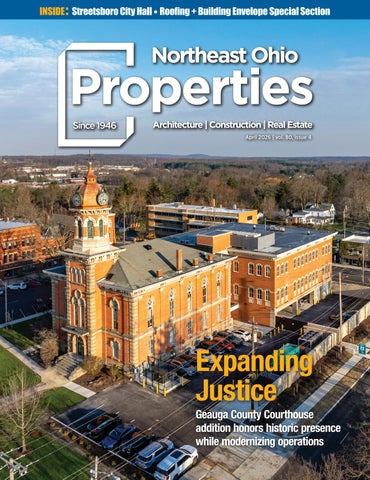
19 Expanding Justice

Geauga County Courthouse addition honors historic presence while modernizing operations
39 Building Interest, One Trade at a Time ACE Mentor Program of Cleveland and Cleveland Builds join forces to host Trades Day

42 Special Section: Roofing + Building Envelope

42 Post-Winter Commercial Roof Inspections: A look at what building owners should prioritize in Q2

44 Benefits of Metal Roofing Systems in High-Humidity Environments: Designing assemblies to control condensation, corrosion + energy loss

48 Maximizing Construction Dumpster Capacity: How on-site waste consolidation improves efficiency + reduces hauling costs

51 Fenestration Fundamentals: A guide to curtain walls, window walls and storefront systems

54 Legal Perspectives: Condo Repair Responsibility – Who Owns the Leak? 58 Vantage Point: Building Envelope Risk Management Strategies

DEPARTMENTS

Photo
Doug Bardwell

PROPERTIES PEOPLE

Highlighting notable industry events

The 19th annual CANstruction ClevelandAkron competition took place recently at the Akron Art Museum, bringing together eight teams of design professionals and students to build striking structures out of canned food, inspired by this year’s “Mythology and Legends” theme. The event provided the equivalent of 43,860 meals for the Greater Cleveland Food Bank and the Akron-Canton Regional Foodbank through a donation of 30,862 cans and $7,000 in monetary donations. 1

1 “Feed-Fi-Fo-Fum” (AVID Architects)

2 “CANsune” (CESO)

3 “Magically Delicious” (SoL Harris/Day Architecture)

4 “CAN-zilla” (LDA Architects)

5 “Corn Fed Strength: A Titan of Tuna” (CPL)

“Mjölnir” (Turner) 7 “Medusa, Re-CANstructed” (Onyx Creative)

“The Dragon and the Pearl” (Vocon)

The Electrical League of Ohio (ELO) hosted an Emerging Electrical Professionals Golf Social at Five Iron in downtown Cleveland recently. The event provided association members and guests with an evening of simulated golf, appetizers and networking.

Tom Gula (Eaton) with Tim Root, Don Moran, Chuck Kroeger and Dave Biradi (Echo Electric)
Bob Doherty and John Eber (Wolff Bros.)
Tyler Gallagher (McAuliffe Sales), Ava Nice (Hawkins Sales) and Brian Jones (Myriad Solutions)

Cavanaugh Building Corporation is proud to have served as Construction Manager for the new City of Streetsboro City Hall. This landmark project reflects the power of collaboration, and we are grateful to the City of Streetsboro and the design team for their trust, partnership, and shared vision.

We extend our sincere appreciation to the many subcontractors whose skill, dedication, and craftsmanship brought this project to life.

It has been a true privilege to contribute to a project that will serve the Streetsboro community for years to come.

Anchoring the Oval

New city hall establishes a civic focal point within Streetsboro’s evolving municipal campus

If the adage “Great things come to those who wait” is a truism, then the City of Streetsboro has just received a well-deserved great thing: a new city hall. Founder Titus Street first purchased the land in 1798 and established the first settlement and cabin in 1822. Incorporated as a city in 1968, the city has never had a “purpose-built” city hall – until now.

They now have a 14,000-square-foot, single-story facility at 9184 State Route 43. The $7.8 million project is prominently situated on a nine-acre parcel that includes the new fire department, a splash pad and an outdoor recreation area with a town oval the size of a football field.

Decades in the making

The first town hall was a converted farmhouse. It wasn’t until the city bought nine acres from the school board in the 1980s that they had space to grow. The school building had been constructed in the ‘50s, and not much had been done to update it. The city purchased the parcel with the school building, and moved in.

Unfortunately, according to Mayor Glenn Broska, the 60-year-old school building –composed primarily of 30- by 30-foot rooms with just two electrical outlets in each – struggled to support a growing staff

of 15 to 18 employees and increasingly technology-driven operations.

“We had equipment connected to extension cords connected to extension cords connected to extension cords,” says Broska.

Outdated infrastructure added to the challenge, from steam heat that would have cost millions to replace to an electrical system that still contained some knob-and-tube wiring.

For their five-year master plan, they had numerous needs, so they brought in a developer who proposed building and managing a community center for a reportedly exorbitant annual fee. The city quickly rejected that idea and hired a civil engineer to create the current master plan, which included shared recreational space, a firehouse and a separate city hall.

“We badly needed the new firehouse, so we decided to build that

first,” Broska recalls. After completing the fire station, the next major need was a community center with space for seniors. “Through a public RFP in 2021, we chose levelHEADS for architectural services, and that was one of the best decisions we made. They designed a very nice, not over-the-top, but highly functional building. We now have a community center there, with comfortable space for our seniors. It’s really proven to be beneficial.”

Designing for two fronts

“When we were finally ready to start this project, we issued another RFP in 2023, and thankfully, we ended up choosing levelHEADS again,” relates Broska. “After months of planning, we developed a design plan, a budget, and received council approval to hire a contractor. We decided to go with a Construction Manager at Risk approach, so we wouldn’t

Architec ture

I nterior Design

O wner ’s Representation

Corporate Architec t

Master Planning

Site Planning

Facilit y Assessments

Space Planning

Cost Estimating

Philanthropic Support

Capital Planning

EMPHASIZED ENTRY An elevated canopy and prominent columns clearly define Streetsboro City Hall’s main entrance along its east-facing façade.

have to act as the general contractor and handle all the bids ourselves. That was another great decision we made – using Cavanaugh Building Corporation.”

As an opening remark to the architects, Broska recalls telling them, half-jokingly, “I don’t want to build a monument to an architect.” Laughing, he quickly follows up by saying everyone in the building agrees the design and construction team actually “nailed it.”

One of the initial requirements was that everyone have a window to see what’s going on outside. While a few cubicles are scattered inside, all full-time personnel are positioned along the exterior walls. Broska’s office in the southwest corner overlooks the main driveway into the campus as well as the recently built fire station, which was important for him due to his past career as a fireman. He compares sitting in his office to being in an airport control tower, watching everything arriving and departing.

Even with the limited interior spaces, Christopher P. Trotta, AIA, lead planner and project executive at levelHEADS, explains that employees can see outside from the breakroom and enjoy going outside in the enclosed courtyard in the center of the building. A Zen garden atmosphere, with bamboo plantings, boulders, exposed aggregate cast-in-place concrete and woodencapped benches, invites people to step outside and enjoy the warmer months within this serene environment.

“We intentionally designed a building around an interior, landscaped courtyard to orient all visitors going to major areas including council chambers and the water and building departments,” says Trotta. “Having natural light spilling into the council chambers provides an uplifting ambiance, unique to proceedings within.”

The site for the building had been specified in the master plan, but levelHEADS’ challenge was to create a building with two public-facing façades.

“Right on Route 43, the two sides were always a challenge,” explains Trotta.

On the west side of the building, facing Route 43, is the Flag Plaza, which has a semi-circular sidewalk and an array of five tall flagpoles. LED uplights on the building’s stone masonry exterior change colors roughly every 10 seconds, illuminating the street side of the building with a constantly changing color scheme.

“There’s no parking out front either, which is nice, so you just see green space, the Flag Plaza, and then the building at night,” says Trotta.

Originally, a retention pond was planned for the area where Flag Plaza now sits. Christine Daily, project manager for Cavanaugh, explains that by burying large tanks beneath the parking lot, they could eliminate the pond, which would have been dry most of the time.

“It cost us a couple thousand dollars more, but now we have a beautiful yard out front,” states Broska.

People typically enter the building from the east side, next to the town oval.

“The long, single-story building needed a hierarchy of building shapes, color contrasts and textures to break up the façade and provide a clear entrance with an elevated canopy and prominent columns,” says Chris B. Trotta, levelHEADS’ director of design for the exterior. “The main canopy serves as the anchor to the building and demarks its prominent place

within the city center’s oval and other community amenities.”

“When you first presented it to us, there were a lot of ‘oohs and ahs’ because we really liked the different levels,” says Broska. “Seeing the exterior with this stone and the other materials, well, you guys really knocked it out of the park. We were very, very pleased.”

The council chambers have a high ceiling, and with a hip roof above, it looks almost like a story-and-a-half

tall. The protruding entry canopy with its metal roof and the nearby warm, multi-colored stone exterior draw the eye toward the building entrance in the center. The south end of the building uses similar hues but with lighter tones in a brick façade with an even taller hip roof, hinting at a two-story structure on that end.

The city hall incorporates some of the same gray and black tones, along with shingled and metal roofing taken from

CRAFTED IN LIGHT Natural daylight fills the council chambers, highlighting the custom millwork and continuously curved desk that define the space.

COURTYARD CONNECTION

The east entrance opens directly to a light-filled lobby (top) with clear views into the interior courtyard, which serves as a central organizing and gathering space (bottom).

the fire station, but still establishes its own character and identity as the main building when arriving at the campus.

“Working on a project like this is really exciting, especially collaborating with levelHEADS and the city,” explains Daily. “We started during the design phase to help with the budget. We aimed to offer some value engineering ideas without altering the design concepts or the building’s appearance. It was a fun and collaborative process.”

All the site work, including ground penetrating radar was completed prior to construction. The site was a former farm, so when Cavanaugh mobilized, they were ready to begin excavation.

“We started work on the project in January 2024 when we were awarded the CMR contract,” says Daily. “We were shoveling snow just to get going. Starting in winter always brings challenges, but this project had its own obstacle, especially in the front corner where the gallery area is. The slab we poured there is actually the finished floor. It’s polished concrete. So we had to ensure that when we poured it, we achieved a good finish because it wasn’t going to be covered by any floor covering.”

“Fortunately, we had some good contractors who worked really well with us to schedule around the weather,” states Daily. “They were here whenever the weather permitted and helped keep the project on schedule. Once we got into spring and the weather broke, this job site was busy. It looked like an ant colony out here.”

“Our superintendent, Travis Epling, did a really good job coordinating between the different trades to ensure everyone was on the same page, and we were able to keep work progressing in nearly all areas of the building most of the time,” adds Daily.

The building rests on a slab foundation with minimal structural steel. “The building is primarily framed with cold form structural metal stud walls with cold form joists,” explains Daily. “We also used metal trusses at both ends of the building to form the higher roof areas.”

The central part of the building has a flat roof covered with EPDM, with metal roofing installed above the canopy, and shingles on the hip roofs at both ends of the building. Rooftop HVAC units coordinate with VAV boxes throughout the building for climate control.

“We balanced where we focused our budget,” explains Christopher P. Trotta. “We put a nice standing seam roof at the front canopy, while being more economical further back on the building.”

Interior walls consisted of metal studs with full insulation between offices and sound baffling installed above the ceiling in certain areas.

“We can now have private conversations in our office, which was something we didn’t have in any of our prior quarters,” says Broska.

Working collaboratively with the mayor and his staff, a very neutral palette was selected for most of the interior

spaces. The wood tones were brought inside from the entrance.

“The stone from the outside was also brought into the courtyard, so we tried to bring what we chose outside inside and vice versa,” states Katie Duncan, director of interiors for levelHEADS. “You know, when you come inside, it’s not a different building. You still feel like you are connected to the exterior with the garden.”

With a limited construction timeframe, levelHEADS ensured all specified materials were sourced from the USA, prioritizing regional sources whenever possible.

“The new Streetsboro City Hall was the kind of project that required much attention to detail in both the design and construction phases,” points out Anthony Duncan, AIA, project manager for levelHEADS. “Many critical design elements and details were carefully coordinated in the field to achieve

WARMTH IN WOOD Wooden accents unify interior spaces, from slatted ceiling and wall panels (top) to a pair of liveedge conference tables featuring the city’s seal intricately carved into their surfaces (middle, bottom).

the finesse that a project of this nature demands.”

The mayor agrees, saying, “I was here every day, sometimes twice a day, and the great thing was that every day we could see progress.”

Bringing the outdoors in Access to Streetsboro City Hall is easy for residents, with many parking spots right in front of the entrance. Employees also have convenient access through a separate parking lot just outside the north door.

Entering beneath the grand canopy, the vestibule opens into a spacious lobby with views of the courtyard

“Many critical design elements and details

were carefully

coordinated in the field to achieve the finesse that a project of this nature demands.”

Anthony Duncan levelHEADS

straight ahead. The two busiest city departments, water and building, have service windows and counters directly accessible from the lobby.

To the right as you enter is a large gallery area along the east window wall and the entrance to the council chambers. The gallery features a 100inch color monitor for viewing council proceedings in case of overflow crowds that cannot be accommodated in the chamber itself. The lengthy west wall, opposite the windows, is currently awaiting a mural timeline depicting the history of the City of Streetsboro.

Council chambers is one of the most impressive spaces for several reasons. The millwork and carpentry are flawlessly executed, reflecting the formality of the room while remaining entirely functional.

Before the casework was built for the council chambers, the Cavanaugh

SIGNAGE SOLUTIONS

Subscribe

Save Over

ENVIRONMENTAL CONSULTING AND LABORATORY SERVICES

Group can help you make the pieces fit!

EA Group is a recognized leader in environmental analysis and management. We’ve worked with a multitude of businesses and institutions to help discover, analyze, and manage their environmental issues. Since 1982, we have provided environmental, health and safety consulting, field, and laboratory services to thousands of clients throughout Ohio and the region.

Our consulting staff has extensive experience in environmental, health and safety assessment, remediation, and management. Our laboratory capabilities include full environmental analysis, industrial hygiene analysis, and asbestos analysis.

EA Group works with clients in the following industries:

• Construction & Design Companies

• Environmental Consulting and Contracting

• Educational Institutions (K-12, Public & Private, Universities)

• Healthcare Facilities

• Commercial Real Estate Development & Property Management Firms

• Manufacturing Companies

BREATHE EASIER

team laid everything out on the floor. They then brought in the chairs and made sure everyone could see each other. With the chairs in place and the geometry verified, only then did the casework contractor begin fabrication.

While waiting for the casework, the room was used for internal storage, so it was the last room to be finished. Cavanaugh self-performs all carpentry themselves, so when the final materials arrived, they made sure everything fit together perfectly.

On the south side of the chamber, a large part of the wall is made of window glass, offering a view of the enclosed courtyard with its garden plants.

“We believe in how natural daylight impacts people, and in a council chamber, council meeting or committee meeting setting, it improves attitude,” Christopher P. Trotta says. “I’m convinced it has the sort of benefit that makes you happier and positively engaged.”

Seating for the eight council members is on an elevated level, while the 12 seats for department heads and support staff are at floor level. The 20 seats form a semi-circle around the west side of the room, providing an unobstructed view of all members. The custom-built, continuously curved desk is faced with maple wood veneer and has a solid surface Corian cap and

LIGHT ILLUSION A recessed faux skylight adds depth and diffuse lighting to an otherwise enclosed corridor.

desktops. Slim gooseneck microphones and name plaque holders are attached at each individual’s seat.

The feature wall behind the council members features matching maple veneer bands running horizontally wall-to-wall, with vertical WoodUpp Akupanels behind the great seal of Streetsboro.

Thirty comfortable individual seats are arranged for residents to observe the proceedings. Two large TV monitors flank the front wall, and an overhead projector is ceiling-mounted to display content on the rear wall.

Just outside the chamber, in the front lobby, are two rustic-looking handmade benches. A large elm tree had grown on the property since the ‘60s, and when it couldn’t be saved, the wood was salvaged.

“Our engineer saved some of the slabs when it was taken down, and our Parks Department created the benches,” says Broska.

Next to the chamber, but also with a view of the courtyard, is the employee breakroom. Across the western hallway are the clerk’s office and workroom, as well as an executive session meeting room, all overlooking State Route 43.

The rest of the western hallway leads to the executive suite. Here, you’ll find offices for finance, law, economic devel-

opment and human resources. At the end of the corridor, facing southwest, is the mayor’s office.

Outside the office, there is a small seating and waiting area with maple slat panels on the feature wall and ceiling. The nourish (refreshment) area is just to the east, as you pass the executive

“After not having a purpose-built city hall for 203 years, we hired an architect and a construction team to create something that would last. Both of them ended up giving us an A+ job.”
Mayor Glenn Broska City of Streetsboro

conference room leading to the city services section.

This area contains offices and support services for the water department, building department, planning and zoning, and engineering.

Throughout the building, there are four conference rooms of different sizes. The executive conference room and the large conference room both feature live-edge, rustic wooden tops with the city seal at the center of each. The

seal is quite intricate and was expertly hand-routed before the table was coated with a durable, clear epoxy. One table measures 10 feet long, and the other is an impressive 16 feet long, each made in one piece.

“We had a gentleman in Medina custom-make them for us,” recalls Broska.

A purpose-built legacy

“After not having a purpose-built city hall for 203 years, we hired an architect and a construction team to create something that would last,” muses Broska. “Both of them ended up giving us an A+ job. I don’t think we could have chosen a better team to work with than these guys. We held weekly meetings, and throughout the entire project, I don’t think we faced any controversial issues.”

“I don’t think so either,” adds Daily. “We had really productive meetings, working through any issues that came up. Our biggest challenge was the schedule, trying to get it done in a 14- to 15-month timeframe, but despite the winter, we did it.”

“The city was highly engaged from design through construction,” concludes Christopher P. Trotta. “I think that enhanced the project and contributed to its success today.”

CIVIC CENTERPIECE The new city hall (at right) anchors Streetsboro’s oval-shaped municipal campus, situated near the adjacent fire station (at top), which opened in 2021, and new outdoor recreation area with a splash pad (at left), which opened in 2025.

Infinity is proud to serve as Construction Manager at Risk for this new state-of-the-art addition to the Geauga County Courthouse, building upon its 156-year legacy.

Infinity is proud to serve as Construction Manager at Risk for this new state-of-the-art addition to the Geauga County Courthouse, building upon its 156-year legacy.

Expanding Justice in Chardon

Geauga County Courthouse addition honors historic presence while modernizing operations

For more than 150 years, the Geauga County Courthouse has stood at the center of Chardon Square, serving as both a working seat of government and one of the community’s most recognizable civic landmarks. Built in 1870, the historic courthouse has long anchored the county’s judicial system. But as court operations expanded and security expectations evolved, the limitations of the original building became increasingly difficult to ignore.

A newly completed addition now provides a modern expansion of the courthouse while preserving its historic presence on the square. The 30,000-squarefoot project creates new courtrooms and support spaces while carefully respecting the architectural character that defines downtown Chardon.

A courthouse since 1870

In its early years, the courthouse served a broader governmental role than it does today. Like many 19th-century county courthouses, the building housed a range of public offices in addition to court functions. Various county departments operated there at different times, including offices such as the county treasurer. As Geauga County grew and administrative needs expanded, those functions gradually moved to other

buildings, leaving the courthouse to focus primarily on judicial matters.

Today, the Geauga County Courthouse houses the Court of Common Pleas and the General Division. Judges hear felony criminal cases, major civil disputes and family law matters while overseeing jury trials, probation services and specialized programs, such as drug court. The courthouse also includes the Clerk of Courts.

Architecturally, the Italianate architectural style building reflects the historic character of Chardon Square. It was constructed of brick with stone detailing that gives the structure a sense of permanence. The design follows what is common to many civic buildings of its time, with wide overhanging eaves and decorative brackets, strong cornice lines, arched narrow window openings and carefully detailed stone trim.

The history of the courthouse is also tied directly to the land on which it sits. The property was originally deeded for use as a courthouse, and that deed included conditions that shaped the future of the site. One provision required that a view corridor across the property be preserved, ensuring that the courthouse remained visually connected to the surrounding square. The deed also restricted the use of the land specifically to courthouse purposes.

Why the addition was needed

“From my perspective, the most important thing and the biggest concern we had in the old building was security,” says Judge Carolyn Paschke.

One of the most significant concerns involved the lack of separation between public and secure areas. In the previ-

Photo by Brad Gellert

Geauga County Courthouse

by Scott Esterly

ous layout, defendants in custody often entered the building through the same doors used by judges, jurors, attorneys and members of the public. Victims and jurors could pass defendants and their families in hallways during breaks and there were no secure holding areas for individuals in custody.

“When we had contentious cases with victims’ families and defendants’ families, they were kind of all smooshed together,” says Judge Matthew Rambo.

Many spaces were small by modern standards, with limited seating and layouts that made it difficult to incorporate current courtroom technology. Noise from the surrounding square could also interrupt proceedings, occasionally forcing hearings to pause when the sound of sirens or street activity carried into the building.

A courthouse security review conducted through the Supreme Court of Ohio ultimately highlighted many of these issues, identifying the facility as an example of the challenges older courthouses face when adapting to modern security expectations.

The $20 million project was assembled without a levy, with funding coming from multiple sources, including $10 million in American Rescue Plan funding, $2 million from the City of Chardon through a settlement agreement and the remaining

from county funding.

Photo
Photo by Mark Wayner

FUNCTIONAL FLOW A secured entry sequence (top) guides visitors from screening into the courthouse interior (middle). Service windows nearby provide a functional interface between public and private zones (bottom).

worked through challenges tied to the historic setting, the building connection and long-standing deed restrictions on the site. Infinity Construction joined the project team in late 2023.

Selective demolition began in December 2023, followed by site excavation and early construction work in spring 2024. Groundbreaking took place in late May 2024, and by early February 2026 the new courthouse addition was fully operational.

Building while justice continues

Constructing the addition in the center of Chardon Square presented a unique challenge from the start: the existing courthouse never closed. Hearings, trials, clerk operations

“This building has been around since 1870. We tried to look beyond ourselves and say, ‘what do I need right now and what is going to serve the county 50 years from now.’”
Judge Carolyn Paschke Geauga County Court

and probation services all continued throughout construction, requiring the project team to carefully plan every phase of the work.

Selective demolition began along the north side of the historic courthouse. Several smaller structures were removed, including a one-story addition, exterior restroom facilities and mechanical equipment, such as the building’s existing chiller. An old exterior fire escape was also removed to make way for new circulation and lifesafety features, including a new stair tower and updated emergency exits tied into the new structure.

“It’s a tight site,” says Daugherty. “You’ve got about 10 feet off the front to the sidewalk and maybe 35 or 40 feet

Photo by Mark Wayner
Photo by Ryan Caswell

on the sides. You can’t get semi-trucks onto the site, so almost every delivery you see inside the building was picked off the street and boomed directly into the structure. It’s not just the courthouse either. There’s a school right across the street with pickup and drop-off times, so we had to coordinate deliveries around everything happening on the square.”

Excavation also required careful coordination. The floor elevations of the existing courthouse and the new addition did not align naturally with the site grades, requiring approximately four feet of subgrade excavation along the north side of the historic structure. This work allowed the lower level of the new building to align with the basement level of the original courthouse, creating a functional first-floor connection between the two structures and a ground-level accessible entrance to the building.

“I think that was one of the most challenging and also most rewarding goals – getting these two buildings to line up,” says Hribar. “The cornices, the levels, the connection at each floor between the existing and the new.”

Once the site work was complete, framing for the addition progressed quickly. The new building is primarily a steelframe structure with elevated concrete floor slabs. At the lower level, concrete masonry units (CMU) form the struc-

tural base, providing both durability and added security at the building’s perimeter. Above that level, the structure transitions to a steel framing system with structural studs, continuous insulation and a brick veneer exterior. A three-inch rigid insulation system creates a continuous thermal barrier around the building envelope, improving energy performance and elimi-

“Everything is designed for sound control. It’s under your feet in the flooring, it’s in the acoustical wall panels and every penetration through the walls is sound-sealed.”

nating the thermal bridging common in older construction.

The exterior envelope was designed not only for efficiency but also to reflect the architectural character of the original courthouse.

“The stone at the window trim and arches comes from the same vein of sandstone as the historic building, and we even took molds from the original cornice so it could be replicated and carried around the new addition at the same elevation,” says Gellert.

“You’ve got a brick veneer over top of three-inch rigid insulation that provides a continuous vapor air barrier from the first floor all the way up through the cornice,” adds Daugherty. “The anchoring system ties the brick back through the insulation into the studs.”

One of the most technically complex aspects of the project involved integrating the mechanical and utility systems of the new structure with those of the historic building. Nearly all utilities serving the addition had to route through the original courthouse before entering the new structure. Boiler systems, chillers, electrical feeds and other infrastructure were removed, relocated or replaced as part of the process. Temporary systems were installed to keep the courthouse operational during these transitions, including temporary chillers and phased mechanical connections.

“A lot of the swap-over times were done after hours or on weekends so that we were not inhibiting the flow of the courthouse,” Daugherty says.

The project team also coordinated closely with courthouse staff to schedule construction activities around hearings and court sessions, limiting noise during sensitive proceedings whenever possible.

“In this entire project, we only had to close the building one day, and that

ELEVATED ALIGNMENT Positioned along the building’s edge, a magistrate courtroom (left) and meeting room (right) both capitalize on exterior views, enhancing interior environments with natural light and visual connection.
Photo by Ryan Caswell
Photo by Scott Esterly

HISTORICAL CONNECTION Chardon Square’s courthouse remains the focal point of downtown, with the carefully designed addition extending its footprint while respecting the historic urban fabric.

was for the electrical switchover,” says Judge Paschke.

Winter conditions added another layer of complexity. Masonry work continued during cold months using temporary enclosures and heating systems. Scaffolding areas were wrapped with tarps to create controlled environments, while large indirect-fire heaters were used to maintain proper temperatures for brick and mortar installation.

Additional heaters were placed inside the structure to remove moisture and maintain workable conditions for interior finishes, such as drywall, painting and flooring.

“When you look at the interior and exterior of this building, everything is designed for sound control,” says Daugherty. “It’s under your feet in the flooring, it’s in the acoustical wall panels and every penetration through the walls is sound-sealed. The doors themselves are specialty doors with high sound ratings.”

Designed for continuity + function

“This building has been around since 1870,” Judge Paschke says. “We tried to look beyond ourselves and say, ‘what do I need right now and what

is going to serve the county 50 years from now.’”

The goal was not to replicate the historic courthouse, but to create a building that feels like a natural continuation of it, Gellert notes.

“We were trying to match the scale, style and spirit of the old building, but in a modern way,” he says.

Key architectural elements were intentionally aligned between the two

“We hope that citizens, when they look at the courthouse, don’t even realize that there is an addition. The addition is the same fabric. It looks like it’s part of the community.”
Brad Gellert ThenDesign Architecture

buildings. The new addition continues the horizontal cornice line of the original courthouse at the same elevation, creating a visual connection across the façade. Window proportions, arches and stone trim were also carefully referenced from the historic structure, helping the

new building blend naturally into the square’s architectural rhythm.

Material selection played an important role in achieving that continuity.

“We couldn’t match the brick exactly, but we spent a lot of time researching manufacturers to get as close as we could to the original brick in both color and texture,” says Gellert.

Elements from the historic courthouse informed several key interior features, including floor patterns, wood tones and millwork details. A black-and-white tile pattern from the original courthouse lobby inspired flooring selections in the new building, creating a subtle visual link between old and new spaces. Wood finishes and base details were also selected to echo the materials used in the historic structure.

Beyond aesthetics, the design prioritized flexibility and long-term use. Courtrooms were carefully planned to improve circulation, visibility and accessibility. The addition provides new courtrooms and jury deliberation rooms along with offices for judges and court staff, conference rooms and records areas, all organized with separate circulation routes that allow judges, jurors, defen-

Photo by Ryan Caswell

dants and the public to move through the building independently. Dedicated holding areas, secure corridors and controlled courtroom access points were integrated into the design to enhance safety for judges, staff and visitors.

Looking ahead

Attention now turns to the original courthouse itself. With court operations relocated into the new addition, the historic building is currently vacant and awaiting its next phase of work. Long-term plans call for the structure to be renovated and adapted for additional court-related functions, potentially including probate and juvenile court operations. That approach allows the county to continue using the historic building while ensuring that it meets modern accessibility and operational standards.

With the addition now complete and fully operational, the response from those who work in the courthouse every day has been overwhelmingly positive.

“I’m really proud of the courtroom and the thought and effort that was put into the furniture, the technology, the design and the build,” says Judge Paschke. “We made a courtroom that I feel like we can try cases in that will be comfortable for people. I think it’s good for the attorneys. I think it’s safe. I think it’s good for the jurors.”

The difference is felt not only in the courtrooms themselves, but throughout the building. Dedicated circulation paths for judges, staff, jurors and in-custody defendants have transformed the daily flow of the courthouse. Waiting areas and conference rooms now provide spaces for attorneys and clients to meet privately, while improved acoustics and technology support the work happening inside the courtrooms.

“We hope that citizens, when they look at the courthouse, don’t even realize that there is an addition,” says Gellert. “The addition is the same fabric. It looks like it’s part of the community. It enhances the original building. It doesn’t just benefit the court; it benefits the whole city.”

The public has also provided positive feedback. “It wasn’t until recently that someone was coming to the square and they’re like, ‘Well, where’s the new courthouse?’ And I said, ‘That’s exactly perfect,’” says Daugherty.

BILLBOARD

News about people, products, places & plans

Frank Lloyd Wright’s Weltzheimer/Johnson House Reopens

The Weltzheimer/Johnson House, a Usonian residence designed by Frank Lloyd Wright, reopened to the public recently, following ongoing restoration work led by Oberlin College. Completed in 1949, the house is considered the first Usonian home built in Ohio and remains one of the few Wrightdesigned residences in the region accessible to the public. Located within a residential neighborhood near downtown Oberlin, the property is widely recognized for its low-slung horizontal profile, integration with the landscape and use of natural materials.

Recent improvements to the structure include a new roof, masonry restoration to brick walls and chimneys, and rehabilitation of wood doors and window systems. Additional exterior woodwork and fascia repairs are scheduled to continue this spring as part of a phased preservation effort.

Open houses will be held on the first Sunday of each month through November. The reopening provides architects, designers and real estate professionals an opportunity to study Wright’s approach to modest-scale residential design and construction detailing, particularly his Usonian principles emphasizing affordability, efficiency and connection to site.

Nosan Joins Cushman & Wakefield | CRESCO Real Estate

Brad Nosan has joined Cleveland-based Cushman & Wakefield|CRESCO Real Estate as a vice president, bringing more than a decade

of experience spanning brokerage, development, leasing and asset management. Nosan brings a focus on owner representation, advising clients on strategy, positioning and longterm value creation across a range of asset types.

Nosan began his career in tenant representation at Newmark before expanding into development and portfolio management through Property Advisors Group, his family-owned real estate business where he has been

involved in mixed-use redevelopment, multifamily development and asset strategy. Throughout his career, he has been involved in the development and acquisition of over $150 million in commercial and multifamily projects.

American Interiors Acquires APG’s Ohio Operations

American Interiors Inc. recently announced it has acquired APG Office Furnishings’ Northeast Ohio operations, becoming the region’s sole dealer for

Weltzheimer/Johnson House
Brad Nosan
Photo by Andrew Pielage

MillerKnoll. The acquisition took effect March 9, 2026, and expands American Interiors’ presence in the Cleveland and Akron markets. The company, founded in 1993, operates in commercial furniture and digital construction services and has maintained a longstanding partnership with MillerKnoll and its predecessor brands.

APG Office Furnishings, founded in 1969, has been a MillerKnoll dealer for decades and established a strong client base across Northeast Ohio. With the transition, American Interiors assumes responsibility for serving those customers while continuing operations under a unified regional dealership model.

The move consolidates MillerKnoll’s distribution network in Northeast Ohio under a single provider, a shift expected to streamline service delivery and expand resources available to clients. APG will continue to operate in other markets, including Cincinnati, Dayton and Memphis.

TDA Becomes 100% Employee-Owned

ThenDesign Architecture (TDA) recently announced it has transitioned to a 100% employee-owned business model, a move aimed at strengthening leadership development and aligning long-term firm performance with staff investment.

The Willoughby-based architecture firm, which focuses on educational, athletic and civic projects, says the shift is designed to position the company for sustained growth in a competitive design and construction market. Under the structure, employees with more than one year at the firm are granted

ownership stakes without a direct buy-in requirement. The transition follows the implementation of an internal development program intended to prepare the next generation of firm leaders and support continuity in project delivery. TDA emphasizes that employee ownership is expected to deepen engage-

TDA Headquarters in Willoughby

ment across project teams while reinforcing collaboration and accountability.

Frantz Ward Litigation Practice Welcomes Associate

Frantz Ward recently announced that Jamie L. Rasor has joined the firm’s Litigation Practice Group as an associate. Rasor assists clients throughout all aspects of litigation, arbitration, mediation and settlement conferences. She brings extensive litigation experience to the firm, representing clients in first- and third-party matters involving insurance coverage, premises liability and defamation actions.

Prior to joining the firm, she gained experience draft-

ing pleadings and motions as well as conducting and defending depositions as an associate at a civil litigation firm in Cleveland. Additionally, she served as a judicial extern to the Honorable Judge Michelle Sheehan at the Eighth

District Court of Appeals and as a law clerk at an Ohiobased personal injury firm.

Birchway Title Joins NIAS

Birchway Title Agency recently announced it has joined National Independent Agency Solutions (NIAS), a national network of independent title agencies focused on collaboration and operational best practices.

The Independence-based firm says its membership in NIAS expands its access to a nationwide network of title professionals, along with shared resources such as compliance tools, legal updates and industry guidance. The network’s founding members bring more than a century of

combined experience in the title insurance sector.

Birchway Title Agency provides title and closing services across Northeast Ohio and works with commercial and residential real estate transactions. By joining NIAS, it gains additional support aimed at improving efficiency in complex deals and adapting to evolving regulatory requirements.

Ahern, Oscar to Receive ORT’s Jurisprudence Award

Ann-Marie Ahern, comanaging principal at McCarthy, Lebit, Crystal & Liffman Co., LPA, and Lawrence E. Oscar, senior counsel and former CEO and managing partner at Hahn

Jamie Rasor

BILLBOARD

News about people, products, places & plans

Loeser & Parks LLP, will be honored with ORT America’s 2026 Jurisprudence Award. The award ceremony is scheduled for June 17 at The Union Club in Cleveland. Established in 1996, the Jurisprudence Award recognizes attorneys and jurists for leadership, professional excellence and meaningful community impact. This year marks the 30th anniversary of the award, which has become a prominent tradition within the Cleveland legal community.

BOMA NORTHEAST OHIO

co-chairs include James Graham (Cleveland-Cliffs Inc.), Catherine O’Malley Kearney (Key Private Bank) and Dan Zelman, immediate past chair of the Jewish Federation of Cleveland.

TC Architects Becomes Part of Pickering Associates

Pickering Associates, a West Virginia-based architecture, interior design, engineering and surveying company, recently announced it has acquired TC Architects,

Pickering’s in-house engineering and surveying capabilities.

ens its reach into Northeast Ohio while enhancing its interior design capabilities, a service line the firm recently expanded.

TC Architects, which has a 75-year history, brings experience across healthcare, multifamily housing, education and civic projects. With the transition, TC President Robert Chordar is now the company’s director of multifamily housing. Both firms will continue to operate under their existing names. The combined organization includes nearly

Become a Member

Become a Member

Our

Our members represent the largest investment in fixed assets in the Northeast Ohio Area.

Becoming a member gives you the tools to increase ROI and access the most up-todate information, training, education and members only benefits and savings

BOMA NORTHEAST OHIO

BOMA NORTHEAST OHIO

Robert Chordar

Signing Ceremony for the Cleveland Clinic Fairview Hospital Project recently. This partnership is an agreement between Higley Construction, OSHA (Occupational Safety and Health Administration) and the union trades with

the goal to build a culture that focuses on safety. All union trades working on the jobsite will bring a foreman with at least an OSHA 30-Hour certification.

Dave Pastir, president & COO for Higley

Construction, shares that Higley “always holds the value that people are our greatest asset, and this OSHA partnership is another way to bring safety and quality to the forefront of our projects.”

Within OSHA Region 5 (which covers Ohio, Michigan, Indiana, Illinois, Wisconsin and Minnesota), there are only three ongoing OSHA Partnerships, two of which are Higley Construction projects.

CRS Announces Annual Benefit Details

Cleveland Restoration Society (CRS) recently announced that its 2026 Annual Benefit will take

place on Friday, June 12. As in previous years, the festivities will take place at the Sarah Benedict House & Gardens at 3751 Prospect Ave. in Cleveland.

CRS has shared that this year’s event will be a Preservation Party to celebrate America’s 250th anniversary and its own piece of history – the Sarah Benedict House. The celebration will include cocktails in the garden, a buffet under the tent, music, raffle and more. Visit www. clevelandrestoration.org for more details.

Scott Neill, Tom Lippert and Dave Pastir (Higley Construction), with Mike Muzic (IBEW Local 38), Janelle Madzia (Cleveland Area OSHA), Charlie Shelton (OSHA) and Chris Zidek (Cleveland Clinic)
Photo courtesy of Higley Construction

FINANCIAL STRATEGIES

Smart use of fiscal planning & action

Burnt Out

The 1991 BMW 7 series was the first regular production automobile to offer Xenon headlamps. The automotive press lauded the crystal-clear white light as a revolutionary upgrade and a seed was planted in my mind. It took a few years to be in a position to afford a car that had these coveted headlamps and even then, it was a stretch. But once I had that car with those headlamps, it was indeed a significant improvement over the older halogen bulbs.

All was good for several years until one of the headlamps stopped working. Unable to roll into my local AutoZone to buy a new Xenon bulb, I took it into my friend, Tom the mechanic. I certainly wasn’t prepared for his diagnosis. He needed to replace the entire housing, as it was a sealed unit that included the Xenon light, the daytime running light, the turn signal light and a motor that turned the lamp slightly whenever the car was steered in a left or right. The good news – new housings were almost $2,000 but he found a used one for $900. The bad news – two weeks later, I was right back in Tom’s shop because the other side stopped working.

The IRS introduced the concept of cost segregation in 1997. Like Xenon headlamps, this concept was a significant improvement over the standard cost recovery deduction as it allowed a taxpayer to significantly accelerate the depreciation schedule on specific categories of property assets. But also, like Xenon headlamps, there are a few things that can cause a taxpayer to get knocked back on their heels.

To better understand some of these pitfalls, read on.

Passive can be aggressive

If the real estate investment is considered by the IRS to be a passive activity for the taxpayer, the tax deduction asso-

ALEC J. PACELLA

ciated with cost recovery is limited to $25,000. Known as the passive loss limit, it also restricts these losses to only be taken against gains for other real estate held in a passive capacity. This can be an issue, especially if the cost segregation study creates a significant taxable loss for the investor. Often, investors can avoid this is by qualifying as a real estate professional, which eliminates the passive activity loss limit. The IRS considers someone a real estate professional if more than half of their time during the tax year is spent on real estate activities, such as development, redevelopment, construction, acquisition, management, leasing or sales. By way of an example, suppose a taxpayer works 30 hours each week as a firefighter. That person would also need to work at least this same 30 hours each week performing the types of real estate activities listed above. And keep in mind, this requirement is in addition to the fabled “7 tests” to determine being a material participant.

Red flag

What I C @ PVC

BURGERS TO BANKS The Harry Buffalo located at 4824 Great Northern Blvd. in North Olmsted recently closed after operating at this location for 26 years. It was subsequently transferred for $4.4 million to JP Morgan Chase & Co. –AP

1250 property is considered like-kind and qualifies for an exchange.

Net sum game

A cost segregation study allows the useful life on certain components to be shortened. It does not increase the

desirable, the shine starts to fade if the bracket is the lowered as a result of a decrease in taxable income. Reducing the taxable income from $1.2 million down to $600,000 in a given year makes a lot more sense than reducing it from $800,000 down to $200,000.

Any time I have content related to taxation, I always include my presumptive disclaimer: I am not a tax professional, and you should consult a tax professional to fully understand your associated tax implications. You may remember that I have a tax professional that I consult with, Mark the CPA. But it was Tom the mechanic who summed it up best. As I wrote that second $900 check in two weeks, he simply said “a good halogen bulb costs $30 but only you can decide if the difference is really worth it.”

Nothing sends a shiver down a taxpayer’s spine more than the word “audit.” And while performing a cost segregation study is generally not considered to be something that will attract the IRS’s attention, the situation changes if the taxpayer is also a W-2 employee.

Nothing sends a shiver down a taxpayer’s spine more than the word “audit.” And while performing a cost segregation study is generally not considered to be something that will attract the IRS’s attention, the situation changes if the taxpayer is also a W-2 employee. As detailed earlier, the primary way for a taxpayer to not be subject to the passive loss limit is to be considered a real estate professional. And having a W-2 makes this much more challenging. If you want some excellent bedtime reading on this specific subject, check out an IRS publication titled “Passive Activities Loss Audit Techniques Guide.”

1245, 1250, give or take

A cost segregation study will sometimes categorize a portion of the asset as 1245 personal property. While this will help the taxpayer increase the depreciation shelter because of a shorter class life, it can also create a problem if the taxpayer later elects to sell the property as a part of a 1031 exchange. The associated gain on any portion of the asset that was classified as 1245 will be immediately taxable, as only Section

overall amount of depreciation shelter available but rather just front-loads it. The result is a significantly lower amount of shelter in later years. Suppose I own an office building that has $800,000 of value attributable to the improvements. The cost segregation study establishes that $500,000 of this are components that can be accelerated over the first seven years. But that means that the other $300,000 will be spread over the remaining 32 years – $9,375 each year. In contrast, I could shelter approximately $20,500 each and every year over the entire 39-year useful life if I didn’t do the cost segregation study.

How good is too good?

Cost segregation is very effective in reducing taxable income. But as the investor’s taxable income is decreased, the investor’s marginal tax bracket may be reduced as well. Our taxing system is progressive, with dollars associated with higher income being taxed at a higher rate. It is spread over seven progressively higher tax brackets. For example, if filing singly, it starts at 10% for the first $10,000 of income and increases to a maximum of 37% for any dollars in excess of approximately $626,000. And while the shelter associated with dollars that are in the higher brackets is very

Alec Pacella, CCIM, president at NAI Pleasant Valley, can be reached by phone at 216-455-0925 or by email at apacella@naipvc.com. You can connect with him at www.linkedin.com/in/alecpacellaccim or subscribe to his youtube channel; What I C at PVC.

ACAR CORNER

Issues in the real estate industry

Consumer Guide: Hiring a Remodeling Contractor

Do you have a home-improvement project on the horizon?

Whether you’re looking to renovate a home you’ve just purchased, improve the value of your home before you sell it or just bring more joy to your life, a remodeling contractor will make the process easier, mitigate potential costly errors and ensure that your projects are up to code.

Americans are expected to spend $608 billion on U.S. residential remodeling in 2025, according to the Improving America’s Housing 2025 report by the Joint Center for Housing Studies at Harvard University. The payoff can be high for homeowners’ enjoyment as well as a good return on investment. For its 2025 Remodeling Impact Report, the National Association of Realtors asked its members to estimate what homeowners could expect to recover at resale on the cost of various homeimprovement projects. The projects with the highest cost recovery were small upgrades: a new steel front door (100%), a closet renovation (83%) and a new fiberglass front door (80%).

The report also asked homeowners to rate their happiness with recent renovations. Projects that brought

owners the most joy: primary bedroom suite addition, kitchen upgrade and a new roof.

Finding a remodeling contractor

To find a reputable remodeler, seek referrals from friends and professionals. Real estate practitioners who are Realtors often have a strong network of trusted contractors. Other resources can also be found through online research and remodeling trade organizations. Interview at least three contractors, gather bids and research the companies.

What should I look for?

Look for someone who has extensive experience with your type of project; is licensed and insured; can provide a contract that details the scope and cost

EQUIPMENT LOAN SPECIAL

JEANNET WRIGHT

of the work; and is professional and easy to communicate with.

What should I ask a contractor?

• How long have you been in the remodeling business?

• Who will work on the project? Are they employees or subcontractors?

• Will you secure all necessary permits and approvals?

• Will you provide me with a contract that spells out the scope of the work, the timeline for completion and total cost?

• What allowances are in your contract bid? (Allowances are line items in the contract where the cost is yet to be determined; these variable costs can drive up the total cost of the project, so try to minimize any surprises by asking for a breakdown of all materials and products needed for the project, when possible.)

• Are you licensed for the work to be performed, bonded and insured? (Bonding protects you if your home is damaged; insurance protects the contractor and workers.)

• How much insurance do you carry and what does it cover? (Always verify that the policy is active.)

• How will you communicate with me during the project?

• Can you provide a list of references of similar projects you have done?

Possible red flags to avoid Avoid signing a vague contract that contains too many allowances or a contract that asks for a large down payment or full payment before the project is complete. The lowest estimates are not always the best option, so review bids carefully to make sure all materials and costs are spelled out. Before signing a contract, consider consulting an attorney to ensure understanding. A little bit of due diligence will ensure a smooth remodeling project that will increase not only the enjoyment of your home but also its future resale value.

Jeannet Wright (Berkshire Hathaway HomeServices Professional Realty) is 2026 president of the Akron Cleveland Association of Realtors (ACAR). This article was reprinted with permission from

Building Interest, One Trade at a Time

ACE Mentor Program of Cleveland and Cleveland Builds join forces to host Trades Day

The ACE Mentor Program of Cleveland has been hosting a Trades Day for three years. Cleveland Builds has been doing the same for the past two. This year, the two combined their efforts to create something bigger and better.

The ACE Mentor Program of Cleveland has a simple mission: to engage, excite and enlighten high school students to pursue careers in architecture, engineering and construction through mentoring and continued support for individual advancement. The organization seeks to fulfill this mission through after-school programming with experiential learning, in addition to events such as ACE Day, Design Day, Drones Day and Trades Day.

This year, with the ACE Mentor/ Cleveland Builds merger, Trades Day was held at the Cleveland Metropolitan School District’s Arnold Pinkney East Professional Center. The event drew over 300 students and advisors for schools across Northeast Ohio. Precision Environmental’s Joe DiGeronimo and Mike Finley, member of Local 310, served as the ACE Cleveland coordinators.

“We have plenty more capacity to add additional trades,” DiGeronimo said at the event. He also noted that the merger with Cleveland Builds shows the strength of Construction Employers Association (CEA) members and subcontractors, Cleveland Builds and ACE Cleveland.

“Ultimately, a tradesman is going to work for a company,” said Glen Shumate, executive VP of CEA and executive director of ACE Cleveland, while surveying the room and taking in the successful turnout.

Jim Trueblood, senior superintendent at Shook Construction, manned his organization’s concrete form work demonstration. He said it represents a typical project for his company.

“This is how we form concrete structures,” explained Trueblood, who has been in the trade since 1991, developing an interest while in high school. “I think [Trades Day] is amazing. Ours is a very aging industry with a 50-plusyear-old workforce. There are few within the 24- to 40-year-old range. Seeing this much youthful interest is hopeful for the future.” Trueblood also said he thinks

the engagement is “fantastic” and “casting a wide net.”

Piero Guzman, 17, a student at CMSD’s Rhodes School of Environmental Studies, is a participant in the ACE Cleveland program. He looked on to Shook’s concrete form work demonstration with signs

“Ours

is a very aging industry with a 50-plus-year-old workforce. There are few within the 24- to 40-yearold range. Seeing this much youthful interest is hopeful for the future.”

of curiosity on his face. Because Guzman’s uncle is an insulator, he’s very much interested in the trades. He hears conversations about working in the industry, among family members, all the time.

“I’m interested in something manual – in construction or as an insulator,”

Guzman said, adding that he enjoyed the opportunity to explore options. He had checked out the roofing and electrical stations as well. “It’s like it’s all coming together. It’s very helpful for me to see all that’s available.”

Lamya Woodward, an 18-year-old senior at Cleveland School for Digital Arts, on the other hand, has absolutely no interest in construction. She wants to become a graphic designer. But, she found a way to justify being at Trades Day.

“It’s good to have a backup plan,” she said. And seeing all the demonstrations made her to want to “build something” while there.

“The concrete was fun,” said Woodward, who also planned to check out the bricklaying station.

Pretty much every station remained busy throughout the time, with some students waiting patiently in line – such as at Precision’s scissor lift or at the Pipefitters’ table where they talked to the young people about their training programs.

James Boggan, from Boilermakers Local 744, said it was his first time attend-

CRAFTING CONNECTIONS During Trades Day, students rotated through sessions with multiple trades, exploring materials firsthand while hearing directly from experienced professionals working in the field.

ing Trades Day. “It’s great for the kids,” he said. Boggan explained that he spent much of the time there laying out the roadmap into his trade and explaining the “earn while you learn” model. Boggan worked in HVAC for three to four years prior to recently switching over to Local 744. Their mechanical pulley system demonstration drew lines as well.

ACE Cleveland advisors Nevin Jenkins (Shaker Heights High School) and Jimmy Smith (John Marshall High School) bring students to ACE Cleveland’s Trades Day every year. Both think it’s a great opportunity to target the ACE Cleveland students who are more specifically interested in construction.

“This is valuable for the students who don’t know what they want to do or are interested in specific interests in construction,” Jenkins said. “The unions are talking about pay in detail. That’s the main attraction.”

Jayson Richardson, Cleveland Builds’ director of community and industry partnerships, described the day as “great.” He said Cleveland Builds’ Trades Day usually attracts about 200 students but partnering with ACE Cleveland gave them more access to CMSD schools.

When asked about the benefit to the trade unions and companies who par-

ticipate, he said, “They like to see and talk to as many kids as possible. They’re reaching an audience they are not usually reaching.”

Meghan Whyard, a school-based therapist at Applewood, which serves kindergarten through eighth-grade students, looked around the room – at the experience – from the Precision Environmental demonstration table. “A lot of eighth graders I work with start to talk about careers, so I came to explore and see,” she said. “I love there’s a lot of hands-on things to do. It’s not dry. I’m engaged.”

To her, Trades Day appeared to be a great opportunity for youth to explore different jobs and careers because they typically only know about what’s within the bubble of their existence, she said while watching students mill around the gymnasium in search of a demonstration station that piqued their interest.

Destanee McElrath, a 16-year-old, 10th grade student at New Tech West, is in the middle of her first year in the ACE Cleveland program. When the representative for SMACNA/SMART Local 33 Cleveland told her she had to be 17 to enter the trade, she instantly expressed disappointment. She seemed ready to start now.

“It’s a very good learning experience, lots to see,” McElrath said of the experience. “I got to do stuff I don’t normally get to do.”

A fan of hands-on activities, she tried the welding, bricklaying and concrete wall demonstrations but wasn’t quite sure if any one trade sparked her interest over the other. “I talked mostly to everyone,” she said. “I just want to know more, and I got an opportunity to learn more.”

McElrath said she will continue with ACE Cleveland and wants to do something she’s passionate about but doesn’t foresee herself going to college. Trades Day is designed for students like McElrath.

“I like seeing young people get into the trades,” said Finley, who graduated from high school and went to college for a stint before following in his father’s footsteps. He also mentioned how the occupation has afforded him a good living and the ability to take care of his family. He has advanced to serve as a business agent. “Today, a lot of the students were really interested and excited.”

For more information on ACE Mentor Cleveland, visit www.acecleveland.org or contact Glen Shumate, Executive Director, ACE Mentor (ace@acecleveland.org).

SKILLS ON DISPLAY Throughout the day, students moved between stations for hands-on experiences with various skilled trades, such as bricklaying (1), pipefitting (2) and structural concrete work (3). Participants had a chance to ask questions and discuss potential career opportunities with local professionals, including (4) Shook Construction’s Regi Reed and Nate Pastor, (5) Shawn Banks with Hatzel & Buehler and (6) SMART Local Union #33 Training Coordinator Alan Simonitis.

Post-Winter Commercial Roof Inspections

A look at what building owners should prioritize in Q2

Every winter leaves its mark on a commercial roof. Snow loads, freeze-thaw cycles, wind events and temperature swings all stress roofing systems in ways that often aren’t visible from the ground. Most buildings make it through the season without obvious leaks, but when we climb onto those roofs in the spring, we usually find early signs of trouble that developed over the winter – loosened flashing, clogged drains, small membrane punctures or areas where water has started to pond.

Even when everything looks fine from inside the building, small issues are often already developing on the roof. Those issues rarely cause immediate failure. But if they go unnoticed through the spring and summer storm season, they can become much larger – and much more expensive – problems.

That’s why Q2 is one of the most important times of year for property managers and building owners to evaluate the condition of their roof. Not because the roof is failing today, but because this is the window where there’s still time to plan.

Q2 is when planning should start

The best time to evaluate whether a roof may need restoration or replacement is earlier in the year, before contractor schedules tighten and weather becomes less predictable.

Commercial roofing projects rarely happen quickly. Most are scheduled four to eight weeks in advance, and many commercial roofs take three to four weeks or longer to complete, depending on size, building operations and weather. Most roofing schedules start filling up by late summer. Once the colder fall months arrive, the window for complet-

ing roofing work becomes much smaller. In practical terms, if a roof project isn’t already being evaluated by the end of Q2, there’s a good chance it won’t happen until the following year.

Common issues found after winter

When post-winter inspections are performed, roofing contractors aren’t just looking for obvious leaks. Most

Owners who inspect within the first half of the year give themselves time to review budgets, evaluate options and schedule work before demand peaks.

What the Lifecycle of a Commercial Roof Usually Looks Like

Roof Age What Is Typically Seen What Owners Should Be Doing

0-10 years

10-15 years

15-20 years

System performing normally

Early signs of wear

Repairs becoming more frequent

20+ years System nearing failure

Annual inspections & preventative maintenance

Begin evaluating restoration options

Budget planning for replacement

Replacement planning strongly recommended

VIEW FROM THE TOP While every roof system is different, most commercial roofs follow a similar lifecycle pattern. Installation quality, maintenance, weather exposure and rooftop traffic all affect how long a roof will last.
Photo courtesy of Campo Roof

roofs come through winter without visible problems inside the building. What they’re really looking for are the smaller issues that develop during months of snow, ice and temperature swings.

Throughout the winter, debris accumulates on roofs, such as leaves, branches, roofing materials and even trash carried by wind. When that debris collects around drains or scuppers, it prevents water from leaving the roof during spring storms.

Low-slope commercial roofs are particularly vulnerable to this. Even small blockages can create ponding water, which accelerates membrane deterioration and adds weight to the roofing system.

Inspectors also frequently find loose debris left on roofs. When strong winds arrive during storm season, those materials can puncture the roofing membrane.

Another issue that should be checked carefully is rooftop mechanical equipment. HVAC access panels and service doors often loosen during winter due to vibration and temperature movement. If those components aren’t secured, they can shift during storms and damage the roof surface.

These aren’t dramatic failures – but they’re exactly the kinds of issues that turn into leaks months later.

Warning signs

One of the most common questions that property managers ask during inspections is whether a roof still has useful life left. While every roof is differ ent, there are several signs that a system is nearing the end of its service life.

1. Water that doesn’t leave the roof

If water remains on the roof more than a day or two after rain, it may indicate structural sagging or drainage problems. Over time, ponding water accelerates membrane wear and increases the likeli hood of leaks.

2. The same repairs keep coming back

Seams, flashing and penetrations are the most common places where roofs fail. If those areas require repeated repairs year after year, it often means

the roofing membrane is beginning to lose flexibility.

3. Soft areas in the roof system

When a roofing contractor walks a roof during inspections, they’ll pay attention to how the surface feels underfoot. Soft areas often indicate moisture trapped in the insulation beneath the membrane, which can significantly shorten the roof’s remaining lifespan.

Protecting the warranty

Most commercial roofing manufacturers recommend bi-annual inspections, typically in the spring and fall. In many cases, those inspections are also required to maintain warranty coverage.

Regular inspections allow small issues – loose fasteners, deteriorating sealant or minor punctures – to be addressed before they become major repairs. For property managers responsible for large buildings or multiple facilities, these inspections also provide documentation that supports long-term maintenance planning.

Preventative maintenance

The buildings that experience the

with the most expensive roofing systems. They’re the buildings where the roof is evaluated regularly and where small issues are addressed before they have time to grow.

Most commercial roofing problems develop gradually. Drains begin to slow, sealants deteriorate, seams loosen slightly or areas of the roof begin holding water longer than they should. When those issues are identified early, they’re usually straightforward to correct.

A spring inspection allows building owners and property managers to see how the roof performed through winter and make informed decisions about maintenance, repairs or future capital planning while there is still plenty of time in the construction season.

A commercial roof protects everything underneath it. Taking a close look at it early in the year is one of the simplest ways to keep the building performing the way it should.

Kevin Campopiano is president and CEO at Campo Roof. To learn more about commercial roof inspections or maintenance planning, visit https://www.camporoof.com/commercial-

ROOFING + BUILDING ENVELOPE

Benefits of Metal Roofing Systems in High-Humidity Environments

Designing assemblies to control condensation, corrosion + energy loss

High-humidity environments present significant challenges for building durability, indoor comfort and long-term performance. Elevated moisture levels can lead to condensation, mold growth, corrosion and reduced energy efficiency if not properly controlled.

A well-designed metal roofing system – combined with effective moisture management strategies – can significantly improve building resilience and longevity in these conditions.

Moisture + condensation

Moisture enters building assemblies primarily through air movement (air leakage) and, to a lesser extent, vapor diffusion. Air leakage is the dominant source and must be carefully controlled.

Condensation occurs when warm, moisture-laden air contacts a surface below the dew point temperature. In roofing systems, this often happens when humid air meets cooler metal panels or structural components. Without proper design, condensation can accumulate within the assembly, leading to hidden damage over time.

Why metal roofing performs well

Metal roofing systems offer several inherent advantages in high-humidity environments, particularly when compared to traditional materials like asphalt shingles or wood. Because metal does not absorb moisture, it is far less susceptible to issues such as rot, warping and mold growth, making it well-suited for consistently damp conditions. When properly finished, metal systems also provide long-term durability, resisting corrosion and environmental wear over time.

Additionally, metal roofing can improve energy efficiency by reflecting solar radiation and reducing heat gain. Panel design also plays a role in performance, as profiles such as standing seam systems are designed to shed water

effectively and reduce the risk of water intrusion when properly installed.

Choosing the right components

A successful metal roof system is more than just panels. It’s a complete assembly designed to manage moisture and air movement.

Metal panels

There are three critical components to look at when choosing metal roof panels: material options, profile types and coatings. For the best quality, your material selection should be Galvalume steel, aluminum, zinc or copper. As for profile types, standing seam systems are preferred for superior water-tightness. And finally for coatings, PVDF (Kynar 500) coatings are good for corrosion

resistance, as well as energy efficiency. Metal roofs that are coated with PVDF resin achieve between 26% (black) and 88% (white) in the Solar Reflectance Index. The higher the SRI, the lower its surface temperature and heat gain into the building – a crucial component in a high-humidity environment.

Underlayment

A high-performance underlayment acts as a secondary moisture barrier. It is recommended to use a hightemperature waterproof membrane. These membranes are self-adhered to the substrate, allowing for additional protection for fasteners, which are used to fasten these multilayered roof systems. Avoid traditional felt in high-humidity zones when possible,

TOP CHOICE Metal roofing performs well in high-humidity environments, resisting moisture absorption and reducing the risk of rot, warping and mold compared to asphalt shingles or wood.
Photo courtesy of Brookpark Design Builders

as they are known to absorb moisture and wrinkle over time.

Vapor barrier

Controlling vapor movement is essential in a high-humidity climate. Ensure that the vapor barrier is on the warm side of the insulation, which is typically the interior side in cooling climates. This helps prevent condensation within the roof assembly. It is recommended to use polyethylene sheets or smart vapor retarders to slow moisture from getting into the roofing system.

Insulation & ventilation system

Proper insulation minimizes temperature differences that cause condensation. It is best to use rigid board insulation. You can choose from Polyiso or XPS, depending on your needs for the roofing system.

As for ventilation, it is critical in humid climates to remove trapped moisture. Key components to consider are: ridge vents, soffit vents and ventilated air gaps beneath panels. A balanced intake and exhaust system prevents moisture buildup.

Air barrier systems

Air leakage carries moisture into assemblies. Ensuring that your roofing system has continuous air barriers reduces humid air infiltration. Additionally, sealing penetrations, joints and transitions will allow for effective air exchange.

Fasteners & flashing

Fasteners are a crucial component and are the main defense against water penetration, corrosion and wind uplift. Using stainless steel or coated fasteners will help prevent that corrosion. Also, ensuring compatible metals are being used will avoid galvanic corrosion. Proper flashing at the penetrations is essential to water being redirected to the nearest draining system.

HVAC design. The air conditioning systems need to be properly sized. Where it is needed, there must be dedicated dehumidification. Finally, an indoor relative humidity between 30% and 50% should be maintained.

Additionally, the building envelope should be sealed to limit humid air

Metal roofing systems are well-suited for high-humidity environments due to their durability, moisture resistance and energy performance. However, success depends on a comprehensive design approach that integrates proper materials, air and vapor control, insulation, ventilation and indoor humidity management.

infiltration, and exhaust fans should be used. Energy Recovery Ventilators (ERVs) can be considered, as well, for balanced airflow.

Recommended roof assembly

Indoor humidity control

The biggest component to effectively control humidity inside a building is the

A well-designed assembly should control air, vapor and temperature while maintaining structural integrity. A typical system should include 1) structural roof deck, 2) continuous air/ vapor control layer, 3) multiple layers

of rigid insulation with staggered joints, 4) secondary sheathing, 5) secondary air/moisture barrier (as required) and 6) a standing seam metal roofing system. Using a system like this will control air infiltration, maintain surface temperatures above the dew point, reduce condensation risk and support wind uplift resistance. It’s important to note that a dew point analysis may be required to avoid trapping any moisture.

Key takeaways

Metal roofing systems are well-suited for high-humidity environments due to their durability, moisture resistance and energy performance. However, success depends on a comprehensive design approach that integrates proper materials, air and vapor control, insulation, ventilation and indoor humidity management. When properly designed and installed, metal roofing systems can significantly extend building lifespan, improve comfort and reduce maintenance in humid climates.

Steve Friedmann is vice president with Brookpark Design Builders, a family-owned metal building construction company headquartered in North Royalton and established in 1951. For more info, visit www.brookparkdesign.com.

BOUNCING BACK Metal roofing can improve energy efficiency by reflecting solar radiation and reducing heat gain.
Photo courtesy of Brookpark Design Builders

ROOFING + BUILDING ENVELOPE

Maximizing Construction Dumpster Capacity

How on-site waste consolidation improves efficiency + reduces hauling costs

You wouldn’t take out the kitchen trash without pressing it down a few times to remove excess air, so why treat your construction dumpster any differently? Building envelopes and enclosure work creates a wide range of bulky, irregular waste, including packaging, skids, material cut-offs, sheet goods, light-gauge metal framing and trim, and window units. Left as-is in a container, these materials rarely nest efficiently. Odd shapes and rigid panels create pockets of air that eat up valuable volume and force unnecessary hauls.

On-site waste consolidation addresses this inefficiency by removing air and changing the geometry of materials so dumpsters can carry more debris. In practice, this process is performed using specialized equipment operated directly at the jobsite. Rather than relying on manual labor or off-site compaction, materials inside the container are mechanically broken down, flattened and reorganized to improve density. This allows more effective use of available volume without interrupting normal workflow.

Unlike simple compaction, consolidation focuses on reducing bulky materials into smaller, more manageable forms. Sheet goods are broken down, metal framing and trim are flattened, and bulky assemblies are broken down to occupy much less space. The result is a denser load that puts more effective cubic feet into each container, often doubling the amount of waste a dumpster can hold.

Improved density delivers measurable operational benefits. Projects waste less time and money ordering extra hauls or scheduling emergency swaps because containers appear full long before they are. Instead of project managers climbing on ladders to peer into dumpsters and guess at swap timing, a professional operator will learn your waste stream and can consult with project staff regarding true capacity. That eliminates the unsafe practice of standing on dumpster ladders in all weather, moving material around to eliminate an over-full condition or to squeeze in a bit

more – an activity that exposes crews to falls and other jobsite hazards.

Manual reconfiguration of waste introduces additional risks. Nails, screws and sharp edges increase the likelihood of puncture injuries, while climbing or reaching into containers raises the potential for slips and falls. Mechanically consolidating materials from outside the container reduces the need for direct handling and can contribute to safer jobsite conditions.

Beyond safety and efficiency, on-site waste consolidation improves project planning. A consolidator working onsite has a bird’s-eye view of the waste

stream and can provide timely, actionable feedback about swap timing and expected volume. Swaps don’t always happen the next day – lead times vary by season – so the ability to forecast container needs based on consolidated, real-time data prevents costly delays or “I need a favor” swaps. That operational intelligence is especially valuable when multiple trades dispose of inconsistently processed materials; not every supplier or installer will break down boxes or make sure that dimensional waste falls in without creating air gaps.

Teams frequently promise to do better – “it only takes five minutes” – but

WASTE LESS, HAUL LESS On-site waste consolidation improves efficiency by compressing materials and removing air, allowing dumpsters to hold more debris using specialized equipment operated directly at the jobsite.
Photo courtesy of Cleveland CRUSHR

those five-minute habits add up across trades and days. Consolidation helps you capture the net value of all those small inefficiencies and reduces headaches at a lower overall cost to the project than paying each trade to change its behavior.

The financial upside is significant. Waste management generally runs about 0.75–1.25% of a construction budget. On a $10 million project, that amounts to $75,000-$125,000. With on-site consolidation, projects commonly reduce that line item by 40-50%, translating to savings of roughly $40,000-$60,000 on a $10 million budget. Those savings can

On-site waste consolidation doubles usable container capacity, reduces dangerous dumpster-diving and handling of hazardous debris, improves swap planning with realtime insights, and captures the aggregated cost of small, repeated inefficiencies from trades.

be redeployed to contingency, schedule improvements or margins – real dollars that improve project outcomes.

Treating your dumpster like the kitchen trash bin – eliminating air and making materials as compact as possible – changes everything. On-site waste consolidation doubles usable container capacity, reduces dangerous dumpsterdiving and handling of hazardous debris, improves swap planning with real-time insights, and captures the aggregated cost of small, repeated inefficiencies from trades. For projects with high volumes of bulky or irregular debris, on-site waste consolidation offers a practical approach to maximizing capacity while reducing operational challenges.

John Lateulere is chief operating officer at Cleveland CRUSHR, a dumpster compactor service-provider based in Chagrin Falls. For more information, call Lateulere at 440-376-6599 or visit www.dumpstercrushr.com.

CLEAR DIFFERENCES A curtain wall (left) acts as a non-structural outer skin, hung from the building frame and capable of spanning multiple floors, whereas window walls (center) sit between floor slabs for a stacked façade effect. Storefront systems (right) are singlestory glazed assemblies anchored at the head and sill, often used for entrances.

Fenestration Fundamentals

A guide to curtain walls, window walls and storefront systems

Fenestration refers to the arrangement of windows and doors on the exterior of a building, including any glass panel, window, door, curtain wall or skylight unit. Fenestration can include any building materials that are used to create an opening between the exterior and interior, but glass is the most commonly used material because of its cost and aesthetic appeal.

Fenestration is important for the overall look and design of a building, but it is also important to a building’s function in the surrounding environment. Glass is a cost-effective material that can help prevent damage as buildings flex and shift – an effect that becomes more pronounced with increased height.

There are three systems for glass fenestration: curtain walls, window walls and storefronts. None of these three systems is a structural component of the building.

Curtain wall

A curtain wall is an exterior glass wall used in large buildings where the structure may be steel and concrete. Curtain walls are defined as a non-load-bearing wall system in which the vertical framing members of the system run past intermediate floors. The system is located at the exterior of the building and is anchored

to the building through the curtain wall vertical framing members.

The glass panels are hung on steel or concrete, like curtains are hung from a rod. These walls can be constructed by any frame but are typically aluminum with glass panels. These panels can be

Glass is a cost-effective material that can help prevent damage as buildings flex and shift – an effect that becomes more pronounced with increased height.

hung beyond the length of one floor. They are often up to 14 feet high and can be as high as 24 feet. A curtain wall system is hung from the structural elements using mounting brackets. These

brackets can be secured to the concrete floors or the structural skeleton of the building, but in both methods they can span spaces greater than one floor.

There are two classifications of curtain walls, depending on the method of fabrication. The first is a stick system, with glass panels connected to each other and to the frame on-site. The second is a modular system, which consists of large units that are factory-assembled and installed on the building in larger panels. Regardless of the assembly type, a curtain wall is hung on the exterior of the structure and is not part of any loadbearing system.

Window wall

Window walls are an assembly of windows placed in a building between the structure. Window walls are manufactured and transported to the

ROOFING + BUILDING ENVELOPE

construction site and are often installed in place of siding or outer coverings. These walls are similar to curtain walls since they are also the exterior walls or serve as the siding of the building. There is one key difference between curtain walls and window walls. While curtain walls can extend beyond one building floor, window walls do not span more than one floor. Rather than hanging like a curtain, window walls are mounted between the concrete floor slabs with a break in the glass between each floor. Window walls are most often installed as a large assembly or panel rather than stick-constructed.

Storefront wall

A glass storefront is a non-load-bearing wall typically less than 10 feet high. While window walls are usually found in buildings taller than two or three stories, storefront windows are found on smaller buildings. These walls are often on the first floor. A storefront wall is defined as a system of doors and windows in which vertical framing members typically run between the top of the floor and structure above. The system is typically anchored to the building at the perimeter.

A storefront wall is placed between the structure instead of hanging from the structure like a curtain wall or window wall. It is made of glass windows and a framework, and it usually serves as a business’s entrance and windows.

Storefront walls are often placed directly on the slab and are exposed to the same exterior elements as conventional walls. The frames are typically aluminum, but older frames could be steel or wood. Both steel and wood frames will be subject to deterioration if not properly maintained.

Water issues

All three types of windows or façades can have issues with water entry. The seals between the glass panels can dry out or fail. The seals are likely to shrink as they dry out, leaving a gap between the window and the aluminum frame. As water drains down the glass panels and enters this now-exposed gap, it can penetrate the wall system and cause interior moisture issues. This gap can be resealed or replaced.

The migrating water flowing down the window glass and into the frame has no place to go. As a result, it can potentially damage interior components as well as the structural integrity of the window frame.

Fogged windows

When dual- or triple-paned glass is used, an inert gas is often placed between the panes of glass to provide additional insulation. The integrity of thermal pane window seals can often fail, allowing the gas to escape and leaving the windows with condensation or cloudiness between panes.

One way of identifying a failed thermal pane is to use an ice cube. If an ice cube is placed against a thermal pane window and held there for some time (one minute or so), the temperature of the gas or air between the panes of glass is changed. Wiping the surface condensation from where the ice was previously held will reveal potential cloudiness or condensation between the panes of glass that cannot be wiped off. This is an indication of failure in the thermal pane seal.

Proper design, installation and maintenance are critical to ensuring fenestration systems perform as intended. Routine inspections of seals, frames and drainage components can help identify potential issues before they lead to water intrusion or energy loss. For building owners and managers, understanding how curtain walls, window walls and storefront systems function can support more effective maintenance planning and help extend the service life of these highly visible building envelope components.

This article was written by Rob Claus, CMI, and provided with permission from the Certified Commercial Property Inspectors Association (CCPIA), a non-profit trade association. CCPIA members perform commercial property inspections across North America according to the International Standards of Practice for Inspecting Commercial Properties. For more information, visit www.ccpia.org.

SEALANT SEPARATION As sealants dry and pull away from frames, openings develop that allow water intrusion (left), often evidenced by damage to interior flooring and finishes (right).
Photos courtesy of CCPIA
Mike Hicks President

Navigating property laws & regulations

Condo Repair Responsibility – Who Owns the Leak?

When a building envelope fails – whether from natural disaster, construction defect or wear and tear – the first dispute in a condominium setting may not be, “What failed?” It may be, “Who owns the problem?” Is the association responsible because it is part of the common elements, or is it on the unit owner because it falls within the unit or a limited common element? The answer impacts budgets, schedules, insurance coverage and lien rights.

Default rules governing condominium maintenance and repair responsibilities vary by state (for example, Ohio’s Condominium Law, Chapter 5311, Ohio Revised Code and Florida’s Condominium Act, Chapter 718, Florida Statutes). Every condominium also has its own community-specific governing documents, including the declaration of condominium, articles of incorporation, bylaws and amendments. Chief among these is the declaration, which functions as the association’s constitution, and sets key restrictions and obligations. Before you price,

schedule or assign responsibility for repairs, confirm what state law and the governing documents say about unit boundaries versus common elements, and who must maintain, repair and replace each component.

Across jurisdictions, certain principles are consistent. Every unit owner holds an undivided interest in the common elements, and the association is charged with operating and maintaining them. See, e.g., Ohio Rev. Code 5311(O) and Fla. Stat. 718.103(14). Common elements usually include the structure and shared systems (roof

HEATHER A. DEGRAVE
SARA JAWAD

assemblies serving multiple units, foundations and framing, stairs/elevators, corridors, garages and vertical mechanical/electrical/plumbing distribution), plus other components outside the unit boundary. They are generally repaired, maintained and replaced by the association as a common expense shared by unit owners.

In the simplest case, the unit owner maintains the unit, and the association maintains the common elements. However, there are exceptions. First are limited common elements (patios, lanais, balconies, storage spaces) –common elements reserved for one unit’s exclusive use. See, e.g., Ohio Rev. Code 5311(W) and Fla. Stat. 718.103(22). These “gray zone” components may be owned by the association, but the unit owner may have dayto-day maintenance duties (or vice versa) depending on the particular declaration. Further, many communities (and some statutes) shift costs back to an owner when damage is caused by intentional conduct, negligence or noncompliance with the governing documents by the unit owner, or the unit owner’s family, guests or tenants. See, e.g., Fla. Stat. 718.111(11).

In more complicated cases, parties may disagree about how certain components are classified, even after reference to statute and governing documents. These disagreements often involve the building envelope, including roofs, walls, doors and windows, when inadequate maintenance has caused substantial damage to units or common elements. Many associations’ governing documents are silent or ambiguous as to the responsibility for maintenance, repair and replacement of components of a building envelope. For example, responsibility for roof maintenance and repair in a traditional condominium building with a single roof may be straightforward (the association), but standalone or townhouse-style condominiums may present a more difficult question, as there are multiple roofs in the condominium, each of which benefits less than all units in the condominium. Similarly, where a unit owner shares responsibility for exterior maintenance

Experts In Exterior Masonry Repair & Restoration

McMahon Masonry Restoration

Brick + Stone Repair & Replacement Caulking | Tuckpointing | Sealing Pressure Washing | Building Cleaning

Phone 216-778-9666 | Fax 216-661-4520

9449 Brookpark Rd. Unit A, Parma, Ohio 44129 mcmahonrest1@att.net

YOUR INDUSTRY IS OUR BUSINESS.

At Hahn Loeser, our Construction Team was listed for the sixth year in a row in Construction Executive Magazine’s Top 50 Construction Law Firms. Further, we are ranked National Tier 1 practice for Construction Law in the 2026 “Best Law Firms” report by U.S. News & World Report and Best Lawyers® and our attorneys are recognized as industry leaders by Chambers USA®, Best Lawyers® and Super Lawyers®

We offer our clients exceptional strength, leadership and industry knowledge. Our responsive team of hardworking professionals is committed to seeking outstanding results for our clients around the corner and across the country.

For the latest legal developments impacting your business, subscribe to our blog at constructionlawinsights.com.

or painting and the governing documents are otherwise silent, disputes may arise over responsibility for exterior walls and waterproofing that are appurtenant only to that unit. Windows and sliding glass doors can be even murkier because “window” may mean only the glass, or the entire assembly – framing, jambs, weatherstripping, tracks, locks and hardware. When the governing documents are unclear, parties can end up arguing over responsibility while water intrusion spreads, and the repair scope grows.

Inadequate repairs and maintenance, by any party, could compromise the envelope, allow water intrusion, and lead to rot, mold and other life-safety issues affecting multiple units and shared spaces. Given the interdependent nature of condominium living, unit owners and associations, and the construction professionals contracting with them, should be proactive in determining and executing maintenance and repair obligations.

Actionable insights

Here are some practical takeaways for unit owners, associations and contractors. First, pull the declaration before finalizing scope; confirm unit boundaries and responsibilities for building envelope components. Secondly, tie each observed condition (leaks, damaged finish, failed waterproofing, etc.) to the responsible party under the documents and applicable statutes.

Lastly, if responsibility is ambiguous or disputed, prioritize temporary dry-in and moisture control measures while the dispute is resolved; the longer the envelope stays open, the broader the damage footprint and the higher the total cost.

Heather A. DeGrave is a partner and litigation chair of Hahn Loeser’s Tampa office. She focuses on construction, commercial collections and business litigation. Sara Jawad is a litigation attorney with specific experience in providing general counsel to community associations and individual lot and condominium owners in both transactional and litigation matters. For more information, visit www.hahnlaw.com.

VANTAGE POINT

Experts weigh in on industry issues

Building Envelope Risk Management Strategies

FThe building envelope is basically the barrier between the inside of the building and everything outside – rain, wind, temperature swings, you name it. When something goes wrong here, it can quickly turn into delays, expensive fixes or even property damage claims. The good news is that a lot of these risks can be avoided with some practical strategies and, ideally, habits.

First up is schedule maintenance. Envelope work is especially sensitive to timing, and not just because of other trades – weather plays a huge role too. You can have the best plan in the world, but a week of rain or extreme tempera-

tures can throw everything off. That’s why it’s smart to build some flexibility into your schedule from the beginning. Give yourself some buffer time and don’t stack activities too tightly. It also helps to stay on top of material deliveries. Long lead items like curtain wall systems or specialty waterproofing products can cause major delays if they don’t arrive on time. Regularly reviewing and updating the schedule keeps everyone aligned and helps to catch potential issues early instead of scrambling later.

Next is coordinating with other trades, which is where a lot of problems either get solved – or created. The building enve-

PHIL TRUAX

lope connects with structural elements, mechanical systems, electrical work and more. If those teams aren’t communicating, it’s easy for something to slip through the cracks. For example, an unplanned penetration for piping or conduit can compromise waterproofing or air barriers. That’s the kind of mistake that leads to leaks and callbacks, or worse. The fix is pretty simple: regular coordination meetings, clear drawings and making sure everyone understands sequencing and responsibilities. A few extra conversations upfront can save a lot of headaches later.

Preventing property damage claims is another big piece of the puzzle.

Commercial projects often involve working around the work of others, existing structures, finished areas or even occupied spaces. If water gets in because of incomplete or improper sealing, for example, you could be looking at costly claims. To avoid that, crews need to take protection seriously. Use tempo-

rary waterproofing when needed, cover exposed areas and make sure materials are stored properly so they don’t get damaged before installation. It’s also worth doublechecking high-risk areas at the end of

each workday. Small oversights can turn into big problems overnight.

Finally, there’s documentation. It might not be the most exciting part of the job, but it’s one of the most valuable when things don’t go as planned. Keeping detailed records – daily reports, progress photos, inspection logs and

material tracking – creates a clear story of what happened on the project. If delay arises or a property damage claim comes up, good documentation can protect you by showing that proper procedures were followed. It also helps with quality control, making it easier to spot and fix issues early.

There are a number of contracting strategies that an article in Properties can’t capture, which certainly are critical to shifting risk to the appropriate parties – and then making sure your team understands those binding provisions.

Nothing replaces the practical impacts of being proactive and prepared – keeping your schedule realistic, communicating with other trades, protecting the work and surrounding property and documenting everything.

Phil Truax is founder and managing attorney with Truax Law Group. For more information, visit www.truaxlawgroup.com or call 440-534-6733.

CONSTRUCTION PROGRESS REPORT

Updated info on important projects in the region, provided courtesy of ConstructionWire (www.constructionwire.com)

Project: #3756211

CANON HEALTHCARE USA NATIONAL HEADQUARTERS

PROJECT TYPE/SIZE: Office (10,000-24,999 sq-ft), Office/Research/Technology (43,000 sq-ft), Medical

CONSTRUCTION TYPE: Renovation

ESTIMATED VALUE: $33.6 million

SECTOR: Private LOCATION: 10500 Cedar Ave. Cleveland, OH 44106

DETAILS: Plans call for the conversion of the former IBM building to a 43,000-square-foot research/technology space as the Canon Healthcare USA Inc.’s national headquarters. The first floor will house an imaging research center and outpatient clinic, while the second floor will house offices.

Estimated Schedule (as of 3/18/2026)

STAGE: Starts in 1-3 months

CONSTRUCTION START: 4/2026

CONSTRUCTION END: Q4/2026

BID DUE DATE: N/A

OWNER: Canon Healthcare USA, Inc 777 Beta Dr., Ste. A Mayfield Village, OH 44143

P: 216-243-9535

GC: Panzica Construction Company

Contact: Stephen Myers, Design-Build Manager smyers@panzica.com

739 Beta Dr. Mayfield Village, OH 44143

P: 440-442-4300

ARCHITECT: CBLH Design Inc.

Contact: Jae Cho, Project Architect jcho@cblhdesign.com

7850 Freeway Circle Middleburg Heights, OH 44130 P: 440-243-2000

Project: #3782764

AMBLER APARTMENTS

PROJECT TYPE/SIZE: Multifamily (109 units), Athletic Facilities (< 10,000 sq-ft), Social (< 10,000 sq-ft)

CONSTRUCTION TYPE: New

ESTIMATED VALUE: $29 million

SECTOR: Private LOCATION: 2166 W. 26th St. Cleveland, OH 44113

DETAILS: Plans call for the demolition of an existing structure to construct a four-story apartment development with 109 market-rate dwelling units. Units will be two to threebedroom units. The fourth floor will have a roof terrace with indoor common space. Amenities include a fitness room. There will be 85 off-street parking spaces and 76 on-street parking spaces.

Estimated Schedule (as of 3/10/2026)

STAGE: Construction

CONSTRUCTION START: 10/2025

CONSTRUCTION END: Q3/2027

ARCHITECT, GC: Geis Companies 10020 Aurora Hudson Rd.

Cleveland Chemical Pest Control

Streetsboro, OH 44241

P: 330-528-3500

DEVELOPER: Revival Residential

Contact: Luke Palmisano, Owner luke@revivalres.com

3333 Richmond Rd. Beachwood, OH 44122

Project: #3874940

RAFIH AUTO GROUP DEALERSHIPS

PROJECT TYPE/SIZE: Retail (25,000-49,999 sq-ft)

CONSTRUCTION TYPE: New

ESTIMATED VALUE: $5.061 million

SECTOR: Private

LOCATION: Chester Rd. & Jaycox Rd. Avon, OH 44011

DETAILS: Plans call for the construction of two luxury auto dealerships (MercedesBenz and Porsche) anchoring a 30-acre site. The dealerships would anchor the broader development, which also includes multiple outparcels and a proposed multi-tenant strip center marketed for retail, medical and office uses.

Estimated Schedule (as of 2/17/2026)

STAGE: Starts in 1-3 months

CONSTRUCTION START: 6/2026

CONSTRUCTION END: Q3/2027

BID DUE DATE: N/A

DEVELOPER, TENANT: Rafih Auto Group 24717 Gratiot Ave. Eastpointe, MI 48021

Porsche Motor City P: 877-898-6699

ENGINEER: Polaris Engineering & Surveying 34600 Chardon Rd. D Willoughby Hills, OH 44094 P: 440-944-4433

CONSULTANT: Cushman & Wakefield, Inc. Contact: Rico Pietro, Principal rpietro@crescorealestate.com 3 Summit Park Dr. Independence, OH 44131 CRESCO Real Estate P: 216-520-1200

Project: #3367047

CWRU INTERDISCIPLINARY SCIENCE & ENGINEERING BUILDING

PROJECT TYPE/SIZE: Universities/Colleges (< 10,000 sq-ft), Research/Technology (200,000 sq-ft)

CONSTRUCTION TYPE: New

ESTIMATED VALUE: $300 million

SECTOR: Private

LOCATION: 2049 Martin Luther King Jr. Dr. Cleveland, OH 44102

DETAILS: Plans call for the demolition of Yost Hall to make way for the construc-

tion of the 200,000-square-foot

Interdisciplinary Science and Engineering Building for Case Western Reserve University (CWRU).

Estimated Schedule (as of 3/13/2026)

STAGE: Construction

CONSTRUCTION START: 10/2024

CONSTRUCTION END: 9/2026

OWNER: Case Western Reserve University

Contact: Eric Kaler, President 10900 Euclid Ave. Cleveland, OH 44106

Planning Design and Construction

P: 216-368-3780

ARCHITECT: HGA

CONTACT: Peter Cook, Design Principal pcook@hga.com 1350 Connecticut Ave. NW Washington, DC 20036 DC Office

P: 202-470-3594

GC: Turner Construction Company 1422 Euclid Ave., Ste. 1400 Cleveland, OH 44115 Cleveland Office

P: 216-522-1180

GC: Adrian Maldonado and Associates 7684 Columbia Rd.

Olmsted Falls, OH 44138

P: 216-372-0039

GC: The AKA Team Inc. 1306 E. 55th St. Cleveland, OH 44103

P: 216-751-2000

Project: #3873669

STARK COUNTY JAIL IMPROVEMENTS

PROJECT TYPE/SIZE: Prisons/Jails/Detention (10,000-24,999 sq-ft), Office/Prisons/Jails/ Detention (10,000-24,999 sq-ft), Medical

CONSTRUCTION TYPE: Addition/Expansion, Renovation

ESTIMATED VALUE: $75 million

SECTOR: Public

LOCATION: 4500 Atlantic Blvd. NE Canton, OH 44705

DETAILS: Plans call for the renovation of Stark County Jail kitchen and clinic, and the addition of a two-story housing unit with 312-bed capacity (including 144 mental health beds) and a pod-style layout.

Estimated Schedule (as of 2/17/2026)

STAGE: Construction

CONSTRUCTION START: 10/2025

CONSTRUCTION END: 1/2028

ARCHITECT: K2M Design

Owner: Nic Olecnowicz, Project Manager 3121 Bridge Ave. Cleveland, OH 44113

P: 855-866-4526

OWNER: Stark County (OH) Jail Division 4500 Atlantic Blvd. NE Canton, OH 44705

P: 330-430-3800

ARCHITECT: HOK Architects, Inc.

415 North Front St., Ste. 175 Columbus, OH 43215

Columbus Office

P: 6142215407

GC: Welty Building Company 3421 Ridgewood Rd., 200 Fairlawn, OH 44333

Akron Office

P: 330-867-2400

GC: Granger Construction Company 400 Lazelle Rd., Ste. 18A Columbus, OH 43240

Columbus Office

P: 614-705-2280

Project: #3795167

SILVER BIRCH ASSISTED LIVING FACILITY

PROJECT TYPE/SIZE: Multifamily (120 units), Medical

CONSTRUCTION TYPE: New ESTIMATED VALUE: $17 million

SECTOR: Private

LOCATION: 432 E. Bath Rd.

Cuyahoga Falls, OH 44223

DETAILS: Plans call for the demolition of existing structures on 7.4 acres and the construction of a three-story, threewing, 120-unit assisted living facility.

Estimated Schedule (as of 1/28/2026)

STAGE: Groundbreaking

CONSTRUCTION START: 2/2026

CONSTRUCTION END: Q4/2027

BID DUE DATE: N/A

DEVELOPER: Vermilion Development

Contact: Darrin Jolas, Managing Director darrin.jolas@vermiliondevelopment.com

121 W. Wacker Dr., Ste. 400 Chicago, IL 60601

DP: 312-239-3536

P: 312-488-1918

GC: Arco Murray Design Build 8150 Corporate Park Dr., Ste. 200 Cincinnati, OH 45242

Cincinnati Office

ARCHITECT: WJW Architects

212 W. Superior St. 600 Chicago, IL 60654

P: 312-642-5587

WALTON SENIOR APARTMENTS

Project: #3682055

PROJECT TYPE/SIZE: Multifamily (52 units), Athletic Facilities/Social (< 10,000 sq-ft)

CONSTRUCTION TYPE: New

ESTIMATED VALUE: $19 million

SECTOR: Private

LOCATION: 3517 Walton Ave. Cleveland, OH 44113

DETAILS: Plans call for 52 low-income, affordable housing units for seniors approximately 54,129 square feet. Walton Senior will provide wholistic, service-oriented housing for the senior tenant population, providing residents with a wide-array of health, wellness and socialization

services. The project will serve seniors age 55 and older, who have incomes between 30% and 70% AMI. The building’s amenities include a fitness center with senior-specific equipment, a community room with a kitchenette, and enhanced site and building security.

Estimated Schedule (as of 2/20/2026)

STAGE: Early Construction

CONSTRUCTION START: 2/2026

CONSTRUCTION END: Q1/2027

BID DUE DATE: N/A

DEVELOPER: Episcopal Retirement Services

3870 Virginia Ave. Cincinnati, OH 45227

ARCHITECT: RDL Architects, Inc.

Contact: Winston Hung, Project Manager Winston@rdlarchitects.com

16102 Chagrin Blvd. Shaker Heights, OH 44120 P: 216-752-4300

DEVELOPER: Volker Development, Inc

Contact: Greg Baron, Managing Director of Development g.baron@volker.co

464 S. Hickory St. Fond du Lac, WI 54935

P: 920-638-6653

GC: John G. Johnson Construction Company 8360 E. Washington St. Chagrin Falls, OH 44023

P: 216-938-5050

Project: #3875415

REDWOOD NORTON GREENWICH ROAD PHASE 2

PROJECT TYPE/SIZE: Multifamily (50-100 units)

CONSTRUCTION TYPE: New

ESTIMATED VALUE: $18 million

SECTOR: Private

LOCATION: 3599 Redwood Blvd. W. Barberton, OH 44203

DETAILS: Plans call for the construction of apartment rental homes.

Estimated Schedule (as of 2/16/2026)

STAGE: Planning

BID DUE DATE: N/A

OWNER, PROPERTY MANAGER: Redwood Living/ Redwood Apartment Neighborhoods 7510 E. Pleasant Valley Rd. Independence, OH 44131 P: 216-360-9441

Construction project reports are provided with permission through ConstructionWire, courtesy of BuildCentral (www.buildcentral.com). BuildCentral specializes in planned construction project leads and location analytics for CRE, hotel, multi-family/single-family, medical, mining & energy, and retail construction spaces. Properties Magazine makes no warranty of any kind for this information, express or implied, and is not responsible for any omissions or inaccuracies. To notify Properties of any reporting errors, we encourage you to email cpr@propertiesmag.com.

Terra Hilliard Bluffs

CONSTRUCTION SERVICES

PLEASANT VALLEY CORPORATION WORKS COAST-TO-COAST ON THE CONSTRUCTION AND REMODELING OF OFFICE BUILDINGS, RESTAURANTS, RETAIL, INDUSTRIAL AND MIXED USE SPACE.

NEW CONSTRUCTION

DESIGN BUILD

IMPROVEMENTS

QUALITY, SAFETY, SCHEDULING, BUDGETING: PLEASANT VALLEY WILL COME THROUGH FOR YOU IN ALL THE WAYS IN WHICH YOU NEED A SOLID, EXPERIENCED PARTNER.

Let’s Talk Applied.

For over 50 years, engineers, architects, and contractors have trusted Air Control Products to solve their airside challenges. Now, we’re expanding our applied systems offering with AHUs, DOAS, and RTUs, giving you more solutions supported by the same people you’ve worked with for years.

• Fully Custom Design

• Assembled Construction

• Mission Critical Applications

• Configurable DX Units

• Indoor or Outdoor Use

• Retro-fit Friendly Design

• Configurable Components

• Smart Controls

• Application-Driven Design

• Inverter-Driven Efficiency Rooftop Units Custom Air Handlers

Retrofit

Turn static files into dynamic content formats.

Create a flipbook