MREJ February26

Page 1


A slowdown in office leasing activity? Not at downtown Minneapolis’ SPS Tower

Not all office buildings are struggling to attract tenants today. Consider the SPS Tower in downtown Minneapolis.

The 31-story, 655,070-square-foot Class-A office tower completed 66,000 square feet of new and renewed leases in the third quarter of last year. A big contributor? A new 30,000-square-foot Regus workspace scheduled to open on the tower’s 21st and 22nd floors.

Other businesses that signed new leases in SPS Tower in the third quarter of last year were Schechter Dokken Kanter, A Twin Cities-based CFO, accounting and tax firm, which leased 14,000 square feet; Emergent Software, which is moving into a 6,700-squarefoot spec suite; and Heritage Wealth Advisors, which leased a 4,200-square-foot spec suite.

Three existing tenants renewed their leases in the building during the third quarter, too.

SPS Tower stands out among its competitors thanks to its amenities. The building offers a two-floor spec

Business of Housing Driving value through partnership and smart design

Maximizing ROA in Multi-Family Housing

In the competitive world of multi-family housing, success isn’t just about breaking ground or getting a project approved¬—it’s about unveiling new ideas that maximize return on investment, making the undertaking feasible and worthwhile for all parties. The most effective developments aren’t just well designed, they are strategically planned to attract

residents, differentiate from competitors, and ensure long-term value for investors. As architects, our role extends well beyond design. We help developers bring projects to market with a vision that drives efficiency and profitability. To accomplish this, we start with a fresh, future-ready perspective that builds strong partnerships, facilitating the collaboration necessary to maximize value for every dollar spent.

suite space on the 19th and 20th floors with a tenant lounge, meeting spaces and a podcast studio. Earlier this year, FRGMNT Coffee opened in SPS Tower’s skyway level.

And one of the more unusual amenities? The Turf Club, the largest lawn in downtown Minneapolis. The Turf Club offers a putting green and entertainment space.

We spoke with Jim Montez, vice president of agency leasing with the Minneapolis office of Transwestern, Office to page 20

Bring Something New to Market

To lease up a new apartment quickly, several boxes need to be checked, including creating a memorable brand and differentiating amenity package. Identifying the right location, target market, and lifestyle is key to capturing the interest of prospective residents. Cultivating a lifestyle experience that reflects its residents and leverages the unique qualities of the neighbor-

Photography by Amdak Productions & Piggyback Creative
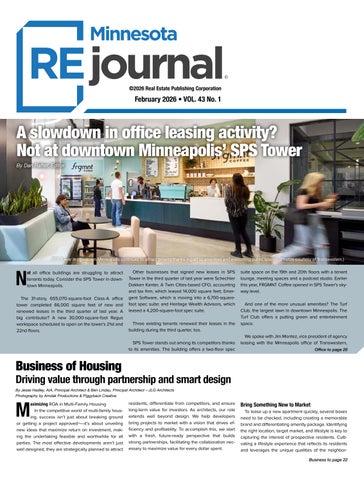
SPS Tower in downtown Minneapolis continues to attract tenants thanks in part to amenities and welcoming public spaces. (Photos courtesy of Transwestern.)

The Vision To See Banking Differently

Discover Bridgewater Bank.

CONTENTS February 2026

1

1

4

A slowdown in office leasing activity?

Not at downtown Minneapolis’ SPS Tower: Not all office buildings are struggling to attract tenants today. Consider the SPS Tower in downtown Minneapolis.

Driving value through partnership and smart design:

In the competitive world of multi-family housing, success isn’t just about breaking ground or getting a project approved¬—it’s about unveiling new ideas that maximize return on investment, making the undertaking feasible and worthwhile for all parties.

Pop-up concession stands and porta-potties? Not any more. Minneapolis’ Wold designing high school athletic facilities that serve as gathering spaces and showcases: Picture a high school football field, softball stadium or track. What do you see? Lonely metal bleachers, a card table covered with candy bars and rows of portable toilets?

8

6

Trends and tips for developers:

As we settle into 2026, the commercial real estate landscape continues to evolve, and many developers I talk to are asking the same questions: Where is the CRE market heading next? Are conditions finally stabilizing? And is 2026 shaping up to be a

10

NAI Legacy launches The Retirement REIT:

NAI Legacy announced the official launch of Legacy Property Trust, also known as The Retirement REIT, a purpose-built real estate investment vehicle designed to support legacy property owners as they reposition their concentrated real estate holdings for the next generation.

The suburban vs. urban divide widens in Twin Cities office sector:

Not all office assets are performing equally in the Minneapolis-St. Paul market, with office leasing and investment sales stronger in the Twin Cities suburbs while this activity remains muted in the downtown areas of Minneapolis-St. Paul.

12

The Future of Hospitality and Entertainment is on the Ascent. Buckle up! :

The recent International Association of Amusement Parks and Attractions Expo marked the five-year anniversary of the Covid-19 shutdown – which had a significant impact on the themed entertainment industry. However, there are numerous signs the industry is well on its way to recovery and beyond.

President | Publisher Jeff Johnson jeff.johnson@rejournals.com

Managing Editor Dan Rafter drafter@rejournals.com

Senior Vice President Jay Kodytek jay.kodytek@rejournals.com

Chief Financial Officer Todd Phillips todd.phillips@rejournals.com

Art Director | Graphic Designer Alan Davis alan.davis@rejournals.com

Senior Graphic Designer Jordan Jensen jordan.jensen@rejournals.com

Managing Director

National Events & Marketing

Kaitlyn LaCroix kaitlyn.lacroix@rejournals.com

7767 Elm Creek Boulevard, Suite 210 Maple Grove, MN 55369

Pop-up concession stands and portapotties? Not anymore. Minneapolis’ Wold designing high school athletic facilities that serve as gathering spaces and showcases

Picture a high school football field, softball stadium or track. What do you see? Lonely metal bleachers, a card table covered with candy bars and rows of portable toilets?

That might have been true at one time, but a growing number of high schools are rethinking athletic facilities as more than fields and bleachers. They’re turning them instead into community gateways that focus on safety and accessibility while offering modern amenities.

Just consider much of the work that Minneapolis-based Wold Architects and Engineers has done on high school athletic facilities, including a recent job performed for Richmond-Burton Community High School District #157 in . Richmond-Burton Community High School District #157 in Richmond, Illinois, recently unveiled a new entrance for their outdoor athletic stadium. Designed by Wold Architects and Engineers, the project adds clear and secure entry points, larger restrooms, improved concessions and a new press box to the facility.

Midwest Real Estate News spoke with Alison Andrews, education practice leader with Wold, about the new expectations high school officials have when ordering upgrades to their school athletic facilities.

Here is some of what she had to say.

Why are we seeing so many school districts investing in their athletic facilities today?

Alison Andrews: Richmond-Burton is one of those communities that is still so engaged with the whole Friday Night Lights atmosphere of high school sports. The community shows up for basketball or football games. During football season, if there’s a home game, everyone in town is there. This is not a new trend. There are always those communities with that culture. That is one of the drivers leading to school districts transforming their athletic facilities so that they make more of a statement about what the community is all about.

How much work needed to be done to the RichmondBurton athletic facility to transform it?

Andrews: They had a traditional outdoor athletic facility. It could’ve been built by someone in the community. It had an old restroom that hardly worked. The pipes would freeze in the winter. They also didn’t have a good space to sell concessions or merchandise. They were carting out a pop-up tent instead.

We changed that. We designed a new entrance to the stadium that acts as a gathering point for the high school. We also added new restrooms and a concession space. We transformed that space and made it more of a central hub for the building.

The newly opened Richmond-Burton athletic stadium boasts new restrooms, a press box, concession stand and entry plaza. (Photos by Wold Architects and Engineers.)

1,000Attendees in2025

3:30PM - 5:00PM COCKTAIL HOUR 5:00PM - 7:30PM DINNER & AWARDS PROGRAM

2026 CRE Outlook: Trends and Tips for Developers

As we settle into 2026, the commercial real estate landscape continues to evolve, and many developers I talk to are asking the same questions: Where is the CRE market heading next? Are conditions finally stabilizing? And is 2026 shaping up to be a better year to move projects forward?

While the year begins with cautious optimism, recent trends suggest a reasonably stable and an opportunity-rich environment for developers and investors alike. Let’s take a look at what we’re seeing and discuss tips for success in 2026:

Trends Worth Talking About

1. A Softer Rate Environment Is Opening Doors

After prolonged inversion, the yield curve has finally normalized, with the 2–10 Treasury spread sitting around +50 basis points. The 10-year Treasury is holding near 4.1%, and the effective Fed Funds Rate is now around 3.75%, following the Federal Reserve’s recent rate cut.

That may sound like a small shift, but for developers, it’s meaningful. A softer rate environment is leading to:

• Better access to both equity and debt

• Some loosening of underwriting standards at community banks

• Slightly lower equity requirements and stronger loan proceeds

In other words, more projects are starting to pencil again.

2. Financing Momentum Is Real, and Creativity is Driving It

We saw CRE lending pick up in Q1 2025 and loan demand continue into 2026 with the CBRE Lending Momentum Index up 90% year-over-year. Local banks, including Bridgewater, are seeing more activity, especially in the multifamily and industrial sectors.

Developers are also using creative capital stacks, blending senior loans, mezzanine debt, and preferred equity, to navigate today’s underwriting environment.

Overall, the Bridgewater team and I have seen a noticeable uptick in financing requests and our new loan pipeline, driven both by loan maturities from 2020–2021 financings and renewed optimism around a continuing “soft landing” for the economy. Developer confidence steadily increased throughout the latter part of 2025. The bottom line is that more projects pencil and are financable.

3. The Urban-to-Suburban Shift Isn’t Slowing Down

When it comes to multifamily, development continues to migrate outward. Suburban markets (think Eden Prairie, Bloomington West, and other high-growth pockets) are seeing stronger rent growth and absorption rates than many urban cores.

According to CoStar data, prior to the pandemic, roughly 40–45% of new multifamily supply across the seven-county metro was being delivered in Minneapolis and St. Paul. From 2023 through 2025, that share dropped closer to 30%, signaling a meaningful shift in where new development is taking place.

Why? A combination of factors:

Access to Modern Living

Jon Tollefson (Photo courtesy of Bridgewater Bank.) Trends to page 16

NAI Legacy launches The Retirement REIT

NAI Legacy -- with offices in Minneapolis, Chicago and Scottsdale, Arizona -- on Feb. 3 announced the official launch of Legacy Property Trust also known as The Retirement REIT, a purpose-built real estate investment vehicle designed to support legacy property owners as they reposition their concentrated real estate holdings for the next generation.

Many of these owners hold illiquid, diversified, low-basis assets within partnership and entity structures that don’t provide flexible estate and succession planning. The Retirement REIT provides a tax-efficient platform for individuals and families to transition their holdings into an estate-driven ownership structure.

At its core, The Retirement REIT is structured around a §721 UPREIT consolidation strategy, similar to how the technique was deployed by REITs in the early 1990s, which is when the UPREIT structure was first introduced to the industry.

“In the early 90’s we used the UPREIT structure to consolidate like-minded real estate owners and operators and built several successful public and private REITs,” said Duane Lund, the Chairman of the Board and visionary behind The Retirement REIT. “Today most REIT structures are equity- raising vehicles,” added Lund, “which creates an opportunity to re-introduce to the market a platform much like the 90s, when owners contributed their legacy holdings directly to the UPREIT.”

“Why sell when you can contribute?” added Lund. “We built The Retirement REIT to give owners a way to simplify their holdings without forcing a sale of the assets. In its simplest form, our message is bricks to shares, shares to heirs.”

Another unique feature of The Retirement REIT is its people-centric versus property-centric focus. Given that most REITs focus on one unique product type, owners with diversified real estate holdings don’t have a one-stop REIT solution in the marketplace today.

The “People’s REIT” allows owners to contribute their holdings directly into one of The Retirement REIT’s unique operating partnerships in exchange for partnership units, enabling a tax-deferred transition into a diversified, professionally managed portfolio. The structure simplifies ownership today, with flexibility for tomorrow, helping families move from complexity to clarity.

BUILDINGS ARE COOL

We should know. We design the behind-the-walls systems that bring them to life.

BUILDINGS ARE COOL

. We should know. We design the behind-the-walls systems that bring them to life.
.
Photo courtesy of iStock.

Unlock

Discover the difference between a development and a true community. With more than a century of experience and 110+ communities, Ebenezer Management Services is a trusted leader in senior living management, development, and consulting. We partner with organizations at every stage to ensure communities and the people who call them home thrive.

As the senior housing division of Fairview Health Services, we bring integrated healthcare expertise, strong professional partnerships, and a proven track record. Our mission-driven staff foster connection, engagement, and belonging, transforming buildings into vibrant communities. From planning to daily operations and ongoing maintenance, we deliver thoughtful guidance and innovative solutions that support lasting success.

From concept to care, we deliver.

“ Because they have such a strong reputation, we don’t have to worry about the care side of things. Ebenezer has that tightened up.”
—Development Partner/Owner

The suburban vs. urban divide widens in Twin Cities office sector: New report shows demand rising in suburbs, stagnant in downtown Minneapolis-St. Paul

Not all office assets are performing equally in the Minneapolis-St. Paul market. Marcus & Millichap in its latest research says that office leasing and investment sales are stronger in the Twin Cities suburbs, while this activity remains muted in the downtown areas of Minneapolis-St. Paul.

In its 2026 Office Investment Forecast, Marcus & Millichap said that the Twin Cities’ suburban office markets are entering this year with more momentum, with office vacancy rates outside core urban areas falling below 12% for the first time since early 2023.

As builders we are driven by a desire to make a positive difference in the communities where we work, live and play. We do this by investing in our employees’ development and growth, and by nurturing solid relationships with our clients, partners and each other.

In fact, the office vacancy rates in many suburban Twin Cities markets rank among the lowest in the United States as 2026 begins.
Image by StartupStockPhotos from Pixabay.
Suburban

The Future of Hospitality and Entertainment is on the Ascent. Buckle up!

The recent International Association of Amusement Parks and Attractions (IAAPA) Expo marked the fiveyear anniversary of the Covid-19 shutdown – which had a significant impact on the themed entertainment industry. However, there are numerous signs the industry is well on its way to recovery and beyond, even surpassing the attendance numbers and revenue of 2019 – the highest year on record.

Entertainment giants like Universal and Disney have announced new attractions as well as expansions of existing parks, while Mattel is set to open its first ever themed adventure park in Glendale, Ariz., as part of the 60-acre VAI Resort complex, for which Baker Barrios is the architect of record. Also, notable is that this year’s IAAPA Expo had the highest number of registrants ever, highlighting the interest in and optimism for the industry.

My colleagues at Baker Barrios and I were among the more than 40,000 registered attendees at the IAAPA conference, and here are four key take-aways for those invested in hospitality real estate: 1.) All in on AI.

From shortening guest wait times to streamlining operations, AI and similar technologies are creating both cost savings as well as new revenue opportunities in the themed entertainment industry. Predictive modeling can better anticipate where to increase or reduce staffing, more accurately inform guests of wait times, forecast what attractions will drive attendance and plan ahead for maintenance to reduce downtime.

Similar technology is being used to continually update and enhance various attractions and character interactions, offering a unique guest experience that can be highly personalized to encourage repeat visits.

From a design standpoint, it’s imperative that this tech is integrated from the onset of planning – whether that’s a brand new built or updating an existing park. The data supplied by this technology also highlights the need for flexible space as part of the design, to allow for the ever-evolving guest experience.

2.) Doing more with less.

Not every theme park has hundreds of acres to build on or adjacent land for expansion potential, so theme park design is focusing on ways to maintain an engaging guest experience within a smaller footprint. Engineering advancements are allowing for even taller, yet more compact rides that focus on speed and abrupt movements – which maintain the thrill without requiring as much space. AR and VR have also taken hold in themed entertainment, and will be increasingly utilized to offer continually evolving, immersive guest experiences without major space requirements.

Another important piece of designing a theme park within a limited footprint is the master plan of the space. Baker Barrios taps into data points and behavior modeling when creating a master plan, regardless of product type, to ensure efficient use of space and pathways that encourage organic pedestrian traffic flow. That’s especially important in places where there will sometimes be a large volume of people, like at a theme park. The design also needs to make sense from a wayfinding standpoint, to reduce crowding and bottlenecks, and provide a safe environment.

3.) Accessibility will equal attendance.

According to the Southeast ADA Center, disabled Americans and their families spend around $50 billion on travel and tourism annually, making them a significant target market for those in entertainment. Creating inclusionary spaces is more than a legal requirement – it’s smart economics.

Although all theme parks have always been required to comply with ADA regulations, there is certainly a difference between complying with and designing a truly accessible and enjoyable guest experience. Beyond physical accessibility, the trend is moving toward accommodations for a broader range of physical and mental disabilities. These can include sensory spaces and light- and noise-reduction options, expanded dietary offerings and areas within a park especially

created for guests and their families to have a safe and restorative place to rest while enjoying their visit.

As designers, that means considering every aspect of a guests visit – not just the rides and attractions, dining, etc. – but also how they spend their downtime, too.

4.) Global inspiration, regional locations.

Historically, theme parks have been concentrated in Florida and California, followed by Japan and China. However, there is a trend toward expanding into regional areas with an established hospitality market, such as Glendale, Ariz., noted above as the home of Mattel’s first theme park, as well as places like metro Nashville, Tenn., where former execs with Pixar and Legoland are planning a literary-focused children’s theme park.

Driving this regional trend is data showing that not only are Americans preferring road trips over air travel, but there is also a significant rise in what is being dubbed “microtravel,” which means a get-away of less than a week. This MSN News article has the stats. So, for companies looking to invest in themed entertainment facilities, these more inland/centralized locations are attractive.

While conversations around commercial real estate rarely include theme parks, there is no denying the economic impact of this business. Generating billions of dollars in the U.S. annually, this is a growth market with excellent potential to owners and investors alike, and these emerging trends will continue to strengthen this hospitality sector.

Mike Frohnappel is Director of Hospitality and Entertainment Design with Baker Barrios Architects.

Image by Mac Wheeler from Pixabay.
Mike Frohnappel (Photo courtesy of Baker Barrios Architects.)

May 7, 2026

1,000Attendees in2025

3:30PM - 5:00PM COCKTAIL HOUR 5:00PM - 7:30PM DINNER & AWARDS PROGRAM

We also wanted to look at what is unique to Richmond-Burton. What makes this school different? At Richmond-Burton, they have a group of people who without fail show up, bring their own chairs and sit on a berm to watch the game. They don’t sit in the bleachers. The school didn’t want to lose that. That is part of the school culture.

When working through the design, we had to develop around a significant grade. We had to manage this change of elevation anyway, so we decided to place the stadium amenities on this raised platform area. We created this plaza area. If people bring their own chairs, they can sit there and watch the game from there instead of going into the bleachers. That is something unique to this stadium.

The new entrance to the stadium was designed to serve as a gathering place and plaza before the games. How important is that central-plaza space becoming to high school districts?

Andrews: It is something we are seeing more districts want. We are working with another school district, the Kaneland School District in Kane County, Illinois. They are enhancing their outdoor stadium experience.

The work will include a new turf field, the outbuildings, concessions, restrooms and a new press box.

Part of our conversation with Kaneland focused on the sequencing. How are we going to bring the spectators in and out of the stadium? Where does everyone go after the game, including the parents and friends who want to welcome the team as the team members come out after the game? That gathering space has become important. School districts don’t want people hanging out in the parking lots. They want an intentional space designed for people who want to hang out at the stadium.

These spots can also be used during the school day. Districts can, say, bring the entire freshman class together in these spaces if they wanted.

I know no one likes to talk about restrooms, but adding modern bathroom facilities is key, too, right?

Andrews: It does feel like having cleaner, modern bathrooms has become an expectation. When a high school approves a new stadium, turf field or running track, the decisionmakers don’t want a line of porta-potties. They don’t want a line that is an hour long because there aren’t enough bathroom facilities.

There has been a shift in what the expectations are for parents or grandparents who are watching a meet. It’s not just about the high school kids, but about the spectators, too.

Are permanent concession facilities also something that you are seeing?

Andrews: It is. They might sell the same items –nachos, pizza, candies and sodas – but they want a permanent facility that offers protection from the elements. We also see a lot of schools running grilling stations, a place where you can get a hot dog, brat or burger. That is another piece of the puzzle. If everyone is out there on that Friday night, that becomes dinner for a lot of fans. So you want a facility that makes the people running those stations comfortable.

These games are usually run by volunteers, the people collecting the tickets, the parents running the concession stand and the people manning the grill. A lot of what we design are facilities and spaces designed to protect them. In Richmond-Burton, that was a big catalyst for the project. They were selling tickets on the side of the road. Once people parked, it was a free-for-all for them to get into the stadium. The guy who was grilling might be standing in the rain. Schools now want a built space where you are selling tickets and selling concessions. They want a nice booth for the volunteers running these spaces.

The Richmond-Burton athletic facility is now open. What has the feedback been?

Andrews: The school principal recently gave an update to the board of education. He mentioned all the compliments they’ve gotten about the new stadium, all the excitement in the community about the new space. The students, athletes and band members are all excited about it. The parents appreciate the attention to detail.

We are now in the design phase with the Kaneland School District. We took officials with the district on a field trip to some of the stadiums that we designed. Richmond-Burton was one of the ones we took them to. We like to show them what is possible.

The newly opened Richmond-Burton athletic stadium boasts new restrooms, a press box, concession stand and entry plaza. (Photos by Wold Architects and Engineers.)

• Concerns around taxes and rent control in urban districts

• Affordability and perceived safety in the suburbs

• Lingering work-from-home flexibility influencing where people want to live

This migration has staying power, and developers who align projects accordingly are seeing results.

4. Population Growth: Slower, but Still a Key Driver

Since 2020, the Twin Cities metro has added roughly 85,000 residents, a 2.7% growth rate that’s slower than the previous decade. But the real story is in the suburbs: Dayton, Corcoran, Lake Elmo, and other outer-ring cities continue to rank among the fastest-growing communities in Minnesota.

This expansion is driving sustained demand for both housing and commercial development. We’re seeing this firsthand, and it’s one reason we’re excited to be opening a new branch in Lake Elmo in early 2026.

5. Affordable Housing is a Hot Ticket

Another key area of opportunity is affordable housing. Rising homeownership costs and increasing market rents have created an urgent and seemingly insatiable need for more affordable housing. Matter of fact, we’ve seen demand continuing to outpace supply for many years.

At Bridgewater, we’re uniquely passionate about affordable housing because it’s a chance to serve our borrowers while addressing a societal need and making a lasting impact locally and nationally. As leaders in this space, we equip developers with the deep expertise, responsive support, and flexible lending options they need to succeed, from tax credit equity bridge loans to construction and permanent lending.

Tips for Developers Planning Ahead

1. Research Your Market Thoroughly

First, it’s critical to study your submarket closely: new supply, repositioned assets, demographic shifts, and absorption trends. This is where good projects rise or fall.

2. Stay Ahead of Your Maturities

Many loans originated in 2020–2021 are coming due. We recommend starting refinance conversations early and considering laddering maturities to balance rate and term risk.

Bridge loans may also be worth a look if you need more runway. And don’t overlook interest rate swaps! They can create attractive fixed-rate options, especially for long-term or legacy assets.

3. Structure with Intention

Match financing to your project’s lifecycle:

• Bridge debt may support lease-up phases.

• Flexible terms may strengthen disposition strategies.

• Recourse structure and estate planning should remain part of the conversation.

4. Partner with Local Experts

A national lender can quote terms, but a local bank can help you make decisions. Bridgewater’s relationship-driven approach, and our deep Twin Cities CRE experience, allows us to move quickly, navigate complexity, and offer guidance and creative solutions tailored to each project.

As we prepare for 2026, there’s plenty to be optimistic about. With a stabilizing rate environment, strong suburban demand, and active community bank participation, developers who plan thoughtfully and move with intention will be well-positioned in 2026.

If you’re evaluating opportunities or preparing for upcoming maturities, our dedicated team is here to help you think through strategy, structure, and timing. Connect with a local expert>>> https://bridgewaterbankmn.com/inquire

Member FDIC | Equal Housing Lender

Jon Tollefson is managing director with St. Louis Park, Minnesota-based Bridgewater Bank.

`Marcus & Millichap said that leasing demand has been especially strong among office properties built after 2010.

“Suburban office submarkets are demonstrating resilience, with improving fundamentals and rising investment activity helping offset ongoing downtown softness,” said Todd Lindblom, senior managing director and market leader with Marcus & Millichap in Minneapolis.

But in downtown Minneapolis and St. Paul? Leasing demand remains sluggish, Marcus & Millichap reported. According to the company’s forecast, these downtown areas saw vacancy rates that kept rising throughout 2025. This trend, along with expected limited corporate growth, points to another year of waning demand for office space in the Twin Cities’ urban cores, Marcus & Millichap said.

Vacancy rates might not rise too quickly in 2026, though, even in downtown areas. That’s because Marcus & Millichap is forecasting little new office construction throughout the Minneapolis-St. Paul region this year. At the same time, a growing number of developers are converting outdated office space to other

uses. Both of these trends might help limit vacancy increases in downtown St. Paul and Minneapolis.

Marcus & Millichap predicts that the market’s overall office vacancy rate will fall by 30 basis points to 14.5% in 2026. That falling vacancy rate is good news, but 14.5% would still be above the Minneapolis-St. Paul office market’s five-year average.

The forecast report predicts that the average asking rent in the Minneapolis-St. Paul office market will increase by 1.5% in 2026 to $19.85 a square foot. That would put Minneapolis-St. Paul’s rent change among the highest in the Midwest and would also extend a four-year streak of rent gains in this region’s office sector.

Don’t expect much new supply to hit the market, though. Marcus & Millichap predicts that inventory expansion in the Twin Cities market will slow to its lowest level in a decade. The company is predicting only 430,000 square feet of new office construction in the Twin Cities market this year, with the I-494 corridor in Hennepin County accounting for roughly half of all deliveries.

The I-394 corridor is a strong one, too. Marcus & Millichap said that this submarket captured an outsize share of investor activity in 2025. Office asking rents here are among the highest in the Twin Cities market and many of the office properties here offer the high-quality amenities that companies are increasingly seeking. The corridor, then, appears positioned to remain a key target for capital in 2026.

Those investors looking for a smaller office footprint might look at properties in suburban St. Paul, which Marcus & Millichap ranked as the most active submarket for trading last year.

“Improving suburban fundamentals, limited new supply, and steady rent growth are creating a more constructive investment environment for office assets across the metro,” Lindblom said.

Minnesota 22nd Annual

LAND DEVELOPMENT

March 12, 2026

The Club at Golden Valley

Speakers:

Andy Bollig - Roers Companies

Art Plante - JPB Land LLC

Ben Delwiche - Kaas Wilson Architects

Ben Drew - Cushman & Wakefield

Brian Pankratz - CBRE

David Arbit - Minnesota Realtors

David Stradtman - Rachel Development

Deanna Kuennen - City of Farmington

Eddy Wolf - Ryan Companies

Eric Van Oss - City of Rosemount

Greg Kruschke - City of Owatonna

Gregory Frahm-GillesAnoka County Regional Economic Development

Janelle Westrick - Watson-Forsberg Co.

Jon Aune - Lennar

Katya Pilling - Watson-Forsberg Co.

Kevin Campbell - PulteGroup

Leslie McGillivray-Rivas - City of Faribault

Monte Hilleman - Sustainable Investment Group (SIG)

Nancy Hoffman - Chisago County HRA - EDA

Sheri Brezinka - USGBC

Stephanie Griffin - M/I Homes of Minneapolis

Tana Wahtola - Centra Homes

One Partner. Every Stage.

In both established HOAs and new developments under construction, Sharper delivers experience, technology and people-first service that keeps communities running strong now and into the future

Serving Established Communities

With more than 20-years of industry experience, we serve HOAs of every size, type and scope to help the Board and residents enjoy a well-run community

Transparent, Timely & Accurate Financial Management

Proactive Community Communication

Maintenance Coordination & Project Oversight

Technology (resident webportal) That is Secure & Robust

Reliable Response Available 24/7

Your community deserves a partner who understands the importance of structure, transparency, and long-term success

Partnering with Developers & Builders

From the blueprint to the Declarant turnover, Sharper is the trusted partner along the way to establish thriving CICs throughout the Twin Cities We work side-by-side with Developers and Builders to help realize the dream from dirt to established HOA

Budget creation and reserve planning tailored for new HOAs

Governance setup and legal documentation assistance

Homeowner transition planning and welcome materials

Professional guidance from project start to community turnover

A smooth, stress-free handover from builder to board

Sharper takes care of the details so you can focus on building

about the reasons behind the success of SPS Tower. Montez handles leasing for the tower and has seen firsthand just how popular this space has become with tenants. Here is some of what he had to say about the leasing activity at this key Minneapolis property.

Why have you seen such high leasing activity at the SPS Tower?

Jim Montez: It’s a great building. It’s a classic. It was built in the late ‘80s by a developer out of Dallas. If you were building a tower today, you would never to be able to afford to do what they did. It is a fundamentally high-quality building, and that helps to attract tenants. The building also has great ownership.

From there, it’s about building an ecosystem that attracts tenants. This building was originally supposed to be two buildings. The second one was never built. So it has double the amount of parking that the typical building in downtown has.

We also have half of block of green space that we call the Turf Club. We program that with live music at least once a week in the summer. We bring in food trucks. We have a bags tournament. Last year, we had more than 70 teams participate in the bags league. There’s a putting green there and people play bocce ball there. It’s a place to get out of the office and get fresh air.

The building was also recently renovated, too, right?

Montez: There was an interior renovation anchored by the addition of FRGMNT Coffee. Prior to that, there were marble and granite everywhere. It was all hard, shiny surfaces. People just passed through it quickly.

Speakers:

Bali Kumar - PACE Loan Group

Ben Bahr - Emanuelson-Podas, Inc.

Chris Schaefer - Nalco Water (Ecolab)

Christopher Rheineck - Cordia

David Scott - Sunrise Banks

Donna Becker - JLL

Griffin Dooling - Blue Horizon Energy

Ilya Krasnoyarov - Mortenson Properties, Inc.

John (Jack) Miller - CenterPoint Energy

Jonas Bates - Xcel Energy

Kevin White - Enhanced Information Solutions, Inc.

Matthew Strebe - Sustainable Energy Savings, Inc.

Mike Menzel - Sagiliti

Monte Hilleman - Sustainable Investment Group (SIG)

Russ Landry - Center for Energy and Environment

Stephen Todd - Energy Guy

Johnson

With the renovation, we created zones anchored by food and beverage. There are now places for people to hang out and sit, places where employees can get out of the office. The first floor is curated like a fine hotel lobby.
SPS Tower in downtown Minneapolis continues to attract tenants thanks in part to amenities and welcoming public spaces. (Photos courtesy of Transwestern.)

This success, though, would not have happened without the ownership, Sumitomo Corporation of Americas, which purchased the tower in 2019. At that time, we were studying all the ways to make an office tower successful. But nobody was prepared for a pandemic. When COVID hit, we decided to wait and see what happened. Two-and-a-half to three years ago, we started seeing new patterns. We saw that people wanted places to bring their teams to, that they wanted amenities and private spaces. We incorporated those ideas into our renovation. Those ideas have been a big catalyst for the leasing momentum we are now seeing.

More renovation work is planned for the building.

Montez: Yes, the next phase of the renovation will include an addition to our conference center. We are going to offer a big training area that many buildings don’t have today. We are also going to add more tenant lounge spaces. Employers are trying to get people back to the office. A building that supports those efforts is desirable.

Companies are leasing space in office buildings that are attractive to their employees. In the past, before the renovation, we’d have people looking at the building and they’d tell us it was pretty but that nothing was happening. After the renovation, people tour the building and they see people, activity and energy. They can see their employees enjoying working in this space. That is the environment here.

How big of a role do these amenities play in attracting tenants?

Montez: They do play a big role. It helps that also have world-class management. The tenants are well cared for. The average tenant here stays for 17 years. We don’t give them any reason to leave, which is another part of the success story for this building.

Amenities like the Turf Club are so important. That grassy area creates a campus feel. That’s important for companies that are trying to attract younger workers. This isn’t just a plain office. People can go outside and get fresh air. The Turf Club is a great amenity.

Are you seeing improvements in office leasing activity in the Twin Cities CBD today? And how is ICE activity and the resulting protests impacting the area?

Montez: If you just watch it on the news, it looks like the protests and ICE activity are happening in downtown Minneapolis every day and that they are very disruptive to businesses. That activity, though, has generally been in the neighborhoods outside of downtown. It has not been present much in the CBD. But like every other urban city, we are dealing with the changing work world. We are never going back to seeing everyone work five days a week from the office. It will probably be three to four days a week for most companies. But we are seeing a recovery in the CBD. That is real. You can see it. It’s a welcome sight. There is still work to be done, of course. It is still tough on the retailers and restaurants in the CBD. It’s tough

for them to operate when you only have a reliable customer base three days a week.

But we are seeing more activity in the CBD. We will see more in 2026. We will just keep building the momentum and moving forward.

Are you still seeing a flight to quality when tenants are looking for new office space?

Montez: Absolutely. SPS has had good success. The Wells Fargo Center has had good success. North Loop Green is successful. Those are all high-quality buildings that are amenitized appropriately for what the buildings are. That’s important. Buildings need to be what they are. When you try to force them into something they’re not, it doesn’t work.

CAPITAL MARKETS

hood helps developers fill units and retain residents. To begin this process, we study the competition to then propose design and amenity differentiators that will attract new residents and set you apart in that community.

Examples of this experience-driven differentiation include:

Golf Simulators: An amenity that caters to a wide demographic, offering year-round appeal in the Midwest.

Pickleball Courts: The fastest-growing sport in America, providing both social engagement and all-level fitness opportunities.

Sport Courts: An amenity missing in many neighborhood gyms, now popular with Millennial post-college residents.

Fitness & Wellness Centers: Create convenient and varied ways to exercise for today’s mobile and hybrid work lifestyles to offset the cost of a gym membership.

Lap Pools: Attract goal-setting achievers who want to get ready for next year’s triathlon, at a lower cost than a typical pool.

Therma Culture: An emerging wellness amenity and experience-driven culture gaining traction in northern communities. Hot and cold plunge pools demonstrate support for the well-being of residents by improving muscle recovery time and increasing feel-good endorphins.

Redirecting the focus from a smartphone culture to a more social, pet-friendly, and community-driven culture.

Pet Amenities: Helping residents provide the best life for their furry friends is vital. From woof-top patios to pet spas and dog + residence social spaces, these common spaces create a unique sense of community among residents to improve resident retention.

Outdoor Spaces: Support resident well-being with connections to nature, including relaxing and flexible outdoor spaces that can be programmed with in-demand amenities adaptable to the market.

Selecting the right mix of amenities requires careful consideration of the neighborhood and what that community values in their home. In the case of Block 25 Lofts, a multi-family housing development in Willmar, MN, rooftop patios aren’t as prevalent in this region as they may be in more populous, urban cities such as Minneapolis. The development’s rooftop lounge is now the focal point of the exterior and a prime amenity for residents, offering views of downtown and a vari-

Unique Games:
Riverhouse in Fargo, North Dakota. Image courtesy of Amdak Prodctions

ety of seating and outdoor grill stations. Furthermore, the excitement for this feature has trickled into the community as a whole, opening the door to more development opportunities.

“It’s important to see the neighborhood with fresh eyes, not only what already exists, but what has the potential to exist in that space,” explained JLG Archi-

tects Project Designer, Brian Carlson. “These are the small but mighty details that become dynamic differentiators, sparking community growth and additional development opportunities.” Forward-thinking amenities like these help projects stand out in a crowded market and command premium rents.

As architects, we help lead the collaboration between leadership and management teams to ideate

and design experience-driven amenities specific to location and target market, providing an ultimate differentiator that attracts residents and bolsters multi-family developments. In essence, we’re maximizing leasing and rent values by creating memorable destinations that capture the imagination of future residents in a way that is unique to that community.

Collaborate & Innovate to Lower Cost

Collaboration isn’t just about bringing a shiny new idea to market, but the ability to work with builders, subcontractors, and suppliers in innovative ways to save money while also improving project quality. Having a design team that can proactively lead this process is essential.

Collaborate with Builder on Test Fits: Collaborating with the builder during the initial test fit will help maximize value from the very beginning. When the architect explores the highest and best use of a site, the value can be assessed by a contractor even during the test fit phase of the project. The contractor can advise on the cost for sitework and bring in the trades with the largest scope of work to evaluate structural and mechanical systems at a very early stage in the process. An initial test fit that digs into the site design can derive feedback from the builder to advise on high-cost items such as cut and fill grading, retaining wall layouts, efficiency in stormwater management, and the cost of phasing and staging to help determine when less is more and how to drive project value.

Early collaboration on test fits proved to be successful in the design of Riverhouse in Fargo, ND, a Business to page 26

Speakers:

Callie Ronkowski - JLL

Damaris Hollingsworth - Design by Melo

Deanna Kuennen - City of Farmington

WOMEN IN REAL ESTATE & CONSTRUCTION

Gauri Samant - Fredrikson & Byron, P.A.

Heather Dunn - RSP Architects

Heidi Addo - Michel Commercial Real Estate

Julia Douglass - Fabyanske, Westra, Hart & Thomson, P.A.

Katherine Johnson - Winthrop & Weinstine. P.A.

Katie Hopp - Transwestern

Katrina Cadalbert - Sherman Associates

Leah Peterson - Cushman & Wakefield

Leslie McGillivray-Rivas - City of Faribault

Marlee Benson - Oppidan

Mythili Thiagarajan - Auromira Architects LLC

Nancy Hoffman - Chisago County HRA - EDA

Patricia Weller - Monroe Moxness Berg

Susan Farr - Presbyterian Homes

For More Information:

Jeff Johnson jeff.johnson@rejournals.com | 612-819-0385

Jay Kodytek jay.kodytek@rejournals.com | 612-940-3713

The golf simulator at Riverhouse. Image courtesy of Amdak Productions.

May 7, 2026

1,000Attendees in2025

3:30PM - 5:00PM COCKTAIL HOUR 5:00PM - 7:30PM DINNER & AWARDS PROGRAM

multi-family development built to support active lifestyles with connection to the Red River and local trails. With outside factors affecting the initial allocation of the budget, a pivot was necessary to re-align unit density and keep things on track with the developer’s financial modeling. This prompted a value engineering exercise in which our team considered various unit density and amenity mix options.

Through collaboration and strategic thinking, the team identified levers that could be pulled for more effective budget alignment, which opened the door for additional amenities to be added—including a heated indoor pet run, tenant storage areas, upgraded appliances, EV charging stations, and a golf simulator. Thanks to strategic moves made early in the process, these enhancements maximize the development’s value and enrich the living experience for residents.

Focus on High-Cost Items with Subcontractors: When the architect and builder collaborate with subcontractors on high-contract value items at an earlier stage in the process, it allows more time for exploration and coordination to develop creative solutions.

In the early stages of design for Sand Creek Flats in Jordan, MN, JLG worked with the contractor to leverage material trends that would streamline the production process. Tapping into construction data, the team leveraged the lower cost of precast foundational walls as opposed to other methods that require more intense labor, such as cast-in-place or masonry foundations. Strategic coordination of structural systems kept construction on track with timely arrival of precast materials on site, resulting in a project delivered on time and on budget without surprises.

Collaborate with Trades to Innovate

& Find Effi-

ciencies: The building exterior is another high-cost contract that can vary greatly based on the design, where the design and construction team can work with the trades to find strategic design efficiencies to minimize waste, standardize layouts, and maximize the yield count.

When the entire team is along for the journey from the get-go, it minimizes surprises as design development wraps up and the construction phase begins.

JLG and the MEP team leveraged this philosophy in the design of The Landing at 1001 NP, a mixed-use multi-family development in the heart of downtown Fargo, ND. Working closely with contractors, we found efficiencies in wood frame construction to minimize waste of construction materials. Furthermore, a modular approach to construction elements such as premade metal paneling and cement boards optimized the waste yield percentage of construction materials. The result is a highly efficient building that was delivered on schedule with minimal waste, providing ultimate value on investment.

Collaborate to Maximize Pre-Leasing

Another key way to drive value for multi-family developments is a well-executed marketing strategy, put in place long before the building is complete. The architect is in a unique position to help optimize the transition of projects to the Marketing and Pre-Leasing Teams, minimizing the time to a fully leased building

and project stabilization for a higher return on investment.

Market Branding & Naming: By collaborating with an interior designer and marketing team to brand and name the project, the architect can fully communicate the design ideas behind the experience-driven differentiation process. The marketing lead can then build on and position the development at the most optimal point in the marketplace.

Integrated Interior Design with FF&E Selection & Procurement Support: By using an architect with integrated interior design and FF&E selection with procurement support, developers can compare FF&E systems at a high level to find the best value while staying true to the brand, from big-picture placemaking to market-focused interiors – all while spending less time managing the overall process.

The Paxon, a more recent project, implements a fully integrated design strategy to deliver a cohesive and elevated residential experience. “Beyond just selecting furniture, we curated accessories and finishing touches throughout the shared spaces to create a welcoming and refined atmosphere,” explained Karen Mutschelknaus, NCIDQ, IIDA, LEED AP, Interior Design Lead at JLG Architects.

The design emphasizes warmth, tranquility, and sophistication through a serene palette of whites, warm golds, natural browns, and wood details. “Every element was selected to resonate with a diverse, international clientele while reflecting the essence of the city,” she added. “The result is a beautifully branded environment that feels both luxurious and personal, demonstrating the power of design integration in creating spaces that are as financially efficient as they are emotionally engaging.”

Pre-lease Web Content: From 3D unit plans to virtual walkthroughs of units and amenity spaces, architects can provide the additional content needed to market the project with web and online sales tools. With the architect already modeling and often rendering the units, amenities, and building exterior, they can produce these additional assets at minimal effort and cost, compared to other marketing sources.

Pre-lease Center and Exhibits: For significant projects with adjacent commercial space, the architect can

The Paxon in Minneapolis. Image courtesy of Piggyback Creative.
Velo in Minneapolis. Image courtesy of Piggyback Creative.

assist with the design of sales centers and collaborate with sales teams to select exhibits or leasing spaces that are on brand with the project for maximum sales impact.

Conscientious Schedule Decisions

Ensure Speed to Market: Strategic project schedule decisions will help get properties on the market at the right time, taking into consideration the construction start date in relation to the occupancy date. Oftentimes, fast-tracking construction schedules in multi-family housing development is crucial for controlling and reducing construction loan costs. Because of the fluctuating nature of interest rates, less time building reduces interest accrued on construction loans.

Completing construction on time or ahead of schedule minimizes these interest expenses and avoids costly loan extension fees or penalties. Moreover, faster completion allows developers to begin leasing units sooner, generating income and reaching stabilization more quickly. For value-based scheduling, prioritize project completion around optimal leasing season to ensure speed to market that helps developers quickly realize value from their investment. By accelerating project timelines, developers not only improve financial efficiency but also enhance their capacity to take on future projects through better cash flow and capital utilization.

These efforts not only accelerate lease-up, they instill confidence with lenders by demonstrating strong pre-leasing numbers, helping secure financing before construction begins.

Building Success

The role of architects extends beyond design—as partners in bringing innovative ideas to market and fostering strong collaborations that maximize value. In the dynamic landscape of multi-family housing, architects can help deliver projects that not only meet but exceed expectations for return on investment. By strategically planning developments to attract residents

and differentiate from competitors, working together ensures long-term value for investors. Through early collaboration, strategic marketing, and thoughtful scheduling, the right architect can enhance financial efficiency and create vibrant communities that stand out in the marketplace. Build more than housing projects—build lasting legacies of success for developers and communities.

Block 25 Lofts in Willmar, Minnesota. Photo courtesy of Piggyback Creative.

Turn static files into dynamic content formats.

Create a flipbook