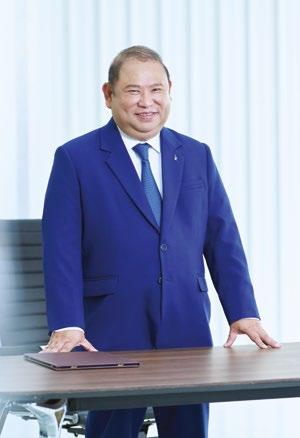
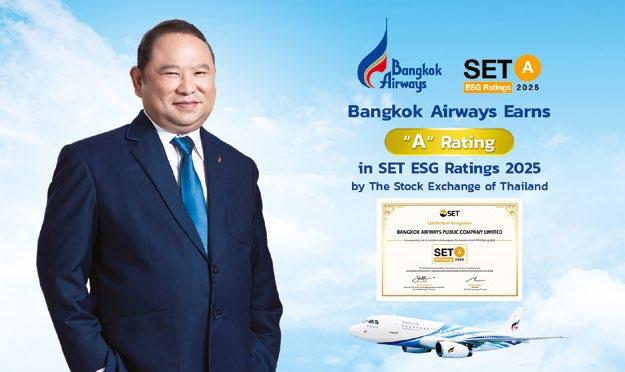
/ President Bangkok Airways Public Company Limited
Dear Passengers,
Welcome aboard Bangkok Airways.
As the Songkran holiday approaches, people are busy planning getaways with family and loved ones – making this the perfect time to explore Thailand’s many charming and beautiful destinations.
From the pristine seas of Koh Samui and Trat to the serene World Heritage site of Sukhothai, or the alluring blend of culture and nature in Chiang Mai, countless meaningful experiences are waiting to be discovered.
Meanwhile, fitness enthusiasts can look forward to Bangkok Airways’ signature running festivals, the Bangkok Airways Boutique Series 2026, taking place from May to September across four destinations: the Trat Half Marathon (May 23-24), Samui Half Marathon (June 20-21), Sukhothai Half Marathon (August 22-23), and Chiang Mai Half Marathon (September 26-27). Young runners can join the Kids Series, held on the same dates. For details and registration updates, visit Facebook: bangkokair.run
Sustainability remains at the heart of all Bangkok Airways’ operations, under the new vision – “Leading Aviation with Responsibility, Delivering Services with Sustainability”. The airline continues to place society, the environment, stakeholders and, above all, passenger safety at the core of its business.
Planned initiatives for 2026 include upgrading Samui Airport to boost passenger and flight capacity, partnering with the Commerce Ministry’s Department of Internal Trade to support Thai farmers and promote Thai ingredients globally through MasterChef Thailand Season 7 , and improving internal systems to enhance transparency, stability and long-term sustainability.
To keep up with Bangkok Airways news, promotions and activities, stay connected via Facebook: FlyBangkokAir or at bangkokair.com
On behalf of Bangkok Airways, I wish you a comfortable journey and a memorable experience with Asia’s Boutique Airline, a full-service aviation leader dedicated to caring for every passenger.
David Hammond Tel: +44(0) 20 8467 8884 david@majormedia.co.uk
USA THE MULTIMEDIA INC.
Fernando Mariano Tel: +14 0790 3500 fmar@multimediausa.com
“FAH THAI” is the official in-flight magazine of Bangkok Airways Public Company Limited and is edited and published by MPMI Group Co., Ltd. All articles and photographs published herein are created by the authors and photographers at their own discretion and do not necessarily represent the views of the airline. Bangkok Airways holds no responsibility or liability arising out of the publication of such articles and photographs.
All information correct at press time. All rights reserved. No part of this magazine may be reproduced, stored in a retrieval system or transmitted in any form or by any means without the prior written permission of Bangkok Airways Public Company Limited and MPMI Group Co., Ltd.
OVERTURES
12 SAVE THE DATES
Stay in the know about inspiring events, exhibitions, and festivals across Bangkok Airways destinations –from captivating art exhibitions to cultural celebrations.
14 FINITE PARADISE
Surrounded by sea, island life depends on scarce rainwater. Mindful travellers are conserving every drop to preserve communities, culture, and futures.
16 COCO SCOOPS
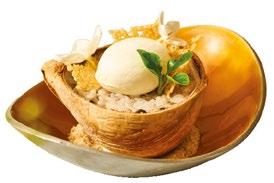
Sold from roadside carts, ‘i-tim’ pairs coconut richness with familiar toppings, easing the heat one scoop at a time.
18 HIGH CULTURE
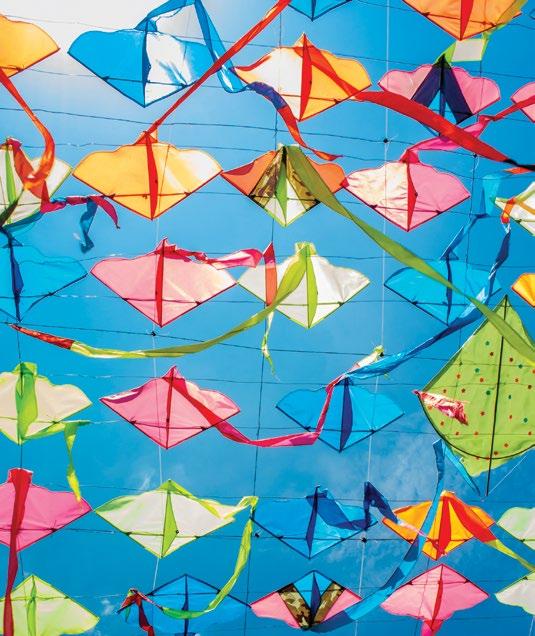
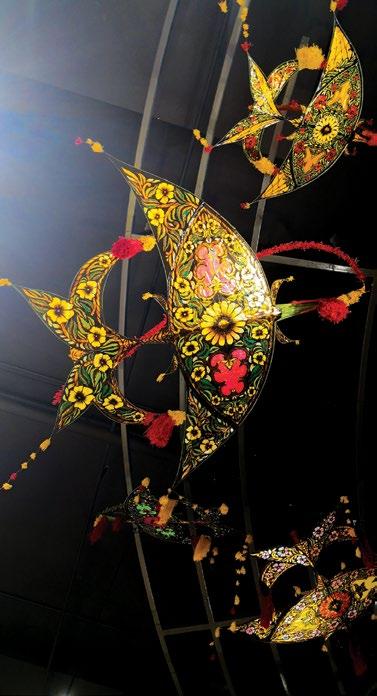
Traditional Thai kites soar each summer as craftsmanship, playfulness and wind send centuries of culture dancing over the fields.
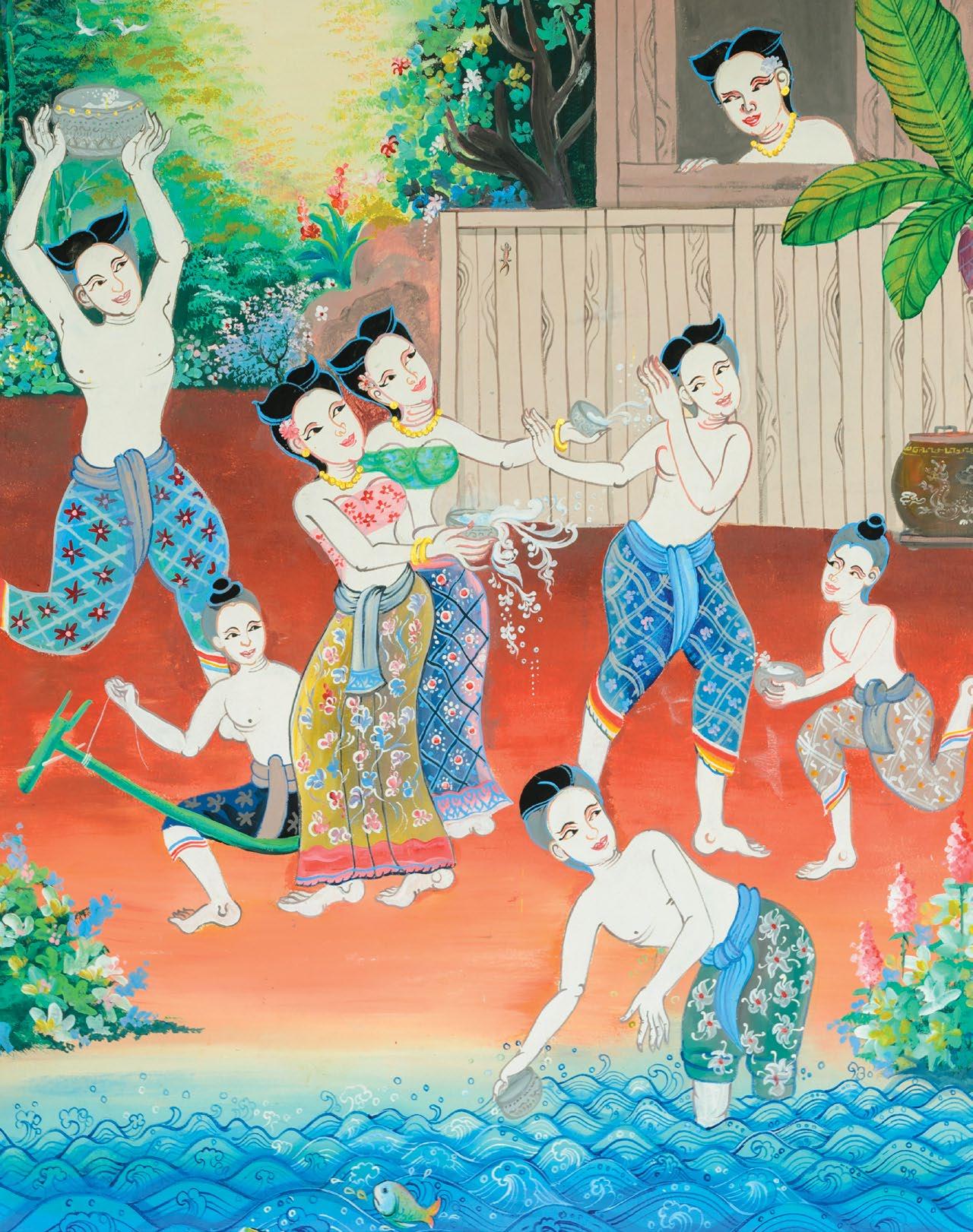
22 SONGKRAN SPIRIT
Soak up the vibes of Thai New Year as ancient beliefs meet modern playfulness in a joyful celebration of renewal.
FEATURES HAPPENINGS CORPORATE
26 WHEN THE GOING GETS HOT…
Discover Thailand’s secret recipes for a sensational summer – from food and colours to clothing and cool trips.
40 UNESCO CITIES
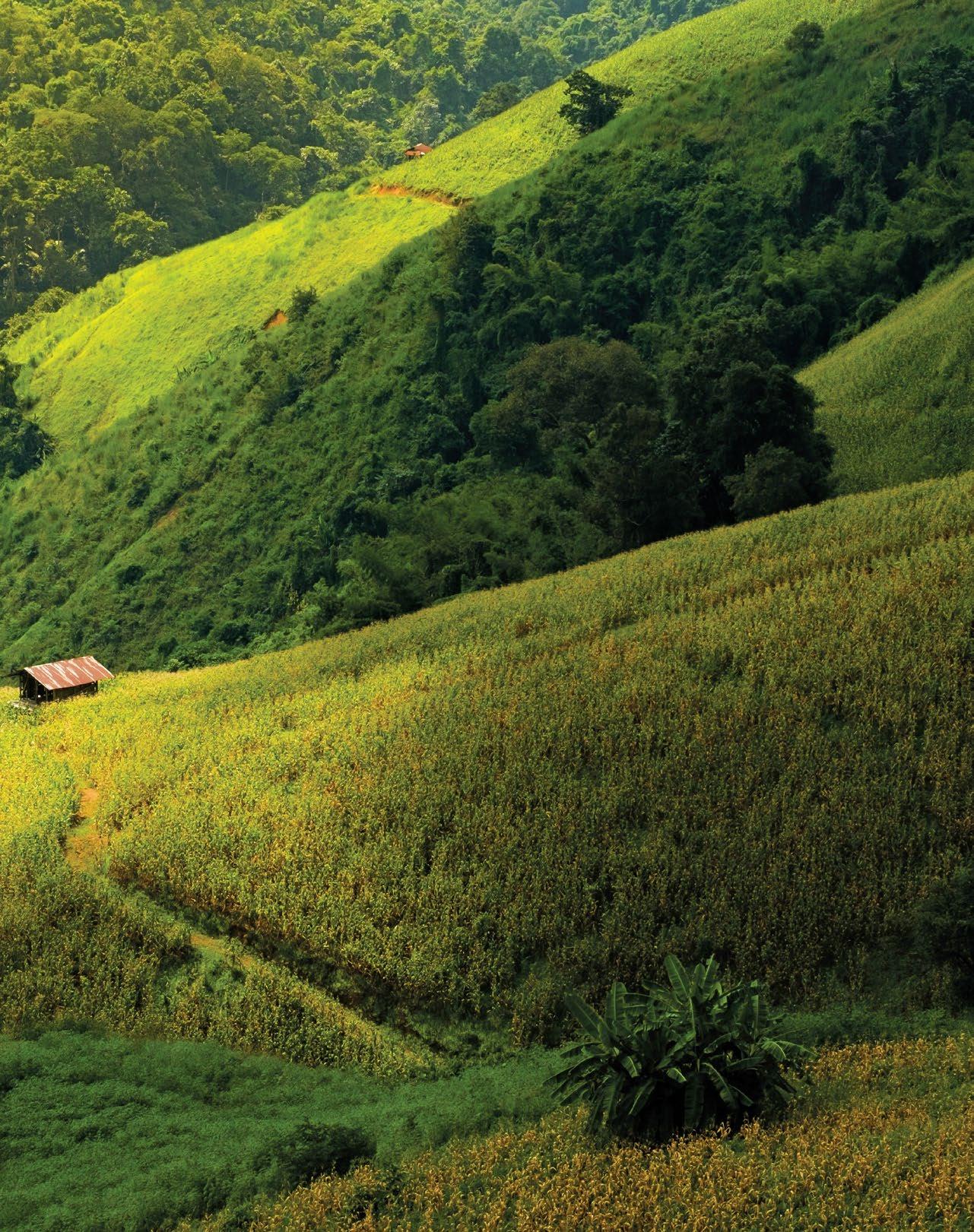
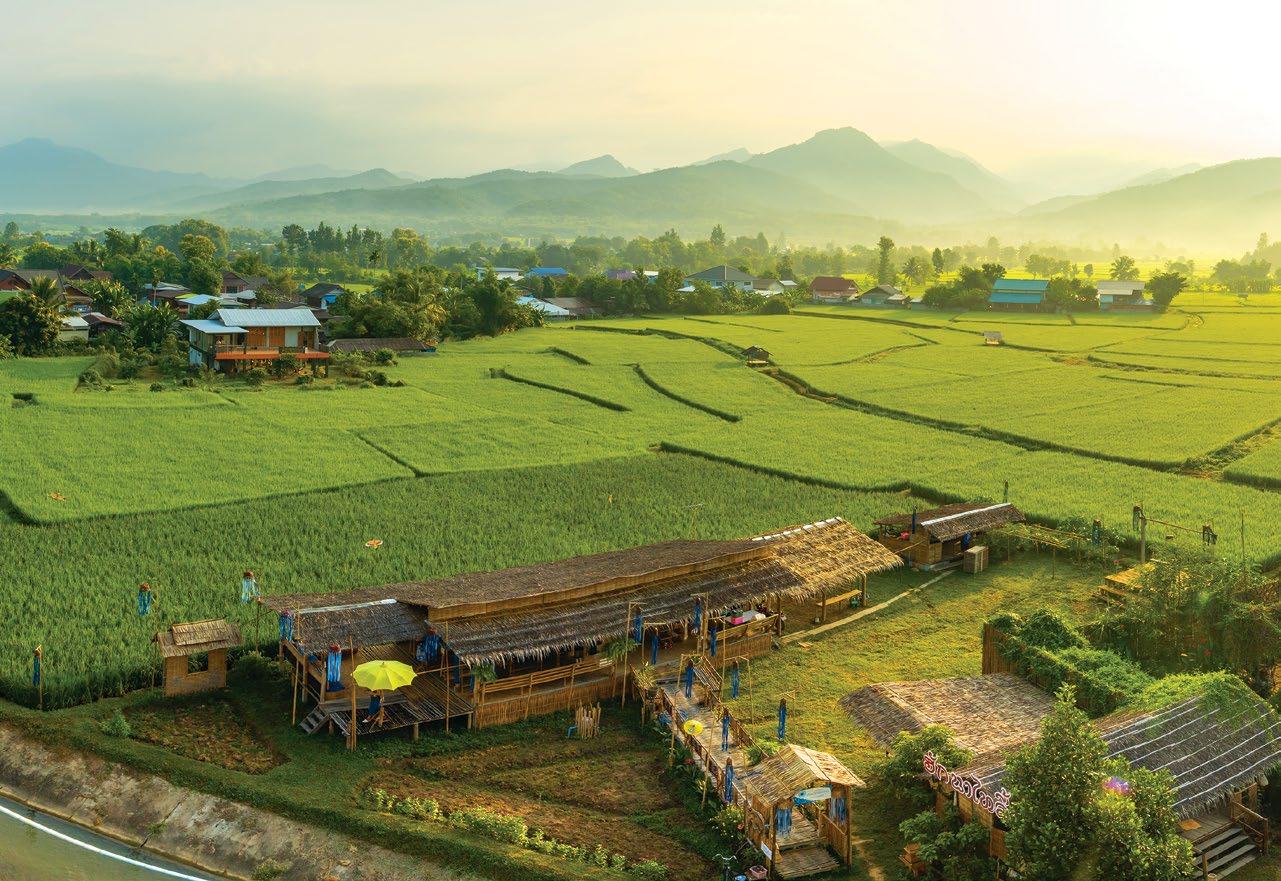
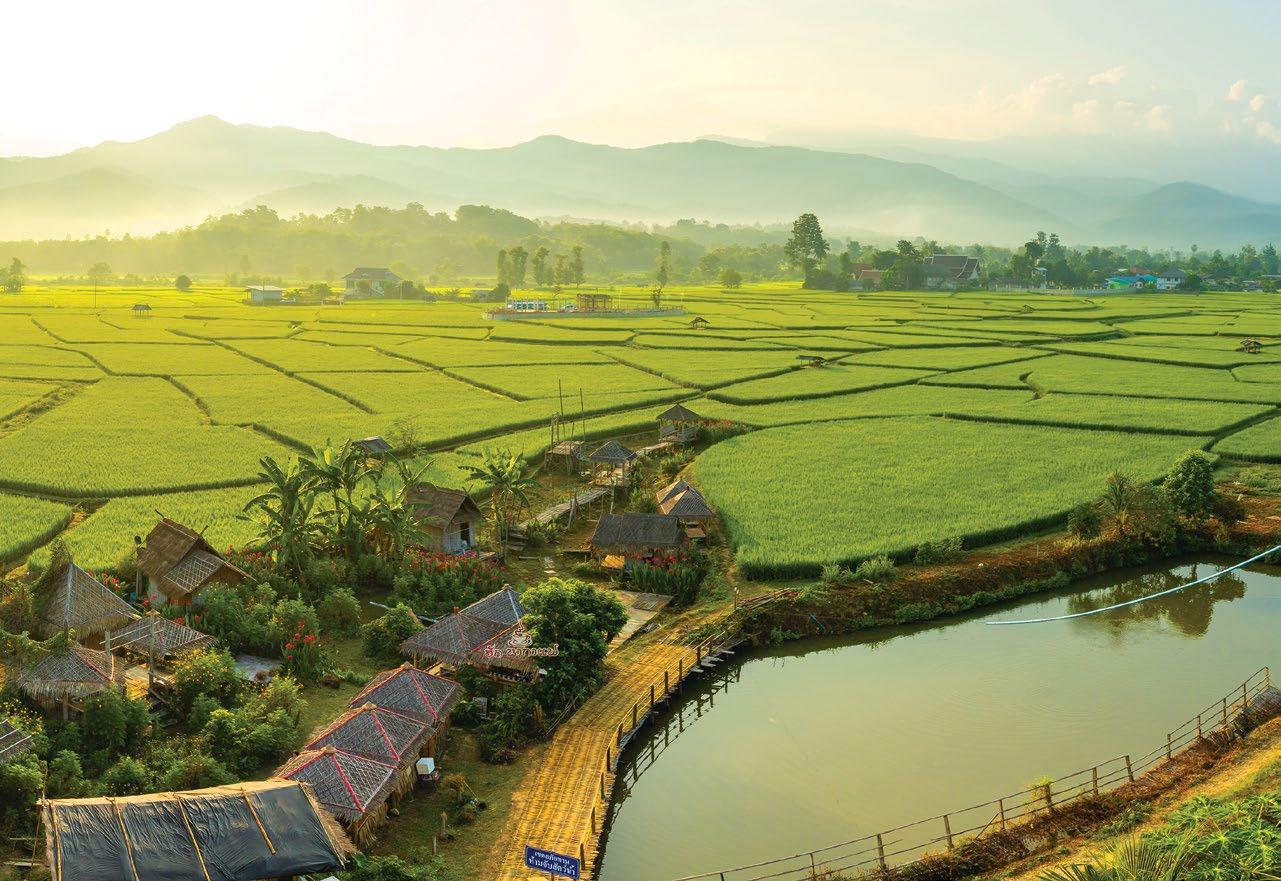
From Nan’s mountain weavers to Songkhla’s coastal kitchens, two UNESCO Creative Cities showcase craft mastery and age-old traditions.
52 CARRIED BY FAITH
On Koh Samui, Hainanese rituals endure through fire, sea, and ceremony, revealing a living faith carried across generations.
Check out hip hangouts in Thailand and its neighbours.
64 SAMUI
66 PHUKET
68 KRABI
69 CHIANG MAI / PATTAYA / TRAT
70 BANGKOK
71 HONG KONG / SINGAPORE
72 PHNOM PENH / SIEM REAP
74 LUANG PRABANG / MALDIVES
78 BANGKOK AIRWAYS NEWS
83 ROUTE MAP
CHECKING OUT
84 LEANING INTO FAITH
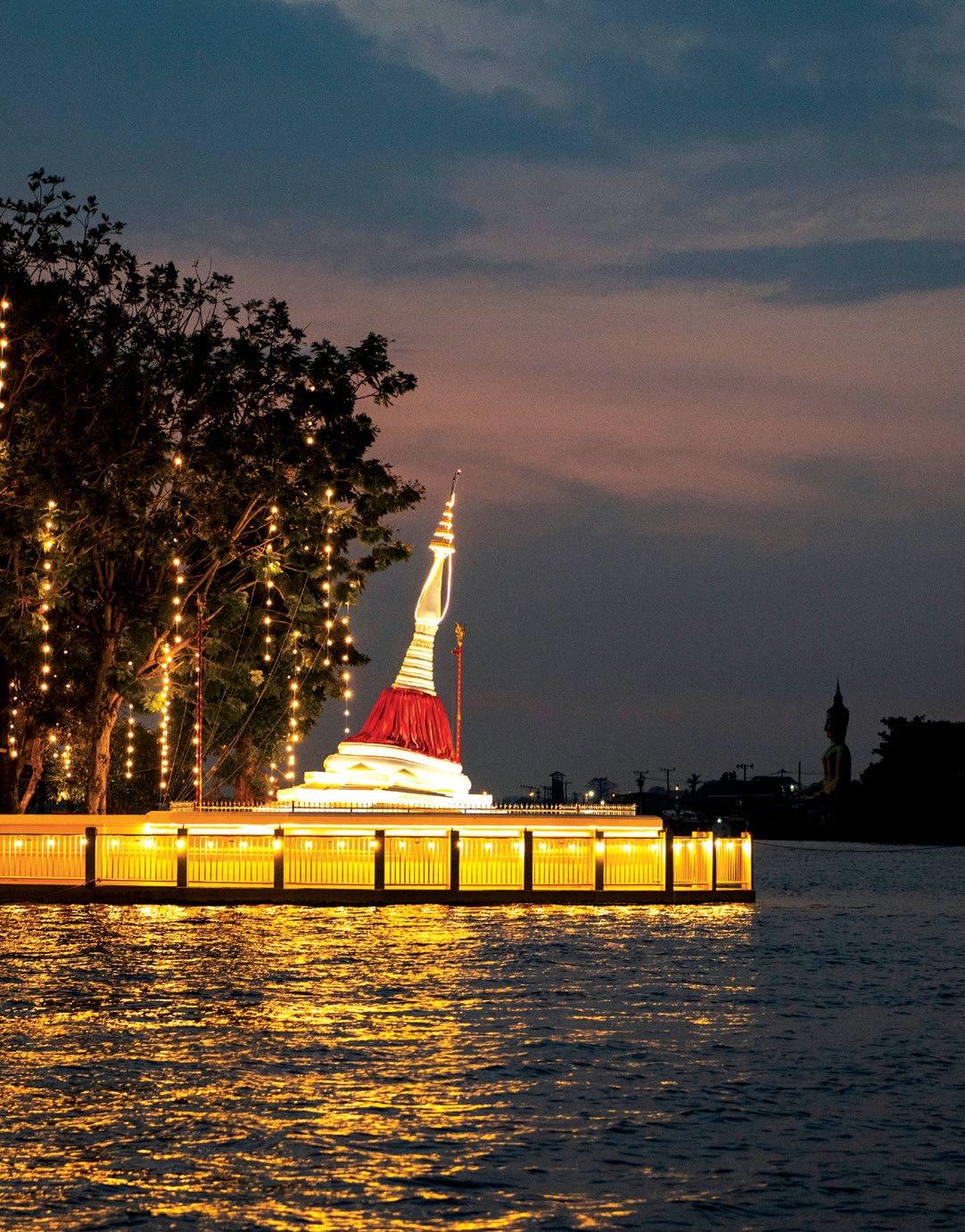
The Mutao pagoda tilts over the Chao Phraya River on Koh Kret north of Bangkok, shaped by faith, currents, and time.
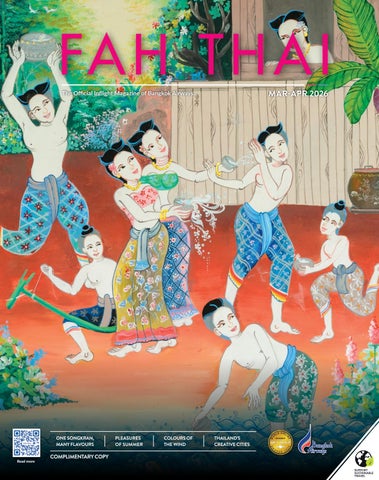
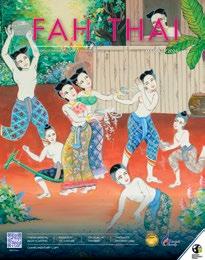
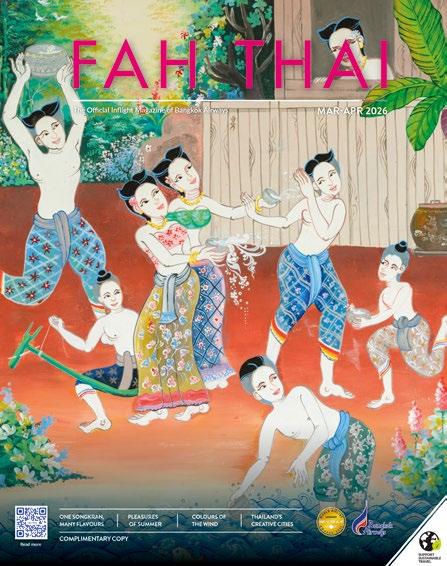
This month’s cover:
40 Cities Of Crafts And Cuisine
Happy Songkran
Kite Culture Goes Sky High
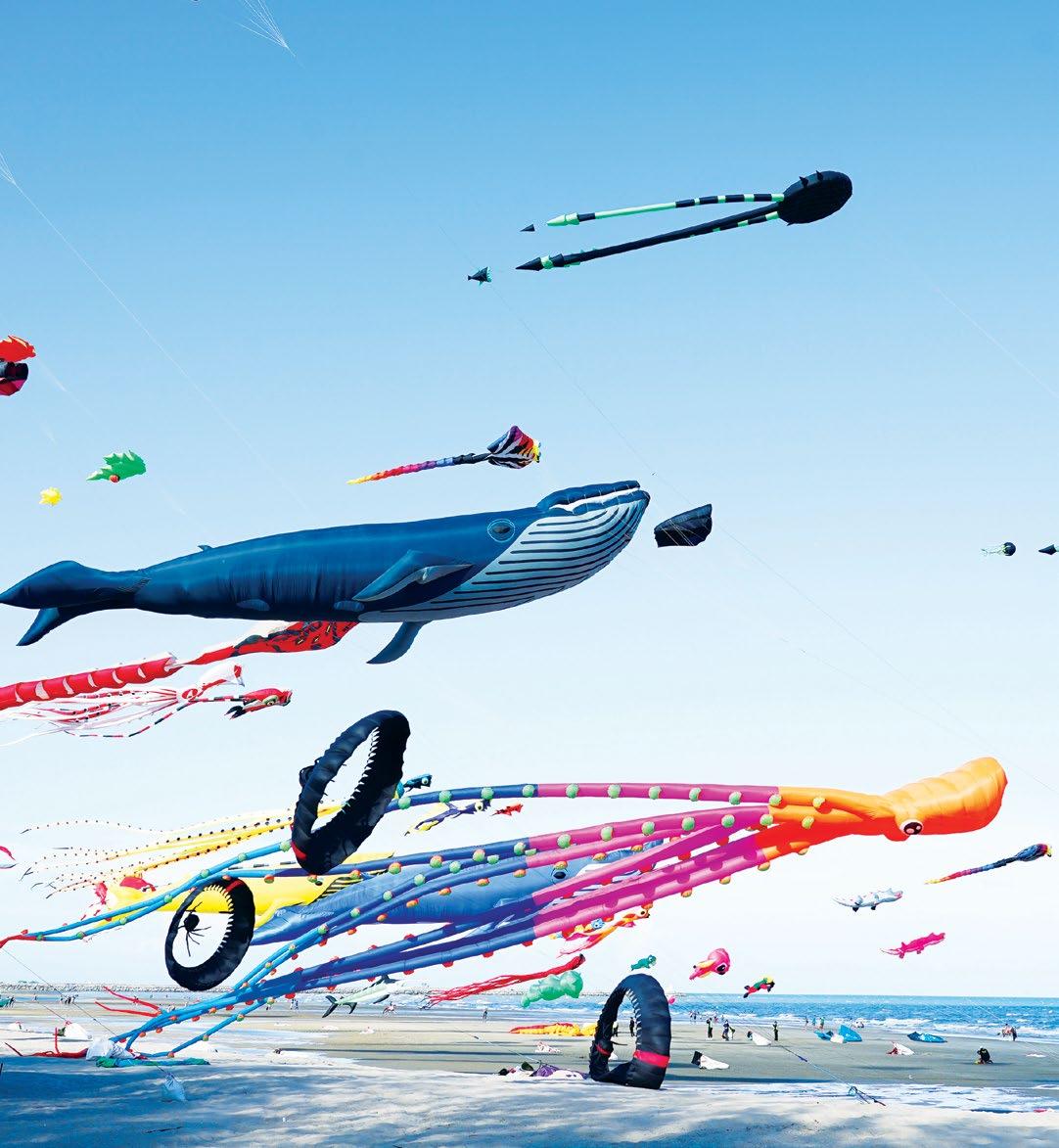
Thailand’s skies burst into a kaleidoscope of whirling colours once a year as eye-catching designs, vivid hues and brilliant craftsmanship unfurl during the International Kite Festival. Behind the dazzling displays unspools a deeper story: a living tradition of Thai kites shaped by seasons, craftsmanship and local winds. From riverbanks to open fields, these handmade creations are still flown, carrying aloft beliefs and culture. This year’s festival will soar at the Rama VI Camp in Phetchaburi’s Cha-am district from March 9-11.
MAY 2026
BANGKOK ARCHITECT OF THE SELF
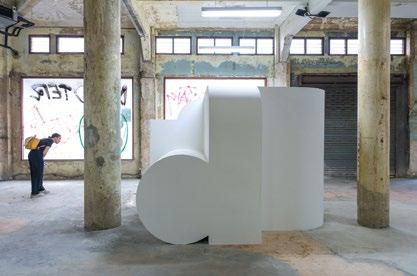
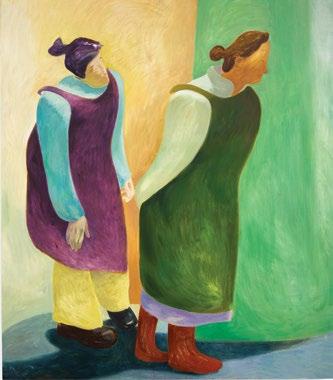
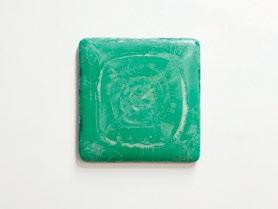
The six iconic Cell s created by French-Israeli artist Absalon make their Asian debut in the exhibition Description Without Place at Bangkok Kunsthalle, running until May 31.
Designed as a precise match for the artist’s body, the one-person dwellings are stripped of ornamentation and conceived more as spiritual architecture than functional homes.
Originally intended to be installed in several cities – including Paris, New York, Tel Aviv and Tokyo – the pieces challenge the very idea of home, identity and ownership. More than sculptural spaces, the Cells reimagine dwelling as a conscious practice, where solitude, restraint and spatial limits become tools for self-transformation and quiet resistance to life’s demands. The exhibition is curated by Stefano Rabolli Pansera. Open: Wednesday to Sunday from 2pm to 8pm; Free admission; www.facebook.com/ BangkokKunsthalle
MAR 2026 APR 2026
BANGKOK / SINGAPORE MAGIC ON ICE
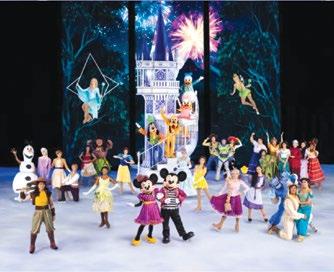
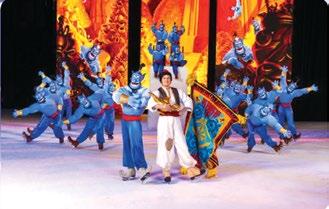
Disney On Ice Presents Magic in the Stars skates into Southeast Asia in March to enchant two cities with its glittering spectacle. The first stop is Singapore’s Indoor Stadium from March 14 to 22, before Bangkok audiences feel the chills and thrills at IMPACT Arena, Muang Thong Thani from March 27 to April 5. The worldfamous show blends championship figure skating with aerial acrobatics, cinematic lighting and lavish costumes.
Mickey Mouse and his friends lead the audience through a parade of Disney favourites from Frozen 2, Encanto, Toy Story, and Cars to magical adventures with Moana, Raya, Aladdin, Tiana, and Asha from the Kingdom of Rosas Celebrating dreams, courage, and imagination, the production turns classic stories into a highenergy ice fantasy, reminding people of all ages that the brightest magic shines from within. www.thaiticketmajor.com/disneyonice2026, ticketmaster.sg
MAR 2026 27-29
HONG KONG ART BASEL RETURNS
Art Basel Hong Kong returns from March 27-29 to the Hong Kong Convention and Exhibition Centre, strengthening the city’s status as a global crossroads for contemporary art. The fair will feature 240 top galleries from 41 countries and territories, more than half from the Asia-Pacific region. This edition introduces Echoes , a new zone spotlighting works created in the past five years, alongside Encounters, the fair’s platform for large-scale installations and performances – this year led by a new, Asia-based curatorial team. The fair expands citywide with a menu of events featuring film screenings, conversations and more, while a major public artwork by Shahzia Sikander will illuminate the M+ Façade. The fair highlights artistic innovation, cross-cultural exchange, and Hong Kong’s enduring position as Asia’s cultural hub. www.artbasel.com
Photos: Bangkok Kunsthalle
Photos: Thai Ticket Major
Photos: Courtesy of Art Basel
MALDIVES FINDING HOLIDAY
PARADISE
APR 2026
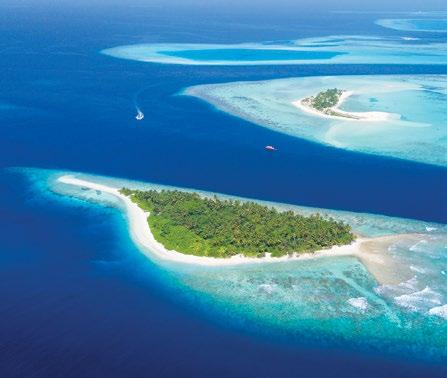
Vacations Expo 2026 offers travellers a rare chance to explore the world – and find their next holiday paradise – without leaving the Maldives. Hosted at Central Park, Hulhumalé, the event brings together global destinations, luxury resorts, airlines, and adventure specialists in one open, walkable space. Visitors can browse new travel ideas, speak directly with resorts and tour operators, and discover emerging destinations and experiences shaping future journeys. More than a trade fair, the expo feels like a live travel map, where conversations spark itineraries and curiosity leads the way. Whether planning an island escape or a long-haul adventure, Vacations Expo 2026 invites travellers to gather inspiration, ask questions, and plan their next journey on their own terms. www.facebook.com/vacationsexpo
11-13
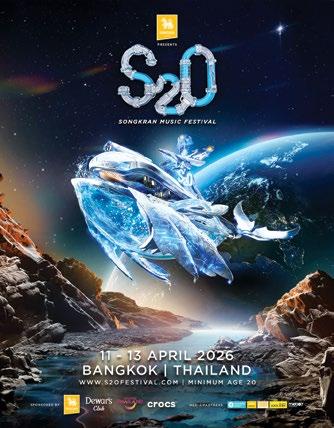
BANGKOK SONGKRAN’S WILDEST PARTY
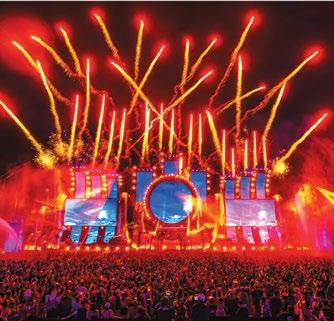
For adventure-seekers in town for Songkran, S2O Songkran Music Festival 2026 turns Thailand’s famous water festival into an electrifying dance music extravaganza. Famous around the world as the “world’s wettest party”, S2O blends high-energy beats with epic 360° water effects, dazzling light shows, and international DJs spinning non-stop throughout each night. This year’s edition brings together stars like Zedd, Alan Walker b2b Steve Aoki, and Kygo, with fireworks and immersive stage production keeping the crowd soaked and dancing from start to finish. Whether you’re chasing bucket-loads of fun or crafting an unforgettable Songkran memory, S2O offers a drenched-to-the-bone party atmosphere that’s both uniquely Thai and universally thrilling. www.s2ofestival.com
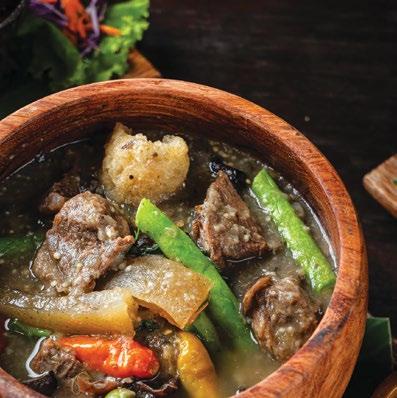
THAI / LAOS / CAMBODIA NEW YEAR, SOUTHEAST ASIAN STYLE
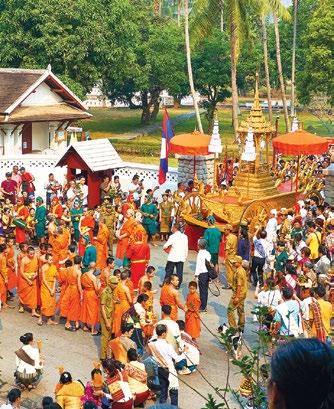
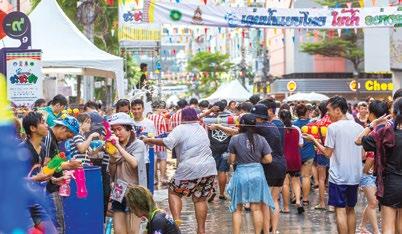
Thailand, Laos and Cambodia celebrate the New Year with festivals rooted in renewal, gratitude, and community. Songkran arrives in Thailand on April 13-15 as people make merit at temples, anoint Buddha images, and seek blessings from the elderly – before launching an exuberant nationwide water-splashing celebration.
In Laos, the celebration runs from April 14 to 16, with similar rituals, temple visits and lively water battles. Cambodia celebrates the New Year, or Chaul Chnam Thmey , from April 14 to 16, marking the end of the harvest and arrival of the rainy season through traditional games, folk dances and temple rituals. Spanning three neighbouring countries, the festival unites ancient heritage with contemporary cultural pride, turning April into a shared season of hope and renewal. www.tourismthailand.org, www.tourismlaos.org, tourismcambodia.org
Photos: Vacations Expo
Photos: S2O Festival
Paradise Comes with Limits
Water defines daily life on islands. Though surrounded by the sea, island communities are often short on fresh water and have long known what travellers are only just starting to understand – that abundance is an illusion. To sustain island life, we must recognise that every drop of water from the tap counts, because its source is not a flowing river, but sporadic rain that falls from the sky.
On popular Thai islands like Phuket and Samui, reservoirs are fed by monsoon cycles that are growing increasingly unpredictable. Groundwater reserves, once taken for granted, are now being drained by surging demand from tourists coupled with longer dry spells. Take a lingering shower or bath with a sea view and you could be drawing water from the same source that feeds farms, fishing villages and household wells.
For islanders, living well means adapting and cooperating within the limits of their ocean-bound home. In Bali, for instance, the ancient subak water-management system still irrigates rice terraces, preserving water as a shared resource rather than a private commodity. Across the Maldives, where fresh water is scarce, resorts and local communities rely on rainwater collection, solar-powered filtration and greywater systems – driven by necessity rather than sustainability rhetoric.
However, for travellers, conserving water doesn’t have to mean giving up luxury and comfort. Opting for accommodation that invests in rainwater harvesting, efficient plumbing and responsible water management makes a huge difference. Simple decisions like shorter showers, reuse of linen and
towels, and fewer laundry requests lead to long-term benefits for island dwellers. Dining choices also matter: locally sourced seafood and produce typically require less water than ingredients flown in, especially to satisfy international palates.
Water also shapes island culture. Wells, canals, cycles of the tide and seasonal fishing patterns are the tapestry of daily life, offering a reminder that water is both a vital resource and a cultural anchor. Local communities on islands like Samui or the Maldivian archipelago understand that water must be respected, monitored and shared.
Travelling sustainably on islands is about treading lightly, with humility and awareness. The sea may stretch endlessly, but fresh water is limited – shaping landscapes, culture and the very survival of island life.
The ocean may be endless, but fresh water on islands is not
Scoops of Heaven
From coconut shells to hot-dog buns, i-tim is the sweetest way to stay cool in Thailand
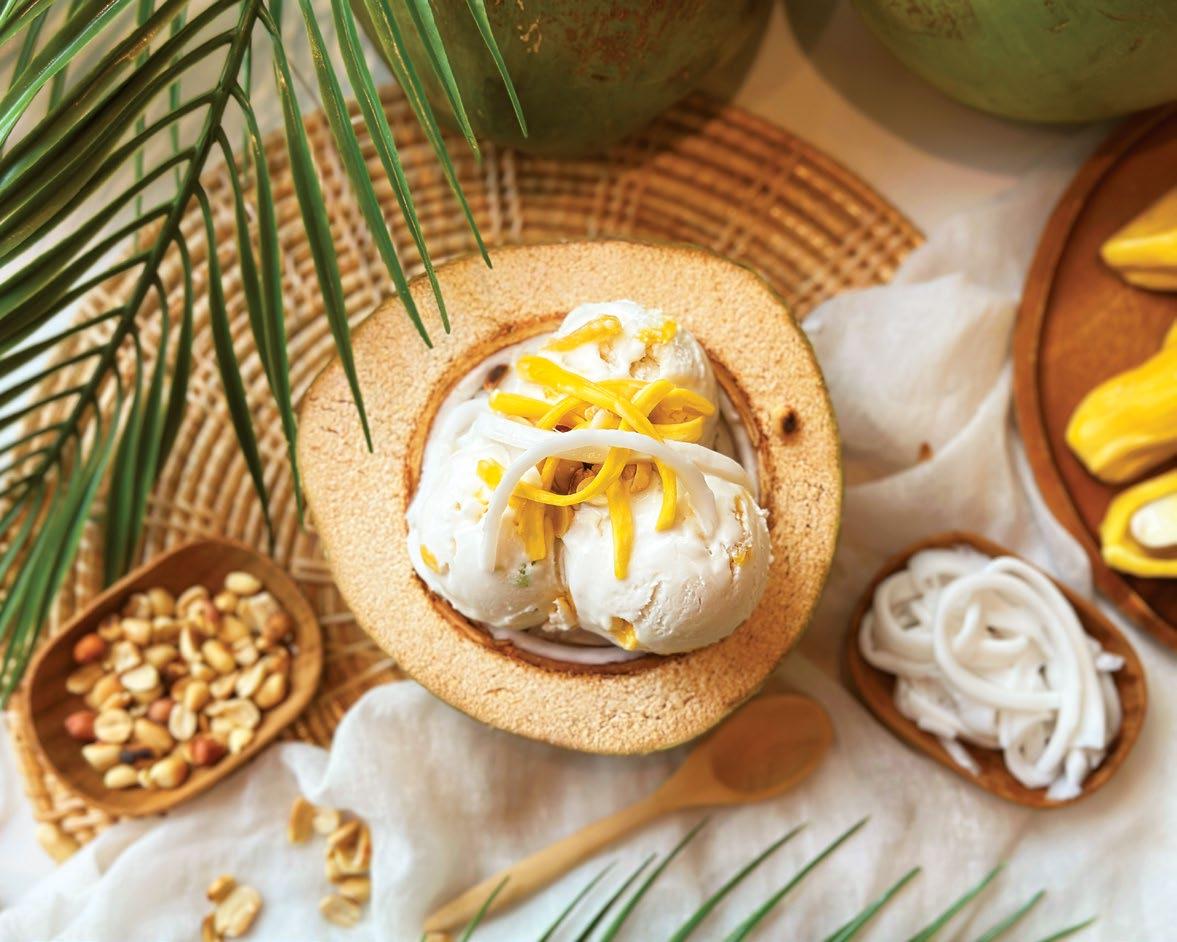
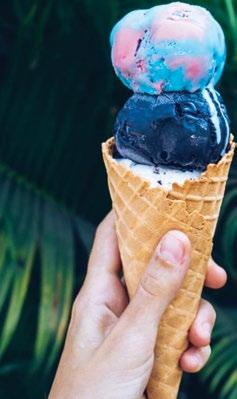
Coconut, in any form, is often your best cooling option on a hot day in Thailand – but few things are as instantly uplifting as a scoop of rich coconut ice cream, or “i-tim” as it is known locally. This subtly sweet, luxuriously creamy, non-dairy treat cools the body and lifts the spirits in one blissful mouthful.
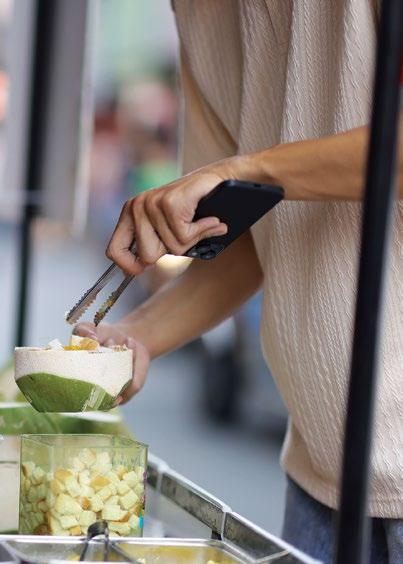
Usually sold from mobile street carts, i-tim comes in generous portions. Expect big scoops piled high in paper cups or crisp cones. Some vendors also serve it in a hollowed out coconut shell or tucked inside a soft, plain hot dog bun, offering a pleasant chewy contrast to the cold creaminess.
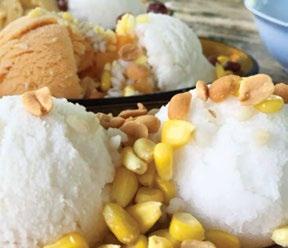
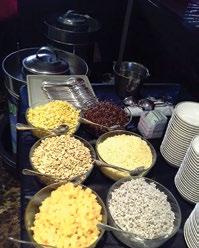
No i-tim is complete without the toppings, which provide a delicious contrast in flavour and texture. Stalls typically offer a colourful spread, ranging from sweetcorn, sticky rice and shredded jackfruit to candied pumpkin, coconut jelly, red
beans and young coconut flesh. A sprinkle of freshly roasted peanuts tops off your creation with a satisfying crunch.
The beauty of i-tim lies in its simplicity. Fresh coconut milk, corn flour and a touch of vanilla are churned together with just enough sugar and salt to enhance the flavour. The mixture is gently simmered until thickened, then cooled, frozen and churned before returning to the freezer to achieve its signature smoothness. For a playful twist, some vendors fold in local favourites like Lot Chong Bai Toey (pandan-flavoured noodles) or Thapthim Krop (crunchy water chestnuts coated in tapioca flour).
Often overlooked by tourists yet deeply comforting, i-tim remains one of Thailand’s most beloved ways to beat the heat – one spoonful at a time.
THAILAND TREASURES
Words: Phoowadon Duangmee Photos: Shutterstock
When Thailand Takes Wing
Seasonal winds carry traditional kites skyward in a soaring display of culture and tradition
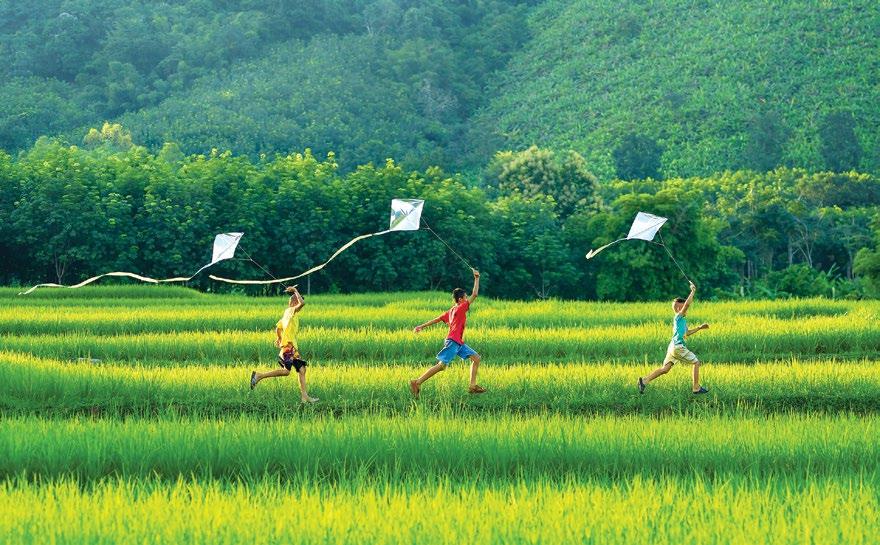
As seasonal winds sweep across Thailand’s countryside, vibrant stars and diamonds turn the skies above rice fields into a flowing tapestry of colours.
Locals fly the handcrafted kites at harvest’s end in March and April, weaving tradition with the natural cycle of life.
Traditional Thai kite flying is a subtle art rather than a spectacle. The kites rise quietly into the sky, carried by gentle breezes, an invisible string and patient hands. Children run barefoot across the fields while adults steady papered bamboo frames and elders look on serenely, having witnessed this ritual countless times before. To travellers, this may seem like a simple pastime. Yet, these airborne shapes reveal a culture forged by landscape, craftsmanship and an exquisite dance of human will and the wind’s force.
A KINGDOM CARRIED BY THE WIND
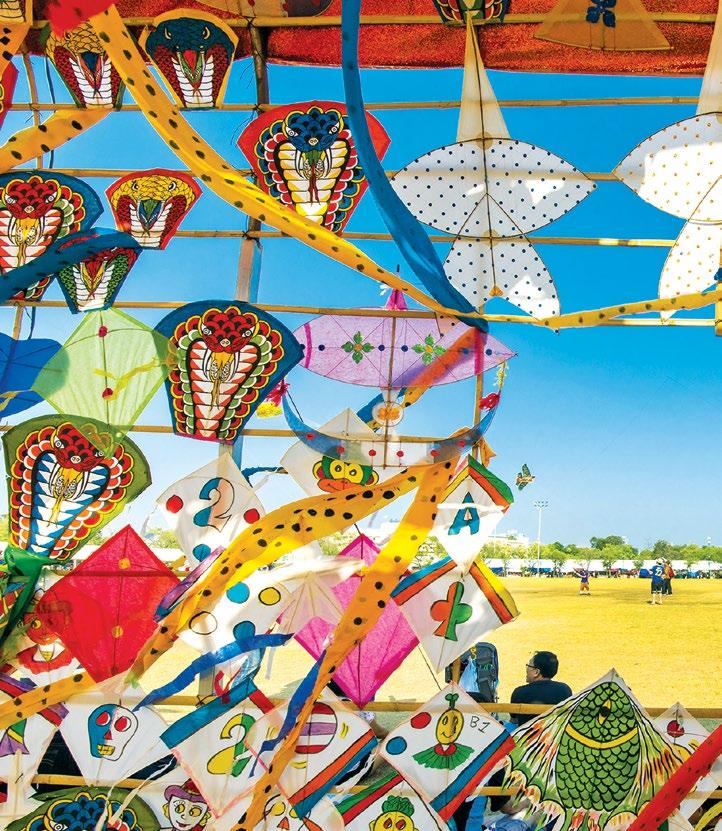
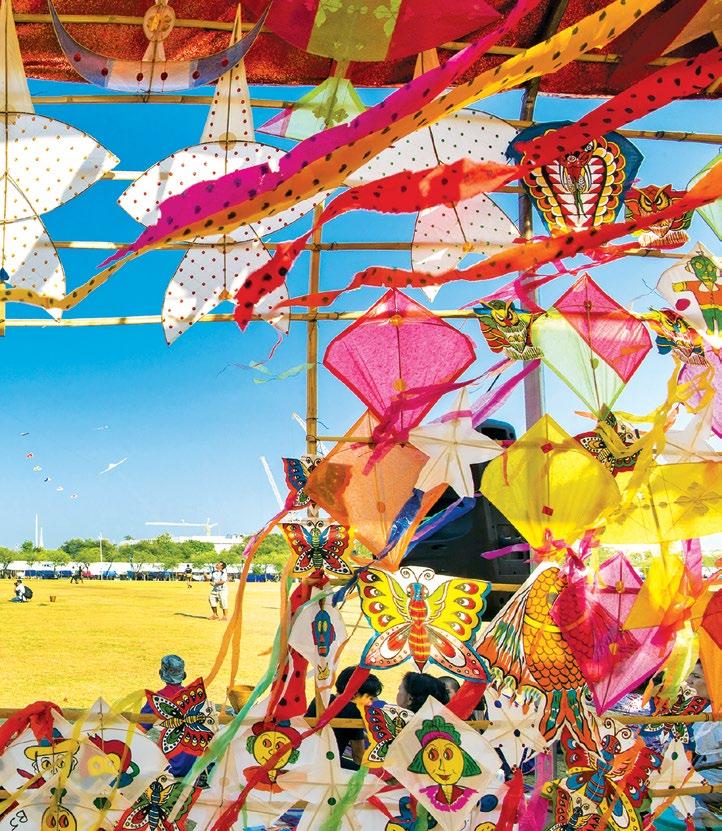
Clockwise from Top Left Colourful kites on display at Sanam Luang
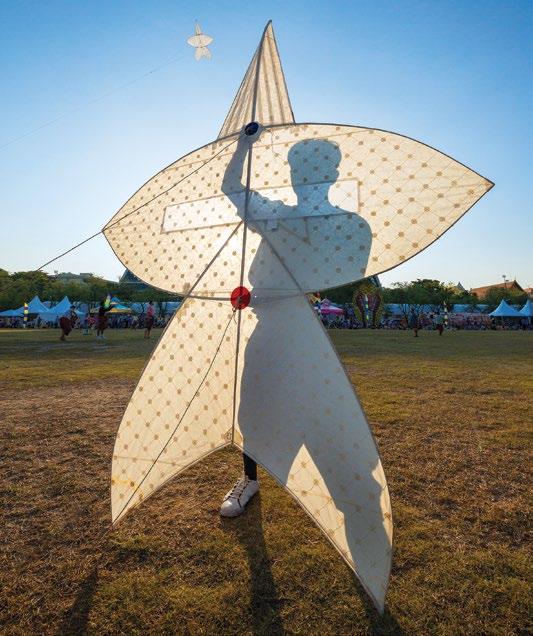
Chula, the iconic star-shaped kite
Pakpao kites
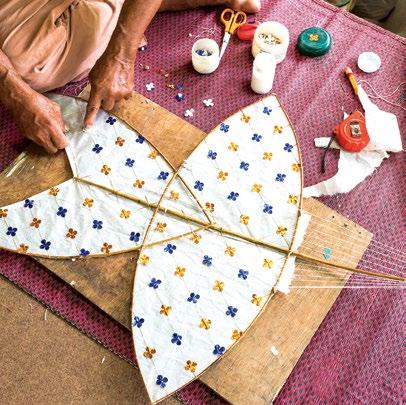
A traditional Thai kite with a bamboo frame is put together by an artisan
Kite-flying has been part of Thai life for centuries, with angular silhouettes gracing the bright, dry-season skies from December to April. Fields and farms wind down after the harvest is gathered in, leaving a period of leisure that stretches until Songkran.
Kites are thought to have arrived in Thailand with Brahmins from India in the 13th century. From village greens to palace grounds, their varied shapes and colours have adorned Thai skies ever since. Northern chronicles recount how Prince Phra Ruang of Sukhothai met his future lover while looking for a kite lost beyond the palace walls – a chance encounter that sent romance soaring aloft.
Beyond tradition and leisure, kites have played a more serious role in warfare. During the Ayutthaya period (1351-1767), large kites were used to carry makeshift bombs – clay pots filled with gunpowder and a spark – over fortified walls. When peace returned, these flying weapons reverted to symbols of play, skill and prestige.
Kite flying entered a golden age during the reign of King Chulalongkorn (1868-1910). The monarch was a
devoted patron of the sport, overseeing an era of competitions and prized trophies centred on Bangkok’s ceremonial heart of Sanam Luang, now considered the traditional home of Thai kite-flying.
HARNESSING THE WIND
Before a kite rises, it must be meticulously crafted by hand – a ritual as fascinating as the spectacle overhead. Bamboo is carefully measured, split and shaped to achieve a precise balance of strength and flexibility, before being covered with kite paper made from bamboo cellulose. The craft of kite-making is passed down through generations and requires painstaking attention to detail. If the frame is too rigid, it snaps; too loose, it won’t take off. Every joint, every length
of string, plays a crucial part in how the kite responds once it meets the wind.
In many communities, kite-making is a shared craft. Elders guide younger hands, teaching them not only how to build, but when to fly, where to stand and how to read the currents of air. Knowledge is passed on through practice, becoming part of a living story.
BATTLES IN THE SKY
Among Thailand’s many traditional kites, two soar as cultural icons: the Chula and the Pakpao. They are seen as rivals, though their battles are defined by finesse rather than force.
The Chula is large and star-shaped, with expansive wings supported by a carefully balanced bamboo frame.
Traditionally flown by teams, it demands coordination and collective control. Once aloft, it appears composed and authoritative, commanding the sky with steady grace.
The Pakpao , in contrast, is smaller and lighter, flown by a single handler. Agile and quick, it darts and circles with purpose as it tries to ensnare the Chula’s string in traditional contests – testing timing, precision and tactical intelligence.
These aerial encounters once drew huge crowds to open fields, where cheers and laughter punctuated every swoop and swerve. Victory mattered less than the battle itself – a demonstration of craftsmanship, teamwork and strategy – values deeply embedded in Thai culture.
OVERTURES
THAILAND TREASURES
AN AERIAL MAP
Beyond the Chula and Pakpao , Thailand’s kite-flying traditions are rich and varied, shaped by geography and wind patterns.
In the North, the E-Lum traces a graceful diamond against the sky, its gossamer paper balanced by twin tufts and a trailing tail. In Sukhothai, the Phra Ruang – reminiscent of the Chula – is entwined with local craftsmanship and the centuries-old tale of royal romance.
The central plains, with wide-open fields and steady winds, favour large Chula kites that dominate the skyline. In the Northeast, the Dui-Dui resemble smaller versions of the Chula with twin palm-leaf tails for stability and a curved bamboo head, strung to make a “dui-dui” sound as the wind passes through its tails.
In the South, kites reflect rhythms of land and sea. Buffaloes, birds and crescent moons are forged from bamboo and paper. Highlights include the moonshaped Wong Duean (or Bulan ), Satun
Clockwise from Top Right Children run across rice fields with their Pakpao kites
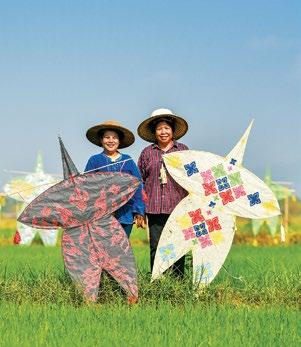
A couple of farmers show off their Chula kites
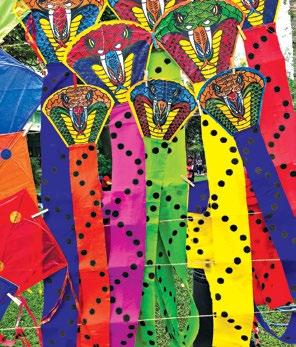
Colourful traditional snake-shaped kites
Bulan, a traditional kite from Southern Thailand
province’s buffalo-shaped Hua Khwai and, in the far South, the ornate Amas kite, named for its intricacy.
Together, these variations form an airborne map of Thailand – each kite shaped by its environment, materials and local customs. To see them all in flight is to witness a country expressed in graceful movement rather than rigid boundaries.
LOOKING UP, TODAY
Traditional Thai kites are enjoying a revival. Festivals and cultural events nationwide celebrate kite-flying as both
heritage and spectacular contemporary display. Beaches, riverbanks and parks become temporary galleries where classic shapes share the skies with modern innovations – some monumental in scale or illuminated for night-time displays.
Artists continue to reinvent classic forms, unspooling new inventions that remain anchored in tradition. For travellers, such moments offer an easy entry into Thai culture – no prior knowledge required, just a willingness to pause, feel the breeze and look up.
ARTS & CULTURAL MATTERS
Words Sarita Urupongsa
Songkran: Follow the Flow
From northern temples to southern islands, the traditional New Year festival showcases Thailand’s rich cultural diversity
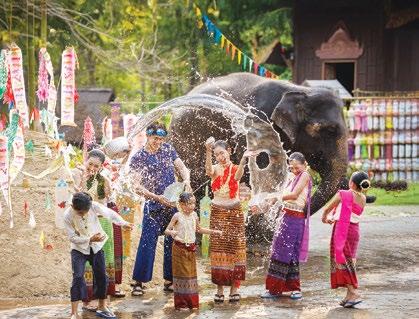
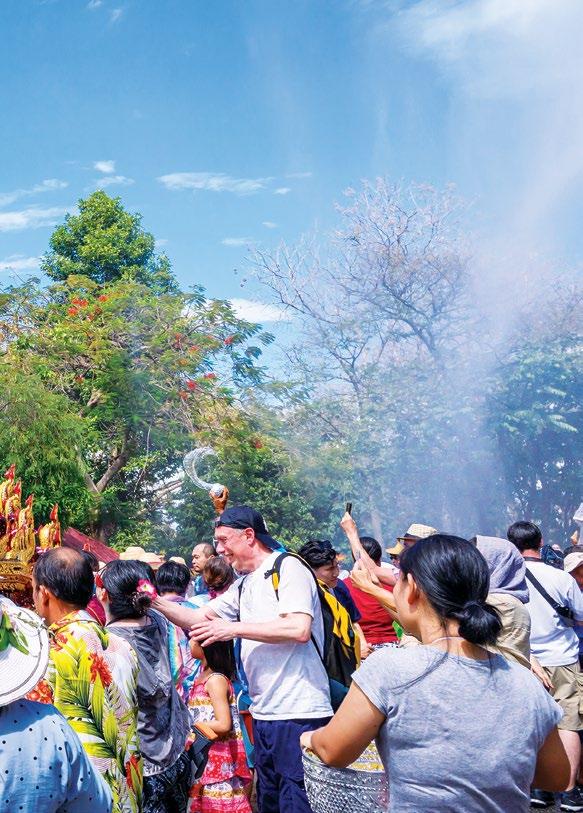
Each year in April, Thailand pauses, takes a deep breath, and plunges into rituals of renewal for the year ahead. But traditional new year Songkran celebrations are far more than just water battles and drenched city streets. Rooted in cosmology, gratitude and community, this festival is marked in many different ways across the country. From serene temple rituals to happy village games, Songkran reveals Thailand’s sacred and playful heart.
SONGKRAN: EVERYTHING YOU NEED TO KNOW
One of Thailand’s oldest and most cherished traditions, Songkran is a graceful yet joyful festival bathed in a spirit of thanksgiving, respect and togetherness. At its heart is a simple yet powerful element – water – used to cleanse, bless and bring people closer. Purification and playfulness go hand in hand, showing renewal can be both meaningful and merry. Whether marked with quiet prayers, family reunions or laughter-filled splashing, the festival invites you to wash away old worries and welcome the year ahead with an open heart.
The word Songkran comes from “Sankranti”, the Sanskrit word for “stepping forward, or transitioning”. It also describes the Sun’s entry into Aries, a cosmic turning point marked by traditional New Year celebrations across South and Southeast Asia.
Songkran celebrations traditionally last three days. The first day is Maha Songkran, when the Sun shifts from Pisces to Aries. The second is known as Wan Nao or the day of transition. The final day is Wan Thaloeng Sok, or the start of the new year.
Songkran is celebrated every year on April 13-15, according to the royal Thai calendar. The traditional calendar
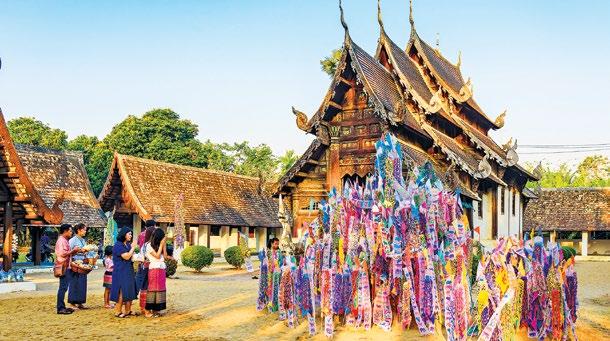
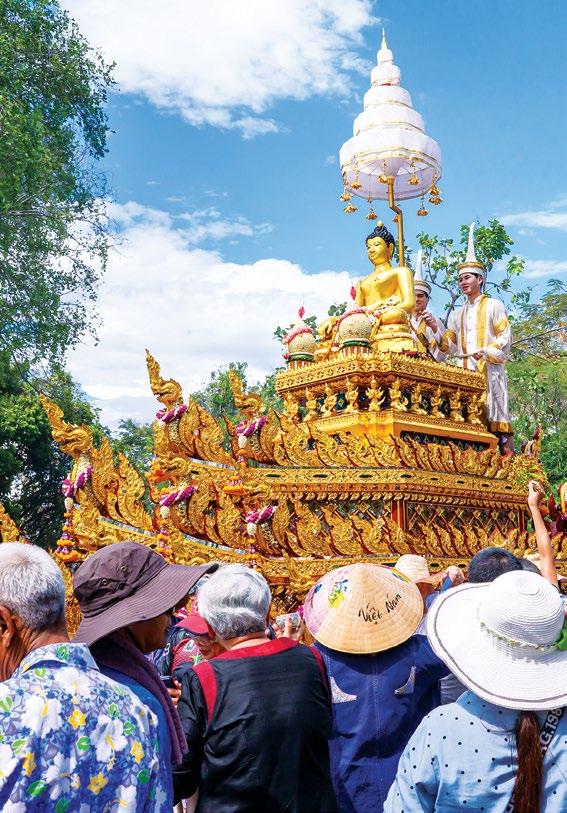
Top An intricately decorated float with a Buddha statue leads a Songkran parade Bottom Colourful Tung banners adorn a temple, symbolising the spirit of Songkran
once guided daily life in Thailand, marking auspicious dates and royal ceremonies, as well as seasonal rhythms and solar and lunar eclipses.
Besides ushering in a new year, Songkran carries deep social meaning. April 13 is National Elderly Day while April 14 marks Family Day, adding to the festival’s celebration of respect, kinship and family bonds.
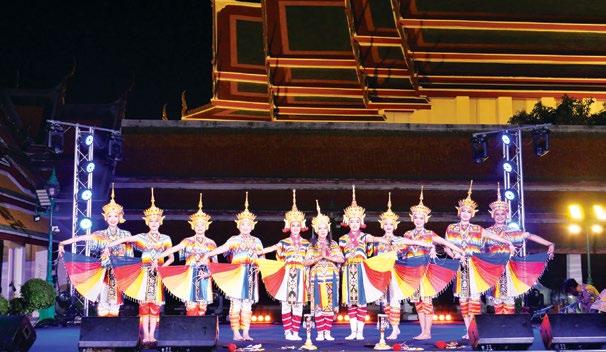
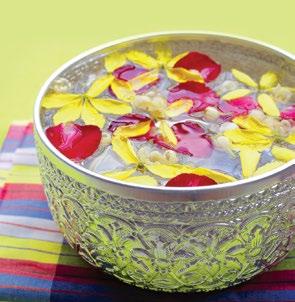
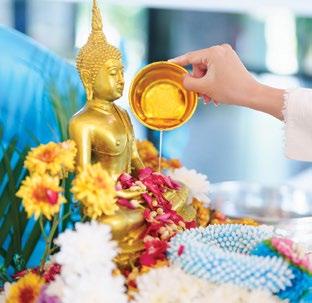
For many Thais, Songkran is a precious opportunity to return home and reconnect with loved ones. Water battles and claydaubed faces may be iconic images of the festival, but gentler traditions flow in family homes and temples. Worshippers offer alms to monks, bathe Buddha images and sculpt sand pagodas –returning sand to temples in a ritual of renewal. Evenings bring a livelier atmosphere with theatrical performances and live music.
Songkran’s fame has spread worldwide, drawing visitors from every corner of the globe and earning recognition as Intangible Cultural Heritage by UNESCO on December 6, 2023.
Photos: Shutterstock
UNIQUE REGIONAL FLAVOURS
Songkran unfolds differently across Thailand, each region boasting its own rituals rooted in local culture and beliefs. In many places, ancient traditions offer a glimpse into the rhythms of an earlier time.
NORTH: LANNA TRADITIONS
The North celebrates Songkran as “Paweni Pi Mai” – the Lanna New Year. Its opening day, Sangkran Long, brings the white-clad spirits of Grandfather Sangkhan (Pu) and Grandmother Sangkhan (Ya) floating down rivers to carry misfortune away. To ward off bad luck, villagers fire guns or set off firecrackers, while homes are spring-cleaned and Buddha statues anointed with turmericand Sompoi (soap pod)-infused water.
Next comes Wan Nao or the “day of restraint”, when quarrels or harsh words should be avoided. The morning is devoted to preparing food and offerings for meritmaking the following day. In the afternoon, villagers sculpt sand pagodas at temples, decorating them with colourful “Tung” paper banners.
Clockwise from Top Songkran in the South is marked with performances of the graceful Manora dance
Sacred water is poured over Buddha statues to mark the auspicious occasion
Jasmine-scented water is prepared to pour over senior family members’ hands and seek their blessings during the Dam Hua ritual
The third and most auspicious day is Wan Phaya Wan, the start of the new year. People rise early to offer alms to monks and prepare Than Khan Khao , or food for ancestors. Family members pour scented water on the hands of their elders in the “Dam Hua” ritual of forgiveness and blessing.
The final evening is spent watching traditional performances and playing traditional games like Sabah – bean tossing.
NORTHEAST: BUDDHISM FLOWS Songkran in Isaan is traditionally known as “Bun Songkran” or “Bun Duean Haa” – merit-making in the fifth lunar month. Deeply rooted in Buddhist beliefs, the Northeast festival balances celebration with spiritual renewal.
It begins with Mue Songkran Long/ Phaai, the day the old year passes or is defeated, when locals prepare offerings and sweep their homes to welcome the new year.
On day two, Mue Nao , villagers adorned in their finest clothes visit temples to make merit and offer alms. Senior monks give blessings, Buddha images are gently washed with ceremonial water, and youngsters pour fragrant water on their seniors’ hands. Listen out for the Bai Sri Su Khwan chanting ritual, held to restore balance and good fortune by honouring the 32 guardian spirits. The mood lightens as the day unfolds, with joyous watersplashing and games, before the evening brings communities together for sermons and chanting.
The finale is Mue Songkran Khuen , the day the New Year rises, when villagers gather to play games and watch Mor Lam and Ram Trut dance performances at temples to appease spirits and dispel misfortune.
Songkran festivities can last anywhere from a week to two weeks in the Northeast, depending on when family members have to return to work in the cities.
OVERTURES
ARTS & CULTURAL MATTERS
CENTRAL THAILAND:
RITUALS OF GRATITUDE
Songkran in the heartlands features its own unique rituals of bathing Buddha statues, honouring elders and making merit. Celebrations in Bangkok centre on the royal field of Sanam Luang, where worshippers bathe the revered Phra Buddha Sihing statue.
Meanwhile, ancient Songkran rituals are preserved by ethnic Mon communities in provinces around Bangkok. In Ban Phaeo (Samut Sakhon) and Pak Kret (Nonthaburi), offerings are made to the Hindu deity Thao Kabil Brahma and the Goddess Nang Songkran. Regional flavours abound, from Khao Chae (rice in iced water) and colourful flag parades to the propping of sacred bodhi trees, carrying sand to temples, and playing traditional games.
Entertainment takes centre stage, with traditional sports like tug-of-war, horseback relays, hide-and-seek, sack racing, and the classic “Monkey Grabs the Post” game, where competitors scramble up a greased pole to grab prizes. Adding to the festive atmosphere are Likay folk theatre, Lam Tat musical verse and Ram Wong dancing.
Clockwise from Top Local beauties wave from a float during the colourful Nang Songkran parade
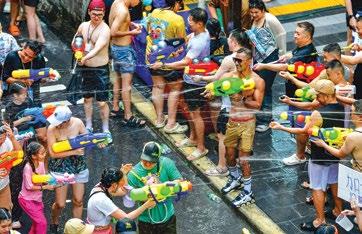
Plastic water guns are the weapon of choice during water battles
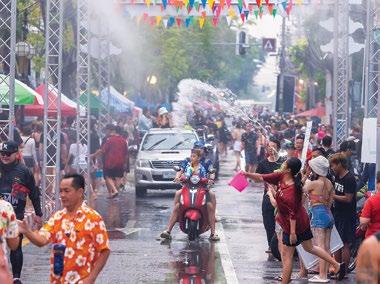
Spirited community water battles are the main highlight of Songkran
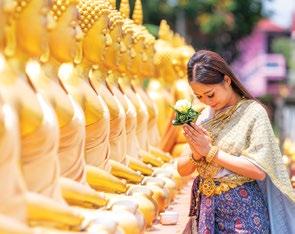
Top to Bottom Left Thais dress up in traditional wear for the merit-making ritual at temples
In some places, Songkran celebrations often last long into the night
On Bangkok’s “Green Lung” of Phra Pradaeng, the Mon community preserves centuries-old traditions with its Songkran Pak Lat celebrations. Uniquely, rituals here last a full seven to 10 days and date back to the reign of King Rama II (1809-1824).
Phra Pradaeng’s Songkran begins with spring cleaning to invite good luck. The neighbourhood then bursts into colour with floral floats and Nang Songkran parades, as young women and men in traditional attire dance to the rhythm of Mon long drums.
Another cherished tradition is Khanom Kuan Ha Ko , better known as Kalamae – Thai toffee. Neighbours gather to stir large pots of the sticky sweet made from glutinous rice, coconut sugar and coconut milk. Once ready, the thick, glossy candy is cut into pieces and shared among families, friends and monks in a spirit of unity and generosity.
THE SOUTH: REFLECTION AND RENEWAL
In the South, Songkran is known as Wan Wang, the “day of rest”, when daily habits are set aside in favour of reflection and renewal.
On the first day, locals bid farewell to the guardian spirit of the old year while banishing misfortune by launching tiny rafts in purification rituals known as Loi Khroh or Loi Phae. Revered Buddha statues are also bathed to strengthen spiritual bonds for the year ahead. Unique to the South is “Tham Khwan Khao Yai” – a temple blessing ceremony featuring sheaves of rice to ensure a bountiful harvest and prosperity in the 12 months ahead.
On the third day, Wan Benja, people welcome the guardian of the new year by wearing pristine outfits symbolising renewal and holding the Jaturamuk ceremony to reinvigorate ties with elders. Len Wang , or playing during rest, brings out the playful side of southern Songkran, with Manora dance performances, Nang Talung shadow puppetry and the Chuea Ya Hong ritual invoking and honouring ancestral spirits.
PHRA PRADAENG: LIVING MON HERITAGE
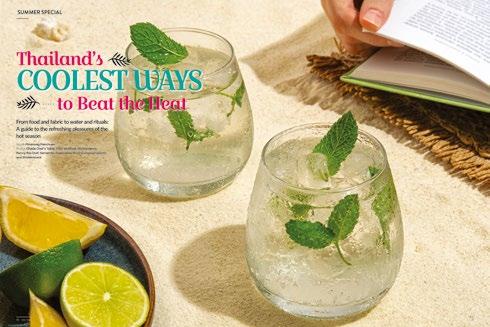
COOLEST WAYS
Thailand’s to Beat the Heat
From food and fabric to water and rituals: A guide to the refreshing pleasures of the hot season
Words Pinanong Panchuen
Photos Chada Chef’s Table, Chef Wuttisak Wuttiamporn, Penny the Chef, Samatcha Apaisuwan, Anutra Ungsuprasert and Shutterstock
The hot season opens like an oven door in Thailand –humid air rolling out before dawn as street vendors set up their carts. By mid-morning, life retreats from the heat. Shady spots are treasured, the rhythm of life slows, and even conversations are short, as if silence offered relief.
Steam-room temperatures can shock visitors, but Thais have found a multitude of cooling – and delicious – antidotes. Over generations, the hot season has shaped how they eat, dress, travel and rest. Rather than fighting the heat, they have learned how to move with it, making small, practical choices that add up to comfort.
These can be tasted in refreshing food, seen in calming colours, and felt in various age-old traditions that now define summer in Thailand.
UNLOCKING FRUIT’S SAVOURY SUPERPOWER
Before refrigeration reshaped kitchens and eating habits, Thais relied on seasonal produce, which defined the menu from month to month. Fruits, abundant and naturally cooling, were turned into delicious dishes designed to beat the summer heat.
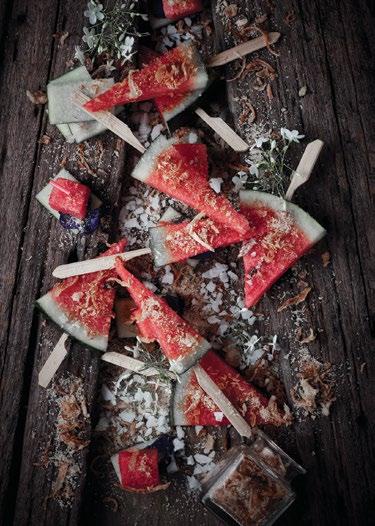
Watermelon is chilled, cut into thick wedges, and topped with a sprinkling of dried fish powder mixed with sugar for a classic hot-season treat. This combination can startle at first bite, before becoming strangely irresistible.
Clockwise from Top Right Pla Haeng Taeng Mo, or watermelon topped with dried fish, is a classic summer treat dating back to ancient times
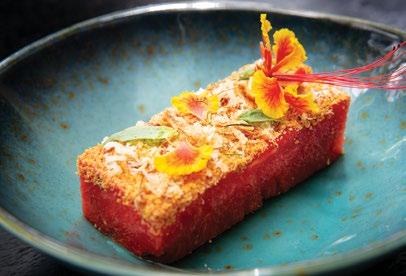
A refined take on Pla Haeng Taeng Mo at CHADA Chef’s Table
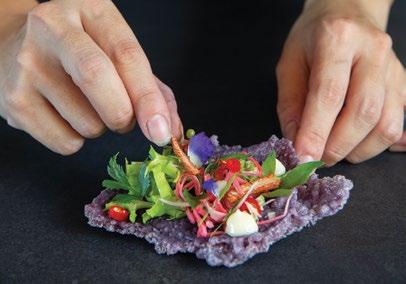
The South’s signature Khao Yum is interpreted as a butterfly-pea tinted rice cracker topped with chilled lime mayonnaise
The fruit’s high water content cools and hydrates the body, while the savoury topping awakens the appetite. Thais consider it neither a dessert nor a snack, but something in between, to be eaten slowly on hot afternoons.
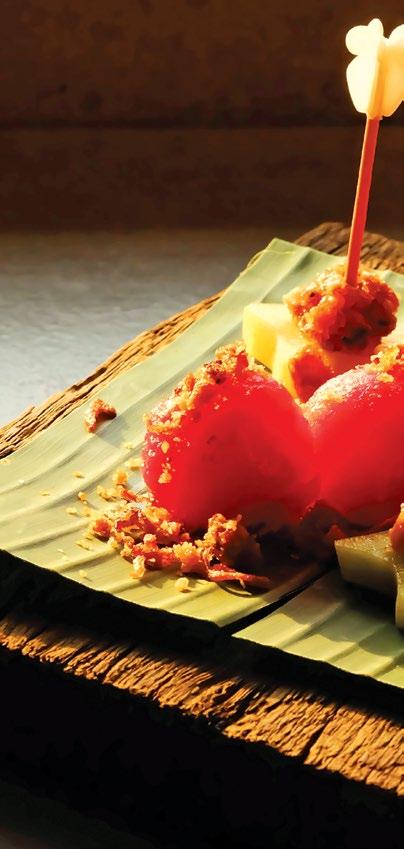
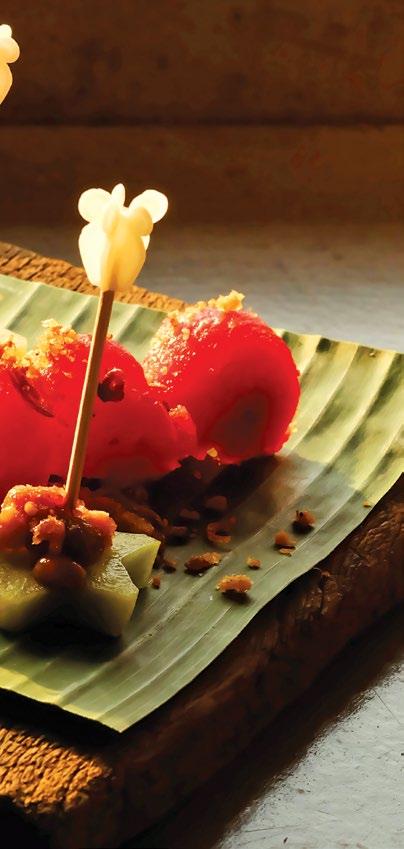
Continuing the savoury summer theme, chilled pineapple is served with Ma Hor – a savoury, caramelised nutty pork or chicken topping, stir-fried with palm sugar, fish sauce and a garlic-corianderpepper paste. The fruit’s acidic sweetness balances the rich, umami flavour of the topping, creating a flavour contrast that is highly prized in Thailand.
COOLEST CUISINE DOWN SOUTH
The sun blazes brighter in the South, with flavours to match. Culinary offerings here are bold – each designed to bring relief from the unrelenting heat.
A classic example is Bai Liang Phad Khai: melinjo leaves stir-fried with egg. This creamy concoction is traditionally paired with the South’s famously spicy yellow curry to quench the fire without dulling the flavour. The leaves bring a delectable bitterness, while the egg adds subtle richness.
These summer favourites reach new heights in the fine-dining setting at Koh Samui’s CHADA Chef’s Table ( www.chadaculinary. com ), where locally sourced ingredients are cooked simply so their natural flavours shine. The
Bai Liang stir-fried with egg is traditionally served with spicy curry to balance the heat
Fresh watermelon, a perfect antidote to the burning summer heat
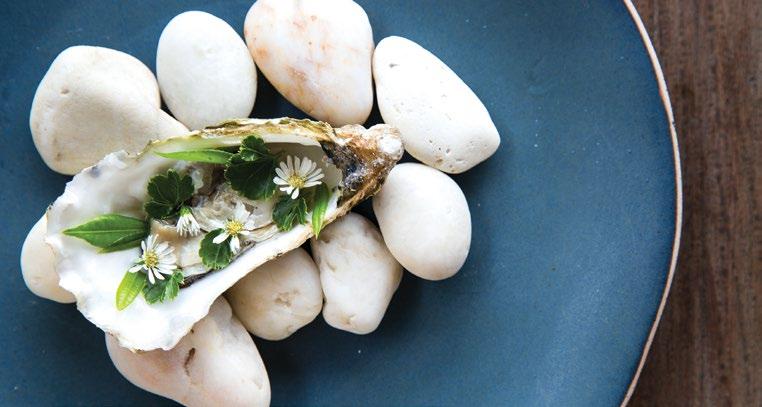
Clockwise from Top Right Fresh oysters served with local leaves
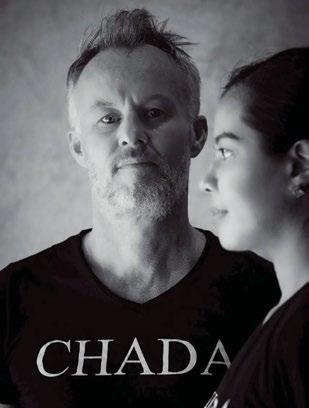
Chef Jeremy Simeon and Chef Chitrlada ‘Tang’ Sirachadapong of CHADA Chef’s Table, Koh Samui
Bai Liang leaves with egg and pork crackling chilli paste at CHADA
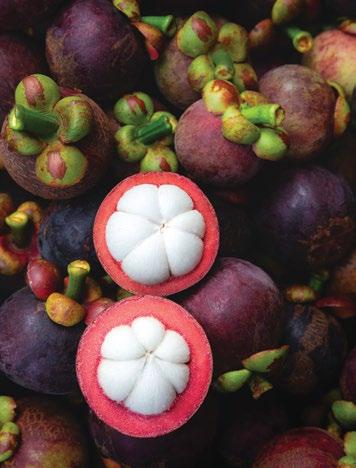
Mangosteen salad with young cashew leaves
focus is less on interpretation than on clarity.
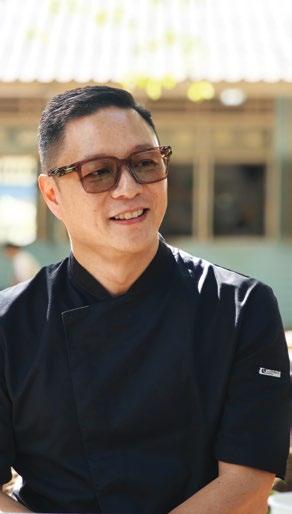
The kitchen is helmed by Chef Jeremy Simeon – a New Zealander who has cooked for celebrities such as filmmaker Guy Ritchie and TV chef Gordon Ramsay – and lawyerturned-chef Chitrlada “Tang” Sirachadapong. Their shared mantra: Avoid excess.
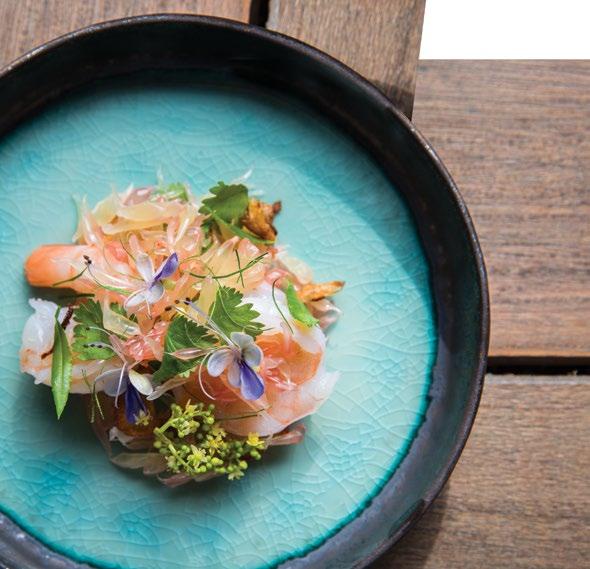
The menu opens with appetiser classics: oysters paired with Bai Mui leaves for a delectably bitter brininess; dried fish with watermelon; pomelo salad with blanched prawns and coconut milk; and mangosteen with a savoury twist of Bai Waen Kaeo (water pennywort).
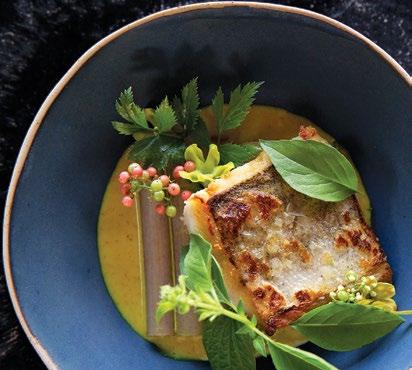
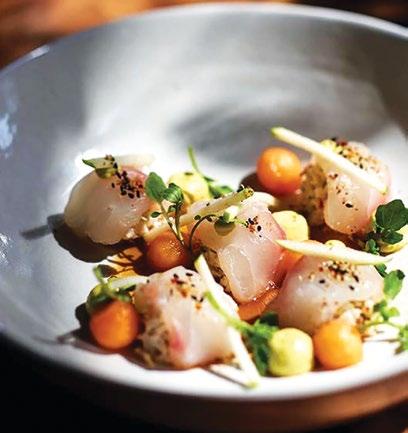
Curries follow with equal precision. Scallops emerge as a ceviche alongside chilled Tom Kha broth, accented with caviar and finely sliced kaffir lime. Firm barracuda anchors a yellow curry,
served with lotus stem salad, Malay bael leaves, and wild coriander. Even the humble Khao Yum – a salad of butterflypea-tinted rice, fresh herbs, fruits, vegetables and a tangy, sweet dressing – is transformed into a crisp rice cracker topped with chilled lime mayonnaise.
What defines these dishes is not novelty, but care. The flavours remain unmistakably southern, yet they are designed to cool, stimulate and restore.
Clockwise from Top Right
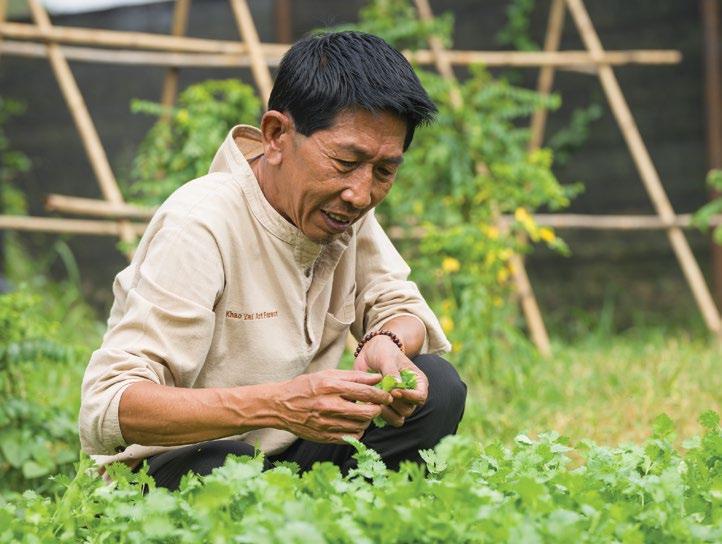
Chef Wuttisak Wuttiamporn of Khao Yai Art Forest
‘Cooking and art are inseparable,’ says Chef Wuttisak
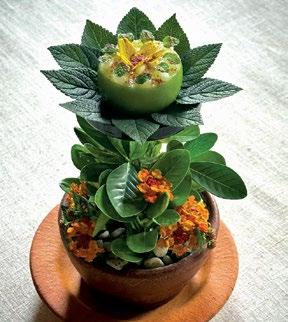
Chef Wuttisak’s creation served in a terracotta pot
Bottom Left
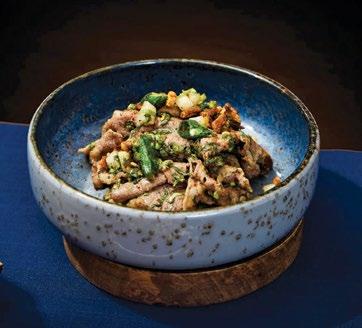
Chef Pruek Sampantaworaboot, Thailand’s Iron Chef, presents tiger salad, a dish made to help diners handle summer heat
LETTING SPICE DO THE WORK
When the heat advances, the response is not to retreat, but to engage. Thais’ famed culinary creativity blazes even higher during the hot season.
One example is Suea Phen salad, or the “Tiger Runs Away Salad”, Chef Pruek Sampantaworaboot’s (www.instagram.com/pruek) signature dish for sweltering summers. A Thai Iron Chef winner and former instructor at the Le Cordon Bleu Dusit culinary school, Pruek concocted the dish as a secret weapon against rising temperatures. Although trained in sauce-heavy French cuisine, he believes meals in the hot season should be light, yet bold. Among his preferred antidotes are spicy Thai salads (Yum), which promote perspiration – the body’s cooling system.
The Suea Phen salad features slices of grilled beef tossed in a sharp, fragrant dressing of green chilli paste blended with roasted eggplant relish and fish sauce. Crispy beef fat and grilled roselle flowers add a touch of richness, acidity and contrast. The level of heat can be adjusted, but the intention remains clear. Asked how fiery the dish can get, the chef grins: “Even a tiger would run away.”
WHEN THE PLATE BECOMES A LANDSCAPE
Hues matter in the heat, when lighter colours become more appetising. This is where food presentation comes in.
The plate is a canvas for Chef Wuttisak Wuttiamporn at Khao Yai Art Forest (www.khaoyaiart.com). Fashion, art, and seasonal colours influence how food is arranged here.
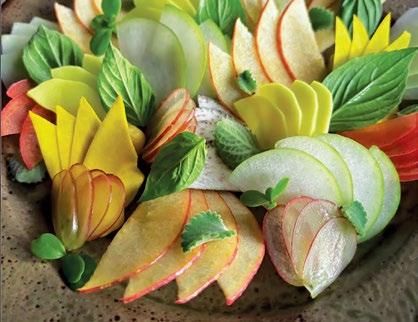
A simple vegetable salad can become an expression of rhythm, layered in bands of yellow, red and white punctuated with herbs to resemble a garden in full bloom.
Fruit receives the same eyepleasing treatment. Milk jujubes are halved, arranged in small clay pots, and dressed with mint and
chilli salt – a painstaking yet playful presentation.
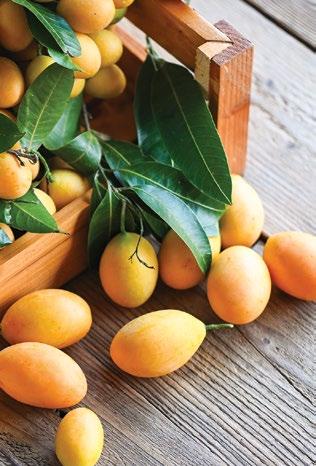
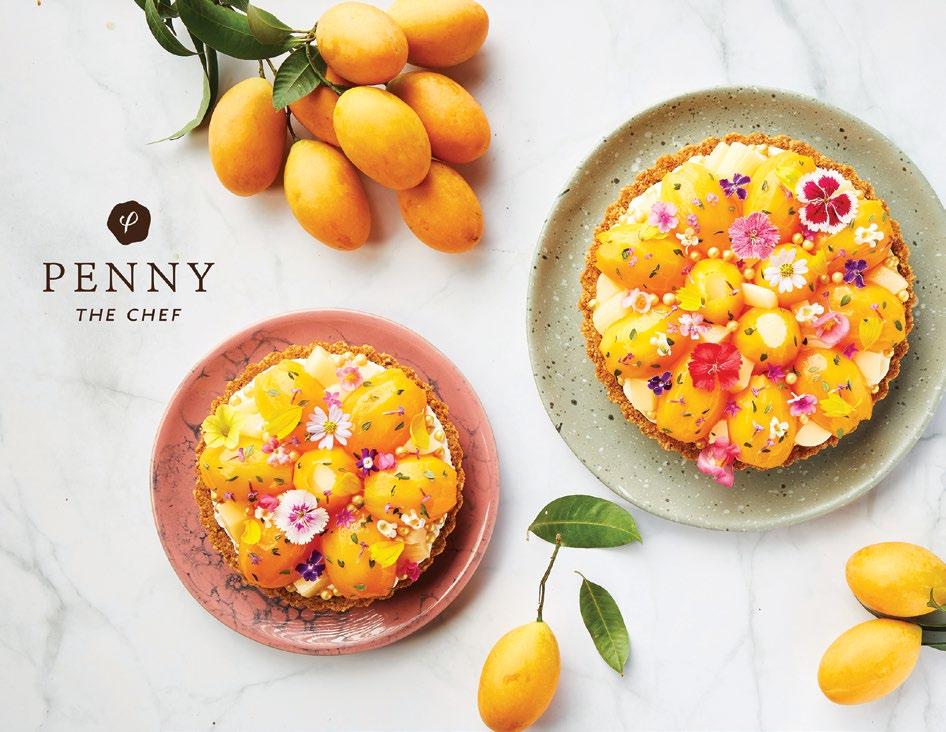
Seasonal fruits with brief harvests are especially prized during the hot season. Mayongchid (Marian plums), sweet with a soft acidity, are pounced upon by Chef Pennee Jirayuwatana (Penny the Chef at www. instagram.com/pennythechef), who transforms the fruit into sensational chilled desserts that focus on texture and flavour, not sugar.
A star among them is Mayongchid Tart – layers of yoghurt jelly and cream cheese over a crisp biscuit base made with wholewheat flour and French butter, decorated with edible flowers and herbs. The result is a refreshing treat rather than a heavy dessert.
A simple vegetable salad can become an expression of rhythm, layered in bands of yellow, red and white punctuated with herbs to resemble a garden in full bloom
AT THE ORCHARD, AT THE RIGHT MOMENT
Hot season abundance is best experienced in Thailand’s orchards. From late February to May, fruit farms across eastern provinces open their gates, inviting visitors to taste sweet treats straight from the tree.
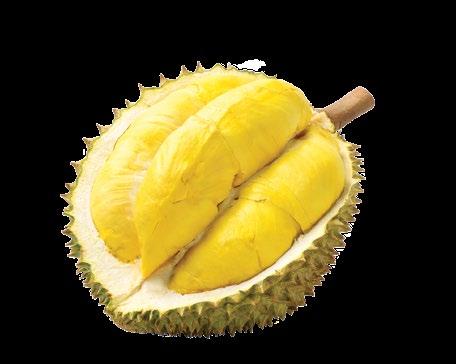
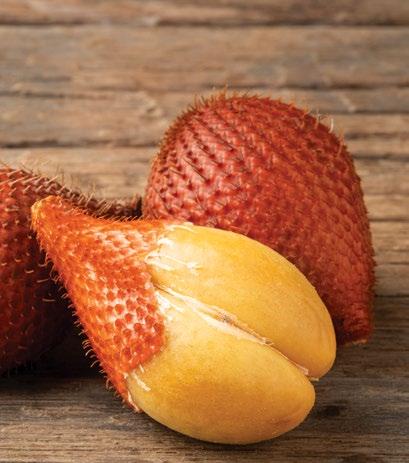
Chanthaburi, Rayong, and Trat are famous for durian, mangosteen, rambutan, and salak (snake fruit). Visitors can stroll beneath the boughs, tasting fresh fruit and comparing the sweetness and texture.
In Nakhon Nayok, the two varieties of Marian plum – sour mayongchid and sweet maprang – appear early in the season. In Chachoengsao, golden Nam Dok Mai mangoes arrive in March, often sold with freshly steamed coconut sticky rice and coconut milk.
These experiences are a reminder that when it comes to seasonal produce, timing is everything.
DRESSING FOR THE SEASON
Summer comfort is not limited to the table. What touches the body matters as much as what feeds it.
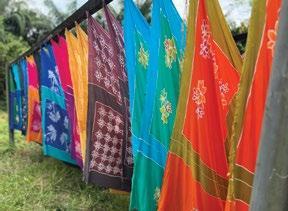
The traditional batik sarong (Pha Pa-Teh) remains one of the most adaptable garments for the hot season. Wrapped or draped, it shields the body from the blazing sun while allowing the skin to breathe.
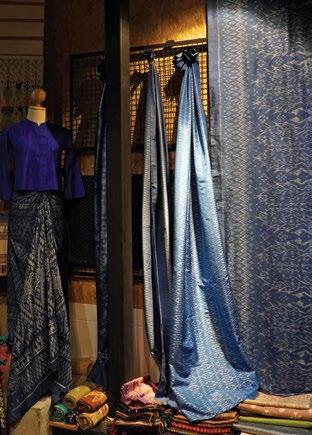
Silk, often linked with formality and ceremony, is also a practical choice in the heat. Cool by day and warm at night, it adjusts to the
temperature. A light silk shawl can guard against the midday sun, then serve as a wrap in the evening.
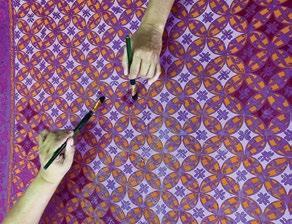
Southern batik blooms with patterns of the sea, flora and fauna, sashaying easily between traditional and everyday wear.
At master batik designer Thaninthorn Raksawong’s Dahlah Batik in Krabi, visitors can watch the pattern-making unfold firsthand, gaining insight into how each piece is shaped by patience and handiwork.
Silk, often linked with formality and ceremony, is also a practical choice in the heat. Cool by day and warm at night, it adjusts to the temperature
Clockwise from Top Left Mayongchid, a seasonal fruit with a sweet-andtangy flavour
Mangosteen, the queen of fruits
Salak, a scalyskinned fruit with sweet-and-sour flesh, enjoyed fresh or in syrup over ice
The batik-writing technique, forming patterns rich in character and allure
Summer-hued batik textiles
Silk, a natural fabric that feels cool in warm weather and gently warm when temperatures drop
Bottom Left Durian, the muchanticipated king of fruits
COOLING THE BODY, CLEARING THE MIND
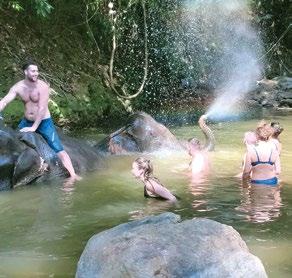
Water is the most obvious answer to heat, with rivers, waterfalls, canals and ocean offering relief across the country.
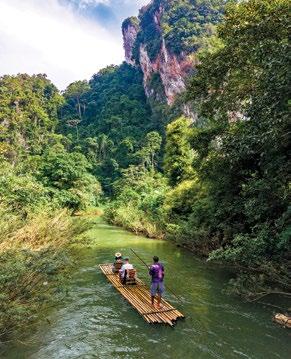
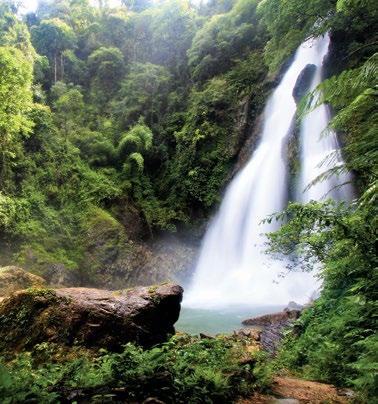
From bamboo rafting and waterfalls in Phang Nga, to Krabi’s freshwater canals and hotand-cold springs, and Samui’s waterfalls, lagoons, and coralfringed islands, full immersion offers physical and emotional restoration.
Standing under a waterfall or drifting along a shaded river washes away tension. In Thailand, summer doesn’t drive people indoors; it heightens awareness –of food, fabric, and leisure. Comfort comes not from avoiding the heat, but from knowing how to turn it into pleasure. That understanding, shaped over time, is the real taste of summer.
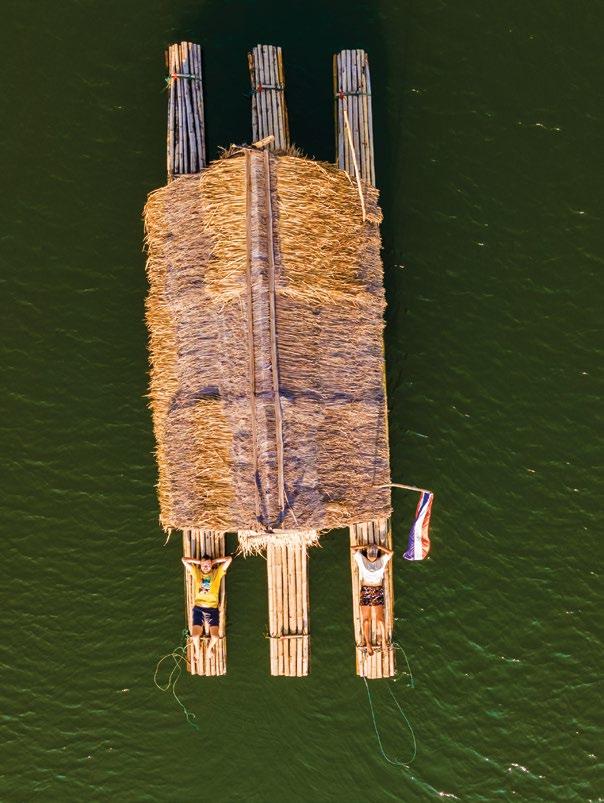
Clockwise from Top Right River basking on a thatched raft
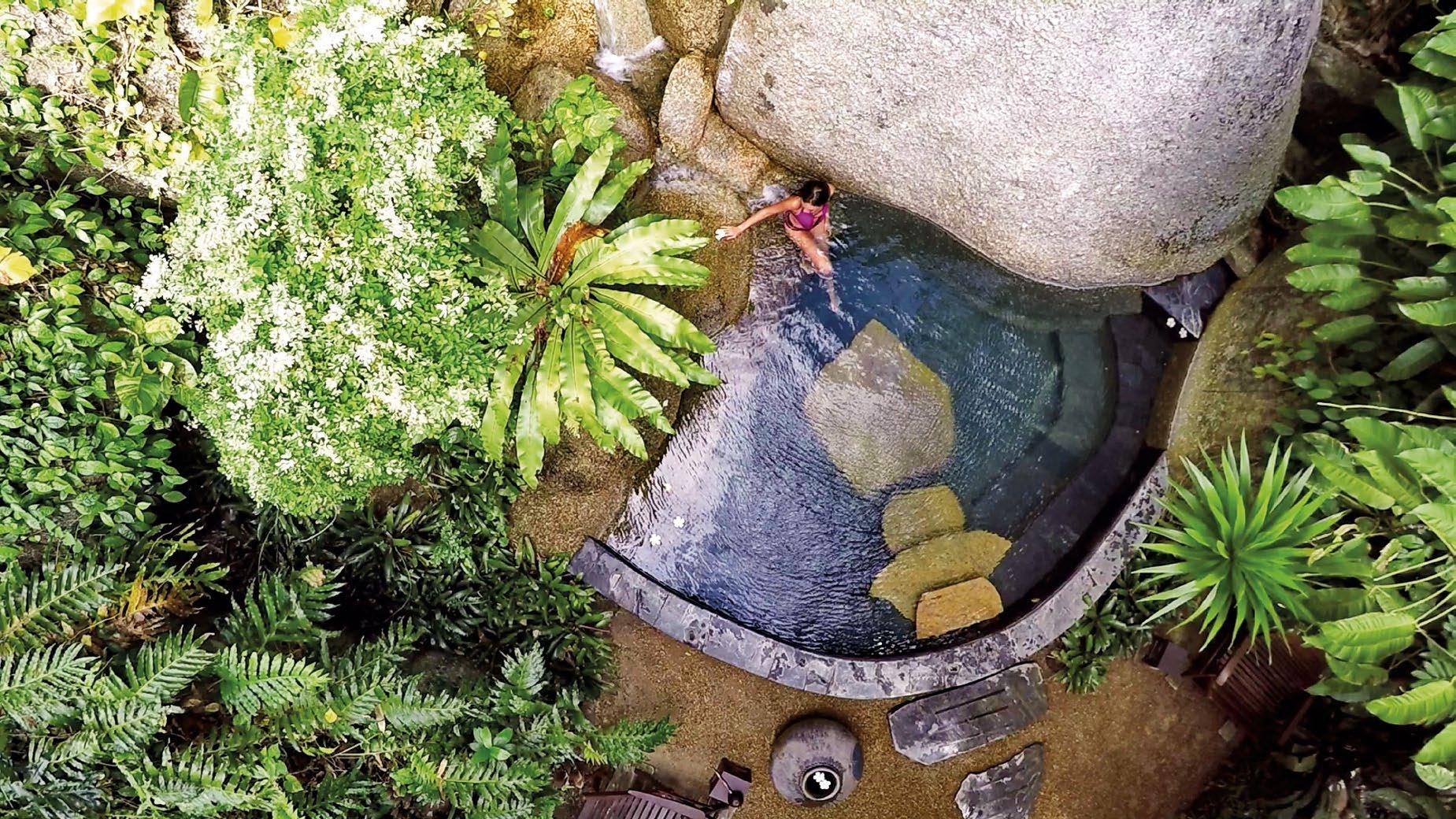
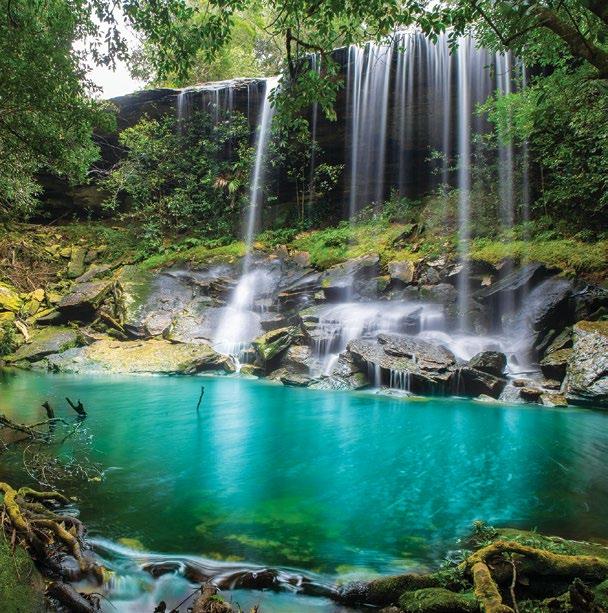
A crystal-clear pool for forest bathing to ease the heat
A waterfall tumbles over rock, kicking up a refreshing mist in a jungle grotto
Floating into the forest on a bamboo raft, surrounded by nature
Cold Comforts in Hot Hours
When eating becomes a chore, chilled desserts are often the answer. In Thailand, these delicious treats are not seasonal novelties, but an everyday way of beating the heat.
Baan Pat & Jeanne, GalileOasis, Bangkok
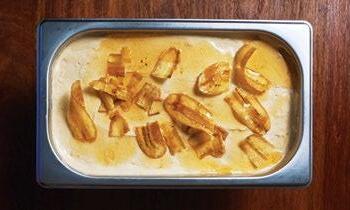
Produced in small batches, ice cream here comes in strange yet sensational flavours. Treat your palate to brown butter banana with fish sauce, dark caramel soy sauce with almond praline, nipa palm vinegar sorbet, and so much more. Instagram: @baanpatandjeanne
Kokia Coconut Ice Cream 1947, Koh Samui
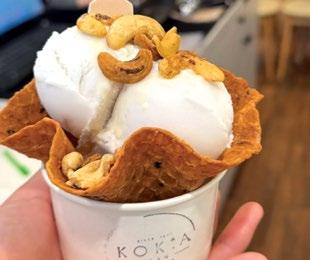
Charming and popular, locals prize this café for its Thai ice cream made from local coconuts and traditional toppings like Lod Chong (pandan noodles) and Bua Loy (glutinous rice balls) in a crispy Thong Muan (rolled coconut wafer). For vibes, don’t miss the historical photos of Samui and welcoming floral decor. Facebook: Kokia Coconut Ice Cream1947
Coconut Ice Cream Carts (Nationwide)
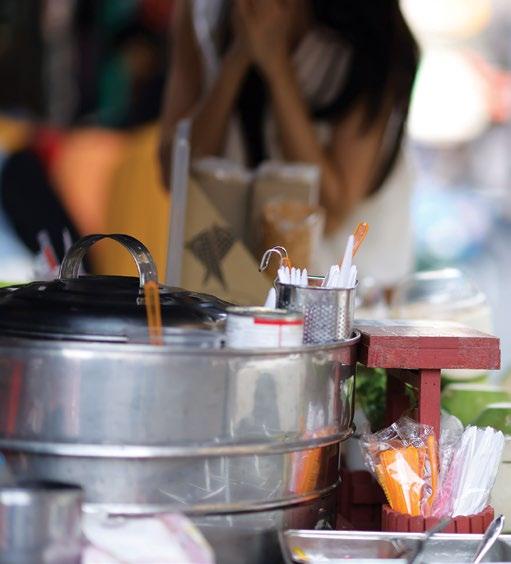
You don’t have to look far to find street stalls and carts serving coconut ice cream in cups, coconut shells, or soft buns, with a choice of roast peanuts, sticky rice and other toppings. Creamy, not too sweet, and fast-melting, this ice-cold treat demands to be eaten quickly on the spot.
Cheng Sim Ei, Chula Soi 5, Bangkok
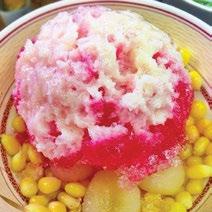
Thais are addicted to this familyowned chain specialising in shaved ice layered with grass jelly, beans, fruit, and syrup. Choose from a myriad of flavours and toppings for your own special balance of sweetness and textures. www.facebook.com/ chengsimei
Torry’s Ice Cream, Phuket
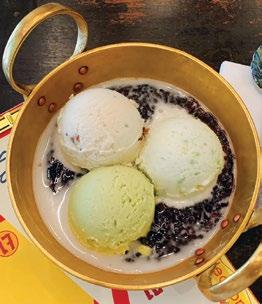
This artisan ice-cream parlour celebrates Phuket’s Peranakan traditions with flavours such as O-Aew (aiyu jelly), A-Pong (coconut crepe) and Bi-Co-Moi (black sticky rice with coconut milk). For extra atmosphere, they are served inside a gorgeous restored SinoPortuguese shophouse. www.torrys.com
Ni-Ang Namkhaeng Sai & Egg Ice Cream, Talat Phlu, Bangkok
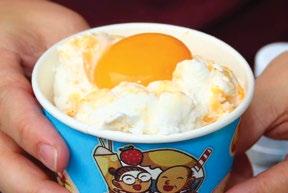
A classic, family-run street dessert vendor offering shaved ice and firm-egg ice cream with classic syrups and toppings. The menu has remained unchanged for decades, favouring familiar classics over trendy trifles. www.facebook.com/niang. taladplu
Itim Roi Ros (100 Flavours Ice Cream), Chiang Mai
Famed for its “hundreds” of unique flavours, this longstanding homemade ice cream shop offers savoury sensations such as Khao Soi and Nam Phrik Num alongside even crazier concoctions inspired by soap and fabric softener. Even weirder – once your taste buds recover from the shock – the flavours are all delicious! www.facebook. com/Iceloveyou
Nuttaporn Ice Cream, Bangkok
This generations-old shop in Bangkok’s Old Quarter is cherished for authentic, natural Thai-style ice cream, especially coconut and mango flavours. Recipes remain true to tradition, prioritising fresh flavours over commercial ease. www.facebook. com/nuttapornicecream94
Lod Chong Singapore, Charoen Krung, Bangkok
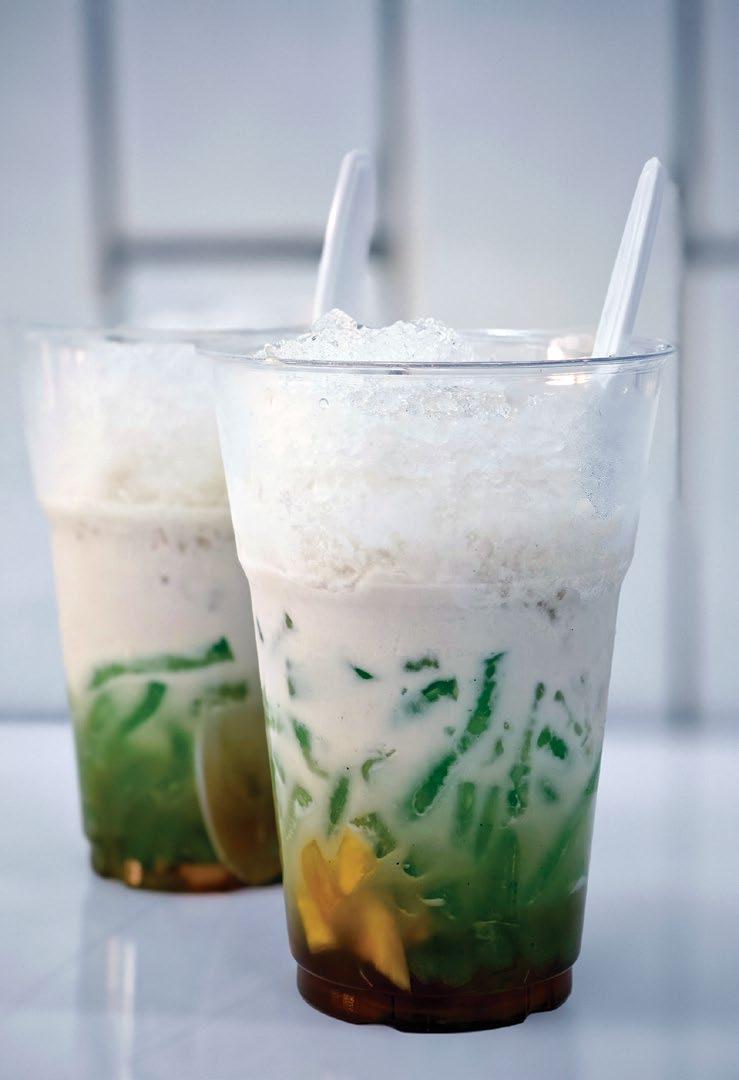
This 70-year-old street stall, named after the nearby but now defunct Singapore cinema, is celebrated for its refreshing Lod Chong: Soft, chewy pandan-flavoured jelly noodles served in rich coconut milk, palm sugar syrup and crushed ice, often with jackfruit. www.facebook.com/lodchongsg
From loom to market stall, Nan and Songkhla pulse with the quiet artistry that keeps Thailand’s cherished traditions alive
Two Beating Hearts of Heritage
Words Phoowadon Duangmee
Photos Shutterstock
Mountains of Nan in northern Thailand
UNESCO CREATIVE CITIES
Asoft clack-clack-clack rises from stilted wooden houses at dawn in Nan’s highlands, as weavers cradle threads dipped in dyes of bark, leaves, flowers and earth. The pattern, known as Lai Nam Lai, is not recorded but remembered – learned by careful watching, counting under the breath and repeating the motion until it settles into memory.
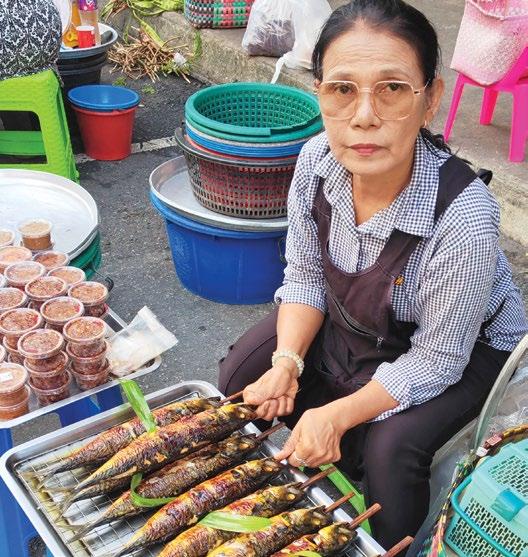
More than a thousand kilometres to the south, the day begins very differently in Songkhla province. Oil sizzles in a market wok. Fish is lifted from ice. And each bowl is served with the quiet confidence of age-old custom. The stalls open before sunrise and close only when the last customer has eaten.
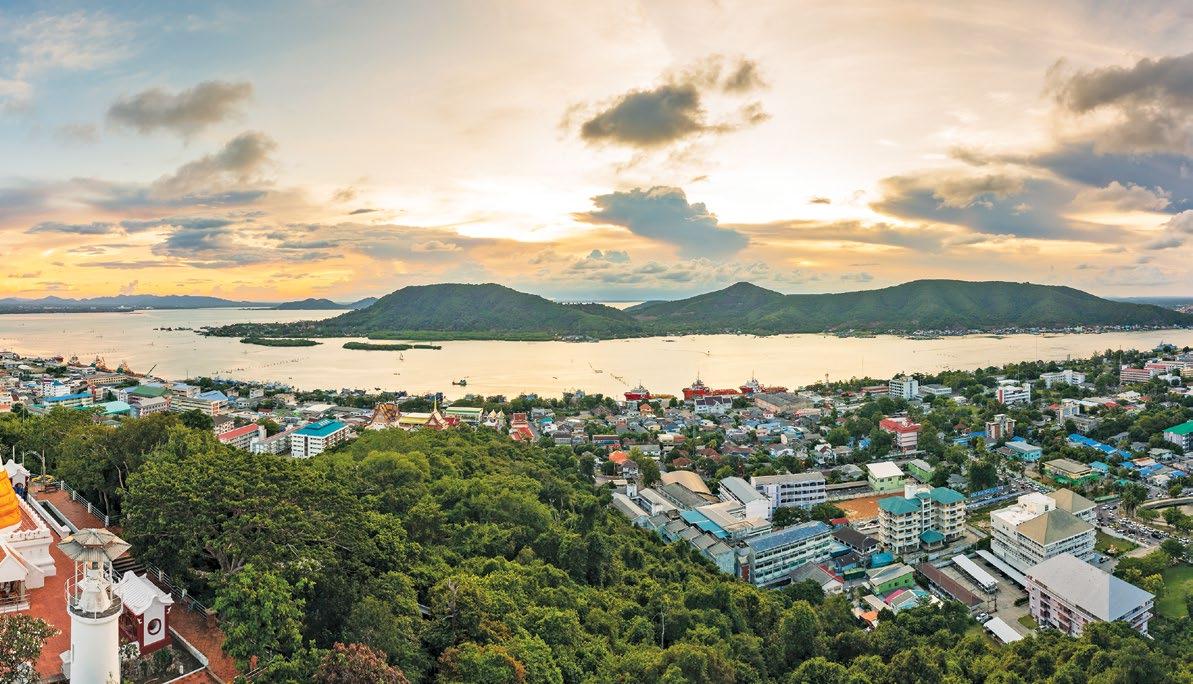
These are not scenes staged for visitors. In both provinces, these simple acts weave the daily tapestry of food, cloth and community. So bright do they shine that Nan and Songkhla were enshrined as UNESCO Creative Cities late last year, joining a constellation of global destinations where artistry sparkles.
Nan received the designation for Crafts and Folk Art, Songkhla for Gastronomy. Together they invite travellers to look beyond Thailand’s beaches and landmarks to the hands, habits and knowledge that quietly sustain everyday life.
Below Cradled in a fertile valley near the Lao border, Nan was once the seat of a small, independent principality
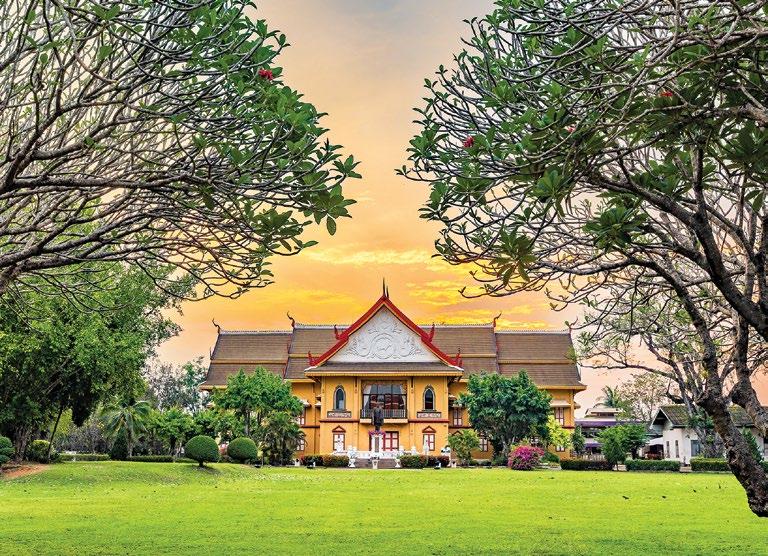
Top Right Nan National Museum
CREATIVE CITIES, LIVING PLACES
UNESCO’s Creative Cities Network ignores grand buildings to spotlight life in the streets –places where skills are passed on, adapted and renewed across generations. In Nan and Songkhla, creativity is not confined to galleries or rooms with white tablecloths. It is embedded in households, landscapes and routes. It shines forth in the way a loom is positioned to catch the light or how a fisherman reads the tide before dawn.
With these two additions, Thailand now has nine Creative Cities, reflecting a cultural diversity far broader than the welltrod tourist trail. Though Nan and Songkhla sit at opposite ends of the nation, both reveal the same simple truth: culture endures only when it is lived.
NAN: A LIVING ANCIENT CITY
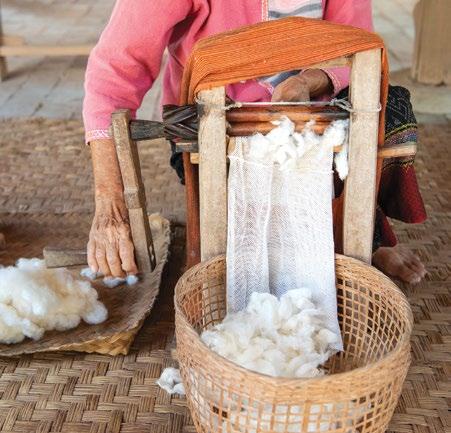
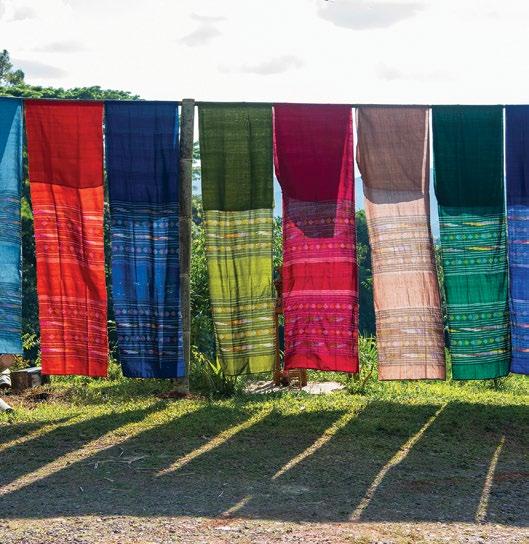
Nestled in a fertile valley close to the Laos border, Nan was once the seat of a small kingdom. Isolated from the outside world by forests and mountains, the town preserved its intimacy and age-old rhythms. Streets remain walkable and neighbourhoods are close-knit. Dubbed “living old city”, Nan thrives today not behind glass but in the bustle of daily traditions. Its UNESCO-honoured crafts are not visitor showcases but the lifeblood of locals. In villages, looms perch on shaded verandas as naturally as patio furniture. Weaving follows the agricultural cycle, fitted between planting and harvesting. Patterns are remembered, not read from manuals. They carry the code of ancestry and belief, deeply understood by those raised within them.
Clockwise from Top Right
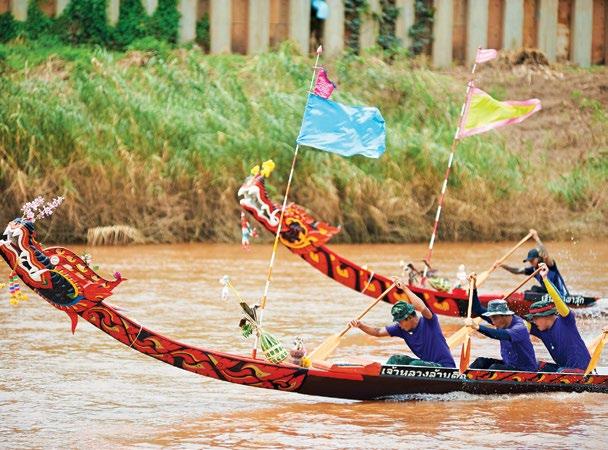
In monsoon season, the Nan River hosts long-boat races, where carved prows transform the water into a living pageant of myth
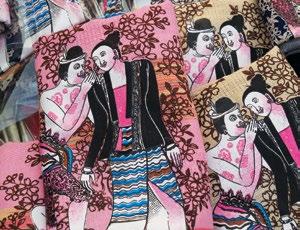
A lifestyle piece inspired by Nan’s iconic “Whisper of Love” mural
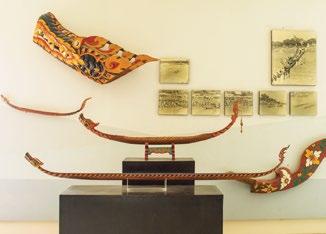
Naga prows and swan-tail sterns on display at the Nan Boat Racing Museum
A Nan weaver spins yarn, preparing thread before it is woven into a story on the loom
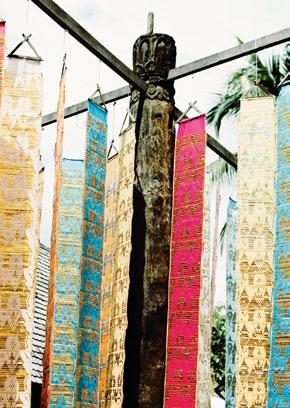
Vertical Tung banners offer the spirits of loved ones symbolic ladders to ascend to heaven
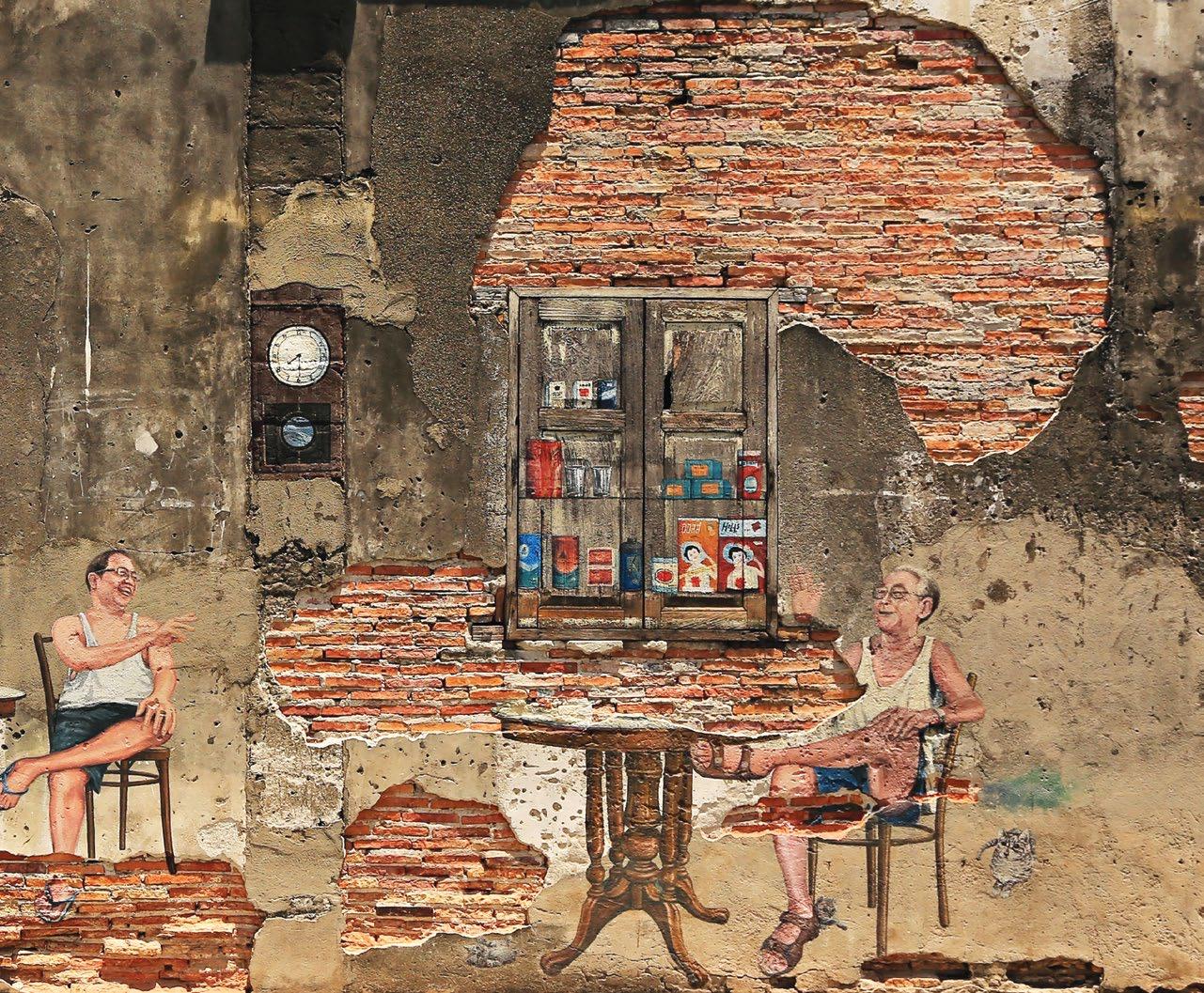
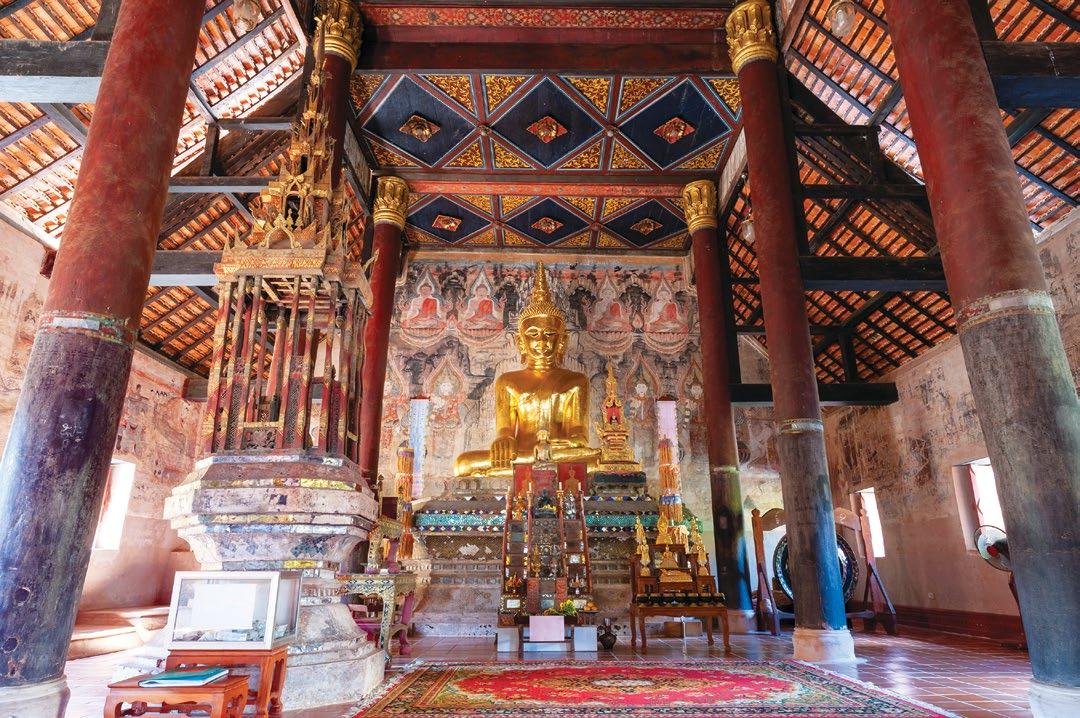
That ancient thread surfaces everywhere: in clothes worn to market, banners at temple entrances, and murals on prayer hall walls. Wat Phumin’s famous “Whisper of Love” mural is the finest example – an intimate scene that favours quiet storytelling over spectacle.
In the valley town of Pua, locals still cut filigree from mulberry paper, fold floral cones for temple offerings, and hang colourful Tung banners to aid departed spirits on their journey to heaven. Sacred artistry peaks during the annual Mahachat festival, when a suspended meadow of flowers –Dok Mai Phan Duang – recreates the fabled Himappan forest connecting heaven and Earth.
The Nan River swells as the rains arrive, forming a stage for the province’s legendary long-boat races. Finely carved prows – nagas, crocodiles and lion-serpent hybrids – turn the river into a raucous pageant of myth and competition between rival communities.
UNESCO’s Creative Cities rest on a simple idea: connection between artisans, community and nature. In Nan, locally grown cotton is coloured with dyes made from indigo, jackfruit heartwood and ebony fruit. Local creativity extends to Hmong silverwork, bamboo baskets and ceramics rooted in the ancient kilns of Bo Suak, where archaeologists have
unearthed centuries-old patterns and techniques still in use today. The latest generation of Nan artisans is working within the same traditions, extending and innovating while remaining rooted in the culture of their ancestors.
FROM MOUNTAINS TO MARITIME CROSSROADS Farther south, Thailand gets flatter and wetter as canals and river basins shape the landscape. Approaching Songkhla, the landscape is swallowed by Songkhla Lake and the Gulf of Thailand beyond. If Nan is shaped by valleys, Songkhla is etched in water.
In villages, looms perch on shaded verandas as naturally as patio furniture. Weaving follows the agricultural cycle, fitted between planting and harvesting. Patterns are remembered, not read from manuals.
Top Built in 1862 by Thai Lue craftsmen, Wat Nong Bua in Nan displays artistry and refinement on par with the celebrated Wat Phumin
Bottom Left Nan’s traditional textiles bring colour and character to the valley landscape
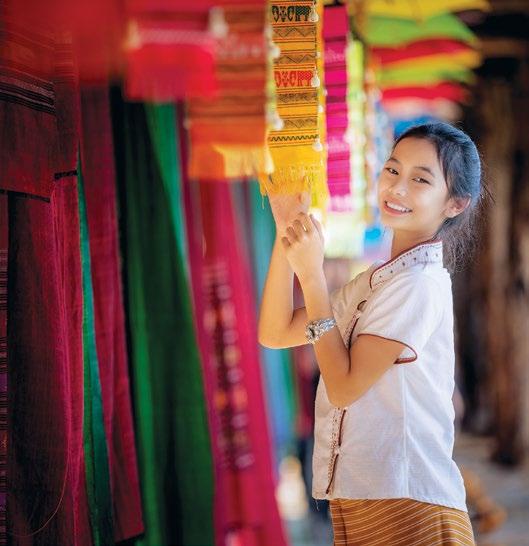
Bottom Right A young woman wears her pride in Nan’s art and culture, woven in cotton
Top Left In Songkhla, cooking has long been an art of adaptation
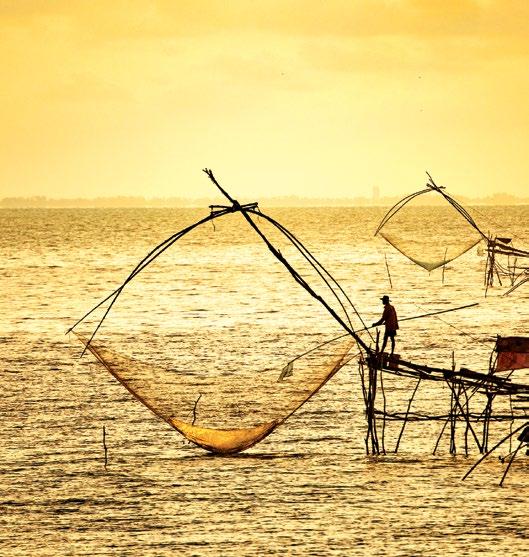
Top Right At dawn in Songkhla, local fishermen check their lift nets as the day’s work begins
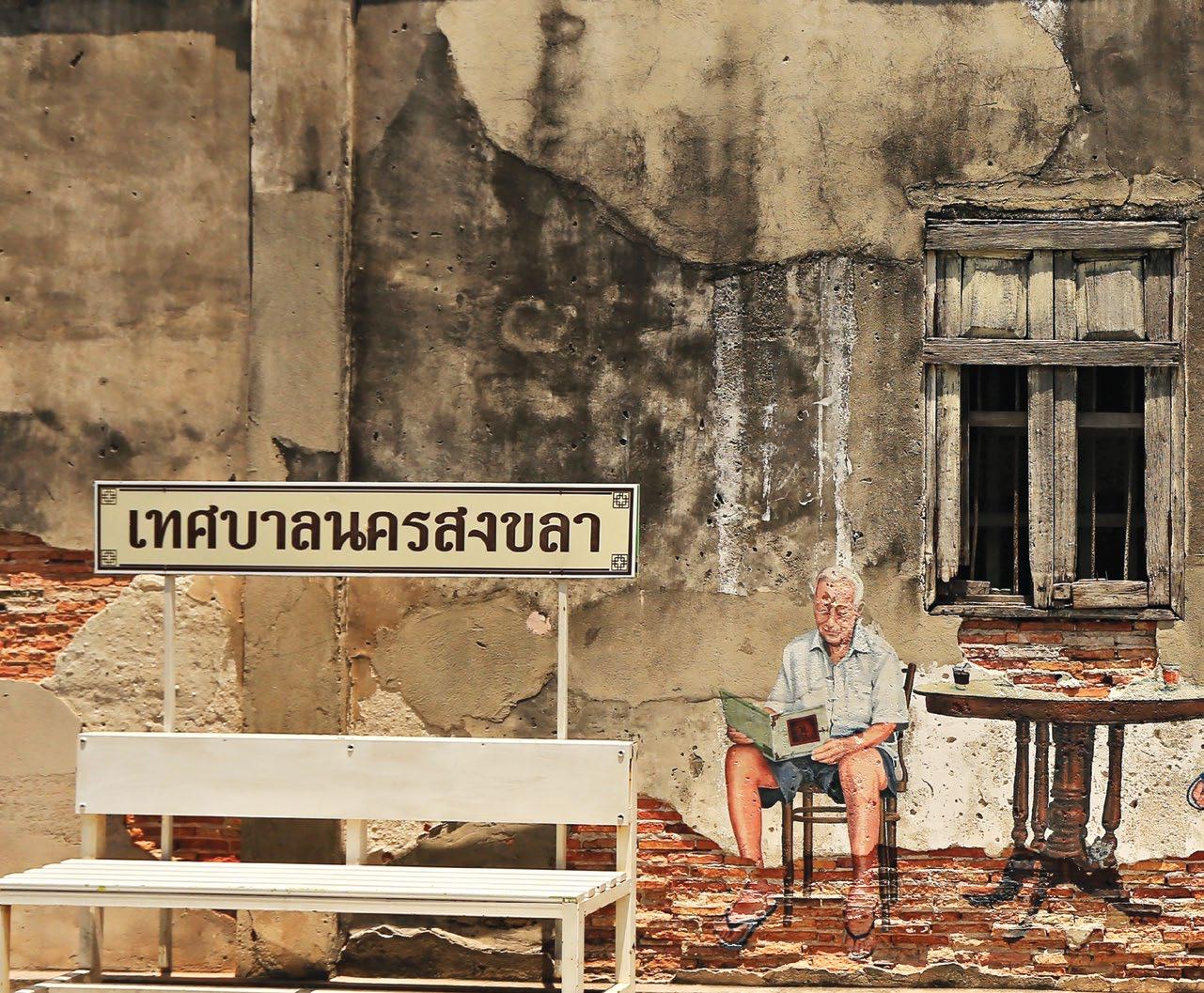
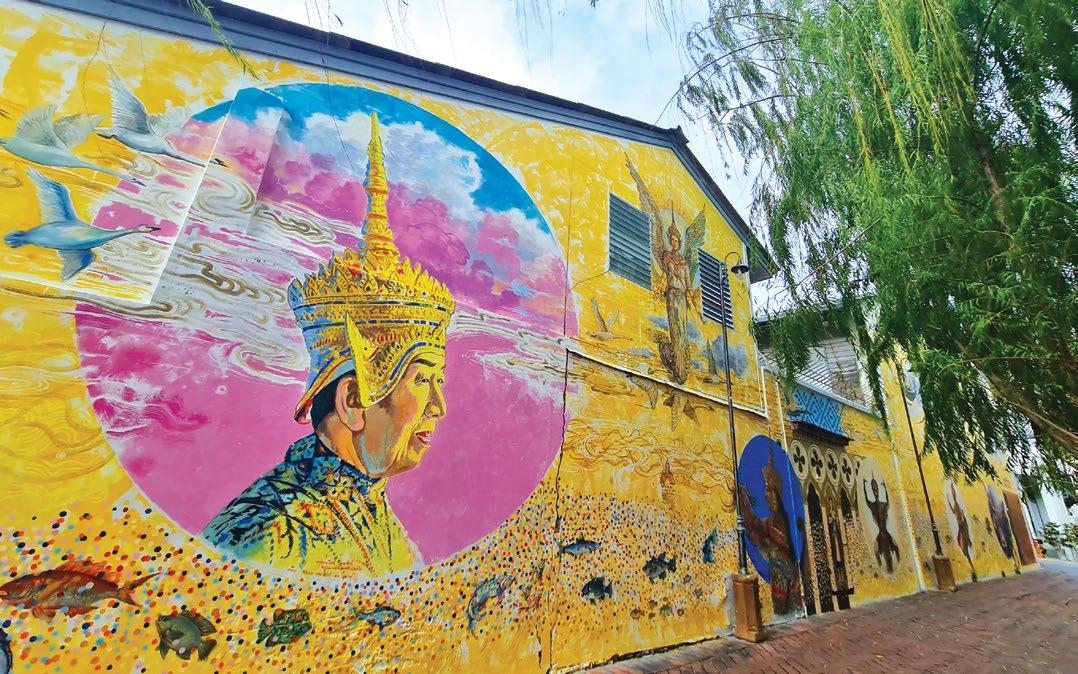
Bottom Manora dance reimagined as street art in Songkhla Old Town
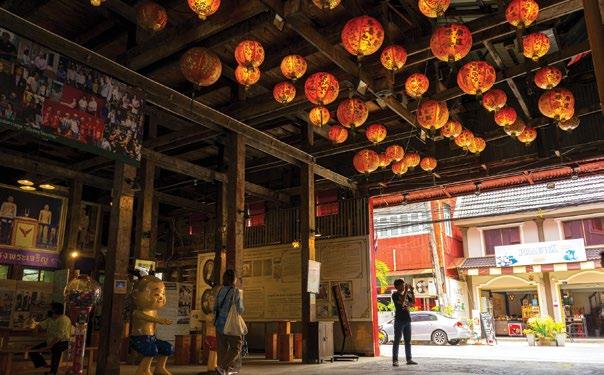
Nestled between the lake and sea, Songkhla is an ancient meeting place of tides and cultures. Chinese traders, Thai officials and Malay fishermen arrived by boat, carrying not just products but new techniques of cooking, seasoning and preserving that still define the city’s cuisine. Here, gastronomy is not a trend, but an inheritance.
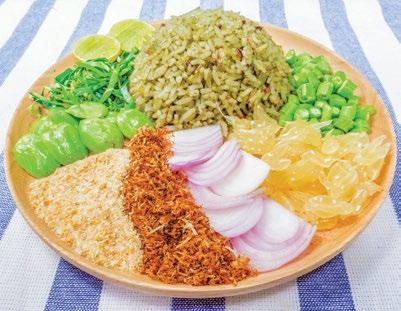
In Kopitiam traditional coffee shops, a century-old breakfast ritual unfolds. Menus offer a mouthwatering melting pot of Thai curries, Chinese noodles and Malay dishes. A colourful bowl of Khao Yum captures Songkhla’s natural bounty in rice, coconut, sharp lime and its signature fermented fish sauce. A plate of Gaeng Tai Pla carries heat and herbal depth – a curry embodying local heritage.
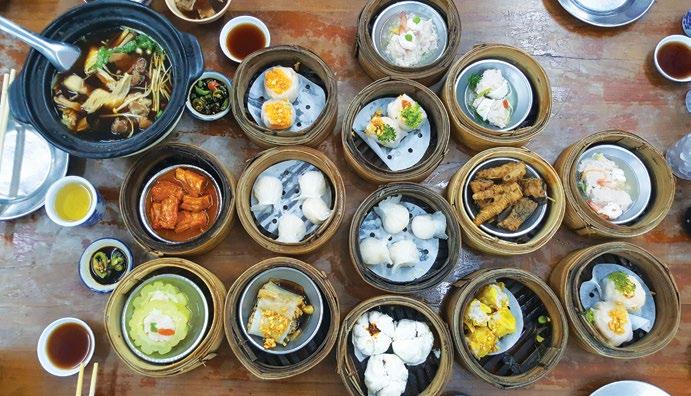
Clockwise from Top Right A Songkhla restaurant serves dim sum for breakfast, echoing the city’s enduring Chinese heritage
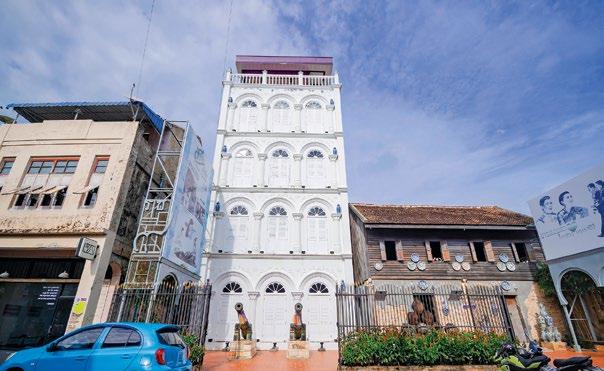
Sino-European façades and wooden shophouses stand side by side, reflecting Songkhla’s long-standing cultural melting pot
Khao Yum blends herbs, rice and citrusy dressing into a bright, refreshing meal in southern Thailand
The catch of the day on display at Songkhla’s local market
In Songkhla’s food markets, look out for Tao Khau – a prized noodle-fried tofu salad. This delicious street dish delivers the region’s trademark rainbow of flavours. Sweet, sour and savoury mingle with crisp vegetables, tofu and seafood – the fruit of centuries of exchange between MalayMuslim, Thai-Chinese and southern Thai traditions.
Markets still form the city’s beating heart. Seafood from the Gulf glints beside freshwater fish pulled from the lake, while rice, coconuts, herbs and spicy pastes teeter in piles. Mirroring the markets, Songkhla cooking is defined not by written recipes but through an intimate understanding of where ingredients come from and how they change with the seasons.
CITY SHAPED BY WATER
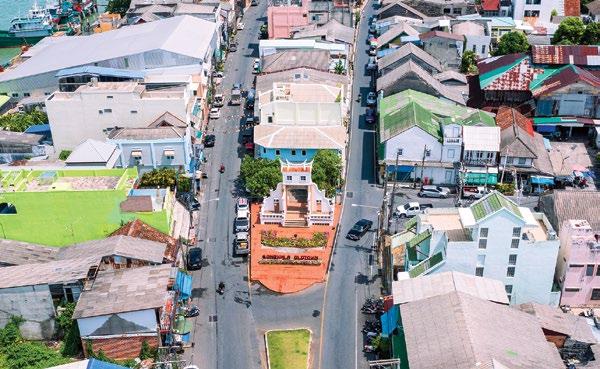
Songkhla Old Town reveals itself in layers that tell a fascinating story. Sino-Portuguese architecture
sits side by side with mosques and Buddhist shrines. Its three historic streets – Nakhon Nok, Nakhon Nai and Nang Ngam –are best explored on foot. Their faded shophouses whisper of trade routes that once connected Songkhla to Penang and Singapore further south. Water is the element that carved this new addition to UNESCO’s Creative Cities. The sea meets Thailand’s largest lake in a mosaic of canals, wetlands and rice fields, creating one of Thailand’s most fertile landscapes. However, local abundance is inseparable from vulnerability. The waterways that sustain the city can also engulf it. Hat Yai is now recovering from its latest severe flood, with hotels, resorts and restaurants reopening, and locals once again showing the resilience and hospitality the region is known for.
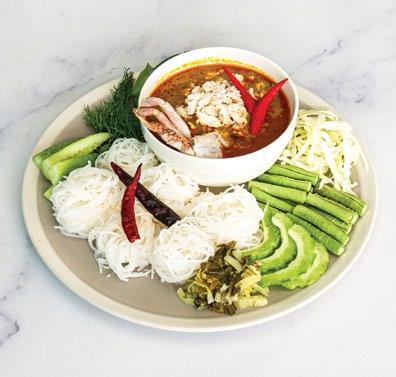
Cooking in Songkhla has always been rooted in time and terroir. Dishes like Gai Tom Khamin (turmeric chicken) and Khanom Jeen Nam Ya Pu (rice noodles with crab curry) are prepared from shared knowledge rather than a recipe book, adjusting instinctively to seasons and supply. The art of preservation – drying, fermenting and pickling – reflects an awareness of natural cycles and scarcity. Gastronomy here is guided less by novelty and more by stewardship.
THREADS AND TIDES
On the surface, Nan and Songkhla seem to inhabit different worlds – one shaped by textiles and temples, the other by markets and maritime trade. Yet both are grounded in the same idea: community is preserved by creativity. Skills are not commodities but the thread that binds people together.
UNESCO’s recognition has not changed these creative hubs so
much as sharpened their focus. In Nan, dyes and patterns evolve without diluting heritage. In Songkhla, flavours absorb new influences without erasing old ones.
For travellers seeking depth over novelty, Nan and Songkhla offer a more grounded journey through Thailand – one that rewards patience and curiosity with creativity woven into daily life.
Clockwise from Top Poised between lake and sea, Songkhla has long been a crossroads of tides and cultures
Songkhla Old Town unfolds in layers, where SinoPortuguese façades, mosques, and shrines stand steps apart
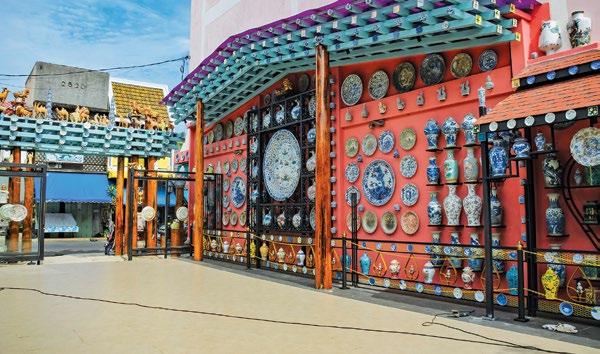
Songkhla Old Town rewards visitors with rich heritage and promising food experiences
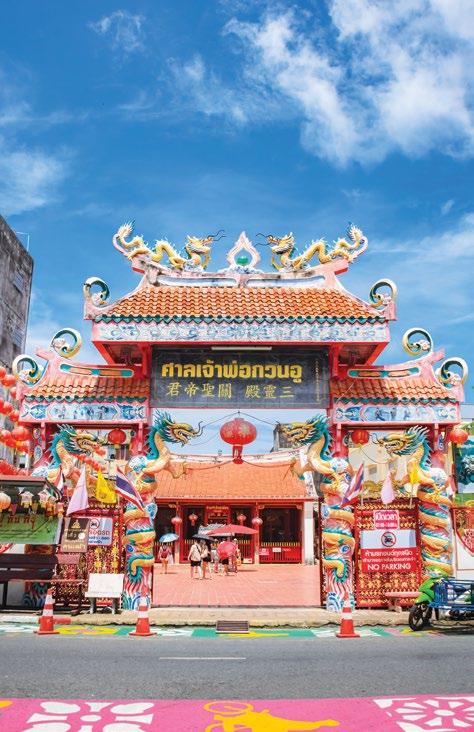
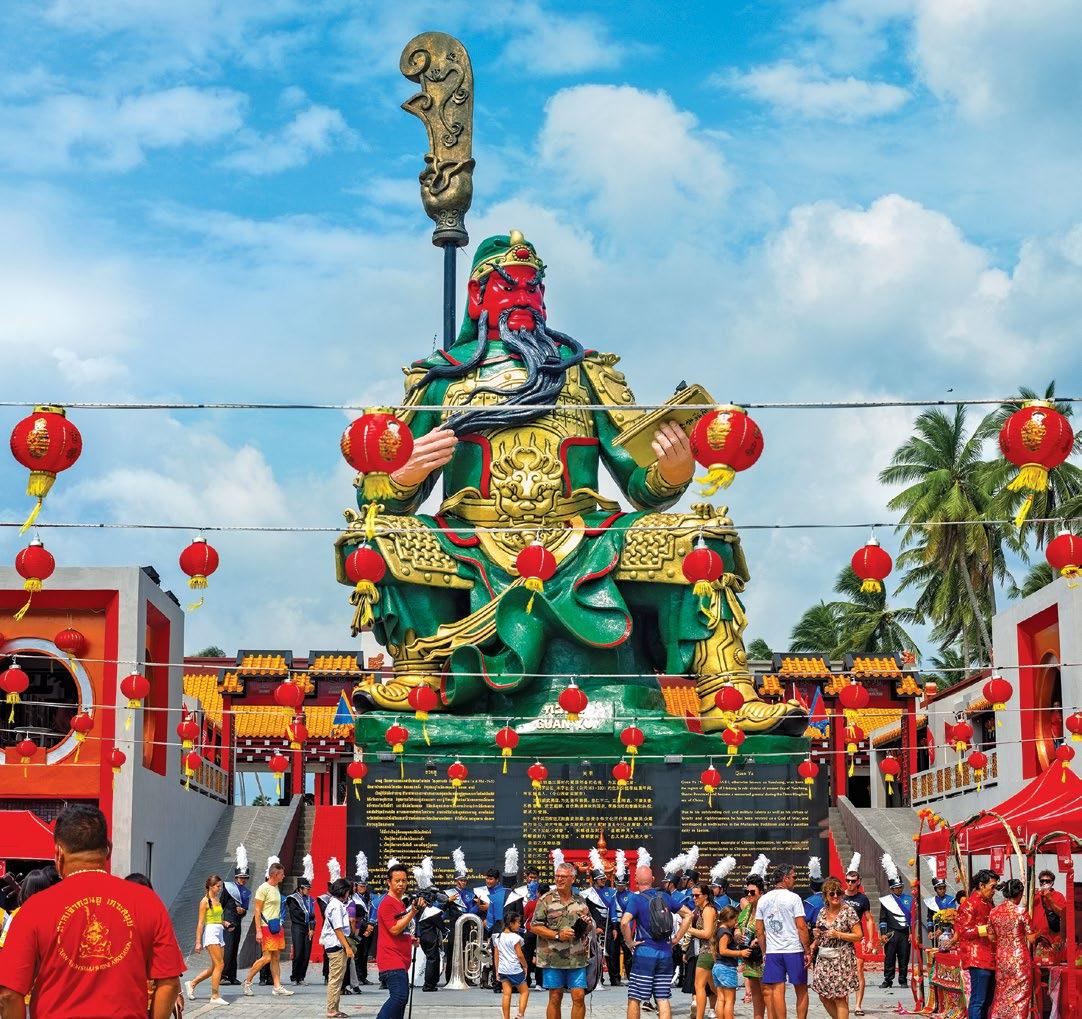
The Guan Yu Shrine anchors Songkhla Old Town’s historic Chinese-speaking community
A heritage building in Songkhla Old Town is reborn as an art and lifestyle hub
Khanom Jeen rice noodles served with tasty crab curry
Where the
On Koh Samui, the Hainanese community keeps alive rituals shaped by ocean crossings, ancestral memory and unwavering belief
Carried by tides and sustained by faith, the Hainanese people of Thailand have preserved a spiritual world that is increasingly rare in the modern age. A precious example is Koh Samui, where sacred tiger dances, fire-walking and celestial rituals are practised as a living tradition. Heritage here is not hidden in museums but performed daily as part of ordinary life.
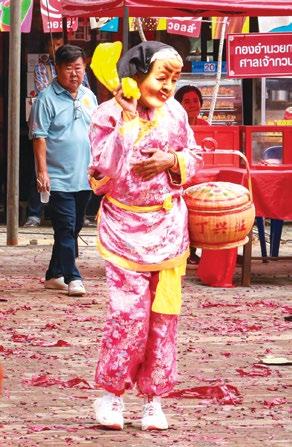
Thais of Hainanese descent join the Changing Sacred Vestments and Awakening the Deities ritual
Chinese migrants began trickling into Thailand during the reign of King Rama III (1824-1851), but it was under King Rama V (1868-1910) that the movement surged. The turning point came with the signing of the Bowring Treaty between Siam and Great Britain in 1855. This landmark agreement opened the Siamese kingdom to international trade, accelerating economic growth and reshaping the country’s relationship with the outside world. Commerce expanded, agriculture and industry flourished, and Chinese migrants arrived in growing numbers – trading, investing and seeking opportunities on foreign shores.
The migrants came from several distinct Chinese groups: Teochew, Hokkien, Hainanese, Cantonese and Hakka. They are collectively known as Ngoh Hok – the five major Chinese groups in Thailand –although they are often referred to simply as Thai-Chinese today.
Over generations, Thai and Chinese identities have blended so seamlessly that the boundary between them is often difficult to define. Chinese values such as diligence, perseverance, thrift and loyalty quietly wove themselves into the Thai spirit of warm-heartedness, generosity, tolerance and sanook (fun).
Yet despite this melting pot, many Chinese communities in Thailand retain a strong sense of cultural continuity. Across the country, Chinese shrines, schools and language associations stand as quiet witnesses to this heritage. Rituals once practised privately within communities have evolved into
national events, with celebrations like Chinese New Year and the Vegetarian Festival now firmly fixed on the calendar. Among Thailand’s many Chinese communities, however, one group stands out for the depth and resilience of its traditions: the Hainanese.
A PEOPLE SHAPED BY THE SEA Thais of Hainanese descent trace their roots to Hainan Island, China’s southernmost province. Historically remote and surrounded by ocean, Hainan shaped a people intimately connected to the sea. Though distant from political and economic centres, the island was
rich in natural resources and its geography shaped a culture marked by independence, adaptability and a strong artistic sensibility.
As Hainanese migrants spread across Thailand, many headed for Bangkok – particularly to the Samsen, Bang Pho and Bang Sue districts. Others settled beyond the capital in Nakhon Sawan, Phichit, Lampang and Chiang Rai. Perhaps the strongest magnet, however, was Surat Thani province, particularly Koh Samui, where the rhythms of island life echoed those of their ancestral home.
Central to the Hainanese identity is a deep bond between ancestors and
descendants. Cultural knowledge, moral values and unique rituals are handed down from generation to generation. Even after more than a century in Thailand, this careful transmission has allowed local Hainanese to preserve a distinct sense of identity, grounded in memory yet lived out in the here and now.
This living heritage was praised by King Rama V, who wrote: “The Hainanese cherish art and beauty, and their craftsmen are distinguished by grace and refinement.”
Many of the migrants became skilled carpenters or sawmill owners – a legacy that is still visible today. Intricate woodcarvings found in
Hainanese shrines, along with the painstaking restoration of sacred statues – smoothing, lacquering, gilding with gold leaf and repainting with bright colours – shows a reverence both for craftsmanship and for the divine itself.
BELIEF AS A WAY OF LIFE
When it comes to faith, Hainanese beliefs closely mirror those of Thais. Spirit worship, belief in karma and moral teachings influenced by Confucianism and Mahayana Buddhism form the foundation of daily life. Great importance is placed upon virtue, gratitude towards ancestors and honouring one’s word.
The one and the only Kan Luan ritual in Thailand
These values come alive in a rich calendar of rituals and festivals, from Chinese New Year and the Ghost Festival to elaborate funerary rites such as Gong Tek to ensure safe passage of departed loved ones into the afterlife. At the centre is Hainanese opera, which serves both as entertainment and a stage to strengthen bonds of language, memory and tradition.
For the Hainanese, deities are not distant symbols but daily companions – protectors helping to shape their lives. Migration often meant perilous journeys across open seas in small boats at the mercy of wind, waves and pirates. In these moments, faith became essential and legends took shape.
Traditionally, sacred images were painted or carved only for deities who took up residence in a permanent home – a shrine, household altar or trading vessel. On migrant journeys, devotion took a lighter form: Red paper inscribed with the deity’s name or sacred flags could be carried easily across land and sea. Deities might be invited temporarily for a ceremony, then respectfully bade farewell as ritual texts were burned to mark its conclusion.
Today, there are 135 recognised Hainanese shrines across Thailand. Most are dedicated to the Goddess of the Sea, Jao Mae Tubtim.
“Wherever there are Hainanese, there is a Jao Mae Tubtim shrine,” goes the saying. On Koh Samui, no less than four Hainanese shrines stand as quiet sentinels of faith, history and maritime identity.
WITNESSING A RARE TRADITION
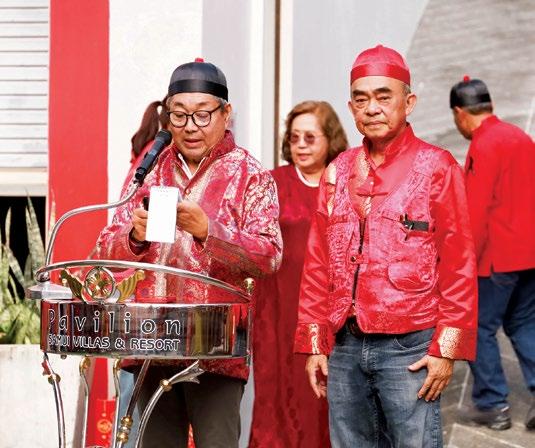
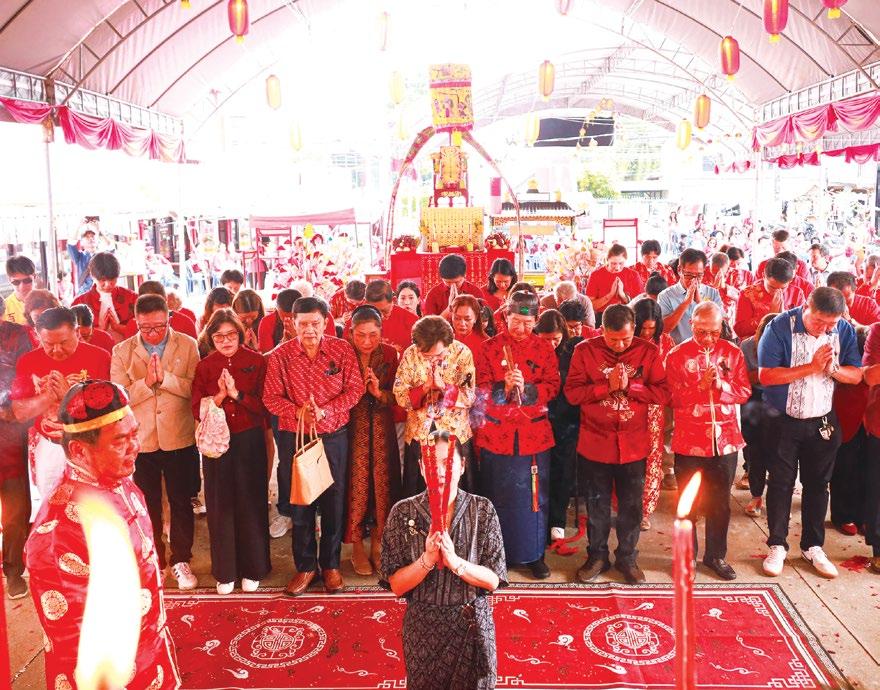
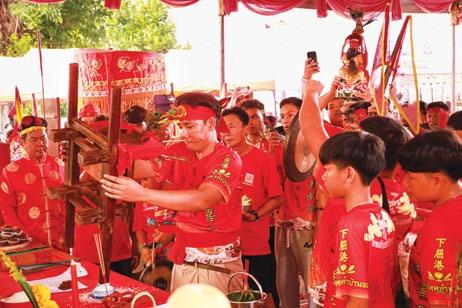
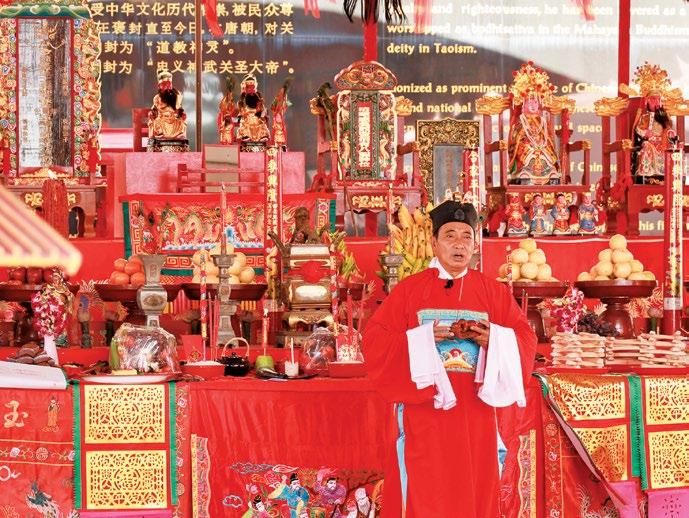
In December last year, Fah Thai was lucky enough to witness one of the most elaborate Hainanese rituals still practised today, an event becoming rare even in China. The occasion was the unveiling of a new sanctuary within the Guan Yu Shrine in Na Khai-Hua Thanon, built to welcome additional Hainanese deities. The consecration ceremony on December 14 and 15 featured the changing of sacred vestments and the “eye-opening” ritual – formal invitations for the divinity to take up residence in the newly restored images. Prayers were chanted in the Hainanese language, led by a priest from Hainan Island itself.
No mere religious rite, the ceremony was an act of cultural preservation – honouring the ancestors who settled on Koh
Top Thapanee Kiatphaibool, Tourism Authority of Thailand’s Governor, chairs the Changing Sacred Vestments ritual
Bottom Left
One of the main performers of the Tiger Dance
Samui over a century ago and keeping their traditions vibrant and intact for future generations.
CHANGING SACRED VESTMENTS AND AWAKENING DEITIES
The ceremony began at dawn when six deities were invited to descend, led by Guan Yu and Ban Thao Kong, the guardian spirit overseeing the rite. Enthroned on ornate sedan chairs, their statues were borne down from the upper levels of the shrine to join the Goddess Tubtim in her two manifestations – Tian Hou Teng Mai and Tui Bui Teng Niang – as well as Yidi Gong, guardians of the sea, and Hua Guang Gong, God of Performance.
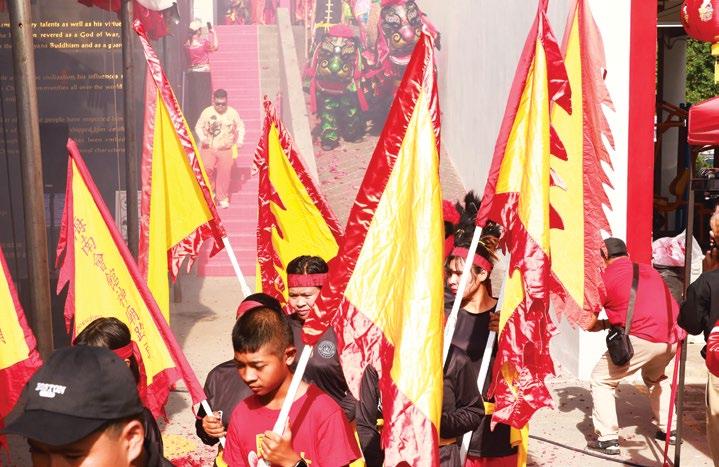
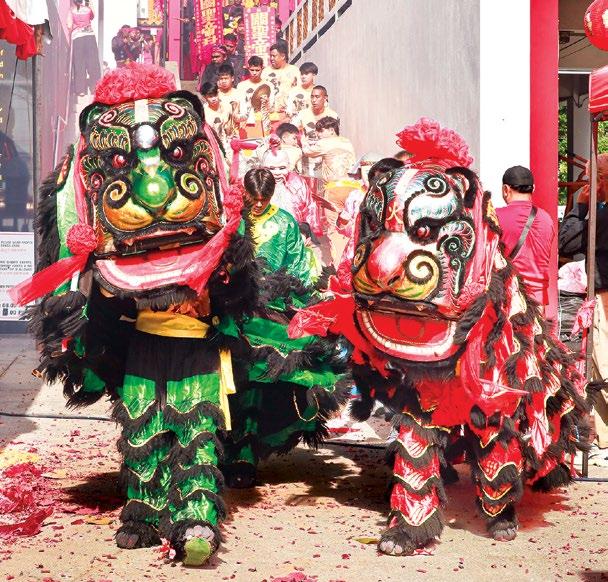
The deities were escorted to the ceremonial altar by the Tiger Troupe from Nakhon Sawan’s Thevarak Shrine. Firecrackers shattered the silence, signalling to Heaven and Earth that sacred proceedings were underway. The ritual reached its climax with the “eye-opening” ceremony, inviting the divinities to inhabit their restored images.
TIGER DANCE RITUAL
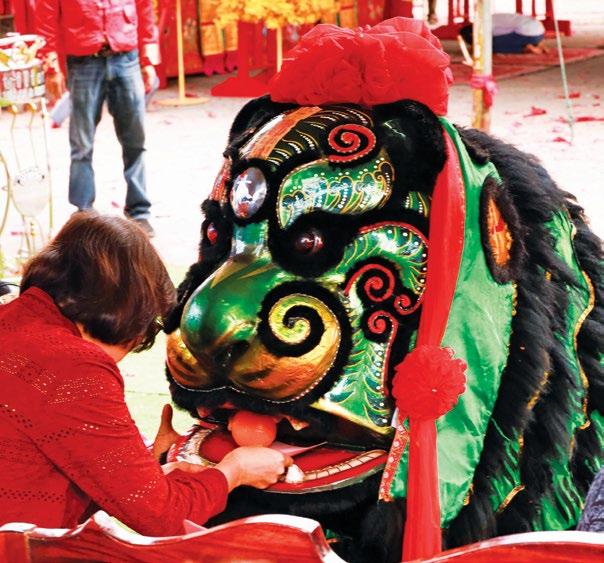
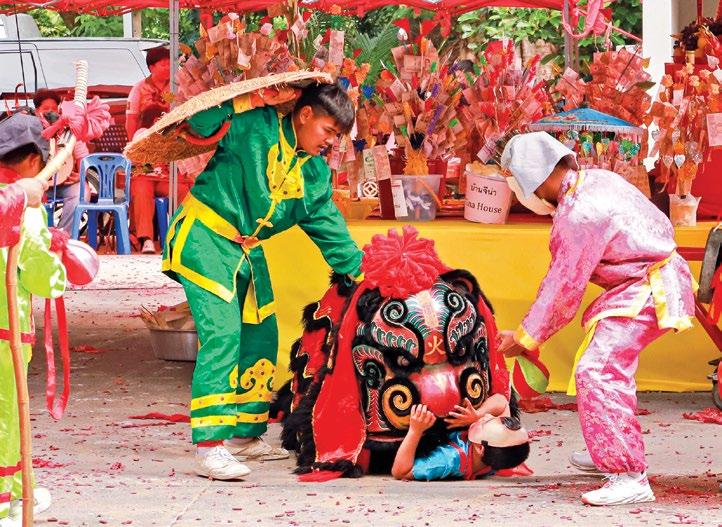
For Hainanese, the tiger embodies the guardian spirit Ban Thao Kong, known in Thailand as Thepharak. Traditionally, the tiger leads the enshrinement procession, clearing obstacles from the path and shielding devotees from harm. Symbolically, the Tiger Troupe became the festival’s spiritual vanguard – sweeping away malevolent forces so blessings may follow.
THE KAN LUAN RITUAL
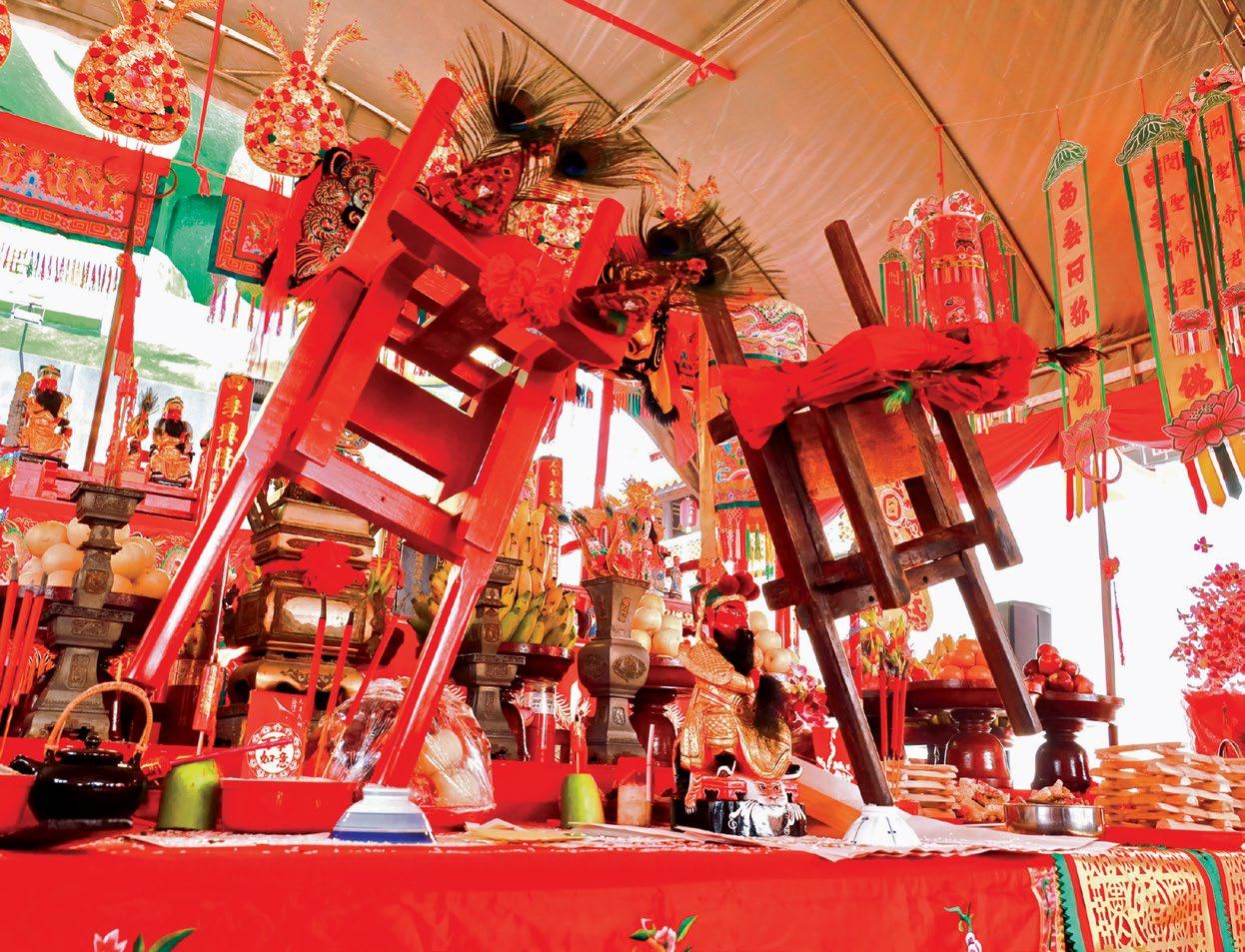
The Kan Luan ritual sees the deity’s spirit invited to descend through a spirit medium and take residence on the sedan throne, or Luan. The crucial point comes with the Luan balanced at an improbable angle, often resting on a single leg placed on the mouth of an inverted bowl or vase. This suspension, believed to be guided by divine force rather than human strength, serves as proof that the deity has fully descended. If balance cannot be achieved, the ritual is considered incomplete. Performed on December 14 by a spirit medium from Ban Phot Shrine in Surat Thani’s Don Sak district, the ceremony offered a glimpse into one of the most elusive and sacred rites of the Hainanese people.
LIVING FAITH
A BATTLE FOR SALVATION
The legend behind the ceremony tells of a tiger that devoured a child in a moment of rage. The boy had been teasing the sleeping tiger, which turned around and swallowed him whole. Moved by the mother’s grief, Ban Thao Kong commanded the tiger to spit out the boy unharmed – a story since transformed into a dramatic ritual, embodying divine justice and mercy.
FIRE-WALKING RITUAL
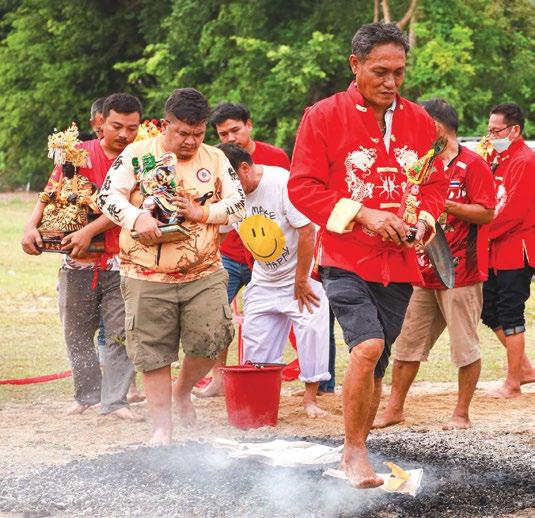
Participants walk barefoot over smouldering embers while carrying sacred images, believing fire to be a purifying force. Passed down through generations and traditionally performed within shrine grounds, the ritual takes place every five or 10 years, when artisans carefully remove the old layers of paint from each sacred statue before repainting them anew. The rite demands unwavering faith and courage, restoring spiritual clarity and potency.
THE JIAN BIAO RITE
In the Jian Biao ceremony, or the Rite of Petitioning Heaven, written petitions ( biao ) are prepared with great care and symbolically sent heavenwards to the highest celestial authority – the Jade Emperor. Ritualists chant formal invocations as offerings of incense, candles and symbolic items are made.
The written petitions are then burned to confirm that the heavens have been formally informed and respectfully engaged. Among the Hainanese, the Jian Biao ritual is essential, marking the completion of the ceremony as blessings are sealed and faith and spiritual balance restored.
THE GOD GUAN YU
Born in Hedong Commandery, present-day Yuncheng in Shanxi Province, Guan Yu was a legendary general of the Three Kingdoms. Honoured in Taoism for his loyalty and integrity and deified as a god of wealth, he is also revered in Chinese Buddhism as a protector, warrior and moral paragon.
With his commanding image –red-faced, bearded and wielding the Green Dragon Crescent Blade –
Guan Yu remains a symbol of righteousness. Shrines dedicated to him can be found across China, Taiwan, Hong Kong and Chinese communities worldwide, with worshippers seeking his protection and blessings for success in career and commerce. Guan Yu statues are commonly seen in homes, shops and offices, serving as a silent guardian of integrity and prosperity.
GUAN YU SHRINE, KOH SAMUI (NA KHAI-HUA THANON)
Established in 1857 and sanctified with finely carved images of Guan Yu and Ban Thao Kong, the Guan Yu Shrine has long served as a spiritual anchor for Koh Samui’s Hainanese community. In its early years, the temple provided shelter for newly arrived Chinese migrants, granting them a sense of belonging far from home.
Today, it stands as one of the island’s most significant cultural landmarks – a living testament to faith, migration and the enduring legacy of the Hainanese people.
Art Alert
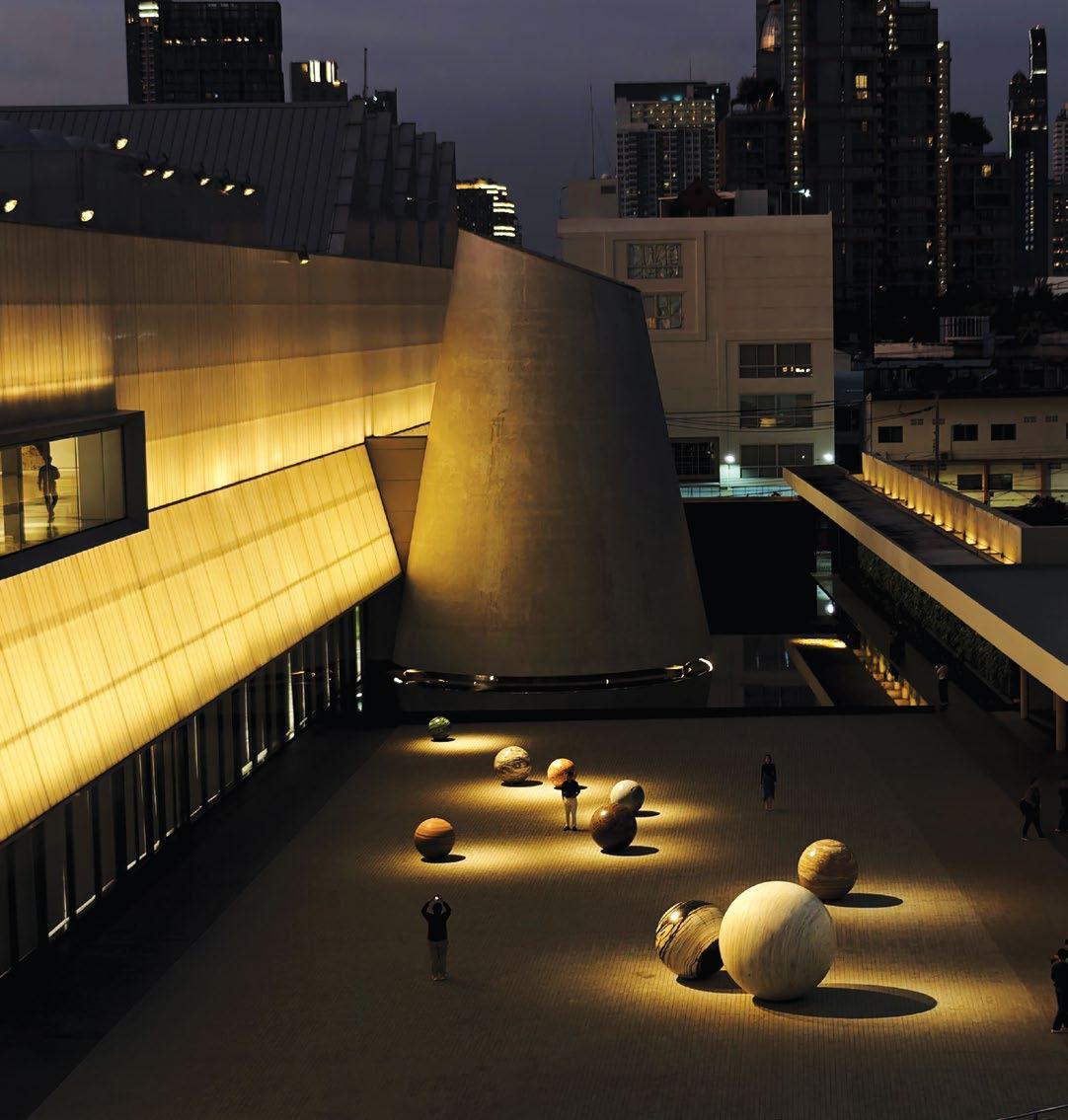
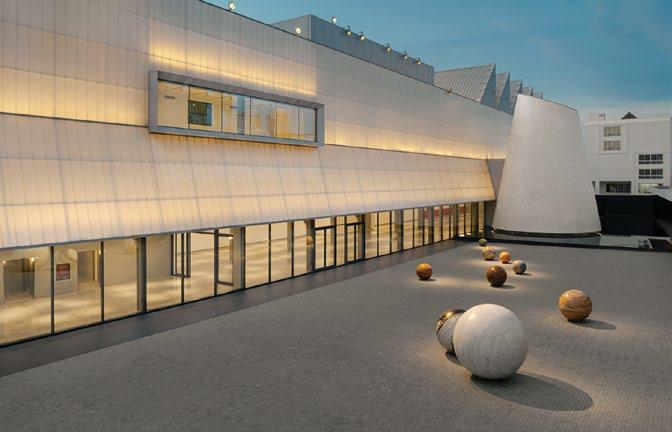
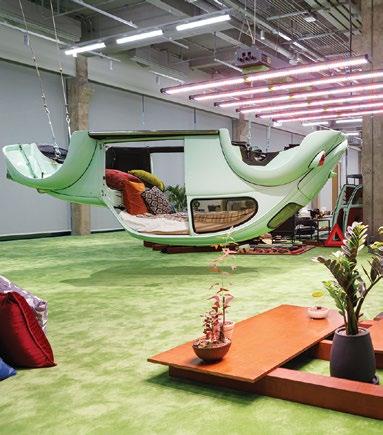
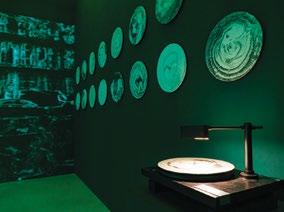
Bangkok’s first international contemporary art museum, Dib Bangkok, has taken shape in a 1980s threestorey warehouse in the heart of the city. Launched as a new destination for cultural exchange, learning and discovery, the space brings Thai contemporary art into global dialogue. Debut exhibition (In)visible features 81 works by 40 leading artists –including Montien Boonma, Lee Bul, Pinaree Sanpitak, Anselm Kiefer, and Alicja Kwade – that reflect on memory and absence in contemporary life.
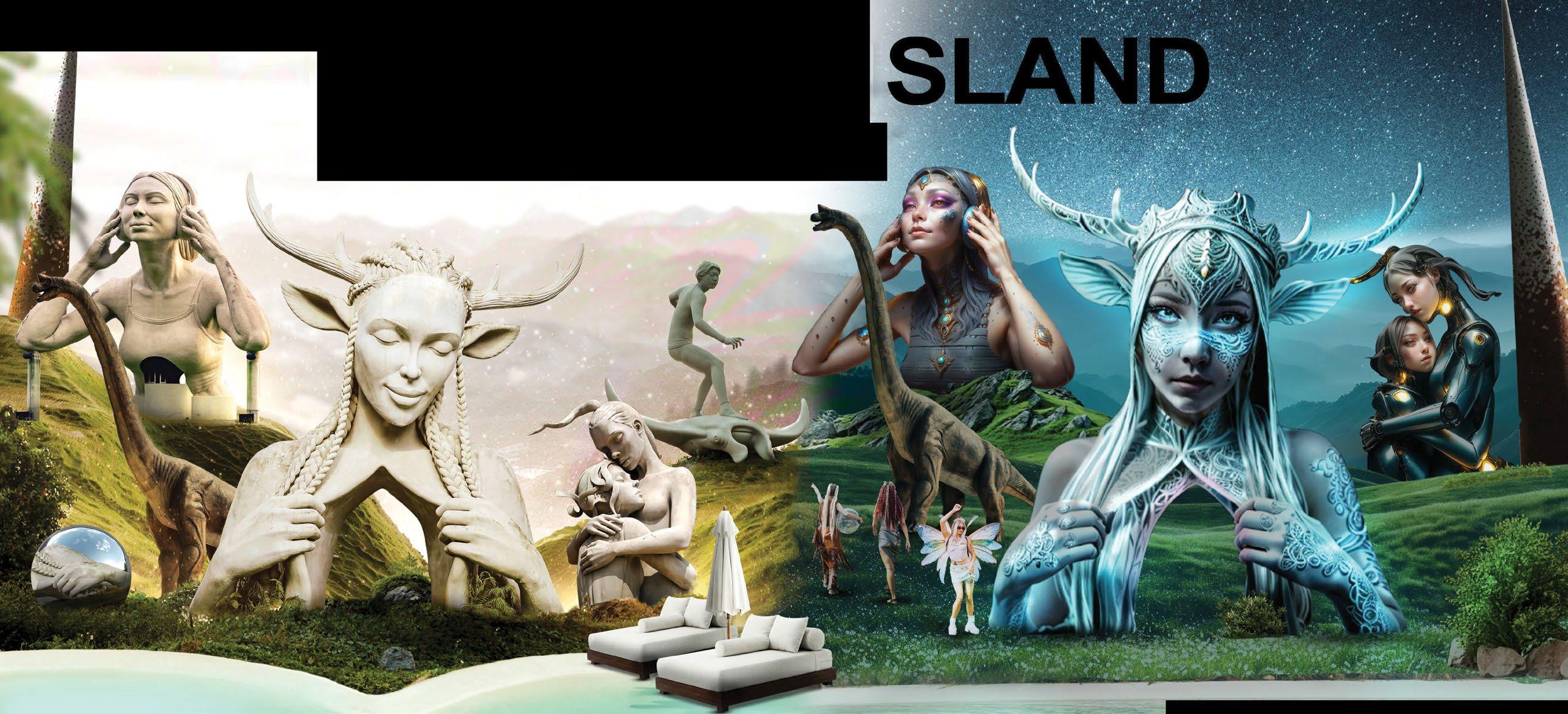
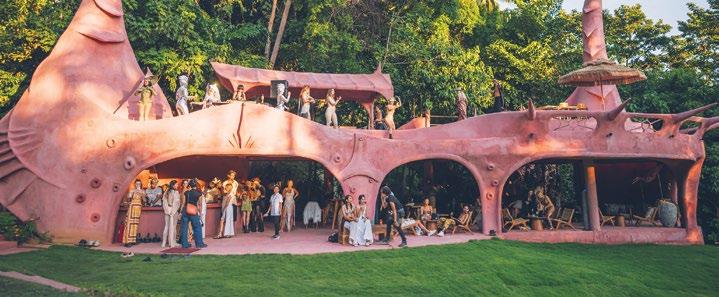
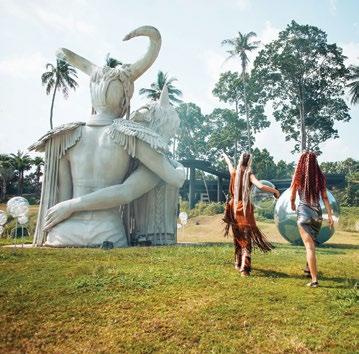
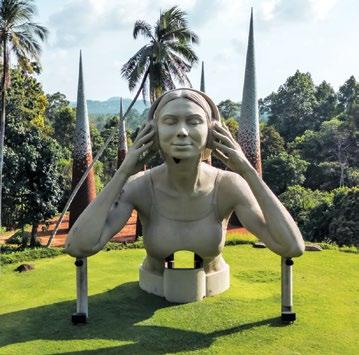
Dubbed the eighth wonder of Samui, The Xperience unites art, nature and technology for an immersive experience unlike any other. Guests journey through a parallel universe where striking sculptures, glowing pathways, interactive installations and dreamlike environments respond to their movement and presence.
Each zone offers something different, ranging from elevated viewpoints, plunge pools and immersive lagoons to sensory environments that blur the line between reality and imagination. When it’s time to slow the pace, the beach club delivers easy island vibes with music, drinks and ocean views. Open Wednesday to Sunday from late morning through evening, The Xperience invites curious minds to explore, play and rediscover their sense of wonder. 11/45 Moo 4, Lipa Noi, Koh Samui, Surat Thani; thexperienceworld.com
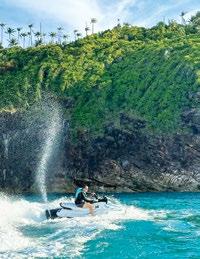
Adrenaline Vibes Watersport transforms the ocean into an open playground, as an expert team leads jet-ski riders to hidden beaches and winding mangrove routes around Koh Samui and Koh Phangan. Expect powerful machines, guides who know every wave of the sea, and a strong focus on safety without sacrificing thrills.
From one-hour adrenaline-packed rides to full-day journeys and even overnight adventures, each experience caters to travellers who want to explore deeply, not just skim the surface. Guests can find their comfort level at their own pace, with expert guidance in English, French or Russian, delivering experiences that are both empowering and effortless. www.adrenalinevibe.com
AN EDEN FOR ENTERTAINING
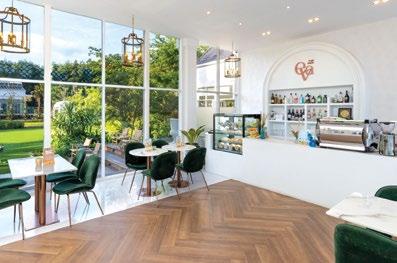
Eva Café & Restaurant offers sophisticated comfort food in the relaxed surroundings of a lush tropical garden – perfect for occasions that call for both style and seclusion. From weddings and milestone celebrations to office meetings, conferences and intimate dates, its flexible indoor and outdoor spaces adapt seamlessly to every demand. Outdoors, a sweeping green lawn, tropical trees and fountain create serene natural drama, while the purpose-built glasshouse softens
daylight and lends an airy elegance to daytime gatherings.
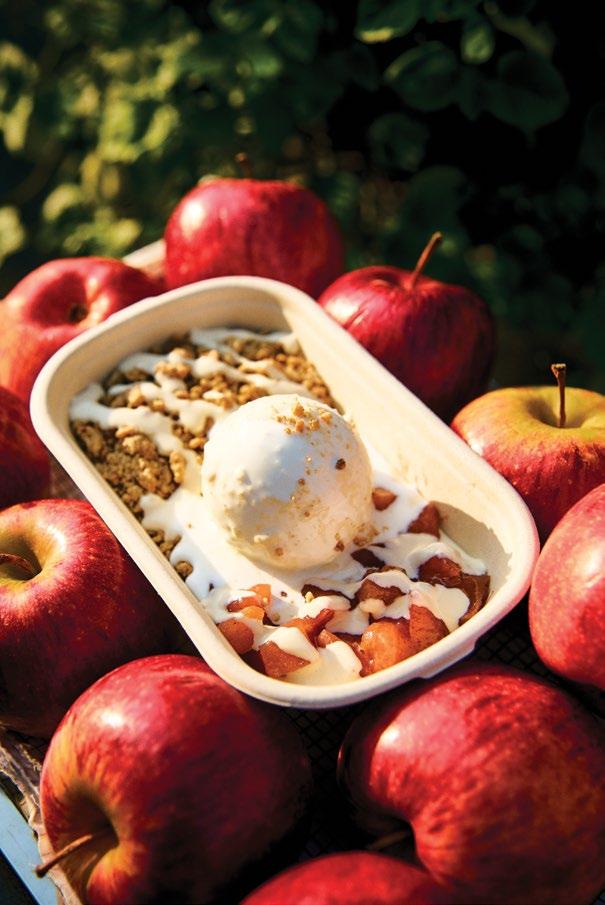
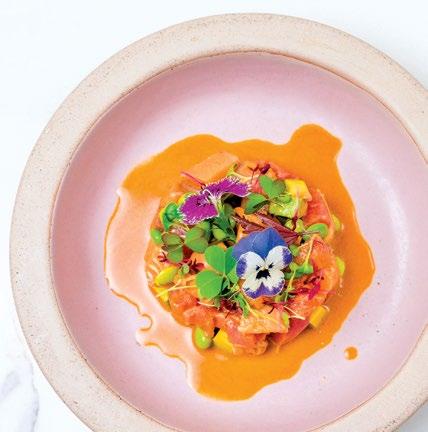
The menu balances playful comfort and polished plates, from fried ravioli paired with Thai papaya salad to Tom Yum spaghetti with crispy salmon and rich pasta dishes. Desserts tempt in the form of warm apple crumble and silky mousse cakes, best enjoyed with cocktails or wines from the garden cellar. 13/2 Garden of Eden, Building 1, Koh Samui,
Photos: The Xperience
Photos: Adrenaline Vibes Watersport
Photos: EVA Café & Restaurant
RIDE THE BLUE
THE MINDFUL GYM
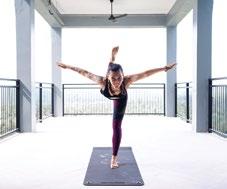
Overlooking lush jungle, Gravity Movement Gym is where fitness equals freedom. Here, the aim is not to chase mirrors, but to build strength, mobility, control and athleticism in an ego-free environment.
From callisthenics and hand balancing to mobility work, yoga, and primal flow, training here is smart, mindful, and sustainable. Members can drop in for classes, follow personalised programmes with expert coaches, or fuel up at the on-site café with coffee and protein shakes. Retreat packages are also available for those seeking to reset and level up.
Led by owner Coach Jared Foote and his experienced team, Gravity Movement supports everybody – from athletes to newbies – helping them move better, feel stronger, and unlock the hidden power of their bodies. 150/52, Taling Ngam, Koh Samui, Surat Thani; www.gravitysamui.com
TWO GENERATIONS, ONE HEART
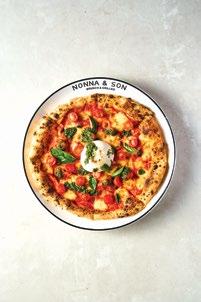
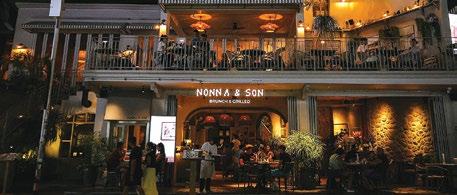
Nonna & Son lives up to its name: an Italian grandmother’s kitchen serving slow-cooked comfort food prepared with love and expertise, while her son weaves magic with meat and smoke over a charcoal grill. Two generations rooted in one of the world’s top cuisines showcase their passion for Mediterranean cooking. By day, the restaurant serves fresh handmade pasta, pizza with slow-fermented dough base, and other Italian classics.
SPOTLIGHT
Jump the Lava, Beat the Heat
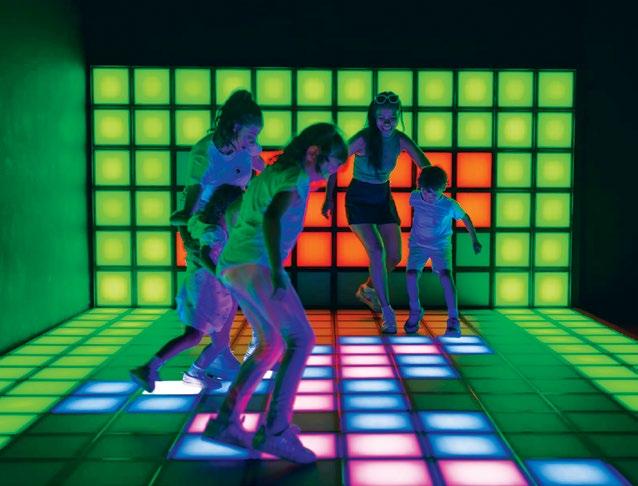
LAVALED Samui delivers sizzling thrills with its “Floor is Lava” playground, where players jump, dodge and navigate levels by stepping on safe tiles while avoiding the eruption. Each 25-minute session turns into a lively team challenge as the ever-changing tiles keep everyone moving and laughing.
Since erupting in central Chaweng last year, LAVALED has quickly become the go-to indoor escape – perfect for cooling off, avoiding tropical rain or just taking an energetic break between beach plans. Catering for groups of two to six, LAVALED is all about shared fun, quick reflexes and memorable island moments. Chaweng Walking Arcade, Ground Floor, 162/161, Moo 2, Bo Phut, Koh Samui, Surat Thani; www.thelavaled.com
As night falls, the second generation takes over, serving up fire-grilled steaks and sharp flavours with a modern touch. The result is honest Italian cooking served in a premium casual dining setting – two styles united by a passion for meals meant to be lingered over and shared. Nonna & Son, 168/1 168/55 Tambon Bo Phut, Koh Samui, Surat Thani; www.instagram.com/
Photos: Gravity Movement Gym
Photo:
LAVALED
Photos:
Nonna & Son Samui
Bowls of Japanese Comfort
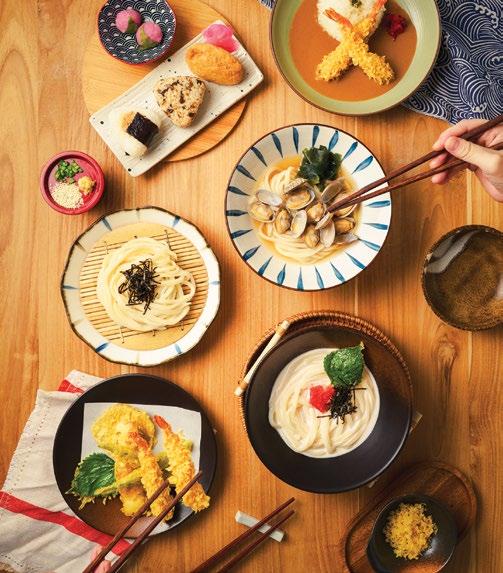
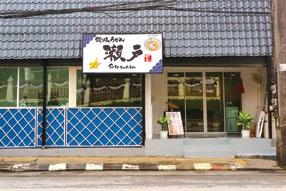
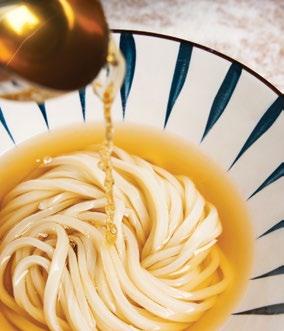
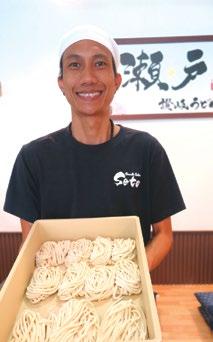
Udon noodles are prized in Japan, and Seto Sanuki Udon serves up the real thing for discerning diners. Led by Thai chef Dew and his Japanese wife, the restaurant brings the soul food of her hometown on Shikoku island to the heart of Phuket.
The smooth, firm noodles in delicate, comforting broths carry flavours to match the finest eateries in Japan. From udon to tempura to rice balls, each dish is painstakingly prepared inhouse with no MSG added. More than just dining, Seto Sanuki Udon offers warmth, tranquillity and authenticity during your time in Phuket. 6/18 Narisson Road, Tambon Talat Yai, Mueang Phuket district, Phuket; www.facebook.com/setosanukiudon
BUZZ OF DISCOVERY
Seeking the road less travelled? Head to Surron Ride Phuket for a thrilling off-road adventure on a Surron electric bicycle. Zip silently along jungle trails, cruise scenic back roads, and explore hidden viewpoints. The powerful, yet easy-to-handle bikes are suited to
all skill levels, with rides featuring full safety gear and friendly guides. Small groups mean flexible, bespoke tours to secret corners of the island, making it a highlight of your time on Phuket. 56/28 Wiset Road, Rawai, Phuket; Instagram: @surronridephuket
UNLOCK THE SECRETS OF THAI CUISINE
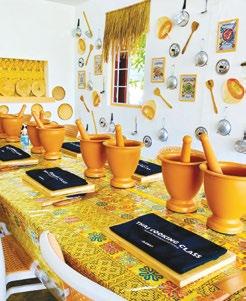
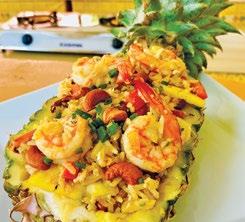
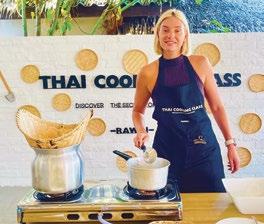
Intrigued by what makes Thai food so irresistible? Learn the secrets first-hand at a Rawai Thai Cooking Class. These three-hour classes, held twice daily in a relaxed, open-air setting, teach you how to select local herbs and spices, prepare them correctly and, most importantly, understand the order in which they should be cooked. Participants are taught to prepare four classic dishes, learning tricks and nuances that are rarely captured in Thai recipe
books. Classes are kept small, meaning personal attention and expert guidance throughout. At the end of the class, participants take home their creations along with a certificate of participation. Vegan and vegetarian options are available. 39/18 Saiyuan Road, Rawai, Mueang Phuket district, Phuket; www.rawaithaicookingclass.com
Photos: Surron Ride Phuket
Photos: Rawai Thai Cooking Class
Ride the Wind at Friendship Beach
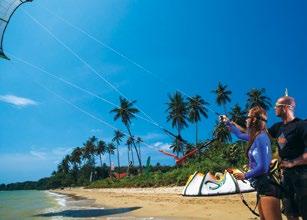
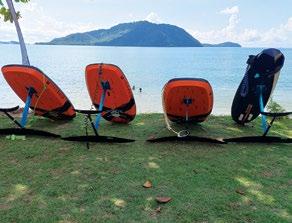
Harness the magic of wind and water at Kiteboarding Asia (KBA), a marine paradise for thrill-seekers of all abilities. Based on Friendship Beach, the school offers everything from beginner-friendly lessons to advanced sessions for experienced riders. Try kiteboarding, wingfoiling, e-foiling and kitefoiling, all taught by qualified instructors using top-quality
equipment in a safe, uncrowded location. Already confident on water? The onsite rental shop stocks premier international brands, so you can simply turn up and ride. Whether you’re chasing adrenaline or learning a new skill, KBA delivers a seamless, safe and genuinely fun experience. 16/26 Wiset Road, Rawai, Mueang Phuket district, Phuket; kiteboardingasia.com/phuket
WHERE LANNA FLAVOURS STEAL THE SHOW
Diners in the South of Thailand are spoiled for choice when it comes to rich and spicy curries, fresh seafood, and even Northeast treats like Som Tam (papaya salad). But when it comes to Northern specialities, Phuket offers few choices. Step forward Huensamkham, an instant favourite among discerning diners in Chalong. The restaurant gets rave reviews for its Khanom Jeen Nam Ngiow (rice noodles served in tomato-based pork broth), Khao Soi (curried rice noodles), and flavourful Gaeng Hang Lay (pork curry) – slow-cooked to succulent perfection. Drop in for the Khanom Jeen buffet and linger in the breezy café complete with inviting Lanna décor and awesome aromas. 12/83 Chalong, Mueang Phuket district, Phuket, www.instagram.com/huensamkham
WEAR A PIECE OF PHUKET
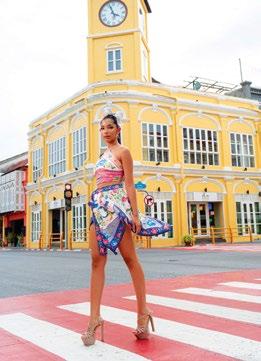
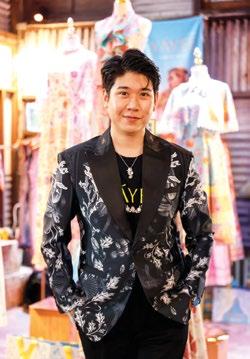
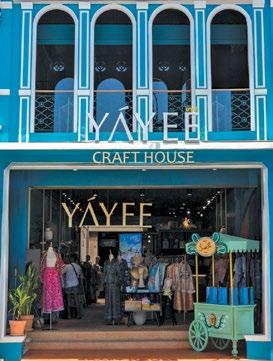
YAYEE fashion and lifestyle brand captures the soul of Phuket Old Town along with its pulsing heritage heart. Wedded to a “Made in Phuket” philosophy, YAYEE collaborates with local batik artists to shape Peranakan style into timeless, contemporary silhouettes. The boutique, located at the historic Chartered Clock Tower intersection, steers clear of fast fashion to craft pieces rooted in a sense of belonging – Phuket’s spirit distilled into stylish souvenirs of island paradise. 30 Phuket Road, Tambon Talat Yai, Mueang Phuket district, Phuket; www.yayeephuket.com
Photos: YAYEE Craft House
Photos: Jeremie Schatz
Where Krabi Starts Its Day
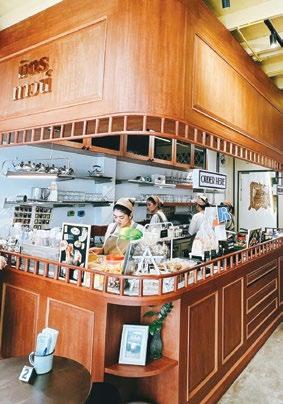
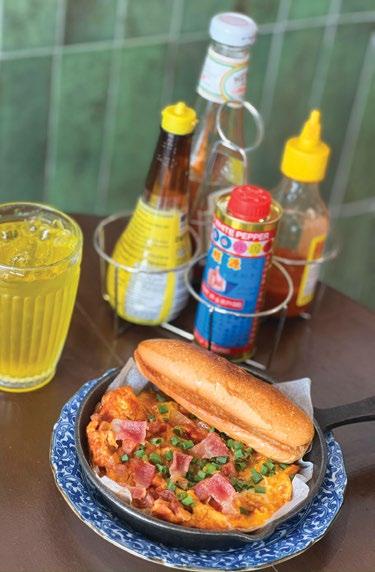
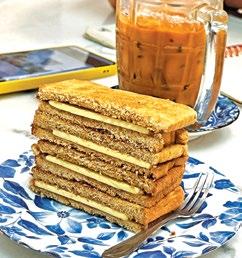
Meet Town anchors Krabi’s relaxed vibe each morning, serving carefully prepared traditional breakfasts and local favourites in a chilled atmosphere. Think soft-boiled eggs, toast, and American fried rice, paired with strong coffee or milky Thai tea and warm conversation. A traditional coffee shop oozing with local character, Meet Town is where the local community gathers to start its day. Retro décor combined with modern touches creates the perfect Instagrammable backdrop wherever you look. Guests are invited to linger over leisurely chats, endless cups of their favourite beverage and hearty local favourites –45, Isara Road, Mueang Krabi district, Krabi; www.facebook.com/meettownkrabi
Krabi Lion Muaythai has grown from a small community training space where young local fighters gathered to practise moves and learn discipline into a local legend among pro martial artists. Travellers seeking to master the basics can join short sessions guided by professional coaches, with extended packages available for visitors keen to dive deeper into the “art of eight limbs”. The gym is just a short drive from Ao Nang and Noppharat Thara beaches, making it a convenient option for visitors seeking adventure and cultural immersion. Advance booking is required. Open Monday-Sunday; 462/3, Moo 5, Saithai sub-district, Mueang Krabi district, Krabi; www. instagram.com/krabilion_muaythai
GENERATIONS ON A PLATE
Pathé Krabi is the story of one family’s devotion to Southern Thai cuisine – from selecting the freshest market vegetables and meat to crafting authentic flavours in the kitchen. Passed down through the generations, recipes served here remain true to the tastes that made this region famous for food. Think sea bass soup, spicy wild boar
curry, stir-fried squid with salted egg, and the fiery gaeng tai pla – famous for its deep pungent flavour and uncompromising spice. Even better, the real flavours of the South are served up in a relaxed homey atmosphere. 68/2, Reukkasem Road, Paknam sub-district, Mueang Krabi district, Krabi; www.facebook.com/KrabiPathe
KRABI
Photos: Krabi Lion
Muaythai
Photos:
Pathé
Krabi
CULTURE WITH KICKS
natural streams, giving the majestic creatures a tranquil environment suited to their natural rhythms.
Visitors are welcome to spend time with the residents, taking them for walks or joining the fun during bathtime. The camp encourages encounters grounded in respect rather than exploitation –allowing elephants, humans and nature to write a new story together, chapter by chapter. 22/16, Moo 3, Koh Chang sub-district, Koh Chang district, Trat; Open 9am to 3pm; www.facebook.com/ KlongSonKohChangElephantCampThailand
Bangkok’s New Art Hub
Dib Bangkok, Thailand’s first international contemporary art museum, debuts with (In)visible Presence) – a multisensory journey through memory, absence and the human condition. The expo features 81 pieces by 40 leading local and foreign artists, with highlights ranging from monumental sculptures by Anselm Kiefer and Lee Bul to deeply poetic installations by Montien Boonma and Alicja Kwade.
Founded by the Osathanugrah family and designed by WHY Architecture, the reimagined 1980s warehouse blends industrial design with serene
touches over three floors. The museum unfolds vertically, guiding visitors to light-filled galleries, outdoor courtyards and sculpture gardens. Don’t miss the onsite Watthu-Dib Bistro & Bar, a stylish all-day dining venue with a thoughtfully curated menu of Thai and international dishes alongside craft cocktails and wines.
With a world-class permanent collection of over 1,000 works, Dib Bangkok places the city firmly on the global contemporary art map.
Open Thursday-Monday, 10am7pm; 111 Soi Sukhumvit 40; Book tickets at dibbangkok.org
SPICE, SMOKE, AND SAKE
After a standout year in Chinatown, Namsu Shan Izakaya is rerouting to a new home in bustling Sukhumvit. Reopening in February above Rangoon Tea House, the move marks a thoughtful evolution rather than a departure, with a perfect new location for Namsu’s relaxed yet discerning ethos.
Staying true to the soul of Shan cuisine, the restaurant is leaning further into a Shan-Izakaya vibe, blending bold, comforting flavours with Japanese bar culture. Expect an intimate, rockstar-tinged space with al fresco seating and a dedicated sake lounge. The menu will showcase Shan comfort food, yakitori, and small plates, all paired with highballs, sake, beer and wines.
Led by Chef Honey Rae Zenang, Namsu remains a deeply personal project rooted in cultural exchange. The relocation signals continuity, growth, and a more social, late-night future for one of Bangkok’s most distinctive dining experiences. 2/F 6 Sanchai, Sukhumvit 38; Instagram: namsu.bkk
Acqua Ristorante brings a breath of sea-salted air from Sardinia to Bangkok’s elegant Ploenchit-Chidlom enclave. After 14 years delighting Phuket, chef-owner Alessandro Frau has brought his signature Italian servings to a refined 60-seat city setting. Rooted in time-honoured Sardinian recipes and elevated with contemporary technique, the menu champions imported ingredients from Italy and beyond. Standout dishes spotlight seafood, handmade pastas and thoughtful degustation menus. Think squid tagliatelle served with Siberian caviar and cucamelon, Sardinian smoked eel with pickled vegetable sweet and sour balsamic sauce; raw Sicilian red prawns Rosso di Mazara; and Joselito Iberico ham. An award-winning wine cellar of over 800 labels anchors the experience. 16, 16/18 Soi Somkid, Ploenchit, Lumphini; www.acquarestaurantbangkok.com
CAPTURING SARDINIA’S SPIRIT
Photos: Dib Bangkok
Photos:
Namsu
Photos:
Acqua
Ristorante
Haute Cocktails Reach New Heights
Perched atop The Henderson at Summit 38, Peridot is Hong Kong’s newest destination for terroir-inspired cocktails and fermentation-forward, plant-based haute cuisine. The bold concept brings together mixology, innovative dining and soulful live music, all set in a striking lime-green interior by Studio Paolo Ferrari within the Zaha Hadid-designed landmark.
At the heart of Peridot is a globally inspired cocktail menu curated by François Cavelier, celebrating unique local tastes alongside refined plant-based dishes created by
Chef Lisandro Illa, whose fermentation-driven innovations redefine vegetarian cuisine. Think Koji carrot pumpkin ginger soup, asado mushroom with chimichurri forest and chorizo tempeh, as well as nut-based cheeses and fruit-based “meats”.
With rare spirits, panoramic city views and a vivacious atmosphere, Peridot sets a new benchmark for hospitality in Hong Kong’s rapidly evolving bar scene.
38/F, The Henderson, 2 Murray Road, Central Hong Kong. Open Monday-Saturday, 12pm-2am; peridothk.com
ODETTE, REVIVED A TIMELESS MUSICAL
Cameron Mackintosh’s Les Misérables: The Arena Spectacular arrives in Singapore on the latest leg of its record-breaking World Tour.
The globe’s longest-running musical – now in its 40th year in London – returns in a large-scale arena production featuring a dynamic new design and a “vintage” cast and orchestra made up of people aged 65 and above.
Written by Claude-Michel Schönberg and Alain Boublil, this version of Victor Hugo’s classic novel Les Misérables presents a stirring tale of love, sacrifice and redemption driven by iconic songs including I Dreamed a Dream , On My Own, Bring Him Home and One Day More. Watched by more than 130 million people worldwide, Les Misérables: The Arena Spectacular remains one of the most celebrated
Odette reopens after a major redesign to mark its 10th anniversary, ushering in a new era of modern French dining in the Lion City. Led by chef-owner Julien Royer, the Michelin threestar restaurant remains rooted in traditional French techniques with subtle Asian influences.
A refreshed menu reimagines
Odette signatures with delicate nuances reflecting Chef Royer’s culinary journey. Highlights include Foie Gras Abalone “Bak Kut Teh” Consommé, Hokkaido Botan Ebi,
Verjus
Complementing the cuisine is an expanded temperance beverage menu of seasonal pairings, served in a rejuvenated interior defined by warmer tones, tactile materials and a deeper sense of intimacy.
1 St Andrew’s Road, #01-04 National Gallery, Singapore; Open daily 12pm-1.15pm and 6.30pm-8.15pm; odetterestaurant.com
Photos: The Henderson
Photos:
Photos: Lo & Behold Group
Peking-style Bidor and Sauternes
Ice Cream featuring shiso granita and muscat grapes.
Cocktails and City Lights
HighGround Skybar lives up to its name, offering a refined rooftop dining experience paired with sweeping views of the Phnom Penh skyline. The Asian-Western menu bristles with mouthwatering options ranging from fresh oysters to gourmet cheese platters and prime beef steaks, all complemented by expertly crafted signature cocktails. Panoramic 360-degree views of the river, the Royal Palace and surrounding cityscape create a memorable setting for travellers, especially when the golden hour transitions to glittering night. Amass Tower, Floors 25 and 26; Street 63&282, BKK 1, Phnom Penh; Open daily 5pm-2am; highgroundskybar.com
At Java Creative Café, coffee, culture and conversation flow together in a space that functions as a coffee shop, gallery and community salon. Known for its regular art exhibitions, poetry readings and panel discussions, the café offers travellers a relaxed introduction to Cambodia’s contemporary creative scene over thoughtfully prepared food and coffee.
More than two decades after its launch, Java Creative Café has stayed true to its founding formula: fresh, made-from-scratch dishes served from breakfast to dinner. Beyond dining, Java is cherished as a cornerstone of Cambodia’s art landscape, hosting hundreds of expos and supporting dialogue, collaborations and experimentation within the local creative community. 20A Street 337, Toul Kork, Phnom Penh; Open daily 7am-8pm; javacreativecafe.com
Angkor Speedway, set just outside the Angkor Archaeological Park, offers an unexpected burst of high-octane excitement amid Siem Reap’s historic landscape. The modern motorsport circuit satisfies visitors’ competitive spirit and lust for speed – a sharp contrast with the surrounding ancient
temples and cultural sights. Whether you are a motorsport nut or a curious adventurer keen to try something new, Angkor Speedway delivers a memorable, adrenaline-fuelled experience. 734P+84, Damdek district, Siem Reap; Open daily 8.30am-6pm; www.instagram.com/angkorspeedway28
CAMBODIA
PHNOM PENH / SIEM REAP
Photos: HighGround Skybar
Photos: Java Creative Café
Photos: Angkor Speedway
COFFEE WITH ADDED CREATIVITY
RACING BEYOND RUINS
ONE RESCUE STORY AT A TIME
Visitors are offered the rare opportunity to help conserve vulnerable creatures at the Bear Rescue Centre and Luang Prabang Wildlife Sanctuary, just 40 minutes from Luang Prabang. Run by Free the Bears in partnership with local authorities, the sanctuaries provide lifelong care for rescued sun and moon (Asiatic black) bears, along with other threatened species saved from the illegal wildlife trade.
Guests can join guided Bear Care Tours for behind-the-scenes access to the animals, hear their rescue stories, and help keepers prepare their treats. Whether you choose to visit the site near the famous Kuang Si waterfall or the more secluded sanctuary further up the valley, the experience is both educational and deeply moving. Luang Prabang Wildlife Sanctuary, Ban Long, Laos; Book tours from 9am-12pm and 1-4pm; freethebears.org
SUNSET, SERVED BY THE MEKONG
Mekong Sunset View restaurant and bar is a special spot to unwind, boasting gorgeous views of the Mekong River in Luang Prabang’s historic old town. As the sun dips below the horizon, the restaurant-bar becomes a stage for the day’s fiery finale as deep crimson hues flame above the water.
Opened in 2014, Mekong Sunset View quickly rose to fame for its family-style hospitality and flavourful dishes like poached Mekong fish, spicy squid salad and fried noodles with vegetables, to name a few. A popular spot for travellers, it offers a simple yet memorable introduction to tranquil riverside life in Luang Prabang. Chun Kham Road, Luang Prabang, Laos; Open daily 10am-10pm; www.facebook.com/sisaleosunset
When Maldives Dives Best
Renowned for its crystal-clear waters, the Maldives offers some of the best diving experiences on the planet. The best time to explore its underwater world is during the dry season, between December and May. Calm seas, clear skies and underwater visibility of 30 metres and more create ideal conditions for divers, unveiling marine life, coral reefs and dramatic drop-offs in stunning detail. The atolls of North and South Malé and Ari are best for encounters with manta rays, whale sharks and schools of tropical fish. With its warm waters, gentle currents and abundance of dive sites suited to all levels, the Maldives remains the world’s best destination for unforgettable underwater adventures. padi.com/diving-in/maldives
Photos: Sebastian Pena Lambarri/Unsplash
Photos: Mekong Sunset View Restaurant
Photos: Shutterstock
BANGKOK AIRWAYS ANNOUNCES NEW VISION
FOR SUSTAINABLE EXCELLENCE
Bangkok Airways has reaffirmed its commitment to responsible, sustainable aviation with a new corporate vision: “Leading Aviation with Responsibility, Delivering Services with Sustainability”.
The vision underpins the airline’s strategy for advancing its fully integrated aviation business amid evolving economic conditions, industry dynamics, societal expectations, technological change, international regulations and standards, and mounting global sustainability challenges.
Mr. Puttipong Prasarttong-Osoth, President of Bangkok Airways Public Company Limited, stated: “This vision serves as a key framework guiding the organisation’s operations in alignment with the current business landscape, while supporting long-term growth. It brings together Bangkok Airways’ strengths as a fully integrated aviation service provider with responsible business practices and sustainable development principles, enabling the company to advance its corporate strategy in a tangible and comprehensive manner.”
The concept “Leading Aviation with Responsibility” reflects the company’s commitment to conducting its aviation
business responsibly across all dimensions. This includes enhancing safety standards, managing costs and resources efficiently, and strengthening partnerships to generate sustainable returns and balanced growth.
Meanwhile, “Delivering Services with Sustainability” underscores Bangkok Airways’ dedication to excellence in product and service quality, while minimising environmental impacts and maximising benefits for all stakeholders to support long-term, sustainable business growth.
To achieve this vision, Bangkok Airways has established a “5S core mission” of guiding principles for operations: Safety, Service, Staff, Synergy, and Sustainability. These pillars aim to strengthen competitiveness, create shared value for all stakeholders, and propel the organisation to new heights as a global leader in sustainable aviation.
“The next phase of Bangkok Airways’ growth is not solely about business expansion, but about building on a solid foundation of social, environmental, and stakeholder responsibility in a consistent and sustainable manner,” Mr. Puttipong concluded.
Aviation with Responsibility, Delivering Services with Sustainability”
BANGKOK AIRWAYS EARNS ‘A’ RATING IN
SET ESG RATINGS
2025
Bangkok Airways Public Company
Limited earned an “A” in the Services Industry Group category of the Stock Exchange of Thailand’s SET ESG Ratings 2025. The top rating reflects the airline’s strong commitment to integrating sustainability across environmental, social, and governance (ESG) dimensions, creating long-term value for stakeholders and supporting sustainable business growth.
“Receiving an ‘A’ rating in this year’s SET ESG assessment is a source of pride for the organisation and demonstrates significant progress in its sustainability performance compared to previous years,” said Mr. Puttipong Prasarttong-Osoth, President of Bangkok Airways Public Company Limited. He added that the company’s mission is to excel as a leading regional airline in Asia while upholding strong social and environmental responsibility and best-practice corporate governance.
Highlights of the airline’s ESG initiatives include the “Low Carbon Skies by Bangkok Airways” campaign, which is cutting emissions through the use of Sustainable Aviation Fuel (SAF), energy-efficient flight operations, and upcycling
waste-management. Bangkok Airways also remains committed to social engagement through projects such as “Community of Love” and youth-focused initiatives like “Wings of Dreams”, which provide learning and development opportunities.
The airline also prioritises efficient resource management, international safety standards, employee well-being, service quality, customer relationship management, and data security. These efforts contribute to building trust among stakeholders and supporting the company’s long-term, sustainable growth.
The SET ESG Ratings are recognised as one of Thailand’s key sustainability benchmarks, assessing listed companies based on disclosures, policies, and performance across environmental, social, and governance areas. In 2025, a total of 265 companies met the assessment criteria, with 67 achieving an “A” rating. Bangkok Airways’ inclusion in this group reinforces its credibility in ESG practices and reflects its continued alignment with internationally recognised sustainability standards.
CHILDREN GIVEN ‘WINGS OF INSPIRATION’ AT SUKHOTHAI AIRPORT
Bangkok Airways Public Company
Limited has partnered with Sukhothai Airport and the Bangkok Air Aviation Training Centre (BATC) to host its “Wings of Inspiration: Creating Learning Opportunities” programme for a third consecutive year.
The latest chapter of the airline’s “Connect Your Happiness” campaign took place recently at Sukhothai Airport, giving local primary school
Tilted by the shifting currents of time, the Mutao pagoda leans out over the Chao Phraya River at the tip of Koh Kret in Nonthaburi, just north of Bangkok. The leaning monument stands as a serene landmark, reminding visitors to this unique island community of traditional handicrafts that rivers, like history and life, are always in motion.