STAY HUMAN

INTRODUCTION
Dear MG Fam,
In the last six months, Movement Generation has been deep in design, renovation, and restoration mode—on the land, and in our political, cultural, and relational work. In the face of the current iterations of state violence via fascism and tech oligarchy, we assert and express our humanness, as peoples have done for centuries: through mutual aid, collective healing, grieving the deaths of loved ones in our cultural ways, and deepening our praxis of solidarity. We must not waver.
As we are bombarded with false promises through the increasing insistence of the imposition of AI on our lives, we remember what our role is in nature as natural beings—humans—in the web of life. Just as trees make oxygen, and soil provides nourishment for all life forms, humans bring stories and song, making meaning of the world around us to love, protect, and provide for one another.
These past two seasons, we’ve held ceremony transitioning from our little backyard yurt in Berkeley, giving thanks to the land and the families that held MG since the beginning. We’ve participated in two prescribed burns with the fire department and begun working with the water flows at our liberated land site with our community of volunteers. We’ve traversed the world from Milan to Massachusetts to California’s Central Valley and back home to Oakland, participating in powerful organizing, movement building, and cultural work happening across different sectors of society.
2025 has also been a year of profound loss. Patty Berne. Marvin Boomer. Assata Shakur. Joanna Macy. Alice Wong. Too many more. Rest in power. Rest in peace. Rest in freedom. In their memory we lean into all our relations—in the living world and in the spirit realm—as an antidote to the dissonance of these times and as we continue to build formations, structures, and economies that affirm life.
May you find resonance in the stories in these pages.
Stay human,
Movement Generation


TABLE OF cONTENTS
Introduction 2
Continuity In/Of Fluidity by Aniya Butler 4
Just Transition
PROPA Summer Dream Weave 6
Under standing AI, Technology, and Power 10
Stop Billionaires Summer Training 12
Land
Building the New 14
Becoming Regenerative Disturbers 16
Culture Shift
Mateo’s Moodboard 20
Remembering Patty Berne 22
Leah Penniman on the Haitian Revolution 24
Tending the Fire 32
Cacophony of Joy Podcast 33
Rooted In Joy Poster 36



coNTINUITY IN/oF FLUIDITY
By Aniya Butler
welcomed by thunder water pouring relentlessly from clouds where we like to think a heaven exists
trees
standing still through it all resting in between volcanoes and possibility waiting for the smoke to come
moving with ease yet thickness like honey - sweet, ancestral forgotten but feels familiar
poured over war wounds, fragmented bodies, and memories
mending what was once valued as sacred re-rooted in return
sweetness eclipses centuries of erasure; sweetness means we’re still here; still feeling
remembering our vulnerability to earth breath blending with her movement
movement aligned with her waters
bloodline traveling through currents
my people birthed from the womb we were also buried in waves whisper continuity those who sought life by taking ours tried to make us forget memory that seems too heavy to carry, yet our bodies feel lifeless without essences of our being(s) held by constant birth
water womb
vessel to life
portal to being insisting on life







PROPA SUMMER DREAMWEAVE JUST TRANSITION


Photos by Brooke Anderson
What We Feed Grows:
one of the four principles of the Just Transition framework, and one of the four ingredients of Resilience-Based Organizing. When we put our heart, spirit, and body into a vision of better places for all, we organize ourselves and apply our labor to meet our needs in ways that are rooted in our cultures and histories.
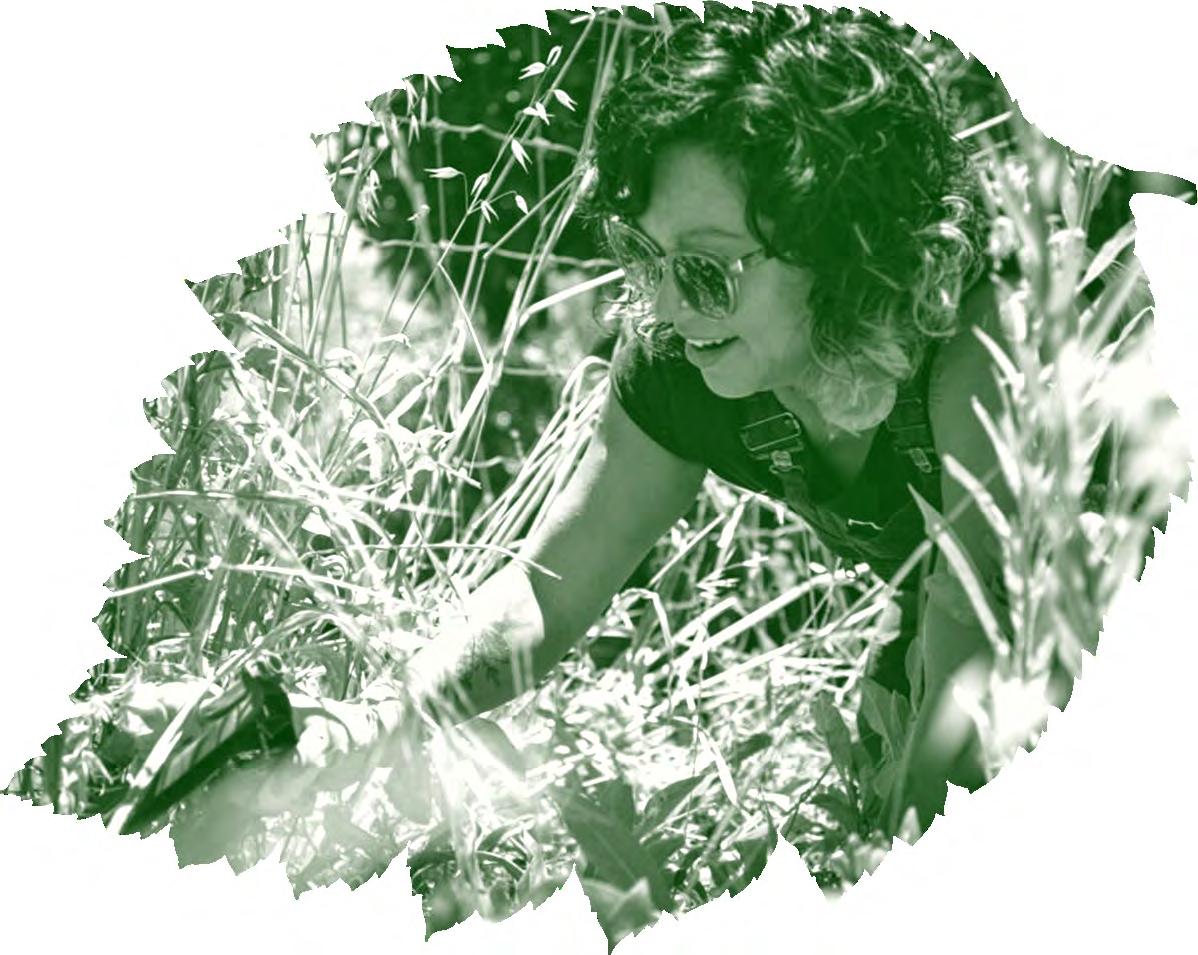
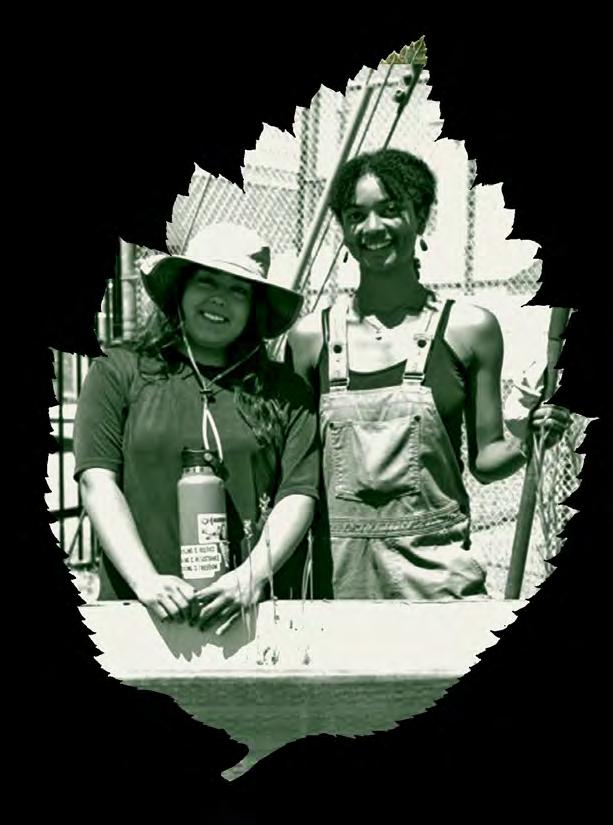
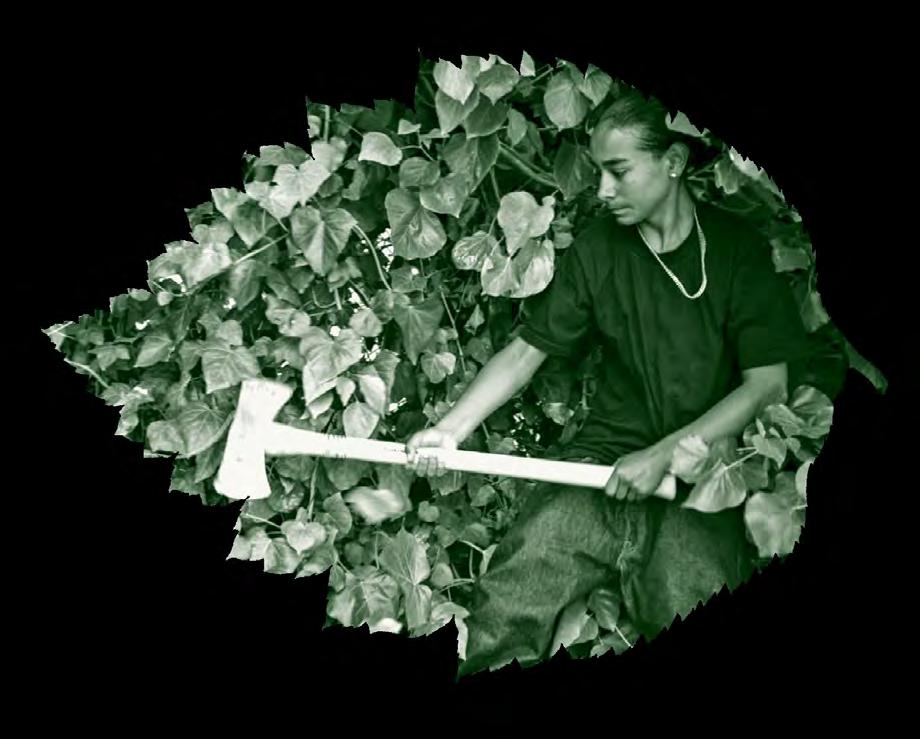
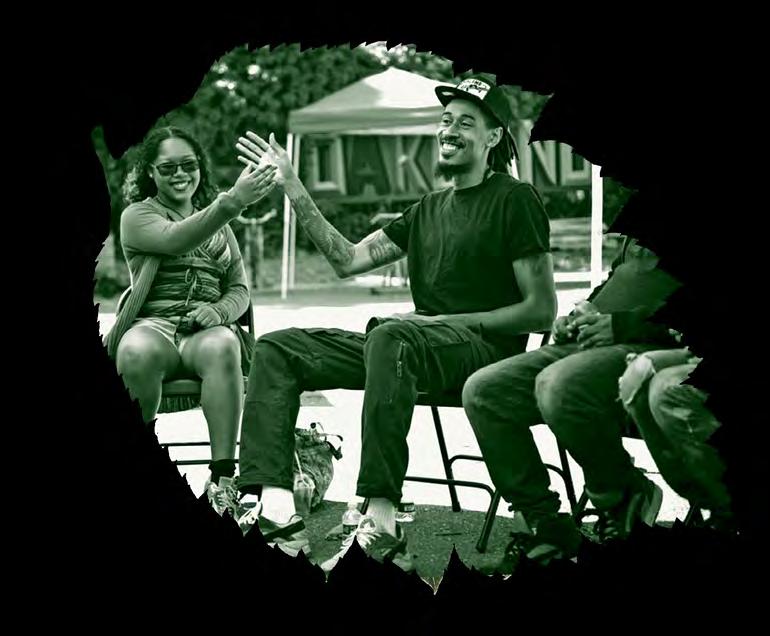
Our Summer 2025 Propa Dreamweave experience—a collaboration between Castlemont High School, Civic Design Studio, Northeastern University, and other East Oakland youth community organizations to build power using art, creativity, and education towards ecological justice—was designed around this principle. We entered the summer in a somber state after the tragic death of Castlemont High School pillar, Dr. Marvin Boomer. Affectionately called Boomer, he supported the Propa collaboration, allowing us to continue gathering at the Castle. In his honor, we slowed down and pivoted our approach to the Dreamweave. We gently set aside the strategy sessions and deep political education, and instead channeled our energy into feeding the growing projects at Castlemont High.
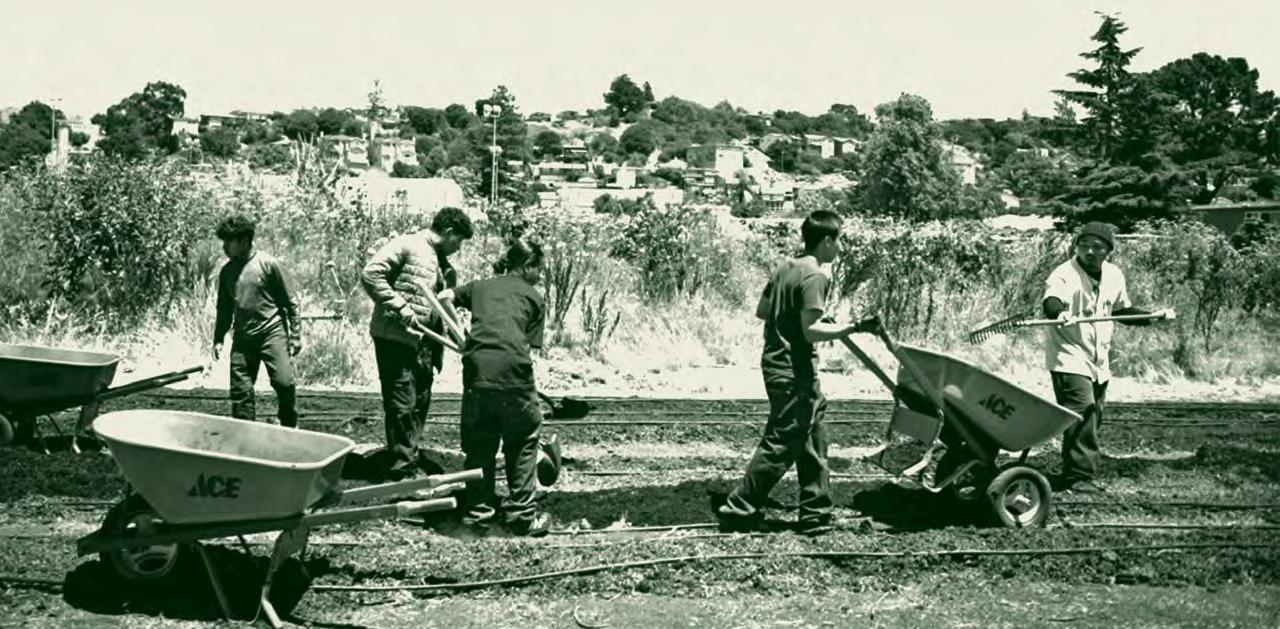
Our intergenerational, cross-sector cohort (with ages ranging from 14-80!) spent the week learning about projects at Castlemont, including the development of an outdoor classroom, beautifying a corner on a street adjacent to the school, the endless farm activities, and the design and development of public art by high school youth. And then we applied our labor to support the projects! Our cohort helped build picnic tables, moved compost to the farm, put pollinator plants into the soil, weeded garden beds, and more. In the process, we emphasized the life-affirming work of relationship building, mutual aid, and we asked the question:



What do we hold sacred here in East Oakland?
The cohort wrapped up the week cutting up melon, prepping veggies and meat for grilling, and cooking food for almost 100 people who were working at Castlemont on various projects all summer. While there were many powerful moments during the Dreamweave, the multigenerational learning and care that transpired over the week was inspirational, especially for these times. One of the youth participants shared, “I learned that youth can talk to adults without a problem or without a power difference. But we live in a society that makes us think the youth are below adults.”
May we continue to cultivate experiences for each other that feed the vision of building economies based on caring and sacredness of relationships to each other and the world upon which we depend.








JUST TRANSITION
UNDERSTANDING AI, TECHNOLOGY, AND POWER
As we all work hard to wrap our heads and hearts around the emergence of AI, it is useful to take a step back and root ourselves in a firmer understanding of our society’s relationship with technology. These are anxiety-provoking times, where we often seem trapped in a binary between two imposed worlds:
TECHNO-FETISHISM:
one that believes technological breakthroughs will always save us and are the defining features of human progress and development,
TECHNO-FATALISM:
one that is resigned to accept emerging technologies as inevitable, which can’t be stopped, even if they destroy us.
How to break out of this bind? How do we gain clarity and reclaim our societal agency?
It helps to first define what we mean by technology. Once rooted in a shared understanding, we can then democratically reclaim the terms by which technology is shaped, directed, managed, and deployed. At a simple, distilled level, technology can be defined as tools to solve problems. Examples: a plow, a printing press, penicillin, barbed wire, Agent Orange, or a thermonuclear bomb. Written language is a social technology, as are games, music, and educational systems.
So to further define technology properly, these are the questions: What problems are we trying to solve? Who gets to define the problems at hand? Who decides we need this new tool?
Further relevant questions: How is this new tool forged? What are the impacts of its creation and production? What existing practices does the new tool displace? Who gets to decide how it is used, who gets to use it, how it changes hands, who can modify the tool, and how they can modify it?

These questions help us appreciate that technology is not simply made up of parts. Technology is a complex set of relationships of resources and power over time.
How it is used is an important part of a technology, but not always the most important part. Technology represents social and ecological processes, and therefore can only be understood in that context. Technologies always have power relationships embedded within them. And technology almost always extends the power relationships in the context from which they emerge.
We must ask ourselves: What assumptions are being made that govern the decisions that drive a technology? Technology always has assumptions built in and assumptions it is built on.
We need to engage in a concerted effort to contest in this narrative space that defines technology within our society. Technological trajectories are never inevitable, even if the techlords and broligarchs of our day want us to believe they are.
ALL TECHNOLOGY IS POLITICAL,
as all technologies are the embodiment of socio-ecological processes over time. This means we can reassert our democratic right to define, shape, confine, and redirect technology at any juncture in this process.
Recently, Chileans in the greater Santiago area successfully fought and blocked a new Google AI data center. This move protects the communal water needs of many people and ecosystems, given the exponentially absurd amount of clean water needed to run a data center.
Reclaiming and constraining technology towards regenerative and life-affirming purposes is the task at hand.
Movement Generation’s analysis on AI is informed by ongoing work with ETC Group. For a deep dive, read ETC Group’s report, The Politics of Technology.

STOP BILLIONAIRES SUMMER JUST TRANSITION
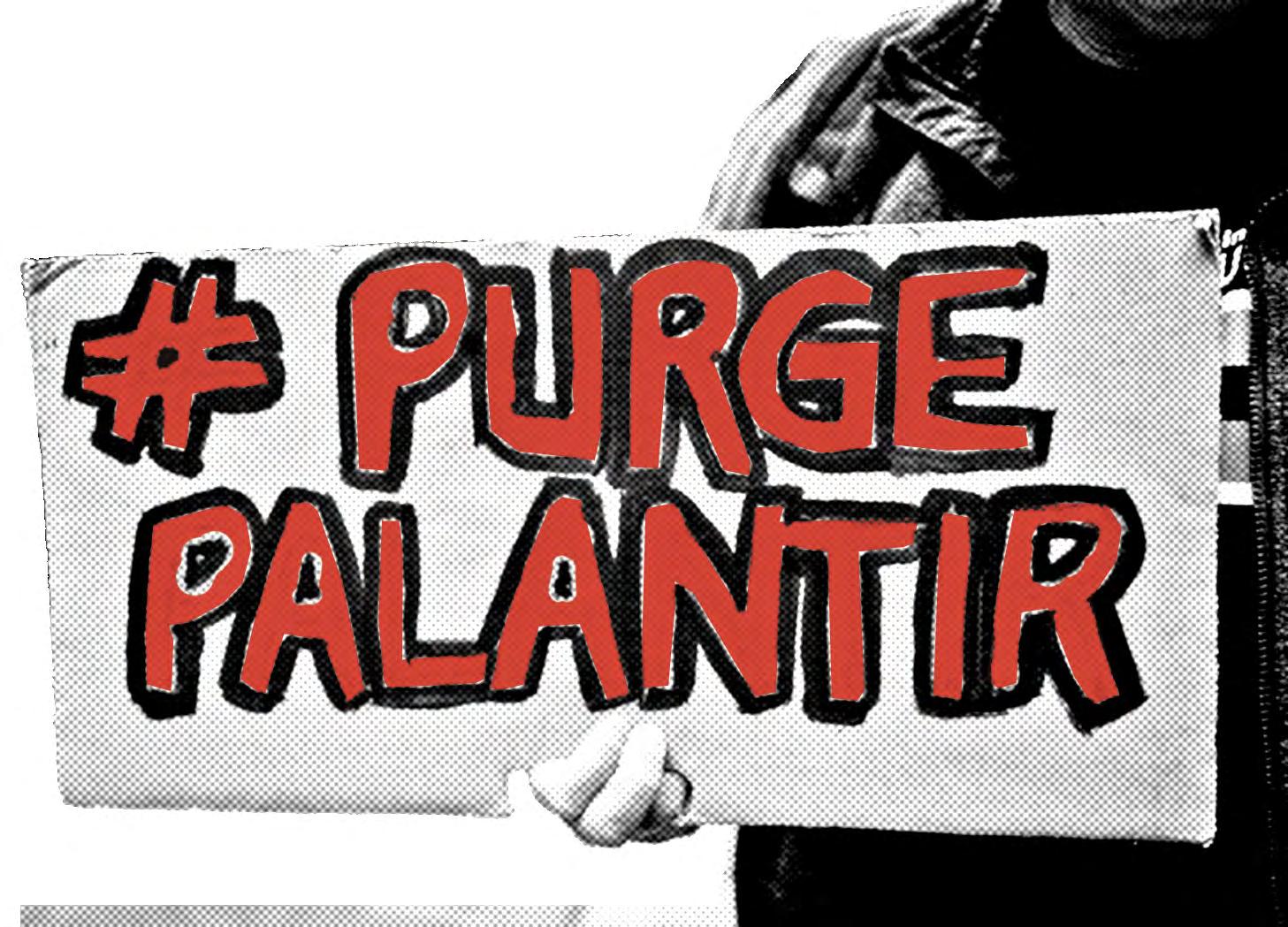


Photo by Brooke Anderson
In September, MG provided curricula and training support for 18 college students from 14 states participating in the Stop Billionaires Summit in Oakland, CA.
This summer, Stop Billionaires Summer brought together a multiracial, multigenerational, and cross-class movement throughout the Bay Area for eight weeks of sustained nonviolent direct action to demand an end to the billionaire class control over our economy, communities, and ecosystems.
At the start of fall, to heighten the pressure on the billionaire broligarchs and to continue to invest in youth leadership, the Oil and Gas Action Network (OGAN) created a paid fellowship for college students to make the connection between billionaires and repression on campus.
The fellowship started with a three-day summit in the Bay Area to deepen students’ understanding of tech billionaire fascism and to sharpen their skills at campaign research and development, direct action planning, and narrative strategy.
At that summit, MG staff Mateo Nube, Gopal Dayaneni, and Brooke Anderson led trainings on ecology, extractive and regenerative economies, just transition, and the use of AI to surveil and repress social movements.
Student fellows who attended the summit are now leading powerful campaigns at their schools, including blocking Palantir from recruiting on campus, fighting big AI data farms, challenging universities’ complicity in weapons manufacturing, supporting local campaigns for housing, immigrant, and environmental justice, and more.
MG staff trainers are continuing to provide mentorship to student fellows.


LAND BUILDING THE NEW

access-centered JUSTICE & ECOLOGY CENTER. This past year, we made a big pivot from hustling on urgent repairs of the buildings to implementation of some dreamy building infrastructure!


We had our first specialized hire—AKEEM KING—our Facilities
Maintenance and Construction Manager, working in the realms of general contracting and repairs and maintenance. He’s been doing amazing work alongside the Land Team, the residents, and many contractors.
We’ve been moving a lot of work to maintain the core infrastructure like our entry roads, electrical systems, water drainage and pipe shed, and rodent control / co-habitation!
This month we’ll complete two of our biggest renovation projects: a wheelchair-accessible bathroom in our main hall, and a fully renovated studio apartment. The renovated apartment is bigger and integrates full wheelchair accessibility and access-forward design.
We also just broke ground on a big exterior renovation project on our main hall! This project will build in fire-resistant siding (in a vibrant gold color!) and new windows and doors, and will allow us to address some urgent structural deterioration in our framing. We’ve partnered with a values-aligned architect firm to help us design this project, which also sets us up for future renovations of the main hall.




LAND BECOMING REGENERATIVE DISTURBERS
Photos by Angela Aguilar
We’ve spent much of the last three years at the rematriated land site that we tend, wrapping our minds and hearts around the history and complexities of this land. We’ve learned how settlement land-use patterns of the last 150 years have degraded the ecological cycles of these upper watershed ridges and slopes. It’s a familiar series of long-lasting degrading disturbances: roads, culverts and infrastructure built directly in the historic water flow pathways; fire-prone flash fuels of non-native grassland plants; cow grazing compaction; and dense overstocked forested slopes.
In our third autumn season in relationship with this land, we’re engaging in a mosaic of wildland management practices that support fire, water, and biodiversity resilience. With the help of many partners, consultants, and volunteers, we’re implementing what our friends at the Occidental Arts & Ecology Center call “regenerative disturbance” techniques: a set of practices with the broader goals of restoring ecological cycles and keystone processes.

Let It Burn
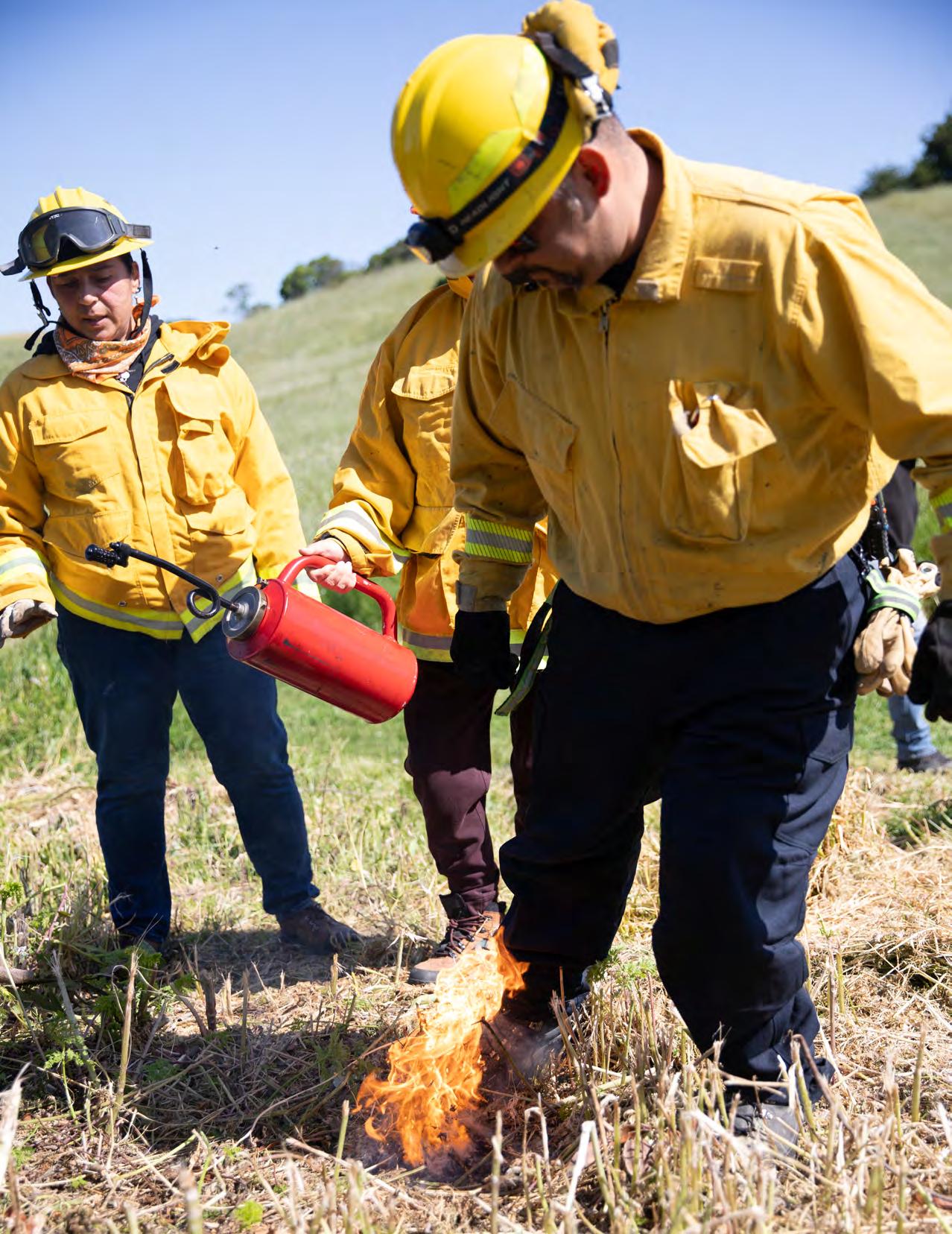
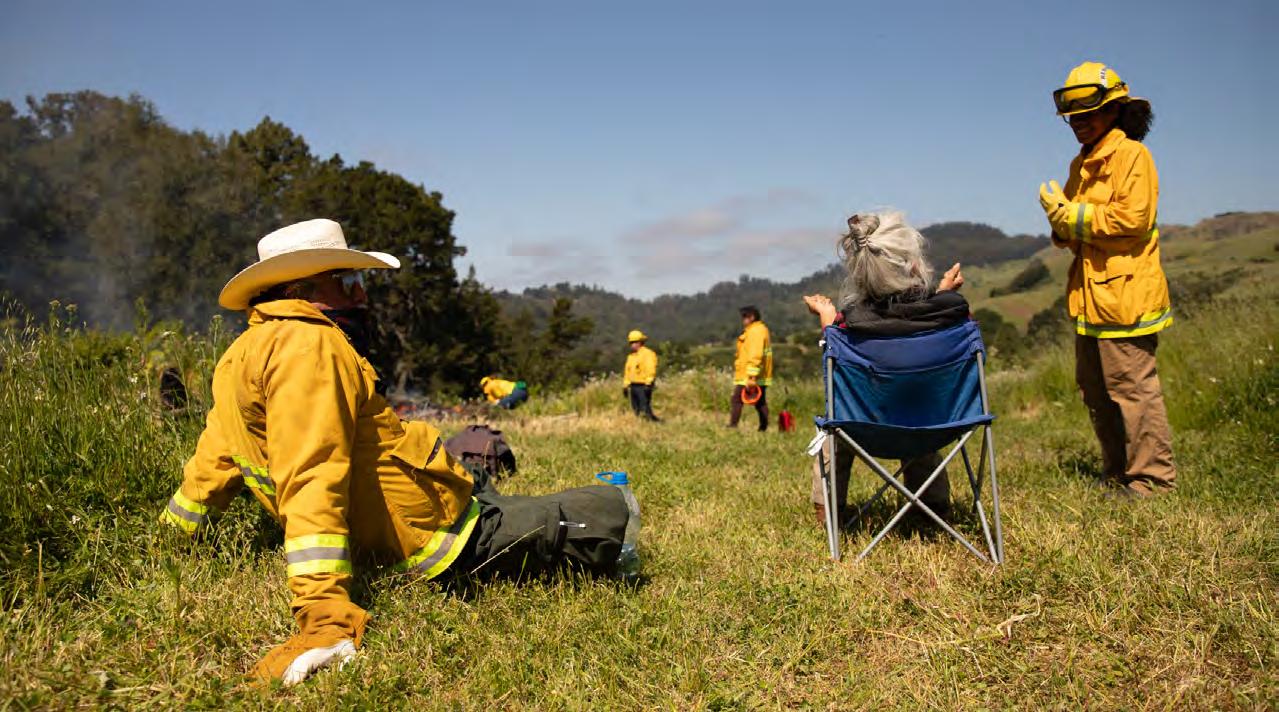
At the end of June, we partnered with the Moraga-Orinda Fire District (MOFD) on a 6.5-acre broadcast burn. It was a beautiful day bringing back low-intensity, high-frequency good fire to this land as Bay Miwok peoples practiced here for millennia. The burns will help restore native vegetation and improve wildlife habitat, as well as create a buffer between the wildland and homes in the area. We’re thrilled that MOFD is doing the work of making good fire common sense in the East Bay and grateful for their support in building our capacity to carry out prescribed burns into the future.
This past fall, we planned two more broadcast burns, another four acres total. We’ve also continued to work with local arborists and sawyers on creating shaded fuel breaks—limbing and thinning dense, dead, and neglected slopes around the woodland core areas of our site (“fewer trees, more forest”). We’ve also done a lot of very unglamourous mowing and weed-eating, which also helps disturbance-dependent grassland ecosystems and controls non-native flash fuels like poison hemlock.
Hustle & Flow
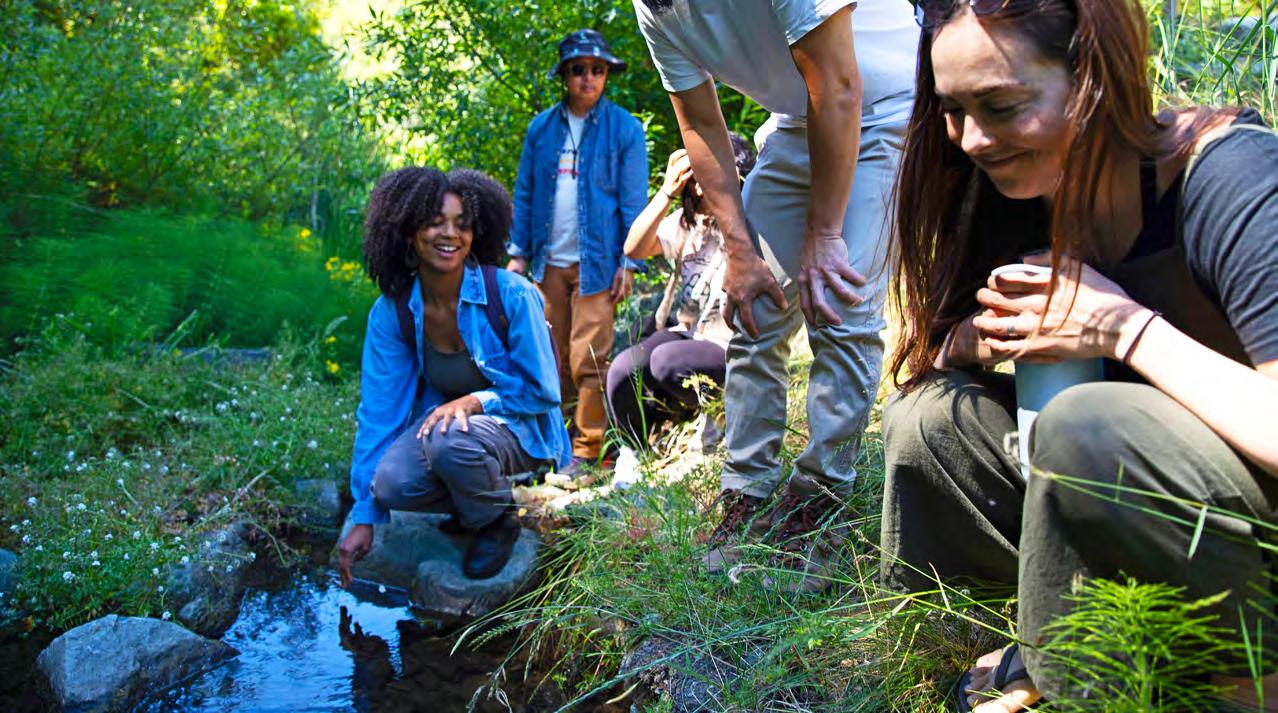
This past fall we took some of the overstocked tree and shrub fuel and used that beneficial biomass to start getting right with the water cycle on the land. Guided by Low-tech Process Based Restoration (PBR) practices and principles, we experimented with various water interventions including gully stuffing, beaver dam analogues, and other “water speed bump” systems that address excessive runoff and soil erosion and improve water infiltration and retention. Ahead of winter rains we have several work days and a volunteer day dedicated to getting these practices going.
The restoration goals intwined in these practices is pretty amazing:, over time we’ll promote groundwater recharge, encourage repopulation of riparian plant communities to slow sediment mobility and expand wetland mosaic habitat, restore hydrologic processes that sequester carbon, and enhance and encourage conditions for habitat resiliency for many critters.
CULTURE SHIFT

MATEO'S MOODBOARD







ARTICLE
"The Point of Politics is to Convince People, Not Grandstand," by Ben Burgis, Jacobin.
BOOKS
La Mujer Habitada (The Inhabited Woman) by Gioconda Belli.
Playground by Richard Powers.
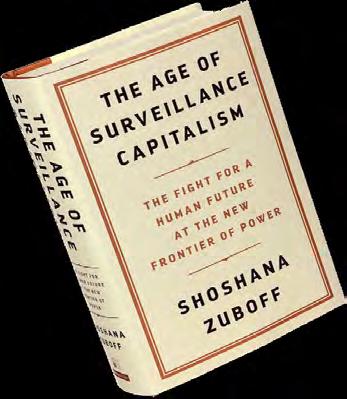
The Age of Surveillance Capitalism by Shoshana Zuboff.
COLLECTION
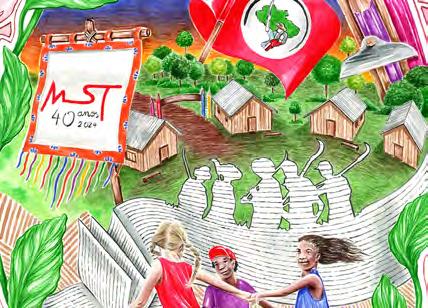
"Forty Years of the MST," Landless Workers’ Movement (MST), Tricontinental.
INTERVIEWS
Mahmoud Khalil, Ezra Klein Show.
Arundahti Roy, The Interview, The New York Times






ORGANIZATION
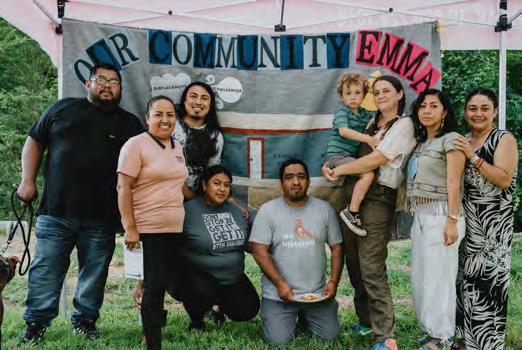
Poder Emma, Asheville, North Carolina.
MUSIC
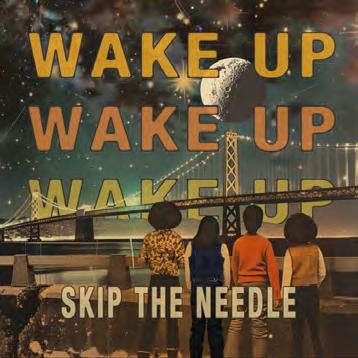
Skip The Needle, Wake Up.
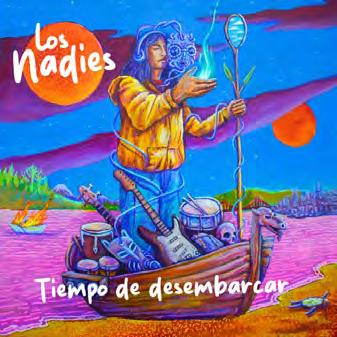
Los Nadies, Tiempo de Desembarcar.
Okan, an Afro-Cuban Jazz Band.
GoGo Penguin, an instrumental trio from Manchester, England.

TV & FILMS

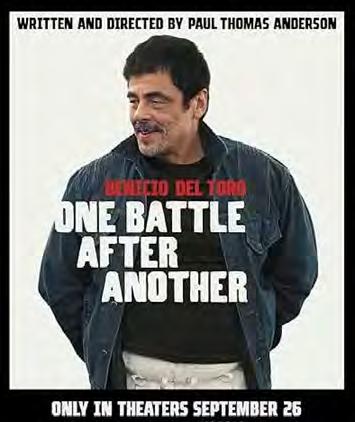
One Battle After Another, 2025
Paul Thomas Anderson film.
South Park, Episode 1, Season 27.
MG co-founder and collective member




CULTURE SHIFT
Remembering Patty Berne
On May 29, 2025, our community lost a dear friend and comrade, Patty Berne. Patty was co-founder and longtime Executive and Artistic Director of Sins Invalid and a primary architect of the Disability Justice movement, its 10 Principles, and core practices that center the lives, wisdom, and leadership of disabled queer and trans Black and brown people.

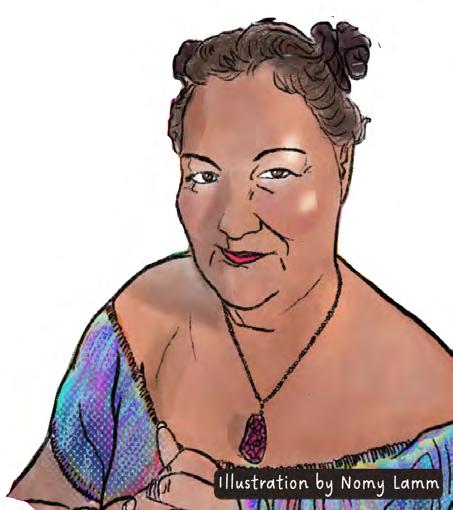
Movement Generation collective members from the past and present share some reflections on Patty’s beautiful life and legacy.
Listen to Patty Berne on That's How the Light Gets In Podcast
“I first experienced the gift of Patty Berne as a college student, as we were both members of Students Against Intervention in Central America. It was a bad-ass space of fierce and successful organizing, made possible in so many ways by Patty’s brilliance and visionary leadership. Patty always led with joy, discipline, directness, and tremendous political clarity. They took internationalism very seriously, and pushed us to think and act and care in innovative and necessary ways. Patty was great at getting us to cultivate curiosity, lean into discomfort, and foster our revolutionary learning edges as we did so. And: Patty was funny as fuck. Always. Their irreverence was delightful, refreshing, healing. Thank you Patty, for shining so bright, so true, so potent. ¡Patty Berne, presente!” –Mateo Nube






“What Patty taught me, I can never un-learn: that if capitalism depends on ableism—that industrial production brought with it measuring a person’s worth by how much profit their they can produce—then disability justice requires the end of capitalism. In other words, if we’re committed to a world where all mind-bodies are truly sacred and worthy of care and belonging, then we have to re-organize our relationships around collective care, interdependence, and mutual aid. I am forever indebted to Patty for their friendship, comradeship, and mentorship. I will miss her political brilliance, her artistic production, her always super-fly style. I am so grateful to have recorded a conversation with Patty in what we didn’t know would be their last year of life. If it would do you good to hear her voice, I invite you to listen here.” –Brooke Anderson
“I absolutely 100 percent move more boldly in everything I do since meeting Patty Berne. Without a doubt they shifted my perspective, approach, and beliefs about my body and all bodies: No body is disposable and our bodies —disabled, queer, crazy, funky—are sexy as fuck. I sometimes forget this about myself, but Patty’s way of pushing with stern care, humor, and realness continues to be instructive and inspiring and allows me to experience the worthiness, sensuality, and love for all bodies and all life. Thank you, Patty. I will never be the same and I am grateful.” –Angela Aguilar
“Patty showed me how to move from a place of unapologetic and fierce love. She could say ‘that’s not right and here’s another perspective’ in a way that could help bring someone into their heart instead of shame and defensiveness. Patty did that all with a twinkle in her eye, a flawlessly madeup face, a delightful giggle, and a lightness that made radical change feel imminently possible instead of heavy and hard.”
–Michelle Mascarenhas

“Patty took us all under their wing, and for that I am forever grateful. A legend. A teacher. A beautiful human. Patty taught me how to be unapologetically myself. To embrace the complexity of being human at this time on earth, and to turn towards the moment with both fiery rage and the deepest, most expansive love possible. I am a better person, comrade, and leader because of Patty. Rest in MFing power, Patty Berne.” –Ellen Choy
“What I cherish is Patty’s smile and kindness; the fierce conviction and the loving critiques. Patty was unafraid to grapple with the contradictions of all of our lives and the worlds we are navigating. She taught me to let go of the fear of mistakes and the violent lie of perfection. She was always here for her communities and I know she always will be.” –Gopal Dayaneni


CULTURE SHIFT Murmurations:
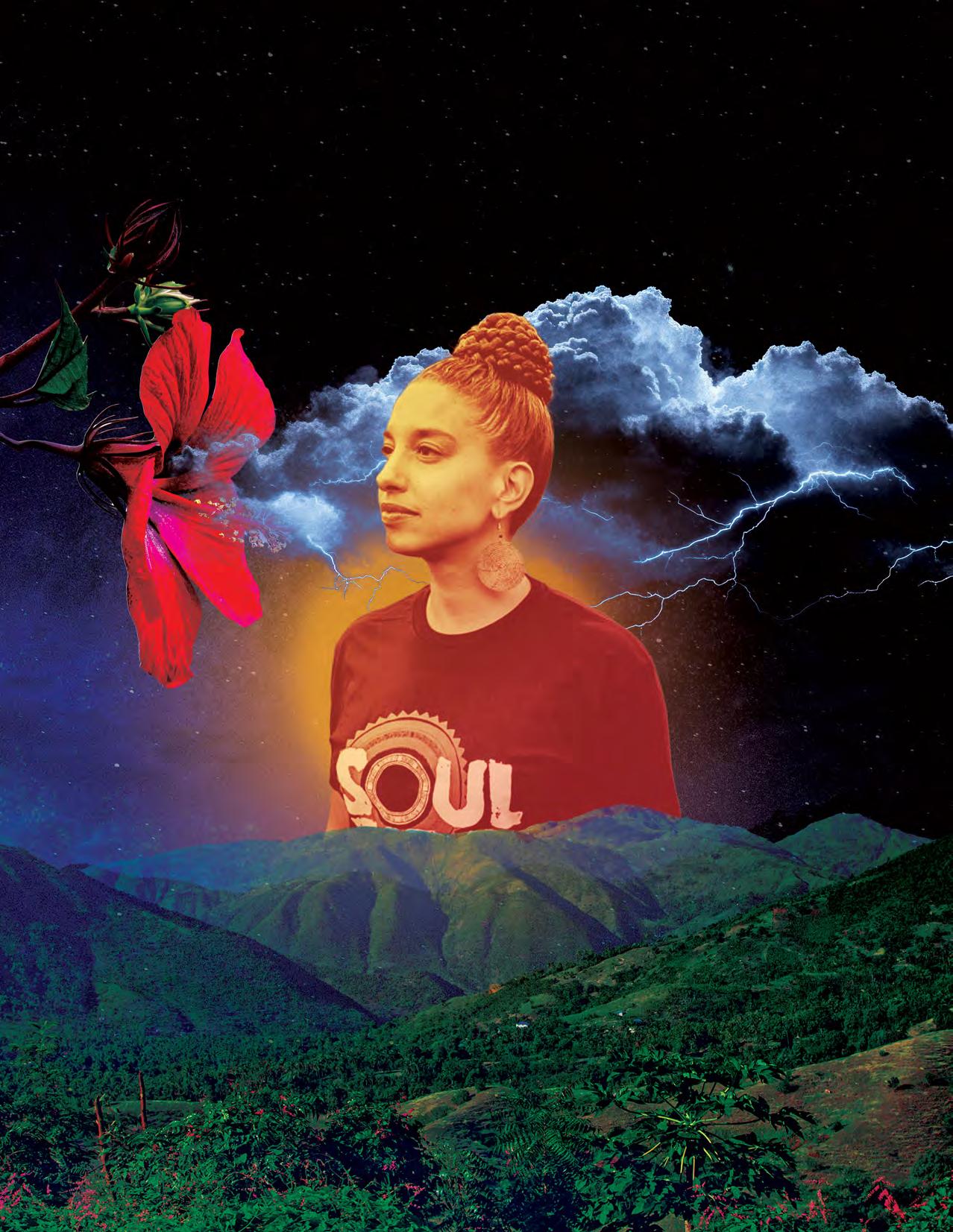
The Haitian Revolution Continues – Lessons for Today
by Leah Penniman of Soul Fire Farm
Black rumbling clouds provided cover for the insurgents as they converged in the forested grove at Bwa Kayiman on August 14, 1791. Heavy rain drops and lightning were welcomed as good omens by the two-hundred enslaved people who entrusted their officiants, Hougan Dutty Boukman and Mambo Cecile Fatiman, to call the African and Taino spirits to their aid. The time for revolution was imminent.
The Africans in Saint-Domingue had suffered at the hands of the most brutal enslavers in the hemisphere, forced to toil in scorching diseaseridden cane fields, and when they did not meet quotas – buried alive, crushed in mortars, crucified on planks, castrated, forced to eat excrement, boiled in cane syrup, and sent down the mountainside in barrels studded with spikes. As the rain washed the sweat in rivulets down their bodies, Boukman intoned, “God who has made the sun that shines upon us, that rises from the sea, that makes the storm to roar, and governs the thunders . . . you have seen what the whites have done . . . give strength to our arms and courage to our hearts.
Sustain us . . . Harken until Liberty!”
Fatima sacrificed a black pig to the deity Ezili Danto, spiritual mother of Haiti and protector of the rebels. Together, the congregation swore a blood oath to free the land and free themselves, at any cost.
Within the next ten days, the maroon army of Dahomey took hold of the Northern Province. By 1792, the rebels controlled nearly a third of Saint-Domingue (Haiti). By 1804, after 12 years of uprising, they declared complete victory as the only rebellion of the enslaved to result in the founding of a nation both free from slavery and free from rule by their former captors.
The Haitian revolution inspired insurgencies across the colonized world for which Western nations have punished Haiti to this day.
This Black August we commemorate Bwa Kayiman and reflect on the lessons that this catalytic Vodou ceremony has for changemakers today. Professor Pierre Michel Chery proposed the “Prensip Bwa Kayiman,” a set of proverbs, written in Haitian Kreyól, elucidating the values of Bwa Kayiman, which will be explored in this essay.


Sa nou pa konnen pi gran pase nou. What we do not know is greater than us.
For a small band of hungry, sparselyresourced rebels to take on the military might of France, Spain, and England in a bid for their freedom required a deep faith in the Divine mystère. They called on God, Ezili Danto, all of the sacred loa, their ancestors, and the power of the forest that hid them to “direct our hands and give us help.”
What if we, in this moment of acute repression, acknowledged that we can’t win freedom on our own – that we need the strength of our ancestors and the Divine to make a way out of no way?
Dèyè mòn gen mòn; There are more mountains behind mountains.
The steep, forested slopes provided refuge for maroon communities who escaped the plantation, forming autonomous societies and rebel armies. Vodou priest François Mackandal, born in Guinea and enslaved in Limbé, unified the maroon bands and established a network of secret organizations among the plantation enslaved, uniting over 6000 rebels and leading to the rebellion of 1751-1758. The Mackandal insurgency was a precursor and training ground for the revolution.
In what ways are we investing in landbased autonomous zones, beyond the gaze and control of Empire, where we can train, organize, strategize, and heal? How are we engaging the cradled protection of mountains and forests to incubate our movements?

Chak moun gen fason pa li pou li lapriyè. Respekte fason chak moun lapriyè… Everyone has their own way to pray. Respect how everyone prays.
In Haitian Vodou, there is always enough room on the shrine for your deity and enough room in the ceremony for your praise songs. The freedom-fighters were Kongo, Yoruba, Fon, Angola, Dahomey, Nago, Igbo, Bizango, and Taino and they combined the strength of all of their deities to unite in one syncretized religion. Vodou implicitly rejected the Africans’ status as “slaves” and asserted the basic humanity and dignity of each person. In what ways are we celebrating the beliefs, cultures, and faiths of those in our community, even when we differ? How are we building a wide tent that embraces diversity in our coalitions? Do we see every one of us as fully human and worthy of dignity?


ank n ap aprann, se tank n ap konnen kòman pou nou respekte ekilib lavi a. The more we learn, the more we will understand how to respect life’s balance.
The Haitian revolutionaries understood that their dehumanization and enslavement was contrary to the natural order of the universe and an upset to the metaphysical balance of life. They expected the deities, manifested in nature, to come to their aid. And they did, in the form of mosquitos carrying yellow fever. Over 12,000 British troops that invaded Haiti in 1794 succumbed to the dreaded “black vomit” according to Sir John Fortescue, with more dying from disease than combat. British soldiers began to riot when they found out they were being sent to the West Indies, well knowing it was effectively a death sentence. The French attempt to retake the island in 1802 ended in defeat after General Charles Leclerc and 50,000 of his troops perished to “Yellow Jack.” By 1804, one account estimates that the disease had killed 80 to 85% of French forces.
To face the most powerful army in the world at the time, Toussaint L’Ouverture established bases in the mountains with fewer mosquitos and used herbal medicines to protect fighters from the disease. Some believed that their fallen heroes, like Mackandal, reincarnated as mosquitos to aid their resistance. Of course, the
resistance lost many lives to yellow fever as well, only partially mitigated by their deft use of the highlands. Nature out of balance brings trouble to all beings.
Whether we see the world through an empirical scientific lens or a spiritual lens (or both) can we admit that the wildfires, floods, hurricanes, droughts, pest outbreaks, and heat waves are messengers of a world out of balance?
Can we imagine that restoring balance in our human communities will have ripple effects in the natural world?
Can we see the echoes and parallels in the way we treat our human kin and our beyond human-kin?
Tout moun gen plas yo anba syèl ble a. Everyone has their place under the blue sky.

Rooted in the force of Bwa Kayiman, the Haitian revolution embraced the leadership of women and trans people. Cécile Fatiman performed the inaugural Vodou ceremony of the Haitian revolution, one among many mambos (female priestess) who used their spiritual leadership to radicalize the enslaved and facilitate the liberation movement. Romainela-Prophétesse, a trans woman and prophetess, led an uprising of thousands of captives and came to govern two main cities in southern Haiti, Léogâne and Jacmel. Dédée Bazile was a maternal mystic of the revolution, ensuring the dignified burial


of soldiers, and representing the “madness” of love for the land Ayiti. Women participated at all levels of the rebel army, consistent with West African traditions training women for combat. Notably, Marie-Jeanne Lamartinière led the famous Battle of Crête-à-Pierrot. Women and trans rebels also served as nurses, spies, and intelligence agents.
In what ways do we make space for the leadership of trans people in our movements? Women? Disabled folks? Queer comrades? Do we recognize that everyone has a place in the long march to freedom and find aligned and important roles for them?
Si gen pou youn gen pou de. If there is enough for one, there is enough for two.
Haitians did not stop at freeing themselves. They offered citizenship to any enslaved or oppressed person that arrived at Haiti’s shores as mandated by Dessaline’s constitution. Haiti’s early presidents, Dessalines, Christophe, Petion, and Boyer all had programs encouraging Black captives from the USA, Martinique, and Guadelupe to resettle, guaranteeing their freedom. Notably, President Alexandre Petion protected escaped Jamaicans from re-enslavement after they fled their plantation and landed in the southern city of Jérémie.

On multiple occasions, Haiti’s leaders offered asylum to revolutionaries globally. One of the more notable examples of this included Haiti’s involvement with Gran Colombia, where Dessalines and Petion both offered aid, ammunition, and asylum to Francisco de Miranda and Simón Bolívar, who later credited Haiti for the liberation of his country. Mexican nationalists, Francisco Javier Mina and José Joaquín de Herrera took asylum in Les Cayes and were welcomed by Petion during Mexico’s War of Independence. The Greeks later received support from President Boyer during their fight against the Ottomans.
What would it look like to actualize the adage that “no one is free until all of us are free”? How can we build global and intersectional solidarity into our liberation strategies from the inception?
Nan pwen anyen nan lavi a ki pa gen règleman. Se règleman ki bay lavi a ekilib. There is nothing in life without a law. Law gives life balance.
Haiti’s first constitution abolished slavery for all time across its lands. It also established public schools and honored agriculture as “the first, most noble, and most useful of all the arts.” The constitution eliminated distinctions based on the color gradient, declaring all Haitians to be
Black, including Indigenous people, mixed race people, and naturalized Germans and Polanders. It forbade the former enslavers from owning property or gaining citizenship. Saint-Domingue was renamed Haiti/Ayiti after the Indigenous Taino name for the island.
Translating community values into policy and self-governance demands a level of clarity and rigor that can be tedious and intimidating. Are there ways that our movements lean into ambiguity as avoidance? In what areas of our work could codified rules and norms bring greater balance and alignment? What policies are we willing to take a stand for at the societal level?
Tout moun se moun. Pa gen moun pase moun. All people are human. No person is better than another.
In 1802, Napoleon dispatched around 5,200 Polish soldiers to fight alongside the French in Haiti. There were 500 or so Poles who so admired their opponents that they switched sides and joined the Haitians. The Poles saw kinship in the Haitians, believing they were fighting for the same ideals of freedom and independence. Haiti’s first head of state Jean-Jacques Dessalines called Polish people “the White Negroes of Europe”, which was then regarded a great honor, as it meant brotherhood between Poles and Haitians. After
Haiti gained its independence, the Poles acquired Haitian citizenship for their loyalty and support in overthrowing the French colonialists, and were called “black” by the Haitian constitution.
Are we open to allies and supporters joining us from overlooked corners of our community? Can we honor the commonalities we have in our values with others, even when geography and circumstance are distinct? How do we honor and share gratitude with those who help us get free?
Pa fè san inosan koule; do not shed the blood of innocents.
This is possibly the most difficult Baw Kayiman proverb to address, because the Haitian revolution was notoriously brutal and the blood of civilians – including children – was shed throughout. Our role is neither to condemn nor glorify their tactics, but to recognize this values-based aspiration of restraint, and ask, “What were the causes and conditions that made this bloodshed nearly inevitable?” I dream of a world where bloodless civil resistance offers the only suite of tactics necessary for liberation and justice. We are on our way. Studies comparing nonviolent and violent resistance campaigns from 1900 to 2006 show that nonviolent campaigns succeeded about 53% of the time, while violent campaigns


succeeded only 26% of the time, and further that nonviolent campaigns led to more stable democracies. The interconnectedness and visibility of global struggles, coupled with emergence of global definitions and shared values around basic human rights, are key ingredients in making civil resistance a viable liberatory tool. We can simultaneously glean inspiration from the noble aspects of the Haitian revolution, acknowledge its limitations, and aspire to the foundational principle of protecting the innocent.
How does abolitionary praxis challenge us to imagine a world where all beings are “innocent?” What examples can we point to of fierce accountability that does not rely on violence?
Malè yon eritye ki bliye esklav fè Bwa Kayiman pou moun k ap sèvi Bondye pa lote moun nan mitan bèt. Shame on the heir who forgets that slaves made Bwa Kayiman so that people who are serving God may never again be put in packs among animals.
Due to the abysmal mortality rate for those toiling in the plantations of Saint-Domingue, two-thirds of the enslaved were not born into slavery but rather imported from Africa. This meant they could still taste their recent freedom and speak the tongues of their motherlands. They knew they were not meant to be
slaves and were ready to engage in unprecedented mass non-cooperation to free themselves. These courageous ancestors ask that we never forget their feat, and that we honor them by preventing anyone from ever being enslaved again.
Today, approximately 50 million people are enslaved worldwide, including incarcerated laborers in the USA. How are we taking a stand to end slavery? We are beseeched to never forget. How are we teaching the legacy


This Black August we ask that you retell and remember Bwa Kayiman. Imagine its stormy summer raindrops kissing your face and the intonations of Mambo Fatima stirring you as you swear your own oath of liberation. These ancestors are not gone – they are with us when we protect our neighbors from ICE, when we flood the streets for Palestinian freedom, when we tend the soil to feed communities under food apartheid, when we stand up for Black lives in the face of mass incarceration and police violence, and when we practice our beautiful African ancestral rituals. May the ASE these ancestors passed down to us fortify us with wisdom, courage, and victory.
Leah Penniman is a Haitian-heritage farmer, and founding Co-ED of Farm Operations at Soul Fire Farm in Grafton, New York, an Afro-Indigenous farm that works toward food and land justice. She serves as a member of clergy in the African tradition religions of Vodun and Ifa. Her books, Farming While Black and Black Earth Wisdom, are love songs for the land and her people. More at www.soulfirefarm.org



CULTURE SHIFT Tending the Fire
Movement Generation is so honored to be in deep partnership with our friends and co-conspirators at Art.Coop, Climate Justice Alliance, and New Economy Coalition. Our Creative Wildfire collaborative has been not only an inspiring and fruitful arts and cultural strategy program, but also an abundant ecosystem of relationships. Every time we get together, the joy is palpable!
This fall, we convened an incredible cohort of artists, storytellers, and communicators to help us dream up the stories that will inspire our peoples through the next phase of Creative Wildfire. Among MG, CJA, NEC, and Art.Coop’s own storytellers and weavers in this cohort were artists Aisha Shillingford, Ashley Salaz, Chiara Galimberti, Jackie Fawn, Lizzie Suarez, Maddy Clifford, and Rad Pereira. Our facilitators Cris Lagunas and Zakiya Scott from Cipher held us in our dreamspace.
Our narrative strategy sessions culminated in a magical retreat at Bent Birch, a movement-aligned retreat center in Western Massachusetts. Shoutout to the Kibilio Collective for also supporting our stay.
From real comic books you can hold in your hands to popular theater for embodying our liberation, the future of Creative Wildfire looks and feels very exciting. We’re moving together to reclaim our narrative power and remind our people what it feels like to build the new.

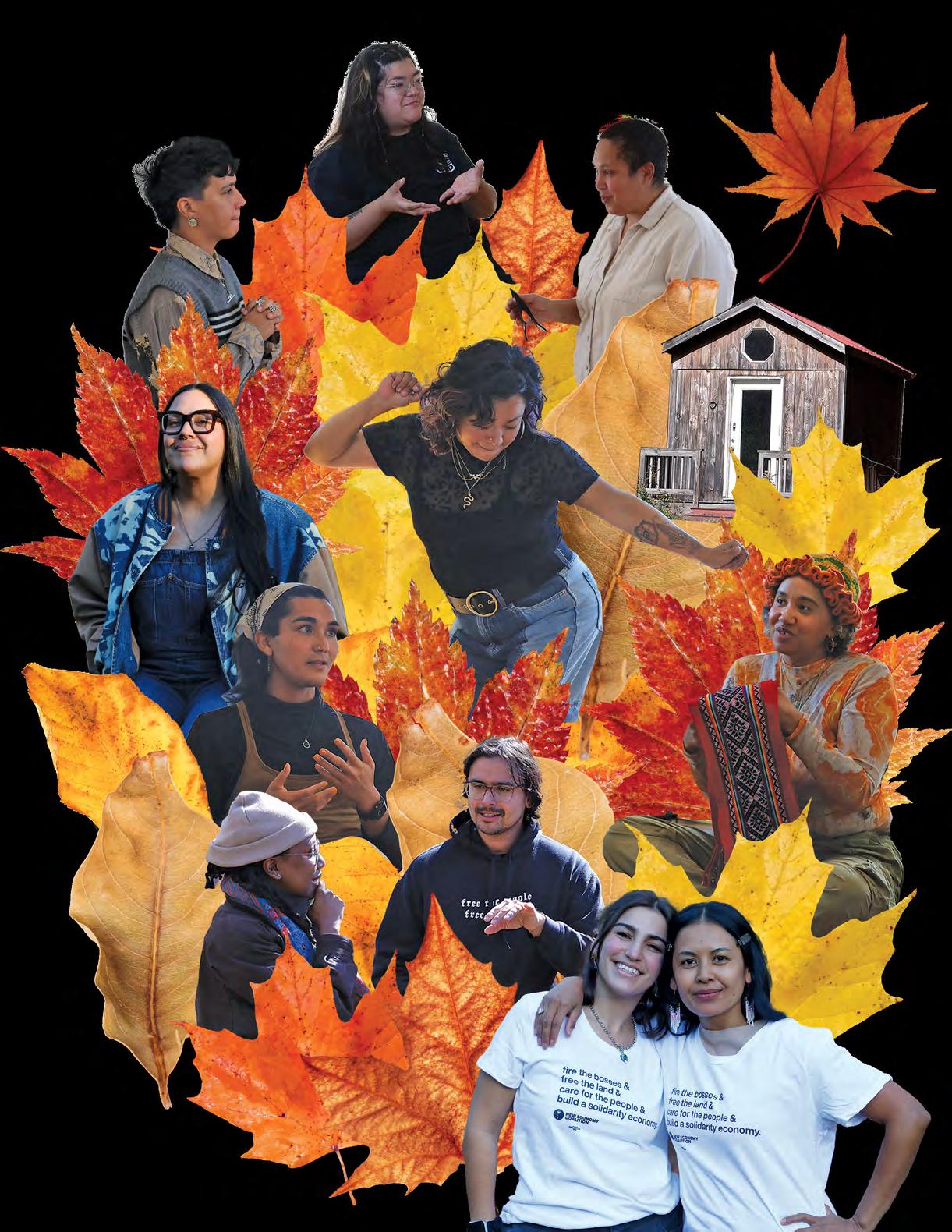
Photos by Anthony Rodriguez

CULTURE SHIFT cacophonY oF JoY
In the Spring, the Herring Protectors—an Indigenous women-led grassroots movement—invited We Rise and Movement Generation to what is known as Sitka, Alaska or Sheet’ká Kwáan, for the Yaaw Koo. éex', a Lingit ceremony honoring the herring and Lingit ways of life.
Woven with voices and song from ceremony, gatherings, and interviews, and sound from the land, Cacophony of Joy is a series where we share teachings from our time together in Sheet’ká Kwáan. Guided by the Herring Protectors, we honor grief, confront colonialism, navigate pathways forward together, and make space for celebration and the cacophony of joy.
This We Rise Production is a collaboration with Movement Generation & Herring Protectors. Learn more about the Herring Protectors and support their work at HerringProtectors.org

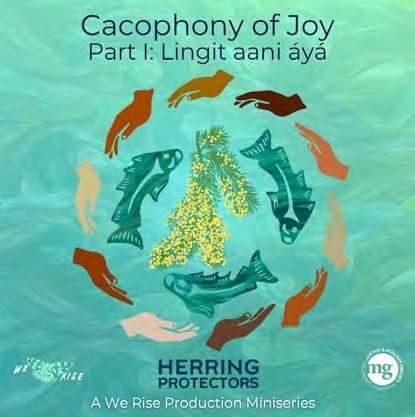
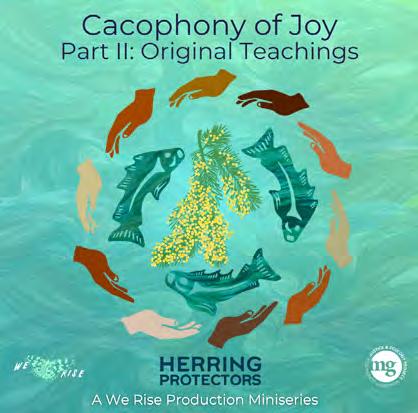
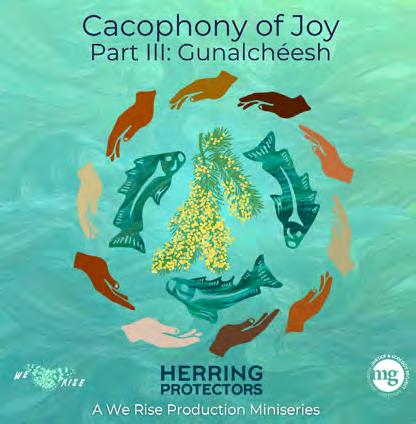

Cacophony of Joy
Part I: Lingit aani áyá

Cacophony of Joy
Part II: Original Teachings
Cacophony of Joy
Part III: Gunalchéesh

CULTURE SHIFT Rooted in Joy
Artwork by Robert Liu-Trujillo • @robert_tres
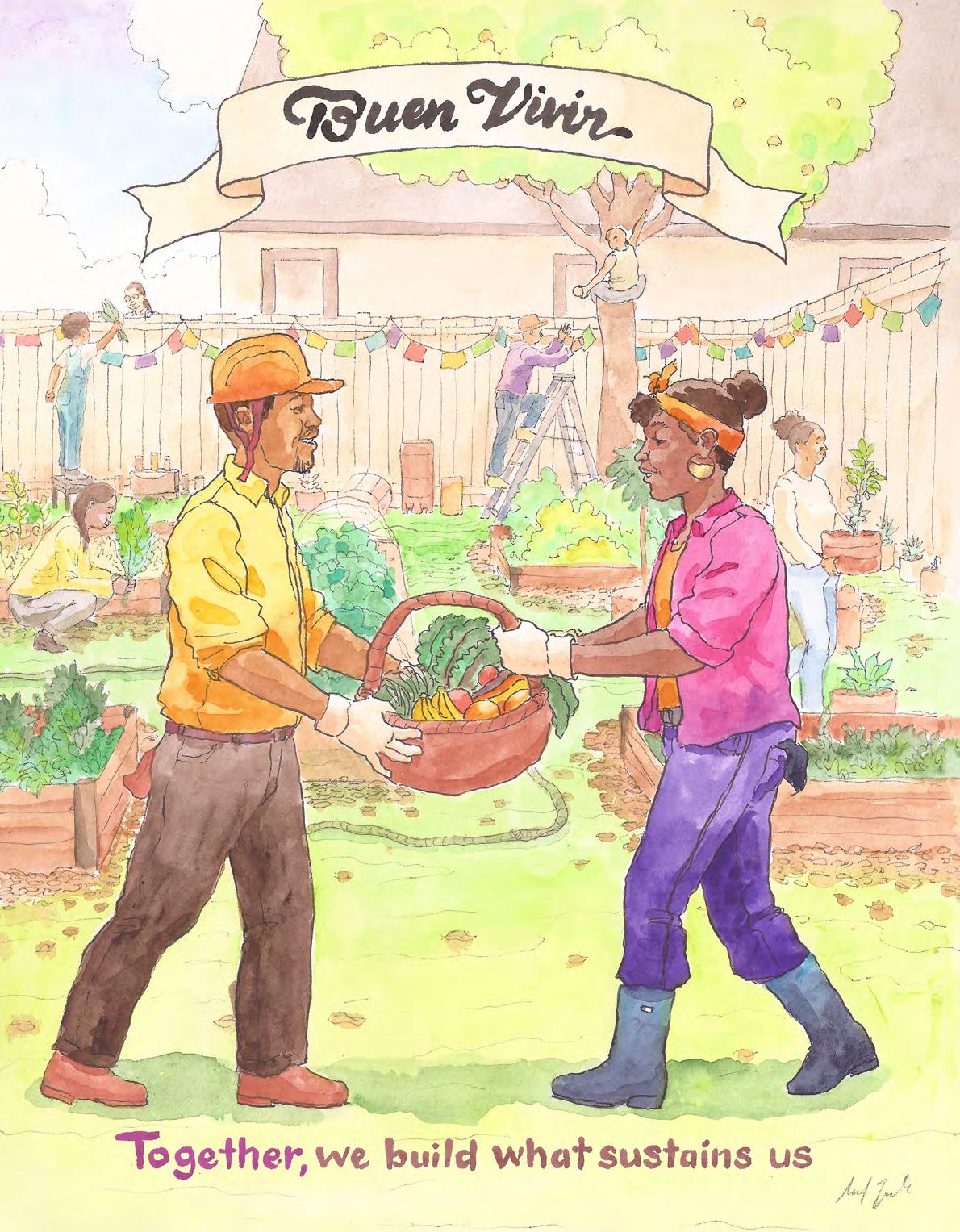
“Together,
we build what sustains us.”
This simple, yet necessary reminder and message comes to us through a collaboration between Movement Generation, the Center for Cultural Power, and artist Robert Liu-Trujillo.
From Robert, “For this image, I wanted to combine several themes from the #RootedInJoy campaign, and those are collective action, interdependence, resilience, and survival... we got this!”
What are you building (even if it’s small) with your neighbors to sustain your community at large?
Robert Liu-Trujillo is an author and illustrator from Oakland California. He has worked in murals, public art, arts education, merchandise making, illustration, and kid book publishing. More at robdontstop.com