
Movable Stationery vol 32, no 2, June 2024

Page 1


IN THIS ISSUE

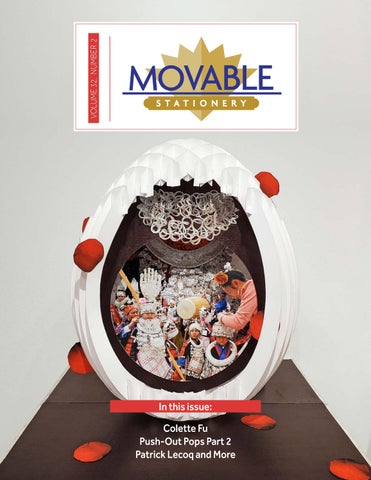
Recently Colette Fu was a featured presenter in our quarterly online MBS Show and Tell Zoom speaking about her most recent oversized pop-up book. We thought this would be the perfect time to dive deeper into the incredible work of this undeniably unique paper engineer, whose work is more likely to be destined for a museum than a bookstore.

In the previous issue of MS, at the last minute, I filled an empty double page spread with formulas I had developed for push-out pop-ups way back in the mid-90s. But after publishing something about it on Instagram, the comments opened up some interesting avenues. So instead of a last minute filler, this issue finds us exploring the subject with renewed purpose. Besides, I had a correction to make to one of those formulas!

Patrick Lecoq is a vociferous champion of the pop-up world from his home in Paris. He shares with us his illuminating lecture, now translated into English. I loved his video and think you will as well.

Metamorphosis Mania

Save the date for St. Louis, 2025! We'll be meeting there for our next conference from September 25 to 28th!

May 25's fantastic MBS Show and Tell featured enormous pop-up book art installations from Movable Stationery cover artist Colette Fu and by Bruce Foster, as well as very small ones from Geraldine, Nicolas Codran, and Gene Kannenberg, Jr.!

Join us next at 3 pm Chicago time on August 24th for a change of scene with recent work by former MBS director Shawn Sheehy, and Emily Brooks and Matt Holbein of The Foliage Library! They will discuss the mechanics and elegant geometry of making movables metamorphic. These sorts of illusionistic flaps and harlequinade formats date back centuries, like the ever-tricky Eve who became a Mermaid for hundreds of children learning their ABCs in the 19th century!

Suzanne Karr Schmidt, Director

P. S. Please email me with comments, questions, and suggestions. info@movablebooksociety.org

Volume 32, Number 2 / June 2024

©2024 The Movable Book Society

All rights reserved. No content from this publication may be reproduced or shared without the expressly written permission of the editor or the board of The Movable Book Society. Art Direction and Design by Bruce Foster.

Send questions, articles, or suggestions to editor@movablebooksociety.org

Colette Fu, Nuosu, Many Layers Deep Tunnel Book. Cherry wood, Mohawk Superfine, Flashe paint, leather. The layers are inspired a Nuosu Yi designs used on lacquerware tables and bowls, shields, armor, a dagger, and wine pots. Hidden beyond the layers is a photo of the artist from 1995 with a woman from her ancestral village in the Greater Liangshan Mountains of Southwest China.
Eve-Mermaid in an 1853
Metamorphosis harlequinade on pink paper by Benjamin Sands (Collection of Ellen G. K. Rubin).

TABLE OF 4 12 20 26 30 31

COLETTE FU

90° PUSH-OUT POPS PART 2

PATRICK LECOQ

RECENT AND UPCOMING RELEASES

EDWARD GOREY EXHIBIT OF MOVEABLE BOOKS

POPPITS BY ELLEN G. K. RUBIN

Cover: The decidedly strange fish on The Table.
This page: Detail from the recently recreated The Table.
Cover: Wings of Silver, from What the Butterfly Dragon Taught Me series, 2021. This page: Colette Fu in her home studio with her dog, Nori.

Editor's Note:

On May 25, 2024, Colette spoke on the MBS Show and Tell Zoom about her latest large scale work for Monument Lab, Noodle Mountain, right. It is a soaring achievement, one imbued with a rich cultural discussion about inclusivity/exclusivity; tradition/history; and the connection of food with memory.

Of course most of us in the Movable Book Society know Colette for her insightful cultural pop-ups, her gigantic constructions (her Tao Hua Yuan Ji won the Meggendorfer Prize for Artist Book in 2018), and, of course, her quiet, yet blazingly intelligent demeanor.

We at Movable Stationery think it is past time to learn more about this fearless, determined artist, marveling that her works are much more likely to be featured in museums than bookstores.

Colette Fu: Removing Boundaries, Dealing with Fear, One Pop-Up at a Time.

Materials: Pigment ink printing on corrugated board, gator board, vinyl, canvas; wood and metal crank table fabricated by Bradley N. Litwin.

Noodle Mountain will be on display until September 1, 2025 at Monument Lab in Philadelphia. Noodle Mountain is 7 x 10 feet, excluding the table.

The history of Chinese noodles in the United States is marked by exclusion, yet they symbolize traditional values and beliefs. Noodles have a long, multicultural history, and are a complex culinary connection to our history of immigration, colonization, and expansion. Due to a loophole in legislation, opening restaurants became a way to bypass U.S. immigration laws designed to keep Chinese laborers from immigrating or becoming U.S. citizens. Growing up in North Brunswick, New Jersey, Fu rejected Chinese food until her mid-20s. Growing up with spaghetti and meatballs she still has vivid memories of watching her father make Chinese noodles using a manual pasta maker, an expression of his Northern Chinese roots, where noodles were a more commonly consumed staple than rice.

With the turn of a crank, a monumental noodle mountain pops up from within a book on a table. The table references the kitchen table, where the family shares stories, an altar, an offering, and the Iron Chink, the automated salmon processing machine invented to replace Chinese laborers in the 19th century, whose name was derived from a racial slur. Noodle Mountain is a reminder of our complicated past and symbolizes the resilience of the Chinese in America. Where are you from?

The noodles create a gold mountain (California translates as old gold mountain in Chinese) highlighted with blood, a roller coaster – reminded Fu of growing up at the Jersey shore – and the ups and downs and recurrence of strong anti-immigrant sentiment from two centuries before. Fire reminds us of the many Chinatowns that were burned down yet references the ease of political ties in the 1970s and the introduction of new Chinese immigrants that brought different regional cuisines. The installation evokes a sense of nostalgia, comfort, and familiarity while still conveying the painful underlying themes of racism, persecution, and discrimination. Still, it celebrates the food and culture Chinese immigrants brought and the many contributions her ancestors made to create our country.

This article is a compilation of writings from various institutions that have hosted Fu for residencies or installations. Additional information and insights were contributed by Fu herself. https://www.getty.edu/news/an-artists-travel-pop-up-book/ https://www.craftcouncil.org/magazine/article/be-seen https://monumentlab.com/projects/slow-motion-or-colette-funoodle-mountain

Her mother was a voice major and her father an engineer. Summers were often spent in art camp, so not surprisingly, art and math became her favorite subjects. Fu didn't think of becoming an artist till her mid-20s after a trip to Yunnan Province to teach and study English. Her mother was actually born in Yunnan. While there she learned that she is a member of the minority group, Black Nuosu Yi. Over half of China's fiftyfive officially recognized minority groups reside in Yunnan Province.

Photography first came of interest to her while traveling there. When she returned home she then studied photography at Virginia Commonwealth University and again later at Rochester Institute of Technology. But as for paper engineering, Fu is self-taught. While attending artist residencies she recalls opening pop-up books in a bookstore in Rochester and delighting in Robert Sabuda's "The Wizard of Oz" and Margaret Wang's "Who Stole the Cookie from the Cookie Jar?" She began learning the art of paper-engineering by deconstructing commercially manufactured pop-up books. After RIT and attending many artist residencies, she applied for a Fulbright fellowship to make a pop-up book of the ethnic minorities there. That project formed the work that she is still doing now. Originally it was meant to be a commercial publication but ended up as a series of smaller handmade editions. Between 2013 and 2018 residencies were instrumental in creating work for We Are The Tiger Dragon People, her ongoing series of photo-based pop-up books about the ethnic minority groups of China.

Her curiosity of different cultures and the world is woven into all the work she does. As her artwork has evolved, she has translated concepts from her studio work into the community through social practice projects, public art, residencies, and teaching. Starting out in Philadelphia, she began teaching and working on community art projects and then began constantly applying for grants, exhibition and teaching opportunities, and more residencies. Frequently traveling around the United States today she lectures about her work and teaches workshops at art centers, schools,

and universities. Most of her commissions and exhibition opportunites are by invitation, only working on a few larger commissions a year that involve something new for her to experiment on and grow with.

Between 2014 and 2018, Fu traveled with opportunities and residencies to Shanghai, Kyrgyzstan, Morocco, India, Belgium and even Brazil where she learned such diverse crafts and skills as felting, rug making, silkscreen, brass metalsmithing, and even Capoeira, an Afro-Brazilian martial art and game that includes elements of dance, acrobatics, music, and spirituality.

In 2016/17 Fu had a solo exhibition of her pop-up books at the National Museum of Women in the Arts, the only museum dedicated to women in the arts. Curator Krystyna Wasserman described her work thusly: "Her themes are largely inspired by her personal experience, but her art also embodies—and inspires—feelings of joy, sorrow, and curiosity experienced by all of humankind... Each of Fu's popup books tells a story. She is a fearless wanderer who shares her wonders and helps us understand the world around us." However, Joyce Lovelace in 2015 wrote for the American Craft Council magazine: Fu doesn't see herself as fearless, just determined. "That's just a thing I've tried to do in my everyday living," she says. "Dealing with fear." Fu sells editions of her pop-up books to special collection libraries who use books in their collections as teaching tools. They are now part of over fifty museum and library collections, including the Library of Congress, the Metropolitan Museum of Art, Getty Research Institute, The Smithsonian, the Phillips Museum, Yale University, Harvard, the Rhode Island School of Design, George Washington University, and the National Museum of Women in the Arts.

In recent years, Fu has been making room-sized installations of pop-up books so that people could enter the book and feel fully immersed, as she does when she is creating them.

In 2018 Fu received the Meggendorfer Book Artist Prize, one of the highest awards in paper engineering through the Movable

Wishing Tree is a commission for The Cynthia Lovelace Sears Collection, and is inspired by the The Lam Tsuen Wishing Trees, a popular shrine in Hong Kong. According to local superstition, they hold a magical ability to make wishes come true as visitors write down their wishes for the new year, tie them to an orange, and then toss them up into the tree’s branches.
Like the Lam Tsuen Wishing Tree, the tree is a banyan tree, which has special significance in many cultures. It is considered sacred and represents numerous virtues including growth, strength, perseverance, longevity, immortality, wisdom, enlightenment, and the quieting of the mind.''
The Wishing Tree is 10 x 10 feet.
With my work, I want to eliminate boundaries, between people, between art and craft. These are all constructs that help us understand how we find ourselves in the world. But at the same time, I don’t want to be bound by them. ” ”

Right: Wa Hair Swinging Dance, 17x25x5.5”, 2017. Archival inkjet pop-up book. The Wa people regard the wooden drum as a divine tool that has exceptional power and is the symbol of existence and prosperity. Wa women uninhibitedly swing their long black, shiny hair to the beat of the drums. Their beat is slow and fast, representing anger and sadness, anxiety and happiness.

Far right: Uyghur Food Pop-up Book, 23x34x16”, 2020. Archival inkjet pop-up book. This book depicts popular Uyghur cuisine. The Uyghurs are a Muslim Turkic ethnic group living within China’s dominant Han population. Xinjiang Uyghur Autonomous Region is now one of the world’s most heavily policed areas.

Tao Hua Yuan Ji Room Size Pop-up Book, 21 x 14 feet, 2017. Archival inkjet pop-up book, originally 23x34x7.” Fu constructed an extra-large replica of Taohuayuanji at the Philadelphia Photo Arts Center over the course of 2 months. Visitors were invited to enter the cave. Taohuayuanji loosely translates as utopia in Chinese language. This book is inspired by a poem about a fisherman who visited an isolated peach blossom valley where people seeking political refuge lived an ideal, harmonic life with nature and each other. This pop-up won the Meggendorfer Artist Book Prize in 2018.

get facial tattoos at puberty. Some claim it was to make them unattractive to neighboring tribes who enslaved them. Dulong woman believe that their tattoos resemble butterflies; souls of the dead were said to turn into butterflies.

Kaifuna, 17x25x18", 2020. Archival inkjet pop-up book Dulong girls

Book Society, for her artist book "Tao Hua Yuan Ji: Source of the Peach Blossoms." The book measured 13.8 x 21 feet and reached over 5 feet high. According to Fu, "the book is inspired by a fourth-century Chinese poem about a traveler who came upon an isolated peach blossom valley beyond a cave where people seeking political refuge lived an ideal, harmonic life with nature and each other. Although villagers told the traveler not to tell of their location, he vainly marked his path and even sent government officials who were unable to find it. To the Chinese, this story is a metaphor to an unattainable Utopia. I traveled to a Zhuang minority village (Sep-Nov 2008) that claimed to be this village in the poem...

...I have not told anyone how to get there." I have not told anyone how to get there.

Fu has also incorporated movable books into public art projects. Commemorating the Stacks was a site-specific public art commission that was part of a $36 million renovation at the Philadelphia Parkway Central Library. The work was inspired by the tunnel book form and consisted of LED-lit laser-cut frosted acrylic layers that created a complex overlapping design mimicking paper. A tunnel book is a historical accordion-like book form, consisting of parallel layers of cut paper that create a multidimensional scene when viewed from the front. Each tunnel book was framed with fragments of the original metal shelving system. The layers of the book were created from her photographs of the six tiers of historic stacks removed for renovations (July 2017-May 2019).

Below: Fu working on a project-to-come as part of a residency

Bottom: A

In addition to teaching at universities and schools, Fu has worked with homeless shelters and formerly homeless people, intergenerational projects with senior citizens and a girls' home, and youth on probation through Family Court and Restorative Justice programs through Mural Arts. Fu has made pop-ups with children affected by AIDS on the Myanmar China border and with displaced earthquake victims in Sichuan Province. One of her most fulfilling social practice projects was with the Asian Arts Initiative and the Overcomers, a group of formerly homeless men from the neighboring Sunday Breakfast Rescue Mission in Philadelphia. Through writing, photography and pop-up holiday workshops,

the Overcomers and Fu created Chinese zodiac pop-up cards with their photography of the Chinatown North neighborhood in which both resided, and personal stories relating to zodiac animal characteristics that lead to struggles and/ or triumph. The goal of the project was to give visibility to both the men and the neighborhood of Chinatown North (Nov 2012- May 2013). In the past, Fu frequently worked on commercial projects as well. In 2010, Fu worked with Duck Studios on a series of animated commercials about children recovering from cancer for the Children's Medical Center of Texas. One of the three commercials, Brook's Broken Heart won an Annie Award for best animated commercial. She has also freelanced

To the left: Colette and a friend in Daliangshan, Sichuan Province, the center of the Nuosu Yi.
with the Brandywine Workshop and Archives.
scene from Jubilee and Her Doll, Duck Studios, one of three Children's Medical Center of Texas animated films.

for clients including Greenpeace, Vogue China, Canon Asia Moët Hennessey, Louis Vuitton, the Bearded Ladies Cabaret, and the Delaware Disaster Research Center, to name a few. These companies asked her to help tell their stories in pop-up form.

Fu has energetically supported a fulltime career in the arts for the past 15 years through exhibitions, artist residencies, grants, freelance projects, community and public art projects, lecturing, and teaching. While her artistic interests varied before 2008, she set a goal when she received a Fulbright fellowship that year that she was going to focus her career going forward solely on work relating to pop-up books.

Learn more about Colette Fu: https://www.colettefu.com/ Instagram @colette_fu

A commercial pop-up piece for Shalimar perfume commissioned by Moët Hennessy Louis Vuitton.
Fu has stayed committed to this goal.
Above: Members of the Overcomers and a zodiac pop-up created with Fu as part of their Social Practice Lab with the Sunday Rescue Breakfast Mission and the Asian Arts Initiative

90 "Push-Out"

Part 2

Pop-Ups Degree

Why am I returning to this subject again so soon? Actually there are several reasons.

One. A good friend, MBS member, and current colleague of mine, Seth Berg, reported to me that one of my formulas had an incorrect factor.

Two. I had begun noticing a new trend when assembling the New Books lists last issue, that a LOT of recent and upcoming pop-up books are using this form of paper engineering. But I didn't realize just how many until I really started investigating.

Three. David A. Carter replied to my Instagram post regarding push-outs after the last issue thusly: "At Intervisual we called this style of pop-up “poverty pops” because they are inexpensive to manufacture. I recently had a well-respected publisher tell me that they had discovered a new pop-up structure that was very inexpensive to manufacture. Ha, ha, you guessed it, poverty pops."

Yet, recognizing I had never heard that term before, I could still understand why it might have earned that less-than-complimentary nickname. Frankly, this technique in its basic implementation really is "the poor man's" pop-up as it avoids the expense of all those glue spots. But it is also suggestive that some publishers might actually not care as much about paper engineering as the good readers of this magazine do. So "good enough" was ok with them? Hey, it's popping, after all!... Right??? Well, before we jump to conclusions, let's take a closer look at this topic. When did this form of paper engineering first appear? According to the 10th Anniversary

Commemorative Pop-up book by the Movable Book Society, it first appeared during the World War II era with works by Geraldine Clyne. Geraldine went on to author and illustrate the Jolly Jump-Ups series of books with her husband, Benjamin Klein, although he remained anonymous and uncredited. From this book Ann Montanaro Staples writes: "Inspired by [simple] German pop-ups, Benjamin designed a new paper engineering process. Until then, pop-up books had been made from die-cut sheets glued onto flat pages. Each JOLLY JUMP-UPS illustration, however, was printed on a single sheet die-cut, and folded to form a three-dimensional scene. The flat portions of the illustration were glued to stiff boards so the popup would stand as the page opened." Since this

coincides with the years leading up and through World War II, resources, both in material as well as labor, were limited, making such an innovation attractive.

Although another decade later, Vojtěch Kubašta also dabbled in this art form for some of his innovative work, although sometimes he would add a few glued-in pieces to extend and/ or hide to the push-outs, thus improving the final perception of the results.

Of course when I began working with Ottenheimer Publishers in the early 90s, I had no knowledge of any of this. I was provided with a selection of their previously-designed books by their art director, Bea Jackson, using this technique with instructions to follow suit, along with new artwork for my assignments. The

Notice how the layers are

and

Right: An example of Kubašta using this technique. See the side view and how most of the volume has been lifted from the base as well. BUT also notice how he has added pieces to this to improve the composition as well as provide some interactivity! For instance the woman on the lower left has a pull tab that makes her appear to stir the bowl.

Geraldine Clyne, from the MBS 10th Anniversary Commemorative.
cut
lifted right out of the base sheet, leaving their blank silhouettes behind.
Photos by Rosston Meyer.

history of paper engineering was completely unknown to me. I was frankly just overjoyed to be working in this delightful "new" field! Remember, the internet in the early 90s was in its infancy, so there was very limited accessibility to research...

But I will tell you, this technique can be more difficult than it looks. As a matter of fact, when Seth alerted me to that mistake in my formula, he noted that adapting the formula to his experiments had been "brutal."

I definitely concur. Sometimes those projects can twist one's brain into knots. (By the way, let this be a lesson kids: Check your work not once, but twice! Heck, better make that THREE times just to be safe!)

In addition to the dirision heaped on the push-out because of its cheaper manufacturing is the realization that this also prohibits the engineer from exploring much in the way of angles, expansion, volume, and movement. Those require costly glue spots, skilled hand-assembly, and of course, interesting engineering solutions. Is "poverty" then a euphemism for lack of imagination as much as lack of funding?

Not necessarily! When the technique itself is used to take advantage of the push-outs' inherent strengths, elegance can be achieved.

For instance, using it for sculptural volume as seen in the examples following like this invitation I engineered for a gala for the Hirshhorn Museum and Sculpture Garden in Washington D.C. It is just a curve emulating the rounded shape of the

Christmas star. A Christmas-themed pop-up book. It was introduced by Lelequ, but it is now semi-out of print in China. Although it is a simple pop-up structure, the design is very innovative, including the color matching of the back panel and some small details, which are all very well done. Posted online by Guan Zhonping.

museum achieved simply by stepping the bends incrimentally.

Or, seen below, the elegance of the basic shapes of this Christmas-themed book from China and this card to the right by Seth Berg.

Invitation to the Hirshhorn 2017 gala benefiting 31 women artists, paper engineering by Bruce Foster, 2017.

Each bar featured the name of a single artist. The bright fluorescent reddish orange on the underlying layer added by the art director highlighted the sculptural form of the pop, emphasizing the volume as well as adding drama.

Push-out card by Seth Berg, from a set of cards designed for the Ah HAA exhibition in Telluride, CO this July, inspired by the Stepwells of India.

Correction

The "C" at that position was definitely unintended. Below is the corrected formula...

Two Direction Complex Overlap

Some of the best contemporary examples come to us from France and one of the best masters of this form is Nicolas Codron. Here we see his leporello, Steps, as well as Steps 2 in full scrumptious, pure color. Watch this fascinating time-lapse video of how he has to manipulate each fold meticulously by hand. When we see complexity of this magnitude, I do not think the term poverty pop is still applicable. While these pop-ups don't have a lot of glue spots, the hand manipulation can easily be just as costly.

Codron even made a version that is only 2.48 x 2.83 x 1 inches small! All purely abstract expressions of the best this form can achieve. If you are interested in owning one of his handmade delicacies, directly jump to this link.

Or That's My Hat, a 2016 book from Popville creators Anouck Boisrobert and Louis Rigaud. But notice that their push-outs are cut on smaller sheets and then glued

That's My Hat, 2016 by Anouck Boisrobert and Louis Rigaud, authors of Popville, a Meggendorfer Prize-nominated book.
The leporello, Steps, by Nicolas Codron hand-made to order. Left: Steps 2: Colors! utilizing colored papers. A copy of this is in the collection of the Metropolitan Museum of Art.
Above right:The miniaturized Small Night Steps .

into a printed book. On the flat areas where normally there would be the blank silhouettes, they have added new art, integrating the pushouts together with the base art to complete the story in a more satsifying way.

But wait! There is yet another term for this form of paper engineering: Origamic Architecture, as embodied in this how-to book of the same name by the late Masahiro Chatani. While the book explores examples of more complicated and/or gluedpieces forms, his push-outs are still elegant in their simplicity, akin to Codron's approach.

But as mentioned earlier, this return to push-outs is widespread in today's publishing. David Hawcock and d'Andrea Bignone are creating a landslide of push-out books for Nuinui Jeunesse in both French and English. Just see for yourselves. Explore Nuinui's online catalog for 2023 and I'll bet you, like me, will be astonished at the number of simple and/or push-out pop-up books. So whether we regard pushout pops as less than (or not), depends a great deal on the choices the paper engineer and the publisher make. Sure, they can be crude or at the very least, efficient, in their most minimal forms, but if allowed, these can also attain great heights as true works of art in their own right, proudly standing beside those of the best paper engineering of the past few decades.

https://nuinui.ch/collections/pop-up/bambini

An example of Origamic Architecture by Masahiro Chatani.

Clockwise from the top: Blanch-Neige, pe d'Andrea Bignone.

First Pop-up Book of Endangered Animals, pe, Owen Davey.

The Pop-Up Guide Cities Around the World, pe? L'Histoire de Egypt, pe, David Hawcock.

Center: releasing this fall, Surrealism, pe Gerard Lo Monaco.

A Journey Through the World of Movable Books

Patrick Lecoq has sailed through the pages of this publication before. See issue Vol 30 No 2. As a collector of movable books, he has quite a depth of knowledge.

Recently Patrick created a lecture on the history of pop-up and movable books which was delivered to French audiences. He has now translated this wonderfully rich and insightful treatise charmingly into English, despite his self-effacing caveat. Assisting Patrick for historical research was Graziella Abanèse. These photos are just a small selection of the gems he features in his presentation.

You can enjoy this video by visiting his Vimeo.

Patrick weaves an enchanting path from a very clear explanation of the original volvelles through the centuries past flap books, movables, and on to current published and handmade books. This presentation unveils some fascinating gems rarely seen. Highly recommended viewing.

Aladin and the Magic Lamp, Guérin-Müller 1861. Published by Dean and Sons. Early diorama book. Pops lifted by ribbon.
Catechism Card, 1900. Early version of a 90° pull-down pop-up.
Image on the left is the title slide from Lecoq's video presentation.

One of seventeen Catechism pop-up books printed by the Catholic Church of Hong Kong, 1957-64. Each book had up to 20 scenes.

Livre Hop-Scène, Ivan Sigg. The title is a word play on obscenity. Hand made.
A Circus Party, 1910.
Number, Camille Renoult, 2015. A pop-up book made entirely of wires and string.
Dans le Secret des Feuillages (In The Secrets of Foliage), Cécile Jacoud, 2021. This one spread has eight levels of die cuts for an exquisite tunnel book.

MÊME PAS PEUR! (NOT EVEN AFRAID)

PE: David Hawcock Nuinui Jeunesse

April 4, 2024

978-2889573196

$16.98

LE CHAT BOTTÉ (PUSS IN BOOTS)

PE: d'Andrea Bignone Nuinui Jeunesse

May 5, 2024

978-2889572991

$13.49

MONTAGNES (MOUNTAINS)

PE: David Hawcock Nuinui Jeunesse

June 4, 2024

9782889573530 11,90

There are so many pop-ups being released by Nuinui Jeunesse (many by David Hawcock) that perhaps perusing their site would be more beneficial. Just have fun browsing!

RECENT AND UPCOMING POP-UP BOOKS

KEITH HARING POP-UP BOOK

PE: Simon Arizpe

July 1, 2024

Poposition Press

978-8-9854695-6-1

$60

All Keith Haring artwork and quotes © The Keith Haring Foundation

POP-UP SURPRISE: ONE LITTLE PUMPKIN

PE: Junissa Bianda?

Cottage Door Press

July 16, 2024

978-1646389940

$12.99

PREHISTORIC BEASTS

PE: Mike Love?

Templar Publishing

July 23, 2024

978-1800782099

$26.99

Not a pop-up, but a graphic novel ABOUT a pop-up book out of control! Sounds fun!

POP-UP PERIL

Stone Arch Books

August 1, 2024

978-1669073628

$7.99

Thames and Hudson

August 6, 2024

978050048103

$13.82 plus shipping English and Traditional Chinese

POP-UP ANIMALS

PE: Jenny

Usborne

August 6, 2024

978-1805075523

$7.99

Hilborne
M+ POPS UP!
PE: Marion Bataille

DISNEY TIM BURTON'S THE NIGHTMARE BEFORE CHRISTMAS: POP-UP HOLIDAY WORLDS

PE: Matthew Reinhart Insight Editions

August 6, 2024

979-8886634037

$34.99

ANDRÉS FURUKAWA'S MACKEN: THE JOURNEY

PE: Bruce Foster Paperpops, LLC

August 18, 2024

More information to come next issue. This boxed set contains a six-spread pop-up book, a double vinyl album of Swedish metal bands, and a 200 page deep dive into Macken Bryggeri (a craft beer company in Stockholm), its history, philosophy, and graphic design development of the company and its beer labels..

Exquisite Corpse exhibits at the Edward Gorey House April 4th through December 29th, 2024.

Edward Gorey seemed driven to explore every physical permutation one could inflict on a book: multiple-fold books, pop-up books, flipbooks, accordions, fans, tarot decks, and even books that don’t really open at all. All these paper experiments were a logical (or, illogical) evolution born of Gorey's forays into Surrealist storytelling, non-sequitur reveals, anagrammed authorships, and cryptic dedications. Blurring the line between Book and Game, Exquisite Corpse explores how Gorey reveled in subverting the physical realm of the book to allow for endless visual and narrative possibilities to, quite literally, unfold.

–From The Edward Gorey House website.

The Edward Gorey House 8 Strawberry Lane • Yarmouth Port, MA 02675

Learn more here.

Thanks to Joy Malnar for bringing this exciting exhibit to our attention...If anyone is fortunate enough to visit this exhibit, we would love to hear a report. Don't forget Photos!

POPPITS POPPITS

BOOK FAIRS 2024

It’s not too early to plan to attend the 46th Boston International Antiquarian Book Fair; November 8-10, 2024 The Boston Book Fair is the annual fall gathering for book lovers and collectors, featuring the top selection of items available on the international literary market. The Popuplady always attends and always finds goodies.

Also, last issue we noted that the next annual event of the Salon du Livre Animé will be held the weekend BEFORE Thanksgiving on November 23, 2024. Kick off your holiday in Paris!

VIRTUAL BOOK FAIRS

More and more organizations are offering virtual book fairs. I have found them safe, easy, and rewarding. Check Getman’s to see which fairs he is sponsoring. https:// getmansvirtual.com/

EXHIBITIONS

The Bainbridge Island Museum of Art sponsors ongoing video and live exhibitions of several kinds of artist books including movable ones. They are a deep-dive into the world of books.

There will be two exhibitions mounted at the University of Pennsylvania Kislak Library, Philadelphia in September.

The Movement of Books, August 30-December 13, 2024. Goldstein Family Gallery, 6th floor, Van Pelt-Dietrich Library Center

To read a book, you must move it: take it off the shelf, open the cover, and turn the pages. Yet, in library exhibits, books are often displayed under glass, which protects them but removes the tactile experience crucial to how we understand them. This paradox is the basis for The Movement of Books, an exhibition curated by Dot Porter, the Schoenberg Institute for Manuscript Studies Curator of Digital Humanities, exploring the myriad ways books move—as physical objects in different formats, and across space and time. The exhibit will feature items from Penn Libraries' collections and video, as well as interactive physical facsimiles for visitors to engage with directly.

AND Material World, September 4-December 9, 2024. Lobby and Kamin Gallery, 1st floor, Van Pelt-Dietrich Library Center.

Material World is an exploration of materiality of the book form, challenging the

participating artists/ binders, all members of the Delaware Valley Chapter of the Guild of Book Workers, to use non-traditional mediums and structures. Founded in 1990, the Delaware Valley Chapter includes book artists, book conservators, fine binders, calligraphers, librarians, paper marblers, teachers, photographers, printmakers, and graphic designers. Penn Libraries is a longstanding supporter of the book arts through its collections and its involvement with the Common Press, Penn's letterpress printing studio, housed in the Fisher Fine Arts Library.

In conjunction with these exhibits, The Popuplady will give a talk, tentatively called, Art and Action: Movable Books and Paper from the Collection of Ellen G. K. Rubin, at 5:30PM on September 12 relating to these exhibits.

MBS members: If you are planning an exhibition or know of one, please alert The Popuplady or Bruce Foster. We all want to see these exhibitions. Think about approaching your local library or museum about mounting an exhibit from your pop-up book collection.

MULTIMEDIA

Our esteemed director, Suzanne KarrSchmidt, reprised her talk about the exhibition, Movable Mayhem: Pop-up Books Through the Ages on July 7, 2PM PDT sponsored by The Book Club of Washington. You will be able to see it at https://www.youtube.com/channel/ UCU9C-ZAiicBCLmzhEd6tHPw

The movable genre, rankie, has other names, myriopticon or panoramic scrolls, as examples. The Popuplady collection has several myriopticons made mostly in the 19th century. It is an illustrated paper scroll moving behind an opening often in a theater set up. The scroll is activated with cranks of some kind causing the movement. I’ve even seen chopsticks used. You can participate by making a Crankie if you wish, maybe next year. https://www.randomactsofsilliness.com/2024crankie-fest https://crankiefestival.com/ http://www.thecrankiefactory.com/115034635 html Here is a fun example of a musical crankie from Baltimore artist Matt Muirhead.

engineer at Robert Sabuda’s studio, will be the instructor.

Shawn Sheehy will be giving a Pop-up Intensive: Parallels and Angles at Maine Media on SEPT 3, 10, 17, 24. There are scholarships available. Shawn will be giving several workshops around the country but mostly on-line. Log onto Shawn's website.

Jill Deiss of CatTailRun Hand Bookbinding tells us the Society of Gilders will be having their 2024 conference in Charleston, SC in Aug. There are several workshop opportunities that our members might be interested in. See pages 15, 16, and 17 of the online prospectus. https://societyofgilders.org/2024-conference/

HOW-TO

The BMCC Makerspace hosts videos to instruct making pop-ups. https://openlab. bmcc.cuny.edu/makerspace/popups/

For a low fee, one can learn to make pop-ups with Silvia Hijano Coullaut.

ANNOUNCEMENTS

Our Cleveland conference keynote speaker, Peter Dahmen, will join forces with Poposition Press to release Peter’s first book, Pop Up Sculptures. Previously, his work was unavailable to collectors. A Kickstarter campaign will start in September. Drop in at Popositionpress.com for more info.

Bruce Foster, paper engineer and editor of this publication, and MBS member Seth Berg will be in joining forces at Telluride, CO's Ah HAA School for the Arts July 15-22 to install oversized pop-ups for a group show.

OBITUARIES

I am so sad to report that Katsumi Komagata (19532024) has passed on. His work was ethereal, artistic, and unique. I discovered his books at the D’Orsay Museum in Paris and always looked forward to new works. He started by making books for his children. If you are not familiar, you are missing something. He uses different papers, die-cuts and some pop-ups. There is a Bruno Munariquality to his art. I was excited to find this video of Komagata in his studio. What a warm smile!

WORKSHOPS

The School of Visual Arts in New York City will host a children’s pop-up book workshop on August 24, 2024. Teen Liu, former paper

We have also lost a devoted collector and MBS member, Betsy Traganza. She attended several conferences and spoke about her Hallmark collection in California in 1998. We need more like her!

VOLUME 32, NUMBER 2

Poposition Press is pleased to announce a new collaboration with world renowned designer and paper artist Peter Dahmen.

Pop Up Sculptures will be Peter’s first published book, featuring six of his beautiful all white paper sculptures. For a long time, Peter’s work could only be seen online but with this collaboration he has created pop-up designs that are suitable to finally be produced in a pop-up book.

The project includes two editions: a standard edition with six paper sculptures and a special edition that includes a second volume with an additional six sculptures. Both volumes in the special edition will come housed in a laser etched acrylic slipcase and will be signed and numbered by Peter Dahmen.

Poposition Press will be launching a Kickstarter campaign this September for this exciting project. Click HERE to sign up to be notified when the campaign launches, and if you follow them on social media, keep your eyes peeled for more sneak peeks in the coming weeks.

Dahmen. was of course, the keynote speaker at the 2023 MBS Conference in Cleveland, OH.

Turn static files into dynamic content formats.
Create a flipbook
Movable Stationery vol 32, no 2, June 2024 by MovableStationery - Issuu