S U M M I T
M
O
INE )
U
O-F T he (NOT-S odern ar t o f m g : parentin or A guide fused the conf
N
T
R
O
Y
A
L
U
N
I
V
E
R
S
I
T
Y
2 0 2 6
FROM BEATS TO BELLY L AUGHS
T A Y L O R C E N T R E . C A
FIND YOUR NEXT EVENT USE PROMO CODE MRUCOMMUNITY FOR 15% OFF TAYLOR CENTRE PRESENTATIONS!
LETTER FROM THE PRESIDENT
Now appearing
Alumni in this issue Ayden Ali
BACHELOR OF ARTS — SOCIOLOGY, 2026
Neepin Auger
BACHELOR OF EDUCATION — ELEMENTARY, 2015
Luke Azevedo
BROADCASTING DIPLOMA, 1986
Daniel Bartholomew-Poyser HONORARY DOCTOR OF LAWS, 2026
Joban Brar
BACHELOR OF COMPUTER INFORMATION SYSTEMS, 2026
George Brookman
HONORARY DOCTOR OF LAWS, 2020
Francine Cerbino de Santana BACHELOR OF SCIENCE — BIOLOGY (HONOURS), 2026
Jessica Cuillerier
BACHELOR OF EDUCATION — ELEMENTARY, 2026
Kayla Aren Evenson
AVIATION DIPLOMA, 2026
Janelle Flett
BACHELOR OF SCIENCE — ENVIRONMENTAL SCIENCE, 2022
Danielle L. Jensen
BACHELOR OF ARTS — ENGLISH (HONOURS), 2012
Alice Kaquitts
HONORARY DOCTOR OF LAWS, 2026
Alexandra Kingcott
BACHELOR OF APPLIED COMMUNICATIONS — PUBLIC RELATIONS, 2010
Adam Kingsmill
BACHELOR OF HEALTH AND PHYSICAL EDUCATION — ATHLETIC THERAPY, 2024
Megan Lachance
CHILD AND YOUTH CARE COUNSELLOR DIPLOMA, 2013
Krysten Loiselle
BACHELOR OF COMMUNICATION — INFORMATION DESIGN, 2025
Angelo Lozancic
Emma Marshall
BACHELOR OF COMMUNICATION — JOURNALISM AND DIGITAL MEDIA, 2026
Ann McCaig
HONORARY DOCTOR OF LAWS, 2020
Chelan McCallion
CHILD AND YOUTH CARE DIPLOMA, 2006
Kaylene McTavish
BACHELOR OF COMMUNICATIONS — PUBLIC RELATIONS, 2014
Lachlin Muir
BACHELOR OF BUSINESS ADMINISTRATION — GENERAL MANAGEMENT, 2015
Sarah O’Brien
BACHELOR OF SCIENCE — BIOLOGY, 2023
Alyssa Peppler
BACHELOR OF ARTS — PSYCHOLOGY (HONOURS), 2025
Jessica Sadler
BACHELOR OF ARTS — PSYCHOLOGY (HONOURS), 2025
Katie Samoil
ADVANCED CRITICAL CARE NURSING CERTIFICATE, 2011
Andrea Seale
PUBLIC RELATIONS CO-OP DIPLOMA, 1995
Mike Shaikh
HONORARY DOCTOR OF LAWS, 2026
Bryce Starlight
GENERAL STUDIES ARTS AND SCIENCE DIPLOMA, 2002
Spirit River Striped Wolf
BACHELOR OF ARTS — POLICY STUDIES, 2023
Mary A. Tidlund
HONORARY DOCTOR OF LAWS, 2026
Debra Tomlinson
HONORARY DOCTOR OF LAWS, 2026
Wilfredo Vargas Suarez
BACHELOR OF ARTS — PSYCHOLOGY (HONOURS), 2026
BACHELOR OF BUSINESS ADMINISTRATION — ACCOUNTING, 2026
Sophia Wells
Xochi (Clint) Anne MacLeod
HONORARY DOCTOR OF LAWS, 2026
BACHELOR OF ARTS — CRIMINAL JUSTICE (HONOURS), 2026
Jon Macpherson
BACHELOR OF ARTS — POLICY STUDIES, 2011
What’s new at MRU!
AVIATION DIPLOMA, 2009
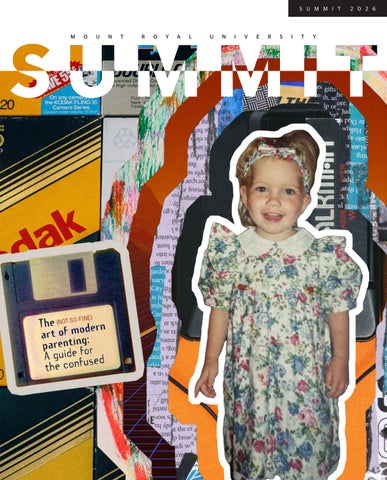
I love back-to-school! As students begin to return to campus after their summers away, it conjures the vibrancy of a community in motion; a collective “falling back” into the excitement of discovery, growth and shared purpose. It is a distinct energy, amplified by the thousands of faces who join or rejoin us after a summer away from their studies. I extend a special welcome to our new students who arrive with a mix of excitement and anxiety as they embark on their Mount Royal journey. Our halls are reinvigorated, and all of MRU falls into a familiar rhythm. I hope you feel this energy, too. When our alumni and friends remain in tune with the learning and developments happening both on and off campus, it reminds us of the communal impact of Mount Royal. In this issue of Summit, we explore stories relevant to our community’s current conversations. Our cover story looks at a topic close to our hearts. We examine how the constant bombardment of information has made modern parenting harder than ever, raising expectations and reinforcing gender roles. Our focus is on how parents can cut through the noise and prioritize their family. We also turn our attention to the power of self-understanding and technology. This issue includes a thoughtful piece on using the internet to selfdiagnose, exploring how social media is reshaping how people understand themselves and how diagnosis begins, with early research pointing to more cautious optimism than one might expect. We also celebrate the achievements of our graduates by highlighting the annual Outstanding Alumni Award recipients. And finally, for our Last Word, we hear from athletic therapy grad and Canadian Paralympian Adam Kingsmill, who shares his positive experiences at MRU and representing Canada. The stories within these pages reflect the commitment to opening minds and changing lives that defines Mount Royal University. As you read, I hope you feel the same sense of pride in our collective achievements as I do, and are inspired to contribute to the conversations shaping our future. Your engagement, whether on campus, online or through your work in the wider community, is what empowers us to think bigger and reach further. Or, dare I say, “Grow Beyond.” Please stay close to MRU and remember you are always part of our community. I wish you and your family a wonderful fall season.
David Weyant Eden Wilson
BACHELOR OF HEALTH AND PHYSICAL EDUCATION — SPORT AND RECREATION MANAGEMENT, 2019
On the cover: Emmie Henderson-Dekort, PhD
ASSISTANT PROFESSOR, BACHELOR OF CHILD STUDIES
Tim Rahilly, PhD, President and Vice-Chancellor Mount Royal University MRU.CA/SUMMIT
|
1
MEET THE TEAM
Meet the team EDITOR-IN-CHIEF
Melanie Rogers EDITOR
Michelle Bodnar
BCMM (APPLIED) ’05
DEPUTY EDITOR
Rachel von Hahn ART DIRECTOR
Michal Waissmann BCMM (APPLIED) ’07
PRODUCTION MANAGEMENT
Dana Heise MARKETING AND COMMUNICATIONS COORDINATOR
Chase Goods Astri Do Rego Mike Poon Chidera Uzoka BCMM ’26
A Cougar’s comeback
BCMM ’26
CONTRIBUTORS
Jody Arndt Michelle Bodnar
BCMM (APPLIED) ’05
Haley Diodati Peter Glenn Guiliana Harvey Sarah Hewitt Adam Kingsmill BHPE ’24 BBA ’21
DESIGN
Chao Zhang
ILLUSTRATIONS
Ane Arzelus Chidera Uzoka
Annemarie Potyondi
BCMM ’24
Calgary Herald newspaper clipping provided by alumnus Chase Goods, grandson of Bill Goods and Summit’s marketing and communications coordinator.
PHOTOGRAPHY
Cary Schatz Chao Zhang
Rachel von Hahn Ethan Ward BCMM ‘22
Fiona Wren
PROFESSIONAL WRITING CERTIFICATE ’97
COPY EDITOR
Matthew Fox A 1960 Calgary Herald photo featured Mount Royal fullback Bill Goods recovering at Holy Cross Hospital after suffering a dislocated elbow during the Alberta Junior Football League final. With his left arm in a cast, Goods was shown receiving care from nurses Roberta Blake and Marlene Herle. Despite the injury, the hard-running fullback was expected to return to the Mount Royal Cougars lineup for the Western semifinal against the British Columbia champions at McMahon Stadium. Read more on page 14.
VICE-PRESIDENT, COMMUNITY ENGAGEMENT Melanie Rogers ASSOCIATE VICE-PRESIDENT, MARKETING AND COMMUNICATIONS Dave McLean DIRECTOR, COMMUNICATIONS Peter Glenn DIRECTOR, MARKETING Katie Cabaret
Summit is published in the fall of each year. With a circulation of approximately 76,000, each issue features the exceptional alumni, students, faculty and supporters who make up the Mount Royal community. Summit tells the University’s ongoing story of the provision of an outstanding undergraduate education through personalized learning opportunities, a commitment to quality teaching, a focus on practical outcomes and a true dedication to communities. Celebrate yourself through Summit. ISSN 1929-8757 Summit Publications Mail Agreement #40064310
2
Return undeliverables to: Mount Royal University 4825 Mount Royal Gate SW Calgary, AB, Canada T3E 6K6 Enjoy Summit online by visiting mru.ca/Summit. If you would like a print copy delivered to your home or office, simply email summit@mtroyal.ca.
With gratitude and reciprocity, Mount Royal acknowledges the relationships to the land and all beings, and the songs, stories and teachings of the Siksika Nation, Piikani Nation and Kainai Nation of the Blackfoot Confederacy, the Tsuut’ina Nation, the Chiniki, Bearspaw and Goodstoney Nations of the Iethka Stoney Nakoda, and the Métis.
FSC
IN THIS ISSUE
Letter from the President Scratch Pad Outstanding Alumni
1 4 12
From the Archives Everyday Science Research Snapshots
14 15 18
Magnified Viewpoints
24
Grow Beyond: A future without limits
40
This year’s Outstanding Alumni Award recipients show up in their professions and communities, living MRU’s vision and values while making a difference.
Research at Mount Royal is building and improving communities in Calgary and around the world. Our experts discuss the benefits of boredom.
Ecotourism and outdoor leadership student Jenna Sherrington says the program has forced her to live outside her pre-established boundaries and provided an amazing stepping stone.
The Last Word
Athletic therapy alumnus Adam Kingsmill shares the lessons that carried him from Mount Royal classrooms to the Paralympic stage.
42
44
Alumni Connect
Health science innovation
A proposed centre will provide room to expand and enhance critical health education and support for Alberta’s need for health and science professionals.
16
32
26
Like and follow for more symptoms
How social media is reshaping our view of mental health and fuelling an era of self-diagnosis — a new reality that has both its positives and negatives.
The rise of the mocktail
Gen Z has a reputation for being “the most sober” generation, but their reasons for drinking less may not be so cut and dry.
20
The (not-so-fine) art of modern parenting
Parents are inundated with advice and information via social media and other means, often leading to a crisis of self-esteem. How do parents see past the noise and learn how to support themselves?
Things you’ll learn in this issue Page 7
What is the average cost of fertility treatments in Alberta?
Page 11
How much in scholarships and bursaries does MRU distribute each year?
Page 15
What is the first kind of tissue to grow after a bone breaks?
Page 28
Which social media platform is the worst for health misinformation?
Page 34
How many hours per day do Canadians spend on mobile apps?
MRU.CA/SUMMIT
|
3
S C R AT C H PA D
LOGISTICS FOR GROWTH
Funding supports innovation ADVANCING MOVEMENT SCIENCE
Professor appointed Canada Research Chair Dr. Jared Fletcher, PhD, has been named a Tier 2 Canada Research Chair in Integrative Physiology and the Biomechanics of Locomotion, recognizing his work investigating the science behind human movement. Through MRU’s Fascicles, Tendons and Energetics Research (FasTER) Lab, Fletcher and his students study how muscles and tendons contribute to exercise, performance and recovery, with findings that can benefit athletes and everyday movers alike. The five-year appointment will support continued research while creating more opportunities for undergraduate students to gain hands-on research experience.
SAM TAYLOR STUDENT COMMONS
New student hub opening soon Opening in the revitalized G-Wing, the Sam Taylor Student Commons will serve as a central hub for student life. The space brings together student services, academic supports and social areas in one accessible location, including an information services desk, flexible study spaces and private appointment rooms. Designed to bridge learning and community life, the Commons will also feature a central student plaza intended to encourage connection and engagement across campus. The transformation is supported by a $50-million investment from the Government of Alberta and a $15-million gift from Don and Ruth Taylor and the Taylor Family Foundation, with completion expected in the coming months. mru.ca/GWingRenovation
4
A combined $5.6-million investment from federal, provincial and municipal partners is supporting the Alberta Logistics Centre of Excellence at Mount Royal’s Institute for Innovation and Entrepreneurship. The provincewide hub brings together industry, government and academia to strengthen supply chains, address workforce gaps and respond to shifting trade conditions. Through applied programming, work-integrated learning and industry collaboration, the centre will help businesses test and scale solutions while preparing talent to meet the evolving demands of Alberta’s transportation and logistics sector.
OPENING DOORS FOR STUDENTS
Largest scholarship in MRU history The Edwin and Jeannette Dodd Scholarship marks the introduction of the largest student award ever offered at Mount Royal. Beginning in fall 2026, three students in their second, third and fourth years will be selected annually based on academic achievement and financial need, each receiving $25,000 to support their academic journey. The scholarship is a longterm investment in student potential and the impact graduates will go on to make in their professions and communities.
MRU EXPERTS IN THE SPOTLIGHT
Media watch “How a Sea Creature’s Fossils Show All the Colors of the Rainbow” New York Times Paul Johnston, PhD — Earth and environmental sciences “Some people say they lack an inner voice” CHED Alain Morin “How to begin an investigation of a mass shooting” CBC News Doug King — Criminal justice “This ‘Clock’ Could Warn of Hidden Stresses to Animals, Offering a LongSought Signal That a Population Is Nearing Collapse” Smithsonian Magazine Levi Newediuk, PhD — Biology “Does the CBC’s Israel-Hamas coverage favour Palestinians?” Canadian Affairs Gabriela Perdomo Páez, PhD — Journalism “What Experts Want You to Know About Running and Poop” Runner’s World Jill Parnell, PhD — Health and physical education “Think-tank member Tim Rahilly: Ensuring those who grow up here have opportunities to lead here” Calgary Herald Tim Rahilly, PhD — President and vice-chancellor
CLAWS FOR A CAUSE
Pearls of Wisdom back on the menu After a 12-year pause, Pearls of Wisdom returned to Mount Royal on June 6, bringing back the signature lobster-boil event that connects alumni, donors, community partners and friends in support of student success. With its East Coast-inspired setting, the evening pairs a shared meal with philanthropy, raising funds for student learning and opportunity. This year’s event featured seafood from Rodney’s Oyster House and a painting created live by Calgary artist Mandy Stobo. Alumna speaker Francine Cerbino de Santana spoke about about how mentorship and support shaped her path from upgrading courses to graduating in biology.
“Airline manufacturing needs to take a beat” CBC Radio David Finch, PhD — Marketing “Canada’s Tate McRae faces backlash for Team USA Olympics ad” Global National Kris Hans — Public relations
See more at mru.ca/News
MRU.CA/SUMMIT
|
5
S C R AT C H PA D
L to R: Dr. Raphael Slawinski, PhD; Heather Laird, RASC president, Calgary Centre; Dr. Stephen Jeans, PhD; Dr. Jonathan Withey, DPhil.
ASTRONOMY IN ACTION
L to R: MRU President Tim Rahilly, PhD; Honorary Doctor of Laws recipient Ann McCaig; Chancellor Arlene Strom; Honorary Doctor of Laws recipient George Brookman.
COMMUNITY BUILDERS CIRCLE
Honorary degree recipients reconnect A new initiative is bringing together past honorary degree recipients to continue sharing insight and experience beyond Convocation. Created by honorary degree recipients George Brookman and Ann McCaig in collaboration with MRU, the Community Builders Circle focuses on ongoing connection and collaboration in support of the University and the broader community.
BEST OF THE BEST
MRU athletes on the world stage Mount Royal connections were on full display at the Milano Cortina Winter Olympic and Paralympic Games, with athletes and coaches contributing across multiple sports. Aviation management student Xavier McKeever competed in cross-country skiing, and ecotourism and outdoor leadership student Jared Schmidt raced in ski cross. Sport and recreation alumna Eden Wilson served as an alternate for women’s bobsleigh, while Cougars coach Scott Rivett was an assistant coach with Czechia’s women’s hockey team. In the final event of the Games, athletic therapy alumnus Adam Kingsmill earned silver in para ice hockey. Read more about Kingsmill’s experience on page 42.
6
Awards highlight community science work Mount Royal’s astronomy outreach has earned recognition from the Royal Astronomical Society of Canada (Calgary Centre). The University received the 2025 Corporate Award for its popular Star Parties, while Associate Professor Stephen Jeans, PhD, was honoured with the 2025 Peter Sim Public Education Award for his leadership in accessible, hands-on science education. Together with students and volunteers, Jeans has helped make MRU’s Star Parties a popular way for hundreds of community members to explore the night sky.
Eden Wilson
Krysten Loiselle presenting her research. Photo Courtesy McCall MacBain
DESIGNING WHAT MATTERS
Alumna named national finalist Information design alumna Krysten Loiselle was MRU’s first-ever finalist for the prestigious McCall MacBain Scholarships, Canada’s largest leadership-based scholarships for master’s and professional studies. Loiselle was selected from more than 700 applicants for her leadership, academic strength and commitment to community. Her work centres on inclusive, people-first design, from supporting local organizations to improving accessibility in tech spaces.
FERTILITY AND THE WORKPLACE
Study highlights gaps in support A study by Mount Royal University researchers, in partnership with Fertility Alberta, examines how fertility care is affecting employees and workplaces across the province. Led by Dr. Rachael Pettigrew, PhD, alongside Dr. Sarah Orton, PhD, and Dr. Carol Armstrong, PhD, the research draws on surveys and focus groups with Albertans navigating treatment while working. About one in six people experience infertility, and many face significant barriers to care. In Alberta, treatments are not publicly funded, with participants reporting average out-of-pocket costs of $35,000, plus additional expenses. More than 60 per cent sought financial help, while only 21 per cent had access to employer benefits. Workplace effects are also notable. Sixty-five per cent of respondents reported challenges at work, and 82 per cent took time off for treatment, missing an average of nearly 19 days. Fewer than four in 10 described their workplace as supportive. The findings point to a gap between workforce needs and existing policies, with options such as flexible leave, inclusive benefits and supportive workplace cultures identified as ways forward.
TOP 20 UNDER 20
Climbing to new heights Nursing student Evan Lau was named to Avenue’s Top 20 Under 20. A member of Team Canada in sport climbing, he qualified for the youth national team for four consecutive years and earned seven youth national titles. Lau also mentors emerging climbers and serves as an athlete representative with Climbing Escalade Canada and the Alberta Climbing Association.
Self-portrait by Alex Assan
Big ideas on campus Mount Royal welcomed a range of notable speakers and creators to campus this year, bringing national and international perspectives into classrooms and public lectures. • Award-winning comic artist and illustrator Alex Assan served as writer-in-residence, meeting with students, reviewing manuscripts and leading a public discussion on how words and images work together in storytelling. • For the Arts Distinguished Speaker series, University of Alberta scholar and author Timothy Caulfield explored the roots of today’s “knowledge crisis,” including how misinformation spreads and what evidence-based approaches can help people separate fact from fiction. • Investigative journalist Justin Ling visited campus for the Journalism Spotlight Lecture, speaking about truth-telling in online spaces and the importance of staying vigilant in an era shaped by misinformation.
MRU.CA/SUMMIT
|
7
S C R AT C H PA D
PRODUCTIVITY PUSH
Federal funding supports labour research MRU researchers are contributing to a $6-million federal initiative aimed at improving Canada’s productivity through the Alberta Centre for Labour Market Research. Assistant professor of economics Qiongda Zhao, PhD, and professor of innovation and marketing David Finch, PhD, are part of a national partnership examining how labour markets, skills and public policy shape economic outcomes. The project brings together universities, government and research organizations to generate evidence that can support stronger, more effective economic policy.
Photo courtesy of the Cougars Athletics
COUGARS ROUND UP
Record seasons and standout moments
It was a season to remember for MRU Cougars, marked by strong performances on the field, in the classroom and in the community. More than 16,500 fans attended home games, with thousands more tuning in online, as seven teams advanced to the postseason and two reached national championships. Here are a few standout moments: • Men’s soccer captured Canada West gold and earned silver at nationals • A record 85 student-athletes were named Academic All-Canadians (maintained a full course load and achieved an academic standing of 80 per cent or better) • 20 Cougars were recognized with Canada West and U SPORTS awards and all-star honours • Four Cougars set new all-time Mount Royal records: Chanan Chanda (men’s soccer, most goals and points in a season, most playoff goals in a season), Tamara Djurisic (women’s soccer, all-time leading goal scorer, most goals in a season), Shane Farkas (men’s hockey, all-time games and minutes played by a goalie) and Connor Bouchard (men’s hockey, all-time leading goal scorer) • The 2026 Crowchild Classic set a new U SPORTS regular season attendance record for the second year in a row, with 13,324 fans packing the Scotiabank Saddledome
8
NATIONAL STAGE AWAITS
U SPORTS volleyball championships coming to MRU Mount Royal will host the U SPORTS Men’s Volleyball Championship in 2027 and the U SPORTS Women’s Volleyball Championship in 2028, marking the first time the university has hosted a national championship since joining U SPORTS in 2012. The events will bring Canada’s top university volleyball teams to Kenyon Court and guarantee the Cougars a place in both tournaments as host. The announcement builds on a strong tradition of volleyball success, including a national silver medal for the women’s team in 2022.
COMPELLING CALGARIANS
Two from MRU honoured Former chancellor Dawn Farrell and alumnus Bryce Starlight were named to the Calgary Herald’s 2026 Compelling Calgarians list. Farrell was recognized for her leadership of Canada’s new Major Projects Office and a career leading major energy and infrastructure organizations. Starlight was honoured for advancing economic development on Tsuut’ina Nation through the Taza Development project while championing Indigenous prosperity and cultural inclusion.
GROWING THE FUTURE OF TECH
Bringing computing and mathematics together Mount Royal has launched the School of Computing Sciences and Mathematics within the Faculty of Science and Technology, bringing together programs in computer science, data science, computer information systems and mathematics. The new school strengthens support for students and faculty while creating new opportunities for interdisciplinary research and collaboration. Dr. Brady Killough, PhD, continues as school chair, while Dr. Yasaman Amannejad, PhD, has been appointed the school’s inaugural academic director.
OPENING DOORS IN SPORT
Professor inducted into Canadian Disability Hall of Fame
SCALING IDEAS INTO ACTION
MRU helps bring growth leaders together
Simon Raby, PhD, at the 2026 ScaleUP Awards
ScaleUP Week returned in June, providing space for founders, business leaders and partners to explore how Canadian companies can grow with resilience and purpose. Led by Mount Royal’s Institute for Innovation and Entrepreneurship, the annual event included masterclasses, roundtables and the ScaleUP Awards Gala, celebrating Western Canada’s leading growth companies. This year’s honourees reflected a new generation of businesses scaling solutions in areas such as wellness, clean technology, workforce development and infrastructure.
Dr. David Legg, PhD, has been inducted into the Canadian Disability Hall of Fame in recognition of his decades-long leadership and research in adaptive and Paralympic sport. A professor at MRU for nearly 30 years, Legg has helped shape adaptive and Paralympic sport in Canada and internationally through his work in research, policy and athlete development. He has held senior leadership roles with the Canadian Paralympic Committee, including serving as president and board member, and has contributed globally through the International Paralympic Committee and the International Federation of Adapted Physical Activity.
MRU.CA/SUMMIT
|
9
S C R AT C H PA D
ACHIEVEMENTS
Round of applause Photo courtesy Emma Marshall
ON AIR AND ON POINT
Alumna earns national broadcasting award Mount Royal journalism alumna Emma Marshall has received national recognition for her work in community radio, winning the 2026 Community Radio Broadcasting and Online Award for municipal election coverage in Calgary with CJSW. Marshall, currently on a scholarship placement with CBC in Toronto, was honoured for her reporting during a fast-paced summer of election coverage, interviews with candidates and production work that also included podcasting on Calgary’s arts and culture scene.
AWARD-WINNING IMPACT
Child studies student earns national honour Third-year Bachelor of Child Studies student Aisyah Ghazali has received a 2026 Terry Fox Humanitarian Award. Ghazali supports youth in crisis through McMan Calgary and volunteers with Ups and Downs: Calgary Down Syndrome Association, helping deliver inclusive programs. She was one of 15 recipients from across Canada honoured at a ceremony on Parliament Hill.
10
2026 HONORARY DOCTOR OF LAWS Every year, Mount Royal University awards Honorary Doctor of Laws to individuals whose achievements reflect the highest ideals of leadership, service and vision. This year’s recipients come from distinct paths: public service, the arts, health care and social justice, but they are united by a shared commitment to growth that goes beyond personal success.
Daniel Bartholomew-Poyser
Alice Kaquitts
Mike Shaikh
Mary A. Tidlund
2026 GOVERNOR GENERAL’S MEDAL Established in 1873, the Governor General’s Academic Medal is one of the most prestigious awards that a student can earn for exceptional academic achievement in a Canadian educational institution. Xochi (Clint) Anne MacLeod was awarded the Silver Medal for achieving the highest academic standing of all graduates in a degree program. MacLeod graduated with a Bachelor of Arts — Criminal Justice (Honours) and a minor in law and governance with a cumulative GPA of 4.0. Kayla Aren Evenson was awarded the Bronze Medal for achieving the highest academic standing of all graduates in a diploma program. Evenson graduated with an Aviation Diploma with a cumulative GPA of 4.0.
2026 CENTENNIAL GOLD MEDAL RECIPIENTS
MRU’s Centennial Gold Medal award is patterned after the Henry Birks and Sons Gold Medal, which was Mount Royal’s highest award for student academic achievement from 1935 to 1985. The medal commemorates the tradition of academic achievement and leadership.
Joban Brar Bachelor of Computer Information Systems Debra Tomlinson
David Weyant
Ayden Ali Bachelor of Arts — Sociology Angelo Lozancic Bachelor of Business Administraion — Accounting Jessica Cuillerier Bachelor of Education — Elementary
CELEBRATING THE MILESTONES
By the numbers
$14
$6.7
More than
MILLION
raised by MRU’s Foundation in 2025/26 to support students, programs and facilities
YAHOO IN BLUE
Biology alumna named Stampede Princess Sarah O’Brien is bringing her passion for science, community and Calgary pride to a new role as the 2026 Stampede Princess. A lifelong Stampede volunteer and former Show Rider, O’Brien has spent a decade working toward this moment. She says her Mount Royal experience, shaped by meaningful connections with professors and a supportive campus community, helped prepare her for the opportunity to represent the city she calls home.
MILLION
in scholarships and bursaries distributed to students in 2025/26.
2,310
$444,000
64
89
new graduates in 2026
COUNTRIES from which international students are currently enrolled (as of Jan. 1, 2026)
raised during Giving Day 2025 from 575 donors to help fund scholarships and bursaries, mental wellness supports, career readiness programs and emergency assistance. The initiative highlights the impact of giving and raises support where it’s needed most. Join this year’s celebration on Dec. 1, 2026, and help elevate every student.
%
of 2023/24 alumni were employed six months after graduation (2024 Graduate Follow-Up Survey)
128,000+
alumni, of which 70 per cent live in Alberta with 60 per cent in Calgary
MRU.CA/SUMMIT
|
11
C E L E B R AT I N G A L U M N I
2026 Every year, Mount Royal University celebrates alumni who are authentic, bold and inquisitive — those who create belonging, transform systems, open minds and change lives. Together, this year’s recipients embody those values through their leadership in arts and culture, public relations, critical care and climate action, creating meaningful change in their communities and beyond. The Outstanding Alumni Awards are proudly supported by TD Insurance. Watch for celebrations this fall!
mru.ca/OAA
Neepin Auger
Luke Azevedo
Janelle Flett
TRANSFORMING INDIGENOUS EDUCATION THROUGH ART AND STORYTELLING
LEADING ALBERTA’S CREATIVES FROM CALGARY TO CANNES
INDIGENOUS YOUTH LEADER FOR LAND, CLIMATE AND THE FUTURE
Principal, Chief Jacob Bearspaw School Bachelor of Education — Elementary, 2015
CEO, Edmonton Screen Broadcasting Diploma, 1986
Resource development advisor, Athabasca Chipewyan First Nation Bachelor of Science — Environmental Science, 2022
Danielle L. Alex Jensen Kingcott
Katie Samoil
Andrea Seale
ICONIC ROMANTASY AUTHOR WITH HEART FOR MENTORSHIP
COMMUNITY ENGAGEMENT MAVEN FOR CALGARY ARTS AND CULTURE
MAXIMIZING HUMAN PERFORMANCE FOR AEROSPACE TRAVEL
A STRATEGIC FORCE IN CANADIAN PHILANTHROPY
Founder and president, Shareworthy PR & Communications Bachelor of Applied Communications — Public Relations, 2010
Registered nurse, Alberta Health Services; Researcher and instructor, Mount Royal University; Fellow, Aerospace Medical Association Advanced Critical Care Nursing Certificate, 2011
New York Times bestselling author Bachelor of Arts — English (Honours), 2012; General Studies Arts and Sciences Certificate, 2000
12
CEO, Canadian Cancer Society Public Relations Diploma, 1995
When you give, students grow. Discover powerful stories from students and alumni whose lives have been changed by donor support. From everyday necessities to career readiness programs, your gift helps open doors to scholarships, bursaries, food security, health services and wellness supports.
Join the MRU community on Dec. 1 for MRU’s sixth-annual Giving Day. mru.ca/Foundation
FROM THE ARCHIVES
Calgar y Herald .
First Cougars topped the league 1960 dream football team launched CFL careers In 1960, Mount Royal College put together a surprise football squad that coined the name “Cougars.” Against all odds, the gridiron grinders won the Alberta Junior Football League (AJFL) championship title in their opening season. Narrowly defeating the Edmonton Huskies 32-31, they broke Calgary’s six-year title drought. Among the many standouts was Larry Robinson, who was chosen as MVP, rookie of the year and the outstanding quarterback of the AJFL. He then played for the Calgary Stampeders for 14 years, scoring 1,000 points in the CFL and becoming a member of the Stampeders Wall of Fame. Also to make the CFL were players Gerry Shaw, Trev Ekdahl, Bill Goods and Barry Randall. Sadly, the team was disbanded in 1964 due to financial reasons. In 2000, team alumni from 1960 held a 40-year anniversary gathering, He rald . for which a celebratory publication stuffed with newspaper C algar y B ilyc h , e rg o e clippings, photographs and memories of their championship run yG Photo b was created. Read the full story, including comments from team alumni, at mru.ca/1960Champs.
Photo by Bo b Bla
ck more, Calgary
P h o to
He rald.
Larry
Ro bin
son
Ron Mo ore
Bill Goods
g r aph
er u n
k n ow
n , C alg
ar y H
erald
.
E V E RY D AY S C I E N C E
How do broken bones heal? Words by Sarah Hewitt, PhD Department of Biology
*Article originally published in ScienceSphere online magazine, a Faculty of Science and Technology initiative.
If you break a bone, have you ever wondered how it heals? Why is there a need to wear a cast for as long as eight weeks? What happens during that time? Bone tissue is incredibly dynamic — constantly changing, building up and breaking down to form and re-form new bone tissue. These changes occur as you grow in response to mechanical stresses (like walking or lifting weights), or after the bone has been damaged. This constant remodelling means that bones have a high metabolic rate — they use a lot of energy. To maintain this rate, bones are highly vascularized (have a good blood supply) to deliver oxygen, glucose and other required elements for metabolism and cellular respiration.
We can break (pardon the pun) the repair process into four steps:
STEP 1
STEP 2
STEP 3
STEP 4
Immediately when the bone breaks, blood vessels running through the bone are sheared and leak blood into the area. You’ll likely see a bruise and some swelling. Also, it hurts. Bones have nerves in them, and damaged tissues release SOS signals to the immune system, activating nerve endings in the surrounding area.
In the first few days after the break, broken blood vessels regrow and span the damaged region, bringing the metabolic requirements (oxygen and glucose) needed for cells to divide and grow. During the initial stage, it’s not bone tissue that forms. It’s actually cartilage tissue called fibrocartilage that contains lots of thick and ropey collagen fibres that bind the pieces of broken bone.
A week or so after the fibrocartilage forms, it starts to be replaced with bone tissue, a process that will continue for about two months. It mimics the process of bone formation that skeletons undergo in utero. Once the bony callus forms, you can safely remove the cast (hence, why it took a few weeks!). The bone structure, however, still isn’t the same as it was before the injury.
Before the bone is considered fully healed, the tissue needs to remodel for several months. With the cast off, you can resume “normal” activities like walking, running, dancing, lifting weights or any stress or strain you subjected your body to before the break. It’s these stresses that trigger the final remodelling to take place. The bone eventually regains its original structure as it responds to the mechanical stresses placed on it.
MRU.CA/SUMMIT
|
15
H E A LT H S C I E N C E I N N O VAT I O N
Conceptual rendering
Health Science Innovation Centre will give MRU room to grow Building will enable education of health care and science students Words by Peter Glenn
16
A proposed Health Science Innovation Centre will provide Mount Royal University room to expand and enhance critical health education and support for Alberta’s need for health and science professionals. Mount Royal continues to grow as a student-focused university fully engrained in the Calgary community and Alberta economy. Demand for programs are growing as well, as the province needs more health and science professionals. The Centre and its building on the MRU campus will unite health, science and technology to advance learning, research and community well-being within a growing post-secondary context. “From the beginning, Mount Royal has responded to community needs. The Health Science Innovation Centre will train critically needed health workforce professionals and scientists, breaking down silos and nurturing collaboration between the frontline workers, data analysts and researchers,” says Dr. Tim Rahilly, PhD, president and vice-chancellor of MRU. Mount Royal’s Faculty of Health, Community and Education (HCE) offers a unique collection of programs that have, at the core, a focus on preparing students to work with people, in community, and primarily in the helping professions. The Bachelor of Nursing, launched before MRU officially became a university, was Mount Royal’s first full degree program. HCE programs are flourishing with expanded enrolment, programs and research. “When you look at what is happening in our province, what our students require, what health and science fields require and how they rely on Mount Royal University to produce graduates in these professional settings, it is perfect timing to launch a plan for a new building so that we can serve even more students,” says Melanie Rogers, vice-president of Community Engagement at Mount Royal.
Work on bringing optometry education to MRU is also continuing in partnership with the University of Waterloo’s School of Optometry and Vision Science thanks to a 2025 memorandum of understanding between the universities. An Alberta government-funded feasibility study is currently underway, involving industry leadership from the Alberta Association of Optometrists and the Alberta College of Optometrists, to explore the opportunity of creating the first optometry school in Western Canada and only the third nationally. Without sufficient seats in Canada, many qualified candidates go to the U.S. to study — and this presents barriers for many potential optometrists. The Centre, both the building and the enhanced programming and education and research opportunities it will house, will further MRU’s strategic plan in a variety of ways, including work-integrated learning for students and community engagement. MRU is currently in the planning phase for the new building, working closely with government and community members on its vision and how to achieve it. Ultimately it will help to deliver the programs Alberta learners need and the top-notch health care Albertans deserve, taking an interdisciplinary approach to health and science education, including MRU’s new School of Computing Sciences and Mathematics. “It’s very much going to be a multidisciplinary, interprofessional type of space. We know that we can’t solve complex problems and prepare professionals in silos and that we need to be looking at questions in different ways from different perspectives,” says Dr. Chad London, PhD, provost and vice-president, Academic, at Mount Royal. Initial plans for the building include: • Experiential immersion labs for simulations and training • Computational and data labs • Instruction labs and classrooms • Interprofessional education spaces • Public spaces and amenities The health landscape is changing fast with the evolution of artificial intelligence, expanded access to data and consumer-driven health care. The Health Science Innovation Centre will be built for this future. It expands on what Mount Royal does best: exceptional programs, workintegrated learning and career-ready graduates. “Alberta expects an increase of more than 39,000 students by 2033, with nearly half of that growth here in Calgary,” says Dr. Jonathan Withey, DPhil, dean of the Faculty of Science and Technology. “The Health Science Innovation Centre is our answer. It’s not just a building; it’s a commitment to increase our capacity by 25 per cent to ensure more Albertans can access the education they need.” Learn more about the proposed Health Science Innovation Centre and the vision behind it at mru.ca/Grow.
MRU.CA/SUMMIT
|
17
RESEARCH SNAPSHOTS
Driving impact with communityengaged research Words by Ethan Ward
By addressing social, economic, cultural and environmental challenges, scholarship at Mount Royal builds resilience locally, nationally and globally while advancing MRU’s commitment to research integrity and excellence. “MRU is steadily growing its footprint in research that advances knowledge, informs teaching and promotes community engagement,” says Dr. Connie Van der Byl, PhD, associate vice-president of research, scholarship and community engagement at Mount Royal. “Research with impact builds and improves communities in Calgary and around the world.”
Hadi Fariborzi, PhD
Institute for Innovation and Entrepreneurship
Assembling the pieces of the puzzle: Cumulative science and meta-analysis Dr. Hadi Fariborzi, PhD, is an assistant professor of innovation and entrepreneurship with MRU’s Bissett School of Business. His research inspiration was born out of a love of tea, for which he had consistently heard conflicting findings regarding its health benefits. “I remember growing up hearing that scientists found that drinking tea has this positive effect on your gut, your heart, your health. But later, a new group of researchers found the opposite, saying it has a negative effect on health. Then, again, a different group said it had positive effects.” When Fariborzi became a researcher he searched for clarity, which he found through the efforts of cumulative science. Likening it to piecing together a jigsaw puzzle, Fariborzi says cumulative science, in simple terms, is knowledge building upon knowledge, leading to better overall understanding. For Fariborzi, it is the practice of bringing together information and evidence found by scientists in a particular area of study and then collating that scattered data into a digestible summary of findings — an often herculean task. To facilitate this, Fariborzi helped create HubMeta, an AIpowered web-based platform to assist researchers in conducting meta-analysis. HubMeta allows for the import of large numbers of academic papers, which AI then screens, looking for duplicates and studies most similar to the researcher’s criteria. Once the most fitting papers are selected, HubMeta gathers data and presents it in a digestible summary. For Fariborzi, this condensation and simplification of the massive amounts of scholarly evidence is a democratization of science that unlocks information. “This is a very exciting time we live in. I understand all the pain and suffering that is happening, but if I can see any light, it is that more and more science is happening.”
Kari Roberts, PhD
Department of Economics, Justice and Policy Studies
All eyes on the Arctic: Seeking solutions to emerging threats in Canada’s North The world finds itself in tumultuous times and not even the frozen Arctic is safe from the chaos. Recent political posturing regarding the sovereignty of Greenland as well as musings over Canada becoming the 51st state have brought the Arctic into an unexpected spotlight. However, this recent development is just one in a crop of threats, both old and new, that are posing challenges for Canada’s most remote region. Dr. Kari Roberts, PhD, chair of MRU’s Department of Economics, Justice and Policy Studies, is stepping up to help Canadian decisionmakers grapple with these challenges. Roberts is an expert on Russia-U.S. relations, specifically within the context of the Arctic, and is co-lead of the North American Arctic Defence and Security Network (NAADSN). This network of scholars, funded by the Canadian Department of National Defence, conducts research and provides expert policy advice regarding issues affecting Canada’s North. Russia has been ramping up militarization in the Arctic for the past 10 to 15 years, Roberts says, pointing out that the area is essential to Russia’s economy, to an extent that many may not realize. “The Russian Northern Sea Route is critical to Russia’s energy dominance. It is critical to its economic growth, future and strength. It is critical, in terms of its geopolitical positioning.” As a NAADSN advisor, she hopes to amplify this context, but also emphasizes the group is highlighting a larger existential threat: climate change. “In the public domain, we don’t frame climate change as a security problem. Security tends to have a hard, military focus. But climate change represents a serious challenge to northern communities. It is important to not lose sight of the challenges faced by Arctic communities, and essential to ensure their partnership in driving the Northern security agenda.”
Katherine Bright, PhD School of Nursing and Midwifery
Finding peace and healing: Advancing trauma therapy with 3MDR With a nursing career spanning more than two decades, Dr. Katherine Bright, PhD, has been dedicated to addressing women’s mental-health concerns across lifespans. An assistant professor with MRU’s School of Nursing and Midwifery, Bright’s research focuses on improving care for women experiencing trauma and mental-health challenges during pregnancy and the postpartum period. She works with women who experience severe anxiety, post-traumatic stress and psychological distress following difficult or traumatic births, with the goal of developing therapies that are both effective and accessible. To advance these aims, Bright has adopted Multi-Modal Motion Assisted Memory Desensitization and Reconsolidation therapy (3MDR), an emerging treatment combining virtual reality, motionassisted therapy and personalized sensory cues (photos and music). This approach helps support emotional processing by splitting attention between different tasks so as to not exclusively focus on traumatic memories. “When people do regular trauma therapy, it can sometimes be really challenging for them to sit in that place of discomfort. They can get swallowed up, overwhelmed and they can dissociate. 3MDR helps them to stay in their body. They have to be dividing their attention up, rather than shutting down,” Bright says. Also part of an international consortium working to advance 3MDR therapy, Bright’s research assessing its effectiveness is in pragmatic clinical trials, with her employing it with a wide range of trauma patients, not just those who have experienced traumatic pregnancies or births. Early findings suggest that 3MDR may help reduce symptoms of PTSD, depression and anxiety while improving interpersonal relationships and daily functioning.
MRU.CA/SUMMIT
|
19
M O C K TA I L S
THE RISE OF THE MOCKTAIL Data from NielsenIQ shows Canada’s non-alcoholic beverage sales growing 24 per cent yearover-year between June 2023 and June 2024, hitting $199 million in sales. Looking ahead, the market is projected to expand at a compound annual growth rate of around 5.5% from 2023 through 2030. Words by Michelle Bodnar and Haley Diodati Photos by Chao Zhang
Lachlin Muir, general manager and co-owner of Distilled Beauty Bar & Social House in Marda Loop, has been noticing a change in his customers’ drink preferences. Distilled is a one-stop-shop, Muir describes, with a spa, medical aesthetics, hair salon, coffee shop, wine bar and restaurant all in one. On their menu are two mocktails, including a “beauty tonic” with fresh basil, mint, cucumber, a little bit of citrus juice and soda water. A Mount Royal Bachelor of Business Administration — General Management alumnus, Muir says, “We try to make everything dual purpose. For example, we make sure we can ice our teas or use them in something else. In case someone doesn’t want to have a beer or wine, then can I make them something that’s bubbly and still get that kind of craving out of the way?” Mocktails are a lot more than just splashing some ingredients together in a cup, Muir says. A top-of-theline mixologist is required to bring in a complexity of flavours, piquancy, mouthfeel and texture. They are created with craftsmanship and often presented using elegant glassware, clear ice, aromatically misted sprays and carefully chosen garnishes.
20
“Good mocktails are created by someone who knows what they are doing,” Muir says, noting that the right ingredients are the way to start, then, as with cocktails, it takes plenty of practice to master the drink. “Of course, we always taste everything we make so that way we know when it goes out, it’s going to hit the customer’s table and be appropriate for their experience.”
Younger people seem to have switched to very sweet and fluffy coffee drinks that are pretty much the same price as a beer. — Lachlin Muir
Young and dry Gen Z has a reputation for being the generation that drinks less, earning the title of “the most sober” generation. Statistically, however, Canadians of all ages are drinking less. Alcohol sales were down 1.6 per cent in 2024/25 compared to the previous year, the fourth year in a row marking a decline in sales. A 2025 Gallup study found that only 50 per cent of young adults between 18 and 34 report drinking alcohol, down from 72 per cent in the early 2000s. That same survey found that the majority of people believe even drinking in moderation is bad for one’s health, with the 18- to 34-year-old age group found to be most likely to believe alcohol consumption has negative health effects. While not a huge decline, Canadian post-secondary students are drinking less than their peers from just a few years ago. In 2019/20, 88.3 per cent of postsecondary students reported having consumed alcohol in their lifetime, compared to 81.8 in 2024/25. Muir muses that the non-alcoholic “swing” he has witnessed could potentially be due to cost. Twenty years ago, $100 would take a person very far, Muir says. “As ’90s kids, going out to the bar on the weekends was what you did. We’d go out probably every weekend,” dancing at the HiFi Club, or Vinyl, and then getting a piece of pizza before heading home. But, with the so-called “sin tax” ever increasing on alcohol, the average price for a drink at a casual pub or restaurant is from $10 to $14. Midrange restaurants and bars run from $14 to $17 a drink, with a high-end cocktail ranging from $18 to $22. Cost is an issue, however Muir points out that, “Younger people seem to have switched to very sweet and fluffy coffee drinks that are pretty much the same price as a beer.”
Is it a health, societal or generational transition? One argument for the non-drinking trend is that knowledge about the negative health impacts of alcohol is far more prevalent, says Kamryn Lewis Baekeland, a Mount Royal peer health educator through Wellness Services. She works on one of four teams focused on mental health, physical health, sexual health and substance use. As a member of the Substance Use Team, she organizes events and offers resources around harm reduction and recovery. Lewis Baekeland, a psychology student at MRU, doesn’t drink and says when she mentions it to people, it’s a non-event. “There’s not as much peer pressure around it as I expected,” she says, adding that the options when it comes to non-alcoholic drinks are much more vast. Instead of drinking, she and her friends might opt for a board game night. Ian Lyon is the Recovery On Campus (ROC) program coordinator and a social work student. ROC is a provincially funded initiative focused on making recovery a visible and supported part of university life. Launched by a network of post-secondary institutions, it offers students and staff a supportive, judgement-free environment designed to empower personal recovery journeys within an academic setting. “We follow a lot of peer-based models, facilitating peer recovery meetings for the campus community. When students are abstaining from alcohol and drug use they can feel lonely, so these groups really provide that community.”
MRU.CA/SUMMIT
|
21
M O C K TA I L S
Lyon says it’s difficult to measure why the drinking trends are down. He brings a unique perspective — he is in recovery, but as a student still experiences and sees what his peers are doing. While there is more information available about alcohol consumption and the negative impacts it has on health, Lyon says the statistics versus what he sees are telling a bit of a different story. “There’s still a lot of binge drinking happening,” Lyon says. “Use might not be as consistent during the week, but then people seem to overdo it on the weekend. Most people don’t realize that the effects of binge drinking are equally as damaging to our health.” Lyon also questions if there could be a shift from one substance to another, pointing out that cannabis use is up. Cannabis is the second most-used substance in Canada after alcohol, according to the Canadian Centre on Substance Use and Addiction. Statistics Canada data from 2023 shows more than one-third of adults from 18 to 24 use cannabis. Inhaled cannabis extracts (cannabis vapes) were the fastest-growing recreational product in 2024/25. Cannabis vapes, available in both disposable and cartridge formats, make up almost onethird of total recreational drug sales in the country. “It’s something I hear a lot, so I think that is also a very important consideration,” Lyon says. It all begs the question as to whether the reduction in drinking alcohol is due to cost and greater emphasis on health and wellness, or if there are just more options available. As drinking is generally a social activity, Muir believes that lowered consumption may have something to do with increased time spent online. “It seems like now the social atmosphere is all digital,” Muir says. “My parents would kick us out of the house on our bikes and we disappeared for seven hours. Now I see younger people sitting in my store on a nice sunny day when we would have been grabbing a Slurpee and going down the river.” The advent of mocktail stores and increased availability of zero-proof beverages at local breweries point to the continued normalizing of non-drinking habits and increased attention to health and wellness. Any way you stir it, that is a good thing.
22
DISTILLED’S COLLAGEN BEAUTY TONIC • 1.5 ounces Aphina Wildberry Hibiscus Collagen • 2 cucumber slices
• 5 mint leaves • 2 basil leaves • soda water
Add collagen, cucumber, mint and basil with a splash of soda and mix well. Once collagen is mixed, add ice and top with more soda water. This drink can be modified into a hibiscus mojito. Remove basil and cucumber, add more mint and 1.5 ounces of citrus. Mix with collagen and shake on ice (not too hard, as you don’t want to shred the mint in the shaker). Pour all contents into a tall rocks glass and add a splash of soda water. Stir and enjoy!
Squeeze more out of your career Grow your skills, chart a new course and shape what’s next with MRU Continuing Education.
mru.ca/ContEd
MAGNIFIED VIEWPOINTS
What is the power of boredom? One question, multiple viewpoints. Portrait illustrations by Chidera Uzoka
BOREDOM THROUGH A TWO-EYED LENS
Carrie Cemka Heiltsuk Nation Member Bachelor of Social Work student In a world of chaos and constant to-dos, silence and stillness are welcomed activities for many Indigenous people, myself included. It’s not about filling your time with tasks to keep you from feeling bored; it’s about learning to respect this time of calmness, or “boredom” by western standards, by connecting with your mind, your ancestors and the land we live on. In my opinion, there is a deep connection between mindfulness and boredom that needs to be considered. Boredom, by definition, is a lack of interest or stimulation in tasks. By shifting your mindset to respect these less stimulating times in your life, you can use these times to reflect more on feeling than task. This allows you to connect on a deeper level with Creator, or simply yourself.
24
THE CREATIVE ITCH VS. THE COGNITIVE QUIT
PROVIDING SPACE FOR CURIOSITY
Sarah Hamilton, EdD
Chelan McCallion
Department of Education
TOO MUCH TO DO
Dan DeVoe, PhD Department of Psychology
From a psychological perspective, we may be facing a “lack-ofboredom” crisis. Modern life leaves very little room for mental idle time. As a result, the mind rarely has space to wander. Boredom is not simply having nothing to do. It is a state in which attention is not externally directed. In these moments, the brain shifts inward, engaging processes linked to imagination, creativity, memory and future planning. When boredom is eliminated, these internally driven forms of thinking have fewer opportunities to occur. There is a growing discomfort with being alone with one’s thoughts. What many people describe as boredom may actually be an intolerance for mental silence. Constant stimulation can become a way of avoiding reflection, emotional processing or uncertainty. This has implications for development and well being. Unstructured time supports autonomy, problem solving and self-regulation, particularly for children and adolescents. When every moment is occupied, those skills are underused.
In the time of instant online gratification, humans are increasingly treating the itch of boredom like a fire that needs to be extinguished immediately. We treat boredom as a problem to be solved instead of basking in the beauty and relishing the fertile silence where the brain stops reacting to the world and starts reimagining the possibilities that exist within it. As educators, it is vital to distinguish between generative boredom that comes in quiet moments, and disengagement that results in withdrawal from learning. True boredom is a temporary state of under-stimulation, while disengagement describes a lack of alignment or interest in a specific task. One signals a lull in stimulation; the other is a lack of motivation. Understanding this difference allows us to embrace the “itch” of a quiet mind as an incubator for growth. A bored student can engage with ideas as their boredom prompts daydreaming and productive thinking patterns when the external noise pauses. While a bored student is often a resting engine ready to be ignited, a disengaged student has been disconnected from the machine entirely. So, I ask our young educators-in-training: Are you teaching a room full of scholars waiting for a spark, or a room full of ghosts waiting for a bell?
Department of Child Studies and Social Work
When children and youth say they are bored, it creates a moment where adults feel an urge to fill the silence. In child and youth care practice, boredom can be understood differently. Rather than something to eliminate, it opens space for curiosity to emerge. The lives of children and youth move between different environments, with much of their time being structured. Outside of those spaces, many have constant access to digital entertainment. When that stream of stimulation stops, boredom can feel uncomfortable. Yet, these moments can support emotional regulation as children and youth begin to slow down, notice their surroundings and tune into their own ideas. When boredom begins to shift into curiosity, a child or young person who was “bored” may begin sketching, wandering outside, looking more closely at insects in the grass, or simply lying back and watching the sky. These moments matter. Awe in child and youth care practice can emerge in ordinary moments when young people experience themselves as part of something larger than their individual story. These moments interrupt feelings of isolation and open a sense of belonging. In this way, boredom can be the doorway that allows these experiences to surface.
GOOD IDEAS COME FROM RANDOM CONNECTIONS
Ray DePaul
Institute for Innovation and Entrepreneurship One of the better ideas I’ve had recently didn’t arrive at my desk, on my computer or on my phone. It showed up while I was doing nothing particularly useful. No videos. No podcast. Just a quiet walk and a wandering mind. Somewhere in that stillness, a thought appeared: “Why don’t we treat student entrepreneurs like varsity athletes?” It wasn’t a lightning bolt. It felt more like two distant thoughts quietly connecting. That’s often how ideas form. When the brain isn’t focused on a task, it shifts into a mode associated with reflection, imagination and connecting unrelated ideas. Which raises an uncomfortable possibility. Many of us have eliminated boredom from our lives. Every idle moment gets filled with videos, podcasts or scrolling. I’m guilty, too. While I’ve replaced social media with books about my interests, if I never let myself get bored, the ideas in those books don’t have time to mingle and give birth to a new idea.
MRU.CA/SUMMIT
|
25
SELF-DIAGNOSIS
Like and follow for more symptoms How social media is reshaping our view of mental health and fueling an era of self-diagnosis. Words by Rachel von Hahn Illustrations by Ane Arzelus
26
One minute you’re mindlessly scrolling. Next, you’re down a self-help rabbit hole, being interrogated with questions that land a little too close to home. Do you struggle to finish tasks? Are you easily overwhelmed? Does it feel like your brain has too many tabs open? Below, the comments read like a collective realization: “This is so me.” “You just explained my whole life!” Welcome to the age of social media-informed selfdiagnosis, a digital frontier where platforms like TikTok, Instagram and YouTube have become informal entry points into conversations once reserved for a doctor’s office. According to a 2025 survey by LifeStance Health, nearly one-third of American adults say they have self-diagnosed a mental health condition using social media content. Among Gen Z, that number jumps to 50 per cent. We are, by many measures, the most health-aware generation in history. But we are also navigating a landscape where anyone can speak with self-appointed authority and the algorithm rewards what resonates, not necessarily what is right. So what happens when those two realities collide? And what does it mean for the people trained to diagnose and treat mental health?
The clinician perspective
Dr. Joanne Park, PhD, a clinical psychologist and assistant professor at Mount Royal University, noticed this shift firsthand about six years ago, coinciding both with the start of COVID and the rise of short-form video social media. Some clients, particularly youth and young adults, were arriving with theories already shaped by content on their phones. “They’d say, ‘I saw these symptoms on social media and I think this fits me,’ “ Park says. If the formal assessment didn’t align, some clients would simply pivot: “Okay, I found this other video . . .” “It felt a bit like they were chasing a diagnosis,” she says.
This pattern of “diagnosis shopping” wasn’t isolated. Colleagues across the country were describing similar experiences, yet there was little formal research examining how social media-informed self-diagnosis was shaping clinical care. That gap led Park to collaborate with fellow MRU associate professor Malinda Desjarlais, PhD, whose research focuses on social media, and three psychology honours students-turned-alumni: Alyssa Peppler, Jessica Sadler and Wilfredo Vargas Suarez. Their ongoing study surveys clinicians across North America, exploring how often self-diagnosis shows up in practice, how strongly clients hold onto these beliefs and what it means for the therapeutic relationship. Early findings confirm what Park suspected: this is not a fringe issue. Out of 47 clinicians surveyed so far, each one has encountered it, and many deal with it on a regular basis. While the quantitative analysis is still underway, preliminary responses reveal a fascinating duality. “Clinicians describe social media as a bit of a double-edged sword,” Vargas Suarez says. While they frequently flag the spread of misinformation, they also point to undeniable benefits like reduced stigma and earlier help-seeking. Initially, Vargas Suarez worried self-diagnosis might delay professional care or damage the therapeutic relationship. Instead, preliminary data suggests the impact on rapport is often neutral, acting more as a starting point for negotiation between client and clinician. While not everyone who diagnoses themselves online will ultimately pursue professional follow-up, for those who do, that content can be a powerful catalyst. Clinicians report that clients most frequently ask about labels like attention deficit hyperactivity disorder (ADHD), autism, anxiety and obsessive-compulsive disorder (OCD). It is a trend Vargas Suarez says directly mirrors the most visible diagnostic language circulating online, where certain conditions have become highly normalized and broadly applied.
MRU.CA/SUMMIT
|
27
SELF-DIAGNOSIS
“
I love hearing their stories and that moment of relief when they get the diagnosis and their lives are changed. — Alyssa Peppler, psychology alumna
The power of being seen
To understand why self-diagnosis has gone viral, it helps to understand what it offers. A 60-second video might be the first time someone realizes the traits they’ve spent years apologizing for — chronic forgetfulness, sensory overload, the inability to start a task — might actually be symptoms of a brain that processes the world differently. A well-documented example is women with ADHD. For decades, diagnostic frameworks were based largely on studies of hyperactive young boys. Women and girls, whose symptoms often present more inwardly, were frequently overlooked or misdiagnosed entirely. “I’ve seen a lot of adult women finding some clarity through social media,” Sadler says. “For them, it’s like this huge weight has been lifted. They’ve finally figured out and been able to label this mental block that has been such a burden their whole life.” Another reason people can fly under the diagnostic radar is masking, a survival strategy involving the constant, often invisible work of adapting behaviours to fit a neurotypical world. These are people who appear to be coping, even thriving, while quietly working much harder than everyone else to stay afloat. But masking is exhausting, and it doesn’t magically disappear with age. That’s why recognition, even later in life, can be so powerful. In her work as an assessment co-ordinator at a Calgary practice that evaluates adult ADHD and autism, Peppler sees it often. “I love hearing their stories and that moment of relief when they get the diagnosis and their lives are changed. They’re like, ‘This makes so much sense.’ It’s so validating.” If an influencer’s reel is the fuel that finally pushes someone to seek an assessment and get the help they’ve always needed, it’s hard to argue against the value of that digital open door.
“
Context matters
But here is where the relief of recognition meets the reality of the algorithm. The very systems that make this content so accessible and easily digestible are also the ones erasing clinical nuance. For her honours thesis, supervised by Desjarlais, Peppler analyzed the top 100 TikTok videos under the search term “ADHD,” coding how closely they aligned with the Diagnostic and Statistical Manual of Mental Disorders (DSM-5).
28
While 71 per cent mentioned at least one symptom that corresponded to the DSM-5 symptoms, “almost every single video was missing the contextual criteria needed for diagnosis,” she says. In clinical practice, diagnosis involves multiple criteria beyond symptom count: symptoms must be pervasive across time and settings, significantly interfere with daily life and not be better explained by something else. Social media, by design, strips that context away. Complex conditions are reduced to short, relatable fragments such as being forgetful or struggling to concentrate — traits that can apply to almost anyone under certain circumstances. “If people are seeing these videos and thinking, ‘I have ADHD based on this,’ they’re missing almost all of the contextual diagnostic criteria,” Peppler warns. Research beyond MRU proves Peppler’s findings are not an isolated fluke, but a microcosm of a massive global trend. A recent, large-scale study from the University of East Anglia looked at rates of mental health misinformation across multiple platforms. The results mirrored what MRU researchers saw: TikTok was the worst offender, where over half of the content for ADHD and 40 per cent for autism was inaccurate or unsubstantiated. One notable “bright spot” was YouTube Kids, which refreshingly had no misinformation on anxiety and depression, and less than nine per cent inaccuracy for ADHD. Researchers attributed this success to stricter moderation. If we know how to curb health misinformation, why aren’t platforms doing more of it? The reality is that they are businesses, and highly relatable, unchecked mental health content is an attentiongrabbing revenue goldmine. For years, tech giants have essentially put virality ahead of public health, knowing that stricter moderation means losing engagement. But the legal tide may finally be turning on this algorithmic free-for-all. In a landmark March 2026 verdict, a California jury awarded $6 million to a woman who developed severe depression and anxiety after compulsively using social media as a child. They found Meta and Google liable for treating their apps as “defective products,” deliberately engineered to exploit and addict developing brains. If tech giants are increasingly forced to pay for the psychological toll of their designs, it could trigger an industry-wide reckoning — one that finally prioritizes user safety and clinical context over endless engagement.
“
Young teens are searching for who they are. Finding community online can be helpful, but if they don’t have the literacy or critical thinking skills to evaluate what also cause problems. — Joanne Park, PhD
Young and impressionable
For her honours thesis, Mediating the Relationship Between Social Media and ADHD Self-Diagnosis in Adolescents: Using Social Media for Mental Health Information, Sadler set out to track exactly how this digital landscape shapes self-perception. Supervised by Park, the research specifically investigated whether early social media use predicted later selfreported ADHD symptoms, and how online searches for mental-health content factored into that equation. Using data from the University of Calgary’s long-running All Our Families cohort study, Sadler analyzed survey responses from nearly 1,400 local participants as they transitioned from late childhood (around age 10) into early adolescence (around ages 12 and 13). The longitudinal data set offered a unique opportunity to “capture that transition when kids are especially vulnerable to social media influences,” Park explains.
More than half of the participants reported using social media to learn about mental health, and roughly 32 per cent said that content made them think they were experiencing symptoms of a disorder. “That’s a few elementary schools’ worth of kids,” Sadler points out. But there is a catch: when the adolescents’ actual self-reported symptom scores were reviewed, the averages fell well below the threshold for clinical concern. The content they watched led them to believe their mental health was much worse than the data reflected. Specifically, Sadler found that early social media use predicted a later increase in inattentive symptoms, like struggling to focus, but not hyperactive ones. This makes sense in a digital ecosystem built on constant notifications and short videos that continually disrupt developing attention spans.
“
they’re seeing, it can
However, this relationship isn’t a simple oneway street. While social media might convince a teen they have ADHD, the reverse scenario also plays out. Adolescents who are already struggling — and who might lack trusted adults to talk to — often turn to TikTok or Instagram simply because they don’t know where else to look for information on their mental health. “Young teens are searching for who they are,” Park says. “Finding community online can be helpful, but if they don’t have the literacy or critical thinking skills to evaluate what they’re seeing, it can also cause problems.” Still, there is a silver lining to the screen time. “Social media captures adolescents’ attention in a way no other media source does today,” Sadler says. “There’s huge potential for increasing mental health literacy if used properly.” That opportunity comes with a heavy responsibility: ensuring the content young people encounter is not just relatable, but reliable.
MRU.CA/SUMMIT
|
29
SELF-DIAGNOSIS
Valid without a label
AI has entered the chat
For a growing number of people, the first place they go with a mental health question isn’t Google or their TikTok feed — it’s a chatbot. Artificial intelligence (AI) tools like ChatGPT are quickly becoming the ultimate low-friction triage system. There’s no waitlist, no co-pay and absolutely no perceived judgment. You just type in your symptoms and get an instant response. On paper, AI is impressive. Recent studies have shown that Large Language Models can comfortably pass the United States Medical Licensing Examination and regularly outperform human medical students on multiple-choice tests. But navigating our health is not a dataretrieval exercise. Clinical care is a deeply human conversation built on observation and trust. AI relies entirely on the prompts it is given, but we are rarely objective narrators of our own pain. A chatbot can’t observe a client fidgeting with their hands or read between the lines to distinguish the clinical distractibility of ADHD from the heavy mental fog of burnout, grief or chronic stress. A 2026 survey by the Canadian Medical Association found that Canadians who relied exclusively on AI for health advice were five times more likely to experience harm than those who only used it as a starting point before seeing a doctor. The danger goes even further than a misdiagnosis. Recent high-profile tragedies, including lawsuits filed by grieving parents whose teenagers were encouraged toward self-harm by unregulated chatbots, have exposed a chilling legal reality. Licensed professionals operate within strict ethical frameworks and can be held professionally and legally responsible for incorrect care. AI tools, on the other hand, shielded by terms-of-service agreements, carry zero liability. They might be great at mimicking empathy and fitting symptoms into textbook definitions, but when the stakes are life and death, they can’t actually provide care.
30
Not everyone who seeks an assessment leaves with a formal diagnosis, but that doesn’t mean their symptoms aren’t real or that they don’t deserve support. In a clinical setting, a diagnosis is not a confirmation or rejection of identity. It’s simply a tool to help guide proper treatment. The internet, however, doesn’t like nuance. A rigid, black-and-white checklist or an emotionally triggering quiz will always go viral faster than a clinician gently explaining, “Well, it depends.” To be fair, the vast majority of creators mean well. While every corner of the internet has a few bad actors, most people are simply sharing their lived experiences, hoping to help someone else feel less alone. But good intentions do not equal clinical expertise. “Nothing is ever black and white in this realm,” Peppler says. “There’s so much to consider in the grey area.” When people become too attached to a specific label pushed by a viral video, it can actually
hinder treatment or miss the overlapping realities of anxiety, burnout or trauma. “Most clients will come with openness,” Park says. “But there seems to be a small proportion of people that are seeking a specific diagnosis that validates them, which isn’t necessarily how mental health diagnosis works.” “That’s the double-edged sword,” Peppler adds. “Social media can be a great starting point. But if people overidentify with things that aren’t accurate, it can lead them away from the supports they actually need.” If you relate to information online, Park notes that the ideal next step is seeing a trained mental health professional like a psychologist. “Maybe the findings show it’s not the disorder you thought. Maybe you’re struggling in an area of your life that you still need help with. It’s still all valid.” At the end of the day, you don’t need a viral label to justify asking for help. The goal isn’t to fit perfectly into a category — it’s to figure out what’s hurting and how to fix it.
The access paradox
At the centre of this conversation is an uncomfortable truth: professional mental health care is not equally accessible. In a perfect world, every TikTok-inspired realization would lead to a full assessment with cognitive testing, third-party reports and hours with a clinician. In reality, private evaluations can cost thousands of dollars and public waitlists are long. “There can be a lot of barriers,” Peppler says. “Mental health care isn’t always accessible or affordable.” Even so, there are ways forward. A family doctor can help rule out other causes, provide referrals or connect patients to publicly funded services. Community health centres, non-profits and university-based clinics can offer lower-cost or sliding-scale support. Even before booking an appointment, there is value in taking a breath and closing the apps. “Putting in the work to do your own research and critical thinking as a first step is really important,” Peppler says. Looking beyond a trending reel and finding reputable sources, such as hospital websites, established mental health organizations or peer-reviewed research, can help restore the context short-form content removes. The MRU team describes this as digital literacy. Not dismissing what resonates, but
building on it carefully by asking where the information comes from, whether symptoms are long-standing or situational, and staying open to the possibility that the answer may be more complicated than a single label. Social media may be a helpful starting point, but it should never have the final word.
Cautiously optimistic
For better or worse, the digital waiting room is open and social media-informed selfdiagnosis is here to stay. There are serious risks here with misinformation, oversimplification, diagnosis shopping and algorithms that prioritize engagement over accuracy. But there is also immense value in awareness, validation and connection, particularly for people who have long felt overlooked by traditional systems. Both things can be true at once. That sense of community is exactly what keeps people coming back. Online groups offer a vital space to share practical, non-medical tools, like how to hack a chaotic routine or manage sensory overload. The grey area darkens when community advice crosses into harmful territory, such as self-medicating, or when the digital echo chamber begins to breed a deep distrust of licensed medical professionals.
Navigating the digital triage
If you find mental health content on social resonating with you, the MRU research team suggests a few ways to move forward thoughtfully: Check the source: Look at who is behind the content. Are they a licensed psychologist or psychiatrist, or someone sharing a personal experience? Both can be valuable, but they are not interchangeable. Accreditations matter because they come with training, standards and accountability.
Focus on function, not labels: Instead of asking, “Do I have this?” try asking, “What would help me feel or function better right now?” or “What parts of this resonate with me/what parts of this am I struggling with?” Tools and coping strategies can be useful whether or not there is a formal diagnosis.
Ask the persistence question: Was this a challenge before you saw the video, or did it only start to feel relevant afterward? Longstanding patterns are worth exploring further with a professional, while newer feelings may need a different kind of reflection.
Consider professional support: If patterns still feel consistent or concerning, connecting with a clinician can help bring clarity. A full assessment is the gold standard, but a family doctor, community health centre or sliding-scale service can also be a meaningful place to start.
Look beyond the video: Short-form videos are designed to simplify. Take the time to read more in-depth, reputable sources such as hospital websites, established mental health organizations or peer-reviewed research to better understand the full picture.
Then there’s everything in between, the part we are still figuring out. What does it mean to grow up with clinical language at your fingertips? How does it shape the way people seek help or show up in a clinician’s office? That work is still unfolding, both in research and in practice. What we do know is that people aren’t usually looking for labels as much as they are looking for understanding. So when someone says a video resonated with them, the most useful response may not be to immediately correct them, but to ask why. From there, the next steps matter. It requires a collective effort: educators integrating digital media literacy into classrooms and policymakers holding tech platforms to tighter safety guidelines. It demands healthcare systems build more accessible, affordable pathways to care so the gap between recognition and support isn’t so devastatingly wide. And it means universities must train the next generation of psychologists to meet clients exactly where they are, ready to unpack a viral video without stigma or dismissal. Because behind every self-diagnosis is a person simply trying to make sense of their own mind. The algorithm might start the conversation, but it is context, care and human connection that will carry it forward.
Resources
MRU Mental Health Services: offers mental-health assessments, medications and counselling services for current MRU students, employees and faculty. University of Calgary Psychology Clinic: A low-cost, outpatient mental health program. Psychotherapy and assessment fees are determined using a sliding scale fee structure based on total household income. Primary Care Alberta Addiction and Mental Health Help Line: Call 1-877-3032642 (toll free within Alberta) for mental health advice or dial 811 and follow the prompts to speak to the Addiction and Mental Health team. If you or someone you know talks about suicide, self-harm, a mental health crisis, a substance use crisis or any other kind of emotional distress, get help right away. Call or text Canada’s suicide and crisis hotline at 988.
MRU.CA/SUMMIT
|
31
PARENTING
THE (NOT-SO-FINE) ART OF MODERN PARENTING: A GUIDE FOR THE CONFUSED Tom Buchanan, future MRU sociology professor
32
If you’re a parent or a parent-to-be, you know there’s a lot to think about. From the moment of a positive pregnancy test, until, well — forever — all thoughts are about what’s best for your kid. Are you eating the right food, avoiding stress, is the nursery decorated in the right colours for stimulation (but not so stimulating the baby can’t sleep)? Once kids are on the scene, every choice can feel loaded, from what and how they eat to how you perform in the Sleep Olympics (when, where, how long). As they grow and start navigating the world, it’s ensuring they’re performing at grade level, they’re making the right friends and they’re doing the correct amount of extracurriculars. And, are they still eating the right foods? Everyone has an opinion or advice. Everyone has a podcast or a TikTok. How come they all know the answers, and you don’t? Words by Fiona Wren
What is making parenting more dif ficult? Raising a human from birth to the age of majority has never been easy. Until the last century, people were often lucky if their kids made it out of infancy at all. But parents today are facing unique challenges — and since 2020, some of those have accelerated. For starters, parenting has never been so demanding, particularly for mothers. Today, mothers are expected to live up to the ideal of “intensive mothering,” a term coined by sociologist Sharon Hayes in 1996, says Dr. Caroline McDonald-Harker, PhD, a sociologist and professor with the Department of Sociology and Anthropology at MRU who studies families. “There’s this idea that mothers should dedicate and sacrifice their entire physical, psychological, emotional, even intellectual being, not only to meet the needs of children but also to be these perfect mothers and to raise these perfect children,” McDonald-Harker says. “This system really requires a very rigorous, exhaustive and demanding type of mothering.” Where once children were sent outdoors to fend for themselves until the streetlights came on, today’s parents are expected to be involved, sacrificial, selfless and ever-present, while also listening to the experts and offering their kids age-appropriate stimulation. Sophia Wells knows all too well the challenges of balancing parenthood and a demanding career. A pilot, flight instructor and an advocate for women in aviation, Wells — who has an MRU Aviation Diploma and is a 2019 Alumni Achievement Award recipient — often has an unpredictable schedule. “There’s a lot of juggling. I’m very grateful for my inlaws. I don’t think I’d be able to do what I do without that support,” she says. “That balance is hard, and I think we as women need to talk about that more.” “We expect of mothers that they work like they don’t have children and that they care for their children like they don’t work,” McDonald-Harker says.
MRU.CA/SUMMIT
|
33
PARENTING
Parenting coach Megan Lachance explains the struggle comes from lack of recovery time. “A lot of us are having delayed reactions to Covid and other stressful events. We can’t relax because everything has just picked up and we’re going full throttle again, and we can’t keep up.” The pandemic hit when Lachance was parenting four kids under three — her own infant, plus three foster children. “I crashed hard,” she says. “My husband was an essential worker, and I had no daycare, no supports and I had to figure everything out myself. And I learned then that there were very few supports that weren’t doused with shame.” The stress of the situation led Lachance, who is a Mount Royal Child and Youth Care Counsellor Diploma alumna, to start her own business as a parenting coach focusing on “shame-free” solutions. The pandemic also forced everyone into a more techforward world overnight. On average, Canadians spend around 4.6 hours per day on mobile apps. In 2019, prior to the pandemic, we spent approximately 3.1 hours per day with our devices. This uptick in screentime has changed everything, including having a huge effect on parenting.
Judged by your cake smash Past generations made incremental changes to childrearing, modelling themselves on how they were raised by their parents and making adjustments where necessary. Now? Cultural expectations have shifted. “Most of what we were raised with, you aren’t supposed to do anymore,” Lachance says. Children of the ’80s can remember sitting in a running vehicle while their mom ran errands, zero sunscreen or hats, and “wooden spoon” spankings. “The only way you learn parenting is through role modelling, and now we’re all parenting without role models.” What today’s parents do have is access to more information than any past generation. So, as Lachance puts it, we “outsource” our parenting. We look to experts for advice, and sometimes the “experts” are on social media. “We’re living in this era of social media, movies, books, networking sites, Pinterest mommy blogs, Facebook, Instagram, TikTok — all of this where mothers more than ever before are bombarded with specific images and messages of what constitutes good mothering and against which they themselves are measured,” McDonald-Harker says, adding that
34
“We expect of mothers that they work like they don’t have children and that they care for their children like they don’t work.” — Caroline McDonald-Harker, PhD
birthday parties must be extravagant with cake smashes, clever crafts, healthy homemade snacks and every moment filled with activities. “Social media can be really helpful, but one of the cons is that anyone can post. So we get mixed messages, comparisons and a big dose of shame, which fractures our confidence. And when that happens, we are more stressed, more overwhelmed and we enter a cycle where we react more and feel less connected to our kids,” Lachance says. Dr. Emmie Henderson-Dekort, PhD, is an assistant professor with the Bachelor of Child Studies program at MRU. She often works with families trying to navigate high-stress situations and agrees that the digital revolution, along with the modern expectation of intensive parenting, has put a lot of stress on families. With everything geared toward “optimal outcomes” for our children, it’s a struggle to make the “right” choice. “We have these little devices that are with us 24/7 now,” Henderson-Dekort says. “It’s interesting to see how we’re so protective of our children in some areas, but not protective at all in others.” There can be deep anxiety about letting kids walk to school on their own, for instance, but parents will hand over a device that lets them access the entire world. Those who grew up before the digital age had an escape from the outside world when home with their parents. “Kids would interact and have both positive and negative experiences, and then you’d go home — you’d be in your safe space,” says Dr. Tom Buchanan, PhD, a professor with MRU’s Department of Sociology and Anthropology. “With social media, there are no breaks. You’re constantly being evaluated or judged because the phone is with you,” although children under the age of 16 may be getting a break. Bill C-34, the Safe Social Media Act was tabled by the federal government in June and will prevent children under the age of 16 from having social media accounts. Social media services may seek an exemption if they can demonstrate that they have put in place sufficient safeguards for children. Balancing autonomy is one of the biggest challenges for parents, says Henderson-Dekort, but letting kids engage in age-appropriate activities, like risky play, is a key part of their development. “Helicopter parenting” refers to when parents are involved in their children’s lives in a way that’s not appropriate for the child’s age or stage of development. The term originally referred to parents of universityaged children, but it can apply to younger kids, too. “The problem is it impedes the child’s sense of autonomy. Self-determination theory argues that trying things, putting oneself out there, experiencing interactions, whether they go well or don’t go well, is necessary to learn how to live and succeed and for
Emmie Henderson-Dekort, future MRU child studies professor
the development of autonomy and independence. Helicopter parenting blunts that,” Buchanan says, who has studied how helicopter parenting affects students. A lack of autonomy can be a problem as kids grow up. Several studies show that kids who live under the protective rotor of a helicopter parent often have higher levels of anxiety. In a confusing twist, however, some studies also show those kids can perform better in several areas, including academics. If that doesn’t sum up the whole parenting conundrum, what does?
What’s your style? Talk of autonomy and kids inevitably leads to a dialogue about parenting styles, a topic that’s often misunderstood and — at least online, anyway — used as a way to account for kids’ lapses in behaviour. First identified by psychologist Diana Baumrind in the 1960s, parenting styles helped establish a framework for rearing children. She identified three distinct techniques, based on the responsiveness and “demandingness” of parents: • Authoritarian parenting is rules-based, and they often insist on obedience from their kids. “Because I said so,” is a good enough reason for their rules. • Permissive parents are highly responsive, but place few demands on their kids. They’re warm and sensitive and prefer to let their kids regulate themselves rather than enforcing strict rules. • Authoritative parenting combines high responsiveness with high demandingness. Parents are tuned in to their kids’ needs and willing to adapt as necessary, but also have clear expectations based on their values as a family. Many experts agree that authoritative parenting is the most effective. It offers kids some autonomy and fosters their independence, and parents tend to reason with their kids rather than take a more dictatorial approach. Kids raised in authoritative households fare better socially, are more independent and perform better academically. “What ends up happening is when parents use an authoritative parenting style, typically it results in children being a lot more confident, more selfreliant, academically successful and socially capable,” McDonald-Harker says. While Baumrind identified three styles, and most might adhere to one philosophy over another, almost no one adheres to any one style all the time. The combination of “what works” is infinite — no matter what parents on the internet might tell you.
MRU.CA/SUMMIT
|
35
PARENTING
That’s normal, Buchanan says. “There are times when we’re more authoritarian because that fits the situation — in an emergency, for instance — and times when we’re more permissive . . . maybe when we are on vacation.” In her work on children’s rights, Henderson-Dekort often runs across situations where adults are trying to figure out what’s best for a child. And sometimes, she says, the best thing to do is just ask. “Who knows what’s in their best interests better than the children themselves?” she asks. “It’s really about mutual respect,” HendersonDekort says. “There’s a balancing act, where you have a conversation with them about what you’re doing and also why you believe it’s important.” Wells, the pilot and instructor, finds this strategy effective with her young daughter. “Sometimes she doesn’t want me to leave. She’d like me to stay and have fun with her. And I could just say goodbye and go, but she’s much calmer and happier when I explain where I’m going and why, and let her know when I’ll be back and what she’s going to do while I’m gone.”
Who’s doing what? Transformations of parenting expectations might have come quickly, but in contrast, cultural change is slow. For all the progress made, couples often revert to “traditional” roles once kids come into the picture. Women still shoulder most of the domestic duties, including child care — even if they work outside the home. According to recent studies, women take on the bulk of the domestic work, usually starting in their twenties. Even though women have made great strides in the public sphere, men have made smaller ones at home, leaving women to handle most of the domestic chores. Women also spend more time with the children — up to 52 minutes more each day, according to a 2022 timeuse study from Statistics Canada. The pandemic also exacerbated the split between gender roles. Research done in 2022 by Mount Royal’s Dr. Tim Haney, PhD, and the University of MissouriKansas City’s Dr. Kristen Barber, PhD, suggests that the pandemic resulted in an “extreme gendering” of household tasks, especially for the caring of children. In addition, McDonald-Harker, Buchanan and Haney have recently published a peer-reviewed article together in Marriage & Family Review titled, “Adaptive Parenting in the Disaster Context: Parental Concerns and Protective Practices.” “Mothers are held to a standard that fathers are not,” McDonald-Harker says. “Mothers are judged in ways that fathers are not for the success and well-being of their children and the household.” What does this mean for the parent shouldering most of the work? In a lot of cases, more stress.
36
Megan Lachance, future MRU grad and parenting coach
All those child-rearing and domestic jobs come with something else: mental load. In her book Fair Play, Eve Rodsky examines how every task comes with an associated set of other tasks, and those tasks all compound. So, for example, if a parent is responsible for taking their child to the doctor, that task could involve making the appointment, booking time off work, letting the school know. Then travelling to the appointment, stopping at the pharmacy and managing the prescribed treatment. On the calendar, it’s “doctor’s appointment,” but in reality requires much more time and energy. When Lachance meets with overwhelmed parents, the first thing she does is take something off their plate. She starts by looking at stressors — emotional, cognitive, social and prosocial (actions that help others) — and figuring out how to alleviate some of them.
Emotional stressors could include things like grief or emotions around your kids and spouse. Cognitive stressors include scheduling or managing your household. Social stressors can include kid-related issues (like bullying), interactions with friends or colleagues, or even the lack of a social support system. And then there’s prosocial, which can seem exhausting as energy is being poured into everything else. As we desperately seek ways to give our kids “enough” — putting them in all the things, packing their time with activities — we also make things harder on ourselves. “There’s this idea that parents need to put their children in all sorts of enriching activities and sports and programs to help them acquire the skills that they need to get into university, that they will need to get good jobs,” McDonald-Harker says. Adequate assistance helps everyone in a family. Wells says support from her husband and family are key to balancing her roles at work and at home. “My partnership with my husband is really collaborative,” she says. “It’s been a learning curve with a kid in the mix, but we’ve been really careful about working on our connections and making sure we communicate with each other.” With each having hectic careers in aviation, they often divide tasks — including making appointments or remembering family birthdays. But Wells admits she still feels pressure, like many women, to “do it all.” “A lot of times it’s self-inflicted, and he’ll say to me, ‘Why are you doing all this? Are you okay?’ We’ve talked a lot about our values and what we want our life to look like.”
What’s a parent to do?
“It’s interesting to see how we’re so protective of our children in some areas, but not protective at all in others.” — Emmie Henderson-Dekort, PhD
There’s no magic trick to becoming the top-tier parent we expect ourselves to be. But take heart: there isn’t even a clear definition of what that parent looks like. Parenting according to your values is one of the easiest ways to cut through the clutter. Lachance suggests thinking about what matters most to your family, and making decisions that support that. Those values can also help you figure out which advice to take and which to leave behind, especially if you’re looking at social media. It’s also important to remember that you’re raising a whole person, and that means managing all the complexities that come with people. Looking at the whole child helps you make a decision that’s right for them, and right for you. Without worrying about what the internet — or anyone else — thinks. “I know I’m going to make mistakes,” says Wells. “It’s my first time doing this. But, I’m learning. I know that it’s not going to be perfect, but it’s going to be ok.”
MRU.CA/SUMMIT
|
37
PARENTING
Limiting screen time for younger children
Jody Arndt, future MRU director of Wellness Services
Words by Jody Arndt, PhD MRU Wellness Services
Electronics are one of the trickiest parenting topics out there. Everywhere we look, we’re getting messages that screens are harmful, addictive and something to be avoided at all costs. For many parents, that can translate into just saying “no” to electronics altogether for as long as possible. That isn’t my perspective — and it’s not how I’m raising my two boys under 10. In my work supporting the mental health and well-being of post‑secondary students, I’ve seen first-hand how challenging electronics use can be later in life, from excessive gaming to struggles with balance and self‑regulation. It’s made me think hard about the approach I take at home. The reality is this: electronics are here to stay. My children will never know a time without video games, computers, tablets or gaming consoles. From my lens, my job isn’t to prevent them from using these things — it’s to teach them how to use them responsibly. A book that has helped shape my thinking is The Tech Solution: Creating Healthy Habits for Kids Growing Up in a Digital World by Dr. Shimi Kang, a Harvard‑trained psychiatrist and mom of three. Kang encourages families
38
to focus less on the number of minutes kids spend on screens and more on whether the tech they’re consuming supports or hinders their development. She approaches screen use like a “tech diet,” similar to how we think about healthy eating — distinguishing between nourishing tech that connects, creates or cares, and “junk tech” that doesn’t add value. I’ve adopted three of Kang’s rules that my boys must consistently demonstrate before electronics become part of their day: regulate emotions without using a device, make and maintain friendships without electronics and switch between tasks without a meltdown. These behaviours can be observed without screens present and give me a clear sense of whether they’re developmentally ready for more autonomy with tech. Once they meet those expectations, they’re allowed to use their devices, but it’s not a free‑for‑all — I remain vigilant about the same three behaviours. If I notice emotional dysregulation, social withdrawal or an inability to transition between activities, electronics are paused until we’re back on track.
My kids understand that a break from electronics isn’t a punishment, it’s a reset — an opportunity to practice skills that matter not just for screen time, but for life. Importantly, I aim to make the reset time a positive experience because this is a behaviour I want them to repeat into adulthood. We reset with ski days, family movie nights, scooter rides and other activities designed for connection. We also talk openly about what they’re using electronics for, discuss the impact of social media and talk about online gaming safety. A key conversation we have often is keeping in mind that there’s another person behind every avatar, and kindness matters there just as much as in person. It’s not a perfect system, but approaching electronics as an opportunity to teach self‑regulation instead of something to fear has given my boys a chance to learn, fail, reset and try again — with my support and guidance. My hope is that, by doing this, they will be better equipped to develop healthier, more balanced relationships with technology as they grow.
Letting go: Supporting the path forward for older kids Words by Giuliana Harvey, PhD School of Nursing and Midwifery
“You’re on your own, kid. Yeah, you can face this.” Lyrics from Taylor Swift’s song “You’re On Your Own, Kid” resonate with me as I face the milestone of “letting go.” My daughter, Sera, is in her final semester of high school and has been accepted into a program at MRU. Sera is a full-circle student, starting her university journey at the very place where she first learned to read, write and dream in preschool. As she prepares for university, I am left with a flurry of thoughts and emotions as I venture into uncharted territory. For me, letting go involves supporting Sera as she learns through trial and error, defines herself on her own terms and strives for independence while recognizing limitations. Based on personal reflection, I offer two insights that may resonate for others who are on a similar journey. Insight 1: Who am I? Letting go has led to a change in self-identity; the role I had as a parent and mother has morphed. More specifically, I have shifted from the decisionmaker and problem-solver to advisor and sounding board, fostering increased responsibility and accountability. One helpful approach in this transition is my use of questioning techniques. Rather than simply giving Sera the answers, I ask a series of questions that encourage critical thinking and reasoning skills. Examples of these questions include, “What information do you need to make an informed decision?” and “Which of these options will make you happy?” My goal is to rescue less and support more while enhancing her self-understanding. My letting go has led to growth, transformation and evolving self-identities for Sera and me. Insight 2: Investing in self Letting go has required me to reconcile the tension between prioritizing Sera’s needs and my well-being. As I navigate this phase of life, I realize the importance of investing in the notion of “self” by noticing activities that make me happy and then deliberately pursuing those tasks. I have given myself permission to prioritize “me” by planning trips, investing in friendships and setting new goals. Self-care doesn’t mean I care less about Sera; rather, it’s changing how I care by making room for expansion, opportunity and forward-thinking for both of us. I see the stage of letting go as iterative and likely never-ending because it is a journey. I anticipate letting go will happen at future milestones such as when Sera graduates from post-secondary education and begins a career. Sera will choose and travel her own path; I will continue to gaze with pride and enthusiasm.
Giuliana Harvey, future MRU associate professor and HCE scholar in teaching and simulation
Two roads diverged in a yellow wood, And sorry I could not travel both And be one traveler, long I stood And looked down one as far as I could To where it bent in the undergrowth . . . Robert Frost “The Road Not Taken” (1915)
MRU.CA/SUMMIT
|
39
GROW BEYOND
A future without limits Ecotourism and outdoor leadership student learns in all environments Words by Michelle Bodnar Photos provided by Jenna Sherrington
Jenna Sherrington doesn’t just study the outdoors — she thrives in them. A fourth-year Bachelor of Health and Physical Education — Ecotourism and Outdoor Leadership (ETOL) student at Mount Royal, Sherrington always knew the “9-to-5” life wasn’t for her. Instead, she blends her passion for physical fitness with her commitment to health, wellness and the environment, exemplified by her work in Kenya through the Faculty of Health, Community and Education’s (HCE) Queen Elizabeth II Diamond Jubilee Scholarship program. Her story is a reminder that the most profound learning often happens beyond the confines of a lecture hall. “I always knew I didn’t want a job just sitting down in an office. It felt like my brain was just never wired for that,” Sherrington says. “I felt very trapped in a classroom. So, I actually really struggled to find something where I was interested and that felt aligned with who I was and what I wanted out of life, even if I didn’t quite know what exactly that was at the time.” ETOL represented the ideal starting point. The opportunities to take courses such as kayaking, canoeing, backpacking, mountaineering and rock climbing, in addition to classroom content such as sustainable tourism, leadership, ecology and geography, coincide perfectly with her affinity for the outdoors (the mountains in particular) and her active lifestyle.
EXPERIENTIAL LEARNING When a fellow student encouraged Sherrington to apply along with them for the Queen Elizabeth II Diamond Jubilee Scholarship program, their applications were both successful. The pair then lived and worked in Nairobi, Kenya, as part of HCE’s collaboration with Commonwealth Sport Canada. While in Kenya, Sherrington worked on the CHEZA Healthy project, an initiative designed to address the growing prevalence of non-communicable diseases such as obesity, diabetes and hypertension. The CHEZA project highlights the importance of preventative measures and works to educate youth about the mental and physical benefits of an active lifestyle through sports and physical activity, with the intent of empowering them to integrate those habits into their lives long-term. “The first few weeks were spent gathering information and data and finding schools to approach,” Sherrington says, adding that the ETOL pair had arrived at the perfect time. The project had been mainly in the planning stages and it was now “go” time. “We planned a lot of school visits and reached out to a lot of schools, and by the end I think we ended up going to 10 or 15, or possibly even 20 schools.” For a little more than three months, the two dealt with the differing technical and physical capabilities of each location and planned relay races, tug-of-wars and other activities while presenting on what noncommunicable diseases are and mitigation strategies.
40
Mount Royal’s Bachelor of Health and Physical Education — Ecotourism and Outdoor Leadership combines kayaking, canoeing, backpacking and rock climbing experiences with course content such as sustainable tourism, leadership, ecology and geography.
“We focused primarily on getting enough physical activity in a day, about one hour, and giving different ideas for how they could fit that in,” such as perhaps starting a running club and similar tactics. “I think my biggest takeaway from Kenya was just how big of a perspective shift I had during and afterwards and being immersed in a completely different cultural context. It made me so aware of my own personal privilege and how relative everyone’s priorities are. “I think overall the experience definitely helped me see a bigger picture of life, how large and complex our world actually is and how important it is to approach everything with humility, curiosity and just a lot of openness.”
SCALING NEW HEIGHTS The ETOL program includes two 10-day expeditions, the first with a professor and the second on the students’ own. For the first, Sherrington went on a backpacking trip, and
for the second, she and classmates tackled another backpacking trip through the western Purcell Mountains in British Columbia. “It was stunning. Incredible,” she says, even though it was difficult and the learning curve was steep. “Everything you need is on your back, so you’re constantly thinking about weight, food, navigation and how your body is holding up. The terrain in the Purcells is rugged and the weather can change fast, so there’s a lot of problem-solving as you go. We were responsible for everything; planning the route each day, managing risk and making decisions as a group. It pushed us outside our comfort zones, but it also gave us a lot of confidence in our abilities.” Sherrington also took part in the ETOL Norway Field School, where participants spend time learning Norwegian outdoor skills and survival techniques, rowing a traditional Viking boat along the coast and camping under northern European stars.
Sherrington took part in the Queen Elizabeth II Diamond Jubilee Scholarship program, living and working in Nairobi, Kenya, as part of Mount Royal’s collaboration with Commonwealth Sport Canada.
“I learned that every experience can be taken as a learning opportunity. It was a lot of what felt like random experiences, but you can tie them together in a really interesting way.” Careful to stay present and in the moment, Sherrington is concentrating on finishing her degree and adding certifications to her portfolio, such as guiding, plus avalanche search and rescue. “If I would give advice to any ETOL students, or anyone who is interested, it would be to do as many extra things as you can. It’s not just the degree that is an awesome stepping stone, but also going out, getting involved and experiencing as much as you can.”
Sherrington backcountry skiing at Surprise Pass near Lake Louise, AB.
MRU.CA/SUMMIT
|
41
THE LAST WORD
Love the grind Words by Adam Kingsmill Bachelor of Health and Physical Education — Athletic Therapy, 2024
There are moments in sport that seem to slow time. One of those moments, for me, came while being at centre ice before a gold medal game between Canada and the United States. More than 12,000 fans packed the arena, the noise bouncing off every surface, and for a second everything just kind of went quiet. I remember looking down at the maple leaf on my chest, then out into the crowd and finding my family. I just took it in. Years of training, sacrifice, wins, losses, early mornings and long days all stacking up into that exact moment. The pressure was there, but what stood out more than anything was pride. Pride in representing Canada. Pride in representing every coach, teammate, professor, family member, friend and classmate who helped me get there. In that moment, I realized I was part of something a lot bigger than myself. What I have realized since then is that those moments do not get built in the spotlight. They are built in the grind that no one sees. Early mornings when the rink is still half asleep and the morning fog clings to the glass. Long training blocks where fatigue becomes normal, and you begin to understand that consistency matters more than motivation. Somewhere along that journey, I wrote a phrase at the top of my journal that still guides me today: “Love the grind.” Not just endure it. Not just survive it. But love it. Because the grind of the journey is where memories are made and champions are built. There were definitely days where that idea got tested pretty hard. Days where things felt heavy and I was just trying to get through the next rep, the
42
Photo courtesy Hockey Canada
next drill, the next assignment. Over time, I learned something that changed how I handled those days. I started to surrender the outcome. In sport and in life, it is easy to get ahead of yourself and start thinking about what the final score is going to be or about the endless “what ifs” the moment brings. When that happens, it is easy to lose track of the present. Working with my mental performance coach at the time, Liam Heelis, we learned to lean on our foundation and training. One cue that has stayed with me, inspired by Tom Brady, is to surrender the outcome by focusing on making your next two reps the best they can possibly be. Not the whole game. Not the whole practice. Just the next two. Unsurprisingly, that same foundation I built through my career in sport has been useful elsewhere in my life too, particularly during my education. I started to look at school the same way I approached training. You do not get a degree in one semester, just like you do not become a champion in one game. If you try to look at everything at once, it can get overwhelming fast. By breaking it down, the biggest of challenges become manageable, and by leaning on my foundation and focusing on completing the next two assignments to the best of my abilities, I was able to stay successful and grounded. Mount Royal University gave me the opportunity to build my own community. On my first day of class, I met some of my closest friends. Going through school together we grew close, eventually living together and staying connected even after graduation and life pulling us in different directions. Then during the 2026 Milano
Cortina Paralympic Games, those same friends surprised me there. Seeing familiar faces in a completely different part of the world hit me more than I expected, and I am so grateful. Ultimately, I had many classmates over the years who helped me get through it all. Notes, lectures, covering things I missed when I was away competing. I owe a lot of people a lot of thank-you coffees. I have been fortunate to be supported by Mount Royal’s great community and that feeling isn’t lost in sport. Wherever hockey has taken me, teammates have continually sacrificed room time so I could study or write tests. Athletic therapists, doctors and physios who not only take care of me, but use their rare off-hours to help me study. Upon reflection, representing Canada has never been about that moment at centre ice or the medals. That moment was just the result. Everything that mattered was found in the process: in classrooms, in rinks, in training rooms and in the people who were part of it all. So I keep coming back to the same things. Love the grind. Surrender the outcome. Make the next two reps the best you possibly can. And maybe most importantly, find wonderful people and appreciate them properly while you have them. Because none of this ever really happens alone.
ADAM
KINGSMILL Kingsmill is a goaltender with Canada’s national para ice hockey team, a two-time Paralympic silver medallist and a 2024 world champion. After losing his right leg below the knee in a lawnmower accident at the age of two, he grew up skating and playing hockey on a prosthetic leg. It wasn’t until 2016 that he had the opportunity to try para ice hockey — and the rest is history.
ALUMNI HUB
Alumni Connect ALWAYS BLUE
An MRU alumni podcast
Kaylene McTavish (BCMM ‘14)
The Always Blue Podcast explores the stories, challenges and triumphs of the Mount Royal University alumni community. Follow along with our host, Dr. Tim Rahilly, PhD, president and vice-chancellor, as we sit down for open-minded and authentic conversations with Mount Royal alumni from every corner of the world — educators, pilots, nurses, artists, leaders and more, each with a story to tell. Listen now on Spotify, Apple Podcasts or YouTube Podcasts. mru.ca/AlwaysBlue
What are you currently doing professionally, and what does your role involve? I’m working as the manager of Integrated Student Services and Experience at MRU. It involves identifying student gaps, supporting their transition to university and helping them succeed during their time here.
ALUMNI FEATURE
SAMRU presidents of the Past: Where are they now? Jon Macpherson (BA ‘11) SAMRU president term: 2006-2008
What are you currently doing professionally, and what does your role involve? I’m the director of Primary and Preventative Health Services with the Government of Alberta, working on supporting the refocusing of the health-care system. What accomplishment since graduating are you most proud of? I’m proud of the life I’ve built with my wife and daughters, and of the relationships I’ve formed with people who have supported and challenged me along the way. I’m incredibly proud of creating MRU’s free breakfast program. It started as a bold campaign idea of mine, and we turned it into something real. Two decades later, it has served hundreds of thousands of meals to students. Honestly, I hope my greatest accomplishment hasn’t happened yet. One piece of advice for students? Success isn’t linear — embrace the twists, invest in relationships and focus on effort and attitude.
44
SAMRU president term: 2012-2013
What accomplishment since graduating are you most proud of? I’ve had a great support network and team for many years, so I’m fortunate to have accomplished a lot in my time. I received an Outstanding Alumni Award in 2024, which was very meaningful for me. One piece of advice for students? Get involved and step outside your comfort zone regularly. Campus connections are lacking, and you really have to work as a student to find your space these days, so try hard at it. It is very, very worth it!
Spirit River Striped Wolf (BA ‘23) SAMRU president term: 2020-2022
What are you currently doing professionally, and what does your role involve? I’m the executive director at Canada Bridges. My role involves strategic and operational oversight of our programs. We support Indigenous youth in growing, leading and creating change. What accomplishment since graduating are you most proud of? I’m most proud of navigating Canada Bridges through a critical period of vulnerability. I spearheaded our transition to a fully Indigenous-led model and our pursuit of the Imagine Canada accreditation, securing the organization’s sustainable future. One piece of advice for students? Lean into the uncomfortable. A degree provides an excellent foundation, but stepping outside your comfort zone and tackling difficult challenges head-on is what truly builds resilience and drives meaningful change.
STAY CONNECTED
Alumni Perks As an MRU alumni, you have access to exclusive perks to help you stay active, grow your career and save money. From 20 per cent off MRU Recreation to alumni pricing on health services, you’ll want to make sure you don’t miss out on every opportunity! mru.ca/AlumniPerks
REGISTER FOR THE
Alumni Business Directory Mount Royal alumni are making their mark as entrepreneurs, creating businesses that deliver exceptional products and services to our community and across Canada. If you own a business — or know of one — run by an MRU alum, help us showcase it by adding it to our Alumni Business Directory. mru.ca/AlumniBuyLocal
savingswith withTD TDInsurance. Insurance. Unlock savings You could get preferred rates on home and car insurance. Plus, learn about other TD Insurance products that can fit your needs. To learn more or to get a quote visit tdinsurance.com/<partner page> tdinsurance.com/mtroyalalumni
FPO
The TD Insurance Meloche Monnex program is underwritten by SECURITY NATIONAL INSURANCE COMPANY. It is distributed by Meloche Monnex Insurance and Financial Services, Inc. in Quebec, Meloche Monnex Financial Services Inc. inNATIONAL> Ontario and by TD Insurance DirectCOMPANY. Agency Inc. the rest of address: 50 Place The TD Insurance Meloche by Monnex program is underwritten by <SECURITY <PRIMMUM> INSURANCE It isin distributed byCanada. Meloche Our Monnex Insurance and Crémazie, 12th Floor, H2P 1B6. DueFinancial to provincial legislation, this Carand andbyRecreational program is not offered in BritishOur Columbia, Financial Services Inc. Montréal, in Quebec,Québec by Meloche Monnex Services Inc. in Ontario TD InsuranceInsurance Direct Agency Inc. in the rest of Canada. address:Manitoba 50 Place ® logo other TD trademarks are the is property of The Toronto-Dominion Bank or or its or Saskatchewan. AllMontréal, trademarks are property their owners. The Crémazie, 12th Floor, Québec H2P 1B6.of Due to respective provincial legislation, thisTD Car andand Recreational Insurance program not offered in British Columbia, Manitoba subsidiaries. All trademarks are property of their respective owners. ®The TD logo and other TD trademarks are the property of The Toronto-Dominion Bank or its subsidiaries. Saskatchewan. 2022-23307-7027_HomeAutoGeneric