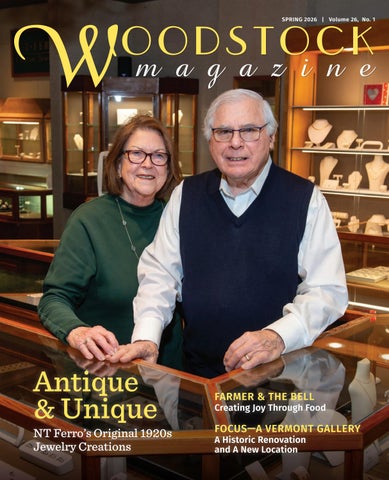
Farmer and the Bell finds a permanent home in Woodstock 44 Art and Architecture
By Stephen D’Agostino
A historica lly accurate renovation of a cherished storefront provides a new home for Focus–A Vermont Gallery.
Antique and Unique
By
Mary Gow
Everything ol d is new again at NT Ferro Jewel ers.
Cassie Horner
MOUNTAIN VIEW PUBLISHING, LLC
135 Lyme Road, Hanover, NH 03755 (603) 678-2793
mountainviewpublishing.com greateruppervalley.com
Publishers
Cheryl Frisch
Ryan Frisch
Publisher Emeritus
Bob Frisch (1951–2025)
Executive Editor
Deborah Thompson
Associate Editor
Kristy Erickson
Creative Director
Ellen Klempner-Beguin
Art Director
Brad Wuorinen
Ad Design
Melanie Marston
Web Design Locable
Digital Manager
Erin Frisch Newton
Advertising
Ryan Frisch
Calyn Frisch
KEEP US POSTED
Woodstock Magazine wants to hear from readers. Correspondence may be addressed to: Letters to the Editor, Woodstock Magazine, 135 Lyme Road, Hanover, NH 03755. Or email us at: dthompson@mountainviewpublishing.com. Advertising inquiries may be made by email to ryanfrisch@mountainviewpublishing.com.
This season brings renewal, clearly visible in the changes we witness around us each day. Fresh buds are popping out on plants and trees, and the first colorful crocus are bravely peeking up from beneath the snow. As the weather warms, birds return to build their nests while other creatures prepare dens to welcome their newborns. The cycle of nature that ushers in the gentle warmth of spring inspires and invigorates our spirits.
As you head outdoors to delight in a beautiful day, consider going for a stroll through downtown Woodstock. Take time for a delicious doughnut or sandwich at Farmer and the Bell on Pleasant Street (page 36). Their newly renovated building is welcoming and spacious, so make plans to meet friends for lunch or coffee. Tell April and Ben we sent you!
Continue your walk by navigating to Central Street, where you can drop in to visit Loren Fisher and Bob Wagner at Focus–A Vermont Gallery (page 44). Their new location has also been beautifully renovated, and there’s plenty of space to display their stunning framed photographs of the best Vermont has to offer, from red barns to snowy fields.
An outing through the village is not complete without stopping in to see Nick Ferro, longtime owner of NT Ferro Estate & Custom Jewelry, also on Central Street (page 54). He and his wife Bev, who opened the store in 1981, grace our front cover this issue. As an award-winning jeweler, Nick has been creating gorgeous—often oneof-a-kind—rings, necklaces, bracelets, and more for 45 years. Now Nick may have outdone himself with his exciting new line of rings made with diamonds mined in the 1920s set in designs from the 1920s. Exquisite!
Have a wonderful spring! No matter where your adventures take you, stay in touch with the latest news and events at www.greateruppervalley.com. Enjoy!
Lynn began her photographic career at the New England School of Photography in Boston assisting commercial photographers and studying custom color printing. Originally from West Virginia, she made her way north, finally landing in the hills of Vermont, where she has been photographing for over 30 years. Her current assignments include photographing people, architecture, and art.
Stephen is a freelance writer living in Reading, Vermont. His work has appeared in local publications in Boston and New York City, museum catalogs, Night Sky magazine, and weekly in the Vermont Standard. He’s always writing a novel and is working with an agent to get his first book published. When he’s not writing, he’s knitting, gardening, baking, or struggling with his ukulele.
Mary holds the middle place in a family with three generations of women writers. Best known for her awardwinning history of science books for middle school students, she is also a regular contributor to regional magazines. She lives in Warren, Vermont.
Jessica is a commercial photographer based in Woodstock, Vermont, with more than 20 years of experience and a quiet gift for putting people at ease. She brings a collaborative spirit and a thoughtful eye to every project, creating images that are genuine and timeless. She is available for projects worldwide and always up for adventure.
Kelly has written for The Concord Monitor, AMC Outdoors Magazine, and The Hippo, and she is an alum of the University of New Hampshire’s Master of Fine Arts in Writing program. She currently lives in Lebanon, New Hampshire, with her husband and son.
Mary Gow
Jessica Notargiacomo
Kelly Sennott
Lynn Bohannon
Stephen D’Agostino
www.greateruppervalley.com is proudly brought to you by: community sponsor
Dunk’s in Hanover Gets New Owner, New Name Honoring Late Dartmouth Coach
Buddy’s T’s, located at 7 Lebanon Street, was purchased by the owner of Molly’s Restaurant and Bar.
10 Books to Enjoy Check out recommendations from libraries and bookstores within the Upper Valley.
Who Can Help Get Your House Spring Ready?
If you’re already thinking about spring cleaning inside and out but don’t know who to contact, we’ve got you covered.
ONLINE ADVERTISERS INDEX
Check out these local businesses in our directory.
3 PHASE LANDSCAPING, LLC
ALIGN INN VERMONT
BARTON INSURANCE / HILB GROUP
BELLETETES
CALDWELL LAW
CAPPADOCIA CAFÉ
CARPENTER & MAIN
COLBY INSURANCE GROUP
CO-OP FOOD STORES
COPELAND FURNITURE
CROSSROADS ACADEMY
DARTMOUTH AUTHENTIC
DATAMANN
DB LANDSCAPING
DESIGNER GOLD
DUTILLE’S JEWELRY DESIGN STUDIO
EYEGLASS OUTLET
FORE-U GOLF CENTER
HANOVER EYECARE
HUBERT’S FAMILY OUTFITTERS
IVY IV AESTHETICS
JEFF WILMOT PAINTING & WALLPAPERING, INC.
CLICK ON
LAVALLEY BUILDING SUPPLY
LEDYARD BANK
LITTLE ISTANBUL
MARTHA E. DIEBOLD REAL ESTATE
MB PRO LANDSCAPE DESIGN
MORNINGSIDE FLIGHT PARK
MVP MARINE
RAMUNTO’S OF CLAREMONT
RICHARD ELECTRIC
RIVER ROAD VETERINARY CLINIC
RODD ROOFING
STATELINE SPORTS
THE FLYING GOOSE
THE GILDED EDGE
THE HANOVER INN AT DARTMOUTH COLLEGE
THE PUBLIC HOUSE
TOP STITCH
TUCKERBOX
UPPER VALLEY BUSINESS ALLIANCE
VILLAGE PIZZA
WHITE RIVER FAMILY EYECARE WISE
WOODSTOCK INN & RESORT
For more information about how your business can get listed on our ONLINE BUSINESS DIRECTORY or for other online advertising opportunities, contact Ryan Frisch at (603) 678-2793 or email ryanfrisch@mountainviewpublishing.com.
AROUND & ABOUT
By Cassie Horner
Ascutney Mountain Audubon Society
Promoting Conservation of Nature
Ascutney Mountain Audubon Society (AMAS) was established in 1972. At about 54 years old, this chapter of Audubon Vermont and the National Audubon Society serves eight towns in New Hampshire and 18 towns in Vermont, including Woodstock. “Springfield is sort of the geographic center,” says Ken Cox, president of the chapter. “Our mission is to promote enjoyment, appreciation, and conservation of nature through education, habitat protection, and advocacy for the benefit of our communities and all living things.”
With more than 340 members, AMAS helps support a number of initiatives that are important to bird conservation and other animals and their habitats. The chapter’s board
of directors meets monthly at the Unitarian Universalist Meetinghouse in Springfield, Vermont.
A key program of AMAS is a series of annual birding field trips in spring, summer, and fall. The trips invite birders to explore a variety of habitats, including the Windsor Grasslands Wildlife Management Area, once Vermont State Prison Farm, that is run now by Vermont Fish & Wildlife with support from groups such as AMAS. Birds such as bobolinks, blue-winged warblers, and American kestrel, among other species, favor this area.
“Trips are not limited to members,” Ken says. “We especially encourage young adults and kids to participate. Young kids will be young adults soon and will hopefully take over the reins to
protect our natural world.”
For about 25 years (with a break during COVID), AMAS has run the Herricks Cove Wildlife Festival, scheduled this year on May 3 in Rockingham, Vermont. Herricks Cove is designated as an Important Birding Area valuable for migrating birds. This area is owned and maintained by Great River Hydro. The festival, open to the public (donations are appreciated), features a large number of exhibitors ranging from nonprofits such as the Vermont Institute of Natural Science to state agencies offering talks, exhibits, and technical advice related to nature. Many activities are designed for young people, including
Photos courtesy of Ascutney Mountain Audubon Society
Eastern kingbird.
birding walks, a petting zoo, and face painting. The festival draws from 1,400 to 4,000 attendees.
AMAS is also active in habitat protection in areas such as Windsor Grasslands, where members have volunteered to do projects such as tree and shrub planting to enhance habitat. The North Springfield Bog is another important habitat. Accessed from a boardwalk, this kettle hole pond from the glacial period is an acid bog with pitcher plants, sundews, and other unusual plants.
Other projects AMAS members are involved with include citizen science projects like the Vermont Amphibian and Reptile Atlas and the Springfield and Saxtons River Christmas Bird Counts held annually in December. AMAS also supports eBird, an online site run by the Cornell Lab of Ornithology that allows people to enter bird sightings.
For more information about AMAS, visit amasvt.org. The group’s quarterly newsletter, The Harbinger, can be found on the website. It includes details about upcoming events.
Clockwise from top left: Purple finch. Great blue heron. Blue-winged warbler. Broad-winged hawk.
Caleb Kenna’s Our Working Lands Exhibit
Local Artist Captures Vermont's Landscape and People
From January 10 to June 14, Caleb Kenna’s photographic exhibit, Our Working Lands, will be held at Billings Farm & Museum. The beautiful drone images of a working landscape intersect with intimate portraits of some of the people who work on and steward this land. The varying perspectives of distance raise questions for viewers, inspiring them to explore their beliefs and assumptions about what the Vermont landscape looks like today, how it got that way, and what the future holds.
“I’ve always loved making portraits and taking aerial photos so this was a great opportunity to work together with Billings Farm & Museum to create this exhibition of large-scale and smaller
“I’ve always loved making portraits and taking aerial photos so this was a great opportunity to work together with Billings Farm & Museum to create this exhibition of large-scale and smaller prints depicting Vermont’s working landscape.”
— Caleb Kenna,
artist
prints depicting Vermont’s working landscape,” Caleb says. “I’ve had a great time working with curator Sherlock Terry and his team to present these words and pictures.”
Caleb, who was raised in Brandon and now lives in Middlebury, has a long connection to the Vermont landscape. This connection is reflected in his
remarkable, artistic aerial photographs. It is also visible in his portraits of people. His work, including rural views, architectural geometry, and portraits, has appeared in The New York Times, The Boston Globe, National Geographic, Smithsonian, and other major publications. His work takes center stage in his book, Art Above Vermont.
Above: Vermont Verde Antique Quarry in Rochester, Vermont, drone photograph in 2024.
Right: Caleb Kenna.
“In Vermont, many people experience the landscape from a car window. At quick glance the hills seem untouched and wild,” says Sherlock Terry, curator at Billings Farm & Museum. “But these vistas have been shaped by generations of farmers, foresters, and land stewards. This exhibition invites visitors to consider both the beauty and the complexity of that work from multiple perspectives.”
The drone images captured by Caleb portray a gorgeous, sometimes abstract view of farmlands, forests, and quarries. From a distance, his quarry image looks abstract; close up, it draws viewers into the depths of a quarry as they orient themselves to what they are seeing. A drone photograph of a field reveals vibrant color bands so precise it is startling to realize humans work those lands. The portraits in the exhibit help viewers link the landscapes with the people who work them.
For more information about Billings Farm & Museum and visiting Caleb’s exhibit, go to billingsfarm.org. Billings Farm & Museum, now in its 44th season, welcomes visitors on weekends and select days through May 22 and daily through October 31.
Portrait of Geraldo Valance in Panton, Vermont, shot in 2019.
Champlain Valley Hops in Starksboro, Vermont, shot in 2020.
The Farm Between in Jeffersonville, Vermont, drone photograph in 2020.
The Spinach King
The Family Saga of a South Woodstock Writer
John Seabrook, who has a home in South Woodstock, Vermont, is a decades-long staff writer for The New Yorker and the author of several books. But writing his new book, The Spinach King: The Rise and Fall of an American Dynasty, was a very different experience for him because it involved researching a troubled family history dating back to his grandfather, CF Seabrook, who created and ran a frozen vegetable empire in New Jersey in the early days of that industry. Tragically, he destroyed what he built, disinheriting and
“There was something wrong with my grandfather. He was a sort of sociopath, an amoral person. The only thing that mattered to him was power.”
—
John Seabrook, author
disowning his three sons and effectively folding the company, Seabrook Farms.
“It was hard to write,” John says of The Spinach King. “I discovered what my grandfather did to be successful, including exploitation of workers— especially Blacks—in the 1930s, the corners he cut, the rules he broke. It is hard to take.”
The grandfather’s authoritarian style of running his company extended to his family interactions. “The family was not very happy,” John says. “At the end of the day I would say we were a family business . . . but family affection and money were all mixed up. There was something wrong with my grandfather. He was a sort of sociopath, an amoral
John Seabrook.
person. The only thing that mattered to him was power.”
John’s father and uncles were educated; his father attended Princeton. CF was not educated. This contrast resulted in further family conflict because the investment bankers who had loaned Seabrook Farms money were Ivy League graduates and sided with John’s father in plans to change the company. Ultimately, the decision was made to prove that CF was mentally incompetent and he was institutionalized until his daughter got him out and he acted to disinherit his sons.
Crucial to writing the book was a cache of letters in which John’s mother chronicled to her mother and her sister what was happening in the Seabrook family. John inherited those letters. After his father died in 2009, he was the recipient of boxes of court documents that traced the suit CF’s sons filed against the estate.
“My grandfather was a pioneer of frozen vegetables. He was a great capitalist and empire builder,” John says. Known as the “Henry Ford of agriculture,” CF engineered a safe way to quick-freeze vegetables along with an industrial process of producing them for a market of Americans that he had convinced of the value of the products.
Unfortunately for the family patriarch, changes happened quickly in the frozen foods industry in the 1950s and he could not see his way to allow change in his business. His son, John’s father, did see the value and necessity of adapting to new markets for items such as frozen dinners, creamed spinach, and frozen orange juice. “His father fought him at every point,” John says. “It was a toxic mix. There was a branded version of the family and the marketing overwhelmed them.” For more information about John and his book, visit johnseabrook.com.
JOHN SEABROOK
Clean Up to Tone Down Spring Allergies
Even the cleanest homes can benefit from a thorough deep clean in the springtime, and clearing away the dust, mold, and other allergens that have accumulated over the winter can help ease symptoms once allergy season hits. The American College of Allergy, Asthma & Immunology offers the following tips for creating a clean, allergyfriendly environment:
1. Follow the water trail.
Bathrooms, basements, and tiled areas are especially prone to mold. Scrub away visible mold from surfaces with detergent and water and completely dry the cleaned area. Get rid of mold by controlling the moisture. Use bathroom fans and a dehumidifier to keep humidity below 60 percent.
2. Keep cleaning supplies simple. Stick to multipurpose products that don’t irritate your sinuses and consider homemade solutions with baking soda and vinegar.
3. A bath for Fido may be in order. Pet allergens can build up over the winter, and there’s a good chance that fur, saliva, and dander are affecting your allergies. Vacuum frequently, wash upholstery and all pet bedding, and professionally deep clean your carpets.
4. Don’t open the windows.
As tempting as it is to throw open the windows to let in a fresh breeze, keep your windows closed to keep out pollen particles. Change your air filters every three months and use filters with a MERV rating of 11 or 12.
DID YOU KNOW?
Mulch Tips for Trees
As the snow melts and you’re able to start cleaning up your yard and flowerbeds, pay special attention to your trees. If you mulch around trees, be aware that too much can be harmful. Excessive mulch mounded around the base of a tree can cause decay of the vital tissue at the root collar. When there’s decay, serious disease organisms can more readily enter the plant. When mulching around a tree, always remove old mulch and use new mulch sparingly, keeping it pulled back from the tree itself.
Excessive mulch mounded around the base of a tree can cause decay.
Small Changes Impact Longevity
New research suggests that small daily changes like sleeping a few extra minutes, moving a little more, and small improvements in your diet may help you live longer and stay healthier as you age. Researchers at the University of Sydney studied 59,000 older adults and compared those with the poorest health habits (those who slept about 5.5 hours a night, exercised 7.3 minutes per day, and scored 39.9 on a 100-point scale of self-rated eating habits) to participants who made small improvements in these areas. They found that people with the least healthy routines could add about one year to their lives by getting five extra minutes of sleep per night, exercising 1.9 more minutes per day, and improving their diet quality score by five points, which could include eating a half serving more of vegetables or a serving and a half of whole grains daily.
“All those tiny behaviors we change can actually have a very meaningful impact, and they add up over time to make a big difference in our longevity,” says lead author Nicholas Koemel. Larger changes were linked to an even longer life, but researchers stress that small, realistic steps are a great place to start.
Clean Your Makeup Brushes
While you’re spring cleaning your bathroom, toss expired cosmetics and clean your makeup brushes. Makeup brushes and sponges can harbor hardto-see grime and bacteria, and each use applies germs onto your face. Gently wash brushes with a natural cleanser (baby shampoo works great) and then lay them flat to dry for 24 hours. This is also a good time to replace your loofah and check your medicine cabinet for expired medicines and topical creams.
It’s Time to Reconnect
Now that our winter hibernation is over, let the warming sunshine reignite your social life. Invite a friend to go for a walk on one of Woodstock’s many trails and walking paths (just be sure to wear proper footwear—it is mud season, after all!). Or if you’re more the indoorsy type, consider joining one of several clubs and groups at Norman Williams Public Library. From needlepoint get-togethers to poetry club, mahjong, and book discussion groups, you’ll find many ways to connect with others with common interests and enjoy your time riding out the rest of mud season. For more information, check out the calendar at normanwilliams.org. NORMAN WILLIAMS
Spend Time with Grandkids
Caring for grandkids is beneficial to the heart and soul, and new research finds that it’s also good for the aging brain, potentially serving as a buffer against cognitive decline. In the study, it didn’t matter how often grandparents cared for their grandkids or what they did—simply that they spent time together. “What stood out most to us was that being a caregiving grandparent seemed to matter more for cognitive functioning than how often grandparents provided care or what exactly they did with their grandchildren,” says lead researcher Flavia Cherches. More time spent with leisure activities and more frequent help with homework appeared to boost verbal and memory skills, while preparing meals and taking grandkids to and from school increased verbal fluency.
PRESERVING HISTORY
Woodstock Village Greenhouses
A legacy of romance and beauty
By Cassie Horner
Photos courtesy of the Woodstock History Center
There is a special magic to wandering into a greenhouse, with the sweet smells of plants and flowers and the warmth, even on a cool day. Woodstock Village was once home to greenhouses, including the Billings Greenhouse at the mansion where up to 20 men worked in the greenhouse, gardens, and grounds from spring through fall, and a series of linked greenhouses on Pleasant Street that were constructed in 1886 and 1888 by Frank MacKenzie, whose home was across the road on Bond Street.
BILLINGS GREENHOUSE
The Billings Greenhouse, still extant, is part of the 1870s Belvedere Complex designed for Frederick Billings. An article in the Vermont Standard in May 1887 describes the author’s visit to Mr. Billings’ greenhouse
Top: RC Eaton Greenhouses, c. 1950s.
Above: View of Pleasant Street showing greenhouses, c. 1950.
where George H. Mass, superintendent, was raising bananas, among other novelties. The writer notes that “an eminent member of congress” told him that “Mr. Billings has the largest private greenhouse and grapery in the country.” Vegetables were also available to the community for purchase.
The greenhouses were important enough to the community that the local newspaper carried reports of highlights of the plants. For example, the Billings Greenhouse circa April 1903 offered “a fine display of roses and carnations. The grapery is fruiting heavily and the thinning process occupies attention this week. Numerous varieties of ‘garden sass’ are in the hot beds and all together it looks quite spring-like on the hill.” The Congregational Church in Woodstock was bedecked for Easter in 1895 with palms, great hydrangeas, delicate
An article in the Vermont Standard in May 1887 notes that “an eminent member of congress” told the writer that “Mr. Billings has the largest private greenhouse and grapery in the country.”
ferns, and flowers from the Billings Greenhouse.
Much later, in 1952, the Billings Greenhouse was adorned with 195 varieties of chrysanthemums in bloom, including “Mrs. MacKenzie,” “Minerva,”
“Golden Wedding,” and “The Queen.”
A mysterious reference appears in the 1959 “Olde Woodstock” column: “The alligator at the Billings Greenhouses, known as ‘Jake’ to his intimate friends, died last week aged about two years. It
Above: The Billings Greenhouse and flower gardens, c. 1895. Image courtesy of the Billings Family Archives, The Woodstock Foundation, Inc.
Right: Formal garden, c. 1890. Image courtesy of the Billings Family Archives, The Woodstock Foundation, Inc.
Above: The Billings Greenhouse was part of the 1870s Belvedere Complex designed for Frederick Billings.
Below: Mary Montagu Billings French (right) and her friend Susie Herriman in the upper meadow on the Billings estate, c. 1887. Image courtesy of the Billings Family Archives, The Woodstock Foundation, Inc.
may have been something he ate off the weird plants in his tropical-like enclosure. Jake was three feet long and still gaining.”
MACKENZIE GREENHOUSES
The Vermont Standard article from 1887 went on to describe a visit to Frank
MacKenzie’s grapery, which the writer praised highly for its amazing progress after only one year under the care of James Anderson. There were “grapes setting, oranges ripening, lemons, peaches, nectarines, and plums, well advanced,” along with large strawberries grown in containers.
In 1893, George H. Mass purchased the greenhouses and the Richmond house from Frank MacKenzie. The newspaper noted that George purchased the “grapery and garden which is attached (to the house) for the purpose of growing and selling cut flowers, plants,
seeds, and vegetables. If this is so we predict rushing business for Mr. Mass as he has a good field and knows every intricacy of his business.”
A few years later, circa 1907, the newspaper advised readers, “Those interested in in tropical fruits would be well repaid to visit the greenhouses of George H. Mass, and inspect the growing peaches, pineapples, grapes, figs, and oranges there, as well as the rare flowers now in their bloom.”
A FLOURISHING ERA
Eaton & Morris Florist took over the
George Mass business in 1924. By 1925, Ernest Morris was out of the business, and it became RC Eaton Greenhouses, owned by Robert C. Eaton. Robert was a friendly, active man who bustled around his business, assisted for some years by Everard “Ev” French. Robert, who served in WWI, was active in the community. For example, he took orders for Easter flowers donated to veterans at the Veterans Hospital in White River Junction. Robert Eaton constantly expanded his knowledge of plants and the greenhouse and florist business, traveling to the Boston Flower Show. He took at least one trip to Europe. In the spring of 1953, he sailed on the Queen Elizabeth to Cherbourg, France, and continued by train to Holland to meet friends and attend the tulip festival. He also visited nurseries and greenhouses in France, Belgium, Italy, Germany, Switzerland, and England. In June 1949, Robert added a greenhouse to increase the floor space by about 30 percent. “The addition will increase capacity particularly for spring and late summer rush periods,” the newspaper reported. Six months later, in January 1950, a devastating high wind damaged the greenhouse, causing extensive broken glass. In June of 1950, the original 63-year-old greenhouse was removed to accommodate a new structure, about 120 feet by 20 feet. Of modern design, it was two feet wider and included larger panels of glass. Robert operated his florist and greenhouse business for over 45 years until his retirement in 1969 when he was 82 years old.
Although long gone, Woodstock Village’s greenhouses leave a legacy of the romance and beauty of flowers and plants in a New England community. WOODSTOCK
Woodstock, VT woodstockhistorycenter.org
April Pauly has no formal culinary training, but the business of gathering around food is ingrained in her, having grown up on the same rural road as her grandmother’s New Hampshire bed and breakfast. Under her grandmother’s tutelage, April cooked, cleaned, waited tables, and learned the art of bringing people together. “There was one telephone in the whole place. It was very rustic,” April says. “I took it for granted, all the experiences that exposed me to from birth.”
Creating Joy Through Food
Farmer and the Bell finds a permanent home in Woodstock
By Kelly Sennott | Photography by Jessica Notargiacomo
Above: April and Ben are preparing the bakery display on their opening weekend.
Opposite: Slabs of focaccia fresh from the oven and on display for the customers to point and choose from.
“From a young age, I got joy out of creating something for other people to enjoy. That’s what my grandmother did. And in a way, that’s what I’m doing here, too.”
— April Pauly, co-owner
So it shouldn’t be surprising that, after living many other lives—April’s been an apparel designer, a farmer, and has lived around the world—she now finds herself slinging doughnuts and creating menus for the cafe she and her husband, Ben Pauly, have been devising since the pandemic.
Woodstock’s Farmer and the Bell, named in homage to the farms with dinner bells Ben and April each grew up on, has finally morphed from a weekend
pop-up to a full-fledged restaurant. For April, it’s a full-circle moment. “From a young age, I got joy out of creating something for other people to enjoy. That’s what my grandmother did. And in a way, that’s what I’m doing here, too,” she says.
Top: One of six rotating flavors, lemon and coconut French crullers on display.
Right: Two of our favorite regulars in the bakery and the fashion world, the Powell sisters. Photo by their uncle, Dan Powell.
“We were at the point of the pandemic where we were like, what do we do to create joy for other people? And how do we find joy as well? For both Ben and me, it’s creating things.”
— April Pauly, co-owner
DOUGHNUTS OUT THE BACK DOOR
Like so many things, the idea for Farmer and the Bell was planted during the pandemic. April was living on a 15-acre farm caring for 100 chickens and her son Gray and had recently met her nowhusband Ben. “We were at the point of the pandemic where we were like, what do we do to create joy for other people? And
how do we find joy as well? For both Ben and me, it’s creating things,” April says. They began experimenting with recipes for French crullers, an airy, eggrich doughnut, “failing spectacularly” but having fun. When the doughnuts felt right, they shared them with friends and family, who encouraged the couple to sell them.
Their first pop-up location was the Angkor Wat Restaurant, which sometimes involved the whole family waking at 1am to start making doughnuts. People came, no matter the weather. “We were just slinging doughnuts out the back door. People were standing in a snowstorm, waiting in line,” April says. Not long afterward, they began hosting pop-ups in the Simon Pearce–owned Parker House, where they stayed for 10 months until pausing to marry, have their daughter Marigold, and search for a permanent location.
The upstairs offers views of the action below as well as family-style seating at the tables that Ben and his father, David Pauly, created from wood on April's former farm.
About the Renovation
By David Hamilton Partner at Geobarns
Eva Douzinas, who acquired the site and brought Geobarns aboard to help envision its transformation, created the conditions for a real gift to the public realm of Woodstock. Entering one of Vermont’s iconic downtowns by walking or driving past an unused gas station is obviously nobody’s preference, but the environmental challenges— unusually tight geometry and slope— have deterred many others from the project.
In this new vision, every element of the project contributes a new gateway to the south side of this charming town. The building's green gable faces the road’s turn into town, and the parking is tucked into the landscape, with a glimpse from the street of what will be a vibrant outdoor dining area.
Farmer and the Bell could not be a better business to start the transformation. Their pastry and deli concept gives everyone a reason to come to this far end of town, and the building has to support this experience. Geobarns worked with Eva and with the Farmer and the Bell team to fit a superb bakery with retail space and ample seating into one end of the site. The primary challenge was maintaining the open and airy feel, accomplished with a clear span first floor and a full-height central space that connects the order counter, dining above, all the way to a light-filled cupola. The result is an experience, even when the lines are long for Farmer and the Bell’s signature pastries.
WELCOME TO WOODSTOCK
The new location, a brand-new twostory structure built by Geobarns, is outfitted with wood paneling, exposed ceiling rafters, and a takeaway cafe with seating for 82 guests. At the entrance is a windowed porch and inside is a black-and-white mosaic floor that reads “Woodstock, VT: EST. 1761.”
Though they’re renters, April says they had a heavy hand in the aesthetic design of it, thanks to the building’s owner Eva Douzinas, who saw their vision immediately. “April and Ben had already proven their concept through their popups, but what really stood out to me was their integrity, strong business sense, and care for what they were building,” Eva says. “I felt they would bring warmth and joy to the entrance of Woodstock.”
The open kitchen features checkered floors, subway tile up the walls, and brass
finishings. One staff member makes focaccia with brisket, Gruyère, and creamy horseradish. Further along, someone’s piping the last French cruller onto a sheet pan. Each cruller has the same base with a different glaze—like Lemon Crumb, Maple, Sugar and Spice, and Malted Mocha—all made with whole ingredients, nothing artificial or processed. Slowly, they’ve been introducing new items, from smoked maple creemees and hand pies to soups and savory pastries. Adjacent to the cafe counter is a fridge filled with drinks, premade sandwiches (like hot pickled prosciutto, roasted artichoke, and more), salads, and snacks. You can order just about anything and have it
Above: Locals Tom, Cindy, and Hillary List, Suzi Curtis, and Ji Min Lee Thompson soak up some sun with baked goods on the outer patio.
Right: Newlyweds and locals Taylor and Sydney Heirs enjoy some brunch in the enclosed patio.
handed to you immediately, April says, no waiting required.
CONSTANTLY EVOLVING
April and Ben’s days are busy. During the week, Ben, who created Kelly Way Garden and is now the director of property operations and design at the Woodstock Inn & Resort, moonlights on the weekend as the head donut slinger.
Much like with kids, April jokes, she sometimes forgets how much work the cafe has taken up because there’s so much reward. She’s enjoyed seeing people make the space their own, coming to eat, to work, to conduct job interviews, to go on first dates.
“I love that it gets to evolve with us. It gets to evolve with the community,” April says. “So much life happens around food, all over the world. You celebrate. You mourn. You cry. You talk. You laugh.” To have a place where people can gather and have all those experiences together around food—to her, she says, there’s nothing better.
FARMER AND THE BELL
69 Pleasant Street
Woodstock, VT
(802) 291-2029
farmerandthebellvt.com
Bags of organic Vermont maple cotton candy freshly made in the kitchen and on display for purchase.
Art and Architecture
A historically accurate renovation of a cherished storefront provides a new home for Focus–A
Vermont Gallery
By Stephen D’Agostino | Photography by Lynn Bohanon
Snow and red barns. If Loren Fisher and Bob Wagner, co-owners of Focus–A Vermont Gallery, had to sum up what people are most drawn to, it’s images of snow and red barns.
The name of the bestselling photograph in the gallery, Snowy Barn, shot by Loren, features, you guessed it, snow and a red barn.
While people like you and me seek shelter when the snow is falling, Loren and Bob head outdoors. They know they’ll find the ground around the barn, fence, home, or whatever structure they’re drawn to will be pure, untouched by animal or human, shovel, or plow. Plus, the falling snow creates a scrim of sorts that helps soften or even erase some of the
detail. Loren’s Three Skiers, for example, shows brightly clad folks on their downhill journey with no evidence of how they got there.
These snowy assists helped Bob capture my favorite image in the gallery. Rolled Hay is a photograph of a small, aging red barn with a rusty tin roof and two sliding doors. One is open to expose several bales of hay, warm tan in color, arranged so there is a hole in the shape of a stretched maple leaf in the middle of the bales. “I love the color, I love the patina, the roof, the barn, and the snow falling,” Bob says, but being an engineer earlier in life, he is fixated on the leafshaped space. “I can’t figure out how they took the bale in the middle out and how everything else didn’t just collapse.”
Bob Wagner, left, and Loren Fisher are the owners and photographers at Focus–A Vermont Gallery.
Top: Snowy Barn by Loren Fisher is one of the most popular photos in the gallery.
Above: Bob Wagner’s Rolled Hay.
Left: The gallery features photos printed on traditional paper, canvas, and metal. In the grouping, Three Skiers is displayed at top.
LOCATION, LOCATION, LOCATION
As photographers, being in the right place is important. As business owners, the same holds. In 2020, during the pandemic, Focus Vermont opened at 1 The Green. It was a good place to be. “Everybody in town had to walk past that space,” Bob says, “and that just brought in lots of people.”
But there were compromises to be made in a space comprised of rooms once used for living. “It was fitting a gallery into a house,” Loren says. They stayed for four years, and when the rents got too high—New York City high, as Loren notes—the gallery moved to a large space on Elm Street, a location better suited for local traffic than tourist traffic. And though the rent was much lower, this location, too, was a compromise given how “far” they were off the tourist trail. In the gallery’s new space, there is no compromise.
Clockwise from top left: The front of the gallery greets customers with an airy, welcoming feel. A mix of color and black and white photos are on display. Photos are available in multiple sizes, either matted or framed. Scenes from around Vermont.
“One of the reasons I love the space is that we were able to build it out to show photos in the best possible way.”
— Loren Fisher, co-owner
FROM PHARMACEUTICALS TO PHOTOGRAPHS
Residents and visitors alike—at least those who were here before 2020—know the space Focus Vermont is in now, 19 Central Street, as half of the Woodstock Pharmacy. In fact, every resident and visitor since 1842 knew this space as a pharmacy.
Walking into the building today, it’s hard, if not impossible, to recall Woodstock Pharmacy. Thalia Tringo purchased the building in 2021 and began renovations. She and her crew returned the arched tops to the first-floor windows, as they were originally when the building was built. “It took 18 months to
find somebody who would restore the windows to the original, and they were expensive,” Thalia says, “but it was still worth doing.”
While she was working on renovations, she first thought a restaurant would be ideal for the space. But with no infrastructure in the building suitable for cooking, it wasn’t feasible. People approached Thalia with ideas for yet another clothing or home store. She declined. “It’s really important to have variety,” Thalia says. “Plus I wanted to preserve a local business that existed rather than having somebody come in.”
Focus Vermont had been in contact with Thalia about renting the space, and
Top: An antique 8"x10" camera that is more than 100 years old is a lovely contrast with modern digital photos.
Above: Framed photos are ready to go.
she decided that the gallery would be an excellent occupant. Thus began the second part of the renovations, turning the empty space into a gallery. “One of the reasons I love the space,” Loren says, “is that we were able to build it out to show photos in the best possible way.”
Inside Focus Vermont, you may be too distracted by Loren and Bob’s art to notice some of the build-out details. The flooring, for example, is five-inch-wide white oak. You may notice tall baseboards along the perimeter walls. At 10 inches tall, it notes the maximum height of the floorings that had accumulated over the years. If you remember the pharmacy, you’ll recall that there were two steps from the sidewalk to get into the building. Now there is just one. As for the entryway, it shares the arched shape of the windows and a large door, which will help people with mobility issues enter the
gallery. For those using wheelchairs, there is a ramp under an overhang at the back of the building.
In addition to the multiple floors, the building also had multiple ceilings. After several of those were removed, the gallery now boasts 12 feet of vertical space. The fluorescent lights are also gone, replaced by 49 lights on tracks and 20 recessed into the ceiling, all LED and all simulating daylight, making it easier to view and appreciate the photography on display.
BEYOND SNOW AND BARNS
You won’t only see snow and red barns at Focus Vermont. Our state has four seasons (five, if you count mud season, but who would want images from that time of year?). It has houses, fields, mountains, trees, and a stunning night sky. You’ll find all of that and more in the gallery, including a masterly interior still life shot by Bob—not Focus Vermont’s usual fare, but worth a moment to ponder if it is made of pixels or paint.
Though finding the perfect images to fill the gallery can be dangerous if the weather is bad, time-consuming if the conditions aren’t perfect, or patiencetesting if foliage takes days longer than expected to reach peak, there is something Loren and Bob experience that makes it worthwhile. “Frequently, when I’m alone out shooting,” Loren says, “I scream, ‘How lucky am I?’ Because this is happening for me, and nobody else is seeing this.” That is true until the photographers put the images they captured on canvas, paper, or metal and hang them in the gallery. Then we get to experience Loren and Bob’s talent, their epiphanies, and the beauty of Vermont—and the gallery—in comfort and safety.
FOCUS–A VERMONT GALLERY
19 Central Street Woodstock, VT (802) 457-7327
focusvermont.com
The detailed renovation shines through as you look toward the front of the gallery.
Unique Shopping, Dining, and Services
37 Central Clothiers
377 Central Street
Woodstock, VT
The Ivy Edit
35 South Main Street Hanover, NH @37centralclothiers
Above: Store owner and wife, Nick and Bev Ferro, pictured in the jewelry showroom.
Inset: Nick and Bev photographed in the same spot for the store’s grand opening in 1981.
Antique and Unique
Everything old is new again at
NT Ferro Jewelers
TBy Mary Gow
Photography by Ian Raymond
hirty-two years ago, DeBeers London, the world’s leading diamond group, awarded Nicholas T. Ferro of Woodstock their prestigious Diamonds Today Award for his stunning platinum and gold double diamond engagement ring. DeBeers asked Nick (as everyone knows him) his thoughts on jewelry and diamond trends. Nick noted interest
in new and different cuts of gems. He also told DeBeers that he thought diamonds in the Old European cut should be brought back.
The depth of their brilliance, sparkling even in low light, and distinctive flash of color drew Nick to admire these gems that were hand cut before the advent of mid-20th-century diamond-cutting tools. With tiny differences, no two Old European–cut diamonds are alike.
Founded in 1981, NT Ferro Estate & Custom Jewelers offers a meticulously curated selection of jewelry sourced from around the country and world.
Now Nick, founder and owner of NT Ferro Estate & Custom Jewelers in the heart of Woodstock, is introducing a limited selection of rings featuring these elegant diamonds—and he is setting them in ring designs from their era. “These are diamonds mined in the 1920s in designs from the 1920s. They are truly antique and truly unique,” he says.
As unique as these diamonds, Nick has a lifetime of experience, expertise, and commitment to bringing people together with jewelry that they cherish. Founded in 1981, NT Ferro Estate & Custom Jewelers offers a meticulously curated selection of jewelry sourced from around the country and world. True to their
name, they specialize in custom design, including working directly with clients to create meaningful, exquisite one-ofa-kind pieces. They also excel in offering top-quality estate jewelry including rings, timepieces, earrings, bracelets, pins, and necklaces.
This new selection of NT Ferro rings is deeply rooted in Nick’s expertise in estate jewelry and his knowledge of diamonds and jewelry styles. His personal history, and inspiration from his wife Beverly, ignited the project.
A FAMILY LEGACY
When Nick opened the Woodstock store 45 years ago, he brought decades of
experience to the new endeavor. He and Beverly and their children frequented the area for years before they made the move. They invested in downtown Woodstock and imbued the store with refined and welcoming ambiance—lush hunter green carpet, custom wood-trimmed display cases. The store has the same classic look today.
At the time of their move, the Ferro family’s jewelry legacy was already in its fourth decade. Originally from Salerno, Italy, Nick’s grandparents and their children emigrated to the United States in the early 20th century. Settling in New Jersey, his grandfather made custom suits and shirts—and inspired his children. Newark was a jewelry-making hub then. Its 150-plus jewelry manufacturers included Tiffany & Co.’s castle-like factory.
Top left: Platinum designs from the 1920s are set with hand-cut natural Old European diamonds.
Above: Tiffany & Co. estate bracelet with Burma rubies and diamonds set in platinum, circa 1930s.
from above: Selection of fine estate jewelry featuring tourmaline. Ashley
Clockwise
Gomm serves as the store's custom coordinator. Jewelry showroom.
Clockwise from left: Fine strand of cultured pearls with a red jade clasp and matching earrings. John Morales is the jeweler and repair specialist. Variety of jewelry featuring amethyst, February’s birthstone. Handmade custom design created in-house: an 18K yellow gold ring showcasing pink tourmaline, sapphires, and diamonds. Blue topaz and diamond estate necklace.
Nick’s father, Nicholas, wanted his own business. He built his skills, as Nick recalls, “at a small little jewelry factory.” In 1947, Nicholas and Victor Parmigiano opened their firm, Essex Jewelers. They grew the business to become one of the leading ring designers and manufacturers in the country. In the 1960s they employed over 65 people, including 40 jewelers.
“They could make everything, but didn’t,” says Nick about their specialization in rings. His father’s lesson was “Focus on what you do well. Don’t try to be everything to everybody.” Nicholas also told his children, “You have jewelry in your blood.”
Nick studied design at Pratt Institute and business at Pace University. He earned advanced certifications with the Gemological Institute of America, an institute considered the foremost authority on diamonds, colored stones, and pearls.
Collaboration with clients on custom pieces takes many directions— the perfect set of engagement and wedding bands, pendants with personal meaning, sometimes carrying family jewelry forward in new ways.
TAKING THE LEAD
After his father died, Nick led the business and opened a high-end retail store in Bernardsville, New Jersey. In Woodstock, from the beginning, Nick and his team focused on helping people find or create jewelry to treasure.
Collaboration with clients on custom pieces takes many directions—the perfect set of engagement and wedding bands, pendants with personal meaning, sometimes carrying family jewelry forward in new ways. Pieces of jewelry passed down through a family often have profound personal connections, but design-wise they may not be the right
fit, or a family may want to pass on various stones to multiple family members. For all of these and more, Nick and his team’s talents step in. From sketch to finished product, they transform vision to reality.
Repairing, restoring, and selling estate jewelry, Nick has worked extensively with antique pieces. “Over the last 40 years I have received many important pieces for my estate department. Being a diamond setter and jeweler, I appreciated the quality and filigree design jewelers created in the 1920s,” he says. Styles from the 1920s are known for delicate lace-like metalwork.
Nick designs a custom matching wedding band for a client’s three-diamond engagement ring.
GIVING OLD JEWELRY NEW LIFE
With pieces he acquired that he particularly admired, Nick would remove the large center diamond from the mounting and then have a mold made of the ring, preserving a record of its design. Today, this process is done with computer-aided design (CAD) software. After the mold was created, he reset the stone in the original ring and brought it to top condition for its next owner.
Through the years, Nick built an extensive collection of molds—200 or so. Working with the collection was a project he long intended to pursue. Recently, Beverly nudged it along, encouraging Nick to select some of his favorite designs and have them cast in gold and platinum.
The rings dating to the 1920s featured the Old European–cut diamonds. Beyond the hand-cutting technique, which results in larger facets overall, they have a large culet (the facet at the bottom of the diamond) and a small table (the facet at the top). This design affects the way light bounces around inside the gem and then reemerges with multicolored flashes.
Moises Uribe, Graduate Gemologist, is the store's fine jewelry appraiser.
Nick works with a company that specializes in buying 1920s hand-cut diamonds. They sell them to a few select jewelry designers, including him. “Every one of my 1920 designs are set with European diamonds that were hand cut in the 1920s,” he says.
Back in 1994, when DeBeers selected Nick Ferro’s elegant double diamond ring design over more than 600 other entries, Nick was already thinking about the spectacular attributes of Old European–
cut diamonds. This spring, he is bringing them forward for the rest of us to delight in these one-of-a kind-beauties in distinctive settings of their time.
NT FERRO ESTATE & CUSTOM JEWELERS
11 Central Street Woodstock, VT (802) 457-1901 ntferro.com
Estate ruby and diamond bracelet and brooch by designer Oscar Heyman.
Jewelry showcased at the storefront for passersby to enjoy.
The HUB
Providing financial relief with respect and dignity
By Katherine P. Cox
In this time of ever-increasing costs, it only takes a medical emergency, an unexpected car repair, or lost days at work to tip someone into financial crisis. The crisis can spiral if that person is unable to pay a utility bill, rent or mortgage, or get their car fixed. That’s where The HUB comes in. When an applicant living in the towns of Barnard, Bridgewater, Killington, Plymouth, Pomfret, Reading, or Woodstock reaches out, a volunteer case advocate responds within 24 to 48 hours to evaluate the need and provide financial assistance. They will pay the bill directly, and if, when talking to the applicant, further assistance is indicated, the case advocate can then refer the applicant to additional resources in the community.
HELPING TO EASE THE WORRY
The HUB, started in 2022, is one of eight projects under the umbrella of the Woodstock Community Trust, a nonprofit founded in 1997 that provides administrative and financial services to local volunteer community groups so they can focus on their missions. The HUB’s mission is to provide direct support to get struggling residents back on their feet. Paying someone’s utility bill can make a huge difference not just financially but also emotionally. It lessens the stress and worry that also impacts people’s lives. It takes a lot for someone to ask for help, and HUB volunteers treat every applicant with dignity, respect, and confidentiality.
Meg, one of six volunteer case ad-
The HUB brings together funding sources and service providers.
Applicants complete the application (via online, phone, or paper)
Applicants learn about The HUB
Eligible Applicant Locations:
• Barnard
• Bridgewater
• Killington
• Plymouth
• Pomfret
• Reading
• Woodstock
The HUB volunteer case advocates connect applicants to immediate and long-term resources
The HUB Partners:
• Barnard Helping Hands
• Bridgewater Neighbors Helping Neighbors
• Community Care Coordinator
• Ottauquechee Health Foundation
• Plymouth Memory Tree
• Pivotal Steps
• Reading West Windsor Community Resilience Fund
“Once we have an application, our goal is to communicate that we are interested in addressing the physical, mental health, social, emotional, and educational needs of individuals and families. We believe that when one of us suffers from emergent financial stressors, the entire community suffers.”
— Meg, volunteer case advocate
vocates, explains, “Once we have an application, our goal is to communicate that we are interested in addressing the physical, mental health, social, emotional, and educational needs of individuals and families. We believe that when one of us suffers from emergent financial stressors, the entire community suffers.”
The HUB came about, she says, from the realization that “there was a niche
for just financial relief. There are many organizations in our region who work to assist those in need. Each has its own mission and operating practices. Our goal was to meet that financial stressor that none of the other organizations were meeting.”
Meg says financial relief is a form of disaster relief. “The problem with emergency relief is that most people think of it in
terms of disasters. The HUB is out front in recognizing, especially after the pandemic, that the economy hasn’t bounced back for everyone. One crisis is enough to take somebody under. When we say financial relief, we’re putting it up there with disaster relief. Falling off a financial cliff is no worse than your house falling off a flooded cliff, and we’re proud of the fact that The HUB recognizes that.”
HOW IT WORKS
Case advocates, who just use their first names to ensure privacy, do not ask for financial information. The process begins online with the applicant providing their name and contact information. They are contacted within 24 to 48 hours. “We ask our applicants to share their stories with us. What brought them to The HUB? We approach that first conversation as if we were in their situation. We only ask whether they rent or own and how many
General Community Relief
January through December 2025
The HUB awarded
134 grants
people are in the household; are there any children or elderly?” Answers to those questions could open up the opportunity to refer them to additional resources beyond just financial ones.
The HUB pays the bills directly; they do not grant directly to the applicants. If the case advocates determine that the situation is more complex than The HUB can address, they will refer the applicant, with their permission, to Carla Kamel, The HUB’s local professional Community Care Coordinator. As one of Meg’s colleagues says, in her professional capacity, Carla can connect HUB applicants to appropriate and more sustainable social services.
CARLA KAMEL: A LONG-TERM PLAN
“The HUB will help with immediate financial needs, but I’ll take a deeper dive,” Carla says. Because the case advocates are actively listening, she says, “something may percolate to the top” and Carla can work closely with the applicant to come up with a plan for long-term assistance. “We don’t always get the full picture at first. It’s getting to know that person, meeting them where they are and taking further steps if they’re comfortable with that. What are they struggling with? They could be going to The HUB for one reason, and it could be something a little more in-depth—more than basic needs. It’s teasing out the different layers of what’s going on.”
She tries to determine the root cause of an applicant’s crisis and the variables that precipitated it and points them to
to 301 individuals in 127 homes 301 /127 for these reasons:
“They’re our neighbors in the community. We give them time and they understand that we care about them.
If you create these plans, they feel like there’s promise.
It’s all about trust and collaboration and embracing quality of life. They’ve been through something that is horrific for them, but they feel supported and appreciate that.”
— Carla Kamel, Community Care Coordinator
General Community Relief
January through December 2025
resources that are personalized to their situation. “They’re our neighbors in the community. We give them time and they understand that we care about them. If you create these plans, they feel like there’s promise. It’s all about trust and collaboration and embracing quality of life. They’ve been through something that is horrific for them, but they feel supported and appreciate that.”
Carla has worked with The HUB since it began operations three years ago and has been in case management for almost 30 years. “I love helping out the com-
munity, but also fostering connections with medical services, businesses, police, librarians, retailers, and volunteers with food shelves because they all play a part in everyone’s life,” Carla says. She says she and the case advocates work well together to get to the root cause of what has sent the applicant to The HUB and try to make life better for them.
ANNE SOSIN: THE BIG PICTURE
As a collaborator with The HUB, Anne Sosin, an expert in public health policy, looks at what The HUB is doing and
helps them analyze their data and program practices. She examines how their work translates into broader trends of community relief in the Woodstock area and around the state of Vermont. As part of a project with Vermont Community Foundation, Anne works with other Vermont organizations who are interested in providing community relief have a model to work from.
Anne says the case advocates provide important information about the causes of financial insecurities community members are experiencing. They anonymously collect demographic data and document the root causes and specific needs. “I analyze data to understand the overall applicant pool to help inform decision-making. It’s data for action; what can we do in response to trends?
“Many people are experiencing economic precarity, and they’re vulnerable to shocks such as natural disasters, medical crises, or rising housing costs that push them over the edge financially. That’s where The HUB intervenes—to prevent a short-term crisis from becoming a cascading one that leaves them in an even more disastrous place,” Anne says. She sees the level of precarity deepening. “I’m seeing more people in over their heads. Conditions are increasingly structured against families in our region. It’s hard on people living paycheck to paycheck.”
There’s a gap between housing costs and wages, for example. Medical costs and expensive health insurance premiums could precipitate a crisis. “Many of us don’t realize how close to the brink
“Many of us don’t realize how close to the brink many in our community are. Communities like Woodstock rely on a workforce that is increasingly facing precarity. People in our schools and businesses are struggling to meet ever-rising costs of basic essentials such as housing, food, and heating fuel.”
— Anne Sosin, public health policy expert
many in our community are. Communities like Woodstock rely on a workforce that is increasingly facing precarity. People in our schools and businesses are struggling to meet ever-rising costs of basic essentials such as housing, food, and heating fuel.”
She says The HUB is an essential safety net because it can provide fast, flexible, and responsive funding to meet acute needs. “We’re seeing formal safety nets that were already threadbare dissolve, which heightens the importance of community safety nets like The HUB. That local action is very important to ensuring the survival of many in our community.” Federal and state programs can be slow and come with rules and
restrictions. “The HUB is able to talk to applicants and turn around funding quickly, and that makes an enormous difference when someone is facing a crisis.”
To apply for assistance, email apply@ thehubneighbors.org, call (802) 4577214, or pick up an application at the Ottauquechee Health Foundation at 30 Pleasant Street in Woodstock. The HUB receives philanthropic money from residents as well as foundations and grant money. To contribute, visit woodstock communitytrust.org.
Val’s Hair Trends
6985 Woodstock Road, Route 4
Quechee, VT (802) 295-6150
Mon & Tue 9:30am–7:30pm Wed & Thu 9:30am–5pm By appointment
Instagram @vals.hair.trends
ANICHINI 802
Luxury Textiles & Soft Furnishings
6931 Woodstock Road
Quechee, VT (802) 698-8813
www.anichini.com/vermont
Open daily Design Consultations & Personal Shopping
Vermont Antique Mall
Quechee Gorge Village, Route 4
Quechee, VT (802) 281-4147
www.vermontantiquemall.com
Open daily 10am–5pm Free Parking
Quechee Pizza Chef & Mini Golf
5893 Woodstock Road
Quechee, VT (802) 296-6669
www.quecheepizza.com Sun–Thu 11am–8pm Fri & Sat 11am–9pm Instagram @ gethoppy802
Quechee, VT For appointments call (802) 457-1116 or email Eleanor@shepardvt.com
Off The Beaten Path in Culebra
Beaches and bonefish in the Spanish Virgin Islands
In Spanish, culebra means snake or serpent. “I’m not sure I want to go to Snake Island,” I muttered when my husband Jack booked a spring trip for us to Culebra in the Spanish Virgin Islands. “There are no snakes on Culebra,” Jack assured me. “The island isn’t even shaped like a snake. It’s just a name, probably based on a creek with lots of bends in it. Some people call it Isla Chiquita, or ‘Little Island.’ It’s small, but it has great beaches and bonefish!” No wonder Jack wanted to go there. One of his passions is saltwater fly-fishing.
By Caribbean resort standards, Culebra is not a tropical destination sought by vacationers. Most people haven’t heard of it. It was on Jack’s radar because a year earlier, a fishing guide suggested we check it out. Digging deeper, Culebra did, indeed, have good beaches, including Flamenco Beach,
rated among the top beaches in the world by Tripadvisor. It also had good snorkeling off dozens of other beaches. A mere seven miles long and five miles wide, while you can rent a Jeep to get around, most visitors and residents used golf carts. It sounded like a nice place to thaw out for a few days after a cold, long winter.
WHERE IS CULEBRA?
While US and British Virgin Islands are well-known springtime getaways, few people are aware of the Spanish Virgin Islands. Culebra lies only 12 miles west of St. Thomas. It’s technically part of Puerto Rico, along with the neighboring island of Vieques. The three islands—Puerto Rico, Culebra, and Vieques—make up the Spanish Virgin Islands. They are United States territories. “No passport required,” I thought. “That’s easy.”
Above: A beachgoer arrives at Carlos Rosario Beach, one of Culebra's top snorkeling spots.
Opposite: An aerial view of Culebra's coastline from the Cape Air flight from San Juan, Puerto Rico, gives a enticing welcome for first-timers to the island.
Culebra is popular among Puerto Ricans, who day-trip there in private boats or by ferry on the weekends. Coming from the north, we opted for a Cape Air flight from San Juan that flies the same type of eight-passenger prop plane from Rutland, Vermont, and Lebanon, New Hampshire, to Boston and New York. Besides the pilot, there was only one other person on the plane, a woman who had flown to San Juan a day earlier for a doctor’s appointment. “Go to the beaches on the western side of the island,” she advised. “The water is calmer and the snorkeling is better.” With that small insight, we hopped in our rental golf cart, put the address of our hotel in MapQuest, and bounced down the road into Dewey, the main village on the island.
Hotel was an overstatement. There are no resort hotels on Culebra, only a few B&Bs and guesthouses. We unloaded our golf cart at a small inn called El Navegante. It was basic: a bathroom, a
bed, tiny end tables with lights on either side of the bed, and a couple of hooks on the wall. No closet. No chair. No extras whatsoever.
“We’re just sleeping here,” said Jack, stringing his fly rod. I was less enthusiastic. Perhaps Isla Chiquita was a little too small for my idea of a vacation. At least the little open-air restaurant attached to the hotel served fresh fish and tasty frozen cocktails, and a bakery a block away sold homemade Danishes and island-grown coffee in the morning. If nothing else, we would eat well.
BONEFISH BONANZA
For our first full day on the island, Jack hired a fly-fishing guide named Antonio, who picked us up by boat at the long dock that extended into the water below the inn. Getting around Culebra by boat was as common as by golf cart.
The skies were gray, and the water was choppy, not ideal for targeting bonefish and other gamefish that require “sight-
Top: Hector el Protector, a giant troll made from cut-up pallets from a local junkyard, sits by the ferry terminal and is said to guard Culebra's natural environs from harm.
Above: Rush hour in Dewey? Many locals and visitors get around the uncrowded island in golf carts instead of cars.
casting.” To sight-cast, the angler holds the fly in their hand until they see fish feeding, then casts in front of the fish, hoping the fish mistakes the fly for real food.
Despite the unsettled weather, Antonio had ideas. First, we headed into a sheltered cove framed by mangroves. When that proved fishless, we motored to a broad, shallow bay where the water was less angry. From there, we waded slowly across a broad underwater shelf toward some nervous water about a hundred yards away.
“Bonefish,” whispered Antonio. “Take it slowly, so we don’t spook then.” As we got closer, we glimpsed a fishtail swish the surface now and again. About 40 yards away from the feeding bonefish, Jack cast toward it. Suddenly, his rod bent and his reel buzzed. Game on!
Jack fought the fish for 10 minutes, brought it to net, then let it go. He highfived Antonio with a smile as broad as the bay, then the hunt was back on. The two men were happy to look for bonefish for hours, despite a downpour that soaked through our light rain jackets. They kept going when a steady wind blustered across the bay. Though we were all shivering, they would have fished until dark, except that I was shaking so violently I was probably scaring the fish away. “We had better head back,” suggested Antonio to Jack. “Your wife is becoming hypothermic.”
SNORKELING
The next day, it was my turn to choose our outing. The weather cleared. It was a perfect day to explore Culebra’s beaches. Remembering the advice of the woman on the airplane, we loaded our beach towels and snorkeling gear onto the back of our golf cart, then motored to the end of the road on the northwest part of the island. From the parking lot, we continued on foot for 20 minutes along a well-trod trail through a wildlife refuge to Carlos Rosario Beach. The only wildlife we saw was a blue and brown Ameiva lizard that scurried across the dirt path and a couple of jungle fowl (wild roosters) that watched us walk by.
When we reached the strand—a narrow, long crescent of white sand and black volcanic rocks—we had it to ourselves. It felt natural and wild. Just beach and water. Several hoof prints from a couple of the island’s white-tailed deer marked the otherwise quiet, secluded beach.
We spent the next couple of hours looking at brain corals, sea fans, several types of angelfish and parrotfish, tangs, and dozens of other small, colorful fish through our snorkel masks. It was like swimming in an immense aquarium, though we were actually in the Cayo Luis Peña Natural Reserve, which protects the marine life off of Carlos Rosario Beach.
When Jack and I were both waterlogged, he took a few casts toward
Top: Some snorkelers come by boat to check out the underwater wonderland off Carlos Rosario Beach.
Above: A vertical wall of coral, like this one at Malones Beach, attracts numerous tropical fish, though the coral itself is fascinating to see.
the rocks at the south end of the beach to see what would bite. Nothing did, but we were still happy to have had the chance to see fish.
That evening, while savoring fresh grouper, a margarita, and a sizeable slice of tres leche cake at El Navigante’s restaurant, I decided that Culebra was turning out to be a fine place for a vacation after all. While Jack planned to fish the next day, I claimed the golf cart to go to Flamenco Beach.
FLAMENCO BEACH
Flamenco Beach is the only beach on Culebra with some infrastructure. There’s a fee to park ($6) and another small charge to get onto the milelong swath of white sand ($2). There are also food concessions, life guards, bathrooms, souvenirs, snorkel rentals, beach umbrellas, beach chairs, iguanas, and a couple of rusty, graffiticovered Sherman tanks, one of them permanently embedded in the strand.
After World War II, the US Navy tried to clear all residents from Culebra, which it used as a location for bombing practice. The two tanks never saw real action. They were targets for military drills, but the locals didn’t like it. During the early 1970s, the residents of Culebra staged nonviolent protests that ultimately led to the Navy’s withdrawal from the island in 1975. The tanks, especially the one on the beach, are now a reminder of that era in the island’s history. They’re also a must-see if you visit Flamenco Beach. The next day, I took Jack there to see the tanks, too. Of course, he couldn’t resist casting a line by the one on the beach.
During our stay on Culebra, we also visited Tamarindo, Melones, and Datiles Beaches, mainly for snorkeling, but Jack fished at them, too. They were smaller crescents, but with more coral and thus more fish to see while snorkeling. At most, we ran into another couple at each spot, plus a plethora of wild roosters.
The roosters on Culebra strutted and crowed everywhere—on the beaches, on sidewalks, in restaurants, in the openair stores, and outside our window at El Navigante—as if they owned the place. European explorers and pirates during
A grafitti-covered Sherman tank permanently embedded in the sand at Flamenco Beach was once used for naval target practice during the mid 20th century. Today, it is an interesting relic for beachcombers to walk to.
the 16th and 17th centuries brought these colorful ancestors of domestic chickens to Culebra where they were either set free or escaped. Today, they are part of the fabric of island.
We didn’t get much sleep the night before our departure thanks to an endless chorus of roosters, but we did have a meal to remember at place called The Dinghy Dock. As the name implied, people boating to Culebra liked to take their dinghies to dine there. The fresh seafood was on par with the other restaurants, and large tarpon loved to school by the dock. When a waiter cleared a table, instead of taking the leftovers to the kitchen, they scraped them into the water, causing a feeding frenzy among the tarpon. It was great entertainment, but also got Jack’s fishing mojo going again.
The next morning, Jack got up early hoping to hook one of the tarpon from a rocky outcropping a hundred yards across the water from restaurant. “They’ve got to be in there,” he thought, but no tarpon found his hook.
“They were still full from the leftovers,” I joked as we loaded our luggage onto our golf cart and headed to the airport. But Jack never forgets a fish. You can bet we’ll be back on Culebra again soon looking for tarpon as well as bonefish.
HAPPENINGS
Get ready for the cutest event of the year!
THROUGH JUNE 14
APRIL 25–26
Baby Farm Animal Celebration
Meet Billings Farm’s newest arrivals—calves, piglets, and goat kids— along with special guest baby animals visiting from local farms.
Billings Farm & Museum billingsfarm.org
Exhibit: Our Working Lands
Billings Farm & Museum billingsfarm.org
MARCH 25, APRIL 22, MAY 27
Read Between the Lines: Book Discussion Group
Norman Williams Public Library, 4pm normanwilliams.org
MARCH 26
Rumney Sessions: All She Wrote Fable Farm, 5:30pm fablefarmfermentory.com
MARCH 26
Trivia! Library After Hours
Norman Williams Public Library, 7pm normanwilliams.org
THROUGH MARCH 29
The Art of Dining by Tina Howe
Barnard Town Hall barnarts.org
MARCH 27–28
I’m a Businessman, Man: New Works by Abbey Glover
The Grange Theatre artistreevt.org
MARCH 28
Introduction to Watercolor Artistree, 10am artistreevt.org
APRIL 2
Awakening Light: Monthly Hypnotherapy Meditation Series Artistree, 6pm artistreevt.org
APRIL 4
Opening Day
Billings Farm & Museum billingsfarm.org
APRIL 7, MAY 5
Family Game Days
Norman Williams Public Library, 3pm normanwilliams.org
APRIL 7, MAY 5
Time to Talk Books: Discussion Group
Norman Williams Public Library, 5:30pm normanwilliams.org
APRIL 8
A New Nation, Conceived in Liberty: Enlightenment Idealism and the Reality of the Modern World
Norman Williams Public Library, 2pm woodstockhistorycenter.org
Norman Williams Public Library, 6pm normanwilliams.org
APRIL 22
The Great Contradiction: The Tragic Side of American
APRIL 13–18
Spring Global Music Residency: Veronica Robles Mariachi Various Locations barnarts.org
Founding with Professor Joe Ellis
Norman Williams Public Library, 2pm woodstockhistorycenter.org
APRIL 23
Word Games! Library After Hours
Norman Williams Public Library, 6pm normanwilliams.org
APRIL 25
Pathways to Abstraction Artistree, 10am artistreevt.org
APRIL 28
Counterpoint Chorus: Act of Remembrance
Norman Williams Public Library, 6pm normanwilliams.org
APRIL 17
VSO Jukebox: Porch Songs – Americana Roots Artistree, 7pm artistreevt.org
HAPPENINGS
APRIL 28
Program: How the Working Class Home Became Modern Woodstock History Center, 6:30pm woodstockhistorycenter.org
APRIL 29
The Great Bennington Battle and Vermont
Norman Williams Public Library, 2pm woodstockhistorycenter.org
APRIL 30, MAY 28
YogaTranceDance Artistree, 6:30pm artistreevt.org
MAY 9, 10, 23
Cook It Speak It: Tofu Katsu Curry Artistree, 11am artistreevt.org
MAY 14
Member Family Picnic
Billings Farm & Museum billingsfarm.org
MAY 15–17
Bookstock Festival of Words Village Green bookstockvt.org
MAY 17
Race Around the Lake Silver Lake State Park barnarts.org
MAY 17
Family Workshop: Paint a Seashell like Georgia O’Keeffe Artistree, 11am artistreevt.org
MAY 28–SEPTEMBER 24
Feast & Field Music Series
Fable Farm barnarts.org
MAY 30
Family Sheep and Wool
Celebration
Billings Farm & Museum billingsfarm.org
ADVERTISERS INDEX
GET CONNECTED
Get listed on the greateruppervalley.com BUSINESS DIRECTORY and you will also be included on our printed list in every issue of WOODSTOCK MAGAZINE. (See page 21.)
Email Ryan Frisch at ryanfrisch@mountainviewpublishing.com, or call (603) 678-2793. Find out how you can connect with our readers. It’s easy, inexpensive, and another way to reach an affluent and educated audience.
SUBSCRIBE
Share the wonder of our beautiful area and the latest news all year long with a gift subscription. Friends and family who have moved away from the area will be especially appreciative. Be sure to order a subscription for yourself too!