VERMONT ARTIST HILDA BELCHER STILL CAPTIVATING US A CENTURY LATER
CENTER FOR CARTOON STUDIES
CELEBRATING 20 YEARS OF ARTISTIC EXPRESSION
- ARENAS- TIMBER FRAME- Delivery throughout the USA -
SPRING
2026 56 page
FEATURES
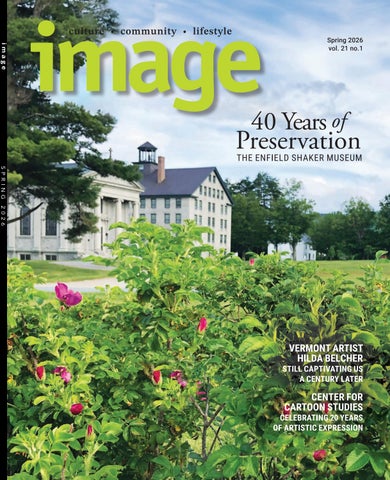
26 | Forty Years of Preservation
The Enfield Shaker Museum: Looking forward while honoring the past. by Susan
Nye
34 | The Center for Cartoon Studies is Having a Moment
Celebrating 20 years of creating visual stories. by Wren Wahrenberger
46 | Celebrating Hilda Belcher
A “thorough-going Vermonter” and world-class painter. by Susan B. Apel
56 | Riding Horses in the Tuscan Countryside
Stress-free travel at its best. by Sylvia
Cooley
Cover: The Enfield Shaker Museum rose garden. Photo courtesy of the Enfield Shaker Museum. Right: Riding by the Roman Abbey of Badia d’Ombrone. Photo by Sylvia Cooley.
From the first signs of spring, we’re eager to embrace a season filled with new life and transformation. Buds begin to pop out, fresh growth appears, and nature comes to life again. This time of year reminds us that each day brings the promise of renewal and new beginnings. It’s time to celebrate the return of vibrant life all around us.
Why not kick off the season with a visit to the Enfield Shaker Museum (page 26)? Besides touring the gorgeous grounds and remarkable buildings, consider signing up for one of their workshops or educational classes. Do you have an upcoming family reunion, wedding, or other event? You’ll be hard-pressed to find a more beautiful venue. And you can make reservations for your out-of-town guests to stay over—21 rooms are available.
I always adore the topics of our articles, but now and then a very special one captures my heart. Recently I’ve been captivated by the art of Hilda Belcher (page 46). The story’s writer, Susan Apel, published a brief item in her Artful blog last fall about an upcoming event to commemorate Hilda in Corinth, Vermont. Included was a photo of Hilda’s painting The Checkered Dress, and that was it for me—I was smitten! I’m deeply grateful to Susan for introducing me to Hilda and her work, for attending the event in September to meet the family, and for so skillfully writing our story; to Amy Peberdy for organizing the Corinth event; to the Belcher family, who graciously shared memories, clippings, photos, and facts, not to mention time for a call or two and lots of emails; and to Martha Richardson, Boston art gallery owner who represents the estate of Hilda Belcher, for providing high-quality images of Hilda’s paintings and for always having time to chat about art and answer my many questions and requests. Mark your calendar now to attend her exhibit of Hilda Belcher’s paintings on Newbury Street from May 2 through June 6, 2026.
The experience of working on this article and experiencing the kindness and generosity of so many people converging at once to achieve a common goal is mindboggling and will stay with me always. Thank you all! My wish is that all of you have an inspirational experience as fabulous as the one I had working on this issue. Enjoy!
Susan shuttered a lifelong career as a law professor to continue an interest (since kindergarten) in writing. Her freelance business, The Next Word, includes literary and feature writing; her work has appeared in a variety of lit mags and other publications including Art New England, The Arts Fuse, and Persimmon Tree. She connects with her neighbors through Artful, her blog about arts and culture in the Upper Valley. She’s in love with the written word.
Chantelle Neily, PHOTOGRAPHER
Chantelle grew up in rural Vermont. At a young age she was introduced to photography and was immediately drawn to the opportunities that each new photograph presented. After receiving a BFA in Photography from Sage College of Albany and a Certificate in Professional Photography from Hallmark Institute of Photography, she moved back to the Upper Valley and started CPerry Photography.
Lisa Ballard, WRITER AND PHOTOGRAPHER
A full-time freelance writer and photographer, Lisa is a graduate of Dartmouth College who resided in the Upper Valley for another 25 years. She is the author of 13 books, including Best Hikes with Dogs: New Hampshire & Vermont, Hiking the White Mountains, and Hiking the Green Mountains. She covers all types of travel, outdoor recreation, and conservation topics for over 25 magazines. www.LisaBallardOutdoors.com
Kata Sasvari, PHOTOGRAPHER
Hungarian-born photographer Kata brings a storyteller’s eye to every image. Based in Norwich, Vermont, she specializes in portraits and events, capturing genuine emotion and connection. Kata is a dedicated theater photographer whose work is often exhibited at Northern Stage. If not behind the camera, you can find her running rock shows for local teens through Tuck’s Rock Dojo. katasasvari.com
Susan Nye, WRITER
While you can find her work in magazines throughout New England, Susan lives, eats, cooks, and writes in New Hampshire. She shares many of her favorite stories about family, friendship, and food on her award-winning blog, Around the Table, at www .susannye.wordpress.com.
Wren Wahrenberger, WRITER
A retired high school English teacher, Wren lives with her husband and two golden retrievers on Goose Pond. She enjoys yoga, gardening, traveling, and spending time with her grandchildren. She has written for a number of magazines over the years and is currently working on a family memoir based on her mother’s stories of growing up in Nazi Germany.
Dunk’s in Hanover Gets New Owner, New Name Honoring Late Dartmouth Coach
Buddy’s T’s, located at 7 Lebanon Street, was purchased by the owner of Molly’s Restaurant and Bar.
10 Books to Enjoy
Check out recommendations from libraries and bookstores within the Upper Valley.
Who Can Help Get Your House Spring Ready?
If you’re already thinking about spring cleaning inside and out but don’t know who to contact, we’ve got you covered.
ONLINE ADVERTISERS INDEX
3 PHASE LANDSCAPING, LLC
ALIGN INN VERMONT
BARTON INSURANCE / HILB GROUP
BELLETETES
CALDWELL LAW
CAPPADOCIA CAFÉ
CARPENTER & MAIN
COLBY INSURANCE GROUP
CO-OP FOOD STORES
COPELAND FURNITURE
CROSSROADS ACADEMY
DARTMOUTH AUTHENTIC
DATAMANN
DB LANDSCAPING
DESIGNER GOLD
DUTILLE’S JEWELRY DESIGN STUDIO
EYEGLASS OUTLET
FORE-U GOLF CENTER
HANOVER EYECARE
HUBERT’S FAMILY OUTFITTERS
IVY IV AESTHETICS
JEFF WILMOT PAINTING & WALLPAPERING, INC.
LAVALLEY BUILDING SUPPLY
LEDYARD BANK
LITTLE ISTANBUL
MARTHA E. DIEBOLD REAL ESTATE
MB PRO LANDSCAPE DESIGN
MORNINGSIDE FLIGHT PARK
MVP MARINE
RAMUNTO’S OF CLAREMONT
RICHARD ELECTRIC
RIVER ROAD VETERINARY CLINIC
RODD ROOFING
STATELINE SPORTS
THE FLYING GOOSE
THE GILDED EDGE
THE HANOVER INN AT DARTMOUTH COLLEGE
THE PUBLIC HOUSE
TOP STITCH
TUCKERBOX
UPPER VALLEY BUSINESS ALLIANCE
VILLAGE PIZZA
WHITE RIVER FAMILY EYECARE
WISE
WOODSTOCK INN & RESORT
For more information about how your business can get listed on our ONLINE BUSINESS DIRECTORY or for other online advertising opportunities, contact Ryan Frisch at (603) 678-2793 or email ryanfrisch@mountainviewpublishing.com.
MONTHLY TIDBITS | MARCH
NATIONAL SLEEP MONTH
As we age, there are changes in the way the body regulates circadian rhythms, making it harder to fall asleep and stay asleep through the night. We all have trouble sleeping occasionally, but chronic insomnia can not only affect mood and cognition but also increase the risk of obesity, heart disease, and type 2 diabetes. Harvard Health offers the following tips to encourage a good night’s sleep:
1. Exercise. Daily activity boosts the effect of natural sleep hormones such as melatonin. Just watch the timing of your workouts—exercising too late at night can be stimulating.
2. Reserve your bed for sleep. Don’t answer calls, text, or return emails in bed. Skip watching TV in bed at night too.
3. Keep it comfortable. Make sure your bedroom is comfortable, dark, quiet, and cool.
4. Eat—but not too much. A grumbling stomach can keep you awake, but so can an overly full belly. If you’re hungry before bed, eat a small snack like an apple or a slice of cheese with whole-grain crackers. 5. Get checked. An urge to move your legs, snoring, and burning pain in your stomach or chest are symptoms of common sleep disruptors—restless legs syndrome, sleep apnea, and gastroesophageal reflux disease. If these symptoms are keeping you up at night, see your doctor.
WELCOME, VERNAL EQUINOX!
Spring officially begins on March 20 at 10:46am. On this day, the Northern Hemisphere and the Southern Hemisphere receive roughly equal amounts of sunlight.
Did You Know?
There are many ancient sites that mark the equinoxes and solstices. One of the most famous ancient spring equinox celebrations took place in Mexico at Chichen Itza. The Mayans built a pyramid around 1000 AD. Even today, the way the sun’s light falls on the pyramid signals the beginning of the seasons. On the spring equinox, it looks like a huge snake is slithering down the steps. The Mayans called this day “the return of the sun serpent.”
FACTS, FUN & IDEAS
SPECTACULAR SPINACH
March 26 is National Spinach Day, but there are many reasons to enjoy this versatile leafy green veggie every day. Raw or cooked and added to smoothies, salads, soups, appetizers, and main dishes, spinach is low in calories and packed with vitamins, minerals, and fiber. The nutrients in spinach support healthy blood pressure, protect brain cells, improve gut health, and help preserve eyesight. Cooked spinach provides more calcium, vitamin A, fiber, iron, protein, and zinc, while raw spinach offers more vitamin C, folate, and lutein.
Spinach Tips
To get the most nutritional bang for your buck, select fresh spinach and eat it soon after you bring it home—the longer it sits in the fridge, the more its nutrient content decreases. Boiling spinach decreases the content of vitamins B and C. These vitamins end up in the cooking water, so if you do boil it, use the water as a base for soup. Vitamins A and K plus some of the phytochemicals in spinach need a little fat to be absorbed by the body, so sauté spinach in olive oil or drizzle oil on top of a salad.
A Walk in the Park
There’s no better way to appreciate our beautiful natural scenery in the Upper Valley than to head out into the Great Outdoors and enjoy one of the many parks and walking paths in the area. On March 30, Take a Walk in the Park Day, dress in layers and head out for a springtime walk. Check out the path that goes around Erwin Clifford
Colorful Crayon Facts
Park in Hartford, or take the walking path in Riverside Park in West Lebanon that goes along the river to the PowerHouse Mall. Or walk the trails around Moody Park in Claremont. Finally, the main house at The Fells doesn’t open until Memorial Day Weekend, but you can enjoy the grounds and trails year-round from dawn to dusk.
March 31 is National Crayon Day. The first box of Crayola crayons rolled off the assembly line in 1903 in Lehigh Valley, Pennsylvania, where the company’s world headquarters and major manufacturing facilities are still located. The box contained eight crayons and sold for a nickel. According to crayola. com, the first Crayola crayons were extruded (like spaghetti), cut to length, and then sharpened. Molded crayons were not made until 1920. All crayons were hand labeled, and to increase productivity and help the local economy, women and farm families were able to work from home labeling crayons. Boxes of unlabeled crayons were delivered to local homes and picked up the next week. Each house would always label the same color.
“It was one of those March days when the sun shines hot and the wind blows cold: when it is summer in the light, and winter in the shade.”
—Charles Dickens
Celebrate Library Week
The first week of April is Library Week, and we’re fortunate to have many great libraries in the Upper Valley. Visit your local library to read and borrow books, attend their events, learn something new, join their book clubs, and socialize with friends and neighbors.
Converse Free Library, Lyme, NH
Kilton Public Library, West Lebanon, NH
Lebanon Public Library, Lebanon, NH
Fiske Free Library, Claremont, NH
Grafton Public Library, Grafton, NH
Richards Free Library, Newport, NH
Tracy Memorial Library, New London, NH
Passover Begins
Passover begins on April 1 and concludes at nightfall on April 9. This annual observance commemorates the emancipation of Jewish people from slavery in ancient Egypt. For the duration of Passover, no leavened food is consumed. A well-known Passover food is matzah (or matzo), a crispy unleavened bread that’s a reminder of the haste with which the enslaved people left Egypt because they did not have time for their bread to rise. Matzah is traditionally served with charoset (or haroset), a mixture of apples, nuts, and Passover wine. There are many variations of this recipe that may include honey and dried fruits, but here is a basic one from epicurious.com.
3 medium tart apples
1½ cups walnut halves, lightly toasted and coarsely chopped
½ cup sweet red wine
1½ tsp ground cinnamon
1 Tbsp packed brown sugar
In a large bowl, stir together all ingredients. Store at room temperature until ready to serve.
A New Spin on the Easter Egg Hunt
If you organize an annual Easter egg hunt, try something new this year on April 5. Instead of filling eggs with candy, fill some of them with “coupons” that family members can redeem whenever they’d like. Grab a stack of sticky notes and write things like “Stay up past your bedtime,” “Breakfast for dinner,” “Game night,” “Dance party,” and “Picnic.” The fun will continue through the spring and beyond!
An Easter Tradition
Are the Peanuts characters part of your family’s Easter traditions? Based on the comic strip by Charles M. Schulz, It’s the Easter Beagle, Charlie Brown! debuted on CBS on April 9, 1974, five days before Easter that year. Lucy, determined to win at her own private Easter egg hunt, hides all the eggs so she can find them. When Easter morning arrives, the Easter Beagle, revealed as Snoopy, distributes the eggs to everyone. Unfortunately for Charlie Brown, Snoopy runs out of eggs by the time he reaches him.
“April is a reminder that life is a beautiful, ever-renewing cycle.”
—EE Cummings
Did You Know?
The birth flowers for April are the daisy and the sweet pea. Daisies stand for purity, joy, and childlike innocence, while the sweet pea represents unbridled joy.
Add Some Cheer to Your Garden
Shasta daisies are fool-proof perennials that add charm and beauty to any garden. Long blooming, disease resistant, and low maintenance, Shasta daisies are perfect for beginners and seasoned gardeners alike. They’re excellent as cut flowers because their blooms can last a week or more in arrangements. Daisies can be planted in the spring or early fall. When the ground has thawed, pick a garden bed in full sun and dig a hole twice the diameter of your daisy plant’s container. Place the plant in the hole, making sure the top of the root ball is level with the soil surface. Water thoroughly. (During the summer, water only if the rainfall is less than one inch per week. Daisies are generally tolerant of dry spells once they’re established.) As flowers fade, deadhead to extend the blooming season.
The Unsinkable Ship
On April 15, 1912, the RMS Titanic, a luxury steamship thought to be unsinkable, encountered an iceberg off the coast of Newfoundland and sank about three hours later. According to history.com, there weren’t enough lifeboats for the 2,224 passengers and 900-member crew, and in the confusion and chaos during the hours before Titanic plunged into the sea, nearly every lifeboat would be underfilled, some with only a handful of passengers. Only 706 people were rescued. One of the most famous tragedies in modern history, the sinking of the Titanic has inspired books, films, and research and speculation about what went wrong. From design failures to errors of various crew members and radio operators, many factors contributed to the tragedy. Thanks to this incident, in 1913 the first International Conference for Safety of Life at Sea was called in London, which drew up rules requiring that every ship have lifeboat space for each person embarked, that lifeboat drills be held for each voyage, and that ships maintain a 24-hour radio watch.
Celebrate Earth Day at LOH
On April 22, head to Lebanon Opera House for a viewing of the film Earth. Narrated by James Earl Jones, this epic adventure follows the journeys of three animal families—polar bears, African bush elephants, and humpback whales—over the course of one year. Earth is an astonishing documentary that illustrates how climate change and warming temperatures disrupt animal habitats and migration patterns. This event is free, and registration is appreciated but not required for attendance. For more information, visit lebanonoperahouse.org.
BRIGHTEN SOMEONE’S DAY ON MAY 1
Although the Vernal Equinox is in March, May Day (May 1) unofficially celebrates the return of spring and it’s the halfway point between the spring equinox and the summer solstice. Like many early holidays, May Day was rooted in agriculture. Cattle were driven to pasture and there were festivities filled with song and dance celebrating the sown fields starting to sprout. Dancing around a maypole eventually declined in popularity, and in the 1800s and 1900s neighbors would leave baskets of spring flowers and sweets on each other’s doorsteps. The custom was to knock on the door and yell “May basket!” and then run. This May Day, brighten a neighbor’s day by leaving an arrangement of flowers on their doorstep and celebrate the “Bringing in the May” tradition by snipping some early blooming flowers in your yard to decorate your home.
A Special Treat for Mom
Looking for another way to make Mother’s Day special? Treat Mom to a night out to enjoy Jennifer Turbes on viola, Chenyu Wang on piano, and soprano Rose Hegele for a concert highlighting both classical and contemporary selections. The concert is from 6:30 to 8pm at the First Congregational Church of Lebanon on May 10, and more details can be found at Upper Valley Music Center’s website, uvmusic.org.
GET PEDALING!
May is American Bike Month, which is sponsored by the League of American Bicyclists. Established in 1956, National Bike Month is a chance to showcase the many benefits of bicycling and encourage everyone to give biking a try. There are many ways to celebrate—National Ride a Bike Day is May 3, Bike to School Day is May 6, Bike to Work Day is May 15, and Bike to Work Week is May 11 to 17. Or simply ride around your neighborhood and enjoy the warming springtime weather! To get fitted for a new bike or if your bike needs service, visit Omer and Bob’s in Lebanon or Drummond Custom Cycles in Enfield. Their highly skilled staff will help you find the perfect bicycle and make sure your ride is safe, comfortable, and enjoyable.
Looking southeast from the Enfield Shaker Museum Herb Garden, Mary Keane Chapel (1932), Great Stone Dwelling (1837–1841), and MInistry Shop (1880) in the distance.
BY SUSAN NYE 6 PHOTOS COURTESY OF THE ENFIELD SHAKER MUSEUM
FORTY YEARS OF PRESERVATION
THE ENFIELD SHAKER MUSEUM: LOOKING FORWARD WHILE HONORING THE PAST
Top from left: Sister Annie Ellis seated at a great wheel, c. 1903. Shaker children in front of the South Family Office, c.1890. Sister Mary Ann Joslin across the road from the North Family Trustee’s Office, c. 1900. Bottom from left: Sister Henrietta Spooner feeding her chickens, c. 1905. Sister Fannie Fallon with her Shaker students in front of the Shaker School House, c. 1905.
Incorporated in 1761, Enfield’s earliest settlers came north from the Connecticut town of the same name. Some 30 years later, James Jewett, one of the town’s residents, was introduced to the United Society of Believers in Christ’s Second Appearance, commonly known as the Shakers. Jewett’s encounter with the Believers would have a lasting impact on Enfield.
In the post–Revolutionary War years, a strong interest in religion, enlightenment, and spiritualism developed throughout the young nation. Known as the Second Great Awakening, it was a time of revival meetings and emotional, charismatic preaching. The Shakers were one of a handful of religions to experience rapid growth. Jewett and his wife Molly converted and opened their home on Mascoma Lake for worship.
BUILDING COMMUNITIES
Founded in mid-18th century England, the Shakers are best known for their ecstatic chanting, dancing, and singing during worship, as well as their furniture designs. Misunderstood and frequently jailed, church leader Mother Ann Lee, her brother William, and a small group of followers moved to America in 1774. Within a few years, they established the first Shaker village near Albany, New York. Once established, Mother Ann began a series of proselytizing missions to expand membership and build new communities.
Along with boisterous worship, the Shakers believed in communal living and ownership, pacifism, equality of the sexes, and celibacy. Rural poverty played a vital role in recruiting new members. Life was incredibly hard on small family farms. Together, a community of 100 or more Shakers could accomplish a level of self-sufficiency, comfort, and prosperity that an individual family could rarely achieve. At its peak in the mid 1800s, there were about 5,000 Shakers in the United States living in 19 villages.
The Jewetts attracted converts from surrounding towns and as far away as Maine. Together, they constructed a meetinghouse and communal home and called their community Chosen Vale. At its peak, it was home to more than 300 Shakers—living, working, and thriving on 3,000 acres with more than 100 buildings including a meetinghouse, schools, workshops, barns, and more.
WORKING TOGETHER
Their communal efforts allowed the Shakers to produce for themselves and create excess for sale. Throughout their tenure in Enfield, the Shakers built several businesses and financed others. Their commercial interests included bucket manufacture, wholesale seeds, medicinal herbs, and knit and sewn goods as well as financing and constructing commercial buildings for lease.
The Great Stone Dwelling is a wonderful example of Shaker prosperity and ingenuity. When it was completed in 1841, it was the largest, most expensive home north of Boston. Designed by architect Ammi Burnham Young, the magnificent six-story house is built from locally quarried granite. It is filled
HOLLYWOOD SHAKERS
In an era when science fiction, horror, and action-adventure movies dominate, who could imagine that a story about an illiterate 18th century religious leader would make it to the silver screen? The story of Mother Ann Lee and the Shakers premiered at the prestigious Venice International Film Festival in September 2025. The Testament of Ann Lee hit local theaters this past January. Check your favorite streaming service for availability.
Top: Great Stone Dwelling (1837–1841) and Stone Machine Shop (1950).
Bottom from left: Restoration carpenters TIm Baker and David Lewis install a restored Great Stone Dwelling exterior door frame, c. 2021. Great Stone Dwelling in the fall.
Clockwise from below: Bell (1848) housed in the belfry on the Great Stone Dwelling used to call the Shakers to meals. Interior of a Shaker “retiring room” in the Great Stone Dwelling, c. 1905. Meeting Room in the Great Stone Dwelling where the Shakers held their worship services, c. 2017. View of the Great Stone Dwelling from the brook.
with the best design ideas of the day, including weighted window sashes on all 182 windows, toe-nailed hard pine flooring, and beautiful paneled doors.
Both men and women lived in the Dwelling. Like all Shaker architecture, it reflects Ann Lee’s teaching of neatness and order. The bedrooms are spacious with ample storage. Along with peg racks for hanging clothing and tools, there are 860 built-in drawers throughout the house. At the time, it would have been close to impossible for an individual family in rural New Hampshire to plan, finance, and build a home of this magnitude.
THE SHAKERS’ DECLINE
While many assume celibacy led to the downfall of the Shakers, it is only part of the story. Just as rural poverty helped grow Shaker membership, new economic opportunities can be credited for its demise. With the industrial revolution,
factories and mills sprung up in towns across the northeast. By 1900 the Shaker population had fallen to about 1,000. By 1935, there were less than 100 members.
When the mills opened in nearby Lebanon, Newport, and Claremont, many Chosen Vale members chose to leave the restrictive rules of religious, communal life. After the precipitous drop in membership, Chosen Vale was closed and put up for sale in 1923. Most of the remaining residents moved to the Shaker Village in Canterbury. The property was purchased by the Missionaries of Our Lady of La Salette, an order of Catholic priests, in 1927.
THE SHAKER MUSEUM IS BORN
In 1985, the priests sold about half of the property to a real estate investment group. They had big plans to build a lakeside community of condominiums and a golf course. Soon after the developers arrived, a small group formed the nonprofit Shaker Museum. This year marks the museum’s 40th anniversary. At its start, the Shaker Museum group owned none of the Chosen Vale land or buildings, had $125 in the bank, and was determined to preserve Shaker history in Enfield. While working on their plans and financing, the real estate developers lent the museum space for a small exhibit in the Great Stone Dwelling, loaned some artifacts, and permitted tours of the grounds.
The investors were bankrupted in the real estate bust of the early 1990s. The condominiums and golf course were never built, and their loss created an amazing opportunity for the museum. Working with the bank and the State of New Hampshire, the Shaker Museum group purchased its first buildings and land. At the same time, the state purchased more than 1,000 acres of fields and forest. The land is protected from future development and preserved for recreational use.
EXPANDING ONCE AGAIN
Over the next 30 years, the Shaker Museum group continued to purchase buildings and land as they became available. In 2023, with the closure of La Salette, the group completed its final purchase of what was once
Chosen Vale. Included in the sale was what would become the Chosen Vale Performance Center. For 40 years, the Shaker Museum has raised millions of dollars for the purchase and upkeep of these antique buildings, rebuilt the gardens, and maintained the land. It has been and continues to be an enormous challenge and amazing achievement.
Today the Great Stone Dwelling is both museum and inn. Twenty-one rooms, each with a private bathroom, are available for rent. It is a popular site for historic tourism, retreats, reunions, and conferences. Beautifully furnished with Shaker reproductions, the house is filled with historic photographs and artifacts. The kitchen and dining room are fully equipped and ready for your event. Surrounded by gardens and just steps from Lake Mascoma, the Great Stone Dwelling is indeed a special place. A popular wedding venue, the bride and groom can choose to celebrate outside by the lake, in the Dwelling or, for rustic flair, in the stone mill.
SO MUCH TO SEE AND ENJOY
A great place for families, there is lots to do at the Shaker Museum. Not just for rainy days, there is plenty to experience, both inside and out. Visitors have a choice of a guided or self-guided tour. After seeing the Great Stone Dwelling, visitors can explore the workshops, walk through the gardens, or take a hike through the fields and abutting conservation land. The Enfield town beach is a mile down the road, so be sure to bring a picnic and spend the day.
From top: Hallway gathering area and overnight guest room in the Great Stone Dwelling, c. 2016. North Family (left) and Church Family (right) of the Enfield Shaker Community, c. 1900.
A quick note for the future—the museum staff are investigating the possibility of turning the Wood House into a café or restaurant. It’s a beautiful open space and would be a much-welcomed addition to the Upper Valley.
The museum hosts numerous programs, special events, workshops, and projects throughout the year. There is something for everyone. The Shaker Forum held each spring is a fascinating weekend of lectures and workshops for scholars and laymen alike. Bring your mom to the Mother’s Day Celebration. Bring the entire family to the Harvest Festival in September. Enjoy printmaking, letter writing, fiber arts, cooking, and other creative workshops and weekends.
Music lovers will want to attend the Summer Concert Series at the Mary Keane Chapel. Gardening aficionados will enjoy tours, workshops, and volunteer opportunities with the museum’s master gardener. Gourmet or gourmand, you’ll enjoy the annual Solstice Dinner and Pie Sale in July and October.
Much-needed renovations on the Chosen Vale Performance Center are complete. The staff is hard at work putting together a performance schedule. This unique space can seat up to 300 people. The center will soon offer a variety music, dance, lectures, and theater programs.
The list of activities at the museum is long and growing. This spring and throughout the year, make it one of your favorite destinations for the arts, history, entertainment, and recreation. Carolyn Smith has been with the Shaker Museum from the start, first as executive director, then a longtime board member and, again in 2022, she took on the role of executive director. Carolyn encourages visitors to come often and says, “There is so much to see and enjoy. You’ll want to come back again and again.” y
Enfield Shaker Museum
447 NH Route 4A
Enfield, NH
(603) 632-4346
shakermuseum.org
The Center for Cartoon Studies IS HAVING ITS MOMENT
CELEBRATING 20 YEARS OF CREATING VISUAL STORIES
Graduates often remain in the Upper Valley after graduation.
CCS has a 98 percent student retention rate, well above the national average of 78 percent.
CCS offers an MFA and one- or two-year certificates.
The first year of the program is the “bootcamp” year and the second year is the “thesis” year.
Over 3,000 students have attended in-person and online workshops offered by CCS.
2025 graduates under the CCS awning at the Colodny Building in White River Junction.
BY WREN WAHRENBERGER
PHOTOGRAPHY BY ROB STRONG
EXCEPT WHERE NOTED
The mood is upbeat at The Center for Cartoon Studies (CCS), located in the renovated historic Post Office building on South Main Street in White River Junction. As they celebrate their 20th anniversary, faculty and staff also anticipate the culmination of their longtime dream to consolidate the college’s workspaces into just two buildings after the purchase and renovation of a second historic building in downtown WRJ.
After years of leasing spaces in different locations all over the village, CCS President Michelle Ollie says that fundraising for the old Telegraph building at 103 Gates Street is 85 percent complete. CCS plans to move from their various leased spaces in the coming year and anticipates community fundraising support to complete the renovation project. Problems with their current leased workspaces, some of which are below ground, include accessibility issues, flooding, capacity, and lack of natural light. “Now we can manage, design, and build the spaces to fit the program,” says Michelle.
Faculty member and artist/author (Wash Day Diaries and Nubia: Real One) Robyn Smith ’17 and Michelle pause for a hug while passing each other in the foyer. Robyn, a winner of the Los Angeles Times Book Prize for Graphic Novel/Comics, shows off a drawing that a student has made of her wearing a holiday sweater for their annual gift drawing exchange. Michelle says she wants to show me hers, which is in her office, and invites me in to follow her through a spacious classroom with wood flooring, high ceilings, and colorful art projects hanging on every wall.
CREATING A CARTOON COLLEGE
As president of the college, Michelle’s primary job is to work with the staff and faculty, but she says that within the closeknit community she often touches base with students as well. Michelle cofounded the college with celebrated cartoonist James Sturm, who as director of CCS oversees the Applied Cartooning lab. “He’s incredible! I believed we could accomplish a lot together,” Michelle says.
“The classes at CCS were exceptionally well-run. I really admire the pedagogy and dedication of everyone who is currently teaching.”
Shay Mirk, ‘23 –24 Program and Applied Cartooning Fellow
Graduates work in comics and non-comics publishing in design, production, editorial, distribution, and marketing at companies such as Barefoot Books, BOOM!, DC, Fantagraphics, Abrams, Kensington, Macmillan, and HarperCollins.
alumni, and staff
Many CCS alumni are published by large and small comics publishers such as Drawn & Quarterly, Fantagraphics, First Second/Macmillan, Random House Graphic, HarperAlley, Scholastic, Chronicle Books, and Simon & Schuster.
Students,
gather around Sasha Velour ‘13, winner of RuPaul’s Drag Race season 9, after a performance at the Lebanon Opera House. Photo by Johnny Velour.
2025 graduates speak with faculty chair Jason Lutes.
Bottom two photos: 2025 graduation show and reception in the Colodny Gallery.
With industry support, their famed Schulz Library, which is fully stocked with more than 18,000 graphic novels and comics, many donated by publishers, alumni, and other cartoonists, found its home in the building.
This page: The Schulz Library at the Post Office Building in downtown White River Junction.
Photos by Abe Olson.
Michelle and James met when she interviewed him to head up a comics major at the Minneapolis College of Art and Design, where she was a faculty member and director of marketing and publicity. He was teaching comics at the time and had the idea to have a program exclusively focused on comics. “Graphic novels were starting to get a lot of attention,” Michelle says. She loved James’s vision of including design and self-publishing in the curriculum; however, he decided not to take the job at MCAD. A few years passed, and when Michelle was talking to a mutual friend about where she saw her own career going, the friend said to her, “Michelle, I think you need to talk to James.” At this point, James had moved to Vermont, and after contacting him and collaborating on a plan for a cartoon college, Michelle moved to WRJ, which had the perfect artistic vibe for their endeavor.
Michelle and James leased and renovated space in the Colodny building, once a department store on South Main, and started the school. They held graduation at Briggs Opera House. “My son was born a few weeks before the first graduation,” says Michelle. “I had a little baby with me up on stage.”
As the school grew, “we were all over WRJ, renting space where we could find it, but it’s hard to manage that over time,” says Michelle. In 2013, the college was able, after fundraising and community support, including a reduced sale of the property by founding board member Bayle Drubel, to purchase and renovate the historic Post Office building. With industry support, their famed Schulz Library, which is fully stocked with more than 18,000 graphic novels and comics, many donated by publishers, alumni, and other cartoonists, found its home in the building.
Above the library circulation desk hang the cartoon self-portraits of every librarian who has worked there, and EB Sciales ’22, the librarian on duty, is aware of the gravity of her task to add her own framed likeness to the collection. “I’m not not confident about my work,” she says with a laugh, but acknowledges that the pressure is on. EB, along with her librarian colleagues Natalie Norris ’20 and Violet Kitchen ’23, are “the dream team,” according to Michelle.
Alumni have pursued teaching, offering classes and workshops for K –12, and several are faculty at the college level at schools like School of the Art Institute of Chicago, California College of Art, Missouri State University, Stanford, and more.
MICHELLE OLLIE
PRESIDENT & CO-FOUNDER
Michelle Ollie is co-founder and president of The Center for Cartoon Studies (CCS). She teaches design and was previously a director and faculty at Minneapolis College of Art and Design and faculty for New York Institute of Technology’s online graduate business program. Michelle has also worked as a development manager in the printing industry and she received her MBA from the University of St. Thomas. She currently serves on several nonprofit boards including the Vermont Higher Education Council.
JAMES STURM
DIRECTOR & CO-FOUNDER
James Sturm is the cofounder of The Center for Cartoon Studies and his graphic novels include Off Season, Market Day, and The Golem’s Mighty Swing (Drawn & Quarterly). Working with Andrew Arnold ′07 and Alexis Frederick-Frost ’07, he has co-authored eight books in the Adventures in Cartooning series (First Second Books). James is the recipient of two Eisner Awards including one for his Fantastic Four series, Unstable Molecules (Marvel) and another for Satchel Paige, Striking Out Jim Crow (Hyperion/Disney).
A TOP CHOICE FOR SERIOUS ARTISTS
CCS stands out as one of the only independent colleges in the country that focuses on cartooning and offers the opportunity to earn a Master of Fine Arts. Other institutions have classes and majors in cartooning as part of their larger art programs, but because CCS has a set curriculum focused only on cartooning and enrolls a smaller number of students who receive more faculty support, it is the top choice for more serious applicants. Most students are pursuing an MFA at the college, and the program is designed for that level of engagement. The application process is rigorous, and the curriculum is intense. “Students are very prolific while they attend,” says Michelle. Some students have been working already as cartoonists or in other professional fields, and for some, CCS is a retirement dream. “You can’t come here and not be dedicated to the medium,” says Michelle. “The whole curriculum revolves around it. The Center for Cartoon studies is just magical. I don’t think there’s any place else like this.”
CCS cares deeply about their students’ futures. Professional Practice is a required class where students explore industry topics such as working with agents and understanding contracts, as well as accounting and business, as they develop their art practice. They learn how to present and sell their work to agents and publishers, who visit
The Telegraph Building. Drawing by Mitra Farmand ‘13.
individual classes and travel to CCS for an industry day to meet with students. “We invite a variety of publishers,” says Michelle, “including for children’s books.”
Classes do sometimes have students who come right out of high school and pursue the option of a one- or two-year certificate instead of the MFA. “Few people fit that model,” says Michelle. “But they find us, and they are incredible.” Michelle cites Tillie Walden ’16, author of Are You Listening? and Spinning and current Vermont Cartoonist Laureate, as one of those younger students. Tillie, who trained as an ice skater, has won both Eisner and Ignatz awards for her work.
Alumni are actively attached to the school in many capacities, including as faculty. Administrative and Development Coordinator Jarad Greene ’17 is the author and illustrator of the middle grade graphic novels A-Okay and Scullion.
Alumni host recruitment events for CCS in cities where they live all over the country. They promote the college on social media platforms and in dedications in their published books. Katherine Roy ’10 (How to Be an Elephant and Making More: How Life Begins), another award-winning alumnus, is the bestselling author and illustrator of children’s books focused on science and natural history.
First-year students at CCS are on campus full time. During the second year, students work on a thesis project of a full graphic novel or comics that may be picked up by an agent or publisher or eventually selfpublished. For the most part, second-year students are also on campus attending courses and working in the studio, although a few with extraordinary circumstances can work on their thesis project remotely. Michelle discourages a remote semester because the students lose the community connection of being at the school.
WORKSHOPS AND MORE
In addition to CCS’s 30 to 40 full-time students, at any given time, more than 300 people of all ages are taking cartooning and graphic novel workshops. They are also
When you’ve been physically harmed due to someone else’s negligence, we understand that your injury can have serious, long-lasting impacts on your life. The insurance company has a lawyer, so should you.
attending webinars or a cartoon club. CCS provides summer and winter workshops and seminars (from one to six weeks). The CCS website (cartoonstudies.org) offers a free online selfdirected Cartooning Workout class to introduce people to the medium. The website also provides links to purchase notable alumni publications online.
Another popular program has been the Saturday Morning Cartoon Club for kids ages 8 to 13. More than 3,500 Upper Valley kids have participated in Cartoon Club since it launched. During July, kids can also attend weekday morning Summer Cartoon Club. Michelle says people come to visit the area from all over the world and enroll their kids in the summer workshops.
The college offers some merit and income-sensitive scholarships and relies on community support for raising funds for their nonprofit institution. Every year for their annual appeal they mail out a special comic zine to their supporters.
A COMMUNITY-CENTERED SCHOOL
The community supports CCS, and in turn CCS is a valuable resource for WRJ. In addition to restoring their campus buildings, helping beautify the village, CCS often shares their spaces. They host meetings and events for the Vermont Arts Council,
More than 3,500 Upper Valley kids ages 8 to 13 have participated in the Saturday Morning Cartoon Club.
Top: Saturday Morning Cartoon Club. Bottom: “The Reading Party,” an end of semester tradition where students and staff bring anything they’ve finished to share with the CCS community. Photos by Abe Olson.
the Town of Hartford, and other nonprofits. They hosted the mural creation project on the COVER wall, allowing the public to engage with the artist, and they donated space for JAG to conduct rehearsals for many years.
“We also do a fair amount of programming with local libraries,” says Michelle. “We get requests from all over the country, but mostly from the Upper Valley, for our faculty and alumni to work with schools and libraries to participate in events, forums, conferences, and zine fairs,” she says, and they donate books to libraries as well.
CCS sponsors at least a dozen zine fairs across the country, where the community of cartoonists and artists showcase their work. Every fall CCS partners with JAM (Junction Arts & Media) to sponsor the TWIST (Twin States Comics and Zine Fair). Many of the artists are CCS alumni who live in the area. “It’s a chance for them to bring their work to the public,” says Michelle. “In addition to comics and zines, they sell stickers, merchandise, original art, and posters; they are celebrating the medium at these types of events.”
CCS often partners with The Norwich Bookstore, Still North Books & Bar in Hanover, and Yankee Bookshop in Woodstock, which all display CCS alumni work. Shopping for graphic novels, cartoon books, and children’s books at these local bookstores is one way for the community to support local artists.
“Several of our alumni have had their book release parties here in the Upper Valley,” says Michelle. “It is fantastic for our community to be able to celebrate these authors who live here and work here. It really is another example of how it’s a community centered school—not just within the walls, but also out in our community.”
CCS also partners with Putnam’s Vineyard in WRJ, providing multiple genres of graphic novels and comics for a comic strip reading pop-up called Strip Club on Sundays in January. These events help increase awareness of the medium, showing how entertaining and educational it can be.
Michelle points out that comics can serve as a tool to encourage and promote literacy in reluctant readers. “The goal is to encourage a lifelong passion for reading. Comics can be a way to do that. And this work is not done,” she says. “There are plenty of opportunities for supporting young readers, and I want comics to reach as many of them as possible.” y
The Center for Cartoon Studies PO Box 125 White River Junction, VT (802) 295-3319 cartoonstudies.org
Walk In Beauty Spa & Wellness
Top Notch Facials, Massage, Acupuncture
219 County Road (next to Hubert’s Clothing Store) New London, NH (603) 557-1001
The Checkered Dress (Portrait of Georgia O’Keeffe), 1907. Credit: Frances Lehman Loeb Art Center, Vassar College, Poughkeepsie, NY/Art Resource, NY.
BY SUSAN B. APEL 6
PHOTOS OF PAINTINGS FROM THE HILDA BELCHER ESTATE COURTESY OF MARTHA RICHARDSON FINE ART, BOSTON EXCEPT WHERE NOTED
CELEBRATING
HILDA BELCHER
A “THOROUGH-GOING VERMONTER” AND WORLD-CLASS PAINTER
In October 1925, the residents of the town of Corinth, Vermont, were poring over printed handbills inviting them to a box social at the local Meadow Meeting House. The event promised an opportunity for young men and women to mingle, musical entertainment, and an “exhibition of oils by the notable Hilda Belcher depicting portraits and the natural beauty of these parts.”
Hilda Belcher, 1908.
Almost exactly 100 years later, Amy Peberdy, trustee and keeper of the Meeting House journals, discovered an online photo of the handbill and decided to hold a centennial celebration at the still-standing structure. It too was advertised as a box social, albeit in a different and more modern mode. There was music. But Amy was particularly taken with the aforementioned artist Hilda Belcher. She researched Belcher’s work and discovered that the Belcher homestead in Pittsford, Vermont, still existed, currently inhabited by Stephen Belcher, a great-nephew. And so, as part of the September 2025 celebration, Stephen Belcher occupied the entry room of the Meadow Meeting House, displaying photos of some of his great-aunt’s works and sharing voluminous family scrapbooks detailing Hilda Belcher’s painting career. In effect, Hilda had returned to Corinth’s meetinghouse one more time, albeit a century later.
Hilda Belcher was born in 1881 in Pittsford, Vermont, to Stephen Belcher, a manufacturer of stained glass, and Martha Wood Belcher, an artist. During Hilda’s adolescence, the family moved to New Jersey, where Hilda graduated from high school in 1900 as class valedictorian. Though the family moved from time to time, they always retained their home in Vermont. As a young woman, Hilda made her way to New York City where she attended the New York School of Art
Sam No. 3, 19XX
Top right: Hilda Belcher, New York School of Art, 1907. Above, from left: Hilda and Martha Belcher, 1913. Hilda with prize-winning portraits Alex, Old Sinner, Teddy, and Mary Betty at the opening reception of the first watercolor show at the clubhouse of the National Association of Women Painters and Sculptors, 1921. Reprinted by permission of the Belcher family.
Magnificent Mourning (a rainy day, seen on the promenade by the sea, Penzance), 1913. Watercolor on paper, 11”x 9”.
and studied with some of the luminaries of the time: William Merritt Chase, George Bellows, and Robert Henri. Henri and a handful of compatriots pioneered the then-revolutionary Ashcan School of American realism. Hilda also studied at the Arts Student League of New York.
EARLY ACCOLADES
Some artists, and particularly women, work in obscurity throughout their lifetimes and are discovered at some point after their deaths when it is almost too late to give them their due. But this was not the case with Hilda Belcher. Remarkably, given the constraints of gender at the time, Belcher was a successful and lauded artist during her own lifetime. In 1935, Anne Miller Downs, a reviewer for The New York Times, called Belcher “one of the most distinguished women artists in America.”
Accolades found Hilda and her work early on. As a young artist trying to build her career, she submitted her work to art contests. The Knitted Shawl (also called Young Girl in Yellow) won the prestigious Strathmore Prize from the New York Watercolor Club in 1908, resulting in the surely satisfying headline “Girl Painter Wins Prize from 692 Men Competitors.” “Her success in capturing the coveted honor fairly took away the breath of the . . . men competitors, who saw themselves obliged to take second place to the young Vermont student,” said The New York Times.
Just one year earlier The Checkered Dress had earned Hilda membership in the New York Watercolor Club. It’s a visually striking piece; in addition to its artistic qualities, it is known for another reason—the identity of the model who sat for part of the painting. The work was not an official portrait of any particular individual. The dress, according to Stephen Belcher, Hilda’s great-nephew, was likely modeled by a close neighbor at home in Vermont. Hilda, now back in New York City, needed to finish the painting and searched for a model for the face. In a letter dated October 13, 1907, she wrote to her mother, “I have secured a most fascinating girl at the house to pose for the face. I must tell you more about her someday.”
“The house” was a boarding house at 153 East 62nd Street where Hilda lived. The “fascinating girl” was a fellow boarder there. Her name was Georgia O’Keeffe.
Six days later, again to her mother, Hilda wrote about a hectic schedule that included finishing some illustrations she had contracted to do: “. . . then I had a day and a half to finish up my watercolor and Georgia O’Keeffe stood by most nobly, posing after school until it was too dark to see the brushes, and then getting up at six the next morning for a session before breakfast.”
Choir Girls, Savannah, 1934. Watercolor on paper, 22”x16½”.
Sombreo, 1939. Watercolor on paper, 14”x10¼”.
EXCITING NEWS
A rare opportunity to see Hilda Belcher’s work is coming soon. Martha Richardson Fine Art in Boston, Massachusetts, will be hosting an exhibition of the artist’s work. The opening is set for May 2, 2026, from 2 to 5pm, and it will run through June 6, 2026.
Martha Richardson Fine Art 38 Newbury Street, 4th Floor Boston, MA martharichardsonfineart.com
100 YEARS LATER
In September 2025, almost exactly 100 years after a box social showcasing Hilda’s paintings was held at the Meadow Meeting House in Corinth, another gathering celebrating Hilda Blecher took place. Stephen Belcher shared some of his great-aunt’s works as well as scrapbooks filled with clippings about her.
October Snow, 1925. Courtesy of the Belcher family.
Keith Irwin and his wife Susan Apel, article author, chat with organizer Amy Peberdy.
Guests view some of Hilda’s paintings.
Stephen Belcher (left) speaks with a guest.
Study for Chicken Pie Supper, 1937. Watercolor and pencil on paper, 13”x11”.
photos by chris belcher
Choir (study for Go Down Moses), 1934. Oil on board, 12⅜”x10¼”.
ART THEFT
If theft of one’s work is a kind of tribute (albeit an unfortunate and criminal one), Hilda’s professional experience included that as well. In December 1934, The New York Times reported: “PHILADELPHIA, Dec. 23.—“Portrait by Night ” . . . was stolen from a wall of the Pennsylvania Academy of the Fine Arts today after being cut from its gilt frame. The thief apparently worked during the noon hour as the loss was discovered by Samuel Coutchman, a guard, about 1 PM. He found only the upper fourth of the canvas left in its frame. The rest had been cut away, probably with a razor or sharp penknife. The manner in which it had been sliced from the frame, leaving only the narrowest of margins above the head of its one figure, a girl in blue basking in the reflected light of an open fireplace, virtually precluded the possibility that it had been filched by an art lover. . .”
Despite two initial suspects who were seen lurking around the gallery earlier in the day, the painting was never recovered.
A newspaper in East Orange, New Jersey, speculated that the police “ . . . figure it might have been someone in love with Miss Belcher, though she has poohpoohed the idea to the press.” Another, apparently baseless, claim was that the painting may have been stolen by a jealous professional rival.
A REALISTIC STYLE
Martha Richardson, owner of Martha Richardson Fine Art, a gallery on Newbury Street in Boston, and who represents the estate of Hilda Belcher, describes Belcher’s art as demonstrating “amazing technical skill as a watercolorist.” She further states that the painter “worked in a realistic style influenced by the Ashcan School . . . an early 20th century movement eschewing ‘pretty’ subjects depicted by Impressionist artists in favor of more direct, ‘realistic’ representations.” Martha and others see a direct line between Ashcan’s founder Robert Henri and the work of his student, Hilda.
Hilda painted portraits and scenes of life in Vermont and New York City. She often painted relatives, especially children, and cats. Her oeuvre included something unusual for the time from a white artist—several paintings produced over many years of Black American subjects. She had been commissioned to paint a portrait in Savannah, Georgia, and her introduction to the city proved a fruitful one. She returned often to paint portraits and other representations of the city’s African American community.
Since Hilda Belcher’s death in 1963, there have been a handful of exhibitions of her work in Vermont and elsewhere. (Despite her travels, she referred to herself as a “thoroughgoing Vermonter.”) Her works can be found in many private and public collections, including the Metropolitan Museum of Art, the Vermont Historical Society in Montpelier, and at the Robert Hull Fleming Museum in Burlington, where The Knitted Shawl/Young Girl in Yellow—the painting that left those 692 male competitors “breathless”— has been added recently to its collection. y
Kit in Kerchief, 1937. Watercolor on paperboard, 6”x8”. Courtesy of Martha Richardson Fine Art, Boston.
Olive grove and vineyard near the Roman Abbey of Badia d’Ombrone.
STORY AND PHOTOGRAPHY BY SYLVIA COOLEY
RIDING HORSES IN THE TUSCAN COUNTRYSIDE
STRESS-FREE TRAVEL AT ITS BEST
Is there a place you dream of visiting? Maybe a landscape you have seen in paintings. Somewhere otherworldly in its beauty, where the weather is perfect—the sun warms, the breeze cools. For me, that place is Tuscany. I ride horses, and the idea of exploring the paths and rolling hills of the Tuscan countryside on horseback was very appealing.
A few years ago, I visited Bitterroot Ranch in Wyoming. The owners scout the world for riding facilities with hospitable owners, delicious food, good horses, and rideable trails—all at a reasonable price. Their research led to them starting Equitours. How about a riding vacation in Egypt or Brazil? Pick a country and you’ll find an incredible equine establishment there that you can book via Equitours. At age 70, there are still places I want to explore before I’m too old to walk through airport terminals pulling my luggage behind me. My husband, on the other hand, is quite content to remain at home. Equitours provided a week with limited risks involved for an older woman traveling alone. I would stay at one location, an 18th century stone farmhouse. I would have all my meals provided—real Italian food—and have no need to rent a car.
SIMPLIFIED TRAVEL, RELAXING ACCOMMODATIONS
I was picked up at the train station by Sadio. He and his wife Donatella own and operate the Equestrian Center of Berardenga. During my stay, Sadio and Donatella also escorted me on lovely afternoons to medieval towns: visiting an Etruscan museum, touring the breathtaking countryside while gazing out the car window, visiting a central square café, or discovering a tucked-away-in-the-hills cheese shop. Everything was included in the price for the week—
Top: Views on the road to Pienza of the stables of Palazzo Massaini. Below from left: Gate and house with views near Castelnuovo Berardenga. Sidewalk steps in the walled city of Pienza. Town square in Castelnuovo Berardenga.
horseback riding, touring, meals, and accommodations for $2,900. That breaks down to roughly $400 per day for a beautiful room, three delicious meals a day, being chauffeured around by Italians who know the area, and hours of horseback riding. Simplified travel at its best.
My private room was in the main farmhouse with its own bathroom. I was the only visitor using the winding staircase up to that section of the house. Quiet and peaceful, doves cooed in the acacia trees outside my windows. The room glowed with a golden canopy over the bed and terracotta floor tiles. Sun laid down patterns through curtains fluttering in the breeze. Ancient wooden beams supported the high ceiling.
Mornings I could rise whenever I chose. I would head down to breakfast at 8am to find strong Italian coffee along with a crusty loaf of bread made by Donatella. Butter and jams, cheeses, and meats were available with the couple’s own organic eggs cooked to perfection. After breakfast, I took my time getting into my riding breeches and boots, grabbed my helmet, and headed over to the stables.
GETTING TO KNOW THE HORSES
The Equestrian Center of Berardenga typically has six guests at the farm for the week, so you get to know others and share camaraderie on trail rides. During my week, there were only three other riders—two American sisters and a Yale University student working at the farm for the summer.
The sisters were staying in one of the apartments in the stone house across the courtyard. This is a less-expensive option where you have your own kitchen, get your own meals, and rent a car, touring the area on your own in the afternoons. This is great if you are traveling with a spouse or friend who doesn’t ride. You can still enjoy a twohour trail ride in the morning but spend the afternoons with your partner.
The first day, Donatella took guests into the outdoor riding arena to evaluate their skills. With Tuscany’s mild climate, the arena can be more open than a typical indoor riding arena in New England. It was surrounded by greenery and birdsong.
A cypress-lined road makes for a scenic ride.
KNOW BEFORE YOU GO
It’s helpful if you are already a rider, but some locations take beginners. Just check each Equitours trip (equitours.com) and browse the ability levels required, ranging from Beginner to Advanced. They give clear definitions of each level.
I fit the definition of Intermediate Rider. I prepared for my trip by increasing my riding hours a couple of months in advance, took extra lessons from my local instructor, and used her horse so I could improve my cantering ability.
The location in Italy was flexible for the week I was there. If you needed more instruction, you could stay at the farm with a lesson in the riding arena. If you had more experience, you could head out on a long trail ride. A different week at the same farm offers even more intensive riding—spending 25 hours in the saddle and traveling 135 miles. Be sure to check the Equitours website for details.
Clockwise from top: A half day of riding to the Roman Abbey of Badia d’Ombrone. The 18th century farmhouse with courtyard at the Equestrian Center of Berardenga. Bedchamber at the farmhouse. Montalto Castle gate near the farm. Authentic Italian food, such as ravioli, is served. Living room and dining room at the farmhouse.
Donatella has her own riding program with 20 local girls coming for lessons each week. (I overlapped with them only once.) She is an experienced rider, teacher, and trainer who knows her horses and the area trails very well. I was a little intimidated at first, but I quickly realized that her instruction was helpful and supportive. She is a warm person who is happy to talk about the places where you will ride in Tuscany.
A BREATHTAKING RIDE
My favorite ride was to Montalto Castle on the hill just beyond the farm. Heading down the small road alongside fields filled with horses and tall grass, the castle sat perched in the distance. Our leader gave a hand signal allowing a trot down the cobbled road lined with wild red poppies. When we reached a shallow stream, we let our horses drink and then headed to another meadow on the other side. We spotted deer grazing there.
Just before reaching the castle, we arrived in a meadow with olive groves and grape vines. With their delicate green-silvery foliage, the olive trees were placed in rows wide enough to ride between and were reminiscent of riding through an apple orchard back home.
Up ahead was the castle gate and old stone towers loomed overhead. As we clip-clopped along the cobblestones, I imagined the people who lived there 1,000 years ago. Looking up I saw a variety of sturdy doors, barred windows, narrow twisting staircases, and stone walls covered in vines.
The views from inside the castle walls were breathtaking. A patchwork quilt of the Tuscan countryside was laid out before us with tall cypress trees flanking roads, rows of vineyards, rolling olive groves, and settlements of stone buildings clustered together. Off in the distance was a huge extinct volcano, Mount Amiata. It was easy to see that the castle site was well chosen—one could spot an enemy approaching long before they arrived.
Clockwise from top left: Views of Montalto Castle include a lantern with views from inside the castle walls, cobblestone roads, and the entry path to the castle. Far right: Riding near Badia d’Ombrone.
EXPLORING THE AREA
Tuscany provides open fields and dirt roads that allow for easy cantering and comfortable trotting. There were plenty of times where our horses were at a walk, allowing opportunities to study the landscape and snap photos. Back at the barn we untacked our horses, cooled them down, gave them a brush, and let them relax with their hay.
Lunch was at 1pm—Italian pasta and organic home-grown salads. Afternoons were for napping, reading, exploring the grounds, or touring area towns. My favorite town in Tuscany was the tiny village of Castelnuovo Berardenga. There was so little traffic that one could stand in the middle of the cobblestone street at the town common and chat with a friend. The narrow streets were some of the most beautiful I have seen in all of Europe, though it’s a wonder that cars could make it through. The buildings rose straight up on either side of alleyways that felt unaffected by tourism. Authentic Italian life was happening here. An old woman was led into a shop for a haircut. A small child gazed longingly at the array of gelato colors in a glass case. A man and woman sipped coffee at an outdoor café with their dog curled up at their feet.
Evening dinners were back at the farm and often shared with the family at a long wooden table. Both Donatella and Sadio spoke English, so we could talk about Italy’s history, the food, and horses. My trip to Tuscany exceeded what I even imagined. To spend a week riding in a beautiful place while also relaxing (since all my travel needs were so well taken care of by Equitours and the farm) was a dream come true. This was truly no-stress adventure travel. y
Platform wall tents by a babbling brook are one of the glamping options at Arapaho Valley Ranch near Grand Lake, Colorado. You sleep in a tent, but it’s more like a canvas cabin.
Glamping is a hybrid of two words, glamorous and camping. It refers to an outdoorsy experience with luxurious amenities. You’re camping but far from roughing it. Yet roughing it means different things to different people. Nowadays, glamping gets tossed out by inns, guest ranches, RV parks, and other destinations as a lodging option, but there’s no standard beyond sleeping in a bed rather than on a pad on the ground. What you sleep on runs the gamut from a twinsize mattress on a simple frame covered with bargainbasement bedding to an ornate king-size bed that engulfs you in linens on par with Anichini.
Your personal definition of glamping probably relates to how comfortable you are sleeping in a tent, being off the grid, and having indoor plumbing. Whereas a five-star hotel room comes with predictable amenities, like thick cotton towels and high-end toiletries in the bathroom, you might not even have a private bathroom if you’re fivestar glamping. It’s a rare wall tent that has a toilet in it, though you probably won’t have to use an outhouse. The point is that anything to do with plumbing is probably not connected to your sleeping quarters.
Over the last several years, I’ve booked a number of accommodations that were promoted as glamping, but they were startlingly different, hence this insider’s guide to glamping.
SHELTER
My first glamping experience spoiled me. In 2009 when the term had barely made its way into our collective consciousness, I needed a place to stay on a lake in the central Adirondack Park. One of the inns on the lake mentioned glamping as an option. “Why not? It’s something different,” I thought, and was it ever!
Upon checking in at the front desk, a bellman walked me to a sizeable, sparkling white wall tent on a wooden platform. With a flourish, he pushed aside the flap to reveal an antique four-poster bed draped in a cloud of down bedding. A plush Asian rug covered the polished hardwood floor. The other furnishings were a showcase of artisancrafted hardwood, birch bark, and antlers. A chandelier
from
A
is another glamping option at
Ranch. Glamping off the grid in Judith Gap, Montana, means sleeping on cots, but in a spotless wall tent. A closer look at one of the wall tents at Arapaho Valley Ranch reveals a sizable deck, a nice spot to relax and watch the wildlife walk by. A glamper walks her horse by a crystalline creek. Horseback riding is a favorite activity at many western glamping spots, which are typically at guest ranches. The interior of the yurt at Arapaho Valley Ranch is spacious and basic but still far more upscale than a sleeping bag inside a nylon tent. The inside of the teepee at Arapaho Valley Ranch is small but with a rustic yet elegant log-framed bed.
Clockwise
far left:
teepee on a wooden platform
Arapaho Valley
hung from the peak of the tent, illuminating the room with a soft, golden light reminiscent of summer sunsets. Only thin canvas separated me from nature, yet the tent was nicer than most hotel rooms. “I could get used to this,” I concluded, wanting more.
My next glamping trip occurred a couple years later on a girlfriend getaway. We were off the grid at a guest ranch in Montana’s Judith Mountains. Though we stayed in a spacious wall tent similar in size to the one in the Adirondacks, this one was less opulent, and I had a tent mate. We slept in single beds. The rug was an indoor-outdoor, low-knap swath. The beds were bedecked with nondescript sheets and heavy wool blankets, befitting the rustic tone of the ranch. A table in the corner of the tent had an old-fashioned wash basin and a large pitcher of water on it. Instead of a chandelier hanging from the tent roof, we found our way with flashlights and headlamps after the sun went down.
While the wall tent in the Judith Mountains was not nearly as luxurious at the one in the Adirondacks, it was comfortable, and the ranch had clever touches that made glamping there memorable. For example, in the bathhouse, the
RV GLAMPING
If you own an RV, here are seven ways to turn a camping into glamping:
1. Eat and drink well. Whether you eat in or go out, plan delicious things to eat and drink, especially for dinners.
2. Use the good stuff. Serve drinks and food with real dishes, silverware, and glassware, not plastic.
3. Have a few treasures in your trailer. Several niceties or sentimental items go a long way, like bringing your favorite slippers and having a couple pieces of original artwork on the walls.
4. Put fresh flowers and seasonal fruit on the tables. Flowers and fruit brighten your camper and help create a happy atmosphere.
5. Sleep in nice sheets. Instead of relegating the old stuff to the camper, use good linens to sleep like a king.
6. Dry off with soft towels. After a shower or a swim, thick cotton towels make a glamper feel like a million bucks.
7. Tidy up. Uncluttered, clean surroundings equate to a well-maintained trailer and that feeling of “I’m in a special place.”
Guests at Judith Gap round up cattle during the day (left) and then shower under a cleverly modified milking pail as part of the glamping experience.
ACTIVE LIFE
When booking a glamping trip, be sure to ask what the toilet, sink, and shower situations are. They might not be in the same room, and they are likely (but not always) shared with others.
showerheads were handmade from metal milk pails, and the propane-heated hot tub was a stock tank (metal water reservoir) sans cows. We spent each day either riding horses to gorgeous hilltop views or rounding up cattle. Each evening, we sat around a campfire drinking wine, making s’mores, and regaling each other with the day’s adventures. I could get used to that, too.
The last time I glamped was just last spring on a trip with my husband to Colorado. We stayed at a place called Arapaho Valley Ranch near Grand Lake that offered not one but three different glamping options: wall tent, yurt, and teepee. All three had wooden floors, but none were as luxurious as the tent in the Adirondacks or offered the camaraderie of the ranch in Montana, but they were still a big step up from sleeping on the ground in a backpacking tent.
I opted for the yurt for the silly reason that it was round, so something different, and it was roomier than the teepee. No plush rug or lavish furnishings adorned our circular, wood-framed abode. We slept in a queen-size bed. It was comfortable enough, the Days Inn of glamping, but if you define glamping as sleeping in a real bed, it fit.
The yurt also had a futon couch in it, along with a small cooking area (some pots and other basic kitchen needs provided). You could grill your own food if you brought it and keep it chilled in the yurt’s cooler. It also had electricity, heat, and Wi-Fi. For us, the yurt was a perfect basecamp for all kinds of mountain-based adventures. I rode a horse into Rocky Mountain National Park, went for a boat ride and then walked around historic Grand Lake, hiked, fished, and went paddleboarding. Though the
accommodations were basic and the yurt and teepee campers shared a small bathhouse, it was much nicer than a pad on the ground inside a flimsy nylon tent, which brings me full circle to the wide range of experiences that glamping could mean. If you are planning to glamp, explore these details in addition to where you sleep to ensure what you book is what you want.
Plumbing. Tents, yurts, and teepees don’t typically have private bathrooms, though one time I had an ensuite bathroom connected to an upscale yurt while glamping in Mongolia. When booking a glamping trip, be sure to ask what the toilet, sink, and shower situations are. They might not be in the same room, and they are likely (but not always) shared with others. It’s also worth asking about where to fulfill your other water needs, including sources of drinking water and dishwashing water if you plan to cook.
Heat. To some, a heated tent is a luxury. Other’s don’t care. It depends on the time of year and where you are glamping. In the mountains in midsummer, it can get chilly, even snow, especially at night. Rain at 50 degrees can feel raw. Most glamping setups have a heat source. It’s worth asking.
Air Conditioning. Likewise, if the weather is hot, air conditioning in your shelter is one of the possible amenities of glamping, though some people are happy with a fan that keeps the air moving. Again, it depends on the location and your tolerance for heat. Tents and similar shelters can be hot boxes during a heat spell, especially if the flaps are closed for privacy.
Electricity. Electricity is another glamping nicety. Most glamping shelters are wired with outlets and light switches. You can charge your electronic devices, and there is likely Wi-Fi. With sophisticated solarpower setups, even glamping resorts off the grid can provide electricity. If you want it, it’s another amenity to ask about.
Glamping boils down to creature comforts. Once you get off a sleeping pad and onto a real bed, you might still be camping, but is it glamorous? Only you can decide. y
New to the Upper Valley, Jolene Nails and Lashes offers a fresh, modern space where beauty meets comfort. Clients can choose from an extensive array of nail colors and finishes, along with professional lash services designed to enhance every look. Our friendly, highly skilled staff is dedicated to providing exceptional service in a clean, bright, and welcoming environment that makes every visit relaxing and enjoyable.
217 Maple Street
White River Junction, VT (603) 790-3718
Mon–Fri 9am–6:30pm, Sat 9am–5pm
Little Istanbul
5 South Main Street
White River Junction, VT
www.cappadociacafevt.com
Mon, Tue, Thu, Fri, Sat 7:30am–5pm Sun 9am–5pm Closed Wed
Little Istanbul Gifts brings the heart of Turkish culture to your doorstep with a curated collection of authentic, handmade goods. From vibrant kilim bags and artisanal jewelry to rich spices, Turkish delights, and handcrafted accessories, each item is personally sourced from artisans across Turkey. Discover unique gifts and flavors that celebrate tradition, craftsmanship, and the spirit of Istanbul.
27 North Main Street
White River Junction, VT (802) 698-8611
www.littleistanbulgifts.com
Tue–Sun 10am–6pm
Cappadocia Cafe
Steven Thomas, Inc.
Fine Arts & Antiques, Buying & Selling
85 Gates Street
White River Junction, VT (802) 457-1764
www.woodblock-prints.com
Fri–Sat 11am–4pm or by appointment
C&S Pizza
104 South Main Street
White River Junction, VT (802) 295-5622
Mon–Thu 11am–8pm
Fri & Sat 11am–9pm Closed Sun
Tuckerbox
We’re Making Tracks!
193 North Main Street
White River Junction, VT (802) 295-5804
Mon–Sat 8am–7pm, Sun 9am–5pm
Tuckerbox is located in the heart of downtown White River Junction. A community gathering place with exceptional coffee, exceptional service, and truly authentic Turkish and Mediterranean cuisine. We serve delicious Mediterranean breakfast until 2pm, a very healthy way to start your day. You can also enjoy authentic Turkish lunch items and even the best BLT you have ever had! For dinner enjoy any of our 12 different kebab dishes prepared on a wood-fired smoker grill. Dining at Tuckerbox will whisk you away to a far off land, transporting you to Istanbul and back with every bite!
1 South Main Street
White River Junction, VT (802) 359-4041
www.tuckerboxvermont.com
Upper Valley Food Co-op
The Upper Valley Food Co-op is an independent co-op located in downtown White River Junction. We focus on products that are local, organic, fair trade, and minimally packaged. We have a strong commitment to local farmers and producers, and you’ll find local products in every department of the store.
Junction Frame Shop
Junction Frame Shop has been a steadfast part of downtown White River Junction since 1985. That’s 40 years of providing creative picture framing for all tastes and budgets.
55 South Main Street
White River Junction, VT (802) 458-0569
www.junctionframeshop.com
Mon–Fri 9am–5pm Sat 9am–3pm
BY PAMELA BROWN
PHOTOGRAPHY BY CPERRY PHOTOGRAPHY
feels like family at Helen’s Place
LONGTIME RESTAURANT OFFERS COMFORT OF HOME
AS SOON AS YOU STEP INSIDE HELEN’S PLACE IN GRANTHAM, NEW HAMPSHIRE, you’ll feel like you’re dining in the comforts of your own home. With a tagline of “Feels like family—tastes like home,” the popular mainstay serves customers with a special feeling of homemade goodness and a generous helping of kindness.
“We strive to treat every guest who walks through the door as a friend, whether it’s their first visit with us or they come multiple times a week,” says Helen Whittaker, owner of the eponymous restaurant. “We strive to be everyone’s favorite restaurant by creating a home-away-from-home atmosphere where our team is committed to always providing the best guest experience and meal possible—love and dedication in every plate and interaction.”
Creating a Family Legacy
The family restaurant is now in its fourth generation, with Helen leading the way with her children, grandchildren, and great granddaughters. “Our family has almost 100 combined years of service in the industry,” says Helen, who owns the business with John, her significant other; her daughter Natalie; and her son Harry. “The business wasn’t started for me. I wanted to leave my family something that matters for long after I’m no longer here.”
Prior to opening Helen’s Place, Helen worked at The Farmer’s Table, a family-owned and -operated restaurant that previously occupied the space. “They moved to Newport, New Hampshire, which left the building in Grantham empty and available. My family and I realized it was a prime opportunity to finally work for ourselves. We’re new to owning a business. We spent many years running other businesses, but we’re learning fast,” says Helen.
Helen Whittaker, owner of Helen’s Place.
The Business Spotlight highlights businesses that have been in our community for many years.
“We strive to be everyone’s favorite restaurant by creating a home-away-from-home atmosphere where our team is committed to always providing the best guest experience and meal possible—love and dedication in every plate and interaction.”
Opposite, clockwise from top left: The bar at Helen’s. Friends chat over dinner. Jen Childs greets customers. Natalie Vuletich
Right: Natalie, Natasha, and Helen with Everett. Kayla, and Steven. Below from top: Friends take time to visit. Regulars Rick and Marshall.
The restaurant, renamed Helen’s Place in honor of Helen, the family matriarch fondly called Meme, opened its doors on January 13, 2024. “We’re excited to be celebrating our second anniversary.”
Comfort Food and Genuine Care
Serving lunch and dinner, the menu features American-style comfort food with most dishes made in-house and to order. It includes burgers, brick-oven pizza, chicken tenders, hand-cut steaks, baby back ribs, corned beef and sauerkraut, pastas, soups, salads, desserts, and more. A kids’ menu offers finger-friendly favorites. “Everyone enjoys our hand-cut, beer-battered chicken tenders, hand-cut ribeye, zesty chicken alfredo, and chicken marsala. As we continue to grow, we hope to expand our offerings to include breakfast, and maybe even delivery,” says Helen.
Helen attributes the restaurant’s success to her customers. “I’m grateful to our regulars who choose us to feed their families every week. It’s because of them that we’ll hopefully continue to grow and eventually expand what we are able to offer, and it allows us to give back to the community,” she says, adding, it’s all about providing legendary service. “Our goal is to provide the kind of unique and genuine sort of personal care and attention that our customers tell stories about. We believe that good enough isn’t good enough. We never stop trying to do it better, no matter how good we are.”
prepares a salad. Natasha Vuletich in the kitchen. Steven Vuletich tosses pizza dough.
BUSINESS SPOTLIGHT
For Helen, there’s no other place she’d rather be than Grantham. “There’s a humility and compassion that comes with every interaction. That’s why we’ve stayed in New Hampshire for so many generations and have no plans of leaving.”
Read on for more fun information about Helen. Best piece of business advice anyone has given you?
To be authentic, real, and always treat people the way you want to be treated.
Favorite part of owning a restaurant?
All the new people I get to meet across all kinds of areas, with endless life stories.
Most useful kitchen tool?
A team I can rely on!
What is your culinary philosophy?
I try to make sure every dish that goes out to a table is something I would want someone to place in front of me. If we can make it happen, we will; if we can avoid saying no, we do.
If you could invite anyone to dine at Helen’s Place, who would it be and why?
My mother. She passed away when I was 27, so she never got to see the life and family I’ve created. I look around Helen’s Place and always find myself wondering what she would think. I try to include little things that I hope she would love, whether it’s in a dish or in the decor.
What’s a fun fact people don’t know about Helen’s Place?
We go out of our way to focus on little things—our candy basket gets filled every day (and there’s no age limit!). Everyone deserves a sweet treat to make them smile. I’m also a tea connoisseur. We have an endless variety of hot tea bags with honey spoons! We’re always looking for a way to make our guests’ day better. y
Helen’s Place
249 Route 10, North Grantham, NH (603) 865-5492
COOKS' CORNER
by susan nye
Asparagus is a member of the cancer-fighting cruciferous family. In addition, this stalk also contains nutrients that may lower the risk of diabetes, support healthy blood pressure, and boost brain health. Asparagus contains anti-inflammatory antioxidants that help reduce the risk for many chronic diseases.
ASPARAGUS— HARDLY HUMBLE AND ABSOLUTELY DELICIOUS
Fit for Royalty
I’m not exactly sure what or why but there is something almost noble, even heroic about asparagus. The stately stalks—mostly green but sometimes purple or white—stand straight and strong. One might call them regal or perhaps divine. After all, none other than Egyptian Queen Nefertiti and France’s Louis XIV thought so. Nefertiti proclaimed asparagus food for the gods while Louis declared it the King of Vegetables. Who am I to argue with royalty?
While it is imported year-round from places like Mexico and Peru, fresh, local asparagus is more than just another vegetable. It is an annual experience not to be missed. Available for a just few weeks, nothing compares to locally grown. Some might recommend that you eat it every day during the too short season. Not me—I wouldn’t want to risk the farm selling out before I could get there.
Asparagus is incredibly easy to prepare. Your only real concern is not to overcook it. Steam it, stir-fry, roast, or grill it. In all cases it cooks up quick and delicious.
Steam
Bring about one inch of water to a boil over mediumhigh heat in a large pot or skillet. Add the asparagus in single layer if possible, cover, and steam for:
Pencil-thin spears: 1 to 2 minutes
Medium-thickness spears: about 3 minutes
Thick spears: about 5 minutes
Test for doneness by piercing the thickest part with the tip of a knife. It should be tender but still firm.
Roast – Use only medium or thick spears. Preheat the oven to 375°. Place the asparagus on a rimmed baking sheet, drizzle with olive oil, sprinkle with salt and pepper, and toss to coat. Roast at 375° until tender-crisp, 6 to 10 minutes depending on thickness.
Grill – Use only medium or thick spears. Preheat a charcoal or gas grill to medium-high. Place the asparagus in a large dish, drizzle enough olive oil to lightly coat, sprinkle with salt and pepper, and toss to coat. Arrange the asparagus on the grill and cook until tender-crisp, 1 to 3 minutes depending on thickness.
If local asparagus becomes a daily habit, even short term, you’ll probably want to shake things up a bit. A few great sauces will take your asparagus from magnificent to sublime. Of course, you can keep it simple with a little melted butter and a splash of fresh lemon juice, or add a bit of complexity with the herbs and spices of France, Italy, the Mediterranean, and Asia. By the way, these sauces are perfect with a great many spring and summer dishes. Top grilled or roasted fish with a dollop of Roasted Lemon Aioli. Lemony Tarragon Salsa Verde is terrific with steak. Tahini Drizzle is delicious with grilled broccolini and pretty much any other vegetable you can think of. Same goes for the stir-fry: The ginger-lime combination complements everything from chicken to zucchini.
ROASTED LEMON AIOLI
Makes about 1½ cups
1 lemon
4 cloves garlic
Olive oil
½ tsp sweet paprika
¼ tsp or to taste cayenne pepper
Sea salt to taste
1 cup vegetable or chicken broth or water
¼ cup dry white wine
¼ cup extra-virgin olive oil
¾ cup mayonnaise
1 Tbsp Dijon mustard
1. Trim the ends off the lemon, quarter horizontally and thinly slice the quarters. Transfer the lemon to a medium skillet, add the garlic, drizzle with enough olive oil to generously coat, sprinkle with the paprika and cayenne, and
season with salt. Add about ½ cup broth and toss to combine.
2. Roast at 375° for 30 minutes. Give the lemon a stir, add more broth if necessary, and continue roasting until the lemon and garlic are tender and lightly caramelized, about 20 minutes more. Remove from the oven, add the wine, and cool to room temperature.
3. Transfer the lemon and garlic to a mini food processor, add the extra-virgin olive oil, and process until smooth. If necessary, add a little water or wine. Add the mayonnaise and mustard and process until smooth. Refrigerate for 1 hour or more to co mbine the flavors. Serve at room temperature. Can be made ahead, covered, and stored in the refrigerator. Refrigerate any leftovers.
White and Green Asparagus?
Unlike green asparagus, white asparagus is grown underground. As the spears of white asparagus grow, they’re completely covered with a thick mound of dirt so they’re never exposed to the sunlight. This prevents them from producing chlorophyll, the green-tinted molecule that’s responsible for turning sunlight into energy. Green asparagus, on the other hand, is exposed to sunlight. Growers allow the spears to poke freely out of the dirt, produce chlorophyll, and turn green.
LEMONY TARRAGON SALSA VERDE
Makes about 1½ cups
Zest and juice of 1 lemon
3 cloves garlic
1 scallion, chopped
½ tsp or to taste hot pepper sauce
Sea salt and freshly ground pepper to taste
3 cups loosely packed tarragon leaves
1 cup loosely packed parsley leaves
1 Tbsp fresh thyme leaves
¾ cup or to taste extra-virgin olive oil
1. Put the lemon zest and juice, garlic, scallion, and hot pepper sauce in a small food processor, season with salt and pepper, and pulse to combine and finely chop.
2. Add the tarragon, parsley, and thyme and pulse to finely chop. Add the olive oil and pulse to combine. Cover and let sit for 30 minutes at room temperature or longer in the refrigerator to combine the flavors. Serve at room temperature. Can be made ahead, covered, and stored in the refrigerator. Refrigerate or freeze any leftovers.
TAHINI DRIZZLE
Makes about 1½ cups
3 cloves garlic
Zest and juice of 1 lemon
Kosher salt and freshly ground pepper to taste
3–4 Tbsp apple cider vinegar
⅓ cup tahini
½ cup extra-virgin olive oil
¼ cup water
1. Put the garlic, lemon zest and juice, salt and pepper, and vinegar in a small food processor and pulse to combine and finely chop. Add the tahini and olive oil and process until smooth. A tablespoon at a time, add the water and process until smooth and creamy.
2. Cover and let sit at room temperature for 30 minutes or longer in the refrigerator. Bring to room temperature before serving.
Can be made ahead, covered, and stored in the refrigerator. Refrigerate any leftovers.
QUICK ASPARAGUS STIR-FRY
Serves 8
Vegetable or olive oil
2 lb asparagus, cut into 2-inch lengths
2 cloves garlic, minced
1 Tbsp minced ginger
Sea salt and freshly ground pepper to taste
¼ cup water
1 tsp or to taste hot pepper sauce
1 Tbsp soy sauce
Zest and juice of 1 lime
1 cup toasted cashews, roughly chopped
1. Lightly coat a wok or large skillet with oil and heat over medium-high. Add the asparagus, garlic, and ginger, season with salt and pepper, toss to combine, and cook, stirring, for 2 to 3 minutes. Add the water, hot pepper sauce, and soy sauce, toss again to combine, cover, and cook for 2 to 3 minutes more.
2. Sprinkle with lime zest and cashews, drizzle with lime juice, and toss to combine. Serve immediately. y
OUTDOOR LIVING
BY MIKE MORIN
PHOTOS COURTESY OF PURE SOLUTIONS
BEAUTIFY YOUR SURROUNDINGS with PURE SOLUTIONS
NATURALLY PROTECT YOUR FAMILY AND PROPERTY FROM PESTS
We live in an age where people take greater care with what they put in their bodies, and Pure Solutions of Lyme, New Hampshire, takes a similar approach with what gets put into our environment. By keeping toxic chemicals out of our environment, we come full circle, caring for ourselves, loved ones, and family pets. And our lawns. And birds, bees, and unseen creatures we rely on to keep our neighborhoods beautiful and healthy. They all work together if we don’t harm them. It isn’t rocket science, but it is science. Pure Solutions has embraced the concept and is running with it, and locals are loving it.
“Growing up in New England, our fondest memories are of being outdoors. As both cousins and best friends, we started Pure Solutions to protect what was important to us—our family, our friends, and the environment.”
Protecting What’s Important
Kyle LaCroix, Pure Solutions owner and licensee, knew right away that he wanted to have a part in a company that beautifies our surroundings with natural, nontoxic, and nonsynthetic products. Founders Brian Whittemore and Trevor W. Nelson explain what put them on the path to a cleaner, greener environment. “Growing up in New England, our fondest memories are of being outdoors. As both cousins and best friends, we started Pure Solutions to protect what was important to us—our family, our friends, and the environment.”
From that simple idea, Pure Solutions gained traction and has spread to other communities. Their products are sourced from botanical extracts and natural oils—no toxins, poisons, or chemically based materials. Kyle knew it would take a new mindset and product results to get homeowners on board. “I think a lot of people traditionally thought that the only way to control a pest was with harsh pesticides and chemicals,” Kyle says. “They didn’t trust that
Clockwise from top left: Enjoy a beautiful landscape naturally and safely with Pure Solutions. Professional staff members take care to protect the environment.
there was anything safer as an alternative that would actually be effective. It took time to build that trust, but seeing what Brian and Trevor had accomplished in their communities gave me confidence that we could earn that same trust in the Upper Valley.”
Natural Tick Protection
PROGAEA is a family line of botanical pestcontrol products that stops the destructive pathogens created by ticks and their vectorborne illnesses, including debilitating Lyme disease. Ticks are not born carrying Lyme but once hatched, Kyle explains, if they latch onto a chipmunk or mouse that does have Lyme disease, the animal can transmit the bacterium to the tick, and then possibly to a family pet or human.
What is the science behind PROGAEA that stops this process? “It’s a neurotransmitter blocker that essentially disables [the tick’s] ability to find and locate food. If our product gets on them, it starts shutting them down because they can’t find their blood meal, essentially. They can’t sense the carbon dioxide or the body temperature. It just immobilizes them. It’s usually pretty quick that it will kill the tick,” says Kyle. It is a killer, for sure—just not lethal to the animals and humans it’s designed to shield from Lyme disease. “It’s essential oils. The most effective one we’ve found is the lemongrass oil product that we’re using now,” Kyle adds.
Protecting Landscaping Investments Year-Round
While tick and mosquito protection are top of mind for many homeowners, deer damage has quietly become one of the most costly threats to landscaping in New England.
“People invest tens of thousands of dollars into trees, shrubs, and ornamental plantings,” Kyle says. “One harsh winter or heavy browsing season can undo years of growth.”
Pure Solutions offers an all-natural deer repellent program designed to protect valuable plantings throughout the year, including the winter months when food sources are scarce and deer pressure intensifies. The botanical-based
Pure Solutions offers an all-natural deer repellent program designed to protect valuable plantings throughout the year, including the winter months when food sources are scarce and deer pressure intensifies.
formulations create a scent and taste barrier that deters browsing without harming plants, soil, pets, or surrounding wildlife.
Unlike short-term deterrents, Pure Solutions focuses on consistent seasonal protection. From spring growth through winter dormancy, properties remain shielded so homeowners can preserve the beauty and value of their landscapes year after year.
“Our goal is simple,” Kyle adds. “We help families protect what they’ve worked hard to build safely, effectively, and naturally.”
In a region where landscapes are an investment and the outdoors are part of daily life, Pure Solutions delivers year-round protection without compromising what matters most. y
Pure Solutions Upper Valley 4 Britton Lane Lyme, NH (603) 838-PURE puresolutions.com
Spring | 202 6 THE PICK
arts & entertainment
Ongoing
One-Week Cartooning
Workout: Alec Longstreth and James Sturm
The Center for Cartoon Studies cartoonstudies.org
Mondays
Toddler Storytime
Lebanon Library, 10:30am leblibrary.com
Mondays
Crafternoon
Kilton Library, 3pm leblibrary.com
Tuesdays
Jammin’ Jellybeans
Kilton Library, 10:30am leblibrary.com
Tuesdays
Teen Quiet Study Session
Kilton Library, 3pm leblibrary.com
Tuesdays
Afternoon Storytime
Kilton Library, 3:30pm
Wednesdays
Baby Buzz Lebanon
Lebanon Library, 10:30am leblibrary.com
Wednesdays
Beginners Yoga
Kilton Library, 6pm leblibrary.com
Thursdays
Baby Buzz Kilton
Kilton Library, 10:30am leblibrary.com
Fridays
Jammin’ Jellybeans
Kilton Library, 10:30am leblibrary.com
Through March 28
AVA’s 18th Annual High School Exhibition
March 28
AVA Gallery and Art Center avagallery.org
Through April 4
Saturday Morning Cartoon Club
Center for Cartoon Studies cartoonstudies.org
March 17, April 21
Free Walk-in Health Services Kilton Library, 11am–2pm
March 19, April 16, May 21
Queer Book Club
Lebanon Library, 6:30pm leblibrary.com
March 20
March Mighty Acorns
Preschool Programs & Playgroups: Majestic Maple Trees The Nature Museum nature-museum.org
March 20, April 17, May 15
Friday Teen Craft Hour
Kilton Library, 3pm leblibrary.com
March 21
Both Sides Now Lebanon Opera House, 7:30pm lebanonoperahouse.org
March 25, April 1
Writing Wednesdays with Tracy Wood The Fells, 2pm thefells.org
March 25–April 12
The Children
Barrette Center for the Arts northernstage.org
March 26
A Colorful Evening with Author Adam Blue
AVA Gallery and Art Center, 5:30pm avagallery.org
AM Gold Yacht Rock Claremont Opera House cohnh.org
March 29, 30
Kaki King & GLITCH: BUGS Lebanon Opera House, Sun 5pm; Mon 10am lebanonoperahouse.org
April 3
Flight of the Seabird: A Tribute to Bob Weir
Lebanon Opera House, 7:30pm lebanonoperahouse.org
April 3, May 1, June 5 Game Time Kilton Library, 3pm leblibrary.com
April 9
Nidia Gongora Lebanon Opera House, 6:30pm lebanonoperahouse.org
April 10
April Mighty Acorns Preschool Programs & Playgroups: Bird Beak Buffet The Nature Museum nature-museum.org
April 10
A Little Lunch Music: The VTones Upper Valley Music Center, 12pm uvmusic.org
April 10, May 8, June 12
Anime Club Kilton Library, 3pm leblibrary.com
April 10, May 8
Slow Jam
Upper Valley Music Center, 5:30pm uvmusic.org
March 25–April 12, The Children
Through April 4 Saturday Morning Cartoon Club
April 3, Flight of the Seabird: A Tribute to Bob Weir
April 10, May 15
Songwriter Circle
Upper Valley Music Center, 5:30pm uvmusic.org
April 10
Lucia
Lebanon Opera House, 7:30pm lebanonoperahouse.org
April 11
Follow Your Art
Lebanon Opera House, 7pm lebanonoperahouse.org
April 11
Sh!t Faced Shakespeare Presents: Hamlet Claremont Opera House, 7:30pm cohnh.org
April 12
Ben Kulp Cello Solo Recital Upper Valley Music Center, 3pm uvmusic.org
April 17
Spring Shaker Forum
Enfield Shaker Museum, 12pm shakermuseum.org
April 18
Jake Simabukuro
Lebanon Opera House, 7:30pm lebanonoperahouse.org
April 22
Come as You Are Film Series: Earth
Lebanon Opera House, 6:30pm lebanonoperahouse.org
April 25
BOStyx—The Ultimate Boston & Styx Tribute
Claremont Opera House, 7:30pm cohnh.org
May 2
Comedian Juston McKinney
Claremont Opera House, 7:30pm cohnh.org
May 7
First Thursday Hike at The Fells
The Fells, 11am thefells.org
May 7
Cabaret
Lebanon Opera House, 7pm lebanonoperahouse.org
May 9
Comedian Bob Marley
Lebanon Opera House, 8pm lebanonoperahouse.org
THE PICK
May 10
Jennifer Turbes, Viola & Rose Hegele, Sprano with Chenyu Wang, Piano
First Congregational Church of Lebanon, 6:30pm uvmusic.org
May 10, 11
Tutti Frutti Productions: Hare and Tortoise Lebanon Opera House, Sun 4pm; Mon 10am lebanonoperahouse.org
May 13–31
Wonder! A Woman Keeps a Secret Barrette Center for the Arts northernstage.org
May 15
May Mighty Acorns Preschool Programs & Playgroups: Wiggling Worms The Nature Museum nature-museum.org
May 15
Cinderella Lebanon Opera House, 7pm lebanonoperahouse.org
May 16, 17
Sing & Play Festival Upper Valley Music Center uvmusic.org
May 16
Draw the Line—A Tribute to Aerosmith Claremont Opera House, 7:30pm cohnh.org
May 22
A Little Lunch Music: Allison Pollard and Will Ogmundson Upper Valley Music Center, 12pm uvmusic.org
May 29–31
Man of La Mancha in Concert New London Barn Playhouse nlbarn.org
Daryl Roth Studio Theater & Spaulding Auditorium, 7:30pm
May 12
Spring 2026 Dartmouth College Glee Club Top of the Hop, 1pm
May 16
Spring 2026 Coast Jazz Orchestra Spaulding Auditorium, 7:30pm
May 23
HopStop Family Show: Mister Chris & Friends Top of the Hop, 11am
May 23
Spring 2026 Dartmouth College Wind Ensemble
Spaulding Auditorium, 7:30pm
May 27–31
Green Day’s American Idiot
The Moore Theater, 7:30pm; Sat 3 & 7:30pm; Sun 3pm
May 28
Spring 2026 Dartmouth College Gospel Choir
Spaulding Auditorium, 7:30pm
May 30
Met Opera in HD: El Ultimo Sueno de Frida y Diego
Spaulding Auditorium, 1pm
Get listed on the www.greateruppervalley.com BUSINESS DIRECTORY and you will also be included on our printed list in every issue of image magazine (see page 15).
HERE’S HOW!
Call Ryan Frisch at (603) 678-2793 or email ryanfrisch@mountainview publishing.com. Find out how you can connect with our readers. It’s easy, inexpensive, and another way to reach an affluent and educated audience.
SUBSCRIBE
Share the wonder of our beautiful area and the latest news all year long with an image gift subscription. Friends and family who have moved away from the area will be especially appreciative. Be sure to order a subscription for yourself, too!
Send a check for $19.95 for one year (4 issues) to image, 135 Lyme Road, Hanover, NH, 03755. Or conveniently pay online using PayPal at www.greateruppervalley.com.
121 Home 79
3 Phase Landscaping, LLC 23
American Precision Museum 88
Baker Orthodontics 10
Bark N Bath Pet Spa 45
Belletetes 7
Bethel Mills 19
Blood’s Catering & Party Rentals 70
Bonita by Olga 88
C&S Pizza 73
Cape Air 25
Cappadocia Cafe 72
Carpet Mill 2
Claremont Makerspace 55
Claremont Opera House 55
Color Café 45
Cota & Cota 63
Crown Point Cabinetry 9
Crown Point Select 1
Dance Arts Academy 70
Dutille’s Jewelry Design Studio 17
Eastern Propane & Oil 13
Ennis Construction 33
Eyeglass Outlet 31
Flashphoto 44
Floorcraft 44
Focus Gallery 79
Foster’s Fine Jewelry 44
Friends of Dartmouth Cancer Center/Prouty 33
Grounds 45
Hanover Road Dental Health 71
Hartford Area Career and Technology Center (HACTC) 78
Helen’s Place 44
Hugo Anderson MFA 45
Jasmin Auto Sales 89
Jeff Wilmot Painting & Wallpapering, Inc. 93
ADVERTISERS INDEX
Jenna Sievers Realtor 63
Jolene Nails & Lashes 72
Junction Frame Shop 73
Lake Sunapee Region Chamber of Commerce 84
Lake Sunapee Region VNA & Hospice 17
Landforms 31
LaValley Building Supply 3
Lebanon Airport 92
Lebanon Opera House 11
Lebanon Paint & Decorating 39 & 91
Life Is Good 45
Little Istanbul 72
Loewen Window Center 54
Love’s Bedding & Furniture 42
MB Pro Landscape Design 19
MJ Harrington Jewelers 89
Mascoma Dental Associates 68
McGray & Nichols 24
Mertens House 95
Morgan Hill Bookstore 45
NT Ferro Estate & Custom Jewelers 39 & 79
Nathan Weschler & Co. 83
New London Opticians 45
Newport Golf Club 45
Omer and Bob’s 93
Quail Hollow Senior Living Community 68
Ramunto’s Brick Oven Pizza 21
Real Property Options 70
RedCan 72
Richard Electric 83
Ricker Funeral Homes & Crematory 84
Rousseau & Ross 41
Shady Elm Home Systems 15
Shaker Hill Granite 71
Simple Energy 69
Springfield Hospital 13
Stateline Sports 10
Steven Thomas, Inc. 73
Sugar River Bank 21
Summercrest Senior Living Community 22
Sunapee Shade & Blind 44 & 84
Talbot Builders 53
Tatewell Gallery 44
The Cabinet en-Counter 41
The Carriage Shed Inside front cover
The Flying Goose Brew Pub & Grille 45
The Hair Station 44
The Refinery Restaurant & Market 44
The Renaissance Shoppe 45
The Tea House Back cover
The Woodstock Gallery 79
Thyme Restaurant 72
Timberpeg 5
Timeless Medical Aesthetics & Wellness 12
Top Stitch Embroidery 88
Tuckerbox 73
Upper Valley Food Co-op 73
Upper Valley Haven 53
Upper Valley Pediatric Dentistry 22
Upper Valley Septic Professionals 85
Valley Artesian Well Company Inside back cover
WISE 91
Walk in Beauty Spa & Wellness 44
White River Family Eyecare/ Hanover Eyecare 94
Willam Smith Auctioneers & Appraisers 4
Willow Brook Builders 43
Woodcrest Village 85
Woodstock Inn & Resort 92
For more information about print and online advertising opportunities, contact Ryan Frisch at (603) 678-2793 or email ryanfrisch@mountainviewpublishing.com.
Send photos of your special moments to dthompson@mountainviewpublishing.com. Moments to remember with family and friends
The Upper Valley Business Alliance (UVBA) is proud to announce the appointment of Gordon Boddington as the organization’s new marketing and administration manager. Gordon brings over two decades of experience in community and economic development, along with a deep-rooted passion for the unique culture of the Upper Valley.
Eric, Killian, and Rowan take in a Dartmouth women’s hockey game at Thompson Arena.
Greta, Kristy, and Mary at The Fells.
Bobby celebrates his fifth birthday.
Claremont Makerspace Artist in Residence Margo Dunlap (far left) with CMS members during their Bandsaw Box class.
Lovell welcomes his new brother, Lamont. photo by stephanie ann photography, tilton, nh