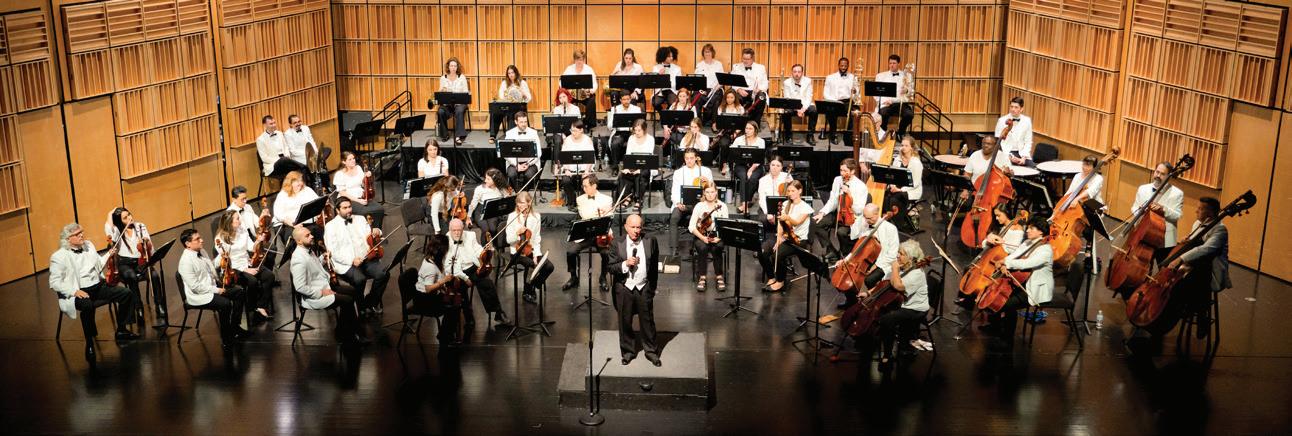

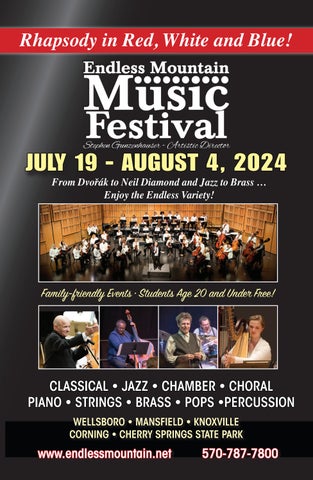
Welcome to the eighteenth season of the Endless Mountain Music Festival. Our ability to share the wonderful experience our festival provides would not be possible without the truly generous funding we receive from our many corporate sponsors and individual donors. We are indeed fortunate to have such dedicated support from our Twin Tiers community, and we thank all of you who have helped us make this year’s festival a reality.
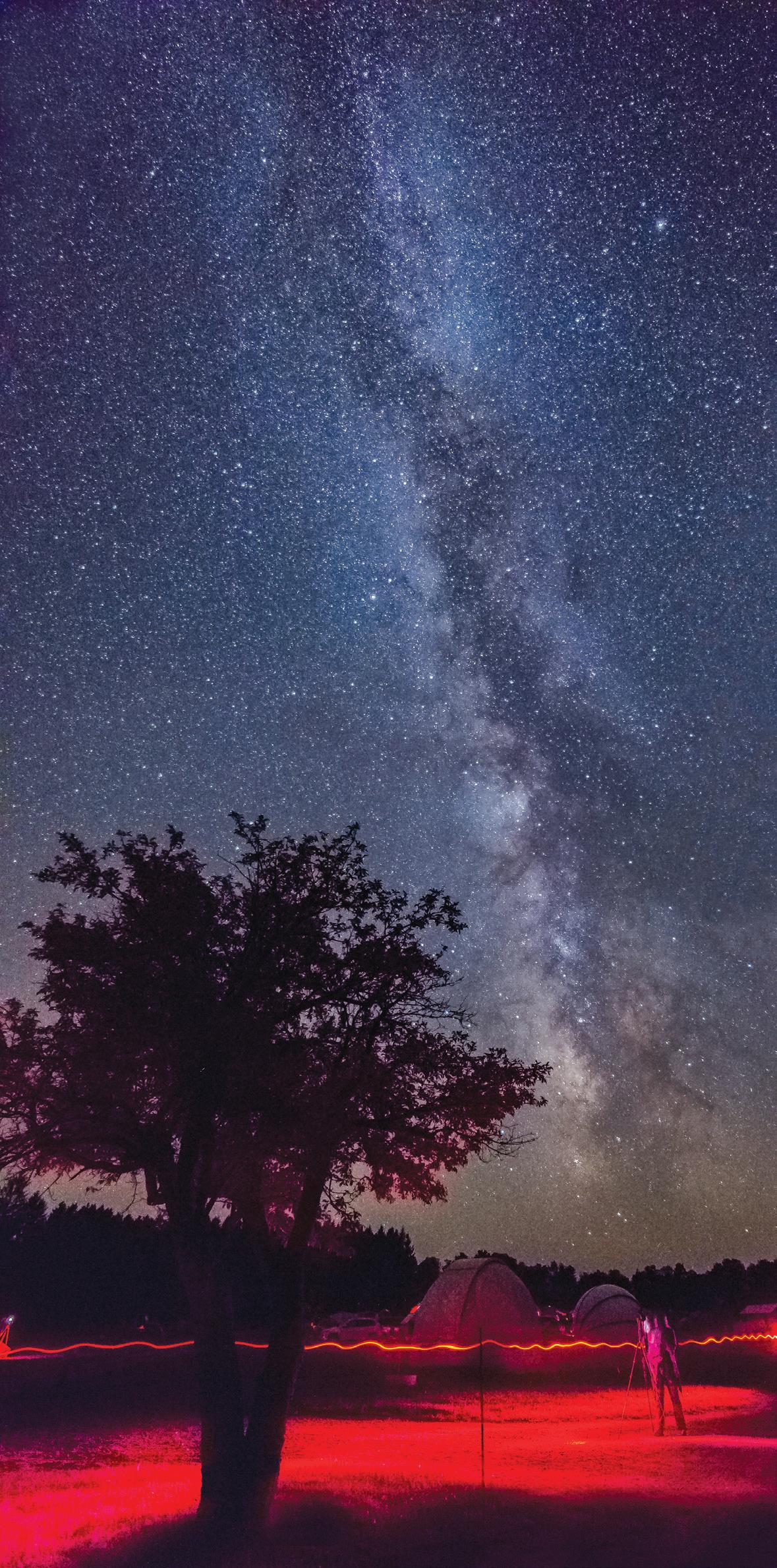
We would not be able to fulfill our mission, of course, without our dedicated, world-class musicians, many of whom travel great distances (some internationally) to share their remarkable talents with us. Whether performing as an orchestra, a smaller ensemble, or as soloists, our musicians will treat you to multiple musical genres— from classical to pop to jazz and more—in a variety of performance venues, including the CU-Mansfield campus, the Corning Museum of Glass, Wellsboro High School, the Knoxville Yoked Church, several area cultural and community centers, and even under the stars at Cherry Springs State Park.
In addition, we are pleased to offer our community several free “inspiration” concerts at local venues, including the Southeast Steuben County Library (Corning), the Mansfield YMCA, the Wellsboro Green Free Library, the Blossburg Library, and the Knoxville Library.
Finally, the organization and planning necessary for our festival would not be possible without the tireless efforts of our executive director, Cindy Long; our artistic director, Stephen Gunzenhauser; our many dedicated staff members, volunteers, and friends; and my colleagues on the Board of Directors. Please join me in thanking all of those who support our festival to make it a genuinely enriching experience for all involved.
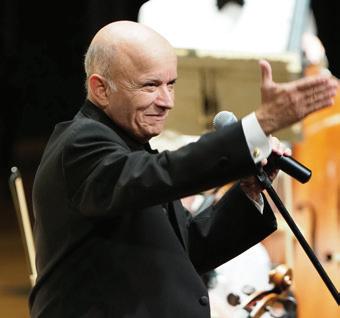
And now I invite you to sit back, relax, and enjoy the dynamic performances of this season’s musicians under the direction of our accomplished maestro, Stephen Gunzenhauser.
John M. Ulrich, President of the EMMF Board of Directors













July 19 - “Opening Night Fireworks in Red, White, and Blue!” 20 July 20 - “Happy Birthday, Gershwin!” 25 July 21 - “Bach to Funk” POPS! Concert 27 July 21 - “EMMF Brass under the Stars!” 27 July 22 - Seminar “Maverick American Composers”
July 22 - “EMMF String Quartet Performs Classic Gems” 28 July 23 - “Flute and Harp Sister Duo” 28 July 24 - “Music is My Weapon”
29 July 25 - “EMMF’s Famous Brass Quintet” 29 July 26 - “Hear the Voices!” 34 July 27 - “Dvořák Shines” 39 July 28 - “Sweet Sounds of Violin and Piano” 39 July 29 - “Keep Stringing Things Together” 40 July 30 - “Clarinet Confections” 41 July 31 - “Endless Mountain Standard Time” 41 Aug. 1 - “Let’s Jazz It Up!” 41 Aug. 2 - “The Way Things Were” 45 Aug. 3 -“Franckly Speaking” 48 Aug. 4 - “It’s Showtime”
Guest Artist Biographies
Inspiration Concerts


Platinum Gold Plus - $20,000 - $26,000
Corning Incorporated
Ward Manufacturing
EMMF receives state arts funding support through a grant from the Pennsylvania Council on the Arts, a state agency funded by the Commonwealth of Pennsylvania and the National Endowment for the Arts, a federal agency.
Platinum - $15,000 - $19,999
C&N
Deerfield Charitable Trust
Diamond - $10,000 - $14,999
Dunham Family Foundation
Mountain Home magazine
National Endowment for the Arts
Gold - $5,000 - $9,999
American Composers Forum
Community Foundation of Elmira and the Southern Finger Lakes
Charles Knox and Margaret Etner Foundation
Horace B. Packer Foundation
Penn Wells Hotel
Quality Inn of Mansfield
Sweet Foundation
Visit Potter-Tioga
UPMC and UPMC Health Plan
Wellsboro Electric Company
This project is made possible with funds from the Statewide Community Regrant program, a regrant program of the New York State Council on the Arts with support of the Office of the Governor and the New York State Legislature and administered by The ARTS Council of the Southern Finger Lakes.
Silver - $3,000 - $4,999
First Citizens Community Bank
Guthrie
Seneca Resources
The David & Sylvia Teitelbaum Fund, Inc.
Bronze - $1,000 - $2,999
AJ’s Hair & Make-up
Corning Rotary Club
Eastern Gas & Transmission & Storage, INC
William & L.R. Gale Community Foundation
Ted Goldwyn Writing
Larson Design Group
Baker Tilly
Mountain Valley Realty, Inc.
Six West Settlements, Inc.
SWN
Weis Markets
Williams Toyota
X-GEN Pharmaceuticals, Inc.
EXECUTIVE COMMITTEE
President – John Ulrich
CEO – William Hebe
Treasurer – Duke Argetsinger
Secretary – Scott Clark
BOARD MEMBERS
Ardell Thomas Morgan Shaffer
Mark Warner Hilma Cooper
Tricia Goodwin
BOARD MEMBERS EMERITUS
AJ Fratarcangelo David Tews
Carol Sides
STAFF
Artistic Director – Stephen Gunzenhauser
Executive Director – Cynthia Long
Business Manager – Matthew Difasi, CPA
Music Librarian – Joseph Shafer
Stage Manager – Hayne Webster
Box Office & Office Manager – Stacey Champaign
Social Media & Web Manager – Allison Rudy
Photographer – Robert C. Bair, Jr.
Outreach Coordinator – Melanie Mashner
Volunteer Coordinator – Marion Charsky
The Endless Mountain Music Festival expresses sincere appreciation to those of you who have helped provide quality orchestral music to the adults and children of our region. Since ticket sales only cover a small percentage of the festival’s operating costs, donor support allows us to attract world-class artists and, at the same time, keep ticket prices accessible to the general public. It is only with the support of donors like you that the Endless Mountain Music Festival can continue.
Dvorak Circle - $20,000 +
Stephen Gunzenhauser + *
Cynthia Long + *
Chopin Circle - $4,000 - $19,900
Eugene Seelye +
Tchaikovsky Circle - $2,000 - $3,999
Duke & Nick Argetsinger
Laura Douglas
Hon. Daniel & Mrs. Mary Ann Garett
Margery Hoffman
John Ulrich & Lynn Pifer
Beethoven Circle - $1,000 - $1,999
Anonymous
Richard & Nancy Becker
Ron Butler +
Mike & Teresa Capuzzo
Robert & Diann DeCamp
AJ Fratarcangelo
William & Shirley Hebe
Tricia Goodwin Kinane
Sheilah Y. Prevost
Dick & Judy Sphon
Ardell & Peg Thomas
Jack & Joan Ulrich
Brahms Circle - $500 - $999
Hilma Cooper +
Peggy Dettwiler & Jurgen Thym
Janna Keser
Ronald L. Miller & Carol A. Myers
Richard Perry
Harriet & Gil Sweet
Gershwin Circle - $300 - $499
Ellen Blais
Bill & Sue Boland
Scott & Dawn Clark
Alan & Lynnette Eusden
Barry & BJ Haverstick
Heather Kissinger
Deborah & Thomas Rudy
Rodger & Doris Wagner
M. Alene York
Friends of the Festival - $50 - $299
Robert & Sharon Bair
Oliver R. Bartlett
Randall E. Black
David Blowers
Lee & Darlene Borts
Hilma Cooper in honor of Gene Seelye’s 90th birthday
Patricia T. Dann
Matt & Amy DeCamp
Matt Difasi
Daria-Lin Guelig
Lilace & Jimmy Guignard
Sandy Foor
Gustin’s Jewelers
Bryn Hammarstrom & Lynne Graham
Land Services Group
Bev McNight
Patricia Newruck
John & Morgan Shaffer
Thomas & Rita Rudy
Kathryn M. Sheneman
Joseph & JoAnn Stello
Dave & Rachel Tews
Kathleen Thompson
Chris & Amy Wood
In Memory of Layne Conrad
Connie V. Bolt
Robert & Patricia Briggs
Brad & Kevin Conrad
Hilma Cooper
Carol A. & Nicholas P. Ferratella
Eric Flood
Regina & Jennifer Gilbert
Mark A. Hughes
Robert & Ruth Link
Jen L.Ward
John & Ellen Wise
+ denotes founding members
* denotes in kind donation

Stephen Gunzenhauser is the Music Director and Conductor of the Endless Mountain Music Festival now in its eighteenth season. He completed twenty-three years as the Music Director of the Delaware Symphony Orchestra in Wilmington before concentrating on the Lancaster Symphony. He retired from the Lancaster Symphony after forty years to focus on growing the Endless Mountain Music Festival. Maestro completed his best-selling book about his life, Travels with Stephen: The Most Famous Unknown Conductor, in January of 2024.
Dr. Gunzenhauser enjoys conducting in foreign venues. He has conducted in Europe and the British Isles, South America, Canada, Korea, Hong Kong, and Israel. Personal favorites have included the National Orchestra of Argentina and the Berlin Symphony Orchestra, where he conducted the mayor’s concert on the day after Christmas for five years.
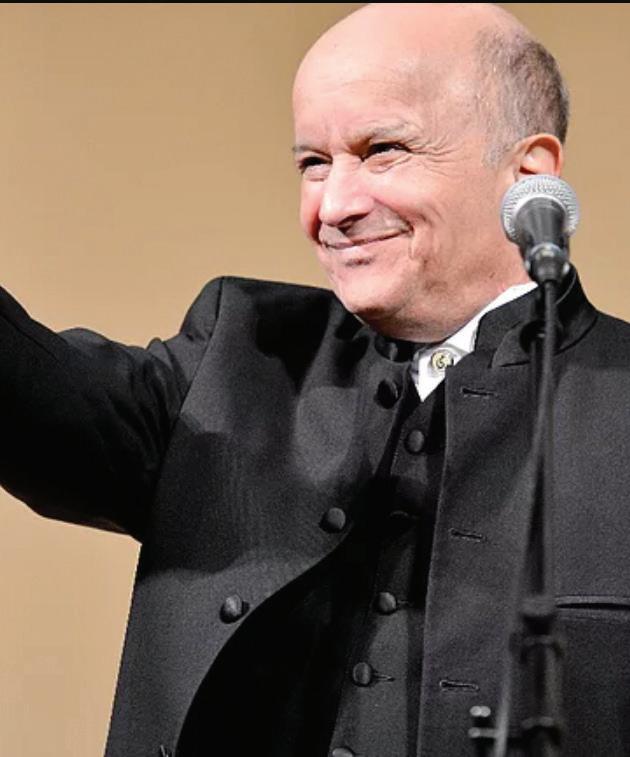
The Maestro is the fifth most recorded American conductor. His recordings have sold over two million copies; his compact disc of Vivaldi’s Four Seasons has sold more than 800,000 copies. He has recorded eighty compact discs for Naxos, HNH International Music Company, Angel, Pro Arte Records, Elan, West Branch and Albany Records. He has recorded works by Beethoven, Saint-Saëns, Grieg, Tchaikovsky, Brahms, Bruch, Orff, Borodin, Dvořák, Rachmaninov, Schumann, Copland, Mozart, Vivaldi, Glière, and Lachner. In August 2001, Gunzenhauser completed a recording of Benjamin Lees’ Symphonies Nos. 2, 3, and 5 with the State Philharmonic of Rheinland-Pfalz. That recording was nominated for a Grammy in 2003.
In 2008, he was conductor of a new virtuoso chamber orchestra called Pro Musicis. They recorded The Seasons of Antonio Vivaldi with Harrisburg Symphony Concertmaster Odin Rathnam, for West Branch Records. In September 2001, the Maestro was selected as the American Judge at an International Conducting Competition in Lisbon, Portugal. Also selected were judges from Russia and other parts of Asia and Europe. Dr. Gunzenhauser was an international judge and conductor at competitions in Sicily and Kazakhstan. Maestro Gunzenhauser has conducted the Belgrade Philharmonic in Serbia and more recently he appeared with the Arpeggione Chamber Orchestra of Austria and the Israel Sinfonietta in Beer Sheba Israel.
In past seasons, the Maestro conducted at the Teatro Colón (one of the five most beautiful concert halls in the world) with the Buenos Aires Philharmonic Orchestra, and with the Bogotá Philharmonic Orchestra of Colombia, South America. Other activities included a full-scale production of Puccini’s Tosca at the Wittgenstein Theater near Dresden, Germany. In August 2005, he performed at a Hungarian Music Festival sponsored by the Franz Liszt Chamber Orchestra as well as with the Danubius Orchestra at the Franz Liszt Academy of Budapest in the première of the Mazetti completion of Mahler’s Tenth Symphony.
In August 2006, Maestro Gunzenhauser presented the inaugural season of the first International Music Festival in Pennsylvania, the Endless Mountain Music Festival, which presented seven concerts in eight days. In 2007, the festival expanded to perform fifteen concerts in seventeen days. And after eighteen years the festival has grown to seventeen concerts in seventeen days. The festival continues to expand and grow in significance as the only international bi-State (Pennsylvania and New York) music festival. In addition, the Endless Mountain Music Festival performs in Corning and Elmira, New York. This past season more than 3,000 people attended the festival concerts.
Born in New York City and a graduate of the High School of Music and Art in New York City, Dr. Gunzenhauser received a bachelor of music degree from Oberlin College and a master of music degree from the New England Conservatory. He also holds an honorary doctorate degree from Widener University. He has been awarded three Fulbright grants and has an artist’s diploma from the Mozarteum, Salzburg, Austria. He was awarded Delaware’s First Cultural Ambassador designation in 1990 and is the recipient of the University of Delaware’s Medal of Distinction. He was also awarded the Order of the First State—the highest acknowledgement that a civilian may receive from the State of Delaware.
Dr. Gunzenhauser enjoys competitive tennis, golf, and gourmet cooking. He resides in Lancaster, Pennsylvania, with his wife Shelly. Both of their daughters are grown and live in Los Angeles.
Cynthia Long – Executive Director
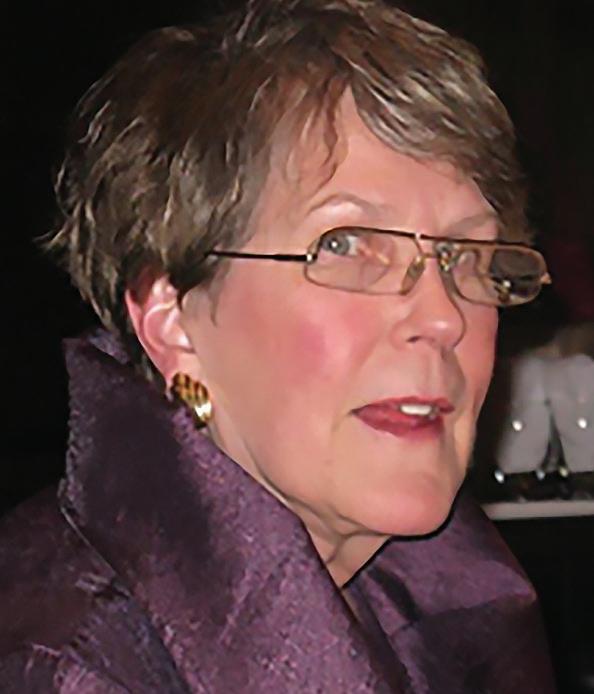
Local arts advocate, Cynthia Long, Endless Mountain Music Festival Executive Director, is a founding member and has served in many capacities including President from 2005-2007 and Advisory Chair from 2007-2009. Cynthia comes to the festival with a wealth of experience in leadership roles. She currently is a member of the Corning Rotary and a founding board member of the Deane Center for the Performing Arts in Wellsboro. Cynthia is a graduate of Penn State University. She is a past member of the Jr. League of Harrisburg, served as volunteer coordinator of the Harrisburg Chapter of the American Red Cross, served on the Cystic Fibrosis Board of Directors, served as president of the Wellsboro Wednesday Morning Musicales from 2007-2009, and served as an elder of the First Presbyterian Church in Wellsboro from 2006-2008. Teaching still remains a passion. She retired from the West Shore School District after twenty-two years of service where she received “Teacher of the Year” award in 1997. Currently, Cynthia participates in many community educational outreach programs. The challenge of taking the Endless Mountain Music Festival forward is a passion she embraces because of her love for the arts. “Live music on stage is phenomenal!” She believes that giving back to the community makes a difference to the residents of the Twin Tiers of Pennsylvania and of New York.
Ways to Support Endless Mountain

Violin
Hua Jin–Concert Master
Gilbert Bigenho
Garrett Charnin
Jennifer Farquhar
Cara Garofalo
Pat Karakas
Quddus Khamooshi
Theresa E. Langdon
Linda Yu-Picard
Lisa Scott
Noelle Tretick Gosling
Stephanie Tretick
Stella Carolina Pedroza Torres
Yun Kang
John Zhang
Karen Banos
Viola
Caroline Argenta–Principal
Lauren Strachan
Charlie Alves
Jennifer Alger
Cello
Gita Ladd–Principal
Jacob Resendez
David Rezits
Lee Richey
Perry Scott
Bass
Carion Chu
Shawn Alger
Jacqueline Pickett
Flute
Morgann Davis–Principal
Lish Lindsey
Joseph Shafer
Oboe
Marie Trudeau–Principal
Katherine Danforth
Kenny Bader
Clarinet
Trina Gross–Principal
Marcia Spina
Joseph Shafer
Bassoon
Lynn Moncilovich–Principal
Gabrielle Hsu
Joseph Shafer
French Horn
Rebecca Dodson-Webster–Principal
Melvin Jackson
Rob Danforth–Co-Principal
Rebekah Lorenz
Ricky Yoder
Trumpet
Brian Strawley–Principal
Josh Carr
Brian Rodriguez (apprentice)
Trombone
Alexander J. Walden–Principal
Kenton Campbell
J.J. Cooper
Tuba
Kevin Ladd – Principal
Harp
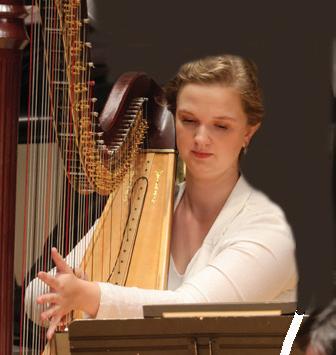
Melanie Mashner – Principal
Timpani
Juanmanuel Lopez – Principal
Percussion
Jason Mathena – Principal
David Wert
Piano
Érico Freire Bezerra–Principal


We are proud to support the Endless Mountain Music Festival.
Stephen Gunzenhauser may be known as Maestro of the Endless Mountain Music Festival held during the summer months in our neck of the woods, but now we can travel with him on a first-name basis, thanks to his recently published memoir: Travels with Stephen: The World’s Most Famous Unknown Conductor. The book is a good read, with lots of poignant stories told with considerable flair, full of wisdom about music and musicians, spiced up by occasional indiscretions, and, in its last pages, a declaration of love for our area and the Endless Mountain Music Festival.
Writing the program notes for this summer’s Endless Mountain Music Festival allowed me to travel with Stephen in a different way. Knowing in advance what would come up in the summer made me become aware of the program planning and the myriad of decisions on artistic and logistical matters that go into realizing a summer music festival. Mounting a music festival may not be an endless endeavor, but its preparations (hiring musicians, contracting soloists, reconciling schedules, raising funds, finding sponsors, ordering the music, allocating rehearsal time, etc.) extend over much of the year. In comparison, jotting down program notes, I must admit, was really the easy part in getting ready for the summer, even though it occupied me for some time during much of April. I was familiar with some of the compositions programmed for the six orchestral concerts of the festival (I had even taught some of them in my music history classes at the Eastman School of Music), but quite a few pieces and composers were new for me. Writing the program notes thus became both a learning and a teaching moment, an act of discovery and an act of instruction. Traveling with Stephen has been a rewarding experience.
Before signing off on the program notes that follow, I need to thank several individuals who helped me in putting this booklet together: Stephen Gunzenhauser and Teresa Cheung (both of whom quickly responded to questions about the program); George Tsontakis (who sent me information about his Laconika and made me curious to hear more of his works); Peggy Dettwiler (whose expertise on Rutter’s Requiem informed my notes); Cynthia Long (who filled in some of the blanks and proofread the text); and, last but not least, Ralph Locke, colleague at the Eastman School of Music for nearly 50 years (who advised me on numerous issues).
~Jürgen Thym
FRIDAY, JULY 19
“Opening Night Fireworks in Red, White, and Blue!”
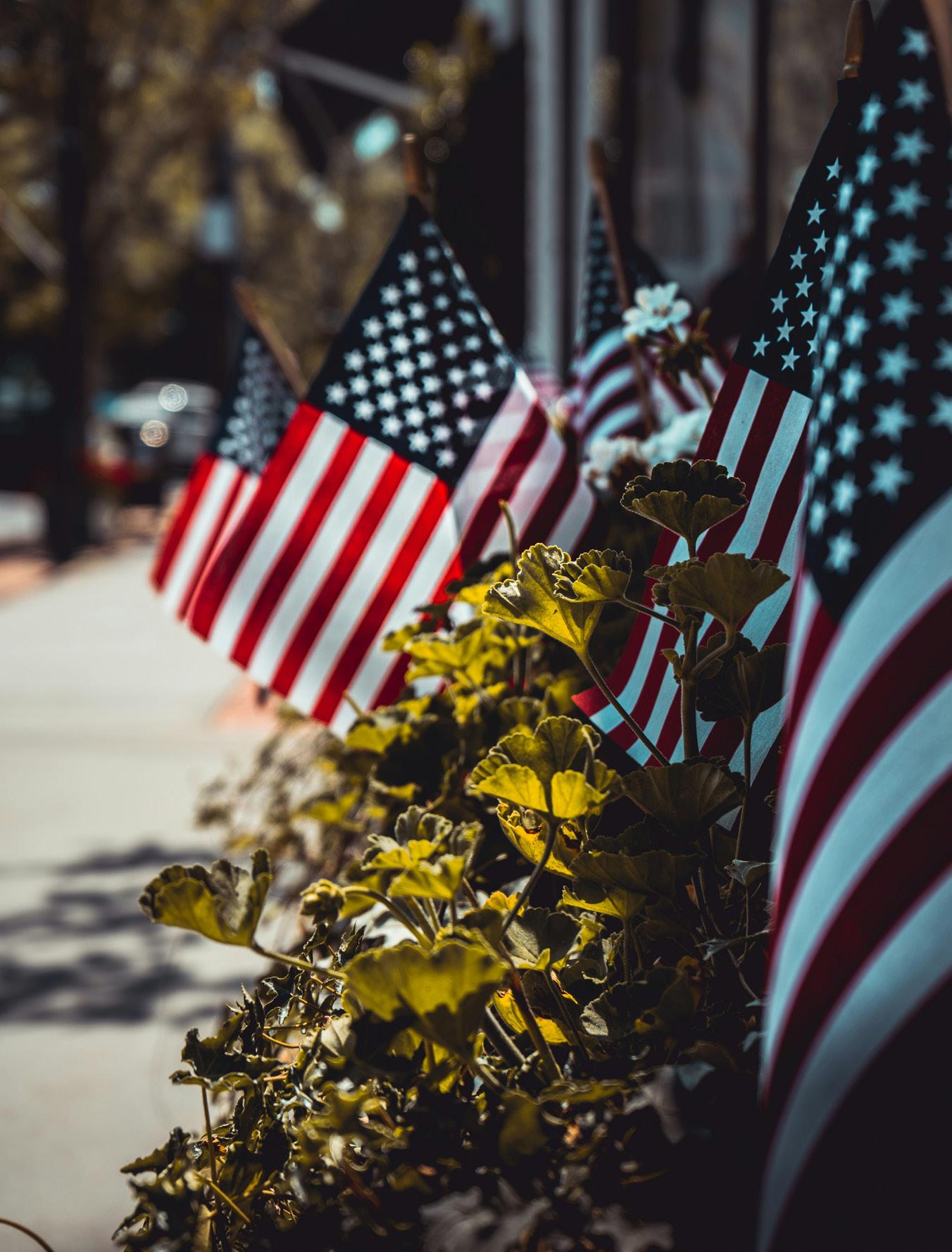
7:00 p.m. - Commonwealth University of Mansfield, Steadman Theatre Sponsored by C&N
J.S. Bach, Orchestra Suite No. 3 Creston, Dance Overture
Intermission
Boyer, Rhapsody in Red, White & Blue (Pennsylvania Premiere) Jeffrey Biegel, Piano
Program Notes
Suite No. 3 in D major, BWV 1068 (1731)
Johann Sebastian Bach (1685-1750)
5
Johann Sebastian Bach is revered today mostly as a church musician. From 1723 until his death, he served as Cantor of St. Thomas in Leipzig, Germany, and was contractually obligated to provide music for Sunday services. That may explain the halo cast on his substantial body of works for the organ, on an even more substantial body of church cantatas (more than 200 have survived, an unknown number has been lost), several oratorios narrating stories of the Bible, and the amazing Mass in B minor (in which the Lutheran composer set a Latin liturgical text). But it should not be overlooked that Bach was also a prolific composer of music, both vocal and instrumental, for secular purposes. The 6 Brandenburg Concertos and 4 Suites (also known as Overtures) for Orchestra are perhaps the most well-known in this category.
Suite No. 3 for Orchestra was written by Bach (who for a few years added the responsibilities of Leipzig’s Civic Music Director to his church job to supplement his income) for one of the public concerts featuring a Collegium Musicum in Zimmermann’s coffee house in Leipzig. It is scored for strings, 2 oboes, plus 3 trumpets and timpani (the latter adding a regal and festive character to the piece with which this summer’s Endless Mountain Music Festival opens). The Suite begins with a French Overture whose structure can be encapsulated in the formula ABA (a fast contrapuntal center piece is framed by two majestic slow sections signaling gravitas). Most of the other movements are courtly dances: an energetic Gavotte (featuring trumpets), a mercurial Bourrée, and a lively Gigue (where again trumpets add to the festive character). But before we get to those dances, Bach treats us to one of his most beautiful utterances: an Air (or Aria) in the Italian style. Yes, Bach, a composer known for his complex and complicated contrapuntal textures, could write melodies, Italianate in its style, hovering and soaring over the other strings and giving free reign to individual expression. It is a tune (popularly known as the “Air on the G-String”) that nowadays would rise to the top of the charts. Written almost 300 years ago, we still can relate to it; it imbues us with a sense of happiness, so many years later! In other words: Bach is still relevant.
Note: During much of his lifetime, Bach was considered old-fashioned, perhaps a good organist, but, as a composer, as one of his critics remarked, he would be well advised to simplify his style if he wanted to capture audiences. Well, he has captured audiences, not only through the abovementioned “Air on the G-String,” but he, more than any other composer, has been “updated” by other musicians: Not only those who clearly followed his path such as Mozart and Mendelssohn, or who used the acronym BACH as a source of inspiration (including Schumann, Liszt, Reger, Schoenberg, and countless others), or the Hilliard Ensemble with its haunting “Morimur” (based freely on various Bach works), or those who transferred his style to the jazz idiom: Jacques Loussier, the Swingle Singers, the King’s Singers, Uri Caine, and Bill Dobbins with the West German Radio Jazz Band in Cologne. Bach is an overpowering and relevant figure, even several centuries after his death.
I picked up the following joke several years ago from a German weekly news magazine, and it is applicable here: A musician comes to heaven, is being welcomed by St. Peter at the Pearly Gates, and advised to go straight to the celestial concert hall (because God just happens to be listening to some music there). The musician does as he has been instructed and encounters God listening to a piece by Mozart with Mozart himself playing the piano. The musician wonders why God is listening to a piece by Mozart, as music by Bach would be a much more appropriate musical fare in the celestial concert hall. Well, God looks at the musician with puzzlement and somewhat sternly says: “I am Bach!” (Aside, and it is a long one: What is lurking behind the joke is the question of who the best composer is, worldwide and throughout history. And granted, the reference point is the universe of classical music, excluding other repertories. Whereas the inventor of the joke seems to be in favor of Bach, Karl Barth, an eminent Swiss theologian of the twentieth century, had a more diplomatic answer: When God is in heaven, the angels play Bach, but when he is not there, they play Mozart.
It reminds me of the Italian Contessa Belgiojoso being asked to judge the merits of two virtuoso pianists of the nineteenth century; her response allegedly was: “Thalberg is the best, Liszt is the only one.”)
Postscript: Mozart will make his appearance, several times, later in the program notes. And Bach will return as well.
Dance Overture, Opus 62 (1954)
Paul Creston (1906-85)
After giving a nod to the Old World with Bach’s Suite of courtly dances, Maestro Gunzenhauser moves to New World composers for the remainder of the concert. Creston’s Dance Overture consists of a succession (a suite, if you wish) of four dances played without pause: a Spanish bolero in 9/8 meter, an English country dance in 4/4 meter, a French loure in 6/8, and an American square dance in 2/4 meter. The work, by and large, is a fast-paced virtuoso piece for orchestra, allowing for the display of musical fireworks with a few solos thrown in to show off individual instrumentalists. The Dance Overture was commissioned by the National Federation of Music Clubs for its biennial convention of 1955 held in Miami, Florida; its four different dances were meant to represent the different countries that have ruled the state of Florida.
Paul Creston (born in New York City as Giuseppe Guttovecchio to Sicilian immigrants) is a composer who is nearly forgotten today. But in the 1940s and 1950s he was one of the most frequently performed American composers. His oeuvre of more than 120 opus numbers includes six symphonies, as well as concertos for piano, violin, and “exotic” or unusual instruments such as marimba, saxophone, and accordion. Among his vocal and choral works are several mass settings and pieces based on poems by Walt Whitman. During his lifetime, he received many honors and awards. The musicians of the Endless Mountain Music Festival should be applauded for giving Creston another hearing in 2024.
Symphony No. 13 (Madras) (1958)
Henry Cowell (1897-1965)
1 Alapna. Andante rubato
2 Tali Adi. Allegretto
3 Allegro
4 Andante
5 Allegro
Was he an enfant terrible or a maverick? Henry Cowell leapt onto the musical scene in the 1920s as an eccentric and controversial composer and pianist. His signature was the tone cluster, an extremely dissonant harmony generated by pressing down the keys of the piano, as many as one could catch with one’s forearm. His techniques and practices got him the attention of critics and audiences and exerted an influence on like-minded artists, such as Lou Harrison and John Cage. He soon was recognized as the leader of the American musical avant-garde.
“Cowell was the apostle of new music. He was not only its practitioner but its salesman, its chronicler, and with Varèse its most significant organizer. Varèse did much to organize the New York musical world, but he was limited by his own temperament and his European outlook. Cowell had no fetters. He had carved his own niche since childhood. He had ideas, talent, and unlimited enthusiasm. His own music was wild enough to attract attention. Its principal feature, the tone cluster, was simplicity itself, an idea that everyone from the man on the street to the critic at the city desk could understand. It was the ideal emblem of new music. To discuss the use of fists, arms, and elbows on the keyboard required no grasp of the arcana of musical notation. It defined Cowell to the American public with a clarity that no other musician achieved.” (Michael Broyles)
But there was another side to Cowell, perhaps not unrelated to the unrestrained discoverer
of new techniques and practices: his open-mindedness when it came to tapping musical resources. Born in California and spending some of his life on the West Coast of the United States, he looked across the Pacific Ocean toward Asia (rather than across the Atlantic toward Europe) with the aim of discovering new musical idioms. Encouraged by the ethnomusicologist Charles Seeger, father of the folksinger Pete Seeger, he promoted Asian musical cultures (especially those of Iran, Japan, and India) as a teacher, writer, and consultant of Folkways Records, a recording company that in the 1950s and 60s familiarized the American music lovers with “world music” (non-Western music). And he discovered in the music of these other cultures resources for his own creativity. The Madras Symphony (No. 13 of a total of twenty symphonies he finished) was composed in 1957-58 after Cowell and his wife, the ethnomusicologist Sidney Robertson Cowell, returned from studying Indian, i.e. South Indian or Carnatic music, in Madras, India. The eleven-minute work consists of five movements that are performed without being separated by pauses. In addition to its “meditative” quality generated by melodic formulas anchored to a tonal center, the most tangible Indian features are the use of tablas (percussion instruments) and jalatarang (tuned bowls).
The score of the Madras Symphony lay dormant for decades. The work was premiered in San Francisco in 2005, another performance took place at the Juilliard School in 2010 under the direction of Joel Sachs. (The latter can be accessed on Soundcloud: soundcloud.com/juilliardschool/sets/ new-juilliard-ensemble-cowell-symphony-no-13-madras; available on the Internet is also a brief introduction into the work by Joel Sachs.)
Recommended further reading: Michael Broyles, Mavericks and Other Traditions in American Music. New Haven and London: Yale University Press, 2004.
Rhapsody in Red, White & Blue (2022-23)
Peter Boyer (1970-)
Tonight is opening night of the Endless Mountain Music Festival, and fireworks in the colors of the American flag have been announced in the subtitle of today’s program. The writer of these lines is not so sure whether a little more than two weeks after the Fourth of July the little town of Mansfield can afford to illuminate the nocturnal sky above the Eastern Hill again. (The borough’s entertainment budget may have been depleted by now, and much depends on the weather anyway.) But a fireworks display will take place in sounds in Steadman Theatre: the Pennsylvania premiere of Peter Boyer’s Rhapsody in Red, White & Blue for piano and orchestra. The mastermind behind the composition is the pianist Jeffrey Biegel; he commissioned the work to be composed as the companion piece to Gershwin’s Rhapsody in Blue on the occasion of its centennial (see notes further below) to celebrate Gershwin and American music. To help American orchestras and musicians overcome the slump caused by the years of the pandemic, he volunteered his pianistic skills, free of charge, to at least one orchestra in every state of America to play it. The honor of premiering the Rhapsody in the Commonwealth has fallen to the Endless Mountain Music Festival ensemble and its Maestro in Mansfield, Pennsylvania.
Boyer’s Rhapsody in Red, White & Blue (which had its first performance in the state of Utah last year) is a spirited composition for piano and orchestra with driving rhythms and jazzy tunes generating a forward momentum that is as relentless as it is energizing. Like the piece premiered in 1924 from which it takes its cues, it has the markers of being “American.” A middle section provides relief in the form of lush sweeping melodies in the orchestra with the piano accompanying or paraphrasing the melodic turns. Runs in the piano introduce the third and final section, which returns to the forward momentum and energy-generating sounds of the first.
Peter Boyer is a composer worth watching (or hearing). He is one of the most prolific composers in the United States nowadays, writing for the concert hall as well for film and television. Quite a number of his works are on American themes: Ellis Island: The Dream of America (for which he received a Grammy in 2006 and which PBS featured nationwide in its “Great Performances” series in 2018), The Dream Lives On: Portrait of the Kennedy Brothers (2010), and Balance of Power (2020-21). Lately, he has added political figures and crowned heads to be celebrated with his
music: He composed a Fanfare for Tomorrow for the inauguration of President Biden (2021) and Today We Ask for the coronation of Charles III of England (2023). For over 30 years he has been showered with awards and honors, including one from the Lancaster Symphony Orchestra directed by Stephen Gunzenhauser that quite early recognized him as a force to be reckoned with.
Note: A video of an excerpt of the Rhapsody with an interview by Peter Boyer can be accessed on YouTube: youtube.com/watch?v=WOsWCI589zA. The entire 17-minute work is available through Streaming from Naxos and also can be downloaded for a small fee at eclassical.com/labels/ naxos/boyer-rhapsody-in-red-white-blue.html.
Listening recommendation: Peter Boyer’s Ellis Island: The Dream of America is available in the “American Classics” series on the Naxos label (8.559246). “This is a piece to be enjoyed, not only by the 100 million Americans who trace their heritage back to an ancestor who first set foot on American soil on Ellis Island, but by their children and grandchildren. Its themes celebrate the American Dream of freedom, hope, and opportunity for all—aspirations as true today as they were 100 years ago. It is surely a work for the generations.” (Peg Zitko, Director of Public Affairs, The Statue of Liberty-Ellis Island Foundation)

SATURDAY, JULY 20
“Happy Birthday, Gershwin!”
(A Celebration of the 100th Year of Rhapsody in Blue)
7:00 p.m. - Corning Museum of Glass, Corning, NY
Sponsored by Corning Incorporated and Mountain Home magazine
Brahms, Symphony No. 2
Intermission
Tsontakis, Laconika
Gershwin, Rhapsody in Blue Jeffrey Biegel, Piano
Symphony No. 2 in D major, Opus 73 (1877)
Johannes Brahms (1833-97)
1 Allegro non troppo
2 Adagio non troppo
3 Allegretto grazioso (Quasi Andantino)
4 Allegro con spirito
Composing symphonies was a burden for Brahms. Not that he could not write something that might qualify as symphonic for a composer less self-critical than he was: his youthful serenades are forays in writing for orchestra and might have passed muster as symphonic works in an earlier era. By the time Brahms came into his own, symphonies meant something on a higher level than just stringing a few movements together. It meant competing with (or living up to the challenge of) Beethoven who, single-handedly, had changed expectations and raised the bar for symphonies. It is not Haydn with more than 104 symphonies or Mozart with at least 41, but Beethoven with a “meager” 9 symphonies who is considered the most important representative of the genre. “Writing symphonies is no laughing matter,” said Brahms; “you can’t have any idea what it’s like always to hear such a giant [like Beethoven] marching behind you!” Besides, Brahms’s mentor and friend, Robert Schumann, had heralded the young composer in 1853, who
at the time had not published any of his compositions, as a second Beethoven, raising expectations so high that Brahms had difficulties fulfilling them. In short, Brahms, when it came to symphonies, was a composer writing what literary critics have called the anxiety of influence—that is, the fear of not being able to measure up to one’s most distinguished predecessor(s).
Brahms waited until 1876, when he was 43 years old, before he dared to present his Symphony No. 1 to the musical world. (Beethoven, at the same age, had already composed all his symphonies except the Ninth.) Brahms’s First Symphony—in many ways, a riff on Beethoven’s Fifth and Ninth with a similar symphonic narrative (and therefore nicknamed “Beethoven’s Tenth”)—had a gestation period of more than 20 years, a length that is perhaps indicative of the struggle it took to complete the work.
Brahms’s First was heard at last year’s Endless Mountain Music Festival. And now we are treated to the sequel.
Once Brahms had paid his dues to Beethoven the symphonist with a variant of his own, he moved very quickly to write his Second Symphony during a few weeks in the summer of 1877, and he premiered the work in Vienna before the year ended. Brahms’s Second is a work quite different from his first essay—relaxed, cheerful, heavenly. For that reason, it has occasionally been called his “Pastoral.” The work is as tightly constructed (or as “Beethovenian” as its predecessor)—a descending and ascending minor second (heard at the very beginning in the lower strings) followed immediately by a song-like triadic theme presented by horns and woodwinds are usually invoked by analysts as the building blocks that provide structural coherence within movements and across movements. But reducing the sonic landscapes so generously displayed in this work to just a few motives would be utterly “reductionist” and limit (“reduce”) the listening experience.
Even though Brahms, perhaps in a moment of sardonic humor, called attention in letters to friends to the melancholy nature of his work, the principal character of the Second is joyful and serene. The first movement takes its point of departure from the blissful world of Viennese waltzes

(triple meter, nature motive in the horns, a sweet or dolce response in the woodwinds) and grows from there into a large-scale sonata form. Granted, the music is not free of darker hues: a timpani roll threatens quite early on, ominous trombone sounds intrude occasionally with a premonition (or reverberation?) of tragedy, and a section with sharply dotted rhythms may signify struggle, but, overall, the movement proceeds along an idyllic path with troubles on the way being resolved. The slow movement clearly is the most “serious” of the four; here Brahms’s insistence on the melancholy quality of the work rings true, especially when lugubrious trombones enter the scene. The movement concludes in a tone of quiet resignation. The third movement returns to the triple meter of the first: but rather than invoking a waltz, the music now suggests a minuet in an almost parodistic manner, a courtly dance of the eighteenth century associated with the aristocracy, and it gives some of the movement an “archaic” or old-fashioned flavor. (Vienna, Austria’s capital, is a city prone to memory culture, and was so even during Brahms’s days: when the symphony was premiered in 1877, the third movement had to be repeated.) The minuet-like sections frame two scherzos of Mendelssohnian lightness. The Finale is one of Brahms’s most joyful and unbuttoned utterances. If we want to consider the Second Symphony the companion piece of the First, we might describe it as an expression of victory over anxieties of influence: Brahms celebrates having found his voice.
Recommended further reading: Reinhold Brinkmann, Late Idyll: The Second Symphony of Johannes Brahms, trans. Peter Palmer. Cambridge, MA: Harvard University Press, 1995. And a memorable quote from Alex Ross, “Grieving with Brahms” (The New Yorker, April 16, 2020): “There is an enormous sadness in his work, a sadness that glows with understanding.”

Laconika (2010)
George Tsontakis (1951-)
1
2
3
5
George Tsontakis, whom this year’s Endless Mountain Music Festival is privileged to welcome as a guest, is an American composer and conductor of Greek descent. His music has been performed widely in North and South America, Europe, and Japan. He has been the composer-inresidence with the Aspen Music Festival, the Albany Symphony, and the Chamber Music Society of Lincoln Center, and has served on the faculty of various conservatories and colleges, including Bard College in Annandale-on-Hudson, New York. Among the numerous awards bestowed on him are the Berlin Prize from the American Academy in Berlin (2002) and the University of Louisville’s highly coveted Grawemeyer Award for Music Composition (2005). The recordings of Ghost Variations for piano (on the Hyperion label) in 1998 and his Violin Concerto No. 2 in 2008 were nominated for the Grammy for best contemporary classical composition.
The wellspring of artistic creativity is often shrouded in mystery. But George Tsontakis has been quite open about what got his “juices” flowing in the case of Laconika. The work was commissioned by the Los Angeles Chamber Orchestra or LACO (the ensemble’s acronym). Being of Greek descent, he quickly arrived from there at the word “laconic” (Spartan, brief, or using few words) and took the etymological hint as a cue to write five short movements for chamber ensemble, “each with as much individual color as I could muster within the space of, let’s say, the average ‘historical’ song – pop, classical, troubadour, or other styles of the world’s most popular musical idiom. This, with musical economy of means ever in mind. The characters of the movements reflect their titles, two of which alter real words to suit the first performances by LACO, … Indeed, my ‘Laconicrimosa’ incorporates a very famous snippet of the world’s most recognized ‘Lacrimosa’ [from Mozart’s Requiem], here rendered with a degree of respectful poetic license.”
And here’s what Allan Kozinn said about a performance in New York’s Alice Tully Hall in the New York Times (November 7, 2010): “Laconika … received the most memorable performance here. Mr. Tsontakis has become a magnificently free-spirited colorist in recent years, and in the five short movements of Laconika orchestral sections overlap and interact in ways that yield otherworldly textures. The opening movement, ‘Alarmingly,’ for example, is built of sliding brass figures overlaid by crystalline vibraphone lines and acidic woodwind chords, the closing ‘Twilight’ is woven around an oscillating flute motif. Curiously, for all the orchestral magic, the most affecting movement was ‘Laconicrimosa,’ a straightforward meditation dominated by a lush string sound.”
Further recommended listening: George Tsontakis, Man of Sorrows for Piano and Orchestra (2005), a gripping piece of music: a piano concerto, a series of tone poems, and a musical portrait of the suffering of Christ at the same time. (Stephen Hough, piano, with the Dallas Symphony, Andrew Litton conducting; Hyperion CDA 57564). Here’s what the critics say: “A five-star performance and recording” (Gramophone); “Brilliantly written for the keyboard and scintillatingly orchestrated … [Man of Sorrows] is superbly played and recorded, patently sincere and easily assimilable” (BBC Music Magazine); “This is a serious work of substance and integrity, challenging and rewarding, provocative in the best possible sense. It is performed here with the utmost care and devotion” (American Record Guide).
Rhapsody in Blue (1924)
George Gershwin (1898-1937)
“Committee Will Decide ‘What Is American Music’” read a headline in the New York Tribune on January 3, 1924, heralding a concert billed as “An Experiment in Modern Music” by Paul Whiteman’s band. Less than six weeks later, on Lincoln’s Birthday, came the answer when George Gershwin’s Rhapsody in Blue for piano (with the composer as piano soloist) and jazz band premiered in New York’s Aeolian Hall. When the piece ended, the hall broke into spontaneous applause, and the applause was long and loud: Audiences rather than a committee decided the question posed by the newspaper headline. An American composer, of Russian-Jewish ancestry, had given a voice to America (or was it just to New York City?) with what must be considered one of the most recognizable compositions in music history. The clarinet trill followed by a slide upward is, like the short-short-short-long at the beginning of Beethoven’s Fifth (or the first chord in Mendelssohn’s “Wedding March” from his incidental music to Shakespeare’s A Midsummer Night’s Dream, or the high-pitched bassoon that starts Stravinsky’s Sacre du printemps) an iconic sound, immediately identifiable, that electrifies listeners. (It is a sound ready-made for “Name that Tune,” a quiz-show on American TV that was popular in the 1950s and that had several reincarnations in later decades.)
The Rhapsody in Blue combines elements of classical music with jazz. In some ways, the composition can be traced to the Hungarian Rhapsodies of Franz Liszt. It is loosely constructed, full of surprises and contrasts, mainly achieved through tempo changes, and replete with improvisatory sections. In fact, the work at its premiere may not have had a written-out piano part (we can assume that George Gershwin improvised his solo sections, showing off his incredible skills as a virtuoso pianist). Since Gershwin at the time lacked experience as an orchestrator, he enlisted the help of Ferde Grofé (1892-1972), composer of the well-known Grand Canyon Suite, who produced several arrangements of the Rhapsody. The Endless Mountain Music Festival Orchestra performs Rhapsody in Blue in the centennial year of its existence in the arrangement of 1942 for full symphony orchestra.
Recommended further reading: David Schiff, Gershwin: Rhapsody in Blue (Cambridge Music Handbooks). Cambridge: Cambridge University Press, 1997.
And a memorable quote from Leonard Bernstein (Atlantic Monthly 1955, also in Bernstein, The Joy of Music, 1959): “Rhapsody in Blue is not a real composition in the sense that whatever happens in it must seem inevitable, or even pretty inevitable. You can cut out parts of it without affecting the whole in any way except to make it shorter. You can remove any of these stucktogether sections and the piece still goes on as bravely as before. You can even exchange these sections with one another, and no harm done. You can make cuts within a section, or add new cadenzas, or play it with any combination of instruments or on the piano alone; it can be a fiveminute piece or a six-minute piece or a twelve-minute piece. And in fact, all these things are being done to it every day. It's still the Rhapsody in Blue.”
SUNDAY, JULY 21
“Bach to Funk” (Pops Concert)
2:30 p.m. - Wellsboro High School Auditorium, Wellsboro, PA Free
Sponsored by the Dunham Family Foundation in Memory of Robert N. Dunham, UPMC & UPMC Health Care, & Wellsboro Electric Company
Featuring the Endless Mountain Music Festival Orchestra playing a selection of popular favorites from “East St. Louis Blues” and “Also Funk Zarathustra” to “What a Wonderful World,” and “YMCA.” Also featuring clarinetist Trina Gross in “Viktor’s Tale” by John Williams.








SUNDAY, JULY 21
“EMMF Brass under the Stars!”
8:00 p.m. - Cherry Springs State Park, Overnight Astronomy Observation Field (by the telescope domes)
Free Sponsored by the David G. Patterson Foundation and the Galeton Foundation
The program will be announced from the stage.
MONDAY, JULY 22
Seminar “Maverick American Composers”
12:00 noon to 1:30 p.m. - Corning Museum of Glass, Corning, NY
Sponsored by Corning Incorporated
Featuring George Tsontakis, Stephen Gunzenhauser, Hiroko Sakurazawa, Jürgen Thym
The program will be announced from the stage.
MONDAY, JULY 22
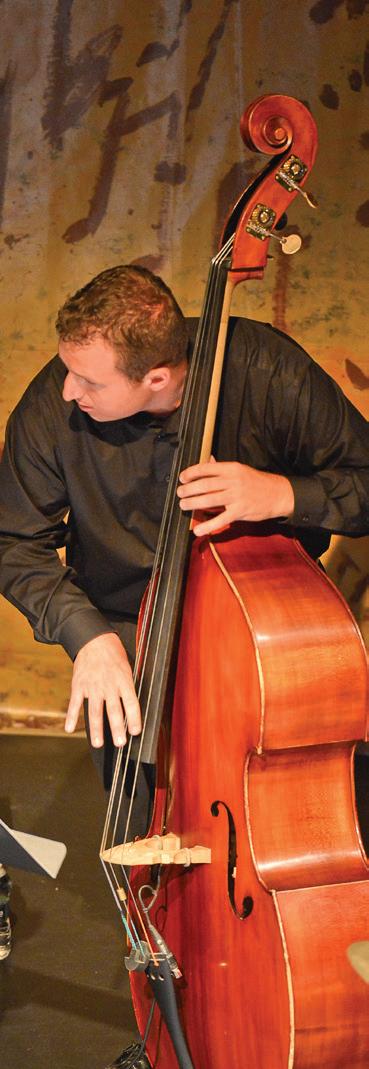
“EMMF String Quartet Performs Classic Gems”
7:00 p.m. - 171 Cedar Art Center, Corning, NY
Sponsored by Corning Incorporated
Featuring Lisa Scott, violin; Hua Jin, violin; Charlie Alves, viola; and Perry Scott, cello
The program will be announced from the stage.





TUESDAY, JULY 23
“Flute and Harp Sister Duo”
7:00 p.m. - Deane Center, Grand Community Room, Wellsboro, PA
Sponsored by First Citizens Community Bank
Featuring Melissa Mashner, flute, and Melanie Mashner, harp
The program will be announced from the stage.
WEDNESDAY, JULY 24
“Music is My Weapon”
7:00 p.m. - Yoked Church, Knoxville, PA
Free
Sponsored by the Deerfield Charitable Trust
Featuring Jason Mathena and David Wert, percussion
The program will be announced from the stage.




THURSDAY, JULY 25
“EMMF’s Famous Brass Quintet”
7:00 p.m. - Deane Center, Coolidge Theatre, Wellsboro, PA
BYOB
Sponsored by Spencer, Gleason, Hebe & Rague, PC
Featuring the EMMF Brass Quintet
........................ Rebecca Dodson-Webster, French horn
........................ Brian Strawley, trumpet
Joshua Carr, trumpet
........................ Alexander Walden, trombone
........................ Brian Rodriguez, trumpet
The program will be announced from the stage.
FRIDAY, JULY 26
“Hear the Voices!”
7:00 p.m. - Commonwealth University of Mansfield, Steadman Theatre
Sponsored by Ward Manufacturing
Schubert, Overture in D major
J.S. Bach, Harpsichord Concerto
........................ arranged for two marimbas and orchestra by Jason Mathena
Jason Mathena and David Wert
Arban, Norma Variations for Trumpet and Orchestra
Brian Strawley, trumpet
Teresa Cheung, conductor
Intermission
Rutter, Requiem
........................ Mansfield University Festival Chorus
........................ Peggy Dettwiler, conductor
Program Notes
Overture in D major (in the Italian Style), D. 590 (1817)
Franz Schubert (1797-1828)
In 1816, works by Rossini were introduced to audiences in Vienna, works that differed in style from those of Viennese composers such as Haydn and Mozart (both of them deceased by the time) and Beethoven. Even though Vienna was still some years away from the Rossini craze, the works caused astonishment and also encountered considerable criticism. Schubert’s creativity had found an outlet thus far mainly in the composition of German Lieder performed in private gatherings. But he was open-minded enough (his composition teacher had been Antonio Salieri, an Italian) to try his hand in writing something in the Italian style, resulting in 1817 in two overtures in D major and C major, the first of which, the one we will be hearing tonight, was performed a year later in a Gasthof (yes, a restaurant, as public concert halls did not yet exist) in Vienna. It
may have been the first public performance of one of his compositions, resulting in a review by a Viennese musical newspaper noticing the “youthful zest” of the work. Schubert, at the time an unknown composer, just 20 years old, must have been pleased to have found some recognition with his venture “in the Italian style.”
What makes the overture Italian is more difficult to assess. It is, for the most part, a joyful piece of music, Mozartean in its grace; darker hues intrude occasionally but they are quickly dispelled. The overture is in sonata form (Allegro giusto, alle breve) preceded by a slow introduction (Adagio in 3/4 meter) and concluded by a fast-paced wrap-up (Allegro vivace in 6/8 meter). It is perhaps in this coda that the spirit of Rossini and the Italian style is most notably invoked.
Concerto for Harpsichord and Orchestra in D minor (BWV 1052) (c. 1735) (arranged for two marimbas and orchestra)
Johann
Sebastian Bach (1685-1750)
Allegro
During his lifetime, Bach may never have heard of marimbas, instruments of an African and Latin American ancestry, but, given his openness to novelties and proven record of looking for inspiration in the works of others, he would have welcomed this arrangement of a movement from a harpsichord concerto that he wrote in the mid-1730s, like the Suite No. 3 heard earlier during the Endless Mountain Music Festival, for one of the Collegium Musicum concerts in Leipzig. After all, Bach transcribed for organ and harpsichord the concertos of Vivaldi, Torelli, Marcello, and others—indeed, excelled in arrangements, often tightening the fabric and adding touches of his own to the works of his Italian colleagues. He would have been delighted to witness two young musicians showing off their virtuosity on an instrument he would have considered exotic, playfully engaging in a give-and-take between solo parts and orchestra, and the writer of these lines imagines that, at the end, the stern facial image of the wigged composer would be transformed by a smile; he would get up from his seat in the audience and applaud that a younger generation has given his notes a new sonic and, in its own way, enchanting sonic image.
Variations on a Theme from Bellini’s Norma
Jean Baptiste Arban (1825-89)
Jean Baptiste Arban may no longer appear as an entry in all music encyclopedias and dictionaries, but during his lifetime he gained fame as the greatest virtuoso on the cornet (cornet à piston, a trumpet-like instrument). He took his cues from Niccolo Paganini (1782-1840), whose virtuosity on the violin mesmerized audiences so much that some folks believed that the devil must have had his hand in the display of such extraordinary skills. (The Catholic Church refused to admit his body for burial on a cemetery for Christians!) One of the most famous pieces of Paganini were his variations on “O mamma, mamma cara,” a Neapolitan ditty that he titled “Il Carnevale in Venezia” (Carnival in Venice), and that is well-known in English to the words also known as “My hat, it has three corners.” Since Paganini, many composers and instrumentalists have written follow-up compositions on the same tune to show off their virtuosity on their respective instrument, and Arban was one of the first to do so for cornet à piston. It made him famous and gained him a place in the pantheon of trumpet virtuosos.
Hardly less difficult is the piece rendered by Brian Strawley today with the Endless Mountain Music Festival Orchestra, Arban’s Norma Variations. The melody that serves as a pretext to show off the trumpeter’s skills is the cavatina “Casta diva” (Chaste Goddess), one of the most famous operatic arias of the nineteenth century (from Bellini’s opera Norma of 1831) and the pièce de résistance for a whole host of female singers from Joan Sutherland and Maria Callas to Cecilia Bartoli and Angela Meade on their way to recognition as prima donnas. In anxious expectation,
we await today’s performance, replete with fast runs and double-tonguing, which may well lead to Maestra Teresa bestowing on Maestro Brian the title of primo uomo
Listening recommendation (and it comes with a video) before or after the performance today: youtube.com/watch?v=AB92bGuTnEg (with Hakan Hardenberger managing the nearly unmanageable).
Requiem (1985)
John Rutter (1945-)
1 Requiem Aeternam 2 Out of the Depth
5 Agnus Dei
6 The Lord is my Shepherd
7 Lux Aeterna
John Rutter is an English composer and conductor, highly respected and celebrated mainly in the world of choral music. Many of his works are of the shortish variety such as carols and anthems: “This is the Day” was heard (and heard all over the world) during the wedding service of Prince William and Catherine Middleton in Westminster Abbey in 2011; his “Ukrainian Prayer” has been performed in the last two years by choral ensembles in Europe and the Americas, including Mansfield University’s Concert Choir, expressing solidarity with a country fighting for its independence in the aftermath of a mean-spirited Russian invasion. Rutter, in other words, is a composer who writes for the here and now.
Even though he is a composer of so much religious music, he revealed in an interview in 2003 with CBS’s 60 Minutes that he does not consider himself a “particularly religious man, yet still [feels] deeply spiritual and inspired by the spirituality of sacred verses and prayers” (Wikipedia). He has also composed some extended compositions, and one of them is the Requiem heard in today’s concert: Composed in memory of Rutter’s father, the work was premiered in 1985 in Dallas, Texas, and since then has become a favorite staple of choral groups.
Rutter’s Requiem is special in that it combines several liturgical texts associated with the Missa pro defunctis or Mass for the Dead (Introit, Kyrie, “Pie Jesu,” Sanctus, Agnus Dei, and Lux Aeterna) with other sacred texts from the Old Testament (Psalms 130 and 23, Book of Job), New Testament (John 11:25 and Revelation 14:13), and the 1662 Anglican Book of Common Prayer. Rutter may have been inspired here by Benjamin Britten’s War Requiem, which, in a similar fashion, also combines liturgical texts with texts from different traditions (and in whose first recording in 1963 he participated as a chorister when he was a youngster). The first two movements capture a somber and foreboding quality, introduced by pounding beats of the timpani and an expansive cello solo, respectively, that is lightened up in the third movement (featuring a soprano solo). The text set here, “Pie Jesu,” are the last two lines of a much lengthier medieval poem, describing, in great detail, the wrath of Last Judgment Day; like Fauré and Duruflé before him, Rutter clearly wanted to downplay the horrific aspects in a liturgical text that inspired Mozart, Berlioz, and Verdi to highly dramatic statements in their respective settings of the Requiem. The Sanctus, praising the majesty of the Lord, with bell sounds chiming in, is the jubilant centerpiece of the Requiem, giving a glimpse of Heaven. The fifth movement returns to the somber quality of the earlier sections (again pounding beats of the timpani set the mood), but it now leads to the consoling message, intoned softly by the chorus: “I am the resurrection and the life.” The penultimate movement is a setting of the long-beloved Twenty-third Psalm (a song of David, both shepherd and king), and it features, appropriately, a solo oboe as a shepherd’s instrument; it confirms the trust in God, and it leads, in the last movement, to the concluding prayer that eternal light may shine on the departed.
Texts and Translations
Requiem æternam (Introit and Kyrie)
Requiem æternam dona eis, Domine, (Grant them eternal rest, O Lord,) et lux perpetua luceat eis. (and may light eternal shine upon them.)
Te decet hymnus Deus in Sion, (It is fitting that a hymn should be raised unto Thee in Zion) et tibi reddetur votum in Jerusalem; (and a vow paid to Thee in Jerusalem;) exaudi orationem meam, (give ear to my prayer, O Lord,) ad te omnis caro veniet. (unto Thee all flesh shall come at last.)
Kyrie, eleison! (Lord, have mercy!) Christe, eleison! (Christ, have mercy!) Kyrie, eleison! (Lord, have mercy!)
Out of the deep (Psalm 130)
Out of the deep have I called unto thee, O Lord Lord, hear my voice. O let thine ears consider well the voice of my complaint. If thou, Lord, wilt be extreme to mark what is done amiss. O Lord, who may abide it?
For there is mercy with thee: therefore shalt thou be feared. I look for the Lord; my soul doth wait for him; in his word is my trust. My soul fleeth unto the Lord before the morning watch, I say, before the morning watch. O Israel trust in the Lord, for with the Lord there is mercy, and with him is plenteous redemption. And he shall redeem Israel from all his sins.
Pie Jesus
(excerpt from the Sequence “Dies irae”)
Pie Jesu Domine, dona eis requiem, (Blessed Lord Jesus, grant them rest,) Pie Jesu Domine, dona eis requiem sempiternam. (Blessed Lord Jesus, grant them eternal rest.)
Sanctus
Sanctus, Sanctus, Sanctus, (Holy, Holy, Holy, ) Dominus Deus Sabaoth. (God of power and majesty.) Pleni sunt coeli et in terra gloria tua. (Heaven and earth are full of your glory.) Hosanna in excelsis! (Hosanna in the highest!)
Benedictus qui venit in nomine Domine. (Blessed is he who comes in the name of the Lord Hosanna in excelsis! (Hosanna in the highest!)
Agnus Dei (with Book of Job, Book of Common Prayer, and John 11:25)
Agnus Dei, qui tollis peccata mundi, dona eis requiem. (Lamb of God, who takes away the sins of the world, grant them rest.)
Man that is born of a woman hath but a short time to live, and is full of misery. He cometh up and is cut down like a flower; he fleeth as it were a shadow.
Agnus Dei, qui tollis peccata mundi, dona eis requiem. (Lamb of God, who takes away the sins of the world, grant them rest.)
In the midst of life, we are in death; of whom may we seek for succour?
Agnus Dei, qui tollis peccata mundi, dona eis requiem. (Lamb of God, who takes away the sins of the world, grant them rest.)
I am the resurrection and the life, saith the Lord; He that believeth in me, though he were dead, yet shall he live; and whosoever liveth and believeth in me shall never die.
The Lord is My Shepherd (Psalm 23)
The Lord is my shepherd; therefore can I lack nothing. He shall feed me in a green pasture, and lead me forth beside the waters of comfort. He shall convert my soul, and bring me forth in the paths of righteousness, for his Name's sake. Yea, though I walk through the valley of the shadow of death, I will fear no evil, for thou art with me; thy rod and thy staff comfort me. Thou shalt prepare a table before me against them that trouble me; thou hast anointed my head with oil, and my cup shall be full. But thy loving-kindness and mercy shall follow me all the days of my life; and I will dwell in the house of the Lord forever.
Lux æterna (with Revelation 14:13)
I heard a voice from heaven saying unto me: Blessed are the dead who die in the Lord, for they rest from their labours; even so saith the Spirit. Lux æterna luceat eis Domine; (Let eternal light shine upon them, O Lord) Cum sanctis tuis in æternum, quia pius es. (with Thy saints forever, for art merciful.) Requiem æternam dona eis Domine, (Grant them eternal rest, O Lord,) et lux perpetua luceat eis. (and may light perpetual shine on them!)
SATURDAY, JULY 27
“Dvořák Shines”
7:00 p.m. - Corning Museum of Glass, Corning, NY Sponsored by Corning Incorporated
Liadov, Mazurka Mozart, Sinfonia Concertante
........................ Hua Jin, violin; Caroline Argenta, viola Intermission
Dvořák, Overture In Nature’s Realm
Dvořák, Carnival Overture
Dvořák, Othello Overture

Mazurka for Orchestra (Village Scene by the Inn), Opus 19 (1887) Anatol Liadov (1855-1914)
A joyful celebration of community in a country setting opens this evening’s concert of the Endless Mountain Music Festival: a kind of tone poem in the form of a mazurka, a Polish folk dance in 3/4-meter. The mazurka differs from the Viennese waltz as the accent is often on the second rather than the first beat. Chopin elevated the folk dance to the level of high art through dozens of mazurkas for the piano with adventurous harmonies and structural anomalies thrown in, and Lyadov, as well, wrote a half-dozen of them for piano. But here he shows off his skills as an orchestrator in composing a Mazurka for Orchestra. The piece is dedicated to his teacher RimskyKorsakov, himself an author of an important treatise on orchestration.
Anatoly Lyadov, nowadays an almost forgotten figure in Russian music, deserves to be rediscovered. Granted, his prickly personality and conservative tastes in music did not always ingratiate him to the next generation. (“Go study with Richard Strauss and Claude Debussy,” he allegedly told his students at the St. Petersburg Conservatory when they hoped for more advanced instruction.) I recommend The Enchanted Lake, op. 62 (because of its iridescent colors), and Kikimora, op. 63 (a compendium of ominous sounds ready-made for horror movies), because they lead straight to Igor Stravinsky, a major figure of twentieth-century music, and his Russian ballets of the 1910s. And Stravinsky owes a lot, especially in his use of instrumental colors, to Rimsky-Korsakov! For a display of Liadovian orchestral colors (including the Mazurka heard today), music lovers may want turn to a Naxos CD (8.555242), recorded in 1985, with the Slovak Philharmonic Orchestra, Stephen Gunzenhauser conducting.
Sinfonia Concertante in E-flat Major for Violin, Viola, and Orchestra, K. 364 (1779)
Wolfgang Amadeus Mozart (1756-91)
Ted Wilks, the program annotator for the Endless Mountain Music Festival, decided to step down as program annotator and let someone else take over writing the notes for the 2024 season. The organizers of the festival are immensely grateful for his commentaries and essays on hundreds of compositions performed over nearly two decades of EMMF’s existence, providing information and enlightening audiences. His account of Mozart’s Sinfonia Concertante, K. 364, erroneously printed in last year’s program booklet (a different Sinfonia Concertante by Mozart was performed in 2023 instead of the one for violin and viola), is reprinted here, in part, as a token of appreciation for Ted’s many years of “service.”
1 Allegro maestoso
2 Andante
3 Rondo. Presto
“In this work, Mozart divided the violas into two groups, which adds richness to the orchestral texture, and he wrote the viola solo part in the key of D major with instructions to the soloist to tune the instrument up a half-tone so that it sounds as if it is in E-flat. This technique, called scordatura, brightens the viola’s tone, extends its range downward, makes certain passages easier to play, increases the instrument’s brilliance, produces mixed sonorities, and provides greater contrast with the orchestra violas.
“The main themes of the eloquent and graceful Allegro are disclosed only when the soloists enter. For the remainder of the movement, the violin and the viola are equal partners. Two-part phrases are usually split; one soloist usually states the first part, the other the rest. Mozart’s writing reveals his intimate knowledge of each solo instrument’s precise capabilities. Mozart broke with tradition by assigning an important role to the orchestra.


“The intensely moving C-minor Andante seems to express anguish. The poignant theme, heard first in the orchestra, passes to the soloists and develops into an almost unbearably sad duet.
“The exuberant Rondo presents a continuous flow of gay melodies, and the bravura passages included for both soloists add to the gaiety. A sparkling flourish concludes the work.”
Recommended further reading: Scott Burnham, Mozart’s Grace. Princeton: Princeton University Press, 2013. Here is a notable quote from the blurb of Burnham’s book: “It is a common article of faith that Mozart composed the most beautiful music we can know. But few of us ask why. Why does the Beautiful in Mozart stand apart, as though untouched by human hands? At the same time, why does it inspire intimacy rather than distant admiration, love rather than awe? And how does Mozart’s music create and sustain its buoyant and ever renewable effects. In Mozart’s Grace, Scott Burnham probes a treasury of passages from many genres of Mozart’s music, listening always for the qualities of Mozartean beauty; beauty held in suspension; beauty placed in motion; beauty as the uncanny threshold of another dimension, whether inwardly profound or outwardly transcendent; and beauty as a time-stopping, weightless suffusion that comes on like an act of grace.”
Overture In Nature’s Realm, Opus 91 (1891)
Carnival Overture, Opus 92 (1891)
Othello Overture, Opus 93 (1892)
Antonín Dvořák (1841-1904)
On the surface, it may look like an odd assemblage of one-movement compositions called overtures, two of them dedicated to Cambridge University in England and the University of Prague, respectively, in gratitude for having received honorary doctorates from these institutions, but their opus numbers, all adjacent, suggest something like a cycle of symphonic poems, amounting to, or at least suggesting, a little more. And indeed it is. Dvořák seems to emulate his fellow Czech composer Smetana, who unified six symphonic poems (one-movement works) under the title My Fatherland (in Czech, Ma Vlast) with only one of them making “the charts”: “The Moldau” (or in Czech, “Vltava”), a river starting with ripples in the hinterland, gaining in strength, and, majestically, passing by what became the national capital of Prague. Dvořák’s narrative for his trilogy of overtures is more general: Nature, Life, and Love (with the latter, as those of us who remember what happened in Shakespeare’s drama, turning into jealousy and tragedy). Tonight, Maestro Gunzenhauser treats us to witness something special: a premiere in the Twin-Tier area of all three overtures performed in sequence.
The three overtures are unified thematically, confirming the cyclic nature of the trilogy: A pastoral theme introduced in “In Nature’s Realm” makes a brief appearance in “Carnival” and returns in distorted form in “Othello.” The first overture is a portrayal of the innocence of nature, mostly serene and joyful, with occasional bird calls intruding; the pastoral theme comes back in a triumphant affirmation before a subdued coda concludes the movement. “Carnival” starts and ends with musical fireworks, an unbridled and joyful, even raucous, expression of what one might call “life energy” framing a pastoral intermezzo (featuring solos in English horn, oboe, and flute as “shepherd’s instruments”). “Othello” begins with a slow introduction, pensive and tentative, leading to the main movement in F-sharp minor: Longing and love are tinged here with an ominous and foreboding quality, hinting at the tragedy to follow.
Recommended listening: The three overtures heard today have been recorded with two other works by Dvořák by the BBC Philharmonic Orchestra, Stephen Gunzenhauser conducting. The Naxos CD (8.550600) of 1993 is perhaps the most spirited performance of the overtures on the market.
SUNDAY, JULY 28
“Sweet Sounds of Violin and Piano”
7:00 p.m. - Gmeiner Art & Cultural Center, Wellsboro, PA
Sponsored by Eugene Seelye
Featuring Noelle Tretick Gosling, violin, and Érico Freire Bezerra, piano
The following information was provided for two of the pieces performed in tonight’s concert:
Endless Mountain Music by Michael Schelle gently unearths the mystery and timelessness of nature’s true beauty. In a decidedly romanticized nineteenth-century view of the expanse of towering nature, we are also simultaneously aware of our own personal time and nature.
Composed during a special leave from his teaching post at Ball State University, Sidney Tretick’s Violin Concerto No. 1 in D major was completed in Boulder, Colorado, at Christmas time in 1961. The premiere in January of 1962 with Dr. Tretick as soloist concluded with six standing ovation curtain calls. In the weeks preceding the premiere, no one suspected that his fatigue and discomfort were evidence of a strange malady that would terminate his brilliant career a scant five weeks after the performance. He gave the following account of his concerto: “The work is in an essentially conventional concerto form. I have tried to write in the spirit of the older violinist-composers who created a vehicle for their own enjoyment as performers. Thus, the elements of melody, harmony, and rhythm considered singly are rather conventional, although their combination in fresh ways permits an approach to a reasonably contemporary style. Although the concerto is not cyclical in the strict formal sense, there is a kinship of interval structure in each of the movements.”
MONDAY, JULY 29
“Keep Stringing Things Together”
7:00 p.m. - Tioga County Court House, Wellsboro, PA
Sponsored by Guthrie
Featuring the Endless Mountain Music Festival String Quartet
........................ Jennifer Farquhar, violin
........................ Linda Yu-Picard, violin
Lauren Strachan, viola
........................ Gita Ladd, violoncello
Sidney Tretick, Toccata
Jessie Montgomery, Strum
Joaquin Turina, The Bullfighter’s Prayer
Intermission
Ludwig van Beethoven, String Quartet in C minor, Opus 18, No. 4
........................ 1 Allegro ma non tanto
........................ 2 Scherzo. Andante scherzoso quasi Allegretto
3 Menuetto. Allegretto
........................ 4 Allegro
TUESDAY, JULY 30
“Clarinet Confections”
7:00 p.m. - Deane Center, Grand Community Room, Wellsboro, PA
Sponsored by Seneca Resources
Featuring Trina Gross, clarinet; Erico Bazeera, piano; Melanie Mashner, harp
Cantilène for Clarinet and Piano ......................
Pagina d’Album
Sonata for Clarinet and Piano
1 Gentle/Playful
2 Interlude
3 Agitato
Intermission
Louis Cahuzac (1880-1960)
Michele Mangani (1966-)
Amanda Harberg (1973-)
Suite from The Victorian Kitchen Garden for Clarinet and Harp............ Paul Reade (1943-77)
1 Prelude
2 Spring
3 Mists
4 Exotica
5 Summer
3 Preludes for Piano (adapted for Solo Bb Clarinet and Piano)
George Gershwin (1898-1937)
........................ Arr. James Cohn
Prelude I
Prelude II
Prelude III

WEDNESDAY, JULY 31
“Endless Mountain Standard Time”
7:00 p.m. - Penn Wells Dining Room, Wellsboro, PA
Sponsored by Penn Wells Hotel
Dinner available 5:30-6:30 p.m. For reservations call (570) 724-2111.
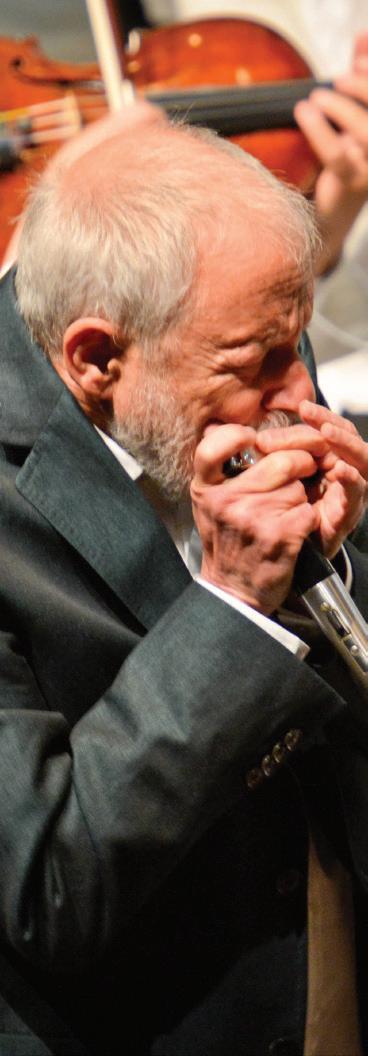
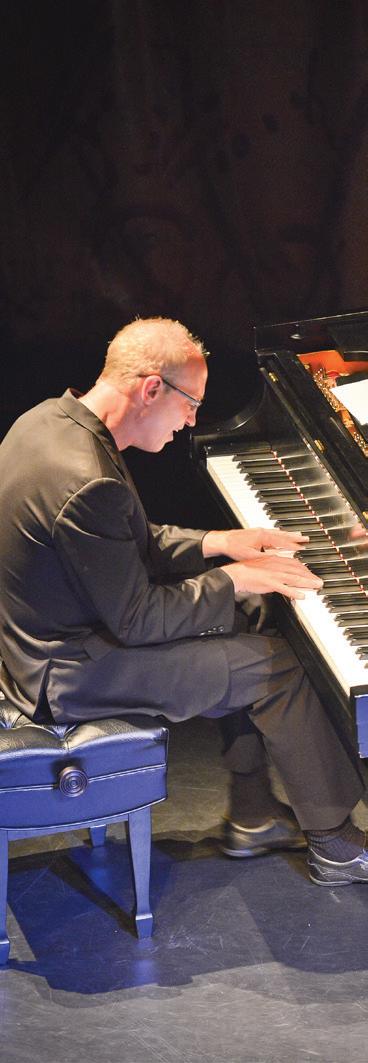
Featuring Ron Stabinsky, jazz piano, and Friends, with guest artist Adam Smale, guitar.
The program will be announced from the stage.
THURSDAY, AUGUST 1
“Let’s Jazz It Up!”
7:00 p.m. - Deane Center, Coolidge Theatre, Wellsboro, PA
BYOB
Sponsored by Hon. Daniel & Mrs. Mary Ann Garrett
Featuring the Dave Stahl Jazz Sextet
The program will be announced from the stage.
FRIDAY, AUGUST 2
“The Way Things Were”
7:00 p.m. - Commonwealth University at Mansfield, Steadman Theatre
Sponsored by Visit Potter-Tioga and Quality Inn of Mansfield
Shostakovich, Festive Overture
Schickele, Pentangle: Five Songs for French Horn and Orchestra
........................ Robert Danforth, French horn
Intermission
Schubert, Symphony No. 5
Festive Overture, Opus 96 (1954)
Dmitri Shostakovich (1906-75)
Dmitri Shostakovich today is considered the Soviet Union’s greatest composer of classical music. And yet, during his lifetime he suffered greatly from the vagaries of cultural politics of his home country under Communist rule. He leapt onto the musical stage in 1926 with a surprisingly assured First Symphony, composed as a graduation exercise at the Conservatory in Petrograd (later Leningrad, now St. Petersburg) and which soon was also performed outside of Russia. His opera Lady Macbeth of Mtensk, premiered in 1934 at Moscow’s Bolshoi Theater, enjoyed a successful run with subsequent performances, when an editorial in Pravda in 1936 with the headline “Muddle instead of Music” called a halt to the opera’s favorable reception and signaled the beginning of a campaign against the composer. It was the time of Stalin’s purges, and Shostakovich feared for his life. He withdrew his Fourth Symphony and responded to the denunciations by writing his
Fifth Symphony, by and large a more conservative work than earlier compositions. The composer referred to this work as “a Soviet artist’s creative response to just criticism.” After World War II, another campaign headed by Stalin’s cultural commissar Zhdanov got underway to rein in artistic freedom, and again Shostakovich and other composers were summoned to apologize in public for writing “formalistic” music. Somehow the composer was able to negotiate the state-imposed conditions and produce works of art that even garnered him Stalin and Lenin Prizes.
The Festive Overture was commissioned by the Bolshoi Theater to celebrate the 37th anniversary of the October Revolution. It was composed on short notice within just three days to meet the deadline. Since its premiere in November 1954, it has become one of Shostakovich’s most oft-performed works. In fact, its opening brass fanfare (which comes back at the end of the overture) was chosen as the iconic musical theme for the Summer Olympics in Moscow in 1980. Shostakovich’s friend and confidante, the musicologist Lev Lebedinsky, describes the Festive Overture as follows: “I heard this brilliant effervescent work, with its vivacious energy spilling over like uncorked champagne.” Audiences of the Endless Mountain Music Festival will agree with this assessment.
Pentangle: Five Songs for French Horn and Orchestra (“probably in the 1970s”)
Peter Schickele (1935-2024)
1 Cottonwood Grove
2 Tom on the Town
3 Noonsong
4 Ladies and Gentlemen, the Amazing and Amusing Professor Presto
5 The Riddling Knight



The writer of these program notes is a subscriber to the British weekly, The Economist, and one of the features in that magazine he always looks forward to reading is, strange though this may seem, the Obituary column. Not only are the lives of statemen and generals, of do-gooders and everyday heroes and heroines, recounted on the last page of the magazine, but, occasionally, also those of crooks and criminals. Your chronicler even recalls an obituary of a turtle, a mascot during the Crimean War of 1853-56 living an uneventful life of more than 150 years thereafter in the park of some British nobleman. Well, when Peter Schickele, professor of musical pathology at the University of Northern South Dakota at Hoople passed away at age 88 in January of this year, the Brits published a poignant obituary whose first paragraph I cannot refrain from quoting:
“His own musical career looked fairly good on paper. He had more than 100 serious works to his name. The National Symphony [in Washington, DC], the Minnesota Opera, and several string quartets had all commissioned works from him. He wrote film scores, too, including tracks for ‘Silent Running’ in the 1970s. But Peter Schickele could indulge his dreams of serious composing only because, for half a year, he was touring the concert halls of America with the much more celebrated part of his persona, a bibulous, cranky, chaotic remnant of the 18th century called P.D.Q. Bach.”
The list of P.D.Q.’s (“Pretty Damn Quick”) works is as long as it is hilarious. (His dates are often given backwards, because of his backward glances, as 1807-1742.) His prolific output was based on alluding to or quoting (some less generous minds may even say: stealing or plagiarizing) ideas from other composers. There is a “Kleine Nicht-Musik” (obviously recalling one of Mozart’s most famous compositions), a canine cantata “Wachet, Arf!”, a Christmas carol “Oh Little town of Hackensack” (located in New Jersey, for those geographically challenged), and “The ShortTempered Clavier,” piggy-backing on two famous volumes of “Preludes and Fugues” collated by his presumed father, Johann Sebastian Bach, but now provided with an added subtitle: “in all the major and minor keys except the really hard ones.” And the writer of these lines remembers having taught Beethoven’s Fifth Symphony in a seminar at the Eastman School of Music in which the students heard the work with Professor Schickele’s comments, presented in form of a sports announcer doing a “play by play” in real time. This amazing recording allowed the students to listen to the Fifth, an oft-repeated war-horse in the symphonic repertory, “as if for the first time.”
The title of Schickele’s work, Pentangle, combines a Greek root (“pent” meaning five and probably referring to the work’s five movements) with the English verb “tangle” (meaning: expect something unusual). The work was commissioned “probably in the 1970s” (according to Professor Schickele) by Tom Bacon, a horn player in the Detroit Symphony, who wanted not just a regular horn concerto but something special, “something off the wall.” Well, a visit to a magic shop gave commissioner and composer the answer…
Adding detailed program notes for Pentangle would mean spoiling the surprise that awaits the listener. Thus, the author of these lines accepts the verdict of the philosopher Ludwig Wittgenstein, uttered as proposition No. 7 (and the last) in his famous Tractatus Logico-Philosophicus: “Whereof one cannot speak, thereof one must be silent.”
Symphony No. 5 in B-flat major (1816)
Franz Schubert (1797-1828)
1 Allegro
2 Andante con moto
3 Menuetto. Allegro molto
4 Allegro vivace
“Of songs I have not written many new ones,” wrote Schubert to his friends Leopold Kupelwieser in the spring of 1824, “but I have tried my hand at several instrumental works, for I wrote two Quartets for violins, viola, and violoncello and an Octet, and I want to write another quartet; in fact, I intend to pave my way towards grand symphony in that manner. – The latest
news in Vienna is that Beethoven is to give a concert at which he is to produce his new symphony. … God willing, I too am thinking of giving a similar concert next year.” Reading between the lines, we discover Schubert confessing here to his friend that he is not quite satisfied with having mastered the “grand symphony” (even though by that time he had already composed 6 of them). And he hints at the composer who has raised the stakes in composing symphonies—grand symphonies, that is—and who is about to premiere his Ninth Symphony a few weeks later in Vienna: Beethoven. Yes, Schubert may have been the first composer—like Brahms fifty years later (see earlier in the program notes)—who felt the need to measure up to the standards Beethoven had set for symphonic composition.
Considering that Beethoven and Schubert were contemporaries and lived in the same city, it is surprising that Schubert seems not to have familiarized himself with Beethoven’s works and begun seeing them as inspiration until relatively late in his short life. It may have been around 1821 that the influence of Beethoven is felt in Schubert’s instrumental compositions, and the ensuing struggle in absorbing Beethovenian lessons can be seen in quite a number of works written at that time that were left incomplete and have come down to us as fragments and torsos. (Schubert’s Symphony No. 8, known as the “Unfinished,” is the most famous example.) Before he encountered Beethoven, Schubert looked back to Haydn and Mozart as models, and the Symphony No. 5 is a work that we might easily attribute to Haydn or Mozart, if we did not know the name of the composer.
“The Way Things Were” is the motto of this evening’s concert, and Schubert’s Symphony in the “sunny” key of B-flat major is true to this nostalgic statement. Schubert is glancing backwards to Haydn and Mozart in shaping the first movement as a transparent sonata form full of joyful melodies that are presented, as if by accident, in symphonic garb. It is Hausmusik (music for the home) transferred to the concert hall. The second movement, traditionally a slow movement, is informed by the gait of a minuet, a courtly dance in triple meter; its structure can be diagrammed as ABABA. The third movement, “officially” designated as Menuetto, is much too fast-paced to serve as a dance; Schubert moves here to the key of G minor (alluding to Mozart’s Symphony, No. The arts bring us

40, K. 550), introducing precipitous dramatic gestures and darker hues that are lightened up in the Trio (a contrasting middle section in G major). The fourth movement returns to the joyful discourse of the first movement and wraps up the symphony by intensifying its high-spiritedness.
Granted, Schubert’s Fifth may not be a “grand symphony” if measured by the Beethovenian yardstick, but the composer, at age 19 (!), has written a little gem of a symphony, Mozartian in its grace, that is simply adorable.
Reading recommendations: Otto Erich Deutsch, The Schubert Reader: A Life of Franz Schubert in Letters and Documents, trans. Eric Blom (New York: Norton, 1947), if you like to assemble a larger picture on your own; and Lorraine Byrne Bodley, Schubert: A Musical Wayfarer (New Haven and London: Yale University Press, 2023), if you prefer to have things sorted out for you. The latter is, in the words of Harry White, an Irish cultural historian and musicologist, “a biography [of Schubert] for the ages.”
SATURDAY, AUGUST 3
(“Franckly Speaking”)
7:00 p.m. - Corning Museum of Glass, Corning, NY Sponsored by Corning Incorporated
Kabalevsky, Colas Breugnon Overture Mozart, Piano Concerto No. 20
........................ Sheng Cai, piano
Intermission
Franck, Symphony in D minor
Colas Breugnon Overture (1938)
Dmitry Kabalevsky (1904-87)
Dmitry Kabalevsky was one of the leading musical figures of the Soviet Union (1917-91). He was a prolific composer, an excellent pianist, and as a pedagogue very much devoted to the musical education of children. “Beauty evokes kindness” was his motto. Unlike his colleagues Sergei Prokofiev (1891-1953) and Dmitry Shostakovich (1906-75), who were accused by censors of being guilty of “formalism” (a dirty word during Stalin’s regime), Kabalevsky embraced the ideas of “socialist realism” and managed to reconcile his creativity with an environment that reined in individual freedom of expression. The list of honors and awards he received is long, and it includes Stalin or Lenin Prizes in 1946, 1951, and 1972, and being named “Popular Artist of the Soviet Union” in 1963 and “Hero of Socialist Labor” in 1974.
The opera Colas Breugnon (also known as The Master-Craftsman of Larceny after a novel by Romain Rolland), premiered in Leningrad (today’s St. Petersburg) in 1938, is unknown outside of Russia, but its overture has become a favorite staple in the concert repertory worldwide. And, once it has been heard at the beginning of the last orchestra concert of the Endless Mountain Music Festival, the reason for its acceptance will become clear. It is a fast-paced, “rollicking” (an adjective used frequently in describing the piece) little gem, lasting just under five minutes, full of tuneful snippets and tricky rhythmic features that delight audiences. If “socialist realism” is so entertaining (and captivating audiences), it may not have been such a bad thing! It is the hope of the author of these lines that Maestro Gunzenhauser either immediately repeat the overture or return to it as an encore at the end of the concert (after conducting Franck’s, “frankly speaking,” paean to Beethoven).
Piano Concerto No. 20 in D minor, K. 466 (1785)
Wolfgang Amadeus Mozart (1756-91)
1 Allegro
2 Romanze
3 Rondo. Allegro assai
Mozart wrote more than two dozen piano concertos during his short life, but most of these were composed within a few years, from 1782 to 1786, and this has something to do with the economic and social conditions in Vienna, capital of a large multicultural and multiethnic empire at the time. After leaving the services of the archbishop of Salzburg and relocating to Vienna, Mozart became what today would be called a free-lance artist, and one way to make a living was to compose music, including piano concertos and perform them with an orchestra and himself as a soloist at special subscription concerts that flourished in Vienna during the mid-1780s.
Here is a letter dated 19 February 1785 from Leopold Mozart (Wolfgang’s father) to his daughter Nannerl, describing the pressures on composer and musicians in getting ready for the premiere of the Piano Concerto in D minor: “On Friday, we arrived at one o’clock… The copyist was still copying [K. 466] when we arrived, and your brother did not even have time to play through the Rondo, as he had to supervise the copying. … On the same evening, we drove to his first subscription concert, at which a great many members of the aristocracy were present. Each person pays a souverain d’or or three ducats for these six Lenten concerts. Your brother is giving them at the Mehlgrube and only pays half a souverain d’or each time for the hall. [There were more than 150 subscribers.] The concert was magnificent, and the orchestra played splendidly. In addition to the symphonies, a female singer from the Italian theatre sang two arias. Then we had Wolfgang’s new and very fine concerto.”
Neal Zaslaw, a musicologist who taught for many years at nearby Cornell University, attributes the decline of concert life in Vienna in the late 1780s to various political and military events resulting in an economic recession: “The combination of these factors led to a stifling of cultural life and a decline both of public concerts and of private patronage. Many noblemen let go of their private bands, opportunities for performances were drastically curtailed, and Mozart virtually stopped composing piano concertos.”
Mozart reserved the key of D minor for some of his most serious utterances: Sections in his opera Don Giovanni (the eerie music associated with the statue of the Commendatore), the aria of the Queen of the Night in The Magic Flute, and his Requiem come to mind, and K. 466 is no exception. The first movement is agitated and restless and lights up only when a secondary theme sounds in the relative major key. The second movement in B-flat major, called “Romanze,” is, for the most part, true to its name, flaunting several lyrical melodies that are tossed back and forth between soloist and orchestra, but before sounding one of its peaceful lyrical melodies for a last time, it erupts, suddenly and without any transition, in a stormy and passionate outburst in the key of G minor. The last movement returns to the dark key of D minor and the ominous and restless quality of the first movement, but after the cadenza (a section improvised by the soloist) the sky brightens with a coda (or final wrap-up) in D major that we may describe as a jubilant “happy end.”
In parenthesis: At the premiere, Mozart improvised his own cadenzas, and he never passed them on to posterity in a notated version. Later pianists who performed the D minor Concerto thus fashioned their own cadenzas: Beethoven, Hummel, Brahms, Clara Schumann, Busoni, and, in our own time, Cornell professor Malcolm Bilson. We are looking forward to knowing how Sheng Cai, who performs K. 466 at the Endless Mountain Music Festival, will handle the improvisatory sections in the various movements: Will it be Beethoven’s, Hummel’s. Brahms’s, etc., or his own?
The Italian composer Luca Lombardi (1945-), a good friend of the writer of these lines since 1982, offers the following thoughts on Mozart: “There is nothing more beautiful than to overcome a bout of depression by listening to a wonderful piece of music, especially one by Mozart who is so balanced and yet full of contrasts. Joy, sadness, seriousness, fun, elegance—all these characteristics
and many more are contained in his music. Mozart the antidepressant—he is so much better than modern pharmaceuticals, because the latter numb the depression but do not remove its cause; they only cover it up. But Mozart’s music is the means and the goal of removing depression, for what better occupation can there be than to devote oneself to the music of such a genius. Here I envy musicologists, … since they can turn the in-depth study of great creations into their purpose of life.”
César Franck (1822-90)
1 Lento – Allegro non troppo
2 Allegretto
3 Allegro non troppo
Opera reigned supreme in France in the nineteenth century, especially grand opera, with Meyerbeer, Halévy, Rossini, and later Verdi as major suppliers of operatic fare, with star singers worshipped like rockstars, and a mise-en-scène that tickled the senses. Opera was an art and a business, and very successful in both aspects. In comparison, instrumental music ranked lower, and performance opportunities were relatively sparse. (Berlioz always had to do some heavy lifting to get his symphonic works performed in Paris: copying parts, gathering musicians, renting halls, organizing publicity, etc.) That would gradually change in the last third of the nineteenth century. Several French composers got together in 1871 (Franck, Lalo, Massenet, and Saint-Saëns among them) to lay the groundwork for the Société Nationale de Musique, a concert society devoted to the performance of works, especially instrumental music, by French composers. The Society became the umbrella organization under which French symphonists and French symphonies could flourish. In fact, four major symphonies were created in the 1880s that equal those written by German-Austrian composers in grandeur, musical substance, and orchestral splendor: Camille Saint-Saëns’s Symphony No. 3 (with organ) of 1886; César Franck’s Symphony in D minor (1886-88); Vincent d’Indy’s “Mountain” Symphony (with piano obligato) of 1886, and Ernest Chausson’s Symphony in B-flat major (188990). Note: Saint-Saëns’s Symphony No.3 can be heard on a Naxos CD (8.550138), recorded in 1988, with the CSR Symphony Orchestra (Bratislava), Stephen Gunzenhauser conducting. Franck’s Symphony, with which the Endless Mountain Music Festival orchestra concludes the 2024 season, received mixed reviews when it premiered in Paris in 1889. The Society of National Music, by that time, had split over the issue of giving foreign-born composers a hearing in its concerts, and Franck, had come out, together with his students Duparc and d’Indy, in favor of inclusiveness and diversity. But for some more nationalistically inclined minds that meant opening the door to Germanic influences, especially Wagner. Franck’s Symphony clearly reveals an indebtedness to Wagner’s chromatic harmonic language and expansion of tonality, and more conservative minds took issue with it in statements that today can be accepted for their entertainment value rather than their correctness. Here are a few samples: [the symphony is] “the affirmation of impotence taken to the point of dogma”; [Franck has little to say but saying it] “with the conviction of the Pope pronouncing on dogma”; and [he has made the excusable mistake of] “aspiring to a pedestal a little too high for him.” Well, Franck’s Symphony has, since those voices were uttered, become a most beloved staple of the orchestral repertory, and audiences in the Twin Tiers can now judge for themselves.
Picking up the key of the Mozart concerto heard before intermission, Franck’s D minor Symphony, in some ways proceeds along similar lines as the concerto: A tragic, sometimes gloomy, tone prevails in the first movement, the middle movement combines two different characters (slow movement and scherzo), and the finale turns into a joyful celebration in D major.
Franck’s program notes in a letter to a friend even reveal another reference: Beethoven’s Ninth, also a work in D minor that ends in D major: “At the end of the first movement there is a recapitulation, exactly as in other symphonies, for the purpose of more firmly establishing the main subjects, but here it is in an alien key. Then follow an andante [recte: allegretto] and a scherzo. It was my great ambition to construct them in such a way that each beat of the andante movement
should be exactly equal in length to one bar of the scherzo. With the intention that after the complete development of each section one could be superimposed on the other. I succeeded in solving that problem. The finale, just as in Beethoven’s Ninth Symphony, recalls all the themes, but, in my work, they do not make their appearance as mere quotations. I adopted another plan and made each of them play an entirely new part in the music. It seems to me successful in practice, and I fancy you will be pleased.”
In other words, Franck is trying to outdo Beethoven here, who in many of his works was concerned with establishing structural unity across a multi-movement composition. The striving for unity by way of cyclic procedures (previously heard themes are brought back) generates here an effect similar to the end of a play, when the various characters, with theatergoers applauding, take their bows after the curtain call.
It is an effect appropriate for concluding the Endless Mountain Music Festival in the summer of 2024.
Au revoir! Auf Wiedersehen! See you again next year!
But there is one more concert—and this is really the concluding event of this summer’s music festival:
SUNDAY, AUGUST 4
“It's Showtime!”
2:30 p.m. - Corning Museum of Glass Auditorium Free
Sponsored by Corning Incorporated, Community Foundation of Elmira-Corning and the Southern Finger Lakes, the Rotary Club of Corning, and Laura Douglas and the ARTS Council of the Southern Finger Lakes
Featuring Anthony Nunziata with Orchestra
The program will be announced from the stage.
Jürgen Thym, Professor Emeritus of Musicology at the Eastman School of Music (University of Rochester), has published on the music, mostly Lieder, of Beethoven, Schubert, Schumann, Wolf, Weill and others (co-authoring several essays with the late Ann C. Fehn). He edited the anthology 100 Years of Eichendorff Songs, co-edited several volumes in the Arnold Schönberg Collected Works Edition, and was co-translator of music theory treatises by Kirnberger (Die Kunst des reinen Satzes in der Musik) and Schenker (Kontrapunkt). More recent accomplishments include Luca Lombardi: Construction of Freedom (edition of the composer’s selected writings); Of Poetry and Song: Approaches to the Nineteenth-Century Lied; and Mendelssohn, the Organ, and the Music of the Past: Constructing Historical Legacies. He edited the autobiographies of the composer Samuel Adler (Building Bridges with Music) and the arts administrator Robert Freeman (Commitment). From 1982 to 2000, Thym was the chair of musicology at the Eastman School of Music.
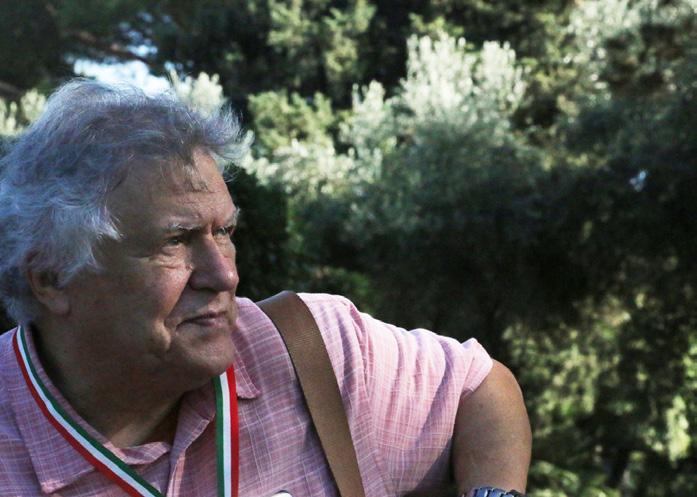


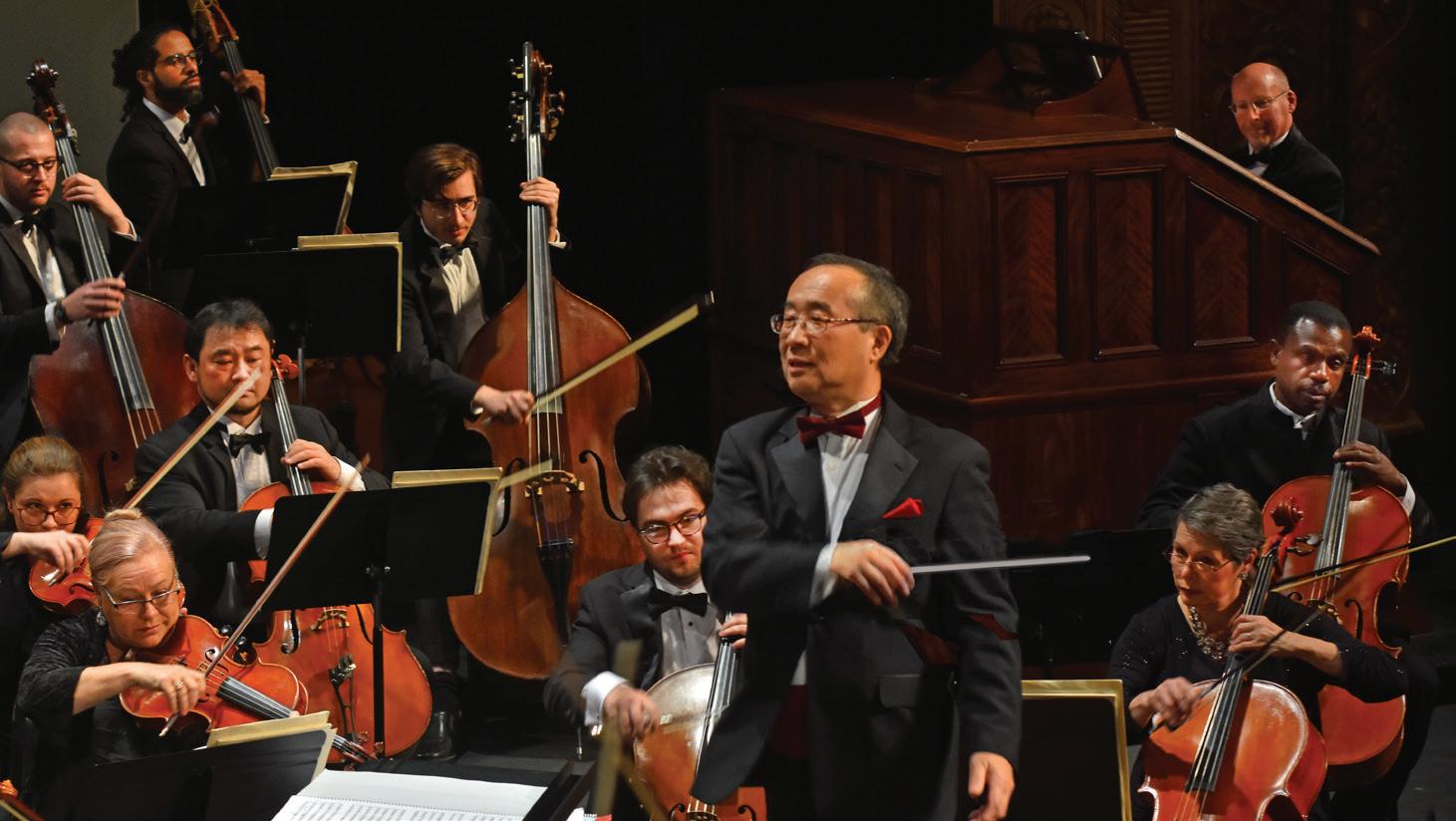


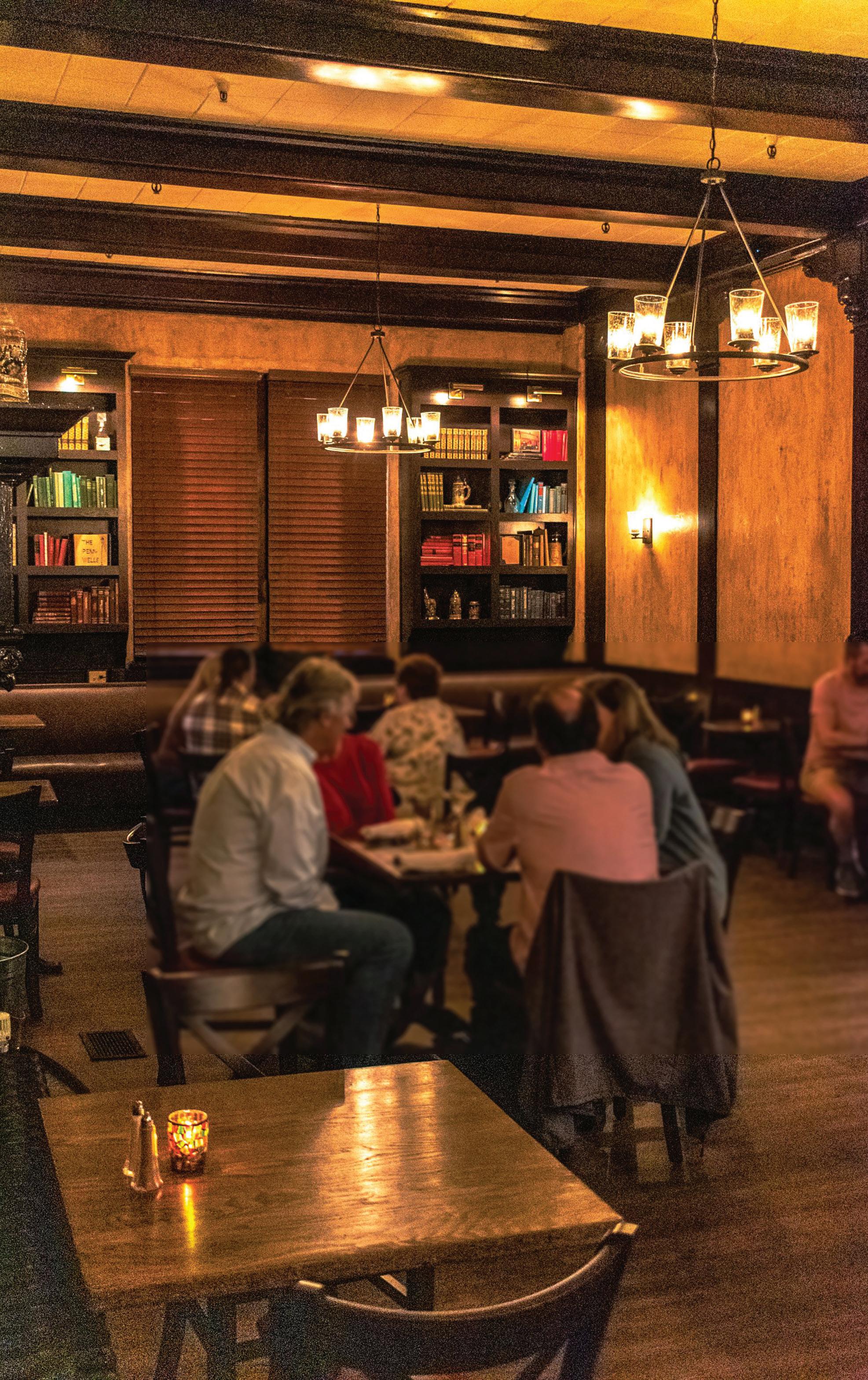


Jeffrey Biegel
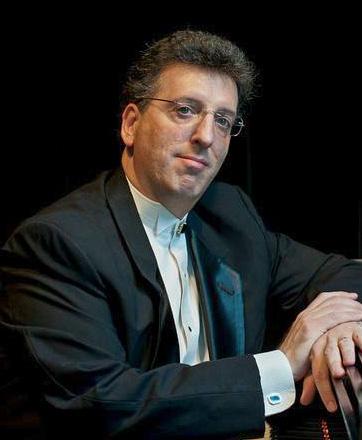
In an age when many artists’ fortunes begin with a meteoric ascent and quickly cool with the inexorable free fall, pianist Jeffrey Biegel has managed to buck that trend, fashioning a career of steady success studded with concerts at major venues with major orchestras, a Grammy-winning recording, and more than twenty-five commissioned works by living composers. His life takes its roots from age three, barely able to hear or speak, until corrected by surgery. The “reverse Beethoven” phenomenon explains his lifelong commitment to music, having heard only vibrations in his formative years. During the pandemic year of 2020, he focused on composing original “Waltzes of Hope;” “Sonatina;” and “Three Reflections: JFK, RBG and MLK,” for solo piano; and for piano and orchestra, orchestrations by Harrison Sheckler. The next year saw the world premieres of his “Reflection of Justice: An Ode to Ruth Bader Ginsburg” with the Dallas Symphony Orchestra, and Ellen Taaffe Zwilich’s “Remembering Ruth Bader Ginsburg” for mezzo-soprano, piano, and orchestra in tribute to the late Supreme Court Justice Ruth Bader Ginsburg, featuring mezzosoprano Denyce Graves, as well as the world premiere of Ellen Taaffe Zwilich’s “Shadows” newly arranged for piano and seven players with the Idaho State Civic Symphony. In 2022, he premiered Jim Stephenson’s Piano Concerto; Daniel Perttu’s “A Planets Odyssey” for piano and orchestra; Farhad Poupel’s “The Legend of Bijan and Manijeh” for piano, orchestra, and chorus; his own concerto, Three Reflections: Freedom (JFK), Justice (RBG) Equality (MLK); and Christopher Marshall’s “Thanksgiving Variations on ‘We Gather Together.’” For 2023, The fifty-state Rhapsody National Initiative begins, with the Utah Symphony leading a three-season effort with Peter Boyer’s Rhapsody in Red, White & Blue, with a world premiere recording of the new Rhapsody with Peter Boyer conducting the London Symphony Orchestra for a February 2024 Naxos digital release. The 2024-25 season foresees a new work for piano and orchestra by Adolphus Hailstork with the Pacific Symphony, Carl St. Clair conducting, and Grammy winning singer/songwriter Melissa Manchester’s “AWAKE” for piano and orchestra (premiere tba).
Considered the most prolific artist of his generation, Moravian College in Bethlehem, Pennsylvania, conferred the Honorary Degree of Doctor of Humane Letters upon him in 2015, for his achievements in performance, recordings, chamber music, champion of new music, composer, arranger, and educator. In 2019, Kenneth Fuchs’s Piano Concerto: Spiritualist with the London Symphony Orchestra led by JoAnn Falletta received a Grammy Award for Best Classical Compendium, featuring Jeffrey as its soloist. In 2019, the first digital recordings were released on his Naturally Sharp label: “Cyberecital: An Historic Recording,” “A Pianist’s Journey,” and the September 2021 release of George Gershwin’s Rhapsody in Blue 1924 version with the Adrian Symphony Orchestra, Bruce Kiesling conducting.
Jeffrey created the first largest consortium of orchestras in 1998 for Ellen Taaffe Zwilich’s “Millennium Fantasy” premiered with the Cincinnati Symphony Orchestra in 2000; followed with Charles Strouse’s Concerto America with the Boston Pops; Lowell Liebermann’s Concerto no. 3 with the Milwaukee Symphony Orchestra; William Bolcom’s “Prometheus”
for piano, orchestra, and chorus with the Pacific Symphony and Pacific Chorale; Richard Danielpour’s “Mirrors” with the Pacific Symphony; Ellen Taaffe Zwilich’s “Shadows” with the Louisiana Philharmonic Orchestra; Jake Runestad’s “Dreams of the Fallen” with the Louisiana Philharmonic Orchestra and Symphony Chorus of New Orleans; Lucas Richman’s Piano Concerto: In Truth with the Knoxville Symphony Orchestra and recorded with the Pittsburgh Symphony Orchestra; and Kenneth Fuchs’s Piano Concerto: Spiritualist with the Springfield Symphony Orchestra (MA). He also premiered and recorded Giovanni Allevi’s Concerto for Piano and Orchestra and commissioned Christopher Theofanidis’s Concerto no. 2 for Piano and Orchestra with the Harrisburg Symphony Orchestra; the Peanuts Concerto by Dick Tunney, based on music by Vince Guaraldi; Jimmy Webb’s “Nocturne for Piano and Orchestra” and PDQ Bach’s Concerto for Simply Grand Piano and Orchestra by Peter Schickele with the Colorado Symphony Orchestra. Bringing new music to youth orchestras saw the world premiere of Daniel Dorff’s Piano Concerto with the Etowah Youth Orchestra, conducted by Michael Gagliardo.
He studied at the Juilliard School with Adele Marcus, herself a pupil of Josef Lhevinne and Artur Schnabel, and is currently on faculty at the Conservatory of Music at Brooklyn College.
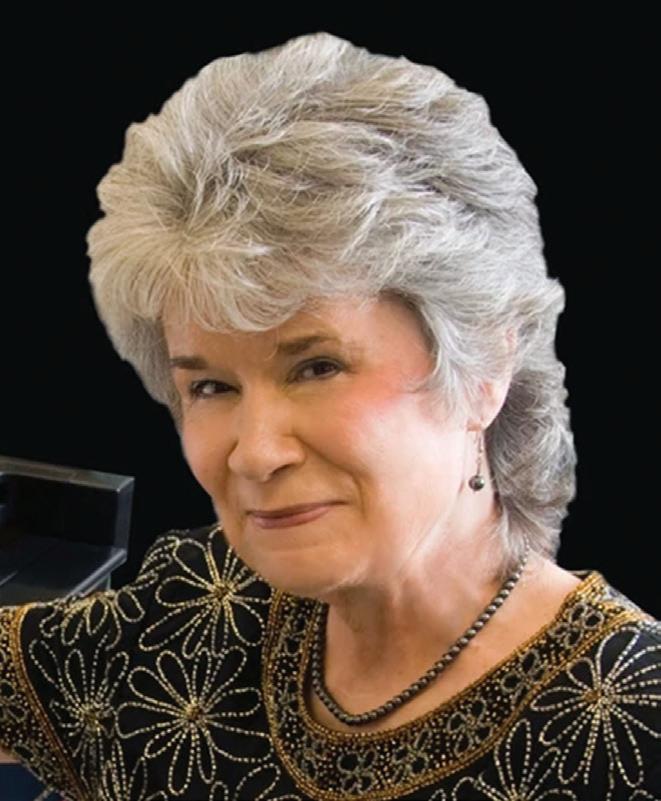
Peggy Dettwiler is professor of music and director of choral activities at Mansfield University, where she conducts the Concert Choir, Festival Chorus, and Chamber Singers, and teaches choral conducting and methods. She holds the doctor of musical arts degree from the Eastman School of Music in Rochester, New York. She also has a master of music degree in choral conducting from the University of Texas at San Antonio and a master of music degree in music education from the University of Wisconsin in Madison. In 2010, Peggy received the Elaine Brown Award for Choral Excellence from the Pennsylvania Chapter of the American Choral Directors Association, and she placed second in 2011 and 2013 for the American Prize for Choral Conductors at the College/University level. Peggy has served as a guest conductor and lecturer throughout the country and has given presentations at numerous NAfME and ACDA Conventions. She has produced two DVDs, one entitled, “Developing a Vocal Color Palette for Various Choral Styles” and the second, “Sing in Style.” Peggy made her conducting debut in Carnegie Hall in January of 2014 and presented an interest session at the World Choral Symposium in Seoul, Korea, in August of 2014. Peggy received the Presidential Coin for Excellence from General Francis Hendricks, president of Mansfield University, and was designated “2015 Honored Artist of the American Prize.” In 2016, she served on the jury for the World Choir Games in Sochi, Russia, and was one of ten conductors from seven countries, who participated in the course, CONDUCTING 21C: Musical Leadership for a New Century, held in Stockholm, Sweden. In January of 2017, Peggy served as Artistic Director for the concert, “Of War, Peace, and the Power of Music,” held in Carnegie Hall and sponsored by Performing Arts Educators.

Ron Stabinsky

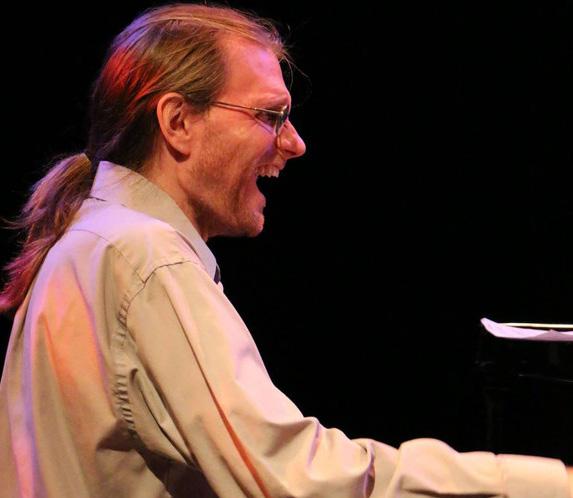
Ron Stabinsky enjoys working in many stylistically diverse musical contexts throughout the United States and Europe with a wide variety of other musicians and ensembles. These include free-improvising saxophonist Jack Wright, lead trumpet legend Dave Stahl, bass trombone virtuoso David Taylor, NEA Jazz Master David Liebman, phenomenal drummer/composer Christian Lillinger’s Open Form for Society, and innovative trumpeter/ composer Peter Evans. Festival appearances include Newport Jazz Festival (Rhode Island), Big Ears Festival (Tennessee), North Sea Jazz Festival (Netherlands), Moers Festival (Germany), Donaueschingen Music Days (Germany), JazzFest Berlin (Germany), Jazzfestival Saalfelden (Austria), Jazz Jamboree Festival (Poland), and Jazz and More Festival Sibiu (Romania). In 2016, his debut album, Free for One, received four stars in DownBeat and tied for number one debut of the year in the 2016 NPR Music Jazz Critics Poll. He is currently a regular member of numerous groups including Mostly Other People Do the Killing, Relâche, Grassy Sound, and the Meat Puppets.
Dave Stahl Trio
Born in Reading, Pennsylvania, Dave Stahl studied trumpet with Walter Gier and attended Penn State University, graduating in 1970 with a degree in Music Education. From 1970 to 1973 he served in the U.S. Army, where he performed as a soloist with the Army Band— lead trumpet for the Army Blues and principal trumpet for the White House Herald Trumpets. After his discharge, he toured and recorded as lead trumpet with the bands of Woody Herman (1973-1975), Count Basie (1975), Buddy Rich (1977-1978), Liza Minnelli (19871999), Larry Elgart, and Toshiko Akiyoshi. In addition, he played lead trumpet for the Broadway productions of Damn Yankees (19941995), and Saturday Night Fever (1999-2000), among other shows. In 1987 Dave formed his own record label, Abee Cake Records, which records the work of both of his bands, the Dave Stahl Band and the Sacred Orchestra.
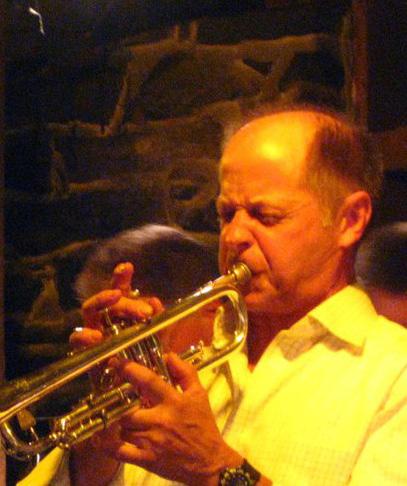
Sheng Cai
Recently described as “having the inner passion paired with Rubinstein’s nonchalance” by Thüringer Allgemeine in Germany, Canadian pianist Sheng Cai has embraced the keyboard tradition which epitomizes the greatness of the romantic virtuoso. His performances of major keyboard works of the past centuries have touched audiences and won the praise of critics on four continents. Opera Plus review in Prague praised his playing for “Accurate interpretation and great interplay...excellent technique, spontaneous rhythmic feeling and the use of the maximum sound color of the piano,” and he was described as a pianist “with great confidence... gave more lucidity, color and power” by the Birmingham News. Sheng Cai has been honored with a number of prizes and awards and continues to push the boundaries in interpreting both the established and rarities of the piano literature.
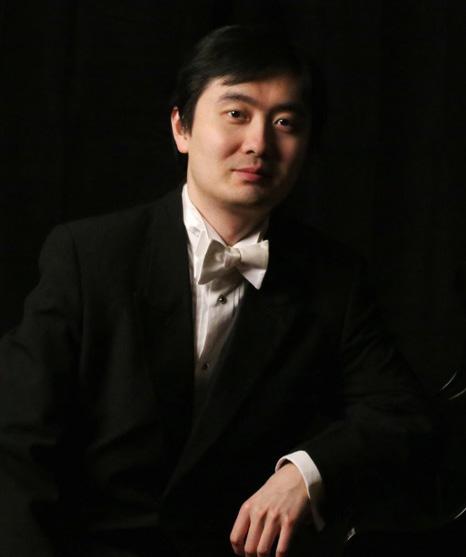
Since his debut with the Toronto Symphony Orchestra at just fifteen years old, Sheng has performed a broad spectrum of concerto repertoire—Bartok, Beethoven, Brahms, Chopin, Liszt, Gershwin, Grieg, Mendelssohn, Mozart, Prokofiev, Rachmaninoff, Saint-Saens, Schumann, Shostakovich, and Tchaikovsky, with invitations to dozens of orchestras worldwide as a guest soloist. Recent concerto performances include invitations to perform with the Toronto Symphony, Quebec Symphony, Calgary Philharmonic, Windsor Symphony, Canton Symphony of Ohio, Fort Collins Symphony, New Bedford Symphony, Irving Symphony of Texas, and with Shanghai Symphony, Shenzhen Symphony, as well as with Philharmonisches Orchester Erfurt in Germany, Krakow Philharmonic of Poland, North Czech Philharmonic, Jalisco Philharmonic and Orquesta Filarmonica Boca del Rio of Mexico, Orquesta Filarmonica de Bogota in Colombia, among many others. In Canada, he was also invited to perform with the Vancouver Symphony for the lunar New Year Gala Concert and has performed with numerous regional orchestras in the US and Canada from coast to coast such as Kingston, Kamloops, Folsom Lake symphonies, and Glacier Symphony of Montana. He has recently worked with many conductors such as Keith Lockhart, Yoav Talmi, David Lockington, Robert Moody, Charles Olivieri-Munroe, Myron Michailidis, Donato Cabrera, Robert Franz, Dina Gilbert, Guoyong Zhang, Marco Parisotto, and Eckart Preu.
In solo recitals, Sheng Cai has been heard in many prestigious venues in North America, such as Steinway Hall in New York, Jordan Hall in Boston, Chicago’s International Music Center, the Cleveland Play House, the Modern Art Museum in Fort Worth, the Alys Stephens Center in Birmingham, CBC’s Glenn Gould Studio in Toronto, and other distinguished venues in Stratford, Elora, Montreal, and Winnipeg. In China, he inaugurated the Ningbo concert hall, giving both recitals and concerto performances. As a chamber musician, he has collaborated with a number of fine artists, including the Enso String Quartet. Many of his performances have been broadcast across North America on CBC Radio Canada and WCLV Radio station in USA.
Sheng is a passionate recording artist. His first recording was a CD of works by Mozart and Martinu for the Canadian Broadcast Company. His most recent Schumann and Liszt CD releases on Centaur and ATMA classique labels gained international acclaim from the American Record Guide, MusicWeb International in UK, the WholeNote magazine in Canada, and Fanfare magazine in the US.
He was a top-prize winner at many competitions throughout his teenage years, including the Montreal Symphony Orchestra Competition (Concours OSM), Toronto Symphony

Piano Competition, the International Young Artists Competition of Colorado, the Bay State competition in Boston, and was the youngest finalist and special prize winner at the Bösendorfer International Piano Competition in the US.
Sheng is instrumental in advocating many neglected works that are peaks of the piano literature, works by composers such as Enescu, Kabalevsky, Kapustin, Medtner, Morawetz, Villa-Lobos, and a number of his own works frequently appear on his concert programs. His creative programming have made audiences aware of such treasures of the piano literature, which deserve a wider audience.
Sheng began his studies in Canada and the US where he was a student at the Royal Conservatory of Music in Toronto and the Juilliard School’s pre-college division in New York. He received his bachelor of music degree under full scholarship at the New England Conservatory in Boston. His teachers and mentors include pianists Anton Kuerti, Gary Graffman, and Russell Sherman.
Anthony Nunziata
Dubbed “America’s new romantic singing sensation,” tenor Anthony Nunziata is the Brooklyn-born, Nashville-based singer and songwriter who brings his soulful voice to classic jazz, pop standards, classical-crossover, and his timeless original music.
Anthony says, “I’m in the business of making people feel good, making people happy. I’m grateful I get to tell stories for a living through lyrics and music. To make people laugh, cry, feel something—there’s nothing like it.”
He has performed over 400 concerts over the past decade headlining major performing arts centers, theaters, symphony concert halls, jazz clubs and private events across the country and around the world. The Brooklyn-born, classically trained singer is hailed by Broadwayworld as “an explosion of love and entertainment.” Anthony recently co-headlined Carnegie Hall for two sold-out concerts with the New York Pops Symphony Orchestra. Anthony recently appeared in the Netflix film The Last Laugh opposite Chevy Chase and Richard Dreyfuss.
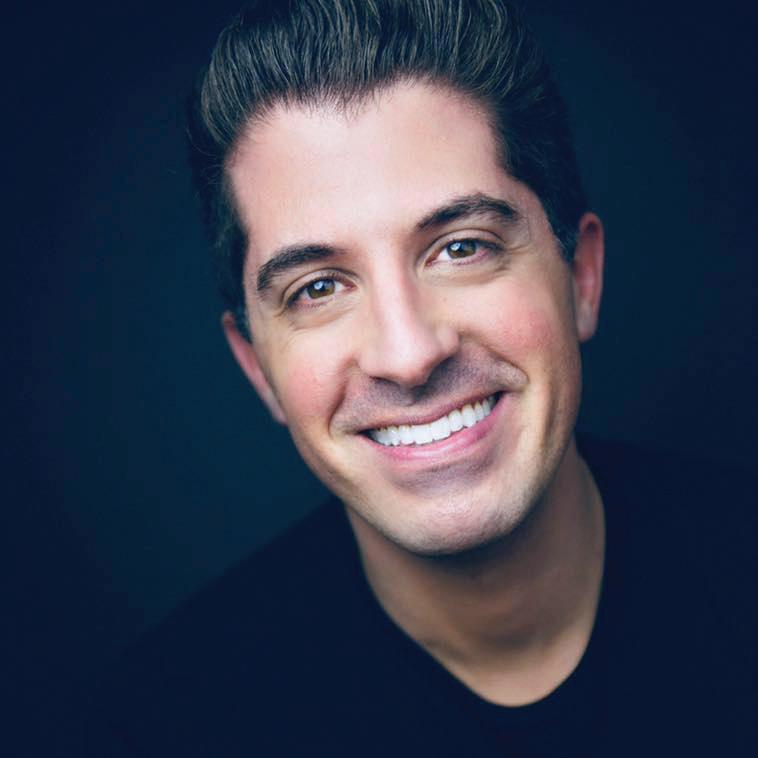
Anthony’s recent original songs include cowriting collaborations with Rudy Perez, Blessing Offor, Tigirlily, Victoria Shaw, Jim Brickman, Jackie Evancho, Jeff Franzel, Tom Kimmel, Maria Christensen, Nina Ossoff and Porter Carroll Jr., Kathy Sommer, Jasmine Power, and Dan Godlin.
His songs have recently been featured on MTV, Comedy Central, CBS News, NBC News, and Good Day NY. His original pop song “The Gift Is You”–which he wrote honoring his mother’s battle with breast cancer (she is now cancer-free)–is currently being used as an anthem for the Susan G. Komen Foundation.
Anthony recently released his debut jazz/pop release The Love Album, now available on all streaming services and autographed CDs available for purchase at his website. He and his Grammy-winning team of musicians re-imagine “Unchained Melody,” “Can’t Take My Eyes Off Of You,” “Can’t Help Falling In Love With You,” “When I Fall In Love,” “Somewhere,” originals including “Will You Be My Everyday?” and many more.
Anthony’s acclaimed debut Christmas album Together for Christmas won Broadwayworld’s “Best Holiday Album of the Year.”
Anthony has brought his fresh take on classic & contemporary songs as well as his movie-bound original tunes across the United States and around the world to performing arts centers, theaters, and private events, as well as intimate jazz clubs and symphony concerts with orchestras such as the New York Pops, Detroit Symphony, Cleveland Pops, Colorado Symphony, Lancaster Symphony, Kravis Pops, Annapolis Symphony, Plymouth Symphony, Cape Cod Symphony, Toledo Symphony, Edmonton Symphony Orchestra, and more. He has performed at private events across the United States and recently in England, Spain, Italy, and Singapore.
Anthony studied music, acting, and directing at Boston College, and trained in improv comedy at the famed Upright Citizens Brigade in New York City. Featured on Good Morning America and The Rachael Ray Show, Anthony is most proud of his “Arts Matter!” Educational Outreach Initiative and Master Class Workshops that educate and inspire students to fearlessly pursue their passions.
At age eleven, Adam Smale distinctly remembers announcing to his parents one morning that he had made up his mind that he wanted to be a professional guitarist. Within a year that vision came true, much to the surprise of the young guitarist and his parents.
Guitarist/composer Adam Smale tells stories with his music. His “pen” is a personally designed seven-string guitar. His tales are woven from his rich imagination stoked by a wide variety of musical influences and his latest CD, Out of the Blue, fully attests to his compelling artistry.
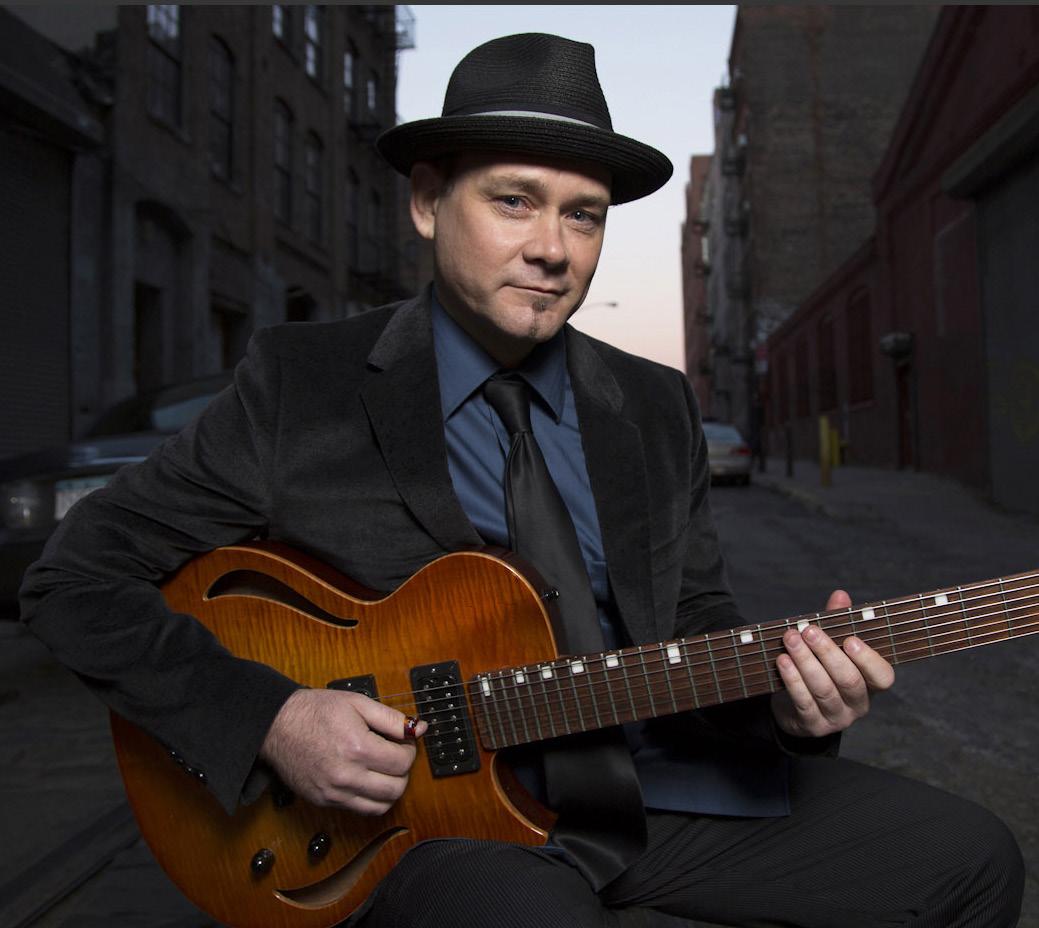
Raised in a small working-class community in Northern Ontario, Adam’s musical roots first began in country and bluegrass. Too small at the tender age of seven to handle the five-string banjo, he took up the guitar and a lifelong bond grew and a personal commitment to the instrument cemented. By the age of twelve, he was performing professionally with local groups and by fourteen, he was on his way to becoming a seasoned professional, performing in clubs, bars, community events, weddings, and private parties.
During these formative years, Adam branched out to a variety of musical influences. But it wasn’t until his years at Humber College that he discovered jazz, and his path took a profound turn. Rather than abandoning his origins—or his earlier influences like Chet Atkins, Albert Lee, Eddie Van Halen, Flatt & Scruggs—Adam began to forge a new direction for himself in the classic tradition of true jazz expression. Charlie Parker, Ed Bickert, Pat Metheny, John Scofield, and pianist Bill Evans became important influences. Adam eventually performed all over the globe, including South America, India and the Middle East, as well as numerous cross-Canadian tours gaining even more experience. With Toronto as his home base, he performed consistently with his own trios and quartets and was a regular presence at the acclaimed Toronto Downtown Jazz Festival. Adam’s debut CD, Fun City, was released in Canada in 2000 to extensive radio play and critical acclaim and was also featured at the prestigious Grand Prix du Jazz at the 2002 Montreal Jazz Festival. Eventually it was the playing style of the legendary Lenny Breau that had the greatest impact. Not only in the direction of his music, but in the physical means by which he would


choose to express it. Returning to the thumbpick of his early years, Adam began to employ a fingerstyle technique, puzzling together his current sound. “It was stepping back and moving forward at the same time. Fingerstyle is definitely a softer approach,” he says, “but at times I can coax out more sensual sounds.” To complete the process, Adam designed his own seven-string guitars and now primarily uses his custom-built electric and a self-built classical guitar as his two instruments of choice.
In 2007 Adam left for Michigan where he received his masters degree in jazz performance at Western Michigan University in 2009. It was during this time he discovered a goldmine of jazz guitar masters, including, Pat Martino, Tal Farlow, and Jim Hall. Adam then decided to transplant himself to the Jazz Mecca, New York City, where he now resides.
Over the years he has conducted master classes and seminars at colleges, universities, and private music schools in the US and Canada. He has taught at Guitar Workshop Plus, National Guitar Workshop, and has maintained private students over the years. Adam has also written and published New Approach to Scales for Guitarists: A Practical Modern Direction, proposing a new way for guitarists to organize, think about, and implement music scales on guitar. The book’s material stems from Adam’s personal research over many years and a main component to his sound
Shortly after being signed to Ropeadope Records, Adam’s first US CD, Out of the Blue, was released. This recording demonstrates his enormous versatility and virtuosic artistry on guitar, the album also showcases Adam’s remarkable compositional skills, weaving intricate and compelling stories in the classic jazz tradition of the masters. Adam is focusing on touring, composing new material, honing the songs before live audiences, and looking to record more works soon.


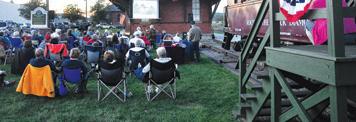
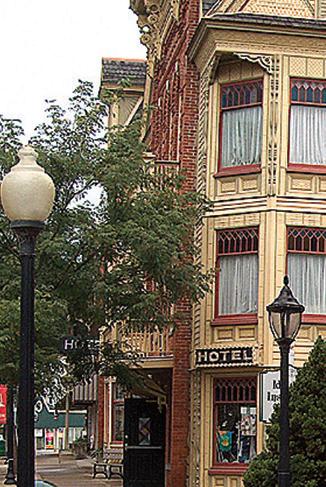


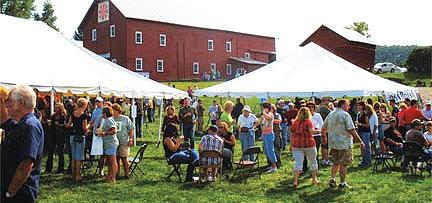




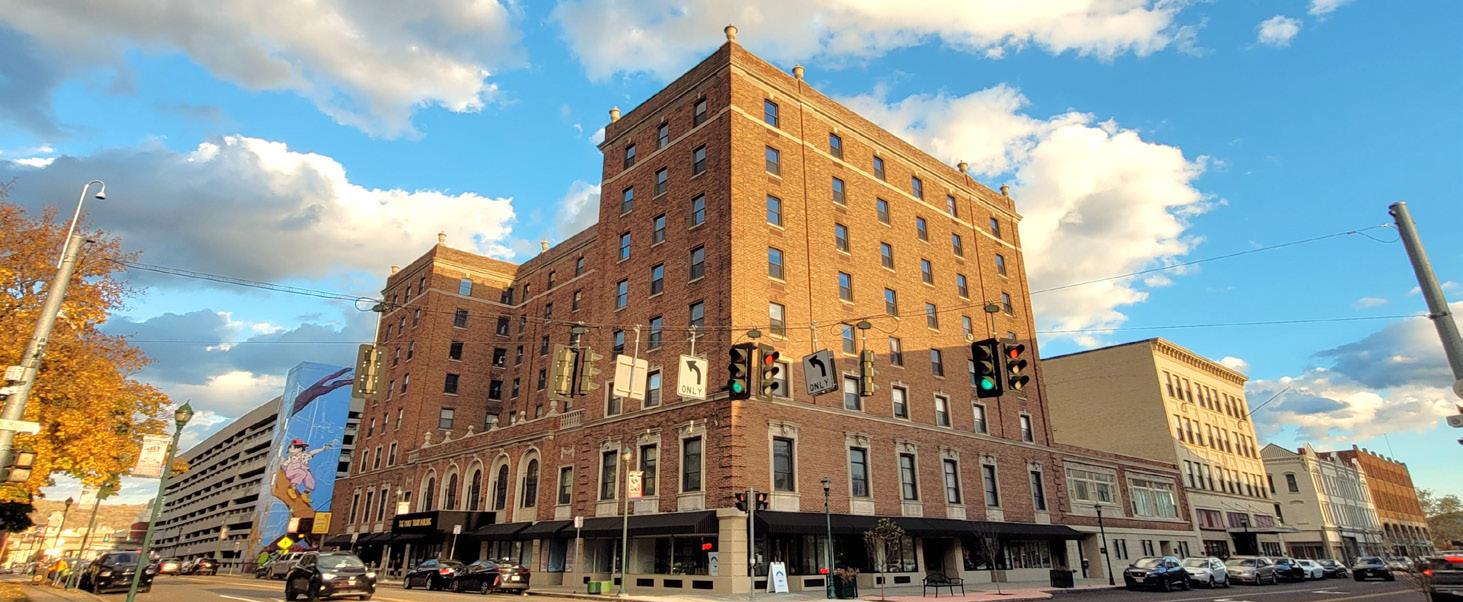
Welcome to the iconic Mark Twain Building, a former hotel dating back to 1929, now boasting all-new luxury apartments in the heart of Downtown Elmira’s rising Arts & entertainment district! The 3rd through 8th floors have been entirely renovated and rented, with great attention to detail by incorporating the historic features of the building into a modern, 21st century “urban-chic” aesthetic.





Construction of the 2nd floor is currently underway, with exquisite 1, 2, and 3 bedroom apartments soon to be available in what were the original ballrooms and parlors of the hotel! Each of these brand-new apartments include:
- All-new appliances - In-unit laundry - Custom lighting fixtures - Discounted high-speed internet - All building utilities included - Secure covered parking - New AC & heating systems - On-site office & full-time maintenance




Located at the center of Elmira’s growing downtown district, the building is also home to Beijing Gardens Restaurant and The Juice collective, with numerous other restaurants within just one block, such as Siam Elephants, WMC North, Los Ponchos, and the new Centertown Social Club. Entertainment can also be found just one block away, including the Clemens Performing Arts Center, and the First Arena for sports and events. Numerous coffee shops, restaurants, and bars are only a short walk away, and a short drive from Elmira’s LECOM campus, Arnot Ogden Medical Center, shopping centers, and nature trails.
Shawn Alger, bass
Shawn Alger is a freelance bassist equally at home with baroque performance practices and music of the classical canon. As an in-demand performer in the Washington, DC, area, he has performed with modern and period ensembles such as the National Symphony Orchestra, American Bach Soloists, Washington Bach Consort, Annapolis Symphony, and National Philharmonic. He is the double bass instructor at Washington Adventist University and has been a guest lecturer and clinician for numerous schools, universities, and ensembles throughout the country.
Shawn earned his doctor of musical arts degree from the University of Maryland in 2015, where he was the recipient of the Pomeroy Prize for excellence in the performance and scholarship of Baroque music. In addition to his busy performance and teaching schedule, Shawn is also the editor of numerous works of baroque music, transcribed for modern double bass, which were the focus of his presentation at the International Society of Bassists Convention in 2017. His primary teachers include Anthony Manzo, Jeffrey Weisner, Tyler Abbott, and Thomas Derthick.
Charlie Alves, viola
Currently based in Pittsburgh, Charlie enjoys a versatile career as a freelance musician and music teacher. He is a member of numerous professional symphonies in Pennsylvania, such as the Westmoreland Symphony, Johnstown Symphony, and the Altoona Symphony, where he is principal violist. Outside of the orchestral setting, he has performed in concerts with world-renowned singers such as Josh Groban and Il Volo. Charlie has kept modern music alive and well by playing in recordings for musicians such as the folk-rock band The New 76ers and the contemporary composer Scott Slapin. Additionally, he performed Michael Kimber’s Caprice in G at the 2016 ASTA conference, showcasing a virtuosic work by a living composer. Charlie studied music and international affairs at Florida State University from 2012 to 2016 and got his master of music in viola performance at Penn State University in 2019. He then went on to study at Carnegie Mellon University for three years as an advanced music studies student. He has attended a number of summer festivals such as National Repertory Orchestra, Sewanee Summer Music Festival, and Green Mountain Chamber Music Festival. When he is not performing, Charlie enjoys teaching private lessons in his studio to violinists and violists of all ages.
Caroline Argenta, viola–principal
Brazilian violist Caroline Malinski Argenta holds a master in music—viola performance degree from Illinois State University under Dr. Kate Lewis’ orientation. Before that, she received her bachelor of music degree from Universidade Federal do Rio Grande do Sul, Brazil, under Prof. Hella Frank’s guidance. Carol has been performing as principal and guest violist in all the major orchestras in Brazil, including Sphaera Mundi Orchestra, Paraná Symphony Orchestra, Camerata Florianópolis, and Unisinos Anchieta Chamber Orchestra, with which she recorded a CD in 2012. In the United States, she has performed as a guest violist in many orchestras, including Illinois Symphony Orchestra, Peoria Symphony Orchestra, Heartland Festival Orchestra, and more recently at the Endless Mountain Music Festival. She won the Young Soloist Competition of the Sesi/Fundarte Orchestra, performing the piece Brasiliana by Edino Krieger with this orchestra. Carol
has appeared in many music festivals as a student, where she had the opportunity to play for Charles Pikler (Chicago Symphony Orchestra), Ori Kam (The Jerusalem Quartet), Walter Küssner (Berliner Philharmoniker), among others. She currently lives in Rochester, New York, with her husband and two kids, Clara and Leonardo.
Érico Freire Bezerra, piano–principal
Brazilian pianist Érico Freire Bezerra is currently pursuing a doctor of musical arts degree in piano accompanying and chamber music at the Eastman School of Music, under the guidance of Director Andrew Harley. He received his bachelor’s degree from Rio Grande do Sul Federal University (UFRGS) in Brazil and his masters’ degree from Illinois State University. Érico has been a prize winner in numerous piano competitions, including the Orquestra Sinfônica de Goiânia Young Soloist Competition, where he performed Ravels’ Piano Concerto in G major. In 2023, he received second place in the 41st Annual Jessie Kneisel Lieder Competition and the Barbara M. H. Koeng Award for collaborative pianists at Eastman.
Since the beginning of his DMA, Érico participated in many music festivals, including the 2021 Toronto Summer Music Festival, and Music on Site Inc (MOSI) 2022 where he served as music director of the opera Suor Angelica. Last summer, he attended the 2023 Aspen Music Festival and School as a fellow in the Vocal Collaboration program. Since 2015, he has served as a staff collaborative pianist at UERGS in Porto Alegre/Brazil. Érico is a recipient of the Fulbright Scholarship and currently holds graduate assistantships in studio accompanying and orchestral keyboard at Eastman.
Kenton Campbell, trombone
Kenton Campbell is an active freelance trombone performer within the greater NYC, New Jersey, DC, and South Florida areas. He began his musical studies in native Georgia with former principal trombonist of the Atlanta Symphony Orchestra, Colin Williams, as a high school student in Lawrenceville, Georgia, and was a consecutive member of the Atlanta Symphony Youth Orchestra before continuing his bachelor’s studies at Northwestern University and master’s at the Manhattan School of Music. He has performed as second trombone with the Miami Festival Orchestra, The Chelsea Symphony, and NEWorks Philharmonic Orchestra, amongst other ensembles.
Kenton has been awarded second prize for National Society of Letters Florida Chapter, Collaborative Duo Competition: Piano and Brass, and the first prize for the ITA Remington Trombone Choir (2016) and ITA Trombone quartet competitions (2018). As a student, he’s performed in masterclasses for Nitzan Haroz, Jorgen Van Rijen, Martin Schippers, Randell Hawes, Weston Sprott, and Yasuhito Sugiyama. He is currently finishing a professional performance certificate at Lynn Conservatory in Boca Raton, Florida.
Joshua Carr, trumpet
Joshua Samuel Carr studied trumpet at the San Francisco Conservatory of Music and Towson University. While studying at Towson University, Josh won several solo competitions and department awards. He has been part of various unique projects, from touring the region’s historic theaters with the Peacherine Ragtime Orchestra accompanying the silent films of Buster Keaton and Charlie Chaplin, to opening for the
band Reel Big Fish. In San Francisco, Josh performed with several orchestras including the Symphony Parnassus, the San Francisco Academy Orchestra, and the Awesöme Orchestra. In collaboration with Undercover Presents, he performed a tribute to A Tribe Called Quest’s Midnight Marauders as part of the Awesöme Orchestra Collective. He has worked with the Lancaster and Mid-Atlantic Symphony Orchestras and was a member of the Capital Wind Symphony in Washington, DC. He is currently in a two-year fellowship program performing with the Pittsburgh Symphony.
J.J. Cooper, bass trombone
J.J. Cooper is an active freelance musician/educator in the New Jersey/New York/Pennsylvania region. Regularly performing with many of the region’s top ensembles, J.J. has recently performed with Orchestra St. Luke’s, Opera Philadelphia, Delaware Symphony, Princeton Symphony, Northeast Pennsylvania Philharmonic, Lancaster Symphony, Kennett Symphony, Symphony in C, Ocean City Pops, and many others.
J.J. received his DMA and MM degrees in trombone performance from Mason Gross School of the Arts at Rutgers University and BA/BM degrees from the University of Washington. In addition to playing and teaching the trombone, J.J. enjoys golf and craft beer (sometimes at the same time).
At the age of twelve, Garrett Charnin started playing the violin under the instruction of Linda Shapanka. He received his bachelor of arts degree at Florida International University for music performance.


Garrett has studied under the great Robert Rozek and Marcia Littley of the Amernet String Quartet. Moreover, he has performed in several summer festivals, orchestras, and ensembles locally and abroad. He is currently performing with Symphony of the Americas, Southwest Florida Symphony, Orlando Philharmonic Orchestra, Miami Lyric Opera, the Anthology String Quartet, and was appointed professor of violin at Miami Dade College.
Carion Chu, bass
Carion Chu was born in Hong Kong. Her fascination with the sound of the double bass beckoned her to take up the instrument when she was a teenager. She immediately joined the local youth orchestra and other groups. She studied at the Royal Northern College of Music in England with Rodney Slatford, and took various courses in Italy where she studied with Franco Petracchi. She has performed in England, France, Israel, Cypress, Australia, Italy, the US, and Canada. In 1988, Carion moved to the Boston area and is known to both symphonic and chamber music audiences. She is currently principal bass with Cape Cod Symphony, and also performs with Plymouth Philharmonic, Symphony by the Sea, and South Florida Symphony. She lives in Milton, Massachusetts.
Katherine Danforth, oboe
Originally from Indianapolis, Katie Danforth is a versatile performer, educator, and arts administrator. As an orchestral musician, Katie has performed with the Indianapolis Symphony Orchestra, Indianapolis Chamber Orchestra, Akron Symphony Orchestra, Pasadena Philharmonic, Craig Turley Orchestra, and the New Texas Sinfonia. Also a dedicated
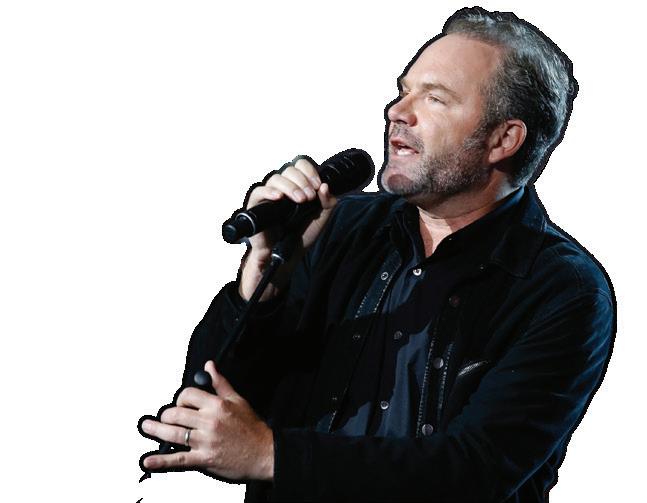
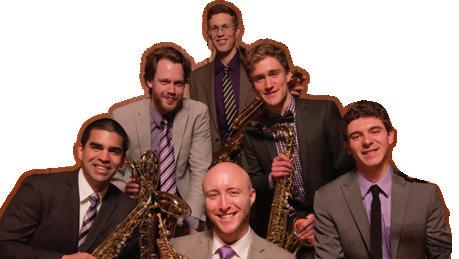
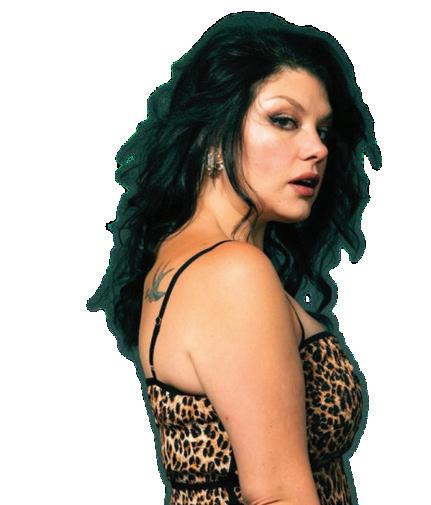
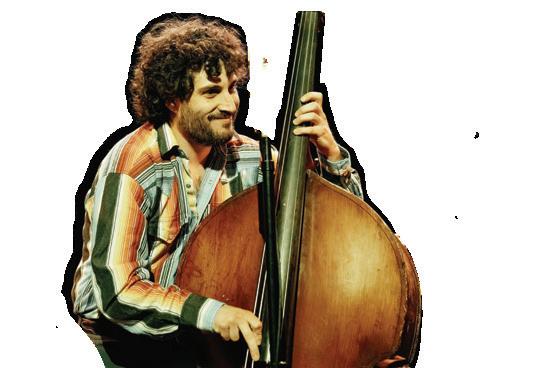
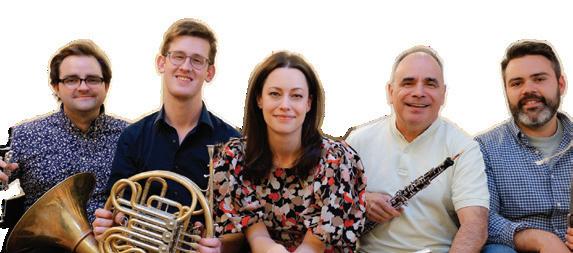
teacher, Katie leads a large private studio and masterclasses in the greater Houston area and is passionate about creating a comfortable and accessible environment for students to cultivate a love for music. During the summer, she works in an administrative role with Chamber Music Northwest in Portland, Oregon. She recently graduated with her master of music in oboe performance from Rice University, where she studied with Robert Atherholt. Previously, she studied with Robert Waiters at the Oberlin Conservatory of Music and graduated with a bachelor of music in oboe performance. In her free time, Katie can often be found cycling and running outdoors; she also loves to relax with a cup of coffee and a great book.
In April of 1990, Robert Danforth accepted the offer from Raymond Leppard and the Indianapolis Symphony Orchestra to fill the position of principal horn. At that time, he was completing six-and-a-half seasons in the same position with the Grand Rapids Symphony Orchestra. He has also held co-principal or associate principal positions with the Toledo and Omaha symphony orchestras, and the Cincinnati Chamber Orchestra. He has been a fellow at the Tanglewood Music Center and a member of the Civic Orchestra of Chicago. Rob has performed as soloist on numerous occasions with the ISO as well as with other orchestras in the midwestern United States. He is an active chamber musician. Rob has served on the faculties of DePauw University and Calvin College. He has presented master classes and performed at numerous International Horn Society Symposiums, regional horn symposiums, and universities and conservatories. His main instrument is a Conn Schmidt model made in the 1930’s.
Rob received his bachelor of music degree in 1981 from the College-Conservatory of Music at the University of Cincinnati, where he was a student of Cincinnati Symphony Orchestra principal horn Michael Hatfield. Other influential teachers have been Dale Clevenger, Arnold Jacobs, Lowell Greer, Charles Weaver, Robert Schauer, and Mary Berry. Rob was born in Detroit and grew up in St. Clair Shores, a suburb of Detroit. He and his wife, Coral, have four children: Libby, Madeline, Katie, and Andrew. As a newly minted empty nester he is wondering about all the spare time he was supposed to have but can often be found swimming, mountain biking, or on the back porch with a cup of coffee, the morning paper, and the dog and cats.
Morgann Davis, flute–principal
Morgann Davis is professor of flute at Millersville University. She is an active performer and a certified yoga and mindfulness meditation instructor. Fortunate to share the stage with many talented musicians, Morgann performs regularly with ensembles including the Allegro Orchestra Lancaster, Berks Sinfonietta, Reading Symphony, Harrisburg Symphony, Kennett Symphony, Baltimore Chamber Orchestra, and Lancaster Symphony. Through her private studio, Davis Flute Studio, she is able to create an encouraging and inventive environment for learning for beginning students through adults. She has previously been on faculty at Maranatha University and Lancaster Bible College and has taught at the Ohio State University Flute Workshop, UW-Whitewater Flute Camp, and Pocono Flute Society Flute Camp. Morgann has performed throughout the US with orchestras such as the Dubuque Symphony and Madison Symphony, as well as in Europe and Canada in various recital series. She has helped to promote an innovative approach to the arts as a member of the National Flute Association’s Career and Artistic Development
committee and has served as an adjudicator for the NFA’s High School Young Artist competition, among others. Morgann is passionate about helping musicians explore the mind-body connection to improve their wellbeing and performance, and has presented workshops and intensives for flute societies, universities, and summer music programs. She holds degrees in music performance from the Ohio State University and the University of Wisconsin-Madison and did post-graduate study on scholarship in Paris and Courchevel, France.
Rebecca Dodson-Webster, French horn–principal
Rebecca Dodson-Webster lives in Wellsboro and serves as associate professor of horn and music history at Mansfield University. A sought-after orchestral soloist and teacher, she has been Principal Horn in the Endless Mountain Music Festival since its first season. She is also a member of the Orchestra of the Southern Finger Lakes and the Williamsport Symphony Orchestra, as well as a founding member of the Orchestra of the Southern Finger Lakes Brass Quintet. Former orchestral affiliations and performances include Orchestra Nova, Westmoreland Symphony, Washington-Idaho Symphony, Spokane Symphony, and Wheeling Symphony. Her horn teachers include Douglas Hill, Soren Hermansson, Martin Smith, John Cerminaro, and Terri Winger. Rebecca’s solo CD, Music for Horn and Piano, is available on Centaur Records. Called “a true Mozart soprano” by Robert Page (WQED Pittsburgh), she has also performed as a vocal soloist and chorister in the United States and Europe, appearing with the Pittsburgh Symphony and Lorin Maazel on a recording of Wagner’s “Ring Without Words.” Locally, she performed the role of Rose in Hamilton-Gibson’s The Secret Garden. A member of the American Federation of Musicians Local 60471, Rebecca appears frequently as a freelance horn player in the region and beyond. She has been featured as a soloist at International Horn Society conferences and workshops in many locations, including most recently Canada, Florida, Missouri, Delaware, West Virginia, Pennsylvania, Alabama, and North Carolina. Rebecca was born in Apollo, Pennsylvania, and enjoys the beauty of the Endless Mountains with her musician husband, Don Webster (also a member of EMMF), and their son, Hayne.
Jennifer Farquhar, violin
Jennifer Farquhar joined the Indianapolis Symphony Orchestra in 1997 as a first violinist, but since 2017 has been acting assistant principal second violin. Over the years she has performed in many chamber music concerts in Indianapolis. She also is a member of the Arizona MusicFest Orchestra. Jennifer teaches violin lessons from her home studio and for the Metropolitan Youth Orchestra. As a member of the 150, she has also coached violinists in their Side-by-Side program.
Before joining the Indianapolis Symphony Orchestra, she played in the North Carolina Symphony, the Delaware Symphony, and the Opera Company of Philadelphia. She performed and taught at Eastern Music Festival for two summers, having previously attended as a high school student. As a college student she participated in the New York String Orchestra Seminar under Alexander Schneider and in the Castleman Quartet Program. She graduated magna cum laude from the Eastman School of Music, where she studied with Charles Castleman. Other teachers included Yumi Ninomiya Scott, Helen Kwalwasser, and Helen Spencer.
Cara Garofalo, violin
Cara Garofalo enjoys a versatile career as a violinist, regularly performing with orchestras such as the West
Virginia Symphony Orchestra, Northeastern Pennsylvania Philharmonic, Lancaster Symphony Orchestra, and Akron Symphony Orchestra, to name a few. She has extensive experience working in chamber and new music ensembles, and as a pit musician in musical theater, opera, and ballet productions. Cara also has had the privilege of working with international artists including Bruce Springsteen, Josh Groban, Gregory Porter, and Evanescence. Since 2019, she has enjoyed working summers for the Endless Mountain Music Festival and Trentino Music Festival in northern Italy. As a teacher trained in the Suzuki Method, Cara has held a private studio of students since 2012. Notably, she has had students win positions with youth orchestras and festivals, and pursue higher education degrees in music performance and education. Cara has also taught in school settings and joined Seton Hill University as adjunct professor of violin in 2022. Cara graduated with a bachelor of music in violin performance from Duquesne University where she studied under Christopher Wu of the Pittsburgh Symphony Orchestra. She later continued advanced private studies with David Kim of the Philadelphia Orchestra and Jeremy Black of the Pittsburgh Symphony Orchestra.
When Noelle Tretick Gosling was a student at the North Carolina School of the Arts, she was both a violin and ballet major. These dual interests brought her full scholarships to both the Aspen Music Festival and Ballet West before she finally decided to pursue her music performance degrees at the Jacobs School of Music in Bloomington. In January 2017, Noelle won the position of concertmaster of the Muncie Symphony Orchestra (now Orchestra Indiana) fifty-five years after her father held the same position. She is a former member of the Indianapolis Chamber Orchestra and still performs regularly with the Indianapolis Symphony Orchestra and the Louisville Orchestra.
In addition to classical, Noelle enjoys playing all genres of music and is in demand as a recording artist for music publishing companies as well as traveling Broadway shows. Tours with legendary performers including Stevie Wonder, Johnny Mathis, Natalie Cole, Tony Bennett, Harry Connick Jr, Sandi Patty, Andy Williams, Mel Tormé, Perry Como, and Manhattan Transfer have taken her from coast to coast.
Noelle has served on the music faculties of Anderson University and Park Tudor School in Indianapolis. She now maintains a private teaching studio and coaches students of the Indianapolis Youth Orchestra. During the summers, she teaches at the Music for All Summer Symposium, Benefic Chamber Music Camp, and the Anderson University String Camp.
She is one of five children, all of whom are professional musicians. Their father, Sidney Tretick, was a virtuoso violinist and head of the string department at Ball State University from 1952 until his untimely death in 1962. Their mother, Patricia Tretick, was also professor of violin at Ball State until her retirement in 1993. Noelle resides in Indianapolis with her husband Dan, a professional trumpet player and the inventor of ChopSaver Lip Care. Their son, Anthony, is a graphic designer and DJ/music producer living in Chicago. When not playing violin, Noelle enjoys traveling, cooking, hiking, reading biographies, consignment shipping, collecting unique footwear and clothes, and still loves to dance.
Trina is the second and e-flat clarinetist in the Indianapolis Symphony Orchestra's clarinet section, a position she has held since 2002. Prior to joining the ISO, she was principal clarinetist of the Louisville and Augusta Symphony
Orchestras. She has also held positions with the Indianapolis Chamber Orchestra and the Columbus Indiana Philharmonic Orchestra. As an active chamber musician, she is a founding member of the Circle City Winds and performs frequently with other ensembles in Indianapolis.
Trina is currently an instructor of clarinet at Butler University in Indianapolis. She performed Messiaen’s Quatour Pour la Fin du Temps with the Eroica Trio during Butler’s Arts Fest in April of 2016. She has also appeared as a soloist with the Butler Wind Ensemble in Scott McAllister’s Concerto Americana for Clarinet and Saxophone in the fall of 2015. She has been an Instructor of Clarinet at the University of Indianapolis and Indiana State University and maintains a private studio in her home.
As a soloist, Trina performed the Weber Concertino with the Hochstein Alumni Orchestra Rochester, NY in January of 2016. She has also appeared as soloist with the Augusta Symphony Orchestra, the Indiana State University Wind Ensemble, and the Rochester Philharmonic Orchestra.
Trina earned her bachelor of music degree from the Eastman School of Music. She received her master of music, performance certificate, and performer diploma from Indian University Jacobs School of Music. Her principal teachers include Eli Eban, James Campbell, Alfred Prinz, Charles Neidich, and William Osseck.
Gabrielle Hsu is a freelance bassoonist and contrabassoonist based in South Florida. Aside from an active orchestral performance schedule, she is also passionate about expanding the solo and chamber repertoire of the bassoon and performing contemporary works by living composers, including the premiere of Aaron Hendrix’s Scenes from My Mother’s Story for oboe, clarinet, bassoon, saxophone, piano, and percussion alongside members of the Akropoils Quintet, and one of the first live performances of Kaghondi wamwa Mwanga’s A Nightmare for bassoon and ankle bells.
Gabrielle is a native of Seattle and holds a bachelor of music from Arizona State University and a master of music and artist diploma from the Frost School of Music at the University of Miami, where she performed as a fellow in the Henry Mancini Institute. Her primary teachers are Gabriel Beavers, Albie Micklich, and Francine Peterson.
Melvin Cortez Jackson currently lives in Cincinnati, Ohio. He began learning the horn at the age of ten. He has studied extensively with some of the finest horn players in the world, including Randy Gardner, Liz Freimuth, Phil Munds, Denise Tryon, Shawn Hagen, Robert Fant, and many others. He is currently fourth horn of the Evansville Philharmonic and assistant principal of the Owensboro Symphony orchestras, and is a regular substitute with the Cincinnati Symphony, San Diego Symphony, Louisville, Dayton Philharmonic, Indianapolis Chamber orchestras, along with many others.
Melvin also has spent the last five years studying Jazz, learning the American song book, learning and internalizing the musical language of the great musicians of that tradition, and doing his best to uphold that tradition on his instrument, the French horn. He has lead groups and shared the stage with such great musicians as Steve Schmidt, Tony Franklin, Josh Strange, Justin Dawson, Ethan Marsh, Cole Baker, and countless more at jam sessions and gigs in and around Cincinnati.
When not working, Melvin enjoys kayaking, chess, food, going on road trips, and just sitting on his porch with his cat Carlos.
Hua Jin, violin–concert master
A native of China, Hua was born into a musical family and began violin lessons at the age of four. She entered the Central National Conservatory of Music in Beijing at age twelve. Hua studied at The Shanghai Conservatory of Music under Professor Ding Zhinuo. She won a prize at the Chinese National Violin Competitions at the age of fifteen and won the Gold Prize at the Harbin Music Festival Competition. She appeared as a soloist throughout northern China.
After she was invited to the US as a visiting scholar, she studied privately under Donald Weilerstein, Blair Melton, Jeffrey Applegate, I-Fu Wong, and Philip Palermo. Hua’s soloist career expanded to orchestras in the US, with performances of film composer Franz Waxman’s Carmen Fantasy, and “The Lark Ascending” by Ralph Vaughan-Williams.
In 2009, after winning the nationwide audition, Hua became a member of Indianapolis Symphony Orchestra. Hua was also assistant concertmaster in the Fort Wayne Philharmonic and associate concertmaster for the Kalamazoo Symphony Orchestra. As an active chamber musician, she has performed with Ronen Chamber Ensemble and has taught and coached students of chamber music for the South Korean Music Festival. In addition to classical music, Hua enjoys Astor Piazzola tangos, smooth jazz, and Latin music.
Yun Kang, violin
A native of Taiwan, Yun Kang is pursuing her DMA degree in Violin Performance at the Catholic University of America under the guidance of Professor Oleg Rylatko. In 2022, she received the first prize in a concerto competition at the Rome School of Music. Yun has made appearances as a section violinist and chamber musician in the United States; Washington, DC; Virginia; Maryland; New York City; Connecticut; and Taiwan.
A collaborator in chamber music as a solo violinist and as a violinist in orchestra, she has been selected as one of the concertmasters in the Catholic University orchestra, second violin principal and associate concertmaster in Nol+F 2023 in Maryland, Orpheus@Mannes in New York, and Seiji Ozawa Ongaku Juku, and Saito Kinen Festival in Japan.
When not playing the violin, she also studies orchestra conducting with Maestro Simeone Tartaglione and Maestro Murry Sidlin.
Pat Karakas, violin
Helen Patricia Karakas is a highly experienced violinist, violist, and educator, originally from Detroit and now residing in Houston. Her extensive opera experience includes Michigan Opera Theater, Houston Grand Opera, Texas Opera Theater, New York City Opera National Company, and Opera Saratoga. Her symphony work includes Houston Latin Philharmonic, Corpus Christi Symphony, Theater under the Stars, Victoria Symphony, New York Gilbert and Sullivan Players (touring), and Mantovani (touring) Orchestra. When not performing, Pat, a certified Suzuki teacher, is busy teaching violin to thirty elementary students in the Spring Branch School District.
Quddus Khamooshi, violin
With a career spanning over two decades, violinist Quddus Khamooshi enjoys life as an orchestra musician, chamber player, and teacher. After being selected as a prize winner of the 2001 National Young Artist Competition in Iran, Quddus was featured in several solo recitals and chamber performances throughout the country. Quddus studied music at the Bahá’í Institute for Higher Education before immigrating to the United States. He also studied under the
direction of Charles and Rachel Stegeman at the Mary Pappert School of Music at Duquesne University, where he earned his bachelor’s and master’s degrees in music performance. He also holds a post-master’s certificate in performance from DePaul University in Chicago, where he studied under Olga Kaler. Quddus has performed in masterclasses for accomplished artists such as Ilya Kaler, Cyrus Forough, Sherry Kloss, Noah Bendix-Balgley, and several members of the Pittsburgh and Chicago symphony orchestras. Summer music festival appearances include Bowdoin International Music Festival in Maine, Sunflower Music Festival in Kansas, and the Summer Violin Institute at the Bienen School of Music at Northwestern University in Chicago.
Gita Ladd, cello–principal
Gita Ladd is one of the most sought-after American cellists. She has performed throughout the US, Europe, Russia, India, Japan, Korea, and Taiwan as a recitalist and as a soloist with the Baltimore Symphony Orchestra, Cincinnati Chamber Orchestra, Knoxville Symphony Orchestra, Concert Artists of Baltimore, Baltimore Chamber Orchestra, and others. She has collaborated as Principal Cello with the Washington Concert Opera, Post Classical Ensemble of Washington DC, and the former Baltimore Opera Company. Gita often performs at the Kennedy Center with various groups including the Washington National Opera. During the summers, she performs as Principal Cellist at the Endless Mountain Music Festival and has soloed with the festival orchestra numerous times. She has also appeared as soloist in Italy at both the Capriccio Festival and the Orpheus Festival. Gita has recently completed a recording of the Shostakovich, Prokofiev, and Rachmaninoff Sonatas with Asiya Korepanova, piano, for a soon to be released CD. In August of 2017, she was a featured artist at the VentiCordi Festival in Maine.
Gita has served on the faculty of the Peabody Conservatory of Music at Johns Hopkins University and, in 2006, joined the faculty at University of Maryland Baltimore County. In 2016, she also joined the faculty at CCBC. Along with her cello studio and faculty recitals, she also performs with the contemporary music ensemble, Ruckus.
Gita attended the Curtis Institute of Music in Philadelphia, the Cleveland Institute of Music, and the Cincinnati Conservatory of Music. Her major teachers include: Mischa Schneider of the Budapest String Quartet; David Soyer of the Guarneri String Quartet; Peter Wiley, former Principal Cellist of the Cincinnati Symphony, Beaux Arts Trio, and Guarneri String Quartet; Stephen Geber, former Principal Cellist of the Cleveland Orchestra; and John Sharp, Principal Cellist of the Chicago Symphony. She performs on a 1720 Italian cello.
Kevin Ladd, tuba–principal
Kevin Ladd has been performing at Endless Mountain Music Festival for nine years. A native of upstate New York, he was All State and All American in high school, performing internationally. While receiving a music education degree at SUNY Potsdam under a full tuition scholarship, he was president of the Crane School of Music student body and a founding member of the Potsdam Brass Quintet. He was the only student in its almost fifty years of existence to attain a performance certificate in his sophomore year. He earned two performance degrees at the Juilliard School where he was awarded a Naumberg Scholarship. While there he soloed with the Juilliard Orchestra in a world premiere of a concerto by Ulysses Kay. Kevin was Principal Tuba of the Syracuse Symphony Orchestra for twenty years, where he served on
the Musicians’ Players Committee, was chief negotiator for the Union contract, served as Personnel Manager and served on the Board of the Symphony, and soloed on several occasions with the Orchestra.
Kevin has also performed with the New York Philharmonic, Buffalo Philharmonic, Bolshoi Ballet, Vienna State Opera Ballet, Baltimore Opera Company, Eastern Connecticut Symphony, Greenwich Symphony, Binghamton Symphony, Lancaster Symphony, Kennett Square Symphony, Maryland Symphony, John Phillip Sousa Band, Guy Lombardo Orchestra, Moody Blues, and the Clyde Beatty, Cole Bros. Circus.
He is listed in IMDb for acting and performing with the Irish singing group Anuna on their international DVD hit Christmas Memories, and for acting in a 2007 movie, Afternoon of the Rat-Faced Zombies. Kevin has taught at SUNY Potsdam, Ithaca College, Blue Lake Fine Arts Camp, New England Music Camp, and Syracuse University for twenty years, where he conducted the SU Tuba Ensemble, Heavy Metal, in concerts throughout the CNY area. He is currently Instrumental Music Teacher at Kenwood High School in Essex, Maryland and freelances in the Baltimore/DC area.
Theresa E. Langdon, violin
Violist Theresa Langdon is a recently retired member of the Indianapolis Symphony's viola section.
Theresa performs often at Newfields (the Indianapolis Museum of Art), and with the Manchester (Indiana) Symphony, She is an active freelancer in the Indianapolis area, performing on both violin and viola. Her teaching affiliations include her home studio, the Quattro String Academy, Indianapolis Youth Orchestra, and coaching violists for Music for All. She served for many years on the faculty of the MasterWorks Festival. Her students, mostly high school-aged, have gone on to be music majors or to continue playing as non-majors at excellent colleges and universities. She is a past president of Indianapolis Matinee Musicale. Theresa Langdon holds music performance degrees from Indiana University and Yale University.
Alisha Lindsey, flute
Alicia “Lish” Lindsey is the principal piccoloist with the Capital Philharmonic Orchestra and Garden State Symphonie Band, principal flutist with the Eastern Wind Symphony, resident flutist with the Exit 4 Wind Quintet and the contemporary music ensemble Random Access Music, contrabass player with UpTown Flutes und Centre Park Flute Ensemble, and a ryüteki (dragon flute) performer with the Tokyo to New York Concert Series, and performer/director of the Columbia Instrumental Gagaku Ensemble of New York. She also performs/has performed with the Harrisburg, Lancaster, and Reading Symphonies, Riverside Symphonia, Philadelphia Virtuosi Chamber Orchestra, Strauss Symphony of America South Florida Symphony, Pennsylvania Philharmonic, East Brunswick Symphony Orchestra, South Brunswick Chamber Orchestra, Center City Opera Theater, Fresh Squeezed Opera, New York Opera Exchange, Penn Flute Ensemble, and the West Point Band. She was a regular flute substitute with the Broadway musical Finding Neverland and has performed on tour with Josh Groban, Sarah Brightman, Sarah McLachlan, Evanescence, Hanson, violinist Lindsey Stirling, guitarist Warren Haynes, Il Divo, Il Volo, Celtic Thunder, and others.
Venues include Carnegie, David Geffen, and Radio City Music Halls, Madison Square Garden, the Beacon Theater, Kennedy Center, Philadelphia’s Verizon Hall, and
performances in Japan, China, Italy, England, Wales, and Belgium. CD/DVDs include Josh Groban’s Bridges: Live, Music for Haiti, Reawakening, Elements, Resurgence, Heard Again for the First Time, The Music of Daniel Spalding, Pearls, New Heritage: Contemporary Compositions for Gagaku Instruments, and over twenty-six wind band literature albums.
Lish is an adjunct music professor at Columbia University, an American Composers Orchestra Teaching Artist, and is on the board of directors for the New York Flute Club, Flute Society of Greater Philadelphia, and New Jersey Flute Society. Degrees include an MA (flute performance) from New York University, a BM (flute performance) from the College of New Jersey, and a BA (English, music minor) from Trenton State College. Influential teachers include Julius Baker, Dr. Brad Garner, David DiGiacobbe, Dr. Dent Williamson, David Ancker, Ronna Ayscue, Louise Sasaki, and Takeshi Sasamoto. Find out more at LishLindsey.com.
Juanmanuel Lopez, timpani–principal
Juanmanuel Lopez is an active timpanist, percussionist, and educator based in Deerfield Beach, Florida. He currently acts as Principal Timpani with the South Florida Symphony Orchestra, Symphony of the Americas, and the Endless Mountain Music Festival. He is also a member of Nu Deco Ensemble and performs regularly with Palm Beach Symphony. Other engagements in the past include the Buffalo Philharmonic Orchestra, West Virginia Symphony Orchestra, Erie Philharmonic, Savannah Philharmonic, Southwest Florida Symphony, and Florida Grand Opera. Juanmanuel served on faculty at the Universidad Nacional in Costa Rica for three years where he worked as visiting professor of percussion. He was also a member of Banda de Conciertos de San Jose and Orquesta Sinfonica de Heredia. Juanmanuel is a graduate of the Interlochen Arts Academy. He holds a bachelors of music in percussion performance from the Peabody Conservatory and a master of music from Cleveland State University. Additionally, he earned a professional performance certificate and a second master of music from the Lynn Conservatory of Music. His main teachers include Robert van Sice, Tom Freer, and Ted Atkatz. In his spare time, Juanmanuel enjoys the outdoors, working out, cooking, and reading.
Rebekah Lorenz, French horn
Rebekah Lorenz is the acting principal horn of the Tulsa Symphony Orchestra and Principal Horn of the Carmel Symphony Orchestra. She has performed with the Boston Symphony Orchestra, the Boston Pops, Cincinnati Symphony Orchestra, Cincinnati Pops, Indianapolis Chamber Orchestra, Indianapolis Opera, Rochester Philharmonic Orchestra, among many other ensembles across the country. Rebekah has enjoyed playing in the festival orchestras of the Aspen Music Festival, Orford Musique, Domaine Forget, Festival Napa Valley, and the Soundscape Contemporary Music Festival. She earned a master of music from the New England Conservatory in 2019, where she studied with James Sommerville, and a bachelor of music from the Eastman School of Music in 2017, from the studio of W. Peter Kurau.
Melanie Mashner, harp–principal
Professional harpist Melanie Mashner is passionate about bringing joy to the people around her through music. Melanie is the Principal Harpist of the Carmel Symphony Orchestra, the resident orchestra at the Palladium in Carmel, Indiana, as well as the Terre Haute Symphony Orchestra. She also serves as Personnel Manager for the CSO and maintains a private harp, cello, and piano studio in northern Indianapolis. Melanie has
won numerous awards for the harp and performs frequently as a chamber artist, orchestral harpist, and soloist throughout the midwest and northeastern United States. Recent performances include a guest appearance as Principal Harp with the Virginia Symphony and Yo-Yo Ma, as a featured soloist and Principal Harpist of the 2021 and 2022 Endless Mountain Music Festival, a premiere of Juan Pablo Contreras’ concerto for harp and chamber orchestra, Ángel Mestizo, with Arca Sonica in Ann Arbor, MI, and Rodrigo’s Concierto de Aranjuez as the IU Harp Department Concerto Competition Winner.
As the graduate assistant instructor in harp for the Indiana University Jacobs School of Music from 2018-2020, Melanie worked and studied with renowned international concert artists Florence Sitruk, Susann McDonald, Elizabeth Hainen, Emile Naumouff, and many others. Melanie lived in Vienna, Austria, for six months where she worked with Vienna Philharmonic harpist Anneleen Lenaerts as the Global Leader Award recipient from the National Society of Leadership and Success, and was also a scholarship recipient at the 2018 Bowdoin International Music Festival with renowned harpist June Han. Melanie enjoys collaborating with local musicians and composers, as well as with her sister, flutist Melissa Mashner, as a member of the Angelus Duo. As the program coordinator of the 2019 11th USA International Harp Competition, Melanie was thrilled to bring harp music and education to over 1,800 children and adults across Indiana as the head of their educational outreach program, Harp Start. She holds her MM, BM, and performer’s certificate from the Indiana University Jacobs School of Music.
Jason Mathena, percussion–principal
Dr. Jason Mathena currently serves as adjunct instructor of music theory and graduate percussion studies at Jackson State University and adjunct professor of music at Millsaps College. At JSU he teaches 100 and 200 level music theory and ear training, applied graduate percussion, assists with the Percussion Ensemble, and directs the Steel Pan Ensemble, Steel Tigers. For Millsaps he directs the Jazz Ensemble, Pep Band, and Percussion Ensemble in addition to teaching applied percussion and improvisation. Previous college posts include nstructor of music and assistant band director at CopiahLincoln Community College in Wesson, MS, and Southwest Mississippi Community College in Summit. In addition to his teaching duties, Jason maintains a rigorous performance schedule as a member of the Mississippi Symphony, Mississippi Opera, Gulf Coast Symphony, and Meridian Symphony. From the vibraphone, he has created and lead many jazz and popular music combos such as The Vibe Doctors, The Plus1 Jazz Trio, The Foxbury3, and B-PAC. Ever since he was eighteen, he has freelanced as a performer as well as consultant and arranger for various high school and college marching band programs. Degrees include a doctorate of musical arts in percussion performance and pedagogy with secondary emphases in music theory and music history from the University of Southern Mississippi, a master’s degree in percussion performance from the University of Louisiana-Lafayette, and a bachelor’s degree in music education from Auburn University. Jason is also vice president and treasurer of the Mississippi Chapter of Percussive Arts Society and a member of the Mississippi Arts Commission Artist’s Roster and American Federation of Musicians.
Carolina Pedroza, violin
Carolina Pedroza began her violin studies in her hometown, Villavicencio, Colombia. She holds a bachelor’s degree in violin pedagogy from the Universidad Pedagógica Nacional de Colombia, an artist diploma from Duquesne
University in Pittsburgh, and a master’s degree from Penn State University. She is the recipient of full tuition awards for doctoral programs in violin performance from both Louisiana State University and the Catholic University of America. She has worked in music education programs for children in Colombia, Venezuela, and the United States, and has also served as a teaching assistant at Duquesne University and Penn State University.
As an orchestra musician, she was a permanent member of the Orquesta Sinfónica Municipal de Caracas in Venezuela for several years. In the United States, she has been concertmaster of the Catholic University of America Symphony Orchestra, the Penn State Philharmonic Orchestra, and Colour of Music Virtuosi Chamber Orchestra. She has also been a section member with Butler Symphony Orchestra, West Virginia Symphony, Wheeling Symphony Orchestra, and Baton Rouge Symphony Orchestra, among others.
Carolina attended festivals including FEMUSC (Brazil), A Tempo (Colombia), Sewanee Summer Music Festival (Tennessee), Academia Internacional Teatro del Lago (Chile), Norther Lights: Music Festival (Minnesota), and Color of Music Festival in (South Carolina and California). Additionally, she has participated with Sphinx Organization in Orchestra Audition Intensives and Conferences, and was also a member of the Youth Orchestra of the Americas for the 2018 European Tour, performing in the emblematic Elbphilharmonie Concert Hall in Hamburg, and other important venues in Poland, Ukraine, Germany, and Scotland.
Her achievements in the DC area include a solo appearance with the Catholic University Symphony at the Kennedy Center and her appointment as a diversity fellow with Fairfax Symphony.
Carolina plays the Maurizio Tadioli violin “Garodus,” on a generous loan from the Catholic University of America. During her time in Baton Rouge, she was a member of the Guayaba Quintet, a Chamber Music Program envisioned by her and other Latin American students, focused on promoting the music of living Latin American and Iberian composers. Following this line of interest, it is with great enthusiasm that she receives her appointment as graduate research assistant at the Latin American Music Center, where she is eager to share, as well as further expand her knowledge about Latin American and Iberian music. She looks forward to helping promote the works of composers that are close to her heart and her roots as a Latin American herself and that she reveres as significant pieces of humanity’s cultural heritage.
Linda Yu-Picard, violin
Linda Yu-Picard is a graduate of Indiana University School of Music and earned her bachelor’s and master’s degrees with professors Henryk Kowaski, Mimi Zweig, and Joseph Gingold. She has enjoyed a diverse career playing in the New World Symphony in Miami as well as traveling to eighteen countries with an international music ministry. She currently enjoys opportunities to play in Indianapolis with the Indianapolis Symphony Orchestra, Indianapolis Chamber Orchestra, and with two violin and piano duos, the Belle Musique Duo and the Providence Duo. Linda is grateful for the gift of music and the and the opportunity to share it with others.
Jacqueline Pickett, bass
Jacqueline Pickett obtained her bachelor of music degree with high honors from West Virginia University; her master of music degree from Yale School of Music; and her doctor of musical arts degree from the University of Wisconsin-Madison.
Her musical abilities cover a wide range of performance genres from album credits with hip-hop artist Monica (The Makings of Me, 2006) to classical recordings with the Nashville Chamber Orchestra (Conversations in Silence, 2008).
Jacqueline began her career as a section bassist with the Jacksonville, Florida Symphony Orchestra. She is Principal Bassist of the Columbus, Georgia Symphony Orchestra, and LaGrange Georgia Symphony Orchestra. Pickett also serves as Principal Bass of the Colour of Music International Black Classical Musicians Festival. She was recently appointed instructor of double bass at Spelman College.
David Rezits, cello
David Rezits, a cellist with the Fort Wayne Philharmonic since 1991, previously was principal cello with the Haifa Symphony in Israel, assistant principal cello with the Florida Orchestra, and associate principal cello with the Rio de Janeiro Symphony.
Rezits has worked with conductors such as Leonard Bernstein, Kurt Masur, Seiji Ozawa, Maxim Shostakovich, and Robert Shaw. He often performs with his father, Joseph, a concert pianist. David received a bachelor of music performance degree from Indiana University, a master of music performance degree from State University of New York, and a master’s in education from Indiana University. His past teachers include Janos Starker, Bernard Greenhouse, and Eva Janzer. He has taught and performed in Israel, the Czech Republic, Ecuador, Peru, Brazil and the USA. David is the author of a celebrity classical musician’s cookbook, Culinary Harmony, which has been in print since 1997. Besides cooking, his interests include tennis, hiking, wetland restoration, animals, and traveling. David also volunteers in the community assisting in ESL classes for Burmese and Hispanic adults.
Born in New Haven, Connecticut, Dr. Lee Richey is primarily a native of North Carolina. He began his musical studies at the age of eight on the violin with his mother, Elaine Lee Richey. At age fourteen, he switched to the cello and studied with Luca DiCecco.
He received his bachelor of music degree from the North Carolina School of the Arts with Robert Marsh, his master of music degree from Southern Methodist University with Marion Davies, and his doctor of musical arts (DMA) degree from the University of Wisconsin-Madison with Parry Karp.
He has been the principal cellist of the Knoxville Symphony Orchestra, the Spoleto Festival, the Winnipeg Symphony Orchestra, the Green Bay Symphony, and the Fairbanks Symphony. He has also been a member of the Dallas Ballet and Milwaukee Ballet orchestras. He has served as adjunct faculty at the University of Virginia at Charlottesville and Washington and Lee University, and was on the full-time faculty for two years as a term professor at the University of Alaska Fairbanks. He is now a contract cellist with the Greensboro Symphony Orchestra, the Hilton Head Symphony Orchestra, and the Symphony of the Mountains. He is also a substitute cellist with the Winston-Salem Symphony, the Charleston Symphony Orchestra, the Knoxville Symphony Orchestra, the Roanoke Symphony Orchestra, the Symphony Orchestra Augusta, and the Valdosta Symphony Orchestra.
He lived in Las Vegas from December of 2004 to September of 2012 where he was the assistant-principal cellist with the Las Vegas Philharmonic, the adjunct cello teacher at the Nevada School of the Arts, the adjunct cello and music appreciation teacher at the College of Southern Nevada, and was the cellist in the orchestra of Phantom, The Las Vegas Spectacular! Following the closure of the Phantom show in
September of 2012, Lee relocated to his home state of North Carolina. He now lives in Greensboro where he freelances in the southeast, conducts, and teaches privately.
Brian Rodriguez, trump (apprentice)
Brian Rodriguez is a trumpet player from the Baltimore area. They are a recent graduate from Towson University getting a bachelor of music with a concentration in classical performance. During their time, they had the opportunity to play symphonies from David Maslanka, Beethoven, and Barnes. Outside of the University, Brian has performed musicals such as Cabaret, The Sound of Music, and The Little Mermaid, and performed the opera Die Fledermaus. Brian has performed with orchestras such as Endless Mountain and Kennett Symphony Orchestras.
Lisa Scott, violin
Lisa Scott became a member of the Indianapolis Symphony Orchestra in 1983. Born in New York City, she grew up in Bloomington, Indiana. Lisa earned a BM degree from Indiana University, where she studied with Tadeusz Wronski, Jacques Israelievitch, and Daniel Guilet. She participated in master classes at the Banff School of Fine Arts and with the Rowe Quartet in Switzerland. Lisa has appeared twice as soloist with the ISO and served as a section coach for the Side by Side program. She is married to ISO cellist Perry Scott, and they are the parents of two sons. The Scotts, along with ISO violist Beverly Scott and his wife, formed the Scott Chamber Players in 1981 and are the piano quartet in residence at the Indianapolis Museum of Art. Lisa is a recognized visual artist in the pen and ink medium.
Perry Scott, cello
Perry is proud to say that his mother is Raiford Scott, the first registered woman architect in South Carolina. His father, Ronald Scott, was the state planner for North Carolina. His brother, Beverly, is ISO assistant principal viola, and Perry’s wife Lisa is an ISO violinist. With brother Bev and his wife, pianist Sylvia Patterson-Scott, they are collectively known as the Scott Chamber Players, longtime artists-in-residence at the Indianapolis Museum of Art. He plays a ‘hybrid’ cello. The top was made in Venice by Matteo Goffriller in 1696. The back and sides are the work of the Roman maker Francesco de Emiliani from around 1730. And the scroll is made by an unidentified Flemish craftsman of a slightly later period. Perry and Lisa live in a home tucked away in the woods, complete with a largewindowed music room, which is a perfect fit for Perry’s nonmusical interests. He has done rare plant inventories for the Indiana Department of Natural Resources, and does botany field studies in the Boundary Waters Wilderness and Quetico Provincial Park. Perry hopes after many years of field work to write a book on the complete vascular flora found in this two-nation wilderness. Perry and Lisa are the proud parents of two sons. Aaron is at IU in Bloomington and about to apply to medical school and Brian is at the University of Vermont pursuing a degree in geology.
Joseph Shafer, flute, clarinet and basoon
Joseph Shafer is a Los Angeles-based freelance musician and composer. He has performed with many orchestras, wind ensembles, pit orchestras, and chamber ensembles throughout Colorado, Wyoming, and Minnesota, with various other performances throughout the country, as well as China and the Caribbean. Since moving to the Los Angeles area in 2019, he has continued to pursue music and has been delving into the world of recording. He is excited to be participating in the EMMF for the first time this summer.
Marcia Spina, clarinet
Marcia Spina began playing clarinet at the age of six, using an old metal instrument, which had been her father’s. Starting in elementary school, through high school, she studied with Charlotte Owen. Marcia was a member of the Philadelphia Youth Orchestra and the Lansdowne Symphony Orchestra. She and her four siblings formed a woodwind quintet which performed throughout the Philadelphia suburbs. Marcia was a performance major at DePauw University, studying with John Sox. Later, she performed in the Riverfront Dinner Theater Orchestra and other local orchestras under the direction of Joseph Primavera and Henri Elkan. After a successful career as a research chemist, Marcia has returned to her first love of music performance, studying with Cathryn (Trina) Gross, and playing in the Almost World Famous Wellsboro Town Band, the Mansfield University Wind Ensemble, and now the EMMF Symphony Orchestra.
Lauren Strachan, viola
A native of Huntington, West Virginia, Lauren Strachan currently performs in the viola section of the Longmont Symphony in Longmont, Colorado. Before moving to Colorado, she spent seven years in the greater Pittsburgh area, where she performed as a member of the Altoona Symphony and the Johnstown Symphony, in chamber ensembles, and premiered works of new music, operatic and otherwise. Lauren completed her undergraduate studies at West Virginia University, during which time she spent two summers at the Brevard Music Center festival in North Carolina in the studio of Maggie Snyder. She went on to receive a masters degree from the Mary Pappert School of Music at Duquesne University in Pittsburgh, Pennsylvania in the studio of Marylène GingrasRoy.
Brian Strawley, trumpet–principal
Brian Strawley is currently principal trumpet of the Phoenix Symphony and hails from Philadelphia. Growing up in a musical family of nine, he began studying piano at the age of six and trumpet at the age of eight. He attended Temple University in Philadelphia to study with Donald McComas, and after graduation he was appointed to the principal trumpet position with the Media Theatre of the Performing Arts Orchestra near Philadelphia. After a few years, he attended the Orchestral Performance Program at the Manhattan School of Music, during which time he worked with Vincent Penzerella, Robert Sullivan, Chris Gekker, and Per Brevig.
Brian then won a position with the Naval Academy Band before moving on to become associate principal trumpet with the Richmond Symphony (appointed two seasons as principal), and principal trumpet with the Williamsburg Symphony. In addition, he has performed as principal with the New York City Ballet Orchestra, Philadelphia Ballet Orchestra, Virginia Symphony, Roanoke Symphony, Harrisburg Symphony, Maryland Symphony, and first cornet with the Baltimore Symphony.
In the brass chamber setting, Brian has performed as first trumpet with the Baltimore Symphony Brass Quintet, the Washington Symphonic Brass, Rodney Marsalis Philadelphia Big Brass, Mir Brass Quintet, the Bayfield Brass Quintet, and the Bay Street Brass Quintet, which was the first place winner of the 2003 NYC Brass Quintet Competition.
As soloist, Brian has appeared with the Williamsburg Symphony, Richmond Symphony, Harrisburg Symphony, and the Naval Academy Band. During his tenure with the Richmond Symphony, Brian was also active as a recitalist throughout the Mid-Atlantic region, and he served as professor
of trumpet at Virginia Commonwealth University.
Stephanie Tretick, violin
A native of Boulder, Stephanie Tretick comes from a family of musicians: both parents and all four siblings are professional instrumentalists. Stephanie began her music studies with the piano, and later focused on violin at the Interlochen Arts Academy as a student of Alfio Pignotti. She attended Vassar College where she studied violin with Matthew Raimondi and earned her bachelor of arts cum laude. She subsequently attended Indiana University/Bloomington as a fellowship student of Josef Gingold, finishing her master of music summa cum laude.
Before coming to Pittsburgh, Stephanie was a member of the Baltimore Symphony for five years, serving there in both the violin and viola sections. She also has performed on both instruments in Pittsburgh, substituting on short notice as a first violinist during a PSO Far East tour and appearing as violin soloist with the Orchestra in a performance of the Concerto in D by her father, the late Sidney Tretick.
Stephanie has been associated with the Aspen and Casals Music Festivals and the Bach Aria Group. Solo engagements have included performances of the Brahms Double Concerto with her sister Blythe, a marathon Vivaldi Seasons evening, and several other appearances playing the Tretick Concerto. She also adores performing chamber music.
When not on Heinz Hall stage, Stephanie enjoys many diversions. She renovated her own kitchen, designs jewelry and clothing, has a U.S. Patent for a violin/viola shoulderrest, and during covid produced nearly 4000 cloth face masks for local nonprofits.
Marie Trudeau is a New Jersey based freelance oboist from Michigan. She is principal oboe at Garden State Philharmonic and often acts as principal in area orchestras such as Bay Atlantic Symphony, Kennett Symphony, and the Reading Symphony Orchestra. In November, she performed as principal in China with the Philadelphia Festival Orchestra. She also performs Allentown Symphony and Lancaster Symphony. Marie assists Robert Walters, solo English horn of The Cleveland Orchestra, at Hidden Valley English Horn seminar in Carmel, California. In the Summer of 2018, she was invited to teach at Festival of the Gulf, in Italy. She has also played for Amy Grant with the Richmond Symphony and toured with the Italian tenor trio, il Volo. Her favorite musicals to perform are Nine and Fiddler on the Roof. She has worked with many great musicians like Midori, Leonard Slatkin, and Itzhak Perlman. In addition to modern oboe and English horn, Marie plays the two keyed period instrument, baroque oboe. She is the baroque oboist in residence with the Rutgers Baroque Players.
Marie earned her doctorate with a teaching assistantship in musical arts at Rutgers, the State University of New Jersey. There, she wrote her dissertation titled “Prokofiev’s Trapeze, Walking the Tightrope between Composing and Culture,” which focuses on Prokofiev’s Quintet for oboe, clarinet, violin, viola, and double bass. The document was also added to the archives at Columbia University in New York. Previously, she attended the Cleveland Institute of Music for a master’s degree and earned a bachelor’s in music performance at Michigan State University. Marie maintains an active teaching studio of twenty students. She also develops musical courses for and is adjunct faculty at the Lewis School in Princeton, a school for unresolved, language-based learning differences related to dyslexia, ADHD, auditory processing, and executive
functioning. She can be heard on a Grammy nominated jazz album called, “Pictures at an African Exhibition.” Many new works have been written for her, including “Differential Moods” by Matt Schoendorff, an oboe and piano piece with influences of Nine Inch Nails, and “Happy Hour” by Phil Popham, a piece for a double reed quartet in which each movement represents a different beverage.
Dave Wert, percussion
Dave Wert holds degrees in music education from Mansfield University and Boston University. He currently teaches instrumental music as a band director in the Northern Tioga School District where he serves students in grades 4-12. Dave has performed previously with the Endless Mountain Music Festival Orchestra as well as the Great Lakes Wind Symphony, Southern Tier Concert Band, and recently completed a four-year tour with the Parris Island Marine Corps Band. While a member of the Marine Corps Band program he performed in countless military ceremonies as well as public parades and concerts.
Ricky Yoder, French horn
Ricky Yoder is currently a student with Scott Strong, third horn at the Detroit Symphony Orchestra, and the professor of horn at Baldwin Wallace University. As a student at Baldwin Wallace, Ricky double majors in horn performance and computer science, and performs in several ensembles there, including the Baldwin Wallace Symphony Orchestra, Wind Ensemble, and Brass Choir. Along with ensembles related to academics, Ricky has performed with Allegro, the Chamber Orchestra of Lancaster.
John Zhang, violin
John Shuo Zhang, a graduate with a master’s degree from the Juilliard School, was born in Guangzhou, China. He began studies on the violin at age seven and made his first public appearance in a movie about musically gifted children just six months later. Before arriving in the United States, he received his bachelor’s degree with honors from the Xinghai Conservatory of Music. His musical study in the United States includes Eric Rosenblith, Dorothy DeLay, Hyo Kang, Itzhak Perlman, Joseph Silverstein, Yoko Takebe, and Michael Gilbert. John also studied chamber music with Fliex Galimir, the Emerson String Quartet, and the Juilliard String Quartet. As a scholarship student at the Juilliard School, he has participated on a tour performance with the Juilliard Chamber Orchestra and on a US tour with the New York City Opera. He has appeared as a soloist with the Brooklyn neighborhood Orchestra and given recitals in the Lincoln Center IBM Gallery as part of the IBM Recital Series and NYC International Center. John has performed with the New York Philharmonic, the New Jersey Symphony, the Delaware Symphony, the Northeastern Pennsylvania Philharmonic, and the Symphony in C. As an advocate for contemporary music, John has premiered several new works in the US. Since 2009, he has served as the concertmaster of Guiyang symphony and currently holds an assistant concertmaster position in Hangzhou Philharmonic Orchestra.







Monday, July 22 • 10:00 a.m.
Southeast Steuben County Library
300 Nasser Civic Center Plaza, Suite 101, Corning, New York
Monday, July 22 • 1:00 p.m.
Mansfield YMCA
40 Besanceney Drive #42, Mansfield, Pennsylvania
Wednesday Jul 24 • 6:00 p.m.
Concert on the Porch, Wellsboro Green Free Library
134 Main Street, Wellsboro, Pennsylvania
Monday, July 29 • 10:30 a.m.
Blossburg Memorial Library
307 Main Street, Blossburg, PA
Monday, July 29 • 1:00 p.m.
Knoxville Public Library
112 East Main Street, Knoxville PA