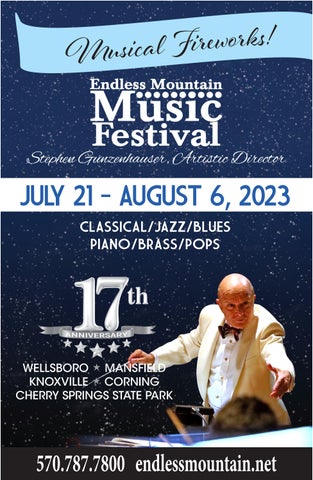
! s k r o w e r i F l a c Musi Stephen Gunzenhauser, Artistic Director
JULY 21 - AUGUST 6, 2023 CLASSICAL/JAZZ/BLUES PIANO/BRASS/POPS
WELLSBORO H MANSFIELD KNOXVILLE H CORNING CHERRY SPRINGS STATE PARK
570.787.7800 endlessmountain.net
2
endlessmountain.net
A WARM WELCOME
Welcome to the 17th season of the Endless Mountain Music Festival, and thank you for your continuing support of this mid-summer's music program of the Twin Tiers! We are committed to continue bringing you amazing performances from world-class musicians along with another significant part of our mission, which is music education outreach. I'm proud to say that as the Festival has grown, so has our ability to increase and expand our outreach programs to the communities that we serve. Many of these programs happen in conjunction with the Festival because that is when our dedicated musicians are here to share their talent and knowledge. However, even throughout the year, some of them are able to return and help us provide assembly programs to our local schools. So whether we are collaborating with Mansfield University to develop music camps or the Science and Discovery Center to help students create and play instruments made from recycled materials, our goal is always to find a fun way to share music. Our ability to continue to augment music education and share the wonderful experience this festival provides to rural areas would not be possible without the generosity from our corporate sponsors and donors. Nor could we fulfill any part of our mission without the dedicated musicians who come each year, for it is their talents and reputations that enable us to attract participants to all of our programs. The organization and execution of this colossal undertaking could not be accomplished without the dedicated staff, volunteers, and board of directors. Please take an opportunity to join me in thanking everyone who supports this festival in one way or another. Now sit back, relax, and enjoy all of the fine work of this year's group of musicians and especially our founding Conductor and Music Director, Stephen Gunzenhauser.
Ardell Thomas,
President of the EMMF Board of Directors
4
endlessmountain.net
We are proud to sponsor
Endless Mountain Music Festival
for 17 years in a row.
90-92 Main Street, Wellsboro cnbankpa.com 877.838.25147
POWERFUL MUSIC STARTS HERE
Bloomsburg, Lock Haven, and Mansfield have each enjoyed a long history of musical excellence since their foundings in the mid-1800s. Together as Commonwealth University, we’re expanding music education and performance opportunities for students across our locations. New opportunities include: Greater resources: music, instruments, guest artists Access to more faculty experts Shared ensemble performances across campuses Expanded course offerings
commonwealthu.edu/music 6
endlessmountain.net
Table of Contents 4
Message from the President of the Board
10
Corporate Sponsors
10
Board Members & Staff
11
Individual Donors
12
Director Biographies
14
Festival Orchestra
16
July 21 - Opening Night
19
July 22 - Music for Royal Fireworks
22
July 23 - POPS! Concert
22
July 24 - “Bach to Rock”
22
July 25 - Serenade No. 12 in C Minor
24
July 26 - String Quartet in C Major
27
July 27 - Endless Mountain Love Songs
28
July 28 - Carmen
32
July 29 - Tangazo and Ástor Piazzolla
34
July 30 - “Explore the Universe”
34
July 31 - Danse Macabre
37
Aug. 1 - “Under the Summer Sky”
45
Aug. 2 - “Anyone Can Play the Drums!”
46
Aug. 3 - “Big Bands in Hollywood”
46
Aug. 4 - Symphony No. 9
49
Aug. 5 - Prelude to the Opera
51
Aug. 6 - Fly me to the Moon
54
Guest Artist Biographies
63
Orchestra Biographies
Endless Mountain Music Festival is a not for profit 501(c)(3) registered in the State of PA and NY.
The
Endless Mountain Music Festival
39 Water Street Wellsboro, PA 16901 (570) 724-3838 info@mountainhomemag.com 8
endlessmountain.net
© Heather Mee Fotografee
© Heather Mee Fotografee
© Heather Mee Fotografee
Hans’ Photography © 2015 Kenting
makes our readers howl for joy!
Beagle Media, llc
Infinite Skies by Night Boundless Activities by Day
Cherry Springs State Park INTERNATIONAL DARK SKY PARK
Pennsylvania Grand Canyon
Lyman Run State Park
Pine Creek Rail Trail
PA Lumber Museum
Covered Wagon Tours
Home of the Pennsylvania Grand Canyon and Pine Creek Rail Trail. With ten state parks, two federal parks and more than 400,000 acres of state forestland, the counties of Tioga and Potter are waiting to welcome you for your next getaway! For Lodging and Area Information: VisitPotterTioga.com | 888-846-4228 Endless Mountain Music Festival
9
GRANTS & CORPORATE SPONSORS Platinum Gold Plus - $21,000 - $26,000 Eastern Gas & Transmission & Storage, INC Charles Knox and Margaret Etner Foundation Corning Incorporated Foundation William & L.R. Gale Community Foundation Commonwealth University EMMF receives state arts funding support through a grant from the Pennsylvania Council on the Arts, a state agency funded by the Commonwealth of Pennsylvania and the National Endowment for the Arts, a federal agency.
Platinum - $15,000 - $20,999 C&N Bank Deerfield Charitable Trust Ward Manufacturing
Diamond - $10,000 - $14,999 Dunham Family Foundation Mountain Home magazine National Endowment for the Arts Gold - $5,000 - $9,999 Community Foundation of Elmira and the Southern Finger Lakes Guthrie Mansfield Auxiliary Corporation Penn Wells Hotel Quality Inn of Mansfield Visit Potter-Tioga UPMC Susquehanna SWN Wellsboro Electric Company This project is made possible with funds from the Statewide Community Regrant program, a regrant program of the New York State Council on the Arts with support of the Office of the Governor and the New York State Legislature and administered by The ARTS Council of the Southern Finger Lakes. Silver - $3,000 - $4,999 First Citizens Community Bank Seneca Resources Bronze - $1,000 - $2,999 AJ's Hair & Make-up Corning Rotary Club 10
endlessmountain.net
Xtreme Internet Ted Goldwyn Writing Packer Foundation Baker Tilly Mountain Valley Realty, Inc. Six West Settlements, Inc. Sweet Foundation Weis Markets Williams Auto Group X-GEN Pharmaceuticals, Inc.
BOARD MEMBERS & STAFF EXECUTIVE COMMITTEE President – Ardell Thomas Vice President – John Ulrich CEO – William Hebe Treasurer – Duke Argetsinger Secretary – David West BOARD MEMBERS Tricia Goodwin Mark Warner Scott Clark
Morgan Shaffer Christina VanDergrift
BOARD MEMBERS EMERITUS AJ Fratarcangelo David Tews Carol Sides STAFF Music Director – Stephen Gunzenhauser Executive Director – Cynthia Long Resident Conductor – Teresa Cheung Business Manager – Matthew Difasi, CPA Music Librarian – Joseph Shafer Assistant Librarian – Shuo Zhang Stage Manager – Peter Davis Asst. Stage Manager – Hayne Webster Box Office & Office Manager – Stacey Champaign Social Media & Web Manager – Allison Rudy Photographer – Robert C. Bair, Jr. Volunteer Coordinator – Marion Charsky Assist. for Recruitment to the MD – Karen Banos Operations – Kathie Largey
INDIVIDUAL DONORS
The Endless Mountain Music Festival expresses sincere appreciation to those of you who have help provide quality orchestral music to the adults and children of our region. Since ticket sales only cover a small percentage of the festival’s operating costs, donor support allows us to attract world-class artists, and at the same time, keep ticket prices accessible to the general public. It is only with the support of donors like you that the Endless Mountain Music Festival can continue.
Dvorak Circle - $20,000 + Stephen Gunzenhauser + * Cynthia Long + *
Chopin Circle - $3,000 $19,900 Eugene Seelye + John Ulrich & Lynn Pifer
Tchaikovsky Circle - $2,000 $2,999 Anonymous
Beethoven Circle - $1,000 - $1,999 Anonymous Duke & Nick Argetsinger Ron Butler + Mike and Teresa Capuzzo Barry & Rochelle Clark + Robert & Diann DeCamp A.J. Fratarcangelo William & Shirley Hebe Margery Hoffman Tricia Goodwin Kinane Dick & Judy Sphon Ardell & Peg Thomas David & Lorraine West
Brahms Circle - $500 - $999 Robert C. Bair+ Hilma Cooper + Janna Keser Robert L. Miller Richard Perry Peggy Dettwiler & Jurgen Thym Jo Ann Stello
Gershwin Circle - $300 - $499 Ellen Blais Bill & Sue Boland Scott & Dawn Clark Dan & Cathy Doremus Alan & Lynnette Eusden Dan & Mary Ann Garrett Luanne Goodwin Barry & BJ Haverstick Heather Kissinger Fred & Judy LaVancher Rodger & Doris Wagner M. Alene York
Friends of the Festival - $50 - $299 Oliver R. Bartlett Richard & Kate Black David Blowers Lee & Darlene Borts Matt & Amy DeCamp Daria-Lin Guelig Gustin’s Jewelers Bryn Hammastorm & Lynne Graham Land Services Group Bev McNight Patricia Newruck John & Morgan Shaffer Sheilah Y. Prevost Thomas & Deborah Rudy Kathryn M. Sheneman Kathleen Thompson Alan & Maria Winston Amy Wood + denotes founding members * denotes in kind donation
Endless Mountain Music Festival
11
DIRECTORS Stephen Gunzenhauser – Conductor and Music Director Stephen Gunzenhauser is the Music Director and Conductor of the Endless Mountain Music Festival now in its seventeenth season. He completed twenty-three years as the Music Director of the Delaware Symphony Orchestra in Wilmington before concentrating on the Lancaster Symphony. He retired from Lancaster Symphony after forty years to focus on growing Endless Mountain Music Festival. Dr. Gunzenhauser enjoys conducting in foreign venues. He has conducted in Europe and the British Isles, South America, Canada, Korea, Hong Kong, and Israel. Personal favorites have included the National Orchestra of Argentina and the Berlin Symphony Orchestra, where he conducted the Mayor’s concert on the day after Christmas for five years. The Maestro is the fifth most recorded American conductor. His recordings have sold over two million copies; his compact disc of Vivaldi’s Four Seasons has sold more than 800,000 copies. He has recorded 72 compact discs for Naxos, HNH International Music Company, Angel, Pro Arte Records, Elan, West Branch, and Albany Records. He has recorded works by Beethoven, Saint-Saëns, Grieg, Tchaikovsky, Brahms, Bruch, Orff, Borodin, Dvořák, Rachmaninov, Schumann, Copland, Mozart, Vivaldi, Glière, and Lachner. In August 2001, Gunzenhauser completed a recording of Benjamin Lees’ Symphonies Nos. 2, 3, and 5 with the State Philharmonic of Rheinland-Pfalz. That recording was nominated for a Grammy in 2003. In 2008, he was conductor of a new virtuoso chamber orchestra called Pro Musicis. They recorded The Seasons of Antonio Vivaldi with Harrisburg Symphony Concertmaster Odin Rathnam for West Branch Records. In September 2001, the Maestro was selected as the American Judge at an International Conducting Competition in Lisbon, Portugal. Also selected were judges from Russia and other parts of Asia and Europe. Dr. Gunzenhauser was an international judge and conductor at competitions in Sicily and Kazakhstan. Maestro Gunzenhauser has conducted the Belgrade Philharmonic in Serbia and last season he appeared with the Arpeggione Chamber Orchestra of Austria and the Israel Sinfonietta in Beer Sheba Israel. In past seasons, the Maestro conducted at the Teatro Colón (one of the five most beautiful concert halls in the world) with the Buenos Aires Philharmonic Orchestra, and with the Bogotá Philharmonic Orchestra of Colombia, South America. Other activities included a full-scale production of Puccini’s Tosca at the Wittgenstein Theater near Dresden, Germany. In August 2005, he performed at a Hungarian Music Festival sponsored by the Franz Liszt Chamber Orchestra as well as with the Danubius Orchestra at the Franz Liszt Academy of Budapest in the première of the Mazetti completion of Mahler’s Tenth Symphony. In August 2006, Maestro Gunzenhauser presented the inaugural season of the first International Music Festival in Pennsylvania, the Endless Mountain Music Festival, which presented seven concerts in eight days. In 2007, the Festival expanded to perform fifteen concerts in seventeen days. And after seventeen years the festival has grown to seventeen concerts in seventeen days. The festival continues to expand and grow in significance as the only international bi-State (Pennsylvania and New York) music festival. In addition, the Endless Mountain Music Festival performs in Corning and Elmira, New York. This past season more than 3,000 people attended the Festival concerts. Born in New York City and a graduate of the High School of Music and Art in New York City, Dr. Gunzenhauser received a bachelor of music degree from Oberlin College and a master of music degree from the New England Conservatory. He also holds an honorary doctorate degree from Widener University. He has been awarded three Fulbright grants and has an artist’s diploma from the Mozarteum, Salzburg, Austria. He received Delaware’s First Cultural Ambassador designation in 1990 and the University of Delaware’s Medal of Distinction. He was also awarded the Order of the First State—the highest acknowledgement that a civilian may receive from the State of Delaware. Dr. Gunzenhauser enjoys competitive tennis, golf, and gourmet cooking. He resides in Lancaster, Pennsylvania, with his wife Shelly. Both of their daughters are grown and live in Los Angeles. 12
endlessmountain.net
Cynthia Long – Executive Director Local arts advocate, Cynthia Long, Endless Mountain Music Festival Executive Director, is a founding member of the Festival and has served in many capacities including President from 2005-2007 and Advisory Chair from 2007-2009. Cynthia comes to the festival with a wealth of experience in leadership roles. She currently is a member of the Corning Rotary and a founding board member of the Deane Center for the Performing Arts in Wellsboro. Cynthia is a graduate of Penn State University. She is a past member of the Jr. League of Harrisburg, served as volunteer coordinator of the Harrisburg Chapter of the American Red Cross, served on the Cystic Fibrosis Board of Directors, served as president of the Wellsboro Wednesday Morning Musicales from 2007-2009, and served as an Elder of the First Presbyterian Church in Wellsboro from 2006-2008. Teaching still remains a passion. She retired from the West Shore School District after twenty-two years of service, where she received “Teacher of the Year” award in 1997. Currently, Cynthia participates in many community educational outreach programs. The challenge of taking the Endless Mountain Music Festival forward is a passion Cynthia embraces because of her love for the arts. She believes that giving back to the community makes a difference to the residents of the Twin Tiers of Pennsylvania and New York.
Ways to Support Endless Mountain Music Festival Become a Volunteer Make a Donation Be a Corporate Sponsor Like us on Facebook House a Musician Sponsor a Principal Musician Donate at endlessmountain.net (for more information on support call 570-787-7800)
Connect with us.
Concert Etiquette
Please turn off cell phones No flash photos
bakertilly.com © 2015 Baker Tilly Virchow Krause, LLP. Baker Tilly refers to Baker Tilly Virchow Krause, LLP, an independently owned and managed member of Baker Tilly International.
Endless Mountain Music Festival
13
FESTIVAL ORCHESTRA
Violin
Hua Jin– Concert Master Gilbert Bigenho Sol Ochoa Castro Amelia Dixon Cara Garofalo Emin Huseynov Pat Karakas Quddus Khamooshi Emily Madonia Rachel Massey Phil Palermo Lisa Scott - Principal Violin II Miriam Smith Anthony Wong Mario Zeyla John Shuo Zhang
Viola
Caroline Argenta– Principal Charlie Alves Lucy Gelber Brandon Gianetto Lauren Strachan
Cello
Clarinet
Ednaldo Alves – Principal Victória Gautto Joseph Shafer
Bassoon
Lynn Monsilevitch – Principal Gabrielle Hsu Joseph Shafer
French Horn
Rebecca Dodson-Webster – Principal Sara Petokas Madison Warren Sharon Weyser
Trumpet
Judith A. Saxton – Co-Principal Brian Strawley – Co-Principal Brian Rodriguez – Apprentice
Trombone
Alexander J. Walden – Principal Kenton Campbell J J Cooper
Gita Ladd – Principal Chen Chen Jacob Resendez Perry Scott Clarissa Juca Vieira
Tuba
Bass
Tympany
Dan McDougall – Principal Shawn Alger Carion Chu Jacqueline Pickett
Flute
Kevin Ladd – Principal
Harp
Melanie Mashner – Principal Juanmanuel Lopez – Principal
Percussion
Jason Mathena – Principal Dave Wert
Morgann Davis – Principal Lish Lindsey Joseph Shafer
Piano
Oboe
Joseph Shafer – Principal Librarian John Shuo Zhang – Assistant Librarian
Marie Trudeau – Principal Dana Newcomb Camilla Yoder 14
www.endlessmountain.net
Greg Martin – Principal
Librarian
Resident Conductor Teresa Cheung
Endless Mountain Music Festival Concert Season Program notes by Ted Wilks
FRIDAY, JULY 21 “Opening Night Orchestral Fireworks” at Mansfield University 7:00 p.m. - Steadman Theatre, Mansfield University Sponsored by C&N Bank
Handel............. “Music for the Royal Fireworks” Bach................ “Brandenburg” Concerto No. 3 Intermission Tchaikovsky.... Piano Concerto No. 1 .Featuring — Georgian—American pianist Ketevan Kartvelishvili Program Notes Music for the Royal Fireworks, HWV 351 (1749) George Frideric Handel (1685-1759) The German-born Handel moved to England in 1712 and became a British citizen in 1727. In 1748 the war of the Austrian Succession ended and a new period of prosperity began in England. King George II wished to put on a display to demonstrate England’s security and serenity. The King commanded Handel to write “martial” music suitable for the great celebrations planned, which included a magnificent fireworks display in Green Park, London. A hundred-foot-high, badly proportioned monument was erected, which incorporated the royal Arms and the figures of Peace, Neptune, Britannia, Mars, and the King. Atop the structure was a pole with a large, round ball designed to burst into flames at the height of the celebration. The whole city thronged with excitement and expectancy. The great day came – April 27, 1749. The King appeared among the people, smiled benevolently, and changed his uniform nearly every hour. He inspected the monument, found it satisfactory, and gave money to pay the builders. He reviewed the Guards from the garden wall for three hours. The music was performed. The Overture, constructed from the D-major and F-major concertos for orchestra, was heard first, and the cannons were then fired in a 101 gun salute. The other five movements, comprising a Bourrée subtitled La Paix, a Largo alla Siciliana, an Allegro subtitled La Rejouissance, and two minuets, were then played. The fireworks were scheduled after the music. Fireworks, new at that time, were highly unreliable. The rest of the evening was a catastrophe. Some rockets went up, after which the ball on the pole was lit and burned with a blinding intensity. Most of the rest of the fireworks fizzled. The monument collapsed in flames, one pavilion burned down, and two people were killed. The architect went mad, drew his sword on the Duke of Montague, and had to be arrested. Fortunately Handel’s splendid music survived this disastrous fiasco, and audiences today still enjoy this famous orchestral suite. The original scoring was for brass, winds, and percussion only in compliance with the King’s insistence upon “martial” instruments; string parts were added for subsequent performances.
16
endlessmountain.net
Located in the historic “Shattuck House”
Featuring Homemade Hand Dipped Ice Cream & Italian Ice We also offer: Sundaes, Floats, Banana Splits, Milkshakes, Parfaits & more….
Come join us in our lovely parlor and “Old Fashion Soda Fountain” or sit a while on our front porch.
Full Service
Restaurant & Bar OPEN MONDAY-SATURDAY
Outdoor Seating Available!
Happy Hour Specials • Lunch Specials Weekend Specials • Hours and Full Menu and Live Entertainment Information All on Our Facebook Page: “Beck’s Bistro Inc” Located in the historic “Shattuck House”
Featuring Homemade Hand Dipped Ice Cream & Italian Ice We also offer: Sundaes, Floats, Banana Splits, Milkshakes, Parfaits & more….
Come join us in our lovely parlor and “Old Fashion Soda Fountain” or sit a while on our front porch. HOURS: Sun–Thurs Noon until 8:30 PM Fri &104 Sat Noon until 9:00 PM Main Street,
PA, 16901 PintsWellsboro available for take-out!
Call 570-787-4545 to Order
W CUSTOM W AND OTHE created by
HOURS: Sun–Thurs Noon until 8:30 PM Fri & Sat Noon until 9:00 PM
Pints available for take-out!
570.948.9558
17 Main Street, Wellsboro, PA
75
& 80 flavors of Olive Oils & Balsamic Vinegars
Stop in for tastings and samples!
ASSORTMENT OF SEASONINGS, RUBS, SPICES, SALTS, PASTAS, AND MORE WE ALSO OFFER CUSTOM LASER ENGRAVED WOOD GIFTS AND OTHER SPECIALIZED GIFTS created by Local Wood Craftsman
You won’t want to miss this shopping experience!
570.948.9558 Delivery Available!
17 Main Street, Wellsboro, PA
75 Main Street, Wellsboro, PA
Endless Mountain Music Festival
17
Brandenburg Concerto No. 3 in G Major, BWV 1048 (1718c) Johann Sebastian Bach (1685-1750) I. Allegro II. Adagio (Cadenza) – Allegro In November, 1717 Bach was appointed as conductor and composer of secular music at the court of Prince Leopold of Anhalt-Cöthen. Later that year he went to Berlin to order a new harpsichord; while there he performed for Prince Christian Ludwig, the Margrave of Brandenburg. The Prince, impressed with Bach’s performance, commissioned some music. Bach probably anticipated no payment, so he revised six concertos already in the Cöthen repertoire rather than creating new music. All six compositions, dedicated to the Margrave, were composed between 1718 and 1721, and each is for a different combination of instruments. The Third, the shortest, is the most frequently performed. It is a true ensemble concerto with no single instrument or instrumental group elevated to solo status. The score calls for three violins, three violas, three cellos, and continuo (customarily played by a harpsichord or string bass). The structure of the concerto is unusual in that there are only two movements joined by two slow chords which serve as a cadenza; Bach may have expected them to be improvised. The first movement begins with a strong, rhythmical theme that is the basis of the whole movement. As the movement proceeds it reappears, in some places completely but elsewhere only partly. Sometimes all the instrument parts play together; at other points the three groups of three, set against each other, are heard. This movement, which is full of energy and vitality, leads through the two cadenza chords (which serve as an Adagio) to the finale, a graceful Gigue. The theme, introduced by the first violin, is imitated in contrapuntal style by the second violin, third violin, violas, and cellos. The strong rhythm combined with Bach’s bold harmonies and sweeping melodies envelop the listener in a masterfully interwoven stream of sixteenth notes right to the conclusion. Concerto No. 1 in B-flat Minor for Piano and Orchestra, Op. 23 (1874-1875; rev. 1876-1879, 1888-1890) Pyotr Il’yich Tchaikovsky (1840-1893) I. Allegro non troppo e molto maestoso – Allegro con spirito II. Andantino semplice – Prestissimo III. Allegro con fuoco The First Piano Concerto had a stormy beginning. Tchaikovsky played it for Nikolay Rubinstein, Director of the Moscow Conservatory. Rubinstein’s response was a stony silence followed by a vitriolic condemnation. Tchaikovsky, utterly humiliated, dedicated the Concerto to Hans von Bülow, who was deeply honored and highly impressed with it. Tchaikovsky refused to change a note of the work despite Rubinstein’s tirade, and it was published exactly as written. Rubinstein later revised his opinion of the work. Von Bülow conducted the concerto’s première on October 25, 1875 in the Music Hall in Boston, MA. The first movement begins with a splendid introduction. There is a brief orchestral prelude with horn calls, and the soloist enters with a series of powerful chords as the strings play the mellifluous first subject. The piano introduces the main part of the movement with a lively rhythmic melody based on a Ukrainian folk song called “The Song of the Blind.” Two other subsidiary ideas are also presented – a lyrical section for wind instruments and a melodic passage played by muted strings. The themes are developed extensively in lively dialogues between piano and orchestra. The virtuoso climaxes of the movement are the three solo cadenzas, each following a brilliant crescendo. The second movement, a cantabile theme played by the flute with pizzicato string 18
endlessmountain.net
accompaniment, suggests a nocturnal serenade. The piano takes up the theme and elaborates it. The middle section quotes the French song Il faut s’amuser, danser et rire (One must amuse oneself, dance and laugh). The melody is decorated with bravura solo passages and a cadenza leads to a recall of the initial dreamy opening material. The finale, a virtuosic and orchestral tour de force, is reminiscent of Russian folk music. The strongly rhythmic principal theme is presented first by the piano and then by the whole orchestra. The subsidiary subject, in a more relaxed vein, is a folk song presented by violins with horn accompaniment. The themes are developed extensively. A short cadenza of the utmost brilliance leads to a dashing, fiery conclusion in which the main theme is prominent.
SATURDAY, JULY 22 “Tchaikovsky Meets Mariachi” 7:00 p.m. — Corning Museum of Glass, Corning, NY Sponsored by Corning Incorporated Foundation Handel................ “Music for the Royal Fireworks” Bach................... “Brandenburg” Concerto No. 3 Intermission Arturo Marquez.. Danzón No. 2 Tchaikovsky....... Capriccio Italien
Program Notes Music for the Royal Fireworks, HWV 351 (1749) George Frideric Handel (1685-1759) The German-born Handel moved to England in 1712 and became a British citizen in 1727. In 1748 the war of the Austrian Succession ended and a new period of prosperity began in England. King George II wished to put on a display to demonstrate England’s security and serenity. The King commanded Handel to write “martial” music suitable for the great celebrations planned, which included a magnificent fireworks display in Green Park, London. A hundred-foot-high, badly proportioned monument was erected, which incorporated the royal Arms and the figures of Peace, Neptune, Britannia, Mars, and the King. Atop the structure was a pole with a large, round ball designed to burst into flames at the height of the celebration. The whole city thronged with excitement and expectancy.
Endless Mountain Music Festival
19
The great day came – April 27, 1749. The King appeared among the people, smiled benevolently, and changed his uniform nearly every hour. He inspected the monument, found it satisfactory, and gave money to pay the builders. He reviewed the Guards from the garden wall for three hours. The music was performed. The Overture, constructed from the D-major and F-major concertos for orchestra, was heard first, and the cannons were then fired in a 101 gun salute. The other five movements, comprising a Bourrée subtitled La Paix, a Largo alla Siciliana, an Allegro subtitled La Rejouissance, and two minuets, were then played. The fireworks were scheduled after the music. Fireworks, new at that time, were highly unreliable. The rest of the evening was a catastrophe. Some rockets went up, after which the ball on the pole was lit and burned with a blinding intensity. Most of the rest of the fireworks fizzled. The monument collapsed in flames, one pavilion burned down, and two people were killed. The architect went mad, drew his sword on the Duke of Montague, and had to be arrested. Fortunately Handel’s splendid music survived this disastrous fiasco, and audiences today still enjoy this famous orchestral suite. The original scoring was for brass, winds, and percussion only in compliance with the King’s insistence upon “martial” instruments; string parts were added for subsequent performances. Brandenburg Concerto No. 3 in G Major, BWV 1048 (1718c) Johann Sebastian Bach (1685-1750) I. Allegro II. Adagio (Cadenza) – Allegro In November, 1717 Bach was appointed as conductor and composer of secular music at the court of Prince Leopold of Anhalt-Cöthen. Later that year he went to Berlin to order a new harpsichord; while there he performed for Prince Christian Ludwig, the Margrave of Brandenburg. The Prince, impressed with Bach’s performance, commissioned some music. Bach probably anticipated no payment, so he revised six concertos already in the Cöthen repertoire rather than creating new music. All six compositions, dedicated to the Margrave, were composed between 1718 and 1721, and each is for a different combination of instruments. The Third, the shortest, is the most frequently performed. It is a true ensemble concerto with no single instrument or instrumental group elevated to solo status. The score calls for three violins, three violas, three cellos, and continuo (customarily played by a harpsichord or string bass). The structure of the concerto is unusual in that there are only two movements joined by two slow chords which serve as a cadenza; Bach may have expected them to be improvised. The first movement begins with a strong, rhythmical theme that is the basis of the whole movement. As the movement proceeds it reappears, in some places completely but elsewhere only partly. Sometimes all the instrument parts play together; at other points the three groups of three, set against each other, are heard. This movement, which is full of energy and vitality, leads through the two cadenza chords (which serve as an Adagio) to the finale, a graceful Gigue. The theme, introduced by the first violin, is imitated in contrapuntal style by the second violin, third violin, violas, and cellos. The strong rhythm combined with Bach’s bold harmonies and sweeping melodies envelop the listener in a masterfully interwoven stream of sixteenth notes right to the conclusion. Danzón No. 2 (1994) Arturo Márquez (b. 1950) Márquez, born in Alamos Sonora, Mexico, studied music first in California and subsequently at the National Conservatory in Mexico City. Jacques Castérède tutored him in Paris for two years during the 1980s. He was awarded a Fulbright Grant in 1988. He took up electro-acoustic music with Mel Powell and Morton Subotnik at the California Institute of the Arts. 20
endlessmountain.net
Márquez is a prolific and highly successful composer and his music has been performed in both the USA and Europe. He has extensively researched the traditional folk-music of most Mexican regions. His unique style of composition is an unusual combination of American jazz and Latin-American idioms. Márquez is always searching for what he terms “special colors and sonorities,” and he constantly tries new ways of using traditional musical instruments. Several of Márquez’s works use the Danzón form, a type of dance music that probably originated in 19th-century Cuba. The National Autonomous University of Mexico commissioned Danzón No. 2, which is deservedly popular; Márquez’s tuneful inventiveness coupled with the work’s dynamic rhythms resulted in a winning combination. At its Mexican première the audience promptly demanded an encore. The orchestra’s percussion and brass players are prominently featured in this very exciting work. Capriccio Italien, Op. 45 (1880) Pyotr Il’yich Tchaikovsky (1840-1893) Tchaikovsky’s early compositions were received coldly on the European continent, though more warmly in England and the USA. His popularity began to increase rapidly around 1880. In 1877 Antonina Milyukova, a young, unsophisticated, and emotionally unstable music student, became infatuated with Tchaikovsky and threatened to commit suicide unless he married her. He proposed to her but made it abundantly clear that it would be a platonic arrangement; he would be her faithful and grateful friend, but he could never love her. The marriage was a disaster; after nine weeks the distraught Tchaikovsky fled and attempted to drown himself in the icy Moscow River. In 1880 Tchaikovsky visited Rome with his brother Modest as respite from the marital fiasco. This trip inspired him to compose Capriccio Italien, which incorporates several Italian folk-tunes. Nikolay Rubinstein premièred the work in Moscow in December, 1880. The slow introduction contains a trumpet fanfare based on a bugle which Tchaikovsky heard while he was staying at a hotel adjacent to the barracks of the Royal Italian Cuirasseurs. This leads to a flowing melody in the strings and a theme for oboes – both popular Italian melodies. One of the main themes is based on Bella ragazza dalle trecce bionde (Beautiful girl with blond braids), a folk song from Tuscany. The tempo changes to Allegro, and a march is introduced. Some of the introductory music is recalled, and a vigorous tarantella concludes the work.
Endless Mountain Music Festival
21
SUNDAY, JULY 23 Pops! Concert
2:30 p.m. - Wellsboro High School, Wellsboro, PA Sponsored by Dunham Family Trust in Memory of Robert C. Dunham, UPMC, SWN, & Wellsboro Electric Company Featuring the EMMF Orchestra, with music from Broadway, tango and “Stars and Stripes Forever,” featuring Dave Stahl, former lead trumpet for Frank Sinatra Program Notes The program will be announced from the stage.
MONDAY, JULY 24 “Bach to Rock” Featuring Jason Mathina & Dave Wert 7:00 p.m. - Tioga County Courthouse, Wellsboro, PA Sponsored by Seneca Resources
Program Notes The program will be announced from the stage.
TUESDAY, JULY 25 “An Evening of Serenades”
7:00 p.m. - Deane Center, Wellsboro, PA Sponsored by EMMF Board of Directors Program Notes Serenade No. 12 in C Minor for Winds, K.388 (1782) Wolfgang Amadè Mozart (1756-1791) I. Allegro II. Andante III. Menuetto (in canone) IV. Allegro Virtually nothing is known about why Mozart wrote this work, which carries the Franco German subtitle Nacht Musique. It is one of a group of three known as the Vienna Serenades (the other two are Nos. 10 and 11). Mozart’s quarrel with Archbishop Colloredo of Vienna in 1781 had resulted in his dismissal from service. In 1782 he was therefore free but unemployed, and it is likely that he amused himself by writing these three pieces for friends. This Serenade is scored for pairs of oboes, clarinets, bassoons, and horns. The mood is mostly somber, but the work is very appealing, and the ingenious writing raises it above the level of the 22
endlessmountain.net
usual eighteenth century outdoor entertainment music. The serious themes and the four movement format make this oeuvre resemble a symphony for winds. The opening Allegro is remarkable for the concentration of its musical thought. The contrasting ideas presented – an arresting opening in unison, a rhythmically urgent, repeated note theme, and a lyrical second subject – are drawn together by an underlying unity of mood and anchored by a persistently recurring diminished seventh. The drama of the first movement is offset by a beautiful Andante with some exquisite writing. Mozart exercises his technical dexterity in the Minuet, which is filled with ingenious contrapuntal devices and is essentially a canon in two octaves one bar apart. The contrasting Trio is a canon in inversion one octave and two bars apart. The movement’s charm masks its ingenuity. The finale is a set of variations, and the seriousness of mood is continued. Each variation is very cleverly contrived so that it seems to grow out of the very nature of the instruments. The minor key prevails until almost the end when a shift to the major reinforces the unity and the strength of this beautiful composition. Serenade in D Minor for Winds, Cello, and Double Bass, Op. 44 (1878) Antonín Dvořák (1841-1904) I. Moderato, quasi marcia II. Tempo di menuetto III. Andante con moto IV. Allegro molto When Dvořák wrote this Serenade he was just beginning to enjoy international recognition, but he had had to work hard for success. His musical talents were encouraged in his childhood,
Your Future. Our Future. We are Seneca Resources Company, LLC, the exploration and production segment of National Fuel Gas Company.
Just as we have for more than 100 years, the companies of National Fuel are ready to serve our community.
For more information,
YourFutureOurFuture.com
Endless Mountain Music Festival
23
but when he told his parents that he wanted to be a professional musician his father was furious and refused to pay for a musical education. Dvořák, financed by his uncle, left home, went to Organ School, began to compose at age 18, and survived by giving lessons and playing the viola in a provincial orchestra. He might have struggled thus for many years had not Brahms recognized his talent. Dvořák owed much to Brahms for promulgating his music. In 1875 Dvořák was awarded 400 gold florins for a composition by a jury of which Brahms was a member. Brahms’ admiration for the composer’s music soon grew into friendship for the young man; he persuaded his publisher Simrock to publish Dvořák’s “Moravian Duets.” These were so successful that Simrock and other German publishers invited Dvořák to submit more compositions. The Serenade reflects Dvořák’s new-found success in life. The clarity and balance of the writing are exquisite. The opening movement is dominated by a march-like subject, perhaps in imitation of a village band. The second movement in A-B-A format presents a Sousedská, a slow Czech folk-dance; after a central section containing energetic, syncopated furiant rhythms the Sousedská returns. The principal melody in the Andante is a tender, expressive cantilena – surely a love song. The Allegro begins with a brisk statement in unison of the principal theme, and fragments of it are then tossed around. A jaunty second subject enters and gathers momentum. The movement builds until – unexpectedly – the first movement’s main theme is recalled. The second subject quickly returns, and the Serenade ends with a flourish.
WEDNESDAY, JULY 26 EMMF String Quartet
7:00 p.m. - 171 Cedar Arts Center, Corning, NY Sponsored by Corning Incorporated Foundation Franz Schubert ... .String Quartet No. 14 in D Minor, D810, known as “Death and the Maiden” Program Notes String Quartet in C Major, K.465 “Dissonance” (1785) Wolfgang Amadè Mozart (1756-1791) I. Adagio – Allegro II. Andante cantabile III. Menuetto and Trio. Allegro IV. Allegro Mozart’s exposure to Haydn’s Op. 33 Quartets in 1782 opened up fresh horizons for him. He reacted by composing six so called “Haydn” quartets dedicated to Haydn. Mozart’s newly found freedom of style and structure inspired use of unorthodox techniques and much varied invention. He wrote them out of artistic compulsion, not in response to any commission or request. Haydn, amazed by the music’s power, magic, and greatness of these new quartets, changed his own compositional style; his future works became bolder and more daring. Three key points distinguish Mozart’s new quartets from Haydn’s. First, Mozart used much chromaticism whereas Haydn largely avoided it. Second, they exhibit considerable “subtlety”; Haydn’s music reflects his serene disposition and religious faith whereas Mozart’s projects underlying feelings of pessimism and anxiety about death. Third, their recapitulation methods in sonata form movements differ; Haydn frequently does the unexpected whereas Mozart does the expected but always in a new and interesting manner. The “Dissonance” Quartet’s opening is marked by lack of a definite key and chromatics that 24
endlessmountain.net
r ea Y en und! p O Ro
Maple Syrup • Cream • Candy • Sugar Maple Dry Rub • Maple Coffee • Granola Walnut Brittle • Maple Balsamic Vinegar Maple Mocha Bark & More!
1145 Parker Hill Road Sabinsville, PA 16943
L isI toFo E
Call to schedule tours and tastings.
F A K EE
814-628-2230
S H O RT
for
MAPL SYRUP
www.stickybucketmaple.com
Endless Mountain Music Festival
25
create startling cross relationships; thus in the second bar A-natural is set against A-flat. These effects produce dissonant effects far in advance of Mozart’s time. The key of C major is established only in the ensuing Allegro; this explains the origin of the work’s sobriquet. Mozart’s contemporary Giuseppi Sarti opined that Mozart’s audacious harmonics demonstrated his lack of compositional skill. Certainly the initial dissonance conflicts with the clear style of the rest of the work, but the Adagio is really a meditative passage in which ideas recurring throughout the work are presented. The solo cello’s repeated notes are very important; they reappear, in various guises, at the beginning of the first movement’s exposition, development, recapitulation, and coda sections. The solo cello embellishes their return in the Andante’s second subject just before the other instruments recall the introductory Adagio’s imitative texture. Mozart’s attention to detail is truly astonishing. The first movement contains two main themes, the second of which is marked by a repeated suspension and round triplets. The ambiguity of the dissonant introduction is fully resolved by the end of the Adagio, and the bright, straight-forward Allegro is almost a relief from the opening disorientation. The movement drives steadily forward with unrelenting pace until the relatively tranquil coda derived from the Allegro’s opening theme. The lyrical Andante starts with a passionate cantilena that would have made a good operatic aria. This is overall a melodic and tranquil movement, despite occasional abrupt interruptions and dramatic meter changes. After an energetic minuet containing an intense trio the finale is vivacious and robust. In the coda Mozart uses a theme previously borrowed from a set of variations on a theme of Gluck, as well as a succession of trills he used later for a scene in the opera Così fan tutte. String Quartet No. 14 in D Minor, D.810, Der Tod und das Mädchen (Death and the Maiden) (1824) Franz Peter Schubert (1797-1828) I. Allegro II. Andante con moto III. Scherzo: Allegro molto IV. Presto The years 1823 and 1824 were difficult for Schubert, who was ill for much of 1823. He was also virtually penniless after entering into a disastrous deal with Diabelli to publish a batch of works for which he received almost no payment. Despite poor health, poverty, and depression Schubert continued to turn out more wonderful compositions that made him the toast of Viennese society: the song cycle Die schöne Müllerin (D.795), the octet for winds and strings (D.803), over 20 songs, and several light piano pieces. The cause of Schubert’s death was officially diagnosed as typhoid fever. Accounts by his friends indirectly implied that he was syphilitic, but the symptoms of his final illness do not correspond with those of tertiary syphilis. The poem Der Tod und das Mädchen by the German author Matthias Claudius (1740-1815) inspired Schubert’s famous song (D.531) of the same name in 1817. Schubert composed this Quartet, called “one of the pillars of the chamber music repertoire,” after a bout of serious illness. The work, first performed in 1826 in a private home and published in 1831, acquired its sobriquet because the principal subject of the second movement is based on the melody from the song. The first movement, which contains recurring violent mood shifts, begins with a stern, fortissimo, five-note unison statement in D minor that changes abruptly into a pianissimo chorale and a triplet figure which introduces an important triplet motif. The main theme is built from these two contrasting ideas. The gentler second subject is in F major. The movement ends quietly with the triplet motif in the background. The Andante, consisting of a theme and five variations, is based on the 24-measure theme of the D.531 song, which resembles a death march. The text depicts how Death attempts to calm a frightened young girl with the promise of everlasting peace. 26
endlessmountain.net
Maiden: Pass me by, oh, me pass by! Away, cruel Death! I am still young; go away, dear one And do not touch me. Death: Give me your hand, you beautiful, tender creature. I am a friend, and do not come not to punish. Be of good courage. I am not heartless; You shall sleep softly in my arms! Musicologist Walter Cobbett described the brief Scherzo, which is full of syncopations and dramatic leaps from fortissimo to pianissimo, as the “dance of the demon fiddler.” It serves as an interlude leading to the frenzied finale, a tarantella in rondo-sonata form. The tarantella is a very fast Italian dance in 6/8 time that was traditionally and supposedly a treatment for madness and convulsions brought on by the bite of a tarantula spider. Appropriately, Cobbett calls this movement “a dance of death.” The scampering main theme, which recurs throughout the movement, is interspersed with other sections. The broad second subject is marked con forza (forcefully). A crescendo leads to the prestissimo coda, which begins in D major but suddenly returns to D minor. The movement culminates in a tumultuous and tragic conclusion.
THURSDAY, JULY 27 “Endless Mountain Love Songs” – A harmonious night of acoustic love songs by slide guitarist and vocalist Abbie Gardner, with guitarist Sean Kiely. 7:00 p.m. - Penn Wells Hotel, Wellsboro, PA Sponsored by Penn Wells Hotel
Program Notes The program will be announced from the stage.
Endless Mountain Music Festival
27
FRIDAY, JULY 28 “Lift Up Your Voices and Sing”
7:00 p.m. - Steadman Theatre, Mansfield University Sponsored by Ward Manufacturing Radion Shchedrin............ “Carmen” Suite for Strings Teresa Chung, Resident Conductor Intermission W. A. Mozart...... Coronation Mass K.317 Peggy Dettwiler, Choral Conductor
Program Notes Carmen – Suite from the Ballet after Bizet, for Strings and Percussion (1967) Rodion Shchedrin (b. 1932) Shchedrin studied with Yuri Shaporin at the Moscow Conservatory, from which he graduated in 1955. His compositions are relatively conventional. For this Suite his strength lies in his brilliantly original reorchestration of a classical masterpiece. Shchedrin’s other compositions include two symphonies, two piano concertos, the opera “Not for Love Alone,” the orchestral spoof “Mischievous Melodies,” and two ballets – “The Little Humpbacked Horse” (1955) and “Anna Karenina” (1974). Bizet’s opera Carmen was the basis for the Broadway play “Carmen Jones” as well as numerous films and several ballets, of which the most successful was probably the 1949 version by the choreographer Roland Petit for his Ballets de Paris. Petit’s version used essentially Bizet’s
now that’s convenient
online
same day
pickup or delivery Residential • Commercial • Automotive Keys • Locks • Safes• Installation Service • Key Programming • Remotes Key Fobs • Camera Systems Installation and Service
ORDER online
SELECT CHOOSE
your timeslot
pickup or delivery
Malachi Cunningham mcunningham3030@gmail.com
570-439-7429
28
endlessmountain.net
www.weismarkets.com/shop
original music, whereas Shchedrin retained Bizet’s themes but radically changed much of the orchestration. In one respect Shchedrin is more faithful than Bizet to Merimée’s original story; Micaela is omitted and Carmen is the center of attention for the entire story. Shchedrin’s version of the Prelude quotes the Habañera, one of Carmen’s most prominent arias, whereas Bizet’s Prelude includes the Song of the Toreador. Shchedrin uses the Habañera theme throughout his ballet as Carmen’s leitmotif; it appears in fragmented form in the Prelude, in several other places – in various orchestra transformations – as the work progresses, and finally in the restatement of the Prelude at the end of the work. Shchedrin borrows additional music for his ballet from two other Bizet operas – “The Fair Maid of Perth” and L’Arlésienne. Thus he is following Bizet’s original intentions, for Bizet sanctioned this for the 1875 première of Carmen. The brief Prelude is followed by 12 additional sections: Aragonaise (Act IV Entr’acte); First Intermezzo (Chorus following Habañera; “Fate” theme); Trooping the Colors (Les dragons d’Alcala – Act II Entr’acte); Entrance of Carmen and Habañera; Scene (Act II Duet, Carmen and Don José: Carmen’s Tra la la from Act I); Second Intermezzo (Act III Entr’acte); Boléro (Farandole from L’Arlésienne); Toreador (Act II – Escamillo’s song); Toreador and Carmen (Bohemian Dance from “The Fair Maid of Perth”); Adagio (Act II – Don José’s Flower Song); Fortune telling (Act III – card scene); Finale (Act IV – March and Chorus; Act II – finale; Act IV – final duet; recall of entrance music and Prelude). Coronation Mass in C Major, K.317 (1779) Wolfgang Amadè Mozart (1756-1791) 1. Kyrie 2. Gloria 3. Credo 4. Sanctus 5. Benedictus 6. Agnus Dei Mozart left his position as Konzertmeister at Prince-Archbishop Heironymus Colloredo’s court in Salzburg in 1777. He and his mother journeyed to Mannheim, where he fell in love with Aloysia, daughter of the prompter and copyist Fridolin Weber, who barred Mozart from taking her to Italy. Mozart and his mother continued to Paris, where she died (July, 1778) and Mozart failed to find employment. This Mass was Mozart’s first composition after his return to Salzburg and his resumption as Konzertmeister. The appellation “Coronation Mass” arose from an incorrect assumption that it was written for Salzburg’s annual celebration of the anniversary of the crowning of the Shrine of the Virgin. It was probably performed during the coronation festivities in Prague either in August, 1791 for Leopold II or in August, 1792 for his successor Francis I. Its style conforms to Archbishop Colloredo’s preferred form – short yet grand and impressive. Accordingly he omitted formal closing fugues for the Gloria and Credo, set the Credo in a compact rondo form despite the length of the text, and recalled the music of the Kyrie in the Dona nobis pacem. The work is set for four soloists, chorus, and orchestra. Brass and timpani enhance the splendor of the concise Kyrie. The animated Gloria features both soloists and chorus. The opening music returns in Quoniam tu solus sanctus, and an Amen coda completes the section. The joyous Credo opens with repeated octave Cs in the chorus. The central Adagio section of the Credo begins with a sudden modulation to E-flat major at Et incarnatus est, which the four soloists sing softly and slowly over muted violins. The original tempo and key then return. Et in Spiritum sanctum is given to the soloists, who are joined by the chorus for the rest the section. The stately Sanctus concludes with a spirited outburst at Osanna. The quartet of soloists begins the Benedictus, and the chorus enters excitedly at Osanna. The quartet recalls the opening, and the section ends with a jubilant repeat of Osanna. Endless Mountain Music Festival
29
The Agnus Dei, surely the most unconventional part of the Mass, is an appeal for the divine gift of peace. The soprano begins with a long, sublime solo, and it is not until Dona nobis pacem, which recalls a theme from the Kyrie, that she is joined by the other soloists, choral voices, and full orchestra. This section contains some of Mozart’s most inspired music. Texts (The Roman Catholic version of 2011 is used for the translation.) Kyrie Kyrie eleison. Christe eleison. Kyrie eleison. Kyrie Lord have mercy. Christ have mercy. Lord have mercy. Gloria Gloria in excelsis Deo et in terra pax hominibus bonae voluntatis. Laudamus te, benedicimus te, adoramus te, glorificamus te. Gratias agimus tibi propter magnam gloriam tuam. Domine Deus, rex caelestis, Deus Pater omnipotens. Domine Fili unigenite Jesu Christe, Domine Deus, agnus Dei, Filius Patris. Qui tollis peccata mundi, miserere nobis. Qui tollis peccata mundi, suscipe deprecationem nostram. Qui sedes ad dexteram Patris, miserere nobis. Quoniam tu solus Sanctus, tu solus Dominus, tu solus Altissimus, Jesu Christe, cum sancto Spiritu in gloria Dei Patris. Amen. Gloria Glory to God in the highest, and on earth peace to people of good will. We praise you, we bless you, we adore you, we glorify you. We give you thanks for your great glory. Lord God, Heavenly King, O God almighty Father. Lord Jesus Christ, Only Begotten Son, Lord God, Lamb of God, Son of the Father. You take away the sins of the world, have mercy on us; you take away the sins of the world, receive our prayer; you are seated at the right hand of the Father, have mercy on us. For you alone are the Holy One, you alone are the Lord, you alone are the Most High, Jesus Christ, with the Holy Spirit, in the glory of God the Father. Amen. Credo Credo in unum Deum, Patrem omnipotentem, factorem caeli et terrae, visibilium omnium et invisibilium. Et in unum Dominum Jesum Christum, Filium Dei unigenitum, et ex Patre natum ante omnia saecula. Deum de Deo, lumen de lumine, Deum verum de Deo vero, genitum, non factum, consubstantialem Patri, per quem omnia facta sunt, qui propter nos homines et propter nostram salutem descendit de caelis. Et incarnatus est de Spiritu Sancto ex Maria Virgine, et homo factus est. Crucifixus etiam pro nobis, sub Pontio Pilato, passus et sepultus est, et resurrexit tertia die, secundum scripturas, et ascendit in caelum, sedet ad dexteram Patris, et iterum venturus est cum gloria iudicare vivos et mortuos, cuius regni non erit finis. 30
endlessmountain.net
Et in Spiritum sanctum, Dominum et vivificantem, qui ex Patre Filioque procedit, qui cum Patre et Filio simul adoratur et conglorificatur, qui locutus est per prophetas. Et unam sanctam catholicam et apostolicam Ecclesiam. Confiteor unum baptisma in remissionem peccatorum, et exspecto resurrectionem mortuorum, et vitam venturi saeculi. Amen. Credo I believe in one God, the Father almighty, maker of heaven and earth, of all things visible and invisible. I believe in one Lord Jesus Christ, the Only Begotten Son of God, born of the Father before all ages. God from God, light from light, true God from true God, begotten, not made, consubstantial with the Father; through him all things were made. For us men and for our salvation he came down from heaven, and by the Holy Spirit was incarnate of the Virgin Mary, and became man. For our sake he was crucified under Pontius Pilate, he suffered death and was buried, and he rose again on the third day in accordance with the scriptures. He ascended into heaven, and is seated at the right hand of the Father. He will come again in glory to judge the living and the dead and his kingdom will have no end. I believe in the Holy Spirit, the Lord, the giver of Life, who proceeds from the Father and the Son, who with the Father and Son is adored and glorified, who has spoken through the Prophets. I believe in one, holy, Catholic and Apostolic Church. I confess one Baptism for the forgiveness of sins and I look forward to the resurrection of the dead and the life of the world to come. Amen. Sanctus Sanctus, sanctus, sanctus, Dominus Deus Sabaoth. Pleni sunt caeli et terra gloria tua. Osanna in excelsis. Sanctus Holy, holy, holy, Lord God of hosts. Heaven and earth are full of your glory. Hosanna in the highest. Benedictus Benedictus qui venit in nomine Domini. Osanna in excelsis. Benedictus Blessed is he who comes in the name of the Lord. Hosanna in the highest. Agnus Dei Agnus Dei, qui tollis peccata mundi, miserere nobis. Agnus Dei, qui tollis peccata mundi, miserere nobis. Agnus Dei, qui tollis peccata mundi, dona nobis pacem. Endless Mountain Music Festival
31
Agnus Dei Lamb of God, you take away the sins of the world, have mercy on us. Lamb of God, you take away the sins of the world, have mercy on us. Lamb of God, you take away the sins of the world, grant us peace.
SATURDAY, JULY 29 “Classic Gems”
7:00 p.m. - Corning Museum of Glass, Corning, NY Sponsored by Corning Incorporated Foundation and Mountain Home magazine Piazzolla.......... Tangazo Mozart............. Sinfonia Concertante Intermission Beethoven....... Symphony No. 7 Program Notes Tangazo (1970) Ástor Piazzolla (1921-1992) The Argentinian composer Ástor Piazzolla was an undisputed master of the tango, a dance that originated in late nineteenth-century Argentine bordellos. Piazzolla took the tango’s fundamental scheme – a unique combination of rhythm and format – and transformed it from its rigid prescription into jazz, modern classical music, and even boogie woogie. When his New Tango appeared in the 1950s people complained that they couldn’t perform to it. Piazzolla responded by taking it to concert halls, which infuriated the tango enthusiasts, who regarded Piazzolla’s expansion of the tango’s horizons as desecration. Piazzolla continued to evolve the tango as a musical form. He invented music that required several instruments to perform in parallel, and when they moved apart they ventured into meandering, frequently overlapping sub themes that still miraculously blended into the tango’s basic concept. While still retaining the classical tango’s characteristic melancholy, Piazzolla introduced jazzlike syncopations, chromatic chord movement, folksong fragments, and even Stravinsky like dissonance. Yet at heart Piazzolla was still the quintessential master of the tango, and everything he did was rooted in the basic concept of the tango. “Tangazo” is an orchestral tone poem that blends two normally separate genres – concert music and the tango. Sinfonia Concertante in E-flat Major for Violin, Viola, and Orchestra, K.364 (1779) Wolfgang Amadè Mozart (1756-1791) I. Allegro maestoso II. Andante III. Rondo: Presto As a style of composition the symphonie concertante, which flourished between 1770 and 1830, is often in a major key, generally light-hearted, and usually projects a relaxed, happy mood, although the Andante central movement is often poignant. Annotator James M. Keller explained the differences between a symphonie concertante and a concerto or concerto grosso. In a symphonie concertante the orchestral introduction omits the principal themes, and the work is primarily a virtuosic showpiece in which the relationship between the soloists is more important than their 32
endlessmountain.net
relationship with the orchestra, whose contribution is deemphasized. Contrastingly, in a concerto (concerto grosso), the orchestral introduction includes the principal themes, and each soloist interacts more intensely with the orchestra, whose contribution is important. In this work Mozart divided the violas into two groups, which adds richness to the orchestral texture, and he wrote the viola solo part in the key of D major with instructions to the soloist to tune the instrument up a half-tone so that it sounds as if it is in E flat. This technique, called scordatura, brightens the viola’s tone, extends its range downward, makes certain passages easier to play, increases the instrument’s brilliance, produces mixed sonorities, and provides greater contrast with the orchestra violas. The main themes of the eloquent and graceful Allegro are disclosed only when the soloists enter. For the remainder of the movement the violin and viola are equal partners. Two-part phrases are usually split; one soloist states the first part, the other the rest. Mozart’s writing reveals his intimate knowledge of each solo instrument’s precise capabilities. Mozart broke with tradition by assigning an important supporting role to the orchestra. The intensely moving C-minor Andante seems to express extreme anguish. The poignant theme, heard first in the orchestra, passes to the soloists and develops into an almost unbearably sad duet. The exuberant Rondo presents a continuous flow of gay melodies, and the bravura passages included for both soloists add to the gaiety. A sparking flourish concludes the work. Symphony No. 7 in A Major, Op. 92 (1812) Ludwig van Beethoven (1770-1827) I. Poco sostenuto – Vivace II. Allegretto III. Presto – Assai meno presto – Presto – Assai meno presto – Presto IV. Allegro con brio Beethoven spent the summer of 1811 at Teplice (Teplitz) near Prague and worked on the Seventh and Eighth Symphonies, the “Archduke” Trio, and the G-major Violin Sonata. The Seventh Symphony premièred at a concert given in aid of the Austrian and Bavarian soldiers wounded at the Battle of Hanau. The concert also contained Beethoven’s Eighth Symphony and marches by František Dušek and Ignaz Pleyel. Beethoven conducted despite his total deafness, which brought chaos to the rehearsals, but miraculously the concert itself went well and the audience was wildly enthusiastic, especially after the Seventh Symphony. The first movement’s slow introduction is so long that it becomes almost a separate movement. A single flute note signals the start of the Vivace section which is in sonata form. The flute note germinates the movement’s energetic main theme. The enormously powerful though relatively short development section begins with a kind of orchestral round in C major. The Allegretto drives forward relentlessly. The main theme, a somber, funeral like march, is later taken over by second violins with a countermelody in the violas and cellos. This contrapuntal idea builds to a grand climax after which a fugal section begins. The middle section contains a lyric passage for woodwinds against triplets in the first violins. The Presto begins with a vigorous theme that is tossed around the various orchestra sections. The basis of the contrasting Trio section is a lyrical idea for clarinets, bassoons, and French horns. The opening Presto and the Trio are repeated and the Presto is then heard a third time. A Trio fragment suggests yet another recall, but the movement ends unexpectedly with five abrupt chords. The finale, one of Beethoven’s most energetic, presents a frenetic dance with a theme of almost savage intensity that continues undiminished to the end in an overwhelming display of brilliance. The rhythmic power generated throughout this Symphony is remarkable. Wagner was so impressed that he called it “The apotheosis of the dance.” Endless Mountain Music Festival
33
SUNDAY, JULY 30 “Explore the Universe” featuring the EMMF Brass Quintet 8:00 p.m. - Cherry Springs State Park, Coudersport, PA Sponsored by William & L.R. Gale Community Foundation Program Notes The program will be announced from the stage.
MONDAY, JULY 31 “From the Forests of La Plata to the Meadows of Bohemia” featuring Hua Jin and Phil Palermo, violin, and Melanie Mashner, harp 7:00 p.m. - Deane Center, Grand Community Room, Wellsboro, PA Sponsored by Guthrie Saint-Saëns……. Danse Macabre (Dance of Death) in G Minor, Op. 40 Piazzolla…….. Two Movements from L’Histoire du Tango Hermann…… Capriccio No. 1 in D Minor, for three Violins, Op. 2 Smetana…… Piano Trio in G Minor, Op. 15
Capriotti
P R O P E RT I E S
“Known for Our Victorian Apartments”
607-846-3680 —OR— 570-233-0558
QUALITY Maintained Apartments in Elmira, NY
Stay with us on AirBnB! FOLLOW US...
w w w.C apr i otti Prop er ti es.c om 34
endlessmountain.net
Program Notes Danse Macabre (Dance of Death) in G Minor, Op. 40 (1874) (arr. for two violins) Camille Saint-Saëns (1835-1925) According to legend Death appears at midnight every year on Halloween and summons the skeletons of the dead from their graves to perform their dance of death while he plays his fiddle. They dance until the rooster crows at dawn when they must return to their graves for another year. Twelve plucked notes represent a clock striking midnight. One soloist plays a dissonant tritone comprising an A and an E-flat. This is an example of scordatura tuning in which the E string is retuned to E-flat. Two main themes are heard – an eerie, jittery one and a sequence of descending notes in the minor mode. These two ideas are interwoven into an increasingly complex pattern until the pace is suddenly halted by the sound of a cock crowing, and the work ends relatively quietly. This composition was originally an 1872 art song for voice and piano with a French text by the poet Henri Cazalis. In 1874 the composer reworked the piece, which is based on an old French superstition, into a tone poem for orchestra in which a solo violin replaced the vocal line. This performance, an arrangement for two violins, demands the utmost virtuosity. Two Movements from L’Histoire du Tango (1985) Ástor Piazzolla (1921-1992) 2. “Café 1930” 3. “Night Club 1960” The Argentinian composer Ástor Piazzolla was an undisputed master of the tango, a dance that originated in late nineteenth-century Argentine bordellos. His took the tango’s basic rhythm and format and expanded it from its rigid prescription into jazz, modern classical music, and even boogie woogie. When his New Tango appeared in the 1950s people complained that they couldn’t dance to it. Piazzolla’s response of modifying it for concert-hall performances infuriated tango enthusiasts, who regarded his expansion of the tango’s horizons as desecration. Nevertheless he continued to evolve the tango as a musical form. He retained the melancholy of the classical tango but introduced jazz-like syncopations, chromatic chord movement, folksong fragments, and even Stravinsky like dissonances. Despite these innovations he remained the quintessential master of the tango, and everything he did was rooted in its basic concept. Piazzolla’s “The History of the Tango,” originally for flute and guitar, is a four movement piece depicting the development of the tango from the bordellos of the 1880s to contemporary concerts. This concert, which features only the second and third movements, was arranged for violin and harp. Café 1930 depicts how the tango becomes more musical and more romantic in its second epoch. People are content merely to listen to it instead of dancing it when it originated in bordellos in the 1880s. There is a radical change; the tango becomes slower, develops new harmonies, and becomes very melancholy. “Night Club 1960,” the third movement, describes how the New Tango became a serious musical form and how the tango moved to the night clubs and was influenced by bossa nova, French chanson, and even jazz. Capriccio No. 1 in D Minor, for three Violins, Op. 2 (1845) Friedrich Hermann (1828-1907) Hermann was born in Frankfurt am Main, Germany. He studied violin with Ferdinand David and composition with Mendelssohn and Niels Gade at the Leipzig Conservatory. He graduated at Endless Mountain Music Festival
35
age 19 and was appointed principal violist of the Leipzig Gewandhaus Orchestra. He was also a member of the Gewandhaus Quartet. He obtained a teaching post at the Conservatory in Leipzig, and eventually became a professor there. In 1878 he resigned from all of his appointments except his professorship at the Conservatory in order to devote himself to composing, editing, and teaching. He became well known for his work as an editor of works by Beethoven, Haydn, and Mozart as well as those by the Belgian violinist Charles-Auguste de Bériot and the French violinists Rodolphe Kreutzer and Pierre Rode. Hermann’s most well known compositions are a symphony (1852) and three capriccios, each for the unusual instrumental combination of three violins. The first Capriccio, written expressly to showcase his talented students, premièred at a concert at the Leipzig Conservatory where he was teaching. The composer took the part of third violin for the performance. The brief Adagio introduction with which the Capriccio begins leads into the main Allegro section. The energetic, scurrying main subject eventually segues into a more lyrical melody. The two themes alternate with each other and the piece builds to a brilliant conclusion. Piano Trio in G Minor, Op. 15 (1854-1855; rev. 1857) Bedřich Smetana (1824-1884) I. Moderato assai – Più animato II. Allegro, ma non agitato III. Finale. Presto In 1848 Smetana abandoned his unsuccessful attempts to become a touring piano virtuoso and started a piano institute to help the young women of Prague who were barred from the all-male Organ School. He often participated as pianist in chamber-music programs at institute concerts. In 1849 he married Kateřina Kolářová, and the happy marriage produced four daughters – Bedřiška (nicknamed Fritzi), Gabriela, Žofie, and Kateřina. The years 1854-1859 brought several tragedies; Gabriela died of tuberculosis in June 1854, Bedřiška died of scarlet fever in September 1855, daughter Kateřina died in 1856, and Smetana’s wife succumbed to tuberculosis in 1859. Smetana was especially devastated by the loss of Bedřiška, whose musical precocity endeared her to him; in his diary he wrote: “Nothing can replace Fritzi, the angel whom death has stolen from us.” He dedicated this Trio in G minor for piano, violin, and cello to her memory. The predominantly tragic mood of the whole work becomes apparent almost at once. A seven-bar, solo-violin lament begins the first movement (in sonata form) and leads immediately to the first theme, a somber dialog between violin and cello accompanied by throbbing piano chords. The cello, with piano accompaniment, gives out the contrasting second subject, which is expanded upon in the Più animato part of the movement. A tempo rubato section leads to the recapitulation and thence to the coda. The ABABA structure of the Allegro movement is reminiscent of the typical AABA form of a Scherzo and Trio, but the two B sections are identified as Alternativo I and II. The second Alternativo is a premonition of the funeral march in the finale. The closing A section recalls material from the first movement. The finale begins with a scurrying theme recycled from an earlier piano sonata. The ensuing funeral march gives way to more rapid passages followed by a calmer, reflective interlude, which builds to a dramatic conclusion. The Trio’s première in 1855 was poorly received in Prague although Liszt praised it after hearing it in 1856. The revised version, performed in 1858 during Smetana’s sojourn in Gothenburg (Sweden), was warmly welcomed.
36
endlessmountain.net
TUESDAY, AUGUST 1 “Under the Summer Sky” featuring the EMMF Brass Quintet
7:00 p.m. - Gmeiner Art & Cultural Center, Wellsboro, PA Seating is limited. Sponsored by Quality Inn of Mansfield & Wellsboro Electric Company Bach…… Badinerie, from Orchestral Suite No. 2 in B Minor, BWV 1067 Ewald….. Quintet No. 2 in E-flat for Brass, Op. 6 Piazzolla…. Tango Suite Michael Jackson….. “Smooth Criminal” Steve Perry, Neal Schon, and Jonathan Cain…… “Don’t Stop Believing” Roland Orzabal….. “Mad World” Frank Sullivan III and James Peterik….. “Eye of the Tiger” Freddie Mercury…… “We are the Champions” Joey Tempest…. “The Final Countdown” Thom Yorke…. “Paranoid Android” Van Halen…… “Jump” Neil Diamond…… “I’m a Believer” Sting….. “Message in a Bottle” John Lennon…… “Imagine” Program Notes Badinerie, from Orchestral Suite No. 2 in B Minor, BWV 1067 (1721c) (Arr. Caleb Hudson) Johann Sebastian Bach (1685-1750) Baroque-era composers such as Bach and Telemann made little if any distinction between an “overture” and a “suite.” Telemann’s contribution to this genre amounts to over 140 multimovement works; most of them are entitled Ouverture and contain an overture plus – typically – between five and nine other movements, which are often named after a dance, e.g. Bourrée, Forlane, Gigue (jig), Passepied, Sarabande, etc. Bach composed four orchestral suites, each of which comprises several movements. The first movement of each is an overture; the other movements are usually named after a dance (e.g. Courante, Gavotte, Menuett, etc.), but a few have titles such as Air or Réjouissance (festivities or merry-making). The seventh and last movement of Bach’s Suite No. 2 is called Badinerie (banter or jesting). The movement introduces a lively flute melody derived from the Polonaise, the fifth section of this suite. Quintet No. 2 in E-flat for Brass, Op. 6 (ca. 1905) Viktor Vladimirovich Ewald (1860-1935) I. Allegro risoluto II. Thema con variazioni (Thema: Andante; Var 1. Andante; Var 2. Poco più mosso; Var 3. Allegro; Var 4. Allegro vivace; Var 5. Andantino; Var 6. Allegro; Coda) III. Allegro vivace Ewald was born and died in St. Petersburg. He was a Professor of Civil Engineering at the Institute of Civil Engineering between 1895 and 1915 and also after the 1917 revolution. He was interested in Russian folk music and undertook expeditions to northern Russia to gather folk songs. He was also a violoncellist in the salons of the St. Petersburg nobility, notably in the circle of Mitrofan Petrovich Belayev (1836-1904), who published many compositions of Ewald, Nikolay Endless Mountain Music Festival
37
Tcherepnin, Tchaikovsky, and members of the Moguchaya Kuchka (Mighty Handful) – Balakirev, Borodin, Cui, Musorgsky, and Rimsky Korsakov. Ewald was a very conservative composer who had neither the nationalistic flair of the Moguchaya Kuchka nor the waywardness and eccentricity of Tchaikovsky. He must have been well aware of these composers’ compositions, but he kept his music formal and – apart from an occasional far-flung modulation – he shied away from full acceptance of the richly developed chromatic language of the late Romantics. After a few opening bars the first movement offers an unashamedly Romantic melody in which the main theme is presented and then subjected to several modifications. The second movement comprises a simple subject containing several three note groups, and variations of this theme follow. The powerful brass writing in the final variation is reminiscent of that of the great Russian master Tchaikovsky. The finale begins with a sprightly theme and several other melodies are introduced. The interweaving of ideas is ingenious, and the work ends serenely. Tango Suite (1985) (arr. for Brass Quintet) (Arr. Michael Allen) Ástor Piazzolla (1921-1992) I. Deciso (Allegro) II. Andante III. Allegro The Argentinian composer Ástor Piazzolla was an undisputed master of the tango, a dance that originated in late nineteenth-century Argentine bordellos. His took the tango’s basic rhythm and format and expanded it from its rigid prescription into jazz, modern classical music, and even
38
endlessmountain.net
boogie woogie. When his New Tango appeared in the 1950s people complained that they couldn’t dance to it. Piazzolla’s response of modifying it for concert-hall performances infuriated tango enthusiasts, who regarded his expansion of the tango’s horizons as desecration. Nevertheless he continued to evolve the tango as a musical form. He retained the melancholy of the classical tango but introduced jazz-like syncopations, chromatic chord movement, folksong fragments, and even Stravinsky like dissonances. Despite these innovations he remained the quintessential master of the tango, and everything he did was rooted in its basic concept. Piazzolla was so inspired by the playing of the Brazilian-born guitarist brothers Sérgio and Odair Assad that he wrote this Tango Suite for them and dedicated it to the famous duo. Deciso begins with a brisk melody that segues into a gentle central section before the initial lively pace resumes. The Andante presents a calm and sweetly flowing theme. The bright, energetic finale is filled with rapid phrases, sudden chords, and melodic fragments. “Smooth Criminal” (1988) (Arr. Seb Skelly) Michael Jackson (1958-2009) “Smooth Criminal” is a song by the American singer Michael Jackson. It was released on November 14, 1988 as the seventh single from “Bad” (1987), his seventh album. It was written by Jackson and produced by Jackson and Quincy Jones. The lyrics address a woman who has been attacked in her apartment by a “smooth criminal.” The refrain “Annie, are you OK?” was inspired by Resusci Anne, a dummy used in CPR training. The song evolved from an earlier one written by Jackson called “Al Capone” (named after real life gangster Al Capone), which was released in 2012. The music video for “Smooth Criminal,” which premièred on MTV on October 13, 1988, is the centerpiece of the 1988 film “Moonwalker.” The 1930s setting and Jackson’s white suit and fedora pay tribute to the Fred Astaire musical comedy film “The Band Wagon.” Jackson and the dancers perform an apparently physically impossible “anti-gravity lean” in the video. “Don’t Stop Believin’” (1981) (Arr. Seb Skelly) Steve Perry (b. 1949), Neal Schon (b. 1954), and Jonathan Cain (b. 1950) “Journey” is an American rock band formed in San Francisco in 1973 from former members of the groups “Santana” and “Frumious Bandersnatch.” The American singer and songwriter Stephen (“Steve”) Ray Perry is best known as the lead singer. The American songwriter and vocalist Neal George Joseph Schon is a guitarist. Jonathan Leonard Friga, known professionally as Jonathan Cain, is an American musician, singer, and songwriter best known as the keyboardist. “Don’t Stop Believin’” was originally released as the second single from “Escape,” their seventh album. “Mad World” (1982) (Arr. Seb Skelly) Roland Orzabal (b.1961) The English musician, singer-songwriter, and record producer Roland Orzabal is best known as a co-founder of “Tears for Fears,” an English pop rock band for which he is the main songwriter and joint vocalist, but he has also achieved success as a producer of other artists such as the American singer and pianist Oleta Adams. “Mad World,” written by Orzabal for “Tears for Fears” and sung by bassist Curt Smith, was the band’s third single release and first chart hit. Michael Andrews and Gary Jules recorded a version in 2001 for the soundtrack of the film “Donnie Darko.” “Eye of the Tiger” (Arr. Seb Skelly) Frank (“Frankie”) Michael Sullivan III (b. 1955) and James (“Jim”) Michael Peterik (b. 1950) Endless Mountain Music Festival
39
40
endlessmountain.net
Endless Mountain Music Festival
41
Sullivan is an American musician, singer, and songwriter. Pianist and keyboardist Jimmy Tranchitella of Northlake, Illinois avers that Sullivan’s musical career began in his early teens when he began to attended local garage-band practices and assisted with equipment changes. Band members, noting his serious interest, eventually allowed him to play guitar after practice. He was a member of the hard rock band Mariah in 1976, but is best known as a founding member of the band Survivor and has been the only permanent participant since the band’s 1977 inception. Sullivan and Jim Peterik, a keyboardist, vocalist, and former bandmate, co-wrote all of the group’s hits, including “Eye of the Tiger” and “Burning Heart,” from the Rocky III and IV movie soundtracks. “Eye of the Tiger” is the theme song for the 1982 film “Rocky III.” “We are the Champions” (1977) (Arr. Seb Skelly) Freddie Mercury (1946-1991) Farrokh Bulsara was born as a British citizen of Parsi descent in the Sultanate of Zanzibar and grew up there and in India. In his mid-teens he and his family moved to Middlesex, England because of ethnic violence during the Zanzibar Revolution. He changed his name to Freddie Mercury, participated in several minor rock bands, and Brian May, Roger Taylor, and he formed the rock-band Queen in 1970, for which he was the lead vocalist and co-principal songwriter. He became famous for his flamboyant stage persona and four-octave vocal range. He wrote and composed numerous hits for Queen (“Bohemian Rhapsody,” “Killer Queen,” “Somebody to Love,” “Don’t Stop Me Now,” “Crazy Little Thing Called Love,” and “We Are the Champions”). He occasionally served as a producer and guest musician (piano or vocals) for other artists, and simultaneously had a solo career while performing with Queen. Mercury’s sexual orientation was debatable. Some claimed that he publicly denied his homosexuality whereas others averred that he was openly gay. At age 45 he finally acknowledged that he had AIDS and died from complications resulting from it one day later. In 1992 he was
Gmeiner Art & Cultural Center
134 Main Street, Wellsboro FREE ADMISSION 570-724-1917 134 Main Street, Wellsboro • (570) 724-1917 Gmeinerartculturalcenter.org GMEINERARTCULTURALCENTER.ORG Open Tuesday through endlessmountain.net Sunday 12 – 6PM
Open Tuesday through Sunday 12-6PM—Except when hanging a new exhibit
42
posthumously awarded the Brit Award for Outstanding Contribution to British Music, and a tribute concert was held at Wembley Stadium, London. He was inducted into the Rock and Roll Hall of Fame in 2001, the Songwriters Hall of Fame in 2003, and the UK Music Hall of Fame in 2004. Queen received a star on the Hollywood Walk of Fame in 2002. “The Final Countdown” (1986) (Arr. Seb Skelly) Joey Tempest (b. 1963) Rolf Magnus Joakim Larsson, known professionally as Joey Tempest, is a Swedish singer best known as the lead singer and main songwriter of the rock band “Europe.” His hits include “The Final Countdown,” “Rock the Night,” “Cherokee,” and “Superstitious.” “The Final Countdown” was based on a keyboard riff Tempest made in the early 1980s, with lyrics inspired by David Bowie’s “Space Oddity.” The band members originally planned it as a concert opener because they didn’t expect it to be a hit. They were surprised by its instant success, so it was chosen as the first single and title track from the band’s third studio album. “Paranoid Android” (1997) (Arr. Luis Engelke) Thomas (“Thom”) Edward Yorke (b. 1968) Thom Yorke is an English musician and the main vocalist and songwriter of the alternative rock band “Radiohead.” He is a multi-instrumentalist, but plays mainly guitar and keyboards; he is known for his falsetto singing. Yorke wrote the lyrics for “Paranoid Android” after an unpleasant experience in a Los Angeles bar. The song was released as the lead single from their third studio album “OK Computer” on 26 May 1997. The original song, over 14 minutes long, was shortened to about six and a half minutes. The final song was a joint effort by Jonny Greenwood, Ed O’Brien, Colin Greenwood, and Phil Selway. “Jump” (1983) (Arr. Seb Skelly) Van Halen Rock Band “Jump” is a song by the American rock band Van Halen. It was released in December, 1983 as the lead single from their album “1984.” It is Van Halen’s most successful single and reached No. 1 on the US Billboard Hot 100. The song differs from earlier Van Halen ones in that it is driven by a keyboard line, although it does contain a guitar solo. Band member David Lee Roth dedicated the song to martial artist Benny “The Jet” Urquidez, with whom he studied. The synth line1 was written circa 1981 by the Dutch-born guitarist Edward (“Eddie”) Lodewijk Van Halen (1955-2020), but the other band members rejected it. In 1983 producer Ted Templeman asked Roth to listen to the unused song idea. Roth remembered seeing a TV news report about a suicidal jumper and reasoned that one of the onlookers at such an event would inevitably yell “go ahead and jump.” He thought that this would be a good basis for a song and discussed it with Larry Hostler, his roadie2. Hostler liked the fundamental idea but not the suicide angle. The final song appeared with lyrics that are an invitation to action, life and love. 1 A synth line in pop music is a melody created electronically, e.g. by a synthesizer, as opposed to acoustically by instruments such as guitars and drums. 2 A roadie helps musicians while they are on tour by setting up and dismantling equipment, loading and unloading the van, and perhaps driving it from gig to gig. Other names for a roadie include back stage crew or road crew. “I’m a Believer” (1966) (Arr. Seb Skelly) Neil Diamond (b. 1941) The American singer-songwriter and musician Neil Leslie Diamond was born in Brooklyn, NY Endless Mountain Music Festival
43
to parents of Russian–and Polish–immigrant descent. He is one of the world’s best-selling artists of all time and has sold over 100 million records worldwide since his career began in the 1960s. He is the third most successful adult contemporary artist on the Billboard charts behind Elton John and one-time duet partner Barbra Streisand. His songs have been covered internationally by many performers from various musical genres. Diamond was inducted into the Songwriters Hall of Fame in 1984 and into the Rock and Roll Hall of Fame in 2011. He also received the Sammy Cahn Lifetime Achievement Award in 2000 and was a Kennedy-Center honoree in 2011. His No. 1 singles include “Cracklin’ Rosie,” “Song Sung Blue,” “Longfellow Serenade,” “I’ve Been This Way Before,” “If You Know What I Mean,” “Desiree,” “You Don’t Bring Me Flowers,” “America,” “Yesterday’s Songs,” “Heartlight,” and “I’m a Believer.” “Sweet Caroline” is played frequently at sporting events, and has become an anthem for the Boston Red Sox. “I’m a Believer” was recorded first by Diamond and subsequently by The Monkees in 1966 with the lead vocals by Micky Dolenz. This song was also released by Smash Mouth and Eddie Murphy in 2001 as part of the soundtrack to the movie “Shrek.” “Message in a Bottle” (1979) (Arr. Seb Skelly) Sting (b. 1951) Sting (né Gordon Matthew Thomas Sumner), is an English musician, singer, songwriter, and actor. He was the frontman, songwriter, and bassist for “The Police,” an English new-wave rock band that performed between 1977 and 1984. The band’s line-up for most of its history consisted of primary songwriter Sting (lead vocals, bass guitar), Andy Summers (guitar), and Stewart Copeland (drums, percussion). The group played a style of rock influenced by punk,
The arts bring us together, bring us joy and open us up to exciting possibilities. Thank you for your dedication and for your bold, creative spirit!
44
endlessmountain.net
reggae, and jazz, and became globally popular in the late 1970s and early 1980s. Sting composed “Message in a Bottle,” a song about a castaway on an island, who sends out a message in a bottle to seek love. After a year he despairs because he assumes that he is destined to be alone forever. The following day he sees “a hundred billion bottles” on the shore and discovers that there are many others like him out there. “Imagine” (1971) (Arr. Seb Skelly) John Lennon (1940-1980) John Winston Lennon was an English singer, songwriter, musician, and peace activist who achieved worldwide fame as founder, co-songwriter, co-lead vocalist and rhythm guitarist of the Beatles. His work was characterized by his rebellious nature and the acerbic wit of his music, writing and drawings, on film, and in interviews. His songwriting partnership with Paul McCartney remains the most successful in history. He was born in Liverpool and became involved in the skiffle craze as a teenager. In 1956 he formed the Quarrymen, which evolved into the Beatles in 1960. He was initially the group’s leader, but gradually ceded the position to Paul McCartney. He expanded his work into other media by participating in numerous films. He left the Beatles in 1969, and he and Yoko Ono, his second wife, collaborated on many works, including a trilogy of avantgarde albums, several more films, and several international top-10 singles. Lennon’s song “Imagine” became the best-selling single of his solo career. The lyrics encourage listeners to imagine a world of peace, without materialism, without borders separating nations, and without religion. Shortly before his death Lennon said that Yoko contributed much of the song’s lyrics and content, and in 2017 she received co-writing credit. Lennon was fatally shot by Mark David Chapman, a one-time Beatles fan and born-again Presbyterian, as he and Yoko were walking toward The Dakota, their apartment building in Manhattan. Chapman had become incensed by Lennon’s lifestyle and public statements, especially his remark about the band being “more popular than Jesus” and the lyrics of his later songs “God” and “Imagine.”
WEDNESDAY, AUGUST 2 “Anyone Can Play the Drums!” featuring Jason Mathena, percussion & David Wert, percussion 7:00 p.m. - Knoxville Yoked Church, Knoxville, PA Sponsored by the Deerfield Charitable Trust
Program Notes The program will be announced from the stage.
THURSDAY, AUGUST 3 “Big Band Sounds from Hollywood” featuring Bram Wijnands, Rick Doganiero & friends” 7:00 p.m. - Deane Center, Coolidge Theatre, Wellsboro, PA Sponsored by Spencer, Gleason, Hebe, & Rague, P.C.
Endless Mountain Music Festival
45
Program Notes The program will be announced from the stage.
FRIDAY, AUGUST 4 “Fill the Hall with Great Sound”
7:00 p.m. - Steadman Theatre, Mansfield University Sponsored by Visit Potter-Tioga Program Notes Symphony No. 9 in E-flat Major, Op. 70 (1945) Dmitry Shostakovich (1906-1975) I. Allegro II. Moderato III. Presto IV. Largo V. Allegretto Shostakovich’s Ninth Symphony, written to celebrate the end of World War II, is flanked by his Eighth, which contemplates the horrors of war, and his Tenth, which is both a compelling musical experience and an exalting human document. This short, lightweight, and even comical
2023-2024 CONCERT SERIES at the Corning Museum of Glass
Take3
A Jazz Tribute to 100 Years of Disney*
November 12, 3:00 PM (Sunday Matinee)
October 28, 7:30 PM
Trio Con Brio Copenhagen
Amy Lynn & the Honey Men Celebrate Janis Joplin
February 23, 7:30 PM
March 23, 7:30 PM
Accent
December 9, 7:30 PM
Kingston Trio
May 4, 7:30 PM
* This production is not affiliated with, sponsored, or authorized by The Walt Disney Company.
season tickets, flex packages, student and senior pricing
CORNINGCIVICMUSIC.ORG
46
endlessmountain.net
work generated reactions of shock, disbelief, and outrage. How could anyone produce such a trivial ninth? Beethoven, Bruckner, Dvořák, Mahler, and Schubert had proved that ninth symphonies were supposed to be the pinnacles of their careers. This work damaged Shostakovich’s reputation as a serious composer, and his image was restored only with the arrival of his Tenth in 1953. The Haydnesque first movement depicts a bright and pleasant world. The lighthearted dance themes and rhythms convey joy, freedom from worry, and the pulse of life itself. A circus-like atmosphere pervades the second subject; its reappearance later in the movement is prepared by a trombone, whose futile attempts to establish a new key in the least appropriate places provide several humorous touches. Haydn’s image fades and Shostakovich’s persona dominates as the movement progresses. The construction is original, fresh, clever, and witty. The ensuing Moderato introduces a mood of warm and gentle lyricism, but a tender, reflective veneer barely masks a pathos just under the surface. The last three movements, played without a break, inject an element of self-parody. The exuberant Scherzo, marked presto, introduces several dance melodies and then presents variations of them. The Scherzo’s rapid pace is interrupted by a brief but very important episode – the Largo. This short section holds the key to the trilogy of the Seventh, Eighth, and Ninth Symphonies, which portray the three faces of war; the Seventh expresses the spirit of a people rising to defend its land; the Eighth depicts the tragedy and the horror; the Ninth portrays the voice of victory. The Allegretto positively sparkles with inventiveness and humor. The main theme is straightforward, and the mood is one of radiance. The theme is subjected to considerable elaboration, and the movement ends with a whirlwind coda. This is arguably Shostakovich’s most entertaining and witty score. Cello Concerto in C Major, Hob.VII:1 (ca. 1765) Franz Joseph Haydn (1732-1809) I. Moderato II. Adagio III. Finale: Allegro molto Prince Nikolaus I (1714-1790), a member of the noble and wealthy Hungarian Esterházy family. had a magnificent new palace constructed at Eszterháza (now Fertőd), Hungary, about 50 miles south-east of Vienna. The prince, a music-lover and amateur baryton* player, employed Haydn from 1762 until 1790; the composer was required to supervise and conduct the court orchestra, maintain the library, and provide a steady stream of new music, especially symphonies, chamber, and vocal music. Haydn composed his earliest symphonies, which are short, three-movement pieces, between 1759 and 1762; his final ones, dating from the mid-1790s, are substantial, fourmovement works lasting about 30 minutes. His expansion of the symphonic genre was doubtless greatly facilitated because the excellent court orchestra enabled him to explore the possibilities. This cello concerto has an unusual history. Haydn wrote the beginning of the principal theme of the first movement in his draft catalogue of 1765, but the complete work was presumed lost until musicologist Oldřich Pulkert discovered a copy of the score at the Prague National Museum in 1961. It is now regarded as one of the greatest cello concertos of the classical era and has become a firm concert-hall favorite. The Haydn scholar H. C. Robbins Landon declared: “Here is the major discovery of our age, and surely one of the finest works of this period.” For his C-major cello concerto Haydn used sonata form** for all three movements. The first opens with an orchestral exposition followed by a recall of the opening subject by the soloist. Rapidly repeating notes and quick contrasts of register require great virtuosity. The movement is dominated by a single theme containing several motifs, each developed separately. A cadenza precedes the recapitulation. The tranquil and songlike Adagio¸ complete with cadenza, is followed by a spirited finale in which Haydn demonstrates his ability to spin out a single theme into a series of short motifs and Endless Mountain Music Festival
47
many rapidly changing moods. The movement demands the utmost in solo virtuosity, especially in passages where the cello alternates rapidly from low to high. The movement rushes headlong to a brilliant finish. *Baryton: a now-obsolete bowed string instrument similar to the viol, but distinguished by an extra set of sympathetic but also pluckable strings. It was in regular use in Europe until the end of the 18th century. **Sonata-form movements of symphonies and concertos comprise the following sections: optional slow introduction; exposition (presentation of the main themes); development (modification of thematic material from the exposition in any way that the composer wishes); cadenza (in a concerto); recapitulation (recall of the main themes); coda (conclusion). Symphony No. 1 in C Minor, Op. 68 (1860-1876) Johannes Brahms (1833-1897) I. Un poco sostenuto – Allegro II. Andante sostenuto III. Un poco allegretto e grazioso IV. Finale: Adagio – Più andante – Allegro non troppo, ma con brio Beethoven’s death in 1827 cast a long shadow. By 1875 Brahms had written four orchestral works – two Serenades, a Piano Concerto, and the “St Anthony Chorale” Variations – but no symphony. Perhaps he felt that the composition of anything in that genre worthy of acceptance after Beethoven’s nine magnificent symphonies was an insurmountable task. He needn’t have worried. After its 1876 première the famous conductor Hans von Bülow hailed the new symphony as “the tenth,” meaning that it was a worthy successor to Beethoven’s symphonic ennead.
48
endlessmountain.net
The Symphony’s unifying principle is based on a chromatic motif heard in the first movement’s short introduction and several more times during the work. The main theme contains two important elements, one derived from the chromatic motif, the other a broad melodic violin phrase combined with the same motif. The movement’s many dramatic and tempestuous passages alternate with brief tranquil moments. The more relaxed Andante starts with a tender melody expressing deep resignation. The oboe presents the exquisite second subject. After new material is introduced in the central section earlier themes return with increased beauty, and to conclude a solo violin sums up the exquisite experience. The third movement, offering relief from tension, presents a charming, graceful, leisurely, meandering theme. The Trio moves briefly into a minor key but overall retains the movement’s lighter mood. The dramatic finale reinforces the work’s seriousness. A somber slow introduction leads to a fortissimo and then a passionate French-horn theme. The ensuing chorale phrase later becomes the climax of the movement and indeed of the whole symphony. The Allegro section begins with a majestic C-major theme. The lighter second subject offsets the tension, and the two main ideas are developed extensively. After a recall of earlier material the symphony builds to a dramatic conclusion based principally on the chorale phrase.
SATURDAY, AUGUST 5 “Nothing But the Best”
7:00 p.m. - Corning Museum of Glass, Corning, NY Sponsored by Corning Incorporated Foundation Wagner............... “Die Meistersinger” Overture Stravinsky.......... Pulcinella Suite Intermission Dvořák................ Symphony No. 9 “From the New World”
Program Notes Prelude to the Opera Die Meistersinger von Nürnberg (The Mastersingers of Nuremberg) (1862) Richard Wagner (1813-1883) Wagner conceived this opera around 1845, but did not begin work on it until 1861. It was completed in 1867 and premièred in Munich in June, 1868. The story of the opera concerns Walther von Stoltzing, a knight who falls in love with Eva, daughter of Pogner, the Goldsmith. To win Eva’s hand Walther is forced to compete in a singing contest, the rules of which are strictly enforced by the Mastersingers. His only rival is the unpopular town clerk Sixtus Beckmesser – Wagner’s blatant characterization of the vitriolic Viennese music critic Edward Hanslick, his archenemy. Walter has an inspirational dream for the Prize Song and sings it to his friend Hans Sachs, the cobbler, who gives Walther some good musical advice and writes down the words. Beckmesser enters Sachs’ workshop, sees the song, steals it, attempts to memorize it, tries to sing it to his own tune in the contest, becomes hopelessly confused, and flees from the jeering crowd. Walther then sings the Prize Song in all its beauty and wins the hand of Eva with the approval of all. The prelude, the first section to be written, characterizes the Mastersingers with their march and banner themes, Walther with his ideal of womanhood and love of nature, the apprentices Endless Mountain Music Festival
49
who mimic their dignified Masters in a quickened version of the opening theme, and the love of Walther and Eva. The themes are developed and often combined with astonishing virtuosity, and the overture ends in a powerful climax with the Mastersinger theme. Orchestral Suite from the Ballet Pulcinella (1919; 1922) Igor Fyodorovich Stravinsky (1882-1971) I. Sinfonia II. Serenata III. Scherzino – Allegretto – Andantino IV. Tarantella V. Toccata VI. Gavotta (con due variazioni) VII. Vivo (Duetto prior to revision) VIII. Minuetto – Finale Stravinsky initially rejected Diaghilev’s suggestion that he should consider a ballet based on music by Giovanni Pergolesi (1710-1736). However, his exploration of the eighteenth-century musical world persuaded him to change his mind; the result was this 1919 ballet. After the ballet’s première many people accused Stravinsky of abandoning his Russian heritage. Most failed to comprehend that this backward glance meant growth, not renunciation. For the ballet Stravinsky chose 20 excerpts (most by Pergolesi), each delicately orchestrated for a chamber ensemble of 33 players divided into a string quintet (the concertino1) and a tutti (the ripieno2). Stravinsky included operatic excerpts from three of Pergolesi’s operas as vocal sections. The three singers (soprano, tenor, bass) function as “orchestral instruments,” rather than soloists per se. Stravinsky subsequently created several other works using music from the ballet. The scenario is based on a 1700 Neapolitan manuscript describing several comic episodes centered around Pulcinella, the traditional sly hero of Neapolitan commedia dell’arte3. The ballet is based on the episode entitled “The Four Similar Pulcinellas.” In this story four local girls are in love with Pulcinella, but four young men, the girls’ fiancés, become very angry and jealous, and plot to kill him. When they think they have succeeded they borrow costumes resembling Pulcinella’s and appear in disguise before their fiancées. However, that wily fox Pulcinella had changed places with Furbo, a double who pretended to succumb to the beating inflicted upon him. Pulcinella, now disguised as a magician, revives Furbo. The four fiancés, believing that they have disposed of their rival, come to claim their sweethearts. Pulcinella suddenly appears, arranges all the marriages, marries his girlfiend Pimpinella, and receives the blessing of Furbo, who is now dressed as the magician. The purely orchestral suite, comprising the above-listed sections, omits the singers. 1 A solo instrument or a group of solo instruments playing with an orchestra. 2 The body of instruments accompanying the concertino in baroque-era concerto music. 3 Commedia dell’arte (Italian: lit. ‘comedy of the profession’) was an early form of professional theatre, originating from Italian theatre, that was popular throughout Europe between the 16th and 18th centuries. Symphony No. 9 in E Minor, Op. 95, Z nového světa (From the New World) (1892-1893) Antonín Dvořák (1841-1904) I. Adagio – Allegro molto II. Largo III. Scherzo: Molto vivace IV. Allegro con fuoco 50
endlessmountain.net
In 1891 Mrs. Jeanette Thurber, founder of the National Conservatory of Music of America, offered Dvořák the Directorship of her Conservatory, which he accepted (1892-1895). He composed this symphony between December, 1892 and May, 1893; much of it was written during a visit to a Bohemian immigrant community in Spillville, IA. The first movement’s main theme, hinted at in the introduction, is boldly stated by French horns in the ensuing Allegro and bassoons and clarinets take it up. Flute and then violins present the second subject after a transition passage. This melody resembles the Afro-American spiritual “Swing Low, Sweet Chariot,” but it is original – Dvořák never used any genuine American folk tunes in this symphony. The main theme of the Largo is an exquisitely beautiful, serene English-horn melody with string accompaniment. William Fisher, one of Dvořák’s pupils, later added words to create the famous song “Going Home.” Flute and oboe subsequently introduce two subsidiary ideas and the main theme returns to complete the movement. Flute and oboe, then clarinet, present the Scherzo’s sprightly principal theme. Flute and oboe also play the gentle second subject. After two lively Trios in E major and C major the opening theme recurs. French horns recall the opening Allegro’s main theme in the coda. A brief introduction leads into the finale’s majestic main theme, boldly proclaimed by trumpets and French horns. After a transition section the clarinet, over tremolo strings, plays the second subject in triplets. The development section works out both main themes and recalls several ideas from all three earlier movements. In the recapitulation the themes of the finale are restated. The coda recalls earlier material once more, the movement builds to a powerful climax, and the Symphony ends with a blaze of orchestral color that fades away via a lengthy diminuendo chord.
SUNDAY, AUGUST 6 “Corning POPS!” featuring Anthony Nunziata, direct from Nashville & Broadway with orchestra, in memory of Cornelius W. (Neal) O’Donnell Jr.
Sponsored by Corning Incorporated Foundation, Community Foundation of Elmira—Corning and the Finger Lakes, Tyoga Container, Williams Toyota and the Rotary Club of Corning, Guthrie, X—Gen Program Notes Fly Me to the Moon & When I Fall in Love, back by popular demand: Anthony Nunziata (In memory of Cornelius O’Donnell, Jr.) The program will be announced from the stage.
Endless Mountain Music Festival
51
Proudly supporting the Endless Mountain Music Festival
Wellsboro Electric Company 33 Austin Street • 570-724-3516 www.wellsboroelectric.com
Emerge Healing Arts & Spa DETOX SERVICES SALT CAVE • SALT THERAPY WALK-IN AVAILABILITY COUPLE AVAILABILITY Massage • Facials • Skin Therapy Sauna • Ionic Foot Bath • More! 129 Main Street, Wellsboro, PA • (570) 360-8180
Follow Our Journey emerge_spa
52
emergehealingarts.com
endlessmountain.net
Guthrie Corning Hospital Receives Top Rating for Patient Safety Congratulations to the staff at Guthrie Corning Hospital for achieving an A rating in patient safety from The Leapfrog Group, a patient advocacy organization. The Leapfrog Group rates hospitals across 32 areas for patient safety. Guthrie Corning Hospital earned the highest possible ratings in categories such as Staff Responsiveness and Nursing Staffing Levels. It also rated high in preventing infections and problems during and after surgery. If you need a hospital, choose the area hospital rated highest in patient safety. Choose Guthrie Corning Hospital.
Endless Mountain Music Festival
53
GUEST ARTISTS Teresa Cheung, resident conductor Teresa Cheung is in frequent demand for symphonic, choral, operatic, and balletic productions throughout the United States, Canada, and Hong Kong. Following an acclaimed thirteen-season tenure as Music Director of Pennsylvania’s Altoona Symphony Orchestra, she has been appointed Resident Conductor of the Endless Mountain Music Festival. Teresa’s recent engagements have found her on the podia of the: Amarillo, American, Bakersfield, Chappaqua, Delaware, Mid-Texas, Mobile, New Amsterdam (NYC), Phoenix, Portland, Stamford, Venice, and Western Michigan symphony orchestras; Evansville, Fort Wayne, and Rochester philharmonic orchestras; Pennsylvania Centre Orchestra; Woodstock Chamber Orchestra; New York City Ballet; Brooklyn’s Regina Opera; and the Hong Kong Sinfonietta. Additionally, she often appears as conductor for colleges and universities and with All State/All County orchestra festivals. She has also served as a conducting clinician for Lincoln Center for the Performing Arts’ “Meet the Artist” program. Widely known for her creative concert programming, collaborative projects, and community outreach initiatives, Teresa is also a passionate advocate for music education for all ages. During her tenure in Altoona, she created numerous outreach programs that engaged area children and high school musicians, along with choristers, ballet companies, and civic organizations. Under her leadership, the ASO also performed with university instrumental and choral ensembles from Penn State University, Indiana University of Pennsylvania, and Juniata College. Her vision of extending the Altoona Symphony’s artistry and reputation beyond Central Pennsylvania led to the filming of “Dvorák’s New World,” an acclaimed joint-project with the Pennsylvania Council for the Arts’ Humanities on the Road program that was broadcast throughout Pennsylvania in December 2011. Another highlight of Teresa’s interdisciplinary projects was the North American premiere of F.W. Murnau’s Nosferatu on Halloween 2017, reuniting the original symphonic score of Hans Erdmann with the silent film in Berndt Heller’s reconstruction. Teresa began her career as Resident Conductor of the Evansville Philharmonic Orchestra, where she was also conductor of the Evansville Philharmonic Youth Orchestra and Evansville Philharmonic Chorus. Among her many artistic initiatives, she led the Evansville Philharmonic Youth Orchestra on its first international concert tour to Japan in 2002. Subsequently, she served as Resident Conductor of the American Symphony Orchestra and Assistant Conductor for the Bard Music Festival and SummerScape. A native of Hong Kong, Teresa received her master’s degree in conducting from the Eastman School of Music. She is also the recipient of the JoAnn Falletta Conducting Award for the most promising female conductors.
54
endlessmountain.net
Peggy Dettwiler, choral conductor Peggy Dettwiler is professor of music and director of choral activities at Mansfield University, where she conducts the Concert Choir, Festival Chorus, and Chamber Singers, and teaches choral conducting and methods. She holds the doctor of musical arts degree from the Eastman School of Music in Rochester, New York. She also has a master of music degree in choral conducting from the University of Texas at San Antonio and a master of music degree in music education from the University of Wisconsin in Madison. In 2010, Peggy received the Elaine Brown Award for Choral Excellence from the Pennsylvania Chapter of the American Choral Directors Association, and she placed second in 2011 and 2013 for the American Prize for Choral Conductors at the College/ University level. Peggy has served as a guest conductor and lecturer throughout the country and has given presentations at numerous NAfME and ACDA Conventions. She has produced two DVDs, one entitled, “Developing a Vocal Color Palette for Various Choral Styles” and the second, “Sing in Style.” Peggy made her conducting debut in Carnegie Hall in January of 2014 and presented an interest session at the World Choral Symposium in Seoul, Korea, in August of 2014. Peggy received the Presidential Coin for Excellence from General Francis Hendricks, president of Mansfield University, and was designated “2015 Honored Artist of the American Prize.” In 2016, she served on the jury for the World Choir Games in Sochi, Russia, and was one of ten conductors from seven countries, who participated in the course, CONDUCTING 21C: Musical Leadership for a New Century, held in Stockholm, Sweden. In January of 2017, Peggy served as Artistic Director for the concert, “Of War, Peace, and the Power of Music,” held in Carnegie Hall and sponsored by Performing Arts Educators. Rick Doganiero, baritone sax When not reading X-rays, Rick Doganiero can usually be found playing his saxophone. Rick has been playing sax for the last forty-nine years. Director and one of the founding members of the Xray Big Band, Rick has been involved with big band jazz music in the Wellsboro area for the last twenty years. He continues to study the saxophone and jazz improvisation and has played in local jazz bands including Starlite Jazz Orchestra, Clickard Consortium, and Williamsport City Jazz Orchestra.
Endless Mountain Music Festival
55
Ketevan Kartvelishvili, Piano Soloist When Ketevan Kartvelishvili was twelve, she made her debut performance with the Tbilisi Symphony Orchestra. Ketevan graduated from the Tbilisi State Conservatory where she received a bachelor of music, a master of music, and a postgraduate degree. She was awarded third place and a laureate title in the 5th Marco Polo International Piano Competition in Greece in 1999. That same year, she received a grant from the famous pianist Elisabeth Leonskaja. She regularly performed solo and chamber recitals all over Georgia and other countries in Europe. In 2009, Ketevan moved to the United States and joined the world-renowned Alexander Toradze Piano Studio at Indiana University South Bend. She received artist and performer diplomas while studying there. In 2010, she was awarded a performer’s certificate for her solo recital from Ernestine M. Raclin School of the Arts. She has won first place in numerous International Competitions in the USA including: the William C. Byrd Young Artists International Piano Competition held in Flint, Michigan, 2011; the 36th Young Artists Piano Concerto Competition in Kankakee, Illinois, 2012; the Jacob Flier International Piano Competition in New Paltz, New York, 2013; and the American Protege International Concerto Competition in New York City, 2014. She was nominated as one of the best performers of the Bartok “Out of Doors” at the Liszt-Garrison International Piano Competition in Baltimore, Maryland, 2015. In 2017, Ketevan released her debut solo CD, The Chase. She recorded her second CD in 2020, during the pandemic, which was released in May 2022. Ketevan has performed with the Flint Symphony Orchestra, the Kankakee Valley Symphony Orchestra, the South Bend Symphony Orchestra, the Hudson Valley Philharmonic, the Glacier Symphony and Chorale, the Plymouth Philharmonic Orchestra, and the Symphony of Oak Park and River Forest. Abbie Gardner, dobro and slide guitar soloist Abbie Gardner is a fiery dobro player with an infectious smile. Whether performing solo or with the Americana harmony trio Red Molly, her acclaimed tales of love and loss, both gritty and sweet, are propelled by her impeccable slide guitar playing. Solo performances feature the dobro as a solo instrument, bouncing between a solid rhythmic backbone and ripping lead lines, all in support of her voice and songs. Her background is as varied as the songs she writes. Gardner has listened to the sweet sound of high lonesome harmonies since her first bluegrass festival at the age of three. Her father, Herb Gardner, is a swing jazz and stride pianist and Dixieland trombonist. Watching him laugh as he went off to “work” every day was her first introduction to the 56
endlessmountain.net
joy of being a musician. Gardner’s first full-length recording, My Craziest Dream (2004), is an album of jazz standards featuring her father on piano, and it earned her an entry in the 2009 Hal Leonard book The Jazz Singers: The Ultimate Guide. Gardner didn’t get into music school on her original instrument (classical flute), so she rebelled against her musical family and went into health care. After graduating summa cum laude with a degree in occupational therapy, Gardner found her way back to music through Boston’s folk music scene. Soon after quitting her day job, however, she ended up with tendonitis from playing guitar. Continued heartbreak didn’t discourage her for long, though. She found that playing a lap-style slide was more ergonomic and easier on her hands than a regular guitar. The dobro resonated with her on a deep level. She had the instrument just under a week when she formed Red Molly and soon traveled to Colorado and Nashville to study with experts Rob Ickes, Sally Van Meter, and Mike Witcher. Red Molly made seven records and toured the world for over a decade before the band focused on individual solo careers. In this space of transition, Gardner recorded Wishes on a Neon Sign (2018), a soulful examination of love and heartbreak, pain and strength, and the transformative power of hope. “The record feels like a love letter to New York City,” says Gardner. “I love the contrast here–how darkness makes Times Square shine brighter, how New Yorkers can seem so gruff but will help you the instant you fall... And here I am, a contrast myself, a female singer/songwriter playing the dobro, a traditionally male-dominated bluegrass instrument, taking the instrument pretty far from bluegrass and doing it in the city.” Already an award-winning songwriter, Gardner took her writing to a new level on Wishes on a Neon Sign. She collaborated with kind-hearted outlaw Chris Stapleton (on the wistful “Bad Leaver”), Nashville regular David Olney (on the deliciously slick "Empty Suit)," and bandmate Molly Venter (on the deeply true “Cold Black Water”). Gardner traveled across the country as a solo act, but when everything shut down in 2020, she had the opportunity to make the record she’s always dreamed of making. Using a tiny closet recording studio in her home in the shadow of NYC, she gathered a collection of songs. She recorded them raw–singing and playing without a band, without separating the voice from her instrument, and without any studio tricks to hide behind. The result is intimate–you can hear every breath, every chuckle as if you are in the room with her. Since her previous record, Gardner’s vocals and dobro playing have matured to a place where they share the spotlight equally. In this case, the stage is a tiny recording studio, and the spotlight is a candle. Gita Ladd, cello soloist Gita Ladd is one of the most sought-after American cellists. She has performed throughout the US, Europe, Russia, India, Japan, Korea, and Taiwan as a recitalist and as a soloist with the Baltimore Symphony Orchestra, Cincinnati Chamber Orchestra, Knoxville Symphony Orchestra, Concert Artists of Baltimore, Baltimore Chamber Orchestra, and others. She has collaborated as Principal Cello with the Washington Concert Opera, Post Classical Ensemble of Washington DC, and the former Baltimore Opera Company. Gita often performs at the Kennedy Center with various groups including the Washington National Opera. During the summers, she performs as Principal Cellist at the Endless Mountain Music Festival and has soloed with the festival orchestra numerous times. She Endless Mountain Music Festival
57
has also appeared as soloist in Italy at both the Capriccio Festival and the Orpheus Festival. Gita has recently completed a recording of the Shostakovich, Prokofiev, and Rachmaninoff Sonatas with Asiya Korepanova, piano, for a soon to be released CD. In August of 2017, she was a featured artist at the VentiCordi Festival in Maine. Gita has served on the faculty of the Peabody Conservatory of Music at Johns Hopkins University and, in 2006, joined the faculty at University of Maryland Baltimore County. In 2016, she also joined the faculty at CCBC. Along with her cello studio and faculty recitals, she also performs with the contemporary music ensemble, Ruckus. Gita attended the Curtis Institute of Music in Philadelphia, the Cleveland Institute of Music, and the Cincinnati Conservatory of Music. Her major teachers include: Mischa Schneider of the Budapest String Quartet; David Soyer of the Guarneri String Quartet; Peter Wiley, former Principal Cellist of the Cincinnati Symphony, Beaux Arts Trio, and Guarneri String Quartet; Stephen Geber, former Principal Cellist of the Cleveland Orchestra; and John Sharp, Principal Cellist of the Chicago Symphony. She performs on a 1720 Italian cello. Dave Stahl, trumpet soloist Dave Stahl is an American jazz and big band trumpeter, known mainly for his lead trumpet work with the bands of Buddy Rich, Woody Herman, and Liza Minnelli. Born in Reading, Pennsylvania in 1949, Dave studied trumpet with Walter Gier and attended Penn State University, graduating in 1970 with a degree in music education. From 1970 to 1973 he served in the U.S. Army, where he performed as a soloist with the Army Band, lead trumpet for the Army Blues, and principal trumpet for the White House Herald Trumpets. After his discharge, he toured and recorded as lead trumpet with the bands of Woody Herman (1973-1975), Count Basie (1975), Buddy Rich (1977-1978), Liza Minnelli (1987-1999), Larry Elgart, and Toshiko Akiyoshi. In addition, he played lead trumpet for the Broadway productions of Damn Yankees (1994-1995), and Saturday Night Fever (1999-2000), among other shows. In 1987, Dave formed his own record label, Abee Cake Records, which records the work of both of his bands: the Dave Stahl Band and the Sacred Orchestra. Anthony Nunziata, baritone soloist Dubbed "America's new romantic singing sensation," tenor Anthony Nunziata is the Brooklynborn, Nashville-based singer and songwriter who brings his soulful voice to classic jazz, pop standards, classical-crossover, and his timeless original music. Anthony says, "I'm in the business of making people feel good, making people happy. I'm grateful I get to tell stories for a living through lyrics and music. To make people laugh, cry, feel something—there's nothing like it." He has performed over 400 concerts over the past decade headlining major performing arts centers, 58
endlessmountain.net
theaters, symphony concert halls, jazz clubs and private events across the country and around the world. The Brooklyn-born, classically trained singer is hailed by Broadwayworld as “an explosion of love and entertainment.” Anthony recently co-headlined Carnegie Hall for two sold-out concerts with the New York Pops Symphony Orchestra. Anthony recently appeared in the Netflix film The Last Laugh opposite Chevy Chase and Richard Dreyfuss. Anthony's recent original songs include cowriting collaborations with Rudy Perez, Blessing Offor, Tigirlily, Victoria Shaw, Jim Brickman, Jackie Evancho, Jeff Franzel, Tom Kimmel, Maria Christensen, Nina Ossoff and Porter Carroll Jr., Kathy Sommer, Jasmine Power, and Dan Godlin. His songs have recently been featured on MTV, Comedy Central, CBS News, NBC News, and Good Day NY. His original pop song "The Gift Is You"–which he wrote honoring his mother's battle with breast cancer (she is now cancer-free)–is currently being used as an anthem for the Susan G. Komen Foundation. Anthony recently released his debut jazz/pop release The Love Album, now available on all streaming services and autographed CDs available for purchase at his website. He and his Grammy-winning team of musicians re-imagine “Unchained Melody,” “Can’t Take My Eyes Off Of You,” “Can’t Help Falling In Love With You,” “When I Fall In Love,” “Somewhere,” originals including “Will You Be My Everyday?” and many more. Anthony's acclaimed debut Christmas album Together for Christmas won Broadwayworld's "Best Holiday Album of the Year." Anthony has brought his fresh take on classic & contemporary songs as well as his movie-bound original tunes across the United States and around the world to performing arts centers, theaters, and private events, as well as intimate jazz clubs and symphony concerts with orchestras such as the New York Pops, Detroit Symphony, Cleveland Pops, Colorado Symphony, Lancaster Symphony, Kravis Pops, Annapolis Symphony, Plymouth Symphony, Cape Cod Symphony, Toledo Symphony, Edmonton Symphony Orchestra, and more. He has performed at private events across the United States and recently in England, Spain, Italy, and Singapore. Anthony studied music, acting, and directing at Boston College, and trained in improv comedy at the famed Upright Citizens Brigade in New York City. Featured on Good Morning America and The Rachael Ray Show, Anthony is most proud of his "Arts Matter!" Educational Outreach Initiative and Master Class Workshops that educate and inspire students to fearlessly pursue their passions. Bram Wijnands, jazz pianist and arranger Born in Eindhoven, the Netherlands, Bram Wijnands began playing piano at an early age. By the time he turned eight, he studied Barrelhouse Blues (Boogie Woogie) and stride-piano recordings of Fats Waller, James P. Johnson, Meade Lux Lewis, Jack Dupree, and Memphis Slim. One thing led to another and in 1991, he graduated in jazz instrumental education and performance at the Hilversum Conservatory in the Netherlands, the largest school of jazz in Europe. During and after graduation, he performed with jazz artists Slide Hampton, Gene Connors, Jos Moons, Richard Ross, and Deborah Brown, then immediately embarked with his trio on a tour throughout eastern Europe, Russia, western Europe, and the United States. Performances included the Kansas City Blues and Jazz Festival, 18th & Vine Heritage Festival, and the Topeka Jazz Party. Endless Mountain Music Festival
59
Bram formed the group The Trio in 1989 to participate in the Heineken Jazz Festival in Rotterdam. Featured players were Jurgen Welge on drums and Joris Teepe on bass. Later, the players consisted of Jos Machtel or Hein Kalter on bass and Remco van Schaik on drums. As part of the traditional band called The New Red Onion Jazz Babies led by Don Carlton, many other festival crowds were able to hear Bram including places like Sacramento (Sacramento Jazz Jubilee), Milwaukee, Davenport (Bix Beiderbecke Fest), Des Moines, Madison, Cedar Falls, St. Louis, and Lake of the Ozarks. Bram taught at the UMKC Conservatory of Music (2000-2015) headed by Bobby Watson teaching jazz piano, arranging for small bands, combo and jazz piano techniques and theory. Currently he teaches jazz piano and bass at Kansas City Kansas Community College in Jim Mair's program. This creates a unique opportunity for conservatory students to fill in or sit in at the Majestic and get some live experience. Bram performed with such luminaries as Hal Melia, Corky Siegel, Bob Kindred, Marilyn Maye, Bobby Watson, Jimmy Slide, Warren Vache, Jon Hendricks, Duke’s Boys, James Carter, and the world famous Glenn Miller Orchestra. In September of 2005, Bram, alongside Bobby Watson, was featured at ‘Jazz at Lincoln Center’ as part of a Wynton Marsalis program featuring jazz styles of different American cities. His performance and arrangements received many compliments. In October of 2006, he performed with his seven-piece band, The Majestic Seven, at the 25th anniversary of the reopening of the Folly Theater. Kansas City Swing found the right setting in the historic venue as warm up for the renowned American comedian Bob Newhart. He took this band to Florida in 2007 to perform during a Sister Cities conference, representing the city of Kansas City. The audience consisted of luminaries that came from many different countries whereby the king of Ghana immediately took their CDs home with him. An evening spent watching Bram Wijnands on stage is a unique entertainment experience. This subsequently made him an award-winning artist with the National Endowment for the Arts in the United States.
60
endlessmountain.net
We invite everyone from everywhere to come “Experience Bradford County!”
History & Heritage
Adventure Awaits
PostcardLike Streets
Fairs & Festivals
Kayaking & Hiking
www.visitbradfordcounty.com 570.265.TOUR Follow us on
Endless Mountain Music Festival
61
62
endlessmountain.net
ORCHESTRA BIOGRAPHIES Shawn Alger, bass Shawn Alger is a freelance bassist equally at home with baroque performance practices and music of the classical cannon. As an in-demand performer in the Washington, DC, area, he has performed with modern and period ensembles such as the National Symphony Orchestra, American Bach Soloists, Washington Bach Consort, Annapolis Symphony, and National Philharmonic. He is the double bass instructor at Washington Adventist University and has been a guest lecturer and clinician for numerous schools, universities, and ensembles throughout the country. Shawn earned his doctor of musical arts degree from the University of Maryland in 2015, where he was the recipient of the Pomeroy Prize for excellence in the performance and scholarship of Baroque music. In addition to his busy performance and teaching schedule, Shawn is also the editor of numerous works of baroque music, transcribed for modern double bass, which were the focus of his presentation at the International Society of Bassists Convention in 2017. His primary teachers include Anthony Manzo, Jeffrey Weisner, Tyler Abbott, and Thomas Derthick. Charlie Alves, viola Currently based in Pittsburgh, Charlie enjoys a versatile career as a freelance musician and music teacher. He is a member of numerous professional symphonies in Pennsylvania, such as the Westmoreland Symphony, Johnstown Symphony, and the Altoona Symphony, where he is principal violist. Outside of the orchestral setting, he has performed in concerts with world-renowned singers such as Josh Groban and Il Volo. Charlie has kept modern music alive and well by playing in recordings for musicians such as the folk-rock band The New 76ers and the contemporary composer Scott Slapin. Additionally, he performed Michael Kimber’s Caprice in G at the 2016 ASTA conference, showcasing a virtuosic work by a living composer. Charlie studied music and international affairs at Florida State University from 2012 to 2016 and got his master of music in viola performance at Penn State University in 2019. He then went on to study at Carnegie Mellon University for three years as an advanced music studies student. He has attended a number of summer festivals such as National Repertory Orchestra, Sewanee Summer Music Festival, and Green Mountain Chamber Music Festival. When he is not performing, Charlie enjoys teaching private lessons in his studio to violinists and violists of all ages. Ednaldo Alves, clarinet–principal Ednaldo Alves is a world-renowned musician. He earned his bachelor's degree in music performance and music education from the Federal University of Paraíba in Brazil, where he served as the principal clarinetist for several orchestras and concert bands. Ednaldo's passion for music drove him to pursue further studies, and he obtained his artist certificate and master's degree in music performance from Azusa Pacific University, where he had the privilege of studying under the legendary Michele Zukovsky. Throughout his illustrious career, Ednaldo has received numerous accolades for his exceptional performances in competitions held in Brazil, Bosnia Herzegovina, the US, and the UK. Recently, he was a finalist in the prestigious 2023 Hennings-Fischer Young Artists Competition and a winner of the 2023 La Sierra University All-Stars Concerto Competition. Ednaldo has also held various orchestral and
wind ensemble positions locally and has performed as a soloist in a diverse range of orchestral settings. Ednaldo's musical talent and dedication to his craft have earned him an international reputation as a sought-after musician. His ability to communicate through music has allowed him to connect with audiences, making him a global ambassador for the art of music. Currently, Ednaldo is working towards his performance certificate at La Sierra under the guidance of Dr. William Wellwood. In July of 2023, Ednaldo is honored to serve as the principal clarinetist of the prestigious Endless Mountain Music Festival orchestra. Caroline Argenta, viola–principal Brazilian violist Caroline Malinski Argenta holds a master in music—viola performance degree from Illinois State University under Dr. Kate Lewis’ orientation. Before that, she received her bachelor of music degree from Universidade Federal do Rio Grande do Sul, Brazil, under Prof. Hella Frank’s guidance. Carol has been performing as principal and guest violist in all the major orchestras in Brazil, including Sphaera Mundi Orchestra, Paraná Symphony Orchestra, Camerata Florianópolis, and Unisinos Anchieta Chamber Orchestra, with which she recorded a CD in 2012. In the United States, she has performed as a guest violist in many orchestras, including Illinois Symphony Orchestra, Peoria Symphony Orchestra, Heartland Festival Orchestra, and more recently at the Endless Mountain Music Festival. She won the Young Soloist Competition of the Sesi/Fundarte Orchestra, performing the piece Brasiliana by Edino Krieger with this orchestra. Carol has appeared in many music festivals as a student, where she had the opportunity to play for Charles Pikler (Chicago Symphony Orchestra), Ori Kam (The Jerusalem Quartet), Walter Küssner (Berliner Philharmoniker) among others. She currently lives in Rochester, New York, with her husband and two kids, Clara and Leonardo. Kenton Campbell, trombone Kenton Campbell is an active freelance trombone performer within the greater NYC, New Jersey, DC, and South Florida areas. He began his musical studies in native Georgia with former principal trombonist of the Atlanta Symphony Orchestra, Colin Williams, as a high school student in Lawrenceville, Georgia, and was a consecutive member of the Atlanta Symphony Youth Orchestra before continuing his bachelor’s studies at Northwestern University and master’s at the Manhattan School of Music. He has performed as second trombone with the Miami Festival Orchestra, The Chelsea Symphony, and NEWorks Philharmonic Orchestra, amongst other ensembles. Kenton has been awarded second prize for National Society of Letters Florida Chapter, Collaborative Duo Competition: Piano and Brass, and the first prize for the ITA Remington Trombone Choir (2016) and ITA Trombone quartet competitions (2018). As a student, he’s performed in masterclasses for Nitzan Haroz, Jorgen Van Rijen, Martin Schippers, Randell Hawes, Weston Sprott, and Yasuhito Sugiyama. He is currently finishing a professional performance certificate at Lynn Conservatory in Boca Raton, Florida. Sol Castro, violin Violinist Sol Ochoa Castro studied at the National Conservatory of Music of Peru with Laszlo Benedeck in her hometown Lima. She attended the Interlochen Arts Camp Endless Mountain Music Festival
63
in 2014, where she received a Fine Arts Award, and she was granted fellowships in music festivals such as the Internationale Junge Orchesterakademie’s Easter Festival in Bayern, Germany, in 2018; the Winter Festival of Campos do Jordão in São Paulo, Brazil, in 2019; and the Orchestra of the Americas in 2020. She was also a fellow of the Orchestra of the Americas’ OAcademy 2021 program. Sol has participated in masterclasses with Vadim Repin, Lara St. John, Ray Chen, Gil Shaham, Nicola Benedetti, Leticia Moreno, Ryu Goto, Lavard Skou Larsen, and Markus Däunert. She took part in the chamber music seminars conducted by Philip Setzer and Lawrence Dutton of the Emerson String Quartet, and violinist Carlos Johnson in Lima in 2016. From 2015 to 2018, she was a member of the National Youth Symphony Orchestra of Peru. She is currently pursuing a bachelor's degree at the Lynn Conservatory of Music in the studio of Maestro Guillermo Figueroa, and has been the recipient of the Shirlee’s Violin Scholarship in 2021 and the Boca West Scholarship in 2022. Sol has certifications in Suzuki philosophy, early childhood music education, and violin pedagogy. She has worked at the Lynn Conservatory Preparatory School of Music from 2018 to 2020. She is a current teacher at the Samuel Vargas International Music Foundation and music theory teacher at the Volta Music Foundation. Carion Chu, bass Carion Chu was born in Hong Kong. Her fascination with the sound of the double bass beckoned her to take up the instrument when she was a teenager. She immediately joined the local youth orchestra and other groups. She studied
at the Royal Northern College of Music in England with Rodney Slatford, and took various courses in Italy where she studied with Franco Petracchi. She has performed in England, France, Israel, Cypress, Australia, Italy, the US, and Canada. In 1988, Carion moved to the Boston area and is known to both symphonic and chamber music audiences. She is currently principal bass with Cape Cod Symphony, and also performs with Plymouth Philharmonic, Symphony by the Sea, and South Florida Symphony. She lives in Milton, Massachusetts. Morgann Davis, flute–principal Morgann Davis is professor of flute at Millersville University. She is an active performer and a certified yoga and mindfulness meditation instructor. Fortunate to share the stage with many talented musicians, Morgann performs regularly with ensembles including the Allegro Orchestra Lancaster, Berks Sinfonietta, Reading Symphony, Harrisburg Symphony, Kennett Symphony, Baltimore Chamber Orchestra, and Lancaster Symphony. Through her private studio, Davis Flute Studio, she is able to create an encouraging and inventive environment for learning for beginning students through adults. She has previously been on faculty at Maranatha University and Lancaster Bible College and has taught at the Ohio State University Flute Workshop, UW-Whitewater Flute Camp, and Pocono Flute Society Flute Camp. Morgann has performed throughout the US with orchestras such as the Dubuque Symphony and Madison Symphony, as well as in Europe and Canada in various recital series. She has helped to promote an innovative approach to the arts as a member of the National Flute Association’s Career and Artistic Development committee and has served as an adjudicator for the NFA’s High
EVERYONE WELCOME! 759 Route 660 Wellsboro, PA (570) 724-1653 TyogaGolf.com
64
endlessmountain.net
School Young Artist competition, among others. Morgann is passionate about helping musicians explore the mind-body connection to improve their wellbeing and performance, and has presented workshops and intensives for flute societies, universities, and summer music programs. She holds degrees in music performance from the Ohio State University and the University of Wisconsin-Madison and did post-graduate study on scholarship in Paris and Courchevel, France. Amelia Dixon, violin A native of central Iowa, Amelia Dixon began studying the violin at age ten. She became involved with the Des Moines Symphony Academy youth orchestras soon after, and her dedication to the violin led her to pursue a bachelor of music at Iowa State University, studying with Borivoj Martinić-Jerčić. While at Iowa State, Amelia was co-concertmaster of the ISU Symphony Orchestra and concertmaster of the ISU Chamber Orchestra. She now performs with the Lynn Philharmonia under Maestro Guillermo Figueroa. Amelia is currently pursuing a master of music in violin performance at the Lynn Conservatory of Music, studying with Carol Cole. Rebecca Dodson-Webster, french horn–principal Rebecca Dodson-Webster lives in Wellsboro and serves as associate professor of horn and music history at Mansfield University. A sought-after orchestral soloist and teacher, she has been Principal Horn in the Endless Mountain Music Festival since its first season. She is also a member of the Orchestra of the Southern Finger Lakes and the Williamsport Symphony Orchestra, as well as a founding member of the Orchestra of the Southern Finger Lakes Brass Quintet. Former orchestral affiliations and performances include Orchestra Nova, Westmoreland Symphony, Washington-Idaho Symphony, Spokane Symphony, and Wheeling Symphony. Her horn teachers include Douglas Hill, Soren Hermansson, Martin Smith, John Cerminaro, and Terri Winger. Rebecca's solo CD, Music for Horn and Piano, is available on Centaur Records. Called "a true Mozart soprano" by Robert Page (WQED Pittsburgh), she has also performed as a vocal soloist and chorister in the United States and Europe, appearing with the Pittsburgh Symphony and Lorin Maazel on a recording of Wagner's “Ring Without Words.” Locally, she performed the role of Rose in Hamilton-Gibson's The Secret Garden. A member of the American Federation of Musicians Local 60471, Rebecca appears frequently as a freelance horn player in the region and beyond. She has been featured as a soloist at International Horn Society conferences and workshops in many locations, including most recently Canada, Florida, Missouri, Delaware, West Virginia, Pennsylvania, Alabama, and North Carolina. Rebecca was born in Apollo, Pennsylvania, and enjoys the beauty of the Endless Mountains with her musician husband, Don Webster (also a member of EMMF), and their son, Hayne. Cara Garofalo, violin Cara Garofalo enjoys a versatile career as a violinist, regularly performing with orchestras such as the West Virginia Symphony Orchestra, Northeastern Pennsylvania Philharmonic, Lancaster Symphony Orchestra, and Akron Symphony Orchestra, to name a few. She has extensive experience working in chamber and new music ensembles, and as a pit musician in musical theater, opera, and ballet productions. Cara also has had the privilege of working with international artists including Bruce Springsteen, Josh Groban, Gregory Porter, and Evanescence. Since 2019, she has enjoyed working summers for the Endless Mountain Music
Festival and Trentino Music Festival in northern Italy. As a teacher trained in the Suzuki Method, Cara has held a private studio of students since 2012. Notably, she has had students win positions with youth orchestras and festivals, and pursue higher education degrees in music performance and education. Cara has also taught in school settings and joined Seton Hill University as adjunct professor of violin in 2022. Cara graduated with a bachelor of music in violin performance from Duquesne University where she studied under Christopher Wu of the Pittsburgh Symphony Orchestra. She later continued advanced private studies with David Kim of the Philadelphia Orchestra and Jeremy Black of the Pittsburgh Symphony Orchestra. Victória Gautto, clarinet Victória Gautto is an experienced clarinetist who believes in the power of education to change people’s lives. She began her musical life in Brazil at the age of twelve through a free social project and has since gone through an extensive process of specialization, including classes at a music conservatory and a university degree. Currently she is halfway through her masters degree in performance from Azusa Pacific University in California, which she received a full scholarship to come from her country to attend. Professionally, she worked for five years in a symphonic band, two of which she was section leader. She played in various symphony orchestras, participated in ten music festivals in Brazil, took classes with big names in the clarinet, has recorded some tracks in the studio, and presented chamber music shows. Victória lives in Azusa, California, and is a musician in the Symphony Orchestraand Wind Ensemble at APU. Lucy Gelber, viola Violist Lucy Gelber is currently pursuing an artist diploma at the Glenn Gould School, where she studies with Steven Dann. She recently received her bachelor of music from the Eastman School of Music as a student of Masumi Rostad. Originally from Atlanta, Georgia, she started on violin but switched to viola, which she felt better suited her. She studied with Atlanta Opera violist Joli Wu throughout high school. An avid chamber musician, she founded and performed with the Andromeda String Quartet for three years, working under the guidance of Yoojin Jang, Mikhail Kopelman, and members of the Ying Quartet. The Andromeda String Quartet has performed in both the Honors and Intensive Chamber Recitals at Eastman and several independently organized chamber recitals. They have played in master classes for Paul Katz and the Aizuri Quartet. At Eastman, Lucy served as co-principal violist of the Eastman Philharmonia and School Symphony Orchestra under Neil Varon for four years. She made her solo debut in 2021, performing Mozart’s Sinfonia Concertante with the Eastman Philharmonia. She has since performed Peter Hamlin’s “Before I Go My Own Way” with the Eastman Chorale under the direction of William Weinert for the Eastman Centennial. Lucy has attended several summer music festivals including Bowdoin, Madeline Island, Green Mountain, and she has performed as a fellow at the Round Top Festival Institute and Bach Virtuosi Festival. She also takes interest in early music, playing Baroque viola with Eastman Collegium Musicum for several years and performing with various early music ensembles around Western New York. Hua Jin, violin–concert master A native of China, Hua was born into a musical family and began violin lessons at the age of four. She entered the Central National Conservatory of Music in Beijing at age Endless Mountain Music Festival
65
twelve. Hua studied at The Shanghai Conservatory of Music under Professor Ding Zhinuo. She won a prize at the Chinese National Violin Competitions at the age of fifteen and won the Gold Prize at the Harbin Music Festival Competition. She appeared as a soloist throughout northern China. After she was invited to the US as a visiting scholar, she studied privately under Donald Weilerstein, Blair Melton, Jeffrey Applegate, I-Fu Wong, and Philip Palermo. Hua’s soloist career expanded to orchestras in the US, with performances of film composer Franz Waxman’s Carmen Fantasy, and “The Lark Ascending” by Ralph Vaughan-Williams. In 2009, after winning the nationwide audition, Hua became a member of Indianapolis Symphony Orchestra. Hua was also assistant concertmaster in the Fort Wayne Philharmonic and associate concertmaster for the Kalamazoo Symphony Orchestra. As an active chamber musician, she has performed with Ronen Chamber Ensemble and has taught and coached students of chamber music for the South Korean Music Festival. In addition to classical music, Hua enjoys Astor Piazzola tangos, smooth jazz, and Latin music. Pat Karakas, violin Helen Patricia Karakas is a highly experienced violinist, violist, and educator, originally from Detroit and now residing in Houston. Her extensive opera experience includes Michigan Opera Theater, Houston Grand Opera, Texas Opera Theater, New York City Opera National Company, and Opera Saratoga. Her symphony work includes Houston Latin Philharmonic, Corpus Christi Symphony, Theater under the Stars, Victoria Symphony, New York Gilbert and Sullivan Players (touring), and Mantovani (touring) Orchestra. When not performing, Pat, a certified Suzuki teacher, is busy teaching violin to thirty elementary students in the Spring Branch School District. Quddus Khamooshi, violin With a career spanning over two decades, violinist Quddus Khamooshi enjoys life as an orchestra musician, chamber player, and teacher. After being selected as a prizewinner of the 2001 National Young Artist Competition in Iran, Quddus was featured in several solo recitals and chamber performances throughout the country. Quddus studied music at the Bahá’í Institute for Higher Education before immigrating to the United States. He also studied under the direction of Charles and Rachel Stegeman at the Mary Pappert School of Music at Duquesne University, where he earned his bachelor’s and master’s degrees in music performance. He also holds a post-master’s certificate in performance from DePaul University in Chicago, where he studied under Olga Kaler. Quddus has performed in masterclasses for accomplished artists such as Ilya Kaler, Cyrus Forough, Sherry Kloss, Noah Bendix-Balgley, and several members of the Pittsburgh and Chicago symphony orchestras. Summer music festival appearances include Bowdoin International Music Festival in Maine, Sunflower Music Festival in Kansas, and the Summer Violin Institute at the Bienen School of Music at Northwestern University in Chicago. Kevin Ladd, tuba–principal Kevin Ladd has been performing at Endless Mountain Music Festival for nine years. A native of upstate New York, he was All State and All American in high school, performing internationally. While receiving a music education degree at SUNY Potsdam under a full tuition scholarship, he was president of the Crane School of Music student body and a founding member of the Potsdam Brass Quintet. He was the only student in its almost fifty years of existence to attain a 66
endlessmountain.net
performance certificate in his sophomore year. He earned two performance degrees at the Juilliard School where he was awarded a Naumberg Scholarship. While there he soloed with the Juilliard Orchestra in a world premiere of a concerto by Ulysses Kay. Kevin was Principal Tuba of the Syracuse Symphony Orchestra for twenty years, where he served on the Musicians’ Players Committee, was chief negotiator for the Union contract, served as Personnel Manager and served on the Board of the Symphony, and soloed on several occasions with the Orchestra. Kevin has also performed with the New York Philharmonic, Buffalo Philharmonic, Bolshoi Ballet, Vienna State Opera Ballet, Baltimore Opera Company, Eastern Connecticut Symphony, Greenwich Symphony, Binghamton Symphony, Lancaster Symphony, Kennett Square Symphony, Maryland Symphony, John Phillip Sousa Band, Guy Lombardo Orchestra, Moody Blues, and the Clyde Beatty, Cole Bros. Circus. He is listed in IMDB for acting and performing with the Irish singing group Anuna on their international DVD hit Christmas Memories, and for acting in a 2007 movie, Afternoon of the Rat-Faced Zombies. Kevin has taught at SUNY Potsdam, Ithaca College, Blue Lake Fine Arts Camp, New England Music Camp, and Syracuse University for twenty years, where he conducted the SU Tuba Ensemble, Heavy Metal, in concerts throughout the CNY area. He is currently Instrumental Music Teacher at Kenwood High School in Essex, Maryland and freelances in the Baltimore/DC area. Lish Lindsey, flute Alicia “Lish” Lindsey is the principal piccoloist with the Capital Philharmonic Orchestra and Sinfonietta Nova, principal flutist with the Eastern Wind Symphony, resident flutist with the NYC contemporary music ensemble Random Access Music, contrabass player with Centre Park Flute Ensemble and Uptown Flutes, and a ryūteki (dragon flute) performer with the Columbia Instrumental Gagaku Ensemble of NY, and Tokyo to NY Concert Series. She has also performed with the Harrisburg, Lancaster, and Reading Symphonies; Riverside Symphonia; Philadelphia Virtuosi Chamber Orchestra; Strauss Symphony of America; South Florida Symphony; Pennsylvania Philharmonic; Center City Opera Theater; Fresh Squeezed Opera; and New York Opera Exchange. She was a regular flute substitute with the Broadway musical Finding Neverland and has performed on tour with Josh Groban, Sarah Brightman, Sarah McLachlan, Evanescence, Hanson, violinist Lindsey Stirling, Il Divo, Il Volo, Celtic Thunder, and others. Venues include Carnegie, David Geffen, and Radio City Music Halls; Madison Square Garden; the Beacon Theater; Kennedy Center; Philadelphia’s Verizon Hall; and performances in Japan, China, Italy, England, and Wales. CD/ DVDs include Josh Groban’s Bridges: Live, Music for Haiti, Reawakening, Elements, Resurgence, Heard Again for the First Time, The Music of Daniel Spalding (forthcoming), and over twenty-six wind literature albums. Lish is an adjunct flute/music professor at Columbia University, CUNY Brooklyn College, NJ City University, and Wilkes University. Degrees include an MA (flute performance) from New York University, BM (flute performance) from The College of New Jersey, and a BA (English, music minor) from Trenton State College. Influential teachers include Julius Baker, Dr. Brad Garner, David DiGiacobbe, Dr. Dent Williamson, David Ancker, Ronna Ayscue, Louise Sasaki, and Sasamoto Takeshi.
Juanmanuel Lopez, tympany–principal Juanmanuel Lopez is an active timpanist, percussionist, and educator based in Deerfield Beach, Florida. He currently acts as Principal Timpani with the South Florida Symphony Orchestra, Symphony of the Americas, and the Endless Mountain Music Festival. He is also a member of Nu Deco Ensemble and performs regularly with Palm Beach Symphony. Other engagements in the past include the Buffalo Philharmonic Orchestra, West Virginia Symphony Orchestra, Erie Philharmonic, Savannah Philharmonic, Southwest Florida Symphony, and Florida Grand Opera. Juanmanuel served on faculty at the Universidad Nacional in Costa Rica for three years where he worked as visiting professor of percussion. He was also a member of Banda de Conciertos de San Jose and Orquesta Sinfonica de Heredia. Juanmanuel is a graduate of the Interlochen Arts Academy. He holds a bachelors of music in percussion performance from the Peabody Conservatory and a master of music from Cleveland State University. Additionally, he earned a professional performance certificate and a second master of music from the Lynn Conservatory of Music. His main teachers include Robert van Sice, Tom Freer, and Ted Atkatz. In his spare time, Juanmanuel enjoys the outdoors, working out, cooking, and reading. Emily Madonia, violin Violinist Emily Madonia began her training at age three in Anchorage, Alaska. At ten she moved to Cedar Falls, Iowa, and continued her solo, chamber music, and orchestra studies with the faculty members of the University of Northern Iowa. She won her first orchestra job with the Waterloo-Cedar Falls Symphony Orchestra at age fifteen and won the orchestra’s concerto competition at eighteen. In 2006 Emily graduated with her bachelor of music degree in violin performance from the Eastman School of Music under the tutelage of professors Mikhail Kopelman and Zvi Zeitlin. For the past fifteen years, Emily has maintained a busy schedule performing with various ensembles, including the Syracuse Symphony, Buffalo Philharmonic, Cayuga Chamber Orchestra, Columbus Symphony (GA), Corpus Christi Symphony, Victoria Symphony (TX), Mid-Texas Symphony, the Houston Grand Opera, the Houston Ballet, the Gilbert and Sullivan Society of Houston, the Bach Society of Houston, Divisi Strings, the Richard Brown Orchestra, and artists including Michael Bublé, Il Divo, Sarah Brightman, Lindsey Stirling, Evanescence, and Wilson Phillips. Emily has taught private lessons and coached chamber music for fifteen years and enjoys leading All-State and Region workshops. When not playing the violin, Emily is a wife, mom to two kids, an avid runner, and an actor. Melanie Mashner, harp–principal Professional harpist Melanie Mashner is passionate about bringing joy to the people around her through music. Melanie is the Principal Harpist of the Carmel Symphony Orchestra, the resident orchestra at the Palladium in Carmel, Indiana, as well as the Terre Haute Symphony Orchestra. She also serves as Personnel Manager for the CSO and maintains a private harp, cello, and piano studio in northern Indianapolis. Melanie has won numerous awards for the harp and performs frequently as a chamber artist, orchestral harpist, and soloist throughout the midwest and northeastern United States. Recent performances include a guest appearance as Principal Harp with the Virginia Symphony and Yo-Yo Ma, as a featured soloist and Principal Harpist of the 2021 and 2022 Endless Mountain Music Festival, a premiere of Juan Pablo Contreras’ concerto for harp and chamber orchestra, Ángel Mestizo, with Arca Sonica in Ann Arbor, MI, and Rodrigo’s Concierto de
Aranjuez as the IU Harp Department Concerto Competition Winner. As the graduate assistant instructor in harp for the Indiana University Jacobs School of Music from 2018-2020, Melanie worked and studied with renowned international concert artists Florence Sitruk, Susann McDonald, Elizabeth Hainen, Emile Naumouff, and many others. Melanie lived in Vienna, Austria, for six months where she worked with Vienna Philharmonic harpist Anneleen Lenaerts as the Global Leader Award recipient from the National Society of Leadership and Success, and was also a scholarship recipient at the 2018 Bowdoin International Music Festival with renowned harpist June Han. Melanie enjoys collaborating with local musicians and composers, as well as with her sister, flutist Melissa Mashner, as a member of the Angelus Duo. As the program coordinator of the 2019 11th USA International Harp Competition, Melanie was thrilled to bring harp music and education to over 1,800 children and adults across Indiana as the head of their educational outreach program, Harp Start. She holds her MM, BM, and performer’s certificate from the Indiana University Jacobs School of Music. Jason Mathena, percussion–principal Dr. Jason Mathena currently serves as adjunct instructor of music theory and graduate percussion studies at Jackson State University and adjunct professor of music at Millsaps College. At JSU he teaches 100 and 200 level music theory and ear training, applied graduate percussion, assists with the Percussion Ensemble, and directs the Steel Pan Ensemble “Steel Tigers.” For Millsaps he directs the Jazz Ensemble, Pep Band, and Percussion Ensemble in addition to teaching applied percussion and improvisation. Previous college posts include nstructor of music and assistant band director at CopiahLincoln Community College in Wesson, MS, and Southwest Mississippi Community College in Summit. In addition to his teaching duties, Jason maintains a rigorous performance schedule as a member of the Mississippi Symphony, Mississippi Opera, Gulf Coast Symphony, and Meridian Symphony. From the vibraphone, he has created and lead many jazz and popular music combos such as The Vibe Doctors, The Plus1 Jazz Trio, The Foxbury3, and B-PAC. Ever since he was eighteen, he has freelanced as a performer as well as consultant and arranger for various high school and college marching band programs. Degrees include a doctorate of musical arts in percussion performance and pedagogy with secondary emphases in music theory and music history from the University of Southern Mississippi, a master’s degree in percussion performance from the University of Louisiana-Lafayette, and a bachelor’s degree in music education from Auburn University. Jason is also vice president and treasurer of the Mississippi Chapter of Percussive Arts Society and a member of the Mississippi Arts Commission Artist’s Roster and American Federation of Musicians. Dan McDougall, bass–principal Dan McDougall joined the Delaware Symphony Orchestra in 1996 and has been its principal double bassist since 2008. Following his 2014 performance of the Koussevitzky concerto, Gail Obenreder of the News Journal wrote: “He played the technically and physically demanding work with impressive—and expressive—technique and great delight, treating the audience to the unexpectedly lyrical qualities of this orchestral foundation instrument.” He is the principal bassist with the PostClassical Ensemble, assistant principal of the Pennsylvania Ballet Orchestra, and plays regularly with the Chamber Orchestra of Philadelphia, Philly Pops, Opera Philadelphia, the Bach Choir of Bethlehem, and Endless Mountain Music Festival
67
others. Freelancing has placed him on stage with Julie Andrews, Luciano Pavarotti, Peter Gabriel, The Who, and others. After graduating from Philadelphia’s Curtis Institute of Music, he remained on staff and faculty, most recently as associate dean of student and academic affairs. He left in 2018 to focus more time on performing and travel—beginning with a 14,000-mile road trip to Alaska with his Airstream trailer that summer. Dana Newcomb, oboe Dana Newcomb is an oboist living in Delaware and performing all along the mid-Atlantic region. She is on the faculty of the Music School of Delaware where she teaches flute, oboe, and coaches the Delaware Youth Symphony Orchestra wind section. She currently serves as Acting Principal Oboe of the Lancaster Symphony Orchestra, as Second Oboe and solo English horn with the Mid-Atlantic Symphony Orchestra, and is a member of the chamber group Trillium Winds. Additional performance experience includes the Delaware Symphony, Baltimore Symphony, Richmond Symphony, Baltimore Chamber Orchestra, Kennett Symphony, Virginia Opera, Washington Opera Society, and Pennsylvania Philharmonic, among others. She earned both her bachelor's and master's degrees from the Peabody Institute where she studied with Joseph Turner and Katherine Needleman, the former and current principal oboists of the Baltimore Symphony. She has had additional studies with Jane Marvine and Frank Rosenwein. She is a Delaware native and happy to have her little girls grow up there as well. Phil Palermo, violin Philip received his first violin lessons at the age of eight
68
endlessmountain.net
from his father, George, a former member of the Indianapolis and Chicago symphonies. He began studies with Morris Gomberg at the Chicago Musical College at the age of twelve and at fifteen won the Chicago Symphony Youth Award. Philip has also studied with Franco Gulli at Indiana University and with Dorothy DeLay at both The Juilliard School and the Aspen Music School. His additional awards include the Rudolph Ganz Memorial Award (Chicago Musical College), the Merek Weber Award (Indiana University), the Fritz Kreisler Memorial Award (Juilliard), and first prize at the 1975 Kosciuszko Foundation Wieniawski Violin Competition in New York City. Philip Palermo was appointed associate concertmaster of the Indianapolis Symphony Orchestra in January 1985 and appears frequently with the orchestra as soloist. A native of Barrington, Illinois, Philip made his concerto debut with the Chicago Symphony Orchestra at the age of fifteen. He has also appeared as soloist with: the Baltimore, Houston, Milwaukee, Pittsburgh, and Juilliard symphonies; the Aspen Chamber Orchestra; and the Civic Orchestra of Chicago. Internationally, he has presented recitals in Canada, England, Finland, Germany, Holland, Liechtenstein, Norway, Spain, and Switzerland, as well as the United States. As a chamber musician, Philip performs regularly at the Sebago-Long Lake Music Festival in Harrison, Maine. His series and festival credits also include the Mainly Mozart Festival, the Mostly Mozart Festival, the Linton Chamber Music Series, the Utah Music Festival, the Aspen Music Festival, and the Ravinia Festival. In Indiana, Philip can be heard frequently as a guest artist with the Ronen Chamber Ensemble and the Tippecanoe Chamber Music Society. Philip is a former member of the Canale Quartet and the Spring Mill Quartet, an Indianapolis-based quartet that
has performed in major cities throughout Europe. Philip is featured as soloist on the Indianapolis Symphony's CD Yuletide Celebration, conducted by Principal Pops Conductor Jack Everly. He is also featured on a seven-CD series recorded live at the Sebago-Long Lake Music Festival. Philip plays a 1705 Giovanni Grancino violin as well as contemporary instruments made by Tetsuo Matsuda, Jennifer Becker, and Oscar Hemmig. He has a passion for violin bows and plays examples by F. Tourte, N. Maline, J. A. Vigneron, F. N. Voirin, James Tubbs, and E. Sartory. Sara Petokas, french horn An active performer and educator based in Indianapolis, Sara Petokas performs regularly on both modern and period instruments. Sara holds a bachelors in music education from Mansfield University, a masters in horn performance from the Eastman School of Music and is currently finishing her doctorate in horn performance and literature from Indiana University. Sara teaches as adjunct professor for Marian University and is a popular teacher on the platform lessonface.com. Sara is also the lead teaching artist for the El Sistema Indianapolis Program, which provides music education to underserved students. On the baroque horn, Sara has performed with the Indiana University Baroque Orchestra, the Bloomington Bach Cantata Project, and the North Carolina Baroque Orchestra on a project for the South Carolina Bach Society. She recently performed Handel’s “Parnasso in Festa” and the “Teleman Concerto for two horns” TWV 52:D2 with the Indiana University Baroque Orchestra. On the modern horn, Sara performs regularly with the Lafayette Symphony Orchestra, Danville Symphony Orchestra, and Carmel Symphony Orchestra in Indianapolis. Sara is also on the substitute list for the Kokomo Symphony Orchestra and Terre Heute Symphony Orchestra. During the summer of 2018, Sara performed as principal horn in the Stellenbosch International Chamber Music Festival Orchestra, in Stellenbosch, South Africa. Sara plays regularly with The Flower City Brass, a quintet founded at Eastman in 2017. The quintet has performed around the world, most recently with the Aspen Music Festival in the summer of 2021. The quintet was also invited to compete at the Philip Jones Brass Ensemble Competition in July 2019. In the summer of 2018, they appeared in Leksand, Sweden, in conjunction with the Stockholm Chamber Brass. In the summer of 2017, the quintet performed in Höff, Germany, invited as a fellowship quintet to a festival with the Rekkenze Brass. In February 2018, the quintet performed as featured soloists with the Eastman Wind Ensemble on a composition for brass quintet and wind ensemble, “New York City Scapes,” by Jeff Tyzik. Jacqueline Pickett, bass Jacqueline Pickett obtained her bachelor of music degree with high honors from West Virginia University; her master of music degree from Yale School of Music; and her doctor of musical arts degree from the University of Wisconsin-Madison. Her musical abilities cover a wide range of performance genres from album credits with hip-hop artist Monica (The Makings of Me, 2006) to classical recordings with the Nashville Chamber Orchestra (Conversations in Silence, 2008). Jacqueline began her career as a section bassist with the Jacksonville, Florida Symphony Orchestra. She is Principal Bassist of the Columbus, Georgia Symphony Orchestra and LaGrange Georgia Symphony Orchestra. Pickett also serves as Principal Bass of the Colour of Music International Black Classical Musicians Festival. She was recently appointed instructor of double bass at Spelman College.
Judith A. Saxton, trumpet–co-principal Judith Saxton is glad to return to her Pennsylvania roots to continue her thirty-year trumpet career as an international concert and recording artist, chamber, orchestral, liturgical musician and improviser, and educator. As principal and soloist, she leads the Shenandoah Valley Bach Festival, and she was acting principal for Winston Salem Symphony’s ’22-23 season. Judith regularly performs with orchestra and chamber groups across the eastern seaboard, and can be heard in recital nationwide with her piano/organ partners. She was on Eastern Music Festival faculty for twenty-five years; was principal and soloist with Hong Kong Philharmonic; Illinois, Wichita, and Key West Symphonies; Chicago Chamber Orchestra; guest principal for St. Louis and Roanoke; sub./extra with Chicago, North Carolina, Charlotte, Milwaukee, Harrisburg, and Grant Park Symphonies. Her twenty recordings include Wichita Brass Quintet, Tromba Mundi, Millar and Monarch Brass ensembles, NC Brass Band, and three solo CDs. Judith received her music education degree from Mansfield University and a master in music from Northwestern University. Her past teaching positions include artist/faculty and brass/percussion chair at University of North Carolina School of the Arts and tenured associate professor at Wichita State University. In her online/in-person studio, she teaches Alexander Technique (ATI Certified) and coaches musicians. She offers guest artist residencies combining her music, RSME (Registered Somatic Movement Educator), and mindfulness world-wide. Summer 2023 finds her Mindfulness faculty for Music and Mindfulness Camp, VA, and founder/teacher for NC’s inaugural Camp Kool Kreativ: Music, Mindfulness, Movement and Art for rising third through fifth graders. Perry Scott, cello Perry is proud to say that his mother is Raiford Scott, the first registered woman architect in South Carolina. His father, Ronald Scott, was the state planner for North Carolina. His brother, Beverly, is ISO assistant principal viola, and Perry’s wife Lisa is an ISO violinist. With brother Bev and his wife, pianist Sylvia Patterson-Scott, they are collectively known as the Scott Chamber Players, longtime artists-in-residence at the Indianapolis Museum of Art. He plays a ‘hybrid’ cello. The top was made in Venice by Matteo Goffriller in 1696. The back and sides are the work of the Roman maker Francesco de Emiliani from around 1730. And the scroll is made by an unidentified Flemish craftsman of a slightly later period. Perry and Lisa live in a home tucked away in the woods, complete with a largewindowed music room, which is a perfect fit for Perry’s nonmusical interests. He has done rare plant inventories for the Indiana Department of Natural Resources, and does botany field studies in the Boundary Waters Wilderness and Quetico Provincial Park. Perry hopes after many years of field work to write a book on the complete vascular flora found in this two-nation wilderness. Perry and Lisa are the proud parents of two sons. Aaron is at IU in Bloomington and about to apply to medical school and Brian is at the University of Vermont pursuing a degree in geology. Lisa Scott, violin–principal II Lisa Scott became a member of the Indianapolis Symphony Orchestra in 1983. Born in New York City, she grew up in Bloomington, Indiana. Lisa earned a BM degree from Indiana University, where she studied with Tadeusz Wronski, Jacques Israelievitch and Daniel Guilet. She participated in master classes at the Banff School of Fine Arts and with the Rowe Quartet in Switzerland. Lisa has appeared twice as soloist with the ISO and served as a section coach for the Side by Endless Mountain Music Festival
69
Side program. She is married to ISO cellist Perry Scott, and they are the parents of two sons. The Scotts, along with ISO violist Beverly Scott and his wife, formed the Scott Chamber Players in 1981 and are the piano quartet in residence at the Indianapolis Museum of Art. Lisa is a recognized visual artist in the pen and ink medium. Joseph Shafer, flute and basoon Joseph Shafer is a Los Angeles-based freelance musician and composer. He has performed with many orchestras, wind ensembles, pit orchestras, and chamber ensembles throughout Colorado, Wyoming, and Minnesota, with various other performances throughout the country, as well as China and the Caribbean. Since moving to the Los Angeles area in 2019, he has continued to pursue music and has been delving into the world of recording. He is excited to be participating in the EMMF for the first time this summer. Miriam Smith, violin A native of Buffalo, New York, Miriam Smith began her violin studies at the age of four. As winner of the 2023 John Oliviera String Competition, she has given several solo recitals, including at the Boca Museum of Art and in the Friends of the Classics series at St. Andrews. She has also given performances around the Buffalo community, including as part of the Vision Possible Charity concert series. During high school, Smith served as a substitute violinist with the Houghton Symphony Orchestra. In recognition of her passion for chamber music, she was awarded the Silverman Scholarship from the Buffalo Chamber Music Society in 2020. The Sapphire Quintet, of which Smith was a member, was named alternate winner in the 2022 Lynn Chamber Music Competition. She has participated in several chamber music festivals that she considers to have been influential, such as BRAVO International Workshop, Apple Hill Chamber Music, and Green Mountain Chamber Music Festival. She also received a full tuition fellowship to the 2023 Sarasota Music Festival. She has been able to learn with distinguished teachers such as Janet Sung, Ann Setzer, and Margaret Batjer. She has played in masterclasses for Elmar Oliveira, Grigory Kalinovsky, Ani Kavafian, David Halen, the Calisto String Quartet and others. Her chamber music mentors include Chauncey Patterson, Sheila Browne and Lisa Leonard. As part of the 2023 New Music Festival at Lynn Conservatory of Music, Smith had the opportunity to work with composer Marti Epstein and perform her string quartet “Hidden Flowers.” Currently she is completing her bachelor’s degree with Guillermo Figueroa at the Lynn Conservatory of Music. Lauren Strachan, viola A native of Huntington, West Virginia, Lauren Strachan currently performs in the viola section of the Longmont Symphony in Longmont, Colorado. Before moving to Colorado, she spent seven years in the greater Pittsburgh area,
70
endlessmountain.net
where she performed as a member of the Altoona Symphony and the Johnstown Symphony, in chamber ensembles, and premiered works of new music, operatic and otherwise. Lauren completed her undergraduate studies at West Virginia University, during which time she spent two summers at the Brevard Music Center festival in North Carolina in the studio of Maggie Snyder. She went on to receive a masters degree from the Mary Pappert School of Music at Duquesne University in Pittsburgh, Pennsylvania in the studio of Marylène GingrasRoy. Marie Trudeau, oboe–principal Marie Trudeau is a New Jersey based freelance oboist from Michigan. She is principal oboe at Garden State Philharmonic and often acts as principal in area orchestras such as Bay Atlantic Symphony, Kennett Symphony, and the Reading Symphony Orchestra. In November, she performed as principal in China with the Philadelphia Festival Orchestra. She also performs Allentown Symphony and Lancaster Symphony. Marie assists Robert Walters, solo English horn of The Cleveland Orchestra, at Hidden Valley English Horn seminar in Carmel, California. In the Summer of 2018, she was invited to teach at Festival of the Gulf, in Italy. She has also played for Amy Grant with the Richmond Symphony and toured with the Italian tenor trio, il Volo. Her favorite musicals to perform are Nine and Fiddler on the Roof. She has worked with many great musicians like Midori, Leonard Slatkin, and Itzhak Perlman. In addition to modern oboe and English horn, Marie plays the two keyed period instrument, baroque oboe. She is the baroque oboist in residence with the Rutgers Baroque Players. Marie earned her doctorate with a teaching assistantship in musical arts at Rutgers, the State University of New Jersey. There, she wrote her dissertation titled “Prokofiev’s Trapeze, Walking the Tightrope between Composing and Culture,” which focuses on Prokofiev’s Quintet for oboe, clarinet, violin, viola, and double bass. The document was also added to the archives at Columbia University in New York. Previously, she attended the Cleveland Institute of Music for a master’s degree and earned a bachelor’s in music performance at Michigan State University. Marie maintains an active teaching studio of twenty students. She also develops musical courses for and is adjunct faculty at the Lewis School in Princeton, a school for unresolved, language-based learning differences related to dyslexia, ADHD, auditory processing, and executive functioning. She can be heard on a Grammy nominated jazz album called, “Pictures at an African Exhibition.” Many new works have been written for her, including “Differential Moods” by Matt Schoendorff , an oboe and piano piece with influences of Nine Inch Nails, and “Happy Hour” by Phil Popham, a piece for a double reed quartet in which each movement represents a different beverage.
Madison Warren, french horn Madison Warren is a freelance horn player based in Rochester, New York. She performs with several groups in the surrounding area including the Rochester Philharmonic, the Cayuga Chamber Orchestra in Ithaca, and Symphoria in Syracuse. A graduate of Oberlin Conservatory, Madison completed her bachelors of music in horn performance under the guidance of Roland Pandolfi in 2018. Then she went to study at the Eastman School of Music in Rochester, where she completed her masters of music in performance and literature as a recipient of the performer’s certificate under the instruction of W. Peter Kurau. Though orchestral playing was what drew her first, she became captivated by new music during her time playing in smaller contemporary ensembles. You can hear her on recordings including “Eden Sank to Grief” by Jesse Jones and “Legends of Kintemani” by Su Lian Tan with the Oberlin Contemporary Music Ensemble under the direction of Tim Weiss, as well as David Liptak's "Folgore’s Months," with the Eastman Wind Ensemble led by Dr. Mark Scatterday and featuring the luminary soprano Tony Arnold. She is looking forward to exploring more new music in the context of a low brass trio in the coming months. When not making music, Madison enjoys the company of her partner Zach and their cat Jack, being outside, and growing, cooking, and eating plants. Dave Wert, percussion Dave Wert holds degrees in music education from Mansfield University and Boston University. He currently teaches instrumental music as a band director in the Northern Tioga School District where he serves students in grades 4-12. Dave has performed previously with the Endless Mountain Music Festival Orchestra as well as the Great Lakes Wind Symphony, Southern Tier Concert Band, and recently completed a four-year tour with the Parris Island Marine Corps Band. While a member of the Marine Corps Band program he performed in countless military ceremonies as well as public parades and concerts. Sharon Weyser, french horn Originally from New York, Sharon Weyser resides in Indianapolis where she maintains an active career as a performer, teacher, and administrator. She is a member of the Lafayette, Terre Haute, and Danville Symphony Orchestras, and the contemporary music ensemble Orkestra Projekt. Sharon is a frequent sub with orchestras throughout the mid-west including the Indianapolis Symphony Orchestra and Heartland Festival Orchestra. Internationally, Sharon has performed throughout Asia, Europe, and Mexico. From 2012-2014 she was Co-Principal of the Hollywood Concert Orchestra touring China and Japan. Sharon has performed throughout Austria and Hungary with the Classical Music Festival Orchestra based in Eisenstadt, Austria, and throughout Mexico with the Acapulco Philharmonic. Sharon served as visiting professor of horn and music theory at Indiana State University prior to her appointment at IUPUI. Sharon holds a DMA from Stony Brook University, an MM from Indiana University, and BM from the Eastman School of Music. Camilla Yoder, oboe Based in Lexington, oboist Camilla Yoder is pursuing her DMA at the University of Kentucky as the teaching assistant for Dr. ToniMarie Marchioni. Her previous alma maters include Temple University’s Boyer College of Music (MM) and Baldwin Wallace University’s Conservatory of Music (BM). She enjoys freelancing throughout the Lexington area, as well as performing with the Lexington Philharmonic. In her
homestate of Pennsylvania, she has played in various orchestral settings including the Berks Sinfonietta, the Harrisburg Symphony, the Allentown Symphony, the Bay-Atlantic Symphony, Allegro: The Chamber Orchestra of Lancaster, and the Lancaster Symphony. Beyond performing, she thoroughly enjoys teaching oboe to music education students, as well as private online and in-person oboists of varying levels. She has participated in various summer festivals including the Texas Music Festival, National Music Festival, Decoda Skidmore Chamber Music Institute, the National Orchestra Institute, Endless Mountain Music Festival, Chautauqua Music Festival, and the Atlantic Music Festival. John Zhang, violin John Shuo Zhang, a graduate with a master’s degree from the Juilliard School was born in Guangzhou, China. He began studies on the violin at age seven and made his first public appearance in a movie about musically gifted children just six months later. Before arriving in the United States, he received his bachelor’s degree with honors from the Xinghai Conservatory of Music. His musical study in the United States includes Eric Rosenblith, Dorothy DeLay, Hyo Kang, Itzhak Perlman, Joseph Silverstein, Yoko Takebe, and Michael Gilbert. John also studied chamber music with Fliex Galimir, the Emerson String Quartet, and the Juilliard String Quartet. As a scholarship student at the Juilliard School, he has participated on a tour performance with the Juilliard Chamber Orchestra and on a US tour with the New York City Opera. He has appeared as a soloist with the Brooklyn neighborhood Orchestra and given recitals in the Lincoln Center IBM Gallery as part of the IBM Recital Series and NYC International Center. John has performed with the New York Philharmonic, the New Jersey Symphony, the Delaware Symphony, the Northeastern Pennsylvania Philharmonic, and the Symphony in C. As an advocate for contemporary music, John has premiered several new works in the US. Since 2009, he has served as the concertmaster of Guiyang symphony and currently holds an assistant concertmaster position in Hangzhou Philharmonic Orchestra.
Open Daily: 10am - 5pm Finger Lakes Boating Museum 8231 Pleasant Valley Road, 607-569-2222 Hammondsport, NY 14840
info@flbm.org
Endless Mountain Music Festival
71
THOMAS T. TABER
Museum
of the Lycoming County Historical Society 858 West Fourth Street | Williamsport, PA 17701-5824 Phone: 570.326.3326 | Fax: 570.326.3689 www.tabermuseum.org
Museum | Archives | Library
Join us for our… • Sunday Afternoon Society Programs
• Local History
Coffee Hours
72
endlessmountain.net
• Children’s Events • Frequent New Exhibits
Endless Mountain Music Festival
73
300 Gateway Dr., Mansfield, PA, 16933 (570) 662-3000 • www.choicehotels.com 74
endlessmountain.net
NEVER UNDERESTIMATE THE POWER OF A GREAT PERFORMANCE We are proud to support the Endless Mountain Music Festival.
Endless Mountain Music Festival
75
Orchestra
TOSHIYUKI SHIMADA Music Director & Conductor
OF THE SOUTHERN FINGER LAKES
LIVE Orchestral Concerts in Our Community
PROFESSIONAL ORCHESTRA • CHAMBER MUSIC YOUTH ORCHESTRA • SYMPHONIC CHORUS COMMUNITY COLLABORATIONS
Season Tickets Available Now! (607) 936-2873 OSFL.org OSFL .org ANDERSON FOUNDATION, INC
76
endlessmountain.net
with the support of the Office of the Governor and the New York State Legislature.
n o i t a r i p s In 2023 FREE
Concert Series
Monday, July 24 • 10:30 a.m. Southeast Steuben Library, Corning, NY Monday, July 24 • 1:00 p.m. Music Concert YMCA, Mansfield, PA
Wednesday Jul 26 • 6:00 p.m. Concert on the Porch Wellsboro Green Free Library, Wellsboro, PA Monday, July 31 • 10:00 a.m. Music Concert Blossburg Library, Blossburg, PA Monday, July 31 • 1:00 p.m. Music Concert Knoxville Library, Knoxville PA Endless Mountain Music Festival
77
Historic
Penn Wells Hotel 62 Main Street, Wellsboro, PA
Open for Dinner and Drinks Wednesday - Sunday at 4 p.m.
(570) 724-2111 78
endlessmountain.net
www.pennwells.com
Endless Mountain Music Festival
79
Shop, Finance and Buy Your Car...
ALL ONLINE! Find your next vehicle at your fingertips!
Make Car Buying Simple.
DRIVE
YOUR DEAL! WWW.S I M M O N S - R O C K W E L L .COM