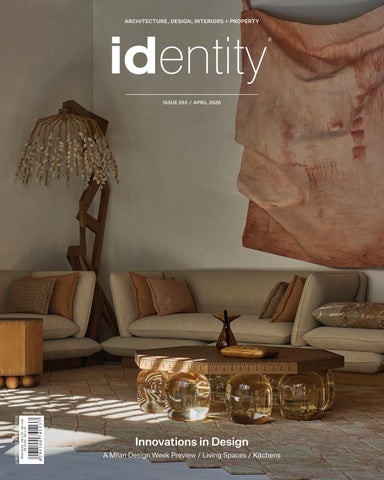
ISSUE 263 / APRIL 2026

![]()
ISSUE 263 / APRIL 2026

Discover more at quooker.ae


Designed to simplify everyday kitchen tasks without compromise, Quooker brings elegance and ease to the heart of every home.
Patinated Brass: a living finish that brings character to contemporary interiors. Expanding its design offering for 2026, Quooker introduces the Flex in Patinated Brass — a warm, living finish that develops a natural patina over time, giving each tap a unique character.

As developments in Saudi Arabia continue to increase, we consider how Japanese design principles are shaping sustainable urban development in the kingdom
A curated journey through the latest Italian design, where material mastery, sculptural form, and forward-thinking creativity converge to shape the future of interiors and outdoor living
Agata Kurzela Studio’s approach for the Zayed National Museum brings a distinct identity through a curation of Emirati designers throughout the 3,000 sqm space
Sleek, audacious, and defined by striking architecture, these are some of the UAE’s most unforgettable landmarks


Editor-in-Chief
Obaid Humaid Al Tayer
Managing Partner and Group Editor
Ian Fairservice
Chief Commercial Officer
Anthony Milne
Group Content Director
Thomas Woodgate
Editor
Aneesha Rai
Contributer
Rebecca Anne Proctor
Senior Art Director
Olga Petroff
Designer
Vibha Monteiro
Sub-editor
Max Tuttle
Senior Partnerships Manager
Sharmine Khan
General Manager - Production
Sunil Kumar
Production Manager
Binu Purandaran
Assistant Production Manager
Venita Pinto

Head Office: Media One Tower, PO Box 2331, Dubai, UAE; Tel: +971 4 427 3000, Fax: +971 4 428 2260; E-mail: motivate@motivate.ae
Dubai Media City: SD 2-94, 2nd Floor, Building 2, Dubai, UAE; Tel: +971 4 390 3550, Fax: +971 4 390 4845
Abu Dhabi: PO Box 43072, UAE, Tel: +971 2 677 2005, Fax: +971 2 677 0124; E-mail: motivate-adh@motivate.ae
Saudi Arabia: Regus Offices No. 455 - 456, 4th Floor, Hamad Tower, King Fahad Road, Al Olaya, Riyadh, Kingdom of Saudi Arabia; Tel: +966 11 834 3595 / +966 11 834 3596; E-mail: motivate@motivate.ae
London: Acre House, 11/15 William Road, London NW1 3ER, UK; E-mail: motivateuk@motivate.ae


This issue marks my return to the office to a world that feels very different from the one I left before maternity leave at the end of last year. In putting it together, I found myself wondering how best to offer a sense of comfort or respite to those of us in the GCC. Whilst we continue to navigate these unprecedented times, we know that things will, ultimately, move forward.
Over time, I’ve noticed that periods of disruption often give rise to the most meaningful work. The experiences that challenge us tend to shape what comes next. Your best work may still be ahead of you, and identity can’t wait to be your witness. We continue to support the industry and our partners through these uncertain times.
With that in mind, this issue looks both ahead and around us. We explore innovations in design in the lead up to Milan Design Week. Peruse through the pages to have a look at what awaits you at Salone del Mobile.Milano, Fuorisalone and EuroCucina. As always, identity is proud to be present at the fair as a media partner from the region – do follow @identityae on Instagram to see the highlights.
In our cover story, we feature the interiors at the Zayed National Museum by Agata Kurzela Studio. The project is a masterclass in dialogue between contemporary materials, spatial, and artistic language. Completed in close collaboration with Emirati and international designers on a series of bespoke pieces; it is a particularly compelling story to tell. This spirit of exchange continues in our Saudi Setting section, where we explore Japanese architectural influences on Saudi projects. We also revisit some of the UAE’s most iconic spots through the lens of architecture. In trying times, it becomes even more important to notice the beauty between moments.
Perhaps my main lesson is this: there is rarely art that matters without dialogue. The most meaningful work emerges when there is space for exchange and respect for each other’s craft.
Aneesha Rai Editor identity


HÄCKER.AE


Hu bring a truly global perspective, and we are proud to introduce their work to the UAE for the first time.”
Founded in 2006 by Lyndon Neri and Rossana Hu, Neri&Hu is an interdisciplinary design practice based in Shanghai. The firm has earned international recognition for its concept of “restorative nostalgia,” by creating contemporary spaces that evoke memory and familiarity through materiality and spatial experience, rather than direct historical imitation. Their work seeks to produce architecture and objects that serve as lasting, meaningful reference points for the communities they inhabit.
Al Ghurair Development brings Neri&Hu’s philosophy of place, memory, and materiality to the UAE
Al Ghurair Development, the freehold real estate arm of Al Ghurair, has appointed Neri&Hu Design and Research Office as lead architect for its upcoming residential project in Wadi Al Safa 3, near Al Barari and The Wilds. The move reinforces the developer’s commitment to collaborating with globally recognised architects to shape a new generation of thoughtfully designed homes in Dubai. It also marks Neri&Hu’s first residential project in the UAE, reflecting Al Ghurair Development’s long-term belief in architecture that responds to its environment while standing the test of time.
“Our search for the right architect was guided by a simple principle: we wanted a practice driven by meaning,” said Sultan Al Ghurair, CEO of Al Ghurair Development. “Neri&Hu have built their work around connecting people to place, memory, and one another – an approach that aligns closely with our vision of creating purposeful homes that deliver lasting value for residents and the wider city. Lyndon Neri and Rossana
The forthcoming development represents the studio’s latest exploration of urban living. Neri&Hu will design a residential tower complemented by dedicated amenities, parking, and ground-level retail, with the full concept currently in development. In line with the practice’s ethos, the architecture will explore the interplay of contrasting materials, layered textures, and spatial complexity. Residences will be designed to strengthen the connection between indoor and outdoor living, while the overall scheme aims to establish a distinctive identity for the neighbourhood. At its core, the project will be informed by how residents live, gather, and retreat, by ensuring the architecture performs as beautifully from within as it does externally.
Lyndon Neri and Rossana Hu, Founding Partners of Neri&Hu, added, “We believe design must be rooted in its time, place, and culture. Dubai, as a city in constant reinvention, presents both a challenge and an extraordinary opportunity. Our process begins with a close reading of context – the quality of light, material textures, and the rhythms of daily life. These elements guide us in shaping architecture that feels inherently connected to its surroundings. Equally important is a commitment to permanence: creating work that endures not only physically but in meaning. With Al Ghurair Development, we share this vision and aim to realise something lasting.”

Photography: Natelee Cocks
How Ennismore reinterpreted a Miami hospitality legend for Dubai, incorporating references to the signature elements of the original


Set on Bluewaters, Dubai Holding’s vibrant waterfront destination, Delano Dubai made waves when it opened in late 2024. Developed by Ennismore in collaboration with Elastic Architects and a roster of international design partners, the multi-award-winning project reinterprets the spirit of the legendary Delano in Miami, transforming the former Caesars Palace into a new design landmark for the city.
For Ennismore’s global brand design team, the ambition extended beyond reproduction and instead focused on capturing the distinct ‘feel’ of Delano while reimagining its design signatures for a new cultural and architectural context. As Mark Eacott, Global Vice President of Design at Ennismore, explains, “The key challenge was informing the next chapter of the Delano story, in a way that felt both respectful to the legacy of the original in Miami, and in tune with the energy and style of Dubai.”
The resort features 251 guest rooms, including 84 suites, alongside six dining destinations, including reimagined versions of the storied Rose Bar and Blue Door Restaurant. Two pools an-
chor the outdoor spaces, while 250 metres of private beach offer a rare stretch of Dubai shoreline with sweeping views of the horizon and the city skyline. At its pinnacle sits the Delano Penthouse, spanning more than 850 square metres across its own floor. The residence features five bedrooms, a private terrace and pool, as well as panoramic views across the Arabian Gulf.
To shape the design narrative, the team revisited archival photographs of the Miami property, long associated with glamorous parties and performances. Signature elements such as the iconic Delano white palette, sunken pool seating and billowing lobby curtains have been reinterpreted as contemporary design cues.
In the guest rooms, these references appear as subtle gestures. Framed archival images nod to the brand’s heritage, while sculptural glass apples recall the playful motif made famous in Miami. Monogrammed throw blankets, curated accents of colour, and natural stone-inspired Dekton countertops contribute to a sense of soft modernity.
The spatial experience unfolds as a choreographed journey. Guests arrive through
a dramatic curtain installation where white sheers, subtly illuminated by concealed lighting, introduce a feeling of movement and discovery. Dimly lit corridors open into luminous interiors defined by a chic, tonal palette. Curved furniture, cocoon-like seating arrangements and richly grained natural materials bring warmth and tactility, while the whimsical topiary and manicured greenery outside evoke Miami’s iconic green hedge.
Materiality plays a defining role throughout the project. Dekton, the carbon-neutral, ultra-compact surface by Cosentino, was selected for bespoke furniture elements, including bar countertops, side and coffee tables, and console surfaces.
Durable yet refined, the chosen surfaces –travertine-inspired Dekton Marmorio designed by Daniel Germani and Paonazzo stone-inspired Dekton Awake by Nina Magon – complement the hotel’s sculptural forms and tactile palette of finely crafted finishes.
In a city known for its ever-evolving luxury hotels, Delano Dubai stands apart as an icon thoughtfully reimagined for a new era on the emirate’s shores.

Saudi Arabia and the United Arab Emirates are among the Gulf countries which have confirmed their participation at the upcoming 61st International Art Exhibition of La Biennale di Venezia
WORDS – REBECCA ANNE PROCTOR
The Venice Biennale is gearing up for its 61st edition, an event which will prove to be a monumental and unique affair for its focus on intimacy and anti-spectacular art. The biennale, running from May 9 to November 22, 2026, is being realised posthumously following the passing of its appointed curator Koyo Kouoh and continues the exhibition she planned titled In Minor Keys. Exploring subtle and marginal expressions, the biennale’s theme moves away from the portrayal of global crises toward, what La Biennale called “the emotional, sensory and affective registers of art.”

rooted in foregrounding Middle Eastern cultural histories through the revival of craft practices and the preservation of the region’s globally important material heritage,” Awartani explained in the pavilion’s announcement. Her recent work, like the installation Come, let me heal your wounds Let me mend your broken bones, staged during the last biennale in 2024, reflects on the loss of historical buildings and centuries of heritage due to conflict in the Middle East. Awartani believes that when edifices are destructed not only is the structure abolished, but also a means inhabitants have of identifying themselves with their homeland and their identity. This is cultural erasure and it is often, she believes, overlooked globally.
Above – (from left)
Dana Awartani’s Come
Let Me Heal Your Wounds; Installation view of “Sarab” at Desert X Al-Ula, Saudi Arabia, 2022, Photography by
Lance Gerber
From the Gulf region Saudi Arabia and the United Arab Emirates have confirmed exhibitions at their pavilions. For the former, Saudi Palestinian artist Dana Awartani, known for her multidisciplinary works that reimagine Middle Eastern historical forms and traditions, will represent the Kingdom in a show curated by Antonia Carver, director of Art Jameel, alongside Saudi Iraqi curator Hafsa Alkhudairi. Awartani will present a monumental site-specific exhibition at the Kingdom’s permanent pavilion at the Arsenal exploring how conflict risks cultural erasure and identity. “My practice is
The National Pavilion of the UAE has appointed Bana Kattan, Associate Head of Exhibitions at the Guggenheim Abu Dhabi, as the curator of the pavilion. While the exhibiting artist or artists for the UAE pavilion have yet to be announced, the pavilion, commissioned by the Salama bint Hamdan Al Nahyan Foundation, will highlight the cultural and historical evolution of the UAE’s contemporary art scene. “Having worked extensively in the region and alongside a wide range of multigenerational and transdisciplinary artists from the Arab world, I look forward to contributing my experience to a project that reflects the UAE’s vibrant artistic landscape while engaging with broader histories, complexities, and conversations,” said Kattan in the pavilion’s opening statement. Kattan, who was born in Abu Dhabi and raised in the United Arab Emirates, is strongly connected to the UAE’s cultural landscape and has used her work to engage the sociopolitical and historical themes of the region while jointly fostering the voices of emerging and established artists from the Gulf and wider Middle East across generations.
Qatar and Kuwait, which have participated in previous editions, have not yet confirmed their attendance. During a challenging time for the region, these artistic presentations aim to offer an understanding of the Gulf’s unique histories, cultures and identities within the context of the greater Middle East region.


As developments in Saudi Arabia continue to increase, we consider how Japanese design principles are shaping sustainable urban development in the kingdom
WORDS – MAX TUTTLE


The interior spaces of Tadawul Tower is organised as a polyhedral composition, and its faceted, crystalline geometry operates as an environmental mediator by calibrating solar exposure in response to local climatic conditions
This page – Designed by Nikken Sekkei, Tadawul Tower employs the lens of origami, resulting in a crystalline exterior form that appears as though a single sheet of glass has been folded, while adhering to the stringent urban design guidelines of the King Abdullah Financial District
Saudi Arabia is in the midst of a building boom, with developments springing up across the kingdom. In common with other countries in the region, an increasing number of projects now celebrate Arabic heritage, architecture and culture, yet other design philosophies remain influential throughout the Saudi built environment.
Among these, the Japanese design approach has become an increasingly prominent framework. Characterised by clarity of intent, formal simplicity and sophisticated restraint, the philosophy values coherence, efficiency and contextual sensitivity over expressive excess. These principles are evident in some of Saudi Arabia’s most ambitious projects, where clear vision, rigorous execution and resilience to environmental and urban conditions are shaping more sustainable and enduring models of vertical urbanity and iconic development.
Importantly, the intent and simplicity emphasised by the Japanese approach is finding favour with key developers active in Saudi Arabia, who apply it to ensure that every detail has a purpose and every element belongs to its context. This philosophy embeds traditional aesthetics such as minimalism and harmony with nature – and in a region undergoing rapid
urban growth, this disciplined methodology delivers architecture that performs technically and respects the country’s cultural identity.
Projects such as Tadawul Tower in Riyadh, designed by Nikken Sekkei and developed and managed by Tadawul Real Estate Company, showcase Japanese principles translated into practice. Responding to the stringent urban design guidelines of the King Abdullah Financial District (KAFD), Tadawul Tower establishes a distinct architectural identity through its faceted, crystalline geometry, which not only complies with prescribed parameters but also operates as an environmental mediator. The crystal-shaped form carefully calibrates solar exposure in response to local climatic conditions, demonstrating how formal articulation can be directly linked to performance.
These guidelines, known as the ‘facetted form’, abstract Riyadh’s natural wadis and fuse them with Islamic geometric principles. The design team behind Tadawul Tower reinterpreted this concept through the lens of Japanese culture as ‘origami’, creating a crystalline exterior form that appears as if a single sheet of glass were folded, with interior spaces organised as a corresponding polyhedral composition. Complementing this approach, horizontal louvres and
high-performance glazing mitigate heat gain, while a strategically positioned internal void introduces natural daylight and fosters a sense of spatial calm. These elements are integral to the building’s environmental strategy, enhancing energy efficiency and occupant comfort rather than functioning as applied ornamentation. In contrast to many surrounding developments, the project embodies sophisticated restraint, relying on precisely angled surfaces to achieve an understated yet highly integrated presence within its urban context.
It should be noted that Middle Eastern applications of the Japanese principles of clarity, simplicity and harmony with nature are not new. Another Nikken Sekkei project, the Islamic Development Bank Headquarters Building was completed in 1993 and reflected a thorough understanding of the local climate, culture and religion, as well as spatial concepts and customs unique to Islamic architecture.
Looking to the future, it is certain that one fundamental will remain: regardless of the overarching architectural approach, the region’s successful buildings will be contextually responsive – only then can they balance environmental performance, human experience and enduring urban value.
Below – Tadawul Tower abstracts Riyadh’s natural wadis and fuses them with Islamic geometric principles, while demonstrating the Japanese design approach that is characterised by clarity of intent, formal simplicity and sophisticated restraint


A curated journey through the latest Italian design, where material mastery, sculptural form, and forward-thinking creativity converge to shape the future of interiors and outdoor living
WORDS – NILUFER NAJEEB
RODA expanding the sculptural language of the Aspic series, The Aspic dining table, an evolution of Gordon Guillaumier’s iconic coffee table, will be presented at Salone del Mobile. Milano as part of Roda’s 2026 innovations. Its solid concrete structure, sculpted concave base, and speckled top assert a monolithic presence while maintaining visual delicacy. Offered in three new natural shades orange, green, and mole the table combines durability, refined texture, and structural performance. Extremely versatile, Aspic integrates seamlessly with other collections and seating, bringing elegance, character, and tactile richness to both indoor and outdoor living environments.


Bross, a brand recognised for its innovative approach to contemporary seating, is entering a new phase with the launch of the SIT collection, designed by Marco Zito. This new range reflects the company’s commitment to versatility, quality, and modern living, offering solutions for residential, office, and hospitality spaces. The SIT collection marks an important step in Bross’s ongoing evolution, expanding its portfolio with a cohesive family of lounge seating and poufs that respond to diverse needs. With options in fabric or leather and a variety of finishes, SIT embodies the brand’s dedication to craftsmanship, adaptability, and contemporary excellence. Through this launch at Salone del Mobile.Milano, Bross reinforces its position as a reference in premium seating, presenting a collection that is both versatile and representative of the company’s vision for the future.
Edra continues to build its identity around a deep exploration of comfort, material research, and the dialogue between innovation and craftsmanship. Founded in Tuscany, the brand has become known for collections that merge advanced technology with artisanal expertise, shaping a distinctive presence within contemporary furniture.
With its newest collection presenting at Salone del Mobile.Milano, the brand continues this trajectory, presenting updated interpretations that reflect
evolving materials, finishes, and construction techniques. This ongoing dialogue between research and craftsmanship allows Edra to respond to contemporary living while preserving the distinctive character that has made its furniture enduring design icons.
Deep roots and a forward-looking vision define et al.’s 2026 collection, with Nuy by Marco Acerbis extending the brand’s commitment to craftsmanship and human-centered design. The chair’s signature inverted “Y” ash wood frame creates a structural and symbolic foundation, while clean lines, visible joinery, and generous upholstery introduce a refined balance of precision and comfort.
Alongside Nuy, the collection reflects et al.’s ongoing exploration of materiality, sustainability, and spatial presence, strengthening the brand’s identity with pieces that are at once bold, welcoming, and attuned to the future of living and working environments. “Placing a ‘new us’ at the centre means making the company’s values concrete: believe in its own identity, recognise hospitality as natural field and looking to the future with courage,” says Francesca Tonti, CEO of et al.
Antrax IT introduces Carlo, a new heating accessory designed by Dante O. Benini and Andrea Crosetta in homage to the legendary architect Carlo Scarpa. Drawing inspiration from Scarpa’s drip-edge detail, Carlo transforms this subtle architectural feature into a vertical tubular

heater that also functions as a hook for bathrobes, towels, or clothing. At Salone del Mobile. Milano, the collection will showcase its refined material dualism, combining brushed stainless steel with recyclable aluminum finishes. Slim, elegant, and low-energy, Carlo brings architectural poetry and functional design to bathrooms, spas, and living spaces alike.
Atlas Concorde will showcase its expertise at Salone del Mobile, presenting Marvel Epic, a collection set to redefine surfaces as immersive, monumental elements that bring depth and character to any space. Inspired by seven precious natural stones Taj Mahal White, Taj Mahal Noisette, Calacatta Viola, Onyx Ivory, Alpinus, Natural Roots, and Zephyr the collection will offer versatile solutions for floors, walls, large slabs, and furnishings. Zephyr stands out with its polychromatic design and bold grey and hazelnut veins, evoking the dynamic essence of nature and creating a surface full of movement, personality, and visual depth.
Atlas Concorde, a global leader in ceramics since 1969 and parent of the Concorde Group, combines continuous innovation, Italian style,
and environmental responsibility. Through brands like Atlas Plan and Atlas Concorde Habitat, it delivers large slabs and furniture elements with precision and an industrial approach that meets the demands of modern design.
Curves redefine the iconic, Meridiani will present the René collection with new curved elements at Salone del Mobile.Milano, expanding the modular sofa’s creative and compositional possibilities. These sinuous modules soften the iconic collection’s solid volumes, allowing the sofa to flow like a double-sided sculpture that enhances any space with personality and poetic presence. Staying true to its Italian craftsmanship, Meridiani continues to combine timeless design, refined materials, and technical expertise, offering versatile collections that transform interiors into elegant, intimate environments for both residential and contract settings.
At Salone del Mobile.Milano, Abimis showcases its mastery in blending industrial precision with artisanal craftsmanship through the new
AlterEgo sideboard collection. Designed by Alberto Torsello, this collection extends the iconic Ego Kitchen aesthetic with a bold fusion of orbitally polished stainless steel and natural Cipollino marble doors. Drawing inspiration from 1950s design, AlterEgo redefines functional elegance with bevelled flush doors, pivot hinges, and signature circular stainless steel handles. This collection embodies Abimis’ commitment to creating sculptural, tactile furniture that bridges kitchen and living spaces, offering a harmonious balance between timeless design, innovative materials, and meticulous construction quality.
Ulisse Narcisi will present a new vision of Volare for ARAN World, reimagining one of the brand’s most iconic kitchen systems. In this restyling, Volare will balance structural lightness with elegant volumes, translating the company’s heritage into a contemporary and international perspective. Set to be previewed during Salone del Mobile.Milano at ARAN’s Milan Flagship Store, the updated Volare will explore the dialogue between material and form: natural oak base units and island elements will meet Taurus
gres surfaces, creating a refined contrast between organic warmth and mineral strength. Handleless channels, titanium accents, and plinths will define a precise architectural rhythm, while subtle chromatic details in wall unit interiors will add a couture-inspired note to the everyday experience. Designed as an integrated system for open-plan and contemporary environments, Volare will maintain its signature elegance and versatility while offering


a new interpretation of lightness and harmony. Through this evolution, ARAN World will continue to combine craftsmanship, innovation, and international design vision, presenting a kitchen that is both sculptural and functional.
Turri will present B.E.L.T. at the fair, a collection that speaks the language of furniture by reinterpreting the iconic leather belt as a signature design gesture. The preview will highlight hand-woven leather bands wrapping the sofa’s generous armrests, accented with a sleek buckle, creating a sculptural and collectible presence. This presentation aims to explore modular volumes, tailored edges, and integrated accessories such as the leathercovered coffee table, inviting feedback on how bespoke craftsmanship and contemporary elegance can shape future living environments.
Ethimo will present Teodora at Salone del Mobile.Milano, a new outdoor armchair that combines comfort, craftsmanship, and refined design. Shaped from specially curved natural teak, Teodora embraces a woven Olive Green Rope Seat with rhomboid patterns that add depth and highlight Ethimo’s artisan expertise. Generous White bouclé cushions complete the ergonomic, sensorial experience, creating a piece that naturally supports the body while relaxing outdoors. Perfect for residential and contract settings, Teodora elevates outdoor living with elegance, character, and a distinctive sculptural presence.
COVER STORY – DESIGN
Agata Kurzela Studio’s approach for the Zayed National Museum brings a distinct identity through a curation of Emirati designers throughout the 3,000 sqm space
AS TOLD TO ANEESHA RAI
PHOTOGRAPHY – SEBASTIAN BOTTCHER


Where does one begin designing the interiors of a space designated to be the UAE’s national museum? “By creating interiors that would sit in dialogue with the architecture while expressing Emirati culture through contemporary materials, spatial, and artistic language,” shares Agata Kurzela, founder of Agata Kurzela Studio. The studio was asked to lead the creative direction, interior design, curatorship, and furnitures, fixtures and equipment across a constellation of public, VIP, and research spaces inside the newly unveiled museum.
Adopting an approach that looked at spatially interpreting the museum, the studio
moved away from just presenting history to bringing forth the talents of Emirati designers through project-specific pieces. Most of the pieces offer a contemporary take with a resonant story behind them, looking into history, materials, and rituals – creating a dialogue against the contemporary architecture designed by Foster + Partners. “The defining quality of the project lies in its curatorial structure. Each space is conceived as a cultural chapter,” shares Kurzela.
The atmospheres shift deliberately across the museum. Public zones remain quietly sculptural and monumental, calibrated to support pause and orientation within the architectural scale. By contrast, other spaces designed by
Left and previous spread – The Research Library, composed of a library space and a sitting area, overlooks the monumental Magan Boat whose black woollen sail visually connects to the materials that originate in a Bedouin tent and that are at the core of the centre’s design
the studio invite curiosity, unfolding warmth through nuanced combinations of colour, shadow, and tactile surfaces. Al Liwan – a modular seating system is developed by Agata Kurzela studio and is conceived as a near-infrastructural element that dissolves into the architecture at the public atrium. The Al Shaheen Majlis on arrival expresses the tradition of welcoming guests with gahwa – Emirati coffee. A sequence of interconnected meeting spaces on the first floor is organised around a central courtyard, is informed by the cadence of the al durour calendar, the traditional system that maps the year through climatic and ecological phases. The meeting environments consist of two majlises and one boardroom. Both Al Hurr majlises represent seasonal conditions with distinct spatial and chromatic identities – Al Sheta (winter) and Al Qaith (extreme heat) – while the Boardroom reflects Al Saif (summer). Cultural meaning is embedded within the tactility of surfaces, the weight of objects, and the atmospheres produced through light and proportion.
The Al Shaheen Majlis introduces warmer references inspired by the welcoming ritual of gahwa, decorative traditional doors flanked by an Al Bab carpet and camels through the Jamal carpet with long fringes reminiscent of a soft animal fur. All carpets used in the project are by Zuleya. The arrival area of this majlis brings together works by Abdalla Al Mulla, who developed an adaptable modular bead bench that sits upon the Jamal carpet, flanked by large sculptural ceramic pots by Michael Rice. The Ned sofa and table system developed by Omar Al Gurg was adapted from an ultimate residential comfort to a more formal setting, the tables executed in stone and papyrus-based biomaterial. Roudha Al Shamsi was responsible for pendant lighting; Irthi wove safeefah cushions from local leather. The space is framed by a series of artworks by Juma Al Haj. Roudha Al Shamsi was responsible for pendant lighting, and safeefah cushions by Irthi are woven from local leather.
The Al Hurr 1 majlis is inspired by winter ( Al Sheta). It features a custom sofa system by Aljoud Lootah featuring stone tables, solid yet visually lit. The system references an arrangement of stacked cushions, whose spontaneous and adaptable form was at the origin of a traditional Emirati majlis seating,

here reinterpreted and synthesised. A bespoke EBB table light by Alya Al Ghefeli is rendered in metal patina, stone and camel leather, while feature pendant lights are by Khalid Shafar, octagonal tables are by One Third Studio, carpets by Agata Kurzela, and the embroidered artwork is by South African, Dubai-based artist Stephanie Neville.
Al Hurr 2 majlis features a custom sofa system by Aljoud Lootah, a Shade and Shadow floor light by Lodge Interior, a custom octagon table by One Third Studio, carpets by Agata Kurzela studio, and artwork again by Stephanie Neville. In the boardroom, inspired by Al Saif, Afra Al Dhaheri’s kanduraimprint wall panels establish a cultural surface
language, complemented by a pendant light by Agata Kurzela studio and manufactured in collaboration with Nader Gammas, custom cabinetry by One Third Studio, carpets by Agata Kurzela studio, and seating by Vitra.
The Research Library is composed of a library space and a sitting area that overlooks the monumental Magan Boat, whose black woollen sail visually connects to the materials that originate in a Bedouin tent and that are at the core of the centre’s design. It introduces a more graphic register; high contrast, tactile, and grounded, drawing on the material logic of the raw wool of a Bedouin tent. The space integrates custom shelving spanned by a system of movable ladders clad in burnished

system by
Lootah,
custom
EBB table light by Alya Al Ghefeli, feature pendant lights by Khalid Shafar, octagonal tables by One Third Studio, carpets by Agata Kurzela, and embroidered artwork by Stephanie Neville. The lobby of Majlis Al Shaheen features a large modular Bead bench by Abdalla Al Mulla set on a custom Jamal carpet
bronze, timber desks, sofa systems, lighting, coffee tables and rugs by Agata Kurzela studio, side modular tables co-designed with Abdalla Al Mulla, Nomad chairs by Latifa Saeed, Vitra task seating, carpets by Agata Kurzela with custom tarboushes by Loretta Bilinskaite.
Execution was treated as a curatorial and research-led process. Agata Kurzela studio conducted extensive prototyping, material trials, and full-scale mock-ups, working closely with local workshops and regional craftspeople. From testing the limits of the kilns and ceramic glazes to research-focused development of local tassels to on-site validation of bespoke furniture systems, the project evolved through continuous dialogue between concept and fabrication. This deliberate, investigative methodology ensured that every component aligned not only technically, but culturally.
“Designing within a national monument required a careful negotiation between presence and humility,” shares Kurzela. “The interiors needed to hold emotional and cultural weight without competing with the architecture’s authority.” Together, these collaborations embed contemporary Emirati and regional authorship directly into the museum’s spatial identity.


Salone del Mobile.Milano 2026 will showcase modular, sculptural, and contemporary design that will transform interiors with personality and balance
Kreoo, the Italian brand renowned for its innovative approach to marble and stone, present its latest creations designed by Luca Nichetto, Musina and Posso reinterpret the historic Venetian vera da pozzo the carved stone wells traditionally found throughout Venice. Translating this architectural archetype into contemporary design, the two countertop washbasins explore the relationship between geometry, material, and memory through the expressive qualities of marble.
Musina combines a circular inner basin with an octagonal outer structure carved from a single block of stone. Subtle protruding facets and softly contoured edges create a dynamic surface that highlights the natural veining of the marble. Posso echoes the octagonal theme with delicately concave faces and a refined base trim, giving the form a lighter, sculptural presence. Together, the pieces reinterpret a historic object through precise geometry and material depth, transforming tradition into a contemporary design language.
Soft volume meets compositional freedom in Paco, a modular sofa system designed by Ludovica Serafini and Roberto Palomba. Defined by fluid lines and balanced proportions, the design embraces comfort as a spatial element, with generous padding and a low, enveloping profile that feels both inviting and refined. Its modular nature allows seamless configurations, adapting effortlessly to different layouts while maintaining visual harmony. Soft yet structured forms create continuity, giving each arrangement a cohesive identity.
Carefully selected fabrics enhance tactility and depth, while precise detailing underscores craftsmanship. Paco emerges as a quiet, contemporary system flexible, elegant, and designed to evolve naturally within modern interiors.
STEPEVI presents A Softer World, a living textile installation by Swedish artist Alfhild Külper at its Via dell’Orso 9 showroom. Conceived as a forest of emotion, the work transforms leftover


yarns from STEPEVI’s Caresse collection into a tactile, immersive environment.
Designed with Carolina Nisivoccia, the installation celebrates upcycling, material mindfulness, and the interplay of light, tone, and texture. A Softer World is a contemplative space where craft, emotion, and design converge, creating a living dialogue between materials and human experience.
Bloomington, designed by Mauro Lipparini, is a sculptural exploration of gesture and material. Its curving, calla-inspired silhouette asserts itself as a three-dimensional volume, defining space even before it welcomes the body.
The polished outer shell reflects light, amplifying tension and curvature, while the trumpet-shaped base rises like a structural stem, lifting the seat into a suspended, chalice-like posture. Asymmetrical armrests and backrest introduce a deliberate dynamism,

breaking conventional symmetry and engaging the surrounding environment. Every line is intentional, merging structure and elegance, while comfort remains inherent yet understated. BLOOMINGTON transforms seating into a spatial statement of presence and poise.
Fabula by Rastelli reinterprets classical design through a contemporary lens, where balance meets modern expression. Warm washed oak, steel, and glass create open, luminous volumes, while matte Cava Noir Desir surfaces and titanium-finished handles add tactile depth. Geometric precision and seamless appliance integration ensure clarity and harmony. Fabula transforms the kitchen into a space of calm, presence, and daily balance.
Designed by Vittorio Venezia and Carolina Martinelli for Lodes, Axia reinterprets the chandelier through a contemporary lens, exploring the delicate balance between light, form and technology. Structured around a slender central axis, the suspension lamp integrates electrical conduction directly within its body, eliminating visible cables and


allowing the form to remain visually pure. From this tapered core, arms extend outward in a rhythmic composition, creating a sense of equilibrium and lightness while distributing soft, diffused illumination.
The design transforms a technical system into a decorative gesture, where function and structure become integral to the lamp’s visual language. Finished in metallic surfaces such as Glossy Bronze or Black Chrome, Axia highlights the reflective qualities of metal while maintaining a refined architectural presence. The result is a lighting object where engineering and minimal form converge to create a luminous, sculptural statement.
Defined by clarity of form and a strong graphic rhythm, the Sunset Collection by Marco Corti translates indoor sensibilities into an outdoor setting. Generous proportions and clean lines create a relaxed yet structured presence. Striped fabrics introduce a bold visual identity, adding movement and contrast while anchoring each piece. The interplay of soft upholstery and a precise metal frame balances comfort with stability.
Powder-coated finishes and high-performance textiles enhance durability without compromising refinement. The result is a cohesive, contemporary system where graphic expression and minimal design shape a distinctive outdoor language.
Ideagroup opens Spazio Milano to reveal Architectural Forms. Human Spaces, a showcase of design where geometry meets human experience. The Cubik collection by Riccardo Gava exemplifies this vision: minimalist 45-degree edges, handle-less fronts, and modular innovations create a seamless visual rhythm.
New finishes from natural woods to marble-effect laminates and versatile coloured glass expand creative possibilities, while refined proportions respond to everyday living. Every detail, from texture to alignment, emphasizes the dialogue between architectural form and personal comfort. Cubik transforms bathroom furniture into a carefully composed space where elegance, material richness, and functional clarity coexist in harmony.

We highlight the latest kitchen innovations and product launches taking place at Salone del Mobile.Milano and Fuorisalone
WORDS – NILUFER NAJEEB

After its success in 2024, anticipation is high for EuroCucina along with Technology For the Kitchen (FTK), taking place at Salone del Mobile. Milano from 21 to 26 April 2026. This year, 106 exhibitors from 17 countries, including 35 new or returning brands, will showcase innovations shaping the kitchens of tomorrow. The Biennale remains the global benchmark for kitchen design, highlighting technology, sustainability, AI, and intelligent systems that let users craft personalised spaces.
This year, the kitchens seem to be evolving with open-plan layouts, interactive surfaces, and invisible induction hobs. Eco-friendly materials like FSC wood and recycled glass combine with smart systems that control lighting, temperature, and scent, creating adaptable, multisensory spaces. Despite innovation, kitchens remain rooted in tradition. UNESCO’s recognition of Italian cuisine as an Intangible Cultural Heritage of Humanity reinforces kitchens as spaces of memory, creativity, and conviviality. Italian companies respond with designs that celebrate identity while embracing global innovation. The large appliance sector is also advancing.
At FTK, leading brands will unveil quieter, more integrated, autonomous devices. Fisher & Paykel’s Nature-Ritual installation will showcase its Minimal Style collection,
reflecting the “Social Kitchen” philosophy. Visitors can explore modular ovens, smart refrigeration, integrated hoods, and multifunctional cooktops. The exhibition features sensory experiences, including a kawakawa tea ceremony, a sculptural monolith, and New Zealand wine tastings. Developed with Alt Group and Calvi Brambilla, it blends design, sustainability, and technology.
Also reflecting this shift, Ernestomeda will unveil Sign Round at the fair, which is an evolution of its iconic Sign kitchen by Giuseppe Bavuso. Soft curves and fluid lines create a relaxed link between kitchen and living spaces. The island’s wing-like snack table encourages social gatherings, while refined finishes and sustainable production ensure a considered, contemporary design.
Snaidero will introduce Orbita as an additional component to its highly configurable Sistema Snaidero range. The heart of Orbita lies in its moving geometry, a system that allows the rotation of bases and columns by 20°, generating a new way of interacting with space.
The focus on kitchens as living, harmonious spaces continues with Falmec, presenting Mimesis, where ventilation integrates seamlessly into worktops, ceilings, and lamps. Circular forms symbolise balance, while materials blend aesthetics with function. The brand will be marking its 45th anniversary this year. Falmec will also present the Level collection, three downdraft extraction systems built into worktops. From Level One’s induction hobextractor combo with Flex Surface and Chef Mode to the adaptable Level and fully concealed Level Invisible, these solutions combine power, efficiency, and minimalist style.
Nolte Küchen will highlight new materials and surfaces that blend aesthetics with practicality. Their enhanced matt lacquer concept will feature durable finishes and fresh colours, while the Nolteneo premium line focuses on architectural design and expressive materiality, seamlessly connecting kitchen, living, and adjacent spaces.
Latest presentations at EuroCucina 2026 will include natural and marble-effect materials like porcelain stoneware, composite quartz, and laminates. Known for elegance and durability, marble is perfect for countertops, splashbacks, and islands, offering resistance to heat, stains, and scratches.
Scavolini will present Poetica, a modern kitchen system designed by Vuesse. Featuring a combination of stoneware, glass, and marble, the design includes an island with Maxidoor doors in Stopsol Acciaio glass and a Fusion White porcelain stoneware top. Wooden Rice Ash frame doors and Vertical System woodwork in Fusion White complete the look.
Febal Casa, in collaboration with Zaha Hadid Architects, will introduce Isola Onda, the focal point of the kitchen. With customisable
worktops and sides, it offers a range of premium materials, including Gres, Abitum, Laminam, Neolith, Optimum, and Laminate, blending design with functionality.
Within the gardens of Villa Necchi Campiglio, Gaggenau’s presence offers an immersive experience during Milan Design Week. Light, shadow, and materials guide focus, with appliances blending seamlessly into the architecture. Visitors will experience how simplicity, balance, and design transform the kitchen into a calm, sophisticated space where every detail serves function and visual harmony.
In line with this evolution in design, Poliform is set to open a new showroom in Piazza
della Scala, marking a bold shift for Milan Design Week 2026. The strategic location will strengthen the connection between architecture, interior design, and Milan’s urban landscape. The showroom will serve as a significant milestone in Poliform’s retail strategy, providing a space for design, experience, and relationship-building. Poliform’s participation in Milan Design Week 2026 will take shape as an autonomous chapter, enhancing the brand’s presence in Milan and opening new perspectives on the relationship between design, the city, and industry.
As brands embrace new materials, smart systems, and sustainable practices, EuroCucina will once again prove to be the leading platform to showcase the future of kitchen design.


1. Nebula Monaco by miniforms
Miniforms presents a fresh take on contemporary seating with Nebula Monaco, balancing a dense, enveloping form with the lightness of upward-reaching lines. Inspired by cloud-like shapes, its identity is defined by distinctive teardrop arms. Available in multiple variations with different base options, it adapts to diverse interiors. Crafted from fully recyclable polyurethane, it combines expressive design with a conscious and sustainable production approach.
2. Layers by Glas Italia
Glas Italia introduces a new approach to storage with Layers, designed by Nendo. The piece explores transparency and layering through white matt extralight lacquered glass, while coloured sliding doors overlap to create shifting chromatic effects that partially conceal the shelves. Available in warm and cool tones, it balances visual lightness with a clear, structured form, combining functionality with a subtle sense of movement and depth.
3. Gambosa by Marset
Marset reimagines the traditional table lamp with Gambosa, exploring a refined balance of form. Designed by Mathias Hahn, it distills the lamp into essential elements, forming a minimal yet sculptural composition. A curved shade, slender stem, and flat base act as distinct volumes, creating lightness and tension. Available in various colours and finishes, it shifts from subtle to expressive while maintaining a clear, recognisable identity.
4. STAGE MAE ENGELGEER by cc–tapis
Mae Engelgeer’s STAGE for cc–tapis translates digital gestures into rugs, turning mirrored patterns


into ethereal compositions. Made from wool, silk, and linen, layering and texture create a serene, dreamlike environment. Soft pastel palettes enhance Engelgeer’s poetic aesthetic, elevating her signature atmospheric style into a visually immersive spatial experience.
5. Taito by +kouple
+Kouple introduces the Taitō Pouf, blending simplicity with a distinctive, non-standard form. Designed by Dan Vakhrameyev, Taitō meaning “equivalent” in Japanese reflects balanced volumes through a square-cylinder silhouette. Launched at Design Nation Berlin 2025, it comes in two sizes that complement each other, equally shaping and enhancing the surrounding space with harmony, clarity, and a strong sense of visual balance.
6. Additional System by Tacchini
Tacchini’s Additional System, designed by Joe Colombo in 1967, combines six cushion sizes inspired by 1960s ergonomics. Its versatile modules enable flexible, inventive seating as armchairs, poufs, or daybeds. Developed with the Joe Colombo Archive, this re-edition remains strikingly “futuristic” over 50 years later.

The evocative torus-shaped structure of the Museum of the Future in Dubai, an unmissable structure that opened in Downtown Dubai in February 2022, has become one of the city’s architectural masterpieces, symbolizing humanity’s capacity to continuously innovative – one of Dubai’s defining characteristics. Designed by Killa Design, the building features a

green hill representing the earth, symbolizing permanence, its stainless-steel structure represents humanity or strength and the central void for which it is known reflects the idea of surrendering to the unknown future and the exciting opportunities it will bring. Covering the façade of the building is Arabic calligraphy acting as glass windows, presenting quotes on the idea of the future by Sheikh Mohammed
bin Rashed Al Maktoum, Prime Minister of the United Arab Emirates. One notable one reads: “We might not live for hundreds of years, but the products of our creativity can leave a legacy long after we are gone.”
Situated in the heart of Alserkal Avenue, Concrete is a 1,250-square-meter multi-disciplinary
Sleek, audacious, and defined by striking architecture, these are some of the UAE’s most unforgettable landmarks
WORDS – REBECCA ANNE PROCTOR

space for museum-grade exhibitions, performances and cultural exchange, designed by Office for Metropolitan Architecture (OMA), founded by Pritzker Prize-winning architect Rem Koolhaas. Comprising four combined warehouses that have been repurposed to create a museum-grade space with the capacity for multiple configurations, Concrete's modular capacity stems from its movable walls, allowing
for up to 15 layout configurations. “Concrete was our first built project in the UAE,” said Kaveh Dabiri, an Associate at OMA. “Nine years later, we look back with great satisfaction at the diversity of exhibitions and public events it has hosted, and the contribution it has made to Dubai’s cultural landscape. Highly adaptable, almost machine-like, it has consistently performed as intended since completion.”
Cinematic in scale, since it opened in March 2017, Concrete has hosted dance performances, international and regional art exhibitions, conferences and activations. It reflects Dubai’s forward-thinking, all-inclusive and innovative character, grounded in quality and respective for diverse cultures. In 2019, Concrete became the first building in Dubai to be shortlisted for the prestigious Aga Khan Award for Architecture.
Shooting up into the sky as if there were no limits, the 828-meters tall Burj Khalifa is the world’s tallest building. With 200 stories, 160 of which are inhabitable, the building, inaugurated in January 2010 and located in Downtown Dubai, represents the United Arab Emirates’ transformation from an oil-based economy to a tourism-based, technologically advanced, highly innovative and entrepreneurial society. “We in the United Arab Emirates have no such word as ‘impossible.’ It does not exist in our lexicon,” Sheikh Mohammed bin Rashid Al Maktoum, is
often quoted in reference to the tower’s emblematic representation of human ambition against all odds. Designed by Skidmore, Owings & Merrill with architect Adrian Smith, the tower’s Yshaped plan mirrors the Hymenocallis flower, a regional desert flower, and incorporates geometric patterns from Islamic architecture. The Burj Khalifa’s core rises, surrounded by three wings that act like flower petals, offering stability and a sophisticated aesthetic. Outside of their elegant appearance, the three wings reduce wind forces and maximise views of the Gulf. The tower was conceived by Emaar Properties, a leading Emirati real estate company, as a "symbol of hope" for the Arab world, showcasing economic and social progress. The tower, since its launch, has become one of Dubai’s most recognisable symbols.

Designed in the shaped of an iconic dhow, a traditional Arabian sailing vessel, since its launch in August 2016, the Dubai Opera has become one of the city’s most recognisable architectural icons. Located in Downtown Dubai and designed by Atkins and lead architect Janus Rostock, the 2,000-seat, multi-format venue features a flexible, high-performance design that transforms into three sections: a theatre, concert hall, and a flat-floor event space.
“Dubai Opera stands as a defining symbol of the city’s cultural ambition: an architectural landmark inspired by Dubai’s maritime heritage, yet shaped for a global future,” said Head of Dubai Opera, Paolo Petrocelli.
“More than a venue, it is a platform where cultures meet, ideas are exchanged, and

artistic excellence finds a home in the region. As a cultural institution, we see our role not only in presenting world-class performances, but in fostering connection, dialogue, and shared experiences. Especially in challenging times, Dubai Opera reaffirms the enduring value of the arts as a unifying force, reflecting the openness, resilience, and forward-looking spirit of Dubai.”
A Roman-style, open-air amphitheatre in the coastal town of Khor Fakkan in the UAE emirate of Sharjah, might be hard to believe. But this impressive structure, which opened in 2020, designed by Jordan-based firm Dar Al Omran, combines classical architecture with modern facilities and features a 3,500-seat capacity, adjacent modern water features and


a built-in cooling system. At 1,700-squaremetres the cultural venue features the same classic arches and columns that one would find in a Roman amphitheatre throughout the Mediterranean. Its location in the United Arab Emirates is meant to bridge history and diverse cultures.
The structure, which is built into the side of Al Sayed Mountain, features a stone façade with 234 arches and 295 columns. Commissioned by the Ruler of Sharjah, Sultan bin Muhammad Al Qasimi, to bolster the cultural scene in the Eastern region of the Emirate, it also incorporates t raditional Middle Eastern and Islamic geometric patterns and uses white limestone that was quarried in Oman to endow it with a local touch. Located directly adjacent to the amphitheater is the Khor Fakkan waterfall, also built into a natural cliff at the foot of Al Sayed Mountain, bridging t he impressive man-made cultural venue with the beauty of the area’s natural surroundings.
Elegantly projecting upwards towards the sky, the five-falcon wing-shaped lightweight steel towers of Zayed National Museum in Abu

Dhabi offer a sense of determination, pride and strength. The museum, which opened to the public on December 3, 2025, a day after the United Arab Emirates’ National Day, was designed by Pritzker Prize-winning architect Lord Norman Foster of Foster + Partners. It is symbolic of the strength, courage, determination and pride of the falcon, the national emblem of the United Arab Emirates.
The museum’s falcon-wing towers act as solar thermal chimneys providing a sustainable, natural cooling system. Inside, the museum consists of a light-filled central atrium known as Al Liwan, an Arabic term referring to a traditional, long, vaulted hall or central courtyard or gathering space, with suspended pod-shaped galleries housing together over 3,000 objects, including ancient and modern artifacts that recount the history and culture of the United Arab Emirates. The building, which had been under construction for 15 years, has quickly become an iconic architectural landmark symbolising the pioneering vision of the UAE’s founder Sheikh Zayed bin Sultan Al Nahyan, who united the country in 1971. The museum reflects the nation’s steadfast move
towards progress and innovation while never forgetting its history and heritage.
ZAHA HADID ARCHITECTS
Designed in the manner of a futuristic oasis amid Sharjah’s Al Sajaa Desert, Zaha Hadid Architects designed the 9,000-square-metres BEEAH Headquarters, the central administrative hub for BEEAH Group, a regional leader in sustainability, waste management and green mobility, to resemble the desert sand dunes. The undulating structure has two primary dune volumes – one for management and the other for public departments – connected by a central, naturally ventilated courtyard. The building is powered by a solar array with Tesla battery packs to achieve net-zero emissions and has been designed with sustainable, locally sourced materials, incorporating LEED Platinum standards and AI-integrated technologies to make it a pioneering structure for sustainable design and work.
Incorporating the signature anamorphic forms of other Zaha Hadid designs, BEEAH seems to rise as if from the desert itself. It was
one of Dame Hadid’s last designs and still under construction when the legendary architect passed away. The interior, designed by ACPV ARCHITECTS (Antonio Citterio Patricia Viel) is equally impressive and features a 15-meter-high foyer for natural light, flexible workstations and follows the fluid “dune” shape of the exterior divided into two main sections: a central courtyard and public management and administrative areas. One of the structure’s primary dunes features a concrete dome on the north side and facilitates a cascade of natural light inside – a breathtaking vision amid the building’s futuristic white interior designed to echo the surrounding desert landscape, bridging the UAE’s rich natural heritage with its pioneering sense of innovation.
Designed by Foster + Partners and completed in 2020, the Sharjah House of Wisdom is a twostory rectilinear educational and cultural center located on Sharjah International Airport Road in the UAE emirate of Sharjah. Embodying a sense of lightness and clarity, its architectural structure features a large floating 15-meter roof


that cantilevers from all sides of a transparent rectangular volume with a glass façade. Inside, a tech-filled 21st-centry library and cultural hub, home to 300,000 physical and digital books, aims to redefine traditional learning spaces while simultaneously blending the consumption of physical and digital knowledge.
The impressive structure was commissioned in 2019 to honour Sharjah’s title as the UNESCO World Book Capital 2019 and is located 10 kilometers from the city and serves as the centerpiece of a new cultural district. The House of Wisdom conceptualises the idea of a library and transforms it into a social hub for learning, supported by technology and innovation. The building’s mesmerising seemingly floating roof shades the façade during most of the day, while, according to the architects, fixed aluminium screens with various densities filter the low sun in the evenings. Additionally, moveable bamboo screens at a low level have been incorporated to provide a sense of privacy for visitors. When not in use, the bamboo screens are left open and forge a visual and physical connection between the striking edifice and the surrounding landscaped gardens.

This new villa in Dubai’s The Lakes designed by Dubaibased Cecilia Morosi of Studio Morosi marries contemporary simplicity with the serenity of desert living
WORDS – REBECCA ANNE PROCTORPHOTOGRAPHY – GABRIEL GUALDI

From the main entrance, the villa opens onto the dining room area where warm oak paneling conceals both the storage units and passageways. Hanging from above the table, the Flamingo suspension lights by Vibia introduce a poetic, floating presence, while the Vice Versa carpet by cc-tapis adds a graphic layer underneath. Near the entrance, the ISP Wall applique in bronze by DCW Éditions endows the space with a refined, sculptural accent

A view of the contemporary main entrance crafted locally in Dubai from iroko wood. Its clean, defined lines resonate with the redesigned staircase, fully refurbished to introduce a sharper, more contemporary rhythm, enhancing the architectural identity of the villa
A refined interplay of Italian craftsmanship and local tailoring defines the kitchen. The cabinetry, imported from Italy and finished in a deep Bordeaux FENIX surface, endows a velvety, light-absorbing quality to the space. At the center, a bespoke terrazzo table, crafted in collaboration with a Dubai-based artisan, introduces a tactile, contemporary contrast. Suspended above is the Le Soleil light by Foscarini, casting a soft, diffused glow that gently enhances the material palette
Inside Dubai’s The Lakes, a leafy green neighbourhood known for its family-centric lifestyle and outdoor living, a new 340-square meter villa designed by Italian Dubai-based architect Cecilia Morosi of her eponymous architecture firm Studio Morosi incorporates minimalist contemporary design with rich materials, touches of colour and an abundance of natural lighting.
Morosi’s renovation transformed the villa into a structure intended to celebrate the essence of family life in Dubai surrounded by the verdant landscapes and several bodies of water. Completed at the end of 2024, the project was conceived for a large and vibrant household – a couple and their five children – with the desire to create a place capable of welcoming both everyday life and extended family visits with ease.
Upon entry, visitors will observe nods to Italian Mid-Century modern design found through a blend of functional, clean-lined forms with subtle, expressive curves and
sculptural elements, endowing the minimalist interior with a warm and welcoming approach. Morosi’s renovation provided an opportunity to rethink the spatial balance of the house to unite daily life for a large family. The brief, explains Morosi, was clear: to design a villa that could host multiple layers of living: spaces for the children, areas for gathering, a quiet office for remote work, and a private suite where grandparents can stay comfortably when visiting. “The villa was structured to adapt to the needs of a large family while also offering everyone their share of privacy,” explains Morosi. However, at the center of the structure, with the intention to unite all, was one essential room: the kitchen, which Morosi conceived as the true heart of the home.
Rather than relying on dramatic gestures, the design seeks a quiet, subdued harmony. The atmosphere draws inspiration from the natural landscape of Dubai itself – the warmth of golden sand, the brightness of the desert
light, and the calm presence of the Arabian sea. A soft palette of natural, beige and nude tones was chosen for the flooring, used both indoors and outdoors to create a sense of visual continuity. Natural oak surfaces shape the cabinetry and the integrated doors, which were all assembled locally, transforming walls into architectural elements while maintaining a warm domestic presence. Subtle touches of colour appear in selected areas such as the bathrooms – an eye-catching feature created in ceramic tiles in various shades of deep greens – adding depth without disturbing the villa’s overall sense of calm. “The owners wanted something subdued and very simple and at the same time, pure,” explains Morosi. “The bathroom was the only place where we could use a little bit of colour.”
Natural light plays a pivotal role in defining the character of the spaces. It is as if light has become itself an architectural element, moving throughout the various spaces, transforming
them subtly during different times of the day. Light moves across pale stone surfaces and wooden textures, reinforcing a feeling of serenity and harmony. The interiors feel open yet intimate, minimal yet deeply warm and welcoming, ready to receive all. This is what Morosi aimed to achieve: a house designed to be lived in, day after day, and one that dialogues with its natural surroundings endowing a sense of peace to its inhabitants.
For Morosi, the project reflects a broader design philosophy and acts as a reference for her studio’s larger vision. Launched in 2020, while Studio Morosi is still relatively young, its identity and mission are clear: design for serenity. “Design is a language,” explains Morosi. “It is the way we tell stories through space.” Rather than following trends, Morosi’s approach is guided by the client’s story, specific context and surroundings of the site, and a search for lasting coherence and balance. Morosi believes trends come and go while
architectural structures remain and are endowed with evolving meaning over time.
“Every project has its own boundaries,” adds Morosi. “But that is also the most beautiful part of the process. Creativity performs at its best when it has something to push against.” This villa in The Lakes is indicative of the pursuit of balance between openness and privacy, family life and moments of quiet contemplation and solitude. At the same time the central feature, the kitchen, the equivalent perhaps of the Arabic majlis in Italian culture, is the place where everyone gathers, converses and unites from their individual spaces and lives.
There were also constraints to the design process, explains Morosi, constraints in terms of time, budget and technicality – constraints, she believes, which gave way in a positive sense to the creativity of the design. Morosi believes that creativity often thrives precisely due to certain limits. And then, like the balance she achieved in this villa, everything suddenly

This page – (bottom right) The corridor unfolds as a seamless architectural element where custom-made cabinetry, entirely produced in Dubai, defines both the function and rhythm of the space. Concealed within the millwork are hidden doors that dissolve into the composition, creating a continuous, uninterrupted surface that emphasises spatial fluidity and a quiet, understated elegance
becomes clear – all the spaces, colours and materials align into a state of oneness. That moment, for this project, explains Morosi, was when all elements translated into an architecture that immediately felt effortless, serene and balanced. The villa was complete when each element seamlessly catered to the larger narrative and mission for balance, serenity and unity.


Q East by Alphabeta positions itself as a live-work creative district
WORDS – ANEESHA RAI


With the UAE’s ‘Year of the Community’ now behind us and the ‘Year of the Family’ underway, this new development called Q East by Alphabeta bridges both themes of community and found family. It will be positioned as Dubai’s answer to a ‘Soho-style’ ecosystem, where studios, residences, and cultural operators will coexist within one interconnected community. Rather than functioning as a conventional property showcase, it comprises 17 loft residences. The development will form part of a broader vision – a destination rooted in creativity, community, and long-term cultural programming. Its apt location in Al Quoz brings it right to the heart of creativity and the arts; a perfect setting for an offering of this type.
“When we looked at the market, there was a clear gap. Not just in quality of finishes, but in how spaces were actually designed around people who live in them,” shares Abdulla Al Shaibani, CEO & Founder at Alphabeta Properties. “At Alphabeta, our approach has always been to ask one question first: what does this place specifically need? Q East was built from that. Al Quoz already had its own character, and we didn't try to override it. We worked with the concrete, the scale, the industrial memory of the area. The lofts carry
that in the exposed ceilings and the raw wall textures. But a space with that much weight needs warmth to balance it, so we brought in walnut, leather, and wide-plank timber in the bedrooms. And that kitchen island was a deliberate sculptural choice, something that gives the space a personality without telling the tenant who they are. The layouts are generous on purpose. We want people to move in and make it their own.”
With a limited supply and a rental-only model, the lofts will offer a range of orientations, including one, two, and three-bedroom layouts, each featuring its own private pool and rooftop garden. Notably, these properties will not be available for sale but will instead be rented through an auction system facilitated by Aurelius Auctions. The Q East Lofts offering represents Alphabeta’s second auction-led initiative, reinforcing the company’s commitment to reshaping leasing norms through a transparent, market-led rental auction model.
Set above an entrepreneurial membership club called ONE OF US, the curated lifestyle destination will include premium food and beverage concepts, studios, retail spaces, an events hall, and social areas. The lofts will be ready for immediate move-in following the close of the auction.
The transformation of Ocean Pool House on Velaa Private Island has created one of the Indian Ocean’s most desirable and ultra-luxurious private villa experiences
One of the Maldives’ most exclusive private island resorts, Velaa Private Island, has unveiled a newly upgraded Ocean Pool House, marking a significant design evolution for one of its signature overwater residences. The transformation, say the operators, “reflects a deliberate shift towards design-led ultra-luxury, positioning the Ocean Pool House as one of the most desirable private villa experiences in the Indian Ocean.”
Velaa Private Island is nestled within the constellation of islands that form the Noonu Atoll in the Maldives, and was designed by award-winning Czech architect Petr Kolar as “an elegant fusion of Maldivian culture with contemporary luxury, intimate with Maldivian nuances.” The resort comprises 47 private villas, houses and exclusive residences, with 18 built over water and one – the Romantic Pool Residence – accessible only by boat.


Velaa means ‘turtle’ in the local language, named after generations of sea turtles that flock there to nest and hatch. Guests arriving by seaplane will also be treated to the sight of a turtle, with the island’s exclusive over-water villas constructed to resemble the head of a turtle and the island forming the body.
furniture by L’ATELIER
Tasked with the design updates of Ocean Pool House was JYH International Architects and the team was led by the studio’s founder and principal architect, Joy Alexandre Harb. Taking the contextual and human-centred approach for which he is renowned, Harb’s architectural vision has brought clarity, balance and flow to the property, enhancing its relationship with light, water and the surrounding environment.
Eva Szumilas provided the creative direction that enriched the interior concept. Her furniture designs have introduced sculptural elegance and tactile comfort, and her work complements the architecture with a refined sense of proportion and materiality, ensuring each piece feels both intentional and inviting. The space has been given a
distinctive layer of character, as well as an artisanal and expressive quality, by the addition of a selection of atypical furniture curated and supplied by L’ATELIER, a brand led by Aziz Moussawer and known for sourcing unique, conversation-driven pieces. One standout furniture item is the iconic Litho chair by Pierre Frey; celebrated for its bold design language and craftsmanship, it serves both as a functional element and a sculptural statement, reinforcing the project’s commitment to timeless yet contemporary design. Bespoke carpets by BM HOME, created under the direction of Elif Paşalıoğlu Demirtaş, complete the interior palette. The custom pieces ground the space with warmth and texture, subtly enhancing comfort while harmonising with the overall aesthetic. Together, these collaborations mean that Ocean Pool House has received far more than an upgrade; rather, it has been transformed into a space where architecture, design and craftsmanship converge to create an immersive and enhanced guest experience within one of the Indian Ocean’s most exclusive private island destinations.


Masaar, a premier residential community in Sharjah developed by Arada, has become known for its verdant lifestyle
WORDS – REBECCA ANNE PROCTOR
Imagine a lush, verdant forest in the middle of a desert terrain. For most people this seems highly unlikely, but Arada developers have made this a reality in Tilal City in the Sharjah suburb of Al Juwaiza’a. The residential area, called Masaar, is a 180-hectare forestthemed property designed for 65,000 residents offering a mix of residential, retail and commercial spaces. Designed as what the developers call a “woodland paradise,” featuring tens of thousands of trees and structured into eight gated sub-communities comprising approximately 3,000 low-rise homes. Properties include luxurious villas and townhouses with smart home technology, extensive green spaces and amenities such as cafés, swimmable lagoons and cycling tracks – making it a true oasis for verdant living in the desert.
Designed by Dewan Architects + Engineers, the residences are interconnected by what the architects call a “green spine” – a continuous

forested corridor running through the community, planted with 70,000 trees. This massive afforestation makes Masaar among the greenest residential projects in the United Arab Emirates offering a lush, natural backdrop for everyday life and reinforcing the development’s commitment to wellness and sustainability.
The first three phases of Masaar – Sendian, Kaya, and Robinia, are now complete and were designed by Dewan Architects + Engineers, who also acted as a supervision consultant, focusing on wellness and integration with nature. Sendian, part of phase 1, included 431 homes, and introduced smart home technology in every unit, alongside immediate access to green parks. Kaya, Phase 2, included 421 homes and was planned according to the principles of Vastu Shastra, the ancient Indian science of architecture and design, aligning homes with natural elements to offer greater wellness, balance and positivity in residents’
lives. Robinia, Phase 3, included 565 homes and continues this approach, blending architecture effortlessly with the surrounding landscape to optimise healthy living.
Each phase offered additional green parks, walking trails and sports facilities, encouraging residents to get out in nature through physical activities such as forest walks, jogging, cycling and even outdoor meditation amid a verdant environment while staying close to home.
Subsequent phases, include Azalea, Sequoia, Saro, and the ultra-luxury Sarai mansions, will further expand the community while maintaining the same ethos of smart, nature-centric design. Each new phase introduces additional parks, community facilities, and housing options to further create a vibrant, self-contained township that contributes to the sustainable growth of the emirate of Sharjah. Masaar Central, the retail and lifestyle hub at the heart of the development,
is currently under construction and scheduled for completion later in 2026, alongside the final three residential phases.
The unique design of Masaar, with its alluring verdant environment, aims to foster a strong sense of community while encouraging a healthy lifestyle. Education is also of importance for the area. The project will be home to Reigate Grammar School Masaar, a branch of one of the UK’s top private schools, due to open in 2027.


Dabbagh Architects’ reimagining of the Al Ain Museum – the UAE’s first museum – preserves the nation's historical memory through a thoughtful dialogue between heritage, archaeology, and contemporary design
WORDS – REBECCA ANNE PROCTOR


Situated in the desert oasis of Al Ain, a town in the emirate of Abu Dhabi, is the Al Ain Museum. Founded in 1969 by Sheikh Zayed bin Sultan Al Nahyan, the founder of the United Arab Emirates, it is the oldest museum in the UAE. The site is especially relevant because the late Sheikh Zayed was born in Al Ain. In October 2025 it reopened with a sleek new design and renovation by Dabbagh Architects that seeks to preserve the original structure, its cultural and archaeological aspects while expanding the museum.
Located on the same grounds as the historic Sultan Fort, the museum traces over 8,000 years of human habitation in Al Ain and the surrounding region, preserving the area’s archaeological remains, historic structures, and cultural heritage within a contemporary architectural narrative that bridges the past with the present. It now comprises four
exhibition galleries, with three constructed around in situ archaeological remains alongside interactive displays and educational spaces spanning prehistoric times to the establishment of the UAE in 1971.
Dabbagh Architects, an internationally recognised architectural design firm led by Saudi architect Sumaya Dabbagh, known for its contemporary and culturally relevant projects across the Gulf, was commissioned in 2018 by the Department of Culture and Tourism Abu Dhabi to lead the redevelopment of the Al Ain Museum. Located adjacent to the Al Ain Oasis within a UNESCO-listed grove of over 147,000 date palm trees within the Harat Al Hosn district, the museum, showcasing over 1,800 artifacts, some dating back 300,000 years presents the region’s rich archaeological and cultural history, including jewellery, ancient tools and remnants from traditional desert life.
“For us, the architecture was a means to connect the stories,” explains Dabbagh. “You have an oasis, which is thousands of years old, which is really the reason the city of Al Ain exists. It was the source of livelihood for the people of Al Ain. Then you have Sultan Fort next to the oasis. The museum was initially built next to the Fort, and we wanted to keep that connection to the oasis.”
With a gross floor area of approximately 8,000 square metres, the redevelopment incorporates two historically significant structures: the mud-brick Sultan Fort, built in 1910 by Sheikh Sultan bin Zayed the First and the Al Ain National Museum, the first museum in the UAE, founded in 1969 by Sheikh Zayed bin Sultan Al Nahyan. In 2019, during the construction of the Museum’s initial design, several significant archaeological discoveries were uncovered. Through excavations these include a sophisticated network of
Photography: Gerry O’Leary


aflaj (ancient irrigation systems common in Oman and the UAE, dating back thousands of years), wells, and a tomb – all of which shed new light on the historical and cultural context of the region during ancient times. Due to such discoveries, construction was suspended and a team of archaeologists proceeded to research, excavate further and document what they found. In 2020, the discoveries sparked the revision of the project brief, which was undertaken between the client and Dabbagh Architects.
The discoveries, explained Dabbagh, necessitated a comprehensive redesign of the Museum, which included expanding the site and programmes to make room for and showcase the new archaeological discoveries.
“What you see now is the result of the second round of design, which included the archaeological galleries,” explains Dabbagh. “These were not part of the original design and
really enriched the site because they told older stories than the previous structures. Because we were building on top of archaeology, it was a way to weave together the stories of how people lived thousands of years ago in Al Ain up until recently before the discovery of oil.”
The museum’s modest yet sleek structure eloquently marries local archaeological findings, such as on-site tombs and wells, with its exhibition displays and gallery halls.
Life prior to the discover of oil was simple. “Water was found underground and used to grow crops, palms and dates and the architecture was woven around those elements,” adds Dabbagh. “To tell the story of Al Ain and the region we needed to literally weave around the archaeological findings and connect them in a way that was meaningful.”
Dabbagh explains how her studio created courtyards between archaeological findings
Left page – A view of the Aflaj Gallery featuring recent excavations of a sophisticated network of aflaj, ancient irrigation systems common in the UAE and Oman
This page – (from top) An exterior view of the reopned Al Ain Museum; An interior view of the galleries inside the museum. Images courtesy of Al Ain Museum
and viewing points onto the discoveries from the diverse galleries, bridges and corridors that unite the various spaces. “We didn’t want the architecture to overshadow what was there,” she adds. “We wanted to add to the story and celebrate what was there.”
Archaeological remains are not new to the museum. When it opened in 1979 there were artifacts on show – traces of ancient settlements in the area. Sultan Fort, the adjacent historic mudbrick structure in Al Ain next to the museum has been an integral part of the museum since its inception. Built around 1910 by Sheikh Sultan bin Zayed Al Nahyan, the son of Sheikh Zayed the First, who lived there before becoming the ruler of Abu Dhabi in 1922, its proximity to the museum evocatively bridges the region’s ancient past with its modern day founding and statehood.
Dabbagh's extensive renovation and expansion of the Al Ain Museum has transformed the structure into a contemporary cultural hub while preserving its historical legacy. Three elements – the architecture, the archaeology and the artifacts – are presented in the newly reopened Al Ain Museum, aspects that Emirati Shaikha Al Azeezi, Al Ain Museum’s Exhibitions Designer, has incorporated alongside her team to shape the visual and experiential narrative of the structure of the museum.
“We wanted to highlight various artifacts that were found in the region while connecting the story of Al Ain’s history and the United Arab Emirates,” she says. “The museum’s exhibition areas have now become vessels of memory.”

Guided by a holistic design process, architect Paul Conrad envisioned his family home– shared with his wife Katrina and their two children – as a graceful, light-filled refuge
WORDS – KARINE MONIÉ PHOTOGRAPHY – TIMOTHY KAYE


with Cassina Cab Chairs from Mobilia, a Lenticchia Grande
light by Viabizzuno from VBO Australia, and a bowl by When Objects Work; Below – The façade is notable for its quietness; an elegant and robust street presence creates a sense of permanence. Although contemporary in expression, undertones of classical proportion and materials demonstrate a timeless design


For some creatives, designing for themselves can become a nightmare – with every decision yielding infinite possibilities. For Paul Conrad, at the helm of Australian firm Paul Conrad Architects, it was the opposite. “For a client project, we always commence with an exploratory process to understand specific requirements – physical, functional, and aesthetic,” he says. “In this instance, those requirements were already second nature, and so the design process was very straightforward.”
The starting point was a two-year search for the ideal site; the key criteria for Conrad and his wife, Katrina, were a northern orientation and the ability to capture the “garden character” of the area. Located in Malvern –a long-established suburb in Melbourne’s inner-east – the contemporary two-story home includes a basement with a gym, playroom, and wine cellar. The living spaces extend to a backyard featuring a swimming pool and lawn area, with landscaping by Paul Bangay. “The façade is notable for its elegance, quietness, and undertones of classical proportions,” Conrad describes. “The design aims not to ‘stand out,’ but rather to present as a residence with a restrained and timeless quality.


Above – (fom left) The bathroom features Altamira liner blinds and curtains, Astra Walker tapware, a Kaldewei bath from e&s, Calacatta Paonazzo surfaces by Artedomus, European oak flooring by Mardegan Legno, and artworks including Woman Standing by Frédéric Forest and Tree Study by Samuel Condon from Studio Gallery; “Lighting became a significant focus due to its enormous power to create mood and feeling within a space,” Paul Conrad says
Indeed, everything in this home is about discreet refinement. Typical of Paul Conrad Architects’ projects, a warm, neutral color palette prevails – creating a sense of calm and escape – while sharp contrast is injected through dark accent materials in select areas of the home. “My design process always centers around the interior architecture of the project, which defines the proportions, sizes, relationships, and views between interior spaces,” Conrad explains. “It also considers how external windows and doors control the natural light in a space, and how these elements create mood and emotion.”
Limestone, Calacatta Paonazzo marble, aged brass, and natural linen dress the home, while silver-leaf and highly textured European oak – stained in both light and walnut-black hues – add richness and tactility. For example, the steel handrail of the sculptural staircase has been beaten and blackened to emphasize its hand-wrought fabrication.
Throughout, the result is one of timelessness and European elegance. Featuring floorto-ceiling aluminum sliding doors, the living,
dining, and kitchen areas reflect a seamless flow from inside to out. The primary bedroom suite offers a simple yet delicate atmosphere of rejuvenation. “My study adopts a more formal approach, symmetrically planned on axis with the entry hall and staircase, and utilising tall steel-framed French doors to emphasise elegant vertical proportions,” says Conrad. “The space functions as part library and part gallery, acting as a retreat to nurture creativity and my design process.”
Focusing on space, light, and proportion – the enduring qualities of architecture, according to Conrad – the home seamlessly fuses contemporary and classic design ideas. “This approach has led to a house with two unified, yet subtly different identities – two sides of the same coin – evident in the transition from more formal, intimate rooms at the front to a more open, modern character at the rear,” he says. “In some ways, I often feel that the aesthetic is one of contradiction: minimal yet rich; restrained yet bold; poised yet relaxed.” It is, ultimately, the perfect equilibrium for a soulful, lived-in home.


A
new monograph by Ellie Stathaki, Future Homes: Domestic Architecture in a Changing World explores the various demands on home design within the realm of rapidly changing technology and aesthetic needs
WORDS – REBECCA ANNE PROCTOR
When one thinks of an architectural monograph on present day architecture, the usual thought that comes to mind is of a handsomely bound hardcover tome with a series of carefully curated evocatively photographed architectural interiors and exteriors, with a peppering of text. Every so often, a book comes along that eloquently marries the timeless aesthetic beauty of a monograph with textual analysis that presents an argument pertinent to the zeitgeist. Future Homes: Domestic Architecture in a Changing World published by RIBA Publishing in March 2026. Exploring innovative residential design that tackles climate change, the evolving realm of modern technology, and changing lifestyles that cater to new aesthetic and architectural demands, Stathaki, a trained architect and Wallpaper* magazine’s Architecture and Environment Director, examines how architects across the world are pioneering a way forward through residential architecture
to cater to today’s rapidly transforming needs. The book balances poignantly captured images of residences around the world from Australia, India, Ecuador, Singapore, the United Kingdom and Saudi Arabia, with text that responds to the how and why of the changing needs of homes today. Featured architects include both emerging and established names, including Shahira Fahmy Architects from Egypt, Italo Rota and Carlo Ratti from Italy, the UK’s Knox Bhavan, Studio Bark and AO-FT, Omar Gandhi Architects in Canada and Fernanda Canales in Mexico. Highlighted residences include Shahira Fahmy Architects’ Bin Nouh’s Courtyard House in the ancient oasis city of AlUla which was built using traditional earth-building techniques; Burnt Earth Beach House, set on the craggy cliffs of Anglesea in Australia by Wardle Australia; Urban Houses by Vietnamese Tad.atelier, which cleverly combines different households into one residence; Ua House in Kilifi, Kenya by Nairobi-based Studio Mehta
Architecture, featuring a minimalist home born from its architect’s philosophy of what it calls “affordable luxury,” and Chuzhi in Tamil Nadu, India by Wallmakers featuring distinctive, swirling, vortex-like structures and a bathroom that appears carved into the rock. “I love the ingenuity, creativity and diversity of solutions the book contains,” says Stathaki. “There are examples from all corners of the world and I hope readers will enjoy the sheer variety of designs and context-sensitive, site-specific responses to universal, similar problems, such as layout efficiency that responds to current human needs, social and wellness elements in designing homes, the use of indigenous materials and frugality in resources and more.”
The book highlights how all the homes featured were made using progressive methods which, according to Stathaki, “break the mold of the current norm – while also looking fabulous at the same time.” This is a key point the author wished to make with this publication, that, as she says: “You can be mindful and sensitive to various needs with a design but still look inviting, aspirational and super contemporary.”
Key themes throughout the book include climate change, technology, materiality, energy consumption and cultural heritage. Ultimately, the book reflects on how the meaning and nature of home as a permanent shelter – a dedicated space for protection, social activity and hearth since it was first conceived hundreds and thousands of years ago – continues to evolve alongside the shifting needs of society and the environment. This is a book that doesn’t shy from posing challenging questions while still upholding beautiful architecture and design. Stathaki eloquently proves that both can be true.


The L’Ottocento kitchen area born in collaboration with the studio Russo Sgarbossa speaks the language of an essential and refined aesthetic. Linear shapes and innovative material combinations interpret a contemporary style with warm tones and enveloping sensations. The boiserie Atlante is handcrafted in Italian walnut – “Noce Tabacco” and extends to full height, dressing the space with a rigor softened by the materiality of the wood. Fully equipped inside, it is equipped with swing or pocket doors to accommodate pantry spaces, appliances and shelves. Virtus, the units located in the center, in brushed vintage steel, are completed with wall units. The display cases on the sides, with illuminated shelves, lighten the aesthetics of the wall, supporting the sophisticated mood of the composition.


Marvel T, the collection that rede nes travertine effect: authentic, tactile, unexpected. Decors designed by