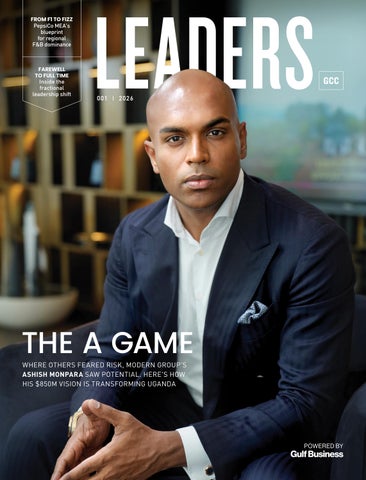
FROM F1 TO FIZZ
PepsiCo MEA's blueprint for regional F&B dominance
FAREWELL TO FULL TIME
Inside the fractional leadership shift
GCC 001 | 2026
THE A GAME WHERE OTHERS FEARED RISK, MODERN GROUP'S ASHISH MONPARA SAW POTENTIAL. HERE'S HOW HIS $850M VISION IS TRANSFORMING UGANDA
POWERED BY
EVERYONE
has a STORY to tell
+971 4 427 3000 podcast@motivate.ae
BOOK YOUR STUDIO
Calling all podcasters and content creators! Whether you are looking to record, edit or manage your podcast, our fully equipped podcast and video recording studio has it all.
motivatemedia.com
CONTENTS 012026 20
Getty Images
08
ARE WE TOO OBSESSED WITH LONGEVITY? Prime Performance Labs’ Jason Leavy and Samira Cutts argue that true longevity isn’t about extending lifespan, but enriching it
Supplied
Getty Images
18
FROM ADOPTION TO EDGE: WHAT LEADERS SHOULD KNOW AND DO Here’s why leaders should leverage technology to fuel growth
AI-READY DOESN’T MEAN TURNING EXECUTIVES INTO ENGINEERS. IT MEANS DEVELOPING LEADERS WHO CAN INTEGRATE AI RESPONSIBLY, STRATEGICALLY, AND SUSTAINABLY ACROSS THEIR ORGANISATIONS.”
GB LEADERS
MAN ON A MISSION Modern Group chairman Ashish Monpara reveals his inspiring journey from the suburbs of Mumbai to Uganda’s industrial heartland
SERGEI GURIEV, DEAN, LONDON BUSINESS SCHOOL 3
LAST CHANCE TO VOTE AND REGISTER VOTE HERE
REGISTER HERE
FOR EVENT SPONSORSHIP, TABLE BOOKINGS AND GENERAL ENQUIRIES violeta.popescu@motivate.ae | pamela.bayram@motivate.ae | ali.mohammad@motivate.ae
WhatsOn.ae
Sponsors
Culinary Partner
Beverage Partner
WhatsOnDubai
Printing Partner
#WOAwards
Vote Processing Partner
Structural Partner
Presented By
29
Supplied
Editor-in-chief Obaid Humaid Al Tayer Managing partner and group editor Ian Fairservice
RACING AHEAD PepsiCo MEA’s Mohamed Shelbaya talks about the new Mercedes-AMG F1 partnership and the F&B giant’s laser-focus on catering to the needs of the youth-driven regional market
Chief commercial officer Anthony Milne Anthony@motivate.ae
Group content director Thomas Woodgate Thomas.Woodgate@motivate.ae Publishing director Manish Chopra Manish.Chopra@motivate.ae
39
EDITORIAL Gareth.Vanzyl@motivate.ae
THE GREAT WEALTH TRANSFER Family Office Summit chairman Obediah Ayton shares key developments, investment trends and embracing private equity
Editor Neesha Salian Neesha.Salian@motivate.ae
Deputy editor Rajiv Pillai Rajiv.Pillai@motivate.ae
Reporter Nida Sohail Nida.Sohail@motivate.ae
Senior art director Freddie N. Colinares
DUBAI MEDIA CITY: SD 2-94, 2nd Floor, Building 2, Dubai, UAE, Tel: +971 4 390 3550, Fax: +971 4 390 4845 ABU DHABI: PO Box 43072, UAE, Tel: +971 2 657 3490, Fax: +971 2 677 0124, motivate-adh@motivate.ae SAUDI ARABIA: Regus Offices No. 455 - 456, 4th Floor, Hamad Tower, King Fahad Road, Al Olaya, Riyadh, Saudi Arabia, Tel: +966 11 834 3595 / +966 11 834 3596, motivate@motivate.ae LONDON: Acre House, 11/15 William Road, London NW1 3ER, UK, motivateuk@motivate.ae Cover: Freddie N. Colinares Follow us on social media: Linkedin: Gulf Business Facebook: GulfBusiness X: @GulfBusiness Instagram: @GulfBusiness
A GULF BUSINESS INITIATIVE
Freddie@motivate.ae
PRODUCTION General manager – production S Sunil Kumar Production manager Binu Purandaran Assistant production manager Venita Pinto
SALES & MARKETING Digital sales director Mario Saaiby Mario.Saaiby@motivate.ae
Sales manager Hitesh Kumar
GB LEADERS
HEAD OFFICE: Media One Tower, Dubai Media City, PO Box 2331, Dubai, UAE, Tel: +971 4 427 3000, Fax: +971 4 428 2260, motivate@motivate.ae
This issues’ Images, vectors and fonts credits: Getty Images / The noun project / Typography
Supplied
Group editor Gareth van Zyl
Hitesh.Kumar@motivate.ae 5
FEATURE
BY DR M MUNEER
THE NEW ART OF LEADERSHIP: WHEN AI JOINS THE WORKFORCE
Getty Images
Dr M Muneer
GB LEADERS
T
6
he hybrid workforce, where employees suddenly realise their new co-workers are artificial intelligence (AI) agents who never ask for a raise or take sick leave, is no longer fiction. We are already seeing it in many organisations. This demands a radical overhaul of leadership thinking, operating norms, and organisational design. The age of command-and-control has faded, replaced by fluid ecosystems shaped by distributed teams, machine cognition, and human-tech interdependence.
Pic: Supplied
The hybrid workforce is no longer theoretical, AI agents are already working alongside humans. For leaders in the GCC, the real risk is not technology itself but failing to evolve fast enough to lead it well
GCC nations with their thrust on AI and digitisation are probably at risk of leadership missteps if they don’t evolve at the matching acceleration. Imagine how Dubai’s algorithmic government or Saudi Arabia’s cognitive city ambition in NEOM might perform without appropriate leadership coding. The new demand is for a leadership that combines technological acumen, emotional intelligence, ethical awareness and strategic imagination. It covers task oversight; it manages living systems of intelligence, both organic and artificial. Fancy titles like CEO, director or VP alone will no longer command authority or respect. Influence now belongs to leaders who decode data, build trust, cultivate meaning, and galvanise collective capability. Artificial intelligence brings efficiency without loyalty or fear. Its neutrality demands leaders mediate between algorithmic logic and human values. The UAE’s Ministry of AI and Saudi Arabia’s SDAIA exist precisely for this purpose: to ensure automation serves dignity, accountability, and inclusion. But the onus extends beyond policy circles. Corporate leaders must protect psychological safety so people do not feel threatened by tireless digital colleagues. Without empathy, hybrid workplaces risk ossifying into soulless technocracies. Mastering algorithmic literacy is a skill that will set the leaders on the right path to managing a hybrid workforce. They don’t need to do actual coding but need to know how
01 | 2026
TRANSPARENCY ISN’T OPTIONAL ANYMORE — IT HAS TO BE BAKED INTO THE SYSTEM. AI STILL ACTS LIKE A BLACK BOX, SO THE NEW-AGE LEADERS MUST SWITCH ON EVERY LIGHT. ALGORITHMS NEED TO BE READABLE, CHALLENGEABLE, AND CRYSTAL CLEAR ABOUT HOW THEY REACH DECISIONS.
workplaces only work when leaders deliberately build belonging through shared rituals, common language, and genuine psychological safety, whether people are in the room or on a screen. AI has to show up as a partner, not a predator. That’s the ethos behind NEOM’s cognitive city, where technology is meant to elevate human life, not edge it out. But leaders still have to protect the irreplaceable human stuff; mentoring moments and sparks of creativity. Finally, purpose becomes the organising soul. When you automate efficiency, purpose gives work direction. The vision in the region revolves around human flourishing, which means the leaders must embrace this. Purpose will guide when to automate, when to defer to people, and how to align profit with collective welfare. Where work advances something nobler than optimisation, resilience deepens and allegiance strengthens. In the end, hybrid-era leadership is metamorphic. Leaders must think like technologists, act as ethicists, teach like educators, narrate like storytellers, and build like architects of culture. Those who embrace this expanded mandate won’t simply survive the future — they will illuminate it, just as the GCC’s digital experiments illuminate what becomes possible when technology and humanity rise together. L
The writer is a Fortune-500 advisor, startup investor and co-founder of the non-profit Medici Institute for Innovation.
GB LEADERS
to interrogate right: What assumptions shape outputs? What biases creep into models? Hybrid leadership scholarship emphasises decision intelligence, that is, the ability to evaluate digital recommendations without surrendering agency. The financial institutions in the GCC experimenting with AI loan scoring learnt first-hand how prejudice embeds itself unless leaders actively oversee design. One reason why leaders must develop epistemic vigilance, balancing machine precision with human fairness, and translate these concepts for teams to prevent techno-elite silos. But analytical mastery alone is insufficient. Hybrid leadership is profoundly human. Emotional intelligence, identified universally as the core hybrid competency, is non-negotiable. Fear of redundancy grows as AI takes over routine work. Organisations automating customer support or airport services report frontline anxiety. It is therefore important to validate such unease, if any, and address AI as augmentation to improve productivity rather than displacement. Celebrate distinctly human strengths such as empathy, improvisation, ethical behaviour, and intuition. This should dovetail into job architecture so employees see their use as an aid to make an impact. Similarly, the performance systems must also evolve. Traditional metrics won’t work for the hybrid era. Logged-in hours, tasks executed, etc are meaningless when AI agents take over routine output. What will count are adaptability, ethical reasoning, collaboration, and skill in leveraging AI responsibly. Take the case of the healthcare sector in Dubai, where AI-enablement is under way. Clinicians are assessed on how wisely they interpret algorithmic advice and how compassionately they convey uncertainty, instead of mere diagnostics. The consequences? Evaluation has become a learning instrument, indicating excellence is in proper judgement, empathy, and context, for instance. Transparency isn’t optional anymore, it has to be baked into the system. AI still acts like a black box, so the new-age leaders must switch on every light. Algorithms need to be readable, challengeable, and crystal clear about how they reach decisions. GCC regulators, from the UAE’s AI ethics principles onwards, are already pushing companies in that direction. The best leaders don’t hide behind technology but question it, welcome dissent, and make it clear that no algorithm is above accountability. Adaptability emerges as existential currency. AI evolves faster than organisational norms; leaders must learn faster than machines advance. High-performing hybrid managers practise continuous upskilling, scenario framing, and experimentation. GCC digital agendas — from Vision 2030 to UAE smart governance — model this as iterative transformation. Leaders must emulate that elasticity through modular strategies, fluid roles, and cultures that treat uncertainty as opportunity. Culture needs a reboot rather than a refresher. Hybrid
7
BY JASON LEAVY AND SAMIRA CUTTS
Getty Images
FEATURE
GB LEADERS
WHY THE LONGEVITY OBSESSION MISSES THE POINT
8
As executives chase biomarkers and biohacks in the quest to live longer, Prime Performance Labs’ Jason Leavy and Samira Cutts argue that true longevity isn’t about extending lifespan, but enriching it
J
ust like any other industry, the health and wellbeing industry has its trends, and right now longevity is the buzzword. Leaders are obsessing over their biological age, tracking their HRV (heart rate variability) scores and discussing sleep optimisation as much as their company numbers. Data is a critical tool in ensuring executives and entrepreneurs not only lead better but also live better. However, we strongly believe the longevity conversation needs a reframe.
01 | 2026
In essence, we think longevity shouldn’t be a goal per se, it should be the inevitable byproduct of doing the right things in the present. Just as importantly, adding years to your life means nothing if you haven’t added life to your years – the quest to live longer is a hollow one without a sense of purpose and meaning.
Jason Leavy
Samira Cutts
WHAT’S THE POINT? But here’s where the conversation needs to shift fundamentally: what’s the point of living to 100 if those years lack meaning? You may think of this as a philosophical question, but the evidence tells us that if you have a sense of purpose in your life you will literally live longer. Research from Rush University Medical Center found people with a strong sense of purpose had a 44 per cent lower risk of developing Alzheimer’s disease. Another study published in JAMA Psychiatry showed that individuals with greater purpose in life had significantly lower mortality rates,
GB LEADERS
Another hugely overlooked factor in determining longevity is social connection. The adage that ‘it’s lonely at the top’ isn’t just metaphorical, there are now a wide range of studies proving that loneliness literally kills.Our provocation is that if longevity is your goal, taking active steps to build those connections outside of the workplace will constitute a far better return on your investment than jumping on board the latest trend. And as with all our recommendations, they have significant mental and physical benefits in the present as well. So the great news is that all the evidence for significantly improving your healthspan and longevity is out there and you don’t need to be spending tens of thousands of dollars in that quest.
Pics: Supplied
FUNDAMENTALS OVER FADS The lure of quick fixes is seductive for time-poor leaders, but the reality is that nothing beats the fundamentals. How you sleep, eat and move will have a massive impact on your performance and wellbeing. Nail the basics consistently and you’ll not only be adding years to your life, you’ll be showing up better in the present – more energy, greater focus and feeling on your A-game. Technology can help, but far too frequently leaders get fixated with the lure of cutting-edge tech and try to build on a foundation that hasn’t been properly constructed. Data relating to factors such as sleep quality, heart rate variability, Vo2 max and grip strength can be hugely insightful in terms of determining healthspan and longevity, and the simple fact is that these can be positively influenced simply by doing the basics right on a consistent basis: Sleeping seven-eight hours nightly with sufficient deep and REM sleep, which is where the glymphatic system clears metabolic waste and tau proteins from the brain, critical for preventing cognitive decline Eating a balanced, whole foods diet rich in antioxidants, vitamins, and minerals Exercising with both strength and cardiovascular training, as each triggers different neuroprotective pathways What is frequently overlooked in the longevity conversation is the profound impact these fundamentals have on cognitive performance. For leaders operating in high-pressure environments, your brain is your primary asset (think of it as the CEO of the body), yet to date it’s often the most neglected. Consider what happens when you prioritise the fundamentals: Quality sleep enhances your memory and decision-making. Regular movement increases a protein called BDNF, which acts like fertiliser for your brain, it promotes the growth of new neurons (neurogenesis), strengthens existing neural connections, and protects brain cells from damage. Proper nutrition provides the building blocks for neurotransmitter production, directly affecting your mood, focus and energy. Crucially these aren’t separate benefits. Better cognitive performance in the present naturally extends your healthspan because you’re maintaining the very organ that regulates and synchronises with every other system in your body. You’re not choosing between performing now and living longer – they’re the same investment.
9
Getty Images
FEATURE
GB LEADERS
THE PLAN REFLECTS WHAT WE CAN’T STRESS ENOUGH – THAT LIFE IS ABOUT THE JOURNEY, NOT THE DESTINATION. SIMULTANEOUSLY, IT’S ABOUT MAKING THOSE FOUNDATIONAL CHANGES THAT ALLOW YOU TO SHOW UP IN THE PRESENT AS THE BEST VERSION OF YOURSELF.
10
even after controlling for other factors. The bottom line is that it’s become increasingly clear that our sense of purpose literally affects our biology. Yet the modern longevity movement rarely addresses this. We’ve become obsessed with the mechanics of extending life while ignoring what makes life worth extending. As philosopher Viktor Frankl observed after surviving the concentration camps: “Those who have a ‘why’ to live, can bear with almost any ‘how’.” For leaders, this distinction is crucial. You’re already carrying the weight of decisions that affect others. You’re already operating under pressure. If longevity is just about adding more years of that same grind, why bother? We advocate flipping the equation: clarify your purpose first, then optimise your health to give you more time to pursue it. Longevity becomes the vehicle, not the destination. YOUR ROADMAP TO LIVING BETTER (AND LONGER) So what does our version of a longevity roadmap look like in practice? Firstly, switch off the auto-pilot and reflect on your relationship with purpose. Not the
LinkedIn version where every leader claims to be making an ‘impact’, but the honest question: if you’re looking back in years to come what do you want your story to be? What do you have to do to close that gap? If you’re struggling to capture this, one of the tools we use with our clients may help, which is the Odyssey Plan from Stanford’s Life Design Lab. It asks you to map out three different five-year scenarios: your current path, an alternative if that path disappeared, and a ‘wild card’ version if money and status weren’t factors. The exercise isn’t about choosing one path – it’s about recognising you have agency, that your identity isn’t locked into a single narrow definition, and that there are multiple ways to create a meaningful life. The plan reflects what we can’t stress enough – that life is about the journey, not the destination. Simultaneously, it’s about making those foundational changes that allow you to show up in the present as the best version of yourself. The irony is that by letting go of longevity as a goal, you’re more likely to achieve it. By focusing on living well now, you’re essentially making deposits in a longevity account without obsessing over the balance. Because here’s what the research ultimately shows: the people who live longest aren’t the ones frantically optimising every biomarker. They’re the ones who’ve found something worth living for, who maintain deep connections with others, who move their bodies naturally throughout the day, who sleep well because they’re at peace with their choices. They’re not trying to live longer. They’re just living better and leading better. L
Jason Leavy is the founder and chief executive coach, and Samira Cutts, PhD, is a cognitive neuroscientist and chief performance coach, at Prime Performance Labs.
BY NIDA SOHAIL
FEATURE
Getty Images
01 | 2026
WHEN WOMEN LEAD: INSIDE THE GLOBAL SHIFT TRANSFORMING BOARDROOMS AND TECH HUBS
cross boardrooms, laboratories, startups, and corporate towers worldwide, a quiet revolution is underway. Women are no longer simply participants, they are innovators, strategists, and decision-makers shaping industries from AI and data science to FMCG and finance. Their influence is transforming not only business outcomes but the very notion of leadership itself. This is not a story about quotas or tokenism. It is a story of vision, resilience, and purpose, women who refuse to wait for permission, who combine expertise with courage, and who turn opportunities into empowerment. As technology accelerates and markets evolve, these leaders demonstrate that inclusion is not merely a moral imperative, it is a competitive advantage.
A
At the WE Convention 2025, held on November 1–2 at Atlantis The Royal in Dubai, these remarkable women shared their insights and experiences, highlighting how empowerment translates into tangible impact across sectors. Through the voices of trailblazing women across sectors, this feature explores empowerment in practice: from claiming boardroom seats to mastering complex technological landscapes, these leaders prove that leadership is not gendered, it is human. WOMEN IN TECH: LEADERSHIP, EDUCATION, AND OPPORTUNITY For Kubra Canel, EMEA AI and data strategy leader at Oracle, empowerment means representation across every pillar of the IT industry.
GB LEADERS
Women are no longer simply participants, they are innovators and decision-makers shaping industries from AI to FMCG and finance
11
FEATURE
“For me, women empowerment means seeing women in every pillar of our industry,” she said. With more than 15 years in IT, she has witnessed the persistent underrepresentation of women, especially in leadership roles. Yet she remains hopeful: “One day, we won’t talk about woman leaders. We will only talk about leaders in IT, and we will see women equally represented in our industry.” Canel’s journey reflects the challenges and opportunities that define women’s careers in tech. Balancing a master’s degree while holding a full-time job was overwhelming, yet it became a career asset. “My master’s degree was all about AI and data science, and I started to reuse most of the information I learned in my master degree in my actual work,” she shared. She also highlights the crucial role of multinational companies and HR departments in driving gender equality. “They need to make sure organisations are diverse, not only in leadership and management roles, but across every part of the organisation,” Canel emphasised. Beyond organisational responsibility, she encourages female engineers and scientists to raise their voices, advocate for themselves, and confidently step into leadership roles.
GB LEADERS
COMMUNITY INITIATIVES: FOSTERING LEADERSHIP ACROSS ORGANISATIONS Within Oracle, the URLE Women’s Leadership community has become a platform for empowerment. Mahira Pathan, EMEA Data Science blackbelt, describes its purpose: “The community empowers women leaders by giving them a platform to present themselves, showcase their skills, and share new ideas.” One distinguishing feature of the community is its inclusive approach. “We don’t limit participation to women,” Pathan said. “We follow a ‘champions’ model, where male employees can also support us and help foster leadership skills across the organisation.” Initiatives such as hackathons and leadership campaigns allow employees to demonstrate their abilities and step forward for leadership roles. Empowerment in today’s corporate world is not about gaining permission, Pathan explained, but about leveraging available platforms. “As women, we often underestimate ourselves or wait until we feel ‘perfect’ before showcasing our abilities. Within our community, we encourage each other to push past that mindset.” For early-career professionals, empowerment can be as simple as saying, “Yes, I can take this on,” demonstrating the evolving meaning of equality in practical terms.
12
FMCG AND CORPORATE LEADERSHIP: POLICIES AND PURPOSE Supporting women in leadership, and being a woman in leadership, remains both important and challenging in corporate environments. Andrea Gontkovicova, VP of Corporate Affairs SSEA, CIS and MEA at Philip Morris International, emphasised the company’s commitment:
“We have established both the processes and the corporate commitment needed to advance this work. We have been certified for many years as an equal-salary company, which goes beyond equal pay for men and women. It also includes equal opportunities for growth, access to career moves, and equal support for parental leave.” Currently, 35 per cent of PMI leaders are women, reflecting progress while signaling potential for further growth. Gontkovicova underscores the dual responsibility of organisations and women themselves. “When we make the decision to lead, it’s important to stand by it and keep moving forward. The journey can be tough, but it is also deeply fulfilling,” she said. She also stresses the importance of mutual support, whether through mentorship, advocacy, or simply being present for colleagues facing challenges. Mary Gukasyan, MD at Kraft Heinz Middle East & Africa, reflects on empowerment as freedom. “Equality, freedom, professionalism, education, these elements must come together to create real opportunities,” she said. Growing up in a traditional Armenian family, Gukasyan faced cultural skepticism about women pursuing education. Her mother’s encouragement helped her cultivate ambition and independence, which became foundational to her career. In the corporate world, empowered women deliver results in challenging business areas. Gukasyan shared, “I was often assigned the hardest tasks, transformation projects, difficult conversations, and complex situations. These experiences built resilience, courage, and confidence.” NAVIGATING WORK-LIFE BALANCE AND CAREER TRANSITIONS Balancing personal and professional
CURRENTLY, 35 PER CENT OF PMI LEADERS ARE WOMEN, REFLECTING PROGRESS WHILE SIGNALING POTENTIAL FOR FURTHER GROWTH
01 | 2026
responsibilities remains a significant challenge for many women leaders. Gukasyan recounted the dilemma of pregnancy while on an ambitious career path: “Should I take maternity leave, knowing that I might lose opportunities?” Open communication with her manager enabled her to create a clear plan, allowing her to return to an even higher position. Later, relocation posed another challenge. Gukasyan reflected on balancing her daughter’s routine and education with professional growth: “What helped was open communication, talking with my daughter, discussing everything with my husband, and helping them become more agile and adaptable. In the end, their support made it possible.” She emphasises that success requires peace of mind: “Without stability in your family, relationships, and home life, it is very difficult to perform well at work.” For Engineer Yasmin Al Enazi, head of Women in AI Middle East, empowerment is when women are measured by the problems they solve and the value they create, not by presence. She faced skepticism when pregnant with her second child but insisted her performance be measured by KPIs, proving her ability. Later, she transitioned from the corporate world to startups and innovation ecosystems to align her career with purpose, impact, and long-term vision. Al Enazi emphasises continuous reskilling, intentional learning, and leveraging platforms such as tech conferences and innovation events to build networks, gain mentorship, and participate in inclusion efforts. THE ROLE OF TECHNOLOGY AND SOFT SKILLS IN WOMEN’S LEADERSHIP Al Enazi underscores the importance of women leveraging their innate strengths in technology and leadership. “Women already possess powerful abilities, especially soft skills such as communication, adaptability, resilience, and multitasking. These skills are increasingly in demand in the tech world and make us uniquely capable.” In a rapidly evolving AI and digital economy, she believes reskilling, agility, and openness to change are critical to sustaining both personal and organisational success. Maria Vasileva, CEO and board member at AM Wealth Limited, frames women’s empowerment through economic agency: “Empowerment is not a slogan, it’s a
transformation. It’s about women gaining control: control over their choices, their time, and their capital. When a woman understands money not as stress but as freedom, she changes the trajectory of her family, her business, and even her community.” Vasileva’s own career demonstrates this principle. Moving to the UAE marked a turning point, bringing global business experience to a new jurisdiction. Despite early regulatory challenges, she and her team took ownership of licensing processes, wrote policies and procedures, and navigated the system directly, ultimately succeeding as a minority woman in the field. She emphasises that the future of gender equality lies in economic equality, ownership of capital, decisions, and impact. Women as founders, investors, shareholders, and board members will reshape industries and influence how capital flows worldwide. FROM REPRESENTATION TO TRANSFORMATION The voices of these leaders collectively reveal that women’s empowerment is multifaceted. It involves education, organisational support, community-building, mentorship, resilience, purpose, economic agency, and leadership. True empowerment is not limited to participation; it is about influence, ownership, and the courage to shape the future. Across sectors, empowered women are driving innovation, transforming business strategies, and setting new standards for leadership. Their stories underscore that equality is not a box to check, it is a journey of determination, vision, and impact. When women lead, communities prosper, industries innovate, and economies thrive. The conversation is no longer about whether women belong at the table. It is about how they are redefining the table itself, creating spaces where inclusion, diversity, and excellence coexist, and where the next generation of leaders, regardless of gender, can rise with confidence, purpose, and influence. L
GB LEADERS
“WOMEN ALREADY POSSESS POWERFUL ABILITIES, ESPECIALLY SOFT SKILLS SUCH AS COMMUNICATION, ADAPTABILITY, RESILIENCE, AND MULTITASKING. THESE SKILLS ARE INCREASINGLY IN DEMAND IN THE TECH WORLD AND MAKE US UNIQUELY CAPABLE.”
13
FEATURE
SAMARA IQBAL
Here are some practical tips for entrepreneurs looking to safeguard their legacies in the Middle East and ensure smooth transition of wealth and leadership:
Getty Images
UNDERSTANDING THE LOCAL LEGAL FRAMEWORK
SECURING YOUR LEGACY Practical tips for entrepreneurs in the Middle East on structuring wills and guardianship plans to ensure a smooth succession, protect family members, and preserve business assets
GB LEADERS
E
14
ntrepreneurship in the Middle East continues to flourish and being an entrepreneur myself, I’ve seen how rewarding but also demanding building a business can be. Family-owned enterprises and emerging startups are shaping the region’s economic landscape, driving regional growth and creating opportunities. Yet, amid the daily hustle, one critical aspect often gets overlooked by entrepreneurs: planning for succession and protecting both your family and your business. Conversations around wills, guardianship and succession can feel deeply uncomfortable, particularly in cultures where discussing death is considered taboo. But avoiding these conversations can lead to disputes, frozen assets and business disruptions, problems that are easily preventable with the right foresight and structure.
Each GCC country has its own rules and approach for inheritance and guardianship. In the UAE, for example, non-Muslims can register wills at the DIFC Wills Service Centre, while both Muslims and non-Muslims can register at the ADJD Court which recognise testamentary freedom. If no will exists, assets may be distributed according to local inheritance laws, which can differ significantly from your intentions. In Saudi Arabia, succession is largely guided by Sharia law, whereas Qatar and Kuwait have evolving frameworks that balance religious principles with considerations for expatriates. It’s essential to know and understand which laws apply to your nationality, residence, and asset locations. Consulting a lawyer who is familiar with regional and international estate planning can help ensure your plan is legally sound and aligns with the current legal regime. DRAFT A LEGALLY VALID WILL AND KEEP IT UPDATED
A will is more than a document, it’s a roadmap for your family and your assets. Entrepreneurs should ensure that their wills: Clearly identify beneficiaries and asset distribution Cover business ownership interests, intellectual property, and offshore holdings Are registered where assets are located Periodic review is equally important. Major life events such as marriage, divorce, childbirth or business expansion require immediate updates. With regional regulations evolving, such as Dubai’s recent efforts to simplify will registration for resident; keeping your estate plan current ensures clarity and compliance.
01 | 2026
TODAY, MANY ENTREPRENEURS IN THE MIDDLE EAST HOLD MULTIPLE RESIDENCIES OR GLOBAL CITIZENSHIPS, WHICH MAKES ESTATE PLANNING MORE COMPLEX, MAKING IT ESSENTIAL TO CONSIDER CROSS-BORDER TAXATION AND REPORTING.
ESTABLISH GUARDIANSHIP PROVISIONS FOR MINOR CHILDREN
For parents with young children, guardianship is often a sensitive, yet vital part of planning the will. Without formal designation, local courts may decide who assumes custody, potentially against your wishes which could conflict with family preferences. What I recommend is appointing temporary guardians for immediate care if both parents are incapacitated and appointing permanent guardians who can assume longterm responsibility. In jurisdictions like the UAE, such provisions can be formally recognised within DIFC or ADJD wills, giving you a peace of mind that your children will be cared for according to your wishes. PROTECT THE BUSINESS THROUGH SUCCESSION PLANNING
A business is more than an asset; it represents years of effort, relationships, and knowledge. Without a clear succession plan, ventures often falter after a founder’s absence. A clear plan prevents this disruption by defining leadership transitions, ownership transfers and governance structures. Key steps I advise include: Identifying successors, whether family, co-founders, or external professionals Clarifying shareholding transfers to avoid disputes among heirs Documenting business continuity protocols, including access to banking and management powers.
Samara Iqbal
Even the most carefully structured estate plan can fail if your intentions are misunderstood. In my opinion, transparency is just as important as legal precision. Open and formal conversations with family members, business partners, and key trusted advisors can prevent confusion and conflicts, ease tensions, and ensure everyone understands the “why” behind your decisions. To conclude, planning is protection. Succession planning is not just a legal requirement; it’s an act of protection and foresight. In the Middle East’s dynamic entrepreneurial landscape, a wellstructured will and guardianship plan safeguard more than wealth; they preserve harmony, continuity, and vision By taking proactive steps, entrepreneurs can ensure that their legacies endure, and their families and businesses remain secure long into the future even as regional legal frameworks evolve to accommodate diverse populations and asset classes. L
USE TRUSTS AND FOUNDATIONS FOR ASSET PRESERVATION
High-net-worth entrepreneurs with multi-jurisdictional assets should consider using trusts and foundations which are mechanisms that are recognised in ADGM and DIFC. This can separate legal ownership from beneficial enjoyment, ensuring that assets are managed professionally and distributed according to pre-set terms. These structures help protect against forced-heirship rules, safeguard family wealth from business liabilities, and maintain privacy and control over succession processes.
Pic: Supplied
INTEGRATE YOUR ESTATE PLAN WITH TAX AND RESIDENCY CONSIDERATIONS
The writer is is the founder of Aramas International Lawyers.
GB LEADERS
COMMUNICATE YOUR PLANS CLEARLY
For cross-border assets, trust structures or holding companies can provide continuity. Family enterprises can benefit from a family constitution that outlines roles, values and decision-making mechanisms to balance emotional and financial interests.
Today, many entrepreneurs in the Middle East hold multiple residencies or global citizenships, which makes estate planning more complex, making it essential to consider cross-border taxation and reporting. The relationship between where you live, where your assets are held, and where you’re legally domiciled can have major
tax implications. To avoid surprises, it’s crucial to work with advisors who are familiar with international tax laws, inheritance taxes, double taxation agreements. They can help ensure your estate plan complies with reporting requirements such as the common reporting standards (CRS) to ensure that your beneficiaries aren’t burdened with unexpected financial or legal obligations later on.
15
FEATURE
BY SARA DAW
Getty Images
pressure is being pushed onto already stressed and overworked individuals. Indeed, a Gartner survey revealed that 62 per cent of managers report higher workloads in 2025 due to freezes in staff. This inevitably leads to burnout and stalled business growth. This issue doesn’t just impact junior workers and middle management — the C-suite is also feeling the strain. Hiring a full-time executive team has a hefty price tag, and with rapid technological and economic change, the required scope, complexity and speed of leaders has grown exponentially. Corporates have responded by adding more responsibilities to each role. They want superhumans — those who can do it all, all the time — but to do it all, all the time, is less feasible. No single leader can realistically hold all the answers, or all the pressures. Executives are burning out under unrealistic demands. Businesses need a different way to unlock capability and skills in a fluid, flexible and cost-effective way. One approach that is growing in popularity is the use of the access economy model, whereby businesses access fractional talent as and when needed, instead of bringing in full-time hires. But what does this look like in practice, and how can this approach unlock capability?
THE FRACTIONAL FIX
How businesses can unlock capability through fractional talent instead of increasing headcount
GB LEADERS
H
16
iring freezes have become common practice for businesses in 2025. In the US, for instance, hiring has slowed to its lowest point in 14 years, with a 35 per cent decrease in planned hires compared to this time last year, according to Challenger, Gray & Christmas’ October 2025 Challenger Report. With the technical disruption of artificial intelligence (AI) automation, coupled with GDP growth deceleration, organisations are adopting a “do more with less” attitude towards their workforce strategy. As a result, the productivity and engagement of current hires become especially important in driving business success. Yet this growing trend is a double-edged sword. Organisations still need the skills, leadership and output, but the
FRACTIONAL TALENT AND THE REDESIGN OF EXECUTIVE WORK Let’s take the C-suite as an example. Some executives have chosen to transition from employment to selfemployed by becoming a fractional executive. These fractional leaders work with businesses on a part-time or flexible basis, providing their expertise to multiple organisations. It allows businesses to benefit from the complete range of functional, emotional, and collective intelligence at the C-suite level by moving their positions from the “pay-roll” to an “access-role”. Traditionally, executive roles have been siloed, whereby the CFO manages finances, the CMO owns marketing, the CEO sets the direction and so on. Accessing fractional talent disrupts and challenges this traditional full-time executive role design, unbundling one
01 | 2026
ULTIMATELY, WHEN PO IS PRESENT, BUSINESSES CAN UNLOCK THE CAPABILITY OF FRACTIONAL LEADERS, WHO BRING VALUE TO EMPLOYED LEADERS AND INTERNAL TEAMS, NOT AS OUTSIDERS, BUT AS TRUSTED INSIDERS.
executive role and the associated decision-making and accountability across several specialists. One way of achieving this is through collaborative models like fractional twinning. This is where leadership responsibilities are shared between the fractional C-suite executive and their employed counterparts. The fractional leader can either mirror the employed leader by bringing a larger volume of the same skills the business needs, or have different skills and bring new capabilities to the table. This approach is less about static CXO titles and more about a temporary combination of skills to achieve leadership clarity and desired outcomes. As time commitments can be flexed easily up and down to fit budgets, with clear priorities and outcomes agreed, it is a flexible and affordable way for organisations to access the right skillsets and mindsets at the right time and in the right quantity to match the changing business agenda, without the financial burden of full-time hiring.
leaders, who bring value to employed leaders and internal teams, not as outsiders, but as trusted insiders. Without being hired, these fractional executives can plug into specific gaps and deliver ROI fast.
The writer is the group CEO of The CFO Centre and The Liberti Group, and the author of Strategy and Leadership as Service – How the Access Economy Meets the C-Suite, which explores the fractional leadership trend.
GB LEADERS
FRACTIONAL TALENT AS THE NEW FUTURE OF WORK The increase in engaging with fractional talent will be a significant change in society. This shift contributes to a new future of work where the traditional ownership and employment model is no longer the only route forward. To truly benefit from this change, business owners must rethink what it means to ‘own’ a role, learning how to engage with other working models to lessen the load and orchestrate capability. Leading in this fluid and flexible context allows corporates to avoid the downfalls of a “do more with less” talent strategy, in turn paving the way to scale, grow, upskill and gain capacity as a business. L
PIC: Supplied
DEVELOPING PSYCHOLOGICAL OWNERSHIP TO UNLOCK CAPABILITY IN FRACTIONAL TALENT At the heart of this fractional approach to the C-suite is the idea that leaders don’t need to be on the payroll to create impact and value in a business. What matters most is that they have a sense of psychological ownership (PO) over the work that they do. For PO to emerge, fractional and employed C-suite executives must understand each other’s needs, feel knowledgeable about the range of services offered, and be confident that the service and relationship are working to meet desired goals. Self-identity is also a key component to developing PO. People use ownership to define themselves, express self-identity to others, and ensure the continuity of the self across time. In this context, fractional and employed C-suite executives work together with shared identities and use them to establish and contribute to their own identities, fostering feelings of PO. Working together enables fractional and employed C-suite executives to be part of a group of like-minded people, contributing to their feelings of PO towards each other. The idea is that organisations encourage individual C-suite professionals to collaborate, share, and do activities together for enhanced outcomes, aligning their culture and values. Ultimately, when PO is present, businesses can unlock the capability of fractional
Sara Daw
17
FEATURE
BY RITAVAN
Ritavan
True growth comes from differentiation: using technology to compound unique strengths and create value competitors cannot replicate.
Getty Images
THREE QUESTIONS THAT MATTER Before adopting new technology, leaders should ask three hard questions. First, is it leverage or average? In other words, does the technology amplify something proprietary, such as customer data, distribution, or legacy assets, or is it generic, easily copied, and dressed up as “best practices”? Second, does it strengthen the moat or erode it? The test here is whether the investment creates a lasting competitive edge or simply makes your business look like everyone else’s. Third, is it growth or wastage? Does the technology compound value and drive future returns, or does it just consume resources without creating leverage? Asking these questions shifts technology from being an expense line to becoming a strategic weapon.
FROM ADOPTION TO EDGE: WHAT LEADERS SHOULD KNOW Here’s how good leaders challenge technology to fuel growth
18
ADOPTION DOESN’T EQUAL GROWTH The region is full of opportunity, backed by capital and ambition. IDC projects “AI” spending in the region will reach $14bn by 2028. Yet copying what everyone else does is still the fastest path to mediocrity. Efficiency gains from generic tech get competed away, margins shrink, and business models become commoditised.
Pic: Supplied
GB LEADERS
A
cross the Gulf region, executives are pitched new technology by the best salespeople from around the world. Vendors promise AI-driven transformation — whatever that means. Here’s the reality: technology doesn’t create growth by itself. It can amplify what your business does well or expose its weaknesses. Leaders who succeed don’t just adopt technology off the shelf. They challenge it, asking how it sharpens their edge, delights customers, and unlocks growth, not just cuts costs.
HOW SMART LEADERS LEVERAGE TECHNOLOGY Efficiency alone doesn’t lead to growth. Most cost-focused digital projects fail to deliver long-term value because savings get competed away. Growth comes from using technology to create proprietary advantages that compound over time. Great leaders interrogate technology ruthlessly. The two following Gulf-relevant examples illustrate this.
01 | 2026
BANKS: FROM PAYMENTS TO PLATFORMS Are we just digitising old processes, or using technology to build new customer networks? Gulf banks have embraced digital identity and instant payments. In the UAE, over 50 per cent of transactions shifted to digital channels in 2023. But the breakthrough isn’t faster transactions — it’s becoming the hub of a customer’s digital life. Layer credit, wealth management, loyalty, and lifestyle services on top of payments, and banks evolve into ecosystems. Instant payments may be a commodity, but the ecosystem built on top isn’t. Owning the digital identity relationship creates a durable advantage as a gateway to financial and non-financial services. THE CHECKLIST: A FOUR-PART LENS FOR TECH INVESTMENT When evaluating technology, great leaders go beyond “cost versus benefit”: 01 Adopt for leverage: Invest only when it amplifies unique strengths. 02 Avoid average: Efficiency is defensive; differentiation compounds returns. 03 Eliminate wastage: Kill initiatives that consume resources without building an edge. 04 Create flywheels: Ask if today’s investment unlocks compounding growth cycles.
THE GULF EDGE: CAPITAL, VISION, AND SCALE Executives in the Gulf have unique advantages. They benefit from capital abundance, where discipline ensures funding fuels growth rather than wastage. They also enjoy rapid adoption, with smartphone penetration in the UAE and Saudi Arabia exceeding 95 percent, which allows platforms to scale quickly. In addition, they have the backing of state-driven vision, giving them the ability to experiment boldly and expand across sectors with ease. Leaders who succeed bend technology to their will, creating compounding flywheels where customers are delighted, proprietary advantages grow, and competitors cannot follow without cannibalising themselves. THE FUTURE: FROM ADOPTION TO PARADIGM BUILDING Technology alone doesn’t win. Efficiency alone doesn’t win. Growth comes when technology is challenged, leveraged, and made to serve your unique unfair advantage. The Gulf’s next generation of leaders will be remembered not for the technologies they bought, but for the paradigms they built. If a technology doesn’t amplify your unique advantage, build a customer flywheel, and compound future growth, it isn’t worth your capital. L
The writer is the bestselling author of Data Impact, and an entrepreneurial technology leader.
GB LEADERS
AIRLINES: TURNING SEATS INTO BANKS Are we just flying planes to move people, or monetising the demand we already control? Selling seats is capital-intensive and low-margin. The breakthrough comes when airlines treat every passenger interaction as a proprietary, data-driven growth flywheel. Loyalty programmes stop being perks and become highmargin businesses. Globally, airline loyalty programmes are valued at billions — Delta’s SkyMiles at $26bn, more than the airline itself. Points are issued, sold to banks, monetised via credit cards, retail partnerships, and e-commerce. Over time, the programme becomes a bank, marketplace, and customer-experience ecosystem layered on top of transport. The seat is just the entry ticket. The value lies in owning and monetising the customer relationship across multiple paradigms: industrial, digital, and data-driven. This is leverage at scale: compounding value for decades while competing for yield per seat on the surface.
Supplied
GLOBALLY, AIRLINE LOYALTY PROGRAMMES ARE VALUED AT BILLIONS — DELTA’S SKYMILES AT $26BN, MORE THAN THE AIRLINE ITSELF. POINTS ARE ISSUED, SOLD TO BANKS, MONETISED VIA CREDIT CARDS, RETAIL PARTNERSHIPS, AND E-COMMERCE.
19
GB LEADERS
COVER STORY
20
GROUND UP FROM THE BUILDING MODERN GROUP’S ASHISH MONPARA ON HIS JOURNEY FROM MUMBAI TO UGANDA’S INDUSTRIAL HEARTLAND THE CHAIRMAN AND FOUNDER OF MODERN GROUP AND ONE OF UGANDA’S MOST ENTERPRISING INDUSTRIALISTS SHARES HIS PHILOSOPHY OF REINVESTING LOCALLY, CREATING OPPORTUNITIES BEYOND JUST JOBS, AND BUILDING BUSINESSES WITH INTEGRITY THAT SERVE SOCIETY
GB LEADERS
WORDS: TEAM GB
21
The restaurant eventually shut down, but instead of breaking him, it built him. “Schools teach you what to do, but no one teaches you what not to do,” he reflects. After closing shop in Mumbai, Monpara returned to Ahmedabad and joined his father’s real estate business. Together, they launched seven projects in just three years, capitalising on the property boom. The lessons from his failed restaurant became his pillars of success.
Supplied
FINDING PURPOSE IN UGANDA
W
hen Ashish Monpara looks back at his childhood, it’s not the comforts he remembers but the courage he witnessed. Growing up in a cramped one-room government colony in the Indian state of Gujarat, surrounded by uncles, grandparents, and his parents, life was modest at best. His father worked long, hectic shifts in a textile mill before taking a leap of faith and starting his own diamond business. “That was where I got my courage,” Monpara, the founder and chairman of Modern Group, recalls. “If my father could build everything from zero, so could I.” That inspiration guided him to work with integrity, win people’s trust, and never take shortcuts.
GB LEADERS
EARLY DREAMS AND HARD LESSONS
22
With an MBA and big dreams, Monpara’s first venture was a restaurant in Mumbai, India’s leading financial centre, in Maharashtra. He leased half a floor in a bustling mall, hired 60 people, and poured his heart into it. Then came the 2008 global financial crisis. The business that looked quite promising in the beginning quickly turned into a struggle for survival. “There were nights I barely slept,” he says. “I had cheques to clear and no funds in my account. Financial stress was one of the hardest battles.” Monpara regularly boarded the crowded second-class local train from Vashi, a suburb in Navi Mumbai on the city’s outskirts, into South Mumbai, the island city and financial heart of India, enduring a long, exhausting commute that left him drained, but never tempted him to give up. Before his entrepreneurial journey, Monpara had been a professional athlete for 12 years and also represented his state in marathon events. Those years taught him the essence of discipline and resilience, which later proved invaluable in his life. During those stressful times in Mumbai, he returned to running to manage the pressure. “I started running again to keep my stress down,” he says. “And I kept telling myself, this time will pass. Change is the only constant in life.”
In 2015, a family friend invited his father to explore business opportunities in Africa. Monpara tagged along, unsure of what awaited him. “I used to think Africa was a country,” he laughs. But when they drove through Uganda’s Mabira Forest, something clicked. “It was peaceful, it just felt right. I told my father, ‘I want to build something here.’” Within months, he founded Modern Distillers in Uganda, an ethanol plant that began with a 1.2 million litre capacity. That was a bold move in a market still finding its footing. From one ethanol plant, Monpara went on to build the Modern Group, now one of Uganda’s most dynamic industrial conglomerates. Its interests span sugar, tiles, aluminium, sanitisers, distilleries, power generation, and more, with leading names such as Modern Sugar, Kassanda Sugar, Kaliro Sugar, and Kidera Sugar driving Uganda’s sweet economy, besides generating thousands of jobs and energising rural economies. For Monpara, Uganda is not just a market but a second home where he discovered his true purpose. The warmth of its people and the peace he felt in Mabira Forest gave him the conviction to invest with a long-term mindset rather than chasing quick returns. Relocating from India to Uganda taught him that leadership is driven by courage, resilience, and trust. “Starting from scratch in a new country required self-belief and the humility to keep learning. My past failures reminded me that setbacks are powerful teachers,” he shares. Inspired by self-made Indian visionaries and industrialists such as Dhirubhai Ambani, Gautam Adani, and his father, Monpara believes ambitious dreams and hard work can transform lives. Today, he is counted among Uganda’s most enterprising industrialists, a first-generation businessman who bet on a country many overlooked. The
COVER STORY
leader credits much of his success to Uganda’s stable business environment and the support of government leadership, including President Yoweri Kaguta Museveni and Minister of Finance and Investment Anite Evelyn, whose encouragement helped Modern Group expand across multiple sectors. His advice to young entrepreneurs is to believe in their dreams, work with integrity, and build businesses that serve society. “Entrepreneurs in emerging markets should start with people,” says Monpara. “Invest in your workforce, support communities, and create opportunities, jobs alone aren’t enough.” He urges reinvesting profits locally, identifying market gaps, and delivering world-class quality. Sustainable success, he adds, comes from creating lasting impact for both people and the economy.
THE MAIN CHALLENGES WERE TALENT DEPTH, CROSSCOMPANY COORDINATION, AND MAINTAINING A UNIFIED CULTURE WHILE ENTERING COMPLETELY DIFFERENT INDUSTRIES.”
BUILDING AN INDUSTRIAL EMPIRE
Supplied
Ashish Monpara with his cousins
At the age of 42, Monpara has built the Modern Group into a hub that has invested over $850m in Uganda’s economy. In less than a decade, his leadership has transformed a single venture into a diversified empire of 11 companies.
FROM ONE PLANT TO A NATIONAL FORCE When Monpara landed in Uganda a decade ago, he saw a sleeping giant of opportunity in Africa. He noticed that many local manufacturers produced low-quality goods while consumers relied heavily on imports. He decided to fill that gap by producing worldclass quality within the country. Thus, he began his entrepreneurial journey in 2015 with Modern Distillers, a state-of-the-art ethanol plant producing over 15 million litres of extra neutral alcohol (ENA) annually. ENA is widely used in beverages, pharmaceuticals, and cosmetics, and the company supplies it to leading brands like DIAGEO and AB InBev. In 2018, he expanded with Modern Gas, utilising the CO₂ released during distillation to create valuable products. When Monpara saw Uganda importing most of its ceramic tiles, he launched Modern Tiles in 2020. With a daily capacity of 49,000 square metres, the company is the biggest in eastern and central Africa. Inaugurated by President Museveni, it now holds 45 per cent of the Ugandan tile market. “The project put us on the map as one of the most promising business groups in Uganda. It earned us several international awards, including recognition at the Abu Dhabi Investment Congress 2023 as the Best Investment in Africa,” he says.
GROWING RESPONSIBLY Rapid diversification has been both Modern
GB LEADERS
Monpara’s entry into Uganda happened at a time when the country was opening its doors to serious investors. The story of the Modern Group began with a shared vision between Monpara, his father, and two cousins, who were united by their curiosity about Africa’s untapped potential. “I started this business with Ishan, Rajan and my father,” he says. “We are the three pillars of the Modern Group.” While Rajan takes care of finance and strategy, Ishan manages day-to-day operations. Monpara’s father and uncle had been researching African markets since 2010, and Uganda consistently stood out. “Our data team in India and the UAE pointed to Uganda as the most stable market, economically, politically, and socially,” Monpara says. His hands-on approach, reinvestment strategy, and alignment with Uganda’s pro-investor policies have made Modern Group a key player in the nation’s industrialisation agenda. With operations already spanning Uganda, Tanzania, Kenya, Rwanda, and Zambia, the group now plans to deepen its export presence across East and Central Africa, including new ventures in Tanzania and Angola. “Our goal,” says Monpara, “is to make Modern Group a Pan-African name.”
23
COVER STORY
Group’s biggest strength and its biggest challenge. Moving from one plant in 2015 to a multi-sector conglomerate required building systems faster than expanding capacity. “The main challenges were talent depth, cross-company coordination, and maintaining a unified culture while entering completely different industries,” Monpara explains. “We addressed this by institutionalising what used to be founder-driven decision-making, putting in place stronger management teams, establishing shared service centres, upgrading governance structures, and investing heavily in training young Ugandan professionals who now run many of our operations. Our philosophy is simple: scale is meaningless unless your systems scale with you.” For Monpara, job creation is not a by-product but part of the mission. “Balancing growth with quality means three things: stable, long-term employment, not just seasonal or temporary roles; investment in skills, so that workers grow with the company instead of being replaced; and welfare and safety standards that exceed local requirements, because a motivated workforce is the backbone of industrial success,” he says. “Our aim is not only to employ thousands, but to create upward mobility and sustainable livelihoods in every community we touch.”
A VISION FOR SELF-RELIANCE Economic sovereignty sits at the core of Modern Group’s longterm vision. “Uganda has enormous potential, but dependence on imports drains value that should remain within the economy,” Monpara says. “Every project we take on must answer one question: does it move Uganda closer to self-reliance? Whether it is sugar, fertiliser, power, animal feeds, or steel, all our investments aim to close supply gaps, stabilise prices, and build a resilient industrial base. For us, industrialisation is not a trend; it is a national responsibility.” In rural and underdeveloped areas where Modern Group operates, the company integrates local communities into its value chains throughout grower programmes, where farmers receive seedlings, training, and guaranteed offtake; local procurement, so more money circulates within the region; community infrastructure such as roads, water access, health camps, and education initiatives; and continuous dialogue with local leaders to ensure development aligns with community needs. “When communities grow, the company grows — the two are inseparable,” Monpara notes.
GB LEADERS
LOOKING AHEAD
24
Modern Group’s strategy over the next three to five years is defined by resilience, localisation, and green transition. “We are investing in automation, renewable energy, precision agriculture, and more efficient processing technologies,” says Monpara. “Global disruptions have shown that Africa must build local capacity, and Uganda is well-positioned to lead this shift. We will continue expanding in areas where Uganda has natural advantages, such as agri-industry, energy, and manufacturing, while ensuring our operations meet international standards of sustainability.” The group’s prioritisation framework is disciplined, evaluating projects based on strategic importance to Uganda’s industrialisation, availability of raw materials, economic impact, and feasibility within current capacity. Projects like steel and sugar expansion support large existing ecosystems, while vaccine
“East Africa is integrating rapidly, creating a unified market of hundreds of millions of consumers.”
manufacturing is a long-term strategic bet for regional health security. Looking at East Africa and beyond, Monpara sees the next decade belonging to agro-industrial processing, pharmaceuticals, green energy, and regional logistics. “East Africa is integrating rapidly, creating a unified market of hundreds of millions of consumers,” he says. The principles for expansion are clear: enter only where the group can add structural value, build competitively at global standards, integrate local communities and supply chains, and reinforce Uganda’s position as a manufacturing hub for the region.
GOVERNANCE AND RESPONSIBILITY As the Modern group grows bigger and more diversified, Monpara recognises the need for stronger systems. “We are transitioning from entrepreneurial governance to institutional governance,” he explains. “This includes independent boards for major subsidiaries, strong internal audit and compliance functions, environmental and social management systems aligned with IFC standards, and digitised monitoring across safety, emissions, and supply-chain practices. Growth brings responsibility, and we take governance as seriously as profitability.” For Monpara, the responsibility of large industrial conglomerates extends far beyond shareholders. “Industrial groups in developing economies carry a responsibility far beyond shareholder returns. We must be engines of national development, creating jobs, transferring skills, building industries, and uplifting communities,” he says. “Shareholder value is important, but it is built on societal value. If our work strengthens Uganda’s economy, empowers farmers, stabilises rural incomes, and reduces import dependence, then the nation grows, and so do we. That is the philosophy on which Modern Group was built, and the philosophy that will guide us forward.” L
stability improves. The insight: shared prosperity is strategy, not philanthropy.
USE FRAMEWORKS TO STAY FOCUSED IN A WORLD OF ABUNDANCE. Monpara filters
ASHISH MONPARA
Through a decade of building Modern Group, Ashish Monpara has developed a distinctive leadership approach that offers practical wisdom for entrepreneurs navigating emerging markets. Here are the lessons that shaped his philosophy.
TURN YOUR WORST MOMENTS INTO YOUR BEST TEACHERS. Monpara’s failed Mumbai restaurant during the 2008 crisis taught him cash flow management better than any MBA could. Sleepless nights clearing cheques with empty accounts taught him to build financial buffers, read warning signals, and never confuse revenue with survival. The principle: your failures teach you what no classroom can—if you study them honestly.
KNOW WHEN TO HOLD ON AND WHEN TO DELEGATE. Control and
Pic: Supplied
growth are often inversely related. Training Ugandan professionals to run operations wasn’t about convenience, it was about sustainability. Founder obsession with detail can become a company’s ceiling. The test: if the business an’t function without you for a month, you’ve built a dependency, not a business. Measure impact by what people become, not what they produce. Beyond employment numbers, Monpara tracks whether workers
leave more skilled than when they arrived. This means rejecting cheap seasonal labour for year-round training programmes. The shift: from “How many people work for us?” to “How many lives have we fundamentally changed?”
LET NATIONAL NEEDS SHAPE YOUR STRATEGY, NOT JUST MARKET GAPS. When evaluating ventures, profit potential isn’t Monpara’s first filter: Uganda’s industrial self-reliance is. This led to projects like sugar and fertiliser that might have lower margins but higher national impact. Instead of “Where can we make the most money?” he asks “Where does the country need us most, and can we do it sustainably?”
MAKE LOCALS OWNERS OF YOUR SUCCESS, NOT JUST BENEFICIARIES. Out-grower programmes and community infrastructure aren’t CSR boxes to tick they’re business model design. When farmers have guaranteed offtake and training, supply chains become reliable. When communities have better infrastructure, workforce
BUILD GOVERNANCE BEFORE YOU NEED IT, NOT AFTER CRISES DEMAND IT. Monpara implemented independent boards and compliance systems while profitable and growing—not because regulators required it, but because he’d seen family businesses collapse under their own weight. He treats governance as infrastructure: unglamorous but essential. The principle: build institutional checks when you don’t think you need them yet.
PHYSICAL RESILIENCE SHAPES MENTAL RESILIENCE. Returning to marathon training during tough business moments wasn’t escapism, it was strategic. The discipline of training, acceptance of discomfort, and patience to build endurance transferred directly to business challenges. The reminder: leadership is physical, not just intellectual. Your body’s capacity to handle stress affects decision-making under pressure. Monpara’s approach rests on a simple but radical premise: businesses in developing economies aren’t just economic entities—they’re development partners. Your success is inseparable from the country’s success. Short-term profits sometimes bow to long-term nationbuilding. The trust you build with communities and governments becomes your most defensible moat. It’s a patient, principled approach in markets that often reward neither but it’s what builds something that lasts beyond quarterly results.
GB LEADERS
LEADERSHIP LESSONS WITH
opportunities through four questions: Does it advance Uganda’s industrialisation? Are raw materials accessible? What’s the economic multiplier? Can we execute with current capabilities? The discipline: in high-growth environments, what you don’t pursue matters as much as what you do.
25
INTERVIEW
BY NEESHA SALIAN
Treasure Island –TI Las Vegas Hotel & Casino, a part of Accor’s Handwritten Collection
GB LEADERS
Swissôtel in Jeddah - in partnership with Al Qimmah Hospitality - is scheduled to open in 2029
26
Accor and the age of augmented hospitality CAMIL YAZBECK, GLOBAL CHIEF DEVELOPMENT OFFICER - PREMIUM, MIDSCALE AND ECONOMY, SHARES ACCOR’S NEXT GROWTH CHAPTER
Pics: Supplied
Swissotel Corniche ParkTowers in Doha
Q&A I
Camil Yazbeck
You manage an enormous global remit. How do you stay on top of it all? It comes down to having the right team and trusting that team. Without them, I can’t do anything. I’m very lucky to be supported by people who handle things day in, day out, and that makes a huge difference. Preparation is also key, being well organised and self-motivated. I always say leadership is about the ability to influence, persuade, and inspire people to get the job done. Teams need to feel inspired. Beyond that, it’s about self-leadership and having strong support at home as well. It’s team, family and mindset. A positive mindset is key.
You often describe Accor as an “augmented hospitality” company. What does that mean in practice? It’s not a buzzword. It reflects the fact that we go far beyond hotels. We operate across hotels, extended stay, branded residential, food and beverage, co-working, and wellness. We manage or franchise around 12,000 restaurants and bars globally, and we have multiple food and beverage brands that can be integrated into hotels or mixed-use projects. In the UAE, Accor continues to strengthen its footprint through strategic conversions and partnerships that drive value for owners and guests alike. Over the past year alone, we converted close to 1,000 keys in the UAE a remarkable milestone that rein-forces owner confidence in our platform and flexibility across segments. Recent highlights
ACCOR MANAGES OR FRANCHISES AROUND Pic: Supplied
The Middle East, Africa, and Turkey are seeing strong momentum. How is Accor scaling in these markets while protecting returns? Globally, Accor has close to 5,700 hotels and a pipeline of around 1,400 properties, representing roughly 240,000 keys. Development is structured regionally, and while I oversee global development, the Middle East, Africa, and Turkey are managed by a dedicated leadership team. In that region alone, we operate around 350 hotels today, with approximately 150 new openings targeted by 2028. For me, success isn’t just about signing deals, it’s about opening hotels quickly and operating them well so there’s a real win-win for owners and for Accor. A major factor is alignment with national agendas. Whether it’s Saudi Arabia’s Vision 2030, the UAE Tourism Strategy 2031, or Egypt’s tourism plans, our development strategy maps directly against these frameworks. That alignment builds confidence for investors and helps ensure long-term support.
How important is diversification across segments to that growth? It’s critical. We have more than 45 brands, which allows us to capture demand across luxury, lifestyle, premium, elevated, and essential segments. Some of the fastest-growing areas right now are branded residentials, extended stay, and mixed-use developments. Hospitality used to rank much lower as an asset class, but today it’s firmly among the top choices for investors. The reason is diversification. A mixed-use development can include a hotel, branded residences, extended stay, food and beverage, and wellness. That spreads risk and strengthens asset value. Branded residentials, for example, typically command a 30 to 40 per cent premium over nonbranded residential. We created Accor One Living specifically to focus on this space, bringing in industry specialists to scale it properly. Owners can sell units early, generate cash upfront, and reinvest in the asset.
12,000
F&B OUTLETS GLOBALLY
GB LEADERS
n an era where hospitality is evolving beyond traditional hotel stays, Accor stands at the forefront of transformation. With more than 5,700 hotels and around 850,000 keys globally, the French hospitality group is redefining what it means to be a hotel company. Leading this shift within the premium, midscale and economy division is Camil Yazbeck, global chief development officer, whose background across hotel operations and private equity gives him a distinctly owner-focused perspective on growth. In this interesting conversation, Yazbeck explains how Accor’s concept of “augmented hospitality” stretches far beyond rooms, spanning branded residentials, food and beverage, co-working and wellness. He outlines how an owner-centric, partnership-led model, aligned with national agendas such as Saudi Arabia’s Vision 2030, is shaping expansion across key markets. From the significance of the Treasure Island signing in Las Vegas to the rise of the elevated segment and the growing importance of conversions, Yazbeck shares how Accor is positioning itself for a more experience-driven, authenticity-focused future.
27
Supplied
INTERVIEW
GB LEADERS
A view of the lounge in Pullman Dubai Jumeirah Lakes Tower
28
include Mercure Abu Dhabi Downtown, a successful reposition in the heart of the capital, and Grand Mercure Dubai Downtown, reinforcing our premium midscale leadership. In Dubai, Accor has deepened its partnership with the Investment Corporation of Dubai (ICD) through a six-hotel cluster at Deira Waterfront, totalling 999 keys. The project brought together three existing hotels ibis Styles, Aparthotel Adagio, and Mercure alongside three new openings under Novotel, ibis Styles, and Mercure, showcasing Accor’s conversion agility and enduring partnership strength in one of the region’s most dynamic markets. We also signed a master development agreement with Al Qimmah Hospitality, a subsidiary of BinDawood Investment Company, to develop a portfolio exceeding 3,000 keys across Saudi Arabia, reinforcing both groups’ commitment to Vision 2030 and the diversification of the kingdom’s hospitality landscape. On top of that, we have ALL Accor, the booking platform and loyalty programme, with around 100 million members. What’s different is that members can earn and use points not just in hotels, but across restaurants, events, concerts, and other lifestyle experiences. For customers, it creates a richer ecosystem. For owners, it drives revenue across multiple channels. How does your background influence the way you work with owners? I come from hotel operations and private equity, so I’ve sat on the owner side. I know how important it is to think about cost of capital, investment criteria, hold periods, and return expectations. That’s why our approach is partnership-led. We adapt deal structures to the owner, whether they’re private equity, family offices, or sovereign funds. We have master development agreements in markets such as the UAE, Saudi Arabia, and across Africa to accelerate growth. We’re asset-light, we own our brands, and our focus is always on return on equity for our partners. Today, about 50 per cent of our signings are conversions, which reflects market realities. Conversions allow faster entry, lower capex, and reduced risk, especially in a high-inflation environment. Looking ahead to 2026 and beyond, what excites hoteliers the most? I prefer to talk in practical terms. Take Treasure Island in Las Vegas, part of our Handwritten Collection. It’s
nearly 2,900 keys, one of the largest deals we’ve done, and it shows how the market is shifting. Owners want access to distribution, loyalty, procurement, and global systems, but they also want to preserve the identity and authenticity of what they’ve built. Our role isn’t to erase that, it’s to enhance it while connecting the property to a global ecosystem. Travellers today are looking for authenticity. They want to feel the neighbourhood, experience local culture and food, and stay somewhere that feels unique. At the same time, they expect safety, comfort, loyalty benefits, and consistent service. Brands need to be flexible enough to deliver both. What major trends will define hospitality? One big trend is the rise of the elevated segment. It sits above essentials and below traditional luxury, and it’s growing fast as the global middle class expands. India is a great example. That’s why we’ve partnered with InterGlobe to open hundreds of hotels and focus on tier-two and tier-three cities. Another key trend is conversions. They offer speed, lower risk, and allow owners to retain authenticity while benefiting from international systems. We’re also investing heavily in technology, particularly AI, to remove repetitive tasks for our teams so they can focus on genuine service. Sustainability and ESG are no longer optional. Conversions often improve ESG performance immediately, and we’ve created clear frameworks for owners, from quick wins to long-term improvements. Finally, which markets are you most optimistic about? The Middle East and North Africa remain strong, but India is a major growth engine. Europe continues to perform well, and in the US we’re very selective, focusing on key gateway cities and specific brands. Growth comes from discipline, focusing on the right markets, the right partners, and the right brands. When you combine that with diversified revenue streams and strong owner partnerships, hospitality becomes a truly mainstream asset class. L
Q&A
BY NEESHA SALIAN
Pics: Supplied
INTERVIEW
From F1 to local flavours: PepsiCo’s focus on the youth, AI and F&B innovation
T
he global consumer landscape is undergoing a rapid, digital-first transformation, driven by an engaged and environmentally conscious youth population. Nowhere is this shift more pronounced than in the Middle East and Africa (MEA), a region defined by its immense demographic dividend, with over 65 per cent of the population under 30, and its accelerated embrace of technology and local pride. To capture this dynamic market, multinational giants must evolve beyond traditional strategies, focusing on rapid innovation, health and wellness, and deep community integration. This strategic evolution is perfectly encapsulated by PepsiCo’s recent landmark multi-brand partnership with the Mercedes-AMG PETRONAS F1 Team starting in 2026. This alliance, which uniquely positions Gatorade,
Mohamed Shelbaya
GB LEADERS
MOHAMED SHELBAYA, PEPSICO’S CEO OF BEVERAGES - MEA, DISCUSSES THE STRATEGIC LOGIC BEHIND THE NEW MERCEDES-AMG F1 PARTNERSHIP AND DETAILS THE COMPANY’S LASER-FOCUS ON CATERING TO THE NEEDS OF THE MIDDLE EAST AND AFRICA’S YOUTH-DRIVEN MARKET THROUGH INNOVATION, LOCALISATION, AND AI INTEGRATION
29
INTERVIEW
crowd and focus on digital platforms for behind-the-scenes content; and leveraging Doritos, whose bold flavour profile aligns well with the bold theme of the sport. We are looking forward to a lot of activations, digital content, and sports performance hydration solutions, and we even had a surprise activation specifically for the Formula One in Abu Dhabi on Sunday, December 7, 2025. How does PepsiCo view the Middle East and Africa region, and what are the key trends driving your strategy there?
Supplied
The Middle East and Africa region is strategically critical for us because it has the youngest population globally, with over 65 per cent of the population under 30. This demographic is tech-savvy, cares deeply about the environment, and constantly seeks innovation. Key trends driving our strategy include the acceleration of digital speed, which means the wearout factor for traditional marketing is incredibly fast due to social media, forcing us to constantly innovate and adapt our marketing programmes by moving from traditional celebrity endorsements to influencers and focusing on CSR and environmental initiatives. Furthermore, the pace of innovation is increasing, demanding that we stay on our toes and innovate much quicker as market shifts now happen every two to three years. Finally, localisation is key. We are opening a research and development hub in Riyadh to serve the region.
Sting performance drink, and Doritos together, is a direct response to Formula 1’s explosive, youth-led growth. As highlighted by a special activation during the 2025 season-ending Abu Dhabi Grand Prix, the partnership is designed to tap into F1’s dramatically expanding audience, which is now approximately 40 per cent Gen Z and Gen Alpha and features a rapidly growing base of young women. Here, Mohamed Shelbaya, PepsiCo’s CEO of Beverages - MEA, delves into the thinking behind these pivotal moves, detailing how PepsiCo is aligning its business, from R&D to digital marketing, to meet the sophisticated needs of this influential new generation across the MEA region.
GB LEADERS
What is the strategy behind the new F1 partnership with the Mercedes-AMG PETRONAS F1 Team, and what are the commercial goals?
30
The decision to partner with the Mercedes-AMG team, which builds on our existing relationship with Formula 1, is driven by the massive transformation in the sport, particularly its appeal to younger generations. Formula 1 now has a viewership of 1.3 billion followers, with 40 per cent being Gen Zs and Gen Alphas, and around 45 per cent being females aged 15 to 24. We aim to tap into this young, engaged audience by associating PepsiCo brands with the excitement and news generated by an F1 team. The partnership is a three-pronged approach: positioning Gatorade as a sports rehydration solution, where we are partnering with Mercedes’ team through our Gatorade Sports Lab to find hydration solutions for the drivers to give them a performance edge; using Sting, our energy drink aimed at Gen Zs, to energise the
How do you balance consumer demand for healthier, low-sugar options with the traditional full-sugar portfolio? Formula 1 now has a viewership of
1.3 billion followers,
with 40 per cent being Gen Zs and Gen Alphas, and around 45 per cent being females aged 15 to 24
Our simple rule is to listen to the consumers, and we don’t try to sell what they aren’t asking for. The trend for healthier options and no-sugar drinks is loud, especially among the younger generation, but there is also a segment, particularly in hot markets like Africa, that still seeks full-sugar options as a cheap source of energy. The company’s approach is to offer a
01 | 2026
What is PepsiCo’s commitment to the community and sustainability in the region?
We view our role as going beyond selling; we are here to service the communities we live in. Our focus areas are on the youth, helping them fulfill their dreams through entrepreneurship and sports; on farmers and sustainable agriculture, which is a big priority given we are an agriculture company, where we supportfarmers on sustainable practices to conserve water and soil, helping them improve productivity and earn a decent living; and on the environment. We have serious commitments to reducing our environmental footprint, including water saving by recycling every drop of water consumed in our plants, aiming to recycle our entire plastic portfolio, and actively finding ways to reduce the carbon footprint from our plants, trucks, and coolers. What can readers look forward to in 2026, beyond the F1 partnership?
Consumers are primarily looking for two big things: value and innovation. In terms of value, we are driving productivity within our manufacturing and go-to-market strategies to offset rising commodity prices and ensure we offer the right product at affordable prices. For innovation, consumers want to see new products, and we are focusing on launching internationally popular products with a local twist, such as the recent launch of Pepsi Cherry in the UAE. We also plan many new, fresh collaborations, like our successful venture this year with Noon, where they manufactured a 7-Up ice cream, which helps make the brand young, fresh, and very local.
What is the philosophy that has helped PepsiCo build an enduring legacy?
The key to an enduring legacy is being consumer-centric and having the vision to transform, even if it goes against current operations, drawing a lesson from companies that failed because they had the data but refused to adapt. We are undergoing a major shift in mindset, viewing our portfolio as food and drinks, not just carbonated soft drinks and snacks. We are also heavily investing in AI to drive productivity and harness data, which is key in this day and age, to totally reshape the business, as data analysis is what will shape our business. Underlining all of this is our people, who bring the passion, drive, and competitiveness needed to succeed. What is your personal philosophy for strong leadership?
I am a firm believer that winning as a team is the right way to go. My philosophy is based on building a great team where departments gel together for the greater cause, focusing selflessly on the big picture rather than individual objectives, operating with the belief that “We’re all in this together. We’re in one boat.” I invest time in the right people, specifically recruiting individuals who are better than I am and can challenge me. Furthermore, I ensure there is an environment of openness and safety by having an open-door policy to listen to ideas from everyone, regardless of seniority, because when you achieve the finish line with this collaborative approach, the sense of achievement for the whole team is much more profound. L
IN TERMS OF VALUE, WE ARE DRIVING PRODUCTIVITY WITHIN OUR MANUFACTURING AND GO-TO-MARKET STRATEGIES TO OFFSET RISING COMMODITY PRICES AND ENSURE WE OFFER THE RIGHT PRODUCT AT AFFORDABLE PRICES. FOR INNOVATION, CONSUMERS WANT TO SEE NEW PRODUCTS, AND WE ARE FOCUSING ON LAUNCHING INTERNATIONALLY POPULAR PRODUCTS WITH A LOCAL TWIST.”
GB LEADERS
full portfolio, allowing consumers to choose among low-sugar, no-sugar, and hydrating options like Gatorade, or full-sugar options like the Sting performance drink. The key complexity comes in the back-office management, which is where we are investing in AI to help us manage a large portfolio. AI helps us analyse customer data to understand specific outlet needs, for example, a university shop might require a higher index of no-sugar options, allowing us to manage production, go-to-market, and allocate shelf space accordingly.
31
INTERVIEW
BY NEESHA SALIAN
Supplied
Nurturing talent, supporting innovation
THE 12TH YEAR OF THE L’ORÉAL-UNESCO FOR WOMEN IN SCIENCE MIDDLE EAST REGIONAL YOUNG TALENTS PROGRAM CELEBRATES ARAB WOMEN DRIVING RESEARCH IN CRITICAL FIELDS LIKE CLIMATE, HEALTH, AND SUSTAINABLE AGRICULTURE. SIX AWARDEES SHARE THEIR INSIGHTS ON BUILDING INCLUSIVE KNOWLEDGE ECONOMIES AND OVERCOMING OBSTACLES IN THEIR FIELDS
GB LEADERS
T
32
he L’Oréal-UNESCO For Women in Science Middle East Regional Young Talents Program marked a milestone this year, celebrating its 12-year run of backing Arab women pushing the boundaries of scientific research. Twelve new awardees were recognised in Dubai for work that cuts across some of the most urgent issues facing the region and the world, from climate resilience and food security to space robotics, personalised medicine and public health. With 63 GCC researchers supported to date and Dhs3.8m in endowments awarded since the programme began, the initiative has become a steady force for nurturing female talent in STEM and spotlighting the role women scientists play in shaping and leading a more innovative and sustainable future. This year’s cohort reflects how fast the region’s research landscape is evolving. Their work touches everything from precision therapeutics to next generation robotics and the future of sustainable agriculture, fields that are becoming central to GCC ambitions around knowledge economies and scientific leadership. Here, we speak to six of the awardees about their research, the gaps they’re trying to close, and what it will take to build a stronger, more inclusive scientific ecosystem across the Middle East.
Aysha Ali Samra AlShehhi (UAE) A PHD STUDENT CONDUCTING RESEARCH ON A BIOINSPIRED ROBOTIC ARM FOR IN-SITU INSPECTION AND REPAIR OF AERO-ENGINES What pivotal moment first drew you to this specific area of continuum and soft robotics, and how does your work address a critical, unfulfilled need or knowledge gap vital to the region and the global scientific community?
My inspiration has always come from nature. Since childhood, my family often took us on boat trips and to the seaside, where I developed a deep fascination with the marine environment. This early curiosity motivated me to pursue underwater soft robotics during my master’s studies. Today, I work in the emerging field of continuum and soft robotics — highly complex systems with many open challenges. My current research focuses on developing deformable robotic arms for inspection tasks in aero-engines. Such inspections are often dangerous for workers and resource-intensive. By advancing this technology, I
Q&A How prestigious initiatives like the L’Oréal-UNESCO For Women in Science programme accelerate change by providing essential visibility, validation, and a pipeline for future female mentorship?
One of the biggest challenges I faced was entering a research area with very few precedents. The most difficult part was learning to envision what didn’t yet exist and believing in myself during the inevitable difficult moments. Overcoming self-doubt and persevering through those turning points has shaped me as a scientist. Programmes like the L’OréalUNESCO For Women in Science play an essential role by reminding us that we can achieve our goals and by amplifying our voices so that we, in turn, inspire future generations. These initiatives accelerate progress toward gender balance by providing recognition, resources, and visibility for women in research.
Dr Nadine Hosny El Said (UAE) A POST-DOCTORATE RESEARCHER WORKING ON EPIGENETICS AND RNA-BASED THERAPIES How did you come to study epigenetics and RNA-based therapies, and how does your work address a knowledge gap in the field?
My inspiration to pursue science began early, thanks to two teachers who truly changed my path. My middle school chemistry teacher first sparked my curiosity, but it was my high school biology teacher, a medical doctor who left clinical practice to teach, who completely shifted my perspective. I had initially planned to study economics and political science, like my mother, but my teacher’s passion for biology inspired me to take a different direction, toward pharmaceutical sciences and, eventually, biomedical research. My academic and research journey since then has been far from linear, but each turn has had purpose. After applying to several programmes, I was finally accepted to the PhD programme at KAUST in Saudi Arabia, after four attempts, and that’s where I discovered the fascinating world of epigenetics. I joined the lab of Professor Valerio Orlando as the first PhD student to study epigenetics in the GCC region, an experience that shaped both my scientific curiosity and my resilience. In my research, I became captivated by long non-coding RNAs (lncRNAs), the
98 per cent portion of our genome once dismissed as “junk DNA”. Our work revealed that several lncRNAs, such as Malat1 and MEG3, play vital roles in muscle and metabolic diseases and hold great potential as biomarkers and therapeutic targets. During my current postdoctoral work in Professor Piergiorgio Percipalle’s lab at NYU Abu Dhabi, we demonstrated how MEG3 can influence diseases like osteoarthritis, as well as cardiac and neurological disorders, though much remains to be explored. This line of research has far-reaching implications. Osteoarthritis and metabolic diseases are among the leading causes of disability worldwide. Osteoarthritis alone affects over 500 million people globally, with prevalence rising due to ageing populations and metabolic risk factors. Despite this, there are currently no curative therapies, only symptomatic relief. This gap highlights the urgent need for next-generation molecular therapies that address disease mechanisms at their root. Our work contributes to this global effort by exploring how non-coding RNAs regulate gene expression and chromatin structure, a promising frontier in personalised medicine. In the UAE, this aligns closely with national priorities to advance biotechnology, epigenetics, and AI-driven healthcare, positioning the region as an emerging hub for transformative biomedical innovation. How do initiatives like the L’Oréal-UNESCO For Women in Science programme accelerate change by providing visibility and opportunities for future female mentorship?
My journey has been defined by persistence and purpose. As a woman in science, I’ve often had to prove that excellence isn’t defined by gender but by perseverance and passion. Balancing motherhood, leadership, and research has taught me resilience, and that representation truly matters. When young women see someone who looks like them in a lab coat, they begin to believe they can do it too. Yet, the reality remains that women in science still face unequal opportunities, from hiring and funding gaps to underrepresentation in leadership positions. Too often, women’s ideas are questioned or dismissed, or their contributions are overshadowed by others who assume they can’t lead or deliver. These challenges can be disheartening, but they also build strength. Resilience and persistence are key. I personally applied for the L’Oréal-UNESCO award three times before being selected. I never gave up on my belief that my science and my projects deserved a chance, and I’ve been fortunate to have a supportive supervisor who believed in my research and encouraged me to keep going. The L’Oréal-UNESCO For Women in Science program is part of a larger global initiative that, since 1998, has recognised over 4,400 researchers and 132 Laureates from more than 110 countries, including 63 women
GB LEADERS
hope to contribute to safer, more efficient solutions that not only benefit the region but also address global challenges in industrial inspection and maintenance.
33
INTERVIEW
scientists from the Middle East. Such programmes are crucial because science is not a solitary pursuit; it’s a collective effort. By highlighting women’s voices, fostering mentorship, and encouraging collaboration between research and society, the programme helps accelerate real progress toward gender equity, ensuring that more women are not only present in science but leading it.
Dr Fatemah Jawad Bahman (Kuwait) A POST-DOCTORATE RESEARCHER STUDYING GENETIC LINKS BETWEEN DIET, INFLAMMATION AND METABOLIC DISEASE
GB LEADERS
A PHD STUDENT RESEARCHING HOW TO OPTIMISE PACKAGING DESIGN TO REDUCE POST-HARVEST LOSS AND SUPPORT FOOD SECURITY What led you to conduct your research in the field of sustainable agriculture packaging, and how does your work address a critical, unfulfilled need in this niche area?
I was motivated by the rising rates of obesity and diabetes in our region, especially among younger people. My research focuses on how diet-derived metabolites and epigenetic changes drive inflammation and metabolic disease. By identifying early biomarkers and molecular targets, we aim to shift from treatment to prevention and create personalised, region-specific strategies that also contribute to global scientific understanding.
What first inspired me was my country’s vision, Oman Vision 2040, which emphasises food security and promotes a sustainable, innovation-driven agricultural sector. This vision motivated me to look closely at the challenges within Oman’s agricultural system, particularly the significant post-harvest losses that affect food quality, availability, and the economic value of local products. At the same time, the packaging industry in the region is still developing, and there is a clear need for research-driven innovation that improves packaging, and enhances the competitiveness of Omani produce in both local and international markets. I see my work as contributing to improving food security and promoting sustainable agriculture, both in the region and globally, by reducing post-harvest losses, making better use of resources, and supporting more resilient and efficient food systems.
What are some of the challenges that have you personally overcome, and how do initiatives like the L’Oréal-UNESCO For Women in Science programme make a difference?
Beyond funding, what key obstacles have you personally overcome, and how does the L’Oréal-UNESCO For Women in Science programme support a pipeline for female mentorship?
As a woman in science, I encountered a mix of challenges that shaped how I grew in the field. Early on, I didn’t always have the kind of guidance that helps you navigate tough choices, which made the learning curve sharper. Competing for research funding and recognition as a young scientist was another hurdle, and it often felt like you had to work twice as hard just to be noticed. Balancing family responsibilities with the demands of research added its own layer of pressure, and along the way I had to teach myself to speak up and claim space in scientific conversations. More than anything, I wasn’t just trying to succeed for myself, I wanted to clear a path for the women coming after me. These experiences strengthened my commitment to mentorship and leadership. Programmes like the L’Oréal-UNESCO For Women in Science are powerful because they provide visibility, resources, and networks that help women advance and inspire the next generation.
There are many personal experiences and obstacles that have significantly shaped my journey as a woman in science include finding my path at the start of my research journey and figuring out my own direction, while also trying to build meaningful connections and friendships. I also had to balance the requirements of my studies with other responsibilities. At times, this made things feel overwhelming and isolating, but I choose to see it as an opportunity to grow. Facing these challenges taught me perseverance and the value of time and building a strong support network. They also became a motivation to succeed and inspire other young women in science. This programme supports gender balance in the field of research by highlighting women’s achievements and contributions. The programme also shows women’s active roles, giving them the confidence and motivation to pursue science without hesitation or fear, working side by side with men.
What drew you to this area of metabolic disease research, and how does your work address a critical need vital to the region and the global scientific community?
34
Ohood Al-Ghadani (Oman)
01 | 2026
Dr Ayat Hammad (Qatar)
Fatimah Abdulhakim (Saudi Arabia)
A POST-DOCTORATE RESEARCHER FOCUSED ON MICROBIOME SCIENCE AND PERSONALISED MEDICINE
A PHD STUDENT RESEARCHING PLANT IMMUNITY TO STRENGTHEN FOOD SECURITY AND CROP RESILIENCE
My passion for women’s health research began during my undergraduate clinical rotations in pharmacy, where I encountered many young women facing breast cancer diagnoses. Seeing how the disease affected their self-esteem, mental well-being, and life plans deeply inspired me to pursue research that could help reduce such suffering. As I advanced in my graduate studies, I became increasingly interested in personalised medicine, particularly the role of the gut microbiome in diseases that disproportionately affect women, including breast cancer and impaired wound healing. My current work explores how understanding microbial interactions can lead to targeted, probiotic-based, and personalised therapies that improve recovery and overall health outcomes. I believe this field holds tremendous promise not only for improving women’s health in the region — where awareness and access to such research are still emerging — but also for contributing to the global effort toward precision and microbiome-informed medicine. The journey for women in science often requires immense persistence. Beyond funding, what key obstacles have you personally overcome, and how do initiatives like the L’Oréal-UNESCO For Women in Science programme accelerate change by providing essential visibility, validation, and a pipeline for future female mentorship?
I completely agree that while the number of women in research is increasing, there is still much more we can contribute to the scientific community. One of the biggest challenges many women face — and that I have personally experienced — is finding a balance between professional ambition and family responsibilities. At times, women feel pressured to pause or limit their careers to fulfil personal or societal expectations. From my own journey, I’ve learned that family and community support are essential for women to thrive in research. When that support is present, women can achieve extraordinary things. The programme and others play a crucial role in this process. They not only recognise women’s contributions but also provide validation, visibility, and encouragement, giving women the confidence and energy to continue pushing scientific boundaries. Such recognition helps create an environment where women feel seen, valued, and empowered to lead.
What first drew you to the field of plant immunity and crop resilience, and how does your research fill a knowledge gap in the area?
I was inspired to enter this field because our region, especially Saudi Arabia, relies heavily on imported food and agricultural products. Vision 2030 places a strong emphasis on food security, sustainability, and national self-sufficiency, and that motivated me to focus on research that strengthens our local agriculture. I wanted to contribute scientific solutions that help us grow crops that can tolerate heat, drought, and disease, major challenges in the Gulf. By improving plant resilience in a sustainable way, we can reduce dependence on imports, support local farmers, and build a more secure food system. At the global level, these challenges are not unique to our region. Climate change and water scarcity are affecting agriculture everywhere. So the knowledge and tools we develop here can also support wider international efforts to build a more resilient and sustainable food future. How do mentorship programmes accelerate change and opportunities for future female mentorship?
As a woman in science, especially in the agricultural and environmental fields, my journey has not always been straightforward. One of the biggest challenges I faced was that very few people believed in this field in the early years. Opportunities were limited, career paths were unclear, and there was very little awareness about how critical agriculture and food security would become for the future of our region. Another personal challenge was the misconception about what it means for a woman to work in agriculture. Many people assumed that choosing this field meant I would simply “become a farmer,” not understanding the scientific, technological, and strategic importance of agricultural research. Overcoming these stereotypes requires resilience and a strong belief in the value of my work. Programmes like L’Oréal-UNESCO For Women in Science play a critical role in accelerating progress toward gender balance. They give visibility to women scientists, highlight their contributions, and create a platform that encourages the next generation of girls to pursue science with confidence. When young women see others like them succeeding in high-impact research, it breaks stereotypes and opens doors that were once closed. L
GB LEADERS
Why did you choose to conduct your research in the field of microbiome science and personalised medicine, and how does your work address a critical, unfulfilled need in this area?
35
INTERVIEW
BY NEESHA SALIAN
Getty Images
Why collaboration and AI readiness will define leaders in 2026
PROFESSOR SERGEI GURIEV, THE DEAN OF LONDON BUSINESS SCHOOL, SAYS AGILITY, VALUES-DRIVEN INNOVATION AND RESPONSIBLE AI INTEGRATION WILL DEFINE THE LEADERS WHO STAY RELEVANT IN A DYNAMIC ENVIRONMENT
GB LEADERS
L
36
ondon Business School (LBS) dean Professor Sergei Guriev says leadership is shifting toward collaboration, agility and purpose as organisations navigate rapid technological and social change. In a conversation with Gulf Business, he outlines how LBS is reshaping executive education to reflect this shift, why AI readiness now depends more on judgement than technical skills and how demand from the Middle East, especially Saudi Arabia, is reshaping the school’s global strategy. Looking ahead to 2026, he states that agility, values-driven innovation and responsible artificial intelligence (AI) integration will define the leaders who stay relevant in a volatile environment. Here are excerpts from the chat. How has your own understanding of leadership evolved since becoming dean, and how has that directly shaped what LBS teaches today?
In recent times, much modern leadership has shifted decisively from a top-down management style to one that focuses on inclusion, collaboration, and bottom-up
innovation. In today’s complex world, no single individual, however competent and charismatic, can tackle all the challenges that the organisation is facing alone; talents and efforts of the whole team are essential. Equally important is agility: leaders must navigate complexity and rapid change while inspiring this collective effort around a shared purpose. Managerial skills alone are not enough; leaders need a motivating vision that channels an organisation’s talent and energy. This outlook directly informs LBS’s teaching and strategy, where we emphasise accountable leadership that empowers teams and builds systems capable of learning and adapting. Since I became dean, LBS has taken concrete steps that demonstrate this approach. We have held an inclusive consultation with faculty, staff, students, alumni, and other internal and external stakeholders and reconfirmed our vision of LBS as a global school inspiring transformation in business and society through excellence in teaching and research, agility, diversity, and community. We constantly update our programmes to reflect technological and societal shifts, ensuring participants gain current and applicable skills. We recently opened a new Executive Education office in Riyadh’s prestigious Diriyah area, deepening a partnership of more than a decade with Saudi Arabia, which is one of our largest markets for executive education. We’ve launched a refreshed Executive MBA available in person or via blended learning from London or Dubai, giving leaders, particularly women, more flexible pathways to study. When organisations say they want “AI-ready” leaders, what does that mean in practical leadership terms?
Artificial intelligence-ready doesn’t mean turning executives into engineers. It means developing leaders who can integrate AI responsibly, strategically, and sustainably across their
Q&A How do you decide which programmes belong in-region versus London, and what does that say about how seriously the Middle East now features in LBS’s global strategy?
Sergei Guriev
What shifts are you seeing in executive education demand from the Middle East, in terms of skills, seniority and learning formats?
Looking to 2026, which three leadership capabilities will separate effective leaders from outdated ones?
Pic: Supplied
Demand for executive education in the Middle East is accelerating. The kingdom is our largest market for executive education, and Saudi nationals form the largest group within the Executive MBA cohort at LBS’s Dubai campus. The refreshed EMBA’s flexible, blended formats resonate with leaders seeking high-quality learning that fits around demanding schedules. Interest is rising in programmes such as the AI Master Class and Next Generation Digital Strategy, alongside custom offerings that embed AI for specific organisational contexts. Beyond technology, sustainability has also become a priority, reflecting a wider regional focus on long-term, responsible growth. The appetite for lifelong learning continues to grow. More Middle East professionals are joining LBS programmes every year, and the school is proud to have supported the development of almost a thousand Saudi women leaders through executive education. Last academic year alone, LBS recorded a 52 per cent year-onyear increase in participation by Saudi women executives across our portfolio. The unique skills and perspectives of these women are enriching organisational cultures and accelerating innovation across sectors.
Our approach is impact-led and customer-centric. We work closely with partners to understand their context and needs, and then co-design learning experiences that create tangible results and sustain long-term progress. When proximity and local relevance are critical, we deliver programmes in-region, incorporating regional case studies, and ensuring ease of access. When organisations seek a global peer mix, international perspectives or immersive exposure to different business ecosystems, they may opt for flagship programmes in London. Our Riyadh office underscores our enduring commitment to the Middle East, and to the people who are supporting one of the world’s most ambitious economic and social transformations through sustainable and knowledge-driven growth.
WE RECENTLY LAUNCHED THE LBS DATA & AI INITIATIVE, A CENTRE OF EXCELLENCE THAT WILL DELIVER TRANSFORMATIVE INSIGHTS INTO THE WAY DATA SCIENCE AND AI ARE RESHAPING FIRMS, MARKETS AND SOCIETY.”
In my view, there are three key capabilities that leaders will need to exercise: Agility: Leaders must be able to build organisations that learn through disciplined experimentation. Pilot projects, rigorous and evidencebased evaluation, and an appetite for course correction should be institutional norms rather than one-off exercises. Balancing core values with perpetual innovation: Preserve and champion the values and assets that define success, while constantly reexamining processes and structures to improve efficiency and effectiveness. AI readiness: Integrate AI responsibly, strategically and sustainably to enhance decision-making, productivity and innovation without compromising ethics or trust. Leaders who combine these capabilities will be better equipped to deliver long-term impact and value, even in fast-changing and unpredictable environments. L
GB LEADERS
organisations. The tech is touching every function, from operations and finance to marketing and HR, reshaping roles and redefining work. There will be a substantial impact on the job market from the rapid development of AI, particularly at the junior levels, and we are already beginning to see that. But importantly, as automation expands, it is our human capabilities that will become more valuable: judgement, emotional intelligence, relationship management, empathy, and ethical reasoning. This is where truly future-proof leaders will differentiate themselves. We recently launched the LBS Data & AI Initiative, a centre of excellence that will deliver transformative insights into the way data science and AI are reshaping firms, markets and society. This is a centre that will conduct world-class research and influence the way we teach both with AI and about AI. Crucially, leaders must be able to focus on value creation by rethinking processes and workflows – often quite radically – so that AI is something that augments business performance rather than becoming an isolated tool.
37
INTERVIEW
and active communication with the market in the Middle East, Russia, the Americas, and Asia allow us to identify real demand, opportunities, and challenges earlier, especially at the intersection of different regions.
Supplied
You work closely with digital parks and regulators in the UAE, Qatar, Oman, Kazakhstan, and Saudi Arabia. What is required to maintain a balance between innovation and regulatory clarity?
Mining the future INTERHASH FOUNDER ALEXANDER LOZBEN IS BUILDING BRIDGES BETWEEN MINERS, ENERGY PROVIDERS, AND GOVERNMENTS, POSITIONING DIGITAL MINING AS CRITICAL INFRASTRUCTURE FOR THE NEXT DECADE OF GLOBAL GROWTH n a sector where technology, regulation, and energy economics are evolving in real time, standing still is not an option. Here, Alexander Lozben, founder of INTERHASH and an IT entrepreneur, shares how the company stays ahead of rapid change, works with regulators across key markets, and positions mining at the intersection of energy, infrastructure, and the future digital economy.
I
GB LEADERS
INTERHASH has grown into one of the most influential mining service providers in the world. How do you approach leadership in an industry where technological change happens so fast that yesterday’s advantage can disappear overnight?
38
The market is changing at lightning speed — and this applies not only to mining, but to almost every industry. New regulatory requirements and shifts in demand emerge very quickly. That’s why the core principle is rapid adaptation. We focus heavily on automation: optimising processes from sales to marketing, integrating AI into routine tasks, and constantly testing tools that can deliver even a small competitive edge. It’s important not just to move with the market, but to stay ahead of it — otherwise growth is impossible. The second pillar is continuous presence in the international landscape. Industry conferences
We see growing interest in mining from regulators all over the world. Our position as a company is to help regulators clearly understand what exactly they are regulating. In many countries, the initial reaction to something new is to “ban first and figure it out later,” because innovation often feels unfamiliar or risky at the beginning. Our approach is the opposite: we aim to represent the market’s perspective, demonstrate the economic and state-level benefits, and help shape rules that don’t stifle the industry, but rather strengthen it and make its development sustainable. I would especially highlight the Middle East, where regulators are generally open and positive toward innovation. You often say that the future of mining is directly linked to the future of energy. How are you leading INTERHASH through this transition?
Today, mining is already largely about energy. Energy companies see it as a practical tool: generation is often stable, while demand in certain regions can be low or inconsistent. Mining makes it possible to utilise excess capacity and convert it into economic value, increasing the margins of power generation businesses. As a result, the development of mining is becoming increasingly intertwined with the development of energy infrastructure and efficient load management. Which trends do you believe businesses and governments should prepare for over the next decade?
We already see steady growth in electricity consumption: people own more devices, and electric mobility continues to expand. Over the next 10–20 years, personal robotic assistants may become widespread — and all of this will require power. At the same time, traditional data centers are expanding: data storage, AI development, and high-performance computing demand everincreasing capacity. As a result, one of the key trends of the coming years will be sustained demand for power generation and infrastructure, growing interest in energy startups, and accelerated development of alternative energy sources to meet the rising needs of the global economy. L
INTERVIEW
Q&A
BY NEESHA SALIAN
UAE family offices double down on private equity deals
GB LEADERS
OBEDIAH AYTON, CHAIRMAN OF THE FAMILY OFFICE SUMMIT, SHARES HOW UAE FAMILIES ARE EMPLOYING STRATEGIC PRIVATE MARKET EXPOSURE, AI ADOPTION, AND NEXT-GENERATIONLED, IMPACT-FOCUSED WEALTH STEWARDSHIP
39
INTERVIEW
Family offices are increasing their allocations to private equity, with co-investments gaining traction. What’s driving this appetite for private markets, and how are families balancing higher returns with risk exposure?
Insights from C-suite executives from the RP Group, Gargash and Crescent Enterprises indicate that mid-market private equity remains a key focus for investors. Their preferred jurisdictions include India, China, and the US. The UAE-based families, often backed by substantial liquidity from diversified conglomerates, value the ability to engage directly with private market opportunities, visiting assets, assessing them firsthand, and aligning investments with their organisational expertise. In recent months, family offices in the UAE have increasingly shown interest in co-investments, driven by a desire for greater control, reduced fees, and hands-on involvement reflecting broader global trends in private market strategies observed in Q3 2025. The upcoming multi-trillion dollar generational wealth transfer is set to reshape the family office landscape. How prepared are families for this shift, especially in governance and succession planning?
UAE families need to clearly distinguish between family business and family wealth. While the term “family office” is often overused in the UAE, its true purpose is to manage the family’s wealth, whereas the family business represents the operational enterprises that generate that wealth. My vision for the Family Office Summit is to see UAE families embrace a more strategic approach to wealth, where separate family offices collaborate to co-invest in assets, similar to models observed in Europe and the US sharing both risk and opportunity. If managed effectively, this approach to wealth transfer and collaboration could position UAE family offices among the most influential and powerful globally. Families today are far more prepared for generational wealth transfer. With nearly 70 per cent of family offices now led by second- or third-generation principals, governance and succession planning have become top priorities. The next generation is driving diversification and purpose-led investing while preserving legacy values.
GB LEADERS
Artificial intelligence (AI) is becoming central to wealth management. How far along is adoption among family offices, and what are the biggest challenges in integrating AI responsibly?
40
Family offices are all embracing AI big and small. However, investment decisions remain largely manual and human-driven, reflecting the personal responsibility families feel toward their wealth and legacy. Many families are not comfortable with AI making key decisions for a while, as they have
attained success trusting their own judgement more than AI. However, AI is gaining traction in backend areas such as compliance monitoring, predictive analytics, and operational efficiency, as seen in recent regional wealth management reports. Healthcare and biotech are being called the next wealth frontiers. What’s behind this growing investor interest, and how can families enter these sectors strategically?
Healthcare and biotech are attracting growing interest from family offices because they offer both innovation and long-term value creation. AI-driven advancements in drug discovery, development, and robotic surgery are opening new investment opportunities. Families can enter these sectors strategically through private equity, direct deals, or co-investments, which provide greater control and alignment with their expertise. Strong governance, diversification, and purpose-driven strategies are key to managing risk while generating measurable impact. Dubai’s robust ecosystem further supports access to high-quality deal flow and cross-border growth. Purpose-driven investing and ESG are moving from “nice-to-have” to “must-have”. How are family offices embedding these principles into their investment DNA rather than treating them as side projects?
For the first time, we’ve added impact investing to the summit’s agenda. A large community appeared from the dark, as many philanthropic
With nearly 70 per cent
of family offices now led by second- or third-generation principals, governance and succession planning have become top priorities
01 | 2026
Obediah Ayton
activities are personal to families. As highlighted at the recent Family Office Summit 2025 in Dubai, many modern family offices are aligning capital with their values, integrating sustainability, climate resilience, and social impact into their portfolios. This shift is driven by next-generation leaders who are actively shaping portfolios for measurable impact alongside financial returns. By combining governance, professionalisation, and strategic private market exposure, families are ensuring that purpose-driven principles are a central part of their long-term wealth strategy.
e-commerce, signaling a strategic shift toward diversification, innovation, and forward-looking growth.
Pic: Supplied
This year’s Family Office Summit underscored how family offices are evolving from traditional wealth preservation to actively shaping their portfolios. We saw a strong focus on private equity and co-investments, cross-border diversification, and the strategic use of technologies like AI to enable smarter, faster decisionmaking. Governance, succession planning, and purpose-driven investing were key themes, highlighting the next generation’s emphasis on innovation, impact, and long-term legacy. With Dubai solidifying its position as a global wealth hub, the summit provided an ideal platform for exploring strategic partnerships and the ongoing professionalisation of family offices worldwide. L
GB LEADERS
The Family Office Summit brings together influential voices shaping global wealth. Whatwere the main insights defining this year’s discussions?
As next-generation leaders take on a more active role, how are they redefining ideas of legacy, impact, and wealth stewardship?
New legacy brands are emerging across the UAE, offering the next generation of business leaders an opportunity to innovate, experiment, and explore industries beyond their family conglomerates. This approach allows them to take calculated risks, develop their entrepreneurial acumen, and pursue ventures driven by personal passion. For instance, Tariq Al Futtaim and Hattan, led by Abdulaziz Al Ghurair’s son, illustrate this trend. There are many reports that indicate how nextgeneration investors in the UAE are increasingly targeting sectors such as clean energy, AI, and
UAE FAMILIES NEED TO CLEARLY DISTINGUISH BETWEEN FAMILY BUSINESS AND FAMILY WEALTH. WHILE THE TERM “FAMILY OFFICE” IS OFTEN OVERUSED IN THE UAE, ITS TRUE PURPOSE IS TO MANAGE THE FAMILY’S WEALTH, WHEREAS THE FAMILY BUSINESS REPRESENTS THE OPERATIONAL ENTERPRISES THAT GENERATE THAT WEALTH.”
41
LEADERS SPEAK
AI IS RESHAPING THE RULES, AND THESE LEADERS ARE SPELLING IT OUT “AI AGENTS WILL BECOME OUR DIGITAL ASSISTANTS, HELPING US NAVIGATE THE COMPLEXITIES OF THE MODERN WORLD. THEY WILL MAKE OUR LIVES EASIER AND MORE EFFICIENT.”
“AI WILL NOT REPLACE HUMANS, BUT THOSE WHO USE AI WILL REPLACE THOSE WHO DON’T.”
— JEFF BEZOS, FOUNDER AMAZON
— GINNI ROMETTY, FORMER IBM CEO
“AI IS NOT ONLY FOR ENGINEERS. IT BRINGS CHANGES IN THE
42
AND WE HAVE TO ADAPT OR DIE.” — SATYA NADELLA, CEO MICROSOFT
Pics: Getty Images
GB LEADERS
DYNAMIC OF BUSINESS,
THE FUTURE BELONGS TO THOSE WHO CAN COLLABORATE WITH AI, NOT COMPETE AGAINST IT.” — ELON MUSK, CEO X, SPACEX, TESLA AND STARLINK
REWARDING EXCELLENCE IN BUSINESS TRAVEL AND HOSPITALITY
REGISTRATIONS OPEN
REGISTER HERE
FIND OUT MORE
BusinessTraveller.com BusinessTravellerME
BTMiddleEast
#BTMEAwards
For event sponsorship and general enquiries: chaitali.khimji@motivate.ae | murali@motivate.ae
Beverage partner
Vote processing partner
Presented by
21 - 27 JANUARY 2026 INTERCONTINENTAL, DUBAI FESTIVAL CITY
Stories that redefine our world
Hear from 200+ of the world’s greatest writers, performers and thought leaders. BOOK YOUR TICKETS NOW