
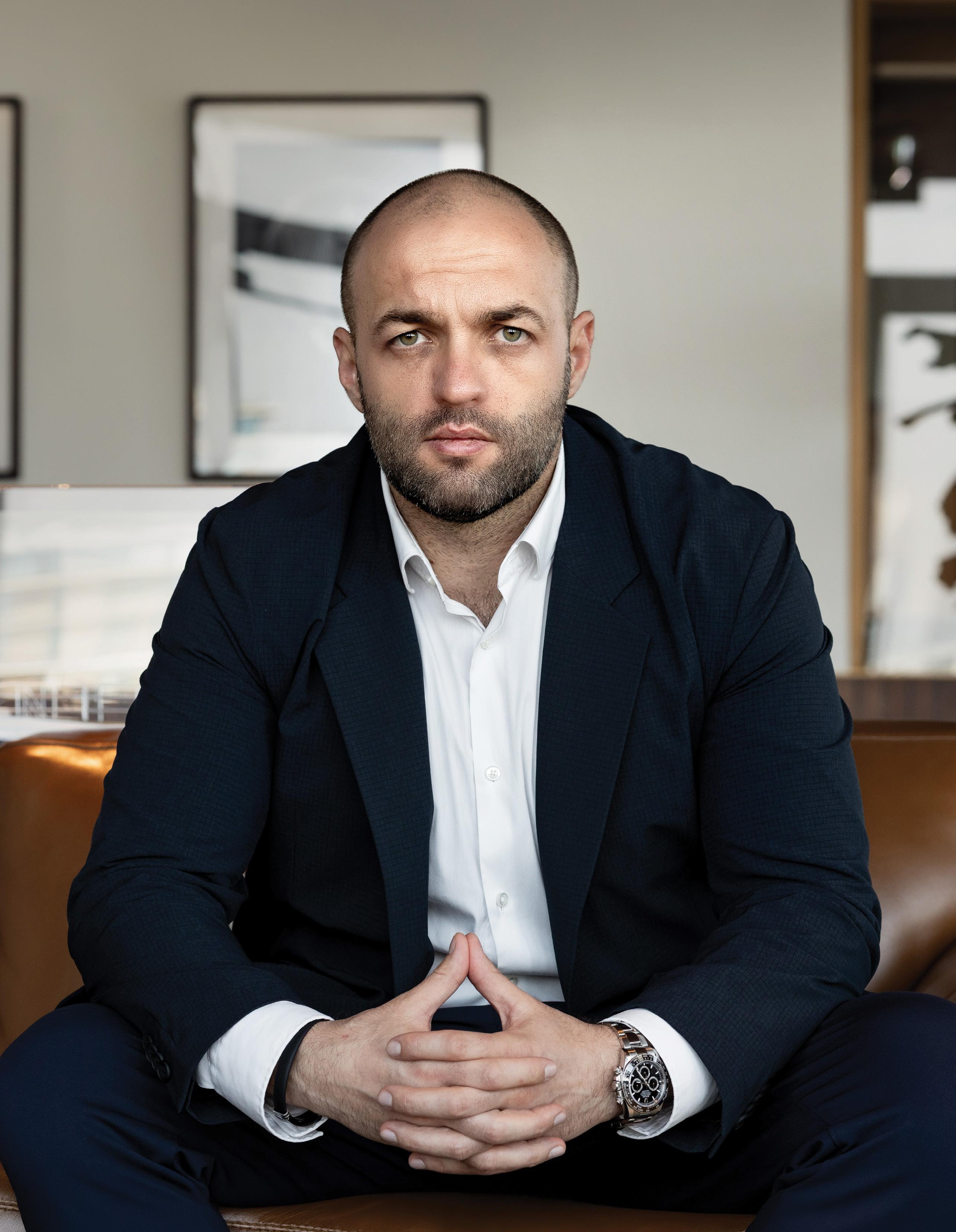
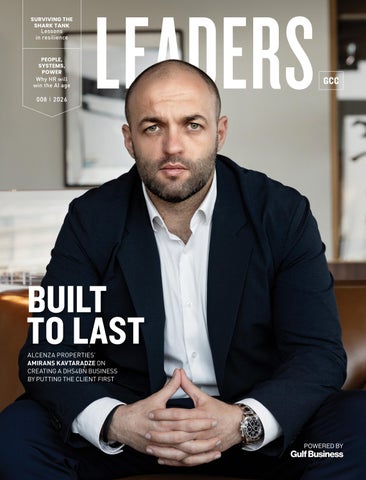
ALCENZA PROPERTIES’ AMIRANS KAVTARADZE ON CREATING A DHS4BN BUSINESS BY PUTTING THE CLIENT FIRST















TRUST OVER TRANSACTIONS
Alcenza Properties’ founder Amirans Kavtaradze explains why long-term relationships matter more than closing the next deal

WHY CREATIVITY HAS STRATEGIC RELEVANCE
Some leaders still see creativity as a niceto-have and why that needs to change

AI, DATA CENTRE RACE RAISES THE STAKE CEOs are facing mounting pressure as AI, data centres and geopolitical shifts reshape the business landscape
MARK STABILE, DEAN OF DEGREE PROGRAMMES AT INSEAD, DEAN OF THE EUROPE CAMPUS AND PROFESSOR OF ECONOMICS

GCC firms are using smarter risk management to expand faster and recover stronger

The vice chair of IMPACT by Miral discusses conservation, community development and long-term sustainability in Abu Dhabi
HEAD OFFICE: Media One Tower, Dubai Media City, PO Box 2331, Dubai, UAE, Tel: +971 4 427 3000, Fax: +971 4 428 2260, motivate@motivate.ae
DUBAI MEDIA CITY: SD 2-94, 2nd Floor, Building 2, Dubai, UAE, Tel: +971 4 390 3550, Fax: +971 4 390 4845
ABU DHABI: PO Box 43072, UAE, Tel: +971 2 657 3490, Fax: +971 2 677 0124, motivate-adh@motivate.ae
SAUDI ARABIA: Regus Offices No. 455 - 456, 4th Floor, Hamad Tower, King Fahad Road, Al Olaya, Riyadh, Saudi Arabia, Tel: +966 11 834 3595 / +966 11 834 3596, motivate@motivate.ae
LONDON: Acre House, 11/15 William Road, London NW1 3ER, UK, motivateuk@motivate.ae
Editor-in-chief
Obaid Humaid Al Tayer
Managing partner and group editor Ian Fairservice
Chief commercial officer
Anthony Milne
Anthony@motivate.ae
Group content director
Thomas Woodgate
Thomas.Woodgate@motivate.ae
Publishing director
Manish Chopra
Manish.Chopra@motivate.ae
EDITORIAL
Group editor
Gareth van Zyl
Gareth.Vanzyl@motivate.ae
Editor
Neesha Salian
Neesha.Salian@motivate.ae
Deputy editor
Rajiv Pillai
Rajiv.Pillai@motivate.ae
Reporter Nida Sohail
Nida.Sohail@motivate.ae
Senior art director
Freddie N. Colinares Freddie@motivate.ae
General manager – production
S Sunil Kumar
Production manager
Binu Purandaran
Assistant production manager
Venita Pinto
SALES & MARKETING
Digital sales director
Mario Saaiby
Follow us on social media: Linkedin: Gulf Business Facebook: GulfBusiness X: @GulfBusiness Instagram: @GulfBusiness
Cover: Freddie N. Colinares A GULF BUSINESS INITIATIVE
Mario.Saaiby@motivate.ae
Sales manager
Hitesh Kumar
Hitesh.Kumar@motivate.ae

AS AI RESHAPES HOW ORGANISATIONS OPERATE, THE CHIEF HUMAN RESOURCES OFFICER’S ROLE IS EVOLVING FROM MANAGING PEOPLE PROGRAMMES TO REDESIGNING WORK, SKILLS AND DECISION -MAKING ALONGSIDE TECHNOLOGY
The chief human resources officer (CHRO) will not become the most important person in the C-suite because HR suddenly becomes more powerful. The role becomes central because AI is forcing every organisation to answer a harder question: how should work, people, and technology be redesigned together?
In the AI age, advantage will not come simply from buying better technology or training people to write better prompts. In our book, HumanCorps, we argue that organisations must be redesigned for a world in which human judgement and machine capability increasingly operate together. As AI systems begin to plan, recommend, act, and learn across workflows, the real question becomes: how does an organisation improve performance without losing trust?
That is not a technology question alone. It is a question of work design, capability, culture, decision rights, and governance, the territory where the CHRO should become indispensable.
In the Gulf, this is particularly urgent. AI adoption is colliding with national transformation strategies, localisation agendas, and the need to build highvalue capability among citizens at speed. Workforce composition is no longer a back-office concern; it is increasingly a licence-to-operate issue. The organisations that succeed will convert technology into trusted, productive workforces — not just automate more tasks.
That is why the old positioning of HR as an enabling function is beginning to break down. We are already seeing organisations reposition the people function as the backbone of the enterprise, working hand-in-hand with operations. As more front-line work becomes AI-enabled, the critical challenge will be how people, systems, judgement, and accountability work together. The future operating model will not be “HR supporting the business”. It will be people and systems shaping how the business performs.
This is the real opportunity for the CHRO. AI does not simply remove tasks. It changes the authority structure of the organisation. When software can recommend actions, trigger processes, or operate across systems, leaders must ask: who delegated that authority, what must be checked, and where does accountability sit when human and machine have both shaped the outcome?
These are not abstract governance issues. They determine whether AI improves judgement or simply accelerates confusion, whether employees feel empowered or bypassed, and whether the organisation can explain its decisions to regulators, boards, customers, and its own people.
AI DOES NOT SIMPLY REMOVE TASKS. IT CHANGES THE AUTHORITY STRUCTURE OF THE ORGANISATION. WHEN SOFTWARE CAN RECOMMEND ACTIONS, TRIGGER PROCESSES, OR OPERATE ACROSS SYSTEMS, LEADERS MUST ASK: WHO DELEGATED THAT AUTHORITY, WHAT MUST BE CHECKED, AND WHERE DOES ACCOUNTABILITY SIT WHEN HUMAN AND MACHINE HAVE BOTH SHAPED THE OUTCOME?
For the CHRO, this means moving beyond programmes, policies, and engagement campaigns into the practical architecture of work. It starts with redesigning workflows before “implementing AI”: where does AI change the sequence of work, the skills required, the points of risk, and the moments where human judgement must remain decisive?
Decision rights then need to become explicit. Every organisation needs clarity on who may make, challenge, escalate, or override decisions — and under what conditions. That clarity must apply to humans and machines. This is not anti-innovation. It is the trust infrastructure that allows autonomy to scale.
Capability building also needs more precision than universal “AI fluency” allows. Everyone needs baseline awareness: what is permitted, what

is prohibited, how data should be handled, and when outputs must be verified. But some roles will use AI lightly; others will be redesigned around AI-enabled workflows; a smaller group will orchestrate agents connected to enterprise systems. Treating these populations as the same is inefficient and risky.
This matters deeply in the GCC, where nationalisation is moving from headcount compliance towards capability creation. The question is not simply whether organisations employ enough nationals. It is whether they can accelerate national talent into value-creating, AI-enabled roles. That requires career pathways, skills evidence, internal mobility, and work design as strategic infrastructure,with HR and operations working as one system.
Measurement must change as well. Boards should be wary of vanity metrics: licences issued, prompts written, training modules completed, or pilots launched. Better measures are tied to work itself: cycle time, error rates, customer outcomes, retention, promotion velocity, audit exceptions, and movement into higher-value roles. The prize is not a more digital HR function; it is a faster, more adaptive, more accountable organisation.
There is, however, a trap. The CHRO should not claim to “own AI”. Business leaders must own value and workflow outcomes. Technology and data leaders must own engineering, integration, and reliability. Risk, legal, audit, and cybersecurity must own controls and assurance. The CHRO’s distinctive role is to ensure that the human system — skills, roles, culture, incentives, fairness, and accountability — makes the operating model work.
So, will the CHRO become the most important C-suite role in the AI age? Potentially, yes. But not by defending the boundaries of HR. The CHRO becomes central by helping the organisation answer a harder, more commercial question: how do we turn machine capability into trustworthy human performance, measurable productivity, and better execution?
In the Gulf, that question is already urgent. AI, nationalisation, and economic transformation are converging. The winners will not automate fastest but learn fastest, redesigning work so people and systems perform together with judgement, speed, and trust. If the CHRO can lead that orchestration, the role may determine whether the AI age strengthens the organisation, or simply overwhelms it. L
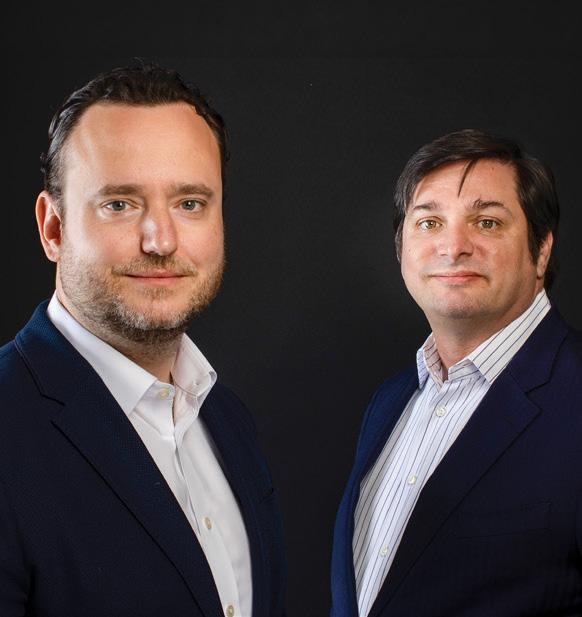
MIKE PINO has spent the past 25 years helping organisations improve value and performance through strategy, technology, and talent. He is the co-author of HumanCorps: Redesigning Organisations for the Wisdom Age (Routledge, July 2026) and holds a PhD in English, specialising in computational linguistics, from CUNY. The co-author of the book, ANDREW LOPIANOWSKI, has spent over decades helping organisations strengthen leadership, culture, and performance through behavioural science, organisational design, and transformation. He is holds an MSc in Industrial/Organisational Psychology.

Why leaders still see creativity as a nice-to-have and why that needs to change
ost people have experienced creativity at work in a workshop, or maybe while solving a problem, and felt the shift into fresh thinking. When it works, creativity is a source of competitive advantage. But creativity has a reputation problem. It’s often seen as uncontrollable, risky, a bit of a lottery, or dismissed as a lightweight, nice-to-have factor. This is because many teams have lived through creativity that has overpromised and underdelivered.
Particularly if your path to leadership has been through more traditionally analytical functions (for example, finance, operations, research and development, procurement), then deliberately deploying creativity might not have played a big part in your role to date.
According to an HBR study, 96 per cent of businesspeople recognise that creative ideas are essential for growth, yet only 22 per cent believe they are successfully harnessing creativity. This is an execution disconnect: organisations aren’t consistently designing the conditions, and the decision points, that break teams free from business-as-usual thinking and deliver breakthrough ideas. You know you’re suffering from this if attempts
to escape business-as-usual thinking result in endless discussion, recycled ideas, and safe incrementalism.
We live in a VUCA world, volatile, uncertain, complex and ambiguous, and the pace of change is only accelerating. In this environment, challenges increasingly need nonlinear solutions.
The issue is not whether creativity matters, it’s whether organisations are building and protecting the skills to deploy it under pressure.
Creativity is defined as producing ideas that are novel, useful and surprising in response to complex, ambiguous and ill-defined problems, often for which no single correct answer exists. Innovation is the application of creativity to create change. That might mean creating something new for customers or solving an internal business challenge. The underlying creative process is the same.
Sometimes people mistakenly think that creativity is simply about throwing around lots of ideas and seeing what sticks. What this overlooks is a counterintuitive truth: creativity isn’t the absence of structure, but the use of structure to capture and channel exploratory thinking.
In any creative thinking process, you’ll first think divergently, generating lots of solutions and exploring many different directions. Then you’ll pivot to think convergently and begin to prioritise, synthesise, articulate and sharpen potential solutions.
The behaviours required are deliberately different. Divergent thinking means delaying judgement, building on ideas, seeking novelty and creating a quantity of potential solutions before we pause and begin to evaluate ideas. Convergent thinking means applying affirmative judgement, protecting novelty and checking back against your original objective.
It is vital to separate divergent and convergent thinking. Trying to do both at the same time is like driving with one foot on the accelerator and the other on the brake: you make little progress. Cycles of divergent and convergent
thinking are at the heart of creativity and form the foundation of many innovation approaches, where you will go through multiple cycles:
Defining the challenge
Creating solutions
Sharpening and iterating those solutions
Forming action/commercialisation plans
When creativity is reduced to simply ideation, or even more narrowly to just brainstorming, it’s hardly surprising that people question its rigour. But properly understood, creativity is a disciplined approach to solving complex problems and a serious strategic tool.
TREATING CREATIVITY AS OPTIONAL IS COSTLY
Poor-quality problem-solving and innovation work incur significant costs to the business. There are three types of costs to consider:
The direct costs: Money, time and resources spent producing mediocre solutions or ideas.
The inefficiency premium: The cost of trying to resuscitate, develop or execute weak ideas.
The opportunity cost: The headspace and organisational capacity that could have been invested in stronger work.
Repeated creative underperformance also creates fatigue in the business and damages creativity’s reputation. One watch-out, especially in larger organisations as roles get more and more specialised: there are fewer opportunities for people to use their creativity. This is especially true in roles that are dominated by analysing, briefing, circulating debriefs and repeating that cycle. Over time, the more exploratory creative thinking skills, and the confidence to deploy these skills, can fade.
The World Economic Forum’s Future of Jobs report is clear: by 2030, around two-fifths of current skills will shift or become outdated, with AI and information processing reshaping most businesses. Creative thinking skills rank near the top of required skills, at number four. Yet as creativity becomes more valuable, many organisations are giving people fewer opportunities to practise it.
Creativity isn’t magic. It’s brain-based, shaped by the conditions you design for and the choices you reward.
Drawing on almost 20 years of strategic innovation work with global clients and an MSc focused on the neuroscience of creativity, I developed five principles that allow creativity to drive differentiation and growth.
The five principles are not another rigid innovation process. They are five design choices leaders must make if they want stronger creative cultures.
01 COGNITIVE FOCUS: Ensuring our brains know where to search to create on-strategy ideas.
02 CYCLES OF DEEP THINKING: Using the brain’s natural cycles to focus, defocus and incubate ideas.
FORUM’S FUTURE OF JOBS REPORT IS CLEAR: BY 2030, AROUND TWO-FIFTHS OF CURRENT SKILLS WILL SHIFT OR BECOME OUTDATED, WITH AI AND INFORMATION PROCESSING RESHAPING MOST BUSINESSES.
03 CREATIVE FLOW: Creating the right mental and emotional climate for creativity.
04 CHALLENGING REALITY: Breaking fixation to reimagine the problem and make unexpected connections.
05 COURAGEOUS CHOICES: Designing decisions to protect rough diamonds under uncertainty.
In practice, this means establishing a clear strategic destination and aligning senior stakeholders from the outset. It also means creating space for focused work and incubation, while fostering psychological safety, meaningful challenge, and a sense of momentum and progress. Equally important is deliberately disrupting familiar ways of thinking and designing decision-making processes that protect promising ideas while they are still imperfect.
START DESIGNING FOR CREATIVITY
A culture of creativity is not about telling people to be creative. It is about designing the conditions and behaviours that make creative thinking more likely to deliver smarter innovation. The question is no longer whether leaders can afford to invest in creativity. It is whether they can afford to keep treating one of the capabilities most critical to adaptation, differentiation and growth as optional. L
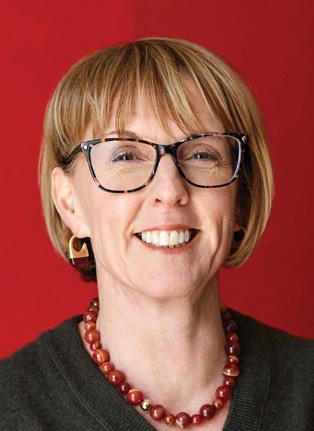
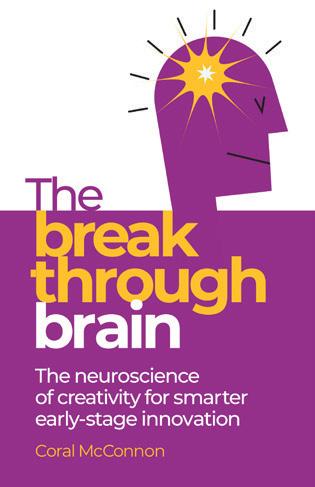
The writer is the author of The Breakthrough Brain: The Neuroscience of Creativity for Smarter Early-Stage Innovation

Eight Lessons from eight years growing a $15bn real estate and retail giant
On Shark Tank Lebanon, founders sometimes ask me, off camera, what it takes to build something big. They expect a framework or a formula. The answer is less comfortable. Shark Tank does not test your strategy or your will. It tests your relationship with the truth. For eight years I led Majid Al Futtaim, a real estate and retail business valued at around $15bn, operating in 17 countries with people from more than 100 nationalities. Almost everything those years taught me comes down to one discipline: how hard you can work to see reality clearly, when your position makes that harder.
Nothing has taught me less than winning or succeeding in business. When the results are good, everything you do is attributed to to “genius”, the smart calls and the lucky ones alike. Those good results teach you very little. In fact, the contrary is true: the years that made me a better leader were the ones that embarrassed me. If there is nothing in your track record that makes you wince, you are not keeping honest records.
02
NOBODY IS MISLEADING YOU. YOU ARE MISLEADING YOURSELF.
Information reaches a CEO in polished form. This is not because people lie. They don’t. They work hard, they believe in what they present, and they are doing their best. The distortion has more to do with distance than any dishonesty This is because layer between you and the front line smooths the picture a little more, and with the best of intentions. There is only one cure (and it is not a better way of reporting) It is your own eyes and your own time. Walk the markets. Visit the projects. Meet on the factory floor. Sit with the software teams. Talk to your customers and the people who deal with your business every day. A leader who stops investing time here becomes vulnerable, and that vulnerability is entirely his or her own doing.

Alain Bejjani
03
CONSENSUS IS HOW LARGE COMPANIES FAIL POLITELY.
As a CEO I came to grow suspicious of rooms that agreed with me quickly. Unanimity in a leadership team is rarely alignment. More often it is arithmetic, with each person round the table weighing the cost of disagreeing and finding it too high. The most valuable colleagues I had were the ones who made our meetings longer and our decisions better, the argues, dissenters and questioners. You have to protect those people because a comfortable discussion will tend to exclude their insights.
04
DATA ENDS EXACTLY WHERE THE REAL DECISIONS BEGIN. The easier decisions come with spreadsheets. But the consequential ones never do. Whether it is entering a
NOTHING HAS TAUGHT ME LESS THAN WINNING OR SUCCEEDING IN BUSINESS. WHEN THE RESULTS ARE GOOD, EVERYTHING YOU DO IS ATTRIBUTED TO TO “GENIUS”, THE SMART CALLS AND THE LUCKY ONES ALIKE. THOSE GOOD RESULTS TEACH YOU VERY LITTLE. IN FACT, THE CONTRARY IS TRUE: THE YEARS THAT MADE ME A BETTER LEADER WERE THE ONES THAT EMBARRASSED ME.

market with no precedent or holding your nerve through a crisis, no model settles these questions, because the future they depend on does not exist yet. What settles them is what you actually believe. And that is why values are not the soft part of a company. They are what runs the business when the data runs out, which is exactly when it matters most.
05
We like to tell the story of growth as a smooth curve, but it never is. Growth, like success, is painful. It is all those ups and downs, setbacks, wrong turns, and recoveries; and your ability to grow is set by your ability to overcome and to learn. The down years are not interruptions to the story. They are the story. What you do with them decides everything that comes after.
In our part of the world, this is not just theory. Across my years in business, we lived through the Arab Spring, boycotts, conflicts on the doorstep of our markets, currency shocks and then a global pandemic. Each one tested our business continuity and our nerve. What carried us through was not invented in the moment, or on the fly. It was the long-term trust and relationships we had built with governments, partners, customers and our own people in the calm years. Building trust and doing good always cost us something (nobody was forcing us to pay). That is the broader truth about doing good in business. The right conduct will help you later only if it costs you in the present; you are giving to the
future. And when the storms come they do not build your character: they just reveal and show who you are.
IS NOT WASTE. IT IS SURVIVAL.
How efficient do you want to be? Efficiency thinking treats every cost, every duplicate, as fat to be cut. This could be a second supplier, spare capacity, cash you are not deploying. In stable times that logic looks clever. Then the unforeseen arrives, the black swan that nobody planned for, and the difference between companies that bend and companies that break turns out to be exactly the slack that the optimisers wanted to remove. You cannot predict these events. That is the point of them. But you can build so that surviving them does not depend on prediction. Resilience looks expensive right up until the day it is priceless.
The hardest truth comes last. If the institution cannot thrive without you, you have not built an institution. You have built a dependency with your name on it. Knowing when your presence has become the limitation, and acting on it, is the one decision no board and no adviser will make for you. So when a founder stands in Shark Tank and asks what I am looking for, it is none of the things they probably rehearsed. When I question the numbers they present, I watch what happens next. The ones who defend reflexively, I tend to pass on. The ones who pause, absorb and update, those are the ones I back. Capital is a commodity. Strategy can be copied. The only durable edge, at any scale, is a leader who is open to the truth. L
The writer is the former CEO of Majid Al Futtaim, an investor, and the author of NEXT: Leading Through the New Realities. He appears as a shark on Shark Tank Lebanon.
BY RAJIV PILLAI

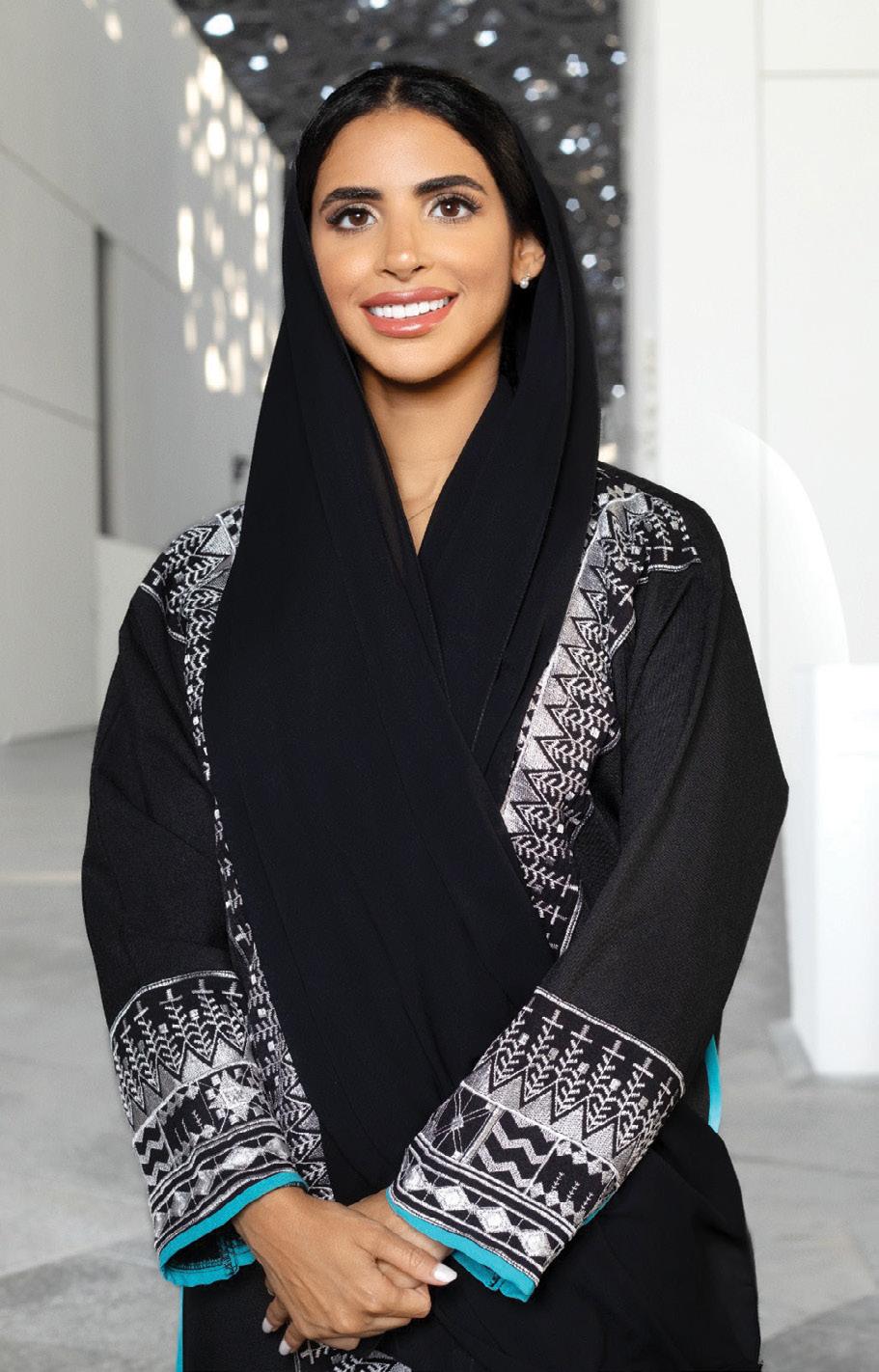
Unlike standard AI programmes focused primarily on technical instruction, NEP-AI is structured around Emirati professionals already operating within priority sectors across the UAE economy, says Eman Al Mughairy, expert at the National Experts Program in the Culture and Identity sector
As the UAE accelerates its push to become a global artificial intelligence hub, the focus is increasingly shifting from infrastructure and investment to talent capability. While universities and training programmes continue to expand AI education, the country is also experimenting with a different model — one built around execution, institutional impact, and sector integration.
For Eman Al Mughairy, expert at the National Experts Program in the Culture and Identity sector and head of Outreach at Mohamed bin Zayed University of Artificial Intelligence, the UAE’s National Experts Program AI track (NEP-AI) represents a deliberate departure from conventional learning pathways.
“What makes NEP-AI different is simple: it doesn’t behave like a traditional programme,” she says.
“Most education pathways are designed to transfer knowledge. NEP-AI is designed to shape perspective and create impact.”
Unlike standard AI programmes focused primarily on technical instruction, NEP-AI is structured around Emirati professionals already operating within priority sectors across the UAE economy. “NEP-AI is designed for Emirati professionals already embedded across priority sectors,” Al Mughairy explains.
“This means AI is applied within real institutional contexts, shaped by sector-specific knowledge and national priorities.” The programme’s positioning at mid- to senior-management level is intentional. By targeting professionals already involved in decision-making environments, AI capability is integrated directly into institutions where
policy, strategy, and operational execution intersect.
“It also operates at a different level of seniority,” she says. “Participants are mid- to senior-level professionals, which ensures that capability is integrated directly into the environments where policies are shaped and decisions are made.”
This approach reflects the UAE’s broader strategy of embedding AI across government, industry, and public services, rather than treating it as a standalone technology sector.
Beyond individual capability-building, Al Mughairy sees the programme as part of a larger national objective: strengthening technological sovereignty and long-term resilience.
“By distributing expertise across sectors, it strengthens a national backbone of AI capability,” she says.
The emphasis is not simply on technical literacy, but on creating leaders who can translate AI into institutional outcomes aligned with national priorities. Most significantly, programme success is measured not by academic achievement but by implementation.
“Success is not measured by what participants know, but by what they deliver,” Al Mughairy says.
This execution-focused approach is reinforced through capstone projects, where participants work on realworld sector challenges under structured mentorship. “Every stage of learning is tied to execution, addressing real challenges and translating AI from concept into institutional application.”
The programme’s rigorous selection process reflects its strategic ambition.
“NEP-AI looks for Emirati professionals who are already operating within sectors where AI matters,” Al Mughairy says.
Technical skills remain important, but the programme evaluates a much broader set of capabilities — including decision-making, systems thinking, and the ability to connect AI to policy and societal outcomes.
“There is also a strong focus on responsibility,” she explains. “Candidates are expected to demonstrate how AI impacts institutions, policy, and society, not just systems.”
The process itself combines technical assessments, AI-based interviews, and in-person evaluation by a multidisciplinary panel. At each stage, the central question remains consistent.
“Can this individual translate AI into meaningful, realworld outcomes?” Al Mughairy asks.
NEP-AI’s eight-month structure is designed as a progression from technical understanding to applied delivery. “It begins by establishing a strong technical foundation,” Al Mughairy says. “Participants develop a clear, practical understanding of how AI systems work, including infrastructure, data, and deployment realities.”
From there, the focus shifts toward value creation and implementation strategy. Participants are expected to Pic:
identify sector-specific AI opportunities, assess feasibility, and understand the economics of deployment.
“As the programme advances, the emphasis moves to strategy and leadership,” she explains.
International study visits also form a core component of the experience, exposing participants to global AI ecosystems, governance frameworks, and operational models.
“These are structured engagements with leading AI ecosystems, focused on applied models, governance approaches, and implementation at scale.” Throughout the programme, capstone projects run in parallel, ensuring that learning remains directly connected to real institutional problems. “By the end of the programme, the expectation is that participants can apply AI in ways that are relevant, responsible, and aligned with national priorities.” One of the
programme’s defining characteristics is its sector-based structure. “Participants are selected from across 25 priority sectors,” Al Mughairy says. This creates a model where participants gain deep expertise within their own fields while simultaneously developing visibility into AI applications across multiple industries. “Depth comes from the participant’s own sector. Breadth comes from the programme.” The result is a cohort capable not only of driving AI within their own institutions, but also understanding how AI capability connects across the broader national ecosystem. “That combination ensures participants do not operate in isolation,” she says.
For Al Mughairy, international exposure is not an optional enhancement — it is essential.
“AI is not a local industry. It’s a global system where convergence matters — technically, economically, and politically,” she says.
This perspective shapes NEP-AI’s approach to partnerships and study visits, which are designed to expose participants to how other nations deploy, govern, and regulate AI at scale.
“Participants are exposed to how other countries deploy AI, how institutions manage risk, and how systems are built and governed in practice.” This global benchmarking process serves two purposes: aligning participants with international standards while strengthening their ability to adapt those insights to the UAE context.
“Global collaboration… challenges assumptions and expands what they consider possible.”
The programme’s capstone projects are positioned as the clearest demonstration of its execution-led philosophy.
“Capstone Projects are where the programme makes a difference,” Al Mughairy says.
Each participant develops an AI initiative tied to a real sector challenge, with a focus on measurable outcomes and implementation viability.
“These are not academic exercises; they are designed to be practical, measurable, and aligned with institutional needs.” Participants must not only design solutions, but also present operational models and deployment strategies to senior stakeholders. “This is what shifts the programme from learning to delivery.”
For the UAE, AI capability-building is increasingly tied to economic diversification and long-term competitiveness. “NEP-AI contributes by embedding capability across the system,” Al Mughairy says. She points to the growing importance of technology convergence, where competitive advantage increasingly depends on the ability to combine and scale multiple technologies effectively.
“An AI-enabled economy is not built by engineers alone, but by people who can translate, align, and activate across systems.” This is where NEP-AI positions itself differently — not only developing technical experts, but also connectors capable of bridging policy, technology, and execution.
“The programme also connects multiple layers — government, industry, academia, and international partners — through applied learning and project delivery.”
Ultimately, Al Mughairy believes the UAE’s success in AI capabilitybuilding will not be measured by announcements or investment totals, but by practical deployment.
“Success will be reflected in how AI is used, not how it is described,” she says.
For her, the UAE’s differentiator lies in alignment — where education, leadership development, research, and implementation operate within a coordinated national framework.
“What stands out in the UAE is alignment,” she explains. “There is a clear national direction, supported by education, leadership development, research, and sector deployment — all working toward the same objective.”
“PARTICIPANTS ARE EXPOSED TO HOW OTHER COUNTRIES DEPLOY AI, HOW INSTITUTIONS MANAGE RISK, AND HOW SYSTEMS ARE BUILT AND GOVERNED IN PRACTICE.”
Within that system, NEP-AI serves a highly specific role: translating strategy into institutional execution through people. “It focuses on people, and on building the capability required to translate strategy into execution.”
As countries globally race to build AI ecosystems, the UAE’s model suggests that long-term competitiveness may depend less on isolated technical expertise and more on the ability to integrate AI capability directly into the structures where decisions are made. L

Russell Reynolds Associates’ Global CEO Turnover Index found 234 chief executive departures worldwide in 2025, 21 per cent above the eight-year average, highlighting mounting pressure on leaders navigating increasingly complex business environments
The rapid expansion of artificial intelligence (AI) and data centre infrastructure across the Gulf is increasing demand for executives and board members capable of overseeing increasingly complex digital platforms, according to analysis released by leadership advisory firm Russell Reynolds Associates. The findings come as Gulf states, led by Saudi Arabia and the UAE, accelerate investments in AI, cloud computing and digital infrastructure as part of broader economic diversification strategies.
The UAE has emerged as one of the region’s most ambitious adopters of artificial intelligence. In April, the government announced plans to deploy agentic AI across 50 per cent of government sectors, services and operations within two years, a move officials described as a world first.
As investment pours into data centres across the region, attention is increasingly shifting from building infrastructure to finding leaders capable of operating it, Russell Reynolds said.
The firm’s Global CEO Turnover Index found 234 chief executive departures worldwide in 2025, 21 per cent above the eight-year average, highlighting mounting pressure on leaders navigating increasingly complex business environments. In the technology sector, however, CEO turnover fell to 20 departures in 2025 from 40 a year earlier, suggesting boards are prioritising continuity amid growing demand for executives with specialist expertise. At the same time, governance expectations are rising. Russell Reynolds’ analysis of 35 leading data centre boards globally found that while board renewal has accelerated since 2023, capability gaps remain in areas including hyperscale operations, technology expertise, workforce leadership and operational resilience. “A decade ago, success in data centres was defined by operational reliability and incremental growth,” said Christopher Bradley, a Dubaibased member of the firm’s global energy practice. “Today, these are capital and energy-intensive platforms of national strategic importance, deeply embedded in digital and economic agendas. CEOs must align power strategy, capital deployment, hyperscale relationships and operational execution at scale, while boards must be equipped to govern that complexity.”
The firm said the role of data centre leaders has expanded significantly as facilities evolve from propertybacked assets into critical infrastructure supporting AI workloads, cloud services and national digital strategies.
Executives increasingly need to balance energy security, capital allocation, cybersecurity, regulatory requirements and relationships with hyperscale cloud providers while attracting scarce technical talent.
The UAE presents a distinctive leadership environment, supported by sovereign and private capital, advanced digital policies and a long-term economic diversification agenda. The country is rapidly expanding the infrastructure required to support growing AI adoption, while Abu Dhabi and Dubai continue to position themselves as global technology and innovation hubs. Saudi Arabia, meanwhile, is benefiting from large-scale state-backed investment, abundant land availability and competitive energy economics as it seeks to establish itself as a regional AI powerhouse.
“The UAE is building AI infrastructure at extraordinary scale and ambition,” said Marie-Osmonde Le Roy de
THE UAE HAS EMERGED AS ONE OF THE REGION’S MOST AMBITIOUS ADOPTERS OF ARTIFICIAL INTELLIGENCE. IN APRIL, THE GOVERNMENT ANNOUNCED PLANS
WITHIN TWO YEARS, A MOVE OFFICIALS DESCRIBED AS A WORLD FIRST
Lanauze-Molines, a board and CEO adviser at Russell Reynolds Associates in Dubai.
“Boards and CEOs who get the combination of leadership, governance and execution right will define the next decade of digital infrastructure in the region.” Dr Jan C Cron, a Dubaibased member of the firm’s global technology and board practice, said technology cycles were moving faster than traditional succession planning, forcing boards to rethink leadership pipelines.
“The boards moving fastest are bringing in expertise from cloud, software and digital infrastructure to build leadership teams that match the pace of the industry,” he said.
As data centres evolve from real estate-backed assets into systemically important digital infrastructure, leadership quality is increasingly expected to determine which operators can successfully convert investment and ambition into longterm commercial success.
For Gulf economies seeking to lead in the AI era, the challenge is no longer simply building infrastructure, but developing the leadership and governance capabilities needed to operate it at scale.
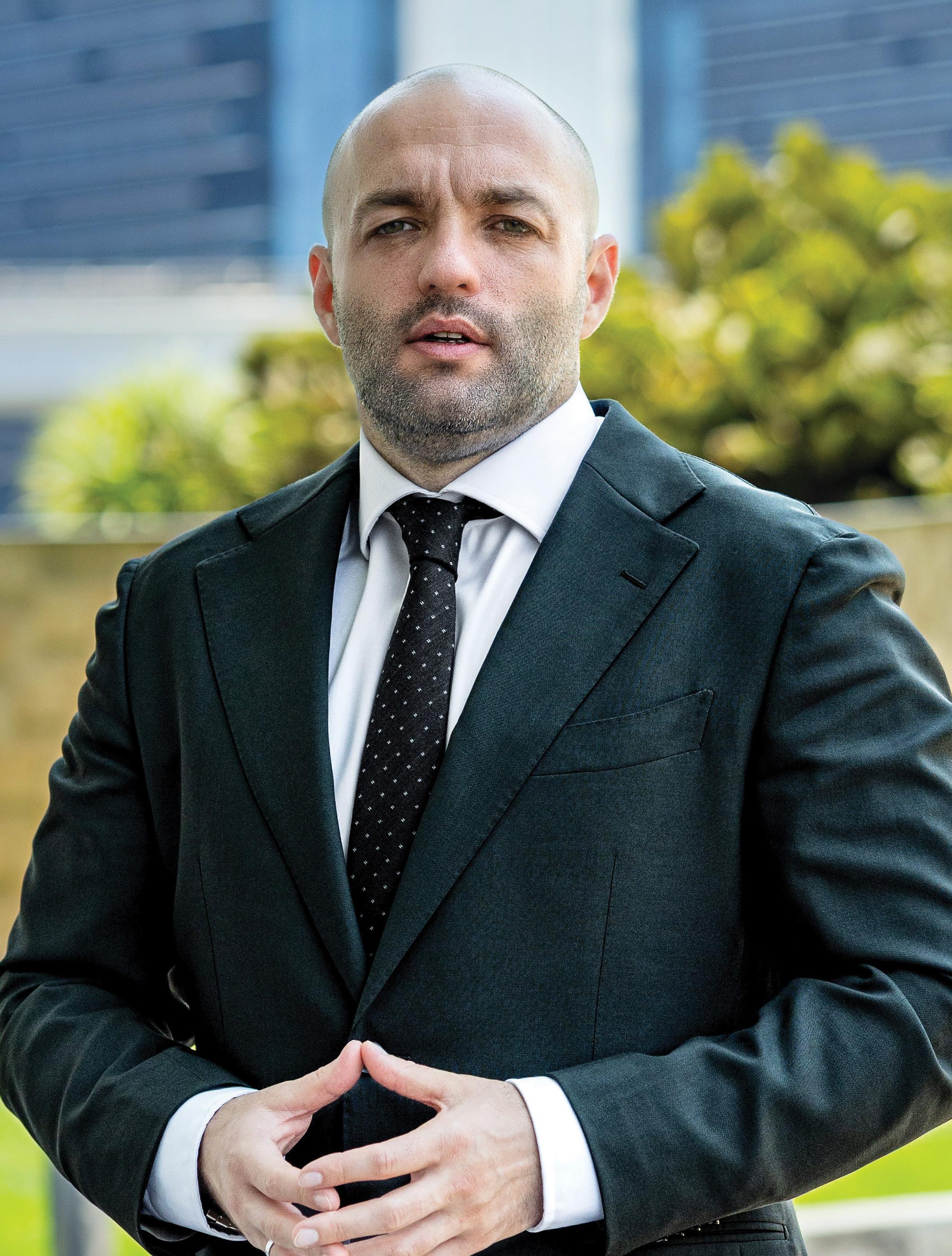
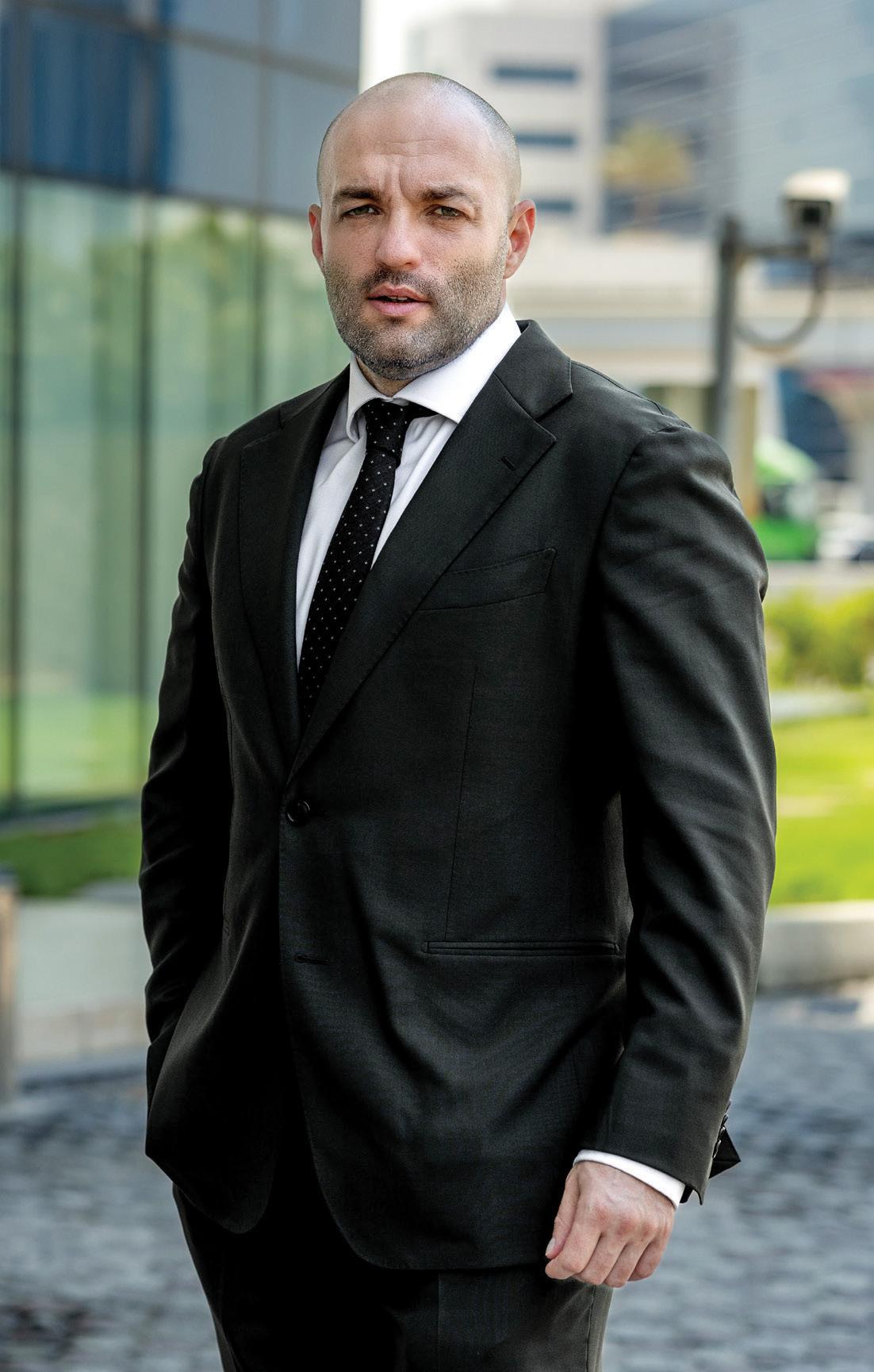
AMIRANS KAVTARADZE HAS BUILT A MULTIBILLION-DIRHAM BUSINESS BY REFUSING THE EASY SALE
IN
IN 2022 AND TOOK A JOB ON THE SHOP FLOOR. TWO YEARS LATER, ALCENZA PROPERTIES SITS AMONG EMAAR’S TOP PARTNERS AND HAS MOVED MORE THAN DHS4BN IN TRANSACTIONS FROM A STANDING START, POWERED BY AN AI SYSTEM ITS FOUNDER INSISTS MUST NEVER SPEAK TO A CLIENT
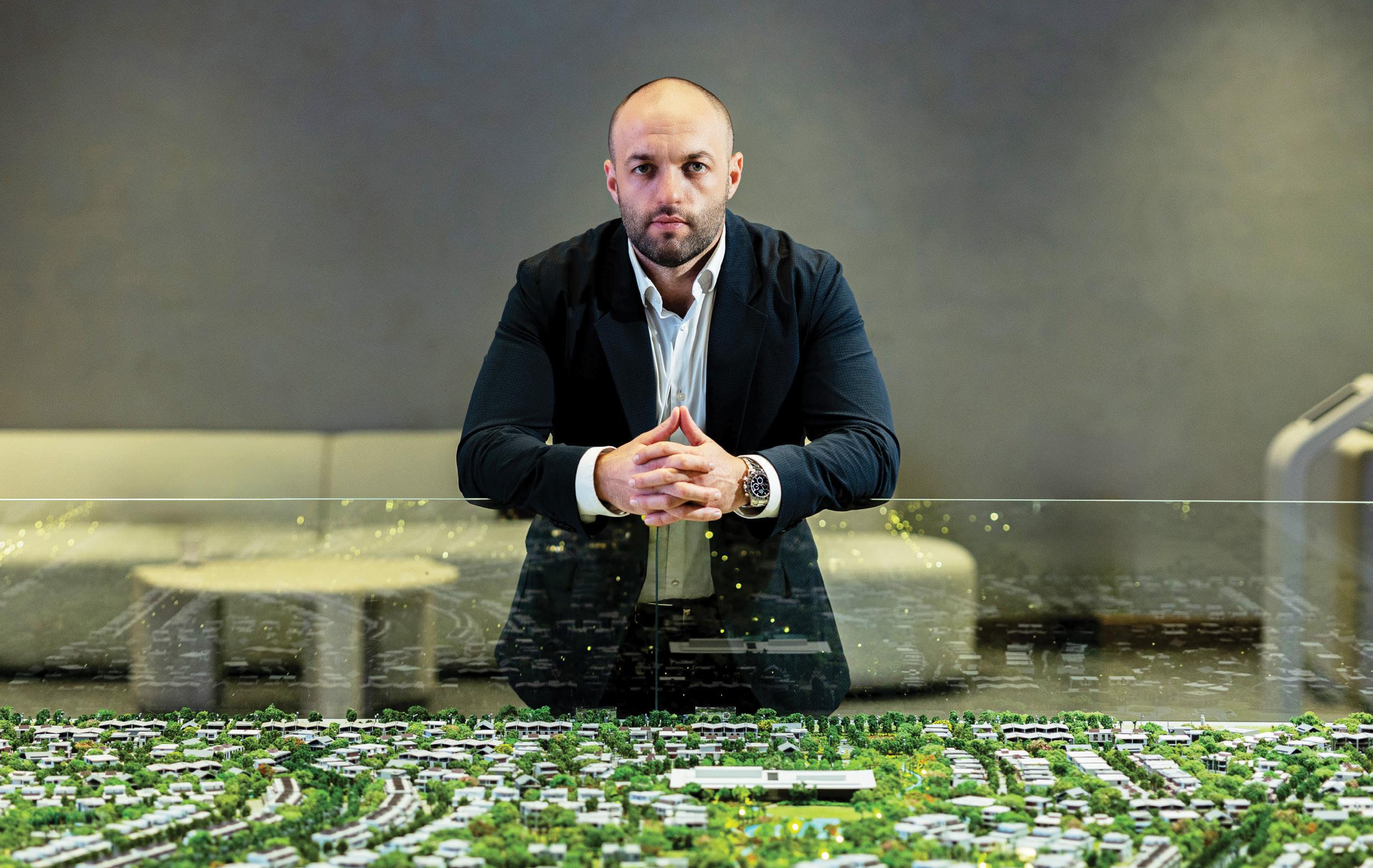
Most founders enter a new market from the top. Amirans Kavtaradze walked in through the front door and started selling. He had run his own real estate companies in Europe, a career begun in Latvia in 2008 and continued in London, and every reason to arrive in Dubai as a chief executive. Instead, in 2022, he took a job as a broker at one of the city’s large agencies.
“I deliberately started on the front line,” he says. “Within two years I knew exactly how this market works: what investors actually need, which projects perform and, most importantly, what was missing.” His conclusion: Dubai did not need another brokerage. “What was missing was never brokers; Dubai has thousands. It was a company that owns the client’s entire journey.”
“A person entering the UAE isn’t just buying an apartment; they’re often relocating a life: opening a business here, moving an existing one, bringing the family, finding schools for the kids, arranging residency and banking.” The market, he says, “forced them to assemble all of that alone, piece by piece, across companies that never talked to each other.”
So, Alcenza Properties, his own agency had a different premise from day one: give the investor the full cycle in one place.
The conventional reading is that a successful brokerage later diversified. Kavtaradze says that reverses the sequence.
“People assume the ecosystem came later, as an add-on to a successful brokerage. The truth is the opposite: the ecosystem was the founding idea, and brokerage was the right place to start, because handling the largest purchase of someone’s life is where trust is earned.” Alcenza Business Services, he says, “simply gave that idea its own home.” Alcenza Properties proved itself fast. “In our first year we were already among the top 10 partners of developers like Emaar and Nakheel.”
Ask what has been hardest about growing quickly and he names none of the usual suspects. “The hardest thing to scale isn’t revenue; it’s judgment. The barrier to entry in Dubai
brokerage is low; the barrier to consistency is enormous.” His diagnosis is unusually blunt for a chief executive on the record.
“Most of the competition here isn’t really between companies; it’s between hungry agents fighting for money today. No strategy, no thought about tomorrow: push whatever project pays the highest commission, collect, move on.” The consequence is visible in the resale market: “You see buyers who bought into certain projects and now can’t resell them, or exit at a painful loss. The client ends up paying the price for the agent’s hunger.”
Alcenza Properties’ counter-position is a constraint it imposes on itself: it will not sell an illiquid project for a higher commission.
“A client should come to us once and stay for life. That means defending only their interests,” he says. “What matters is location, location and location again, and the client’s actual goal: a home for the family or an investment with a clear exit. A client who’s genuinely happy comes back tomorrow, brings a friend, and works with you for years. That philosophy, more than anything, is what separates us in this market.”
Institutionalising that is harder, and he treats it as an operational problem, not a values statement. The company hires for character before track record, trains agents to advise rather than push, and uses AI to strip away the administrative routine so agents’ hours go to clients. Success is measured on repeat business and referrals, “the only honest test of the philosophy.” The external scorecard is the developers. “Developers see everything: when Emaar places us among its top partners, and Meraas and Nakheel rank us in their top five, I read it as evidence that our standards survived our growth.” Then he refuses the tidy ending: “That challenge never ends, and it shouldn’t.”
Kavtaradze departs most sharply from the proptech consensus on what AI should be allowed to touch. The fashionable investment is AI-powered lead qualification: bots screening prospects before a human gets involved. Alcenza Properties has refused to build it. “People buy from people,” he says. “A property purchase is one of the most emotional decisions a person ever makes: there’s excitement, there’s fear, there’s a
family behind it. A great agent reads all of that in the first two minutes and adapts. No algorithm does that. AI can process language, but it can’t feel the moment, and it can’t build the trust that closes a seven-figure deal.”
The objection is also commercial. “Part of your audience doesn’t notice, and a large part is turned off instantly; AI qualification calls have become the new spam.” Meanwhile, competition for attention in the UAE keeps driving up the cost of every lead.
He concedes one exception. When leads arrive faster than a team can answer, “a robot beats a lead that sits untouched until everyone forgets it existed. But that’s triage, not a sales strategy.”
The deeper risk is invisible. “A machine filters people out at its own discretion, and these models carry a known error rate, filling gaps with assumptions that aren’t grounded in fact. Every such mistake is a paying client silently deleted from your pipeline.”
So Alcenza Properties points the technology the other way. “AI belongs behind the agent, multiplying their capacity. Not between the agent and the client, killing the relationship before it starts.”
That principle is now a product. Alcenza is building its own ecosystem inside its CRM, built around AI, “not features for a demo, but tools agents actually need every day.”
Start with listings, the industry’s hidden tax. “On most platforms, getting a live listing onto the portals is heavy work: documents collected by hand, forms, checks, formatting.”
So the company built its own publication system. It verifies documents automatically, matching the data inside them against the listing fields, turns quick photos shot on an agent’s phone into professional images, and generates the title and description.
“The agent ticks a few fields, and the listing cross-publishes from our CRM to all the major portals and across our partner and project sites.”
The same logic runs through the rest of the agent’s day. When a lead arrives, the agent gets an instant WhatsApp notification with the project information already assembled. “All that’s left is to pick up the phone and talk to the client.”
The pipeline maintains itself. “Nobody has to live inside the CRM: the system recognises the actions an agent has taken with a client and updates the pipeline automatically.” A working day of data entry becomes 10 to 20 minutes of review and comments. Internal chat assistants answer agents’ questions and retrieve information on demand.
Notice what is deliberately absent. Nothing in the stack talks to a customer. AI verifies documents, writes listing copy, files data and routes information, all upstream of the conversation, never inside it. Where it does touch the top of the funnel it is narrow by design: filtering spam and verifying suspicious contacts “so they never eat an agent’s time.” Below that, it automates the routine that fills an agent’s day: listings, documents, follow-ups, reporting.
A BROKERAGE SELLS YOU A PROPERTY. AN ECOSYSTEM STAYS WITH YOU FOR THE NEXT DECADE. WE’RE BUILDING THE SECOND .”
“Every tool exists to return time to the conversation with the client. Free an agent from routine, and the same agent properly handles far more leads, and a human talking to a human converts far more often than any bot ever will.”
Technology claims are usually unfalsifiable, because growth has many causes. So he offers the cleanest natural experiment his business has produced. “We spent about a year working toward a target number of live listings. After these tools went live, we doubled that number in less than three months. Same team, same market, same standards; the only thing that changed was the technology.”
He does not overclaim. “Growth always has many parents, and I’d never deny what recruitment and training contribute. But when you see a step change like that with the same people, you know what caused it.” The rule is short: “If we can’t measure a tool’s effect, we don’t scale it.”
His read on the market is neither promotional nor bearish. “Every property market in the world is cyclical, and the UAE is no exception. This market has been through several crises, and every time the recovery carried it to a higher level than before.”
That is the context for the current numbers: nearly eighty thousand transactions worth roughly Dhs286bn in the first half of 2026, “after the boom of 2021–2024, not during it. That isn’t speculation anymore; that’s structure.”
Composition matters more than the total. “The clearest sign of maturity is who is buying, and why. A few years ago off-plan dominated, and much of it was bought to flip. Today the focus
FOUNDED: 2024
TRANSACTIONS:
More than Dhs4bn in the first year, from zero
FOOTPRINT:
Two Dubai offices, one Abu Dhabi; representative offices in Monaco, Latvia and Georgia
DEVELOPER STANDING
Top 10 Emaar Partner 2025, #7 Emaar Partner H1 2025, and #5 ranking with Meraas and Nakheel
Alcenza Business Services, In-house marketing company
OPPORTUNITY AND RISK
Opportunity
Prime and waterfront with constrained supply
Branded residences
Communities where end-user demand outruns supply Dubai South and Al Maktoum airport corridors
Risk
A heavy supply pipeline through 2027 in specific segments Off-plan bought purely to flip, with no underwriting of the developer, the location or the exit
is shifting toward ready homes, because people aren’t just parking capital here, they’re moving here. More demand comes from people buying a home to live in, and that end-user base is exactly what makes a market stable.”
Then the argument he thinks international investors still underestimate.
That gap, he says, is why close to 10,000 millionaires relocate to the UAE every year, more than to any other country, “and why business follows: the Emirates are investing heavily in AI and turning themselves into a global platform for technology companies and startups. For the next decade, this is where people will come to build a business and raise a family.”
Turn to the next two to three years and he gets specific. The opportunities, as he sees them, are “prime and waterfront locations with genuinely constrained supply; branded residences; communities where end-user demand outruns supply; and the corridors around Dubai South and the Al Maktoum airport expansion.” The risks are as clearly

drawn: “a heavy supply pipeline through 2027 in specific segments, and off-plan bought purely to flip, with no underwriting of the developer, the location or the exit.”
His verdict splits the difference. “I don’t expect a crash, but returns will diverge sharply between good assets and average ones. The era of buying anything and watching it double is over; the era of buying the right asset, with the right advice, is just beginning.”
“Relocating to a new country is always stressful,” Kavtaradze says. “Unfamiliar laws, procedures, paperwork; even registering the property you’ve just bought can feel overwhelming.” Most Alcenza Properties’ customers are international, and for them the purchase is an entry point, not an endpoint: residency, “often the Golden Visa their property already qualifies them for”, a bank account, a company licence, the relocation of a business, schools for the children. “We watched clients complete a flawless purchase with us and then walk alone into a fragmented, opaque services market. That’s the gap this company was created to close.”
The proposition is deliberately unglamorous. “Come, choose, buy, and relax. We’ll open the bank account, handle the visa, transfer the business, even place the kids in kindergarten and school, and anyone who has faced Dubai’s school waitlists knows what kind of headache we’re removing. The client shouldn’t have to worry about a single step twice: we organise it, we process it, it gets done.”
The flow runs both ways. “You don’t need to buy property to come to us; many arrive first to open a company. But we know how that story continues: today he sets up a business, tomorrow he buys an apartment or an office with us, later he expands, rents or sells.”
“We don’t chase profit here and now. We’re built for relationships that last, where every single request gets handled, and the client
has a reason to stay with us for decades.” The strategic reading is sharper than the service list suggests: “Dubai’s growth story isn’t really about property; it’s about people moving their lives and businesses here. Property is just the most visible part of that move.”
Is the ambition a full-service platform for investors entering the UAE rather than a brokerage? “Yes, that’s precisely the ambition, and everything we see confirms the timing.”
“Over the next five years, the UAE will be the country people actively move to, and that’s not just my optimism, it’s the government’s published strategy.” He lists them: D33, aiming to double the economy by 2033 and place Dubai among the world’s top three cities to live, work and do business in; the 2040 Urban Master Plan, building for a population approaching six million; and the Land Department’s target of a trillion dirhams in transactions and 33 per cent homeownership by 2033.
Auto-verifies documents against listing fields
Converts phone photos to professional images
Writes title and description
Cross-publishes to all major portals and partner sites, cutting creation time from about an hour to about ten minutes
Instant WhatsApp alerts offered with project information already prepared
Updates itself from the agent’s actions, 10–20 minutes a day instead of a working day
Internal chat assistants answer agents’ questions and retrieve information
Spam filtering and verification of suspicious contacts only
THE RESULT: A year-long listings target, doubled in under three months

IN HIS OWN WORDS, THE PRINCIPLES BEHIND HOW AMIRANS KAVTARADZE HAS BUILT THE BUSINESS.
01. Learn the business from the floor
Kavtaradze arrived in Dubai able to run a company and chose to start as a broker instead. “I deliberately started on the front line. Within two years, I knew exactly how this market works.”
02. Scale judgment, not just revenue “The hardest thing to scale isn’t revenue; it’s judgment. The barrier to entry in Dubai brokerage is low; the barrier to consistency is enormous.”
03. Turn down the wrong money.
“I’d rather earn a smaller commission on the right property than a bigger one on a deal the client will regret.”
Hire for character first. “We hire for character before track record and train agents to advise, not push.”
04. Measure what actually matters.
Success is judged on repeat business and referrals, “the only honest test of the philosophy”, and no tool is scaled until its effect can be proven: “If we can’t measure a tool’s effect, we don’t scale it.”
05. Point technology at your own people, not your customers.
“AI belongs behind the agent, multiplying their capacity. Not between the agent and the client, killing the relationship before it starts.”
06. Build for the decade, not the deal.
“We don’t chase profit here and now. We’re built for relationships that last.”
“Dubai is building the city of the future openly, on a published schedule, and it has a habit of beating its own deadlines. When a city publishes plans like that, you align your own growth with them.” Demand is already running ahead of it. “There’s product for every taste, yet commercial occupancy sits at 95 per cent and higher; in prime districts there’s simply no space left; business is outgrowing the city.” The country, he adds, will welcome more newcomers every year.
Three things sit on the roadmap. INTERNATIONAL REACH. Expanding the office network and international representation, “bringing the UAE closer to the markets our clients come from.”
I DON’T EXPECT A CRASH, BUT RETURNS WILL DIVERGE SHARPLY BETWEEN GOOD ASSETS AND AVERAGE ONES. THE ERA OF BUYING ANYTHING AND WATCHING IT DOUBLE IS OVER; THE ERA OF BUYING THE RIGHT ASSET, WITH THE RIGHT ADVICE, IS JUST BEGINNING.”
TOKENISATION. A dedicated service, built on regulation already in place: “the Land Department has launched tokenised title deeds, and the secondary market is live.” His interest is in who it admits: “Tokenisation will open this market to investors entering with smaller capital, letting them hold a share of UAE real estate and earn from it.” EXCLUSIVES. “Several projects are already under our exclusive management, which lets us control quality end-to-end: the property, the transaction, and every service around it, from company formation to handover. The more of the chain we control, the more we can personally answer for the result.”
The finished product is an experience, not a service list. “You don’t worry about a thing. We start the entire process remotely: the selection, the structuring, the residency, the company, the schools, so you fly in at the last moment, when it’s all ready. One decision, one team, zero stress.”
The internal design mirrors it. “We’ll keep building the company the same way: so that both clients and agents feel it was made for them. When agents aren’t buried in routine, they understand the client better, and the client feels it. I want Alcenza Properties to be as comfortable and modern as Dubai itself.”
Kavtaradze has a phrase for what he wants the company to become: “The first call a person makes when they decide the UAE is their future, and the last partner they ever need to replace.” L
BY NEESHA SALIAN
IN HER BOOK THE SELF-RESPECT PLAYBOOK, LEADERSHIP COACH AND FOUNDER OF BEYOND TOMORROW, DR KATHERINE ISCOE, EXPLORES WHY HIGH ACHIEVERS OFTEN STRUGGLE WITH PEOPLE-PLEASING, OVERTHINKING AND THE NEED FOR EXTERNAL VALIDATION, ARGUING THAT LASTING PERFORMANCE BEGINS WITH THE ABILITY TO TRUST YOUR OWN VALUE AND MAKE DECISIONS WITHOUT SEEKING CONSTANT APPROVAL
Your book The Self-Respect Playbook challenges the idea that confidence is the main driver of success. What gap were you seeing in leadership and performance thinking that pushed you to write it?
I kept meeting senior, highly accomplished, and overtly confident people who could walk into a boardroom, own it, then go home and replay every word for hours. Or say yes to something they had no capacity for because saying no felt like letting someone down. Most leadership development still treats confidence as the finish line. But the missing piece was self-respect, because you can look completely in control on the outside and still be outsourcing your internal value to everyone else’s opinion of you.
That gap is also exactly why I started Beyond Tomorrow. If we can teach 15-year-olds this before the pattern sets in, we’re not just fixing leaders later, we’re building ones who never needed the repair.
In simple terms, what do you mean by “self-respect” in a professional context, and how is it different from self-confidence or self-esteem?
Self-respect is knowing you’re important - not ‘the’ most important, or that you are better than anyone. Selfrespect is the internal knowledge that when you’re sitting next to Michelle Obama at a dinner party, you don’t need to fake mantras - you may not be as accomplished as she is, but that doesn’t mean you don’t deserve to be there.
Picture a house. Confidence is your ability to sell your house, and your willingness to try. Self-esteem is how much you like your house, but it’s fragile. One overheard comment and you wobble. Self-respect is the foundation of your house. So even though a hurricane tears it down, it’s yours to rebuild upon. No one can take that from you — unless you let them.
Which idea in the book tends to resonate most with senior leaders, and which one do they usually resist at first?
The one that resonates instantly: imposter syndromeusually isn’t about doubting your skills, it’s about fearing you’ll be seen as arrogant. Senior leaders, especially
women, often downplay hard earned abilities because owning them feels like self-promotion.
The one they resist: accepting help. High performers built their identity on not needing anyone, so when they’re lost, in careers, relationships, mental health, they just keep pushing.
Stubbornness feels like grit, and grit keeps going when things are hard. Stubbornness keeps going in the wrong direction. Self-respect is knowing when to lean on others.
You connect neuroscience with behaviour change in the book. What is one brain-based insight that most readers find surprising or counterintuitive?
That people-pleasing can be a learned survival instinct. Functional MRI studies show that social rejection activates the same pain centers physical pain, meaning your brain reacts to “What if I say the wrong thing?” the same way it reacts to “What if someone hits me?”
So of course, your nervous system flips the “stay silent” switch. The result: You start to disappear in your own life.
People don’t know your ideas, your needs, your boundaries - not because they don’t care, but simply because you never spoke up.
Once leaders understand that the impulse is a threat response that they can change, they stop being angry at themselves for having it.
A lot of leaders struggle with overthinking and people-pleasing at the same time. How does the book


THAT PEOPLE-PLEASING CAN BE A LEARNED SURVIVAL INSTINCT. FUNCTIONAL MRI STUDIES SHOW THAT SOCIAL REJECTION ACTIVATES THE SAME PAIN CENTERS PHYSICAL PAIN, MEANING YOUR BRAIN REACTS TO “WHAT IF I SAY THE WRONG THING?” THE SAME WAY IT REACTS TO “WHAT IF SOMEONE HITS ME?”
MANY OF US WERE RAISED TO BELIEVE THAT AVOIDING CONFLICT KEEPS THE PEACE. WE WERE REWARDED FOR IT. GIRLS LEARN EARLY THAT SPEAKING UP MEANS “BOSSY,”
ASSERTING BOUNDARIES MEANS “RUDE,” EXPRESSING ANGER MEANS “OVERREACTING.” OVER TIME THAT CONDITIONING BECOMES INTERNAL.”
address that specific combination in high-pressure environments?
I talk about the ‘high-achieving people-pleaser’ as two voices running at once. The high achiever “that wasn’t good enough, do it again,” and the other “don’t upset anyone.” Together, they send a leader into a loop of second-guessing a decision while trying to manage everyone’s reaction to it.
The trick is to separate the two questions: Is this a good decision? Will everyone like it? And being open to answering yes to the first and no to the second.
If a CEO reads your book and only takes away one practical shift for their leadership style, what should it be?
Many of us were raised to believe that avoiding conflict keeps the peace. We were rewarded for it. Girls learn early that speaking up means “bossy”, asserting boundaries means “rude”, expressing anger means “overreacting”. Over time that conditioning becomes internal.
It shows up in small ways. Why do so many of us say “I’m just checking in” instead of “I’m checking in?” That one word softens the ask but dilutes our authority. The shift: pleasing everyone pleases no one, especially not you. And sometimes the smallest act of speaking up changes everything.
Since publishing the book, what kind of feedback or real-world changes have you seen from executives or teams applying its ideas?
The pattern I hear most is leaders catching themselves in real time, noticing themselves about to over-explain or over-give, and choose differently in the moment. That’s the point of the book: people do not need a personality
overhaul, just the ability to catch themselves when they slip.
What’s unexpected is how many leaders come back worried about their teenage daughters showing the exact same patterns, at 15 instead of 35. That’s what led to Beyond Tomorrow, a programme that builds self-respect in teenage girls before they spend their thirties unlearning what they picked up in their teens. KHDA’s Skills for Life initiative, rolling out in Dubai schools from the 2026-27 academic year, is built precisely for this gap.
What does “self-respect under pressure” look like in practice for leaders making high-stakes decisions, especially when there is no clear right answer?
It took me nearly half my life to realise that discomfort doesn’t mean you’re doing something wrong. It means you’re doing something right. Because discomfort always comes before growth. When there’s no clear answer, most people default to whichever option is easiest to defend afterwards. Self-respect means making the harder call if it’s the right one and living with the outcome without needing everyone’s approval. Fitting in at the cost of your values isn’t success, and external approval is meaningless if you’re betraying who you really are. L
BY NEESHA SALIAN

WITH INSEAD WELCOMING ITS FIRST GEMBA FLEX COHORT, MARK STABILE, DEAN OF DEGREE PROGRAMMES AND PROFESSOR OF ECONOMICS, EXPLAINS WHY FLEXIBLE, CONTINUOUS LEARNING HAS BECOME THE DEFINING EDGE FOR EXECUTIVES
xecutive education is being impacted by the same forces it seeks to help leaders navigate. As AI adoption accelerates, geopolitical fault lines deepen and the assumptions underpinning entire business models erode in months rather than decades, the way senior executives learn is changing too.
INSEAD’s answer is GEMBA Flex, a new blended format of its Global Executive MBA that has just welcomed its inaugural cohort: 59 senior leaders from 37 nationalities, 51 per cent of them women — a notable shift at a level where flexibility has long been a barrier to participation.
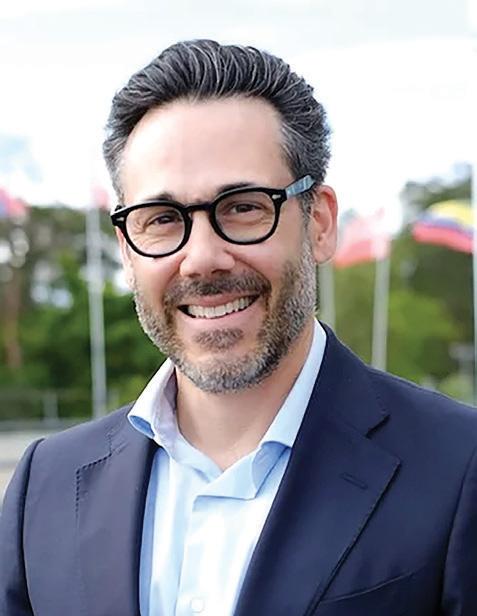
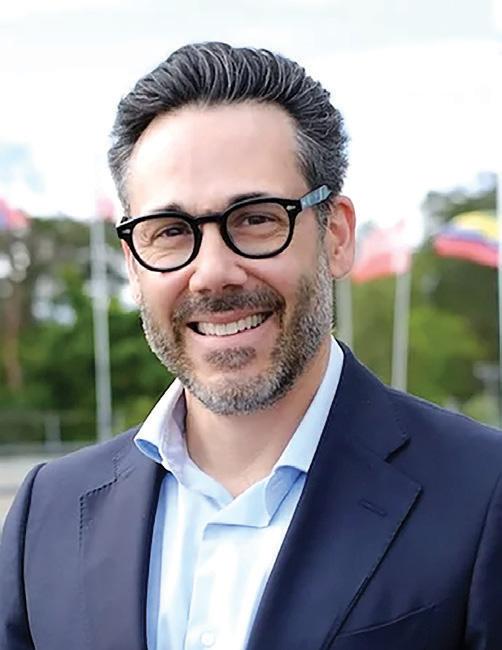
Here, Mark Stabile, dean of Degree Programmes at INSEAD, dean of the Europe Campus and professor of economics, explains the thinking behind the new format and what it signals about where executive learning is heading. Drawing on his vantage point as an economist, he explores why leading through this moment differs from past disruptions, which capabilities will carry leaders through what’s coming, what the evidence says about whether investment in development pays off, and why the widening “learning divide” between organisations that keep learning and those that stand still may define competitiveness, and inequality, in the decade ahead.
INSEAD has just welcomed the first GEMBA Flex cohort — 59 senior leaders, 37 nationalities, built around people who are still running organisations full-time. What was the thinking behind launching a format like this now, and what does the demand for it tell you about where executive learning is heading? The launch of the Global Executive MBA Flex (GEMBA Flex) was a natural evolution of our portfolio. Over the years, we have seen the profile of senior leaders continue to evolve. Today’s executives are navigating a highly fluid global landscape, frequently managing crossborder teams, travelling extensively, and balancing corporate responsibilities alongside personal commitments. The traditional model of in-person management and executive education remains incredibly valuable and continues to be the preferred delivery format. However, since the pandemic, demand for online and hybrid learning has grown globally because of the flexibility it offers. We saw an opportunity to combine the same academic rigour, faculty engagement and global network that define INSEAD with a format that better fits the realities of modern leadership. That was the catalyst for launching GEMBA Flex. The response was very encouraging. Our inaugural cohort brings together 59 senior leaders from 37 nationalities, with participants spanning industries, functions and regions. Notably, women make up 51 per cent of the cohort. This is particularly
significant because flexibility can help address some of the barriers that have traditionally limited participation in Executive MBA programmes, especially for women balancing leadership responsibilities alongside family and other life commitments. A more flexible format allows leaders to invest in their development without compromising on quality or impact.
Today’s leaders increasingly seek development that is continuous, flexible and immediately applicable to the challenges they face every day. They want to be able to move seamlessly between self-paced online learning, live virtual interaction and immersive in-person experiences.
The future of executive education is neither purely digital nor exclusively classroom-based – it lies in a blended model that combines the flexibility of online learning with the richness of faculty and peer interaction across our global campuses in Fontainebleau, Singapore, Abu Dhabi and innovation hub in San Francisco.
Leadership feels harder than it has in a long time, with AI, geopolitical tension and economic uncertainty all landing at once. From an economist’s vantage point, what’s genuinely different about leading through this moment compared with disruptions we’ve seen before? From an economic perspective, what’s different today is that several shifts are happening simultaneously, interacting with one another and compounding the effect of multiple disruptions. We are not just dealing with isolated technological or economic disruptions but managing a web of highly interconnected forces.
First, the rapid and widespread adoption of AI – which is not simply another technology cycle. It is reshaping productivity, business models and the nature of work itself. In the Gulf, where governments are proactively establishing frameworks for AI governance and digital infrastructure, this technological shift is unfolding at an accelerated pace. Second, we are seeing a reconfiguration of the global economic order characterised by geopolitical fragmentation, supply chain realignment and a heightened emphasis on economic security over pure cost-efficiency.
Third, the workforce itself is changing. Organisations are increasingly leading multi-generational teams with very different expectations around careers, learning and flexibility, while the rise of project-based and gig work is reshaping how talent is sourced, managed and retained. For many organisations, attracting and developing diverse leadership talent, including more women in senior roles, has also become a strategic priority. Together, these shifts are reshaping how firms compete, hire and create value.
For leaders, the challenge is not simply the existence of uncertainty, but the speed at which core business assumptions become outdated. Competitive advantages that previously sustained corporations for decades can
now erode in months. Knowledge has a significantly shorter shelf life. Modern leadership is less about having all the answers and more about building highly agile, resilient organisations capable of continuous adaptation.
When the ground keeps shifting like this, which capabilities matter most for senior leaders — and are the skills that got people to the top the same ones that will carry them through what’s coming?
Organisations are no longer hiring solely for technical expertise. Increasingly, they are looking for leaders who combine AI fluency with adaptability, emotional intelligence and the ability to collaborate across functions.
The skills that helped many leaders succeed in the past, deep expertise, operational excellence and execution, remain important. But they are no longer sufficient on their own. At INSEAD, we group what organisations increasingly value into three broad areas: Business Acumen, Leading & Communicating, and Staying Relevant. The last category is becoming particularly important as leaders navigate constant disruption. It encompasses capabilities such as AI and big data, resilience and agility, creativity, innovation, entrepreneurship and self-awareness. These complement, rather than replace, traditional leadership strengths. As technology reshapes the workplace, cognitive capabilities such as strategic thinking, sound judgement under uncertainty, problemsolving and effective decision-making become even more valuable. Equally important are learning agility, curiosity and the ability to work across disciplines.
Increasingly, leadership is about balancing two priorities simultaneously: delivering results today while preparing organisations for tomorrow. Leaders need to understand not only technologies, but also its implications for people, customers, operations and long-term business value.
The OECD estimates that 1.1 billion jobs will be transformed by technology over the next decade, underscoring the need for organisations and executives alike to continuously develop new capabilities.
“Upskilling” can sound like a buzzword, but a programme like GEMBA Flex is a real commitment of time and money. In practical terms, what does meaningful development look like at a senior level, and what does the evidence say about whether that investment pays off?
Meaningful development is about expanding how leaders think, make decisions and create impact in increasingly complex environments.
For experienced executives, the greatest value often comes from stepping outside their comfort zone. A programme such as GEMBA Flex provides exposure to different industries, markets and leadership perspectives, helping participants challenge assumptions and develop a broader strategic lens. It also offers the opportunity to build a trusted global network of peers that share a common ambition to grow as leaders, opening doors to new ideas, collaborations, business opportunities and lifelong professional relationships. Equally important is the opportunity for personal reflection to step back from
ORGANISATIONS ARE NO LONGER HIRING SOLELY FOR TECHNICAL EXPERTISE. INCREASINGLY, THEY ARE LOOKING FOR LEADERS WHO COMBINE AI FLUENCY WITH ADAPTABILITY, EMOTIONAL INTELLIGENCE AND THE ABILITY TO COLLABORATE ACROSS FUNCTIONS.”
day-to-day operational demands and critically examine how they lead. Through coaching, structured reflection and feedback from faculty and peers, participants are able to redefine their leadership style, identify their strengths and blind spots, and become more intentional about the impact they want to have.Executive education has consistently been shown to strengthen leadership effectiveness, strategic decision-making and career progression. Many participants report taking on larger responsibilities, leading transformation initiatives or moving into new roles after completing a programme. Beyond career advancement, many also describe increased confidence in leading through ambiguity and greater clarity about their long-term leadership aspirations. Ultimately, the question is not whether senior leaders can afford to invest in their development, but whether they can afford not to.
Many leaders are weighing this up at exactly the time budgets are tight and calendars are full. How would you think through that trade-off, and is there a cost to standing still while the world moves on?
Many leaders face this dilemma: time is scarce, budgets are under pressure, and there’s increasing demands of the day job. The question, however, is not simply whether you can afford the investment, but what the cost of inaction might be. Today’s business environment is evolving at an unprecedented pace. Leaders who rely solely on past experience may find that the assumptions that brought them success no longer apply.
Executives should view development not as time away from work, but as time invested in themselves in becoming more effective at work. Participants often bring live business challenges into the classroom and leave with practical insights, frameworks and networks they can apply immediately. Ultimately, standing still is rarely a neutral choice. The risk is not just falling behind competitors; it is missing opportunities to innovate, grow and lead more effectively. The leaders who thrive are often those who make the deliberate decision to create space for learning, even when their schedules are at their fullest.
The first GEMBA Flex cohort is 51 per cent women. Why do you think we’re seeing that change now, and what tends to finally unlock it after years of slow progress? While it is still early to draw definitive conclusions, it
strongly validates one of our principles behind the programme’s design, increasing flexibility can help broaden access to executive education for talented leaders who may previously have found it difficult to participate. Research consistently shows that many senior professionals, particularly women, are balancing demanding leadership responsibilities alongside family commitments and other major life milestones. These competing demands have traditionally been among the barriers to pursuing executive education. in increasingly complex environments. As more organisations invest in developing female leadership talent, we are also seeing more women actively seeking opportunities to broaden their strategic capabilities and global networks.
Gulf economies are diversifying fast while building leadership talent at pace. What kind of leaders do these markets need most right now? Right now, that combination creates a very specific leadership requirement – and not only technical acumen, but adaptability on a scale. Right now, the leaders most in demand are those who can operate across systems rather than within silos. That means leaders who are comfortable with uncertainty, capable of making decisions in fastevolving regulatory and geopolitical environments, and able to bridge public and private sector logics. In many Gulf economies, transformation is being driven through large national strategies, so leaders also need to be able to align commercial execution with broader state-led ambition.
Looking ahead, one of the more important dynamics is the widening “learning divide” between organisations that invest in development and those that do not. Organisations that prioritise learning build stronger decisionmaking, greater adaptability and more resilient leadership pipelines. Those that fail to invest will find themselves structurally locked into legacy operating models, even as the external environment shifts around them.
Ultimately, the question is whether they are building the capacity to stay competitive in five or 10 years’ time. L
BY NEESHA SALIAN

AS GCC COMPANIES EXPAND GLOBALLY, TREATING INSURANCE AS A COMPLIANCE CHECKBOX IS NO LONGER ENOUGH, THOSE STRUCTURED AROUND CENTRAL GOVERNANCE AND LOCAL EXECUTION MOVE FASTER INTO NEW MARKETS, AND RECOVER MORE EFFECTIVELY WHEN CRISES ARRIVE
companies are expanding into Europe, Asia and Africa at unprecedented speed. But each new market brings a regulatory minefield: different compliance requirements, legal frameworks, claims environments and tax regimes that a single policy cannot cover.
For boards and CEOs, the temptation is to treat insurance as a compliance checkbox. The smarter ones are treating it as a strategic enabler of growth.
Managing around 5,400 multinational programmes and 30,000 policies globally, HDI Global has a distinctive vantage point into how this shift is unfolding.
Willem van Wyk, senior executive officer and director, Middle East at HDI Global, has observed a clear pattern: companies that structure international insurance programmes with central governance and local execution move faster into new markets, avoid regulatory blindspots, and recover more effectively when claims arrive.
By contrast, those that fragment risk management across subsidiaries or over-rely on home-market solutions face coverage gaps, regulatory friction and delayed decision-making at board level.
As geopolitical uncertainty intensifies and regulation becomes more local, the question is no longer whether companies can afford to treat risk strategically. It is whether they can afford not to.
As GCC companies continue to expand into new markets across Europe, Asia, and Africa, how has the role of multinational insurance programmes evolved from a compliance requirement into a strategic business tool? International insurance programmes have clearly evolved beyond a pure compliance function.
Today, they are a critical strategic enabler of international growth, particularly at this time when many GCC companies are expanding into Europe, Asia and Africa. They allow businesses to expand their operations globally with confidence. International programmes allow them to enter new markets with a structured framework that combines local regulatory compliance with central oversight and governance.
From our perspective, the real value lies in enabling clarity and control across complex international operations. When designed well, programmes provide transparency over risks, consistent protection standards and the flexibility to adapt as businesses grow.
At HDI Global, we see international programmes as part of our approach to
act as brokers’ and clients’ partner in transformation: We help them put the right risk protocols in place so they can pursue global opportunities with greater certainty and long-term confidence.
Many regional businesses are pursuing ambitious international growth plans. What are the biggest risk management challenges they face when operating across multiple jurisdictions with different regulatory, legal, and claims environments?
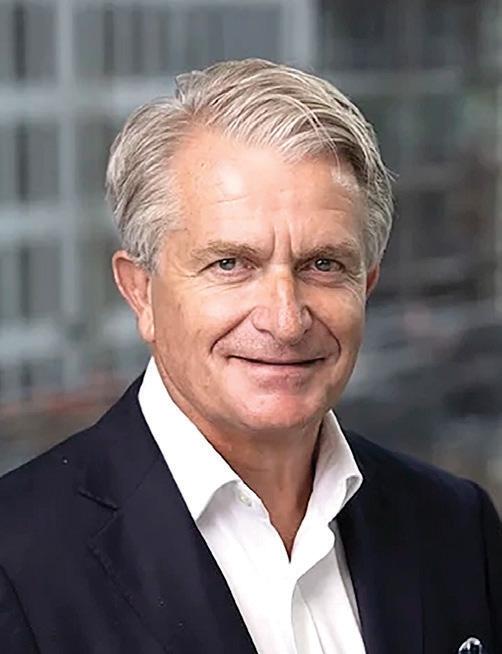
The biggest challenge is achieving and maintaining compliance across jurisdictions. A single policy issued from the GCC cannot simply cover global operations. Each country has its own regulatory requirements, which affect everything from policy structure and pricing to premium collection and claims handling. In practice, this requires locally admitted policies in the respective markets.
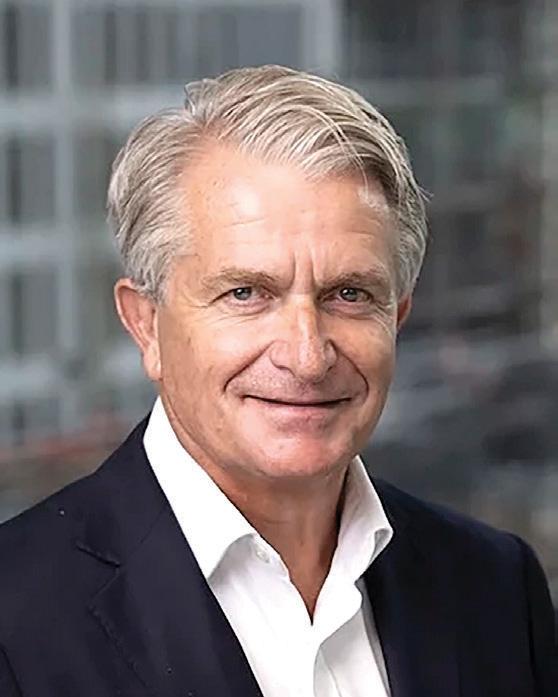
The second challenge is ensuring consistency across the programme. Well-structured international insurance programmes typically combine a master policy in the home country with local policies in the jurisdictions where subsidiaries operate. This approach satisfies local regulatory requirements while maintaining overall control and coherence at group level.
Programme design is equally critical. Limits and premiums must reflect the actual risk landscape and local market conditions. The master policy should support and not replace the local policies. With close coordination between clients, brokers, and insurers, risks such as coverage gaps, inadequate limits, or duplication can be effectively mitigated.
From a claims perspective, complexity increases further: Legal frameworks, market practices, and operational realities differ significantly across countries. Claims handling will therefore not always mirror homemarket processes. It is essential that claims are notified, assessed, reserved, and settled in full alignment with local regulatory requirements.
Finally, transparency is key. Without a consolidated view of exposures, policies, and claims activity, decisionmaking at both risk manager and board level becomes reactive rather than strategic.
The GCC is positioning itself as a global investment and business hub. How are multinational insurance programmes helping companies build resilience and confidence as they enter unfamiliar markets, acquire overseas assets, or undertake cross-border investments?
As GCC companies expand globally, international programmes are becoming a key enabler of resilience and strategic confidence. They provide a structured framework that combines robust local compliance with central oversight. They are helping businesses navigate
unfamiliar regulatory environments, protect overseas assets, and manage cross-border investments.
This balance is critical. On the one hand, companies must meet local requirements in each market; on the other, they need a consolidated view to steer risk at group level. Well-designed programmes create precisely this link between local execution and global governance. In the end, this enables more informed and confident decision-making. Companies gain transparency over their risk exposure, avoid blind spots, and can act with greater certainty when entering new markets or executing international transactions while remaining protected against regulatory complexity and market volatility.
From your experience managing multinational programmes across more than 200 territories, what common mistakes do companies make when trying to coordinate risk management, claims handling, and insurance coverage across several countries?
Across international programmes, several recurring pitfalls stand out. A common issue is the over-reliance on the master policy, often at the expense of the quality and structure of local policies. Under-allocating premium locally or overusing non-admitted solutions and DIC/DIL structures can quickly lead to regulatory and tax issues. Equally critical is poor communication across the value chain. Misalignment between the parent company, local subsidiaries, brokers, and insurers can result in local entities being unaware they are part of a global programme or placing standalone cover that conflicts with it.
Another frequent underestimation is the importance of network capability and local expertise. Delivering a compliant programme across multiple jurisdictions requires strong on-the-ground knowledge, regulatory understanding, and consistent service execution. While international programmes are inherently complex, close collaboration between insurers, clients, brokers, and network partners is essential to ensure timely delivery and overall programme stability.
Finally, many companies still underestimate claims readiness. While significant effort is often invested in programme design, less attention is paid to how claims will actually be handled across jurisdictions. Yet this is where the value of insurance is ultimately tested,
POLICIES GLOBALLY, HDI GLOBAL HAS A DISTINCTIVE VANTAGE POINT INTO HOW THIS SHIFT IS UNFOLDING
SEVERAL TRENDS ARE EXPECTED TO SHAPE THE INTERNATIONAL INSURANCE LANDSCAPE. WE EXPECT CONTINUED INTERNATIONAL EXPANSION FROM EMERGING AND MID-SIZED MULTINATIONALS.”
requiring clear processes, local expertise, and alignment with regulatory requirements from the outset.
Geopolitical uncertainty, supply chain disruptions, and evolving regulatory requirements have become defining business challenges in recent years. How are these factors reshaping the way multinational companies approach risk and insurance strategy?
These factors are reinforcing the need for a more dynamic and coordinated approach to risk management.
Geopolitical tensions are increasing the focus on country-specific risks, sanctions, and regulatory divergence, forcing companies to reassess how their programmes are structured and where critical dependencies lie.
At the same time, supply chain disruptions have exposed how closely operational, financial, and geopolitical risks are intertwined. This is accelerating demand for more integrated programme structures that provide both transparency and flexibility.
In parallel, regulation is becoming more local and more assertive, with greater scrutiny on premium allocation, tax compliance, and participation in domestic schemes such as catastrophe pools.
As a result, international insurance programmes are no longer viewed as static placements. They are evolving into living frameworks that must continuously adapt, supported by stronger governance, better data, and closer coordination between central and local stakeholders.
As businesses become increasingly global, how important is it for CEOs and boards to view risk management as a strategic function rather than simply an operational or compliance issue?
It is increasingly important for CEOs and boards to view risk management as a strategic enabler rather than a purely operational or compliance function. As companies expand internationally, risk becomes directly linked to market entry, capital allocation, and operational resilience. Decisions on where to invest, how to structure operations, or how to manage supply chains all carry complex risk implications that need to be understood and actively managed from the outset.
Organisations that take this strategic perspective are better positioned to use international insurance programmes to support business objectives. This includes faster entry into new markets, facilitating M&A activity, or ensuring continuity in times of disruption.
At the same time, well-structured programmes provide confidence to key stakeholders, including investors and partners, by demonstrating that risk is managed in a consistent and disciplined way. By contrast, treating risk management as a box-ticking exercise increases the likelihood of gaps, inefficiencies, and delayed responses when challenges arise and ultimately put both resilience and growth at risk.
What trends do you expect to define the multinational insurance landscape over the next five years, and how is HDI Global positioning itself to support the next generation of internationally expanding businesses from the Gulf? Several trends are expected to shape the international insurance landscape. We expect continued international expansion from emerging and midsized multinationals, including those headquartered in the Gulf, driving demand for scalable and flexible programme solutions. At the same time, regulation will become more local and more demanding, with increased focus on compliance, premium allocation, and in-country execution. This requires deep technical expertise and strong local capabilities. Digitalisation will further accelerate this shift. Clients are increasingly expecting real-time visibility, faster policy issuance, and integrated platforms to manage global programmes more efficiently and transparently. In parallel, there is a move towards more holistic risk solutions. International programmes, captives, risk consulting, and alternative risk transfer are increasingly being combined into more integrated frameworks.
We are positioning ourselves along these developments as a reliable partner in transformation for clients and brokers. To this, we combine global reach with strong local execution, supported by continued investment in network capabilities, digital tools, and operational excellence. Our focus is not only on programme design, but on delivering consistent, compliant outcomes across all territories, thus enabling clients to grow internationally with confidence. L
BY NEESHA SALIAN
THE GULF, GROWTH, TRANSFORMATION AND RESILIENCE ARE NO LONGER TRADE-OFFS. PEDRO OLIVEIRA, MANAGING PARTNER, IMEA, OLIVER WYMAN, EXPLAINS WHY CEOS MUST NOW MANAGE THEM SIMULTANEOUSLY
Economic diversification, rapid technology adoption and an increasingly volatile global landscape are redefining the role of the chief executive across the Gulf. Growth is no longer pursued independently of cost discipline, artificial intelligence or workforce transformation. Instead, CEOs are expected to deliver on all fronts simultaneously while making faster, higherstakes decisions.
According to Pedro Oliveira, managing partner, India, Middle East and Africa (IMEA) at Oliver Wyman, this shift marks a new leadership mandate, one where competitive advantage depends less on setting ambitious strategies and more on executing them with discipline.
Drawing on findings from The CEO Agenda 2026, a global survey of 415 chief executives representing around 10 per cent of global market capitalisation, Oliveira explains why Gulf leaders are rethinking investment, AI deployment, mergers and acquisitions, and talent strategies to build organisations capable of sustaining growth through uncertainty.
What has changed in the role of the CEO across the Gulf?
The role has become more compressed and more complex. CEOs can no longer deal with growth, resilience, artificial intelligence, workforce change and capital allocation one at a time. These issues are now moving together, and they require simultaneous attention.
For business leaders in the GCC, this is not an abstract global trend. The region is already operating through rapid economic transformation, large-scale investment, technology adoption and geopolitical volatility. CEOs are being asked to keep growing, keep transforming and maintain resilience at the same time.
That is also reflected in The CEO Agenda 2026, a new report by the Oliver Wyman Forum and the New York Stock Exchange, based on a survey of 415 chief executives representing around 10 per cent of global market capitalisation. Almost two-thirds of CEOs see today’s volatility as an opportunity to out manoeuvre competitors. The challenge is to convert that ambition into better decisions and stronger execution.
Why is this particularly relevant to GCC companies?
The Gulf encountered this shift earlier, and more

intensely, than many other markets. Across the region, national growth models have been built around speed, ambition and the willingness to move early. In the UAE, that is visible in its role as a global hub economy, using infrastructure, regulation and openness to position itself at the centre of capital, talent and trade flows. In Saudi Arabia, it can be seen in the scale of domestic economic transformation and the creation of new sectors. Qatar has also shifted from World Cup-driven infrastructure investment towards a broader growth model spanning energy, financial services and the knowledge economy.
These ambitions remain a strength. What has changed is the delivery challenge. CEOs must now make several critical decisions in parallel, often with incomplete information and under closer scrutiny from boards, shareholders and employees.
The report suggests that growth now has to pay for itself. What does that mean?
It means growth remains the priority, but the funding model has become more disciplined. Two-thirds of CEOs rank a growth lever as their main objective, while 58 per cent cite cost management among their top three priorities.
That does not mean companies are becoming defensive. It means cost discipline is being used to fund investment in technology, transformation and acquisitions. Efficiency is not the end goal. It is a source of capital for growth. For GCC companies, this is a useful distinction. The region’s growth ambitions remain high, but capital has to be deployed with greater precision. The question is whether companies

FOR BUSINESS LEADERS IN THE GCC, THIS IS NOT AN ABSTRACT GLOBAL TREND. THE REGION IS ALREADY OPERATING THROUGH RAPID ECONOMIC TRANSFORMATION, LARGE-SCALE INVESTMENT, TECHNOLOGY ADOPTION AND GEOPOLITICAL VOLATILITY.”
can direct investment into the areas that improve competitiveness, resilience and long-term value.
Why is M&A so prominent on the CEO agenda?
An overwhelming number of CEOs, 94 per cent, plan deals over the next one to two years. The more important point is what companies are trying to achieve through M&A.
This is not only about scale. It is increasingly about speed, expertise and capability. In some cases, companies are using acquisitions and partnerships to access specialist capabilities that would take too long to build organically.
That resonates strongly in the Gulf. Businesses in sectors such as financial services, healthcare, industrials and energy are using deals and strategic partnerships to accelerate capabilitybuilding. The strongest deals will be those that support a clear strategic need and help the organisation execute faster, rather than simply becoming another layer to manage.
How are shorter planning horizons changing the CEO role?
CEOs globally now spend half their planning time on horizons of less than a year, up from 43 per cent in 2025. At the same time, boards are becoming more involved in strategy, risk and leadership decisions. The report also notes that 11 per cent of CEOs were replaced in 2025.
That creates pressure to deliver quickly. In periods of volatility, leaders naturally focus on continuity, liquidity,
THE PRIORITY IS TO MAKE FASTER AND BETTER DECISIONS ACROSS MULTIPLE FRONTS WITHOUT SACRIFICING LONG-TERM STRENGTH FOR SHORT-TERM SPEED. THAT MEANS PURSUING GROWTH, BUT ENSURING IT IS SELFFUNDED AND LINKED TO EXECUTION.”
resilience and near-term performance. The risk is that short-term reaction starts to crowd out longterm clarity. For Gulf companies, this is especially important. Many are aligned with long-term economic transformation agendas, so they cannot afford to make decisions only around the next quarter or the next disruption. The strongest organisations will respond quickly while still making disciplined choices about where they can win over time.
What does the report tell us about AI adoption?
AI is the clearest example of the gap between ambition and execution. The report shows that about two-thirds of CEOs are still primarily planning or piloting AI deployment, and 53 per cent say it is too early to assess return on investment.
The lesson is not that AI is overhyped. It is that implementation is harder than expected. Moving from experimentation to commercial value requires changes to workflows, operating models, roles, data and governance.
At the same time, the divide is widening. AI deployment leaders are around three times more likely than laggards to say returns are meeting or exceeding expectations. Advantage is shifting to companies that can move beyond pilots and embed AI into how the business actually works.
What should CEOs in the GCC take from that AI finding?
Markets across the GCC have rightly placed AI and digital capability at the centre of their long-term ambitions. But early ambition is not the same as commercial value.
The practical question for CEOs is where AI should drive growth, where it should improve efficiency, where it can improve customer experience, and where the risks remain too high. That requires disciplined prioritisation. Companies do not need isolated pilots across every
function. They need a clearer view of where AI can improve performance, and then they need to redesign work around it.
The most advanced organisations are treating governance, workflow redesign and adoption as part of AI deployment, not as secondary issues. That is where the value will come from.
How should companies think about the workforce implications?
The workforce implications are more immediate than much of the public debate suggests. The report shows that 43 per cent of CEOs plan to reduce junior roles, while 45 per cent expect to keep overall headcount broadly flat.
This is not simply a cost story. It reflects a structural redesign of how work gets done. As AI changes the operating model, companies are reassessing which roles they need, how work should be organised and what skills will matter most.
For high-growth GCC markets, there is an important caution. Reducing junior roles may improve short-term efficiency, but it can also weaken the pipeline of future managers and leaders. The next phase of competitiveness will depend on adopting new technologies without undermining long-term capability-building.
What should CEOs prioritise now?
The priority is to make faster and better decisions across multiple fronts without sacrificing long-term strength for short-term speed. That means pursuing growth, but ensuring it is self-funded and linked to execution. It means investing in AI, but focusing on deployment and measurable value. It means using M&A to build capability, not just scale. And it means reshaping the workforce without weakening the leadership pipeline.
Perhaps the main lesson is not simply that the world has become more uncertain. Leaders in this region already understand that. The real lesson is that advantage now lies in managing complexity with discipline: moving quickly, making sharper choices and building organisations that can grow through volatility without becoming more fragile. L
BY NEESHA SALIAN
THE CORPORATE VP AND GENERAL MANAGER FOR EMERGING MARKETS EXPLAINS WHY ORGANISATIONS WINNING IN CYBERSECURITY ARE NO LONGER TRYING TO PREVENT BREACHES, THEY ARE BUILDING TO RECOVER FROM THEM
The window between a cybersecurity vulnerability becoming public and an attacker exploiting it has collapsed from 23 days in 2025 to barely a day in 2026. No human watching dashboards can keep pace with that velocity.
At SHIFT Dubai, Fady Richmany, corporate VP and general manager for emerging markets at Commvault, explains why AI-powered threat detection is no longer optional, and why the real advantage now sits with organisations that have stopped trying to prevent breaches and started building to recover from them at speed.
How can AI help identify cybersecurity threats faster? Please provide a percentage and how many threats has it been able to identify in this year so far?
The honest answer is that speed has become the whole game. The window an attacker needs to move from a vulnerability becoming public to actively exploiting it has fallen from around 23 days in 2025 to barely a day in 2026, according to PwC, and a human watching dashboards simply cannot keep pace with that anymore.
What AI does well is sit across enormous volumes of data and identity activity and recognise the patterns that signal something is wrong. This would include aspects like an unusual access request, or a privilege that quietly changes, or data that starts moving when it should be sitting still. AI surfaces those signals in near real time rather than days later, and that is the difference between containing an incident and explaining one afterwards.
The industry numbers support this. IBM’s 2025 Cost of a Data Breach report found that the global average breach cost fell by 9 per cent year on year, the first decline in five years, and the reason was faster detection and containment driven by AI-enhanced tools.
Organisations using AI and automation extensively reduced the average breach lifecycle by 80 days and saved nearly $1.9m in breach costs. The catch is that only about a third of organisations are using it that way today, so the advantage still sits with a minority who have embraced it.
At Commvault, we put AI to work in exactly this place, watching for anomalies across data and identity, drawing on third-party threat intelligence so we are never relying on a single view, and pointing customers to a clean recovery point the moment something looks wrong.

What best practices should organisations adopt when implementing AI-related cybersecurity solutions?
Start with the data, because every AI system is only as trustworthy as the data feeding it. If that data is poisoned or quietly tampered with, the integrity of everything downstream is compromised, so you need to know what you hold, classify it, and govern who and what is allowed to touch it before it ever reaches a model or an agent. That governance piece is exactly why we recently brought Satori into the portfolio.
The second thing is identity, and I would place it close to the top. Active directory (AD) is one of the hottest threat vectors for bad actors to exploit. Nine out of ten attacks target AD because it controls access to data, systems, and applications – without it, business operations can grind to a halt. Agentic AI is multiplying the problem, because every autonomous agent you deploy is effectively a new identity, a non-human one that lives on data and becomes its own door into the environment.
Protecting identity on its own is no longer enough. It has to be wired together with your data security and your recovery so that the three areas work as one discipline rather than three teams who only meet during a crisis.
The third is to accept that you will be breached one day and to build for that eventuality well in advance. Strong walls are necessary and you should still build them, but I always say that resilience begins where security ends. So, the real question becomes, how cleanly and how quickly you can recover when something gets through? That means testing recovery

continuously rather than once a year, keeping a known clean copy you can actually trust, and rehearsing with the security and infrastructure teams in the same room.
We wrap all of that into what we call resilience operations, or ResOps, which treats resilience as a living operating model built on people, process and technology rather than a tool you switch on and forget.
What are some common challenges and mistakes made by organisations in deploying AI cybersecurity solutions?
The most common and most damaging mistake is leaving the work in silos. In a large enterprise, you typically find one team running the collaboration platforms, another running infrastructure, another handling backup and recovery, another in security operations, and another in analytics.
On an ordinary day, that division of labour looks perfectly sensible. The moment a cyber incident lands, it becomes chaos, because five or six departments who have rarely worked with each other suddenly have to coordinate while forensics are still working out what happened and how far it spread. We call that the ‘IT collision’, and if those teams have never run the drill together, it is the hardest position an organisation can find itself in.
The second mistake is pouring the entire budget into prevention. I have seen organisations spend a lot building the highest possible wall around the castle, and they still get breached, because someone always finds a way in. That money would go a great deal further if some of it were redirected toward the dark day when the breach actually arrives, so that the answer to “what now” is a resilient operation that can restore identity, data and operations at speed.
The third is deploying AI on top of data that nobody is governing. IBM found that 97 per cent of the organisations that suffered an AI-related breach lacked proper access controls around those systems, and that most had no governance policy in place at all.
People rush to switch on the capability and worry about who can reach the underlying data afterwards, which is precisely the wrong order to do it in. Instead, organisations need to establish governance before deployment, with clear controls around data access, identities, and accountability. AI is only as trustworthy as the data and safeguards behind it.
What are some emerging AI cybersecurity trends?
The trend underneath all the others is the explosion of machine identity. We have spent years learning how to secure human users, and now every AI agent we deploy arrives as a new non-human identity that runs on data and has to be governed and protected like any other. G42 Group CEO Peng Xiao has talked about building and deploying a billion agents, and when you sit with a number like that you realise the attack surface is expanding faster than most security models were ever designed to handle. Alongside that, attackers now have frontier AI in their hands, which is why the time from a vulnerability becoming public to it being exploited has collapsed from weeks to roughly a single day. The defensive response is AI against AI, using intelligence to spot the anomaly and point to the clean recovery point faster.
We are also seeing data governance move to the front of the conversation, because both the value and the risk sit in the data feeding these models, and organisations are starting to govern how that data is used before it reaches an agent rather than after the fact.
Looking a little further out, resilience itself is becoming more predictive and more automated, with systems that can forecast where a recovery might fail and increasingly detect, validate and recover with far less human intervention.
OF
In the Middle East region, there is a particularly strong thread around sovereignty, where each country sets its own rules on where data lives and how it can be accessed, and the technology has to adapt to each of those rather than assume one model fits everyone. L
BY NEESHA SALIAN
Global workforce models were not built for the GCC’s reality. They ignore family structures, community expectations, and a generation stepping into entirely new economic roles for the first time. Yet the Gulf is transforming faster than most economies on earth: female labour force participation reached 39.3 per cent across the GCC in 2025, and in Saudi Arabia women rose to 44 per cent of middle and senior management, surpassing the global average of 33.5 per cent.
Nationalisation targets such as Saudi Arabia’s Nitaqat Mutawar Programme aim to create 340,000 new private sector roles for nationals, but quotas alone cannot carry the weight of genuine transformation. What matters is what happens after the hire: whether employment is supported by wellbeing, stability and belonging.
Muhammad Abdul Rahman, VP of empowerment at Maximus Gulf, has overseen a shift in how the region thinks about workforce development. Rather than importing solutions, the GCC is building systems designed for its own demographics, employer needs and cultural dynamics. The early results, two million individuals trained and placed, 271 Saudi nationals promoted into senior leadership, suggest that homegrown models are not just culturally necessary; they are commercially smarter. In this chat, Rahman discusses why workforce transformation in the Gulf requires more than policy targets, and how locally designed systems are reshaping employment, inclusion and long-term economic resilience.
Many workforce models in the GCC were designed for other labour markets. How do these global systems differ from the realities of the Gulf, and what challenges do governments and employers face in building competitive workforces while ensuring international best practices?
Global workforce models often fall short here because they were not built for the GCC’s socio-economic reality. Our labour markets are shaped by family structures, community expectations, and a generation stepping into entirely new economic roles.
The pace of transformation here is consistently remarkable. Female labour force participation reached 39.3 per cent across the GCC in 2025, and in Saudi Arabia women rose to 44 per cent of middle and senior
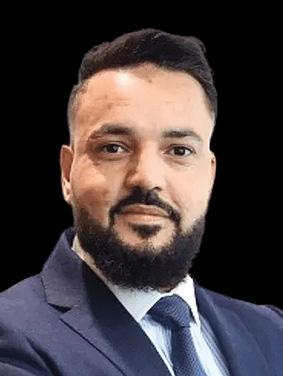
management, surpassing the global average of 33.5 per cent. This shift highlights the GCC’s far-reaching structural transformation and the kingdom’s role as a compelling example of values-aligned reform.
Maximus’ Employability Center of Excellence plays a central role in bringing international standards into the Saudi context through our partnership with the Institute of Employability Professionals (IEP). The depth of that expertise is reflected in our empowerment team, the majority of whom are certified IEP Fellows: combining global professional standards with an intimate understanding of the Gulf market.
Nationalisation targets are central to regional policy, but success depends on more than headline quotas. What do these targets require in practice, and how can governments ensure they lead to sustainable employment pathways?
Nationalisation targets create value when they translate into tangible progress for people. The kingdom’s Nitaqat Mutawar Program, a central pillar of Vision 2030, exemplifies this position through its goal of creating 340,000 new private -sector roles for nationals.
In the UAE, expanded Emiratisation targets now apply to over 12,000 companies, sitting within the country’s wider Nafis; a palpable priority rather than a compliance exercise. However, targets alone cannot carry the weight of transformation. This is why a truly holistic approach is essential: one that addresses the whole person, not just the job seeker. When employment is supported by wellbeing, stability, and belonging,

it becomes transformative for individuals and the communities they sustain.
What does a genuine people‑first approach to workforce and public service reform look like, and how can cultural dynamics and employer needs be embedded into these systems?
A genuine people-first approach begins with recognising that no two individuals enter the workforce from the same place. Whether it’s a young graduate, a returning mother, or someone living with a disability, individuals bring different lived experiences and cultural realities into the workforce.
Concurrently, people - first does not mean employer-second. Sustainable workforce reform requires individuals to be skilled, confident, and aligned to sectors where opportunity exists. The kingdom has systematically removed practical barriers that once limited women and underserved communities, building social infrastructure many mature economies still struggle to replicate. Digital tools like AI-enabled job matching, CV support, labour market insights, and digital case management further enhance journeys and remove barriers to progress.
We’ve seen the multiplier effect firsthand: one person in steady employment stabilises a household, strengthens a community, and creates ripples across generations.
How do you work with governments, employers, and non‑profits to design workforce solutions that reflect local demographics, employer expectations, and cultural dynamics, and what outcomes are emerging?
We work with governments, employers, and more than 3,000 NPOs to design workforce solutions that mirror local
demographics, employer expectations, and cultural dynamics. Crucially, many individuals face layered and complex challenges beyond employment itself, so this partnership model allows us to deliver culturally grounded support.
Working alongside them, our case managers cultivate trust and identify the channels that lead to effective, sustainable pathways into work. By coordinating daily and reviewing beneficiary needs, the team helps individuals move into roles that match their capabilities and long-term career goals. The results speak for themselves: more than two million individuals, including women, people with disabilities, and those facing employment barriers, have completed training and moved closer to meaningful work. This is what happens when the right partnerships, expertise, and human investment come together with unfeigned purpose.
The region is increasingly calling for models built here, not imported. What could a truly GCC‑built workforce model look like in the next few years?
One of the region’s biggest advantages is that governments here can design programmes with a future-focused view rather than the short political cycles seen elsewhere. In many countries, programmes are redesigned before they have time to mature, but effective workforce systems need space to evolve and take root in communities.
IN SAUDI
WOMEN ROSE TO 44 PER CENT OF MIDDLE AND SENIOR MANAGEMENT, SURPASSING THE GLOBAL AVERAGE OF
Freed from these cycles, GCC governments can center individuals and focus on substantive social outcomes while benchmarking global best practices to the Gulf context. At Maximus Gulf, this is the philosophy that guides everything we do. We do not design programmes; we build systems. With 98 per cent of our workforce comprising Saudi nationals, our impact starts at home. To date, we have supported 271 Saudi nationals into senior leadership promotions, demonstrating that homegrown talent, given the right investment and opportunity, rises to every level.
The goal is for something lasting and genuinely useful to communities to remain long after any contract ends. L
BY NEESHA SALIAN

THE VICE CHAIR OF IMPACT BY MIRAL DISCUSSED BRINGING TOGETHER ORGANISATIONS, DONORS AND EXPERTS TO SUPPORT CONSERVATION , COMMUNITY DEVELOPMENT AND LONG-TERM SUSTAINABILITY IN ABU DHABI
As sustainability moves beyond corporate commitments to measurable action, businesses are increasingly seeking ways to create lasting social and environmental value through collaboration. At Miral, that ambition has taken shape through IMPACT by Miral, a platform developed in partnership with the Authority of Social Contribution, Ma’an, to support initiatives spanning conservation, education, health and wellbeing, arts and culture, and skills development.
Here, Taghrid Alsaeed, executive director of Marketing, Communications & Events at Miral and vice chair of IMPACT by Miral, explains why conservation was chosen as the platform’s first focus, how partnerships across the public, private and academic sectors are driving its initiatives, and what success will look like as the platform works to contribute to Abu Dhabi’s
long-term social, environmental and economic development.
Many organisations are investing in social and environmental initiatives today. Why was it important for Miral to establish IMPACT by Miral? We believe our responsibility extends beyond creating world-class destinations and experiences. The longterm success of our industry depends on thriving communities, protected natural environments, and a strong pipeline of future talent. That is why we established IMPACT by Miral.
Developed in partnership with the Authority of Social Contribution – Ma’an, the platform provides a structured and transparent way for organisations and individuals to support initiatives that are closely aligned with our sector and portfolio. From marine conservation and wildlife protection to education, skills
development, health and wellbeing, and arts and culture, these are areas that contribute directly to building a more sustainable ecosystem for tourism, entertainment, and community development in Abu Dhabi.
Through IMPACT by Miral, we are bringing together partners, experts, and donors to invest in initiatives that create measurable outcomes today for future generations.
Conservation is the first area of focus for IMPACT by Miral. Why did you choose to start there, and what impact do you hope these projects will have?
Protecting the UAE’s natural environment is both a responsibility and an opportunity to create a lasting legacy. Through the Yas SeaWorld Research & Rescue Center, we have seen the value of advancing research, rescue, rehabilitation and education to improve knowledge and strengthen stewardship of the region’s wildlife and habitats. Building on this foundation, conservation was a natural starting point for IMPACT by Miral, enabling us to support programmes that address key environmental priorities and contribute to a more sustainable future.
The four priorities approved for 2026 reflect a focused approach to preserving the UAE’s marine and terrestrial ecosystems. While marine initiatives are built on the expertise of the Yas SeaWorld Research & Rescue Center, the terrestrial efforts will be led by Al Ain Zoo, drawing on its internationally recognised leadership in wildlife preservation. Together, they address critical needs facing the region, from tracking sea turtle populations across the Arabian Gulf and advancing AI-enabled sustainable aquaculture to protecting the Arabian Sand Cat in Abu Dhabi’s deserts and safeguarding the critically endangered Dama Gazelle.
By leveraging applied research, conservation genomics, AI and data-driven monitoring, these projects aim to enhance biodiversity, support food security and enable structured species conservation and reintroduction planning, helping safeguard the UAE’s natural heritage for future generations.
One of the platform’s defining features is the range of organisations and experts involved. How important is collaboration to achieving meaningful impact? Collaboration is fundamental to everything IMPACT

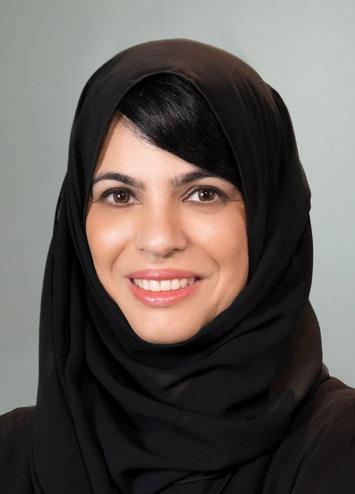
by Miral aims to achieve. Environmental and social challenges cannot be addressed by any one organisation alone, which is why the platform unites expertise from across the public, private and academic sectors.
Through our Steering Committee and Advisory Working Group, we work alongside leading environmental, conservation and research institutions to ensure initiatives are aligned with Abu Dhabi’s priorities and supported by the expertise needed to deliver meaningful outcomes.
What would success for IMPACT by Miral look like over the next few years? For us, success means creating a lasting and measurable impact across Abu Dhabi by supporting initiatives that strengthen our communities, protect our natural environment, and help develop future generations.
The approval of our first four conservation programmes marks an important milestone. In the coming years, we want to see tangible outcomes from these initiatives, whether through protecting wildlife, advancing conservation research, raising environmental awareness, or creating opportunities for community engagement. Success will also be reflected in how IMPACT by Miral brings together organisations, donors and experts around a shared purpose to strengthen the impact of these initiatives and help deliver meaningful outcomes over the long term.
Ultimately, our ambition is for IMPACT by Miral to become a trusted platform that supports conservation, education and skills development, health and wellbeing, and arts and culture, helping to build a more sustainable ecosystem, nurture future talent, and contribute to Abu Dhabi’s long-term social and economic development. L
FOR US, SUCCESS MEANS CREATING A LASTING AND MEASURABLE IMPACT ACROSS ABU DHABI BY SUPPORTING INITIATIVES THAT STRENGTHEN OUR COMMUNITIES.”
WE LAUNCHED ‘DUBAI-IT’ TO CONVEY DUBAI’S PHILOSOPHY OF WORK TO FUTURE GENERATIONS, AND TO INSTILL IT AS A WORK CULTURE IN OUR INSTITUTIONS AND COMPANIES AND TO BUILD THE NEXT LEAPS WITH IT.”
HH SHEIKH MOHAMMED BIN RASHID AL












NEW: Best Gaming & Esports Agency
NEW: Best Influencer Marketing Agency
NEW: Best Sports Marketing Agency
Best Creative Agency








Best Events, Experiential and Engagement Agency


Best Digital Agency


NEW: Best Agency Producer
NEW: Best Media Planning Leader
NEW: Independent Agency Head of the Year

Best Account Person
Best Arabic Copywriter








Best Creative Leader
Best CSR Initiative
Best New Business Development Leader
Best Strategic Planning Leader Best Place to Work in 2026

Best Talent Management Individual
NEW: Best Independent Digital Agency



NEW: Best Agency – UAE: Independents
NEW: Best Agency – UAE: Holding Company / Networks




Best Independent Creative Agency


Best Production House
Best Social Media Agency
Best Startup / New Agency

Holding Company of the Year Best Integrated Marketing Agency Best Media Agency Best Performance Marketing Agency Best PR / Communications Agency








Best Corporate Communications & Marketing Team
Head of Agency with streams for Creative, Digital, PR, Media & Integrated Marketing Network Head of the Year
Outstanding Woman In Advertising or Media

Best Independent Media Agency RETURNING FOR 2026: Independent Agency of the Year





NEW: Best Agency – Saudi Arabia: Independents
NEW: Best Agency – Saudi Arabia: Holding Companies / Networks









NEW: Best Agency – Wider Middle East (Qatar, Oman, Bahrain, Kuwait, Jordan, Lebanon and Iraq)




Best Agency – Egypt