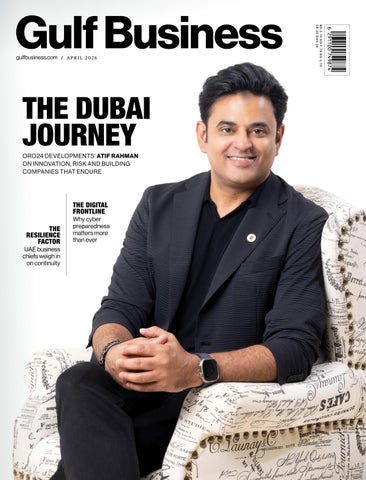
Gulf Business-April 2026

Page 1


THE DUBAI JOURNEY

ORO24 DEVELOPMENTS’ ATIF RAHMAN ON INNOVATION, RISK AND BUILDING COMPANIES THAT ENDURE

THE DIGITAL FRONTLINE Why cyber preparedness matters more than ever THE RESILIENCE FACTOR

UAE business chiefs weigh in on continuity

Gulf Business

CONTENTS / APRIL 2026

11

The brief

An insight into the news and trends shaping the region with perceptive commentary and analysis

Atif

Rahman

on vision, reinvention and building for the future

The founder of ORO24 Developments reflects on 22 years in the UAE and the projects that defined his path

32

Steering through turbulence

UAE business leaders on navigating today’s complex geopolitical challenges

Editor-in-chief Obaid Humaid Al Tayer

Managing partner and group editor Ian Fairservice

Chief commercial officer Anthony Milne Anthony@motivate.ae

Group content director Thomas Woodgate Thomas.Woodgate@motivate.ae

Publishing director Manish Chopra Manish.Chopra@motivate.ae

Group editor Gareth van Zyl Gareth.Vanzyl@motivate.ae

Editor Neesha Salian Neesha.Salian@motivate.ae

Deputy editor Rajiv Pillai Rajiv.Pillai@motivate.ae

Reporter Nida Sohail Nida.Sohail@motivate.ae

Senior art director Freddie N Colinares Freddie@motivate.ae

General manager – production S Sunil Kumar

Production manager Binu Purandaran

Assistant production manager Venita Pinto

Digital sales director Mario Saaiby Mario.Saaiby@motivate.ae

Sales manager Hitesh Kumar Hitesh.Kumar@motivate.ae

HEAD OFFICE: Media One Tower, Dubai Media City, PO Box 2331, Dubai, UAE, Tel: +971 4 427 3000, Fax: +971 4 428 2260, motivate@motivate.ae DUBAI MEDIA CITY: SD 2-94, 2nd Floor, Building 2, Dubai, UAE, Tel: +971 4 390 3550, Fax: +971 4 390 4845 ABU DHABI: PO Box 43072, UAE, Tel: +971 2 657 3490, Fax: +971 2 677 0124, motivate-adh@motivate.ae SAUDI ARABIA: Regus Offices No. 455 - 456, 4th Floor, Hamad Tower, King Fahad Road, Al Olaya, Riyadh, KSA, Tel: +966 11 834 3595 / +966 11 834 3596, motivate@motivate.ae LONDON: Acre House, 11/15 William Road, London NW1 3ER, UK, motivateuk@motivate.ae

Photo: John Melencion
Cover: Freddie N Colinares

Lifestyle

Art Basel Qatar debuts How the fair has boosted Qatar’s status as a serious player in the global contemporary art scene p.52

The Rose de Mai story

For nearly 50 years, Henry Jacques has transformed rare roses into elegant, luxurious fragrances p.56

Best buds

A pick of cool wireless earbuds, from premium performers to budgetfriendly offerings p.60

“Over the past weeks, in conversations with UAE visitors and residents, and with leaders, investors, and partners from around the world — one message has been consistent. The world now knows exactly what the UAE exemplifies: wisdom, integrity, dignity, resilience and compassion.”

Dr Sultan Ahmed Al Jaber, UAE Minister of Industry and Advanced Technology, ADNOC MD and Group CEO, and executive chairman, XRG

BECOME A MEMBER

Email: info@britishchamberdubai.com

Website: britishchamberdubai.com

LinkedIn: /british-chamber-dubai

Instagram: @bccdubai

X: @BCCDonline

Founding Sponsors

The British Chamber of Commerce Dubai is a membership organisation that supports companies and individuals from the UK with existing business interests in the region and those new to the UAE.

Our membership consists of British-owned, Dubai and RAK-based companies, UK registered organisations, UK passport holders and brands that support British business.

Through a considered and strategic calendar of events, the BCCD ensures high-quality networking opportunities, market knowledge sharing, valuable engagement opportunities and exclusive experiences for our members.

The BCCD provides an ecosystem that goes beyond Dubai, to the wider GCC and through the British Chambers of Commerce’s Global Business Network reaching and providing international exposure and opportunities for our members and stakeholders.

For more information, please contact the BCCD Business Team: info@britishchamberdubai.com

Annual Partners

Gareth van Zyl, Group Editor

MIDDLE EAST ALERT: IRAN CRISIS PROMPTS DIPLOMATIC, ECONOMIC RESPONSES ACROSS GCC

QATAR AND BAHRAIN ENERGY SECTOR HIT

QatarEnergy declared force majeure on March 4 on LNG supplies after halting production due to the regional security crisis. The company reassured stakeholders that updates would be provided as developments unfold, reflecting the growing impact of geopolitical tensions on global energy markets.

Bapco Energies BSC (Closed), Bahrain’s integrated energy company, declared force majeure on certain group operations on March 9 following the ongoing regional conflict and a recent attack on its refinery complex.

Gulf Cooperation Council (GCC) nations are taking unprecedented diplomatic and economic measures following the Iranian conflict targeting the region, as tensions escalate across the Middle East.

The GCC, alongside Jordan, issued a joint statement on March 26 condemning Iran’s attacks on regional states, infrastructure, and commercial shipping, reinforcing compliance with UN Security Council Resolution 2817 (2026). The statement highlighted violations by Iranian proxies in Iraq and called for an immediate cessation of hostilities, emphasising freedom of navigation in the Strait of Hormuz. From embassy closures to airspace protests, member states are reinforcing sovereignty while safeguarding key economic and strategic interests.

SAUDI ARABIA

DIPLOMATIC EXPULSIONS AND VISA ADJUSTMENTS

Saudi Arabia declared Iran’s military attaché and embassy staff personae non gratae, mandating their departure within 24 hours on March 22. The Foreign Ministry condemned Iran’s strikes as “a violation of international conventions and principles of good neighbourliness.

In a humanitarian measure, the Ministry of Interior began processing visas that expired since February 25, 2026, enabling visitors and Umrah pilgrims to extend or depart without penalties until April 18, easing strain on travellers affected by regional tensions.

Pics: Getty Images

DIPLOMATIC RETRENCHMENT AND CIVILIAN SAFETY MEASURES

The UAE closed its embassy in Tehran on March 1 and recalled its ambassador along with the entire diplomatic mission in response to Iranian missile attacks that struck civilian infrastructure, including airports, ports, and residential areas. The Ministry of Foreign Affairs described the strikes as “a flagrant violation of national sovereignty and international law.”

In tandem, the UAE Ministry of Foreign Affairs (MoFA) and National Emergency Crisis and Disaster Management Authority (NCEMA) continue implementing evacuation and repatriation plans, facilitating the safe return of approximately 500 Golden Visa holders and residents stranded abroad due to regional airspace closures. Meanwhile, the country celebrated a positive development in the World Happiness Report 2026, securing first place in the Arab world and 21st globally. The report highlighted strong citizen freedoms, high GDP per capita, and robust social support systems.

Dubai also rolled out two landmark laws under Sheikh Mohammed bin Rashid Al Maktoum, Vice President and Prime Minister of the UAE and Ruler of Dubai: a new government services law enabling private-sector delivery of public services, and a shared housing law introducing fines up to Dhs1m for non-compliance, aiming to regulate occupancy and subleasing practices.

The laws were introduced on March 12 and March 11, respectively.

US-ISRAEL-IRAN CRISIS TIMELINE

February 28

Israel announces it has launched a “pre-emptive” attack on Iran, coordinated with the US, aimed at destroying Iran’s nuclear and missile capabilities

Iran’s leader Ayatollah Ali Khamenei, was killed in the initial US-Israeli strikes on his Tehran compound. The UAE and GCC nations intercept drones and missiles launched by Iran in retaliation

March 3

Israeli and US strikes across Iran, including naval and air facilities; Iran fires missiles and drones back at Israel and Gulf states. Targets in Lebanon get hit

March 7–8 (Succession)

Iran has named Mojtaba Khamenei, Ali Khamenei’s son, as the new supreme leader, after his father was killed in the initial strikes on the country

AVIATION SECTOR DISRUPTED, DIPLOMATIC PROTESTS FILED

Kuwait’s Directorate General of Civil Aviation submitted a formal protest to the International Civil Aviation Organization (ICAO) over Iranian airspace violations affecting Kuwait International Airport on March 22.

Authorities cited “significant risks to passengers, airlines, and airport personnel,” reporting suspended flights, injuries, and economic losses to the civil aviation sector.

The protest urges ICAO to safeguard civilian airspace and prevent recurrence, emphasising Kuwait’s “full legal rights to protect its sovereignty and infrastructure.”

A rapid escalation between the US, Israel and Iran has triggered a widening regional crisis with global stakes. From a deadly opening strike to threats over oil and maritime routes, here’s how events unfolded

March 15–16

US President Donald Trump considers forming a “Hormuz coalition” and the possible occupation of the Kharg Island in order to disrupt Iranian oil exports

March 24

Trump says talks with Iran show progress and Washington has proposed a peace plan tied to oil and gas, while Pakistan offers to host possible negotiations to end the conflict

March 28

Houthi forces in Yemen launch ballistic missiles at Israel, formally entering the conflict and widening the regional scope as as US forces reached the Middle East

March 30

Trump said he wants to “take the oil” in Iran, suggesting possible US plans to seize Iranian oil and expand the conflict’s aims

KUWAIT

The Brief Building

The Gulf’s invisible front line

As drone incursions, missile incidents and geopolitical brinkmanship reshape one of the world’s most critical shipping regions, maritime security has moved from the margins of strategic planning to the centre of global economic risk

In recent months rising geopolitical tensions and security incidents across the Red Sea and the wider Gulf region have highlighted the vulnerability of these critical shipping corridors. For governments, shipping operators and global businesses alike, maritime security is no longer simply a strategic issue for defence planners. It has become a central factor shaping trade continuity, supply chain reliability and economic stability.

WHY THE GULF’S MARITIME CORRIDORS MATTER

Few regions hold the same strategic maritime significance as the Arabian Gulf. The Strait of Hormuz

alone facilitates roughly one fifth of global oil and gas trade, making it one of the most important energy chokepoints in the world. Meanwhile, the Red Sea and the Bab Al Mandeb Strait serve as key gateways connecting Europe and Asia through the Suez Canal, enabling the steady flow of goods between major manufacturing hubs and global consumer markets. The Arabian Sea forms a broader operational theatre where commercial shipping routes intersect with naval deployments and energy transportation networks. Together, these waterways represent essential arteries of global commerce where stability is fundamental to maintaining the uninterrupted movement of goods and energy.

A CHANGING MARITIME THREAT ENVIRONMENT

The maritime threat landscape across the region has evolved significantly in recent years. Traditional risks such as piracy and vessel boarding have been joined by a wider range of asymmetric threats, including drone incursions, missile incidents, sabotage attempts and the seizure of vessels. Non-state actors have

demonstrated their ability to disrupt shipping routes with relatively limited resources, while geopolitical tensions continue to shape the broader security environment. These developments have transformed maritime security from a largely operational concern into a complex strategic challenge requiring constant vigilance and adaptive risk management.

SECURITY RISKS AND THEIR IMPACT ON GLOBAL TRADE

When security risks intensify along major shipping routes, the consequences extend far beyond the maritime sector. Increased threat levels can drive up insurance premiums, disrupt established shipping routes and place additional pressure on already strained global supply chains. Recent incidents in the Red Sea have demonstrated how quickly shipping operators may reroute vessels around longer routes such as the Cape of Good Hope, adding significant time and cost to global trade flows. For Gulf economies that position themselves as major logistics and energy hubs, maintaining secure maritime corridors is therefore closely tied to sustaining economic competitiveness and investor confidence.

STRENGTHENING MARITIME SECURITY IN THE REGION

Governments and international partners have responded to these challenges by strengthening maritime security frameworks across the region. Multinational naval task forces continue to patrol key waterways, monitoring shipping activity and deterring potential incidents involving commercial vessels. At the same time, regional governments have expanded their maritime surveillance capabilities, investing in technologies that enhance situational awareness across busy shipping lanes. Improved coordination and intelligence sharing between governments and maritime stakeholders have also become increasingly important in identifying potential risks and responding more effectively to emerging threats.

OPERATIONAL PREPAREDNESS ACROSS THE MARITIME INDUSTRY

Alongside government-led initiatives, the commercial shipping industry has had to adapt to a more complex and unpredictable operating environment. Shipping companies, logistics providers and energy producers are increasingly integrating risk management into their operational planning. This includes enhanced crew training, improved vessel security protocols and more dynamic route planning informed by evolving threat assessments.

Greater coordination between industry stakeholders has also become essential. Shipping

MULTINATIONAL NAVAL TASK FORCES CONTINUE TO PATROL KEY WATERWAYS, MONITORING SHIPPING ACTIVITY AND DETERRING POTENTIAL INCIDENTS INVOLVING COMMERCIAL VESSELS

Christopher Long is head of intelligence and compliance at Neptune P2P Group

WHEN SECURITY RISKS INTENSIFY ALONG MAJOR SHIPPING ROUTES, THE CONSEQUENCES EXTEND FAR BEYOND THE MARITIME SECTOR.

operators now rely more heavily on shared situational awareness and structured communication channels that allow potential risks to be identified and managed before they escalate into operational disruptions. As maritime threats continue to evolve, strengthening these practical risk mitigation measures will remain a critical component of maintaining safe and reliable shipping routes.

BUILDING LONG-TERM MARITIME RESILIENCE

Looking ahead, the challenge will not only be to respond to individual security incidents but to build a more resilient maritime ecosystem capable of managing future risks. This will require closer cooperation between governments, naval forces and industry stakeholders, alongside continued investment in technologies that support maritime monitoring, vessel tracking and early warning capabilities. Diversifying supply routes and strengthening contingency planning will also play an important role in ensuring that localised disruptions do not escalate into broader global trade crises.

PROTECTING THE LIFELINES OF GLOBAL COMMERCE

The waterways that pass through the Gulf and surrounding regions are far more than transit corridors. They are strategic lifelines that sustain the movement of energy, goods and capital across continents. Protecting them is therefore not simply a reactive measure triggered by crisis, but a continuous strategic priority that underpins global economic stability. As maritime threats evolve in both scale and complexity, safeguarding these routes will require sustained cooperation between governments, industry leaders and maritime stakeholders to ensure that the global flow of trade remains secure.

Navigating the energy shock

Energy markets are shifting from a short-term spike toward a more prolonged and volatile phase, underscoring the need for resilient and flexible positioning amid rising geopolitical uncertainty

Energy markets are entering a more complex phase, where recent price action and crossasset signals are increasingly reflecting levels previously associated with an “enduring and chaotic” scenario, underscoring how rapidly market sentiment and positioning can adjust to an evolving geopolitical backdrop. The recent crisis has moved further up the escalation ladder, raising the risk that disruptions extend beyond logistics and transit routes into actual production shut-ins or infrastructure damage. While our base case continues to assume only temporary disturbances, particularly around key chokepoints such as the Strait of Hormuz, the probability distribution of outcomes has widened meaningfully. The risk is no longer just about higher prices, but about duration and second-round effects. From a macro perspective, the immediate impact still resembles a stagflationary impulse rather than a demand shock. Europe remains the most exposed region, facing higher energy costs and weaker growth momentum. Asia appears relatively more resilient: India continues to be sensitive to import prices and inflation, while China and Japan are more likely to absorb the shock through margin compression rather than a structural shift in their growth trajectories. However, if disruptions become more persistent, risks to economic growth could re-emerge more forcefully.

Portfolio positioning is best framed across three scenarios, though the market is currently gravitating towards pricing elements of the more adverse case. In our base case — still assigned a probability above 60 per cent — the current shock remains intense but ultimately temporary, with stabilisation expected into the second quarter.

CORE RISK EXPOSURE

Maintaining core risk exposure remains appropriate, complemented by selective hedges such as energy, gold, and defensive sectors. In an enduring and more chaotic scenario, which markets are increasingly testing, disruptions extend beyond the near term and oil prices move sustainably higher. In this environment, portfolios should tilt more clearly towards defence: reducing cyclicality, increasing exposure to energy as a hedge, and emphasising quality across asset classes. The key risk in this scenario is not only the level of energy prices, but also the potential for policy responses — such as trade restrictions or market interventions — to amplify and prolong the shock. Only in a full oil crisis scenario, which remains a low-probability tail risk, would a more decisive reduction in overall portfolio risk be warranted. This would involve higher cash allocations and a stronger focus on assets that can act as shock absorbers in a disorderly environment.

GRADUAL PRICE NORMALISATION

Beyond the near term, the broader rebalancing narrative for energy markets remains intact, albeit delayed. As geopolitical tensions eventually ease and additional supply returns - including potentially from Iran — oil prices should gradually normalise towards lower levels. However, the path towards this equilibrium has become more uncertain and potentially more volatile. In this environment, the key is not to overreact to short-term moves, but also not to underestimate the speed at which regimes can shift. A flexible and agile investment approach remains essential, as markets navigate a phase where the fog of geopolitics continues to obscure the fundamental outlook.

01

Swift and intense scenario (>60 per cent) Oil: $80–$90 | Gas: $40–$50 | EUR/$1.15 | US Treasuries: 4.10 per cent | Bund: 2.80 per cent | Gold: 5,300 | S&P: 6,800 | Stoxx: 600 I Hang Seng: 25,000

02

Enduring and chaotic scenario (<30 per cent) Oil: $90–$100 | Gas $60–$70 | EUR/$ 1.12 | US Treasuries: 4.30 per cent | Bund: 3.30 per cent | Gold: 5,750 | S&P: 6500 | Stoxx: 570 I Hang Seng: 22,000

03

Oil crisis scenario (<5 per cent) Indicative market extremes: EUR/$1.10 | US Treasuries: 4.30 per cent | Bund: 3.30 per cent | Gold: 6000 | S&P: 6000 | Stoxx: 500 I Hang Seng: 17,000

INDICATIVE MARKET EXTREMES BY SCENARIO PROBABILITY

Marc

L Busch is the Karl F. Landegger professor of International Business Diplomacy at the Edmund A. Walsh School of Foreign Service at Georgetown University. He is an expert on international trade policy and law

The changing face of global trade

As trade becomes more political, Gulf businesses must plan for a different global economy

Global trade is not slowing. But it is changing in ways that businesses in the Gulf cannot afford to ignore. For decades, supply chains were built around efficiency. Production followed cost. Inventory was minimised. Trade routes were assumed to stay open. Political risk existed, but it was background noise, not a binding constraint.

That world is fading.

Trade today is shaped as much by geopolitics as by economics. Governments are intervening more directly, screening investment, tightening export controls, and deploying industrial policy in sectors like energy, semiconductors and critical minerals. The result is not deglobalisation, but a shift toward selective integration: trade continues, but increasingly within networks that are politically trusted and strategically aligned.

For firms, that shift is already visible. Cost still matters, but it no longer dominates. Resilience, diversification and regulatory alignment now sit alongside price in boardroom decisions. Companies are spreading risk across suppliers, rerouting logistics and building compliance capacity across multiple jurisdictions. Nowhere is

this more consequential than in the Gulf. The region sits at the intersection of global trade, energy markets and great-power competition. As rivalry between the US and China reshapes investment and technology flows, the Gulf is both a beneficiary and a balancing point. Capital, logistics and digital infrastructure are being redirected toward locations that offer stability. But access to advanced sectors increasingly comes with conditions, on security, governance and technology standards. These are no longer exceptions. They are becoming the baseline for economic cooperation.

At the same time, fragmentation raises the value of connectivity.

When firms need flexibility, they gravitate toward hubs that combine efficient ports, predictable regulation and deep financial systems. Geography matters again. Positioned between Asia, Europe and Africa, the Gulf has a structural advantage, one reinforced by sustained investment in infrastructure and trade facilitation.

That investment is paying off. The UAE has built integrated logistics networks, free zones and digital trade systems designed to keep goods and data moving even as global rules become more complex. Saudi Arabia’s

Vision 2030 places industrial capacity, connectivity and supply-chain resilience at the center of economic strategy.

Trade policy is evolving in parallel. The UAE’s Comprehensive Economic Partnership Agreements are not just about tariffs. They reduce regulatory friction, expand market access and anchor firms in broader commercial networks. In a more fragmented system, that kind of access is not marginal — it is strategic.

For business leaders, the implication is straightforward. The global trading system is not breaking down. It is becoming more political, more conditional and more complex. Exposure, across markets, suppliers and technologies, must be managed deliberately. Flexibility is no longer optional. It is a competitive advantage.

Looking ahead, these trends will deepen. Great-power rivalry, technological competition and the push for secure energy and resource supply will continue to shape trade and investment. The system will remain active, but less neutral.

For the Gulf, that is not a disadvantage. It is an opportunity.

The region’s capital, infrastructure and geographic position make it a natural platform for connecting an increasingly fragmented global economy. Gulf economies are not simply adapting to these changes. They are helping define the next phase of globalisation. For firms operating in the region, the task is not to sidestep geopolitics. It is to incorporate it, recognising that in the years ahead, strategy will matter as much as efficiency.

Why the future of UAE logistics runs on rail

Each freight train on the UAE network can carry the equivalent of up to 300 heavy trucks, moving on fixed schedules, on dedicated corridors, unaffected by peak-hour congestion or road incidents

For decades, the story of logistics in the UAE has been written on roads. Trucks have carried the weight of our industrial growth — from ports to factories, from warehouses to construction sites. That system has served the nation well. But as we enter a more competitive, more complex phase of economic growth, the question is no longer whether road freight works. It is whether it works well enough for what comes next.

Across global supply chains, the winners are those who move goods most predictably, most efficiently, and most intelligently. Reliability has become the new currency of logistics. And that is where rail comes into its own.

Building a national freight railway from scratch in the UAE was never a small undertaking. It required laying nearly 900 kilometres of track across desert, mountains and urban corridors. It required regulatory frameworks, safety systems, signalling integration, and industrial alignment — all created in parallel with operations.

In other words, it was not an incremental upgrade on an existing system or systems. It was the construction of an entirely new logistics backbone.

The result is a bespoke system designed not as an alternative to road freight, but as a deliberate strategic upgrade — built for scale, certainty and long-term industrial competitiveness.

Business leaders across heavy industry understand one truth better than most: unpredictability is expensive. Delays ripple through production schedules. Congestion disrupts just-in-time delivery. Driver shortages and fuel volatility add friction to models never designed for today’s volumes. Rail addresses those pressures at their root.

FREIGHT NETWORK SUPPORTS MANUFACTURERS

Each freight train on the UAE network can carry the equivalent of up to 300 heavy trucks, moving on fixed schedules, on dedicated corridors, unaffected by peak-hour congestion or road incidents. That consistency allows manufacturers to plan production with confidence, ports to reduce dwell times, and logistics operators to offer customers something increasingly rare: certainty.

Since its inception, Etihad Rail has moved more than 80 million tonnes of bulk cargo, including over 16 million tonnes in the last year alone — supporting sectors such as aggregates, construction materials, petrochemicals, cement, steel and containerised trade.

These are not marginal industries. They are the backbone of the UAE’s industrial economy. Rail’s economic impact extends far beyond transport.

Global evidence consistently shows that freight rail networks stimulate productivity growth by lowering input costs, reducing supply chain friction, and increasing export competitiveness.

Studies from Oxford Economics, for example, indicate that rail investment delivers strong multiplier effects — supporting jobs across construction, manufacturing, logistics and downstream industries, often generating several dirhams in wider economic output for every dirham invested.

In the UAE context, the opportunities are particularly significant across construction and building materials, petrochemicals and energy, metals and heavy manufacturing, ports and re-export trade, and cross-border logistics into the wider GCC. And that cross-border dimension

AS THE UAE STRENGTHENS CONNECTIVITY AND INTEGRATES FURTHER INTO GCC SUPPLY CHAINS, RAIL BECOMES NOT JUST A DOMESTIC ASSET, AS IT IS TODAY, BUT ALSO A REGIONAL STRATEGIC CORRIDOR. IT SHORTENS INLAND TRANSIT TIMES,

STRENGTHENS TRADE RESILIENCE, AND POSITIONS THE UAE AS A LOGISTICS PLATFORM FOR WIDER REGIONAL GROWTH.

matters. As the UAE strengthens connectivity and integrates further into GCC supply chains, rail becomes not just a domestic asset, as it is today, but also a regional strategic corridor. It shortens inland transit times, strengthens trade resilience, and positions the UAE as a logistics platform for wider regional growth.

The upcoming launch of passenger rail complements this freight backbone in important ways.

PASSENGER SERVICES ARE KEY TO INTEREMIRATE CONNECTIVITY

Passenger services reinforce network utilisation, deepen public familiarity with rail infrastructure, and strengthen inter-emirate connectivity — creating a truly national rail culture. Together, freight and passenger services form a unified transport ecosystem that connects industry, communities and markets. Scale is where rail’s structural advantage becomes clear. As industrial output grows, adding more trucks increases congestion, road maintenance pressure and operational risk. Rail scales differently. Adding one additional train dramatically increases capacity without increasing traffic complexity.

For heavy industry, scalability is the difference between sustainable growth and structural bottlenecks. The economics follow. Rail reduces

EACH FREIGHT TRAIN ON THE UAE NETWORK CAN CARRY THE EQUIVALENT OF UP TO 300 HEAVY TRUCKS

per-tonne transport costs over medium and long distances, particularly for high-volume and bulk cargo. It stabilises operating expenses and lowers exposure to volatility. Over time, these efficiencies compound — strengthening the competitiveness of individual firms and the resilience of the broader industrial ecosystem.

It’s important to say that rail is not here to replace road freight. It is here to liberate it. Because when long-haul and bulk movements shift to rail, trucks are freed to focus on flexible, last-mile delivery. Each mode operates where it performs best. The system becomes balanced rather than strained. And this is how leading industrial economies operate. Rail forms the backbone; road provides agility at the edges.

THE NEXT CHAPTER OF THE UAE’S INDUSTRIAL STORY

My message is that the UAE has now built that backbone, so the next chapter is utilisation at scale. Those who integrate rail into their logistics strategy today gain reliability, resilience and regional reach. They align themselves with infrastructure designed to support industrial growth for decades, not quarters.The railway is operational. It is proven. And it is ready to carry the next phase of the UAE’s industrial story.

Engagement versus attention: The metric that actually matters

In a digital world, the real measure of a product’s staying power boils down to genuine engagement

In today’s digital economy, attention is often mistaken for success. Apps celebrate impressions, views and time-on-screen as proof of value. But attention and engagement are not the same thing, and confusing the two has led to an entire generation of products that capture users briefly but fail to keep them meaningfully involved in the long run.

Attention is passive. It is the moment a user looks at something, a video auto playing, a notification tapped, an ad briefly watched before being skipped. It is fleeting, often involuntary, and easily bought. Engagement, on the other hand, is active. It is users choosing to participate, to return, to invest time, energy, and emotion into an experience. This distinction is critical: engagement always leads to attention, but attention does not always lead to engagement. A highly engaging product naturally commands attention. Users return to it, talk about it, and spend increasing amounts of time within it. Attention becomes a byproduct of value. However, attention alone, driven by ads, clickbait, or algorithmic interruptions, rarely converts into sustained usage. It is rented, not owned.

This misunderstanding is particularly evident in modern apps and games that rely heavily on advertising models without offering real utility. These platforms optimise for short bursts of attention, maximising impressions rather than meaningful interaction. The result is a cycle of diminishing returns, where users are constantly acquired but rarely retained. Engagement, by contrast, is built, not bought. Psychologists Mihaly Csikszentmihalyi’s concept of ‘Flow’, the state of complete absorption in a challenging but achievable task and SelfDetermination Theory, developed by

Deci and Ryan, both support this: people engage deeply when they feel competent, autonomous, and connected to others. It is rooted in psychological systems that give users a reason to come back. The most effective products structure engagement around a few key principles: clear goals, real-time feedback, visible progress, escalating challenges, cliffhangers, and social interaction.

These elements create a loop. A user sets a goal, receives feedback, sees progress, and is motivated to continue. Escalation ensures that the experience evolves, preventing stagnation. Cliffhangers introduce anticipation, pulling users back in. Social interaction adds another layer, transforming individual activity into shared experience. Over time, this loop becomes habit. Habits, once formed, are notoriously difficult to break. As behavioural researcher BJ Fogg outlines in his ‘Tiny Habits’ model, repeated behaviour tied to a trigger and a reward becomes automatic over time and Nir Eyal’s Hooked framework builds on this, showing how variable rewards are particularly effective at embedding products into daily routines. This is where true product power lies, not in capturing attention once, but in embedding itself into a user’s routine. From a consumer psychology perspective, this explains why premium users on platforms like Exscape report spending more than three hours per session actively engaged, a pattern consistent with findings from the Nielsen Total Audience Report, which shows that highly gamified or reward-driven apps generate significantly longer session times than passive content platforms. Their behavior is not driven by passive consumption, but by active participation. They return because there is always something new to achieve, explore, or compete in.

The competitive layer deepens this engagement. Users are not just playing in isolation, they are part of a dynamic ecosystem. They can see leaderboards, follow top performers, connect socially, and build relationships within the platform. Competition is no longer limited to a single moment, it operates across weekly and monthly cycles.

Crucially, winning carries both intrinsic and extrinsic rewards. Beyond social validation and bragging rights, users earn points that can be redeemed for real-world or digital rewards. This creates a tangible value exchange, reinforcing continued participation and increasing perceived utility. Compare this to traditional social media platforms. Research on platform stickiness consistently points to what behavioural economists call switching costs and sunk cost bias, the psychological friction of leaving behind years of accumulated memories, relationships, and personal history. A 2023 Pew Research study found that a significant share of Facebook users who report reduced satisfaction with the platform still have no intention of leaving, precisely because of this emotional lock-in.

The lesson is clear. Attention may bring users in, but only engagement keeps them there. As the digital landscape becomes more competitive, the winners will not be those who capture the most attention, but those who convert it into meaningful, repeatable engagement. Products that offer utility, progression, and social depth will outperform those that rely solely on interruption and visibility.

In the end, attention is the entry point. Engagement is the outcome. And only one of them builds lasting value.

Dr M Muneer is a startup investor and co-founder of the non-profit Medici Institute for Innovation

Dubai’s endurance capitalism: How to win every crisis without ever slowing down

Ports, finance, pixels and persistence, the emirate’s habit of outrunning shocks may once again turn disruption into design

Dubai has never treated a crisis as a oneoff drama. Disruption shows up often enough that the city treats it almost like a recurring season.

Long before the skyline took shape, Dubai was already learning resilience. The collapse of the pearl industry in the early 20th century could have been a defining blow. Instead, it became a lesson in diversification. Trade widened, merchants were encouraged to stay, and the idea settled in

early that relying on a single source is a structural risk. Oil, when it finally arrived, was welcomed but never overvalued. Dubai understood that hydrocarbons can jump-start growth, but they don’t guarantee long-term stability.

HOW DUBAI TURNED INSTABILITY INTO A DEVELOPMENT MODEL

Regional turmoil added more tests. The Gulf conflict unsettled the neighbourhood, yet Dubai

DUBAI HAS LONG UNDERSTOOD THAT PERCEPTION SHAPES ECONOMIC BEHAVIOUR. IN TENSE PERIODS, PROJECTING CALM IS PART OF POLICY. OVER TIME, THE CITY HAS BUILT A REPUTATION FOR RESPONDING TO SHOCKS WITH QUICK ADAPTATION AND, OFTEN, A NEW SECTOR

IN THE MAKING.

positioned itself as the place where business could continue while politics played out. The pattern repeated during the global financial crisis. The property market shook, debt concerns made global news, and restructuring dominated the headlines. Still, the city responded with recalibration rather than retreat. Governance strengthened, institutions matured, and ambition stayed steady.

Dubai’s crisis playbook becomes clearer when you look at the institutions it built along the way. Jebel Ali Port was a deliberate bet that turned geography into advantage. The Dubai International Financial Centre (DIFC) created a legal and financial system designed to reassure global capital. Dubai Internet City recognised early that if physical trade shaped the past, digital flows would define the future. More followed, from Dubai International Academic City to the UAE Artificial Intelligence Strategy 2031.

Running through all of this is a philosophy of endurance. Sheikh Mohammed bin Rashid Al Maktoum, Vice President and Prime Minister of the UAE and Ruler of Dubai, in his prime, was a committed endurance rider, competing in longdistance desert races that demand stamina and discipline. It is not hard to see a parallel with the way Dubai governs, always moving, pacing itself, and staying ahead of rivals who mistake short bursts for staying power.

WHY THE CURRENT REGIONAL CRISIS MAY REINFORCE DUBAI’S POSITION

That brings us to the present Iran-linked crisis. Houthi strikes in the Red Sea have rerouted container ships around Africa, stretching supply chains and driving up shipping costs. Oil traders have grown cautious as tensions raise the risk

of disruption in the Strait of Hormuz, which handles roughly a fifth of global crude flows. For many economies, the moment calls for caution. For Dubai, it is more likely another adjustment in rhythm. Logistics will probably move first. When traditional routes face pressure, Dubai’s relevance often increases. Investments in ports, free zones and alternative corridors tend to speed up, especially when upgrades were already on the agenda.

Finance usually follows. In uncertain periods, capital looks for stable jurisdictions. The DIFC has spent years building that reputation with clear rules and efficient processes, so heavier activity wouldn’t be surprising. Technology also steps forward in moments like this. When moving goods becomes harder, moving data becomes even more central. Education fits into that logic too. A city that trains talent at home is less exposed to global disruptions. Dubai International Academic City is part of that long-term hedge.

Narrative is the final piece. Dubai has long understood that perception shapes economic behaviour. In tense periods, projecting calm is part of policy. Over time, the city has built a reputation for responding to shocks with quick adaptation and, often, a new sector in the making. This doesn’t make Dubai invincible. The region’s risks are real, and interconnected markets mean no city is fully sheltered. But Dubai’s advantage has always been iteration. Where others see disruption, Dubai tends to see redesign.

It’s likely that the current tensions will leave behind both challenges and openings, from shifting trade routes to new financial and technology demand. Rather than opportunism, it reflects simple readiness. Dubai’s story has been about absorbing crises into its operating model. Each shock becomes data. Each recovery becomes preparation for the next. Like an endurance race across unpredictable terrain, the goal is not to eliminate obstacles but to navigate them better than anyone else. Over the decades, Dubai has shown this consistently: it doesn’t just stay in the race. It rewrites the track while running it.

Abhay Bhargava is MD and regional leader –Middle East and Africa, Frost & Sullivan

Resilience by design: Why the Gulf’s longterm trajectory remains intact

Amid global concern over regional volatility, the real picture of how the Middle East adapts looks more grounded than the headlines suggest

Iam often asked by clients, peers, and professional contacts from outside the region how the current crises is likely to reshape the Middle East. My answer tends to surprise them.

First, let’s contextualise for perspective. The GCC as an economic bloc represents a $2.3tn GDP, and is host to over $600bn in foreign direct investment flows only in the past decade and remains the world’s most critical energy hub. Its scale and strategic importance are not easily disrupted by a single event of such magnitude, including the developments we are witnessing today.

There is no question that recent developments have created disruptions for both governments and industry. However, these externalities are unlikely to translate into fundamental or long-term structural

change - especially when considering how the region has already spent years (effort and investment) preparing for volatility.

These are governments that have been deliberate in developing national Visions — anchored in diversification, resilience, societal development, and long-term competitiveness — with clearly defined execution models. These frameworks were designed to absorb shocks and not be derailed by them. Hence, what we can expect to see hereon is not a change in direction, but a reaffirmation of strategic intent. That said, certain priorities will emerge.

Investment in localised value chains, stronger buffers against supply-chain disruption, and focus towards greater domestic resilience will accelerate, particularly in foundational sectors such

as healthcare, food, and basic materials. At the same time, deeper intra-regional trade and collaboration will play a growing role, considering that scale and resilience cannot be achieved in isolation.

Regionally based industries are also likely to evolve faster through geographic diversification, vertical integration, innovation, and increased adoption of digital and advanced technologies. This will naturally expand opportunities across the services ecosystem, from finance and insurance to logistics and professional services, with corresponding growth in skilled employment. Importantly, none of these shifts is being created by the current crisis. They were already embedded in national strategies across the Gulf. At most, what we are witnessing is an acceleration of trajectories that were firmly in motion, underscoring the region’s long-term confidence and relevance, rather than calling it into question.

For those who understand the region, this is not a moment of doubt. It is a moment of distinction.

LEADING IN THE GULF

What this moment asks of leaders

A moment of uncertainty in the Gulf region is putting leadership instincts to the test, revealing the kind of grounded judgement this region demands from those at the helm

Leading an organisation in the Gulf region right now requires a particular kind of clarity, not drawn from a crisis playbook but from something more fundamental: judgement built from proximity, relationships and a deep understanding of the region.

LEADING THROUGH COMPLEXITY

The UAE’s foundational institutions remain stable. Offices are open and business continues across many

sectors. Organisations are adapting, and their leaders are doing so while managing a complexity that is not always fully grasped from a distance.

For those leading within international institutions, there is an additional dimension. Global headquarters are seeking clarity and reassurance, and the task of conveying the full texture of the situation across time zones rests with the leader on the ground. One recent conversation illustrates this well. I spoke with the regional head of an international bank, a

senior leader managing a substantial operation while fielding calls from headquarters around the clock. She told me she was exhausted, not because of the situation itself, but because of the gap between what she was experiencing and what was visible from afar.

At the same time, every client conversation required its own careful judgement — the context of the relationship, the cultural moment, and the particular demands of the day all had to be weighed. Her description of her organisation’s posture has stayed with me. “We are trying to conduct business as normally as possible. But we are doing so with restraint.” That is not a retreat, it is deliberate leadership.

WHAT THIS MOMENT DEMANDS OF LEADERS

The first is presence. In uncertain times employees do not need leaders who have all the answers, they need leaders who are visibly there. It is a quality that has been demonstrated from the top — the region’s leaders have remained visible and present among their communities throughout this period, setting an example that resonates across organisations of every kind.

The executives navigating this environment most effectively are doing the same, physically present with their teams, accessible and engaged, asking the question that costs nothing and means everything: how are you?

Experienced leaders in this region have navigated uncertainty before, but the demands of this moment are immediate and close, and in these conditions physical presence becomes a form of stability that no written update or virtual announcement can replace.

The second requirement is communication, and its absence is one of the most common failures. When employees begin to feel their organisation is out of touch with what they are experiencing, trust erodes quickly and does not return easily.

Leaders do not need certainty to communicate, they need to acknowledge the reality their people are living, be clear about what the organisation stands for and be honest about what they do not yet know. Silence, however well intentioned, leaves employees feeling their organisation is either uninformed or disengaged.

The third requirement is restraint, and this is the quality most easily underestimated. Operating with restraint is not the same as withdrawing, it is a form of respect for the moment, for clients and for the communities in which these organisations operate. One executive described it to me as treating every business opportunity like gold dust, valuable but handled thoughtfully. That discipline is not fear, it is judgement.  It is something that can only come from leaders who understand their environment deeply enough to act on that understanding with confidence.

These three qualities only work in combination. Without presence, restraint looks like withdrawal. Without communication, presence looks like performance. But when all three work together they create something more substantial than crisis management — they create leadership.

WHY THE REGION’S LEADERSHIP CULTURE MATTERS

The qualities this moment demands are not new to leaders who have established their careers here. The UAE was founded on long-term conviction, on the willingness to maintain a forward view when conditions were difficult, to invest when others paused and to treat volatility as a condition to navigate rather than a reason to stop. That instinct is cultural and institutional, and it runs through the organisations that have shaped this region and through the leaders who have led them.

What I observe in the most effective leaders today is that instinct reasserting itself. Not loudly, not with bravado, but with the quiet confidence of people who understand that how you lead through a difficult period defines what your organisation becomes when it is over.

EVERY CLIENT CONVERSATION REQUIRED ITS OWN CAREFUL JUDGEMENT — THE CONTEXT OF THE RELATIONSHIP, THE CULTURAL MOMENT, AND THE PARTICULAR DEMANDS OF THE DAY ALL HAD TO BE WEIGHED.

The region, as one executive said to me simply last week, is still open for business. That is not optimism, it is an accurate description of a place whose leaders understand the difference between a moment that demands care and a moment that demands retreat. The executives demonstrating that understanding, staying present, communicating honestly and exercising restraint without withdrawing, are not waiting for conditions to improve before they lead — they are leading now.

Nicolas Manset is head of the Middle East, Russell Reynolds Associates

TIGHT-KNIT NETWORKS HELP WOMEN ENTREPRENEURS

RESEARCHERS SHARE HOW THE STRUCTURE OF PROFESSIONAL NETWORKS AFFECTS WOMEN FOUNDERS’ CONFIDENCE AND RESILIENCE

cross the Middle East, women are playing an increasingly visible role in entrepreneurship, from fintech startups in the UAE to family businesses and SMEs in Saudi Arabia. As their presence grows, so too does interest in understanding the social dynamics that shape women’s entrepreneurial journeys. To explore this,  Gulf Business  spoke with researchers Aneeta Rattan, professor of Organisational Behaviour at London Business School; Raina A Brands, professor at UCL School of Management; and Ezgi Ozgumus, assistant professor of Management at NYU Stern Abu Dhabi. Their insights are drawn from their 2025 research titled When Form Leads to Function: Network Closure and Social Identity Threat Among Women Entrepreneurs. The study examines how the structure of professional networks affects women founders’ confidence, resilience and ability to navigate entrepreneurial ecosystems. Their findings suggest that tightly connected networks can help women entrepreneurs overcome stereotype-based pressures and focus more fully on growing their ventures.

A GROWING FORCE IN THE REGION

The Middle East has witnessed a rapid rise in female entrepreneurship over the past decade, supported by government initiatives, funding programmes and growing recognition of women’s role in economic diversification. “The Middle East has experienced a significant, rapid rise in the number of female entrepreneurs,” says professor Aneeta Rattan. Women now own more than 45 per cent of small and medium-sized businesses in Saudi Arabia. In the UAE, a report by the Emirates Businesswomen Council shows that businesswomen make up 18 per cent of all entrepreneurs.” The figures reflect an ecosystem gaining momentum and creating new opportunities for women entrepreneurs. “While this figure

highlights that there is still room for growth, it also points to a strong and expanding base of women-led ventures supported by an increasingly dynamic ecosystem,” Rattan notes.

Despite this progress, women founders in the region still encounter many of the same challenges faced by entrepreneurs globally. “Female entrepreneurs around the globe face challenges accessing capital,” says Ezgi Ozgumus. “Our research has also revealed another subtle but powerful dynamic shaping women’s entrepreneurial journeys: the interplay between the social networks they access, which provide both tangible resources (for eg., funding, advice) and intangible support (e.g., trust, emotional backing), and concerns about negative gender stereotyping.”

WHY NETWORKS MATTER IN ENTREPRENEURSHIP

Entrepreneurship is often framed as an individual pursuit. But in reality, success rarely happens in isolation. “Entrepreneurship is often described as a lonely road, but in reality, it is anything but solitary,” says Raina Brands. “Business success depends on access to resources, information, and support—assets that flow through social networks.”

The researchers examined the concept of “network closure,” which refers to how interconnected someone’s professional network is. “Network closure’ refers to how tightly knit or interconnected a person’s network is,” Brands explains. “In a closed network, most members know each other, forming a cohesive, trusted circle. This can foster trust and facilitate the sharing of sensitive information, which is especially valuable in the highrisk world of startups.” By contrast, open networks provide different advantages. “In an open network, people get a different benefit – they access new ideas and opportunities and may have more chances to meet people they are not yet connected to,” says Ozgumus. However, building networks remains one of the most difficult aspects of entrepreneurship. “As essential as networks are, entrepreneurs also find building their network to be one of the biggest challenges they face,” says Rattan.

For women founders, this challenge can be compounded by what researchers call social identity threat. “Women

entrepreneurs are further burdened by the anxiety or concern that being a woman will cause them to be devalued or lead to discrimination,” Rattan explains. “This threat of being judged based on gender stereotypes can undermine their confidence, ambition, and persistence.”

At the same time, the region’s entrepreneurial landscape is evolving. “In the MENA region, however, we are seeing a meaningful shift,” says Ozgumus. “As entrepreneurship ecosystems mature, there is growing recognition of the value women bring as founders, leaders and innovators. Here, women are playing an increasingly visible role in shaping the region’s entrepreneurial future, supported by governments, investors, and institutions that are expanding opportunities for women to launch and grow successful ventures.”

TRUST-BASED NETWORKS

To explore how network structure affects entrepreneurs, the researchers surveyed founders and analysed their networks.

“In our research, we examined how the structure of entrepreneurs’ networks shapes women’s experiences in building their ventures,” says Ozgumus. “Surveying 150 early-stage founders, we mapped their professional networks and measured how interconnected their contacts were.”

The findings revealed a striking pattern. “We found a striking pattern: women with tightly knit, interconnected networks felt significantly less worried about being judged through negative gender stereotypes,” says Rattan.

“For men, network structure made no difference.” The effect was not simply about having supportive individuals in a network. “This effect held even after accounting for factors such as network size, prior experience, and who was in the network,” says Brands. “In short, it was the overall connectedness of the network, not just having supportive individuals, that mattered for women.”

To better understand the mechanism behind this effect, the researchers conducted an experiment involving nearly 500 entrepreneurs. “Participants who formed more interconnected networks reported higher levels of trust among their contacts,” says Ozgumus. “That trust, in turn, reduced women’s concerns about being evaluated unfairly

because of their gender; again, there was no comparable effect for men.” Other explanations did not account for the results. “Other explanations, such as simply feeling more comfortable or more confident in one’s identity, did not explain the findings,” Brands adds. The implication is significant: trust within networks can shield women founders from the psychological burden of stereotype-based scrutiny. “The takeaway is clear: tightly knit networks foster trust, and that trust can shield women entrepreneurs from the psychological toll of stereotype-based scrutiny at a critical stage of building their businesses,” says Rattan. “This means that women in these interconnected, high-trust networks would feel freer to focus on their business goals, without the distraction of worrying about bias.”

IMPLICATIONS FOR THE MENA ECOSYSTEM

For the Middle East, the findings offer important insights as governments and institutions continue to invest in entrepreneurship and women’s economic participation. “These findings have important implications for women entrepreneurs in the MENA region,” says Brands. “The entrepreneurial ecosystem in the region is rapidly evolving, with governments and organisations investing in women’s empowerment and economic participation.” However, cultural and structural barriers remain. “Yet, cultural norms and structural barriers persist,” Brands notes. “In this context, women’s networks can be both a lifeline and a potential constraint.” The researchers argue that unlocking the full potential of women founders requires addressing both sides of the network equation. “To unlock the full potential of women entrepreneurs, both sides of the network closure equation must be addressed,” says Rattan. “This means creating environments where women feel safe to engage with broader, more diverse networks without fear of gender discrimination. It also means challenging the biases that fuel social identity threat.”

BUILDING INCLUSIVE NETWORKS

According to the researchers, organisations, investors and policymakers all have a role to play in fostering stronger, more inclusive networks. “First, organisations

and policymakers must prioritise reducing the biases that women face,” says Ozgumus. “This involves not only formal policies against discrimination but also active efforts to create cultures of inclusion.” Initiatives such as mentorship programmes, networking events and incubators can be particularly powerful when designed with women’s experiences in mind. “Mentorship programmes, networking events, and incubators should be designed with an awareness of the unique challenges women face, ensuring that all participants feel valued and respected,” Ozgumus adds. “Our research suggests that when these programmes are designed, they may be most positively impactful if they bring women together to develop interconnected networks.”

The researchers also emphasise the importance of engaging men as allies. “Second, men must be engaged as allies,” says Brands. “Too often, the burden of navigating bias falls solely on women. Male leaders and peers can play a transformative role by advocating for inclusion, challenging stereotypes, and opening doors to new opportunities.”

Finally, women’s networks themselves can evolve into platforms for broader engagement. “Third, women’s networks themselves must evolve,” says Rattan. “

UNLOCKING THEIR POTENTIAL

For the researchers, the study ultimately highlights how invisible social dynamics shape entrepreneurial success. “The barriers facing women entrepreneurs are not just external; they are woven into the fabric of social interactions and networks,” says Rattan. “By understanding the dynamics of network closure and social identity threat, we can begin to dismantle these invisible barriers.”

But lasting change will require more than policy reforms or funding programmes. “Empowering women entrepreneurs in the MENA region requires more than investment and policy change,” Rattan adds. “It demands a cultural shift, one that values diversity, fosters psychological safety, and encourages women to step beyond the confines of closed networks.” If that shift continues, the region’s growing community of women founders could play an even greater role in driving innovation and economic growth.

VISION, REINVENTION AND RESILIENCE

ATIF RAHMAN ON PLAYING THE LONG GAME

THE FOUNDER OF ORO24 DEVELOPMENTS , SHARES HOW A

ONE-MONTH TRIAL VISIT TO DUBAI TURNED INTO

A

22-YEAR JOURNEY OF RESILIENCE, INNOVATION, AND SHAPING THE CITY’S SKYLINE

Some careers are built on luck, others on timing, and a few on the ability to read a city as it evolves. Atif Rahman’s story sits in the last category. After arriving in Dubai with a one-month escape plan, the founder of ORO24 Developments went on to build three real estate ventures shaped by the city’s pace, ambition and appetite for reinvention. Here, he shares his remarkable journey that complements Dubai’s own success story.

When you look back, what first brought you to the UAE, and what have been the defining chapters in that journey that shaped both the person and entrepreneur you are today?

I arrived in Dubai 22 years ago as a young newly married man, telling myself I would head home within a month if it didn’t feel right. Instead, the city pulled me in completely, and I can honestly say it has given me everything I have today. The rest is history and I won’t be wrong in saying that this city has given me everything I have today.

My journey in Dubai started as a founding member of a team building an exciting property development firm, Advance Construction Works. We saw the highest of highs until 2008 and then the global economic meltdown taught us the toughest lessons of delivering real estate projects during the toughest times. This journey lasted until end of 2013, and it taught me the resilience in navigating through unfavourable times. Then in January 2014, as part of the core team, I helped lay the foundation of Danube Properties, under which I launched several successful projects across several locations of Dubai mastering the art of land acquisition, joint ventures, real estate sales, consumer financing, construction management, supply chain management and project delivery through some glorious years and some tough periods like Covid-19.

In Q4 2021, I parted ways and laid the foundation for ORO24 Developments, my third property development venture in the city of real estate. The idea behind my latest venture was to build disruptive real estate led by governance, risk mitigation and supported by technology. Today, ORO24 delivers community

led real estate with forward integration as a turnkey solution to the consumer.

The defining moment for me has always been the visionary leadership of the city. Like I always say, Dubai is a unique city where the government sector is ahead of the private sector, always offering the direction for the future. I continue to learn and evolve in this great city which continues to transform.

You have seen Dubai navigate multiple economic cycles, from the 2008 financial crisis to Covid-19 and beyond. Having lived and built through those moments, why do you remain confident in its ability to emerge strongly from periods of uncertainty?

Let me share my observations of few critical events which created a firm global sentiment and then what followed after:

• In the year 1999-2000, the Y2K problem or the lack of understanding of technology led many in the world to believe that tech stocks will be the worst performing and to never consider investing. Cut to 2025, the better part of the year drove investments to tech stocks including the Mag Seven, AI etc.

• When 9/11 happened, the whole world started talking about high-rise buildings and how dangerous they were. Go to New York City today and you will witness even taller skyscrapers built after the episode including the site at which WTC towers once stood.

• The unfortunate incident of 2011 in Japan which led to nuclear accident after the Tsunami caused the power grid failure created huge concerns about the nuclear energy. Moving forward the world only became more resilient including the economy of Japan and it continues to expand this method of energy production.

• During lockdown of Covid-19, I was speaking at a webinar hosting experts from global real estate industry. The general belief

was that the way in which real estate is built will change forever, you will need to redesign work from home facilities, people will choose suburbs over the cities etc. Come 2026, we are again engaging in talks of density of population in major cities, traffic congestion, etc and people returning to offices instead of working from home.

• In 2008, some media stories conveyed that Dubai real estate will never recover and the investment would struggle to yield good returns. Cut to 2021, people started buying real estate in Dubai from every corner of the planet as if there is no other city better than Dubai.

The common thing you will notice is that the reality and facts are stronger and deeper than the panic created by news headlines or impulsive observations.

There are many things that have built this city and with contribution of many individuals and companies. However, for me, two things that powerfully navigate the city to growth are the “resilience” and “vision”. The former creates the unparalleled strength to bounce back, and the later ensures that the direction is only enhanced.

There is one aspect of Dubai’s “success”, which should not be misunderstood that we are free from challenges, risk, failures or economic impact. What it means is that in favourable or adverse situation, ultimately the city will curate the success. The city is growing and so is the economy and with it comes bigger challenges

and exposures but also bigger opportunities and greater success.

In the immediate threat of global correction, it’s a tangible city with world class infrastructure so at max you will experience variable correction in which good asset class shall retain reasonable value. Overleveraged debt will come under stress. One of the outcomes of an exponential growth in real estate is that it causes deficit of delivery infrastructure which in turn generates the construction risk. These are natural growth pains and gets fixed organically.

At a moment like this, what is your message to entrepreneurs, executives and investors across the UAE who may be feeling cautious right now? What does resilience really look like in practice?

The UAE as a country has welcomed people from all races and religions, offering opportunities of growth. The country has been the gateway and torchbearer for regional growth. If I look around the world, I struggle to find a country equivalent to the UAE in terms of ease of doing business or living a comfortable life. May be Antarctica would be the only other place without challenges but neither I can do business nor live a comfortable life.

The government of any country offers platform and infrastructure to do business, and the private sector is expected to convert that into an economy through disciplined approach and ethical practice. The UAE offers one of the finest infrastructures with protection from external threats so that we can focus on building the economy, that’s what I would advise every business and individual to do. The UAE is an advanced economy and will continue to prosper. The economy continues to diversify and grow in trade, logistics, renewable energy, technology, financial services, tourism, production etc making it more resilient.

I must emphasise that since 2008, the global economy has not experienced an economic correction. It got further postponed due to Covid-19 and cash surplus it created due to reduced spendings. In the recent term, the global economy will feel some stress due to the trade deficit and supply chain backlog which in my opinion will ease out after some time but not before leaving some impact. There is an imminent reset which the global economy is expected to experience in the short term.

Atif Rahman first came to Dubai 22 years ago
IF I LOOK AROUND THE WORLD , I STRUGGLE TO FIND A COUNTRY EQUIVALENT TO THE UAE IN TERMS OF EASE OF DOING BUSINESS OR LIVING A COMFORTABLE LIFE.”

Eventually, the global wealth will undeniably move towards strong and agile economy; on that count, not many nations offer the abovementioned attractions as does the UAE.

For many people, Dubai has been a place of reinvention. In your case, what did this country make possible for you that may not have happened elsewhere, and how central has Dubai been to the way you think about ambition, risk and scale?

For me, Dubai is an inspirational university and not just a metropolis. I have learned so much doing business here for the last 22 years. The city has taught me to dream, aspire, think big and achieve it. The city has always promoted doing something unique and different.

To experience the legacy, you need to look at the history of Dubai, and you will know what I mean. Let me share some examples; Jebel Ali port was built in the year 1979, the famous Burj Al Arab was built in 1999, World Trade Centre was inaugurated in 1979, Dubai Internet City was built in 1999, Emirates airlines was launched in early 80s, DIFC founding legislation was passed in 2002, Palm Jumeirah was built in 2006, Burj Khalifa was announced in 2004.

Now, none of them are new and between 20-50 years old but so much in line with today’s market, that’s Vision. By now, I have not even mentioned Dubai Frame, Dubai Safari, Dubai Parks, Museum of the Future, several other islands, malls, hotels and iconic buildings which are countless. Name one city in the whole world which has all of these.

I am in business of property development and no matter how much I innovate and build quality asset, ultimately the value is appreciated by the vision and infrastructure of the city. I can confidently say that if I relocate any of my projects to other major cities in the world, it will change in value. The city offers me that platform to build disruptive real estate which will attract appreciated value. The government puts the roads, schools, hospitals, utilities, gas stations and attractions which further act as catalyst for the real estate. No one does it better than Dubai.

Every long business journey has moments that test conviction. In your own UAE story, what were the toughest stretches — the moments when things could have gone very differently — and what did those experiences teach you about leadership, patience and staying power? Either I can build my business riding the wave which will remain transactionally volatile, or I will build it with a long-term vision. In a country like the UAE, it’s extremely rewarding to build a resilient long-term business as the country has vision and longevity. It will also offer you a stable business with unmatched opportunities when the market cycle is changing.

Rahman says resilience is the key to business success

I believe a property developer must value the importance of a consolidated portfolio with healthy cash flow and economical leveraging. It has always helped me navigate rather smoothly when the market cycle turns. Real estate business is for seasoned players and that comes with staying firm in turbulent times, gaining deeper understanding of the industry and opportunities.  Focus on delivery, diversity of customers, strict credit policies, control on supply chain and construction are other key recipes for success in property development business. Human life and its needs are constantly changing so the asset offering must innovate to serve the consumer needs. In a nutshell, in real estate there is no overnight success formula with a cookie cutter model that can stay sustainable in the long run.

You have often spoken about the need to build with intent rather than simply chase the market. In today’s environment, what separates developers and business leaders who are genuinely creating long-term value from those who are simply reacting to the cycle?

I firmly believe that my business should be built around my infrastructure capacity, led by my core competencies and controlled by my capital limit. In today’s time, when any business across the globe can be impacted by any global socio-economic or geo-political factors, one needs to have governance in place to navigate the business in good and bad times. The leadership within

every business must understand obligations and exposures before benefits. Property development is a complex, capital intensive, multi layered and high-risk business. It’s very important for every developer to simplify the execution, mitigate risk and remain focussed on building class A assets.

Your academic background is in IT, which is an interesting foundation for someone who went on to build a major real estate business. How has that technology mindset influenced the way you think about opportunity, problem-solving and building companies over time?

Actually, my upbringing was pure real estate and construction under my grandfather and my father; the love for technology happened much later as a rebel. My mother would tell you my childhood stories of me building homes with clay and bricks or my father will share with you how I could build my own water feature using salvage material or create an art piece with bark of a tree etc. However, in my teens I thought that construction wasn’t glamorous enough as an industry.

In the early 90s, information technology was the coolest big thing, and I got good exposure during my school making me believe that my future was in technology. That’s how I landed in BIT which is one of the celebrated universities of India to graduate in computer science. Although I really enjoyed my stint at BIT and graduated with distinction, but during the early years of Y2K, it was still casting doubts about how technology could evolve as an industry landing me back in real estate and construction.

When I look back, my understanding of technology really empowers me in understanding and running the business today. Whether you look at my love for building expansive software, investing in AI, DR sites, telco solutions etc, all of them empower my business today. I recall one of my father’s quotes he used to repeatedly say, “Study, because it will never go to waste” and I stand by that.

At the end of it, whether its business, technology or construction, all are science built on same fundamentals of process, numbers and endless possibilities. That’s why I enjoy doing business of real estate development empowered by technology and driven by innovation.

Rahman believes in building with a long-term vision
IN TODAY’S TIME, WHEN ANY BUSINESS ACROSS THE GLOBE CAN BE IMPACTED BY ANY GLOBAL SOCIO-ECONOMIC OR GEO-POLITICAL FACTORS, ONE NEEDS TO HAVE GOVERNANCE IN PLACE TO NAVIGATE THE BUSINESS IN GOOD AND BAD TIMES.
THE LEADERSHIP WITHIN EVERY BUSINESS MUST UNDERSTAND OBLIGATIONS AND EXPOSURES BEFORE BENEFITS.”

Looking at ORO24 today, how do you define the next phase of the business and the brand? What do you want ORO24 to stand for in Dubai’s real estate story over the next few years?

For me, ORO24 is still in its early years, and my entire focus is on building a strong foundation for the organisation. The real estate development business along with its forward integrated arms is performing exceptionally well but I want it to successfully navigate through one market cycle to achieve full maturity. The vision is big and we want to attract global capital for expanding the business footprint so the importance of building the DNA that delivers consistently is paramount for me. We cannot build every real estate, so the focus will always be on building something disruptive. I want consumers to engage with ORO24 for quality asset delivery and management.

Tell us about the key ORO24 projects reaching major milestones this year? And now that TORINO has had time to play out, how do you reflect on that development in terms of market response, execution and what it revealed to you about demand in Dubai?

TORINO By ORO24 has performed well for its consumers. I often visit the community and engage with people, the ones who bought for themselves are really happy living in the community. While the investors who bought for rental yield are enjoying returns of mid-teens. And, the investors who wanted to exit have achieved handsome capital appreciation so, all in all, it’s been a great story and totally in line with my original vision. I want my team to continue working hard in further innovating at the community, so it continues to perform as a class A asset in the long term.

This year is crucial for us; we have over 1,093 units on the finish line spread across three projects and a full commercial building getting ready. Additionally, we have more than 700 units advancing well in construction. Against the plan and due to several external factors beyond our control, the deliveries are pushed by few months. However, I firmly believe that the quality of delivery takes precedence over rushing a project. At the end, the quality of asset we deliver will not just deliver good returns but also help recover financially for the time lost through better yields.

As explained earlier, the property development business is always exposed to some or the other risk at all times. You never stop learning and you never take it easy.

STAYING THE COURSE

THE UAE’S MOST INFLUENTIAL BUSINESS LEADERS, NAVIGATING THE MOST COMPLEX GEOPOLITICAL CRISIS IN A GENERATION, SHARE HOW THEY ARE PROTECTING THEIR PEOPLE, LEVERAGING THE EMIRATES’ STRENGTHS AS A GLOBAL HUB, AND KEEPING THEIR ENTERPRISES NOT JUST INTACT, BUT AHEAD

AHMED GALAL ISMAIL , CEO, MAJID AL FUTTAIM HOLDING

Across the GCC, we have seen time and again that periods of regional uncertainty are met with stability, clear leadership and strong coordination. For Majid Al Futtaim, our focus remains firmly on operational resilience and business continuity across our businesses. We operate a highly diversified portfolio across retail, malls, entertainment and communities, and we have built strong resilience into our operations, supply chains and partnerships.

At the end of the day, we are a ‘people’ business, so our priority is to make sure our people feel safe, supported and well looked after, because when they do, they show up for their colleagues, their customers and their communities. At the same time, the investments we have made over many years in localising and regionalising our supply chain, strengthening our technology and e-commerce capabilities, and working closely with government authorities, mean we are able to adapt quickly and continue serving customers with confidence. We have also faced external shocks in the past, and each time our organisation has demonstrated its ability to navigate periods of disruption with discipline and agility. Following the strongest financial results in our history and a healthy balance sheet, we are in a robust position today. Our financial strength ensures we are well prepared to weather uncertainty and continue delivering value to the customers and communities we serve. The long-term fundamentals of the GCC remain strong, and we remain confident in the region’s leadership, stability and continued economic momentum.

SHUJA JASHANMAL , CEO, JASHANMAL GROUP

ODUNCAN O’ROURKE, CEO OF ACCOR

MEA APAC, PREMIUM, MIDSCALE & ECONOMY

Accor has built a strong and diversified presence across the Middle East over many years, and our commitment to the region is absolute. We are closely monitoring the evolving situation and any potential implications for our operations. Our priority is, first and foremost, our teams, our guests and our partners, alongside ensuring continuity across the business. We are agile and adaptable, and we are working hand in hand with our hotel teams and owners to maintain operational stability, as the situation evolves.

Being based in Dubai, I have immense respect for the way the UAE authorities are managing the situation, with clarity, coordination, communication, and strong focus on safety and stability.

The region has a well-established track record of resilience and rapid recovery, thanks to its strong and decisive government leadership, and we remain in close and ongoing contact with the authorities, engaging daily and following their guidance to ensure we are aligned. We are well positioned for recovery as it returns. We remain confident in the long-term outlook and in the strength of our network across MEA APAC to navigate the current environment.

ur foremost concern is the safety and wellbeing of our team members, our customers, and the communities we are privileged to serve across the Gulf. The UAE and the wider region have always demonstrated remarkable resilience, and moments like these remind us of the strength and unity that define our communities.

Our priority is to ensure stability in our operations while continuing to support our teams and customers. Our stores across the Gulf remain open and operational, and we are focused on maintaining the high standards of service and care that our customers have come to expect from us. Continuity is essential. For more than a century, our business has grown alongside the nations of this region, and that long-standing relationship gives us confidence in the future. We remain closely connected with our teams on the ground and are ensuring they have the support and resources they need during this time.

KHALIL AL MANSOORI, ED, ABU DHABI EXPORTS OFFICE (ADEX)

The UAE’s ability to sustain stable trade flows under diverse regional and global conditions reflects the resilience of its economic system, built on a strategic, forward-looking vision. This vision emphasises preparedness, adaptive logistics, and diversified international partnerships to ensure continuity and efficiency in trade.

Coordinated policies between government and private sectors, together with the UAE’s strategic location on global trade routes, strengthen the nation’s capacity to maintain market stability, support the steady movement of essential goods, and reinforce a resilient and dynamic economy.

TAAREK HINEDI, VP OPERATIONS AND PLANNING & ENGINEERING, FEDEX MIDDLE EAST, INDIAN SUBCONTINENT AND AFRICA

Ihe current situation has introduced added complexity across the Gulf and wider Middle East, particularly for businesses dependent on predictable cross-border trade and stable supply chains. For the logistics sector, this means operating with greater agility, continuously reassessing route planning, monitoring airspace and maritime corridors, and ensuring continuity in a fluid environment. Across the industry, we are seeing a clear shift toward adaptive operations, with providers strengthening contingency frameworks, recalibrating networks, and leveraging alternative gateways to maintain the flow of goods. At FedEx, continuity is built into how we operate. Our network is designed for flexibility across air and ground, allowing us to dynamically adjust routes and modes as conditions evolve. This includes introducing alternative international gateways such as Johannesburg, Nairobi, Istanbul, and Amsterdam to sustain connectivity between the Middle East, Europe, and the US. Complementing this, our Middle East Road Network enables efficient redistribution from key hubs such as Dubai and Riyadh across the GCC and Jordan.

n moments of regional volatility, the real test for business is whether systems continue to function with compassion and confidence. In healthcare, that means uninterrupted patient care, resilient supply chains, and teams that remain focused on delivery. That is what we are seeing. Our hospitals continue to operate normally, and that reflects the strength of the wider environment we operate in. The UAE has built deep institutional credibility over decades, and that matters in times like these. Businesses may become more selective, investors may take a more measured view, and decisions may take longer, but resilient markets don’t stand still. They adapt. One positive lesson from periods like this is that they reinforce the value of preparedness, cross-sector coordination, and calm leadership. In the end, headlines move quickly; credibility endures.

Combined, this multimodal approach spanning air and ground ensures we can maintain the movement of critical shipments across sectors such as healthcare, manufacturing, aerospace, retail, and energy – ensuring that supply chains, and in turn economies, continue to function.

At the same time, the region’s underlying fundamentals remain strong. The Gulf has invested significantly in building world-class logistics infrastructure and diversified trade corridors, which continue to support market access and economic continuity.

What we are seeing is an evolution towards more resilient, responsive supply chains. At FedEx, our presence across the Middle East, Indian Subcontinent, and Africa provides additional resilience. Infrastructure such as our hub at Dubai World Central, along with our nonstop connectivity from the West into Saudi Arabia, strengthens our ability to support customers with consistent, reliable access to global markets. Ultimately, the opportunity lies in building smarter, more connected supply chains that are not only resilient in times of disruption, but better equipped to support long-term trade growth across the region.

SCHOOLS ARE NOT ONLY PLACES OF LEARNING; THEY ARE ANCHORS OF STABILITY, CONTINUITY AND TRUST

FOR FAMILIES AND COMMUNITIES.

SUNNY VARKEY, CHAIRMAN AND FOUNDER, GEMS EDUCATION

We are deeply grateful to the UAE leadership for its clarity, decisiveness and unwavering commitment to the safety and stability of the nation. The UAE continues to demonstrate a distinctive ability to navigate regional and global uncertainty with foresight and confidence, providing reassurance to communities, institutions and international partners alike. In times of uncertainty, the role of education becomes even more critical. Schools are not only places of learning; they are anchors of stability, continuity and trust for families and communities. The responsibility of educators extends beyond academics. It is about helping young people understand the world with balance, resilience and perspective. At GEMS Education, our focus has been clear: to ensure that learning continues without interruption or compromise. Through the strength of our teachers, supported by robust digital capabilities, we are maintaining structured, high-quality learning while preserving routine, engagement and a strong sense of normalcy for every student. Moments like these also remind us of a larger responsibility. Today’s children will inherit the world we are shaping. If we want a more peaceful future, we must nurture it through education, instilling empathy, coexistence and global understanding from an early age. Education ensures continuity today and shapes the peace of tomorrow.

TRASHID AL KAABI, ACTING DEPUTY DG, ABU DHABI FUND FOR DEVELOPMENT

The UAE’s ability to sustain progress and deliver long-term development impact reflects the resilience of its national institutions, built on a strategic, forward-looking vision. As a central pillar of this system, ADFD is advancing economic and social development both within the UAE and across its global ecosystem of partners, supporting sustainable growth and creating meaningful impact in communities worldwide. Through high-impact investments, strategic partnerships, and the integration of advanced technologies, including dedicated satellite capabilities developed with local partners, ADFD is strengthening the nation’s capacity to foster innovation, enable scalable development pathways, and ensure shared prosperity.

he current regional situation has highlighted the importance of resilience and adaptability across the business landscape. While we have seen some pressure across supply chains and broader market dynamics, our focus has remained on ensuring operational continuity, supporting our teams, and staying close to our consumers. Importantly, we continue to see strong momentum in our digital channels, with online sales showing consistent growth, reflecting a sustained shift in consumer behaviour and engagement with our brand. Overall, this period has reinforced the strength of our foundations and our ability to respond proactively in a dynamic environment. Looking ahead, success will be driven by agility, clarity of strategy, and the ability to anticipate change. For regional businesses, this means strengthening operational flexibility, investing in digital capabilities, and maintaining a disciplined yet forward-looking approach to growth. Staying attuned to evolving consumer needs will be essential. Organisations that combine strategic foresight with speed of execution will be best positioned to navigate uncertainty. While the challenges are significant, they are also accelerating meaningful and long-term transformation across industries. We are seeing faster adoption of digital solutions, stronger collaboration across markets, and a renewed focus on purpose-driven business practices. At ASICS, this reinforces our commitment to initiatives that promote movement, wellbeing, and community engagement.

SEIJI HORI, GM ASICS ARABIA
IAS WE LOOK AHEAD, HALEON REMAINS FOCUSED ON PREPAREDNESS AND AGILITY.”

n the midst of a complex and rapidly evolving regional context, the UAE government continues to demonstrate exceptional leadership and resilience, providing stability and reassurance at a time when it matters most. Its steadfast focus on safeguarding people’s wellbeing, protecting essential services, and ensuring continuity reflects a governance approach defined by foresight, agility, and compassion. The safety and wellbeing of our people remain our top priority, and this principle continues to guide how we operate across the region. Throughout this period, our teams have shown remarkable dedication, ensuring that essential everyday health products continue to reach the communities who depend on them. We have also seen the strength of our business foundations, with resilient demand for consumer health products and strong alignment with the government and partners supporting continuity across markets.

As we look ahead, Haleon remains focused on preparedness and agility. Our established business continuity and scenario planning structures support thoughtful, timely decisionmaking that reflects local realities and longterm needs. This period has further underscored the value of collaboration, resilience, and responsible leadership as we continue to support our people, partners, and the communities we serve.

TKHALID ANIB, CEO, ABU DHABI NATIONAL HOTELS

The UAE’s real estate market continues to be supported by strong fundamentals; a resilient economy, a diversified global investor base, and a robust regulatory and infrastructure framework. These factors have consistently reinforced long-term confidence in the country’s premium and ultra-luxury residential segment. Long-term demand drivers also remain firmly in place, from sustained population growth and high-net-worth relocation to progressive visa reforms and economic initiatives such as the Dubai Economic Agenda D33, all of which continue to support demand for high-quality residential assets. We are seeing that development activity and project delivery continue to progress steadily, reflecting the strength and maturity of the UAE’s real estate ecosystem. At ADNH, our focus remains on disciplined execution and delivering projects of enduring quality. The Luxury Collection Residences by Nasim Al Bahr on Al Marjan Island continue to advance as planned, reflecting our commitment to reliability, thoughtful design, and meticulous development standards. Luxury real estate is ultimately defined by longevity and relevance. The homes we create are designed not only for today’s market, but to remain exceptional assets for years to come.

he resilience of food systems is often tested in new circumstances. In the UAE, that resilience has been deliberately built into the system.

The strength of the country’s model comes from diversified sourcing, advanced logistics, and importantly, a strong and growing base of local production that continues to play a stabilising role.

In categories such as fresh poultry, eggs, and dairy, what is produced within the UAE reaches shelves daily and is more resilient to cost and supply changes. This helps anchor both availability and pricing. At Al Ain Farms Group, we contribute directly to local production and feeding the nation on a daily basis. Through our fully integrated farm-to-shelf model, we deliver fresh, UAE-made products to retailers within 24 hours, supplying the everyday staples that families rely on.

This is what underpins trust – not only in where food is produced, but in availability, freshness and reliability. We continue to invest in local capacity and distribution capabilities, supporting the UAE’s wider food security goals by increasing self-reliance. Ultimately, it comes down to reliability and agility, a system that keeps the wheels turning, ensuring that fresh, wholesome food reaches tables across the country every day.

HASSAN SAFI, GROUP CEO, AL AIN FARMS GROUP
ARDA ARAT, GM, HALEON, GULF & NEAR EAST

JAMAL ALVI, CEO, HABIB BANK AG ZURICH UAE

We maintain operational continuity through disciplined risk management, strong capital and liquidity buffers, and an unwavering clientfirst approach. Our robust system, established contingency plans, and secure digital channels ensure uninterrupted service, while proactive client engagement delivers tailored solutions to protect cash flow and sustain trade corridors. Anchored by Swiss governance and close coordination with the UAE regulator, these measures preserve confidence and enable the bank to support the economy when it matters most. The UAE’s fundamentals remain strong; this is a time for calm and longterm thinking. With clear policy, healthy fiscal buffers and worldclass infrastructure, the country offers a dependable platform for growth even amid uncertainty. Real opportunity lies ahead — in trade and logistics that connect continents, in technology that accelerates productivity, and in Shariah-compliant finance that broadens access to capital. My message is simple: invest in resiliencediversify exposures, build digital and human capability, and back projects that create sustainable value. Collective confidence and pragmatic action can turn volatility into momentum.

CAMPBELL GRAY, CEO, ATKINSRÉALIS MIDDLE EAST AND AFRICA

In periods of uncertainty, our priority is straightforward: protect our people and ensure the business continues to operate with confidence and discipline. At AtkinsRéalis, our teams sit at the centre of every decision we make, and their safety and wellbeing guide how we respond. Strong organisations are defined by how they show up in moments like these. Discipline, collaboration, and adaptability matter, and our teams continue to demonstrate these qualities every day. That allows us to stay focused, meet our commitments, and support the clients and communities that rely on our work. We also recognise our responsibility to stand firmly with our clients during challenging times. Many of the programmes we are delivering contribute directly to national growth and long-term economic resilience.

Maintaining continuity, providing clarity and ensuring delivery remains steady are essential for the momentum of the sectors and nations we serve. Periods of disruption reinforce the importance of longterm thinking. Businesses that invest in their people, strengthen their systems, and build a resilient culture are better positioned to navigate uncertainty and emerge stronger.

THE MIDDLE EAST HAS REMAINED OPEN FOR BUSINESS DESPITE THE TROUBLING SITUATION.”

HICKMAN, HEAD OF MIDDLE EAST, ADDLESHAW GODDARD

Our thoughts continue to be with everyone affected by events in the region. As you would expect, the safety and wellbeing of our colleagues and their families has been our top priority, and we have focused on providing our teams with support and regular guidance. Despite the exceptional circumstances, our teams in the region have continued to advise our clients and provide them with the usual legal services.

We all hope that diplomacy will prevail and that life can return to normal for people across the Middle East. The safety and wellbeing of employees and their families will remain a top priority as companies keep their business contingency arrangements under review and monitor the geopolitical situation. However, I see real appetite from companies in the region to get on with business as usual and we are well-placed to support them.

The current situation is a reminder of the remarkable resilience of the region. The Middle East has remained open for business despite the troubling situation. Many clients are operating near normally whilst, like Addleshaw Goddard, focusing on the safety and wellbeing of their teams. Clients continue to push ahead with ongoing projects and deals, and we have received numerous RFPs for new transactional work. This highlights the entrepreneurial, positive mindset of businesses in the Middle East.

ROBIN

At Bank ofSingapore, we have two booking centres — Singapore and Hong Kong. Our core positioning is firmly rooted in the stability of Singapore and its robust financial and regulatory ecosystem. This stability, combined with our extensive global platform, continues to be the cornerstone of our value proposition.

Locally in the UAE, we are working closely with our ecosystem partners to ensure the ongoing robustness of our operating model.

We remain committed to supporting our clients through these times and providing them with secure and seamless access to investment opportunities across our key markets.

If there is one consistent lesson from the UAE, it is this: even in challenging times, progress does not pause here. The ability not just to endure uncertainty but to evolve and thrive is what makes this region truly exceptional.

CAPT PRADEEP SINGH, CO-FOUNDER AND CHAIRMAN, KARMA DEVELOPERS

Resilience, to me, is not measured by how loudly an organisation reacts in challenging times, but by how consistently it stands by its people and its purpose. My foundation in the shipping industry, particularly in risk management has instilled a discipline of preparing for lowprobability, high-impact events, where scenario planning, system resilience, and decisive execution are critical.

The current environment reinforces a reality we have long understood: disruption is inevitable, but preparedness defines outcomes. The UAE has repeatedly demonstrated this strength navigating financial cycles, global disruptions, and external shocks with clarity, coordination, and confidence. What stands out is not the challenge itself, but the robustness of the response, built over years of foresight and institutional discipline.

At Karma Developers, we apply the same principles strong fundamentals, minimal leverage, phased execution, and a peoplefirst approach. This enables us to maintain continuity while prioritising the wellbeing of our residents, partners, and teams.

The UAE continues to set a global benchmark for stability and resilience. My message to the region is simple: remain steady, remain united, and stay focused on the long term. The character we demonstrate today will define the future we build together.

IN THE MONTHS AHEAD, REGIONAL COMPANIES WILL NEED TO FOCUS ON CONTINUITY, CONFIDENCE AND THE ABILITY TO ADAPT QUICKLY AS CONDITIONS EVOLVE.”

In recent weeks, I have seen firsthand the extraordinary dedication and resilience of our Landmark teams across the UAE. Our stores remain fully operational, replenishment is stable, and our teams continue to serve customers with care. Our leadership team is staying closely connected to colleagues across stores and warehouses to ensure they have the support they need. We remain committed to the safety of our people, the continuity of our operations, and the communities we proudly serve. For our sector, this period has underlined the importance of agility, preparedness and staying close to both customers and colleagues. In the months ahead, regional companies will need to focus on continuity, confidence and the ability to adapt quickly as conditions evolve. Resilience is built collectively through collaboration, responsibility, and trust. We remain confident in the UAE and GCC economies, and our investment plans remain unchanged.

KABIR LUMBA , CEO, LANDMARK RETAIL

NICOLAS SIBUET, ACTING GROUP CEO, ARAMEX

As a leading global provider of logistics and transportation solutions, with operations in over 70 countries and more than four decades of experience, our priority has always been more than business. It starts with our people, ensuring their safety, wellbeing, and ability to perform their roles confidently while continuing to support our customers who depend on us every day. This extensive experience has taught us to navigate different environments, including developments similar to those the region is currently experiencing. Over the years, we have built a strong foundation that underpins our resilience, reliability, and commitment to our people and customers.

During these times, we have been putting in extra effort to ensure our teams across the Gulf and beyond are working tirelessly to keep shipments moving. We acted quickly as the situation evolved, implementing alternative routing solutions, coordinating around the clock with our partners, and planning ahead to prevent potential delays.

What stands out most to me is the efficiency, commitment, and care shown by our people. They look out for one another and for our customers in ways that go beyond duty. Every team member followed official safety guidelines, and the support of local authorities helped us maintain stability.

For me, these experiences are a reminder that leadership is about people, preparation, and purpose, and they highlight what makes Aramex a trusted partner in the region and beyond.

MICHAEL AYRES, GROUP CEO AND PARTNER, ROSTRO GROUP

As we head into April, global markets are navigating a highly complex matrix of geopolitical fragmentation and the potential for accelerating and persistent inflation. We are transitioning from a period where markets reacted primarily to political and central bank rhetoric to one where tangible supply chain disruptions and geopolitical friction are in the driver’s seat. For the broader market, this means volatility is no longer a temporary spike, but a baseline condition that businesses and investors must integrate into their strategies. The prospect of oil testing the $200 mark in a worst-case supply shock scenario is no longer just a thought experiment. A shock of that magnitude would act as a severe regressive tax on the global economy. For investor confidence in the MENA region, the lack of capital inflows as the Strait of Hormuz is closed could lead to secondary effects like lack of liquidity and financial system stress. During periods of extreme commodities volatility, relying solely on legacy correlation models can be dangerous, and the traditional 60/40 portfolio faces limitations. Alternative investments, from digital assets to derivative strategies, are being utilised as essential tools for decoupling from highly correlated traditional markets. To anticipate shifts, businesses and investors need to look past headline equity indices. Fixed income volatility, credit spreads, and cross-border trade flow data offer clearer signals. Watching liquidity metrics and the cost of capital provides early warnings. True resilience isn’t about predicting events, it’s about building the infrastructure to withstand them. Preparation means ensuring access to liquidity and utilising agile multi-asset technology.

Within our Everyday Goods retail network, including Geant, aswaaq and Monoprix supermarkets, our priority across the UAE continues to be maintaining operational continuity while ensuring the safety and wellbeing of our teams and customers. The UAE has invested significantly over the years in building resilient retail infrastructure and strengthening food systems. As a homegrown business, we also contribute to this ecosystem through our farm-to-fork strategy, where a significant portion of our food is manufactured locally. By investing in local production and integrated supply chains, we are able to maintain reliable availability for our customers while supporting the UAE’s food security agenda.

MURAT CAGRI SUZER , GROUP CEO, NETWORK INTERNATIONAL

At Network International, our purpose to enable and empower commerce and economic growth now holds deeper significance. Our platform plays a critical role in maintaining essential services and enabling daily life, and we are committed to upholding this responsibility.

The safety and wellbeing of our 3,500-strong workforce is always a top priority, as is keeping our operations strong and making sure our clients always have what they need from us. We monitor and constantly reinforce our technological infrastructure, data centres, and operational hubs. Whether on-site or working remotely, our teams work tirelessly to ensure that all the types of digital payments we facilitate are accessible and every transaction is seamless and secure. We’ve put robust business continuity plans in place to keep systems stable and running optimally. Our field teams also maintain vital on-the-ground support and technical assistance and stay closely connected with our customers.Our advanced analytics platform continuously monitors shifting consumer behaviours and market dynamics, enabling us to anticipate emerging needs with precision. To support critical cash flow requirements and fortify merchant resilience, for example, we recently launched an initiative facilitating free instant settlements for all our merchant clients in the UAE. This is part of our efforts to help sustain business continuity and positivity.

CHERIF SLEIMAN, CHIEF REVENUE OFFICER, PROPERTY FINDER

In periods of regional uncertainty, the immediate response across sectors is often caution. However, from a real estate perspective, early signals from Property Finder data indicate that engagement from buyers, sellers, investors and renters remains present, with activity becoming more measured as people take a longer-term view. This aligns with the broader strength of the UAE’s fundamentals and the continued trust in its regulatory environment and leadership. Moments like these reinforce the importance of resilience, adaptability, and clear decision-making. For businesses, the priority is not to react to short-term developments, but to maintain stability, support customers, and stay aligned with long-term strategy. The UAE has consistently demonstrated its ability to navigate periods of uncertainty with a balanced and forward-looking approach, helping to support confidence across sectors over time.

MUTASEM DAJANI, CEO, DELOITTE MIDDLE EAST

The impact on the professional services sector has been driven largely by what our clients are experiencing across multiple industries. In times of uncertainty, organisations naturally reassess priorities, revisit risk assumptions, and focus on continuity.

Our role has been to remain steady and present. Supporting clients as they navigate evolving conditions while ensuring our own operations remain stable. Across the Middle East, established continuity frameworks and flexible ways of working have enabled this.

If anything, this period is a reminder that preparedness is not something you build in response to disruption, but something you plan, prepare for and sustain over time.

Prioritising people and workforce safety and wellbeing, and operational resilience will remain front of mind for leadership teams across the region. Many organisations have already taken important steps, strengthening operating models, investing in digital capabilities, and diversifying supply chains. The real test now is consistency: how these capabilities are embedded into everyday decision-making, not just activated in times of disruption. We are also seeing a shift in how scenario planning is approached. Moving from a periodic exercise to a more continuous discipline that helps organisations navigate uncertainty with greater clarity and confidence.

For organisations, it has brought renewed focus to the fundamentals, preparedness, clear governance, and the ability to adapt operating models quickly. It has also reinforced the importance of trust; within teams, across institutions, and throughout the broader ecosystem.

RUGGERO OTTOGALLI, CEO, ATELIO

At Atelio, resilience has come from staying operational and close to our clients. We have kept our showrooms open, our teams active, and our projects moving, while adapting where needed around logistics and timelines. We’ve prioritised clear communication and flexibility, internal and external, so decisions don’t stall and clients can continue progressing with confidence. Across both private and hospitality projects, work has continued with a long-term view. At the same time, we’ve made it easy for people to engage with us, offering consultancy support in-store, at home, and on-site. Stay focused on continuity and maintaining momentum. Across the UAE, people and businesses are continuing to build, create, and collaborate with intention, and that consistency is what sustains progress. Even in more complex moments, taking a measured rather than reactive approach to decisions is essential. Confidence comes from this continuity, projects moving forward, partnerships holding strong, and a community supporting one another and moving ahead together.

ISLAM ABDUL KARIM, REGIONAL HEAD, YANGO GROUP MIDDLE EAST

In our sector, geopolitical situations can lead to some fluctuations in demand depending on location, time of day and broader external conditions, but our focus is on operational readiness. Our priority remains the safety of passengers and partner drivers, while continuing to monitor and follow guidance issued by local authorities. Yango’s mapping and navigation systems help maintain reliable matching and efficient trip flows as conditions change. These tools also provide clearer visibility through the app, helping partner drivers respond more confidently to shifts in traffic patterns and demand. Companies need to be agile and respond quickly to shifts in customer behaviour and operating conditions without losing service consistency. In mobility, agility requires the right systems, trusted local partnerships, and a clear understanding of how urban populations move. Companies that adjust operations in a measured way will be better placed to support customers, partners, and communities. In the UAE, where transport networks continue to expand, businesses need to stay close to official guidance and make practical decisions that protect continuity.

Challenging periods reinforce the value of collaboration between public authorities and private operators. In the UAE, that collaborative approach has already supported more connected and reliable transport systems, whether through smoother first and last-mile planning, better station access, or more integrated passenger journeys. These moments remind businesses to invest in fundamentals such as safety, reliability, flexibility, and clear communication.

In challenging times, the UAE’s leadership continues to show what true resilience and compassion look like. The government’s calm communication and care for every community give businesses and families the confidence to keep moving forward. Dubai remains a place like no other — dynamic, supportive, and full of possibility. At Publsh, we are grateful to call it home, and we will navigate this moment together.

KUSHAL

The UAE has again demonstrated the strength of steady leadership, and no matter what the challenges may be, progress does not stall, it evolves. We are seeing how vital accurate, responsible communication is for keeping societies and economies strong, and our industry feels this responsibility keenly. We stand united in gratitude and optimism, knowing that the UAE’s spirit will carry us through.

CYBER-ATTACKS SURGE AS REGIONAL TENSIONS SPILL INTO THE DIGITAL TURF

SECURITY ANALYSTS AND INDUSTRY EXPERTS WARN THE MIDDLE EAST IS ENTERING ANOTHER WAVE OF HYBRID CONFLICT, WHERE CYBER OPERATIONS RISE IN LOCKSTEP WITH EVENTS ON THE GROUND

WORDS NEESHA SALIAN

HUSSAM SIDANI, VP Middle East, Turkey & Africa, OPSWAT

Ports, airports and supply chains are strategic assets. And often, when they are targeted, the impact extends far beyond a single facility. That is why threat prevention cannot be reactive. Comprehensive frameworks must be embedded long before a crisis emerges. Just as physical security systems are installed and stress-tested in advance, cyber threat-prevention technologies and secure data-transfer mechanisms must be designed to withstand pressure. This means actively blocking malicious activity before it reaches critical systems, encrypting and validating data flows between sites, and ensuring remote access is secure and auditable. At both enterprise and national levels, resilience depends on preparedness. In turbulent times, these facilities cannot afford to fight threats on both physical and digital fronts without a robust, integrated security foundation already in place.

MOREY HABER , chief security advisor, BeyondTrust

When geopolitical tensions rise, cyberattacks accelerate immediately or have been preplanned to launch prior to a physical confrontation. The goal is to soften an adversary’s defences prior to kinetic munitions, spread propaganda after the initial events, or degrade future electronic civil and military capabilities. State actors, proxy groups, and hacktivists all increase operations simultaneously, sometimes coordinated by nation states, or rogue actors acting on their own beliefs. Regardless, threat actors shift from quiet espionage toward visible disruption, and this is the most notable change in the threat landscape when physical confrontations occur. Identity systems, communications platforms, social media, and critical infrastructure become priority targets because they enable operational access, intelligence gathering, and an overall psychological impact during a conflict. Instead of them being silent attacks, the threat actors’ goal is to let everyone know they are vulnerable and have been compromised. The only exception is when military targets have been compromised. Rarely will a nation state admit their cybersecurity has suffered an incident.

The immediate priority for organisations is to abandon the pursuit of absolute prevention and focus on mathematically sound resilience and structural continuity. First, CISOs must establish secure, outof-band communication channels. If your primary corporate network or tools like Microsoft Teams are compromised, your crisis management team must have a sovereign, uncontaminated channel to coordinate the incident response.

Second, to neutralise the threat of wiper malware, teams must rigorously enforce immutable, offline backups, ensuring the business can recover data even if the primary network is destroyed. Finally, security leaders must translate these technical risks into business terms. By quantifying the value at risk regarding critical operational downtime, CISOs can align executive leadership and direct resources strictly toward the controls that yield the highest return on investment for business survival.

As geopolitical tensions intensify and military developments unfold across parts of the Middle East, the digital domain is once again emerging as a parallel theatre of conflict. Cyber activity, ranging from coordinated hacktivist campaigns to sophisticated state-linked operations, has historically escalated alongside physical confrontations, targeting government networks, financial institutions, communications systems, and critical infrastructure. Security analysts warn that the current environment reflects a broader pattern of hybrid warfare, where cyber disruption, intelligence gathering, and psychological operations are deployed to complement events on the ground. For businesses and public institutions, the implications are significant, with experts urging organisations to strengthen resilience, protect critical systems, and prepare for the growing likelihood that cyber threats will increasingly accompany geopolitical crises.

Following the latest military developments, researchers recorded a wave of hacktivist operations including more than 140 distributeddenial-of-service attacks targeting over 100 organisations across sectors such as government, finance, and telecommunications. Many of these attacks have focused on organisations in countries such as Israel, Kuwait, and Jordan, with government institutions and critical infrastructure representing a large share of targets. At the same time, analysts are monitoring a broader hybrid conflict environment where cyber campaigns are unfolding alongside physical military operations, and recent incidents, such as a suspected Iran-linked cyberattack disrupting systems at a global medical technology company, highlight how cyber activity tied to the conflict is expanding beyond the immediate region.

RICH GREENE , certified instructor, SANS Institute

Let’s be honest, phishing attacks are only getting more sophisticated, and with AI-generated content fueling more convincing lures and misinformation campaigns blurring the line between what’s real and what isn’t, even well-trained employees are going to fall victim. Security awareness training matters, but if your entire defensive strategy depends on every person making the right call every time, you’ve already lost.

Organisations need to assume the click is going to happen and build defences that contain the damage when it does. That means enforcing least-privilege access so a compromised account can’t reach everything. It means tightening permissions, implementing proper access control lists, and segmenting your network so one bad click doesn’t give an attacker free rein across the environment. Multi-factor authentication should be non-negotiable, and endpoint detection needs to be in place to catch what gets through the door.

The goal isn’t to build a perfect wall, it’s to make sure that when someone gets over it, they land in a very small room. Train your people to spot misinformation and phishing, absolutely. But trust your technology to do what humans can’t: enforce controls consistently, at scale, every single time.

AARON BUGAL, field CTO APJ, Sophos

In periods of economic pressure and geopolitical uncertainty, cyber risk does not slow down. It accelerates. We consistently see spikes in phishing, misinformation and fraud at the very moments when organisations are distracted by growth targets, transformation initiatives and/or operational strain. The most damaging cyber incidents today are rarely the result of highly technical attacks. They succeed because attackers exploit trust, authority and speed.

Strengthening cybersecurity starts with a mindset shift at the leadership level. Cybersecurity can no longer be treated as a technology issue delegated solely to IT. It is a business risk that directly impacts financial resilience, reputation and customer trust. Foundational controls such as multifactor authentication, email security and secure backups remain essential, but they are no longer sufficient on their own.

Employees must be trained to recognise manipulation, not just malware, especially as AIdriven phishing and impersonation scams become more convincing. At the same time, organisations should plan on disruption rather than denial. Tested incident response plans, clear decisionmaking authority and rapid recovery capabilities are what ultimately limit damage.

Cyber resilience is not a one-time, compliance exercise. It needs to be a constant, all the time measured competency. Don’t treat it as another cost centre, consider it a competitive advantage.

SUBHALAKSHMI GANAPATHY, chief IT security analyst, ManageEngine

As geopolitical tensions escalate, cyberthreats intensify alongside them and artificial intelligence (AI) is only accelerating that trajectory dramatically. Attackers are weaponising AI to launch more convincing phishing campaigns and misinformation operations at unprecedented scale, exploiting organisational uncertainty with surgical precision. But what many organisations still underestimate is the growing vulnerability of non-human identities, service accounts, API keys, machine credentials, and automated pipelines, which now outnumber human users and represent a rapidly expanding attack surface. Cybersecurity today must protect identities across the board, human and non-human alike, underpinned by phishing-resistant multi-factor authentication and zero trust principles that leave no credential unaccounted for. When adversaries exploit global instability as a distraction, your identity security posture becomes your first and most critical line of defence. The organisations that recognise this shift will be the ones that endure.

During periods of regional instability, cyber threats often exploit uncertainty rather than technical sophistication. The risk is often not sophisticated, but just a lapse in judgment caused by urgency, confusion, or distraction. These threats are designed to leverage the psychological state of the workforce. Strengthening a company’s position starts with transforming every employee into a proactive sensor. A culture of immediate, friction-free reporting of anomalies is essential for identifying threats. For enterprises, it is time to reduce exposure where it matters most. Organisations need to look at internet-facing systems, third-party access, suppliers, and any part of the business that depends heavily on external trust. That is where attackers will be trying to blend into normal business activity, that is where the risk is most acute. Strengthening cybersecurity requires prioritising the outcome of total resilience. The objective is maintaining an unshakeable operational core regardless of the digital noise. Critical services must be capable of a cold start from zero, even under extreme duress. A secure organisation is one that can withstand a coordinated hit and continue to function without losing stride.

Wttacks grow during social uncertainty and geopolitical tension. Cybercriminals take advantage of the fear, urgency, and information gaps for generating phishing, misinformation, and identity attacks. Risks are higher because the region is advancing in digital transformation and cloud adoption. Companies should think of resilience as part of their processes. Begin with having strong identity security and MFA that can watch out for phishing, unusual logins, and privileged access. This will reduce the chance of credentials getting compromised. As we know, compromised credentials are the most common entry points for attacks. Also, improve visibility across identity, cloud and endpoints. AI security platforms can detect unusual behavior, malicious automation, and correlate signals in real time. This helps security teams respond faster and contain threats before escalation. Companies also need to equip employees to verify sources and report suspicious activity.

hat we have witnessed across this region over the past two years is a meaningful shift in how attacks happen. Phishing used to require effort. Today, AI has made it industrialised. Attackers can generate convincing, contextually accurate messages at scale, in Arabic, in English, tailored to a specific role or organisation. The human layer has never been under more pressure. The harder conversation, though, is about visibility. Most organisations I meet are still reacting to threats they can only see once they’re already inside. That’s too late. What security leaders need is a clear picture of what their infrastructure looks like from the outside, the same view an attacker has, before the attack begins. Practically, the steps are clear. First, know your attack surface completely, including assets from acquisitions, cloud sprawl, and shadow IT. Second, invest in employee awareness that is current, not annual. Third, treat third-party access as a risk category on its own. That number should change how boards think about supplier relationships. Most still haven’t absorbed it.

HARUN BAYKAL, head of Cybersecurity Practice Middle East and Africa, NTT DATA

Building the world’s largest food trade hub

DUBAI FOOD DISTRICT IS ONE OF THE MOST SIGNIFICANT FOOD TRADE INFRASTRUCTURE PROJECTS IN THE REGION. HERE, WE SPEAK TO GENERAL MANAGER RAMZI KUHAIL TO FIND OUT MORE ABOUT ITS IMPACT

Dubai already moves a lot of the world’s food. But the ambition behind the Dubai Food District is to do it at a scale that hasn’t been attempted before — a 29 million sqft hub built to become one of the world’s largest and most advanced centres for food trade. Originally announced by Sheikh Mohammed bin Rashid, Vice President and Prime Minister of the UAE and Ruler of Dubai, in July 2024, DP World officially unveiled the project at Gulfood in January this year. The district will build on what already exists: the Al Aweer Central Fruit and Vegetable Market. The plan is to more than double its footprint and expand well beyond fruit and vegetables into dairy, staples, and specialty and gourmet foods, with the first phase of construction set to begin in 2027 — and trading continuing throughout. That last part is one of the more

quietly complex challenges Ramzi Kuhail, GM - Fruits and Vegetables Market at DP World, is navigating. You can’t pause a busy, live market while you rebuild it around thousands of active traders. Add to that the broader goals — reducing post-harvest losses for producers across Africa and Asia, strengthening supply routes through DP World’s network across more than 20 countries, and building genuine buffers against the kind of supply shocks the region has experienced — and the scope becomes clear. Gulf Business spoke to Kuhail about what it actually takes to build this hub, who it’s designed to serve, and its impact on completion.

The Dubai Food District is a major infrastructure and logistics undertaking. Walk us through the development roadmap so

far and the key challenges.

Dubai Food District builds on the existing Al Aweer Central Fruit and Vegetable Market, which has been operating since 2004 and already supports more than 2,500 traders.

The vision, announced in 2024 by Sheikh Mohammed is to develop the largest logistics hub in the world for the trade of food, fruits and vegetables and enhance investment opportunities in the sector. Expansion is planned to begin from 2027 so trading can continue while the 29 million sqft hub is fully developed.

The project will more than double the market’s footprint and expand activity beyond fruits and vegetables into dairy, staples, specialty and gourmet foods. What we will need to navigate is engaging in this very complex development with minimal disruption to a busy, live market which requires careful planning and close coordination with thousands of traders.

How has location, design and integration with existing markets and ports shaped the potential of the Dubai Food District as a regional and global hub?

Anchoring the project at Al Aweer allows the district to grow from an established trading centre where volumes, business relationships and supply routes are already in place.

The design brings the full food ecosystem together including cold storage, processing, packaging, wholesale markets, cash-andcarry formats and a gourmet food hall,

THE PROJECT WILL MORE THAN DOUBLE THE MARKET’S FOOTPRINT AND EXPAND ACTIVITY BEYOND FRUITS AND VEGETABLES INTO DAIRY, STAPLES, SPECIALTY AND GOURMET FOODS.”

catering to both businesses and consumers. By accommodating fruits and vegetables, meat and dairy, staples, pulses, and specialty foods in a single hub, the district becomes a one-stop sourcing and redistribution centre for retailers, distributors and hospitality businesses.

Its integration with DP World’s multimodal logistics network, linking producers and buyers across more than 20 countries, strengthens Dubai’s role as a major consolidation and redistribution hub.

Global food supply chains remain exposed to climate risk, geopolitics and logistics disruption. Where do you see the most vulnerabilities today and how is the district designed to reduce those risks rather than just absorb volume?

Food supply chains today are most vulnerable where sourcing is concentrated in a few regions, where shipping depends on limited trade corridors or where cold-chain systems are weak.

For import-reliant markets like the UAE, disruptions in production or shipping routes can quickly affect supply stability. Dubai Food District helps reduce this exposure by giving traders access to multiple sourcing regions, strong cold-chain infrastructure and faster rerouting options through DP World’s global network.

Dubai is already a major re-export hub, but hubs only matter if they improve speed, cost, and reliability. What improvements in turnaround time, coldchain integrity, or cost efficiency should traders expect from the food district?

The biggest improvements will be speed, reliability and predictability. With storage, processing, inspection and distribution in one location, many products, especially perishables, can be processed and dispatched the same day.

Purpose-built, temperature-controlled facilities will reduce spoilage and improve product quality, while shared infrastructure and streamlined processes will lower operational costs and improve predictability for traders. These efficiencies are

important as regional food demand continues to grow, with fruit and vegetable trade alone expected to expand steadily over the coming decade.

How does the Dubai Fruits and Vegetables Market move from being a transactional wholesale market to a strategic node in regional food security, and what changes in governance, data visibility, or market structure does that require?

Globally, food infrastructure is increasingly linked to trade strategy, supported by trade agreements like the UAE’s CEPAs, which expand sourcing and trade opportunities. Dubai’s integrated system of ports, free zones and markets turns these agreements into real trade flows. The redevelopment of Al Aweer will transform the market into a multi-category food-trade ecosystem with integrated storage, processing and redistribution capacity. Integration with the Dubai Trade single-window platform also supports faster customs clearance, smoother movement of goods and greater predictability for traders, supporting longer-term supplier partnerships and more diversified sourcing.

Policymakers increasingly talk about resilience and food security, but traders care about margins and predictability. How are you balancing national foodsecurity objectives with commercial realities for private-sector players? Resilience is built into the commercial

model. Shared infrastructure, free-zone benefits and integrated logistics lower operating costs and improve margins for traders, while diversified sourcing and better storage improve supply stability. This approach supports both private-sector competitiveness and the UAE’s long-term food-security objectives.

Many producers in Africa, Asia and Central Asia struggle with fragmentation and post-harvest losses. How does Dubai Food District create a more reliable route to market for these producers and what role does DP World play beyond logistics?

The district gives producers a reliable route to market by allowing them to consolidate shipments, access cold storage and reach multiple markets from one hub. Faster cold-chain handling also reduces post-harvest losses and improves returns.

For example, a few years ago when India temporarily stopped exporting onions it created a sudden supply gap. We brought multiple stakeholders together and quickly identified alternative routes to avoid disruption. By leveraging our network, we were able to source onions from other regions and keep supplies flowing.

Diversified sourcing and trade agreements also help balance local and global dependencies. For example, CEPAs with multiple countries are strengthening cooperation on logistics, cold chain and sustainable agriculture.

If we revisit this initiative in five years, what outcomes would convince you that it has genuinely reshaped regional food trade, in terms of trade flows, sourcing diversity, and Dubai’s influence in global food corridors?

Success would mean the district operating as a major consolidation and redistribution hub for food trade across the GCC, MENA and global markets, with traders sourcing from a broader range of countries and routing more supply through Dubai because of its speed, reliability and integrated infrastructure. We would also expect to see measurable reductions in spoilage, faster response to supply disruptions and stronger trade flows supported by coordinated infrastructure across ports, logistics zones and markets.

Ramzi Kuhail

WeRide drives the Middle East ambitions toward fully autonomous mobility

CEO TONY HAN OUTLINES PLANS TO DEPLOY AROUND 1,200 ROBOTAXIS ACROSS THE UAE AND SAUDI ARABIA, FROM PILOT PROJECTS INTO EVERYDAY REALITY

As autonomous mobility moves from pilot programmes to real-world deployment, the Middle East is emerging as one of the most active testing grounds for commercial-scale rollout. Cities like Abu Dhabi and Dubai are already transitioning from controlled trials to fully driverless operations, backed by regulatory support and growing public acceptance.

Against this backdrop, WeRide is accelerating its regional ambitions, with plans to deploy at least 1,200 Robotaxis

across the UAE and Saudi Arabia by 2027. Here, founder and CEO Tony Han outlines the company’s roadmap, the lessons learned from early deployments, and what it will take to scale autonomous mobility into a commercially viable, everyday transport solution across the region.

The Middle East has moved quickly from pilot programmes to live commercial deployments in autonomous mobility, with Abu Dhabi already hosting fully driverless operations

and Dubai preparing to follow. Against that backdrop, you’ve committed to introducing at least 1,200 Robotaxis across Abu Dhabi, Dubai and Riyadh. What gives you confidence that demand, infrastructure and regulation are aligned for rollout at this scale?

The global Robotaxi market is projected to grow rapidly, and the Middle East is emerging as a leading region for commercialisation. We are confident that our first-mover advantage, strong partnerships, close regulatory collaboration, and robust passenger demand will support the deployment of at least 1,200 Robotaxis across Abu Dhabi, Dubai, and Riyadh as soon as 2027. We started Abu Dhabi Robotaxi public operations in 2021 and launched fully driverless commercial Level 4 operations in November 2025, marking the Middle East’s first driverless

OUR VEHICLES OPERATE IN OVER 40 CITIES ACROSS 11 COUNTRIES, HOLD AUTONOMOUS DRIVING PERMITS IN EIGHT COUNTRIES, AND HAVE ACHIEVED FULLY DRIVERLESS COMMERCIAL OPERATIONS IN ABU DHABI, GUANGZHOU, AND BEIJING.”

deployment. The Abu Dhabi WeRide-Uber Robotaxi service is on track to achieve breakeven unit economics. Dubai began passenger operations in December 2025, with a driverless commercial service to begin in the near future, while Riyadh started passenger operations in October 2025. WeRide currently operates more than 200 Robotaxis in the Middle East, with nearly four more years of experience than other autonomous vehicle industry players. Our long-standing partnerships with TXAI and Uber allow us to scale smoothly and access an established rider base. Regulators including Abu Dhabi’s Integrated Transport Centre (ITC), Dubai’s Roads and Transport Authority (RTA), and Saudi Arabia’s Transport General Authority (TGA) have been supportive, reflecting government confidence in our technology. In Abu Dhabi, our fleet covers about 70 percent of core city areas and operates at competitive rates of $1–1.2/km, and we are fully committed to launching driverless commercial operations in Dubai in the near future, in partnership with the RTA.

You are already operating fully driverless commercial services in Abu Dhabi. What have been the most important operational lessons from that experience, and how will they shape your expansion in Dubai and Riyadh?

Abu Dhabi is the benchmark for our global Robotaxi deployments, and we are using the same model to guide expansion in Dubai and Riyadh. In February, we launched the first commercial downtown Abu Dhabi service with Uber, reaching approximately 70 percent of the city’s core areas, with the fleet quadrupling in size since December 2024. Our experience operating fully driverless Robotaxi services in Abu Dhabi, Guangzhou, and Beijing gives us strong operational expertise. Driverless commercial operations in Dubai are expected by the end

of March 2026, followed by Riyadh. Key lessons shaping our expansion include building strong regulatory trust through close collaboration with authorities, leveraging local partners like Uber for fleet integration and demand generation, and adopting a phased, data-driven approach to optimise routes, monitor reliability, and build public confidence.

In Riyadh, Robotaxi rides launched in October 2025, marking the first time autonomous vehicles were publicly available on Uber’s platform. In Abu Dhabi, fully driverless operations began in November 2025 on Yas Island, endorsed by the ITC.

In Dubai, passenger rides launched in December 2025 across Umm Suqeim and Jumeirah in partnership with the RTA.

The UAE has positioned itself as a global hub for smart mobility. From your perspective, what has it done right in terms of regulation and publicprivate coordination?

The UAE provides a favorable regulatory framework that aligns with our Robotaxi

deployments. Effective collaboration between government and industry has created a comprehensive shared mobility ecosystem, including charging infrastructure, depot planning, passenger guidance, emergency coordination, approvals for new vehicle types, and streamlined import-export procedures. High-profile government endorsements have helped normalise autonomous mobility and boost public acceptance.

The launch of fully driverless Robotaxi operations in Abu Dhabi marked a major step toward large-scale autonomous mobility, achieved through our partnership with Uber and ongoing collaboration with the ITC. Looking forward, industry players need to cooperate responsibly, upgrade technology together, and focus on safety to advance the deployment of autonomous vehicles. We are open to partnerships with local peers and global industry leaders to accelerate commercialisation and technology development.

Unit economics will ultimately determine whether Robotaxis become mainstream. At what point do you expect autonomous fleets in the UAE to become costcompetitive with human-driven ridehailing at scale?

We are confident that our Robotaxis will reach unit economic break-even very soon, as we scale our fleet and increase public access. Since 2025, WeRide’s Middle Eastern subsidiary has already achieved operational profitability.

Our vehicles are deployed in more than 40 cities across 12 countries, hold autonomous driving permits in eight countries, and have achieved fully driverless commercial operations in Abu Dhabi, Guangzhou, and Beijing. Hardware costs per Robotaxi GXR are around $40,000, with potential further reductions as fleet size increases. Software and R&D costs drop sharply as we apply the WeRide One platform across all vehicles, with upfront R&D spread over the fleet.

Additional efficiency comes from the HPC 3.0 high-performance computing platform, which reduces autonomous driving suite costs by 50 per cent, and the GENESIS simulation model, which lowers data collection and labeling costs by 75 per cent. Each additional deployment becomes

Tony Han

cheaper, improving long-term commercial viability.

Your global ambition is to deploy 2,000 to 3,000 Robotaxis by the end of 2026. What are the biggest execution risks between now and then, technology, supply chain, capital intensity, or public acceptance? Public acceptance of autonomous driving is rising, and governments and cities are preparing for large-scale autonomous mobility. We are ready to scale to over 2,600 active Robotaxis by the end of 2026 and tens of thousands by 2030, supported by strong partnerships, proven technology, an efficient supply chain, and investor confidence. Our technology has been tested globally in over 40 cities across 12 countries, with autonomous permits in eight markets and driverless operations in three cities. Our core technologies, WeRide One and GENESIS, create an “acceleration flywheel,” enabling rapid, repeatable deployment. Partnerships with Uber, Grab, and Geely Farizon help ensure fleet integration, demand generation, and global rollout.

In March 2026, we announced a strategic cooperation with Geely Farizon to deliver 2,000 upgraded, purpose-built Robotaxi GXRs, equipped with GEN8 autonomous systems and Sensor Suite 8.0. The vehicles offer 17 times higher LiDAR resolution, 600-metre detection range, over 70 percent more reaction time for high-speed scenarios, and reduced assembly time from one hour to under ten minutes, potentially lowering total vehicle cost by 15 percent.

Our supply chain is strong due to shared hardware design across products, and we have secured investments from Ark Invest, Blackrock, Fidelity, Mirae Asset, Morgan Stanley, Temasek, and strategic partners including Bosch, Grab, Uber, and Renault-Nissan.

The Middle East presents unique operating conditions, from extreme heat to high-speed highways and complex urban layouts. How has WeRide adapted its hardware and software stack to perform reliably in these environments?

Adapting to diverse environments has been central to WeRide’s global strategy. We have tested our technology in over 40 cities across 11 countries, including extreme conditions in Heihe, China, and

Abu Dhabi, UAE, with temperatures from -25°C to over 45°C.

Our technology addresses extreme heat with integrated thermal management, salty humid air with self-cleaning sensors, and sand/sandstorms with a multi-sensor architecture using LiDAR, cameras, and millimetre-wave radar. Prior to deployment, vehicles undergo extensive testing and route familiarisation to adapt to local traffic habits, road conditions, and dense urban layouts.

The HPC 3.0 high-performance computing platform is auto-grade, built for 10 years or 300,000 km, and able to withstand heat, shock, and corrosion. The GENESIS simulation platform rapidly generates virtual worlds, covering extreme weather and rare driving scenarios, allowing AVs to train and validate before deployment. Over 2,300 days of autonomous operations demonstrate safety and reliability, and WeRide’s miles per intervention metric has ranked first among commercial autonomous vehicle companies from 2022 to 2024.

Globally, autonomous driving is shifting from experimentation to commercialisation. What trends are you seeing in investor sentiment, regulatory frameworks and consumer behaviour that will define the next phase of the Robotaxi industry?

The global Robotaxi market is projected to grow rapidly. In 2024, L4 autonomous driving was valued at $31bn, with a CAGR of

MOBILITY INTERVIEW

92 percent to 2030, and expected to reach $8.29tn by 2035. The L4 and above sector is anticipated to represent 94 percent of the global market by 2030 and 98 percent by 2035 in revenue terms. Governments partnering early with industry, sharing infrastructure, and establishing clear deployment standards will be crucial. WeRide’s progress has attracted recognition from investors including ARK Invest, Fidelity, Morgan Stanley, Bosch, Uber, and Grab, with major institutions initiating buy ratings and upside targets.

Looking ahead to 2030, what does success in the UAE look like for WeRide, fleet size, integration with public transport, profitability, or something else entirely?

Success for WeRide in the UAE will mean large-scale fleet adoption, integration with public transport, and sustainable, profitable operations. We aim to grow to tens of thousands of Robotaxis globally by 2030, with our Middle East fleet expanding to 500–1,000 Robotaxis in 2026, supported by commitments to deploy over 1,200 Robotaxis in the region as soon as 2027. Profitability will come from scaling efficiently, reducing operational costs, and leveraging our proven technology and fleet management experience.

Abu Dhabi’s Robotaxi service with Uber is already on track to achieve breakeven unit economics, and we are confident this model can be replicated across other UAE cities and internationally.

HBZ bets on relationships , Islamic finance to stand out in UAE private banking

In this interview, Sheheryar Rasul, CEO - Group Wealth Management at Habib Bank AG Zurich, highlights the bank’s client-centric model, DIFC expansion and growing focus on Shariah-compliant wealth solutions as it competes with global players in the Emirates

In an increasingly crowded private banking landscape in the UAE, how does Habib Bank AG Zurich differentiate itself — particularly when competing against global institutions with deeper balance sheets?

Our model values client service and multigenerational relationships as the foundation of our strategy. We believe this is our “secret sauce”, given the insight and understanding we have of our clients’ needs. As a family-owned organisation, our shareholders understand this well and appreciate the client perspective — this enables the bank to maintain a genuinely client-centric culture. Also, our clients are based in countries where we have maintained a presence for multi decades. This long-standing presence allows us to understand our clients, their regulatory environments, business cultures, and financial needs far more intimately.

HBZ has been expanding its footprint in the UAE, including its presence in DIFC. What is driving that momentum, and how does Dubai fit into your broader regional strategy?

Dubai has the unique advantage of being at the crossroads for our clients. Our DIFC branch has enabled us to engage more closely with them and has shown a significant rise in client footfall. Being in DIFC has brought us much nearer to our clients in a more personable and consistent

manner. Our presence in DIFC, combined with a stable and long-established booking centre in Zurich, has provided our global clients with a highly effective and meaningful private banking platform.

Islamic wealth management continues to gain traction. How significant is Shariahcompliant private banking within HBZ’s growth strategy, and where do you see the biggest opportunities?

Islamic banking has been the cornerstone of HBZ’s GWM strategy. Sharia-compliant solutions are the fastest-growing asset class within the wealth industry, particularly among HBZ’s unique client base, which highly values Islamic offerings for both investment and financing needs. We have the distinct advantage of a global Islamic brand, Sirat, which has a strong footprint across multiple countries.

Technology is reshaping financial services at speed. How is HBZ balancing digital innovation with the traditional relationship-driven model that private banking is built on?

HBZ continues to invest in its technology infrastructure. The bank has enhanced its core banking system, introduced a state-of-the-art credit and lending platform, and is on the verge of rolling out a new CRM system. These developments have not only elevated the client

Rasul,

experience but have also improved operational efficiency.

We recognise the rapidly evolving expectations of the next generation of clients and continue to invest in our digital platforms for private banking accordingly.

Wealth preservation is becoming increasingly complex for global families with multi-jurisdictional exposure. What role does HBZ play in helping clients structure and safeguard generational wealth?

In today’s world of constantly shifting fiscal policies, tax regimes, cross-border regulations, and globally dispersed family structures, a focus on wealth preservation is essential. We continue to support our clients through webinars, one-to-one meetings, and next-generation engagement events.

Finally, talent is often the defining factor in private banking. How are you building the next generation of relationship managers, and what cultural values define HBZ internally?

HBZ’s five cultural values are Trust, Integrity, Commitment, Respect, and Responsibility.

These core principles guide the development of our next generation of private bankers. We reinforce them through on-the-job training, structured in-house programmes, and recognition of individuals who exemplify these cultural attributes.

The same approach applies to our recruitment strategy, where we ensure prospective team members fully understand and appreciate these values from the outset.

Sheheryar
CEO - Group Wealth Management, at Habib Bank AG Zurich

ART BASEL QATAR

HOW DOHA BECAME THE ART WORLD’S MOST EXCITING NEW DESTINATION

THE INAUGURAL EDITION OF ART BASEL’S FIFTH GLOBAL FAIR HAS CEMENTED QATAR’S POSITION AS A SERIOUS PLAYER IN THE INTERNATIONAL CONTEMPORARY ART SCENE, AND TRANSFORMED HOW WE THINK ABOUT EXPERIENCING ART IN THE MIDDLE EAST

In February, Art Basel Qatar opened its doors for the first time, and the art world took notice. The conclusion of the show, held from February 3 to 7, marked a defining moment in Doha’s cultural evolution, reinforcing the city’s position as a leading hub for contemporary art and creative exchange in the region.

Unlike the sprawling booth-driven formats of Art Basel’s other fairs in Basel, Miami, Paris, and Hong Kong, the Qatar edition introduced an open-format exhibition model that felt more museum than marketplace. Under the artistic direction of acclaimed Egyptian artist Wael Shawky, who represented Egypt at the 60th

Venice Biennale in 2024, the fair replaced traditional gallery stalls with solo artist presentations, each responding to the central curatorial theme of “Becoming”.

The concept proved transformative. Eighty-seven galleries from 31 countries presented 84 artist showcases across M7 Cultural Forum and the Doha Design District in Msheireb Downtown Doha. Sixteen galleries made their Art Basel debut, bringing new voices and perspectives onto the global platform.

More than half of the featured artists hailed from the Middle East, North Africa, and South Asia, including internationally celebrated names like Etel Adnan, Ali Banisadr, Simone Fattal, and Ali Cherri, alongside emerging regional voices. This positioning firmly establishes Art Basel Qatar as the region’s anchor fair, creating a powerful conduit between the MENASA region and the Art Basel network worldwide.

Reflecting on the fair’s significance, Wael Shawky said: “Working with this extraordinary group of galleries and artists for the first edition of Art Basel Qatar was both a privilege and a milestone. Each

presentation brought a practice that is deeply rooted in the cultural fabric of the Gulf and its extended geographies, while also pushing conversations forward in bold and unexpected ways. Together, they activated Msheireb with fresh perspectives and new encounters that reshaped how audiences engage with place.”

ART BASEL’S MOST AMBITIOUS PUBLIC PROGRAMME

A defining feature of the inaugural edition was the expansive Special Projects programme, a wide-ranging series of nine large-scale, site-specific sculptures, installations and performances unfolding across key cultural venues and public spaces in Msheireb Downtown Doha. Curated by Shawky in close collaboration with Vincenzo de Bellis, chief artistic officer and global director of Art Basel Fairs, these landmark projects together formed the most extensive group of public works ever realised for an Art Basel show.

The Special Projects deepened the fair’s exploration of “Becoming”, with artists considering transformation in both

material and conceptual terms, examining metamorphosis, transition, upheaval, and the thresholds in between. Works engaged directly with the seismic environmental, economic, and social shifts shaping our world, grounding the programme in urgent regional and global realities.

Together with the main Galleries sector of the show, these works presented a narrative of transformation that offered audiences the chance to experience the region’s widest range of artistic practices.

Featuring monumental architectural and mixed-media interventions, the Special Projects programme underscored Art Basel’s commitment to staging fairs that are locally grounded and globally resonant, developed in close collaboration with host cities and their artistic ecosystems.

STAGED AT MSHEIREB DOWNTOWN DOHA

The selection of Msheireb Downtown Doha as the host district was no accident. This heritage-led, walkable urban environment represents one of the world’s most ambitious sustainable regeneration

projects, a dense neighborhood of more than 100 buildings, featuring the highest concentration of LEED-Platinum and Gold certified structures on a single site globally.

Inspired by traditional Qatari urban planning featuring shaded alleyways, courtyards, and high-density, low-rise structures, Msheireb was designed to bring people back to their roots while embracing modern technology. Narrow streets prioritise pedestrians over automobiles, while contemporary wind towers and naturally cooled pathways create an environment perfectly suited for wandering between galleries and installations.

For hospitality operators and developers, the fair demonstrates how cultural capital is now as significant as physical infrastructure,” says Giacomo Nicolodi, group marketing and communications director, Kerten Hospitality. “Highvalue travellers are increasingly seeking experiences that combine heritage, creativity and meaningful engagement with place. Events like Art Basel Qatar accelerate the growth of adjacent sectors, from lifestyle

hotels to F&B and retail, reinforcing the Gulf as a year-round cultural hub.” This thoughtful integration of contemporary art within a heritage-conscious setting reflects Qatar’s wider cultural vision, one where creativity is encountered across the city, well beyond major events.

A CULTURAL WELCOME

As lead partner for the 2026 edition, Visit Qatar shaped the visitor experience through activations designed to engage artists, collectors, and cultural stakeholders. Central to this was the Art Basel Café in M7 Cultural Forum, themed “Doorway to Qatar”. Inspired by traditional Qatari doors as symbols of welcome and opportunity, the space reinterpreted these architectural elements as contemporary gateways.

Local artist Buthaina Al Zaman, who collaborated on the activation, described how the use of contemporary techniques such as 3D printing created a meaningful dialogue between heritage and modern expression. Qatari artist Yousef Ahmad highlighted how the initiative positioned

The first edition of Art Basel Qatar was an opportunity for visitors to encounter firsthand the richness of artistic expression in the MENASA region.

art as a form of hospitality and cultural storytelling, with limited-edition artworks serving as expressions of place, craftsmanship and intention rather than souvenirs. He described Qatar’s cultural scene as confident and self-aware, noting the coexistence of tradition and experimentation alongside an openness to global dialogue.

BEYOND THE FAIR

Art Basel Qatar further reinforced Qatar’s already thriving arts ecosystem. Cultural landmarks including the National Museum of Qatar and the Museum of Islamic Art stand alongside the diverse offerings of Qatar Foundation Museums and the heritage-focused Msheireb Museums. The 3-2-1 Qatar Olympic and Sports Museum

highlights the intersection of sport, culture, and storytelling, while year-round activations across Katara Cultural Village and Souq Waqif ensure creativity permeates daily life. Qatar Museums’ extensive public art collection features work by international artists including Richard Serra’s monumental “East-West/West-East” in the Brouq Nature Reserve.

For regional audiences, the successful close of Art Basel Qatar underscored Doha’s growing role as a meeting point for art, culture, and creative exchange.

LOOKING FORWARD

For regional audiences, the successful close of Art Basel Qatar underscored Doha’s growing role as a meeting point for art, culture, and creative exchange. Looking ahead, Ahmad expressed optimism about Qatar’s cultural trajectory, pointing to continued investment in artists, institutions, and experimentation as foundations for a sustainable and influential creative ecosystem. Art Basel Qatar stands as a milestone that reinforces Doha’s role as a confident, modern cultural hub, which while rooted in regional identity is also shaping the global art conversation.

TRULY SCENT-SATIONAL: EXPLORING HENRY JACQUES’ ROSE DE MAI

FOR NEARLY 50 YEARS, NICHE PERFUME HOUSE HENRY JACQUES HAS TURNED RARE ROSES INTO FRAGRANCES THAT REFLECT REFINEMENT AND TIMELESS ELEGANCE, SHARES CEO ANNE-LISE CREMONA

In the world of haute parfumerie, few names carry the weight and artistry of Henry Jacques. For nearly half a century, the maison has woven fragrance, craftsmanship and storytelling into an experience that is as personal as it is luxurious. From bespoke French perfumes to globally celebrated collections, every scent tells a story, one of heritage, creativity, and an almost obsessive attention to detail. We

sat down with Anne-Lise Cremona, CEO of Henry Jacques, to explore the maison’s journey, the rare and exquisite Rose de Mai that inspired its latest Collection de l’Atelier, and the philosophy of time, patience, and exclusivity that defines high perfumery in the modern era. In this conversation, the worlds of artistry, olfaction and storytelling come together to reveal why Henry Jacques remains a

benchmark for luxury, experience and the pursuit of perfection.

How would you describe the maison’s journey from a bespoke French perfume house to the global brand it is today?

Henry Jacques is a maison shaped by experiences and conversations, always guided by creativity and a quest for endless innovation. From the start, every decisive milestone has been born from an encounter, each one nurturing the next.

First, an encounter between founder Henry Cremona and his wife Yvette, of course; then the encounters with their clients and craftsmen, together forging a strong sur-mesure (or bespoke) culture and cultivating a sense of service that has driven every step that followed since.

After I was entrusted with my family’s legacy, a meeting with our now creative director Christophe Tollemer united a house of composition and a house of design – leading to not only exceptional collections, but a true Art-de-Vivre.

In 2008, I met the team at Harrods. These inspiring conversations led to the opening of the Salon de Parfums, marking our first foray into the world of retail and revealing the now-iconic Les Classiques collection at the heart of the Maison.

Today, the Henry Jacques vision is brought to life through ten boutiques around the world, including three in the Middle East in Dubai, Abu Dhabi and Doha. Two further openings are soon to come, as well as the introduction of La Maison Éphémère, our new pop-up concept appearing in different global markets in the year ahead.

The Collection de l’Atelier was born from your own Rose de Mai harvest in the South of France. What made this particular rose

so extraordinary that it inspired an entire trilogy of fragrances?

What makes it so extraordinary is, first of all, that it was a true surprise. The decision to grow roses was very spontaneous, and it was also challenging. We learned a great deal from the experience and were not expecting such success – neither in terms of olfactory brilliance, nor quantity: in 2023, we harvested more than four tons of roses. The olfactory notes of the HJ Rose de Mai absolute were absolutely stunning, and so unique that it was like discovering a new colour. This has repeated itself each year. The remarkable quality can likely be explained by the iron-rich soil, the purity of the nearby river, and all the care devoted to the cultivation of our roses, truly helping nature to offer the very best it can give.

It took five years to cultivate the ecosystem that allowed the rose to flourish. In an industry that often moves quickly, why was patience and stewardship of the land so central to this project?

It was only natural for us to care for the land with the same attention and respect for tradition that we devote to everything else at Henry Jacques. Patience and determination were indeed central to the project, but they were never a burden. We deeply value time, its length, its slowness. Time, to us, is a luxury. It was a true pleasure to observe the soil evolving, the plants growing, the insects returning, and to learn from nature along the way.

And what a reward it has been.

The 2025 edition marks the final chapter of Collection de l’Atelier. What does it mean for the Maison to close this creative cycle with what you describe as the boldest interpretation yet?

The 2025 edition represents the final trio of fragrances celebrating our HJ Rose de Mai. That said, it doesn’t mark an end to working with these roses, we’ll continue to explore new creations inspired by them. Collection de l’Atelier evolves according to our inspirations, without being constrained

by form or trends. It wasn’t a conscious decision to create a “grand finale,” but the 2025 Rose de Mai Absolute revealed itself with such depth and complexity that it naturally inspired bold interpretations. Its round chestnut-honey facets give it an almost leathery richness, while warm, spicy touches of cinnamon and saffron open the door to unexpected unions like rose and saffron in Rose Azafira. Our craftsmen embraced these nuances, daring to explore very different expressive frameworks, each highlighting a unique facet of the rose.

Each fragrance in the trio, Rose Azafira, Rose Très Rose 2025, and Rose Alambrah, explores a different dimension of the rose. How did you approach translating a single flower into three distinct olfactory stories?

The 2025 Rose de Mai absolute is exceptionally rich, revealing so many facets that it naturally invites exploration. For a perfumer, this is a rare gift, its nuances are delicate, sometimes almost hidden in the background, yet it is thrilling to focus on these details and discover what emerges. Translating a single rose into three distinct olfactory stories is both an exercise in precision and an act of imagination. Like a musician composing a symphony, the perfumer layers notes to bring different facets of the rose to life. Through this intuition, creativity, and respect for the raw material, each of the three fragrances becomes its own expressive universe. HJ Rose de Mai has so much more to say, and we are certain we have only begun to uncover her story.

Rose Azafira introduces an intriguing dialogue between rose and saffron, while Rose Très Rose 2025 leans into the complexity of the flower itself. What new facets of the rose did you discover while composing these fragrances?

The 2025 HJ Rose de Mai absolute revealed surprising and inspiring facets that shaped each fragrance in the trio. The subtle spiciness of saffron in the background prompted a playful question: if rose and saffron pair so naturally in this absolute, why not explore

The 2025 Rose de Mai absolute is exceptionally rich, revealing so many facets that it naturally invites exploration. For a perfumer, this is a rare gift.”

it further? This led to the creation of Rose Azafira, a unique dialogue between the rose and saffron that feels both unexpected and perfectly harmonious. The absolute’s depth also inspired a richer, more textured interpretation. By incorporating resinous labdanum balanced with bright citrus and neroli, Rose Alambrah was born, revealing a radiant and enveloping side of the rose.

For Rose Très Rose 2025, it was the leathery, chestnut-honey nuances of the absolute that stood out. The perfumer amplified these facets within the Cuvée Dehen el Oudh, giving the fragrance a distinctive strength and highlighting an intimate, unexpected dimension of HJ Rose de Mai.

With only 500 Boîtes à Parfum available worldwide, rarity is clearly part of the experience. How important is exclusivity in preserving the spirit of haute parfumerie today?

In this case, it is not only the collection that is rare in the sense that it is limited to 500 pieces worldwide, but the Rose de Mai Absolute itself that is rare. Henry Jacques works with very small parcels of land, in soil where roses are not usually grown, and nothing guarantees the harvest from one year to the next. In many ways, exclusivity is inherent to haute parfumerie. When you make no compromises on quality, you need the finest raw materials, the most skilled craftsmen, and true conversations with clients – all of which are rare and require time. Ultimately, exclusivity means time. And today, time is rare. As our rose cultivation experience has reminded us, time is the true luxury.

When someone opens this chest and experiences the trio for the first time, what emotions or memories do you hope these fragrances will awaken?

Perfume is profoundly personal. For some, opening this chest and discovering the trio for the first time may evoke a cherished memory – an instant journey back to a particular moment, place, or feeling. For others, it may simply bring comfort, joy, energy, or a sense of calm. And for another, it might spark curiosity, inviting them to explore the richness of HJ Rose de Mai or the Maison’s story. Every reaction is unique, and each is precious to us. These are the moments the entire Henry Jacques team treasures most: when a fragrance resonates, surprises, or inspires, creating a deeply personal connection between wearer and perfume.

PROXIMITY POWER

BUSINESS TRAVEL IS SEEING A SHIFT TOWARD REGIONAL AND SHORT TRIPS, SAYS MOHANAD NADA, HEAD OF GCC AT TUMODO

Afew years ago, if you’d asked a corporate travel manager about their busiest routes, they’d probably rattle off names, including London, New York, or maybe Frankfurt. Long-haul dominated the conversation. Today, the answer sounds different: Riyadh to Dubai, Doha to Jeddah, Abu Dhabi to Kuwait City. Something has shifted in how companies across the GCC move their people. And the data suggests it’s not a temporary adjustment; it’s a structural change in the region’s business rhythm.

THE

NUMBERS TELL A CLEAR STORY

According to our internal data, over the past 18 to 24 months, we’ve tracked a

35–45 per cent increase in regional GCC bookings. That growth significantly outpaces long-haul recovery trends. The fastest-growing corridors tell you where economic gravity is pulling: RiyadhDubai, Riyadh-Doha, Jeddah-Dubai, and Dubai-Doha. We’re also seeing new connections emerge to secondary cities, particularly those linked to Saudi Arabia’s giga-projects and economic diversification push.

This isn’t just happening in isolation. According to recent aggregated airport usage data across the GCC:

Saudi Arabia: 36 per cent surge in travel volumes last summer, with June marking the kingdom’s highest travel month on record Bahrain: 208 per cent increase

Qatar: nearly 199 per cent increase Oman: 89 per cent increase

WHAT’S DRIVING THE SHIFT

More and more, companies are making their business trips shorter but more often. Before 2022, these journeys lasted around three to three and a half days. Now, though, they’re typically only about two to two and a half days. That’s a meaningful change which reflects better regional connectivity, more same-day travel options, and a corporate culture that values efficiency. The industries behind this shift are the same ones driving the GCC’s broader transformation: tech, financial services, consulting, construction, and energy. What unites them is a shared need for speed, and regional travel delivers it. There’s also a cultural dimension. Business travellers expect comfort, and airport lounge access is becoming standard rather than a premium perk. The data shows:

Bahrain: highest lounge usage globally at 1.35 per cent of passengers, ahead of major international hubs like London

Getty

Heathrow and Hong Kong

Saudi Arabia: follows at 0.86 per cent

HOW TRAVELLERS ARE ADAPTING

We’re seeing more day trips and one-night stays than ever before. That’s only possible because flight networks have matured. Low-cost carriers like Flydubai, SalamAir, and Jazeera Airways have grown rapidly, making short-haul travel affordable and frequent. Premium carriers like Emirates, Qatar Airways, and Saudia continue to serve longer routes and the executive segment that values flexibility and service. At the same time, a growing number of travellers are extending business trips into long weekends. Dubai, Riyadh, Doha, and Abu Dhabi remain the most common bleisure destinations. But we’re also seeing interest in emerging spots like AlUla and Red Sea projects. Saudi Arabia is increasingly becoming both a business destination and a leisure one in the same trip.

THE RAIL REVOLUTION AHEAD

The biggest change on the horizon is the Gulf Railway, scheduled for completion by 2030, linking all six GCC states with high-speed rail. For sub-500-kilometre routes, rail will be highly competitive with air travel. It will enable true day-return business trips between cities like Dubai and Abu Dhabi, Dammam and Bahrain,

or Riyadh and nearby economic zones.

For corporate travel managers, this changes the calculus entirely. Rail offers predictability, productivity, and lower emissions. Moreover, it aligns with ESG goals that are increasingly embedded in procurement decisions. And it gives travellers a genuine alternative to shorthaul flights.

A PERMANENT STRUCTURAL SHIFT

Was this shift simply a reaction to postpandemic cost pressures? Initially, yes. But it’s become something more durable. The signals are consistent: continued investment in regional infrastructure,

stronger intra-GCC economic integration, and corporate strategies focused on efficiency. Also, another factor is quietly accelerating this trend now. As the problems in the wider Middle East disrupt long-haul paths, airlines are having to reroute to avoid dangerous areas. This makes long-haul travel slower, more expensive, and less predictable. So, proximity travel isn’t just about cost or convenience anymore. In the current situation, it may be the only way to maintain supply-chain resilience and business continuity.

The companies that understand this, both the long-term shift and the current moment, are adjusting accordingly. They’re booking critical trips early, building flexibility into their programmes, and treating the GCC as an integrated business landscape. Proximity has become a competitive advantage. And in this region, it’s only going to become more valuable.

ACCORDING TO RECENT AGGREGATED AIRPORT

USAGE DATA ACROSS THE GCC

SAUDI ARABIA

36 per cent surge in travel volumes last summer, with June marking the kingdom’s highest travel month on record

BAHRAIN

208 per cent increase

QATAR

nearly 199 per cent increase

OMAN

89 per cent increase

Mohanad Nada

BEST BUDS

SEVEN OF THE BEST WIRELESS EARBUDS ON THE MARKET, FROM PREMIUM PERFORMERS TO BUDGET-FRIENDLY PICKS

APPLE AIRPODS PRO 3 | DHS949

Launched in September 2025, the AirPods Pro 3 are Apple’s most ambitious earbuds yet: part noisecancelling flagship, part health wearable. ANC is up to 2x more effective than the AirPods Pro 2, while an optical heart rate sensor reads blood flow directly from the ear canal and feeds it to the iPhone’s Health and Fitness apps. FDA-cleared clinical-grade Hearing Aid functionality rounds out a medical-grade feature set that no rival at this price point comes close to matching. Battery hits eight hours with ANC on, a 33 per cent jump over the previous generation, with the MagSafe-compatible wireless charging case extending total playback further. Live translation converts spoken language in real time during face-to-face conversations, personalised spatial audio adapts the soundstage as you move, and conversation awareness automatically lowers music and lifts speech the moment you start talking. It has an IP57 rating.

SAMSUNG GALAXY BUDS 4 PRO | DHS949

Announced at Galaxy Unpacked on February 25 and on shelves by March 11, the Buds 4 Pro are Samsung’s most technically advanced earbuds yet.

A redesigned dual-driver setup, 5.5mm planar tweeter plus a bezel-less 11mm woofer with 20 per cent more surface area, delivers 24-bit/96kHz Hi-Fi audio via Samsung’s SSC codec, with 50 per cent less distortion than the previous model. Adaptive ANC improves by 3dB and adapts to your individual ear shape in real time. A deep neural network filters call noise, while Super Wideband and Super Clear Call expand voice bandwidth for noticeably crisper conversations. Galaxy AI brings real-time Interpreter mode across 22 languages, head-gesture controls, nod to answer, shake to decline, siren detect for emergency alerts, and voice detect, which boosts ambient sound the moment you start speaking. Battery reaches seven hours with ANC off (six with ANC on), extending to 30 hours total with the case. Features Bluetooth 6.1 with Auracast. It has an IP57 rating.

SONY WF-1000XM6 | DHS1,299

Sony’s new WF-1000XM6 is the most meaningful overhaul to the flagship earbud line. The redesign ditches the divisive gloss of the XM5 for a pill-shaped, matte-finish body that sits 11 per cent slimmer in the ear, with a new ventilation structure to reduce occlusion noise. The new HD Noise Cancelling Processor QN3e, three times faster than its predecessor, works with eight microphones across the two earbuds to deliver 25 per cent better ANC than the XM5. A new splitmaterial diaphragm driver, 32-bit audio processing (up from 24-bit), DSEE Extreme upscaling and 360 Reality Audio with head tracking handle the listening side. A bone-conduction sensor combined with AI beamforming makes calls noticeably cleaner. Battery holds at eight hours with ANC , and 24 hours with the wireless charging case — three minutes plugged in adds an extra hour. It features Bluetooth 5.3, multipoint pairing for two devices.

SOUNDCORE LIBERTY BUDS BY ANKER | DHS399

The Soundcore Liberty Buds are the most spec-generous earbuds at this price in the UAE right now. The semi-in-ear design prioritises all-day comfort, with four ear fin sizes for a secure, pressure-free fit during movement.

Adaptive ANC 3.0, the same technology used in Soundcore’s flagship Liberty 5 and Liberty 4 Pro, uses two microphones per earpiece to continuously monitor and adjust noise cancellation in real time. A four-microphone AI array handles calls with voice isolation that punches the price. LDAC and hi-res audio certification bring high-bitrate wireless audio to compatible Android devices, while real-time AI translation supports over 100 languages at better than 97 per cent accuracy. HearID 4.0 in the Soundcore app personalises the sound profile to your listening preference.

Battery reaches seven hours per charge and 30 hours with the case. Ten minutes of fast charging equals roughly four hours of playback. It features bluetooth 6.1 and is IP55 rated.

HMD DUB X50 PRO | DHS279

HMD made its Middle East debut with the DUB audio range in January, rolling out simultaneously across the UAE, Saudi Arabia and Qatar. The flagship DUB X50 Pro leads the line with DUB Platinum Sound, a Hi-Fi DSP engine tuned for full-range audio, active noise cancellation, and an AI-powered four-microphone ENC system that filters background noise on calls in real time.

Multipoint connectivity handles two devices at once, and automatic in-ear detection pauses playback the moment an earbud is removed. Total playtime of up to 60 hours with the case is among the best at the price point. Fast charging tops up quickly when needed. A companion app allows custom EQ tuning and the design clearly positions this as a fashion-forward product, not just a budget one.

REDMI BUDS 8 PRO | DHS219

Xiaomi’s answer to the budget earbud is to simply refuse to act like one. The Redmi Buds 8 Pro pack a coaxial triple-driver setup into each earbud — separating bass, mid and treble for a layered audio performance that is amazing at the price.

Dolby Audio certification and Xiaomi Dimensional Audio add spatial depth across five dedicated modes: standard, music, video, game and audiobooks.

ANC hits up to 55dB across a 5kHz bandwidth, with an adaptive algorithm sampling the environment 32,000 times per second. A triple-microphone AI system keeps calls clear in wind up to 12 m/s. Battery reaches eight hours per charge and 33 hours with the case: five minutes of fast charging yields two full hours. Dual-device Bluetooth, touch controls and IP54 protection complete the package.

HUAWEI FREEBUDS PRO 5 | PRICE TBC

Announced in the UAE on March 12, the FreeBuds Pro 5 are the world’s first earbuds with a dual-driver ANC architecture. Two independent engines, an ultra-linear dual-magnet driver and an ultra-thin micro planar diaphragm driver, handle noise cancellation and audio separately, covering a frequency range of 10 Hz to 48 kHz. Compared to the FreeBuds Pro 4, ANC performance is up 220 per cent, processing 400,000 noise instances per second at 8 microseconds of latency.

Lossless audio transmission reaches 48 kHz/24-bit at up to 2.3 Mbps via L2HC 4.0, with four HUAWEI SOUND profiles to shape the experience. Unlimited spatial audio works with any content on any device. Calls stay clear in noise up to 100 dB and wind up to 10 m/s. Battery runs nine hours with ANC off (six with ANC on) in AAC mode, extending to 38 hours with the case. Available in sand, white, grey and blue — the latter in eco-friendly vegan leather. It’s IP57 rated (IP54 for the case).

Price not confirmed at time of publication.

Note: Prices may vary by store, colour option, promotional offers, and availability. Always check with authorised retailers for the most up to date pricing.

A DEDICATED HUB FOR THE REGIONAL STARTUP AND SME ECOSYSTEM

When the going gets tough... The SME Story APR 26

No one who starts a business expects it to all be smooth sailing. Let’s be honest, entrepreneurs are hardwired for challenges, and many even thrive on them. But there is a difference between the everyday friction of building something from scratch and the kind of external shock that nobody sees coming: a global pandemic, financial crash, or geopolitical crises that reshapes the economic landscape

For entrepreneurs operating in the UAE and the broader Gulf, the instinct in moments like these may be to keep your head down, wait for the dust to settle. Even the most resilient founders can feel that pull when the disruption is geopolitical rather than commercial, when the variables are outside their industry, outside their control, and frankly outside their expertise. It is rarely the right instinct.

What separates the businesses that come through intact, and occasionally stronger, from those that don’t is rarely luck. It is preparation, clear thinking, and the willingness to keep making decisions even when the picture is uncertain.

BUILDING ON FOUNDATIONS THAT HOLD

To understand why keeping the engine running matters, it helps to look at the foundations you’ll be building your

business on. Foundations that don’t shift with the geopolitical weather.

The first is the business-friendly legal and regulatory architecture. The UAE’s free zone framework gives foreign founders full ownership, repatriation of profits, and access to an arbitration system that operates independently of local courts. These rights exist in law. They aren’t a product of any particular political moment, and they don’t require

any bilateral relationship to hold in order to remain valid.

The second is physical infrastructure. The road network connecting the seven emirates, the Etihad Rail project linking the UAE into the wider Gulf network, the ports, the airports, the free zone logistics hubs, the fibre and cloud connectivity that underpins digital business: this is a layered system built up over decades, and that layering is what gives it resilience. Individual nodes can come under pressure. The overall architecture does not unravel.

The third is the depth of the business community that has taken root here over two decades. Capital and talent are mobile, and will sometimes move, but ecosystems of this scale and complexity have inertia. The legal entities, the banking relationships, the supplier contracts, the regional headquarters don’t get unwound in weeks or even months. For founders operating here, that means the

infrastructure of a functioning business community remains largely intact even when sentiment is shaky.

The UAE’s legal architecture, its infrastructure, and the culture of mutual cooperation and growth were not built for fair weather. They were built to last.

WHAT SMART FOUNDERS DO IN A CRISIS

Crises do not pause for businesses that aren’t ready for them. But they do reward the ones that are. Companies that adopt a proactive, adaptive posture during crises tend to recover faster and often emerge in a stronger competitive position than those that simply battened down the hatches.

Plan beyond immediate growth. Uncertainty tempts paralysis, but pausing all strategic activity is rarely the right call. The businesses that performed best through Covid-19 were those that continued to invest, pivot and plan, even when the environment was unclear. Companies maintaining operational momentum during disruption were significantly better placed to recover.

Diversify your exposure. One of the clearest lessons from recent years is that over-reliance on any single market, supplier or revenue stream is a vulnerability waiting to become a crisis. Startups with diversified customer bases and multiple routes to market are simply better insulated.

Plan scenarios, not just budgets. Scenario planning is one of the most underused tools in a founder’s toolkit. It doesn’t require certainty about what will happen.

It requires honesty about what could. Organisations with robust scenario frameworks respond faster and make better decisions under pressure because they have already done the thinking.

Protect your cash, but stay in the game. Extending runway is sensible in times of uncertainty. Shutting down entirely isn’t. Remain active, build relationships, and be ready to move when conditions improved. Timing the market is almost impossible but being positioned when it turns is achievable.

Stay close to your customers. Markets in flux reward speed of observation as much as speed of execution. The founders who maintain tight feedback loops with their customers during uncertain periods aren’t just protecting existing revenue, they’re often the first to see where demand is shifting and the best positioned to follow it.

WIRED FOR FLUX

The entrepreneurs who build something lasting are rarely the ones who had it easiest. They are the ones who developed the habit of making clear decisions under pressure, of planning for disruption rather than hoping it wouldn’t come, and of understanding that uncertainty isn’t an aberration, it is simply the condition in which all serious business gets done. Crises compress time, expose weaknesses, and occasionally close doors permanently. But they also clear the field, accelerate change, and create openings for the businesses that kept moving while others stopped. The question was never whether difficult moments would arrive. It was always whether you’d be ready when they did.

MARKETS IN FLUX REWARD SPEED OF OBSERVATION AS MUCH AS SPEED OF EXECUTION. THE FOUNDERS WHO MAINTAIN TIGHT FEEDBACK LOOPS WITH THEIR CUSTOMERS DURING UNCERTAIN PERIODS AREN’T JUST PROTECTING EXISTING REVENUE, THEY’RE OFTEN THE FIRST TO SEE WHERE DEMAND IS SHIFTING AND THE BEST POSITIONED TO FOLLOW IT.
Lorenzo Jooris, group CEO, Creative Zone

The valuation reset

The region’s funding landscape has hit a turning point, with mega-rounds reshaping how Middle Eastern startups are valued almost overnight

The traditional script for Middle Eastern startup funding, defined by modest rounds and conservative valuations, is being fundamentally rewritten. Over the past few years, the region has seen a significant surge in mega-rounds of $100m or more, raised by companies that previously would have struggled to justify even half those figures.

This shift represents more than just a change in funding volume, it is a profound evolution in how the ecosystem is valued and matured. By concentrating capital and redefining the scale of local ambition, these rounds signal a new phase for the region’s digital economy.

Understanding the mechanics behind this transition is essential for any founder or investor looking to navigate the next generation of companies being built in the Gulf.

MEGA-ROUNDS HAVE CHANGED THE VALUATION BASELINE

In earlier cycles, Middle Eastern startups were often valued at a discount compared to peers in the US, Europe, or parts of Asia. Market size was questioned, exit paths were unclear and follow-on capital felt uncertain.

Mega-rounds have flipped that perception. When companies like Careem, Kitopi, or Tamara raise nine-figure rounds, they don’t just strengthen their own balance sheets – they reset the reference points for the entire ecosystem. Valuations are no longer anchored to “regional discounts.” They are increasingly benchmarked against global category leaders, adjusted for execution and growth, not geography.

For founders, this creates a psychological shift. The question is no longer “What valuation will the market allow here?” but

“What valuation can our fundamentals justify anywhere?”

SOVEREIGN AND STRATEGIC CAPITAL THINK DIFFERENTLY ABOUT PRICE

One of the defining features of Middle Eastern mega-rounds is who is writing the cheques. Sovereign-backed funds, family offices, and large strategic investors play an outsized role. These pools of capital often operate with longer time horizons and broader objectives than traditional venture capital. Entities connected to organisations like Mubadala, Public Investment Fund,

and Qatar Investment Authority are not just chasing fast flips. They are backing platforms. This has a direct impact on valuations. There’s less pressure to optimise for short-term markups, a greater willingness to price in long-term regional dominance, and more tolerance for capital-intensive growth strategies. When capital is patient, valuation becomes a reflection of strategic importance, not just near-term revenue multiples. This doesn’t mean prices are irrational. It means the calculation accounts for factors that traditional VC models often overlook:

ecosystem control, national priorities, and multi-decade market creation.

SCALE IS BEING PRICED EARLIER THAN BEFORE

Another significant shift is the movement of scale expectations further upstream. Where startups were previously rewarded with high valuations only after proving their success across multiple borders, investors are now providing substantial capital based on a company’s capacity for growth rather than its historical track record.

The Middle East is uniquely positioned for this trend, as a company that successfully establishes itself in Saudi Arabia or the UAE can often expand rapidly across the GCC, North Africa, and parts of South Asia. Investors have begun to price this expansion path into valuations much earlier, a trend particularly evident in fintech, logistics, B2B SaaS, and consumer platforms.

The resulting pre-emptive valuations assume regional leadership before it has fully materialised. For founders, this creates a distinct environment where the opportunity of early capital is balanced by a far less forgiving landscape for execution risk, as the expectations for future growth are already baked into the balance sheet.

MEGA-ROUNDS COMPRESS THE GAP BETWEEN WINNERS AND EVERYONE ELSE

One under-discussed consequence of these mega-rounds is the resulting concentration of capital. When a startup secures $150m or $300m, it gains a level of speed, optionality, and defensive power that smaller competitors cannot match.

While this provides a significant advantage to these market leaders, it creates a cascading effect on valuations across the wider sector. Dominant players pull further ahead, leaving mid-tier companies struggling to justify premium multiples, while early-stage startups are forced to meet much higher expectations far sooner in their lifecycle.

In markets like the UAE and Saudi Arabia, this is creating a clearer “winner-takesmost” dynamic. The result is that investors are increasingly willing to pay a premium

for companies they believe can dominate their categories. At the same time, they are more selective – sometimes harsher – on companies that feel incremental. Valuations, in other words, are becoming more polarised.

GLOBAL INVESTORS ARE USING MEGAROUNDS AS MARKET VALIDATION

Mega-rounds serve as a significant signal to global capital. When a Middle Eastern startup secures a large round led by a respected regional or international investor, it effectively reduces the perceived market risk for external observers. This has been instrumental in attracting later-stage investors from the UK, Europe, and East Asia, many of whom previously categorised the region as emerging rather than essential.

Confidence is the primary driver of capital flows, and these large-scale investments provide that assurance at a systemic level. As global investors become more comfortable with the regional landscape, valuation benchmarks rise – not as a result of speculation, but because competition for high-quality assets is intensifying.

The fundamental shift is evident not only in larger valuations but also in the logic behind their formation. Valuations now reflect a company’s position within the wider ecosystem and its potential for regional dominance, rather than being tied strictly to current operational metrics.

Of course, revenue and growth still count. Unit economics haven’t suddenly

become optional, but they’re no longer the full story.

Investors are spending more time looking at where a company sits in the wider system. They want to know how tightly it’s woven into regional infrastructure, whether it naturally supports national digitisation or diversification efforts, and if it has the potential to become something others rely on, not just something customers use.

When a startup fits into that bigger picture, its valuation can look high if you judge it purely by traditional models. In the context of the Middle East’s longterm economic direction, though, those numbers often feel entirely rational. You see this most clearly in areas like digital payments, logistics, AI, clean energy, and enterprise software, where strategic importance carries almost as much weight as financial performance.

WHAT THIS MEANS FOR FOUNDERS

Mega-rounds have raised the ceiling, but they’ve also raised the bar.

If you’re building in the Middle East today, bear these points in mind:

Valuations can scale faster than before.

Capital is available, but increasingly concentrated.

Execution discipline matters more once future growth is priced in.

The upside is real. So is the scrutiny.

Founders who understand how megaround dynamics influence valuation, and who build companies worthy of that confidence, will define the region’s next decade.

WHAT’S NEXT?

The Middle East is no longer asking whether it can produce globally valuable startups. It’s asking which ones will earn the right to absorb serious capital and justify serious valuations. Mega-rounds are not a bubble. They are a signal of a market growing up, reallocating risk, and betting earlier on conviction.

The question for founders and investors alike isn’t “Are valuations getting higher?”, it’s “Are we building companies strong enough to deserve them?”

That’s where the real work begins.

Jigar Sagar, founder, Triliv

Halo ef fect

How three co-founders turned the Gulf’s AI ambitions into a global beauty-tech win

When Vito Strokov, Rami Saad and Alex Gadalin built Halo AI in Dubai, they were betting that the Gulf’s AI infrastructure ambitions and appetite for creator economy innovation would give them something most startups don’t get: a genuinely demanding proving ground before going global. That bet just paid off. The three co-founders were named among the winners of L’Oréal’s 2025 SAPMENA Big Bang Beauty Tech Innovation Programme, the region’s largest beauty technology competition, which drew more than 50,000 scouted startups. The prize opened the door to a commercial pilot with L’Oréal and potential expansion across 35 SAPMENA markets. Here, the founders to share how they got here, and where they intend to go next.

What was the turning point that convinced you Halo AI needed to exist and why build it from the GCC?

The turning point came from a hard reality my co-founders and I observed while working at major social platforms: despite significant investment in the creator economy, there were persistent inefficiencies impacting both creators and platforms, particularly regarding cost optimisation. Rising creators without established representation often struggled to gain visibility with brands. Brands, while eager to collaborate, faced their own set of challenges: identifying suitable creators was difficult, collaborating with them was complex, and handling payments for numerous creators was often inefficient and not financially scalable. Existing processes were being automated without significant breakthroughs, yet we recognised a massive wave of AI advancements could fundamentally reimagine the collaboration landscape for brands and creators, enabling unprecedented speed to market and automation. That’s why Halo AI had to exist.

We chose to build from this region because it is fast becoming an AI infrastructure hub where compute, capital, data, and policy all compound in the same direction, with tens of billions committed to sovereign AI stacks, data centres, and over 100,000 cutting-edge GPUs by 2030. That foundation, combined with proactive digital and AI governance that is designed to enable rather than slow innovation, gives Halo AI a unique launchpad: direct access to GPU clouds, strategic data partnerships, and policy leadership that lets us build and export new creatoreconomy models at global scale.

What role did the startup ecosystem in the region play in preparing Halo AI to compete internationally?

While MENA represents a small to medium proportion of global revenue for most enterprise brands, it’s growing far faster than mature markets, and the expectations for innovation are extraordinarily high. Regional leaders demand fundamentally new ways to work with creators, which for a startup like us means we get a real chance to prove ourselves. If we deliver, we will scale rapidly. We’ve built relationships on top of pilots with various enterprise brands here who became believers in our platform, each one raising the bar for what we needed to deliver. Leadership across the region is far more open to startups and unconventional thinking than in legacy markets. L’Oréal is proof that this was the right place to start,

HALO AI WAS NAMED AMONG THE WINNERS OF L’ORÉAL’S 2025 SAPMENA

BIG BANG BEAUTY TECH INNOVATION PROGRAMME

winning their confidence validates that we weren’t just building theory, but something that meets Fortune 500 standards precisely because we were battle-tested by demanding regional partners first.

How do you plan to scale Halo AI across the 35 SAPMENA markets now open through this win?

We will start by understanding L’Oréal’s specific challenges in scaling creator partnerships across these markets. Our vision is to support brands in partnering seamlessly with creators: reducing friction, increasing transparency, and delivering measurable ROI. Before winning the L’Oréal SAPMENA Big Bang Beauty Tech Innovation Programme, we have orchestrated thousands of successful creator collaborations for other brands and clients using deep research and scalable workflows. How we expand into different SAPMENA markets will depend on calibrating L’Oréal’s needs with Halo AI’s capabilities. Each market has different dynamics, so rather than imposing a one-size-fits-all approach, we’ll develop localised solutions that work at their scale while maintaining operational efficiency.

Rami Saad and Vito Strokov, co-founders, Halo AI

STevens

MISSION TO EARTH PHASE

Only available at selected Swatch stores

Turn static files into dynamic content formats.

Create a flipbook