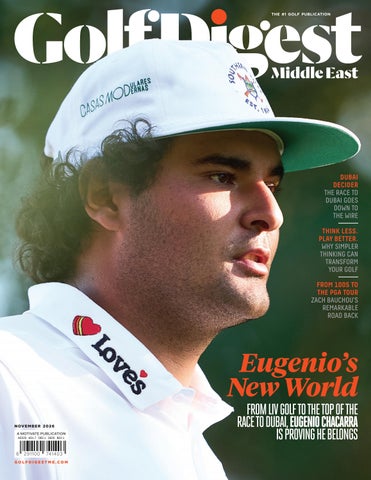
THE #1 GOLF PUBLICATION
DUBAI DECIDER THE RACE TO DUBAI GOES DOWN TO THE WIRE THINK LESS. PLAY BETTER. WHY SIMPLER THINKING CAN TRANSFORM YOUR GOLF FROM 100S TO THE PGA TOUR ZACH BAUCHOU’S REMARKABLE ROAD BACK
Eugenio’s New World N OV E M B E R 2 0 2 6 AED20 KD1.7 OR2.1 SR20 BD2.1
GOLFDIGESTME.COM
FROM LIV GOLF TO THE TOP OF THE RACE TO DUBAI, EUGENIO CHACARRA IS PROVING HE BELONGS
N O V E M B E R
2 0 2 6
Earth Calling
The DP World Tour reaches its climax in Dubai, with two titles at stake on Jumeirah Golf Estate’s Earth Course. Page 40
BY THOMAS WOODGATE
the starter
features
how to play
36 No Turning Back Eugenio Chacarra left LIV Golf to start again. Now he leads the Race to Dubai.
16 Numbers Game
BY SHARAD KOHLI
8 Hann Rising IMG extends its partnership with the Philippines resort as its second championship course nears opening.
BY SHARAD KOHLI
44 Getting In Hopeful college golfers and their advisors for hire.
10 Journeys Zach Bauchou overcame yips and triple-digit scores. WITH KEELY LEVINS
12 Finding Strength How golf helped Maria rediscover strength, connection and confidence.
4
20 Rules Review You hit into a group and they’re not happy. What now? BY RON KASPRISKE
32 Fearsome Foursome Streamsong’s fourth course, Bone Valley, brings McLay Kidd’s distinctive design to an elite lineup. BY STEPHEN HENNESSEY
52 The Oldest Golf Clubhouse in the World? Golfers with a 12th-century monastery in Italy are calling out contemporaries.
BY JAKOB TROBOLLOWITSCH
BY ERIK MATUSZEWSKI
24 Sand Master Ben Griffin is deadly from greenside bunkers.
35 Blank Canvas It’s already time to start preserving modern courses.
BY ANDREA VERCELLI
BY RON KASPRISKE
BY DEREK DUNCAN
what to play
the me club
26 Hot List Extra Your next driver might not be what you expect.
66 Club News A gallery of just a handful of the local winners in the amateur circuit in the region.
BY JIM NANTZ
BY WILL ROBINS NOVEMBER 2026
where to play
34 Montana’s Epic Dude Ranch Golf Experience
BY PAUL SULLIVAN
14 Playing In The Dirt Helping build Tepetonka has been a dream project.
GOLFDIGESTME.COM
30 What’s in My Bag Si Woo Kim.
18 Swing Analysis Matt Wallace.
22 Mind Games Boring golf is good golf. Your mind should be boring, too.
58 Golf Is Not A Mental Game The seven emotional states that can ruin your game—and how to beat them.
WITH THOMAS WOODGATE
BY MIKE STACHURA
BY MICHAEL BREED
BY LUKE KERR-DINEEN
40 All To Play For Golf’s leading names descend in Dubai for the season finale.
BY THOMAS WOODGATE
voices
28 When a Premium Ball Matters
BY JARED GOLDSTEIN
COVER PHOTOGRAPH BY MATEO VILLALBA/GETTY IMAGES
PHOTOGRAPH BY ANDREW REDINGTON/GETTY IMAGES
6 The Road Less Travelled Why the best journeys rarely follow the expected route.
E D I T O R’S
LETTER
The road less travelled From Eugenio Chacarra starting again to Zach Bauchou fighting his way back from the 100s, this issue is a reminder that there’s rarely one route through golf – or life. BY THOMAS WOODGATE
M
aybe it’s because the end of the year is approaching, but I’m in a reflective mood. It feels like a time for taking stock, and perhaps making a few decisions. Which could be why this month’s cover story resonated with me. It starts with one. Eugenio Chacarra left LIV Golf because he wanted something different: majors, Ryder Cups, the PGA Tour and the chance to test himself on another stage. There were no guarantees. Now, after three DP World Tour victories in 2026, he heads towards the season finale at the top of the Race to Dubai. What I like about his story is that Chacarra doesn’t pretend the first decision was a mistake. He remains grateful for his time at LIV, but recognised when it was time to take another route. There’s something refreshing in that. Changing direction doesn’t necessarily mean what came before was wrong – sometimes it simply means knowing when you want something different. I think we can all relate to that feeling. The timing couldn’t be better. The DP World Tour season concludes in Dubai this month, with the tournament title and Race to Dubai decided at Jumeirah Golf Estates. Chacarra knows what awaits, not least from three-time Earth Course winner Rory McIlroy. That idea of finding your own way through golf runs through quite a bit of this issue. Zach Bauchou’s story is perhaps the most remarkable. His game disappeared so completely that he was shooting in the 100s. He kept playing, slowly found a way back and eventually earned his PGA Tour card. It’s difficult to imagine a much longer journey between those two places.
6
GOLFDIGESTME.COM
NOVEMBER 2026
Elsewhere, we look at how complicated the path to college golf has become. Smaller rosters and the transfer portal have changed the landscape, but perhaps the most useful advice is also the simplest: find somewhere you can play, develop and enjoy the experience. There’s perspective for the rest of us, too. Will Robins argues that better golf is often less about controlling your thoughts than managing the emotions around them, including, surprisingly, hope. Get carried away by one good shot and optimism can quickly become poor course management. And if all that sounds rather serious, there is always Golf Club Varese. Less than an hour north of Milan, its clubhouse occupies a Benedictine monastery whose origins trace back to 1129. Golf arrived much later, in 1929. It’s a wonderful reminder that sometimes the best thing about this game is simply where it takes you. Perhaps, with year’s end nearly here, a bit of reflection isn’t such a bad thing. Golf rarely takes us exactly where we expect it to. Sometimes that’s the best part. Until next month, enjoy the journey.
editor-in- chief Obaid Humaid Al Tayer managing partner & group editor Ian Fairservice chief commercial officer Anthony Milne group content director Thomas Woodgate thomas.woodgate@motivate.ae art director Clarkwin N. Cruz sales manager Abdel Djeebet abdel.djeebet@motivate.ae gener al manager - production S. Sunil Kumar production manager Binu Purandaran assistant production manager Venita Pinto t h e g o l f d i g e s t p u b l i c at i o n s editor-in- chief Jerry Tarde senior director, business development & partnerships Greg Chatzinoff international editor Ju Kuang Tan golf digest usa editor-in- chief Jerry Tarde gener al manager Chris Reynolds editorial director Max Adler executive editor Peter Morrice managing editors Stephen Hennessey, Ryan Herrington, Jonathan Wall chief designer David Schlow pl aying editors Collin Morikawa, Jordan Spieth
head office Media One Tower, PO Box 2331, Dubai, UAE Tel: +971 4 427 3000; Fax: +971 4 428 2266
dubai media cit y SD 2-94, 2nd Floor, Building 2, Dubai, UAE Tel: +971 4 390 3550; Fax +971 4 390 4845 Email: motivate@motivate.ae
abu dhabi 14th Floor, Office 1406, Makeen Tower, 9th Street, Al Zahiyah, PO Box 43072, Abu Dhabi, UAE Tel: +971 2 677 2005; Fax: +971 2 657 3401 Email: motivate-adh@motivate.ae
saudi ar abia Regus Offices No. 455 - 456, 4th Floor, Hamad Tower, King Fahad Road, Al Olaya, Riyadh, KSA Tel: +966 11 834 3595 / +966 11 834 3596 Email: motivate@motivate.ae
london Motivate Publishing Ltd, Acre House, 11/15 William Road, London, NW1 3ER, UK Email: motivateuk@motivate.ae Golf Digest and How to play, what to play, where to play are registered trademarks of Warner Bros. Discovery. Copyright © 2024 Discovery Golf Inc. All rights reserved. Printed in the U.S.A. Published by Warner Bros. Discovery. Principal office: Golf Digest, 230 Park Avenue South, New York, NY, 10003. Warner Bros/Discovery Luis Silberwasser, Chairman & CEO TNT Sports; Gunnar Wiedenfels, Chief Financial Officer. Periodicals postage paid at New York, N.Y., and at additional mailing offices.
golfdigestme.com thomas.woodgate@motivate.ae @golfdigestme
/GolfDigestME PHOTOGRAPH BY LUKE WALKER/GETTY IMAGES
Breaking News How To Play What To Play Where To Play Golf Live Golf, organised the way it should be golfdigestme.com GolfDigestME
the starter
Second course, bigger ambitions IMG extends its partnership with the Philippines resort as its second championship course nears opening
H
ANN RE SE RV E is entering its next phase, with IMG expanding its role at the 450-hectare golf and lifestyle development in New Clark City, Philippines. The sports marketing agency has worked with the resort since before opening and will now support guest experience, service standards and international marketing, while connecting Hann Reserve with its wider golf and hospitality network. The move comes as the resort prepares to open Six Moons, its second championship course, in late 2026. Designed by eight-time PGA Tour winner and 2011 Players champion K.J. Choi, it will join the already-open Dragon’s Landing by Nicklaus Design. A third 18-hole layout, Caverns Deep by Faldo Design, is also planned. Hann Reserve, the PGA of America’s exclusive development partner in the Philippines, sits around 20 minutes from Clark International Airport. As part of the expanded agreement, it will also join the IMG Prestige Network, giving members preferred access and privileges across a collection of international clubs and destinations. For UAE golfers, Emirates operates a daily service from Dubai to Clark. –THOMAS WOODGATE
8
GOLFDIGESTME.COM
NOVEMBER 2026
PHOTOGRAPH COURTESY BY IMG
JOURNEYS
10
GOLFDIGESTME.COM
NOVEMBER 2026
Zach Bauchou: ‘I Was Shooting in the 100s ’ WITH KEELY LEVINS
I
was not an athletically gifted kid. Nothing ever clicked easily when I tried a sport, including golf. We lived on London Downs, a public golf course in Virginia, and every evening when my dad got home from work, we’d walk out and play a few holes. I didn’t care about being great, I just wanted to spend time with him. As I got older and entered tournaments, that changed. I fell in love with golf and competing and knew I wanted to play professionally. the rest of my game. Putting, There weren’t many kids my left hand would start where I played, so we’d ZACH BAUCHOU shaking uncontrollably. I was drive pretty far for tournaliterally shooting in the 100s. ments. I’d play OK but rarely AGE: 30 ●●● win. That always left me LIVES: feeling motivated. My dad I’d seen guys go through FOREST, VA. is a chiropractor with an the yips. They’d take a engineering background, so month off, hoping to come he really likes stats. He’d look up what back and somehow be normal again. the tour guys were doing and make up None ever made it to the tour, so I despecific short-game drills that he cided to keep playing. I teed it up every believed mirrored their levels. day. I’d shoot 102 and hope that tomor●●● row would be a 98. Some coaches gave I went to Oklahoma State but was me advice, and other friends didn’t far from the best player on the team. know what to say. My swing videos I overlapped with Wyndham Clark, looked pretty good, making it even Viktor Hovland, Matthew Wolff and more baffling. Friends from college Austin Eckroat. I saw playing up as a heard I was struggling and came to play catalyst for improvement. Some match- with me. es got heated. Once against Hovy, our ● ● ● group got so intense that we didn’t eat The chaos of my game seeped into dinner together afterwards. The next my mind. I’d always been mentally day we were all great friends again. It very stable, was never a wild kid, but I’d was a great experience. My first year, lost control. I was scared and confused I was in and out of the lineup. My last and couldn’t stop feeling that way. three years, I didn’t miss a tournament. I listened to podcasts about psychology ●●● and self-help. I stopped entering mini After graduation, I was living in tour events, afraid of what might hapViktor’s house when his career took pen. This was my game during 2021. off quickly. Mine started by not get- ● ● ● ting through Korn Ferry Q School. I got I thought I had to quit. I didn’t have status on the Asian Tour but that shut any money, I didn’t have any status, down during the pandemic. I went back and most importantly, I didn’t have any to Oklahoma and suddenly started slic- game. Then I talked to one more coach, ing my driver—bad. I was hitting it 100 Denny Lucas in Palm Beach Gardens. yards right. I’d make the turn, compen- He told me to weaken my grip, which sate, and hit an 80-yard hook. It really I thought was insane because I was slicfreaked me out, and that fear crept into ing it so hard. We also took the orthotPHOTOGRAPH BY MATT WILLIAMS
ics out of my shoes, so I could feel the ground better. I was also rotating too hard, so we worked on that, too. ●●●
After a few months, I was at least keeping the ball on the golf course. I played in mini tour events again. I was chipping cross-handed to get out of my head. This was the spring of 2023, my wife was pregnant, and we made a deal that if she went into labour, I’d leave no matter where I was and be there for her and our baby. Right around this time I also bought a long putter off the rack. Five days after the purchase, I Monday-qualified for the Korn Ferry event in Wichita by making a 30-footer in a playoff. I made the cut and shot 64-63 on the weekend. ●●●
I was on the Korn Ferry Tour and had locked in some status. If I could finish in the top five in the finals, I’d get my PGA Tour card for 2024. A rules official came up to me during the first round. My wife was in labour, five weeks early. The decision had already been made. My playing partners were shocked when I walked off. I got on a plane and was there for the birth of our first son, and I don’t regret it. ●●●
I kept at it on the Korn Ferry Tour and in 2025 finished 11th on the seasonlong points list to earn my PGA Tour card. I went through something brutal and confusing to get here, and I came out on the other side with my game and my mind intact. I still don’t understand why things happened the way they did. Now I’m competing against the best players in the world every week. It’s crazy that not long ago I was shooting in the 100s. I survived it, and that makes me confident that I can persevere. NOVEMBER 2026
GOLFDIGESTME.COM 11
THE
GAME
Finding Strength Through Golf After undergoing treatment for breast cancer at the age of 32, Maria discovered that golf could offer far more than competition – it became part of her recovery, a source of calm, and provided precious time with her husband WITH THOMAS WOODGATE
How did golf first come into your life? My husband started playing after retiring from rugby. I knew that, after everything we had been through, golf was his escape. Life in Dubai with work and teenagers is fast-paced, so we began making time for nine holes at dusk, a proper catch-up and a meal afterwards. It became our version of date night. What made you realise you had become a golfer in your own right? I started matching [my husband] Gwill’s scores on some holes, despite him having played for two years longer. Buy12
GOLFDIGESTME.COM
NOVEMBER 2026
ing an EGF subscription made it feel serious, but perhaps the real moment was buying clubs that cost more than a holiday abroad! I’m now playing off 22. Golf has taught me that improvement does not always happen quickly, but patience, perseverance and a sense of humour can surprise you. How did the game become part of your physical recovery? I had two upper-body reconstruction surgeries while learning to play. My body was tight, I had lost muscle and I couldn’t complete a full swing without compensating elsewhere. After each operation, my physiotherapist incorporated swinging a club into my rehabilitation. Completing a full
swing became a measure of progress. After cancer, you spend so much time focused on what your body cannot do. Golf helped me focus on what it could do again. Did that change your relationship with your body? Absolutely. For a long time, my body felt like something that had let me down, then something that constantly needed fixing. Golf gave me another perspective. Instead of concentrating on scars or limitations, I was learning a skill. I began appreciating my body for what it was capable of, rather than only what it had been through. What does the course give you mentally? Peace. Life can be incredibly busy, but on the course I can switch off and focus on something completely different. It is one of the few places where I genuinely slow down, although after three bad chips in a row I may feel differently! For Gwill and me, the time is intentional: you book the tee time and show up. We talk, play music, support each other and reset. What does standing on the first tee mean to you now? I feel incredibly lucky to be here and able to experience it. Cancer changed how I choose to live; I say yes more often, even when something feels scary. Standing on a course, healthy enough to play and surrounded by people I love, is something I genuinely appreciate. I don’t take ordinary moments for granted in quite the same way anymore.
PHOTOGRAPHS SUPPLIED
BEYOND
EMIRATESWOMAN.COM @emirateswoman
Playing in the Dirt Helping build Tepetonka has been a dream project BY JIM NANTZ
In 2023, whIle guestIng on a podcast with famed architect Gil Hanse, I mentioned in passing that, had my childhood dream of becoming a sports commentator not come true, my second choice was to be a golf course designer. The allure of sculpting earth and building something with permanence was enticing to a young boy. A small part of my fallback plan came to fruition in 2015 with the construction of a backyard par-3 hole at my home in Pebble Beach. Then I built another one seven years later at my house in Nashville. There’s an old broadcasting adage in radio that also applies to podcasting: You never know who might be listening. Tuned in to that pod was my old University of Houston golf teammate Mark Haugejorde, a fine player and dear friend whose golf-DNA is imprinted deep. 14
GOLFDIGESTME.COM
NOVEMBER 2026
After college, Mark enjoyed a diverse Mark “Hoggie” career that includHaugejorde ed handling global asked Jim partnerships for Jack Nantz for fun ideas. Nicklaus’ design firm. “Hoggie,” as we call him affectionately, was now pursuing a dream of his own, a national golf destination in his home state of Minnesota. As a child, Mark had watched his father create the Little Crow Golf Resort not far from the piece of land he now had in mind, a generous tract 100 miles west of the Twin Cities. He broadly told me his plan for a 27-hole facility that would include a nine-hole par-3 layout. Then he popped the question. “Why don’t you come join me on this project and work as a design consultant on our short course?” After a moment of stunned silence, I, of course, accepted. DESIGN PARTNERS
A short time later, I was on site in Minnesota walking the property that would be known as Tepetonka. “Tepe” is distilled from teepee, and “tonka” in Sioux means big, so you have “Big Tent.” When the course opens officially in 2027, golfers will find that few places in North America are better suited for golf. Some 12,000 years ago, glaciers two miles in depth began to melt and creep south from the Great Lakes region. When their journey was complete, they left behind a sprawling, shallowravined landscape covered with prairie grasses, red cedar trees and creek beds stretching into the horizon. From afar the land resembles a giant wrinkled blanket that stirs the imagination of every armchair golf course architect. The slight remoteness of the property inspired in Haugejorde a “Land of 10,000 Lakes version” of what Sand Hills is to Nebraska, Whistling Straits is to Wisconsin, and the Dunes Club is to Michigan. Soon, Mark and I were meeting over dinner in Minneapolis with the team at OCM (Ogilvy, Cocking and Mead), one of the hottest firms in golf course design. Geoff Ogilvy, who will captain
PHOTOGRAPHS BY CAPTURE FILMCO
H E L L O, F R I E N D S
PHOTOGRAPHS COURTESY OF TEPETONKA
the International Presidents Cup Team against Brandt Snedeker’s American squad in September, is best known for winning the 2006 U.S. Open at Winged Foot. Mike Cocking, once an outstanding amateur, brings along with Geoff a player’s perspective to design. Ashley Mead is a skilled executioner of the team’s jointly conceived creations. The portfolio of the three young Aussies already is prolific and has been widely praised. Most recently, OCM designed and built Fall Line Golf Club in Georgia, selected by Golf Digest as the Best New Private Course of 2025. OCM also renovated Shady Oaks, Ben Hogan’s hang spot in Fort Worth, as well as Kingston Heath in Australia and the famed Medinah No. 3 in Chicago, which will add to its long history of hosting big competitions when it serves as the site of the upcoming Presidents Cup Sept. 24-27. Yes, Geoff will lead his team on a course he helped reimagine. With a powerhouse like OCM on board, I was absolved from examining topo maps and trying to operate a bulldozer—not my strong suits. Gratefully, in October I became one of only a few non-architects to receive the Donald Ross Award, an honour coming to me mostly due to my appreciation and support of outstanding designs. My role at Tepetonka has been to add features on and around the inland links course that serve Hoggie’s end goal: to make the experi-
“I was absolved from examining topo maps and trying to operate a bulldozer—not my strong suits.” ence fun and memorable, kind of like my backyard designs. “Can’t wait to get there—can’t stand to leave!” was an early motto. I wanted to add fun to the par3 course, an eye-catching, breezy layout near the clubhouse, practice range and an indoor/outdoor bar and grill. Near the final green of the short course, we’ve installed a Rock of Fame like the ones adjacent to my backyard holes in Pebble Beach and Nashville. Players who make a hole-in-one will have their names engraved on the rock, but only if the ace is made under a special circumstance. On a balcony over the indoor bar, overlooking the hole, is a Gjallarhorn, an enormous instrument you may have seen sounded prior to the start of Minnesota Vikings games. In summer months at roughly 5 p.m., the Gjallarhorn will sound. In Norse mythology, the bellow DESTINATION of the Gjallarjorn MINNESOTA served as a call Remote Tepetonka to war and to sigis scheduled nify the end of to open for play in 2027. the world. At Te-
petonka, its thundering tone is a signal for all to gather at the bar, at which time each person gets one shot at an ace, with patrons cheering each player on. The bar has been named “Hog Heaven” as a nod to Hoggie. To make the day’s final shot at glory more obtainable, the ninth green will pitch similar to the 16th hole at Augusta National, where a slope guides balls toward the cup—or you can go right at the pin. Watching a ball trickle and fall into the hole will no doubt elicit cheers that match the Gjallarhorn in volume. Sharing that scene with other national guests will bring people together. Hello, friends! Each of the holes at the short course, which we named The Gjallarjorn, has been assigned a name. “Jack Nicklaus,” for the greatest player of all time, measures 86 yards, while “Couples,” at 92 yards, is a nod to our beloved Houston teammate. I’m sure you see the Masters symmetry there. There’s “Patty Berg” and “Tom Lehman,” named after Minnesota’s finest female and male golfers. OCM named one hole “Peter Thomson” to honour their Australian golf hero. My favourite might be “Mike Schultz” after the man who served as head pro at Hazeltine for 37 years and was one of Hoggie’s first mentors. Behind the eighth green of the big course is a cozy halfway house built literally into the green complex. It even has a grass roof. It serves golfers not only at the eighth hole but also at the 14th and 16th holes. Hoggie christened it “The Dead End,” and we don’t doubt golfers will venture back there to hang out after their rounds, watch shots and enjoy some great food and beverages. At Tepetonka, “Minnesota casual” prevails, not strictly to attire but also to the friendly discourse among people who love the game. On each of the five site visits I’ve made—I have two more scheduled before the end of the year—my admiration for Geoff, Mike and Ashley has soared to great heights. Watching this “Minnesota Masterpiece” come together has proven to be one of my greatest thrills in golf. When I’m at Tepteonka, I’m quite literally in hog heaven. NOVEMBER 2026
GOLFDIGESTME.COM 15
16
GOLFDIGESTME.COM
NOVEMBER 2026
E D I T E D
B Y
R O N
K A S P R I S K E
Numbers Game “Great wedge play requires what I call two-number golf. The first number is how far you want to carry the ball; the second is where you want it to end up. Most golfers shoot the yardage to the flag and never think about carry distance. They’re skipping the first number and going straight to the second. You can have a great sense for how the ball is going to bounce and roll out, but does that matter when you don’t cover the front bunker? Switch your focus from total yardage to carry yardage, and you’ll instantly be a better wedge player.” –MICHAEL BREED, GOLF DIGEST’S CHIEF DIGITAL INSTRUCTOR
PHOTOGRAPH BY J.D. CUBAN
NOVEMBER 2026
GOLFDIGESTME.COM 17
S W ING ANALYSIS
1
Matt Wallace: A Nice Blend of Power and Technique
18
GOLFDIGESTME.COM
NOVEMBER 2026
AGE 36 LIVES London STATS (PGA TOUR RANK IN ’26)
Strokes gained/tee to green: (25th); Distance: 306.6 yards (74th); Strokes gained/approach the green: (21st) NEED TO KNOW
Six career wins between the PGA Tour and DP World Tour and three top-10s on the PGA Tour in 2026. Driving distance increased by 10.5 yards on the DP World Tour from ’25 to ’26 (298.2 yards/308.7 yards). —LUKE KERR-DINEEN
2
3
1. STAYING TUCKED
2. STABLE AND STRONG
3. SWING THROUGH IT
“During the takeway, making sure my right arm doesn’t separate too far from my body is a big focus for me,” Wallace says. “I tend to overturn sometimes, and when my right arm drifts from my body, it causes me to pivot too much. I let my right arm fold early rather than keeping it straight.”
“Coming down into the ball, I think, strong legs, strong body, and not tilting behind it too much. At impact, I’d like the shaft to be pretty neutral. Also, I’m trying to keep my right hand on top of my left thumb instead of allowing it to separate. That connection helps with my release.”
“I wouldn’t look necessarily so much at my swing in terms of positions; I’d emphasise tempo. That’s more important because amateurs sometimes don’t get in the right positions. Keep the rhythm nice and smooth and let the ball get in the way rather than smacking it—that’s a good swing thought.”
PHOTOGRAPHS BY MATT TANNEHILL
NOVEMBER 2026
GOLFDIGESTME.COM 19
RULES
de-escalate things, but you might Be sure to wonder what happens yell “fore” if when one of those you hit into golfers takes your Bill Murray’s group. ball, hits it back at you or throws it away. There are a few things to understand about how to proceed when these things happen. The first is that the golfer is considered an outside influence by the Rules of Golf, and under Rule 9.6, if he or she happens to do something to move your ball from the spot where it came to rest, you can replace it (or another ball) on that spot with no penalty. If you’re not sure where that spot is, you can estimate it based on all available evidence. Remember that it has to be known or virtually certain another golfer moved your ball. If you’re not at least 95 percent sure and you can’t find it, it’s considered lost. Take a stroke-anddistance penalty under Rule 18.2. The procedure for what to do changes if your ball was deliberately deflected while in motion instead of being picked up after it had come to rest. For example, your ball rolls up onto a group on the green and one of them kicks it off (perhaps into a pond bordering the hole). If it’s known or virtually certain that happened, under Rule 11.2 you have to take relief. Do so by estimating the spot where you think the ball would have come to rest if it wasn’t kicked. You’re supposed to drop in a relief area if that ball would have stopped off the green, or place the ball if it would have stopped on the putting green. If your ball likely would have gone out-ofbounds, you unfortunately have to take stroke-and-distance penalty relief. To recap: If your ball at rest is moved by an outside influence, put that ball (or a replacement) on the spot where it came to rest and play on with no penalty. If it’s deflected while in motion, estimate where the ball would have come to rest and either drop it on that spot (off the green) or place it (on the green), then play on with no penalty. Oh, and maybe buy a round of drinks for a group you hit into if they leave your ball alone. Not the worst idea.
Don’t Chuck it! You hit into a group and they’re not happy. What now? BY RON KASPRISKE
20
GOLFDIGESTME.COM
NOVEMBER 2026
IT CAN’T BE EMPHASISED enough that you should never intentionally hit into the group in front of you, but it does happen from time to time—even on the PGA Tour. John Daly famously hit into tour pro Jeff Roth’s group twice at the 1994 NEC World Series of Golf, and then got into a fight with Roth’s father after the round. Not a good look, but as you probably know, Daly’s had more than his share of wincing moments over the years. There’s hitting into a foursome on purpose and then there are these more common happenstances: Sometimes it occurs because you hit a shot longer than expected. Sometimes it happens because it’s a blind shot and you didn’t realise the course ahead wasn’t clear. If you do it, you’ll likely encounter some unhappy golfers. Apologies usually do the trick to
PHOTOGRAPHS BY LARRY PLACIDO/ICON SMI/CORBIS/ICON SPORTSWIRE VIA GETTY IMAGES
HERE’S THE WINDUP
REGISTER YOUR OUTLET FOR ABU DHABI’S FAVOURITE RESTAURANT, LEISURE & ENTERTAINMENT AWARDS REGISTER HERE
FIND OUT MORE
FOR EVENT SPONSORSHIP, REGISTRATIONS AND GENERAL ENQUIRIES nitika.sharma@motivate.ae | lina.abdelaziz@motivate.ae
WhatsOn.ae
Sponsor
Beverage Partner
WhatsOnAbuDhabi
Printing Partner
Vote Processing Partner
#WOAwards
Structural Partner
Presented By
MIND
GAMES
Boring Golf is Good Golf. Your Mind Should Be Boring, Too Every golf shot begins before the club moves. According to one Dubai-based mental performance mentor, clearer targets, fewer decisions and simpler thinking can lead to more committed golf. BY JAKOB TROBOLLOWITSCH
22
GOLFDIGESTME.COM
NOVEMBER 2026
Your mind plays the shot first Every shot in golf is played twice. First in your head, then with the club. Before you swing, you choose a target. You decide whether the ball moves left to right or right to left, whether it flies high or low. All of that happens before the club moves. In other words, you begin shaping the shot before you hit it. That is why the thought on the tee matters so much. Under pressure, the image you are trying to avoid can become the one that dominates your attention. “Just not left” still keeps the left side, and the water, at the centre of your thinking. Research supports what most golfers have felt. Studies of putting under pres-
sure have shown that when players focus on avoiding a specific mistake, they can become more likely to make it. Trying hard not to do something keeps it at the centre of your attention. Too many thoughts, too many decisions The second problem is volume. Ask an amateur what is going through their head on a pressure shot, and you will rarely hear one thought. You will hear five. The water. The score. The playing partner who birdied the last. A swing tip from the range. What happens if this goes wrong. Many of those thoughts carry an emotional response, and each one can
PHOTOGRAPH BY IMAGINEGOLF/GETTY IMAGES
Y
OU KNOW THE MOMENT. The 18th tee, and the best score you have had in months is sitting on your card. Water down the left. A bunker on the right. Between them, a fairway that looked wide enough every other day of the year. You take your stance, and one thought arrives before any other: just not left. You make a decent swing. The ball starts left and keeps going. Afterwards you call it nerves, or a bad swing at the wrong time. Neither is quite true. You hit the shot you had planned. You simply planned the wrong one.
add another decision. Lay up or go for it. Driver or hybrid. Aim at the middle or away from the trouble. By the time the club starts back, the player has made several decisions and committed to none of them. In my experience, poor course management is often not a lack of knowledge. It is too much information arriving at once, much of it produced by the player. This is not only an amateur problem. I work with junior golfers on their way to college golf and with an NCAA Division I programme, and the pattern is the same at that level. The first thing I do with a new player is not to give advice. It is to find out what is actually happening in their head before they step up to the ball. Almost always, there is too much of it.
PHOTOGRAPH BY IMAGE SOURCE/GETTY IMAGES; SUPPLIED
Make the mental game boring Scorecards tend to reward boring golf. Fairway, green, two putts, next tee. Very few golfers apply the same idea to their thinking. Yet the principle is identical. The fewer thoughts you produce in a situation, the fewer decisions you have to make. Reducing those decisions can make it easier to commit and execute freely. That is why the players I work with have one or two fixed anchors for the situations that come up again and again: the first tee, the shot after a bad hole, the tee shot with trouble on both sides.
Every shot in golf is played twice: first in your head, then with the club. Before you swing, you choose whether the ball goes left or right. Those anchors are different for every player, and most of them have nothing to do with golf. That surprises people.
But an anchor is not a swing thought. Its job is not to add information. Its job is to replace five thoughts with one, so there is nothing left to decide. It might be a word, an image or a simple physical cue that brings attention back to the shot in front of you. The decision is made before the situation arrives. On the course, there is only the shot. One thing for your next round You do not need a new routine to start. Take one rule onto the course this weekend: on every tee, say where the ball is going, never where it should not go. Not “avoid the water”, but “the right half of the fairway”. One clear picture, then swing. It will feel almost too simple. That is the point. Your best rounds were probably boring. Nothing much happened, and the card was low. Your mind can work the same way. JAKOB TROBOLLOWITSCH is a Dubaibased mental performance mentor and founder of the Awareness Performance System. He is the mental performance coach for the men’s and women’s golf teams at Oral Roberts University, an NCAA Division I programme, and works with junior golfers on their path to college golf in partnership with the college recruiting agency ProDream USA. NOVEMBER 2026
GOLFDIGESTME.COM 23
ONE
THING
Sand Master Ben Griffin is deadly from greenside bunkers. Copy his move BY RON KASPRISKE
BEN GR IF F IN ’S SW ING coach, James Oh, tries to get his star student to practice in greenside bunkers as much as possible. Griffin’s typical response to get in the sand, however, comes with a little eye roll from Oh. “You do realise I’m pretty good out of here,” Griffin says. Tough to argue that. Griffin, a threetime PGA Tour winner, led his peers in sand saves during the regular season. His scrambling percentage (67.5) meant he was getting up and down in two out of three attempts. That’s 12 percent better than just two seasons ago. 24
GOLFDIGESTME.COM
NOVEMBER 2026
There are a few reasons for the improvement, Oh says, including the consistency of his contact with the sand behind the ball—usually pretty close to it to create more spin—and his ability to make long, relaxed swings from all kinds of challenging lies. “I’ll put him in really tough spots, and he finds a way to get the ball close,” Oh says. “You’d be amazed how many times he holes out.” DON’T STOP While trying A bunker swing to strike the sand ends well past fairly close to the the moment the ball with an openwedge enters face wedge can be the sand.
unnerving for average players, there is one thing you can copy in Griffin’s technique that should make your sand play a lot easier, Oh says. “What I see from amateurs is that they tend to lean too much into their front side and then make a jabby swing into the sand. The club just stays down there,” Oh says. If you watch Griffin’s swing, it’s a long, unhurried motion, and he finishes well past impact with the sand—that’s the key. “Focus on your finish,” Oh says. “If you finish full, you’ll get the ball out.” Make a smooth rehearsal swing outside the bunker and hold a finish position where your torso is completely unwound and facing your target. Then get in the sand and recreate the same move thinking about that finish position. It will help you accelerate through the sand without jabbing into it. The ball will float onto the green with good spin, stopping close to where it lands.
PHOTOGRAPH BY ALEX GOODLETT/GETTY IMAGES
GIMME
LIST
EXTRA
Your Next Driver Might Not Be What You Expect Our testers showed it’s better to try a variety of clubs than to rely on design stereotypes based on a player’s swing or ability level BY JARED GOLDSTEIN
ONE OF THE KEY ASPECTS of the Hot List is how we use a diverse array of player types, skill levels and swing speeds to assess the best new clubs. That’s especially valuable when it comes to drivers, where companies introduce three, four or five models to try to match the playing characteristics of a club with the swing characteristics of a certain type of player. There’s a reason 40 driver models were named in the 2026 Hot List: Each resonated with a portion of the golfers in our testing sessions. However, the players’ preferences weren’t always what you might think. “It’s still about the individual player, what they need and what’s going to 26
GOLFDIGESTME.COM
NOVEMBER 2026
benefit them,” said Chris Marchini, director of performance and innovation at Golf Galaxy, on a recent episode of Golf Digest’s Club Lab equipment podcast. “There are still many people falling into the dangerous realm of putting themselves in silos.” In other words, don’t assume that because of your skill level or swing, you should be playing a certain type of driver. It simply isn’t the case that high handicappers should play the most forgiving model and low handicappers should play the tour-style driver. Case in point: Rory McIlroy, who can hit it 350 and whose projected handicap would be about +8, actually plays the same model of TaylorMade driver as
that 50-something FORGIVE HIM guy you got paired Rory McIlroy’s TaylorMade with last weekend. Qi4D targets McIlroy reportedly players who made the change want more forgiveness. in four swings, noting that he now prioritises control and predictable spin over simply chasing the lowest spin numbers—a traditional benchmark on tour. That out-of-the-box thinking made sense for Rory and also is smart for golfers trying to break 80 or 90. We break out our Hot List players into three handicap groups—low, middle and high—but when we looked at the driver models each group liked best, we saw some overlap. One reason: Although there are plenty of fast-swinging players in our low-handicap group, we also have several whose swing speeds are down in the low 90s. At the other end, we have high handicappers who are newer to golf but swing at very high speeds. Another reason for the overlap is that the majority of drivers today produce effective spin, so it’s no longer a choice between forgiveness or proper spin.
PHOTOGRAPH BY RICHARD HEATHCOTE/GETTY IMAGES
HOT
Plus, as in McIlroy’s case, too little spin isn’t optimal, either. Pursuing certain performance attributes like lowest spin or highest moment of interia (MOI) isn’t an ironclad method for finding your best driver. Fact is, a lot of today’s models give players at every level the launch and spin they need to optimise distance. Finding your ideal driver is a personal search that requires a proper fitting to produce the best results. LOW HANDICAPS The best players on our 2026 Hot List testing panel picked a quintet of lowspinning drivers as their favourites, perhaps unsurprisingly given that roughly three-quarters of them cruise with swing speeds more than 110 mph. With such high speeds, it’s imperative to limit spin to keep the ball in play. That said, these models, including the Callaway Quantum Triple Diamond Max and the Ping G440 LST, still offer plenty of forgiveness. Both of them received an MOI rating of “High,” which indicates substantial stability on off-centre hits. That kind of forgiveness was important, even for players who seemingly don’t miss many shots. Tester Ricky Brown, a +2-handicap, said of the Quantum Triple Diamond Max: “It’s just a rocket launcher. Every swing was producing.” MIDDLE HANDICAPS There are a bunch of ways to become a middle-handicap golfer, so perhaps it shouldn’t be surprising that our middle group favoured drivers with optionality and flexibility. These testers were drawn to the core or standard models in the driver families, but there were also two low-spinning heads that you might think were reserved for our low handicaps. Again, the combination of forgiveness with low spin was even more appreciated by this group. Peter Lee, a middle-handicap tester, said of the low-spinning Ping G440 LST: “A nice head shape, and it’s got a nice feel off the face, very powerful. It really helps keep the ball going straight. An effective tool.” That idea of finding a driver with the most efficient functionality was a recurring theme among all
of our players. It wasn’t just distance; it was playable distance. HIGH HANDICAPS Our testers who shoot in the 90s might seem to be all about maximum forgiveness, but that’s not such a simple conclusion. Like the state of the game today, our panel of higher handicappers represent the legion of new golfers who are younger, fitter and able to generate high speeds. Indeed, a National Golf Foundation report says 71 percent of the post-pandemic growth in rounds played has come from golfers younger than 50. New golfers swinging at high speeds might benefit from drivers with less spin that also provide ample stability.
An example is the TaylorMade Qi4D that McIlroy has been gaming. Forgiveness (its MOI rating is “Above Average”) with low spin means more distance for golfers who are fast-swinging but less precise than other players, like 12handicapper Shane Popham. “There wasn’t a miss in this driver. There wasn’t much I couldn’t do,” Popham said. “Real energy at impact. It was immediate; it was immense; and it was euphoric.” We can look at our top-rated drivers by handicap group, but many of them can work for players at various levels, so let go of your assumptions and allow a proper driver fitting to play out. You might end up with a club that targets another type of player, like Rory did.
HOT LIST TESTING
Low-spin, forgiving drivers were most preferred across our three handicap groups. Here are some favourites from our testers: MATT NESTLER, 29
JACK BINGHAM, 37
8-handicap
1-handicap
Callaway Quantum Triple Diamond
Ping G440 LST
“This is the most forgiving driver I’ve hit. It seemed no matter where I got it on the clubface, it went dead straight every time.”
“Hyper-forgiving driver on toe and heel hits. You really don’t lose anything. You can pretty much just get the ball on the face, and it goes. I was able to launch it higher with low spin, maximising my distance.”
PAUL IANNIELLO, 65
DAN LUPO, 34 11-handicap
6-handicap
Titleist GT3
TaylorMade Qi4D
“If I had to think of a name for this, it would be ‘Old Reliable.’ It’s just very consistent. It’s a classy look, and it delivers consistent, stable results. I really felt like I had complete control of the ball.”
“It was very fast, and it’s very light. I felt like the sweet spot was quite large, and it delivered consistent shots.”
NOVEMBER 2026
GOLFDIGESTME.COM 27
YOUR
QUESTIONS
Q: I FEEL LIKE MY 4-IRON, 5-IRON AND 6-IRON ALL GO THE SAME DISTANCE. IS THAT NORMAL?
Short-game spin is seriously reduced with less expensive models
Q:
I CHEAP OUT WHEN IT COMES TO BUYING BALLS, SPENDING ABOUT $20 A DOZEN, AND STILL SHOOT ABOUT 80. WOULD A TOUR-QUALITY BALL GET ME INTO THE MID-70S? Upgrading your golf ball is unlikely to save you five or six shots a round. Although a change to a premium model, identified by having a urethane cover ($35-$60 per dozen), should help your score, there are a few factors to consider. For starters, what shot or shots are preventing you from shooting in the 70s? If your main issue, for example, is that you’re blasting two drives a round out-of-bounds, then a ball with more spin—the urethane-cover type—is probably not what you’re looking for. However, if the short game is where you’re losing strokes, a change might be in order, but not necessarily. When you get around the greens, do you like to loft the ball up in the air and see it check and stop fast? If so, then a urethanecover ball will help. If you prefer running your chips and pitch shots to the 28
GOLFDIGESTME.COM
NOVEMBER 2026
hole, that extra spin is THE LITTLE THINGS worthless to you. Emphasise The best approach greenside is to figure out what touch over problem you hope to driving solve, then what kind distance. of feel or trajectory you want. Beware of the temptation to determine a ball’s usefulness solely on how far you can whack it off the tee. Starting your ball-selection process from the green and working your way back is a better way to experiment. Equipment tracker Golf Datatech looks at about 80 models of golf balls, and the technology ladder now has moved down to ones costing as little as $20 a dozen. That’s a lot to sift through. (Note: No non-urethane ball earned Gold on this year’s Golf Ball Hot List. See the winners on golfdigest.com.) Will a ball change shave a half dozen shots from your scores? Not likely. But playing the right model is as important as being fit for any club in your bag. Given that you’re already playing well with technologically inferior golf balls, the call here is that you can expect lower scores with a premium model.
Answers by Golf Digest equipment editors Mike Stachura, E. Michael Johnson and Jonathan Wall PHOTOGRAPH BY J.D. CUBAN
PHOTOGRAPH OF IRONS BY ALEX BIERENS DE HAAN/GETTY IMAGES
When a Premium Ball Matters
Multiple clubs going similar distances is very common, especially at the long end of the iron set. According to data from Cobra, more than 90 percent of golfers have at least one gapping issue in their set, defined by Cobra as two adjacent clubs within two yards in distance. Consider the enduring words of one equipment executive: “Don’t think in terms of wood sets or iron sets or sets of wedges. Think of your bag as a place you get to invite 14 friends. You’re not going to bring one along that’s useless.” Many players have a point in their bag at which the loft for a certain type of club becomes too strong for their swing speed to optimise ball flight. Here’s a good fix to think about for long clubs: High-lofted hybrids and fairway woods with their larger heads and longer shafts can help trajectory-challenged golfers achieve a better ball flight and more distance versus long irons. Alternatively, you might not need another long club. Ditching that hardto-hit 4-iron for an additional wedge you might use several times a round can prove very useful. There’s also the nuclear option: playing with fewer than 14 clubs. Your set makeup should be dictated by what earns a spot in your bag rather than a predetermined number.
GEAR
ON
TOUR
What’s in My Bag Si Woo Kim
30
GOLFDIGESTME.COM
NOVEMBER 2026
DIAMONDS ARE A GUY’S BEST FRIEND
Kim doesn’t change clubs on a whim, so it was notable when he switched to Callaway’s Quantum Triple Diamond driver earlier this year. Better performance on offcentre strikes led to the upgrade, and he improved from 30th to 20th in strokes gained off the tee.
EARLY ADOPTER
TEST THE BREAKS
MARKING TOOLS
Kim’s ball markers include one from Merion Golf Club, a 500-yen coin and a bronze marker with his name stamped on it.
GOOD MEMORIES Winner of the Players in 2017, Kim personalised his Callaway Opus SP lob wedge with the tournament logo and year he won.
NOVEMBER 2026
GOLFDIGESTME.COM 31
As one of the first players to use the chunky Odyssey TRTL mallet, Kim fine-tuned the turtle-shaped head with strips of lead tape.
PHOTOGRAPHS BY JOHNNY JAFFE
On practice days, this electronic level allows Kim to verify the slope on the greens that he’s feeling with his feet.
E D I T E D
32
GOLFDIGESTME.COM
NOVEMBER 2026
B Y
S T E P H E N
H E N N E S S E Y
Fearsome Foursome Streamsong Resort was already one of golf’s best destinations in the U.S., with only Bandon Dunes, Pinehurst and Sand Valley boasting as many courses (three) inside the top 50 of Golf Digest’s ranking of America’s 100 Greatest Public Courses. Enter David McLay Kidd and Bone Valley, Streamsong’s fourth 18-hole course. McLay Kidd built some of the most visually interesting holes at Streamsong, such as Bone Valley’s ninth hole with a massive, 30-foot-high dune created by mining overburden in the middle of the snaking fairway, or the par-5 14th hole with a double fairway and two enormous ridges guarding the green. This was Kidd’s chance to put a course next to the three greatest architects of his generation: Tom Doak, Gil Hanse and the team of Bill Coore and Ben Crenshaw—making it the only facility with original designs from these four. Kidd’s design complements the other courses, and it might just be your new favourite at Streamsong. Bone Valley opened for preview play in September with a grand opening scheduled for January 2027.
PHOTOGRAPH BY BRANDON PETERSEN
NOVEMBER 2026
GOLFDIGESTME.COM 33
Montana’s Epic Dude Ranch Golf Experience This trip is straight out of Yellowstone BY ERIK MATUSZEWSKI
I
CHUCKLED EACH MORNING as my golf shoes and sticks sat next to my cowboy boots near the door of my rustic, TV-less cabin. The experience at Mountain Sky Guest Ranch is unlike any other for golfers. Less than an hour from Yellowstone (the park) and just over an hour from Bozeman, Rising Sun Golf Course, the ruggedly scenic 18-hole Johnny Miller design, is among a select few in the U.S. that are affiliated with a working dude ranch. And golf is just one of a host of outdoor activities and adventures at Mountain Sky, a 17,000-acre American West escape owned by Arthur Blank, an avid golfer whose better-known ownership interests include the NFL’s Atlanta Falcons, Home Depot and one of the nation’s biggest golf retailers, PGA Tour Superstore. Blank purchased the ranch—one of four he owns in Montana—in 2001, and the golf course debuted a decade later. Golf is just one part of a bigger story at this high-end ranch experience (start-
34
GOLFDIGESTME.COM
NOVEMBER 2026
ing at $14,350)—a rare place where a morning round of golf can be followed by an afternoon cattle drive. Weeklong stays are the minimum, allowing guests to immerse themselves in the ranch. Horseback riding, guided hikes, yoga and other activities, plus many for kids, are included in the price. Off-ranch excursions are add-ons. There’s a communal aspect to Mountain Sky that almost feels like a throwback to summer camp. In the main lodge, there’s a bulletin board with sign-up sheets for each day’s activities. On the same board is a list with guest names—of families, couples and
groups staying on RANGE OF OPTIONS The 11,000+ property. foot Emigrant The dinner bell Peak frames all rings—quite litactivities at erally—at a set Mountain Sky. time every day, where the same meal is prepared for all, from oven-roasted bison tenderloin and whipped potatoes to panroasted Tazman salmon and grilled citrus polenta. Don’t try to come for a late seating. After dinner, the nearby saloon comes alive. Drinks flow, the fireplace crackles, and guests swap stories. Just down the hall is live dancing and music, with guests and staff alike dancing to country music played by local musicians. It’s a bit unlike most 19th hole conversations. You won’t have much competition for a tee time at Rising Sun, where the front nine winds around the base of rolling hills and through the natural grasses of the aptly named Paradise Valley. Mountains and hills frame every hole with dramatic elevation changes and “wow” moments throughout. The back nine offers a different look, dramatically playing into and away from some of the surrounding Montana peaks. I walked away from the week with my first pair of cowboy boots, which can be borrowed for the week if you’re not ready to make the full commitment.
PHOTOGRAPHS COURTESY OF MOUNTAIN SKY
ADVENTURERS
BLANK
CANVAS
It’s Already Time To Start Preserving Modern Courses BY DEREK DUNCAN
L
AST FALL, HARBOUR TOWN Golf Links on Hilton Head Island reopened after a renovation by Love Golf Design, the firm of Mark and Davis Love III and lead architect Scot Sherman. The work involved new drainage and irrigation, expanding lost green space, rebuilding bunkers—normal things that all courses need to do every 20 years or so. There was another element, one that introduced a new aesthetic: The conversion of a dozen or so bunkers to artificial, stacked sod-wall faces. The resort termed the project a “restoration” of the original Pete Dye course that opened in 1969 and stands as one of the architect’s landmark early creations. While Dye did attempt to construct natural sod-faced bunkers, he gave them up by the early 1970s and never chose to reinstall them across the numerous occasions he personally renovated the course over the next 40 years. For 95 percent of Harbour Town’s life, they didn’t exist. Whether reviving an idea the original architect quickly abandoned counts as restoration or editorial liberty is open to debate. But it does bring up an important question about how architects and memberships should handle renovations of contemporary designs. So far, most of the tinkering that’s been done to Dye’s courses was done by him. But since he passed in 2020, memberships and resorts require outside guidance when renovation work is needed. They will have to decide whether to preserve Dye’s distinctive and often groundbreaking architecture or go in new directions. The same questions will eventually apply to the best courses from active designers like Bill Coore and Ben ILLUSTRATION BY GONÇALO VIANA
‘He was a great guy, but he did a lot of damage.’ Crenshaw, Tom Doak, Gil Hanse and Jim Wagner and others. Will subsequent architects be caretakers of these legacy designs and resist the urge to put their own imprints on them, even under the premise of improvement? Or will they be used as canvases for artistic reinterpretation? The reason there is even a concept of “restoration” is because clubs began hiring a new generation of architects to modernise their existing layouts in the years following World War II. Those courses from the 1910s and ’20s needed refreshing and benefitted from advances in turf and irrigation technology, but mid-century outlooks (stretching into the 1970s and ’80s) felt little obligation to honour the original design ideas. Historical conservation was not a concept. In almost every case the work of Donald Ross, A.W. Tillinghast, George Thomas and their contemporaries was altered in the name of progress and the whims of the times. As one architect said to me
about an elder practitioner who became prominent for remodelling old courses during the 1950s, ’60s and ’70s, “He was a great guy, but he did a lot of damage.” Most clubs now consider this period of remodelling a mistake and have since hired architects to reconstruct—to restore—their eradicated design features, a correction of past ambivalence. We should learn from this. Most of the best work created in the past 30 years is still intact, but we shouldn’t assume it will stay that way. Courses need routine work with age, which always opens the door for edits and alterations. Preserving their architecture will require diligent stewardship and purposeful intent. Perhaps it’s time to create a Tom Fazio or Jack Nicklaus Society the way similar organisations emerged to protect and promote the lineage of Golden Age designers. Not all architecture is worthy of total conservation, but caring voices could advise on a registry of important courses that should have landmark status. The time is coming. If proprietors and designers have the foresight to preserve and not change their properties now, there won’t be a need in the future to correct their mistakes. NOVEMBER 2026
GOLFDIGESTME.COM 35
BY SHARAD KOHLI
EUGENIO CHACARRA LEFT LIV GOLF TO START AGAIN. NOW HE LEADS THE RACE TO DUBAI
NO TURNING BACK 36
GOLFDIGESTME.COM
NOVEMBER 2026
PHOTOGRAPHS BY JASON BUTLER, LUKE WALKER/GETTY IMAGES
ugenio Chacarra knows exactly what is coming. Rory McIlroy is behind him. Patrick Reed is behind him. The Race to Dubai is heading for the Middle East, and for the first time in his career, everyone else is doing the chasing. The Spaniard earned that position in Delhi, where a closing 70 delivered his third DP World Tour victory of 2026 and lifted him to the top of the season-long standings. But the more intriguing story isn’t where Chacarra is now. It’s the route he chose to get here. “When I left LIV, I wanted to be in majors, be in Ryder Cups, win tournaments on the DP World Tour, be on the PGA Tour. That’s what I dreamed of since I was little,” Chacarra said. “I know what I’m capable of. Like I said, I believe in myself. I believe that I can be one of the best players in the world, and that’s why I work hard every single day.” It is a journey that has increasingly run through India. A year after victory at the Hero Indian Open changed the direction of his career, the 26-year-old returned to the country to add the DP World India Championship to his KLM Open and Open d’Italia wins earlier in 2026. “It’s been a tremendous season. It’s been more than I could ever imagine,” a weary but delighted Chacarra said in the glow of a two-shot triumph. This one meant something more, too. Putting mind over matter, Chacarra played through physical discomfort while embracing the memory of his grandfather, Francisco Coto, who had died the previous week. “My parents worked so he would pick us from school and take us to golf practice. He helped me a lot in everything he could,” Chacarra reminisced. “I knew he was going to push me and help me these couple of weeks. I didn’t get it done last two weeks in France and Spain, but he definitely helped me today. “I didn’t have my best out there, so, yeah, this trophy I dedicate to him. He’s been very important in my path in golf.” To Eugenio, Francisco is as important to his story as any of the great Spanish golfers who came before him. There is, inevitably, another name that looms large. Chacarra grew up in a country shaped by Severiano Ballesteros, and the connection was more tangible than simply FIGHTING SPIRIT Chacarra battled sharing a flag. “I grew up going to his camps, play- injury and fatigue in India, finding a way ing his small events in the summer. to win without his Obviously trying to put my name on his best golf. trophies is something that we dream of.”
HANGING TOUGH If there was something Seve-like about Chacarra’s India victory, perhaps it was less about artistry and more about finding a way to win when his best golf wasn’t there. The final round arrived at the end of a draining week, with injury and disrupted schedules adding to the challenge. “I woke up the last three days 3:45am. They’ve been long days,” he said “It’s hot. It’s humid. I’ve been fighting myself today, and that’s not normal. It’s not something that I’m used to. I’m normally a very good ball-striker. But just the fight, you know, like I rely on my short game, and all the hard work I’ve been putting in my putting and chipping, it paid off.” A troublesome toe had already made life difficult, before a neck problem threatened his participation altogether. “To be fair, the toe issue was more last week, which was really tough, but doing all the ice and taking all the medications was better. Still, I notice because 25, 30 holes a day like we did is not easy on the toe. “But my neck was just in a bad position at night on Monday. Kind of like for eight hours that you’re sleeping in a bad position. I wasn’t sure if I was going to be able to tee off on Wednesday. But my physio did a great job, he gave me a chance to compete.”
NOVEMBER 2026
GOLFDIGESTME.COM 37
I BELIEVE THAT I CAN BE ONE OF THE BEST PLAYERS IN THE WORLD.
A DIFFERENT PATH Self-belief has rarely been Chacarra’s problem. One of the world’s leading amateurs before turning professional, he chose LIV Golf at the beginning of his professional career. It was a decision he neither regrets nor runs away from. “When LIV came up, as one of the best amateurs in the world they offered me something that I couldn’t say no to. I’m very thankful for that,” he said. “I’m always grateful to LIV. Nothing bad to say. My time was done. Decided with my team and family that the next step was ready for me.” 38
GOLFDIGESTME.COM
NOVEMBER 2026
THE NEXT STEP Whatever comes next, though, India will occupy a particular place in Chacarra’s story. “It’s a country that’s been awesome to me. Changed my life couple of years ago at the Hero at DLF, and obviously did it again here,” he said. “Yeah, I’m excited to come back next year.” It is not only the trophies that keep pulling him back. “Like I said, every time I get a chance to come back, I will be here. People are super nice, like in Spain. Everyone welcomes you very nice. They’re always wanting to help. “I also love the food. I’m a big butter chicken with naan guy! I think I had it seven times this week. That can tell you how much I love it! “I love everything. I love the golf courses. I love the type of grass. I can see the breaks better than on other courses. Yeah, I enjoy my time here.” India may be where Chacarra has repeatedly found another gear, but his sights are now fixed further west. With three victories behind him and the biggest names in European golf giving chase, the Spaniard heads towards the Middle East with the opportunity to turn the best season of his career into something bigger still. For a player who left LIV in search of majors, Ryder Cups and a different kind of success, the destination increasingly looks worth the gamble.
PHOTOGRAPH BY LUKE WALKER/GETTY IMAGES
Instead of overpowering Delhi Golf Club, Chacarra played the percentages. “I didn’t really miss a shot. I putted ON THE RISE Chacarra’s good. Chipped it good. That helped me, remarkable 2026 having that big lead, to get it done today. season has put “But, yeah, it’s a course that suits me. majors, the Ryder You need to be a ball-striker. You need Cup and the Race to to hit it on the fairway. I like those types Dubai firmly in view of courses.” More important than any individual shot was the knowledge that he could win without producing his best golf. “Like I said, I didn’t have my A-game but really proud of how I fought and how I played down the stretch,” he said. And there was another source of satisfaction: the field he had beaten. “We got Rory, No. 2 in the world, Tommy, Patrick Reed, Luke Donald, Shane Lowry, probably the best field of the year with Wentworth. So, just to prove to the world that I can beat all these guys and I can compete not even having my A-game, is something that gives me a lot of motivation to keep working,” Chacarra said.
That next step required Chacarra to take a different route towards the career he wanted. After all the doubts and uncertainties an athlete often faces, there is nothing more reassuring than winning. “This just gives me more motivation to keep working hard. That makes you know that you’re doing the right things,” he said. “So I’m excited to keep doing it and see where that takes me.” Increasingly, it is taking him towards golf’s biggest stages... In 2027, Chacarra is set to make his Augusta National debut. “It will be my first Masters. Last year was my first Open, and I enjoyed every single moment of it. I played four days, and I think I can, with my game, keep working hard to be contending in those tournaments in a couple of years or next year,” he said. Then there is the Ryder Cup. Chacarra’s rise has put another Spaniard into the European conversation, but simply reaching the team isn’t necessarily enough. He wants to earn his place. And there remains something even more immediate: The Race to Dubai. If Chacarra can finish the job, he has the opportunity to place his name alongside two of the defining figures in Spanish golf. “To put my name with Jon’s and Seve’s, that would be a dream come true,” he said.
BY SHARAD KOHLI
DP WORLD TOUR CHAMPIONSHIP PREVIEW
40
GOLFDIGESTME.COM
THE DP WORLD TOUR SEASON REACHES ITS CONCLUSION IN DUBAI THIS NOVEMBER, WITH THE TOURNAMENT TITLE AND THE RACE TO DUBAI ON THE LINE AS THE GAME’S LEADING NAMES RETURN TO THE EARTH COURSE AT JUMEIRAH GOLF ESTATES
NOVEMBER 2026
A LONG SEASON
comes down to four days in Dubai. From November 12 to 15, the DP World Tour Championship will bring the curtain down on the 2026 campaign at the Earth Course at Jumeirah Golf Estates, with both the tournament title and the Race to Dubai still to be decided. The US$10 million Tour Championship has been hosted on the Earth Course since 2009. The DP World Tour Play-Offs, launched in 2024 as part of a new-look schedule, make up the final sprint of the season, with the leading players in the rankings following the Abu Dhabi Championship progressing to the year’s concluding Rolex Series event. And there is plenty at stake. A total of 12,000 Race to Dubai ranking points are available across the championship, with 2,000 going to the winner, leaving considerable scope for the season-long standings to shift one last time.
PHOTOGRAPH BY DAVID CANNON/GETTY IMAGES
The Earth Course test
The par-72 Earth Course, a Greg Norman design measuring 7,706 yards from the back tees, is a fitting venue for the climax of the season. Undulating and styled in the manner of the great parkland layouts of Europe and the US, its water hazards, bright white bunkers and contoured fairways ensure length alone is no guarantee of success. The closing stretch, in particular, has been designed to add drama to proceedings. A leader reaching the back nine with an advantage can hardly afford to coast home, with water, bunkering and the possibility of a shifting breeze all capable of changing the shape of the championship. That potential for low scoring remains. Justin Rose shot a 10-under-par 62 here in 2012, still the lowest round recorded on the course. But with the championship and Race to Dubai potentially hanging in the balance, the final holes demand both execution and nerve.
The men to beat
If the 17-year history of the DP World Tour Championship tells us anything, it is that the cream usually rises to the top. After Lee Westwood won the inaugural edition in 2009, Rory McIlroy, Jon Rahm and Matt Fitzpatrick have
PREVIOUS WINNERS 2009
Lee Westwood 2010
Robert Karlsson 2011
Álvaro Quirós 2012
Rory McIlroy 2013
Henrik Stenson 2014
Henrik Stenson 2015
Rory McIlroy 2016
Matt Fitzpatrick 2017
Jon Rahm 2018
Danny Willett 2019
Jon Rahm 2020
Matt Fitzpatrick 2021
Collin Morikawa 2022
Jon Rahm 2023
Nicolai Højgaard 2024
Rory McIlroy 2025
Matt Fitzpatrick
all taken home the trophy on three occasions, with Sweden’s Henrik Stenson the other multiple winner. That record alone makes McIlroy impossible to overlook. Few players are more comfortable in this part of the world, and three victories on the Earth Course give him a considerable body of evidence to draw upon when he returns to Dubai. But perhaps the player carrying the greatest momentum into the closing weeks is Eugenio Chacarra. The Spaniard has turned consistency into victories during a breakthrough campaign, winning the KLM Open and Open d’Italia in June before adding a third title at the DP World India Championship in October. That victory strengthened his position at the top of the Race to Dubai and placed him ahead of Patrick Reed and McIlroy entering the final part of the season. Chacarra, though, knows what awaits in Dubai. “I know it’s not going to be easy,” he said after his October win in Delhi. “Rory in Dubai always plays good and I know it’s going to be a big battle. Patrick, too. Two of the best players in the world coming for me, and I know they’re not going to make it easy. “I need to keep working and getting better, and hopefully I can get it done in Dubai.” His response in Delhi suggested a player increasingly comfortable with the expectation surrounding him. Should he finish the season on top, he would add his name to an illustrious list of Spanish winners of the order of merit.
The chasing pack
Then there’s Reed, who got off to a fast start to the 2026 Race to Dubai. He recorded two wins during the International Swing, with a runner-up finish at the Bapco Energies Bahrain Championship sandwiched between victories at the Hero Dubai Desert Classic and Qatar Masters. NOVEMBER 2026
GOLFDIGESTME.COM 41
THE TOURNAMENT TITLE AND THE RACE TO DUBAI COULD BOTH COME DOWN TO THE FINAL HOLES.
Room for a surprise
LOOK OUT FOR
Of course, golf asks us to expect the unexpected. Just as long hitter Álvaro Quirós outshone the bigger names in 2011, there is every possibility that one of the lesser-heralded contenders could upset the established order. 42
GOLFDIGESTME.COM
NOVEMBER 2026
EVENT ESSENTIALS DATES
November 12-15 VENUE
Earth Course, Jumeirah Golf Estates, Dubai DEFENDING CHAMPION
Matt Fitzpatrick PAR
72
YARDAGE
7,706 yards Rory McIlroy Eugenio Chacarra Patrick Reed Aaron Rai Ryan Fox
Casey Jarvis, Daniel Hillier and Jayden Schaper are all positioned inside the leading group in the Race to Dubai heading into the final weeks, and each has an opportunity to turn an already strong season into something considerably bigger. Whoever ultimately emerges, there will be little room for a cautious finish. The Earth Course has repeatedly rewarded players comfortable among elite company, but its closing stretch ensures the championship can remain alive deep into Sunday afternoon. By the time the final putt drops, Dubai will have its tournament champion and the DP World Tour its No. 1. The compelling question is whether one player can leave the Earth Course with both.
PHOTOGRAPH BY DAVID CANNON/GETTY IMAGES
The remainder of his season has been less straightforward. Following a T10 in Johannesburg in early March and top-15 finishes at the Masters and PGA Championship, he had to wait until July for another top-15 result at the Genesis Scottish Open. Back-to-back finishes of T11 at the Omega European Masters and T2 at the Amgen Irish Open suggested an upturn in September, before a wrist injury forced him to withdraw from the BMW PGA Championship. Still, his record in the Middle East this season alone makes him difficult to dismiss. There is quality beyond the leading trio, too. Major champions Aaron Rai and Ryan Fox have confirmed their places in Dubai and remain firmly in the Race to Dubai conversation. Both will arrive on the Earth Course looking to add one final statement to landmark seasons. And then there are the established names who know how to perform on occasions such as this. Tommy Fleetwood sits among the leading players in the Race to Dubai standings, while defending champion Matt Fitzpatrick has a particularly compelling argument: three victories here, including last year’s title, put him alongside McIlroy and Rahm as the tournament’s most successful players.
REGISTER YOUR OUTLET FOR THE REGION’S FAVOURITE RESTAURANT, LEISURE & ENTERTAINMENT AWARDS REGISTER HERE
FIND OUT MORE
FOR EVENT SPONSORSHIP, REGISTRATIONS AND GENERAL ENQUIRIES violeta.popescu@motivate.ae | pamela.bayram@motivate.ae | ali.mohammad@motivate.ae
WhatsOn.ae
Sponsor
Beverage Partner
Printing Partner
WhatsOnDubai
Vote Processing Partner
#WOAwards
Structural Partner
Presented By
By Paul Sullivan
Hopeful college golfers
Illustrations by Frank Stockton
and their advisors for hire
max brown, a senior on depauw University’s golf team, didn’t think about playing college golf until his sophomore year in high school. That’s late by today’s standards, where many golfers start the process in middle school and are committed to a program by junior year. From Spring Lake, Mich., Brown was the first person in his family to go to college. His parents, while supportive of his golf dream, were not knowledgeable of how college recruiting worked. Brown chuckles at his obliviousness when asked where he ranked among his national graduating class of golfers. “I wasn’t great.” He was fairly certain that Michigan State University, which he’d cheered on since childhood, wasn’t an option. A friend suggested he reach out to a college golf advisor. Brown didn’t know such professionals existed, what they did or how they worked. While advisors to help golfers find the right college are relatively new, the business of advising high school students—and their parents—to gain an edge in college admissions has been thriving for decades. Tutoring for SAT prep and essay writing are table stakes; the big bucks are spent on creating so-called “spikey” kids who stand out as applicants whether they’re volunteering at animal shelters, performing with an orchestra or excelling in a sport. In some respects, golf is playing catch up in the multi-million-dollar college advising business. Brown got connected at a tournament with Michael Burcin, the former golf coach at the University of Wisconsin who now runs Under Par Consulting. They had a positive initial chat, and their advising relationship formally began when Brown flew to Charleston, S.C., to play golf with Burcin. After that meeting, Burcin knew what he had to work with. He started Brown on a program for improving his mechanics, course management and mental game, but more to the point, he gave Brown direction on how to evaluate various college golf programs and what to say when interacting with coaches. “He helped me find DePauw and all these different schools,” says Brown, now majoring in business analytics. “He figures out what people’s priorities are. Mine was not to be a top golfer. I wanted to get a great education.” The college golf consulting business is about helping a junior golfer find a spot on a team at a school where he or she can thrive. Most advisors charge anywhere
Most advisors charge anywhere from $2,500 to $10,000 a year, or sometimes more. from $2,500 to $10,000 a year, or sometimes more. Some advisors run showcase camps that cost from $300 to $1,800 to attend and meet top coaches. Others have created web-based programs to rank players and, ostensibly, get this data to coaches. The demand is there. The membership of the American Junior Golf Association has more than doubled in the past decade. It has 11,400 members, and about 9,000 of those kids play at least one event a year, with
some playing the maximum of five. Mark Oskarson, chief operating officer at the AJGA, says the organisation has recognised the need to help connect players and coaches. The AJGA has created a site that allows players to input their rounds as well as their GPAs, standardised test scores, and areas and schools of interest—to which more than 1,300 college coaches have access. Beyond increased participation in golf, systemic factors have boosted the usefulness of consultants. Many young golfers who could’ve played Division I in a past era now can’t because of shrinking team rosters. To comply with an NCAA settlement that offers more full scholarships but restricts the size of teams, as of the 2025-2026 academic year top golf programs have reduced rosters from 12 to nine players. In addition, the transfer portal lets coaches snap up players who have already proven themselves on the college stage. Whereas coaches used to offer scholarships to two or three high school players per year, now it’s common practice to take one from high school and one from the transfer portal. This has been a boon for Ivy League and Division III programs. Rather than remaining a practice player at a power golf school, a very good but not great player can more seamlessly transfer to an elite academic school and get connected with alums who can help launch a career. “Perfect grades are not the standout anymore,” says Richie Brazeau, a college golf advisor and owner of The College Golf Guide database. “Our job is to open these kids’ eyes to what’s out there. There are 295 men’s Division I teams and 250 women’s DI teams, but some of these DI programs are closer to a DIII [in golf competitiveness] than they are to Oklahoma State.” John Brooks, who set up Red Numbers Golf in 2003 and is considered the dean of college golf advisors, says, “You start by being realistic with how competitive Duke, Vanderbilt, University of Virginia, Georgia Tech and Texas are. Then you realise players at Lehigh, Bucknell, Richmond and Georgetown are really good, too.” Parents and golfers are often surprised to learn how few roster spots are available for juniors and seniors in high school. “The top 150 golfers in each class are done or close to done sometimes two years before other kids in their class,” Burcin says. “Then you have the other 1,200 programs, with DII and DIII coaches recruiting kids in the top 400 in that class. These schools have ac-
NOVEMBER 2026
GOLFDIGESTME.COM 47
cess to kids they never thought they would.” All of this has left parents scrambling for advice and advisors playing more of a therapeutic or psychological role to manage everyone’s expectations.
It can be hard for a junior player to know where his or her game exactly stacks up.
The Advisors The common thread of top advisors is having played or coached at a high level. Brooks won two NAIA titles at the University of North Florida in Jacksonville, Fla., as a player before coaching there for 13 years. He charges clients depending on what they want. His initial assessment costs $3,500, though that gets credited back if the student stays. An annual program costs $8,500. He offers an hourly rate of $375, with a retainer of $3,500. He has worked formally with the AJGA since 2006. Richie Brazeau, who was not guaranteed his spot on Seton Hall’s golf team, finds it
48
GOLFDIGESTME.COM
NOVEMBER 2026
easy to relate to late bloomers. “I was not a very good player in high school,” he says. “I had to work hard to get on my college team.” He says he specialises in players who are “ranked 300 to 500 in their class.” His annual fee is $5,000, though he halves it for kids who start with him before 10th grade. Burcin, who worked with Brown, started his career coaching at the University of South Carolina before spending a decade as the head coach at the University of Wisconsin. Not travelling during COVID-19 got him thinking of other things he could do in the
game. He started Under Par Consulting and brought the perspective of a Big Ten coach to his advising. Most of the families he works with pay between $2,000 and $5,000 a year. CJ Gatto played college golf at UNLV and as a professional won the 2010 Hong Kong PGA Championship. After playing for five years in Asia, he found a niche working with families in Asia who wanted to send their junior phenoms to the United States. In 2013 he brought a group of nine college coaches to China, including from Yale and Oregon. “Parents didn’t believe me that the term ‘student-athlete’ existed,” says Gatto, who runs American College Development Solutions and who regularly gains added perspective from his wife, Mimi Burke, the women’s head golf coach at Georgia Southern University. Josh Jacobs has a different business model: showcase camps. Jacobs, who played golf at Emory University, is the founder of College Golf Experience (CGX). This company runs nearly 100 camps per year, primarily in the United States but also in Japan, Mexico and Canada. Jacobs says the ratio of players to coaches is never more than eightto-one, and smaller at the Top 25 camps. CGX offers one-day camps for players looking to stay in state, as well as camps focused on Ivy League, NESCAC and top Division III programs. Some multi-day camps aim to put a golfer through the paces of what it’s like playing at an elite program. There’s even a camp for last-minute hopefuls to Division II and Division III schools. “The coach really gets to know the player but also the family,” Jacobs says. “These types of camps are very prevalent in other sports for the recruiting process, but they weren’t in golf. When I told parents what I was doing, no one had a good grasp on the do’s and don’ts. There was a lack of education.”
GUTTER CREDIT TK
The Kids Unless you’re playing at the absolute top level, in the rarefied air of, say, Asterisk Talley, who just won the U.S. Women’s Amateur and is committed to Stanford, or Miles Russell, who made the cut at the U.S. Open and is headed to Florida State, it can be hard for a junior player to know where his or her game exactly stacks up. There are several ranking systems, like Junior Golf Scoreboard or The Universal Golf Ranking. Being the best in your state is relative as even small states produce outsize talent. Ben James,
who grew up in central Connecticut, played at the University of Virginia and is now on the PGA Tour. A central truth advisors stress to kids is that they don’t have to be among the absolute best to find a spot on a college golf team. “Everyone can play college golf,” Burcin says. “Kids who shoot in the 80s can play college golf and get such a life-changing experience. Too often kids get into thinking they should play at those schools that they see playing football on Saturdays.” This was briefly the case with Brown. Now going into his final year at DePauw, Brown plays in the No. 1 spot for his team. Last spring, he earned player-of-the-week honours in the North Coast Athletic Conference. His low competitive round is 65. “My college golf career’s gone a lot better than high school did, for sure,” he says. “One of the big things Michael told me is, ‘You want to be travelling and with the team as much as you can. Don’t try to go to a Michigan State just because you might get on the roster. You want to go and play and have a great experience.’” Jake Lopes, who also worked with Burcin, started his journey much earlier. Attending Gonzaga College High School, the prestigious all-boys school in Washington, D.C., he got into the Optimist International Junior Golf Championship when he was 13, the same summer he became a scratch player and got serious. “My dad needed help scheduling. It felt like a second job to him. Mike helped a lot with that. After my freshman year he told me what to send to coaches and when to send it and what tournaments to play in.” That helped Lopes maximise his time and his family’s financial commitment. Lopes’ priority was to stay in the midAtlantic region. As a plus-4 handicap, his choices varied from small private colleges to big state universities. Going into his junior year, he was focused on getting a scholarship. “I played really well all that summer— I was shooting under par weekly,” he says. “After all my events, Mike was making sure I was sending the right things to coaches. He didn’t want me to send schedule updates. He told me the right things to say and what to ask, like how many roster spots they’re taking, what they do for qualifying, how they practice, what their workout schedule is, how they see me in their program.” Emilee Ferguson, who is playing at DIII Sewanee in Tennessee this year, knew she wanted to play college golf when she was in seventh grade–well before she was compet-
ISSUE XNOVEMBER 2026 2026
GOLF GOLFDIGESTME.COM DIGEST XXX 49
ing. Her father is a golf course superintendent in Connecticut, and she fell in love with the game going with him to the Travelers Championship. She took the leap and enrolled at the Golf Performance Center in Ridgefield, Conn., a golf boarding school 30 minutes from her home that also accepts day students. She worked on her strategy and mental game while playing only a local tournament schedule—mostly events run by the Connecticut State Golf Association and Metropolitan Golf Association. She committed to Sewanee during Thanksgiving of her senior year and now enters as a 3-handicap. “When I stepped on campus at Sewanee, it was just so beautiful,” she says.
The Parents What parents don’t think their son or daughter is the best golfer out there? It’s natural, but problems arise when the love and support for their child’s achievements reach pathological proportions. As such, advisors are often reigning in the parents who are paying them. “There are plenty of parents who think Nick Saban is going to fly in on the helicopter and watch the second half of the game and come over for dinner,” Brazeau jokes. “Unless you’re a top, top prospect, that is not going to happen. You have to go find it, not just the schools but the coaches. You have to beat the door down.” All advisors agree on empowering kids to take the lead. “The kids are pretty smart,” Brazeau says. “They’re going to figure it out. It’s the parents you have to talk to. You’re not going to Yale with a 3.1 GPA, and you’re just decent at golf.” Parents who don’t step back can be a hindrance to the process and even damage their child’s likelihood of getting recruited. “If you’re the most talented player in the world, but you have a dad or a mom who is impossible to deal with, coaches are going to pass,” says Spencer Graham, a golf coach and founder of the Junior Golf Performance Academy in Naples, Fla. “I remember [Burcin] saying, ‘Make sure your parents don’t reach out,’” Brown says. “It was, ‘This is how you email them. This is how you keep the conversation going.’ It was everything you can think of, which was great.” Parents who push kids too early are at best wasting time and money, and at worst putting undue pressure on young student-
50
GOLFDIGESTME.COM
NOVEMBER 2026
athletes. “A family who has a ninth or 10th grader fully committed to the process, playing a lot of tournaments, wanting to play college golf, that’s the right time to look for an advisor,” Brooks says. “I would bet that twothirds of the work I do is counselling parents. I’m trying to help them understand reality.”
The Coaches Even when a junior golfer qualifies for the biggest events, that’s not a guarantee of scholarship offers. “Qualifying for the Amateur or the Open is more of a crap shoot—you could have just had a great day,” says Ryan Potter, the associate head coach for Wake Forest University’s women’s golf team. “If they then shoot 85-85, they’ve got a long way to go. If they shoot 7274, then there’s something to work with.” Potter says the Wake program isn’t often looking beyond the top 30 players in a class, so it doesn’t rely on advisors to fill out its rosters. Instead, he says, advisors can help recruits—and potential transfers through the portal—understand the role golf can play in admission. Read: Your scoring average is not going to carry you over the line at a school like Wake if you don’t have the grades to get in on your own. “If there are three equally qualified candidates, maybe golf is the tiebreaker,” Brooks says. “It’s not like a team sport where the coach can get you in. Most golfers recruited at elite academic schools need to be close to getting in on their own.” Graham, the golf coach in Naples, pushes back on the need for advisors at all. “It’s really on the family and on the coach,” he says, noting he’s helped 150 players get recruited to DI programs. “That’s enough of a team. These families are paying so much already. I get frustrated when someone says we hired this service to get our kid noticed.” Many advisors don’t disagree but point to a different goal. “The swing coach just wants to make the player better,” Brazeau says. “They don’t want to tell them you can’t do this. Our job is to say, ‘Here are 30 to 40 schools. This is where you can play. This is where you fit.’” The advisors see golf as part of a bigger package, not the sole goal that a swing coach might consider it to be. “We try to identify the priority set—max out academics or max out playing time or max out scholarship money,” Brazeau says. “The most scholarship money may not be the best golf school you could play at, but you’ll get the money, and you’ll play on the team.”
The Portal Depending on your point of view, the transfer portal is ruining college golf recruiting or making it more efficient. It has certainly changed how college coaches look at high school players. Unless a golfer has played an elite national schedule and qualified for USGA championships, questions will linger about how that player will adapt to college golf. This situation is where advisors can manage expectations and craft a strategy if players don’t get into their top choice out of high school. “Most kids thinking they’re going to go to an SEC school have another thing coming,” Gatto says. “Those coaches are often recruiting from other DI schools. If I’m an SEC coach, why would I ever recruit a junior golfer unless he’s some amazing golfer who makes the round of eight at the U.S. Junior Amateur?” Gatto cites the successful example of Miles Eubanks, who walked on at the College of Charleston, played well and transferred this summer to the University of Alabama. One way the portal is problematic is when players enter thinking they’re going to reap name, image and likeness money. One coach at a top school who asked not to be named says the golf program gets inundated with portal kids thinking they’re going to get $100,000 from the school. “There are maybe half a dozen college golfers worth that,” this coach says. “The portal has inflated most players’ sense of value.”
GUTTER CREDIT TK
Solo Sport
‘ We try to identify the priority set— max out academics, playing time or scholarship money.’ PHOTOGRAPH BY NAME SOMEONE
However students get to college golf, the core principles haven’t changed. “If you’d asked me 35 years ago what’s important in recruiting, I would have said, ‘Make great grades and shoot low scores in tournaments,’” Brooks says. “Today, I’d also say, ‘Make great grades and shoot low scores in tournaments.’ It’s just that the number of people playing has increased drastically. The number of coaches recruiting has increased drastically. It’s a far more competitive space, but it’s the same basic formula that leads to success.” Should aspiring college golfers still consider going it alone? “All the time, I tell people you don’t need to hire a college golf advisor to get recruited for college golf,” Brooks says. “It’s just that the number of decisions you need to make in a year—tournaments, coaches, classes, SAT prep, colleges to target, etc.—consume the dinner table. That’s what I try to help people navigate. But hiring me doesn’t change you as a golfer or a student.”
ISSUE XNOVEMBER 2026 2026
GOLF GOLFDIGESTME.COM DIGEST XXX 51
The Oldest Golf Clubhouse in the World? Golfers with a 12th-century monastery in Italy are calling out contemporaries
By Andrea Vercelli
LESS THAN AN HOUR’S DRIVE NORTH of Milan, golf becomes far more than a game. Here, amid rolling fairways and sweeping views over Lake Varese and Monte Rosa, the experience is steeped in a sense of place that feels almost timeless. Golf Club Varese is not simply a club; it is a story nearly nine centuries old. At the heart of that story is its clubhouse, housed within the ancient Benedictine monastery of Sant’Antonino di Luvinate. Its origins trace back to 1129, making it one of the oldest buildings ever associated with golf—older even than the historic homes of many British clubs. Notably, the clubhouse of Golf du Prieuré in Sailly, France, is a former Priory that dates to 1180. Over the centuries, Varese’s monastery underwent a series of transformations. In the 15th century, it temporarily housed the nuns of Torba. In 1567, it was suppressed by Archbishop Carlo Borromeo as part of a broader reorganisation of religious institutions. After the nuns moved permanently to Varese in 1571, the complex entered a long period of decline and was gradually converted into a rural farmhouse. It passed through several owners—including Stampa nobility with a link to the 19th-century philosopher Alessandro Manzoni—before beginning its golf chapter in 1929. Alongside a nine-hole course designed by Peter Gannon and Cecil Blanford, the monastery was restored and converted into the clubhouse with the interiors curated by Bica Pirelli. In the 1950s the course was expanded to 18 holes by Swiss architect Donald Harradine. The new layout was unveiled in October 1958 with the staging of the Italian Open, won by Peter Alliss. 54
GOLFDIGESTME.COM
NOVEMBER 2026
Locker rooms full of character, halls decorated with frescoes, the experience of being immersed in a Benedectine monastery—this is not what golfers expect.
GUTTER CREDIT TK
Golf Club Varese president Umberto Gandini can speak to the history. “The monastery was the centre of Luvinate’s economic and religious life for several centuries. The earliest document we have found dates to 1129, which suggests the building itself is slightly older. At a European level, we have not found any other clubs with historical reference points earlier than ours, so we can say that, if Varese’s clubhouse is not the oldest in the world, it is certainly among the oldest in Europe.” This research certified, the club is drawing a new vision to reach well beyond Italy. Its Historic Clubhouse project aims to create a network of clubs linked by authentic homes rooted in the past and capable of expressing a powerful identity. Gandini says, “The goal is to develop an international golfing community connecting clubs whose homes are buildings with roots stretching back centuries, from castles and palaces to sacred sites such as ours—places that changed function over time and eventually became clubhouses. There are no formal rules yet for joining, but we imagine selection based on rigorous historical criteria and buildings dating from before the 19th century. . . . We are a historic and well-established club, but at the same time ours is a membership that fully understands how the game is evolving, and therefore happily accepts that the beauty and privilege of playing a course like ours, in such an extraordinary setting, is also something to be shared. Most of our visiting players come from France, Switzerland and northern Europe, and when they arrive, they are often struck by how unique the club is.” PHOTOGRAPHS COURTESY GOLF CLUB VARESE
NOVEMBER 2026
GOLFDIGESTME.COM 55
Romanesque walls, an exposed-stone belltower, an intimate cloister framed by columns. Here, history has been preserved with care and woven into the identity of the club itself. At a time when many clubs look increasingly alike, in both standards and services, the idea behind the Historic Clubhouse project is simple: to celebrate cultural settings in which golf becomes part of a fuller experience that engages players emotionally as well as aesthetically. In that sense, Varese is endeavouring to position itself as the standard-bearer for an alternative model in which architectural and historical value becomes a strategic strength. While the quality of the golf remains essential, perhaps more players are looking for authenticity, memory and beauty. At Varese, those qualities have not been manufactured; they were preserved. While other clubs pursue the future through innovation and modernity, Varese shows that innovation can also grow out of the past, not only as memory to be protected but as a vision to be developed. “We have joined the circuit of historic houses and residences that open to outside visitors twice a year, with guided tours led by staff trained by FAI (Fondo per Lambiente Italiano, the national heritage society), and the same experience is offered to members as well,” Gandini says. “So alongside a high-level golfing experience, there is also the opportunity to discover the history of the place—to understand its evolution and how deeply rooted this building is in our wider story.” —Adapted with permission from Golf & Turismo
For information regarding the Historic Clubhouse Network, email info@golfclubvarese.it
56
GOLFDIGESTME.COM
NOVEMBER 2026
GUTTER CREDIT TK
NOVEMBER 2026
GOLFDIGESTME.COM 57
GOLF'S NOT MENTAL.. IT'S EMOTIONAL To play your best, you have to manage your emotions more than your thoughts. Here are 7 EMOTIONAL STATES that can take over your game—and how to beat them By WILL ROBINS with PETER MORRICE
PHOTOGRAPHS BY JESSE RIESER
EMBARRASSMENT… THERE ARE MOMENTS in golf that are so humiliating, so soul-rattling, they make you do things that would horrify the kids back home. I’m not talking about when you clank a 4-iron—you don’t expect to hit that shot. It’s the simple ones that carry the emotional risk. Take the two-footer for birdie that your buddies make you putt. How embarrassing it would be if you missed. It’s just a tiny tap of the putter, yet many attempts don’t even sniff the hole. You can fake disbelief, find something to blame, but the shame is real. WHAT TO DO: First, understand that the fear of embarrassment comes from what you assume your playing partners are thinking and going to say. Truth is, they don’t care. They’re stuck in their own games. So stop worrying. The real damage is what all that stress does to your body: It hijacks your actions and turns your stroke into a stiff, twitchy jab. No chance. The fix is to shrink the target and shorten the moment, like a free-throw shooter. The longer you dwell in the emotion, the worse it gets. Pick a small spot on the back of the cup, one look and go.
When you can’t believe what you just did, remind yourself: You’re not that good.
RAGE…
THIS ISN’T FRUSTRATION. This is fullblown anger gone wild. You want to hurl your club into a pond or snap it over your knee. How did you get here? Maybe you started with a careless bogey, then a double—anger starts bubbling. Enter the perfect storm: You pipe a tee shot, leaving a simple wedge, and you flat out lay the sod over it. Your anger snowballs into rage after you blade two chips and three-jack for a triple. You’re done. WHAT TO DO: As spontaneous as rage seems, it’s there way before the round starts. It’s been there since your expectations stopped lining up with reality. It started the night before when you saw yourself playing perfect golf, shooting your personal best. Those predictions lead to tension, and that’s the killer. To head off rage, admit to yourself that this game is hard, you’re going to make mistakes. Remember, you’re not that good; you don’t practice enough to get mad. If you feel rage coming on, think of the “second-ball pro,” the guy who drops a ball after a terrible shot and absolutely stripes it. Try for that feeling of freedom before you hit the bad one.
GUILT…
HERE’S ANOTHER emotional predicament that tends to creep in and ruin your day. Picture yourself out on the course playing like a clown, after you told your spouse you’d be four hours and you’re going on six— and you missed your kid’s soccer game. When your drives are flying and putts are falling, those thoughts don’t pack much emotion, but when your golf turns sour, guilt takes over and bulldozes everything. WHAT TO DO: For starters, realise that guilt is a totally wasted emotion. You’re not going to be able to rationalise what you’re missing out on or who you’re pissing off. You’re out there now, and no collection of excuses or stories you could tell your family are going to change anything. Commit to making the most of whatever’s left of your round. Try to turn your guilt into gratitude. After all, you’re getting to do the thing you say you love. If you need a reminder, grab your Sharpie and write “gratitude” across your glove. When you’re feeling regretful, look at that simple cue and embrace the opportunity of each shot as it comes. NOVEMBER 2026
GOLFDIGESTME.COM 61
GRIEF GRIEF…
LOSS CAUSES GRIEF, and I don’t mean losing some big tournament. I mean little losses that happen all the time. You get stuck in traffic, skip your warm-up, then top it off the first. Silly as it sounds, you’re grieving the loss of getting off to a good start. Or you three-putt the first hole from 10 feet, turning a birdie into a bogey. Or your partner in a match pumps one OB and declares, “Your hole, bud,” then you step up and do the same. Point is, you suffer an unexpected loss, so you’re in a mild state of trauma. WHAT TO DO: Take the partner example. Your focus went from, Let me just put this in play to Don’t hit it OB. Your preoccupation with not letting your partner down makes you so tight, all you can do is hit it sideways. Instead, vow to go down swinging but with a shot you know you can pull off. Pick your go-to club, maybe a 5-wood or hybrid, aim away from the trouble and swing with the target in mind— no technical thoughts. Stick the finish, feeling good that you swung with commitment, not cowardice. Grief won’t get you when you know you didn’t shy away from the moment.
Avoid those here-I-go-again moments by sticking with the shots you know you can hit.
A TYPICAL ROUND of golf is a long haul. Throw in a few slow foursomes in front, maybe some extra time in the woods, and long gets loooong. At some point, boredom shows up. What happens then? You lose your focus. You start combing through texts and emails. When it comes to hitting shots, you don’t give them much attention or start trying wacky stuff because you’re bored. Either way, I don’t like your chances. WHAT TO DO: The good news here is, boredom is one emotion you can anticipate. Develop a trigger that allows you to switch your attention on and off. Maybe it’s putting your glove on or tapping your clubhead on the ground before you make a practice swing. It’s a little physical act that tells you it’s time to lock in for the next 30 seconds. After you hit, go ahead and let yourself zone out. That said, I don’t love the idea of checking messages—you risk seeing an email from the boss or a credit-card bill. Turning off lets you bank some emotional energy, and we all could use more of that. Just make sure you have a trigger to click you back in.
BOREDOM… NOVEMBER 2026
GOLFDIGESTME.COM 63
LONELINESS… THIS IS A TRICKY ONE, because there’s a lot of time alone in golf. You’re the one who picks your shots, remembers those marathon sessions on the range, knows that swing checklist in your head. As a result, the game can be isolating, especially when you get out there and everything falls to pieces. You find yourself hunting for tee shots in the bushes while your buddies are chatting it up in the fairway. Golfers claim to love the inner challenge, but, man, it can get dark in there. WHAT TO DO: Be aware of getting too introverted. Walking with your head down, grinding through swing thoughts, no social breaks—I’m betting this isn’t how you play your best. Think about your most satisfying rounds. What are you like? I bet you’re telling stories and having some laughs. You’re reacting to what’s in front of you, focused on the target and not overthinking technique. When you lose that mojo, force a reset. Imagine you just finished nine and mentally bring the halfway house out to you. Crack a “mental beer,” pull out a new ball. Stop brooding and get back to playing a game.
64
GOLFDIGESTME.COM
NOVEMBER 2026
Hope is a trap. Don’t let one lucky shot make you feel like a world-beater.
HOPE…
I KNOW IT SEEMS CRAZY that hope can be negative, but it often is. It’s like positive thinking: I can do anything I set my mind to. Believing that causes you to play more aggressively and bring in too much risk. Imagine you start a round double-double, then you roll in a 40-footer for birdie on No. 3. I’m back, baby! So you try a high draw off the next tee and flare it into the trees. You mistook confidence for competence. WHAT TO DO: Use realistic thinking, even negative thinking, which means being honest about where you struggle. Make notes on your scorecard before teeing off. Circle holes where you can be aggressive and flag ones where you should play safe. Don’t get tempted by possibility because something good just happened. Instead, trust the plan you made when you were unemotional. If it says 3-wood, hit 3-wood. Hope is not a strategy.
Will Robins, a Golf Digest 50 Best Teacher in Granite Bay, Calif., is creator of The Scoring Method.
the me club
The wins, the milestones, the memories, a gallery worth celebrating. Spot anyone you know?
Aayan Dadabhoy
Christopher Clark and George Fitchet
Junior Club Champion 2026 Jumeirah Golf Estates, UAE
BMW Open Social Sharjah Golf and Shooting Club, UAE
Sara Engsig Ladies Open supported by adidas Trump International Golf Club Dubai, UAE
Overall Winners Patricia Yurkiw, Chisa Mitsuyama, Kurt Alexa & Rod Williams Captain’s Charity Day Education City Golf Club
Alexander Rushika and Anuradha Chaudhuri Men’s and Ladies’ Gross Champions – 2nd Cedars Golf Championship Al Zorah Golf & Yacht Club, UAE – Lebanese Golf Federation
Participants
Participants
Sam Mullane
Al Mouj Golf Pink Walk Al Mouj Golf, Oman
Bahrain Amateur Championship Royal Golf Club, Bahrain
To read more, visit golfdigestme.com/theMEclub 66
GOLFDIGESTME.COM
NOVEMBER 2026
PHOTOGRAPHS SUPPLIED
Swing for a Cure supported by Mediclinic and Polyclean Trump International Golf Club Dubai, UAE
What happens when the best take on the best? In 2028 the Presidents Cup is coming down to Melbourne. The home of the original upset. And when the USA takes on the world, anything can happen. Donʼt miss out. Register now for early access to exclusive hospitality experiences and prizes.
DECEMBER 2028 KINGSTON HEATH GOLF CLUB
REGISTER NOW FOR FIRST ACCESS