














UAE’S BRIGHTEST PROSPECT REWRITING THE RECORD BOOKS BILLION DOLLAR FAIRWAYS GOLF’S HIDDEN WORTH THE IMMORTAL SHOT CHANGING GOLF FOREVER


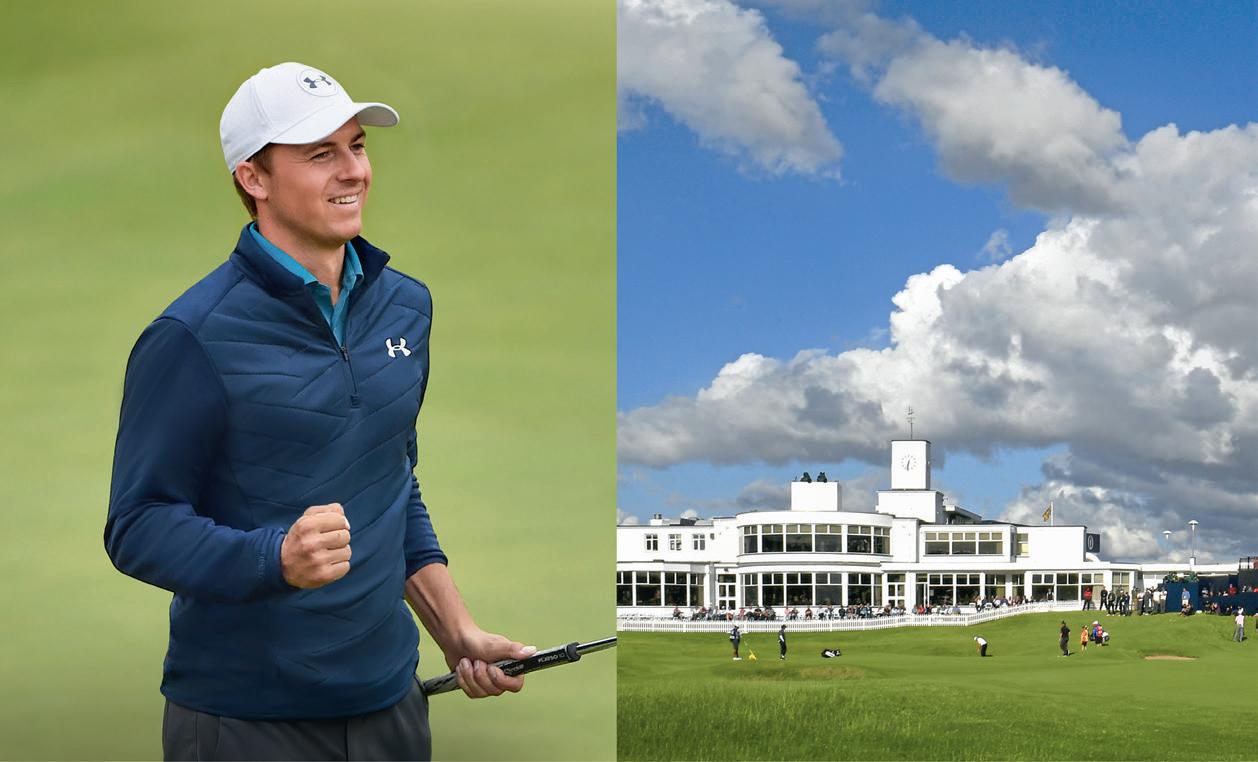
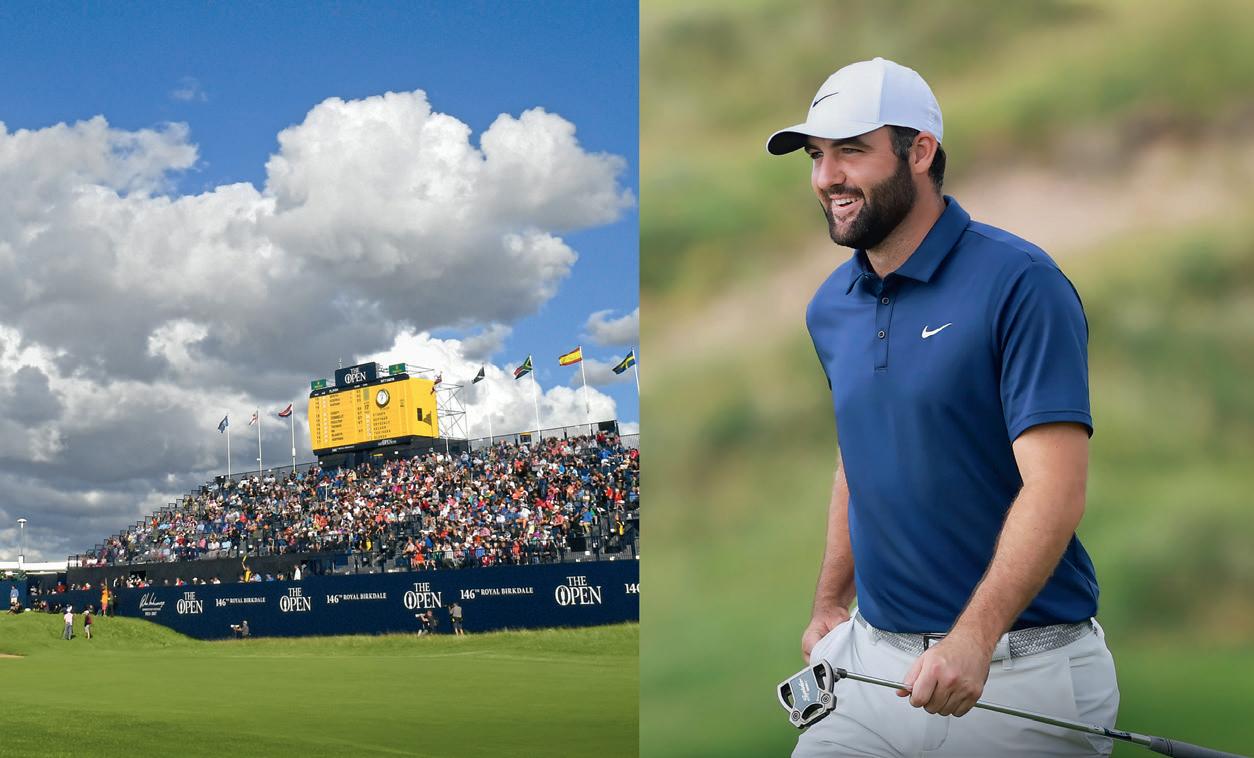



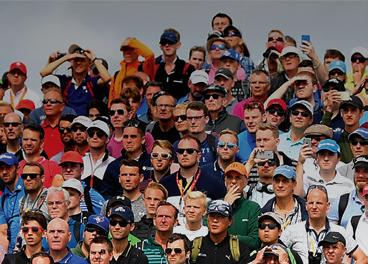
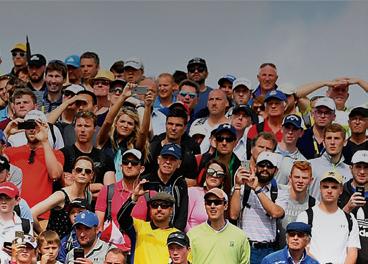
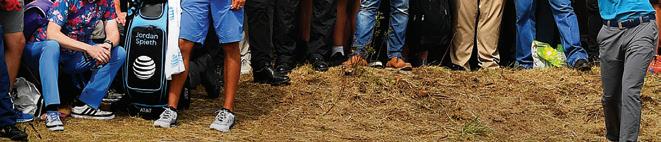
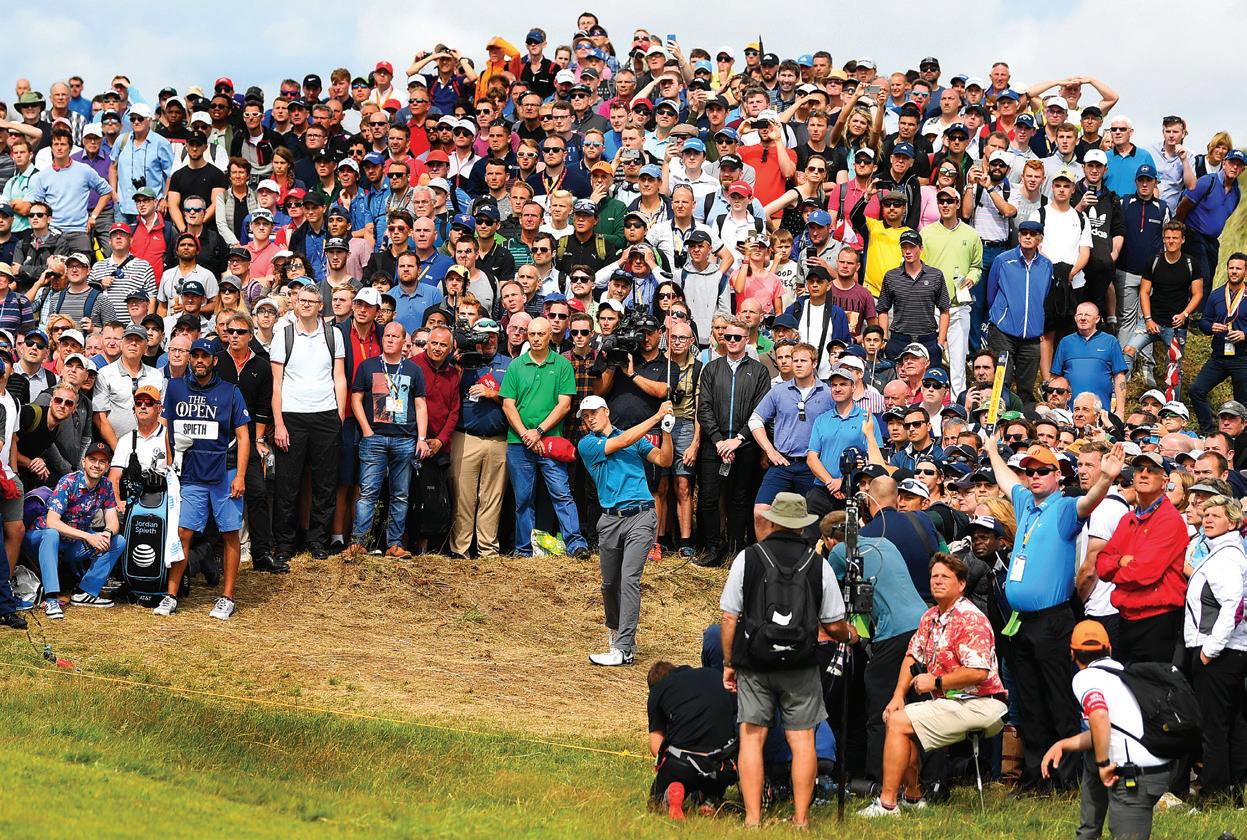
Jordan Spieth’s heroic recovery shots en route to winning the 2017 Open had everyone watching.

6 Chasing Perfection
Complete players, immortal shots and billion-dollar fairways. BY THOMAS WOODGATE
starter
8 Golf at the Georgia Precipice
The Keep offers five cliff-edge holes with 50-mile views.
BY DEREK DUNCAN
10 Journeys
From lockdown obsession to golfing history maker. BY THOMAS WOODGATE
12 The Fringe
Train’s Pat Monahan is always focused on the next hit.
BY ALEX MYERS
14 Paying Dues
How are indoor clubs profiting from the golf boom? BY PAUL SULLIVAN

16 Golf’s Important Skincare Lesson
The phone call that scared Justin Thomas and me. BY JERRY TARDE
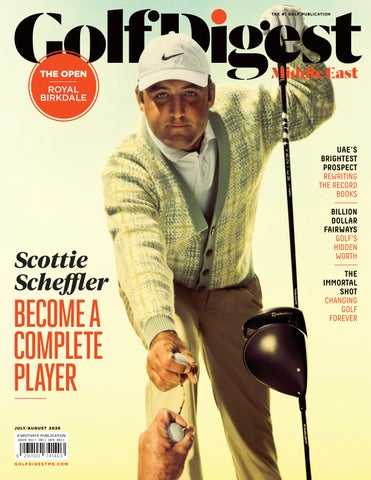
40 A Complete Player Scottie Scheffler’s model for greatness is the best way from now on. BY JAIME DIAZ
50 Bobby Jones and The Immortal Shot
That Almost Never Was Jones’ unlikely Open win, 100 years later.
BY STEVEN REID






58 Protected Green
How much real estate value is locked up in golf? BY STEPHEN HENNESSEY
18 Quality Range Time BY COLLIN MORIKAWA
20 Swing Analysis Jeeno Thitikul. BY DAVE ALLEN
22 Rules Review
Is soling the club in front of the ball illegal? BY RON KASPRISKE
23 Rickie Fowler’s Keys to Avoiding a Three-Jack It’s the little things. BY LUKE KERR-DINEEN
26 Tool Time BY PETER MORRICE
28 Hot List Extra
Looking for new irons? Our testers loved these. BY MIKE STACHURA
30 Robo Report
Why sweeping your woods isn’t always best. BY JONATHAN WALL
32 What’s in My Bag Tommy Fleetwood.
34 Dune Diligence
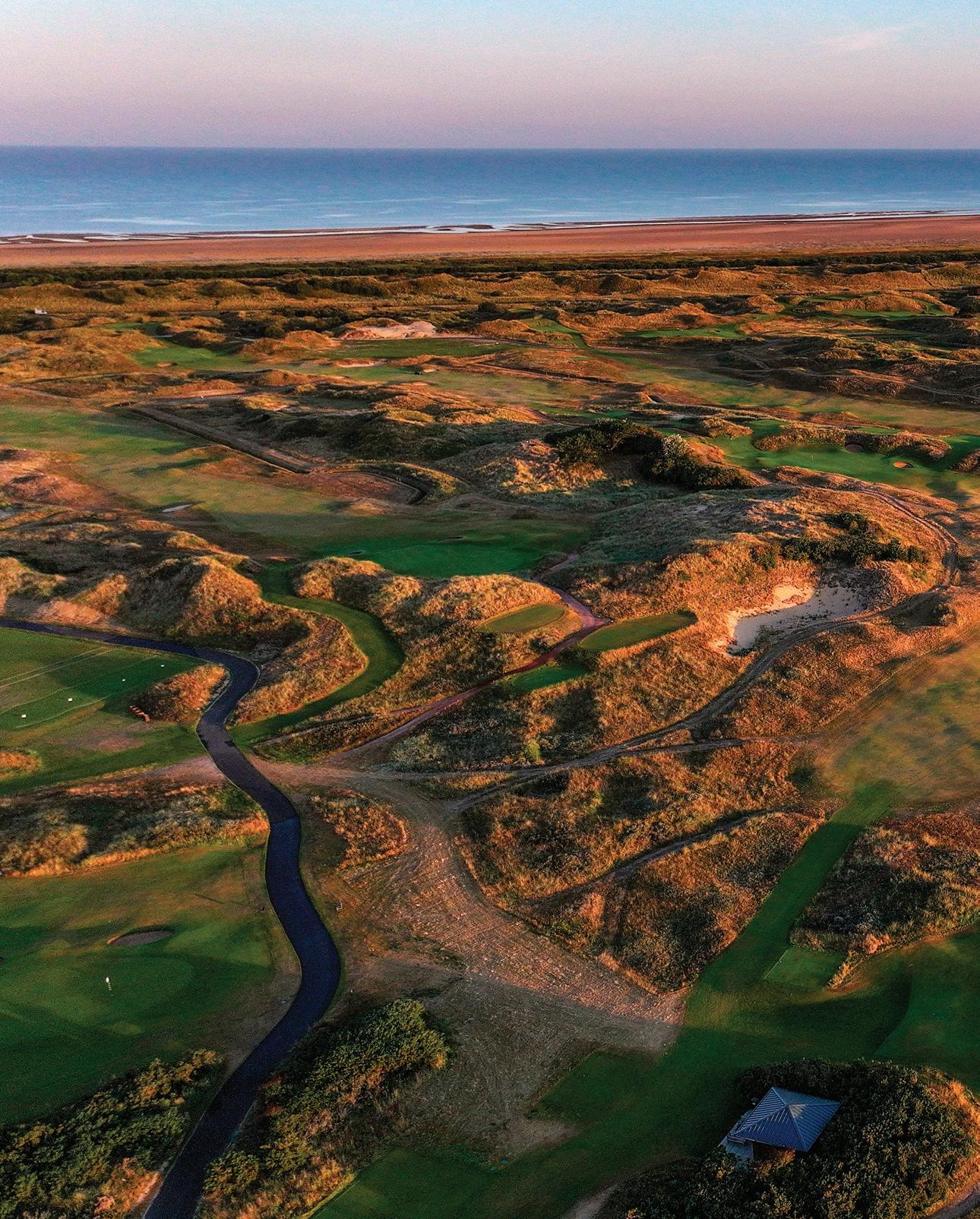
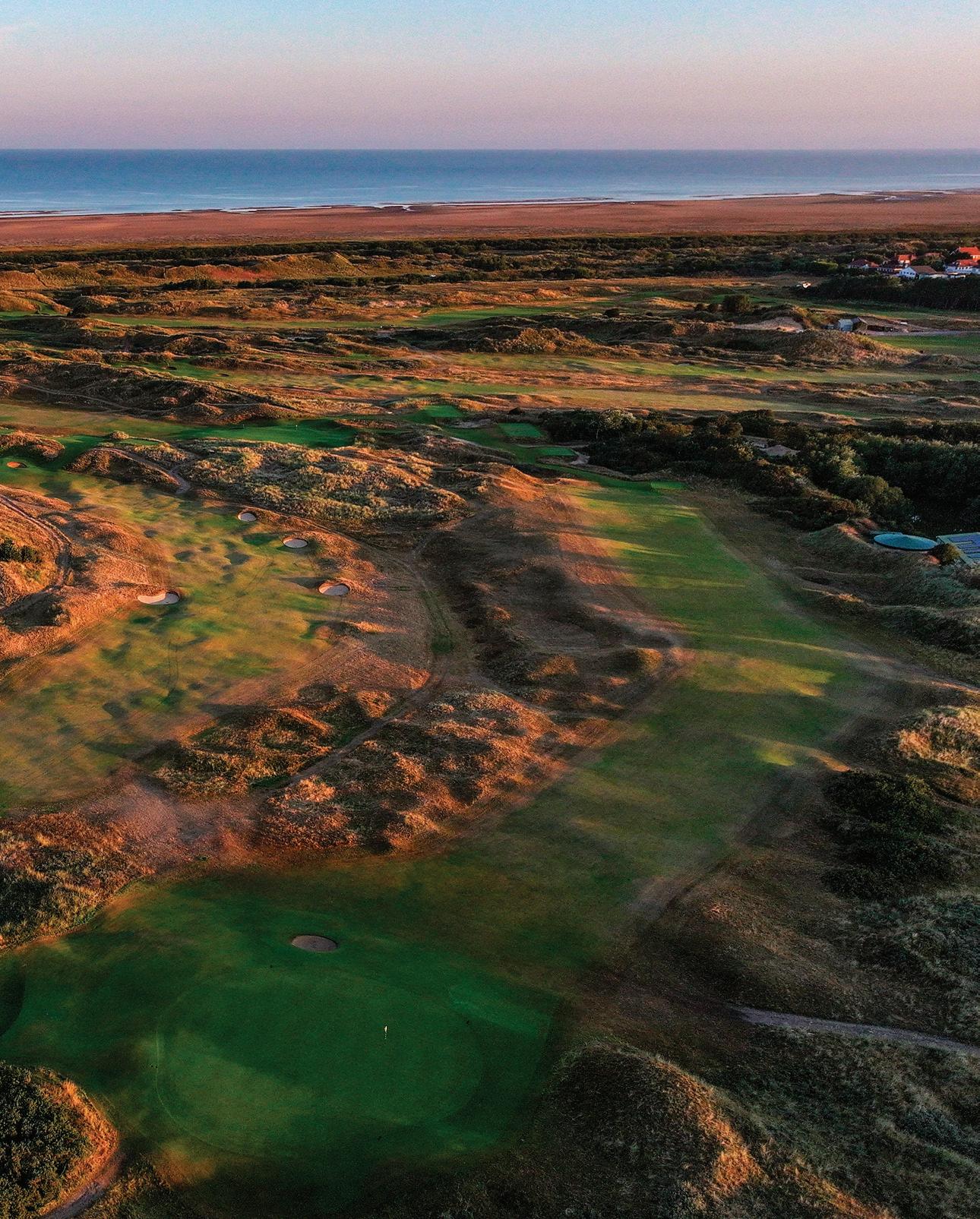
Royal Birkdale, The Open’s most even-handed links, remains one of golf’s truest tests of total command. BY DEREK DUNCAN
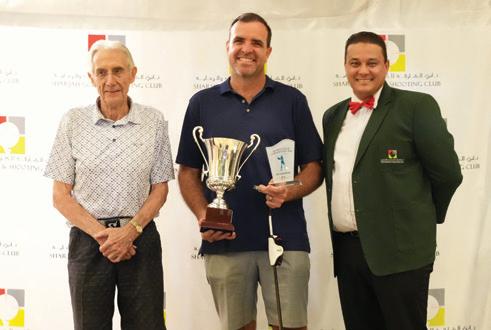
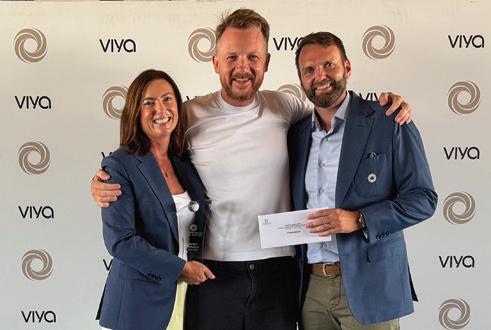
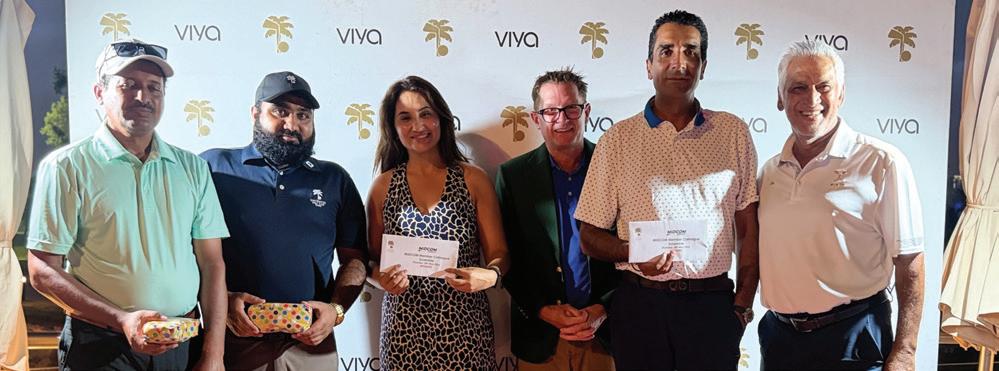
64 Club News
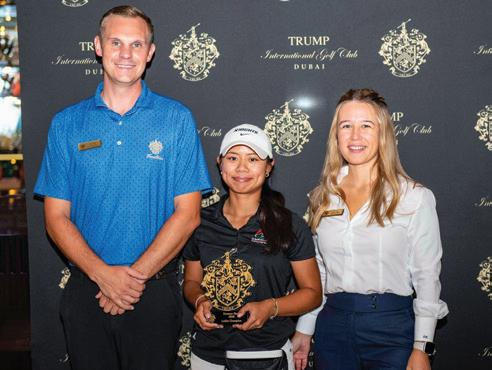
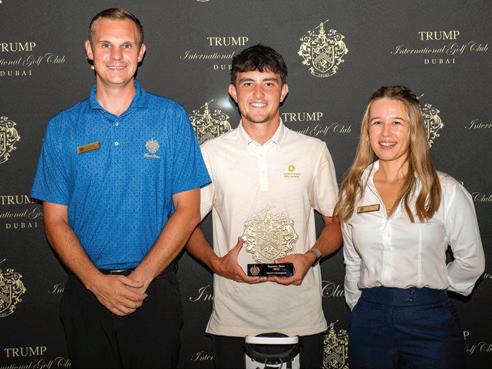
A gallery of just a handful of the local winners in the amateur circuit in the region.















BY THOMAS WOODGATE
This month’s issue of Golf Digest Middle East arrives with perfect timing – The Open Championship at Royal Birkdale as our backdrop, and a magazine built around the biggest questions in the game right now.
We lead with Scottie Scheffler, and rightly so. The cover feature is one of the most thoughtful pieces of golf writing you will read this year – a genuine attempt to place Scheffler in his proper historical context, drawing on the voices of Lee Trevino, Tiger Woods and Nick Faldo to ask whether we are watching the most complete player the game has ever seen. The answer, as Trevino himself puts it, is that Scheffler may have quietly retired everything he ever said on the subject. It is essential reading ahead of Birkdale.
Speaking of which, our Where to Play section offers a hole-by-hole guide to Royal Birkdale itself – a course that’s rightly described as the most even-handed test in the Open rota, and one that will reward straight driving and total command this July. If you are making the trip, read it before you pack your waterproofs.
We also mark a remarkable centennial with an account of Bobby Jones and the immortal shot at Royal Lytham & St Annes that not only won the 1926 Open, but arguably made the Grand Slam of 1930 possible. I will admit this was my personal highlight of the issue – a reminder that golf’s greatest moments are often separated from failure by the thinnest of margins. One hundred
years on, the story loses none of its drama, and I suspect the golf buffs among you will enjoy the history lesson as much as I did.
Elsewhere, there’s a fascinating examination of how much real estate value is locked inside golf’s greatest courses – a thought-provoking read that reframes what these places actually mean beyond the ropes. There’s also an analysis of the swing adjustments helping Jeeno Thitikul chase LPGA history, and our Fringe feature catches up with Train frontman Pat Monahan on the unlikely parallels between life on tour and life on the road.
Finally, we spotlight one of the most exciting young golfers this region has produced – Emirati amateur Rayan Ahmed, whose journey from a Covid lockdown obsession to NCAA Division I scholarship is exactly the kind of story that reminds you why this game gets under your skin and never quite lets go.
Until next month – may your drives find the fairway and your putts find the bottom of the cup.

thomas.woodgate@motivate.ae @golfdigestme
editor-in-chief Obaid Humaid Al Tayer
managing partner & group editor
Ian Fairservice
chief commercial officer
Anthony Milne
group content director
Thomas Woodgate
art director Clarkwin N. Cruz
editorial assistant Londresa Flores
sales manager Abdel Djeebet
general manager - production
S. Sunil Kumar
production manager Binu Purandaran
assistant production manager
Venita Pinto
the golf digest publications
editor-in-chief Jerry Tarde
senior director, business development & partnerships
Greg Chatzinoff
international editor Ju Kuang Tan
golf digest usa
editor-in-chief Jerry Tarde
general manager Chris Reynolds
editorial director Max Adler
executive editor Peter Morrice
managing editors Stephen Hennessey, Ryan Herrington, Jonathan Wall
chief designer David Schlow
playing editors Collin Morikawa, Jordan Spieth
head office
Media One Tower, PO Box 2331, Dubai, UAE Tel: +971 4 427 3000; Fax: +971 4 428 2266
dubai media city
SD 2-94, 2nd Floor, Building 2, Dubai, UAE
Tel: +971 4 390 3550; Fax +971 4 390 4845
Email: motivate@motivate.ae
abu dhabi
14th Floor, Office 1406, Makeen Tower, 9th Street, Al Zahiyah, PO Box 43072, Abu Dhabi, UAE Tel: +971 2 677 2005; Fax: +971 2 657 3401
Email: motivate-adh@motivate.ae
saudi arabia
Regus Offices No. 455 - 456, 4th Floor, Hamad Tower, King Fahad Road, Al Olaya, Riyadh, KSA
Tel: +966 11 834 3595 / +966 11 834 3596
Email: motivate@motivate.ae
london
Motivate Publishing Ltd, Acre House, 11/15 William Road, London, NW1 3ER, UK
Email: motivateuk@motivate.ae
Golf Digest and How to play, what to play, where to play are registered trademarks of Warner Bros. Discovery. Copyright © 2024 Discovery Golf Inc. All rights reserved. Printed in the U.S.A. Published by Warner Bros. Discovery. Principal office: Golf Digest, 230 Park Avenue South, New York, NY, 10003. Warner Bros/Discovery Luis Silberwasser, Chairman & CEO TNT Sports; Gunnar Wiedenfels, Chief Financial Officer. Periodicals postage paid at New York, N.Y., and at additional mailing offices.




























The Keep offers five cliff-edge holes with 50-mile views
WHILE REMODELING the original course at McLemore in northwest Georgia, architects Bill Bergin and Rees Jones located an unused strip of heavily wooded land on the precipice of a cliff that drops several hundred feet. They then crafted it into a new hole that Golf Digest Middle East would list as the best 18th hole built in the U.S. since 2000. The revelation of that jaw-dropping exposure encouraged the ownership group to explore the rest of their holdings for more golf, which led to the development of The Keep, a new Bergin-Jones course one-and-ahalf miles south. Instead of one hole that walks along the clouds, The Keep has five. The rest play through undisturbed inland sections with 50-mile views into north Georgia. Tee times for The Keep are available to guests of the on-site Cloudland at McLemore Resort along with additional stay-and-play packages. –DEREK DUNCAN

WITH THOMAS WOODGATE
Istarted playing golf during Covid , which sounds like an unlikely origin story, but those slow afternoons on the course with my father were what sparked the obsession. I had been playing table tennis and badminton at school, and golf was something the whole family did for fun. But somewhere in that period the bug caught me – and it never let go.
● ● ●
I went from a 24 handicap to scratch in under a year. Looking back, talent helped, but I think the biggest factor was that I simply fell in love with the process of getting better. I became obsessed – practising for hours, watching golf, thinking about golf. My parents spotted that obsession early and actually moved our house right in front of the Montgomerie range, which really fuelled the grind. The biggest thing they gave me, though, was freedom. They never pushed for medals or specific targets. Sport was always about building character. It became my obsession and I was allowed to grow into it at my own pace – I genuinely wouldn’t be here without that.
● ● ●
Rory McIlroy has probably been my biggest professional influence. I studied his swing endlessly when I started, and honestly I still do – his action plays on a loop on the TV at my home academy. But Tiger Woods is a hero in our house, too. As you walk through the front door, you are greeted by a large oil-on-canvas painting of a young Tiger fist-pumping. Watching him win the 2019 Masters was simply out of this world.
● ● ●
The summer of 2024 was a real stamp of approval on my ambitions. Competing at the U.S. Junior Amateur at Oakland Hills as the first Emirati to do so, then earning medalist honours in the final qualifier to secure my place at the U.S. Amateur at Hazeltine — it made me feel that I had arrived, that I belong, that I can com-
pete at the highest level. And speaking of Woods — it was honestly surreal practising right next to Charlie and Tiger on the range. My father couldn't stop telling everyone that his son had beaten Tiger’s son.
● ● ●
I joined the national team in 2023 after winning the EGF Junior Order of Merit, and my world changed overnight. Suddenly I was competing against the likes of Gordon Sargent and Nick Dunlap at the World Amateur Team Championships in Abu Dhabi. From there, the Emirates Golf Federation opened every door — international tournaments, world-class facilities, and a coaching team including Faycal Serghini and Matthew Brookes. I genuinely would not be where I am today without the EGF and the vision of our President, General Abdullah Al Hashmi.
● ● ●
I have achieved a string of historic firsts for UAE golf, but I try not to think too much about the firsts while competing. What I feel instead, every single time, is pride and responsibility. When I walk into an event and see the UAE flag flying amongst all the others, knowing it is there because I am representing my country – that motivates me to give everything. Pressure honestly doesn’t feature at all.
● ● ●
The mental side of the game is probably where I have developed the most. I naturally have a quiet demeanour and people often see me as mildmannered, but behind that quietness I am fighting extremely hard. In the past I
could be tough on myself – what should have been a bogey sometimes became a triple. Alongside my swing coach Liam James, I also work with Sensei Majid, a kickboxer who has helped me become comfortable in difficult situations. At The Amateur Championship at Royal Liverpool recently, my swing was completely out of sync and I made some serious errors – yet I didn’t beat myself up. I took detailed notes and went straight back to work on the range.
● ● ●
A year ago, when I won at 14-under at the Tommy Fleetwood AJGA event at Earth Course, I was actually losing nearly three strokes a day through putting. Ironically, putting – especially pace control – is now probably my secret weapon. With all the speed training I have done in the gym, my club speed is also up to 116 mph and growing. When everything is in sync, I can be an extremely accurate driver of the ball too.
● ● ●
Winning both the Men’s and Junior Order of Merit titles in the Emirates Golf Federation’s 2026 season feels like the perfect sign-off as I prepare to head to UC Irvine in the fall – becoming the first UAE National to secure a full NCAA Division I golf scholarship. I intend to major in Business and Economics, and from a golf perspective, Coach Paul Smolinski runs an excellent programme. The UAE national team structure and all the international travel it involves has made me resilient and genuinely ready for that next chapter.
●
I have the humility to understand just how difficult it is to reach the very top of this game. But that understanding is only matched by my desire to get there. I am aiming for the stars. Nothing less.
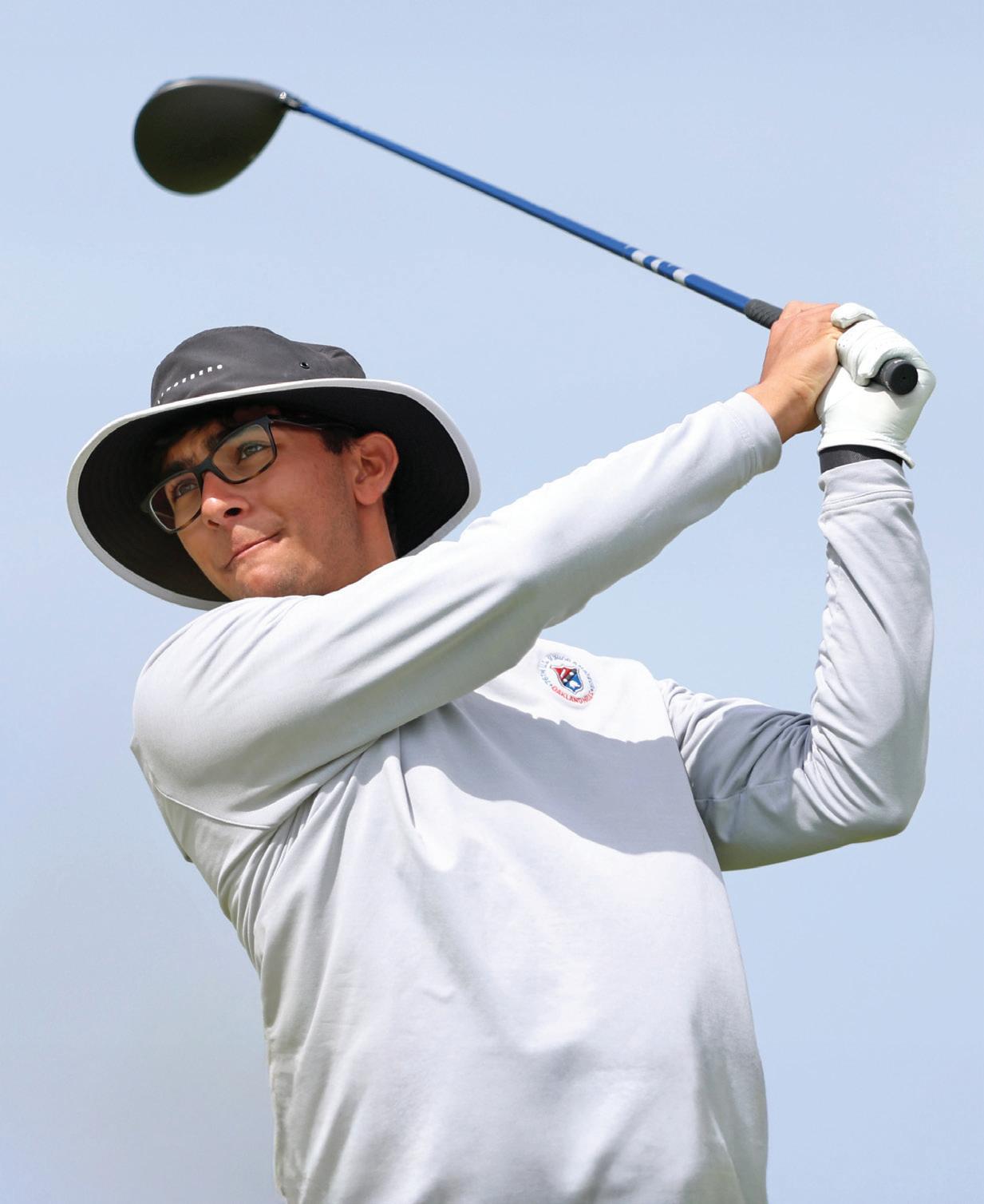
RAYAN AHMED
EMIRATES GOLF FEDERATION
AGE: 19
TURNED PROFESSIONAL: STILL AMATEUR
NATIONALITY: EMIRATI



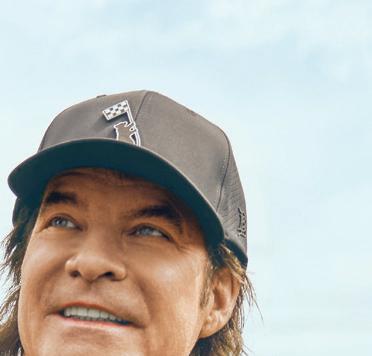
In golf and rock ’n’ roll, Train frontman Pat Monahan knows you’re only as good as your last
BY ALEX MYERS
AS THE FRONTMAN OF A BAND t hat has sold more than 10 million albums, Pat Monahan has performed on stages all around the world. But as a golfer, a few smaller gigs stand out. The Train lead singer didn’t buy a set of clubs until he was in his 40s and just dabbled in the game when he booked a private event in San Francisco 11 years ago that wound up changing his life.
“It was for two of my very dear friends now that I didn’t even know at the time, but they found out through my agent that I played golf, and so they invited me to San Francisco Golf Club,” Monahan, 57, recalls. “When I got there, I met the people I was gonna play with and many other people, and I was like, ‘These are my people.’ Because of how



positive that experience was, I was like, ‘Now I have to really learn how to play the game.’”
A few years later, now fully into his golf obsession, Monahan was given the chance to perform at another event with a golf angle, Tiger Jam. Monahan had performed at Tiger Woods’ annual Vegas fundraiser before and initially declined when another band backed out at the last minute—before he received a unique offer from non other than the golf legend himself.
JOT THAT DOWN
When Monahan finds musical inspiration on the course, he’ll sing into his phone.
“I had just come back from Europe and Australia, and I was like, ‘I’m not going anywhere,’ and my agent said, ‘Tiger will give you






practicing his game that he picked up from playing with Jake Knapp.
“I’m into it now,” Monahan says. “Instead of playing nine holes, I’ll just go work on my game for 90 minutes because it’s the only chance of me ever getting from a six to a three.” He has been ingraining a narrower stance that has allowed him to get the club back farther and finish his swing better.
There’s not a ton of time for golf with a busy summer on tap. Train has a new studio album, “Mad Dog in the Fog,” coming out in August and a 39city tour celebrating the 25th anniversary of their iconic “Drops of Jupiter,” which resulted in the band’s first two Grammy Awards. Monahan, who is also the co-writer of a new musical, “Begin Again,” set to debut later this year, will bring his clubs on the road as always. The band will also travel with a semi-trailer with equipment for workouts on show days.
a thing in music as well,” Monahan says. “Nobody cares about, Hey, that’s the guy who wrote ‘Drops of Jupiter.’ It’s like, What about now? What do you got? I try to stay competitive in that.”
His competitive side comes out when he plays in celebrity tournaments or in club events at Aldarra. When asked for a golf highlight, he points to a Presidents Cup match a few years back when he hit two great shots on the par-5 seventh hole and then converted a clutch eagle putt from six feet after the opposing two-ball team chipped in for birdie.
“ Beating those two guys on that hole was one of the best things I’ve ever done,” Monahan says with a grin. “If you met these guys, you’d be like, ‘I’m so glad you won.’”
Most of his rounds are much more friendly. A few years ago, Monahan was jealous of the camaraderie he saw at San Francisco Golf Club when a friend challenged him to do something about it at his home club.

an hour-long golf lesson if you do it,’” Monahan says. Monahan quickly changed his mind: “I’ll be there in 15 minutes!” he replied. Woods helped Monahan with some swing tips on the range before taking a look at his putting stroke. “I just loved it. We had some lunch, and then he’s like, ‘See you tonight.’ It was really cool,” Monahan recalls.
Monahan, who lives in the Seattle area, has taken many more golf lessons since, most recently with twotime PGA Tour winner Rick Fehr after a disappointing performance in his seventh appearance playing in the AT&T Pebble Beach Pro-Am. “It was so frustrating that I didn’t understand it,” says Monahan, who has a 7 handicap at Aldarra Golf Club in Washington. He discovered a new appreciation for
“You can have a great drive, nobody cares,” Monahan says. “What are you gonna do with it? That’s a thing in music as well.”
“I’m not in really good shape right now, but I will be by the third week of July,” Monahan says. “Golf’s my fun time.” Just as golf is a lifelong sport, Monahan views his music career in the same light.
“I’m a long-distance runner more than a sprinter, and we’ve never been the biggest band in the world,” says Monahan of the group that formed in 1993 in San Francisco and of which he’s the only remaining original member. “But I was like, ‘We’re gonna outlast all of them.’ That was always the goal.”
Monahan says that scrappy attitude carries over to the course as well, and he appreciates the game’s ability to keep him hungry and humble. “You can have a great drive, nobody cares. What are you gonna do with it? That’s
“So I went there, and I was determined to meet as many people as possible, so they know me and I know them,” Monahan says. “I try to mix it up as much as I can. I just think it makes me better as a person and as a player.”
The game certainly hasn’t hurt him as a musician. Monahan famously penned “Drops of Jupiter” in 15 minutes a quarter century ago after waking from a dream about his recently deceased mother returning from a spiritual journey through the galaxy. When he suddenly gets a burst of inspiration while on the course, he’ll sneak off and sing something into his phone to record it for later.
If there was a Venn diagram of people who have both written a song and performed with Taylor Swift as well as taken a golf lesson from Tiger Woods, we’re pretty sure Pat’s name would be the only one on there. While he hasn’t gotten to “sail across the sun or make it to the Milky Way,” some golfers may argue that playing places like Pebble, Pine Valley and Augusta National qualify as similar experiences.
“ I’m living a pretty cool existence,” Monahan says.


BY PAUL SULLIVAN

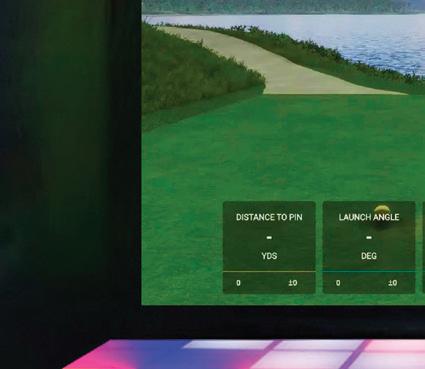
THE TOAD VALLEY GOLF Course in Pleasant Hill, Iowa, made a radical change when it recently closed its pro shop and converted the space to an indoor golf facility. Gone were shirts, sweaters and assorted swag, and in were simulators. If you need balls or a glove, there’s now a vending machine.
The most profitable way to utilise an indoor golf space depends on the expected clientele, of course. Allison George, who operates the family-
owned and public Toad Valley, has seen that the booking of simulators by the hour consistently yields more money than an hour of pro shop sales.
“The renting of the bays is a very high-margin business once you establish what your fixed costs are,” says Jay Karen, chief executive officer of the National Golf Course Owners Association, of which George is a board member. “Before [simulators], owners could only yield more from the tee sheet, which was weather dependent. If demand was flat, that was hard.”
Although indoor golf is booming, it is a tale of two simulators. Some facilities are for grinders, like Toad Valley and a growing number of standalone indoor operations. Other facilities are for events—beer, wings, music and game-ified golf that is fun and especially appealing to those newly interested in the game but not exactly ideal prep for the club championship. To be successful, operators need to know which they are—an event space or a practice facility.
“I took a call from someone who wants to do both well,” says Jimmy Vukanovich, a plus-1 handicap and owner of the Indoor Golf Club, which has three locations in New Jersey. “I said, ‘I don’t think you can do that. Five Iron Golf is always going to do events better than you, and I’m going to do avid golfers better than you.’”
The number of people using simulators in the United States has more than doubled in the past decade, from 3.8 million in 2015 to 8.1 million in 2024, according to a National Golf Foundation report. Sixty-one percent of golf course operators consider simulators a worthwhile investment. The NGF puts the average construction cost to install a bay at $45,000, but the price can go way up. Golfzon, which has movable floor-plate technology and a system that tees up the ball for you, spends closer to $100,000 per bay.
While knowing which type of space you want to be is the start, owners need to keep other variables in mind.
Vukanovich, a Stanford business school graduate who has qualified for various New Jersey state championships, offered three steps to success.
The first is finding a building where the bays can be set up to give grinders more space and privacy to work on their games, which likely means fewer bays than at an event venue.
The second is knowing how many memberships a location can support. In addition to the basics of revenue offsetting rent (which is often the largest nut for these venues), electricity and any financing costs for the simulators, the numbers owners need to focus on most
and Scholz, who worked in financial services and real estate, respectively, and understood the numbers. The buildout, they say, was straightforward. They installed seven TrackMan bays and 3,500 square feet of shortgame turf from Back Nine Greens. Their pricing model is an annual membership at $250 a month. The permits from the city lagged but fortunately, were rubber stamped by mid-December, so they were able to open just in time for the snow.
To be successful, operators need to know which they are— an event space or a practice facility.
are in the demographics of the area. Are there enough golfers with desire and disposable income to make the space work as a golf-first venue?
“Affluent, good population density, and heavy golf population are the three must-haves,” says Todd Becker, who opened the 1868 Golf Club in Stamford, Conn., with his business partner Jamie Scholz. By his calculations, their niche of lower Fairfield County has about 25,000 affluent golfers and two dozen golf clubs within close driving distance.
To meet demand where it is, Vukanovich has three tiers of monthly dues to manage the actual usage: for $135, you get two hours; for $250, you get unlimited weekdays or weekends plus two hours in your non-primary window; and for $400, you get unlimited everything. Non-members pay $75 an hour from 8 a.m. to 9 p.m., and only members are allowed after 9 p.m. “I don’t want them to become event spaces,” Vukanovich says.
The third step: Make sure the facility is open for the first winter season when people want to keep their games going. While these businesses are meant to be year-round, that first indoor season is critical to get people sold on the concept.
That rush to open before winter was something that really drove Becker
Becker says the business was profitable after its first two months and has now sold about 60 percent of its memberships. One of its biggest cohorts comes from a nearby public course with a two-story driving range.
“Their range is hot, crowded, and the ball quality is not great,” Becker says. “Our experience on the TrackMan is way more engaging.”
The big difference between these practice-first clubs and event-first venues like Five Iron Golf and Golfzon is the revenue support from food and beverage. “[Ours] is a bar and restaurant business that runs on golf simulators,” says James McDonald, chief customer officer at Golfzon America.
In this second category, the NGF estimates the average spend of a simulator session is $55 for the simulator and $40 for the food and beverage.
“Where our customers are succeeding, they run it like a bowling alley,” McDonald says. Golfzon owns 10 facilities in the U.S. and has some 300 franchises. “They have weekday leagues, and then they’re open on the weekend to people who want to just come by.”
Where franchises fail, the operators lose focus on the hospitality part.
“Those restaurant hours aren’t for everyone,” McDonald says. “If your focus isn’t on the hospitality and you think that part will be easy, that’s where you’re going to struggle.”
Golfzon is also making inroads into the private-membership model, with a separate product called Golfzon Range. “These facilities are no food, and the beverages are nonalcoholic,” McDonald says. “It’s come in and practice.”
Then wait until you get home to grab that beer.
BY JERRY TARDE
F
ive years ago, i had a small brown spot appear on my face that I didn’t notice, but my daughter Lauren did. It looked like nothing, but I was due for my annual dermatology exam anyway, so I went to my local doctor, Jason McBean of Fairfield, Conn., who did a routine inspection of my whole body. He paused on my left cheek. “Need to do a biopsy of this,” he said in his normal monotone. A few days later, I got a call with the bad news: It was melanoma, the most serious and aggressive form of skin cancer.
Golfers in their 60s who have spent years in the sun like I did should not be surprised by a diagnosis of basal or squamous cell carcinoma. It usually can be dealt with by an outpatient procedure removing the tumor in thin layers and immediately examining the results under a microscope. It’s typically found on the exposed areas of the body like your head, ears, shoulders and legs. You endure a little pain but walk out of the office cured.
About 230,000 Americans are diagnosed annually with melanoma, split almost evenly between noninvasive and invasive (penetrating the deeper layers of the skin). If it’s superficial, you have 99 percent chance of survival; if it spreads to the lymph nodes, it’s about 76 percent; if it spreads to distant organs, the number drops to about 35 percent, according to the American Melanoma Foundation. In a lifetime of being lucky, mine was caught early and turned out to be Stage 0 or in situ, meaning remaining in the top layer.
the New York area. He arranged three quick surgeries in a little over a month— the first removing a portion of my cheek that was about the size of a 50-cent piece. Further testing resulted in a second procedure that removed about a silver dollar. For a short period of gauze wrapping, I resembled Humphrey Bogart in “Dark Passage.” This was followed by plastic surgery to reconstruct my face, which sounds worse than it was, only my skin had to be dragged up from my neck, and I’m now left with a handsome little scar. Six-month checkups have followed, and so far there has been no recurrence.
In the way only golf connects us with the medical profession, I occasionally play with Dr. Phil Ozuah, who is known among friends as “Nitro” for his explosive power off the tee. He is also the president and CEO of Montefiore Medicine, one of the great health institutions in
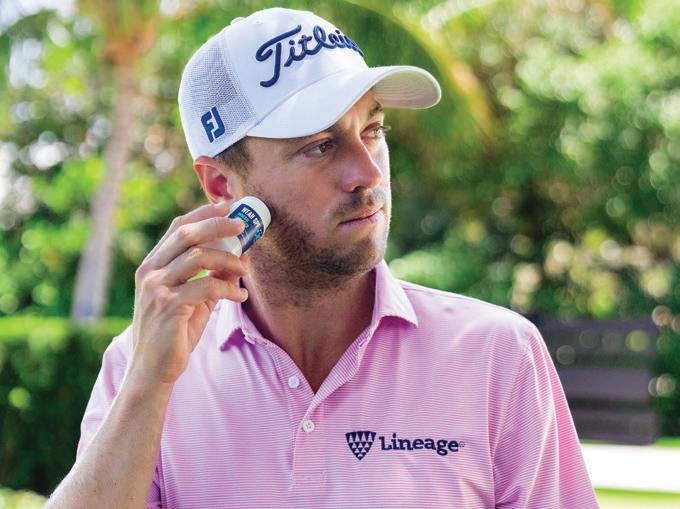
SPF 50, PLEASE Justin Thomas has become an advocate for checkups since overcoming a skin cancer scare at 26.
My advice is to follow the ABCDE of skin cancer detection: The warning signs of melanoma are moles that are Asymmetric with uneven Borders, multiple Colors, larger than a pencil eraser in Diameter, and Evolving in size or shape. Golfers are susceptible to skin cancer. Fred Couples, Greg Norman, Davis Love III, Tom Kite, Gary Player, Stewart Cink and Adam Scott have all reported scares. In the early 1990s, when Retief Goosen was still in his 20s, he found a lump near his collarbone that was diagnosed as melanoma spread to his lymph nodes. His physicians told him it could have been fatal without the successful surgery he had before winning two U.S. Opens.
Justin Thomas, on his yearly check-up in 2019, discovered that the mole on the back of his left calf required a biopsy. He still remembers getting a call from his doctor at 9 p.m. telling him it was melanoma, “an eye-opening thing to hear for a 26-year-old, a scary moment in my life,” says Thomas, now 33 and healthy. “I didn’t think it happened to people my age. My doctor shaved off the mole, leaving a three- or four-inch scar the shape of a football on my leg, and no further treatment was required. The more I read, the more I realised how extremely lucky I was.” Thomas signed an endorsement deal with WearSPF and became a spokesman for awareness. He advocates using 50 SPF sunscreen lotion, paying close attention to any changing moles, and getting annual checkups with a dermatologist.
Skin cancer doesn’t care about your age or handicap. You need to take this lesson seriously.












• O icial EGF Handicap (GHIN), recognised worldwide
• Discounted green fees at all UAE golf clubs
• Play in events/competitions and receive awards
• Third party and property damage golfer’s insurance

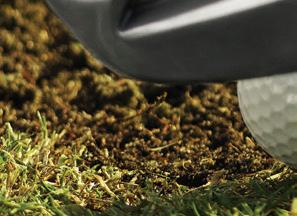
“When I was a junior golfer, my coach, Rick Sessinghaus, would have me hit a shot, and after I did, he would toss another ball down and ask me to hit it to the same spot—but in a different way. That type of practice taught me how to be creative and adapt much easier to whatever scenarios I encounter during a round. It might be a 70-yard slice that you need once a year to get around a tree or a low-trajectory shot with a lob wedge. Constantly switch clubs and give yourself new problems to solve. When you teach yourself how to work something out, you’ll remember it forever.”
—COLLIN MORIKAWA


EDITED BY RON KASPRISKE






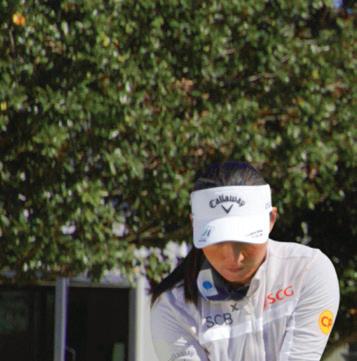
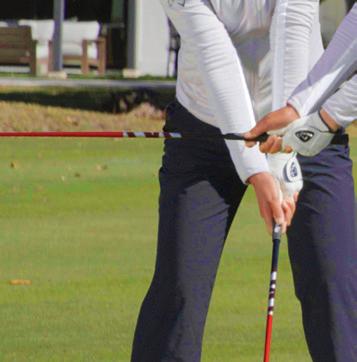
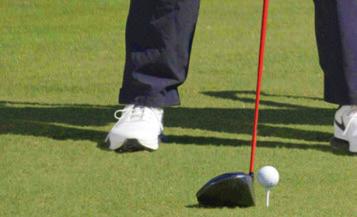
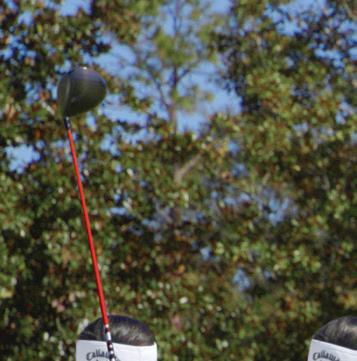
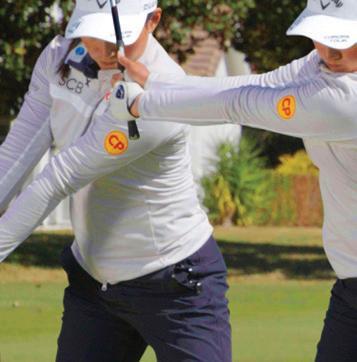
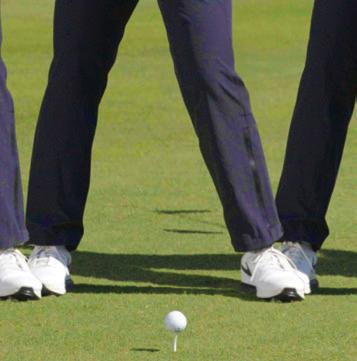
The LPGA’s all-time best scorer might turn a swing adjustment into even more birdies in 2026
BY DAVE ALLEN
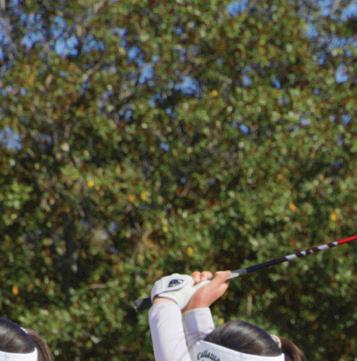

LAST SEASON WAS historic for Thai golfer Jeeno Thitikul. Besides reclaiming the No. 1 spot in the Rolex Women’s World Golf Ranking, she recorded the lowest scoring average in LPGA Tour history (68.68), eclipsing Annika Sorenstam’s mark (68.69) from 2002.
What can Thitikul do for an encore?
Considering all the 23-year-old former LPGA Rookie of the Year accomplished last year without dominating off the tee, there’s optimism she can go lower.
“I want her to gain more speed through the ball with the upper body,” says her

swing coach of almost nine years, Kris Assawapimonporn, of the ASA Golf Academy in Bangkok, Thailand. “Once she does that, she’ll be able to hit the ball farther. When everything works perfectly and her upper body matches her lower body, she can carry the ball six or seven more yards off the tee.”
Those yardage gains would have Thitikul—currently averaging 265.2 yards off the tee—inside the top 30 in driving distance on tour, helping her to attack more flags and giving her even more birdie opportunities.
To accomplish this, Thitikul will
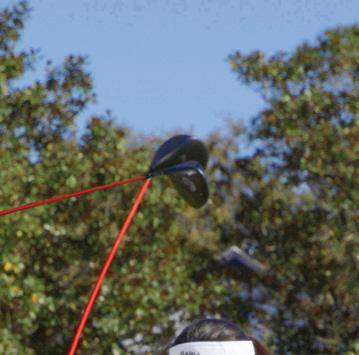
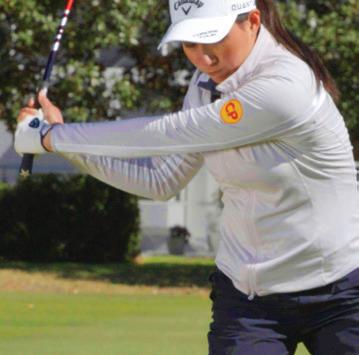
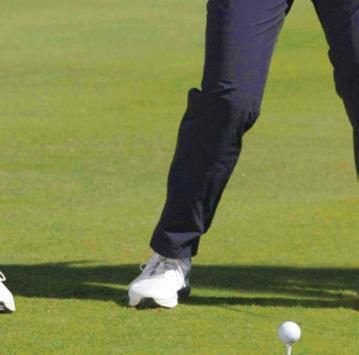
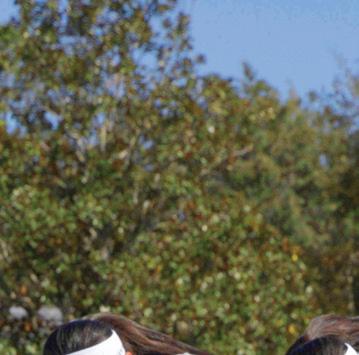
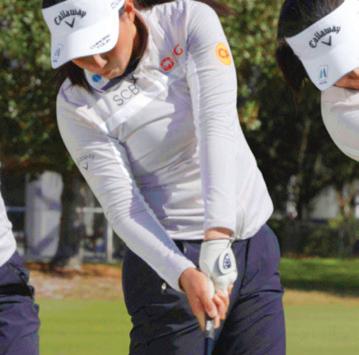
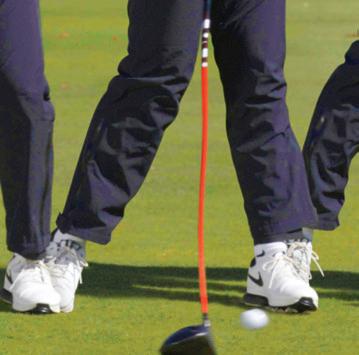
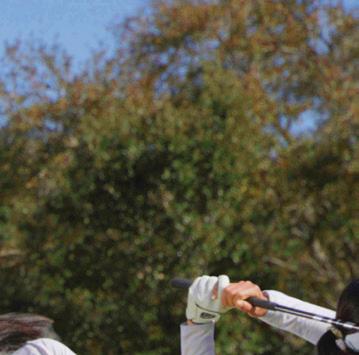
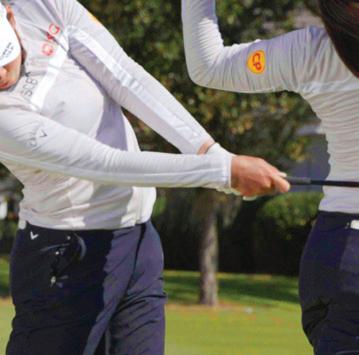
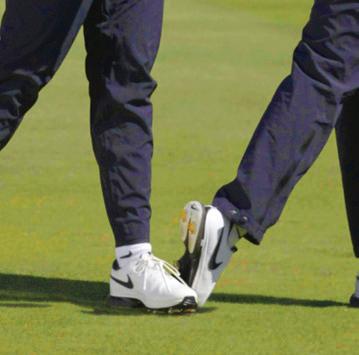
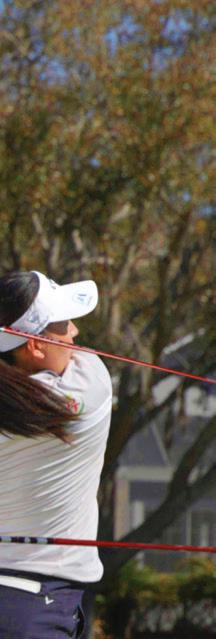
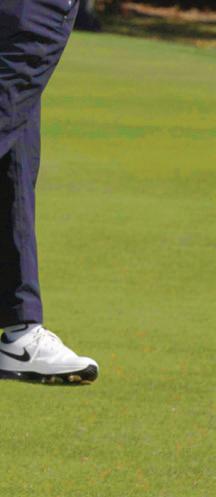
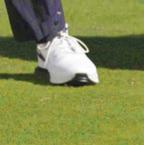
need to eliminate the right miss off the tee. Her tendency is to pull her hands and club down too much during the first part of the downswing, Assawapimonporn says. As a result, she doesn’t have enough room to swing the club down in front of her, causing her to extend her hips early (toward the ball) and leave the clubface open.
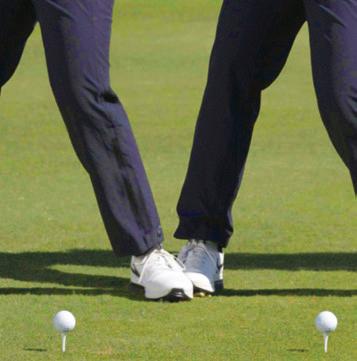
To fix this fault, known as early extension, they worked last season on keeping her pelvis back while she rotates, so she can clear her hips more efficiently on the downswing. However, she got so good at rotating her hips that
SYNCING IT UP Thitikul has been trying to get her upper and lower body to work better together.
“her upper body could no longer keep pace with them,” her coach says.
This year, the emphasis has been on getting her upper body to catch up and match her lower body in the downswing. The key, Assawapimonporn says, is getting her right arm to “extend earlier on the downswing so that it’s straighter at impact (above, sixth frame).” At times, her trail arm stays bent for too long, he says, which causes the right shoulder
to drop and the upper body to lag so far behind that the clubface can’t release.
The feeling Thitikul uses to help get that release is to feel like she’s hitting the front-left quadrant of the ball.
“You want to feel like you’re chopping the wood where the ball is,” he says. “That’s when you have the most extension and maximum speed at the ball. The right shoulder stays up, and the right arm extends even more.”
When Thitikul does that and stays tall, her upper body has an easier time keeping pace with her hips—providing more power to the strike.
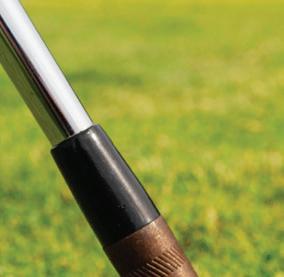
What about aiming the club before addressing the ball? What you need to know on both topics
BY RON KASPRISKE

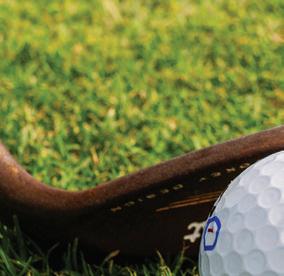
ONE OF GOLF’S OLDEST tricks (cheats?) is to sole a club behind the ball in the rough and then “decide” to use another club to hit the shot. The initial club’s weight makes the grass sit down, which in turn gives the replacement club a cleaner path into the ball.
Purposely pushing down the grass is a violation of Rule 8.1 (improving conditions affecting the stroke), but you might wonder how that rule applies to golfers who rest their club on the ground in front of the ball before moving it behind the ball to swing. Some golfers do that as a way of getting aligned with their target (setting the putter down in front of the ball, for example). Does that act improve conditions aff ecting the next stroke? Seems like it might, but here’s what the Rules of Golf says about it:
Rule 8.1b(4) explains that it’s OK to ground the club lightly directly in front of or behind the ball. “Lightly” means allowing the weight of the club to be supported by the grass, soil, sand or other material on or above the
NICE AND EASY
It’s OK to lightly ground your club, but don’t apply more pressure.
surface. “Supported” is the key word here. Pressing the club down would be a violation.
This rule came into focus at the 2024 Arnold Palmer Invitational. TV cameras showed Wyndham Clark settling his club down into the rough to play an approach at the 18th hole during the third round. The broadcast team and TV analysts wondered if he pushed down a little too hard and should have been penalised. Clark was exonerated by PGA Tour rules officials, but not until they reviewed the incident with him and his playing partner that day, Scottie Scheffler.
One other thing to remember about this rule is that if you do improve the conditions affecting your next stroke but then decide to play a different type of shot that would not have been improved by your actions—such as chipping instead of putting—you would still be penalised under Rule 8.1 unless you can restore the conditions. Another uncommon alignment practice is to set a clubhead down behind the ball on the target line before taking your stance. You might wonder how this plays into the idea of using a golf club or another object for aiming purposes. The answer: There is no penalty if you do that. This was clarified in the rule book in 2025 and is differentiated from setting an object down for the purpose of aiming or taking a stance, which is a violation of Rule 10.2b(3). “Setting an object down” doesn’t mean resting the clubhead on the ground if you’re still holding it, the book says.
Rather, setting an object down means that it’s in contact with the ground but the player is not holding it . For example, if you lay another club down next to your ball (or anything for that matter) to help you get aligned as you are about to hit, you would be assessed the general penalty (two strokes or loss of hole in match play). It’s also worth remembering that you’re still penalised even if you remove the object before hitting.


It’s the little things
BY LUKE KERR-DINEEN


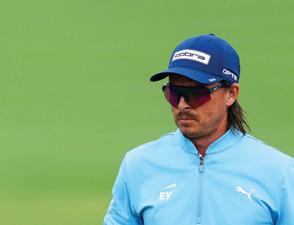
IF YOU WANT TO STOP three-putting as much as possible this golf season, you’d do well to pay attention to Rickie Fowler’s habits around the greens. He led the PGA Tour in 2025 in threeputt avoidance (1.4 percent), and his average leave on a first-putt miss was just two feet. Through mid-April this season, he was ninth in avoidance (1.4 percent again). It shouldn’t come as a huge surprise—he’s been an elite putter for most of his career. Here are some reasons why:
1. HE HOVERS THE PUTTER ABOVE THE GROUND
Moments before he starts his stroke, Fowler raises the putter a bit. The sixtime PGA Tour winner says it relieves













tension in his fingers and forearms by forcing him to hold the putter lighter than if it was resting on the green. It also prevents the putterhead from getting stuck in the grass as he begins the backstroke.
2. HE USES DIFFERENT GRIPS
Fowler has used a left-hand-low grip for short-range putts and a conventional grip for longer ones. He says left-hand low aligns his forearms and reduces wrist hinge, making the clubface more stable, which matters a lot in keeping a short putt on line. For longer putts, the conventional grip encourages more wrist hinge, helping foster better speed control and easier second putts.
3. HE ALMOST ALWAYS GETS IT TO THE HOLE
Fowler says he sticks with the same goal on medium-to-long putts—leave the ball two feet past the hole if he misses. He works backward from that spot in determining what speed to hit the putt.
4. HE FOCUSES ON A SPOT BEHIND THE BALL
Keeping his eyes quiet and head still is important to making sure the put-

STARE IT DOWN
A steady head is key to solid contact, which leads to good speed control.
terface stays square to the intended line at impact, he says. However, Fowler doesn’t lock his eyes onto the ball. Instead, he focuses on a spot behind the ball. It makes sense: Unlike the ball, that spot isn’t going to move, so it helps him keep his head still and prevents peeking. Give it a try to see if it leads to fewer three-jacks.




Don’t blow a golden opportunity when you could toss it on BY
MAUREEN FARRELL


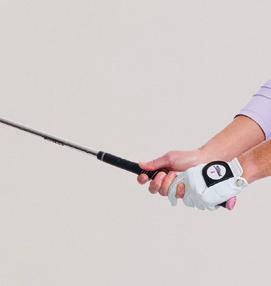
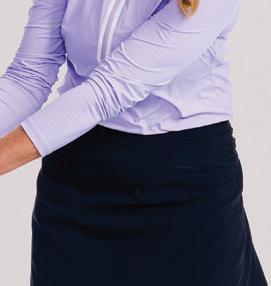



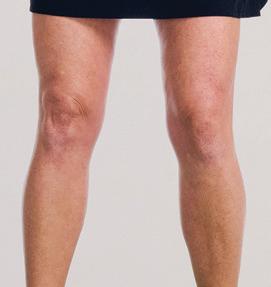

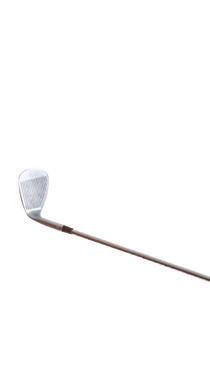
ANY TIME YOU’RE CLOSE enough to the green that you can’t make a full swing without airmailing it, you might not be sure what to do. Do you swing slower? Do you swing shorter? Do you try to fly the ball higher? If you find yourself in this awkward position, you’re in what is commonly called “half-wedge” territory, a general term for any spot that calls for a lessthan-full swing. Here’s how to regulate the distance. —WITH RON KASPRISKE
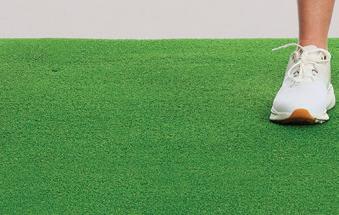
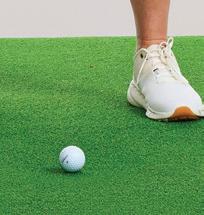


STEP ONE: FAVOUR YOUR FRONT SIDE
• Play the ball in the middle of your stance.
• Be sure your nose is in front of the ball (closer to the target).
• As you start back, make sure your head stays in place (above).
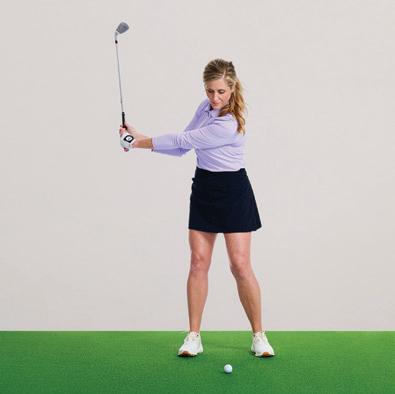
STEP TWO: KEEP YOUR BACKSWING COMPACT
• Take the club back with your torso rotation, not your hands.
• Allow your wrists to hinge the club up as you rotate.
• Create an “L” shape with your arms and club as you go back (left).
• Stop the backswing when your lead arm is roughly chest high.






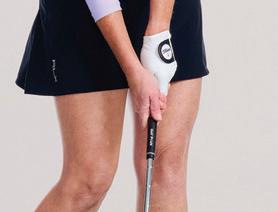




STEP FOUR: MIRROR YOUR BACKSWING AT THE FINISH
• Let your hands and arms swing past your body.
• Keep turning your hips and shoulders through.
• Allow the club to rehinge into a backward “L” shape at the finish (right).
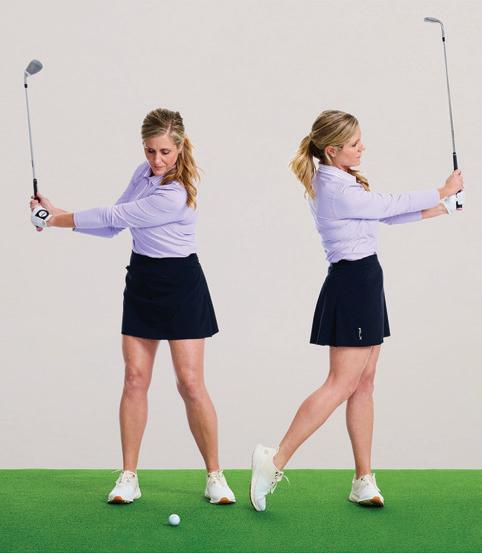
STEP THREE: USE BODY ROTATION TO HIT THE SHOT
• Resist the urge to make an arms-only swing.
• Keep your body turning toward the target.
• Smoothly accelerate the club down into the ball (left).
• Make sure your weight stays forward for crisp contact.

STEP FIVE: DRILL: RESTRICT YOUR BACKSWING
• Wrap a resistance band around your torso and hands.
• Swing back, feeling your arm swing pulling your body.
• Use the tension from the band to make a wide, compact swing (above).
• Notice how the band keeps you from overswinging.
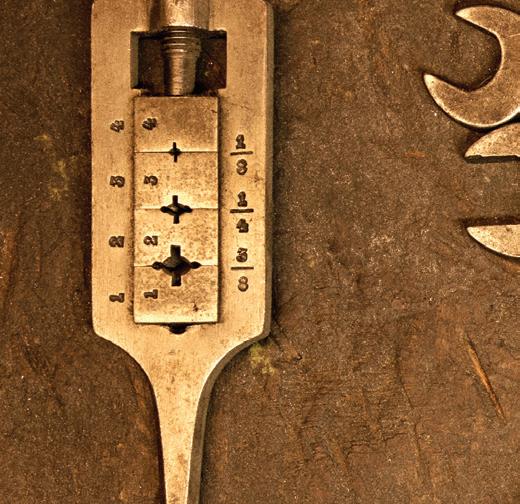
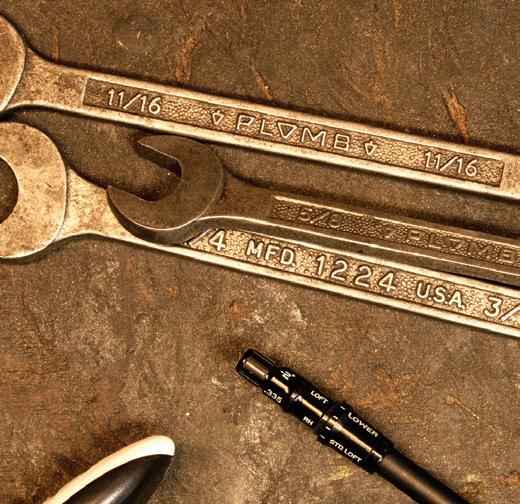
EDITED BY PETER MORRICE
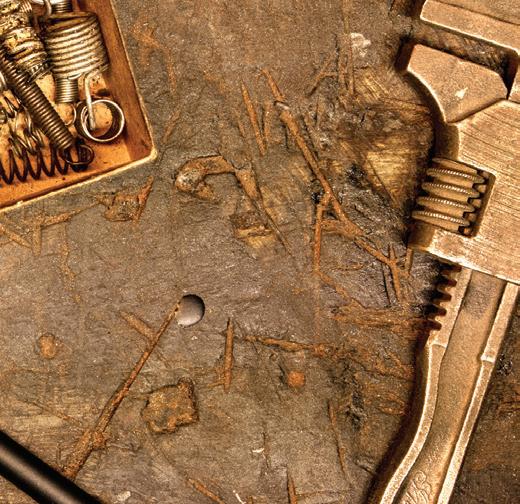
If you’re like most of us, you’re thinking, It’s mid-season, and my game is stuck in neutral again. Maybe that’s putting it mildly. At times like these we resort to desperate measures, like a swing overhaul, couples therapy with your member-guest partner or a frantic search for a new driver. We advise something simpler: Find that wrench that came with your driver. Outside of your lucky 1965 quarter, it’s the most important thing in your bag. Adjusting lie, loft, face angle and any movable weights isn’t window dressing. It can fundamentally change your tee shots. Our testing has shown as much as a 25-yard ball flight improvement from a few clubhead tweaks. By all means, work on your swing, but the fastest fix might be a twist of the wrist.







Blending good looks and high performance, Players-Distance irons are finding their way into many average golfers’ bags
BY MIKE STACHURA
W HEN THE HOT LIST
started more than two decades ago, there was one category of irons. Now there are four. The equipment industry continues to delineate player types based on preferred head shapes and sizes and, most importantly, how certain designs might enhance your skills or mask your flaws. With all those changes, it’s the newest iron category that is both the hottest and the one offering the most enticing promises.
Long story short: Players-Distance irons might provide the best of all worlds for the majority of players still searching for better iron play.
First, let’s look at a little history. The Players-Distance category really emerged a decade ago with Callaway’s multipiece Apex irons, but there were even earlier inklings of this bridge-like iron between the one-piece, cavity-back Players irons that exuded precision and the wider-soled, oversize GameImprovement irons that promised distance and forgiveness. Farther back, irons like the Mizuno MP-H4 and even the Callaway Big Bertha Fusion irons of 20 years ago suggested that distance, forgiveness and precision could live together in the same package. Over the last decade, it has been stalwarts
like TaylorMade’s P·790, the Titleist T200 and now T250 irons, Ping’s i500 series, PXG’s 0311 P and others joining every year to make Players-Distance irons the most intriguing type of iron in the game. It became its own category in the Hot List in 2018.
HAVING IT ALL PlayersDistance irons offer looks, forgiveness and speed.
Players-Distance irons offer two key characteristics that make them appealing to a broad swath of avid golfers: relatively compact shapes mixed with distance-enhancing face inserts made of super-thin high-strength steel or even titanium alloys. Throw in some heavy tungsten perimeter weighting that sits low in the clubhead, and the end result is an iron that can do it all— distance, trajectory control, forgiveness (in physics, it’s called high moment of inertia, or MOI) and feel. It all comes in a package that fits a better player’s eye while making an average golfer walk a little taller to the first tee. Indeed, one of
the early successes of the category, the P·790, had sales that covered an almost bizarrely wide range. According to company research, the level of players who purchased the original P·790 irons included nearly a third with handicaps less than 8 but also 25 percent with handicaps over 12.
Perhaps the most exciting aspect of Players-Distance irons is that second word in the name. Because thinner face inserts are a separate piece from the rest of the body, which is sometimes also hollow, engineers have gotten those faces to flex much the same way they do on a driver. Even those low-on-theface impacts that are so common with an iron feature extra rebound because the faces wrap around the leading edge, or slots in the sole get the entire face to give more at impact.
Any iron can be made more forgiving by stretching its size. The appeal of a Players-Distance iron is that its size is relatively compact and still provides the off-center forgiveness of a larger design, according to Titleist’s Chuck Golden, senior vice president of club research and development. He explained that you can have a greater effect on forgiveness by pursuing MOI in an iron, noting that a couple yards on a 7-iron mis-hit can be the difference between hitting the green and going in the water. That kind of improvement with the driver might be a fraction of a yard, which is imperceptible on a tee shot.
“If you can get away with maximising the moment of inertia as much as possible within a pleasing shape, that’s a hill worth dying on,” Golden said.
In terms of raw data collected at the Hot List, Players-Distance irons proved even more impressive. Our testers saw a nearly 10-yard distance advantage over Players irons. Compared to irons in the Game-Improvement category, Players-Distance irons flew the ball nearly half a club farther on average. They also reached a higher apex.

In short, Players-Distance irons likely will give you all the iron game you need. In fact, our players liked the versatility of these clubs throughout the entire set. Said one tester, “The look is super sleek, super elegant, super thin. They make you feel confident and aggressive. I wouldn’t mind staying hours and hours on the range with these.”


ROBERT SHAW, 28 +2-handicap
Titleist T250

Our testers scored Players-Distance irons higher than any other iron category. Here’s a look at a few of their favorites:
SKYLAR FRANKIEWICZ, 28 7-handicap


TOM ALLEN, 61 7-handicap

WESLEY GILMORE, 31 +3-handicap
TaylorMade P•790

Callaway Apex Ti Fusion


hands of real golfers at the Hot List. Our
All of those theories make sense, but more compelling is what happens when we put Players-Distance irons in the hands of real golfers at the Hot List. Our testers found Players-Distance irons to feel nearly identical to traditionally soft and solid Players irons while providing better feel than Game-Improvement types. They found Players-Distance irons to launch just as high and to be considerably more forgiving than the Players irons. Compared to GameImprovement irons, Players-Distance irons launched just as high and were equally as forgiving.


“A very simple design that sits well behind the ball at address. Noticeably higher ball flight without being too spinny, which I enjoyed, especially in the longer clubs where I’m able to hit them into a par-5 green and stop it fairly quickly.”





Mizuno Mizuno Pro M-15
“Absolutely electric. You can work the ball any which way. Like, if you wanted to go a mile straight, take a right, then a left, then another right, it can be done. Plus, these look rich and very classy.”





“I can throw anything at it, and it was just going high and straight every time. The turf never bothered it. The clubhead just plowed right through it. Super easy to hit. Pitching wedge, 7-iron, 5-iron, they were all down the middle and long.”









“They look pretty intimidating, but they play like a gameimprovement iron. Very easy to get the ball up in the air, fast through the turf, and I was able to hit them high or low, from the pitching wedge on up.”








































Our latest robot test reveals how attack angle affects distance in the longer clubs
BY JONATHAN WALL
IT’S A SWING TIP THAT HAS been h anded down through generations: Sweep your woods off the turf. Don’t take a divot, don’t hit down, just let the club work through impact on a shallow arc and trust the loft on the clubface to do the work.
It sounds reasonable. It’s also, according to data from recent robot testing we conducted with Golf Laboratories in San Diego, more nuanced than that. For most of the clubs we tested, from fairway woods to long irons, getting a little steeper is worth trying.
More than any other spot in the bag, the gap between your driver and longest iron remains a mystery. Most golfers patch it with whatever club came in their set or take a recommendation on faith and move on. Few golfers really know what those clubs are doing at impact, like how the ball is launching,






how much it’s spinning, or whether the attack angle they’ve grooved over years of practice is helping or hurting them.
For this test, we used Ping’s most recent fairway woods (G440), hybrids (G440), utility iron (iDi) and long iron (G440) on the swing robot at two different swing speeds (85 and 95 miles per hour). We also tested two attack angles (neutral—or level to the ground—and 3 degrees downward) to determine how clubhead delivery at impact affects launch, spin and carry.
Our most dramatic finding belongs to the higher-lofted fairway woods. The 9-wood spun at 6,300 rpm with a neutral attack angle—a spin rate that sounds reasonable for a club designed to launch it high and stop it fast. When we moved to a descending blow, the spin rate dropped to 5,835 rpm and carry distance jumped about seven yards
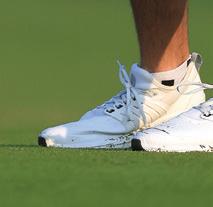


TAKING TURF Viktor Hovland hits down on his 7-wood, even makes a little divot.
at 95 mph and four yards at 85 mph. (See chart on the next page for full results.) These numbers establish a baseline for fairway woods. When you hit down on the ball with a high-lofted fairway wood, spin drops and distance goes up. (One caveat: Lowering spin might flatten a shot’s landing angle, which could affect its ability to hold the green.)
The 5-wood tells a similar story. With a downward strike, nearly 700 rpm of spin came off at 95 mph, with an increase of almost six yards of carry. Less spin on a club already launching high means the ball will stop climbing earlier and carry farther instead of peaking. Again, the physics make sense.
What’s interesting is the 7-wood only saw modest carry gains of roughly two

yards at both speeds, with spin dropping meaningfully at 85 mph but holding relatively flat at 95 mph. It benefits from the steeper angle, just less dramatically than the 9- or 5-wood.
The 3-wood is the outlier, and it’s an important one. Unlike its higher-lofted stablemates, the 3-wood actually lost carry with a steeper attack angle— down two yards at 95 mph and six yards at 85 mph. At 15 degrees, this club is already running lower spin numbers (3,928 rpm at 95 mph with a neutral delivery) and a flatter, more efficient ball flight. There’s simply less high spin to correct. Forcing a descending blow here drops the launch angle without a proportional spin benefit, and carry suffers as a result. The advice to sweep is actually good for the 3-wood.
Interestingly, the hybrids were split. The 5-hybrid gained about six yards of carry at 95 mph with the steeper angle of attack, with spin dropping more than 400 rpm—a meaningful response that mirrors what the higher-lofted fairway woods showed. The 3-hybrid was much
When we moved to a descending blow [with the 9-wood], the spin rate dropped . . . and carry distance jumped about seven yards.
less affected: a marginal carry gain at 95 mph but a slight loss at 85 mph. This tracks with what we know about hybrids: Because of the geometry of the head, they tend to spin less than fairway woods of similar loft. It makes sense that getting steeper helped the higherlofted one more, given that its spin numbers started higher.
With the irons, the story shifts again. The iDi 3 utility iron was largely indifferent to attack angle—barely a yard of carry gain at 95 mph and a slight loss at 85 mph, even as spin dropped notably at slower speeds. Like with the lowerlofted hybrid, the weighting in the head
is surely at play here. The G440 4-iron, a game-improvement design built for players who want forgiveness and don’t mind playing a larger profile, was actually the biggest carry beneficiary at 85 mph with more than a five-yard boost from a steeper blow. That’s a meaningful number for moderate-speed players, driven by spin dropping more than 400 rpm without much loss of launch angle. For slower swingers who carry a gameimprovement iron, a slightly more descending strike is worth pursuing.
Clearly, this topic is more nuanced than a single swing tip. The 3-wood wants to be swept. The 5- and 9-woods— and less so the 7-wood—reward a descending blow. The 5-hybrid benefits from getting steeper; the 3-hybrid not so much. The G440 4-iron at moderate speed responds to a little steepness, but the utility iron is just as good at neutral.
The slot between the driver and irons requires some thinking. Set makeup is critical, and now our data confirms that attack angle can affect how each club performs. Choose—and swing—wisely.
YARDS GAINED OR LOST BY GOING FROM A LEVEL STRIKE (0 DEGREES) TO 3 DEGREES DOWN 95 MPH SWING 85 MPH SWING
9-WOOD
5-WOOD 7-WOOD
5-HYBRID
4-IRON (STANDARD)
3-IRON (UTILITY)
3-HYBRID
3-WOOD
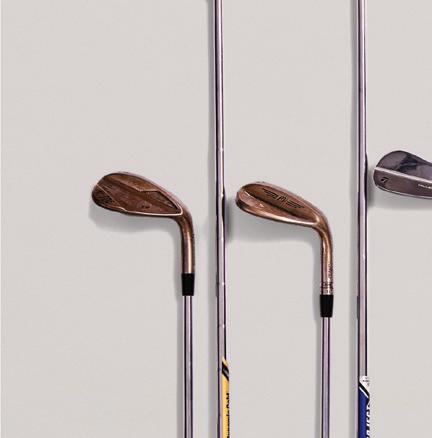
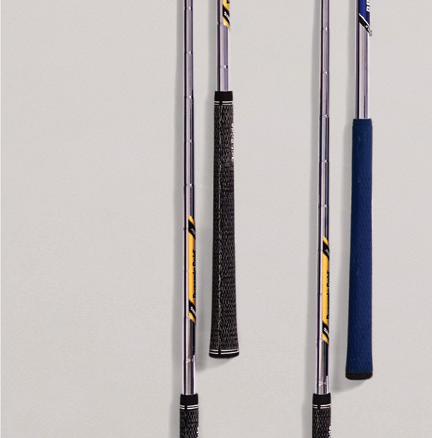
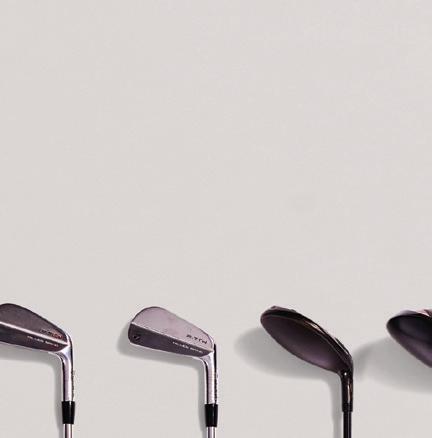
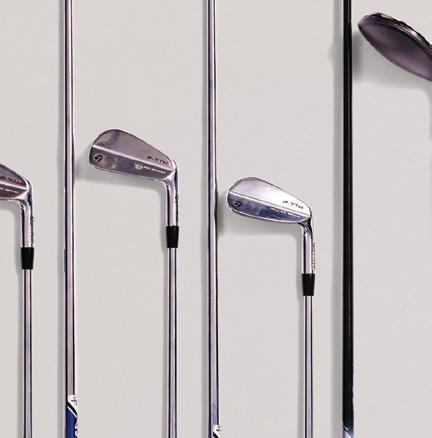


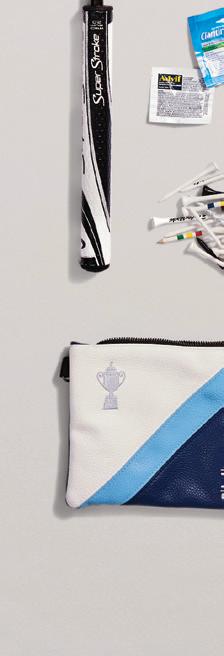

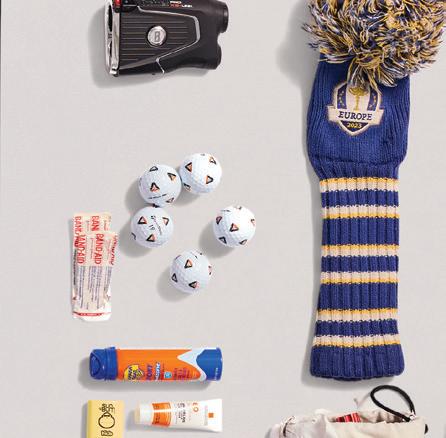
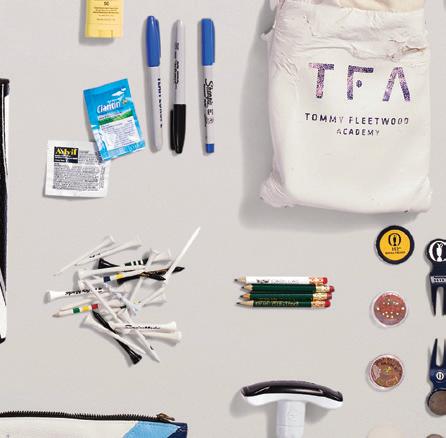
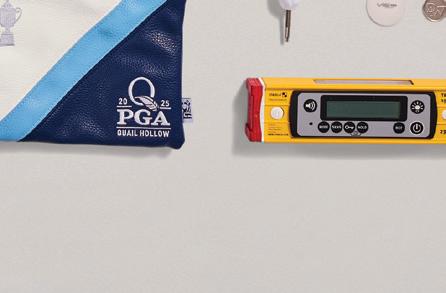
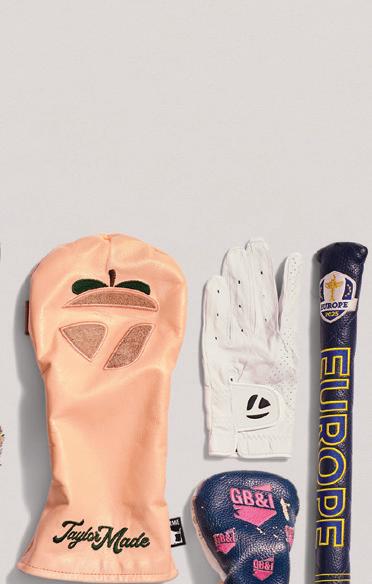


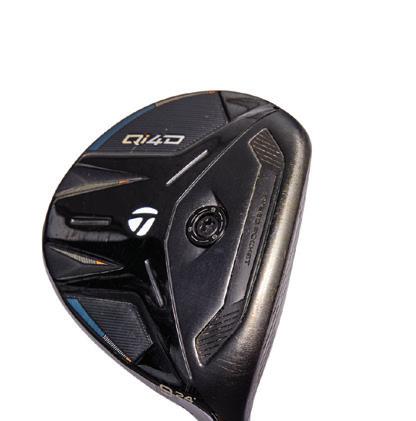

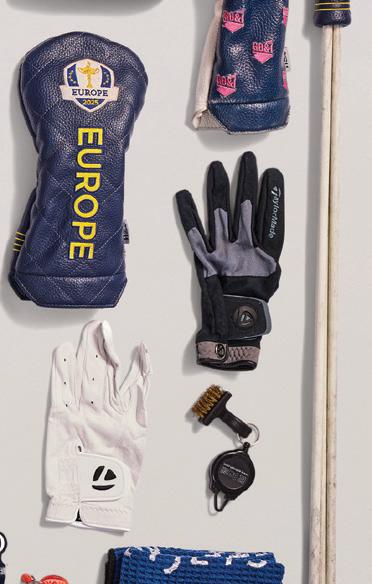
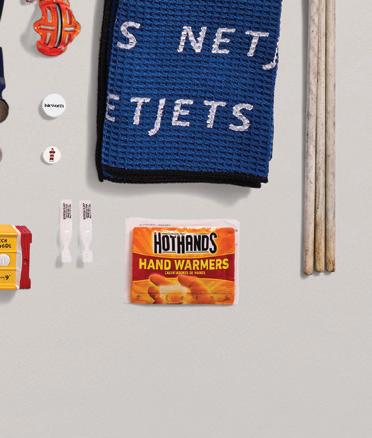
HE’S GOT A CLUB FOR THAT
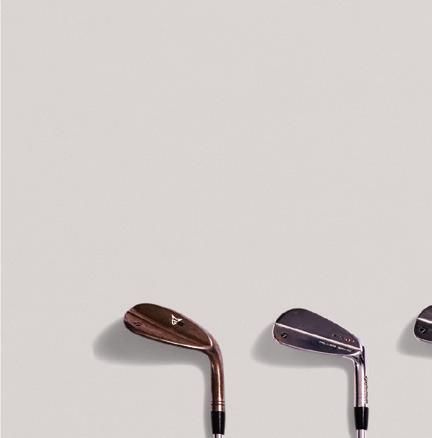
Fleetwood first put a 9-wood in play at the Players Championship in 2023. The reason was a 25yard gap between his 4-iron and 5-wood. He prefers hitting woods over hybrids, and this 24-degree TaylorMade Qi4D 9-wood fills that hole in his bag nicely.

ARTSY SIDE
The whimsical TaylorMade TP5 Pix ball has been his gamer for five years. It helps him with alignment—
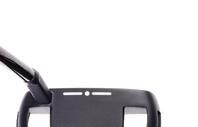
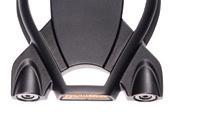
LOCKING A LOOK
Fleetwood went from handdrawn lines on his TaylorMade Spider Tour Black to a sight dot flanked by two dashes.
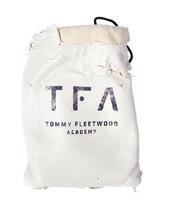
FOR THE FUTURE Fleetwood’s academy teaches juniors the game, including discipline and etiquette, keeping it fun so that kids stick with it.

These mementos remind him that winning the claret jug has been a goal since he was a kid growing up in England.
Royal Birkdale, The Open’s most even-handed links, remains one of golf’s truest tests of total command
BY DEREK DUNCAN
EDITED BY STEPHEN HENNESSEY
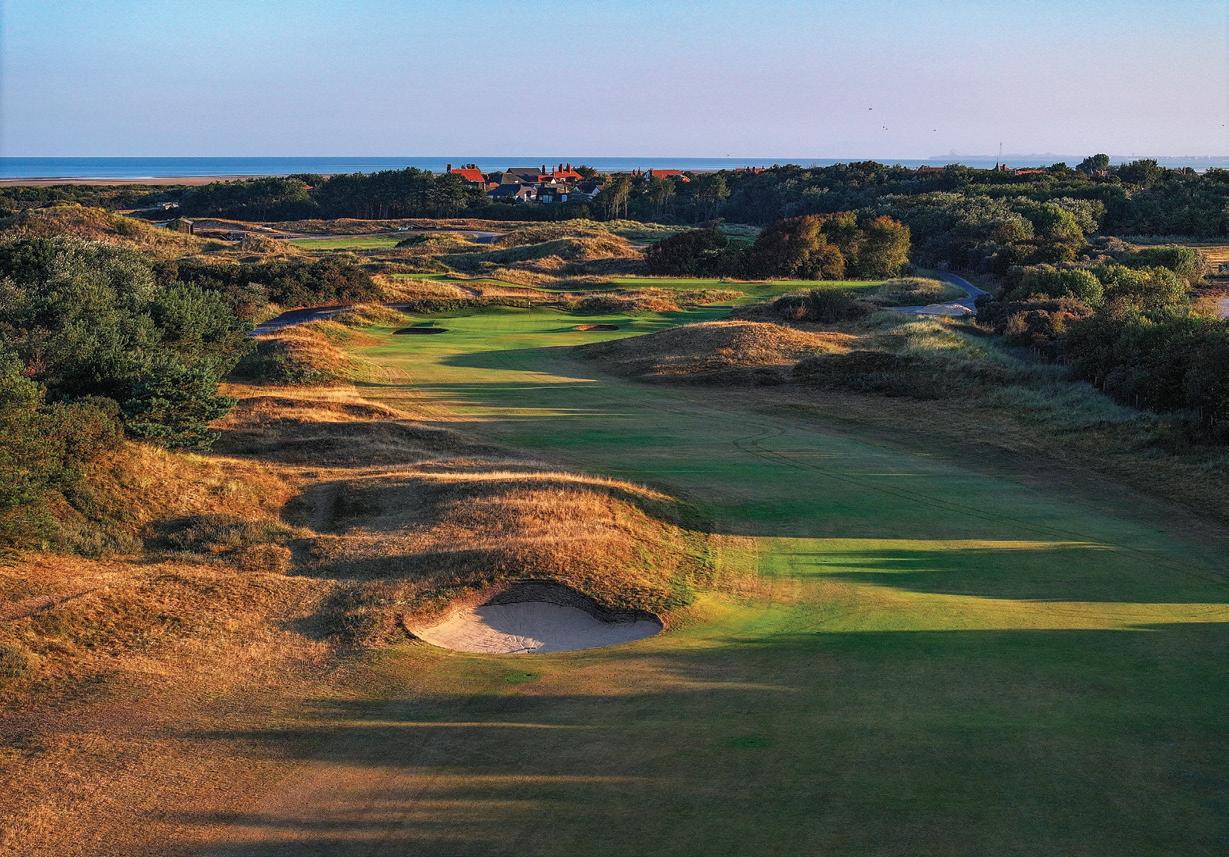
OF THE 10 LINKS COURSES THAT CURRENTLY HOST THE OPEN Championship, Royal Birkdale is often described as the most “fair.” The dunes of the Birkdale Hills site near Southport on the west coast of England are among the tallest and most rugged in the rota. The golf holes are set in between valleys, streaming like smooth water over the low points and making for placid footing among the turbulent surroundings.
There’s very little quirk at Birkdale and less of the random bounce and unpredictability intrinsic to other links. The flat lies and absence of blindness make it a favourite competition site for professional and high amateur play. What you see is usually what you get, and the design consistently rewards straight driving and acute distance control.
The club dates to 1889, but the Birkdale course played today is the product of a major 1931 redesign by Frederick Hawtree and five-time Open Champion J.H. Taylor. That ratherlate modernisation meant that Birkdale didn’t host an Open until 1954, three years after it achieved “Royal” status. Since then, Royal Birkdale has hosted the Open 11 times, including the 2026 Open, placing it second only to St. Andrews during that duration and validating its status as one of the sport’s timeless and trusted tournament venues.
Golfers visiting the U.K. and Ireland typically must adapt their games to the unique verities of links golf. Royal Birkdale’s dunes, firm turf, wild brush and wind are quintessentially links, but the calm surfaces and straight-ahead layout offer a sense of familiarity. Birkdale is a level playing field, and the only advantage it confers is to those in total command of their game.
BRUTE FORCE
The first hole at Birkdale is one of the toughest openers in the Open rota.
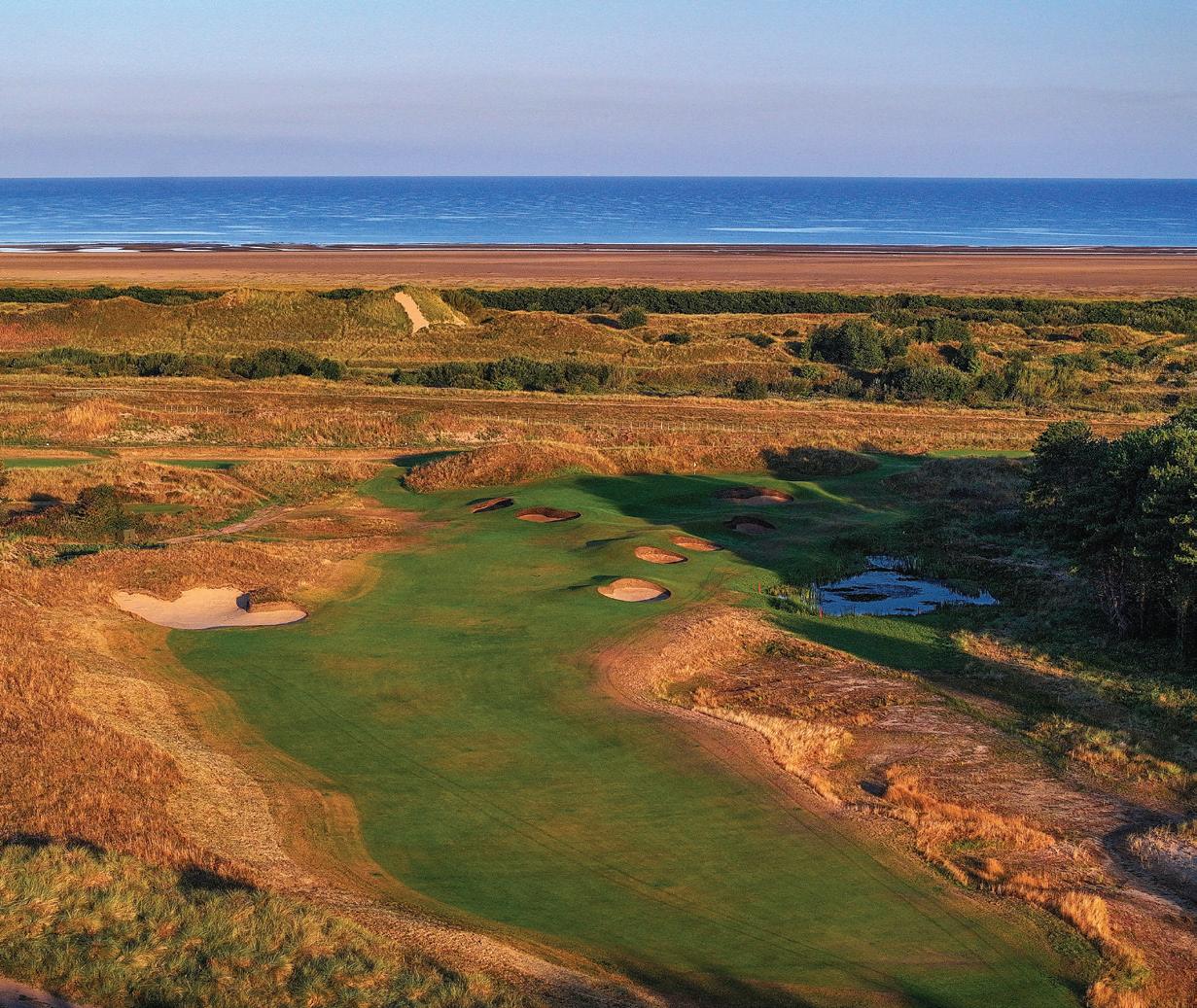
PAR 4, 447 YARDS
Birkdale’s first hole wastes no time demanding players be on point. Along with Royal Portrush, this is one of the most stringent starting holes in the Open rota, averaging nearly 4.4 strokes per round over the past three tournaments. It begins in some of the property’s mellowest dunes, but a penal bunker notched into the face of a mound on the left pinches the fairway before it sweeps left behind it. The narrow landing area and out-of-bounds on the right means most players won’t try to squeeze driver past it, leaving them a longer, semi-blind approach to a green guarded in front by two pot bunkers.
Royal Birkdale tends to catch players at the peak of their powers.
1954 Peter Thomson, 283
1961 Arnold Palmer, 284
1965 Peter Thomson, 285
1971 Lee Trevino, 278
1976 Johnny Miller, 279
1983 Tom Watson, 275
1991 Ian Baker-Finch, 272
1998 Mark O’Meara, 280
2008 Padraig Harrington, 283
2017 Jordan Spieth, 268
PAR 4, 322 YARDS
The short, blind par-4 fifth was altered during a major 2024 remodel by Tom Mackenzie of the British design firm Mackenzie and Ebert. It still bends to the right but is 25 yards shorter, and grassy dunes on the inside corner have been removed and replaced by an open sand barren. The putting surface was also shifted left and cocked nearly 45 degrees behind a field of sod-wall bunkers. With all targets now visible from the tee, some players will be tempted to hit driver, but those who do will want to keep their misses short since the green drops off steeply left and over the back.
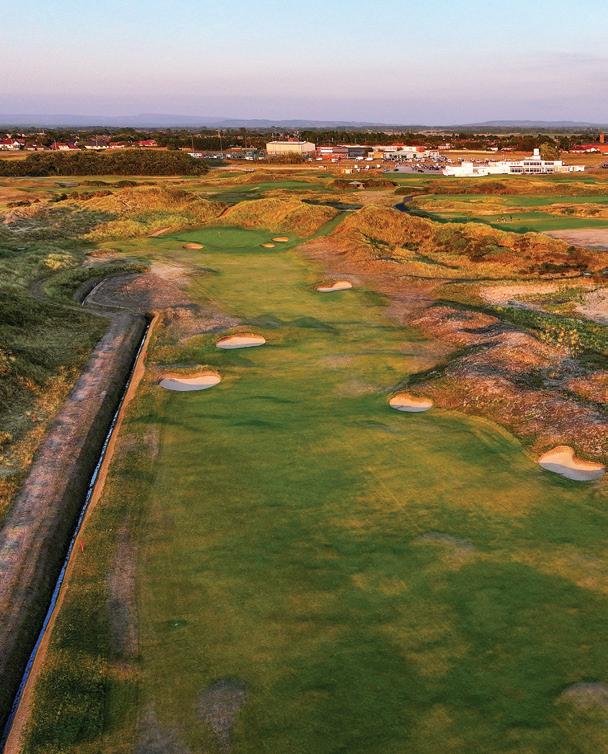
Open Championship theatre doesn’t get more bizarre than what occurred here in 2017 when Jordan Spieth flared his final round drive so badly it settled on the outside shoulder of the dunes on the right, 70 yards from the edge of the fairway. Twenty-nine minutes and several rulings later he was in with a remarkable bogey, sparking a birdie-eagle-birdiebirdie run that clinched the claret jug. The fairway has been widened toward a ditch on the left but still favours drives that hug the right bunkers, and the expanded area left of the green will catch long bailout approaches since there’s no room to stray right.
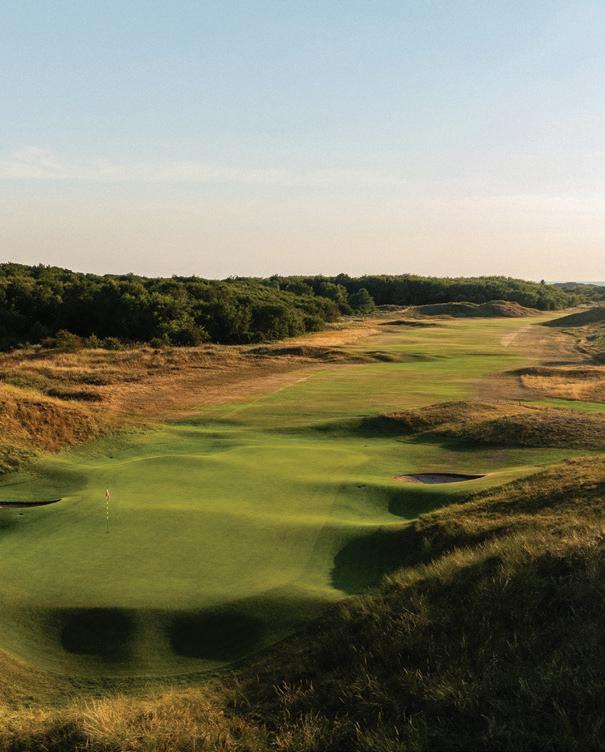
The 15th hole is a new addition to Royal Birkdale for the 2026 Open. Mackenzie created it during the 2024 remodel as a replacement for the par-3 14th that was converted into a short-game practice area. It fits neatly into the space between the old par-5 15th (now the 14th) and the par-4 16th and gives the layout the long par 3 it was lacking at 241 yards. The ability to get up and down from the sunken short-grass area to the right is critical since long incoming shots trying to avoid the two pot bunkers on the left will often bounce through the axis of the deep, angled green.
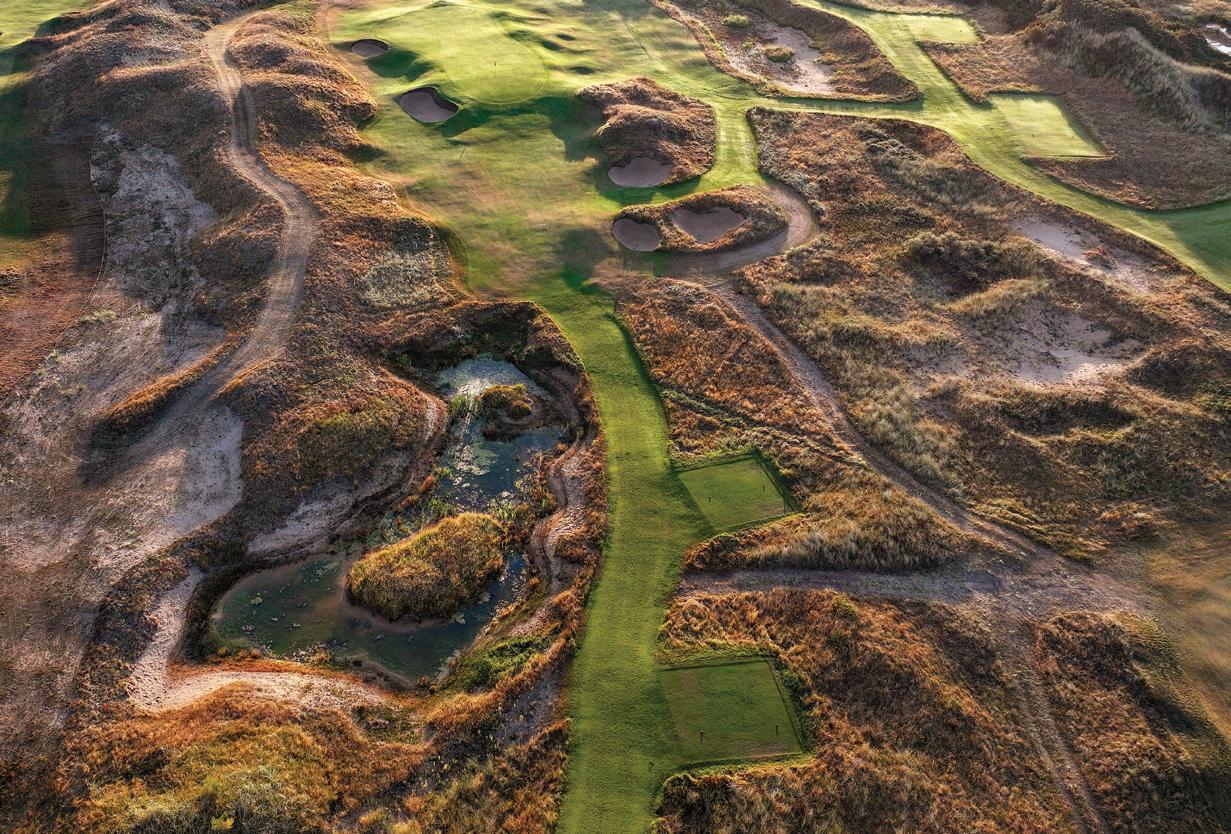
Birkdale’s only two par 5s, 14 and 17, occur late in the round and have been statistically the easiest holes during the previous three Opens. No one on the leaderboard will feel out of it with these holes still ahead. The slender fairway snakes right to left through a valley of willow scrub, and in normal conditions long hitters can cut distance by carrying a carved-out bunker in the left rough. The green was rebuilt and extended before the 2008 Open by Martin Hawtree, grandson of original architect Fred Hawtree, and is the most significantly contoured here, rising in a series of steps into a beautiful amphitheater of dunes.
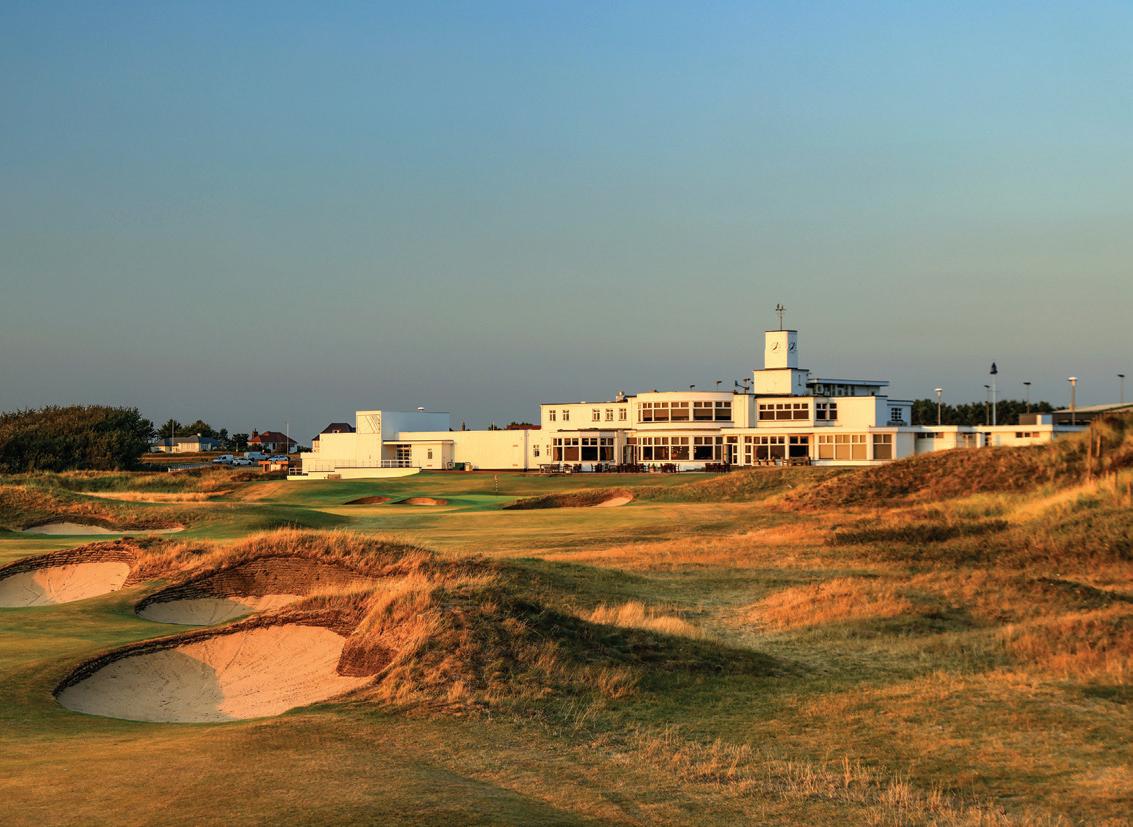
The modernist structure of Royal Birkdale’s clubhouse dominates the grass and dunes surrounds with its bright white two-story façade, strong horizontal geometries and centerpiece rotunda windows. This is purposeful: The architect, Lancashire native George E. Tonge, said he wanted the Art Deco-inspired building that opened in 1935, just a few years after the newly remodeled links, to “intrude” upon the course. More than that, the clubhouse has given Birkdale an unmistakable brand—one look and golfers know where they are.



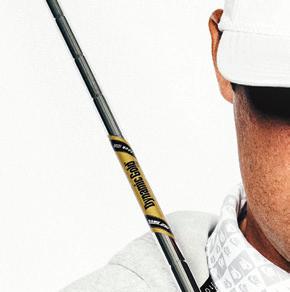



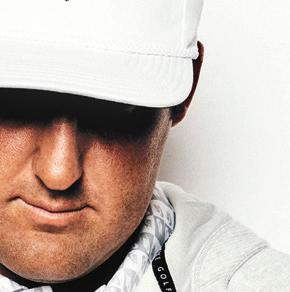








MODEL FOR GREATNESS IS THE BEST WAY FROM NOW ON

LEE TREVINO’S ONE-LINERS TEND TO LAST. Quick and pleasingly structured, they ring the bell with sharp wit and hard truth. For example: “You can talk to a fade, but a hook won’t listen.” Sometime in the 1970s, when Trevino mused that “nobody gets everything,” golf got a new aphorism.
The six-time major winner had likely been spurred by a question about his 1971 U.S. Open playoff victory over Jack Nicklaus, who Trevino has always considered both the GOAT and a poor wedge player.
Trevino was, and remains at age 86, a student of golf history and a savant, and his larger point was that the game is simply too vast, various and difficult to be completely mastered.
He had plenty of evidence at the time. Any list of golf’s all-time top 20 reveals that nearly all had a weakness, not just one that was simply the least of the player’s own strengths but an actual liability in competition, something close to negative strokes gained.
With Vardon, Hogan and Snead, it was


short putting. With Hagen, Watson and Ballesteros, it was driving accuracy. With Nicklaus and Palmer, it was pitches around the green. Sarazen and Player both fought a low hook; Mickelson and Norman both a high block. Trevino himself struggled to hit long irons with sufficient height, distance and stopping power.
That’s right: Great as they were, they weren’t complete. Before getting too carried away, let’s establish that completeness—being strong in every facet of the game—is not an end all. The players mentioned above all habitually beat more complete players because their strengths (Hogan’s precision, Nicklaus’ power, Player’s scrambling, Watson’s putting, Trevino’s repetition) were so extraordinary. These players routinely overwhelmed their weaknesses.
For those who happen to be great, the path to becoming greater is to become more complete, especially in majors, where conditions force the most mistakes and weaknesses are
Although
as


BY RANDY SMITH
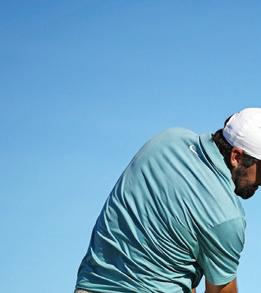
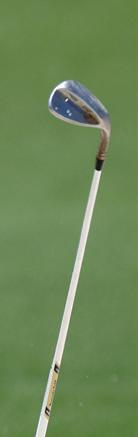
If you ask Scottie about his favourite shots, he’s not going to agree with my picks, but I’m going to give you some of mine anyway. Let’s start with the teed-down, low, leftto-right fairway finder. He hit one of these low missiles at the Open Championship in 2025—which he won by four—and I kid you not that the shot tracker lost it about 50 feet o the tee. I think the ball went underground.
He tees the ball way down, plays it farther back than a normal driver swing, and his stance is slightly open. He hits it with a little more of a descending blow and a big swing path to the left. You’ll see a strong rightside clearance of his body and absolutely no hanging underneath. The feel for this shot is that you’re creating friction across the golf ball. It shoots o the face low and has some sidespin to move it left to right. This is the drive he goes with when he wants to make sure he’s in the short grass for his second. —WITH RON KASPRISKE
Randy Smith, one of Golf Digest’s Legends of Golf Instruction, has been working with Sche er for nearly 25 years.


most exposed and so, by definition, majors are more rewarding of completeness. What’s intriguing is that this quality is likely becoming more attainable.
For an old-school view of being complete, consider how Nicklaus looked back on his short-game weakness. For years, his glib assessment of his short game was, “I didn’t need one.” But he was more reflective in a 2010 Golf Digest story, realising that he had missed an element because Jack Grout didn’t teach short game, and he hadn’t gone to see Paul Runyan, and frankly, he didn’t want to mess around with what he had and possibly get more screwed up. When Phil Rodgers finally helped a desperate Nicklaus in 1979 with his short game and paved the way for two major wins in 1980, Nicklaus understood he had left a lot of talent, and probably championships, on the table.
“Because I didn’t have a real good short game, my philosophy became I’m going to hit 14 or 15 greens, I’m going to hit at least a couple of par 5s in two, and I’m going to make every putt inside 10 feet,” Nicklaus said. “That’s what I thought, like it really didn’t make any difference how good my short game was. As long as I could chip the ball, slop it around the hole somewhere—six, eight, 10 feet—I was going to probably make it anyway. But that was an accommodation. It wasn’t ideal, and it was foolish for me to believe that it was good enough.”
According to Trevino, Nicklaus being complete would have
TALL TEXANS
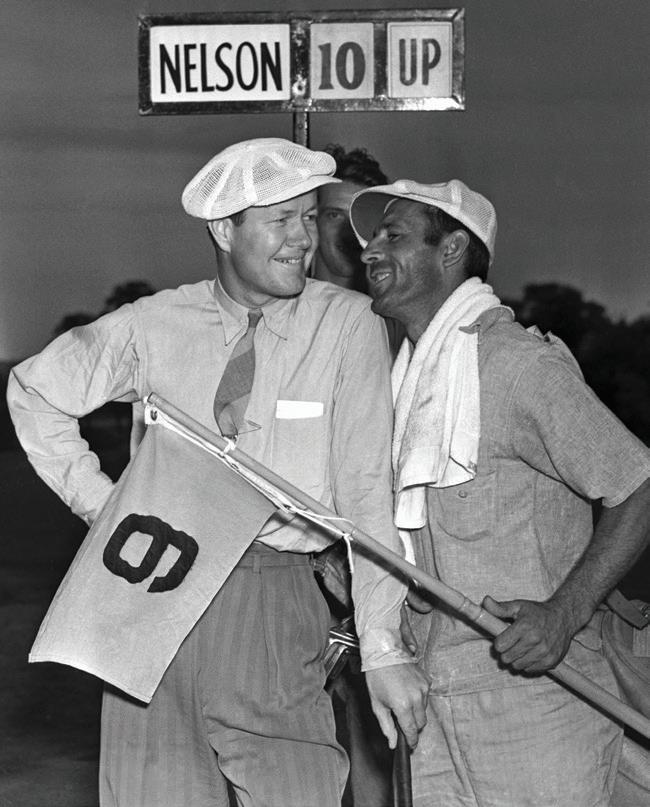
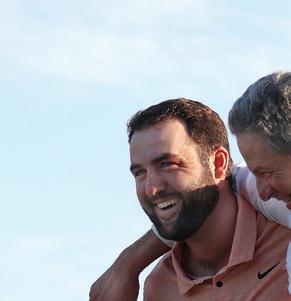
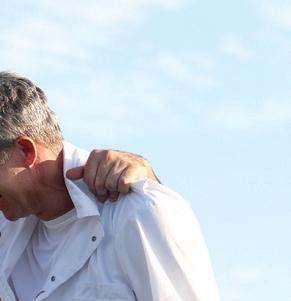
Scheffler (with Ted Scott) seeks the kind of mastery Byron Nelson attained in winning 11 in a row in 1945.
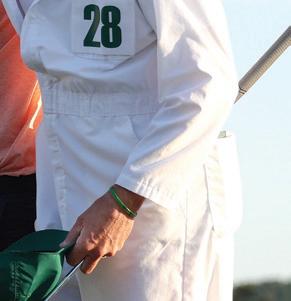
FOR YEARS, NICKLAUS’ GLIB ASSESSMENT OF HIS SHORT GAME WAS, “I DIDN’T NEED ONE.”
dramatically altered golf history. “If Jack had had a wedge, no doubt in my mind, he would have won 30 majors,” Trevino said in the same story. “I mean, he was so good at everything else.”
Of course, the calibre of completeness that Trevino had envisioned for Nicklaus eventually did show up in the person of Tiger Woods. By achieving an unprecedented mastery of every part of the game, he both debunked Trevino—who has always rooted Tiger on—and forever stretched the boundaries of the possible.
Woods’ mantra was “no limits.” In his epic year of 2000, he led the PGA Tour in more than 20 statistical categories. The worst ranking he earned was 54th in driving accuracy, a remarkably good number (and what would be his career best) for such a long hitter. Woods took the opportunity to only halfjokingly warn the perennial straightest driver at the time, Fred Funk, that he was coming for him.
Today, Woods remains unchallenged as the greatest complete player, surpassing Bobby Jones, Byron Nelson and Billy Casper. “There was a moment when Tiger might have been the very best at every department—driving, metals, irons, short game, sand play, putter, all of it,” recalls Nick Faldo, who also excelled through the whole bag winning six majors. “No one had ever been that, and I wonder if anyone will again.”
The multiple-major-winning No. 1 players who followed Tiger performed admirably, but none filled the void. Rory McIlroy was brilliant but mistake-prone with the shorter clubs. Jordan Spieth’s driver was a weakness. Dustin Johnson became surprisingly well rounded after dramatically improving his short game and putting but stopped pushing. Brooks Koepka seemed complete whenever he was winning one his five majors but strangely only then. Jon Rahm possessed an extensive arsenal but lost momentum after going to LIV, although his runner-up at the 2026 PGA Championship was a blast from the past.
However, next in line was Scottie Scheffler, and what’s possible has once again changed.
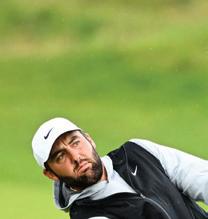
Scheffler first became No. 1 in March 2022 and has currently held the position by mostly wide margins for more than 160 consecutive weeks, a run exceeded only by Woods’ separate streaks of 281 and 264. Through the PGA at Aronimink, Scheffler has 20 victories, four majors, and an Olympic gold medal. Yes, McIlroy has six majors, 30 PGA Tour victories and a Slam, but the relentless excellence of Scheffler has made him, not Rory, the second-best player of the century.
Like Tiger, Scheffler is the very rare complete player at the very highest level of the game, but he is not Woods. Scheffler is not as dynamic, dramatic or supremely athletic. He doesn’t have quite the power with the longer clubs, not quite the touch with the putter; he’s not as dominant. Whereas Scheffler achieved his largest lead in the OWGR last year by doubling No. 2 McIlroy’s total, Woods in 2001 nearly tripled the total of No. 2 Phil Mickelson. Nobody is saying Scheffler, who has led several statistical ball-striking categories since becoming No. 1, is better than everybody else in every individual department. Scheffler has his own style—not as brilliant but possibly steadier and more repetitive. Whether because of a slightly slower swing speed, less club rotation through the ball, more conservative course management or fewer swing-change transitions, Scottie’s misses aren’t as wild as Tiger’s. In style of play tee to green, Scheffler is more like the risk-averse Nicklaus than
BY RANDY SMITH
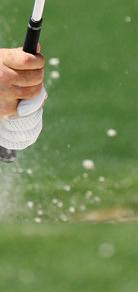
Scottie hits these super-cool wedge shots from 60 to 120 yards where the ball comes in a bit lower and he can control the spin. His arms stay so soft throughout the swing, and the motion looks so fluid. He lets the length of the swing determine the distance the ball goes. The size of the backswing matches the size of the downswing.
The big key is how soft his arms stay. There’s very little wrist hinge with dead hands, and the arms aren’t rigid. They have some bend in them—like he’s swinging two ropes. His arms are in control and the body follows. With these approach shots, there are two things you can control: impact and the green that you’re landing on. This shot is perfect for that.
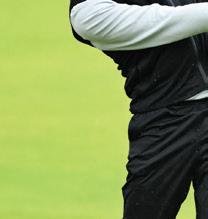
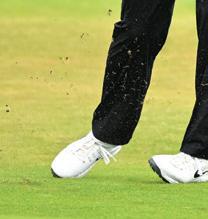
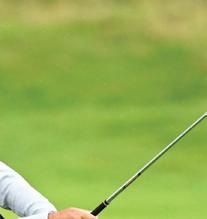
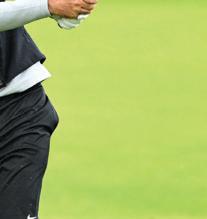




the more explosive Woods.
Both have a weakness relative to their strengths. Woods’ was driving accuracy, particularly in the second half of his prime, while Scheffler has suffered startling bouts of poor short putting. However, both were able to maintain their overall level, their problems more intermittent than chronic. In 2006, amid criticisms of his driving, Tiger ran off seven wins in a row.
While Scheffler has never been statistically superior on the greens, he has lost strokes putting in only one season, 2023, when he ranked a horrendous 162nd in strokes gained. With the help of Phil Kenyon and a switch to a claw grip on shorter putts, he got down to a career-best 22nd in strokes-gained putting in 2025. This year, despite a momentary and untimely relapse at the PGA Championship where he ranked 72nd in putting among the 82 finishers, Scheffler has stayed near the top 20 (26th) on tour in the category, proof of significant improvement.
Woods has always been complimentary of his successor, regarding Scheffler’s putting as a reliable role player on a dynastic team. “If he putts decent, he’s going to win,” Woods said in a May 2024 appearance on the “Today Show.” “If he putts
SCHEFFLER IS MORE LIKE THE RISK-AVERSE NICKLAUS THAN THE MORE EXPLOSIVE WOODS.

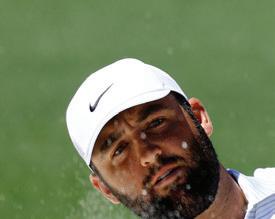


EQUALS IN EQUANIMITY
A less apparent trait shared by Nicklaus and Scheffler is the ability to keep golf in proper perspective.
great, he blows away fields. If he has a bad putting week, he contends. He’s just that good of a ball-striker.” That December, Woods issued a complete-player-to-complete-player compliment that was understated but said it all: “He doesn’t really do anything really wrong.”
Scheffler’s best might be ahead of him. Even if it isn’t, he will go down in history as the first player who walked through the barricaded door that Tiger broke down. Consciously or subliminally, others, such as Cameron Young and Matt Fitzpatrick, seem ready to follow. As McIlroy said of his mindset while winning at Pebble Beach last year, three months before he finally completed the career Grand Slam: “Just really try to limit the mistakes and play smart golf and be a little more like Scottie Scheffler basically.”
Regardless of his example, replicating Scottie’s path will be difficult. That’s because it’s arguable that no great player has ever had as fertile an environment in which to grow up to be a successful professional golfer.
Already in love with the game when his family moved from New Jersey to Dallas when he was 6, Scheffler began an accelerated journey when his parents took out a loan to join Royal Oaks C.C. There, Randy Smith was the teaching professional with a bevy of current and future touring pros as students, including Justin Leonard, Harrison Frazar, Ryan Palmer and Colt Knost. They all practiced and competed together and trashtalked in a kind of gritty Texas-style salon of golf—and they let a grade-school prodigy hang around.
BY RANDY SMITH
This one is so cool to me. From a downhill lie, about 30 to 50 yards out, Scottie will hit a low, spinning, checking wedge shot.
I’m talking about a pretty good downhill lie, too. Wait, he can’t do that. Oh, yes he can.
The ball goes to his back foot at address, and the clubface is slightly open to more fully open depending on the lie. When he swings, it’s a huge hook motion through the bottom. He says he creates the shot with his hands, but his right forearm is working over, big time. One of the keys is that he keeps swinging down the slope so far past impact, and he creates this low-hook shot shape that still checks up on the green. And get this, he uses his 60-degree wedge!




HATS OFF
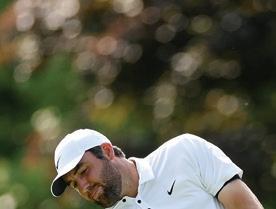
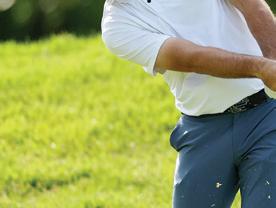
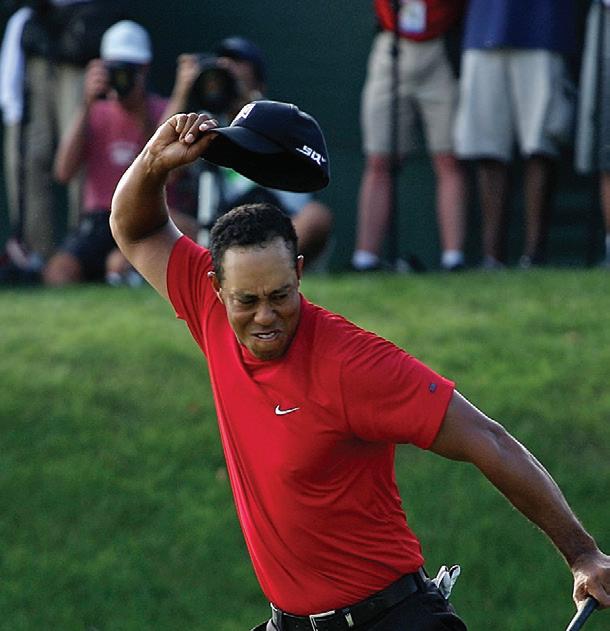
Woods has been complimentary of Scheffler, recognising him as a successor.
“Randy doesn’t get enough credit for creating that culture at Royal Oaks,” says Mark Brooks, the 1996 PGA Championship winner who now coaches promising young players with aspirations to play professional golf. “Scottie got a huge head start.”
At an age when the brain has extra plasticity, Scheffler took in the highest form of the game up close and personal. Royal Oaks became an incubator of intensive imitation, with Scheffler exposed to all manner of specialty shots, techniques, strategies and friendly but fierce competitions, the process of becoming a complete well underway.

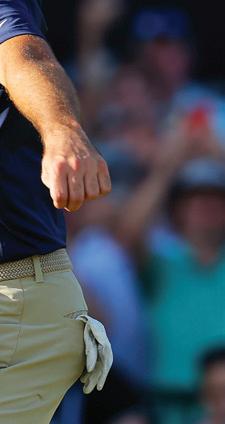
“TIGER APPROACHED EACH SHOT LIKE IT WAS THE LAST SHOT HE WAS EVER GOING TO HIT.”—SCHEFFLER
“Scottie would sit on the ground while I was working with tour guys hitting shots, and he’d be watching what the golf ball is doing, just making these wonderful notes in his head,” Smith says. “When he got full with what he wanted to see, he’d pop up and go down to the range and hit all those shots. We would work on technical things, certainly, but he was always just out there shaping shots.”
“Scottie would watch us practice like a hawk and be all quiet,” Knost says. “Then he’d go off and copy what he saw and come back and do it better than you did. Of course, then he’d talk—a lot.”
The mindset that values these habits is ingrained in Scheffler. “For me, getting better at golf is such an interesting and fun thing to try and accomplish,” Scheffler said at the PGA. “When I can go out by myself and practice and have something that I want to work on, it’s one of my favourite things. I love trying to figure things out. That’s always what’s driven me.”
That should lend some perspective to the surprisingly candid reflection Scheffler shared with the media before last year’s Open Championship at Portrush. Calling himself “kind of a sicko” for caring so much about winning when the desired result can feel so fleeting, Scheffler confessed that “sometimes, I just don’t understand the point.”
It’s the natural ambivalence of a gifted person in the public arena who wants to have a normal family life, but also knows the more chaotic one will allow him to express his special talent in a fulfilling way. That he’s content with the tradeoff is evidenced by what he told the media at last year’s Tour Championship was the turning point in his career—the final round of the 2020 Masters. It was the first time he played with Woods.
Scheffler had noticed on the very first hole that “Tiger was just different in the sense of the way he approached each shot, it was like the last shot he was ever going to hit.” After Woods made a 10 on the 12th hole and then birdied five of the last six, Scheffler realised that he needed another mental gear.
“I just admired the intensity that he brought to each round, and that’s something that I try to emulate,” Scheffler said, “That was something that I just thought about for a long time. I felt like a change I needed to make was bringing that same intensity to each round and each shot.”
After concluding that story, Scheffler talked about having won the Open at Portrush by four strokes (where he had referred to himself as a “sicko” before the championship). “I just brought a lot of intensity to each shot that week,” he said proudly, as if it had been the culmination of that lesson at Augusta.
Trevino noticed, too. He runs across Scheffler from time to time at Preston Trail in Dallas, where both are members. “I don’t know of any weaknesses he has,” Trevino says. “I like everything. Helluva chipper. I like that he went to the claw. Focus. How he can go up with those irons.” Laughing, Trevino says, “Well, I guess Scottie has it all. He and Tiger both retired whatever I said.”
Then Trevino turned serious. “I’ll tell you the thing that Scottie has got more than anyone I’ve ever seen who is that good: He is at peace with himself. He doesn’t think and play golf 24/7 and worry about it like I did or Arnold did or Gary did, the way so many of us did. He’s like Jack that way in that he can separate. It gives him a little extra, so when you talk about complete, that’s what really makes Scottie complete.”
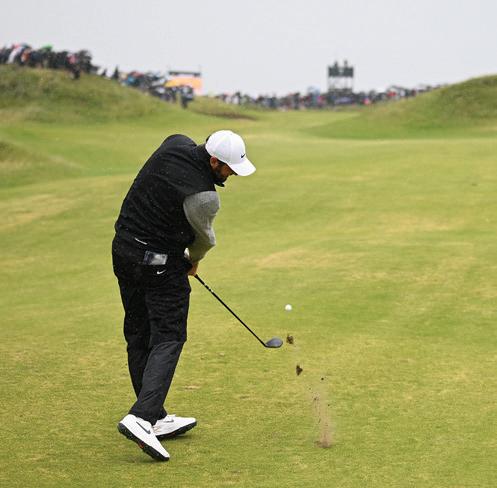
BY RANDY SMITH
I’ve seen this shot several times. His ball will either be on a bit of a downhill lie or sitting in a depression. You get lies like that at the Open Championship. What does Scottie do? He’ll often take a little wider stance, play the ball back and just beat down on it with his 3-wood, getting the leading edge of the club on the ball and taking a big divot. You can’t believe it.
You would never think to play a 3-wood from a lie like that—but he does. It’s a little bit of a left-to-right shot, but it comes out pretty hot and maxes distance. The mental picture is coming down on the ball and getting into the turf like you’re hitting a 7-iron. For amateur golfers, trying to hit 3-woods out of a divot hole really helps teach how to get the middle of the clubface on the ball instead of hanging back and trying to help it up. When you put one in a hole, it’s amazing what human beings do with their instincts. It cleans up the swing quite a bit.
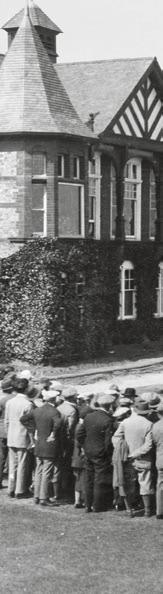

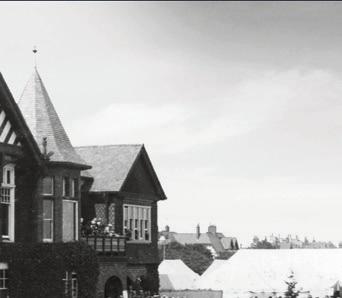
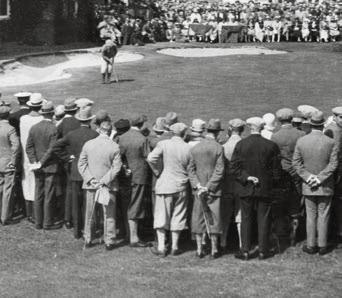
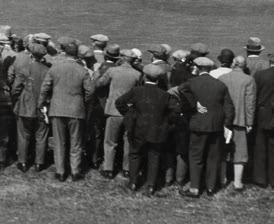
100 YEARS AGO
Putting out to win the 1926 Open Championship

by Steven Reid
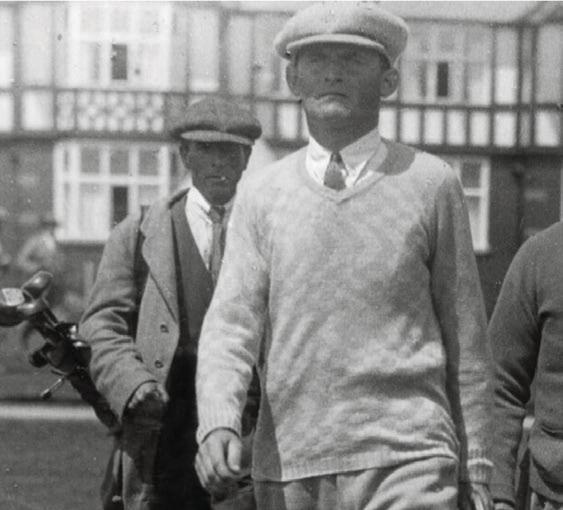
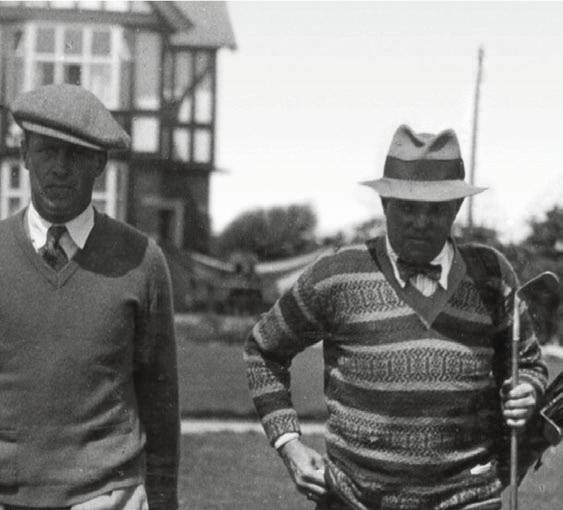
AAN ENDURING BOND EXISTS between the members of Royal Lytham & St Annes Golf Club, past and present, and the Georgian golfer Robert Tyre Jones, Jr., because it was at St Annes, that:
• He won his first Open Championship in 1926, thereby taking his place on the world stage of golf for the first time.
• He achieved his victory by playing one of the most famous single shots in history.
• He transformed his playing career on the international stage from one of failure to one of success.
• He identified the location from which he had played his ‘immortal shot’ and a plaque, the first to be placed on a golf course anywhere in the world to mark a single shot, was embedded.

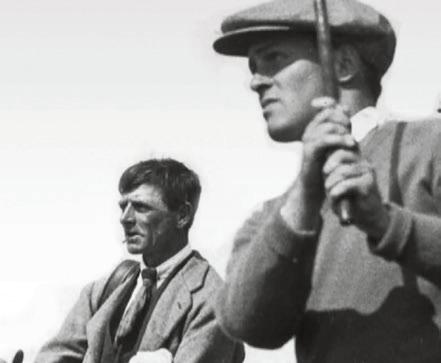
AMERICANS ON TOP
Detroit’s Al Watrous (far left) started the final round two strokes ahead of Atlanta’s Bobby Jones, who had withdrawn in his only other Open appearance in 1921.

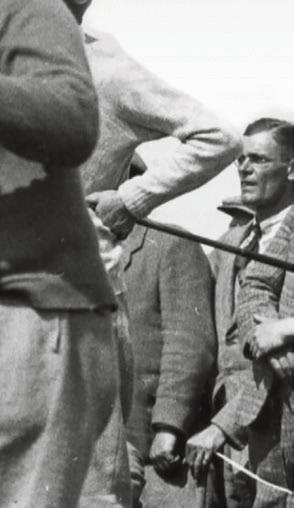
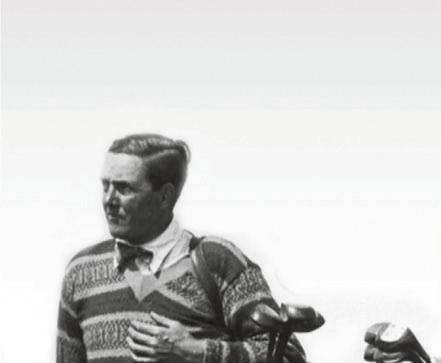
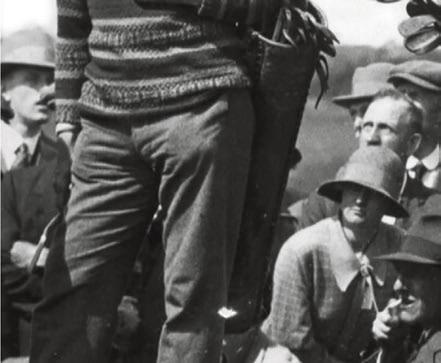
When the legendary Georgian amateur won his first British Open at Royal Lytham & St Annes, Bobby Jones started a run unique in championship golf. Including this win, he entered 14 championships and won 10, finishing second in two of the other four.
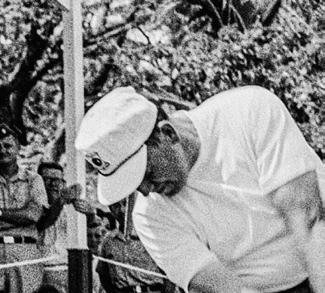
It was after he won in 1926 that the germ of the idea of winning all four majors in the one year first came to him. He confided his thoughts only with his great friend, American sportswriter Al Laney, swearing him to secrecy. Jones did not share his dream with his wife Mary or his fellow traveller and scribe O.B. Keeler. He knew that the only opportunity would arise in 1930.
If he had not won in 1926, the Grand Slam might well never have happened.
Jones sensed that predestination played a part in the outcome of championships, that the identity of the winner was somehow determined before the event started. He also sensed that there was a destiny waiting for him. It remained to be seen whether he would be able to fulfill it. While predestination might have decided in advance that he was going to win the Open in 1926, other developments and happenings cropped up in the weeks and days preceding the event, any one of which could have meant he did not.
As he crossed the Atlantic with other members of the U.S. Walker Cup team on board the S.S. Aquitania, frantic telegraph messages flew in both directions trying to establish what lay ahead. Great Britain was faced with a general strike, and there were serious doubts about the feasibility of holding the Amateur Championship at Muirfield, the Walker Cup at St Andrews and the Open at Royal Lytham & St Annes.
The trigger to the general strike was coal-mine owners demanding reduced pay and increased hours for miners. Workers within and beyond the coal miners and the Trades Union Congress called for a general strike to support the miners. A nationwide stoppage started on May 3. The army and volunteers were called to respond, and for several days there was an impasse.
On board the ship, there was uncertainty. The USGA President, William C. Fownes Jr, sent a cable to the R&A, suggesting in the verbose language of the times, that “the R&A were not to feel any embarrassment in the event it was deemed inexpedient to carry out any part of the golf program.” The reply from the R&A was that they “shall try to carry out all of the program.” By May 9, it was known that no boat or train would be available, and instead motor cars or motor coaches would be arranged to take the team to London.
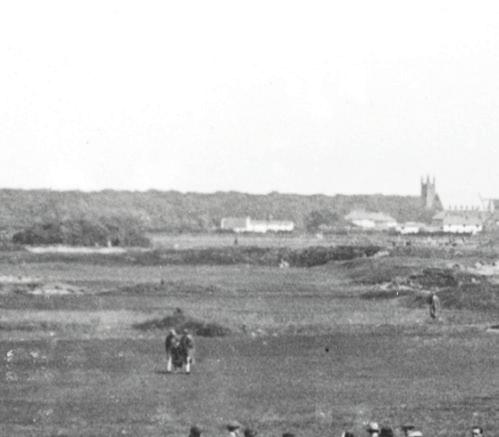
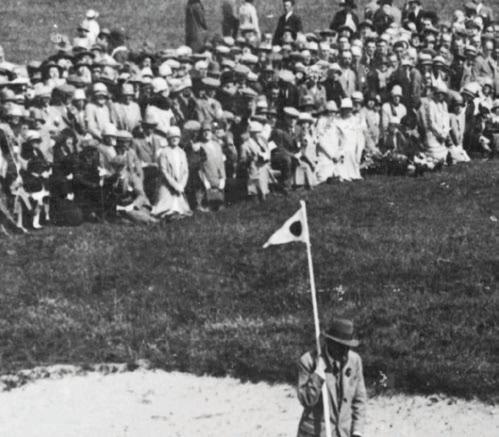
WITH THE STRIKE, THERE WERE SERIOUS DOUBTS ABOUT THE FEASIBILITY OF HOLDING THE AMATEUR, THE WALKER CUP AND THE OPEN.
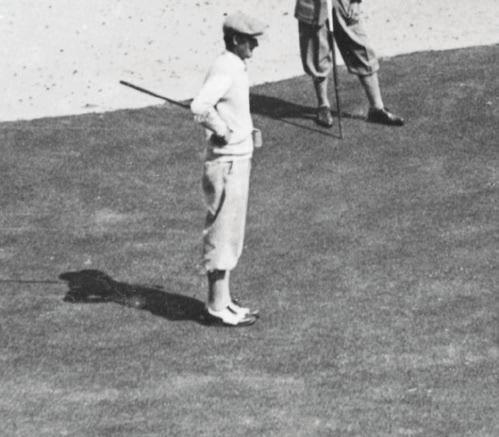
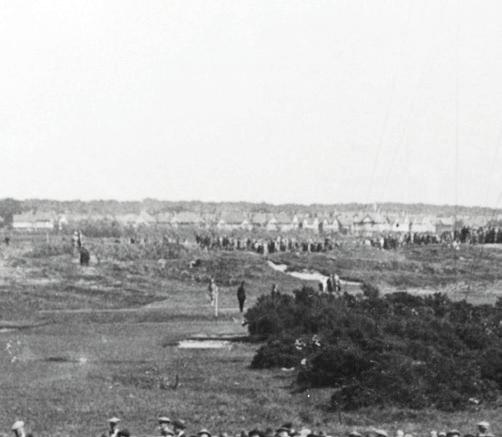
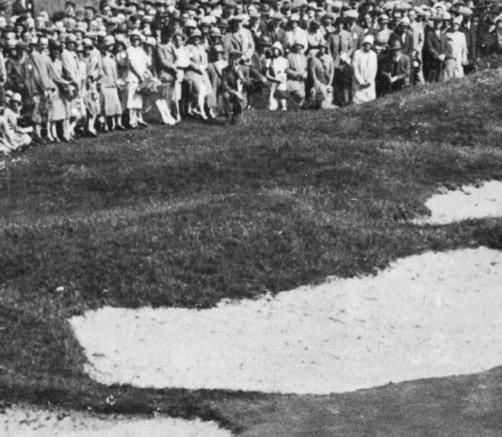
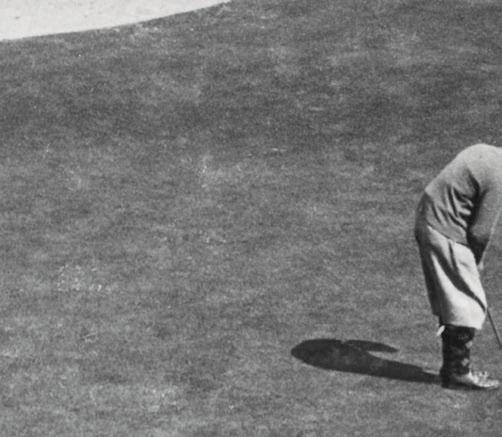
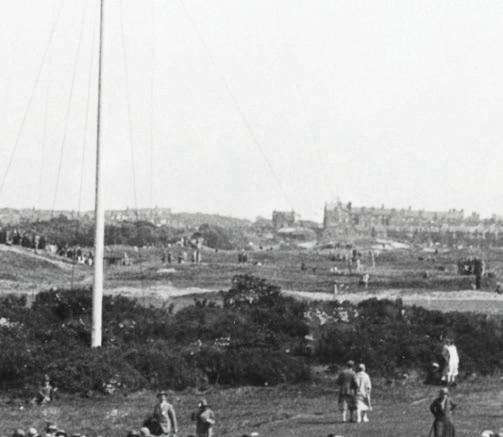
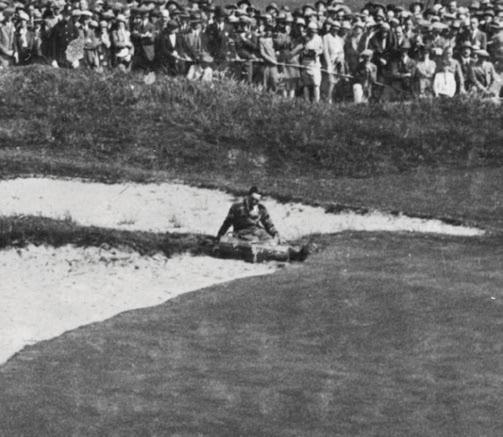
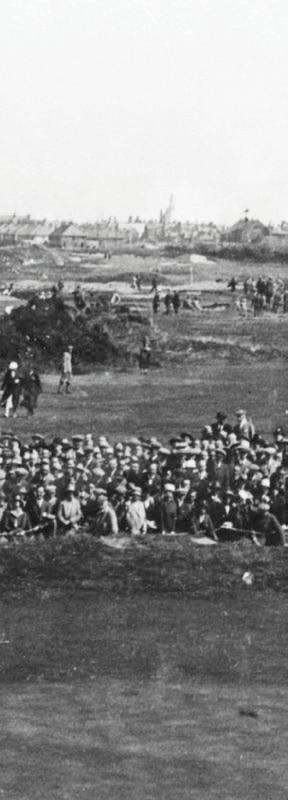
Had Jones skipped the 1926 Open to go home with the Walker Cup team, as planned, would he have won The Grand Slam in 1930?
Before Jones receives the claret jug, Walter Hagen tries to fetch a laugh by presenting him a comically oversized niblick.
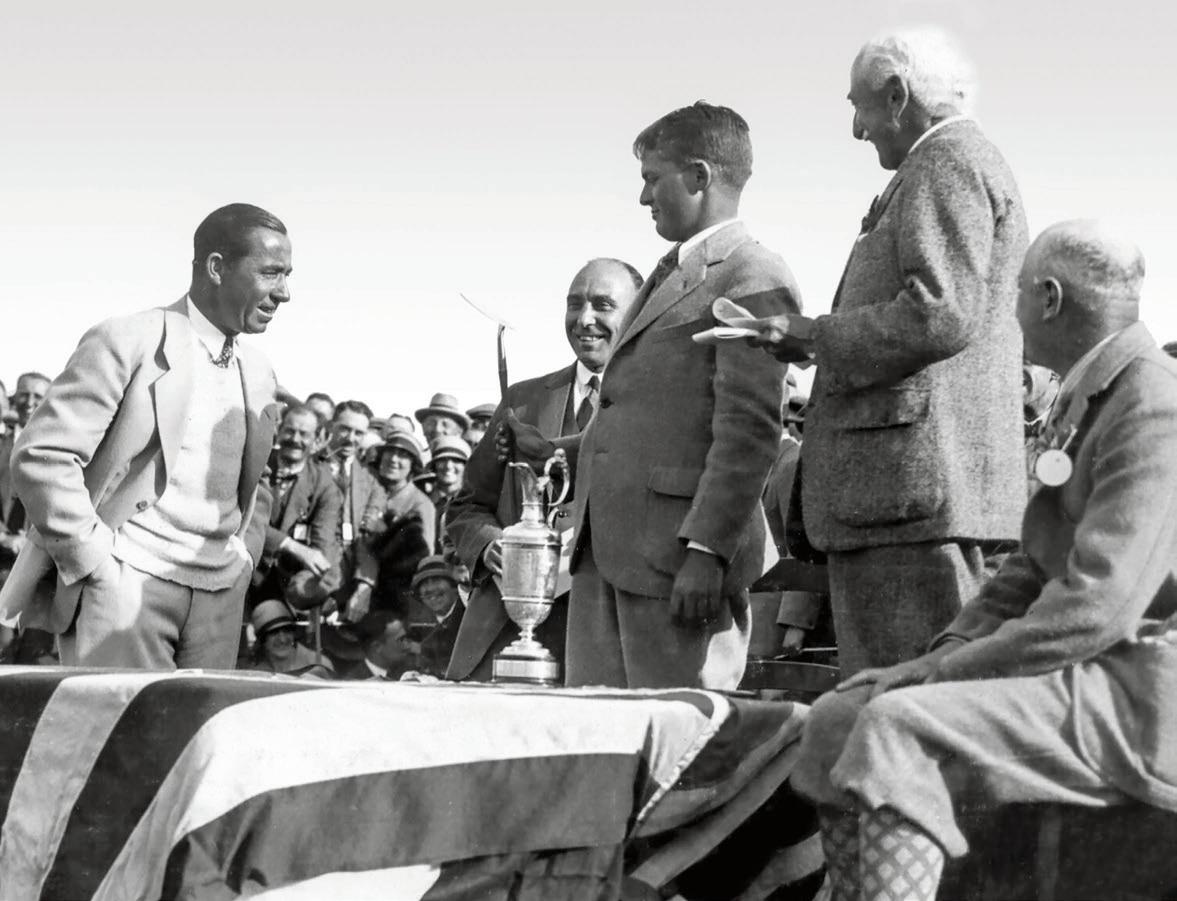
IF JONES HAD PUT IN A STRONG PERFORMANCE AT THE AMATEUR, HE WOULD HAVE BEEN BACK HOME BY THE TIME THE OPEN STARTED.
O.B. Keeler was intrigued to learn that “almost immediately after putting down a riot of rowdies with their batons, London police donned football apparel and played football with a team of strikers.” He commented, “A strike must be especially interesting in a nation where they do things like that.”
When the Aquitania paused at Cherbourg on May 11, the impression was that golfing events might still take place, although the charity match between Bobby Jones and Francis Ouimet and Abe Mitchell and George Duncan, scheduled for May 13, had already been postponed.
By May 12, the strike had collapsed, and it was clear that both the Walker Cup and the Open would take place. After disembarking, the American players boarded cars, pushing their way over roads which recalled war-time conditions, with lorries of food trucks being accompanied by tin-hatted soldiers and motorcycle dispatch riders.
At this stage, the Amateur was in question, and if it were cancelled, thought was being given to moving the Walker Cup from June 2-3 to May 24-25 to not keep the American players longer than necessary. Both events took place.
During the crossing, Jones changed his plans. His first intention was to stay over to play in the Open with his Atlantan friend Watts Gunn. However, he was faced with a three-week gap between the Walker Cup and the Open, and he saw little realistic prospect of winning it. No amateur had done so since 1897. Jones had a wife and young child at home, so by the time he landed, he decided he was now going to return home with the bulk of the Walker Cup team.
In the sixth round of the Amateur at Muirfield, he was comprehensively beaten by a young Scot, Andrew Jamie -
son, who cycled to the course each day. When this was added to his abject performances during his earlier appearances in Great Britain in both the Amateur and the Open in 1921, he could see that the British public might have formed a poor view of his ability. He decided to stay over and play in the Open, still with no expectation of winning, but more to show the British public that he could “play a little.”
If he had not been knocked out by Jamieson but instead put in a strong performance at the Amateur, he would have been back home by the time the Open started. He would never had teed up in the championship, let alone won it.
Jones submitted his entry for the Open, and in the intervening weeks, his game improved. He was allocated Sunningdale as the location of his qualifying round, and there came two important developments. The first was that he found a driver made by Sunningdale professional Jack White. This club so suited his game that he used it to win all the 10 major championships that followed. He called this driver “Jeanie Deans.”
The second was that in the first qualifying round he played what many still consider the most nearly perfect round played by anyone anywhere ever, but this triggered apprehension for both him and Keeler. Both were concerned he had peaked too soon. When he started playing in the Open, his worries were found to be justified. After three rounds he was two strokes behind the young American professional Al Watrous. By coincidence, Jones and Watrous had been paired together for the last two rounds, played on the last day.
The fourth round effectively became match play between the two. Still playing at a subdued level, Jones drew level with Watrous after five holes, but by the turn he was two behind once more. He pulled one back, but after 13 trailed again by two. Had he come all this way and stayed over for three more weeks just to finish second?
Watrous, who up to that point had seemed imperturbable, suddenly wobbled, three-putting 14 and 15. The two players, nearing exhaustion from the strain, were level once more. Before Jones played his second shot at the 17th hole, he knew Watrous had put his ball on the front part of the green.
Jones had pulled his tee shot into a sandy waste area. A perfect shot might leave him near or on the green, but the odds were stacked heavily against it. More likely outcomes were ending up in another bunker, heavy rough or even a lost ball. A 5 or worse loomed. A relieved Watrous would get his 4, and the entire trip would be another failure on the international stage. Writing in 1927, Jones summed up his prospects. “This, off dry sand, though the ball luckily lay clean, was a stiff assignment. You know, an eighth of an inch too deep, and the shot expires right in front of your eyes. And if your blade is a thought too high—I will dismiss this harrowing reflection.”
Of all the contemporaneous eyewitness accounts, the best is that by Laney in Follow the Leaders:
Jones walked straight across the fairway from left to right and stood there looking first at the green, then at the spot where he had put his tee shot. I wondered what he was thinking, looking first one way, then back, and I have wondered a thousand times since what it is that tournament players think about when they stand there putting off the moment for taking action. Not that Jones dawdled. Far from it. He always decided quickly, then went to work. Now he looked, came back with his mind already made up, and what I remember more acutely than the shot itself was how drawn and almost ill Bob’s face appeared as he stepped into the sand and settled his feet. Then he struck the ball with a mashie-iron, about a no. 4 by later gradings. A big shout down the fairway told us that the ball had safely reached the green. When Watrous eventually took three putts, Jones moved a stroke ahead. What made it one of the finest shots ever brought off in championship play? With the target out of sight, the stroke also had to be judged exactly so that the ball would become airborne instantly, carry 175 yards or more, and stop quickly after reaching the green. It was only after I heard the shot discussed that I came to have some understanding of its difficulty and the boldness, technical mastery and even artistry involved in bringing it off.
This single stroke won him the championship against all odds. Had he not executed it as he did, he would have returned on the Aquitania empty handed once more. It was a case of predestination at its best. Eighteen year later, in 1944, Jones played his last shots in the British Isles at St Annes, as he played with members and with the U.S. military before returning home.
Perhaps the last word should be with the most successful golfer of all time, Jack Nicklaus, who wrote in his foreword:
That brilliant come-from-behind win for the gentleman from Georgia was celebrated with a ticker-tape parade in New York City. It also launched a remarkable run for Mr. Jones that ended with a record 13 major championship titles—a golf standard that became an important measuring stick in my career. I never had the fortunate pleasure to celebrate a victory over the subtle nuances and intellectual challenge of Royal Lytham, although I came frustratingly close in 1963 when I missed a playoff with Phil Rodgers and eventual champion Bob Charles by a shot. But that Open became a valuable learning experience that paid off a week later in Dallas, Texas, with my first PGA Championship title. But for so many reasons, Mr. Jones’ triumph at Royal Lytham, underlined with all its historical significance, was a truly important chapter in the life of arguably golf’s greatest amateur and one of the most influential figures in the history of this great game.
Adapted with permission from the new anthology
Bobby Jones and the Royal Lytham & St Annes Golf Club compiled by Steven Reid (stevenreid1@me.com).

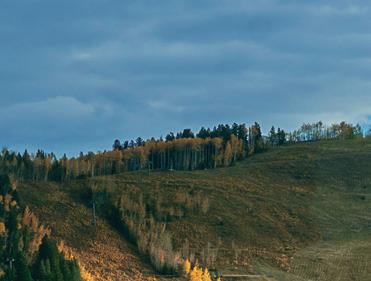





BY STEPHEN HENNESSEY





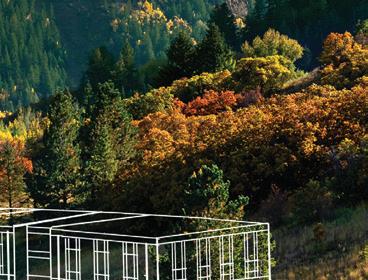




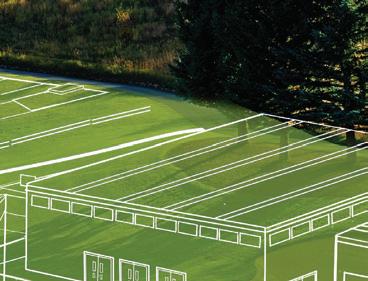


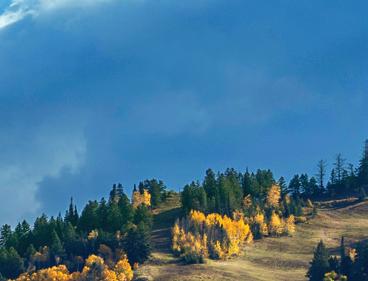
HOW MUCH REAL ESTATE VALUE IS LOCKED UP IN GOLF?
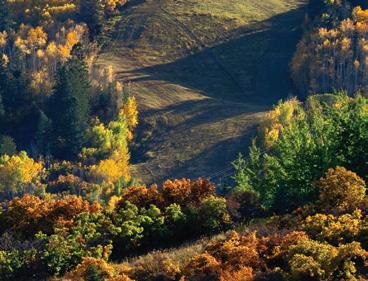



GOLF’S MOST VALUABLE PIECE OF LAND IS INTENTIONALLY unknown to most golfers. Turn onto 91st Street in Surfside, Fla., north of Miami Beach, and you’ll encounter a highly ornamented, police-gated bridge that looks like an entrance into a country club. In a way, it is. Indian Creek Village has become an enclave for society’s richest individuals. Mark Zuckerberg and his wife just closed on a $170 million, 1.8acre mansion. Jeff Bezos is building his estate on multiple parcels of land, and around the corner lives Tom Brady among other famous residents. There are only 41 homeowners inside the community known as Billionaire’s Bunker on the manmade barrier island in Biscayne Bay.
At the heart of this sanctum is Indian Creek Country Club, an historic William Flynn design from 1929 that was recently renovated by architect Andrew Green. The course was here before any of the big homes. The elite like to escape here not only because this 294-acre island is ultra-secure but because the golf course has intrinsic value. Preposterous as it may be to calculate what the land locked in 18 holes such as these is worth, we posed that very question. It’s an impious topic, of course. No golfer with a soul would ever propose bulldozing Indian Creek, Pebble Beach or any other great course for real estate development.
Frazer Rice, a strategic asset manager, author and podcast host of “Wealth Actually,” started this exercise by evaluating the land and zoning restrictions for all courses in the most recent ranking of Golf Digest America’s 100 Greatest Courses. He then ran comparison sales and identified government restrictions to arrive at a hypothetical value for each property if sold for the highest and most legally permissible use under current zoning. He also looked at standouts outside the top 100, such as Indian Creek and Maroon Creek Club in Aspen, Colo., to help offer a comprehensive geographical representation of our game’s greatest assets.
Per Rice’s modeling, Indian Creek blew away every other course with its estimated $3-5 billion price tag. “The island’s exclusivity and ultra-luxury residential context make this the
Las Vegas is the rare place where golf might turn into buildings.
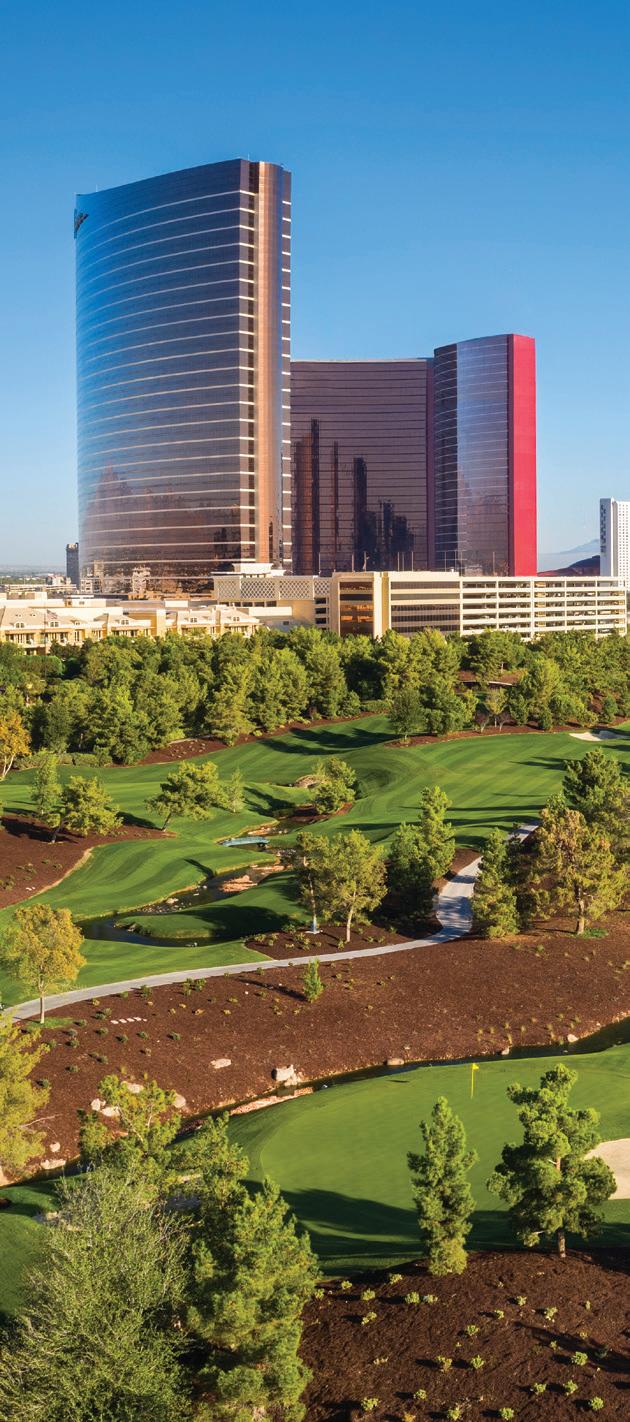

The below list represents projected land value for ten notable golf courses, calculated by taking the hypothetical value of each property if sold for its highest and best legally permissible use under current zoning. We chose a geographically diverse selection of clubs to illustrate a wide selection of various markets and appropriate value based on recent transactions.
ISLAND
Indian Creek Country Club
Indian Creek Village, Fla.
Estimated acreage: 180
Value: $3-5 billion
MAJOR CITY
Los Angeles Country Club
Los Angeles
Estimated acreage: 325
Value: $2.6 billion
RESORT
Pebble Beach G. Links
Estimated acreage: 176
Value: $880 million
WEST COAST
The Olympic Club
San Francisco
Estimated acreage: 300
Value: $750 million
DESERT
Wynn Golf Club
Las Vegas
Estimated acreage: 130
Value: $520 million
FLORIDA COAST
Seminole Golf Club
Juno Beach, Fla.
Estimated acreage: 175
Value: $437 million
LONG ISLAND Maidstone Club
East Hampton, N.Y.
Estimated acreage: 200
Value: $300 million
MOUNTAIN
Maroon Creek Club
Aspen, Colo.
Estimated acreage: 200
Value: $300 million
SUBURBAN
Winged Foot Golf Club
Mamaroneck, N.Y.
Estimated acreage: 280
Value: $252 million
MIDWEST
Medinah (Ill.) Country Club
Estimated acreage: 650
Value: $130 million

Source: Frazer Rice, strategic asset manager, Wealth Actually



THE HIGHEST-VALUE LAND THAT HAS THE HIGHEST POTENTIAL TO BE DEVELOPED IS LIKELY WYNN GOLF CLUB.

highest per-acre estimate of any course in this analysis,” Rice says. Unlike all his other course valuations, Rice went purposefully more conservative for Indian Creek, “accounting for the reduction in exclusivity and scarcity driving down the value, plus the assumed need for more infrastructure such as additional roads, sewage, utilities and commercial development, stores and such, to handle the significant increase in population.”
Our phantastic scenario can also be read as a reminder that premier golf land is irreplaceable and continues to be the most coveted private land in the United States. “Not because of what it’s worth if you tear it down—but because nobody is ever going to assemble it again,” says Bert Guy, a Tuscaloosa-based attorney and president of Campfire Golf, which has developed some of golf’s hottest destination clubs such as The Fall Line in Georgia, Childress Hall in Texas and High Grove in Florida. “Indian Creek isn’t valuable because it could be 41 more mansions. It’s valuable because the 41 mansions next to it depend on it staying exactly what it is.”
Some other unrealistic but fascinating case studies are on the West Coast. In Beverly Hills overlooking Bel-Air Country Club is the most expensive home ever listed in the United States, a 70,000-square-foot mega mansion owned by Qatar’s royal family priced at $400 million. The golf course, recently remodeled by Tom Doak and hosting the 2026 Curtis Cup, would fetch about $1.8 billion, Rice says. As you play the fourth hole at Los Angeles Country Club’s North course, you can admire Lionel Richie’s $30-million home. Rice ran the numbers on LACC’s two 18-hole courses comprising 325 acres in the affluent Brentwood section of LA and estimated it’d be worth somewhere between $3-8 million per acre, so as much as $2.6 billion. Dan Spiegel, managing director of global operations at Coldwell Banker, adds, “That land is so valuable and has such high commercial potential because of the surrounding developments. The land would be snatched so darn fast.”
Of course, for all the supposed temptation to develop this prime real estate, clubs like LACC survive because the surrounding wealth needs the land to remain untouched.
“LACC does a better job of protecting Brentwood property values than any HOA in California could ever dream of,” Guy says. “The course isn’t a holdout against development. It’s the architecture that makes the surrounding development valuable.”
SAFE HAVEN
Wealthy neighbours are confident Indian Creek will stay the same.
The highest-value land that has the highest potential to be developed is likely Wynn Golf Club, sitting on 130 acres within the Strip of Las Vegas. Originally conceived by casino magnate Steve Wynn on the site of the old Desert Inn course, the land of this
GOLF CLUBS HAVE BECOME THE DE-FACTO VEHICLE FOR A PRIVACY ECONOMY THAT REAL ESTATE ALONE CAN’T DELIVER.
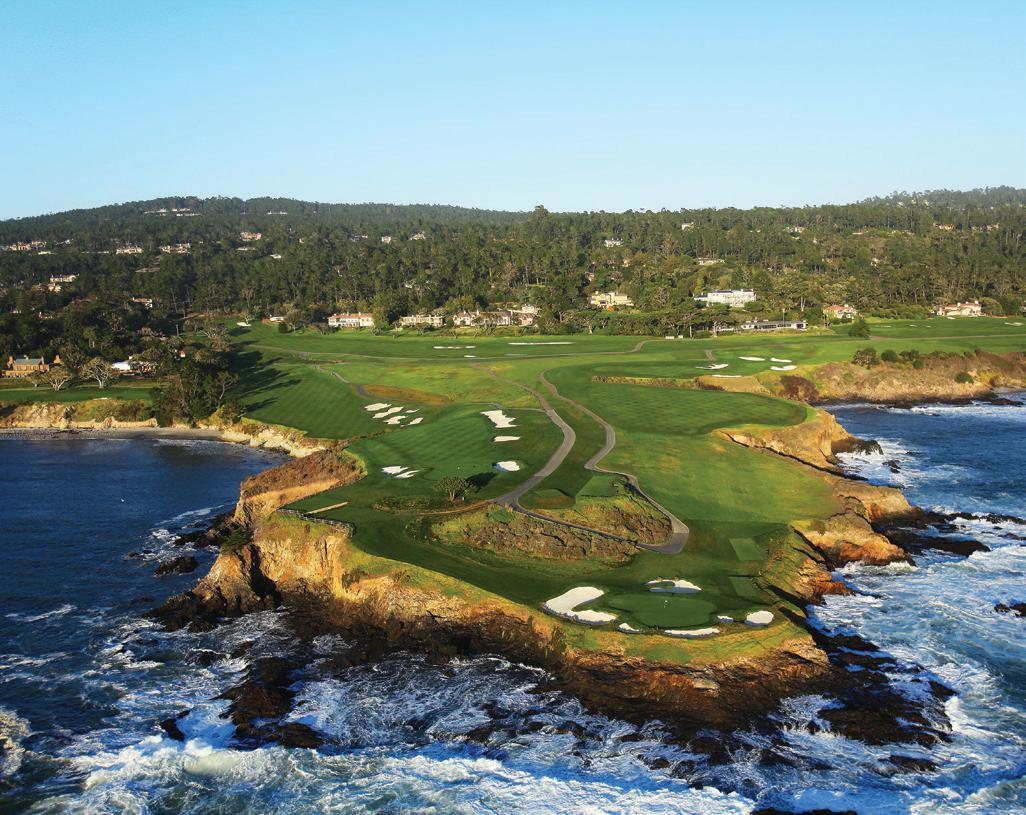
Tom Fazio creation has already been rezoned for potential resort expansion, according to Clark County plans, and has been openly discussed by Wynn Resorts. “It’s among some of the most commercially valuable land in the United States,” Rice says. For comparisons, MGM paid roughly $562 million for 37 acres behind Bellagio in 2021.
How about Pebble Beach, golf’s greatest meeting of land and sea? Picturing high-rises along the iconic seventh tee box is enough to make golfers sick to their stomach. Don’t worry; it’s highly unlikely Pebble Beach’s owners would ever sell the property. Also, California’s restrictions via the Coastal Act would severely limit any development. With those caveats, $880 million for this land is perhaps a conservative number. A 7,700-square-foot home along Pebble’s 11th hole sold for $24 million in March 2026. Heaven forbid condos ever do go up, the inland holes wouldn’t have the same value as the land directly along Stillwater Cove with ocean views.
In the highly sought-after land of Long Island, where eight of America’s 100 Greatest Courses reside, Maidstone Club in East Hampton, N.Y., slightly edges Sebonack and Shinnecock Hills for the most valuable land, with estimates ranging up to $1.5 million per acre for high total value of $300 million. To buy the land to build Sebonack in 2001, Michael Pascucci paid $46 million in cash to the International Brotherhood of Electrical Workers’ Union Local 3 and then donat-
RARE BEAUTY
Golf developers will never again find available land like Pebble Beach.
ed 54 acres of wetlands to the town of Southampton. His land today is worth $253 million, says Rice, or 554 percent more than he paid for it 25 years ago. Of course, Pascucci, who has become one of golf’s marquee developers with his Apogee Golf Club in Hobe Sound, Fla., would never sell the land to be used for something other than golf.
The current boom in course construction has many developers searching for cheap land in remote areas. Developers like Guy are trying to replicate the model of Indian Creek or Maidstone, deliberately assembling the kind of acreage many of these older clubs acquired almost by accident. Whether they can succeed is perhaps the more important question than if Medinah can ever be subdivided. Golf clubs have become the de-facto vehicle for a privacy economy that real estate alone can’t deliver. “The land is valuable because of the golf—not the other way around,” Guy says.