JANUARY 2016 ISSUE 15
A M o n t h ly M a g a z i n e o n K n o w l e d g e a n d D e v e lo p m e n t b y t h e M o h amm e d B i n R a s h i d A l M ak to u m F o u n d at i o n
AED20
I n C o n v e r s at i o n
42 flashes / january 2016
Stephen Wozniak
‘The digital divide bothers all of us’ Stephen Wozniak, co-founder of Apple Inc. on life after Apple and his current views about education, philanthropy and the world of technology
www.mbrf.ae
january 2016 / flashes 43
I n C o n v e r s at i o n
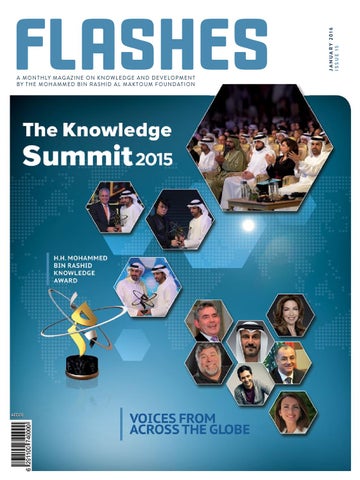
One of the panelists at the third session on ‘Innovation and Information Technology’ on the opening day of the Knowledge Summit 2015 in Dubai was Stephen Wozniak, co-founder of Apple Inc. and inventor of Apple II computers. Wozniak had helped shape the computing industry with his design of the Apple’s first line of products – the Apple I and II and influenced the popular Macintosh. The following are excerpts from his exclusive interview with Flashes: On his career after leaving Apple I moved out from Apple to philanthropy and
then to teaching, in that order. I had an unusual personality. When we started Apple, I did not want to run a company and I made sure I was never at the top of the business. I was only at the bottom of the organisation chart as an inventor in the laboratory. Eventually, Apple grew big. I did some very important, critical inventions in the early days of Apple and kept it going. But eventually it was so big and managed …it was not my style. I like start-ups. One time I had a plane crash and five weeks later, I came out of amnesia and I called up Steve Jobs and I said, ‘This is my only chance to go back to college and get my degree.’ So I went back to college for one year and earned my degree from Berkley under a fake name. My Berkley diploma says Rocky Raccoon Clark. I returned to Apple as an engineer. And after a few years, I got an idea – around the time the Macintosh has been in use – it was an idea to build a universal remote control. This is when anyone in the US had two remote controls – one for TV and one for VCR. No one had remote controls for hi-fi stereos, laser disc players, satellite TV receivers, etc. And it was a difficult machine, with two microprocessors – it was like a little computer in your hand. And I built that. Then I started getting involved at the same time with philanthropy. I did not want huge sums of money. I had more than I needed and I started giving it to museums and arts groups and things like that. I did not want to wind up in that phase of maximising one’s wealth forever and getting powerful forever. That’s not my personality. I am the opposite. In fact, when Apple had an IPO, I gave away huge amounts, maybe almost $20 million worth today of this stock to some early employees and to some other employees because I felt that it was wrong for only the three of us at the top to have it.
Photos: © Getty Images
On the digital divide in the world I have no better answer than anyone else. If I were to look at a statement that would have meaning, I would say that it has to be based on something that does not exist yet. Some day we may have smart computers that are conscious, that can actually come up to you and be your best friend. And you can have one teacher per student. Education is where it all starts. More
44 flashes / january 2016
Stephen Wozniak
Wozniak did a Berkeley diploma under the fake name Rocky Raccoon Clark
education, knowhow and resources too. I wish there were incubators just to give more resources into people’s hands, just to build things for their own homes. Things they want for themselves. That is how I started. The digital divide bothers all of us at the top tech companies. And some go and teach in poor neighbourhoods. I did my teaching for eight years, but I did it in the town I lived in, which is not a poor neighbourhood. But I did it in the public schools, not the private schools. I kind of feel guilty about that some times. When you go to an impoverished area, this is the problem: You might bring technology in. You can tell students how to use technology, to be part of the oncoming world and get a job and a career. But their parents sometimes don’t have the ability
to be teachers in their homes and don’t guide them or give them the culture. So in impoverished areas, many will not be ready to reap the full benefits of the mobile internet culture we have today. It will eventually reach there. But it will take a long, long time [for technology in these spaces to be culturally enriching].
www.mbrf.ae
Drew Carey guest hosted The Late Late Show, with guests David Arquette and Steve Wozniak on the CBS Television Network
january 2016 / flashes 45