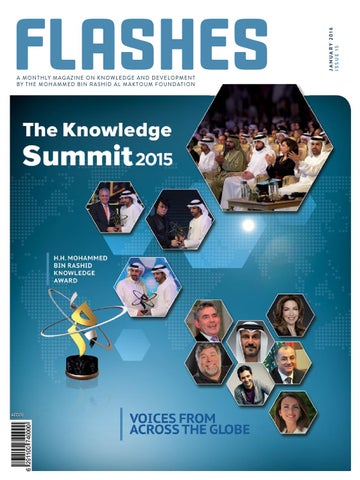
JANUARY 2016 ISSUE 15
A M o n t h ly M a g a z i n e o n K n o w l e d g e a n d D e v e lo p m e n t b y t h e M o h amm e d B i n R a s h i d A l M ak to u m F o u n d at i o n
AED20
EXPLORE
The Middle East is in the frontline of gender equality in filmmaking Nayla Al Khaja, the UAE’s first female filmmaker, talks about her love for the craft, about being a woman and holding the camera, and why digital media needs better storytellers
50 flashes / JANUARY 2016
N ay l a Al K h a j a
www.mbrf.ae
JANUARY 2016 / flashes 51
EXPLORE
In 10 years, you have become a seminal name associated with Emirati film culture. How did you decide to become a documentary filmmaker? I could almost call it an accident. I was motivated to do this student documentary because a German guy in my classroom asked me if people in Dubai had microwaves and I was quite shocked. This is 12-13 years ago. I was quite adamant on flying him down to Dubai and shooting this documentary from his eyes, about his discovery of this place. I fell in love with the process and I thought I could do this for a long time. That said, my first love is narrative and storytelling, creating atmospheres. Narrative filmmaking is where I see myself heading for sure.
As a female filmmaker in the GCC region, how is your cinema different from that of a male filmmaker? Does gender play a role in how cinema is made? Is the term “female filmmaker” too much of a label? Absolutely not. I have seen lots of interesting films about women directed by men, and 52 flashes / JANUARY 2016
vice-versa. Being a specific gender does not determine your craft. I think the best way to classify filmmakers is whether you’re a good filmmaker or whether you need to work on your craft. To break yet another stereotype, women comprise 7% of directors globally, but in the Middle East, we are doing fantastically when it comes to this ratio. We have a balance and are in the front lines of gender equality in filmmaking, even if it is a small step. We’re still not a full-fledged industry, but when it blossoms and becomes bigger, you’ll find an even distribution of male and female workers, which to me is interesting. I think the term female filmmaker will die out because it’s just not a professional term any more.
Your firm D-Seven Motion Pictures also works with top clients such as car companies, etc. How do you negotiate the space between art and commerce? D-Seven was established to do commercials because it’s work, it’s bread and butter. D-Seven also has The Scene club, which is the largest film club in the region. We showcase 36 films a year from all around the world. We fly in the director/producer to discuss the film. We run
A behind the scenes moment from Nayla Al Khaja’s Arabana
N ay l a Al K h a j a
In a world where video/nanotechnology is wiping out the format of film itself, do you feel the region needs to do more to promote analogue technology?
this as a year-long festival, you could say. The only difference is that a film festival is condensed to a week. It’s now turning into a commercial venture, it’s now a paid-for service – with commercials, we work with agencies, we are the ‘execution’ end of things, we get a readymade story-board, the agency has the concept, they have a campaign. We come up with a director who matches that vision. That’s hard-core commercials. When it comes to art, D-Seven uses its extra cash to invest in short films and we boost those films in festivals. Neighbours has been in 40 festivals and won three awards.
Nayla Al Khaja on the sets of Neighbours
I personally absolutely miss analogue production. If I had the chance I would shoot solely in 35mm. It has a depth and aesthetic value that digital can never give you. Digital is hyper reality. It is way too polished. That said, analogue cinema has become harder to create. How do you do reversal processing? Where do you buy stock? How do you project your film? Because you can shoot so little with film to save money, you had so many rehearsals. The accessibility of digital cinema ironically backfires because you get a lot of garbage in the process as well.
The Scene film club that you launched has a cult following of sorts. Please tell us about the independent film club culture in the Emirates? When we launched, we had 50 members. Today, we have 10,700 plus members. It has gone from strength to strength. I like the concept, you come in with your jeans, tshirt, flip flops. You don’t walk the red carpet. It’s just good film, good people, a good day – and the formula works.
What is the status of film education in the Middle East? The Knowledge Summit has had a lot of talks on how to turn the region into a knowledgebased economy. What are some of the hopes and challenges to film education in the region? That’s a very tricky one because I think it’s a supply and demand thing. Definitely, film education in Dubai is not available. There is a film institution in Dubai and I don’t think it gives you the full-on experience; there is one film school in Abu Dhabi that is more geared and more hardcore and that’s a two-year course. That said, you don’t have a film culture and film history courses, which is enrichening. Students need to be made aware of how analogue cinema works and this is where film history is important. People were so patient back in the day when making films in analogue. They manually spliced all their footage. That humility and rigour is very important in understanding film. It makes you a more mature filmmaker. I would love to see a film department at more universities. I think the timing is right, and I don’t see why not. www.mbrf.ae
JANUARY 2016 / flashes 53