J U LY 2 0 1 7 ISSUE 31
A M O N T H LY M A G A Z I N E O N K N O W L E D G E A N D D E V E LO P M E N T B Y T H E M O H A M M E D B I N R A S H I D A L M A K TO U M K N O W L E D G E F O U N D AT I O N
#YearOfGiving
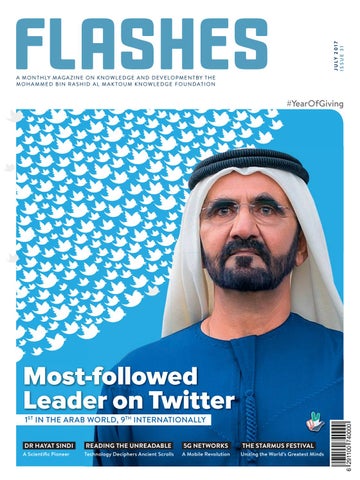
Most-followed Leader on Twitter 1ST IN THE ARAB WORLD, 9TH INTERNATIONALLY DR HAYAT SINDI
READING THE UNREADABLE
5G NETWORKS
THE STARMUS FESTIVAL
A Scientific Pioneer
Technology Deciphers Ancient Scrolls
A Mobile Revolution
Uniting the World’s Greatest Minds
1 Cover.indd 1
7/5/17 9:28 AM
The box that ticks all the boxes Introducing Business in a Box for SMBs Enjoy a one stop business-grade solution while saving cost! You can now get: Internet up to 100 Mbps Advanced IP phones and features Zero upfront on office devices Office applications Firewall and access control
Starting from AED 955 per month with 24/7 support
800 5800
etisalat.ae/businessinabox
2-5 Content forword.indd 2
7/5/17 2:25 PM
CONTENTS
J U LY / 2 0 1 7 ISSUE 31
REGULARS 05: WELCOME 06: NEWS Global Knowledge Index is launched 44: THE DANGER OF COUNTERFEITS The global economic value of counterfeiting could reach $2.3 trillion by 2022
EXPLORE READING THE UNREADABLE Using X-rays and new innovative technologies, experts are reading ancient
48: PLANTS OF THE FUTURE Scientists are now working on improving photosynthesis for better plant growth
scrolls without unwrapping them /12
50: THE POWER OF SCIENCE Dr Hayat Sindi is internationally recognised for her ground-breaking work, dedication to science, her focus on youth entrepreneurship and the important role of women
engineer, wants to ensure that younger
54: A LITERARY RESTORATION The University of Al-Qarawiyyin in Fez is the world’s oldest continually operating educational institution in the world www.mbrf.ae
2-5 Content forword.indd 3
NO FEAR OF FAILURE Sir James Dyson, the world famous British generations embrace engineering /16
THE WORLD’S LARGEST PLANE Stratolaunch, the world’s largest aircraft by wingspan, is aiming to transform satellite launching /20
A SUPER ANTIBIOTIC TO FIGHT A SUPER BUG A team of American scientists recently reengineered a vital antibiotic that could thwart the fatal advance of super bugs /22
RWANDA’S QUANDARY
Oil exploration is set to start on Lake Kivu, which could potentially result in a cataclysmic disaster thanks to the lake’s unique geology /26
REACHING FOR THE STARS
The fourth Starmus Festival brought together the world’s greatest scientific, theoretical, technical and artistic minds /30
THE TRADE IN SEA CUCUMBERS
With prices up to $3,000 or more per kilogram when dried, sea cucumbers are becoming an endangered commodity /34
REACHING OUT WITH 5G
The world is getting ready for 5G networks, which will have a profound impact on our world /40 JULY 2017 / FLASHES
3
7/5/17 2:25 PM
Flashes Magazine English.pdf
1
7/4/17
2:46 PM
C
M
Y
CM
MY
CY
CMY
K
2-5 Content forword.indd 4
7/5/17 2:25 PM
Printing, Publishing & Distribution Member of MBRF Holding CHAIRMAN HE Jamal Bin Huwaireb EDITORIAL BOARD Saif Al Mansoori Khalid Wazani Lina Al Anani Eyad Al Jurdy Mohammed Bin Rashid Al Maktoum Knowledge Foundation T: +971 4 423 3444 F: +971 4 368 7777 PO Box 214444, Dubai United Arab Emirates www.mbrf.ae flashes@mbrf.ae
A Motivate Connect Publication
Media One Tower, Dubai Media City PO Box 2331, Dubai, UAE T: +971 4 427 3000 F: +971 4 428 02261 motivatepublishing.com connect@motivate.ae PUBLISHER
Chris Capstick chris@motivate.ae GROUP EDITOR – CONNECT
Guido Duken
PROJECTS MANAGER
Ingrid Valles
SENIOR ART DIRECTOR
Tarak Parekh
SENIOR DESIGNER
Rouf Majid
CONTRIBUTOR
Robert Anderson GENERAL MANAGER – PRODUCTION
Sunil Kumar
www.mbrf.ae
2-5 Content forword.indd 5
FOREWORD Dear readers, Knowledge, which is based on literacy and education, has far reaching social consequences that impact the development of countries around the world. The Mohammed Bin Rashid Al Maktoum Global Initiatives, which the Mohammed Bin Rashid Al Maktoum Knowledge Foundation (MBRF) is part of, seeks to support education, disseminate knowledge, encourage research and the spread of knowledge, and provide children with a healthy learning environment to help address these social issues. Literacy and education are key to sustainable development, but as countries and regions all have their own unique set of challenges, accurate data is required to implement innovative approaches and solutions. The launch of the Arab Knowledge Index in 2015 and the Arab Reading Index in 2016 by MBRF, in collaboration with the United Nations Development Program (UNDP), sought to address the significant lack of credible data and research through empirical study that would aid the decision making process in the areas of knowledge and development. As implied by their names, both Indices focus on the Arab region’s contexts, cultures and needs. The Arab Knowledge Index and the Arab Reading Index have proven extremely useful and the unveiling of their annual
results is a highly anticipated part of MBRF’s annual Knowledge Summit. However, we live in the era of globalization, which means every country and region is politically, economically and socially connected. Knowledge, especially, recognizes no borders and it is not limited to specific peoples or nations. Therefore MBRF, following directives from its Chairman His Highness Sheikh Ahmed bin Mohammed bin Rashid Al Maktoum, recently announced the launching of the Global Knowledge Index. It is the first index of its kind with a truly global focus, assessing 140 countries from the perspective of sustainable human development. When the full report and findings of the Global Knowledge Index is made available this November it will not only provide governments and authorities with accurate and objective data to flag both opportunities and challenges, but also allow the UAE to benchmark itself against international standards. The UAE is already a regional leader in the knowledge sector, but as its ambition is to be among the best in the world the result will be particularly relevant. Jamal Bin Huwaireb CEO of Mohammed bin Rashid Al Maktoum Knowledge Foundation JULY 2017 / FLASHES
5
7/5/17 2:25 PM
NEWS
National Volunteer Platform Launched His Highness Sheikh Mohammed bin Rashid Al Maktoum, Vice President and Prime Minister of the UA and Ruler of Dubai, together with the Crown Prince of Abu Dhabi and Deputy Supreme Commander of the UA Armed Forces, His Highness Sheikh Mohammed bin ayed Al Nahyan, were the first two people to sign up to volunteer through the country’s national volunteer platform o nteers ae’. The platform aims to register 200,000 volunteers in 201 . The platform was launched by HH Sheikh Mohammed bin Rashid before a Cabinet meeting, which was attended by HH Sheikh Mansour bin ayed Al Nahyan, the UA Deputy Prime Minister and Minister of Presidential Affairs; HH Lieutenant eneral Sheikh Saif bin ayed Al Nahyan, Deputy Prime Minister and Minister of Interior; and HH Sheikh Abdullah bin ayed Al Nahyan, Minister of Foreign Affairs and International Cooperation. HH Sheikh Mohammed bin Rashid signed up as a volunteer in the fields of Hope Making and nvironmental Sustainability, and Sheikh Mohammed bin ayed signed up in the Humanitarian ork field; their actions are intended to motivate the community to register as well, and enrich the nation’s culture of generosity, philanthropy and social service. The UA Volunteers platforms purpose is to create an integrated and sustainable system for volunteering, and to promote the value of volunteerism as one of the most 6
6-9 news-N.indd 6
important pillars of social cohesion, which is one of the national priorities of the UA . The mirates Foundation, in collaboration with the Ministry of Community Development, developed the national volunteer platform. It will bring together volunteering opportunities with government institutions, private-sector entities, and charitable organisations. Thousands of registered volunteers, including citi ens and residents, will have opportunities to apply their skills and serve their communities. The platform is designed in a manner that highlights opportunities based on the volunteer’s skills and interests. It provides volunteer opportunities in the fields of education; humanitarian work; care for the elderly; health; culture and arts; sports; leisure; environment; community service; hope making; professional development; international volunteerism; and emergency response. It will also develop a personal record for each volunteer, and provide people the chance to nominate volunteers for innovative projects. It will be the largest and most thorough volunteer platform in the country. The platform seeks to consolidate the mission of the Year of iving, as announced by UA President His Highness Sheikh Khalifa bin ayed Al Nayhan, for public and private sector entities to promote the value of volunteer work and social responsibility as an important part of sustainable development.
FLASHES / JULY 2017
7/5/17 9:30 AM
NEWS
UAE’s Leap in 2017 World Competitiveness Report His Highness Sheikh Mohammed bin Rashid Al Maktoum, Vice President and Prime Minister of the UA and Ruler of Dubai, expressed his pride at the UA ’s leap in the 201 orld Competitiveness Report, and its place on the top 10 list of countries in the competitiveness index. “Today the orld Competitiveness year book was released in Swit erland; the UA advanced five positions from last year, and is now among the top 10,” His Highness said in a series of tweets on his Twitter account. “The UA ranked 1st in Quality of overnment Decisions, Adaptability in overnment Policy, and Supporting Technological Advancement.” “The UA ranked 2nd in Business fficiency 5th in conomic Performance as stated by the International Institute for Management Development,” Sheikh Mohammed continued. The UA advanced by five places in the general index of the report, while it occupied the first position in the region and the Arab world in competitiveness.
Top 10: 1
Hong Kong SAR
6
Ireland
2
Switzerland
7
Denmark
3
Singapore
8
Luxembourg
4
USA
9
Sweden
5
Netherlands
10 UAE
Most-followed Arab Leader on Twitter
His Highness Sheikh Mohammad Bin Rashid Al Maktoum, Vice-President and Prime Minister of the UA and Ruler of Dubai, is the most-followed Arab leader on Twitter and 9th internationally, according to BursonMarsteller’s 201 Twiplomacy study.
www.mbrf.ae
6-9 news-N.indd 7
ith .9 million followers, Sheikh Mohammed ( HHShkMohd) emerged as the top Arab leader, followed by Jordan’s QueenRania and Saudi Arabia’s KingSalman with six million followers each, the study said.
JULY 2017 / FLASHES
7
7/5/17 9:30 AM
NEWS
MBRF Launches Global Knowledge Index The Mohammed bin Rashid Al Maktoum Knowledge Foundation (MBRF) has collaborated with the United Nations Development Program (UNDP) to launch the lobal Knowledge Index. Following directives from MBRF Chairman His Highness Sheikh Ahmed bin Mohammed bin Rashid Al Maktoum, the Index is the first of its kind in the world and has enlisted 1 0 countries by offering a platform to exchange insight and expertise. It is set to contribute to economic and social development strategies around the world, enrich the knowledge movement, and serve as a roadmap for the sustainable development of human societies. The lobal Knowledge Index also offers a new tool to ag the opportunities and identify the challenges facing nations, and produce accurate and objective data for governments and authorities to launch new programmes and initiatives to build a knowledge-centred society. The press conference was attended by MBRF C His xcellency Jamal bin Huwaireb; Khaled Abdel-Shafi, Director of the UNDP Regional Hub in Amman, Jordan; Yakup Beris, Regional Program Coordinator, Arab Bureau for UNDP; and Dr Hany Torky, Chief Technical Advisors at the Arab Knowledge Project. “The lobal Knowledge Index ushers in a new era for the knowledge industry, taking our efforts onto the global stage,” said H Jamal bin Huwaireb. “Knowledge recognises no borders; it is not limited to specific peoples or nations. ith that in mind, it becomes ever so important that we embrace globalisation and be fully engaged with what is happening in the world around us – especially, the rapidly accelerating knowledge revolution.”
MBRF and UNDP will set up a cross-continental team of experts and specialists to oversee the new Index, and to ensure that it operates according to a well-researched methodology. The new tool covers a diverse spectrum of sectors including higher education; pre-university education; technical vocational training and continued education; information and communication technology; scientific research and innovation; and, finally, economics. Khaled Abdel-Shafi underlined the significance of this strategic and productive partnership with MBRF, commending the many initiatives under the Arab Knowledge Project. MBRF and the UNDP had previously collaborated on the Arab Knowledge Project and launched the Arab Knowledge Index in 2015 and the Arab Reading Index in 2016. The results for both indexes are discussed at length during the Foundation’s annual Knowledge Summit. MBRF and UNDP will work with other in uential international bodies, most notably the UN SC Institute for Statistics, the International Telecommunication Union (ITU), and the International Association for the valuation of ducational Achievement.
Successful Conclusion of Nobel Museum on Physics The Mohammed bin Rashid Al Maktoum Knowledge Foundation (MBRF) concluded the third edition of the Nobel Museum at the Children’s City at Dubai Creek Park, where it was held for three months. Themed “The Nobel Pri e in Physics Understanding Matter”, the Museum attracted tens of thousands of visitors of all ages and shed light on scientists, inventors, and Nobel laureates in the field of Physics, as well as their discoveries and achievements. It was the first Nobel Museum to ever focus on physics. For the third consecutive year, the Nobel Museum has been committed to providing scientifically inclined students with knowledge, expertise, and insight into the most important scientific achievements. The main objective is to motivate visitors to learn from these sources and then implement their newly acquired knowledge to excel and register their own achievements. The Nobel Museum 201 hosted eight different sections, including Rays and aves, Matter, Stars Universe, 8
6-9 news-N.indd 8
lectronics, and Quantum Physics (“A Quantum orld”). Visitors also had the chance to learn about the different Nobel laureates in the Laureate Arena, and were able to go on a journey through the cosmos using virtual reality equipment with the museum’s VR xperience section.
FLASHES / JULY 2017
7/5/17 9:30 AM
NEWS
Submissions Open for the Mohammed bin Rashid Al Maktoum Knowledge Award MBRF is officially accepting submissions for the annual Mohammed bin Rashid Al Maktoum Knowledge Award (MBRKA). The Award seeks to recognise and honour individuals and organisations that have made significant contributions to the field of knowledge, and to encourage them to innovate and play an in uential role in building the knowledge economy. H Jamal bin Huwaireb, C of MBRF and Secretaryeneral of the Award, said “The Mohammed bin Rashid Al Maktoum Knowledge Award has underlined the necessity to produce, disseminate, and localise knowledge in the region. It is a prestigious Award that plays a critical role in building a knowledge economy at the local, regional, and international levels. The award embeds knowledge into the cultural fabric of our societies and promotes intellectual and creative achievements.” ith the deadline set for August 31, 201 , written submissions (in Arabic or nglish) will be received on the Award’s website ( no e ea ar co ), where candidates that meet the necessary criteria can register for consideration, even if they have won the Award in previous years. Candidates can be individuals (in the UA and abroad); government departments; or local, regional, and international companies and organisations. The Award, however, cannot be granted posthumously. As regards eligibility, the Foundation has reaffirmed that any individual or organisation is welcome to apply, provided they have made significant and measurable contributions to
the knowledge industry, within one of the following categories knowledge, development and innovation; developing academic and research institutions; information and communication technologies (ICT); printing, publishing and documentation (both paper-based and electronic); as well as other fields specified by the Award’s Board of Trustees. Furthermore, nomination conditions and criteria for the Award stipulate that applications must be accompanied by reference letters from referees with expertise in the field of nomination; and that the nomination request must be accompanied by supporting documents about the nominee’s contribution to knowledge. Nominations must also adhere to the standards and ethics of scientific research, integrity and intellectual property.
How to Join LinkedIn’s ‘Arab Professionals Forum’ The Mohammed bin Rashid Al Maktoum Knowledge Foundation (MBRF) revealed the criteria candidates must meet to join the Arab Professionals Forum, which the Foundation had launched in collaboration with LinkedIn in ctober 2016. The Forum gathers top Arab subject-matter experts, academics, and scientists from all over the world, and serves as a platform where experts can communicate directly with Arab talent from the region and the world. The Foundation – a member of the Mohammed Bin Rashid Al Maktoum lobal Initiatives – has developed a set of criteria for candidates wishing to join the platform, mandating, among other things, that candidates be citi ens of Arab countries (including Arab expats around the world), and have more than 10 years of experience and a master’s degree or doctorate in their chosen field, in addition to Arabic reading and writing skills. “This forum builds bridges of cooperation between Arab experts, academics, and www.mbrf.ae
6-9 news-N.indd 9
executives,” said MBRF’s C His xcellency Jamal bin Huwaireb. “It encourages the exchange of ideas and opinions, aligns visions, and creates synergy to improve the cultural, social, and economic realities of the region.” “The stringent criteria we’ve specified allow us to select only the most qualified candidates to take part in the forum, which stands to bolster communication and cooperation between experts and academics in various fields,” H bin Huwaireb explained. The MBRF C lauded the agreement with LinkedIn, which intensifies cooperation between the Foundation and the professional networking giant, and facilitates the launch of joint, knowledge-focused initiatives in the Arab region. For more information regarding the terms and conditions to join the Arab Professionals Forum, please visit ttps in e in co ro ps JULY 2017 / FLASHES
9
7/5/17 9:30 AM
EGYPT Reading Rank Overall: 2nd Total Reading Time Per Year: 64 hours 2016 Sample Size: 52,720 Number of Arab Countries Sampled: 22
The Ara b Reading Index (ARI) was first released in 2016 and aims to provide an objective assessment of the state of reading in the Arab region
97% EXTENT OF READING
83% ACCESS AND AVAILABILITY
Reading matter sourced from
64 hrs
92% Family
Average of total reading (annual)
84% School
64%
AVERAGE TOTAL READING HOURS (ANNUAL)
under the wider vision of the Arab Knowledge Index. As reading is the basic tool in knowledge acquisition, exchange, and dissemination this assessment is of primary importance. The Arab Reading Index focuses mainly on reading within the more general knowledge development concept, emphasising the role of reading as a tool for enlightenment and empowerment.
85% 27% PERSONAL ATTRIBUTES
Made up of
35 hrs Electronic documents
30 hrs Printed documents
76%
27
73% Society
17
In Arabic
Skills and abilities
10
85%
In foreign languages
Motivation
12
28 hrs
Work related
Work related
Average number of books read (annual)
AVERAGE NUMBER OF BOOKS READ
35 hrs
Not work related
91%
Attitudes
14
Not work related
The Arab Reading Index is done in partnership by the Mohammed bin Rashid Al Maktoum Knowledge Foundation (MBRF) and the United Nations Development Programme (UNDP). Source: www.knowledge4all.com 10
FLASHES / JULY 2017
p10-11 index.indd 10
7/5/17 9:36 AM
U P D AT E S
EGYPT Number of Arab Countries Sampled: 22
The Index, which was initially launched at 2015’s Knowledge Summit, monitors the status of knowledge in 22 Arab countries to help decision makers, experts and researchers to implement development policies and identify knowledge gaps.
THE SIX MAIN SECTORAL INDICES OF THE ARAB KNOWLEDGE INDEX ARAB KNOWLEDGE INDEX
Technical Vocational Education and Training
Information and Communications Technology PreUniversity Education
Higher Education
Research, Development and Innovation
Economy
53% 60% 43% 49% 52% 46%
TECHNICAL PRE-UNIVERSITY VOCATIONAL EDUCATION EDUCATION Main pillars AND TRAINING Main pillars
59%
Education and Training
Main pillars
52% Enabling
environments
53%
Organisational Framework
INFORMATION AND COMMUNICATION TECHNOLOGY
77% Knowledge
44% Technological capabilities
50%
47% General
developmental context
Main pillars
HIGHER EDUCATION Main pillars
38%
Organisational performance and human resources
63% Competitiveness
42% Enabling
environment
55%
Economy-related information technology
RESEARCH AND INNOVATION Main pillars
40% Innovation 44% Higher
education inputs
49%
Research and development
and creative development of the economic structure
capital
Development context
ECONOMY
59%
Higher education outputs
48% Enabling
environment and infrastructure
The Arab Knowledge Index is a joint initiative between the Mohammed bin Rashid Al Maktoum Knowledge Foundation (MBRF) and the United Nations Development Programme (UNDP). Source: www.knowledge4all.com www.mbrf.ae
p10-11 index.indd 11
JULY 2017 / FLASHES
11
7/5/17 9:35 AM
EXPLORE
READING THE UNREADABLE o
o o rea an ancient scro if t e er act of nro in it i estro it sin ra s an ne inno ati e tec no o ies a tea of e perts a e s ccee e in irt a n rappin t e n e i cro posin ne possi i ities for arc aeo o
12
FLASHES / JULY 2017
12-15 Science.indd 12
7/5/17 9:36 AM
SCIENCE
It may not be common knowledge but anyone with access to a computer can read texts from thousands of years ago. Meticulously restored, deciphered and digitised by passionate scientists, academics and experts from all over the world, scripts from classical antiquity through to the oldest Islamic writings known to humankind are readily available online to view. Fancy perusing the Dead Sea Scrolls Reportedly discovered by a Bedouin shepherd chasing a stray in the Qumran caves in 19 , the seven scrolls are just a click away. The largest and best preserved of the seven, The reat Isaiah Scroll, is almost complete and contains 66 chapters of the biblical Book of Isaiah dating back to 125 BC . In December 2012, around 5,000 highresolution images of the Dead Sea Scrolls were put online by a partnership between oogle and the Antiquities Authority (AA). Shuka Dorfman, eneral Director of the AA said, “ e have succeeded in recruiting the best minds and technological means to preserve this unrivalled cultural heritage treasure which belongs to all of us, so that the public with a touch of the screen will be able to freely access history in its fullest glamour”. The internet now has archives dating back to the first century BC , which include sections of the Ten Commandments and the Book of enesis. In a fascinating alliance of ancient history and science fiction, the united efforts of computer scientists, archaeologists, historians and biblical scholars are harnessing www.mbrf.ae
12-15 Science.indd 13
new technologies to salvage the contents of libraries once thought lost to disasters such as fires and volcanic eruptions. ne of the most important treasures awaiting restoration is a library filled with the lost works of ancient reek and Roman authors from a villa in Herculaneum, a town that was destroyed by the eruption of Mount Vesuvius in C 9 that wiped out nearby Pompeii. Herculaneum was also overwhelmed by ultra-hot gases and ash. The charred scrolls, which likely belonged to the father-in-law of Julius Caesar, are so fragile that they would disintegrate upon being touched. However, modern techniques may unlock the contents of the scrolls. Dr. illiam Brent Seales, a computer scientist and the head of the University of Kentucky’s
Above: The 2D scan of the En-Gedi scroll that was done without unwrapping it. Below: The En-Gedi scroll was too fragile to unwrap.
JULY 2017 / FLASHES
13
7/5/17 9:37 AM
EXPLORE
Above: The Dead Sea scrolls were remarkably well preserved. Right: The charred scrolls have to be handled carefully as they can disintegrate. Below: The Herculaneum scrolls are believed to be the lost works of Greek and Roman authors.
14
Center for Visuali ation and Virtual nvironments, is something of a tech-genius Indiana Jones who is dead-set on restoring such archaeological treasures from ancient civili ations. Herculaneum is like the Holy rail for Dr. Seales and he has dedicated almost 1 years to developing the techniques and software to recover its mysteries. In 2009, using -ray-computed microtomography, a process similar to a CT scan, Dr. Seales managed to decipher the physical structure of the scorched layers of papyrus in one Herculaneum scroll. In the subsequent years, Dr. Seales launched the DUC project ( nhanced Digital Unwrapping for Conservation and xploration) which seeks to create readable images of such texts without opening them, using minimally invasive scanning and a technique known as virtual unwrapping’. This innovative technology works by modelling the surface of a scroll into a computerised mesh of tiny triangles. A virtual surface is created from the data obtained by scanning a scroll, then a best fit is applied to its internal structure. The ink letters are then studied and assembled on the structure in order to transform the 3-D structure into a 2-D sheet. In September 2016, Dr. Seales and his team applied these new techniques and succeeded in restoring two chapters of the n- edi Scroll, the
work of monks and scribes from over 2,000 years ago. Since 19 0, when archaeologists discovered the animal skin scroll fragments at an ancient site that was destroyed by fire around 600 C , the scroll had been shelved by the AA as any attempt to handle the charcoal remains resulted in destruction. As with numerous damaged materials in archives around the world, physical contact was simply not possible. In the co-authored research article published in cience A ances in September 2016, Dr. Seales writes, “The implementation and application of our computational framework allows the identification and scholarly textual analysis of the ink-based writing within such unopened, profoundly damaged objects. ur systematic approach essentially unlocks the n- edi scroll and, for the first time, enables a total visual exploration of its interior layers, leading directly to the discovery of its text.” The virtual unwrapping of the scroll revealed it to be the earliest copy of a Pentateuchal book ever found in a Holy Ark. Dr. Seales continued, “This work establishes a restoration pathway for damaged textual material by showing that text extraction is possible while avoiding the need for injurious physical handling. The restored n- edi scroll represents a significant leap forward in the field of manuscript recovery, conservation, and analysis.”
FLASHES / JULY 2017
12-15 Science.indd 14
7/5/17 9:37 AM
SCIENCE
Far left: Dr Brent Seales has taken the lead in ‘virtually unwrapping’ and deciphering scrolls. Left: A 3D scan reveals the many layers of a scroll.
The software is advancing constantly and the current hardware is thankfully up to the task. “The scroll from n- edi was digiti ed scanned with a commercially available scanner”, Dr. Seales says, adding, “Quite a lot can be done with available equipment. The software for analysis isn’t there yet, that’s where we’ve spent a lot of time.” hen Dr. Seales’ current government grant ends the suite of software programmes, called Volume Cartography, will become open source. Responding to inquiries about the motivation for the work on e e e it o rna of cience, Dr. Seales says, “The digital library movement got me interested, back in the 90’s, but I quickly got into the damaged part of materials. Digiti ation is crucial to build a library. hat do you do if something is really hard to digiti e That was the initial thinking. Then when I thought about the most profoundly damaged things it took me right to the idea of “imaging without touching opening.” Dr. Seales has his focus directed towards salvaging hundreds of historical texts that until now have been held in a form of limbo. His team’s success in unlocking the contents of the n- edi scroll bodes well for future projects. “There is no complete inventory world-wide of eligible objects, but from my own work I know there are lots of interesting objects. Almost every library or museum has damaged things,” he says. www.mbrf.ae
12-15 Science.indd 15
Unwrapping more of the Herculaneum scrolls remains a major goal for Dr. Seales. “They have their own problems – profound damage, carboniation, etc. – but fundamentally I’m a believer. I have always believed we will read Herculaneum non-invasively. e’re closer now than ever.” It remains to be seen if these impressive technological advancements will affect the modern world’s understanding of religion and whether the internet – providing open access to authentic documents – will result in a reinforcement of religious institutionalism, or alternatively a de-centrali ation. “In the past year, we ve more than doubled our productivity, but there s still a lot more to be done, Dr. Seales concludes. “And it’s a really exciting time in computing, so there’s currently no limit on what could happen ” A further positive result for the work of Dr. Seales and his team is not only saving of historical treasures thought to be irrevocably lost, but also a demonstration of the potential for a symbiotic relationship between the study of science and religion.
Below: The magnetic particles in ancient inks are scanned to reveal the writing.
JULY 2017 / FLASHES
15
7/5/17 9:37 AM
EXPLORE
16
FLASHES / JULY 2017
16-19 Innovation-N.indd 16
7/5/17 9:38 AM
I N N O VAT I O N
NO FEAR OF FAILURE ir a es D son is t e or fa o s ritis en ineer o in ente t e D son a ess ac c eaner is in entions isr pt an o inate t eir ar ets an t e e a e D son a i ionaire in t e process e ants to ens re t at o n er enerations e race en ineerin to esi n a etter f t re
In public bathrooms from London to Lahore, Dubai to Denmark, you will find Dyson Air Blade hand-dryers. Using just one sixth of the energy of standard hot air hand-drying machines, the invention was a happy accident for Sir James Dyson, Founder and Chief ngineer at Dyson Ltd. The blade of cool air was being developed for other uses, but the engineering team realised it performed better
www.mbrf.ae
16-19 Innovation-N.indd 17
at scraping moisture from hands – cue steady global ubiquity. here the Air Blade failed for its intended purpose, it succeeded in a new unplanned area. Failure is something that Dyson is utterly unafraid of. “At school, you’re not allowed to fail. The wrong answer is a bad thing. But all failures teach you something,” he says.
JULY 2017 / FLASHES
17
7/5/17 9:38 AM
EXPLORE
Clockwise from above: Dyson sold his first vacuum cleaner in 1985. It was bag-less and over time he refined the concept further to include roller ball joints.
18
Dyson gained this wisdom first hand over a fiveyear period in the 1980s as he developed his first major breakthrough invention – the Dyson vacuum cleaner. f this huge success Dyson famously stated, “I made 5,12 prototypes of my vacuum before I got it right. There were 5,126 failures. But I learned from each one. That’s how I came up with a solution. So, I don’t mind failure.” This approach and dedication is resonant of the great inventor and businessman Thomas dison, who said, “I have not failed. I’ve just found 10,000 ways that won’t work.” hen the popular American interviewer and mmy-winning journalist Charlie Rose asked Dyson on his television show what his passions were, beyond engineering, Dyson didn’t miss a beat and replied “ ngineering and engineering”. You get the picture. Dyson couldn’t be more passionate about designing and making things that look good and work well. “I’m a firm believer in function over form,” he says, adding, “You quickly fall out of love with something that’s easy on the eye if it doesn’t do the job.” n the motivation behind his greatest success Dyson explains, “It was such a horrible product, everybody hated it. I mean most people probably still do hate it, but I hated it because I was made to vacuum when I was about six because my father died, and I just remember this sort of smell of stale dust and stale dog, and the screaming noise and it not picking things up. hen I was 25 I had exactly the same experience when I bought what was supposedly the world’s most powerful vacuum cleaner. So, I
thought, now I’m an engineer, I’ve got to understand this and see why it doesn’t work.” This quest to understand, improve and innovate is Dyson’s life work and passion. He works daily with his team of engineers to devise solutions and enhance products wherever possible. “There are big problems like stopping a vacuum cleaner from clogging, or they can be very little problems like how to make that wheel not fall off. I’m not sure I like the thought of a problem before I do it, but once I get involved, going through the sort of agony and the pilgrim’s progress, it’s hugely enjoyable” he says. n the journey from problem to solution Dyson explains that it is ultimately a case of trial and error. “It’s 99 per cent failure and one per cent success. atching failure and experiencing it is fascinating because it gives you a clue as to how you might solve it… and you don’t get through that sitting at a drawing board.” hilst Dyson has no fear of failure in his own endeavours, he is greatly concerned that the UK, and also the USA, have a massive shortfall of young people embarking on a life and career in the engineering sector, and that the est is being left behind in the wake of countries such as India, China, Korea and Singapore where roughly 0 per cent of graduates are engineers. “I think most countries, certainly the US and Britain, need more engineers,” he says, “and they’re just not coming through our schools. In the UK, we have about 12,000 engineers a year coming out of universities and thousands of vacancies – that’s going to be some 200,000 vacancies in five years’ time. The shortfall is going to be enormous because manufacturing companies are going to have to gear up to compete in production technology.”
FLASHES / JULY 2017
16-19 Innovation-N.indd 18
7/5/17 9:38 AM
I N N O VAT I O N
To combat the lag in engineering the James Dyson Foundation was launched in the UK in 2002 to inspire young generations to opt for a life in engineering and science. The organisation has extensive engineering programmes across the UK and works with 2,000 schools and top universities including Manchester, xford and Cambridge. Following success in the UK the James Dyson Foundation opened in Chicago, USA, in 2011. “My Foundation is helping encourage design, technology and engineering and our engineers go and visit schools and do master classes, plus we’re doing after-school classes in Chicago. e’re supporting and giving grants to people studying engineering and science in universities and at post-graduate level,” Dyson explains. rin ebb ran the launch of the James Dyson Foundation in Chicago and as a senior figure at the Foundation she develops programmes and workshops to help teachers and students dispel the myth that engineering is boring. Re ecting on a typical day in her role ebb says, “I work with an ama ing team to help inspire the next generation of engineers. There is definitely no such thing as a typical day, but I love that. It challenges me to think on my feet, which is incredibly motivating.” ebb is a dab hand at mythbusting and sweeps aside the common notion that engineering is a vocation mainly for males. “ ngineering is one of the most exciting careers and it’s certainly not just for the boys. Design engineering is highly creative – it’s solving real problems with your own ideas. It’s extremely hands-on and anything but boring. And despite the myth, the best design engineers are great communicators and quite social.” Another Dyson trailbla er’ at the Foundation is Lenore Kaplan from Chicago. The design and engineering bug grabbed her during after-school clubs and it has driven her into a career she is passionate about. “At its core, engineering is problem solving, and I love that” she says. Kaplan’s job involves any task that requires a technical eye testing machines, helping the call centre with inquiries and listening to users. The technology constantly changes and new challenges arise. “This is why I love my job; to me, everything is a problem to be solved.”
www.mbrf.ae
16-19 Innovation-N.indd 19
Above: The James Dyson Foundation was launched in 2002 to inspire more young people to study engineering.
From brainstorming the initial concept right through to the conclusion stage, Kaplan embraces the challenge. “I love working in a group to come up with cra y ideas and watching those ideas grow. Sometimes the strangest thing can put you on the right path. ngineering can take you anywhere. It gives you a foundation for solving problems – you can find creative solutions and implement them into anything.” Sir James Dyson has enjoyed phenomenal success, but he has not learned from it. It’s his failures that have taken him to where he is today and he remains passionate about inspiring and supporting new generations to take the mantle and run. “The fact is that the world needs engineers,” he says, concluding, “ e need them with the advanced education and skills that will allow them to leave university and immediately start contributing to the engineering industry. ngineering is one of the most exciting careers, full of adventure and opportunity. It’s the only job in the world in which you look at the world’s problems and work out practical ways to solve them. I believe that there’s an engineer within all of us. But to become a great engineer that spark has to be nurtured.”
Below: The latest Dyson bladeless fan has been another hit product.
JULY 2017 / FLASHES
19
7/5/17 9:38 AM
EXPLORE
THE WORLD’S LARGEST
PLANE trato a nc t e or s ar est aircraft transfor sate ite e i er hen you ask someone what the world’s largest aeroplane is they are likely to think of the double decker passenger jet Airbus A380 or the cargo behemoth Antonov An-225. But this could be about to change. In early June workers towed the gargantuan Stratolaunch out of its hangar in the Mojave Air and Space Port in California, giving an insight into what could be the future of satellite delivery and space travel. The Stratolaunch is massive in every sense of the word. It has a 11 m wingspan, stands 15m above the ground with 28 wheels for support and measures 3m in length.
20
in span is ai in to
To put that into context, the A380-800 has a length of 2. 2m and a wingspan of 9. 5m although it does stand higher off the ground at 2 m. But comparisons with conventional aeroplanes do not do the Stratolaunch justice. It is after all designed for a completely different purpose.
FLASHES / JULY 2017
20-21 Aviation.indd 20
7/5/17 9:39 AM
AV I AT I O N
Stratolaunch Systems Corporation was founded by entrepreneur and Microsoft co-founder Paul Allen in 2011. It is intended to be an air-launch platform to make access to space “more convenient, reliable and routine”. However, as the company’s vision states, it has far bolder ambitions than just transporting passengers from city to city. “ e believe that normalising access to low arth orbit (L ) has the potential to redefine our lives by creating more opportunities for commercial, philanthropic and governmental organisations to collect rich and actionable data and drive advancements in science, research, and technology from space,” the company says. utside of his role as co-founder of one of the world’s best-known technology companies, Allen himself is no stranger to projects of scale or indeed beyond arth altogether. He is well known as the owner of one of the world’s largest superyachts, the 126m ctop s, and as a funder of SpaceShip ne, the first private spacecraft to carry a civilian into suborbital space and back in 200 . His vision for Stratolaunch is to go even further by providing airport-style access to low arth orbit in a move he believes will open scientific and technological possibilities. “Like millions of others, I was enthralled by the idea of space exploration, and have been ever since,” he recalls citing Russian Cosmonaut Yuri agarin’s achievement of becoming the first man in space in a LinkedIn opinion piece. “But I would never have imagined that, more than 50 years later, access to low arth orbit would still be costly, complex and difficult. I am determined to change this to help maximise the potential of space to improve life here on arth.” To do so Allen is constructing the largest all-composite plane ever built with a unique catamaran-style hull designed to carry payloads between its two fuselages with the support of six whopping Boeing Pratt hitney engines. Should his plans prove successful, the Stratolaunch will be able to deliver satellites and other payloads of more than 500,000 pounds across multiple orbits and inclinations in a single mission with an operational range of 2,000 nautical miles.
www.mbrf.ae
20-21 Aviation.indd 21
Crucial to the design is its reusability compared to traditional rockets, which up until the March success of Space , have been discarded or unusable after launch. Another key advantage is that the Stratolaunch will be able to take off from a runway allowing it to avoid ha ards including bad weather, airborne traffic and heavy marine activity encountered by rocket launches. “ hat advantages does this air-launch approach offer First, with aircraft-like operations, our reusable launch platform will significantly reduce the long wait times traditionally experienced between the construction of a satellite and the opportunity to launch it into space,” Allen notes. “Second, because Stratolaunch is designed with a ight radius of up to 1,000 nautical miles and can launch from different runways, it will offer scientists, businesses and space entrepreneurs much greater exibility, such as the potential to evade local weather problems that often impose untimely delays on traditional vertical rocket launches. “Third, with shorter wait times, greater exibility and more missions per year, we will be able to lower costs and increase opportunities to put small satellites into L . And when such access to space is routine, innovation will accelerate in ways beyond what we can currently imagine.” The June unveiling of the Stratolaunch craft to conduct aircraft fuelling tests marks the completion of the initial aircraft construction phase and the transition into the aircraft ground and ight-testing phase. It also paves the way for the first take-off sometime this year and the first rocket-launch test, expected in 2019. Should all go to plan the company hopes to be fully operational by the end of the decade, although Allen himself admits there are likely to be challenges ahead. “As always, space remains an unforgiving frontier, and the skies overhead will surely present obstacles and setbacks that must be overcome,” he says. “But hard challenges demand fresh approaches, and I’m optimistic that Stratolaunch will yield transformative benefits – not only for scientists and space entrepreneurs, but for all of us.”
Above: Microsoft co-founder Paul Allen. Below: Stratolaunch, the world's largest aeroplane, should start flight testing later this year.
JULY 2017 / FLASHES
21
7/5/17 9:39 AM
EXPLORE
A SUPER
ANTIBIOTIC TO FIGHT A SUPER BUG A tea of A erican scientists recent re en ineere a ita anti iotic t at co t art t e fata a ance of s per s it e perts arnin e are on t e c sp of a post anti iotic era ere e istin r s are po er ess a ainst so e of t e or s ost t reatenin iseases t is is eartenin ne s Drug-resistant bacteria are one of the greatest threats to human health. Nearly 23,000 people succumb to antibiotic-resistant infections in the United States of America alone according to the US Centers for Disease Control and Prevention. lobally, the figure stands at 00,000 deaths annually. ithout new antibiotics, we are looking at 10 million deaths annually by 2050, which equals to somebody dying every three seconds of antimicrobial resistance (AMR). The independent e ie on Anti icro ia esistance, backed by the UK government and the ellcome Trust and headed by the economist Jim ’Neill, estimates that by 2050, infections that are untreatable with antibiotics could cost the global economy 100 trillion.
22
FLASHES / JULY 2017
22-25 Health.indd 22
7/5/17 10:15 AM
H E A LT H
Notably, the e ie on Anti icro ia esistance doesn’t attempt to estimate what they call the secondary costs of resistance that is, the cost of having to forego routine medical procedures such as cancer care, joint and organ transplants and surgeries, as without antibiotics the danger of infection would be too great. (They estimate that C-sections alone contribute two per cent to annual DP.) It also doesn’t try to estimate what the healthcare costs would be of caring for those additional resistance illnesses and deaths. Antibiotic resistance has reached such alarming proportions that last year all 193 UN member states pledged to tackle what has been called one of the major health challenges of our time. arlier this year the orld Health rgani ation drew up a list of a do en drug-resistant bacteria to discuss at the 20 summit being hosted in ermany in July.
AN IMPORTANT BREAKTHROUGH As the urgency to find new antibiotics capable of fighting hard-to-treat infections grows, scientists at the Scripps Research Institute in California made an important breakthrough. The team have re-engineered a vital antibiotic in a bid to wipe out one of the world’s most threatening superbugs. For years, the vancomycin-resistant enterocci or VR infection has been worrying doctors. VR , which is found in hospitals and causes fatal wound and blood stream infections, features on the H list as one of the most dangerous drug-resistant bacteria. The original vancomycin antibiotic, engineered over 60 years ago, is now ineffective against VR . In May this year, the Scripps research team succeeded in reformulating the existing vancomycin antibiotic to make it ultra-tough and a thousand times more potent than its older version.
To restore vancomycin’s efficacy, the Scripps team made strategic modifications to the molecularstructure of the old drug. The new vancomycin antibiotic is designed to fight bacteria in three different ways, thereby reducing the bacteria’s chances of withstanding the attack. The new drug works by destroying the most vital part of the bacteria – its cell walls. Researchers changed the molecular structure of vancomycin to increase its strength and durability explained the team’s lead researcher, Dr. Dale Boger. “ e made one change to the molecule vancomycin that overcomes what is the present resistance to vancomycin. And then we added to the molecule, two small changes that are built into the molecule, which results in two additional ways in which it can kill bacteria. So the antibiotic has three different, we call them mechanisms’, by which it kills bacteria. And resistance to such an antibiotic would be very difficult to emerge,” he said.
Above: Professor Dale Boger (right) and Assistant Professor Akinori Okano led the VRE research.
ANIMALS IN THE USA CONSUME MORE THAN TWICE AS MANY MEDICALLY IMPORTANT ANTIBIOTICS AS HUMANS
70%
ARE CONSUMED BY ANIMALS
30%
ARE CONSUMED BY HUMANS
www.mbrf.ae
22-25 Health.indd 23
JULY 2017 / FLASHES 23
7/5/17 10:15 AM
EXPLORE
The reinforced vancomycin was able to completely eliminate samples of VR in lab tests and retained its potency even after 50 rounds of exposure to the bacterium. Dr. Boger attributes the drug’s success to its three-pronged mechanism, as the bacterium is unable to cope against the three independent attacks the antibiotic launches. ven if it is able to defend against one mechanism, the other two kill it.
MORE NEEDS TO BE DONE ver the past few decades, research is being actively carried out to find solutions to drug resistant bacteria. However, H stresses that more needs to be done by governments to find new antibiotics to fight hard-totreat infections. Despite antibiotic resistance reaching record highs, the drug-pipeline is practically dry. The global organisation fears that pharmaceutical companies will only develop treatments that are easier and more profitable to make. “ e are fast running out of treatment options. If we leave it to market forces
alone, the new antibiotics we most urgently need are not going to be developed in time,” said Dr MariePaule Kieny, Assistant Director- eneral – Health Systems and Innovation. In the midst of such concerns, microbiologists and doctors are hailing the vancomycin breakthrough as hugely important. Although the new drug is yet to be tested in animals and people, the team is hopeful that it will be ready for human use within the next five years. The Scripps team is confident that vancomycin’s modified version can be used without fear of resistance. “It’s a molecule designed specifically to address the emergence of resistance,” asserts Dr. Boger. Now, the researchers are looking to find a way to formulate the new version of vancomycin using fewer chemical processes – the current method involves 30 steps. This will make production of the drug more economically viable. Compared to the challenge of designing the new molecule, this is the easier part of the project says the Scripps team.
North America 317,000
Latin America 392,000
Number of deaths 24
Asia 4,730,000
Europe 390,000
Africa 4,150,000
Oceania 22,000
AMR mortality per 10,000 population
FLASHES / JULY 2017
22-25 Health.indd 24
7/5/17 10:15 AM
H E A LT H
THE CAUSES OF ANTIMICROBIAL RESISTANCE The causes of AMR are widespread. Animal consumption of antibiotics is a major problem. Some 70 per cent of medically important antibiotics in the US are given not to people but to animals in order to boost their growth rate. The global proportion used in agriculture is hard to calculate, but the O’Neill review estimates it is at least half. As evidence mounts of a link between agricultural antibiotic use and resistant infections in people, it is clear that we are taking unacceptable risks. This is evidenced by Colistin, a last-resort treatment against bacteria that have become resistant against other antibiotics. Colistin is used widely in agriculture, and in November 2016 it was revealed that E. coli bacteria in China, in both animals and people, have acquired resistance to it. The same gene has now been found in E. coli in Europe. In humans, antibiotic resistance is accelerated by the misuse and overuse of antibiotics, as well as poor infection prevention and control. Antibiotic resistance is rising to dangerously high levels in all parts of the world. New resistance mechanisms are emerging and spreading globally, threatening our ability to treat common infectious diseases. A growing list of infections – such as pneumonia, tuberculosis, blood poisoning and gonorrhoea – are becoming harder, and sometimes impossible, to treat as antibiotics become less effective. Where antibiotics can be bought for human or animal use without a prescription, the emergence and spread of resistance is made worse. Currently, at least 90 per cent of multi-resistant infections in the US can still be killed by at least one www.mbrf.ae
22-25 Health.indd 25
antibiotic of last resort. However, the situation is getting grimmer. This year the US Centre for Disease Control and Prevention reported that a woman who died in Nevada last August was infected with Klebsiella bacteria that was resistant to 26 different antibiotics – everything her hospital was able to throw at it.
ANTIBIOTIC RESISTANCE WHAT YOU CAN DO Antibiotic resistance happens when bacteria change and become resistant to the antibiotics used to treat the infections they cause. Only use antibiotics when prescribed by a certified health professional Always take the full prescription, even if you feel better Never use left over antibiotics Never share antibiotics with others Prevent infections by regularly washing your hands, avoiding contact with sick people and keeping your vaccinations up to date
JULY 2017 / FLASHES 25
7/5/17 10:15 AM
EXPLORE
RWANDA’S
QUANDARY i e p oration is set to start on a e i ic co potentia res t in a catac s ic isaster t an s to t e a e s ni e eo o
26
FLASHES / JULY 2017
26-29 Energy.indd 26
7/5/17 9:46 AM
ENERGY
Lake Kivu, which straddles the scenic borders of Rwanda and the Democratic Republic of Congo (DRC), hides a terrifying secret in its depths. Its waters are saturated with methane, carbon dioxide and hydrogen sulphide gas. If released, this toxic combination of approximately 60 billion cubic metres of methane and 300 billion cubic metres of carbon dioxide could take the lives of the more than two million people that live along the lake’s shores. ith a surface area of 2,3 0km2 – almost the si e of Mauritius – and a maximum depth of 80 metres, Lake Kivu is one of the reat Lakes of Africa. It is the 3rd deepest in Africa after Lakes Malawi and Tanganyika. The thing that makes Lake Kivu stand out is its unusual geochemistry, largely as a consequence of local subaquatic springs that absorb carbon dioxide from the region’s volcanic soil and feed the gas into Kivu’s deepest waters. Much of the methane comes from decomposing organic matter; the rest comes either from the volcanic soil or from bacteria converting the carbon dioxide to methane.
www.mbrf.ae
26-29 Energy.indd 27
A DANGEROUS PRECEDENT The gas-laden water is currently trapped beneath a layer of heavy saline water that prevents it from rising to the surface. However, with the methane concentrations rising, an earthquake, a volcanic eruption, or even the growing pressure of the gases themselves could breach that barrier. This phenomenon, which has only occurred twice in recorded history, is known as a limnic eruption or an overturn. Both of these overturns happened in small lakes in Cameroon, with the one at Lake Nyos killing more than 1, 00 people in 1986. The victims were asphyxiated when a cloud of carbon dioxide, which burst from the lake along with a 100-metre fountain of water, spread as far as 25 kilometres from shore. Kivu contains a thousand times more gas than Nyos and studies of Kivu’s sediment record suggest that the lake has experienced at least five overturns in the last 6,000 years.
Below: Lake Kivu contains approximately 60 billion cubic metres of methane and 300 billion cubic metres of carbon dioxide.
JULY 2017 / FLASHES
27
7/5/17 9:46 AM
EXPLORE
Above left and right: KivuWatt uses methane gas from the lake to fuel a 26-megawatt power plant. Below: KivuWatt’s 3,000 ton barge separates the methane gas from the water.
That is why a five-year agreement between Rwanda and the DRC to explore for oil under the lake is a contentious issue. “This could release a powerful explosion, due to gas expansion, such as happened on Nyos – but potentially much larger,” says Robert Hecky, of the Large Lakes bservatory at the University of Minnesota who has been researching the lake since 2012. Drilling on the lake surface would be very ha ardous as it could lead to a rapid upwelling of deep water. If a blowout were to occur, the upwelling of oil or gas would displace the currently stable gas rich layers upward until the gas pressure exceeded the hydrostatic pressure at shallower depths allowing spontaneous degassing – a limnic eruption – to occur.
The problem is that landlocked Rwanda and DRC currently have to import expensive diesel fuel to generate electricity. Therefore, the prospect of finding oil is an enticing one. The so-called Kivu graben is an extension of the Albertine region in which Uganda has discovered massive crude oil deposits estimated at around 5.5 billion barrels. In 201 , an oil survey exercise in Rwanda discovered that the Lake Kivu basin was favourable for oil and gas exploration. However, as the Kivu basin is the highest in altitude of the lakes in the estern Rift Valley, the sediment thicknesses may not be as deep and oil rich as in the Albert basin or the Lake Tanganyika basin. A Rwandan firm, Ngali Mining, has now won petroleum exploration rights in Lake Kivu two years after it was put on hold following the termination of a contract with Vanoil – a Canadian company that had spent 3 million on petroleum exploration in Lake Kivu.
METHANE TO ENERGY The irony is that the methane in Lake Kivu is already a viable power source. Rwanda’s economy has been growing at eight per cent annually, but its electricity grid has struggled to keep pace. Installed capacity was doubled from 2010 to 2015 but remained at a scant 156 megawatts, meaning around 80 per cent of Rwandan’s were not connected to the grid. It is estimated the lake s 60 billion cubic metres of methane could power the country at current rates for 00 years a transformative prospect in a country that has few energy alternatives. More importantly, extracting
28
FLASHES / JULY 2017
26-29 Energy.indd 28
7/5/17 9:47 AM
ENERGY
the methane gas also reduces the pressure, making a limnic explosion less likely. n December 31, 2015, the switch was ipped on Kivu att, which was billed as the first of its kind. This 200 million facility draws up water from an offshore barge, siphons off the methane, and pipes it to a 26-megawatt power plant on shore. The US energy company Contour lobal developed the project and it exceeded expectations from day one. However, Kivu att wasn’t the first attempt. Years earlier, Rwanda had entered into a partnership with a Scottish firm to build a small pilot facility on the lake. The plant, known as KP1, began working intermittently in 2008 and produces a few megawatts of electricity. Another project brie y produced 2. megawatts in 2010, but the equipment was removed from the lake after it was damaged in a storm. The problem was that designing a system to exploit the energy potential of the methane while stabilising the lake and protecting the environment had to be done from scratch. nergy industry insiders lauded the idea as a noble undertaking, but expressed doubt it would actually work, or be cost effective if it did. It eventually took seven years and millions of dollars to come up with a workable system. “Many came and concluded that this thing could not be done,” says Joseph Brandt, C of Contour lobal. And it wasn’t easy, he says. “ e tried, and when we failed, we kept trying.” ventually, he says, “Possibility became probability and then certainty.” In a planned second phase, Contour lobal plans to build two or three more barges, ramping up capacity to 100 megawatts, which would nearly double Rwanda’s energy capacity by 2020. Another US firm, Symbion Power, signed an agreement with the Rwandan government to build a 50-megawatt project last December. According to the Management Prescriptions for the Development of Lake Kivu as Resources, a 2009 document known as the MPs, the authors estimate
www.mbrf.ae
26-29 Energy.indd 29
that the lake is capable of providing between 160 and 960 megawatts of generating capacity over a period of 50 years. After that, the gas that continues to accumulate could be harnessed for up to 100 megawatts of capacity in perpetuity. Kivu att’s 3,000-ton extraction barge, moored 13km from Lake Kivu’s shoreline, draws the gas-laden waters from a depth of 350 metres. As the waters come closer to the surface, where there is less pressure, the gas bubbles out, much like what happens when a soda bottle is uncorked. The gas is siphoned off for cleaning while the degassed water is injected back into the lake to maintain the ecosystem. Finally, the purified gas is piped back to the mainland where it fuels generators that supply electricity to the national grid. In a developed country, the current 25 megawatts would provide enough energy for 5,000 people. In largely rural Rwanda, it is already enough to radically transform livelihoods. The Lake Kivu gas extraction project is unique in that it is able to harness a potent greenhouse gas to produce electricity, while at the same time making the area safer for its inhabitants. The discovery of oil would undoubtedly be a boost to Rwanda’s economy, but the jury is still out whether it is a risk worth taking.
Above: The 1986 limnic eruption at Lake Nyos killed 1,700 people. Below: Scientists instal early warning systems that can detect a change in methane and carbon dioxide concentration.
JULY 2017 / FLASHES 29
7/5/17 9:47 AM
EXPLORE
REACHING
FOR THE
STARS
30
FLASHES / JULY 2017
30-33 Events.indd 30
7/5/17 9:48 AM
EVENTS
e fo rt tar s esti a ro t to et er t e or t eoretica tec nica an artistic in s If you think celebrating science and music simultaneously doesn’t sound like an average event, you’d be right. The Starmus Festival, which refers to stars’ and music’, had its genesis in two minds that found fame in widely divergent fields. Rock star Brian May is the founding guitarist of super group Queen. In 19 , May was working on his astrophysics PhD dissertation at Imperial College in London, but he abandoned his work when Queen began to achieve success. More than 30 years later, he resumed his focus on odiacal dust in the solar system. In 200 , his new advisor was renowned astrophysicist Dr arik Israelian. May and Israelian struck up a friendship that went beyond science as the latter is also a musician. ut of this meeting of minds the idea of the Starmus Festival was born, and the first event took place in 2011 in Tenerife, Spain. The fourth edition of the Starmus Festival took place this year in Trondheim, Norway, from June 18 to 23 under the theme Life and the Universe’.
www.mbrf.ae
30-33 Events.indd 31
s reatest scienti c
A UNIQUE COMING TOGETHER According to Israelian, the goal of the Starmus Festival is to make science and art accessible to the public. He has accomplished this through three fully booked festivals and the fourth was no exception, attracting record numbers of the world’s most in uential researchers and astronomers along with superstars from the world of music. “Starmus is about science communication,” says Israelian. “ e communicate science to the general public. And we communicate it in a really unique way, in a very ambitious way. This is an extremely ambitious festival. It’s probably the most ambitious festival in the world. No one has been able to achieve what we have achieved in four editions.” The magic of the Starmus Festival is not just its focus on science but on the integration of music into the programme. ne of the most prominent members of the board, Peter abriel (former head of the British group enesis), explains the close links between astronomy and music “Musicians explore and define what’s
Above: Acclaimed musicians Devin Townsend and Steve Vai performed at this year’s Starmus Festival.
JULY 2017 / FLASHES
31
7/5/17 9:48 AM
EXPLORE
Above: Among the seminar topics this year was the search for exoplanets and alien life. Below: ‘Moonwalkers in Conversation’ featured astronauts Buzz Aldrin, Charlie Duke and Harrison Schmitt.
32
inside of us, astronomers explore and define what’s outside of us. That’s exactly what I love at the Starmus Festival the combination of the two worlds.” “Starmus is an important and very unique interdisciplinary festival of people working in different fields – astronomers, astronauts, cosmologists, physicists, philosophers, musicians, artists and biologists, who share an interest in the universe, how it began and is now, and how we may explore and use its many facets,” says Stephen Hawking, the world famous nglish theoretical physicist, cosmologist, author and Starmus board member. Hawking’s achievements in science have fundamentally changed our understanding of the universe and he serves as an icon of the scientific community. As a result the Stephen Hawking Medal, which was first awarded in 2016 in association with the Starmus Festival, rewards outstanding contributions to the field of science communication. The three winners of this year’s award, who received their medals at a Starmus ceremony on June 20, prove just how diverse the Starmus Festival is. Neil de rasse Tyson is an accomplished astrophysicist known for his television show os os; French composer, performer and record producer Jean-Michel Jarre is one of the
pioneers of the electronic music scene; and the CBS arner Bros television show, e i an eor has won acclaim for its commitment to science education through its 11 season run.
TACKLING THE BIG ISSUES ne of the highlights of this year’s event was a Nobel Laureate panel discussion on The Role of Science in the 21st Century’. Reading like a who’s who of the science world, it says a lot about the Starmus Festival that 11 Nobel Laureates graced the stage. They were May-Britt Moser, Robert ilson, dvard Moser, eorge Smoot, Adam Riess, Finn Kydland, Susumu Tonegawa, Chris Pissarides, Torsten iesel, Tim Hunt and Stefan Hell. ther topics that were addressed during separate seminars included The Legacy of Apollo 16’, xoplanets and xo arths’, rigins and Aliens The Search for Biosignatures on xoplanets’, String Theory and the Fabric of Spacetime’ and Moonwalkers in Conversation’, which featured Bu Aldrin via Skype, with Harrison Schmitt and Charlie Duke on stage. The undoubted highlight was Stephen Hawking’s seminar on The Future of Humanity’, which was broadcast from Cambridge. In it, Hawking outlined that he believes humanity has about 100 years to find another planet for habitation due to climate change, overdue asteroid strikes, epidemics and population growth. “I strongly believe we should start seeking alternative planets for possible habitation,” he said. “ e are running out of space on arth and we need to break through technological limitations preventing us living elsewhere in the universe.” Nobel Laureate neuroscientist dvard Moser said Professor Hawking emphasi ed the need for science in society at a time when communicating science is more important than ever. “I think what it comes down to is explaining how the data of climate change has been collected and how
FLASHES / JULY 2017
30-33 Events.indd 32
7/5/17 9:48 AM
EVENTS
the scientific process works and how data is tested over and over again. I don’t think there’s a single sentence I could say that would change anyone’s mind overnight, it’s a long term thing. Climate change is something scientists have to fight against other types of evidence for a long time, you shouldn’t take for granted that science is perceived as the source of the right answer. You have to explain to the public how science works,” he said.
THE ULTIMATE GOAL The fourth edition of the Starmus Festival was a huge success as it featured new and innovative ideas as told by leaders in technology and people who have changed the way we communicate, such as Skype co-founder
Jaan Tallinn, cybersecurity expert ugene Kaspersky, musicians Brian no and Steve Vai, and writer and director liver Stone. The opportunity to hear from 11 Nobel Pri e Laureates, as well as the best and brightest women who lead in the fields of physics, chemistry, and medicine proved an inspiration that reached far beyond the actual event. “ e all need role models that we can identify with. Starmus is an arena for creating scientist role models for girls and boys alike,” Moser said in conclusion. “The festival allows for children to meet with excellent scientists and learn about the many wonders of the world that science has brought to light, inspiring them and nurturing their curiosity.”
Above: Starmus speakers May-Britt Moser and Edvard Moser jointly won the 2014 Nobel Prize in Physiology or Medicine. Above left: Renowned astrophysicist Garik Israelian is a co-founder of the festival.
A GROWING SUCCESS The first three Starmus Festivals were held in Tenerife in 2011, 2014 and 2016, with each being more successful than the last. The first Starmus Festival, ‘50 Years in Space: Poyekhali’ set the tone with astronaut Neil Armstrong, the first man to walk on the moon, as the keynote speaker. Fellow Apollo astronaut Buzz Aldrin, Alexei Leonov, the first human to perform a spacewalk, and Nobel Prize scientists George Smoot and Jack Szostak, as well as many other luminaries, attended. In 2014, boosted by the publicity of the first event, Starmus truly lived up to its description as an event where “the greatest minds in space exploration, astronomy, cosmology, and planetary science get together for a week of incredible talks, sharing of information, and appreciation of the knowledge we have of space and the universe.” Close to 1,000 delegates were able to enjoy two lectures by Stephen Hawking, as well as contributions by Nobel Prize winning astronomer Robert Wilson and Nobel Prize winning astrophysicist John Mather. The 2016 Starmus Festival, entitled ‘Beyond The Horizon: A Tribute To Stephen Hawking’ swelled to more than 1,200 delegates with the most high-profile scientists and science
www.mbrf.ae
30-33 Events.indd 33
communicators in the world in attendance, including eleven Nobel Prize laureates. Starmus III was also the location of the inaugural awards ceremony for recipients of the “Stephen Hawking Medal For Science Communication.” The award recipients (chosen by Stephen Hawking himself) were: Composer Hans Zimmer, physicist Jim Al-Khalili and the science documentary Particle Fever.
JULY 2017 / FLASHES 33
7/5/17 9:48 AM
EXPLORE
THE TRADE IN SEA CUCUMBERS e re consi ere a c inar e icac in inese c isine si i ar to s ar n so p it t e i prices t e co an p to or ore per i o ra en rie sea c c ers are eco in t e ot ne ac ar et co o it
34
FLASHES / JULY 2017
34-39 Environment.indd 34
7/5/17 9:49 AM
ENVIRONMENT
The sea cucumber’s dietary and medicinal properties have made it an appreciated dish in China and other Southeast Asian countries for centuries. However, an unprecedented spike in global demand over the past three decades is posing a serious risk for this seemingly humble sea creature. Sea cucumbers are distributed in all oceans of the world, generally living near corals, rocks or seaweeds in waters of all depths and temperatures. The total number of presently known sea cucumber species is about 1, 00, of which some 66 are targeted as food that is generally sold as b che-de-mer. verfishing of sea cucumbers may be a modern problem, but the fishery itself is more than 1,200 years old. Sea cucumbers have been harvested since as early as 800 C . In the 1 00s, Indonesians travelled as far as Australia to harvest sea cucumbers for trade with Chinese merchants. By the late 1980s, sea cucumber fisheries had rapidly grown and expanded due to the growing international food trade, and further supported by demand for aquaculture, biomedical research, and manufacturing health supplements.
FOOD FOR KINGS Although less glamorous than their star fish and sea urchin cousins, the slug-like creatures are pri ed seafood on Asian markets and one of five essential luxury foods at traditional festive
www.mbrf.ae
34-39 Environment.indd 35
dinners. Temperate species can command up to 3,000 per kilogram while tropical species fetch up to 600 per kilo. The white sea cucumber boasts a price tag higher than gold – a whopping 16,000 for 200 grams. A live sea cucumber weighing 50 grams generally yields around 16 grams when dried. ith such lucrative prices, sea cucumbers are a hot commodity, which makes them an important resource in many coastal communities. In the Seychelles, for example, the 25 people who hold licenses to collect sea cucumbers are producing one per cent of the country’s DP. China’s rapidly growing af uent class has ensured that demand for sea cucumbers keeps rising. In fact, the sourcing network for these sea creatures has now extended far across Chinese regional waters to the USA, Africa and urope.
Above: Sea cucumber with mushrooms is a popular Asian dish. Top: Sea cucumbers and other fresh seafood for sale at the Seoul, South Korea, fish market.
JULY 2017 / FLASHES 35
7/5/17 9:49 AM
EXPLORE
Above: Sea cucumbers are known for their medicinal properties across Asia. Below: There are around 1,700 species of sea cucumber.
36
MEDICINAL PROPERTIES Sea cucumbers, commonly known as trepang, b che-de-mer, or gamat, have long been utilised in the traditional healing systems of Asian and Middle astern communities. Sea cucumbers are
recognised as a traditional remedy in Chinese and Malaysian literature for their effectiveness against hypertension, asthma, rheumatism, cuts and burns, impotence and constipation. Sea cucumbers consist of vitamins, minerals, cerebrocides, peptides and lectins, and also contain unique molecules, such as sulphated polysaccharides, 12-methyltetradecanoic acid (12-MTA), philinopside , triterpene glycoside compounds, glycosaminoglycan, and chondroitin sulphates. In sufficient quantities, these unique compounds are known to possess anti-microbial, anti-oxidant, anti-antigenic, anti-inf lammatory, immunomodulatory, and anti-tumoral properties. At the present time, around 60 per cent of approved cancer treatment drugs are of natural origin. Natural products that exist in marine animals and plants function as anti-mutagenic and anti-carcinogenic substances that may inhibit one or more stages of carcinogenesis by preventing or delaying cancer development. As a result the isolation and use of bioactive compounds from sea cucumber extracts has received increasing scientific attention.
FLASHES / JULY 2017
34-39 Environment.indd 36
7/5/17 9:49 AM
ENVIRONMENT
OVEREXPLOITATION IS A GROWING PROBLEM According to the US Fish and ildlife Service, 66 species are overexploited worldwide. The fishery follows the same patterns across communities in the Indo-Pacific and off the coasts of Africa, South America and Central America. Sea cucumber traders – either recent arrivals from Asia or locals working with overseas traders – set up shop, enlist local fishermen to strip the invertebrates first from shallow waters and then from greater and greater depths, and finally move on when there’s nothing left. ven if a population isn’t entirely wiped out, recovery is difficult. Sea cucumbers spawn externally, so if species density is too low, their reproduction fails and the local population can go extinct. Fishery managers struggle to react quickly enough and, in many cases, local governments only step in to close the fishery after it’s been overexploited. That’s what happened in Papua New uinea, the Solomon Islands, Vanuatu, Samoa, and Kiribati. Recovery can happen, but it often takes much longer than anticipated. An often cited example is that of cuador where the sea cucumber fishery arrived at the mainland in the late 1980s. The uncontrolled fishery soon depleted the resource, which prompted its migration to the alapagos Islands in 1991. However, strict regulations are enforced there due to the alapagos’ orld Heritage status. The alapagos Islands sea cucumber fishery is now one of the oldest fisheries of its kind in South America (1 years), and its management has been a model for many other nations wishing to regulate the sea cucumber fishery. The commercial farming of sea cucumbers may also be a viable alternative. Farmers in China have been
www.mbrf.ae
34-39 Environment.indd 37
raising large quantities of sea cucumbers in former shrimp ponds since the 1980s. Farms have cropped up in places such as Madagascar and Vietnam, but the industry is still in its infancy as only two species have been farmed successfully to date. The creatures’ biolog y makes aquaculture uniquely difficult. xcept on the equator, sea cucumbers breed seasonally. Due to their ability to soften and re-form their bodies, sea cucumbers easily slip out of pens and mesh nets, which are easier to build than solid confinement pools.
Above: A live sea cucumber weighing 450 grams yields around 16 grams when dried. Below: In Madagascar, Indian Ocean Trepang is successfully farming sea cucumbers.
JULY 2017 / FLASHES
37
7/5/17 9:49 AM
EXPLORE
Above: Sea cucumbers are found in all the world’s oceans and at all depths. Of all the species, only 66 are targeted for food.
38
n the positive side, sea cucumbers are fairly resistant to disease and do not need to be fed as they are scavengers that feed on small food items in the sea oor. Algae, aquatic invertebrates, and waste particles make up their diet. If carried out sustainably, sea cucumber harvesting can help alleviate poverty in many fishing communities. This requires proper governance of fisheries and supply chains to make sure sea cucumbers are harvested sustainably and fishermen get the rightful benefits of their hard work.
CLEANERS OF THE OCEAN The quickly disappearing numbers of sea cucumbers are worrying environmentalists and conservationists as they are critical to marine ecosystems by cleaning the world’s oceans of waste materials and turning them into nutrients for other marine creatures. By feeding on reef sand, sea cucumbers increase the alkalinity of the surrounding water. This process protects delicate corals and other reef organisms from erosion due to ocean acidification.
FLASHES / JULY 2017
34-39 Environment.indd 38
7/5/17 9:49 AM
ENVIRONMENT
As a result the loss of sea cucumbers due to overfishing threatens tropical biodiversity and coral reefs already under stress from changing ocean chemistry. As one area is fished out, the fishery moves to new fishing ones and often targets poor countries with lax regulations. Millions of sea cucumbers are traded each year but the message that they are endangered does not garner much public sympathy. Most marine conservation efforts are inclined towards charismatic’ fauna such as sharks and whales. The fact that sea cucumbers can hibernate in summer, eject and regrow their intestines, and – at the end of their decade or so on arth – release a chemical to dissolve their bodies without a trace does not up the cuteness’ appeal. The exact extinction risk of many sea cucumber species remains undetermined due to insufficient data. According to Traffic, a wildlife trade monitoring network, the data on sea cucumber catches fail to convey the true nature of the fishing impact as they are all recorded simply as “b che-de-mer” when imported. The countries of origin and the exact species are never noted. As a result most countries don’t know what they are importing and consumers aren’t aware of where the sea cucumber was sourced. “Demand for sea cucumbers does not appear to have been affected by any of the campaigns for shark fin conservation, including the Chinese government
actively limiting banquets where both shark fin and sea cucumbers are consumed. Many people are probably not even aware that sea cucumbers are fished and traded to meet similar cultural demand,” says Hampus riksson, a scientist with orldFish and the Australian National Centre for cean Resources and Security. According to riksson, the current regulatory environment is insufficient and the first step to saving sea cucumbers would be have more accurate trade data to evaluate poaching trends and guide efforts to manage and conserve the sea creatures.
Above: The white sea cucumber can fetch $16,000 for 200 grams.
A SUSTAINABLE SUCCESS AquaSpark, a fund that invests in sustainable aquaculture, is breeding sea cucumbers successfully on the Indian Ocean island of Madagascar. The farm, which is called Indian Ocean Trepang, began as a science project between the two Belgian universities Universite de Mons-Hainaut and Universite Libre de Bruxells – and Madagascar’s University of Toliara. The breakthrough was the invitro-fertilisation of sea cucumbers, which allows a year round harvest. A successful pilot phase turned into Indian Ocean Trepang, which now employs
www.mbrf.ae
34-39 Environment.indd 39
170 people and produces five tons of dried sea cucumber annually. Trepang also works as an NGO by growing the larvae to juveniles, which are then sold at 100 per cent credit to local fishermen who grow them over 12 months to the market size of 450 grams in sea pens. As a result the village communities are benefitting as it doubles the fisherman’s average income. Trepang is still working on optimising growing conditions for the sea cucumbers, and then hopes to expand the company to other areas around the world.
JULY 2017 / FLASHES 39
7/5/17 9:49 AM
EXPLORE
REACHING OUT WITH
40
FLASHES / JULY 2017
40-43 Technology.indd 40
7/5/17 9:50 AM
TECHNOLOGY
e or is ettin rea for net or s ic i a e profo n i pacts t at o far e on faster o n oa spee s en t e are a nc e in Later this year, 500 homes in 11 metro cities across the United States of America will experience 5 technology. Helmed by telecommunications company Veri on, 5 will allow a larger number of wireless users to share the same spectrum at connection speeds of one gigabit per second via smaller wireless cells. By 2018, 5 technology will control self-driving cars and robots working in mines in Sweden and stonia. Their citi ens living in rural areas are looking forward to 5 ’s better communication capabilities. n the other side of the globe, South Korea plans to launch its 5 network during the 2018 inter lympics. The network will link longterm evolution (LT ) base stations enabling more efficient telecommunications – a system that is much easier than laying fibre optic cables to create links. Japan’s biggest mobile service carriers – NTT Docomo, KDDi Corp and Soft Bank – are in continuous talks with the country’s communication ministry to discuss the R D progress
www.mbrf.ae
40-43 Technology.indd 41
of 5 technology. China is also expected to implement 5 technology commercially by 2020. Closer to home, UA -based tisalat is to pilot 5 next year and plans a commercial roll-out in the Middle ast in 2019. Hatem Mohamed Bamatraf, Chief Technology fficer at the tisalat roup, said that with 5 being prepared for commercial roll-out in 2019, the company is committed to trials and the commercial launch in the UA and the rest of the region. “ e signed an agreement with Qualcomm during the Mobile orld Congress this year to advance 5 and bring it forward,” he said. “ e remain committed to doing a proof of concept in 2018 and hopefully the commercial launch by 2019 before the Dubai xpo 2020.” ith 5 technology promising better connectivity, enhanced latency and greater throughput than current wireless technology, the opportunities offered by 5 are considerable, but the preparations for it are complex, he said.
Below: The implementation of 5G was the main focus of this year’s Mobile World Congress in Barcelona.
JULY 2017 / FLASHES
41
7/5/17 9:50 AM
EXPLORE
Above: 5G will be able to support the ever larger data requirements of networks. Above right: In the future, 6G will integrate 5G with satellite networks for total global coverage. Below: The Internet of Things will greatly benefit from 5G’s increased speeds and bandwidth.
RAISING A HIGH 5 In 2015, mobile data use rocketed by per cent, taking the overall global figure to approximately 3. xabyte’s per month (a unit of information equal to one quintillion (1018) or, strictly, 260 bytes). The spurt is due to a massive growth in streaming services and people’s growing use of apps – all underwritten by the expectation of having high-speed data connection at all times. hen existing networks will no longer be able to cope with demand, 5 will step in to save the day according to industry experts. 5 has been specifically designed to meet the expectations of next generation mobile networks. It pools bandwidths to handle more data, connect more devices, reduce latency, boost range and speed with increased levels of reliability. According to the National Infrastructure Commission UK, “5 means seamless connectivity. Ultra-fast, ultra-reliable, ultra-high capacity transmitting at super low latency. It will support the ever larger data requirements of the existing network and new applications from augmented reality to connected vehicles and the Internet of Things, and
many more, as unknowable today as the services we take for granted would have been a decade ago.” The 5 network is expected to have average speeds of 100Mbps. hile this isn’t a huge leap from the current 30-50Mbps which LT -Advanced networks deliver, it is a significant improvement. The technology has shown the capability to handle up to 150Mbps in lab conditions but the maximum capacity will eventually depend on the category of the device and connection. 5 boosts its speed by splitting data into bands, each of which has its own particular bandwidth limitation. Combining the different bands and pooling the bandwidth means users get speeds up to 100Mbps and beyond. 5 networks not only mean enhanced communications but also a huge boost in revenues. A study by telecommunications company Qualcomm estimates that the industry will produce up to 12.3 trillion worth of goods and services enabled by 5 by 2035. 5 itself could potentially generate up to 3.5 trillion in revenue in 2035 and support 22 million jobs. ver time, 5 will boost real global DP growth by 3 trillion dollars cumulatively from 2020 to 2035, roughly the equivalent of adding an economy the si e of India.
MASS REACH If rolled out globally in 2020, 5 will have 2 million subscribers by 2021 predicts technology, media and research company vum. “North America and Asia will each account for more than 0 per cent of global 5 subscriptions at the end of 2021, followed by urope with more than 10 per cent of subscriptions, with the Middle ast and Africa accounting for the remainder,” states its report. vum estimates that 5 services will be available in more than 20 markets worldwide by the end of 2021, with services in all four major world regions. However, the vast majority of 5 subscriptions will
42
FLASHES / JULY 2017
40-43 Technology.indd 42
7/5/17 9:50 AM
TECHNOLOGY
be concentrated in the US, Japan, China, and South Korea, where major operators have revealed aggressive timelines for launching 5 services. perators around the world are racing to bring 5 networks and devices to the masses. The Federal Communications Commission (FCC) in the US recently revealed Apple is testing next-generation, 5 wireless technologies, suggesting a future iPhone will run on the advanced connection. Finnish firm Nokia recently took a step closer to 5 mobile networks by announcing its .5 Pro network. .5 Pro will deliver 10 times the speeds of conventional networks, allowing network operators to offer peak speeds of one gigabit (1,000 megabits) per second. Nokia plans to follow this up with the launch of .9 . In the USA, AT T and Veri on are already trialling 5 across a controlled number of sites. ricsson and range have recently partnered to work on the development and testing of selected 5 use cases based on range’s network, using ricsson 5 technology. The partnership will enable so-called 5 technology building blocks’, proof of concepts, and pilots across urope from this year onwards. These include wireless multi-gigabits internet access, “ultra large mobile coverage solutions” and connected cars. ricsson is also partnering with NTT Docomo and Intel to build a 5 trial environment in central Tokyo, starting next year. The trials will test use case applications and radio performance. ricsson will provide 5 end-to-end systems including 5 radio and core networks, and Intel will contribute its chipset in user devices. At Mobile orld Congress 201 in Barcelona, Samsung announced a range of new 5 developments including a 5 router for the home, which supports a top data rate of 1 bps, and a 5 radio base station. As the race towards 5 unfolds, there is still a high degree of uncertainty around its deployment and adoptions. From self-driving cars to simply higher download speeds, the future of 5 is vast and unpredictable. The only thing that is certain is that it will be part of our lives soon.
Global Mobile Data Traffic Growth / Top-Line Global Mobile Data Traffic will increase 13X from 2012 to 2017
12 66% CAG
R 2012 –
10
2017
11.2 EB
8 7.4 EB
6 4 2 0
0.9 EB 2012
1.6 EB 2013
2.8 EB
2014
4.7 EB
2015
2016
2017
Source: Cisco VNI Global Mobile Data Traffic Forecast, 2012–2017
www.mbrf.ae
40-43 Technology.indd 43
THE EVOLUTION OF MOBILE COMMUNICATION First Generation (1G) • Year: 1970 – 1980s • Standard: AMPS (Advanced Mobile Phone System). • Services: Only Voice • Technology: Analogue • Speed: 1Kbps to 2.4Kbps Second Generation (2G) GSM technology was the first one to facilitate digital voice & data and international roaming. • Year: 1980 – 1990 • Technology: Digital • Speed: 14 to 64Kbps • Frequency Band: 850 – 1900 MHZ (GSM) and 825 – 849 MHz (CDMA) Third Generation (3G) The goal of 3G systems is to offer increased data rates. It enables wireless voice telephony, high speed internet access, fixed wireless internet access, video calls, chatting & conferencing, mobile TV, Video on demand and Location-based services. • Year: 2000 • Speed: 384Kbps to 2Mbps • Frequency: about 8 to 2.5GHz • Bandwidth: 5 to 20 MHz Fourth Generation (4G) The 4G mobile system is an all IP (internet protocol) based network system. The main goal of 4G technology is to provide high speed, high quality, high capacity, security and low cost services for voice and data services, multimedia and internet over IP. • Year 2010 to present • Speed: 100Mbps while moving and 1Gbps while stationary • Services: Mobile web access, IP telephony, gaming services, high-definition mobile TV, video conferencing, 3D television, and cloud computing, manage multi broadcast streams and handle quick-moving mobile phones, Digital Video Broadcasting (DVB), Dynamic information access and wearable devices. Smooth handovers across heterogeneous networks and automatic roaming between different wireless networks Fifth Generation (5G) It connects people and devices anywhere anytime. Its application will turn the world into one big Wi Fi zone. This will be supplemented by 6G in the future, which will integrate 5G with satellite networks for global coverage. • Year: 2017 onwards • Speed: 1 to 10Gbps. • Bandwidth: 1,000x bandwidth per unit area. • Frequency: 3 to 300 GHz
JULY 2017 / FLASHES 43
7/5/17 9:50 AM
EXPLORE
44
FLASHES / JULY 2017
44-47 Business.indd 44
7/5/17 9:51 AM
BUSINESS
e o a econo ic a e of co nter feitin co reac tri ion ort nate anti co nterfeitin tec no o is eco in ore sop isticate No place in the world is safe from the counterfeit scourge. In March this year, over three million counterfeit products of more than 30 renowned brands were confiscated in a week after Dubai conomy Development raided four warehouses in the emirate as part of its strategic focus on protecting intellectual property, as well as the rights of trademark owners and consumers. By the end of the first quarter of this year counterfeit versions of branded products including women’s bags, belts and expensive watches worth 31.16 million were sei ed by Dubai Police. Ibrahim Bah ad, Director of Intellectual Property Rights Protection in the Commercial Compliance Consumer Protection (CCCP) sector in Dubai conomy said “People promoting and selling counterfeits use innovative tricks. Some of them import the goods in pieces and then assemble it here, and they even use remote or misleading locations to stock such goods. e work closely with global brands to train our inspectors in identifying counterfeits and we update trademark owners on local developments in combatting counterfeiting.” In Dubai the millions of counterfeit mobile phones, cigarettes, cosmetics and other items sei ed in 2016 came to a total value of 0 million. Mobile phones and their accessories topped the list, followed by cosmetics. Some people regard buying counterfeit goods as a victimless crime. After all, what does it matter if a famous Italian fashion house loses some money if you buy a knockoff handbag, or a Swiss watch house goes empty handed when you acquire a passable imitation of the real thing The problem is that these are just two examples of the criminal global counterfeit wave that is sweeping the globe. A report commissioned by the International Trademark Association (INTA) and the International Chamber of Commerce said the global economic value of counterfeiting and piracy could reach 2.3 trillion by 2022. The global value of the counterfeit market in 2015 stood at 1. trillion. The February 201 report, by research firm Frontier conomics, said the wider social, investment and criminal enforcement costs could take the total to .2 trillion, leaving at risk about 5. million legitimate jobs’. According to analysts counterfeiting and fraud have always been a part of commercial life, but the quickening pace of fake products has come with the globali ation of business.
www.mbrf.ae
44-47 Business.indd 45
JULY 2017 / FLASHES 45
7/5/17 9:51 AM
EXPLORE
Above: Falsified medicines represent up to 50 per cent of the pharmaceutical market in several African countries. Above left: China has implemented a major crackdown on counterfeit goods.
46
A recent report by the UN ffice on Drugs and Crime (UN DC) says “counterfeit goods and fraudulent medicines pose a serious risk to public health and safety”. The goods range from automotive supplies, to chemicals and pesticides, consumer electronics, electrical components, food, drink and agricultural products. hile deaths and sickness have been reported from key foods such as baby milk powder in Asia, the full human toll as a result of fake mechanical, food and medicines is unclear. The UN DC and the orld Customs rgani ation estimate 5 per cent of counterfeit products sei ed worldwide in 2010 were manufactured in ast Asia. A report released by the US Chamber of Commerce’s lobal IP Centre ( IPC) in 2016 indicates that as much as 86 per cent of the world’s counterfeit goods originate from China, while India is a major source of fake medicines. China has begun a massive crackdown on counterfeits but key aspects of production are likely to move elsewhere, including to North Korea, Myanmar and Vietnam. The orld Health rgani ation estimates that counterfeit drugs make up 10 per cent of the drug market worldwide. That breaks down to 30 to 0 per cent (sometimes higher) in developing countries versus perhaps one per cent in developed countries. However, the US Food and Drug Administration (FDA) says this percentage is rising as it periodically buys drugs online and routinely finds that more than half are fakes. Do ens of public health scientists declared in 2015 that a global crisis of fake drugs was undermining the fight against malaria, tuberculosis and HIV Aids, particularly in the developing world. The orld Health rgani ation estimates that falsified medicines represent more than 50 of the pharmaceutical market in several African countries. Ineffective antimalarial drugs alone killed over 120,000
preschool children in Africa in 2013, according to research from the Center for Disease Dynamics. As a result, there is increasing demand for technologies to thwart counterfeiting or forgery, especially with issues of cross border migration and terrorism in many parts of the world. A report by Research and Markets entitled o a o nterfeit Dr Detection De ices ar et Assess ent orecast says that counterfeit drug detection technology has evolved greatly from large laboratory set-ups to battery powered handheld devices. These devices can scan medicines and immediately determine their active ingredients, thereby quickly and efficiently exposing counterfeits. Increased efficiency, ease of use, rapid test results and on-field applications are major factors driving their adoption in drug regulation and compliance. overnment initiatives for implementing unit level track and trace policy has boosted radio-frequency identification (RFID) and barcode systems application in the pharmaceutical supply chain. Research and Markets says the global counterfeit drug detection devices market was valued at 90 .5 million in 2016 and is expected to reach 1,368.5 million by 2021. Packaging is another aspect where technology is making its mark. Long gone are the times when stand standard holograms were effective, as counterfeiters now make copies that are indistinguishable from the real ones. Beating counterfeiters at their own game ultimately depends on the ability to identify them in the marketplace and using product authentication technologies that are far beyond their reach. Though the search for fakes may
FLASHES / JULY 2017
44-47 Business.indd 46
7/5/17 9:51 AM
BUSINESS
range far and wide, it begins with securing the product package. Anti-counterfeit pharmaceutical packaging is segmented on the basis of technology as RFID (active tags, passive tags, semi-active tags), security inks and coatings, security printing and graphics, hologram, mass encoding (Barcode Application, Digital Mass Seriali ation, Digital Mass ncryption) and others ( lectromagnetic, Surveillance Technologies). ne of the more fascinating forensic technologies used in this arena is that of deoxyribonucleic acidbased marking and authentication. That mouthful of chemistry is familiar universally as DNA, which is a molecule that encodes the genetic data found in every living organism. ne vendor, Applied DNA Sciences (ADNAS), leverages plant DNA to create a unique marking and authentication system for product and package security. Microtext is another solution being implemented in the fight against counterfeiting. An extremely fineresolution lasing method is used to create text that’s too small for the unaided eye to detect and can easily be hidden within the overall package design. For example, a single character of fine print on the package that’s already difficult to read at 1mm high might reveal, under microscopic examination, that it’s actually composed of do ens of smaller letters on the order of tens of microns high. Microscopic line images are also possible, and can be hidden within larger text or another image. Another approach is to include a hidden image within a design element. An image that is completely invisible to the naked eye can be included within the package design, and people who need to verify the authenticity of the product can be supplied with a special decoder. Typically about the si e of a credit card, this semi-transparent decoder is embossed with
www.mbrf.ae
44-47 Business.indd 47
a special line structure designed to reveal the hidden image. The user simply places the decoder over the package to reveal the image. A report by Markets and Markets said the value of anti-counterfeiting packaging is set to reach 153.95 billion by 2020, from 82.05 billion in 2015. The fashion industry has also been fighting back. In the uropean Union alone, the clothing, footwear and accessories industry loses approximately 2 . billion of revenue annually from counterfeit goods, according to official U statistics. lectronic Product Code-enabled RFID allows brand owners to assign a unique serial number to each item, which is then stored in a common database for purposes of tracking shipments and detecting authentic versus counterfeit goods, and also for increasing inventory efficiencies. There are now RFID tags that can be woven directly into textile or fabric products. The inclusion of extremely difficult to remove hologram stickers with serial numbers has proven a popular tactic for brands, including (but certainly not limited to) Fendi, Dolce abbana, Roberto Cavalli, Chanel, Canada oose, Rolex, and Moncler. According to eBay’s legal counsel, holograms have proven to be a very effective way to fight fakes because they re extremely difficult to reproduce with significant accuracy. Advancements in anti-counterfeit technologies, paired with tougher government legislations for protecting intellectual properties, may help to stem counterfeiting in the long run.
Above: The global value of the counterfeit market in 2015 stood at $1.7 trillion. Above left: Handheld devices scan medicines and immediately determine their active ingredients. Left: Fake Rolex watches seized in Thailand. Below: Technology is coming up with unique marking and authentication systems for product and package security.
JULY 2017 / FLASHES 47
7/5/17 9:51 AM
EXPLORE
otos nt esis t e process is not as ef cient as it co i pro in t is process
e
ic p ants t rn s n i t into foo cientists are no or in on
The world’s population is predicted to reach 9. billion in 2050, but with more mouths to feed there are fears that there may not be enough food to go round. lobal warming is also posing unique challenges. Crops will need to withstand hotter, drier conditions, and farms will need to feed more people. These unique problems will need unique solutions. ne area that researchers are taking aim at is photosynthesis, the basic green chemistry plants use for converting the sun’s energy into food – which results in plant growth. Photosynthesis, which consists of more than 1 0 interlocking steps, is not as efficient as it could be. As a result scientists are optimistic that enhancing this process will result in greater crop yields. In this context, researchers are looking at four key areas in the process Improve the efficiency with which plants capture light.
48
Improve the efficiency by which plants turn light into energy. Improve carbon uptake. Improve carbon use.
INCREASED PRODUCTIVITY Concentrating on the first approach, researchers at the University of Illinois at Urbana-Champaign and the University of California, Berkeley, found they could increase the productivity of genetically-modified tobacco plants by between 1 and 20 per cent, by boosting levels of three proteins involved in photosynthesis. The researchers used computer simulations to identify which of the 1 0 key steps in the photosynthesis chain might be most suitable for genetic tweaking to improve efficiency. They settled on a process called “non-photochemical quenching” of chlorophyll orescence, whereby the plant typically responds only slowly to changes in light intensity. The underlying idea for the tobacco experiment came from an appreciation of how light and shade dance over leaves throughout the day in a farm field. hen a plant finds itself taking in more sunlight than it can handle, its cells initiate a process to deal with all this excess light energy. n ymes in the leaf create a surge of a molecule called eaxanthin, which helps of oad the excess energy as heat. This process, known as nonphotochemical quenching of chlorophyll
FLASHES / JULY 2017
48-49 Plants of the Future-N.indd 48
7/5/17 9:53 AM
A G R I C U LT U R E
uorescence (NPQ), ensures the plant doesn’t get burned. hen the sun moves through the sky and shade covers the plants again, NPQ slows down. But this takes a while, and during the time that NPQ is relaxing, photosynthesis remains slow with a negative effect on plant growth. This is a natural defense that plants have evolved over time, which has worked well for millennia. However, agriculture is about exploiting plants for the greatest possible human gain. The downside of NPQ for agriculture is that it makes crop plants miss out on a lot of light energy that they could be using to build more sugars, fruits, seeds and vegetables. The research team from the two universities used a supercomputer to predict how much the slow recovery from NPQ reduces crop productivity over the course of a day. These calculations revealed “surprisingly high losses” of .5 to 30 per cent, depending on the plant type and prevailing temperature. The team of scientists found a way to tweak the genes associated with NPQ in tobacco plants so they would relax, or halt, NPQ much more quickly once they’re no longer in the hot sun. By quickening the relaxation of NPQ, the researchers enhanced the tobacco plants’ photosynthetic efficiency by about 15 per cent. Further genetic manipulation to change some of the other proteins used in the photosynthetic process yielded separate strains of tobacco. The researchers selected the three best performers and tested them in several field plots alongside plots of the unchanged tobacco. Two of the modified plant lines consistently
www.mbrf.ae
48-49 Plants of the Future-N.indd 49
showed 20 per cent higher productivity in terms of photosynthesis and carbon dioxide fixation, and the third was 1 per cent higher than the unaltered tobacco plants. The modified plants also exhibited greater leaf area and plant height, with an overall weight that was 1 to 20 per cent greater than that of control plants.
MEANINGFUL RESULTS By changing plants on a genetic level to make them use the sun’s energy more effectively, the scientists hope this will help farmers meet the demands of a growing population. “ ur goal is to see this reach poor farmers around the world,” Krishna Niyogi, one of the researchers involved in the project, said. “Businessas-usual plant breeding is not going to get us there.” Do we really need more tobacco “Certainly our goal is not to improve the productivity of tobacco,” says Niyogi. “ e used tobacco because it’s easy to work with in the lab, and it has a canopy that’s similar to food crop plants. This is just a proof of concept experiment for the time being, meaning that the scientists wanted to demonstrate that it could be done. Since his team’s approach uses genes and proteins found in all plants, Niyogi says, these results could be applicable to many crop plants – especially global staples like cassava, sorghum, and rice. So if this technique is validated in other plants by further research, it could potentially be used all over the world, helping many people achieve food security.
Above left: Tobacco is used in laboratories as it is easy to work with. Top: The difference between the genetically altered tobacco plants and the standard one is easy to see. Above: Krishna Niyogi was one of the researchers involved in the project.
JULY 2017 / FLASHES 49
7/5/17 9:53 AM
EXPLORE
THE POWER OF
SCIENCE
Dr a at in i is internationa reco nise for er ro n rea in or e ication to science er foc s on o t entreprene rs ip an t e i portant ro e of o en
Dr. Hayat bint Sulaiman bin Hassan Sindi has an ama ing resume that re ects her determination, ambition, intellect and humanity. She was the first Saudi woman to be accepted at Cambridge University in the field of biotechnology, and the first woman from any of the ulf States to complete a doctoral degree in the field. In 2010, Sindi was the winner of the Mekkah Al Mukaram’ Pri e for Scientific Innovation, given by HRH Prince Khalid Al-Faisal. The National eographic Society named her a 2011 merging xplorer. In 2012, she was selected as one of Newsweek’s “150 omen ho Shake the orld”. She became a UN SC oodwill Ambassador in 2012 and a year later Sindi was one of the first 30 women to be appointed to Saudi Arabia’s highest consultative body, the Shura Council. Last year she was selected by the UN Secretary Ban Ki-moon in the Ten Members group to support the technological
50
facilitation mechanism (TFM) for the UN’s Sustainable Development oals. The above are just a few highlights of her astonishing and ongoing career.
FLASHES / JULY 2017
50-53 Arab Contribution.indd 50
7/5/17 9:54 AM
ARAB CONTRIBUTION
www.mbrf.ae
50-53 Arab Contribution.indd 51
JULY 2017 / FLASHES
51
7/5/17 9:54 AM
EXPLORE
SUCCEEDING AGAINST THE ODDS
Above: In 2016, Sindi was selected to be part of the UN’s Ten Members group. Below: Sindi travels around the world attending seminars, as well as visiting schools to encourage young scientists.
52
Sindi was born in 196 in Mecca and was drawn to science from an early age. “I was about four or five when I realised I really wanted to become a scientist. I really wanted to be like them one day because I had this curiosity about them and their fields of study. I believe if you want to change anything in your life, it always starts with an inspiration. I was in uenced by a mix of Muslim-Arabic scholars and estern scholars such as Al-Farabi, Marie Curie, Albert instein and Isaac Newton.” Her desire to study pharmacology was inspired in part by her father having asthma. “Seeing him suffer like that made me want to be able to develop drugs that could alleviate those symptoms,” explains Sindi. “ ne of the best pharmacology schools in the world is at King’s College in London, so I asked my parents to send me there. ventually they agreed to let me go, and I spent four years studying about in ammation and asthma”.
However, her arrival in London was anything but smooth. Sindi didn’t speak nglish and all her university applications were rejected. “I was naive. My qualifications from Saudi were like CS s, not A-levels, so I couldn’t go,” she explains. “They (the universities) asked me to do my A-levels again, and that was hard because I had to do it in one year, and I still couldn’t speak nglish very well.” But Sindi had the passion to succeed, and after completing her Bachelor of Science in Pharmacology at Kings College in London, she was offered a scholarship to do a PhD in Biotechnology at the University of Cambridge. This came on the back of her winning the Princess Anne Award for her undergraduate work on allergies.
THE INVENTOR AWAKENS hile doing her doctorate, Sindi worked at the Schlumberger Lab Research Centre in Cambridge where she invented the Magnetic Acoustic Resonator Sensor (MARS) device as she needed an accurate machine in her research. MARS combines the effect of light and ultrasound for use in the field of biotechnology. However, it also has medical applications such as the early detection of cancer thanks to its ability to detect single molecules. “You can detect small molecules, like at the atomic level, and that is the key thing,” Sindi explains. “Most of the diagnostic tools around us are unable to detect single molecules, and in the clinical industry, we need something which is sensitive to this. It can apply to the whole industry, of course, but I wanted to benefit women around the world because I understand that if you screen a disease like breast cancer early then it can save millions of lives.” Sindi was invited to attend Harvard University as a visiting scholar, and she subsequently embarked on a two-year course that taught students about the commercialisation of science and technology.
FLASHES / JULY 2017
50-53 Arab Contribution.indd 52
7/5/17 9:54 AM
ARAB CONTRIBUTION
Together with some Harvard colleagues she founded the not for profit organisation Diagnostics For All (DFA), which came up with a very cheap paper product that is designed to change colour upon the detection of certain illnesses and medical problems such as liver failure. Unexpectedly, DFA won two high-profile university competitions. “ e entered the Harvard Professional nterprise Competition and the same year we entered the MIT 100k Competition. e won both competitions, and that had never happened before,” says Sindi. “It was also the first time in 19 years that MIT gave the first pri e to a non-profit organisation, and the first time in 12 years they gave the first pri e to a Harvard invention.” Sindi believes there is a huge need for cost-effective medicine around the world. “You can still make profit without charging so much. Science has become selfish. The point is we can shrink the costs by looking at the material and changing it to a cheaper one. For me, the true scientists are the ones who can make science affordable, simple and accessible so that anybody can benefit.” ith this in mind, Sindi is currently working on a low-cost portable magnetic resonance imaging (MRI) machine in a bid to ease the process of detecting organ, bone and tissue diseases for people in the Arab world.
A SOCIAL INFLUENCER In 2011, Sindi launched the Institute for Imagination and Ingenuity (i2) in Jeddah, to encourage innovation among young people, specifically male and female scientists, technologists and engineers. Through fellowships, training and mentorships, i2 seeks to empower and inspire the next generation of innovators so that they may realise their dreams and ultimately contribute to Saudi Arabia’s growing economy. The idea, she explains, is not simply to help Arabs make money and push them into the limelight, but to help individuals pursue their personal objectives, whilst also aiding society. In the Middle ast, she says, it is often difficult for young scientists to get the funding they need, because investors perceive science as risky. “It’s an institute to create an equal system for entrepreneurship and social immigration for scientists, engineers and technology experts in the Middle ast,” Sindi says. “I am trying to create a new market and opportunities for the youth. I’m trying to bring innovation to the region and give them a chance. It is not to make them rich but to benefit society. All the ideas we adopt have to aid society.” Sindi is also passionate about getting more women into science, but admits there are some hurdles. “If you go to the core of the problem, women like to go into medicine, because for them it’s directly helping people, but they don’t see most of the time that the effect of science is significantly more than just medicine,” she says. Sindi believes that this had a lot to do with the general perception of women in science and technology, especially when it comes to environmental sciences. “The perception must change. hen I went to a school and asked the girls to draw a scientist, they drew a bald man, because
www.mbrf.ae
50-53 Arab Contribution.indd 53
that’s the image they get in Hollywood. That’s my job, to provide a role model, to make it attractive to women.” She has also often urged other Saudi women and Middle astern women to follow her example, “You are strong; you are smart; you are intelligent, and you can also make breakthroughs,” she has said on numerous occasions. “Society and science can go hand in hand. I had a dream as a child to make a difference, and it has all happened.”
SCIENCE AND LIFE Sindi is a firm believer that science goes beyond its subject matter to encompass all areas of life. She admits some people were not supportive of her appointment to the Shura, Saudi Arabia’s Consultative Assembly, as they feared it would kill her passion for science. Sindi, however, believes that science gives her a unique outlook. “It is very important to find people who understand, or who can translate the importance of science to decision makers. That is what I do in the Shura. I always analy e in a scientific way first, and then I search for solutions and for a vision to the future. Most countries are looking for ways to create visionary approaches to solve issues. This has been my experience working with Middle astern countries. I am so lucky to have a degree in science because science gives you another microscope to see the future.” It is hard to sum up the many facets of Sindi in one coherent sentence, but the announcement of her appointment as UN SC oodwill Ambassador in 2012 comes pretty close “In recognition of her work to create an ecosystem of entrepreneurship and social innovation for scientists, technologists and engineers in the Middle ast and beyond, her efforts to bring the youth closer to innovators and her dedication to the ideals and aims of the rganisation.”
JULY 2017 / FLASHES 53
7/5/17 9:54 AM
EXPLORE
A LITERARY
RESTORATION
e ni ersit of A ara i in t e o est e istin an contin a operatin e cationa instit tion in t e or as a i rar f of rare treas res t at i soon e a ai a e to t e p ic after a a or restoration
54
FLASHES / JULY 2017
54-58 Flashback.indd 54
7/5/17 10:24 AM
FLASHBACK
At the tail end of last year, the architect A i a Chaouni finally completed a four-year project to restore the Al-Qarawiyyin library in the Moroccan city of Fe . It had been a long but rewarding journey for the Fe native and assistant professor at the University of Toronto. hen she first visited the library back in 2012, she found a building suffering from major structural issues. There was a lack of insulation, blocked drainage systems, and miscellaneous aesthetic damage, such as broken tiles, cracked wooden beams and exposed electrical wiring. “I actually expected to find one very large space, but I actually found a series of
N www.mbrf.ae
54-58 Flashback.indd 55
spaces that are interconnected, because the library was built throughout the years in different phases and on a hill,” says Chaouni of her first encounter with the interior of the library. “So each space was actually located on a different level. “I found a very large reading room that was built in the 12th century… and finally after going through a series of little corridors and hidden doors I found the rare book room, which was incredible. There were old Qurans that were written on ga elle skin and on camel skin. I found books on poetry, on medicine, on astronomy with ama ing drawings in them. It was quite a treasure.”
Above: A 9th century Quaran, written in Kufic calligraphy, is among the library’s collection of 4,000 manuscripts.
JULY 2017 / FLASHES 55
7/5/17 10:24 AM
EXPLORE
Above: The University of Al-Qarawiyyin, renowned for its architecture, lies in the Medina of Fez, a UNESCO World Heritage Site.
Amongst the ,000 manuscripts was a 9th century Quran written in Kufic calligraphy and the oldest known accounts of the life of the Prophet Muhammad. There was even an original copy of 1 th century historian Ibn Khaldun’s a i a , with its early view of universal history.
Below: The library now has a laboratory designed to treat, preserve and digitize the ancient texts.
56
“You had an ama ing building that obviously was ill,” says Chaouni. “The rare book manuscript room had problems with drainage, which meant that you had water dripping in certain areas. It had no air control whatsoever, no moisture control. I was almost crying. So one of the first steps was to protect the books during construction – to move them to a safe area. “To make sure that the rehabilitation was not just going to be cosmetic, we had to redo the entire roofing and the entire drainage system because we realised that the water from the roof of the mosque, which amounted to an incredible amount, was all dripping on top of the library. So we redid the entire drainage and sewage system.” At the culmination of the renovation project the library’s curator, Abdelfattah Bougchouf, told the Associated Press that the manuscripts were now being kept in a secure room with strict temperature and humidity control, although it had not always been that way. “The original manuscript room door had four locks,” he said. “ ach of the four keys was kept with four different people. In order to open the manuscript room, all four of those people had to physically be there
FLASHES / JULY 2017
54-58 Flashback.indd 56
7/5/17 10:24 AM
FLASHBACK
to open the door. Now all of that has been replaced with a four-digit security code.” The idea to restore and renovate the library had initially been kickstarted in 2012 when Kuwait’s Arab Bank provided a grant for cultural preservation to the Moroccan Ministry of Culture. They in turn approached Chaouni, a T D Fellow, founding principal of A i a Chaouni Projects, and assistant professor at the John H. Daniels Faculty of Architecture, Landscape, and Design. “There were no plans,” recalls Chaouni. “I had to work with nothing in hand. f course there were some problems that I could see – some cracks on the walls, some drains that were blocked – but I had no idea what lay behind the walls. “ e saw that there were some issues with the mosaics on the oors, where water was coming up, and we thought maybe this is coming from a broken drain. But as we actually dug down we found a stream from the river. I felt like a surgeon at that point.” The renovation shone a light on Al-Qarawiyyin itself, which is much more than just a library. It is also home to a mosque and the University of Al-Qarawiyyin, the oldest existing and continually operating educational institution in the world. It was founded in 859 by Fatima al-Firhi, the daughter of a wealthy merchant from al-Qayrawan in what is modern-day Tunisia, and has been one of the leading spiritual and educational centres of the Muslim world for almost 1,200 years. “Fatima was a daughter of immigrants from alQayrawan and her parents were political refugees who escaped the local powers to come to Fe ,” says Chaouni. “Her and her sister inherited a quite large sum of money and she decided to donate her entire inheritance to create a new centre of knowledge that was going to be organised around a mosque. The first mosque took a couple of years to be built and the library was housed inside it, and then throughout the centuries additions were added.” For many it was apt that, not only was the university’s library founded by a woman, but its restoration was commissioned and carried out by women too.
www.mbrf.ae
54-58 Flashback.indd 57
Al-Qarawiyyin lies within the labyrinth that is the ancient Medina of Fe , one of the most extensive and best conserved historic towns in the Arab world and a UN SC orld Heritage Site. The original mosque was built to be of medium si e, with the courtyard located to the west of the prayer hall, although the mosque as it stands today is different, having being altered and extended throughout the course of history. “Like any mosque, Al-Qarawiyyin soon developed into a place for religious instruction and political discussion, gradually extending its education to all subjects, particularly the natural sciences,” explains the British non-profit organisation the Foundation for Science, Technology and Civilisation. “Among the subjects taught, alongside the Quran and fiqh, were courses on grammar, rhetoric, logic, medicine, mathematics, astronomy, chemistry and even history, geography and music. This variety of topics and the high quality of its teaching drew scholars and students from all over the Muslim world.”
Top left: Aziza Chaouni supervised the four-year library restoration. Top and above: The renovated library is now open to the public.
JULY 2017 / FLASHES
57
7/5/17 10:24 AM
EXPLORE
Above: The original manuscript room’s old locks have now been replaced with a modern digital system.
58
Amongst them were Ibn Khaldun, whose work remains in Al-Qarawiyyin’s library, and the mystic poet and philosopher Ibn Al-Arabi, who studied there in the 12th century. The 16th century Andalusian diplomat Joannes Leo Africanus, best known as the author of Description of Africa, a largely first-hand geographical account centred on the Maghreb and the Nile Valley, also graduated from the university, as did Al-Firhi herself. Her original diploma – a simple wooden board – is displayed in the library. Al-Qarawiyyin was expanded and updated throughout history by consecutive rulers and dynasties. The Umayyad Caliph of Cordoba, Abdul-Rahman III, sent a large sum of money to cover the costs of an extension in the 10th century; in 1135, Ali Ibn Yusuf,
the fifth Almoravid king, ordered the extension of the mosque from 18 to 21 aisles; while in the 16th century, the Saadids restored the Mosque and added two patios to the northern and southern ends of the courtyard. Yet Al-Qarawiyyin was not incorporated into Morocco’s state university system until 1963. It took until June 2015, and a royal decree from King Mohammed VI of Morocco, to stipulate that it be re-organised as a public higher education and scientific research institution. From then on it would have financial, educational and scientific autonomy, as well as its own legal body. Professor Amal Jellal, the university’s president, stated at the time that the royal decree would help Al-Qarawiyyin efficiently carry out its mission by improving the content of programmes at all levels. “Al-Qarawiyyin University wishes to train researchers, specialised scholars, Imams, male and female qualified guides, by means of methods and knowledge that enable them to perform their tasks as best as possible,” said Jellal. “Such training requires being aware of the key contemporary issues… It is now necessary that Al-Qarawiyyin University students know about open and illuminated Islamic thought issues, imbued with the dialogue of culture, so they will become more open and prone to exchange and co-existence, using all granted communication tools.” Although the university has updated its curriculum, it remains focused on jurisprudence and the study of languages, while Chaouni’s hope is that, as promised, the library will soon be opened to the public. “I only remember a door, because I was not allowed in,” says Chaouni, discussing her relationship with Al-Qarawiyyin prior to the restoration work. “I remember it as being this extremely mysterious space. I didn’t know what was inside until I began to work on the project.” Despite the clamour of publicity that has followed the restoration of the library, the interior of Al-Qarawiyyin has remained a mystery for the past 80 years. Yet today, thanks to Chaouni’s four-year renovation and the team that worked with her, restored fountains and delicately rehabilitated texts are part of the new Al-Qarawiyyin. There’s also a lab designed to treat, preserve and digitise the ancient texts (including an optical scanner to detect any damage), while a new sewage and underground canal system has been introduced to rid the buildings of moisture. “I was hired to rehabilitate the library, to only fix its architecture,” says Chaouni. “But one of my first motivations when I got the job was to open it to the public, because I realised that it was an architectural treasure first of all, and secondly that its manuscripts were hidden and only available to the eyes of a few. And I wanted the public and visitors to have access to that.”
FLASHES / JULY 2017
54-58 Flashback.indd 58
7/5/17 10:24 AM
54-58 Flashback.indd 59
7/5/17 10:24 AM
تعلن جائزة محمد بن راشد آل مكتوم للمعرفة عن فتح باب الترشح أمام األفراد والمؤسسات للفوز بالجائزة عبر الموقع اإللكتروني The Knowledge Award announces opening of nominations to individuals and organizations through the website
www.knowledgeaward.com
ً تكريما لإلنجازات العالمية في مجال المعرفة واالبتكار Honoring International Achievements in Knowledge & Innovation
2017 أغسطس31 :الموعد النهائي الستالم الطلبات Submission Deadline : 31st August 2017 KnowAward
54-58 Flashback.indd 60
KnowAward
# KnowAward
جائزة ـ المعرفة
# 7/5/17 10:24 AM