AED25/USD7/SAR25
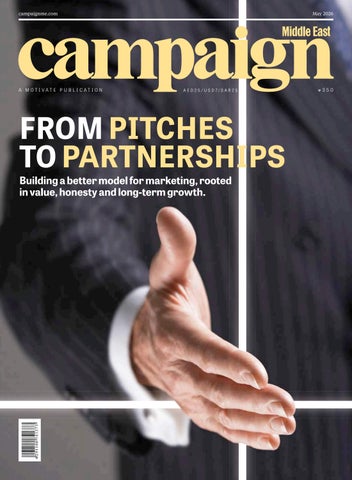
FROM PITCHES TO PARTNERSHIPS
Building a better model for marketing, rooted in value, honesty and long-term growth.


Join us for a morning of knowledge sharing like no other at the Campaign Breakfast Brie ng: Retail & Commerce Media. Industry leaders will move discussions far beyond impressions, cost+clicks and data monetisation to unpack the real truth of how teams can collaborate to win lasting customer retention, allowing your team to become a true growth engine.
TICKETS ON SALE & COMMERCE MEDIA
FIND OUT MORE BOOK TICKETS


14 FROM PITCHES TO PARTNERSHIPS
Industry leaders reveal how pitch processes have become transactional and theatrical, and suggest win-win alternatives for marketers, procurement teams and agencies before the current system collapses.


30 MARKETING BEYOND GENERATIONAL LABELS
Agency leaders and marketers explain why the smartest brands are building their marketing strategies on the foundations of behaviour, trust, a ention and culture.

Motivate Media Group
Head Office: 34th Floor, Media One Tower, Dubai Media City, Dubai, UAE. Tel: +971 4 427 3000, Fax: +971 4 428 2266. Email: motivate@motivate.ae Dubai Media City: SD 2-94, 2nd Floor, Building 2, Dubai, UAE. Tel: +971 4 390 3550, Fax: +971 4 390 4845 Abu Dhabi: Motivate Advertising, Marketing & Publishing, PO Box 43072, Abu Dhabi, UAE. Tel: +971 2 677 2005, Fax: +97126573401, Email: motivate-adh@motivate.ae Saudi Arabia: Regus Offices No. 455 - 456, 4th Floor, Hamad Tower, King Fahad Road, Al Olaya, Riyadh, KSA. Tel: +966 11 834 3595 / +966 11 834 3596. Email: motivate@motivate.ae London: Motivate Publishing Ltd, Acre House, 11/15 William Road, London NW1 3ER. Email: motivateuk@motivate.ae www.motivatemedia.com
EDITORIAL: Motivate Media Group Editor-in-Chief Obaid Humaid Al Tayer | Managing Partner and Group Editor Ian Fairservice Group Content Director Thomas Woodgate | Campaign Middle East Editor Anup Oommen | Senior Reporter Ishwari Khatu Reporter Shantelle Nagarajan | Junior Reporter Hiba Faisal
DESIGN: Senior Designer Thokchom Remy
ADVERTISING ENQUIRIES: Chief Commercial Officer Anthony Milne | Publishing Director Nadeem Quraishi (nadeem@motivate.ae) | Sales Manager Tarun Gangwani (tarun.gangwani@motivate.ae) | Senior Sales Executive Saif Hemdan (saifeldin.hemdan@motivate.ae)
PRODUCTION: General Manager S. Sunil Kumar | Production Manager Binu Purandaran | Assistant Production Manager Venita Pinto HAYMARKET MEDIA GROUP: Chairman Kevin Costello | Managing Director Jane Macken


We have lived through some surreal times. A month ago, people across the Middle East’s brand and marketing landscape were juggling anxiety with resilience. Despite the dread of uncertainty, they stepped up to ensure business continuity. They empathised with each other, kept lines of communication open with clients, quietly delivered on promises made, and responded to requests for proposal rather than running away from the region.
A large part of the industry also hit the pause button. Paid media spend and campaigns were scaled back to demonstrate sensitivity. Social media ecosystems showed solidarity with national leaders working to keep the skies above us safe. Meanwhile, carefully curated and meaningful discounts across owned channels, email marketing and SMS, coupled with customer relationship management (CRM) strategies, helped hold the line, offering consumers the opportunity to connect with brands – and vice versa.
Several businesses and agencies chose to support local and smaller counterparts rather than staying silent. Through the turmoil, consumers noticed the brands that became invisible, those that hesitated, those that stuck around to help communities in need and those that jumped on the opportunistic bandwagon. The measure of success during the crisis was not purely commercial; it was also emotional, social and reputational. Once the geopolitical – and literal – storms abated, the industry braced for economic repercussions. The prices of fuel, groceries and essential goods rose marginally. Redundancies and pay cuts were announced across the market. Yet, through it all, the industry chose to persevere rather than give in to fear. As a result, it didn’t take long for the positivity to pay off. The market is already bouncing back.
At the time of writing, all the signals point to a semblance of normality. Children are back at schools; parents are back at their office desks; traffic is building up on key arterial roads; creative campaigns are back on billboards and digital devices; embassies have lifted ‘shelter-inplace’ advisories; business travel plans are back on track; and in-person events are making a comeback. However, as we get back into the swing of things, we also have an opportunity to do things better – to fix age-old issues, starting with procurement and pitching. This edition makes the case for better briefs, tighter shortlists, clearer selection processes and increased trust and transparency throughout the pitch process.
and
The key takeaways are practical and principled: fewer theatrics and more truth; less comparison and more conviction; less exploitation and more collaboration; less pitching and longer partnerships. Happy reading.
Publicis Media ME ranks #1 for total new business in GCC; WPP Media MENA ranks #1 for new client wins: report
Group
New Business ranking 2025 including retentions
The 2025 COMvergence Global New Business Barometer, which tracks business performance across the media industry, has revealed the top ranked media groups and agencies in the GCC region by total new business, which includes retentions and losses, and net new business, which highlights new client wins. In total new business, Publicis Media Middle East has been ranked
Ogilvy EMEA
CEO steps down
Patou Nuytemans, Chief Executive Officer of Ogilvy Europe, Middle East and Africa (EMEA), will depart the agency after 30 years of service. Her three-decade tenure witnessed her holding global and regional leadership roles in 35 markets across three continents. Ogilvy staff have widely commended Nuytemans for her forward-thinking leadership style She invested much of her time in transforming people as a frequent conference speaker, thought leader and board director.
Commenting on her decision to step down, Nuytemans said, “I leave with a heart full of gratitude.” She departs at a transformative time for the WPP network, as Cindy Rose takes up the helm as network CEO. Nuytemans will remain in her role until the end of May 2026 to ensure a smooth transition.
the No. 1 media group in the GCC region, with $399.5m in total new business, including retentions and losses. WPP Media MENA and Omnicom Media – MENA are joint second media groups by total new business in the GCC region with $208.5m and $208.9m in total new business in the GCC region, respectively. In net new business, which does not consider retentions, WPP Media
MENA ranked the #1 media group in the GCC region with $249m in new client wins, while Publicis Media Middle East comes in second in the region at $240.1m and Omnicom Media – MENA comes in third at $234.2m in net new business. The report also reveals business performance by agency in the region – in terms of total new billings and net new billings.
At the agency level, in terms of total new billings, Spark Foundry ranks No. 1 in the GCC as an agency network and as the #1 agency in the GCC market, with OMD MENA taking the No. 2 spot, Mindshare taking the No. 3 spot and Starcom and PHD claiming the 4th and 5th spots, respectively.
However, in terms of net new business wins by agency, OMD MENA claims the No. 1 spot in the GCC region, followed by Mindshare and Starcom in No. 2 and No. 3 spots, respectively, while Spark Foundry comes in at No. 4 and PHD is at No. 5.
Globally, the 2025 rankings also place Publicis Media as the #1 media group in new business, leading both total business and net new business, generating $10bn in new client billings – equivalent to one third of all media spend that shifted between agencies in 2025.
Four groups followed at a distance globally – Mediabrands (2nd), Dentsu (3rd), HAVAS Media Network (4th) and Omnicom Media (OMG) (5th).
Globally, across agencies, Starcom ranked the #1 media network with total new business value of $2.7bn, driven by global wins such as Mars and Aldi, and the retention of Luxottica in the US. Initiative ranked #2 globally with $2.4bn. Spark Foundry ranked #3 globally at $2.1bn. Starcom led the ranking in terms of net new business globally, followed by Spark Foundry and Initiative.


Omnicom Advertising and Google launch AI-powered creative intelligence system
Omnicom Advertising and Google have launched an AI-powered creative intelligence system, combining Google’s Attention, Branding, Connection and Direction (ABCD) framework with Omnicom’s proprietary creative AI to pressuretest advertising before it runs. The Middle East pilot, already live with telecommunications leader du, marks the first chapter of a planned rollout across the Africa, the Middle
East and Turkey region. At its core sits the Google-provided code, which uses its proprietary ABCD framework for effective YouTube video creatives to evaluate four proven performance pillars: Attention: Does it hook in the first seconds?; Branding: Is the brand memorable?; Connection: Does it create emotional resonance?; and Direction: Does it drive action?
The system includes a second proprietary layer from Omnicom


Built as a light-hearted take on a familiar truth, this campaign from Dubai Police and Dubai’s Roads and Transport Authority (RTA) aims to tackle reckless driving behaviours that contribute to congestion and road safety risks across Dubai. The campaign takes a raw and real route, pointing to the people most drivers readily respond to: their mothers. Following a young Emirati driver through his everyday moments on the road, the campaign shows how the voice of his mother prompts him to slow down and drive more carefully when he is about to take a risky decision. The campaign was rolled out in phases, starting with a four-day teaser on socials, followed by radio spots and digital billboards in the city.
Outdoor Media brings 3D hologram advertising to Oman
called Brave Bot, an AI agent designed to challenge creative work on distinctiveness, innovation, cultural relevance and conventionbreaking potential.
Following the successful du pilot, Omnicom Advertising is rolling out the system across its broader Middle East client portfolio in 2026, before expanding the programme to cover the full Africa, Middle East and Turkey region.
Outdoor Media Oman, a SABCO Media Company, has introduced a new three-dimensional (3D) hologram advertising solution in Oman, adding an immersive format to the country’s evolving out-ofhome (OOH) landscape. The installations are now live at Oman Avenues Mall and Markaz Al Bahja Mall, placing large-format 3D holographic displays within two distinct retail environments in Muscat and allowing brands to benefit from both dwell time and repeat exposure as part of the shopper journey. Powered by HYPERVSN technology, the PRIME L9 units create high-definition, 3D visuals that appear to float within physical space, offering a striking departure from conventional formats. Each unit operates on a loop-based system, with individual campaigns running several hundred times per day, allowing brands to maintain consistent presence while experimenting with more dynamic, story-led creatives. Early campaigns on the platform highlight brands such as BIMA Insurance, KINZA and Amtur Gold & Diamonds. These activations also demonstrate diversity across categories such as insurance, beverage and jewellery, showing how the platform can present brands in more dynamic ways.


Use
YAS ISLAND THE ANSWER IS YAS
Owning the ‘effortless holiday‘ space by solving the growing complexity of trip planning, this campaign positions Yas Island as a one-stop, all-inclusive destination where the answer to all holiday questions is ‘Yas’. Through comical hyperbole of relatable family moments, the campaign caters to evolving travel behaviours. It showcases simplified decision-making, reduced stress and effortless, experience-led escapes – all designed specifically for how families truly want to travel and what they want to experience. Executed as an integrated multi-channel rollout, anchored in PR and amplified across paid, owned and earned touchpoints, the campaign positions Yas Island as a family-first destination. Agency Momentum
Top EMEA account wins: Netflix appoints dentsu as media agency; Diet Coke picks Ogilvy for creative in 2026

The Europe, Middle East and Africa (EMEA) region has seen major accounts assigned in April. Netflix is set to appoint dentsu as its media agency of record across the EMEA region following a competitive review against rivals WPP and Omnicom. Dentsu has been working with Netflix in the UK since 2023, with the account – worth $191m in

2025 according to COMvergence – being led out of iProspect. The EMEA pitch was a cross agency collaboration from the dentsu holding company, led by Carat and iProspect.
Now, its expanded remit will cover 22 markets across the EMEA region – a geography in which Netflix has been growing its presence in a string


This campaign shifts the focus from what music is to what music does, celebrating the emotional and behavioural side effects of the songs shaping culture today. At the heart of the idea is a simple but powerful truth: today’s music does not just play in the background; it actively influences how people feel, think and behave. Rolling out across outdoor, social and digital platforms, the campaign features a series of executions tied to globally recognised tracks, turning song titles into triggers and behaviours into proof. It aims to position BeatFM not just as a station that plays hits, but as one that understands how those hits show up in people’s lives.
Agency AdPro& Group
of strategic partnerships and investments. Last year, the agency made a content streaming deal with French broadcaster TF1 and forged a partnership to bundle its streaming subscription with Middle East broadcaster MBC Group.
It also pledged to invest more than €1bn in Spain by 2028 to grow its range of Spanish films and shows.
Netflix’s content slate has so far included Peaky Blinders film spin off Peaky Blinders: The Immortal Man , the fourth season of Bridgerton and second season of the live action One Piece: Into the Grand Line
In the world of fizzy beverages, Diet Coke has picked Ogilvy, part of WPP’s Open X, to handle its ad account across the UK and EMEA regions following a competitive review.
WPP’s dedicated Coca-Cola Company shop Open X has won the brief to create work for Diet Coke with a heavy focus on social and influencer marketing. The pitch process included Mother and Havas’ Uncommon Creative Studio, as well as two other unknown shops.
Campaign reported in May last year that The Coca-Cola Company and WPP renewed their global marketing partnership.
The news followed the soft drinks company moving its US and Canada media accounts to Publicis Groupe.
When WPP first won the business in 2021, it created a bespoke shop, named Open X, to service the account.
James Murphy, CEO, Ogilvy UK and Founder of New Commercial Arts, said, “We’re delighted to be working with Diet Coke – an iconic brand with a distinctive voice and place in culture – and excited to help shape its next chapter.”


Every four years, the world slows down and shifts its focus to the FIFA World Cup. One billion people turn their attention to one of the biggest sporting events on the planet. While the world watches football and most brands lean further into the noise, Big4Travel, one of the leading travel agencies in Bangkok, offers travelers a way out – alternative options for those who don’t want to attend the FIFA World Cup 2026. The campaign spans OOH, social placements and the publication of a cheeky travel guide to ‘The Non-Qualified Countries’, within which Big4Travel offers its holiday packages. The campaign offers travellers an escape to peaceful serenity in a world without overzealous football messaging.


Every four years, the world doesn’t just watch football; it feels it. In the Middle East and North Africa (MENA) region, that feeling has evolved into something far more layered. The World Cup is no longer a distant global event; it is a cultural state of mind the region actively shapes.
Yet while the scale of attention continues to grow, the nature of that attention has fundamentally changed. Football is no longer anchored to a single screen or a fixed moment in time. It now exists across platforms, in conversations, reactions, memes and shared rituals that unfold continuously. In this environment, the scroll has become as important as the stadium.
For brands, this shift redefines the opportunity entirely. Success is no longer about visibility during the 90 minutes; it is about relevance across the 90 days around those 90 minutes. To win the next World Cup, brands must move beyond presence and toward cultural participation that lives inside the scroll.


HOW BRANDS WILL WIN THE NEXT WORLD CUP THROUGH SOUND AND THE SCROLL
The Anghami team explains the need to build experiences that live beyond the match, in the moments, sounds and stories that fans carry long after the final whistle.

At Anghami, we’re seeing this play out in how users engage during major cultural and sporting moments. During previous campaigns, we’ve observed spikes in playlist creation, social sharing and real-time engagement around key matches, showing how sound and social interaction extend the life of the game far beyond the final whistle.
“Audio lives in commutes, workouts, late-night scrolls and background moments where attention is fluid. It creates intimacy without interruption.”
The game beyond the game


borders and identities, creating a shared emotional frequency across audiences. Whether through chants or music, sound becomes the common language of fandom.
We’re seeing this come to life through content experiences, where fans move seamlessly between music, moments and match-day conversations in one place. On Anghami, this translates into richer engagement ecosystems where sound connects audiences, creators and live moments more fluidly.
From campaigns to living systems
This shift demands a move away from isolated campaigns toward interconnected ecosystems.


Real-time audio formats turn matches into shared experiences. Live commentary streams and responsive audio spaces allow fans to engage together regardless of location. These moments extend beyond full-time, becoming replayable content that keeps emotion circulating.


The most important shift in football culture today is simple: the match is no longer the main event. It is the trigger.
What happens before kick-off and long after the final whistle is where fandom truly lives. Fans follow narratives, debate decisions, remix highlights, argue in comment sections and build identity through the content they consume and create. Every match becomes a shared storyline rewritten in real time.
This has transformed how attention works. Social platforms are now the natural stadium of football culture. In this environment, relevance must be earned through participation. Brands need to contribute to the ecosystem fans are already building, not interrupt it.
The sound of the World Cup
If football is emotion, sound is its memory system.
World Cup anthems capture the energy of a tournament and preserve it in a form that outlives the final match. Years later, a single track can instantly reconstruct the feeling of a season. In the MENA region, sound carries even greater weight. It bridges languages,


At the same time, social-first storytelling captures the culture around the game. Short-form content and creator-led narratives reflect how audiences behave online, where humour, predictions and emotional reactions become core currency.
Music then becomes the emotional amplifier that ties everything together.
Building a home for fandom in the scroll
In a fragmented attention economy, the most powerful role a brand can play is that of a host.
Creating a centralised space where fans can move between content, experiences and participation allows brands to sit at the centre of the journey.
Anghami’s The Hub feature reflects this shift, giving brands a space where users can explore World Cup content, music and conversations in one unified experience.
Where attention truly lives
Among all channels, audio remains the most underestimated.

In the MENA region, no platform has invested more deeply in this truth than Anghami. With over 70 million users across 22 Arab markets, it sits at the intersection of audio, identity and fandom.

Unlike visual content, audio integrates into daily life. It lives in commutes, workouts, late-night scrolls and background moments where attention is fluid. It creates intimacy without interruption.
When combined with context and personalisation, audio becomes a constant companion throughout the tournament.
Brands that will win
The next World Cup will not be defined by which brands show up the most, but by which of them resonates most deeply.
Winning brands will understand that fandom is no longer linear. It is rhythmic, fragmented and continuously reshaped in the scroll. They will build experiences around the game, collaborate with creators instead of broadcasting over them and use sound as a primary emotional connector.
Because in today’s landscape, attention is not captured. It is earned, shared and reshaped in real time.
For brands ready to move from presence to participation, the opportunity lies in building experiences that live beyond the match, in the moments, sounds and stories fans carry long after the final whistle.


INDUSTRY FORUM:
Is the current pitching process within the Middle East brand and marketing landscape a fair reflection of the client-agency working relationship that follows?

Joanna Agnew Managing Director, Tales & Heads
NO
In many cases, the pitch process is heavily driven by procurement as opposed to the actual client, with cost outweighing value and long-term impact. Communications isn’t always easy to quantify on a spreadsheet, and when the process - led by someone who isn’t a comms professional - focuses too much on price comparison, it can be harder to properly assess the thinking, creativity and partnership an agency will actually bring. That dynamic doesn’t always set the right tone for what’s meant to be a collaborative relationship. That said, pitches are an important part of how clients assess capability and chemistry. The most successful partnerships come from processes that feel more like a dialogue than a transaction –with clear objectives, open conversations around budget and scope, and mutual respect on both sides from the outset.

Joann Correia Account Director, MCH Global
NO
The pitch process, at its best, can be a genuine preview of a great working relationship. To be fair, there are clients in this market who do it beautifully; well written briefs, engaging openly and treating the process as a two-way conversation. Those partnerships tend to flourish. However, too often the process is marked by multiple rounds of unpaid creative iterations, lack of clarity on the ‘definition of success’, unstructured feedback, and a dynamic that feels more transactional than collaborative.
A pitch should be the opening chapter of a co-creation story, built on transparency, clear goals, and open dialogue. When it is, everyone wins.

Jad Rabahi
Managing Director, IMPACT BBDO
NOThis isn’t always the case, but it is a pattern prevalent enough to warrant an honest conversation. Pitching in the region has gradually shifted toward a procurement-driven model, one that prioritises cost efficiency over strategic fit. The challenge isn’t procurement’s involvement per se, but the internal misalignment it creates. Marketing teams often step back during commercial negotiations, only to re-engage post-appointment with ambitions that far exceed what procurement agreed to. The agency is caught in the middle, contracted for a fraction of the original brief yet expected to deliver the whole. That’s not a foundation for a fair or productive partnership.

Curtis Schmidt CEO, RAPP MENA
NOTo sum it up, there are transparency issues before and after the pitch. Often, what I’ve witnessed is the brand team reviewing the technical proposal has a significant disconnect from the procurement team reviewing commercials. That’s issue one. Issue two: The strongest technical proposal is often not the cheapest, and if it is, components of the statement of work could be negotiated out or deprioritised behind closed doors. Once awarded, the brand is often left frustrated – what they’ve ‘bought’ will not deliver the objectives due to commercial constraint or other reasons. This will immediately put a strain on the newly established working relationship. In a nutshell, brands want more for less, and then, with less expect more – often at the expense of the people trying to build a lasting partnership.

Mohamed El-Daly Managing Partner, Digital Champions
MAYBE
But in many cases, no. Pitching often starts with either open briefs that lack a clear scope or budget, or defined templates for the agencies to fill that treat strategic work like a commodity bought by the kilo. Procurement teams are often negotiating scopes without fully understanding their technical aspects, pushing discounts on strategy, content, or community management without visibility into the expertise required. The best relationships happen when business owners stay involved in both technical and commercial discussions, evaluating fit, trust, and partnership potential rather than who can absorb the most unpaid work or offer the lowest number. A healthier model: pay for pitch work, limit lists to three agencies, and assess strategic thinking over speculative decks.
Khaldoun Zaghir General Manager, 5th Element

YESClaire Romano CEO and Co-founder, Melt Media
NO
Too often, the pitching process misses some of the fundamentals you need for a strong working relationship. From a performance perspective, that starts with clarity – on clear objectives, KPIs and budget. Without that, it’s difficult to build meaningful strategy or forecast outcomes with confidence.
We still see briefs with gaps, or a reluctance to share budget in the name of ‘not limiting’ the agency, when in reality, it limits effectiveness. Strong performance marketing is about working within clear parameters to deliver measurable results.
Procurement-led processes can also remove direct access to key stakeholders, which makes it harder to align early and set the right expectations. When transparency, access and accountability aren’t there from the start, the pitch stops reflecting the partnership that follows.
But with important caveats. The pitching process, when run well, does reflect the reality of client-agency relationships: clients need accountability, strategic fit and value for investment, and a competitive pitch tests all three. In the Middle East, specifically, the process has matured considerably, with more sophisticated briefs and structured evaluation frameworks becoming common. That said, ‘fair’ doesn’t mean ‘perfect’. Agencies that engage transparently, ask the right questions early, and push back on unreasonable conditions tend to find the process a genuine preview of how the client operates.


A sneak peek inside the Clio Awards jury rooms


FAlexander Schill, Global Chief Creative Officer, Serviceplan Group, who is the Jury Chair for Creative Commerce & Direct and a jury member for Creative Disruption at the Clio Awards 2026, shares what the work reveals about creative excellence and courage this year.
By Anup Oommen
or the past 66 years, the Clio Awards has been one of the global advertising industry’s clearest mirrors. It not only recognises creative excellence, but also reflects the values that creatives, communicators, brands and businesses cherish the most – and the resulting impact of their work on culture and communities across the world.
The renowned awards celebrate creative brilliance in advertising, marketing and communications, judging work on originality, boldness, execution, craft and the ability to stir people and shape societies.

With the Grand Clio winners for 2026 set to be announced at the Clio Awards gala on 12 May in New York City, conversations inside the jury rooms are already offering an early read on work that stands out – and where global creativity is heading.

This year, the jury conversations aren’t simple and straightforward; in a disruptive geopolitical and socio-economic landscape, it’s no surprise that creative conversations are equally disruptive. On one side of the jury room sits a notion that outcomes, effectiveness, brand purpose, social causes and real-world relevance matter the most. On the other sits the older magic of advertising, calling for work that surprises, entertains, evokes emotion and lingers long after the screen goes dark.

Layered over this is the elephant in the room: artificial intelligence (AI), which is no longer a novelty or a tool. Instead, it’s being viewed by creatives as a co-pilot – a colleague to brainstorm consumer insights with, and create and execute great ideas with, but only when necessary rather than as a crutch to creativity.
For the Middle East, there is an especially interesting signal in that mix: as global markets wrestle with caution, complexity and growing pressure to prove value, the region’s creative output is beginning to project more conviction, boldness and relatability.

Alexander Schill, Global Chief Creative Officer, Serviceplan Group, who serves on the Clio Awards jury for Creative Disruption and as the Jury Chair for Creative Commerce & Direct, speaks to Campaign Middle East about all this and more, with exclusive insights from the Clio Awards 2026 jury rooms.

JURY ROOMS SHAPED BY DIFFERENCE – AND A SHARED REALITY

People often imagine creatives in jury rooms as connoisseurs of fine wine or gastronomes picking their way through never-ending courses of gourmet food. Schill describes a reality that’s far more layered: a room full of varied perspectives, languages, cultures and backgrounds, but all shaped by the same current industry pressures.


Schill explains, “It’s always very exciting to be in jury rooms. It’s great being huddled together with creators from all over the world, and listening to opinions coming in from different cultures, different backgrounds, different viewpoints and different areas. So that’s always the most important and most exciting thing within jury rooms.”


That energy, he suggests, is sharpened by the wider upheaval affecting the business. The conversations in jury rooms have not only been about the entries, but also about how they connect to the context of the ground shifting beneath everyone’s feet.
Schill adds, “We are living in a period of great disruption – whether that’s in the form of geopolitical upheavals, social causes coming to light, or how AI is affecting the creative process and our work. The one thing connecting us all is that we are all in the same situation. So, no matter which country we come from, no matter which cultural background we hail from, we are all in a similar situation right now and
Compared with work from previous years, one of the clearest shifts Schill points to is that AI is no longer novel. It no longer earns attention simply by being present. The fascination with AI as a tool is fading. What matters now is how AI being used – and to what effect – whether it helps produce stronger thinking and sharper work or whether its use is detrimental to the creative process in a specific context.

Schill says, “The time has passed when we say, ‘Wow, this is made with AI’. Instead, we’ve returned to the fundamentals of: ‘Is it a good creative piece or not?’ Simply using AI will not win anyone an award anymore. What matters is how the problem within the brief is addressed – whether with AI or not; and what insights led to what ideas and whether the execution of those ideas in that specific manner had the impact that is intended.”
This is an important distinction for agencies and brands who are either still fascinated by new tools, or are leaning into it because of market pressures such as speed to market, tighter budgets or the fear of technological debt. Schill explains how AI, when used well, can broaden the view, offer deeper insights, sharpen the creative output and enhance performance evaluation.
Schill adds, “We are reaching a stage where campaigns are executed so seamlessly that it’s hard to tell for sure whether AI has been used or not, unless clearly stated, which leads us to focus on originality, the quality of craft within execution and the social impact of the work more than ‘whether it’s AI-driven or not’.”
WHAT MADE THE STRONGEST WORK RISE
When Schill describes how entries are discussed, it becomes clear that the jury is not viewing work through the lens of a fixed formula.
Schill explains, “Advertising has grown up. All the big brands who are winning awards had a strong sense of purpose. The industry is a little bit more driven by return on investment (ROI) and return on advertising spend (ROAS). In a way, this is a good thing because creative work is really creating results – business results and social change.”
While he is careful not to dismiss the need for such a positive evolution towards responsible and accountable advertising, he also shares the feeling that something is being forgotten along the way.
Referring to the ‘bad side to grown-up advertising’, Schill says, “We are lacking a lot of brave work. This year, I wouldn’t say that we have seen the bravest campaigns, even though we have seen some very creative campaigns.”
Schill’s point is not that purpose and performance have gone too far; it is that caution may have become too comfortable. Like an orchestra that has perfected its art and plays perfectly in time but has forgotten how to improvise, the industry risks becoming highly competent without being genuinely surprising or entertaining.

He adds, “There are a lot of brands and agencies that have done a great job in advertising campaigns – but we are lacking a little bit of the brave work and the fun flavour that stands out.”
Schill calls for brands to build relationships with people that go beyond the rational to the relatable. He shares the need for brands to connect with consumers, and reminds them to find a way to make people smile, flinch, laugh, pause or share something with a close friend or family member – because that’s where the magic happens and memories are made.
“The time has passed when we say, ‘Wow, this is made with AI’. Instead, we’ve returned to the fundamentals of: ‘Is it a good creative piece or not?’ Simply using AI will not win anyone an award anymore.”
Rather, it is weighing work across two broad dimensions: the importance of the issue being addressed and the distinctiveness of the creative response. Some jury members lean towards more socially driven or cause-led work, while others want work that feels more playful, fresh, daring and disruptive.
Schill explains, “There are two opinions in jury rooms: One is about the societal impact and the cause behind the campaign, and the other one is based on the work itself: was it bold? Was it fresh? Was it a creative approach to addressing the problem? Was it memorable?”
Many of the entries, he notes, are responding in real time and reacting to the world as it is now: fractured, fragmented, fast-moving and often uneasy. Some are built for the long haul, helping brands strengthen their relationship with consumers over time by addressing critical concerns such as immigration or fake news.
Based on the timelines that brands and agencies work with – whether a quick reactive piece completed in days or weeks, or more considered creative output over months – the jury takes into consideration the parameters within which they had to operate.
This means that a campaign addressing a deeply rooted issue is not judged in the same way as one responding to a flashpoint. But in both cases, Schill suggests, the work must be anchored in a genuine understanding of the situation.
A MESSAGE IN PARTING – AND A NOD TO THE MIDDLE EAST

Before the interview concludes, Schill reflects on what he would tell agencies and advertisers after the Clio Awards and his advice lands in two parts. The first is about balance: use AI fully, but do not let it take the wheel. The second is a call for braver and bolder storytelling.
Schill says, “We all know what AI can do, but we must find a way to come back to the question of what I must do. Creatives must not lose faith in their own judgement simply because a machine can generate options at speed. We should find our self-confidence again as creatives. The best idea that helps to solve a problem for a brand needs to be driven by us as creatives. And AI, just like any other colleague, may help us reach that goal, but it should not rule us. I’m a big fan of using AI in the whole process, but we should not follow AI; instead, AI should follow us.”

ADVERTISING HAS GROWN UP – BUT HAS IT LOST ITS CHILDISH SPARK?
One of the most revealing parts of the conversation is Schill’s view that the industry is becoming more mature and more accountable, but perhaps less adventurous in the process.
The rise of measurable outcomes, clearer brand positions and more serious mandates has brought discipline, but it has also, at times, dulled the edge.


The second point is one the Middle East market will be pleased to hear. Sharing a final insight from jury rooms, Schill explains how the region’s work is beginning to stand apart from the rest of the world because it is showing more nerve.


Schill says, “Looking at the work coming out from the Middle East, I can say that this is a very interesting market that is evolving right now. The region is becoming a lot more self-confident in telling its story the way it wants to. This is reflected in the creative output coming from the region as it is a lot braver than what we’re seeing from other parts of the world. It is a lot fresher, younger and a bit more ‘wow’.”

All in all, if Schill’s view from the Clio Awards jury rooms tells us anything, it is that global creativity is facing a moment of recalibration. The industry has not abandoned ambition; it has simply become more burdened by responsibility, measurement and uncertainty. That has produced stronger discipline and, in many cases, more meaningful work. But it has also made some brands and agencies a little too eager to colour within the lines.


The opportunity now is not to choose between business results and creative electricity, or between human instinct and machine assistance. It is to hold those tensions together. For Middle East marketers and agency leaders watching the Clio Awards closely, that may be the most encouraging signal of all: the work attracting attention is not merely polished or purposeful; it is also work with backbone, perspective and a willingness to leave a mark. In a year when much of the world appears to be playing it safe, that confidence could be the region’s real advantage.


Earlier this month, researchers at Clemson University’s Media Forensics Hub published a study that should stop every communications professional in their tracks. A network of fake social media accounts, later identified as a coordinated foreign operation, had spent months seeding divisive content across UK social media channels, masquerading as Scottish independence supporters, Irish nationalists and Latina women. At its peak, this network generated more engagement about Scottish independence on X than Scotland’s own Scottish National Party.
This is not a distant phenomenon. The Government of Dubai’s Media Office has been actively calling out coordinated waves of false social media posts about daily life in the UAE, mostly from foreign accounts.
As someone with a background in diplomacy, I’m not surprised by such foreign influence operations. Ever since the Cambridge Analytica scandal back in 2016 – in which a now-defunct British political consultancy quietly siphoned data from some 87 million Facebook profiles to micro-target voters with tailored political messaging – we have known just how quickly and efficiently personal data can be used for political ends.
What is surprising is how seemingly straightforward and inexpensive it is to influence a generation’s worldview in today’s news environment. An 18-yearold scrolling through their feed in Sharjah, Edinburgh or Lagos today has few ways of knowing whether the outraged voice in their timeline belongs to a real person or a manufactured persona.
In a global study by Reuters, 44 per cent of 18 to 24-year-olds now say social media and video networks are their main news source. In the Gulf, where we are among the most digitally connected societies on earth, those numbers are likely far higher.
The way young people engage with news also varies sharply depending on the platform they use. On TikTok and Instagram Reels, news is consumed almost incidentally, often stripped of historical or political context or turned into memes or humour. Even longerform content, such as YouTube videos or podcasts, is problematic, as it is often produced by a single person or a small team with no obligation to represent more than one side of the story and questionable fact-checking. And yet, this content reaches millions of young people.
The very design of these platforms hijacks young people’s developing brains: pushing increasingly provocative or harmful content, eroding mental health, and, in the worst cases, connecting young users with illintentioned adults. Given all of this, how can we possibly expect young people to
BRAND FOCUS
THE SCROLL VERSUS THE STORY
American University of Sharjah’s Syed Bukhari asks whether the industry is losing the battle to teach young people how to think critically.

pause and consider where a piece of information came from, why it is being served to them and whether they should trust it? These platforms are engineered to bypass the rational, critical mind before it has even had the chance to fully mature.
This is not an accident of design. It is the business model. In my forthcoming book, The Tyranny of the Average, I argue that algorithmically optimised information environments are not neutral content streams. Rather, they are active mechanisms that sort content in a very particular direction. Content that provokes, outrages or entertains travels furthest and fastest. Content that demands patience, nuance or critical thinking gets buried.
Short-form formats compound this by negatively affecting attention, memory and focus. And the format itself flattens everything: a graphic clip from a war zone and the latest pair of sneakers arrive in the same size, the same format, with the same swipeable ease. In newsrooms of the past, a fringe claim and a verified report did not sit
side by side as though they carried equal authority. Now they do, and as Clemson’s study showed, the unverified version may even outperform the real one.
The Tyranny of the Average argues that readers who seek context and verification are being systematically outperformed by content engineered for speed and reaction. Influence networks do not win because their content is better. They win by exploiting the rules of platforms that were themselves engineered to exploit our attention.
Moreover, young people have fewer quality news sources than before. More than 3,000 newspapers have closed in the US since 2005, and media consolidation is accelerating. The gap has been filled by influencers with no editorial oversight and every incentive to confirm their audience’s biases or inflame those who disagree, because in both cases engagement wins, and engagement brings advertising revenue. It is little wonder that, as the News Literacy Project reports, teens today find news either biased, boring or bad.
That same project also found that only 13 per cent of Gen Z respondents fact-check what they read online; four out of five people believe journalists are no more credible than other content creators; and 80 per cent of respondents are inclined to believe conspiracy theories they encounter online. As the adults in charge, we need to ask: at what cost?
Fortunately, governments are beginning to act. Australia has banned social media for under-16s; France requires parental consent for under-15s – and others are following. But regulation alone is not enough. Delaying access only helps if, by the time young people are given it, they also have the tools to navigate it safely.
If we want the tide to keep moving in the right direction, we need to give young people critical-thinking skills before we grant them connectivity. News literacy should be part of every curriculum: tracing a claim to its source, recognising when a statistic has been stripped of context, understanding how algorithms decide what we see next.
We, as communications professionals, also need to ask honestly whether the content we produce serves the end user or simply adds to the noise.
Engagement optimisation does not just shape what young people see; it shapes what they learn to accept without question. Every time we produce content built for virality rather than informational value, we erode the conditions that make critical thinking possible.
The information environment we have built is not going to simplify itself. But we can decide, as educators and communicators, whether the content we produce strengthens young people’s capacity to think or quietly undermines it. We often speak about this system as though we are outside it. In reality, we are among the ones feeding it.
By Syed Bukhari, Head of Strategic Communications and Visibility,
Ihave lost count of how many times I have heard that marketing is broken. Usually, it comes up in conversations about declining effectiveness, rising costs, or the latest platform that is supposed to change everything. But from where I sit, leading consumer experience across multiple markets, the problem isn’t marketing itself.
The fundamentals still hold: understanding people, creating ideas that resonate and showing up in the right moments.
What’s changed is everything around it.
Most organisations are still built for a world that no longer exists: a world of neat

BRAND FOCUS
CONSUMERS HAVE ALREADY MOVED ON; MOST MARKETING HASN’T
Mondelēz International’s Krinio Christaras calls for the industry to rebuild marketing based on how people actually live, proposing a shift from building campaigns to creating relevant experiences.
campaign cycles, long planning timelines and clearly separated functions, with data in one place, content in another media somewhere else. It worked when consumers moved slower and channels were predictable.
That’s not the world we’re in anymore. People move fluidly across platforms; content doesn’t really stop; signals are instant; and culture shifts daily, sometimes hourly.
Inside organisations, though, we’re still trying to manage all of this with structures designed for something much simpler – and that’s where things start to feel off. It’s clearly not a capability issue. If anything, we have more than we’ve ever had: more tools, more data and more access.
The constraint is how disconnected it all still is. When you really look at it, a few things start to matter more than anything else.
What I’ve seen make a difference is a shift in how we think about the work: moving away from channels and campaigns and towards systems – not in a conceptual way but in how things actually get done.
How easily can we create, adapt and deploy content without everything becoming heavy or over-engineered? It’s also about how connected our decisions are across data, media and creative, and whether teams are building together or only seeing the work once it’s already done.
That’s usually where things break: not in the idea itself but in the handovers, the delays and the disconnect behind the scenes. And, ultimately, those things matter more than the campaign itself.
A few years ago, we started to feel this gap very clearly. We were still operating in campaign cycles while culture was moving in real time, so we pushed into a more agile, moment led approach to content. This was not to replace brand building, but to stay present in what people were engaging with.
At one point, a simple Oreo “two cats” post we turned around in under 24 hours –with no production, just reacting to what people were already sharing – ended up outperforming a lot of what we had spent weeks planning.
That was a wake-up call, not just because of the performance, but because of what it showed us: lower production costs, higher engagement and stronger view through rates. More importantly, it exposed something deeper: the real shift wasn’t creative, it was operational.
“THE REAL COMPETITIVE ADVANTAGE IS THE ABILITY TO CONNECT DATA, CONTENT DISTRIBUTION AND DECISION-MAKING INTO SOMETHING CONTINUOUS RATHER THAN EPISODIC.”
to respond, test and adapt continuously. It sounds simple but it isn’t. It forces everything behind the scenes to change.
In the Middle East, North Africa and Pakistan (MENAP) region, this shift has happened faster – not by design but by necessity. Lower production budgets pushed more agile ways of working. High social penetration brought brands closer to creators and communities. A fragmented media landscape forced speed and flexibility. What’s interesting is that many of the ways of working now being discussed globally are already happening here. This is why I don’t think the next phase of marketing will be defined by channels. They’ll keep evolving; they always do. Channels are just distribution. The real competitive advantage is the ability to connect data, content distribution and decision-making into something continuous rather than episodic –something that learns and adapts.
When we shift from building campaigns to creating experiences that are relevant when they appear – that’s when marketing starts to feel different. It becomes less like interruption and more like relevance: a brand that understands you, shows up at the right time and adds value instead of asking for attention.
That’s when it becomes more human again – not driven purely by data, but by understanding; not just building loyalty but creating real relationships; and not just selling, but serving.
Marketing isn’t broken, but if we keep operating it the way we did even a few years ago, it will keep feeling like it is.
It stopped being about producing perfect assets and became about building the ability
deeper: the real shift wasn’t creative, it It stopped being about producing perfect assets and became about building the ability
people actually live.
The opportunity isn’t to reinvent marketing; it’s to rebuild it around how people actually live.
By Krinio Christaras, Head of Consumer Experience MENAP, Mondelēz International
FROM PITCHES TO PARTNERSHIPS
Industry leaders reveal how pitch processes have become transactional and theatrical, and suggest win-win alternatives for marketers, procurement teams and agencies before the current system collapses.
By Anup Oommen
Astrange paradox has been normalised at the heart of the brand-agency partnership landscape in the Middle East. Brands claim that they want sharper thinking, strategic consumer insights, stronger distinctiveness, larger share of voice, tangible returns on investment and creative work that connects with communities long after campaigns end.
Yet, current systems and the processes used to choose agency partners are rarely consistent with these claimed objectives – often prioritising line items, hourly breakdowns, short-term savings and tidy-looking pitches. Where does the fault lie?
On one hand, marketers agree that procurement teams are under pressure to cut costs, often resulting in commoditised and transactional relationships. They also concede the need to address deficient briefs, overweighted technical pitches, unclear objectives and metrics of success, vague evaluation criteria, dearth of feedback, shifting goalposts, price-based decision making, intellectual property infringements and lack of trust and transparency in the overall pitching process.
On the other hand, agency leaders concur that there’s a need for greater transparency about the actual team working on the account; to bridge the gap between pitch performance and final outcomes; and to reach a consensus on price and payment expectations –rather than running the rat race to the lowest cost.
These frustrations – often moved to the back burner to ensure business continuity – still simmer and occasionally boil over when demands move from difficult to the ludicrous.
Campaign Middle East speaks to several industry leaders, questioning the structure of procurement and pitching processes that push people towards untenable partnerships. The discussion also evaluates win-win alternatives.
Within this feature, leaders call for better judgement, not less rigour. They say that the issue is not whether commercial discipline belongs in the room; it is whether the industry is still measuring the right things, in the right way and with the right North Star.
Contributing to this conversation are:
Reema Al Shammasi, Vice President Marketing and Communications – West Arabia, Mastercard EEMEA, Passant El Ghannam, Chief Marketing Officer – Middle East and Africa, Kraft Heinz, Suad Merchant, Chief Marketing Officer, GEMS Education, Sevgi Gur, Chief Marketing Officer, Property Finder, Ghassan Kassabji, CEO – Dubai and Chief Growth Officer – MENA, IMPACT BBDO, Mazen Jawad, CEO, Horizon Holdings, and
Ramzy Abouchacra, President – Media Practice, dentsu MENA
THE FRAMEWORK GAP: USEFUL GUARDRAILS, OUTDATED YARDSTICKS
The conversation starts on common ground: leaders agree that financial discipline and accountability have very real value.
However, problems arise when a buying model designed to curb overspending is treated as the primary lens for assessing value.
Marketers and agency leaders explain that although price matters, it should not be the main – or only – deciding factor. Instead, they call for better judgement and evaluation based on scale, strategic thinking, creativity and long-term value.
Ghassan Kassabji, Chief Executive Officer – Dubai and Chief Growth Officer – MENA, IMPACT BBDO, says, “Most procurement frameworks are stuck in the past. They focus on cost control, efficiencies and risk management – not on evaluating strategic thinking or creativity. They miss what drives business and brand growth. When ideas are measured only by hours and rates, the results become predictable.”
“UNTIL PROCUREMENT STARTS PRICING OUTCOMES, WE WILL KEEP FOCUSING ON COST WHILE CLAIMING TO VALUE GROWTH.”
strengthened the industry in many ways. At the same time, marketing is not a commodity. This means that the real challenge lies in how success is defined within procurement frameworks. When procurement is aligned to delivering growth and commercial outcomes rather than just cost efficiency, the conversation shifts. It becomes less about the cheapest option and more about the most effective one.”
He adds, “The real questions should be: What are we buying for? Are we investing in the right talent to support transformation? Are we accessing differentiated capabilities, tools and data? Are we securing high-quality inventory that can genuinely convert? And, more importantly, are procurement teams measured on savings alone, or should they also be held accountable for business outcomes?”
Leaders also explain how this current obsession with cost-cutting is encouraging unsustainable practices and is hurting an industry already struggling with high competition and low margins.
Abouchacra reveals, “We are seeing cases where agencies enter pitches at zero fees. This may win in the short term, but it raises important questions about long-term delivery, quality and sustainability.”
He adds, “The real issue is lack of proper evaluation. The good news is that the tools to measure outcomes rather than inputs already exist. The frameworks have not caught up with them. Until procurement starts pricing outcomes, we will keep focusing on cost while claiming to value growth.”
However, this requires client-agency partnerships to evolve. Rather than dismissing the role of commercial oversight, leaders argue that procurement teams must also be held accountable to the same long-term objectives as the marketing teams.
Ramzy Abouchacra, President –Media Practice, dentsu MENA, says, “Procurement teams play an essential role in ensuring discipline, accountability and responsible investment. That contribution is critical and has


Addressing the issue from a brand’s perspective, Passant El Ghannam, Chief Marketing Officer – Middle East and Africa, Kraft Heinz, agrees on the need for better evaluation criteria. She advises clients to first focus on value over cost, and then structure the pitch fairly based on agency scale.
El Ghannam says, “I’ve been fortunate. Our procurement lead in the Middle East and Africa (MEA) region genuinely understands the value of intangibles. He’s a partnership builder, not a cost-cutter. He negotiates intelligently with the agencies we shortlist rather than forcing decisions on us purely on price.”
She adds, “But even with the right mindset, that framework fails if the pitch isn’t set up correctly. You can’t invite agencies of wildly different scales and then complain about cost comparability. Apples-to-apples shortlisting is a client responsibility and a prerequisite for fair evaluation.”
Marketers also share words of caution: If the buying logic stays old while the market keeps moving, the work will flatten. What gets measured, after all, tends to shape what gets made – and vice versa. The path to a solution starts from strategic internal alignment.
Suad Merchant, Chief Marketing Officer, GEMS Education, says, “Procurement frameworks in our region have traditionally played an important role in driving efficiency and financial discipline, particularly in high-growth environments. However, marketing today operates very differently.”
The marketing function is no longer just about producing ads, campaigns or materials quickly and cheaply. It is no longer about gaming the numbers on reach, engagement and impressions. Today, the effectiveness of marketing is being closely monitored for brand outcomes – from awareness and sentiment to brand equity and loyalty. Marketing is also being held accountable for real business results such as customer acquisition, customer retention, sales and financial growth.
Merchant adds, “As marketing evolves, there is a clear need for procurement models to evolve alongside it, shifting from evaluating cost to assessing long-term impact, strategic alignment and brand value. This is less about changing procurement and more about aligning all functions to the reality of modern marketing as a growth driver.”
Reiterating the need for the pitch process to evolve from price discovery to capability discovery and outcome discovery to drive growth, Abouchacra suggests an alternative.
He says, “A more effective model would focus on three areas. First, outcomebased evaluation: the key questions should not only be ‘what does this cost?’ but also ‘can this partner deliver business results at this level of investment?’. Second, clarity on talent and capability: clients should have full visibility on who is working on their business, the level of expertise they are accessing, and the tools and products being deployed. Third, more practical and staged approaches: instead of large speculative pitches, there is value in pilots or phased engagements that demonstrate real performance.”
FROM PITCH THEATRE TO REAL PARTNERSHIPS
Apart from the practice of cost-cutting, the current selection ritual also raises its own concerns. Leaders describe a system that rewards polish under pressure rather than the qualities that matter once the contract is signed.
Reema Al Shammasi, Vice President – Marketing and Communications – West Arabia, Mastercard EEMEA (Eastern Europe, Middle East and Africa), says, “The traditional pitch process is over-engineered, under-informed and misaligned with how great work is produced. Too often, agencies are judged based on speculative ideas created under artificial timelines, with limited context and no access to real constraints.”
To solve this problem, Al Shammasi suggests a better selection process. She says, “Place strategic thinking and problem-framing above ‘big idea’

theatrics; assess how agencies collaborate, challenge assumptions and adapt – not just how they present; include working sessions; and, finally, evaluate teams, not logos – who will do the work matters more than which agency brand is chosen. In short, clients should evaluate fit, thinking quality and working chemistry over performance theatre.”
Emphasising this notion, El Ghannam adds that the real measure of the right fit is not who can put on the best show during the selection process, but who can
“THE GOAL OF THE PITCH PROCESS SHOULD NOT BE TO COLLECT IDEAS, BUT TO FIND PARTNERS WHO CAN OFFER BRANDS A LONG-TERM ADVANTAGE.”
work in step with the client once the day-to-day pressure begins.
She says, “The pitch isn’t an exam; it’s a compatibility test – and compatibility requires both sides to show up fully. Marketing teams need to be just as invested as the agency. This requires proper briefing, tissue sessions and open doors for questions and workshops. What we should be testing is how we work together: strategy alignment, tone of voice and ways of working. Otherwise, so much gets lost between what is said, what is heard and what is done. The pitch is where you find that out early.”
Leaders also suggest starting the selection ritual with clearer intent because not every business challenge needs the same solution, partner or approach. When the brief matches the actual need, the process gets closer to the truth.
Merchant says, “The pitch model needs to reflect the complexity and maturity of the brands and the region. Not every
organisation requires the same type of agency – nor does it need the same type of solution. The starting point for any marketer when selecting an agency partner or supplier should be clearly defined, grounded in return on investment, agility, experience, value orientation and, most importantly, shared values that define the work ethic between partners. The focus should shift from volume to precision: fewer agencies and more relevant partners selected based on where the business is in its lifecycle and what it is trying to achieve.”
This targeted approach also indirectly tackles another prevalent problem in the selection process, where brands are caught ‘window shopping’, and agencies put on a carefully orchestrated performance to avoid wasting time and paid resources on unpaid showmanship.
Kassabji asserts this point with a fair comparison. In his view, no other advisory discipline is routinely asked to hand over so much strategic thinking or technical output for free.
He says, “Architectural firms are never asked to create full blueprints without being paid. Yet, agencies are often expected to deliver complete ideas and strategic thinking for free, with no guarantee of winning the work. We should move from speculative pitching to selecting agencies based on their capabilities. A single idea made under pressure is not the best measure of future performance. Proven track records in thinking, execution and connected intelligence across markets and disciplines are better criteria for evaluation. Working with fewer agencies, building deeper relationships and paying for strategic phases would make the process fairer and improve quality. The goal of the pitch process should not be to collect ideas, but to find partners who can offer brands a long-term advantage.”
Irrespective of the pitch objective, leaders agree that selection should be grounded in demonstrated effectiveness, expertise and experience – not theoretical outputs.
However, this too requires a selection process where both sides tackle the issue together and can be judged on the quality of that exchange.
Sevgi Gur, Chief Marketing Officer, Property Finder, says, “The traditional pitch has lost its relevance. It is timeconsuming and impractical. The story told in the room rarely matches the reality of working together. We have all seen it: a brilliant pitch followed by a partnership that never quite delivers on its promise.”
When asked about a workable solution to overcome selection woes, she suggests shifting to ‘paid discovery’.
Gur says, “Clients can select two or three agencies, pay each a defined fee and let each agency work through the problem alongside the clients – in working sessions, not presentations. Each agency is evaluated on how they think, how they challenge the brief and how they collaborate. The task becomes a demonstration of cultural fluency. It fosters a genuine understanding of the brand and its consumers. Agencies can earn the relationship through the quality of this paid discovery process.”
traditional pitch process is over‑engineered, under‑informed and misaligned with how great work is produced. Too often, agencies are judged based on speculative ideas created under artificial timelines, with limited context and no access to real constraints,”

Gur adds, “A pitch tests how well an agency pitches. ‘Paid discovery’ reveals how an agency thinks and partners. I believe that if we shift from performance to partnership, we can create better conditions for better work and, ultimately, better outcomes for brands, agencies and the people we are all trying to reach.”
Yet, while it’s important to understand how an agency thinks, it’s equally important to understand how the client approaches the partnership.
Leaders agree that relationships are rarely sustainable when one side does all the heavy lifting. The strongest partnership structures are built on foundations where clients and agencies share the responsibility to achieve brand and business outcomes.
Mazen Jawad, CEO, Horizon Holdings, says, “A successful pitch – one that leads to a strong relationship and tangible business results – requires genuine involvement from the client and the agency. It’s very difficult to build something meaningful if the agency is expected to carry the relationship alone or operate with limited engagement. The most successful and enjoyable pitches we’ve experienced were highly collaborative. They were built on strong human chemistry and a shared willingness to freely solve a business
or marketing challenge. When that dynamic exists, the outcome is not just a better pitch, it’s also the foundation of a long term, productive partnership.”
TRUST BREAKS WHEN THE PROCESS FEELS EXTRACTIVE
As the conversation progresses, one notion becomes clear: the pitch process must act as a controlled simulation of the working relationship.
This matters not only from a technical perspective – the ability to deliver on promised scope – but also from a trust perspective: alignment on culture, credibility and chemistry before the process is complete.
Leaders reveal that if potential partners are evasive, deflect questions or try to artfully dodge their way through technical gaps during the pitch, they are signalling how they will handle feedback or project failures later.
However, if an agency team questions the brief, openly admits what is outside their area of expertise and current capabilities, and identifies potential risks during a pitch, it builds credibility.
Similarly, if a client attempts to poach ideas and infringe on intellectual

property, remains vague about scope and pricing, or refuses to compensate for weeks spent on highly technical and strategic solutions, agencies can – and must – push back, educate clients and correct the market instead of condoning negative practices.
Al Shammasi says, “Trust breaks down when pitching becomes a one‑sided extraction of intellectual capital. Repeated unpaid strategic work, vague feedback and recycled ideas across pitches have created understandable cynicism. To reset trust, the industry needs clearer norms: Be explicit about how ideas will – and will not – be used, in writing. Limit the number of agencies invited. Commit to a real intent to appoint. Provide meaningful feedback, not generic closure notes. Transparency is not about legal frameworks alone –it’s about professional respect and ethical behaviour.”
She adds, “Agency leaders have more power than they sometimes acknowledge. Beyond the basics, they can: push back on broken processes instead of normalising them; reframe success away from awards and toward measurable brand and business outcomes; invest in client education, helping marketers and procurement understand what good work requires; and build teams that balance creativity with commercial and cultural intelligence – not just craft.”
Leaders agree that the strongest partnerships are built when agencies are not treated as vendors, but as accountable business partners. However, this also means that agencies must be willing to walk away from relationships that undermine that standard.
Kassabji says, “Unpaid consulting is a real problem, but it can be fixed. Paying for strategy phases, setting clear boundaries for intellectual property and giving structured feedback help set expectations. Agencies should also be more disciplined about which opportunities they pursue. Not every pitch is worth the effort. Trust grows when both sides are selective and respect the process.”
El Ghannam brings the discussion about trust back to basic conduct. In a close knit market, she argues, honesty about timing, money and decision rules is not a nice extra; it is the minimum standard for treating people properly.
She says, “This is fundamentally a question of integrity and fairness. We don’t have a standard policy of paying for pitches, but if a process runs long or cycles through multiple rounds without an award, we discuss compensation for time spent – especially if we don’t end up awarding the business. In a market as connected as the Middle East, relationships are everything and reputations travel fast.
El Ghannam adds, “I’m always in the camp of sharing real timelines, real budgets and real decision making criteria upfront. That’s the baseline of respect.”
The answer, then, is not just legal protection but also clearer boundaries, clearer ownership and a more balanced exchange – right from the beginning. In other words, better systems but also better manners.
Gur says, “Yes, frameworks and schemes to protect pitch work have a role, and they exist for a reason in regions such as the US and Europe. As our region matures, we should consider implementing some checks on that front. But the second part is more important: better etiquette and clearer rules of engagement, established before a pitch even begins. Agencies should set the tone early – aligning with clients on how ideas will be treated before any work is shared. And senior marketers on the client side need to take ownership of how their pitch processes are run. Industry leaders have an opportunity to play a more active role in solving challenges that hurt both sides – and this is one of them.”
BETTER PARTNERSHIPS NEED HONESTY, NOT JUST CHEMISTRY
Most people in the industry know how to spot charm in a meeting. Agency leaders involved in the pitch process attempt to get brands onside to win the account, while passing on the day-to-day deliverables to others within the organisation. Meanwhile, brands dance to the same tune, squeezing out the most value they can from their investments. The harder question is whether this tango translates into tangible shared outcomes. Several leaders argue that the best agency relationships are not
built on charm or chemistry alone, but on candour, honesty and a deeper understanding of what the client is attempting to achieve.
El Ghannam says, “The best agencies act as your toughest team members. They don’t just know your brand; they also know your business as if it were their own. Stop optimising for renewal and start optimising for outcomes. I have no patience left for ‘yes sir’ account managers, or for strategists who don’t hold us accountable to the objective, or for creatives who don’t push us until we feel slightly uncomfortable. The worst outcome is reaching a destination simply because we said so. Agency leaders must give their teams a real voice, and clients must listen to it, because that’s what we’re paying for.”
However, this requires agencies to demonstrate genuine interest in their clients’ businesses, their consumers and the challenges that they are attempting to solve for consumers. Then, it requires developing knowledge, crucial insights and suggesting solutions with brutal honesty before starting work on the account.
Kassabji says, “A strong relationship is not just about delivering work but about making a real business impact. That requires understanding the client’s business objectives and commercial model, not just their communication needs. Agencies that can bring datadriven insight into how a brand is performing across markets, audiences and touchpoints are better positioned to have that conversation. Then, challenge
“THE PITCH PROCESS SHOULD NOT BE JUST ABOUT CAPABILITY, BUT ALSO ABOUT SHARED THINKING, CULTURAL ALIGNMENT AND A DEEP UNDERSTANDING OF THE BUSINESS AND ITS CUSTOMERS.”
unclear briefs, question unrealistic deadlines, and be open about what is needed to create great work. True partnership is about alignment, not just agreement. Agencies that build longterm trust are the ones that offer clarity, not just compliance.”
Gur adds, “It sounds simple. But it is rarer than it should be. My best agency partners were brutally honest. They were not there to please us; they were there to tell us things we could not see because we were too deep inside it. That kind of honesty is invaluable. A great agency is a springboard. They bring genuine curiosity about your consumers, a real understanding of your business model, and a continuous connection to the external world – new thinking, inspiration, provocation. Fundamentally, a good agency helps its client become better in their respective subject matter. That is real value and, sadly, it is quite rare.”
To fix this issue, Merchant calls for clarity, value and alignment of expectations from the outset.
She says, “The pitch process should not be just about capability, but also about shared thinking, cultural alignment and a deep understanding of the business and its customers. Very few partnerships truly achieve this level of synergy, but when they do, the outcomes are significantly stronger. Structuring the process to reflect this, through clearer scopes, defined ownership of ideas and, when appropriate, compensation for strategic work, creates a more balanced and sustainable ecosystem.”
THE FINAL WARNING BEFORE IT ALL COMES CRASHING DOWN
In a game of Jenga, the layers at the top of the structure – to which each player contributes – are often the sturdiest but that comes at a cost: the ones below get increasingly weaker. That gradual erosion of brand value beneath the

surface – while the industry focuses on short-term profits and vanity metrics at the top – is what industry leaders claim is happening within the marketing landscape. They caution that clients – and the agencies supporting them – are setting themselves up for a crash if things remain as they are.
What’s the status quo? The current demand seems to be for more speed and output while excuses are made downstream for the loss of brand identity, decline in customers and followers, and year-on-year drop in growth and commercial outcomes. What’s the bigger risk? Leaders warn of chronic burnout due to scope that doesn’t align with deadlines, loss of institutional knowledge due to attrition of top talent, homogenisation of creativity due to algorithmic conformity, and a dip in consumer trust due to staged authenticity.
Ghannam says, “If the status quo persists, we’ll have an industry of safe, forgettable work – built on broken briefs, exhausted teams and partnerships that optimise for survival over effectiveness.”
Merchant adds, “If we continue with the current approach, there is a real risk of commoditisation, where marketing becomes standardised, efficiency-led and disconnected from real business outcomes. For a region that is investing heavily in global

positioning and differentiation, this would limit the true potential of brand building.”
Abouchacra warns, “If the current trajectory continues, the industry risks moving toward a model where cost outweighs value. This would lead to diluted talent, reduced investment in innovation, lower quality media environments and, ultimately, weaker business outcomes. This is not about blame. Procurement teams are doing their job. Clients are seeking efficiency. Agencies are responding to competitive pressure. But, collectively, there is a need to reset expectations.”
For most leaders, this requirement for a reset is not optional; it’s imperative, especially given that the new era of artificial intelligence (AI) has further exacerbated the need for strategic thinking, deeper insights, greater understanding and clearer differentiation.
Kassabji says, “Agencies that use AI just to work faster, instead of using it to think more deeply, will find that clients notice the difference over time. If things stay the same, our industry will become more efficient but less valuable. More output, less real effectiveness.”
Gur adds, “I do not think we have the option not to change. Whether we like it or not, AI is already redefining how this industry works. This is a tectonic shift – and no matter what, the industry will look fundamentally different in five years. The question is who will be ready. The uncomfortable truth is that most of the work is turning into a commodity. In the world we are moving into, task orientation and mediocre output will not be viable. There is no margin, literally or figuratively, for that any more. The non-negotiables are business understanding, consumer understanding, cultural fluency and financial literacy.”
option not to change. Whether we like it


Leaders reach a consensus that the need of the hour is for trustworthy and respectful relationships – with clients, consumers and communities.
Some leaders look to the past –when things felt better – and call for a return to long-term partnerships; others look to the future, calling for respect, responsibility and realistic promises to reshape an industry stuck in rigid procurement, pitching and pricing structures.
Jawad says, “Those of us who have been in the industry for more than two decades have seen the value of strong, long-term client-agency relationships. In those partnerships, agencies didn’t just execute, they also took real ownership of the brand and product – sometimes even pushing it further than the client expected. There’s an opportunity to bring this back by shifting from a processdriven pitch mindset to a relationshipdriven one, from price-based competition to fair compensation, and from a cost-focused approach to one centred on business growth.”
Abouchacra agrees, saying that, “The most important question remains simple: can the work succeed at the price being agreed? The cheapest solution does not always convert, does not always build brands and does not always drive growth. A healthy industry is not built on the lowest cost; it is built on shared accountability for outcomes. When we align on growth instead of savings, we move from buying cheaper to buying smarter, and that is where real value is created.”
Before the conversation concludes, leaders share their parting messages – and there’s a common call to action within them: there’s room for improvement on all sides.
There’s a need for focused, committed partnerships rather than fragmented, shallow relationships.
Clients need to stop treating agencies transactionally – like replaceable vendors. Agencies must stop doing ‘whatever it takes’ to win and be honest when something is wrong.
Procurement must respect the value that each discipline brings to the table and must align with marketers on long-term brand and business outcomes, instead of only focusing on cost savings.


Abouchacra says, “Clients should continue to demand accountability, while ensuring that investment levels are sufficient to deliver success. Procurement should balance savings with a clear understanding of what is being bought, including talent, capability, and media quality. It should also be measured not only on the outcome of the pitch, but on the performance of the business after the appointment. Agencies must also take responsibility. If we do not respect the value of our own product, we cannot expect others to do so.”
Kassabji adds, “Clients should stop seeing agencies as interchangeable suppliers. Agencies should stop overpromising and underpricing. Procurement should stop applying industrial logic to a creative field. If we want a healthier market, we need to focus on creating value rather than cutting costs. Otherwise, we will optimise ourselves into irrelevance.”
Ghannam sums up the conversation, saying, “Clients must stop treating pitches as exams, and stop treating agencies as vendors. Show up to the process with the same energy you expect from the other side. Agencies must stop saying yes when they mean no. Your silence is not professionalism; it’s how bad work gets made. Procurement must stop pricing creativity like a commodity. The intangibles are not a nice-to-have; they’re where the value lives. Integrity, fairness and honest conversation aren’t ideals. They’re the baseline for a healthier market.”
Strip away the tension, and everything that industry leaders are asking for is quite simple. Treat the pitch process with the seriousness it deserves. Don’t be tricked into believing that the cheapest option is the right one. Choose compatibility, truth and technical capabilities over performance theatre, charm and chemistry.
The way forward is not idealistic; it is practical. Better briefs. Fewer players. Fairer pitches. Clearer ownership of ideas. Realistic investment. And, above all, more honesty on all sides about what outcomes are required. The competitive advantage no longer lies in squeezing partners on scope and cost; it comes from choosing better, trusting more deeply and valuing the talent, judgement, experience and collaboration that drive long-term growth.
THE FINE LINE BETWEEN VALUE AND COST
Zenith’s Rita Kteiche calls for industry leaders to ensure that pitch processes are designed in a way that gives equal weight to value, capability and long-term impact – just as they do cost.
There is a delicate balance in agency pitches between encouraging creative, strategic thinking and ensuring commercial discipline. As the industry evolves, maintaining that balance has become increasingly important.
Competitive pitching is designed to create value. By inviting multiple agencies to respond to the same challenge, brands can compare different perspectives, evaluate capabilities and select the partner best suited to their needs. At its best, this process encourages strong thinking and healthy competition. In practice, however, it can sometimes place competing priorities under pressure.
As more agencies are invited into a process, the focus can gradually shift. What begins as a search for the most effective partner may become more heavily influenced by pricing structures, efficiencies and commercial terms. When this happens, creativity and strategic thinking, often the qualities that make the greatest difference, can receive less attention than intended.
This can create a difficult dynamic for both brands and agencies. In larger pitch processes, evaluation criteria may become more formal and commercially led, placing increased emphasis on cost alongside capability. Agencies naturally respond to these signals and may shape their responses around what they believe the client is looking for. The result can be polished presentations that meet expectations, but do not always reflect the full depth of an agency’s potential in practice.
This is where the process can lose some of its effectiveness.
When cost becomes the strongest point of comparison, it can encourage behaviours that are hard to sustain. Agencies may commit significant senior time, develop highly detailed strategies

and produce work close to final-stage delivery in order to remain competitive. While this can demonstrate commitment and capability, it can also create pressure on a model that is difficult to maintain over the long term.
At the same time, lower cost does not automatically translate into better business outcomes.
Marketing effectiveness is usually built over time through shared understanding, aligned ambition and consistent delivery. When decisions are driven too heavily by short-term savings, there is a risk that longer-term value may be reduced. A more competitive cost may be secured, but potentially at the expense of strategic continuity, depth of partnership and future performance.
This is not about reducing the role of commercial scrutiny in the process. Clear evaluation, transparency and accountability remain essential. They help ensure investments are properly assessed and that value is well understood. The opportunity is to ensure that commercial considerations are assessed in the right context, alongside the strategic and technical factors that are critical to success.
For this reason, it is helpful for brands and agencies to align early on what success really
“THE MOST EFFECTIVE PITCH PROCESSES ASSESS AGENCIES AGAINST THE CAPABILITIES MOST LIKELY TO DRIVE RESULTS.”
looks like. That may mean market share growth, revenue impact, brand equity, customer acquisition or a combination of measures. When these goals are clearly defined from the outset, cost can be evaluated in the right context rather than becoming an unintended proxy for performance.
The most effective pitch processes assess agencies against the capabilities most likely to drive results: strategic thinking, creativity, data, audience understanding and the ability to translate insight into action. Cost should absolutely be part of the conversation, but it works best when considered alongside these factors, not in isolation.
One of the clearest opportunities for improvement lies in connecting strategic and technical evaluation more closely with commercial assessment. Too often, strong proposals are considered in one conversation and pricing in another, which can create a disconnect between what is being proposed and what is expected to be delivered. This can lead to misaligned expectations on both sides.
A more effective approach may be a phased or wave-based process. In the first stage, brands and agencies can focus on strategic and technical alignment: objectives, ways of working, success metrics, tools and capabilities. Once there is clarity on the shape of the solution and the outcomes required, the second stage can focus on building a cost structure that appropriately supports that approach. This creates a more coherent and transparent process, where cost is still important, but clearly linked to the value being delivered.
The goal is not to reduce the importance of commercial discipline or cost considerations, but to ensure that pitch processes are designed in a way that gives equal weight to value, capability and long-term impact, just as they do to cost. When creativity, data and strategic expertise are viewed as investments in growth rather than simply costs to manage, brands are better placed to build partnerships that deliver lasting business value. Ultimately, that is what the pitching process should be designed to achieve.
By Rita Kteiche, Business Director, Zenith
Business in the Middle East has always been personal. For decades, the foundation of every major deal from Dubai to Riyadh was a handshake – a long-term bond built on mutual respect. In this region, a partnership is only as strong as the relationship behind it.
However, as the region undergoes a historic transformation, we are beginning to see rigorous compliance and audit models that rival those any western market. Yet, this evolution has introduced an unintended side effect known as the trust paradox.
While the region still values human connection, procurement has become tethered to a rigid Western legacy that does not fit our pace: the billable hour. To seek predictability, many organisations have defaulted to ‘best price’ benchmarking and an over-reliance on rate cards and manual labour costs as a proxy for value.
The billable hour belongs to a slower era. In a region defined by bold national visions and rapid economic transformation, a model that rewards time spent rather than value created acts as a handbrake on progress.
By trying to codify trust through the narrow lens of how many hours a junior designer spends on a task, we are inadvertently blocking the technological leaps these ambitious, large-scale initiatives were designed to achieve.
THE BILLABLE HOUR IS A HIDDEN TAX ON INNOVATION
The current procurement landscape creates a hidden tax on innovation. Metrics designed to ensure the best price often do the opposite. When a commercial evaluation is weighted heavily –sometimes as much as 70 per cent of a pitch score – it signals that the client is buying capacity, not capability.
This creates a flawed incentive structure. In a traditional time-andmaterials model, an agency is essentially rewarded for time spent. If, for example, a task takes ten hours of manual coding, the agency is paid for ten hours. If that same agency invests in AI orchestration to complete the task in ten minutes, its revenue collapses. Efficiency is penalised and stagnation is subsidised.
But this mismatch represents a strategic risk. By assessing partners based on the volume of manual resources rather than the velocity of output, organisations cap their own potential. We end up with a box-ticking culture where timesheets are reverse-engineered to fit the model, rather than reflecting the reality of modern, tech-driven workflows.
To keep pushing the boundaries of what technology can achieve, we must transition to a model that rewards the solution, not the struggle.
SHIFTS IN TALENT DEMAND NEW WAYS OF WORKING
If the value of a partnership is no longer
found in the number of hours billed, it must live in orchestration: the ability to coordinate talent, technology and AI to deliver at a scale that manual labour cannot match.
This shift is particularly resonant in the Middle East, where a young, digitally native generation is entering the workforce. In Saudi Arabia, for instance, roughly 63 per cent of the population is under 30.
Saudisation aims to empower these digital-savvy professionals to lead the machines that handle repetitive tasks, positioning them as strategic architects.
REWARDING RESULTS OVER LABOUR
Unlocking the speed and scale of orchestration requires partnerships that favour transformational results over transactional labour. This evolution rests on three pillars: asset-based pricing, flexible subscription tiers and data-driven transparency.
The move towards asset-based pricing effectively solves the benchmarking trap. By establishing a cost per asset based on the optimal mix of talent and technology, partners can align on the total value of a delivered solution. This decouples hours from output, ensuring that as AI orchestration accelerates delivery, the commercial model remains focused on the quality and scale of the final result.
Flexible subscription models and managed service plans further strengthen this
BEYOND THE BILLABLE HOUR
alignment by ensuring generative AI and automation remain adaptable across diverse use cases. Adopting these structures allows the commercial strategy to keep pace with technological growth, while performance-based incentives enhance synergy through bonuses tied to velocity and quality. Furthermore, real-time dashboards reinforce transparency by providing marketing and procurement teams with a shared view of the entire production pipeline. Such visibility offers the evidence finance teams require for an audit while granting marketing leaders the agility to pivot resources as priorities shift.
BUILDING A NEW STANDARD FOR EXCELLENCE
Achieving the ambitions set out in national visions across the region – such as Saudi Arabia’s Vision 2030 – requires a departure from the bottlenecks of legacy procurement. For marketing leaders, this transition begins with a shift in dialogue.
Rather than simply defending a creative idea, chief marketing officers (CMOs) can lead by bringing orchestration data to the table. By presenting procurement with clear models of how technology drives velocity, marketing can help internal partners evolve their definitions of value.
For procurement professionals, the opportunity lies in designing frameworks that prioritise technological efficiency. Embracing outcome-based models creates a more resilient supply chain where partners are motivated to innovate.
Monks’ Alex Oberberg shares a unique opportunity to build a new standard for global excellence where high-trust partnerships and high-tech orchestration come together.
Ultimately, technology does not replace the deep, personal relationships that have always been the bedrock of business in this region. Instead, it makes those relationships more productive, transparent and scalable for the next generation. We have a unique opportunity to build a new standard for global excellence where high-trust partnerships and high-tech orchestration come together.
By Alex Oberberg, Chief Revenue Officer – EMEA, Monks


If you buy creativity like stationery, don’t be surprised when it performs like office supplies. The Middle East and North Africa (MENA) region isn’t short on ambition; in fact, it’s the most ambitious marketing region in the world. New brands, new sectors, new destinations and new expectations. Clients want standout work. They want cultural relevance, commercial impact, modern brand systems, smarter experiences and ideas that can cut through in an increasingly noisy market.
But these ambitions and these transformational services are being acquired through systems designed for unbreakable caution.
A huge contradiction lies at the heart of MENA’s procurement and pitching problem.
This is not an argument against procurement. Good procurement is essential. It creates discipline, accountability and fairness. In any serious organisation, that matters. But there is a difference between protecting value and stripping it out.
There is also a difference between buying a standard service and buying strategic, creative and innovation services expected to transform and go beyond known frontiers. Repeatedly, that distinction gets lost.
The issue is not procurement itself. The issue is what happens when commodity logic is applied to non-commodity work. Strategic thinking, creative quality, cultural instinct and transformative potential do not sit neatly in a spreadsheet. They cannot be reduced to line items without some loss of meaning. Yet across too many pitch processes, that is exactly what happens.
Usually, the problem starts before procurement even enters the room. It starts when brands have not fully aligned on what they are buying. What question are we answering? Do we need better execution? Sharper strategy? A stronger brand?
Effectiveness? More innovative thinking? Faster delivery?
A CONTRADICTION AT THE HEART OF MENA’S PROCUREMENT AND PITCHING PROBLEM
AKQA MENA’s Jon Holloway imagines a more mature model with better briefs, real stakeholder alignment, paid stages when meaningful strategic or creative work is requested, clearer criteria, emphasis on chemistry and less obsession with late-stage price squeezing.
And when value is not clearly defined, price takes over.
That is when discussions narrow too quickly to rates, scopes, timelines, deliverables and discounts. All are important, of course. But none of them on their own are reliable measures of future impact. When a business is buying creativity, strategic clarity or a step-change in brand thinking, cost should be part of the judgement, not the whole of it.
This becomes even more visible in the region’s pitching culture.
Pitch processes are not designed to identify the best long-term partner. They are designed to simulate rigour. Large agency lists. Multiple rounds. Significant speculative work. Shifting briefs. Unclear stakeholder groups. Vague scoring criteria. Timelines that drift. ‘Final rounds’ that are not final.
Long processes that create the appearance of thoroughness but often reveal something else: a lack of alignment or understanding of the problem to solve.
A bloated pitch process is rarely a sign of confidence. More often, it is a sign that uncertainty inside the business is being externalised into the market.
And that matters, because broken pitching systems rarely reward the right things. They don’t identify the smartest partner, the most distinctive strategic thinker or the agency best equipped to solve the actual business problem. They reward stamina. The agency willing to absorb the most unpaid effort, stretch the furthest, underprice the hardest or overpromise the most convincingly.
That may produce a winner. It will not always produce the right one. Agencies have their part to play. One
of the first things I did when coming to the region was to slow down the new business approach. Agencies need to be calmer, more confident and more selective about what they do. No other region that I have worked in has so many agencies that do almost entirely the same thing. Everyone goes for every RFP or pitch and builds the business on what they win. It’s madness.
“WE SAY WE WANT BRAVE WORK, BUT BUILD PROCESSES DESIGNED
TO MAKE BRAVE CHOICES LESS LIKELY.”
Above all else, the real cost is market-facing mediocrity. When selection processes are built around comparability, caution and price compression, they quietly shape the kind of work that gets made. Ideas become safer. Thinking becomes flatter. Distinctiveness gets diluted. The result is work that may be professionally delivered, but lacks the sharpness, boldness or memorability that ambitious brands say they want. In the MENA region, that has become the norm rather than the outlier.
We are in a region that already has a huge white noise problem. There is more output, more competition, more
content and more pressure on attention than ever before. The cost of blandness is rising. Yet many businesses still use buying mechanisms that reward what is familiar and easily defensible over what is differentiated and has high potential. We say we want brave work, but build processes designed to make brave choices less likely.
To be fair, the best procurement teams understand this. They are not the problem. At their best, they help create clarity, discipline and better decision-making. But procurement works best when it sits inside a broader model of judgement – one that includes marketing leadership, clear business objectives, strategic evaluation and the confidence to value quality properly.
A more mature model is not difficult to imagine: fewer agencies in the process; better briefs; real stakeholder alignment before the pitch begins; paid stages when meaningful strategic or creative work is requested; clearer criteria from the outset; more emphasis on chemistry, business understanding, operating model and the quality of thinking; and less obsession with late-stage price squeezing as though that is where the real value lies – because it absolutely isn’t.
If the ambition is transformational, the buying model cannot be purely transactional. If the region wants more distinctive brands, stronger ideas and more commercially effective work, it needs to be more intelligent in how it selects the partners expected to create them.
By Jon Holloway, Managing Director, AKQA MENA
The pitch process is broken. There, I said it. I started as a client lead: managing accounts, holding the relationship and living with the consequences of how a pitch was run. Then, I moved into managing growth, pitching and chasing new business, learning how the system works from the inside. Now, I run an agency. Three different seats at the same table. And the view from all three vantage points show the same thing: the way we run pitches in

FROM COMPARISON TO CONVICTION; FROM PROCESS TO OUTCOME
HAVAS Creative UAE’s Carlos Nadal shares what pitching looks like when it works – and the cost of getting it wrong.
this region is not serving anyone as well as it should.
What was built to find the right partner has slowly become something else: a cost exercise with a pitch attached.
Here is what actually happens when a pitch is won on a model that was never quite right: The agency does not walk away. Instead, it delivers, but by absorbing the gap, investing more than was priced, compressing margins and putting senior people on work not budgeted at that level because the commitment matters more than the number.
The client eventually feels it, as well, in a team stretched too thin and struggling to keep to standards that should have been easier to maintain. The problem is not the agency’s willingness. The problem is a process that starts at the wrong point.
And, yet, it keeps happening.
Here is the real issue: procurement has become the dominant force in most pitch processes and in principle. That, in itself, is not wrong. Structure, discipline and accountability are all necessary in a region where marketing spend continues to grow.
And I want to be clear: I have worked with procurement leads who genuinely get it, who treat procurement as partner selection and invest in relationships that last. But when the mandate from leadership reframes new business as a costcutting exercise, procurement leads find that their hands are tied, too. The process reflects the brief it is given. And if that brief is about driving cost down, that is exactly what it will produce.
Behind every proposal is not just a number; it is a model, how a team is built, how work moves, how thinking becomes output and how quality holds over time. A scope that looks clean in a spreadsheet falls apart fast when it meets this market – always-on, high volume and rising expectations. Treating agencies transactionally – as if brands are buying fixed deliverables – is not realistic.
So what needs to change?
First, marketing and procurement need to align before the pitch starts – not only on category and budget but also on the real problem and the type of partner that can solve it. Because, too often, the process involves more agencies than anyone can genuinely evaluate, timelines that make meaningful work impossible and, if we are being honest, decisions that were half-made before the first brief was sent. What we need in the process is: fewer agencies, deeper conversations and clearer intent.
Second, agencies need to simplify. For years, this industry has leaned on complexity, layers of roles, structures that make sense internally but confuse everyone outside.
Procurement
“TREATING AGENCIES TRANSACTIONALLY – AS IF BRANDS ARE BUYING FIXED DELIVERABLES – IS NOT REALISTIC.”
pushing back on that is fair. The agencies that deserve to win show up clearly, with fewer layers, senior people doing the work and teams built around what the client needs rather than what the organisational chart allows.
Third – and this is where I will be straight – the brief needs to be better. A brief is not a fishing trip. A proper brief shares the real challenge, the actual constraints and the budget. Agencies cannot build anything meaningful without knowing the financial reality. And here is what nobody says out loud: a transparent brief also lets agencies decide if this is the right client for them. The default is to say yes to everything. I’ve done it, and most people still do because we rarely have enough information to make a smarter call. Give agencies the full picture and you get a shortlist that actually wants to be there.
Transparency has to go both ways. If we are asking agencies to open up their models, clients need to come in with the same honesty about budget, volume and what success actually looks like. When that happens, the difference is clear. The relationship starts with shared understanding rather than a gap to manage. The team that pitched is the team that shows up. And the investment goes into the work, not into covering the difference between what was priced and what delivery costs.
The future of pitching in this region is not about taking procurement out of the room; it is about giving procurement the mandate to do what the best ones already do. This means not only controlling cost, but also shaping the partnership – from comparison to conviction, and from process to outcome.
Get that right and pitching becomes what it was always meant to be: not an endurance test, but the start of something real. The measure of a pitch is not what it wins on day one; it is what it holds over time.
I have seen what that looks like when it works. And I have seen – from several different seats at the table – what it costs when it doesn’t.
By Carlos Nadal , Managing Director, HAVAS Creative UAE
THE BAD NEWS: PROCUREMENT IS BROKEN; THE GOOD NEWS: WE CAN FIX IT
Acorn Strategy’s Kate Midttun reveals what good looks like in the procurement process.
Anyone who knows me knows that I could talk about procurement practices even under water. It’s broken, yes, but it’s also fixable – and it’s moving in the right direction. In conversations between clients, procurement teams and agencies, there’s a general acknowledgement that procurement – in its current state – is not working for any of us. But there’s also a willingness to improve it.
My optimism that it can be fixed started during a conversation with a friend’s mum. She worked in procurement. I asked her what was broken and why it needed to be so difficult.
Her answer? “Everything.”
Knowing that it isn’t only agency side that struggles with procurement lit a match for me. Nerdily, we spent the next hour designing from scratch. If we were going to build a system that actually worked for everyone in the process, while still upholding the core principles that procurement is meant to serve, what would it look like?
I’ve been asking that question ever since.
WHAT I LOVE ABOUT THE PROCESS
At its best, a pitch or tender process is genuinely exciting. You’re standing against your peers, solving a real client challenge and the best thinking wins. There’s something clarifying, enticing and challenging about that.
You understand the client’s world, work within the parameters they’ve set, and figure out how marketing and communications can move the needle on their biggest challenges for their entire business. Done well, it’s intellectually rigorous and honest. That’s the version worth fighting for.
WHAT’S ACTUALLY HAPPENING
The version we mostly live with is something else entirely.
You rarely get the full reveal of the actual problem until you’re on the kick-off call. Clients are writing briefs that describe symptoms, not the underlying issue. By the time you’ve invested weeks in a response, you realise that you’re working with incomplete information.
The evaluators themselves are often not trained in the procurement process enough to know the importance or value of tailoring the scorecard. Passing an agency through that process can mean committing to a three-year relationship with a partner that might not be the most suitable for the problems that brands are trying to solve. The stakes are high. The rigour, often, is not.
Then there’s the list. More than six agencies invited to tender. I’ve seen twelve. Sometimes even more. This tells me: either clients don’t actually know what they want or they don’t trust themselves to shortlist. Neither is a good sign. This results in agencies spending enormous non-billable hours on a long-shot and clients drowning in proposals that are impossible to meaningfully compare. And then comes the budget. Why is it a mystery? I genuinely want someone to explain that logic to me. The thinking seems to be that withholding budget information will reveal who offers the best value. What it actually reveals is who is best at guessing. It produces wildly incomparable proposals, forces
“RUN THE PROCUREMENT PROCESS THE WAY YOU INTEND TO RUN THE ONGOING RELATIONSHIP.”

agencies to hedge and adds weeks to a commercial negotiation that didn’t need to happen. Sharing the budget doesn’t remove negotiating power. It sharpens the question you’re actually trying to answer: which agency can deliver the most value within this envelope?
WHAT GOOD LOOKS LIKE
The fix isn’t complicated. It requires a slight change in mindset. Treat procurement as the beginning of the relationship, not an obstacle or precursor to it. Start with a chemistry call. Then, share a short brief, include the challenge, state what you’re trying to achieve and offer a rough scope. Meet with a broad list of agencies to gauge experience and cultural fit. Keep it human and honest. Then shortlist to a maximum of six. If you can’t get to down to six, you haven’t done enough homework. Before you issue the request for proposal (RFP), run a request for information (RFI). Ask for information that will make the brief better. You’ll write a sharper document and agencies will have a fairer shot at answering the right question.
Share the budget. If you would like agencies to come in under your budget, add a qualifying criteria calling for agencies to prove what scope they can deliver for 20 per cent less than the actual budget. What you want to know is which agency delivers the most value. Give them the information they need to show you that.
Issue the RFP with a specific deadline and a clear position on whether extensions will be considered. Ambiguity here costs everyone time.
One week after issuing the RFP, hold a one-onone briefing session with each agency. Give them the room to ask the questions that sharpen their response and offer their best consultation. The answers will make proposals better.
Review the proposals before the meeting. Ask each agency to present on a specific focus area.
THE POINT
Run the procurement process the way you intend to run the ongoing relationship. If you want a consultative partner who thinks hard about your business, consult them during process. If you want rigorous, accountable commercial thinking, model that into the procurement process.
The agencies showing up to your pitch are auditioning for the right to solve your hardest problems. Give them what they need to show you what they’re capable of.
Let’s fix it in partnership with each other.
By Kate Midttun, CEO, Acorn Strategy

If you listened to the industry long enough, you’d think pitching was beyond saving. Too long, too expensive and too painful. A process that everyone complains about but no one really changes. But that’s not the full picture. When it works – and it does – it’s one of the few moments where this industry actually feels like itself. Fast, focused and slightly chaotic in the best way, and built on people pushing each other to do better work.
There’s a reason people still care about it. At its best, pitching reminds us why we got into this industry in the first place. It forces clarity, cuts through the noise and gets to the core of what a brand needs. Done properly, it doesn’t just test capability, it reveals chemistry. It reveals how people think, how they challenge each other and whether there’s something worth building beyond the process.
The problem isn’t pitching. It’s how we’ve allowed it to drift. Too many agencies, too much work too early and briefs that lack clarity or change halfway through. Under those conditions, it’s no surprise it feels inefficient. But that’s not a reason to write it off. It’s a reason to do it properly.
In the Middle East and North Africa (MENA) region, where the pace of growth and transformation is exponential, we’re seeing more complex, multi-market pitches with tight timelines and increasing pressure to demonstrate both strategic thinking and execution from day one. At the same time, clients are looking for more integrated
depends on how it is structured. Clarity on the problem is critical, not just the outputs. Overloading a process with too many agencies or too many deliverables rarely improves the result.
Evidence across the industry shows that fewer agencies, clearer briefs and more focused asks lead to stronger thinking. Just as importantly, chemistry should be treated as a core evaluation criteria. How an agency thinks, collaborates and responds under pressure is often a better indicator of long-term success than the final presentation.
In our experience at Omnicom Media MENA, the pitches that deliver the most value are the ones in which both sides treat the process as the start of a partnership, not a transaction.
The upside of pitching is often overlooked. The pace forces prioritisation. The pressure sharpens ideas.
IN DEFENCE
OF THE PITCH
Omnicom Media MENA’s Daniel Shepherd discusses the moment when strategy, data and creativity focus on a single outcome.
solutions across media, data, commerce and content. This makes the quality of the pitch process even more important, not less.
Artificial intelligence (AI) is already transforming how work is produced and how teams operate. According to recent industry analysis, automation is reducing the time needed to develop creative and strategic outputs, shifting the focus away from volume and towards quality of thinking. That’s a positive shift.
Yet, it also risks turning pitches into a race for output rather than a test of ideas. Pitching is becoming more valuable, not less. It remains one of the few environments where human judgement, collaboration and instinct are under real pressure.
For younger talent, it is still a proving ground. Careers are built in these moments, learning how to think, present and respond in real time.
For brand marketers, the implications are straightforward. A well-run pitch will always deliver better outcomes, but that
The collaboration brings different perspectives together in a way that rarely happens in day-to-day work.
WARC has found that the most effective campaigns are those rooted in clear strategic thinking and strong collaboration across disciplines. Pitching, at its best, creates exactly those conditions. It’s one of the few moments where strategy, data and creativity are all focused on a single outcome.
If the industry wants better pitching, the answer isn’t to do less of it; it is to do it better. For clients, that means creating the conditions for agencies to do their best work. For agencies, it means focusing on what matters and being clear about how they can add value.
Pitching still matters – not because it is perfect, but because when it is done properly, it works. In a region moving as fast as ours, that is something worth getting right.
By Daniel Shepherd, Chief Strategy Officer, Omnicom Media MENA
There’s a moment every agency person lives for. You’ve just presented. The room goes quiet. Then the chief marketing officer (CMO) leans forward and says, “I love it”.
Two seconds of pure euphoria. And then, “So… how do we move forward?”
Congratulations! You’ve just cleared the first hurdle, and you’re standing directly in front of the second one. Welcome to the other pitch: the one most agencies prepare for last, treat as an afterthought and occasionally land up losing.
TWO PITCHES, ONE SHOT
In the current landscape – and nowhere more sharply than in Saudi Arabia’s fast-moving, Vision 2030-charged competitive market –winning a client isn’t a single event; it’s a two-act play. And both acts need to be performed brilliantly.
The first act is what we all got into this industry for: it’s the big idea, the narrative and the work that gives people goosebumps or makes a room erupt. It’s chemistry instinct and, yes, a little bit of magic. You’re not just pitching a campaign. You’re pitching a relationship. You’re saying, “Trust us with your brand, your budget and your ambitions.”
In the Gulf region, where business has always been built on personal connections and mutual respect, this act matters enormously. The creative pitch is where the spark is lit.
But a spark, left unattended, goes out.
THE PART NOBODY ROMANTICISES, BUT SHOULD
The second act is where agencies either prove they’re the complete package or quietly disqualify themselves from the work they just won emotionally.
This is the procurement pitch. And before eyes glaze over: this is not the boring part. This is the trust part.
Procurement isn’t the enemy of creativity. It’s the infrastructure that lets creativity survive contact with reality. The procurement team exists to ask the questions a CMO shouldn’t have to –and, often, doesn’t want to: “Can this agency actually deliver what they’re promising? Are they financially stable enough to not disappear mid-campaign? Do they have the compliance credentials, the Saudi-national staffing and the regulatory registrations? When things go wrong – and at some point, things always go sideways – what’s the plan?”
These aren’t obstacles. These are proof of a real partnership. None of this is particularly new advice, of course. But it’s remarkable how rarely it’s actually applied.
Agencies that treat procurement as a box-ticking formality are the ones who lose contracts they thought were in the bag. The ones who treat it as a second creative brief – one that requires craft, attention to detail and passion, are the ones who convert “I love it” into a signed contract.

THE PITCH PARADOX: WIN HEARTS, THEN WIN THE ROOM
In today’s agency landscape, creativity gets you to the table; but only mastering both sides of the pitch gets you the contract, explains TBWA\RAAD’s Dany Aouad.
SPEAKING BOTH LANGUAGES
Here’s the reframe that changes everything: your creative pitch and your procurement proposal should tell the exact same story –just in different languages.
The CMO hears the vision. Procurement needs to see the proof. Think about it: same agency, same values and same commitment, expressed through big ideas in one room, and through detailed timelines, resource plans, risk frameworks and cost transparency in the other.
The mistake agencies consistently make is treating these as separate conversations, even with separate teams. But the best pitches are ones where the strategic ambition of the creative work is fully mirrored in the rigour and reliability of the operational proposal – where the story of who you are is coherent from the first mood board to the last line item.
Put simply: the creative pitch makes them fall in love with you. The procurement pitch makes them feel safe enough to commit.
THE REAL WIN
There’s the thrill of the creative presentation and then there’s the deeply satisfying feeling of watching a signed contract arrive, followed shortly after by a purchase order.
The agencies winning the biggest mandates across Saudi Arabia right now aren’t always the most creatively brilliant in the room. They’re also the most prepared, the most compliant, the most responsive and they understand the full journey, from “wow” to “let’s sign”.
So, the next time your team is prepping a pitch, ask yourself: have you done everything to make them fall in love with your thinking, and have you done everything to make them feel completely safe?
Get both right, and you won’t only win the pitch, you’ll also win the partnership – and that was always the point.
By Dany Aouad, Managing Director – Saudi Arabia, TBWA\RAAD

MAY 2026
CAMPAIGN BREAKFAST BRIEFING (DUBAI, UAE) Retail & Commerce Media
JUN 2026 CAMPAIGN MENA MIXER (CANNES, FRANCE)
JUL 2026
CAMPAIGN MARKET MINDS ROUNDTABLE (DUBAI, UAE)
OCT 2026
CAMPAIGN SAUDI BRIEFING (RIYADH, KSA) Media & Marketing
NOV 2026
CAMPAIGN BREAKFAST BRIEFING (DUBAI, UAE) Out of Home 2027
SEPT 2026
CAMPAIGN BREAKFAST BRIEFING (DUBAI, UAE) Data, Creativity & Culture
AUG 2026
CAMPAIGN MARKET MINDS ROUNDTABLE (DUBAI, UAE)
DEC 2026
CAMPAIGN AGENCY OF THE YEAR MIDDLE EAST AWARDS (DUBAI, UAE)
WHY GENERATIONAL MARKETING IN 2026 DEMANDS AN EMPATHETIC LENS
OMD MENA’s Saleh Agha explores why brands must look beyond birth years and into culture, context and the emerging ‘third space’ to build meaningful cross-generational growth.
We are living through a period where generational labels are multiplying, yet understanding feels increasingly diluted. Baby Boomers are being rediscovered for their spending power. Gen X remains quietly resilient. Millennials are navigating midlife with digital fluency. Gen Z is redefining identity in public. Gen Alpha is growing up with AI as a companion rather than a novelty.
The temptation for marketers is to segment by age and optimise by channel. But age rarely explains behaviour on its own. Culture does. Context does. Technology certainly does.
According to McKinsey, Gen Z already represents more than $450bn in spending power globally, while Millennials remain the largest consumer group in many MENA markets. At the same time, Ipsos research shows that 70 per cent of consumers across generations say they are more likely to trust brands that reflect their personal values. The insight here is not about age. It is about alignment.
At OMD, we have found that an empathetic lens is more useful than a purely demographic one. When we look at generations as people shaped by shared digital culture rather than rigid birth years, patterns emerge that are far more meaningful.
Millennials were the digital storytellers. They turned social platforms into stages for self-expression and collective movements. They value brands that contribute to a narrative larger than the product itself. Nike’s long-term commitment to purposedriven storytelling is a case in point. It did not fragment its message by age group. It anchored in a core belief and allowed different generations to interpret and connect with it in their own way. Gen Z, by contrast, communicates visually and

“GENERATIONAL
MARKETING IN
2026 REQUIRES A HUMAN RESET. LESS FIXATION ON AGE BRACKETS. MORE FOCUS ON PEOPLE IN MOTION.”
collectively. They move seamlessly between TikTok trends, gaming environments and real-world activism.
Deloitte’s 2024 Global Gen Z and Millennial Survey found that nearly half of Gen Z respondents have made purchase decisions based on a brand’s social impact. For them, authenticity is not a slogan. It is a filter. Brands that succeed here do not simply speak to culture. They become part of it in credible ways.
Generation Alpha is still forming its consumer identity, but one thing is clear. Immersive technology is their baseline. Roblox, Fortnite and YouTube are not platforms. They are environments. WARC data shows that gaming now rivals social media in daily time spent among under-18s globally. For brands, this signals a shift from placing messages within media to designing experiences within ecosystems. What differentiates these generations is often expression, not expectation. The formats may vary. The platforms may evolve. But across cohorts, the expectation remains consistent: relevance, authenticity and value.
This is where the idea of the third space becomes critical.
Traditionally, brands operated within two dominant arenas: home and work. Today, a powerful hybrid arena is
expanding between them. The third space is the group chat, the gaming lobby, the pop-up art collective, the live-streamed concert, the community run club. It is fluid, co-created and often borderless.
In the Middle East, this shift is visible in the growth of experiential retail, esports tournaments in Riyadh and communitydriven wellness events in Dubai. These are not simply activations. They are cultural meeting points. Brands that show up meaningfully in these spaces earn more than reach. They earn relevance.
For marketers planning in 2026, this demands a more empathetic planning approach. Data segmentation remains essential, but it must be layered with cultural intelligence. Creative development must flex in tone and format without fragmenting the brand’s core belief. Influencer and creator partnerships must feel culturally embedded rather than transactional. Channel planning must follow intent and context, not age assumptions.
Measurement must evolve accordingly. Cross-generational impact cannot be assessed through impressions alone. Attention quality, brand lift and sustained engagement across communities provide a clearer view of influence in a fragmented landscape.
Generational marketing in 2026 requires a human reset. Less fixation on age brackets. More focus on people in motion. Technology will continue to evolve. Platforms will fragment further. But the constant is this: people seek connection, identity and meaning.
When we create strategies that recognise that shared human drive across generations and understand the third space where culture is co-created, we move beyond reacting to change. We begin to create what’s next.
By Saleh Agha, Managing Director, OMD MENA
We have spent the better part of a decade building an industry out of generational segmentation. We built frameworks, cohort maps and persona decks. We assigned values to birth years. We told ourselves that if we could crack the Gen Z mindset, or finally decode the Boomer’s nostalgia code, we’d have the formula. We were asking the wrong questions.
The brands genuinely cutting through the noise across markets, across ages, across the Gulf and globally are winning because they found something underneath the segmentation – something so structurally human it needs no birthday to resonate. What follows isn’t a rejection of generational marketing; it’s a reminder of what it should rest on.
Call them the ‘constants’. Here are five.
humanity and executed without blinking. That is lore being built in real time.
BUILD THE ROOM EVERYONE WANTS TO BE IN Coachella has gone from being a music festival to an annual act of collective mythmaking. The millennials book the VIP package, Gen Z shows up at all the activations and the acts. The same desert and the same lineup, but two entirely different emotional briefs with one constant: the humans need to be in the room that matters.
Private members clubs are back. Four Seasons just launched a members club yacht setting sail in 2026. Millenials are still building their wellness spaces for microcommunities and Gen Z is flocking to basement hi-fi listening bars. Different rooms, but identical instinct.
COACHELLA, CAROLYN BESSETTE AND COACH DIDN’T GET THE GENERATIONAL
MARKETING MEMO AND NEITHER SHOULD YOU
MCH Global’s Saheba Sodhi invites us into a demographic-free world as she explores why we should forget the birth years of consumers and focus on the constants.
LORE WILL OUTLIVE EVERY CAMPAIGN CYCLE
Formula 1 is the fastest growing sport on the planet across every demographic, not because ‘Drive to Survive’ taught Gen Z to like racing, but because Netflix gave it what every generation has always responded to: heroes, rivalry and a high stakes storyline. The same architecture that made Mohammed Ali transcendent in 1974 made the Verstappen versus Hamilton obsession worthy in 2021. Lets talk ‘CBK’. JFK Jr. and Carolyn BessetteKennedy, have been gone for more than 25 years, and yet are everywhere – in editorial references, TikTok aesthetics, campaign moodboards and this article. Because they represent something that no algorithm can manufacture: beauty, intelligence and tragedy coexisting. This is a combination hard to find in Reels.
Benetton won the 1990s because it understood millennials before millennials existed. It picked a lane of provocation, colour,
TikTok broke these boundaries early on: a 15-year-old in Riyadh and a 60-year-old in Rotterdam want exactly the same thing from it – to be seen. Scarcity and belonging are not Gen Z tactics or Boomer privileges. They are the oldest architecture in experiential marketing.
PEOPLE DON’T BUY BRANDS; THEY JOIN STORIES
Coach was the bag your mother carried. Then it became the bag your daughter had to have. Creative director Stuart Vevers didn’t chase the Gen Z strategy. He went back to the brand’s roots: New York craft, heritage, a particular kind of ‘unselfconscious cool’ and a story told with enough conviction that it pulls every generation toward it.
Brands now investing in their own shows, their own editorial voices and their own episodic content are becoming narrators. Red Bull understood this before anyone called it a strategy.
In a region where storytelling has always been the primary currency of culture –oral, architectural and sartorial, the Middle East marketer has a native advantage that the global playbook consistently underestimates.
LONG LIVE ‘THE MAKER’
Crocs staged a generational comeback. It found its constant: the absolute, unapologetic refusal to be something it
isn’t. LEGO has never once asked whether you’re a Boomer or a Gen Alpha. It just kept making something worth building, regardless of who was holding the bricks. We are living in what I’d call a demographic-free world. Generations still exist, people are still shaped by the eras that formed them, but the most powerful signal in the market right now is free will. Gen Z is reportedly the first generation that will not grow up to become their parents –not because they’re rebellious, but because the tools for self-definition arrived before the social pressure to conform ever could. They’re not rejecting the past. They’re rejecting their prescribed future. The most digitally wired generation is choosing vinyls, film cameras, handwritten notes and no Wi-Fi spaces. They are hungry to find their way back to something real.
BELIEF IS THE ONLY BRAND METRIC THAT COMPOUNDS
Belief is the structural force beneath the best brand relationships ever built – Apple at its peak, Nike at its most dangerous and every sports club that has ever made a grown person cry in a stadium.
The consumer does not love the product. They love the version of themselves the product makes possible. That is not a generational insight; it is the oldest constant in the room and the one most absent from most briefs written for social engagement, swag and virality. Dubai is the greatest case study in brand-building based on belief as part of the economic fabric.
The brands that outlast others over the next decade are those that are mastering the generational map, but also tapping into something deeper: undeniable human truths.
By Saheba Sodhi , Global Head of Strategy and Experiential, MCH Global

MARKETING BEYOND GENERATIONAL LABELS
Agency leaders and marketers explain why the smartest brands in the Middle East are building their marketing strategies on the foundations of behaviour, trust, attention and culture rather than age and traditional demographics.
By Shantelle Nagarajan
For years, marketers have leaned into generational labels as if they were strategic shortcuts: Baby Boomers, millennials, Gen Z and Gen Alpha. These labels have been used to tidy up decks, sharpen headlines, enhance search engine optimisation (SEO) scores and make audiences look neatly sortable. They are often used to justify marketing spend when strategies land, and used as an excuse when they do not.
However, a conversation with senior marketers and agency leaders paints a different picture. Leaders suggest that those labels are convenient cover-ups for attributes that need far more attention: behaviour, context, trust, pressure, aspiration and culture.
Their point is not that age has become irrelevant; it is that age, on its own, explains too little.
People may move through different platforms, rely on different proof points and discover products in different ways, but the underlying drivers remain strikingly familiar. Human connection, a sense of relatability and relevance, ethics and values, convenience and cocreation, and reassurance and belonging still do the heavy lifting.
Over time, and across generations, what seems to change is only the cultural texture and the context connecting consumers and communities to brands.
That shift matters, especially in the Middle East, where markets are fast, populations are diverse and identities can rarely be arranged on a PowerPoint presentation.
Campaign Middle East speaks to marketers and agency leaders who say
that the time has come to stop treating generational cues as answers and start treating them as clues to raise better questions. The real job is to understand people in motion: what they are trying to solve, who they listen to, what kind of proof they need and how brands can fit naturally into the flow of their lives.
BEYOND AGE AS A SHORTCUT
The clearest consensus is that getting rid of generational markers would not weaken marketing strategy; it would simply force better thinking. A good
insights. Those labels rarely carry real behavioural value; they’re usually shorthand for something else: a tension, a cultural current, a moment of pressure, and a shift in status, trust or identity. Strip the labels out and marketers are forced to name the actual context they’re trying to tap into.”
Fischer argues that this kind of simplification often hides the more interesting truth.
The issue, she explains, is not whether a younger cohort exists, but whether the category tells marketers anything useful about the circumstances shaping their choices.
Fischer adds, “The truth is that a good strategy would survive the ban. Because when strategy is strong, even if it uses generational language, it will go beyond stereotypes to read the signals and earn relevance through depth.”


litmus test would be to imagine a world without any labels such as ‘Gen Z’ and ‘millennial’. Instead of building campaigns on weak foundations of generational prejudices or assumptions, marketers would have to begin with a real situation, a real tension or a real need. That shift, leaders suggest, would make planning harder, but also sharper.
Jennifer Fischer, Chief Innovation and Growth Officer at Publicis Groupe Middle East, says, “If we banned ‘Gen Z’ and ‘millennial’ from decks we’d lose a convenient proxy and that would force everyone to work harder at deeper
Sharath Premkumar, Chief Creative Officer at Trivium, agrees with the notion that once generational labels disappear, briefs become less about easy assumptions and more about the detail of everyday life.
In a market such as the UAE, where age alone tells you very little about background or outlook, that matters even more.
Premkumar says, “We’d have to think a bit harder, in a good way. Those labels are convenient, but they let us get a bit lazy. Take them away and you’re forced to think about real people instead of broad categories. You start asking better questions such as ‘What’s going on in their life right now?’, ‘What are they trying to figure out?’, and ‘What actually matters to them?’. It makes briefs feel more real and less like stereotypes.”
Other leaders explain that removing generational buzzwords would also strip out fashionable, empty language. Their point is practical: people of very different ages often come to the same service for the same reason. So, planning should start with the problem that the product solves, not the image wrapped around it.
Anna Migal, Marketing Director –EMEA and APAC at inDrive, says, “The first thing that needs to go would be our obsession with the ‘aesthetic’ and the ‘vibe’. We’d focus on what the product actually does. Take ride-hailing as an example: the truth is that a 20-year-old

matters and so does value. But the path to achieving them both is now more social, more immediate and more visible than it once was.

in Cairo and a 40-year-old in Casablanca aren’t that different. They both just want a safe, reliable car and an affordable ride. Once you strip away the generational buzzwords, you realise they both use inDrive for the same core reason: they want the freedom to negotiate a fair deal themselves.”
She takes the argument further, saying that segmentation becomes more useful when it reflects the lived experiences of people rather than their date of birth. Her point of view encourages marketers to group people based on the pressures they face or the outcomes they want – whether that is affordability, safety or convenience – rather than their age.
Building on this argument, Rory McEntee, Chief Marketing Officer at GymNation, explains the benefits of classifying and understanding consumers based on their behaviours, motivations and cultural signals rather than their age.
He says, “Banning generational labels would push marketers to focus on moments of intent – why people train, how they discover fitness content and what motivates consistency. You’d see planning around mindsets such as ‘performance-driven’, ‘communityseeking’ or ‘lifestyle-enhancing’ consumers instead of generational stereotypes.”
SAME NEEDS, DIFFERENT PROOF
Marketers and agency leaders agree that younger consumers do not behave like their older counterparts in many respects – but this truth does not justify generational tropes.
The more precise marketing insight is that while the problems faced are familiar, the journeys required to solve those problems have shifted. Trust still
Fischer says, “Younger decisionmakers show different signals and purchase paths, but they’re not a different species. They grew up in a different context with algorithmic feeds, lower tolerance for friction and faster truth-validation through peers, creator credibility, demos and always-on information. That shifts what they expect from brands: they want less ‘tell me’ and more ‘prove it’ – with clarity and utility baked in.”
Industry leaders say that while younger buyers may be quicker to cross-check their worldviews and validate their feelings with friends, creators or communities before choosing a brand or a product, that does not mean they have invented an entirely new logic of choice. It means that the traditional foundations of decisionmaking are now being expressed through different signals.
Migal says, “While fundamental needs remain the same across generations, the mechanisms of trust have shifted. Older generations often lean on established brand legacy, but for younger buyers, a polished brand image holds little weight compared with peer-to-peer validation.
She adds, “They prioritise real user reviews, recommendations from friends and raw, non-commercial influencer content over traditional advertising. This demographic is notably less loyal to a brand; they will switch providers instantly if a newcomer offers better transparency and genuine value.
Ultimately, the purchase intent is the same, but the signals they require are rooted in social proof and radical honesty rather than corporate reputation.”
McEntee draws a similar conclusion about the path younger generations tread from motivation and discovery to brand choice. He explains that the desire for self-improvement or value does not disappear across age groups; what changes is where people encounter the brand and which proof points help them feel comfortable enough to make a decision.
McEntee says, “There are genuine differences across generations, but they’re often overstated. Younger decision-makers tend to rely more on social proof, peer validation and creator-led discovery before committing themselves to a purchase. However, the underlying drivers of trust, value,
“ALGORITHMIC AWARENESS DOESN’T MAKE YOUNGER BUYERS IMMUNE. IT MAKES THEM MORE INTENTIONAL.”

convenience and results are the same across age groups. For GymNation, a younger member might discover a class through TikTok, Snapchat or a creator review, while an older member might rely on referrals or proximity. The motivation is still selfimprovement and value; the path to discovery is what evolves.”

Premkumar takes the conversation further, explaining that marketing jargon around youth can exaggerate even subtle differences that exist across generations. He explains that marketers now see more signals in real time and across more touchpoints –and that visibility can make even small changes look much larger than they actually are.
Premkumar says, “Yes, younger audiences move faster, they check with peers more, and they care about what brands stand for. But at the core, the signals are all still the same – people want to trust you, feel like you are relevant to them and get something out of you. We’ve just given the same behaviours new names. The real shift is that we can now see those signals coming to life in real time, across a lot more touchpoints.”
ATTENTION IS NOT THE SAME AS PERSUASION
Leaders also share a word of caution. They reveal one of the biggest mistakes marketers make in their media planning: confusing where people spend time with how they decide.
A channel may deliver reach, and a format may fit the rhythm of a platform, but neither automatically reveals whether reassurance, credibility or validation is required before the consumer commits.
McEntee says, “It’s far more about attention states than channels. Different audiences move through the same platforms but with different mindsets – scrolling for entertainment, searching for solutions or validating decisions. Marketers often confuse format preference with decision preference. For example, short-form video might capture attention, but the decision to join a gym still relies on credibility, pricing, accessibility and community proof.”
Fischer makes the same distinction from a different angle. She argues that a marketing metric about time spent on social media may help explain distribution, but it says very little about what persuades someone. That is why her team has been advising clients to look more closely at the quality of attention across formats, not just volume across channels.
She says, “Knowing that 66 per cent of UAE Gen Z scrolls social media every
run cross-channel attention studies across social, TV and online video to guide the reach versus attention trade-offs and validate the business impact of attention-led optimisation.”
Premkumar injects the human element back into the equation. He reminds marketers that people do not stay in the same state of mind throughout the day. They drift between passive browsing, active consideration and a search for external reassurance. Good planning, in his view, recognises those shifts instead of assuming that a single content habit tells you everything about intent.
Premkumar says, “It’s really about attention; channels are just the backdrop. We sometimes assume that because people watch short content, they also make quick decisions, which isn’t true. If it’s an important purchase, people still slow down, do their research, and look for reassurance. The key is understanding what mindset someone is in: are they just scrolling, actively searching, or looking for validation from others? The reality is that people move between those modes constantly throughout the day and marketers must recognise that and plan accordingly.”
THE ALGORITHM IS NOT THE ENEMY
Growing up inside algorithmic systems has not made younger consumers unreachable. It has simply made them harder to impress with generic targeting, inflated claims or technological jargon that fails to improve the experience in any meaningful way.
“WHILE FUNDAMENTAL NEEDS REMAIN THE SAME ACROSS GENERATIONS, THE MECHANISMS OF TRUST HAVE SHIFTED.”
Migal says, “Algorithmic literacy makes younger buyers far less responsive to traditional top-of-thefunnel fluff. They understand how the machine works, which creates a natural scepticism towards polished marketing promises. They don’t want to be targeted; they want to be empowered. At inDrive, our model is built on a transparent bid-and-accept mechanism rather than a hidden algorithm that decides the price, which helps us bypass that scepticism. We don’t hide behind a black box. In an era of algorithmic fatigue, that transparency is our most effective marketing strategy.”
free minute tells you something about reach mechanics, not persuasion architecture. And format preference isn’t the same thing as decision preference. That’s why we’re increasingly operationalising attention as a metric. In the region, we already have some major clients using it, and we
Fischer and Premkumar both notice a similar pattern. Consumers who understand how feeds, hooks and promotional mechanics operate are quicker to spot anything that feels forced. Yet, they are not rejecting brand-led communication; they are simply stating the need for communication to be useful, credible and culturally natural.
Fischer says, “Algorithmic awareness doesn’t make younger buyers immune; it makes them more intentional. They grew up understanding the feed, hooks, partnerships and performance mechanics. So, yes, they’re faster at spotting manipulation and quicker to


disengage when something feels engineered – especially if it’s irrelevant to them. What earns trust is receipts: transparent pricing, credible creators, real reviews and products that survive the screenshot.”
Premkumar adds, “People aren’t anti-marketing; they’re just quick to spot anything that feels too obvious or repetitive. They know how the system works, so the bar is set higher. But when something feels relevant or culturally on point, they engage with it – sometimes, even more. So, it’s not about beating the algorithm; it’s about not feeling like one.”
The time has come for marketers to build strategies centred on shared rituals, communities and decision loops, not age buckets.
Negotiation will remain a behavioural pattern that travels across generations. Agency advice must account for peer influence, identity tension, validation and the push and pull between tradition and modern life.
The overarching message is clear: age may describe an audience, but it is culture, behaviour and attention that explain how brands can earn a place in people’s lives. Ultimately, the brands that win are those that will show up in moments already charged with meaning – and then find a way to connect with consumers in a manner that is empathetic rather than engineered.
UAE LEADERS SIGNAL NEXT PHASE OF GROWTH
Publicis Groupe Middle East’s Resilience Business Pulse report offers a cross-sector view of how business leaders in the UAE reacted during a period of regional disruption. Findings from the report also reveal what the next phase of business in the region will look like.
Publicis Groupe Middle East has launched a market intelligence report called Resilience Business Pulse, which points to a market that is recalibrating with confidence rather than retreating, while investment and consumer behaviour point in the same direction: forward.

The report draws on insights from more than 60 senior leaders, including chief executive officers, chief marketing officers and general managers across sectors such as fast-moving consumer goods (FMCG), hospitality, automotive, quick-service restaurants (QSR), retail, energy, logistics and financial services.
It adds key takeaways from paid media intelligence. The report also compiles intelligence from more than 300 consumer survey powered by the Youth Studio – the Groupe’s proprietary intelligence hub on youth culture.
Developed using this combination of structured survey data, qualitative leadership interviews and media intelligence, Resilience Business Pulse provides a timely view of where confidence held, where pressure was felt most, how businesses recalibrated and which shifts are likely to outlast the disruption.
At a time when much of the conversation in the Middle East brand and marketing landscape has focused on either immediate disruption or brand response, the report offers a business-led view of what changed beyond the headlines, and what those changes reveal about the next operating model for business in the UAE.


The report’s strongest findings are:
100 per cent of leaders surveyed remain confident in the UAE’s trajectory; 94 per cent trust the government to protect the business environment; 78 per cent believe the country will emerge in a stronger competitive position; and 56 per cent would still recommend it as an investment destination in 2026.
Bassel Kakish, Chief Executive Officer of Publicis Groupe Middle East & Turkey, said, “We set out to build the Resilience Business Pulse to move beyond commentary and understand how business leaders were actually responding under pressure. What stands out most in these findings is the depth of conviction in the UAE itself.”
Kakish added, “Every single leader expressed confidence in the country’s trajectory. That is not a sentiment; it is a signal. It reflects a market that continues to move forward, even under pressure. Confidence at this level, sustained through real disruption, is a strategic asset. It is the foundation on which recovery accelerates, and a clear indicator of how the next phase of business will take shape.”
While many businesses are facing real pressure, particularly across supply chains

and margins, the data suggests consumers are migrating across channels, categories and price points rather than exiting the market altogether. Approximately 17 per cent of leaders are seeing demand grow and another 17 per cent report demand shifting rather than falling. Also, 41 per cent cite supply chain disruption as a key revenue pressure, rising to 77 per cent in FMCG.
Crucially, the findings suggest that disruption is accelerating structural shifts already underway, with businesses moving faster toward digital commerce, performance-led media, AI-enabled efficiency and more selective, value-driven consumer engagement.
The findings suggest that the disruption has accelerated trends that were already underway, rather than creating entirely new ones.
Jennifer Fischer, Chief Innovation and Growth Officer, Publicis Groupe Middle East, said, “There is a significant gap between what international markets are saying about this region and what business leaders here are actually living. We wanted to capture the real story, at scale and at speed, and that is where AI made the difference. AI-powered interviews allowed us to reach sixty senior leaders in under ten days, with a depth of candour that traditional research methods rarely achieve.”
Fischer added, “The picture that emerged is more resilient and more dynamic than the headlines suggest. We are genuinely grateful to every leader who took the time to participate and speak openly while managing through real pressure. That generosity is what gives this report its edge.”
The report also highlights that only 8 per cent of leaders fully paused marketing, while 38 per cent reallocated spend internally with total investment intact, reinforcing the shift toward recalibration rather than retreat.


THIS MONTH ON PLATFORMS
Campaign Middle East rounds up the latest updates on social media, and content and streaming platforms. Here are the key highlights:

SPOTIFY:
Behind every great song is a complex web of people, stories and inspirations that spans genres and decades. Spotify is bringing those relationships to the forefront of the listening experience with the launch of SongDNA – a new, immersive music experience that’s built to reveal the intricate network of people and creative connections behind the music you love.
Spotify is also giving artists the ability to review, approve or decline releases with the launch of Artist Profile Protection – an optional feature within Spotify for Artists, now in limited beta.

ANGHAMI:
Anghami has partnered with artificial intelligence (AI) music intelligence platform Cyanite to enrich 2.5 million songs using AI-generated music metadata. By integrating Cyanite’s auto-tagging application programming interface (API), Anghami has enhanced its catalogue with detailed audio-based metadata across mood, genre, energy, instrumentation and more.
This structured data layer feeds directly into Anghami’s internal recommendation systems, enabling more precise and scalable music discovery.

GOOGLE:
Google has introduced two new updates to Google Gemini, aimed at making its AI ecosystem more connected and intuitive.
It rolled out a simpler way for users to switch between AI tools by importing memories, context and chat history from other platforms directly into Gemini.
The new memory import feature allows Gemini to quickly understand a user’s preferences, relationships and personal context. Instead of starting over from scratch, users can now quickly get the platform up to speed on what ma ers most to them.
Google also expanded Search Live to include all languages and locations where AI Mode is available. Users in more than 200 countries can have interactive conversations with Search in AI Mode, using both voice and camera.


META:
Meta has rolled out the Meta AI support assistant globally on Facebook and Instagram, providing 24/7 help for account issues like updating your password and se ings for your profile.
As technology advances, Meta is applying AI in more ways so users can get reliable, action-oriented help when they need it. Meta can catch more severe violations such as scams faster and more accurately, with fewer over-enforcement mistakes.
Over the next few years, Meta will deploy more advanced AI systems across its apps to transform its approach to content enforcement, more accurately finding and removing severe content violations such as scams and illegal content, so people see less of them.


Private View
AYA HAMMAD
Marketing, PR and Digital Manager (MENA), Warner Bros. Discovery – Kids Brands
SARWA (1):


Financial stability and security are core goals for individuals and family breadwinners worldwide. In a landscape where many brands rely on AI-generated faces, this campaign stands out by featuring authentic reallife stories, creating a relatable human connection and reinforcing the idea that anyone can become a successful investment story.
KING SALMAN PARK (2):
This campaign builds a strong emotional connection. I like the use of Arabic and the phrase ‘on this land’; it ties messaging closely to identity, heritage, and national pride. The artistic storytelling offers a fresh perspective on cultural significance, and it has delivered strong engagement. Clearly a reflection of the campaign’s effectiveness in resonating with its core audience while reinforcing a sense of belonging and collective celebration.
BRITANNIA (3):
Captures the true spirit of Ramadan because it recognises that while the month holds deep meaning for everyone, some people with special circumstances may miss key moments. Loved the authentic portrayals via the campaign’s creative and real-life interviews across the UAE. I think it smartly positions Britannia as a quietly supportive companion that connects people during both shared and solitary moments, reflecting the multicultural fabric of the UAE community.
HOME CENTRE (4):
A fun and creative take on daily family Ramadan moments. I appreciate how the serialised content builds excitement, keeping viewers eager for the next episode. Everything from the characters’ quirks, such as Grandpa’s forgetfulness, Mum’s sweet tooth and Grandma cooking for 40, are instantly relatable and reflect real family life. This campaign cleverly balances humour and cultural insight, making it both entertaining and memorable. Home Centre truly nails it.
VODAFONE EGYPT (5):
Vodafone is known for its catchy, star-studded campaigns, especially during Ramadan. Ending with a mega star whose presence sparks nostalgia for millennials and their parents was a brilliant move. The combination of music, light-heartedness and star power makes it impossible not to share. The spot truly resonates.
TYRA SHAKIL
Founder and Creative Director, Tyra Creative
SARWA (1):


This is a strong shift in how wealth is represented. Instead of the usual polished, inherited luxury visuals, it puts real investors at the centre, which feels far more relevant today. It’s honest, relatable and builds trust in a category that often feels distant. That’s where it lands. If anything, I’d push it further into storytelling, going deeper into these individuals and their journeys to make the connection even stronger over time.
KING SALMAN PARK (2):
This is a smart piece of strategic thinking. The challenge was clear: how do you make people feel connected to something they can’t yet experience? Instead of forcing visibility, it builds meaning. It leans into culture, land and identity without falling into cliché, which is where it wins. It feels confident and intentional. I’d still bring in a slightly more human layer to balance the scale and deepen that emotional connection.
BRITANNIA (3):
This stood out because it didn’t follow the usual Ramadan formula. Instead of the big, polished iftar moments, it leans into the quieter, more real parts of how Ramadan is actually lived in the UAE. That’s what makes it resonate. It feels observant and culturally aware.
HOME CENTRE (4):
A smart way to stand out in a very crowded Ramadan retail space. Instead of just pushing products, it turns the content into something interactive, which naturally drives engagement. The gamified approach works because it gives people a reason to participate, not just watch. It’s not the most emotional campaign, but it’s effective and built to perform.
VODAFONE EGYPT (5):
A familiar Ramadan insight, but still one that resonates. It taps into the tension between busy, modern lives and the desire to stay connected during the month, which feels very real. The emotional layer carries it, especially with the use of recognisable faces. It’s clear and effective. If anything, I’d look to push the execution slightly further to make the idea feel less expected and more distinctive.
Sarwa Title: Wealth’s New Look Agency: DUCKLIFE
Title: Live Ramadan Agency: Amber Communications Production house: &Cut Productions
Home Centre
Title: The Extraordinary Legends of Ramadan Agency: LEO MEA Production house: Feel Productions
Vodafone Egypt
Title: Ramadan Lights Up With You Agency: VML Egypt Production house: The Film Marshals, Story Studio Post
in-house boomerang
Over the past decade, brands raced to set up creative teams as it was ‘cheaper, faster and closer to the data’.
But volume exploded, talent walked, and the ‘savings’ never quite materialised.
Now, the pendulum is swinging the other way.
The big picture
"Content demand grows gradually so in-house teams can keep up."
Fact #1
96
Myth #2
"Generative AI solves the high volume problem internally."
Fact #2
99 per cent of creative professionals already use AI but 48 per cent of creative teams struggle.
The boomerang curve
Brands doing it right
of marketers expect demand for content to grow by up to five times in the next year.
of marketers say production timelines have shortened, sometimes by more than 20 per cent.
Myth #3
"Internal marketing teams are better equipped than agencies."
Fact #3
60 per cent of marketers say their organisation has a marketing effectiveness skills gap.
94%
of chief marketing officers say that translating enterprise strategy into marketing plans is a challenge.
Bottom line

- Partnered to set up a bespoke ‘in-house’ model dedicated to Coca-Cola’s 150+ brands.
- Pools data, creative, media and production across agencies.
- Jointly invests in training and capabilities, strengthening both Coca-Cola and WPP.
So did the in-house experiment fail? Not quite. It delivered a lesson, not a revolution, and will always have a role. But it isn’t built to think at scale. That comes from specialists who focus entirely on how to sell, so companies can focus on building what’s worth selling.

- Established a dedicated agency with 200 creatives across nine markets for Heinz brands.
- Explicitly designed not to compete with rostered external agencies.
- Produces day-to-day assets efficiently, freeing agencies to focus on high-stakes campaigns.
Appointments
Core42, a G42 company specialising in sovereign cloud and AI infrastructure, has appointed former Microsoft executive SHERIF TAWFIK as its Chief Business Officer (CBO). He will lead Core42’s global commercial organisation, with end-to-end responsibility for all global revenue-generating functions, including global sales and marketing, business development, partnerships, and both professional and managed services.


Pinterest has appointed FARIMAH MOEINI as Head of Sales Partnerships, Middle East and North Africa (MENA), the company’s first employee in the region. In this new role, Moeini will lead market development and work closely with Pinterest’s regional sales partner DMS to help advertisers tap into Pinterest’s high-intent audience. She will work with brands to drive successful outcomes using Pinterest’s full funnel platform.
Leading private water desalination company Acwa has appointed LIAM CLARKE as Vice President, Corporate Communications and Sustainability. Based in Riyadh, Clarke will lead the company’s corporate and internal communications functions, alongside its sustainability strategy. The integrated remit

is designed to support Acwa’s continued international growth and long-term strategic ambitions.

Global health and wellness giant iHerb has appointed MOHAMED SALAH HELMY as Head of Paid Marketing for the MENA region. This move signals a strategic reinforcement of iHerb’s commitment to the region, focusing on accelerating brand performance and scaling digital operations across one of the company’s most dynamic markets. As such, Helmy will drive efforts to scale the brand’s digital presence, with a particular focus on performance and long-term customer retention.

IMI, a privately owned global media group headquartered in the UAE, has appointed KARIM BEN SALAH as Chief Investment Officer. Ben Salah will support the group’s continued expansion through disciplined investments, partnerships, and global opportunities. He will work closely with Rihab Jalal, IMI’s Director of Investment, and her team to further advance the group’s investment activities and identify new opportunities across media, entertainment, sport and related sectors.
M+C Saatchi Group has appointed SCOTT FEASEY as CEO for its Europe business, expanding his remit beyond leading the Middle East business. Feasey will remain based in the UAE and continue to sit on the Group’s global Executive Leadership Team. The expanded appointment brings two

strategically important regions into closer alignment, strengthening how the business operates across markets. It also reflects M+C Saatchi Group’s confidence in the Middle East’s position as a centre for leadership, connectivity and long-term growth.
TBWA\RAAD, part of Omnicom Advertising, has appointed DANY AOUAD as Managing Director for Saudi Arabia. The appointment is part of the agency’s plans to focus on its growth in the Kingdom.

Aouad steps into the role with more than 25 years of experience across the advertising and communications industry in the MENA region. Prior to his appointment, Aouad served as the General Manager for Impact BBDO Saudi Arabia since 2022, where he led the development of the agency’s operations in the Kingdom.
The Romans MENA has appointed SOPHIA BOUDJEMAA as its first Managing Director in the region, doubling down on its rapid rise. Boudjemaa’s mandate is to accelerate The Romans’ rise across the region, scaling both its client portfolio and reputation for the best earned-first work in MENA. Boudjemaa joins from MSL Group, part of Publicis Groupe Middle East, stepping into the newly created role, with a sharp focus on growth and expansion.


The Spin


The Spin has seen its fair share of marketing missteps, design quirks and headlines that make you do a double take. Here are some eyebrow-raising examples from the month gone by.
1. This billboard in India promised a full head of hair, complete with before-and-after images of a UAE businessman. Spot-the-difference enthusiasts would want to leave this to the amateurs. Even the


best in the business might struggle to compete with that level of transformation.
2. Anniversaries, ideally, come once a year. The Spin suspects that this newspaper might be working off a slightly different calendar than the rest of us. Some milestones, it seems, arrive earlier the second time around.
3. A few missing letters can bring


things down faster than expected. Behind a news anchor, tomorrow’s plans take a turn no one quite saw coming. Not every breakdown needs to be this literal. Though the caption may double up as an oddly specific threat to whoever’s running the graphics desk.
4. We guess this is what happens when the beef between the design and copy teams runs a bit deep. The brief for the creative is clearly intended for an Easter Sunday roast, but how special is the roast if Easter arrives ‘every Wednesday’?
5. Surely, the letter ‘A’ in all acronyms doesn’t stand for ‘American’? A headline from The New York Times gave NATO – the North Atlantic Treaty
Organization – a slightly more local flavour. Close, but not quite the same.
6. Some thoughts are best left unsaid. This message from Pakistani Prime Minister Shehbaz Sharif on X was posted with with a little extra … context. A draft that didn’t quite get the memo.
7. Some headlines really commit to the bit. This one throws activism, education and seafood into the same pot, with a result that feels a little hard to swallow. Not quite the catch of the day.
8. Geography doesn’t usually invite creative licence. This take on the Strait of Hormuz suggests otherwise. A narrow miss, in more ways than one.


Saudi Arabia Report 2026
POSTMARKED FOR PROGRESS: HEADING TO WHERE THE PAST, PRESENT AND FUTURE CONVERGE


THE KINGDOM’S MARKETING MOMENT HAS ARRIVED … BUT IT DEMANDS MORE
Welcome to Campaign Middle East’s second bilingual Saudi Report. This edition offers client-side marketers and agency leaders across Saudi Arabia’s brand, marketing, advertising and communications landscape a platform to be seen and heard.
Rather than adding to the noise of AI-generated commentary, this edition turns to subject matter experts and experienced practitioners to examine market trends and address challenges keeping leaders up at night.
First and foremost, this edition is curated by Saudi leaders, with insights from the Kingdom to benefit Saudi marketers – and their counterparts across the globe.
One message comes through clearly: the Kingdom’s brand and marketing industry has powerful stories to tell. These stories are deeply human, meaningful and memorable. They are drawing people from around the world to visit places where the past, present and future converge.
Highly immersive technologies, highly interactive social platforms and highly engaging events are helping marketers highlight culture, heritage, customs, traditions, habits and beliefs through extremely personal stories rooted in people, communities and places.
Across these pages, contributors describe an industry that is both surging ahead and, simultaneously, steadying its pace. On the one hand, Saudi Arabia is accelerating towards advanced digital infrastructure, technological growth, data-led decision-making, social commerce, and nation and destination branding – all with a clear focus on long-term returns.
On the other hand, marketers are also pausing – every now and then – to reflect deeply on the path to progress, ensuring that they remain grounded in Saudi values such as ethics, trust, empathy, hospitality, generosity, honour, respect, compassion, faith, social harmony, community, humour and family – all of which are fundamentally human.
Therefore, the task for leaders is not to choose between pace and restraint, but to hold on to both without losing balance.
Marketers are now being asked to do something far harder than simply drive visibility and demand: they are being asked to create meaning. The time for polish, perfection and nicelooking PowerPoint presentations has passed. Markets are moving quickly, audiences are more discerning, and the stakes are too high for advertising to make noise without delivering business value.
These are the questions being raised: Is marketing merely decorative, or can it also shape direction? Is it reactive, or can it lead? Is it only loud and entertaining, or does it have substance? Does it chase what already works, or does it listen carefully, understand people in context and connect meaningfully with consumers and communities?
This edition is driven by a clear conviction: Saudi Arabia demands and deserves higher standards. It requires marketers and agency leaders to bring human understanding to the way they use technology; to stay rooted locally while building global reach and relevance; and to remain ambitious, even in uncertain times, rather than settling for easy wins.
Above all, the call is for brands, platforms, agencies, communities and national ambition to be authentically Saudi. For those still asking what that means, the pages that follow offer some answers. Happy reading.


Motivate Media Group
Head Office: 34th Floor, Media One Tower, Dubai Media City, Dubai, UAE. Tel: +971 4 427 3000, Fax: +971 4 428 2266. Email: motivate@motivate.ae Dubai Media City: SD 2-94, 2nd Floor, Building 2, Dubai, UAE. Tel: +971 4 390 3550, Fax: +971 4 390 4845 Abu Dhabi: Motivate Advertising, Marketing & Publishing, PO Box 43072, Abu Dhabi, UAE. Tel: +971 2 677 2005, Fax: +97126573401, Email: motivate-adh@motivate.ae Saudi Arabia: Regus Offices No. 455 - 456, 4th Floor, Hamad Tower, King Fahad Road, Al Olaya, Riyadh, KSA. Tel: +966 11 834 3595 / +966 11 834 3596. Email: motivate@motivate.ae London: Motivate Publishing Ltd, Acre House, 11/15 William Road, London NW1 3ER. Email: motivateuk@motivate.ae www.motivatemedia.com
EDITORIAL: Motivate Media Group Editor-in-Chief Obaid Humaid Al Tayer | Managing Partner and Group Editor Ian Fairservice Group Content Director Thomas Woodgate | Campaign Middle East Editor Anup Oommen | Senior Reporter Ishwari Khatu Reporter Shantelle Nagarajan | Junior Reporter Hiba Faisal | Group Editor - Arabic Rehab A. Barham
DESIGN: Senior Designer Thokchom Remy | Art Director - Arabic Ahmad Kamal
ADVERTISING ENQUIRIES: Chief Commercial Officer Anthony Milne | Publishing Director Nadeem Quraishi (nadeem@motivate.ae) | Sales Manager Tarun Gangwani (tarun.gangwani@motivate.ae) | Senior Sales Executive Saifeldin Hemdan (saifeldin.hemdan@motivate.ae)
PRODUCTION: General Manager S. Sunil Kumar | Production Manager Binu Purandaran | Assistant Production Manager Venita Pinto
HAYMARKET MEDIA GROUP: Chairman Kevin Costello | Managing Director Jane Macken
of fair review. CampaignMiddleEastincludes material reproduced from the UK Edition (and other editions) of Campaign , which is the
Haymarket Magazines
BUILDING GLOBAL RELEVANCE, WITHOUT LOSING IDENTITY
Saudia’s Khaled Tash shares a brand objective: to represent Saudi Arabia with confidence while delivering a world class experience that reflects the Kingdom’s identity and the scale of its global ambition.
Airlines have always played a role that extends well beyond transport. For many travellers, they shape the first and last impression of a country, influencing how it is experienced long before landing and how it is remembered long after departure.
From service and reliability to the finer details of the onboard experience, each of Saudia’s touchpoints, including authentic Saudi hospitality, curated in-flight entertainment and thoughtfully designed cabin environments – contributes to that perception, positioning aviation not only as a function of connectivity, but also as a powerful expression of national identity.
For Saudia, that connection between aviation and national identity was present from the very beginning. The airline came into being to connect cities across the Kingdom and support the mobility needs of Saudi citizens. As demand grew, its network expanded, with international destinations shaped largely by where Saudis travelled for education, business and leisure. By expanding, Saudia built a strong global footprint while consistently representing the Kingdom abroad.
That approach remains relevant; however, the context today is increasingly dynamic. As Saudi Arabia advances its ambitions under Vision 2030, the Kingdom is positioned as a global destination, welcoming visitors, hosting international events and attracting business at scale. Travel patterns have evolved accordingly, with inbound demand playing a more prominent role in shaping network priorities.
For Saudia, this shift translates into a broader defined mandate. While the airline continues to serve outbound demand, its role today is centred on bringing the world to Saudi Arabia, enabling access to the Kingdom, supporting tourism, facilitating business travel and connecting international audiences at scale.
This evolution is reflected in both network and capacity. Saudia now serves more than 100 destinations, with plans to expand beyond 145, supported by a fleet expansion programme that will introduce 185 new aircraft across the group. With more than 530 daily flights and millions of guests served annually, growth is strengthening Saudi Arabia’s position on the global travel map.
At this scale, global relevance is defined by consistency of delivery. International travellers expect seamless digital experiences, operational reliability and high standards of service as a baseline. These are essential to compete globally, but they are not differentiators.
“As the national flag carrier, Saudia expresses the Kingdom through its service, its product and its overall guest experience.”
beyond the onboard experience to every aspect of the airline. In 2023, Saudia underwent a full rebrand –not as a standalone initiative but as a key milestone within this transformation, which began in 2016. It reflects years of investment in operational performance, guest experience, and product development.


The distinction lies in what that experience represents. For Saudia, every stage of the journey reflects Saudi Arabia itself. As the national flag carrier, the airline expresses the Kingdom through its service, its product and its overall guest experience, delivered with clarity and consistency to a global audience.
In practice, this requires a balance between innovation and authenticity. Continued investment spans advanced technologies, enhanced onboard products, next-generation inflight entertainment, high-speed connectivity and digitally enabled guest services – all designed to deliver a seamless and intuitive journey.
At the same time, the experience remains grounded in Saudi hospitality, defined by warmth, generosity and attention to detail. From offering Saudi coffee and dates upon boarding to the attentive, personalised care delivered by cabin crew throughout the flight, every touchpoint reflects this identity. Together, these elements create an offering that is globally competitive and distinctly Saudi.
This broader ambition is part of a long-term transformation journey for Saudia, one that extends
The rebrand therefore represents the outcome of sustained progress, aligning how the airline looks with how it performs. The response has been strong, with 85 per cent positive audience sentiment, supported by measurable performance gains, including ranking first globally in on-time performance and rising to 17th in the Skytrax rankings. Saudia’s brand value, now estimated at $1.1bn, further reflects growing recognition and trust. However, maintaining relevance extends beyond the core travel experience. It is also shaped by how and where brands engage with global audiences. Saudia has expanded its presence through partnerships across sport, entertainment and emerging industries, aligning with platforms that reflect both scale and future-facing audiences.
Collaborations with globally recognised platforms such as Formula E and the Esports World Cup position the brand within global cultural moments, connecting it with diverse audiences while reinforcing associations with innovation and global relevance. These partnerships are not peripheral; they are an extension of how the brand shows up internationally.
The launch of ‘SV by Saudia’, a premium lifestyle and ready-to-wear brand inspired by the airline’s legacy, reflects a more deliberate extension of the brand into culture and lifestyle. It moves beyond traditional category boundaries, creating a new expression of Saudia’s identity that connects naturally with younger audiences. In doing so, it signals a broader shift from brand as service provider to brand as cultural participant.
Ultimately, repositioning a national carrier for global relevance is not about redefining what it stands for. It is about delivering that identity with clarity, consistency and at scale.
At a time when global brands carry greater responsibility in how they represent identity and experience, the mandate is undoubtedly becoming more complex. For Saudia, the objective remains clear: to represent Saudi Arabia with confidence while delivering a world-class experience that reflects its identity and the scale of its global ambition.
By Khaled Tash, Group Chief Marketing Officer, Saudia
In our world of branding and marketing, a quote from Margaret Molloy, former global chief marketing officer of Siegel+Gale, resonates deeply: “Some brands enter a market. Others enter a culture.”
This distinction, as subtle as it appears, holds the key to building successful, enduring and impactful brands. It is especially true here in Saudi Arabia, where heritage, spectacular pristine natural assets and a rapidly diversifying socio-economic landscape converge to fuel our tourism ambitions.
To me, ‘culture’ signifies the cultivation of generational values – the things that matter to people and communities over time. As tourism marketers, we recognise our people and our culture are our trump cards. We have a role to play in building greater cultural understanding. That is the foundation upon which some of the world’s most well-known and trusted brands have been built.
An understanding of culture was vital to campaigns such as Nike’s ‘Just Do It’ or the launch of ‘The Swedish Number’ by the Swedish Tourist Association. That lens is even more important now – not only to tap into domestic markets that may represent low-hanging fruit, but also to build greater cultural understanding, appreciation and respect for diverse global destinations.
Our home market of Saudi Arabia will always be a mainstay, the source of repeat visitation and our best prospect for what is an increasingly compelling events calendar. In Saudi Arabia, where a new wave of consumers has greater access than ever to a rapidly maturing domestic tourism, cultural and entertainment economy, we facilitate moments for cultural interactions and experiences where lasting memories can be forged.
Our year-round collection of celebrations, events and festivals under the banner of ‘AlUla Moments’ is delivered as an intentional act of storytelling. Our events elevate the role of visitors to active participants.
Today’s ‘thinking tourists’ are no longer appeased by cursory look-and-see experiences; they want to get under the skin of a place.
In AlUla, we’re actively contributing to this trend and pushing the needle forward on the experience economy, celebrating geographical uniqueness and offering cultural immersion.
We recognise that our domestic market provides a solid base with referrals from Saudis resonating more because they come from ‘insiders’ – those who take a special pride in the fact that AlUla’s heritage and natural beauty is of global significance. They also recognise that AlUla – this jewel in the tourism crown of the Kingdom – is going about its journey of touristic development in a careful, considered and respectful way.
Our aspiration is to build a purposeful brand around our destination’s unique offering. Central to building a brand that truly enters culture nowadays is also a commitment to sustainability. Credibility relies on authentic integration of


sustainability principles into operations at all levels and how the brand delivers at every touch point.
Indeed, for sustainability to become a genuine differentiator rather than a superficial add-on, brands must truly respect their environment, making conservation efforts ambitious, relentless and at the forefront of their offering.
Sustainability is the North Star that directs every action in AlUla. Guided by the 12 principles of the AlUla Sustainability Charter, we are implementing light-touch tourism, balanced agriculture and a circular economy based on scientific principles as well as a vision of long-term community growth with cultural empowerment.
WHY CULTURAL QUOTIENT IS KEY FOR TOURISM BRANDS
The Royal Commission for AlUla’s Melanie de Souza emphasises the need to embrace a community-centric, sustainable and advocacy-driven approach to realise economic growth and achieve lasting cultural currency.
“Audiences now recognise that culture can’t be ‘AirDropped’ – it must spring from the soul of a community.”
Crucially, audiences also now recognise that culture can’t be ‘AirDropped’ – it must spring from the soul of a community. Accordingly, community is front and centre of our visitor experience. We’ve achieved this by instilling pride in local people for the tourism jewel they call home.
We create opportunities for education and entrepreneurship, initiatives that are reversing the trend of youth migration to other cities. We nurture home-grown talent, from chefs to artists, who take centre stage in culinary events, train alongside renowned international talent and showcase their skills to visitors. Our Rawis – storytellers – offer guests unparalleled insights, making one-onone interactions with local people one of the most rewarding takeaways for visitors.
Our ability to balance authenticity with development remains an ongoing and nuanced endeavour, anchored in storytelling that celebrates AlUla’s rich heritage and natural beauty. We strive for our visitors to have the opportunity for genuine, transformative encounters with Saudi locals.
Today, our role – as marketers of a destination – has shifted to be less about the latest campaigns or chasing performance metrics and more about consistent messaging and advocacy – by subject-matter experts, by people who live and breathe AlUla and by satisfied customers.
When – not if – tourism recovers after the current geopolitical crisis, we will continue to use it to address misconceptions about Saudi Arabia, using real-world experiences to highlight the incredible hospitality, ancient culture and unparallelled transformation taking place in the Kingdom.
By embracing a community-centric, sustainable and advocacy-driven approach, we can not only realise the economic growth that tourism as a sector can provide but also achieve lasting cultural currency.
By Melanie de Souza, Executive Director – Destination Marketing, The Royal Commission for AlUla
Destination marketing is often viewed through the lens of product marketing. It’s important to step back and evaluate where it is different. Traditional product marketing is about definition and control. You shape its features, pricing, distribution and story. But a destination is not shaped in an office; it is shaped by history, culture and, most importantly, its people. It is about the perception people have of a place before they even visit it. This is where success builds gradually, from awareness to consideration to intent, and from visits to positive experiences and word of mouth.
When it comes to the practical side, marketing a destination carries far higher stakes than marketing a product. Travel is a deeply personal decision. When choosing a destination to visit, people look for meaning, connection and enriching experiences that still fit within their budgets. This creates a level of responsibility that we must handle with care.
And when you market a destination that you come from, the work becomes deeply personal, bringing authenticity, conviction and pride into the story, but it can also introduce bias. The challenge is to balance data and internal belief with external perception.
At the heart of destination marketing is consistency. Marketing a country requires alignment across a wide and complex ecosystem, involving government entities, tourism authorities, cultural institutions, airlines and private sector players – all with different priorities. The environment is constantly shifting, with external factors influencing how your destination is perceived. So, consistency here is about ensuring that everything connects back to one story, while still allowing flexibility for different markets.
Trying to showcase everything a country has to offer rarely works. Understanding what
“The most compelling destinations are those that are able to move people in different ways.”
each audience is looking for, what will resonate with them and deciding on the right content to match that need are essential steps.
This is where strong promotional material is built.
The most compelling destinations are those that are able to move people in different ways. They challenge expectations and create emotional intrigue across different audiences. They speak to each audience in a tailored way and evoke a response that is natural to them.
Saudi Arabia is a strong example of how this shift is starting to take shape in practice. Rather than trying to present everything at once, we are placing greater emphasis on more tailored communication, built around specific experiences, audiences and moments in time.
With the Cristiano Ronaldo campaign, ‘I Came for Football, I Stayed for More’, we were very intentional about framing a global sporting moment as the starting point of a much wider story. The idea was simple: people might come to see a certain player, team or match, but what persuades them to stay is everything that we offer beyond that.
The same applies to our ‘This Land Is Calling’ campaign. Rather than sharing the beauty of Saudi through exposition, we chose to let emotion and imagery lead: vast landscapes, heritage sites, cities and more –all experienced by a solo female traveller.
In different ways, both campaigns reflect the same belief that our role is not to show
YOU DON’T MARKET A COUNTRY, YOU SHAPE HOW IT’S SEEN
Saudi Tourism Authority’s Arcan Murshid reveals why destination marketing is about giving travellers a hint of the kind of memories they want to take home with them.
everything, but to create a compelling and welcoming invitation that draws people in for a reason and keeps them because the destination offers more than they expected.
The challenge, and the opportunity, is ensuring that these narratives still connect back to a larger, cohesive identity. That is where real destination branding starts to take hold. Destination branding is about answering a simple question: why would I visit this place and why would I return?
The answer will vary depending on the audience – and that is expected. But if the answer always leads to the identity you are building, then you are moving in the right direction.
Real success is when perception shifts in a sustained way: when the destination is talked about differently, becoming a destination people actively consider, and when visitors begin to be part of this change and start telling their own stories.
For Saudi, this means shifting the focus beyond volume alone, towards the quality of demand and long-term positioning. It is about building a destination people return to, not for the same reason, but for different experiences over time.
That is where the strategy becomes more sophisticated. It is no longer just about attracting first-time visitors, but about creating enough depth and diversity in the experience to sustain repeat engagement and to shape how perceptions of the destination evolve with each visit.
Because in the end, travel is not about visiting a place; it is about the stories we expect to bring back with us. So, destination marketing is not about selling a place; it’s about giving travellers a hint of the kind of stories and memories they may take home with them.
By Arcan Murshid, Vice President of Global Marketing Campaigns, Saudi
Tourism Authority


A MARKETER’S UNPOPULAR OPINION: ‘THE BEST AD IN THE ROOM’
Almarai’s Nabil Sleiman explains why trophies tell us where the industry’s attention is, but they don’t always tell us where the best thinking is.
Ask someone to name the most creative ad they’ve ever seen. They’ll say Apple. They’ll say Nike. Maybe Spotify. Maybe a car brand. Possibly a bank. Almost no one says Ariel.
And yet, if you follow the awards, the ones handed out by the people who actually judge creative work for a living, fast-moving consumer goods (FMCG) brands have been leading the pack for years. We just don’t talk about it.
THE NUMBERS TELL A STORY THE INDUSTRY KEEPS IGNORING
Cannes Lions is the closest thing advertising has to a universal benchmark for creative excellence. And over the past decade and a half, two FMCG companies have dominated it in a way that should be impossible to overlook.
Procter & Gamble was named Brand Marketer of the Decade at Cannes Lions in 2020. In the decade between 2010 and 2020 alone, P&G collected 243 Lions, including seven Grands Prix, two Titanium Lions and 49 Golds, and it has continued winning at every festival since. It ranked in the top ten for Brand Marketer of the Year every single year of that decade. Not once. Every year.
Unilever was named Creative Marketer of the Year in 2024, having accumulated over 230 Lions between 2010 and 2025. It had won the same title in 2010. That’s a company that sells laundry detergent and mayonnaise, picking up the industry’s highest creative honour twice in fifteen years.
SO WHY DOESN’T IT FEEL THAT WAY?
Part of the issue is scale. A tech company launches one product campaign a year. It’s an event. It gets written about, awarded, turned into a case study. An FMCG brand runs dozens of campaigns simultaneously, across multiple categories, in multiple markets, all year long. The volume makes the work invisible.
Part of it is also an industry bias we don’t like to admit. We’ve been trained to associate creative ambition with the campaign behind certain product qualities: uniqueness, sophistication and trendiness.
If a product feels new, exclusive or culturally relevant by default, the assumption is that the marketing around it must be too. It’s a comfortable bias. And it’s wrong.
And part of it is that the best FMCG creative work doesn’t feel like advertising. ‘#LikeAGirl’ by Always didn’t feel like a campaign. ‘Real Beauty’ by Dove didn’t feel like a campaign. They felt like conversations society was already having. That’s not a limitation of the category. That’s the highest form of the craft and we take it for granted precisely because it works so well.
THE HARDEST BRIEF IN THE ROOM
Here’s what gets missed: FMCG briefs are genuinely difficult. The product is low-cost. The purchase is habitual. The audience is everyone. The competition is sitting on the same shelf. These are categories that have existed for generations. There is no launch buzz, no cultural novelty, no first-mover


excitement to ride. You’re not selling a one-of-a-kind product or an aspirational lifestyle. You’re selling milk. And you have to make someone care enough about your milk to reach past the one next to it.
That takes real creative thinking. Not aspirational thinking. Behavioural thinking. Cultural thinking. The kind of thinking that connects a brand of laundry detergent to the global conversation about gender equality at home, as Ariel did with #ShareTheLoad, and turns a functional product into something people actually talk about.
The fact that great work still comes out of those constraints, consistently, at scale, across dozens of markets, is not a small thing.
IT’S
ONLY GOING TO GET MORE COMPLICATED
As the industry moves further towards performance marketing and conversion metrics, this split is going to get wider. The more we obsess over last-click attribution and short-term sales lifts, the harder it becomes to justify the creative work that builds the brand in the first place.
P&G won ten Lions in 2021. Ten in 2022. Six in 2023. Four in 2024. That’s not a loss of creative talent. That’s a reallocation of priorities.
FMCG brands have always lived under this tension. A significant share of their investment goes into trade promotions and price mechanics, crowding out the brandbuilding story. The irony is that no category understands long-term brand building better and no category is less acknowledged for it today.
SHOULDN’T WE ACKNOWLEDGE CREATIVE WORK THAT WORKS?
Today, the Grands Prix are going to tech companies, automotive brands, financial services and luxury houses such as Apple, AXA, Renault and LVMH. Categories with built-in creative momentum, new stories to tell every cycle, and budgets structured around brand investment.
Now don’t get me wrong, some of this work is phenomenal. I’ve sat in countless judging rooms in recent years. I’ve seen good work get passed over not because it wasn’t strong, but because the category it came from wasn’t considered exciting enough. The idea gets judged before it even gets heard. That’s not a creative standard. That’s a bias. As an industry, we should be celebrating work that works, not just work that shouts.

We’ve built a hierarchy in this industry that has more to do with how unique, sophisticated or trendy the product is than with how good the thinking is. And that hierarchy keeps us from seeing what’s happening at the top of the creative rankings. The trophies didn’t disappear. They moved. They tell us where the industry’s attention is. They don’t always tell us where the best thinking is. And until we’re honest about that difference, we’ll keep missing the best ad in the room.
Over the years, I’ve learned as much from the moments that didn’t go as planned as from the ones that did. One lesson that keeps proving itself true is that uncertainty has a way of either sharpening your priorities or scattering them. There is no middle ground.
Saudi Arabia’s decade of transformation has unquestionably been one of the most dynamic periods to work through in any market – fast-moving and constantly changing, yet demanding the kind of resilience, discipline and clear-headed leadership that real change always requires.
I’ve been privileged to work alongside exceptional leaders and dedicated team members over my career, and the ones I’ve learned from the most share a quality that isn’t always obvious from the outside: they don’t let difficult moments pull them off their footing.
Launching an airline is hard work under any circumstances. The regulatory, operational, commercial and logistical complexities are immense. These are compounded by the realities the aviation industry faces more broadly: supply chain issues, fast-moving technology and the constant need to keep pace with a sector that never really stands still.
It demands agility in decision-making, rigorous and transparent communication with stakeholders, and a leadership mindset that is calm without becoming complacent. Every assumption gets re-examined. Every timeline gets stress-tested. Every touchpoint has to earn its place.
Working alongside Saudi Arabia’s transformation while navigating an industry facing unprecedented change has sharpened our thinking in ways that few airlines are likely to experience.
Riyadh Air is not simply another airline. At its heart, this is a company being built around people and talent, creating opportunities for a new generation of Saudis, strengthening the aviation ecosystem, and contributing to tourism and trade in ways that matter for the long term.
It is built on the premise that connection matters. It believes that the world functions better when people and commerce move freely across it and that getting from here to there – reliably, safely
and with real care – is worth building for.
So yes, this is business. But it is also a commitment to something much larger than business. And those ambitions don’t pause when new challenges emerge. They simply demand more of you.
For Riyadh Air, it’s meant directing our energy towards the relationships that matter most: the people who work at Riyadh Air today, those who will be joining us in the months to come, our supplier ecosystem and the strategic partners helping us build something totally unprecedented. These are the stakeholders who need clarity and confidence from us more than anyone else. This is where our attention has been firmly placed.
But knowing where to focus is just one part of the equation. Having the organisational discipline to maintain that focus consistently, to be transparent under pressure and to remain true to our values is something else entirely. For us, that discipline has a name.
The answer is ‘Pathway to Perfect’ – Riyadh Air’s commitment to stress-test

“Pathway to Perfect’ is Riyadh Air’s commitment to stress-test every element of the Riyadh Air experience before we invite the world to judge it.”
every element of the Riyadh Air experience before we invite the world to judge it. It reflects our commitment to get every touchpoint right before we ask the world to trust us with their journey.
In a moment like this, when expectations are high and every move is being watched, it would be easy to treat that standard as aspirational rather than operational. We’ve chosen to do the opposite. Every scenario we’ve planned


around, every conversation that has demanded greater precision, every moment that pushed us to think harder about our approach has fed back into ‘Pathway to Perfect’ – refining the proposition we are building.
Saudi Arabia’s decade of unprecedented change is a reminder that progress rarely moves in a straight line. It demands agility, discipline and the ability to adapt without losing sight of the bigger picture.
No matter how the journey unfolds, we intend to be ready – not just operationally, but as a brand with demonstrable credibility and an organisation that holds its course when doing so isn’t straightforward.
In aviation, turbulence is the rule, not the exception. For Riyadh Air, resilience means not allowing shortterm turbulence to define the direction of travel but keeping our focus on the bigger future, and the long-term work of building something that lasts.
By Osamah Alnuaiser, Senior Vice President –Marketing and Corporate Communications, Riyadh Air
PATHWAY TO PERFECT
Riyadh Air’s Osamah Alnuaiser discusses the test of readiness, resilience and the long view within aviation.
It is 11:47pm. You open an app you have used for years. A message appears: “Hi Hussain, we picked these just for you.”
What follows is a carousel of products you do not want, offers that do not make sense and a tone that feels slightly off. You pause – not because you are impressed, but because something feels strange. The brand knows your name, your history and your behaviour. Yet, somehow, it does not know you at all. You scroll past it, ignore it and close the app. In that small, almost invisible moment, trust begins to erode.
I have seen this gap play out repeatedly. Organisations invest heavily in data and technology with the right intent. They want to be more relevant, more precise and more personal. Yet, the outcome often misses something fundamental – not because the data is wrong, but because the experience lacks understanding.
This is particularly visible in fastmoving, digitally advanced markets such as Saudi Arabia, where expectations are evolving quickly. Customers in the Kingdom are highly engaged and highly perceptive. They can easily distinguish between a convenient experience and one that actually understands them. The bar is no longer functionality; it is relevance with meaning.
For more than a decade, personalisation has been positioned as the cornerstone of modern marketing and customer experience. The premise has been simple: the more data we collect, the better we can serve the customer. And to a large extent, that promise has been delivered.
According to McKinsey & Company, companies that excel at personalisation can drive meaningful revenue uplift. Yet, many customers claim that they feel treated as numbers rather than individuals.
The disconnect is not in capability; it is in interpretation.
Most personalisation today is built on pattern recognition, not human understanding. It tracks what customers click, what they buy and what similar users tend to do. But it rarely captures context: why the decision was made, what the customer was experiencing and what they actually needed in that moment.
Inside organisations, this creates a structural gap. Personalisation often sits within marketing, while customer experience is owned elsewhere. One function optimises targeting and conversion, while the other manages journeys and interactions. Both aim to serve the same customer, but they are not always designed together. The result is relevance without resonance.
A recommendation can be technically accurate and still feel disconnected. A message can be well targeted and still arrive at the wrong moment. Over time, these small misalignments build into something larger: disengagement that rarely announces itself.
THE EMPATHY ILLUSION
Decision-making is not purely rational; it is situational and emotional. Research published by Harvard Business Review (HBR) shows that emotionally connected customers are significantly more valuable than those who are merely satisfied. Despite this, most personalisation systems are not designed to account for emotional context.
They do not recognise frustration after a failed transaction. They do not sense uncertainty during a delay. They do not respond to the fatigue of navigating a complex journey. Instead, they continue to optimise outputs: more recommendations, more nudges and more messages. Over time, what was designed to help starts to feel like pressure.
There is also a psychological layer to this. When a brand demonstrates partial understanding, it raises expectations. It uses your name and recalls your history, but misreads the moment. When those expectations are not met, the reaction is not
Alat’s Hussain Abdrabalnabi explains why most personalisation often feels fake.
At the same time, in-person interactions become more important. As digital experiences scale, physical touchpoints become moments of differentiation. Whether in retail, hospitality or service environments, the expectation is continuity. Customers expect the experience to feel connected across channels, with awareness that carries from digital to human interaction.
The brands that will lead in this next phase will not be those with the most data. They will be the ones that connect their data, decisions and experiences around a clear understanding of the customer. They will know when to act, when to pause and when to do nothing at all.
“Empathy must be translated into systems and signals. ”
neutral. It creates a disconnect that is difficult to ignore. This is the empathy illusion.
As artificial intelligence continues to advance, this gap may widen. Systems will become more predictive and more precise. But precision alone does not create trust. Customers do not disengage because your algorithm failed. They disengage because the experience made them feel unseen. What is emerging is a shift towards something more deliberate: earned relevance. Earned relevance is not about how much data is used but how it is applied. It starts with context. Understanding what matters to the customer in a specific moment, not just what they have done in the past. It requires better judgement on timing, knowing when to engage and when to step back, and a level of empathy that cannot be automated, but must be designed into the experience.
This is where the future of personalisation becomes more interesting. In a digital-first world, empathy must be translated into systems and signals. That means moving beyond static personalisation toward adaptive experiences that respond in real time. It also means recognising when to reduce interaction rather than increase it. In many cases, the most effective experience is the one that removes friction entirely.
Customers do not expect brands to know everything about them but they do expect consistency between what is promised and what is delivered. If a brand claims to understand its customers, that understanding needs to be felt in the brand experience.
Ultimately, personalisation is not about being smarter; it is about being more human.
By Hussain Abdrabalnabi, Vice President and Chief Marketing Officer, Alat


LEAD THE PROMPT, NOT JUST THE TEAM
Noor El Zeinni discusses the hidden cost of AI delegation.
The use of artificial intelligence (AI) in marketing sparks a heated debate. Should we use it or not? Is it ethical or not? Is it secure or not? Is it going to replace us or not? The debates are endless and sometimes pointless. However, regardless of one’s opinions or values, AI is here to stay, especially in marketing.
Through a survey and personal candid chats with young marketers in Saudi, 100 per cent of respondents confirmed that they use AI with no concerns about disclosing it to their peers. Yet, 50 per cent believe that their managers would
muscle memory. This gut reaction, built by at least a decade of experience evaluating work based on efforts and timesheets, makes AI assistance feel like a shortcut and a cheat code. To break this barrier, it is vital to include middle management in the dialogue to help them understand the true value of AI and equip them with the necessary skillsets and evaluation frameworks to build AI-confident teams. Whether employees curate or co-create, the effort is still their own.
Seasoned leaders are wasting potential by leaving AI utilisation and innovation
“Permission without psychological safety is not permission at all.”
perceive them unfavourably if they found out. They voiced concerns that their output would be ‘unfairly judged’, even though AI was permitted at their company. Therefore, it seems that the barrier for AI in Saudi businesses is not personal hesitation; it is in the psychological divide between teams and their managers.
Marketers using AI in stealth mode and bracing for negative reactions from their managers are not confident adopters or creative thinkers; they are cautious navigators who take calculated steps. They don’t explore and innovate. They don’t take risks that could lead to breakthroughs. With Saudi Arabia’s ambitious project, Transcendence, and $100bn earmarked for AI, this belief could become a competitive liability.
Young marketers’ concerns are not unfounded: a Duke University study in 2024 found that managers were less likely to hire or promote candidates who use AI. Attitudes at a higher level tell a different story: 84 per cent of CEOs in Saudi Arabia say they are ready to deploy AI responsibly. With Vision 2030 supporting AI mandates at a national scale, it is evident that making the most of AI is not an adoption or endorsement problem; it is a governance and culture problem.
The country and its organisations are fully committed, but the employees are still on the fence because they fear that the human in the corner office might not be. If seasoned young talent is hiding their AI usage, then who is experimenting, innovating and creating for tomorrow?
Progressive AI discussions are split across two extremes: the executives set the strategy and key performance indicators (KPIs), while the individuals use the tools. This oversight leaves middle management on the sidelines, making them default to instinct and
to junior teams, without leading by example.
The debate needs to shift to new evaluation frameworks, which need to be developed. It also needs to shift to training required for middle management to help such leaders adapt to the world of AI and overcome biases. Managers need to go beyond automation and KPI reporting and start modelling how AI can spark new ideas and drive real transformation by being:
Creative sparring partners: to challenge thinking, kill bad ideas in minutes, refine creative logic and break through creative blocks.
Rapid testing agents: to relentlessly stress test the ‘v16Final_Final’ version at scale within minutes and offer optimisation recommendations.
Data synthesis specialists: to simplify complex technical information, and aggregate and label data, turning creatives into data scientists within a few prompts.
Personalisation architects: to tailor content across databases instantly without the need for manually editing names or calls to action (CTAs).
Research and compliance guardians: to protect the brand through deep-dive research and instantaneous regulatory checks.
Excellence in marketing needs more than KPIs and access; it demands a shift in managerial mindset. Leaders must foster an environment where talent feels safe to shift out of ‘stealth mode’ and test openly.
Building trust and encouraging unboxed creativity in marketing is not a nice to have; it is essential to unlock the full promise of AI, because permission without psychological safety is not permission at all.
By Noor El Zeinni, Global Marketing Strategist
There has rarely been a more complex moment to be a marketer. We are operating in an era defined in many ways by contradiction. Today, we have unprecedented access to technology and the benefits it can bring – from artificial intelligence (AI) agents to hyper-personalisation and real-time data ecosystems.
However, we must recognise the growing discomfort and concerns about the impact of this tidal wave of technology. These concerns range from identity, social media’s physical and mental toll on young people and the weaponisation of data to the growing unease about what it means to be human in an increasingly automated world.
I have spent my career building brands across continents and industries, and there is one thing that has always remained constant: the fact that marketing speaks to the human spirit.
Marketing cannot become captive simply to algorithms, dashboards, the latest platform feature or trend cycle. It must be used to enhance how we talk to people and how we create campaigns that move us, make us pause, and make us feel something we cannot quite name.


belonging, discovery, fragility, pride and legacy. Driving creativity that values depth over immediacy is key. Communication must be shaped not only by data, but by empathy. People do not connect with campaigns; they connect with meaning.
The current attitude towards AI is a great example of this. While it can generate content at scale, it cannot generate conviction or fully grasp cultural nuance and emotional depth proportionate to that scale.
Ultimately, that responsibility remains ours as professional marketers. It is a tool in our tool chest and must be used wisely – and perhaps, sparingly.
In rapidly transforming markets such as Saudi Arabia, there is an opportunity to rethink how marketers conduct themselves. Perhaps we could resist chasing every latest digital trend and, instead, invest in ideas that take time. Perhaps we could ensure that the creative journey is celebrated more than the creative destination.
Perhaps we can once again prioritise quality in a world that all too often rewards only speed. The future of marketing in this region should be defined by what lasts. In times of uncertainty, people are
WHY WE MUST RE-HUMANISE MARKETING
Kiran Haslam talks about being human in the context of marketing: prioritising kindness, ethics and values, and understanding the long-term impact of our actions.
For too long, our industry has been focused on just chasing momentum – to capture the next platform, trend and ‘must-do’ innovation. But we have also often mistaken speed for progress and novelty for value, losing sight of marketing’s true purpose: to connect with people and to generate real humandriven outcomes.
Marketing has become more system-driven, shaped by processes that bring consistency and scale. But in the pursuit of efficiency, we risk losing what makes it meaningful. Without a human touch, even the most polished work can feel hollow and easily forgotten.
This is where opportunity lies, particularly in places such as Saudi Arabia, which has vision, intent and alignment around rapid transformation. There is a unique opportunity not in choosing between art or science, but in uniting them.
When you think of the most iconic expressions of creativity in architecture, design, music or film, many would never have existed had they been shaped by today’s marketing playbooks. They would have been tested into mediocrity, refined until they lost their soul. I have already seen this ‘technical democratisation’ of content with AI tools taking over literally every social media platform. This is indeed a slippery slope. Just look up ‘Boaty McBoatface’ as proof of how quickly we slip down these slopes. I often reflect on a moment earlier in my career with a global luxury brand, which involved a proposal to replace the heritage colour ‘British Racing Green’ with something more contemporary. The argument posed was simple: “Let’s evolve to stay relevant and replace that colour.” I couldn’t have disagreed more. It seemed to be the laziest path forward. Where was the
“Creative must be rooted in timeless human truths such as belonging, discovery, fragility, pride and legacy.”
provenance, the origin and meaning? As marketers, it is our job to ensure relevance, help rediscover meaning, deepen feelings and make people fall in love all over again.
So, in that particular instance, I believed marketing’s actual role was to make British Racing Green cool again, and relevant and meaningful again. It’s here that I believe Saudi Arabia today has a unique role to play if it can focus and find conviction from a marketing perspective. The Kingdom is not just undergoing transformation; it is shaping a new cultural narrative built on meaning – with identity, heritage and authenticity as core to that. So how do we make that relevant to today? How do we modernise without diluting what makes us unique? We must ensure a return to the fundamentals. Creative must be rooted in timeless human truths such as
looking for clarity, connection and meaning. We are also bringing the next wave of talent into our industry – a very enthusiastic workforce looking for guidance and opportunity. We also have a responsibility to take them through these journeys so that valuable lessons are learned and the creative spirit is not resigned to a prompt in an AI chat.
These choices are not always the fastest or easiest to scale and you need confidence and conviction to make them happen. But they are the ones that create resonance. Because when marketing is grounded in something real – in heritage, purpose and belief – it moves beyond communication and becomes something people can feel. It transcends the obvious context and becomes memorable.
Ultimately, I feel strongly that in our age of seemingly unnecessary reliance on technology platforms, and in a global society where the pursuit of wealth is now eroding our morals and values, where geo-political conflict is prevalent, and the hype of the AI boom-bust cycle is now gripping the financial world, things seem so removed from what makes us human.
Being human in the context of marketing prioritises kindness, ethics, values and the understanding of the long-term impact of our actions. This is the standard we must hold ourselves to, and the standard we must pass on to the next generation of marketers, enabling us to create work that performs, work that stands the test of time, and work that moves people and enhances the human spirit.
By Kiran Haslam, Global Marketer
Everyone wants to be artificial intelligence (AI)-enabled right now. The pressure is real. The technology is moving fast. Nobody wants to be caught standing still. But the biggest mistake marketers are making with AI right now is not moving too slowly; it is asking the wrong question entirely.
If your starting point is ‘which tools should we adopt?’ or ‘where can AI fit into how we work?’ you are already thinking about it the wrong way.
Here is the distinction that matters more than almost anything being said about AI and marketing today: AIenabled and AI-native are not the same thing – not even close.
AI-enabled is what most marketing teams are doing. They look at their existing workflows, their organisational structures and their approval chains, and they ask: “where can AI slot in and make this faster and cheaper?” It feels like the logical question, but it is the wrong one. Because what you end up with is a legacy system with an AI layer on top. Nothing fundamental has changed. You have put a faster engine in a car designed for a different road.
AI-native starts somewhere else entirely. It starts by clearing the table –not by optimising what exists or by tweaking the playbook, but by throwing it out and going back to first principles.
The question is not where AI fits into how you work. The real question is: if you were to build this from scratch today, with everything that is now possible, what would you actually build?
That question is both uncomfortable and the most exciting thing I have encountered in my career.
FOOD FOR THOUGHT
Here is something worth pondering over. Through the entire history of modern marketing, we did not choose our tools; we inherited them. Software and platforms built by engineers, product designers and consultants studied marketers from the outside and made their best guess at what we needed. If you wanted anything resembling customisation, the costs were
“This is the inside-out shift: subject matter experts building from first principles, for their exact needs.”
THE AI INSIDEOUT SHIFT
HUMAIN’s Abeer Al-Qadi reminds leaders that the quality of what AI helps you build is entirely dependent on the quality of thinking you bring to it. So, clear your mind, go back to first principles and build what you need.


extraordinary and the complexity seemed overwhelming. You would go through months of briefs, back and forths, compromise after compromise and still end up with something that only partially fits how your team worked.
We had no choice. So, we worked around it. All of us.
That era is over. For the first time in history, AI makes it possible for every one of us to build our own software from scratch – without an engineering team.
THE INSIDE-OUT SHIFT
At HUMAIN, we took that path. We stopped asking which tools to adopt and started building exactly what we needed. We built an AI-first customer relationship management (CRM) tool. We built a product marketing operating system. These were not static tools but living systems that talk to each other and are optimised in real time.
I have been through the traditional build process before and I know what it costs, not just financially, but in time, in compromise, in the gap between what is asked for and what is done. The product briefs, the user experience (UX) cycles, the engineering back and forth, months of iteration and still something that only fit partly.
At HUMAIN, we built both systems in three weeks, without product designers or engineers. What we have is more precise and more fit for purpose than anything I have ever subscribed to. Our CRM, for example, doesn’t just track pipeline; it learns how we define a relationship, flags when one needs attention, and suggests the right next move in our language and for our context. It does not follow a generic playbook built for everyone and no one.
This is the inside-out shift: subject matter experts building from first principles, for their exact needs.


MY INVITATION
I am aware that a lot of what is being written about AI right now is designed to provoke anxiety. Headlines about displacement, obsolescence and jobs disappearing. Throughout history, every major technological shift has changed what work looks like. That is the simple truth.
But here is what is also true: every shift creates as much as it disrupts. And AI, more than innovation before it, hands real power to people with real expertise. If you have spent 15 years in brand strategy, communications or performance marketing, then that accumulated depth is not a liability in a world of AI. It is your greatest asset. The quality of what AI helps you build is entirely dependent on the quality of thinking you bring to it. The nuance of the nuance that you have accumulated through years of actual work is what separates what you can build from what anyone else can.
Being AI-native is not a tool decision. It is an inside-out shift. So, clear your mind, go back to first principles, and build what you need.
By Abeer Al-Qadi, Chief Marketing Officer, HUMAIN


SAUDI ARABIA’S MOST EXPENSIVE MARKETING MISTAKE
Mohamed Yousuf Naghi Motors’ Bilal Hallab explains why brands built on patience outlast brands built on pressure.
Every marketing campaign in Saudi Arabia wants to sell something. Most of them succeed and that is precisely the problem.
The logic is understandable. Businesses exist to generate revenue. Boards measure quarterly performance. Marketing must justify its budget. In this environment, the pressure to show a return is not irrational; it is structural. The issue is not that Saudi marketers care about sales. The issue is that the obsession with immediate conversion has left no room for what makes long-term selling possible: a brand people actually care about. Walk through almost any marketing meeting in the Kingdom, and you will hear the same logic. We need awareness but we also need leads. We want to build the brand but we need sales this quarter. The agency presents a ‘brand campaign’ – and somewhere, somehow, the client ends up convincing the agency to bury the offer in the small print of the creative. It could be a discount, a QR code or a


This is not a theory. The academics have documented it. The practitioners have confirmed it. Binet, Field and Sharp have spent decades documenting it, and the numbers do not vary by geography. This principle is not a debate: roughly 60 per cent of marketing investment should build the brand, while 40 per cent should activate sales. It is not a creative preference; it is commercial science. Brands that invest in long-term emotional connection outperform on sales over time, with lower spend, because they are not starting every customer conversation from zero.
Marketers in Saudi Arabia, by and large, are ignoring this. Not because they lack knowledge but because of impatience and a management culture that has not yet built the vocabulary to have this conversation properly. The irony is sharp: Saudi Arabia is one of the fastest in launching new brands, and it’s also a place that would benefit the most from investing in making those brands strong for the long term.
The marketing leader who understands the challenge faces a specific battle, not with campaigns, but with the boardroom. Standing in front of a chief executive officer and a chief financial officer and advocating for investments that will not return a number this quarter requires two things that are rarer than they should be in this industry: deep strategic conviction and the willingness to look wrong in the short term in service of being right over time. That is a hard argument to make, and it’s harder still when colleagues are presenting dashboards full of leads while you ask for patience.
But that argument has to be made with evidence and a plan that separates brand investment from activation investment clearly – not aesthetically, but strategically. One builds the relationship, the other converts it. Both matter. But they are not the same job, and treating them as interchangeable is how a market ends up full of campaigns that are neither emotionally resonant nor commercially efficient.
‘limited time only’ offer. The brand is there. But so is the conversion pressure, reliably, without apology.
This is not brand building. It never was. But the room rarely says it out loud. What has happened is a quiet redefinition. Brand activity has become the category where vague intentions go to retire: any marketing investment that cannot be measured by immediate returns. Marketers know this even if they do not say it. CFOs certainly know it, which is why the brand budget is always the first to be cut and the last to be defended with any real conviction. We need to stand up and acknowledge, collectively, that brands that skip the upper funnel and live permanently at the point of conversion are building a machine that requires ever more fuel to run. This leaves no room for memory, meaning or for the customer to return except due to a slightly better offer compared with a competitor. The short-term win is real. The long-term cost is catastrophic.
Hiding behind terminologies does not help either. ‘Always-on’, ‘full-funnel’, ‘integrated’, and now, inevitably, ‘AI-data-driven’ will not compensate for the absence of a genuine brand idea holds consistently over time. You can dress a sales catalogue in the language of purpose, but it will still be a sales catalogue.
What Saudi Arabia’s marketing community needs is rigour, humility and education. Read the research. Understand what has worked in mature markets. Accept that advocacy is not built in a campaign cycle and that some of the most important work a marketing department can do will not appear in this month’s report. Then be willing to walk into a boardroom and explain why, with the confidence of someone who has done the homework.
Brands built on patience outlast brands built on pressure – every time. The question is whether anyone in the room is willing to make that case or whether we will keep signing off on another campaign that ends with a discount code and calling it a brand.
By Bilal Hallab, Executive Director – Marketing and Communications, Mohamed Yousuf Naghi Motors
THE NEXT SAUDI TRANSFORMATION WON’T BE DIGITAL; IT WILL BE RESILIENT
Petromin’s Hussein M. Dajani explains why resilient transformation is not the next trend; it is the next standard.
For the better part of the last decade, digital transformation has been the language of progress. Then Covid made it urgent. Companies had to move fast. Customer journeys shifted online. Operations were reworked and business models had to adapt under pressure. In that moment, transforming digitally was not simply an ambition; it was how businesses kept going.
That period changed things permanently. But it also left behind an assumption that now deserves to be challenged: transformation is mainly a technology agenda. It is not.
The next phase of change in Saudi Arabia will not be defined by digital transformation alone; it will be defined by resilient transformation.
That may sound like a minor distinction, but it is not. It changes the conversation entirely. The pressures businesses face today are different from the ones they faced in 2020.
Back then, the question was how to digitise quickly enough to maintain continuity. Today, the harder question is how to stay effective, relevant and trusted when volatility has become part of the operating environment.
That volatility is not abstract. Saudi businesses are working in a market shaped by geopolitical tension, supply chain disruption, economic pressure and customer expectations that keep shifting. In this kind of environment, efficiency alone is no longer enough. Speed on its own is not enough either. Even innovation, if it sits in isolation, is insufficient.
What matters now is whether an organisation can absorb shocks, adapt quickly and deliver a great customer experience (CX) when conditions around it change without warning. That is what resilience means in practical terms.
This is not caution, not corporate language disguised as strategy and not just another way of talking about risk management. Real resilience is operational. It is the ability to make sound decisions under pressure, respond in real time and protect customer trust when trust is most exposed.
This matters in Saudi Arabia because the Kingdom is entering a different stage of transformation. The conversation is no longer only about building digital foundations. Through Vision 2030, public-sector modernisation, major investment and growing momentum around AI and data, Saudi Arabia has built serious forward momentum. But momentum is not the same as resilience.
A modern platform does not automatically make a company adaptive. A large technology budget does not guarantee responsiveness. A handful of artificial intelligence (AI) pilots does not mean an organisation is ready for uncertainty. That is the gap many businesses are now beginning to confront. For years, transformation agendas have focused on platforms,
channels and automation. Those investments were necessary. In many cases, they were overdue. But they were only the first step. The next phase is more demanding. It is about building operating models that can sense change early, make better decisions faster and respond while the situation is still unfolding. It is about connecting data, customer insight, frontline execution and leadership judgement so they work together, not in parallel.
That is where AI starts to matter in a deeper way. There is still a tendency to talk about AI mainly in terms of productivity: automating tasks, reducing manual effort, speeding up workflows and improving reporting. All of that matters. But it is only part of the story.
The real value of AI, especially in markets such as Saudi Arabia, is anticipation. Used properly, AI can help businesses spot changes in customer behaviour earlier, identify shifts in demand sooner, improve service consistency and make better decisions across the value chain. In sectors such as automotive, mobility, retail, financial services and customer operations, this advantage is beginning to show – not in the novelty of the technology itself, but in the ability to stay steady when pressure rises.
Sometimes, that means detecting service issues before they become complaints. Sometimes, it means adjusting inventory before disruption turns
“What matters now is whether an organisation can absorb shocks, adapt quickly and deliver great CX.”
into a customer problem. Sometimes, it means giving frontline teams better context in the moment, rather than insight after the fact. The strongest AI use cases in the years ahead may not be the most visible. They will be the ones that make a business more responsive, more consistent and more dependable. That is the real shift.
Real transformation begins when AI, data, customer experience and operations stop living in separate conversations. It happens when leadership moves beyond experimentation and starts embedding capability into the business itself.


That matters even more in Saudi Arabia because this market does not reward generic transformation. Saudi consumers are digitally confident, highly aware and increasingly selective. They want convenience, but they also want relevance. They expect businesses to understand language, culture, timing and context. They do not want experiences imported from elsewhere and lightly adapted for the local market.
Brands that will stand out in Saudi Arabia will not necessarily be the ones making the most noise about innovation; they will be the ones that know how to combine intelligence with empathy, scale with localisation, and speed with trust.
Saudi Arabia has a real opportunity here. It has ambition, investment, institutional backing and a clear sense of direction. But the next stage of leadership will not come from deploying more technology for its own sake. It will come from using technology to build organisations that are sharper, more adaptive and more grounded in what customers actually need when conditions become less predictable.
The businesses that lead the next decade in Saudi Arabia will not simply be the most digital. They will be the ones that adapt fastest without losing coherence. The ones that use AI not just to automate work, but to improve judgment. Not just to cut cost, but to stay relevant. Not just to move faster, but to hold on to trust when it matters most.
In Saudi Arabia, resilient transformation is not the next trend; it is the next standard.
By Hussein M. Dajani, Group Chief Marketing and Customer Centricity Officer, Petromin


ILEADING WITH AUTHENTICITY ACROSS BORDERS
Saudi government advisor Lucrezia Di Francesco says that when leaders align what they feel, think, say and do, trust and reputation rise.
n a world saturated with noise, authenticity is what truly makes the difference. We live in an era where connection is constant, but understanding is rare. Social media has erased distance, yet empathy is still missing. What really resonates is not perfection, but honesty. Genuineness builds trust because it requires risk.
When someone speaks their truth without over-curating, people pay attention. This is not because the story is flawless, but because it is real. And being real travels across languages, cultures and countries, as emotions are the same everywhere, from fear to ambition to joy.
When I travel solo from Europe to Asia, I notice more, as I observe with different, deeper sensitivity. A small gesture can change a day, showing that patience and attention matter even more when you are away from your own country. Also, kindness feels more precious. These experiences build your character over time and naturally translate into your life, your role and your purpose.
This is why authentic leadership is changing the global conversation far beyond the boardroom, into culture, sport and business. The most influential voices today do not try to fit expectations. They expand them by being fully themselves
and by raising the bar of what is possible. Let us think about the people across industries who inspire trust, and whom I personally admire. Leaders such as Adena Friedman, CEO of Nasdaq, have redefined the exchange by shifting its focus towards technology and inclusivity. Julie Sweet, CEO of Accenture, has driven massive digital change while making diversity and sustainability central to the company.
But integrity is not only confined to the boardroom.
Shakira has built a global career by staying true to her roots and speaking candidly about personal challenges, creating a deep connection with audiences worldwide. Serena Williams continues to rise through adversity, unapologetically herself, both on and off the court.
Alicia Keys, through her decision to embrace a natural, make-up-free image, has inspired millions to redefine standards of beauty and self-acceptance. In global finance, Bonnie Chan, CEO of the Hong Kong Stock Exchange, has led with authenticity while navigating complex financial challenges and prioritising transparency.
“The most powerful thing we can offer is not a perfect image, but a real story. ”
Angelina Jolie uses her global platform to speak out against injustice and denounce abuses. I have noticed the same pattern across continents, from Italy to Saudi Arabia, from small villages to global cities.
People respond to honesty and recognise it instinctively, because it is rooted in our human nature. It is no surprise, however, that we often feel drained and disconnected, as we are increasingly exposed to artificial content.
From Mel Robbins to Emma Grede, from HRH Princess Reema bint Bandar Al Saud to HE Giorgia Meloni, radical candour breaks that cycle and embraces vulnerability.
When one person chooses to be real, it gives others permission to do the same. This is how cultures shift, through behaviour and example. Leaders must align what they feel, think, say and do. When these four dimensions coincide, trust and reputation rise.
Ultimately, the most powerful thing we can offer is not a perfect image, but a real story. Nevertheless, authenticity on its own is not enough, as truth can just as easily divide as it can connect. In conclusion, while a few individuals may reshape history, it is the accumulation of sincere voices, guided by mutual respect and good intent, that makes the world a better place.
By Lucrezia Di Francesco, Saudi government advisor
WHEN MARKETING WAS BUILT TO BEAUTIFY, NOT TO LEAD
Mohammad Aljuhani explains why the cost of a marketing function that only knows how to look good rather than drive business growth is a strategic failure.
One of the hardest and saddest things about marketing today is that everything can look perfect while achieving nothing. Some marketing teams operate with clear calendars. The content goes out on schedule, the events are neatly covered, and the numbers in the reports are green. They are busy and their work looks perfect, but they deliver limited business value that does not offset the cost; the cost of looking fine. When did the marketing role become about looking good rather than shaping decisions and driving business growth?
We have traded our seat at the strategy table for a front-row seat at the photo shoot. ‘Busy’ has become the ultimate vanity metric.
I have personally seen processes stretch across 40 business days for an evergreen social media post. It is a black hole of senior hours sacrificed for genuine craft without a hint of return on investment (ROI). Nobody asked if it was costeffective and if the time of these senior professionals yielded business value in return. No, nobody was expected to. The problem becomes worse when the organisation does not see the problem. From the outside and from the inside, everything looks fine. But looking fine and performing are two different things. When marketing is measured through how things look rather than the value they create, our focus shifts from what is impactful to what is visible.
A campaign becomes a film, a strategy becomes a communications plan, and a marketing department becomes a very expensive production house. A brief arrives and the immediate question is: what are we producing?
If we look across the industry in our market, we find that this is a pattern.
Some big campaigns with large budgets are often beautiful and even artistic but make little business sense. We, as marketers, amplify the problem. The way we consume ads is different from the average consumer. We live and breathe the craft and our brands; the customer does not. Judging the quality of the work based on what we hear from our industry peers is often misleading. So where do we go from here? We turn to data – and the way we leverage data has introduced another problem.
The wealth of data in the digital era has shifted our focus from the big picture to trying to perfect the numbers. Data has stopped being a compass that we use to make informed decisions. It has become the decision-maker – a shield we use to avoid making a decision. We benchmark to replicate what worked for others. When data is used to diffuse accountability rather than drive it, you end up with safe campaigns built by committees and designed for the approvers, not the target audience.
We should value professionals who challenge the brief, question the metrics and push for bolder approaches. We should treat these professionals as assets, not risks. If we build teams that make no mistakes, we end


up with teams that are optimised for political survival where the compliant gets promoted and the competent gets managed.
Each of these on its own is a problem. Together they build a hollow marketing function – one that gets called upon when a polish is needed but is never part of the real business and its growth. This becomes a much bigger issue in our market.
The Saudi market is hosting the next World Expo in 2030 and the FIFA World Cup in 2034. Our giga and mega projects involve building cities from scratch. The market is competing for global and local talent, investment and attention simultaneously. The organisations behind these ambitions are spending at a scale the region has never seen, and they are doing it in front of an audience that has seen everything.
“We should value professionals that challenge the brief, question the metrics and push for bolder approaches.”
A campaign that impresses internally will not necessarily impress an investor, a mainstream media outlet or a target audience that has been marketed to by the best in the world. When the stakes are this high, the cost of a marketing function that was built to beautify rather than lead is a missed opportunity at a critical moment.
We need to stop treating data as the ultimate truth. Data does not always capture long-term impact. Human behaviour is more complex than what organisations report in surveys or what interviews suggest, especially when they are in market.
The cities are rising and the world is coming. The cost of a marketing function that only knows how to look good in these moments is a strategic failure.
By Mohammad Aljuhani, Senior Manager – Marketing and Communications
Saudi Arabia has given marketing a far bigger role than most markets ever do. Usually, people already understand the product, the habit exists and the demand is waiting to be won. The challenge for brands is straightforward: differentiate, stay visible and convert better than the competition. In Saudi Arabia, the job is not only to capture existing demand, but also to help create it. That is what makes the market so interesting. We are not only seeing the growth of brands, but also the emergence of entirely new behaviours across tourism, entertainment, culture and lifestyle.
A MARKET WITH A DIFFERENT BRIEF
HAVAS KSA’s Eddy Hanna reveals how Saudi Arabia isn’t competing for demand; it’s building it from scratch.
starting point as other destinations that have built leisure demand over decades. In many cases, the first task is not conversion; it is getting on the consumers’ radar. It is giving people a reason to notice, a reason to care and a reason to reconsider what they think they know. That type of shift cannot be driven through optimisation alone; it requires sustained investment in visibility, storytelling, cultural presence and scale.
SCALE IN SAUDI MEANS MORE THAN JUST REACH
When marketers talk about scale, they often mean impressions and reach. In Saudi Arabia, scale does more than build reach; it builds legitimacy. High-visibility media, premium video, landmark outdoor placements, major partnerships and proximity to key events do something more important than exposure – they signal that a brand or a proposition matters. In a market where new categories are emerging, that signal carries real weight.
This is also why short bursts tend to underperform. In more established markets, a well-timed campaign can drive results quickly because the audience already understands the category. In Saudi, where perception is being actively shaped, continuity matters more. Repeated presence builds familiarity; familiarity builds confidence; and confidence drives action.


In many cases, the consumer journey does not begin with comparison; it begins with introduction. Before asking people to choose you, the category itself needs to feel relevant, credible and desirable. That is a different challenge from markets where categories are already well established. It requires marketing to play a more foundational role in shaping perception and building interest before conversion can even begin.
WHY THE USUAL PERFORMANCE LOGIC IS NOT ENOUGH
This is where standard marketing playbooks start to fall short. A lot of modern media strategy is built around performance: capture intent, optimise the funnel, reduce cost per acquisition (CPA) and improve conversion over time. That works when demand already exists, when people are searching, comparing and ready to act. It becomes less effective when the audience is still deciding whether the category matters to them at all.
Tourism is the clearest example. Saudi Arabia is not operating from the same
Context matters as much as content Saudi demands a different approach because audience behaviour is highly contextual. Consumption patterns are shaped by seasonality, social routines and key moments in the calendar in ways that directly affect impact. Late-night engagement, Ramadan patterns, event-driven attention and strong social influence play a role in how media is consumed.
Planning cannot be reduced to platform selection alone. It has to account for timing, setting and audience mindset. This is where many brands misread the market. Localisation is often treated as a language or a creative exercise, when in reality the more important question is behavioural: when does the message land, where does it land and what surrounds it? The same budget can deliver very different results depending on context, and the same message can lose impact if it appears at the wrong moment.
WHAT MAKES SAUDI DIFFERENT
What stands out in Saudi today is the level of coordination behind growth. Marketing is not operating in isolation from infrastructure, experience and investment. In many sectors, all four are moving together. Campaigns are not just
“Repeated presence builds familiarity; familiarity builds confidence; and confidence drives action.”
promoting what exists, they are supporting the development of new categories in real time. That alignment gives marketers a rare environment to work in: one where communications help accelerate adoption rather than simply drive short-term results.
Saudi Arabia should not be viewed through a conventional marketing lens. This is not just a market where brands compete for existing demand. It is a market where demand is actively being shaped, normalised and expanded. For marketers, that changes the brief completely. The real question is no longer how do we sell into demand, but how do we help build a market people genuinely want to be part of?
By Eddy Hanna, Business Director, HAVAS KSA
DATA, DATA EVERYWHERE, NOT A BYTE TO EAT
Publicis Groupe Middle East’s
Chris Solomi shares why AI must make us faster, broader and bolder, and data must make us humbler and more precise, but
– at all times – we must remain in charge.
“Water, water everywhere, nor any drop to drink”: Coleridge’s Ancient Mariner is a fitting patron saint for our moment. I sit in the middle of constant flux surrounded by data – live feeds, hot takes, shaky videos and dashboards blinking like cockpit instruments in turbulence. As a Bayesian, I want to lean on priors, update beliefs and try to understand what a likely outcome is going to be. However, when the rulebook is torn up and actors behave with impunity and whim, the priors don’t help much. The ocean is vast and most of it is salt. Marketers face a similar sea. We have never had more data, more models and more dashboards. We have large language models (LLMs) that can summarise, synthesise and spin endless content in seconds.
Yet, like the Mariner, we often find ourselves thirsty. The problem isn’t scarcity; it’s potability. The internet – the very fuel that powers today’s models – has given us abundance and pollution: bias, bots, rage-bait and hallucinations masquerading as confidence. The albatross we killed, if we’re honest, wasn’t curiosity or creativity; it was the discipline to separate signal from noise and to remember that the customer is human, not a row in a data table. Our curse isn’t LLMs per se; it’s forgetting what they are for. So, where do we find safe harbour?
fact, it raises the premium on judgement. The models are only as good as the questions we ask, the data we feed them and the constraints we impose. Treat AI not as autopilot but as an instrument panel. It accelerates what you already are – disciplined or distracted, customer-centric or channel-centric.
If you’re a marketer seeking a way through the fog, a few principles help turn the ocean into drinkable drops. Begin with enduring human truths. Jobs to be done, not just demographics. Map the anxieties, aspirations and frictions in the buying moment. This is where creative advantage lives. Build memory
more default actions. If a metric doesn’t change what you do on Monday morning, it’s probably theatre. Yes, LLMs can write a media plan synopsis, translate a brief, localise copy for 12 markets overnight and help a strategist prototype segmentation in minutes. They can fuel scenario planning, creative variation testing and attention optimisation. They can flag outliers in campaign performance or elevate emerging cultural signals before they crest.
These are real, material gains but they don’t change why people buy. And they won’t fix a weak value proposition, muddled positioning or forgettable creatives.


Start with what hasn’t changed. The great Bill Bernbach reminded us that it is “the unchanging man” that matters. Jeff Bezos urged leaders to anchor on what won’t change. In marketing, the constants are mercifully simple: people want to save time and money; they want ease, recognition and belonging; they seek beauty, status and reassurance; they avoid effort, uncertainty and risk. We are the same creature we were a century ago, equipped with the same attention budget, the same cognitive shortcuts and the same social cues. When data becomes turbulent, these truths become the bedrock.


Artificial intelligence (AI) is transforming our industry – no doubt. Agencies and holding companies are building secure, privacy-safe AI stacks; wiring planning, media and production workflows with models; partnering across clean rooms and retailers; and upskilling talent so creators, strategists and traders have a capable co-pilot.
In the Middle East, a digitally native, youthful population and ambitious national AI agendas mean adoption is happening at speed. Hyper-local nuance, Arabic language models and commerce integrations are moving from experiment to infrastructure. But embracing AI doesn’t absolve us from judgement. In
and reduce friction. Distinctive brand assets, fluent devices, and mental and physical availability still correlate with growth. Make it easy to recognise, choose and use. Make first-party data your fresh water well. Consent, clarity and value exchange matter. Invest in quality over quantity; sparse, accurate signals beat oceans of sludge. Demand causality, not just correlation.
Blend experimentation such as holdouts and geo-lifts with marketing mix modelling (MMM) and platform signals to understand incrementality. Reward learning velocity, not vanity metrics.
Put guardrails on generative AI. Red-team outputs, verify facts, protect intellectual property (IP) and define brand tone. Use models to augment insight and craft, not replace them. Have fewer dashboards and
The other uncomfortable truth is that much of our data is salted. Identity is fragmenting. Signals are obfuscated by privacy controls, platform policies and the sheer noise of automated content. You can’t out-model bad measurement hygiene. This is why discipline around clean rooms, consented data partnerships and robust experimentation is non-negotiable. It’s also why creative excellence matters more than ever; the single largest lever on effectiveness remains the work itself.
Operating in a world that defies neat priors also argues for a different managerial rhythm: shorter planning cycles and more small bets.
Bayesian thinking doesn’t go away because the world is weird; it becomes the norm. Update beliefs weekly. Build portfolios that hedge. Reward teams not for being right, but for being rigorously curious and fast to adapt.
From where I sit – in a region where conflict and innovation often coexist – the marketer’s responsibility is clarity. To make sense without oversimplifying. To use AI to compress the distance between a real human need and a useful, memorable response. To protect attention, not exploit it. And to remember that in the long run, trust is the compounding asset: earned slowly, lost quickly and rarely rebuilt by an algorithm.
The Mariner’s lesson wasn’t to fear the sea. It was to respect it – and to atone by telling the tale. Our tale, as an industry, is that technology keeps changing and people mostly don’t. Let AI make you faster, broader and bolder. Let data make you humbler and more precise. But let the human stay in charge.
Amid data, data everywhere, the drops to drink are the ones that help a person feel seen, make a decision with ease and come back again. Keep your hands on that wheel, and you won’t just survive the voyage – you’ll chart a course others can trust.
By Chris Solomi, Chief Digital Officer, Publicis Groupe
WHEN WORDS AREN’T ENOUGH
FP7 McCANN KSA’s Samer AlHussein calls for brands to shift from visibility to value, from messaging to meaning, from reaction to navigation and from speaking to doing.
In times of uncertainty, brands tend to respond in one of two ways: they either go quiet, waiting for clarity, or they return quickly, filling the space with activity, offers and messaging to regain momentum.
Neither approach works for long.
When the environment is shifting –economically, socially and emotionally –what people are looking for is not more communication; it’s understanding. More importantly, they are looking for consistency between what brands say and what they do. This is where many brands struggle.
The instinct is to focus on messaging, adjusting tone, reworking campaigns and increasing visibility, but the real challenge sits deeper. The issues arise because of how decisions are made, how quickly brands adapt, and how well they understand what is happening on the
ground. Because in a landscape such as the GCC, assumptions move faster than reality.
So, what brands need is clarity: a real understanding of how people are feeling, how behaviours are shifting and where confidence is strengthening or softening across categories. Without that, even the best intentions can land poorly – not because they are wrong, but because they are mistimed.
This is exactly why FP7 McCANN introduced the GCC Consumer Confidence Monitor. This was not a reporting tool, but a way to help brands and clients navigate in real time.
Built on more than 1.6 million data points, the model distributes complexity into three clear signals: how people feel, how they behave socially, and how industry sectors are performing. It provides a near-daily pulse across markets, allowing brands to move away from reactive decision-making and towards informed, measured action.
And that distinction matters because what we are seeing right now is not a market that has stopped; it is a market that is recalibrating.
pushing new products or leaning into promotional messaging, they reframed their role. Their ‘Stay Home’ campaign didn’t try to sell more; it reflected what people were living through – it made home, and the products people already owned, the centre of its story.
It wasn’t louder. It was honest – and that honesty is what made it land. That lesson applies even more strongly today. As brands return to the market –and they are returning – the risk is no longer absence. It’s excess. A flood of offers, promotions and transactional messaging that adds volume, but not value. Visibility is easy. Relevance is harder.
The brands that will stand out in this phase are not the ones that simply show up again, but the ones that contribute something meaningful to the lives of their audiences. Whether that’s reducing friction in the customer journey, offering genuine flexibility or supporting local communities in tangible ways – the work needs to do something, not just say something.
This is why creativity must evolve. It’s no longer only about storytelling; it’s also about problem-solving. It means coming up with ideas that resonate with current behavioural trends, not just influence it. It’s about creating platforms that help businesses, communities and consumers navigate their own realities.


On one hand, search behaviour, which is slightly moderate, remains above pre-conflict levels. This tells us that intent remains strong – people are still exploring and considering – but with more caution at the margins.
On the other hand, social sentiment remains below the baseline, indicating that while there are early signs of easing, the overall tone is still sensitive.
Simultaneously, media investment is beginning to return as brands cautiously re-enter the market.
Taken together, this paints a very specific picture. This is not a moment for silence, and it is not a moment for noise. Instead, it is a moment for precision.
For brands, this means moving away from broad, campaign-led thinking and towards more deliberate, responsive actions. It means understanding where demand is active – and engaging there with relevance. It means recognising where sentiment is still fragile – and adjusting tone accordingly. It means ensuring that what is being communicated is fully aligned with what can be delivered operationally. Because in uncertain environments, misalignment is what breaks trust the fastest.
We’ve seen this before: during Covid, many brands either paused completely or defaulted to a wave of messaging that quickly became indistinguishable. But IKEA took a different approach. Instead of
This requires a different kind of thinking. It requires brands to communicate with care – understanding tone, timing and context. Brands must reduce friction – making it easier for people to engage, transact and trust. Brands must increase flexibility –adapting to changing conditions without overcommitting. Finally, they must use insight responsibly – not to follow or chase noise, but to respond to real signals that help people.
Ultimately, what this moment demands is not more traditional marketing; it demands better judgement – and better judgement stems from clarity.
With early signs of stabilisation following recent developments, patterns are beginning to emerge. Consumer behaviour is settling. Routines are returning. Confidence, while still measured, is gradually rebuilding.
It’s time for brands to move forward –not by returning to how things were, but by adapting to how things are. It’s time for brands to shift from visibility to value, from messaging to meaning, and from reaction to navigation.
Because in uncertain times, people don’t expect brands to have all the answers, but they do expect them to show up – thoughtfully, honestly and consistently.
The brands that can do that – not only in what they say, but also in how they act – are the ones that will navigate uncertainty successfully and grow through it.
By Samer AlHussein, Business Director, FP7 McCANN KSA
For years, global brands approached Saudi as a localisation exercise: adapt the message, translate the campaign and adjust the visuals. Today, that approach is no longer enough. What we’re seeing across industries, from real estate to food and beverage (F&B), is a fundamental shift away from traditional marketing toward full go-to-market (GTM) thinking.
The brands that succeed are not the ones adapting global campaigns, but the ones designing integrated systems that connect brand, product and experience from day one. This shift is not cosmetic; it’s structural. It’s about rethinking how brands are built, how they operate and how they grow within the market.
At the centre of this transformation is the Saudi consumer. Young, digitally native and culturally confident, this audience is not looking for approximation; it’s looking for relevance. They are highly aware of global standards yet deeply connected to local identity and ambition. As a result, brands need to move beyond surface-level localisation and build strategies rooted in real cultural understanding.
This requires a different approach – one that combines deep local insight with global standards of execution. GTM strategies are no longer linear; they are ecosystems. From brand positioning to digital platforms, content and physical environments, every touchpoint plays a role in shaping perception and influencing behaviour.
What’s changing most is how decisions are made. Consumers are no longer moving through predictable funnels; they are navigating fluid journeys shaped by content, peer influence, digital platforms and real-world experiences. This means brands need to design for non-linear engagement where discovery, consideration and conversion happen simultaneously across multiple channels.
In sectors such as real estate, this shift is even more pronounced. Purchase decisions are high-value, long-term and complex. Marketing is no longer about showcasing properties; it’s about building full sales ecosystems. From immersive 3D experiences and virtual walkthroughs to data-driven digital platforms, brands are now influencing decisions across extended journeys, not just isolated moments.
This also introduces a new level of responsibility – how brands structure their presence. Every interaction, whether digital or physical, needs to feel intentional, connected and aligned with the overall strategy.
Disconnected touchpoints no longer just weaken perception; they directly impact performance.
This is where technology becomes a key enabler. AI, data and immersive tools are accelerating the transformation of marketing into a performance-driven discipline. Brands now can create personalised content journeys, optimise experiences in real time and engage audiences at scale without losing relevance.
However, technology alone is not the differentiator. The real advantage lies in how well strategy, creativity and technology are integrated. The challenge for brands today is not access to tools; it’s the ability to connect them into a cohesive system that drives both engagement and measurable business outcomes.
This shift is also changing client expectations. The conversation has moved from execution to impact. Brands are no longer looking
FROM CAMPAIGNS TO ECOSYSTEMS
WonderEight’s Boudy Nasrala explains why Saudi Arabia is no longer just a market for brands to enter, but also is a market they need to build for.


“We’re seeing brands move toward continuous engagement through content, platforms and connected environments.”
for agencies that deliver campaigns, they’re looking for partners who can think strategically, move fast and directly connect branding to commercial performance. Integration is no longer a value-add; it’s the baseline.
What’s emerging is a new model of GTM, one that blends brand building, digital experience and performance into a single, unified system. In this model, marketing is not a function operating in silos, but an infrastructure that supports the entire business.
It also requires a different way of operating internally. Teams need to be structured around collaboration rather than specialisation – where strategy informs execution in real time and insights continuously refine direction. The speed of the Saudi market leaves little room for fragmentation.
Success, therefore, is no longer defined by the strength of a campaign, but by the strength of the ecosystem behind it. It’s about how consistently a brand shows up across touchpoints, how intelligently it adapts to data and how effectively it translates strategy into experience.
Across industries, we’re seeing brands move toward continuous engagement through content, platforms and connected environments. Marketing is becoming less about moments and more about journeys, where every interaction plays a role in influence, conversion and long-term brand value.
The brands that will lead in Saudi Arabia are not those that communicate the loudest, but those that build the most connected, intelligent and culturally relevant GTM strategies. Brands that understand that relevance is not a message; it’s a system.
And in a market evolving at this pace, the real competitive advantage is not in what you say, but in how everything works together.
By Boudy Nasrala, Co-founder and Chief Innovation and Growth Officer, WonderEight


AI IS NOT A TOOL; IT’S RAW MATERIAL


The global advertising industry has agreed: Artificial intelligence (AI) is a tool. David Droga, Founder of Droga5, describes it as a “filter and accelerator”. Rob Reilly, WPP’s Global Chief Creative Officer, calls it “the greatest tool ever invented for creative people”. Arthur Sadoun, Chief Executive Officer of Publicis Groupe, has built 73 per cent of Publicis’ operating model on it. But I think the consensus is missing something.
A few weeks ago, while scrolling LinkedIn between an elevator and my Uber, a line stopped me: “What if we see AI not as tool but as material?” I put my phone away, got in the car and kept thinking about it for the entire ride. Which, if you know Riyadh traffic, means I had plenty of time.
Here is why that reframe matters: a tool does what you tell it. AI doesn’t just execute – it disrupts business models and rewires how we create. Calling it a tool is like calling electricity a lamp. AI is a material – raw, abundant and endlessly shapeable. And like any material, it does not find its form on its own; it needs a sculptor. It needs human creativity, guided by empathy, cultural intelligence and judgement in a way that no algorithm can replicate.
This distinction matters everywhere, but it matters most in Saudi Arabia right now. The Kingdom is building one of the most ambitious AI ecosystems on earth – aiming to be among the top 15 AI nations by 2030, training 20,000 specialists and attracting $20bn in foreign investment. Saudi has formally introduced 2026 as the ‘Year of Artificial Intelligence’. It is not experimenting with AI; it is
“AI doesn’t know the humour of a Riyadh living room, the pride of a first Diriyah Season or why a reference lands in Jeddah but not in Al Khobar.”
Extend Experience’s Pascal Vrinssen explains why Saudi Arabia’s creative industry must learn to ‘sculpt’ AI.
engineering a future around it. Simultaneously, this country is building something equally rare: a creative industry with its own voice. Five years ago, most Saudi advertising was adapted from elsewhere. Today, ideas are born here, winning at the Athar Festival with unapologetically local work. And this is not just cultural confidence; the creative industries are a pillar of Vision 2030’s economic diversification. This is a movement with an economic engine behind it.
These two forces – AI ambition and creative emergence – are converging. How we manage that will determine whether Saudi creativity leads or gets lost in the noise.
Here is the uncomfortable truth: AI can produce 1,000 ad variations in minutes –technically flawless. Much of that automation creates real value in media, production and operations. Nobody should slow that down. But when it comes to work that shapes how people feel about a brand, a place or a country, audiences sense the difference.
Not because the pixels are wrong, but because the meaning is missing. The sculptor’s skill is knowing where the human hand matters most – disrupting patterns and creating something unexpected.
In Saudi Arabia, where cultural authenticity is existential, this risk is amplified. AI doesn’t know the humour of a Riyadh living room, the pride of a first Diriyah Season or why a reference lands in Jeddah but not in Al Khobar. These things require something AI cannot download: empathy.
The late Indian adman Piyush Pandey put it bluntly: “Data must help me but data cannot be my boss.” His ideas – as a colleague observed – would never fit a large language model because popular culture lives in the heart, not in computers. Where culture evolves as fast as it does here, that truth has teeth.
So what do we do about it?
First, we reframe. The creative industry should see itself not as a consumer of AI but as its sculptor – giving raw capability form, voice and purpose. That is not a defensive position;
it is the most valuable one in the room. Second, we invest in human infrastructure as urgently as in technology. The gap is not in people who can operate AI – it is in people who can think alongside it with empathy, cultural fluency and creative courage. Give young talent a brief, room to fail and another attempt to come up with something no machine would have conceived. That is how empathy and creative courage are built. Mentorship, training and permission to experiment: the infrastructure nobody budgets for but everyone needs. Third, we prove our value differently. When everyone has the same AI, efficiency is no longer a differentiator. What commands a premium is work that changes behaviour – a campaign that turns a destination into a must-visit or a launch that earns a place in national conversation.
The brands that understand this will choose partners not for their speed of output but for their depth of understanding. We need growth drivers, not a production line.
Droga said something else that stays with me: when everyone uses the same tools, taste becomes the differentiator. In Saudi Arabia, it is not just taste; it is understanding – the deep, sometimes irrational, understanding of what makes a culture tick. AI will never have that. That’s our job.
The countries that lead the next era of creativity and growth will not be those that adopted AI fastest but those that kept the human hand on the material longest. Saudi Arabia has every reason to be one of them.
The marble is here. Who is ready to sculpt?
By Pascal Vrinssen, CEO, Extend Experience
Have we made ‘local’ the answer before asking the question? There’s a new rule in Saudi’s marketing industry: local wins.
What we say and how we say it. Who we show. What we do. What we stand for. It is no longer just a creative choice; it is an expectation. The agency has to be local. The talent has to be Saudi. The voice has to feel authentic, rooted and real.
And to be clear, this shift is not only valid; it is necessary. For years, Saudi was spoken about more than it was spoken from. Now, finally, the narrative is owned by the people living it.
Some of the most nuanced strategic thinking in the market today is coming from Saudi planners who are able to both


live the culture and step outside of it. That combination is powerful and irreplaceable.
But somewhere along the way, we have quietly built a new assumption. That local equals better. Full stop. And that is where things get a bit uncomfortable. Because if you look specifically at strategy, the discipline that is supposed to question everything, we might be overcorrecting.
Here is the slightly controversial question: Is some of the most interesting strategic thinking about Saudi today coming from people who did not grow up here?
Not because they ‘know better’ but because they do not know anything at all.
A good strategist is not defined by what they know. They are defined by what they are willing to question. And familiarity, while powerful, can also be blinding.
When you’ve lived somewhere your whole life, certain behaviours stop being behaviours. They simply become habit. You don’t interrogate them. You don’t unpack them. You don’t even notice them.
Why do people gather the way they do? Why is a mall not just a mall? Why does family presence change how brands speak? Why does subtlety sometimes outperform boldness? Why does humour land differently here?
A local strategist might instinctively know the answer. A curious outsider will ask ‘why?’ five times. In that gap between instinct and interrogation is where interesting strategy often lives.
But curiosity is the dividing line. Without it, outside perspective becomes a liability. An expat planner who lacks curiosity does not question the culture, they simplify it.
They flatten it into familiar shortcuts such as tradition versus modernity, old versus new, conservative versus progressive. They mistake observation for understanding, and stereotypes for insight. They see surface signals and call them truths. That kind of thinking is just
PERSPECTIVE IS THE STRATEGY
Interesting Times’ Roupen Markossian reveals why the conversation should not be about choosing between local and expat, but about resisting the idea that any one of those perspectives is enough.
as limiting as unchallenged familiarity, if not more.
This is not about expats replacing Saudis. That would be a terrible idea, and frankly, a step backwards. You cannot build meaningful communication in Saudi without Saudi voices shaping it.
But the inverse is also true. If everyone in the room shares the same cultural assumptions, you risk creating work that is correct but not insightful – safe but not sharp.
We have all seen it. Campaigns that tick every cultural box, feature the right faces, say the right lines and yet feel strangely flat. They over index on
“In the gap between instinct and interrogation is where interesting strategy often lives.”
symbolism. They explain culture instead of revealing something about it. The work looks Saudi, but it does not feel observed. That is often a strategy problem, not a creative one.
Because strategy’s job is to find tension, and tension requires distance. It requires someone in the room to say, “Wait, that thing everyone is taking for granted, what if that is actually the insight?”
Sometimes, that person is the one who does not fully understand why everyone is nodding. Sometimes, it is the one who knows the culture deeply but chooses to question it anyway. The strongest strategy departments in Saudi are not the most local or the most international. They are the ones where both coexist, sometimes uncomfortably.
Where one voice says, “This is how it works.” And another responds, “But why does it work like that?” So, maybe, the conversation should not be about choosing between local and expat. It should be about resisting the idea that one perspective is enough.
The risk is not getting ‘Saudi’ wrong anymore; it is getting it right in a way that says nothing new.
By Roupen Markossian, Senior Strategist, Interesting Times
FIND MY VIEW
Client: Flynas
Agencies: VML Riyadh, Blue Elephant
Developer: Ra el
As part of the campaign, Flynas gave its customers the power to choose more than a seat number. The flight carrier launched ‘Find My View’ as the world’s first intelligent, AI-driven seat selector that lets every passenger choose their preferred view before they fly. Landmarks, coastlines, mountain ranges, sunrises and sunsets were all calculated by the technology using flight time, direction and weather conditions. Passengers were invited to decide not only where they want to sit but what they want to see. Travellers could browse authentic photos captured by previous passengers from specific routes, creating a living gallery of real views and real moments.


SAND & FUN 2025
Client: Saudi Aviation Club
Agency: Influence
Saudi Aviation Club built its Sand & Fun 2025 campaign with the intention of repositioning the event from a niche aviation showcase to a broader lifestyle platform that also caters to mainstream audiences, particularly focusing on families and youth. The club leveraged an influencer strategy to bring the change to life that featured a curated mix of regional and international content creators spanning aviation specialists, lifestyle and mass-reach voices to reach 50 million views.


GEORGINA’S FAVOURITE TREAT
Client: Carlsberg
Agencies: M+C Saatchi Group Middle East, Dentsu, Boho Films
Premium malt beverage Holsten, a Carlsberg brand, partnered with Georgina Rodríguez, an international social media celebrity, style icon, model and entrepreneur, to launch a campaign designed specifically for Saudi Arabia. The campaign drew on deep cultural relevance and local consumer insight to take on a hyper-local and humorous approach. Featuring a neighbourhood baqala run by ‘Rajeev’ that sells Holsten, the hero video plays up a rumour that Rodríguez visits the baqala every Monday to pick up her ‘favourite treat’ – a bottle of Holsten. The rumour spreads across Riyadh, humorously tapping into the power of word-of-mouth, anticipation and celebrity fandom until it all culminates in a surprise appearance by Rodríguez.
SAUDI WORK
A round up of this year’s campaigns that were made by and for Saudi.
OM BDR: THE 12TH INGREDIENT
Client: KFC Saudi Arabia
Agency: TBWA\RAAD
KFC Arabia tapped into a viral TikTok moment that saw Saudi users sprinkling Srar Hail, a spicy seasoning by local cook Om Bdr, over KFC chicken. Instead of simply jumping on the trend by creating the product, the brand partnered with Om Bdr to bottle her seasoning as the brand’s ‘unofficial 12th herb and spice’, turning the cultural phenomena into a limited-edition menu item that honoured its creator. The execution took a step away from the usual playbook entirely. The partnership was driven in the KFC stores and Saudi news outlets and was amplified by more than 35 local creators, and Om Bdr herself.


HOW MUCH TIME IS LEFT?
Client: Golden Chicken Agencies: Ability, VIP Films
The campaign was inspired by the colloquial Ramadan phrase (‘How much time is left?’), which is a common question heard every year before Iftar, before guests arrive and before Suhoor. The consumer insight that inspired the campaign showed that “ ” is a universal Ramadan expression across Saudi and GCC homes. It can sound playful, impatient, excited or emotional, but it always reflects shared anticipation.


KEEPING YOU CLOSE TO WHAT’S IMPORTANT
Client: Ring by Amazon Agency: Kijamii
As part of its debut campaign in Saudi Arabia, Ring by Amazon repositioned the smart doorbells as a vital everyday companion – one that delivers peace of mind, convenience, and emotional connection in the context of modern Saudi life. Drawing from Saudi consumer and culture insights, the creative strategy consciously steered away from fear-based messaging. It focused on small, familiar interactions such as a child arriving home or a visitor at the door, positioning the camera as a means of connection and convenience within daily life rather than as a security device.
LA
ANI AL ASAS WABAN FI KOL MAKAN
Client: Arabian Oud
Agencies: Leo Burnett KSA
Through the Yaqoot campaign, Arabian Oud targeted Gen Z females with a repositioning that moves away from traditional perfume imagery. Created with the aim of breaking the perfume brand’s perception as old and traditional, the campaign focused on young Saudi women and their self-expression. It was created as a movement that celebrated identity, courage and authenticity, tapping on the insight that Gen Z loves to show up as an expressive and unfiltered version of themselves. Launched as an integrated campaign, the rollout spanned online and on-ground touchpoints that emphasised the brand’s messaging around self-acceptance.


TRY NOT TO ENJOY IT
Client: Riyadh Season
Agency: BigTime Creative Shop
The film placed KSI and Speed against each other in the ‘Try Not To React World Championships’ as they attempted to hide their happiness while sampling everything Riyadh Season has to offer. As they experience the various offerings of the Riyadh Season, from the Boulevard World and the boxing arena to the Boulevard City and The Joy Awards, they find it incredibly hard to keep their emotions in check. The duo face heartthumping experiences and more, as they naturally lose control amongst all the fun. The spot was further boosted with a surprise cameo from MrBeast to connect better with the Gen Z audiences.


VASELINE GHABGA
CRUNCH THE NORMS, LONG LIVE TRIANGLES
Client: Doritos
Agencies: FP7 McCann Riyadh, Craft
The campaign was created with the aim of challenging the Gen Z’s stereotypical labels of being lazy and entitled and showcasing their qualities of individuality and selfexpression. To do this, the spot leveraged a narrative that showcases Doritos’ triangle as a symbol of courage and authenticity and breaking away from the ‘circles’ of conformity. The campaign invited Gen Z to embrace their edges, literally and figuratively. From visuals to voice, the campaign challenged generational labels and called on young Saudis to live boldly, loudly, and unapologetically.
Client: Vaseline – Unilever Arabia
Agencies: Team Reactivate, PHD, Mumkin
The campaign, a four-part series, leverages Ghabga –a gathering typically filled with food, laughter and unfiltered conversations. The show was designed to feel like a live experience, mirroring the unpredictability and warmth of a real Ghabga. With Vaseline Ghabga, the brand set out to capture this feeling and turn it into something people could experience beyond their own circles. The brand was woven into the experience through context and conversation, particularly around hydration, a concern that naturally becomes more relevant during Ramadan, allowing the brand to stay authentic to the moment without interrupting it.
TAREK ESPER
Managing Director, SOCIALEYEZ
WHAT ARE GLOBAL BRANDS STILL GETTING WRONG ABOUT MARKETING IN SAUDI?
Global brands can still see localisation in Saudi Arabia as an extension of their global markets, when it really starts with understanding the market, its culture and how people behave. Saudi audiences engage with the same global trends, platforms and content as anywhere else. The difference is how they interact, what feels relevant locally and what creates real connection.
This is especially true with younger generations, who are shaping culture quickly and expect brands to feel current, authentic and in tune with their lives today. Outdated assumptions about the market no longer work.
Another challenge is relying on short campaign bursts instead of building an always-on presence. In a fast-moving market like Saudi Arabia, relevance comes from showing up consistently and staying part of the conversation.
The brands that succeed understand a simple truth: global thinking, local execution. Strong ideas can travel, but they need to be shaped for Saudi in a way that feels natural and real.

HOW HAVE SAUDI CLIENT EXPECTATIONS CHANGED COMPARED TO TWO YEARS AGO?
Saudi clients are expecting much more today than they were two years ago. There is now a far stronger understanding of their market, the style of campaigns that resonate and the level of work needed to stand out. Expectations have moved beyond simply being present to creating real impact.

There is also greater appetite for bolder ideas, stronger messaging and campaigns that lead conversation rather than follow it. Clients are more confident in taking risks, pushing creative boundaries and aiming higher in both strategy and execution.
That shift reflects Saudi Arabia’s position today as one of the leading markets in the Middle East for creativity and innovation,
and increasingly the regional benchmark for ambition and quality. Many brands now want to be more than participants, they want to set the standard for the wider region.
WHAT SKILLS AND CAPABILITIES WILL AGENCIES NEED TO DEVELOP TO STAY COMPETITIVE IN THE SAUDI MARKET?
Staying competitive in the Saudi market will come down to combining deep local understanding with world-class capability. A strong grasp of culture, audience behaviour and localisation is essential, because the work needs to feel relevant, authentic and built for the market.
At the same time, agencies need to keep evolving how they approach innovation. That means using new technology, platforms, data and smarter ways of creating and delivering content.
“Strong ideas can travel, but they need to be shaped for Saudi in a way that feels natural and real.”


Clients increasingly expect faster thinking, sharper execution and ideas that move with the pace of the market.
Genuine expertise still matters as well. Saudi clients want partners who understand global standards, regional best practice and how leading brands grow around the Nation. The agencies that stand out will be the ones that bring together local insight, innovative thinking and regional experience to create real impact.
THE INDUSTRY IN SAUDI NEEDS TO DO MORE TO SUPPORT … always-on storytelling and longterm brand building. Too often, momentum is concentrated around major campaigns or key moments, when the real opportunity is to build consistent narratives that grow over time and stay relevant every day.
Saudi Arabia has already shown through Vision 2030 that it is ambitious, innovative, technologydriven and bold in its direction. That spirit should not only live in flagship announcements or large-scale initiatives. It should translate into everyday marketing, content and brand experiences.


There is a clear opportunity for brands to reflect this energy more consistently through sustainable strategies that keep the story moving, evolve with audiences and create stronger long-term connections with people.
THE TREND THAT WILL INFLUENCE MARKETING STRATEGIES THE MOST OVER THE NEXT FEW YEARS IS …
The biggest trend will be the rise of brands as enablers within the community. People increasingly expect more than products or advertising. They want brands to play a meaningful role in helping them grow, connect and improve everyday life.
This creates a major opportunity for brands to add real value through opportunities, inspiration and useful experiences. That could mean supporting talent, creating access to knowledge, opening new pathways for entrepreneurs or helping communities solve real challenges.
mean supporting talent, creating
or helping communities solve
Technology, innovation and AI will accelerate this shift. The most successful brands will be those that use these tools not just to market better, but to serve people better through smarter services, personalised experiences and solutions that make life easier.
In the years ahead, the brands that win will be the ones that move from simply talking to communities to actively enabling them.
In the years ahead, the brands communities to actively
S A UDI AGENCY DI R E CTORY
A2Z Media Group
Founded: 2015
Type of agency: Media Saudi office: Riyadh a.jarrah@a2zmedia.group
A2Z Media is an award-winning media agency with over 10 years of regional expertise. Powered by a team of 150+ experts across KSA, Qatar, UAE, Lebanon, and Egypt, we help brands grow through bold, data-driven solutions. We specialise in digital strategy, social media management, performance marketing, campaigns, content and full-scale production.
SERVICES: Media buying, social media management , content creation and design, event management and full scale production
KEY CLIENTS: Osool, Zeekr, Taiba Investments, Nissan, Pearson
Action Global Communications
Founded: 2023
Type of agency: Public Relations Saudi office: Riyadh ksa@actionprgroup.com
Action Global Communications is an independent, multi-award-winning international PR network that helps organisations advance their agendas in target markets. Our soon-to-open creative integrated agency in Saudi will continue the Group’s mission of creating meaningful connections between companies and audiences.
SERVICES: Public relations and social media
Acquisit
Founded: 2019 hello@acquisit.io
Acquisit enables companies’ growth by designing and executing data-driven strategies. Since its foundation, Acquisit has collaborated with key industry leaders and high-potential start-ups across the MENA region, helping them seize online growth opportunities. Our scope covers all levers of growth marketing from traffic generation to revenue optimisation.
SERVICES: Performance marketing, SEO, CRM, conversion rate optimisation, measurement, Amazon and marketplace management
Acquaint Communications
Founded: 2013
Type of agency: Creative Saudi offices: Riyadh, Jeddah info@acq-c.com
Where Intuition Meets Intellect.
A for Saudi, by Saudi communications agency, known for its versatility, insight generation, in-house production abilities, and endearing long-term client relationships. Decorated with multiple awards, Acquaint Communications prides itself on not only understanding local nuances, but delivering measurable impact.
SERVICES: Strategy building and brand planning, advanced AI and traditional production capabilities, media intelligence and campaign planning, social media account management, creative services
KEY CLIENTS: MOC-Jeddah AlBalad, Roshn, Riyadh Season, Riyad Bank, Flynas
Create. Group
Type of agency: Digital Founded: 2010
Saudi office: Riyadh talktous@creategroup.me
Create. is the Middle East’s leading strategic digital communications agency, with a team of 150+ across the UAE, Saudi Arabia, and Egypt, and part of the Code and Theory family of agencies under the Stagwell Global Network.
We partner with destinations, nation builders and global brands to drive positive cultural and economic transformation.
SERVICES: Content, digital strategy and products, social, innovation, performance
KEY CLIENTS: Public Investment Fund, Diriyah Gate Development Authority (DGDA), Visioni 2030, Volkswagen Middle East, Ahmed Seddiqi
Dāw Production House
Founded: 2018
Type of agency: Production houses Saudi office: Riyadh Hello@daw.sa
Dāw Production House is a strategic production partner shaping how brands are seen and experienced. Operating at the intersection of creativity and execution, Daw delivers cinematic campaigns that turn vision into lasting impact creating content that doesn’t fade. From idea to final frame, Dāw drives end-to-end production with purpose and precision
SERVICES: Creative concept development, full-service production (A to Z), film and commercial production, creative direction and visual strategy
KEY CLIENTS: Ministry of Sport, Saudi Tourism Authority, Royal Commission for Riyadh City, Public Investment Fund (PIF), General Entertainment Authority

Founded: 2017
Type of agency: Digital HQ: New York, United States; regional offices in Dubai, Riyadh and Cairo Number of staff: 300 assemblyglobal.com +971 04 263 2575 hello-mena@assemblyglobal.com

Dice
Founded: 2013
Type of agency: Events & Experiential Saudi office: Riyadh Talktous@dicema.com
We craft strategy-led brand experiences and social content that drive impact, captivate audiences and make brands unforge able.
SERVICES: strategy, event experiences, social media management, content creation, photography and videography
KEY CLIENTS: Sap, Cisco, Osool, Foodics, Accenture
Bassmat
Founded: 2024
Head of company: Abdulrahman Saud hi@bassmat.com
Bassmat is one of the leading marketing agencies designed to empower brands’ images with creative minds, bold connections, and a different cultural sense. It uses the influence of the metaverse and supports the rapid transformation of the marketing industry in the region.
SERVICES: Strategy and brand experience, creative, social media and digital PR , media buying, digital content, technology, experience, analytics and data.
Assembly is a global omnichannel agency built for brands that want a more modern approach to building brands that perform. Backed by the Stagwell network, we bring together data, talent and technology to unlock smarter, faster and be er-performing outcomes, from the bo om up, not the top down. In Saudi Arabia, Assembly has rapidly scaled its presence in response to growing demand for integrated, performance-led marketing. Since launching in 2022, the business has expanded from a two-person team to a 25-strong specialist hub, with a move to a new office at Tatweer Towers in 2024 marking the next phase of growth and regional investment.
SERVICES: Organic search; creative; (D)OOH; CRM; digital commerce; media buying & planning; data & analytics; programmatic; affiliate marketing; influencer marketing; digital PR; organic media; strategy & insights; social media; UX design; UI & CRO; paid search
KEY CLIENTS: MDLBEAST, AL Nassr F.C, Virgin Mobile, DP World, Emaar, Mashreq
AWARDS: Campaign Middle East Agency of the Year Awards 2025 – Digital Agency of the Year; MENA Search Awards – Best Integrated Agency (2024 & 2025), Best Use of Search – Retail / eCommerce (SEO & PPC) – MENA Digital Awards, KSA 2025: multiple wins including Best Use of AI in Creative & Search; Best Software Innovation (2023); Global Performance Marketing Awards (2024 & 2025) – Best Affiliate & Best Brand Performance Campaign
LEADERSHIP PANEL


Founded: 2017
Head of company: Ashish Verma, Global Head of Creative & Bloomberg Media Studios
Headquartered: New York, NY bloombergmedia.com/studio anayak18@bloomberg.net +971 52 955 2900 BBGMedia
Bloomberg Media Studios is the strategy, creative and content powerhouse within Bloomberg. We move the people that move the world through data-driven storytelling that fuels their curiosity, passion and ambition. Our creative expertise bridges regional and international perspectives with Studios in New York, London, Dubai and Singapore. Our full-service Studio in Dubai caters to all key markets in the Middle East and beyond, delivering integrated campaigns across Bloomberg’s digital, OTT, social and events platforms for maximum impact.
SERVICES: Brand positioning; strategy and insights; content development; campaign activation; video production; experiential design
AWARDS: Tellys, Webbys, Cannes Corporate, Collision Awards, Signal Awards, and more


AMIT NAYAK
Managing Director, Middle East & Africa, Bloomberg Media

INDUSTRY SNAPSHOT
WHAT IS THE BIGGEST CHALLENGE FACED BY THE SAUDI CREATIVE, MARKETING AND ADVERTISING INDUSTRY?
The biggest challenge is balancing rapid transformation with meaningful differentiation. Saudi is evolving at extraordinary speed, and brands are racing to keep up, but speed can sometimes come at the expense of depth. The opportunity lies in using data-led storytelling to move beyond surfacelevel campaigns and create work that is both locally resonant and globally competitive. In a complex regional environment, credibility and clarity matter more than ever and data plays a critical role in delivering both.
WHAT ARE GLOBAL BRANDS STILL GETTING WRONG ABOUT MARKETING IN SAUDI?
Many global brands still approach Saudi as a “translated market” rather than a “tailored market.” Cultural nuance, regional context and audience behavior here are distinct and sophisticated. Effective marketing requires moving beyond assumptions and investing in real audience intelligence. Tools like Bloomberg’s AIQ and Brand Accelerator enable brands to understand not just who their audience is, but how they
think, what they value, and how they engage, allowing for far more precise and impactful campaigns.
HOW HAVE SAUDI CLIENT EXPECTATIONS CHANGED COMPARED
TO TWO YEARS AGO?
Clients are significantly more data-driven and outcome-focused. Two years ago, there was more emphasis on visibility and presence; today, it’s about measurable impact and strategic alignment. Clients expect partners to bring insights, not just inventory. They want to understand why a campaign works, not just that it works. This shift has elevated the role of advanced analytics and intelligent targeting.
THE TREND THAT WILL INFLUENCE MARKETING STRATEGIES THE MOST OVER THE NEXT FEW YEARS IS…
The convergence of data, AI and storytelling. The future is about automation and intelligent storytelling. As the region navigates broader geopolitical and economic dynamics, brands will need to communicate with greater precision and sensitivity. Those who can combine robust data insights with compelling narratives will cut through the noise and build lasting trust.
Global Think Group
Founded: 2018
Type of agency: PR
Saudi office: Riyadh service@globalthinkgroup.com
Global Think Group is a strategy and communications consultancy, born in the Middle East, that helps global organisations achieve recognition and influence in rapidly changing environments. We blend communications, policy, and research to produce strategies, advice, and campaigns that deliver on our clients’ objectives.
SERVICES: Strategy and advisory, communications and public relations, digital, content, creative
KEY CLIENTS: Luma AI, Humain, Global Cybersecurity Forum, SNB Capital, INFRA: National Infrastructure Fund, Ministry of Investment (MISA)
iMetric Digital
Founded: 2018
Type of agency: Media
Saudi office: Riyadh hello@imetric.net
iMetric Digital is a full-service digital media agency with a strong regional presence in Beirut, Riyadh, Doha, and Dubai. We specialise in innovative, data-driven digital solutions tailored for the dynamic digital landscape.
SERVICES: Media buying and planning, measurement and analytics, performance marketing, SEO & SEM
KEY CLIENTS: Hugo Boss, Riyadh Season, DAMAC, INFINITI, Chevrolet

Founded: Burson brings together a legacy of over 30 years in the region, established in 2024 through the merger of BCW and Hill & Knowlton
Type of agency: Public relations and communications
Saudi office: Riyadh
Head of agency: Fouad Bou Mansour, CEO Middle East North Africa and Turkey bursonglobal.com +966 11 244 0116 mena@bursonglobal.com burson.meta

JCDecaux ATA
Founded: 2010
Type of agency: Media
Saudi office: Jeddah ksa@jcdecaux.com
JCDecaux the global leader in outdoor advertising operates in over 80 countries delivering innovative, data-driven Ad solutions and empowering advertisers with targeted campaigns. Since 2011, JCDecaux ATA, its Saudi subsidiary, has revolutionized Saudi Ads landscape managing Ads in Jeddah and Dammam Airports and King Fahd Causeway for great impact
SERVICES: Out of Home Advertising Company offers advertising spaces in Jeddah Airport, Dammam Airport and King Fahd Causeway
Ka an Media
Founded: 2017
Type of agency: Media
Head of company: Founder and CEO Mohannad Ka an info@ka anmedia.com
Ka an Media is a full-fledged media and marketing agency, delivering end-toend solutions for events and brand activations. With a strategic media mix and influencers outreach, we create engaging and inspiring campaigns that drive success. Our expertise ensures impactful brand positioning, audience connection, and exceptional results in projects
SERVICES: Marketing and communication strategy, social media strategy and management, influencers outreach, digital marketing, PR and brand positioning
Burson, a global communications leader established in 2024, draws on a long and successful history in the MENAT region through the merger of WPP’s BCW and Hill & Knowlton. Our collective of more than 400 creative problem-solvers offers C-Suite solutions with a critical client-side perspective, blending earned-first creative power and cultural understanding to build resonant brands.
SERVICES: Reputation management; brand building, earned media strategy and relations, creative content production and engagement strategies, executive visibility and strategic advisory, crisis communications; issues management, influencer marketing and partnerships, product launches and campaigns; sports and entertainment marketing; corporate, internal and policy communications; stakeholder and key opinion leader strategies; community engagement; government relations; predictive data intelligence; research and behavioural science; cognitive and gen AI applications; business transformation; geopolitical risk consulting; sustainability communications and strategy
KEY CLIENTS: Johns Hopkins Aramco Healthcare, NEOM Green Hydrogen Company, NHC, Qiddiya Investment Company, Royal Commission for AlUla, Riyadh Air, Saudi Esports Federation, Saudi Ministry of Sports, Saudi Pro League
NHC, Qiddiya Investment Company, Royal Commission for AlUla, Riyadh Air, Saudi Esports
AWARDS: 2025: Cannes Lions – Young Lions PR Competition, 2024: 11 MEPRA Awards; two Athar Awards; an EMEA IN2 SABRE Award; a PRCA MENA Award
LEADERSHIP PANEL


Founded: 2005
Head of company: Ahmad Itani, Founder & Chief Advisor
Office: Riyadh ciceroandbernay.com info@ciceroandbernay.com
Founded in 2005, Cicero & Bernay (C&B) is a communication advisory with a presence in 35 countries, recognised for its cultural fluency and expertise in transforming global perspectives into strategies built for the region. Its team of strategists, communication advisors, designers and analysts thrives on turning complex briefs into stories that resonate with both public institutions and private enterprise.
SERVICES: Strategic advisory and integrated communication; cultural intelligence and regional advisory; brand, narrative and intellectual positioning; reputation stewardship and stakeholder architecture; digital ecosystem and platform strategy; content systems and creative direction; growth, performance and demand strategy; media; contributor and influence strategy; intelligence, analytics and decision sciences; crisis, risk and issues advisory; ESG, purpose and impact advisory
AWARDS: Award-winning communication advisory with 30+ accolades spanning nearly two decades. Recognition includes two Guinness World Records (2014, 2018), International and MENA Stevie Awards (2008, 2024), MEPRA Awards (2016–2018), consecutive PRCA MENA and PRCA Digital wins (2021–2025), and four-time MENA Digital Agency of the Year.
LEADERSHIP PANEL


Founder & Chief Advisor
WHAT ARE GLOBAL BRANDS STILL GETTING WRONG ABOUT MARKETING IN SAUDI?
Most global brands still treat localisation as translation. The tagline is in Arabic, while the rest of the campaign gets lifted from another market. A decade ago, that might have worked. Not today.
Saudi Arabia is no longer just a market to enter. It is an economic, cultural, and regulatory system that is reshaping how companies compete and create value. And the consumers, especially Gen Z, know when a brand has done the work and when it hasn’t. So do the people signing off. The calibre of marketing leadership inside Saudi companies right now is exceptional, and Vision 2030 shapes how these CMOs and heads of communication think about brandbuilding. They ask harder questions than most international agencies are prepared for. The 2026 RLC Global Forum in Riyadh made it clear: the era of exporting a formula and calling it strategy is finished.
WHAT SKILLS AND CAPABILITIES WILL AGENCIES NEED TO DEVELOP TO STAY COMPETITIVE IN THE SAUDI MARKET?
Two things stand out, and they are connected. The first is reading Saudi audiences with precision, knowing where Riyadh diverges from Jeddah and how Vision 2030 reshapes what a client measures.
The second is the data to back it up, starting with first-party audience work and media modelling built around KSA-specific channels.
Budget and ambition are in place. Building those capabilities is not. LinkedIn’s 2026 research found 44 per cent of Saudi talent acquisition professionals say qualified candidates are harder to find, with demand pushing into niche skills. Agencies running these accounts from other countries are already losing ground to teams that live in the market. You cannot advise on a culture you only visit.
THE TREND THAT WILL INFLUENCE MARKETING STRATEGIES THE MOST OVER THE NEXT FEW YEARS IS …
The move from narrative to substantiation. For years, brands competed on who could tell the best story. That era is coming to an end. AI has made content easy to produce and claims even easier to stress-test. Audiences can sense the emptiness, and they look twice before they trust anything. This is a consumer who is digitally fluent, identity-driven, and harder to impress than most people in this industry realise.
Recent research into young Saudis puts numbers on the shift: brand credibility now outweighs influencer appeal as a purchase driver. The work has moved from persuasion to proof, and that’s a harder discipline than the one most agencies are trained for.
BRANDS NEED TO BE BRAVER ABOUT … Having a clear point of view and staying true to it. Most brands operating in the region skip that
step. They import a position built for another city and paint it in local colour, hoping no one notices. Audiences do. A point of view isn’t a strategy document. It’s a read on what a market will accept, what it will reject, and why. That judgement comes from years of watching how a product gets talked about in Riyadh versus how it lands in Jeddah or Dammam. An outsider can learn the facts. They can’t develop the instinct. That’s why our Saudi operations will be driven by people who know the market from the inside. Success in this market isn’t about being present. It’s about belonging, and that only comes from people who already do.

Kijamii
Founded: 2018
Type of agency: Creative
Saudi office: Riyadh info@kijamii.com
We’re an award-winning independent agency driven by data and innovation. Since 2011, our 170+ talents in Riyadh, Dubai, and Cairo have turned insights into growthfocused strategy, creative, and paid media. We combine efficiency with local edge to bring cultural resonance and measurable impact to brands across the MENA region.
SERVICES: Consumer insights, strategy, creative, social, sports, production, AI studio, media planning and buying
KEY CLIENTS: Keeta, AlMajdouie Changan, Burger King, SPIMACO, EA Sports, Netflix
Liwa Content.Driven
Founded: 2025
Type of agency: Production house Saudi office: Riyadh hello@liwa.tv
Liwa is a hybrid creative+production powerhouse that bridges the gap between world-class strategy and hyper-scale delivery. We work upstream on brand and product strategy, shaping product-level storytelling that forges meaningful engagement between brands and their audiences.
SERVICES: Creative strategy, brand positioning, identity and design, high-end production, AI-films and creatives
KEY CLIENTS: Emirates NBD, Saudia, Total Energies, Shell, Hyundai KSA
MAD Tomato
Founded: 2012
Type of agency: Creative Saudi office: Riyadh tmasnsour@mtholding.co
We’re absolutely mad about bringing ideas to life. Our creativity knows no bounds, fueled by a touch of madness that drives us to create lasting impacts. At MAD Group & Partners, we don’t just run campaigns – we build platforms that move people, shape perception, and deliver tangible results.
SERVICES: Creative, strategy, media, PR, production
KEY CLIENTS: Riyadh Airport Company, Derayah Financial, Bergerizzr, Jood Eskan, Medgulf
MusicGrid
Founded: 2017
Type of agency: Creative Saudi office: Riyadh Support@musicgrid.com
MusicGrid is a sonic branding agency creating strategic sound identities for brands across the Middle East and beyond. Blending music, branding, and cultural insight, it builds scalable audio systems that enhance recognition, emotional connection, and consistent brand experiences across all touchpoints.
SERVICES: Sonic branding, sonic and music for campaigns and advertising, film music composition, immersive music, experiential music
KEY CLIENTS: Boursa Kuwait, Trolley, Alinma Bank, Saudi Press Authority, SILZ
Onsor Mosha
Founded: 2013
Type of agency: Creative Saudi office: Dammam bd@om.sa
We started as a strategy and branding agency and quickly evolved to help clients launch their brands and create campaigns that reach audiences, achieve business goals, and build lasting value. We are not just a service provider, but a committed long term partner and an integral part of our clients’ teams.
SERVICES: Advertising, strategic creative solutions, creative campaign development, content creation, art direction, brand guardianship, campaign management
KEY CLIENTS: New Muraba, Diriyah, JB, GOSI, Al Tamimi Company
ORIGIN
Founded: 2014
Type of agency: Digital info@origin.global
Origin specialises in elevating brand experiences through a unique combination of technology and design, creating meaningful connections between brands and their customers.
SERVICES: Strategy and advisory, creative powerhouse, design agency, immersive tech
Serviceplan Arabia
Founded: 2019 Type of agency: Creative Saudi office: Riyadh and Jeddah r.hmadeh@house-of-communication.com
Serviceplan Group – Europe’s largest independent agency group since 1970 – delivers fully integrated communications through its unique ‘House of Communication’ model. With a MENA presence since 2010 and Serviceplan Arabia launched in 2019, we bring global expertise with deep local understanding to the Saudi market.
SERVICES: Strategy and consulting, creative and content, media and data, platform and technology
KEY CLIENTS: Toyota, Lexus, Bupa, Abbott Diabetes Care, Cardex
Sifr Creative House
Founded: 2018
Headquartered: Riyadh Hello@sifr.sa
Sifr is a local creative house with international standards. They have pioneered their way in the creative industry since 2018 with exceptional conceptual work surpassing expectations and setting them in a league of their own.
The ring without a middle, beginning, or end, Sifr represents an infinite gateway of creativity.
Founded: 2007
Type of agency: Full Service (Media, Creative, CXM)
Offices: Riyadh and Jeddah
Head of agency: Ahmad Haidar
No. of staff: 50+ dentsu.com
ahmad.haidar@dentsu.com dentsumena
Network agencies: Carat, iProspect, dentsu X, Merkle, Dentsu Creative, Tag


Dentsu is the network designed for what’s next, helping clients predict and plan for disruptive future opportunities in the sustainable economy. Taking a peoplecentered approach to business transformation, dentsu combines Japanese innovation with a diverse, global perspective to drive client growth and to shape society.
SERVICES: Consumer intelligence and data; media strategy; media planning; media buying & investment; performance marketing & commerce; marketing effectiveness; partnerships & innovation; content marketing; influencer marketing; creative; production; social media; experience platforms; commerce; sports marketing; digital products and innovation; virtual experiences; brand positioning and identity; experiential, CXM, data and analytics
KEY CLIENTS: Samsung, Hungerstation, Qiddiya, Public Investment Fund, King Abdullah Economic City (KAEC), American Express, Kraft Heinz, Ferrero, General Motors, Arla, Carlsberg, Bupa, Jarir Bookstore
AWARDS: MMA Smarties – KSA 2025 (Media Agency of the Year, Best in Show, 4 Gold, 4 Silver), 2024 (2 Silver); Athar Awards – 2024 (Highly Commended Award), 2025 (Bronze); Media Digital Awards KSA 2025 (Grand Prix, Network of the Year, 8 Gold, 3 Silver & 2 Bronze); MENA Effies 2024 (Gold, 4 Bronze)
LEADERSHIP PANEL


AHMAD HAIDAR
Managing Director

WHAT ARE GLOBAL BRANDS STILL GETTING WRONG ABOUT MARKETING IN SAUDI?
The most common misstep is treating Saudi as a translation exercise rather than a transformation opportunity. There is still a tendency to localise global campaigns superficially, without fully adapting to the cultural, behavioural, and emotional context of the market. Saudi consumers are among the most digitally sophisticated and culturally expressive globally. They don’t just consume content, they shape it. Brands that rely on imported narratives often miss that dynamic. What works here requires a deep understanding of local identity, language, humour and social norms.
INDUSTRY SNAPSHOT
HOW HAVE SAUDI CLIENT EXPECTATIONS CHANGED COMPARED TO TWO YEARS AGO?
Client expectations in Saudi Arabia have evolved in line with the scale and ambition of the market itself. The Kingdom is no longer just a key regional market, it is setting new benchmarks across MENA and increasingly on a global level. As a result, clients now expect strategies that reflect this growth, not just well-executed campaigns. There is a clear demand for fully integrated, culturally grounded work that matches the sophistication of Saudi audiences, who are highly engaged and increasingly discerning. At the same time, expectations around accountability have sharpened, with stronger focus on measurement, performance, and speed of optimisation. The shift is clear: from campaign delivery to business transformation, where agencies are expected to bring foresight, scale, and true market understanding.
WHAT ARE THE KEY INGREDIENTS TO CREATING SAUDI
WORK THAT IS ON PAR WITH
GLOBAL WORK?
World-class Saudi work is built on three pillars: insight, integration and craft. It starts with a deep, culturally grounded insight that reflects how people live, think, and engage in the Kingdom today. That insight must then be translated into a cohesive idea that travels seamlessly across channels, not fragmented executions. Finally, it requires a high level of craft, in storytelling, production, and experience design. The ambition should not be to imitate global standards, but to set them. When local
authenticity is paired with disciplined execution and integrated thinking, Saudi work doesn’t just compete globally, it leads.
THE INDUSTRY IN SAUDI NEEDS TO DO MORE TO SUPPORT … structurally invest in Saudi talent and creative development. The depth of potential is already there. What’s needed is more platforms, mentorship, and real opportunities to translate that potential into impact. Initiatives like “Play the Moment” at Athar Festival demonstrated the thinking and creativity coming from young Saudi talent, the quality of ideas was not just promising, it was competitive. This reinforces the responsibility we have as an industry to nurture, expose, and scale that talent. Sustainable growth will depend on how effectively we build and empower the next generation.
THE
TREND THAT WILL INFLUENCE MARKETING STRATEGIES THE MOST OVER THE NEXT FEW YEARS IS…
The defining trend will be the shift from reach to attention and from data to intelligence. As audiences become more fragmented, the ability to capture meaningful attention, not just impressions, will reshape how media is planned and measured. At the same time, AI and advanced analytics are moving the industry toward predictive, real-time decision-making. In Saudi Arabia, where digital consumption is among the highest globally, this shift is amplified. Brands will need to move beyond visibility toward relevance, using data not just to report, but to inform and anticipate behaviour at scale.


Founded: 2008
Type of agency: Film and commercials production house
Saudi office: Riyadh
CEO: Layal Moukahal filmpudding.com +966115130234
info@filmpudding.com filmpudding
Film Pudding is a global, award-winning production force with bases in Riyadh, Dubai, and Beirut. We craft everything from commercials and documentaries to TV series and branded content – delivering creative content that packs a punch and leaves a lasting impression. Born in 2008, we’ve grown into a creative force across the region’s hotspots. We partner with global ad giants, iconic brands, and fearless local disruptors to create award-winning content that gets noticed. For nearly 20 years, we’ve been the go-to home for diverse global talent and big, boundary-pushing ideas.
SERVICES: Film production for advertising, branded content, documentaries, TV series
KEY CLIENTS: Saudia, Almarai, Coca-Cola, Toyota ALJ, Pepsico
AWARDS: Silver and Bronze Clio, Gold and Silver Effies, Platinum Muse, Gold MMA, Bronze Dubai Lynx, Athar
LEADERSHIP PANEL


Founded: 2004
Regional offices: Riyadh, Jeddah, Dubai, Abu Dhabi, Kuwait, Beirut, Casablanca. Ownership: Horizon Holdings (51% Omnicom, 49% Rafic Saadeh) frontlinebpn.com + 966 11 2090436 info@bpnmena.com
We are a Horizon Holdings and Omnicom Group, media planning and buying company with a strong network across GCC, MENA and internationally. Frontline BPN is an AI-first media and communications company. Our business model centres on staying abreast with ad-tech and mar-tech developments to proactively meet our clients’ challenges and evolving marcomms needs. Our recently developed ‘Frontline Intelligence’ tool manages the entire process.
Today, AI drives everything we do. We leverage its growing data processing and reasoning ability to generate actionable insights and create media and communications solutions that can unlock full market potential for our clients. Frontline Intelligence takes content, context and targeting integration to the next level delivering high-impact, and results-driven media campaigns.
SERVICES: Omnichannel media planning and buying across traditional and digital channels; strategy and business planning; custom research; digital transformation and technology adoption; performance marketing; partnerships and ecosystem development


Havas Media Network’s mission is to create desire, convert demand and drive transformation - delivering growth for today and tomorrow. Through our operating model - Converged.AI, we combine human ingenuity with machine precision to drive clients’ business growth, helping brands stay relevant and grow in a world that never stands still. We are part of Havas, one of the world’s largest communications groups with nearly 23,000 people working across media, creative, production and technology.
Founded: 2005
Type of agency: Integrated comms Office: Riyadh, Saudi Arabia
Head of company: Dany Naaman, CEO- Havas Middle East me.havas.com/havas-saudiarabia/ info@havasme.com

Houda Tohme CEO Havas Media Middle East

Arabia


Founded: 1976
Type of agency: Fully integrated communication agency: creative, media and digital.
Head of company: Tony G. Rouhana
Number of staff: 200+ (In ME) horizonholdingsmena.com +966126503100; +966505656445 admin.saudi@horizonfcb.com horizonfcbksa


SERVICES: Communications strategy, media strategy, investment planning and buying, data and KPI planning, programmatic, data analytics, performance marketing, mobile and geo-local, ooh and experiential, media experience (Mx), digital marketing, social media, brand design, advertising, content creation, website and app development, content studio, community management, brand communications strategy and consulting
KEY CLIENTS: Abu Kass, Aujan, Chalhoub Group, Emirates, Hadeed, Hotel Management Company (HMC), Hyundai, Kia, LG Electronics, Meem Bank (GIB), Ministry of Tourism, Naif AlRajhi Investment, Panda, Riyadh Air, Sanofi, Saudi Monetary Agency (SAMA), Saudi Tourism Authority (STA), Tanmiah
AWARDS WON: Cannes Lions, London International, D&AD, The One Show, Clios, Loeries, Adfest, MENA Effies
LEADERSHIP PANEL

Alejandro

East

Eddy Hanna Business Director - KSA
Horizon FCB Saudi Arabia is a creative digital agency. We understand that activating business is critical, and so is building brands for long term. We build brands that are both timely and timeless with creativity fueled by diversity, data and technology to drive big business success. We believe that creativity is truly an economic multiplier and that brands can unlock it across everything they do. Whether it’s digital advertising, content creation, branding/design, performance or retention – we build a powerful advantage over our clients’ competitors.
SERVICES: Marcom and adtech; strategy; branding and identity; integrated communication; digital and social comms; content creation; gaming; online and on-ground activations; retail and shopper experiences; rapid pace production; and innovation and technology; media planning and buying
KEY CLIENTS: Aramco, Barn’s, Tatweer, Basamh, Kimberly-Klark, MBS College, Perfe o Pasta, Radwa Chicken, Sadafco, Saudia Cargo, Keeta


Founded: 2019
Type of company: Brand experience agency
Saudi office: Riyadh
Head of company: Patrick Reid, Chairman and CEO imagination.com
+966 11 486 8348 newbusiness@imagination.com

Imagination is the original experience design agency. Founded more than 50 years ago, we apply the power of our collective imagination to creative, commercial, and cultural challenges, creating experiences that move people. We have 13 global studios worldwide, united by a deep understanding of what moves people on a human level, and a determinedly independent spirit.
SERVICES: We specialise in consulting, destinations, content and live events.
KEY CLIENTS: Saudi Arabia Ministry of Tourism, Qiddiya, Diriyah Company, Shell, Adidas, Emirates Nature-WWF, Qatar Foundation, Google and many more.
AWARDS: Multiple awards in marketing and creative festivals such as Design Middle East Awards, Campaign Agency of the Year Global, Campaign Faces to Watch, Event Marketer, Campaign Experience Awards, Design Week Awards, The Shorty Awards, Adweek Experiential Awards, Bima Awards


Founded: 2015
Type of agency: Influencer marketing
Saudi office: Riyadh
Head of agency: Rabah Assaf influencer.com
+966 56 822 9303 contact@influencer.com influencer
Founded by OG YouTube creator Caspar Lee and entrepreneur Ben Jeffries, Influencer has been helping brands navigate the ever-evolving influencer marketing landscape since 2015. In that time, they have developed valuable knowledge, experience and technology that have enabled them to deliver thousands of campaigns, for hundreds of brands in markets across the world. Today, Influencer has a team of 170+ of the best talent in the industry, working across Europe, North America, and the Middle East. From Google to Coca-Cola, from Amazon to Microsoft, and from TikTok to Meta – they work with companies, brands and agencies across every vertical, building meaningful relationships between brands, creators and their audiences.
SERVICES: Influencer marketing; creative strategy; affiliate influencer marketing; content production; creator amplification
KEY CLIENTS: Red Sea Global, Saudi Tourism Authority, TikTok, Ministry of Sports, Saudi Tennis Federation
AWARDS WON: SMARTIES 2025 KSA


Founded: 1985
Head of company: Dani Richa Saudi office: Riyadh Number of staff: 70+ impactbbdo.com
+966 11 4653550
n.hussain@omc.com


Part of the global BBDO network and Omnicom family, Impact BBDO Saudi Arabia was established in 1985 and offers comprehensive and integrated marketing communication solutions, covering a wide and prestigious base of global, regional and local clients. Our group brings together the region’s most awarded agencies, including Impact BBDO, Impact Proximity, FleishmanHillard and Impact Porter Novelli.
SERVICES: Advertising; brand development; corporate and reputation management; digital marketing; event marketing; integrated project management; marketing communications; marketing science; performance marketing; production; social and content marketing; shopper marketing.
KEY CLIENTS: PIF companies, Aramco, Ithra, Qiddiya, Diriyah, Vision Bank, Saudi Energy, Saudi Olympic and Paralympic Commi ee, Ministry of Industry & Mineral Resources, Saudi Coffee Company, Saudi Downtown Company (SDC), Vision Bank, ASMO, Unilever, PepsiCo, Al Rabie, Japan Tobacco International (JTI), ETi
AWARDS: Cannes Lions: Global Network of the Decade; MENA Regional Network of the Year - 7 consecutive years; World Global Effie Index: Most Effective Network - 5 years; Campaign Global Awards Best Network MEA - 3rd consecutive year.
LEADERSHIP PANEL


SOCIALEYEZ
Founded: 2010
Type of agency: Digital
Head of company: Tarek Esper, Managing Director, SOCIALEYEZ info@social-eyez.com
Socialeyez is the Middle East’s leading team of creative strategists. Its philosophy, “Create No Ma er What,” motivates the team to realise bold ideas and deliver tangible results for its clients. Socialeyez’s dedicated in-house teams lead end-toend services, from ideation to execution, including content creation, social media strategy and more.
SERVICES: Content creation, online reputation management, video production, creative strategy, social media design
Spiro
Founded: 1939
Type of agency: Events & Experiential Saudi office: Riyadh Contactme@thisisspiro.com
Spiro is a strategically led, creatively driven global experiential agency se ing the benchmark for how brands connect and grow.
Data-informed, using emotional and behavioral insights, Spiro makes brands experiential. Globally connected and trusted by some of the world’s most influential brands, Spiro creates brand gravity.
SERVICES: Strategy, brand activations, events, exhibitions, fit-outs
KEY CLIENTS: Aramco, SAMI, Riyadh Air, Ministries, KSIA


Tailwind EMEA
Founded: 2013
Type of agency: Media welisten@tailwindemea.net
Tailwind EMEA is an advertising technology and media solutions partner for enterprise brands, enabling Be er Media by delivering technology-powered emotional intelligence that drives real business outcomes. It is the regional partner of leading advertising technology companies: Integral Ad Science, Innovid, The Trade Desk, and Lumen Research.
SERVICES: Media quality and contextually driven optimisation, a ention driven optimisation, omnichannel creative personalisation, culturally curated media solutions
KEY CLIENTS: Fusion 5, Zamakan, ExtendAds, Saudi Electric Company, Publicis Media, OMC, WPP Media, Digitect
Tayb Creative Digital
Founded: 2023
Type of agency: Digital Saudi office: Riyadh hello@tayb.sa
We build the digital foundations behind ambitious brands. TAYB designs and delivers scalable digital systems for organizations shaping culture, sport, and innovation in Saudi Arabia. We design, build, launch and maintain.
SERVICES: Branding building, brand strategy, custom web applications, UI/UX, integrations, content system, CRM and automations
KEY CLIENTS: Ministry of Culture, Saudi Olympic and Paralympic Commi ee, MISK Foundation, Diriyah Biennale Foundation, Sanabil Hub


KLIQ is a data-driven influencer marketing platform.
Built to transform how brands discover and collaborate with creators.
Bridging the gap between both sides, KLIQ offers a seamless, end-to-end solution to discover, manage, and scale influencer marketing campaigns.
Where
Brands & Influencers Connect
Platform Name: KLIQ
Type: Influencer Marketing Platform
Year Founded: 2025
Founders: Asma’a AlMaraghi & Ebtihal AlOsaimi


SERVICES
Influencer Marketing
Creator Discovery
Brand Communication
Reporting & Analytics

REDEFINING RELEVANCE

THE NEW RULES OF ENGAGEMENT IN SAUDI ARABIA


ASMA'A AL MARAGHI
THE SHIFT TO STRATEGIC PRECISION


Co-Founder & CEO, Kliq
CULTURAL FLUENCY: WHY "ARABIC-FIRST" IS NO LONGER ENOUGH
The biggest pitfall remains surface-level localization. Many global brands mistake translation for transformation, assuming that swapping a tagline into Arabic is sufficient. Saudi Arabia is a fragmented, hyper-local market with distinct regional nuances. Brands often underestimate the sophistication of the Saudi consumer, who values community-driven recommendations over polished corporate ads. If you aren’t leveraging local voices to bridge this cultural gap, you aren't building trust; you're just broadcasting.
THE SYNERGY OF HYPER-AUTHENTICITY
We must acknowledge that Saudi Arabia is already producing world-class marketing campaigns that rival any global hub. The secret ingredient is Hyper-Authenticity. Work that wins on a global stage is rooted in deep local insights, leveraging humor, heritage, and the "Saudi First" narrative. For this to scale, it requires a synergy between creative local talent and cutting-edge technology that can track and optimize these narratives in real-time, ensuring that "creative" also means "effective."
We have transitioned from an era of "chasing trends" to one of strategic precision. Two years ago, the goal was often just to "be seen," but today’s clients no longer view creators as just a reach play, they see them as a measurable performance channel. There is now a mandatory focus on transparency and a demand for the same level of attribution in influencer marketing as we see in traditional media. Clients expect the technological backbone to track a creator’s journey through verifiable engagement and conversion data, turning "awareness" from a vague concept into quantifiable results that drive growth.
Hyper-authenticity is the keyto world-class Saudi campaigns.
THE BRAVERY OF RELINQUISHING CONTROL
Relinquishing control is essential. The era of rigid, one-size-fits-all global brand guidelines is over. To win, brands must trust the creators who own the relationship with the audience. Brands need to be brave enough to let go of the script and allow local experts to "remix" their identity. By giving up a little control, brands gain something far more valuable: a seat at the table in the Kingdom’s rapidly evolving cultural conversation.


Founded: Established 1995, Middle East presence since 2015
Type of agency: Integrated Creative Solutions Company
Saudi office: Riyadh
Head of agency: Sco Feasey, CEO, Europe & Middle East mcsaatchi.com/middle-east +966 56 861 4669 sco .feasey@mcsaatchi.com mcsaatchime


M+C Saatchi Group Middle East is an integrated creative solutions company and part of the world’s largest independent creative network, M+C Saatchi Group. The Group connects specialist expertise across disciplines, powered by creativity, data and technology, to build influential brands, solve complex business and societal challenges, and create and curate Cultural Power for its clients. The Group’s capabilities encompass advertising, marketing, communications, consulting, media, sport and entertainment, sponsorship, global and social issues and talent management to help brands connect, influence and thrive in a rapidly changing and complex world. Headquartered in London, operations span 23 countries including the UK, US, Europe, APAC, Middle East and Africa.
SERVICES: Advertising, media, sponsorship, talent management, global and social issues, PR, social media, consulting, production, events, experiential and digital media
KEY CLIENTS: Aldar, adidas, Pizza Hut, Warner Bros. Discovery, Longines Global Champions Tour, Elrow Music Festival, Sela, DP World Tour, Al Haboob Racing Team, PIF Saudi International, Ministry of Sport, Wego, Wio Bank, PFL MENA, Al Rajhi Bank, Aquaventure World, Mobily
AWARDS: Dubai Lynx, Loeries, Clio Awards, Effie MENA, PRCA MENA Awards, MEPRA Awards, Cresta Awards, London International Awards and Sports Industry Awards


Founded: 2017
Type of agency: Experiential
Saudi office: Riyadh
Head of company: Uli Stanke, Managing Director
Number of staff: 50+ mch-global.com +966 59 434 1750 ksa@mch-global.com


Founded: 2026
Type of company: Media Headquarters: Riyadh, Saudi Arabia
Head of company: Tarek Sharafeddine, Managing Director tsharafeddine@neoticmedia.com +966 54 449 9237
MCH Global is an award-winning experiential and culture marketing agency headquartered in Dubai, with offices in Riyadh, Zurich, Amsterdam, Los Angeles and Hong Kong. Part of Switzerland’s MCH Group, the agency combines over a century of live marketing expertise with deep cultural insight into KSA to deliver experiences that shape culture. MCH Global works at the intersection of strategy, creativity and production to bring bold ideas to life with precision. Named Campaign Middle East Events, Experiential and Engagement Agency of the Year 2025, the agency partners with some of the Kingdom’s most ambitious brands – including Lucid Motors, ALAT and Mohamed Yousuf Naghi Motors Co. – to create moments that resonate long after the experience ends.
SERVICES: Strategy, experiential marketing, brand experiences, creative technology, culture marketing, destination marketing, exhibitions, content creation, events and festivals, collaborations and partnerships
KEY CLIENTS: TikTok, BMW Group, Porsche, Adidas, Google, HBO, Wynn Resorts, Disney, Coca-Cola, Lucid Motors, Qatar Museums, Sharjah Tourism, Julius Baer, UBS, Mubadala, Jotun
AWARDS: Campaign ME Events, Experiential and Engagement Agency of the Year 2025


Driven by intelligence. Built for performance
Neotic Media is a new generation media and marketing consultancy built to drive real business growth in Saudi Arabia and the wider region. Founded by industry leadership with more than 20 years of experience across the local, regional and global markets, Neotic combines strategic intelligence, advanced media capabilities and performance driven execution to deliver measurable impact. We operate at the intersection of media, data and technology bringing together the right platforms, partners and people to create high impact solutions tailored to today’s evolving consumer landscape. With a strong focus on agility and innovation, Neotic is designed to help brands scale faster, optimise investments and unlock sustainable growth in one of the world’s most dynamic markets.
Key differentiators: Leadership with deep local, regional and global expertise; Saudifirst approach aligned with Vision 2030 growth agenda; performance-driven model focused on measurable outcomes; agile structure enabling faster decision-making and execution; access to a strong ecosystem of global platforms, partners, and technologies
SERVICES: Media and advertising services

Tarek Sharafeddine Managing Director


As a leading global media network, Omnicom Media sets itself apart with an agile, client-first approach that helps businesses thrive today and into the future. It is comprised of global, award-winning agencies Hearts & Science, OMD and PHD. We unlock the potential of our world-class talent through Omni, the industry’s first marketing operating system that transforms data into actionable insights for better business outcomes.
We’re a data-driven agency group helping some of the region's and the world’s biggest brands build individual relationships with consumers at scale. To achieve this, we combine the talent of our global networks with the expertise of our specialist consultancies in e-commerce/retail media, data/tech/analytics, cloud and digital analytics, as well as consumer and market insights.
Contact: mena@omnicommedia.com | +966 11 216 7796 Website: www.omnicommedia.com
Founded in: 2005 Office: Riyadh, KSA SPECIALIZED SERVICES LEADERSHIP TEAM


Annalect, our analytics arm, delivers advanced data solutions like dashboards, workflow automation, and machine learning to optimize ad performance.


Omnicom Consulting is a business transformation partner focused on modern growth systems spanning data, decision-making, and go-to-market execution.


TRKKN is our global analytics, marketing, and cloud partner, enabling digital maturity and efficiency with Google tools in a privacycentric ecosystem. sparks & honey is a global cultural intelligence and research agency that turns data, AI, and human cultural insights into actionable strategy. Flywheel provides tailored AI-powered commerce strategies, integrating retail media, operations, and marketplace intelligence across 32 countries.


Founded in: 2002 Office: Riyadh, KSA
OMD is the world’s largest media network, with over 14,000 people across more than 100 countries. We Create What’s Next by delivering creative media solutions that drive sustainable growth for leading brands. Recognised by RECMA, the Effie Effectiveness Index, and named Media Network of the Year at the 2025 Cannes Festival of Media, OMD leads innovation, creativity, and cultural relevance.
Services: Media planning & strategy, media buying & investment management, performance marketing, data, analytics, & technology enabled consultancy.
Contact: hellosaudiarabia@omd.com
+966 50 517 5434
LEADERSHIP TEAM

Founded in: 2016 Office: Dubai, UAE


Founded in: 2006 Office: Riyadh, KSA
PHD is a global media and marketing communications agency, driven by innovation and creativity. We deliver transformative growth by helping our clients outthink, outpace and outgrow their competition with intelligence connected across a next generation network that brings everything and everyone together.
Services: Media planning & buying; strategic planning; data analytics & technology consultants; social & content marketing; SEO; creative services including dynamic creative optimization.
Contact: info.ksa@phdmedia.com +966 11 216 7796
LEADERSHIP TEAM


Hearts & Science is engineered to accelerate growth through dataled decision-making. Designed to challenge convention, it delivers integrated, end-to-end solutions that remove friction across the consumer journey and unlock superior brand and business impact.
Services: Integrated media planning/buying, e-commerce, marketing science and ROI modeling, digital marketing transformation, business growth acceleration, martech/adtech consultancy/ implementation, CRM/customer experience consultancy.
Contact: mena@hearts-science.com
+971 4 450 0450


LEADERSHIP TEAM

Founded: 1979
Type of agency: Creative Communications
Offices: Jeddah, Riyadh and Dammam
Head of agency: Nathalie Gevresse CEO, Publicis Communications Gulf publicisgroupe.com mena.inquiry@publicisgroupe.com
Publicis Communications is the creative hub of Publicis Groupe. Leo was built on a simple belief that the most creative, most effective, and most powerful work has people and their behavior at its core. Saatchi & Saatchi is a full-service, integrated communications network and is in the business of ge ing people to fall in love with their client’s products and services. Publicis creates strong brand platforms and ideas that help clients stay competitive in a fast-changing landscape. MSL is Publicis Groupe’s strategic communication and engagement company.
SERVICES: Marketing communications strategy and consultancy; creative content and production; social and digital media strategy and content; branding; audio-visual production; digital and social strategy; influencer marketing and management; strategic planning; in-store activation; events support
KEY CLIENTS: Al Munajem, Al Murjan Group, Al Slama Hospital, Alfa Co., Arabian Oud, Aramco, Dan, Dar Al Arkan, Education First, Firegrill, General Motors, Globant, Goody, Iktiva, Ithra, Jotun, KFSH, Knowledge Economic City, Libby’s, McDonald’s & KSA, Nespresso, Nestle, PepsiCo, Pia o, Red Sea Global, Salam, Saudi Tourism Authority, Saudia, Sports Boulevard, Steakhouse, Sting, Sync, Tasaru Mobility Investment, Trendyol, Visa
AWARDS: Cannes Lions, MENA Effies, Dubai Lynx, WARC, Loeries, Cresta, NYF, AME, LIA, Jay Chiat, Art Director’s Club, AdFest, Clio, Gerety, One Show, MMA Smarties
LEADERSHIP PANEL


Publicis Media is the media hub under Publicis Groupe comprising four agencies in the Middle East. Spark Foundry combines start-up spirit with marketplace clout to offer innovative media solutions and help clients achieve higher engagement, affinity, and transactions. Starcom designing human experiences that close the gap between what people want and what brands need to grow and thrive. Zenith is the ROI agency that inspires growth for brands globally spans analytics, data and technology, performance marketing, content, and superior trading. Chain Reaction is a digitally native agency focused on driving measurable business impact through data, creativity, and performance marketing.
SERVICES: Media consultancy, media planning and buying, branded content, data and analytics, e-commerce, digital & performance marketing solutions, CX, CI, measurement
Type of agency: Media
Head of agency: Tony Wazen, CEO of Publicis Media ME publicisgroupe.com mena.inquiry@publicisgroupe.com
KEY CLIENTS: Abbo , Ajar, Alfaco, Almarai, AlUla RCU - Valtech, Aqar, Arabian Oud, Aramco, Barilla, Careem Rides, CEER, Deraya Finance, Ferring Pharmaceutical (Dry Knight), Go Telecom, Humain, Ithraa, Kenvue, Kudu, Lego, LVMH, Maestro Pizza KSA, Magnum, Majid Al Fu aim, Marrio , McDonalds Jeddah, McDonalds Riyadh, MDLBEAST, Mondelez, Mora Finance, Neom, New Murabba, Red Sea Global, Red Sea International Airport, Royal Commission of AlUla (RCU), RSG Residential, Salam, Saudia Airlines, Saudi Tourism Authority, Savola, Spotify, SRMG Group, Sunbullah, Unified Hospitality, Wella.
AWARDS: Clio, Clio Sports, MENA Smarties, KSA Smarties, The One Show, PHNX, D&AD, Cannes Lions, Cresta, Jay Chiat, LIA, Loeries, David Ogilvy, FastCo, MENA Effies
LEADERSHIP PANEL


Founded: 1926
Type of agency: Integrated Marketing Agency
Head of company: Bassel Kakish, CEO
Publicis Groupe ME&T publicisgroupe.com mena.inquiry@publicisgroupe.com
GROUPE EXECUTIVE LEADERSHIP


Founded in 1926, Publicis Groupe today stands as the foremost communications agency holding group globally. Through the Power of One, we are uniquely positioned to help clients unlock growth through the intersection of data, creativity, media and technology. The Groupe enjoys a thriving presence in the Middle East, fuelled by the region’s best talent, world-class agency brands and an enviable portfolio of clients. We are organised across four solution hubs: Publicis Communications is the creative communications division comprising Leo, Saatchi & Saatchi, Publicis and MSL. Publicis Media harnesses the power of modern media with brands such as Spark Foundry, Starcom, Zenith and Chain Reaction. Business transformation is driven by Publicis Sapient and Digitas, and at the core of the Groupe is Epsilon, delivering personalised experiences at scale.
AWARDS: Cannes Lion, Campaign Agency of the Year Awards, MENA Effies, Dubai Lynx, Loeries, Jay Chiat, LIA Awards, CLIO, AdFest, D&AD, Cresta.

Jennifer Fischer Chief Innovation & Growth Officer

Dyala Badran Chief Content Officer
GROUPE LEADERSHIP
GROUPE LEADERSHIP

Khaled AbouNader Chief Integration Officer


Tahaab Rais Chief Strategy Officer


Founded: 2015
Headquartered: Riyadh relymedia.sa +966 11 201 1900 info@relymedia.sa
Rely Media is a Saudi-based, full-service media planning and buying agency supporting brands across the Kingdom of Saudi Arabia. We help local advertisers connect with Saudi audiences through culturally relevant, datadriven, and results-focused media strategies. With a deep understanding of the Saudi media landscape, consumer behaviour and regulatory environment, we ensure every media investment delivers measurable business impact. We design, plan and execute integrated media strategies tailored to the Saudi market, combining traditional, digital and emerging platforms. Our approach is grounded in local insight, powered by data, and continuously optimised to achieve brand and business objectives.
SERVICES: Strategic media planning; media buying and negotiation; digital media solutions; campaign management and optimisation; research, analytics and reporting
LEADERSHIP PANEL


Founded: 2007
Headquartered: San Francisco
Head of company: Mark Rabe, CEO
Number of staff: 400 sojern.com
+971 04 585 0741 sojernmea@sojern.com
Sojern is the leading AI-powered marketing platform built for hospitality, designed to boost growth and profitability for the travel industry. The Sojern marketing platform is a set of easy-to-use software and services that delivers unrivalled traveller insight, intelligent audiences, multichannel activation and optimisation, and a connected guest experience – all in one place. More than 10,000 travel marketers rely on our platform annually to find, a ract, convert and engage travellers. Sojern, founded in 2007 and acquired by RateGain in 2025, is headquartered in San Francisco, California with teams in the Americas, Europe, Middle East and Africa and Asia Pacific.
SERVICE: Adtech or digital marketing; AI-powered online advertising for hotels and destinations; travel marketing solutions; programmatic and multichannel; direct booking
KEY CLIENTS: Jumeirah, Qatar National Tourism Council, Flyadeal, Accor, Diriyah Gate
AWARDS: Hotel Tech Awards 2026: Best Digital Marketing Agency – Winner; AI Global Excellence Awards 2025: Best Omnichannel Travel Marketing Platform; The SASS Awards: Most Innovative SaaS Solution – Sojern Marketing Platform for Hospitality –Shortlist 2025; Sammy – Sales and Marketing Awards 2025: Business Intelligence Group – Finalist; Site Minder Partner Awards 2024: Best Revenue Partner of the Year – Winner
LEADERSHIP PANEL


Founded: 2012
Type of agency: Advertising Agency
Saudi office: Riyadh
Head of agency: Najib Sabbagh ssupworld.com wassup@ssupworld.com ssup.world


Sunny Side Up is a creative intelligence company that transforms cultural insight into content, systems, and scalable platforms. We operate across strategy, content, media, and AI; building long-term value, not just campaigns.
Some of our notable campaigns include BabyJoy’ s The Voice Kids; Aquarabia Qiddiya City’s Ramadan Min el Aqua and Opening Artists; International OOH launch for Six Flags Qiddiya City; Dar Wa Emaar’s Saraya Al Fursan 3 launch and Al Qadsiah sponsorship launch
SERVICES: Strategy; social; content production; public relations; creative; media; influencer marketing; GenAI and Agentive AI
KEY CLIENTS: Saudi Tourism Authority, Six Flags Qiddiya City, Aquarabia Qiddiya City, BabyJoy, Lifree, Dar Wa Emaar, STAR, Sand and Fun, Solitaire Mall, Tim Hortons, TikTok


Trusted by:


Teads (Teads Arabia for Advertising)
Founded: 2011
Type of agency: Media
Saudi office: Riyadh sales-sa@teads.com
Teads is an omnichannel platform for the open internet, delivering full-funnel outcomes for advertisers. It brings together premium media, impactful creative, and advanced measurement. Teads partners with 10,000 publishers and 20,000 advertisers, with 1,700 employees across 30+ countries, headquartered in New York.
SERVICES: Omnichannel digital media buying, CTV, DSP and SS, Teads ad manager, viewable video and display
KEY CLIENTS: PIF, STA, STC, Ministry of Culture, Qiddiya
The Vantage
Founded: 2010
Type of agency: Media Saudi office: Riyadh info@thevantage.com
The Vantage is a MENA-based global media, adtech, and sustainability partner helping regional brands and agencies connect with global audiences. Since 2010, the company has grown into a full-spectrum partner spanning international media representation, data-driven programmatic advertising, and purpose-led sustainable marketing solutions.
SERVICES: Global media representation, global media planning and buying, programmatic advertising, ESG media planning & ethical advertising, connected tv
KEY CLIENTS: The Economist, Newsweek, Politico, Hearst Global Solutions, Food and Travel Magazine, The Goodnet, Clicktivated, Pubity, Harrods, Selfridges, The Liber, Times Now, TF1
TRACCS
Founded: 1998
Type of Agency: Public relations/communications HQ: Jeddah, Saudi Arabia info@traccs.net
SERVICES: Advisory-based solutions, content, training
TTP
Type of agency: Creative info@ p.sa
SERVICES: Marketing, marketing strategy, branding, advertising, content creation, art direction

Founded: 2025 (Part of TXT Group, founded in 1989)
Parent company: TXT Group CEO: Gianluca Vi orelli txtmedia.ae marketing@txt-media.com @txtmedia_
TXT Media is a Dubai-based media intelligence company within the Italianorigin TXT Group, blending creativity, data, and proprietary AI to deliver highimpact marketing solutions. Through products like AdRaise, VIBE, Cognify and more, we help brands drive relevance, engagement, and measurable growth across digital ecosystems in MENA region and global markets. The company is also expanding to the Kingdom, partnering with Saudi agencies such as Ways Marketing and LiveKSA.
SERVICES: AI-powered contextual and sentiment targeting across omnichannel; data-led media strategy; geo-spatial targeting; creative intelligence; programmatic activation; and measurement solutions designed to drive meaningful, measurable growth
KEY CLIENTS: Havas, WPP, OMG, Publicis Groupe, IPG, Suzuki, E&, Carrefour
LEADERSHIP PANEL


Ways Moves Beyond Marketing to Position Itself as an Integrated Growth Platform
As expectations around growth, reputation, and influence continue to rise, Ways Marketing Solutions has evolved alongside the changing marketing landscape in Saudi Arabia. Rather than defining itself simply as a marketing services provider, Ways is positioning itself as a system that sits at the core of how growth decisions are shaped and delivered.
This shift reflects a wider reality in the Kingdom, where marketing is no longer viewed as a support function but as a central driver of business performance, influencing decisions, reputation, and long-term growth. More broadly, it points to a market moving away from fragmented services and toward more integrated models designed to deliver clearer, more measurable outcomes.


A Platform-Led Approach


A key part of Ways’ evolution has been its continued investment in proprietary platforms, including EasyWays, a solution designed for small and medium-sized enterprises (SMEs), which brings planning, execution, and reporting into a single streamlined system, and Tune by Ways, an AI-powered tool that supports performance optimization, smarter budget allocation, and cross-channel insights.
Together, these platforms connect the different parts of the process so work flows more naturally from planning to execution to optimisation. This makes it easier to adjust campaigns in real time, refine direction based on live results, and keep performance closely aligned with business outcomes. The result is a more integrated way of working that reduces fragmentation and supports faster, more accountable growth.
Positioning for the Next Phase of Growth
Marketing and communications are becoming more connected, more data-led, and more closely linked to outcomes. Ways has been moving in the same direction, bringing strategy, technology, and execution closer together so they work as one flow rather than separate parts.
As more organisations step away from fragmented setups, Ways is positioning itself to support a more connected way of working, helping businesses grow with more clarity in markets that are becoming more demanding and complex.
Saudi talent brings strong cultural understanding and a close reading of market shifts

International Expansion Through WGC
With its expansion into London, Ways launched Ways Global Communications (WGC) as its international communications arm, focused on public affairs, media relations, and reputation management. The move builds on the company’s regional experience while reinforcing its broader global outlook.

From Execution to Influence
Founded in 2016, Ways started out as an endto-end marketing services provider. Over time, it has evolved how it works, bringing strategy, execution, data, and technology into closer alignment.
That shift has also changed its role with clients. It is no longer just about delivering campaigns, but about how brands are positioned, how decisions are made, and how growth is shaped in a market that moves quickly and is increasingly competitive. Today, Ways works across complex, layered environments where speed, adaptability, and data driven decisions are essential to getting things right.
Faisal Alkassem, CEO of Ways, put it simply:
WGC brings in senior international expertise to support governments and organisations in navigating complex communication challenges and engaging more effectively with global media. Through this presence, Ways is better positioned to work across connected markets, helping clients connect on-the-ground execution with stronger international positioning and influence.

Saudi Talent as a Strategic Asset

Ways places Saudi talent at the centre of its growth, recognising it as one of its key strengths in a market that continues to change quickly. The company focuses on building local capabilities and supporting emerging leaders who understand the market first-hand and are actively involved in shaping its direction, bringing together local insight with internationally aligned standards in a more practical and grounded way of working.
What differentiates us is not just what we deliver, but how we connect the entire growth process — from insight to execution to measurable impact.


Founded: 2003
CEO: Amer El Hajj
Number of staff: 750+ (MENA)
Offices: Bahrain, Egypt, Iraq, Jordan, Kuwait, Lebanon, Morocco, Qatar, Saudi Arabia (HQ), United Arab Emirates (HQ)
We are WPP’s global media collective, built for the AI era. We bring the best platform, people, and partners together to create innovative solutions that deliver unparalleled growth for brands – in every market, every day. The company is responsible for more than $60 billion in annual media investment, as measured by the independent research bureau COMvergence.
Through its global brands Mindshare, Wavemaker, EssenceMediacom, Keyade, and cross-channel practices, data (Choreograph), entertainment (WPP Media Motion Entertainment) and investment solutions, WPP Media leverages a unique combination of global scale, expertise, and innovation to generate sustained value for clients wherever they do business.


and


Abdalla El Abd
Client President & Egypt
Founded: 2021


Get in touch
+97148736700
menamarcoms@wppmedia.com
https://www.wppmedia.com/local/mena
Services & Products

Strategy & Consulting: Communication Strategy, Media Planning & Buying, Investment Strategy & Management, AdTech & MarTech Consultancy, Ecommerce, Client Growth & Development, Digital Transformation Consulting
Data & Analytics: Data Solutions & Analytics, Consumer & Market Research & Insights, Attribution Modelling, Effectiveness & ROI Measurement, Economic Modelling
Performance & Activation: Search, Social, DOOH, Programmatic, SEO, SEM, Ad Operations (AdOps)
Content & Innovation: Content Creation, Content Distribution, Content & Innovation Partnerships
Social Media: Social Media Strategy, Social Media Management, Influencer Relations
Other Services: CRM, Experiential, Sports Marketing & Sponsorships, Gaming, Advanced TV, Advanced DOOH, Integrated Video, Integrated Display, Integrated Cross-Channel, Acceleration (Always-on Transformation of Marketing Organizations), Copilot (AI Solution)


Client President & WM
Number of staff: 20+ (MENA)
WPP Connected Commerce offers comprehensive, end-to-end solutions that integrate media, commerce, and creativity powered by cutting-edge technology. We help brands navigate the complex e-commerce landscape to drive business growth and build lasting brand value.
Get in touch
+971586786416
Haneen.aburrubb@Wppmedia.com
Founded: 2012
Number of staff: 15+ (MENA)


Founded: 1995
Number of staff: 30+ (MENA)
Choreograph is a global data products and technology company, built for a new era that demands a more purposeful approach to data. Choreograph provides a future-proof data system, orchestrating an end-to-end data enablement system that brings our clients’ customer data to life, and empowers them to move with intention.
Get in touch
+971502261747
alan.azar@wppmedia.com
Founded: 2006
Number of staff: 20+ (MENA)


Mohieddine Mneimneh
VP Content & Influencer Marketing
The Goat Agency was one of the first agencies to harness the power of influencer marketing for brands and have delivered thousands of campaigns for brands across Instagram, TikTok, YouTube, Twitch and more. We see influencer as a full-funnel marketing channel, and we work with clients to devise strategies that will meet their objectives.
Get in touch
+971528565999
mohieddine.mneimneh@wppmedia.com


Keyade, a WPP Media brand, is a leading consulting agency for digital performance. We design and deploy intelligent digital media strategies (SEA, SMA, and SEO), offering consulting services and advanced technological solutions to help our clients achieve their business goals.
Key Clients Al Futtaim, Barakat Group, Emirates, Extra, FAB, Flynas, Royal Air Maroc, Sony, Styli, Tawuniya
Get in touch
+971585977318
laura.gleadhill@wppmedia.com

Mindshare is a media services agency that accelerates Good Growth for its clients in the age of transformation. The solutions we create are both Good for consumers and drive Growth for our clients.
We were the first purpose-built brand created by WPP and today we are 10,000 people working in 116 offices in 86 countries, helping to drive Good Growth for our clients, our people, the industry and the world.

Founded: 1999
Founded: 1999
Regional MD: Samer Majzoub
Number of staff: 172+ (MENA)
Key Clients
Key Clients
ADCB, Ahmad Tea, Alat, Aldar, Alinma, Americana Foods, Americana Restaurants, Bayer (Morocco), Carrefour (Morocco), Damac (Iraq), Danone, du telecom, Ferrero, Fine, Henkel, Huawei (Iraq), L’Oréal (Lebanon & Morocco), LCWAIKIKI (Morocco), Master Card, Mercedes, NHC, NOVA Water, OLX, PIF, Property Finder, Qatar Airways, Rolex, Sanofi, Spinneys, The Coca Cola Company, Total Energies, Xiaomi


Wavemaker is a top five global media network. It’s roster of products and services has been built with a single aim – to positively provoke growth for clients and our people through our new operation system consisting of 3 speeds of growth. We are continually developing our offer to deliver growth in a fast-changing consumer world. Many of our most progressive capabilities are core to clients, including ecommerce, content and precision marketing.


EssenceMediacom is WPP Media’s newest and largest agency, committed to delivering breakthroughs for brands in the New Communications Economy. It has disrupted the old models across media, creative, innovation and analytics to find new opportunities for advertisers and deliver truly integrated media solutions.
Our ‘breakthrough’ ambition is underpinned by our commitment


Abdalla
El
Abd
Client President & Egypt
Get in touch
Get in touch
+971521110705
+971521110705
mena-mindshareworld@wppmedia.com
Founded: 2017
CEO: Marc Ghosn
Founded: 2017 CEO: Marc Ghosn
Number of staff: 250+ (MENA)
Our leading global consultancy has experts to solve any communications challenge, from go-to-market ecommerce strategy to digital transformation.
Key Clients
Huawei, ADIB, Al Ahly Sabbour, Amazon, Colgate Palmolive, Danone, DIB, Dubai Department of Economy and Tourism, Edita, Honor, Huawei, Kitopi, L’Oréal, Nestle, Perfetti Van Melle, Total Energies, Wunderman Thompson
Key Clients Huawei, ADIB, Al Ahly Sabbour, Amazon, Colgate Palmolive, Danone, DIB, Dubai Department of Economy and Tourism, Edita, Honor, Huawei, Kitopi, L’Oréal, Nestle, Perfetti Van Melle, Total Energies, Wunderman Thompson
Get in touch
Get in touch
+971589988868 mena-wmglobal@wppmedia.com
Founded: 2023
Founded: 2023
Regional MD: Abdalla El Abd
Number of staff: 250+ (MENA)
to ‘continuous learning’. We aim to ensure our people fulfil their potential by investing in their whole-person wellbeing, careers and capabilities, which in turn helps grow our clients’ businesses.
Key Clients
Key Clients
Adidas, Alex Bank, American Express, Bayer, Bonjorno, Bose, Carina, Derayah, Etisalat (Egypt), Hasbro, Ikea (UAE), Jotun, Juhayna, L’Oréal (Egypt), Mars, Playstation, Qiddiya, Riyadh Air, Shell (KSA), The Coca-Cola Company, Vodafone (Oman), Xiaomi
Get in touch
Get in touch +971588224416 abdalla.elabd@wppmedia.com
+971588224416 abdalla.elabd@wppmedia.com