campaignme.com
October 2026
A M OT I VAT E P U B L I C AT I O N
AED25/USD7/SAR25
Will care and craft beat speed and shortcuts?
#355
October 2026
IN THIS ISSUE
03
EDITOR’S LETTER 14 THE UNCOMFORTABLE PRODUCTION RESET
E
Leaders from the region’s production landscape reveal how artificial intelligence (AI), shrinking budgets and always-on content demands are reshaping the industry.
25 SAUDI FOCUS
Saudi Tourism Authority’s Sarah Abumelha shares why marketing needs people to step inside the story.
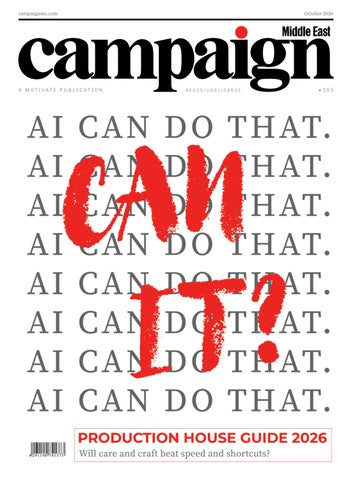
26 THE PRODUCTION HOUSE GUIDE 2026 Cover page design: Omar Albahr, Art Director, Liwa Content.Driven Inside image: Abhijeet Chaubal, Group Head – Art, Liwa Content.Driven
12 BRAND FOCUS
07 DUBAI MEDIA BRINGS GAMING, SOCIAL AND CONTENT TOGETHER IN NEW BRAND SOLUTIONS
Skechers Middle East’s Karuna Loungani shares what she has learned from sitting on both sides of the influencer brief.
Cicero & Bernay reveals the latest news, views and trends making waves across the global communications sector.
20 SPECIAL FEATURE
47 APPOINTMENTS
08 INDUSTRY FORUM
Are all brands getting enough transparency on margins, inventory and data usage within retail media networks?
Campaign Middle East’s Hiba Faisal reveals interesting insights from recent regional industry reports.
44 PROVOCATIONS
46 MATTER OF FACT
ANUP OOMMEN
“A CALL FOR GROWN-UP CHANGE”
WHEN BUDGETS GET TIGHT, EVERY MOVE COUNTS.
04 NEWS & WORK
very so often, the regional brand and marketing industry Editor realises that the ground beneath its feet has shifted – not through one sudden rupture, but through a series of quiet, incremental changes. For some, it feels like sand slowly gathering around their feet; for others, it feels like a quagmire they are trying to escape. This edition, focused on the Middle East’s production landscape, looks at a shift being accelerated by AI. The question leaders raise is not whether the landscape must change – because the consensus is that it must – but what must be protected and preserved through that change. Leaders reject the theatre of panic or praise. The tools are useful because they can organise messy workflows, widen the canvas and help create scenes that once felt out of reach. Yet the sharper truth is that the machine has never craved a mouthwatering meal, has never giggled at a subtle double entendre and has never frowned at an ad that falls flat. Conversations on production sets, in edit suites, inside brand teams and across social feeds are beginning to sound similar. There’s no shortage of content to doomscroll through. There is a shortage of trust, attention and patience. A paid view is only a knock on the door. The real test is whether people invite the idea in – and remember the experience afterwards. Campaigns will always matter, but the production industry is being challenged to create ideas that live longer: through real creators, strong characters, a local tune or a regional tension. The question is whether the work will still evoke emotion after the campaign window closes. None of this happens by magic or by prompts alone. “Let’s fix it in post” or “let’s fix it with AI” is not a strategy. Objectives and outcomes must be defined from the get-go. Faster, better and cheaper are not always compatible. The harder path is to challenge the brief: Why must the idea exist? Who is it for? What problem does it solve? What should it make people feel, remember and do? The message is clear: use new tools, but don’t mistake tools for talent. Move fast and make more content, but not so quickly that the work loses meaning, and not so much that audiences are numbed into indifference. This is a call for grown-up change. Rethink the workflow. Invite production and post-production into the room before the decisions are already made. Bring creators closer. Trust specialists. Give audiences credit. And, above all, remember that efficiency is only noble when it clears space for better thinking, braver craft and more human work.
48 PRIVATE VIEW
Key movements including new roles and promotions in the region.
50 THE SPIN
Mishaps in the world of communications.
Motivate Media Group Head Office: 34th Floor, Media One Tower, Dubai Media City, Dubai, UAE. Tel: +971 4 427 3000, Fax: +971 4 428 2266. Email: motivate@ motivate.ae Dubai Media City: SD 2-94, 2nd Floor, Building 2, Dubai, UAE. Tel: +971 4 390 3550, Fax: +971 4 390 4845 Abu Dhabi: Motivate Advertising, Marketing & Publishing, PO Box 43072, Abu Dhabi, UAE. Tel: +971 2 677 2005, Fax: +97126573401, Email: motivate-adh@motivate.ae Saudi Arabia: Regus Offices No. 455 - 456, 4th Floor, Hamad Tower, King Fahad Road, Al Olaya, Riyadh, KSA. Tel: +966 11 834 3595 / +966 11 834 3596. Email: motivate@motivate.ae London: Motivate Publishing Ltd, Acre House, 11/15 William Road, London NW1 3ER. Email: motivateuk@motivate.ae www.motivatemedia.com EDITORIAL: Motivate Media Group Editor-in-Chief Obaid Humaid Al Tayer | Managing Partner and Group Editor Ian Fairservice Group Content Director Thomas Woodgate | Campaign Middle East Editor Anup Oommen | Senior Reporter Ishwari Khatu Junior Reporter Hiba Faisal | DESIGN: Senior Designer Thokchom Remy | ADVERTISING ENQUIRIES: Chief Commercial Officer Anthony Milne | Publishing Director Nadeem Quraishi (nadeem@motivate.ae) | Sales Manager Tarun Gangwani (tarun.gangwani @motivate.ae) | Senior Sales Executive Saif Hemdan (saifeldin.hemdan@motivate.ae) | PRODUCTION: General Manager S. Sunil Kumar | Production Manager Binu Purandaran | Assistant Production Manager Venita Pinto HAYMARKET MEDIA GROUP: Chairman Kevin Costello | Managing Director Jane Macken The publishers regret that they cannot accept liability for errors or omissions contained in this publication, however caused. The opinions and views contained in this publication are not necessarily those of the publishers. Readers are advised to seek specialist advice before acting on information contained in this publication, which is provided for general use and may not be appropriate for the readers’ particular circumstances. The ownership of trademarks is acknowledged. No part of this publication or any part of the contents thereof may be reproduced, stored in a retrieval system or transmitted in any form without the permission of the publishers in writing. An exemption is hereby granted for extracts used for the purpose of fair review. Campaign Middle East includes material reproduced from the UK Edition (and other editions) of Campaign, which is the copyright of Haymarket. Campaign is a trademark of Haymarket and is used under licence. The views and opinions expressed within this magazine are not necessarily those of Haymarket Magazines Limited or those of its contributors.
04
October 2026
LIONS partners with Saudi Arabia’s Tahaluf and Ministry of Media to launch LIONS Riyadh in 2027
Saudi Arabia’s Ministry of Media, Tahaluf and LIONS announce that the three-day LIONS Riyadh event will be held from 6 to 8 December 2027.
LIONS, the organiser of the Cannes Lions International Festival of Creativity, has announced the launch of LIONS Riyadh, a new regional event that will be delivered in Saudi Arabia by Tahaluf, organiser of LEAP and Cityscape Global, in partnership with Saudi Arabia’s Ministry of Media. Taking place from 6 to 8 December 2027 at King Abdullah Financial District (KAFD), LIONS Riyadh will
aim to serve the local creative and marketing community by providing access to global benchmarks, intelligence, tools, learning and networks needed to drive growth. LIONS has also stated that Dubai Lynx will continue to be an established part of its presence in the Middle East and will remain the home for its regional awards in the Middle East. LIONS will not be introducing
any new awards in Riyadh. Instead, the new regional event will include a three-day programme, featuring keynotes, workshops and mentorship opportunities, giving the breadth of Middle Eastern talent a space that is shaped around the cultural and commercial realities of the region. LIONS Riyadh is intended to include a strategic alliance with Athar Festival, the Kingdom’s largest
gathering of the creative marketing industry, which is run by LIONS’ partner Motivate Media Group. It will also create opportunities for local talent and their work to be highlighted on the global stage. The festival will bring together the expertise of LIONS, along with the region’s most innovative minds. The LIONS Riyadh festival will also support the localisation of creative industries, the growth of local enterprises and the sector’s contribution to diversifying the Kingdom’s economy. It will also support the creation of Saudi content capable of competing globally, further reinforcing Riyadh’s position as a creative capital and a global destination for decision-making and opportunities. Simon Cook, CEO, LIONS, said, “We’re evolving our global model to make more of what LIONS knows is useful, closer to where people work, while keeping Cannes Lions as the place where the world comes together. These platforms will be built with local communities, not simply for them. The exchange works both ways: global expertise becomes more relevant locally, while regional talent and perspectives help shape what the industry encounters at Cannes Lions.”
Royal Air Maroc picks Merkle MENA as SEO, content and GEO partner Royal Air Maroc, Morocco’s national carrier and one of Africa’s leading airlines, has appointed Merkle MENA, a dentsu company and a leading customer experience management agency, as its search engine optimisation (SEO), content and generative engine optimisation (GEO) partner. The appointment marks a significant step in Royal Air Maroc’s commitment to strengthening its digital visibility. Merkle MENA will develop and execute an integrated organic search and content strategy designed to grow Royal Air Maroc’s presence across both traditional search engines and AI-powered discovery platforms.
Use the QR code to view this work on Campaign’s website.
DP WORLD “MAKE THE SAFE CHOICE” DP World has released a brand safety film designed to help reduce incidents among its frontline workforce by challenging the sense of familiarity that can build up in everyday working environments. The safety film, brought to life in partnership with Edelman and Boomtown Productions, was released as part of communications on DP World’s Global Safety Day. The campaign confronts an instinctive behaviour: the false sense of security that can come from working in the same environment every day.
October 2026
05
Saudi’s D360 Bank chooses Initiative as media agency
From left, Tarek Miknas, current CEO of FP7 McCANN MENAT, and Mounir Harfouche, who will take over as CEO of McCANN MENA.
FP7 McCANN and MullenLowe to come together as McCANN MENA FP7 McCANN MENAT and MullenLowe MENA have announced that they will merge to form McCANN MENA, following Omnicom’s acquisition of Interpublic Group (IPG) and MCN. McCANN MENA will be part of MCN and will be led by Mounir Harfouche, who has steered MullenLowe MENA through a period of sustained creative and business growth.
Harfouche also has a close and long-standing working relationship with Tarek Miknas, under whose leadership FP7 McCANN was named MENA Network of the Year at Cannes Lions 2026 and MENA Effie Awards’ Agency and Network of the year. Miknas will be actively involved in the transition process and has stated that he is looking forward to pursuing personal and family
Use the QR code to view this work on Campaign’s website.
projects after he steps down from his current role. Reflecting on the FP7 McCANN legacy, Tarek Miknas said, “FP7 McCANN has been built over decades by extraordinary people, enduring client partnerships and a belief in the power of creativity to build brands and businesses.” McCANN MENA will be part of McCANN’s global network, which has helped build some of the world’s largest brands over the past century.
Initiative, an agency under Middle East Communications Network (MCN) in the MENAT region, part of Omnicom, has been appointed the media agency of record for D360 Bank, Saudi Arabia’s fully licensed, sharia-compliant digital bank. The appointment follows a competitive multi-agency pitch and encompasses an integrated media mandate, further reinforcing Initiative’s growing momentum across some of Saudi Arabia’s most ambitious sectors. Rayan Alturki, Chief Commercial Officer at D360 Bank, said, “D360 Bank was built on the belief that banking should be simpler, more accessible and more rewarding for every customer across the Kingdom of Saudi Arabia. Everything we build – from our products to our services – is shaped around what our customers need today and what they’ll expect tomorrow.” As D360 Bank enters its next phase of growth, Initiative MENA aims to bring regional expertise, intelligence and performance capabilities to support the bank’s ambitions at scale, reinforcing its position as the partner of choice for brands defining the future of the Saudi economy.
Use the QR code to view this work on Campaign’s website.
RAKBANK “THE BEST OF BOTH WORLDS”
SAUDI TOURISM AUTHORITY “TOURISTS GO VISIT SAUDI”
To mark Rakbank’s 50th anniversary, the bank decided to rebrand by addressing a crucial challenge: how can a bank become more digital, faster and easier to experience without becoming faceless or unreachable when customers need support? The answer came to life as “The Best of Both Worlds”. This was a promise of “digital with a human touch”. The rebrand was rooted in clear customer insight: people want frictionless digital experiences but also want access to actual human support. Apart from the campaign, the bank also redesigned its app experience around customer needs, introducing more intuitive language and investing in AI-powered and proactive service monitoring.
During the summer months, “Tourists Go Home” became one of the defining images of the growing backlash against overtourism across Europe. But Saudi Tourism Authority, through its Visit Saudi brand platform, found the perfect response through a witty campaign, which was launched as a street intervention. Existing “Tourists Go Home” graffiti across Barcelona, Lisbon and Rome has been used as the canvas for creatives that reframe the message into an invitation: “Tourists Go Visit Saudi”. The work ran unbranded for a week and then was amplified through organic social and digital seeding, a campaign landing page, creator partnerships and PR outreach.
Agencies Koto, Assembly MENA, Netizency, Gambit Communications and Vertex CGI
Creative agency SRMG Labs Production house The Producer
06
October 2026
Catalyst Advertisement wins Mada Media OOH bid for national SMEs
From right, Mansoor Al Sabahi, CEO, Mada Media, and Sumaia Hammad, CEO, Catalyst Advertisement, sign the contract for the first dedicated out-of-home bid for national small- and medium-sized enterprises.
In line with the directives of Dubai’s leadership to empower national small- and medium-sized enterprises (SMEs), Mada Media, the company responsible for organising, developing and managing the out-of-home (OOH) advertising sector in Dubai, has signed an agreement with Catalyst Advertisement. This makes Catalyst Advertisement the winner of Mada Media’s first dedicated bid launched
exclusively for national SMEs. Catalyst Advertisement is a national company led by Emirati businesswoman Sumaia Hammad and has been active in the OOH advertising industry for more than three years. The contract, contested by 18 qualified companies, was signed at Mada Media’s headquarters in Dubai by Mansoor Al Sabahi, CEO of Mada Media, and Sumaia
Use the QR code to view this work on Campaign’s website.
Hammad, CEO of Catalyst Advertisement, in the presence of members of the senior management teams of both companies. Under the three-year-and-90-day contract, Catalyst Advertisement will hold the rights to install, operate and develop two advertising hoardings in strategic locations along Al Yalayis Street, one of Dubai’s key arterial routes, in the direction from Sheikh Zayed Road toward Sheikh Mohammed bin Zayed Road. This strategic corridor is located within an emerging urban area experiencing significant growth due to its proximity to Al Maktoum International Airport. Through these locations, Catalyst is set to provide effective advertising spaces and solutions that support brands, product owners, entrepreneurs and businesses by strengthening their market presence and enabling them to reach wider audiences. Al Sabahi said, “I would like to extend my sincere congratulations to Catalyst on this well-deserved achievement. This success presents a valuable opportunity for one of our national SMEs to play a meaningful role in Dubai’s rapidly expanding out-of-home advertising sector. We are confident in Catalyst’s ability to effectively manage the strategic assets awarded under the bid and contribute to the sector’s continued growth and development. I believe that this milestone will serve as a strong foundation for the company’s future achievements and long-term success.” Hammad said, “We are pleased and proud of the confidence Mada Media has placed in our company by awarding us these two hoardings in prime locations in Dubai. The partnership reflects confidence in our capabilities and potential while opening broader horizons for growth, business expansion and the opportunity to operate highly valuable advertising assets.”
Use the QR code to view this work on Campaign’s website.
OPTICAL CLUB “ALWAYS PROUD. ALWAYS FOR THE NATION.”
AL-FUTTAIM LEXUS “CREATE YOUR OWN PATH”
Saudi eyewear brand Optical Club has revealed details about its “Always Proud. Always for the Nation.” campaign to celebrate Saudi National Day 2026. One of the most crowded discount moments of the retail year, Saudi National Day usually sees most brands go bigger with a louder promotion, a larger deal or a lofty claim. Instead of adding to the noise, Optical Club showcased how its offers already run year-round, turning its always-on deals into the crux of a campaign that says “Always Proud. Always for the Nation.” rather than tokenising a specific moment.
For Emirati Women’s Day, which in 2026 is a month-long celebration, Al-Futtaim Lexus launched a campaign running from 28 August to 28 September, which moved beyond conventional celebratory messages to tell a story grounded in the lived experiences of Emirati women. The campaign centred on the idea that progress is not always linear. There are missed turns and moments where people have to create an opportunity rather than wait for one. Rather than merely celebrating what Emirati women have achieved, the brand chose to recognise the choices that helped them get there.
Creative Agency Freedom Production Pause Films
Creative agency Memac Ogilvy PR agency Gambit Communications
PARTNER PARTNERCONTENT CONTENT
October 2026
Dubai Media brings gaming, social and content together in new brand solutions The new commercial offering combines gaming audience intelligence, in-game media and creators with Dubai Media’s social and content ecosystem, giving advertisers new ways to engage audiences beyond traditional media.
G
aming is where audiences play, socialise, create and connect around the content, communities and culture they care about. For younger audiences in particular, gaming is central to how they spend time and connect. Creators, streaming and shared in-game experiences turn passive viewers into active participants. Responding to this shift, Dubai Media has introduced new gaming and social solutions powered by Livewire’s game-tech and gaming marketing capabilities, expanding what advertisers can deliver across the UAE. These solutions combine Livewire’s gaming audience intelligence, media, creators and custom experiences with Dubai Media’s content and social storytelling, giving brands a connected way to build reach, participation and relevance across the UAE. The approach follows a simple audience journey: social creates the spark, gaming turns attention into participation and content keeps the conversation moving. Campaigns can start with creators and short-form social content, move into gaming environments where audiences play an active role, then return to social through highlights, stories and calls to action.
THREE LEVELS OF BRAND OPPORTUNITY Awareness:
Awareness gives brands a scalable entry into gaming. Gamer.ID audience intelligence and segmentation help identify and reach relevant players through in-game billboards, rewarded video and video overlays.
Engagement:
Engagement turns attention into action through gamified media, in-game integrations, creator partnerships, interactive
challenges, amplified through reels, interactive stories and social content.
Brand experience:
For brands seeking deeper participation, Brand Experience is built around immersive activations across gaming and the real world. It connects custom in-game world-building with real-world brand experiences, amplified through talent partnerships and gaming media to drive discovery, participation and cultural relevance. Steve Smith, Executive Director – Commercial Media & Ventures, Dubai Media, says, “Audience behaviour is changing, and our commercial offering needs to evolve with it. By bringing gaming together with Dubai Media’s content and social ecosystem, we can give brands new ways to move beyond traditional advertising and create experiences that audiences actively choose to engage with.”
DUBAI MEDIA’S EVOLVING COMMERCIAL APPROACH
The launch forms part of Dubai Media’s wider focus on evolving its commercial offering beyond individual media channels. Rather than treating television, digital, social, creators and gaming as separate products, Dubai Media is creating connected brand experiences that can move across multiple audience touchpoints. For advertisers, the opportunity is not simply to place advertising around gaming, but to use gaming as part of a broader content and audience strategy – combining reach, participation and storytelling in a more integrated way. Ultimately, Dubai Media’s approach is about helping brands connect with audiences in more relevant and engaging ways, while continuing to expand its commercial offering beyond traditional media.
07
08
October 2026
INDUSTRY FORUM:
Are all brands getting enough transparency on margins, inventory and data usage within retail media networks?
Rehan Lalani
Head of Media – Arabia, Unilever
NO
We are seeing progress, but transparency still varies significantly across different networks. In the GCC, the market is growing quickly but retailers are at very different stages of maturity across media, advertising capability, measurement and data governance. Brands need greater clarity on how consumer data and actions are being collected and used, margins and fees within the network, the inventory they are buying, and whether results are genuinely incremental. Strong agency contracts, audit rights and global guidance provide the right guardrails, but many networks still operate as walled gardens. That needs to change. Ultimately, greater accountability will build confidence, unlock investment and drive sustainable growth.
Dylan Temple-Heald Head of Programmatic, Hypermedia
NO
Not yet, but things are improving fast. Transparency across retail media networks still varies, and more work is needed before every brand has a consistently clear view of margins, inventory and data usage. Real structural progress is under way. ABG’s MENA Retail Media Task Force is bringing together retailers, brands, technology partners, media owners and agencies to develop regional standards and best practices. We’re also seeing progress in measurement. A recent proof-of-concept combined sensor technology with real-time retailer point-of-sale data to directly measure sales uplift attribution, moving beyond assumption-based reporting and giving brands clearer evidence of how in-store retail media investment drives sales.
October 2026
09
Ruben van Middendorp
Head of Retailer Partnerships, Retail Media – Nordics, Benelux, Middle East and Africa, Criteo
NO
Retail media has made significant progress, but transparency is not yet consistent across the industry. As investment grows, brands should have a clear understanding of what they are buying, including commercial models and margins, available inventory, where their ads appear, how campaigns perform, and how their data is being used to activate and measure campaigns. Across the wider industry, greater standardisation in measurement, inventory, reporting and data practices will be critical. Ultimately, brands need enough transparency to compare investments, understand the value being delivered and hold retail media to the same standards as other major media channels.
Darius LaBelle
Managing Director, November Five
NO
For most brands, the only performance they see is inside the retailer’s own dashboard. Coupled with attribution models that differ across networks, this means results cannot be properly compared, checked for double counting, or verified against brands’ own definitions. IAB standards start to close this gap, but the industry needs independent verification.
Prasad Amin CEO, IAS Media
NO
The sector’s biggest blind spot remains data governance: transparent measurement, responsible use of shopper data, and a clear line between paid placement and organic discovery. Retail media networks run entirely on first-party customer data, yet the GCC has no regional standard for how that data is aggregated, anonymised or disclosed to advertisers. Brands still rely on retailers’ self-reported numbers rather than audited, independently verified data-usage terms. Globally, the IAB and Media Rating Council have begun standardising this through their Retail Media Measurement Guidelines, built on transparency, privacy, and audit principles, but IAB MENA’s own capability map of 27 active GCC retail media networks shows no equivalent regional benchmark yet exists, even as the market scales fast. Amazon is the only retail media firm with some transparency on data, though not on margins.
Charlotte Davis
Founder, Charlotte Davis Advisory
NO
Retail media transparency is improving fast, though it isn’t yet consistent across the board. The networks leading the market set the standard: clear omni-channel rate cards built around CPMs and cost-per-week models, with full visibility on measurement methodology, so brands, agencies and retailers know exactly what they’re paying for and how performance is reported. The real gap is consistency, in pricing and reporting expectations, versus more traditional, upper-funnel channels. First-party data-led personalisation is the retail media network’s real strength, but pricing models around it are still evolving. As the region matures, networks leading with this clarity will earn brands’ trust and investment first.
Hamza Madi
General Manager – Emerging Markets and Solutions, Platformance
NO
Most are not. Retail media has grown faster than the standards meant to govern it. Brands get strong sales reporting, but far less clarity on what determines whether the money was well spent: how much of the budget buys media rather than fees, the quality of the inventory, and how shopper data is used for targeting. That last point matters to the shopper as much as to the brand. In our experience this stems from pace rather than bad faith. The structure is the harder part. The retailer sells the placement, owns the data and reports the result, so the platform marks its own homework. Across this region, each retailer also reports differently, which stops brands from comparing one network with another on equal terms. Margin disclosure still has to come from the retailers, and the networks that offer it first are best placed to keep brand budgets growing.
10
October 2026
Florian Pfeifer
Managing Director, Flywheel MENA
NO Mahmoud Maghraby
Media Transformation Director – AMEA, MARS
NO
While data access and inventory quality have improved, the ecosystem remains far from ideal. With the explosive growth of retail media networks, added intermediation layers make it increasingly difficult for brands to trace exact margin flow and determine what value actually reaches the end destination. We are essentially building the plane while flying it. Until standardised measurement, end-to-end margin visibility, and clear governance protocols become universal across networks, brands cannot truly claim full transparency across their retail media investments.
Not consistently yet, but I see that as a question of market maturity rather than intent. Retail media is still developing rapidly in this region, and measurement and reporting standards are evolving alongside demand. The level of visibility can also vary depending on the retailer, network and sophistication of the advertiser. We’ve seen a similar evolution in more established retail media markets. In the UK, for example, greater standardisation around definitions and measurement, supported by industry bodies such as the IAB, has helped buyers compare networks more consistently. We’re already seeing that conversation develop globally and in this region. The next step is greater consistency around what is measured, how it is reported and how data is used. For me, transparency is ultimately a maturity question rather than a motive one.
Alok Gadkar
Co-Founder, CEO and CCO, Tuesday Communications
NO
Warwick Gird
General Manager – Marketing and E-commerce, Spinneys
Dina AlSahhar
Regional Marketing Manager, Al-Futtaim IKEA
NO
Not yet. Retail media is growing quickly, and transparency is becoming increasingly important as networks evolve. Brands now have a range of reporting tools at their fingertips, creating an opportunity for greater clarity on where ads appear, how prices are set, how value is shared, how data is used and what incremental sales their investment is driving, both online and in-store. To support sustainable growth, networks can make measurement clearer, audience methods more transparent, and the link between media and sales more visible. This can provide brands with further confidence and support better decisions, stronger partnerships and long-term growth.
NO
This is not yet the case for all brands. Retail media should feel like a partnership, and transparency is fundamental to any successful partnership. Brands deserve clear visibility of what they are investing in, where their campaigns appear and how inventory is delivered. Our role as a retail media owner is to connect brands with highly relevant customer moments across our stores, digital platforms and customer communications, while protecting the privacy and trust our customers place in us. Done well, transparency builds long-term brand confidence and creates shared success, driving category growth, new customer acquisition, repeat purchase and genuinely incremental sales.
Not yet. While retail media networks have mushroomed rapidly, I’m not sure if transparency has kept pace. Brands continue to lack a clear view of how media margins are structured, how inventory is priced, or exactly how first-party shopper data is being used, in spite of paying top dollar. The bigger issue is measurement. When the retailer owns the audience, the media inventory and often the attribution model, brands can end up marking the retailer’s own homework. Closed-loop measurement is powerful, but only when there is clarity around incrementality, attribution and what actually drove the sale. As retail media matures, brands should demand the same standards they expect from any serious media investment: transparent pricing, clear data governance and, above all, proof of incremental business impact. Retail media needs to move from “trust us” to “show us”.
PARTNER PARTNERCONTENT CONTENT
October 2026
How AI and personalisation are reshaping luxury experiences iProspect MENA’s Maya Tayara explains that luxury brands must make AI invisible while using it to create more personal and human experiences.
L
uxury has never been defined by price alone. At its core, it is about making people feel understood, valued and part of something exceptional. While craftsmanship, heritage and exclusivity remain timeless, the way consumers experience luxury is evolving rapidly. Today, the brands setting the standard are those using data, technology and artificial intelligence to create experiences that feel deeply personal without compromising the exclusivity that defines luxury. Across MENA, this transformation is accelerating. The region is home to one of the world’s youngest, most digitally connected populations, where affluent consumers move seamlessly between online and offline experiences. They expect brands to recognise their preferences, anticipate their needs and deliver relevance at every touchpoint. For luxury brands, personalisation is no longer a competitive advantage; it is the new baseline. The conversation around AI often focuses on automation, but its greatest value lies in intelligence. AI allows brands to understand customers at a level that was previously impossible, connecting behavioural, transactional and contextual data to deliver experiences that feel intuitive rather than reactive. The result is not more communication, but more meaningful communication. Whether it’s a boutique associate preparing recommendations before a client walks in, a concierge anticipating future purchases, or exclusive invitations tailored to individual interests, AI is transforming every interaction into an opportunity to deepen loyalty. The most successful luxury brands will be those that quietly use technology behind the scenes, while keeping the customer experience unmistakably human. This matters even more in MENA, where luxury is closely tied to hospitality, relationships and cultural understanding. Consumers
value discretion, trust and exceptional service as much as the products themselves. Technology should reinforce these qualities, making every interaction more relevant without making it feel transactional. At the same time, AI is redefining how luxury brands operate. It can analyse customer behaviour, monitor performance, optimise digital experiences and automate many of the operational tasks that traditionally consume marketing teams’ time. This allows brands to spend less time managing processes and more time investing in creativity, storytelling and the elevated experiences that build long-term brand equity. In luxury, where every detail matters, creating exceptional experiences requires extraordinary focus, and AI gives teams the freedom to focus on what humans do best. As AI becomes more deeply embedded in luxury marketing, trust will become just as important as technology. Personalisation only works when customers feel confident that their data is being used responsibly and respectfully. The brands that lead the next era of luxury will not be those with the most advanced algorithms, but those that combine innovation with transparency, discretion and integrity. Looking ahead, I believe the future of luxury belongs to brands that make AI invisible. Customers shouldn’t remember the technology; they should remember how the brand made them feel. The winners will be those that use intelligence to elevate human connection, blending innovation with craftsmanship, efficiency with elegance, and personalisation with authenticity. Luxury has always been about anticipating desire before it is expressed. AI simply gives us a more intelligent way to deliver on that promise.
By Maya Tayara, Managing Director, iProspect MENA
“The future of luxury belongs to brands that make AI invisible. Customers shouldn’t remember the technology; they should remember how the brand made them feel.”
11
12
October 2026
BRAND FOCUS
WHAT MARKETERS GET WRONG ABOUT INFLUENCERS Skechers Middle East’s Karuna Loungani shares what she has learned from sitting on both sides of the influencer brief.
M
ost marketing directors have never sat on the opposite side of their own influencer brief. I have – and it has quietly rewired how I write one. In any given week, I’m the person deciding how a creator is briefed on a Skechers activation, including how much to script, how much to leave alone and what success looks like in the deck. On another day, I’m the creator receiving a brief that reads a lot like mine, deciding how much of my own voice I’m willing to hand over for the collaboration. That double life has taught me that the industry’s biggest influencer mistakes aren’t made because of budgets or platforms; they’re made because brands are still treating creators as media buys rather than as collaborators with their own expertise.
BRIEF THE OUTCOME, NOT THE CAPTION
Every brand wants consistency, and when you’re running one identity across markets as different as the UAE, Saudi Arabia, Kuwait and Qatar, the temptation to lock down captions, keywords and shot lists is real. But an over-scripted post is obvious to any audience that follows a creator precisely because they don’t sound like a press release. Our back-to-school seeding is a good example of getting this right: every year, the effort goes into how creative the box itself looks, not into scripting the post. We tell creators about a shoe’s features and the tone we’re going for, but then let them decide how to bring it to life. It outperforms anything we’d script tightly, because it still sounds like them. SEEDING ISN’T A STRATEGY; IT’S AN INVITATION
Too many brands still think seeding products is the campaign. A box on a doorstep isn’t a strategy on its own; it’s the promise of hope – the box must give the creator something worth opening on camera.
What moved the needle for us wasn’t the shoes; it was designing a moment worth documenting in the first place, whether that’s a beautifully built seeding box or an experience such as our Friendship Day activation for creator duos. For Friendship Day, instead of asking creator duos to simply post together, we had best friends customise each other’s sneakers and paint on canvas side by side for a shared experience. As a result, the content came from something they were actually doing, rather than something they were performing. If I wouldn’t want to post it myself, I don’t expect a creator to want to either. PUSHBACK IS DATA, NOT FRICTION
Sitting on both sides also means I see something most marketing directors
“WHEN SOMEONE PUSHES BACK ON A BRIEF, THAT’S THE FRESHEST READ ON THE AUDIENCE THE BRAND WILL GET ALL QUARTER.”
miss: creators are already doing the brand’s market research for it – in real time, for free. When someone pushes back on a brief or asks to change the format, that’s not friction to manage; it’s the freshest read on the audience the brand will get all quarter. I’ve watched teams treat that pushback as a negotiation problem rather than the insight it actually is. RELEVANCE BEATS REACH
When we choose who to work with, it’s tempting to chase follower count, especially when the goal is to build awareness for a new category we’re moving into. But reach without relevance just inflates a report. Our Skechers Performance Run, a community run we host in Dubai year-round, has done more for genuine recognition than any influencer list sorted by followers. This is because it’s built around people who actually show up, not a rate card. COLLABORATOR, NOT VENDOR
None of this means creators are always right or that briefs should disappear. It means the best work I’ve been part of, on either side of the table, started the moment the brand stopped treating the creator’s judgement as inventory and started treating it as expertise. Every creator I brief is running their own brand: content pillars, audience data and a point of view built over years, not overnight. Asking them to set that aside for one campaign is a bigger ask than most briefs acknowledge. The brands that get this right aren’t the ones with the biggest budgets; they’re the ones that have quietly stopped writing briefs for a vendor and started writing them for a collaborator. I’ve had the unusual chance to be both. It’s made me a sharper marketer, and it’s exactly the shift I’d like to see more of in this region. By Karuna Loungani, Group Marketing Head, Skechers Middle East
October 2026
I
BRAND FOCUS
THE MOST OVERRATED WORD IN GLOBAL MARKETING: “CONSISTENCY” BYD’s José Miranda explains that global consistency should protect a brand’s core while giving markets room to stay culturally relevant.
believe international brands don’t grow by making every market look the same. They grow by knowing what must never change – and what absolutely should. I spend a good part of my life moving between markets. In the same week, I can be sitting in a campaign review in Europe, walking a showroom in the Middle East and then looking at a completely different consumer problem in Latin America. The countries change. The cultures change. Consumer expectations change even faster. And still, one word follows me almost everywhere: consistency. Marketers love that word. Consistent identity. Consistent message. Consistent experience. Consistent execution. I understand why. A brand needs things that are recognisable. Things that cannot be negotiated every time someone opens a new brief. The problem is that, somewhere along the way, we started treating consistency as if it meant making every market look the same. It doesn’t. I have seen campaigns that looked impeccable in a deck because every country used the same key visual, the same line, the same assets, the same media logic. Headquarters was happy. The brand team was happy. The only person who sometimes didn’t care was the consumer. That experience changed how I look at international marketing. The useful question is not “how do we get every market to do the same thing?” but “what must stay the same everywhere, and what has to change if we want to matter here?” It sounds simple. It isn’t. Brazil is not Germany. Saudi Arabia is not France. Mexico is not the UK. People relate differently to technology, to status, to mobility, to family, even to what makes a brand desirable. The media map changes too. A channel that builds a brand in one country can be almost irrelevant in another. A partnership that feels culturally sharp in one market can look imported and awkward somewhere else. Organisations still drift towards standardisation, and I get it. Standardisation is efficient. It is easier to manage. It gives the centre more control. Presentations look cleaner. Guidelines are easier to police. The
13
trouble is that consumers never experience our efficiency. They experience whether the brand understands them. I believe the best international brands will not pick a side between centralisation and localisation. They will get better at deciding what belongs at the centre and what belongs at the edge. Protect the idea. Protect the ambition. Protect the distinctive identity. Then give the brand room to enter culture in different ways. That takes more than a brand book. It takes judgement. And it takes trust. If every decision that matters must travel through several layers of approval thousands of kilometres away from the consumer, you can still get consistency. You just risk losing relevance. That does not mean handing every market total freedom. That produces another mess: twenty versions of the same brand until, eventually, there is no brand left. The answer sits somewhere between control and chaos. I think of it increasingly as a strong centre and intelligent edges. The centre decides what the brand stands for and what cannot be compromised. The edges know the consumer, the culture and the moment better than anyone sitting at headquarters possibly can. Good marketing happens when those two sides trust each other. Technology makes this sharper, not easier. AI will make it cheap to translate, adapt and produce content for hundreds of audiences. Technical localisation will soon feel almost automatic. Cultural relevance will not. Knowing how to adapt something is becoming easier. Knowing what should be adapted, and why, is becoming the real job. That is why I believe the next generation of international marketing leaders will need a different skill set: not only the ability to control a brand across countries, but also the ability to build a system in which a brand can travel without losing itself. International scale should not mean making the world look the same. It should mean building a brand strong enough to stay recognisable while becoming meaningful in completely different cultures. Consistency protects a brand. Relevance makes it grow. The logo should travel. The brand should travel. The marketing team must understand where it has landed.
By José Miranda, CMO – Europe, the Americas and the Middle East and Africa, BYD
14
October 2026
COVER FEATURE
The uncomfortable PRODUCTION RESET Leaders from the region’s production landscape reveal how artificial intelligence (AI), shrinking budgets and always-on content demands are reshaping the industry. They warn that speed, scale and efficiency will mean little unless brands continue to value craft, specialist talent, human judgement and trusted creative partnerships. By Anup Oommen
COVER FEATURE
T
he region’s production industry is being pulled in several directions at once. Clients want more creative assets, in more formats and across more platforms. They want them delivered faster and often with tighter budgets. Production partners are expected to respond with agility, craft and cultural instinct. They are also expected to justify why, how and when artificial intelligence (AI) tools, creator-led content, costly production equipment and advanced post-production technologies add value. But this is not only a debate about what production partners can deliver. It is also about what the industry now expects from them. Crucial questions are coming up in industry conversations: are brands still giving audiences something worth watching? Are producers being treated as expert partners or delivery tools? Is specialist talent being valued properly? And is technology being used to elevate production expertise or quietly flatten it? There is also a strong human current running through the conversation. The people behind the work – directors, producers, editors, writers, strategists, directors of photography (DOPs), art directors, performers and post-production specialists – are being asked to adapt quickly as the industry undergoes a production reset. But the word “reset” is not synonymous with “replace”. Instead, it calls for better tools, clearer roles, higher levels of trust and enough room for experts to upskill, deliver great work and let that work breathe before its success is dissected.
Carla Klumpenaar
Contributing to this conversation are: Carla Klumpenaar, General Manager of Marketing, Communications and Interior Design, Al-Futtaim IKEA UAE, Qatar, Oman and Egypt; Sami Saleh, CEO, Publicis Productions Middle East; Eddy Rizk, CEO, Big Kahuna Films; Daniel Kilalea, Executive Producer and Director, Boomtown Productions; Aasim Shaikh, Managing Director, LPS; and Inas Nagy, Production Lead, BigTime Creative Shop. Saying the quiet part out loud The first concern leaders raise is about pace and scale. Advancements in technology and AI tools have made it easier for brands
to produce quickly and in large volumes. But the industry is still working out whether that extra output is making brands more memorable or simply more present across devices, platforms and media channels. The danger is that creative content could become like background music in a crowded room: constant, unavoidable and increasingly easy to tune out. Carla Klumpenaar, General Manager of Marketing, Communications and Interior Design, Al-Futtaim IKEA UAE, Qatar, Oman and Egypt, says, “One of the most meaningful questions we should be addressing today is: should we choose speed over creativity? With AI and modern tools, developing content faster and at scale has become easier, but we need to stop and ask whether that content is connecting with people.” Klumpenaar adds, “Technology shouldn’t be used only to develop more content, faster. It should be a tool that frees up our time to focus on more thoughtful human work. At the end of the day, true creative value isn’t measured by how much content you produce, but by how memorable and meaningful it is to your audience.” That concern is reflected in recent industry research by Ipsos and the Advertising Business Group (ABG). The research found that while 60 per cent of regional marketers are using or piloting AI, only 15 per cent believe creative storytelling that resonates with key audiences is a core strength. This leads to a harder question: if everything becomes about saving time and becoming more efficient, what happens to the creative quality that makes the content worth watching in the first place? “Faster and cheaper cannot become the only measure of progress,” says Sami Saleh, CEO, Publicis Productions Middle East. “AI and production automation tools are removing inefficiencies and opening creative possibilities that previously required significantly more time and resources. But the risk is that, in our pursuit of efficiency, we quietly start devaluing craft. Great production is still built on talent, judgement, storytelling and attention to detail.” Efficiency can improve production, but it cannot be the only definition of progress. A cheaper asset is not necessarily a better one, and a faster workflow does not automatically produce more effective communication. Saleh adds, “The opportunity is to find the right balance, using AI to enhance and accelerate the process, while protecting the human craft and creative judgement that ultimately make the work distinctive.”
October 2026
Winds of change: AI fluency and structural shifts Another often unspoken truth is that the industry is not yet fully fluent in the new language of AI, and that lack of fluency may be causing production partners to give up parts of their value too quickly. Eddy Rizk, CEO, Big Kahuna Films, says, “When it comes to AI and technology, we’re in a bit of a blurry space at the moment. We want to embrace change, but we still cling
Sami Saleh
to our old know-how, and that doesn’t work.” Rizk adds, “Before we go all-in on AI, we need to understand and accept how the workflow changes, as well as the limitations that come with it. I think we’ve let go of the stronger 50 per cent of what we already do well and adopted the weaker 50 per cent of something we don’t yet fully understand.” Used well, AI can support previsualisation, versioning, localisation, workflow planning, editing assistance and repetitive post-production tasks. The concern is not the tool itself, but the assumption that the tool can replace the judgement behind the work. Daniel Kilalea, Executive Producer and Director, Boomtown Productions, says, “AI is only as good as the person using it. The common misconceptions are that it is easy to use and it creates better output. Not so. We shouldn’t devalue skills, experience or human ingenuity. AI characters and virtual influencers aren’t believable yet. So, do I connect with them? No. This results in fewer impressions and lower effectiveness in advertising and communication.” For production partners, the issue is also structural. The general perception that AI can simply be switched on or bolted on to old systems is incorrect. If the tools have changed, then the way ideas are developed, made, adapted and measured must change as well. Saleh says, “We cannot continue with traditional creative and production models and simply add AI as another layer. AI requires us to rethink the entire end-to-end workflow, from how ideas are conceived to how they are executed, scaled and adapted.”
15
16
October 2026
COVER FEATURE
“PROXIMITY IS NO LONGER ENOUGH. THE AGENCIES WINNING ARE THE ONES WHOSE TEAMS AND FOUNDERS ARE CREATORS – IN THE FEED EVERY DAY.” Saleh adds, “The real opportunity is not only to use AI to make existing workflows faster but also to combine human creativity and craft with AI to create fundamentally new ways of working.” Production teams are being reshaped. Smaller, sharper and more hybrid models are becoming more viable as tools reduce the need for large physical infrastructure. Aasim Shaikh, Managing Director, LPS, says, “The optimal shape of a production team is changing – and for the better. Big body shops and giant studio spaces are being replaced by talent-dense project management, strong post teams and smaller hybrid spaces – with a rise in the incorporation of motion control setups and AI-built environments. Fewer hands between the script and the frame means minimal transfer of loss from creative to execution. That is a real improvement.” Inas Nagy, Production Lead, BigTime Creative Shop, says, “AI has genuinely helped producers become more organised, from structuring schedules and workflows to creating clearer plans, calendars and systems to follow. It has made many operational aspects of the work more efficient and manageable.” As a result, production is getting more controlled, more efficient and less dependent on labour and space constraints. But concerns arise when the industry starts
painting with a broad brush and when leaders start undervaluing expertise that cannot be replicated. Shaikh adds, “The quiet devaluation is happening to the person in front of the camera. Talent is being priced like a line item. It is the only thing on set that cannot be generated. Our bestperforming work this year kept or amplified the human element rather than trimming it. Talent is not a cost; it is the centrepiece.” Nagy also draws a line when the conversation shifts from process to taste. A polished image does not deliver the same outcome as a strong creative choice. She says, “In art direction and design – particularly when it comes to posters and visual identity – too much dependence on AI tools can lead to work that looks technically polished but lacks taste, the human touch and creative instinct. AI should be a tool that enables and enhances creativity, not one that replaces the creative eye. The best work happens when technology serves human expertise.” The expectation gap: more work, less room and weaker outcomes Several leaders share instances where clients begin a virtual Microsoft Teams
meeting with statements such as: “we need to be doing more” or “we should have jumped on this trend yesterday” or “how much cheaper will it be to skip the shoot and generate everything?” or “can we fix it later with AI?”. While a few production partners are brave enough to ask “why?” and challenge briefs driven by urgency, the deeper issue is that the value of content is being reframed through the lens of cost, speed and output rather than effectiveness, outcomes and meaning. Nagy says, “Clients are asking for more, faster, with less. That means we need to be much smarter about where we save time and money, and where we absolutely shouldn’t.” That said, challenging client briefs is easier said than done. Long-term retainers have given way to short-term projects. Competition is high, margins are tight and response times are shrinking. Production technology and talent are becoming more expensive, even as budgets continue to fall. For producers, this is not only a pricing conversation. It is also about whether their role is understood properly. If the producer is treated only as someone who carries out instructions, the client loses the benefit of the professional judgement they are paying for. Nagy says, “I believe the real gap today is in the dynamics between clients and producers. More and more producers are being treated as tools to simply implement a client’s vision, rather than as creative and professional partners who have been hired for their expertise.” She adds, “Producers are not just there to execute instructions; they bring experience, knowledge, creative judgement and an understanding of what works. It should not be about who controls the cash, but about who has the expertise to deliver the best result. That is where the real partnership lies.” Leaders also point to a survival instinct built over time – one that has helped the industry navigate routes through stormy briefs. But the present gap between ambition, expectation and investment is becoming harder to ignore.
Eddy Rizk
COVER FEATURE
Rizk says, “We always find solutions for any brief; this is what we do best. But then there is always someone who will agree to everything and offer to do it for much less. A lot of compromises are made at the expense of quality.” He adds, “We’re certainly not in a better place than we were 10 years ago, which is strange because technology has given us far more tools to produce much better work. Yet, when you look at the outcome, it simply isn’t there. It’s now more about quantity than quality.” There is also a danger in treating exceptionally fast delivery as the new standard. When a team manages to perform under extreme pressure once,
Daniel Kilalea
that can quickly become the expectation every time. Over time, that distorts both budgets and deadlines. Kilalea says, “Some people can produce high-quality work at speed. This is not easy or something that can be done without experience, and needs a very strong and honest relationship with a client.” He adds, “When a rabbit is pulled out of a hat, that becomes the expectation or the norm. Couple that with existing misunderstandings about technologies such as AI, and the instructions become to do anything at a low cost or to meet a deadline. This ends up hurting the brand and any good equity they have built up over time.” Specialist talent is not disappearing; the definition of value is changing Talent remains one of the strongest concerns during the conversation. As tools become more accessible, the industry may be tempted to believe that craft has become easier to replace. Leaders argue the opposite: the more powerful the tools become, the more important human expertise and judgement become. The case is straightforward. Give a director, a junior videographer and a layperson the same AI tool and the same training, and the difference will become evident in the taste, framing, rhythm, restraint, intent and final output. Shaikh says, “The whole difference sits in how specialists prompt AI. That
prompt is decades of knowing what a frame needs, what a cut is for, and what a brand can carry.” Klumpenaar adds, “As internal capabilities and technology streamline standard production, the role of true master craftspeople, including strategists, directors, DOPs and writers, becomes even more vital. While technology can accelerate output, it can never substitute genuine human intuition, expertise, cultural empathy and emotional connection. The immense opportunity for our industry is to actively celebrate these specialists, using modern production tools to empower their craft.” Saleh makes a similar point, but with an important addition. Specialist talent will still matter, but the strongest people will be those who combine skills and expertise with fluency in new tools. The future belongs neither to pure operators nor to guardians of specialist knowledge who refuse to evolve. He says, “I don’t believe specialist talent is becoming less important; the skills we value are evolving. If we stop valuing specialists, we risk creating greater volumes of content, but less distinctive work. Deep craft in directing, editing, production, writing or post-production remains essential, but it increasingly needs to be combined with an understanding of AI and new technologies. At the same time, technology can amplify talent; it cannot replace taste, judgement and experience.” Kilalea adds, “Many people do things, but how many do them well and at a high level? That’s taste. A good editor is a storyteller; a good DOP is one as well, through visuals. Good writers may be
October 2026
harder to find, but not impossible. The risk with AI is that we start to rely on it to do things and then it becomes like a snake eating its own tail – trained on great human writing, then regurgitating it repeatedly. This is when nuance is lost.” Audiences do not consume content as a media plan Social platforms, short-form video and culturally specific formats have changed the rules of attention. Brand content now sits beside entertainment, creators, memes, news and personal updates. Anything that feels too forced struggles to survive. Rizk says, “Audiences are not waiting to be advertised to. Content must feel natural; it should appear spontaneous without fully being so. It should be culturally relevant and, most importantly, entertaining enough to compete with everything else in their feed.” He adds, “Unless we’re adventurous, daring and willing to try something different, this format will never have the opportunity to prove its potential and impact. We live in a world where we play it safe too often.” Some leaders see a significant opportunity for brands to move further into story-led formats. But they also argue that brands must not suffocate the story. If the audience feels sold to before they feel engaged, the format loses power. Kilalea says, “It’s about making engaging content. Don’t force the sale. I would love to see more brands making engaging stories, fiction, drama and more. Make something interesting – weave in your brand, or make it important to the story.” The social environment also demands different teams and different ways of working. Understanding a platform from a distance is no longer enough.
Boomtown Productions’ Daniel Kilalea says, “Many people do things, but how many do them well and at a high level? That’s taste. A good editor is a storyteller; a good DOP is one as well, through visuals.”
17
18
COVER FEATURE
October 2026
BigTime Creative Shop’s Inas Nagy says, “Technology and tools will keep changing, but great work will still come from great people. Talent, taste, collaboration and experience matter.”
Aasim Shaikh
The people making the work need to be close to the culture of the spaces they are creating for. Shaikh says, “Audiences can smell ‘polish’ from the first frame, so the real question is not how well the agency understands a platform community, but whether it belongs to one.” He adds, “Proximity is no longer enough. The agencies winning right now are the ones whose teams and founders are creators themselves – in the feed every day rather than reading a report about it.” This also changes how production teams need to collaborate. Instead of passing work from one department to another, leaders argue that clients need more direct access to the creators closest to the platform and key communities. Shaikh says, “From account to creative to production, the process becomes a relay and every handoff loses something. The alternative way to win right now is through asynchronous workflows: strategist, creative and platform-native talent each in direct conversation with the client, so the client sees every dimension at once. Then the work comes from people already aligned with each other.” For Nagy, however, the response to changing platforms should not be blind adaptation. Brands still need a centre of
gravity. Without clear identity, chasing every trend can make the work feel interchangeable. Nagy says, “I believe brands and agencies should stay true to their own vision and identity rather than constantly adapting to market demands simply because something is trending or expected.” She adds, “Trends come and go, but authenticity, consistency and a strong creative identity are what create lasting value and make a brand truly stand out.” The message to the industry: change, but don’t hollow out the work The parting messages from production leaders are not nostalgic calls to return to an older model. They recognise that the industry has changed and will keep changing. However, they call for a reset in how the industry thinks about people, tools, trust and value. Saleh says, “Embrace the change, but don’t lose sight of what makes our industry special. AI is giving us an opportunity to rethink how we create and produce, with the aim of empowering creativity, not defining it.” He adds, “The future belongs to those who can combine human creativity and craft with the speed and possibilities of technology. Stay curious, keep adapting, protect the craft and never stop pushing for better work.” Kilalea’s parting message revolves around trust and better partnerships. When clients hire strong creative and production partners, they need to allow those partners to bring their expertise to the table. Otherwise, the process can drain the value out of the very people brought in to create it.
Kilalea says, “I implore everyone to partner with good humans and to trust those people – if you have a good partner, allow them to do what they do best. I think 90 per cent of mediocrity is because an idea is interrogated to death, and the artists who were given the task have become restricted and misguided. As a result, clients don’t get value out of the people they gave the job to in the first place.” Nagy closes the loop by bringing the discussion back to the human nature of production. The tools may keep changing, but the best work still depends on people who know how to collaborate, judge, shape and care. She says, “Let’s go back to valuing expertise, trust and authentic creativity. Let’s not forget this is still a people business. Technology and tools will keep changing, but great work will still come from great people. Talent, taste, collaboration and experience matter, and we should keep investing in them.” The key takeaway is not a simple choice between the old and the new. Production partners are standing in a busy control room, with every dial moving at once: AI, budgets, timelines, social behaviour, client expectations, creator culture and specialist talent. The easy answer is to turn everything towards speed. The harder, more valuable answer is to decide what deserves speed, what deserves patience and what must never be stripped out of the process. For brands, the lesson is simple: ask not only how quickly something can be made, but why it should exist, who it is for and what it needs to make people feel, remember or do. What leaders are asking for is not resistance to change. It is more meaningful change. Use the tools, but do not mistake the tool for the craft. Move faster, but not so fast that the work loses feeling. Make more, but not so much that audiences stop caring. Above all, rebuild the trust between clients, agencies and production partners so that expertise is not treated as friction. In an age when machines can help make almost anything, the real advantage may belong to the people who still know what is worth making.
Inas Nagy
October 2026
T
here’s a moment in most content briefs where the idea quietly stops being the main thing, and you can usually spot it by the size of the spreadsheet. It starts innocently. There’s the hero film. Then the cutdowns, the verticals, the teasers, behind-the-scenes (BTS), stills, social-first pieces, character moments, market versions, and somewhere around row 38, nobody in the room is really talking about an idea any more. They’re talking about a delivery schedule. I’ve sat in those rooms. I’ve built those spreadsheets. I’ve colourcoded them, which should probably tell you something.
Would anyone notice if we made less?
Boomtown Productions’ Nerav Rao shares his personal views on whether every piece of work on the growing list of deliverables earns the time and budget it takes to make it.
I understand why it happens. I came into this industry through broadcast, where the deliverable was the programme and maybe a trailer. Now there are more platforms to feed, more audiences to reach and more pressure to make every production work harder. With the right planning and enough coverage, you can get a lot of useful work from one shoot. A long deliverables list can make a campaign look ambitious before anyone has worked out what the audience will get from it. Each item is achievable on its own. It’s only when you put them together that you see how much you’re asking one idea, and one shoot, to carry. Some ideas are built to expand. They have a mechanic, a behaviour or a point of view that keeps generating new expressions without losing what made the idea interesting in the first place. One thought can live as a film, an activation or something participatory, with each version doing a different job. Those are proper systems, and they’re brilliant when you get one. Other ideas are films. Their value might be in a performance, a reveal or a particular piece of writing. You can pull useful supporting material out of them, but there’s a limit to how many separate stories they contain. A 60-second cut becomes a 30-second cut, then a 15-second cut, then a six-second cut. A shorter edit might sharpen the message or reach someone who will never watch the full film. It doesn’t need to improve the original idea to be useful. The problem comes when we keep adding versions without knowing where they’ll run, who they’re for or what we need them to do. Volume is very easy to account for. You can put forty deliverables in a deck, assign owners, dates and formats, and at the end every box gets ticked. Working out whether each piece was worth making takes more thought. Creative and production teams need to be part of that conversation while there’s still time to change the list. If the ambition is a content system, then build it that way from the start. Make sure the different stories exist before the camera turns over, rather than hoping one hero film turns into a content calendar in the edit. That might change the casting, the way you use a location or how scenes are designed. It changes how much coverage you need and where the time goes. If the brief needs several stories and the treatment only contains one, the production plan needs to acknowledge that before everyone arrives on set. Production people tend to see this clearly because we’re usually standing at the exact point where ambition meets a call sheet. The deliverables list grows. The shoot days don’t. The budget usually doesn’t either. So the answer becomes coverage. Get the wides. Get the details.
19
Get another performance. Get a clean version. Get something vertical. Get enough that nobody feels exposed. I’ve said every one of those things, and I’ll say them again because sometimes it’s exactly what the job needs. But there’s a point where the ambition quietly shifts from making something memorable to making sure we have enough, and “enough” has never been a particularly inspiring creative target. Every extra output has to be planned, shot, reviewed, versioned, amended and approved, usually by the same people.
“I LIKE MAKING A BEAUTIFUL HERO FILM, BUT THAT DOESN’T MEAN EVERY BRIEF SHOULD HAVE ONE.” Even a small addition requires someone’s attention. On a full schedule, that time has to come from somewhere. This is where production knowledge should enter the creative conversation much earlier. Knowing how something will be made helps you put a cost against each request. It also lets you explain what might be lost elsewhere: time for another take, a more ambitious setup, or another pass at the edit. Drop eight pieces that nobody can give a clear purpose for, and maybe you buy an extra hour with the cast that makes the hero film work. Or the editor gets time to find the film instead of servicing versions of it. That’s a decision worth discussing while the scope is still open, rather than discovering the trade-off on the shoot day. There’s a bias I have to watch in myself here. I like making a beautiful hero film, but that doesn’t mean every brief should have one. Sometimes, the cutdowns and adaptations are essential to the campaign, even when most of my attention is on the film. The questions still apply: who is each piece for, where will it run, and what do we need it to do? If there’s a good answer, plan for it properly. If there isn’t, ask before the spreadsheet gets built around it. When a brief asks for 40 pieces of content, I want us to be able to explain why we need all 40. We should also be able to say what we’d gain by making fewer. That’s a much more useful conversation to have before the shoot than in an edit suite with 38 versions still to deliver.
By Nerav Rao, Senior Creative Producer, Boomtown Productions
NEITHER WAS TWO
20
October 2026
8
What happens
hours and 11 minutes. That’s approximately how much the average person in the UAE spends looking at a screen every day, according to a report by DemandSage. In Saudi Arabia, it’s only slightly lower, with the average being 7 hours and 9 minutes. Some of it is work. Some of it is watching influencers make pasta. Some of it is answering messages, checking the weather, reading the latest news and, inevitably, wondering why Instagram is open. And somewhere in between all of that, we find ourselves shopping. Shopping used to be an exercise that we made time for; increasingly, it has become something that happens while we’re doing everything else. The consumer does not necessarily need to decide to go shopping before they start shopping. It is becoming embedded into everyday digital behaviour, shaped by micro-decisions, AI, social platforms, convenience and trust. For marketers, that changes the consumer journey from a relatively linear path – from discovery to consideration to purchase – into something far more fragmented and harder to map. The consumer journey, and the path from ‘discovery’ to ‘add to basket,’ has taken a shortcut – one that is further fuelled by AI tools, algorithms, e-commerce, superapps and content creators.
when the shopping trip never ends? AI, social media, convenience, trust and changing behaviours are reshaping the MENA consumer journey from discovery to purchase, and what this data means for brands, marketers and advertisers.
By Hiba Faisal
The world is your oyster, and in this world that oyster can be delivered within 10 minutes to your door at the tap of a button, which begs the question: What is the MENA digital consumer becoming? The latest research from PwC, Checkout.com, Tabby, Visa, Majid Al Futtaim and others offers a window into how people discover, evaluate and buy in a digital-first market. A series of micro-decisions Tabby, a Buy Now, Pay Later (BNPL) financial app, surveyed 20,999 shoppers
across Saudi Arabia and the UAE for its 2026 Ultimate MENA Shopper report, describing shopping as a series of “micro-decisions” as consumers move between channels, devices and payment options. That makes the journey less about one big purchase decision and more about a collection of smaller ones. Consumers are moving between different trains of thought and asking themselves: Do I stop scrolling and look at this? Do I trust the recommendation? Is this the right price? What are other people saying? Should I ask AI? Do I need to see it in person? Is delivery fast enough? Can I pay the way I want to? With each question, the answer either moves the consumer closer to the purchase, or quietly pushes them somewhere else. The touchpoints are multiplying. Tabby found that 77.2 per cent of product discovery now happens through digital channels, even when the purchase is made in a physical store. The report also highlights social media as the leading source of discovery, with 31.3 per cent of shoppers using it for discovery, 28.2 per cent browsing stores online, 18.6 per cent browsing in-store and 17.8 per cent using marketplace apps. The eventual transaction may still happen in a store, but the decision has often already been shaped elsewhere. The Tabby survey also found that 68 per cent of shoppers know what they want before entering a store. This suggests that the consumer journey and shopping behaviour have become a hybrid of online and in-person, with 55.3 per cent of shoppers saying they prefer a mix. The result is a hybrid shopper on a hybrid journey. A consumer might discover a product online, compare it across different platforms, read reviews, walk into a store to see it for themselves, and then decide where and how to buy it. The store is still part of the journey. It is just no longer necessarily where the journey begins. Discovery doesn’t have a front door The hybrid behaviour reveals that shopping no longer has one obvious starting point. Consumers experience a series of micro-decisions before clicking purchase. A consumer can enter discovery through a social feed, a creator recommendation, a search result, an AI prompt, a marketplace, an advert, or simply something they happen to see while doing something else online. Research conducted this year by finance company Visa UAE, found that 60 per cent of consumers typically discover new brands or retailers while shopping online, while 69 per cent have purchased directly through social media platforms. Tabby’s data also reveals differences in how shoppers navigate the journey: 41.4 per cent of shoppers in
October 2026
21
WHEN ASKED WHAT MAKES THEM WANT TO BUY SOMETHING, 61 PER CENT OF GEN ALPHA RESPONDENTS POINT TO SOCIAL MEDIA. and convinced somewhere along the way. The journey can begin without the consumer even realising they are on one. The purchase may still happen in a single moment, but the journey is the accumulation of micro-decisions. For marketers, brands and advertisers, the challenge is understanding which of these moments matter – and what role a brand needs to play in each one.
Saudi Arabia prefer an online-only approach as opposed to the 30.6 per cent in the UAE. The figures for an in-storeonly approach are much smaller, at 9 per cent in Saudi Arabia and 6.8 per cent in the UAE. The distinction between discovery and transaction is therefore becoming harder to maintain. The feed can introduce the product, provide the social proof, create the desire and, increasingly, facilitate the purchase. The youngest consumers are already growing up inside this environment. A study conducted this year by consultancy PwC surveyed more than 1,000 children aged 7 to 14. The report found that 70 per cent of Generation Alpha own their own tablet, 72 per cent use smartphones regularly and 97 per cent say they make purchasing decisions independently at least some of the time. When asked what makes them want to buy something, 61 per cent of respondents point to social media. This figure is higher than peer influence, at
56 per cent, and significantly outpaces traditional channels such as TV advertising, at 48 per cent, or in-store browsing, at 53 per cent. The findings suggest that over time, social media and gaming platforms are likely to become increasingly important discovery engines, shaping purchasing intent and decisions as well as where brand preferences are formed. This generation is what PwC refers to as the Youngest Chief Influence Officers as most Gen Alpha knows exactly where to spend their time and money. For brands, the takeaway is less about putting a shopping cart in the hands of a seven-year-old and more about recognising where influence is already happening. Gen Alpha may not have the final say – or the bank account – but they are increasingly shaping the conversation before a purchase is made. The next generation will not learn shopping as a separate activity; they will inherit online shopping as an embedded behaviour. Shoppers don’t necessarily decide to go shopping before they start shopping. They can be entertained first, influenced second
How AI is changing the journey AI is becoming another layer in that decision-making process. Digital commerce largely relies on the consumer doing the work: searching, comparing, reading reviews, opening tabs and deciding which option to choose. AI is starting to take some of that work away and is opening a new type of shopping experience built around greater convenience. Deloitte’s 2026 Digital Consumer Trends report for Saudi Arabia found that 66 per cent of consumers aged 18 to 50 actively use AI tools, up from 49 per cent the previous year, signalling growing comfort with advanced interfaces. AI usage for work-related tasks has climbed to 45 per cent, with consumers increasingly turning to it as a starting point for productivity. The most common use cases, searching for information (51 per cent), generating ideas (44 per cent) and language translation (42 per cent), highlight a fundamental behavioural shift, with AI becoming the first step in how people access information. This growing familiarity shows up within shopping behaviour. Checkout.com’s MENA 2026 report found that 50 per cent of consumers are comfortable letting an AI agent shop on their behalf. Similarly, Tabby’s 2026 research found 43 per cent of shoppers across the UAE and Saudi Arabia now use AI to help decide what to buy. Among 18- to 29-year-olds, that shopping figure rises to 51.8 per cent, although only 30 per cent fully trust its recommendations. Visa’s UAE research shows just how quickly AI is moving into the shopping journey. It found that 85 per cent of consumers in the UAE have used AI tools to assist with shopping. This includes checking reviews or product ratings (60 per cent), comparing prices (59 per cent) and finding gift ideas (55 per cent). The report also suggests there is clear appeal for AI shopping; 93 per cent of shoppers feel
22
October 2026
AI-powered tools are making online shopping faster and easier than before. However, consumers remain more cautious when it comes to AI handling transactions on their behalf. About 32 per cent would trust AI agents to complete checkout, reinforcing the importance of earning consumer trust in the age of agentic commerce. Meanwhile, 69 per cent of consumers in the UAE have purchased directly through social media platforms, showing that consumers are not just willing but are moving from discovery to transaction within digital environments. The question is whether that same level of comfort will be extended to AI agents making and completing those decisions on their behalf or if consumers are simply more comfortable with AI as an assistant rather than a personal shopper. AI, then, has not necessarily removed the consumer from the journey. It is changing how much of the journey they have to do themselves. And that creates a new problem for brands. When the shopper has an AI assistant AI is supporting consumers in understanding, searching and reviewing products before they ever reach a brand’s website, social feed or store. This means consumers are shortlisting their options before reaching traditional points of brand discovery and the overall consumer journey. Despite the growing adoption of AI tools, most consumers still treat AI-generated summaries as an entry point rather than a destination. According to a recent NielsenIQ report titled ‘Visibility in the Age of AI’ about four in 10 users say they typically read the summary and then click through to relevant links for more information.
THE QUESTION FOR MARKETERS IS BECOMING: WILL AI SYSTEMS HELP CONSUMERS FIND US, UNDERSTAND US AND RECOMMEND US? Another one in five actively compares AI outputs against multiple sources to validate accuracy and credibility. If consumers increasingly rely on AI to narrow down their options, being visible in search results or social feeds may no longer be enough. Brands may also need to be visible to the systems that are helping consumers decide what is worth considering in the first place. The stakes are rising for companies seeking to remain visible, relevant and trusted. Last month, OpenAI expanded ChatGPT Ads to the Middle East and North Africa, giving regional advertisers access to its self-service
advertising platform as the company’s global advertising business reaches a $1bn annualised revenue run rate. Allowing advertisers to buy placements directly on the AI-powered platform will once again reshape the consumer journey between search, discovery, consideration and final purchase. The question for marketers is no longer simply: can the consumer find us? It is becoming: will the systems helping the consumer make decisions find us, understand us and recommend us? That is a very different kind of visibility. And it brings the conversation back to values that has always mattered in
October 2026
commerce, even if the technology around it keeps changing: convenience and trust. Convenience is no longer a bonus If discovery has become fluid, convenience has become an expectation. The consumer does not necessarily want to spend more time navigating the journey. In many cases, they want the journey to disappear. Checkout.com’s 2026 MENA report, The New Era of AI in Payments, based on YouGov research of 4,002 adults across six MENA markets, found that 63 per cent of consumers expect to shop online more over the following 12 months. For these digital journeys, 97 per cent say a seamless payment process is important, 62 per cent say security remains critical, and 50 per cent of consumers are also willing to save their card details to make checkout faster and simpler. The same expectation is visible in the wider retail experience. A white paper report from Majid Al Futtaim and Visa found that 67 per cent of UAE consumers used their mobile phones as part of their most recent retail purchase, while 37 per cent completed their online shopping directly on mobile devices. Expectations are also unforgiving: nine in 10 shoppers said they would abandon even their favourite brands after a single poor experience. Food delivery, quick commerce, one-click payments, digital wallets and superapps have all trained
consumers to expect less friction between wanting something and getting it. Tabby’s 2026 research found that 70 per cent of shoppers would avoid retailers that do not offer flexible payment options. That is an important distinction for brands. Convenience is no longer necessarily something that wins the customer. It is something they may notice only when it is missing. So when convenience becomes the baseline, offering it does not automatically create loyalty. Failing to offer it can, however, create a reason to leave. Fast gets them. Trust keeps them. The consumer may be willing to let technology do more of the work. But they still need to feel confident about where that work leads. Fraud risks continue to follow consumers online. 46 per cent have experienced a financial scam in the past 12 months, with 38 per cent reporting the incident occurred on social media, according to Visa’s 2026 report. Security concerns keep AI’s role largely limited to discovery. So while the shopping trip may be open 24/7, the consumer’s willingness to follow it all the way to checkout is not. The more technology takes over, the more important that trust becomes. The Majid Al Futtaim and Visa report argues that the next stage of e-commerce growth will be driven not by new technologies, but by the ability to embed trust consistently across the entire customer journey. To support this trustdriven model, the white paper outlines five foundational capabilities required for a
23
scalable retail ecosystem: digital identity, secure credentials, consentdriven data sharing, interoperability between platforms and clear recourse mechanisms for customers. Together, these capabilities will enable retailers to deliver more frictionless experiences that will support the trust loop. Consent, identity verification, authentication and secure data collaboration will no longer sit in the background; they will define whether systems are usable at all. Retailers will need to design products, payment rails and digital channels that are machinereadable, interoperable and resilient, structured not only for human decisionmaking, but also for AI agents evaluating reliability, transparency and security. This set-up may not win customers on its own, but its absence will certainly lose them – particularly as new AI-based commerce models reshape how purchasing decisions are made. The shopping trip may now be open 24/7. Discovery can happen before there is even a need, and AI can increasingly help decide what happens next. Convenience keeps the customer and trust leads to purchase. The consumer journey may be harder to map than ever. For brands, the challenge is becoming clearer: be discoverable when the journey starts, useful while decisions are being made, easy to buy from when the moment comes, and trustworthy enough to be chosen.
24
October 2026
SAUDI FOCUS
We have built the stages. Now we need to build the rooms. Maheerah alumna and mentor Laila Essa argues that Saudi Arabia has built the platforms and opportunities; now it needs stronger communities where the knowledge behind the work can be passed on.
S
audi Arabia’s creative industry has no shortage of stages. There are festivals, awards, conferences, panels and increasingly ambitious work being shown to the world. That visibility matters. But while stages offer great platforms and opportunities, I have become more interested in the rooms behind them; the smaller rooms where people can say, “I don’t know”. Where founders can be vulnerable without being judged. Where someone five years in can learn from a mistake made by someone 15 years ahead. Where people are not performing expertise for an audience. Saudi needs more of these rooms. Saudi needs communities. We are building a creative industry faster than anyone can write the manual for it. Categories that did not exist 10 years ago now have teams, budgets and deadlines. So, if the work is maturing this quickly, what is happening to all the knowledge? I think most of what helps you navigate this industry is never written down. How
By Laila Essa, Maheerah alumna and mentor, and Co-founder of Taglime and Soul of Saudi
“Community needs curation, continuity and relationships that survive after the lanyard comes off.” do you price something nobody has priced before? What does a government approval process really look like from the inside? How do you tell whether a client’s feedback is feedback or fear? There’s no case study for this. It sits in the heads of people who learned those lessons the expensive way. We still talk about professional development as if careers move in a straight line. Agencies teach through hierarchy. Companies teach internally. Conferences broadcast from a stage in one direction. All three assume somebody already holds the answer, and the job is to hand it down. Community works differently. In a community, knowledge moves sideways. A founder tells another founder what ownership costs. A junior person teaches someone 20 years ahead how AI is changing the craft. Someone inside a network explains to an independent operator how institutions make decisions. Very little of it is on an agenda. That is what Maheerah – a year-round initiative for women in Saudi Arabia to learn, connect and grow, organised by Athar Festival and powered by Publicis Groupe Middle East – made clear to me. I entered as a participant in 2024 expecting a programme: mentor, sessions, learning, access. I found those things, yes, but the lasting value came from a highly curated group of women bringing different experiences into the same room. Founders, senior corporate leaders, mentors, people from different corners of the industry. The surprise was how much of the learning happened informally between everyone in the room. Two years later, that community is still
buzzing. Recently, I was stuck on a government project in an area that was new to me. I messaged a woman I knew through Maheerah who had the experience I was missing. She replied in about 20 seconds with the context I needed. That exchange cost nothing and saved me weeks. When that kind of access exists across a community, it becomes infrastructure. This is why I am careful not to confuse community with “people you know”. A WhatsApp group is not automatically a community. Neither is a networking event. Community needs curation, continuity and relationships that survive after the lanyard comes off. Last year, I returned to Maheerah as a mentor. I sat with a woman who had just been laid off. She needed somebody to explain what had probably happened on the other side of that decision, from someone who sometimes has to make such decisions. What stayed with me was that I needed exactly that conversation 12 years earlier, and nobody was available to have it with me. So, I worked it out alone, slowly, at full price. That is why I have stopped finding the terms mentor and mentee especially useful as labels. Some years you need the room. Some years the room needs something from you. I built a company serving the Saudi market without a mentor, a graduate scheme or an institutional apprenticeship. Most of what I know about pricing, negotiation, hiring and clients came from making decisions first and discovering afterwards whether they were wise. That usually gets described as resilience. It is also an absence of infrastructure, described generously. A maturing industry should want fewer of those stories, not more. Saudi has been impressively deliberate about building the visible layer of its creative industry: festivals, awards, academies, incubators, agencies and in-house teams. The next layer is about creating more ways for the people inside them to learn from one another. More rooms where experience can move across generations, companies and disciplines. Where emerging talent can access judgement, not just advice. Where senior people can still ask questions without being embarrassed. That is what Maheerah became for me: a community I can return to from either side of the table. Sometimes I have the experience somebody else needs. Sometimes somebody else has the answer I have been overthinking. The value is that the relationship exists when the question arrives. We have built the stages that show the world what Saudi creativity can do; now we need rooms where the people behind it do not have to figure everything out alone. The Maheerah Programme, powered by Publicis Groupe Middle East, will take place as part of Athar Festival on 24-25 November at Crowne Plaza RDC, Riyadh. Find out more atharfestival.com.
October 2026
25
I
n an environment where consumers are exposed to more content and advertising than ever before, brands are competing not only for attention but also for meaningful engagement. As the number of messages people encounter continues to grow, capturing attention is increasingly just the starting point. The more interesting challenge is what happens after someone notices a brand. Do they feel something? Do they become curious? Do they participate? And, ultimately, does the experience give them a reason to act? This is where experiential marketing continues to have a distinctive role. A well-designed experience does something advertising cannot always do: it allows people to step inside the story rather than simply hear about it. They can taste, touch, explore, ask questions, meet people and form their own impressions. That shift, from being audience members to becoming participants, is increasingly important to how brands build relevance. The strongest experiences are therefore not necessarily the biggest or most technologically advanced. They are the ones that make a brand feel real, relevant and authentic. This is particularly powerful for destinations. A destination is an inherently experiential proposition. You can describe its culture, hospitality, food, landscapes and entertainment through thousands of pieces of content, but information alone cannot fully communicate what it feels like to be there. The role of an experience is to provide a glimpse, a sensory and emotional preview that turns an abstract proposition into something people can imagine themselves experiencing. That is why human connection matters so much. People want to speak to real people, ask questions, discover the details they cannot find in a brochure and encounter something that feels authentic. Technology can enhance that interaction, but it cannot replace it. The most effective use of technology is often the one that makes the experience more relevant, immersive or useful, rather than simply more impressive. This is also why the current conversation around creativity is moving beyond spectacle. At Cannes Lions 2026, experience, effectiveness and participation were prominent across the winning work, while emerging creative trends highlighted the value of giving audiences something meaningful in return and inviting them to participate in the story. That is an important distinction for marketers. An experience should not exist simply to create a photo
By Sarah Abumelha, VP of Global Events and Exhibitions, Saudi Tourism Authority
SAUDI FOCUS
From brand message to brand experience Saudi Tourism Authority’s Sarah Abumelha shares why marketing needs people to step inside the story. opportunity. It should create a reason to engage. The real opportunity is to give people a role in the story. When audiences are given space to explore, interpret and respond in their own way, they develop a more active relationship with the brand. They are no longer simply experiencing something created by the brand; their own choices, reactions and interactions become part of the experience itself. For destination marketing, this principle extends beyond the physical activation. The experience needs to connect to the
wider journey. If someone becomes interested in a destination, the next steps should feel equally compelling and straightforward: what can I do there? Where can I stay? How do I get there? When should I go? What is available for someone like me? This is where experiential marketing becomes more than an awareness tool. It can become a bridge between inspiration and action. It also means that marketers need to think carefully about where experiences live. The best activation is not necessarily the one with the largest footprint; it may be the one that appears naturally in the places where the intended audience already spends time. The relevance of location can be as important as scale. And operational detail matters. A beautiful experience undermined by long queues, unclear journeys or poor accessibility is still a poor experience. Creativity creates the invitation, but execution determines whether people leave with the feeling the brand intended. Authenticity is part of that execution: the details, people and interactions need to deliver on the promise the experience makes. Ultimately, the future of experiential marketing is not about choosing between physical and digital, technology and humanity or brandbuilding and conversion. It is about connecting them. The opportunity for marketers is to design experiences with a clear purpose, translate that purpose into something people can genuinely experience and create a natural path towards the next step. For destinations, that means giving people an opportunity to encounter elements of the destination before they travel – its flavours, culture, hospitality, people and experiences – and allowing those encounters to shape how the destination is understood. This points to a broader shift in the role of experiential marketing. Its value increasingly sits in its ability to turn a destination from something people see and hear about into something they can begin to experience for themselves. That is where experiences can create curiosity, build an emotional connection with the destination and, ultimately, inspire people to consider a visit.
26
October 2026
MassHouse Office: Dubai, UAE contact@masshouse.studio SERVICES: Film & content production, architecture photography, aerial filming, KEY CLIENTS: Foster+Partners, BIG Architects, Heatherwick, Minotti, Flos
Pixojam Office: Dubai, UEA hello@pixojam.com
PRODUCTION HOUSE GUIDE 2026
SERVICES: Virtual production, production services, real time hybrid production KEY CLIENTS: BMW, Huda Beauty, The Estée Lauder Companies, Jo Malone London
Roya Media Group BIG KAHUNA FILMS Office: Dubai Studio City hello@bigkahunafilms.com SERVICES: Creative production, concept development and ideation, commercial films, documentaries, scripted series
Office: Jordan info@royamediagroup.com SERVICES: Television broadcasting, news reporting, tv series & artistic production, video-on-demand streaming, podcast hosting KEY CLIENTS: Orange Jordan, MBC Group, Jordan Football Association, RT Arabic, Fantahi App
Snap Arts Bigsea Productions Office: Dubai, Beirut contact@bigsea.tv SERVICES: Production services, AI agency services, creative services KEY CLIENTS: Etihad Rail, Samsung, Harrods, MAF, Ikea
Office: Egypt info@snaparts.tv SERVICES: Visual effects, set extensions , crowd tiling , action elements , rig removal KEY CLIENTS: Vodafone, Samsung, Etisalat, Nescafe, Amazon
Tam Tam Corp Office: Dubai info@tamtamcorp.online SERVICES: AI video production, product and food imagery, real estate listing films, social-first short-form advertising, white-label overflow production for agencies
BIGZ Productionz Office: Riyadh, Jeddah think@bigz.sa
Two Lights Production
SERVICES: Commercial films, social media content, post production & VFX
Office: Riyadh, Saudi Arabia info@twolightssa.com
KEY CLIENTS: AROYA, NMS Jetour, Sela, AL AHLI FC, AMERICANA, HAVAL
SERVICES: Advertising photography, photo libraries, corporate portraiture, KEY CLIENTS: STC, GOSI, Ministry of Health, Mobily, PepsiCo
Film DNA Office: Based in Cairo and Shoots around the world. hello@film-dna.com SERVICES: Full production service: ads, feature films, documentaries, branded content, creative development, influencers, full post production, AI, photoshoots
Whale Studio Office: Dubai hello@whalestud.io SERVICES: Brand audits, marketing support, strategy, brand identity and design KEY CLIENTS: Swan Hellenic, Miratorg, Sherwoods International Properties, Atlas
October 2026
29
C
reate Production is a production studio built for this region. Since 2016 we have made cinematic, high-calibre content for nation builders, global brands and agencies across the UAE and Saudi Arabia, with full production infrastructure in Dubai, Abu Dhabi and Riyadh. Our films are known for emotional resonance and narrative purpose. We specialise in capturing transformation: cities, industries and people on the move. We are part of the Code and Theory family of agencies within the Stagwell global network.
Founded: 2016 Headquarters: Dubai Number of staff: 12 createproductiondxb.com +971 4 442 5674 hello@createproduction.com createproduction.me create-production createproductionme
KEY CLIENTS: Department of Culture and Tourism Abu Dhabi, Dubai Department of Economy and Tourism, Ahmed Seddiqi & Sons, Volkswagen, Public Investment Fund, Diriyah Company, Jumeirah, Zayed National Museum SPECIALISMS: Photo and video production, event coverage, drone content, post-production and animation, AI content production, podcast and docuseries production AWARDS: Part of Create Group, we are a three-time winner of Campaign Digital Agency of the Year Middle East Award.
LEADERSHIP PANEL
Dia Hassan1
Joy Films Ad Half Page 14.8X21.5 cm.pdf
24/09/2026
Partner & Chief Creative Officer
Shona Royston
Kim Jerbo
Group Head of Production
Executive Creative Director
10:24 AM
C
M
Y
CM
MY
CY
CMY
K
KEEP SMILING
30
October 2026
The media plan says
the campaign is over. Is it? Liwa Content.Driven’s Sagar Rege explains that brands should stop treating ideas as finished simply because the media plan has ended.
T
he first view can be bought. The second must be earned. Advertising has become extraordinarily good at creating a first encounter. We know how to target, retarget and personalise what people see. We can measure how long they watched, where they dropped off and what they did next. But there is a question we ask less often: did they ever want to see us again? That is where I believe the next conversation around creativity needs to begin. For a long time, the campaign has been the organising principle of our industry. There is a brief, an idea, a launch, a hero film, adaptations and then media. The campaign runs its course and, very often, the creative thinking resets. New brief. New idea. There is nothing inherently wrong with campaigns. Products need launching. Offers need communicating. Brands need moments of concentrated activity. The limitation begins when campaign thinking becomes the only way we know how to think. A media plan can legitimately determine when an advertising burst ends. It should not determine when an idea does. We may have misdiagnosed the attention problem. Attention span is not the issue. People will watch a two-hour film, listen to a 90-minute podcast, binge an entire series or spend hours gaming. The truth is that audiences have little tolerance for things they do not find interesting. That is an uncomfortable distinction for advertising. And it should
push us to reconsider what we mean by engagement. Beyond a view, like or comment, there is a harder test. Did they seek out the next episode, remember the character or share it without prompting? Did the idea leave them wanting more? Perhaps true engagement begins when the paid encounter ends. Advertising produces endless assets, most with an expiry date already attached. But occasionally an idea has more in it: a character worth following, a format that can evolve, a cultural tension worth exploring or a world audiences want to return to. That is when an asset has the potential to become a property. And we should use that word carefully. Six branded films are not intellectual property (IP). Calling something “Episode One” does not make anyone want Episode Two. A genuine property builds recognition, memory, meaning and anticipation. Each new expression gains value from what came before, rather than asking the brand to start from zero every time. A brand can create the conditions for IP. Only an audience can validate it. Micro-drama is one interesting manifestation of this shift. Its rapid growth demonstrates that people will happily consume episodic stories on a phone, in short vertical formats, provided there is sufficient reason to care about what happens next. But it would be a mistake for advertising to turn micro-drama into the next checklist item. The lesson from micro-dramas isn’t that every brand needs 60 or more 90-second episodes. It is that continuity, character and anticipation have value. When the exchange is worthwhile, audiences will give brands more time, opening creative possibilities far beyond any single format. As technology makes production easier, technically competent content will become abundant. Things that will become scarce are judgement, taste and an understanding of people: knowing what deserves to be made, what feels culturally true, what people will care about and when a brand should speak or simply step back. Technology can reduce the cost of making an image. It cannot reduce the
difficulty of making people care. In a world of infinite content, craft becomes more important, not less: not craft as decoration, but craft as the choices that give someone a reason to stay. The traditional process is remarkably linear. Strategy is developed. The concept is approved. The script arrives. The production partner is appointed. The film is made. The assets are delivered. Everyone moves on. That model works perfectly well for many assignments. But if we want to create ideas capable of living beyond a campaign, some of those boundaries may need to become more porous. Writers may need to enter earlier. Directors may need to contribute before everything has been decided. Creators may need to be part of development rather than simply distribution. Production thinking may sometimes need to sit alongside strategic and creative thinking rather than only downstream from it. Because creating something people might return to requires different questions from the start. Who are these characters beyond the script? What are their backstories, relationships and conflicts? What is the world they inhabit? What subplots can emerge? What can evolve? What keeps building towards the next turn or climax? And, importantly, what role can the brand legitimately play in that world without disrupting it? Perhaps the hardest question of all: why would somebody want more? Perhaps that is the next creative brief. Advertising will continue producing campaigns. It should. But alongside reach, awareness, consideration and conversion, perhaps there is another ambition we should allow ourselves. Not simply “how many people can we put this in front of?” but “can we create something they might voluntarily come back to?” Media can deliver an audience once. Creativity has the possibility of making that audience return. And if an idea earns that privilege, perhaps we should stop killing it simply because the media plan says the campaign is over.
By Sagar Rege, Founder and CEO, Liwa Content.Driven
October 2026
E
ye Studio is a boutique agency creating heartfelt visual content for brands across hospitality, fashion, beauty and lifestyle. From social media and production to CGI, 3D and AI, we bring stories to life in ways that feel human, memorable and visually exciting.
Founded: 2017 Headquartered: Dubai No. of staff: 30-35 eyestudio.ae +971 50 690 5849; +971 04 548 7397 contact@eyestudio.ae eyestudioworld
SPECIALISMS: Social media strategy and management,Creative concepts and campaign development, Photography and video production, CGI, VFX and 3D animation, AI generated films and visual content and Illustration and motion design KEY CLIENTS: Four Seasons Abu Dhabi, Four Seasons Dubai, Orfali Bros, L’Oréal Group, Redbull – Global
LEADERSHIP PANEL
Juhi Rupani, Co-owner and Creative Director
INDUSTRY SNAPSHOT
JUHI RUPANI Co-owner and Creative Director
WHAT HAS CHANGED MOST SIGNIFICANTLY IN THE REGION’S PRODUCTION LANDSCAPE OVER THE PAST 12 MONTHS? For me, the biggest change has been the pace. Brands are no longer working towards only a few major campaigns every year. They need content constantly, and they want to react quickly to trends, conversations and what audiences are engaging with. Because of this, production houses are getting involved much earlier. We are not only handed a brief and asked to execute it. We are often part of shaping the idea, deciding how it should be produced and working out how it can live across different platforms.
HOW ARE CHANGING CLIENT EXPECTATIONS AFFECTING THE WAY PRODUCTION HOUSES APPROACH PROJECTS TODAY?
Clients naturally want more from every shoot. One production day may need to deliver a hero video, reels, stills, stories, behind the scenes
content and different edits for different platforms. At the same time, timelines are getting shorter. This has made planning much more important. We have to go into a shoot knowing exactly what we need, but still leave enough room for something spontaneous. Clients also expect content to feel made for social media, rather than one campaign simply being resized into several formats.
WHERE ARE YOU SEEING GENUINE VALUE FROM AI IN PRODUCTION, AND WHERE DOES IT STILL FALL SHORT? AI has been genuinely useful for developing ideas, creating visual references and experimenting before production begins. It also allows us to create certain environments or moments that would otherwise be difficult or very expensive to shoot. But it still needs a lot of human direction. It can produce something visually impressive, but that does not automatically make it a good idea or a strong piece of brand communication. Taste, emotion and an understanding of people still come from the creative team behind it.
WHAT ARE THE BIGGEST COMMERCIAL PRESSURES FACING PRODUCTION HOUSES IN THE REGION TODAY?
The biggest challenge is that expectations are growing faster than budgets. Clients want
stronger ideas, more deliverables and quicker turnarounds, while the cost of talent, equipment and specialist teams continues to increase. Production houses have to find smarter ways of working without making everything look cheaper or repetitive. For us, that means planning the full content requirement from the beginning and making every production day work harder. It also means being honest with clients about what can realistically be achieved within a certain budget and timeline.
31
32
October 2026
F
eel Productions is a Dubai-based creative production company built for ambitious ideas. From high-impact fashion and lifestyle campaigns to films, photography and branded content, Feel brings together creative talent, international production expertise and meticulous execution, delivering work across the Middle East and leading global production destinations. The production house also has been recognised for its HomeCentre Ramadan Campaign and Babyshop’s Lots More For Less featured among Campaign Middle East’s Top 15 Film Campaigns of 2025. SERVICES: TVC production, fashion & lifestyle photography, international production, post-production, CGI and animation, AI production, audio production
Founded: 2015 Office: Dubai Regional head: Sandip Shivtarkar, Executive Producer feelproductions.com +971 4 548 8642; +971422 35 688 info@feelproductions.tv feelproductionsdubai
KEY CLIENTS: Publicis Groupe, Centrepoint, Babyshop, Splash, Shoemart, Homecentre, Oppo AWARDS: Gold Effie, Effie Awards MENA 2021: Healthcare Services – Project Stuck, Tecom Group – Dubai Science Park; Silver Effie, Effie Awards MENA 2021: Healthcare Services, Project Stuck, Tecom Group – Dubai Science Park; Silver Effie, Effie Awards MENA 2021: David vs. Goliath, Project Stuck, Tecom Group – Dubai Science Park; Cannes Lions 2020/2021: Creative Effectiveness Lions. LEADERSHIP PANEL
Sandip Shivtarkar Founder / Executive Producer
Angee Ibrahim Senior Producer
John Vonn Jayvee Post Producer
Vaishakhi S. Account Manager
F
ilm Pudding is a global, award-winning production force with bases in Riyadh, Dubai and Beirut. We craft everything from commercials and documentaries to TV series and branded content – delivering creative content that packs a punch and leaves a lasting impression. Born in 2008, we’ve grown into a creative force across the region’s hotspots. We partner with global ad giants, iconic brands, and fearless local disruptors to create award-winning content that gets noticed. For nearly 20 years, we’ve been the go-to home for diverse global talent and big, boundary-pushing ideas. Our sister company Très Content is our trendy lead for all creative content and production, hip, fast, social.
Founded: 2008 Headquartered: Riyadh, Dubai, Beirut No. of staff: 24 filmpudding.com info@filmpudding.com +971 4 391 1764; +966 11 513 0234
SPECIALISMS: Film production for advertising, branded content, documentaries, TV series KEY CLIENTS: Coca-Cola, Saudia, Almarai, Toyota, Amazon, KIA, Pepsico AWARDS WON: Lay’s Netflix Money Heist (Clio – 1x Silver, 1x Bronze), (Effie – 1x Gold, 2x Silvers), (Muse – 1x Platinum), (MMA – 5 golds); Spotify Tarab (1x Bronze Effie); Dove Welcome to womanhood (1x Bronze Dubai Lynx)
LEADERSHIP PANEL
Layal Moukahal
Sam Milan
CEO
Regional Head of Production
October 2026
33
F
rame Vision Productions is an Iraqi production company specialising in visual content, television, film and commercial production, delivering projects to professional and international standards. Based in Baghdad, the company provides end-to-end production services, from creative development, planning and pre-production through filming, production, editing, post-production and final delivery. The company operates across Iraq and aims to contribute to the development of Iraq’s production industry while delivering work that competes locally and regionally.
Founded: 2016 Headquartered: Baghdad framevision.net +964 771 330 7952; +964 783 590 8880 Alatrakche@framevision.net framevision.pro Frame Vision Production
SPECIALISMS: TVC, branded content, television series, feature films, and endto-end film production KEY CLIENTS: CrazyTown, Brodmann, TNA, M&C Saatchi Group, Memac Ogilvy, Bered, 4Corners, Noise in Head, Midea, Zain Iraq, Ahmad Tea, Asiacell, Supercell, Al Ghadir, Doritos, Lay’s, Abwaab, Al Hamra Insurance, Sorouh, Al Balsan, realme, Chevrolet, BMW, AUX, Iraqi Cinema
LEADERSHIP PANEL
Dhafir Ayad Co-Founder & Film Director
Abdullah Al Atrakche
Aws Al Lami
Co-Founder & Executive producer
Head of Production
Bayan Nabeel Producer
Qasim Hameed Business Director
INDUSTRY SNAPSHOT
DHAFIR AYAD Co-Founder & Film Director
WHAT HAS CHANGED MOST IN THE REGION’S PRODUCTION LANDSCAPE OVER THE PAST 12 MONTHS? The advancement of the Iraqi market and its growing connection to the regional and international production landscape, attracting greater attention for its capabilities and potential. We believe in the talent and diverse capabilities available within Iraq, which is why, from the beginning, Frame Vision Productions has focused on establishing clear and professional production processes capable of
handling major projects according to international standards. We were among the early companies to focus on building a genuine production process, from detailed preparation, development, crews, locations, and creative logistical solutions, through to high-quality production and post-production. This has enabled us to collaborate with directors and creatives from around the world and execute major projects in Iraq, demonstrating that the country is capable of hosting and producing work that can compete regionally and internationally. Our work has also contributed to changing the perception of the Iraqi market from the outside, opening doors for our company within the international production landscape, while also creating new opportunities for Arab and international companies to explore Iraq as a production destination. Today, the question we hear from international directors and companies has shifted from “Can we produce in Iraq?” to “What can we produce in Iraq?”
HOW ARE CHANGING CLIENT EXPECTATIONS AFFECTING THE WAY PRODUCTION HOUSES APPROACH PROJECTS TODAY?
The Iraqi client today is more exposed to international productions, and as a result, local work is increasingly being compared directly with international standards. The development taking place across the region and the rest of the world has significantly raised expectations. For us, this development has been positive, as it aligns with the philosophy on which we built our
integrated production process from the beginning. We approach every project as a creative idea that goes through several professional stages, ultimately becoming a finished product capable of competing regionally and internationally. The presence of Iraqi expertise, combined with international expertise on some of our projects, has also helped facilitate knowledge transfer, build a creative production culture and create a professional environment that has contributed to the development of the production industry within the country.
WHAT DO YOU EXPECT TO HAVE THE GREATEST IMPACT ON THE PRODUCTION SECTOR OVER THE NEXT 12–18 MONTHS?
We believe the greatest impact will come from Iraq transitioning from a market that primarily consumes production to a market that produces and exports production and expertise.There is significant Iraqi talent, exceptional filming locations, rich stories and cultures, and a commercial market that continues to grow. What was needed was a production ecosystem capable of bringing these elements together and presenting them in a professional way that international partners could trust. This is what we have been able to establish at Frame Vision Productions. Accordingly, we see the next stage as an extension of what we have already started, with greater investment in developing local talent and capabilities. We expect the world’s attention to increasingly turn toward Iraq as a key destination for production and development on major projects.
34
October 2026
Are women in production fighting
to be taken seriously? Film Pudding’s Layal Moukahal says that while women have begun to dominate Middle East production, there’s still potential for a move from craft to company ownership.
I
’ll be honest, the headline is a bit misleading – on purpose. When I sat down to write this piece, I expected to be answering the question: are women in production fighting to be taken seriously? Twentytwo years into a career in production across the GCC, I assumed I would be telling you about the barriers, the glass ceilings, and the battles fought and only half-won. Instead, the more honestly I examined our industry, the clearer it became that this is not the story I thought I would be telling. Because here is the truth: women don’t merely have a seat at the table in Middle East production. We are the table. Almost 70 per cent of the workforce in a typical production house here is female, and roughly 80 per cent of producers across the region are women. We are not the exception in this industry. We are the majority, running the sets, managing the budgets, and carrying the deadlines on our shoulders. What makes this even more compelling is who we are doing it for. Our clients remain overwhelmingly male, largely Arab men, and yet they entrust us with their budgets, their brands, their craft and their deadlines without a second thought. Whether that trust is conscious or instinctive is up for debate, but one thing isn’t: they know these are safe hands. Why? My own theory, drawn from two decades on set, is this: women tend to be exceptional multitaskers – resilient under pressure, instinctively organised and hospitable by nature. It is already demanding enough to work long hours in a job defined by unpredictability, surrounded by strangers, without also being treated ungraciously. We treat our sets the way we treat our homes: full of warmth, generosity and care. Good production work, needless to say, tends to follow. None of this is to say men can’t produce brilliantly. My longtime producing partner is proof of that, one of the best in the business. He’s just never quite grasped why a full spread of food
matters as much as a full shot list. That combination, more than anything else, is why women excel here. I want to be equally honest about respect, because it would be easy to reach for a more dramatic narrative. When I started out, young and inexperienced, I was thrown into a world in which men vastly outnumbered women. I was challenged by rivals who had been in the industry long before me and, in two instances, was the target of deliberate, carefully orchestrated sabotage on my own shoots. But looking back with a clear head, none of it was ever about my gender; it was about competition and the insecurity that competition breeds. Clients, agencies and brands have always worked with our female-majority production teams with genuine respect for our opinions, our instincts and our voice. They rely on us for campaigns that can make or break a creative director’s or
“THERE IS A STRANGE KIND OF EQUALITY IN HOW DISRESPECT GETS DISTRIBUTED.”
a marketer’s career. Yes, disrespect exists in this industry, but it stems from the insecurity of some powerful men and women alike, and is never directed specifically at our gender. If anything, there is a strange kind of equality in how disrespect gets distributed. So where is the real gap? It sits at the top. Look around and you will still find far fewer production houses founded and led by women than the numbers on set would suggest. Most female producers rise to executive producer level, and then the journey stops. They rarely take the leap into starting their own companies. I don’t believe this comes down to a lack of bravery, confidence or client support. I think the explanation is simpler: most female producers love producing as a craft, a passion, rather than as a calculated business strategy. Producing and running a production house are two entirely different callings. Men, by contrast, often approach this industry from the outset with an eye on ownership and on building something to lead – a more classically entrepreneurial instinct that carries them into the boss’s chair faster. If there is one thing our industry needs, it is more women willing to make that leap from craft to company, from producing to leading. Not because the current balance is broken, but because we have earned the right to own more of what we already carry. We are fortunate to work in a part of the world where women are, on the whole, treated with genuine respect, but that respect grants us nothing beyond a fair starting point. Everything else we have built through hard work and merit, not through quotas or diversity targets. My hope is simple: that women continue to do what makes them happy, are given equal opportunities to pursue it, and are no longer framed as evidence of a gap that needs fixing. In production, for once, the balance is already on our side.
By Layal Moukahal, Founder, Managing Partner and Executive Producer, Film Pudding
October 2026
35
W Founded: 2017 Regional headquarters: Dubai Number of staff: 7 fuel-content.com +971 3 54 4458 info@fuelcontent-mena.com
e are a specialist global production network for advertising, marketing, communications and brand experiences, executing work through an omni-channel approach. Our world-class production and creative services vary from high end productions to small costefficient jobs, coupled with highly agile workflow and technology. We deliver exceptional quality at scale, brand control and savings for global businesses. SPECIALISMS: Film and video production, AI film and content creation, AI music and audio production, 2D and 3D animation, AI-powered creative production, VFX, colour grading, sound recording and design, music production, AR/VR and emerging technologies, events and on-ground activations, mobile app and game development, web development and advanced print management. KEY CLIENTS: Visa, Emirates ,Emirates NBD, Mai Dubai, Mubadala, Taqa, UAB, DHL, Total Energies AWARDS WON: Multiple awards at the Cannes Lions Festival, LIA, Dubai Lynx, Clio, The Andy’s, The One Show, MAD Stars and D&AD.
LEADERSHIP PANEL
Mazen Jawad
Mohamed Hesham
Reham Mufleh
CEO
Head of Creative Services and Production
Managing Director
Alexander Pineda CCO
G
ood People has been named Production House of the Year at Dubai Lynx too many times to mention by this point. With an undisputed commitment to craft and a quirky knack for creative, we’ve been turning briefs from good to great for the last 10 years now. Founded by two of the region’s most awarded creatives, Ali Ali and Maged Nassar, we are a global production house with hits for global brands such as Heineken, Diesel and Lavazza with offices in Cairo, Riyadh, Dubai and Athens. SPECIALISMS: Film production - in every which way - across the globe.
Founded: 2016 Headquartered: Dubai Number of staff: 40 goodpeople.film +20 10 02512085 Khaled@goodpeople.film
KEY CLIENTS: Film production - in every which way - across the globe. AWARDS WON: Sixteen Cannes Lions in seven years and just recently a silver lion for film in 2024. Twelve coveted D&AD pencils. Eight Dubai Lynx Grands Prix. Production house of the year (European Production house of the year) at the Golden Drum Awards, 2022.
LEADERSHIP PANEL
Ali Ali
Maged Nassar
Khaled Zaki
Co-Founder
Co-Founder
CEO
36
October 2026
H Founded: 2017 No. of staff: 12 hanzofilms.com +971 52 936 0566; +971 52 999 6670 hijaz@hanzofilms.com; jerry@hanzofilms.com Hanzofze
anzo is a production house from Dubai. We started in 2017. Since then, we’ve made global campaigns for Etihad Airways, Cadbury, Kellogg’s and others. The numbers are straightforward. 40 countries filmed in over the last two years. 80+ markets reached. 45+ languages delivered. Most recently, we produced Etihad Airways’ first global brand campaign in 11 years, Beyond Borders. We worked directly with the brand from research and development through production, post and localisation – delivering the campaign across more than 30 languages. We’re headquartered in Dubai, with an office in Singapore and production partners around the world. We keep the company lean. The productions don’t have to be. Big scale is useful. But only if the film is worth watching. SPECIALISMS: Commercial production across the globe, Short and Long format content and Animation KEY CLIENTS: Dubai Lynx, Loeries
LEADERSHIP PANEL
Hijaz Moosa
Nasneen Kiliyamannil
Jerry Simon
Executive Producer
Co-Founder and Executive Producer
Head of Production
Imvent Studios is a full-service content production house built for brands, agencies, creators and thought-leaders. From studio production to on-location shoots and post-production, we bring the people, spaces and expertise together to make great content easier to create.
Branded Podcasts
Videography
Video Editing
Mobile Podcasts
8 Setups
Media Trained Operators
Widely Accessible Parking
Coworking Spaces
FOUNDED: 2024
STAFF: 20
CEO: Mike Alnaji
LOCATION: Villa 11, Boutique Offices, Dubai Media City
GET IN TOUCH create@imventstudios.com /
+971 52 341 4455
October 2026
37
K
ino Films is an independent production company, delivering premium film and content production across Egypt and the wider MENA region. Built around a 360-degree approach, Kino works across commercials, films, series, music videos, branded content and original entertainment. Kino works with leading brands, agencies, platforms and filmmakers to create culturally relevant, visually distinctive work for both regional and international audiences.
Founded: 2024 Offices: Cairo and Dubai Heads of company: Amira Sherif, Abdelwadood Karim thekinofilm.com +20 100 164 0910 amira@thekinofilm.com Kinofilms
SPECIALISMS: Commercial and advertising production, film and series production, branded and original content, IP development, music videos, digital and social content, international and regional productions, casting and talent coordination, post-production, creative development and treatments KEY CLIENTS: Google Gemini, Shahid, Vodafone, Orange, E&, Zain, Amazon, Yango Play, Kia, MG Cars, Mashreq Bank, Banque Misr, Mountain View, P&G AWARDS: 2 Golds and 1 Silver Effie Awards for MG Commercial 2025; Best Ramadan & Best Comedy Ad in Creative Industry Summit for Belaban Commercial 2025 LEADERSHIP PANEL
Amira Sherif
Ahmed Abbas
Abdelwadood Karim
Founder, CEO & Executive Producer
Co-Founder & Head of Business Development
Co-Founder & Managing Partner & Executive Producer
Mohamed Sabry Abaza
Amr Hassanein
Omar Abdel Razik
Bidding Producer
Head of Post-Production
Co-Founder & Head of Production
INDUSTRY SNAPSHOT
AMIRA SHERIF
potential for post-production and increasingly personalise or adaptive content. Where I think it still falls short is human taste. AI can generate options very quickly, but knowing which option is right is something else entirely. Filmmaking is built on instinct, performance, cultural nuance and thousands of creative decisions. So I don’t see AI replacing production companies. I see it removing friction around them. The interesting question isn’t human versus AI, but what talented people can create when AI gives them more time to focus on the decisions that actually matter.
Founder, CEO & Executive Producer WHAT HAS CHANGED IN THE PRODUCTION LANDSCAPE OVER THE PAST 12 MONTHS?
The biggest change is the speed at which the definition of a production house is evolving. Clients are no longer simply looking for someone to execute a film. They increasingly expect production partners to understand the business objective, contribute creatively, move faster and deliver content with more efficient budgets. This has pushed us towards a more integrated model. We are expanding beyond traditional advertising production into films, series, original content and more agile digital formats.
HOW ARE CHANGING CLIENT EXPECTATIONS AFFECTING THE WAY PRODUCTION HOUSES APPROACH PROJECTS TODAY?
Clients want more content, faster turnarounds and greater production value, often within tighter budgets. That changes the conversation completely. Our role now starts much earlier than the shoot. We look at how to design the production intelligently from the beginning: where the money should be visible on screen, what can be consolidated, what technology can make more efficient, and what absolutely
shouldn’t be compromised. For me, efficiency shouldn’t mean making the work cheaper at any cost. It means protecting the idea and putting the budget where the audience will actually feel it. Production houses increasingly need to think like creative and business partners, not simply suppliers.
WHERE ARE YOU SEEING GENUINE VALUE FROM AI IN PRODUCTION, AND WHERE DOES IT STILL FALL SHORT?
AI is already extremely valuable in preproduction and workflow efficiency. We use it as a tool for research, visualisations, references, early concept development and helping teams communicate ideas faster. I also see enormous
WHAT DO YOU EXPECT WILL HAVE THE BIGGEST IMPACT ON THE PRODUCTION INDUSTRY OVER THE NEXT 12–18 MONTHS?
I think the biggest shift will be the blurring of boundaries between advertising, entertainment and digital content. Brands increasingly want storytelling rather than simply advertising, platforms are looking for new forms of content, and audiences don’t distinguish between formats in the way the industry traditionally has.For production companies, that’s a huge opportunity. The future isn’t necessarily about being the biggest production house. It’s about building an ecosystem that can move between a commercial, a digital film, a music project or a series without losing creative quality. That’s very much the direction we’re building Kino towards: a production company designed around storytelling rather than one specific format.
38
October 2026
W
e are pears in a world of apples. We create 360 impact by scaling execution, drawing from communities and building on the edge. No templates, just culture – crafted into ideas that land. SERVICES: An end-to-end production ecosystem, from insight to outcome. Concepts that shape ideas, DVCs and TVCs that define brands, short-form that drives culture, and AI-generated content that expands what’s possible by our proprietary AI platforms. KEY CLIENTS: Dubai Chamber, Dubai Economy and Tourism, Wasl, Carrefour, Liva, Hismile, ENOC, Ajmal, Coffee Planet, Dubai Silicon Oasis Authority, Abbott, Treva, Wingstop, Dolby, Nysaa, Dabur, Crocs, Jollibee, Perfetti Van Melle, Mentos, Mashreq, Firehouse Subs, Skechers, Toys”R”Us, Del Monte, Panasonic, Create Apps in Dubai, London Dairy, Mashreq, Tim Hortons
Founded: 2013 Head of company: Aasim Shaik lps-me.com +971 58 101 2825; +971 55 926 2301 vivekn@lps-me.com; bisma@lps-me.com Lps.brands Lps.brands
AWARDS: 2025: Campaign Production House of the Year Middle East; 2024: Campaign Influencer Management Team of the Year Middle East, The Netty Awards – The Best Use of Video in Social Media; 2023: Campaign Social Media Agency of the Year Global, Campaign Social Media Agency of the Year Middle East, Campaign Production Team of the Year Middle East LEADERSHIP PANEL
Aasim Shaik Managing Director
Hamza Sheikh Head of Production
PRODIGIOUS ME
Vishal Munyal Head of Creative
Vivek Namboodiri Program Director
P
Founded: Regional headquarters/offices: Holding group: Publicis Groupe Number of Staff: 28 Social Media Tags:
rodigious is the global production platform of Publicis Groupe Middle East, working across all agencies. It has grown from a TVC production house into a full content creation hub, now integrating AI into every stage of its work. By bringing creatives, data experts, and production teams together from the start, Prodigious streamlines processes and shows how technology and creativity can work side by side to deliver strong results.
KEY CLIENTS: Saudia Airlines, General Motors, FAB, Nivea, Visa, McDonalds, P&G, Nestle, Stellantis, Pizza Hut, Mondelez, ENBD, Dubai holding, PepsiCo, Home Centre, ADNOC, NEOM SPECIALISMS: 1. Film production, 2. AI creation and production, 3.Full Post-Production Services, 4. Animation and CGI, 5. Photography and Retouching. AWARDS WON: #1 Lynx 2023 Production House of the Year. #2 Lynx 2024 Production House of the Year. #1 Overall Production Company in ME at Loeries 2023. #6 Production Company – Film at Loeries 2023. #6 Digital Agency / Production Company at Loeries 2023#1 Production Company in UAE at D&AD #1 Production House of the Year at Campaign ME
prodigiousme/
Executive Leadership Panel Publicis Groupe ME&T
Senior Leadership Panel Prodigious ME
Bassel Kakish
Houda Samir
Bashar Abdulkarim
Sami Saleh
Chief Executive Officer ME&T
Chief Financial Officer ME&T
Chief Talent Transformation Officer ME&T
Chief Executive Officer
October 2026
39
P
urple Brain is a Saudi-based creative production house specialising in impactful storytelling. For nearly a decade, it has elevated standards for leading global brands through a curated approach that prioritises timeless narratives over fleeting trends. Renowned across industries for blending stellar production with artistic craftsmanship, it pushes cultural boundaries while delivering purposeful, iconic work. Its commitment to narrative excellence positions the company as a production artisan, creating powerful stories that resonate deeply and stand the test of time. SPECIALISMS: Film production services, service production KEY CLIENTS: Strategic management office: Saudi Vision 2030, local organising committee: AFC Asian Cup 2027, New Murabba, Rua Al Haram, Ma’aden
Founded: 2017 Headquartered: Riyadh No. of staff: 15 purplebrain.co +966 55 105 1191 info@purplebrain.co
AWARDS: 2026 – Gerety Awards: Bronze, Visual Effects (A Vision, Inherited) and Berlin Commercial: Shortlisted, VFX/Animation & Editing; Raw Selection & Official Selection for Costume Styling (A Vision, Inherited); 2025 – Athar Awards: Silver, Production Team of the Year; Muse Creative Awards: 6 Platinum, 3 Gold (FIFA Club World Cup, DGDA Founding Day, Saudia Ice Cream Sandwich, Truly Saudi, Ma’aden National Day, Lai Ba). LEADERSHIP PANEL
Otbah Rayess 1
TwoTales Ad.pdf
20/09/2026
Co-Founder/Executive Producer
Maria Mahdaly 10:02 PM Co-Founder
Nour Rustom Executive Producer
Mohammad Kusaibati Producer
Ana Vidovic Bidding Producer
Bespoke servicing-only operations across the Kingdom. C
M
Y
CM
MY
CY
CMY
K
work with us. www.twotales.film hello@twotales.film +966 569 7548 83
find us. Al Takhassousi, Pure Centre, 1st floor, office 17, Riyadh, Saudi Arabia
40
October 2026
F
ounded in Egypt in 2016 by Mohamed Abdelrehim and Saleh El Azab, Rhino & Oxpecker Productions is built for the big stuff. We bring the production muscle, experience and problem-solving needed to turn ambitious ideas into reality whether that means managing mega stars, complex logistics or shoots across multiple countries. We’ve built a reputation for making challenging productions feel effortless, without ever compromising on quality not only in Egypt, but across the world (Africa, Europe and Asia). We don’t just manage production; we own the chaos, solve the impossible and make things happen. Big ideas deserve big execution and that’s exactly what we deliver.
Founded: 2016 Offices: Cairo and Dubai Heads of company: Mohamed Abdelrehim and Saleh El Azab rhinoandoxpecker.film +20 106 855 2727; ¡+971 54 537 3377 Rhinoproductions rhinooxprod
KEY CLIENTS: P&G, Orange, E&, Vodafone, Pepsico, Mobil, Madinet Masr, Americana Group, Palm Hills, Halwani Brothers, Al Ahram Beverages, FP7 McCann, Leo Burnett, Saatchi & Saatchi, BBDO, Tarek Nour Communication, Circus, Ads from Earth, Ghost Ads, PG Integrated, KTP LEADERSHIP PANEL
Mohamed Abdelrehim
Saleh El Azab
Founder / CEO
Co-Founder/ Managing Director
Amal Gharbo
Amira El Sharkawi
Senior Producer
Senior Producer
Kareem Darwish Head of Production
INDUSTRY SNAPSHOT
MOHAMED ABDELREHIM Founder & CEO and
SALEH EL AZAB Co-Founder & Managing Director
WHAT ARE THE BIGGEST COMMERCIAL PRESSURES FACING PRODUCTION HOUSES? Its the gap between ambitious creative ideas and the reality of tight timelines, budgets and complex logistics. We don’t believe the answer is to scale back the creative. We believe production should be part of the solution. Our strength lies in our production muscle on the ground and our ability to find practical, real-world ways to make ambitious ideas happen. Production is not about selling the process or creating PR around it only with the client and the agency. It’s about understanding the creative, anticipating challenges, and finding smarter production and logistical solutions. We believe that when a creative spends a lot of time selling an idea to the client, it’s our duty to make it happen.
HOW ARE CHANGING CLIENT EXPECTATIONS AFFECTING PRODUCTION HOUSES’ APPROACH TO PROJECTS?
Client expectations have increased as media consumption has become more diverse. Shoots today are expected to deliver not only the main campaign film, but also digital cutdowns,
multiple formats and global adaptations often from the same production. We help clients navigate this shift through flexible, direct contracting formats that maximise efficiency and transparency.
WHAT PRODUCTION SKILLS ARE HARDEST TO FIND IN THE REGION? High-level operational problem-solving on set. Mainly because the new generation is often
focused on reaching the end result quickly, rather than taking the time to learn the craft hands-on and build experience step by step. As a result, they can miss the practical experience needed to develop strong problem-solving skills. The region has plenty of talented visionaries and producers, but far fewer who excel at managing the complex logistics behind multi-country shoots, celebrity schedules, tight timelines and unexpected challenges on the ground. That’s precisely where we focus at Rhino & Oxpecker. A producer’s edge is not simply supplying crew and equipment; it’s knowing how to turn production and logistical challenges into practical solutions. Production is an art form in itself finding the smartest, most efficient way to bring the creative to life without compromising the vision.
WHERE DO YOU SEE GENUINE VALUE FROM AI AND WHERE DOES IT STILL FALL SHORT?
We see genuine value in AI across the full lifecycle of a project from mood boards, visual references, storyboards and animatics in pre-production, to helping us pre-visualise shots during production to VFX, background extensions, cleanup, multi-platform cutdowns, and build certain shots from scratch in postproduction. But AI cannot replace physical problem solving or human chemistry at all, which are at the core of good producing. AI cannot replace the human feelings, performance and connections and cannot manage a mega star, navigate unexpected challenges, or engineer live solutions when reality changes.
October 2026
41
42
October 2026
S
ince 2017, SOCIALEYEZ Production has evolved from a team focused on short-form content, interviews and event coverage into a fully integrated production department built to deliver content at every scale. Today, the department brings together three specialised units: Advanced production, special projects and live production, covering everything from creative development and full-scale campaign production to high-profile conceptual content, live event coverage and always-on client servicing. Together, they combine creativity, craft and production expertise to turn ideas into content made to connect, engage and perform. The SOCIALEYEZ Production department is built to deliver at any scale, across any format, with the capabilities, talent, and expertise in-house to make it happen.
Founded: 2011 Headquartered: Dubai No. of staff: 90+ socialeyez.com +971 04 356 4238 info@socialeyez.com social-eyez social-eyez
SPECIALISMS: High end commercial films and photography, product and lifestyle photography, AI and hybrid AI films, conceptually edited films, live event coverage and photography, 2D and 3D animation, social reels and TikTok videos KEY CLIENTS: TEC, DGE, du, RTA, ENOC, Dubai Culture, WGS, Dubai Games, GITEX, MOIAT, DM, Dubai Customs, DEWA, DFF, MOHAP, PMO LEADERSHIP PANEL
Eid Abu Musaed
Samuel Azer
Lahcen Amouaj
Head of Production
Associate Production Director
Associate Production Director
W
e are VIP Films! Collaboration is at the heart of everything we do. We’re a team where seasoned experience meets raw talent, backed by three generations and more than five decades of know-how. We integrated AI in its early stages, using it in post-production and now we’ve taken it further, creating completely AI-driven films. Every project, we push ourselves a bit more, chasing moments that stick with people long after they’ve watched. SPECIALISMS: Film production, production servicing and AI production
Founded: 2001 in Dubai, 2024 in Riyadh Offices: Riyadh, Dubai and Beirut Head of company: Rafic Tamba Number of staff: 12 vipfilms.com +971 4 3914789 hello@vipfilms.com; martha@vipfilms.com Vipfilms
KEY CLIENTS: Hyundai, Toyota, Mercedes, SAB, SAIB, Modon, Hilton, Masar, Al Dar, Lego, Zain, Ministry of Health, Jaguar, Range Rover, Kinder, UTV, SRMG, Oppo, Qatar International Bank, ADCB, Nakheel AWARDS: ADIDAS the Desert Runner: shortlisted in Cannes Lions; An Nahar: Cannes Lions Shortlist - Loeries Award; IKEA: Gerety Awards - Loeries Award; Al Riyadiyah Magazine: Cannes Shortlist; AD Sports TV Idents: PROMAX BDA Europe Gold; DDIA “Invest in Dubai”: IAA Awards – Dubai (Silver); Cadillac Escalade “The Chase”: IAA Awards – Dubai; Short Films Awards: Beirut…After Shave (short feature): awarded best short feature Gold Cesar France. Mabrouk Again (short feature): more than 10 awards for Best Film in international festivals. LEADERSHIP PANEL
Rafic Tamba CEO
Paula Tamba Senior Executive Producer
Martha Nassar Regional Executive Producer
Jad Moussa Senior Producer
October 2026
T
ag is an end-to-end content partner. Crafting high quality and scalable content across all channels and markets, handling strategy, ideas, tech and execution under one roof – so you never have to manage multiple agencies to get one thing made. SPECIALISMS: Localisation, translation and transcreation, creative production, channel activation
Founded: 2021 (MENA), 1972 (Globally) Offices: Dubai and Riyadh Head of company: Assi Rahbani tagworldwide.com + 971 4 447 4996 tagmena@tagworldwide.com
KEY CLIENTS: Ceer, PIF, Motorola, Adobe, Unilever, Toyota, Sanofi, Amazon, AMEX, Katana, PCG, NEOM, Abu Dhabi Fatwa Council, Sela, Kinder, Galaxy, Hunger Station
LEADERSHIP PANEL
Toby Codrington
Matt Kitcherside
Assi Rahbani
Cynthia Aouad
Global CEO
EMEA CEO
Managing Director MENA
Growth Director MENA
INDUSTRY SNAPSHOT
ASSI RAHBANI
WHAT ARE THE BIGGEST COMMERCIAL PRESSURES FACING PRODUCTION HOUSES IN THE REGION TODAY?
Managing Director MENA
WHAT HAS CHANGED MOST SIGNIFICANTLY IN THE REGION’S PRODUCTION LANDSCAPE OVER THE PAST 12 MONTHS?
Several things have converged at once. The most obvious is budget: clients are asking for the same, often more, with visibly tighter budgets, so we’re constantly finding ways to deliver ambitious work for less. At the same time, briefs have changed shape entirely; almost nothing comes in as a single deliverable anymore, it’s integrated campaigns spanning film, social, activations, and events under one brief and one budget line. Planning has also gotten harder across the board, timelines shift, locations get reassessed, and contingency planning is now standard in every proposal rather than a footnote. Layered on top of that, AI use has gone from optional to expected; clients ask about it directly in briefs now, and the pressure to use it well, without losing craft, is real and growing month on month. Creatively, there’s a push for genuinely out-of-the-box ideas that still feel authentically regional, which is a harder needle to thread than it sounds. And structurally, we’re seeing both the UAE and Saudi grow as production hubs in parallel, each with its own momentum and mandates, and part of our job now is making sure our footprint and our messaging give both markets their due weight, rather than
positioning one as the “real” hub and the other as secondary.
WHERE ARE YOU SEEING GENUINE VALUE FROM AI IN PRODUCTION, AND WHERE DOES IT STILL FALL SHORT?
Real value: pre-production. Concept visualisation, storyboarding, script iteration, location scouting simulations, AI has cut weeks out of the ideation phase and let us show clients more options, faster, before a single Dirham or Riyal is spent on a shoot day. Where it still falls short is anything requiring cultural nuance or regional authenticity, dialect, gesture, the specific way an Emirati or a Saudi family gathering actually looks versus a generic Gulf stereotype. AI-generated content in that territory still reads as synthetic to a local audience, and clients here are increasingly sensitive to that. It’s a brilliant accelerant, but not yet a substitute for people who understand the region.
Margin compression, plainly. Clients are benchmarking against local rates while expecting international execution quality, and the RFP process has become more competitive with new entrants. That’s forcing real discipline in how we price and staff work, the operators who can’t adapt their cost models are the ones getting squeezed out. At the same time, our own costs haven’t gone down: crew day rates, equipment and insurance in markets like Saudi, UAE, Qatar and Kuwait are climbing as demand outstrips supply. We’re being asked to do more, faster, for less, while our input costs move in the opposite direction.
IS THE MIDDLE EAST BECOMING A MORE COMPETITIVE DESTINATION FOR INTERNATIONAL PRODUCTIONS? WHAT IS DRIVING THAT SHIFT?
Yes, and it’s not subtle. Saudi’s infrastructure investment, incentive programs, and gigaproject mandates have put the region on international radars in a way that simply wasn’t true a few years ago. What’s driving it is a mix of state-level ambition, genuinely improved production infrastructure, and a talent base that’s matured enough to service internationalstandard briefs. The UAE still holds its own as an established, easier-to-navigate base, so international productions increasingly look at the two markets together rather than picking one, which changes how we position ourselves as a partner who can move fluidly between both.
43
44
October 2026
PROVOCATIONS
THE REAL SHIFT IS NOT TECHNOLOGICAL. IT’S PSYCHOLOGICAL. By Tahaab Rais, Group Chief Strategy Officer and Film Director, Publicis Groupe MENAT
Publicis Groupe MENAT’s Tahaab Rais says that brands must look beyond AI’s capabilities to understand the fears, desires and behaviours that shape adoption. For the past few years, the world has asked whether machines are becoming more human. It is the wrong question, and it flatters us. The more uncomfortable one, which almost nobody wants to sit with, is whether humans are becoming more machine-like. Consider what we now optimise. Attention, productivity, creativity, relationships and judgement itself. Faster, leaner and more measurable. But not everything valuable is efficient. Trust isn’t efficient. Love isn’t efficient. Curiosity is gloriously wasteful. Great ideas are born of wandering, and wandering never appears on a dashboard. If the test of this decade were teaching machines to think like us, we would have passed already. The harder test is ensuring we don’t begin thinking like them. That is the real shift: not technological, but psychological.
“Spend part of your life studying the one machine nobody has decoded: the human being.”
FROM CAPABILITY TO CONSEQUENCE Every time a new technology arrives, we are seduced by capability. What can it generate? What can it automate? How much faster and cheaper can it make things? How much more can it create? Fair questions. All of them second-order. The first-order questions are human. What are people afraid of losing? What are they hoping to gain? What are they trying to become? Technology changes at extraordinary speed. Human beings do not. We still want to belong, to hold status, to feel competent, to be trusted, to keep control over our own lives, and we still dislike the sense that something is being done to us rather than for us. Watch that play out inside a business. A leader introduces AI and sees productivity; an employee sees a question about their own value. A company sees automation; a customer wonders whether anyone still understands them. A marketer sees personalisation; a consumer asks how much these people already know. The technology is identical in each case. The psychology is not. So, the boardroom question cannot simply be: what possibilities does this create? It must be: how will this make people feel? Adoption never arrives when a technology makes things possible. It arrives when people become ready for the possibility. FROM DATA TO UNDERSTANDING We have never held more information about human beings, and it has quietly made us less curious about them. Because the numbers look precise, we mistake precision for comprehension. But behaviour is evidence. It is not explanation. When somebody abandons a basket, the data records the
leaving. Only psychology asks why. Price? Anxiety? Too much choice? Absent trust? Or the suspicion they never needed the thing at all? Five human problems demanding five solutions, hiding behind one identical metric. I am not remotely anti-AI. It is the most powerful amplifier of human intelligence we have been handed. But an amplifier is only worth owning if you feed it something worth amplifying. AI accelerates an insight. It cannot manufacture one that was never there. FROM ADOPTION TO IDENTITY People rarely resist change because it is new. They resist what they believe it will cost them, and the currency is seldom money. It is identity, status, competence, control, a ritual that gave the week its shape. Someone who has spent 20 years mastering a craft is not frightened of the software. They are asking an older question: “If this machine does in 30 seconds what took me two decades to learn, what does that make me?” We discuss adoption as though humans were software awaiting an upgrade. We are not. We need meaning, agency and trust before we will move. The reverse holds too. People adopt with startling speed when a technology removes a frustration they had quietly tolerated for years. New becomes useful, useful becomes trusted, trusted becomes habitual, habitual becomes invisible. FROM PLATFORMS TO PERMANENCE Platforms explain where behaviour happens. Psychology explains why. TikTok wasn’t always here. Google wasn’t always here. Whatever obsesses us in 2036 is not on today’s martech slide. But fear will still exist, and so will desire, envy, belonging, pride, nostalgia. These have moved people for millennia. Learn the tools, master them, then treat them as instruments rather than the music. Which leaves us a counterintuitive instruction. While everyone races to learn the same machines, spend part of your life studying the one machine nobody has decoded: the human being. Read novels, watch cinema, study comedy, notice contradiction and interrogate ritual. Make human psychology visible to you. The winners of the next decade will be not only the people with the most technology, but also the ones who best understand the humans living through it. Because underneath every technological revolution sits a far more interesting one – a renegotiation of what it means to be human.
October 2026
AI platform updates you need to know from September 2026 Campaign Middle East rounds up the latest AI platform updates and announcements from OpenAI, Luma AI, Google and Adobe.
OPENAI:
OpenAI has expanded ChatGPT Ads to the Middle East and North Africa, giving regional advertisers access to its self-service advertising platform as the company’s global advertising business reaches a $1bn annualised revenue run rate. The expansion, which began on 31 August, means advertisers across MENA can purchase ChatGPT advertising through Ads Manager, alongside newly added markets in India and Europe.
LUMA AI:
Luma AI has revealed that Luma Agents, its unified AI creative platform, will offer a fully native Arabic-language interface later this year. This will be a creative intelligence platform in Arabic designed for creative communities in Saudi Arabia and the wider MENA region. The update is a direct result of Luma’s strategic partnership with HUMAIN, as well as engagement with creatives and enterprises in Saudi Arabia.
GOOGLE:
Google has introduced agentic video understanding across Gemini 3.7 Flash, 3.6 Flash and 3.5 Flash-Lite, allowing the models to actively search, scan and analyse specific sections of a video rather than processing footage at a fixed frame rate. The feature can cut token consumption by up to 88 per cent, reduce analysis costs by up to 66 per cent and improve accuracy by up to 7 per cent.
ADOBE:
Adobe Firefly has become an all-in-one creative AI studio, where users can bring any idea to life. Firefly offers tools across image, video, audio, and design, alongside industry-leading models from Google, ElevenLabs, Kling AI, Luma AI, OpenAI, Runway and more. The studio has expanded its audio tools to include: Generate Music, Generate Speech, and Generate Sound Effects. These tools are now broadly available to users, bringing commercially safe AI audio to creative workflows, from social content and live vlogs to short films, product tutorials and podcast clips.
45
Buy more, Pay later
Brought to you by Campaign Middle East and C&B
October 2026
4 min
read Matter of fact
W
O BUY N
PAY LATER
When you split a price into four, the number gets smaller. But we all know the total hasn't changed: nobody’s fooled. Except we are, according to the data on Buy Now, Pay Later (BNPL).
Brands winning the format Bottom line
Myth #2
Myth #3
‘People are aware of their purchase decisions.’
‘BNPL shifts spending around. It doesn't add any.’
Fact #1
Fact #2
Fact #3
10 per cent larger basket size after a large retailer introduced BNPL. This was measured based on real transaction data before and after.
Three experiments found that instalments lower the perceived cost and make the budget feel manageable.
$130 is the jump in total weekly spending the first time a shopper uses BNPL, of which only about $30 is the instalment purchase itself.
60%+
The big picture
The dual shopping funnel
Myth #1 ‘A payment method won’t change spending behaviour.’
6.3
of BNPL happens with zero interest, which is why nobody experiences it as borrowing.
≈60% of users
percentage points is the permanent shift in the spending basket toward retail once BNPL is available.
carry more than one BNPL loan at a time. The basket grows across several checkouts at once.
Reads the full number
Weighs it against the balance
Hesitates
Doesn’t buy
Reads one instalment
Weighs it against the week
Doesn't pause
Buys
Same product. Two outcomes.
Tabby
Tamara
-
-
-
Now valued at $6.5bn, overtaking Klarna, the company that invented the category. Profitable since 2023, processing over $18bn in annualised transaction volume. 25 million registered users and 70,000 business partners across the UAE, Saudi Arabia and Kuwait.
Instalments look like a payment option, but they work like a price cut. Brands that adopt BNPL and build their pricing around it are tapping into this behavioural gap.
-
Passed 10 million users and raised more than $340m. Secured a $150m debt facility from Goldman Sachs, the first of its kind in the region. Runs as default checkout across Shein, IKEA and Jarir in Saudi.
Be Empowered by facts
October 2026
47
Appointments Omnicom Advertising has appointed ANDREW ROBERTSON, the Chairman of Omnicom agency network BBDO Worldwide, as the Chief Executive Officer of Omnicom Advertising, effective immediately. Troy Ruhanen, who until recently was president and CEO, revealed that he is stepping down from the role and retiring from the industry. talabat has appointed SELIN SUZER as Chief Marketing Officer. Suzer joins talabat from within the Delivery Hero group, where she was serving as Chief Marketing Officer of foodpanda, foodora and Yemeksepeti. In her new role, Suzer will lead talabat’s marketing organisation and play a key role in shaping the company’s marketing and brand agenda. APCO has appointed JOHN DEFTERIOS, the award-winning former CNN emerging markets editor and energy correspondent and long-time senior advisor to the firm, as Chairman of APCO in the Middle East and North Africa (MENA) region. He also serves as the global lead for APCO’s Storybook Studio, the firm’s in-house content studio, where he draws on his journalism network to help APCO’s team of awardwinning international and regional journalists
WE HAVE YOU COVERED
identify, create and distribute live studio coverage Publicis Groupe Middle East has appointed KALPESH PATANKAR as Chief Creative Officer of Leo Constellation Gulf, which comprises the creative agencies of Leo Gulf and Publicis Gulf. Patankar rejoins the Groupe in an expanded role, leading the creative agenda across Leo and Publicis Gulf in the UAE and KSA. He will work closely with clients and leadership teams to define how creativity can address their most important business priorities, build stronger brands, and support long-term growth. IMPACT BBDO has appointed TAREK AKIL as CEO of IMPACT BBDO Cairo. Akil’s return to IMPACT BBDO Cairo marks something of a homecoming for an advertising leader whose career has been closely intertwined with the agency’s evolution over the better part of the past decade. During his previous tenure at IMPACT BBDO, the Cairo office collected a series of notable accolades, including being named 2025 Agency of the Year by Campaign Middle East and winning a Silver Lion at Cannes Lions in the Film category. Burson has promoted ROSS HALL to EMEA Chief Client Officer. This new dedicated regional role brings together the agency’s approach to client leadership, retention, and organic growth. Hall will oversee the region’s
CampaignME.com/jobs
client leadership strategy, ensuring senior leaders maintain a focus on client service and opportunities for long-term partnerships and growth. Initiative has appointed DARINE ELKAISSI as Managing Director for Saudi Arabia. Elkaissi will oversee the strategic direction and operations of Initiative in the Kingdom as the agency advances with the ambitions of Vision 2030. MiQ has appointed CHADI KHOURY as Senior Vice President of Revenue and Growth, MENAT, strengthening its regional leadership team as the business continues to expand. Khoury brings more than 15 years of experience across adtech, media and commercial partnerships. LiveRamp has appointed HANNAH BARNETT as the new Vice President, Brand Sales for the UK and MENA. Based in London, Barnett will be responsible for driving brand sales growth and deepening relationships with brand clients.
48
October 2026
Use the QR code to view this work on Campaign’s website.
Use the QR code to view this work on Campaign’s website.
Ahmed Seddiqi … “Disciplined brand-building over spectacle ... ” (ZE)
Al Jazira Club ... “Beautiful but familiar territory ...” (ZE)
Use the QR code to view this work on Campaign’s website.
Carrefour ... “It’s pretty good entertainment and a message that sticks ... ” (RN)
Use the QR code to view this work on Campaign’s website.
Use the QR code to view this work on Campaign’s website.
Home Centre ... “Smart insight, smartly reused ...” (ZE)
Snoonu ...“As enjoyable to watch as it must have been to make...” (RN)
October 2026
49
Private View RAMSEY NAJA
ZEINAB EL-AMRAWY
Creative Partner, Dekuple Das Kapital
Marketing Director – EMEA, Subway
AHMED SEDDIQI (1): A relatively decent brand manifesto film somehow decided it will be a brand TVC. Well, it ain’t. How a voiceover that seems to have been written by an old version of ChatGPT managed to conceal a fascinating story instead of leveraging it is a mystery to me. Sorry guys, if this were a holiday, it would be one that’s already forgotten.
AHMED SEDDIQI (1): This campaign is disciplined brand-building over spectacle – heritage, craftsmanship and restraint carry the story instead of noise. Skipping influencers was the sharper call: it protected credibility and let real partnerships with Dubai Opera and Dubai Watch Week do the talking. The gap I’d flag: nextgen collectors need more than proximity to legacy; they need a way in. I’d invest harder in bridging that generational handoff.
Title: A Love Letter to Abu Dhabi Agencies: Mixfame and 815 Studios
AL JAZIRA CLUB (2): Right instinct: lead with community, not the kit. It resonates because it doesn’t oversell the partnership. The city and the supporters do the emotional work, not the product. Where it plays safe: it’s beautiful but familiar territory for sports-community films, so it won’t cut through as a standout. I’d push for one unexpected human detail – a specific fan, a specific ritual – that only Al Jazira could own.
Agencies: One More Advertising and Banban Films Production House
AL JAZIRA CLUB (2): Not much to remember from Al Jazira Club, either, sadly. Except a lot of happy people wearing nice jerseys and smiling a lot. And laughing. Oh and some close-ups of trainers. But it’s all set to a cool piece of music that drives it along nicely. Maybe there was an idea in this one (match day?) but I fear it is buried in a sandy beach somewhere. CARREFOUR (3): With the Carrefour app video, however, we’re in full back-to-school mode. Not because it has got anything to do with BTS but because you get two videos for the price of one: an ad that’s a rather good take on convenience, and a music video that’s basically the entire list of RTBs sung to a frankly great tune. It’s cheerful, it’s chaotic and makes you tap your feet. Ibiza it ain’t but it’s pretty good entertainment and a message that sticks. HOME CENTRE (4): Home Centre, however, brings back the grumpiness. Not for failing, mind you. It simply angers me that such a strong idea, a headline that’s for once better in Arabic than in English, with some lovely bits and pieces scattered around, manages to be, well, so scattered. There’s no coherence anywhere – neither in style nor in tone and not even visually. It is a mess that’s almost held together by a lovely insight but feels like the people doing it were not in the same boat. SNOONU (5): But if you want a mess – and a magnificent one for that matter – look no further than the Snoonu campaign. This is pure unadulterated, unfiltered, unhinged, kitschminded Thai-style advertising entertainment that is as enjoyable to watch as it must have been to make. It is also a proper ad campaign – at last! And it’s one that gives the brand true character. That holiday in Bangkok was well worth it, guys.
CARREFOUR (3): This one’s built on craft, not spectacle – a jingle is a lowemotion device, but a smart one here: it’s catchy enough to make a functional benefit feel fun rather than forced. It resonates because it lets creators run with it rather than controlling the message, which is why the usergenerated content (UGC) wave feels earned, not seeded. My note: the wordplay is clever but easy to miss once the song ends – I’d want a visual or gesture cue that travels with it, so the idea survives past the audio. HOME CENTRE (4): Smart insight, smartly reused – flipping “back to school” into “parents keep learning” gives a tired category moment fresh emotional territory without reinventing the wheel in year two. The real win is the in-store “Kids Become the Teachers” mechanic: it converts sentiment into a trackable, discount-linked funnel action. SNOONU (5): The bodybuilders-as-superapp device is a bold, culturally fluent punchline that actually earns its moment rather than reaching for it. It works because it trusts the audience: leaving the story unsaid is a confident move few local campaigns risk, and the tone lands naturally with the Kuwaiti audience.
Ahmed Seddiqi
Title: 75th Anniversary campaign Agencies: Create. Group, Assembly Global and iProspect
Al Jazira Club
Carrefour
Home Centre
Title: Home Schools You Agencies: AKQA, foid studio, HAVAS Middle East, VAS, PS Agency
Snoonu
Title: No Lay’s No Game Agency: Beattie + Dane
50
October 2026
The Spin 5
2
3
6
4
8
7
1. Changing rooms are generally places where you expect to be left alone to contemplate whether those trousers really are worth the price tag. This one appears to have other ideas. We’re not quite sure what’s going on behind door number four, but The Spin is intrigued by the prospect of a four-man trial. 2. This brand clearly has a lot of faith in its sneakers. Its latest Instagram ad features a person explaining that they wear them with everything. We were curious to see the evidence, but it seems
1
we’ll just have to take their word for it. Perhaps the brand is saving the big reveal for part two. 3. We appreciate a bicycle that comes with instructions. Wear a helmet, ride carefully and enjoy the journey all seem like perfectly sensible pieces of advice. The Spin is just slightly puzzled by the inclusion of one final warning. We’re not sure that’s something we’ve ever seen on a safety notice before. 4. This ad appears to be speaking two different languages. The
English version has a fairly straightforward message, while the Arabic version seems to have some rather different advice for would-be customers. Is this disruption for the sake of it, or is it counter-productive? 5. This ride-hailing poster was spotted exactly where you’d expect it – at a drop-off point. A case of being in the right place, with perhaps the wrong word. The Spin doesn’t know about passengers, but this ride certainly did a good job of dropping off a few letters. 6. Indian cuisine has travelled rather well, finding its way on to menus all over the world. This particular restaurant, however
appears to have bitten more off than it can chew. We’re not sure who invited the extended family, but there they are. 7. We’ve heard of making the most of every hour, but this might be pushing it. The Spin would very much like to ask Apple where those extra hours came from, as we could certainly use a few. 8. When Dolly Parton died, two Scottish tabloids appeared to be reading from the same lyric sheet. Almost. The difference was small, but enough to give us a brief pause. Perhaps the writers missed the rendition of “Jolene, Jolene, I’m beggin’ you, please don’t take my headline”.
CHECK OUT THE CAMPAIGN DIRECTORY
campaignme.com/directory Contact nadeem@motivate.ae for more details.
PODCAST
Your perspective. On the record. Real stories. Unfiltered perspectives. Lasting impact.
REC
Be part of the conversation. sales@motivate.ae CampaignME.com
motivatemedia.com
October 2026
03
INDEX AGENCIES Abouchacra, Ramzy, MENA Media Practice President, dentsu MENA
4
Alessa, Abeer, Co-Founder, Group CEO and Chair, The Bold Group
5
Altuaymi, Rayan, CEO, Foaj Group
6
Arbid, Lara, CEO, Initiative MENAT and Magna
7
Bhojani, Avishesha, Group CEO, BPG Group
8
Bou Mansour, Fouad, CEO – MENAT, Burson
9
Boueri, Nassib, CEO, WPP Creative MENA and WPP MENA RHQ
10
Choucair, Elda, CEO, Omnicom Media MENA
12
Ghrayeb, Nadim, CEO, LEO Gulf
13
Daouk, Tarek, CEO, dentsu MENAT, and President, Merkle SEMENAT
14
El Hajj, Amer, CEO, WPP Media MENA
16
Fischer, Jennifer, Chief Innovation and Growth Officer, Publicis Groupe MENA
18
Gevresse, Nathalie, CEO, Publicis Communications Gulf
20
Harfouche, Ghassan, Group CEO, MCN MENAT
22
Haidar, Ahmad, Managing Director, Dentsu KSA
24
Harfouche, Mounir, CEO, MullenLowe MENA
25
Hasbani, Ziad, Regional CEO, Weber Shandwick MENAT
26
Hmadeh, Rami, Managing Partner, Serviceplan Group Middle East
27
Itani, Ahmad, Founder and Chief Advisor, Cicero & Bernay
28
Jawad, Mazen, CEO, Horizon Holdings
30
Kassabji, Ghassan, CEO, Impact BBDO Group Dubai, and Chief Growth Officer, Impact BBDO MENA
31
John, Sunil, Senior Advisor – MENA, Stagwell
32
Kakish, Bassel, CEO, Publicis Groupe Middle East and Turkey
34
Khoury, Ralph, CFO, WPP Media MENA
36
Laala, Sachinn, CEO, Liquid HAVAS Market
38
Konash, Ahmad, Group CEO, Wahaj Group, and CEO, Onsor Mosha Advertising
40
Maktabi, George, Group CEO, Webedia Arabia Group
41
Miknas, Tarek, CEO, FP7 McCANN MENAT
42
Nahawi, Mazen, Founder and CEO, CARMA and RAIYN
43
Naaman, Dany, CEO, HAVAS Middle East and Africa
44
Najjar, Wissam, Chief Commercial Officer, Omnicom Media MENA
46
Nicolas, Joe, CEO, UM MENAT
47
Raad, Reda, Group CEO, TBWA\RAAD
48
Sehly, Mohammed, CEO, BigTime Creative Shop
49
Sleiman, Ramzi, CEO, Saatchi & Saatchi Gulf and Publicis Health Middle East
51
Tahir, Dana, CEO, HAVAS Red Middle East and Egypt
52
Tohme, Houda, CEO, HAVAS Media Middle East
54
Wazen, Tony, CEO, Publicis Media MENA
56
MEDIA NETWORKS Almulla, Mohamed Sulaiman, CEO, Dubai Media
60
Al Mufleh, Sami, Founder and CEO, Hills Advertising
62
Al Sahhaf, Ahmed, CEO, MBC Media Solutions (MMS)
64
Badreddine, Sharif, Chief Value Officer, IMI
66
Bicknell, James, Group CEO, Multiply Media Group (MMG)
68
Jomaa, Imad, CEO and Founder, JGroup
70
Megahed, Mohamed, Senior Vice President and Managing Director – Middle East, Africa and Turkey (MEA&T), Aleph
72
Nagro, Nezar, CEO, Rotana Media Services Holding
74
Wehbi, Habib, Founder, Chairman and Group CEO of W Group Holding (Hypermedia and AiOO)
76
04
October 2026
THE MENA POWER LIST
AGENCIES
RAMZY ABOUCHACRA DESIGNATION: MENA Media Practice President, dentsu MENA YEARS IN THE INDUSTRY: More than 25 years YEARS IN THE MIDDLE EAST: More than 20 years
A
bouchacra is the MENA Media Practice President at dentsu, leading the group’s media proposition across the region and overseeing Carat, iProspect and dentsu X. With more than two decades of experience in media and advertising, Abouchacra has built his career around growing businesses, developing talent and helping brands navigate constant change in the media landscape. His focus at dentsu is on moving media beyond the traditional agency model by bringing together strategy, media, data, technology, commerce and performance around measurable business outcomes. He has championed the adoption of AI and automation alongside new capabilities spanning audience intelligence, search, retail media, connected TV, attention measurement and data-driven OOH planning.
RAPID FIRE One thing the industry needs to improve as a priority Stop confusing complexity with sophistication. We need to simplify media around what drives business growth and become more accountable for outcomes, not outputs. One point of focus for 2026 within your organisation Moving from AI experimentation to AI-native ways of working. One quality you believe is essential to leadership Decisiveness. You will rarely have 100 per cent of the information you want. Words of advice to young leaders Don’t optimise your career for titles. Optimise it for learning, responsibility and exposure to difficult problems. One advertisement that you enjoyed in the past 12 months It wasn’t an ad. It was Norway’s ‘Row’ at the World Cup. I loved how it took the world by storm, turned a team into a global talking point and got people everywhere cheering for them. One thing you’ve unlearnt in the past 12 months I have unlearnt that experience automatically makes you better at predicting what comes next.
THE MENA POWER LIST
October 2026
05
AGENCIES
ABEER ALESSA DESIGNATION: Co-Founder, Group CEO and Chair, The Bold Group YEARS IN THE INDUSTRY: 20 years YEARS IN THE MIDDLE EAST REGION: 20 years OTHER LEADERSHIP ROLES: Board Member, Al Arabia OOH; Vice President, National Committee for
Advertising, Federation of Saudi Chambers
A
lessa is the Co-Founder, Group CEO and Chairman of The Bold Group, an independent Saudi creative and communications group she started in 2011. Over two decades in the industry, she has grown Bold from a Saudi creative boutique into a multidisciplinary group spanning creative, branding, customer experience, PR and influence, production and product design. Her role has evolved alongside the business, building the leadership, governance and capabilities needed to take the group into its next phase. Alessa also serves on the board of Al Arabia OOH and holds leadership and advisory roles within Saudi Arabia’s advertising and creative industry. She was named one of Ad Age’s 40 Under 40 in 2023.
RAPID FIRE Best book you’ve read in the past 12 months Zero to One by Peter Thiel. One thing the industry needs to improve as a priority How we define and capture value. Agency economics are still too tied to time and headcount, rather than the thinking, judgement and outcomes. One point of focus for 2026 within the organisation Evolving Bold to put results and value for brands at the centre of what we do, while building the capabilities and technology to strengthen what we can deliver. One quality you believe is essential to leadership Humility. Knowing what you don’t know, recognising that success is never yours alone, and owning your part when things go wrong. Words of advice to young leaders Stay curious. Passion gets you started, but curiosity keeps you growing. Never let success convince you that you know enough. One ad that you enjoyed in the past 12 months “Vaseline Verified”. I loved that it started with something people were already doing, rather than something the brand created, and turned that behaviour into the idea itself. One thing you’ve learnt in the past 12 months I’ve learnt to see uncertainty differently. Opportunity becomes easier to recognise when you know your strengths, trust your capabilities, and stay focused on where you want to go.
06
October 2026
AGENCIES
RAYAN ALTUAYMI DESIGNATION: CEO, Foaj Group YEARS IN THE INDUSTRY: More than
12 years
YEARS IN THE MIDDLE EAST REGION:
More than 12 years
OTHER LEADERSHIP ROLES: Founder, Tact
A
ltuaymi is the CEO of Foaj Group, a Saudi marketing and communications group bringing together 12 specialised companies. Foaj has more than 850 professionals, has worked with more than 600 clients, and delivered more than 750 projects. Altuaymi is now focused on preparing Foaj for its next chapter, strengthening the way the group operates, building stronger governance, and leading its IPO readiness journey.
RAPID FIRE Best book you’ve read in the past 12 months The Hard Thing About Hard Things by Ben Horowitz. One thing the industry needs to improve as a priority Building more Saudi-grown capabilities that can compete globally. One point of focus for 2026 within the organisation Building a stronger institution without losing the entrepreneurial spirit that got us here. One quality you believe is essential to leadership Trust. Give good people ownership and the space to lead. Words of advice to young leaders Don’t wait until you feel completely ready. Take responsibility early and learn as you go. One ad that you enjoyed in the past 12 months “Can I Get a Six-Pack Quickly?” by Claude. One thing that you’ve learnt in the past 12 months Growth isn’t always about doing more. Sometimes the hardest part of scaling is deciding what not to do.
THE MENA POWER LIST
THE MENA POWER LIST
AGENCIES
LARA ARBID DESIGNATION: CEO of Initiative MENAT
and Magna
YEARS IN THE INDUSTRY: 19 years YEARS IN THE MIDDLE EAST REGION:
19 years
OTHER LEADERSHIP ROLES: MCN
Executive Committee Member
A
rbid, CEO of Initiative MENAT and Magna, is one of the region’s most influential media leaders, with nearly two decades of leadership. She led Magna’s expansion into Saudi Arabia, becoming the first woman to head a media office in Riyadh and grow the business to profitability within three months. Having driven double-digit growth for three consecutive years, her impact extends to the leaders she has developed, the cultures she has built, and the precedent she has set for the next generation of talent.
RAPID FIRE Best book you’ve read in the past 12 months Revenge of the Tipping Point by Malcolm Gladwell. One thing the industry needs to improve as a priority Creativity. Precision without a great idea is just efficient mediocrity. One point of focus for 2026 within the organisation The craft of strategic thinking and media planning. One quality you believe is essential to leadership Emotional consistency paired with relentless motivation. Words of advice to young leaders Speak up, trust your instincts and lead with passion. One ad that you enjoyed in the past 12 months “Rip The Script” by Nike. One thing that you’ve learnt in the past 12 months I learnt that protecting thinking time matters as much as being in every room.
October 2026
07
08
THE MENA POWER LIST
October 2026
AGENCIES
AVISHESHA BHOJANI TITLE: Group CEO COMPANY: BPG Group YEARS IN THE INDUSTRY: More than 45 years YEARS IN THE MIDDLE EAST REGION: More than
38 years
OTHER LEADERSHIP ROLES: Managing Director,
Innoventures Education; General Partner, AMEA Ventures; Chairman, International Management Ventures; and Founder and CEO, Interface Communications India.
B
hojani’s career spans more than 45 years in marketing services, media, education, private equity, direct real estate investments and government sectors. At the helm of the BPG Group, which is minority-owned by WPP, since 1991, he is a multi-tasker driven by innovation who has assisted in the conceptualisation and execution of some strategic Dubai initiatives such as the Dubai Quality Award and Dubai Shopping Festival. He has served the Government of Dubai while assisting with the development of knowledge economy hubs in Dubai.
RAPID FIRE Best book you’ve read in the past 12 months It’s the first book I was told to read on my first day in Ogilvy Mumbai, and it’s called Obvious Adams. It is a book about an obviously ordinary man called Oliver Adams. I recently re-read it for the seventh time. It continues to inspire and define me. One thing the industry needs to improve as a priority Become more focused on client success. One point of focus for 2026 within the organisation Get everyone to think of solutions rather than ping-pong and passing the buck. One quality you believe is essential to leadership Humility that is inspiring. Words of advice to young leaders Focus on client wins, and you will win automatically. One ad that you enjoyed in the past 12 months The ChatGPT Super Bowl 2026 ad, “The Intelligence Age”. One thing you’ve learnt in the past 12 months It’s all about customer experiences.
THE MENA POWER LIST
October 2026
AGENCIES
FOUAD BOU MANSOUR TITLE: CEO – Middle East, North Africa and Turkey (MENAT) COMPANY: Burson YEARS IN THE INDUSTRY: Nearly 30 years YEARS IN THE MIDDLE EAST REGION: Nearly 30 years
F
ouad Bou Mansour is a visionary communications leader renowned for his ability to guide transformative strategies and drive significant impact across complex markets. He delivers innovative 360-degree communications leadership, adeptly blending the science of data with the art of creativity at the executive level. His career demonstrates a consistent record of impact and strategic leadership, including more than seven years as a C-suite leader.
RAPID FIRE Best book you’ve read in the past 12 months I revisited a classic: The Trusted Advisor. Its message remains highly relevant: expertise may earn you a place at the table, but trust is what enables your counsel to travel beyond the room. One thing the industry needs to improve as a priority We need to elevate communications from a service to a strategic business function – reputation, evidence-based counsel and real impact should live at the heart of executive decision-making. One point of focus for 2026 within the organisation Integrating AI-led intelligence with sharp human judgement to deliver measurable reputation and business impact. One quality essential to leadership Curiosity paired with humility. A willingness to keep learning, listen to different perspectives and create the conditions for others to lead. Words of advice to young leaders Be bold but stay authentic. Embrace technology without outsourcing your judgement or losing your human touch. And remember that leadership is ultimately about enabling others to succeed. One ad that you enjoyed in the past 12 months The “KitKat Heist” from the UK. I loved how an atypical challenge was turned into an unmistakably KitKat moment. It triggered a huge wave of organic ads from more than 115 brands – and that’s how creativity builds relevance and reputation in real time. One thing you’ve unlearnt in the past 12 months I’ve unlearnt the idea that leaders need to have all the answers. In a period of constant change, we all have a responsibility to stay curious, ask better questions and empower people to put their best foot forward.
09
10
October 2026
THE MENA POWER LIST
October 2026
AGENCIES
NASSIB BOUERI DESIGNATION: CEO of WPP Creative
MENA and WPP MENA RHQ YEARS IN THE INDUSTRY: 24 years
YEARS IN THE MIDDLE EAST REGION:
27 years
B
oueri is the CEO of WPP Creative MENA and WPP MENA RHQ. Boueri has been at the helm of VML MENA for more than three years, and is an industry veteran with more than two decades of experience.
RAPID FIRE Best book you’ve read in the past 12 months Triggers by Marshall Goldsmith. One thing the industry needs to improve as a priority Protecting it. One point of focus for 2026 within the organisation Collaboration. One quality you believe is essential to leadership Resilience. Words of advice to young leaders Discipline. One ad that you enjoyed in the past 12 months Many. One thing that you’ve learnt in the past 12 months Patience 2.0.
HIGHLIGHT OF THE PAST YE AR Last year, we delivered strong performance until regional conflict disrupted our momentum and tested our business. Yet through resilience, commitment and discipline, we navigated the uncertainty while protecting what matters most: our creative reputation. Maintaining the quality, relevance and recognition of our work despite challenging circumstances stands as one of our most important achievements and a testament to our people.
POWER ESSAY: THE DISCIPLINE OF MODERATION IN AN AGE OF EXCESS The central contradiction facing our industry is clear: we are being asked to create more value while being paid less for it. Clients expect greater effectiveness, faster delivery, deeper expertise and constant innovation, while procurement pushes fees downward. Agencies are simultaneously investing in AI, technology, talent and new capabilities. We are being asked to transform our businesses, absorb the cost and pass the resulting efficiencies on to clients. Too often, our response is simply to do more. We adopt the latest technology, expand into new services, follow emerging trends and promise greater output at lower cost. Some of this is necessary progress. But when investment is driven by competitive anxiety rather than commercial logic, growth can become a form of excess. We risk building agencies that are more sophisticated and productive, yet less profitable and less financially resilient over time. We are conditioned to believe that more is better. Yet beyond a certain point, more can undermine the things we seek. Moderation is not the opposite of ambition. It is what makes ambition sustainable. When more stops creating value More revenue does not necessarily mean a healthier company. More clients do not automatically mean stronger profitability. More capabilities can create complexity rather than differentiation, while more output can dilute rather than improve quality. Leadership should ask: Does this genuinely strengthen the business, or does it make us larger, busier or more fashionable? AI and the economics of transformation AI is one of the most significant transformations our industry has experienced. Its potential is enormous, from accelerating production to improving analysis and removing repetitive work. AI can free talented people to focus on strategy, creativity, judgement and more complex client problems. Yet it can also tempt us to confuse speed with quality and volume with value. Agencies must invest in technology, training, talent and new operating models, while clients increasingly expect AI to reduce costs immediately. If productivity gains are simply passed on as lower fees, agencies may become more efficient without becoming more profitable.
AI should create better outcomes and healthier economics – not simply accelerate the commoditisation of our services. Procurement and the cost of cutting costs Clients have legitimate reasons to demand efficiency, and procurement plays an important role. But there is a fundamental difference between eliminating waste and eliminating value. A cheaper agency is not necessarily a more effective agency. If relationships are evaluated primarily through rates, headcount and fee reductions, both sides can end up optimising for short-term savings while weakening the capabilities required for long-term success. Cost matters, but so do effectiveness, expertise and the ability to solve difficult business problems. The agency’s responsibility Agencies cannot place all responsibility on clients. We have contributed to the problem by repeatedly promising more capabilities, faster delivery and lower costs without adequately considering the economics. Every new trend can seem to require another department or specialist capability. Some investments are essential; others are unnecessary. Before following the next trend, leadership should ask: Does it create genuine competitive advantage? Will clients pay for it? Can it generate sustainable returns? Innovation without financial discipline is not a strategy. It is speculation. The value of enough Moderation does not mean reducing ambition. It means making deliberate choices about where to invest, where to simplify and where to say no. Our industry must continue to transform. But transformation should strengthen the business, not undermine its economics. AI will reshape our industry. Clients will continue to demand greater value. Procurement will continue to challenge costs. Our responsibility as leaders is to adapt without losing our identity, innovate without sacrificing financial discipline, and deliver value without destroying the economics that make that value possible. Moderation is not about doing less. It is about doing what matters, with greater purpose and discipline. In an age defined by excess, that may be the most important competitive advantage of all.
11
12
THE MENA POWER LIST
October 2026
AGENCIES
ELDA CHOUCAIR TITLE: CEO COMPANY: Omnicom Media MENA YEARS IN THE INDUSTRY: 26 years YEARS IN THE MIDDLE EAST REGION: 26 years
C
houcair is CEO of Omnicom Media MENA, with more than 26 years of experience across the Middle East media industry. She is one of the region’s most senior media leaders and the only woman currently heading a major media holding group in MENA. A CEO for a decade and an agency leader for nearly two, Choucair took the helm at PHD in 2008 and grew the business sevenfold, earning the CEO title in 2016. In 2019, she moved into group management as Chief Operating Officer, and in 2021 was appointed CEO of Omnicom Media MENA, leading all of Omnicom Media’s brands and companies across 12 markets and 16 offices.
RAPID FIRE Best book you’ve read in the past 12 months Born of This Land: My Life Story by Chung Ju-yung. It is one of the most inspiring autobiographies I’ve ever read. One thing the industry needs to improve as a priority Infrastructure over novelty. How we use AI, where human judgement fits into it, and how we manage costs while maintaining quality of service. One point of focus for 2026 within the organisation People, people, people. Reorganising our talent to fit the new operating model built around connected capabilities, while nurturing future leaders. One quality you believe is essential to leadership Honesty, with yourself and with others, so we identify our limitations and barriers to progress as we continue to transform and operate in a volatile economy. Words of advice to young leaders Stay somewhere long enough to compound. Movement looks like progress and often isn’t. The value you build comes from depth: depth of relationships, of judgement and understanding of how something really works. One ad that you enjoyed in the past 12 months Uber Eats’ “Build Your Own Super Bowl”, which turned the app itself into the advertising platform in the week before the game. One thing that you’ve unlearnt in the past 12 months I have unlearnt the long-range plan. I grew up in a discipline that rewarded three-year roadmaps, and this region no longer permits them. I’ve replaced it with scenario planning: holding several possible futures at once and building an organisation that can move between them without panic.
THE MENA POWER LIST
October 2026
AGENCIES
NADIM GHRAYEB DESIGNATION: CEO, LEO Gulf YEARS IN THE INDUSTRY: 22 years YEARS IN THE MIDDLE EAST REGION:
Born and raised
G
hrayeb leads one of the region’s most influential creative businesses at the intersection of brand, culture and growth. With more than two decades of experience across agency and client environments, he brings a rare end-to-end perspective on how creativity can drive measurable business value. His career spans the Middle East, Europe, and Asia, where he has worked across complex, multi-market mandates and led integrated solutions that combine creativity, strategy, data, technology and execution.
RAPID FIRE Best book you’ve read in the past 12 months Open: An Autobiography by Andre Agassi. One thing the industry needs to improve as a priority Don’t forget to invest in talent. Technology is always evolving but good talent will always be the cornerstone of the business. One point of focus for 2026 within the organisation Embrace change and new points of view. One quality you believe is essential to leadership Be humble in your victories and losses. Words of advice to young leaders Embrace making mistakes because that’s how you learn. One ad that you enjoyed in the past 12 months This is not so much one campaign as the social approach of Ryanair with both its content and its community managers. It has me wanting to try the airline to see if the same experience also extends into the service. One thing that you’ve learnt in the past 12 months Just because something has been done one way for a long time doesn’t mean it has to continue operating that way.
13
14
October 2026
THE MENA POWER LIST
October 2026
15
AGENCIES
TAREK DAOUK DESIGNATION: CEO, dentsu MENAT, and President, Merkle SEMENAT YEARS IN THE INDUSTRY: More than 25 years YEARS IN THE MIDDLE EAST: More than 25 years
S
ince joining dentsu in 2018, Daouk has focused on business turnaround, scaling growth and building operating models that help teams work more effectively across markets. With more than 25 years of experience, he works closely with clients to help them navigate disruption, make sharper decisions, and connect media, creative, data, and customer experience around clear business outcomes.
POWER ESSAY: THE MIDDLE EAST HAS THE OPPORTUNITY TO DEFINE THE NEXT ERA OF GROWTH Periods of uncertainty often reveal where real value is created. Today, businesses are navigating pressure from multiple directions: geopolitical disruption, changing customer expectations and an AI-driven reset that is reshaping how they operate, compete and grow. For clients, the priority is not only to keep up with change, but also to make clearer choices and turn disruption into practical progress. Across the region, ambition, investment, talent and openness to new ways of working are creating momentum. Governments are reshaping economies, businesses are adapting their models, and consumers are embracing new experiences with speed and confidence. The region’s young population, growing entrepreneurial base, national transformation agendas and appetite for digital adoption are forming favourable conditions. This creates space for practical innovation to take hold, not as an abstract idea, but as a way to solve real business challenges. Momentum, however, needs discipline. Progress requires steady clarity. This means knowing what matters most, putting clear governance around decisions and having the courage to act before every signal is complete. Boldness is not recklessness; it is the ability to move thoughtfully when standing still feels safer. For our industry, that discipline matters because clients need both measurable results today and value that lasts. When signals are shifting and the path ahead is not fully clear, creativity, media, data and customer experience should work together around smarter decisions, practical action and sustainable business outcomes. AI is an important part of this shift, but it is useful only when it is connected to clear outcomes. The opportunity is not to use AI because it is new, but to apply it where it improves decision-making, productivity,
creativity, customer understanding and operational speed. The risk lies in treating it as a separate technology agenda. The better question is: where can it make work sharper, faster and more relevant for clients and teams? That same discipline is shaping how we are evolving at dentsu. We have had to make clearer choices about where we focus, how we support clients, and how our teams work together. This means staying close to business challenges, investing in our people and simplifying our operating model so we can move with more agility and impact. Our people remain central to this work. Technology can improve speed, intelligence, and efficiency, but people create trust, ask better questions and turn capability into impact. As AI changes the nature of work, the most valuable skills will be judgement, curiosity, resilience and the ability to connect insight with action. We want our teams to feel supported to experiment, adapt and lead through shifting conditions, while staying grounded in the commercial and human realities our clients face. For younger leaders, I would keep it practical: stay close to clients, understand what is changing in their business, ask better questions and build the courage to make clear decisions while the picture is still forming. As I look ahead, I remain optimistic. The Middle East is facing many of the same challenges and ambitions as the rest of the world: how to grow through shifting conditions, apply technology with purpose and build businesses that are more resilient and more human. What makes the region exciting is the opportunity to contribute to that progress with energy, talent, and pace. The opportunity is not simply to participate in the next era of growth, but to help define what responsible, ambitious, and human-centred growth can look like.
RAPID FIRE Best book you’ve read in the past 12 months How to Be Bold by Ranjay Gulati. One thing the industry needs to improve as a priority Giving equal weight to nearterm performance and outcomes that build over time. One point of focus for 2026 within your organisation Turning disruption into progress. In 2026, our focus is to help clients make clearer decisions and act faster on the issues that matter to their business. One quality you believe is essential to leadership Steady clarity. In uncertain conditions, leaders need to set direction, protect attention and give people confidence to act. Words of advice to young leaders Stay close to clients, understand what is changing in their business, ask better questions, and build the courage to decide while the picture is still taking shape. One ad that you enjoyed in the past 12 months “Dear Difference” by Nikka Whisky. One thing you’ve learnt in the past 12 months Uncertain periods require both governance and courage. Governance helps teams move with discipline; courage gives them the confidence to act when not everything is clear.
HIGHLIGHT OF THE PAST YE AR How we remained disciplined and clear-headed through a period of real uncertainty. Geopolitical tensions across the region created unforeseen pressure and ambiguity, while AI continued to reshape how we and our clients operate, compete and grow. Through this, we anchored ourselves around three priorities: helping clients solve immediate business challenges and navigate disruption; investing in our people so they can grow, adapt and lead; and simplifying our operating model so we can work faster and more effectively across teams and markets.
16
October 2026
THE MENA POWER LIST
October 2026
17
AGENCIES
AMER EL HAJJ DESIGNATION: CEO, WPP Media MENA YEARS IN THE INDUSTRY: 22 years YEARS IN THE MIDDLE EAST REGION: 24 years
RAPID FIRE
W
ith over two decades in the MENA media industry, Amer brings deep experience across operations, negotiation, and media investment strategy. His track record earned him the role of CEO at GroupM MENA, and subsequently CEO of WPP Media MENA, where he leads the region across 13 markets including the UAE, Saudi Arabia, Egypt, the Levant, Qatar, Morocco and beyond.
POWER ESSAY: THE BIGGEST NUMBER NOBODY MANAGES Media is one of the biggest pots of money a company can freely decide how to spend. Unlike rent or salaries, leadership decides how much to spend and where; they can move it, cut it or double it overnight. It is a huge, controllable number. It is also the one they consider the least like an investment. That is the uncomfortable truth of our industry, and we don’t say it out loud often enough. There is also an important point for our industry to acknowledge. Clients treat media as a cost because we taught them to. For years we sold it as one – by the impression, by the spot and by the placement. Almost, by the kilo. We competed on who was cheapest, not on who returned the most. We measured ourselves by how much we bought, not by what it was worth. If media looks like a cost to be cut, it is partly because we handed clients the scissors. And squeezing media usually backfires. The cheapest cost-per-thousand-impressions is not the best outcome. Buying media cheaper often destroys the very return it was meant to protect. Cheaper media is not a saving. It is the most expensive mistake a marketer, a procurement lead or an auditor can make, because it looks good on a spreadsheet and quietly loses the market. Meanwhile, the buying itself is being automated. Placing the order, which was once a real part of the job, is fast becoming a machine task. If we focus only on transactions, we risk undervaluing the strategic value agencies can create. The value was never in placing the order. It is in the decision about where the money should go, why, and what it should return. That decision is the whole job. Everything else is being automated around it. So, what would it look like to treat media like an investment? An investor asks three questions of every dollar: what is the return?
What is the risk? What else could this money do? These are the questions WPP Media is uniquely placed to answer with the knowledge, experience and tools to turn media from a line item into a disciplined investment decision. This matters more in our region, not less. For all our growth, we still invest less in media, per person, than almost any mature market on earth. The United States spends more than $1,200 per head on advertising every year; the United Kingdom spends close to $900 per head. The Middle East spends a fraction of that. That gap is not a sign that media matters less here. It is a sign that we have priced it too cheaply and never made the case for what it is worth. Fast-growing markets are exactly where undisciplined money gets wasted. In a boom, even a bad investment looks good, so nobody asks if the money could have done more. That is precisely when discipline pays. None of this happens by playing it safe. It takes an ambitious agency, a brave one, willing to sit across from a client and tell them the truth: you cannot buy results cheaply, and you certainly cannot automate them. The easy path is to nod, quote a lower price and keep the client comfortable. The braver path is to say the uncomfortable thing, and to mean it. That is the difference between a supplier and a partner. Let me say plainly what “media investment” is supposed to mean, and too rarely does: our job is not only to buy media; it is to invest our clients’ money better than anyone else can, and to be paid for the business outcome, not just effort. The responsibility to advance this shift starts with us: we price media as an investment first and bring clients with us. Media is not a cost to be minimised. It is capital to be optimised. That is the shift that matters – not in the tools, but in the money.
Best book you’ve read in the past 12 months Long Walk to Freedom by Nelson Mandela. One thing the industry needs to improve as a priority Pricing on value, not volume. The industry still sells media by the unit, not the outcome. One point of focus for 2026 within the organisation Retaining and protecting the talent that built us. One quality you believe is essential to leadership Composure – especially when everything around is anything but. Words of advice to young leaders Be patient; rushing does more harm than good. One ad that you enjoyed in the past 12 months “The PIF Effect” – a fantastic docuseries created by Saudi Arabia’s Public Investment Fund. One thing that you’ve learnt in the past 12 months Not every battle is worth showing up to.
HIGHLIGHT OF THE PAST YE AR This wasn’t a win or an award; it was a launch. One of our clients was bringing a new brand to market, and the pressure was real on both sides. What I’ll remember is how we worked. The client showed up as a true partner – with patience, empathy and support for our team, even in the hardest moments. And our people met it with the same determination. Together, under real pressure, we delivered. Everyone who watched it saw what that partnership was: a reminder of how the relationship between an agency and its client is supposed to work.
18
October 2026
THE MENA POWER LIST
October 2026
19
AGENCIES
JENNIFER FISCHER DESIGNATION: Chief Innovation and Growth Officer, Publicis Groupe MENA YEARS IN THE INDUSTRY: 20 years YEARS IN THE MIDDLE EAST REGION: 18 years
F
ischer is Chief Innovation and Growth Officer at Publicis Groupe MENA, where she drives cross-disciplinary collaboration across more than 17 agencies and more than 3,600 talents, uniting creativity, data, technology and media to shape the next chapter of growth for brands and the industry at large.
POWER ESSAY: WHAT A 100-YEAROLD INDUSTRY CAN LEARN FROM 250 MILLION YEARS OF EVOLUTION Modern advertising is about a century old. Evolution has been running the same experiment called “what survives change?” for 250 million years, and it has notes for us. Lesson one: size is not resilience – The PermianTriassic extinction, 252 million years ago, remains the worst thing that ever happened to life on Earth. Around 90 per cent of all species vanished. Then, 66 million years ago, a meteorite ended the dinosaurs. In both cases, the same pattern held: the dominant rarely made it. The survivors were the small, the odd and the adaptable – the species nobody would have bet on. The lesson isn’t that being big is bad. It’s that being big and brittle is a fatal combination. Our industry is currently running a live experiment on this exact question. Some are betting that the answer is scale – that if you become the biggest thing in the room, you win. But if your model leans on one revenue stream, one client type and one way of making money, then you’re built for the last disruption, not the next one. Dominance feels like safety. It’s often just a larger target. Lesson two: evolution rewards optionality: Meet the archosaurs. After the Great Dying, this unglamorous group fathered dinosaurs, crocodiles, pterosaurs and birds. They didn’t survive by being the best at one thing. They kept their options open, evolving to move on land, take to the sky and work the water. They were, in effect, an evolutionary operating system: a platform for many possible futures. That’s the model for an agency group worth its name. Not one capability defended to the death, but genuine range across creativity, media, technology, culture and sport, and the appetite to keep experimenting at the edges. The same is true for talent. The people who thrive will have optionality built in. Lesson three: cooperation is the real superpower: Here’s the humbling maths. Dinosaurs ruled for roughly 165 million years. Homo sapiens have been around for about 300,000. If the reign of dinosaurs were a 24-hour day, our entire existence is the last three minutes. We never shared the planet with them and didn’t outlast them. Yet in that sliver of time,
we reshaped the world more than any species before us – and not because we were faster or stronger, but because we could act as a “we”. Cooperation is humanity’s greatest adaptation. Language, myth, money, law, companies and brands – these are all coordination technologies. They let strangers share an intention and build what none of us could alone. That’s not a soft skill; it’s the hard infrastructure of everything we’ve made. In an industry obsessed with individual genius, our collective intelligence is the asset we most consistently underrate. Lesson four: the fear is part of the deal: So far, the witnesses have been millions of years old. Let’s move to barely 2,500 years ago. In Plato’s Phaedrus, Socrates warns that a new technology, writing (yes, writing), will rot our memories and make us stupid. This is just one example, but across history, the fear of the new repeats again and again. Even refrigerators made people scared of “artificial ice”. So the current panic about AI is not a glitch. It is the process. It is how we absorb change and how – through thousands of small edits and cumulative, experimental, messy changes – one day, you’re a different species and can’t quite say when it happened. Which brings me to what we actually need from leaders: not someone with a single, fixed vision to march everyone toward. That’s a bet on the world standing still, and it won’t. We need people who can help us navigate permanent transformation. There’s something special about working inside an organisation born in a small Paris office in 1926, one that has turned 100 and survived war, fire, television, the internet and every reinvention the last century could throw at it. It reached its centenary not by being the biggest, but by being ready, again and again, to become something new. That is not a legacy you relax into. It’s a standard you live up to. So, the task isn’t to guess the future correctly. It’s to become the kind of industry, and the kind of leaders, that can meet any future: adaptable, cooperative and brave enough to stay a little afraid. That is what evolution has been teaching all along – not how to survive, but how to keep becoming.
RAPID FIRE Best book you’ve read in the past 12 months It opens with: “I open my eyes and don’t know where I am or who I am.” Andre Agassi tells his story beautifully, narrating the psychology of tennis and the reality of physical and mental exhaustion. Read Open: An Autobiography. One thing the industry needs to improve as a priority: Fewer promises, more proof. The tech-ification of advertising pulls us towards hype. Our job is to resist that gravity and ship real solutions. One point of focus for 2026 within the organisation Foresight, building the muscle to explore potential futures rather than simply reacting to the present one. One quality essential to leadership Care. Backed by consistency. Words of advice to young leaders Lean into your fears. More often than not, they point at exactly what you need to do to grow. One ad that you enjoyed in the past 12 months Trade Republic’s World Cup spot in France: “This is Brad Pitt. And now that I have your attention, here are three benefits of Trade Republic…” One thing that you’ve unlearnt in the past 12 months The idea that what you’ve learnt has to be immediately useful.
HIGHLIGHT OF THE PAST YE AR A brilliant team that inspired me every day, winning Best New Business Team and partnering to put seven companies on Fast Company’s Most Innovative Companies list. Together we launched the Resilience Business Pulse at the height of geopolitical uncertainty, interviewing leaders across the region; ran the third edition of Growth Club; delivered LionX sprints with brands such as Visa; launched VivaTech Trends; brought Youth Studio to life; processed and supported hundreds of pitches; and kicked off Atelier Potentialis and Publicis Groupe’s Foresight stream. A year of building, not promising, and doing it with joy. My thanks to Publicis Groupe and Bassel Kakish for the space to build things that matter.
20
October 2026
THE MENA POWER LIST
October 2026
21
AGENCIES
NATHALIE GEVRESSE DESIGNATION: CEO, Publicis Communications Gulf YEARS IN THE INDUSTRY: 30 years YEARS IN THE MIDDLE EAST REGION: 15 years
RAPID FIRE
G
evresse brings three decades of international and regional experience across agency leadership and clientside marketing. Since joining Publicis Groupe in 2022 as CEO of Publicis Communications UAE, comprising Saatchi & Saatchi and Publicis Worldwide, she has reshaped the creative arm into a more agile, integrated and high-performing partner for clients and for the Groupe. She now oversees the broader Gulf region.
Best book you’ve read in the past 12 months The Book of Five Rings by Miyamoto Musashi. One thing the industry needs to improve as a priority Cultivate deep subcultural nuances.
POWER ESSAY: CHANGE IS THE ONLY CONSTANT
One point of focus for 2026 within the organisation Talent – still and always.
building on loyal communities seeking authenticity and trust, creators are turning cultural influence into long-term commercial value. Currency 3: Inhabiting a brand’s universe – Physical experiences turn scarcity into memory, making moments more distinctive, resilient and difficult to replicate. They build emotional connection through participation, authenticity and shareability. Because experience is created through human, tactile encounters, it remains intentionally difficult to scale. Yet its impact can extend well beyond the moment itself. Today, trust is increasingly earned through presence. Dwell time and loyalty are becoming new measures of value. Experience is a testing ground that keeps customers engaged for longer, turning transactional retail into a destination that builds memory. To attract and connect, brands must earn cultural relevance – even when that means moving beyond their traditional areas of expertise. Currency 4: Distinctiveness – For years, the industry has raced to prove who is fastest, most agile and quickest to ship or adapt. That race is ending. Soon, everyone will have access to much the same speed and many of the same tools. When every agency runs similar models on similar data, agility becomes the baseline, not the advantage. The advantage will be distinctiveness, precisely what AI cannot originate. AI reproduces patterns, templates and the well-worn. Sometimes not even the best of them. When everything is generated from the same patterns, execution may vary, but very little truly emerges. This is where human creativity and imagination make the difference between a brand people scroll past and one they carry with them. And at the centre comes the talent required to create it: conceptual art directors and copywriters grounded in empathy and instinct; creative technologists who build digital experiences in service of human-centred stories; and cultural anthropologists who can read community dynamics, identify cultures within cultures, and connect the dots across art, culture and behaviour. Change will remain the only constant. The technologies will evolve, the players will shift and new currencies will emerge. Our opportunity is not simply to keep pace, but to keep changing without losing the human intelligence, imagination and cultural understanding that give our industry its value in the first place.
One quality you believe is essential to leadership Empathy.
Every industry believes, at some point, that it has reached its final form. Advertising has believed this more than most and has been wrong every time. “This is the end of...” has been declared countless times. Print gave way to broadcast, broadcast to digital, and digital is now giving way to something harder to define: a world where creators, platforms, brands and products merge into one continuous act of building trust. Destabilising? Not really. Change is not a threat to strategy. It is the only strategy that has consistently worked in our industry. What is interesting is where value, influence and advantage will sit next. Four emerging currencies are reshaping our industry: how we think, who holds influence, where trust is built and what will make brands distinctive when everyone has access to the same tools. Currency 1: The elephant in the room: AI – Yes, artificial intelligence is now integral to how we work, bringing speed and agility. But it must arrive at the right moment, with the right intention, and never first. If AI opens the door, it also chooses the room. It hands you a path that locks quietly behind you, because a machine that starts the thinking has already narrowed what the thinking can become. Emotion, creativity, empathy and human intelligence must be the starting point, not the finishing touch. AI is a companion, not an author. It can take an idea further and faster once the idea exists, not before. But AI can also become the new Galactus, the Marvel force powerful enough to consume entire worlds: expansive, transformative and in need of stronger governance. Its use requires tighter controls, new oversight models and clearly defined roles and responsibilities across both the agency ecosystem and the broader marketing function. Currency 2: New players, new rules – The experts once hidden behind the label of “content creator” or “influencer” are becoming central players in the marketing ecosystem. For years, brands rented audiences campaign by campaign. That model is fading. Today’s leading creators are becoming IP brands in their own right. They own worlds, product lines, beverage brands, physical retail and studios. Increasingly, they compete with the consumerpackaged goods (CPG) companies that once hired them because they possess something no media plan can buy: direct equity with an audience. Their production companies – leaner and culturally fluent – now compete with traditional agencies for budgets. By
Words of advice to young leaders Never stop learning. One ad that you enjoyed in the past 12 months “Three Words” by AXA France. One thing that you’ve learnt in the past 12 months To be more patient.
HIGHLIGHT OF THE PAST YE AR Our transformative new chapter in Saudi Arabia. Publicis Communications Gulf accelerated a transformative leap in the Kingdom through a dual approach: human intelligence rooted in deep Saudi cultural insight, paired with AI-driven transformation in partnership with HUMAIN. One brought human truth and authenticity, reading the nuance, the context and the identity that only local understanding can capture. The other brought scale and speed, reimagining creative disciplines through intelligent technology. Together, we reshaped our ways of working and built a hybrid talent model – proof that culture and code, insight and innovation, move furthest when they move as one.
22
October 2026
THE MENA POWER LIST
October 2026
AGENCIES
GHASSAN HARFOUCHE DESIGNATION: Group CEO, MCN MENAT YEARS IN THE INDUSTRY: 40 years YEARS IN THE MIDDLE EAST REGION:
40 years
H
arfouche is a serial entrepreneur and seasoned leader with more than four decades of global and regional experience across marketing, communications and media. Under his leadership, the group has grown into an agile, inclusive and future-fit partner to more than 2,000 clients across sectors including FMCG, retail, finance, tech, energy, real estate, telecoms, aviation, automotive and government.
POWER ESSAY: THE POWER BEYOND THE LIST There is no doubt that recognition feels good. After all, our industry loves a list. But the word “power” is an interesting one because its definition can be both objective and subjective. What does power really mean, and how should we choose to use it? Power is usually associated with status, control, politics or authority – and we often see it play out through conflict, aggression and geopolitical tension. Yet power can also create change, open minds, build confidence and move people towards something better. By that definition, the marcomms industry may be one of the most powerful industries in the world.
RAPID FIRE Best book you’ve read in the past 12 months Nexus by Yuval Noah Harari. One thing the industry needs to improve as a priority Act together. One point of focus for 2026 within the organisation Supporting our people through uncertainties. One quality you believe is essential to leadership Trust. Words of advice to young leaders Continue to believe in their potential and the potential of the Middle East region. One ad that you enjoyed in the past 12 months “The Thousand Sponsors for Muni” by McCANN Lima One thing that you’ve unlearnt and learnt in the past 12 months Unlearnt: How to plan for the week. Learnt: Embrace the unexpected.
HIGHLIGHT OF THE PAST YE AR First-ever Gold Lion for the FP7 McCANN Dubai office, which won the MENA Network of the Year at Cannes Lions 2026.
Every day, the ideas we create reach millions of people. They influence what people
“We are more than an
industry serving brands. We are also ambassadors for this region. The work we produce travels. It shapes perceptions.” notice, what they discuss, what they believe in, and how they see one another. A single piece of work can challenge a stereotype, launch a conversation, bring a fresh perspective to an issue, or help someone imagine a future they had not previously thought possible. Campaigns can help grow businesses and create jobs that contribute to economic prosperity. That is real power. But it also comes with real responsibility. We are living through a period when conflict feels ever-present in our region. Uncertainty has become part of everyday life and fear can easily become the main lens through which people view the Middle East. As
someone who was born into a region already familiar with war, I have seen how quickly people and places can be reduced to the headlines around them. Yet I have also seen the positive role our industry can play in challenging those perceptions and bringing people closer together. Through creativity and communication, we can bridge cultural differences, give people and communities a voice, see the world from another vantage point, and find common ground. Our responsibility is to use that ability well: to tell stories that are rooted in the truth and reflect the culture, generosity, ambition and soul of this region. In doing so, we can give the rest of the world a more accurate and honest picture of who we are and where we are headed. In that sense, we are more than an industry serving brands. We are also ambassadors for this region. The work we produce travels. It shapes perceptions. It can replace distance with understanding, and fear with curiosity. It can show the world who we are in our own voice, rather than allowing others to define us. Which brings me to my point: a power list should represent more than recognition. It should be an invitation to act – bringing agencies and clients, leaders and young talent, creativity and technology, business and culture together around a shared purpose. We can use our influence to uphold truth, carry our heritage forward and make creativity a force for positive change. So, my invitation is simple: let us use our voices responsibly and play an active part in building an industry that the next generation will be proud to inherit. Our greatest strength lies not in any one of us, but in what we can make possible together. This is what the Power List means to me: power that creates progress and positive impact, not power as a collection of titles or individual successes. At a time like this, the true measure of power is not how much of it we hold but what we choose to do with it – and that’s the larger purpose it serves.
23
24
October 2026
AGENCIES
AHMAD HAIDAR DESIGNATION: Managing Director,
dentsu KSA
YEARS IN THE INDUSTRY: More than
20 years
YEARS IN THE MIDDLE EAST REGION:
More than 20 years
H
aidar has spent more than two decades in the media, marketing and communications industry, with Saudi Arabia at the heart of most of that journey. He is passionate about creativity, innovation and developing people, and about continuing to build a business that stays relevant to its clients and aligned with where Saudi Arabia is heading.
RAPID FIRE Best book you’ve read in the past 12 months The Infinite Game by Simon Sinek. One thing the industry needs to improve as a priority Being more accountable for real business outcomes, not just communication outcomes. One point of focus for 2026 within the organisation Turning the scale and capabilities we have built into greater impact for our clients. One quality you believe is essential to leadership Trust. Words of advice to young leaders Invest in people. One ad that you enjoyed in the past 12 months Rexona’s “It Won’t Let You Down”. One thing you’ve learnt in the past 12 months I’ve learnt that leadership isn’t about having all the answers; it’s about asking the right questions.
THE MENA POWER LIST
THE MENA POWER LIST
AGENCIES
MOUNIR HARFOUCHE DESIGNATION: CEO,
MullenLowe MENA
YEARS IN THE INDUSTRY: More than
25 years
YEARS IN THE MIDDLE EAST REGION:
More than 40 years
A
s the CEO of MullenLowe MENA, Harfouche leads the agency across four offices to create and implement award-winning projects that have consistently met and exceeded client objectives. He is globally recognised for transformational creative and strategic programmes, as well as successful creative integration. Harfouche is known for his creative thinking, leadership, business and strategic vision, as well as an entrepreneurial spirit.
RAPID FIRE Best book you’ve read in the past 12 months The Infinity Machine by Sebastian Mallaby. One thing the industry needs to improve as a priority Bring back the joy. One point of focus for 2026 within the organisation Confidence and forward-thinking. One quality you believe is essential to leadership Great leadership is the ability to adapt the right qualities to the right context. Words of advice to young leaders Talent is essential, but so is experience. One strengthens the other. One thing you’ve unlearnt in the past 12 months That a comfort zone exists. One thing you’ve learnt in the past 12 months Adaptability and resilience keep you moving forward.
October 2026
25
26
October 2026
THE MENA POWER LIST
AGENCIES
ZIAD HASBANI DESIGNATION: Regional CEO, Weber Shandwick MENAT YEARS IN THE INDUSTRY: More than 30 years YEARS IN THE MIDDLE EAST REGION: More than 30 years
H
asbani currently heads the MENAT operations of Weber Shandwick, Jack Morton and Current Global. In addition to his regional management role, he is involved in advising key clients, C-suite executives and corporate boards. His client experience includes First Abu Dhabi Bank, Qatar National Bank, Etisalat/e&, Saudi Telecom Company (stc), Mastercard, Media City Qatar, McDonald’s, the Ministry of Finance of the UAE, Saudi Basic Industries Corporation and the Saudi Fund for Development, among many others.
RAPID FIRE Best book you’ve read in the past 12 months The Crisis of Narration by ByungChul Han. One thing the industry needs to improve as a priority Bigger focus on measuring impact and connecting it to business results, rather than measuring activity. One point of focus for 2026 within the organisation Keep expanding space for our talent to deliver more high-impact, strategic and creative work by automating routine tasks. One quality you believe is essential to leadership Adaptability. Words of advice to young leaders Stay curious, keep learning and focus on identifying the future possibilities of people, opportunities and ideas. Don’t only fixate on what you see now. One ad that you enjoyed in the past 12 months Claude’s “How can I communicate better with my mom”. Entertaining and funny; a great way to combine a relatable scenario with a sharp, humorous twist to differentiate itself from a competitive product. One thing that you’ve learnt in the past 12 months Adaptability keeps you relevant, but versatility makes you valuable.
THE MENA POWER LIST
October 2026
27
AGENCIES
RAMI HMADEH DESIGNATION: Managing Partner, Serviceplan Group Middle East YEARS IN THE INDUSTRY: 24 years YEARS IN THE MIDDLE EAST REGION: 24 years
H
madeh is Managing Partner at Serviceplan Group Middle East,leading Serviceplan Arabia in Saudi Arabia and Serviceplan Experience in the UAE, with operations across Dubai, Jeddah and Riyadh. Based in the UAE since 2002, he brings 24 years of experience in the industry, the first eight of them in consultancy, before moving into advertising, building and scaling agency businesses regionally. He is also spearheading House of AI, Serviceplan’s rebuild of the agency operating model around AI: a bet that rebuilding now beats retrofitting later. Off the clock, he’s an unapologetic coffee aficionado, happier discussing roast profiles than spreadsheets.
RAPID FIRE Best book you’ve read in the past 12 months The Wager by David Grann. It’s more honest about decisionmaking under pressure than most business books tend to be. One thing the industry needs to improve as a priority Procurement-led pitching. Too many briefs now ask agencies to commit resources and compete before there is any real commercial commitment. It erodes the quality of the work and the sustainability of the agencies producing it. One point of focus for 2026 within the organisation Making AI a genuine operating capability rather than a bolt-on. One quality you believe is essential to leadership Clarity under pressure. Teams don’t need constant reassurance; they need a leader who will make the hard call and own it. Words of advice to young leaders Don’t wait for permission to have an opinion. The industry rewards people who can say something and stand behind it, not people who wait to be told what to think. One ad that you enjoyed in the past 12 months “Sheep Happens” for PENNY. More than fifty sheep wandered into a supermarket in Bavaria, and instead of managing it as a PR problem, PENNY leaned into it in real time. It became a creator-led story that drove real revenue and ended with the brand adopting the entire flock. One thing you’ve unlearnt in the past 12 months Unlearnt the idea that AI adoption is a tools problem. It’s a change-management problem. The technology is the easy part; getting people to trust and use it well is the actual work.
28
October 2026
THE MENA POWER LIST
October 2026
AGENCIES
AHMAD ITANI DESIGNATION: Founder and Chief Advisor,
Cicero & Bernay
YEARS IN THE INDUSTRY: 27 years YEARS IN THE MIDDLE EAST REGION: 50 years OTHER ROLES/BOARD MEMBERSHIPS: Chair, PRCA
MENA Advisory Board; Principal, RAIYN Global
F
ounder and Chief Advisor of Cicero & Bernay, Itani has spent more than 25 years helping organisations across the Middle East understand reputation as a strategic leadership asset. Since establishing C&B in 2005, he has led its evolution into one of the region’s most respected communication advisory firms, with a presence in 35 countries and an approach grounded in accountability, informed by context.
RAPID FIRE Best book you’ve read in the past 12 months Staring at the Sun by Irvin D. Yalom. One thing the industry needs to improve as a priority Work ethic. One point of focus for 2026 within the organisation Culture – always. One quality you believe is essential to leadership Integrity. Words of advice to young leaders Patience. One ad that you enjoyed in the past 12 months Adidas’ “Backyard Legends” made global scale feel local and human. One thing that you’ve learnt in the past 12 months The importance of always giving people the benefit of the doubt.
HIGHLIGHT OF THE PAST YE AR Culture has always been central to how we build forward. Our continued investment in it stands out to me over the past year. As we grow, I want our people to feel the same sense of belonging and shared purpose that has shaped us from the beginning. A strong culture takes consistent care, and each year brings opportunities to deepen it.
POWER ESSAY: TECHNOLOGY MOVES FAST. REPUTATION DECIDES WHAT LASTS. I once watched a team use a simple data signal to spot a concern before it became a crisis. Within hours, they had moved from reacting to listening and from defending a position to opening a conversation. The response acknowledged what people were experiencing, explained what the organisation knew and did not yet know, and set out the steps being taken to address the concern. People were more willing to engage because they could see that their concerns had been heard rather than managed. But the technology did not create or accelerate the trust that made that conversation possible. What it did was help the organisation recognise where trust needed attention, and it gave leaders enough time to respond with care. Beyond that, the signal’s intrinsic value lay in what the team chose to do with it: move from defending a position to opening a conversation. The promise du jour – although it would be more apt to call it the promise de l’année – is the ability of AI to create content in seconds and data platforms’ potential to map sentiment across millions of conversations, granting teams greater reach and analysis. However, while each capability offers efficiency, together they offer something more powerful: the chance to understand people more deeply and respond with greater purpose. Consider this: viewed from a broader industry perspective that oversees the industry, contemporary technology exists in a world already defined by memory and expectation; a faster response still bears the weight of the organisation behind it, just as a personalised message still reflects the values that guided its creation. Technology may indeed widen the horizon of communication, but it is reputation that will determine whether people will believe or adopt what they see, hear or feel. I recently ruminated on this in my Substack, The Reputation Economy: the more closely we examine how organisations grow, compete and endure, the more apparent it becomes that reputation is no longer what follows
performance, but what makes performance possible. Setting aside the inevitable outcome, before we address the impact of technological integration, we must ask ourselves a number of relevant questions, chief among them a tool’s effect on trust: how will it improve the quality of a decision, and how will it strengthen the relationship between an organisation and the people it serves? The communication industry has spent years discussing artificial intelligence as a production tool, but its greater value resides in its ability to improve judgement. After all, used thoughtfully, data can show leaders how different audiences interpret the same decision, but only advisers can connect the signals to guide the appropriate action or reaction. Across the region, organisations are adopting new systems during a period of extraordinary transformation, with expectations rising as audiences experience institutions across more touchpoints than ever. In this environment, technological integration becomes part of reputation management itself: every automated interaction contributes to the story people form about competence and care. At Cicero & Bernay, and through our wider work across RAIYN Global, we see the strongest results when intelligence enhances expertise. Technology helps teams listen at scale and act with greater precision, while human judgement keeps progress aligned with trust. The future will ultimately belong, as always, to organisations that use technology to move with greater intent. Similarly, the most trusted leaders will be those who turn intelligence into understanding and understanding into service. I think back to the first time a new tool seemed to promise a different kind of future. The excitement was real, but so was the question that followed: what would we choose to do with it? That question remains the one that matters. Technology will continue to evolve, but reputation will remember the choices made with it.
“The most
trusted leaders will be those who turn intelligence into understanding and understanding into service.”
29
30
October 2026
AGENCIES
MAZEN JAWAD DESIGNATION: CEO, Horizon Holdings YEARS IN THE INDUSTRY: 32 years YEARS IN THE MIDDLE EAST REGION:
29 years
W
ith 32 years of leadership across continents, Jawad has built a career at the intersection of creativity, business transformation and growth. His journey with Horizon Holdings – which celebrates its 50th anniversary in 2026 – and Horizon FCB/FCB has taken him through Beirut, Jeddah, Chicago, Athens, and Dubai, where he has been based since 2001. As CEO, Mazen leads a diverse group of communication and creative companies, including Horizon FCB, FrontlineBPN, GolinKetchum, Blue Barracuda, and FuelContent – all part of Omnicom.
RAPID FIRE Best book you’ve read in the past 12 months The Art of Spending Money: Simple Choices for a Richer Life by Morgan Housel. One thing the industry needs to improve as a priority Integrity. One point of focus for 2026 within the organisation Protect our people. One quality you believe is essential to leadership Integrity. Words of advice to young leaders Listen. One ad that you enjoyed in the past 12 months “The Un-dropped Kit” by ASICS. One thing that you’ve learnt in the past 12 months How fun a dad-daughter holiday trip can be.
THE MENA POWER LIST
THE MENA POWER LIST
October 2026
AGENCIES
GHASSAN KASSABJI DESIGNATION: CEO, Impact BBDO Group Dubai, and Chief Growth Officer, Impact BBDO MENA YEARS IN THE INDUSTRY: More than 25 years YEARS IN THE MIDDLE EAST REGION: More than 30 years
K
assabji works from a single conviction: bold creativity is a growth engine. Over 25 years across the US and the MENA region, he has built and grown agencies, led global brands through digital transformation and delivered work that holds up to scrutiny. His portfolio spans destination and nation branding, telecoms, retail, entertainment and food service, and includes recognitions such as Agency of the Year at Dubai Lynx and the most awarded MENA agency at Cannes.
RAPID FIRE Best book you’ve read in the past 12 months Good to Great by Jim Collins – a reread off the shelf. One lesson above all: quiet, humble leaders build the enduring companies. Not the loud ones. One thing the industry needs to improve as a priority Kill the billable hour. Price the value of the idea and what it delivers, not the hours behind it. One point of focus for 2026 within the organisation Staying close to our clients. Being in the business and growth conversations. Doing big things – ideas that deliver real business results. One quality you believe is essential to leadership Be the best listener, not the loudest voice. You lead by hearing people, not by being heard. Words of advice to young leaders Get out of your comfort zone and start building your own brand. Your reputation is the one asset you keep with you. One ad that you enjoyed in the past 12 months Lime’s “Good Service on All Limes” during the London Tube strike. One pun, perfectly timed, and a 50 per cent lift in rides. Wit that paid. One thing that you’ve learnt in the past 12 months Cut through the AI noise. Everyone’s chasing the newest tool, but what matters is knowing which ones actually help you achieve your objectives.
31
32
October 2026
THE MENA POWER LIST
October 2026
33
AGENCIES
SUNIL JOHN DESIGNATION: Senior Advisor, MENA, Stagwell YEARS IN THE INDUSTRY: More than 30 years YEARS IN THE MIDDLE EAST REGION: More than 30 years
J
ohn heads Stagwell’s MENA office with a focus on spearheading regional growth, exploring strategic acquisitions and enhancing collaboration among local and global agencies in the network. Since joining Stagwell in 2024, John has supported a leadership transition at Assembly Global MENA, besides building a more integrated Stagwell offering in the region post the acquisition of Consulum and Create.Group.
POWER ESSAY: WHY WE MUST PROTECT HUMAN CREATIVITY IN THE AGE OF AI The rules of digital engagement have changed, challenging the role that human creativity once played in setting strategy, shaping messages, building campaigns and telling stories that connect with audiences. Social media disrupted how we tell stories. Artificial intelligence has gone further, flattening the playing field. Large language models (LLMs) can search archives, imitate styles, create compelling visuals, recommend channels and strategic approaches, replace a thousand Google searches and even produce complete pitch decks. Clients are impressed; agency leaders see efficiencies; and the work gets delivered with fewer people. So where does human creativity belong? The AI transformation is irreversible, and we should embrace it. Used well, AI creates opportunities to optimise workflows and remove repetitive work. Its best role is to free communications professionals to focus on what matters: telling authentic stories, exploring unfamiliar territory and seeing challenges from a fresh perspective. That is where we can offer clients genuine value rather than more generic content. What we risk losing Amid the pursuit of vanity metrics and complaints about clients constraining creativity, our work is becoming increasingly uniform. To rise above the noise, we must challenge the prevailing AI-led approach and rediscover the power of storytelling. The Middle East is unlocking enormous opportunities despite the challenges posed by ongoing regional conflict. It needs stories that can engage
many different audiences. When everyone can produce content at scale, everyone starts to sound the same. Human-led creativity becomes more valuable, not less. At a time when many audiences are turning away from long reads in favour of Instagram Reels and bite-sized videos, we must reclaim marketing as an engine for authentic, creative communication. AI can generate stories, but it is not a storyteller with a heart or mind of its own. It draws on existing knowledge and content, repackaging them in whatever style we request. Unless people continue to create original work, the LLMs of the future will simply recirculate what has already been said. Ultimately, the channel or format matters less than the strength of the idea. For years, the industry was divided into advertising, media, PR, digital, social and influencer marketing. AI is accelerating their integration. This gives us an opportunity to build marketing programmes shaped by human instinct and judgement, using AI as a tool rather than allowing its output to define the work. The region’s advantage Our task is not to restore those old divisions. It is to use this integrated environment to become better storytellers, especially in a region with a deep and proud storytelling tradition. That means we must see ourselves not simply as digital evangelists or AI specialists, but as original storytellers who can shift perceptions, build trust and create the source material on which the next generation of LLMs will depend. AI may change how we work, but human creativity must continue to decide what is worth saying.
RAPID FIRE Best book you’ve read in the past 12 months Mother Mary Comes to Me by Arundhati Roy. One thing the industry needs to improve as a priority Building genuine digital and AI capability rather than bolting it on. One point of focus for 2026 within the organisation Deepening integration across Stagwell’s MENA agency network and widening the offering by further building the strategic CRM and loyalty agency GALE; research brand HarrisX; AI-based influencer marketing agency IM.AI; as well as boutique creative agencies 72andSunny, Anomaly and Forsman & Bodenfors. One quality you believe is essential to leadership Staying focused on innovation and business impact for clients and employee motivation. Words of advice to young leaders Stay curious, read more and doomscroll less. One ad that you enjoyed in the past 12 months Nike’s “Rip the Script”. One thing that you’ve unlearnt in the past 12 months The notion that size matters. We are witnessing the restructuring of global holding companies, some of which boasted a global employee base of more than 100,000. What matters in this digital era is a combination of human creativity and technology prowess.
HIGHLIGHT OF THE PAST YE AR 2025 was a record year of growth in the Middle East for Stagwell. Adding to the strong omnichannel media agency Assembly Global MENA, Stagwell integrated two acquisitions within the regional offering – strategic communications consultancy Consulum and digital communications company Create. Group. Today, Stagwell has three operating companies in the region, nearly 600 employees in the UAE, Saudi Arabia and Egypt, and it is considered an integrated regional network of significance. Stagwell prides itself to be in the Goldilocks territory – neither too small nor too big to serve clients with local, regional and global ambitions.
34
October 2026
THE MENA POWER LIST
October 2026
AGENCIES
BASSEL KAKISH DESIGNATION: CEO, Publicis Groupe
Middle East & Turkey
YEARS IN THE INDUSTRY: 24 years YEARS IN THE MIDDLE EAST REGION:
Born and raised
K
akish leads more than 3,600 talents across creative communications, connected media and business transformation. Having been at Publicis Groupe for more than 24 years, he has held several positions within the regional leadership team, including Chief Financial Officer, Chief Integration Officer, and coManaging Director of Publicis Sapient in the Middle East before taking over as CEO for Publicis Groupe ME&T.
RAPID FIRE Best book you’ve read in the past 12 months Grit: The Power of Passion & Perseverance by Angela Duckworth. One point of focus for 2026 within the organisation AI enablement and governance. Words of advice to young leaders Stay curious. One quality you believe is essential to leadership Knowing you are an enabler, not the answer. One thing the industry needs to improve as a priority How we account for talent. One ad that you enjoyed in the past 12 months The 2026 Working with Cancer campaign by Publicis Groupe, which introduced an AI-powered coach to support more than 40 million workers across 5,000 member organisations. One thing that you’ve learnt in the past 12 months How to build agents.
HIGHLIGHT OF THE PAST YE AR Convening more than 600 leaders in Abu Dhabi for The Majlis of Possible to discuss the forces shaping the future of all our businesses. Those conversations mean more than ever in today’s reality. It also marked Publicis Groupe’s centenary, and a hundred years of transformation.
POWER ESSAY: SHOW ME THE TALENT The 1996 film Jerry Maguire is most remembered for one line about money. But it’s really a film about a memo. A sports agent cannot sleep, so at two in the morning he writes down what has gone wrong with his industry: the agency has taken on more clients than it can look after properly. Everybody knows it. Nobody says it. His answer is fewer clients, less money, and proper attention paid to each one. He hands the memo out, gets a standing ovation, and is fired within the month. The first two are why he was fired. The third is why he was right, and almost 30 years later, business economics have caught up with him. So here is Jerry’s memo, rewritten. Memorandum To: Every leader From: Bassel Kakish Re: The future of our business: what we are actually selling We all have access to broadly the same technology now. The compute is rentable, and whatever advantage a platform gives us this quarter is gone by the next. Volume costs almost nothing to produce, and anything that costs nothing stops being worth paying for. What stays scarce is attention – to a client’s business and to the talent doing the work. Which is the thing we do not say often enough. We are in the business of talent. Literally. Clients pay us for our talent. But businesses often claim people are their greatest asset and then account for them as an expense, somewhere between the rent and the electricity. Analysts do the same. They count the machinery, the buildings and the assets, and our people show up as a cost. Arthur Sadoun addressed that this year, saying Publicis Groupe “won’t squeeze to please Wall Street” and that “the first value of our industry is people”. Anyone can say people come first in a good quarter. It counts when the market is asking for the opposite. I work for 3,600 talents across the Middle East and Turkey, and the phrasing is deliberate. I have said for years that half my time goes to growth and the other half I am Jerry Maguire. The part worth copying is the quiet part: knowing what someone is capable of before they can see it themselves, fighting for the room they
deserve, keeping what was promised when they signed. My job is to remove the ceiling and get out of the way. So, the proposal, since a memo should contain one. Before any of us look outside for a skill, we should be asking who we already have and what it would take to get them there. Capability building is an obligation, and we prioritise it as one. We build futureready skills so our people can grow without having to leave, and learning is embedded into everyday work rather than run as a separate activity alongside it. The skills this industry will be hiring for in three years are not sitting in a pool any of us can recruit from today. We need to build them. The second proposal is less comfortable. If I am the smartest person in the room, we have a problem. The depth of knowledge and tech savviness in this business sits with the people closest to the work; my role is knowing where that expertise is and having the curiosity to go and ask. I learn that from my children every day. They are curious, and they see things through the lens of truth. The same applies to AI, which I assume is what everyone expected this memo to be about. Our talents are the Tony Starks. AI is the suit. Neither one gets you Iron Man on its own. Put them together, and you have the superhero. I have never agreed with the
“Capability building is an obligation, and we prioritise it as one.”
word artificial, because there is nothing fake about a system working at a scale and a speed the human brain cannot reach. It is advanced intelligence, and it is the most powerful suit any of us has ever been handed. Our responsibility is to make sure every talent has this superpower. Jerry Maguire lost his job for writing this down. I am publishing mine, and I will still be here next year to answer for it. Show me the talent, and I will show you the business.
35
36
October 2026
THE MENA POWER LIST
October 2026
AGENCIES
RALPH KHOURY DESIGNATION: CFO, WPP Media MENA YEARS IN THE INDUSTRY: 18 years YEARS IN THE MIDDLE EAST REGION: 18 years
K
houry was appointed as the Chief Financial Officer for WPP Media across MENA, to help drive the transformation of the finance function, and adapt the group’s financial strategy in a world and ecosystem that is now powered by AI. Prior to that, he held a number of CFO roles across Omnicom creative and media, culminating in his previous role as the CFO leading Omnicom’s commercial and financial relationship with its largest global client, Nissan.
RAPID FIRE Best book you’ve read in the past 12 months Madison Avenue Revisited by Michael Farmer. One thing the industry needs to improve as a priority Overhauling the pricing of services. One point of focus for 2026 within the organisation Insulating the organisation from the impact of the regional conflict. One quality you believe is essential to leadership Integrity Words of advice to young leaders There is no substitute for hard work. One ad that you enjoyed in the past 12 months “The KitKat Heist” One thing that you’ve unlearnt and learnt in the past 12 months Unlearnt: losing my patience. Learnt: the power of AI for finance.
HIGHLIGHT OF THE PAST YE AR From a personal standpoint, it’s a nobrainer to say that the highlight of the year was joining WPP Media. Through 2026, Amer El Hajj and the team have been on a winning streak across the MENA region. There is a reason for that. When one client after the other entrusts their brand to you, it builds confidence and trust. So, when I started on 5 January 2026, it felt great.
POWER ESSAY: WHY YOUR NEXT AGENCY RFP NEEDS A REWRITE The marketing and communications landscape in the Middle East and North Africa (MENA) region is experiencing an extraordinary era of growth and innovation. As we navigate this dynamic market together, our industry’s ultimate goal remains constant: delivering exceptional growth for our clients, building their profiles and ultimately driving their commercial success. To achieve this in today’s fast-paced, technology-driven world, the industry has an opportunity to evolve traditional commercial models. For decades, the foundational agency relationship has relied on billable hours. This is a model that assumes the more time taken to complete a project, the greater the investment required. However, in a future defined by agility and increasing automation, true value will lie in the impact of the work, not necessarily the time it takes to produce. When agencies utilise automation, artificial intelligence and strategic brilliance to achieve client goals faster, a traditional time-based model simply does not capture the true value of that efficiency. If we help a brand successfully break into a new market, exponentially grow a subscriber base or drive highly qualified traffic that converts to significant sales, the focus should be on celebrating and expanding those remarkable outcomes. By shifting commercial strategies to focus on the results delivered, agencies align their success entirely with the brands they serve. The integration of AI into our daily operations makes this evolution not just possible, but essential. AI supercharges our ability to scale campaigns, extract predictive analytics and optimise media deployments with unprecedented speed and precision. At WPP, we invest significantly in WPP Open, our agentic marketing platform. WPP Open unifies our capabilities across the entire marketing lifecycle, spanning strategic ideation and creative development through to scaled production and complex commerce execution. As this powerful technology allows us to work smarter and faster, transitioning to outcome-based partnerships will help to ensure clients continue to receive the maximum benefit from these innovations. For brands ready to embrace this evolution, it may help to begin this transformation during the procurement and request for
proposal (RFP) process. Exploring these three tangible shifts in how briefs are structured can help build stronger, more deeply integrated partnerships that deliver truly exceptional results: 1. Pivot from output to business outcomes: Rather than issuing RFPs that request full-time equivalent (FTE) headcounts and day rates, anchor the brief in strategic business goals. Procurement teams might consider outlining the specific market share they wish to capture, the brand value they aim to elevate, or the exact conversion metrics they need to hit. 2. Value capability over capacity: Brands often achieve their most significant leaps forward when prioritising strategic brilliance and technological capability over hours logged. When evaluating potential partners, consider looking closely at an agency’s ability to leverage data, insight and AI platforms such as WPP Open. Shifting evaluation criteria can unlock levels of efficiency and innovation that traditional time-andmaterials contracts simply cannot support. 3. Define a shared success model: Truly modern partnerships establish clear, mutually beneficial commercial structures early in the process. Brands might consider listing the exact delivery metrics they are willing to contract on and pay for. When agencies are rewarded for hitting specific and pre-agreed targets, it creates a dynamic where both parties share the exact same motivation: driving the most impactful results at the greatest possible speed. We see a remarkable opportunity for brands in the MENA region to lead this global transformation. As local markets continue their rapid growth and expansion, the ability to act quickly and capture market share is a brand’s greatest competitive advantage. By becoming early adopters of outcome-focused partnerships, brands in MENA can facilitate industry-wide innovation while reaping the immediate rewards of highly efficient, highly effective marketing. At WPP Media, we are uniquely equipped to meet these modern demands. We proudly serve as trusted strategic advisors for global and regional clients who entrust us to deliver tangible business results. The time has come for the broader industry to embrace this confident, forward-looking approach. Together, we can build sustainable, future-proof partnerships that consistently deliver extraordinary success.
37
38
October 2026
THE MENA POWER LIST
October 2026
AGENCIES
SACHINN J. LAALA DESIGNATION: CEO, Liquid HAVAS Market YEARS IN THE INDUSTRY: 22 years YEARS IN THE MIDDLE EAST REGION:
23 years
E
ntrepreneurship is in Laala’s DNA. From the age of 12, he was involved in his family business, getting an early taste of what it meant to build, sell, negotiate and, most importantly, solve problems. Watching Liquid grow from an entrepreneurial idea into a business that was ultimately acquired by HAVAS remains one of his proudest moments. More than the acquisition, it was validation of a belief he had held for years: commerce is no longer merely a collection of separate channels; it is becoming central to how brands connect with consumers.
RAPID FIRE Best book you’ve read in the past 12 months Lateral Thinking by Edward de Bono. One thing the industry needs to improve as a priority Telling our own story. One point of focus for 2026 within the organisation Functioning at the speed of retail. One quality you believe is essential to leadership The quality of decision-making. Words of advice to young leaders Rome wasn’t built in a day. One ad that you enjoyed in the past 12 months “A.I. Irresponsibly” by Brewlander. One thing that you’ve learnt in the past 12 months Leadership can be nurtured, but it can’t be taught.
HIGHLIGHT OF THE PAST YE AR A standout highlight of the past year has been our breakthrough in Saudi Arabia. After years of trying to crack the market, we’ve finally built meaningful momentum and a strong presence. Seeing the Kingdom become an important part of our growth story has been incredibly rewarding.
POWER ESSAY: FOR THE LOVE OF ADVERTISING … WHY ARE WE EVEN HERE? I left banking 22 years ago to move into an industry that had everything going for it: exceptional storytelling, a few channels that allowed creativity to flourish, powerful manifestos about what brands stood for, and visuals that moved the senses. Twenty-two years later, the industry is struggling to stay above water. How did one of the world’s oldest industries get here, and more importantly, what comes next? The first book I read when I entered advertising was Ogilvy on Advertising. Adland felt like a school of advertising wisdom, teaching us not just how to make ads, but why we did what we did for a living. Ogilvy himself put it simply: “People do not buy for logical reasons. They buy for emotional reasons.” That was our north star: creativity in service of the story, never for its own sake. So perhaps the first question we need to ask ourselves is: what happened to our ability to be exceptional storytellers?
of creating. I believe we need to stop thinking first in channels: media, abovethe-line, below-the-line, digital, social, influencers or the newest buzzword, AI. We need to think about the story first. What does the brand stand for? What does the product do for me as a consumer? Why should I care? Simple, right? Once we nail that, everything else should serve the story. Use digital to bring the brand story to life. Use influencers to make it travel. Use PR to give it credibility. Use the shop floor to tell the product story. Then use AI to produce and adapt those parts cost-effectively, so that more of the marketing investment goes toward the story itself, rather than stitching together the pieces we broke apart in the first place.
“We went from being
storytellers to maintaining We were once focused on doing great work books, and worrying and bringing a powerful idea to life. more about top line and Somewhere along the way, agencies discovered that the best way to make more bottom line than about our money was to break the story into separate creative, client servicing and strategy parts, clients and the exceptional and charge the client for each one. It’s like brand stories we were McDonald’s deciding to sell you the bun, lettuce, cheese and chicken patty meant to tell.” separately rather than simply selling you the burger.
Then came more channels, and with them more complexity. More adaptations, cut-downs, versions and deliverables. Somewhere along the way, we made a mess of it. We aren’t a business of parts; we are the sum of all parts. Yet we have optimised ourselves out of the very thing that made us valuable. We went from being storytellers to maintaining books, and worrying more about top line and bottom line than about our clients and the exceptional brand stories we were meant to tell. We forgot something fundamental: people don’t remember specifications or numbers; they remember how a brand made them feel. That memory and that emotional imprint are the real product we are in the business
The irony is that AI, data and automation are exactly the tools that could free us to become better storytellers again. Efficiency was supposed to buy us more room for craft. Instead, too often, it has created more complexity, more silos and more invoices. If this industry wants to matter again to clients, consumers and the people who joined it because they loved the craft, we need to reassemble the burger. Put the story back at the centre. Let channels serve it. Let data sharpen it. Let AI make its production faster and more efficient. But never mistake any of them for the reason we are here. Because brands aren’t built by the parts we sell separately. They are built by the whole we forgot how to sell together.
39
40
October 2026
AGENCIES
AHMAD F. KONASH DESIGNATION: Group CEO, Wahaj Group, and CEO, Onsor Mosha Advertising YEARS IN THE INDUSTRY: More than 20 years YEARS IN THE MIDDLE EAST REGION:
Born and raised in Saudi Arabia.
K
onash is a Saudi creative entrepreneur, designer and advertising executive, and the co-founder and CEO of Onsor Mosha (OM), a Saudi brand-led creative agency established in 2013. He is also Group CEO of Wahaj Group, a creative-sector holding company bringing together specialised businesses across advertising, branding, design, typography and creative technology. Today, through Onsor Mosha and Wahaj Group, Ahmad is focused on building sustainable Saudi creative businesses, developing local talent and strengthening the Kingdom’s creative capabilities. He holds a Bachelor’s degree in Architecture from King Fahd University of Petroleum and Minerals and a Master’s in Applied Arts from Emily Carr University, and regularly contributes to the industry as a speaker, juror, mentor and advisor.
RAPID FIRE Best book you’ve read in the past 12 months From Good to Great by Jim Collins. One thing the industry needs to improve as a priority Long-term partnerships. One point of focus for 2026 within the organisation Morale. One quality you believe is essential to leadership Reading people Words of advice to young leaders People are your real capital; quality is what builds your reputation. One ad that you enjoyed in the past 12 months Carrier اﻟﻤﻜﻴﻒ ﺑﺘﺎع ﻣﻨﻰ One thing that you’ve learnt in the past 12 months Cash flow is king.
THE MENA POWER LIST
THE MENA POWER LIST
AGENCIES
GEORGE MAKTABI DESIGNATION: Group CEO, Webedia Arabia Group YEARS IN THE INDUSTRY: 27 years YEARS IN THE MIDDLE EAST: 25 years
M
aktabi is the Group Chief Executive Officer of Webedia Arabia Group. He was appointed in 2020 to lead the group to an exponential business growth, with breakthrough creative work, exceptional brand building activities, initiatives and innovative business models for the multitude of companies and publications under the group. Maktabi brings over 20 years of experience in the GCC, having led the operations of Publicis Communications and taken the Publicis Groupe to new heights in Saudi, through working with blue-chip multinational clients, local brands as well as governmental entities. During his free time, George is an aspiring artist with a solid collection of his own illustrations that have been attracting a big following on social media.
RAPID FIRE Best book you’ve read in the past 12 months The World of Yesterday by Stefan Zweig. One thing the industry needs to improve as a priority Bringing back the power of ideas. One point of focus for 2026 within the organisation People. One quality you believe is essential to leadership Empathy. Words of advice to young leaders Read historical fiction novels. They offer a captivating window into the past, allowing us to experience everyday perspectives through the intimate lived experiences of ordinary people. One ad that you enjoyed in the past 12 months I haven’t. One thing that you’ve learnt in the past 12 months I learned that “great moments are outside time”.
October 2026
41
42
THE MENA POWER LIST
October 2026
AGENCIES
TAREK MIKNAS DESIGNATION: CEO, FP7 McCANN
MENAT
YEARS IN THE INDUSTRY: 29 years YEARS IN THE MIDDLE EAST REGION:
23 years
M
iknas became CEO of FP7 McCANN for the MENAT region in 2010. Under his leadership, the agency was named Most Effective Agency and Network of the Year at the MENA Effies for eight consecutive years and earned the title of Most Effective Agency of the Year globally four times. In 2026, FP7 McCANN was named MENA Network of the Year at Cannes Lions.
RAPID FIRE Best book you’ve read in the past 12 months Non-fiction: Atomic Habits by James Clear and The AI-Driven Leader by Geoff Woods. Fiction: On the Road by Jack Kerouac. One thing the industry needs to improve as a priority Trust and collaboration. One point of focus for 2026 within the organisation Better, faster and more efficient. One quality you believe is essential to leadership Empathy. Words of advice to young leaders Outwork and outcare – and then you’ll outperform, which is the only way to advance. One ad that you enjoyed in the past 12 months “Expensive Sh*t” by McCann NY/New Zealand for Huggies. Hilariously simple product demonstration. One thing that you’ve learnt in the past 12 months If you’re in a hurry, slow down.
THE MENA POWER LIST
October 2026
43
AGENCIES
MAZEN NAHAWI DESIGNATION: Founder and CEO, CARMA and RAIYN YEARS IN THE INDUSTRY: More than 30 years YEARS IN THE MIDDLE EAST REGION: More than 30 years OTHER LEADERSHIP ROLES: Executive Board Member, MEPRA
N
ahawi is the Founder and CEO of CARMA and RAIYN, with more than 30 years of experience in communications intelligence and media analytics. He has built CARMA into a globally recognised media intelligence company operating across 24 offices in MENA, APAC, Europe and the Americas. Mazen also founded RAIYN, bringing together CARMA, Brazen MENA, Cicero & Bernay, Salient Communication Group and SOCIALEYEZ under one communications group built around trust, specialist expertise and measurable impact. A recognised industry leader, Mazen regularly speaks at international communications forums and has briefed audiences at US Central Command and the Office of the Director of National Intelligence. He has been recognised by Arabian Business among its Top 15 Disruptors and 150 Most Influential Arabs and serves on the Executive Board of MEPRA.
RAPID FIRE The best book you’ve read in the past 12 months Breath by James Nestor. It’s a brilliant book about the importance of breathing properly and consistently. I read it many years ago but re-read it this year, and it’s been even better. One thing the industry needs to improve as a priority Bringing people together. Everyone is focused on processing, AI, technology, pitch decks, content and storytelling, but why do we do it? We do it to bring people together. One point of focus for 2026 within the organisation Empowering people through education, a good work environment, culture, kindness and compassion. Ultimately, uplifting our teams must be the number one priority. It’s easier said than done. One quality you believe is essential to leadership Kindness. Words of advice to young leaders Believe. Believe in who you are, why you’re doing it and in the people around you. If you have that purpose, nothing is impossible. One ad that you enjoyed in the past 12 months I have enjoyed the new campaigns by Kalshi. They’re betting on everything. They’re very humorous, very smart and targeted at the same time. One thing that you’ve unlearnt in the past 12 months: I have unlearnt the habit of eating when I’m not hungry. I can eat all day long. Even if I’m not hungry, you put a thick crust pizza in front of me, and it’s gone in five minutes. I’ve been able to unlearn that habit. Put that pizza in front of me right now and it’s going to stay there untouched.
44
October 2026
THE MENA POWER LIST
October 2026
45
AGENCIES
DANY NAAMAN DESIGNATION: CEO, HAVAS Middle East and Africa YEARS IN THE INDUSTRY: 33 years YEARS IN THE MIDDLE EAST REGION: 54 years
RAPID FIRE
N
aaman has played a central role in building HAVAS’ presence in the Middle East since the launch of HAVAS Media Middle East in 2005, before being appointed Group CEO in 2019. He currently oversees the Group’s business across the Middle East, with responsibility for its strategic direction, growth and continued development across the region. His remit has recently expanded to include strategic oversight of Africa, as well.
POWER ESSAY: THE AGE OF CONSEQUENCE For most of our professional lives, we have spoken about communication as a force of influence. Its role was to shape perception, create preference and move people towards a decision. I wonder if that description is still complete. We are living through a period in which trust is fragile, certainty is limited, and every institution is being judged by the distance between what it says and what it does. People are not only listening to brands. They are asking what they reveal about the world, what they value, and whether they deserve a place in their lives. In that environment, communication carries a different weight. It does not simply tell us what a brand offers. It tells us what a brand believes is worth wanting, protecting, changing or becoming. And yet, somewhere along the way, we may have lost sight of what our job is actually about. We have surrounded communication with increasingly sophisticated language. We speak about ecosystems, transformation, personalisation, performance and now artificial intelligence. But the complexity of the machinery should not obscure the simplicity of the responsibility. Our job is to understand people and culture. To find meaning in the space between what a business wants to say and what people are ready to hear. To create ideas that connect, not simply messages that travel. Technology can accelerate a message. It cannot give that message meaning. Those remain human responsibilities. They are also the reason our profession exists. This is not an argument against progress. Our industry has always evolved, absorbing new media, new technologies, new behaviours and new ways of working. Reinvention is not a threat to marketing and communications. It is part of our history. The question is whether we remain clear about what progress is meant to serve. When measurement becomes the centre of the conversation, we can confuse what is countable with what is valuable. When speed becomes the priority, we can forget that the most powerful ideas require judgement and courage. When production becomes easier, we risk producing more without asking whether there is anything meaningful left to say. We can know how many people saw something and still not know whether it mattered. We can
understand behaviour and still fail to understand the person behind it. The stories we tell help shape what people notice, what they believe is possible, and what they expect from the organisations around them. They can make people feel seen or make them feel targeted. They can build trust or deepen scepticism. They can add meaning to a product, a service or an experience – or simply add to the noise. At its best, communication gives form to a deeper human desire: for progress, belonging, recognition, joy or a life that feels more possible. That is a responsibility we should not take lightly. The work should offer something in return for the attention it asks of people. This does not mean every brand must comment on every issue or that every campaign needs to carry a social message. It means brands cannot separate what they say from what they do or their message from the context in which it is received. Purpose has never been a line added to a campaign. Trust has never been created by visibility alone. Meaning is earned through consistency. The strongest brands understand this. They do not simply ask people to choose them. They give people a reason to believe in them. They become useful in people’s lives, relevant to their culture and credible in their actions. That is also where commercial value comes from. Meaningful connections are not separate from growth; they are what allow growth to endure. People may notice a brand because of a message, but they stay with it because of what it represents and the experience it consistently creates. This is why our work still matters. Not because we have more channels, more data or more powerful technology. It matters because ideas can help people make sense of change, give shape to ambition, create belonging and make a possibility feel closer. We do not need to make our profession sound more important by making it more complicated. We need to remember why it matters. Communication has always carried consequences. The difference today is that we can no longer afford to overlook what we leave behind. The tools have changed. The responsibility has not.
Best book read in the past 12 months The Housemaid by Freida McFadden – a gripping, fast-paced thriller. One thing the industry needs to improve as a priority Simplify. Fewer buzzwords and more meaningful ideas. One point of focus for 2026 within the organisation Supporting our people and clients with clarity, care and continuity through regional uncertainty. One quality essential to leadership Humanity. Ambition and high standards are more powerful when combined with kindness and joy. Words of advice to young leaders Don’t try to impress. Try to make a difference. One ad that you enjoyed “Madrid Beats” – a vibrant, distinctive campaign that captures the city’s energy, character and rhythm. One thing you have learnt recently People are never remembered for talent alone. Their humanity, energy and the way they make others feel matter just as much, if not more.
HIGHLIGHT OF THE PAST YEAR Emirates returned to HAVAS after five years – the first reinstatement in the airline’s 25-year agency history. It was a defining achievement for HAVAS Middle East and a powerful demonstration of how trust, continuity, evolving capabilities and global collaboration can create lasting partnerships.
46
October 2026
THE MENA POWER LIST
AGENCIES
WISSAM NAJJAR DESIGNATION: Chief Commercial Officer, Omnicom Media MENA YEARS IN THE INDUSTRY: 25 years YEARS IN THE MIDDLE EAST REGION: 25 years
A
s Chief Commercial Officer of OM MENA, Najjar leads the commercial transformation of one of the region’s largest media investment operations. Responsible for shaping commercial strategy, investment governance, trading excellence, product monetisation and business transformation across 13 markets, he is helping redefine how media value is created, measured and delivered in an increasingly complex digital economy. With more than two decades of experience in media and advertising, Najjar has built a reputation for combining commercial acumen with transformational leadership. At OM MENA, he oversees a broad commercial remit spanning investment, trading, commercial finance, strategic partnerships and product innovation.
RAPID FIRE Best book you’ve read in the past 12 months The Myth of Normal by Dr. Gabor Maté. In a world obsessed with performance and achievement, it was a refreshing reminder that our relationships, emotional health and sense of belonging ultimately shape how we lead, grow and succeed. One thing the industry needs to improve as a priority Breaking the industry’s addiction to legacy trading metrics and replacing them with true business accountability. One point of focus for 2026 within the organisation Building a culture where reinvention is valued as well as expertise. AI is democratising access to knowledge, which means competitive advantage will increasingly come from an organisation’s ability to adapt faster than the market around it. One quality you believe is essential to leadership Decisiveness. Speed matters. Perfect information rarely exists, and leadership often comes down to making the best call with the data available. Words of advice to young leaders Stay curious. The leaders who keep learning are the ones who keep growing. One ad that you enjoyed in the past 12 months “Vaseline Verified”. It wasn’t just a campaign; it was a masterclass in modern brand building. It turned consumer behaviour into value, used evidence to combat misinformation, and proved that relevance is earned through usefulness. One thing that you’ve unlearnt in the past 12 months I’ve had to unlearn that experience compounds forever. AI has changed the equation.
THE MENA POWER LIST
AGENCIES
JOE NICOLAS DESIGNATION: CEO, UM MENAT YEARS IN THE INDUSTRY: 17 years YEARS IN THE MIDDLE EAST REGION:
19 years
OTHER LEADERSHIP ROLES: MCN Executive Committee Member
N
icolas is CEO of UM MENAT, a leading media agency in the region. Drawing on more than 17 years of experience and a deep understanding of the media landscape, he has led the agency’s transformation across digital, technology and data, delivering sustained growth and client success while holding firm to creativity and innovation as a discipline.
RAPID FIRE Best book you’ve read in the past 12 months The Highway Rat by Julia Donaldson. One thing the industry needs to improve as a priority Less tech demos, more delivered solutions. One point of focus for 2026 within the organisation Turning scale into simplicity. One quality you believe is essential to leadership Intellectual honesty. Words of advice to young leaders: Learn from everywhere and everyone. One ad that you enjoyed in the past 12 months Bad Bunny, Super Bowl Halftime Show. One thing that you’ve learnt in the past 12 months The newest answer is not always the best one.
October 2026
47
48
October 2026
THE MENA POWER LIST
AGENCIES
REDA RAAD DESIGNATION: Group CEO, TBWA\RAAD YEARS IN THE INDUSTRY: 31 years YEARS IN THE MIDDLE EAST REGION: 31 years
A
co-founder of TBWA\RAAD in 2000, Reda Raad is a visionary leader who has spent more than two decades transforming what began as a four-person operation into a regional and now globally recognised powerhouse. In Raad’s words, “Our people are our greatest disruptors.” It is through this lens that he has shaped TBWA\RAAD into one of the most innovative, inclusive and results-driven agencies in the region, and an integral hub within the TBWA global network.
RAPID FIRE Best book you’ve read in the past 12 months Honestly, no books, but podcasts: ‘Pivot’ for media and tech, and ‘The Diary of a CEO’ because Steven Bartlett gets people to say the thing they usually leave out. One thing the industry needs to improve as a priority Conviction. We need to believe this region is worth building something permanent in. One point of focus for 2026 within the organisation Protecting focus. My job is to keep the noise from becoming the work: sharper AI, not a cost story dressed as innovation, and growth inside the clients we already have. One quality you believe is essential to leadership More empathy. More EQ. Words of advice to young leaders Be useful before you ask to be visible. Solve something nobody assigned you. Titles follow, faster than you think. One ad that you enjoyed in the past 12 months “Backyard Legends” for adidas, by Lola USA. $50m budget, Chalamet, Messi, Bad Bunny and the story is still a neighbourhood pitch. Scale and specificity aren’t opposites. Most brands still think they are. One thing that you’ve learnt in the past 12 months A good plan doesn’t survive the year; clear direction does. Conviction on direction, flexibility on route.
THE MENA POWER LIST
October 2026
AGENCIES
MOHAMMED SEHLY DESIGNATION: CEO, BigTime
Creative Shop
YEARS IN THE INDUSTRY: 15 years YEARS IN THE MIDDLE EAST REGION:
Born and raised in the region
M
RAPID FIRE Best book you’ve read in the past 12 months The Creative Act by Rick Rubin. One thing the industry needs to improve as a priority Building the next generation and pipeline of talent. One point of focus for 2026 within the organisation Digital transformation. One quality you believe is essential to leadership Resourcefulness, making the most of every opportunity.
Words of advice to young leaders Be native to the technology as it evolves, but keep the idea, the storytelling and the craft at the core. One ad that you enjoyed in the past 12 months “JELL-OMETER” for Jell-O. One thing that you’ve unlearnt in the past 12 months I’ve unlearnt that the best idea in the room should be mine. As a creative director, that instinct is the job. As a CEO, it is the bottleneck.
ohammed Sehly is an Emmy award-winning advertising executive and the founder and CEO of BigTime Creative Shop, a Saudiborn global independent creative agency recognised for shaping cultural conversations across sports and entertainment. Launched in Riyadh in 2023, BigTime operates on a global level, building work for brands including Pepsi Global, Riyadh Season, the NBA and LIV Golf. Under his leadership, BigTime has secured more than 370 international awards from the industry’s most prestigious festivals, including Independent Entertainment Agency of the Year 2025 at Cannes Lions, alongside numerous wins from Eurobest, D&AD, Dubai Lynx, Clio Awards, The One Show, London International Awards, Loeries, CICLOPE, Kinsale Sharks, New York Festivals, ADC and ADFEST. Many of those awards were historic firsts for the Middle East and Africa, reinforcing a new era of creative leadership emerging from the region. That record has translated into global standing. BigTime ranks as the number one independent agency in MENA and sits in the global top 10 alongside holding company networks in the WARC and The Drum World Creative Rankings, an unusual position for an agency barely three years old. Sehly believes creativity should drive culture, not just campaigns, and BigTime’s work has actively participated in shifting industry norms, blending cinematic storytelling, fandom fluency and integrated communications to redefine how global brands build momentum and engage modern audiences. He is a regular voice on the international stage, most recently on the Lions Sport Stage at Cannes Lions 2026, the Saudi Media Forum, and at Dubai Lynx.
49
OCT
15 2026
Media & Marketing 9 AM | SHERATON RIYADH HOTEL & TOWERS This event is dedicated to bringing together top leaders in the Kingdom to share insights at the intersection of human-centred strategies and tech-driven innovations. Conversations will also dive into the critical shift from “AI that helps” to systems that can run the work – connecting research, planning, creative iteration, measurement and optimisation into one continuous loop. If you want to upskill and learn from the best, join us to be an active part of key industry discussions that will shape the future marketing and advertising in the Kingdom.
TICKETS ON SALE BOOK HERE
Gold Sponsors
FIND OUT MORE
Associate Sponsor
Media Partner
Presented By
THE MENA POWER LIST
October 2026
51
AGENCIES
RAMZI SLEIMAN DESIGNATION: CEO, Saatchi & Saatchi Gulf and Publicis Health Middle East YEARS IN THE INDUSTRY: 25 years YEARS IN THE MIDDLE EAST REGION: Born and raised
S
leiman has spent more than two decades with Publicis Groupe Middle East, shaping some of its most enduring client relationships and contributing to the steady evolution of its creative agencies in the region. His deep operational experience and cultural fluency made him a natural at unlocking new opportunities and leading multi-market transformation.
RAPID FIRE Best book you’ve read in the past 12 months Good to Great by Jim Collins. What I loved about it is the idea that greatness is about having the right people, being honest about the reality you’re facing, and consistently doing the small things well over time. One thing the industry needs to improve as a priority Designing better cultures. AI can optimise systems and accelerate progress, but only people can bring heart, soul and instinct to an organisation. One point of focus for 2026 within the organisation Growth for our people, growth for our clients and growth for the agency. One quality you believe is essential to leadership Presence. Great leadership is about being fully present, especially when it matters. And that requires empathy: the ability to see the human before the role and the why before the what. Words of advice to young leaders Lead with heart before title. Show up when it’s hard, listen when it’s quiet and stand up when it counts. One ad that you enjoyed in the past 12 months “The Periodic Fable” for The Ordinary. One thing that you’ve unlearnt in the past 12 months The old advertising playbook. What worked before won’t necessarily work now. Leaders who cling too tightly to old ways of thinking risk becoming irrelevant.
52
October 2026
THE MENA POWER LIST
October 2026
AGENCIES
DANA TAHIR DESIGNATION: CEO, HAVAS Red Middle
East and Egypt
YEARS IN THE INDUSTRY: 19 years YEARS IN THE MIDDLE EAST REGION: 20 years OTHER ROLES / BOARD MEMBERSHIPS:
HAVAS Global Creative Council
A
s CEO of HAVAS Red Middle East, Tahir leads one of the region’s most dynamic creative communications agencies. With a career spanning more than 19 years in PR and communications, she has been instrumental in transforming the agency into a powerhouse for integrated brand storytelling, strategic advisory and reputation management.
RAPID FIRE Best book you’ve read in the past 12 months Documentaries are more my thing. One thing the industry needs to improve as a priority Raising industry standards collectively, so we compete on the value of our work, not on who can do it for less. One point of focus for 2026 within the organisation Adapt and build for what’s next. One quality you believe is essential to leadership Thinking beyond yourself. Words of advice to young leaders Don’t wait to be given a chance. Take one. One ad that you enjoyed in the past 12 months “TOCAYOS” by Heineken. One thing that you’ve learnt in the past 12 months You’ll never know until you try.
HIGHLIGHT OF THE PAST YE AR Being named the first Arab woman to serve as a Cannes Lions Jury President was a defining moment for me. Beyond the personal honour, what mattered more was the visibility it created for Arab women and our region.
POWER ESSAY: RAISING THE BAR FOR YOUNG TALENT – THE LADDER IS OURS TO BUILD, THEIRS TO CLIMB We ask more of a junior today than we did five years ago, and it isn’t close. Today’s entry-level hire is expected to navigate social platforms, creator ecosystems, artificial intelligence (AI) tools, data and rapidly changing media behaviours, while developing a meaningful understanding of the client’s business. What once constituted a strong junior skill set is now simply the starting point, and the definition of good at this job keeps widening. The expectations running the other way have grown just as fast. Junior talent increasingly expect clarity on progression, regular and meaningful feedback, access to senior leadership, work with a sense of purpose and flexibility that allows for a life beyond it. These are not unreasonable demands. But they represent a fundamental shift in what people expect from the relationship between employer and employee. The old agency bargain was relatively straightforward. You joined, worked hard, learned through proximity to people with more experience and progressed over time. But the infrastructure that made that model work has changed. Hybrid working has reduced the informal learning that happens through observation. AI is absorbing many of the junior tasks that once built foundational skills through repetition. Teams are leaner. And young people can see other careers and other salaries, far more clearly than any generation before them. So here’s the question I keep coming back to. If both sides now expect more, are both sides ready to give more? Start with what we owe them. We can’t ask for commercially sharp, digitally fluent young talent and then leave their development to chance. That means managers who teach, not just hand out tasks. It means bringing junior people into the rooms where client conversations and strategic decisions happen, rather than simply handing them the output afterwards. It means giving honest feedback early enough for people to act on it. And it means being clear about what progression looks like and what it takes to get there. Development is a leadership job now. It isn’t HR’s responsibility alone. A good manager can compress years into months. A bad one can make a genuinely talented person wonder whether they belong in this industry at all. That is on us. But the responsibility cannot only run one way. A career is still something you participate in, not something you receive. Young talent
should absolutely ask what an organisation is going to invest in them. Ask about progression. Ask for feedback. Ask for opportunities and greater responsibility. But they should be equally prepared to ask: how much am I investing in return? Because showing up is not the same as being invested. Being invested means asking questions because you genuinely want to understand, not simply to complete the task. It means owning your learning, caring about the outcome beyond your piece of it and understanding why the client hired us in the first place. It means knowing what is happening in the industry, developing a point of view and taking ownership without always waiting to be asked. And importantly, it means being willing to hear feedback, particularly when it is uncomfortable. You cannot ask for progression and then resist the feedback that will help you get there. Wanting to grow means wanting to understand where you need to improve and then actually doing the work to improve in those areas. There is something else that matters: depth. You cannot build a meaningful career from the surface. You have to put something of yourself into the work. Read more. Ask why. Stay with the problem longer. Care whether the work is good, not simply whether it is done. Some parts of this craft only come from repetition, experience and genuinely putting your heart into becoming better at what you do. There is no shortcut around that. That last point matters, because everything around us now runs on immediacy. Information is instant. Feedback online is instant. Careers are not. They still compound. AI makes all of this more urgent. It can already do a lot of the research, the first drafts, the monitoring and the summaries. The work gets faster, and some of the learning goes missing in the process. So we have to be deliberate about how juniors build judgement, and they have to resist treating AI as a replacement for understanding the work. Use it. Master it. But don’t let it do your learning for you. The best agencies will be the ones in which both sides understand the exchange. We invest, teach, challenge and open doors. Young talent need to bring the commitment, take the feedback, do the work and have the ambition to walk through them. Expect more from leadership. But expect more from yourself, too. Because no agency can want your growth more than you do.
53
54
October 2026
THE MENA POWER LIST
October 2026
55
AGENCIES
HOUDA TOHME DESIGNATION: CEO, HAVAS Media Middle East YEARS IN THE INDUSTRY: 27 years YEARS IN THE MIDDLE EAST REGION: All my life OTHER ROLES / BOARD MEMBERSHIPS: IAA UAE, IAB MENA
T
ohme has almost three decades of experience across marketing, advertising and media. She has led HAVAS Media Middle East’s growth into one of the top five media agencies in the region. Tohme is regarded as one of the more experienced and long-standing leaders in the Middle East media industry, known for a pragmatic, results-driven approach to leadership.
POWER ESSAY: THE BRAND DOESN’T GET A SEAT WHEN THE CHAIR KEEPS CHANGING Every brand has a memory. Almost nobody owns it. Leadership here moves fast. A chief marketing officer (CMO) arrives, sets a direction, and is reassigned within eighteen months. A chief executive officer (CEO) changes, and the effect reaches every part of the business. Priorities shift. Budgets move. Work that was approved gets paused. We treat this as normal. It isn’t. It’s a real cost to growth, and almost nobody accounts for it. The GCC has a short memory. People move fast here: up, sideways and out. That mobility says something exciting about the ambition of this market. But it all comes at a cost, one that many share, though it’s the brand that pays the largest bill. When a leader leaves, it’s not just the person walking out the door. It’s the reasoning. The why. Why that channel mix. Why that market first. Why the campaign that failed three years ago failed, and what it cost to find out. What fills that gap, often, is an agenda. Not always a bad one, but rarely a neutral one. New leaders want to leave a mark. It’s human, and frankly it’s expected of them. The problem is when that need comes first. A new tagline. A new direction. A new tone. Not because the brand needed it. Because someone needed a signature on the wall. And here’s the uncomfortable truth: the brand rarely asked for any of it. It was doing fine. It was thriving. It simply became the stage where someone needed to prove themselves. The first place this tends to show up is the marketing team: new faces, new reporting lines, sometimes new hires altogether. It shows up next in the partnerships around the brand. A new leader reviews what’s in place quickly and forms their own view of what’s working. That instinct is healthy. But there’s a difference between reviewing a partnership on its own merits and resetting it simply because it predates them. The first is judgement. The second is not, even if it looks like it. Institutional
memory is an asset. It should only be spent when the brand gets something better in return. When that happens, the brand loses people who already understand its history, its audience, its tone, and every lesson already paid for. That knowledge doesn’t transfer with a handover email. It must be earned again, slowly, at the brand’s expense. Consistency is one of the most underrated assets a brand can have. It compounds slowly and invisibly, the same way trust does. A distinctive look, a recognisable tone, a promise repeated until people stop noticing it and start believing it – all of it is built through years of consistency, not novelty. A revolving door, in leadership or in the partners around a brand, is one of the fastest ways to wear that down. Only one question actually matters: does this make the brand stronger, or does it just make someone’s first ninety days feel productive? New leadership isn’t the problem. Some of the strongest work in this region started the same way. Someone new walked in and asked the obvious question nobody had asked in years. Gave a tired brand permission to move again. Fresh eyes catch what familiarity misses. The difference isn’t who’s in the seat. It’s intent. A decision made in service of the brand’s ambition builds something. A decision made simply to mark a new chapter costs something. The first deserves full support, even when it’s uncomfortable. The second deserves a second thought, from anyone in the room paying attention. People move on. Titles change hands. Partners come and go, sometimes for excellent reasons. The brand is the only thing left carrying every decision made in its name, long after everyone who made them has moved to their next role. Protecting its continuity isn’t nostalgia. It’s discipline, and possibly the most valuable, least discussed job in our industry today.
RAPID FIRE Best book you’ve read in the past 12 months The Four Agreements by Don Miguel Ruiz. One thing the industry needs to improve as a priority The sustainability of our industry. One point of focus for 2026 within the organisation Helping our partners navigate the current uncertainties. One quality you believe is essential to leadership Patience. Words of advice to young leaders Keep asking questions. One ad that you enjoyed in the past 12 months A Peruvian TV network, Frecuencia Latina, sped up one of its prime-time shows by 0.7 per cent, so subtly that no viewer noticed, quietly reclaiming 60 seconds of the most expensive advertising real estate per episode. The campaign, called “Prime Time 0.7”, handed that stolen minute straight to the Peruvian Cancer Foundation as two free ad spots in a slot they could never have afforded to buy. One thing that you’ve learnt in the past 12 months This year retaught me an old lesson the hard way: nothing is guaranteed. War broke out in the region overnight, without warning, and every plan we’d built had to bend. It reminded me that stability isn’t owed; it’s earned, daily, and never for granted.
HIGHLIGHT OF THE PAST YE AR The clearest validation of an agency’s value isn’t a new client; it’s an old one returning. This year, Emirates came back to us, alongside a boomerang effect across a few other clients such as Swarovski, The Deal and Tanagra … not to mention others that would return in a heartbeat, given the chance.
56
October 2026
THE MENA POWER LIST
October 2026
57
AGENCIES
TONY WAZEN
RAPID FIRE
DESIGNATION: CEO, Publicis Media MENA YEARS IN THE INDUSTRY: More than 20 years YEARS IN THE MIDDLE EAST REGION: More than 20 years OTHER LEADERSHIP ROLES: ABG Board Member; IAA Board Member; and YPO Member
W
ith more than 20 years of experience across the Middle East’s marketing and media industry, Wazen is the CEO of Publicis Media MENA, where he oversees leading media brands including Starcom, Zenith and Spark. Tony has spent 18 years with Publicis Groupe, beginning his journey with Optimedia, the Group’s ROIfocused media agency, in 2008. He eventually became the Managing Director and held the role until 2019, before being appointed CEO of Digitas Middle East.
POWER ESSAY: REINVENTING THE MACHINE There is a difference between talking about reinvention and doing it. Having spent much of my career helping organisations navigate change, I have learnt that transformation is rarely as neat as it sounds. You must reinvent the machine while keeping the machine running. The business still has targets to deliver; clients still need answers; revenue still needs to grow; and people still need support. And alongside all of that, an organisation must change how it works, develop new capabilities and nearly always let go of things that have historically made it successful. That is hard. But the alternative is harder. In our industry, staying still in a market that is moving quickly doesn’t protect the business. Eventually, it puts it at risk. AI is the catalyst of one of the biggest moments of transformation our industry is likely to ever see. But I don’t think the most interesting question is what AI can do. It is what we should now be able to do that simply wasn’t possible before. That shift in perspective matters. Because adding AI to an existing process isn’t necessarily reinvention. In some cases, it can make an organisation more complicated and more expensive – another platform, another workflow and another approval layer without changing the underlying model. And the cost isn’t just the technology; it is the hidden cost in talent, capacity, training, management attention and, ultimately, the ability of people to do their best work. The danger is that we become technologically sophisticated but organisationally unchanged – I don’t think that is good enough. This is a pivotal moment for our industry because, for perhaps the first time, we have the technology and data to fundamentally rethink how we deliver outcomes for clients. But technology cannot be the starting point. The starting point must be the business challenge. What is the client trying to achieve? What is happening with their customers? What human truth sits underneath the data? What is getting in the way of growth? Then we should ask how we bring together people, creativity, data, strategy and technology in a way that solves that problem better and faster than we could before. That thinking is behind the evolution of Publicis Connected Media. Rather than asking clients to
navigate the increasingly fragmented ecosystem themselves, the ambition is to connect media, data, commerce, influence and technology around the consumer and, ultimately, the business outcome. For me, that is what reinvention should look like: not adding another capability to the machine, but changing how the machine works – and that requires courage. Real reinvention doesn’t happen through a series of small requests to add AI here and there. Those experiments have value, but they don’t constitute transformation. The bigger opportunity is to step back and look at the operating model itself. What capabilities do we need? What should humans be doing? Where can technology remove friction? What could happen in real time that currently takes days? And, perhaps, the most uncomfortable question is: what should we stop doing altogether? Our industry has accumulated processes and ways of working over many years. Some are essential, while others exist simply because nobody has challenged them. Reinvention gives us permission to challenge them. This is also where the MENA region has a real opportunity. The region has ambition, energy and a willingness to build for what comes next. But speed alone isn’t the answer. The real advantage will come from combining that agility with something technology cannot replicate: human understanding, cultural intelligence and creativity. AI can help us move faster. It can help us see more, test more and create at a scale we couldn’t previously imagine. But it doesn’t tell us what matters to people; that still requires insight. So, I don’t think the question for our industry is whether we reinvent ourselves. We must. The question is whether we are brave enough to reinvent properly. That means starting with outcomes rather than technology, designing organisations around the future rather than protecting the past, and being prepared to change the machine while continuing to run it. It won’t always be comfortable. It will require investment, difficult decisions and a willingness to leave some things behind. But after a career spent watching our industry evolve, I’m convinced of one thing: the biggest risk isn’t getting transformation wrong; it’s deciding that what worked yesterday will be good enough for tomorrow.
Best book you’ve read in the past 12 months The Fourth Turning Is Here by Neil Howe. One thing the industry needs to improve as a priority We need to get better at connecting what we do to real business outcomes. One point of focus for 2026 within the organisation Turning AI from a collection of tools into a genuinely differentiated way of working. One quality you believe is essential to leadership Composure. Words of advice to young leaders Don’t confuse confidence with certainty. Have the confidence to make decisions, but stay curious enough to listen, learn and change direction when the evidence tells you to. Don’t be afraid to challenge the way things have been done. One ad that you enjoyed in the past 12 months “Build Your Own Super Bowl” by Uber Eats. One thing that you’ve unlearnt in the past 12 months I’ve unlearnt the need to solve everything immediately. In a fastmoving business, there is a natural pressure to react to every challenge immediately. I’ve become more comfortable taking a step back, separating the signal from the noise and focusing on the problem that needs solving.
HIGHLIGHT OF THE PAST YE AR We became a Category of One. Publicis Media has expanded from traditional investment into influence, content, commerce, creators and technology. We moved from being a media network with AI capabilities to becoming a connected media ecosystem. This has proven extremely effective and resulted in a record year for growth for us both regionally and globally.
LOOKING FOR A CAREER CHANGE?
WE HAVE YOU COVERED CampaignME.com/jobs
+
CAREER ADVICE FROM INDUSTRY HEADS
Media Networks
60
October 2026
THE MENA POWER LIST
October 2026
MEDIA NETWORKS
MOHAMED SULAIMAN ALMULLA DESIGNATION: CEO, Dubai Media YEARS IN THE INDUSTRY: Since 2001 OTHER ROLES / BOARD MEMBERSHIPS:
POWER ESSAY: BUILDING THE INDUSTRY BEHIND THE ARAB STORY
M
The Arab world has never lacked stories. What it still needs is an industry capable of capturing the full cultural and commercial value of those stories. I believe the next competitive advantage for Arab media will be ownership – of ideas, formats, audience relationships and the value they create. Our region should not remain merely a market for global intellectual property. It should develop, own and export intellectual property of its own. This requires us to reconsider how we define success. We must stop measuring it only by reach. Reach tells us how far a story has travelled, but not who owns it, whether the creators behind it have built sustainable careers or whether the value it generates is reinvested in the region. A more consequential measure is whether one successful production creates the foundations for the next. Investing in original Emirati and Arab intellectual property is therefore an economic and cultural priority. When an idea is developed and owned in the region, its potential extends beyond a single programme or season. It can become a returning series, an adaptable format or a story that moves between television, film and digital platforms. It generates opportunities for writers, directors, journalists, producers and technical specialists, while creating value that can support further production. It also gives us the confidence to explore experiences that remain largely absent from the screen. The changes taking place within our families, communities, cities and workplaces are not peripheral subjects. They are part of a significant regional story, and they should be interpreted by creators who understand their complexity because they have lived it. Creators are the engine of this ambition, but talent cannot build a sustainable career through visibility alone. Emerging voices need practical skills, repeated opportunities, access to production expertise and platforms that can connect strong ideas with audiences. A promising creator should be able to progress from an initial commission to a body of work, contribute to the careers of others and participate meaningfully in the value that work creates. Media organisations have an important role because they sit at the intersection of policy, creativity, technology and audiences. Government entities can strengthen the enabling environment. Private companies can provide investment, specialist capabilities and international routes to market. Media institutions can bring these strengths together with creative talent, commission original work and establish the infrastructure required for it to compete. In this sense, media organisations must become more than publishers, broadcasters or distributors. They must become market makers for the creative economy. At Dubai Media, this conviction shapes how we work across news, entertainment and cultural storytelling. Through Dubai Studios, we are developing original series, films and documentaries while working with regional and international production partners. Through Dubai Media Academy,
Board Member – Dubai Media Council ohamed AlMulla is a visionary leader in the media and entertainment industry. With a career spanning more than two decades, he has held prominent positions and made significant contributions to the growth and development of various organisations in the UAE. AlMulla brings a wealth of experience from diverse media and entertainment business segments, and has consistently displayed a passion for innovation, strategic thinking and excellence in the media and entertainment industry. As the CEO of Dubai Media, he continues to drive growth, shape the future of the organisation and contribute to the flourishing media landscape of Dubai and the UAE.
RAPID FIRE What is the media industry’s most valuable currency? Trust. What will define the region’s next media chapter? Original stories with global reach. What will unlock the region’s creative economy? Partnerships across the media ecosystem.
HIGHLIGHT OF THE PAST YE AR In two years, ambition became delivery at Dubai Media. Across three fronts – platforms, partnerships and people – we have accelerated. We have launched the Dubai+ digital platform, forged more than 20 strategic partnerships across government and the media industry, and the Al Bayan Economic Centre is now established. Built on a strong legacy, this is momentum with purpose: creating new pathways for Emirati photographers and journalists to shape what comes next.
we are helping talent develop the capabilities required to participate in a rapidly changing industry. These are connected priorities: strong stories need skilled people, professional production environments and a clear route to audiences. That route increasingly depends on audiencefocused digital platforms. Local content cannot create lasting value if it is difficult to discover or is confined to a single moment in the broadcast schedule. Dubai+ brings original productions, films, series, live television, sports and major events together within an integrated digital platform, making Emirati and Arab content more accessible while helping us understand how audiences discover, watch and return to it. Distribution partnerships can take these stories further. From October 2026, Dubai+ will launch on Emirates’ ice entertainment platform with 10 programmes, 35 episodes and more than 20 hours of locally produced content, with new titles and episodes added monthly. The significance is not simply the number of programmes available. It is the creation of a continuing international route through which Emirati and Arab stories can reach audiences from different countries and cultures. Partnerships of this kind demonstrate how cultural reach and commercial value can reinforce one another. The objective is not a single moment of exposure, but sustained discovery, repeat engagement and greater potential for future production, licensing and collaboration. As these stories travel, their authenticity must remain intact. Language, length, subtitling and format can be adapted to improve accessibility, but cultural meaning and authorship should remain clear. The UAE’s story is most compelling when it is presented with confidence, specificity and honesty. International relevance should not require Emirati and Arab stories to lose the qualities that make them distinctive. Technology will be central to building this industry. At Dubai Media, we are actively integrating artificial intelligence across idea development, content creation, production, operations and audience engagement through Media X. Used responsibly, AI can reduce repetitive work, strengthen efficiency, improve personalisation and make Arabic content easier to discover and adapt. Its purpose, however, should not be to standardise creativity. It should give creators more time and better tools while protecting human judgement, editorial credibility and cultural authenticity. In a region defined by linguistic and cultural diversity, those principles are essential. The opportunity before Arab media is not only to produce more content; it is to build an industry in which original ideas are developed here, creators establish meaningful careers here, and the value generated by successful work is capable of funding what comes next. Arab stories will travel furthest when they are supported by a confident, connected and sustainable creative economy. Our responsibility is to build that economy so that when these stories reach the world, their authorship, identity and value travel with them.
61
62
October 2026
THE MENA POWER LIST
October 2026
MEDIA NETWORKS
SAMI AL MUFLEH DESIGNATION: Founder and CEO,
Hills Advertising
YEARS IN THE INDUSTRY: 30 years YEARS IN THE MIDDLE EAST REGION:
34 years
A
l Mufleh has spent 30 years helping shape the out-of-home (OOH) media landscape across the Middle East. Since establishing Hills, he has grown the business through a long-term approach built around strategic locations, strong partnerships and continued investment in the evolution of the medium. His leadership philosophy has always been grounded in looking beyond immediate market demand and building capabilities that can create value over time.
RAPID FIRE Best book you’ve read in the past 12 months The NVIDIA Way by Tae Kim. One thing the industry needs to improve as a priority Long-term thinking. One point of focus for 2026 within the organisation Building for tomorrow. One quality you believe is essential to leadership Adaptability. Words of advice to young leaders Stay curious. Stay decisive. One ad that you enjoyed in the past 12 months “So Win” by Nike. One thing that you’ve learnt in the past 12 months Never stop adapting.
HIGHLIGHT OF THE PAST YE AR Leading Hills through its most ambitious transformation to date, with a long-term investment programme reshaping its outdoor media network across Dubai. The focus has been on building the infrastructure, technology and commercial capabilities required for the next generation of OOH, while positioning the business for sustainable growth in the years ahead.
POWER ESSAY: THE COURAGE TO BUILD BEFORE THE MARKET ASKS One of the hardest decisions in business is not deciding what to build. It is deciding when. By the time everyone agrees that a market is ready for something, there is a good chance you are already late. After 30 years in outdoor advertising, I have seen our industry change more times than I can count. Technology has changed. Formats have changed. Clients have changed. Cities have changed. Even the way we define value in media has changed. And it will all change again. What interests me more today is not trying to predict every change that is coming. I have learnt that this is almost impossible. What matters is having the leadership principles that allow you to recognise change, adapt to it and, when necessary, move before everyone else does. Some of those principles have remained remarkably constant throughout my career. The first is conviction. There are moments in business when the data will tell you what to do. There are other moments when the data simply does not exist yet. If you are building something new, there will rarely be a business case that removes every uncertainty. At some point, a leader has to make a decision. But conviction should never become stubbornness. That is where adaptability becomes equally important. I have changed my mind many times over the years. I consider that a strength, not a weakness. Markets give you new information every day. Good leaders listen to it. They surround themselves with people who challenge them, and they are prepared to change direction when the evidence says they should. What should not change is the ambition behind the decision. This is particularly relevant in the Middle East. We operate in a region that has never been afraid to think ahead. Look at the cities around us. Much of what we take for granted today exists because someone had the conviction to build it before the demand was obvious. I believe our industry needs more of that mindset. Advertising has become very good at short-term optimisation. We measure more, optimise more and expect investments to demonstrate returns faster than ever. That discipline is important and has made our industry more accountable. But leadership cannot only be about the next quarter. At Hills, we are currently making one of the biggest investments in
“While the tools of
business constantly change, the principles required to lead through change are surprisingly consistent.”
our history. We are building new digital infrastructure, technology and capabilities not simply around what advertisers were asking for yesterday, but around what we believe they will expect from outdoor media in the future. There is risk in doing that. There should be. If every decision feels completely safe, you are probably not moving far enough ahead. Another principle I have learnt to value more with time is patience. We celebrate speed in business, but not everything valuable happens quickly. Infrastructure takes time. Building the right team takes time. Changing an organisation takes time. Trust certainly takes time. The challenge for leaders is knowing when to move fast and when to give something the time it needs. Perhaps that is what 30 years in this industry has taught me most. Leadership is not about having predicted every change correctly. It is about staying curious enough to see change coming, adaptable enough to respond to it, decisive enough to act and patient enough to allow the right decisions to create value. Technology will continue to change our industry. New platforms will emerge. New performance metrics will become important. What advertisers expect from us five years from now will be different from what they expect today. That does not worry me. It excites me. Because while the tools of business constantly change, the principles required to lead through change are surprisingly consistent. And sometimes the most important of those principles is simply having the courage to start building before everyone else is asking you to.
63
64
October 2026
THE MENA POWER LIST
October 2026
MEDIA NETWORKS
AHMED AL SAHHAF DESIGNATION: CEO, MBC Media Solutions (MMS) YEARS IN THE INDUSTRY: More than 20 years YEARS IN THE MIDDLE EAST REGION:
Born and raised in the region OTHER LEADERSHIP ROLES: President of the IAA KSA Chapter; Board Member of Arabiya United Digital – Egypt; Member of the Supervisory Board of Engineer Holding Group – KSA; Board Member, SMC Group; Board Member, UD Almeria.
A
l Sahhaf has more than 20 years of experience in the regional advertising and communications market. His career spans across Nestlé’s Dubai headquarters, Samba Financial Group and Saudi Telecom Company (stc). He currently oversees a 150-strong team that specialises in connecting brands and people with premium content to drive growth. MMS is also heavily focused on client services based on consulting and collaboration, developing strong relationships with media agencies and brands to deliver valuable insights and results.
RAPID FIRE One thing the industry needs to improve as a priority Turning audience attention into meaningful impact. One point of focus for 2026 within the organisation Connecting global innovation with regional opportunity. One quality you believe is essential to leadership Adaptability. Words of advice to young leaders Stay curious and keep listening. One ad that you enjoyed in the past 12 months “Shlonak” by STA – a travel series showcasing Saudi Arabia’s cooler summer destinations through local storytelling. One thing that you’ve learnt in the past 12 months Technology changes fast. Human insight remains essential.
HIGHLIGHT OF THE PAST YE AR Seeing Saudi Arabia’s media and advertising industry continue to gain global momentum, while playing a role in bringing international platforms, local talent and advertisers closer together.
POWER ESSAY: GLOBAL SCALE NEEDS LOCAL INTELLIGENCE It has never been easier for a global media platform to reach an audience anywhere in the world, but reaching people and truly connecting with them are two very different things. Technology can cross borders instantly; culture, context and consumer behaviour cannot. And as media becomes increasingly global, that distinction is making local knowledge one of the industry’s most valuable currencies. As media becomes more global, I believe we are entering a period where local knowledge is becoming more valuable, and the most successful global media businesses will increasingly be those that combine the strength of their technology, products and platforms with partners who understand the markets and audiences those businesses want to reach. This is particularly important in the MENA region. Our region cannot simply be approached as an extension of a global media plan. It is home to distinct cultures, languages and traditions, alongside rapidly evolving consumer behaviours and some of the world’s most digitally engaged audiences. Even within the region, what resonates in Saudi Arabia may differ significantly from what works in the UAE or Egypt. Understanding those differences requires more than translating an advertisement into Arabic. It means understanding the cultural moments that matter, the content people consume, how they consume it, and the expectations they have of brands. It also means understanding the local advertising ecosystem: the agencies, advertisers, commercial dynamics and relationships that turn media capabilities into meaningful business results. This is why I believe we will continue to see deeper partnerships between global media and technology companies and established regional players. For global platforms, the objective is not simply to enter a market. It is to become part of its media ecosystem. Local partners can provide the cultural intelligence, advertiser relationships and market expertise that help global capabilities translate into locally relevant opportunities. We are already seeing this model develop at MMS. In 2024, Samsung Ads
appointed MMS as the official Samsung TV Plus advertising partner across Saudi Arabia, the UAE and Egypt, giving advertisers access to its connected TV advertising formats while combining Samsung’s technology with MMS’s regional advertising expertise. Connected TV illustrates particularly well why this combination matters. The technology may be global, but advertisers still need to understand how audiences in individual markets watch television, how CTV complements other media channels and how it can contribute to their specific marketing objectives. More recently, TikTok announced the appointment of MMS as an official advertising reseller in Saudi Arabia. Through the partnership, Saudi advertisers and agencies gain access to TikTok’s advertising ecosystem, including branded content, creator-led campaigns, performance tools and short-form video formats, supported by MMS’s local market expertise and execution capabilities. Again, the significance goes beyond representation. Platforms such as TikTok are global by design, but much of their power comes from their ability to feel intensely local. Culture, creators, humour, language and trends move differently from one market to another. Helping advertisers participate effectively in that environment requires people who understand both the capabilities of the platform and the cultural context surrounding the audience. These partnerships point to a wider evolution in the relationship between global and regional media companies. The future does not have to be global or local. The greater opportunity lies in combining the two: global technology, innovation and scale alongside local knowledge, relationships and cultural understanding. For publishers and platforms looking towards MENA, local expertise should therefore not be viewed simply as a route to the market. It should be viewed as a competitive advantage. Ultimately, reaching an audience is relatively easy. Understanding that audience – and earning its attention – is where the real value lies.
65
66
October 2026
THE MENA POWER LIST
October 2026
MEDIA NETWORKS
SHARIF A. BADREDDINE DESIGNATION: Chief Value Officer, IMI YEARS IN THE INDUSTRY: 30 years YEARS IN THE MIDDLE EAST REGION: 30 years
W
ith more than 30 years of experience in media and advertising, Badreddine is a strategic leader in commercial innovations, brand development and audience engagement. Prior to joining IMI, he served as Group Director of Commercial at MBC Group, where he led product innovation, alternative revenue streams and multi-platform brand solutions. His experience also includes leading global and regional brands such as Nestlé, Unilever, Kraft, Rolex and Orascom.
RAPID FIRE Best book you’ve read in the past 12 months Never Split the Difference by Chris Voss. One thing the industry needs to improve as a priority The MENA region suffers from more than 80 per cent of its advertising budgets moving to global suppliers, leaving just around 20 per cent for a few hundred players. This makes many of them commercially unsustainable. Amending this should be an obligation for all of us. One point of focus for 2026 within the organisation Continue to innovate in media monetisation despite the paradigm shift caused by AI. One quality you believe is essential to leadership Be a forever learner. Words of advice to young leaders Never stop learning.
HIGHLIGHT OF THE PAST YE AR Changing the philosophy of revenue generation into value creation, and shaping how IMI approaches value creation at a time when the economics of media are rapidly changing. Audience behaviour, technology and advertiser expectations are all evolving at once, requiring media companies to rethink traditional commercial models. At IMI, this is part of a broader transformation focused on building a more integrated, technology-enabled media business that connects content, audiences and commercial opportunity more effectively.
POWER ESSAY: ATTENTION REMAINS THE ULTIMATE CURRENCY – EVEN IN THE AGE OF AI Media has always had monetisation challenges. What keeps changing is the length of the format. It all began with the 30-second spot. The classic TV commercial had a simple job: capture attention, tell a story, create desire and leave before the audience reached for the remote. Then, the boundaries expanded. Audiences showed that they would happily give brands 30 minutes, sometimes longer, if the experience was entertaining or valuable enough. Branded entertainment was born and turned advertising into programming, and programming into a media asset in its own right. Today, three seconds can make or break a piece of content. A thumb pauses, a hook lands, a face registers, or the audience moves on. Attention has become both brutally measurable and brutally unforgiving. This is where artificial intelligence (AI) becomes particularly interesting. Not because AI will magically make advertising better. It will not. But it will fundamentally change the economics of creating, distributing, understanding and monetising content. For years, one of media’s biggest constraints was the cost and complexity of producing enough creative to keep pace with increasingly fragmented audiences, platforms and formats. AI is beginning to remove that constraint. One strong creative idea can become hundreds of executions across formats, languages, audiences, platforms, moments and contexts. Optimisation can move from post-campaign analysis towards continuous adaptation informed by real-time signals. But there is a catch. When everyone can make more content, simply making content becomes less valuable. The scarce resource is attention, and increasingly, qualified attention. Three seconds of passive scrolling is not the same as three seconds of genuine interest. Ten million impressions do not automatically translate into ten million meaningful connections.
This is where the next generation of media monetisation will be built: at the intersection of the science of attention and the art of earning it. The science gives us the signals: what stopped the scroll, what sustained attention, what prompted action, what resonated with which audience and in what context. The art turns those signals into something people actually want to watch, read, hear or experience. AI can help media businesses understand audiences better, personalise experiences and build smarter approaches to distribution and monetisation. But as technology becomes more deeply embedded across the media value chain, trust, quality and editorial integrity become even more important.
“In an AI-powered
media world, making more content will be easy; making someone care will remain the real business.”
Technology can make us faster and more efficient. It cannot replace the creativity, judgement and understanding required to make people care. The 30-second ad taught us how to compress a story. Branded entertainment taught us how brands could become part of culture. Shortform content is teaching us how quickly brands must establish relevance. AI will make the production cycle faster, smarter and infinitely more scalable. But in an AI-powered media world, making more content will be easy; making someone care will remain the real business.
67
68
October 2026
THE MENA POWER LIST
October 2026
MEDIA NETWORKS
JAMES BICKNELL DESIGNATION: Group CEO, Multiply Media Group (MMG) YEARS IN THE INDUSTRY: 25 years YEARS IN THE MIDDLE EAST REGION:
22 years
J
ames Bicknell is Group CEO of Multiply Media Group (MMG), a premium out-ofhome media group headquartered in Dubai, with operations across the UAE, UK and Saudi Arabia. His focus at MMG has been deliberately simple: build a better business, not simply a bigger one. That has meant selective expansion, stronger governance, common commercial standards and a clear focus on premium assets and markets where MMG believes it has a genuine right to win.
POWER ESSAY: DISCIPLINE WINS Everyone talks about growth. Growth is easy to talk about. You acquire a company. Enter a new market. Add more assets. Announce bigger numbers. Then comes the difficult part: making it work. That has been the real lesson of MMG’s first year. When we created Multiply Media Group, we brought together three strong UAE out-of-home (OOH) businesses under one organisation. A year later, what matters to me is not the announcement. It is what we built afterwards.
“The most important RAPID FIRE Best book you’ve read in the past 12 months Material World by Ed Conway. One thing the industry needs to improve as a priority Measurement over vanity metrics. One point of focus for 2026 within the organisation Disciplined, purposeful growth. One quality you believe is essential to leadership Clarity under pressure. Words of advice to young leaders Stay curious. Learn AI. One ad that you enjoyed in the past 12 months Burberry’s “It’s Always Burberry Weather”. One thing that you’ve learnt in the past 12 months Simplicity scales. Complexity doesn’t.
HIGHLIGHT OF THE PAST YE AR In MMG’s first year, we did what we said we would do. We brought our UAE businesses together, expanded into the UK, entered Saudi Arabia and built a stronger organisation at the same time. Growth is easy to announce. Disciplined growth is much harder. That is what we delivered.
word is sometimes ‘no’. No to the wrong acquisition. No to bad economics. No to complexity for its own sake. No to growth that looks impressive but destroys value.”
We expanded into the UK. We entered Saudi Arabia. We strengthened the organisation behind the assets. And we did it deliberately. When we acquired a premium UK network and created BackLite UK, buying the assets was the easy part. Integration was the real work. Governance. Systems. Commercial standards. Accountability. The things that rarely make headlines are usually the things that determine whether an acquisition creates value. Saudi Arabia is the next test. We launched BackLite KSA in July because we believe strongly in the market. But belief is not enough. You need the right
assets, the right partner and the right economics. Then you execute. I would rather prove what we have built than spend a year telling everyone what we are going to build. The same principle applies inside the company. During our first year, MMG became a Great Place to Work and ranked among the Top 5 Best Workplaces in Media, Advertising and Marketing across MENA. That matters. A company that gets bigger while becoming worse to work for is not succeeding. It is accumulating problems. Our industry sometimes confuses activity with progress. More assets. More markets. More technology. More announcements. More is not always better. Better is better. That is why one of the biggest lessons I have learnt is simple: Simplicity scales. Complexity doesn’t. Every layer you add needs to earn its place. Every market needs a reason. Every acquisition needs an economic case. Every piece of technology needs to make the business better. AI, data, programmatic and measurement will transform our industry. We are investing seriously in all of them. But technology does not replace judgement. And it certainly does not replace discipline. The most important word in business is sometimes “no”. No to the wrong acquisition. No to bad economics. No to complexity for its own sake. No to growth that looks impressive but destroys value. Leadership requires ambition. But ambition without restraint becomes expensive very quickly. So, I am ambitious about MMG. Very ambitious. But I want growth we have earned. Growth we understand. Growth that creates value. That is the business we are building. Not growth at any cost. Disciplined growth.
69
70
October 2026
THE MENA POWER LIST
October 2026
MEDIA NETWORKS
IMAD JOMAA DESIGNATION: CEO and Founder, JGroup YEARS IN THE INDUSTRY: 23 years YEARS IN THE MIDDLE EAST REGION: 23 years OTHER ROLES: Founder of Promofix,
Promomedia and Almedia prior to consolidating them under JGroup. Investor in media ventures including Shazam.
J
omaa is a forward-thinking entrepreneur and investor recognised for his pivotal role in transforming the regional media and technology landscape. Under his leadership, JGroup has become a trusted regional partner for international platforms, bringing programmatic and data-driven capabilities to the market, and enabling brands to connect with audiences at scale. His approach blends entrepreneurial vision with a deep understanding of local business realities, supporting sustainable growth and long-term partnerships. He continues to guide JGroup’s strategic expansion and investment portfolio.
RAPID FIRE Best book you’ve read in the past 12 months The Art of Thinking Clearly by Rolf Dobelli. One thing the industry needs to improve as a priority Transparent, AI-verified advertising measurement. One point of focus for 2026 within the organisation We invested in JustAd, an AI platform that we are going to launch worldwide. One quality essential to leadership Uncompromising resilience with empathy. Words of advice to young leaders Build relationships before you need them. One ad you liked in the past 12 months Apple’s “Underdogs” campaign One thing you unlearnt in the past 12 months Unlearnt relying solely on myself.
HIGHLIGHT OF THE PAST YE AR In 2025, JGroup became the official Google reseller across Qatar, Kuwait, Oman, Bahrain and Jordan, and expanded its Snapchat partnership into Turkey. It also expanded its TikTok and Amazon partnerships across a number of regions.
POWER ESSAY: HOW DO WE KNOW THIS IS ACTUALLY WORKING? Every conversation I have with clients across the GCC, Levant and North Africa eventually arrives at the same question: how do we know this is actually working? For most of my career, “working” meant a reach number, a frequency curve, a post-campaign deck built on historical benchmarks and a healthy dose of faith. That era is ending, and not fast enough. The advertising, brand and creative industry’s most urgent priority right now is not a new format, a new platform or even artificial intelligence itself. It is trust – specifically, trust in what we measure and how we measure it. Brands are spending more than ever on precisiontargeted, data-rich campaigns and yet many marketing leaders privately admit they cannot fully explain how their attribution numbers are produced, who audits them or why two platforms reporting on the same campaign rarely agree. That gap between spend and confidence is the single biggest risk our industry carries into the next few years. AI is often presented as the disruptor here, and it is – but not in the way most people mean. The real disruption isn’t that AI can optimise a media buy faster than a human planner. It’s that AI, applied honestly, can finally make measurement legible: transparent, auditable and consistent across the walled gardens that have made cross-platform comparison nearly impossible. Used the wrong way, though, AI becomes another black box stacked on top of the ones we already have – a faster engine producing numbers that nobody can fully explain. The difference between those two outcomes is entirely a matter of choice, and it’s a choice our industry has been slow to make. I’ll admit this shift required me to unlearn something I relied on for years: leaning on historical performance data as the safest predictor of what comes next. Historical metrics are comfortable. They are also increasingly disconnected from how people actually discover and respond to brands today, across fragmented attention and behaviours that change faster than any benchmark can be updated. The leaders who do well over the next decade will be the ones willing to treat measurement itself as a product that needs constant rebuilding,
not a fixed report refreshed quarterly. This is why, at JGroup, our priority for 2026 is deepening our own proprietary adtech capability rather than simply reselling someone else’s black box. It is not enough to plug AI into a media plan and call it innovation. The responsibility is to build – or partner deeply enough to genuinely understand – the systems doing the measuring, so that when a client asks how a number was produced, we have a real answer, not a dashboard screenshot. None of this is unique to our region, but it matters more here. The GCC, Levant and North Africa are among the fastest-growing advertising markets in the world, and fast growth without measurement discipline is how an industry earns a credibility problem it spends the next decade trying to undo. Because so much regional infrastructure is still being built
“My advice is
simple: Don’t let the sophistication of the technology become an excuse for opacity.”
rather than retrofitted, we have a rare chance to set a higher bar from the outset: measurement that is explainable, technology that is accountable and partnerships built around transparency rather than convenience. My advice to anyone building in this industry right now is simple: don’t let the sophistication of the technology become an excuse for opacity. Adopt AI aggressively, but insist on understanding what it’s telling you and why. Clients are not asking us to be flawless. They are asking us to be honest about what we know, what we don’t, and how we’re closing that gap. That is the standard our industry needs to hold itself to, and it’s the one I intend to keep holding JGroup to.
71
72
October 2026
THE MENA POWER LIST
October 2026
73
MEDIA NETWORKS
MOHAMED MEGAHED DESIGNATION: Senior Vice President and Managing Director – Middle East, Africa and Turkey (MEA&T), Aleph YEARS IN THE INDUSTRY: More than 20 years YEARS IN THE MIDDLE EAST REGION: More than 20 years OTHER LEADERSHIP ROLES: Vice President – Commercial and Business Development, Connect Ads; Managing Director – MENAT, Aleph.
M
egahed oversees Aleph’s commercial strategy, growth and business development. His leadership philosophy centres on people, partnerships and continuous learning, with a focus on developing local capabilities, connecting global technology with local market opportunities, and creating sustainable growth for partners, clients and teams across the region.
POWER ESSAY: SCALE OPENS DOORS; LOCAL RELEVANCE UNLOCKS GROWTH One of the biggest mistakes global platforms can make when entering high-growth markets is assuming that a successful go-to-market model can simply be replicated from one country to another. MEA&T – the Middle East, Africa and Turkey – represents some of the most exciting opportunities in the global digital economy, driven by young populations, increasing connectivity, rapid digital adoption and ambitious transformation agendas. But MEA&T is not one market. It is a collection of highly diverse markets, each with different levels of digital maturity, consumer behaviour, regulations, payment infrastructure, agency ecosystems and ways of doing business. Having worked across this region for many years, I believe the companies that succeed are those that combine global scale with genuine local understanding and execution. For global platforms, localisation must go much deeper than translating products or managing markets remotely. Having people on the ground matters. Local teams understand the business culture, build relationships with agencies and advertisers, identify opportunities earlier and, most importantly, create trust. In emerging markets, relationships remain a fundamental part of doing business. But presence alone is not enough. Payment infrastructure is another critical part of market development. In many markets, advertisers may want to invest with global platforms but face challenges around international payments, currencies, credit, taxation, invoicing or local regulations. Solving these operational barriers can be just as important as creating demand. Making it easier for advertisers to transact locally can unlock budgets that otherwise may never reach the global digital ecosystem.
The third element is education. Developing a high-growth market is not simply about competing for existing digital budgets; it is about expanding the overall opportunity. Platforms and their partners need to invest in educating advertisers, agencies and talent on new technologies, formats, measurement and best practices. When knowledge grows, confidence grows – and investment follows. This is why partnerships are becoming increasingly important. Not every global platform can – or should – build a full organisation and infrastructure in every market. The right partner can provide local teams, commercial infrastructure, payment solutions, market knowledge, relationships and education while maintaining the platform’s global standards. The role of agencies is evolving as well. With more platforms, data and technology available than ever before, agencies increasingly need to help clients navigate complexity, determine where to invest and demonstrate how digital advertising contributes to real business outcomes. Measurement will therefore become even more important. As the ecosystem becomes increasingly privacy-safe and fragmented, the conversation needs to move beyond impressions and clicks toward incrementality, outcomes and return on investment. After working across markets at very different stages of development, one lesson has remained consistent for me: there is no single playbook for high-growth markets. The winning model is to think globally but execute locally – combining technology and global capabilities with on-the-ground presence, education, payment infrastructure and strong local relationships. Scale creates opportunity. Local relevance turns that opportunity into sustainable growth.
RAPID FIRE Best book you’ve read in the past 12 months The Culture Map by Erin Meyer. One thing the industry needs to improve as a priority Developing local talent and capabilities at the same pace as technology is evolving. One point of focus for 2026 within the organisation Bringing our capabilities across MEA&T closer together to unlock greater scale, knowledgesharing and growth. One quality you believe is essential to leadership Adaptability – the ability to listen, learn and evolve while keeping people aligned around a clear direction. Words of advice to young leaders Never stop learning. Stay curious, surround yourself with people who challenge you, and never assume that what made you successful yesterday will be enough tomorrow. One ad that you enjoyed in the past 12 months The Anthropic Super Bowl 2026 ad: “Can I Get a Six Pack Quickly?” One thing you’ve unlearnt in the past 12 months I’ve unlearnt the idea that leadership means having all the answers. The more responsibility you have, the more important it becomes to ask the right questions, listen to different perspectives and keep learning.
HIGHLIGHT OF THE PAST YE AR Taking on an expanded role across the Middle East, Africa and Turkey, and bringing together diverse markets, teams and opportunities under one regional vision. Over the past year, we have also expanded our portfolio by scaling the business with leading global digital and social media platforms. We have continued to strengthen the longstanding business relationships that have been fundamental to our journey. We have also entered new markets and created greater collaboration and knowledge-sharing across our teams.
74
October 2026
THE MENA POWER LIST
October 2026
MEDIA NETWORKS
NEZAR NAGRO DESIGNATION: CEO, Rotana Media
Services Holding
TOTAL YEARS IN THE INDUSTRY: 36 years TOTAL YEARS IN THE MIDDLE EAST: 36 years OTHER LEADERSHIP ROLES: Chairman, Rotana
Modern for Publicity and Advertising – Rotana Signs
T
asked with developing Rotana’s in-house advertising sales capability, Nagro has played a central role in building Rotana Media Services into one of MENA’s largest advertising sales houses, developing long-standing relationships with advertisers, agencies and media partners. With 36 years of experience in the media and advertising industry, he brings extensive knowledge of commercial strategy, media sales, client relationships and organisational leadership.
RAPID FIRE One thing the industry needs to improve as a priority A fairer distribution of value across the advertising ecosystem. One point of focus for 2026 within the organisation Profitable growth through operational efficiency, technology and stronger commercial execution. One quality you believe is essential to leadership Integrity. Words of advice to young leaders Patience. One thing you have learned during the past 12 months AI will not replace experience, but leaders who combine AI with experience will outperform those who don’t
HIGHLIGHT OF THE PAST YE AR Giving younger executives greater responsibility within the organisation. Leadership succession cannot begin when a senior executive decides to leave. It needs to be built continuously. We focused on identifying talented people within the organisation, giving them greater exposure to decision-making and allowing them to lead important areas of the business. Promoting younger leaders also brings new thinking into the organisation.
POWER ESSAY: THE ADVERTISING INDUSTRY DOES NOT HAVE A REVENUE PROBLEM – IT HAS A VALUE PROBLEM. The MENA advertising industry has changed dramatically. Audiences are fragmented across television, digital platforms, social media, outdoor media and emerging channels. Technology has created extraordinary opportunities to understand consumers, measure performance and deliver increasingly targeted advertising. Yet one fundamental question remains unresolved: How should value be distributed across the advertising ecosystem? Advertisers understandably want greater efficiency. Agencies face continuous pressure on margins. Media owners need to fund high-quality content and infrastructure. Technology platforms demand an increasing share of advertising expenditure. Sales houses are expected to deliver audiences, data, service and commercial results simultaneously. Everyone is being asked to deliver more. But the conversation often focuses primarily on reducing price rather than increasing value. That model cannot remain sustainable indefinitely. The future of advertising requires a healthier commercial ecosystem based on three principles: transparency, measurable value and partnership. First, the industry needs greater transparency. Advertisers should understand what they are buying, where their investment is going and what commercial outcomes that investment is expected to produce. Greater transparency builds confidence and reduces the temptation to evaluate media purely on price. Second, the industry must continue moving from selling inventory to demonstrating value. A television spot, digital impression or outdoor screen is ultimately only valuable if it contributes to an advertiser’s objective. Technology and artificial intelligence (AI) can play an important role here. Better data can help media companies and agencies understand audiences, optimise campaigns and measure results more effectively. But measurement should not create an obsession with short-term metrics. Not every advertising impact can be measured by an immediate click or conversion. Brandbuilding, awareness and consumer trust remain critical components of long-term business growth.
Third, relationships across the ecosystem need to evolve from negotiation towards partnership. Agencies, advertisers and media companies sometimes approach each other as though value gained by one side must automatically be value lost by another. The strongest relationships are different. They begin with a common question: How do we create better results for the advertiser while maintaining a healthy and sustainable media ecosystem? That requires fair commercial arrangements. If agencies cannot invest in talent, their service quality declines. If media companies cannot invest in content and platforms, audiences decline. And if advertisers cannot demonstrate returns, advertising budgets eventually decline. Everyone is connected. The next chapter of MENA advertising will therefore not be determined simply by who controls the most inventory or has the most technology. It will be determined by who can demonstrate the clearest value. The companies that succeed will combine technology with creativity, data with judgment, and commercial discipline with long-term partnerships. The objective should not be for one participant to take a larger share of a shrinking market. It should be to create a stronger ecosystem capable of growing the entire market. One-minute video script I have spent more than three decades in the media and advertising industry, and one thing I have learnt is that our industry never stops changing. Today, technology and AI are transforming how we understand audiences, measure campaigns and operate our businesses. But despite all this technology, the fundamentals remain the same. We need trust between advertisers, agencies and media companies. We need greater transparency. And most importantly, we need to focus on creating real value rather than simply competing on price. Another responsibility we have as leaders is developing the next generation. The future of this industry will belong to leaders who combine experience with new thinking. One piece of parting advice to younger leaders: Be ambitious, but be patient.
75
76
October 2026
THE MENA POWER LIST
October 2026
MEDIA NETWORKS
HABIB WEHBI DESIGNATION: Founder, Chairman and Group CEO of W Group Holding (Hypermedia & AiOO) YEARS IN THE INDUSTRY: 30 years YEARS IN THE MIDDLE EAST REGION: 30 years OTHER ROLES / BOARD MEMBERSHIPS: Chairman of W Ventures Holding, overseeing W Group Holding, W Invest Holding and W Equity Holding; Member of YPO, Dubai Chapter; Member of TIGER 21
W
ehbi is leading W Group’s growth: strengthening Hypermedia’s physical media footprint while accelerating automation, programmatic capabilities, data, measurement and AI across the business. This transformation combines proprietary capabilities with technologies from global partners to create a more connected, efficient and intelligent media ecosystem.
RAPID FIRE Best book you’ve read in the past 12 months The Thinking Machine by Stephen Witt. One thing the industry needs to improve as a priority Demonstrating measurable business impact. One point of focus for 2026 within the organisation Building our next chapter. One quality you believe is essential to leadership Decisiveness in uncertainty. Words of advice to young leaders Believe. Decide. Keep moving. One thing that you’ve learnt in the past 12 months Circumstances change. My focus doesn’t.
HIGHLIGHT OF THE PAST YE AR Over the past year, we have accelerated Hypermedia’s transformation while continuing to expand its UAE footprint, integrating automation, programmatic, data and AI to make our media ecosystem more efficient, intelligent and valuable. At the same time, we are building capabilities that can take what we have developed in Dubai into international markets.
POWER ESSAY: BUILDING FOR WHAT COMES NEXT When you have been building a business for more than 25 years, you learn that growth is rarely a straight line. Markets change. Technology changes. Customers expect more. At certain moments, you must decide whether to protect what you have built or use it as the foundation for something bigger. I have always believed in the second. When I founded Hypermedia, we built around a simple opportunity: being present where people live, move, shop and spend their time. Today, Hypermedia sits at the heart of W Group Holding, with a media network spanning transport, roads, malls, hypermarkets, destinations and communities across the UAE. But I have never seen scale as an end. What you build gives you a position. What you do with that position defines your future. Building ahead of the opportunity Dubai taught me early in my career that you do not build only for the opportunity you see today. You build for the one you believe will exist tomorrow. That mindset has shaped Hypermedia. We invested in transport media as Dubai’s mobility infrastructure transformed, expanded across retail and destinations as the consumer economy evolved, and invested in digitalisation well before digital out-of-home reached its current scale. Today, we continue to invest across roads, transport, retail, communities and landmark destinations because we believe physical infrastructure will become even more valuable as cities become more connected. I do not look at an asset only for what it can generate today. I look at where cities are growing, how people will move, where markets are evolving, and what advertisers will need tomorrow. That is the difference between buying inventory and building a business. Making our foundations work harder After more than 25 years of building physical scale, our responsibility is to multiply what that scale makes possible. Technology is important to that ambition, but technology itself is not the strategy. The strategy is to make our media more valuable, our business more efficient, and our partnerships more productive. Over the past year, we have accelerated automation across Hypermedia,
connecting processes that were once manual and fragmented. We are integrating programmatic trading, data, measurement, and AI into how we operate and what we deliver. We do this through both our own capabilities and technologies from global partners. I do not believe we need to build everything ourselves. Our role is to identify the right technologies, integrate them effectively, and use them to strengthen the entire ecosystem. We are also building capabilities that add a new layer of intelligence to the infrastructure we have built. AiOO is a key part of that evolution, bringing audience intelligence and measurement capabilities that strengthen Hypermedia while creating opportunities beyond our own network. This is not a collection of technology initiatives. It is a transformation of the business we have built. The infrastructure we built yesterday can become the platform for the businesses we build tomorrow. Thinking in decades As a founder, I believe one of the greatest risks is allowing past success to define the limits of future ambition. What worked for our first 25 years cannot automatically be the blueprint for the next 25. But neither should we abandon the strengths that brought us here. For W Group Holding, the opportunity is to build from those strengths. We will continue investing in premium physical media infrastructure and long-term partnerships through Hypermedia, while developing and integrating capabilities that make that infrastructure more connected, automated and intelligent. And we will take what we have learned from building in Dubai into new markets, with the same discipline that brought us here. More than 25 years after starting Hypermedia, I still ask the same fundamental question: not simply, “how big can this business become?” but “what do we need to build today to remain relevant tomorrow?” Markets will change. Technology will change. The opportunities will change. The responsibility of a founder does not. Build for the opportunity you can see. Invest for the one you cannot yet see.
77
78
October 2026
W
elcome to The MENA Power List 2026. True to its editorial purpose, this list brings together the most powerful and influential people from across the agency and media landscape.
This year, The MENA Power List has been reserved exclusively for leaders in C-suite roles such as chief executive officers (CEOs), chief financial officers (CFOs), chief growth officers (CGOs) and chief innovation officers (CIOs) from holding companies, global and regional networks, and media owners across the Middle East. These are leaders who have final sign-off on investments, budgets and resource allocation, high-value partnerships, executive hires, growth strategies, transformation priorities, market expansion, and mergers and acquisitions. The initial names on this list were recommended by government leaders and some of the most respected client-side marketers. What distinguishes this list is that every featured leader was also peer-recommended by other leaders included in the final selection. Each leader on The MENA Power List was offered the opportunity to recommend leaders they believed deserved a place on this list, with the caveat that they could only endorse peers from outside their own holding company, network group or organisation.
ANUP OOMMEN Editor
Anup.Oommen@motivate.ae
This list is not a ranking. Instead, it has been arranged alphabetically by surname, giving equal credit to catalysts of change, enablers of innovation, guardians of creativity, sources of generational wisdom and interpreters of evolving cultural intelligence. These are the leaders repeatedly identified by public-sector clients and brand-side marketers as trusted partners capable of delivering outcomes and unlocking growth. Through these pages, leaders on The MENA Power List 2026 also offer counsel. They cut through the industry noise around new tools and trends. They call for discipline: invest where value is real, restore trust and integrity, price work according to the value it creates, and stop using current market conditions as an excuse to devalue agency work while agencies carry the cost of talent, technology and business transformation. There is also a deeper moral current here. Power is not a plush chair in a spacious office. It is a responsibility to serve the region, clients, consumers, employees, society and each other. Leaders also pass on wisdom to those following in their footsteps: teach generously, learn deeply, reflect on feedback, protect culture, and do not outsource understanding or strategic thinking to any machine. The MENA Power List is not a celebration of ego; it is a reflection on the purpose of power. It is a call to use insight and influence with courage and care, because the future will not reward the first, the loudest or the largest. It will reward those who add value, solve real problems, remain commercially accountable and pave the way for growth.
The MENA Power List Cover designed by Thokchom Remy
Motivate Media Group Head Office: 34th Floor, Media One Tower, Dubai Media City, Dubai, UAE. Tel: +971 4 427 3000, Fax: +971 4 428 2266. Email: motivate@motivate.ae Dubai Media City: SD 2-94, 2nd Floor, Building 2, Dubai, UAE. Tel: +971 4 390 3550, Fax: +971 4 390 4845 Abu Dhabi: Motivate Advertising, Marketing & Publishing, PO Box 43072, Abu Dhabi, UAE. Tel: +971 2 677 2005, Fax: +971 2 657 3401, Email: motivate-adh@motivate.ae Saudi Arabia: Regus Offices No. 455 - 456, 4th Floor, Hamad Tower, King Fahad Road, Al Olaya, Riyadh, KSA. Tel: +966 11 834 3595 / +966 11 834 3596. Email: motivate@motivate.ae London: Motivate Publishing Ltd, Acre House, 11/15 William Road, London NW1 3ER. Email: motivateuk@motivate.ae www.motivatemedia.com EDITORIAL: Motivate Media Group Editor-in-Chief Obaid Humaid Al Tayer | Managing Partner and Group Editor Ian Fairservice Group Content Director Thomas Woodgate | Campaign Middle East Editor Anup Oommen | Senior Reporter Ishwari Khatu | Junior Reporter Hiba Faisal DESIGN: Senior Designer Thokchom Remy ADVERTISING ENQUIRIES: Chief Commercial Officer Anthony Milne | Publishing Director Nadeem Quraishi (nadeem@motivate.ae) | Sales Manager Tarun Gangwani (tarun.gangwani@motivate.ae) | Senior Sales Executive Saif Hemdan (saifeldin.hemdan@motivate.ae) PRODUCTION: General Manager S. Sunil Kumar | Production Manager Binu Purandaran | Assistant Production Manager Venita Pinto HAYMARKET MEDIA GROUP: Chairman Kevin Costello | Managing Director Jane Macken The publishers regret that they cannot accept liability for errors or omissions contained in this publication, however caused. The opinions and views contained in this publication are not necessarily those of the publishers. Readers are advised to seek specialist advice before acting on information contained in this publication, which is provided for general use and may not be appropriate for the readers’ particular circumstances. The ownership of trademarks is acknowledged. No part of this publication or any part of the contents thereof may be reproduced, stored in a retrieval system or transmitted in any form without the permission of the publishers in writing. An exemption is hereby granted for extracts used for the purpose of fair review. Campaign Middle East includes material reproduced from the UK Edition (and other editions) of Campaign, which is the copyright of Haymarket. Campaign is a trademark of Haymarket and is used under licence. The views and opinions expressed within this magazine are not necessarily those of Haymarket Magazines Limited or those of its contributors.
GOT A VIEW?
campaignme.com
@campaignME
Campaign ME
ISSUE 355. POWER LIST 2026
campaignme@motivate.ae
JUDGES ANNOUNCED CHAIR OF JUDGES
MELANIE DE SOUZA
Destination Marketing Executive Director ROYAL COMMISSION FOR ALULA
JUDGING PANEL
REHAN LALANI
ROXANE MAGBANUA
MOHAMMAD ALJUHANI
BASSEM ABDUL GHANI
NABIL SLEIMAN
PASSANT EL GHANNAM
ALIA LOTFY
OMAR BIYARI
Media Lead - Arabia UNILEVER
CMO KFC - Americana AMERICANA RESTAURANTS
FAHEEM AHAMED
Group Chief Marketing and Communications Officer G42
CX and Marketing Director AL-FUTTAIM KSA
Head of Marketing Communications ALMARAI COMPANY
Nivea Marketing Director MENA BEIERSDORF
Associate Director Marketing & Communications
MEA CMO KRAFT HEINZ
Communications & Advocacy Director SAUDI TOURISM AUTHORITY
KHALED ALSHEHHI
ELIAS EL RASSY
Director - Media & Digital Client Activations CARTIER
Head of Performance Marketing and Advertising PIF
BUTOOL RIZVI
OMAR SAHEB
ALI ASHRAF
Sr Marketing Director THE COCA-COLA COMPANY
MAI CHEBLAK
Head of Corporate Marketing, Consumer Education & Awareness EMIRATES NBD
CMO MENA SAMSUNG ELECTRONICS
DONNA GLASPER
Executive VP - Brand, Marketing COMMS & CX, SHAMAL HOLDING
Date: 10 December 2026 Venue: The Plaza, JLT, Uptown Dubai
WWW.AOYAWARDSME.COM
Sponsorship opportunities: nadeem@motivate.ae | tarun.gangwani@motivate.ae
PARTNERS
SHIMAH AKRAMI
Executive Director of Marketing and Communication UAE GOVERNMENT MEDIA OFFICE
STRATEGIC PARTNER
BROUGHT TO YOU BY
Head of Media DIRIYAH COMPANY
SUAD MERCHANT
Global Chief Marketing Officer GEMS EDUCATION