

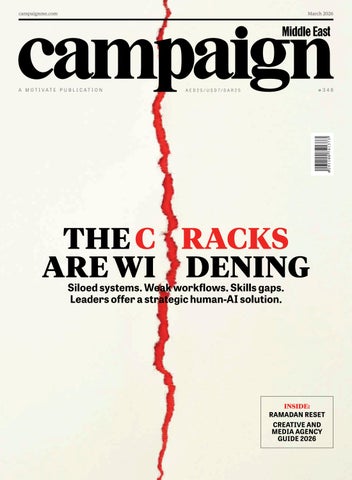
Siloed systems. Weak workflows. Skills gaps. Leaders offer a strategic human-AI solution.















































its
Balance’s Ana Elisa Seixas on why communities are

Marketers, tech experts and agency leaders discuss barriers to AI adoption that must be broken down and highlight a roadmap for AI implementation.

Motivate Media Group
Head Office: 34th Floor, Media One Tower, Dubai Media City, Dubai, UAE. Tel: +971 4 427 3000, Fax: +971 4 428 2266. Email: motivate@motivate.ae Dubai Media City: SD 2-94, 2nd Floor, Building 2, Dubai, UAE. Tel: +971 4 390 3550, Fax: +971 4 390 4845 Abu Dhabi: Motivate Advertising, Marketing & Publishing, PO Box 43072, Abu Dhabi, UAE. Tel: +971 2 677 2005, Fax: +97126573401, Email: motivate-adh@motivate.ae Saudi Arabia: Regus Offices No. 455 - 456, 4th Floor, Hamad Tower, King Fahad Road, Al Olaya, Riyadh, KSA. Tel: +966 11 834 3595 / +966 11 834 3596. Email: motivate@motivate.ae London: Motivate Publishing Ltd, Acre House, 11/15 William Road, London NW1 3ER. Email: motivateuk@motivate.ae www.motivatemedia.com
EDITORIAL: Motivate Media Group Editor-in-Chief Obaid Humaid Al Tayer | Managing Partner and Group Editor Ian Fairservice Group Content Director Thomas Woodgate | Campaign Middle East Editor Anup Oommen | Senior Reporter Ishwari Khatu Reporter Shantelle Nagarajan | Junior Reporter Hiba Faisal
DESIGN: Senior Designer Thokchom Remy
ADVERTISING ENQUIRIES: Chief Commercial Officer Anthony Milne | Publishing Director Nadeem Quraishi (nadeem@motivate.ae) | Sales Manager Tarun Gangwani (tarun.gangwani@motivate.ae)
PRODUCTION: General Manager S. Sunil Kumar | Production Manager Binu Purandaran
contained in this
of
is
No
for
of
and may not be
or any part of
for
thereof
be
in
The
system or transmitted in any form without the permission of the publishers in writing. An exemption is hereby granted for extracts used for the purpose of fair review. CampaignMiddleEastincludes material reproduced from the UK Edition (and other editions) of Campaign which is the copyright of Haymarket. Campaignis a trademark of Haymarket and is used under licence. The views and opinions expressed within this magazine are not necessarily those of Haymarket Magazines Limited or those of its contributors.





Through the first quarter of 2026, Campaign Middle East has been politely declining certain thoughtleadership opinioneditorial article submissions – even though they meet our caveats for: exclusivity, regionally relevance and nonpromotional content. Why? Because these articles have been red flagged as 100 per cent AI generated.
A cursory read shows that they are wellrationalised but fail to resonate the sentiments of the industry, fail to evoke emotion, and are bereft of empathy for those facing the challenges they allude to. The irony? Even submissions preaching authenticity, trust, credibility, and human discernment are authored by AI and attributed to individuals. We reply with a simple email requesting a more human touch. The reworked articles that land in our inboxes not only sustain the incredible performance of our website, avoiding platform penalties for AI slop, but also inspire fascinating conversations in the market. Consider this an analogy for everything that this edition is about: it juxtaposes the call for meaningful messaging, memories and moments that matter during Ramadan with a call for augmented intelligence – rather than artificial intelligence – with human-in-the-loop oversight, ethical and bias review guardrails, and clear autonomy boundaries.
The feature articles on AI and automation in this issue are not slop or noise. They clearly frame the cracks within the industry; explain why these cracks must be fixed before the pressure of AI is placed on them; and provide a precise roadmap for those looking to kickstart or accelerate their AI journey. While these pieces stays centred on operating models within marketing, skills, governance and measurement, they are not a pure tech play either. The biggest takeaway is the human touch. Think about it: As we enter an era when AI agents talk to AI agents and make purchase decisions on behalf of consumers – the differentiator will be humans who can convince other humans to override agentic AI suggestions and choose specific brands.
In an era when attention is currency and trust is gold, marketers who tug on human heartstrings may find more success than a tool that targets at the right time. In an era when generative AI is perfecting linguistic accuracy, humans with lived experiences, cultural nuance and local context still come up with the most memorable taglines.
After all, AI may write the textbook, but the teacher reads the room. A lab report leads to an AI prognosis, but a doctor detects what is unspoken in the room. This editor’s note can either state the obvious or remind you that you matter.
Your knowledge, your upbringing, your jokes, your weird way of thinking that we call creativity, your years of hard work, your resilience in a constantly evolving industry, your empathy for those around you, the sum of all your experiences and emotions – they matter. You matter.
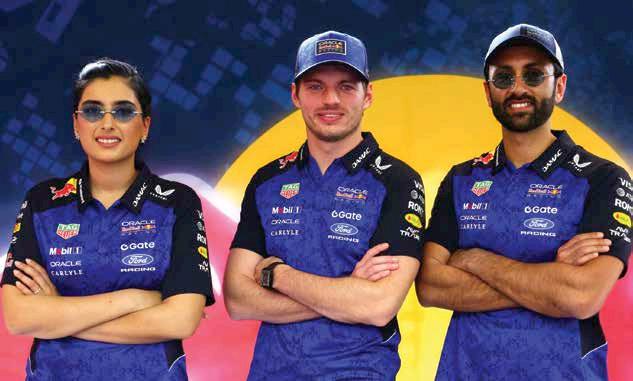
DAMAC Properties has signed up as a partner for Formula 1 (F1) team Oracle Red Bull Racing, marking the start of a long-term partnership with the racing team.
The collaboration is the result of DAMAC Properties and Oracle Red Bull Racing sharing values of ambition, performance, innovation and a pursuit of excellence. The partnership will see DAMAC
Following an internal review on behalf of all Hyundai Motor Group brands across their key regions, INNOCEAN has renewed its global media partnership with HAVAS Media Network.
The media network’s mandate comprises the Hyundai, Kia and Genesis brands across Europe, the Middle East, Asia Pacific, and Latin America. This renewal between INNOCEAN and HAVAS Media Network looks towards the future with a growing emphasis on data and technology to effectively connect the acquisition, conversion and retention of Hyundai Motor Group’s ever more diverse global customer base.
The renewal officially commenced in January 2026.
Properties’ branding and logos appear on the Oracle Red Bull Racing team’s halo and sidepods.
Extending beyond the car itself, the branding will also be positioned on the team principle and driver team – featuring four-time world champion Max Verstappen and up-and-coming talent Isaac Hadjar – kit, helmets and race suits. The collaboration is also expected to generate greater global
engagement and create meaningful outcomes for both brands.
“At DAMAC, we are constantly seeking partnerships that are distinctive, powerful and aligned with our ambition to be a trendsetter in the market. Oracle Red Bull Racing is a perfect fit for us, a team that challenges limits, embraces innovation, and consistently performs at the highest level,” said
Ali Sajwani, Managing Director of Operations, Finance and Hospitality at DAMAC Properties.
He added, “This partnership reflects our mindset as a business and our vision for the future.”
DAMAC Properties’ values are further aligned with the sport due to Formula 1’s emphasis on accuracy and superior performance, as well as its standing as the highest level of motorsport.
“Formula 1 represents precision, innovation and elite performance at the highest level, values that resonate deeply with our brand DNA,” said Amira Sajwani, Managing Director of Sales & Development at DAMAC Properties.
“I truly believe that no real estate developer in the UAE has built a partnership portfolio as diverse and globally impactful as DAMAC’s, and this collaboration is a powerful testament to that journey,” she added. “By ensuring compliance with technical standards, and driving digital transformation, we aim to create a market that is commercially attractive while enhancing Dubai’s beauty.”
The collaboration is yet another feather in DAMAC Properties’ hat, where the brand has signed multiple strategic alliances with global brands such as Roberto Cavalli and Paramount. Oracle Red Bull Racing joins Chelsea Football Club as part of the brand’s global sports partnerships portfolio.

Use
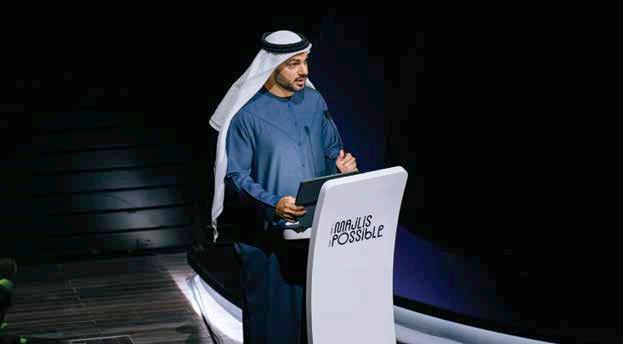
Marking ‘100 years of transformation’, Publicis Groupe hosted The Majlis of Possible event at Louvre Abu Dhabi, where more than 600 leaders representing UAE government ministries and entities, global and regional brands and the Groupe’s agencies gathered to chart out a path for the future during a time of significant economic, technological and societal change. The overarching theme of The
Majlis of Possible was to continue catalysing an engine of transformation through collective thinking and purposeful engagement with key opinion leaders (KOLs) and stakeholders across the advisory, marketing, advertising, creative, technology, luxury, sport and business landscape.
The event was intentionally anchored in Abu Dhabi, acknowledging the capital’s role as a
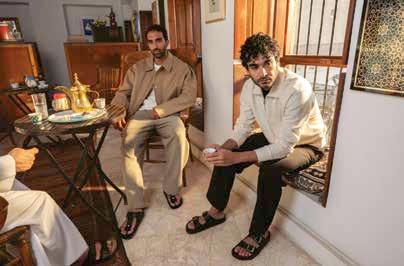

This campaign moves beyond stereotypical seasonal advertising to a distinctive anchoring of Birkenstock’s presence in everyday rituals and journeys of Ramadan. Through still photography and a long-form documentary-style hero film, the campaign positions Birkenstock as a natural companion to Ramadan life. The brand collaborated with regional photographer Moz, whose personal perspectives shaped the storytelling. His approach enhanced authenticity, grounded the campaign in lived experience, and allowed Birkenstock to integrate organically into cultural conversations rather than overt influencer marketing.
Four young creatives will represent the UAE at the Cannes Lions International Festival of Creativity in June, following a fiercely competitive 24-hour challenge that saw 52 teams tackle the visibility crisis facing women’s football in the region.
centre for long-term value creation, policy and cultural leadership, and its growing importance as a place where public and private sector priorities converge. The through-line for the event remained the power of collaboration, the untapped potential of AI and a return to humanity and human values, culture and meaningful storytelling that emotionally resonates with audiences in the region.

Nouran Osama Mohamed Said Elwishy and Alaa Nour from Publicis Middle East claimed Gold in the Digital Category, while Maria Nabil Bitar and Muskaan Manoj Bhojwani from Initiative MENA secured Gold in the Media Category, delivering campaigns that transformed cultural hesitation into cultural pride for Banaat FC, the UAE’s first girls-only football club with an Arabic name. Digital teams were tasked with developing a digital campaign that makes women’s football visible, celebrated, and impossible to ignore. Media teams needed to create a media strategy that transforms the sport from invisible to unmissable. The UAE Young Lions Competition is organised by Motivate Media Group and Motivate Val Morgan Cinema Advertising Company, the official UAE representative for Cannes Lions International Festival of Creativity. This year’s competition was powered by Getty Images and supported by Banaat FC.

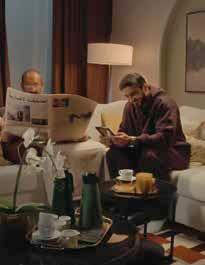
Building on its ‘Here To Be Part of Your Story‘ brand platform that places everyday family narratives at the heart of the campaign, this spot from Al-Futtaim IKEA spotlights the human qualities of big gatherings typically assosicated with Ramadan. Through a series of visuals, nuanced family dynamics and expressions of care are captured across the brand’s social channels to engage audiences where they are most active, facilitating shareable, emotional storytelling. The brand taps relevance, usefulness and authenticity to cut through the noise and go beyond a purchase and become a permanent function in the daily lives of consumers in the region.
Agency Memac Ogilvy
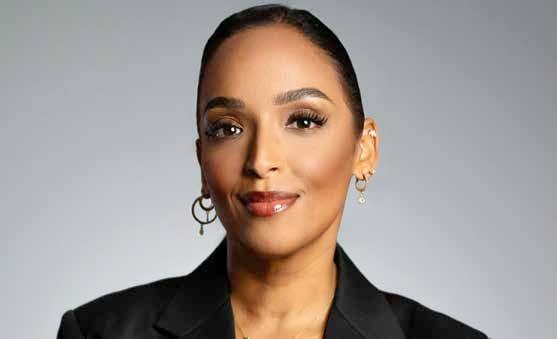
The Cannes Lions International Festival of Creativity, taking place 22–26 June 2026, has announced its 2026 Jury President line-up, bringing together an exceptional group of leaders to evaluate creative excellence from across the globe.
Within the line-up, Dana Tahir, CEO, HAVAS Red Middle East has been chosen as the Jury President for PR. This makes Tahir the first Arab woman from the Middle East and North Africa (MENA) region to be chosen as a Cannes Lions Jury President.
Commenting on being selected as Jury President, Tahir said on a LinkedIn post, “As the first Arab woman in the Middle East to hold this global role, this is a deeply meaningful milestone for me personally, one that comes with a responsibility I carry with intention and care. Cannes Lions has long been the benchmark for creativity that drives culture, business, and impact.
I’m looking forward to working alongside an incredible jury to recognise the very best in PR, work that pushes boundaries, shapes reputations,


This Ramadan, Careem launched ‘Seeds For Gaza’, a community-led donations campaign supporting on-ground humanitarian relief and long-term rebuilding efforts in Gaza during the Holy Month of Ramadan. Inspired by the Arabic language, within which a single dot can shift meaning, the campaign reimagines dots as watermelon seeds, a widely recognised symbol of Palestinian resilience. More than a visual gesture, the seeds embody continuity, hope and a collective commitment to rebuilding lives on the ground. Apart from an in-app ‘Donate’ option, every watermelon purchased on Careem Quik and every ‘Seeds For Gaza’ T-shirt sold contributes 100 per cent of profits to relief efforts.

influences conversations, creates meaningful change and sets new global standards for creativity.”
Dany Naaman, CEO, HAVAS Middle East, said, “Dana’s selection as Jury President is a landmark moment for the PR industry in the Middle East. It speaks to the strength of leadership emerging from the region and the growing role it plays in shaping global industry standards.
We are incredibly proud of Dana and what this moment represents.”
From a global perspective, James Wright, Global CEO, HAVAS Red and Chairman of HAVAS PR Network, said, “Dana’s selection reflects the growing importance of leaders who can navigate culture, creativity, and impact with equal fluency. Shaped by her experience in the MENA region, her perspective is both grounded and globally relevant.”
Wright added, “Having worked with Dana closely over the years, I know her keen eye for a breakthrough idea centred in earned that is then brilliantly executed and activated means we will see the best of the best work rise to the top in the PR Lions. It’s a proud moment for HAVAS Red and our global HAVAS PR network.”
Also in the 2026 Jury President line-up revealed by Cannes Lions is Bertille Toledano, CEO of BETC, President of Havas Creative Network, and CEO of Havas Creative Middle East, who has been picked as the Jury President for Creative Effectiveness.
She works closely with Naaman to ensure that the Middle East region delivers its full creative and business potential leveraging Havas’ Converged.AI strategy. Cannes Lions is open for Awards submissions until 9 April 2026.

This campaign from UNHCR focuses on families affected by the global displacement crisis, showing how they continue to give despite profound loss. The work narrates generosity through the voices of displaced individuals in areas of crisis: a teacher, a mother and a child in areas of displacement share why they value giving. The multichannel campaign has been further amplified through UNHCR’s network of Goodwill Ambassadors. With the aim of providing hundreds of thousands of families who have been forcibly displaced with life-saving support, the campaign’s goal is to provide displaced individuals with safe shelter, emergency cash and access to basic essentials.

Rotana
Signs’ CEO on shaping the next phase of Saudi Arabia’s data-driven, national OOH ecosystem.
In Saudi Arabia, outdoor media has become an intrinsic part of the Kingdom’s streets, skylines and shifting patterns of daily life –transforming from relatively straightforward inventory into a seamless synthesis of environments, formats and technologies.
Campaign Middle East speaks to Waleed Hussein, CEO, Rotana Signs, a pioneer who has helped shape Saudi Arabia’s out of home (OOH) industry for more than three decades. Hussein frames the industry’s innovation as a move far beyond the billboard, built through repeated reinvention: not just adding new sites, but steadily widening what OOH can do for clients and brands as the country modernises.
HOW HAS THE OOH INDUSTRY EVOLVED OVER THE PAST 12 MONTHS? HOW HAVE THESE MILESTONES INFLUENCED THE MARKET’S GROWTH AND FUTURE DIRECTION?
The evolution of OOH in Saudi Arabia has been a journey defined by challenge, opportunity, continuous learning and rapid adaptation. From the early days of static unipoles, I have been privileged to lead the introduction of bridges of various types, in-mall media, entertainment and retail formats, many of which have since become industry benchmarks.
Supported by one of the highest OOH media mix shares globally and consistent year-on-year growth, the Kingdom has established itself as a highly advanced, format-rich, and digitised OOH market, leading in innovation and scale. Further shaping the landscape, my team and I have had the honour of delivering landmark digital façades such as Kingdom Tower, Burj Rafal and Al Abdulkarim Tower, transforming the urban skyline, alongside our recent awards in Makkah and Dammam. Together, these milestones reflect our ongoing commitment to expanding the market in size, value and diversity, ensuring it continues to meet the evolving communication needs of advertisers.
LOOKING AHEAD, WHAT NEW INNOVATIONS DO YOU BELIEVE WILL DRIVE THE FUTURE GROWTH OF THE OOH MARKET?
I believe three key factors will drive the next phase of market growth.

First, Saudi Arabia’s social and economic transformation under Vision 2030 has created higher population density, an influx of international residents, and increased mobility across cities, with people moving between work, entertainment zones, parks, and social spaces, significantly strengthening the impact and relevance of the media.
Second, at Rotana Signs, we focus on large, networked and high-impact assets that cut through clutter, deliver creative dominance and secure strong associations with key points of interest, while also extending media presence into neighbourhoods which were historically lacking. Supported by strong technical capabilities, this approach continues to expand reach and drive advertisers’ confidence.
Third is measurement, which has long been a challenge for the industry, but one we are now overcoming. With robust audience data and the emergence of programmatic digital out of home (pDOOH), the market will soon offer scalable, measurable access to brands worldwide, further accelerating growth across the Kingdom’s OOH market.
WHERE DO YOU STAND ON AUDIENCE MEASUREMENT INVESTMENTS? ARE YOU BUILDING AN IN-HOUSE FRAMEWORK, PARTNERING WITH THIRD PARTIES, OR CONSIDERING A HYBRID APPROACH?
Today, we are in the final preparation phase of launching our measurement tool. We are working closely with a European-based OOH measurement partner whose methodology and data are CESP certified, ensuring independent validation and alignment with global standards. This will help give our advertising partners clear, objective insight into how their campaigns are performing, what is truly working and where improvements can be made. It will allow brands to better understand their investments, measure results against key performance indicators (KPIs) and begin building a stronger link between exposure, engagement and return on investment.
Looking ahead, we will continue conducting annual research papers to understand consumer sentiment towards OOH, whereby our long-term vision is to secure a balanced, hybrid model combining first-and-third-party data sets to help deliver a 360-degree understanding of the media and how it resonates within the market.
WITH ROTANA SIGNS’ STRONG FOOTPRINT ACROSS SEVERAL CITIES, WHAT IS NEXT FOR THE COMPANY IN TERMS OF EXPANDING ITS INVESTMENT PORTFOLIO, FORMING STRATEGIC PARTNERSHIPS AND SCALING LARGE-FORMAT SOLUTIONS?
With our long-term awards across Makkah and the Eastern Province, a growing presence in Jeddah, landmark assets in Riyadh, in addition to many other cities, we have created a national platform that gives advertisers both scale and impact. To build on this and create a market ready for future communication requirements, we have established a dedicated investment pool for developments within Saudi Arabia and selectively across the region.
In parallel, we are building strategic partnerships with key players in the digital and OOH sectors to introduce new formats that raise standards and provide novel opportunities.
A key priority for us is making OOH media more accessible to businesses of all sizes. We are developing flexible models and networked solutions that allow both large and growing brands to benefit from high-impact visibility. By doing so, we are creating an entry point for new advertisers and encouraging brands that may not have traditionally invested in OOH to see the channel as relevant, effective and within reach. Our goal is to grow the market by making it more inclusive, dynamic and valuable!
LOOKING AHEAD, WHAT CHALLENGES DO YOU ANTICIPATE WHEN ADVERTISERS MIGRATE TO NATIONAL SOLUTIONS, AND HOW ARE YOU PREPARING TO ADDRESS THEM AND TURN THEM INTO OPPORTUNITIES?
As more advertisers move toward nationwide OOH solutions, one of the key challenges will be avoiding a one-size-fits-all approach. Success at scale requires a deep understanding of the role each format and network plays, the environments in which they operate, and how messaging can be adapted through business insight to strengthen contextual relevance and audience connection.
As our new assets continue to be installed within the market, we are preparing balanced national packages that combine consistency with local weighting and will be supported by our upcoming measurement capabilities. This will ensure campaigns are not only executed but are done so with greater efficiency. This approach will also help attract new advertisers while reshaping how traditional brands view and use the medium. Together, we see this shift as a significant opportunity to deliver meaningful reach, stronger and more sustainable long-term value for brands across the Kingdom.
Are media agencies in the Middle East still struggling to find qualified talent, particularly for senior digital media and data-driven roles?

Ramy Mouganie
Client Leadership Director, Fusion5
YES
We see a clear gap when it comes to filling data-driven roles, and this is primarily due to a market evolution outpacing the local talent pool. While digital adoption accelerates, there remains a significant shortage of professionals with deep, hands-on experience in advanced ad tech, data analytics, and AI-driven strategy. The current crop of digital professionals in our region still operate within a comfort zone of processes that are rapidly becoming outdated, and there’s a clear need to elevate knowledge and tap into learnings from proven data-first markets.

Vivek Nair
Managing Director, Radix Media MENA
YES
There is a struggle to find the right talent in our region, especially for senior digital and data-driven roles. The majority of professionals come with a strong understanding of campaign planning and activation, client management, budgeting and day-to-day optimisation. Yet, only a few can confidently mine large datasets, connect multiple data sources and build a clear data story that links performance to audience behaviour and business outcomes – skills a trained data analyst typically brings. This creates a gap between reporting and decision-making, and creates a disconnect from ‘numbers’ to actionable, strategic recommendations.

Shubham Dhanwate
Associate Director – Media, Adapts Media
While the Middle East has no shortage of talent, there is a clear gap when it comes to qualified senior digital and data-driven professionals. The challenge isn’t hiring people who know platforms, it’s finding leaders who can connect data, media, technology, and business outcomes. Many senior roles demand hybrid skill sets: performance plus brand, analytics plus creativity, automation plus human judgment. These profiles are still rare. Additionally, rapid platform evolution has outpaced structured upskilling, leaving experience fragmented rather than holistic. Agencies aren’t struggling to hire –they’re struggling to find professionals who can truly lead modern media in a complex, outcome-driven ecosystem.

Farhad Miah Chief Client Officer, Assembly MENA
The Middle East, fuelled by brand and substance, with Dubai at its core, has established itself as a global destination for talent. The region has been intentionally developing digital capability for more than a decade, while continuing to attract leading talent from around the world. Agencies moved early to reshape learning and development around digital priorities. Like any market, the talent pool reflects a range of experience and maturity. That is natural. But the depth of capability here is undeniable. The region is now home to some of the strongest, most commercially minded industry talent globally.

Neha D'Souza Senior Media Director, Equation Media
Talent is available in the Middle East for such roles, but the real challenge is finding the right match. While the necessary skills are often present, matching the right expertise to the agency's needs can be difficult. Different cities across the region offer varying levels of appeal to talent, shaped by factors such as work environment, lifestyle, and compensation. Additionally, a generational divide in work preferences (remote work vs office-based roles) adds complexity to finding the ideal fit for agencies.
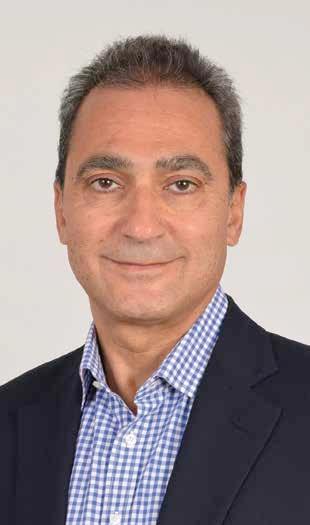
Antonio Boulos President, Frontline BPN
The pool of digital talent is not keeping pace with the rising demand for digital roles, especially for AI-driven planning, advance analytics, MarTech integration, and first-party data strategies.
Another challenge is finding senior talent that can step back, look at the big picture, and connect the dots to build a seamless approach that optimises the performance of every channel involved in a particular campaign. Channel specialists are good at optimising the delivery of their channel, but the perfect outcome relies on the input of a lateral thinker, typically a senior talent who can diligently calibrate the delivery of every channel and ensure that the executed plan is efficiently addressing the campaigns’ business KPIs.
When the return on ad spend (ROAS) of every invested dollar is closely measured by our clients, and rightly so, the onus rests entirely on agencies to search for and attract the right talent and absorb the associated salary inflation caused by the high demand and short supply of selected roles. Investing in the training of rising internal stars is another way to create and nurture required talent.
Charbel Jreijiri General Manager, Mediaplus Middle East
The talent crisis in Middle East media is a structural failure. By prioritising offshoring for efficiency, many agencies silo talent into narrow execution roles, depriving them of broad exposure. This results in growth without foundation, producing technicians rather than future leaders. At Mediaplus, we are breaking this cycle. We prioritise holistic development, providing our team with cross-speciality skills to evolve into future leaders. While self-motivated outliers exist, we believe institutional investment in versatile expertise is the only way to build a sustainable leadership pipeline in a market currently defined by narrow specialisation.

Lama Accary Bibi Managing Director, Means Design
Securing senior digital and data-driven talent in the Middle East remains challenging due to the rapid pace of industry change. These roles require a strong blend of strategic leadership and technical expertise, yet the number of professionals with both long-term experience and up-to-date knowledge of emerging digital platforms is limited. This has created an ongoing skills gap across the market. Agencies can address this issue by investing in structured training programmes and mentoring high-potential employees to develop future-ready talent pipelines. This approach will ensure access to skilled professionals who combine experience with current digital capabilities, supporting the sustainable growth of the regional media industry. Investing in the training of rising internal stars is another way to create and nurture required talents.

Oliver El Obeid VP of Human Resources, Havas Middle East
but it’s more nuanced than a simple talent shortage. In the Middle East, we’re not struggling to find people; we’re struggling to find senior, future-ready talent. Roles in digital media, data, and performance now require a rare mix of strategic thinking, hands-on platform expertise, commercial understanding, and leadership. That combination is still limited in the region. The market has evolved faster than capability development. As a result, agencies are competing for the same senior profiles while, at the same time, investing heavily in upskilling internal talent and rethinking what ‘seniority’ really means in a data-driven, fast-moving media ecosystem.



Prasad Amin CEO, IAS Media
There is a clear talent gap in programmatic, attribution, and data analytics, as the majority of professionals come from conventional media. The struggle is real – especially for senior digital and data-driven roles. The market has plenty of entry-level digital talent but a significant shortage of experienced professionals who can lead strategy, manage complex campaigns, and interpret data at a senior level.
Khaldoun Zaghir General Manager at 5thElement
YESLea Koyess General Manager, UM UAE
NOWe aren’t struggling as much to find senior digital media talent any more since the market has matured and we’ve developed a solid pool of specialists who truly master platform dynamics, performance, and client needs. The bigger challenge is the structural ambiguity surrounding data-driven roles. This isn’t just about a talent shortage; it’s about a lack of industry-wide clarity on how to define these hybrid positions, where they sit between media, tech, and analytics, and which competencies really matter. The lack of a clear framework makes attracting and retaining the right profiles much harder.

The talent gap in senior digital media and data-driven roles remains acute across the Middle East. While we’ve seen improvement in mid-level capabilities, finding senior strategists who can bridge programmatic expertise, first-party data activation, and AI-driven optimisation is exceptionally challenging. The regional market demands professionals who understand both global best practices and local nuances – from Arabic content strategies to region-specific consumer behaviours.
The reality is that traditional recruitment pipelines haven’t kept pace with how rapidly the industry has evolved. Agencies now need senior practitioners who can navigate cookieless environments, leverage AI for media planning, and extract actionable insights from fragmented data sources – skill sets that simply didn’t exist five years ago. The market hasn’t produced enough qualified candidates to meet this growing demand.
















As we enter the third month of 2026, marketing in the Middle East is also entering a defining new chapter. This shift has been building over the past few years; technology has advanced at full throttle, consumers have become increasingly selective and retail has evolved far beyond transactions.
Today, the region is one of the most exciting commercial environments globally: digitally advanced, highly competitive, experience-driven and culturally rich, and a consistently growing tourism powerhouse.
But with growth comes new challenges, and in 2026, brands will need more than visibility to be successful. They’ll need clarity, relevance and meaning.
AI IS
Artificial intelligence (AI) will continue to dominate conversations in boardrooms and brainstorms alike. Many speak about it as though they fully understand the capabilities of AI – from large language models (LLMs) to automation – but the truth is, excitement often moves faster than clarity.
The real challenge is understanding that AI is not the strategy; leadership is. Brands need to start with a clear destination – a defined business solution and brand strategy, and then ask how AI can accelerate it. When used intentionally, AI can create ease for creative and design teams, remove friction and unlock new possibilities that expand, rather than limit, creativity. I recently heard a great analogy on a podcast between the founder of ChangeTools.ai and a board member.
transport: you can’t choose the best it
They described AI as a mode of transport: you can’t choose the best vehicle until you know your destination. How fast will it get you there? How cost-effective is it? Will the journey allow for clarity and perspective along the way? That is exactly how brands should think about AI in 2026: an effective mode of transport to reach their strategic goals more efficiently. AI is not the goal.
Consumers in the Middle East are some of the most digitally engaged in the world, but they are also among the most discerning. We are operating in a market defined by constant promotional cycles, influencer saturation and endless seasonal noise. Attention has become scarce and brands can no longer rely on visibility alone.
Today, almost everyone understands the ‘three-second hook’ rule and ideas are ever-flowing. You could create 25

Middle East Retail Group’s Heba Qadeer explains why the future belongs to brands that don’t just capture attention, but show how they deserve it through culturally resonant, digitally intelligent and emotionally meaningful marketing.
videos with strong hooks but if the content lacks storytelling, if the messaging is off, or if it fails to reflect the brand’s identity, then it simply becomes more noise.
Audiences are more digitally savvy than ever; they will see right through performative marketing.
In 2026, brands must shift away from volume and toward precision. This means: Fewer campaigns, executed better; creative rooted in authenticity; storytelling that delivers trust, not just clicks; and brand worlds people actually want to engage with.
RETAIL HAS BECOME AN EXPERIENCE ECONOMY
With e-commerce so readily available across every category, including fashion, beauty, groceries and electronics, and lifestyles becoming increasingly fast-paced, retail has fundamentally changed. It is no longer just about selling products.
Consumers are ready to spend in places where they find the most value for their money. Value today is emotional, cultural and experiential.
The more culturally relevant the experience, the better. The more Instagrammable, the better.
A powerful example is Marsa Boulevard. The location has existed for years, with a beautiful lake view overlooking the Jaddaf skyline, yet footfall was minimal.
Now, the area has been revamped into a destination: curated pop-ups, experiential retail concepts and a space built for discovery. It’s consistently making waves online as the latest hotspot in Dubai. Experience is no longer an add-on. It is the product. That is the opportunity: purchasing wrapped in experience, presented in a classic Dubaistyle bow.
In 2026, retail brands will win by investing in:
Immersive in-store moments. Community-driven activations. Seamless omnichannel journeys. Experiences worth leaving home for.
Performance marketing will always matter. Data will always matter. Return on investment (ROI) will always matter.
However, in 2026, the brands that build lasting growth will be those that balance: Technology with intentionality and humanity, performance with strong brand identity, and purchasing opportunities with experiential elements.
But above all: storytelling, storytelling and storytelling.
The Middle East has an opportunity to set a global benchmark for modern marketing – culturally resonant, digitally intelligent and emotionally meaningful.
The future belongs to brands that don’t just capture attention, but deserve it.
By Heba Qadeer, Group Head of Marketing, Middle East Retail Group
New Balance Middle East’s Ana Elisa Seixas on why communities are becoming the MENA region’s most powerful media channel.
For decades, marketing was built around reach. It’s been about the biggest billboard, the loudest TV spot and the most visible logo. The logic was simple: if enough people saw you, enough people would buy from you.
Today, that equation is changing, especially across the MENA region. The shift is not just from offline to digital or from traditional to social. It is a shift from broadcast to belonging, from interruption to participation and, more importantly, from attention to trust. Increasingly, trust lives inside communities.
Consumers are navigating more messages than ever before. Between social feeds, streaming platforms, retail media and creator content, audiences are constantly filtering what deserves their attention. What I am seeing today is not necessarily fatigue with marketing itself but fatigue with messaging that feels disconnected from real life. In that environment, authenticity is no longer a nice-to-have but an entry point.
Not surprisingly, globally, around 92 per cent of consumers trust recommendations from friends and family over paid advertising and nearly three quarters say word of mouth directly influences their purchasing decisions. At the same time, social proof is becoming a dominant decision driver. More than 90 per cent of consumers say reviews influence purchases and user generated content is often trusted more than brand-created messaging.
But it’s not just about numbers; it’s really all about behaviour. When someone recommends a coffee spot after a morning run or suggests a running shoe after a run club training session, it carries emotional credibility. It happens inside a context where trust already exists. Marketing becomes part of a conversation rather than an interruption to one. Most importantly, it comes about from experience – from someone who has tried the shoes and has experienced them in real life.
identities, languages and traditions it is easy to spot that mass messaging rarely lands with equal relevance across markets or even individuals. Communities, on the other hand, naturally localise. They adapt to cultural rhythms whether that is sunset runs during Ramadan, neighbourhood fitness meetups or run clubs after school drops, or even creative collectives that reflect the personality of a city. What is changing now is how brands participate in those spaces.
For a long time, the dominant playbook was takeover marketing with branded environments, heavy logo presence and high visibility at any cost. You literally paid your way into it. However, what is emerging instead is something much more collaborative and a true testament of the power of ‘collaborations’ instead of ‘takeovers’.
Spaces where branding is present but not overwhelming and where the experience leads and the logo just follows. Spaces that are designed together and that honour the space and the community that has been built around it.
Can I claim to have labelled this type of shift first and call it ‘quiet branding’? The truth is that, in many ways, it mirrors the rise of quiet luxury. It is less about visible status markers and more about symbiotic relationships, credibility and intention. In a way, we can also connect it to craftmanship. So, the brand is still there but it does not need to announce itself loudly because its value is understood through experience and relatability.
This also aligns with how creators and influencers are evolving in the region. Authentic storytelling from smaller, community-rooted creators is often more trusted than largescale endorsement campaigns because it feels closer to real life.
“WHEN DONE RIGHT, COMMUNITY IS NOT A CHANNEL YOU ‘USE’. IT IS AN ECOSYSTEM WE AS MARKETERS CAN HELP NURTURE AND DEVELOP FURTHER.”
As a result, it is especially interesting to watch how the line between owned and earned media is starting to blur. Community members are naturally becoming storytellers, sharing experiences, creating content and shaping brand perception without being formally asked to. When done right, community is not a channel you ‘use’. It is an ecosystem we as marketers can help nurture and develop further.
One would then wonder: what’s the difference between a follower and a community member? It’s obviously becoming harder to tell the difference, but consistency is probably the key word. People need to see that influencers show up regularly, that they listen and that their audience’s feedback shapes what they do next.
This is also where creativity is evolving. The most powerful ideas are no longer the ones that dominate space but the ones that integrate into it. We are seeing brands succeed when they become part of culture rather than trying to sit above it. Whether through sport, art, music or local creative scenes, relevance now comes from participation.
experienced them in real life. by cultural nuance. Being one of the most diverse regions in the world with layered
Across MENA, this shift is also amplified by cultural nuance. Being one of the most diverse regions in the world with layered
And even macro influencers and content creators are becoming more selective about partnerships, with more than 60 per cent saying they increasingly speak about causes and values they genuinely care about.


selective about partnerships, with more speak about causes and values they genuinely care about. would love to have it stick around.
There is also a broader trust context shaping this shift. In an era of artificial intelligence (AI)-generated content and information overload, people are increasingly questioning what is real. That makes human recommendation and real-world experience even more valuable. Community here becomes a trust filter. What is clear is this: currently success might not belong to whoever shouts the loudest. It is becoming skewed towards brands and individuals who show up with consistency, creativity and genuine respect for the spaces people care about. As in the end, community is not built through campaigns but through presence. So, is this permanent? Like most evolutions, it is too early to tell, but I would love to have it stick around.
By Ana Elisa Seixas, Head of Marketing
at New Balance Middle East, Africa and India






MASSIVE REACH UNMATCHED ENGAGEMENT PREMIUM CONTENT DISCOVER HOW YOUR BRAND CAN OWN THE MOMENT WITH OUR RAMADAN GUIDE BY SCANNING THE QR CODE
























EMBC Media Solutions’ (MMS’) Karim Soubra outlines why the Holy Month is one of the most effective times of the year for brand building.

very year, Ramadan reshapes the rhythm of life across the GCC. Daily schedules shift, nights grow longer, families gather, and media consumption reaches its peak, but what defines Ramadan today is not just scale; it is convergence. Culture, commerce and content intersect in ways that create one of the most powerful brand-building environments of the year. For marketers, Ramadan is no longer a single-channel opportunity; it is a unified, cross-screen ecosystem where reach, emotion and intent align.




OUT


Ramadan’s scale also brings intense competition where advertising clutter is inevitable, particularly across high-demand categories such as FMCG, retail, banking, automotive, and e-commerce.



But clutter does not mean diminishing returns. It raises the standard. The most effective Ramadan campaigns are not necessarily the loudest; they are the ones that are the most culturally intelligent.



Ramadan consistently delivers a measurable uplift in consumer behaviour. Insights from an MMS Ramadan consumption intent study conducted in Saudi Arabia among 850 found that 82 per cent of audiences in KSA are planning to shop more from retail stores during Ramadan, and 70 per cent of audiences are planning to shop online more frequently during Ramadan and Eid.

While creative excellence matters, it must be anchored in strategy to reinforce brand identity and communicate a clear proposition; otherwise, it will risk achieving the desired impact.




One of the most impactful solutions that MMS delivers to achieve this is premium content integration, which enables brands to secure meaningful exposure through contextual alignment with highperforming programs and culturally resonant storytelling.



This dual growth, across physical retail and e-commerce, signals something important. Ramadan is not only culturally significant; it is commercially decisive. Consumers are not passively consuming content; they are actively planning, purchasing and preparing.
For brands, this creates a rare opportunity where emotional openness and buying intent coexist.



Integrations range from talent-led brand mentions and organic product placement to advanced post-production solutions powered by patented AI technology.


THE POWER OF SHARED PRIME TIME



This technology analyses thousands of hours of video content to identify the most contextually relevant, high-attention moments – ensuring brands appear naturally within scenes where audience engagement is strongest. These integrations remain embedded within the program across its full airing cycle on MBC platforms – including first TV runs, repeats, reruns, and on MBC Shahid – providing sustained visibility, authentic association and long-term recall.
Ramadan remains one of the few moments when audiences move in sync; Iftar to Suhoor evenings become extended prime time, and families gather around premium comedies, dramas, talk shows and entertainment formats.
In Saudi Arabia alone, MBC Group connects with 12.1 million unique TV viewers during the holy month and MBC Shahid garners 12 million streaming viewers in KSA, delivering scale that few other periods can replicate. The difference during Ramadan is not just audience size; it is attention quality, with viewers spending four hours and 41 minutes on TV, out of which two hours and 12 minutes of that time is spent on MBC Group.






This turns storylines into a part of the viewer’s daily social dialogue, and at MMS, we enable brands to integrate into this environment, where they are not just seen; they become part of the shared cultural memory.
What ultimately sets Ramadan apart is not just viewership or spend, but cultural concentration.There are a few periods in the year where audiences across demographics align around shared content and shared rituals. Premium programming becomes the backdrop to family gatherings. Conversations about episodes spill into workplaces and social feeds the next day.



FROM LINEAR TO HYBRID: THE MODERN RAMADAN VIEWER

Ramadan media consumption is no longer confined to one screen; today’s viewer moves fluidly between live television, streaming platforms, smart TVs, mobile devices, and social media.





Linear viewing continues to anchor the living room experience, but it is complemented by catch-up episodes, late-night binge sessions, and short-form digital content that extends engagement throughout the month. VOD platforms are particularly strong during Suhoor hours, while social platforms amplify discovery and conversation.
This hybrid behaviour expands the brand opportunity. Instead of relying on a single exposure point, marketers can design journeys that move with the audience, from mass reach on television to precision engagement on streaming and digital formats. Ramadan is no longer about choosing between platforms. It is about orchestrating them.



The emotional intensity of the month amplifies brand

The emotional intensity of the month amplifies brand messaging when it is delivered thoughtfully, and this presents brands with an opportunity to move beyond transactional communication and into long-term equity building. Ramadan does not require brands to choose between awareness and performance. It offers both when approached with integrated thinking, creative clarity and strategic discipline.



presents brands with an opportunity to move beyond transactional communication and into long-term equity between awareness and performance. It offers both when approached with integrated thinking, creative


So, in a media landscape defined by fragmentation, Ramadan represents focus, not because consumption has not evolved, but because it transformed into a connected, cross-screen experience anchored by shared cultural moments.
So, in a media landscape defined by fragmentation, Ramadan represents focus, not because consumption has not evolved, but because it transformed into a connected, cross-screen experience anchored by

For brands ready to navigate this ecosystem intelligently, the opportunity is not only to be present during Ramadan, but to be remembered long after it ends.



ecosystem intelligently, the opportunity
By Karim Soubra, Client Growth Associate Director, MBC Media Solutions (MMS)








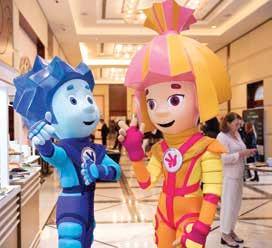
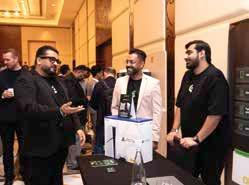

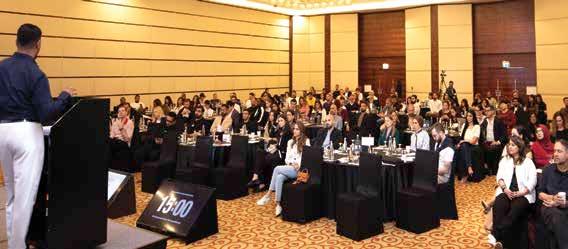


The first Campaign Breakfast Briefing event of 2026 was on Ramadan Advertising and the Year Ahead. It brought together close to 200 attendees, including client-side marketers, agency leaders and measurement experts, as well as adtech and martech players, at The Westin Dubai Mina Seyahi on 13 February.
Delegates listened with rapt attention as several educative case studies were presented, and highly informative insights were shared by leaders who discussed what works best to earn lasting attention and drive purchase intent; how technologies –notably AI tools and agentic AI deployments – can accelerate planning, rapid research, creative analytics and programmatic orchestration without sacrificing strategy or craft; and how Ramadan acts as a cultural crucible that tests shared convictions, brand values and connections with the community.
Before we dive into each of the keynotes and panel discussions, here are key takeaways from the event: Test, learn, iterate: There’s no time like the present to run experiments, adapt attribution and creative approaches, and be willing to pivot when data shows you that your strategies won’t resonate with consumers.




The Campaign Breakfast Briefing: Ramadan Advertising and the Year Ahead was held at The Westin Mina Seyahi Hotel on Friday, 13 February. Here’s a recap of the morning event.

focused marketing, marketing mix modelling, brand lift studies (BLSs) and custom attribution to quantify the value of each touchpoint’s contribution. Focus on measurement that matters, including incremental demand and growth in share of voice, even across longer conversion windows in certain categories.
From talking to practising agentic AI: Understand why automated agent-based workflows are no longer optional during peak periods. Address real challenges faced and then accept the benefits of agentic AI beyond real-time optimisation and decision-making to rapid research, adaptive creatives, cross-platform orchestration, and proactive decisioning.
Product, participation and platform: For several brands, products remain the north star. For others, it’s people and participation, calling for a shift from attention-grabbing to experiential initiatives.
Creators and culture: Prioritise people who genuinely love the brand and want to associate with it. Creator-first and co-created campaigns far outperform token influencer inclusions or highspend celebrity endorsements.

Nostalgia, creativity and emotional storytelling: Ramadan remains a powerful reminder that what resonates most with people is emotional, cultural, deeply human and built on thought-provoking creativity. This not only results in strong brand recall, but also builds intent and drives conversion downstream resulting in a compounding effect.
The event began with a welcome speech by Nadeem Quraishi, Publisher, Campaign Middle East, who briefed the attendees about the brand’s latest developments. Campaign Middle East Editor Anup Oommen then took the stage to deliver the chair’s opening remarks, setting the scene for what turned into an incredible event filled with actionable insights.
KEYNOTE

KPIs and incentives: Align key performance indicators around both short-term and long-term objectives; ensure buy-ins and incentivise a collaborative move towards shared outcomes.
A ribution and measurement: Lean into franchise-

Animated character-driven brand equity: Building on the notion that young children, including Gen Z and Gen Alpha are key decision-makers within families, offline mascots and online animated characters in brand-safe environments – especially during Ramadan – are becoming ‘influencers’ that are sustaining emotional bonds in the long-term.

The programme officially kicked off with a keynote presentation by Julia Nikolaeva, General Manager, Animotion Media Group on brand-safe, familyfocused and educational content for children of different ages during Ramadan, framing children as key opinion leaders who drive conversions. Nikolaeva said, “Around a quarter of the population in the region is children, and parents of these kids are more than half of the population. What does this mean for brands? Kids are driving consumption trends, what families watch, where they go and what families buy.”
She went on to make the case for animated characters and explained why brands are increasingly leaning into mascots. She said, “Animated characters are the new influencers – the emotional connection that is formed during childhood goes on to last for a lifetime.”
Nikolaeva concluded by revealing a 360-degree approach to brand-building, including licensed promotions and merchandising, brand ambassador programmes, custom mascot creation, as well as live shows and tailored meet-and-greet family experiences during Ramadan.
PANEL 1: BRAND VS. PERFORMANCE: FINDING BALANCE IN RAMADAN CAMPAIGNS
This first panel discussion of the day, moderated by Campaign Middle East Editor Anup Oommen, welcomed to the stage Mathieu Yarak, Head of Data, MBC Media Solutions (MMS); Anne Tulloch, Divisional Marketing Director – Wellness, Alshaya Group; Mai Cheblak, Head of Corporate Marketing, Emirates NBD (ENBD); and Hugues Raingeard, Head of Performance Media, HAVAS Media Middle East
These leaders succinctly highlighted how a pragmatic, investable philosophy: brand-building and performance activation are best served by a single, coherent engine.
Tulloch said, “You cannot have brand awareness without consideration, and then conversion.”
She outlined how brand awareness is a part of every step of the customer journey. Brands must pull on customers’ heartstrings and connect with them emotionally to lead them into consideration and product. Then, once curiosity drives them into the store, communicate value beyond the purchase of the product through added-value from loyalty points or a great offer.
“The ROI lies across the entire funnel, whether that’s brand-led or performance-led and they all interlink,” she said. “When we draw on marketing mix modelling or franchise-focused marketing, we actually see consideration which is mid-funnel, having the most effectiveness in terms of conversion.”
Furthermore, ENBD’s Cheblak made the case for why brand and performance are mutually reinforcing and must run in parallel rather than being viewed as antagonists.
Her point was that marketers must go the distance as far as creating content that integrates into the scripts of the shows that people watch.
“Ensure that they are not only educated about the product but feel emotionally connected to the brand and its offerings,” Cheblak said. “This is what will keep the leads coming through during Ramadan and after.”
Taking the example of a car loan, Cheblak explained, “Imagine that we have great auto loan offers during Ramadan. It’s no surprise that people are highly connected if I’m just advertising and promoting a really good offer. That will definitely get me leads. But then, these are people only currently interested because of the discount or promotion, and I need to keep that coming in.”



Talking about the need for brands to pay close attention to consumers and iterate based on changing behavioural patterns and preferences, Raingeard approaches the brand-plus-performance conversation from another angle.
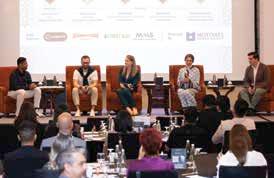
Raingeard said, “We have clients that have noticed not only how behaviour changes in the first week of Ramadan compared with the last week of Ramadan, but also how the timing of Ramadan changes behaviour differently each year.”
“What we also need to get right is the mix between creative and performance,” Raingeard added. “We can work on performance as much as we like, but if we don’t have the right creative that drives the right emotion with the right message to the right audience, it’s not going to work.”
“From our perspective, we’re building a whole foundation,” Yarak said. “We have invested heavily in collecting human data, exploring how advertisers can integrate attention insights into media planning, creative strategy, and campaign optimisation to unlock measurable business growth.”
“We have also invested heavily into collecting brand data and have conducted brand lift studies that measure brand impact across Shahid and TV. So when we bring all of these together, it offers a mechanism that will support advertisers and agencies to optimise from Day Zero and ensure that this drives high quality outcomes on all fronts.”
For the second keynote of the day, Neel Pandya, Founder and Global CEO, Climaty.AI, broke down what agentic AI means for modern marketing teams: moving beyond “AI that helps” to systems that can run the work – connecting research, planning, creative iteration, measurement and optimisation into one continuous loop.

Yarak showcased how MMS continues to drive value for partners across agencies and advertisers, by bringing human attention data and brand metrics to inform media planning from Day Zero in a way that drives both brand and performance.






The keynote reframed agentic AI as a very real, transformative, end-to-end operating system for marketing, orchestrating everything from brief ingestion and audience research to creative adaptation, cross-platform execution and real-time optimisation.
The premise was urgent: Ramadan delivers a spike in attention, and speed matters, drawing a direct line between cultural timing and the necessity for accelerated workflows. The call to arms was clear: “speed up everything” because human-driven processes cannot keep pace with demand spikes.
Pandya said, “Ramadan is a season of reflection, intention and renewal – and that’s exactly how brands should be thinking about AI. At Climaty AI, we’re building an agentic ecosystem that doesn’t just automate marketing, but reimagines how ideas are born, built and scaled. The future isn’t AI tools – it’s intelligent agents working alongside human creativity. The year ahead belongs to brands bold enough to rethink their operating model.”
He highlighted how a prompt-based agentic AI ecosystem can turn a three- or four-page unstructured PDF brief into concrete, structured and actionable data.
The final emphasis was on augmentation rather than replacement: agents take on heavy lifting, while humans provide guardrails, brand guidelines and higher-order judgement.




PANEL 2: RAMADAN STORYTELLING THROUGH ATTENTION, INTENT AND TRUST
This panel, moderated by Campaign Middle East










Reporter Shantelle Nagarajan, elicited insights from: Carla Klumpenaar – GM of Marketing, Communications & Interior Design, Al-Futtaim IKEA; Alain Mayni, Head of Tech, Media, Disruptors & Professional Services, Meta MEA; Jonathan Bannister, Head of Marketing – GCC, PUMA Middle East; and Jack Sivzattian, Manager – Partner Sales & Anghami Studios, Anghami & OSN+.
The shift from attention to participation was framed as both a behavioural and platform reality.
Mayni said, “We invite brands to think of engaging formats that move the conversation from attention to active participation. But on that front, it needs to be authentic, as well.”
He explained this demand for authenticity signals the rise of creator-first campaigns. “Maybe, over the last year or two, it might have been enough to include a creator element in a campaign, but now we’re seeing brands adopt a participatory, interactive and creator-first approach within their campaigns.”
Building on this notion, panellists also called for a greater focus on local creators and regional talent to inform campaigns.
Sivzattian said, “The shift is going to continue towards authentic content that is led by creators on the ground. But for the content to resonate with audiences here in the region, it needs to be told through the lens of the local creators.”
He explained that at Anghami, “Our mission is to continue focusing on the regional talent that we have, and give them the stage that they deserve. There’s no doubt about it: we need to prioritise regional talent, lean into micro and macro creators who reflect local culture, and build content anchored by those creators.”
Leaders also emphasised the need to highlight product credibility within marketing initiatives, while working with genuine influencers who not only use but are also passionate about the product.
recognise themselves in each room,” Klumpenaar said, “On social media platforms, we lean into the visual aspect in a shortstorytelling format in short films. During Ramadan, food is also very important, so that’s something else we look at in terms of what influences people and what their needs are at different times of the day.”
The final notes on the panel point to how relevance, purpose and mindfulness lead to attention, intent and trust.
The final panel of the day introduced a new, unscripted and live format that permitted the audience to pose questions to four brave industry leaders.

“Everything that we’re trying to promote through a performance lens starts with a great product. Product truth is where credibility begins,” PUMA’s Bannister said, “We want to genuinely work with people who want to work with us. If they love the brand and what we stand for, that matters more to us than all their millions of followers because that’s what garners the right attention and intent. When you have that, you pivot to promoting a lifestyle or sports, and then shift the focus again to influence.”
Keeping the focus on people, IKEA’s Klumpenaar doubled down on the need to listen to consumers, whether that’s offline or online. She called for a deeper understanding of what works best for each platform, for each campaign.
“It’s important to keep the conversations constantly going with consumers and listen to them. There’s a reason we don’t automatically go for a full 360-degree marketing campaign every time. We really look at the messaging and what is the best campaign and for each channel. For example, our biggest channel is still the IKEA store. We look at our room settings, and how people can

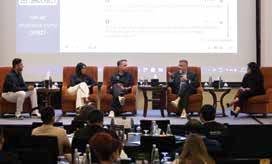
The panel moderated by Campaign Middle East Editor Anup Oommen, included insights from: Alka Winter, Vice President – Destination Marketing and Communications, Ras Al Khaimah Tourism Development Authority (RAKTDA); Ali Rez, Regional Chief Creative Officer, IMPACT BBDO; Joe Lahham, Managing Director, TBWA\ RAAD; and Remya Menon, Director of Marketing and Communications, Bayut
Without giving too much away on an unfiltered conversation meant specifically for the live audience in the room, some leaders discussed the need for clients to map out the right outcomes and measure what they’re trying to truly solve for, while others called for a greater focus on methodologies, processes and AI.
The leaders shared how “marketing has lost some of its magic”, and how the industry needs to bring back the “stopping power” that resonates really well with people and goes past garnering attention to live for a lifetime in people’s brains.

“WE’RE SEEING BRANDS ADOPT A PARTICIPATORY, INTERACTIVE AND CREATORFIRST APPROACH.”

They also opened up lessons that can be learned from mistakes made, such as “going ahead with mediocre work because of pressure from a brand”.
The client–agency dynamic also received robust scrutiny. The leaders highlighted the need to frame marketing as an investment and a value-driving exercise rather than constantly viewing it as a cost centre.
They described how the strength of a brand can be measured by the strength of the CMO-CFO relationship.
Procurement practices were also inspected under the spotlight: from unpaid ideation and ‘window shopping’ to industry-shaping approaches such as pitch or concept development fees to safeguard creative value.
Craft, creative originality and expertise also emerged as competitive edges in a market increasingly driven by metrics and speed.
Behind-the-scenes storytelling and handcrafted productions were flagged as differentiators, showcasing how audiences increasingly value the human element that goes into creating campaigns.
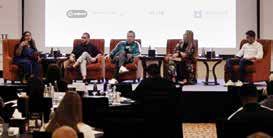


All in all, the event reiterated how brand building in the Middle East now rests on a living, multitouchpoint ecosystem underpinned by authentic storytelling, local resonance and intelligent tooling.
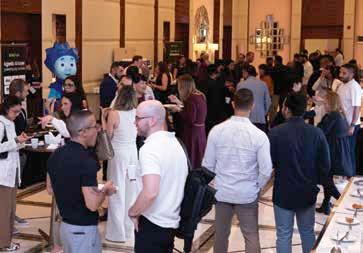
Lessons for Ramadan 2026? Participation over mere attention, authenticity over box-ticking reach, and purpose-driven storytelling – these are not season-specific tricks but a blueprint for enduring growth. After the keynotes and panels at the Campaign Breakfast Briefing, attendees stayed back for a time of networking, collaborating, engaging with ideas, learning and brainstorming.
By Gold Sponsors
Presented

The Anghami team shares why Ramadan has become the Middle East’s most powerful content reset moment
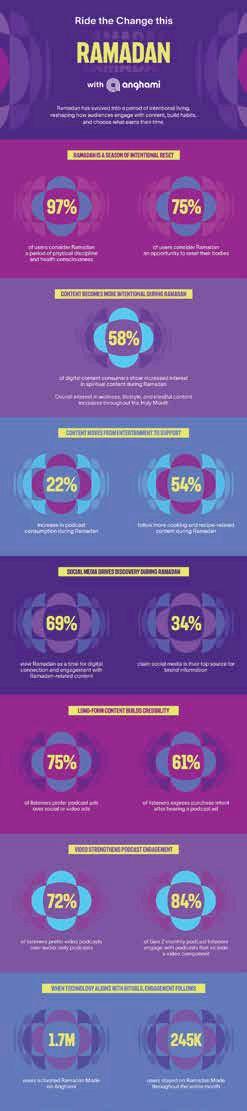
Ramadan has always shaped how audiences across the Middle East think, feel and connect. But in recent years, the Holy Month has evolved into something more defining: a behavioural reset that influences not just daily routines, but the type of content people actively seek, engage with and trust. For brands, this shift represents one of the most meaningful opportunities of the year.
From Anghami’s vantage point, Ramadan marks a change in how users interact with content. Engagement increases, intent deepens, whilst audiences become more reflective, selective about what earns their time.
Ramadan as a moment of intentional living
For many consumers today, Ramadan is no longer about eating patterns or social schedules, but has become a time of intentional living. Insights from The 2025 Ramadan Handbook: MENA Edition by Anghami reflect this mindset, showing a strong association between Ramadan and a personal reset.
This mindset reshapes expectations of content. Audiences gravitate towards formats that feel purposeful, rather than content that simply competes for attention.
The shift in consumer behaviour during Ramadan
These behavioural shifts mirror content preferences throughout Ramadan. Interest in spiritual, wellness and lifestyle content rises, alongside strong engagement with food-related and routine-based formats that align with daily Ramadan.
Motivation often peaks at the beginning of the month, but sustaining new habits is the real challenge. This is where content plays a more functional role. During Ramadan, content moves beyond passive entertainment to become a tool, supporting routines and offering structure.
Audio and video formats become deeply embedded into everyday moments, accompanying users through cooking, commuting or quiet reflection after iftar. These formats fit the rhythm of the month rather than competing with it.
The rise of long-form content during Ramadan: Podcasts
As audience expectations evolve, traditional hard selling feels increasingly out of place during Ramadan. Audiences respond more positively to content that feels helpful, emotionally relatable.
Long-form formats such as podcasts and vodcasts are effective because they are built on trust and familiarity. They allow conversations to unfold naturally, enabling brands to participate without dominating the narrative. When paired with video, these formats deliver both depth and presence .
The message for brands is clear: during Ramadan, contribution matters more than interruption.
Short-form discovery, long-form connection
While long-form content builds credibility,
discovery increasingly happens through short-form video. Social platforms act as the gateway, introducing audiences to deeper stories through snackable, platform-native formats.
Ramadan-specific social series resonate when they reflect shared cultural behaviours and are in line with what the public consumes most, whether it’s to build healthier habits, learn new cooking routines, or discover the next best workout. These formats succeed because they feel human and relatable, encouraging participation, rather than passive consumption.
When extended across interviews, behind-thescenes content and social cut-downs, a single idea turns into an ecosystem of meaningful touchpoints.
Music as a cultural connector
Music continues to play a unique role during Ramadan evenings, offering moments of calm, reflection and togetherness. Intimate, Ramadaninspired music sessions create experiences that feel emotionally grounded and culturally relevant.
For brands, these moments present an opportunity to align with emotion rather than messaging, presence rather than promotion.
Technology that fits into real life
Beyond content itself, technology increasingly shapes how Ramadan is experienced digitally. Features designed around the season such as Ramadan-mode, or purpose-led audio experiences or Anghami’s newly introduced feature ‘The Hub’ feel most effective when they align naturally with daily rituals.
When technology enhances the moment rather than disrupts it, branded experiences feel intuitive, relevant and welcome. This is where Anghami plays a critical role, helping brands translate cultural moments into meaningful, platform-native experiences.
A moment that rewards cultural intelligence
The brands that stand out during Ramadan are not those chasing short-term spikes, but those investing in cultural understanding. By aligning with the deeper themes of the season, brands can move beyond transactional messaging and build long-term connections with their audiences.
As users approach Ramadan with greater intention, the brands that resonate most will be those that understand not just what people consume, but why and when. Navigating this shift requires more than seasonal visibility; it demands platforms that are culturally fluent, format-led and deeply embedded in daily routines. With its understanding of Ramadan behaviour, range of audio and video formats, and production capabilities built for the region, Anghami enables brands to move cohesively with the month by creating content that is timely, purposeful and seamlessly woven into everyday routines.







For years, Ramadan campaigns have relied on the familiar motifs of lanterns, crescent moons, family gatherings, nostalgic soundtracks and celebrity-driven films. While on the surface, the elements seem like ideal representations of Ramadan, in reality they’re quite often far off from what really resonates and reflects the realities of their audience.
As Ramadan moves into the cooler months – with shorter days and longer nights – timing isn’t the only thing changing. Audiences are maturing and shifting with a greater demand from younger generations for more authenticity and relatability.
MULTIPLE LAYERS OF RAMADAN
One consistent theme that has emerged this year is that Ramadan is no longer singular. It is layered, fragmented and experienced differently across communities, professions and younger generations.
“It’s no longer just a month of serenity and reflection; it’s layered with economic pressure, social obligation, late-night work cycles and digital overload,” says Martino O’Brien, Creative Director and Managing Partner at YouExperience. Emotionally, people oscillate between gratitude and fatigue.”
While Ramadan is spiritually grounding, it is also physically exhausting. “It’s calm and chaos at the same time,” says Curtis Schmidt, CEO, RAPP MENA.

Marketers talk to Campaign Middle East about what’s changed and what really matters during today’s Ramadan.
By Ishwari Khatu

He adds, “For Muslims, it is about reflection, family time, late nights, work pressure, scrolling, generosity … all layered together. For the non-Muslim community, it’s more about dealing with daily changes in the rhythm of life.”
Even Ramadan experiences are not restricted to Iftar table celebrations any more. “Culturally, Ramadan is no longer one shared moment – it is many varied experiences happening simultaneously,” says Ahmed Abdel-Karim Hussein, Executive Vice President, Integrated Marketing and Communications, Eastern Europe, Middle East and Africa (EEMEA) at Mastercard.
Hussein explains that there are two sides to every Ramadan experience. There are people who are gathering to connect in person after a while, and then there are people such as delivery drivers and retail workers who are missing their Iftar to enable someone else’s.
Marketers also share that the values of Ramadan don’t need to be constantly recycled, as most of its audience live through them in their daily lives.
“The industry underestimates how tired people are of being sold their own faith back to them,” says Ahmed Ali El-Shorty, Business Director at Zenith “Muslims don’t need brands to explain what Ramadan means. They live it. What they notice is when brands treat the month as a seasonal marketing



opportunity rather than a moment that demands genuine respect and restraint.”
“People don’t want empty emotional messaging; they want brands that understand their reality and connect with the culture,” says Sally Adib, Associate Director, Carat MENA. She adds that brands that show real empathy for how people live Ramadan are the ones that truly resonate.
In the region, audiences respond best to relevancy and practical value.
“Sometimes marketing treats it like a single sentimental moment, but people are just trying to get through the day a bit easier,” says Schmidt. “They don’t need brands to constantly move them emotionally; they need brands to understand the situation they’re in.”
Brands are now moving from creating work that just performs emotional storytelling to work that shows and reflects situational awareness. “Our ambition is to address the practical challenges our customers face throughout the entire period – from pre-Ramadan preparations to Eid celebrations,” says Sherin Yassin, Chief Growth Officer, Majid Al Futtaim Retail, referring to the brand’s latest campaign that focuses on tangible benefits such as services and affordable pricing.
Consumers are also seeking stronger alignment between their values and the brands they choose to spend time with.
“They seek meaning alongside convenience and security,” says Mastercard’s Hussein. “Brands that acknowledge the richness and complexity of the season – rather than idealising perfection – tend to resonate more deeply.”
The Ramadan patterns have not only changed on a social and cultural front, but the season has also become more commercially sophisticated, as Karim Farid, Head of Protein, Beverages & Butter at Arla Foods – MENA, notes.
“Convenience is trumping tradition; it’s no longer a linear, single-screen moment. People stream while scrolling, cook while consuming content, and navigate the month through layered media habits. Planning, inspiration and decisionmaking are fluid,” Farid says.
TRADING EXCESS FOR RESTRAINT Brands are adapting to the new changes,
implementing campaigns that reflect this new reality this year.
Marketers have expanded into research and localisation for different markets and included a move from quantity and numbers to a focus on quality and emotion. They’re trading in mass short-term promotions for fewer, larger scale brand-focused campaigns.
“Rather than asking, ‘How loud can we be during this season?’, we are asking, ‘How relevant and resonant can we be?’
This has led us to prioritise ideas grounded in community, recognition, and shared humanity, which is culturally rooted in trust and engagement, not just short-term offers,” says Mastercard’s Hussein. “Equally important is what we are choosing not to do. We are conscious of over-commercialisation – the instinct to flood Ramadan with promotions simply because spending peaks. That means not treating Ramadan as just another sales moment but thoughtfully weaving in the cultural nuances of the month.”
Majid Al Futtaim Retail’s Sherin Yassin, says that the brand is trading short-term promotions for more impactful campaigns that resonate deeply across key seasonal and cultural moments.
“This approach enables us to build cohesive, brand-led storytelling that connects seamlessly across all customer touchpoints, ensuring a consistent and meaningful brand experience,” she says.
Attributing the move to an increase in effectiveness of their campaigns, Yassin says, “This allows us to create significant cultural moments, deliver sustained value, and build stronger brand resonance that truly lasts. This approach guides our planning for all peak periods, ensuring we make a positive impact and remain at the very centre of the conversation with our customers.”
Zenith’s El-Shorty highlights how campaigns should also reflect one of the main sentiments of the month: restraint.
“In a month defined by discipline and mindfulness, the brands that win aren’t the loudest. They’re the ones that understand when to step back, when to listen, and when their role is to support rather than dominate the conversation.”
Pointing to an example of a brand that got this right, he says, “KFC Saudi Arabia proved this by halting all advertising during peak Ramadan weeks and instead redirecting that spend toward Iftar meal donations. The silence was louder than any ad. Brand favourability jumped by 18 per cent and same-store sales grew in double digits. That’s true in Ramadan. It’s true the rest of the year. We just forget it when we’re chasing share of voice instead of share of respect.”
With marketers moving away from short-term impact promotions, performance and visibility are no longer the sole indicator of success. Resonance and relevance have taken up the mantle as key KPIs. Across categories, marketers describe a recalibration of what success looks like – from short-term effectiveness




to sustained engagement, from one-off emotional films to platforms that build equity over time.
The most relevant campaigns are not the loudest but the ones that understand the emotional beat of the month and show up with consistency throughout the year.
“Success is owning a narrative that deeply resonates, like celebrating the ‘Champions of Ramadan’, showcasing how emotional relevance is a key differentiator,” says Yassin. Attributing localisation for markets to connecting with audiences in an authentic way, “moves beyond mere ‘share of voice’ to ‘share of heart,’ ensuring our brand is seen as a genuine partner and contributor to the community’s wellbeing, building long-term relationships.”
Schmidt adds, “Real success usually shows up after Ramadan ends. We look at signals like people staying subscribed, returning without prompting, trusting the brand more and engaging again later. If the relationship deepens, the month worked.”
With memorability taking precedence over visibility during the month, people remember how a brand behaved rather than how loud it was. “Did the brand solve a real problem? Did it save time or bring people closer together?” asks Adib. “Ramadan is not about instant wins; it’s about building a relationship in the most sacred season of the year. If a brand earns trust here, it carries far beyond the month itself.”
Brands that help, guide or reassure during the season tend to stay ingrained in people’s minds and see results as performance follows afterwards.
O’Brien defines also success as showing up in conversation weeks later when recall is tied to feelings which go long beyond Ramadan. “It’s measured in cultural embedment, not just CPMs. If your Ramadan work strengthens brand equity and reduces price sensitivity post-Eid, you’ve built something sustainable.”
‘‘THE MOST RELEVANT CAMPAIGNS ARE NOT THE LOUDEST BUT THE ONES THAT UNDERSTAND THE EMOTIONAL BEAT OF THE MONTH AND SHOW UP WITH CONSISTENCY THROUGHOUT THE YEAR.”
Mastercard’s Hussein shares how the brand identifies this in practice: “A meaningful measure is whether people feel the brand understood them and what the month truly represents. If people say, ‘This brand behaved differently during Ramadan,’ that is a powerful indicator of effectiveness that no click-through rate (CTR) alone can capture.”
While brand sentiment follows into the post-Ramadan season, building habits that can be carried over is equally key. Farid says, “Sales matter, but if all you’ve built is a promotion, you haven’t built a brand.”
He adds, “If your product becomes part of Iftar or Suhour routines, that behaviour doesn’t vanish post Ramadan. Once embedded in habit, it becomes culture. As brand leaders, our responsibility is clarity. You don’t build loyalty by owning every occasion; you build it by anchoring one credible role and repeating it relentlessly.”
While the effect of building brand trust and values lasts long after Ramadan, marketers call for the need for brands to show up throughout the year and not just during the Holy Month. “Ramadan forces brands to engage with values like generosity, community, and sacrifice,” says El-Shorty. “But most treat it as a seasonal activation rather than a test of whether those values are embedded in how the brand operates.”
Brands that win are ones that don’t just show up during Ramadan; they win because of the work they’ve been doing all year long.
Often described as the region’s Super Bowl moment, Ramadan functions as the peak spending season for brands – where they spend an estimated 20 per cent of their annual budgets during the month. This leads to a spike in activities, messaging and promotions before all plans and strategies return to the brands’ regular baseline – with performance dipping as well.
“Your Ramadan learnings should inform how you allocate budget the other eleven months,” says El-Shorty, emphasising the need for brands to stop unlearning their findings and continue to use strategies learnt all year round.
He adds, “If you discovered that community-level partnerships drove more authentic engagement than top-down broadcast campaigns, why revert to mass reach strategies post-Ramadan? If localised, culturally rooted storytelling outperformed generic regional creative during Ramadan, that’s not a seasonal insight. That’s a market truth you should be applying year-round.”
The discipline, empathy and behavioural insight required to succeed during Ramadan are now informing a year-round strategy. Marketers are looking at how the lessons in cultural differences, audience segmentation and measured storytelling can extend beyond the Holy Month to build more sustainable engagement long after Eid has passed.
Ramadan reshapes the rules of engagement. Media budgets intensify, attention migrates to the late nights, search intent builds earlier and commerce spikes in compressed windows between Iftar and Suhoor. Platformance’s Moments of Influence: Ramadan Report 2026 maps these shifts through a ‘4S’ – Streaming, Scrolling, Searching, Shopping – behavioural framework, highlighting where brands win influence during the Holy Month.

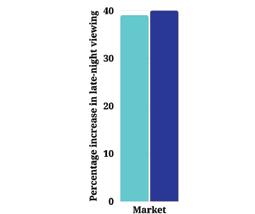


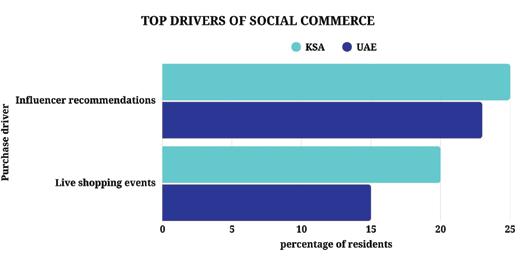
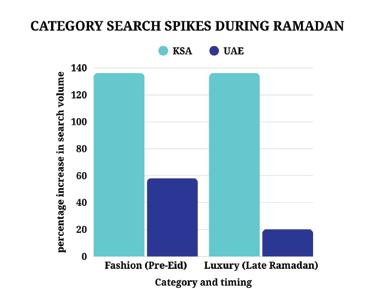
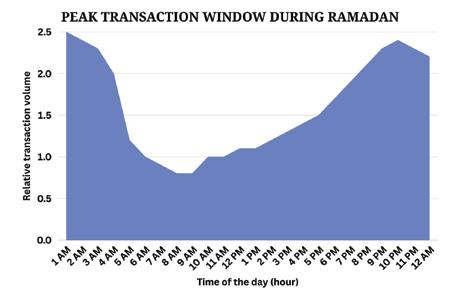
Ramadan continues to function as the Middle East’s most concentrated period of digital attention, with creator-led engagement nearly doubling compared with other months. Data compiled by influencer marketing and intelligence platform Qoruz shows the Holy Month is not only driving higher interaction rates, but also reshaping when, where and how audiences engage.
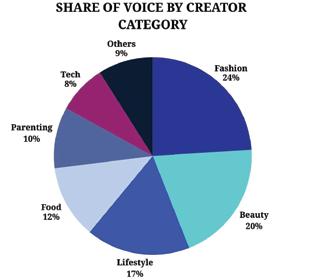
Categories such as fashion, beauty and lifestyle collectively account for nearly half of Ramadan creator content, reflecting the month’s emphasis on self-expression, routines and family-centric storytelling.
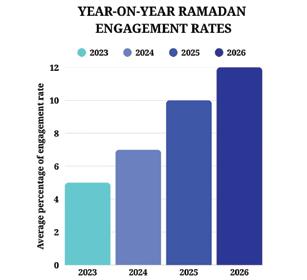
Engagement rates during Ramadan have increased steadily over the past three years – with 2026 projected to reach 12 per cent –indicating a sustained change in how audiences interact with seasonal content on social media.
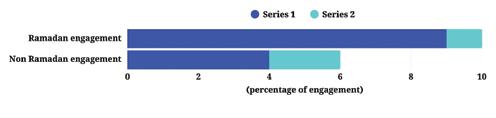
Engagement during Ramadan is nearly double regular periods, positioning the Holy Month as a distinct attention window across social platforms shaped by relevance and seasonal context.
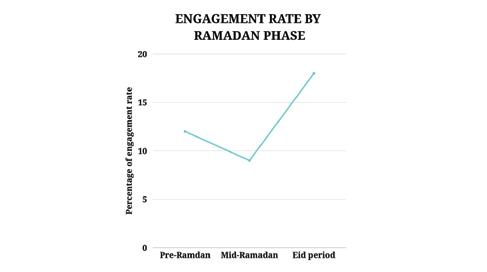
Engagement rates are not linear during Ramadan. They build gradually in the beginning, before dipping in the middle and peak sharply around Eid, indicating that audience interaction intensifies toward the end of Ramadan, coinciding with heightened social activity and celebratory moments.
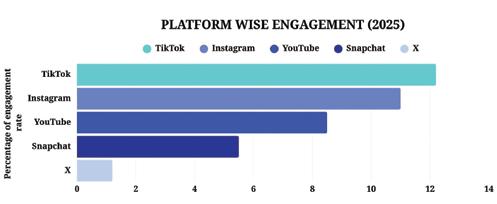



Campaign Middle East speaks to marketers, technology experts and agency leaders about the barriers facing artificial intelligence (AI) adoption, what it will take to break down such barriers and how an effective roadmap for AI implementation can be actioned.
By Anup Oommen







Let’s get the artificial intelligence (AI) fundamentals out of the way before the deep dive: What comes to mind when “AI-augmented marketing” is spoken out loud? If the words speed, scale and shortcuts are the unspoken mental response, it’s time to pause.
The problem with speed is that it’s not quite the same as direction. Unless there’s a course correction, many marketers in the Middle East might accelerate away from intended outcomes. Think of AI as a quad-turbo V12 engine dropped into an old car. Sure, it might speed up for a bit, but the chassis will still rattle; the steering will drift; and the shifty dashboard will still navigate to the wrong exit – only faster.
The problem with scale is that the ground is shaking – geopolitically,

socio-culturally and financially. And skyscrapers built over swamps will sway. Unless the foundations are firmed up, weak workflows are weeded out, and education and experimentation are engineered into organisational culture, scaling the skyscraper might not be the best idea.
The problem with shortcuts is that they shift risk from visible effort – or a lack of it – to invisible consequences. A team that saves time by skipping governance, data discipline and human oversight is handing over the cockpit to a system it cannot fully explain, audit or troubleshoot. Poor data and inconsistent taxonomies get scaled, not solved. Biased and context-blind outputs become repeatable. Confidence gets replaced by complacency.
Campaign Middle East speaks to several marketers, technology experts
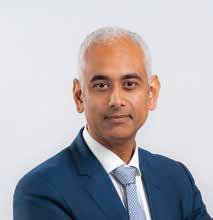
Contributing to this conversation are:
Kiran Haslam, Chief Marketing Officer, Diriyah Company
Faheem Ahamed, Group Chief Marketing and Communications Officer, G42
Tareq Amin, CEO, HUMAIN
Dr. Hoda Daou, Managing Director, Annalect MENA
Joe Lahham, Managing Director, TBWA\RAAD
Mario Soufia, Regional Managing Director – Growth and Marketing, WPP Media MENA
Elie Bassel, Business Lead, Digitas Andreas Frangeskides, Global Data and Technology Lead, HAVAS
Middle East
Alex Jena, Chief Strategy Officer, dentsu MENAT
Elias Aziz, Head of PMO, VML MENA
Ryan Fletcher, Regional Head of Data and Technology, Initiative MENAT
Roy Aftimos, CEO, C2 Comms

loops are slow and decisions are still shaped by handoffs rather than insight. Until marketing is redesigned as a continuous intelligence system rather than a sequence of campaigns, AI’s true value will remain constrained.”
Offering a similar diagnosis, TBWA\ RAAD’s Joe Lahham adds, “The real barrier to AI-led marketing isn’t capability; it’s organisational inertia. AI exposes inefficiencies that many companies have learned to live with: fragmented data, siloed teams, slow decision-making and legacy KPIs built around outputs instead of outcomes.”
C2 Comms’ Roy Aftimos drives the case further, saying, “Leaders are distracted by the wrong problems. They’re chasing budgets for new tools while ignoring foundational rot. Your AI is only as good as the data it’s built on, and most companies are running on data that’s fragmented, siloed and dirty. It’s garbage in, garbage out. And right now, they’re investing billions to get garbage out faster.”


BARRIERS TO UNLOCKING AI VALUE: STRUCTURES AND SYSTEMS, NOT SOFTWARE





and agency leaders about the application of AI beyond speed, scale, shortcuts, generative content and efficiencies. Without mincing words, these leaders call for the industry to put in the real work to leverage AI correctly: as a stress test rather than as a shiny add-on. This includes rebuilding operational workflows, aligning leadership intent with day-to-day realities, and treating reporting and measurement as cornerstones of marketing culture.
The real questions are whether there’s clarity of purpose in the application of AI; whether humans – clients, customers and creatives – remain at the heart of AI-augmented marketing; and whether the use of AI in specific contexts offer a strategic advantage, leading to results over theatre.
Before discussing transformative ways in which AI can be leveraged, marketers and industry leaders reveal key challenges preventing people from tapping into the full potential of AI-augmented marketing. Several leaders describe the central challenge as structural and organisational, not technological or computational.
Garbage in, garbage out They call for the industry to develop a deeper understanding of how intelligence flows and how to harmonise fragmented data before complaining about lack of AI budgets.
“LEADERS ARE DISTRACTED BY THE WRONG PROBLEMS. THEY’RE CHASING BUDGETS FOR NEW TOOLS WHILE IGNORING FOUNDATIONAL ROT.”
G42’s Faheem Ahamed says, “The biggest barrier is structural. Most organisations are applying AI to isolated tasks within a fragmented marketing system: optimising content here and automating media there – without rethinking how intelligence flows end-to-end. Data is episodic, learning
AI literacy and an opportunity to redesign workflows
The chorus on the problem statements continues: AI is being introduced into operating models that were never designed to support it, and legacy systems that were never designed to work with each other.
Digitas’ Elie Bassel explains, “One can’t run an exponential AI strategy on a linear organisation. Most leaders think they’re adopting AI when they’re only speeding up small tasks. They produce more marketing assets without real progress because approvals, escalations and decision-making stay the same.”
Leaders state that the time has come to re-route workflows and redesign systems before plugging in AI solutions.



with structure, clear safeguards and a responsible framework that defines how generative AI is tested and applied in real client and operational environments.”


WPP Media MENA’s Mario Soufia adds to the conversation, saying, “Many leaders still look at AI as if it’s a tool that they must purchase and use. Instead, leaders must look at AI as an end-to-end workflow redesign across intelligence, strategy, planning, content, activation, production and measurement.”
Aftimos adds, “Stop treating AI as a software update. It’s a fundamental redesign of how work gets done. You must restructure workflows at three levels: the individual (the node), the connections between teams (the edge), and the entire system (the network). Don’t just layer AI on top of a broken process.”
Marketers also call for better AI literacy at the leadership level, the need to move beyond legacy mindsets, and to unlock ways to realise the true value of AI.
HUMAIN’s Tareq Amin says, “Too many leaders treat AI as a buzzword instead of a strategic advantage, so it gets underfunded and deprioritised. They don’t truly understand where AI delivers value or how to measure its return on investment (ROI), and they fear losing control or authenticity. Complacency also holds them back, as they believe their current methods are good enough. Without AI literacy at the top, organisations can’t set clear goals or invest wisely.”
Diriyah Company’s Kiran Haslam adds, “For organisations of significant size and scale, the challenge isn’t just keeping up, it’s ensuring that adoption delivers real, tangible value. The key is not to fear the speed of AI but to build the agility, partnerships, and culture needed to harness it effectively.”
HAVAS Middle East’s Andreas Frangeskides says, “There is a shortage of leaders who can translate AI into commercial outcomes. There’s a risk-averse mindset driven by short-term performance pressure. As a result, AI becomes something to test cautiously rather than commit to with intent.”
Calling for more confidence over caution, dentsu MENAT’s Alex Jena adds, “Can we trust a self-optimised media plan? Have AI models been trained on accurate data? Are synthetic plugs adequate to cover the inevitable gaps in data sets? Does a rendered human, or even the family pet on the sofa feel convincingly real? Confidence tends to follow when experimentation is paired
Frangeskides explains how most organisations already have access to models, platforms and automation capabilities that would have been unthinkable just a few years ago, but goes on to reveal that “meaningful impact remains uneven; so does literacy; so does the real understanding of where AI actually creates value across the operational chain of command.”
These insights echo findings of a recent Salesforce study, which reveals that 43 per cent of marketers have not embraced AI – and are reluctant to do so – because they’re struggling to see real value from its use in the short term.
Initiative MENAT’s Ryan Fletcher explains, “Leaders who expect instant outcomes often lose momentum too early. They should instead treat early friction as the cost of building long-term capability. This space moves so fast that
“THERE IS A CLEAR SHORTAGE OF AI-READY TALENT AND RESISTANCE TO CHANGING ESTABLISHED WAYS OF WORKING.”
the ‘perfect solution’ today will be outdated tomorrow – hands-on learning beats endless planning. We should also avoid underestimating the time and effort required to become truly AI-native. Transformation isn’t linear. Things will break, assumptions will fail, and you’ll hit messy integration realities. That’s normal.”
The Salesforce study also shows 70 per cent of marketing professionals calling out their employers for not providing them with AI training. This pivots the discussion from existing skills gaps and literacy gaps to also highlight leadership gaps.
Aftimos says, “The barrier to AI adoption isn’t the technology. It’s the mindset. It’s the talent. It’s the training. It’s the failure of leadership to build a bridge from today’s workflows to tomorrow’s workflows. We have teams of
people staring at the most powerful tools ever created, and we haven’t shown them how to use them safely, let alone strategically. That’s not a skills gap. That’s a leadership gap.”
This gap widens further due to the lack of alignment between leadership, teams and tech specialists.
Annalect MENA’s Dr. Hoda Daou explains, “Leaders are accountable for growth, efficiency and outcomes. Teams on the ground are focused on execution and understandably concerned about how automation might change their roles. Technology specialists often sit in the middle, capable of building powerful solutions but speaking a language that




doesn’t always translate into the wider business context. This is why we need alignment.”
VML MENA’s Elias Aziz agrees with the need to bridge the skills gap but also points to technical and financial problems that need to be fixed.
Wrapping up the initial phase of the discussion neatly, Aziz says, “On the human side, there is a clear shortage of AI-ready talent and resistance to changing established ways of working. Technically, poor data quality and complex legacy stacks slow progress. Financially, fragmented tools increase cost and risk.”
BREAKING BARRIERS: SHARED MINDSETS AND STRUCTURAL CHANGES
Just as the dawn of the printing press revamped news completely, from products and processes to people –requiring manual scribes to upskill to typesetters and proofreaders; and town criers to upskill to correspondents, journalists and early marketers – AI adoption is expected to overhaul marketing and advertising as we know it.
A fundamental shift in how marketing operates
To derive true value, leaders will need to embrace the fact that AI is not a new plug-and-play technology for current marketing roles and functions. Instead, it is reshaping the foundational infrastructure of marketing operations. What does this new era of marketing look like? It institutes a shift from seemingly separate and specialised roles
– such as technical data analytics, creative execution, and high-level strategy – to hybrid roles that requires cross-functional knowledge and expertise.
G42’s Ahamed visualises the future of marketing as an integrated, connected operating model that learns continuously because information flows seamlessly across closely linked marketing functions. This is a significant departure from marketing as a series of one-off campaigns.
Ahamed explains, “The industry needs to shift from campaign-centric execution to intelligence-centric architecture. That means connecting research, strategy, creativity, activation, testing and reputation into a single, learning system where every action informs the next decision.”
Lahham adds, “Agencies need to redesign their value proposition, shifting from asset creation to intelligence, orchestration and measurable business impact. That means upskilling creatives and strategists in AI fluency, not just hiring technical specialists. It also requires new commercial models that reward effectiveness and optimisation, not volume. Agencies should build integrated teams where data, creative, media, and tech operate as one system.”
On the flip side, several leaders also explain why organisations must stop operating like a box of jumbled puzzle pieces. For the beauty of AI to be seen, the puzzle pieces must be put together through linked workflows, shared mindsets, common business goals, and roles that bridge strategy, technology and execution.




evaluative literacy; an understanding not just of how to use these tools, but how to pressure-test them to see what makes a specific solution truly unique. Without this collective shift, we risk a total homogenisation of strategy. If every brand is chasing the same audiences using the same suite of planning signals and off-the-shelf models, the potential of AI is neutralised.”
Taking this notion a step further, Aftimos says he believes that organisations should not only offer paths to upskilling, but also incentivise it. This removes the barrier of fear – the fear of unlearning and relearning; the fear of being replaced; and the fear of looking incompetent.
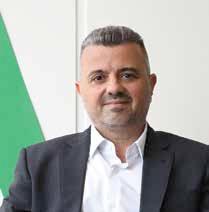
that enable each other rather than getting in each other’s way.



Soufia says, “Start with a shared operating system mindset. Make sure that the workflows you’d like to reimagine are clear with governance, safety and accountability baked in from day one.”
Daou adds, “It starts with getting everyone to speak the same language, which is not easy. For AI strategies to work, everyone needs to be aligned. Leaders must be clear on outcomes they want to achieve, and teams closest to the work should help shape how those outcomes are delivered.”
The case for upskilling and building crossfunctional teams
Knowledge becomes particularly important given the context of the current MarTech landscape, which is awash with products and tools that all claim to offer similar solutions.
Jena explains, “Education is still the biggest lever. What we should aim to collectively achieve is a stronger culture of
Aftimos says, “Make training mandatory. Celebrate AI proficiency as sophistication, not a shortcut, with programmes that fast-track talent who master these tools. You share the upside. If AI is creating efficiency, you offer productivity bonuses, training royalties, and career guarantees that channel those gains into reskilling. You position AI as a tool for growth, not just contraction. When people see that technology is expanding the business, the fear of replacement becomes the opportunity for advancement.”
Done right, this will result in the development of cross-functional squads




Frangeskides says, “Organisations must invest in roles that bridge strategy, technology and execution. Data security teams should enable responsible speed, not act as a brake on progress. Most critically, leaders must be willing to retire legacy thinking and systems that don’t support adaptive decision-making.”
Soufia adds, “Build cross-functional squads across different areas of the business and accelerate use cases so that you are moving from pilots to production with clear and measurable KPIs. Finally, it’s your people who will benefit from this transformation, so make sure you invest in upskilling everyone, not only a handful or ‘transformation champions’.”


The right approach to implementing AI doesn’t begin with hiring ‘AI experts’, adding an AI line item to job descriptions, investing in proprietary tools that may or may not fit, or setting aside a public relations budget for a stop-gap narrative on ‘AI-driven’ organisations.
It begins with resolving to change how work gets done, with clear goals, clear intent, clear ownership and clear rules.
The end goal is not, and should never be, automation for its own sake, but a more capable marketing organisation – one that moves faster, makes better decisions, protects brand integrity and uses AI to amplify people rather than replace them. Haslam and Ahamed suggest starting from these primary principles. Rather than focusing on toolsets, they advise focusing on why AI is being implemented, what it should improve for people and what must remain human-led.
They share a belief that marketing effectiveness depends on judgement, empathy and brand meaning – elements that AI can support, but not own.
Haslam says, “My mantra always is: don’t run before you can walk when it comes to digital technology. Take a step back and make sure what we are doing is going to help people and enhance the human experience. It is, after all, what drives our human-centric, people-first approach in building our walkable city in Diriyah.”
Ahamed adds, “Start with intent, not tools. Rather than asking what AI tools are best for marketing, ask how marketing can be relevant in an AI-native society. Be clear about which decisions AI should augment and which must remain human-led. Establish guardrails around explainability, data provenance and brand governance early, especially as systems move from recommendation to action. A phased approach works best: assist, simulate and then act – with the human in the loop at every stage.”



Frangeskides adds, “If an organisation cannot clearly explain what an AI system is allowed to do and why, it is not ready to deploy it. The strongest organisations move through three stages. First, augmentation, where AI assists humans with insight, speed and consistency. Second, automation, where decision logic is codified and systems begin to optimise within defined parameters. Only then does agency emerge, with AI systems that are able to act, learn and adapt autonomously within clear boundaries. Skip these steps and trust erodes quickly.”





For marketers beginning their AI journeys, Amin and Frangeskides insist on clarity of progression through the phased approach to adoption.
Amin says, “I’d advise a roadmap built on clarity, discipline and breakthrough outcomes. Start with the future you want to create by asking: What revenue, growth or market leadership are you aiming for? Then, launch a high-velocity pilot that proves value fast, powered by clean data and hard KPIs.
He adds, “Amplify your workforce. AI should supercharge creativity, speed and decision-making. Next, scale aggressively with repeatable systems, training and AI-first operating models, ensuring leadership is aligned and accountable. AI is rapidly becoming the core engine of modern marketing, so it must be integrated and managed as a foundational capability.”
Expanding on the phased approach, Aftimos adds, “Don’t boil the ocean. Start small. Pick one repetitive, timeconsuming task and experiment with AI assistance. Don’t worry about perfect prompts or a comprehensive rollout. Just prove you can create value in one corner of the business. Focus on a clear pain point with a measurable ROI. Then, pilot: expand to proven use cases such as content optimisation, campaign productivity and audience targeting. This is where you build a dual-track measurement dashboard. Keep your core efficiency metrics but start tracking relationship metrics alongside them. Establish your baseline so you can prove the uplift. Finally, scale: this is where you move from improving tasks to redesigning workflows. You take the learnings from your pilots and synchronise AI adoption across interconnected teams. This isn’t about giving everyone a licence, it’s about ensuring that when one team gets faster, they aren’t creating a bottleneck for another.”
However, in this approach to implementing AI tools, leaders also suggest guardrails – clean data practices, security, measurement and the ability to challenge outputs rather than being forced to accept them blindly due to a lack of knowledge.
Fletcher says, “Have a north star. You need clarity on what will change
operationally: what decisions get made faster, what work gets automated, and how success will be measured – and that’s enough to begin with. The key guardrails are data governance, security and human-in-the-loop control. The biggest failure mode is blindly trusting outputs and never questioning the model or the process. AI should enrich human decision-making, not replace it. Trust is earned through testing against benchmarks and iterating until the system performs reliably in the real world.”
Bassel adds, “Set guardrails upfront: autonomy boundaries, evaluation thresholds, and human handoffs. Run monthly reviews to reassess external shifts such as models and competitors, and reassess internal performance such as usage and quality.”
Before the conversation concludes, the panel of industry leaders are asked to share practical takeaways. They explain that the era of experimentation without proof is ending. If AI is being introduced into marketing systems, it must be governed, measured and tied to real outcomes. It’s also time to stop using AI as a shortcut, a pathway to mediocrity, a crutch for laziness, and a means to flatten creativity.
Here are their final thoughts, shared as a quick-fire round-up:
Kiran Haslam, Chief Marketing
Officer, Diriyah Company: “AI as a tool I am comfortable with, but I believe we must ensure there is not an unnecessary reliance on AI tools that can rob human beings of the ability to learn, think for themselves and be fully rounded independent contributors to the human experience. Make sure you create culturally appropriate, nuanced content that reflects the unique identity of your brand like we do at Diriyah. When technology supports that level of specificity and care, the result is work that is not only innovative, but genuinely powerful and relevant.”
Tareq Amin, CEO, HUMAIN: “Stop chasing AI as a trend. Start building AI as your new operating system. AI isn’t hype, but a capability you must integrate into each layer of your strategy, your team and your customer experience. The brands that win will be the ones that use AI to amplify human creativity, not replace it. The industry must invest heavily in AI literacy, upskilling and experimentation today, in order to prepare for the future instead of surrendering to it.”
Mario Soufia, Regional Managing Director – Growth and Marketing, WPP Media MENA: “Stop asking, ‘What can AI do?’ and start asking ‘What should we automate that can make people and brands better?’. Move past the conversation of whether we should or shouldn’t use AI. Get an answer to that question and start building. Treat AI as a new layer of your marketing systems and make sure it’s governed, measurable and designed around workflows that your people and your brands care about. Ultimate success will come when you engineer a system that brings everyone together, not add to silos. Once you’re properly kicked off, measure improvements in speed, quality and decisioning, and continuously improve.”
Dr. Hoda Daou, Managing Director, Annalect MENA: “Keep people at the centre. Whether it’s AI or any other transformation, there must be a clear purpose behind it. Outcomes matter, but those outcomes need to make sense to everyone involved, not just in terms of performance uplift or operational efficiency, but also in how people grow, develop and feel empowered in their roles. With the current capabilities of agentic AI, it’s natural that concerns are growing around its use and what it means for careers. The responsibility sits with leaders to be clear about intent.”
Joe Lahham, Managing Director, TBWA\ RAAD: “Don’t confuse acceleration with progress. Technology will keep moving faster with AI, automation, and data. But speed alone doesn’t create value. Clarity does. Judgement does. Courage does. Our job isn’t to chase every tool or trend; it’s to design systems where creativity, intelligence and business ambition work together. AI should amplify human thinking, not replace it. If we stay obsessed with outcomes over optics, substance over noise, and long-term value over short-term hype, we won’t just adapt to change, we’ll lead it.”
Ryan Fletcher, Regional Head of Data and Technology, Initiative MENAT: “Be brave, be practical, and bring your people with you. There is no single ‘correct’ AI playbook; it’s a process of building what’s right for your

organisation at that moment, learning from reality, and scaling what works. The industry also needs to raise its statistical literacy: the next era will reward those who understand foundational concepts such as regression, significance, and incrementality, because AI without measurement discipline is just fast guessing. And remember that while everyone asks for a faster horse, the job is to solve real problems.”
Roy Aftimos, CEO, C2 Comms: “Stop piloting. Start proving. The experimental phase is over. 2025 was for discovery. 2026 is for accountability. The C-suite is no longer impressed by AI experiments, they’re demanding AI-driven efficiency and they’re expecting headcount reductions to follow. AI won’t replace marketers. But marketers who can’t prove their value will be replaced by those who can. The noise is about the technology. The meaningful conversation is about the metrics. If you can’t measure it, you can’t defend it. And if you can’t defend it, then your budget, your team and your job are on the line.”
Elias Aziz, Head of PMO, VML MENA: “The most important shift the marketing industry must make is from artificial intelligence to augmented intelligence. AI’s real value is not in replacing talent but in amplifying it. By automating repetitive tasks, marketers regain time for empathy, creativity and strategic thinking. The future of marketing is not about adopting more tools but about creating organisations where human insight and machine intelligence collaborate seamlessly to deliver exceptional outcomes.”
Andreas Frangeskides, Global Data and Technology Lead, HAVAS Middle East: “Ultimately, AI will never fix unclear thinking, poor data or misaligned
incentives. It will expose them faster. The real opportunity for marketing leaders is not to become more technologically sophisticated, but more honest. Honest about how decisions are made. Honest about what should be automated. Honest about where human judgement still matters. My final thoughts? The organisations that win will not be those that adopt AI fastest, coolest or flashiest in design, but those that redesign themselves thoughtfully enough to deserve it.”
Alex Jena, Chief Strategy Officer, dentsu MENAT: “Your strategy should obsess over distinction. Be brutally clear on where the real white space lies and which audiences genuinely move the needle for growth. AI is a powerful tool, but it’s ultimately a magnifier. Feed it a generic strategy and it will simply help you get to mediocrity faster. Create a universally understood definition of distinction, a benchmark that everyone can reiterate. When we have that clarity of judgement, we stop chasing every shiny new tool and start identifying the specific AI and automated solutions that unlock real growth. In summary, don’t let the tech dictate your direction. Use your strategy to define the logic and then use AI to give that logic the scale, speed and impact it deserves.”

All in all, industry leaders describe AI not as a single breakthrough, but as a stress test for marketing organisations. If there are cracks in the organisation, they will show – and when the floodgates open, the dam will burst. It’s just a matter of time.
“DON’T CONFUSE ACCELERATION WITH PROGRESS. TECHNOLOGY WILL KEEP MOVING FASTER WITH AI, AUTOMATION AND DATA. BUT SPEED ALONE DOESN’T CREATE VALUE.”
The alternative is to stitch siloed systems, weld broken workflows, build integrated roles and cross-functional teams, and ensure continuous upskilling as part of organisational culture. Then roll out an AI roadmap across three simple stages: addressing a specific challenge with intent, low-risk experimentation, and scaled deployment based on proven value. The guardrails for AI adoption remain: informed-humanin-the-loop oversight, ethical and bias reviews. Establish a baseline to monitor uplift, track and evaluate AI performance, and know where to draw autonomy boundaries.
The new era of marketing will not be defined by artificial intelligence, but by augmented intelligence: AI navigating while riding shotgun with humans firmly in the driver’s seat.
The Future of Marketing in MENA report by Ipsos unveils insights following interviews with more than 60 CMOs and marketing stakeholders across four major markets: the UAE, Saudi Arabia, Egypt and Morocco. More than 80 per cent of the respondents were from C-suite and executive roles, shaping strategy as key decision makers. Of these, 53 per cent were female and 47 per cent male.
IN 2026, BEING ‘FUTURE-READY’ NOW REQUIRES BALANCING HUMAN-CENTRIC STORYTELLING WITH RAPID TECHNOLOGICAL ADOPTION. MORE THAN HALF OF ALL MARKETERS SURVEYED STATE ‘NEUTRAL’ OR ‘WEAK’ FUTURE-READINESS.
Critical insight: While marketing capability is strengthening regionally (41 per cent answered ‘strong’), many teams remain in the middle ground of partial readiness. AI and data-related skills continue to be the hardest to build. Practical integration and upskilling will be essential to convert occasional users into consistent, value-generating practitioners. Week 24 % Neutral 35 %
PRIORITIES FOR FUTURE MARKETERS: CREATIVITY AND BRAND STORYTELLING BEATS AI MASTERY
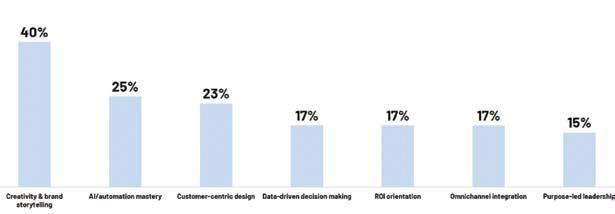
TOP MARKETING CHALLENGES: DIFFERENTIATION, RAPID TECH CHANGES AND TALENT SHORTAGE
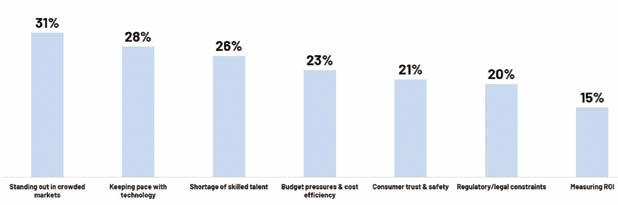
Critical insight: The marketers of tomorrow will blend creativity (40 per cent) with AI fluency (25 per cent) to drive meaningful brand growth. The findings reveal a leadership evolution, from purely analytical or operational strengths to a balanced model of creative intuition, technological literacy, and empathy-driven strategy. Critical insight: Marketers cite market saturation and rapid technological change as their biggest obstacles. Talent shortages (26 per cent) and budget constraints (23 per cent) further strain teams, while ROI measurement remains a persistent but less urgent issue. The data signals a shift from resource-based challenges to strategic differentiation and digital adaptation as the core tension facing marketers today.
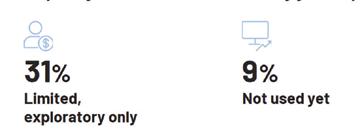
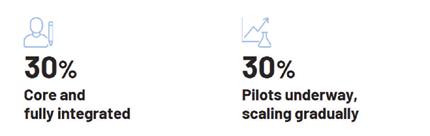
Critical insight: AI adoption is taking hold across the region, with 30 per cent of marketers reporting full integration and another 30 per cent running pilots, signaling a clear acceleration in adoption. However, 31 per cent remain in the exploratory phase.
WILL AI DEEPEN THE TRUST DIVIDE? TRANSPARENCY WILL DEFINE THE FUTURE OF BRAND CREDIBILITY
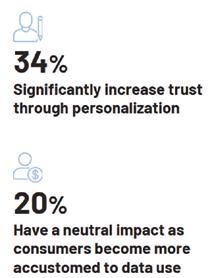
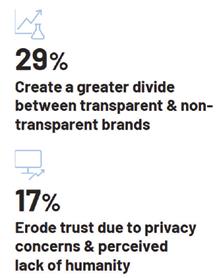
Critical insight: Marketers are split on AI’s impact on consumer trust: while many believe it will boost trust through personalisation, nearly as many expect it to widen the gap between transparent and opaque brands. The findings underline a critical truth: AI won’t automatically build trust; openness about data use and human oversight will.
BIGGEST PAIN POINTS IN DIGITAL MARKETING: AI ADOPTION AND TARGETING CAPABILITIES
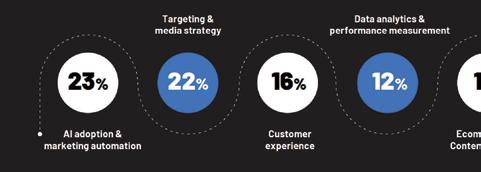
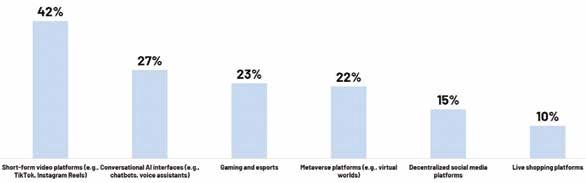
Critical insight: Marketers see the strongest emerging potential in short-form video platforms (42 per cent), led by TikTok and Instagram Reels, which dominate engagement across the GCC. Conversational AI (27 per cent) is rapidly gaining traction as a new frontier for personalised engagement. Meanwhile, gaming (23 per cent) and metaverse platforms (22 per cent) remain promising yet underdeveloped spaces.
GREATEST POTENTIAL OF AI: CUSTOMER ENGAGEMENT AND PREDICTIVE INTELLIGENCE
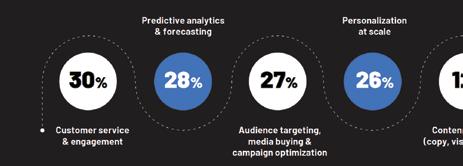
Critical insight: Marketers see the strongest AI opportunities in customer service and engagement and predictive analytics, reflecting a shift from experimentation toward performance-driven applications. Major markets in the GCC lead globally in using AI to elevate customer interactions, with KSA standing out for its focus on predictive forecasting.
The conversation around artificial intelligence (AI) in marketing has become a bit predictable. Faster, cheaper, scalable and more efficient –all at the stroke of a well engineered prompt, or so they say.
But if that’s where the conversation ends, we’re missing the point entirely. Because in the Middle East, AI is not a productivity tool. It is infrastructure.
Across the Middle East, AI is no longer a theoretical ambition. According to PwC’s regional analysis, AI is expected to contribute nearly $320bn to the Middle East economy by 2030, with the UAE and Saudi Arabia leading adoption across government and enterprise sectors. The UAE National AI Strategy 2031 and Saudi Arabia’s Vision 2030 have both placed AI at the centre of economic transformation.
As economies in the region restructure around intelligence, data and automation, public and private organisations are rewriting their strategy playbooks, and marketing cannot afford to sit on the sidelines of this transition; it has to step up and lead.
Yet, much of the industry conversation still reduces AI to operational efficiency. That is the shallow use of AI. And, frankly, it’s the boring one.
In the Middle East, we don’t approach AI as an automation layer whose job is simply to compress timelines or cut costs. What excites us is what AI unlocks, not what it replaces. Because, when used with intention, AI doesn’t just accelerate the work we already do. It enables work that simply wasn’t possible before.
In our creative workflow, AI is less about speed and more about effectiveness. It is a tool for exploration, not just execution.
We use it to pressure-test and refine creative concepts before they go live, evaluating and generating narratives, messages, high-quality visuals and marketing assets at a speed and scale that used to historically take weeks and huge budgets.
Furthermore, deploying AI-powered chatbots across Nissan’s website and WhatsApp channels allow us to deliver personalised, always-on interactions that guide customers from discovery through to aftersales.
Along the way, AI also helps us spot cultural signals early, uncover emerging innovation spaces for the brand, and surface tensions that traditional dashboards or research might overlook, enabling creativity

that is faster, smarter, and more culturally attuned.
Take our recent Dar Patrol CGI campaign. The creative idea, a legendary SUV breaking out of a static billboard and transforming the urban landscape into its natural desert habitat, was born from human imagination. But AI helped us refine it. It allowed us to test variations, assess resonance across markets, and adjust messaging dynamically as the campaign rolled out across Abu Dhabi, Bahrain, Dubai, Kuwait, Qatar and Iraq.
The result? More than 6 million organic views in less than 48 hours, and more than 9 million in earned media shortly after launch. More importantly, we delivered a campaign that felt authentic, locally relevant and unmistakably ours.
The resounding success that the campaign witnessed wasn’t driven by scale of content. It came from relevance. From ensuring that the creative resonated deeply with the audiences it was designed to reach.
AI plays a role not as a volume engine, but as an enabler of smarter adaptation. It enables brands to intelligently tailor visuals, messaging and formats to specific audiences, moments, and cultural nuances without diluting the core creative thought. The real value is not in generating a thousand versions of the same ad, but in ensuring that creativity lands meaningfully in each context while preserving brand integrity
and deepening engagement. The Middle East is not one homogeneous market. Saudi Arabia represents one of the fastest-growing automotive markets in the region, supported by regulatory reforms and increased female participation in driving. The UAE remains a hub for early technology adoption and premium automotive demand. Kuwait and Qatar each have distinct consumer behaviours shaped by demographics and purchasing power. AI gives us the ability to honour those differences while staying anchored to a singular brand truth.
But there is something AI cannot do. It cannot define what your brand should stand for. It cannot feel the weight of a cultural moment or understand the unspoken expectations of a community. It cannot replace instinct, taste or creative courage required to defy the ordinary.
In a region investing billions into AI infrastructure, from sovereign AI initiatives to smart city programmes, access to technology is no longer the differentiator. Perspective is.
At Nissan, our mantra has always been to Defy Ordinary. That philosophy does not fade in an AI-powered world. If anything, it becomes more important. Because, when everyone has access to similar tools, advantage comes from how thoughtfully you use them.
The brands that will lead in the next era will not be the ones using AI to do the same things faster. They will be the ones using AI to do new things, creating deeper engagement, richer experiences, and more meaningful connections.
For us, that means continuing to explore how AI can help us understand our customers more intuitively, to anticipate their needs before they are articulated, and to deliver experiences that feel personal, relevant, and distinctly Nissan.
Efficiency may have been where the industry began its AI journey. But as the Middle East enters its new phase of growth, the real opportunity lies in work that is culturally aware, creatively brave, strategically sharp and intelligently powered by AI.
By Abdulilah Wazni, Director of Marketing Communications and Customer Experience, Nissan in Saudi Arabia and the Middle East
Nissan’s Abdulilah Wazni explains why the marketing industry needs to drive past the pitstop of efficiency to build work that is culturally aware, creatively brave, strategically sharp and powered intelligently by AI.
In a world of consent-based artificial intelligence (AI) agents delivering superior personalised experiences, the brands that win will be the ones consumers are choosing – consciously, emotionally and deliberately – even when they don’t need to, du’s Simon Ornelis explains.

The disruption of the brand-customer relationship by artificial intelligence (AI) won’t happen in the future; it has already happened – through AI inserting itself between intent and action.
Recently, I was happily using the help of ChatGPT to plan our next family vacation, when it suddenly dawned on me: my decades-long brand relationships with Lonely Planet and Booking.com had changed fundamentally. I was no longer sifting through articles or reviews on these websites to devise our holiday plans. Instead, I was asking an AI tool – a single source of truth – to decide where we should
stay, eat and go. Decision-making had moved.
While full consumer adoption of agentic AI is still ahead of us, the implications for brand relationships are immediate. When customers start delegating decisions to AI agents, brands stop competing for attention. Instead, they start competing for moments when customers override their agents’ recommendations.
From persuasion to delegation
In traditional marketing, the core objective is to persuade a human to perform an action in a specific moment. The brand relationship is driven by awareness and message consistency.
In an agent world, our preferences, values and constraints will be preencoded. This means that as customers outsource discovery and decisionmaking to AI, and algorithms summarise, compare and recommend on the customer’s behalf, decisions will increasingly happen without conscious human attention, and at times even before the brand message is ever seen.
As a consequence, the new relationship with the customer isn’t: “Convince me.”
It is: “I trust you enough to let my AI choose you.”
Brands win when humans override their agents
In the future, competitive success in branding will be measured by one thing: how often customers choose to overrule their agent in your favour.
This is especially important knowing strong brands gain significant advantages in AI-mediated interactions. When AI systems trained on billions of data points make recommendations, they naturally favour well-known, trusted brands. This creates a compounding effect where established brands become even more prominent in AI responses.
Companies with rich, consent-based customer information, can also train more sophisticated AI agents that deliver superior personalised experiences. So, to compete, challenger brands will need to give people a reason to step into an AI response and say, “No, I want that one.”
Where overrides happen: the new ba legrounds
What are the likely areas where consumers will overrule their agent’s recommendation in favour of a preferred brand? They are all intentionally human – identity, risk meaning and delight.
First, when a brand is part of selfimage, and its choice becomes an identity. No agent can fully optimise for self-image or taste.
Second comes risk, when a past experience outweighs logic. This is where long term brand investment suddenly pays off again. In essence, trust acts as a strong risk reducer.
Then comes meaning. When a brand is tied to an emotion, a purpose, maybe even a life stage, meaning becomes a
reason to break the rules. Finally, delight. Given that agents are conservative by design, delight becomes a competitive advantage in a world designed to eliminate it. The more AI trains us to expect the expected, the more valuable surprise will become as a key differentiator.
How to drive brand preference in an agentic world
While adding meaning and being intentionally human become more important than ever, winning brands will do a few things consistently well.
Winning brands will treat brand as behaviour, not communication. In an automated world, what matters isn’t what a brand claims. It’s what its systems actually do: how it responds, resolves and adapts. Encoding brand elements such as identity, behaviour and personality are key.
They are machine-readable, providing clarity on price, availability, product performance and reliability in a structured way, because the least risky choice is the easiest choice.
They design for preference, not persuasion. While persuasion happens in moments, preference is built over time through differentiation, consistent positive experiences and meaningful
“WHAT ARE THE LIKELY AREAS WHERE CONSUMERS WILL OVERRULE THEIR AGENT’S RECOMMENDATION IN FAVOUR OF A PREFERRED BRAND?”
interactions. And when decisions are delegated, preference is what survives. They recognise brand experience is delivered by operating models rather than campaigns. Companies must rethink whether traditional, siloed structures can meet AI-mediated expectations.
I believe an agent-to-agent economy will make marketing faster, fairer and more efficient than anything we’ve seen before. AI won’t kill brand relationships. It will expose them.
The upside is clear: when AI handles the rational, brands are finally free to focus on the meaningful. The brands that win will be the ones still worth choosing, consciously, emotionally, deliberately –even when no one has to.
By Simon Ornelis, Director Brand Development and Corporate Identity, du
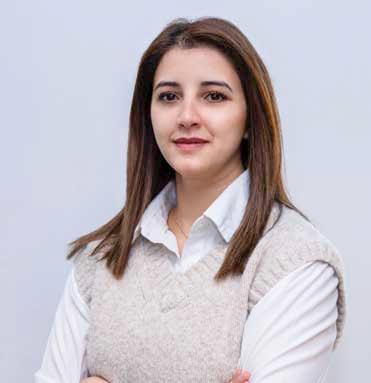
Teams spent weeks analysing customer behaviour. Campaigns were launched based on incomplete information. Optimisation happened slowly, often after opportunities had already passed.
Why? The truth is that the bottleneck was never creative. It was processing –processing data; processing feedback; and processing decisions.
Artificial intelligence (AI) removed that bottleneck.
What once took weeks takes seconds today. AI can process vast volumes of behavioural data instantly, identifying patterns and signals with a level of speed and accuracy no human team could match. Campaigns can be optimised in real time. Media can dynamically be adjusted to performance. Customer journeys can be enhanced based on behaviour, not assumption.
This shift has fundamentally changed the economics of marketing.
Efficiency is no longer earned through scale or resources. It is earned through intelligence. AI allows brands to operate leaner, move faster and make more accurate decisions. It eliminates operational drag. It reduces human error. It ensures execution happens at a level of precision that was previously impossible. But its greatest impact is not what it does. It is what it frees humans to do.
For years, marketers spent more time managing execution than shaping
Royal Jordanian’s Razan Al-Qaisi suggests that in a world where every brand has access to the same technology, the human advantage will be the only one that counts.
strategy. They were buried in dashboards, reports and repetitive operational tasks. AI changed that. By automating the mechanical side of marketing, it gave marketers something far more valuable than speed. It gave them their thinking time back.
AI can tell you what customers are doing. It can tell you when they are likely to convert. It can tell you which message will perform best. But it cannot tell you what customers care about. It cannot tell you what they feel. And it cannot tell you what a brand should stand for.
That is still a human decision.
This is especially true in brandbuilding, where the objective is not efficiency, but meaning.
AI makes personalisation scalable. It allows brands to deliver relevant messages to the right person at the right time. But relevance alone does not build emotional connection. Emotional connection comes from understanding human tension, cultural nuance and
unspoken needs. It comes from instinct, judgement and empathy.
AI can identify patterns. Humans assign meaning to them.
The same applies to communication. AI can optimise media placement, automate content distribution, and continuously refine performance. It ensures campaigns run efficiently. But efficiency does not create memorability. Memorability comes from bold ideas. From emotional truth. From creative leaps that cannot be reversed engineered from data alone.
AI improves execution. Humans create belief.
The brands that will win in this new era will not be those that use AI to replace people. They will be the ones that use AI to elevate them. The brands that allow machines to handle scale, speed, and precision, while empowering humans to focus on judgment, creativity, and emotional connection.
Because the role of marketing was never just delivering messages. It was to create meaning.
AI can make marketing more efficient, but only humans can make it matter.
And in a world where every brand has access to the same technology, that human advantage will become the only one that counts.
By Razan Al-Qaisi, Director of Marketing and E-commerce, Royal Jordanian
For the past 20-plus years, we have been obsessed with one idea: digital transformation. We digitised everything. And I write this as someone who has spent the better part of the last two decades driving that change across industries and operating models.
We moved from paper to platforms. From manual workflows to automated systems. We removed friction, created smoother experiences, built clouds, SaaS models, subscription economies – entire business architectures on the promise that digital would make us faster, smarter, more efficient. And it did. But here is the uncomfortable truth: Digital transformation has now succeeded so completely that it no longer differentiates. Digital is no longer strategy. It is infrastructure.
Which is why I think we are misunderstanding artificial intelligence (AI). Some see AI as simply the next wave of digital transformation – ‘digital transformation 2.0’ – the next layer of productivity. It is not.
Many have already framed AI in terms of augmentation rather than replacement – a view now widely discussed. What I find more interesting is the deeper structural shift underneath it – because the question has flipped. Digital transformation was about digitising processes: taking what was manual and asking, ‘Where do we plug digital into these processes?’ AI forces a completely different lens. In a world where workflows become AI-driven by default, the question is no longer where we plug AI in. It is: where do we plug the human back in? That is the inversion. This is not automation. This is cognition being digitised, execution becoming machine-led, and differentiation becoming human-led. And that changes everything.
FROM DIGITISATION TO OVERLOAD
Marketing is perhaps the clearest example of what digital transformation delivered. We moved from traditional marketing into digital marketing and saw an explosion of data, funnels, attribution models, performance metrics, and optimisation loops.
The function evolved rapidly – and so did the output and the skill sets. Brand became specialised. Performance became specialised. Product marketing became specialised. Content became specialised. CRM became specialised. Digital didn’t just transform marketing. It expanded and fragmented it. We built organisations of specialists, each managing their own slice of the marketing engine, connected by dashboards and analytics, all in service of doing more. Digital transformation gave us acceleration: faster processes, smoother execution, better customer experiences. Now imagine adding AI into that equation. AI brings abundance, infinite content and infinite speed. It brings hyper-
personalisation at scale. So, the question is no longer how much we can produce. The question is: will it resonate?
THE EFFICIENCY RACE IS REAL, BUT IT IS NOT THE PRIZE AI will absolutely deliver productivity. It will reduce cost. It will scale execution. And yes, marketing has entered an arms race. Everyone will be racing. But that is hygiene. Because when everyone has access to the same tools, efficiency stops being differentiation. And if marketing becomes purely transactional or promotional, it risks becoming a zero-sum game - a race to the fastest click and the cheapest option.
BACK TO THE FUNDAMENTALS: BRANDS THAT MEAN MORE
In a world where execution becomes abundant, the advantage shifts. AI will scale production, but it cannot generate brand love – because love is earned through trust, relevance, authenticity, empathy and meaning for the customer.
These are fundamentally human. And they take us back to the fundamentals of marketing – fundamentals that have never changed. Marketing is still about creating differentiated customer value: value that resonates emotionally, feels culturally relevant and makes a brand matter in the mind and heart of the customer.
In markets like the Middle East, where ambition is high, competition is intense, and cultural nuance matters deeply, this becomes even more critical. Customer centricity here is shaped by cultural fluency and by how intelligently brands combine human relevance with AIpowered personalisation.
The brands that will win in the AI era will not be the ones that generate more. They will be the ones that mean more.
THE ROADRUNNER ECONOMY: HOW FAST THE GROUND IS MOVING
I recently came across an article by futurist Noah Raford on the ‘Roadrunner economy’, and the metaphor is striking.
The piece explored how AI is disrupting the SaaS economy – how platforms and business models that took years to build can suddenly be recreated or unbundled almost instantly. Like Wile E. Coyote
“AI WILL SCALE PRODUCTION, BUT IT CANNOT GENERATE BRAND LOVE BECAUSE LOVE IS EARNED THROUGH TRUST, RELEVANCE, AUTHENTICITY AND EMPATHY.”
chasing the Road Runner, many organisations are still sprinting forward, not realising the terrain has already shifted beneath them. I couldn’t help but draw the parallel with marketing and MarTech.
We have built increasingly complex stacks, platforms and ecosystems – but AI raises an uncomfortable question: how much of that advantage holds when so much can be generated, customised or replaced at speed? We are chasing efficiency, optimisation and the next platform. But by the time you catch what you are chasing, it is already gone.
THE POST-DIGITAL ERA IS HUMAN
Digital transformation was about replacing manual work with digital systems. AI is a rethink of how we operate – and where humans create value in an AI-driven world.
If we play our cards right, this is where augmentation becomes real: not the automation of marketing, but the elevation of what only humans can bring: critical thinking, empathy, imagination, curiosity, cultural intelligence, common sense.
Digital built the infrastructure. Now the advantage is human. Because the defining question for marketing is no longer what AI can do but what we choose to become and create, with it.
By George Yaryura, Senior Vice President and Head of CIBG Marketing, Marketing and Communications Group, Mashreq
Mashreq’s George Yaryura calls for an elevation of what only humans can bring: critical thinking, empathy, imagination, curiosity, cultural intelligence and common sense.



















Memac Ogilvy MENA CEO Ghassan Maraqa and WPP Media MENA CEO Amer El Hajj collaborate to highlight how the old wall between creative and media has been broken down by WPP Open, which enhances integrated capabilities, enables creative amplification and turns media fragmentation into a competitive advantage.
The creative world today is being increasingly homogenised, with creative outputs echoing one another in style, substance and spirit. This standardisation, resulting from the democratisation of artificial intelligence (AI), is often described as the most significant challenge to the creative and communications sectors today.
But to see AI as merely a set of tools is to miss the transformative change it brings by influencing our thinking processes, creative habits and how we interact with the world. By rechannelling our collective human knowledge, AI serves as an invaluable input to create our next output, not just another toolkit.
The risk of descending into the law of averages – the standardisation – is not because AI tools are accessible to all, but because the feedback loop that it offers, when not leveraged well, will inevitably undermine the impact of human ideas.
For agencies such as Ogilvy, renowned for its ‘borderless creativity,’ the challenge is to shift from AI-led replication, which is increasingly the industry norm, to genuine creative amplification. This means harnessing AI to elevate human ingenuity, not to standardise it, ensuring that creativity is insightful, strategic and emotionally resonant in a way that algorithms alone cannot replicate.
Focusing on creative amplification fundamentally changes the role of the agency. By drawing on an intelligent operating platform such as WPP Open to automate repetitive and time-consuming tasks, we create room for our teams to move beyond execution and focus on providing the high-level strategic counsel and elevate the creative product to help clients navigate complex market challenges.
When clients are also brought into the ecosystem the value becomes exponential. By onboarding clients directly onto a shared platform such as WPP Open, we create a transparent, collaborative environment. Here, clients can work alongside us to add and interrogate briefs, ensuring alignment from the very start. This framework is built on a foundation of trust, where all proprietary client data remains protected within secure guardrails.
The platform is already marking a significant move now towards agentic AI, providing an ecosystem of tools with the capability of creating specialised AI agents for different workflows. These agents are infused with the right brand knowledge and works with real-time information from a wide array of external sources, leading to creative breakthroughs.
On the creative side, the focus is on amplification over replication. In media, the same platform and agentic capability extend to an equally critical challenge: Fragmentation. The consumer journey today is fractured
“THE SAME INTELLIGENT PLATFORM THAT POWERS CREATIVE AMPLIFICATION ALSO ENABLES US TO BUILD CUSTOM MEDIA WORKFLOWS AND DEPLOY SPECIALISED AGENTS AT ANY SCALE.”
– social, streaming, e-commerce and retail are all competing for attention with no connective thread. For brands, this means data sitting in silos, budgets spread thin and a real struggle to deliver anything that feels connected or personal.
The root cause is familiar. Just as creative faces a disconnect between AI output and genuine strategic thinking, media contends with a similar gap between data intelligence and execution. Brands have mountains of first-party data but lack the infrastructure to connect it to how media is planned and bought. Campaigns default to generic, insights sit unused, and proving return on investment (ROI) becomes exponentially harder. The demand for personalisation at scale is real – but until now, the operational complexity made it nearly impossible to deliver. This is where WPP Open becomes the common thread. The same intelligent platform that powers creative amplification also enables us to build custom media workflows and deploy specialised agents at any scale – not just to manage fragmentation, but to turn it into a genuine competitive advantage.
And the shift happening in creative is mirrored in media. We’ve been working closely with our teams to ensure this transformation lands across process, product and people. Our talent is moving from manual execution to strategic oversight – delivering stronger outcomes for clients while accelerating their own professional growth. The old wall between creative and media is gone. With WPP Open as the shared foundation, what was once two separate conversations is now one integrated capability. Growth in 2026 won’t come from louder messages – it’ll come from smarter connections. We’re not just helping our clients navigate what’s next. We’re building it, together.
Istill remember sitting in a boardroom in Jeddah two years ago, watching a colleague marketing director present a campaign that had taken his team six weeks to concept. Today, that same team generates fifty variations of creative in six minutes. The room celebrates the speed. I wonder what we’ve lost along the way.
Across the GCC, we are witnessing an unprecedented transformation. AI has infiltrated every corner of our marketing operations – from media buying that optimises in milliseconds to content engines that spin personalised copy at impossible scale. The efficiency gains are undeniable. Campaign execution that once required inter-agency diplomacy now happens before your coffee cools. We have eliminated friction. We have industrialised creativity.
And yet. Something is troubling me, and I suspect it troubles my fellow C-suite leaders too – even if we don’t say it aloud. We are optimising ourselves toward irrelevance.
The GCC is not simply another region where global marketing playbooks get applied. We operate in a landscape defined by unique cultural textures, familial trust structures and audiences who can smell inauthenticity from across the Corniche.
Saudi Arabia’s Vision 2030 has unleashed a generation hungry for modern expression – but not at the expense of their identity. The UAE’s population mosaic demands nuance that demographics slides rarely capture. Qatari consumers carry centuries of storytelling tradition into their splitsecond digital scrolls.
Here is the uncomfortable truth the tech vendors won’t tell you: Artificial intelligence (AI) does not understand context. It understands patterns. It knows what travelled well in Sao Paulo last month and can remix it for Riyadh before breakfast. But it does not know why that worked. It does not carry the memory of how Gulf households gather, how word travels through majlises, how trust is earned here slowly and lost instantly.
I am not advocating for Luddism. Petromin Corporation embraces automation where it serves our objectives. But I have watched too many brands mistake computational output for strategic thinking. They chase engagement metrics that measure thumbs, not hearts. They personalise content to the individual while depersonalising the brand. They achieve remarkable efficiency in delivering messages nobody particularly wanted to receive.
The danger is acute for GCC marketers because we operate in a compressed timeline. Markets here mature faster than talent does. Tools arrive before wisdom. A junior brand manager armed with
“AI CAN TELL YOU WHAT YOUR CUSTOMER PURCHASED LAST TUESDAY. IT CANNOT TELL YOU WHO THEY ASPIRE TO BECOME.”
Petromin’s Hussein M. Dajani explains why GCC brands risk losing their soul in the pursuit of efficiency.
generative AI can produce what looks like senior-level creative direction – until you scratch the surface and find it holds nothing of the brand’s actual character. So where does this leave us?
I propose we stop asking what AI can do and start asking what it should do.
Efficiency is not a strategy. It is a hygiene factor. The brands that will win the next decade in this region are those that recognise automation as the commodity it has become, and reinvest their saved resources into the one thing machines cannot replicate: genuine human understanding.
This requires a different kind of investment. Not in larger cloud instances or additional software seats. In time. In proximity. In the messy, inefficient work of sitting with customers and actually listening. In hiring creative directors who understand Gulf dialects, not just global aesthetics. In building proprietary insight that cannot be scraped from the public web because it exists nowhere except in the lived experience of your teams.
The C-suite audience I am addressing understands quarterly reporting. We know the pressure to demonstrate


immediate returns. But the greatest threat to our competitiveness is not that we move too slowly. It is that we move so fast toward homogenised efficiency that we become indistinguishable from every other brand running the same algorithms against the same datasets.
AI can tell you what your customer purchased last Tuesday. It cannot tell you who they aspire to become on a Thursday evening, or how your brand fits into the story they tell about themselves at family gatherings. That knowledge still lives in human beings. We are not hiring enough of them, and we are not listening closely enough to the ones we have.
I am not arguing for abandoning technology. I am arguing for remembering what technology is meant to serve. The GCC’s marketing community has an opportunity to demonstrate something the global industry desperately needs: a model where algorithmic power enables human insight rather than replacing it. Where efficiency creates space for emotion. Where automation handles the volume, and people protect the soul.
This is not nostalgic romanticism. It is competitive pragmatism. When every brand can execute flawlessly, execution ceases to be a differentiator. The only remaining advantage is what you believe, what you stand for, and whether anyone believes you mean it.
Our algorithms will never believe anything. That remains entirely up to us.
By Hussein M. Dajani, Group Chief Marketing and Customer Centricity Officer, Petromin
Artificial intelligence is not just changing marketing. It is changing the economics of marketing. For the past few years, our industry has been fixated on AI as an efficiency lever – the margin point glint in the CFO’s eye. That is the wrong starting point.
We know the answer to the question: Can AI make us more efficient? The answer is yes. It is how we redeploy the value it releases into the true product of our industry: creativity, ideas and people.
The real debate is not whether AI will kill creativity or drive efficiency or engagement. It is how we use AI and automation to increase efficiency, elevate creative excellence, and drive effectiveness – simultaneously. When used well, AI does not dilute creativity. It creates a new economic model to fund it.
Viewed through this lens, AI’s impact across brand and marketing can be understood through three interconnected forces: efficiency, excellence and effectiveness. When aligned strategically, they form a self-reinforcing cycle that transforms execution, emotion and experience.
Efficiency: Rewiring the operating model AI is fundamentally an efficiency engine. Across content production, media buying, analytics, segmentation, CRM workflows and reporting, automation removes friction and releases value. Tasks that once required days now take minutes. Asset adaptation happens at scale. Reporting is real-time. Media optimisation is dynamic, not retrospective.
This matters commercially. When agency and client are aligned, efficiency enables reallocation of investment, faster implementation and improved return on marketing spend. It reduces cost per output, shortens timelines and increases agility. It allows marketing teams to move at the speed of culture rather than the pace of internal process.
But the real opportunity is not cost saving. It is capital reallocation. When AI reduces operational burden, leadership faces a strategic choice: bank the savings – or reinvest them. The organisations that will outperform are those that channel efficiency gains into higher-order strategic thinking and creative ambition. Handled correctly, efficiency becomes the fuel of creativity.
Excellence: Reinvesting in creative and strategic thinking
Excellence does not come from automation. It comes from imagination, judgement and taste. AI cannot – yet –feel cultural nuance. It cannot sense the weight of a national moment. It cannot instinctively recognise when to zig while competitors zag.
What it can do is create space. When teams are no longer consumed by repetitive production tasks, they can focus on what truly differentiates brands: insight, narrative tension and cultural relevance. With clients willing to reinvest rather than bank efficiency gains, this presents real opportunity.
The classic allocation of budget – 60 per cent tried and tested, 30 per cent new, 10 per cent innovation – may evolve. If AI enables us to recover 15–20 per cent in operational efficiency, the strategic question becomes: do we remove it from the system, or reinvest it in higher creative ambition?
Used intelligently, AI becomes a strategic co-pilot – testing hypotheses, modelling scenarios, identifying micro-segments – while creative leaders make the final judgement call. The role of the marketer shifts from producer to curator. Automation handles scale. Humans handle meaning. And meaning is what creates emotional impact.
Effectiveness: From output to impact
The third ‘E’ is effectiveness – and this is where creativity becomes commercially undeniable.
We already know that higher levels of creativity drive superior business results. Research from WARC and Cannes Lions consistently demonstrates that creatively awarded campaigns outperform on market share growth, profit uplift and even share price performance. Creativity is not decoration; it is a multiplier of effectiveness.
AI strengthens this case. Today, AI-driven systems allow us to connect marketing investment directly to behavioural outcomes, revenue impact and reputation movement. Predictive modelling improves media allocation. Real-time sentiment analysis sharpens messaging. Personalisation engines tailor journeys at scale. Execution becomes adaptive. Experience becomes dynamic. But at the centre remains a distinctive creative idea. Effectiveness becomes measurable not only in clicks and impressions, but in sustained brand equity and long-term enterprise value.
And here lies the cycle: Efficiency frees up investment. That investment drives excellence. Excellence increases effectiveness. Greater effectiveness justifies further investment.
It is a self-reinforcing system. There is understandable concern that automation risks making marketing colder and more mechanical. For some organisations, that will be true. Driving to the bottom is always easier than driving to the top.
But those who lead will use AI to elevate standards, not reduce them –reinvesting in better work, stronger ideas and more capable people.
In the end, AI is a tool, but strategy remains the compass. Creativity is the fuel. Leadership is the driver. If we align efficiency, excellence and effectiveness, AI does not threaten the soul of marketing.It strengthens what makes us commercially powerful and culturally magnetic: our creativity.
By Simon Shaw, Chief Communications and Marketing Offi cer, King Salman Park Foundation

King Salman Park Foundation’s Simon Shaw unveils how artificial intelligence (AI) is the commercial model driving creativity through three interconnected forces: efficiency, excellence and effectiveness.
Artificial intelligence (AI) has become a key element of several business workflows, but in my experience, when it comes to marketing, it has always been on the edge. Agreed, it helps automate reports, analyse campaign data and even generate assets such as headlines, copy and creatives – but is the adoption as high as the attention it gets?
According to the Interactive Advertising Bureau’s (IAB’s) State of Data 2025, nearly 70 per cent of agencies, brands and publishers still do not use AI across media planning and analysis. This gap signals something critical: AI is still an add-on, not yet integrated as an infrastructure. And the emergence of agentic AI ecosystems is here to close this gap –rapidly. Unlike prompts and responses, these systems don’t work in isolation. They orchestrate the workflows – plan, act, learn and optimise autonomously within the defined guidelines and guardrails.
EFFICIENCY: SOLVING MARKETING’S MOST EXPENSIVE PROBLEM
The inefficiency at the starting line is that of friction in marketing logistics – aligning and finalising briefs, multiple decks and brainstorming that gets derailed. This is the marketing problem that hides in plain sight.
Agentic AI reframes this entirely – teams can define objectives such as driving signups or purchases while briefing agents ingest historical data, brand guidelines and business priorities to generate structured campaign scaffolds.
Planning agents recommend channel mix, audience targeting and bidding
strategies based on dynamic realities rather than fixed assumptions.
Creative agents help envision an entire campaign into high-engagement and audience-friendly formats. Agents can even optimise campaigns based on real-time performance signals. What disappears isn’t the human input, it’s the operational friction.
RESEARCH: WHEN INSIGHT STOPS BEING A BOTTLENECK
Data is abundant, but fragmented, and access to data is complex. Market research, therefore, is often inefficient and broken, thus, underutilised.
Research agents change how data is consumed. Instead of humans rummaging
Climaty.AI’s Neel Pandya explains why agentic AI is becoming marketing’s operating system.

through complex dashboards, looking for insights that make sense, marketers can simply query audience behaviour, cultural shifts and category dynamics through simple prompts. These agentic systems synthesise vast data in minutes into usable intelligence.
Research stops being something teams refer to and becomes something they work with continuously.
PLANNING AND EXECUTION: MEMORYDRIVEN MARKETING
Imagine you are planning a campaign for Ramadan in 2026, and you faintly recall a campaign from 2022 that had delivered excellent results, but you can’t easily access the learnings to inform your current plans. Sound familiar?
Media planning has historically relied on experience layered over static assumptions. Agentic AI introduces something new: memory. Planning agents can read and learn from historical campaign data, understanding the strengths and inefficiencies, and how audiences responded over time.
Media plans with agentic AI are no longer created from scratch; they evolve with context and memory. Once the plan is in place, execution agents build structures, targeting frameworks and workflows in minutes. Marketers can move from campaign planning to launch in minutes, not days.
“MEANINGFUL HUMAN CONTRIBUTION ENHANCES AI’S DELIVERY.”
CREATIVITY: SCALE WITHOUT DELAY
Here’s a myth worth calling out: AI is poor at creative production. The gap isn’t in AI capability; it’s the lack of context. Creative agents can create their best assets when embedded with brand guidelines – colours, fonts, tone, formats and other performance signals. They can regenerate adaption of display assets, video, and copy at scale – all aligned to the brand guidelines tuned to deliver audience engagement.
This is not creativity without humans. It is creativity without waiting.
OPTIMISATION: PROACTIVE MARKETING EVEN WHEN YOU’RE OFFLINE
Unlike humans, agentic AI is always-on. Monitoring performance, budget and bid optimisations, flagging anomalies and making changes in real time is now possible.
Marketers are now empowered with real-time performance visibility and actions, taking them away from reactive fixes. With intelligent notifications come better and faster decisions.
REPORTING: INSIGHT, NOT JUST OUTPUT
In my experience, reports are the leastloved stage of a campaign. Data fatigue, which is caused by analysis paralysis and is quite offputting to marketing leaders, is the root cause for this.
Analytical agents make reporting less boring, because they translate performance data into clear narratives –what happened, why it happened, and what a marketer should do next. Reports with agentic AI cease to be retrospective documents and become decision-making tools. The human role has not diminished; it has matured with agentic AI.
The anxiety about the increasing role of AI in marketing is understandable, but with agentic ecosystems, it doesn’t remove humans from the process; it repositions humans, making us more efficient.
Marketers handle strategy, ethics and brand guidelines. AI handles scale, speed and execution. Together they own the outcome and results. Meaningful human contribution enhances AI’s delivery.
The industry has spent years asking for marketing systems that reflect how teams work: connected, adaptive and intelligent. Agentic AI ecosystems are not a trend. They are the logical next step.
The question now is not whether marketing will adopt them, but whether we do so deliberately, responsibly and with clarity of purpose.
By Neel Pandya, Founder and Global CEO, Climaty.AI

Campaign Middle East sat down with the leadership team at Think Human to understand how an agency built on human insight is using artificial intelligence (AI) to double down on work that feels more human.

Across strategy, creative and client partnerships and most importantly culture, artificial intelligence (AI) seems to be deeply embedded into the way Think Human works. The fully integrated communications consultancy considers itself far more than an agency; it is built, and chooses to operate with a people-first mentality as partners, collaborators and consultants committed to client growth. So, where does AI fit in? Not to replace thinking, the leaders clarify in conversation with Campaign Middle East, but to remove friction, challenge the obvious, and create more space for human judgement, perspective and debate.
STRATEGY: STRESS-TESTING THE OBVIOUS
At Think Human, AI is used to accelerate research, analyse competitive landscapes and surface patterns at scale. But insight doesn’t come from the output alone. “AI is the best ‘worst strategist’ I’ve ever worked with,” says Anastasia Younes, Strategy Director, Think Human. “It can generate a hundred insights in seconds. Most of them are predictable. But a few force you to stop and rethink whether what you assumed was true.” What once took weeks of research, analysis and synthesis can now be generated in a single day, using the right tools and the right prompts. The harder part, the team says, isn’t access to information. It’s uncovering the

insights, tensions and human truths that no machine can surface on its own.“ AI helps us stress-test the obvious,” Younes explains.“ It challenges the brief, exposes bias and removes ego from the room. But the final leap still comes from gut instinct, experience, expertise, empathy, and understanding human behaviour and nuance. That’s not something you can automate.” Strategy, she adds, still relies on human synthesis. Connecting culture, context and brand truth is where ideas are shaped. AI simply creates the space to ask better questions, faster.
For the creative team, AI has changed speed, not authorship. “People assume AI threatens art direction,” says Tiago Bastos, Creative Director, Think Human. “But art direction is about intent. It’s knowing why one image feels right for this brand, in this market, at this moment. AI can generate options. It can’t feel.” At Think Human, AI is used to expand creative exploration, visualise ideas earlier, and bring territories to life faster. Where teams once explored a handful of directions, they now explore dozens. Yet, the filtering is entirely human.“The idea always starts with a person,” Bastos adds. “A human prompt, a human perspective, a human decision. AI accelerates the journey. It doesn’t define the destination.” Speed, he notes, has become a creative advantage. Faster iteration means more learning, more refinement and more opportunities to land on work that feels culturally relevant rather than generically impressive.
MORE TIME FOR HUMANS, LESS SPENT ON ADMIN WORK
AI’s impact is perhaps most visible behind the scenes. In client partnerships, Think Human uses AI to automate repetitive tasks, streamline workflows and remove operational drag. The result is not efficiency for efficiency’s sake. “AI gives our teams back time,” says Lucas Rodrigues, Client Partnerships Lead, Think Human. “Time to think, to build relationships, to have better conversations with clients, and to focus on the bigger picture rather than daily admin. By reducing noise, AI allows client teams to do what matters most: understand clients as people, not just projects, and act as strategic partners rather than task managers.”
DIFFERENT PERSPECTIVES STILL MAKE A DIFFERENCE
Across every department, one belief is shared: AI doesn’t create differentiation. People do. “What makes the work travel isn’t the tool,” Younes says. “It’s the discussion. The disagreement. The different perspectives in the room. AI helps us get there faster, but it doesn’t replace the thinking that makes the idea meaningful. At Think Human, AI is treated as a tool. A powerful one. But still just a tool. zThe moment you mistake the tool for the craft, you lose the plot,” Younes adds. “Our job isn’t to compete with AI. It’s to use it to become more human.” All in all, the irony isn’t lost on the team: Although Think Human has gone all in on AI, they still believe that in a world of shared tools, it’s human perspective that will always make the difference.
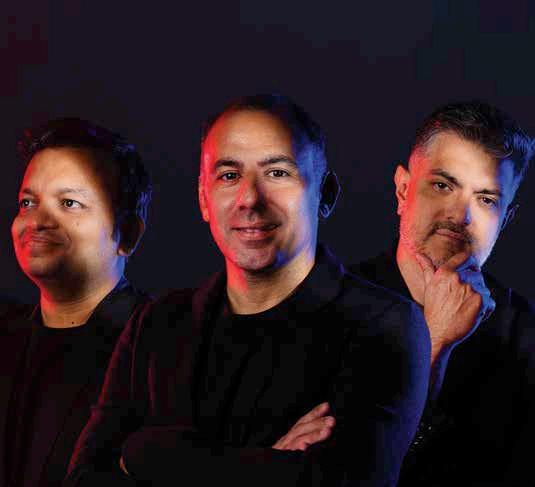



For the last decade, the global marketing and MarTech industry has treated intelligence as a direct function of data volume. More data, more tracking, more identifiers and more history. The assumption has been simple: the more you know about an individual, the more relevant your experience can be. That model is now showing its limitations.
As artificial intelligence (AI) adoption accelerates across marketing, customer experience and digital, many organisations are discovering that aggressive data collection does not automatically translate to better outcomes. It can create fragile systems, regulator exposure and a growing trust deficit with customers.
In parallel, something more interesting is happening in the Middle East. Driven by Personal Data Protection Law (PDPL) regulation and clear government-led digital standards, the region is quietly shaping a more advanced model: intelligence without intrusion.
MRM MENAT’s Simon Geer shares how the Middle East is building intelligence without intrusion – a world where trust, regulation and artificial intelligence (AI) capabilities are converging.


This is not innovation despite regulation; it’s innovation because of it.
REGULATION AS AN ARCHITECTURAL CONSTRAINT
In markets where data collection has historically been permissive, AI systems have grown around identity. Persistent profiles, cross-channel tracking, enrichment pipelines and long-lived behavioural histories became the default building blocks. Personalisation engines learned who you were before they learned what you needed. PDPL frameworks invert that logic. They force teams to justify data retention, limit unnecessary identifiers and think carefully about purpose and proportionality. At first glance, this feels like a constraint. In practice, it forces better system design.
When you remove the assumption that every interaction must be tied back to a permanent identity, teams are encouraged towards architectures that prioritise context, intent and immediacy. The result is AI that is less invasive, more adaptive and often more accurate.
FROM PROFILE PEOPLE TO UNDERSTANDING MOMENTS
The most effective AI systems emerging today are not obsessed with who the user is. They are focused on what is happening right now.
Contextual signals – such as device states, location types, time, languages, current tasks, content being consumed and session behaviour – provide more actionable insights than years of historical data. When processed in real-time, these signals allow AI systems to respond with intent, not identity.
This shift fundamentally changes how personalisation works. Instead of saying, “We know this person, therefore we know what to show them”, the system asks, “Given this moment, what is the most relevant response?”
That distinction matters. It reduces the need for long-term tracking, eliminates large classes of consent and storage risk and aligns organically with privacy-first regulation. It also produces experiences that feel helpful rather than uncanny.


PRIVACY-FIRST DOES NOT MEAN INTELLIGENCE-LIGHT
There is a persistent misconception that privacy constrains lead to weaker AI. However, it often exposes lazy thinking. Surveillance-heavy systems tend to overfit on historical patterns. They are slow to adapt when behaviour changes, brittle when data pipelines break and expensive to govern. Context-driven systems, by contrast, are designed to operate with incomplete information. They are resilient by default.
In the Middle East, this has led to increased adoption of techniques such as session-based intelligence, ephemeral data models, edge inference and semantic understanding. These approaches do not rely on stitching together a person’s digital exhaustion over months or years. They focus on relevance in the present, then let
the data expire. From a trust perspective, this is a meaningful shift. Customers aren’t just passively aware; they’re actively concerned about how their data is used. According to the International Association of Privacy Professionals, 67 per cent of consumers globally say that they are either somewhat or very concerned about their privacy online, and 86 per cent expect data privacy rights from the companies they interact with, meaning brands that ignore privacy expectations risk losing trust before a customer even engages.
Experiences that deliver value without obvious tracking feel respectful. Over time, that respect compounds into confidence.
For organisations operating in PDPLgoverned markets, this shift is not abstract. It is already influencing how AI systems are selected, deployed and governed.
Leading brands are increasingly favouring models that minimise data exposure by design:
Session-based AI models that operate without persistent identifiers.
Ephemeral data retention, where contextual signals automatically expire. Edge and in-region inference to avoid unnecessary data movement.
Clear separation between experience intelligence and identity systems.
The commercial benefit is significant. These approaches reduce consent friction, simplify governance, lower breach exposure and shorten time to market. They also create AI systems that are easier to explain to regulators, boards and customers alike. In practical terms, privacy-first AI is becoming a riskreduction strategy, a trust signal and a speed advantage; not a constraint.
What is emerging in the region is not a compromise between compliance and creativity, but a competitive advantage. Organisations that design for privacy from the start are building AI systems that are more modular, explainable and agile. They are less exposed to regulatory shocks and better positioned for a future where global standards continue to tighten.
Crucially, this model also reframes the role of data teams and marketers. Success is no longer measured by the volume of data you collect, but how intelligently you use the signals you are allowed to have. That requires stronger strategy, better taxonomy and closer alignment between business intent and technical design.
The Middle East is often described as a fast follower in digital. In this area, it is quietly leading. Intelligence without intrusion is not a philosophical stance. It is a practical response to a world where trust, regulation and AI capability are converging. The regions that recognise this early will not just comply better. They will build better systems.
By Simon Geer, Technology Director, MRM MENAT

Seedtag’s Sherry Mansour explores how agentic AI is giving advertisers a deeper understanding of consumers’ motivations and emotions, and unlocking new insights and opportunities.
Across the GCC, digital consumption continues to accelerate, from premium streaming and social platforms to online news and long-form content. At the same time, advertisers face rising pressure to operate faster, smarter and more responsibly. In markets like Saudi Arabia and the UAE, more than 80 per cent of organisations feel urgency to adopt AI (artificial intelligence), with nearly 70 per cent planning to increase their investments.
Yet while many brands are experimenting with AI to improve efficiency, most are still applying it as a support tool rather than a strategic engine. The next shift isn’t about faster automation; it’s about autonomy. And that’s where agentic AI is changing the game.
When agentic AI is paired with neuro-contextual intelligence, advertisers can move seamlessly from emotion to execution. Neuro-contextual AI decodes how people think and feel based on the content they consume, and agentic AI turns those signals into an actionable layer for discovering audiences, understanding competitors, and shaping smarter strategies.
WHEN AI BECOMES A STRATEGIC COLLABORATOR
Until now, most advertisers have used AI
to handle repetitive tasks, like bid adjustments, campaign scheduling and performance monitoring. While useful, these systems still rely heavily on human guidance. Early adoption largely centred on large language models (LLMs), which are designed to generate, analyse and summarise information when prompted, but not to act on their own.
“AGENTIC AI IS NOT A PASSING TREND. IT REPRESENTS A STRUCTURAL SHIFT.”
Agentic AI changes that dynamic. Instead of simply responding to inputs, it introduces AI-powered agents that can operate independently to achieve defined goals. Rather than following rigid instructions, these agents interpret information, adapt in real time and carry out multi-step actions with minimal human input. You define the objective, and the system determines the path to reach it.
In advertising, this means autonomous systems that connect signals across platforms, react instantly to performance data and continuously learn from outcomes. Campaign execution becomes intelligent and always-on, while human teams can focus on creativity, strategy and ethical innovation instead of manual optimisation.
Autonomy alone isn’t enough. Human relevance remains the foundation of effective advertising. For years, the industry has searched for privacy-first ways to reach consumers across the digital ecosystem. Traditional contextual targeting has played a central role in this effort, placing ads based on keywords, page categories, or broad themes. It ensures brand safety and privacy, but often misses the human layer, the why behind someone’s engagement with content.
Neuro-contextual advertising expands that intelligence. Grounded in neuroscience and advanced embeddings, it interprets content the way people do, identifying deeper signals of interest, emotion and intent across the open web, video and connected TV (CTV).
Instead of asking only what a page is about, neuro-contextual AI considers why someone is there and how receptive they are in that moment. Ads appear when people are cognitively and emotionally aligned with the message, not just when a topic looks broadly relevant. It’s privacy-first relevance built on understanding environments rather than tracking identities.
FROM EMOTION TO EXECUTION
Neuro-contextual intelligence can be seen as the brain – capable of interpreting interest, emotion and intent. Agentic AI becomes the ‘action layer’, transforming those insights into real time decisions across the campaign lifecycle. Together, they can provide competitive analysis, evaluate neuro-contextual alignment, surface audience insights and optimise delivery continuously. Media planning evolves from static targeting into an adaptive process where AI supports strategy, experimentation and performance at scale.
WHERE CONTEXT BECOMES INTELLIGENCE
Agentic AI is not a passing trend. It represents a structural shift in how campaigns are planned, launched and refined. Decisions happen faster, relevance becomes emotional as well as contextual, and performance adapts continuously rather than in cycles. By combining agentic AI with neurocontextual insights, advertisers can ensure that campaigns resonate on a deeper, more human level, without losing autonomous execution.
For advertisers, this means agility and scale without sacrificing human understanding. For publishers, it supports environments designed for both meaningful user experiences and intelligent media workflows.
As advertising grows more complex, success will depend on combining autonomy with neuro-contextual relevance, using AI not just to move faster, but to connect smarter.
By Sherry Mansour, Managing Director, Seedtag MENA
We are living in interesting times. Not the postcard kind; the Chinese curse kind. The ground is shifting. The algorithms are writing rules we never agreed to. And here’s what everyone misses while optimising their dashboards: inflection points don’t reward operators. They never have.
The ones who mastered the old system, the old workflows, the old pipelines – they’re beautifully trained for a world that’s quietly dissolving.
Moments like this, the ones that arrive twice a century, if you’re lucky, reward something else entirely: vision. The reckless belief that you can see what is not there yet.
The last time tools changed this fast, we got the internet. Before that, cinema. Before that, the printing press.
And every time, the winners weren’t the ones who used new technology to do old things faster. They were the ones who realised you could do entirely different things. Things that didn’t have names yet.
Now the industry is breathless about AI. Understandably. But almost everyone is asking the wrong question: How do we use generative AI to make more stuff faster?
Videos rendered in minutes. Campaigns summoned from prompts. An endless flood of synthetic assets. The trades gasp, applaud, pivot to scale. This is the shallowest possible reading of the moment. We’re holding foundation models that could reshape how humans think and create, and we’re pointing them at the assembly line.
We’ve been handed a revolution. We’re using it to optimise the status quo. We’re so busy marveling at hyper-realistic AI
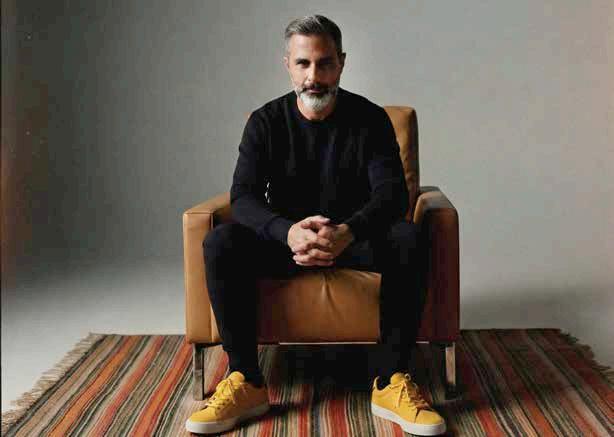
1N7ERES71NG 71MES’ Mo Alghossein calls for the industry to dial forward to a world where strategists believe the right questions outweigh a thousand optimised outputs, where people challenge things because they can’t help it, and leaders are arrogant enough to believe they can change how people see the world.
video demos that we can’t see what happens when intelligence becomes infrastructure instead of performance. Intelligence as infrastructure doesn’t mean ‘AI writes your copy’. It means something more fundamental: the brief arrives and the system has already pressure-tested its assumptions. Research isn’t a phase – it’s ambient, continuous and already synthesised by the time you sit down. Your institutional memory, every deck and debrief and post-mortem from the last decade, searchable not by filename but by meaning.
The meeting isn’t about catching up. It’s about deciding what matters. This isn’t science fiction. The components exist today. Retrieval systems that surface what you forgot you knew. Agents that orchestrate workflows while you sleep. Embeddings that find the connection
between this brief and something your team wrote three years ago. The gap isn’t technical. It’s imagination. Here’s the uncomfortable truth: much of what we called work was never work at all.
The coordination. The reformatting. The rescheduling. The tools that promised efficiency and delivered quicksand. All of it automated now – not to replace us, but to reveal what we’re capable of when the friction disappears.
The creative industry scoured the earth for people who could see around corners. People who could hold an idea that didn’t exist yet and make others believe in it.
And then, with great ceremony, we gave them status meetings. We found storytellers and made them fill timesheets. We built systems for those who could survive the grind and politely filtered out those who could imagine the leap.
We hired these people for their judgement. The instinct that surfaces when research is inconclusive and someone must decide. For taste no training data can teach. Then we drowned them in process and called it professionalism.
No model replaces that judgement. AI clears the path to it. Every brief pre-tested against its weak assumptions, inference running in the background while you focus on the work that matters. The human conversation becomes about what only humans can do: the gut call, the creative risk, the conviction that this is the idea worth fighting for. This is the real automation – not the automation of creativity – the cognitive automation of everything preventing creativity from happening.
The bureaucracy is evaporating. Automated into irrelevance. And what remains belongs to the ones who were supposed to lead but kept getting pulled into meetings. The ones who maintained creative instincts despite years of administrative suffocation.
The strategists who believe the right question outweighs a thousand optimised outputs. The ones who challenge things because they can’t help it. The ones arrogant enough to believe they can change how people see the world. The industry needs them now more than ever.
I look at what’s possible today and I cannot sit still. Do you remember how it felt when you started? When everything was new, everything was discovery, and the work itself was the reason you showed up? Before the meetings, the process, the learned habit of lowering expectations so disappointment wouldn’t sting?
That feeling is available again. Not as nostalgia. As possibility. The bottleneck was never talent. Never ideas. Never compute. It was the courage to change. These interesting times demand nothing less.
Fortune favours the brave. It always has.
By Mo Alghossein, Founder and Chief AI and Creative Technologist, 1N7ERES71NG 71MES



RChannel Factory’s Vincent Pelillo discusses why the future will belong to brands that embrace AI thoughtfully, balancing innovation with integrity, efficiency with empathy and performance with purpose.


amadan is a season of reflection, intention and connection. For brands across the UAE and the wider Middle East, North Africa and Turkey (MENAT) region, it is also one of the most significant moments of engagement, where storytelling, media and community intersect at scale.
At a time when audiences are more attentive and emotionally invested, the way brands show up matters more than ever.
Simultaneously, emerging technologies, artificial intelligence (AI), automation, predictive analytics and generative systems are reshaping the entire marketing playbook. From insight generation to creative execution and media optimisation, technology is no longer a support function. It is central to strategy.

The question is no longer whether to adopt AI, but how to do so responsibly.
FROM AUDIENCE TARGETING TO MINDSET ALIGNMENT
Traditional segmentation models relied heavily on demographics and declared interests. Today, AI-driven systems analyse behavioural signals, contextual environments and content patterns in real time.
In Ramadan, when content consumption peaks across video platforms, CTV and social media, understanding mindset becomes more important than understanding static audience labels.
Consumers are engaging with spiritual reflections, familyoriented content, cooking traditions, charitable initiatives and entertainment programming in distinct patterns. AI-powered contextual intelligence allows brands to align messaging with these environments, ensuring relevance while respecting cultural sensitivity.
The shift is clear: from targeting people to aligning with moments.
PERSONALISATION WITHOUT COMPROMISING PRIVACY


GENERATIVE AI AND THE CONTENT SURGE
AI has unlocked the ability to personalise messaging at unprecedented scale, optimising creative variations and placements dynamically.
Yet in a region where trust, reputation and community values are paramount, personalisation must be grounded in privacy-first principles. Increasingly, brands are moving toward contextual and suitability-based models rather than dependency on intrusive data tracking.
This approach is particularly important during Ramadan, when emotional resonance carries greater weight. The objective is not just efficiency; it is respectful relevance.
PREDICTIVE ANALYTICS: ANTICIPATING INTENT


Another major evolution lies in predictive analytics. Rather than reporting past performance, AI models can now forecast which content environments and formats are likely to drive meaningful engagement.

During high-demand periods such as Ramadan, this capability enables marketers to optimise budgets dynamically, reducing wastage while maintaining brand alignment.



In practice, predictive insights are helping brands balance scale with precision, ensuring that increased seasonal investment translates into measurable business impact.


Generative AI has dramatically accelerated content production, from script ideation and localisation to creative adaptation across formats.

However, the rapid growth of synthetic content across platforms introduces new complexity. While AI can enhance creativity and accessibility, it can also blur the lines between authentic storytelling and artificial amplification.

In culturally significant moments such as Ramadan, authenticity becomes critical. High engagement alone is not a sufficient metric if the surrounding environment compromises credibility.

As AI-generated content continues to proliferate, the focus must shift from pure performance metrics to contextual quality and brand suitability.
AUTOMATION AND INTEGRATED WORKFLOWS
Beyond media and creative, automation is transforming marketing operations. AI-powered systems streamline campaign setup, performance optimisation, reporting and insight generation, allowing teams to move faster without sacrificing control.
For regional marketers operating across diverse MENAT markets, this integration ensures agility while maintaining governance standards aligned with cultural and regulatory expectations.
GOVERNANCE, TRUST, AND THE NEXT ERA OF MARKETING
As technology accelerates, governance becomes the stabilising force. Clear frameworks around brand suitability, cultural sensitivity, data privacy and transparent measurement are no longer optional, they are foundational.


In our experience working across the MENAT region, combining contextual intelligence with performance analytics has proven essential in helping brands navigate complex content ecosystems, particularly during high-attention seasons like Ramadan.
At Channel Factory, we have seen that sustainable growth comes not from maximising impressions alone, but from aligning brand messages with environments that reflect the values of the audience.

Looking ahead
Emerging technologies are transforming marketing at every level. But in moments of cultural significance, such as Ramadan, the emphasis shifts from speed to intention. The future of marketing in the region will belong to brands that embrace AI thoughtfully, balancing innovation with integrity, efficiency with empathy, and performance with purpose. Because in an era defined by automation and scale, trust remains the most human metric of all.


By Vincent Pelillo, Regional MD, Channel Factory




“AI can speed up the output, but it cannot take responsibility for the decision. That part is still ours,” writes Fusion5’s Elias Moubayed.
There is a quiet panic running through agencies right now, and it is understandable. When a machine can generate a campaign recap, draft a media plan, and produce 10 headline options in minutes, people naturally jump to the worst-case scenario: How long until my role is redundant?
But that question is built on a false assumption that our value sits in producing the work. In media, the real value has never been the slide, the recap, or the first draft. It is the judgment behind it. It is knowing what matters in the data, what to ignore, what to test next, and how to make trade-offs when budgets, timelines and business goals collide. AI can speed up the output, but it cannot take responsibility for the decision. That part is still ours.
That is the shift agencies need to name clearly. AI is making baseline work faster, cleaner, and more accessible to everyone.
The danger is not that agencies will stop being needed. The danger is that agencies will keep selling operational work when operations have become cheaper.
If you look at what AI is doing inside media teams, it is not replacing strategy, it is removing friction. It compresses tasks that used to take hours into minutes. That is real progress, and it should be welcomed. But it also forces a question that is more uncomfortable than job security: if everyone can do the basics quickly, what exactly are clients paying for?
The answer is decision quality. Clients do not need more slides they need better choices. They need an agency that can look at a messy mix of signals, platform performance, consumer behaviour, seasonality, and creative realities, then make a call that is grounded and defendable. This is where judgment stops
“AGENCIES THAT WIN IN AN AI-NORMAL MARKET WILL NOT BE THE ONES USING AI THE MOST LOUDLY, BUT THE MOST DELIBERATELY.”
being a soft skill and becomes a commercial advantage.
Judgment shows up in the decisions that actually move performance, setting the right KPI hierarchy, not just chasing platform wins, knowing whether an efficiency spike is real or simply cheap impressions, balancing reach and frequency with intent, building plans around what creative can genuinely deliver and focusing spend and testing on what will create learning and impact, not just a prettier weekly report.
AI can support all of that, but it cannot lead it. Not because it is not capable, but because it does not live with the consequences. A model can suggest a budget split. It cannot sit in front of a client and explain the trade-offs with confidence. It cannot take accountability when performance drops because the wrong objective was chosen, or because the plan was built on a flawed assumption. That ownership remains human.
This is why the agencies that win in an AI-normal market will not be the ones using AI the most loudly, but the most deliberately. They will build workflows where AI accelerates the parts of the job that slow teams down, while humans spend more
time on the parts that move results: problem definition, scenario planning, measurement design, and clear recommendations.
AI can help you generate options, but strategy is the act of choosing. The competitive edge comes from how well an agency can do three things consistently.
First, start with better inputs. If you feed AI generic context, you get generic output. Strong agencies build a habit of capturing what they learn: what drove performance last quarter, what messages resonated, what audiences moved, what formats delivered, what seasonality looks like in the category, and what constraints exist in the real world. When that knowledge is structured and reused, AI becomes far more valuable, because it is working from reality, not assumptions.
Second, use AI to widen the solution space, then apply judgment to narrow it. Instead of asking for one plan, smart teams ask for three and pressure-test each one. This is where AI becomes a thinking partner, not a shortcut.
Third, prove impact with discipline. As AI makes reporting easier, the market will be flooded with summaries that look polished but do not change decisions. Agencies stand out by linking results to actions. Not just ‘what happened’, but ‘why it happened’. AI can help you get to that story faster. Humans have to ensure the story is true.
The question is not “how long until my role is redundant?” The better question is “what standard will my role be held to now?” Because once the busy work shrinks, there is nowhere to hide behind volume. Clients will ask for clearer thinking, stronger justification, and more measurable progress. And that is exactly where agencies can win: not by competing on output, but by competing on judgement.
By Elias Moubayed, Associate Director - Media and AI Integration, Fusion5
Have a chat with any marketer, creative or founder, and you’ll likely land on the conversation, and all their opinions, around artificial intelligence (AI). Some doom. Some gloom. And plenty of unknowns. People are saying it’s taking the creativity out of our industry. I believe there’s something more serious going on than that. This piece isn’t so much about the tech, more about the people – read: you and me.
Yes, AI is exposing creativity. But, more specifically, it’s exposing average creativity. Generative AI tools have made ‘good enough’ work faster, cheaper and easier than ever before.
As someone who long advocated for speed, quality and value across the industry, I still believe AI is a great enabler of achieving that.
But we’re starting to see something more problematic. Videos that took days to bring to life, are now produced in 30 minutes with a 300-character prompt. Copy that needs five rounds of feedback is spat out in less than five seconds.
The speed isn’t the problem. Being OK with the output as-is is. This shift matters, because when the bar of average rises, the middle becomes the most dangerous place to hang around.
For the longest time, many people managed to make careers in that space of grey. Producing work that’s not bad, not brilliant, but good enough. But now, with rapid progress in AI, that grey space will no longer be rewarded. What it means to be ‘average’ has been firmly revolutionised by AI.
We’ve all seen AI slop. I’m now talking about work slop. Opinion slop. So much slop, everywhere. If an intern with an app can create similar work to a marketing veteran with traditional tools, then there’s been an obvious shift. And that forces a very uncomfortable question for a lot of people in the creative space:
‘What are we actually bringing to the work?’ The answer won’t be speed. AI can go faster than you. It isn’t polish, either. AI beats you there too. And if it doesn’t now, it will soon.
So if everyone is relying on speed and polish, how can you stand out from this new higher bar of average? Make AI your intern, just don’t let it be your final output. Don’t regress to average. Don’t let it marginalise your contribution to excellence.
Elite developers don’t code any more; they have agents for that. But they still define problems, give sharp feedback, and design systems to optimise for excellence. They do more, quicker.
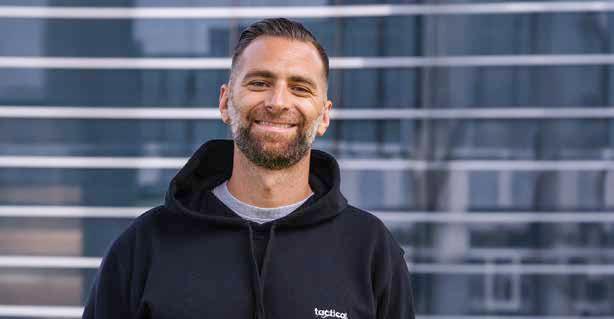
Tactical’s Mike Khouri explains how AI put into the hands of someone who understands culture and human behaviour is powerful, but it leads to slop when placed in the hands of people looking for the easy way out, cutting corners and choosing to be lazy.
Our industry is different from engineering. It relies on human truths as it always has: cultural literacy, nuance, and real-time insight. These are things machines can’t replicate – at least, for now.
AI can take meeting notes, but it can’t read a room. It can draft lines, but it can’t feel a tone shift. It can mimic a voice, but it can’t understand why a joke lands in one market and dies in another. That distinction matters deeply. Especially in a region like the Middle East.
This isn’t a shortcut market. It never has been. And those who tried got spat out time and again. Yes, AI improves efficiency. And it will keep getting better. But without strong judgement before the output, efficiency becomes automation. And automation without taste becomes noise. Remember, noise gets ignored.
Think of AI like steroids. Anyone can boost performance by juicing up. But if you expect steroids to replace the hard work in practice, you’re wrong. Instead, steroids amplify what’s already there. And if you have no underlying strength, you’re going to be exposed.
The same applies in marketing. AI, put into the hands of someone who understands culture and human behaviour, is powerful. But if you look for the easy way out, to cut corners, choose to be lazy, it produces exactly what the market is already drowning in: slop.
AI has already raised the baseline. The advantage has shifted to those who use AI as leverage as opposed to a hack.
AVERAGE IS THE ENEMY AND AI JUST MADE IT YOUR PROBLEM
The irony? The more automated our industry becomes, the more human the best work needs to be.
This morning alone, with AI, I could’ve done a lot: Written an article about ‘The Flaws of the Marketing Funnel’ – a point of view for another day. Vibe coded a mobile app. Built a 3D game.
And all could’ve been delivered at a passable level because of friends like Claude, ChadGPT and Gemma-ni. But the thing that scares me most, is so could you. So could a student. So could anyone with a laptop and the tools.
So AI is not the enemy here. We need to move on from that. Average is. Yes, you can use AI. Yes, you should use AI. Everyone should. But use it as your intern. If work slop is your final output, then you’re accepting average. And no matter how much the bar of average is raised, it should always remain the enemy.
By Mike Khouri, CEO, Tactical
Every technological shift forces the same question: Not “what can it do?” but “why are we using it?”
In 2026, artificial intelligence (AI) has firmly embedded itself in the creative process. It writes, edits, animates, generates, versions and localises content at a speed the industry once dreamed of. Tasks that once took weeks now take minutes. Entire campaigns can be spun up before a meeting ends.
And yet, something feels off. Not because the work looks bad – but because much of it feels empty. This is the paradox of AI in creativity – the tools are improving faster than our thinking.
For years, effort acted as a filter. You couldn’t make something unless you cared enough to spend the time, money and energy to bring it to life. Friction forced decisions. Constraints demanded intention. You had to choose what mattered, because you couldn’t afford to do everything.
“THE AGENCIES THAT WILL SURVIVE THIS MOMENT WILL NOT BE THE ONES WITH THE BEST AI WORKFLOWS. THEY WILL BE THE ONES WITH THE STRONGEST BELIEFS.”
Liwa Content.Driven’s Sagar Rege makes the case for originality, stating that the most important creative skill is not the use of AI, but knowing when and why it shouldn’t be used.
Today, that filter is gone. The cost of creation has collapsed, and with it, the discipline that once forced clarity. When everything is possible, very little is meaningful.
We are now surrounded by what is increasingly called AI slop – content that looks finished but isn’t formed. It follows the rules. It hits the beats. It mimics taste without possessing any. It fills space, not purpose. It exists because it can, not because it should.
But the real danger isn’t that machines are making it. The danger is that humans are approving it. AI slop is what happens when speed replaces belief.
The creative industry has always confused activity with impact. AI has amplified that confusion. We can now generate 10 ideas where we once made one. We can test, tweak, optimise and version endlessly.
But 10 ideas don’t equal one strong conviction. In fact, abundance often weakens decision-making. When everything is easy, nothing feels worth fighting for. Choices become optional. Opinions become negotiable. Everything is reversible, so nothing is committed.
Here’s the uncomfortable truth: AI hasn’t changed creativity. It has exposed it.
It has exposed how often we rely on polish instead of point of view. How frequently we hide behind execution to avoid making a choice. How comfortable we’ve become delivering work that offends no one and moves no one.
In this environment, the most important creative skill is not the use of AI, but knowing when and why it shouldn’t be used.
When should an edit stay imperfect? When should a frame breathe instead of impress? When should silence say more than spectacle? These are not technical questions. They are human ones.
At Liwa Content.Driven, we’ve learned that AI is most powerful when it sits downstream of thinking, not upstream of it. When the intent is clear, AI can remove friction, speed up execution and
open up new visual possibilities. It can help ideas travel further and faster.
But when the intent is vague, AI doesn’t solve the problem – it accelerates it. It simply produces faster confusion. AI doesn’t give you a point of view. It demands one.
Clients may not articulate this yet, but they feel it. They can sense when something was generated versus authored. When work is assembled instead of believed. When craft replaces courage. In a world drowning in content, intention becomes the rarest commodity. And rarity, not novelty, is what creates value.
This shift is also redefining originality. Originality is no longer about being first. Machines have already taken that from us. They can replicate styles, remix references and outpace production endlessly.
Originality in 2026 is about resonance. About saying something familiar in a way that feels deeply personal. About making people feel understood, not impressed. About creating work that lingers instead of scrolls away.
That doesn’t come from prompts. It comes from lived experience. From judgement. From taste. From courage.
The agencies that will survive this moment will not be the ones with the best AI workflows. They will be the ones with the strongest beliefs. The ones willing to say no – to clients, to trends, to the temptation of easy output. The ones who understand that technology should serve meaning, not replace it.
AI will continue to get better. That’s inevitable. The real question is whether we will. Because in 2026, creativity doesn’t disappear. It polarises. Because in an era when creation is effortless, meaning becomes a choice – and the courage to choose is what defines us.
There will be content made because it can be made. And content made because it needs to be made. Our responsibility is to know the difference. And act accordingly.
By Sagar Rege, Director, Liwa Content.Driven







Hypermedia’s Hicham Dergham outlines how AI and automation are rewriting the rules of growth.

For most modern marketing history, decisions were made in the dark. Planners relied on intuition. Buyers trusted experience. Brands accepted uncertainty as part of the job. AI has changed that. Not by making campaigns faster, but by making them smarter.
The biggest shift in marketing today is not technological. It is philosophical. We are moving from approximation to precision, from assumptions to evidence, from fragmented activity to connected systems.
At Hypermedia, we do not see AI and automation as tools. We see them as the operating system of modern marketing.
THE FIRST QUESTION IS NEVER “WHERE DO WE ADVERTISE?” It is: Why?
Before screens, formats, or data models, we start with intent. Is the brand trying to lead a category, drive footfall, regain relevance, or convert interest into action?
Without that clarity, even the most advanced technology becomes expensive decoration.
Every strategy we build begins with this question. Only then do we align audience intelligence, creative direction, channel mix and performance metrics into a single structure.

The result was not just higher visibility. It was documented behavioural change. Footfall increased. Engagement deepened. Attribution became defensible. For the first time, the brand could clearly see how attention turned into action. That is what happens when strategy meets infrastructure.
WHY


The industry is obsessed with accumulation: more platforms, more dashboards, more automation layers. But complexity is not intelligence. Without structure, technology fragments operations and blurs accountability.
Our approach is different. AI must operate inside a coherent system. We use it to forecast audience behaviour, adjust budgets in real time, optimise creative performance and synchronise workflows.
Generative AI accelerates ideation and variation, allowing teams to test faster and explore wider creative territory. But it never operates without rules.

Brand voice is protected. Data is governed. Performance is audited. Every deployment operates within clear governance frameworks and brand safeguards.
Many campaigns become “omnichannel” by accumulation. Add social. Add mobile. Add retail. Add search. Soon, nothing connects. True omnichannel is not built by adding platforms. It is designed from the start.

Before a single format is chosen, we map the journey. We study how people move, where they hesitate, when they decide, and what influences them. Only then do we select the channels that matter. DOOH creates presence. Mobile delivers relevance. Digital reinforces memory. Measurement secures accountability.
Each channel has a role. Each role serves one objective. The audience experiences one coherent story. The brand manages one

“Today’s audiences drift between physical and digital. Automation makes those movements visible.”

intelligent system. Automation then becomes the engine of learning. Creative is tested. Timing is refined. Formats evolve. Budgets rebalance. AI processes signals at scale. Teams interpret meaning.
Strategy stops being static. It becomes adaptive.

This is the difference between running campaigns and building systems.

FROM BILLBOARDS TO BEHAVIOUR

Digital out-of-home was once treated as a moment. You appeared, you impressed, you disappeared. That era is over.


When AI and automation enter the equation, a screen becomes a trigger. Exposure initiates a sequence. Data identifies intent. Mobile reinforces context. Creative adapts. Performance systems refine delivery.

Today’s audiences do not move in straight lines. They drift between physical and digital spaces. Automation makes those movements visible. AI makes them usable.


Recently, a retail brand approached us with a familiar challenge: intense seasonal competition and declining in-store traffic. Instead of launching another awareness campaign, we built a connected system. AI models mapped high-intent movement patterns. Programmatic DOOH activated messaging at peak moments. Mobile retargeting followed exposure. Creative variations evolved weekly based on response signals.


MEASUREMENT IS THE NEW TRUST CURRENCY
As marketing becomes more automated, trust becomes more fragile. Clients no longer accept approximations. They expect evidence.


Every solution we design includes exposureto-action mapping, attribution frameworks, and transparent reporting. When performance is visible, confidence follows. Technology creates possibility. Measurement creates credibility.
spaces. Automation makes those movements a confidence follows. Technology creates possibility. decision. longer





THE SYSTEM AGE OF MARKETING

AI is not replacing marketers. It is demanding greater precision in every decision. In this new era, tools are easy to buy. Intelligence is not.






The advantage no longer belongs to those who move fastest, spend most, or shout loudest. It belongs to those who build systems that think. Systems that connect insight to action.
belongs to those who build systems that think.


At Hypermedia, this is the work we are doing. Not chasing technology and trends. Designing marketing that learns. Because the future will not belong to brands with the most data, but to those who know what to do with it.

Hicham




Facross the region. Big moment, big
production and a big media burst. It delivered attention, and sometimes it delivered growth.
Today, it delivers less certainty. Not because the market stopped valuing creativity, but because the market now demands speed, proof and efficiency at the same time. That shift is showing up in how budgets get approved and how risk is managed, especially when uncertainty slows decisions.
WPP Media cut its 2025 global advertising revenue growth forecast to 6 per cent, citing trade-related uncertainty that delays advertiser decisions. It also highlighted how digital dominates, and how user-generated content is projected to take a larger share of ad revenue than professionally produced content.
Read that as an operating signal. Clients will still spend in 2026, but they will spend differently. They will favour models that can move faster, adapt weekly and justify decisions with evidence, not taste.
One shift explains most of what you are seeing. This shift is from big production as the default, to always-on content as the default. Always-on does not mean more posts. It refers to a system.
This is a system that ships on a weekly cadence, learns from results and improves through iteration. A system where distribution and measurement are decided before production, not after. A system where the cost of variation is low enough that testing becomes normal, not heroic. This is where many teams fall into a trap. They try to respond by working harder inside the same old model. More rush. More requests. More variants. That is not a system. That is burnout with a publishing schedule.
Saudi National Day is no longer a one-day spike. It behaves like a longer cultural and commercial cycle, and platforms are treating it that way.
Snapchat recently reported that during the period there was a 92 per cent increase in add-to-cart actions versus the yearly average, and that a large share of users said their purchases were influenced by content viewed on the platform. While we should treat platform numbers as directional, not a universal truth, the direction is useful and can be validated with your own funnel.
The practical method is simple. Compare baseline conversion and add-to-cart rates across the year versus the National Day window. Control for discounts and media spend. Separate paid lift from organic lift. Then decide what that moment is worth next year based on incremental outcomes, not excitement. That can change everything downstream. It changes how you brief, what you produce, how often you ship, and what you stop.







Stop briefing content. Brief the change you

Stop briefing content. Brief the change you need in the business.

By Alhareth Albelaihed, Chief Growth Officer, Habbar
Most teams still talk about AI as a productivity tool. That is already too small. In a market where content volume and variation matter, AI lowers the cost and time of iteration.
That shifts what clients are willing to pay for. When good enough becomes easier to produce, deliverables lose pricing power. Judgement gains it.
The premium moves to three areas. Judgement in the brief, meaning the problem you choose and the tradeoffs you accept. Judgement in distribution, meaning where you place the work and how you earn reach. Judgement in learning, meaning what you measure, what you conclude, and what you change next week.
If your agency sells deliverables as the product, margins will keep collapsing. If your agency sells a learning system that reliably improves outcomes, you become harder to replace.
SAUDI FOCUS

Define what should change, by how much and by when. Then force operational clarity early. Ask what will ship weekly, what will be tested in two weeks and what will be stopped if it does not work. Ask for a distribution plan, not just a creative idea. Agree on measurement before production starts. If an agency cannot answer these simply, you are buying activity. You are not buying impact. Also, be honest about your side. If you cannot measure outcomes, you will keep funding opinions, not evidence.
Most agencies do not fail because they lack talent. They fail because their operating model wastes talent. At scale, the symptoms are predictable. Too many handoffs, blurred ownership and time spent coordinating instead of delivering. That is where quality dies, timelines expand and clients lose confidence.
Fixing this is not about adding more process. It is about designing the system so the work can move. One proven direction is to build smaller cross-functional units that own outcomes end-to-end. The label does not matter. The design does. The unit needs clear ownership of delivery and client outcomes, fast decision loops close to the work, shared accountability across account, creative, strategy and operations, and a learning rhythm that prevents repetition.
THE ONLY CLOSING QUESTION THAT MATTERS Is what we are doing today enough? Not if it means doing the old thing faster.
It is enough only if your model reduces waste for the client, learns quickly and scales what works. In Saudi and the MENA region, trust is still the currency. When a client signs, they are handing you risk. Your job is to reduce that risk, then grow the business.
Advertising in Saudi Arabia and the MENA region is changing, but if the work systems do not, therein lies a risk, says Habbar’s Alhareth Albelaihed.

Mohammad Aljuhani calls for the industry to take its work beyond marketing noise by mastering creative risks for real results.
Safe marketing will most likely fail. It has slim chances to grab attention and cut through the noise. Successful marketing hinges on taking creative risks; calculated risks.
Over the past years, our Saudi market has been experiencing unparalleled growth led by the ambition of Vision 2030. According to Saudi Arabia’s Ministry of Economy and Planning, the national GDP grew from $666bn in 2016 to $1.24 trillion in 2024, driving the growth of the marketing and advertising industry. Similarly, advertising spend in Saudi grew from $2bn in 2017 to $3bn by 2022, according to the Riyadh Chamber, marking the highest growth in the MENA region for that period. Yet marketing effectiveness was nowhere to be found. In 2025, the MENA Effie Awards held in Riyadh honoured more than 100 winners, but only four of them were Saudi brands. The 2024 Global Effie Index ranked regional agency offices among the top five most effective in the world, but none were Saudi-based.
Are we, as Saudi marketers, directing our work towards business results, or towards creating safe creative ideas that barely drive business forward? We need to stop wasting resources on safe creative work and hiding behind high-end production and big media budgets that offer vanity success and peer validation but not business impact.
Vanity metrics and production costs do not measure marketing effectiveness. Using high-end production and big media budgets to cover up a weak creative idea, may force the audience to see our message, but will they remember it? Or will it fade quickly through the clutter? It may be expensive and loud, but not effective. This is why high-end production and big media budgets should be used to accelerate a great idea, not mask a weak one.
Let’s take a step back and think of what our options as marketers are: We can either take risks on a novel idea or pick a safe creative idea that most likely will fail to deliver effectiveness. Fear of job insecurity instinctively drives marketers to avoid creative risk. In a growing marketing and advertising industry, especially in markets
such as the Middle East, every brand is fighting for attention. Safe creative work is a recipe to be invisible amid the clutter. We cannot pursue creative ideas that we are comfortable with if we want to drive business results. We should pursue creative ideas that challenge us, and ensure they are executed with finesse.
However, taking creative risks is a skill. It takes skill to find and embrace original ideas grounded in consumer insight. Ideas that have high potential to grab media attention, spark audience conversation, align with the brand personality and values, and communicate the message in a clear and simple way. Ultimately, this drives business results, if executed with craftsmanship and measured through a business impact framework.
Such skill needs to be developed and mastered gradually. Just like a pilot who needs to practise within a rigorous system before flying an aeroplane, we as marketers need to develop our skill to distinguish between rewarding risk and damaging risks.
That is finesse: the difference between gambling with our brand and taking calculated risks that drive positive business results.
Creative finesse is measured through frameworks that focus on real business success, whether in sales, retail traffic or brand equity. To grow as a market, the way we define our marketing success needs to mature.
We need to measure success through the business impact we drive, not by how many media impressions we generate or by our production scale. We need to foster a culture where creative work that brings discomfort is seen as a signal of potential, not a threat.
A creative concept that does not make us feel a slight tingle of unease when we see it is probably not disruptive enough to break through the noise. However, that unease must be paired with the discipline of effectiveness, by holding ourselves accountable and asking ourselves the fundamental questions. Is it novel? Does it spark conversations? Is it aligned with the brand? Is it grounded in consumer insight? Is the communication clear and simple? Does it drive business results? We must take our work beyond the marketing noise by
By
‘‘High-end production and big media budgets should be used to accelerate a great idea, not mask a weak one.”
mastering creative risks for real results. This is not a gamble on our brands or our livelihoods. It is about becoming true experts who recognise that safe work will go unnoticed. This is the same creative finesse that saw the Saudi General Entertainment Authority take home seven wins at Cannes Lions 2025.
By choosing effectiveness over vanity and calculated risk over mediocrity, we stop being mere spenders and become the real contributors to our Kingdom’s growth demands.
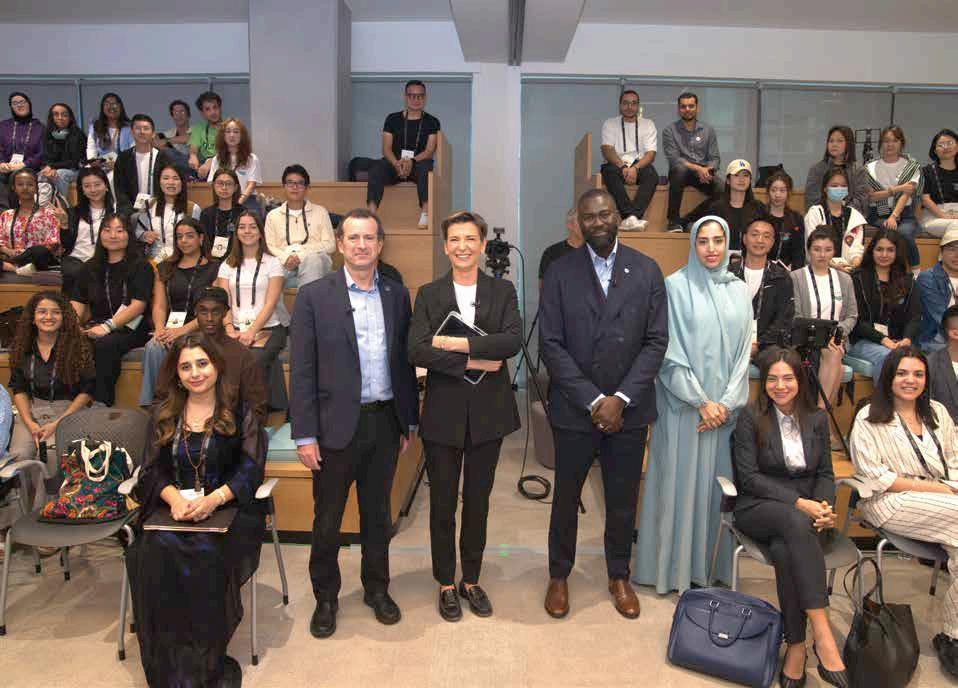


From a corner seat inside the 2025 cohort of the CNN Academy in Abu Dhabi, Campaign Middle East shares an empirical account of the experience and key takeaways, from orientation to ‘Simulation Week’.
By Shantelle Nagarajan


Forty-one students have their eyes-fixed on course instructor
David Ford at the CNN Academy
Abu Dhabi as he outlines the agenda for the three weeks of intensive journalism training they are about to embark on. From daily assignments to planning news programming, the Academy, hosted in partnership with Abu Dhabi’s Creative Media Authority, sets out to train these budding storytellers into broadcast-ready reporters.
I’m watching from a seat in the far corner of the room, as an embedded journalist, to observe how these students listen, take in, interact and apply their learnings to tackle everyday journalism tasks and enhance their reporter-required skills.
The real win? One of them who exemplifies their learnings from the Academy the best, will be offered the opportunity to return to CNN for a six-month-long internship at the news network.
The CNN Academy launched in Abu Dhabi in 2021 with a clear intention: train regional storytellers to meet global standards of news reporting in a world filled with citizen journalism and content creators. Since then, 165 participants – 95 of whom are Emirati – have been upskilled by internationally seasoned journalists to what Aysha Al Jneibi, Director of Talent Management at the Creative Media Authority, calls “the CNN standard”.
Al Jneibi says: “This investment strengthens the region’s communication infrastructure, ensuring that media professionals are not only technically skilled, but also culturally aware and globally competitive.”
Back in my corner in the classroom, I’m told that the fifth edition of the CNN Academy will bear the theme: ‘Community Storytelling’, with a goal to create a new generation of storytellers who reflect the UAE’s values and tell stories that resonate globally.
As the weeks go by, I discover exactly how the CNN Academy is designed to achieve this, how much of its training



sticks, and how it all comes together in a grand finale known as ‘Simulation Week’.
During Week One of the Academy, Ford explains how a daily morning news beat is laid out. He tells the students they’re in a CNN-style editorial meeting and asks them to place 10 stories in order of newsworthiness on the rundown ahead of the daily broadcast.
Sarah Satari, a PR professional and student at the Academy, listens intently and raises her hand to voice her opinion among the chorus that follows. When the session concludes, she tells me that it opened her eyes to what traditional journalists value in a story – truth, context and public interest – which differs greatly from her experience of how PR professionals categorise or order the value of stories based on the likelihood of engagement and reach.
“From my experience in PR, if you’re getting the content views, it doesn’t matter what the context is. When it comes to journalism, storytelling has a lot more layers to it,” Satari says. “It’s more about the value and purpose behind the story and what you can do with it in terms of context for the public.”
When I nudge her for another key take-away through her lens, she adds that she picked up on the elements of newsworthiness that matter to different sets of mass audiences, and how to position these stories in ways that are honest while maintaining integrity for the public interest.
Through the rest of Week One, students learn how to write scripts, interview civilians in the field, and report on stories that reflect several different communities.
In Week Two, the decks, presentations and fascinating conversations translate into on-ground action. The Academy’s curriculum unfolds like that of a highly condensed (yet a lot more hands-on) version of a university degree in journalism.
Students are taken through intensive training and workshops on ethical
frameworks, interviewing techniques, video editing, on-camera reporting and fact-checking protocols.
These sessions are presented to the young cohort by veterans in the broadcast media landscape, including Becky Anderson, Eleni Giokos, Luke Henderson, Glen Mulcahy, Alireza Hajihosseini and Laura Ford. Some of CNN Academy’s alumni also take the stage to share from experience how storytelling can shape realities.
“Right now, anyone with a phone in their pocket is a content creator,” says Hajihosseini, the Academy’s Director.
“The barriers to entry are gone. We’re no longer the traditional gatekeepers of information.”
He explains that the CNN Academy’s purpose is to teach students how to frame a story before the camera turns on.
Whether these students go on to become celebrated broadcast journalists or social media content creators, Hajihosseini reiterates the importance of truth-telling, trust and credibility across the information landscape.
“As long as that content is factual and follows an acceptable set of reporting guidelines that producers, storytellers and journalists both on-air and off-air agree on, that’s our job done,” he says.
In today’s global and regional media landscape, where everyone has an
“WHEN IT COMES TO THE BASIC TENETS OF JOURNALISM, THEY STILL ARE – AND HAVE ALWAYS BEEN –TRUST, TRUTH, EMPATHY AND COMPASSION.”


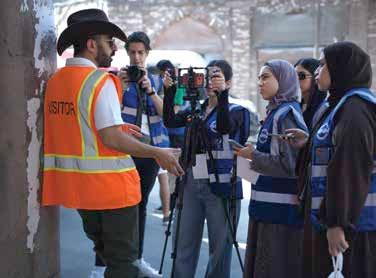


opinion and shares these opinions across traditional, digital and social media channels, these frameworks matter more than ever. This comes into sharper focus in an era when the amount of slop generated by artificial intelligence (AI) is ever increasing.
Becky Anderson, Managing Editor of CNN Abu Dhabi, explains, “AI has exploded the amount of content available. There’s a tsunami of content out there. The real question is: Can we trust it?”
Now, 30 years into her broadcast journalism career, Anderson tells students at the Academy that everything has changed, and yet nothing has changed.
In her words: “The tools evolved. The fundamentals didn’t.” It takes a second, but let that sink in. “When it comes to the basic tenets of journalism, they still are – and have always been – trust, truth, empathy and compassion.”
Those fundamentals resonate deeply with the cohort’s students.
For Muhamad Hani, an Emirati student at the Academy, a key takeaway from Week Two is how media literacy is essential for even the regular, everyday citizen – not just for journalists and independent media professionals.
“The facts within the news are very important, and how you receive and share this news matters,” he says. “But to reach that stage, everyone must know the difference between real news and ‘news’
that’s just for clicks.”
By the end of week two, the class is not only adept at differentiating real news from fake news and sensationalised news, but has also learned how to ‘go straight to the source’, conduct interviews on camera, read from a teleprompter, write scripts for news packages, edit videos and conduct themselves professionally in a live broadcast setting.
While the sessions are extremely informative – almost overwhelmingly so – the real lessons often take place on the fringes; the real takeaways are gathered in
“WHAT MAKES [CNN ACADEMY] GREAT IS THAT THIS IS A ‘SAFE-TO-FAIL’ ENVIRONMENT – STUDENTS ARE ALLOWED TO MAKE MISTAKES, WHICH IN REAL LIFE COULD POSSIBLY GET THEM FIRED OR KILLED.”
moments when instructors impart feedback on students’ work.
WEEK
The adage ‘true learning lies outside one’s comfort zone’ is put to the test during Week Three, when students are taken outside the confines of steady walls and shown a world where the walls are –almost literally – crumbling around them.
This happens in ‘Brynania’ – a fictional country created by political science professor Rex Brynen along with thousands of his students – that teaches future journalists the complexity of reporting on-ground in the midst of an ongoing civil crisis.
“You can sit down in a classroom and learn an awful lot about journalism,” says Brynen. “But until you’re really under pressure in a chaotic, tense, complex environment, you’re not really testing those skills.”
Unsurprisngly, and true to the name of the ‘simulation week’, students are thrown into situations where they have to think and act on their feet, including a mock live press conference, reporting amid the carnage of live civil demonstrations, and figuring out how to keep themselves safe in a chaotic environment. Above all, they must find trusted sources of information –separating fact from misinformation, disinformation and sensationalised, emotional viewpoints – and share their







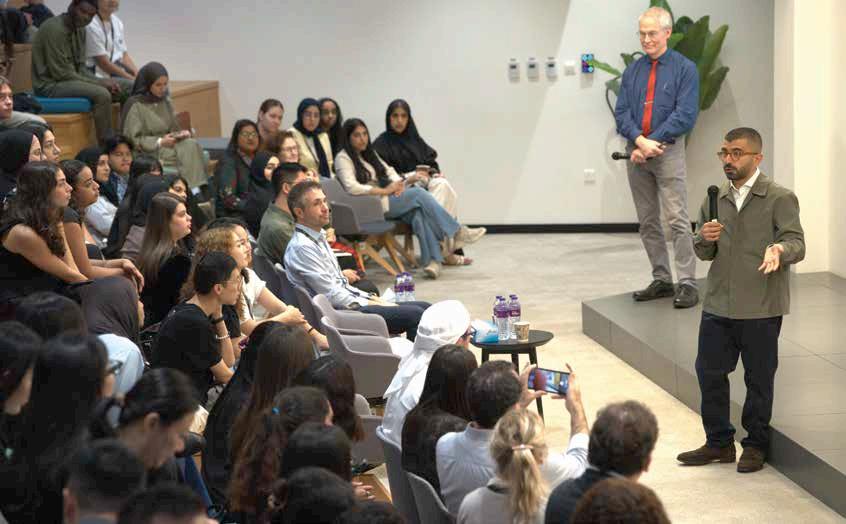
findings in live reportage amid the tense and constantly evolving landscape.
Carrying their preparation from CNN and the Johns Hopkins Center for Humanitarian Health, and their camera equipment, students set out to navigate the crisis environment of Brynania safely, reporting on their surroundings ethically and truthfully.
The students have an opportunity to let their learnings from the past week seep in rather than letting their natural, and often unknowingly biased, instincts kick in.
The ‘CNN standard’ is reiterated to ensure all sides of a given crisis are shared irrespective of feelings and raised emotions at the scene of an ongoing incident.
From the outside looking in, Brynania took me by surprise. Misinformation was flying left, right and centre; the ‘press’ was everywhere; facts and opinions were merged inextricably; and the crisis kept evolving based on every conceivable form of a socio-economic or geo-political emergency.
Through the eyes of a veteran, Brynen – who has watched hundreds of students cycle through Brynania over the years – identifies a pattern.
“Sometimes young journalism students are subject to what I call the ‘squirrel effect’,” he says. He shares how students and inexperienced reporters in high-stress environments react if someone were to yell ‘squirrel!’ Brynen says, “They can get distracted and completely lose track of what their story is about, the accuracy of their story, and how their story resonates. This is exactly why we throw a lot of ‘squirrels’ and distractions at them to see how they react in such situations.”
“What makes it great is that this is a ‘safe-to-fail’ environment – students are allowed to make mistakes, which in real life could possibly get them fired or killed,” he explains. “But at CNN Academy those consequences doesn’t exist. There’s nothing quite like it.”
As an observer, I find myself recognising certain patterns as the cohort canvasses Brynania, as well.
Students who stand out to me are those that go against the grain; take the harder path to report on stories that aren’t easily accessible; make the effort to find the human, community-led story. They speak to the wailing widow on the side of the road, the stragglers on the outskirts as well as the authorities on site such as a police officer. They interview humanitarian representatives who have spent a lot more time on-ground to capture a holistic viewpoint with all possible ‘truths’ of Brynania’s current state of crisis. Having that discipline and staying focused under pressure is exactly what CNN’s Anderson calls the defining factor of the Academy.
“Ethical reporting is really important,” says Anderson. “Our students get a really



good deep dive on the ethics of journalism, media law, and places that you might go for stories.”
She advises, “At the end of the day, it is absolutely crucial that our students understand that you have to source, re-source, double source and triple source information that you might use in your story.”
REFLECTIONS AND ADVICE TO FUTURE COHORTS
As the next edition of the CNN Academy comes calling, here are a few pointers that might help aspiring storytellers along the way:
1. Make your application stand out: When you submit your application to the CNN Academy, you’ll be among hundreds from the region doing so. Salma Arafa, an Academy alumnus, who currently works on the CNN team, recommends applicants to “think like a storyteller and be authentic”.
“I really hate the whole ‘Hi, my name is X and I’m 25-years-old’; it’s so boring,” she says. “Instead, tell a story that is personal and authentic. One that shows why we should choose you.”
A stand-out application, she reveals, tells CNN why they should care about your journey in storytelling. What is the fuel that fires up your passion to tell the stories of people around you? The answer to that question could set your application apart.
2. Read through all the theoretical material: Thoroughly read through every single resource and packet of information provided before the in-person sessions within the Academy begin, so that you can make the most of your time with the instructors present.
The reason for this is simple. You have extremely limited time with these instructors – who are industry veterans.


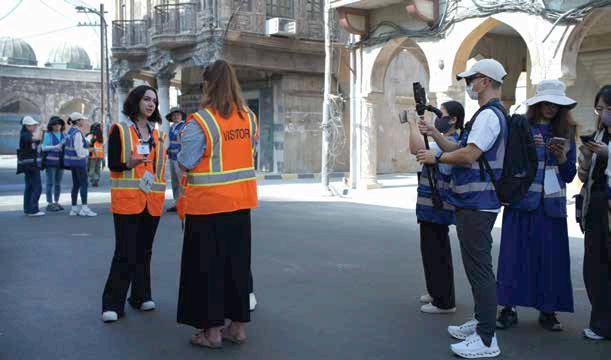
Leverage your access to these resources wisely.
3. Network with everyone: It’s easy to get caught up with all the celebrities at the CNN Academy. While yes, it’s extremely important to develop a network of contacts among renowned reporters and instructors, it’s equally important to connect with fellow students in the cohort. After all, they could prove to be valuable contacts and sources of information in the near future.
4. Always evaluate the impact of your storytelling:
Eleni Giokos, CNN Anchor and Correspondent, and host of Connecting Africa and Marketplace Middle East, wraps up one of the key takeaways, telling students to remember the weight of their platform.
She says that professional storytelling is one of the most fulfilling careers you could possible have.
“When you’re a journalist you can change someone’s life,” she says, advising students to think about the impact that they want to make with their work.
In her words, a true storyteller “never takes no for an answer. Whether it’s an institution you want to work for or an interview you want, don’t take no for an answer. Keep pushing and keep persisting.”
A total of 165 students have graduated from CNN Academy Abu Dhabi, with 41 more added to that number from the latest cohort.
They won’t all become journalists. But they’ll all know the difference between the truth and a version of it; the difference between a human story that serves the public interest and another created for clicks – and that will make all the difference.
To know more about the upcoming editions of CNN Academy, visit academy.cnn.com.
The creative industry in the GCC has never moved faster or felt more intense. In the UAE and Saudi Arabia, brands are transforming at an unprecedented pace, platforms are multiplying, and audiences are increasingly sophisticated, digitally native, and highly discerning. National transformation agendas, rapid adoption of new technologies, and a young, connected population have combined to make these markets some of the most dynamic in the world.
By any measure, these are markets defined by ambition, acceleration, and scale. Content demands are constant, platforms expand daily, and expectations continue to rise. In this environment, a question comes up repeatedly in agency boardrooms and brand meetings: Is the big idea still viable in a fast-moving, highly integrated world?
The answer is yes, but it is being tested. Across the region, brands are no longer asking for isolated campaigns. They want ideas that travel seamlessly across platforms, languages and markets. They want creative thinking that can live equally well on a highway billboard in the UAE, a mobile screen in Saudi Arabia and a social feed anywhere in between. Integration is no longer an added value; it is the baseline. And while this has raised the bar for effectiveness, it has also placed new pressure on how ideas are developed, executed and sustained.
This is where the misunderstanding often begins. Integration is sometimes positioned as the enemy of the big idea, when in reality it reveals whether an idea is truly strong. A powerful idea should not collapse under scale; it should become clearer. In markets as diverse and culturally layered as the GCC, weak ideas
Means Design’s Ihab Nassar argues that integration isn’t killing the big idea in the GCC; weak thinking is. In a market defined by speed and scale, craft is the real advantage.
are exposed quickly. Strong ones, however, gain momentum precisely because they are flexible enough to adapt without losing their core meaning.
Yet the challenge is real. Speed has become a defining characteristic of both the UAE and KSA. From real-time content to rapid market responses, pace is often seen as a competitive advantage. But the risk is not speed itself; it is what speed can quietly erode if left unchecked.
Craft is often the first casualty.
As timelines compress and output expands, there is a growing temptation to prioritise volume over value. Creative teams are expected to deliver more, faster and across more channels than ever before. Without clear standards and strong leadership, the result can be work that is efficient but forgettable, content that fills feeds rather than builds brands.
Protecting creative quality in this environment requires intention. It starts with reframing speed not as the opposite of craft, but as something that must be designed with craft in mind. Investing more time upfront in the thinking pays dividends later. A well-defined idea, one that is culturally grounded, strategically clear and creatively distinctive, moves faster downstream because decisions become simpler. Execution becomes sharper. Adaptation becomes disciplined rather than reactive.
‘‘IN MARKETS SATURATED WITH CONTENT, THE WORK THAT STANDS OUT IS RARELY THE LOUDEST; IT IS THE MOST CONSIDERED.”
In the GCC, this upfront clarity is especially critical. Our markets are fast-moving, but they are also nuanced. Cultural fluency cannot be rushed. Ideas that scale across the
region must respect local context while maintaining consistency. This balance is not achieved through templates or shortcuts; it is achieved through judgement, experience and collaboration. There is also a human dimension the industry can no longer afford to overlook. Sustained pace places real pressure on creative teams. Burnout is not an abstract concern; it is a reality felt across agencies in the region. If better work is the goal, healthier systems are part of the solution. Smarter workflows, clearer prioritisation and more honest conversations with clients about urgency all play a role in sustaining both quality and talent.
Encouragingly, many brands in the region are already recognising this shift. They understand that creative quality is not a luxury; it is a competitive advantage. In markets saturated with content, the work that stands out is rarely the loudest; it is the most considered. Speed may win attention, but craft builds trust.
The future of creativity in the GCC will not be defined by choosing between big ideas and integration, or between speed and quality. It will be shaped by our ability to hold these tensions productively, building ideas robust enough to scale, systems that move quickly without becoming careless, and cultures that value people as much as output.
In a region defined by momentum and possibility, the responsibility is to continue evolving creativity as a strategic discipline, one that scales with purpose, protects its people and delivers long-term impact for the brands and communities it serves.
By Ihab Nassar, Creative Director, Means Design
The conversation around AI in creative circles has been stuck on the wrong question. It isn’t whether we should use it. It isn’t whether it’s ethical, dangerous, overhyped or inevitable. The real shift isn’t technological. It’s psychological.
For years, especially in computer graphics, motion, and large-scale visual production, value was tied to execution. How fast you could build. How clean you could render. How many iterations you could survive without losing your mind.
Mastery meant technical endurance. The industry respected the grind.
Entourage’s Mohammed Suliman explores why, as AI handles more of the workflow, the real differentiator becomes intention – not output.
AI doesn’t erase that history. It simply rearranges what gets rewarded.
Execution is no longer the rare commodity. Direction is.
When tools become more powerful and more accessible, the baseline rises. More people can produce something that looks impressive. More teams can deliver at speed. The output increases. But when output increases, differentiation moves elsewhere.
It moves to judgment.
The ability to look at 10 variations and choose the one that actually works. The ability to understand cultural context, audience nuance, timing, restraint. The instinct to know when to push spectacle and when to pull back. AI can generate. It cannot decide. It cannot care.
And that is the mind shift.
There’s a tendency to frame this moment as a battle between human creativity and machine efficiency. That framing is dramatic, but it’s inaccurate. AI is not competing with imagination. It is competing with repetition. It is automating the parts of the workflow that were never the essence of the craft; the micro-adjustments, the endless resizing, the ‘one more version just in case’.
In markets like ours, where timelines compress around seasonal peaks, product launches, and campaign cycles that leave little room for reflection, that efficiency is not a threat. It is leverage. Standardising AI use across a team doesn’t dilute creativity; it protects it. When the baseline production layer becomes faster and more consistent, creative energy can move upstream, into concept, narrative, experience.
This is where the paradox sits. The more AI handles, the more human thinking matters.
Some resistance to this shift has been framed as artistic integrity. But often it’s attachment to effort. If your value was measured by how long something took, then of course automation feels destabilising. If your value is measured by the clarity of your ideas and the strength of your taste, then this moment is an upgrade.
AI rewards people who know what they’re looking for.
It exposes the difference between producing visuals and shaping meaning. In 3D environments especially, where complexity can easily become noise, the real skill is not adding more, it’s knowing what to remove. Knowing when something looks technically impressive but emotionally hollow. Knowing that spectacle without intention is just decoration.
As more teams adopt AI into their pipelines, something else happens: being the norm becomes the advantage. The leverage isn’t in being the lone rebel refusing new tools. It’s in integrating them so seamlessly that speed and scale are assumed. When AI becomes standard
practice, it stops being the headline and starts being infrastructure. And infrastructure is where serious work gets done.
This doesn’t mean the bar lowers. It means it moves.
The future creative in CG isn’t defined by how many tools they’ve mastered, but by how well they can direct them. The shift is from operator to editor, from technician to decision-maker. Not abandoning craft but elevating it. Technical skill remains essential, but it is no longer the sole differentiator. Taste, clarity, and perspective carry more weight.
‘‘WHAT IMPRESSES NOW IS INTENTION. THE MORE AUTOMATED THE PROCESS, THE MORE VALUABLE HUMAN JUDGEMENT BECOMES.”
There will be a surge of work that looks polished and feels empty. That’s inevitable whenever technology accelerates production. But that surge doesn’t diminish strong ideas; it makes them easier to recognise. When everyone can generate, the ones who stand out are the ones who choose deliberately.
So perhaps the real question was never “to AI or not to AI?” The tool is already here. It’s already embedded in workflows, quietly reshaping timelines and expectations. The more useful question is: what do you do with the time and leverage it gives you?
You can spend it chasing more output. Or you can spend it thinking harder about why something exists in the first place.
The paradox is simple. The smarter the tools become, the less impressive technical difficulty feels. What impresses now is intention. The more automated the process, the more valuable human judgment becomes.
AI hasn’t reduced the role of the artist. It has clarified it.
And if that means fewer hours wrestling with render settings and more hours shaping ideas that actually resonate, that doesn’t sound like a loss. It sounds like the part of the job we always enjoyed. Personally, I’ll take fewer progress bars and more ideas any day.
By Mohammed Suliman, Senior CG Generalist – entourage
The Middle East doesn’t have a creativity problem. It has a connectivity problem between marketing, commercial goals and senior decision-making.
There’s no shortage of inspiration, talent or unique ideas, yet campaigns continue to fall flat due to fragmented thinking. When marketing is not recognised as a commercial driver, leadership pours into short-term campaign cycles that are fundamentally disconnected from long-term goals. Over time, that disconnect doesn’t just dilute creativity; it erodes growth.
UNITING COMMERCIAL AND CREATIVE DIRECTION
For marketing to be truly effective, commercial and creative strategies should be united by a synonymous mission. Decision-makers need to recognise that marketing investment is not a nice-to-have, but is crucial for managing regional growth pressures and standing out in an immensely competitive market. When executed right, brand strategy is the north star that guides decision making, powering long-term expansion for any business willing to embrace it.
But it’s not an easy task. In an age of information overload, campaigns are becoming oversaturated day by day. Events and experiences boost engagement in the short term but fail to resonate deeply enough to make a real mark on brand growth. As businesses feel the pressure to expand rapidly, many rush to thinking bigger, investing more and launching ‘disruptive’ campaigns that prioritise virality over direction.
Reinventing the wheel might feel like a fast-track to impressing consumers, but if it’s not tied to KPIs and commercial objectives, the cracks will quickly show. Visibility without direction is expensive noise.
Before sitting down to plan any campaign, one key question must be asked: how is this solving our commercial problems? Getting clear on long-term business direction, upcoming product development and expansion plans provide the layers of knowledge to keep campaigns on track, from planning to execution. And using this commercial alignment as the foundation of marketing strategy will ensure it is built to generate lasting impact.
We’re seeing more and more Western campaigns cloned for audiences in the Middle East that don’t consider regional nuance, don’t speak to the right consumers and, ultimately, will not resonate. These campaigns miss the key local buying triggers that determine commercial value.
JWI’s Charli Wright shares why Middle East brands must stop treating creativity as a campaign moment and start aligning marketing with commercial strategy to unlock sustainable growth.

Western campaigns do not set the benchmark – the Middle East is finding its own voice. Brands that shy away from this risk their longevity, whilst brands that move quickly to become embedded in the shift will have the insight to craft intelligent campaigns.
Through a closer lens, audiences across the Middle East don’t respond to a one-size-fits-all approach, with regions defined by distinct consumer patterns, cultural contexts and trends influencing purchasing behaviour. In Saudi Arabia, Western humour in marketing campaigns underperforms, reducing shareability and consumer trust. It’s these regional considerations that determine brand perception, along with retained, long-term engagement over short-term bursts of visibility.
This market fragmentation signals how Western approaches fail to align with the region’s commercial realities. While brands in the Middle East face pressure to scale across diverse consumer segments, Western marketing models are designed for more stable, linear growth. Applying them without adaptation doesn’t just limit relevance; it caps commercial potential. The longer this is ignored, the greater the risk to brand credibility. And when businesses notice ROI decline from campaigns lacking regional relevance, it’s easy to assume that marketing is not a priority investment area. When, in fact, it’s simply not being applied in the right commercial context.
So why do brands keep making the same mistakes? The answer isn’t a lack of creativity, ambition or inspiration, but weak decision frameworks. Campaigns become easier to get on board with when they’re perceived as premium by a global standard – and this is exactly where the commercial impact starts to decline. Visibility is easily mistaken for value, especially in large-scale campaigns, and is more likely to secure approval. But over time, this erodes internal trust in marketing as a commercial driver, along with external trust in brand identity. Now, more than ever, businesses should be prepared to rethink their approach to marketing strategy. Using tactical campaigns to build a loyal customer base hinges on trust, reliability and resonance, requiring an always-on approach from those driving creative campaigns along with senior leadership. The brands that will lead this region are the ones that treat creativity as a commercial system, not a campaign moment. The way forward is clear: start repositioning creativity as a solution to commercial challenges, and stop investing in marketing that looks impressive but fails to deliver returns.
By Charli Wright, Owner and CEO, JWI
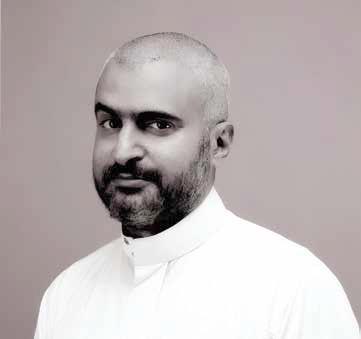
The fullstop’s Fahad AlAhmed shares a novel take on the paradox of an industry built in real time.
The Saudi creative industry is facing a growth paradox. Society is evolving faster than its narratives, and industry demand is expanding faster than the talent pipeline. But these tensions are signs of a sector being built at scale, in real time. If the next few years focus on authentic storytelling for a layered society and the medium-term cultivation of Saudi creative talent, then the Kingdom will not just build a creative industry; it will develop a distinctly Saudi creative voice.
Over the past few years, Saudi Arabia’s creative industries have moved from the margins to the centre of its national agenda. Advertising, content production, gaming, design and related sectors are no longer peripheral. Guided by Vision 2030, they have become strategic pillars in the Kingdom’s economic and cultural transformation.
The Kingdom’s continued upward trend in global competitiveness rankings reflects these efforts. The latest World Competitiveness Yearbook shows that Saudi Arabia recorded the second-best progress among measured countries, improving across all four pillars: economic performance, government efficiency, business efficiency, and infrastructure.
The creative economy is part of this advancement. Creative agencies, production houses, investments, and festivals have risen almost simultaneously, and the ambition is clear: to turn creativity into both an economic engine and a tool for national storytelling.
Yet behind this rapid growth are structural challenges that will shape the industry’s
trajectory. We need to understand and respond to a newly layered Saudi society with evolving identities, and address the talent mismatch, where demand far outpaces local supply.
Saudi Arabia is not changing in a single direction; it is expanding culturally, socially and economically simultaneously.
Global exposure, economic diversification, digital connectivity and social reforms are shaping a new Saudi identity that cannot be decoded at first glance. Today, Saudi consumers may live globally influenced lifestyles while still seeking strong local authenticity.
‘‘WE NEED TO UNDERSTAND AND RESPOND TO A NEWLY LAYERED SAUDI SOCIETY WITH EVOLVING IDENTITIES, AND ADDRESS THE TALENT MISMATCH, WHERE DEMAND FAR OUTPACES LOCAL SUPPLY.”
This has created a layered cultural reality that can appear contradictory without context. Saudis are not abandoning their heritage; they are expressing it differently.
For the creative industry, this presents both opportunity and tension. It enables richer storytelling, more diverse aesthetics, and new creative formats. Yet many brands and institutions still rely on simplified or nostalgic portrayals of Saudi identity, while audiences are already living a more nuanced cultural experience.
The result is a gap between how Saudi Arabia is portrayed and how it is lived. Creative industries are being asked to reflect a society that is more layered, more individualistic, and more globally aware, without losing its cultural roots. Fortunately, this gap has begun to close as the creative industry has developed greater cultural nuance.
TALENT MISMATCH: DEMAND OUTPACES SUPPLY
The industry is expanding faster than its talent pipeline. For decades, many creative sectors in Saudi Arabia relied heavily on expatriate professionals. With Saudisation policies and Vision 2030 targets, the system is shifting toward a locally driven workforce. The long-term goal is to build a sustainable creative economy powered by Saudi talent.
Saudi talent is advancing. According to the IMD World Talent Ranking 2024, Saudi Arabia ranks 32 out of 67 economies. A closer look shows it ranks 18 in appeal, but 33 in readiness and 54 in labour force growth. The Kingdom has been advancing rapidly in workforce development, but economic growth has outpaced the expansion of the talent base.
Demand for Saudi creatives has risen sharply across agencies, production houses, brand teams, entertainment companies, and government initiatives. Yet the supply of experienced professionals is unable to meet the demand.
This is not a question of potential; it is a question of time. Building a mature creative workforce is a generational process. Mentorship in creative industries requires years of practice, not just academic degrees.
The government has begun addressing this through new creative academies, scholarship programmes, and specialised training initiatives. One example is the recent partnership between the Ministry of Education, the National Institute for Educational Professional Development, Tatweer Educational Services Company, and Savvy Games Group, which aims to integrate esports and electronic games into the national education system, supporting future skills and career pathways.
These efforts will eventually produce a much larger pool of Saudi creative professionals. But in the short term, the industry faces a structural imbalance: The demand for authentic Saudi creatives is growing, while the supply of experienced talent is still catching up.
Market dynamics are to the advantage of young Saudi creatives as they are living in the golden era of local creative expression. Their talents are in high demand and our industry’s job is to find new ways to cultivate and grow such talent consistently and progressively.
By Fahad AlAhmed, CEO, the fullstop
Founded: 2023 HQ: Dubai
Heads of company: Emad Al-Ali, Chairman; Ramzy Abouezzeddine, CEO info@2mrw.cc
2MRW is a creative consultancy established to develop innovative, sustainable, competitive solution and create integrated brand strategies by leveraging the latest AI technologies.
SERVICES: Brand strategy; brand identity; communication strategy; marketing and sales solutions; AI powered solutions
KEY CLIENTS: Dakar Olympic City, Ergo Home Group, Reach Group, Administrative City of Libreville, Guinée Technopole
Founded: 2025 HQ: Dubai
Heads of company: Maria Rizzo o and Carina Najia hello@alinedcreative.com
Alined Creative is a boutique, content-first creative agency. Bringing together strategy, identity, production, social and influencer marketing, treating every touchpoint as part of one cohesive story – crafting aligned brand narratives that feel intentional, connected and built to resonate across digital platforms.
SERVICES: Full service creative and strategy services; creative direction; content production; influencer marketing and PR; social strategy; brand strategy; visual identity
KEY CLIENTS: Tim Hortons, Four Seasons, Ritual De Terra Resort
Founded: 2014 dimple@teamalo.com
We are a team of dreamers and innovators. We are not just a workplace, but a vibrant playground where imaginations have no boundaries. We understand that in today’s fast-paced and ever-evolving environment, we need to create relatable and resonating experiences that captivate audiences.
SERVICES: Building brands; creative conceptualisation and ideation; channel planning; experiential marketing; video production
Founded: 2024 HQ: Riyadh Head of company: Ayman Alsomali hello@boslah.sa
A creative strategy consultancy guiding brands and the community to discover their right direction and unlock their full potential through purposeful, insight-driven strategies.
SERVICES: Creative strategy; strategy; brand strategy; positioning strategy; campaign planing; campaign strategy; communication strategy; content strategy; consultation; marketing strategy; digital strategy; workshops
KEY CLIENTS: King Salman Park, New Murabba, The Red Sea, Saudi Green Initiative, Reflect Clinic
Founded: 1997
Offices: Dubai, Beirut, Cairo, Riyadh
Number of staff: 75+ info@aga-com.com aga-com.com
+971 4 445 8383
AGA is a full-service marketing and communications network delivering integrated marketing communication solutions across strategy, branding, creative, content and experiential marketing. Known for bold thinking and effective storytelling, AGA creates impactful and meaningful campaigns that challenge convention and drive measurable results.
One of the leading independent marketing communication networks in the MENA region for more than 25 years, AGA has proudly collaborated with numerous brands and is powered by a team of more than 75 professionals.
SERVICES: Full marketing communication services; strategic planning; creative design; consumer activation; production; branding and corporate identity; content planning and production
KEY CLIENTS: Galderma, GMG Group, Hasbro, Nokia, P&G, Perfe i Van Melle, Tabasco, Unisynk, Philips, Langnese Honey, Marina Mall, Nokia, Novartis, Cenomi Centers, Houri Hearing, BBAC, Societe Michel Sioufi Et Cie, Solen, Al Jazeera Vehicle Agency, Ford KSA, Lincoln KSA, Polaris KSA, Indian Motorcycles KSA, Quick Lane Service Centers, Dunlop, Falken, Vicks, Neurobion, Seven Seas, Always, On, Merz, Lipton, Raibal






Founded: 2009
Offices: Dubai and Riyadh
Ownership: TGW
Head of company: Mohammed Tayem, Founder & CEO entourageintl.com +971 4 338 8834; +966 114 19 19 19 info@entourageintl.com
Entourage is a regional powerhouse in creative, events and brand marketing, deeply rooted in Middle Eastern culture and driven by the belief in the power of humanto-human connection. At the heart of everything we do is storytelling, designed to build emotional resonance and forge lasting relationships between brands and their audiences. Our campaigns are anchored in data, insight and performance, ensuring both creative impact and measurable results. From mega-events to integrated brand launches, entourage has partnered with high-profile government entities and global brands, delivering some of the region’s most iconic moments.
SERVICES: Creative and advertising; event management; PR; social media; content creation and strategy development
KEY CLIENTS: Al Qadsiah Club, Aramco, Ministry of Sport - Saudi, Ministry of Transport & Logistics - KSA, Royal Commission of AlUla, Discovery Networks, Sharjah Commerce & Tourism Development Authority (SCTDA)
AWARDS: Eventex Awards 2025 – Bronzes (Tanween - Ithra’s creativity conference 2024 and Al Qadsiah End of Season Ceremony 2024); Eventex Awards 2024 – Silvers (Global Industrial Internet of Things Summit 2023 and Saudi Ministry of Defense at World Defense Show 2024).






Founded: 2006
HQ: Dubai
Head of company: Lyusok Jung hello@cheil.com
Cheil MEA is a leading 360-degree advertising agency. Renowned for its expertise, Cheil adeptly forges robust connections among advertising, retail, digital, activations and events, seamlessly integrating offline and online touchpoints.
SERVICES: Integrated campaigns; brand experience; digital platforms; social media; e-commerce
KEY
CLIENTS: Samsung, Volkswagen, Ahmed Seddiqi & Sons, Energizer Holdings, Abu Dhabi Equestrian Club
Founded: 2022 (Dubai)
Head of Company: Simon Morehead Camille@crater.global
CRATER is a Global Creative Production Company specialising in innovative and culturally relevant visuals. Founded in 2017 in Australia, the company has grown to have presence in Dubai, Riyadh, London, Sydney and Stockholm. Good people are the heartbeat of CRATER, where collaboration and equality unite agency, brand, and production partners.
SERVICES: Creative; production; DOOH; photography; AI

Founded: 2010
Offices: Dubai, London Head of company: Tom O on createmedia-group.com
SERVICES: Social media; digital; video production; logo design
Founded: 1968
HQ: Dubai
mccann.com
+971 4 445 4577
Founded: 2013 Head of company: Sari Kazma Headquartered: Saudi Arabia, Riyadh talktous@dicema.com
Dice is a strategic creative agency that crafts impactful events, activations, and social media experiences. Merging creativity with AI, Dice transforms brands through innovative storytelling, immersive brand activations, and future-focused campaigns.
SERVICES: Event planning and brand activations; social media and digital marketing; creative campaign development; video production and photography; AIpowered strategic brand solutions
Part of Omnicom and the flagship agency of MCN, FP7 McCANN is the number one creatively driven integrated marketing company in the MENAT region, providing best in class multidisciplinary capabilities and effective marketing solutions. The agency was the most awarded in Cannes and reclaimed the titles of Agency of the Year and Network of the Year at the MENA Effies. FP7 McCANN has also been certified as a Great Place to Work for four consecutive years.
SERVICES: Full-service advertising agency: brand strategy; campaign creation and activation; content creation and production; social strategy; content planning; design/UX; digital strategy; influencer and talent management; dashboard and reporting automation; community engagement; paid social and AI-based content scaling
KEY CLIENTS: Mastercard, McDonald’s, Arla, L’Oreal, Jordan Tourism Board, Saudi German Hospitals, Ferrero, Dubai Duty Free, Parkin, Egypt Tourism, Heinz, General Motors, e& Egypt, Orange Tunis, Palm Hills, Qatar Development Bank, Saudi Tourism Authority, Ooredoo, Al Fardan Group, Nestle, Gile e, Qatar Foundation, Shark Ninja, BSH, Unilever, PepsiCo
AWARDS: Cannes Global Ranking Report 2025: #1 agency in UAE; Cannes Lions: Most awarded agency in MENA 2025 & 2024; MENA Effies: Most Effective Agency Network 2025; Fast Company: Most Innovative Companies 2025; D&AD & New York Festival Awards: #1 agency in MENA 2024; Global Effie Awards: Network of the year 2024





Founded: 2019
Headquartered: Dubai
Head of company: Vaquas Alvi vaquas.alvi@epicworldgroup.com
Epicworldgroup.com is a strategic creative studio that inspires brands to become purposeful and win hearts, minds, and souls. Our North Star is to inspire optimism in everything we do. Epic World co-creates purpose through strategic thinking and creativity to help people and organisations grow.
SERVICES: Purpose and culture consultancy; advertising; branding; total commerce; communications
Founded: 2018
HQ: Dubai
Head of company: Hisham Lahouasnia love@freedom.studio
We are built for those who believe in the power of creativity. We are a creative studio that fuses brand with business, unraveling complexity to design purposeful brand-worlds, that stand the test of time.
SERVICES: Brand strategy; brand identity and design; brand storytelling; brand platforms and campaigns; content creation
KEY CLIENTS: Alshaya Group, Red Sea Global, Chalhoub Group, Eyewa, Kitopi


Founded: 2004
Headquartered: Lusail, Doha Qatar
Head of company: Krikor
Khatchikian
Number of staff: 126

Founded: 2024 Head of company: Anna George anna@ftaforbrands.com
Helping brands connect with audiences through music and entertainment by crafting artist-led campaigns, content and amplification strategies.
SERVICES: Music marketing strategy; artist partnerships; entertainment IP development
KEY CLIENTS: Fujifilm Instax, Styli, Red Bull, Lenskart, Dorco
Founded: 2019 HQ: Dubai
Head of company: Roger Halaby - CEO info@hanginggardens.agency
The Hanging Gardens Agency is a communication boutique concept built on the understanding that today’s most consumed currency is cost-effective creative content, along with brand experience and social media interaction, as it’s never been more important for a brand, a business, or an individual to stand out from the digital crowd.
SERVICES: Marketing strategies; advertising; social media; content creation; design and branding
KEY CLIENTS: L’Oreal Middle East, Katrina Group, Vintage Dreams Real Estate, New Lines Properties, JAYC Jewellry
Founded in 2004, G2. is an independent creative agency network delivering integrated strategic and creative solutions across the region with active operations in Qatar, Dubai, Lebanon and Oman. G2. partners with ambitious brands to build meaningful, results-driven communication platforms. For more than two decades, we have worked across diverse sectors including government, real estate, hospitality, retail, finance, healthcare and education. Our cross-industry experience enables us to combine strategic depth with cultural insight, ensuring that every brand we work with is positioned clearly and competitively within its market. At the core of G2. is a strong foundation. We believe that powerful creativity begins with intelligent thinking. Our services span brand strategy, positioning, research and insights, communication planning, campaign development, digital services, content creation and full-scale creative production.
We pride ourselves on being agile, collaborative, and insight-driven. Our team blends strategic thinkers, creatives, digital specialists, and project managers who work seamlessly to deliver ideas that are both imaginative and commercially effective.
KEY CLIENTS: Patchi, Oakberry, Dukhan Bank, Al-Fu aim Real Estate, Doha Festival City, QatarEnergy




Founded: 2005
Head of company: Carlos Nadal, MD, Havas Creative me-havas.com +971 4 455 6700 info@havasme.com




Founded: 1976
Head of company: Reham
Nader Mufleh
Number of staff: 300+ in the MENA region horizonholdingsmena.com +971 55 744 2241; +971 4 332 3304 reham.mufleh@horizonfcb.com; info@horizonfcb.com

We are Havas Middle East’s flagship creative agency, driven by a shared purpose: to create a meaningful difference for the brands, businesses and people we work with. We believe in creativity that is inspired in cultural insight, to build relevance and connection to drive earned media. Our integrated approach, guided by integrated strategic thinking, delivers ideas that go beyond channels.
SERVICES: Brand strategy; content creation; brand design; social media; advertising
KEY CLIENTS: Jumeirah, Adidas, DWTC, Homecenter, Levis, Muse, Bel Group, Warehouse Gym, Disney+, Aura, Birkenstock, P&G
AWARDS WON: 7 Grand Prix in Dubai Lynx in the past three years (+32 awards), wins across all major global and regional creative festivals: Cannes Lions, London International, D&AD, The One Show, Clios, Loeries, Adfest and MENA Effies.





Horizon FCB is a creative digital agency. We understand that activating business is critical, and so is building brands for the long term. We build brands that are both timely and timeless with creativity fuelled by diversity, data and technology to drive Big Business success. We believe that creativity is truly an economic multiplier and that brands can unlock it across everything they do. Whether it’s digital advertising, content creation, branding/design, performance or retention – we build a powerful strategic advantage over their competitors
SERVICES: Marcom and adtech strategy; branding and identity; integrated communication; digital and social comms; content creation; gaming and online/onground activations; retail and shopper experiences; rapid pace production; innovation and technology
KEY CLIENTS: Visa, Mai Dubai, Haleon, Centrum, Tums, Lipton, Total Energies, Mubadala, AMIS Developments, Emirates Skywards, Pentacore
AWARDS: Multiple awards in creative festivals such as: Cannes Lions Festival, The One Show, The Clio Awards, D&AD, Loeries, Cresta Awards, The Andys, Dubai Lynx, Gerety Awards, Kinsale Shark Awards & LIA.





Founded: 1971
Head of company: Dani Richa
Number of staff: 700+ impactbbdo.com
+971 4 4412 0800
info@impactbbdo.ae
Part of the global Omnicom Advertising and BBDO network, IMPACT BBDO was established in 1971 and offers comprehensive and integrated marketing communication solutions, covering a wide and prestigious base of global, regional and local clients. Our mission is to create and deliver the world’s most compelling commercial content across all mediums and screens.
SERVICES: Advertising; Brand & Identity Development; Corporate Reputation Management; Digital Marketing; Event Marketing; Integrated Project Management; Marketing Communications; Marketing Science; Performance Marketing; Production; Social & Content Marketing; Shopper Marketing
KEY CLIENTS: Aramco, ASMO, Department of Economy & Tourism, DP World Dubai Customs, Economic Development Board of Bahrain, Etihad, Future Minerals Forum , Google, HP, Jotun, OceanQuest, One&Only, PepsiCo, Pladis, Public Investment Fund (PIF), P&O Ferries, Ras Al Khaimah Tourism Development Authority, Royal Development Company, Sadia, Shamal Holding, Starbucks, UAE Government Media Office
AWARDS: Cannes Lions – MENA Network of the Year (7 consecutive years), Dubai Lynx –Agency of the Year, The One Show – No.1 Agency in MEA, WARC Creativity 100 – No. 1 Agency in MEA, Andy Awards – No. 1 Agency in Middle East, The Immortal Awards – No 1 Agency in ME, Campaign Middle East Agency of the Year – Creative Agency of the Year, ContagiousBest and Bravest Agencies in the World







Sebastian Roland Group Head of Strategic Planning Chairman and Group CEO
Ghassan Kassabji CEO, UAE and Chief Growth Officer MENA

Johannes DeBeer Executive Creative Director
Mamdouh Alfred Chief Finance Officer

Shadi El Mourad VP Strategic Partnerships
Jad El Rabahi Managing Director

Nawal Momen Projects Director, Impact Proximity
IFounded: 2000
Head of company: Dani Richa
Number of staff: 100+ impactproximity.com
+971 4412 0850
info@impactproximity.com
Ali Rez Chief Creative Officer, MENAP

Faith Rodrigues Experience Design Director, ImpactProximity
Kordahi Group HR Director

Mohammad Sakib Technical Lead, Impact Proximity
mpact Proximity is part of Omnicom’s IMPACT BBDO Group, leveraging experience design, digital innovation, technology, and data to build scalable platforms and experiences that create measurable business impact across MENA.
SERVICES: Experience design strategy; audit, competitive analysis; audience research & journey mapping; ux discovery workshops and interviews; information architecture, UX wireframes and user flows; UI design; interactive prototypes and accessible digital design system; content structure; UX writing and localisation; digital asset production; performance optimisation; web personalisation; website development; mobile app development; quality assurance; content publishing; SEO strategy and implementation; analytics strategy and implementation; data visualisation and analysis conversational AI solutions; intelligent agents and automation
TECH PARTNERS: Webflow, Sitecore, Optimizely, Umbraco, Wordpress, Sitefinity, Microsoft Azure, IIS, AWS, Cpanel, Strapi, Salesforce, Figma, Adobe Creative Cloud, Google Marketing Platform, Power BI, Oracle, .Net, React, PHP, IOS and Android native, OpenAI
KEY CLIENTS: ASMO, Capital Bank of Jordan, Department of Economy & Tourism, Dubai Customs, Dubai Islamic Bank, Economic Development Board of Bahrain, Front End, Future Minerals Forum, OceanQuest, Sadia, Shamal Holding





Founded: 2020
HQ: Dubai
Head of company: Hana Feidi contact@healzealdigital.com
We are a boutique digital marketing agency specialising in website design and content creation for professionals in health, fitness, nutrition, wellness and any small business that promotes healthy products and lifestyle services.
SERVICES: Website design; content marketing; marketing strategy; branding KEY CLIENTS: Savoir By Tina Chagoury, SQOON, Well@Life, The Serene Effect, iCore Wellbeing
Founded: 2018
Head of UAE: Ayham Homsi Head of KSA: Majeed Alzayer business@hrmny.co hrmny.co
hrmny, a creative agency in Dubai and Riyadh, thrives on a unique music industry history, ensuring a distinct edge in creativity.
SERVICES: Creative strategy and campaign; social media management; multimedia production; music production and activation
Founded: 1997
Heads of company: Rita Boustany , Fady Boustany
Headquartered: Dubai, JLT fady.boustany@tia.ae
The Idea Agency is a full fledge advertising agency offering 360-degrees marketing and communication solutions. We focus on building and maintaining brands, while helping them achieving their KPIs by applying strategic and cost-effective plans.
SERVICES: Creative; public relations; media buying; social media management; digital marketing
Founded: 2023 Head of company: Rasha Hamzeh admin@theinhouse.agency
SERVICES: Brand development and identity design; creative strategy and advertising campaign development; content creation; podcast preproduction; production and post production; interactive and experiential design; website and packaging design





Agency Type: Founded:
Locations: Full-service 2011 Dubai, Riyadh, Cairo
Leadership Panel:




Bassem Elhady Executive Chairman CEO
Bahy Aboelezz MD, KSA
Omar Shoeb ECD
Bio:
We are an independent, award-winning advertising agency driven by innovation.
We lead with consumer data and insights, turning them into strategy and creative, led by content and expanded through paid media to drive growth and measurable impact.
Founded in 2011, with offices in Riyadh, Dubai, and Cairo, we operate as a powerhouse combining efficiency with the edge of 170 diverse local talents. We partner with brands to bring cultural resonance across the MENA region.
Services:
Consumer Insights, Strategy, Creative, Social, Sports, Production, AI Studio, Media Planning & Buying.
Awards:
Dubai Lynx Independent Agency Of The Year
Dubai Lynx Grand Prix Winner
MENA Effies Gold & Bronze Winner
TikTok Ad Awards Bronze Winner
Key Clients:
Contact Us: info@kijamii.com kijamii.com
Founded: 2024
HQ: Abu Dhabi
Head of company: Murali, Managing Partner hello@jockamobarnes.com
Jockamo Barnes is a strategy and creative agency that helps brands instigate culture. We create uncommon and unforgettable brand ideas that drive business results and challenge convention across the Middle East and beyond.
SERVICES: brand strategy and cultural intelligence; innovation design; 360° campaign development; cultural experience design; film and production
Founded: 2012
HQ: Cairo
Head of company: Hesham Ellabban hello@kairo.me
Kairo shatters certainty, channeling data into strategy to unleash creativity for experiences that drive growth. One of the region’s most awarded agencies since 2012, we don’t just navigate the supersonic future, we dictate it.
SERVICES: Strategy; creative; branding; digital media and performance marketing
KEY CLIENTS: FABMisr, Pepsico, Mondelez, Marakez, Unilever
Founded: 2009
Offices: Dubai and London Head of company: Georgina Clair Woollams info@katchthis.com
SERVICES: PR; social media; branding; design; content creation; digital marketing
Head of agency: Nadim Ghrayeb mena.inquiry @publicisgroupe.com
Leo Burnett first opened doors on August 5, 1935 in Chicago, USA with three accounts, and has since expanded to 85 offices in 48 countries with around 10,000 employees. Today, Leo Burnett and its unique ‘Humankind’ philosophy, rooted in the belief that creativity has the power to change


Founded: 2007 Offices: Dubai and Los Angeles hello@lightblueww.com
SERVICES: Animation; brand strategy; broadcast; content creation; content production; creative; design; digital; events; experiential; film; live brand experience; motion graphics; original IPs; strategic planning; virtual production
the world, has become synonymous with advertising excellence. Under Publicis Groupe, Leo Burnett’s multiple offices across the MENA region consult an enviable portfolio of global and local clients, served independently as well as in collaboration with multiple sister networks offering PR, media, data, and technology solutions under Publicis’ ‘Power of One’ model.
SERVICES: Marketing communications; advertising; social media; digital media; branding; audio-visual production; digital and social strategy
KEY CLIENTS: McDonald’s, General Motors, Emirates NBD, Ferrero, Dubai Holding Corporate, Dubai Holding Asset Management, Arabian Oud, Iktiva, Heinz, The Central Bank of the UAE, AADC, Puma, Home Centre, Babyshop, Dubai Duty Free, Cheeze It – Kellogg’s, Yango (Yasmina), Abu Dhabi Media Office, Samsung, Department of Government Enablement, Six Flags Qiddiya City, Aquarabia Qiddiya City, AlDar, Emirates Islamic Bank, Liv Bank, Dubai Holding, TAQA. Leo Jordan – Ila Bank, Zain, Visa, UNICEF, DIFCO. Leo Levant – Procter & Gamble, Nestle, OmanTel, Philip Morris International.
AWARDS: Cannes Lion, MENA Effie, Dubai Lynx, Jay Chiat, Fast Company Most Innovative Awards, D&AD, AME Awards, Loeries, AME Awards, LIA




Founded: 1987
Headquartered: UAE
Head of company: Sagar Rege
Number of staff: 40 liwa.tv/ hello@liwa.tv
Liwa is a hybrid creative+production powerhouse that bridges the gap between worldclass strategy and hyper-scale delivery. We work upstream on brand and product strategy, shaping product-level storytelling that forges meaningful engagement between brands and their audiences. Our expertise spans long-format, narrative-led content designed to build enduring soft power.
We are located across Dubai, Riyadh, Abu Dhabi, Mumbai, Jeddah and New York. Notable work includes: Bayut, Emirates NBD (Ramsatna Wahda), Pantene, Saudia, Emirates NBD (Brand Sonic).
SERVICES: Strategy and creative; brand positioning; identity and design; films, documentaries and high-end production; AI-films and creatives; internal and external comms
KEY CLIENTS: Emirates NBD, Emirates Islamic, Cleveland Clinic Abu Dhabi (M42), Aster Healthcare, G42, Bayut
AWARDS WON: Cannes Gold (Saudia), Indie Agency of the Year - 2025, Effies Independent Agency Award Index 2023 + 2024, Dubai Lynx (Grand Prixs + Golds + Silvers + Bronze)








Founded: 2022
Headquartered: Abu Dhabi, Yas Island
Number of staff: 50+ magnitudecreative.com +971 50 988 6074. business@magnitudecreative.com


Magnitude Creative is an independent, award-winning creative agency built on the belief that collaboration and partnership drive meaningful business growth. The agency delivers integrated communications rooted in strategic insight and bold creative execution, spanning digital media, influencer marketing, social media, events and content production that fuels brand growth across the UAE, KSA and Egypt.
Magnitude has also launched the region’s largest content creator programme, Content Masters, alongside a digital platform, Destination Abu Dhabi, and a podcast, 100X Abu Dhabi, dedicated to promoting Abu Dhabi’s business leaders and entrepreneurs. The agency has experience across major regional clients, including government entities, consumer and lifestyle brands, and experiential platforms. Magnitude Creative operates as a lean, professional force guided by a people-first philosophy and a results-driven mindset.
SERVICES: Advertising integrated communications; influencer marketing & consultancy; social media; branding; production; podcasts; digital media; events
KEY CLIENTS: Destination Abu Dhabi, Hardee’s, Krispy Kreme, Botim, Canon, International Securities



Founded:1995 (London); 2012 (GCC) Info.UAE@mcsaatchi.com.
M&C Saatchi is the largest independent advertising network in the world, and the home of ‘Brutal Simplicity of Thought’. With regional offices in Abu Dhabi, Dubai, Beirut and Riyadh, the agency was born out of the need for strategic, brutally effective creativity.
We navigate complex change, to create new opportunities with technology and creativity, and to lead the way forward.
SERVICES: Advertising; branding; CRM; consultancy; design; digital; mobile; PR; research; shopper; social and sponsorship.
Founded: 2020
Head of company: Nour AlMasri
Headquartered: Riyadh, KSA contact@menabloom.com
MENABloom is a digital content marketing agency based in the UAE and Saudi Arabia, specialising in technology, finance, government, corporate, and lifestyle industries. We deliver tailored strategies, creative content, and campaigns, helping clients drive engagement, brand growth, and measurable results across MENA.
SERVICES: Content marketing; social media management; production; influencer management; strategy development
Founded: 2023 HQ: Dubai Head of company: Manuja Sharma create@nujainc.com
nuja inc. is a creative agency working with businesses in the design and construction industry, helping them build brand systems that feel as intentional as the spaces, services and ideas they put into the world.
We call it full-stack brand marketing.
SERVICES: Marketing audits; brand development; social media marketing; creative content production
KEY CLIENTS: Designsmith, APE Grupo, Franklin Templeton, Nellis Architecture, Kohler
Founded: 2012
Headquartered: Dubai
Heads of company: Lama Accary Bibi and Baha Bibi
Number of staff: 75 meansdesign.ae/ +971 4 355 1500 connect@meansdesign.ae

Founded: 2022
Headquartered: United Arab Emirates - Abu Dhabi petrikorsolutions.com
SERVICES: Website design and development; search engine marketing/pay-perclick; SEO (search engine optimisation); social media marketing; mobile application design and development
reative is the essence of Means Design. Means Design is a 360° integrated marketing agency delivering branding and creative concepts, social media management, communications and PR, events, content production, performance marketing and website development through one seamless model.
Our work brings strategy and creativity together to ensure clarity, consistency, and impact across every touchpoint. Built on collaboration and long-term partnerships, we support brands with integrated solutions that drive relevance, strong brand value and measurable results across the region.
SERVICES: Integrated 360° marketing consultancy; creative and branding; public relations and influencer management; social media and digital strategy and analytics; performance marketing; content planning and creation; events planning and execution
KEY CLIENTS: Emaar Hospitality Group, Vyom by Emaar, Six Senses The Palm, Masafi, Dubai Opera, At.mosphere, Al Habtoor Grand Resort, Autograph Collection, Sofitel Hotels & Resorts, Sheraton Hotels & Resorts and Americana Group





Founded: 1984
Headquartered: Dubai, United Arab Emirates
Head of company: Ghassan MaraqaCEO MENA
Number of staff: 490 memacogilvy.com +971 4 305 0200 info.dubai@ogilvy.com
Memac Ogilvy, part of the Ogilvy network and a WPP company, is an awardwinning integrated creative network that makes brands ma er for Fortune Global 500 companies as well as local businesses, with 10 offices across the MENA region. The company creates experiences, design and communications that shape every aspect of a brand’s needs through five core capabilities: advertising and brand, public relations and influence, experience, health and wellness and social media.
Notable work includes: Abu Dhabi Department of Culture and Tourism - AIncient Influencer; Al-Fu aim IKEA - Phone Sleep Collection; Majid Al Fu aim Malls - Deira City Center 30th Anniversary; Talabat - Get Tarek to Go Pro; AlFu aim Toyota - Journey into HerStory
SERVICES: Creative, PR and influence, social media, digital, health and wellness
KEY CLIENTS: Department of Culture and Tourism, Mastercard, Al Fu aim, Qatar Foundation, Mondelez





CEO MENA, Memac Ogilvy
IN AN INDUSTRY SHAPED BY ACCELERATION AND AUTOMATION, WHAT SHOULD CREATIVITY PROTECT AT ALL COSTS?
The single most important challenge, especially as clients seek large campaigns at scale across multiple platforms, is to ensure that we do not resort to ‘replication’ but instead deliver genuine creative ‘amplification’. Automation excels in delivering speed and undertaking repetitive tasks, and it frees up creative professionals to deliver strategic thinking and elevate the creative output, which are key to delivering impactful campaigns.
That means while automation takes care of the ‘what,’ we must uphold the ‘why’ and challenge every insight and create afresh, so that we can stand out from the ‘sea of sameness.’ We must elevate powerful, human-centric ideas and protect the creative spark above all.
WHAT DOES GOOD CREATIVE LEADERSHIP LOOK LIKE IN TODAY’S ENVIRONMENT, AND HOW IS IT CHANGING?
Creative leadership is evolving from ideation
and execution to building an end-to-end ecosystem, which addresses the pain points of clients, going beyond briefs and uncovering insights that add tremendous value to campaigns.
A great creative leader is a strategic partner to the client, focusing on their business challenges and addressing them through talent and technology.
HOW ARE AGENCIES APPROACHING STORYTELLING BEYOND INDIVIDUAL CAMPAIGNS, AS BRANDS SEEK MORE COHERENT AND CONNECTED CREATIVE SYSTEMS?
At Ogilvy, we are already moving from delivering campaigns to co-creating entire brand ecosystems for our clients.
We adopt a truly integrated approach, underpinned by our ‘borderless creativity,’ and tap into the potential offered by WPP Open, our intelligent operating system. This enables us to challenge briefs from the word go and ensure that our narrative and campaign idea work across multiple platforms and channels.
Every creative campaign, no matter small or big, thus becomes an authentic expression of the brand story.
Above all, by engaging clients within the platform, they become collaborators – from writing to brief to ideation and execution, while ensuring that their data is secure.
HOW ARE CREATIVE AGENCIES ADAPTING THEIR CAPABILITIES, TEAM STRUCTURES OR WAYS OF WORKING TO DELIVER MEANINGFUL WORK AT SCALE?
As clients look for large-scale campaigns that work across diverse platforms, delivering meaningful work means focusing on delivering strategic value.
At Ogilvy, we leverage WPP Open to create specialised AI agents that is infused with the brand’s DNA and our own market intelligence. This allows us to build agile teams that can scale campaigns without diluting the core idea.


Founded: 2022
Headquartered: Dubai
Head of company: Rémy Abouchakra, Founder & CEO
Number of staff: 20 hello@oui.agency +971 4 568 1294 oui.agency


Brands don’t grow alone. Founded in 2022, OUI builds identities, campaigns and digital ecosystems with cinematic ambition and strategic edge. We bring French creative sensibility to the precision and ambition of the region’s most forward-thinking brands. We think like builders, not consultants. Fast, plainspoken, collaborative. No templates. No house style. Every brand gets its own rhythm, its own visual language, sharpened by strategy and curiosity. Whether we’re shooting on set or training AI to invent new worlds, we refuse to repeat ourselves. We stay past the launch, past the invoice. Partnership doesn’t end when the campaign goes live. Sharp strategy. Brave creativity. True partnership.
Notable work includes: J1Beach branding, launch campaign and creative retainer; Le Chateau by BEYOND branding and launch campaign; Mansory Residences by Amaal launch campaign; Culinara branding and social media retainer; ARM Holding creative retainer
SERVICES: Strategy; brand identity; creative campaigns; content; production; social media; digital advertising; AI-driven creative workflows
KEY CLIENTS: J1 Beach, H&H, BEYOND, One&Only, OMNIYAT, Christian Dior Beauty, IWC, Charlo e Tilbury, Vandrel, ARM Holding



Founder & CEO
WHAT SETS OUI AGENCY APART IN TODAY’S CREATIVE LANDSCAPE?
We don’t have a signature look. We have a signature rigour. Every brand we work on gets its own visual language, its own rhythm and is built from the ground up, not borrowed from the last brief.
At OUI, we think like builders, not consultants. We’re fast, plainspoken and collaborative. And we stay in the room long after the launch, long after the invoice is paid and the campaign wraps. Because being invested in our clients’ success isn’t a phase. It’s the entire relationship.
Our clients don’t just come back for another project. They come back because the first one worked. That’s the difference.
HOW HAS THE AGENCY EVOLVED SINCE ITS LAUNCH?
Our mission hasn’t shifted since 2022. What’s evolved is our ability to execute it at scale, not by chasing volume, but by hiring the right talent, refining our craft, and never loosening our grip on the work itself.
In three years, we’ve gone from a studio to a 20-person team working with some of the region’s and world’s most discerning brands: Dior, H&H, Dorchester Collection, Omniyat, Tag Heuer …
We’ve built partnerships that span years, not quarters, while raising the bar on attention to detail, precision and creative ambition.
We’ve remained independent. That means we choose our clients, our talent and how we grow. Brands don’t come to us with finished briefs. They come to us to set the bar. To spot the next move. To act as creative guardians who challenge the category, not follow it. That trust gives us freedom. And freedom is the best ingredient for creativity.
We’ve never been interested in being the biggest agency. We’re interested in being the most precise one. Every project, every hire, every capability is measured against one question: does this help us build braver brands?
We build brands that feel like they mean something. Not louder. Not shinier. Just clear about who they are from the beginning.
Identities with weight. Campaigns with a pulse. Digital experiences that feel considered, not assembled. The kind of work that earns trust in markets where trust is everything.
But the part that matters most isn’t the launch film. It’s what happens next. The message six months later. The next brief. The client who says, let’s do it again.
We work across real estate, hospitality and lifestyle. High-expectation categories where details matter and shortcuts show. We’re not interested in volume or awards for their own
sake. We’re interested in brands that grow properly, and partnerships that last.
We’re one of the most technologically advanced creative agencies in the region. AI and generative workflows aren’t experimental for us. They’re production infrastructure.
We’ve executed full A-to-Z brand launches using advanced technology. Projects like Beyond’s Passo and Le Château were built, refined, and deployed using AI-driven pipelines that let us move faster and think bigger without compromising craft. The strategy, taste and editorial judgment remain ours. But the tools let us prototype in hours, scale production without diluting vision, and create visuals that didn’t exist before.

Founded: 1985
HQ: Lebanon
Head of company: George Slim pimo@pimo.com.lb
PIMO is a communication agency building strong resonant brands for over 30 years. Our solutions are designed to uncover Real insight, create Real experiences, and make a Real impact, to build deep and solid bonds with an increasingly demanding consumer.
SERVICES: ATL/BTL; activations; events ; influencer marketing.
KEY CLIENTS: Baroody Group, Ethel Chocolate, Fa al Holding (ClearblueBio Oil- Milton – One Touch), Libano-Suisse, Lipton Tea, Unilever Levant (Lux-OMO-Vaseline-Comfort-Jif-Lifebuoy- TRESemmé-Clear-Signal).
Founded: 1999
Headquartered: Dubai parichay@praxisadvertising.com
SERVICES: Brand strategy and identity, creative concepting and campaigns; environment and space design; content creation and storytelling; integrated communication and advertising
Founded: 2023
HQ: Dubai
Head of company: Raj Sagar raj@reddot.marketing
Red Dot Marketing is a strategy-led creative and performance marketing agency that helps brands build meaningful connections with their audiences. Working with both emerging and established businesses, the agency focuses on strong marketing foundations, audience-led growth, and long-term strategic partnerships.
SERVICES: Social media strategy and management; brand and communication strategy; performance marketing; content creation; public relations
KEY CLIENTS: Ascend Esports, Babyshop, Hungarian Games, The Fabrique, R’Rumi Diamond
Founded: 2016
Headquartered: Dubai & Riyadh hello@sciencesunshine.com
Science & Sunshine is a story-driven, fearlessly creative ad agency in Dubai and Riyadh that smells wonderful. We believe passionately in the power of brands and that all good selling is good story-telling. Our philosophy is ‘always never be boring’ , and we try to inject that into our creative product every day.
SERVICES: Integrated creative solutions; social and digital marketing; design and branding; activations and experiential; content planning and creation
Founded in 1926, Publicis Groupe Middle East today stands as the foremost communications and digital transformation agency holding group globally. Through the Power of One, we are uniquely positioned to help clients unlock growth through the intersection of data, creativity, media and technology. The Groupe enjoys a thriving presence in the Middle East fuelled by the region’s best talent, world-class agency brands and an enviable portfolio of clients. Our talent-first mindset not only drives our business, but it also guides our entire belief system. We believe in transformation, of our industry, of our clients and of our people.
Founded: 1926
Head of agency: Bassel Kakish, CEO, Publicis Groupe ME&T
mena.inquiry@publicisgroupe.com Publicis Groupe Middle East
SERVICES: Publicis Groupe Middle East provides end-to-end marketing and business transformation solutions, combining data, creativity, media, and technology. Publicis Communications is the creative communications division comprising Leo, Publicis Middle East, Saatchi & Saatchi and MSL. Publicis Media harnesses the power of modern media with brandsSpark Foundry, Starcom, Zenith, and Chain Reaction. Digitas is an Experience Intelligence agency focused on Product Experience, Service Experience and MarTech. Publicis Sapient is the digital business transform arm. At the core of the Groupe is Epsilon, delivering personalised experiences at scale.
AWARDS WON: Clio, Clio Sports, MENA Smarties, KSA Smarties, The One Show, PHNX, D&AD, Cannes Lions, Cresta, Jay Chiat, LIA, Loeries, David Ogilvy, FastCo, MENA Effie, Campaign AOTY


Founded: 2010 serviceplan-dubai@house-of-communication.com
Serviceplan Group M.E. is an integral part of Europe’s largest independent advertising agency group. Specialising in integrated communication services through its ‘House of Communication’ approach, the Dubai-based agency has been delivering Übercreative work since 2010.
SERVICES: Fully integrated 360-approach; business and comms strategy; creative development
Founded: 2022
HQ: KUWAIT
Head of company: Mohammad AlNashmi/Homoud AlKhamis mohammed@shareetstudios.com
Shareet Studios is a full production house and a creative agency based in Kuwait. We have been under the name ‘Shareet Studios’ since 2022, formerly known as core visuals. We have multiple campaigns that have been recognizeed or awarded throughout our time. Being part of Campaign ME spots twice in 2025.
SERVICES: Creative agency; production house
KEY CLIENTS: Zain, Boutiqaat, NBK, Burger King, KFH
Head of agency: Samir Antoun mena.inquiry@publicisgroupe.com
Today’s brands compete with new technologies, empowered consumers, shifting public attitudes, brand new contenders and much more. Creating leading strategies and powerful ideas that allow our clients’ brands to


Founded: 2024
Headquartered: Dubai, UAE notthesame@similar.studio
We are the brand~differentiation company.We practice culture and craft to create distinct, relevant advertising for the challenges of today.We are Similar, so your brand can be different.
SERVICES: Brand identity; integrated campaigns; content production; creative technology
Founded: 2021 HQ: Kuwait City
Head of company: Abdulla Alshaya info@sine.agency
A results-driven top marketing agency in Kuwait, with top local talent dedicated to designing and executing customized marketing plans that propel your business toward its goals.
SERVICES: Branding; social media; digital marketing; event management; 360 campaign
KEY CLIENTS: Pepsi, Ford, Virgin, Zain, STC
become unique, irreplaceable, in control and ahead is our purpose. At Publicis, we all share a common ambition: help our clients and their brands to be and to remain the leaders they want to be, to “Lead The Change”. Publicis ME, an integral part of Publicis Worldwide, has a network of 330 offices in more than 110 countries. Publicis ME is a part of Publicis Communications, the creative communications division of Publicis Groupe.
SERVICES: Audio-visual production; brand communication; consumer activation; corporate communications; creative advertising; digital and social strategy; social media; strategic planning
KEY CLIENTS: First Abu Dhabi Bank, Nestle (KitKat, Nescafe, Nestle Corporate, Nestle Pure Life, Nan), Pizza Hut, Fine Baby, Stellantis: Jeep, Dodge, Ram, Chrysler, Alfa Romeo, Fiat, Abarth, Peugeot, Citroën, BPro, Mopar, Eurrorepar, PME Levant – Philip Morris International, Visa, L’Oreal, Nissan, Fransabank, Agro
AWARDS: Cannes Lion, MENA Effie, Dubai Lynx, Jay Chiat, Fast Company Middle East, Madstars, D&AD, AME Awards, Loeries




Ghorayeb Chief Creative Officer, Publicis Communications, Levant
Founded: 1970
Head of agency: Ramzi Sleiman mena.inquiry@publicisgroupe.com
Saatchi & Saatchi has grown from a start-up advertising agency in London in 1970 to a global creative communications company with 114 offices in 67 countries with over 6,500 employees. A part of Publicis Communications, the creative communications division of Publicis Groupe, we are a full service, integrated communications network. We are in the business of ge ing people to fall in love with our clients’ products and services. We have an unshakeable spirit and unbeatable a itude that Nothing is Impossible, a concept we apply to all our clients and work.
SERVICES: Marketing communications; advertising; social media; digital media; branding
KEY CLIENTS: e&, Beiersdorf, Visa, Cadillac, ACDelco, ADNOC, PMI, Mondelez, RTA, Ducab, Expo City
AWARDS: Cannes Lion, MENA Effie, Dubai Lynx, Jay Chiat, Fast Company Most Innovative Awards, Madstars, D&AD, AME Awards, Loeries, LIA


Nathalie Gevresse Chief Executive Officer, Publicis Communications Gulf
Founded: 2007
Headquartered: Dubai
Head of company: Sunil Damodar, Founder & CEO
Number of staff: 50 sutraworld.com +971 4 357 5048 connect@sutraworld.com


Executive

Yad Bhavam. Tad Bhavati.
They say beliefs can move mountains. Sutra was started with one small client and the belief that we can make a positive difference to brands. Today, our mantra of ‘You are what you believe’ has seen us become one of the leading communication agencies in Dubai, with clients from across categories. And yes, after 15 years, our first client is still with us. Why? Because they continue to believe in us.
Passion for storytelling and impactful creatives drives us to create work that is relevant to the market and brand. We strive to create work that adds value to brands, and we believe that every piece of content should contribute to the ROI.
SERVICES: Brand identity; creative content; tv commercial and video production; packaging design; digital and social content; instore; AI video and static
KEY CLIENTS: Some relationships are like well-kept sutras – best enjoyed, not disclosed.
AWARDS: Our work has received recognition across international and regional platforms, including the AI International Awards, Lynx, Pepper and the 48 Hour Film Festival.

Sunil Damodar Founder & CEO

Syam Manohar Partner & Chief Creative Officer










Founded: 2012
HQ: Dubai
Head of company: Jessica Asher support@socioholics.com
Socioholics is a full service marketing agency, delivers complete brand and marketing solutions, combining strategic thinking, powerful storytelling, and results-driven execution. Right from design to execution, both for online and offline advertising.
SERVICES: Marketing strategy; social media management; campaign management; website solutions; branding services
KEY CLIENTS: Landmark Group, Pappa Roti, H Capital, Big Bad Wolf, Vision Investment
Founded: 2012
HQ: Dubai, United Arab Emirates
Head of company: Najib Sabbagh wassup@ssupworld.com
At SSUP, we believe bold ideas need sharp strategy to create impact. We fuse datadriven logic with culture-forward storytelling to build memorable, measurable and multi-platform campaigns.
SERVICES: Strategy; creative; social; content production; public relations
Founded: 2013
Head of company: Mike Khouri
Headquartered: Dubai, UAE mike@wearetactical.com
Tactical is a creative and innovation agency. Born from social and inspired by culture, Tactical champions storytelling across the platforms and technologies that shape the internet; today and tomorrow.
SERVICES: Campaign/content creation; social management; digital/social strategy; virtual reality; animation
Founded: 2019
Headquartered: Dubai
Head of company: Alix Petit, CEO therefreshmentclub.com alix@therefreshmentclub.com
Founded: 1978 tngulf@tareknour.com; commsservices@tareknour.com
Tarek Nour Group, with 14 companies in the communications sector, is a pioneering force in the region. With 50 years of innovation, it specialises in creating globalrecognised content and impactful campaigns for ambitious brands.
SERVICES: 360 communication: creative content, brand strategy, advertising, events, media planning and buying, digital.
he Refreshment Club is an independent strategic brand agency with inhouse AI production. Operating across luxury, fashion, lifestyle, hospitality and corporate sectors, with offices in Dubai and Paris, its work spans Europe, the United States and the Middle East. The agency is recognised for ideas that challenge convention, from a sideways swimming pool retail concept to the AI transformation of legacy brands such as Westfield and luxury houses like Elie Saab. The common thread is a foundation in disruptive communication, strengthened by future-facing technology.
SERVICES: Brand strategy; creative ideation; branding and design; spatial and experiential design; learning and innovation
KEY CLIENTS: Westfield, Elie Saab, Louis Vui on, Chalhoub Group, No More Plastic





Founded: 2017
Number of staff: 40+ thinkhuman.ae
+971 50 253 8817 marketing@thinkhuman.ae
Think Human is an integrated communication consultancy operating across Dubai, Abu Dhabi and Cairo and soon expanding to new markets. We work across strategy, creative, branding, content, media, SEO and data, events and influencer management, partnering with brands from all industries across the GCC and beyond. We’re built on a simple belief: Different makes a difference.
In an industry that rewards speed, templates and familiarity, sameness has become the default. Brands sound alike. Campaigns follow identical playbooks. Strategies are optimised to blend in rather than stand out. When communication ignores those differences, it becomes generic, forge able, and easy to tune out.
When everything is starting to look the same, difference becomes the competitive edge.
SERVICES: Strategy, creative, content, media, social, digital, SEO, influencer marketing, events and experiences
KEY CLIENTS: Beeah, Do Hotels, Macro Pharmaceuticals, Momstore, Carter’s, Wilhelmsen, One Development, KOV Mall- Egypt, Townwriters Developers - Egypt







GET IN TOUCH NOW: +971 50 253 8817 letstalk@thinkhuman.ae thinkhuman.ae < THINK ONE-STOP SHOP >


Founded: 2014 HQ: Dubai into@thcandpartners.com
A corporate communications consultancy helping clients unlock new market opportunities through industry insight, research, compelling content and targeted communications.
SERVICES: Public relations; public affairs; executive profiling; digital marketing; design
KEY CLIENTS: EA Games, Rolls-Royce, BAE Systems, Higher Colleges of Technology, Expo City Dubai
Founded: 2014
Headquartered: Beirut, Lebanon / Dubai, UAE info@thecreative9.com
SERVICES: Advertising; branding; content creation; 360 campaigns; planning and strategy
Founded: 2011 HQ: Dubai Silicon Oasis Head of company: Khubaid Eisar, Sharath Premkumar, Dhivakar Parameswaran info@triviumconcepts.com
Founded in 2011, Trivium is a UAE-based independent creative agency delivering integrated branding and marketing solutions across the Middle East. Guided by its philosophy, Connecting the Fierce, Trivium combines strategy, creativity, and collaboration to drive purposeful ideas and measurable business impact.
SERVICES: Creative strategy; branding; advertising; marketing communications; 3D conceptulisations
KEY CLIENTS: Jumeirah Hotels & Resorts, Accor Hotels, FedEx MEISA, Aldar, FNP.ae
Founded:2017 Office: Dubai, UAE hello@thosesocialguys.com
Those Social Guys is a next-generation, social-first creative agency serving all aspects of content creation and distribution. We instigate creativity, bringing production, creative and social into one agency. Our service extends to creative concept development and consulting, ensuring your content is unique and hits the desired audiences and beyond.
SERVICES: Strategy; content; production; social
Founded: 2021 carla.dabis@vice.com, tarek.khalil@vice.com
Vice Creative Services Middle East and North Africa for Media plays a vital role in print, events, music, online, television (TV), and feature film activities in Saudi Arabia and internationally. As part of the Vice Media network, the agency contributes to global youth media by producing and licensing content across various platforms. Established to be an integral part of Vice Media, it continues to be pivotal since its inception.
SERVICES: Content Production - digital; audio visual; publications; advertising; production services
Founded: 2006
Headquartered: New York with offices in Riyadh and Abu Dhabi tarek.khalil@vice.com
Virtue, the agency powered by VICE Media Group, builds brands from inside culture.
SERVICES: Consultancy; strategy; creative; production; experiential
Founded: 2001 info@watermelonme.com
We are a group of people bound by a passion for advertising. We seamlessly blend comprehensive brand knowledge, extensive competitive information and intuitive consumer insight to create targeted and creative communication that works.
SERVICES: Corporate identity development; packaging design; point of sale merchandise; master and artwork adaptations; retouching
Founded: 2012 HQ: United Arab Emirates Head of company: Sameer Abdur Rehman hello@xploredms.com
Xplore is a brand and communications agency operating across the UAE, Saudi Arabia and the UK. We bring together brand strategy, content and performance marketing to turn consumer insight into commercial impact, delivering integrated campaigns across digital and physical touchpoints.
SERVICES: Brand and communication strategy; content production; digital and programmatic media; performance marketing; retail media and campaign execution
KEY CLIENTS: Concepts, TIlda, Abu Bint, Amco Lubricants
Founded: 2017 hello@welcometoyellow.com
Yellow is a brand management consultancy based in Dubai Design District, which creates, revitalises and manages brands to drive growth and business change.
SERVICES: Brand strategy and identity development; communication strategy; advertising campaigns; digital creative campaigns; social media services
Founded: 2021 HQ: Dubai, UAE Head of company: Afrin Sayed business@zoidubai.com
ZOI isn’t just another agency, we’re the new wave of creativity. A young team with fresh perspectives, bold ideas, and the energy to move fast. We shape brand identities, grow digital presence, and craft campaigns that connect. Fueled by culture and curiosity, we deliver trend-savvy, visually powerful work built for today’s digital world.
SERVICES: Content creation; social media management; influencer marketing; website development; OOH marketing
KEY CLIENTS: Saeed Al Naboodah Group, Mahy Khoory Automotive, Next Generation Mobility, Mohammed Hareb Al Otaiba, Al Khoory Group
Founded Number of Staff
Offices
United Arab Emirates, Saudi Arabia, Lebanon, Egypt, Qatar, Morocco and Jordan
VML is a leading creative company that combines brand experience, customer experience, and commerce, creating connected brands to drive growth. VML is celebrated for its innovative and human first, award-winning work for blue chip client partners including AstraZeneca, Colgate-Palmolive, Dell, Ford, Microsoft, Nestlé, The Coca-Cola Company, and Wendy’s. The agency is recognized by the Forrester Wave™ _Reports, as a Leader among Marketing Creative and Content Service Providers, Commerce Services, Global Digital Experience Services, Global Marketing Services and, most recently, Marketing Measurement & Optimization. In addition, VML’s specialist health network, VML Health, is one of the world’s largest and most awarded health agencies.

Our expertise spans the entire customer journey, offering deep insights in creative strategy, communications, commerce, consultancy, CRM, CX, data, production, technology and more.


Nassib Boueri
Head of Company CEO, MENA

Microsoft stc
Aldar AlShaya
Vodafone PIF
KUDU L’Oréal
FAB HSBC
Aroya Cruises Coca Cola

Shell Spotify
QNB Dubai Holding Ford
Cannes Lions Agency of the Decade
Dubai Lynx Network of the Year
Athar
Marketing Communications Team of the Year
Athar
Creative Team of the Year


PHD’s Sunjay Malik explores how streaming culture and fandom are reshaping media strategy and brand-building across the Middle East.
In an act of brazen foolishness, and despite 17 years of Middle East summers advising against it, I decided to minimise travel last year. I convinced myself that I could handle it. That I was, as the young ones say, Built Different. I am not.
To break the monotony, I revisited The Wire, a series I had completed more than a decade ago. A slow burner in Baltimore is not quite the same as being in France, but it proved something just as compelling.
This time, I watched it differently. At my pace. On my schedule. When Michael K Williams’ Omar gathered momentum, I stayed in Baltimore late into the night, four or five episodes deep. What struck me most was not the series itself, but everything around it. Podcasts, long-form interviews, video essays. An extended universe that simply did not exist during its original broadcast.
This is where the real shift lies.
For years, we talked about the streaming effect in terms of binge watching and cultural snowballs. Group chats dominated by spoilers. But the more meaningful shift is not about pace. It is about infrastructure. Streaming platforms have evolved into media ecosystems built for obsession. They do not merely distribute content. They keep attention, conversation and community in one place.
In 2024, YouTube reported more than one billion hours of daily viewing on connected TVs globally. Spotify confirmed that more than 250 million users engaged with video podcasts during the year. These are not isolated stats. They signal a structural change in how media is experienced. Screens are converging. Long-form is thriving on digital platforms. Audio, video and community increasingly sit side-by-side. The traditional boundaries between broadcaster, platform and publisher matter far less to audiences than they once did.
The Middle East is accelerating this change. In 2024, Saudi Arabia’s General Entertainment Authority reported more than 76.9 million visits to events and recreational activities, with Riyadh Season alone attracting more than 16 million people. That is not passive consumption. It is participation at scale. Fandom does not stay on the screen. It turns up in the real world.
‘‘FANDOM NOW TRAVELS. IT MOVES FROM EPISODE TO PODCAST, FROM SOCIAL THREAD TO LIVE EVENT, AND INTO COMMERCE.”
We saw YouTube creator MrBeast translate digital challenge culture into a real-world ‘Beast Land’ attraction during Riyadh Season. Automotive brands such as Nissan have embedded themselves into gaming and esports activations on the ground, inviting audiences to compete rather than observe. Content is the entry point. Experience is the multiplier.
For marketers, three points stand out.
First, the myth of collapsing attention spans needs retiring. WARC reported in 2024 that high quality, long-form storytelling continues to drive stronger brand recall and emotional connection than shorter interruptive formats. If the story earns
it, audiences will invest time. The issue is not duration. It is value.
In media terms, this challenges the assumption that impact only comes from short bursts and frequency. Platforms built for immersion reward depth. If committed fans are prepared to invest hours in a story, our planning should reflect that. Long-form storytelling and sustained narratives are not luxuries in this environment. They are logical responses to how people now consume media.
Second, fandom now travels. It moves from episode to podcast, from social thread to live event and, increasingly, into commerce. Media is no longer a sequence of placements. It is an interconnected journey. A viewer who discovers a series on a streaming service may encounter analysis on YouTube, join a discussion on social platforms and attend a related event weeks later.
This calls for joined-up thinking. Audiences do not experience media in silos, so our planning cannot live there either. Attention builds across platforms and over time. The opportunity is not simply to buy touchpoints, but to connect them in a way that feels coherent to the person on the other side of the screen.
Third, brands that build worlds rather than campaigns are increasingly rewarded with deeper engagement. That requires discipline. It means thinking beyond a burst of media weight and asking harder questions. What is the universe we are inviting people into? How does it extend across platforms? Where does it show up in the real world?
The evolution of streaming has normalised immersion and deep cultural participation. Obsession, in its healthiest sense, is no longer a fringe behaviour. It is a defining force within modern media.
I will travel more this summer. Probably somewhere cooler than Baltimore. But even if plans change, I know there are entire worlds waiting behind a login screen. The opportunity for the media industry is not to interrupt those worlds, but to understand the communities that form within them and to help brands earn a place in the conversation.
By Sunjay Malik, Senior Director at PHD
Founded: 2015
HQ: Qatar
Head of company: Elie Charbel info@a2z.media
A2Z Media is an award-winning creative agency with over 10 years of regional expertise. Powered by a team of 150+ experts and innovators across KSA, Qatar, UAE, Lebanon and Egypt, we help brands grow through bold, data-driven solutions. We specialise in digital strategy, SMM, performance, creative, content creation, and full-scale production.
SERVICES: Media and performance; events and activations; creative solutions; social; PR and influencers; technology and digital solutions; photography; videography and production
KEY CLIENTS: Zeekr, Qatar Rail, Osool, Snoonu, Sanita , GIB Bank, PSG Academy, Taiba Investments, Cisco, Pearson, Bagatelle, Carbone, Zulal Wellness Resort by Chiva-Som, Ninja, Al Maha Island
Founded: 2010
Headquartered: Abu Dhabi, UAE
Head of company: Kate Midttun hello@acornstrategy.com
Acorn Strategy is an award-winning marketing and communications agency, specialising in smarter, integrated strategies that deliver measurable results. With a global reach and offices in Abu Dhabi, Dubai, KSA, Jakarta, Melbourne, and London, Acorn Strategy supports clients across diverse industries by blending insights, creativity, and precision.
SERVICES: Strategy-led integrated thinking, PR & strategic communications, digital marketing, brand & design, marketing operations & advisory
Founded: 2005
Headquartered: Dubai with offices in KSA, Egypt, UAE & Dubai, Qatar, Iraq and Morocco
Aleph is a global network of digital experts and technology driven solutions that enables the growth of the digital ecosystem in 130+ countries, connecting over 26,000 advertisers with over 3 billion consumers. Through sales partnerships with 60+ leading digital media platforms (including Amazon, Criteo, Google, Meta, Microsoft, Pinterest, Reddit, Snap, Spotify, TikTok, Twitch, Uber, X and others) Aleph empowers businesses and communities in fast-growing markets by building and supplying proprietary technologies with localized solutions, offering local teams of industry and platform experts.
Founded: 1988
HQ: Jumeirah Lakes Towers
Heads of company: Pierre Abou Diwan, Chairman & CEO & Mark Abou Diwan, Managing Director enquiry@amcuae.com
AMC DMCC is an award-winning 360 agency that blends bold creativewith AIpowered media intelligence to drive brand performance. Backed by 37 years of regional experience, we deliver immersive storytelling andsustainable growth –ensuring brands speak with a voice that is bothrelevant and measurable.
SERVICES: Brand research and audience analysis; creative design and brand identity; media planning and buying (traditional & digital); influencer and experiential marketing; programmatic and networking advertising solutions; web/app design
KEY CLIENTS: ArbitrateAD, Ambulatory Healthcare Services - SEHA, Mitsubishi - Al Habtoor Motors, Deerfields Mall, Rolex, Sorbonne University Abu Dhabi (SUAD), JAC Motors, Red Crescent, TDRA, Tudor

Founded: 2021
Head of company: Muneef Khan
Number of staff: 25 5thelementmea.com +971 50 685 2288 Muneef@5thelementmea.com


5th Element MEA is extending the boundaries of marketing intelligence. We believe the future belongs to marketers who push beyond conventional limits. In an industry overwhelmed by complexity, we empower you to make bolder decisions with confidence. Our mission is to extend your capabilities giving you the clarity, tools, and insights to achieve what once seemed impossible. Our advanced measurement frameworks transform every touchpoint into transparent, actionable intelligence. Operating across MENA, India, UK, Spain, Italy, Russia and China, we serve global brands who understand that technology doesn’t replace human potential it multiplies it. Our strategic partnerships with Signaxe, Vivenda, Waves, Trading Academy and Seekapa extend our reach and capabilities across markets.
SERVICES: Performance media; DSP; DOOH and OOH; activations; creative/production
TECH PARTNERS: Signaxe, Vivenda, Adma ic, Mintegral, Start.io, Alivenow and Kayzin
KEY CLIENTS: Malaysia Tourism, Sharjah Islamic Bank, Talabat, ADNOC, RakBank, Hardees, Pizza Hut, Krispy Kreme, Britannia, Nespresso, Samsonite, Tumi, American Tourister, BOSE, TOYOTA, STC, Bank Aljazira, Anchor Milk, J&J, Chupa Chups, Mentos, Fontera, Hoover, Huggies, Kleenex, RedTag, Tamara, UM, Publicis, BPN, DDB, FCB, FP7, Grey Worldwide, House Of Communications, Impact BBDO, Initiative, Momentum, MullenLowe, Promoseven 360, Saatchi & Saatchi.

Mohamad Faisal Chief of Strategy & Operations


MUNEEF KHAN
CEO
WHAT DOES MEANINGFUL MEDIA PLANNING AND INVESTMENT LOOK LIKE IN 2026, AND HOW HAS THAT DEFINITION EVOLVED OVER THE PAST YEAR?
Meaningful media planning in 2026 means moving beyond channel obsession to outcome architecture. We’re no longer asking ‘where should we be?’ but ‘what behaviour change are we engineering?’ At 5th Element, we’ve shifted from traditional media mix modeling to what we call behavioral cascade planning, mapping every touchpoint to specific decision triggers in the customer journey.
IN AN ECOSYSTEM SHAPED BY AUTOMATION, ALGORITHMS AND PLATFORM DOMINANCE, WHAT SHOULD THE MEDIA INDUSTRY PROTECT AT ALL COSTS?
Strategic judgment and creative bravery. Algorithms optimise for efficiency, but they’re inherently conservative, they reinforce what worked yesterday. The industry must protect its ability to make bold, counterintuitive calls that data would never recommend but culture demands. At our agency, we have a rule: if AI suggests it, we challenge it. The second thing we
must protect is transparency. Platform dominance has created black boxes where marketers pump money in and hope results come out. We owe our clients radical transparency showing them exactly what their money bought, not what the algorithm says it delivered.
HOW CAN THE MEDIA INDUSTRY BALANCE INNOVATION, EXPERIMENTATION AND NEW CHANNELS WITH CONSISTENCY, ACCOUNTABILITY AND EFFECTIVENESS?
The answer is structured experimentation with ring-fenced failure budgets. We allocate 15-20 per cent of client budgets specifically for testing new platforms, formats or audience segments with clear success metrics defined upfront. This isn’t ‘let’s try TikTok because everyone else is.’ It’s hypothesis-driven innovation. The key is treating innovation like R&D, not marketing. You need dedicated resources, controlled environments and the discipline to kill experiments that don’t work quickly.
AS ATTENTION BECOMES HARDER TO EARN AND EASIER TO WASTE, HOW SHOULD MEDIA STRATEGIES PRIORITISE QUALITY, CONTEXT AND RELEVANCE?
Stop buying audiences. Start buying moments. We’ve moved from demographic targeting to decision-state targeting, identifying the exact moment when someone is mentally available for
your message. A person scrolling Instagram at 11pm is cognitively different from the same person at 7am. Context is the new creative. We’re seeing 3-4x performance differences between identical ads served in contextually relevant versus irrelevant environments. Quality isn’t about premium inventory anymore, it’s about cognitive alignment. The future belongs to agencies that can map mental availability windows and engineer presence in them, not those chasing reach and frequency.





























Founded: 2014
Headquartered: Dubai, UAE
Number of staff: 11 zee.com
+971 4 365 3700 sales.me@zee.com


MEDHAT HOUALLA
EVP Revenue
WHAT DOES MEANINGFUL MEDIA PLANNING AND INVESTMENT LOOK LIKE IN 2026, AND HOW HAS THAT DEFINITION EVOLVED OVER THE PAST YEAR?
Meaningful media planning in MENA in 2026 is driven by AIpowered optimisation, now fully embedded in marketing operations. Commerce media is rapidly expanding and has grown by 23 per cent, reshaping consumer journeys. Connected TV (CTV) has become a central investment pillar, fuelled by strong streaming growth across platforms like Shahid, OSN+, Netflix and YouTube. Within this ecosystem, ZEE5 provides premium CTV reach, while Zee Arabic FAST Channels offer culturally aligned, alwayson viewing for Arab audiences.
DOOH has also grown by more than 23 per cent with the support of GCC digital infrastructure, while retail media continues to be the region’s fastestgrowing datadriven channel.
IN AN ECOSYSTEM SHAPED BY AUTOMATION, ALGORITHMS AND PLATFORM DOMINANCE, WHAT SHOULD THE MEDIA INDUSTRY PROTECT AT ALL COSTS?
In MENA’s fastevolving, digitally mature ad market, the industry must protect audience trust, cultural authenticity and creative integrity above all else. With GCC markets increasingly dominated
ATL Media, part of Zee Entertainment Enterprises, is MENA’s leading commercial partner for brands, delivering seamless 360° advertising solutions across TV and digital platforms in the region. As the exclusive representative of Zee channels, Cartoon Network, Fatafeat, GulfBuzz, and Empire Cinemas KSA, ATL Media connects brands with audiences at scale, blending premium content and strategic insights.
With a strong footprint across MENA region, ATL Media offers data-driven planning, innovative brand integrations, influencer collaborations, and high impact onground activations. Backed by deep market expertise and long-standing industry relationships, we create tailored solutions that drive visibility, engagement, and measurable business growth.
From storytelling to screen presence, ATL Media ensures brands don’t just advertise, they lead conversations and build lasting connections with the audience.
SERVICES: Media advertising solutions (TV, digital and cinema), media representation, brand integrations, advertising-funded programmes, on ground events and activations and content syndication.




INDUSTRY SNAPSHOT
by digital-first, mobile-led and influencer-driven consumption, preserving local relevance and Arabicfirst storytelling has become essential as Saudi cultural influence grows regionwide.
As automation and platforms scale, the region must defend transparent data use, brandsafe environments and highquality local content ecosystems that avoid homogenisation. And as budgets shift to AIdriven and CTV-led planning, protecting independent publishers, creators and culturally grounded narratives ensures media remains meaningful, trusted and reflective of the region’s identity.
HOW ARE EXPECTATIONS OF MEDIA EFFECTIVENESS CHANGING AMONG BRANDS, PLATFORMS AND AUDIENCES IN 2026?
Expectations of media effectiveness in MENA are shifting quickly in 2026. Brands increasingly want clear, outcome-driven results, supported by the region’s move toward data-rich, commerce-led media that ties exposure more directly to business impact.
Platforms are evolving to meet these expectations, enhancing measurement, attribution and audience insights as streaming and ondemand viewing continue to grow across the region.
Audiences, meanwhile, expect advertising that feels relevant, local and culturally rooted, with Arabicfirst content now essential across social and streaming environments.
In short, effectiveness now means real outcomes, transparency and cultural resonance.



WHAT DOES STRONG MEDIA LEADERSHIP LOOK LIKE IN TODAY’S ENVIRONMENT, AND HOW IS IT CHANGING?
Strong media leadership in MENA today means being adaptive, culturally sharp and confident with data and technology. Leaders now operate in a region where content, commerce and media are tightly connected, so they need to think in continuous consumer journeys, not funnels. They’re also embracing AI as part of everyday workflow, not as a future idea, but as a practical tool that boosts creativity, speed and decisionmaking.
As streaming grows and platforms evolve, leaders are expected to bring stronger measurement discipline and clearer outcomes. And with Arabicfirst content rising, great leaders protect cultural authenticity above all.
Founded: 2014
Heads of company: Dimple Athavale and Sanjay Bhatia dimple@teamalo.com; sanjay@teamalo.com
We are a team of dreamers and innovators. We are not just a workplace, but a vibrant playground where imaginations have no boundaries. We understand that in today’s fast-paced and ever-evolving environment, we need to create relatable and resonating experiences that captivate audiences.
SERVICES: Digital media planning and buying, social media advertising, search engine marketing, media budget management
Founded: 2001; 2022 (MENA) Regional offices: Dubai, with offices in Riyadh and Jeddah Head of company: Charbel Kahaleh hello-mena@incubeta.com
Incubeta is a digital marketing partner that drives business growth through bespoke Media, Creative, and Technology solutions. Our award-winning approach has resulted in longstanding partnerships with brands in multiple sectors, including retail, travel, finance, entertainment, and more. Our specialist teams find innovative ways to take businesses further, faster.
SERVICES: Creative services including content creation, video production and communication strategy; digital media performance marketing, social media management, SEO, AdTech / martech consulting, global sales partner for Google Marketing Platform
Founded: 2021 shekhar.iyer@dailyhunt.me Bharat Media Group is a 360-degree response driven media planning and buying agency. At BMeG we are actively listening, researching, brainstorming ideas to grow your business. We provide integrated solutions expertise in building business, brand and goodwill.
SERVICES: 360-degree media planning and buying, design and technology integration, brand strategy, creative solutions
Founded: 1988
Head of company: Roy Aftimos
Headquartered: Dubai, United Arab Emirates business@c2comms.cx
C2 Comms turns media into momentum. Every move is deliberate, every campaign precise, rooted in insight and designed to resonate. By analysing digital body language, we identify the right moments to engage, ensuring brands connect when and where it ma ers most. From programmatic finesse to digital grit and classic media craft, we navigate the clu er, keeping conversations open with the channels that shape the media landscape. The result? Brands that are impossible to ignore.
SERVICES: Media strategy, implementation, channel planning and orchestration





Founded: 2011
Offices: Dubai, Abu Dhabi, Bengaluru, Beirut, Cairo, Doha, Jakarta, Jeddah, Riyadh, Shanghai, Singapore and Tirana Head of company: Shadi Abdulhadi Number of staff: 212 boopin.com + 971 4 4255 365 info@boopin.com


Boopin is one of the largest independent integrated agencies in the MENA region, powered by a team of more than 200 passionate creators, strategists, and marketers across multiple markets. The model is integration by design: strategy, media, performance, creative, content and PR teams work as a single unit from brief to delivery. No channel silos, no handoff delays, no fragmented accountability. The result is work that moves fast and delivers measurably.
At Boopin, we don’t just run campaigns. We build brands, accelerate growth, and create experiences people remember.
TECH PARTNERS: Google, Meta, Twi er, Tiktok, Snap, Oracle, Amazon, Moengage and others.
SERVICES: Performance marketing; media planning and buying; digital transformation; martech and CDP strategy; social and content production; PR and influencer marketing; creative and personalization; web and app development; SEO and data analytics
KEY CLIENTS: Abu Dhabi Ports, Government Media Office, Department of Culture & Tourism, Emaar, Baja, Dubai Sports Council, Hyundai, Al Shaya Group, Informa, Shein, EVIQ, Pure Health, Modern Electronics, Pure Gym, ISP Schools, Oppo, Toshiba, Sodic and more




Part of Publicis Groupe, Chain Reaction is a full-funnel, digitally-native agency based in the heart of Dubai. For more than 15 years, we have specialised in creating powerful connections between brands and people across the Middle East. We believe in the power of ‘Reactions’ by sparking measurable movements that start in culture and drive real business impact. Our integrated approach blends deep consumer insights with data-driven strategy, fearless creativity and robust performance marketing to build beloved brands and deliver exceptional growth. Our expertise spans the entire marketing spectrum, from brand strategy and social media management to influencer partnerships, paid media amplification and content creation, all tailored to the unique pulse of the region.
Founded: 2010
Head of agency: Saif Jarad Number of staff: 200 chainreaction.ae +971 4 429 7929 letstalk@chainreaction.ae
SERVICES: Performance marketing, SEO, analytics and data, social media, creative, video production
TECH PARTNERS: Meta, Snap, TikTok, X, LinkedIn, Amanzon, Hubspot, Adjust, Google, Yandex, Baidu, SEMRush, Ahrefs, Apple Search Ads, Adform, Socialbakers
KEY CLIENTS: Abu Dhabi Investment Office, Ferrari Middle East, Dubai Investment Financial Centre, Saudi Research and Media Group, BRF, Amazon, ADQ, Apparel Group
AWARDS: 2025 – Best Use of Search – Retail / eCommerce (PPC) - Chain Reaction & Tommy Hilfiger; Best Use of Search – B2B (PPC) - Chain Reaction & Zid; Best Use of Search – Fashion - Unlocking AI-Driven Innovation in E-Commerce Trendyol

Saif
Founder & CEO
Founded: 2010
Head of agency: Fiona Black, Managing Director
Number of staff: 112 carat.com
+971 4 447 4996 mena.growth@dentsu.com
Carat stands as a trailblazer in the media landscape, having pioneered the belief in media’s transformative power. From our roots as the first-ever media agency, we have evolved into a robust global network, recognised as a leader among media agencies by Forrester. With more than 12,000 experts across 100+ countries, we excel at merging technology with empathy to drive brand growth. As part of the dentsu family, we leverage a collective strength of 40,000 professionals worldwide, crafting impactful media experiences that connect people and brands. We are dedicated to fostering innovation for some of the world’s most iconic brands.
SERVICES: Consumer intelligence and data; media strategy; media planning; media buying and investment; performance marketing and commerce; marketing effectiveness; partnerships and innovation
KEY CLIENTS: Samsung, General Motors, Hungerstation, Ferrero, Kraft Heinz, Standard Chartered Bank, Vodafone, Arla, Valvoline
AWARDS: MMA Smarties KSA 2025 – Media Agency of the Year, Best in Show, 4 silver and 4 gold; MENA Digital Awards KSA 2025 – Network of the Year, Grand Prix, 8 Gold, 3 Silver and 2 Bronze; Athar Festival Awards 2025 – Bronze

Nahas Head of Product and Partnership, dentsu Media

Hoss Performance Lead



FIONA BLACK
Managing Director
WHAT DOES MEANINGFUL MEDIA PLANNING AND INVESTMENT LOOK LIKE IN 2026, AND HOW HAS THAT DEFINITION EVOLVED OVER THE PAST YEAR?
In 2026, meaningful media planning is about making deliberate choices and standing behind them. Over the past year, we’ve seen a clear shift away from chasing scale for its own sake toward investing in relevance, quality and real business impact. Brands are far more focused on the role media plays in driving growth, not just presence. That’s led to sharper planning, clearer priorities and more confidence in focusing spend where it truly matters. Meaningful investment today is disciplined, intentional and closely tied to outcomes, not activity.
IN AN ECOSYSTEM SHAPED BY AUTOMATION, ALGORITHMS AND PLATFORM DOMINANCE, WHAT SHOULD THE MEDIA INDUSTRY PROTECT AT ALL COSTS?
We must protect strategic judgement and independent thinking. Automation has given us speed and precision, but it doesn’t replace

perspective. The industry’s responsibility is to challenge platform defaults, guide algorithms with intent, and ensure technology serves brand value, not the other way around. Protecting trust is equally critical. Transparency in how decisions are made and how data is used is no longer optional. It’s fundamental to
maintaining long-term credibility with both clients and audiences.
HOW ARE EXPECTATIONS OF MEDIA EFFECTIVENESS CHANGING AMONG BRANDS, PLATFORMS AND AUDIENCES IN 2026?
Expectations have risen across the board. Brands want clearer, faster connections between investment and outcomes, and they want accountability built into the process, not delivered at the end. Platforms are being pushed to prove the quality of their environments, while audiences are signalling very clearly that relevance is non-negotiable. Effectiveness today is about earning attention through context and value, not simply buying it.
WHAT DOES STRONG MEDIA LEADERSHIP LOOK LIKE IN TODAY’S ENVIRONMENT, AND HOW IS IT CHANGING?
Strong media leadership today is confident, decisive and optimistic about the future. It’s about creating clarity in complexity, backing talent and investing in skills that keep organisations future-fit. The most effective leaders balance ambition with discipline. They encourage experimentation, but with purpose and accountability. Above all, they lead with convictio n, setting a clear direction and building cultures that move the industry forward in a meaningful way.

Founded: 1895 in Tokyo, Japan; 2022 in MENA
Regional HQ: Dubai
Number of staff: 150+ in MENA
Head of company: Alexei Pashkov
Number of staff: 150 in MENA curiosity-media.com +971 55 309 9223


Curiosity is a marketing and media agency within the Hakuhodo network. We help brands enter, scale, and lead in complex, fast-evolving markets, with deep experience across the Middle East, Africa, LATAM and South Asia. We keep teams small and decision-making close, so we can act fast. That gives brands the speed of an independent agency with the backing of a network.
Our edge is simple: we connect insight to decisions, and decisions to delivery. We bring together trusted industry data, strong local sources, and direct input from teams on the ground to understand people, media landscapes and real consumption behaviour. From there, we build a clear, economically grounded plan and run it end to end through the right mix of media, performance, content, and local execution partners. We optimise continuously and keep learning until the numbers and the story align.
SERVICES: Media strategy; planning and buying; performance marketing; influencer marketing; creative strategy; content production; global campaigns planning and execution; business intelligence
KEY CLIENTS: Travel, real estate, automotive, ride-hailing, electronics, FMCG, beauty
AWARDS: 3 Silver Lions in Creative Data, Direct, and Health & Wellness for Breastmilk Money campaign for Herconomy platform






EIGHT is an innovative media agency that blends creativity, strategy and technology to elevate brands in today’s media/digital landscape. EIGHT brings a fresh perspective with a focus on data-driven insights, high-impact storytelling and tailored media solutions, to drive both engagement and growth.
Founded: Jan 2025
Headquartered: Lusail, Qatar
Head of company: Charbel Kahaleh
Number of staff: 8 8mena.com hello@8mena.com
Powered by exclusive AdTech solutions, EIGHT ensures precision targeting, engaged audiences, and media efficiency – delivering higher a ention levels and be er ROAS.
SERVICES: Media strategy, media planning and buying
KEY CLIENTS: Al Mirqab Group, Dukhan Bank, QatarEnergy, Mazzraty, BadrGo


Founded: 2023
Head of company: Rasha Hamzeh
Headquartered: UAE admin@theinhouse.agency
The Inhouse Agency revolutionises agency models by pooling skilled professionals and boutique companies from diverse sectors. We serve as an in-house extension for clients, offering specialised teams tailored to any marketing need, with credibility and expertise as our cornerstones.
SERVICES: Cross-channel media strategies, media planning and buying, data analysis and reporting, competitive analysis, brand integration and sponsorship opportunities
Founded: 2018
Head of company: Saad Sraj
Headquartered: Beirut and Riyadh
iMetric is a full-service agency dedicated to grow brands by combining metrics with innovation and people skills. We build holistic, integrated digital media campaigns that utilie a mix of customized solutions that fit each and every brand.
SERVICES: Digital media planning and buying, data and analytics, SEO and SEM, programmatic advertising, social media management
Founded: 2019 HQ: Dubai Head of company: Mike Alnaji Info@imfluence.ae
Imfluence is an influencer-first agency built for this evolution. Working with brands to integrate creators into a broader marketing system; aligning strategy, execution, and measurement to deliver relevance, consistency, and measurable impact at scale.
SERVICES: Influencer strategy and planning; campaign management and execution; influencer led social media management
KEY CLIENTS: ADNOC, Aldar, ADCB, Roads & Transport Authority (RTA), Emirates Global Aluminum (EGA)
Founded: 2024
HQ: Dubai, Dubai Media City, Boutique Offices, Villa 11
Head of company: Mike Alnaji info@imventstudios.com
Imvent Studios is a UAE-based premium content and podcast studio built for brands, agencies, and creators. Offering pre-lit studios, podcast rooms, and full production support under one roof.
SERVICES: Podcast bookings; studio booking; video editing; videography; content strategy
KEY CLIENTS: Ahmed MHM, DesignWithSalwa, TheClipsAgency, Emirates Pride, Sobha
The media planning and buying unit of The Network Communication Group, Equation Media’s services are propelled by consumer insights and data analytics as they use a fusion of first-rate research methods, experience and analysis to serve clients and help them create meaningful connections with their audiences. Forming the perfect equation through innovation, creativity and performance, the team strives in taking a leap forward as we shift from assumption-based marketing into predictive models and relies on an integrated network to craft the right solution to business needs.
Founded: 2013
Offices: Dubai, Beirut, Cairo and Riyadh Number of staff: 75+ equation-media.com +971 4 453 7711 info@equation-media.com


SERVICES: Strategic media planning; integrated online and offline campaigns; social and content planning; media buying; performance marketing; retail transformation and experiential solutions; data analytics and personalised marketing solutions
KEY CLIENTS: GMG, Langnese, Marina Mall Abu Dhabi, Modon, Dubai Chambers, Aston Martin, Toshiba, BBAC, Franklin Templeton, GMG Foods, Taqeef, Under Armour, Surf Abu Dhabi, Marsana, Hudayriyat, Mogheira Bay, Baeshan Group, Whoop, Tabasco, Merz




Founded: 2004
Ownership: Horizon Holdings (51% Omnicom Group, 49% Rafic Saadeh)
Regional offices: Dubai, Abu Dhabi, Riyadh, Jeddah, Kuwait, Beirut, Casablanca frontlinebpn.com
+971 4 332 3304 info@bpnmena.com
We are a Horizon Holdings and Omnicom, media planning and buying company with a strong network across GCC, MENA and internationally. Frontline BPN business model centres on staying ahead of adtech and martech developments so we can proactively meet clients’ challenges and evolving marcomms needs.
Data informs everything we do. We turn it into actionable insights to build intelligent media solutions that uncover value and unlock full market potential four our clients. Our agile business model seamlessly integrates content, context and targeting and effectively delivers high-impact, results-driven media campaigns.
SERVICES: Omnichannel media planning and buying across traditional and digital channels, strategy and business planning, custom research, digital transformation and technology adoption, performance marketing, partnerships and ecosystem development







AFounded: 2005
Head of company: Houda Tohme, CEO
Number of staff: 246 me.havas.com +971 4 455 6701 info@havasme.com
t Havas Media, we invest in media that ma ers. We understand where to find the most meaningful media using our unique Mx system. We build a Media Experience (Mx) that connects a client with their target audience – in the context of where they are, through the content they pay a ention to. The Mx System creates value for our clients by turning consumer intelligence into clear growth targets, aligning stakeholders and KPIs through the custom Mx Brief, and measuring the impact of rich and respectful media experiences. Because we believe that more meaningful media can help build more meaningful brands.
SERVICES: Media investment planning and buying, digital and performance marketing, e-commerce, data analytics
KEY CLIENTS: Emirates, Saudi tourism Authority, Dubai Holding, Aujan Group, Hermes, Hyundai-Kia Motors, Shell, Lactalis, Dolce & Gabbana, Puma, Damiani, Nars, Al Ghurair, Oppo, British Council, Meem Bank, Swarovski, Faces, Tanagra, British Council, Ministry of Tourism, Sega, JDE, DWTC



Rosario SVP – Digital




Founded: 2012
Head of agency: Maya Tayara, CEO MENA
Number of staff: 41 iprospect.com + 971 4 447 4996
mena.growth@dentsu.com
i Prospect, a dentsu company, is a global digital-first end to end media agency. Its unmatched mix of media strategy and storytelling with digital expertise and audience knowledge defines the new territory of performance-driven brand building. By delivering human-centric solutions, iProspect accelerates growth for the world’s most iconic brands. The iProspect team works across a network of more than 8,000 media and performance specialists spread across 93 global markets.
SERVICES: Digital marketing services; full funnel strategy and planning; digital, business intelligence; conversion rate optimisation; voice search and SEO strategy services; marketing activation, programmatic advertising; e-commerce marketing services; PPC global affiliate marketing; paid social media advertising
KEY CLIENTS: Seddiqi Holding, Kering Group, Carlsberg, Kamal Osman Jamjoum Group, Gargash Auto, BYD, Bosch, Group Seb, iCaur, VOYAH, Zero, Chery, Exeed, Exlantix Denza, Yangwang, Hilton, Kiko Milano, Pegasus airlines, Hongqi, Galderma





Managing Director
HOW CAN THE MEDIA INDUSTRY BALANCE INNOVATION, EXPERIMENTATION AND NEW CHANNELS WITH CONSISTENCY, ACCOUNTABILITY AND EFFECTIVENESS?
Innovation and consistency are not opposing forces; they depend on each other. In luxury marketing, especially, experimentation must be intentional, not impulsive. New channels and formats should be explored, but always through a clear understanding of brand equity and long-term impact.
The balance comes from strong foundations: clear objectives, disciplined measurement and a shared understanding of what success looks like. When those are in place, innovation becomes purposeful. It’s not about doing more, it’s about doing what matters, and doing it well.
AS ATTENTION BECOMES HARDER TO EARN AND EASIER TO WASTE, HOW SHOULD MEDIA STRATEGIES PRIORITISE QUALITY, CONTEXT AND RELEVANCE?
Attention today is deeply emotional and highly selective. People are not short on content; they are short on meaning. Media strategies must start with respect for the audience’s time and mindset.
For premium and luxury brands, quality and context are non-negotiable. It’s about placing the message in environments that enhance the brand story, not dilute it. Relevance comes from understanding not just who the audience is, but how they want to feel in that moment. When media adds value to the experience, attention follows naturally.
HOW ARE MEDIA AGENCIES APPROACHING MEASUREMENT AND ACCOUNTABILITY AS BRANDS DEMAND CLEARER LINKS BETWEEN INVESTMENT, OUTCOMES AND TRUST?
Measurement is evolving from reporting performance to proving value. Brands want clarity, not complexity. They want to understand how media contributes to growth, perception and long-term brand strength.
Agencies are responding by simplifying frameworks, connecting metrics to real business outcomes, and being more transparent about what media can and cannot deliver.
Accountability today is about honesty as much as performance. Trust is built when data is used to inform decisions, not just justify them.
HOW ARE MEDIA AGENCIES ADAPTING THEIR CAPABILITIES, OPERATING MODELS OR PARTNERSHIPS TO DELIVER VALUE IN AN INCREASINGLY FRAGMENTED LANDSCAPE?
Adaptation today is less about scale and more about depth. Agencies are investing in specialist skills, stronger partnerships and more integrated ways of working. Fragmentation requires agility, but also cohesion.
At iProspect, value comes from bringing together data, technology and experience design in a way that feels seamless to clients and meaningful to consumers. The future belongs to agencies that can navigate complexity with calm confidence and turn fragmentation into opportunity.



Founded: 2015
Headquartered: Riyadh relymedia.net
+966 11 201 1900 info@relymedia.net
RELY is a Saudi-based, full-service media planning and buying agency supporting brands across the Kingdom of Saudi Arabia. We help local advertisers connect with Saudi audiences through culturally relevant, datadriven and results-focused media strategies. With a deep understanding of the Saudi media landscape, consumer behaviour and regulatory environment, we ensure every media investment delivers measurable business impact. We design, plan and execute integrated media strategies tailored to the Saudi market, combining traditional, digital and emerging platforms. Our approach is grounded in local insight, powered by data and continuously optimised to achieve brand and business objectives.
SERVICES: Strategic media planning; media buying and negotiation; digital media solutions; campaign management and optimisation; research, analytics and reporting

Ghaleb Abdoun General Manager

Amhaz Media Manager











As a leading global media network, Omnicom Media sets itself apart with an agile, client-first approach that helps businesses thrive today and into the future It is comprised of global, award-winning agencies Hearts & Science, OMD and PHD We unlock the potential of our world-class talent through Omni, the industry’s first marketing operating system that transforms data into actionable insights for better business outcomes.
We’re a data-driven agency group helping some of the region's and the world’s biggest brands build individual relationships with consumers at scale To achieve this, we combine the talent of our global networks with the expertise of our specialist consultancies in e-commerce/retail media, data/tech/analytics, cloud and digital analytics, as well as consumer and market insights
Contact:
mena@omnicommedia.com
+971 4 450 0450
Website: www.omnicommedia.com
Founded in: 2005 HQ: Dubai, UAE SPECIALIZED SERVICES





Annalect, our analytics arm, delivers advanced data solutions like dashboards, workflow automation, and machine learning to optimize ad performance.




Omnicom Consulting is a business transformation par tner focused on modern growth systems spanning data, decision-making, and go-to-market execution.







TRKKN is our global analytics, marketing, and cloud partner, enabling digital maturity and efficiency with Google tools in a privacycentric ecosystem. sparks & honey is a global cultural intelligence and research agency that turns data, AI, and human cultural insights into actionable strategy. Flywheel provides tailored AI-powered commerce strategies, integrating retail media, operations, and marketplace intelligence across 32 countries.




Founded in: 2002
HQ: Dubai, UAE
OMD is the world’s largest media network, with over 14,000 people across more than 100 countries. We Create What’s Next by delivering ti di l ti ns that drive sustainable grow cognised by RECMA, the Effie d named Media Network of the Year at the 2025 Cannes Festival of Media, OMD leads innovation, creativity, and cultural relevance




ounded in: 2006 HQ D b i

Services: Media planning & strategy, media buying & investment management, performance marketing, data, analytics, & technology enabled consultancy
Contact: hellouae@omd com +971 4 450 0450
Founded in: 2016
HQ: Dubai, UAE




g creative media solution wth for leading brands Re Effectiveness Index, and clie tgrow their competition nected across a next gen
PHD is a global media and marketing communications agency, driven by innovation and creativity. We deliver transformative growth by helping our clients outthink, outpace and out with intelligence conn eration network that brings everything and everyone together
Services: Media planning & buying; strategic planning; data analytics & technology consultants; social & content marketing; SEO; creative services including dynamic creative optimization.
Contact: info.uae@phdmedia.com +971 4 457 4570


Hearts & Science is engineered to accelerate growth through dataled decision-making Designed to challenge convention, it delivers integrated, end-to-end solutions that remove friction across the consumer journey and unlock superior brand and business impact
Services: Integrated media planning/buying, e-commerce, marketing science and ROI modeling, digital mark business growth acceleration, martech implementation, CRM/customer experie
Contact: mena@hearts-science com +971 4 450 0450
eting transformation, /adtech consultancy/ ence consultancy





Founded: 2003
CEO: Amer El Hajj
Number of staff: 750+ (MENA)
Offices: Bahrain, Egypt, Iraq, Jordan, Kuwait, Lebanon, Morocco, Qatar, Saudi Arabia, United Arab Emirates (HQ)
We are WPP’s global media collective, built for the AI era. We bring the best platform, people, and partners together to create innovative solutions that deliver unparalleled growth for brands – in every market, every day. The company is responsible for more than $60 billion in annual media investment, as measured by the independent research bureau COMvergence.
Through its global brands Mindshare, Wavemaker, EssenceMediacom, Keyade, and cross-channel practices, data (Choreograph), entertainment (WPP Media Motion Entertainment) and investment solutions, WPP Media leverages a unique combination of global scale, expertise, and innovation to generate sustained value for clients wherever they do business.


Managing Director KSA (RHQ)





Get in touch
+97148736700
menamarcoms@wppmedia.com https://www.wppmedia.com/local/mena
Services & Products

Strategy & Consulting: Communication Strategy, Media Planning & Buying, Investment Strategy & Management, AdTech & MarTech Consultancy, Ecommerce, Client Growth & Development, Digital Transformation Consulting
Data & Analytics: Data Solutions & Analytics, Consumer & Market Research & Insights, Attribution Modelling, Effectiveness & ROI Measurement, Economic Modelling
Performance & Activation: Search, Social, DOOH, Programmatic, SEO, SEM, Ad Operations (AdOps)
Content & Innovation: Content Creation, Content Distribution, Content & Innovation Partnerships
Social Media: Social Media Strategy, Social Media Management, Influencer Relations
Other Services: CRM, Experiential, Sports Marketing & Sponsorships, Gaming, Advanced TV, Advanced DOOH, Integrated Video, Integrated Display, Integrated Cross-Channel, Acceleration (Always-on Transformation of Marketing Organizations), Copilot (AI Solution)


Founded: 2009
Number of staff: 20+ (MENA)
WPP Media Motion Entertainment funds, develops, produces, and distributes premium television, digital content, and award-winning programming around the globe in partnership with the world’s leading producers, talent, networks, and platforms.
Get in touch
+971504163096
patricia.abifadel@wppmedia.com
Founded: 2012
Number of staff: 15+ (MENA)
The Goat Agency was one of the first agencies to harness the power of influencer marketing for brands and have delivered thousands of campaigns for brands across Instagram, TikTok, YouTube, Twitch and more. We see influencer as a full-funnel marketing channel, and we work with clients to devise strategies that will meet their objectives.
Get in touch
+971528565999
mohieddine.mneimneh@wppmedia.com


Founded: 1995
Number of staff: 30+ (MENA)
Choreograph is a global data products and technology company, built for a new era that demands a more purposeful approach to data. Choreograph provides a future-proof data system, orchestrating an end-to-end data enablement system that brings our clients’ customer data to life, and empowers them to move with intention.
Get in touch
+971502261747
alan.azar@wppmedia.com www.choreograph.com
Founded: 2006


Number of staff: 20+ (MENA)
Keyade, a WPP Media brand, is a leading consulting agency for digital performance. We design and deploy intelligent digital media strategies (SEA, SMA, and SEO), offering consulting services and advanced technological solutions to help our clients achieve their business goals.
Key Clients Al Futtaim, Barakat Group, Emirates, Extra, FAB, Flynas, Royal Air Maroc, Sony, Styli, Tawuniya
Get in touch
+971585977318
laura.gleadhill@wppmedia.com

Mindshare is a media services agency that accelerates Good Growth for its clients in the age of transformation. The solutions we create are both Good for consumers and drive Growth for our clients.
We were the first purpose-built brand created by WPP and today we are 10,000 people working in 116 offices in 86 countries, helping to drive Good Growth for our clients, our people, the industry and the world.


Director

Wavemaker is a top five global media network. It’s roster of products and services has been built with a single aim – to positively provoke growth for clients and our people through our new operation system consisting of 3 speeds of growth. We are continually developing our offer to deliver growth in a fast-changing consumer world. Many of our most progressive capabilities are core to clients, including ecommerce, content and precision marketing.


Marc Ghosn

EssenceMediacom is WPP Media’s newest and largest agency, committed to delivering breakthroughs for brands in the New Communications Economy. It has disrupted the old models across media, creative, innovation and analytics to find new opportunities for advertisers and deliver truly integrated media solutions.
Our ‘breakthrough’ ambition is underpinned by our commitment


Abdalla
El
Abd
Regional Managing Director
Founded: 1999
Regional MD: Samer Majzoub Number of staff: 172+ (MENA)
Key Clients
ADCB, Ahmad Tea, Alat, Aldar, Alinma, Americana Foods, Americana Restaurants, Bayer (Morocco), Carrefour (Morocco), Damac (Iraq), Danone, du telecom, Ferrero, Fine, Henkel, Huawei (Iraq), L’Oréal (Lebanon & Morocco), LCWAIKIKI (Morocco), Master Card, Mercedes, NHC, NOVA Water, OLX, PIF, Property Finder, Qatar Airways, Rolex, Sanofi, Spinneys, The Coca Cola Company, Total Energies, Xiaomi

Get in touch
+971521110705
mena-mindshareworld@wppmedia.com
Founded: 2017 CEO: Marc Ghosn
Number of staff: 250+ (MENA)
Our leading global consultancy has experts to solve any communications challenge, from go-to-market ecommerce strategy to digital transformation.
Key Clients
Huawei, ADIB, Al Ahly Sabbour, Amazon, Colgate Palmolive, Danone, DIB, Dubai Department of Economy and Tourism, Edita, Honor, Huawei, Kitopi, L’Oréal, Nestle, Perfetti Van Melle, Total Energies, Wunderman Thompson
Get in touch
+971589988868 mena-wmglobal@wppmedia.com
Founded: 2023
Regional MD: Abdalla El Abd Number of staff: 250+ (MENA)
to ‘continuous learning’. We aim to ensure our people fulfil their potential by investing in their whole-person wellbeing, careers and capabilities, which in turn helps grow our clients’ businesses.
Key Clients
Adidas, Alex Bank, American Express, Bayer, Bonjorno, Bose, Carina, Derayah, Etisalat (Egypt), Hasbro, Ikea (UAE), Jotun, Juhayna, L’Oréal (Egypt), Mars, Playstation, Qiddiya, Riyadh Air, Shell (KSA), The Coca-Cola Company, Vodafone (Oman), Xiaomi
Get in touch
+971588224416 abdalla.elabd@wppmedia.com
Founded: 2009 HQ: Dubai
Head of company: Mark Dolan contact@mediaagencygroup.ae
At MAG, we create award-winning campaigns powered by insight, creativity, and strategy. With dedicated teams and industry expertise, we deliver impactful, measurable results worldwide, building lasting client relationships while evolving to craft powerful global campaigns.
SERVICES: Out-of-home advertising; programmatic advertising; CTV; social media marketing; audio advertising
KEY CLIENTS: Binance, Pepperstone, Indeed, Interactive brokers, UEFA
Founded: 2017
Head of company: Mohan Nambiar
Headquartered: UAE info@radixmediamena.com
Radix Media MENA is a results-driven media agency specialising in strategic planning, media buying, and data-driven campaigns. Leveraging cutting-edge tools and regional insights, we deliver impactful solutions that maximise reach and ROI. With a focus on innovation and audience connection, Radix Media MENA empowers brands to thrive across the MENA region.
SERVICES: Media strategy, media planning and implementation, consumer research, analytics, AI powered solutions
Founded: 2010 Head of company: Raksha Khimji teamreddot.com
Team Red Dot is an independent agency with more than 15 years of expertise in unlocking audiences across digital and offline media. We plan around real consumer behaviour, not just channels. Success is defined by outcomes and measurable impact, driving growth through long-term partnerships and award-winning work.
SERVICES: Media strategy and planning; programmatic; mobile marketing; OOH; radio advertising
KEY CLIENTS: Careem, Tata Group, Insurance Market, NIO Inc., GMG
Founded: 2001 HQ: Dubai, UAE Head of company: Madhu Kuttat info@watermelonme.com
Founded in 2001, Watermelon Communications is a Dubai-based communications and media consultancy. We help organisations solve business, brand and reputational challenges through insight-led, purposeful communication – rooted in audience behaviour and cultural context—delivering relevance, credibility and lasting value across markets.
SERVICES: Marketing and communications strategy; corporate; government and brand advisory; insight-led media and channel strategy; narrative; content and thought leadership development; digital and social communication programmes; audience insight; measurement and optimisation; communication support for campaigns; events and activations
KEY CLIENTS: Zoho, Casio, Medcare, TCL, Hotpack, Conares, Tanishq, Hong Kong Trade Development Council, Alpen Capital, PeopleStrong, Nikai
SFounded: 2000
Head of agency: Joyce Hallak, CEO of Spark Foundry ME
Number of staff: 200 in the region sparkfoundryww.com
+971 4 367 6400 culture@sparkfoundryww.com
park Foundry is a global media agency brand within Publicis Media, a key division of Publicis Groupe. Spark Foundry’s bold vision harnesses the spirit of a start-up combined with the soul of a powerhouse that melds an entrepreneurial, innovative business approach with the full resources, capabilities and marketplace clout of Publicis Media. With 200 employees across MENA, we leverage the best industry talent to service our clients across the luxury, retail, travel and tourism, culture, banking and FMCG verticals to name a few. Spark Foundry brings HEAT to brands: Higher Engagement, Affinity and Transactions.
SERVICES: Branded content; data and analytics; e-commerce; media consultancy; planning and buying
KEY CLIENTS: LVMH, Sephora, Department of Culture & Tourism Abu Dhabi, Natural Museum of History, Zayed National Museum, Mondelez, First Abu Dhabi Bank, Majid Al Futtaim, Saudi Aramco, Louvre Abu Dhabi, Mariott Group, New Murabaa, FrieslandCampina
AWARDS: Effies, MMA Smarties






Founded: 2000
Head of company: Ramez Zeineddine, CEO, Starcom ME
Number of staff: 206 in MENA starcomww.com +971 4 36 76 400 ramez.zeineddine@starcomww.com


With more than 7,000 employees worldwide and an unmatched global footprint, Starcom, part of Publicis Groupe, provides human experiences at scale, offering a seamless coordination and consistency to clients around the world. We put people at the forefront of everything that we do. Through our propriety HX approach, we design human experiences that close the gap between what people want and what brands need to grow and thrive. We believe that when we combine our deep understanding of people with our unmatched expertise in media, magic happens and experiences get invited in, not filtered out.
SERVICES: Digital and performance marketing solutions, data, CX, CI, media planning/ buying, measurement, content and social media
KEY CLIENTS: Mars, Visa, P&G, Stellantis, Atlantis, Arada, Lego, PUIG, McDonald’s, Yango, Kellogs, Kellanova, RTA, Samsung, Renault, Saudi Tourism Authority, Neom, Red Sea Global, Almaraai, Savola, Arabian Oud, Arma, Mondelez Egypt, Hallan, Qatari Diyar, Bank Audi, Asia cell, UNHCR, Umniah.
AWARDS: MENA Effies, Dubai Lynx, Media Agency of the Year, WARC Top 100





Founded: 2005
Head of agency: Firas El Zein, CEO, Zenith ME
Number of staff: 250+ zenithmedia.com +971 4 367 6309 firas.elzein@zenithmedia.com
Zenith is the ROI agency, a position we have proudly held true to since 2005. Over the years, we have evolved our definition of ROI, as it has changed with the ever-complicated communications landscape. Powered by our best-in-class proprietary tools and data, our work spans the full spectrum of media communications, from analytics, data and technology to performance marketing, content and superior trading. Our unique way of thinking inspires growth for leading brands across the region and globally. Zenith is a part of Publicis Media, the media division of Publicis Groupe.
SERVICES: Media planning and buying; digital and performance marketing solutions; retail media; data; CX; CI; measurement
KEY CLIENTS: Accor, Bank Muscat, Beiersdorf, Bel Group, BMW ME, Dabur, Disney, Essity, Etihad Rail, Haleon, Knowledge Economic City, Luxottica, Ooredoo, Pfizer, Philip Morris International, Reckitt, Red Bull, Royal Commission of AlUla, Salama Hospital, Saudia Airlines, Spotify, Talabat, TikTok, Western Union
AWARDS: MENA Effie, Campaign MENA, Smarties MMA, Cannes Lion, Dubai Lynx, Les Cas D’or












Campaign Middle East rounds up the latest updates on social media, and content and streaming platforms. Here are the key highlights:
Google announced the launch of Lyria 3, Google DeepMind’s latest generative music model, available in Arabic (beta version) around the world. Lyria 3 will be accessible to all users on Google Gemini website.
People can just describe what they want to hear, like ‘an upbeat, modern Arabic fusion track for Ramadan’, and in a ma er of seconds, Gemini will translate the prompt into a high-quality track. The track length is 30 seconds with custom cover art generated by Nano Banana.
X launched Real Talks through an exclusive partnership with Real Madrid. The brand-new, player-driven X Original series gives fans direct access to star players from the men’s and women’s teams.
AI skills are everywhere right now – but proving how you can use the tools is another story. LinkedIn is partnering with leading AI companies, including Lovable, Relay.app, Descript and Replit to help members showcase verified proficiency based on how they really use these products.

Instead of self-declared skills, these companies assess members’ real product usage and issue certificates that can be shared on LinkedIn, giving employers and collaborators a clearer, more trusted signal of what professionals can do.
LinkedIn has also just launched Job Tracker, a new way for members to stay on top of roles they’re interested in or have applied for and, crucially, see which connections in their network could help open doors. By bringing job tracking and network insights together, the feature makes the often messy job search feel more organised, more human, and a lot more strategic.
Together, these updates help professionals stand out with credible AI skills and turn their networks into a more active part of their next career move.


Anghami’s outlook for 2026 points to a future where audio is more visual and contextual, tied to personal identity. Video-native audio is expected to become standard across podcasts, music content and brand collaborations. AI will also play a far more active role in shaping these experiences.
TikTok has entered a partnership with Moving Walls Group under its ‘Out of Phone’ initiative. The collaboration enables brands to extend TikTok content beyond mobile screens and into real-world environments where people live, move and engage offline.

Dubai Chamber of Digital Economy, one of the three chambers operating under the umbrella of Dubai Chambers, has signed an agreement with the global visual communication platform Canva to establish the company’s regional headquarters in Dubai and support 250,000 small and medium-sized enterprises (SMEs) in the digital sector and individuals over the next five years.

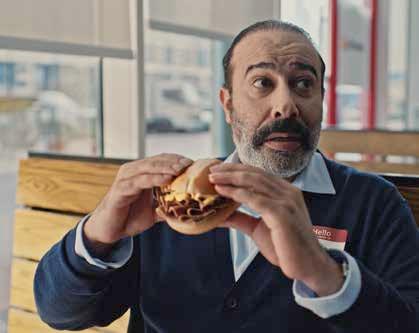






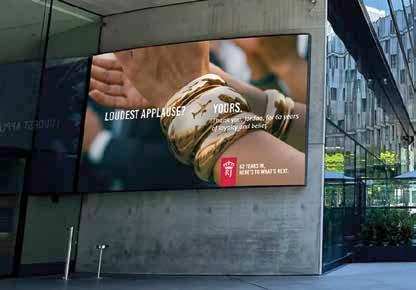

Director of Marketing and Communications, Bayut
HARDEE’S (1):


This one feels like cheeky nostalgia done right. At a time when everything from the early 2000s is making a comeback, bringing back menu favourites feels both timely and self-aware. The humour lands because it taps into a very real truth. Some cravings genuinely do stay with you longer than they probably should, and the exaggerated ‘support group’ idea leans into that in a way that feels fun rather than forced.
DU (2):
As someone working at the intersection of technology and marketing, what stood out to me about du’s campaign is how instantly the idea connects. Today, technology helps us stay close to the people and moments that matter, removing the limits of physical distance. The campaign succeeds by focusing on these human outcomes rather than technical features, recognising technology as an enabler of real connection. That balance between emotional relevance and everyday reality makes the message both authentic and effective.
MOBILY (3):
What I enjoyed most about Mobily’s Ever Closer platform is how instantly recognisable the story feels, perhaps slightly revealing of my age. The idea that closeness creates its own language is something many of us have experienced long before emojis, voice notes and endless group chats made it easier to stay connected. What also works well is how technology quietly sits in the background as the enabler rather than the hero. It is a simple insight, told with honesty and a touch of familiarity, and that relatability is what makes the platform feel both contemporary and enduring.
FAB MISR, E& (4):
This campaign smartly leverages humour and local football culture to create relevance and emotional impact. By transforming Al Ahly’s victories into tangible card benefits, the idea moves beyond symbolic celebration to real consumer value. It’s a strong example of how culturally rooted insights can drive both engagement and utility. It’s not just about cheering, it’s about giving fans something back, making the idea both entertaining and smartly strategic.
Founder and ECD at Idea Farm
HARDEE’S (1):

I’ve not had a Hardee’s since relocating, but I’m going to tuck in soon as a nod of appreciation for this one. It had all the ingredients. Bringing back menu icons, listening to social media demand, and cheekily leaning into the seriousness of a support group. Tasty work.
DU (2):
Technology gets a bad rep for reducing human connection and even driving us apart, so this is a timely reminder from du of the positive impact technology has in life’s important moments. In the UK we like to float things down the Thames; in Dubai, brands light up the Burj Khalifa – which is wholly more impressive in my book.
MOBILY (3):
Just like du’s recent work, Mobily has gone after ‘closeness’ and ‘human connection’. It’s a sign of the times that technology brands are taking more responsibility in championing the importance of human connection in their marketing. I like their decision to swerve nostalgia and milestones – which would have been the easy option to mark 20 years of service.
FAB MISR, E& (4):
At the time of writing, Al Ahly are two points off the league leaders, but this one’s a table topper from FAB Misr. Nothing ignites passion like football and I love the tactic of linking product offers to what happens on the pitch – making fans feel closer to the action and directly benefitting from the result.
ROYAL JORDANIAN (5):
Brand anniversary briefs are always a tricky one – a big moment for the brand doesn’t mean the same for the consumer. So kudos to Royal Jordanian for keeping this one simple, with some lovely copywriting. It doesn’t feel too self serving, which is always the danger. Great work.
Hardee’s
Title: Sorry, We’re Back! Agency: BPG Group Production houses: BKP, Barbershop Studio
du Title: Bridging the Spaces Between Us Agencies: TBWA\RAAD, Mindshare, SOCIALEYEZ, The Hanging House Production house: Rush Films
Mobily
Title: Ever Closer Agencies: FP7 McCann KSA, PHD KSA, Tact Production house: Deja Vu
FAB Misr, e&
Title: Whenever Al-Ahly Wins, You Win With Them Agency: Vorx Production house: Butter Films Director: Sherif Mounir
Royal Jordanian
Title: 62 Years In, Here’s To What’s Next. Agency: Adpro& Group, Adpro& OMD Production house: Pink Lemonade Films
Myth #1
That’s the message almost every brand is screaming at consumers.
But in a room full of voices trying to shout over one another, it’s the quiet ones that garner trust. People are tired of being sold to, and they applaud brands that call out the absurdity of the situation.
Fact #1 "Anti-consumption hurts brand image."
70% of customers are more loyal to brands they perceive as authentic.
Myth #2 Fact #2 "#Deinfluencing is a passing TikTok trend."
#Deinfluencing has amassed more than 3 billion views as of 2025, and continues to grow.
Myth #3 Fact #3 "Only Gen Z consumers are influenced."
42% of millennials and 34% of Gen X admit they’ve been swayed by #deinfluencing.
The big picture Brands doing it right
social media users feel bombarded by ads. of consumers say that trust drives their buying decision.
and 53% of Gen X/Boomers appreciate brands that are values-driven.
The messaging inversion
Bottom line

- Actively discourages consumption of beauty content.
- Campaigns against toxic beauty standards.
- More than 6.5 billion earned media impressions and a Cannes Lions Gold win.
In a market obsessed with selling more, restraint is what earns attention. When brands ease off the hard sell, people lean in.

- Closes all 195 stores on Black Friday.
- Pays more than 14,000 employees to spend the day outdoors instead of shopping.
- More than 1.2 million employee hours spent outside (150,000 paid days off).

Kempinski Hotels has appointed LOAY NOUR to take up the role of Global Vice President of Brand and Marketing. Under his remit, Nour will lead a team responsible for delivering brand, marketing, loyalty, CRM and social media for Kempinski across multiple channels and key markets globally. He moves from Accor’s Fairmont Hotels & Resorts where he was the Vice President – Brand and Marketing for three years.

Middle East Retail Group has appointed HEBA QADEER as its new Group Head of Marketing – Retail and E-commerce, where she will lead the group’s marketing strategy across its retail portfolio and digital commerce platforms in the region. In her new role, Qadeer will oversee brand growth, customer engagement, and integrated marketing initiatives across key group brands including Hamleys, Gorgeous Shop, Concept N and NOUS.

PizzaExpress UAE has appointed MICHAEL JOHN ABONG as Head of Brand and Marketing. With more than 15 years of experience across hospitality, travel and digital marketing in the UAE, Abong will lead
brand strategy, integrated marketing campaigns, partnerships and team operations across 10 PizzaExpress restaurants nationwide.
Publicis Groupe Middle East has appointed JOYCE HALLAK as CEO of Spark Foundry Middle East. She will lead Spark Foundry’s regional agenda, guiding strategic direction across the Middle East and working closely with clients and teams to deliver business-led media solutions at scale. Hallak has held senior leadership roles spanning client leadership, regional management and strategy, including leading Mondelez EMEA and most recently was Chief Strategy Officer for Publicis Media Middle East.

Memac Ogilvy MENA has promoted ANTOINE GEADAH to two leadership roles. He takes up Regional Managing Director for Qatar and Jordan and Chief Growth Officer for MENA. In his expanded remit, Geadah will oversee growth strategy across the MENA region, working closely with regional leadership and country managing directors to accelerate business development, strengthen client partnerships, and identify new opportunities across both established and emerging markets.

Multiply Media Group has appointed AHMED EMAM to Group Chief Commercial Officer to

oversee its commercial strategy across all markets, align revenue functions, strengthen key partnerships, and drive structured, profitable growth at scale. The appointment comes at a time of continued global expansion and increased integration across the Group’s out-of-home portfolio.

FP7 McCANN Riyadh has appointed RAWAD ELDAHOUK as Head of Strategy. He will lead strategic planning across FP7 McCANN Riyadh’s client portfolio to unlock commercial value through strategy that aligns with Saudi ambition and long-term growth. The agency has also appointed Saadi Alkouatli as Executive Creative Director.
BigTime Creative Shop has appointed HAISSAM KAYS as Chief Operating Officer. Kays will support the creative agency’s focus on strengthening its operational foundation while sustaining its creative ambition and global outlook.
With more than 24 years of experience across Saudi and GCC markets, Kays previously held senior leadership roles at BBDO, VMLY&R, GO Telecom, Patchi, and TTP in KSA.






1. Check. Check. This grammar checker must have missed a beat. The tagline promises to sing its praises – though some might suggest a quick soundcheck was in order first. Proof, perhaps, that even the best copy needs a final rehearsal.
2. Something in this family adventure feels a little too memorable. The promise? An unforgettable journey. The visual? Well, let’s just say this particular snapshot may be best left in the test phase. Unforgettable, indeed
– though perhaps not in the way it was intended.
3. Some deals shimmer. Others simply … glisten. This particular oil brand claims to be light on the wallet. A closer look suggests the savings may have slipped through the cracks. A slick move – but not enough to fool The Spin.
4. It’s not every day you’re advised against consuming something designed precisely for that purpose. This tea bag comes with a rather stern instruction – one
usually reserved for silica packets and overenthusiastic toddlers. Best brewed, perhaps. Not bitten.
5. The Spin prides itself on staying updated on the industry’s comings and goings – particularly within the walls of its headquarters. So, it was mildly surprising to receive a rather official update from outside announcing an exit that hadn’t, in fact, occurred. A case of crossed wires and crossed names. The Spin can confirm the ‘departing’ party spent the afternoon very much present – mostly clarifying that they were not going anywhere at all.
6. The Spin enjoys a staycation as much as the next person. But this particular Ajman listing prompted a double take – and then another. Somewhere between hundreds and hundreds of thousands, a few
numerals appear to have moved in uninvited. At the going rate, one might expect the keys and a sale deed to the room rather than merely a one night’s stay. Hurry, though. Only a few rooms left at this price.
7. The Spin recently played Spot the Difference in the haircare aisle. One box promises a fresh new shade. The other appears to have been touched by something a tad more theatrical. Whether it’s a printer running low or a marketer feeling like Defying Gravity, we can only hope the colour stays strictly where intended – above the hairline.
8. This Turkish pet shop is up to some monkey business. Pet parents may want to paws for thought before stepping in. The Spin suspects a little grooming – of the signage – wouldn’t go amiss.
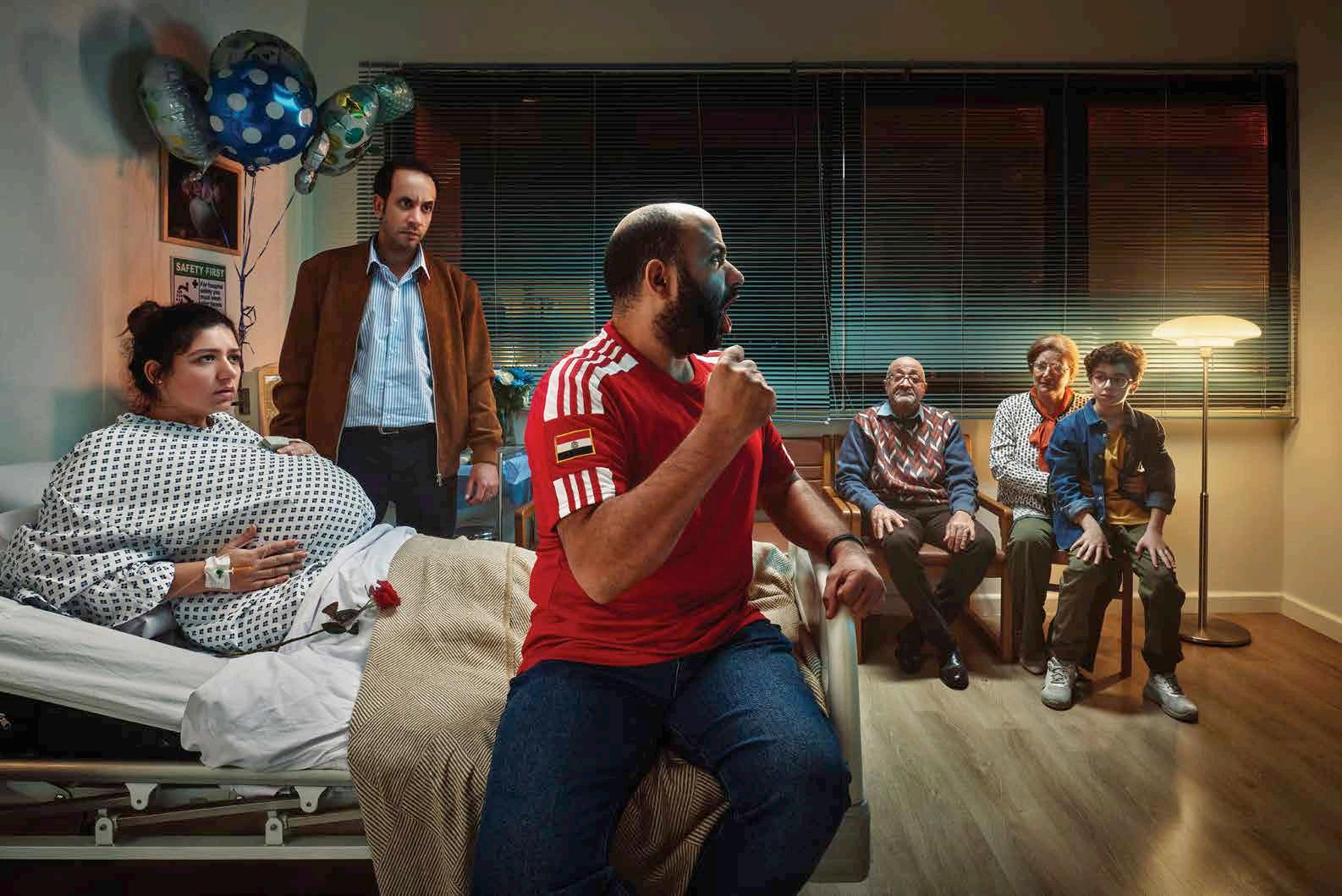
































Founded: 2021 Head of company: Muneef Khan 5thelementmea.com
Founded: 2012
Head of company: Souheil Assaker abilitycomms.com
APCO
Founded: 2005
Head of company: Mamoon Sbeih apcoworldwide.com
Founded: 2006 Head of company: Hasan Fadlallah brandloungeme.com
Cheil MEA
Founded: 1994 (MENA) Head of company: Christakis Christodoulou actionprgroup.com
Founded: 2018 Head of company: Rizk Naifeh atccoms.com
Brazen
Founded: 2015 Head of company: Louise Jacobson brazenmena.com
Founded: 2026 Head of company: Lyusok Jung cheil.ae
Entourage
Founded: 2009 Head of company: Mohammed Tayem entourageintl.com Face
Founded: 2017 Head of company: Ashish Gupta adaptsmedia.com
Bassmat
Founded: 2004 Head of company: AbdulRahman Saud bassmat.com
Founded: 2016 Head of company: Nour Shihab brodmann10.com
Cicero & Bernay
Founded: 2006 Head of company: Ahmad Itani cbpr.me
Founded: 1991 Head of company: Christopher Bell facetofaceuae.com
Hewar Group Founded: 2011 Head of company: Loma Jaber hewargroup.com Icon Marcom Group Founded: 2007 Head of company: Firas Tirhi icon-ad.com
Katch International
Founded: 2011 Head of company: Georgina Woollams katchthis.com
Kenshō Mindful Communications
Founded: 2010 Head of company: Marise Assaf kenshocom.com
Founded: 2013 Head of company: Aasim Shaikh lps-me.com
Netizency
Founded: 2013 Head of company: Fadi Khater netizency.com
Tactical
Founded: 1991
Head of company: Rana Hamarneh adproandgroup.com
Belong
Founded: 2012 Head of company: Pierre Azzam belonginteractive.com
Founded: 2021 Heads of company: Kevin Alderweireldt and Jon S Maloy bureaubeatrice.com
Creo Global
Founded: 2023 Head of company: Jaimesha Patel creoglobal.co
Founded: 2018 Head of company: Fadi Yaish and-us.agency
Creative Shop
Founded: 2023 Head of company: Mohamed Sehly bigtime.sa
Founded: 1988 Head of company: Roy Aftimos c2comms.cx
Founded: 2020 Head of company: Yousef Sharbatly digitect.com
Carma
Founded: 2011 Head of company: Shadi
boopin.com
Founded: 1984 Head of company: Mazen Nahawi carma.com
Edelman
Founded: 2009 Head of company: Omar Qirem edelman.ae
Good People
Founded: 2016 Head of company: Ali Ali goodpeople.film
Founded: 2011 Head of company: Bassem Elhady kijamii.com
Founded: 2012 Head of company: Scott Feasey mcsaatchi.ae
Founded: 2021 Head of company: Rémy Abouchakra oui.agency
Founded: 2013 Head of company: Mike Khouri wearetactical.com
TishTash Communications
Founded: 2012 Head of company: Natasha Hatherall tishtash.com
Creative
Founded: 2007 Head of company: David Balfour lightblueww.com
Founded: 2022 Head of company: Phillipe Berthelot magnitudecreative.com
Founded: 2016 Head of company: Mohan Nambiar radixmediamena.com
Team Red Dot
Founded: 2010 Head of company: Raksha Khimji teamreddot.com
TRACCS Founded: 1998 Head of company: Mohamed Al Ayed traccs.net
Founded: 2015 Head of company: Michael Ahmadzadeh electriclimefilms.com
Founded: 2011 Head of company: Amer Massimi hashtag-me.com
Interesting Times
Founded: 2010 Head of company: Wassim Bassil interestingtimes.me
Founded: 2010 Head of company: Dani Oneisse livingroomdubai.com
Founded: 2018 Head of company: Uli Stanke mch-global.com
Founded: 2009 Head of company: Tarek Esper social-eyez.com
TenX Marketing Solutions
Founded: 2022 Head of company: Bader AlHammad thehanging house.com
We Are Social Founded: 2010 Head of company: Jim Coleman wearesocial.com/me/
Jummar PR
Founded: 2021 Head of company: Ibrahim Almutawa jummarpr.com
Liwa Content. Driven
Founded: 1987 Head of company: Sagar Rege liwa.tv
Founded: 2012 Head of company: Baha Bibi meansdesign.ae
Founded: 2007 Head of company: Sunil Damodar sutraworld.com
The Hanging House
Founded: 2017 Head of company: Anam Ahmad thehanging house.com
WonderEight Founded: 1999 Head of company: Karim Abou Rizk wondereight.com
.Monks
Founded: 2021 Head of company: Sir Martin Sorrell monks.com
Founded: 2007
Head of company: Steven Hetzer sweetwatermea.com
The Romans Founded: 2015 Head of company: Joe Lipscombe wearetheromans.com
You Experience
Founded: 2013 Head of company: Fadi Nakhle youexperience.net
Zamakan
Think Human Founded: 2017 Head of company: Ahmed El Sherbini thinkhuman.ae
Founded: 2009 Head of company: Taha M Azhari zamakan.com
BPG Group Founded: 1980 Group CEO: Avishesha Bhojani bpggroup.com MEMAC Ogilvy Founded: 1984 CEO: Ghassan Maraqa ogilvy.com
Burson Founded: 2024 CEO: Fouad Bou Mansour bursonglobal.com
Keyade Middle East Founded: 2011 GM: Laura Gleadhill keyade.com
WPP Media Founded: 2003 Group CEO: Amer El Hajj wppmedia.com
The Goat Agency Founded: 2015 Associate Director: Vivian Subrata goatagency.com
TO YOU BY
Choreograph Founded in 1995 Region MD – CX, Data and Tech: Alan Azar choreograph.com
EssenceMediacom Founded: 2023 Regional Managing Director: Abdalla Elabd essencemediacom.com
Mindshare Founded: 1997 Regional Managing Director: Samer Majzoub mindshareworld.com /mena/offices
Wavemaker Founded: 2004 CEO: Marc Ghosn wavemakerglobal.com
TBWA\RAAD Founded: 2000 UAE: Joe Lahham KSA: Dany Aouad Lebanon: Rony Skaf Egypt: Ahmad Badie tbwaraad.com
MENAT
Founded: 2009 Regional Managing Director: Karen Kamel mccannhealth.ae
NEXT Founded: 2022 UAE: Noah Khan
TBWA\RAAD Group Founded: 2000 CEO: Reda Raad tbwaraad.com
180 MENA Founded: 2021 UAE: Muriel Lechaczynski 180global.com
Impact Porter Novelli Founded: 2000 Managing Director: Lucy O’Brien porternovelli.com
Ketchum\RAAD Founded: 2000 UAE: Dan Leach ketchum.com
BOLT Content Founded: 2021 UAE: Tony Kayouka
Current Global MENAT
Managing Director: Peter Jacob currentglobal.com
Acxiom MENAT Founded: 2018 Managing Director: Karthik Kumar axciom.com
MCN Mediabrands
UM MENAT Founded: 2001 CEO: Joe Nicolas umww.com
Magna MENAT Founded: 2005 CEO: Lara Arbid magnamena.com Initiative MENAT Founded: 1975 CEO: Lara Arbid initiative.com
Impact BBDO Founded: 1971






































































































Fosfor
Founded: 2023
Heads of company: Ziad Alasqa and Abdullah Alfawzan fosfor.sa
Gene Branding
Founded: 2013 Head of company: Ahmed Al-Abdullatif genebranding.com
Wahaj Group
Founded: 2023 Head of company: Ahmad Konash wahajgroup.sa
Onsor Mosha
Founded: 2013 Head of company: Ahmad Konash om.sa
W.GG
Founded: 2020 Head of company: Mazen Mitri
Uturn
Founded: 2010 Head of company: Samer Bahsas uturn.me
The FullStop
Founded: 2002 Head of company: Fahd Alahmad fullstop.sa
Webedia Arabia Group
Founded: 2018 Head of company: Georges Maktabi webedia-arabia.com
Sayl
Founded: 2024 Head of company: Abdulrahman Alrogaiey sayl.sa
AGA-ADK
Founded: 1997 Executive Creative Director: Dany Azzi aga-adk.com
Wetpaint Creative Digital Solutions
Founded: 2007
Regional General Manager: Joy Sahyoun wetpaint-mena.com
Almasbak Type
Foundry
Founded: 2024 Head of company: Ahmad AlAbdullatif
The Network Communication Group
Founded: 1997 Chairman: Roger Sahyoun thenetwork-com.com
Pencell PR & Events
Founded 1999 Regional General Manager: Nadine Maalouf Pencellpr.com
Bold Creatives
Founded: 2011 General Manager: Saud Saadoun boldcreatives.com
Bold Brands
Founded: 2015
General Manager: Rashad Moglbay bold-brands.com
Bold Influence
Founded: 2025 General Manager: Majdi Ghraizi bold-influence.com
Founded: 2011
Co-founder & CEO: Abeer Alessa bold-grp.com
Teeb Made
Founded: 2019
General Manager: Souad Merheb teebmade.com
Synergy
Consulting
Founded: 2017
Co-Founder & CEO: Fahad Alessa synergyconsult.co
Webedia Group MENA
Founded: 2022 Head of company: Mazen Mitri
Made in Saudi
Founded: 2010 Head of company: Gabriel Abudaher madeinsaudifilms.com
LeadGen
Founded: 2021 Head of company: Elie Zeinieh leadgenarabia.com
Founded: 2013 Regional General Manager: Fadi Zeidan equation-media.com
Tact Digital Communication
Founded: 2014 CEO: Mansour Alotaibi tact.sa
Bold Xperiences
Founded: 2015 General Manager: Ziad Abou Rjeily bold-xp.com
Film
Founded: 2019
Head Producer: Aziza Alsumiri captains.film
Forsman & Bodenfors MENA
Founded: 1986 CEO: Adil Khan Forsman.com
Assembly Global MENA
Founded: 2017 CEO: Ravi Rao assemblyglobal.com
Swing
Founded: 2018 CEO: Khalid Alfuraih swing.sa
Habbar
Creative House
Founded: 2014 Co-founder & CEO: Hassan Al-Ansari habbar.com
Pavo
Founded: 2018 CEO: Bader Alhussaini pavo.sa
XP
Founded: 2023 Head of company: Tareq Almashini thexpsolutions.com
Ubrand
Founded:
Foaj Communications Group
Founded: 2022 CEO: Rayan Altuaymi foaj.sa
Founded: 2014 Co-founder & Managing Director: Osama Al Shubayli ubrand.sa
Howdaj Film
Founded: 2023 CEO: Abdullah Oseilan howdaj.film
GP Inc.
Founded: 2022 Chairman & CEO: Rahul Nagpal gpinc.agency
Tuesday
Founded: 2022
Co-Founder & CEO: Alok Gadkar tuesdayme.com
Create Group
Founded: 2012 Founder & CEO: Tom Otton creategroup.me
Stagwell
Founded: 2015 Lead and Senior AdvisorMENA: Sunil John stagwellglobal.com
Nuss
March
Trase
Founded: 2024 CEO: Jad Ibrahim trase.sa
Founded: 2024 CEO: Abdualziz Bin Helaby march.com.sa
Founded: 2014 CEO: Abdulrahman Albadr nuss.sa
Thirty31North
Founded: 2023
Co-Founder & CEO: Rahul Kantharia thirty31north.com
Serviceplan Middle East
Founded: 2010 Heads of company: Natalie Shardan and Akhilesh Bagri house-of-communication. com/me/en.html
Consulum
Founded: 2012 CEO: James Davies consulum.com
Tonnit & Co
Founded: 2024
Founder & CCO: Tonnit Thomas tonnitdesign.com
Serviceplan Group Middle East
Founded: 2010 Head of company: Rami Hmadeh house-of-communication. com/me/en.html
Serviceplan Arabia
Founded: 2023 Head of company: Rami Hmadeh house-of-communication. com/me/en.html
Biio
Founded: 2019 CEO: Abdulrahman Alsuwaiyan biio.sa
Plan.net
Founded: 2010 Head of company: Natalie Shardan house-of-communication. com/me/en.html
Mediaplus
Middle East
Founded: 2013 Head of company: Azhar Siddiqui house-of-communication. com/me/en.html
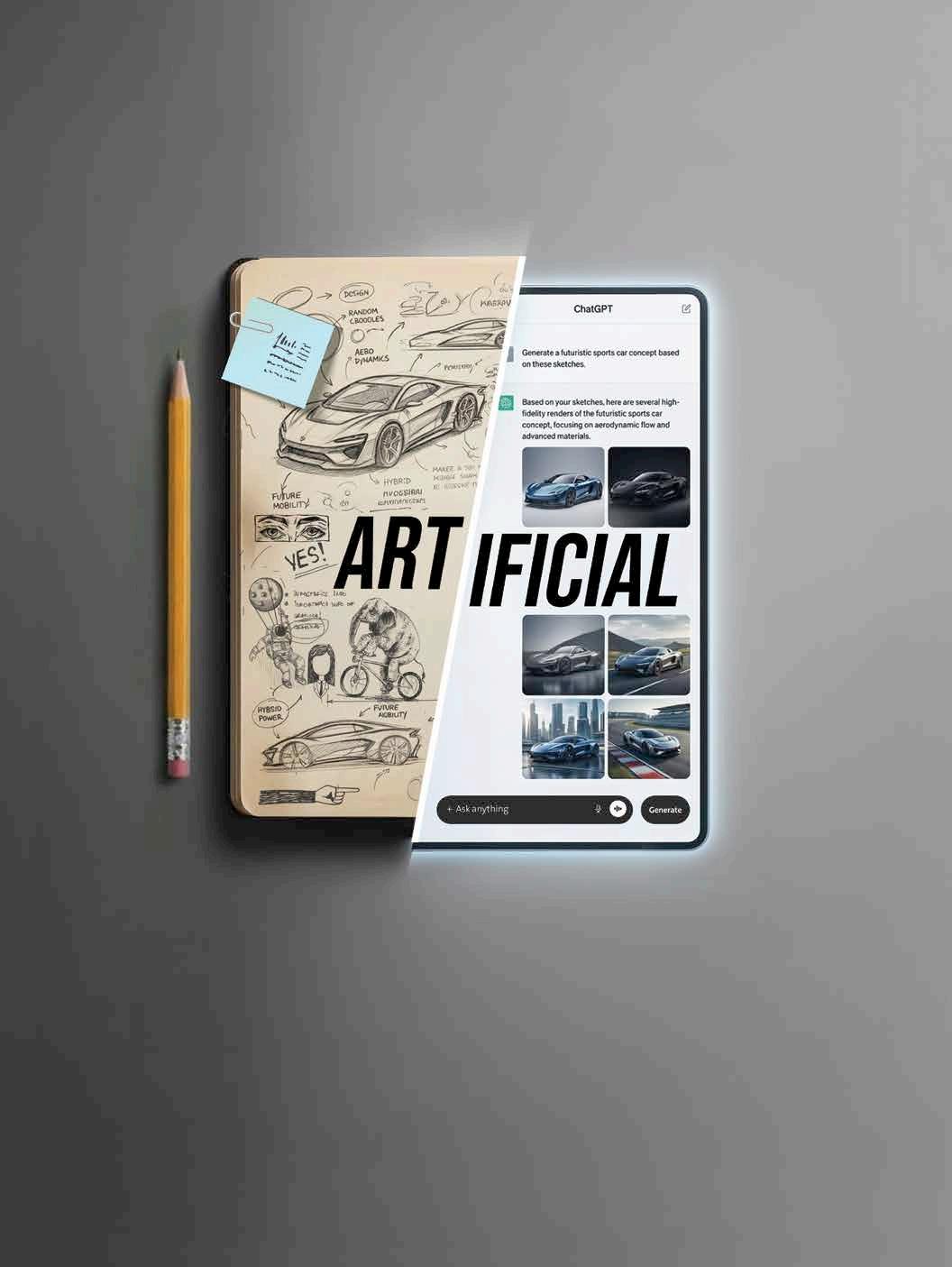
Creativity is never artificial, it’s a blend of talent and tech. At Boopin, we understand the value of combining Art with A.I. to create work with Real Intelligence.