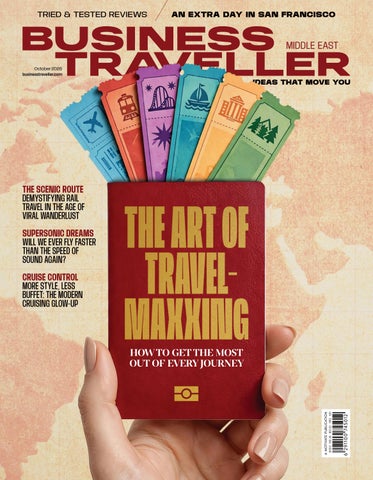
TRIED & TESTED REVIEWS
AN EXTRA DAY IN SAN FRANCISCO
October 2026 businesstraveller.com
THE SCENIC ROUTE DEMYSTIFYING RAIL TRAVEL IN THE AGE OF VIRAL WANDERLUST SUPERSONIC DREAMS WILL WE EVER FLY FASTER THAN THE SPEED OF SOUND AGAIN? CRUISE CONTROL MORE STYLE, LESS BUFFET: THE MODERN CRUISING GLOW-UP
DHS12 RO1.30 BD1.30 SR12 KD1
HOW TO GET THE MOST OUT OF EVERY JOURNEY
CONTENTS OCTOBER 2026
Updates
07
07 Hot Ticket: A new Hatta hideaway for luxe glamping in the UAE 08 Regional News: The latest airline, hotel, and travel news 10 Sustainable Traveller: The greener side of tourism and hospitality 12 Global News: An update on international travel
38
THE ART OF TRAVELMAXXING
Reviews
61
Why (and how) modern travellers are using algorithms, multimodal transit, and clever stopovers to get more out of each trip
61 Sofitel Riyadh Hotel & Convention Centre 63 The Pinnacle Kigali 64 flydubai Riyadh to Dubai, Business Class 65 Le Guilan
61
Insight
15
COVER ILLUSTRATION BY CLARKWIN CRUZ CONTENTS IMAGES SUPPLIED; VNOAM3D/ADOBE STOCK
15 Gianni di Fede, CCO of Radisson Hotel Group, talks to us about adopting new tech with a human heart
18 As Saudi Arabia enters Phase Three of Vision 2030, we asked key hospitality leaders for their insights 24 Accor’s Sushanth Nambiar speaks on Pullman’s new era 25 Op-Ed: The power of light-touch tourism as a competitive advantage 26 Elevator Pitch with Jean-Francois Durand, GM of Grand Hyatt The Red Sea 27 We chat with comedian Zarna Garg O CTO B E R 2026
Explore
29
29 Extra Day in San Francisco 31 Soothe yourself with the wellness-oriented side of travel and tourism 32 Splash out on luxury experiences and products 34 Our pick of cultural events around the world and inflight entertainment 36 How innovation is reshaping our dining habits
Features
54
41
Watt’s the deal with e-bikes? As electric bikes continue to rise in popularity across the world, safety and policy issues race to keep up
Exploring the bizarre world of hotel theft Take a look at the elaborate items crafty guests have purloined from their hotels
56
46
33 50
Is cruising cool now? Cruise holidays have come a long way since the days of boring buffets and blue rinses. Here’s the 411
The scenic route Rail travel is experiencing its most ambitious global renaissance in a generation
Supersonic dreams It’s been 50 years since Concorde’s first commercial flight took place – will we ever fly faster than the speed of sound again?
Postcard
66
The Oberoi Marrakech is targeting guests for largescale events, offering them an extraordinary backdrop BUS I N ES S T R AV EL L ER M I DDL E E AST 3
Editor’s Letter
Yi-Hwa B. Hanna Editor
BUSINESS TRAVELLER MIDDLE EAST IS JOINTLY PUBLISHED BY MOTIVATE MEDIA GROUP AND BUSINESS TRAVELLER MEDIA LTD
MOTIVATE MEDIA GROUP EDITOR-IN-CHIEF OBAID HUMAID AL TAYER MANAGING PARTNER AND GROUP EDITOR IAN FAIRSERVICE CHIEF COMMERCIAL OFFICER ANTHONY MILNE GROUP CONTENT DIRECTOR THOMAS WOODGATE EDITOR YI-HWA B. HANNA ART DIRECTOR CLARKWIN N. CRUZ CONTRIBUTORS JUSTIN GOLDMAN, JOSEPH PHELAN, NIVEA SERRAO, PETER GREENBERG, EMMA LEWIS, ALICE HENDERSON, REBECCA BARNES GENERAL MANAGER – PRODUCTION S SUNIL KUMAR PRODUCTION MANAGER BINU PURANDARAN ASSISTANT PRODUCTION MANAGER VENITA PINTO GROUP SALES MANAGER CHAITALI KHIMJI SENIOR PARTNERSHIPS MANAGER MURALI NARAYANAN
HEAD OFFICE: MEDIA ONE TOWER, DUBAI MEDIA CITY, PO BOX 2331, DUBAI, UAE; TEL: +971 4 427 3000; FAX: +971 4 428 2266; E-MAIL: BTME@MOTIVATE.AE DUBAI MEDIA CITY: SD 2-94, 2ND FLOOR, BUILDING 2, DUBAI, UAE; TEL: +971 4 390 3550; FAX +971 4 390 4845 ABU DHABI: PO BOX 43072, ABU DHABI, UAE; TEL: +971 2 677 2005; FAX: +971 2 657 3401; EMAIL: MOTIVATE-ADH@MOTIVATE.AE SAUDI ARABIA: REGUS OFFICES NO. 455 - 456, 4TH FLOOR, HAMAD TOWER, KING FAHAD ROAD, AL OLAYA, RIYADH, KSA;TEL: +966 11 834 3595 / +966 11 834 3596; EMAIL: MOTIVATE@MOTIVATE.AE LONDON: MOTIVATE PUBLISHING LTD, ACRE HOUSE, 11/15 WILLIAM ROAD, LONDON, NW1 3ER, UK; E-MAIL: MOTIVATEUK@MOTIVATE.AE
BUSINESS TRAVELLER MEDIA LTD. INK, BLACKBURN HOUSE, BLACKBURN ROAD, LONDON, NW6 1RZ
TOP PICKS THE SCENIC ROUTE Exploring the rail travel renaissance in the age of viral wanderlust. P46
SUPERSONIC DREAMS Will we ever fly faster than the speed of sound again? P50
IS CRUISING COOL NOW? Seafaring holidays have come a long way from what they used to be. P56 SUBSCRIPTIONS: EMAIL: SUBSCRIPTIONS@MOTIVATE.AE; TEL: +971 4 427 3542
businesstraveller.com/middle-east BUSINESSTRAVELLERME
0 4 BU S I N ES S T R AV ELLER MIDDLE E AST
BTMIDDLEEAST
O CTO B ER 2026
IMAGES SUPPLIED; NICK/ADOBE STOCK; UNFORGETTABLE CROATIA
IN THE MID-1990S, the British rock band Def Leppard released a song called All I Want Is Everything. Though the song was written about a difficult relationship, its title is an apt fit for what modern consumers increasingly seek from the travel industry. And as any travel industry professional knows, pleasing everyone all the time is tough. One person’s ultimate trip might be a city break packed with museums and vintage shopping; another’s is soaking up the sun at a luxury hotel. For a sports fan, a dream break might be flying out for a match, made better by combining it with a micro-detour destination where the train ride is just as memorable as the memories you make while there. But if you’re travelling in a group, or as a family, how do you satisfy one person’s niche interests without sacrificing everyone else’s share of the fun? Or what if your own passions are so varied you struggle to choose which to indulge on every trip? Enter travelmaxxing: a way to mixand-match more flexibly, by embracing a “more is more” philosophy (p.38). At a time when global economic strain has led to a sharper focus on what value means, experience-rich travel has become the gold standard. If you’ve ever tried to squeeze a little more out of a trip – like transforming routine business travel into a “bleisure” excursion, or turning a one-week family holiday into a multi-stop itinerary – then congratulations, you’ve been successfully travelmaxxing. And you’re not alone. Who wouldn’t want to get the maximum amount of experiences, countries, and value out of limited time and/or money, especially in this economy? It’s not just about economics, though. Social media has made us more eager to seek out unique finds, earning clout and content capital each time we share. And the more we scroll through our feeds, the more of us develop FOMO – a Fear of Missing Out – as the feed-and-receive discovery cycle becomes an endless loop. At the same time, beyond this form of algorithmic peer pressure, the modern workplace and its productivity-enhancing tech often makes us feel more time-poor, pushing busy professionals towards “experience-stacking” – turning short windows of time into high-density microadventures, just to feel more present and alive during personal leave. Whether it’s a cruise making memories the moment you step on board (p.56), an impressive airline that makes the flight just as much of a highlight as your eventual hotel (p.8 & 50), or an e-bike tour that shows you a city’s real heartbeat as you cycle from sight to sight (p.54), there are more ways than ever to make every part of your journey count. The industry is paying attention, finding new ways to fulfil us more every step of the way. When experts insist that the adoption of modern technology should give rise to new ways to be more human, perhaps this is what they mean. This viewpoint certainly does makes the future of travel look more rewarding.
SPONSORED CONTENT
Marriott Executive Apartments Al Jaddaf, Dubai
The Smarter Choice for Extended Business Travel All the comforts of home, backed by the rewards and trust of Marriott Bonvoy®
IMAGES SUPPLIED
FOR TODAY’S BUSINESS TRAVELLERS, a successful trip is about more than a convenient location and a comfortable bed. As work assignments become longer, projects span weeks rather than days, and travel increasingly blends with personal wellbeing, travellers are looking for a place that helps them live, not just stay. That is where Marriott Executive Apartments® stands apart. Designed specifically for extended-stay travellers, Marriott Executive Apartments combines the space and independence of a private residence with the trusted service, security and hospitality of Marriott Bonvoy. Whether travelling for a long-term project,
Marriott Executive Apartments Doha, Le Mirage City Walk
a regional assignment, relocation, or frequent business trips around the world, guests enjoy the flexibility needed to maintain their daily routines while away from home. Each apartment is thoughtfully designed with separate living, working and sleeping areas, creating a comfortable environment to work, unwind and recharge. Fully equipped kitchens allow guests to prepare meals at their convenience, while spacious lounges provide the ideal setting for virtual meetings, catching up on work, or simply relaxing after a busy day. Wherever business takes them, location matters. Marriott Executive Apartments properties are strategically positioned within
Marriott Executive Apartments Al Khobar
key business districts and major cities, providing convenient access to corporate offices, financial centres, government hubs and transportation networks. Guests also benefit from the reassurance of Marriott International’s global standards, with amenities that include fitness facilities, housekeeping services, meeting spaces, dining options and 24-hour support. Marriott Bonvoy members can earn points and Elite Night Credits on eligible stays, bringing them closer to free nights across Marriott Bonvoy’s portfolio of over 30 hotel brands, as well as flights, exclusive experiences and more. At a time when business travellers increasingly value comfort, flexibility and wellbeing alongside productivity, Marriott Executive Apartments delivers a stay experience that feels less transactional and more personal. Because when business takes you away from home for longer, where you stay should allow you to continue living well. Marriott Executive Apartments. More space. More flexibility. More like home.
REGIONAL NEWS
SU STA I N A B I LIT Y
GLOBAL NEWS
New hotels, flight routes, and more
The greener side of tourism & hospitality
Happenings from around the world
HOT TICKET
IMAGES XXXXXXXXXX
Hatta Hideaway Launched last month, this new mountain retreat offers R&R in a series of luxurious Airstreams WORDS YI-HWA HANNA
SE O CTO PT EBM ER B E2026 R 2026
CARAVAN HATTA BY OUR HABITAS – a lush five-star glamping retreat in the UAE’s Hajar Mountains – opened its doors on 28 September, making it the first-ever property from the experiential hospitality venture in the UAE. Managed under Ennismore and Dubai Holding, this new retreat has 50 custom Airstreams overlooking the picturesque Hatta Dam. Each airconditioned caravan has a queen bed, a kitchenette pantry, a private bathroom, and wooden terrace. The property also has an open-air restaurant serving regional fire-cooked dishes and local flavours, as well as a communal infinity pool, stargazing deck, and wellness facilities complete with saunas and plunge pools, with nightly rates starting from AED1,200. BUS I N ES S T R AV EL L ER M I DDL E E AST 7
REGIONAL NEWS
Etihad Airbus A330 First Class
Emirates Airbus A350 Premium Economy
E LE VATI O N I N TH E S K Y
New cabin standouts
Major Gulf air carriers reveal new cabin designs amidst expanding routes
EMIRATES introduced its innovative Airbus A350 Premium Economy flagship product last month, featuring the sector’s first fully electric privacy divider between adjacent seats, within a comfortable seven-abreast cabin layout. Borrowing Safran’s U-Dream headrest from economy alongside modern wireless charging and 4K screens, the expertly crafted 28seat cabin significantly enhances personal space while addressing ongoing fleet consistency
challenges through a massive US$5 billion retrofit programme. Meanwhile, Etihad Airways showcased the First and Business Class cabins for its incoming Airbus A330-900 fleet at the annual Arabian Travel Market, adopting proven Thompson Vantage XL platforms wrapped in a lighter, more refined aesthetic of stone and sand. The four First Class suites and 24 flat-bed business seats demonstrate a pragmatic approach to rapid growth, balancing fleet diversity with an overarching wellbeing and design evolution. Alongside these major cabin updates, Etihad is expanding its regional network with direct, yearround flights from Abu Dhabi to Saudi Arabia’s emerging Red Sea coastal destination starting this month. This new route provides a convenient three-hour connection to 70-plus islands and thriving coral reefs, strengthening the carrier’s footprint across the kingdom while connecting them to the area’s luxury leisure retreats.
Riyadh Air is upgrading its recently launched nonstop service between Riyadh and Manila to a daily schedule starting 19 October, deploying its four-class Boeing 787-9 Dreamliner to strengthen its strong regional presence. 8 BU S I N ES S T R AV ELLER MIDDLE E AST
Jazeera Airways has partnered with CzechTourism to launch its first-ever direct winter flights connecting Kuwait to Prague from 17 December 2026 to 7 February 2027, tapping into strong seasonal travel demands.
SalamAir has opened ticket sales for a new twice-weekly route connecting Muscat to Copenhagen via Baghdad starting 14 November 2026, marking the European city the Omani carrier’s ninth new destination of the year.
flydubai launched a new daily service connecting Dubai to Pokhara on 23 September 2026 – a historic milestone as the first UAE carrier to operate direct flights – and complementing its longstanding Kathmandu route. O CTO B ER 2026
IMAGES SUPPLIED
ROUTE ROUND-UP
WORDS YI-HWA HANNA
FULL STEAM AHEAD
IMAGES SUPPLIED
The new fast track Etihad Rail’s long-anticipated passenger services between Dubai’s Al Yalayis Station and Abu Dhabi’s Mohammed Bin Zayed City Station launched at the end of last month, with the inaugural journey having been planned for 30 September. Offering an efficient 57-minute journey time each way, the train has overhead storage (including space for large baggage), WiFi capabilities, foldable tray tables, and power at every seat, making it easy to get some work done en-route if you should need to. With Comfort and Premium cabins available, there are three fare types: Saver (inflexible tickets that are only available through the Etihad Rail app, booking website, and contact centre), Value (which includes complimentary seat selection and ticket changes), and Flex (which allows easy changes for seat selection, ticket changes, and refunds). O CTO B E R 2026
Address Hotels plans three new properties THE UAE-FOUNDED Address Hotels + Resorts is expanding its regional portfolio with three upcoming properties across the UAE and Saudi Arabia. Leading this exciting rollout is Address The Bay, which is scheduled to open at Dubai’s Emaar Beachfront in 2027. The 182-key property features a main pool deck equipped with cabana seating alongside six distinct dining and lounge concepts ranging from casual all-day venues to club lounges. Meanwhile, Address Diriyah will launch in 2028 within Riyadh’s cultural heartland, comprising 204 keys, 60 serviced apartments, six culinary venues, a rooftop pool café, and various luxury wellness facilities. Rounding out the trio is Address Al Marjan
Island in Ras Al Khaimah, opening in 2028 as a relaxed coastal escape featuring 196 rooms, three pools including a large family pool, and a scenic jetty lounge overlooking the water. Together, they mark the next exciting chapter for the Dubai-born luxury brand under Emaar Hospitality Group as it proudly brings its refined hospitality philosophy into some popular, prime new regional markets.
Address Diriyah
Address Al Marjan Island in Ras Al Khaimah
BUS I N ES S T R AV EL L ER M I DDL E E AST 9
S U STA I N A B LE TR AV E LLE R
GREEN WINS
MALDIVIAN LUXURY retreat Soneva Jani has officially become the first private resort in the country to be designated as an Other Effective Area-Based Conservation Measure (aka achieving OECM Status) by the Ministry of Climate Change, Environment and Energy. Spanning 0.41 sqm on Medhufaru island, the resort’s protected zone encompasses vital coral reefs, sandy beaches, and thriving mangrove habitats that provide essential shoreline protection, carbon storage, and a safe refuge for threatened marine and avian species including nesting Hawksbill and Green turtles. This major ecological milestone directly supports the country’s national roadmap toward fulfilling the Kunming-Montreal Global Biodiversity Framework, an international initiative aiming to conserve 30% of global land, freshwaters, and oceans by 2030. Following a 12-month ecological assessment led by Soneva Conservation and Sustainability Maldives with support from the Waitt Foundation, maintaining the status requires rigorous annual reporting alongside a formal review every five years. By proving that upscale hospitality and environmental preservation can function symbiotically rather than as conflicting goals, the resort establishes a progressive global standard for the luxury tourism sector.
THE POPULAR ISLAND nation of the Maldives now also has its very own treetop dining experience, as JA Manafaru has introduced Kuri, a new dining option nestled between the branches of a living banyan tree on-property in the northern Haa Alifu Atoll. This intimate venue accommodates just two to four guests at a time, for a bespoke culinary journey celebrating authentic local heritage. Executive Chef 1 0 BU SI N ES S T R AV ELLER MIDDLE E AST
Moosa Nazeeh has curated a five-course tasting menu featuring indigenous ingredients sourced entirely from the surrounding atoll, including reef fish, coconut, and fragrant pandan. Dishes range from crispy tuna crackers and cured snapper to a signature Maldivian lobster curry, concluding with screwpine ice cream and candied nuts. Every detail is meant to reflect local craftsmanship, including custom ceramics
handcrafted at the resort’s on-island clay studio, illustrated with watercolour designs of the same shelter tree guests are dining in. For an equally interactive exit, diners will wrap up the evening by taking a gently-curving slide back down to the pristine sand below. Available daily for a select group of visitors, this innovative concept aims to redefines barefoot luxury by spotlighting the rich culinary traditions of the region. O CTO B ER 2026
IMAGES SUPPLIED
FROM THE TREETOPS
SPONSORED CONTENT
An Oasis in the City
INTERCONTINENTAL RIYADH is a landmark luxury hotel in the heart of the Saudi capital, offering a distinctive blend of international hospitality, contemporary comfort, and authentic Saudi character. The hotel provides a wide range of experiences and facilities for business, leisure, dining, and entertainment. Guests can enjoy dining at Mondo Restaurant and relaxing at the Club InterContinental Lounge, while recreational facilities include tennis courts, The Palms Bowling Club, Palms Fitness Club, a heated outdoor swimming pool, and an indoor swimming pool. For conferences and events, the King Faisal Convention Centre offers an extensive selection of spaces, including meeting rooms, Buraidah Hall and the Main Ballroom, making the hotel well suited to conferences, weddings, celebrations, and corporate gatherings. Alongside its accommodation, restaurants, lounges, and wellness and recreational facilities, InterContinental Riyadh continues to provide memorable experiences that reflect the warmth, culture, and hospitality of the Kingdom of Saudi Arabia.
MEETINGS & EVENTS
InterContinental Riyadh is recognised as one of the city’s most prestigious destinations for high-powered meetings and corporate gatherings. Our meeting spaces are thoughtfully designed to combine functionality with understated luxury, offering refined settings for both intimate discussions and executivelevel engagements. Each experience is tailored with precision, supported by a highly trained team delivering seamless planning, discreet service, and flawless execution from start to finish.
+966 11 465 5000 intercontinental.riyadh@ihg.com King Saud Road, Riyadh, Saudi Arabia intercontinental.com/riyadh
GLOBAL NEWS
9
8
6 10 7
1
2
4 3
GET THE SCOOP
The latest updates in the travel industry from across the world Aman opens new resort on Baja’s East Cape, Mexico (Right) Situated within the exclusive Costa Palmas community, the intimate Amanvari 18-casita sanctuary marks a significant milestone for the hospitality brand’s ongoing expansion across the Americas. Guests will have access to extensive wellness facilities, high-end dining venues, and a private collection of branded residences designed to blend into the dramatic desert and coastal landscape of the Baja California Sur region.
2
Shangri-La unveils luxury Kyoto hotel facing Nijō Castle (Above) Occupying the former residence of the Kyoto Shoshidai, the 77-key Songtei Kyoto, Shangri-La Signatures is the second hotel to join the brand’s ultra-luxury Signatures collection. Scheduled for a phased opening from late this year, with a full opening by early 2027, it’s directly opposite the Kita Ōte-mon (Great North Gate) of the UNESCO World Heritage-listed Nijō Castle.
1
5
Fairmont has opened its first hotel in Thailand, in Bangkok (Below) Situated in the vibrant Sukhumvit neighbourhood, the recently-opened 474-room hotel features seven dining venues, comprehensive wellness facilities, and flexible event spaces. It’s hoped to serve as a premier social hub for international travellers and local residents alike, seeking exceptional hospitality experiences during their time within Thailand’s capital.
4
Minor Hotels announces Avani Kota Kinabalu resort (Left) Scheduled for a 2027 debut, the 352-room property will introduce stylish design, a rooftop bar, an infinity pool, and versatile event facilities just 20 minutes from BKI international airport. Positioned as a new vibrant gateway to the island, it invites upcoming guests to immerse themselves in a unique blend of local cultures, mountain landscapes, and unforgettable adventures. 1 2 BU SI N ES S T R AV ELLER MI DDLE E AST
IMAGES SUPPLIED
3
O CTO B ER 2026
WORDS YI-HWA HANNA
Avani has launched a new lakeside hotel in New Zealand (Right) Avani has been busy – in addition to its upcoming hotel in Kota Kinabalu, Borneo, it has new openings scheduled for Australia, Bahrain, Singapore, and Vietnam. Most recently, it opened the Avani Queenstown, a Lakeside Retreat, in New Zealand’s adventure capital, taking over the former Oaks Shores Resort. As per the Avani brand philosophy, the hotel is a vibrant, community-led space.
5
Nobu’s first restaurant and hotel have landed in Madrid (Right) Situated between Puerta del Sol and Plaza de Cibeles, the newly opened Nobu Hotel Madrid has 50 rooms designed with minimalist Japanese aesthetics, plus a generouslysized dining hub comprising the main restaurant, a tri-level space for the first Nobu in the Spanish capital, plus a lobby lounge, a late-night bar, and a rooftop terrace serving both signature creations and local Spanish-inflected specialities.
6
Revolut plans initial branded airport lounge in Copenhagen (Above) The fintech company has partnered with Plaza Premium Group as its operating and investment partner to establish the Schengen area’s largest common-use lounge at Copenhagen Airport. Scheduled to officially open in 2027, this ambitious project marks a key strategic expansion into physical travel hospitality for the fast-growing digital banking corporation.
8
American Airlines deploys its first retrofitted Boeing 777 (Above) The newly refurbished aircraft features the carrier’s long-awaited Flagship Suites and an expanded business class cabin designed to boost premium yield. By eliminating first class and boosting overall premium capacity, the carrier aims to finally address the persistent seating inconsistencies that have long frustrated frequent flyers across its extensive long-haul route networks.
IMAGES SUPPLIED
7
O CTO B E R 2026
Wyndham brings its TRYP by Wyndham to Scheveningen (Below) Housed in a fully renovated 1960s structure located within a protected coastal area in the western Netherlands, the 90-room TRYP by Wyndham, The Hague Scheveningen’s design was inspired by local sand dunes. Wyndham’s fifth hotel in the country, this seaside resort offers a wide range of wellness facilities, flexible meeting spaces, and a vibrant lobby bar for regional guests.
9
Qantas confirms nonstop
10 Sydney to NYC flights in 2028
(Left) Scheduled to commence in mid-2028, the new Project Sunrise service will use specially configured Airbus A350-1000ULR aircraft featuring an extra fuel tank to completely eliminate traditional stopovers, with a reduced journey time of around 18 hours, alongside advanced cabins designed specifically around the physiological demands of long-distance operations. BUS I N ES S T R AV EL L ER M I DDL E E AST 1 3
WINNERS ANNOUNCED
Liza NEWCOMER OF THE YEAR
Chotto Matte RESTAURANT OF THE YEAR
Table;To HOMEGROWN RESTAURANT OF THE YEAR
Luca Rossi CHEF OF THE YEAR
VIEW THE WINNERS
WhatsOnSaudiArabia.com WhatsOnKSA #WOAwards
Sponsors
Structural Partner
Entertainment Partner
Media Partner
Vote Processing Partner
Beverage Partners
Presented By
Expert opinions on the future of travel THE BIG INTERVIEW GIANNI DI FEDE CHIEF COMMERCIAL OFFICER, RADISSON HOTEL GROUP
‘In the age of conversational AI, travellers no longer need to think like a search engine’
Q
&
A
Yi-Hwa Hanna sat down with Radisson Hotel Group’s CCO to hear about how he’s leading their next phase of technological adoption without losing its human heart FOR DECADES, hotel distribution has typically been defined by an uneasy standoff between direct brand websites and the dominant aggregation power of online travel agencies, or OTAs. Now, as search shifts from static keywords to conversational AI and “agentic commerce,” the rules of discovery are being rewritten. With Radisson Hotel Group launching real-time hotel discovery directly inside ChatGPT with Accenture, Chief Commercial Officer Gianni Di Fede is betting on meeting travellers at their most raw moment of intent. O CTO B E R 2026
For years, the travel industry has conditioned guests to search through drop-down menus, fixed dates, and rigid location filters. But with conversational AI, booking shifts from a mechanical search to intent-driven planning. What are you seeing about how modern travellers actually describe or seek out their trips when they talk to an AI bot rather than a search bar? What is fascinating is that travellers no longer need to think like a search engine. Insead of starting with a destination and fixed dates, they can describe
BIOGRAPHY Gianni di Fede is the Global Chief Commercial Officer at Radisson Hotel Group. Having previously driven the group’s revenue management and business intelligence strategies for two decades already as the Global Senior VOP of Commercial, he now oversees global commercial operations, steering the hospitality company’s digital transformation, distribution models, and commercial growth. BUS I N ES S T R AV EL L ER M I DDL E E AST 1 5
Insight Continued from overleaf
understand intent and make travel easier, without replacing the warmth, intuition, and service that define great hospitality.
an ambition: “I want a warm weekend somewhere within three hours, with great food, and a hotel near the action.” That gives us much richer signals about intent. For hospitality, the opportunity is to move beyond simply selling rooms, and become part of the inspiration and decision-making process much earlier in the journey. Hospitality has historically spent billions trying to steer guests away from online travel agencies toward direct booking channels. Do you see agentic commerce and tools like ChatGPT as a great equaliser that finally brings discovery directly back to hotel brands, or are we just creating a new breed of AI gatekeepers? Potentially both, which is why hotel brands need to participate early. AI can create a more level discovery environment because travellers can describe exactly what they need, and be matched with relevant experiences, rather than simply choosing from a ranked list. But any interface sitting between a brand and its customer will inevitably have influence. Our priority is therefore to ensure Radisson Hotel Group is discoverable, accurately represented, and able to build a direct relationship with the guest as these new channels develop. Right now, the ChatGPT experience surfaces live rates, contextual details, and properties, but it still hands the user over to the Radisson website to finalise payment. In digital commerce, every redirect risks drop-off. What is the commercial and technical roadmap for closing that loop entirely in-chat, and what needs to happen to
make full agentic booking seamless? The direction is clearly towards reducing friction throughout the booking journey. Today, conversational discovery can take a guest much further through the decisionmaking process before they complete the transaction through our direct channels. The next evolution requires payments, identity, loyalty recognition, security, and consent to work together seamlessly and reliably. For us, the objective is not simply to enable a transaction inside a new interface; it is to create an end-to-end experience that is convenient and intuitive for guests, while remaining secure, trusted, and commercially sustainable. Travellers in the Gulf and wider Middle East are typically among the fastest adopters of digital
ABOVE Nofa Riyadh, A Radisson Collection Resort
tools, yet hospitality in this region is still mostly being defined by hyperpersonalised, high-touch luxury service. How do you see regional travellers responding to conversational AI discovery compared to, for instance, European or Asian markets? The Middle East is particularly interesting because both digital adoption and expectations around service are extremely high. I do not see those as contradictory. Conversational AI can remove friction from discovery and planning, while hotels continue delivering the high-touch, human experience guests value once they arrive. In fact, technology can potentially enable even greater personalisation. Adoption will vary across markets, but the opportunity is universal: use AI to
‘[We can] use AI to understand intent and make travel easier, without replacing the warmth, intuition, and service’
1 6 BU SI N ES S T R AV ELLER MIDDLE E AST
People travelling for business typically travel under strict corporate travel policies, or with negotiated corporate rates. How does this conversational interface adapt for this type of traveller, or is it currently more for the leisure traveller? Do you envision a near future where corporate booking codes and compliance rules live inside these AI agents? The immediate use cases may feel particularly intuitive for leisure travel, where discover is more open-ended, but the potential for corporate travel is significant. Business travellers operate within a complex ecosystem of negotiated rates, preferred hotels, company policies, and approval processes. Over time, conversational interfaces could help navigate those parameters too. The ideal experience is one where a traveller simply explains what they need, while the technology understands the relevant corporate framework behind the scenes and presents them with options that are both personally relevant and compliant with company policy. When a guest searches an aggregator or an AI app, properties are often reduced to structured data, pricing, and bullet points. How does a commercial team ensure that the distinct character, design, and emotional equity of brands like Radisson Collection or Radisson RED doesn’t get homogenised in conversational results? This is a critical brand challenge. If every hotel is represented only by price, O CTO B ER 2026
GIANNI DI FEDE
location and amenities, we lose much of what makes hospitality compelling. We need to ensure brand identity translates into structured, machinereadable information without losing storytelling. A Radisson Collection experience should feel distinct from Radisson RED whether a guest discovers it through our website, social media, or an AI conversation. In an AI-driven environment, strong brands become more important, not less, because differentiation has to remain clear and meaningful across every interface.
IMAGES RADISSON HOTEL GROUP
Accenture’s research shows that travellers want AI to make their planning easier, while Radisson is looking to integrate loyalty recognition into
this channel. How do you envision the ChatGPT app recognising a Radisson Rewards member to deliver bespoke value to them without feeling intrusive or transactional? The principle should always be value in exchange for recognition. A guest should understand why identifying themselves improves their experience. For a Radisson Rewards member, that could mean the conversation understands relevant membership O CTO B E R 2026
benefits and preferences and uses those signals to provide more useful recommendations. But it must remain transparent, secure and permissionbased. Personalisation works when it feels genuinely helpful rather than invasive. Our ambition should be for loyalty recognition to remove effort and deliver meaningful value to the member, rather than simply creating another opportunity to sell.
‘In an AI-driven environment, strong brands become more important, not less’
Radisson Meetings and group travel are major drivers of revenue, but event planning is still notoriously weighed down by manual RFPs and phone calls. Can conversational AI bridge that gap, allowing an event organiser to brief a 200-person conference in Dubai or Riyadh in natural language and get an immediate layout and rate proposal? This is one of the areas where conversational AI has enormous potential.
ABOVE Mansard Riyadh, A Radisson Collection Hotel
THE BIG INTERVIEW
An organiser should ultimately be able to describe a conference in natural language – the destination, number of delegates, meeting spaces, accommodation, catering, and other requirements – and quickly explore relevant options. Group business is complex, so human expertise will remain important, particularly around bespoke requirements and contracting. But AI can significantly simplify the initial brief, qualification, and venue-matching process, giving both planners and hotel teams a much stronger and more efficient starting point to work from. AI is rapidly becoming the hottest buzzword in corporate boardrooms, with many companies launching features just to show they have them. What was the internal litmus test at Radisson to ensure this ChatGPT app delivered measurable commercial utility rather than just PR novelty? Our test is straightforward: does it solve a genuine customer problem and create measurable value? Technology [that is being deployed] for its own sake is not a strategy. We looked at where friction exists in the travel journey and where conversational AI could make discovery more intuitive, while bringing guests closer to our direct ecosystem. Commercially, we can evaluate adoption, engagement, qualified traffic, conversion, and ultimately, the value created for guests and hotels. The strongest innovation is not necessarily the most visible one; it is the technology that customers will find useful enough to keep using. If AI agents increasingly handle search, choice
comparison, itinerary planning, and booking on behalf of travellers, what will the traditional hotel brand website look like in five to ten years? Is the classic homepage dying, or evolving – and if so, how? I do not think the hotel’s website disappears, but its role will evolve considerably. Today, websites are largely designed around guests navigating menus and pages themselves. In future, more journeys may begin through AI agents that retrieve information, compare options, and complete tasks on a traveller’s behalf. The website therefore needs to serve both people and the technologies acting for them. Brand storytelling will remain important, but the underlying data, content, and booking infrastructure will need to become increasingly dynamic, connected, and accessible across many different interfaces. Technology is constantly changing the mechanics of how rooms are sold. Amid all this automation and agentic commerce, what is the one fundamental truth about why a guest chooses a hotel, that technology will never change? Trust. Ultimately, a guest is choosing where they will sleep, spend their time, meet people, celebrate something important, or conduct business. Technology can make finding and booking that experience dramatically easier, but it cannot replace the fundamental promise behind hospitality: that when you arrive, you will feel welcomed, understood, and cared for. The mechanics of selling hotel rooms will continue to change. The brands that succeed will be those that use technology to remove friction while protecting the human experience that’s at the heart of hospitality.
BUS I N ES S T R AV EL L ER M I DDL E E AST 1 7
Insight
WORDS YI-HWA HANNA
As Saudi Arabia enters Phase Three of Vision 2030, we gathered key hospitality leaders in Riyadh to discuss future execution and mobility HEN WE VISITED Riyadh to attend the 26th UN Tourism General Assembly and the inaugural TOURISE Summit last year, there was one thing that struck us clearly after we’d returned home: how incredibly pleasant, professional, and welcoming everyone we’d met had been, from the driver that had picked us up when we landed, to the smiling front desk staff at our hotel, and the incredibly accommodating people eager to not only help us, but make our journey as smooth and comfortable as possible. The other thing that we couldn’t help but notice? How many of them were young Saudi nationals, eager to not only do their jobs well, but to master the art of hospitality sincerely. Over the past couple of decades, the regional travel industry has made a distinct mark on the global stage, becoming known as a prime destination for travellers flying in from every corner. Yet for many years, to many people, Saudi Arabia was still largely a place of mystery. One could argue that all that changed when the country introduced its first official tourist visa programme on 27 September, 2019 – but in truth, it probaby began long before that,
W
1 8 BU SI N ES S T R AV ELLER MIDDLE E AST
in the quiet offices and boardrooms where the kingdom’s Vision 2030 plan was first being dreamed up, even before it was officially launched on 25 April 2016 by Crown Prince Mohammed bin Salman. The objective was clear: to diversify Saudi Arabia’s economy, reduce its dependence on oil, and improve public services like health, education, and tourism, and while doing so, foster a more vibrant society (for both locals and expats), a thriving economy, and to reintroduce the country to the world as a newlyambitious nation. This plan was divided
ABOVE The BTME Forum at Carbone Riyadh BELOW Yi-Hwa Hanna, Editor of Business Traveller Middle East
LESSON ONE: A GOOD FIRST IMPRESSION CAN GO A LONG WAY Set in the intimate environment of Carbone Riyadh, one of Riyadh’s most stylish venues that’s located at the equally beautiful Mansard Riyadh, A Radisson Collection Hotel, the event brought together general managers, aviation innovators, and transport experts, wherein the discussion served as a vital stocktake on Phase Three of Vision 2030. Our guests were ferried to and from the venue in luxury vehicles manned by top-notch chauffeurs from Blacklane, who brought us all together both literally and figuratively. As we opened the floor to our distinguished guests, the focus immediately turned to the realities of moving past initial development phases and establishing long-term service consistency. The pace of growth across the kingdom has been unprecedented, and achieving this level and speed of transformation has required a delicate balance between upholding global standards of luxury while still deeply honouring authentic local heritage. Diriyah, a US$63.2 billion historic giga-project located just northwest of Riyadh, was one of the first to open its doors as a destination reflecting the new Saudi – a fitting and intentional choice, given its historical significance. The site is home to the UNESCO World Heritage Site of At-Turaif, which was O CTO B ER 2026
IMAGES MARK MATHEWS
Grounded Ambition
into three sections: a foundational stage from 2016-2020, its acceleration from 2021-2025, and its final delivery, which would happen from 2026-2030. Since then, the evolution of travel across the Middle East has entered a truly defining chapter. And wherein the story of the kingdom of Saudi Arabia was primarily being written in blueprints, master plans, and colossal infrastructure announcements, now the scaffolding is coming down so to speak. As more and more architectural marvels continue to rise from the desert (and all of the varying terrains this diverse country has in between those sands), the narrative has shifted decisively from ambition to execution. To understand how the nation’s premier hospitality and aviation leaders are navigating this pivotal transformation, Business Traveller Middle East recently gathered nine of the industry’s most insightful leaders for an exclusive forum in Riyadh to learn more from those on the ground.
REGIONAL DEVELOPMENT
the birthplace of the First Saudi State and the House of Al Saud. Addressing Diriyah’s transition from development to operational reality, Shaker Akbar, Executive Director of Hospitality Marketing at Diriyah, noted that when monumental projects open their doors, it is incredibly important it is to remember that public perception will shift in stages that are parallel to the physical reveals: “When a project is in its development stage, perception also shifts in phases, the same way that physical construction evolves.”
“We exist for direct activity. With all of the energy in this country, more and more people want to come here.” As Akbar explained, Diriyah already came in hot, having already been designated a UNESCO World Heritage Site since 2010. The project is also led by Jerry Inzerillo, one of the hospitality industry’s most influential figures. “That was the first component of our larger development that you see today,” he said. Elaborating on the foundational philosophy guiding their expansion across the vast landscape, Akbar emphasised that building exceptional destinations requires an unyielding dedication to service excellence and deep-rooted support for human capital. As new hotels continue to rise within the area’s expansive 14 sqm master plan, Diriyah’s leadership team remains deeply focused on honouring every promise made to the travelling public. This strategic dedication ensures that O CTO B E R 2026
ABOVE Dr. Mody Alkhalaf from Riyadh Air
every guest who visits the historic site experiences the absolute pinnacle of authentic Arabian hospitality combined with modern luxury standards built for the future world, Akbar explained. Nicolas Soucaille, General Manager of Blacklane in the MEAPAC region, echoed the sentiment on how physical reality typically dispels preconceptions. There is an immediate transformation that occurs when prior expectations meet lived experiences on the ground, and it is essential that brands live up to their promises – or prepare to disprove disbelievers – in announcing their presence to the world deliver accordingly, he explains: “This is when the experience goes from renderings to actual experience.” It’s a very tangible realisation for the Riyadh of today, where new properties are coming online at a rapid cadence to meet surging global travel demand – and everyone from airlines and hotels to the transport taking people there can hold up what they have promised, or more. Indeed, it’s from the very moment of touchdown that the critical importance of ground mobility plays a role, with this often being the first- and last-mile touch that most travellers will experience. “Ground mobility was once treated as an afterthought during major tourism planning phases, but this is increasingly changing,” he pointed out. Through strategic partnerships and investment funds, mobility providers are now embedding themselves directly into the travel ecosystem. By providing reliable, premium chauffeur services and dedicated academy training for its chauffeurs, Blacklane ensures that every corporate executive and leisure traveller
BTME FORUM
receives a flawless welcomefrom the moment they land at the airport. This attention to detail makes a key first impression, while bridging the gap between luxury hotels and aviation networks across the each destination. Among the newly-opened flagships in the capital, Sofitel’s iconic first hotel in Riyadh, which opened its doors in January this year, has quickly established itself as a premier destination for both business and leisure guests. Fadeel Wehbe, Managing Director of Sofitel Riyadh Hotel and Convention Centre, as well as Sofitel Legend, Sofitel MGallery, and Emblems in Saudi Arabia, detailed the meticulous journey of bringing the property to life, emphasising how every aspect of the hotel was built from the ground up to match the market’s evolving sophistication. He shared: “This hotel was conceived from scratch as a Sofitel property, ever since it was first announced in 2012.” Although the project took over a decade to complete, every detail was painstakingly tailored to the vision of what this hotel aspired to be. The result was worth the wait. BUILD IT RIGHT, AND THE TALENT WILL COME – AND HELP TO ENHANCE IT Beyond its infrastructure, Wehbe was quick to point out that it is the remarkable local talent driving the daily operations at his hotel that truly elevates its standards – not just in terms of high-quality service, but also as an emblem of cultural pride for Saudi. “Almost 42% of our team is made up of Saudi nationals, and we have departments that are entirely run by Saudi staff,” he said. This impressive
RIGHT Nicolas Soucaille (left) from Blacklane, and Hans Konings (R) from Mansard Riyadh, a Radisson Collection Hotel
BUS I N ES S T R AV EL L ER M I DDL E E AST 1 9
Insight detail underscores how rapidly the country’s local workforce participation has transformed across the hospitality sector. By empowering national talent to lead key departments, a growing number of properties are cultivating a sustainable, authentic culture of service that international travellers remember. This growing investment in Saudi Arabia’s talent is being increasingly embraced across the Riyadh’s broader economic landscape as a burgeoning global business hub. More international companies are now establishing their regional headquarters across the city, and tourism arrivals are climbing steadily, so hotel operators in the kingdom are continually refining their value propositions. Drawing on over five-and-a-half years of leadership on the ground in the kingdom, Nader Ibrahim has had a front-row seat to the market’s transformation. Ibrahim began as Cluster General Manager for Riyadh’s five Marriott properties, including Marriott Riyadh Diplomatic Quarter, and as of this month, is now also Chief Hospitality Officer at ERTH Saudi Arabia. He highlighted how major international multi-property portfolios are actively aligning their operations to seamlessly accommodate the extraordinary influx of corporate delegations and leisure visitors arriving for the capital’s landmark calendar events. Staying ahead in this fast-evolving market, Ibrahim explains,
requires continuous innovation, be that through elevating food and beverage concepts, to staying abreast of global trends in service. “Riyadh’s opportunity is to give visitors a reason to stay beyond their meetings or major events. Distinctive dining, genuine Saudi hospitality, and experiences that connect them with the city can turn a first visit into a lasting relationship,” he says. Indeed, interest across the country continues to grow – even amidst the tensions resulting from geopolitical volatility since February 2026 – and hoteliers are working hard to meet the extraordinary influx of visitors arriving for the major international events held throughout the year. With Saudi Arabia set to host the AFC Asian Cup in January 2027, Riyadh Expo in 2030, and the FIFA World Cup in 2034, these massive global events are a chance to show incoming tourists what Saudi really has to offer, beyond the headlines – and to leave a lasting impression full of genuine, heartfelt cultural flavour. THE IMPORTANCE OF EMBRACING GENUINE CULTURAL CAPITAL Creating the types of spaces that will appeal to foreign visitors with high demands requires leaders who understand the nuances of local integration. Hans Konings, General Manager of Mansard Riyadh, A Radisson Collection Hotel,
BELOW From left to right: Khozaya Tannous from Edge Riyadh Al Rabie & The Nova M Hotel - Edge by Rotana; Shaker Akbar from Diriyah; and Dr. Mody Alkhalaf from Riyadh Air
“Almost 42% of our team is made up of Saudi nationals, and we have departments that are entirely run by Saudi staff”
20 BU SI N ES S T R AV ELLER MIDDLE E AST
emphasised that success in a new market begins with humility and active listening rather than imposing prearranged templates. He advised: “I think the key thing [for operational excellence] is to remember that when you get to a new destination, it’s important not to pretend that you already know everything. It’s wise to learn from the locals.” Hans speaks from experience, where he brings to his property a wealth of experience growing Radisson properties in both emerging and established markets spanning Europe, Russia, China, and the Middle East. His philosophy of collaboration with indigenous talent is a sentiment increasingly echoed in how international operators are approaching their training across the kingdom. As Hans noted, providing young local professionals with strong support structures and opportunities for career progression is a key aspect of what will inspire more of Saudi’s youth to work in the industry. “Coming into a new cultural environment with an open mind allows hospitality workers to connect their global brand experiences with authentic local experiences.” By bridging international best practices with indigenous heritage, properties such as Mansard Riyadh are creating vibrant work environments where staff members feel genuinely valued, empowered, and inspired to deliver exceptional service to every guest walking through their hotel’s doors. For iconic legacy brands operating in Riyadh, balancing global prestige with genuine cultural warmth has been paramount. Shadi Suleman, Regional Vice President and General Manager of Four Seasons Riyadh noted that the kingdom’s clientele possesses an extraordinarily high level of global travel experience, making high standards essential. He stated: “One of the most important facts to remember when you come to a country like Saudi Arabia is that first, one must acknowledge that Saudi Arabians are very welltravelled. They are the largest feeder of our business worldwide.” As such, rather than superimposing rigid foreign service requirements, Four Seasons works to empower its team members to learn what it means to express genuine care for these guests. Reflecting on the evolution of the kingdom pre- and post-international tourism visa, Suleman reflected that societal attitudes towards service O CTO B ER 2026
REGIONAL DEVELOPMENT
professionals in the country have undergone a profound generational shift in the past two decades. “That is the biggest shift, if you ask me. When we first opened Four Seasons Riyadh back in 2003, we wanted to hire more locals, but we struggled to include them. Because if they did come to the hotel eager to work with us, most were only keen on executive jobs, not service jobs. Today, that old stigma around these types of hospitality jobs seems to have vanished entirely, and there is a new pride to working in this industry.” ESTABLISHING – AND UPHOLDING – WORLD-CLASS STANDARDS Training the staff is one thing, but ensuring that this influx of talent lasts, and that it translates into sustained operational excellence, requires uncompromising standards and disciplined leadership. Kozhaya Tannous, Cluster General Manager of Edge Riyadh Al Rabie and The Nova M Hotel, emphasised the importance of embedding the value of consistency from day one. He shared: “In my experience, the most powerful thing you can do is lead by example. If you apply this from day one of your time on the job, and in your interactions with each new staff member, this will cascade down to the rest. If you deviate, particularly in those first impressions but also down the line, they will deviate as well. Consistency, O CTO B E R 2026
ABOVE From left to right: Dr. Mody Alkhalaf from Riyadh Air, and Fadeel Wehbe from Sofitel Riyadh Hotel and Convention Centre
and leading by example, in delivering the highest standards of service and how we treat people should be set firmly by the leadership, from the start.” All of the leaders around our table agreed that the visible presence of, and trust in, leadership is vital not only for the upkeep of high standards, but also for ong-term staff retention. When managers actively participate in housekeeping, front office, and guest relations alongside their teams, for instance, it fosters an environment of mutual respect and shared purpose. This direct approach ensures that high service standards are not merely written in training manuals, but are actively demonstrated every day, reinforcing the property’s core brand identity and inspiring employees to take genuine pride in their careers. A FLYING START Much like the way a visitor’s experience is heavily impacted from their airport pickup or taxi, the flight to the country itself can also make a critical first or last impression. As such, beyond the hotel walls, the broader visitor journey also
“It’s important not to pretend that you already know everything”
BTME FORUM
relies heavily on ensuring the country delivers top-notch aviation connectivity and the cutting-edge infrastructure to go with it. Dr. Mody Alkhalaf, Director of Guest Experience at Riyadh Air, outlined the unique privilege and strategic mandate of launching a brand new national airline designed specifically to power the kingdom’s tourism ambitions. Sharing insights into the airline’s ecosystem integration, she noted: “Together, I think we’ve had both the privilege and the luxury. Let me start with the privilege. I think the privilege is that we’re part of the CIS, the ecosystem. So we’re supported from the get-go. And we’re also supported financially.” As a digitally native, world-class carrier backed by Saudi Arabia’s Public Investment Fund (PIF), Riyadh Air was engineered to connect the capital to over 100 destinations worldwide by 2030, while becoming a global beacon for this new chapter in Saudi’s identity. Expanding on Riyadh Air’s strategic positioning as a global connector, Dr. Alkhalaf emphasised how essential this vision was for the airline’s brand identity and its mission to bring the world to Saudi Arabia. She observed: “We exist for direct activity. With all of the energy in this country, more and more people want to come here. We are a business capital of the world now.” If the airline’s rapid growth is an indicator of its success, then it seems it is already well on its way to bringing this vision to life: after being founded on 12 March 2023, it was ready to take to the skies within just over three years. Since launching its first commercial passenger flight on 10 June this year, from Riyadh to London Heathrow, it now operates an active fleet of seven factory-fresh Boeing 787-9 aircraft. Since last month, it has already been selling tickets for 15 destinations across Europe, the Middle East, and Asia, and by March 2027, this will rise to 22. Among its initial destinations were London, Dubai, and Cairo, followed by Madrid, Manchester, Kuala Lumpur, Mumbai, Dhaka, Islamabad, and Lahore. In September, Bangkok and Manila were added to that list, the latter of which has now bumped up to flying daily, and on 16 December, it will begin flying between Riyadh and Milan. Like the creation of properties like the Sofitel Riyadh Hotel & Convention Centre, building this carrier from the ground up required navigating complex operational hurdles, particularly in BUS I N ES S T R AV EL L ER M I DDL E E AST 2 1
Insight securing specialised human capital. Addressing these scaling challenges, Dr. Alkhalaf remarked: “We have the same challenge as hotels do, and in some ways, it may be an even bigger one. Because [with the size of our aviation industry currently], we can’t pull in our talent from our sister airlines because we are all national airlines as well.” Overcoming this hurdle, Dr. Alkhalaf explained, has thus involved establishing extensive vocational partnerships and dedicated training academies throughout the kingdom to foster local talent, such as classes of recently graduated aircraft maintenance engineers who are joining the airline’s expanding fleet. Supported by its advanced digital infrastructure and deeply rooted cultural motifs, Riyadh Air is as keen as most hoteliers are to establish new benchmarks for what good service actually means, across the global aviation industry. Building upon this theme of digital integration across the travel journey, André A. Saadé, General Manager of Radisson Blu Hotel & Convention Centre Riyadh Minhal, underscored the immense potential of technological interconnectivity. With his property being known as a premier bleisure destination due to its massive convention facilities (including 2,450 sqm of dedicated meeting and exhibition space, with 14 cutting-edge meeting rooms), he is well-versed in the technicalities of accommodating more than 2,300 attendees simultaneously for everything from government conventions and corporate conferences to exhibitions, all while ensuring that each guest staying in one of the hotel’s 310 rooms and suites feels seen, heard, and supported adequately. Pointing out how unified platforms can streamline guest preferences and reduce friction, Saadé said: “I personally believe that interconnectivity is a great opportunity for the future. A guest entering his credentials and other details on one app, rather than multiple, can save them lots of time.” Indeed, all of the leaders at our event were in agreement that as technology streamlines administrative touchpoints across properties, the human element remains the true heartbeat of hospitality. While apps and digital platforms enhance convenience, genuine emotional connection is what transforms a standard stay into an unforgettable memory. By combining 2 2 BU SI N ES S T R AV ELLER M IDDLE E AST
“The most powerful thing you can do is lead by example” advanced data analytics with warm Arabian hospitality, hoteliers, airline executives, and ground transport companies alike are keen to ensure that every visitor feels individually recognised and deeply valued throughout their entire journey across the kingdom, from their initial airport greeting to their final departure. A TRULY INTEGRATED ECOSYSTEM This desire for seamlessness highlighted one other key aspect for future success: the need for an integrated ecosystem across the industry, wherein each player is ready to contribute their part as an essential cog for the greater machine. Although different hotel brands are technically competitors in the business of booking bodies into their respective rooms, for instance, the seasoned, wise hotel leader in Saudi Arabia today understands that first and foremost, they are all working together to ensure that more of the world comes to visit the kingdom, and leaves with a good enough impression to make a strong case for coming back. This, combined with a keen brand identity and a very community-minded attitude towards their industry as a
BELOW From left to right: Nader Ibrahim from Marriott Riyadh Diplomatic Quarter, Shadi Suleman from Four Seasons Riyadh, and André A. Saadé from Radisson Blu Hotel & Convention Centre Riyadh Minhal
whole, ensures that everyone wins: the larger of a metaphorical pie they can create together, the more pieces of that pie exist to go around for everyone, so to speak. And for brands who are confident that their offering is top-notch, who are also very firm in understanding their own brand identity, they can operate with little fear of losing out on guest numbers to their peers in the bigger picture, as long as the guests are still coming into the country, hopefully repeatedly, and in increasingly greater numbers. A business hotel is much more likely to have a guest book in if they’re working with the leisure property that will encourage a convention traveller to stay for longer to enjoy some culture, for instance. Similarly, a leisure traveller that has a truly enriching experience is much more likely to leave with a positive new perspective of the kingdom, that may in turn lead to future patronage and perhaps even expanding their own business in the country. For this to work well, however, collaboration is essential, between hotels and the rest of the industry, expanding to airlines, ground transport, tour operators, cultural attractions, and everything in between. Thankfully, this philosophy is clear through the goals laid out in the country’s Vision 2030. The framework has accounted for ways for each individual player to succeed on their own terms, while also contributing to
O CTO B ER 2026
REGIONAL DEVELOPMENT
“There is a new pride to working in [the travel, tourism, and hospitality] industry” the greater vision for the country in tandem, and that top-level support – from the Saudi Tourism Authority to the country’s PIF and other segments of the goverment – has provided a strong, reliable grounding force with which to achieve these grand dreams. “The opportunity for Riyadh as a destination is to turn the two-night business traveller into the three-night visitor, because there is so much more to experience here,” as Radisson’s Saadé puts it. The combined efforts of the country’s various travel- and tourismrelated sectors, from hospitality, and aviation, to ground transportation, entertainment, and dining, can help make that happen, since as Saadé pointed out, the easier it is for a traveller to explore a city beyond their meetings, the greater their opportunity to extend their stay. Once the facilitation is taken care of, culture is what turns a good experience into a great, lasting memory: “Brand standards should provide the international framework. Saudi culture should provide the personality,” he adds. AN ARAB-ROOTED RECIPE FOR SUCCESS IN HOSPITALITY To those unfamiliar with Arab culture, the modern Middle East’s success in the travel, tourism, aviation, and hospitality industries is often largely O CTO B E R 2026
ABOVE Esteemed speakers and guests at the Business Traveller Middle East Forum in Riyadh
attributed to its penchant for luxury – but anyone who has acquainted themselves with the values of Arab hospitality would understand that the truth is something far deeper than that. In the Arabic language, the concept of warm, generous hospitality – welcoming a guest with a sincere and effusive greeting, being gracious in the way we receive them, exhibiting genuine kindness in the way we treat them, and showing real joy and care in hosting them – is denoted by the term “Hafawa”. While this classical Arabic word is used across the region, it holds a particularly cherished place in Saudi culture, wherein a number of proudly Saudi Arabian brands have even embraced it in their marketing. Riyadh Air, for instance, has named its luxury airport lounge the Hafawa Lounge, while the Saudi-founded cruise line Aroya Cruises has integrated Hafawa as core part of its brand philosophy. Red Sea Global, too, has used the concept of Hafawa to help define the signature cultural identity of its hospitality subsidiary, which operates luxury island resorts Shebara and Desert Rock – both of which have been recognised through prestigious global accolades, including the coveted Michelin Keys. As Radisson’s Saadé explains, Saudi Arabia’s natural propensity for authentic
BTME FORUM
hospitality creates an opportunity to bring the deeper values of Arab culture into the guest journey – such as generosity, personal recognition, respect, and the sheer joy of hosting someone in a way that makes them feel genuinely welcome. As such, Saadé, like the other leaders at our table, firmly believe that empowering Saudi talent to express that hospitality naturally, rather than making every interaction overly scripted, will help set the country apart in leaving a lasting impression for visitors from all over the world. As the kingdom ramps up its delivery for Vision 2030, the coming years will be defined by rigorous execution, talent development and retention, and sustained operational momentum. Yet for all of the glitz and glamour around the major projects and urban developments expanding across Riyadh and beyond, the focus for those leading the charge still remains firmly on honouring promises made to travellers, and cultivating a thriving local workforce capable of maintaining elite, truly worldclass standards, that are built to last. The growing synergy between hotels, airlines, and mobility partners will help to guarantee that every touchpoint reinforces the destination’s overarching value proposition, fostering lasting success for all of the stakeholders involved in this historic national transformation programme – a renaissance, really – that’s currently underway, and apparently already thriving, throughout the entire country. BUS I N ES S T R AV EL L ER M I DDL E E AST 2 3
Insight
HOTEL VIEWS
Pullman is revolutionising its approach to the business hotel, starting with the Pullman Dubai Jumeirah Lakes Towers. We caught up with Sushanth Nambiar, Cluster General Manager for Accor, to learn more
Pullman Dubai JLT is the first property globally to showcase Accor’s new brand direction, including the debut of the sculptural “Pullman Portal”. What does this mean for guests? The transformation is about changing how people experience a business hotel. The new Pullman philosophy is about creating spaces where business, creativity and social interaction happen naturally. The Pullman Portal creates a distinctive arrival, while the Social Hub gives guests a flexible environment to work, meet, connect, or simply unwind. We have moved away from the traditional lobby concept and created a space that evolves throughout the day. For corporate guests, it means they can be productive, have an informal meeting, or connect with others without always needing a conventional meeting room. The lobby redesign expanded seating, integrating co-working zones and informal meeting nooks. How is this layout performing in practice? The response has been very positive. We are seeing both in-house guests 24 BU SI N ES S T R AV ELLER M IDDLE E AST
and walk-ins using the Social Hub to work, take calls, meet colleagues, or simply spend time over coffee. Café 1859 has become an important part of that experience, offering great coffee and easy-going food that encourages people to stay longer. We have also invested heavily in reliable WiFi, IT infrastructure, and sound quality, because these details are critical to a productive environment. The overall profile and quality of the crowd using the space has increased, and the lobby now feels like a genuine business and social meeting point. You’re also set to introduce Maison Mathis soon. What made you choose this concept, and how does it fit into your dining and broader strategy? Maison Mathis is an established concept with a strong identity and a loyal customer base, which was important to us. Our strategy is to elevate the overall F&B offering and make Pullman Dubai JLT more of a leisure and lifestyle destination. JLT already has a very competitive dining scene, so we wanted to introduce something distinctive rather than simply another restaurant. Maison Mathis brings a different clientele and a strong all-day proposition, creating another reason for people to visit the hotel, whether they are staying with us or living and working in the neighbourhood.
ABOVE Pullman Dubai Jumeirah Lakes Towers
Through these changes, the hotel also increasingly serves as a broader hub for the wider neighbourhood... Our location gives us a unique opportunity because we are surrounded by both a strong residential and corporate community. People use the hotel even when they are not staying with us, whether that is for coffee, working, meeting a client, dining or attending an event. We want Pullman Dubai JLT to become somewhere people choose to spend time, not simply somewhere they come for a room. For us, becoming a neighbourhood hub means creating genuine reasons for people to return. What’s coming up next? There are several exciting projects in the pipeline. Our ultimate goal is to continue elevating a product that has been operating for more than 12 years and keep it relevant to today’s traveller. Our MICE facilities are also planned for renovation, with completion targeted for Q3 2027. MICE is a significant business for us, so we will introduce more contemporary design, technology and flexible meeting solutions. We are also looking at renovating the guest rooms in line with the evolving Pullman brand direction, creating greater consistency across the entire guest experience. Another exciting addition is Noren, a new Japanese restaurant from the team behind Zuma, which opened in September 2026. It brings a fresh dining concept to the hotel and further strengthens our F&B offering. O CTO B ER 2026
IMAGE PULLMAN DUBAI JUMEIRAH LAKES TOWERS - HOTEL & RESIDENCE
A next-gen business hub
Business travellers seek spaces that facilitate productivity, networking, and downtime in equal measure. How are you catering to this through service innovations or programming? The modern business traveller wants flexibility, and we’ve made the hotel adaptable to different moments of the day. A guest may work in the Social Hub in the morning, have an informal meeting over coffee, attend a business event and then unwind over dinner. We are thus investing not only in spaces, but also in connectivity, technology, F&B experiences, and more informal opportunities for interaction. We are also looking at programming that brings guests, local professionals, and the wider community together. The aim is to make the hotel feel useful and relevant throughout the day, not just at check-in and check-out.
WORDS RAMI ALMOALLIM
OPINION
WHY LIGHT-TOUCH TOURISM IS BECOMING TRAVEL’S NEW COMPETITIVE ADVANTAGE OR DECADES, the global tourism industry has relied on a single, uncomplicated metric of success: volume. We benchmarked rising arrival numbers, carrier capacities, and bustling terminals as the signs of sector health. From the perspective of a destination still being shaped for the future, this shift feels especially important. Overtourism has reached a tipping point, evolving from an operational headache into a primary concern for travellers and, in some cases, a reputational hazard. Among the clearest signals of this structural shift are Gen Z travellers, who are helping to rewrite the relationship between visitor and host. They are challenging our legacy assumption that growth must be volume-driven with a demand for intentionality, transparency, and a deep-rooted respect for place. This is not merely a superficial trend of younger travellers selecting “green” hotels. One study found that environmental or social concerns influenced the travel plans of 91% of Gen Z travellers over the past year. Younger travellers are increasingly willing to travel off-peak, choose less crowded alternatives, and invest in experiences that align with their values. Travel is less about consuming places and more about connecting with them. While Gen Z serves as a visible catalyst for this movement, I view their behaviours as early indicators of a wider, cross-generational market realignment. For destinations, success and growth must be reassessed through the lenses of capacity, stewardship, and long-term community
F
benefit. Sustainability can no longer be treated as an initiative or a marketing message only. It must become a commitment embedded in how destinations are planned, managed and experienced. Here, a “light-touch” tourism framework presents not only an ethical consideration but a competitive advantage shaping the future of our industry. The first requirement is designing for capacity. Every destination has inherent environmental, cultural, and social thresholds. Managing visitor flows through timed booking systems, curated routes, and alternative itineraries is not about controlling traffic, but about deliberately shaping experiences. Done well, it can create a stronger sense of intimacy, exclusivity, and memorability, turning visitors into advocates. The second requirement is creating depth. Today’s travellers seek genuine connection., and authentic, immersive cultural experiences. They want to engage with local traditions and stories by connecting directly with the people and cultures that define a place. Community-
Rami AlMoallim is the Vice President of Destination Management & Marketing, Royal Commission for AlUla (RCU)
ICONIC MEMORIES Elephant Rock AlUla
‘Sustainability can no longer be treated as an initiative or a marketing message only’ O CTO B E R 2026
led experiences, human-led interpretation and digital tools that support, rather than replace, discovery can help shape a model of tourism where benefits are more inclusive and meaningful. The third requirement is making local impact visible. Travellers increasingly want to understand how their presence contributes to the places they visit. Destinations should show how visitor spending supports local jobs, strengthens regional food systems, and contributes to cultural and environmental preservation. Together, these principles define what I see as light-touch tourism: an approach that balances visitor experience with long-term stewardship, ensuring destinations remain vibrant and resilient for generations to come. The real test, however, is translating these principles into practice. Rather than pursuing volume alone, this can be used to make every visitor’s experience more holistic – from access to conservation and community engagement. This could mean managing access to heritage sites while ensuring those limited guided experiences manage to deepen visitors’ understanding. It means safeguarding natural ecosystems through conservation initiatives, supporting biodiversity and preserving landscapes that are central to a destination’s identity. It means creating meaningful opportunities for local guides, artisans and businesses, ensuring tourism delivers tangible and inclusive economic and social value. This philosophy is not limited to heritage or cultural experiences. Destinations must invest in a future designed not only to enrich the visitor experience, but to support the longterm well-being of the people and places that make the destination what it is. What we are ultimately witnessing is the forging of a new relationship between destinations and travellers. BUS I N ES S T R AV EL L ER M I DDL E E AST 25
IMAGE SUPPLIED; ROMAN KÖNIGSHOFER
The younger generation is redefining what makes a destination great — and the industry is being asked to keep up
Business Traveller Middle East gives Jean-Francois Durand, general manager of Grand Hyatt The Red Sea, five minutes to pitch his property to prospective guests RAND HYATT THE RED SEA is a destination within a destination, located on Shura Island along Saudi Arabia’s pristine west coast. Set within The Red Sea’s pioneering regenerative tourism development, the hotel brings together contemporary luxury, wellness, dining, and unforgettable experiences in harmony with its extraordinary natural surroundings. The story of the hotel begins with Shura Island, the vibrant heart of The Red Sea. Inspired by the Coral Bloom master plan, Grand Hyatt The Red Sea has been designed to complement its surroundings rather than compete with them. The hotel’s
ABOVE (CLOCKWISE FROM LEFT) Aerial view of Grand Hyatt The Red Sea; JeanFrancois Durand; Room terrace BOTTOM King Bed room
G
26 BU SI N ES S T R AV ELLER MIDDLE E AST
‘Its architecture, interiors, and visual details draw inspiration from coral formations and the ocean’
family escape, or a memorable celebration, the accommodation experience is refined, relaxed, and connected to the landscape. Dining is at the heart of the hotel’s social energy, with nine distinctive dining experiences offering an exceptional variety of cuisines, flavours, and atmospheres. Together, they create a vibrant culinary destination for both hotel guests and visitors to Shura Island. Wellness and discovery are equally central to the experience. Guests can relax at the Ethereal spa, enjoy the pools and fitness facilities, or explore the Red Sea through diving, snorkelling, yacht excursions, desert adventures, and visits to its coral reefs and historic shipwrecks. For meetings, celebrations, and major events, the hotel offers more than 5,000 sqm of flexible event space, including ballrooms, meeting rooms, boardrooms, and an event lawn. This makes it an ideal setting for conferences, government gatherings, weddings, and milestone occasions. What truly sets Grand Hyatt The Red Sea apart is its ability to combine scale with a strong sense of place. It is a hotel shaped by the Red Sea, connected to the future of Saudi tourism and designed to bring people together through comfort, discovery, and meaningful experiences. More than a place to stay, it is set to become Shura Island’s social and business anchor - where connection, celebration and discovery come alive. O CTO B ER 2026
IMAGES SUPPLIED
The Elevator Pitch
architecture and interiors reflect the character of the Red Sea. The result is a contemporary landmark that feels connected to its environment. Its architecture, interiors, and visual details draw inspiration from coral formations, organic forms, ocean currents, desert tones, and the movement of the coastline, creating a contemporary landmark with a strong sense of place. The hotel offers 430 guestrooms, suites, and private villas, designed to provide space, privacy, and uninterrupted views. Whether guests are seeking a peaceful retreat, a
F R E Q U E N T F LY E R
THE SECOND ACT
I do? Cry? How’s that supposed to make me money!
Yi-Hwa Hanna chats with comedian, screenwriter, and author Zarna Garg, about launching a stand-up career after turning 40 You transitioned from being a stayat-home mum to doing stand-up comedy in your 40s. What made you finally get on stage? My daughter Zoya collected dozens of written notes from friends and family encouraging me to pursue stand-up comedy. I didn’t know what that was at the time, because I’m Indian – we don’t do comedy. I had already tried and failed at a dozen different businesses, from vegetarian chili to Indian matchmaking, and just wanted to make my own money. I decided this is my shot. I went to an open mic, and the rest is history. How did your community react when you told them you were pursuing comedy full-time? My friends and family were supportive every step of the way. Even my own husband, whose mother is a throughline of many of my jokes, still supported my journey. There, of course, was pushback from many who didn’t believe what I did was a “real job”. To their point, even I don’t think my job is real sometimes. But the real mystery is how did they figure it out? I still leave the house every day in scrubs.
IMAGES SUPPLIED
Any advice for someone who feels it’s too late to start a new chapter? I always cite the quote from the first page of my memoir, “If life is a gamble, bet on yourself.” The need to be independently successful is a feeling that will never go away, so it’s up to you to bet on yourself and go for it. If that’s not enough, this should give you hope: my mother-in-law thinks it’s not too late for her to launch a stand-up career and do shows about how I’m wrong and also a liar who needs glasses! Your family often features in your sets. Do they have veto power over any jokes, or is everything fair game? Everything is fair game under the roof I pay for. In all seriousness though, there is never a joke that O CTO B E R 2026
involves a family member that is heard for the first time on stage. I’ll run it past them and if they laugh, it’s a green light. If they don’t… refer to my first sentence.
CNBC described you as “the zany, outspoken voice of the Indian American woman.” How do you approach jokes culturally specific to the Indian diaspora while also keeping them universally relatable? I’ve found that cultures share more similarities than people think. Everyone’s family recipe is the best, kids do too many things after school, and everyone’s mother-in-law is a pain! While my experience is uniquely through the immigrant Indian-American lens, we’re all living in the same world dealing with the same nonsense. What do you think it takes for someone to be funny? Life. Life has to slap you around enough and in my case, I slapped myself by having three kids. Personally, I find all of the difficult things in my life that are supposed to be “hush hush” and make light of them. If I can’t laugh at it, what would
Packing essentials?
Other suitcases, so I can fill them with my shopping loot on the way back!
Bucket list
It’s not mine, it’s for my mother-inlaw. I feel I should get her a trip to Mars. Cool and also practical. Hey, I could even use my sky miles towards the trip!
Aisle or window seat?
Aisle, to remind me that I was stupid enough to walk down the aisle for love.
Q
&
A
You built massive momentum through social media before touring major theatres. How did digital content change the game for you? The gatekeepers thought they could keep us out, so we moved their gate into oblivion and took over the playing field. They have the gate to nowhere, and we run the game. Win-Win! You’re returning to the UAE for the Dubai Comedy Festival on 16 October. What do you enjoy most here? I’m actually the World’s Leading Almost Therapist, and Dubai is the best place to get therapy. There are so many options: Gucci, Chanel... I’m talking about retail therapy, people! You travel a lot for work. How do you stay sharp and energised when hopping between time zones? I take any second of sleep I can get. I’m very much into the “power nap” especially before a show. Or on planes, I’ll always have an eye mask on and head phones in, even if no music is playing – it’s just a universal “don’t bother me” sign. How do you like to vacation? I believe the last vacation I took was 10 years ago. But if I were to take a vacation now, it would be a day without a single event on my calendar. I’d have all the time to take a walk in the park without worrying about a call or text, and maybe, I might even wear a nice outfit for no reason at all. But we’ll never know – I’m booked as far as calendar pages can turn! How do you spend your air miles? I’m a saver when it comes to my sky miles. I’ve been banking on them for years in the chance of a spontaneous weekend getaway. If they expire before that opportunity presents itself, I’ll be putting my husband on a plane to Antarctica. As far away from me as possible and hey, it’s free on sky miles! Where are you headed to next? After Dubai, we’re taking over Australia! I already have “Waltzing Matilda” playing on repeat mode on my iPod and our team is figuring out how up, close, and personal we can get with a kangaroo. BUS I N ES S T R AV EL L ER M I DDL E E AST 27
IMAGE ELXENEIZE/GATTY IMAGES
HE CURRENT AI CAPITAL of the world has been shaped by gold rushes, from the mid-19th-century influx of prospectors to the present-day tech boom. In between the quests for gold nuggets and Internet riches, the Bay Area has captured the popular imagination through film noir, psychedelic music (the Grateful Dead, Jefferson Airplane), and elevated flavours (chefs such as Alice Waters and Thomas Keller, the grapes of Napa Valley). Whether you’re there to launch the next billiondollar start-up or simply try some Chinatown dim sum, you’ll find yourself, much like Tony Bennett, leaving your heart in the hilly, foggy, striking City by the Bay.
San Francisco T EX TR A DAY
Additional time in this dynamic city disappears surprisingly quickly when every hill leads to another great meal, beverage, museum, or postcard-worthy view across the bay WORDS JUSTIN GOLDMAN AND YI-HWA HANNA
O CTO B E R 2026
BUS I N ES S T R AV EL L ER M I DDL E E AST 2 9
SAN FRANCISCO
SFMOMA Home to one of the best modern art collections in the U.S., SFMOMA (the San Francisco Museum of Modern Art) boasts works by artists including Frida Kahlo, Henri Matisse, Diego Rivera, Mark Rothko, Andy Warhol, and Yayoi Kusama, as well as an entire gallery of Alexander Calder sculptures and an outdoor terrace with a living wall bursting with 19,000 plants. K-pop fans, take note: This autumn, the museum is putting on an exhibit featuring the personal collection of BTS star RM, including pieces from many influential contemporary Korean artists.
Mister Jiu’s Walk through Grant Avenue’s Dragon Gate and you’ll enter America’s oldest Chinatown, but if you look for the neighbourhood’s greatest restaurant, you’ll find a relative newcomer. Brandon Jew opened Mister Jiu’s in a landmark banquet hall 10 years ago, and since then his modern Chinese cooking has earned both a James Beard Award and a Michelin star. While à la carte dining is an option, the best way to experience the cuisine is with a banquetstyle tasting menu, featuring dishes such as sea urchin cheong fun, scallion milk bread, and a showstopping Liberty Farms Peking-style roast duck. Brucato For drinks with a particularly California feel, check out this hip bar and restaurant that
30 BU SI N ES S T R AV ELLER MIDDLE E AST
‘The 3.4-mile loop Lands End Trail winds through cypress trees on a clifftop’ INTRO PAGE: The Golden Gate Bridge TOP (FROM LEFT): Fans of video game GTA: San Andreas will likely enjoy a visit to Lombard Street; SFMOMA LEFT: Japanese Tea Garden BOTTOM (FROM LEFT): Cable Cars; Brucato
Brucato Spirits opened in the Mission District last year. Brucato produces amaros – herbal tipple typically associated with Italy – from California ingredients such as yerba santa, black fig, and kumquat. At the bar you can try them on their own or in cocktails, including San Francisco’s favourite drink, the martini. Tours of the on-site distillery are also available if you wish. Lands End Trail The best way to soak up San Francisco’s unique scenery is to hike this picturesque 3.4-mile loop trail, which winds through cypress trees on a rocky clifftop in the Golden Gate National Recreation Area. You’ll catch views of the Golden Gate Bridge, Pacific Ocean, and Mile Rock Beach, and you can even hop around the ruins of the Sutro Baths, a huge saltwater swimming complex that burned down in 1966. Pro tip: It gets windy and foggy out here, so dress in layers.
Iconic Memories If you’re still trying to hit your step count – or you just want to visit the site of one of the most famous sights of San Francisco featured in your favourite movies – you can actually walk or bike across the Golden Gate Bridge. More interested in getting a snap of it for your Instagram stories? Head to Battery Spencer in the Marin Headlands, where you’ll find a postcard-worthy view of it. If you’ve got a little more time and want to indulge in a half-day-trip, you can take a ferry to the historic Alcatraz Island prison, which departs from the city’s pier 33, Alcatraz Landing, a short walk from Fisherman’s Wharf. The boat ride, operated by Alcataz City Cruises, takes 15 minutes, leaving every 30-40 minutes. Emirates flies direct to San Francisco from Dubai daily, while Qatar Airways operates nonstop flights there from Doha. O CTO B ER 2026
IMAGES TRONGNGUYEN, VADIM, LEONID ANDRONOV/ADOBE STOCK; SFMOMA; BRUCATO
Luma Hotel San Francisco San Francisco has its share of grande dame hotels, but if you want to plant yourself in the beating heart of the tech industry, stay at the Luma, which opened in Mission Bay in 2022. The property makes a point of being techforward (robot butlers) and eco-friendly (rainwater harvesting). Take in views of the city lights from the lively rooftop bar, Cavaña, or book a package to catch a Warriors game from a suite at Chase Center or a Giants game from a kayak in McCovey Cove.
WORDS YI-HWA HANNA
A new home (hotel) run
TECHNOGYM and the international governing body for the sport of athletics, World Athletics, have recently announced RUN X, a new event that establishes this inaugural 5km world treadmill championship as a novel competitive indoor e-sports discipline designed for global fitness communities. Open to professional athletes, enthusiastic amateurs, and fitness beginners alike, the programme invites participants to compete across affiliated fitness clubs worldwide.
WELLNESS
PRIVATE CLUB
VIP WELLNESS & RECOVERY FOR BUSINESSWOMEN IN NEED OF a little R&R the next time they’re in London, a new private women-only wellness sanctuary has just opened in Knightsbridge LERÉI restricts membership to 150 women to preserve complete discretion, in a space intended to resemble a private residence rather than a commercial club, designed by the renowned Italian architecture firm Visionnaire. The offering is structured around five core rhythms – renew, restore, replenish, reconnect, and revitalise –
and aims to unite highperformance movement, advanced recovery, and longevity diagnostics under one roof. Offerings include infrared mat sculpt, Lagree, hydrothermal contrast suites, Japanese head
spas, and personalised genomic testing through a collaboration with Dr Mansoor Mohammed. Memberships to join this exclusive private community begin from £1,000 per month.
STUDIO OPENING
IMAGES JOSE SALTO; SUPPLIED
Find your flow and reset in this new health sanctuary The global qualification phase begins this month, allowing runners to record trials locally or train from home (or a suitable hotel) using equipment connected to the Technogym digital ecosystem. Athlete performance results will be tracked through real-time online leaderboards and certified directly by connected treadmills. Following regional qualification rounds that take place in January 2027, the global final will take place at the Technogym Village in Cesena, Italy, on 20-21 March 2027. The top ten competitors will then be contending for a share of the lucrative US$100,000 prize pool. Further, World Athletics will award wild card entries to respective member federations for the 5km race at the 2027 World Athletics Road Running Championships held in Yangzhou, China. O CTO B E R 2026
OPENED LAST MONTH at The Commons in Mirdif, KORE Theory introduces a new training philosophy hoping to challenge the long-standing industry belief that maximum exertion yields superior results. Founded on the interconnected pillars of resistance, pace, and control, this new Dubai-based studio asks members to prioritise technical precision, form, and
sustainable movement in their fitness routines, over pushing to exhaustion. The facility offers a diverse schedule of microformer, reformer, and mat pilates classes conducted in both heated and ambient environments. To move beyond traditional workout floors, the concept integrates comprehensive recovery directly through KORE Reset, housing three private thermal contrast therapy suites on the property. Named Ember, Frost, and Still, these private suites are equipped with traditional Finnish saunas, immersive cold plunges, and individual showers to support post-training recovery in complete privacy. The interiors, by Australian architecture practice Studio Plenty, feature warm cork textures, dark timber joinery, sculptural elements, and soft lighting, for a soothing setting. Through a carefully curated membership programme, members will gain access to unlimited fitness classes alongside monthly contrast therapy sessions to ensure a truly balanced approach to daily well-being. BUS I N ES S T R AV EL L ER M I DDL E E AST 31
WORDS YI-HWA HANNA
LITTLE LUXURIES
AFTER-WORK DRINKS
Golden Hour Kira at Jumeirah Marsa Al Arab has introduced a new sunset sharing menu
LOOKING FOR A POST-WORK SPOT with a sophisticated take on the traditional happy hour? This Japanese-Mediterranean fusion restaurant at Jumeirah Marsa Al Arab has launched a new sunset sharing concept that could be just what you’re seeking. Available daily between 5pm and 7pm, the AED355 per-person menu pairs Japanese precision with Mediterranean warmth across a selection of cold and hot starters, mains, and desserts. Choose from
dishes such as salmon sashimi, Japanese wagyu tartare, cacio e pepe rigatoni, and harissa prawns, alongside optional two-hour free-flow beverage packages for an additional AED250 per person, covering bubbles and other curated beverages. Promising panoramic views of the iconic Burj Al Arab, it’s a relaxed setting with al fresco seating for the cooler months, whether you’re out with colleagues, out-of-town guests, or friends and family – or just going there solo!
MORNING MEETINGS
Got some clients you really want to impress at your next early meeting – or just treat yourself to kick off your next weekend? At.mosphere has rolled out an elevated morning menu 442m above the city, inviting early risers to start their day from the iconic 122nd floor of the Burj Khalifa. Running daily from 8am until 11.30am, the AED250 breakfast experience pairs high-end dishes with unmatched panoramas of Dubai’s iconic skyline. 3 2 BU SI N ES S T R AV ELLER M IDDLE E AST
O CTO B ER 2026
IMAGES SUPPLIED; ALEX JEFFRIES
Skyline views with your morning coffee
WORDS YI-HWA HANNA
THE BAG
TH E WATC H
Built for the journey
UAE-created aerospace aluminium cases backed by a lifetime warranty FOUNDED BY A YOUNG entrepeneur in the UAE, independent travel brand RIIGID (riigiduae.com), is hoping to reshape the market with high-end, durable luggage that makes premium travel accessories more accessible. Driven by a mission focused on value, this label, founded in 2022, is capturing considerable attention across the region. Crafted from robust 6061-T6 aerospace-grade aluminium alloy, each case promises exceptional impact resistance alongside a polished metallic aesthetic. Engineering highlights include precision ball-bearing spinner wheels for silent 360-degree movement, dual TSA-approved locks, and a smooth telescopic handle. A signature handbag latch allows travellers to conveniently secure personal bags during transit through busy terminals. Inside, the structured interior features thoughtful compartments and a compression panel to keep belongings orderly. The brand’s website claims that 74% of its patrons return to purchase a second case within five weeks, indicating a strong appetite for heavyduty construction with everyday utility at affordable prices (the brand offers bundle savings), making for a compelling pick for frequent flyers.
Twin-Beat Timepiece Vacheron Constantin has updated its Traditionnelle Twin Beat Perpetual Calendar, refining its dual-frequency system to deliver a 70-day power reserve, housed in a 42mm platinum case. When worn actively, the 480-component watch runs at five hertz for a fourday reserve. When resting, it shifts to a 1.2 hertz standby mode, cutting energy use. Price upon request; vacheron-constantin.com
NEW HOTSPOT
Beirut’s favourite European social house is coming to Dubai
IMAGES SUPPLIED
BRINGING THE WARMTH of Lebanese hospitality to the UAE, popular Beirut concept Cyrano Maison Sociale is setting up its first location in the country at Dubai’s City Walk later this year under the Butlers & Co portfolio. Open during the daytime through late night, the new venue will serve a O CTO B E R 2026
modern continental menu featuring French brasserie classics, Mediterranean plates, and Spanishstyle sharing dishes like chorizo croquettes and beef tartare. Guests can enjoy social lunches, afternoon aperitivo rituals, and full brasserie dinners, complementing an extensive grape list and signature beverages. BUS I N ES S T R AV EL L ER M I DDL E E AST 3 3
E N T E RTA I N M E N T
WORDS NIVEA SERRAO
C U LT U R A L CA L E N DA R OUR PICK OF EVENTS TAKING PLACE AROUND THE WORLD The Golden Eagle Festival, Bayan Ulgii, Mongolia 3-4 October
Lanterns
“There’s hail in Rushville, Nebraska.” Thus begins DC Universe’s latest superhero-flavoured offering, starring Kyle Chandler (Friday Night Lights) as veteran Green Lantern Hal Jordan and Aaron Pierre (Rebel Ridge) as his trainee John Stewart. But instead of suiting up for intergalactic battles, this HBO series swaps high stakes comic book sequences for a broody, slow burn detective drama as the duo investigates a murder in the American heartland. It’s a refreshingly grounded take on what it means to be a hero that will also appeal to fans of True Detective and Slow Horses, as well as 2025’s Superman and HBO’s Watchmen. Available on OSN+
READ
Our Cut of Salt by Deena Helm IN THIS haunting, powerful debut from PalestinianAmerican author Deena Helm, a house is more than somewhere to live: it remembers. In this unique take on a haunted house, after her grandmother Nuhad dies, PalestinianAmerican Marina travels to Haifa to visit the home her family was forced to leave during the Nakba
in 1948. But the house has been waiting for her — and it is angry. Moving between three generations of Palestinian women, Our Cut of Salt uses the conventions of gothic horror to explore displacement, inherited grief, memory, and the devastating consequences of being severed from home. AED 104.68; Amazon
Set against the dramatic landscape of western Mongolia, this annual festival celebrates the centuries-old Kazakh tradition of hunting with trained golden eagles. Eagle hunters arrive in traditional dress to compete in tests of speed, accuracy, and partnership, offering visitors a remarkable glimpse into a practice passed down through generations of nomadic families.
Busan International Film Festival, Busan, Korea 6-15 October Considered one of Asia’s most influential celebrations of cinema, the festival brings filmmakers, celebrities, and cinephiles to South Korea’s coastal city each fall. This year boasts the biggest selections of films yet, with a wide-ranging programme that combines major international releases with a particularly strong showcase of Asian filmmaking, offering audiences the chance to discover emerging voices alongside established directors and stars.
LISTEN
Twenty Thousand Hertz WE SPEND our lives surrounded by sounds but we rarely stop to wonder where they may come from. Host and sound designer Dallas Taylor investigates the world’s most recognisable noises, exploring everything from iconic sound effects and sonic logos like Netflix’s “Ta-dum”, to popular jingles and beloved soundtracks like that of Bluey, highlighting all the subtle ways in which sound shapes our everyday lives. Available on Apple Podcasts. 3 4 BU S I N ES S T R AV ELLER M IDDLE E AST
Durga Puja, Kolkata, India 16-21 October Each fall, Kolkata transforms into an enormous open-air gallery. Neighbourhoods create spectacular temporary pandals filled with elaborate sculptures and installations honouring Durga, drawing millions of people into the streets. Blending spiritual devotion with art, food, music, and community celebration, the UNESCO-recognised festival offers an extraordinary cultural spectacle. O CTO B ER 2026
IMAGES SUPPLIED; CHANWIT, ABHISHEK MITTAL/AODOBE STOCK; CINEMAN69/GETTY IMAGES
WATC H
CONGRATULATIONS TO THE WINNERS
GULF BUSINESS LIFETIME ACHIEVEMENT AWARD Dr Azad Moopen Founder & Chairman, Aster DM Healthcare
GULF BUSINESS LEADER OF THE YEAR Raheel Ahmed Group CEO, Rakbank
GULF BUSINESS COMPANY OF THE YEAR Alshaya Group
LEADER AWARDS
COMPANY AWARDS
AI LEADER OF THE YEAR Saeed Nasser Al Ahbabi Chief Shared Services & Technical Officer, ADNOC Distribution
SUSTAINABILITY LEADER OF THE YEAR Salmeen Alameri Managing Director & CEO, Agthia Group
HOSPITALITY LEADER OF THE YEAR Bani Haddad Founder & Co-CEO, Aleph Hospitality
CONGLOMERATE LEADER OF THE YEAR Capt. Pradeep Singh Owner & Chairman, Karma Group
ENERGY LEADER OF THE YEAR Ali Alshimmari Managing Director & CEO, Global South Utilities (GSU)
RETAIL LEADER OF THE YEAR Michael Chalhoub CEO, Chalhoub Group
TECHNOLOGY LEADER OF THE YEAR H.E. Dr Tariq Bin Hendi CEO, Botim, CEO & Board Member, Astra Tech
TRANSPORT LEADER OF THE YEAR Eng. Mohamed Abdulla Al Ali CEO, Parkin
BANKING LEADER OF THE YEAR Raheel Ahmed Group CEO, Rakbank
TOURISM LEADER OF THE YEAR Mohamed Abdalla Al Zaabi Group CEO, Miral
INVESTMENT LEADER OF THE YEAR Prateek Suri Founder & CEO, MDR Investments
HEALTHCARE LEADER OF THE YEAR Hein van Eck CEO, Mediclinic Middle East
LOGISTICS LEADER OF THE YEAR Tarek Sultan Chairman, Agility
RESILIENT BUSINESS LEADER OF THE YEAR Mazen Nahawi Founder & CEO, CARMA and RAIYN
EDITOR’S CHOICE AWARDS FINANCIAL LEADER OF THE YEAR Naser Taher MultiBank Group
EXCELLENCE IN AI INNOVATION OF THE YEAR Andreas Hassellöf Founder & CEO, Ombori
YOUNG ENTREPRENEUR IN THE MIDDLE EAST 2026 Ali Al Musalam NAVA Group
EXCELLENCE IN CFD BROKERAGE Tag Markets
EXCELLENCE IN BUSINESS MARKETING Credibility X
Sponsors
AI COMPANY OF THE YEAR Inception42 BANKING COMPANY OF THE YEAR Habib Bank AG Zurich TOURISM COMPANY OF THE YEAR Miral HOSPITALITY COMPANY OF THE YEAR Radisson Hotel Group TRANSPORT COMPANY OF THE YEAR GE Aerospace HEALTHCARE COMPANY OF THE YEAR Mediclinic Middle East ENERGY COMPANY OF THE YEAR GE Vernova TECHNOLOGY COMPANY OF THE YEAR stc Bahrain INVESTMENT COMPANY OF THE YEAR EFG Holding LOGISTICS COMPANY OF THE YEAR Arenco Automotive (Thrifty and Dollar Car Rental) RESILIENT COMPANY OF THE YEAR TalentOne RETAIL COMPANY OF THE YEAR Alshaya Group SUSTAINABILITY COMPANY OF THE YEAR VinFast Middle East SEE THE EVENT COVERAGE
BEST GLOBAL LAUNCH Maison Origine Paris x Emirates Inflight Duty Free
Beverage partner
Vote processing partner
PR partner
Presented by
IMAGES EMIRATES; FAIRMONT SINGAPORE; AFRICA STUDIO/ADOBE STOCK
FOOD & DRINK
HIGHTECH BITES
How is innovation reshaping our dining habits?
36 BU SI N ES S T R AV ELLER MIDDLE E AST
O CTO B ER 2026
WORDS JOSEPH PHELAN
N A WORLD of tightening resources and rising populations, efficiency is becoming the defining challenge of global food production. The task is no longer simply to grow more, but to grow smarter, producing higher yields with fewer inputs and at a lower environmental cost. Yet this push for efficiency comes with complications. Land isn’t just a resource to be optimised for human consumption; it supports biodiversity, regulates climate, and underpins ecosystems. The result is a growing need to reconcile productivity with protection; a tension that is now reshaping how food is grown, distributed, and managed.
FAR LEFT Emirates’ vertical farm LEFT Fairmont Singapore’s aquaponics farm
I
Scale of the challenge The global population, now over 8 billion, is projected to reach 9.7 billion by 2050 – with food production required to double to meet such demand, according to research published in the Journal of Future Foods. At the same time, conventional farming faces challenges including soil degradation and extreme weather. A landmark study published by Nature Food last year revealed that only one country in the world – Guyana – can feed its population across all seven essential food groups from domestic production alone. Its combination of fertile land, low population density, and rich biodiversity makes it a statistical outlier. Everywhere else, other approaches are clearly needed. Start-ups and agri-tech firms are racing to respond. Companies like AeroFarms in the US and InstaGreen in Europe are building indoor farms, supplying supermarkets, restaurants, and even airlines with produce. At the centre of this shift are hydroponics and vertical farming – soilless growing methods that cultivate crops using nutrientrich water in controlled environments. Vertical farming builds on this idea by stacking crops in layers, maximising output per square metre, and allowing food to be grown in urban spaces. While the technology is impressive, the business models are still evolving. AeroFarms filed for bankruptcy
‘Land isn’t just a resource to be optimised for human consumption’ in 2023 before restructuring under new ownership, while several other pioneering outfits have had to navigate similar financial headwinds. Subterranean success Similar systems are being deployed on a smaller scale in urban locations. In Dundee, the James Hutton Institute’s Advanced Plant Growth Centre uses vertical growth towers to develop year-round resilient crops under fully controlled light, temperature, and humidity conditions. In Seoul, the metro system leases idle underground spaces to Farm8, a start-up that produces vegetables in controlled indoor environments. They can use less water than traditional agriculture, reduce reliance on pesticides, and enable year-round production regardless of the climate. But that control also comes with trade-offs. “Vertical farming contributes nothing to biodiversity, unless structures are designed with green roofs,” says Professor Duncan Westbury, dean of land and property management at the Royal Agricultural University. “Much of the biodiversity in the UK is associated with the farmed environment, and you simply can’t replicate that indoors.” Stewards of the land Balancing productivity with biodiversity is critical. Increasingly, this is being
O CTO B E R 2026
addressed through approaches that combine technology with nature-based solutions. Some of the most unexpected examples are emerging from travel infrastructure, with airports proving to be unlikely champions of biodiversity. London Gatwick Airport manages over 90 hectares of woodland, wetlands and grassland, while Heathrow maintains around 170 hectares dedicated to conservation, creating vital wildlife corridors between urban and rural landscapes. At Munich Airport, meadow habitats near runways have become an important breeding ground for endangered bird species. Airlines, meanwhile, are looking to secure resilient, localised supply chains. Emirates Flight Catering operates what is billed as the world’s largest vertical farm in Dubai – known as Emirates Bustanica – producing greens for inflight meals. And Singapore Airlines has collaborated with AeroFarms to bring farmto-plane produce onboard select flights. Hotels are also getting involved. Fairmont Singapore’s aquaponics farm combines fish farming with hydroponic plant cultivation, supplying fresh ingredients directly to its kitchens. Guests can even tour the facility to discover the future of urban food production. Meanwhile, social enterprise Edible Garden City has planted more than 270 food gardens in Singapore, including at Marina Bay Sands and the PARKROYAL COLLECTION Marina Bay hotel. Next time you spot some micro-herbs on your plate, they might have just come from an underground farm or rooftop garden. BUS I N ES S T R AV EL L ER M I DDL E E AST 37
COVER STORY
Forget passive fly-and-flop holidays: Modern travellers are using algorithms, clever stopovers, and multimodal transit to squeeze every last drop of adventure and experience out of their time away.
THE ART OF WORDS YI-HWA HANNA
TRAVELMAXXING
3 8 BU SI N ES S T R AV ELLER MIDDLE E AST
O CTO B ER 2026
If
you have spent any time scrolling through social media feeds recently, you’ve probably witnessed Gen Z’s linguistic takeover as the younger generation’s slang systematically reshapes the English language. Among this demographic’s most pervasive and enduring contributions thus far is the verbification of the suffix “-maxxing” – a slang term born out of gaming culture that has rapidly bled into the real world by denoting the hyper-focused, borderline obsessive optimisation of every conceivable facet of daily life. In the realm of gaming, “min-maxing” was a term used to describe a method of minimising undesirable traits while relentlessly maximising your character’s most advantageous stats for peak performance. Over time, people spending a lot of time online started applying the term to various aspects of modern living. First came looksmaxxing – which centers around maximising one’s physical attractiveness – which quickly spiralled into a universe of aesthetic micro-optimisations: sleepmaxxing (aggressively trying to improve one’s sleep through habits such as tracking REM cycles, consuming magnesium mocktails, and utilising blackout products), proteinmaxxing (hyper-calculating one’s daily macronutrient goals through strategic meal plans and snacking), and even careermaxxing (this one’s explanation should go without saying). At a time when travel is often used to gain social media virality and cultural clout as much as it is to enjoy the actual experience of it, it was only a matter of time before this gamified, efficiency-driven mindset collided with wanderlust. And so came “travelmaxxing”: the hyper-curated, strategic approach to extracting the absolute highest yield of experience, culture, and memory from every journey. While the name is synonymous with current internet culture, the behaviour behind it represents a profound shift in how we travel. According to the American Express Global Travel Trends Report, 74% of Millennial and Gen Z travellers now view travel not as a casual luxury, but as an essential investment in personal growth and lifestyle. Meanwhile, data from Kantar reveals that nearly half of younger travellers now intentionally design their trips around multidestination routes – a significantly higher proportion than any previous generation. Far from a passing fad, travelmaxxing is transforming both leisure getaways and corporate travel itineraries into high-yield missions in time management.
COVER STORY
Michelin-calibre dining, then hopping a high-speed or scenic train into the mountains for three days of alpine trekking, and wrapping up with a scenic coastal drive, perhaps with a soothing spa day at a tranquil retreat. To make this feasible, travellers have turned the way they look at their holiday calendar into a strategic game to be beat. By cleverly mapping their annual leave around regional public holidays and bridge days, or ensuring that work trips are conveniently scheduled at the start of the end of the week – making it easier to turn them into bleisure trips – clever planners are able to transform a work trip into a long weekend retreat, or turn four or five days of paid personal leave into ten-day multi-city journeys. The end goal is simple: to extract maximum novelty, enjoy some deep rest, and enrich oneself with diverse cultural exposure without burning through an entire year’s holiday allowance in one go.
THE DIGITAL ENGINE FUELLING THE MOVEMENT
Travelmaxxing simply could not exist at the scale it currently does without the rapid evolution of travel technology. What used to require weeks of manual research, stacks of paper guidebooks, and painful spreadsheet logistics can now be executed seamlessly in seconds from the palm of your hand. At the forefront of this shift is the advent of artificial intelligence. Generative AI tools and predictive travel engines have dismantled the friction of complex route planning for many, and now, rather than spending hours cross-referencing flight times and train timetables, many tech-fluid travellers are feeding specific constraints into an AI prompt – be that tight transfer windows, dietary preferences, bespoke cultural interests, and budget limits – to generate optimised, minuteby-minute itineraries across multiple cities. Navigating foreign transit networks has also become virtually effortless thanks to multimodal aggregators. Modern platforms can now pull live schedules across regional airlines, national railway operators, local bus lines, and ferry services into a single search interface, allowing users to map the fastest, most costeffective cross-border routes in real time. Once on the ground, the physical travel experience is also increasingly frictionless. Biometric smart gates and facial-recognition boarding systems have slashed airport processing bottlenecks, while international eSIM providers allow travellers to step off an aircraft and instantly connect to local cellular networks without queuing
IMAGES VNOAM3D, PIXEL-SHOT/ADOBE STOCK
THE PURSUIT OF EXPERIENTIAL DENSITY
It would be easy to imagine a manic tourist sprinting through airport terminals, frantically ticking off landmarks until collapsing from pure exhaustion, when considering this idea of maximisation. But true travelmaxxing is defined by intentionality rather than the type of excess that leads to burnout. Instead, it can be thought of as an intentional pushback against the conventional, single-location holiday. With annual leave days being so precious, and flight costs remaining a significant financial commitment, some travellers are simply unwilling to spend seven days confined to the passive bubble of a single destination – at least, not unless that destination is a resort that can offer them an endless stream of high-quality experiences maybe. These days, these types of travellers are chasing “experiential density” – a travel philosophy that fuses multiple distinct environments into a single, cohesive route. A travelmaxxed week is designed to deliver maximum sensory contrast: think landing in an energetic metropolis for 48 hours of design and O CTO B E R 2026
BUS I N ES S T R AV EL L ER M I DDL E E AST 3 9
COVER STORY
THE CORPORATE CROSSOVER: HIGH-YIELD BLEISURE
While leisure travellers use travelmaxxing to elevate holidays, the corporate travel sector is applying the same logic to business trips. According to research from Morgan Stanley, global business travel budgets are expanding by over 5% year-on-year, led by strong corporate demand across Europe and the Middle East. Crucially, the survey revealed that only 8% of business travel volume is expected to remain permanently virtual, confirming that face-to-face deal-making and client engagement remain irreplaceable. However, the nature of corporate travel has fundamentally evolved. The now-outdated habit of flying six hours for a single two-hour meeting before rushing back to the airport is increasingly viewed as an inefficient use of executive energy and company capital. Modern professionals are thus practising corporate travelmaxxing: consolidating multiple regional meetings into multi-city business trips, and pairing them with high-yield “bleisure” extensions. Data from Collinson Group – the operator of Priority Pass – underlines this surge in regional business movement, with lounge visits for passengers travelling within their home regions jumping by nearly 85%, rising from 29.4 million to over 54.3 million visits. This sharp uptick reflects a corporate demographic moving frequently between interconnected hubs, demanding productive, high-efficiency transit environments. By adding a couple of days of personal exploration onto the back of a business trip, corporate travellers can experience a new destination while eliminating the cost, planning time, and carbon footprint of booking a separate flight.
MULTIMODAL MOBILITY: MAKING THE JOURNEY PART OF THE TRIP
The secret weapon of successful travelmaxxing appears to be embracing multimodal transport. Instead of relying solely on point-to-point flights or long, draining highway drives, savvy travellers are combining different transit methods to eliminate or at least significantly reduce wasted time, in an effort to turn the movement itself into a core feature of the itinerary.
‘Modern professionals are practising corporate travelmaxxing with highyield ‘bleisure’ extensions’ Sleeper trains, for instance, have enjoyed a massive modern resurgence by solving two problems at once: allowing passengers to cover substantial geographic distances overnight, and eliminating the cost of a hotel room while dropping them directly into downtown city centres, often by sunrise. During daylight hours, panoramic luxury day trains with glass-domed observation cars turn transit time into opportunities for social media-friendly cinematic sightseeing, sometimes even paired with fine dining. Similarly, picking up a rental car directly at a railway station can allow travellers to branch off into countryside valleys and vineyards, coastal roads, and heritage sites that remain unreachable by commercial air paths. On coastal routes, passenger ferries and boutique micro-cruises allow travellers to unpack just once while still waking up in a new port each morning. Within metropolitan centres, guided e-bike and cycling tours let visitors navigate historical districts four times faster than walking, offering rich cultural context without getting stuck in traffic jams – and as a bonus for fitness enthusiasts, while working in some exercise at the same time.
THE MIDDLE EAST AS A MAXIMISER’S PLAYGROUND
The Gulf has become exceptionally well-positioned to lead the travelmaxxing movement. Anchored by major global aviation mega-hubs like Dubai International (DXB) – which handled a record 95.2 million passengers in 2025 – regional carriers are elevating their stopover programmes into opportunities for guests to enjoy curated micro-vacations, allowing transit passengers to convert long layovers into 24-hour city explorations more easily and effortlessly. On the ground, massive regional infrastructure investments are connecting destinations faster than ever. Saudi Arabia’s Haramain high-speed rail links the holy cities of Makkah and Madinah in roughly two hours, while the UAE’s newly launched passenger service on Etihad Rail connects Abu Dhabi to the scenic coast of Fujairah in just one hour and 45 minutes – and as of the end of last month, is now also ferrying passengers between the UAE capital and Sharjah and Dubai. With integrated “Rail to Road” car rentals waiting at station platforms, exploring the country’s desert, mountain ranges, and metropolitan centres in a single weekend is now completely accessible.
A SMARTER WAY TO MOVE
Ultimately, travelmaxxing is less about keeping score and more about cultivating more intentional value. With time essentially being seen as our most non-renewable resource by many, modern travellers who want to get the most out of their travels – and life itself – are refusing to settle for passive itineraries that could, with a little clever planning, be more, and give them more. In their eyes, the impact of a trip is not measured by how many days they can take off, or which place they’re headed to specifically, but by how thoughtfully, efficiently, and strategically they’re using every minute and mile. 4 0 BU S I N ES S T R AV ELLER MIDDLE E AST
O CTO B ER 2026
IMAGES INFINITEFLOW/ADOBE STOCK
at terminal kiosks. When paired with smartphone-unlocked rental cars and urban micro-mobility apps for e-bikes and scooters, transitioning between transport modes has become a widely hassle-free affair. Even social algorithms are rewriting the discovery process, by highlighting hidden regional villages, scenic detours, and hyper-local dining spots that might have once been harder to find, and encourage travellers to build rewarding side-quests into their main travel routes.
IMAGES ROLAND, BISMILLAH, OHMAL2T, QUANG, RAWPIXEL.COM/ADOBE STOCK
WORDS PETER GREENBERG
Bronze statues, silver services, even marble fireplaces – these are among the elaborate items crafty guests have purloined from their hotels
If you mention items taken from hotel bathrooms, most people will think of towels and toiletries. Occasionally, a hotel will pursue the thief. The Nairobi Hilton once prosecuted someone for stealing two towels and he was convicted with a two-year sentence. Usually, however, the towels disappear without consequence to the guest.
BELOW One of the strangest things taken from a hotel room? A fish. Equally as bold? TVs
To some people, a guest’s nationality could be a determiner in what they might steal. One study, by spa and hotel guide Wellness Haven, asked 1,367 hotel managers about the most commonly stolen items. It determined that German and British guests like towels, bathrobes, and toiletries. Austrians tend to take dishes, even coffee machines. Italian guests have walked out with vino glasses. The French have not only targeted remote control units, but also the TVs themselves. And the Americans? Pillows and batteries.
H
ave you ever taken something from your hotel room? How about a towel, ashtray, bathrobe, coat hanger, washcloth, or pen? Historically, these have been the usual targets of hotel guests, who have simply packed them in their bags without guilt or remorse and then checked out. But now let’s add to the list with some remarkable objects of desire that are not so easy to fit into luggage, let alone remove from the hotel. A growing number of hotel guests are now exhibiting astonishing levels of ingenuity with their thievery. We’re talking priceless oil paintings, marble fireplaces, grand pianos and not one but hundreds of television sets lifted from guest rooms. Consider the case of Vasudev Nanaiah, who spent years stealing hundreds of TVs from budget lodges across Southern India before finally being arrested. Police later said that if the suitcase Nanaiah brought wasn’t big enough, he would assess the TV’s size and go out and get a bigger one. For years, no one at the front desk seemed to notice when Nanaiah walked by them, each time carrying a bigger and bigger suitcase. But for some other hotel thieves, it’s quality, not quantity, and they plan carefully – in some cases making sure that the crime won’t be noticed. One guest made off with a famous Roaring Lion image of Winston Churchill from Ottawa’s Fairmont Château Laurier, but he didn’t leave before replacing it with a signed fake. The loss wasn’t discovered right away, but after a lengthy investigation spanning two continents and approximately ten years, the original photo was finally located – in Italy.
O CTO B E R 2026
Brits Take Bathrobes, Americans Take Batteries
BUS I N ES S T R AV EL L ER M I DDL E E AST 41
H O S P ITA LIT Y
Other guests have had more grandiose ideas. One hotel in Berlin lost everything from a rainfall shower head to an entire sink from a bathroom. Other odd items purloined include a Tesla charger, a swimsuit dryer, and a film projection screen. One guest even managed to make off with the large wooden benches from a sauna at a hotel in Salzburg, Austria (not easy to cram into a suitcase). The Phoenix Hotel, a San Francisco property with a rock ’n’ roll vibe, has hosted many musicians and rock stars. One particular guest, however, will not be welcomed in the future: A reggae singer and his band were staying at the hotel. During their visit, the general manager discovered that a number of expensive fish were missing from the courtyard koi pond. Not much later he noticed a very strong odour – of seafood cooking. A room attendant subsequently discovered a hot plate in the singer’s room. Salt-and-pepper containers are items nimble-fingered guests like. In Glasgow, the Kimpton Blythswood Square Hotel & Spa’s gold-rimmed oystershell salt-and-pepper dishes often vanish from tables in the restaurant, says Ellie Mainwaring, global senior communications manager at IHG Hotels & Resorts. And when Sarah Dandashy, a Los Angeles-based travel and hospitality expert, turned up for her first concierge job, she thought the hotel’s distinctive salt-and-pepper shakers looked very familiar, just like the ones she had grown up with on the family table: “My mother had taken them!”
Why People Steal From Hotels
Sometimes hotels actually aid culprits in committing brazen thefts. A guest checked into the Beverly Wilshire in Beverly Hills, and once he got to his room he took out a tool kit and chiseled out an entire marble fireplace. He then called the bellman to help him load it into a truck so he could get it “repaired.” Of course, he never returned, and neither did the fireplace. No word on whether he tipped the bellman. But why do people steal from hotels? According to forensic psychiatrist Austin Blum, “Some people feel that they’ve already paid for the room, so they’re entitled to take things as souvenirs or perks, or they may rationalise it by thinking that the hotel expects items to go missing. Other people find that it gives them a thrill or rush to take items that they wouldn’t otherwise buy for themselves. It seems to be mainly a mix of entitlement, rationalisation, thrill seeking and a misunderstanding of hotel policies.”
How Hotels are Fighting Back
ABOVE The Roaring Lion image of Winston Churchill BELOW Fine hotel silverware has had a tendency to disappear BOTTOM RIGHT Sauna benches - not a common pick
‘Among the missing items: a bronze horse statue, a suit of armour, and a mannequin named Kent in a sailor suit’ 42 BU SI N ES S T R AV ELLER M IDDLE E AST
Hoteliers are installing more cameras and posting notices of items for sale to try to discourage thefts. But “it’s always a balancing act in the hotel business,” says Sean Hennessey, associate professor at NYU’s Tisch Center of Hospitality. “You can implement rules and procedures to minimise the risk of theft, but the more rules you implement, the more the hotel starts to resemble a prison.” Some hotels are devising other ways to cut down on theft. When you call down for a bellman to help you check out, the hotel may send another staffer whom you don’t know about to take a quick inventory of your room. The bellman takes a little bit longer to get down to the lobby, allowing the second staffer to alert the front desk that there’s something in your bag that shouldn’t be there. And miraculously, it appears on your bill. Nothing is said. Then there are amnesty programs. BWH Hotels launched a campaign to find unusual items missing from some of its Scandinavian hotels. “We love how unique each of our hotels is, and guests seem to agree – perhaps a bit too much, given the number of items that have gone missing over the years,” says Johan Michelson, CEO of BWH Scandinavia. “For those willing to be heroes, we’re offering open arms and a hotel voucher, no questions asked.” Among the missing items: a bronze horse statue, a suit of armour, and a mannequin named Kent in a sailor suit. “We really miss Kent here in reception,” says Jörgen Jacobsson, owner of Hotel Norra Vättern in Sweden. “Both children and adults loved him and we hope he can come home soon.”
Recovered Items
Every so often, a stolen item will find its way back to a hotel, sent by a remorseful guest. An entire silver service for 12 disappeared from the old Mayfair InterContinental in London. But it didn’t happen all at once. A regular guest created his very own frequent stay/frequent theft programme. Every time he visited, he pilfered a knife, pocketed a fork, or slipped a plate or spoon into his bag. Years later, a large box weighing more than a hundred pounds arrived at the hotel from Africa, triggering the metal detector. It was gingerly opened, and inside was a note from the traveller saying, “I’m now consumed by guilt. I’m returning the entire service that I took two years to steal.” The Peabody Memphis in Tennessee has also received lost items, some dating as far back as the 1920s. In 2006, the general manager received a letter from “An Anonymous War Bride of 1943.” When she had honeymooned at The Peabody, she took a bath mat “with a badly worn spot in it” as a souvenir. In her letter, she said, “I’m 81 years old with many wonderful memories – but one nagging desire to set O CTO B ER 2026
IMAGES YOUSUF KARSH/FLICKR; KWANGMOOZAA, GRESEI, ASIER, STOKKETE, ANEDUARD/ADOBE STOCK
‘One European hotel notifies guests that the fine for a stolen towel can be as much as US$17,000’
things right before I leave this earth.” Enclosed with the letter was an amount she felt the bath mat cost.
A Passion for Towels
And then there’s the age-old subject of guests stealing towels. Some hotels will go to great lengths to get them back, embedding RFID chips in them and placing warnings in rooms, alerting guests about not just the chips but also the consequences. One European hotel notifies guests that the fine for a stolen towel can be as much as US$17,000. In Kenya, the publicity from that two-year prison sentence for towel theft had a big impact in reducing loss. One hotel, known for its thick and large towels, claims that the RFID chips saved it an impressive $16,000 per month by reducing towel thefts from 4,000 down to 750. But another hotel chain turned guest towel theft into a public relations bonanza. Some years ago, Holiday Inn transformed its annual loss of more than half a million of its distinctive, green-striped towels into a heartwarming story of its guests’ love of the brand. Holiday Inn had become embedded into American culture as family road trips surged in the 1960s and ’70s, and it was also a favourite stop for business travellers, who made up 70% of its patrons. But then “boutique hotels became all the rage,” says Mark Snyder, Holiday Inn’s former top brand manager. “We wanted to reignite the conversation with our customers and emphasise who we were – a good, clean, value hotel where you could get a nice breakfast.” Not to mention a towel. And so Holiday Inn mounted a campaign to encourage current and former guests to write O CTO B E R 2026
ABOVE Standing fan? Toaster? Microwave? How far would you go in taking a hotel room souvenir? BOTTOM Some guests have been known to take coffee machines
to the chain and share stories about what they did with their towels after they snatched them – no penalty, fine, or extra charge involved. The letters and anecdotes poured in. There were so many great stories that Snyder turned them into a coffee-table book, About the Towels, We Forgive You: Absorbing Tales of Borrowed Towels, for which I wrote the foreword – and yes, I even owned up to having pinched one of the towels myself.
Making Off With a Mattress
In recent years, many hotels have upgraded the quality of their rooms, focusing on comfort items that touch the skin – pillows, sheets, mattresses. A number of these properties also sell these high-end items to guests, but that’s not good enough for some people. The same Wellness Heaven study found that 48 mattresses had been stolen in one year from guest rooms in four- and five-star European hotels. It’s one thing to pilfer silverware or fine china. But how do you get an unwieldy mattress out of a hotel? When there’s a will, there will usually be a way. At one hotel, instead of hauling the mattress down to the main floor and dragging it through the lobby, one thief waited until 2 a.m. and simply took the elevator to the basement, which led directly to underground parking. He lashed the mattress to the roof of his car and drove off. Still another guest avoided the elevator altogether and just threw the mattress out of his fourth-storey hotel room. BUS I N ES S T R AV EL L ER M I DDL E E AST 4 3
SPONSORED CONTENT ROVE CITY WALK
How Rove is Rewriting the Rules of Hospitality, Living, and Work THE ROVE ECOSYSTEM • ROVE HOTELS (Operational): Personality-led, accessible lifestyle hotels for modern travellers. • ROVE HOME (In the pipeline): Branded residences offering smart living and community amenities. • HQ BY ROVE (In the pipeline): Hospitality-branded workspaces redefining office efficiency. 1. The Bedrock Disrupting the Traditional Hotel Playbook At its core, Rove’s initial triumph in the UAE hospitality space was rooted in recognising
ROVE HOME DOWNTOWN
that modern travellers — ranging from digital nomads to domestic staycationers — value efficiency, central locations, and authentic experiences over rigid opulence. By removing operational friction and running a lean model that is roughly 30% more efficient than traditional hotel brands, Rove proved that accessible rates do not require compromising on guest experience. Instead of traditional, scripted service, guests — affectionately referred to as “Rovers” — are welcomed by friendly “Rovesters” (team members) chosen for their warmth and personality, rather than solely by prior professional experience.
IMAGES SUPPLIED
THERE WAS A TIME when the Middle Eastern hospitality landscape was defined almost exclusively by sheer, unadulterated luxury. Gilded lobbies, soaring towers, and ultra-high-net-worth offerings dominated the desert skyline. But as the region’s demographic shifted toward a younger, tech-savvy, and design-conscious dynamic, a glaring gap emerged in the market: the “missing middle”. Enter Rove Hotels: Born in Dubai as a joint venture between Dubai Holding and Emaar Properties, Rove set out not merely to enter the hospitality market, but to fundamentally disrupt it. What started as an approachable, personality-led hotel concept in the UAE has rapidly transformed into one of the region’s fastest-growing lifestyle brands, capturing market share through a potent mix of vibrant design, local connection, community engagement, and accessible price points. Now, with nearly 10,000 keys open or under development across the Middle East and North Africa, Rove is preparing to extend its disruptive DNA far past traditional hotel walls. By pioneering a forward-looking “hotel–home–office” ecosystem, the brand is mapping out a future where people can stay, live, and work under one cohesive lifestyle vision.
ROVE HOME DUBAI MARINA
dedicate an exceptionally high ratio of space to shared experiences, offering wellness floors, social lounges, and sports facilities. • Hospitality Integration: Residents gain access to hotel-style services, community events, and ecosystem perks.
HQ BY ROVE
This human-centric approach consistently earns their properties top marks on online reputation platforms. This operational strategy serves as the foundation for an aggressive regional expansion. Rove is bringing its hotel concept to high-growth markets, preparing for its debut in Saudi Arabia along Olaya Street in Riyadh to address the kingdom’s booming mid-market demand under Vision 2030. In Egypt, development is also underway at Rove Sheikh Zayed City near the Grand Egyptian Museum. 2. Rove Home Turning the Branded Residence Model on Its Head While traditional branded residences were historically reserved for the ultra-luxury segment, Rove recognised a massive market appetite for accessible lifestyle living. Through strategic real estate partnerships, the brand introduced Rove Home. The market response was immediate: over 2,500 units sold out across the UAE, spanning high-demand destinations like Downtown Dubai, Dubai Marina, and Sharjah’s Aljada neighbourhood. Building on this momentum, new projects have now been announced across the wider region.
Now, the vision is transitioning into reality. Rove Home Downtown is nearing completion and will become the brand’s very first residential property to officially open and begin handovers before the end of the year, marking a landmark milestone as Rove Home moves from concept to tangible living. Rather than simply applying a brand badge to a facade, Rove Home integrates hospitality expertise directly into residential design: • Smart Living: Modular units feature flexible layouts and intelligent spacesaving furniture. • Amenity-Rich Spaces: Developments ROVE LA MER BEACH
3. HQ by Rove The Hotelisation of the Workplace Completing the pipeline for the lifestyle triad is Rove’s upcoming entry into commercial real estate: HQ by Rove. Set to launch as the Middle East’s first standalone hospitalitybranded office space for sale, this new product directly addresses the reality that traditional corporate environments are failing modern professionals. With 87% of employees expressing dissatisfaction with standard office setups, Rove applied its hospitality lens to rethink the workplace. Located in prime commercial hubs like Marasi Bay, HQ by Rove will transition the office experience from a conventional landlord-tenant relationship to a curated host-guest environment. Grade-A office efficiency will be paired with dynamic, hotel-style perks: • Productivity & Collaboration: Features floating treehouse cabins for meetings, shared community spaces for networking, soundproof acoustic pods, and full content creation/podcast studios. • Hospitality Service: Instead of a static security desk, tenants will be greeted by Rovesters, with access to à la carte services including housekeeping, IT support, laundry, and concierge facilities. • Unconventional Amenities: Planned features include a vertical barista service (a coffee-serving lift), a full food hall (The Block), and a wellness floor equipped with an indoor lap pool, padel court, and boutique fitness by CRANK. AN INTERCONNECTED FUTURE By weaving a consistent thread of vibrant design, community connection, and transparent value across its operating hotels and upcoming residential and commercial projects, Rove is building a self-reinforcing ecosystem. Modern professionals will soon be able to work at HQ by Rove, spend their holidays at Rove Hotels, and reside in Rove Home properties. With Rove Home Downtown leading the charge as the first residential opening before year-end, Rove’s expansion demonstrates that true real estate innovation doesn’t require ultra-luxury price tags. By prioritising human connection and thoughtful design, Rove is setting a compelling new standard for how peple across the Middle East will live, work, and travel in the years ahead.
TR AVEL TRENDS
WORDS YI-HWA HANNA
From high-speed domestic corridors to five-star rolling hotels, rail travel is experiencing its most ambitious global renaissance in a generation, driven by sustainability, innovation from design to dining, and the age of viral wanderlust 4 6 BU S I N ES S T R AV ELLER MIDDLE E AST
O CTO B ER 2026
IMAGES SCALIGER/ADOBE STOCK; COURTESY OF BELMOND
TR AVEL TRENDS
hile technology has made leaps and bounds in terms of convenience, security, and the sleekness of our travel environments, there is still something undeniably unglamorous about the modern airport experience. Between the removal of shoes at security, the mad dash to gate C50, and the distinct indignity of nursing an overpriced terminal coffee while waiting out a flight delay, getting from point A to point B can often become an exercise in endurance. Enter the train: an old transport method that is suddenly becoming one of the most coveted tickets in town. Far from being a simple exercise in nostalgia, rail’s modern resurgence is underpinned by hard infrastructure investments and shifting travel desires. According to data from The Business Research Company, the global rail transport market is projected to reach over US$607 billion in 2026, growing at a compound annual growth rate of 6.2%, driven largely by cross-border connectivity projects and network electrification. Meanwhile, the luxury rail travel sector is tracking a parallel boom – valued at roughly US$3.8 billion and expanding at over 7% annually, as high-net-worth travellers increasingly prioritise experiential, immersive journeys over conventional point-to-point transit. For the modern professional, there’s added appeal – in major business corridors across Europe and Asia, high-speed rail has long proven that on routes under four hours, taking the train frequently outpaces air travel once check-in buffers, taxi rides to distant out-of-town hubs, and runway holding patterns are factored in. Rail also delivers what most frequent flyers crave: uninterrupted working time, reliable onboard connectivity, and seamless city-centre-to-city-centre arrivals. Yet practical efficiency is only half the equation – another key catalyst behind rail’s modern revival is cultural. Leisure travellers and executives looking to extend their business trips into “bleisure” escapes are driving an appetite for the art of slow travel. The luxury rail market is tapping directly into this demand, blending heritage aesthetics with five-star hospitality, Michelin-calibre dining, and curated wellness amenities. In an era where workdays tend to blur together across screens and time zones, the deliberate pacing of a train journey can offer a sort of antidote to hustle culture. Unsurprisingly, social media has poured fuel on the fire. From viral clips of glass-domed observation cars slicing through the Swiss Alps to TikToks exploring Art Deco sleeper cabins, rail travel has also captured the imagination of a younger, design-conscious demographic that views the transit itself as the main event. Governments and hospitality giants are paying close attention. From massive cross-border infrastructure initiatives across Europe to the multi-billion-dollar passenger rail networks currently taking shape right here in the Middle East, the industry has been pouring unprecedented capital into getting the world back on track. Rail travel is firmly reclaiming its status as an indispensable pillar of global exploration, and whether your priority is shaving hours off a regional business trip or indulging in the joy of the slow-travel-informed experience, there has never been a better time to take to the tracks. Whether you’re looking for what is essentially an ultra-luxury rolling hotel, or efficient cross-border sleepers, or wild engineering marvels, here are nine of the most noteworthy, trending, and iconic rail journeys operating around the world today. O CTO B E R 2026
ABOVE Belmond Andean Explorer BELOW The Royal Scotsman, A Belmond Train OPPOSITE PAGE Bernina Express
1
Belmond Andean Explorer LOCATION: Peru Launched in May 2017, the Belmond Andean Explorer holds the distinction of being South America’s first luxury sleeper train, and it remains one of the highest rail routes on Earth. Travelling along the Peruvian Andes from the historic Incan capital of Cusco to the reflective shores of Lake Titicaca and the volcanic white city of Arequipa, this journey reaches staggering altitudes of up to 4,800m above sea level. To ensure passenger comfort at extreme elevations, the train’s 16 carriages are equipped with built-in oxygen systems in every cabin, allowing guests to relax without feeling the strain of thin alpine air. The interiors, designed by Inge Moore of Muza Lab, feature soft alpaca wool textures, native timber accents, and soothing slate tones that reflect traditional Andean craftsmanship. Guests can sample regional cuisine created with locally sourced ingredients in the two dining cars – Llama and Diego – or sip a pisco sour at the rear observation car, which features an open-air deck for taking in unobstructed views of grazing alpacas and dramatic mountain peaks.
2
The Royal Scotsman, A Belmond Train LOCATION: Scotland, United Kingdom Originally launched in 1985 and later acquired and overhauled by Belmond, The Royal Scotsman delivers the quintessential country-house experience on tracks. Departing from Edinburgh’s historic Waverley Station, this ultra-exclusive train accommodates just 40 guests at a time, making it one of the most intimate luxury train experiences in Europe. The train weaves deep into the Scottish Highlands, tracing pine-clad lochs, ancient pine forests, and towering sea cliffs. Its mahogany-clad carriages exude Edwardian warmth, complete with rich tartan upholstery and brass detailing. Beyond the scenic dining cars that serve seasonal Highland game and fresh West Coast seafood, the train houses an onboard spa carriage, designed in partnership with Dior, where guests can book bespoke wellness treatments while moving through the countryside. The true heart of the train, however, is its open-air observation veranda, where passengers gather in the evenings to sample selections from a cellar stocking more than 60 single malt drinks, often accompanied by traditional Scottish folk musicians and historians. BUS I N ES S T R AV EL L ER M I DDL E E AST 47
TR AVEL TRENDS
3
Caledonian Sleeper LOCATION: Scotland and England, United Kingdom For travellers looking to move between central London and Scotland without setting foot in an airport, the Caledonian Sleeper is an enduring British institution. Operating overnight services split between two main routes – the Lowlander (serving Glasgow and Edinburgh) and the Highlander (running to Aberdeen, Inverness, and Fort William) – the service underwent an extensive £150 million modernisation that saw the rollout of state-of-the-art Mark 5 carriages in 2019. The upgrade introduced hotel-grade accommodations to the rails, including double-bed cabins with private en-suite shower rooms, dimmable ambient lighting, and charging stations. Passengers can board at London Euston in the late evening, unwind in the Club Car with a plate of traditional haggis, neeps, and tatties paired with craft Scottish drinks, and wake up as the train climbs into the mist-shrouded peaks of Rannoch Moor or pulls directly into Edinburgh Waverley in time for morning meetings.
4
Dream of the Desert LOCATION: Saudi Arabia Marking a major milestone for luxury hospitality in the GCC, the Dream of the Desert represents Saudi Arabia’s first-ever luxury cruise train. Developed through a high-profile strategic partnership between Saudi Arabia Railways (SAR) and Italy’s Arsenale Group – the lifestyle hospitality innovators behind some of Europe’s most prestigious railway concepts – the project has been tailored specifically for the kingdom’s booming tourism market. The custom-built train comprises 41 bespoke cabins and suites across 15 cars, accommodating up to 82 passengers in total. The interiors draw aesthetic inspiration from Saudi architectural traditions and Bedouin design, executed with contemporary Italian craftsmanship. The route covers approximately 1,290km, originating in the capital city of Riyadh and travelling north toward the Jordanian border at Al Qurayyat. Along the way, passengers journey past sweeping red-sand dunes, verdant nature reserves, and key historical landmarks, including the UNESCO-listed archaeological sites surrounding Hail and AlJawf, all while enjoying fine dining and white-glove service.
ABOVE Caledonian Sleeper RIGHT Dream of the Desert BOTTOM Etihad Rail passenger train
2016, are still in operation of course, with the new passenger trains running along the same infrastructure and rail lines. Slashing intercity transit times between the two emirates to just one hour and 45 minutes, the Abu Dhabi-Fujairah service quickly saw strong regional demand, recording more than 100,000 ticket bookings in its opening weeks, with passengers reserving seats an average of 12 days in advance. The fleet of 13 aerodynamic trains accommodates up to 400 passengers across Comfort and Premium carriages, with standard fares starting from AED55 for Comfort Class and AED120 for Premium. The Abu Dhabi-Fujairah service runs three direct daily trips in each direction between Abu Dhabi’s Mohamed bin Zayed City Station and Fujairah Station. The first train each day departs at 5:34am, and the last train arrives into its destination at 08:33pm. Onboard, the travel experience leans heavily into Emirati cultural identity and hospitality. Etihad Rail partnered with award-winning chef Maitha Warshaw and Capital Catering to roll out ‘A Journey Through the Emirates’ – a gourmet dining menu featuring local ingredients like saffron, cardamom, dates, and slow-braised short rib Machboos. To mark the launch, travellers were welcomed with traditional Arabic coffee, locally
5
Etihad Rail passenger train LOCATION: United Arab Emirates After years of anticipation, the UAE’s national passenger rail network officially introduced its first-ever passenger services on 30 June 2026, with the launch of its Abu Dhabi-Fujairah return route. The company’s freight trains, which first began in
4 8 BU S I N ES S T R AV ELLER MIDDLE E AST
O CTO B ER 2026
TR AVEL TRENDS
7 ABOVE The Nordland Line LEFT The Baltic Route & Rail Baltica
IMAGES COURTESY OF CALEDONIAN SLEEPER, DREAM OF THE DESERT, ETIHAD RAIL, THE NORDLAND LINE, RAIL BALTICA, VENICE SIMPLON-ORIENT-EXPRESS
BOTTOM Venice SimplonOrientExpress
-inspired chocolates, and a complimentary Ghaf juice shot. To solve the first- and last-mile transit puzzle, the company has also introduced a ‘Rail to Road’ partnership with Thrifty Car Rental, letting Etihad Rail passengers pick up vehicles directly from station desks or kiosks from AED80 per day – complete with prepaid fuel, a 60km allowance, and no security deposit requirements. Meanwhile, a comprehensive Passenger Charter keeps operations running smoothly, setting clear behavioural standards with fines applied for infractions such as loud audio, feet on seats, and safety violations. The network is expanding rapidly across the country. On 30 September 2026, the service expanded with the launch of Al Dhaid Station in Sharjah and Dubai’s Al Yalayis Station near Jumeirah Golf Estates, which features a direct pedestrian footbridge linking straight into the Dubai Metro Red Line. Follow-on station openings in Liwa and Madinat Zayed (November 2026), Al Dhafra (December 2026), and Sharjah University City (March 2027) will complete the network, which will link 11 cities and regions, and is expected to carry 10 million passengers annually once fully operational.
6
Golden Eagle Silk Road Express LOCATION: Central Asia and Western China For travellers looking to trace the footsteps of ancient merchants across the legendary Silk Road, the Golden Eagle Silk Road Express offers one of the most adventurous overland journeys in the world. Operated by Golden Eagle Luxury Trains, this privately chartered hotel-train navigates the broad-gauge networks of Central Asia, traversing Kazakhstan, Uzbekistan, and Turkmenistan, with bespoke itineraries connecting onward into western China. The train features lavish Imperial and Gold Class suites with private en-suite bathrooms, power showers, underfloor heating, and 24-hour cabin steward service. The journey takes passengers through some of the world’s most magnificent Islamic architecture, stopping for guided exploration in Samarkand’s Registan Square, the mud-brick labyrinth of Khiva, and the domed bazaars of Bukhara. Onboard, two restaurant cars serve dishes inspired by regional culinary traditions, from Kazakh plov to Russian delicacies, complemented by evening lectures from guest historians in the bar lounge.
O CTO B E R 2026
The Baltic Route & Rail Baltica LOCATION: Lithuania, Latvia, and Estonia The rail landscape across the Baltic nations is undergoing a historic geopolitical and infrastructural transformation. Historically isolated from the standard European rail network due to broader Soviet-era broad tracks, the Baltic states have actively worked to re-establish seamless passenger links between their three capitals: Vilnius, Riga, and Tallinn. In recent seasons, passenger rail operators have launched integrated services linking Lithuania and Latvia, allowing travellers to journey between Vilnius and Riga by train in just over four hours. Running parallel to these current services is Rail Baltica, a colossal greenfield infrastructure megaproject backed by the European Union. Designed to fully integrate the Baltics into the European standard-gauge network, Rail Baltica will span more than 870km of high-speed rail, running from Warsaw through Kaunas and Riga to Tallinn, with planned undersea tunnel links toward Helsinki.
8
The Nordland Line (Nordlandsbanen) LOCATION: Norway Stretching 729km between the historic cathedral city of Trondheim and the coastal hub of Bodø, the Nordland Line is Norway’s longest continuous railway line, and one of only a handful in Europe that crosses directly into the Arctic Circle. The line is celebrated not for opulent gold leaf or vintage champagne bars, but for its sheer engineering brilliance and cinematic views of wild Scandinavian nature. Operating day and night services year-round, the train takes roughly ten hours to complete its route. As the carriages climb over the Saltfjellet mountain plateau at 66°33′ North, passengers cross the Arctic boundary – marked by a distinct stone monument along the tracks. Depending on the season of your journey, the Nordland Line offers radically different spectacles: during the summer months, you travel under the perpetual glow of the midnight sun, while winter journeys offer views of frozen fjords, snowdrifts, and the potential to view the Northern Lights directly from your window.
9
Venice Simplon-Orient-Express LOCATION: Europe (United Kingdom, France, Italy, and beyond) When it comes to trains that have been made legend through literature and film, none are more iconic than the Orient Express. While the original 1883 passenger line rolled to its final stop in 2009, its legacy lives on through the Venice SimplonOrient-Express (VSOE). Launched in 1982 by Belmond, it’s a curated luxury destination in itself. Composed of meticulously restored 1920s and 1930s Wagons-Lits carriages featuring polished brass, intricate wood marquetry, and plush velvet seating, the train runs between March and November each year. While its classic route connects London and Paris to Venice, the train regularly operates seasonal itineraries passing through European capitals including Vienna, Prague, Budapest, and Istanbul. The onboard experience is defined by heritage glamour: black-tie dress codes for evening meals, Michelin-calibre tasting menus served on fine bone china, and bespoke cocktails served in the iconic “3674” Bar Car to the accompaniment of a baby grand piano. BUS I N ES S T R AV EL L ER M I DDL E E AST 4 9
50 BU SI N ES S T R AV ELLER MIDDLE E AST
O CTO B ER 2026
AV I ATI O N
IT’S BEEN 50 YEARS SINCE CONCORDE’S FIRST COMMERCIAL FLIGHT – WILL WE EVER FLY FASTER THAN THE SPEED OF SOUND AGAIN? WORDS EMMA LEWIS
O CTO B E R 2026
BUS I N ES S T R AV EL L ER M I DDL E E AST 51
AV I ATI O N
11.40am GMT on 21 January 1976, something extraordinary happened. Two aircraft – one British Airways from London Heathrow to Bahrain, the other Air France from Paris CDG to Rio de Janeiro via Dakar – rolled down their respective runways at precisely the same moment and climbed away in near-perfect choreography. These were not test flights nor ceremonial flypasts – they were Concorde’s first commercial passenger flights. With a roar of the afterburner, supersonic passenger flight had arrived.
WHERE BUSINESS MEETS BEAUTY
For business travellers, Concorde offered more than speed and luxury. It changed how time was valued, making transatlantic trips possible within a single working day – long before Zoom video calls. Concorde’s appeal to the corporate travel market was clear early on, mainly flying transatlantic routes to New York’s JFK in around 3.5 hours. Other routes included seasonal or chartered flights to destinations like Washington DC, Barbados, Miami, Toronto, and Singapore. The aircraft attracted exceptionally high-yield traffic: senior executives, heads of state, and celebrities for whom time was not just money, but leverage. Passengers landed at their destinations earlier – often before they had left, thanks to time zones – and arrived fresher. Deals could be closed, dinners still attended, weekends extended.
BUILT FOR BULLET SPEED
Even after years in service, Concorde still turned heads. But her slender fuselage, ogee delta wing, and drooping nose were all about physics, not fashion. Captain John Hutchinson, a BA Concorde pilot for 15 years, tells me: “Concorde was incredibly responsive. If you trimmed it up properly, you could just fly it with your thumb and your forefinger and a huge reserve of power. It was a thoroughbred, but a very hard mistress to handle. You always had to be several steps ahead to stay in control.” Built for extreme speeds, altitudes and temperatures, every curve had a purpose. Much of Concorde’s performance relied on variable-geometry engine intakes that slowed supersonic airflow for the Olympus engines, making the aircraft most efficient at Mach 2. If the aircraft slowed to subsonic speeds, the range dropped by an incredible 30% – not great if you’re part way across the Atlantic. Concorde flew commercially for 27 years, and its retirement in 2003 – three years after the devastating Air France 4590 crash – closed a chapter that aviation has yet to fully reopen. Economic challenges, rising maintenance costs, 9/11 and changing business priorities all played a part in her demise. 52 BU SI N ES S T R AV ELLER M IDDLE E AST
ABOVE: The last Concorde passenger flight taking off from New York JFK to London on 24 October 2003 BELOW: Boom Supersonic’s Overture aircraft
WILL WE EVER FLY SUPERSONIC AGAIN?
Since Concorde’s grounding, aerospace companies have continued to explore how faster-than-sound travel might fit into modern aviation. New technologies, stricter environmental standards, and innovative business models are shaping a potential return. Denver-based Boom Supersonic, founded in 2014, is developing the Overture airliner to carry 60-80 passengers at Mach 1.7. Overture has secured pre-orders from airlines including United, American, and Japan Airlines, with certification and commercial service expected in the late 2020s. Its smaller size and efficient design reflect lessons learned from Concorde: speed matters, but only when it’s economically and operationally viable. Boom Supersonic has also made significant progress with its XB-1 demonstrator, a 1/3-scale prototype that has broken the sound barrier. The company has further applied its engine technology to power AI data centres, developing high-efficiency turbines whose revenue helps fund Overture and provides financial stability as Boom works its way back to the skies. Not everyone is optimistic about the future of supersonic aviation, however. Fred Finn, the ‘World’s Most-Travelled Man’, told Business Traveller in 2024: “I don’t think it will happen, not in my lifetime anyway. The biggest chance is NASA, which is testing an aircraft that flies over land at Mach 1.4.” NASA is testing designs that change how shockwaves form, turning a sharp sonic boom into a much quieter sound with its X-59 experimental aircraft developed by Lockheed Martin. First flown in October 2025, the X-59 will conduct tests over O CTO B ER 2026
AV I ATI O N
‘Concorde was incredibly responsive... but you had to be several steps ahead to stay in control’
BELOW: NASA and Lockheed Martin’s X-59 experimental supersonic jet is unveiled in California, in January 2024
communities to measure how people perceive the noise. The data will then be compared to a previous trial carried out in 2018 where an F/A-18 was used to produce “low booms” over the city of Galveston in Texas.
SUPERSONIC CHALLENGES REMAIN
IMAGES GETTY IMAGES; COURTESY OF BOOM SUPERSONIC
Despite the progress, supersonic flight still faces technical, regulatory and environmental hurdles. Overland supersonic flight is largely banned in the US because of disruptive sonic boom noise. Boom Supersonic is tackling this by reshaping the fuselage, nose, and engines to soften the shockwaves. The result is a soft, rolling rumble instead of a double boom. Supersonic
flights also need to fit safely into today’s crowded airspace, requiring careful coordination with slower traffic. Flying faster than sound also burns far more fuel per passenger, driving up emissions at a time of major environmental concerns. Concorde burned roughly 14-17 litres of fuel per 100km per passenger, reflecting the high cost of flying at Mach 2. By comparison, a modern Airbus A350 uses around 2-3 litres per 100km, making it several times more fuel-efficient. Then there’s the question of paying passengers. With economic challenges and businesses increasingly using video conferences, finding the right pricing strategy won’t be easy. Concorde once justified its high fares by saving valuable business time, but with the rollout of high-speed Starlink wifi keeping people productive on today’s jets, will companies sending employees on business trips still pay that premium?
FUTURE OF FLIGHT
Concorde proved that time lost to transit could, however briefly, be reclaimed. Captain Hutchinson is optimistic about an even speedier future: “Never assume that we’ll be stuck flying at 84% of the speed of sound forever, because I just don’t believe it. The human brain always wants to push things further... I think that in 40 or 50 years we’ll see hypersonic flight. People will be able to go from London to Sydney or New York to Tokyo in 2.5 or 3 hours. With new fuels, propulsion systems, materials and technologies, it’s a distinct possibility.” Only time will tell if such predictions will take flight.
CONCORDE MOMENTS
‘Concorde’ was coined by French president Charles de Gaulle, translating to “agreement” or “treaty”
O CTO B E R 2026
Every passenger flying on Concorde received a certificate to prove they had broken the sound barrier
Over 1 million bottles of bubbles were consumed on Concorde passenger flights during its live era
Celebrity jet-setters ranged from Paul McCartney and Sir Elton John to Elizabeth Taylor and Princess Diana
In 1985, Phil Collins performed on stage for Live Aid in London and Philadelphia in the same day thanks to Concorde
In 1995, Captain Les Scott broke the New York-London flight time record in 2 hours 52 minutes and 59 seconds
BUS I N ES S T R AV EL L ER M I DDL E E AST 5 3
I NT DR UA SP T HR EY RTER E N D S S
T’S 8.45AM IN London. Traffic is gridlocked and the Tube is down. You have a 9am meeting 1.2 miles away. What’s the solution? For a growing number of commuters, hopping on an e-bike might be the answer. A souped-up version of the humble push bike, these vehicles are powered by rechargeable lithium-ion batteries and offer speeds of up to 28mph, with very little pedal power required. Traffic-proof, sustainable and costeffective, it’s little wonder e-bikes have grown in popularity. Several companies such as Bolt, Voi, Lime, and Forest now offer ‘dockless’ e-bikes, which can be hired through smartphone apps then picked up and parked in various spots around cities. Lime now operates in 230 cities around the world, and a 2025 Travel in London report revealed that e-bikes account for 10% of daily cycle journeys in the UK capital. In the GCC, the UAE e-bike market commands 44% of the market share in the Middle East, bolstered by expanding infrastructure like Dubai’s cycling network. Popular companies include Careem BIKE, Biyiy Dubai, EZRide, The Cycle Hub and Bike Park UAE. Careem also offers e-bike rentals in Saudi Arabia, in partnership with companies like Lyft Urban Solutions.
Watt’s the deal with e-bikes?
IMAGES GETTY IMAGES, ADOBE STOCK
I
WORDS ALICE HENDERSON
As electric bikes continue to rise in popularity, safety and policy issues race to keep up 5 4 BU S I N ES S T R AV ELLER M IDDLE E AST
O CTO B ER 2026
Green machines No one can deny the environmental benefits of e-bikes, from low noise pollution to no harmful emissions. Charging, too, is sustainable: Voi and Forest use zero-carbon energy, while Lime uses renewable energy. A 2025 paper from The Institute of Transport Economics at the University of Münster in Germany revealed that owning an e-bike can translate to savings of approximately 527kg of CO2 per person per year. Reckless riding Unfortunately, e-bikes are not without their challenges. Rising cases of reckless and intoxicated riding, plus irresponsible parking on pavements, has prompted councils to intervene. In London, Lime bikes are currently banned in Hounslow, while Islington has put Lime and Forest on a final warning due to antisocial behaviour. To combat this, some operators have started to introduce in-app cognitive reaction tests, plus evening curfews when the vehicles are out of action. Another issue is the rise of e-bikeinduced injuries, owing to their speed and weight – up to 35kg on average. One study by Columbia University Mailman School of Public Health found e-bike related injuries soared by 293% between 2019 and 2022. Parking disputes and rising injuries have also seen e-bike restrictions introduced in Brussels and Malaga, as policy-makers scramble to implement appropriate
A TALE OF TWOWHEEL CITIES The Copenhagenize Index ranks the world’s most bike-friendly destinations. Here are the top 10, which are notably all in Europe:
1 UTRECHT 2 COPENHAGEN 3 GHENT
‘In Australia, every Lime bike comes with a helmet fastened into its basket with a locking system’
IMAGES GETTY IMAGES
rules, regulations and infrastructure to manage public safety. Positive planning Effective management of e-bikes is possible, however. Take Copenhagen, for example. Urban planners have been converting car parks into large-scale bicycle parks since the 70s, keeping bikes clear of pedestrian areas, and the city has excellent cycle lanes. Paris, meanwhile, has implemented a maximum power output of 250 watts and a top speed of 25km/h to ensure e-bikes are used responsibly. In the UAE, riders must be at least 16 years old, and speeds exceeding 45 O CTO B E R 2026
km/h are legally categorised as motor vehicles, requiring formal licensing. Protective helmets and reflective vests are mandatory while riding. Dubai’s Roads and Transport Authority and Dubai Police teamed up on an enforcement unit starting 1 May this year, to crack down on unsafe riding, speeding, and gear violations. An honourable mention also goes to Australia, where every Lime bike comes with a helmet fastened into its basket with a locking system. As demand accelerates, proper urban planning and regulation is needed to ensure e-bikes offer a viable, future form of urban transport.
4 AMSTERDAM 5 PARIS 6 HELSINKI 7 MÜNSTER FROM TOP Rental bikes scattered across a London pavement; Parked bicycles at Nørreport Station in Copenhagen
8 ANTWERP 9 BORDEAUX 10 NANTES
BUS I N ES S T R AV EL L ER M I DDL E E AST 5 5
IS CRUISING
56 BU SI N ES S T R AV ELLER MIDDLE E AST
IMAGES GETTY IMAGES, ADOBE STOCK
CRUISES
O CTO B ER 2026
CRUISES
CRUISE HOLIDAYS HAVE COME A LONG WAY SINCE THE DAYS OF BORING BUFFETS AND BLUE RINSES
IMAGES GETTY IMAGES, ADOBE STOCK
WORDS REBECCA BARNES AND YI-HWA HANNA
O CTO B E R 2026
‘COOL’ NOW?
BUS I N ES S T R AV EL L ER M I DDL E E AST 57
an industry that took a hammering during Covid, cruising has made a monumental comeback. Cruise holidays are more popular than ever, with people from the UK and Ireland taking 2.4 million cruises last year, and an increasingly diverse demographic considering a holiday on the water. At this year’s Arabian Travel Market in Dubai, seafaring travel companies had a notable presence, hot on the heels of two million cruise passengers having been expected to travel through the region in 2025. In Saudi Arabia, Cruise Saudi and homegrown operators like Aroya Cruises are targeting 1.3 million regional and international passengers by the late 2030s, and by 2028, cruise passenger volumes globally are expected to exceed 42 million. The latest stats also indicate that cruising is no longer strictly retiree territory: Cruise Lines International Association (CLIA) recently revealed that the average age of UK and Ireland cruisers has decreased again – down to an average of 54 in 2024, compared to 55 in 2023 and 57 in 2019. In the MENA region, the average cruise passenger is significantly younger than the global norm, bucking the typical reputational trend with this type of travel being most popular with Millennials and Gen X travellers, those seeking multi-generational family trips and short all-inclusive escapes, appealing to people aged roughly 38-45, according to figures from Cruise Arabia. With features like onboard tattoo parlours and Instagrammable spaces, some may credit industry disruptor Virgin Voyages as leading the charge. Its launch strategy in 2020 promised to deliver an “epic sea change” and do things differently. “We threw out the rulebook – no kids, no buffets, no stuffy formal nights. Instead, we’ve built this adult playground with incredible Michelin-level food, entertainment that actually blows your mind, and an atmosphere where you can just be yourself,” says Billy Bohan Chinique, senior director of global brand marketing, Virgin Voyages. “People come on board and realise that cruising doesn’t have to be cheesy or boring – it can actually be pretty damn cool,” he continues. “That attracted newbies and people who thought they’d never cruise again. We’ve got 20-somethings dancing the night away and 70-somethings doing yoga on deck. What they share is wanting something fresh and exciting, not your typical cruise experience.” But Virgin Voyages’ pioneering ladies (named Scarlet Lady, Valiant Lady, Resilient Lady, and Brilliant Lady) are not the only ones making waves. 58 BU SI N ES S T R AV ELLER MIDDLE E AST
CHARTING A NEW COURSE
FROM TOP Four Seasons Yachts; Virgin Voyages Brilliant Lady
Forget bland buffets and restrictive dining of the past – these are being replaced with contemporary culinary offerings. MSC Cruises’ flagship World America features the only Eataly restaurant at sea, complete with an open kitchen and dishes exclusively available onboard. Meanwhile Norwegian Cruise Lines’ has had a runaway success with its Indulge Food Hall – a global street food-inspired concept found on Norwegian Viva, Norwegian Prima, and Norwegian Aqua. Celebrated chef Michel Roux also plans to bring his Le Gavroche at Sea residencies to Cunard’s newest ship Queen Anne next year, with a five-course tasting menu. Entertainment is also being revamped, from cabaret to cutting-edge performances. Norwegian Cruise Line’s “Revolution: A Celebration of Prince” delivers an immersive theatrical experience in tribute to the late music icon, an electrifying show that allows the audience to stand as well as sit. Meanwhile, MSC World Asia which sets sail in 2026, will debut The Clubhouse, a retro-inspired games space, where families can enjoy everything from classic table games and the LEGO Family Zone to bumper cars, basketball, and roller skating. Popular travel trends like astrotourism are also being O CTO B ER 2026
CRUISES
‘Cruise lines are also upping the cool factor with highprofile brand partnerships’ embraced by the industry. Holland America Line’s 2026 solar eclipse cruises feature lectures, presentations, and real-time commentary by astronomy experts, while Virgin Voyages’ 12 and 15-night Eclipse Voyages will include talks from esteemed space explorers and astronomers. Princess Cruises will also have two Total Solar Eclipse voyages setting sail in 2027 to witness the phenomenon.
WHAT’S NEW LUXURY SUITES Regent Seven Seas’ Skyview Regent Suite is the largest allinclusive, ultra-luxury cruise suite in history. Launching in late 2026 on the Seven Seas Prestige (from US$26,750 per night), it has two bedrooms, two-and-a-half bathrooms, a private in-suite elevator, a gym and sauna, a floating natural stone staircase and a dining area with a glass-enclosed bar.
MIDNIGHT MEMORIES
MIGHTY MIXOLOGY Oceania Cruises’ ships Oceania Vista and Oceania Allura showcase the latest cocktail trends and techniques – think flavoured smoke bubbles and beverage carts like the Bubbly Bar and Ultimate Bloody Mary Bar. Guests can also sign up to high-end drinks and dining experiences with globally-renowned brands.
One of the biggest criticisms of cruising from a guest perspective is that ships don’t stay long enough in port, making it harder to experience a destination. But many cruise lines are now docking longer, with overnights readily available so guests can dine and drink, and party ashore till dawn. Azamara Cruises, based in Miami, is leading the charge in this area. Its ‘Own the Night’ initiative includes double overnight stays, night tours, and a new ‘Stories Under the Stars’ programme, which could involve sipping wine in a secret Croatian garden, or watching flamenco dancers under the stars in Seville. Regent Seven Seas Cruises is the only cruise line offering voyages with an overnight stay in every single port of call: launched with six itineraries in 2024–2025, Immersive Overnights has expanded to 15 sailings through 2026 – a testament to its success and growing demand. “Developed in direct response to the increasing interest in immersive experiences, the concept offers our guests the rare opportunity to experience each place in its entirety, from evening cultural events to early-morning exploration,” shares Caroline Smith, chief marketing officer, Regent Seven Seas Cruises. “Whether travelling independently or through our curated overnight shore excursions, guests enjoy the freedom to go further and see more.”
CAMPING Adventurous types should check out HX Expeditions’ new Antarctica camping and kayaking programme in the White Continent. There’s a 188% increase in kayaking capacity on industry first ‘Discovery Kayaks’, and double the camping spots – while upholding the highest standards of environmental stewardship.
BRAND POWER
Cruise lines are also upping the cool factor with high-profile brand partnerships. Hip hook-ups range from Cunard’s partnership with Abbey Road Studios to create customised playlists, to Explora Journeys’ collaboration with Rolex for the world’s first Rolex boutique at sea.
O CTO B E R 2026
BELOW The Explora Journey Lounge
In 2025, Explora Journeys’ EXPLORA II was the only ship docked in Port Hercule for the Monaco Grand Prix and transformed into a private-yacht-inspired sanctuary steps from the action. It returned at the Formula 1 Grand Prix De Monaco 2026. Regent Seven Seas, meanwhile, has teamed up with the Aston Martin Aramco Formula One Team to offer guests exclusive onshore programmes. Another first-of-its-kind collaboration is from Seabourn and Uniworld Boutique River Cruises. The two have launched a joint package for 2026, which combines Uniworld’s ‘Venice and the Jewels of the Veneto’ cruise aboard Super Ship La Venezia, with seven nights on board Seabourn Quest sailing between Venice and Athens, blending the worlds of ocean and river cruising. This also signals another key shift: a move towards smaller, more intimate ships – particularly at the luxury end of the scale. Even fitness brands are getting in on the game: this month, the first-ever cruise from indoor fitness racing sport HYROX will depart from Spain’s Palma de Mallorca, for four nights and five days wherein the Mein Schiff 4 will be transformed into a floating training ecosystem at sea. It’ll also feature sessions from major fitness brands like Les Mills, F45, HWPO, and PRVN. BUS I N ES S T R AV EL L ER M I DDL E E AST 59
CRUISES
The 2022 launch of Ritz-Carlton Yacht Collection’s first ship Evrima introduced an entirely new market to the idea of cruising – over half of the guests are new to cruising. “Many wouldn’t consider a traditional cruise but are drawn to something more intimate, design-forward and experiential,”says Ernesto Fara, president, The Ritz-Carlton Yacht Collection. “Thanks to the intimate size of our yachts (150-226 suites), we’re able to create an atmosphere that feels personal and refined, something that’s not always possible on larger ships.” With new additions Ilma and Luminara joining the fleet, the yachts serve as a natural extension of the Ritz-Carlton brand, with seamless integration into the Marriott Bonvoy ecosystem: guests can earn and redeem points, unlock exclusive benefits and enjoy the same service at sea as on land, alongside pre- and post-voyage experiences on land. Four Seasons Yachts’ 2026 debut of Four Seasons I, meanwhile, promised rare access and immersion in every locale visited, with customised offshore experiences led by geologists, historians and folklorists. Wherever the yacht travelled, guests were be able to craft their own personalised itineraries.
GREEN DAY
Cruising is often under the spotlight when it comes to sustainability, but the industry is working hard towards pursuing net zero emissions by 2050 – investing in innovative technologies to reduce emissions, reduce waste, and protect marine life. Partnering with cities and ports on destination management is high on the agenda, with cruise lines using responsible practices such as staggered arrivals and the use of shore power [electrical power from a land-based source when docked]. Smaller ships hit the mark too, as they leave a smaller footprint. Ports including Nice, Barcelona, Dubrovnik and Palma have implemented restrictions on larger vessels to ease overtourism. Another benefit of smaller ships is that they are more flexible when it comes to accessing lesser visited ports of
‘The industry is working hard towards pursuing net zero emissions by 2050’ ABOVE Unforgettable Croatia’s bijou yacht
call – ideal for escaping crowds. Options range from Dalmatian coastal cruising with Unforgettable Croatia’s bijou yachts to Secret Atlas’ micro expedition cruises, which accommodate just 12 intrepid guests in the Arctic or 48 guests in the Antarctic. From 2026, Norway will have a zero-emission requirement for smaller cruise ships operating in its World Heritage fjords including Geirangerfjord, while in Svalbard, new rules state that ships must maintain a minimum distance of 300 to 500 metres from polar bears, depending on the month. From ballroom dancing and bingo to polar bears and tattoo parlours, cruising has come a long way. Forget the stereotypes and embrace modern Michelin dining, immersive overnight experiences and cosmic voyages.
T H R E E M E M O RY- M A K I N G I T I N E R A R I E S
ABU DHABI GRAND PRIX 2026 SUPERYACHT & SAIL-AND-STAY PACKAGES
SEABOURN ENCORE’S 22-DAY SOUTHEAST ASIA HOLIDAY VOYAGE
SCENIC ECLIPSE’S 16-DAY ANTARCTICA & WEDDELL SEA EXPEDITIONS
Building on Celestyal Cruises’ 2025 Abu Dhabi Grand Prix package, the 2026 Formula 1 finale at Yas Marina Circuit offers trackside superyacht charters, VIP hospitality, and luxury hotel stays. Local operators provide packages with prime marina views, fine dining, and after-race concerts. 4-6 December 2026; prices vary.
Sailing from Singapore to Hong Kong, this ultra-luxury itinerary explores Malaysia, Cambodia, Vietnam, and the Gulf of Thailand. Highlights include Christmas Day at Ko Kood, overnight stays in Bangkok and Ho Chi Minh City, and signature events like Caviar in the Surf. Departing 14 December 2026; from US$10,795pp.
For ultimate bucket-list global exploration, ultra-luxury polar yachts like Scenic Eclipse cross the Drake Passage. These voyages include helicopter flight-seeing over ice fields, submersible dives, and guided Zodiac tours of penguin colonies in Antarctica and South Georgia. Departing 3 and 22 December 2026; from US$34085pp.
6 0 BU SI N ES S T R AV ELLER M IDDLE E AST
O CTO B ER 2026
IMAGES VIRGIN VOYAGES; MARC-HENRY CRUISE HOLDINGS LTD, JOINT OWNER/OPERATOR FOUR SEASONS YACHTS; RSSC; OCEANIA CRUISE; KAY FOCHTMANN/HX EXPEDITIONS; TOBY MITCHELL; UNFORGETTABLE CROATIA; CELESTYAL; ADOBE STOCK
TOP TEAM-UPS
FLIGHT HOTEL REVIEW
FLIGHT REVIEW
Sofitel Riyadh Hotel & Convention Centre + The Pinnacle Kigali
flydubai Boeing 737 Max 8, from Riyadh to Dubai, business class
RE STAU R A NT REVIEW
Le Guilan
Expert takes on this month’s essential places and products
IMAGE SUPPLIED
HOTEL REVIEW
A new icon in the heart of Ar Rahmaniyyah We check into the elegant and culturally-rich Sofitel Riyadh Hotel & Convention Centre
O CTO B E R 2026
BUS I N ES S T R AV EL L ER M I DDL E E AST 61
HOTEL
What’s it like? For those in the know – like Riyadh’s hotel enthusiasts – the opening of this stunning hotel has been a long time in the making. The project was first signed back in 2012, yet it only opened in January 2026 – and to anyone who has stepped through its grand entrance, it’s not only easy to see why it took the time it did, it’s also clear that it was well worth the wait. The first Sofitel hotel in Saudi’s capital, the brand’s debut comes as a destination in itself: while half of it is an elegant luxury hotel, it also boasts a impressive 8,500 sqm of flexible event space, making it the largest luxury hotel convention centre in Riyadh. Upon pulling up at its main entrance, you already feel like you’re in for something special – there is a certain grandiose presence to its winding entry path, which is quite literally elevated. Once inside, the lobby is filled with natural light, with greenery provided by real, living trees embedded within the lobby and its ground-floor café and patisserie. To anyone who’s ever sat through the city’s notorious rush-hour traffic, even a few minutes in this space feels like a physical and metaphorical breath of fresh air that provides instant calm and mental clarity. From the outside, the architecture is just as striking: its facade was inspired by the desert as well as the first letter of King Abdullah’s name. Once you’re done marvelling at the decor, however, it’s the staff that really leave a lasting impression from moment one: from the smiling, helpful, and efficient front desk team to the porters and valet, this isn’t just well-trained service – it’s warm and sincere. Rooms Sophisticated and in a neutral colour palette, the property’s immense
WORDS YI-HWA HANNA
VERDICT An exceptional property for both business and leisure in good proximity to Riyadh’s most enticing areas.
BEST FOR Foodies, people who love natural light, and those visiting with meetings across various parts of the city.
388 rooms and suites really deliver on their promise of a refined blend of contemporary French elegance infused with subtle Arabian design influences. In our spacious Junior City View Suite, beyond the sweeping views, we were particularly impressed by the cleverly-designed, large desk (able to swivel to whatever suits your comfort levels best), the majestic bathroom’s big marble tub, and the thoughtful lighting options, which came complete with a soothing night-light setting. Despite the electronic control panel that, even once dimmed, might feel a little bright for particularly light-sensitive sleepers, the bed is so comfortable that it more than made up for our own usual fragile sleep sensitivity, making it easy for us to zone out quickly and enjoy some of the best sleep we’ve had in ages. Facilities The hotel’s soon-to-open spa is the first Clarins Spa in Riyadh, and the alreadyopen separate indoor pools, spa baths, and gym are enticing places to improve
DON’T MISS La Haute Croissanterie: Sofitel’s signature global culinary concept that reinvents the croissant in delicious, jaw-dropping ways. PRICE From SAR975 per night CONTACT 6218 Al Urubah Road, Ar Rahmaniyyah, Riyadh 12342, Saudi Arabia; +966 11 254 3000; sofitel.accor.com
one’s wellness. Food is a strong point here, with five excellent restaurants to choose from serving a variety of Arab, French, and international cuisines. The 24-hour in-room dining is just as thoughtful, with a team so attentive they’ll make sure your meal arrives the minute it’s promised to. In-room, you’ll find Diptyque shower and bath amenities and Dyson hair technology. If you’re there for business, the hotel’s convention centre has 15 state-of-theart meeting rooms.
GOOD -TO KNOW
62 BU SI N ES S T R AV ELLER MIDDLE E AST
IMAGES SUPPLIED
The dinner buffet at all-day dining venue Zeline includes multiple regional treats, including one of the tastiest Lamb Ouzis we’ve ever had anywhere. O CTO B ER 2026
WORDS CHLOE GREENBANK
HOTEL
The Pinnacle Kigali
walls is punctuated by pops of colour in the soft fabrics and furnishings and carefully curated pan-African art. All rooms feature deep bathtubs, private balconies, and complimentary minibars. Should you need help unpacking or settling in, a dedicated private butler is also on hand 24/7.
A sublime retreat unlike any other in the Rwandan capital, this hotel hails a new era of boutique luxury Background Following a soft opening in 2025, this luxe nine-room retreat officially opened in January 2026 and has been garnering rave reviews ever since. The concept for The Pinnacle Kigali began five years ago, with its Ugandan-Rwandan proprietor Sheila Kyarisiima, describing it as a “love letter to Rwanda”. What’s it like? Situated just south of the city’s main business district, it seamlessly blends the privacy of an intimate private residence with the luxury and service levels of a grand hotel, appealing to both business and premium leisure travellers. From the hotel’s modern architecture, combining clean lines with natural materials, to its
Facilities If you’re looking to burn off some energy at the end of the day, the hotel boasts a stunning saltwater infinity pool and modern fitness centre. There are also courts for tennis, padel, and basketball, plus a spa and wellness sanctuary. It doesn’t end there. Kick back with a book in the library, stretch out on a giant sofa in the Dolby Atmos cinema room, or make your way to the hotel’s four-lane bowling alley. When night falls, head up to the Ishami rooftop terrace for sweeping Kigali views and delicious Afrofusion cuisine. There’s also the Ubuki bar that also serves tapas, and a grape cellar with over 1,000 bottles of vintage and world-class pours.
meticulously-designed interiors inspired by Kyarisiima’s globetrotting adventures and clever in-room technology that controls lighting and curtains, this Kigali hotel is achingly cool. Rooms Spread over two floors, the hotel’s nine rooms are each uniquely themed and named to reflect their distinctive decor, with titles including Sunset Serenity, Lavish Lair, Royal Respite, and Angel’s Nest. The neutral colour palette on the
FROM ABOVE Rooms offer stylish features and stunning views; The saltwater infinity pool
VERDICT A serene, stylish stay that is a home away from home. The only downside is that, at some point, you’ll have to check out.
BEST FOR Discerning travellers seeking a discreet, tranquil retreat.
DON’T MISS
IMAGES THE PINNACLE KIGALI
The Pinnacle private luxury club, which provides exclusive access to members-only events, including professional networking gatherings for business travellers.
PRICE Rates start from US$3,090 per night for double occupancy. CONTACT KK30 Rebero Kigali, Rwanda; +250 795 585 329; thepinnaclekigali.com O CTO B E R 2026
BUS I N ES S T R AV EL L ER M I DDL E E AST 6 3
WORDS YI-HWA HANNA
flydubai Boeing 737 Max 8 business class, Riyadh to Dubai
The UAE carrier turns a popular regional hop into a top-tier experience with lie-flat seats, hot meals, and swift service Background flydubai has been running this route since the airline started serving Riyadh as part of its initial expansion into Saudi Arabia in November 2010. The airline received its first Boeing 737 Max 8 in August 2017, and this aircraft is now known for offering “the largest-ever gains in fuel efficiency” and “a smaller-than-ever carbon footprint” as per the flydubai website.
flydubai operates 21 direct flights from Riyadh to Dubai weekly, departing from Riyadh’s King Khalid International Airport at 09.50am, 1.15pm, and 9.15pm. Boarding Departing from RUH’s Terminal 5, the flight boarding was set for 8.50am and began promptly. Passengers were boarded and seated so efficiently that
the flight took off five minutes early. While on the opposing leg of this route flydubai does have a business class lounge at DXB’s Terminal 2, the airline doesn’t operate a dedicated proprietary business class lounge at RUH. Instead, you can access the third-party Hayyak VIP Lounge operated in partnership with Plaza Premium, located airside, on the first floor of Terminal 5, opposite Gate 509. The seat The business class seats on this aircraft can come in either a lie-flat or reclinining variety. Our
flight had the 10-seat lie-flat configuration, made up of a first row with two pairs of seats, a second row made up of standalone solo seats (in the style known as “Throne” seats), and a third row of two pairs of seats. All of the seats on this aircraft have ample space for rest as well as getting work done. For entertainment, each business class seat boasts a 15.6-inch HD touchscreen with a wide range of movies, TV shows, music, and more, enjoyed with comfortable full-sized headphones. There’s no amenity kit for a day flight this short, but blankets are available upon request. Altogether, it’s a considerably premium experience that punches above the typical short-haul regional flight – and, for busy business passengers, it could be the difference that makes or breaks their ability to land in Dubai feeling fresh and ready. The flight The friendly cabin crew offered us drinks and refreshing towels promptly once we were settled in our seats, along with the menu. Although it’s a short flight, the airline does serve a hot meal, with ours being on our tables around 30 minutes after take-off. Menu choices included Arabic mezze with a moreish beetroot hummus to start, and for mains, a choice of lamb ouzi, grilled chicken thigh, or quinoa salad. We went
GOOD -TO -KNOW If you’re after one of the solo “Throne” seats, with larger console tables on either side of you, take advantage of the advance seat selection to select one in row two.
6 4 BU S I N ES S T R AV ELLER MIDDLE E AST
for the first, which was a flavourful ode to Arab cuisine alongside warm, fresh bread and the Arabian dessert Qatayef, a sweet dumpling with soft cheese and pistachios, to finish. Arrival The landing was smooth and speedy, arriving at 12.15pm, 40 minutes ahead of the scheduled 12.55pm arrival time. Deplaning was equally as prompt, and we were on the exclusive business class bus within minutes, arriving at DXB Terminal 2 by 12.33pm. Passport control and security were so quick we were at the luggage carousel by 12.39pm, with our luggage in hand by 12.41pm, and in a taxi five minutes later.
VERDICT A top-notch experience that turns a flying regional commute into affordable, premium comfort.
BEST FOR Business travellers and premium leisure travellers who want to land in Dubai fresh and ready to roll. FLIGHT DURATION 2 hours 05 minutes SEAT WIDTH Approximately 21 inches BED LENGTH Approximately 78 inches top-to-toe fully reclined PRICE Online rates for a return business class trip from RUH to DXB in October start from SAR5,459 CONTACT flydubai.com
O CTO B ER 2026
IMAGES SUPPLIED
FLIGHT
WORDS YI-HWA HANNA
RE STAU R A NT
Le Guilan Contemporary Persian cuisine in a old-world, French-influenced, tranquil setting
IMAGES SUPPLIED
What’s it like? Occupying a ground floor space in DAMAC Maison Distinction, which is tucked between the Burj Views and South Ridge residential buildings (overlooking the nearby
South Ridge park), at first, the location of this brand new restaurant might seem to be a little bit out of the way. But when you realise it’s just down the street from some of the hottest up-and-coming addresses in town – including the Baccarat Hotel & Residences Dubai, Mercedes-Benz Places by Binghatti, W Residences Dubai Downtown, and Fairmont Residences
GOOD -TO -KNOW There’s an outdoor terrace fenced off from the road by greenery, that will be available in the cooler months O CTO B E R 2026
Solara Tower – you’ll understand that it’s just ahead of the curve. Right now, it’s a great hidden gem to impress with – whether that’s an out-oftown visitor or a resident of the city, taking a guest here will feel like you know the city’s secrets intimately, not least because of the location (which will become incredibly strategic once the aforementioned developments open within the next year or two), but also because it serves a singular menu that isn’t easily found elsewhere, in a uniquely elegant atmosphere. The interiors were designed to emulate a Persian manor house from times gone by, and it nailed the brief: stepping in feels like you’ve entered the home of a friend who has ascribed their wealth and status to a life of good taste, and wants you to linger over great food, culturally-rich music, and quality conversation.
Food and drink This restaurant was founded by the visionary behind another highlyacclaimed Persian dining venue, yet despite the bright pedigree, the menu feels like it was curated by a family of cuturally-rich foodies wanting to honour their country with flavours beyond the cliché. You’ll find a charcoal-grilled classic joojeh dish here, for instance, that’s presented in a new way by blending the authentic flavours with classical French and European cooking techniques. Even the starter is served with Sir Torshi – a rare, longfermented black garlic – as a moreish, umami buttery spread. Other dishes not to be missed are the pistachio soup, crispy whole sea bass in saffron beurre blanc, melt-in-your-mouth short ribs cooked in chocolate jus, a delightfully fresh cucumber and pine nut salad, and Tah-Dig: soft, slow-braised beef served under a bed of crispy rice. The uncommon mocktails are also not to be skipped. Service Warm, friendly, and wellversed in the cuisine they serve, the staff exhibit such attention to detail they wouldn’t be out of place in a fine dining venue. Their joy in serving you is sincere.
VERDICT A charming new addition to Dubai’s independent dining scene, that has clearly worked hard to carve itself a unique identity in a city full of globally-branded concepts. If it plays its cards right in maintaining its excellent-uponlaunch food quality and service, it could go a long way in becoming a neighbourhood favourite.
HOURS Open daily from 12pm to 11pm.
CO NTACT Ground floor, Damascus Madison Distinction, Burj Khalifa, Downtown Dubai, UAE; @leguilan.dxb on Instagram.
DRESS CODE Smart casual.
HOT TIPS Vegetarians will find plenty on the menu here, from meaty truffled mushrooms to hearty aubergine and more. Don’t miss the carrot cake – it’s pretty epic.
BUS I N ES S T R AV EL L ER M I DDL E E AST 6 5
Atlas peaks and party weeks BETROTHED COUPLES SEEKING an extraordinary wedding backdrop can exchange their vows across 28 acres of landscaped gardens, ancient olive groves and citrus orchards at the foothills of the Atlas Mountains, where The Oberoi Marrakech is now increasingly targeting guests seeking luxury destination weddings. Designed in the spirit of a traditional Moroccan palace, the resort offers palatial architecture with intricate zellige tiles, sculpted plasterwork and hand-carved woodwork echoing historic local monuments. Celebrations here can unfold along the 120m Grand Canal or within sunlit courtyards, while for ultimate privacy, hosts can reserve all 84 rooms to transform the property into an exclusive-use private palace estate. Tree-lined promenades and serene water gardens offer moments of calm between festivities. 6 6 BU SI N ES S T R AV ELLER M IDDLE E AST
O CTO B ER 2026
IMAGE ALAN KEOHANE
P O S TCA R D
BEAUTY, UNCOVERED. We removed the layers. What remains is raw, expressive and beautifully imperfect. Concrete - Art - Texture A dialogue between what was, what is, and what comes next. The Creekside Hotel Dubai Soon to join MGallery Collection
MORE THAN THE EYE SEES. Connect with Us:
+971 4 230 8555 - HC5L8@accor.com /TheCreeksideHotelDubai
DISCOVER A NEW WORLD:
CHENGDU FLIGHTS STARTING FROM NOVEMBER 11TH
CHINA