TRIED & TESTED REVIEWS
AN EXTRA DAY IN JAKARTA
DHS12 RO1.30 BD1.30 SR12 KD1
November 2026 businesstraveller.com
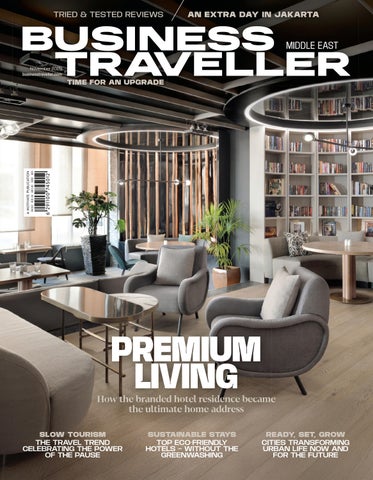
PREMIUM LIVING
How the branded hotel residence became the ultimate home address SLOW TOURISM THE TRAVEL TREND CELEBRATING THE POWER OF THE PAUSE
SUSTAINABLE STAYS TOP ECO-FRIENDLY HOTELS – WITHOUT THE GREENWASHING
READY, SET, GROW CITIES TRANSFORMING URBAN LIFE NOW AND FOR THE FUTURE
KEEP FLYING WITH EUROPE’S BEST Thank you for honoring us as Best Airline in Europe and awarding us in 8 categories at the Skytrax World Airline Awards.
BEST AIRLINE IN EUROPE WORLD’S BEST BUSINESS CLASS ONBOARD CATERING
BEST AIRLINE IN SOUTHERN EUROPE
BEST ECONOMY CLASS IN EUROPE
BEST BUSINESS CLASS IN EUROPE
BEST BUSINESS CLASS ONBOARD CATERING IN EUROPE
BEST BUSINESS CLASS IN SOUTHERN EUROPE
BEST ECONOMY CLASS ONBOARD CATERING IN EUROPE
CONTENTS NOVEMBER 2026
WHERE GLOBAL TALENT LIVES
Updates
How the hotel apartment became the ultimate home address for the mobile workforce
07
COVER IMAGE RESTAURANT: CROSSROADS AT MARRIOTT EXECUTIVE APARTMENTS MANAMA, BAHRAIN; CONTENTS IMAGES SUPPLIED
07 Hot Ticket: F1 makes its way back to Africa by 2030 08 Regional News: The latest airline, hotel, and travel news 10 Sustainable Traveller: The greener side of tourism and hospitality 12 Global News: An update on international travel
Insight
15
15 Rotana’s COO Eddy Tannous talks to us about lifestyle, luxury, and the brand’s regional expansion
17 Why location plays a crucial role in how to maximise your miles 18 Anantara The Palm’s GM Michael Robinson tells us about its transformation 20 Op-Ed: The new definition of luxury – when access is no longer enough 22 We chat with extreme environments cameraman Ben Sherlock 24 Elevator Pitch with Mustafa Bulmuş, MultiProperty General Manager, The Bodrum EDITION and Moxy Izmir N OV E MB E R 2026
34
63
63 Fairmont Riyadh 65 Nobu One Za’abeel
Postcard
66
Drive yourself to the moon (or something like it) at this otherworldly escape
Explore
Features
38
25
25 Extra Day in Jakarta 27 Soothe yourself with the wellness-oriented side of travel and tourism 28 Natural healing: how animals and plants can relieve work stress 30 Splash out on luxury experiences and products 32 Our pick of cultural events around the world and inflight entertainment
Reviews
The power of pause The slow tourism trend is a US$311 billion revolution around how “less is more”
30
48
Different strokes In an era of conformist corporate properties, designer-hoteliers are offering an alternative
42
52
44
54
46
60
Vacation autopilot Are overly-rigid itineraries ruining your travel downtime? Try this instead!
Digital takeoff Slick upgrades to airline apps are streamlining trips – but which ones work?
Top sustainable hotels Eight of the best green hotels out there – with eco-claims that don’t succumb to greenwashing
Stays with a difference Swap the typical hotel room for the extraordinary with these unique UAE picks
Power plants Flourishing backyards, biodiverse architecture, and inspiring renaturation
The long-lost art of letter writing We – and some of our favourite hotels – explore the case for the ensuring luxury of hand-written work BUS I N ES S T R AV EL L ER M I DDL E E AST 3
Editor’s Letter THERE WAS ONCE A TIME where the gold standard of the corporate world was built around the relentless hustle. The professional ideal was someone who would proudly showcase working all hours of the day and night as the ultimate badge of honour – perhaps even layering on a side hustle or two in any leftover time, ensuring every free hour was monetised and directed towards output: always intense, fast-paced, and unyielding In many boardrooms, this concept hasn’t left – but it has evolved. While the ability to get a job done at all costs is still a highly covetable trait, today, attitudes toward productivity and what defines it are shifting significantly. Rather than equating sheer busyness with success, savvy modern executives recognise that a round-the-clock, purely rise-and-grind mentality often yields diminishing returns, and that adequate rest actually fuels the creativity and clarity needed for sustainable growth. And there are few industries where this evolving mindset is being reflected more clearly than travel. As the hyper-connectivity created by modern technology (p.42) leaves us feeling a little worn, the contemporary idea of luxury has become less about acquiring status symbols and more equated with the freedom to enjoy more time and space (p.20). Corporate travellers are increasingly blending work with leisure, extending their trips to work remotely while they decompress in their own time (p.15 & 24), and choosing properties like a premium hotel apartment (p.34) – one that offers the luxurious services of a trusted hospitality brand, paired with residential infrastructure giving you a space to breathe, along with a sincerely neighbourly sense of home. When people slow down, they can also pay closer attention to the details: from the impact of our ecological footprint (p.46 & 54), to the joy of finding a hotel that will wow us with something unique (p.48 & 52). The same applies to the industry experts: places that take the time to actually listen to what travellers are really looking for, then use that to refine their offering, will always win in customer loyalty. (p.18 & 63). Contrary to popular belief, wanting to slow down doesn’t have to mean throwing out the “travelmaxxing” playbook, or giving up the desire to get more out of life, work, and travelling. These ideas aren’t mutually exclusive – they’re just two sides of the same coin. We just want to do more without sacrificing our room to breathe, and see more without having to constantly be in a rush. We don’t just want to work harder, we want to work smarter. The industry has been listening, and it’s responding by building the spaces, places, and offerings to match. So unpack your bags, take a moment, and enjoy the issue.
BUSINESS TRAVELLER MIDDLE EAST IS JOINTLY PUBLISHED BY MOTIVATE MEDIA GROUP AND BUSINESS TRAVELLER MEDIA LTD
MOTIVATE MEDIA GROUP EDITOR-IN-CHIEF OBAID HUMAID AL TAYER MANAGING PARTNER AND GROUP EDITOR IAN FAIRSERVICE CHIEF COMMERCIAL OFFICER ANTHONY MILNE GROUP CONTENT DIRECTOR THOMAS WOODGATE EDITOR YI-HWA B. HANNA ART DIRECTOR CLARKWIN N. CRUZ CONTRIBUTORS HANNAH BRANDLER, ANDRA NASRIE, JAKE JONES, STEPHANIE VERMILLION, NIVEA SERRAO, RHYS JONES, ALEXANDRA RICHARDS, TODD PLUMMER, MICHAEL MÖSER GENERAL MANAGER – PRODUCTION S SUNIL KUMAR PRODUCTION MANAGER BINU PURANDARAN ASSISTANT PRODUCTION MANAGER VENITA PINTO GROUP SALES MANAGER CHAITALI KHIMJI SENIOR PARTNERSHIPS MANAGER MURALI NARAYANAN
HEAD OFFICE: MEDIA ONE TOWER, DUBAI MEDIA CITY, PO BOX 2331, DUBAI, UAE; TEL: +971 4 427 3000; FAX: +971 4 428 2266; E-MAIL: BTME@MOTIVATE.AE DUBAI MEDIA CITY: SD 2-94, 2ND FLOOR, BUILDING 2, DUBAI, UAE; TEL: +971 4 390 3550; FAX +971 4 390 4845 ABU DHABI: PO BOX 43072, ABU DHABI, UAE; TEL: +971 2 677 2005; FAX: +971 2 657 3401; EMAIL: MOTIVATE-ADH@MOTIVATE.AE SAUDI ARABIA: REGUS OFFICES NO. 455 - 456, 4TH FLOOR, HAMAD TOWER, KING FAHAD ROAD, AL OLAYA, RIYADH, KSA;TEL: +966 11 834 3595 / +966 11 834 3596; EMAIL: MOTIVATE@MOTIVATE.AE LONDON: MOTIVATE PUBLISHING LTD, ACRE HOUSE, 11/15 WILLIAM ROAD, LONDON, NW1 3ER, UK; E-MAIL: MOTIVATEUK@MOTIVATE.AE
Yi-Hwa B. Hanna Editor
TOP PICKS THE POWER OF PAUSE The growing slow travel movement is a US$300+ billion revolution. P38
DIFFERENT STROKES A new era of designerhoteliers is creating stays with a difference. P48
POWER PLANTS These biodiverse spaces and renaturation projects are green havens. P54 SUBSCRIPTIONS: EMAIL: SUBSCRIPTIONS@MOTIVATE.AE; TEL: +971 4 427 3542
businesstraveller.com/middle-east BUSINESSTRAVELLERME
0 4 BU S I N ES S T R AV ELLER MIDDLE E AST
BTMIDDLEEAST
N OV EM B ER 2026
IMAGES SUPPLIED; MICHAEL J. COHEN/GETTY IMAGES
BUSINESS TRAVELLER MEDIA LTD. INK, BLACKBURN HOUSE, BLACKBURN ROAD, LONDON, NW6 1RZ
EMIRATESWOMAN.COM @emirateswoman
REGIONAL NEWS
SU STA I N A B I LIT Y
GLOBAL NEWS
New hotels, flight routes, and more
The greener side of tourism & hospitality
Happenings from around the world
HOT TICKET
Racing into the future
Rwanda is set to bring Formula 1 back to Africa with a landmark 2030 Grand Prix agreement
IMAGES JON FEINGERSH/GETTY IMAGES
WORDS YI-HWA HANNA
AFTER A 30-YEAR continental absence, the premier motorsport championship is finally charting a historic course back to Africa through an ambitious long-term partnership. Set against the rolling hills of Bugesera just outside Kigali, the upcoming FIA Grade 1 circuit promises to deliver a thrilling new battleground while supercharging regional tourism and infrastructure development. President Paul Kagame’s bold vision aims to transform this multi-million-dollar sporting bet into an enduring socio-economic triumph for local communities across the key East African region.
N OV E MB E R 2026
BUS I N ES S T R AV EL L ER M I DDL E E AST 7
WORDS YI-HWA HANNA
REGIONAL NEWS
ROUTE ROUND-UP
AIR ASTANA
Two new branded hotel residence projects bring style to the suburbs ACCOR AND CITYVIEW are teaming up to bring more high-end branded living and smart offices to Dubai’s burgeoning neighbourhoods through two new key projects: the world’s first standalone Mövenpick residences and Accor’s debut branded for-sale offices in the city, Pullman Residences & Offices Dubai Meydan.
Launching in 2028, Mövenpick Residences Dubai Motor City will have 408 residences, including studios, one-bedroom, and twobedroom apartments, alongside a fitness centre, multiple swimming pools, a padel court, and a kids club. Pullman Residences & Offices Dubai Meydan, meanwhile, introduces a mixed-use concept to Meydan Horizon, with 282 Pullman branded residences and Accor’s first-ever branded offices for sale globally. Located near Downtown Dubai, overlooking the Ras Al Khor Wildlife Sanctuary, the project includes residential units ranging from one to four bedrooms alongside meeting spaces, a screening room, and three food and drink concepts. “Dubai continues to set the pace for real estate innovation and remains a vital growth market for Accor,” said Camil Yazbeck, Accor’s Global Chief Development Officer for the Premium, Midscale and Economy division.
‘Launching in 2028, Mövenpick Residences Dubai Motor City will have 408 residences’ 8 BU S I N ES S T R AV ELLER MIDDLE E AST
ABOVE Rooftop infinity pool at Mövenpick Residences Dubai Motor City LEFT Pullman Residences & Offices Dubai Meydan
DELTA
has postponed the launch of its new Atlanta to Riyadh route until March 2027 following recent security developments and operational disruptions at King Khalid International Airport. Initially scheduled for launch in October 2026, the daily Airbus A350 service was deferred to prioritise safety. The airline will continue to evaluate conditions with the relevant authorities before resuming any affected services.
RIYADH AIR
is set to launch its Jakarta service on 16 November, connecting Soekarno-Hatta International Airport to Riyadh with three weekly flights aboard a Boeing 787-9 Dreamliner. Bookings remain open at time of this issue going to press, with no cancellation or postponement of the route announced yet. N OV EM B ER 2026
IMAGES SUPPLIED; MAHA/ADOBE STOCK
Beds and boardrooms
has expanded its network to Oman with new direct flights linking Salalah to Almaty and Astana that started in late October 2026. Operating weekly via Airbus A320 aircraft, the services introduce more convenient travel options between Kazakhstan and the Dhofar region, featuring competitive return fares. This strategic launch aims to boost key bilateral tourism and cultural ties.
Anantara heads to Morocco
Boutique luxury hospitality is set to arrive in Rabat’s diplomatic zone MINOR HOTELS is heading to Morocco for the first time by partnering with esteemed Abu Dhabi master developer Bloom Holding, to open an intimate luxury boutique property in the heart of the capital. Scheduled to start welcome discerning guests by early 2030, the upcoming Anantara Retreat Rabat will feature 38 exclusive keys nestled in a quiet part of the city’s most exclusive diplomatic enclave. The property’s design will blend traditional Moroccan architectural elements with sleek contemporary design, with the development housing a refined mix of rooms, suites, and seven expansive three-bedroom villas. Aimed squarely at corporate leaders, diplomats, and affluent leisure travellers, the resort offers a signature dining venue, an authentic Moroccan tea lounge, and a world-
class Anantara Spa. Additional amenities include a sparkling swimming pool, fully equipped fitness facilities, and versatile social areas designed for high-end gatherings and executive functions. This high-profile debut arrives as Rabat experiences a notable surge in tourism momentum, supported by a 7% rise in international visitor arrivals during the first five months of the year. Expanding international air routes are significantly boosting accessibility to the destination, firmly positioning the historic capital as an essential, fast-growing cultural and economic hub across North Africa. Both companies share a unified vision for delivering exceptional hospitality standards that respect local heritage.
DOCK AND PLAY
IMAGES SUPPLIED
Wynn Al Marjan Island has revealed a preview of its stunning upcoming harbour and integrated superyacht waterfront gateway A BRAND NEW 98-berth harbour is taking shape in Ras Al Khaimah as part of the highly anticipated resort, which is currently set to open in 2027. Designed to bridge life on the water with the wider resort’s extensive luxury offerings, the facility features a distinctive circular harbour layout set within a protected basin with a maximum N OV E MB E R 2026
depth of five metres. Once completed, the marine hub will be capable of accommodating superyachts and megayachts measuring up to 85m long. Overseen by IGY Marinas, the location will combine expert harbour management with Wynn’s guest services such as streamlined check-in, personalised concierge support,
essential provisioning, and dedicated captain services. A central architectural landmark known as the capitainerie – envisioned by Dewan Architects + Engineers – will function as the primary arrival and operational heart of the marina, while the basin’s marine infrastructure was engineered by Marina Solutions International. The development has
been conceived as a direct extension of the resort rather than a simple mooring spot, intended to allow visitors to move effortlessly between berths, and the resort’s dining, entertainment, and lively waterfront promenades, solidifying the emirate’s position as a premier destination for international yacht owners and discerning maritime travellers alike.
BUS I N ES S T R AV EL L ER M I DDL E E AST 9
S U STA I N A B LE TR AV E LLE R
GREEN DINING
Kitchens evolving AHEAD OF THE Sustainable Restaurant Award announcement at The 50 Best Restaurants ceremony in Lima, Peru, which will take place on the fourth of this month, fresh global data independently audited by the Sustainable Restaurant Association across the world’s leading venues revealed a profound operational shift. Data has shown that a growing number of restaurants are moving away from reactive habits toward preventative design and supply chain resilience. This newly-released empirical snapshot demonstrates that elite dining establishments are fundamentally rewriting their environmental baselines, with 100% of submitting venues now actively engineering out waste from the very inception of their workflows, 73% securing direct traceability by sourcing straight from small-scale regional producers to preserve traditional agricultural methods, and 16% successfully dismantling legacy infrastructure to operate fully gasfree, electric kitchens. Over 70% of these businesses repurpose ingredients to eliminate unnecessary loss, while 60% maintain rigorous organic waste composting programmes, proving that high-end gastronomy is successfully embedding circularity and ecological accountability directly into its core operations rather than relying on superficial
Sissi Lignou, president of IAPCO
A NEW BLUEPRINT
Nobelhart & Schmutzig
greenwashing or end-of-pipe remedies. As industry leaders like Nobelhart & Schmutzig champion values-centric gastronomy, this comprehensive evaluation framework signals a permanent evolution, where long-term structural resilience and ethical transparency take definitive precedence over traditional markers of culinary prestige.
The framework explores sourcing, society, and environment through 90 detailed criteria
THE INTERNATIONAL Association of Professional Congress Organisers (IAPCO) has released a new Sustainability Handbook: a practical resource to help members translate environmental ambitions into concrete, achievable actions across both their internal business operations and client-managed events. Developed alongside Business Events Australia and the Gulf Organisation for Research & Development, the guide provides practical frameworks and real-world examples to empower industry professionals at every stage of their ecological journey, reinforcing a wider strategic initiative to align future congresses with global sustainability standards and targets.
THE PROMINENT cultural advocate Ali Al Saloom has been named the official Conservation Ambassador for IMPACT by Miral to champion regional wildlife protection. Alongside launching a 1 0 BU SI N ES S T R AV ELLER MIDDLE E AST
six-part podcast series titled Guardians of the Arabian Gulf to foster public discourse, Al Saloom will also drive community participation across vital local conservation initiatives managed by Al Ain Zoo and the Yas
SeaWorld Research & Rescue Center. Al Saloom will help Miral to ensure that more UAE residents are actively connecting with regional efforts protecting dama gazelles, wild Arabian sand cats, raptors, and
sea turtles through engaging educational workshops and public science talks hosted across the emirate to inspire community stewardship and long-term ecological preservation for our future generations. N OV EM B ER 2026
IMAGES SUPPLIED
A VO I C E FO R N ATU RE
ALL YOU NEED IS ROVE
FROM BEACH STAYS TO UNBEATABLE CENTRAL LOCATIONS, WE’VE GOT IT ALL.
Rove Hotels thrives at the intersection of creativity and community. Our vibrant spaces offer cool co-working locations and artsy interiors, perfect for the modern traveller. As part of our commitment to sustainability, we’ve eliminated single-use plastics from our hotels, digitalised our operations to reduce paper consumption by 90% and we compost 100% of our food waste, among many other initiatives. Whether you’re here for work or play, Rove Hotels provides a seamless blend of style, convenience, and eco-conscious hospitality.
For bookings and more information, visit rovehotels.com.
EXPLORING WITHOUT BORDERS ROVEHOTELS.COM
GLOBAL NEWS
3
7
4
9
10 8 6 2
5
GET THE SCOOP
1
The latest updates in the travel industry from across the world DoubleTree by Hilton Opens at Singapore’s Robertson Quay (Right) Situated along the Singapore River in the vibrant waterfront precinct, this newly-launched 344-room property marks the DoubleTree by Hilton’s brand’s highlyanticipated debut in the country. Visitors and guests can experience two innovative dining concepts alongside an outdoor pool, a 24-hour fitness centre, and versatile meeting facilities within an exceptionally wellconnected urban base.
2
Minor Hotels Opens Australia’s Largest Wellness Resort (Above) Spanning 340 acres across the scenic Hunter Valley, the newly unveiled Avani Cypress Lakes Resort combines premium villa accommodation with a championship golf course and extensive wellness facilities. Alongside its diverse leisure offerings, the property introduces AvaniWell to the region to create a premier destination for corporate retreats and lifestyle travellers alike.
1
Porto Debuts Torel Private Collection, A Luxe Art Hotel (Below) Housed within a newly transformed 19th-century building overlooking the Douro River, the adults-only sanctuary showcases a rotating private gallery of original contemporary artworks across its galleries. Visitors can also enjoy bespoke hospitality alongside a Japanese fine dining experience curated by renowned chef Vítor Matos, served in an intimate setting.
4
Historic Shepherd Market Opens Grand Mayfair Hotel Venture (Left) Spanning six floors across 33,600 sq ft, this elegant boutique property proudly occupies the site of Mayfair’s oldest recorded house dating back to 1618. Alongside its individually configured rooms and suites, guests can enjoy fine destination dining at Fayre and The Lounge ahead of the highly anticipated debut of the late-night cocktail bar Teddy’s this month. 1 2 BU SI N ES S T R AV ELLER MI DDLE E AST
IMAGES SUPPLIED
3
N OV EM B ER 2026
WORDS YI-HWA HANNA
Nicole Scherzinger Headlining One&Only Mauritius NYE Event (Right) The international pop icon is returning to the Indian Ocean following a widely praised performance in the Maldives during the previous festive season. Guests ringing in 2027 at the secluded peninsula property will enjoy a stellar high-energy vocal showcase from the multi-talented entertainer, serving as the headline highlight for the exclusive resort festive programme.
5
TWG Tea Opens Its Largest Global Flagship at Changi T3 (Right) Spanning 2,700 sq ft, the sprawling Terminal 3 location features the Singaporean brand’s first museum, showcasing unique antique tea wares alongside historic Russian samovars. Travellers passing through the bustling Singapore hub can also sample exclusive limitededition blends, plus an innovative tea-infused ice cream concept that was specifically created to be easily enjoyed by passengers on the move.
6
Singapore Airlines Introduces Business Class Pajamas (Above) This month, the carrier is rolling out its highly-anticipated first-ever sleeper suits for long-haul business class passengers alongside bespoke Byredo amenity kits and skincare products. Meanwhile, premium suites and first-class cabins will also receive exclusive Sisley skincare offerings and newly redesigned cotton sleepwear to elevate the overall experience.
8
Taj Debuts First Continental European Hotel in Frankfurt (Above) Operating under the Indian Hotels Company, the newly opened 126-key Taj Hessischer Hof, Frankfurt marks a major milestone by introducing the renowned brand to mainland Europe for the very first time. Located right in Frankfurt’s bustling trade fair district, guests can enjoy a seamless blend of heritage and contemporary comforts alongside the legendary Jimmy’s Bar.
IMAGES SUPPLIED
7
N OV E MB E R 2026
Two New Asian Hotels Join Preferred Resorts’ Legends (Below) Newly inducted into the prestigious Preferred Resorts Legends Collection, the rebuilt Dusit Thani Bangkok offers park-view rooms across a central 39-storey tower, while The Leela Coorg Forest Sanctuary features 71 exclusive hillside villas nestled within India’s scenic Karnataka coffee country. They’ve joined a group of more than 125 independent hotels worldwide.
9
Minor Hotels Announces First
10 Property in Vietnam’s Capital
(Left) Scheduled for a 2028 launch, the upcoming 310-key Avani+ Hanoi will anchor a vibrant mixed-use lifestyle precinct situated directly within the city’s central Bach Mai Ward. This strategic agreement marks Minor Hotels’ official debut in the Vietnamese capital, successfully expanding the hospitality group’s well-established coastal footprint into an exciting new metropolitan market. BUS I N ES S T R AV EL L ER M I DDL E E AST 1 3
REGISTER HERE
FIND OUT MORE
FOR EVENT SPONSORSHIP, REGISTRATIONS AND GENERAL ENQUIRIES nitika.sharma@motivate.ae | lina.abdelaziz@motivate.ae
WhatsOn.ae
Sponsor
Beverage Partner
WhatsOnAbuDhabi
Printing Partner
Vote Processing Partner
#WOAwards
Structural Partner
Presented By
Expert opinions on the future of travel THE BIG INTERVIEW E D DY TA N NOU S C H I E F O PE R ATI N G O F F I C E R , ROTA N A H OTE L M A N AG E M E NT CO RPO R ATI O N
Q
‘Growth is about understanding what makes a market tick, staying lean, and anchoring every brand in authentic regional roots’
&
A
Rotana’s COO talks to Yi-Hwa Hanna about changing consumer perceptions of luxury, growth of their lifestyle portfolio, and navigating a rapid region-wide expansion It has been a few years since Rotana launched the Edge by Rotana collection. How has that lifestyle portfolio performed commercially, and how does it fit into your broader brand strategy? Edge by Rotana has been a fantastic success. When we N OV E MB E R 2026
opened our first properties, we realised we had something fun, unmasked, and less heavily branded than a traditional five-star hotel. It is an easy lifestyle brand, more F&B-led and boutique in scale. When you walk into our Edge property on Olaya
BIOGRAPHY Eddy Tannous is the Chief Operating Officer at Rotana Hotel Management Corporation. Overseeing day-to-day operations across Rotana’s expanding portfolio, Tannous brings deep regional expertise to his role in steering the group’s strategic growth, operational efficiency, lifestyle brand development, and talent acquisition across the Middle East.
BUS I N ES S T R AV EL L ER M I DDL E E AST 1 5
E D DY TA N NOU S
THE BIG INTERVIEW
Continued from overleaf Street in Riyadh, you see people sitting with their laptops and a coffee – it feels like a vibrant neighbourhood coffee shop rather than a stiff hotel lobby. We are expanding rapidly in partnership with developers like Namar Hospitality, with nine Edges planned in Saudi Arabia alone. It gives owners a lower capital expenditure per project while offering guests something unique, without diluting our core Rotana and Arjan brands. Leisure and “bleisure” travel are surging, and consumer perceptions of luxury are shifting away from traditional opulence toward experiential presence. How is Rotana adapting to this changing mindset? If you want to summarise the word luxury, you won’t have enough vocabulary because it is entirely subjective. If you look at consumer behaviour historically, luxury used to mean being told what to do – there was a rigid dress code, fixed seating, and structured courses. Today’s travellers, from Gen X onwards, reject that. They want to come as they are. For me, time and space are the ultimate luxuries. That is why bleisure travel is booming – people want the ability to extend a business trip over the weekend to explore a new neighbourhood or bistro. We built our regional DNA around genuine Arabic hospitality and the “five senses” guest experience, ensuring that whether someone stays at a classic Rotana or an Edge lifestyle property, they feel genuinely welcomed and understood.
service standards across your portfolios without pricing out core corporate accounts? Costs are always on the rise, and it requires careful management. We look at technologies like AI as enablers rather than magic fixes – they help streamline processes and reduce overheads where appropriate, but they should never replace the human touch. Beyond technology, local partnerships are crucial. Relying entirely on imported goods and shipping creates
Operational cost inflation remains a persistent challenge across the region. How are you maintaining operational margins and
‘The definition of luxury continues evolving. Luxury for me is often the luxury of space and time’
heavy logistical expenses. By working with local producers and suppliers – practicing a farm-to-doorstep mindset – we improve sustainability while keeping costs balanced. Rotana has always operated leanly, maximising our critical mass and operational efficiency to deliver value for both our owners and our guests.
1 6 BU SI N ES S T R AV ELLER MIDDLE E AST
ABOVE, FROM TOP Two Bedroom Villa; Royal Suite
Rotana has set ambitious growth targets across Saudi Arabia’s primary and secondary cities. As you scale rapidly across the kingdom, what operational hurdles are you encountering, particularly regarding local talent acquisition and supply chain logistics? For us, Saudi Arabia has become a super important market, especially with the transformation brought by Vision 2030. When you look at local talent, once you understand the market, it is not difficult to attract the right people. The key with young Saudi talent is showing them a clear career path – they want to
know where they can be in 10 or 15 years, rather than remaining in an entry-level position indefinitely. The entry of female Saudi talent into the workforce has been incredible; they are hungry to improve, well-spoken, and have driven a positive, competitive spirit across the board. Furthermore, Saudi is not just one uniform market. Operating in Riyadh or Qassim is different from Jeddah, and Mecca and Medina have their own specificities. You have to understand those cultural nuances and become part of the local fabric. As for supply chain and operations, keeping things lean and locally sourced is vital to managing logistics effectively. Extended-stay demand is also surging across the GCC. How are you adapting brands like Arjan to serve this long-term business demographic? Arjan has been one of our biggest success stories, alongside Rotana Residences. Arjan was built from the inception as an extended-stay concept featuring larger studio and suite spaces, kitchen facilities, and full-hotel services – such as allday dining and concierge support – without the stuffiness of a traditional full-service hotel. This year, demand has spiked because people want the flexibility of extending on a monthly basis rather than locking into a rigid yearly rental contract while they navigate their living arrangements. We have seen significant market share dominance in Dubai and Abu Dhabi for extended stays, and where demand has outpaced inventory, we have even converted select hotel rooms into long-stay accommodations to meet the market’s needs. N OV EM B ER 2026
IMAGES SUPPLIED
Insight
WORDS JAKE JONES
MAP QUEST
Why location plays a crucial role in how to maximise your miles NE OF THE key things I recommend to people in the points and miles game is sticking with one airline as much as possible when paying for flights with cash. Why? My answer is two-pronged. First, consolidating your mileage earnings with one airline is more beneficial when it comes to redeeming, because it takes less time to accrue a stash of miles realistically worth using. Having 10,000 miles with three different loyalty programmes isn’t as valuable as having 30,000 with one programme. Second, it is virtually impossible to achieve status without remaining loyal to a single airline. While we can debate whether status is worth chasing, there are objective benefits to having it, including mileage multipliers on paid tickets (eg Silver members earn +25% miles on base earning, Gold +50%, etc), which result in top-tier members earning miles at a much faster pace.
O
IMAGE PINKYEN/ADOBE STOCK
‘It is hard to achieve status without remaining loyal to a single airline’ How do you choose the best airline? Geography is usually the deciding factor. Where you live, and therefore the airport you’ll use most often, typically has the greatest impact on which airline is the best fit for you. For many people, that choice – or lack thereof – is fairly straightforward. In the UK, British Airways is the dominant carrier, while for US residents in hub cities of major airlines – such as Atlanta (Delta), Dallas (American) or Houston (United) – this choice is also largely predetermined. Similarly, if you often travel from a secondary city, such as Austin, Sacramento or Buffalo, to a major hub, you may have only one nonstop airline option available – in which case, it’s probably your leading choice. Flying with the airline that dominates your local airport also has other practical advantages, such as robust schedule choices, though being subject to a quasi-monopoly also typically results in higher fares. Then again, with most status metrics being
N OV E MB E R 2026
tied to dollars spent these days, that extra money could still pay off through status benefits and enhanced mileage earning opportunities. In contrast, travellers who frequently fly between two major hubs generally benefit from having multiple airlines and more frequent flights on that route. But it also means choosing where to place your loyalty needs more careful consideration. Leverage the alliance Suppose you are a US traveller based in Chicago – the country’s most well-connected airport – who frequently travels to a country served by a single dominant airline, like Lufthansa in Germany. In that case, you might want to prioritise flights with United, since both airlines are members of Star Alliance. This would mean any onward flights (or beyond) you take with Lufthansa would also earn miles that can be credited to your United
MileagePlus account – consolidating earning from your travel in one place. I highly recommend that travellers, especially those not bound to a hub city, familiarise themselves with each airline’s route map and alliance partnerships to determine which offer them the best options given their geographic circumstances. Even when discussing points and miles in terms of credit cards, geography is always relevant. Does it make sense for someone to pay £650 for an American Express Platinum Card if their home airport doesn’t even have a Centurion Lounge? If you are looking for a co-branded credit card to bolster your wallet, you’d naturally want to find one for an airline you fly frequently. When it comes to everyday spending on credit cards, those who live in large cities may find dining and Uber credits more readily available to take advantage of than those in more rural locations. No matter which way you look at it, examining your points and miles choices through a geographical lens will eliminate a lot of guesswork from your decisions and lead to the maximum mileage return on every dollar you spend. BUS I N ES S T R AV EL L ER M I DDL E E AST 1 7
Insight
Reimagining Paradise on The Palm
Palm Jumeirah has seen a massive influx of ultra-luxury properties over the years. How is Anantara The Palm protecting its market share and leveraging its unique assets, such as your overwater and beachfront villas? Our biggest advantage is that you simply cannot rebuild a property like this today. The flora and fauna, 1 8 BU SI N ES S T R AV ELLER MIDDLE E AST
the amount of trees throughout the property – even in the summertime, people are amazed by that. Our lagoon rooms feature direct access to three sizable, temperature-controlled swimming pools. We also have unique overwater villas and one- and twobedroom beachfront villas, which recently won Best Luxury Villa for the Middle East at the World Travel Awards. Plus, our location gives guests a great selection of nearby dining options within a 10-to-15-minute taxi ride. You have a massive AED200 million repositioning project that’s primarily starting this month. What can guests expect from this extensive propertywide upgrade? We are spending [this investment on a major refurbishment now] to elevate our product after 13 years of successful operation. The project covers nearly every corner of the resort. We are completely renovating the lobby and adding one of the few sea-facing ballrooms in Dubai. We’re also transforming the Lotus Lounge
IMAGE ANANTARA THE PALM DUBAI RESORT
As Anantara The Palm kicks off a landmark AED200 million transformation, General Manager Michael Robinson talks redefining resort luxury, operational sustainability, and keeping a 13-year-old icon fresh
N OV EM B ER 2026
A NA N TA R A T H E PA L M DU BA I R E S ORT
into a cocktail bar, refreshing all 24 treatment rooms at the Anantara Spa, and completely rebuilding The Beach House. On the accommodation side, we are renovating all 64 adult-only Lotus Lagoon units, which feature a complimentary floating kayak cocktail service, updating our one- and twobedroom beachfront villas, giving our overwater villas full renovations plus private pools, and completing interior and exterior pool finishes. (Ed’s Note: Mekong restaurant reopened on 29 October with a revamped concept, and is once again welcoming guests). With travel dynamics shifting, how has the staycation market performed for you, particularly regarding remote work and longer-term leisure stays? The staycation market has been very popular. Even outside of seasonal trends, we see guests booking in for one or two weeks while working remotely. They check in for a change of scenery, and on weekends their friends visit so they can socialise and feel like they’ve had an extended vacation without taking a flight. Similarly, corporate retreats are increasingly moving toward resort properties. Because hybrid work means teams
OPPOSITE PAGE FROM TOP Anantara The Palm Dubai Resort - One Bedroom Beach Pool Villa; Michael Robinson BOTTOM Aerial view with Dubai Marina skyline
don’t see each other daily in an office, companies use these retreats to combine meetings with team-building activities and personal downtime, helping colleagues connect on a personal level. Independent dining in Dubai is fiercely competitive. How are you keeping signature venues like Mekong and The Beach House relevant to both hotel guests and local residents? You have to cater to local regulars who come two or three times a month. For Mekong, we completely redefined the concept around a fictional character named Bao Lin, who travelled down the Mekong River and set up a restaurant in Chinatown, Bangkok. The menu now features Thai influences blended with flavours from Myanmar, China, and Vietnam. We’ve also updated the decor with dark velvet curtains and
“Our biggest advantage is that you simply cannot build a hotel like this today”
HOTEL VIEWS
introduced a live DJ six nights a week to offer a relaxed after-dinner lounge atmosphere. Meanwhile, The Beach House is entering an even bigger phase. Starting this month, we are completely demolishing and rebuilding the venue. While it will maintain its Mediterraneanstyle menu, it will feature a much more modern, upscale beach club twist, launching early next year. Sustainability is a major focus across the industry, but guests are increasingly looking for measurable impact rather than marketing buzzwords. How is Anantara approaching this behind the scenes? Many hospitality sustainability efforts started as simple cost-saving measures, like reducing towel washing or switching to paper straws. But true sustainability requires looking at the operational backbone. At Anantara The Palm, we track ESG metrics daily and monthly through a Power BI dashboard linked to our corporate office, measuring energy and water consumption. Behind the scenes, we work directly with suppliers to minimise single-use packaging on bulk deliveries, such as how produce, like strawberries, is wrapped. On-property, we operate a hydroponic farm, a newly established mushroom farm, and a plant nursery that allows us to propagate cuttings and replenish our landscaping without trucking in new plants from outside. Drawing on your background and leadership style as a general manager, how do you foster a culture of service excellence and empowerment among your team? I turn 40 at the end of this year and have been a general manager for 10 years. Early on, I realised you don’t need to copy rigid, old-school management styles – you should use your perspective as a benefit. For me, it’s all about clear, understandable expectations and sharing our vision, numbers, and strategies openly during quarterly town halls. We also share what hasn’t worked. Giving people permission to fail and empowering them to make decisions is essential. The last thing you want is a staff member saying they need to check with their manager when trying to help a guest. By keeping communication transparent, approachable, and fun, our team can take genuine ownership of the guest experience.
N OV E MB E R 2026
BUS I N ES S T R AV EL L ER M I DDL E E AST 1 9
WORDS JOSHUA OLIVER
OPINION
THE NEW DEFINITION OF LUXURY: WHEN ACCESS IS NO LONGER ENOUGH HERE WAS A TIME when luxury was defined by what most people could not access. A first-class flight, a five-star hotel, a designer handbag, or a reservation at an exclusive restaurant represented a world reserved for a relatively small group of individuals. Today, that definition has fundamentally changed. Luxury has become more accessible, more visible, and, arguably, more predictable. What was once considered exceptional has increasingly become mainstream, forcing the world’s wealthiest consumers to reconsider what luxury actually means.
T
We are entering an era where money alone no longer guarantees exclusivity. The democratisation of luxury has been accelerated by global wealth creation, the expansion of luxury brands, and, perhaps most significantly, social media. Experiences that were once discovered through personal connections or word of mouth are now broadcast to millions within seconds. A hotel suite, private island, or coveted handbag can become an international status symbol overnight. Suddenly, everyone wants the same experience, the same product, and the same photograph. And therein lies the problem. Social media has created an interesting contradiction. While consumers have more inspiration and access than ever before, individuality has arguably become increasingly scarce. Even among the ultrawealthy, purchasing decisions are frequently influenced by what is trending rather than what genuinely reflects personal taste.
20 BU SI N ES S T R AV ELLER MIDDLE E AST
We see this particularly within fashion, hospitality, and travel, where certain products and destinations become desirable simply because they are repeatedly presented as symbols of success. But popularity should never be confused with exclusivity, and price should never automatically be mistaken for value. A handbag commanding an extraordinary resale premium may represent an excellent financial acquisition under the right circumstances, but purchasing it purely because it is fashionable does not necessarily make it a meaningful investment. Equally, an expensive holiday does not automatically translate into an extraordinary experience. True luxury should be measured by its relevance to the individual, not its visibility to everyone else. This shift is creating a new
Joshua Oliver is the Founder of Joshua Oliver Concierge, a luxury concierge company that provides bespoke travel, fashion, and exceptional experiences worldwide.
category of ultra-luxury, where the emphasis moves away from material possessions and towards privacy, personalisation, time, and genuinely exceptional access. For the world’s wealthiest travellers, the ultimate privilege is increasingly the ability to experience something without crowds, publicity, or compromise. It might mean enjoying a destination privately, discovering somewhere that has not yet become fashionable, or having an experience designed entirely around personal interests rather than a predetermined itinerary. Importantly, ultra-luxury is not necessarily about spending more. It is about experiencing something that cannot simply be replicated by the next person willing to pay the same price. The concept of value is also evolving. Financial appreciation remains relevant, particularly when purchasing collectible watches, jewellery, art, or rare fashion pieces. However, emotional value, craftsmanship, provenance, and longevity are becoming equally important considerations. The most discerning consumers understand that something does not need to be universally recognised to be extraordinary. As luxury continues to become more accessible, the industry faces an interesting challenge: how do you maintain desirability when exclusivity is increasingly difficult to preserve? I believe the answer lies in moving away from conspicuous consumption and returning to the fundamentals of luxury: exceptional quality, individuality, discretion and meaningful experiences. After all, when everyone can purchase the same definition of luxury, perhaps the greatest luxury of all is having the confidence to define it for yourself.
N OV EM B ER 2026
IMAGE SUPPLIED
The younger generation is redefining what makes a destination great — and the industry is being asked to keep up
Welcom e to th e
E XC E P TIONAL European elegance. Arabian hospitality. Discover a distinctive stay in the new heart of Riyadh.
A RADISSON COLLEC TION HOTEL radissonhotels.com/collection
WORDS HANNAH BRANDLER
How did you get into filming? My ambition was to be an adventure cameraman. When I left school, I ended up filming weddings – but I kept the dream alive and worked on independent projects. One was a documentary about a conflict artist who painted war zones. We wanted to follow him to Iraq. We were relentless in our pursuit of access, hammering on the door until we got a call from the Ministry of Defence. We got a place on a C-130 Hercules to Baghdad and were embedded with the US forces. It was never the same after that. I’ve filmed in extreme weather conditions and hostile environments. How do you plan high-stakes travel? When I started out, there was a lot of improvisation and luck. We’d travel to countries and have the wrong filming permits and visas (or none at all). I would have to completely blag it. I was young and arrogant. The reality was that I was on borrowed time before my luck ran out and a mistake landed me in jail. I wised up and started to take my safety seriously. At Blue Door Productions, our team looks after each other and that’s very valuable. Someone checks my homework, and I check theirs.
Q
&
A
LENS INTO THE WILD
We catch up with cameraman and director of photography Ben Sherlock
How much luggage do you take? Around 11 to 20 hard Pelican cases. It’s well-packed and full of air tags. My main fear is forgetting something. That plays through my mind from the minute I leave home to the minute we finish the first day of filming. I make endless checklists – we’ve got thousands of cables, screws and bits of kit. What if I’m in -30 degrees in the Changbai Mountains in China and I’ve forgotten a particular screw for a bit of kit? You can make list after list, and pack 1,000 times, but the fear is always there. How do you prepare for a remote destination? Having a good fixer and safety team is essential. Otherwise, the anxiety levels are incredibly high and everything can fall apart. I’ve had plenty of horror stories and experiences without the right safety or kit. Blue Door has an incredible global network of local contacts and I’m confident if a call came in for a country I’d never been to before, we 2 2 BU SI N ES S T R AV ELLER M IDDLE E AST
N OV EM B ER 2026
F R E Q U E N T F LY E R
could line up contacts to film in that country within a day. The stumbling block is almost always budgets.
much dignity as possible. It was a real honour to listen and share her story so far and wide. We were only there for an hour, but it’s never left me.
Do you ever have to drop everything and go? Yes, there have been plenty of occasions. Once I got a call to travel to COP (the UN climate summit) with 12 hour’s notice. The producer said: “We can’t tell you who it is or what you’re filming, but you’re not going to want to say no.” It was Barack Obama. That was a scramble because I’ve got children and responsibilities, but generally speaking I could be out of the house in two hours with all the kit needed for two weeks in the jungle.
IMAGES STAN GASKELL - BLUE DOOR PRODUCTIONS; MARCUS COLE © RED BULL MEDIA HOUSE; BEN SHERLOCK
What are your top tips for working under pressure? In extreme environments, having the right team is critical. If something goes wrong, you need reliable people. That relationship needs to be pressure tested – you need to work with those people in horrible, hard locations to know how they’ll react.
How do you settle back into reality? My partner says I’m incredibly boring when it comes to home life. I love routine and schedule, I keep my sleep regimented and don’t drink much alcohol. Having a stable, secure home has always been really important. It’s tricky when my family wants to go on adventures – I’d love to go on holiday in Wales, but everyone wants to go overseas! I’m aware that’s a privileged position to be in. I also try not to talk much about my adventures. You don’t want to be that guy who’s trying to one-up everyone’s story.
‘I take the same PJs with me everywhere – even if I’m sleeping in the Amazon rainforest’
Describe the atmosphere when filming the recent Red Bull ‘Can He Hop It’ challenge. I filmed the world’s first BMX jump over a speeding F1 car at Goodwood Motor Circuit. BMX pro Kriss Kyle didn’t make the jump the first time, so it was really tense the second time – but he pulled it off! It was fantastic and had huge viewership. How do you deal with jet lag? I’ve tried everything – every sort of medication and neck pillow. The unfortunate truth is: jet lag is real, and it just takes time to get over it. Stick to the time zone you’re in, go to bed and get up at a reasonable hour and eat your meals at the right time. I’ve spent hours blacking out rooms with gaffer tape. A good eye mask makes a massive difference. And avoid alcohol – particularly for the first few nights while your body settles in. N OV E MB E R 2026
FEARLESS FOCUS Ben captures inhospitable deserts and daredevil antics
What are some of the challenges you encounter in your job? For the series Ed Stafford: First Man Out we worked in some of the planet’s most inhospitable locations. Turkana in northwestern Kenya was the hottest place I’ve been – a volcanic landscape in 40+ degrees with no shade. Absolutely savage heat. You’re trying to keep cameras alive, stay fed and hydrated so you don’t pass out, carry the kit and hit your story beats to make a TV show. Plus, you need to keep everyone happy to create good content. What’s been a career highlight? It’s hard to nail it down to just one. We did a project with the hunter-gatherer Tanzanian indigenous ethnic group, the Hadza. We followed one of the trackers for hours through the bush, carrying our cameras in complete silence. Suddenly he stopped us and told us to get down. We slowly raised our cameras and a herd of gazelle were a few metres in front of us. That was phenomenal. From a career standpoint, on the border of Syria in the Beqaa Valley in Lebanon, we filmed the story of a Syrian girl who fled the war. Her family had been murdered in front of her and her story was incredibly compelling. We tried to treat it with as much respect and give her as
Do you bring routines overseas? I try and keep some of the consistency. Everyone laughs at me because I take the same PJs with me everywhere – even if I’m sleeping in the middle of the Amazon rainforest. What’s your indispensable travel gadget? A really good coffee kit. I started with an AeroPress, then moved onto a little Wacaco hand press, but a whole crew of 20-odd people would turn up and ask for coffee – which was expensive and time-consuming! Now I travel with a cafetiere, a stainless-steel thermos (the glass ones could break in your bag) and at least three bags of extra ground coffee. What’s your dream destination? Japan is at the top of my list. What’s your inflight entertainment pick? If I’m hitting the ground running, I do everything I can to sleep. Otherwise, I’ll attach my iPad to the seatback using the sick bag and binge TV. What’s next? Loads of exciting stuff. I worked on Blue Planet III, which was out in May – I filmed the majority of episode six, which focuses on human-animal interaction and the future of oceans. BUS I N ES S T R AV EL L ER M I DDL E E AST 2 3
The Elevator Pitch
Business Traveller Middle East gives Mustafa Bulmuş, Multi Property General Manager, The Bodrum EDITION and Moxy Izmir, five minutes to pitch his property to prospective guests HEN PEOPLE think of İzmir, they often picture the relaxed, easygoing rhythm of the Aegean. But there is another side to the city that is young, creative and constantly moving. That energy is exactly what we wanted to capture with Moxy İzmir. From the start, our ambition was to create much more than a place to stay. We wanted Moxy İzmir to become a social hub where locals and travellers can meet, work, unwind, and experience the city in a more spontaneous way. The Moxy experience begins the moment you arrive, with check-in at the bar and a welcome drink, setting the tone
ABOVE, CLOCKWISE FROM LEFT Check-In Bar; Lobby; Dining - public space; Meeting room LEFT: Mustafa Bulmuş BOTTOM: Sea view room
W
24 BU SI N ES S T R AV ELLER M IDDLE E AST
‘It’s for guests who want their hotel experience to feel as interesting as the destination itself’
for a stay that feels relaxed, informal and fun. At the heart of the hotel is our open social space. It is designed to evolve throughout the day, from morning coffee and laptop sessions to casual meetings, drinks, and conversations later in the evening. Whether you are staying with us or simply stopping by, there is always a reason to settle in and stay a little longer. That same philosophy carries into our guest rooms, which are smart, stylish, and thoughtfully designed around what today’s traveller actually needs. Clever use of space, intuitive technology, and playful design give guests everything they need to recharge, without adding unnecessary formality. What makes Moxy İzmir particularly exciting is how naturally it connects with the personality of the city. İzmir has a strong creative spirit, a vibrant social scene, and an unmistakable sense of individuality. We wanted the hotel to reflect that character rather than compete with it, creating a space that feels connected to the neighbourhood and the people around us. Ultimately, Moxy İzmir is for guests who want their hotel experience to feel as interesting as the destination itself. Whether they are here for work, a weekend by the Aegean or simply to discover another side of İzmir, we want them to feel comfortable being themselves, meeting new people and experiencing the city on their own terms. N OV EM B ER 2026
IMAGES SUPPLIED
F R E Q U E N T F LY E R
Eat, drink, shop, relax
IMAGE EKO HERWANTORO/UNSPLASH
RAFFIC IS THE PRICE of admission to Jakarta – but stay one extra day and the city can stop feeling like a maddening commute between meetings. Indonesia’s capital rarely makes anyone’s shortlist of favourite Asian cities on first impression. It is vast, humid, and notorious for gridlock that can turn a 5km journey into an hour-long ordeal. But for business travellers who can carve out just one extra day in Jakarta, the reward is a city with genuine depth: a colonial-era old town, one of the region’s best contemporary art museums and a rooftop bar scene that rivals anywhere in Southeast Asia. With Soekarno-Hatta International Airport being so well-connected (and as of 16 November, with nonstop flights to and from Riyadh via Riyadh Air) and Jakarta remaining Indonesia’s commercial engine even as the government relocates to the new capital, Nusantara, in Borneo, the city isn’t going anywhere as a hub for meetings. Here’s how to use a spare 24 hours well.
Jakarta T EX TR A DAY
Between back-to-back meetings in Southeast Asia’s most frenetic capital, one spare day could be enough to appreciate Jakarta’s beauty-in-chaos WORDS ANDRA NASRIE
N OV E MB E R 2026
BUS I N ES S T R AV EL L ER M I DDL E E AST 25
JA K A RTA
WHERE TO STAY
or two, and tickets are best booked in advance to skip the queue. Loop back towards the Golden Triangle – the Sudirman, Thamrin and Kuningan corridor where most of Jakarta’s international hotels and corporate offices cluster – for lunch. This is also the most convenient base for business travellers, given its proximity to malls, offices and meeting venues. For something local, look for a warung (food stall) serving nasi goreng (fried rice) or soto (turmeric-tinged take on chicken or beef soup).
ABOVE FROM LEFT Kota Tua; Jakarta Cathedral BOTTOM Nasi goreng
‘Glodok is worth a detour for its temples and street food’
MIDDAY From Kota Tua, head south to Museum MACAN (Modern and Contemporary Art in Nusantara) in West Jakarta. The collection spans Indonesian and international artists, with rotating exhibitions that have previously included major names such as Yayoi Kusama. It’s an easy hour 26 BU SI N ES S T R AV ELLER MIDDLE E AST
EVENING As the sun drops, Jakarta’s skyline is best appreciated from above the traffic – who would, after all, want to be in it? SKYE, on the 56th floor of the BCA Tower, has long held its position as the city’s headline rooftop, with views stretching from the Java Sea to the volcanoes of West Java on a clear evening. Henshin, at The Westin Jakarta, and Pantja, known for open-fire cooking and cocktails in a converted South Jakarta warehouse, are strong alternatives. For a final stop, Kemang in South Jakarta rewards those with energy left in the tank. The neighbourhood’s bars and live music venues make it the closest thing Jakarta has to a nightlife district.
Nearby, The Westin Jakarta occupies the upper floors of Gama Tower in Kuningan, with direct access to the district’s malls and office towers. Similarly, Fairmont Jakarta sits in the southern reaches of the CBD with a secure underground walkway linking into Plaza Senayan mall.
For something further upmarket, The Langham, Jakarta opened as the brand’s first Southeast Asian property within District 8, a 65-storey mixed-use complex in the Sudirman Central Business District. The hotel houses two renowned restaurants: T’ang Court and Tom’s by Tom.
Emirates flies direct from Dubai to Jakarta; Qatar Airways flies there direct from Doha; Oman flies there nonstop from Muscat, and from Saudi, Saudia flies nonstop from Jeddah, and Riyadh Air from Riyadh. N OV EM B ER 2026
IMAGES SONY HERDIANA, AHIRAO/ADOBE STOCK; BING BANG/GETTY IMAGES
MORNING Start early, before the heat and the crowds set in. Kota Tua, Jakarta’s old town, holds the clearest evidence of the city’s Dutch colonial past, when it was known as Batavia. Fatahillah Square is the figurative heart of the district, ringed by restored 17th- and 18th-century buildings that now house museums, including the Jakarta History Museum, home to thousands of artefacts spanning the city’s transformation from Jayakarta to Batavia to modern-day Jakarta. A short walk north leads to Sunda Kelapa, the city’s old harbour, still busy with traditional wooden pinisi schooners loading and unloading cargo much as they have for centuries. For a change of pace, Glodok, Jakarta’s Chinatown, sits nearby and is worth a detour for its temples and street food stalls.
AFTERNOON No visit is complete without Monas, the National Monument, whose towering 132m obelisk dominates the skyline and offers aweinspiring city views from its observation deck on a clear day. Nearby, the Istiqlal Mosque – Southeast Asia’s largest – sits directly across from Jakarta Cathedral, a pairing that is often cited as a symbol of Indonesian religious pluralism. From there, Menteng is worth a slow wander. This leafy diplomatic quarter, home to embassies and colonial-era villas, includes Taman Suropati, a small park ringed with statues donated by the original ASEAN member states.
Basing yourself in Central Jakarta keeps every stop on this itinerary within easy reach, gridlock permitting. Hotel Indonesia Kempinski Jakarta overlooks Bundaran HI roundabout, and connects into Grand Indonesia Mall.
WORDS YI-HWA HANNA
WELLNESS
Zanzibar’s wellness makeover
BAREFOOT LUXURY retreat Envi Paje, a lodge situated on the powder-white sands of Zanzibar’s Paje Beach is bringing cutting-edge regenerative medicine to this part of East Africa, and offering a new boon to the island’s fast-developing hospitality sector. Featuring The Sanctuary, a specialised spa and recovery lab, the property provides hyperbaric oxygen
therapy, targeted red light treatments, PEMF cellular technology, and cold immersion alongside a traditional sauna and cold plunge pool. All of the treatments are governed by the property’s distinct AFYA philosophy, merging modern scientific results with indigenous botanical wisdom harvested directly from local baobab, coconut, lemongrass, clove, and seaweed found on the surrounding shores. Guests can choose from structured multi-night wellness retreats tailored specifically for rebalancing, deep recovery, or island energy, incorporating daily movement, bespoke massages, and private mindfulness sessions. This autumn, the resort will further elevate its programming by hosting the Limitless Human Residency, an intensive five-day longevity programme led by human performance specialist Elie Abirached, which uses comprehensive bloodwork diagnostics and nervous-system regulation to help guests live and feel better. The goal? To offer high-end wellness tech in an environment of unpretentious coastal elegance.
TOP OPENING
IMAGES SUPPLIED; JOHN ATHIMARITIS
AL QUOZ’S NEW SPORTS HUB SPANNING AN impressive 15,000 sqm in Dubai’s funky Al Quoz district, a newlylaunched sports hub, Club 15, is hoping to etablish an unprecedented benchmark for urban hospitality by uniting professional-grade sports training, advanced physiological recovery labs, indoor padel courts, and diverse family amenities under one expansive roof. Conceived by Lebanese basketball icon Fadi El Khatib as a comprehensive sports city within the city, this multi-level destination transcends standard workout facilities to provide discerning N OV E MB E R 2026
business travellers and fitness enthusiasts alike with an integrated ecosystem encompassing elite basketball courts, indoor padel arenas, swimming pools, specialised physiotherapy clinics, premium social lounges, lifestyle programming, and events.
An upcoming series of well-being breaks SIX SENSES has announced an extensive lineup of programmes across eight specialised wellness retreats spanning properties in Türkiye, the Maldives, Portugal, and Japan for the upcoming seasons. Designed to help busy travellers enjoy a much-needed break away from their otherwise demanding schedules, these multi-day programmes focus on targeted disciplines including women’s health, Ayurveda, breathwork, and hormonal balance. By blending ancient healing traditions with modern wellness practices, these immersive retreats aim to offer guests an effective environment in which to reset and recharge away from everyday pressures. Highlights among the upcoming offerings include the Bloom retreat at Kaplankaya, Yin Way sessions tailored for female guests in Kanuhura and Kyoto, and intensive breathwork workshops
led by visiting international experts, alongside contrast therapy, sound healing sessions, and multi-day Ayurveda immersions set among the picturesque vineyards of the Douro Valley. Each structured journey pairs expert professional guidance
with practical, sciencebacked methodologies that participants can easily incorporate into their daily routines long after returning home. These unique new programmes reflect a broader industry shift toward meaningful travel experiences that prioritise mental clarity, emotional restoration, and long-term physical longevity over conventional vacations.
BUS I N ES S T R AV EL L ER M I DDL E E AST 27
WORDS STEPHANIE VERMILLION
WELLNESS
ANIMAL MAGNETISM
Creature comforts HETHER IT’S LISTENING to backyard birdsong or interacting with horses on a regenerative farm, time with animals can deliver a serious dose of healing. It’s not surprising, then, that therapists and wellness coaches are increasingly bringing animals into the fold, whether it’s goat yoga, equine therapy, or birdwatching for mental well-being. According to the National Institutes of Health, the medical research agency for the US government, quality time with animals can decrease stress levels and lower blood pressure while boosting mood. Christina Marz, psychologist, author and founder of international equine therapy school MarzMethod, says the multisensory aspect plays an important role. “The touch, the smell, and just looking at animals – that positive stimuli is a motivation for your emotion landscape,” she says, noting that the way animals view the world can be passed on, too. “Animals
W
usually don’t get depressed over the past. They look positively into the future,” she adds. “They have a heart field that is based on renewing positive emotions.” Horses are a great example. Equines can reflect our emotions back to us, according to the Purdue University College of Veterinary Medicine. Their non-judgmental presence can help people cope with difficult emotions. But for any animal-interaction experience, you must do your research. “Ask for credentials,” says Marz, noting that someone simply having a horse does not mean they can offer equine therapy. The same goes for dogs. Animals need to be prepared to carry the load of human emotions. “Animals have to learn how to deal with people, and they also have to learn what to do with the emotions dumped on them.” Some other red flags to keep in mind when selecting animal wellness experiences: “Any wellness programme involving animals should prioritise animal welfare over human entertainment,”
‘An ethical programme will allow the animal to choose when to interact and when to retreat’
says Dr Hilary Humm-Beatty, veterinarian at Embrace Pet Insurance. “An ethical programme will allow the animal to choose when to interact and when to retreat. A programme that involves animal performances, forced interactions, or has dirty conditions or sickly, thin-looking animals, is not ethical.” Take goat yoga, an experience where yogis stretch and twist alongside roaming goats. Experts say this experience can be done responsibly, and it often is, with some goats enjoying partaking – you can tell if the animals have tails up or ears forward, according to reporting from Slate. If goats are uncomfortable or stressed, they may instead yell or avoid interaction. Look into reviews or call ahead and ask about goat treatment and protocols before signing up. Also remember that touching isn’t the only way to heal. Simply listening to nature, or watching it, can do wonders for the soul, says Marz. “When you can observe animals in a harmonious state with nature, or in their habitat, that’s a good way to understand and reflect about ourselves and our interaction with others and our environment.” While many of us find healing with our four-legged friends at home, you can also unwind with responsible and feel-good animal wellness experiences. Here’s our pick of animal-friendly activities across the globe.
RESTORATIVE RETREATS
Ojo Santa Fe, New Mexico, US This property in the desert has long lured the health-minded and also boosts well-being through animals. Ojo Santa Fe runs Puppy Patch, where adoptable puppies are brought to the retreat for meet and greets. 28 BU SI N ES S T R AV ELLER MIDDLE E AST
Jacada Travel, Scotland Jacada Travel organises tours around the world. Its “In the Stillness of Scotland” itinerary promises hours in nature – including apitherapy experiences where guests can enjoy the stress-reducing sound of bees.
Gwinganna Retreat & Spa, Tallebudgera Valley, Australia Gwinganna provides a host of nature-based options, including equine therapy that connects travellers with horses. Think equine-assisted meditation, therapy, and learning.
Raffles Bali, Indonesia Listening to birds can put your mind and stress woes at ease. Raffles Bali’s Wings of the Wild programme invites guests to stroll through the garden, where 25 bird species and 11 types of butterflies reside. N OV EM B ER 2026
IMAGES OJO SANTA FE; JACADA TRAVEL; NEDOMACKI/ADOBE STOCK; GWINGANNA RETREAT & SPA; RAFFLES BALI; JINTANA/ADOBE STOCK
From horses and goats to dogs and birds, how animal therapy can relieve stress and boost health
N OV E MB E R 2026
BUS I N ES S T R AV EL L ER M I DDL E E AST 2 9
WORDS YI-HWA HANNA
LITTLE LUXURIES
One night in Paris
CHEZ WAM, located at St. Regis Gardens in Dubai, has launched “A Night in Paris”, a weekly Thursday dining experience curated by coowner and executive chef Hadrien Villedieu. Running alongside the regular à la carte offerings, the specialised menu features reworked French classics such as slow-cooked short rib boeuf bourguignon and 24-month Comté-
AFTER-WORK DRINKS
All aboard for a new era
30 BU SI N ES S T R AV ELLER MIDDLE E AST
enhanced croque monsieur, all individually priced. Villedieu’s deeprooted French culinary techniques blend with global influences while a live DJ bridges dinner straight into late-night drinks. Ranked among MENA’s top 50 restaurants, this buzzy Palm Jumeirah hotspot continues to draw crowds with its vibrant culinary programming, like this latest weekly addition.
STEAK-FRITES HOTSPOT Rowley’s is already a familiar favourite across Dubai’s busy dining scene, but this popular DIFC steakhouse now has even more reasons to visit. Located at Central Park Towers, the restaurant has recently rolled out some exciting new menu additions including a premium Wagyu steak selection, and a rich signature Royal Sauce to complement its classic frites. Just in time for outdoor season, you can also now head upstairs to The Ship, a newly-opened rooftop pub situated directly above the dining room. Featuring striking front-row views of the Burj Khalifa and a vibrant golden-hour drinks atmosphere with drinks starting from AED25, this cosy, relaxed rooftop space provides an ideal spot for after-work socialising.
A hot pick for dinner: Jãra by Martín Berasategui – which features in the 2026 MICHELIN Guide Dubai – has reopened at The Lana Dorchester Collection N OV EM B ER 2026
IMAGES SUPPLIED
FUN NIGHT OUT
WORDS YI-HWA HANNA
UAE EXCLUSIVE
The scent of Arabia served in a teacup LUXURY TEA BRAND TWG Tea has launched a new flavour in Oud Night Tea: a new country-exclusive black tea blend created specifically for the United Arab Emirates. Intended to capture the rich cultural heritage and aromatic traditions of the region in a drink, the blend infuses exceptional whole leaf black tea with notes of traditional oud wood, rose, molten resin, and perfume-rich incense. If you’re looking for a meaningful keepsake on your next business trip passing through Dubai or Abu Dhabi, the 100g collectible tin – priced at
AED108 – will make for an authentic local souvenir. If you’re a resident, it’ll make for a sophisticated gift to take back overseas for friends, family, or colleagues. Love the fragrance but not into tea? The collection also features an artisanal scented candle for AED339, created by distilling 6kg of the tea leaves into a handpoured wax formulation. The new range is available at TWG’s regional boutiques including The Dubai Mall, Mall of the Emirates, and The Galleria Al Maryah Island, and is the start of a wider global collection celebrating unique tea traditions worldwide.
THE BAG
Silk Road chic
Anantara and Jim Thompson fuse iconic Thai heritage into a stunning range of luxury tote bags
IMAGES SUPPLIED
ANANTARA has teamed up with iconic design house Jim Thompson for an exclusive partnership, including a themed luxury suite at two of its Thailand properties, and resortwear. The centerpiece is the bespoke ‘Soul of Siam’ print, which showcases vibrant botanical motifs and Thai iconography. The range features a silk wrap kaftan, scarf, cap, and pocket squares, but a standout travel accessory is the spacious Soul of Siam Capri Beach Bag (AED635), the large Lotus Pouch (AED427) that can fit a laptop of up to 13 inches, and the smaller Cactus Pouch (AED318). Available at Anantara hotels and resorts throughout Thailand, and online at jimthompson.com.
TH E WATC H
A whole new world The Series U Blue Planet by CIGA Design, one of several up-and-coming watchmakers from China, is a stunning timepiece for watch-lovers who value conceptual art, unique engineering, and environmental consciousness. Launched in 2021, this timepiece’s design (driven by a self-developed Asynchronous-Follow movement) is a visual reminder to protect the planet, intended to mimic the “overview effect” of seeing Earth from space. It won the the Challenge Watch Prize at the Grand Prix d’Horlogerie de Genève - making CIGA Design the first Chinese brand to claim a coveted GPHG award. US$1,199, cigadesign.com
N OV E MB E R 2026
BUS I N ES S T R AV EL L ER M I DDL E E AST 31
E N T E RTA I N M E N T
WORDS NIVEA SERRAO AND YI-HWA HANNA (“WATCH”)
C U LT U R A L CA L E N DA R
WATC H
The Thinking Game
OUR PICK OF EVENTS TAKING PLACE AROUND THE WORLD Festival de Barriletes Gigantes, Sumpango, Guatemala 1-2 November
READ
American Hagwon by Min Jin Lee FROM THE bestselling author of Pachinko comes another richly-observed and deeply humane exploration of the Korean diaspora. Set against the upheaval of the 1997 Asian financial crisis, this family saga follows the story of the Koh family, whose comfortable existence in Seoul collapses amid betrayal and economic
turmoil. Lee examines the sacrifices parents make for their children, the relentless pursuit of educational success, and the uncomfortable question of whether hard work really guarantees a better life. Epic in scope yet characteristically nuanced, this book is likely to become another literary classic. AED 79.98; amazon.ae
Golden Horse Film Festival, Taipei, Taiwan 6-22 November One of Asia’s most prestigious celebrations of cinema, this festival showcases outstanding Chinese-language filmmaking alongside international productions. Bringing together established directors, emerging talent and film enthusiasts, its programme features premieres, screenings and conversations, before culminating in the celebrated Golden Horse Awards, making it an essential destination for discovering compelling stories from across Asia and beyond.
LISTEN
The Atlas Obscura Podcast THIS WORLD is full of strange and wonderful things — and projects like Atlas Obscura are devoted to capturing the unusual stories behind them. Whether it’s a museum dedicated to a niche topic, or a mysterious monument to a local tradition, each bite-sized episode serves as an audio passport to some of this planet’s most interesting landmarks. Perfect for inspiring a detour during your next adventure. On Apple Podcasts and Spotify. 3 2 BU SI N ES S T R AV ELLER M IDDLE E AST
Nyege Nyege Festival, Jinja, Uganda 19-22 November Set along the banks of the Nile in Jinja, this festival celebrates the experimental sounds shaping contemporary African music. Bringing together underground DJs, musicians, and performers from across the continent and beyond, it offers an exhilarating mix of genres, cultures and creative expression, championing boundary-pushing artists in Africa’s thriving alternative music scene. N OV EM B ER 2026
IMAGES SUPPLIED; GREG KOHS; KALYAKAN/AODOBE STOCK; SBROGAN, EMAD ALJUMAH/GETTY IMAGES
With Netflix’s latest buzzy documentary, The AI Doc: Or How I Became an Apocaloptimist, creating conversations around the rapid rise of artifical intelligence and what it could mean for global society, 2024’s The Thinking Game is worth a watch if you haven’t seen it yet, or a revisit if you have. Released on YouTube for free in November 2025, and currently available on Emirates’ ICE inflight entertainment, it was filmed over five years and follows the work and philosophies of Demis Hassabis as he first began DeepMind as a cash-poor startup, to its 2014 acquisition by Google, before he and John Jumper won the Nobel Prize in Chemistry in 2024.
Every November, the skies above the town fill with enormous, intricately decorated kites. Held to honour departed loved ones, this spectacular tradition sees communities create elaborate designs using colourful tissue paper and bamboo. Blending Indigenous beliefs, artistry and remembrance, the festival transforms a centuries-old custom into an extraordinary visual celebration.
DISCOVER YOUR NEW CREEKSIDE DESTINATION STAY. PLAY. EXPLORE. A staycation with so much more to discover. Beautifully transformed rooms, refreshing pools, The Aviation Club, lush gardens and little moments of joy, from feeding the fish to visiting the duck pond.
ONE DESTINATION. ENDLESS EXPERIENCES. The Creekside Hotel Dubai Soon to join MGallery Collection
Connect with Us:
+971 4 230 8555 - HC5L8@accor.com /TheCreeksideHotelDubai
COVER STORY
Where Global Talent Lives HOW THE HOTEL APARTMENT BECAME THE ULTIMATE HOME ADDRESS FOR THE MOBILE WORKFORCE
T
he Middle East is undergoing a remarkable transformation. Across cities such as Dubai, Abu Dhabi, Riyadh, and Doha, economic diversification, foreign investment, entrepreneurship, and global mobility are reshaping the region’s business landscape. New headquarters are being established, international firms are expanding regional footprints, and record numbers of executives, consultants, and entrepreneurs are choosing the Gulf as a base for both business and lifestyle. This influx is accelerating a major shift in the region’s hospitality and accommodation market. Industry sector reports indicate that the Middle East’s serviced apartment and extendedstay sector is expanding rapidly, with a robust pipeline of hotel-apartment properties taking shape across key commercial hubs like Dubai, Abu Dhabi, and Riyadh. This growth reflects a structural change in how incoming talent expects to live and work. For many of these professionals, the traditional accommodation options no longer meet their needs. A standard hotel room may work for a few nights – yet a
3 4 BU S I N ES S T R AV ELLER M IDDLE E AST
BELOW Marriott Executive Apartments Istanbul Fulya
residential lease may be too restrictive for a project-based assignment or an uncertain relocation timeline. As a result, today’s global professionals are increasingly seeking a solution that combines flexibility, comfort, and productivity without compromise. Data from the Global Business Travel Association shows that the vast majority of modern corporate travellers now regularly extend their business itineraries or split time across multiple locations, blurring the line between work travel and lifestyle migration. For these mobile professionals, living out of a standard hotel room for weeks at a time can cause fatigue, while traditional residential leases demand too much rigid commitment. For assignees on one, three, six, or 12-month assignments, for instance, traditional annual leases present a friction point of rigid contracts and large upfront payments. Living out of a standard hotel room for months, however, could deprive them of a N OV EM B ER 2026
COVER STORY
truer sense of home. Industry surveys indicate that many long-stay guests choose serviced hotel apartments specifically to bypass these administrative hurdles, simultaneously securing domestic necessities like kitchens and laundry facilities while maintaining flexibility in billing – all supported by the comfort of premium hotel services. Brands like Marriott Executive Apartments were designed precisely for this moment. As Marriott International’s premium serviced apartment brand, Marriott Executive Apartments offers spacious, residential-style accommodation complemented by attentive service and the reassurance of one of hospitality’s most trusted names. The brand caters to extended stays, productive work travel, and longer-term relocation needs, allowing guests to maintain their routines while embracing a new destination. The brand’s target guest is the “Global Citizen” seeking space, comfort, and productivity whilst living abroad. More than a place to sleep Unlike a conventional hotel room, each Marriott Executive Apartment is thoughtfully designed to support everyday living. Fully-equipped kitchens allow guests to dine on their own schedule. Separate living and sleeping areas create an N OV E MB E R 2026
TOP FROM LEFT Marriott Executive Apartments Sheikh Zayed Road, Dubai; Executive bedroom at the Marriott Executive Apartments Kuwait City; Saray Spa inside the Marriott Riyadh Diplomatic Quarter in Riyadh, Saudi Arabia; Gym at Marriott Executive Apartments Istanbul Tema World; Rooftop at Marriott Executive Apartments Al Jaddaf, Dubai
environment where work and personal time can coexist naturally. In-unit laundry facilities provide convenience for longer stays, while a choice of studio and multi-bedroom layouts accommodates individuals, couples, and families alike. These residential features are core elements of the brand experience. The result is an environment where guests can maintain routines, host colleagues, spend time with family, and establish a genuine sense of home, whether one is staying for several weeks, several months, or even years. The modern executive also no longer views accommodation purely as a place to sleep. It must also function as a workspace, a meeting location, a retreat, and a home. Marriott Executive Apartments’ serviced-living approach combines residential comfort with business-friendly amenities, including business services, concierge support, grocery delivery, and access to fitness facilities and meeting spaces, depending on the property. Guests benefit from the space of an apartment together with the service of a hotel. The brand’s design philosophy follows Marriott Modern principles, creating sophisticated, contemporary spaces that feel both functional and refined. Natural light, spacious layouts and residential design elements contribute to an environment that promotes productivity, comfort, and well-being. BUS I N ES S T R AV EL L ER M I DDL E E AST 3 5
COVER STORY
‘The modern executive no longer views accommodation purely as a place to sleep.’ ABOVE Skye & Walker at Marriott Executive Apartments Dubai Creek
Location, location, location Location remains one of the most important considerations for business travellers and relocating professionals who need to prioritise convenience. Marriott Executive Apartments properties are situated in prime urban destinations, providing convenient access to commercial centres, business districts, transportation links, and key city infrastructure. Across the Middle East and beyond, guests are able to position themselves close to clients, offices, and major economic hubs while enjoying the comfort of a residence designed for longer stays. The brand highlights convenient access to city centres and locations where guests need to be. Growing with global demand As demand for extended-stay accommodation continues to rise – with market reports indicating the global extendedstay sector is expanding at a compound annual growth rate of 9.5-11% – Marriott Executive Apartments is expanding its global footprint. The brand currently operates over 50 properties worldwide, with additional properties in the pipeline. EMEA represents one of the largest regions in the portfolio.This growth reflects broader market trends as more professionals embrace international assignments, hybrid working arrangements, and crossborder business opportunities. 36 BU SI N ES S T R AV ELLER MIDDLE E AST
LEFT Dining room at the Marriott Executive Apartments Manama, Bahrain BOTTOM Sauna at the Marriott Executive Apartments City Center Doha
The confidence of loyalty For frequent travellers, consistency and rewards remain important considerations in their choice. Marriott Executive Apartments participates as an earning partner within Marriott Bonvoy, allowing guests to earn points and Elite Night Credits during eligible stays. Marriott Bonvoy remains a valuable benefit for guests who regularly travel across the region and globally, enabling them to connect their extended-stay experience with Marriott International’s wider travel ecosystem. Living the future of work As the Middle East continues its rise as a global centre for commerce, innovation and entrepreneurship, accommodation needs are evolving alongside it. Professionals relocating to the region want more than a hotel room. They want the confidence of trusted hospitality, the flexibility to adapt to changing plans, the space to achieve professional success and the comfort to feel at home. Marriott Executive Apartments brings these requirements together in a single proposition: apartment living with hotel service, designed for those building businesses, careers, and lives across one of the world’s most dynamic regions. Its promise is simple yet increasingly relevant: helping guests live comfortably, productively, and confidently, wherever their journey takes them. N OV EM B ER 2026
WORDS YI-HWA HANNA
TR AVEL TRENDS
As the ability to enjoy true presence becomes the ultimate status symbol, less is becoming more, and the desire to find space in a fast world is fuelling a US$311 billion revolution in unhurried, immersive travel
Power of Pause The
3 8 BU SI N ES S T R AV ELLER MIDDLE E AST
N OV EM B ER 2026
TR AVEL TRENDS
or many of us, switching off for a vacation or even a weekend often starts the same way: Savouring the chance to wake up slowly, perhaps letting yourself wake naturally, rather than jumping out of bed to an alarm that makes your heart race, before you get ready for work at light speed. Feeling the joy of making your coffee deliciously unhurriedly. Perhaps that’s accompanied by breakfast before a mid-morning workout session, and instead of the sounds of traffic, you can enjoy it in peace – using the good kitchenware, taking your sweet time, perhaps buttering your still-warm sourdough extra-generously. It is, in many ways, an antidote to the familiar fatigue of the everyday. When we’re always digitallytethered to the increasingly past-paced, and even our time off is often built around a philosophy of accumulation – ticking off as many landmarks as possible, squeezing multiple countries into even a short break, and capturing the perfect photograph before rushing to the next place – the nature of how we seek true escape is undergoing a profound transformation.
IMAGES MICHAEL J. COHEN/GETTY IMAGES; SIMONA/ADOBE STOCK
A Counter-Movement
For every person who dreams of “travelmaxxing”, there is equally someone looking to embrace “slow travel”. A cultural and touristic philosophy that prioritises depth, connection, and presence above all – even if that means sacrificing adding things to the itinerary, including seeing some famous sights at your chosen destination – the idea of slowing down through travel has actually been around since the 1990s. An evolution of the Slow Food Movement – a concept started in 1986 by Italian activist and author Carlo Petrini, as a pushback against fast-food culture and mass commercialization – Cittaslow was an organisation founded in Tuscany, Italy in October 1999. The organisation developed a 54-point charter that centered around improving the quality of life by slowing down the overall pace, through less traffic, less rushing, and taking more time to encourage high-quality local food and drink, appreciating a place’s natural beauty, and embracing more general conviviality. This idea expanded further, later evolving into the Slow Tourism movement – where all across the world, more and more of the bold were rebelling against mass tourism by choosing a slower, more sustainable alternative with less of a focus on quantity, and a greater push for fewer but more meaningful experiences. Yet as the world evolved, what once started as a countermovement has now become an umbrella for a variety of other micro-trends in their own right: everything from sleep tourism, to hushpitality, to the growing appetite for wellness retreats, nature getaways and farm stay holidays, and astrotourism excursions that offer nights in stillness for stargazing, for instance, all offer us something that contributes to the benefits of slow tourism’s overarching philosophy: a deliberate pivot away from the frantic, more local immersion, and giving into the once-radical idea that the ability to embrace genuine presence is the new luxury. In many ways, slow travel is the ultimate culmination of the recent shifts in our collective consciousness, since each of these mini travel movements shares a common root: a craving to pause or at least decelerate, to unplug and switch off authentically, and to be able to actually stop and smell the roses. N OV E MB E R 2026
The Drivers of Deceleration
37.9 % Europe currently leads the global slow travel market with this dominant share
Several distinct cultural and technological forces appear to be fuelling this momentum. First is the double-edged sword of modern technology. While remote work tools and high-speed connectivity give us the freedom to work from anywhere, they come with the heavy flipside of perpetual accessibility. When you are reachable at all times, switching off can become an active psychological battle, making traditional, rushed holidays feel less like a break and more like an extension of the office workflow, but just with different scenery. Second, the physical world is feeling more crowded than ever. With less undeveloped land remaining in popular tourist corridors, the scarcity of open space has made quiet, uncrowded environments feel more scarce and, as a result, deeply luxurious. In retaliation to a hyper-accelerated, AI-driven world where algorithms dictate our feeds and automate our daily interactions, people are actively heralding the importance of genuine human connection and tactile, analogue experiences – a sentiment heavily championed by Gen Z’s broader cultural obsession with all things retro.
The Depth Economy
The market data reflects this shift in stark terms. The global slow travel market reached US$137.7 billion in 2026. Driven by rising demand for meaningful experiences and longer stays, the market is projected to climb to US$311.6 billion by 2035, expanding at a compound annual growth rate (CAGR) of 9.5%. Geographically, Europe currently leads the global slow travel market at a dominant 37.9% share, representing approximately US$52.1 billion. The region is naturally supported by dense, interconnected rail networks, robust rural infrastructure, and historic towns that lend themselves perfectly to unhurried exploration. When it comes to booking these extended getaways, Online Travel Agencies (OTAs) typically capture 45.9% of bookings, largely due to their ability to offer flexible long-stay lodging and alternative accommodation choices. Demographically, leisure travel accounts for 38.5% of the market, and couples make up 38.5% of travellers opting for extended, relaxed getaways.
BUS I N ES S T R AV EL L ER M I DDL E E AST 3 9
TR AVEL TRENDS
Consumer demand is remarkably high. According to data from vacation home company Vrbo, up to 91% of travellers express interest in slow travel concepts – prioritising restful paces, simplified itineraries, and nature-focused experiences. Across generations, 94.2% of Americans find slow travel appealing. Furthermore, the European Travel Commission reports that interest in slow travel among long-haul travellers has risen from 22% to 26%.
From Scale to Specialisation
Authentic and Immersive
Whether navigating polar waters or settling into a Mediterranean village, slow travel changes how we inhabit a destination, as travellers are increasingly prioritising local culture over manufactured tourist attractions. According to the Hilton 2025 Trends Report, 74% of travellers want recommendations from locals, 73% seek authentic local experiences when travelling with children, and 65% of parents prioritise learning about local culture or family background during their trips. This desire for authenticity is accompanied by a strong ethical compass. Nearly 48.3% of consumers prefer spending their money on deep and meaningful experiences rather than material goods, with average per-trip spending projected to grow 1.6% annually through 2029. Moreover, a growing number of people are demanding transparency: 62% consider communications about a hotel’s sustainability programming to be important, and 73% agree that minimising their environmental impact while travelling is essential. 4 0 BU S I N ES S T R AV ELLER MIDDLE E AST
ABOVE Expeditions into the wild are a growing, popular form of slow travel BELOW The medieval town of Castelsardo on Sardinia
Bypassing the Crowds: The Rise of Secondary Destinations
As more of us embrace the slow travel path, today’s travellers are actively pivoting away from overcrowded global tourist hotspots in favour of secondary destinations and rural escapes. Up to 84% of travellers surveyed show interest in rural accommodations and farm stays – a drastic change from what was once a very niche interest. This trend has been particularly visible across classic European getaways. For instance, Sardinia – which has long been a favourite retreat getaway for Italian locals – is experiencing a significant surge in international slow travellers. Properties like Conrad Chia Laguna Sardinia recorded a 90% year-over-year increase in U.S. travellers and a 15% increase in Irish travellers between 2023 and 2024. Similarly, the Baia di Chia Resort Sardinia, Curio Collection by Hilton, saw a 150% increase in U.S. travellers and a 45% increase from both the UK and the Czech Republic over the same period. In Türkiye, coastal hubs like Bodrum are seeing extended travel seasons as visitors embrace shoulder-period trips. Hilton hotels in Bodrum experienced an increase in website traffic of more than 52% in 2023 compared to 2022 for trips between September and November, demonstrating a clear appetite to stretch the summer season into quieter, cooler months.
Redefining Wealth on the Road
Ultimately, the rise of slow travel is pointing to a fundamental evolution in how we define value. As time is increasingly treated as our most precious non-renewable resource, modern travellers are refusing to settle for rushed, passive itineraries, and as the modern consumer increasingly defines good health as the true wealth, in the experience economy, the myriad benefits of slowing down and feeling true presence are becoming among the highest forms of value that a trip can offer. N OV EM B ER 2026
IMAGES ZHU DIFENG, ANATOLY REPIN/ADOBE STOCK
This underlying desire for depth over scale is not restricted to rural countryside retreats or extended city stays; it can also be seen in the outer edges of tourism. In expedition cruising, a parallel evolution is taking place. As Sam Seward, president of Quark Expeditions, noted on the Travel Trends Podcast hosted by Dan Christian, the polar travel sector is highlighting a broader shift in premium tourism through travellers that increasingly prioritise access, expertise, and specialised experiences over mass-market scale. Rather than chasing superficial volume, today’s explorers are seeking out journeys that offer genuine distinction – things they cannot experience anywhere else. Operators are responding by embedding rigorous specialisation into their itineraries. Quark Expeditions’ Guided Photography Program, for instance, establishes intimate groups of no more than 16 guests backed by specialist guides, while demand continues to surge for programmes combining exploration with education and conservation, such as citizen science initiatives and expertled lectures. This shift is also reflected in booking habits. According to Seward, Antarctica is increasingly booked further in advance and at higher average booking values, as travellers demonstrate a willingness to commit early to secure specific, high-intent itineraries rather than waiting for last-minute deals. While technology underpins these operations – making booking seamless and helping operators understand guest preferences – industry leaders emphasise that digital tools exist solely to support, rather than replace, the human element: the guides, scientists, and crew who make the journey truly special.
THE TRAVEL FEED WORTH FOLLOWING. Be the first to discover inspiring destinations, expert travel advice, airline updates, hotel discoveries, loyalty tips, and essential insights for the frequent flyer.
FOLLOW US @businesstravellerme businesstraveller.com/middle-east
motivatemedia.com
TR AVEL TRENDS
Vacation Autopilot WORDS ALEXANDRA RICHARDS
Are overly-rigid itineraries ruining your travel downtime? We explore why swapping packed, performative schedules for mindful spontaenity could transform your next trip
42 BU SI N ES S T R AV ELLER M IDDLE E AST
N OV EM B ER 2026
TR AVEL TRENDS
IMAGE THANANIT/ADOBE STOCK
I’ll start by admitting: I’m type A. I spend weeks researching a trip, checking the best restaurants, getting local recommendations from friends, and plotting my favourites on a Google map that allows me some semblance of spontaneity when stumbling around a new city. I’m not alone. Studies show that the happiest part of a trip is often the anticipation leading up to it. Then, when you do eventually arrive at your destination, it takes around 48-hours for cortisol levels to drop – and true relaxation doesn’t tend to peak for a further eight days. That means you need at least two weeks of annual leave to truly switch off and relax. Worse still, happiness levels often tank almost immediately upon returning home. The moment we unpack our suitcases – pulling out the train stubs, photos, and receipts from places we may never visit again – we feel the gap between who we are on vacation and who we are at home. This is often followed by the urge to begin planning our next vacation, which psychologists may read as the mind’s attempt to cope with a loss, not just mere escapism. But why does this happen? In our minds, an upcoming vacation is flawless: No airport queues nor lost luggage, no blisters nor bad weather. This, in an ideal world, is experienced by a version of ourselves that exists outside of the office and humdrum everyday life. It’s something, and someone, that we crave as we sit trawling hotel websites and scrolling TikTok at our desks. We often spend so much time dreaming about our next escape, and the ideal, stress-free version of ourselves, who only exists in a different city, that somewhere along the line, have we stopped actually existing whilst on vacation? Travel is supposed to remind us what freedom feels like, yet nowadays, we are often so tied to our phones and predetermined itineraries that most of us no longer wander without a specific destination in mind, speak to strangers, or pause to notice the beauty around us. Most of us are completely consumed by looking over our shoulder at what others have done, researching reviews instead of just stepping inside a cute café impromptu, or looking ahead to the next activity on the list to notice the one that we’re in the midst of, right now. It’s the modern-day paradox. Without realising it, we are often so set on not missing out that we somehow miss everything. By trying to maximise every experience, say yes to every plan and capture every moment on camera, the brain is too busy processing new surroundings to consciously realise joy. Even as dopamine, serotonin, oxytocin, and endorphins flood the system, the limited bandwidth of one’s attention allocation stops us from actually assigning context with presence. As kids, there was always one grand trip to look forward to each year – normally during school holidays – where the entire family would pack up and jet off. But today, Gen Z travellers appear to have retired one long annual vacation in favour of taking, on average, three short trips a year. A recent report by YouGov states that 87% of young adults prefer trips that last under a week, entirely contradicting what we know about how long it takes for our stress hormones to decrease. Is this because multiple micro-cations seduce us into thinking ‘more is more’? Or because travelling consistently ensures a year-round, steady stream of post-worthy content for Instagram? Who can tell. One thing is certain: social media has rapidly overtaken traditional search engines to become the number one source for travel inspiration. Instagram is often a deciding factor when N OV E MB E R 2026
choosing the destination, depending how aesthetic it will look in photos; TikTok is where people go for planning ideas and recommendations; and for many young travellers, Snapchat is used for ongoing documentation during the trip. Alas, for many, the expectations are set so high that there is an inevitable cognitive mismatch. Vietnam’s famous golden bridge, held up by two giant hands, offering panoramic views of Danang’s Bà Nà Hills is often completely covered by fog. The viral restaurant restaurant dish you’ve been drooling over may be overhyped. And the stunning photos of Bali’s most iconic photo-worthy spots, shared by influencers in bright clothing, are often far less glamorous in reality. One could argue that it’s false advertising, but the modern traveller must also shoulder some of the responsibility, since after all, anticipatory joy of travel trends to undergo a huge letdown when travel becomes more about collecting places than creating memories.
‘Presence is fast becoming the most prized aspect of a trip’
OPPOSITE PAGE What percentage of your travels is spent looking at your phone – and how is that screen time affecting your holiday satisfaction?
It’s no wonder, then, that wellness represents one of the fastest-growing tourism sectors: whether knowingly or unknowingly, the best trips tend to be the ones that we experience wholly and mindfully, with our undivided attention and genuine connection, which is most easily and naturally felt during a wellness getaway – where in putting our devices away feels like a natural, almost mandated part of the experience. According to Siddharth Sudhakar, general manager of Trip. com in the MENA region, “One of the clearest trends in 2026 has been the growing role of experiences. Globally, searches for “luxury” and “best spas” increased 170% year-on-year in the first half of 2026.” Presence is fast-becoming the most prized aspect of a trip, and it’s clear that today’s travellers desperately crave an antidote to modern life. Sudhakar adds: “Food is another increasingly important part of destination discovery. Foodrelated searches on Trip.com increased 45% over the first eight months of 2026, with restaurant searches up 68% and searches for local specialities increasing more than sevenfold.” This may suggest another attempt to stay grounded through physical presence: there’s nothing like sharing a fantastic local meal to engage all five senses and deliver a quick spike of dopamine. When we treat travel as a sort of survival mechanism, we put an impossible burden on our vacations to deliver too much in too little time – and as it turns out, for the modern traveller, letting go of that pressure may actually be the secret to enjoying each trip more. In a world where more things are becoming scripted and automated, the more raw, spontaneous journeys that allow us to unplug, for real, can offer a far greater reward. Perhaps the trick isn’t to stop planning our vacations so carefully, but to change what we plan for – with more curated intent, rather than a simple “more is more” mentality. Like not scheduling all the ‘viral’ activities in the first 48-hours of a trip, when your body is still flooded with cortisol. Or, when you see a busy, enticing-looking restaurant that you didn’t come across in your research, to go ahead and cross the threshold. To lock your phone away after taking those all-important firstimpression photos, and savour the moment. As G.K. Chesterton would say, “The traveller sees what he sees. The tourist sees what he has come to see.” If there’s a choice between travelling more and savouring more, I know which I am choosing. BUS I N ES S T R AV EL L ER M I DDL E E AST 4 3
AV I ATI O N
WORDS RHYS JONES
Slick upgrades to airline apps are streamlining your trips – but which comes out on top?
DIGITAL TAKEOFF
4 4 BU SI N ES S T R AV ELLER MIDDLE E AST
N OV EM B ER 2026
AV I ATI O N
IMAGES GETTY IMAGES; COURTESY OF UNITED AIRLINES; COURTESY OF VIRGIN ATLANTIC
A
irline Apps range from the good to the bad to the useless. But recent developments are putting more digital powers in your pocket. In the UK, British Airways and Virgin Atlantic are going head-tohead, releasing new apps that can handle bookings, manage trips, track loyalty benefits and more. Virgin Atlantic released its new app in early March – and it’s off to a good start. The ‘Manage My Booking’ functionality is deeply integrated and well laid-out, with the promise of Apple Wallet-enhanced boarding passes to follow. In April, it also became the first airline in the world to launch an app within ChatGPT. British Airways, meanwhile, took a more gradual approach and invited some customers to beta test the new app before it was widely released – swearing them to secrecy whilst the app was put through its paces. Did they deliver on their promise to revive their digital fortunes? Both airlines have struggled in recent years with apps that are basic at best and non-functional at worst. Recently, I had to check in via the BA website after the app was unable to find, or add, my booking – an ongoing struggle for anyone who has used it recently. Despite grand designs, airlines are rarely at the cutting edge of consumer technologies, with inflexible backend systems that date back decades and are prone to falling over. In 2024, British Airways CEO Sean Doyle admitted his website had code dating back at least 24 years (prior to the millennium), something developers calls “technical debt” because it eventually exacts a cost when the underlying code is rewritten. Airlines have the additional challenge of having to integrate apps with the complex ‘Global Distribution Systems’ underpinning the booking and ticketing of airline operations. While industry leaders Amadeus and Sabre offer modern products, not all airlines run the latest versions. Future friendly functionality The best apps are those that integrate with your phone’s operating system – in my case Apple – and can tap into features that make travel simpler: interactive boarding passes in the Wallet, or the Live Activities feature, which displays real-time information on your lock screen. The worst apps are the lazy types that prompt pop-out browsers, instead driving you to the website. If an app doesn’t have native functionality, it’s hardly worth downloading. Newer features, such as artificial intelligence integration, are largely still experimental. Virgin Atlantic is leading the charge with its own AI concierge, and ChatGPT functionality. Airlines are also introducing what they call “self-service” functionality, allowing passengers to make changes themselves without having to phone a call centre. It’s a win-win: airlines save on call centre costs, and customers can reach a resolution faster. Such capabilities are particularly useful during disruptions, such as when flights are cancelled or delayed. Pro-active rebooking, food and drink vouchers and preN OV E MB E R 2026
arranged hotel accommodation all remove pain points for passengers during particularly stressful periods. But airlines must be careful not to rely solely on such systems: after all, a significant portion of the travelling public do not carry smartphones – 11% according to IATA. Not that Ryanair got the memo, it now forces all customers to use their digital boarding passes – unless they want to pay an additional fee. Top of the charts Asian carriers often have an excellent reputation when it comes to the onboard experience, yet this high standard is rarely matched by their apps. A recent experience on Taiwanese carrier EVA Air proved case in point: superb premium cabins and service were let down by a poor app and website, where making trivial changes to a booking were clunky and difficult. Although, strangely, the airline did allow meal pre-selection – something that other airlines, with more modern apps, do not allow.
‘United Airlines app has been a trailblazer for years and is regularly the first to implement new features’ OPPOSITE PAGE The United Airlines app ABOVE Virgin Atlantic’s app
The best airline apps generally come from airlines in countries with vibrant digital economies, enabling them to tap into deep talent pools. United Airlines, which operates a hub in Silicon Valley’s home turf of San Francisco, leads the pack here. Its app has been a trailblazer for years and is regularly the first to implement new features. Particularly impressive is the speed with which it rolls out features. Earlier this year, it introduced a TSA Wait Time Tracker feature during a period of widespread disruption, advising passengers on the security wait times at seven of its biggest hubs. The app for Scandinavian Airlines also punches above its weight, with real-time flight updates on your phone’s homescreen. Stockholm, after all, is home to tech unicorns Spotify, Zettle and Klarna. A recent trip with Eurowings, Lufthansa’s low-cost carrier, also impressed, with its app tapping into Apple’s latest boarding pass features. Against the global stage, Virgin’s flashy features and techforward stance stand out. As for BA, the verdict has yet to be decided on whether its recent upgrades were finally worth a download. BUS I N ES S T R AV EL L ER M I DDL E E AST 4 5
1
2
4
5
6
8 of the Best Sustainable Hotels ren’t g From Tokyo to Botswana, these eight hotels back up their eco claims with real certifications and awards. Here are our top eco choices for a genuinely sustainable stay hoosing hotels that legitimately prioritise regenerative practices is increasingly important to travellers, yet separating fact from fiction when it comes to eco-credentials leaves many perplexed. Alicia Sheber, writer and sustainability director for the British Guild of Travel Writers, highlights eight of the best eco-hotels that have gained evidence-based certifications and reputable awards for getting things right, whether built from the ground up or a conscientious renovation.
C
4 6 BU S I N ES S T R AV ELLER MIDDLE E AST
1
n a i t h s a thgreenwa
1 Hotel Tokyo JAPAN
This is the newest opening from Starwood’s 1 Hotel brand centred around nature, communities and circularity. It sits within Akasaka Trust Tower, which holds Japan’s highest environmental performance certification, CASBEE Rank S. The urban hotel promotes biodiversity through over 5,000 sqm of green space irrigated by rainwater harvesting, which also supplies low-flow fixtures. Restaurants emphasise seasonality and responsibly sourced ingredients from Tokyo Neo-Farmers, plus onsite food waste
dehydration and recycling. Design studio CRÈME’s ‘tree above the city’ concept integrates Tochigi-sourced Oya stone, reclaimed timber, bamboo, Japanese washi and biodegradable banana-fibre lighting. 1hotels.com/tokyo
2
Populus Denver COLORADO, USA
North America’s first carbon-positive hotel, the Aspen tree-inspired concept by architect Studio Gang sequesters more CO2 than it emits across construction and operations. It does this via lowcarbon concrete and masstimber elements, 100% renewable N OV EM B ER 2026
IMAGES MIKKEL VANG; YOSHIHIRO MAKINO; SIX SENSES CON DAO; JOI-DESIGN; JOHN TONKS; BAINES’ LODGE; MANDAI RAINFOREST RESORT
WORDS ALICIA SHEBER
HOTELS
3
7
8
electricity, food waste turned into compost used by local farmers, no onsite parking, a ‘One Night, One Tree’ replanting partnership with the National Forest Foundation. The hotel also donates 1% of all revenue to Colorado environmental initiatives. Named as one of TIME’s World’s Greatest Places 2025, the LEED Gold-rated, one Michelin-key property won the MIPIM Awards’ Best Hospitality, Tourism & Leisure Project 2026. populusdenver.com
3
Six Senses Con Dao VIETNAM
Grounded in wellness and biophilia, Six Senses achieved brand-wide Global Sustainable Tourism Council accreditation through Control Union in 2025. GSTC’s rigorous anti-greenwashing framework synchronises baseline standards across numerous certification bodies.
N OV E MB E R 2026
IHG’s Six Senses Con Dao, won the 2025 Hotel Investment Conference Asia Pacific’s Sustainable Hotel Award for Positive Community Impact due to long-running, people-first initiatives supporting locals, including 11 island-wide water purification systems, free English classes, veterinary outreach and experiences co-created with artisans and fishermen to sustain livelihoods and place identity. sixsensescondao.com
4
The Usual Rotterdam NETHERLANDS
5
Fowlescombe Farm DEVON, UK
Hotel group The Usual believes conscious travel should be the norm, not the exception. Interior architect JOI-Design developed brand standards aligned with UN Sustainable Development Goals and Environmental, Social and Governance (ESG) principles, helping the property achieve Green Key accreditation and in 2026, the highest BREEAM rating, ‘Outstanding’, for science-led metrics that benchmark and measure building performance. Interior elements, even mattresses, are designed for disassembly and made from bio-based recycled and recyclable materials like cork and ceramic terrazzo offcuts. Fully off the gas grid, the hotel runs entirely on renewable electricity from Dutch windmills. theusual.com/en/locations/rotterdam
Named Country & Town House’s Sustainable Hotel of the Year 2026, this regenerative farm highlights agritourism’s growing popularity. Powered by ground-source heat pumps with solar expansion aimed at reaching net-zero energy in 2027, Fowlescombe harvests rainwater, treats wastewater onsite, and composts kitchen waste. The Refectory, its restaurant, grows or rears 70% of its food on the farm. Remaining supplies come from local, ethically aligned partners, helping it achieve the Sustainable Restaurant Association’s Food Made Good Standard in July 2026. A dedicated carbon analyst tracks Scope 1–3 greenhouse gas (GHG) emissions to identify reduction opportunities. fowlescombe.com
6
Baines’ Lodge, Okavango Delta BOTSWANA
Built around existing ecological patterns, animal movement corridors and termite mound formations supporting biodiversity, this off-grid Abercrombie & Kent lodge incorporates solar power, wastewater treatment and passive cooling. Low-impact construction repurposes the previous lodge’s timber alongside
FSC-certified Thermowood treated for longevity, creating lightweight, concrete-free structures that can be disassembled and removed without damaging the wetlands. Local artisans were trained and employed to produce interior features, strengthening community support. Baines’ Lodge won Best Boutique Hotel New Project, and its architect, Luxury Frontiers, Design Studio of the Year, in the 2026 Sustainability in Design Awards. abercrombiekent.com
7
Mandai Rainforest Resort SINGAPORE
8
Artista Villas at Hotel Belmar MONTEVERDE, COSTA RICA
This 100th Banyan Tree property is the first resort to achieve Green Mark Super Low Energy status from Singapore’s Building and Construction Authority, which also bestowed a 2025 Universal Design Excellence Award. It uses 40% less energy than existing benchmarks through solar panels and Passive Displacement Ventilation in seedpod-shaped treehouses elevated for free movement of wildlife, minimal ecosystem disturbance, and up-close rainforest immersion via open-air verandas. Native Sunda pangolins inspired the spa design. Furniture, wall panels and private freestanding pods have been created from salvaged site timber to reduce construction impact while celebrating local craftsmanship. WOW Architects’ concept was named Sustainability Winner in the 2025 AHEAD Awards Asia. banyantree.com
A quiet, car-free enclave in the cloud forest is the newest offering from family-owned Hotel Belmar, which holds Costa Rica’s highest Level 5 Certification for Sustainable Tourism and carbon-neutral certification from the Technical Standards Institute of Costa Rica. Warm light and natural soundscapes help the ten television-free villas align with design principles guided by functional medicine and nervous system health. Measurable decisions across land restoration, water, energy, materials, community investment and local artist residencies support Artista’s pursuit of the International Living Future Institute’s CORE Green Building Certification. The hotel’s Finca Madre Tierra, Costa Rica’s first carbon-neutral farm, supplies seasonal produce and teaches guests how to milk cows, make cheese, pick coffee beans and press sugarcane. Composting and biodigester facilities turn organics into clean gas so farm-to-table-to-farm becomes a daily ritual. hotelbelmar.net BUS I N ES S T R AV EL L ER M I DDL E E AST 47
In an era of conformist corporate properties, designerhoteliers are offering a bright, adventurous alternative WORDS TODD PLUMMER
4 8 BU S I N ES S T R AV ELLER MIDDLE E AST
N OV EM B ER 2026
HOTELS
For decades, the business of hotel design operated with a kind of quiet uniformity. Brands set their parameters, designers executed within them, and the end results – no matter how polished – tended to blur together. Especially in the context of chains or what today is more generously called “global brands”, a room in New York could feel similar to one in London or Los Angeles. The expectation wasn’t individuality but consistency. Now, thanks to the information economies of the internet and social media, customers are flooded with aspirational travel experiences – and booking another forgettable hotel room doesn’t feel adequate. Part of that shift is generational. Younger travellers that are raised on platforms that reward discovery and differentiation are less interested in predictability, and more attuned to spaces and experiences that feel singular. A more personal model is taking hold, driven not by brand standards but by individual points of view. Increasingly, interior designers are finding themselves not as hired help shaping hotels for their clients, but building and operating them themselves. The shift sounds subtle but is profound. When a property’s designer is also its owner, there’s a smaller barrier between idea and execution. The design becomes less of a commodity and more of a lived experience. When they take the reins, designer-hoteliers have the leeway to shape operations, obsess over details, and imagine new possibilities for the guest experience. The result is a crop of hotels that feel less like places
to rest your head and more like environments to experience – immersive, idiosyncratic spaces that convey a singular point of view.
KIT KEMP’S BLUEPRINT
LEFT Crosby Street Hotel, New York City OPENING SPREAD, FROM LEFT Warren Street Hotel, New York City (Left); Prospect Berkshires, Egremont, Massachusetts
N OV E MB E R 2026
Long before “boutique hotels” became a marketing trope, Kit Kemp was redefining the category for herself. A designer by trade, she and her husband, Tim, opened the Dorset Square Hotel in 1985 in Marylebone, London. With 38 individually designed bedrooms and suites, this intimate property launched the duo’s Firmdale Hotels group, combining Kemp’s colourful magpie approach with the bones of a Regency-era townhouse. “Anything less than 80 rooms wasn’t even thought of as a hotel really,” says Kemp. “We had to approach about 14 banks before anyone considered what we were doing!” Firmdale began at a time when London’s hotel scene was dominated by impersonal corporate brands or imposingly luxe five-star hotels like Claridge’s. By creating a personable, approachable atmosphere inspired by her own penchant for spirited interiors, Kemp created a new market segment that she was able to scale with great success. In doing so, she effectively challenged the prevailing assumption that luxury had to be formal, restrained, and large, proving instead that warmth, personality and intimacy could be commercially viable. Today, Firmdale spans eight properties in London and three in New York – the Warren Street, Crosby Street, and Whitby hotels, some of Manhattan’s most popular boutique properties. Kemp has also leveraged the renown of Firmdale’s hotels into Kit Kemp Design Studio, selling a range of artworks and objects inspired by her colourful, creative point of view. The secret to her success? Using her skills as an interiors expert to ensure each property has its own distinct identity. “There’s a lot of thought and heart that goes into it,” says Kemp. “Each building is like a treasure chest.”
AN IMMERSIVE EXPERIENCE
A hotel offers an opportunity to welcome guests into a tangible expression of a designer’s universe. Interior creator Jade-Snow Carroll spent several years building Sister Moons, a Berkshiresbased linens company, with homey touches such as block prints. Everything the brand produces, from robes to bedding, is made with natural dyes and fair-trade materials. In 2019, when Carroll toured a former campground in Massachusetts near Prospect Lake – a place she’d known since childhood – something clicked. “We saw an opportunity to create a place that was deeply connected to the land,” says Carroll. “Sister Moons really started with a commitment to making things that feel handmade and BUS I N ES S T R AV EL L ER M I DDL E E AST 4 9
HOTELS
LEFT Cabin at Prospect Berkshires BELOW Kit Kemp
considered. When we started building Prospect, I took the same intention and expanded it.” In 2025, she and her business partners opened Prospect Berkshires, a collection of freestanding cabins designed by Carroll and outfitted with Sister Moons linens. Guests wear Sister Moons robes down to the sauna or over to the lake for a swim, and they are free to purchase them. When designers create hotels, the property becomes both a hospitality venture and a physical showroom, where guests can engage with a designer’s brand in a far more immersive way than traditional retail allows. “You can’t plan for that kind of organic connection, but I’m incredibly grateful for it,” Carroll says.
DESIGNING FOR COMMUNITY
Designer-hoteliers also understand the importance of a hotel to its surroundings. The boutique hotel does not exist in a vacuum – it’s a seamless part of its community. That integration is increasingly strategic, as hotels position themselves not just as places to stay, but as social hubs for travellers and locals alike. A former certified public accountant who returned to her creative roots through residential design, Jessica Whitley didn’t originally set out to build a hotel. But after relocating to Athens, Georgia – a city rich in culture but light on boutique accommodations – she saw an opportunity. “Everything felt pretty vanilla,” says Whitley. “I thought, we really need a great hotel here.” The result is Rivet House, a 50-room property that channels Athens’ unique brand of Southern-meets-creative energy. There are industrial design references, but also warmth and plenty of local art. Much like Athens itself, the design feels layered, not forced. Whitley felt that honouring this part of the Southeast through design was important. There were challenges, such as soundproofing, storage, and air circulation – details that guests may never consciously register but would immediately notice if they were wrong. In one instance, Whitley 50 BU SI N ES S T R AV ELLER MIDDLE E AST
N OV EM B ER 2026
learned that exposed brick can carry sound between rooms, forcing her team to rethink wall construction mid-project. “There’s a lot of trial and error, and you don’t always get it right,” Whitley says. “In residential, you’re designing for a single client. With a hotel, everything gets used ten times more.” The hotel has been a hit, attracting parents visiting their children at the University of Georgia, business travellers, and even locals in search of a date night. That mix has proven critical to the hotel’s success, helping maintain occupancy while embedding it deeply into the city.
IMAGES SIMON BROWN/FIRMDALE HOTELS; PROSPECT BERKSHIRES; MALI AZIMA/RIVET HOUSE; HOTEL WREN
CREATING SOMETHING DIFFERENT
Designers don’t always begin projects intending to become the hotelier. But in the case of Los Angeles-based Jessica Pell, that’s how her journey toward Hotel Wren unfolded. She was originally hired to redesign a modest motor lodge in California’s High Desert – but when the project’s original owners stepped away, Pell made the decision to go all in and bet on herself. What followed was an eight-year process. Hotel Wren, which opened in 2025, feels intensely intimate – every object hand-selected and every detail considered by Pell herself. “There’s a level of intimacy that comes with designing,” says Pell. Her personal touch is everywhere. Rooms are outfitted with artwork she has slowly collected over the years. Tiles are painted by her artisan friends. Her overarching design thesis is to create a sense of stillness in harmony with the landscape. On the outskirts of Twentynine Palms, California, just a short distance from Joshua Tree National Park, the property makes the desert itself
LEFT Rivet House, Athens, Georgia TOP RIGHT Jessica Pell BELOW Hotel Wren, Twentynine Palms, California
‘Everything felt pretty vanilla. I thought, we really need a great hotel here’ N OV E MB E R 2026
a design element, with interiors in cream, sand, sage, and adobe pink, designed to evolve with the changing light throughout the day. Rooms on the western side of the property have patios that open directly onto the desert – and there isn’t a single television in sight, in order to preserve the peace and quiet of the landscape. “I wanted to create a place that helps people find stillness,” says Pell. “It’s about being held by beauty, and that has a real impact.”
A SHIFT IN THE INDUSTRY
The growth of corporate-run hotels in recent decades has been a layered collaboration between lenders, developers, owners, operators, designers, and restaurateurs – the never-ending chain of stakeholders it takes to bring a single property to fruition. The process is often streamlined and optimised for profitability and scalability, especially in the case of largescale, publicly traded companies such as Marriott and Hilton. And while consistency is typically the goal, intangibles such as personality and individuality can be lost. A corporate-run hotel project might begin as a spreadsheet and end as a brand’s checklist, passing through layers of management and consultants along the way, each shaping the outcome but rarely owning it. The results might be elegant or impressive – but hotels designed to maximise shareholder value and satisfy as many people as possible might end up rarely surprising anyone. In practical terms, that often means design decisions are filtered through cost controls, brand standards and operational efficiencies – corporate constraints that water down a designer’s ideas before they ever reach the guest. What’s changing now isn’t the disappearance of this model, but the emergence of a niche within it – the designer-hotelier, where the designer is no longer interpreting a brief but writing it. The entire process begins to feel less like an investment and more like an exercise in creative authorship. “There is a hotel for you, whether you’re a minimalist or a maximalist, and that’s the fun now,” says Kemp. “Staying in a hotel should be an adventure. It should pique your curiosity.” And in an era when so much of travel has been engineered to feel seamless to the point of sterility, that sense of curiosity – of stepping into a hotel with a distinct, unapologetic point of view – is starting to feel a whole lot more luxurious. BUS I N ES S T R AV EL L ER M I DDL E E AST 51
F or the modern business traveller, routine can be both a tool for productivity and, at times, a trap. Between back-to-back meetings, constant hyper-connectivity, and the familiar predictability of urban business hotels, even our travel to the most beautiful places can occasionally blur into an extension of the office. While standard luxury accommodations will always have their place, escaping the daily grind can sometimes call for a sharper shift in perspective – an environment that breaks the mould without asking us to compromise on our creature comforts. But when you’re well past the chapter of your life where you’re happy to go backpack-only camping in a frail tent, how can you find that balance? Fortunately, the region does actually have an array of alternative stays that bridge the gap between untamed nature and high-end hospitality. Whether you want to wake up to free-roaming wildlife on a private island, sleep inside a restored historic mountain fortress, or check into a legendary floating ocean liner, these properties prove that distinctive architecture and immersive locations can coexist seamlessly with plush bedding, gourmet dining, and immaculate service. This curated selection of stays with a difference in the UAE offers the ideal antidote to burnout, giving you a memorable backdrop to disconnect, recharge, and return to your desk with a renewed outlook.
Swap the traditional hotel room for something extraordinary — without sacrificing luxury or comfort. Here are six unique regional stays that offer a refreshing break from the corporate routine
Stays with a Difference WORDS YI-HWA HANNA
A recently-opened property, that opened its metaphorical doors to much fanfare in late September 2026, Caravan Hatta by Our Habitas is a particularly exciting new addition to the UAE’s boutique hospitality scene, bringing the brand’s signature blend of design, community, and nature straight to Dubai’s most popular rugged mountain enclave. Tucked into the Hajar Mountains and overlooking the sparkling expanse of Hatta Dam, the property features 50 high-end Airstream trailers split between Ridge and Peak configurations. While the curved metallic exteriors keep a classic roadside feel, the interiors swap roughing it for serious comfort – think plush queen beds, artisanal wooden furnishings, proper air conditioning, and sleek private bathrooms. Floor-to-ceiling glass doors open out onto private wooden decks equipped with pergolas and seating, giving you unobstructed views of the surrounding peaks. Days here are built around a slower pace, whether that means mountain biking down local wadis, kayaking on the dam, or joining in on mindfulness and regional wellness rituals. When hunger strikes, the on-site restaurant, Madar, serves up Emirati-inspired dishes cooked over open fires and in underground pits. It’s an effortless way to trade the city’s glass towers for wide-open skies without leaving your desire for a real bed, with a great shower – and a bit of spa-certified pampering, like massages, saunas, and ice bathing – behind. 52 BU SI N ES S T R AV ELLER M IDDLE E AST
N OV EM B ER 2026
IMAGES SUPPLIED
Caravan Hatta by Our Habitas
D E STI N ATI O N
Anantara Sir Bani Yas Island – Al Yamm Villas
Moon Retreat by Sharjah Collection
If you’d like to enjoy your morning coffee with a view of a passing cheetah or Arabian oryx, this is the spot to do it. Located off the coast of Abu Dhabi on a protected reserve, Al Yamm Villas lean into an Emirati fishing village aesthetic without skimping on luxury. You’re trading concrete towers for beach huts that open straight onto a massive wildlife park where thousands of animals roam free. Swap your usual desk chair for a 4x4 safari vehicle, then head back for a dip in your private plunge pool. It’s wild, but you still get five-star room service.
Tucked away in the fossil-laden dunes of Mleiha, Moon Retreat feels entirely removed from the city buzz. This cluster of dome-shaped tents and low-profile lodges looks a bit like a lunar base camp, but the interiors are all high-end comfort. Expect plush king-size beds, modern bathrooms, and full air conditioning, with several units featuring private heated pools or hot tubs. There are no crowded hotel lobbies here – just absolute quiet, barbecue setups on your private deck, and some of the clearest night skies in the country.
Najd Al Meqsar
Longbeach Campground If the idea of camping brings back unhappy memories of sleeping on lumpy ground, Longbeach Campground in Ras Al Khaimah is built to change your mind. Stretching along a 300m beachfront, this place is glamping done right. You can stay in safari suites or geodesic domes equipped with real king-size beds, electricity, AC, and proper en-suite bathrooms with hot showers, but still enjoy the joy of outdoor BBQ season like you’re at one with nature. When you’re not working on your tan, you can hit the infinity pool, catch a film at the floating cinema, or grab a drink by the water. It’s outdoorsy, but entirely civilised. N OV E MB E R 2026
Perched high on a jagged ridge above Khorfakkan, Najd Al Meqsar is a meticulously-restored historic mountain settlement that turns a centuries-old village into an intimate heritage stay. You get authentic stone-built architecture on the outside, but contemporary comforts – like proper beds and sleek modern bathrooms – on the inside. Getting up there requires a drive into the rocky mountains, but once you reach the top, the panoramic views over the valley make the effort of the climb completely worthwhile.
Queen Elizabeth II Instead of checking into another glassand-steel tower, why not spend the night on a floating piece of maritime history? Permanently docked at Dubai’s Mina Rashid, in its current era, the QE2 has traded transatlantic crossings for hotel duties. The cabins and suites still retain their mid-century Art Deco touches and wood panelling, but they’ve been updated with all the modern amenities you’d actually want. You can wander corridors lined with nautical memorabilia, eat in restaurants steeped in naval history, and completely forget you’re still anchored in Dubai. BUS I N ES S T R AV EL L ER M I DDL E E AST 5 3
WORDS YI-HWA HANNA
Gardens by the Bay, Singapore 5 4 BU S I N ES S T R AV ELLER M IDDLE E AST
N OV EM B ER 2026
IMAGES SUPPLIED
ARCHITECTURE
PLANTS ARCHITECTURE
WORDS YI-HWA HANNA
IMAGES SUPPLIED
POWER
FLOURISHING BACKYARDS, BIODIVERSE ARCHITECTURE, AND INSPIRING RENATURATION PROJECTS ARE CREATING GREEN HAVENS AMONG SKYSCRAPERS WORDS MICHAEL MÖSER
N OV E MB E R 2026
BUS I N ES S T R AV EL L ER M I DDL E E AST 5 5
1973 in Manhattan’s East Village, an artsy New York City neighbourhood, the so-called Green Guerrillas made headlines. Their actions included throwing “seed bombs” over the fences of neglected lots to encourage the growth of plants and trees. The activists campaigned until the city agreed to lease them a plot of land for one dollar a month. Thus, the first official community garden was born. Over the years, this small success story has inspired similar initiatives. Today, there are approximately 550 similar types of gardens in New York. “By implementing just a few measures, we can achieve great things and steer our coexistence with nature in a positive direction,” says Dr Wolfgang Weisser, chair of terrestrial ecology at the Technical University of Munich. “If we incorporate factors that positively influence biodiversity into urban planning, we can utilise their potential and thereby do not only nature a favour, but ourselves, as well.” Through strategic planning that incorporates natural green spaces, green roofs or facades and interconnected green corridors, urban biodiversity can be increased, making cities more resilient to climate change and creating habitats that benefit both people and nature. It no longer takes guerrilla tactics to raise awareness about the importance of biodiversity in major cities. More and more homeowners, as well as urban planners and architects, are recognising the opportunities that exist in large cities. This has given rise to the concept of vertical gardening, which involves expanding green spaces upward rather than outward. One of the world’s most famous examples is the Bosco Verticale in Milan – a residential high-rise project finished in 2014 that combines architecture with nature. The name translates to “vertical forest” and describes the concept accurately: plants and trees form an integral part of the building’s exterior. The two towers, measuring 76 and 110 metres in height, are located in the Porta Nuova district and were designed by the Italian architectural firm Boeri Studio. The facades feature several hundred trees, thousands of shrubs, and up to 20,000 other plant species. Stefano Boeri stresses the need to drastically change cities by increasing green spaces and biodiversity in order to fight climate change: “It’s about seeing nature as an integral part of architecture, not just as decoration,” says the architect and professor of urban planning at the Politecnico in Milan. “We must increase biodiversity within densely populated urban areas by introducing spaces with plants.” 56 BU SI N ES S T R AV ELLER MIDDLE E AST
WHAT DOES BIODIVERSITY MEAN?
The diversity of all living organisms, habitats and ecosystems on land, in freshwater and in the oceans.
ABOVE Bosco Verticale, Milan OPPOSITE AND BELOW Parkroyal Collection, Singapore
Boeri is designing an entire neighbourhood that will be completely covered in greenery in Liuzhou, a city in southern China. Known as Forest City, the project aims to provide housing for 30,000 people, as well as plant 40,000 trees and one million plants. The city is expected to absorb 10,000 tons of CO2 and produce 900 tons of oxygen each year.
A TROPICAL WONDERLAND
With climate change and ongoing urbanisation, biodiversity is becoming increasingly important in major cities. This has also been acknowledged in Singapore, a city of six million people. In 2021, the Singapore Green Plan 2030 was announced, which, in addition to comprehensive sustainability measures, requires 80% of buildings to be fully covered in greenery. The Singaporebased architectural firm WOHA has already implemented this requirement with Pan Pacific Orchard, a hotel that consists of double the amount of green space compared to the building itself. Opened in 2023, this building is distinguished by its four large, recessed terraces. By using a staggered layout, the architects were able to maximise the amount of green space within the building. Another project brought to life by WOHA is the Parkroyal Collection Pickering. This luxury hotel in Singapore’s Central Business District is a tropical paradise in the heart of the city. The multi-award-winning building features 15,000 sqm of terraced gardens. As soon as you step inside the hotel, you N OV EM B ER 2026
IMAGES GARDENS BY THE BAY; ©BOERI STUDIO, VERTICAL FOREST, MILAN, PHOTO: GIOVANNI NARDI; PARKROYAL COLLECTION PICKERING, SINGAPORE; PARKROYAL COLLECTION PICKERING, SINGAPORE / @BELLA_THEGLOBETROTTER; PARKROYAL COLLECTION PICKERING, SINGAPORE; TIMOTHY SCHENCK, COURTESY OF THE HIGH LINE; PAN PACIFIC ORCHARD, SINGAPORE / DARREN SOH; PARKROYAL COLLECTION PICKERING, SINGAPORE / @MANSONYMS
WORDS YI-HWA HANNA
ARCHITECTURE
IMAGES SUPPLIED
WORDS YI-HWA HANNA
N OV E MB E R 2026
BUS I N ES S T R AV EL L ER M I DDL E E AST 57
ARCHITECTURE
feel as though you’ve entered a tropical wonderland. The entire building is brimming with lush greenery. On every fourth floor, sky gardens with tropical plants and areas featuring frangipani and palm trees bloom between guests’ rooms. The hotel is located a stone’s throw from Gardens by the Bay. Designed by the city, these spectacular gardens are a worldrenowned example of biodiversity as an integral part of urban planning. The famous Supertrees have been planted with more than 200 species of plants. They illustrate how vertical gardens save space while creating numerous ecological niches – an important concept for densely populated areas. Singapore has definitely earned its title of City in a Garden. Rooftop and vertical gardens and protected areas enable the survival of monkeys, monitor lizards, otters, and more than 400 species of birds – some of them flying between skyscrapers. The conservation of animals is important in urban areas. The renowned English biologist Edward O Wilson, often referred to as the father of biodiversity, spent his life advocating that “every species is a masterpiece of evolution – and irreplaceable if lost.” Berlin is considered one of the most biodiverse major cities in Europe. More than 20,000 animal and plant species inhabit brownfield sites, old railway yards, and even backyards. The city is particularly well-known for its nightingales, wild bees, foxes, and even otters in the Spree River. Cape Town proves that a city with a population of more than a million can also provide a habitat for highly specialised and globally unique species. This South African metropolis lies at the heart of a global hotspot of biodiversity: the Cape Floral Region, a vegetation zone with an extremely rich diversity, including more than 8,500 plant species, approximately 70% of which are native to the area. Table Mountain National Park, which extends into the city limits, hosts the evergreen fynbos shrub. Baboons, rock hyraxes, antelopes, many species of reptiles, and 58 BU SI N ES S T R AV ELLER MIDDLE E AST
WORDS YI-HWA HANNA
‘By implementing just a few measures, we can achieve great things’ more than 300 species of birds live in the city and its outskirts. Even penguins nest on beaches near the city.
TRANSFORMATION AND RENATURATION
Urban planners are working to improve green infrastructure in many areas. In Barcelona, for example, a conscious effort to connect biotopes has created an ecological network of parks, street trees, and green roofs. To increase biodiversity, planners did not shy away from transformation. For example, a busy intersection in the Eixample neighborhood was transformed into a public park. The 891 sqm Rocafort Square Garden consists of N OV EM B ER 2026
WORDS YI-HWA HANNA
FROM LEFT High Line, New York City; Pan Pacific Orchard hotel, Singapore; Parkroyal Collection Pickering, Singapore
six large flower beds, more than 30 plant species, and a natural irrigation system using groundwater. Seoul provides a perfect example of how renaturation can play a major role in urban planning. In the South Korean metropolis, a former tributary of a river, which was often polluted and prone to flooding, was filled in and converted into a multi-lane overpass in the 1960s. Under Mayor Lee Myungbak (later president of South Korea), one of the world’s most famous urban redevelopment projects was launched. From 2003 to 2005, a seven-mile stretch of road was demolished and the former Cheonggyecheon stream was restored. Thanks to this transformation, a linear city park now runs along the banks, serving as a recreational space and cultural venue. Renaturation has also reduced the temperature in the area (mitigating the urban heat island effect), brought back fish, birds, and insects, and enhanced the landscape.
THE WORLD’S LONGEST GREEN ROOF
New York is also home to a remarkable infrastructure project. In N OV E MB E R 2026
Manhattan, an unused railway line was transformed into a park. The High Line was a 2.3km-long freight rail line running 8m above ground that was converted into the world’s longest green roof between 2006 and 2023. Where trains once rumbled through the Meatpacking District and Chelsea, people now stroll through a green recreational area with trees, shrubs, gardens and all kinds of plants flourishing between the old tracks. Another example of the creative reuse of urban infrastructure can be found in Copenhagen. CopenHill, also known as Amager Bakke, is a state-of-the-art waste-to-energy plant that not only generates clean energy but also features a publicly accessible green recreational area on its roof, complete with a ski slope, hiking trails and a climbing wall. The project combines recycling, energy efficiency and urban spaces in an extraordinary way, demonstrating how technical infrastructure can be transformed into livable places – thus serving as a source of inspiration for sustainable cities worldwide. BUS I N ES S T R AV EL L ER M I DDL E E AST 59
In a hyper-connected digital age where DMs and emails rule, why are people returning to pen and paper? We – and some of our favourite hotels – still celebrate the enduring luxury of handwritten letters
The Long-Lost Art of
Let er Writing WORDS ALEXANDRA RICHARDS
6 0 BU SI N ES S T R AV ELLER M IDDLE E AST
N OV EM B ER 2026
IMAGES CHRIS STEIN/GETTY IMAGES; SUPPLIED
F I N E H O S P ITA LIT Y
t is the best of times in some ways, and in others, it is the worst of times: conversations that used to take hours, even days, are now simplified to a single email. Long, rambling stories have been replaced with photos on Instagram. And we are constantly, incessantly connected and contactable. Where we used to accumulate pen pals, we now count our popularity by DMs. Gone are the days of regular souvenir postcards, diary entries, missives back home, and scribbles on beautifully-crafted hotel stationery. I speak from experience. I may have made a career on curating stories and manipulating the written word, but my trusty Lenovo is part and parcel in the process. Come to think of it, the last letter I wrote was not a love letter, but a thisis-too-painful-to-speak-aloud letter. As such, I ask myself: by taking away the burden of long-form communication, what have we lost? Letter writing is a self-conscious, self-recriminating process. You have to compose and structure your thoughts before setting them down to paper. You must decide which colour of ink best suits the sentiment you’re penning down – blue for leisure, black for business, red for romance? You find the perfect, weighted notepad. You practise your handwriting before the final flourish, and personalise each sign-off with your signature. A written note carries a weight that digital forms simply cannot replicate. It’s intentional, kinaesthetic, and reserved for moments that require presence and permanence. After all, there’s no taking a letter back. Once sealed, it’s impossible to erase or write over. This longevity is precisely why history’s greatest minds have always turned to pen and paper to capture their rawest impulses and genius ideas – reaching for whatever materials were on hand to jot them down. For legacy hotel brands, letterheads represent an archive of stories – consider Coco Chanel’s original sketches and Ernest Hemmingway’s early drafts inscribed on N OV E MB E R 2026
LEFT La Colombe d’Or, France, once hosted artists who traded their masterpieces to pay for their room and board ABOVE Room Service by Michael McGregor BELOW Montegrappa’s Odyssey Chapter II Fountain Pen
Ritz Paris stationery, or Picasso’s quick ink studies using the papers at Hotel de Russie or Hôtel du Canigou. Or how Albert Einstein once wrote a signed note to a courier at the Imperial Hotel in Tokyo in lieu of a tip – which later sold for US$1.5 million at auction. Stories emerge in a different way when we are out of our comfort zone – and hotel stationery can provide us with the perfect canvas for unfamiliar territory, new possibilities, and written snapshots of the world around us. Artist Michael McGregor has taken this literally. Attracted to the intersection of high-low cultures, McGregor’s book Room Service is a compilation of 100 drawings on hotel notepads all across the world. From the candelabras at the historic Beverly Wilshire, now a Four Seasons Hotel, to the palm trees at Hotel Byblos Saint-Tropez, and a freshly-ironed shirt hanging up at the 5-star Belle Époque landmark Carlton Cannes, his charmingly gestural illustrations hark back to an age when travellers had no other choice but to document their journeys through pen and paper. There has always been a certain beauty to hotel stationery. A leather notebook or custom watermarked envelope serves as a physical extension of a property’s identity, remaining with us far beyond our stay. In fact, research points to branded pens being the most frequently pocketed item at hotels, amongst slippers and toiletries. Approximately 42% of guests admit to taking pens from their rooms, turning a simple writing instrument into a roaming hotel advertisement. Consider Mandarin Oriental’s approach: every pen is crafted to reflect the distinct essence of each specific destination. Frequent guests can collect the desert bronze tones of Doha, the cream and white polish of Madrid, and the green shades of London’s Hyde Park all through Mandarin Oriental’s collection of ballpoints. Letters written with them can thus somehow become a portal to a specific place, not just to the past. In 2026, analogue is in – reducing screen time and engaging with the real world has become increasingly important. Montblanc and Montegrappa are the new quiet luxury brands of choice, Chopard is fusing haute joaillerie with fine writing, and heritage design houses including Louis Vuitton, Tiffany & Co, and Dolce & Gabbana are crafting their own notebooks. Even your favourite airline follows the traditional ‘writing desk’ layout, with every first-class Emirates cabin replete with a leather notepad and pen. Pinterest reports interest in handwritten letters rising by 45% in 2026. The fear is that, when people start making a point to celebrate a cultural form of some sort, it’s almost certain to be dying out. Typewriters, stamps, polaroids, and vinyls – all popular right now, meaning moribund. Is letter writing another form of cultural taxidermy then? Perhaps, if you’re choosing aesthetics and performative nostalgia over sincerity; and wax seals and ink fountain pens over heartfelt messages. At its essence, handwritten communication serves as a marker of value. The real luxury in today’s day and age isn’t money, it’s time – and perhaps that’s why a letter feels so extravagant. A letter proves someone has spent 20 minutes sitting down and reflecting on what exactly they want to express to you. A letter is saved for decades, stashed in a book or in a drawer, and returned to year after year for fresh examinations. As communication accelerates, it’s the long-lost art of letter writing to which we always return. BUS I N ES S T R AV EL L ER M I DDL E E AST 61
REGISTER YOUR OUTLET FOR THE REGION’S FAVOURITE RESTAURANT, LEISURE & ENTERTAINMENT AWARDS REGISTER HERE
FIND OUT MORE
FOR EVENT SPONSORSHIP, REGISTRATIONS AND GENERAL ENQUIRIES violeta.popescu@motivate.ae | pamela.bayram@motivate.ae | ali.mohammad@motivate.ae
WhatsOn.ae
Sponsor
Beverage Partner
Printing Partner
WhatsOnDubai
Vote Processing Partner
#WOAwards
Structural Partner
Presented By
FLIGHT HOTEL REVIEW
RE STAU R A NT RE V I E W
Fairmont Riyadh
Nobu One Za’abeel
Expert takes on this month’s essential places and products
HOTEL REVIEW
IMAGE SUPPLIED
A Modern Classic
Since 2019, Fairmont Riyadh has become a trusted go-to for business travellers - and it’s still going strong N OV E MB E R 2026
BUS I N ES S T R AV EL L ER M I DDL E E AST 6 3
HOTEL
WORDS YI-HWA HANNA
GOOD -TO KNOW
Rooms We stayed in a Junior King Suite, which has a king-sized bed, dedicated 6 4 BU S I N ES S T R AV ELLER MIDDLE E AST
working area, separate living area, and spans over a generous 570 sq ft. The room’s spaciousness is instantly refreshing after a long day, and the practicality of the working area is a particularly strong win, coming complete with plenty of outlets and useful technology to turn it into a legit multimedia hub. The beds are exceptionally comfortable, and the AC is effective yet delightfully quiet, making it easy to get a good night’s sleep. Accessible rooms are available on request for those with particular needs. Facilities The hotel has various classic dining options, from The 365 – which serves all-day dining including a buffet breakfast and dinner, as well as treats and light bites during the day – to House of Grill, an upscale 1920s Gatsby-themed fine-dining steakhouse and seafood restaurant led by acclaimed chef Nicolas Isnard, who won earned a Michelin star for
his work at L’Auberge de la Charme in Burgundy, France. Unfortunately, the hotel’s popular Italian restaurant, Che Fegata Riyadh!, was closed for a refresh during our visit, though we were told that it was a highly popular pick by our locally-based friends. The hotel’s wellness offering is impressive, with a top-notch luxury spa and well-equipped fitness centre, with separate times available for men, women, or mixed use. Dry cleaning is fast, efficient, and perfectly-pressed.
VERDICT Equally comfortable for a short or a long-term stay, it’s the sort of hotel you’ll feel so comfortable at that you’ll want to return to it as your go-to.
BEST FOR Business travellers attending MICE events nearby, or in for a flying visit.
DON’T MISS The fantastic wellness facilities. PRICE A Junior King Suite during November starts from around SAR1,040 a night. CONTACT Business Gate, Qurtubah Area, Riyadh 11552, Saudi Arabia; +966 11 520 2174; fairmont.com/riyadh
N OV EM B ER 2026
IMAGES SUPPLIED
What’s it like? Part of the AccorHotels network, this 298-room hotel first opened in January 2019, to much anticipation as the Fairmont brand’s debut in the kingdom of Saudi Arabia. Since then, the property has fast become a go-to choice for many business travellers to the region, particularly those who are visiting for MICE events held at key destinations like Riyadh Front Exhibition & Conference Center. The hotel’s proximity to the airport – it’s just a 20-minute drive away, which can be a major win with this city’s notorious traffic – makes it an especially convenient pick for executives flying in for a conference or meeting but not wanting to get too bogged down in the heart of the city, but it’s still far away enough that you’ll never feel like you’re at an airport hotel, and won’t run the risk of hearing planes fly overhead while there. Recently, the property was the official venue partner for WTM Spotlight Riyadh 2026, and is still routinely named in lists celebrating the best business hotels in the Saudi capital. We visited for the event in question, and despite the ongoing tensions in the region, the hotel was still packed with guests keen to do busy and make the most of their time in the city – along with a good number of day guests made up of savvy Riyadh residents seeking to use the excellent wellness centre and fitness facilities, and connect in its dining areas – whether holding business meetings or visiting for a classic steak-frites. One especially oustanding aspect is the staff: they’re sincerely warm and friendly, and trained to offer truly attentive, thoughtful five-star service.
If you’re not keen on a suite or if that’s not in your budget, workspaces with a good desk are provided in all room categories from the Deluxe King Room up.
WORDS YI-HWA HANNA
RE STAU R A NT
Nobu One Za’abeel
IMAGES SUPPLIED
Globally famous Japanese-Peruvian gastronomy meets striking skyline views inside The Link
What’s it like? Opened to much acclaim in January this year – with a star-studded guest list including both international celebrities and regional stars alike – Nobu One Za’abeel offers a chic, stylish escape that feels instantly sophisticated. This is Nobu’s third offering in Dubai, and is the brand’s first move into a late-night nightlife concept. Suspended 100m in the air in the architectural marvel that is The Link - which holds the Guinness World Record for the world’s longest cantilevered building - the interiors marry sleek lines with Japanese aesthetics, creating a gorgeous backdrop for after-work drinks or celebratory evenings. Floor-to-ceiling windows frame truly impressive views of the sweeping Dubai skyline, making it a stellar spot to watch the city light up at dusk. It strikes a great balance between highend glamour and relaxed, welcoming elegance. N OV E MB E R 2026
GOOD -TO -KNOW Window tables facing the sunset tend to book out in advance – if you’d like one, request one ahead of time for the best views over the Dubai skyline.
Every design detail feels intentional, anchoring the venue as a landmark destination in town. Food and drink The food here completely lives up to the weight of its stellar reputation, delivering worldclass execution of its Japanese-Peruvian fusion across every plate, and proving why Nobu remains a global
titan. While you can lean into classics like the legendary Black Cod Miso – delivering its signature buttery, sweetsavoury melt-in-yourmouth texture – or the sharply fresh Yellowtail sashimi with jalapeño, the tasting menu offers a brilliant multi-course deep dive if you want the kitchen to take the wheel. Highlights include the crispy shiitake salad,
served with a Goma Truffle dressing, rock shrimp tempura with a creamy spicy or butter ponzu, short rib with spicy miso, salmon tataki, umami baby chicken, and sea bass with tomato dashi ponzu. The restaurant also has an extensive drinks list, which can either be enjoyed at its buzzy bar area before or after your meal, or while you dine. The selection of tipple is truly high end, but the mocktails selection is also not to be sniffed at if you’re going zero-proof. Desserts are a creative affair, with unexpected combos including a mochi doughnut made of crispy dough stuffed with Lotus praline and accompanied by hojicha ice cream, as well as a Chocolate Bento Box of chocolate mousse with pecan ice cream. Service The staff here was exceptional from start to finish, beginning with the warm and efficient welcome, to our incredibly friendly key waiter and waitress – who not only had some great recommendations (that included a mocktail so good that it’s now on our forever favourites list), they also had a top sense of humour, adding a sense of real cheer.
VERDICT Best for high-powered networking, chic afterwork drinks, or out-oftown visitors wanting to see and be seen. While the pricing and bustling energy aren’t for quiet nights (especially in later seatings) , it’s a triumph of design and dining that justifies the hype.
HOURS 5pm-12am Mon-Fri; 12-3:30pm and 5pm-2am Friday and Saturday, 12-3:30pm and 5pm-12am on Sunday.
CO NTACT The Link, One Za’abeel, Dubai, UAE; Tel: +971 4 666 1617; nobuonezabeel.com
DRESS CODE Elegant chic.
HOT TIPS The restaurant offers a set lunch menu at AED159 per person, which is an exceptionally good deal for the quality and reputation. The menu includes welcome bites, a starter, a main, and a dessert, including signature dishes.
BUS I N ES S T R AV EL L ER M I DDL E E AST 6 5
P O S TCA R D
IF YOU FANCY an otherworldly escape just a 90-minute drive from Dubai, the Domes at Hatta Resorts is worth keeping on your radar. Set against the backdrop of the Hajar Mountains, these 40 sqm geodomes are designed to host solo travellers, couples, and families of two adults and two children alike, depending on the size you choose. Each family-friendly dome tent features an indoor sleeping space, a temperature-controlled plunge pool with sun loungers and an umbrella, a spacious patio, a seating area, a fire pit, and a private BBQ station, with the price (starting from AED630) including a complimentary bundle of firewood and charcoal, alongside amenities like full AC, an HDTV, a mini bar, and free Wi-Fi, and special discounts on Wadi Hub adventure activities. 6 6 BU SI N ES S T R AV ELLER M IDDLE E AST
N OV EM B ER 2026
IMAGE VISIT HATTA
Drive us to the moon
THE ART OF THE STEAKHOUSE Experience Marco Pierre White Steakhouse & Grill, where premium cuts, masterful craftsmanship and exceptional flavours come together for a timeless steakhouse experience.
Khor Al Maqta, PO Box 114304, Abu Dhabi United Arab Emirates Direct: +971 56 502 4999 Email: babalbahr@fairmont.com
Book Now
RACE WEEKEND, TURNED ALL THE WAY UP. 3rd - 6th December 2026
Be in the heart of the action this F1™ Abu Dhabi Grand Prix. From globally inspired brunches to luxury stays above the circuit, get set for a weekend that goes beyond the race at W Abu Dhabi – Yas Island. Reserve now at wrevup.com 971 50 642 0893 | 971 2 656 0000 T&Cs apply*