TRIED & TESTED REVIEWS
24 HOURS IN TAIPEI
DHS12 RO1.30 BD1.30 SR12 KD1
January 2026 businesstraveller.com
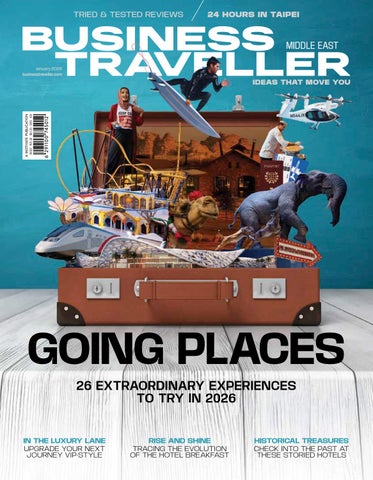
GOING PLACES 26 EXTRAORDINARY EXPERIENCES TO TRY IN 2026
IN THE LUXURY LANE UPGRADE YOUR NEXT JOURNEY VIP-STYLE
RISE AND SHINE TRACING THE EVOLUTION OF THE HOTEL BREAKFAST
HISTORICAL TREASURES CHECK INTO THE PAST AT THESE STORIED HOTELS
CONTENTS JANUARY 2026
Dispatch
07
GOING PLACES
26 extraordinary experiences to try in 2026
07 Hot Ticket: Natural History Museum Abu Dhabi 08 Regional News: The latest airline, hotel, and travel news 10 Sustainable Traveller: The greener side of tourism and hospitality 12 Global News: An update on international travel
34
Reviews
61
61 Corinthia Brussels 63 Sobremesa 64 Eurostar Plus
63
Insight
15
COVER & CONTENTS IMAGES SUPPLIED; GETTY IMAGES
15 We chat with Dr. Fabien Fresnel, CEO of the Riyadh School of Hospitality and Tourism, about the talent behind Saudi’s hospitality
16 We chat with Christopher Evans, CEO of Collinson International, about the launch of Priority Pass Private 17 Frequent flyer with author, scientist, and explorer Neil Shubin 18 A deep dive into a rising market enticing high net worth investors 20 Talking travel with the man who went everywhere – without ever taking off 22 Op-Eds: The importance of being weird; How behaviour can shape green goals 24 Elevator Pitch with Ben Ackhurst, GM of Mandarin Oriental Downtown, Dubai JA NUA RY 2026
Explore
25
25 24 hours in Taipei 27 Soothe yourself with the wellness-oriented side of travel and tourism 28 Splash out on luxury experiences and products 30 Our pick of cultural events around the world and inflight entertainment 32 The rise of the supperclub: the best-kept secrets in community dining
Features
38
50
The Inheritance of Excellence From transformed castles to historic houses, travellers are checking into the past at these heritage hotels
42
28 48
Life In The Luxury Lane Upgrade your next journey with these ultra-exclusive airport departures
The Breakfast Club From comforting rituals to cultural gateways, the hotel breakfast is evolving to travel better than ever
Tracks Through Time We’ve come a long way since the first steampowered rail service 200 years ago. Where to next?
56
Clean, Green Stockholm Welcome to one of the world’s most sustainabilityfriendly destinations
59
Al Ain Bucket List The hidden gem that is Abu Dhabi’s “living oasis”
Postcard
66
Light takes flight in a hotel’s luminous dance installation BUS I N ES S T R AV EL L ER M I DDL E E AST 3
Editor’s Letter BUSINESS TRAVELLER MIDDLE EAST IS JOINTLY PUBLISHED BY MOTIVATE MEDIA GROUP AND BUSINESS TRAVELLER MEDIA LTD
MOTIVATE MEDIA GROUP EDITOR-IN-CHIEF OBAID HUMAID AL TAYER MANAGING PARTNER AND GROUP EDITOR IAN FAIRSERVICE CHIEF COMMERCIAL OFFICER ANTHONY MILNE GROUP CONTENT DIRECTOR THOMAS WOODGATE EDITOR YI-HWA HANNA ART DIRECTOR CLARKWIN CRUZ EDITORIAL CO-ORDINATOR LONDRESA FLORES CONTRIBUTORS HANNAH BRANDLER, CLAIRE TURRELL, NIVEA SERRAO, PAUL CLIFTON, ALICE HENDERSON, MICHAEL MÖSER, ALESANDRA DUBIN, GEMMA GREENWOOD GENERAL MANAGER – PRODUCTION S SUNIL KUMAR PRODUCTION MANAGER BINU PURANDARAN ASSISTANT PRODUCTION MANAGER VENITA PINTO GROUP SALES MANAGER CHAITALI KHIMJI SENIOR PARTNERSHIPS MANAGER MURALI NARAYANAN
HEAD OFFICE: MEDIA ONE TOWER, DUBAI MEDIA CITY, PO BOX 2331, DUBAI, UAE; TEL: +971 4 427 3000; FAX: +971 4 428 2266; E-MAIL: BTME@MOTIVATE.AE DUBAI MEDIA CITY: SD 2-94, 2ND FLOOR, BUILDING 2, DUBAI, UAE; TEL: +971 4 390 3550; FAX +971 4 390 4845 ABU DHABI: PO BOX 43072, ABU DHABI, UAE; TEL: +971 2 677 2005; FAX: +971 2 657 3401; EMAIL: MOTIVATE-ADH@MOTIVATE.AE SAUDI ARABIA: REGUS OFFICES NO. 455 - 456, 4TH FLOOR, HAMAD TOWER, KING FAHAD ROAD, AL OLAYA, RIYADH, KSA;TEL: +966 11 834 3595 / +966 11 834 3596; EMAIL: MOTIVATE@MOTIVATE.AE LONDON: MOTIVATE PUBLISHING LTD, ACRE HOUSE, 11/15 WILLIAM ROAD, LONDON, NW1 3ER, UK; E-MAIL: MOTIVATEUK@MOTIVATE.AE
BUSINESS TRAVELLER MEDIA LTD. INK, BLACKBURN HOUSE, BLACKBURN ROAD, LONDON, NW6 1RZ
SUBSCRIPTIONS: EMAIL: SUBSCRIPTIONS@MOTIVATE.AE; TEL: +971 4 427 3542
Yi-Hwa Hanna Editor
0 4 BU S I N ES S T R AV ELLER MIDDLE E AST
businesstraveller.com/middle-east BUSINESSTRAVELLERME
BTMIDDLEEAST
JAN UARY 2026
IMAGE SUPPLIED
TO UNDERSTAND the present, we must know the past. This notion is one that many great thinkers throughout history have, coincidentally, repeated time and time again. But personally, I’d expand on that idea: In order to not only understand and successfully navigate the present, but also create a better future, we must consider and contemplate the past – then use those learnings to chart our path forward. This may seem like common sense, but the human brain is wired for efficiency not perfect learning, and that can make mistakes surprisingly sticky. Rather than adapting with each new insight, we tend to fall back on mental shortcuts and entrenched beliefs even if they have been proven to hurt us, as our sneaky little brains filter information to confirm what we already think and protect our egos. This cognitive conservatism can dull the precious lessons that our errors and perceived failures can offer us, keeping us stuck in cycles of unchanged behaviour – even when we know better. But we’re not doomed to repeat the loop: we can break the cycle and disrupt these patterns by pausing to reflect, embracing uncomfortable feedback where necessary, and cultivating a greater sense of awareness. It is the simple-but-not-so-simple way to shift the brain’s natural propensity for economy, so that it doesn’t override our capacity to truly grow for the better. While the start of a new year isn’t the only time for a reset, it is an undeniably great moment for a fresh beginning. Yet statistics show we make fewer resolutions as we age: adults aged 18-29 are the most likely to set New Year’s resolutions, with 49% making at least one. By the time we hit 30-49 that drops to 31%, then 21% at 50 or older. Maybe it’s because as we get older, we’ve already achieved more – or become more realistic or more selective. Whatever the reason, it’s worth remembering that our capacity for change does not shrink with age; only our willingness to exercise it does. Neuroplasticity thrives on novelty – the brain rewires itself most readily when we push beyond familiar patterns – which makes this an excellent time to resolve not just to “improve,” but to do, see, taste, and experience something new. Travel has long been the ultimate catalyst for a perspective shift, and if you’re wondering where to begin, our cover story (p.34) offers a head start with experiences that can act as tiny cognitive resets, whether you’re a first-time visitor, a long-time resident, or somewhere in between. This issue leans into this contemplation of the past, present, and future by weaving the three together. You’ll find stories on the rise of dinosaur fossils as today’s most coveted collectables (p.17-19), now anchoring collections from Abu Dhabi’s hottest new tourist attraction (p.7) to one of the region’s most anticipated hotels (p.9). We explore the resurgence of heritage hotels restoring castles and beyond to their former glory (p.38), the renaissance of rail travel (p.50), and the timeless ways food gathers us – from the modern supper club (p.32) to the evolution of the hotel breakfast (p.48). May this issue be full of reminders that where we’ve been enriches where we’re going, along with inspiration on ways to make the journey more rewarding. Happy New Year!
REWARDING EXCELLENCE IN BUSINESS TRAVEL AND HOSPITALITY
REGISTRATIONS OPEN
REGISTER HERE
FIND OUT MORE
BusinessTraveller.com BusinessTravellerME
BTMiddleEast
#BTMEAwards
For event sponsorship and general enquiries: chaitali.khimji@motivate.ae | murali@motivate.ae
Beverage partner
Vote processing partner
Presented by
WORDS YI-HWA HANNA
REGIONAL NEWS
New hotels, flight routes, and more
SU STA I N A B I LIT Y
GLOBAL NEWS
The greener side of Happenings from CAPTION HEADaround the world tourism & hospitality Caption mo molectem nimus ab iur aut re expel ium quiat faciduntus estrum dolupist
HOT TICKET
Star attraction
This new stellar showcase is set to reshape Abu Dhabi’s cultural and tourism landscape WORDS YI-HWA HANNA
IMAGE SUPPLIED
OPENED LAST MONTH in the UAE capital’s growing Saadiyat Cultural District, the Mecanoo-designed Natural History Museum Abu Dhabi is now the Middle East’s largest institution of its kind, tracing 13.8 billion years of science and life through an Arabian lens. Visitors are greeted by a world-first: five towering sauropods displayed together in the atrium, followed by another global debut – two T. rexes, including “Stan”, shown mid-battle over a Triceratops. The museum’s galleries also spotlight the UAE’s own ancient landscapes, from a lush, savannah-like ecosystem to now-extinct species such as a four-tusked elephant. With research facilities and sustainability-led education programmes, the museum is set to become a major anchor within Abu Dhabi’s evolving cultural tourism strategy, strengthening the emirate’s appeal and expected to draw rising visitor numbers in 2026. It joins Louvre Abu Dhabi and other institutions in defining Saadiyat as a world-class cultural hub drawing in travellers from across the world.
JA NUA RY 2026
BUS I N ES S T R AV EL L ER M I DDL E E AST 7
REGIONAL NEWS
Call of the wild
suspicious activity across its network of more than 135 destinations. flydubai CEO Ghaith Al Ghaith said he is “proud to take a stand in protecting endangered species.” United for Wildlife CoChair Lord William Hague
welcomed the carrier’s involvement, noting its regional and global reach to valuable support to the wider conservation effort. The pledge reinforces UAE conservation efforts and wider industry measures against wildlife trafficking.
New biometric check-ins to transform Dubai hotel stays DUBAI has begun rolling out a novel citywide contactless hotel check-in system, setting a new benchmark for guest convenience. Announced by His Highness Sheikh Hamdan bin Mohammed bin Rashid Al Maktoum in December 2025, the initiative allows guests at all participating hotels and holiday homes to bypass traditional
check-in procedures. Through the initiative, a biometric solution developed by the Dubai Department of Economy and Tourism (DET), travellers can upload data and ID documents via mobile before arrival. The details remain valid until the ID expires, requiring only quick facial authentication on future stays — a major benefit for repeat visitors.
8 BU S I N ES S T R AV ELLER MIDDLE E AST
Designed to be easily integrated into hotel apps, the system could later extend to other touchpoints such as car rentals, and builds on Dubai’s wider smart-city infrastructure, such as smart tunnels at Dubai International Airport. Between January to October 2025, Dubai welcomed 15.70 million international overnight visitors.
ICE, ICE BABY
Rosewood Doha has launched an outdoor ice rink – the first hotel-led outdoor rink in the Qatar capital. Previously, the country had enjoyed one at Lusail Winter Wonderland in 2022. Running until 12 January from 4pm to midnight, Rosewood Doha’s new rink headlines the property’s festive season programme, with seasonal treats such as hot chocolate, festive menus, afternoon tea, limited-edition hampers, holiday dining offerings, and other celebrations. JAN UARY 2026
IMAGES SUPPLIED; FRIENDS STOCK ADOBESTOCK
IN LATE 2025, FLYDUBAI signed the Buckingham Palace Declaration, joining United for Wildlife’s global taskforces to strengthen international efforts against illegal wildlife trafficking. The initiative, founded by William, Prince of Wales, and The Royal Foundation, unites airlines, transport operators, lawenforcement bodies, and conservation groups to secure supply chains and disrupt trafficking routes. As part of the United for Wildlife Transport Taskforce, the airline will enhance its cargo and passenger screening, improve informationsharing, and support authorities in identifying
WORDS YI-HWA HANNA
MASTERPIECES The Return from Hunting Tapestry; HalfTriceratops Skull
LIVING GALLERY
Culture by the coast Wynn Al Marjan Island has revealed a museum-grade art collection
ANCHORING its highly-anticipated early-2027 opening, the museumcalibre collection will bring masterpieces, iconic works, and newly-commissioned pieces into an immersive “Living Gallery” woven throughout the resort. Built around one of the region’s most significant private collections, the programme spans prehistoric specimens, Old Masters, Victorian pieces, naturalworld artifacts, and 19th-century Orientalist works. Highlights include a 66-million-year-old Triceratops
skull, Marc Quinn’s commissioned Light Into Life, and a 17th-century 10m tapestry with counterparts at the Louvre and The Met. Major works from Wynn’s global portfolio will also arrive in Ras Al Khaimah, including Jeff Koons’ Tulips, a Jaume Plensa sculpture, rare Buccleuch vases, and Victorian cut-glass pieces. Much of the collection reinterprets 19th-century EastWest artistic dialogue, returning historically significant Orientalist works to the region that inspired them. Many will be publicly displayed for the first time in decades. Alongside these are contemporary regional voices, including in-room works by Algerian artist Faïza Maghni. Set across 60 hectares with 1,514 keys, 22 dining and lounge venues, a beach club, a spa, a marina, and extensive leisure and retail offerings, the resort is progressing on schedule to open on time – and the art collection heralds an opening that will help to position Ras Al Khaimah as a new cultural landmark in the Middle East.
IMAGES SUPPLIED
ROUTE ROUND-UP
Emirates will switch all Baghdad services to the Airbus A350 from 1 January 2026, giving passengers the airline’s latest cabins, quieter inflight comfort, and a consistent experience across all seven weekly flights. JA NUA RY 2026
Saudi Arabia will launch three as-yet-unnamed new airlines to serve NEOM, Qiddiya, and other giga-project hubs, supporting Vision 2030’s goal of attracting 150 million visitors and expanding the kingdom’s aviation network.
Turkish Airlines has teamed up with Samsung to launch a new SmartTag luggage tracking feature, as well as signing a new codeshare agreement with South African Airways, that will take effect from 1 March 2026.
Etihad Airways has launched a brand-new seasonal Abu Dhabi-Kazan route, which will operate three times weekly until April 2026, expanding links between the UAE capital and one of Russia’s key cultural and sporting hubs. BUS I N ES S T R AV EL L ER M I DDL E E AST 9
S U STA I N A B LE TR AV E LLE R
Shared impact
W Maldives’ Sea of Stars project breathes fresh life into its celebrated house reef, marking a powerful step forward in sustainable restoration RESORT long renowned for having one of the Maldives’ most vibrant, awarded house reefs, the W Maldives has completed a milestone restoration effort that’s already yielding results. In autumn 2025, the resort launched Sea of Stars: a weeklong conservation programme created in partnership with MARS Sustainable Solutions – an arm of Mars, Incorporated, the manufacturer of confectionary brands M&Ms and Snickers, and pet care products Pedigree and Whiskas. As part of its sustainability commitment, Mars developed a low-cost, scalable method of coral reef ecosystem restoration called the Mars Assisted Reef Restoration System (MARRS). In partnership with this world-renowned system, the W Maldives installed a new series of “Reef Stars” – hexagonal metal structures coated in coral fragments and sand – to restore, bolster, and sustain over 400sqm of the reef. In keeping with the W’s refreshed brand identity
A
1 0 BU SI N ES S T R AV ELLER MIDDLE E AST
– that celebrates a sociallyconscious, vibrant lifestyle led by sophisticated playfulness and luxury with authenticity – the programme opened with a sunset screening of Peixinho (Little Fish) hosted by filmmaker and conservation biologist Kaushiik Subramaniam. Guests then joined the resort’s sustainability team and MARS specialists to learn how the reef stars help stabilise and regrow degraded reef sections. Over the next two days, the team, led by W Maldives’ sustainability manager Harald Schaller, installed 400 reef stars and 6,000 coral fragments across the resort’s expansive house reef – marking one of the largest single restoration activations in the Maldives to date. Guests helped assemble and deploy the frames themselves, turning reef restoration into a collaborative, hands-on experience. Kate Janetski, marine program lead for Maldives & Caribbean and global training manager at MARS Sustainable Solutions, was keen to see the restored reef become a thriving ecosystem, explaining that the partnership shows what can happen
when science, hospitality, and community come together. And now, the first signs of its impact are already beginning to appear: Coral fragments are stabilising, early fish life is returning, and the reef is entering the slow, deliberate phase of regeneration that will define its progress through 2026. For W Maldives’ general manager Amila Handunwala, it marks the start of a longer journey: “Our goal is to strengthen W Maldives’ stance as a leader in marine restoration, and to extend this initiative to other Marriott resorts in the Maldives.” The resort’s broader sustainability approach includes upgrades to its biogas plant, expanded waste-management initiatives, and evolving solarpower operations. W Maldives’ activation is part of a wider wave of reef restoration sweeping the archipelago, as more resorts seek to rebuild marine ecosystems. Also in collaboration with MARS Sustainable Solutions, Constance Moofushi Maldives recently restored more than 100sqm of reef using 100 reef stars and 1,500 coral fragments, while Cora Cora Maldives began with 120 reef stars (later adding 71 more) and 1,800 fragments. Across different atolls, these efforts each contribute to a healthier, more resilient Maldivian reef system.
children and adults. The programme also includes training for two adult literacy facilitators and will engage local parents and community members through roughly 1,000 volunteer workdays, ensuring long-term sustainability. “Support from the private sector is crucial in driving meaningful change,” said Abdulla Ahmed Al Shehhi, COO of Dubai Cares. Rixos Hotels COO Cenk Ünverdi added that the partnership channels the brand’s reach “into something with longterm social impact.” JAN UARY 2026
IMAGES W MALDIVES; RIXOS HOTELS & RESORTS
A sea full of stars
RIXOS HOTELS has partnered with Dubai Cares to support its Adopt a School programme, inviting guests across all of its UAE properties to help fund the construction of a new school in Malawi. The initiative aims to raise AED186,000, with contributions collected through dedicated POS machines located in the hotel lobbies. Once completed, the school will accommodate up to 100 students and provide vital access to quality education for
WORDS YI-HWA HANNA
Raising the bar on green stays AS SUSTAINABILITY moves from aspiration to expectation across the global hospitality sector, the UAE’s TUMBI Hotel Dubai The Palm has been recognised for embedding environmental responsibility into the fundamentals of its operation. The property was recently awarded the Sustainability Award 2025 by Luxury Lifestyle Awards, highlighting a model that aligns guest experience with longterm environmental and commercial resilience. The recognition comes at a moment when sustainability is increasingly tied to regulatory pressure, investor confidence, and brand credibility across the Middle East’s hotel sector. Rather than simply positioning sustainability as a marketing layer, TUMBI has integrated it into design, dining, and daily operations from the outset. As the UAE’s first Tapestry Collection by Hilton hotel, TUMBI was developed around a wellness-forward, low-impact philosophy. The teetotal property prioritises energy and water efficiency, waste reduction, and responsible sourcing, alongside plant-forward dining concepts such as Afia and dEATox Café. Together, these initiatives reflect a broader shift within hospitality, toward operational sustainability that supports both guest well-being and long-term asset value. “I believe that the guest always comes first, and the team is family. This simple philosophy guides everything we do at TUMBI Hotel Dubai The Palm, Tapestry Collection by Hilton. My goal has always been to create a culture where our employees feel valued and motivated, so they can deliver exceptional guest experiences every single day. Since opening the hotel, we’ve focused on combining human-centric luxury, wellness-driven hospitality, and sustainable operations to elevate the staycation experience on Palm Jumeirah. It’s about inspiring our team, delighting our guests, and leading with purpose,” says Babar Khanyari, the hotel’s general manager. With sustainability now central to how hotels are evaluated – by guests, owners and industry bodies alike – TUMBI’s achievements signal how purpose-led hospitality is becoming a defining benchmark rather than a differentiator.
2026: WHEN SUSTAINABILITY BECOMES STRATEGY
IMAGES SUPPLIED
AS THE HOSPITALITY SECTOR looks ahead to 2026, the industry’s most urgent conversations are no longer about growth alone – they’re also making a clear shift towards planning with durability in mind. That shift was already clearly underway at the 2025 Future Hospitality Summit, where sustainability emerged not as a future aspiration, but as a presentday business imperative shaping how hotels will be JA NUA RY 2026
financed, insured, and built in the years ahead. A global platform for hospitality investment connecting the region and the world’s most influential decision-makers, the event saw industry leaders frame environmental responsibility not as branding, but as financial risk management. With climate volatility rising and insurers retreating from high-risk markets, hoteliers are increasingly treating sustainable design as
essential to asset protection, financing and long-term viability. From discussions on BREEAM standards – a globally recognised framework for assessing, rating, and certifying the sustainability of buildings and infrastructure – to greener operations, the message was clear: sustainability is now tied directly to investor confidence and destination resilience, shaping how hospitality in the Middle East will grow next.
BUS I N ES S T R AV EL L ER M I DDL E E AST 1 1
GLOBAL NEWS
1
2 3 4
5 8 7
6
GET THE SCOOP
The latest updates in the travel industry from across the world Heathrow increases drop-off fee and introduces a new 10-minute vehicle maximum stay (Right) Heathrow is raising its terminal drop-off fee from £6 to £7 from this month, also introducing a new 10-minute maximum stay. Vehicles are monitored by ANPR, with payments due by midnight the next day; non-payment triggers an £80 PCN. The airport says the changes align with other UK hubs and support traffic flow and sustainability goals. Passengers can avoid fees by using the Park & Ride areas, which are free for the first 30 minutes.
2
1 2 BU SI N ES S T R AV ELLER MI DDLE E AST
Paris-Charles de Gaulle to rename all of its terminals (Left) Paris-Charles de Gaulle will rename all 11 of its terminals in March 2027, simplifying its currentlyconfusing layout into Terminals 1–7. The shift coincides with the launch of the CDG Express rail link. New terminal names will appear on tickets sold from March 2026 for travel 12+ months ahead. The overhaul includes major signage updates and aims to make navigation far clearer for the airport’s 76 million annual passengers.
3
IMAGES SUPPLIED; ALLARD SCHAGER
Virgin Atlantic launches AI concierge in collaboration with Open AI and Tomoro.ai (Above) The new AI concierge listens, learns, and offers real-time natural conversations to help travellers plan trips, manage bookings, and access loyalty benefits across all digital touchpoints. The service debuts ahead of the airline’s new mobile app and joins wider digital upgrades, including fleet-wide Starlink wifi, as Virgin Atlantic accelerates its next phase of tech-driven transformation.
1
Almanac Barcelona opens art floor to beat overtourism (Below) With 2026 set to be a bumper year for art and culture tourism in Barcelona, Almanac Barcelona has launched a new Art Floor to help combat overtourism in the city, wherein emerging local artists have transformed five suites and a penthouse with installations, workshops, and shoppable works – all of which will be available until March 2026. As Gaudí’s centenary, the Sagrada Familia’s completion, and 1,500 citywide events draw record crowds, overtourism concerns grow. The new Art Floor is intended to offer a meaningful alternative, supporting local creators while easing pressure on overstretched cultural sites.
4
JAN UARY 2026
WORDS YI-HWA HANNA
Seat capacity surpasses pre-pandemic levels (Right) Global aviation fully rebounded in winter 2025, with seat capacity reaching 3.6 billion – 2.3% higher than the previous year. OAG’s Winter 2025 report shows Asia leading the recovery: China is up 6.2%, while Southeast Asia remains slower but improving. Europe and North America are nearly even, with Europe up 4.6%. Türkiye posts the fastest national growth at 9.3%, followed by Brazil, India, and Mexico. International travel is rising twice as fast as domestic and now represents 40% of all seats. Airlines are expanding in step, with U.S. carriers topping the charts and Chinese airlines showing the quickest acceleration. IndiGo and Ryanair also continue their upward momentum. The sector enters 2026 with steady, sustainable growth as networks and fleets shift from post-pandemic recovery to long-term evolution.
5
Rosewood unveils a signature scent and alpine escape (Below) Rosewood is marking a new chapter with three milestones: the launch of its first alpine retreat, Rosewood Courchevel Le Jardin Alpin; the debut of Bois Cachemire, a signature fragrance created with L’OBJET; and major wins in The World’s Best Hotels 2025, accolades, with seven Rosewood properties making it onto the list, led by Rosewood Hong Kong claiming the number one spot. The new Courchevel property blends chalet-style intimacy with contemporary design, while the fragrance – available as a candle, a room spray, and a pillow mist – aims to extend the brand’s identity into a luxurious sensory ritual.
7
Monica Galetti introduces desserts on Singapore Airlines economy and premium econony (Above) The new desserts, available since 1 December 2025, expand upon the Samoan-born New Zealand chef’s collaboration with the airline. Galetti, who has crafted rotating fine dining menus for its business class and suites/first class since 2024, will offer a salted caramel and honeycomb dessert pot in economy and a refined delice served on porcelain in premium economy. The treats will be available for a year on flights from Heathrow, Gatwick, and Manchester. Premium cabins continue to feature Galetti’s full winter menus, including dishes such as Dorset crab salad, glazed beef short rib, and hazelnut Paris-Brest. The rollout builds on SIA’s broader chef partnerships and its Book the Cook pre-order service for premium passengers.
IMAGES SUPPLIED
6
JA NUA RY 2026
Korean Air debuts new sustainable meal containers (Above) Korean Air is introducing new sustainable in-flight meal containers made from plant-based pulp such as straw, sugarcane, and bamboo, replacing the plastic trays it has used for two decades. The new containers debuted in December and will be expanding across the network by the end of 2026. These eco-friendly options offer strong heat resistance and are expected to cut related carbon emissions by around 60%, joining the airline’s broader sustainability efforts, including bamboo cutlery and upcycling programmes. Korean Air is also enhancing its passenger experience as Hanjin Group carriers – including Jin Air and Asiana – begin rolling out high-speed Starlink wifi from 2026, bringing faster, more reliable connectivity across long-haul fleets.
8
BUS I N ES S T R AV EL L ER M I DDL E E AST 1 3
Sponsors
Culinary Partner
Beverage Partner
Printing Partner
Vote Processing Partner
Structural Partner
Presented By
Expert opinions on the future of travel
The Art of Welcome
Yi-Hwa Hanna caught up with Dr. Fabien Fresnel, CEO of the Riyadh School of Hospitality and Tourism (RSTH), to discuss the city’s hospitality boom, and how they build the people behind the projects HEN FRENCH and Swiss hotel school graduate Dr Fabien Fresnel arrived in Riyadh in early 2025, the country’s fastgrowing hospitality industry was already in full swing. From the Red Sea to Diriyah and Qiddiya, Saudi Arabia’s tourism landscape was racing from blueprint to reality. But what interested this esteemed hospitality educator – who has worked in Michelin-starred restaurants and luxury properties across the world – wasn’t as much the hardware of hotels and giga-projects as it was the people who would bring them to life. “Many people see Saudi Arabia as the new El Dorado for training and education,” he said, speaking to Business Traveller Middle East at the inaugural TOURISE Summit in late 2025. “There’s no tourism strategy without a people strategy.” After nearly two decades in hotel operations and hospitality education across Europe, the Middle East, Asia, and the US, RSTH is Fresnel’s latest challenge, where he is building not just a school, but a country-wide talent ecosystem for a brand-new industry. Its mission is to reinvent tourism education by blending vocational and academic tracks, from six-month certificates to full degrees, across disciplines such as hospitality and tourism management, culinary arts, hotel operations, events, and destination management. Instead of treating training as a narrow pipeline for hotels alone, it’s designed to feed a much broader visitor economy – “events, retail, transportation, luxury, sports… everything that’s on the table here,” as Fresnel puts it.
IMAGES SUPPLIED
W
JA NUA RY 2026
FROM PLACES TO PEOPLE Saudi Arabia’s first wave of tourism investment has been highly visible: resorts, cultural districts, entertainment cities, and a calendar packed with mega-events, from the Asian Games 2029 to the FIFA World Cup 2034 bid. The next phase, Fresnel argues, will be defined by service. “Now comes the operating phase – getting the repeat business, delivering the proper service, the guest experience,” he says. For that, the country is banking on its youth. “The Saudi youngsters, they are really genuine,” he says. “By default, they are extremely hospitable. There’s a long tradition of hospitality in the kingdom.” The challenge – and opportunity – is to
‘There’s a long tradition of hospitality in the kingdom’ translate that instinctive welcome into a professional context, while avoiding the global industry’s common pitfalls, such as treating guests differently based on perceived spending power. His mantra is simple: “You train for skills, but you recruit for attitude.” HOSPITALITY AS A HUMAN CONDITION Fresnel is clear that the technical side of hospitality, while necessary, is not enough. “Hospitality is a social and human condition, more than an industry,” he says. Knife-and-fork rules still matter, but they are secondary to what he calls emotional agility: the ability to read people, reassure them after a long journey, and create a sense of safety and care. That human focus becomes even more critical as AI and automation enter the industry. As such, Fresnel is
unperturbed by the rise of AI. “Can a robot shiver? No. Can it offer a sense of heart and soul? No,” he says. For him, technology’s remit should be to take on repetitive tasks, leaving staff more time for genuine interaction. AI, he says, should magnify humanity, not replace it. Fresnel wishes to prepare students for agility and robustness in a disruptive world, from last-minute changes to geopolitical shocks. The goal is to give young Saudis transferable skills that allow them to move across sectors as the wider economy diversifies – while ensuring that those who stay in tourism can see clear, accelerated career paths. NATIONAL PROJECT, GLOBAL IMPACT Fresnel is acutely aware that hospitality education in Saudi carries weight beyond hotels. “Education is a national good,” he says, pointing to its role in jobs, social stability, and future prospects. With a predominantly young population and an ambitious visitoreconomy agenda, the stakes are high. RSTH positions itself as being “at the forefront of change”, where students don’t just learn about future trends but help shape them. If the kingdom can match its eye-catching infrastructure with equally thoughtful, peoplecentered service, Fresnel believes the impact will extend far beyond balance sheets. Millions of visitors arriving for upcoming global events will leave as informal ambassadors – remembering not just the architecture, but how the country made them feel. BUS I N ES S T R AV EL L ER M I DDL E E AST 1 5
Priority Redefined
Priority Pass Private takes the VVIP playbook of private aviation and applies it to commercial travel, with time, privacy, and bespoke care at its core. We caught up with the experts behind the lounge doors to learn more OR MORE THAN three decades, Priority Pass’s services have essentially been shorthand for a smoother airport journey – the quiet lounge away from the crowds, the complimentary coffee before boarding. But as commercial travel becomes busier and traditional lounges more commonplace, a new tier of traveller has emerged with expectations that sit somewhere between first class and flying private. Enter Priority Pass Private: an invitationonly, VVIP service that Collinson International, the company behind Priority Pass, says is designed to bring “private aviation-style experiences” to commercial travellers. Initially available across more than 70 airports in the Middle East and Europe, this “network of sanctuaries” has thus far been rolled out in over 30 countries, with cities including London, Paris, Zurich, Singapore, and Los Angeles. “For over 30 years now we’ve been at the forefront of enhancing travel journeys,” says Christopher Evans, CEO of Collinson International. “The reason we’ve been able to stay as a market leader is really focusing on the end consumer. We continually evaluate what they’re looking for and try and stay ahead of the curve.” Lately, that curve has bent sharply upwards. Evans
F
1 6 BU SI N ES S T R AV ELLER MIDDLE E AST
ABOVE Priority Pass Private BELOW Christopher Evans
points to the “growing focus and size of this ultra-high net worth customer,” alongside a global intergenerational wealth transfer he estimates at around US$83 trillion. This segment travels frequently, across multiple regions, and places a premium on three things: time, privacy, and discretion. “In today’s evolving world of luxury travel, the most discerning and highnet-worth travellers expect more than a seamless airport experience; they value time, privacy, and exclusivity,” he says. “Priority Pass Private was created to meet this need, transforming time in transit into time well spent.” Practically, that means moving beyond the traditional lounge model. Members access off-terminal VIP facilities, with separate security and immigration channels, private lounges, curated gourmet dining, and airside chauffeured transfers directly to the aircraft steps. Each journey is handled individually – often by a PA or family office – with Collinson’s team tailoring the experience around specific timings, car preferences, or dietary needs. “Travel used to be just a means to get to your end experience,” Evans notes. “What
‘[We’re] transforming time in transit into time well spent’
we’re seeing now is people treating travel itself as something that can be a special, emotive experience – something really memorable.” The Middle East was the natural launchpad. The region is seeing some of the fastest growth in highvalue customers globally, with Dubai in particular recording one of the world’s highest recent influxes of new millionaires. For Evans, that combination of wealth, ambition, and aviation investment made it the ideal launchpad. “We wanted to start with one market, refine and enhance the proposition, get customer feedback, and then expand across the globe,” he explains. A strong existing network of VIP terminals – especially in Dubai and Saudi Arabia – meant Collinson could stitch together an impressive initial footprint while working to add more locations over time. If the hardware is impressive, the software matters just as much. Evans is passionate about the importance of personalisation and emotional value: the ability to recognise a member instantly, know whether they’re travelling on business or with family, or recall their preferred drink or where they like to sit, for instance, and adjust the experience accordingly. As such, despite a growing interest in technology across every industry, here, the cutting-edge is viewed as a key enabler rather than the star of the future. Collinson has introduced AI-driven chat tools and digital wellness products to strip out friction – helping them surface quick answers, track visit history, and help frequent flyers manage sleep, fitness, and jet lag – while deliberately reserving space for human interaction. “There’s nothing nicer than someone welcoming you by name and knowing specifically the sorts of food and drinks that you prefer,” Evans says. Priority Pass Private sits at the top of a much broader pyramid of experiences, but it also hints at where premium travel is heading next. Evans expects a continued “elevation of what that top end looks like”, with more clearly defined customer tiers, and a more holistic approach that blends efficiency, cultural connection, and care. When travellers begin a journey with them, Evans wants them to feel “incredibly special” – not just smoothed through the airport, but seen, known and genuinely looked after – before they even reach the gate. JAN UARY 2026
IMAGES SUPPLIED
WORDS YI-HWA HANNA
F R E Q U E N T F LY E R
where humans venture into the unknown to learn about our world. It is an incredible challenge and privilege to be involved in that work.
THE EXPLORER OF TIME Yi-Hwa Hanna chats with Neil Shubin, an evolutionary biologist, educator, author, and science communicator
IMAGES SUPPLIED
Q
&
A
You’ve spent your career searching for clues to life’s deepest origins often in some of the most extreme corners of the planet. What first drew you to evolutionary biology and the idea that the answers might lie in some of the coldest, least hospitable places on Earth? Understanding the history of our planet and life is like trying to solve a great mystery. Once you know how to look, the search for fossils that tell us about the origin of different living things becomes a global treasure hunt. You look for places in the world that have the right rocks to hold fossils that answer major questions. In our case, it turned out that perfect rocks that would hold some of the earliest creatures on land were, surprisingly, in polar regions. Where there isn’t ice, there’s rock. And many of those rocks hold important fossils. Fieldwork in the Arctic or Antarctic isn’t just about science – it also involves isolation, JA NUA RY 2026
danger, challenging logistics, and endurance. What have been some of the most challenging conditions you’ve faced, and how have they shaped the way you work today? Imagine being in a place hundreds of miles from the nearest humans, with no roads, with 24 hours of daylight, winds that can get close to 80 miles an hour, storms that can come out of nowhere, and landscapes that contain hidden crevasses that can swallow entire snowmobiles. Good planning becomes essential. So does patience and humility. [These] help (but don’t guarantee) things going sideways in the field. I like to think they are lessons that follow me at home. Fossils and evolutionary “missing links” have a way of capturing the public imagination. Why do you think these discoveries resonate so strongly, with interest in natural history (and even the private collecting of fossils!) now rising? I think they show us how incredible life and our planet is. Think of the biggest dinosaurs or our early human ancestors captured in fossils. There is something awe-inspiring to them. And, when you know how to look, they show us how life on our planet is deeply interconnected. You’re coming to the Emirates Litfest this month, with a talk on Discoveries at the Ends of the Earth. What do you hope the audience will take away from it? That science and scientific discovery is filled with awe, wonder, and, in some cases, adventure. Science is a process
Packing essentials
• Earplugs • My favourite teas • Good books (either in paper or on a device)
Your expeditions often rely on time-sensitive travel windows, complex logistics, and international collaboration – all things our readers understand well. What do they look like behind the scenes? [It] first involves seeing months of planning. We plan [for] about five days for every single one spent in a tent in the field. Since all the food and every piece of hardware and camping gear has to come up with us, we spend a lot of time on menus, gear lists, and so on. We also train physically to do the hiking and climbing necessary. We spend time looking at geological maps, satellite photos, and scientific papers. Once there, all bets are off. There’s always something new or unexpected when we actually get on the site.
How do you spend your air miles?
Have your travels influenced your outlook on humanity, and how you think about time? Yes, it has affected the way I see us. I see humans and the planet as interconnected though eons of change over geological time. It’s hard not to see us as one branch on a wondrous tree of life, having evolved in a blue planet full of other living creatures, who are all related.
Bucket list destination
How do you like to spend your vacation time when you’re not on research trips? Beaches. Hiking. Time with family. Those are things I don’t get in the field and miss.
Family travel.
Patagonia. The landscape is so very remote and majestic.
What is your earliest memory of a holiday as a child? It would have to be a Fourth of July [celebration], where I gussied up my bike for a parade. What’s the first thing you usually do at a new destination? Take a long walk. It refreshes my soul, starts my exploration, helps with jetlag, and gets me oriented to where I’m at. What is your go-to choice of in-flight entertainment? An engrossing book, usually a mystery with good characters and setting that swallows me up. BUS I N ES S T R AV EL L ER M I DDL E E AST 1 7
Insight
The Business of Bones As dinosaur fossils become the hottest new blue-chip collectibles, we get the 411 from Salomon Aaron, Director at ancient art and antiquities specialist David Aaron gallery OR MORE than a century, the name David Aaron has been synonymous with antiquities of exceptional provenance and rarity. But in the past decade, a different kind of treasure has begun reshaping the gallery’s trajectory: dinosaur fossils. Their ascent from scientific curiosity to cultural and commercial force has been so swift – and so profound – that they now sit at the intersection of science, private collecting, and institutional ambition. What was once the domain of paleontologists and natural history museums has rapidly evolved into one of the most competitive collecting arenas in the world, attracting tech founders, science-minded collectors, and major institutions alike. As Salomon Aaron, Director at the venerable gallery – an expert who helped guide the gallery’s expansion into the fossil market with the same rigour long applied to its antiquities practice – recalls, the shift began with a catalyst that few in the art world could ignore. “Around 2015, we started to sense a disconnect between the interest in and historical importance of dinosaur fossils and the antiquated trade practices,” he explains. What followed was not a tentative step into a new category, but a reconception of how fossils could – and should – be handled
F
1 8 BU SI N ES S T R AV ELLER MIDDLE E AST
in the commercial sphere. “We wanted to develop a new model for dealing in this field with a much stricter focus on ensuring legal title, analysis of completeness, and aesthetic focus.” The momentum only accelerated after the landmark 2020 Christie’s sale of Stan, one of the most complete Tyrannosaurus rex fossils ever found – now on permanent display at the Natural History Museum Abu Dhabi. But the gallery’s growing conviction in fossils wasn’t based on spectacle or hype, it was grounded in what Aaron calls an inevitability. “It was clear at the outset that it was only a matter of time, given the universal interest and impact of dinosaur fossils, that demand would only increase over time. There is no indication this trend is going to change.”
ABOVE A David Aaron item at Frieze Masters 2025 BELOW The gallery has been open for over a century
‘The Middle East is emerging as a significant region of interest’
A THRILLING NEW MARKET DEFINED BY SCARCITY, COMPETITION, AND SCIENTIFIC POTENTIAL Today’s fossil market sits in a rare trifecta of forces: scarcity, institutional interest, and exceptionally high public engagement. “The market is booming; private buyers, particularly from the tech and science sectors and newly formed museums, have entered this market in recent years,” Aaron notes. But supply, by its nature, cannot keep pace. “The discovery and preparation of dinosaur fossils is a detailed and slow process, therefore the supply cannot keep up with the demand. It is becoming increasingly competitive to acquire important dinosaur fossils.” This scarcity is more than material – it is also keenly intellectual. Collectors gravitate towards species long etched into the global imagination – T. rex, Triceratops, Stegosaurus – as well as fossils whose completeness presents opportunities for scientific breakthroughs. A newly uncovered specimen can refine – and occasionally even rewrite – paleontological understanding. For many collectors, that possibility is deeply compelling. “A difference between dinosaurs and the art market is the possibility of discovery. Collectors have the opportunity to follow the journey of a fossil from the point that it’s been uncovered to the excavation, research and preparation for display. [They are] often very enthusiastic about the science and history, and the opportunity that a new fossil can advance science is another very appealing aspect,” Aaron explains. This isn’t hypothetical. In 2025, a dinosaur handled by David Aaron was identified as a new species, which was named Enigmacursor. Initially thought to be a Nanosaurus, it was later confirmed by the UK’s Natural History Museum to be a distinct, as-yetundiscovered Late Jurassic herbivore. It is this interplay between the commercial, scientific, and cultural that has pushed fossils toward what Aaron describes as the early stages of a “long boom cycle.” While record sales have caught headlines, the deeper story is one of rapidly expanding participation from private buyers, institutions, and global museums. The Middle East, for instance, is emerging as a significant region of interest, with a notably increasing appetite. “There is growing demand from major museums JAN UARY 2026
IMAGES SUPPLIED
WORDS YI-HWA HANNA
THE BUSINESS OF BONES
RISING MARKETS
IMAGES THE TRUSTEES OF THE NATURAL HISTORY MUSEUM, LONDON; ANTONIO OLMOS
and private collectors in the Gulf. The Natural History Museum in Abu Dhabi will definitely inspire the next generation of collectors in the region.” EXPERTISE, PROVENANCE, AND THE DISCIPLINE OF PATIENCE In a market where value is inseparable from scientific integrity, provenance is paramount. “[It] is of fundamental importance and without it, we do not deem a fossil to have commercial value,” Aaron states. To minimise ambiguity, the gallery works exclusively with fossils discovered in the U.S., where laws are clear and enforceable. “If the dinosaur fossil is discovered on private property and excavated, sold and exported with the permission of the landowner and all involved parties, then it is legal.” Authentication undergoes similarly rigorous scrutiny. “We seek out the advice and consultation of the very best experts for the particular dinosaur we are working with. We ensure a specimen is carefully studied before offering [it] on the market.” The excavation-to-exhibition pipeline is equally meticulous. Relationships with landowners and dinosaur hunters allow the gallery access to discoveries in real time, but the journey from field to gallery floor is rarely quick. “There is a lengthy process of working with dinosaur hunters or paleontologists, expert laboratories, and our in-house team of experts to oversee the process from the point of discovery until the moment the dinosaur fossil is offered for sale. In some cases, this process can take several years,” Aaron says. WHERE COMMERCIAL AND SCIENTIFIC WORLDS CONVERGE One of the most fascinating dynamics of this market is the unusually close relationship between commercial galleries and scientific institutions. “We work closely with scientists, palaeontologists, and experts in the field from the time of discovery to the point of display and even after a sale,” Aaron says. “We prioritise making our fossils available to museums before offering them to private collectors. We also encourage private collectors to consult, loan, and ideally acquire on behalf of museums. This was the case with the Enigmacursor.” The gallery had arranged for the breakthrough fossil to be acquired and donated by a private collector on behalf of the Natural History Museum in London. JA NUA RY 2026
that broadened perception by placing natural history within a fine-art context. Art fairs, Aaron explains, “offer an opportunity to present dinosaur fossils alongside masterpieces from art history, and in doing so, create a dialogue with the collector community and raise awareness of the possibility of owning a rare and timeless fossil.”
FROM TOP The Enigmacursor at Earth Hall, in London’s Museum of Natural History; Salomon Aaron, Director at David Aaron
“We find that private collectors are very open to making fossils available to the scientific community,” he adds. This equilibrium – a balance between preservation, research access, and private stewardship – is delicate but critical. As Aaron frames it: “Sometimes, museums do not have the necessary funds or ability to acquire dinosaur fossils, and in such cases the private market plays an important role in stimulating excavation, discovery, funding and promotion.” A NEW CULTURAL CONVERSATION Perhaps the most striking shift to occur from this slow-burning trend is cultural. Fossils are no longer being relegated to the domain of specialists or natural history museums; they are appearing alongside masterpieces in major art collections – such as the one at the UAE’s upcoming Wynn Al Marjan Island resort, which includes a 66-milion-year-old Triceratoprs skull. David Aaron first presented an extraordinary Camptosaurus skeleton at Frieze Masters 2022, an exhibition
THE EVOLUTION AHEAD If the past decade has marked the market’s emergence, the decade ahead will define its maturation. “Over time, clients and museums will require even more certainty about condition and provenance. This creates an opportunity to trade and collect [wherein] the way we work will be appreciated even more in the coming years.” Indeed, buyers grow more discerning, only fossils backed as such will hold their ground Still, Aaron emphasises that fossils should not be purchased as financial instruments. “We do not recommend clients to acquire art or dinosaur fossils as investments. The opportunity to acquire an important, historic, or magnificent dinosaur fossil is an exciting privilege. We want our clients to be invested emotionally in their acquisitions. It is our job to advise them as best we can and offer honest advice, and hopefully the commercial market overtime will reward the way we deal.” As collectors, curators, scientists, and the broader public reshape this market together, the rise of fossils is more than a commercial story, it is a cultural one. What was once a relic of deep time has become a living dialogue between past and present; science and stewardship; knowledge and wonder. BUS I N ES S T R AV EL L ER M I DDL E E AST 1 9
Insight
WORDS YI-HWA HANNA
- without ever taking off The first person to reach every country without flying shares what borders, bureaucracy, and ten years on the move taught him about the world today HEN DANISH adventurer Torbjörn “Thor” Pedersen set out from home in 2013, he thought he was leaving for three or four years. Nearly a decade, 203 destinations, and countless cargo decks, bus rides, train journeys, and ferry crossings later, he became the first person in history to visit every country in the world on an unbroken journey – without taking a single flight. There are only 197 countries in the world recognised by the United Nations, and Pedersen visited all of them, as well as some partially-recognised states – those with limited recognition or partial sovereignty, such as Taiwan and Kosovo. Speaking to us from his home in Denmark, Pedersen still sounds faintly surprised that the idea ever left the realm of daydreams. It all began when Thor read an article emailed to him by his father, that made them realise no one had ever reached every nation solely by land and sea. That set off a light bulb in his head. “I grew up thinking everything had been done,” he says. “It was fascinating to me that something of that scale [hadn’t]. I realised I had a shot.” At first, the appeal was part childhood fantasy, part hard-headed career logic. With a background in shipping and logistics, Pedersen could see how globalisation, automation and – later – AI would reshape industries the world over. Container ships that once
W
20 BU SI N ES S T R AV ELLER MIDDLE E AST
needed 60 or 70 crew now sail with a dozen. Office jobs, he noticed, were quietly being handed over to software. “I [wondered], if there will be fewer jobs and more people competing for those jobs, and if people will be far more educated to do so, what are my odds of surviving in that world?” he says. “I figured if I went out and did something absolutely extraordinary and historic, then I would be able to live off that for the rest of my days telling stories.”
ABOVE Sri Lanka 2023
TRAVERSING A WORLD NOT DESIGNED FOR SLOW TRAVEL Even with a decade in logistics, nothing quite prepared Pedersen for how stubborn the world can be when you try to cross it without boarding a plane. He spent about ten months sketching a route and identifying obvious bottlenecks – ocean crossings, island nations – but his reality shifted faster than any spreadsheet could. Ferry
INSET Ethiopia 2017
BOTTOM Hong Kong 2020 OPPOSITE PAGE FROM TOP Mongolia 2018; Fiji 2023
RETHINKING TRAVEL THROUGH FLYING – WITHOUT PREACHING Given the project’s no-fly rule, many now assume it was conceived as an environmental statement. Pedersen is quick to correct that. “My journey was not a flightless journey because of the environment,” he says. “It was because it hadn’t been done before historically.” When he first set out, sustainability wasn’t a key part of the global psyche like it is now. “[Back then], no one ever assumed that it was about the environment,” he recalls. Only around 2015-16, with climate awareness rising and figures like Greta Thunberg entering the conversation, did journalists begin to frame it that way. Today, though, the project has clearly changed how he travels. “I fly less now than I did before,” he admits. For a four-day conference in Addis Ababa, JAN UARY 2026
IMAGES MIKE DOUGLAS; MAXIME CHAMPIGNEULLE; SUPPLIED
The man who went everywhere
routes disappeared. Conflicts flared in countries that had been peaceful when he left home. A global pandemic shut borders worldwide, leaving him stuck in Hong Kong for two years mid-journey. “This world, it’s not intended for us to travel through every country in it without flying,” Pedersen says. Persuading ships to take him on their way was far harder than the romantic image of hopping aboard a freighter might suggest. After all, container vessels are working environments, not passenger cruises, and most shipping companies have little interest in adding civilians to the crew list. Then there were the borders themselves: visas that could only be issued in a traveller’s home country, even when that was thousands of kilometres and several time zones away; officials who insisted he go “back home and apply”; and a patchwork of corruption, checkpoints, and power plays. Pedersen had decided early that he would never pay a bribe. That vow bought him some long, uncomfortable waits. In one case, he spent three months in Central Africa securing a single visa, only to find the border closed for another 27 days when he finally got it. At another point during his journey, he became a resident of a foreign country solely to apply for a visa for the next one. Over time, the mental battle became just as fierce as the logistical one. The journey stretched from the planned four years to almost ten. Each new delay increased the temptation to quit and go home.
THOR PEDERSEN
the trade-off is obvious: travelling overland from Denmark would take months, so for that, of course he would fly. When he travels to the UAE for the Emirates Airline Festival of Literature 2026 – where he will be sharing stories from his recently-launched book, The Impossible Journey, on 23 January 2026 – he will be flying. But for closer trips, he now seriously weighs the alternatives. “When it makes sense, I will try to go overland still,” he says. A DIFFERENT PERSPECTIVE OF THE MIDDLE EAST By the time Pedersen reached the Middle East on his global circuit, he had already travelled through Europe, the Americas, and all of Africa. That wider context colours how he views the region. “It really bugs me when the news talks only about the ‘unstable’ or ‘wartorn’ Middle East, because most of the region is not. Most of it is quiet, peaceful, developing, and prosperous,” he says. Ask him where in the world he’s experienced the most consistent hospitality, and the region comes up again and again. Hospitality, he notes, is both cultural and a matter of honour here. “It’s among the best in the world – it’s culturally rooted. There is an honour principle as well… the proper skill of hospitality is to make someone feel at home when you wish they were,” he adds with a laugh. “People in the Middle East are so skilled at hospitality that
JA NUA RY 2026
you won’t even know if they genuinely like you or not; they make you feel at home regardless.” He also offers a nuanced take on the region’s migrant-worker economies, contrasting them with Western countries where supply chains – and the people who power them – are typically kept at a more comfortable distance. In the GCC, he points out, those workers are visible: driving taxis, staffing shops, building skylines, and often accessing healthcare and security that may be better than what they had at home. LESSONS FOR THE REST OF US Few people are likely to ever want to replicate his odyssey, which he did on roughly US$20 a day. But Pedersen insists that the principles behind it do scale down for other journeys in life. Time, he argues, is ultimately about choices. “Even with limited hours, use whatever free time you have to explore. Make it happen,” he says. In his own corporate days, contracted to 60-hour weeks in Libya and later Bangladesh, he used days off to explore the desert, hunt for Roman ruins, or see how far he could get across the country instead of staying in with a movie. For business travellers trying to add a bit of discovery around meetings, his advice is simple: be deliberate, and be open. “Don’t be an idiot, of course, but also don’t just hide in a hotel,” he says. “Go out, meet people, say yes when people offer you a meal or a place to stay, or when they want to show you something.” That openness, more than the miles, is what he hopes readers will take from his story – which will also be covered in an upcoming documentary soon set to release on major streaming platforms. “But I think if there’s one main takeaway I’d like to share with people,” he reflects, “it would be that whatever you set your mind to, you can achieve.”
ADVENTURE
RAPID FIRE Most underrated country? Libya. --A dish you still crave from the road? Suya, a Nigerian street food. Thin-sliced meat grilled over fire, served on newspaper with onion and chilli. You eat it with a toothpick. It is fantastic. --A country that you’d return to tomorrow if you could? Hong Kong. I was there long enough to form real friendships and get a deep understanding of [the place] – its culture, its landscape, and everything it has to offer. And then the project had to continue and I was yanked out of it. I miss Hong Kong. --Best land border crossing? Between Kenya and Ethiopia… you have no doubt from the moment you step across that you are in an absolutely new place. It’s one of the few places where you feel the shift instantly. --Which country most altered your worldview? It could be Poland because of an encounter I had there that changed my perspective on kindness and people. But it could also be Afghanistan. You come into a country you’re basically told not to go to, and you see that people are trying to make ends meet and get the best out of it. Life continues – people still fall in love and get married, and children still play football. It really challenges the narratives you hear from afar. --If you could tell travellers one thing? People are just people. Go out, meet them, listen, taste some food… and you’ll see the world differently. --Three essentials you always carry (apart from your passport)? A pen. A scarf. And… let’s leave it there. Or [if I’m to add a third], an openness to saying yes. --If you could give yourself one piece of advice on day one? Don’t do it. (He laughs, before admitting he wouldn’t trade the lessons for anything.) --Will you ever attempt something on this scale again? Definitely a once-in-a-lifetime thing. I don’t think I could pull it off again. BUS I N ES S T R AV EL L ER M I DDL E E AST 2 1
WORDS CERI HAND
OPINION
THE IMPORTANCE OF BEING WEIRD AVING COACHED THOUSANDS of artists and business professionals, I’ve noticed that the same challenges emerge – overcoming imposter syndrome, clarifying their voice and honing creative ideas. But real breakthroughs don’t come from playing it safe. They happen when people embrace their quirks, contradictions, and personal stories. This authenticity creates emotional connections, fuels innovation, and sets true artists and leaders apart. If you want to make a lasting impact, it’s time to get weirder. A common fear is that embracing uniqueness will alienate others. Many worry that standing too firmly in their eccentricity will lead to rejection. Yet the opposite is true. The more clearly you define your perspective, the more you attract the right opportunities. Take the tea brand PG Tips, for instance, which in 2024 partnered with Oscar-winning filmmaker Steve McQueen. After eight years without a major ad campaign, the brand didn’t return with cosy family kitchen scenes or nostalgic British rituals. Instead, McQueen directed Rock Solid, a 70-second meditation on self-doubt and resilience, starring Ashley Walters and scored by Ezra Collective. The film doesn’t “sell” tea in the usual way – it transforms making a cuppa into a metaphor for progress and self-reflection. At a time when younger generations are rejecting burnout culture, this campaign speaks directly to their experience. It proves that disrupting a safe, predictable image can unlock emotional impact. Being unexpected is a competitive advantage. AI predicts the most likely response, but the human edge lies
H
2 2 BU SI N ES S T R AV ELLER M IDDLE E AST
in the absurd connection, the joyful incongruity that sparks curiosity. The businesses and creative leaders who cut through aren’t those striving for polish and predictability, but those embracing their idiosyncrasies and making space for surprise. That’s why public art projects such as Play Me, I’m Yours resonate so deeply. Since launching in 2008, British artist Luke Jerram’s initiative has transformed public spaces in more than 70 cities, placing pianos in urban settings and inviting millions
‘Leaning into what makes you distinct isn’t just an advantage – it’s essential’
Ceri Hand helps contemporary artists, arts professionals, and business leaders embrace their unique edge and unlock their full creative potential. With decades of experience bridging the art and business worlds, she has helped countless creatives and professionals amplify their impact, grow their income and thrive. She is also a soughtafter speaker and host of the Extraordinary Creatives podcast.
to engage with music. Inspired by the quiet isolation of a launderette, Jerram saw these pianos as a way to disrupt silence and spark spontaneous conversations – some even leading to marriages. Beyond its charm, the project unearths hidden musicians and offers access to an instrument many otherwise lack. It proves that compelling ideas come from challenging the status quo and allowing people to interact with the world in new, surprising ways. Many professionals dilute their vision to appeal to everyone. But real impact comes from connecting personal stories, lived experience, and values to create something with bite. The business world is shifting. Traditional leadership models are giving way to a more creative approach. The most compelling voices embrace contradiction and personal truth. In an age when authenticity is the most valuable currency, leaning into what makes you distinct isn’t just an advantage – it’s essential. Being weird isn’t about eccentricity for its own sake. It’s about doubling down on what makes you you. It’s about showing up fully – flaws, contradictions and all – because that allows people to connect with you. The businesses that thrive aren’t just efficient. They’re memorable. The leaders who inspire aren’t just knowledgeable. They’re relatable because they know their strengths and embrace their flaws. Artists experiment, take risks and trust their instincts, even when the outcome is uncertain. Business executives and entrepreneurs can learn a great deal from this mindset. The next time you face a challenge or unexpected shift in plans, ask yourself: how would an artist approach this? The answer might just lead to your next breakthrough. JAN UARY 2026
IMAGES RICKY NARITO; M.AKA/ADOBE STOCK
How leaders can thrive by embracing their core individuality
WORDS VICTOR ABOU-GHANEM CEO, STORY Hospitality
OPINION
HOW BEHAVIOUR CAN SHAPE GREEN GOALS As sustainability becomes increasingly non-negotiable, hotels may find their strongest lever isn’t technology, but human psychology USTAINABILITY has shifted from a “nice to have” to an operational imperative. Consumer expectations, government regulation, and CSR commitments are converging, forcing hotels to rethink how they use resources, reduce waste, and minimise environmental impact. Yet one of the most powerful, often underused, tools is not technology, but psychology. Behavioural economics, the discipline that explores how people actually make decisions, offers hotels a sophisticated way to encourage sustainable behaviour without restricting choice or compromising guest comfort. Through subtle design choices, emotional cues and an understanding of cognitive biases, hotels can influence both guests and employees towards actions that support long-term environmental goals.
from compliance to contribution. Where appropriate, rewards for eco-friendly actions – such as loyalty points for reduced housekeeping requests – add an additional layer. The principle is to make the sustainable choice not just available, but attractive.
THE POWER OF THE “NUDGE” Behavioural economics rests on a simple insight: people rarely make decisions through pure logic. Instead, choices are shaped by context – what is most visible, easiest, socially acceptable, or emotionally appealing. By adjusting that context, hotels can quite easily “nudge” guests towards greener behaviour. One of the most well-known examples is towel reuse programmes. The traditional approach (save water and energy) relies on goodwill. A behavioural approach, however, uses social norms – a mechanism that signals what others already do. When guests read that “75% of visitors in this room reused their towels”, participation rates rise significantly. It’s a small shift in messaging, but a major shift in impact, because people naturally gravitate towards what they believe is normal, popular, or socially approved. Framing also matters. Instead of presenting sustainability as sacrifice, hotels can reframe actions as participation in something positive: “Join our eco-friendly initiative - reuse towels and save 150 litres of water a day.” This moves guests
‘People gravitate towards what they believe is normal’
IMAGE SUPPLIED
S
JA NUA RY 2026
DESIGNING MORE SUSTAINABLE CHOICES Hotels have a unique advantage: they control the physical environment in which decisions are made. This allows them to apply choice architecture, structuring options in ways that naturally steer behaviour. Setting eco-friendly options as the default is often the most effective tactic. Digital receipts rather than printed ones (they’re also faster to create at checkout, which is appealing), linen changes on request instead of automatic, sustainably sourced amenities in refillable dispensers placed prominently in bathrooms – all default pathways that make more sustainable choices effortless.
Visibility also drives behaviour. Recycling bins placed more visibly in guest rooms yield higher usage than bins in dark, hidden corners. Clear, well-designed signage near light switches or taps can subtly prompt guests to turn off lights or conserve water. Even design materials – natural textures, biophilic elements, eco-themed art – can reinforce environmental awareness without a single word of instruction. These changes don’t impose restrictions, they simply make the greener choice easier, more intuitive and more aligned with the overall guest experience. CATALYSTS FOR CHANGE In the hospitality sector, where travellers often compare hotels based on reviews, awards, and recommendations, social proof
exerts enormous influence, and credibility encourages participation. Social media amplifies this effect. When travellers post about their eco-friendly choices, they burnish their own reputations as responsible travellers – reinforcing a behaviour loop that benefits both the guest and the property. In a world where reputation is currency, sustainability becomes part of personal brand expression. On a broader scale, hotel groups themselves are influenced by social comparison. As more brands publicly commit to sustainability targets, others feel the competitive pressure to match or outperform these benchmarks. This creates a positive cycle in which effort drives effort, raising standards across the industry. SHAPING EMPLOYEE BEHAVIOUR THROUGH DATA AND OWNERSHIP Sustainability goals cannot be achieved by guests alone – staff engagement is equally critical. Real-time performance dashboards, clear progress tracking, and visible recognition programmes can strengthen motivation. When staff see measurable gains in energy savings or waste reduction, they develop a sense of ownership and pride. And involving teams in designing sustainability initiatives further reinforces agency and increases adherence. This approach reduces dependence on financial incentives. People are more likely to uphold long-term environmentally responsible habits when they understand the purpose, see their own impact, and feel trusted to act. SUSTAINABILITY AS SECOND NATURE Behavioural economics shows that sustainable transformation is not just a technical or operational challenge; it’s a human one. Hotels that understand how guests and employees make choices can embed sustainability seamlessly into the hospitality experience, couched as a shared commitment rather than an obligation. By harnessing behavioural insights, hotels can drive meaningful impact that lasts far beyond a single stay. BUS I N ES S T R AV EL L ER M I DDL E E AST 2 3
Business Traveller Middle East gives Ben Ackhurst, general manager of Mandarin Oriental Downtown, Dubai, five minutes to pitch his property to prospective guests T IS my pleasure to introduce a new landmark in the heart of the city – one that redefines contemporary luxury and reshapes the way guests experience Downtown Dubai. Rising 303m above Sheikh Zayed Road, the hotel sits within Wasl Tower, whose sculptural form and ceramic façade create a striking new presence on the Dubai skyline. Mandarin Oriental has always been celebrated for bringing Asian heritage into meaningful dialogue with each destination, and here we have curated what we call a “vertical boulevard”: a dynamic urban environment where hospitality, design, dining, wellness, and commerce meet seamlessly. Guests become part of a narrative that blends artistry, innovation, and the cultural energy of Downtown.
CLOCKWISE FROM TOP LEFT: 36 floor lobby; Ben Ackhurst; Wasl Tower; A guest room at the Mandarin Oriental Downtown, Dubai; An F&B venue at the property
I
24 BU SI N ES S T R AV ELLER M IDDLE E AST
‘We have curated a ‘vertical boulevard’’’
transports guests to 1960s Hong Kong: Yù offers crafted drinks and curated playlists, while Mì serves bold Cantonese and Sichuan dishes inspired by the era’s underground supper clubs. Chitarra celebrates handmade pasta and Italian classics, while Noia by the Pool evokes the relaxed elegance of the Greek islands on our 11th-floor terrace. In partnership with Majestas Group, Billionaire, FB1 and Lion in the Sun bring elevated dining and nightlife to the 61st and 62nd floors. Later this year, Osaka, Pavyllon Dubai by Yannick Alléno, and a street-level eatery featuring The Mandarin Oriental Cake Shop will complete this world-class collection. Wellness spans two floors and has been designed as a transformative journey grounded in four pillars: nourishment, in-room wellness, spa, beauty and intelligent movement. Guests will find nine treatment rooms, two couples’ suites, a VIP suite with a hammam, vitality pools, saunas, steam rooms, and a state-of-theart fitness centre featuring custom Technogym equipment. Outdoors, a landscaped terrace with lap, leisure and kids’ pools, cabanas, and a tea lounge offers a serene retreat. For celebrations and corporate events, more than 2,000sqm of flexible space includes the 1,000sqm Oriental Ballroom and eight meeting rooms equipped with intuitive technology. Families will also appreciate Hana & Friends, our purpose-built Kids’ Club. Mandarin Oriental Downtown, Dubai is design-driven, culturally rooted, and dedicated to delivering exceptional experiences. We look forward to welcoming guests to discover a new perspective on Downtown Dubai. JAN UARY 2026
IMAGES SUPPLIED
The Elevator Pitch
Our 259 guestrooms and suites offer refined sanctuaries above the city. Warm palettes, custom furnishings and understated luxury are paired with expansive views. Throughout the hotel, a curated collection of regional and international art reflects the tones and textures of the desert landscape. Within the first half of the tower, The Residences at Mandarin Oriental Downtown, Dubai, our first residential concept in the city, will open in due course. Dining is central to the Mandarin Oriental experience. We are proud to offer ten exceptional concepts, forming one of Dubai’s most exciting new culinary destinations. Yù & Mì
WORDS ALLYSON PORTEE
24 HOURS
Eat, drink, shop, relax
24 HOURS IMAGE HIDE_STUDIO/ADOBE STOCK
Taipei WORDS YI-HWA HANNA
A compact city with big energy, Taiwan’s capital easily mixes business and play
JA NUA RY 2026
IN THIS ISLAND METROPOLIS, a thriving business scene, rich culture, and exceptional food all sit minutes apart. The country is the world’s leading producer of semiconductors, and its fastest-growing industries are driven by digital transformation and the global AI boom, including biotech, smart manufacturing, and more. With smart transport, modern work hubs, and plenty of ways to enjoy life and unwind, there’s plenty to do for the corporate traveller on the move.
BUS I N ES S T R AV EL L ER M I DDL E E AST 25
TA I PE I
‘Head to one of the night markets for entertainment, street food, and dessert’ MORNING Taiwan’s capital is a city that ripples with life at any time of day and night – but it does so in a way unique to some other popular nightlife capitals in Asia, such as Bangkok and Tokyo. In Taipei, while you’ll find night clubs, live music, karaoke lounges, and more, it also has a wide range of other activities that don’t revolve around tipple – such as night markets, cultural performances, 24-hour restaurants and convenience stores vastly different to those found in the Western world, and even a 24-hour bookstore. One attraction that undeniably sleeps and rises with the sun, however, is one ruled by mother nature: a sunrise hike at Elephant Mountain (XiangShan). Easily accessible from Xiangshan MRT station, this short hike can be completed within 30 minutes, and from the summit, the cityscape below unfolds with panoramic views of the city, and the iconic Taipei 101 building rising above the skyline. Once you’ve had your fill of the view, descend into the city to visit Taipei 101’s commercial floors – home to corporate offices, high-speed
lifts, and chic cafés perfect for pre-meeting prep. The 508m-tall building was once the tallest in the world, snagging the title from 2004 until the Burj Khalifa surpassed it in 2009. Currently claiming 11th place on that list, it has 101 stories (as indicated by the name), with eight segments of eight floors each: an intentional choice for prosperity given that the number eight symbolises good fortune in Chinese culture. Grab a coffee at one of the sky-level lounges – or at Simple Kaffa, a coffee shop just one floor below the 89th floor observation deck – before hopping on the MRT to Xinyi, the city’s slickest business district. Try some classic Taiwanese breakfast dishes – such as Dan Bing
26 BU SI N ES S T R AV ELLER MIDDLE E AST
ABOVE: Beef noodle soup TOP: Longshan Temple BOTTOM FROM LEFT: Taiwanese fried chicken; Fresh Xiao Long Bao dumplings
AFTERNOON If you need to get some work done, there are plenty of co-working spaces in Xinyi – otherwise, pay a visit to the nearby Songshan Cultural and Creative Park, or hop on the MRT for a short ride to Da’an, one of the city’s trendiest areas. Shop from its endless array of boutiques, or pop in to one of its unique themed cafés, such as the surf-themed Swell Co. Café or the recently-opened Capybara House – where you can dine on traditional hot pot before visiting the capybara enclosure to feed and pet the resident animals. Come lunchtime, make your pilgrimage to the original location of Din Tai Fung for xiao long bao, steamed buns, and fiery noodles. A 15-minute walk away is the Wistaria Tea House – a tea salon housed inside a Japanese-style historical wooden structure built in the 1920s, declared in 1981 to be Taipei’s very first national heritage site. Since December 2024, the building has been closed for restoration of the historic building – but if you walk 15 minutes away in the other direction, you’ll find another slice of history at Chiang Kai-Shekh Memorial Hall
and the surrounding Liberty Square. Take in the grand blue-and-white architecture of the main hall, the sweeping piazza, and concert halls nearby; stroll through the gardens; and catch the hourly Changing of the Guards. EVENING Wind down your sightseeing tour with a reflective visit to Longshan Temple, one of Taipei’s most atmospheric spiritual sites. Here, incense curls into the air as locals and tourists alike offer wishes, hopes, and appeals, or they toss red crescentshaped “bao buei” blocks as they seek to have their fortune told. As night falls, explore the bustling nightlife of the nearby Ximending area, where you’ll find an exemplary version of the country’s unofficial national dish of beef noodle soup at Lao Shandong Homemade Noodles – beloved for its melt-in-your mouth tender beef, chewy noodles, and hot and aromatic broth. Alternatively, head to one of the city’s famous night markets for entertainment, street food, and dessert. The Nanjichang Night Market is within easy walking distance from the temple – or you can hop back on the MRT to one of the city’s most famous, such as Raohe, Ningxia, and Shilin. From savoury fried oysters and stinky tofu to sweet shaved ice, sweet potato balls, and red bean pudding, all washed down with bubble tea (which was invented in Taiwan), anything goes, with the focus less on the gourmet polish and more about the flavour – the perfect way to taste the city’s pulse. Emirates flies direct from Dubai to Taipei, while EVA Air, Cathay Pacific, and Singapore Airlines fly there with a stop. Etihad now flies there direct from Abu Dhabi. JAN UARY 2026
IMAGES ILLUST_MONSTER, ULADZIMIRZUYEU, ROBBINLEE, GOVAN/ADOBE STOCK
(egg crepes), You Tiao (fried dough sticks), and Zhua Bing or Cong You Bing (crispy, flakey pull-apart scallion pancakes), washed down with Dou Jiang (soybean milk).
WORDS YI-HWA HANNA
WELLNESS
The 2026 wellness forecast is in
THE WELLNESS INDUSTRY is recalibrating at a remarkable pace, with the standard spa experience no longer enough for those seeking peak performance. As a brand that began with a pioneering spa, then evolved into the definitive ‘barefoot luxury’ concept by integrating wellness into every layer of its properties, Six Senses has a uniquely clear vantage point on where the sector is heading. Its global wellness team’s annual forecast, released in winter 2025 and informed by decades of experience as well as data from the Global Wellness Institute, offered insight into the behavioural, technological, and cultural shifts shaping how travellers are prioritising health in the current day. Beyond the hustle One major shift is happening in boardrooms. After decades of the glorifcation of endurance and “hustle culture”, senior leaders are finally acknowledging what researchers have long said: that judgement, resilience, and performance deteriorate when well-being does. CEOs who prioritise sleep, mindfulness, and movement have been found to consistently make sharper decisions. The notion that “high performance” demands selfneglect is fading, and being replaced by leadership that is grounded in clarity rather than depletion. JA NUA RY 2026
Heat, cold, repeat Thermal and contrast therapy are also on the rise. Once reserved for elite athletes, ice baths, saunas, and thermal circuits have gone mainstream, with many guests trading quick “biohacks” for steady rituals that improve circulation, regulate stress, and – perhaps most importantly – offer a structured way to feel something real in an increasingly digital world. A return to analog This desire for tangible experience is echoed in the growing pull toward analog living. After years of hyperconnectivity, travellers crave physicality: journaling, craft workshops, communal tables, or the relief of putting a device away. Guests aren’t disconnecting for escape, but to reconnect – to place, to people, to unmediated moments. The rising wellness capitals The Middle East is also rising as a global wellness hub. From the UAE’s expanding holistic offerings to Saudi Arabia’s multibilliondollar investment in wellness tourism, the region is redefining high-end well-being by blending ancient practices, advanced technology, and a strong cultural affinity for luxury. Yet the most striking theme in the forecast is the simplest: that longevity requires more than metrics. Longevity with meaning As optimisation tools accelerate, researchers are increasingly emphasising purpose, connection, and meaning as the strongest predictors of long-term well-being. The industry is responding with a shift in language: from extending life to enriching it.
Pilates with a sky -high view TATTU Dubai and SEVEN Wellness Club have teamed up for a weekly Pilates experience at the world’s tallest infinity pool. Launched in December and held every Saturday, it starts at 8.15am with a 45-minute mat Pilates session led by SEVEN coach Sofia, set to a live DJ. Guests are welcomed with a cold tea shot and oshibori, plus a complimentary hot or cold drink. Those opting for the full package get sunbed access at TATTU Sky Pool from 9.30am to 1.30pm, with AED 100 redeemable on F&B.
A new place to unwind AS SAUDI’S tourism landscape continues to evolve, InterContinental The Red Sea Resort is emerging as one of the kingdom’s most compelling new destinations for those seeking a wellnessfocused escape. Set on Shura Island and shaped by lagoons, coral reefs, and desert terrain, the resort places restoration at the centre of the guest experience. Its wellbeing unfolds through intentional movement and curated moments of stillness, from yoga and meditation sessions at the Mind & Soul Pavilion to low-impact activities such as paddleboarding, nature walks, and outdoor fitness sessions The spa experience complements this rhythm, combining contemporary therapies with regionally inspired treatments designed to
rebalance both body and mind. Dining includes nourishing menus to be enjoyed at an unhurried pace, reinforcing the idea that recovery is as much about environment and mindset as it is about activity. The resort, which began its official opening phase on 1 Dec 2025, is offering a special “Doorway to Discovery” launch phase package with rates starting from SAR 3,000 per night, available until 15 March.
BUS I N ES S T R AV EL L ER M I DDL E E AST 27
IMAGES SUPPLIED
Data with a human pulse Technology, including AI, is reshaping the landscape too – not by replacing intuition, but illuminating it. Screenings, wearables, and epigenetics can reveal where support is needed, but interventions still rely on human practices: touch, breath, ritual, and rest. The strongest wellness strategies will balance data with discernment.
WORDS YI-HWA HANNA
LITTLE LUXURIES
NEW HOTSPOT
Say hello to Sophia
Sophia brings soulful Mediterranean flavours and shared-table warmth to Saadiyat Island
THE ST. REGIS Saadiyat Island Resort has opened a new restaurant by the name of Sophia Abu Dhabi: a new Mediterranean dining concept celebrating the warmth, generosity, and storytelling spirit behind the region’s culinary traditions Inspired by the cuisine of all 22 of the countries that border the Mediterranean sea, the menu blends heritage with modern craft - from Greek salads and Moroccan tagines to Turkish kebabs, Spanish paella, elegant Italian pastas, and more. The restaurant also offers
a beverage programme rooted in regional flavours, featuring citrus- and herb-infused expertly-crafted drinks, curated Mediterranean bottles, and warm beverage classics like Turkish coffee and Moroccan mint tea. The refined space includes an interactive Cig Köfte Bar, a visible bottle cellar, white-tablecloth dining, and a soundtrack inspired by the region. “Sophia is our reimagining of the Mediterranean table: vibrant, soulful, and meant to be shared,” says the hotel’s general manager Arun Narayanan.
THE FRESH BUZZ
This new restaurant at the Pullman Dubai Downtown brings coastal Mexico to Business Bay, with bold design inspired by Luis Barragán, handmade Oaxacan-corn tortillas, a vibrant ceviche bar, and wood-fire specials like Pescado Zarandeado. Led by Mexican chefs, the authentic menu celebrates regional flavours while the bar serves artisanal mezcals, house infusions, and signature beverages in a lively, sun-drenched setting. 28 BU SI N ES S T R AV ELLER MIDDLE E AST
JAN UARY 2026
IMAGES JIRI LIZLER; SUPPLIED
Mexico in full colour: Bienvenida, Cocina Tres!
WORDS YI-HWA HANNA
THE BAG
TH E WATC H
The new cult carry-on
Two-toned harmony
This luggage brand has style, substance, and a growing global following
Haute horlogerie brand Parmigiani Fleurier has expanded its TONDA PF Micro-Rotor line with a refined two-tone “dialogue between materials” in steel and rose gold, paired with a luminous stone blue Grain d’Orge guilloché dial. Handfinished details, a platinum bezel, and a 22ct rose-gold micro-rotor calibre PF703 underscore the art of duality with exceptional mechanical elegance.
TO THOSE IN THE KNOW, Carl Friedrik has quietly become one of the most recognisable names in modern travel gear – not through flashy logos, but through a sleek aesthetic that has earned the brand screen time in prestige TV series like Succession and The White Lotus, as well as real-world loyalty from savvy travellers. Founded in London in 2012 by Swedish brothers Niklas and Mattis Oppermann, the brand champions clean design, intuitive engineering, and materials that last. Its Hybrid collection, crafted with an aluminium frame and impactresistant polycarbonate, delivers the durability of a trunk with the sleekness of contemporary luggage. Among its growing range, the Carryon X and Check-in remain standouts for both form and function. Its latest seasonal shade, Dark Olive (pictured), introduced in late 2025, has proven so popular it’s sold out repeatedly at retailers such as Harrods. Get it while you can!
CHF28,200 (AED130,041); parmigiani.com
f
THE EXPERIENCE
Stylish Portuguese dining lands at the equally-chic SO/Uptown
IMAGES SUPPLIED
LANA LUSA has opened a second Dubai outpost, bringing its signature warm Portuguese dining to SO/Uptown Dubai. The new space blends relaxed, sun-washed charm with a sleeker, more urban edge, serving favourites like pastéis de nata, bacalhau dishes, and hearty petiscos in a setting befitting the JA NUA RY 2026
design-driven hotel. A spacious terrace anchors the venue, offering great views alongside an easygoing neighbourhood feel. With its mix of comforting classics and contemporary flair, the beloved restaurant’s new digs extend the brand’s soulful, Lisbon-inspired dining experience to a fresh corner of the city. BUS I N ES S T R AV EL L ER M I DDL E E AST 2 9
C U LT U R E
WORDS NIVEA SERRAO
READ
C U LT U R A L CA L E N DA R
River East, River West by Aube Rey Lescure
OUR PICK OF EVENTS TAKING PLACE AROUND THE WORLD
REY LESCURE’S sublimelycrafted debut unfolds across two Chinas: one inhabited by a teenage, biracial Alva in 2007 Shanghai; the other tracing the life of a young Lu Fang, her eventual stepfather, in 1985 Qingdao. Through dual coming-of-age tales told in tandem, this Women’s
Prize for Fiction-shortlisted novel offers up a thoughtful examination of ambition, belonging and the pursuit of the “American Dream.” It’s a masterful portrait of China in transition, exploring what it means to grow up in a country (and a family) that’s still redefining itself. AED43; amazon.ae
Sundance Film Festival, Utah, USA 22 January - 1 February This world-renowned film festival returns for its final year in its iconic Park City, Utah location before its eventual move to Boulder, Colorado. However, that doesn’t mean its 2026 slate is any less starstudded! The new line-up includes films starring Channing Tatum, Olivia Colman, and pop star Charlie XCX in her acting debut.
LISTEN
NPR’s Life Kit
IMAGES SUPPLIED; DAVID BECKER, RICH FREEDA/WWE/GETTY IMAGES
LIFE HACKS have become everyday essentials and this award-winning series definitely delivers on that front! In each episode, journalist Marielle Segarra chats with experts about everything from sleep and stress to paying off credit card debt and navigating relationships. The result is a warm, non-judgmental set of how-to’s filled with actionable tips for anyone seeking sound advice they may be too embarrassed to ask for. Available on Spotify.
Sikka Art & Design Festival, Dubai, UAE 23 January - 1 February Witness the ongoing evolution of the city’s creative identity as Dubai’s historic Al Shindagha neighbourhood is transformed into a vibrant creative showcase of talent. With every corner featuring installations, exhibitions, performances, and open studios, it’s a community-led celebration of contemporary art rooted in local culture.
WWE Royal Rumble, Riyadh, Saudi Arabia 31 January
WATC H
Wake Up Dead Man: A Knives Out Mystery Director Rian Johnson returns with another instalment in his popular series, which stars James Bond actor Daniel Craig as gentleman detective Benoit Blanc. This time, the southern sleuth investigates a puzzling murder that’s taken place in a church within a quiet, tight-knit community. Soon, the search for “whodunnit” has tensions rising and accusations being thrown around. The all-star cast includes Glenn Close, Josh Brolin, and Jeremy Renner.
30 BU SI N ES S T R AV ELLER MIDDLE E AST
WWE’s biggest spectacle leaves North America for the first time as it prepares to touch down in Riyadh. The iconic match will see 30 wrestling superstars enter the ring in rapid succession, delivering shock eliminations, surprise appearances, and high-stakes drama. A highly-coveted WrestleMania title shot awaits the winner!
JAN UARY 2026
SPONSORED CONTENT
Influence, by Invitation Flick Global is reaching the world’s most elusive audiences to achieve global visibility
FLICK GLOBAL is redefining how global brands engage ultra-high-net-worth travellers by building one of the world’s most exclusive private jet terminal advertising networks. By concentrating on top countries with high-traffic destinations, Flick Global is strategically positioned to influence UHNWIs, VVIPs, ambassadors, diplomats, and industry leaders. Flick’s expanding global footprint is deliberately anchored in the world’s most consequential aviation and business gateways, including Dubai, Abu Dhabi, Paris, London, Geneva, and Marrakech. Each location functions not merely as a transit point, but as a strategic intersection of global finance, diplomacy, and luxury mobility. Beyond private jet terminals, Flick Global extends its presence into curated urban and financial districts with premium outdoor advertising assets.
This positioning is reinforced by the scale and quality of attention within Flick’s operating environments. Movement across Dubai South’s DWC private jet terminals has demonstrated consistent growth, reflecting sustained demand and increasing relevance of private aviation corridors. Aligned with private jet terminal operations, and premium urban traffic flows, Flick Global delivers access to audiences that remain
largely beyond the reach of conventional OOH, digital, and social platforms. The company’s ambition continues to be to build a connected, cross-regional advertising network spanning the Middle East, Europe, and the world’s top aviation corridors, and Flick Global is committed to setting new benchmarks for exclusivity, consistency, and measurable influence. Learn more at flick.global
Reach the world’s 1%
FOOD & DRINK
THE RISE OF THE SUPPER CLUB The fastest way to understand a city is through its food
3 2 BU SI N ES S T R AV ELLER M IDDLE E AST
IMAGES SUPPLIED
SUPPER CLUBS ARE the hottest tables in town. These dinner parties with a twist are now popping up in cities across the globe. Chefs and home cooks are serving curated menus to strangers in pop-up venues or even their own home. For the adventurous business traveller, not only will it beat room service, but you can get an insight into the city and its people at the same time. Here are six to whet your appetite. JAN UARY 2026
WORDS CLAIRE TURRELL
IMAGES TUCKER IMAGES/ELEVEN98; PHOTOSBYAVANI; ROSALYNN SUPPER CLUB; KUV’S SECRET SUPPER CLUB; HAAWM
ELEVEN98, LONDON Chef Aidan Brooks came home to London’s East End to launch the Eleven98 supper club. Each Friday, the sustainability-minded chef serves 12 guests a tasting menu in his art-filled home. Each ingredient for this locavore menu comes from local farms or is foraged by Brooks. Guests are welcomed with a drink such as ‘Respect Your Elders’, which features foraged elderflowers. A fresh menu is uploaded each week, but previous guests have been wowed by torched Manor House brassicas, pangrattato, and mustard mayonnaise, followed by rhubarb cheesecake. Priced £78 per person. eleven98.com
‘Dishes that have won guests over include wagyu picanha and cinnamon fried pink pineapple’
ROSALYNN SUPPER CLUB, LOS ANGELES Ex-tech professional Jasper Lynn loved to host friends for dinner. A pandemic passion project with chef friends turned into the Rosalynn Supper Club. The supper club became so popular he now runs events up to four times a week at different pop-up locations around Los Angeles. The menu features Californian dishes with Asian flavours. Dishes that have won guests over include wagyu picanha and cinnamon fried pink pineapple. The drinks are just as creative, as they upcycle used ingredients. Priced USD$165 per person. @rosalynnsupperclub JA NUA RY 2026
THE SEWING TIN, NEW YORK Chefs Akhil Upad and Aditya Mishra both worked at Michelin-star restaurants in New York City but wanted to step out of the kitchen and connect with customers. The Sewing Tin supper club was born. They now serve up South Asian food in creative spaces in Brooklyn. The club is named after the iconic Danish biscuit tins that parents upcycled into sewing tins and left many a child in search of snacks disappointed. The chefs have chosen to refill these tins with tasty items for hungry guests such as citrus spiced salmon or jhol momos. Each six-course menu is paired with four equally delicious drinks. Priced US$195 per person. the-sewingtin.com
HAAWM, BANGKOK Even Brit popstar Dua Lipa has popped into Haawm in On Nut – the hottest supper club in Bangkok. It’s run by self-taught Thai-American cook Dylan Eitharong, who whips up a sensational seven-course Thai menu. The vibe is so good other Thai chefs will drop by for collaborations. Dishes have included a southern Thai sour curry with tiger prawns and torch ginger flowers, and green mango salad. Guests can bring their own bottles. Priced around 2,800 Baht. @ haawmbkk
CHEF KUV’S SECRET SUPPER CLUB, DUBAI Chef Kuv pioneered one of the first supper clubs in Dubai. The architect-turned-chef, who was born in Bahrain, hosts guests in his own home. His varied seven-course menus range from Lebanese to Caribbean cuisine. While guests don’t know what they are going to eat, they can expect a table laden with flowers, themed books, and candles. Guests often include repeat visitors as the ever-changing menus (270 so far) give people an excuse to go back. To help break the ice, Chef Kuv encourages guests to bring a personal item they can chat about. Priced around Dhs395 per guest. @kuvsecretsuppers BUS I N ES S T R AV EL L ER M I DDL E E AST 3 3
GOING PLACES
COVER STORY
26 EXTRAORDINARY EXPERIENCES TO TRY IN 2026
IMAGES DIRIYAH
WORDS YI-HWA HANNA
3 4 BU S I N ES S T R AV ELLER M IDDLE E AST
JAN UARY 2026
COVER STORY
o move forward – in our careers, and in life – sometimes, we just need to try something new. Travel is one of the most effective ways to disrupt our routines, sharpen our perspectives, challenge our habits, reinvigorate our sense of curiosity, and reconnect us with the world around us (and the people in it) – and there’s no better time for a reset than the start of a new year. We’ve rounded up a collection of exciting, interesting experiences that may be the catalyst for the shift you need to kick off 2026 – whether that’s the hottest new tourist attraction, a long-standing cultural event, a fresh adrenaline rush, the latest hotel opening, a brandnew airline, or a chance to expand your knowledge. Because progress doesn’t always come from doing more – sometimes, it can simply come from seeing things differently.
IMAGES SUPPLIED; PETER CADE/GETTY IMAGES
1
Take a street food tour
Street food offers one of the fastest ways to understand a place – it’s a glimpse into the cultural soul of how people eat and gather day to day. One of the best ways to experience the melting pot the UAE's expatrich culture is with Frying Pan Adventures, a pioneering food tours company founded by sisters Arva and Farida Ahmed. The dynamic duo have developed a series of food tours that have evolved from niche activities into a serious cultural entry point to the country, compressing history and delicious bites into a few walkable hours. For travellers on a tight schedule, they offer a deeper understanding of the place packed into a short span of time. Eating at hidden gems where locals eat – guided by those who know the stories behind the dishes – offers a unique insight beyond the headline attractions. The diverse street food tours of Old Dubai are so appealing that they’ve even gained global recognition. Dubai’s Old Town food tours were named among Lonely Planet’s Best in Travel Experiences for 2026, praised for their ability to reveal the emirate’s layered culinary identity through neighbourhoods, home kitchens, and long-standing cafés. Savvy hospitality brands have also picked up on the relevance and power of these experiences: Rove Hotels partnered with Frying Pan Adventures for a special Eid Al Etihad food tour in 2025, using Emirati cuisine, coastal storytelling, and gahwa rituals to connect guests with national heritage beyond the confines of the hotel. Whether you’re passing through on a business trip, on holiday, or just playing tourist as you rediscover the city, these tours make a compelling case for stepping off the usual route.
2
ABOVE Frying Pan Adventures food tours BELOW Natural History Museum Abu Dhabi OPPOSITE PAGE Diriyah
to open in 2026. Although Dubai has long had a surf scene – with a thriving community that began on the beaches of Umm Suqueim, nourished by the pioneers at Surf House Dubai – Surfbase Dubai will be the city’s first-ever indoor surfing spot. Located at CityLand Mall, it’s planned to be the world’s largest indoor surf club, with a wave machine capable of producing waves up to 3m high and 30m wide. In Saudi Arabia, the fledgling surf scene has welcomed the establishment of the Saudi Surfing Federation – backed by the Saudi Olympic Committee – and since late 2024, Surftopia – the country’s first surf park – has been running in Qiddiya City. Part of Aquarabia, it using tech from Endless Surf: a pneumatic system-based nex-gen wave pool technology also used at o2 SURFTOWN MUC in Germany, and that will feature at the UK’s upcoming Surf London.
3
Travel to the past
4
Witness a world first
History can offer us a sense of perspective that encourages long-term thinking and reminds us of the power of creating things with longevity – something increasingly valuable in leadership and decision-making. Get your fix by visiting the Natural History Museum Abu Dhabi, which opened in late 2025. Part of the Saadiyat Island Cultural district, among the 18 immersive galleries and experiences that take you through 13.8 billion years of science and discovery, you’ll find the ancient Murchison Meteorite, as well as the T. rex skeleton “Stan”. For an immersive experience wherein ancient engineering still dictates modern ritual, Egypt’s Abu Simbel Sun Festival offers a unique, hands-on way to experience the past: this bi-annual event takes place at the temple of Rameses II, when the sun’s rays align perfectly to beam into the building, lighting up statues deep within its innermost rooms. Thousands of tourists head to the ancient destination to witness this spectacular experience every year, when it takes place on 22 February and 22 October. When plans for Dubai’s first-ever 3D printed mosque were first announced in January 2023, the news made headlines around the world. This landmark project is a world first, as the first fully-functional mosque built with 3D printing technology. Designed by JT+Partners, it can hold up to 499 worshippers, and is expected to open by the second quarter of 2026.
Surf in the desert
Learning a new physical skill can challenge routine thinking and sharpen focus – particularly for professionals used to controlled environments. It’s also a great way to remind us to think on our feet, and remain agile no matter where we are! One way to do this – while boosting your cardiovascular fitness, improving your strength, and working on your coordination – is by going surfing at one of the UAE’s world-class facilities that allow you to surf in the desert. Surf Abu Dhabi boasts the world’s longest and most advanced man-made wave pool, while in Dubai, the highly-anticipated Surfbase Dubai is expected
JA N UA RY 2026
BUS I N ES S T R AV EL L ER M I DDL E E AST 3 5
COVER STORY
5
Take a thrill ride
6
Soothe your soul
High-adrenaline environments are studies in risk management, safety systems, and human response under pressure – key lessons in the boardroom and life. With an opening date of 31 December 2025, Six Flags in Saudi Arabia's Qiddiya is an immense new tourism attraction that represents the kingdom’s push to anchor entertainment within large-scale economic diversification. The park has six themed lands, 28 rides and the world’s fastest, tallest, and longest roller coaster.
7
Immerse into nature
Spending time in nature can help to improve cognitive function and emotional resilience. From late June to September each year, the usually dry terrain of Salalah in Oman’s Dhofar region transforms into a lush landscape of waterfalls, greenery, and cool breezes that shroud its mountains with an atmospheric mist. In Saudi, the UNESCO-recognised Taif Rose Festival closes its rose-picking season each April, offering a chance to learn how its fragrant Damask rose is used in food, perfume, and more. In Jordan, Yarmouk Eco Lodge – a new sustainable tourism project by Jordan's Royal Society for the Conservation of Nature and EcoHotels in the Yarmouk Biosphere Forest Reserve – is set to open in 2026.
8
Travel by rail
Etihad Rail is set to enter its passenger era in 2026. The 900km network connecting all seven emirates will begin carrying passengers from the Saudi border to Fujairah, initially linking 11 cities across the country, operated by Keolis International (which also runs Dubai Metro). Saudi Arabia's first ultra-luxury train, Dream of the Desert, will also launch in 2026. Designed by Arsenale Group – the force behind the Orient Express revival – the train will operate five curated routes across the kingdom, complete with with fine dining.
9
Take a flying taxi
Dubai will be launching its first commercial air taxi services, using JOBY aircraft, in early 2026. The service will be bookable via an app, with rides priced akin to premium ride-hailing services. There are four vertiports scheduled within the initial network, at Dubai International Airport (DXB), Palm Jumeirah, Downtown Dubai, and Dubai Marina.
10
Up your style quotient
Good style is a visual language that signals taste, confidence, and attention to detail. While we'll have to wait until 2027 for the next edition of Dubai Watch Week, in 2026, you can catch the brand-new Dubai Mall Festival of Fashion from 29-30 January, and Dubai Fashion Week from 1-6 February.
36 BU SI N ES S T R AV ELLER MIDDLE E AST
ABOVE Six Flags Saudi Arabia LEFT Dream of the Desert BOTTOM Red Sea Film Festival
11
Be well-read
Literature can expose us to new ideas that strengthen how we think, help us gain new perspectives, build empathy, and expand our imagination. The Emirates Airline Festival of Literature – the Arab World's largest celebration of the written and spoken word – has evolved into a major cultural anchor in the region, and the 2026 edition will be held at the InterContinental Dubai Festival City from 21 to 27 January.
12
Walk the red carpet
13
Travel by water
14
Experience the tech of the future
Events such as the Red Sea International Film Festival, Istanbul Film Festival, and El Gouna Film Festival place the Middle East firmly within the global cinematic circuit, spotlighting regional talent alongside international premieres. Dates for their 2026 editions have yet to all be announced, but for professionals across various industries, these festivals can offer insight into storytelling, soft power, and creative economies, while reminding us how art often leads social change long before policy follows. Cruises can give us a sense of efficiency by offering the chance to visit multiple destinations without having to deal with constant packing, airport transfers, or logistics. New itineraries entering Middle Eastern ports include those by Celestyal, MSC Cruises, and Saudi Arabia’s homegrown AROYA Cruises. The Middle East is fast emerging as one of the most techforward corners of the world, and the region’s innovation hubs – such as the upcoming Jaddaf Urban Tech District, a net-zero carbon innovation hub set to be the world’s largest urban tech district – provide insight into where industries – and careers – are heading. Events such as LEAP and DeepFest in Saudi Arabia, Dubai Esports and Games Festival, and the Dubai Future Foundation’s annual Dubai Future Forum bring together technologists, pioneers, policymakers, entrepreneurs, and investors shaping tomorrow’s systems. Attending one will keep you on the pulse of the cutting-edge, helping contextualise the disruption that’s emerging across markets, and reinforcing the importance of adaptability in a shifting global landscape.
15
Indulge in fine food
The Middle East’s dining scene continues to mature, with chef-driven concepts, hyper-local sourcing, and experimental formats JAN UARY 2026
IMAGES SUPPLIED
The quest for well-being has pervaded almost every industry across the world – including travel. Wellness travel increasingly focuses on ways to regulate our stress, sleep, attention, and nervous systems, rather than indulgence. For busy professionals, it can offer a chance at recalibration. Taking place amidst the natural wonders of the ancient landscape, AlUla Wellness Festival – which typically runs for about two weeks – offers holistic experiences like yoga, meditation, music, and desert adventures alongside fitness classes. While the 2026 edition’s dates have yet to be announced, the festival is typically held from late October to early November.
LEFT Abu Dhabi Grand Prix RIGHT Taif Rose Season BOTTOM Jebel Jais
gaining momentum. The Michelin Guide Food Festival brings together a range of world-class chefs, signature dishes, and culinary creativity that foodies won’t want to miss, taking place in the grounds of Abu Dhabi's Emirates Palace Mandarin Oriental in late October or November each year.
16
Watch the game of inches
Elite sport is a masterclass in marginal gains, and there are few better ways to enjoy this than with a good game of golf. Tournaments such as the Hero Dubai Desert Classic (next held at Emirates Golf Club from 22 to 25 January) and LIV Golf Riyadh (next held from 4 to 7 February at Riyadh Golf Club) attract the world’s top players, along with a host of global business leaders and decision-makers keen to network beyond the fairways.
17
Rev your engines
Motorsport distils speed, strategy, and innovation into a high-stakes environment where every second counts, and events like the Formula 1 Etihad Airways Abu Dhabi Grand Prix and Bahrain Grand Prix are powerful drivers for the regional tourism industry. F1’s 2026 season will once again feature 24 rounds that begin in Melbourne, Australia on 6 March, and conclude in Abu Dhabi, UAE on 6 December. The Bahrain Grand Prix 2026 will take place from 10-12 April in Sakhir.
IMAGES SUPPLIED; VDVORNYK/GETTY IMAGES
18
Expand your musical horizons
Think you’re too old for a music festival? Think again! These cultural crossroads can stimulate our creativity and emotional intelligence through exposure to diverse genres and emerging artists – and remind us of the power of shared experiences. Some to put on your calendar are Sole DXB – set to return for its 14th edition at Dubai Design District in December; UNTOLD Dubai, which will take place from 5-8 November; and the debut of India’s Sunburn Festival in Abu Dhabi in December.
19
Embrace mountain life
The Middle East’s mountain regions give residents and travellers alike the chance for respite from the intensity of our urban environments. Destinations such as Hatta, Jebel Hafeet, Ras Al Khaimah, and Saudi Arabia’s emerging Aseer region continue to combine outdoor adventure with growing hospitality infrastructure, from glamping experiences that allow you to see the night sky to the world’s longest zipline.
JA NUA RY 2026
20
Dine by fire
Fire-based cooking is one of humanity’s oldest culinary techniques, and its recent revival speaks to a growing desire for authenticity and elemental experiences. Try it at Ras Al Khaimah's Red Rock BBQ, a rugged open-flame experience that uses locally-sourced ingredients in a menu inspired by the emirate’s geology and flora.
21
Check out an architectural marvel
The Middle East is home to some truly inspiring modern architectural feats, and one of its latest is Dubai’s new Wasl Tower. Designed by UNStudio, this groundbreaking sustainable skyscraper features the region's tallest ceramic façade, with fins that shade and cool the building, reducing energy use. This mixeduse icon combines luxury residences and offices as well as the Mandarin Oriental Downtown hotel, creating a truly dynamic urban hub with unique twisting architecture, vertical gardens, and advanced eco-tech.
22
Treat your inner AV geek
23
Fly a new airline
24
Be a culture vulture
25
Shop til you drop
26
Stay in a new hotel
While the Dubai Airshow only takes place once every two years – and its next edition won’t be until 2027 – in the meantime, events such as MEBAA (810 December at the UAE's DWC Dubai Airshow Site), Air Expo Abu Dhabi (October, at Abu Dhabi’s ADNEC Centre), and SAHA Istanbul (5-9 May at Istanbul Expo Centre, Türkiye) are all taking place again 2026, ready to wow aviation enthusiasts and industry professionals alike. Riyadh Air’s much-anticipated launch at the end of 2025 marks a significant moment in Saudi Arabia’s aviation ambitions. The airline continues to expand its fleet this year. From 5-7 February, Art Basel Qatar – the renowned art show's debut in MENASA – positions the region firmly within the global art circuit as it attracts collectors, curators, and creatives. Dubai Mall expanded last year with a new wing – and upgraded its famous fountain. Whether you’re enjoying a bit of retail therapy between meetings, catching up with a colleague at one of the mall’s 200+ dining venues, or enjoying its entertainment facilities with your family, it’s a prime representation of the UAE’s thriving experience-led economy. The Middle East continues to expand its pipeline of hotels, from ultra-luxury resorts to thoughtfully designed urban properties. Some key names on our radar include: Kimpton Dubai; Lux* Khorfakkan; Six Senses AMAALA; Rotana Ras Al Khaimah – The Mangroves; Rosewood AMAALA; Tivoli La Vie Muscat Hotel; Mondrian Abu Dhabi; Raffles Jeddah; SO/ Jeddah; Four Seasons Resort Ajman at Al Zorah; W Riyadh; Conrad Riyadh Laysen Valley; Six Senses The Palm Dubai; Olympia Resort Abu Dhabi; Marbella Resort Hotel, Vignette Collection – The Heart of Europe Dubai; Baccarat Dubai; and Saij, A Mantis Collection Mountain Lodge, Ras Al Khaimah. BUS I N ES S T R AV EL L ER M I DDL E E AST 37
THE INHERITANCE OF EXCELLENCE TR AVEL TRENDS
From transformed castles to historic houses, travellers are checking into the past at these heritage hotels
3 8 BU SI N ES S T R AV ELLER MIDDLE E AST
JAN UARY 2026
IMAGES GETTY IMAGES, ADOBE STOCK
WORDS YI-HWA HANNA
TR AVEL TRENDS
A t the end of last year, I stumbled across an Instagram reel telling the story of a Scottish castle that’s frozen in time, on sale for a jaw-droppingly affordable price. The comments section was filled with people lamenting what a shame it was that it was being left to ruin, along with those wishing they could buy it – and many others hoping that it would be taken over by a hotel brand. After all, that’s one entity that would be able to fund the cost of restoration, turning it into a place that people could visit and stay in, while still honouring its historic value – and still adhering to rules requiring the buyer to meet strict community and conservation conditions. That amazing and curious property is Kinloch Castle, an Edwardian red-sandstone mansion found on the remote Isle of Rum in Scotland. In late August 2025, it was put back on the market with an asking price of £750,000 – a number that is equivalent to the current average cost of a one-bedroom flat in South London. Built between 1897 and 1900 by industrialist Sir George Bullough as a lavish high-society retreat, the 20-bedroom property remains largely untouched since its heyday, with original interiors, a ballroom, period furnishings and rare features such as a Steinway piano, and a mechanical orchestrion still in place. Its interiors remain so much the same that many have described the place as a time capsule. Yet after decades of vacancy, the Category-A listed castle has fallen into a severe state of disrepair, the restoration of which has been estimated to cost tens of millions of pounds. A prospective buyer must not only have the means to undertake these extensive and costly repairs, but also present a plan that secures the castle’s long-term use and benefits the tiny local community – which has weighed in strongly on its future, understandably favouring responsible redevelopment over abandonment or inappropriate private ownership.
ABOVE Ashford Castle BELOW Kilmartin Castle OPPOSITE PAGE FROM TOP Ashford Castle; Airelles Château de Versailles
It’s a task with a magnitude that I truly began to understand after a stay at Casale di Clio last year: the former farmhouse, located in a tiny hamlet in the Tuscan Appenines, was purchased by a couple that worked hard to restore it for use as a retreat for writers, artists, and creatives, without losing its original charm. During my stay, I was able to visit Montefegatesi – a tiny medieval village where the famous writer Dante Alghieri was said to have travelled to while in exile from his native Florence in the 1300s – as well as the former homes of Lord Byron and Percy and Mary Shelley in Bagni di Lucca, where the trio summered in 1822. The stone walls of the Casale took me right into its memories of the past – an energy that would not have been possible without the meticulous and hands-on work of Adrian and Tizi, the couple behind it. In a similar venture, former Dubai residents Simon Hunt and Stephanie Burgeon – the latter of whom was once a familiar voice on the UAE radio, as Geordiebird on Dubai 92’s Catboy and Geordiebird breakfast show – purchased Kilmartin Castle, a run-down 16th-century Z plan tower house, for £460,000, while still working in the UAE. After leaving their corporate life behind in 2018, in 2019 they began restoring the castle and renovating it into a boutique hotel, living in a camper van on-site while they actively got stuck into the process. And their work paid off: the hotel is now a cultural landmark that can can sleep up to 10 guests in five bedrooms – and even be hired privately in its entirety – and it has won a slew of awards and accolades, including being named fourth on The New York Times’ best places to visit in the world in 2023, and the winner of the historical category in The BBC’s Scotland’s Greatest Escape TV series.
IMAGES SUPPLIED
The Royal Treatment The idea of turning an old castle into a hotel is not a new one. Ireland’s Ashford Castle, a prominent and historically-significant spot that once belonged to the Guinness family, began operating as a hotel in 1939, when it was purchased by Irish hotelier Noel Huggard. The castle itself was first built in 1228, and it’s currently a five star property that’s part of The Red Carnation Hotel Collection. It has 83 individually-designed rooms, as well as a historic boathouse perched over Lough Corrib – Ireland’s secondlargest lake – and the 350 acres of the estate include the castle itself, as well as a lodge and the grounds that lead to the lake. JA NUA RY 2026
BUS I N ES S T R AV EL L ER M I DDL E E AST 3 9
TR AVEL TRENDS
4 0 BU S I N ES S T R AV ELLER MIDDLE E AST
spa experiences, and fine dining. Now a Rosewood hotel, the 15th-century property was first built as a hunting lodge for Salzburg’s Prince-Archbishops – one of whom the legendary composer Mozart once worked for – then later used as a holiday rest quarters for US soldiers after World War II. In Italy, Castiglion del Bosco, also a Rosewood Hotel – a 5,000-acre Tuscan estate set within the Val d’Orcia UNESCO cultural landscape – spans centuries of agrarian and aristocratic heritage. Although the hotel isn’t technically in a castle, the estate is still crowned by the 12th century walled castle that is still there in well-preserved ruins, that are surrounded by lands fertile for vineyards. The property was founded by Massimo and Chiara Ferragamo – the former being the youngest son of luxury fashion brand founder Salvatore Ferragamo and the latter being a designer, as well as Massimo’s wife. Guests can wander vineyards, taste local vintages, and stay in restored farmhouses, and Renaissance structures. Old Walls, New Lives If you’re interested in hotels full of history but the idea of a draughty castle doesn’t particularly appeal to you, the Raffles Singapore is well worth a visit. Originally opened in 1887, it’s one of Asia’s most iconic colonial hotels, and its elegant architecture, legendary service, and storied past – including visits by acclaimed writers and dignitaries – make it a timeless base for exploring the city-state’s heritage. In Switzerland, The Dolder Grand in Zurich is a landmark luxury hotel in a building that was first opened in 1899 as a grand spa and sanatorium. Perched above the city on the Adlisberg hillside, it blends its original historic architecture with contemporary wings redesigned by Sir Norman Foster. With 175 rooms and suites, world-class dining – including a two-Michelin-starred restaurant – and a sprawling 4,000sqm spa, the hotel offers panoramic views over Lake Zurich and the Alps, and an impressive art collection full of yet more historical treasures. Closer to home, Saudi Arabia’s Dar Tantora The House Hotel in AlUla offers a glimpse into the Middle Eastern kingdom of the past. Built from 800-year-old mudbrick houses in historic AlUla Old Town, the hotel preserves ancient Arabian architecture while offering the comfort of modern luxury. Guests can further immerse themselves in the past through time-honoured cultural experiences, from Bedouin breadmaking to heritage tours of Hegra. In the UAE, Dubai’s Al Seef Heritage Hotel Dubai, Curio Collection, offers a chance to experience traditional Emirati architecture along Dubai Creek – the heart of the city’s past as a trading hub – just steps away from the old spice and gold JAN UARY 2026
IMAGES LOTHARINGIA/ADOBE STOCK; PHILIPPE HUBLER FOTOGRAFIE; SUPPLIED
Over the years, it’s hosted some illustrious guests including George V, the Prince of Wales, and the former president of the US, Ronald Reagan. It’s been used as the backdrop for film and TV, including the John Wayne-fronted The Quiet Man in 1951, and The CW’s medieval drama series Reign, which aired between 2013-2017. In Netflix’s 2025 series The House of Guinness, a few clips of the castle were used alongside parts of Penrhyn Castle in Bangor, North Wales, with Penrhyn being used as a stand-in for Ashford. Today, staying there will cost you upwards of €855 a night, with a full Irish breakfast in the George V Dining Room included. Guests can enjoy a series of ‘country classic pastimes’, from horse riding to fishing, falconry, archery, shooting, and more, as well as a range of modern pursuits such as golf and cycling. You can also take a leisurely cruise or kayak ride along the lake, watch a movie at the 32-seat in-house cinema, take a painting class, pamper yourself in the luxurious spa, enjoy an afternoon tea, or take a stroll throughout the castle grounds, all before you explore what’s beyond its stone gates. There’s even a dungeon – although nowadays, it’s used for a cozy dining experience serving a bistro-style menu. If you can’t make there it in person (yet), you can, at least, take a 3D virtual tour through its website. Across the pond, if you’ve ever dreamed of staying at the UNESCO-listed former home of French royalty, the opulent Airelles Château de Versailles, Le Grand Contrôle immerses its guests in French royal history with rooms once inhabited by nobles – including King Louis XVI and Marie Antoinette – as well as through lavish salons and direct access to the palace gardens. Here, you can tuck into exceptional culinary finesse created by Michelin-acclaimed Alain Ducasse, swim in the spa’s 15m heated indoor pool, learn how to make French pastries from an expert chef, enjoy a scenic boat ride on the estate’s grand canal, have a picnic by the waterbank, go horseback riding (or take your children, if you have them, on pony rides) – or take an after-hours tour of the palace, once the public opening hours have waned and the crowds have gone home. You can pop into the royal stables, have an 18th century photoshoot dressed in authentic period costumes, and visit the Osmotheque – a world-first historical perfume archive that is the only place across the globe to preserve fragrances that bottle the scents of the past – or nose through the personal correspondence of Marie Antoinette in the Beauty and the Beast-worthy central library. Austria’s Schloss Fuschi is another hotel that offers a true castle experience. Located on Lake Fuschl near Salzburg, this centuries-old estate pairs fairytale architecture with lake views, luxury
TR AVEL TRENDS
IMAGES SUPPLIED
‘For hoteliers, heritage buildings can become powerful differentiators’
souks. In Sharjah, Najd Al Meqsar by Shurooq’s The Sharjah Collection is a restored heritage village retreat in the Hajar Mountains near Khorfakkan, where traditional stone houses have been thoughtfully transformed into a boutique hotel that echoes the country’s rustic mountain living of the past.
ABOVE Najd Al Meqsar by Shurooq’s The Sharjah Collection
The Pull of Provenance In Marriott Bonvoy’s 2025 Ticket to Travel, a report discussing travel trends for the past year and touching on those for the year ahead, one category dubbed “Heritage Seekers” spoke of the growing number of people travelling to explore where their family comes from. In the report, 81% of those surveyed had taken a holiday to explore their family’s heritage, history, or ancestry – or plan to in the neat future – and this figure rose to 85% when looking at younger travellers in particular. Indeed, as reported in the May 2025 issue of Business Traveller Middle East, heritage-inspired travel that takes people back to their roots has been rising as advances in science and technology – particularly the growing accessibility of DNA and ancestry tracing – make it easier for people to explore their origins and personal history. This, combined with a growing appetite for nostalgia-led experiences, alongside a wider desire for deeper cultural connection and personal understanding, is turning travel into a journey of identity as much as discovery for many. These factors are fuelling a broader appetite for meaningful, heritage-led trips, and it’s only natural that it has sparked an interest in travel to heritage locations with rich histories, even if they are not connected to our own past. As travellers increasingly seek places with stories, the desire to experience something unique and exclusive has also become a more covetable luxury, as has a taste for greater authenticity. A restored castle, palace, monastery or merchant’s house, for instance, offers something a new-build or replica simply can’t replicate. For hoteliers, heritage buildings can become powerful differentiators. In a crowded luxury market, history becomes brand equity, wherein the immersive quality offers guests the chance to not just visit a destination but feel as though they are inhabiting it. A hotel that once housed royalty, writers,
OPPOSITE PAGE FROM TOP Airelles Château de Versailles; The Dolder Grand; Castiglion del Bosco
JA NUA RY 2026
musicians, or other notable historical figures immediately carries narrative weight – an especially and increasingly valuable factor in luxury travel, where emotional resonance now matters as much as the thread count of a property's luxury linens. As the conversation around sustainability continues to expand – highlighting that true sustainability involves not only eco-friendliness but also the preservation of culture – governments and tourism boards are also supporting adaptive reuse by encouraging the restoring of historic buildings as hotels, rather than letting them decay. When successfully accomplished, it can help to preserve cultural heritage, activate new interest in tourism, and create jobs in one fell swoop – and it’s an effort increasingly being seen across Europe, the Middle East, and Asia, where everything from palaces to forts, old homes, trading posts, and other historic sites are being reimagined as hospitality assets. An exciting new crop of history-led properties will open across the world in the next couple of years. In Italy, La Réserve Firenze – a collection of six apartments within a historic 15thcentury palazzo near Florence’s centre – is set to open in June. In England, London’s historic Shepherd Market will welcome a new 82-key boutique hotel: The Shepherd Mayfair, which was, at time of this issue going to press, scheduled to opened by late 2025 or early 2026. The hotel reimagines the area’s Park Lane Mews, and promises to honour the area’s Georgian heritage. The Lux Collective will be expanding its extraordinary Tea Horse Road collection in China – a series of unique hotels along the historic trade route with a mystical and storied past – with the opening of the LUX* Tea Horse Road Mount Tiantai in Sichuan by 2027. That same year, the “St.Tropez of Türkiye”, Bodrum, will welcome a Blvgari Resort and Mansions on the site of ancient Halicarnassus, which includes a famous mausoleum that is one of the Seven Wonders of the Ancient World. Sitting at the intersection of nostalgia and progress by honouring the past while offering contemporary comfort, a stay at a heritage property can give travellers a glimpse into the past – along with a sense of grounding, perspective, and permanence that can redefine how we experience the present. BUS I N ES S T R AV EL L ER M I DDL E E AST 41
AV I ATI O N
L I F E
I N
T H E
L U X U R Y L A N E
Upgrade your next journey with these exclusive airport departures
42 BU SI N ES S T R AV ELLER M IDDLE E AST
JAN UARY 2026
AV I ATI O N
GAMA AV I A T I O N
IMAGES COURTESY OF GAMA AVIATION
WORDS YI-HWA HANNA
What’s it like? As the emirate with the first airport in the region, Al Mahtta Airfield – which received its first civilian flight in 1932: an Imperial Airways Handley Page HP42 biplane named 'Hanno', pausing to refuel on its way from Gwadar (now Pakistan) to Britain – Sharjah is considered the birthplace of aviation in the UAE. Its next chapter will be highlighted by Gama Aviation’s new Business Aviation Centre (BAC) — a purpose-built US$65 million investment designed to redefine private aviation in the region. Unlike FBOs adapted from existing terminals, this 80,000 sqm facility – scheduled to open on 15 January this year – has been engineered from scratch to deliver speed, privacy, and efficiency in one seamless ecosystem. The two-storey VVIP terminal sets the tone with modern lounges, private suites, relaxation areas, an observation bar overlooking the apron, and a cigar lounge with rich wood and leather finishes. Guests can enjoy an environment crafted for discretion and comfort, with every detail – from soundproofing to service flow – intentionally designed and personally tested by staff, to elevate the experience. Next door, a 12,000 sqm hangar provides secure aircraft parking and expanded Line Maintenance capability, complete with direct apron access and integrated workshops. Its crew facilities include an apron-facing lounge for briefings, around-the-clock JA NUA RY 2026
dining, private sleep rooms, and priority parking adjacent to the terminal – spaces that support operational readiness and well-being. With Dubai International Airport's upcoming shift – that will see its premises move to its Dubai World Central location – the timing is significant. Sharjah is emerging as a strategically compelling alternative close to Dubai, that's also perfectly positioned for the rapidly rising interest in the Northern Emirates, and free of slot restrictions. For business jet owners, it sends a clear message: Sharjah is ready for its moment. How does it work? The BAC offers integrated Immigration and Customs onsite, meaning no transfers to the main terminal and a discreet landside-toairside flow. Guests arrive at a dedicated entrance and move through privately managed processes before settling into the lounges. Aircraft benefit from selfmanoeuvring apron access,
CLOCKWISE FROM TOP: Quiet Zone at Gama Aviation's new BAC; The Handley Page H.P.42 airliner, "Hanno"; The Lounge at Gama Aviation's new BAC
‘This 80,000 sqm facility has been engineered from scratch’ 24/7 operations with no slot constraints, minimal taxi times, and rapid groundhandling — all operated by Gama’s in-house teams. For owners and operators, the facility’s operational design provides a smooth, predictable experience that contrast the region’s increasingly congested commercial hubs. What’s the F&B offering?
Gama Aviation's new BAC will offer 24/7 dining, tailored menus, private lounge service, and an observation bar (a raised bar with panoramic apron views) with curated refreshments. How much does it cost? It will only be open to guests utilising its services, whether flying private, storing aircraft, or beyond. BUS I N ES S T R AV EL L ER M I DDL E E AST 4 3
AV I ATI O N
THE WINDSOR B Y H E A T H R O W, LONDON WORDS HANNAH BRANDLER
‘Jet-lagged travellers can order breakfast at 9pm if they want’
two months and available to buy via QR code. Next up is the creation of a communal lounge to cater to a more sociable (but no less exclusive) demographic. How does it work? Customers (or their PA) can use the online tool at heathrowvip.com to book, with all airport formalities taken care of by the team. This begins with a chauffeur-driven electric BMW transporting guests from their home or hotel
4 4 BU SI N ES S T R AV ELLER MIDDLE E AST
to the terminal – and subsequently to the aircraft after their time in the lounge. Customers can use their own chauffeurs or drive themselves – but the latter must use Heathrow’s valet service. Departing passengers can use the space for two hours, while those arriving can stay for up to an hour. Upon arrival, guests are greeted by staff in top hats – a quintessential British touch. The Windsor also has a private security lane, immigration services and a personal shopper service on request.
seasonally changing à la carte offering, with dishes ranging from English butter shortbread with praline cream to gochujang smashed avocado with miso hollandaise. There are no limits on ordering and it’s not time-sensitive, so jet-lagged travellers can order breakfast at 9pm if they want. A generous drinks menu includes Taittinger and Moët Champagne as well as Gusbourne English sparkling wine, plus beers, spirits and non-alcoholic beverages. There’s also an afternoon tea trolley with fresh cakes.
What’s the F&B offering? Award-winning chef Jason Atherton is behind the
How much does it cost? Prices start at £3,177 plus VAT for up to three guests.
LAP OF LUXURY Artwork, candles and coffee table books create a calming sanctuary for passengers at The Windsor JAN UARY 2026
IMAGES THE WINDSOR BY HEATHROW/INSTAGRAM
What’s it like? Heathrow was ahead of the curve in the private terminal space, being the first airport in the world to offer such a service in the 1960s. Initially reserved for royalty and diplomats, the service expanded in 2009 to world leaders, touring pop stars and CEOs. In fact, anyone is welcome, provided you are flying in first or business class – and have the cash to splash. Last year, Heathrow invested over £3 million in a three-year refurbishment of the terminal, which is attached to T5 with a private car park and discreet entrance. The first phase was completed in February 2025 with sleek silver and beige interiors by Oliver Burns Studio and refreshed amenities. Designed for peace and privacy, The Windsor is home to a bright biophilic atrium and eight private lounges named after posh parts of London (Knightsbridge, Chelsea, Mayfair). Each features a private bathroom, button to call a private butler, and premium British brands, from snacks by Deliciously Ella and Tyrrells to toiletries by Somersetbased sustainable beauty brand Commune, and diffusers and candles by AUGUST&PIERS (a bespoke scent is in the works). Corridors are jazzed up with artwork from the likes of Banksy, Tracey Emin, Andy Warhol and David Hockney, curated by art consultant Tanya Baxter Contemporary every
AV I ATI O N
J E T Q U AY, SINGAPORE CHANGI
WORDS ALICE HENDERSON
VIPWING, MUNICH AIRPORT
IMAGES FLUGHAFEN MÜNCHEN; SUPPLIED
WORDS MICHAEL MÖSER
What’s it like? This 1,700 sqm special wing of Munich Airport opened in 2011 and acts as a separate terminal, complete with its own entrance area, security and passport control. The five-star setting welcomes VIPs such as government ministers and celebrities, plus any guests that can afford the considerable sum for entry – regardless of their airline, cabin class or membership to a loyalty programme. The terminal itself features a modern design with large rooms flooded with natural light, while oak parquet flooring and stylish furniture create a relaxed, cool atmosphere. Four suites can be rented for private meetings (an additional charge applies). The Neuschwanstein Castle suite, for instance, is a spacious area with a comfortable lounge, while the Schleissheim Castle is equipped with conference technology such as a TVenabled HD projector and sound system. Further facilities include luxurious bathrooms and showers, a smoking area and a prayer room. How does it work? Customers must book the facility in advance via a registration form and JA NUA RY 2026
What’s it like? JetQuay, owned by Worldwide Flight Services, opened at Changi Airport in 2006. Housed in a 2,000 sqm, standalone building next to Terminal 2, the facility has its own driveway and private entrance. Guests are met in an expansive lobby area before moving through to the lounge, complete with soft furnishings, coffee tables, a small dining area and bar, plus a workspace with Apple monitors and desks. The terminal also has nap rooms and showers.
make their own travel arrangements to the terminal – follow the signs for Terminal 1, Arrivals E access road. Upon arrival, guests will be met by a personal assistant to help with airport formalities from check-in to customs (including VAT refunds). A personal concierge can also arrange duty-free shopping. Once it’s time to board, limousines will transfer guests to the aircraft. What’s the F&B offering? The terminal has a spacious bar and dining area with buffet offerings throughout the day, including Bavarian specialties as well as international snacks, regional and international wine, cocktails, tea and coffee – all included in the price. The highlight is the terrace with a beer garden feel, where guests can enjoy famous Bavarian beers on tap amid Alpine views.
RELAX AND UNWIND (From top) The VipWing in Munich; JetQuay in Singapore
How does it work? JetQuay operates 24 hours a day, seven days a week, and is available to those departing and arriving into Changi Airport on both commercial flights (with the exception of select low-cost carriers) and private jets. Customers on the midand top-level packages (Quayside and Jetside) can use the terminal’s private security and immigration
facilities (the entry-level Gateway package means guests will be escorted in the regular terminal for bag drop, check-in, security and immigration, before being taken to their gate). Quayside passengers are free to use the terminal’s lounge area, while Jetside customers also have the option of relaxing in one of the three VIP rooms with a private butler, high tea and Champagne service. The VIP rooms each accommodate 6-8 guests. Quayside customers will be transported by electric buggy to their gate. Those on the Jetside package will be transferred in a limo. What’s the F&B offering? The bar offers alcoholic and soft drinks, plus light snacks and hearty meals. How much does it cost? There are three different packages that need to be booked at least 24 hours in advance. The Gateway service costs S$120 per person; Quayside costs S$450 and Jetside costs S$1,800. All incur an additional 9% Goods and Services tax. Private jet rates vary.
How much does it cost? For those with departing flights, the cost is €560 per person, with each accompanying person at €290. Those arriving at the airport pay the slightly cheaper €530 per person, with every additional person at €270. A transfer, meanwhile, costs €750, with every accompanying person at €380. Suites cost an additional charge of €560 for three hours, with an extra €150 for each additional hour. BUS I N ES S T R AV EL L ER M I DDL E E AST 4 5
AV I ATI O N
you can make bookings up to six months in advance. Upon arrival, teams whisk your luggage away on a bell cart and guests hand over their passports to staff from the comfort of their suite. Staff handle the check-in and bag-check without the need for customers to interact directly with airline representatives. Once settled, passports and boarding passes are issued. When it’s time to board, the luggage is collected and transferred to the private security lane and a Chevy Suburban transports travellers to the tarmac.
PS LOS ANGELES I N T E R N AT I O N A L WORDS ALESANDRA DUBIN
What’s it like? PS is a privately operated terminal at LAX for departures and arrivals, consisting of a main lounge area (known as The Salon), tricked-out private suites, private TSA security screening, customs and immigration services. A second outpost is available at Hartsfield-Jackson Atlanta International Airport, with plans to open at other major airports across the US, including Dallas Fort Worth and Miami International. The private suites are well-appointed spaces that resemble a five-star hotel room – complete with an oversized marble bathroom, wet bar, day bed for lounging, a huge picture window offering views of aircraft in motion and
a fully-stocked pantry. The suites are pet- and childfriendly, whereas guests under 21 aren’t allowed in The Salon. PS offers a range of toiletries and amenities, many of which guests
‘The private suites resemble a five-star hotel room’ can take with them. These include eye masks, neck pillows, an international power adapter and a considerate assortment of cables for Apple products, including chargers and a headphone splitter. How does it work? Customers have two options. The Salon is a communal,
4 6 BU S I N ES S T R AV ELLER MIDDLE E AST
buzzy lounge with shared transport to the aircraft, while the Private Suite comes with dedicated staff, chef-prepared meals, extra amenities and spa services, a private BMW chauffeur service, complimentary valet parking and car wash. It’s advised to reserve the experience at least 48 hours in advance of the flight, but
FINE TIMES Comfort and caviar at PS in LAX
How much does it cost? The Salon costs US$1,095 per person and the Private Suite costs US$4,850 for up to four travellers. There’s also PS Direct, a door-to-door service with chauffeured BMW service from your commercial aircraft straight to your home or hotel (only for domestic arrivals at LAX) that costs US$1,095. There’s also an annual membership with preferred rates, access to both PS locations, preferential cancellation policies, priority reservations, and access to PS Direct. JAN UARY 2026
IMAGES SUPPLIED
What’s the F&B offering? All customers benefit from a complimentary à la carte dining service and beverages, which kicks off with flutes of bubbly alongside private-labelled caviar service. Dining highlights include dishes such as hanger steak with asparagus purée, and cacio e pepe pasta. A bar area, meanwhile, offers a wide selection of drinks and alcoholic beverages, while goodies to go are labelled as “Plane Snacks”.
AV I ATI O N
AETHER, MANCHESTER AIRPORT WORDS ALICE HENDERSON
IMAGES AETHER/INSTAGRAM
What’s it like? Opened at the end of 2024, (in the former PremiAir VIP terminal space), aether is a private terminal open to all. Operated by CAVU, a subsidiary of Manchester Airports Group (MAG), the terminal is a five-minute drive from the airport’s main terminals, next to the Runway Visitor Park. Guests can arrive by taxi or private car (aether also offers a Meet & Greet valet service). A neatly kept lawn and covered walkways lead up to the main entrance, with a separate discreet side entrance for VIPs. The main lounge is a bright, open-plan space with floor-to-ceiling windows overlooking the airfield (peak activity is around 2pm for planespotting enthusiasts). Furnishings are neutral and chic, with wood beams used throughout and artwork by Conor McGuinness. Sliding doors partition the space into three smaller soundproofed rooms, which can be booked privately for meetings, with a boardroom table and TV facilities. There are ample charging points and magazines throughout – plus free access to PressReader. How does it work? Aether is open from 4am until 10pm, with space for up to 12 guests at a time. Guests must check-in online, but the terminal has two bag drop machines, a security scanner and border force. Note: the baggage drop points can only be used by those JA NUA RY 2026
EXCLUSIVE ACCESS Scandi-cool interiors of aether with a private entrance
travelling with aether’s partner airlines (which includes British Airways, Emirates, SAS, Cathay Pacific and Virgin Atlantic). Those flying with a different airline will need to check their bag in at the airport. When it’s time to board, guests are personally notified and transferred to their gate in BMW cars. What’s the F&B offering? Menus at aether are the work of chef Adam Reid, and they’re an extravagant affair. Ingredients are locally sourced where possible, from Chorlton Cheesemongers, Cheshire Smokehouse and Pollen Bakery. Dishes include shrimp and tomato butter crumpets and mincemeat gravy on toasted malt loaf. There are also Nespresso machines and a bar with alcohol and soft drinks. How much does it cost? There are three packages, The Express package (£110 per person) includes private security and chauffeur
‘When it’s time to board, guests are personally notified and transferred to their gate’ service, but it’s only suitable for hand luggage. Guests must arrive 75 minutes before departure. Inclusive – Cabin Bags package (£230 per person) includes drinks and dining, plus the Express package services. Guests can arrive up to three hours before departure.
Inclusive – Checked Bag option (£250 per person) includes checked luggage, plus all other benefits. Aether is also creating a package for domestic arrivals, priced at £90 per person. Bookings must be made at least 24 hours before departure or arrival. BUS I N ES S T R AV EL L ER M I DDL E E AST 47
H O S P ITA LIT Y
rting rituals to c o f ult m ur co al m o
ing olv ev
er
Fr
H
ow do you like your eggs in the morning? Scrambled, fried, or whipped into an omelette? Or perhaps you like them in the form of a Benedict or Florentine. Maybe you don't like eggs at all and you’re not a savoury person, and it’s pancakes and waffles laden with golden maple syrup or fresh fruit that have your heart. Or is it the siren song of a non-Western breakfast that calls to you, from East Asia’s dim sum to India’s parathas, or the Middle East’s hummus? Whatever your choice, it seems that when it comes to the morning meal – which has traditionally been described as the most important meal of the day – if you’re having it in a hotel, the modern traveller increasingly wants to have it all. For decades, the hotel breakfast followed a familiar script: eggs, toast, pastries, and perhaps a token local dish if you were lucky. It was efficient, predictable, and designed more around logistics than curiosity, culture, or the experiential. But today, the breakfast found in hotels across the region has evolved
4 8 BU S I N ES S T R AV ELLER MIDDLE E AST
A I-HWA HANN
into one of hospitality’s most culturally fluent offerings – with a growing list of benefits for time-poor business travellers and holidaymakers alike.
More than just morning fuel
According to a recent survey on breakfast habits from Premier Inn Middle East – which looked at the habits of travellers across the region, including those from beyond its own hotels – 91% of UAE residents consider breakfast the most important meal of the day – and 98% say they always eat breakfast when staying in a hotel. The data may be surprising to some, considering that recent global research on public health has consistently shown that a meaningful share of adults now routinely skip breakfast, with their reasons often tied to time pressure, appetite timing, and weight-management strategies like time-restricted eating such as intermittent fasting. This habit is typically strongest among younger working-age adults and commuters. And yet hotels in the Middle East seem to be bucking this trend, as hotels (if the survey results are anything to go by) have become JAN UARY 2026
IMAGESZAMUROVIC IMAGE GETTY IMAGES, BROTHERS/ADOBE ADOBE STOCK STOCK
WORD SY
el to trav better th a n ev
e h B T r
he hotel brea ys, t kfa a w st e t is ga
u t Cl b
k f a a s e
H O S P ITA LIT Y
the region’s most popular breakfast destination – outranking homes, cafés, and restaurants. For astute hoteliers, this is forcing a rethink of what hotel breakfasts should deliver. The survey found that guests are increasingly discerning when it comes to what they seek in their morning meal: 87% say quality is what they’re most fussy about, while it appears that variety matters almost as much as indulgence: eggs (88%), fresh fruit (80%), croissants (67%), and pancakes (60%) all rank highly, but so do salads (53%) and yoghurt (54%). Although convenience wasn't a stand-out factor in the Premier Inn survey, it certainly is one for the global audience, as “on-the-go” and desk breakfasts keep growing in many markets, driven by increasingly busy lifestyles, longer commutes, and the normalisation of quick-format protein options from shakes to bars. Some hotels have been quick on the uptake, with "grab-and-go" offerings available at Hyatt Place Dubai Al Rigga, Vida Dubai Mall, the Costa Coffee outlets at Premier Inn hotels, and various ibis, Novotel, and Rove Hotels properties across the UAE; as well as Hyatt House Jeddah Sari Street, Courtyard by Marriott Makkah, and Courtyard by Marriott Medina, to name some. For the properties where guests like to slow down and indulge in the luxury of time or exceptionally indulgent meal items, some hotels have taken the opposite approach entirely by offering the most lavish, social media-worthy spreads. At Sahn Eddar in Jumeirah Burj Al Arab's lobby lounge area, for instance, you can start your day with caviar blinis, gold-dusted cappucinos, and "sparkling gold emotion juice". Meanwhile, Gastronomy – a lively spot at Atlantis The Royal – has a bakery with a range to die for, a chocolate fountain, and an in-house roastery, plus 17 different live cooking stations.
IMAGES PHOTOJUTHAMAT, FREEDOM LIFE/ADOBE STOCK
A taste for culture and authenticity
The modern breakfast plate is one that is balanced, flexible – and increasingly global. Nowhere is that more evident than in the Middle East, where international flavours are no longer niche extras. Nearly a third of survey respondents stated that they actively seek Asian, Indian, or Arabic breakfast dishes, with favourites ranging from dosa and idli to hummus, foul, and rice-based dishes. This idea of serving up cultural corners of flavour at the hotel breakfast buffet – once chiefly the preserve of resort destinations like the Maldives – has become standard even in business-focused hotels, and the shift is one that reflects both the multicultural population of the region, as well as changing travel patterns. In a previous interview with Business Traveller Middle East, Oliver Bonke, CEO of H World International, explained that a culturally-appealing breakfast is a key part of the company's strategy for addressing one of their chief client bases: the growing number of outbound Chinese travellers. "Certain food items can bring us comfort on the road – and a Chinese breakfast has a specific programming to it that might not make sense for many Westerners, but will to the Chinese guest," he explained. Chinese breakfast options are now essential across his portfolio (which includes more than 100 hotels across Germany, China, the UAE, Oman, Singapore, Denmark, Austria, and beyond), to offer these travellers that sense of familiarity in the morning, alongside the Western items that are still popularly sought, and some options related to the local culture – thereby empowering them with choice. Yet this sense of globalisation hasn’t diluted identity. Instead, the most successful breakfasts are those that balance cultural breadth with brand authenticity. Take SO/ Uptown Dubai, where JA NUA RY 2026
the hotel has invested in a French pastry chef to ensure that its croissants – one of the UAE’s most consumed breakfast items – remain certifiably and unmistakably French. The SO/ brand began its life as an offshoot of the iconic French brand Sofitel, and with SO/ being part of Ennismore, which partnered with Accor in 2021, both brands are part of the French hospitality giant lifestyle portfolio. Although the brand's first-ever property was in Mauritius, its style-led identity is very much rooted in the world of fashion, and it was important for its chic Dubaibased property to offer a standard of croissant that felt akin to one enjoyed in Paris. If it's local culture you're craving a taste of, a hotel breakfast can also offer a unique sense of place. For busy business travellers who can only engage in the culture of their destination through small doses of 'bleisure', the hotel breakfast may be one of their only chances to sample the local cuisine. Indeed, on a recent trip to Kazakhstan, my breakfast spread at the Holiday Inn Almaty included a corner of Kazakh speciality items such as Balkaymak, Kurt, Baursak, and Kymyz. This thoughtful consideration offered me a small, yet highly-appreciated cultural window that I may not have had the opportunity to sample otherwise, due to my packed schedule, thereby transforming my breakfast into a low-effort, high-reward way to engage with destination culture.
Healthy choices, without judgment
The Premier Inn survey also confirmed that wellness is now embedded in breakfast choices, not segregated from them. 97% of respondents say healthy options are important, yet indulgence remains firmly on the menu – pancakes and pastries still top the “treat” list. This duality explains why buffets remain dominant (71% prefer them), while à la carte offerings are increasingly layered in rather than replacing them. Guests want freedom, not restriction – and hotels that respect that are winning loyalty. Indeed, during a recent stay at Media One Hotel in Dubai's Media City, I was encouraged to see gentle yet non-judgmental reminders espousing the benefits of healthy eating, that came in the form of advice cards placed around the hotel's breakfast buffet at its Qwerty restaurant. The hotel is known for its playful approach to communication, and the hotel's efforts don't just benefit the guests's nourishment – they're also good for sustainability, with the positive side-effect of helping to minimise food waste by only taking what is needed, without sacrificing enjoyment. The hotel has embraced the emotional and mental health benefit of freedom of choice in another way too: by offering guests and outside visitors alike the chance to enjoy a long, lazy breakfast after a lie-in every Sunday, with two hours of unlimited dishes served to the table starting from 11am. Intended to help people unwind at an unhurried pace, it's a clever alternative for people who wish to eat a little later in the morning without having to opt for the more typically loud or raucous Dubai weekend brunch.
The ultimate first impression
Perhaps the most telling statistic from the survey is also the simplest: one in three people said hotels are their favourite place to have breakfast. For savvy hotels, the morning meal should no longer be a cost centre or an operational afterthought. It’s the first conversation of the day – one that, when done well, can communicate care, cultural intelligence, and a meaningful sense of place before the guest has even finished their coffee. BUS I N ES S T R AV EL L ER M I DDL E E AST 4 9
RAIL
TRACKS THROUGH 50 BU SI N ES S T R AV ELLER MIDDLE E AST
JAN UARY 2026
WE’VE COME A LONG WAY SINCE THE FIRST STEAM-POWERED RAIL SERVICE 200 YEARS AGO – WHERE ARE WE GOING NEXT? WORDS PAUL CLIFTON ILLUSTRATION ADOBE STOCKS
TIME JA NUA RY 2026
BUS I N ES S T R AV EL L ER M I DDL E E AST 51
RAIL
ON
27 September 1825, George Stephenson’s steam-powered Locomotion No. 1 travelled 26 miles between Shildon, Darlington, and Stockton in the northeast of England, carrying hundreds of passengers. Just five years later, his son Robert Stephenson’s “Rocket” attended the opening of the Liverpool and Manchester Railway. The railway era had begun. Railway mania spread rapidly around the globe. Every city, town, and village wanted its own station, as people recognised the potential it had to transform economies and connect communities. The US had a 45-year railway-building boom, starting with the Baltimore and Ohio Railroad in 1830, largely driven by the need to move corn and cotton. By the 1850s, Much of the world adopted India boasted the fastest-growing rail Britain’s gauge for the distance network in the world. between the two rails – 4ft 8.5in China, by contrast, did not start (1.435m). Surely one of the most building railways until 1876 (though bizarre international standards today it boasts the largest high-speed of any kind. Its origins lie in the network in the world). And a handful earliest tracks from coal mines, of countries, including Iceland, Libya, with carts that had to be hauled by two horses Cyprus and Kuwait, don’t have any side by side. railways at all. The impact of rail was far-reaching. It paved the way for mass tourism, allowing factory workers in England to escape to seaside towns like Blackpool. It gave rise to mail-order shopping, with catalogues allowing customers to order products from afar. And in 1914, modern warfare was transformed as trains allowed the movement of huge numbers of troops and equipment across France. Rail reshaped the world’s cities, too. It created the concept of commuting: people could live in the suburbs and take ABOVE hopped in personal vehicles, and lorries on motorways were A 1925 rethe train into the central business districts each day. seen as the future of freight. Technological innovation matched demand. Electric trains enactment In 1963, the infamous Beeching Report identified more than of the first first ran on the London Underground in 1890, making journeys train journey, 2,000 stations and 5,000 miles of track for closure, and a state cleaner, quieter and safer. By the 1930s, electric power from a made in 1825 of contraction characterised the next few decades – as did the third rail was improving commuting on the Southern Railway. RIGHT rail nationalisation debate. Rail also captured hearts and minds. Hercule Poirot shot to A 1962 poster Innovation returned to British shores in 1990, when tunnellers digging in opposite directions met under the sleuth stardom as he investigated Murder on the Orient Express advertising in Agatha Christie’s 1934 novel. And in 1945, we met the cheeky the train as English Channel. Four years later, the first Eurostar trains a suitable character Thomas the Tank Engine for the first time. linked London, Paris, and Brussels, successfully challenging the environment dominance of airlines on Europe’s busiest routes. Today, the HS1 for business OFF THE TRACKS is still Britain’s only high-speed line (with HS2 originally planned travellers Barely a generation later, Britain’s railways were in long-term for 2033, and currently significantly delayed), though there decline. Rail was starting to become unprofitable as commuters have been improvements elsewhere. The Elizabeth Line has 52 BU SI N ES S T R AV ELLER M IDDLE E AST
JAN UARY 2026
IMAGES HISTORICA GRAPHICA COLLECTION/ HERITAGE IMAGES/GETTY IMAGES
DID YOU KNOW?
RAIL
IMAGES SSPL/GETTY IMAGES; ETIHAD RAIL
FULL STEAM AHEAD FOR ETIHAD RAIL'S PASSENGER ERA
transformed travel across London. Frequently criticised during late-running, over-budget construction, it is now universally praised. Plans for Crossrail 2 have been “paused” since 2020.
GLOBAL CONNECTIONS
Other countries saw a different future for rail. As Britain was closing dwindling rural routes, Japan was building the Shinkansen, a network of high-speed railway lines commonly known in English as the “bullet train”. By 1975, 1,833 miles (2,951km) were constructed, with maximum speeds of 160-200 mph (260-320 kmh). Today, the fastest service from Tokyo to Kyoto by bullet train takes 2 hours and 15 minutes for 280 miles, while the fastest London King’s Cross to Edinburgh is JA NUA RY 2026
Established in 2009, Etihad Rail has been up and running in some form since 2016, with its first phase of freight operations having commenced in 2016. At first, it only connected the Shah, Habshan, and Ruwais areas – but by 2023, the 900km network, connecting all seven emirates, was completed and fully operational for freight services. While thus far it has still only been used to transport goods across the country, in 2026, the company will launch its first-ever passenger service. Upon launch – which is still on track to happen sometime this year – it will run from the UAE's border with Saudi Arabia through to Fujairah, initially connecting 11 cities and areas across the UAE. In time, it will also connect passengers with Oman and other destinations across the GCC. It will be operated by Keolis International, which also operates Dubai Metro. The passenger rail service is anticipated to connect passengers between Dubai and Abu Dhabi within 57 minutes (or 30 at high speed), and Abu Dhabi to Fujairah within 1 hour 45 minutes. By 2028, Etihad Rail is also set to launch a 15-carriage luxury train service, built in Italy by Arsenale Group: the company behind Europe's Orient Express and Saudi Arabia's Dream of the Desert.
BUS I N ES S T R AV EL L ER M I DDL E E AST 5 3
RAIL
A MIDDLE EASTERN DREAM COME TRUE
‘Cross-border travel is on the rise, making pan-European journeys even more possible’ 4 hours 10 minutes for 332 miles – roughly 50% slower. But the real hallmark of Japan’s railways is remarkable reliability (not to mention spotless carriages and polite service): the average delay is just 1.6 minutes. The UK’s trains, meanwhile, are constantly mocked for poor performance – with just 67.6% of trains classified as on time in 2024. Cancellations are also high, and around 3.4% of timetabled trains don’t actually run. The US still has the largest rail network in the world by far, despite its image as the land of the automobile. It’s tens of thousands of miles ahead of China and India, but it’s mostly about big, slow freight over long distances. Commuter rail is restricted to a few major cities, such as New York, Chicago and Philadelphia. Reasons range from the interplay of vast geography and low population density to the dominance of cars and air travel. Mainland Europe, on the other hand, has developed an extensive high-speed network. Germany, France, Spain, and Italy have all raced ahead of Britain. Intercity journeys in France can be twice as fast by train than by plane. This is largely because trains run city centre to city centre, unlike airports where additional transit is needed, plus check-in time and security checks. For example: central Paris to the heart of Bordeaux is almost four hours by air, but 2 hours 30 minutes by train. The French government even introduced “flight ban” legislation in 2020 to promote rail travel over domestic flights under 2.5 hours. Competition and development 5 4 BU S I N ES S T R AV ELLER M IDDLE E AST
ABOVE GWR locomotive no. 3444 ‘Cardiff’ Great Western Railway circa 1960s BELOW Eurostar trains circa 1994
It will operate five thematic routes showcasing Saudi Arabia’s natural landscapes, heritage sites and cultural destinations, including:The Northern Sands: Three days from Riyadh to Al Jouf, including visits to Marid Castle, Jubbah’s rock carvings, and a night desert experience; A Taste of AlUla: A journey from Riyadh to AlUla, with stops in Al Jouf and Jubbah, and bespoke programming in collaboration with AlUla Destination; Whispers of Jubbah: A two-day itinerary focused on the prehistoric carvings of Jubbah and a visit to Diriyah; Ramadan Nights:
A special seasonal journey featuring iftar and suhoor served onboard in the desert, followed by stargazing; and Summer Mirage: A two-day roundtrip from Riyadh with themed events and dining designed for summer travel. Prices start from SAR 30,000 per cabin per night, with a fully-refundable, redeemable pre-reservation deposit of SAR 2,500 per suite. This marks Arsenale’s first international project, following ventures in Uzbekistan, Egypt, and the UAE, and its acquisition of Golden Eagle Luxury Trains.
are thriving. New private high-speed operator Velvet has ordered 12 double-decker trains from Alstom to link Bordeaux, Rennes, and Paris, offering ten million seats a year. A rival start-up – imaginatively titled Le Train – has ordered ten trains from Talgo to connect major cities in western France with 50 services a day (though this will not include Paris, with the operator avoiding congestion costs and focusing on regional network instead). Both intend to start carrying passengers in 2028. Cross-border travel is also on the rise, making pan-European journeys even more possible. Take some advice from respected rail travel guru The Man in Seat 61 (seat61.com), who posits breakfast in London, lunch in Paris and dinner in Spain as perfectly possible. Eurostar gets you to the Gare du Nord in 2 hours 20 minutes, then take the afternoon double-deck TGV Duplex to Figueres for a look round the Salvador Dalí museum. Book up to six months in advance – he advises raileurope.com – and you’ll pay less than £100 for the one-way trip. But it’s China that has taken the 21st-century lead. From its first high-speed line between Beijing and Tianjin in 2008, it now has two-thirds of the world’s high-speed lines, as well as the world’s longest – the 1,710 mile (2,760 km) Beijing to Kunming JAN UARY 2026
IMAGES SCIENCE & SOCIETY PICTURE LIBRARY/SSPL/GETTY IMAGES; STEPHAN JUILLARD; COURTESY OF EUROSTAR
Dream of the Desert, Saudi Arabia's first ultra-luxury train, is chugging along on its route to launch in 2026, with pre-reservations for its inaugural journeys having been available since late 2025. The trains, created by Arsenale Group, feature the same design language as the La Dolce Vita Orient Express and Orient Express La Minerva, both also led by the Italian luxury hospitality and lifestyle company's vision.
RAIL
route. Shanghai also boasts the world’s first commercial magnetic levitation (maglev) railway, reaching 268 mph (431 kmh).
GREEN SIGNAL AHEAD
IMAGES CFOTO/FUTURE PUBLISHING VIA GETTY IMAGES; VENICE SIMPLON-ORIENT-EXPRESS; GOLDEN EAGLE SILK ROAD EXPRESS; SCOTRAIL
Despite faring differently around the world, rail’s future seems assured, particularly as environmental concerns loom large – a quarter of all global greenhouse gas emissions come from transport. Rail is by far the most efficient and greenest way of moving large numbers of people between cities, and takes much less space than road transport. UK government data shows trains emit just 35g of greenhouse gases per passenger kilometre – lower than an electric car’s 47g, and dramatically less than a short-haul flight’s 246g. For business travellers and companies focused on sustainability, rail offers a clear path to reducing carbon footprints Intermodal connectivity is also becoming a central focus in what future travel should look like – with seamless air-rail links playing a pivotal role. In 2022, Star Alliance broke new ground by welcoming Deutsche Bahn as its first-ever rail partner. SkyTeam followed suit in 2024, adding Eurostar
ABOVE High-speed commuter trains parked in Nanjing, China
‘Intermodal connectivity is becoming a focus in what future travel should look like’
and Trenitalia to its ranks, and marking a significant step toward integrating rail and air travel. Rail is also safe: about six times safer than flying and far safer than road travel. Automation is transforming operations – driverless metros such as London’s Docklands Light Railway have run safely since 1987, and AI-driven systems promise even greater reliability for passengers. Meanwhile, enhanced onboard wifi, seamless ticketing and passenger personalisation will elevate the travel experience. From the pioneering journey of Locomotion No. 1 to the beloved tales of Thomas the Tank Engine, and on to high-speed trains crossing continents and fully automated metros, rail has driven global prosperity and enriches the lives of billions. As it evolves to become smarter, faster, greener and more connected, rail travel stands ready to play a major role in the future of business and leisure journeys alike.
THREE ICONIC RAIL JOURNEYS
VENICE SIMPLON-ORIENT-EXPRESS
The carriages of this world-famous train date from the 1920s and 1930s, taking you at a leisurely pace from Paris to Venice and Istanbul – hopefully with no murders en route. It’s a stylish luxury tour from Belmond with prices from €3,989, though the Grand Suite from Istanbul costs a cool €77,507. JA NUA RY 2026
GOLDEN EAGLE SILK ROAD EXPRESS
Golden Eagle stopped its famed Trans-Siberian Express service, which stretched 5,772 miles across seven time zones from Moscow to Vladivostok. Instead, you can board luxury rail tours that follow the Silk Road from Beijing to places such as Almaty, Samarkand, and Tashkent.
THE WEST HIGHLAND LINE
“The Jacobite” steam train across the spectacular Glenfinnan Viaduct is instantly recognisable to all Harry Potter fans. But board the standard ScotRail service from Glasgow Queen Street to Mallaig and you can enjoy one of the world’s most stunning rail journeys for just £50. BUS I N ES S T R AV EL L ER M I DDL E E AST 5 5
D E STI N ATI O N
CLEAN, GREEN WORDS GEMMA GREENWOOD
STOCKHOLM
56 BU SI N ES S T R AV ELLER MIDDLE E AST
JAN UARY 2026
IMAGES GETTY IMAGES, ADOBE STOCK
From spotless streets and fresh air to ambitious climate goals, Stockholm shows how local pride in the city, care for the environment, culture, and innovation make it one of the world’s leading sustainable destinations
D E STI N ATI O N
“You won’t see any rubbish on the streets here,” our guide remarked during a two-hour boat tour of Stockholm’s archipelago. It was a sunny autumn morning – unseasonably warm, with not a cloud in the sky – and the conditions couldn’t have done more to show off the city’s natural beauty. “In Stockholm, people really care about the place they live,” he said, smiling. It was a simple comment, but one that stuck. And he was right. Step off the boat and it’s obvious: no litter, clean air, and waterways so clear they sparkle in the sunlight. Stockholm doesn’t need to shout about being sustainable; it just feels that way. The archipelago itself is extraordinary: some 29,000 islands stretching out from the city into the Baltic. In fact, Sweden is home to more islands than any other country in the world. In and around Stockholm, many are untouched, others dotted with cosy retreats large and small, many in signature, Swedish summerhouse red, used only from June to August, as weather permits. During these summer months, the islands and their waters are bursting with activity, from kayaking, sailing, and fishing, to outdoor dips, sauna plunges, and beach picnics. Out here, the connection between city and nature is seamless. The urban experience is effortlessly sustainable too with Stockholm compact, walkable, and easy to navigate. Most places you want to visit – museums, restaurants, shops – are within a half-hour stroll. If you do hop on a ride, chances are it’ll be an electric Uber or a bike along one of the many cycle lanes. Even the subway manages to feel like part of the city’s culture, its 110 stations decorated with murals, mosaics and sculptures that together form what’s described as the world’s longest art exhibition. Stockholm is a city where people take pride in their surroundings, and as a visitor, you can’t help but be drawn in.
IMAGES NANCY PAUWELS, BRUNOCOELHOPT/GETTY IMAGES; GEMMA GREENWOOD
Leading the way in sustainable tourism
This sense of care is carried throughout the city. Wide pavements, spotless parks and cycle lanes that actually make sense give the impression of a place designed to be kind to both people and the planet. Against this backdrop it’s no surprise that in January 2024, TripAdvisor named Stockholm the second most sustainable destination in the world, behind only Copenhagen. The ranking was produced in partnership with the Global Destination Sustainability Movement (GDS-Movement) – an organisation benchmarking cities against the UN’s Sustainable Development Goals. Together, TripAdvisor and GDS have created a framework that not only measures environmental performance but also looks at inclusivity, culture and economic resilience. This is reflected in the visitor experience, because nothing feels forced in Stockholm; sustainability is simply built into everyday life. A café hands you a ceramic cup instead of paper, second-hand stores are curated like design galleries, and restaurants casually talk about the farms that supplied their menus. As Forbes recently put it, this is a city where “sustainability isn’t a buzzword; it’s a way of life”.
Djurgården: Stockholm’s green heart
If there’s one place where Stockholm’s sustainable spirit really comes alive, it’s JA NUA RY 2026
Djurgården. Just a short walk from the centre, the island is ABOVE: The a green sanctuary awash with harbourside paths, sprawling Stockholm Subway has parks, and an easy calm that feels miles from a capital city. been called I spent an afternoon visiting attractions and walking the the longest waterfront, autumn sunlight shimmering on the harbour. art gallery in Families cycled past, joggers shared the paths, and the smell the world of Sweden’s famous fresh cinnamon buns drifted from a café. They’re so good and so available, it’s almost a crime to visit BOTTOM: The Nordic Stockholm without eating one! Museum Djurgården has twice received the Green Destination Platinum Award (in 2022 and 2024) for how closely it aligns with the UN’s 17 Sustainable Development Goals. That recognition reflects years of effort by attractions, businesses and the community to manage visitor numbers, protect habitats and reduce emissions. SUSTAINABLE STOCKHOLM The island is home to some of Top Tips for Impact-Reducing Visits Stockholm’s most iconic landmarks including Skansen, the world’s oldest n Dining: Stockholm’s food scene is open-air museum, showcasing rooted in sustainability. At MichelinEkstedt, everything is cooked historic buildings, traditional crafts, starred over open flames using seasonal Nordic and Nordic wildlife; Nordiska Museet ingredients, while Fotografiska’s rooftop (The Nordic Museum) – Sweden’s restaurant is renowned for its plantlargest museum of cultural history; based, zero-waste menu. ABBA Museum – paying homage to the globally famous Swedish pop n Shopping: Södermalm’s boutiques brim with vintage fashion and design, band; and Gröna Lund, a magical while Svenskt Tenn showcases amusement park founded in 1883. sustainable Scandinavian craftsmanship. It sounds like an overcrowded Across the city, upcycled and secondisland, but it’s nothing of the sort; hand finds are part of the mainstream. more a green oasis dotted with n Attractions: Take a boat tour of the cultural treasures. archipelago, explore the world’s longest art gallery in the subway, or spend a day at Djurgården, where culture meets nature. For lovers of the great outdoors, Hellasgården offers hiking and wild swimming just outside the city centre.
n Getting Around: Stockholm is built for low-impact travel. It’s walkable, bike lanes are everywhere, and public transport is clean, reliable and constantly adding electric buses and ferries. n Hotels: Alongside boutique stays like Villa Dahlia, eco-certified properties such as the Radisson Blu Waterfront and Nordic Light Hotel offer sustainable comfort.
BUS I N ES S T R AV EL L ER M I DDL E E AST 57
D E STI N ATI O N
A personal highlight for me was the Vasa Museum, housing the astonishing 17th-century ‘Vasa’ warship raised from Stockholm’s seabed in 1961. Towering over mesmerised visitors, its dark timbers and intricate carvings are remarkably intact. As the museum notes: “The Vasa is the world’s best preserved 17th-century ship, and a unique art treasure.” Standing before it is nothing short of awe-inspiring and definitely a must-visit for travellers of all ages. In short, Djurgården and its many gems capture Stockholm at its best: a place where nature, culture and sustainability share the same stage.
Future-proofed Stockholm
Stockholm has long been recognised for its environmental leadership – it was the first city to be named European Green Capital in 2010 – and its current ambitions are even greater. The recently announced Climate Action Plan 2030 commits the Swedish capital to becoming fossil-free within the decade and climate-positive by 2040. The plan is both wide-reaching and specific. By 2030, the city aims to reduce greenhouse gas emissions by 65 per cent compared with 1990 levels, with an 80 per cent cut in transport emissions. Stockholm also intends to halve energy use per person and ensure that 100 per cent of electricity and heating come from r e n e wa b l e s o u r c e s . Measures include a complete phase-out of coal and oil, major investment in district heating powered by biofuels and waste, and the expansion of carbon capture technology at local energy plants. Nature is just as integral to the plan as energy. Stockholm maintains more than 1,099 hectares of protected green space, 58 BU SI N ES S T R AV ELLER MIDDLE E AST
ABOVE: The Vasa is the world’s best preserved 17th-century ship BELOW: Signature red summer houses along the coast of the Stockholm archipelago BOTTOM: Historic colourful houses at Stortorget square
In a city already known for design and sustainability, Villa Dahlia manages to feel like a fresh discovery. Opened in late 2024, this boutique property in a quiet neighbourhood overlooks the leafy park of Tegnérlunden, yet it’s just a short stroll from Stockholm’s major highlights, from shops to attractions, city restaurants to harbourside bars. Housed in a carefully repurposed 1960s building, it mixes Italian-inspired Art Déco interiors with Scandinavian warmth – and every detail has been shaped with sustainability in mind. Villa Dahlia holds a BREEAM In-Use “Excellent” certification, one of the highest environmental ratings a hotel can achieve. That translates into tangible features: efficient heating and cooling, renewable energy sources, low-flow water fixtures, and refillable glass bottles in every room. Even the spa and wellness areas have been designed with energy and water conservation at their core. Food and drink continue the theme. The Gastro Bar champions seasonal ingredients sourced from local farms and producers, keeping food miles low while celebrating Swedish produce. The hotel’s waste strategy is equally thoughtful: ecocertified cleaning products, careful recycling, and measures to minimise unnecessary use of resources. What sets Villa Dahlia apart is how its responsibilities extend beyond the building. The hotel partners with Håll Sverige Rent, Sweden’s leading environmental non-profit, supporting awareness campaigns that have helped keep Stockholm’s streets and parks famously litter-free. It also backs the World Childhood Foundation, founded by Queen Silvia, which works globally to protect vulnerable children. In summer 2025, Villa Dahlia became the first Nordic hotel to join Beyond Green, a sustainability-focused brand under Preferred Travel Group. Membership involves meeting more than 50 rigorous criteria across environmental, social and cultural impact – a recognition that places the hotel alongside some of the most forward-thinking properties in the world. What makes it memorable, though, is not the certifications but the atmosphere. Sustainability here never feels like a checklist; it’s woven into the experience. From the rooms to the restaurant, the spa to the surrounding park, Villa Dahlia shows how a modern hotel can be indulgent, stylish, and genuinely responsible.
and the city has pledged to increase biodiversity by restoring wetlands, planting more trees, and ensuring that all residents live within 300 metres of a park or natural area. Every public event hosted in the city is also required to meet strict sustainability standards, making conferences and festivals here some of the most environmentally responsible in the world. For travellers, the impact is clear: Stockholm already feels cleaner, greener and more liveable than many capitals, and the changes underway suggest it will remain at the forefront of sustainable urban life for years to come. JAN UARY 2026
IMAGES GEMMA GREENWOOD; AL CARRERA, ALEXANDER SPATARI/GETTY IMAGES
SUSTAINABLE STYLE AT VILLA DAHLIA
Perched at the base of Jebel Hafit, it offers solo travellers and groups alike a chance to explore adrenaline-pumping action across a range of exhilarating activities.
D E STI N ATI O N
Al Ain Bucket List
Explore a UAE hidden gem with these 10 unique experiences in Abu Dhabi’s “Living Oasis” OOKING FOR a place to slow down and reconnect? Just 90 minutes from Abu Dhabi and Dubai, the Al Ain region of the UAE is a refreshing escape of palm-shaded oases, ancient forts, and desert springs – a living oasis where heritage and nature meet. Whether you’re travelling solo, exploring with friends, or spending time with family, these are experiences that everyone can enjoy.
L
1
Soothe the senses at Green Mubazzarah
Recharge in natural hot springs nestled at the foot of Jebel Hafit, Abu Dhabi’s highest peak. Surrounded by lush gardens, this shaded retreat helps you unwind and connect with nature, offering a refreshing change of pace close to the city.
IMAGES SUPPLIED
2
Hike the rocky trails of Jebel Hafit Desert Park
Explore desert landscapes shaped by time, discover Bronze Age beehive tombs, and take in sweeping mountain views. Hike, cycle or ride the trails, then camp under the stars in traditional Bedouin tents or glam bubble domes for a moment of quiet reflection.
3
Step into deep-rooted heritage at Al Jahili Fort
One of the UAE’s largest traditional fortifications, Al Jahili Fort is a celebration of
JA NUA RY 2026
Emirati tradition and pride. Wander between the sun-dried mudbrick walls, explore cultural exhibitions, and immerse yourself in stories of the past. Don’t forget to visit the nearby Jahili Mosque, which was built around the same time as the fort.
4
Wander shaded pathways at Al Ain Oasis
5
Indulge in thrills at Al Ain Adventure
A UNESCO World Heritage Site, Al Ain Oasis offers peaceful walkways under the shade of an incredible 147,000 date palm trees. Sustained by a 3000-year-old falaj irrigation system and home to over 100 different varieties of trees and plants, it’s a living example of deep-rooted traditions existing in harmony with the environment.
From whitewater rafting to kayaking, Al Ain Adventure is the perfect blend of action, family time and the great outdoors.
6
Savour farm-to-table moments at Emirates Bio Farm
7
Step into history at Qasr Al Muwaiji
8
Immerse in creativity at Al Qattara Arts Centre
9
Connect with your wild side at Al Ain Zoo
Stroll through the UAE’s largest organic farm and learn about sustainable food production, enjoy a locally sourced meal, and join workshops that celebrate sustainability. The farm also hosts calming sound healing sessions, giving you an opportunity to unwind and relax in a soothing space.
Once a family home and seat of governance for the late Sheikh Zayed bin Sultan Al Nahyan, Founding Father of the UAE, this UNESCO World Heritage Site now tells a story of leadership and community. Visit the modern exhibition hall, take a guided tour, and catch an interactive workshop or performance.
Located in a restored mud-brick tower, here you can discover how Emirati heritage sparks new ideas and artworks. From calligraphy and pottery to photography and exhibitions, it’s a vibrant hub where culture and creativity come together. Home to more than 4,000 animals, the zoo is a family-friendly place to spend an afternoon filled with discovery. Here, you can experience up-close giraffe feeding experiences, ride a camel or visit the Elezba petting zoo. As the largest zoo in the region, you can expect unique encounters – from seeing exotic species to enjoying a fascinating walk-through lemur experience. There’s something for every member of the family to see, do, and discover.
10
Slow down at Telal Resort & Zaman Lawal Heritage Village
Surrounded by serene golden dunes, Telal Resort offers a retreat rooted in Emirati tradition. Discover the ancient sport of falconry, visit the House of Pearls. or explore a heritage village where hospitality and tradition is woven into every experience. In Al Ain, every experience offers a sense of discovery, tranquillity, and connection with a refreshing change of pace. To inspire your adventures further, you can watch two Emirati friends explore the Al Ain region together in the latest season of the Al Ain: A Living Oasis docuseries. BUS I N ES S T R AV EL L ER M I DDL E E AST 59
NATIVE MARKETING OPPORTUNITIES AVAILABLE ON EMIRATES Attractions Activities Dining Health & Wellness Education Entertainment Real Estate Hotels & Resorts Shopping The ‘Discover UAE’ channels on Emirates’ award-winning ice platform provide affordable access to one of the largest, captivated and affluent audiences in the world, creating a unique opportunity to showcase your business.
FOR ENQUIRIES: +971 4 427 3000 | omran@motivate.ae
motivatemedia.com
HOTEL REVIEWS
Corinthia Brussels
RE STAU R A NT RE V I E W
Sobremesa
RAIL REVIEW
Eurostar Plus
HOTEL REVIEW
Corinthia Brussels
IMAGESSUPPLIED IMAGE SUPPLIED
This palatial property has been beautifully restored in the capital of the European Union
JA NUA RY 2026
BUS I N ES S T R AV EL L ER M I DDL E E AST 61
WORDS HANNAH BRANDLER
HOTEL
PREVIOUS: Front desk shows off the renovation THIS PAGE: Deluxe Room; The Palm Court
Rooms The hotel offers 126 light-filled rooms and suites (including three impressive penthouses) – all with high ceilings, statement marble bathrooms, sumptuous beds and a calming colour scheme with bronze accents. Design details include contemporary floral artwork, coffee table books focused on fashion and design, plus fun touches like a chessboard. One odd detail was a lighting
GOOD -TO -KNOW Buy a Belgian souvenir at Coutume, the hotel’s boutique that sells luxury products from local brands 62 BU SI N ES S T R AV ELLER MIDDLE E AST
VERDICT Aside from a few teething issues, this magnificent property has reclaimed its former glory and is ready to host distinguished guests once again.
module fixed at a weird angle on the bedside table, taking up the space you’d usually allocate to your phone. A round table acts as a comfortable work desk – with plug sockets nearby (though European only) plus USB-A and C slots. Housekeeping was surprisingly a little lax. It took over 90 minutes for my room to be serviced in the morning, which interrupted my day, and dirty plates were not removed from the table on both days of my stay. Facilities Fine dining takes place at the majestic Palais Royal, with seven, ten or 12-course tasting menus from award-winning chef David Martin (plus the option to order any dish à la carte – useful for time-pressed CEOs). There’s a more casual service at Le Petit Bon Bon, while afternoon tea and Belgian beer can be enjoyed in the Palm Court.
BEST FOR Masterful renovation of Belle Époque architecture
DON’T MISS The 1,200 sqm subterranean spa – the basement was specially excavated for wellness fanatics PRICE Rates for an entry-level Superior Room start from €556. CONTACT Rue Royale 103, 1000 Brussels, Belgium; +32 2 593 10 00; corinthia.com JAN UARY 2026
IMAGES JONATHAN MALONEY/INGA BECKMANN FOR WHAT THE FOX STUDIO
What’s it like? Corinthia Hotels picked a Belle Époque masterpiece for its Belgian debut: the former Grand Hotel Astoria Brussels, on Rue Royale in the Notre Dame aux Neiges neighbourhood. Once the destination of choice for high society, the property sat empty for 17 years, with developers scared off by the daunting cost of restoration. Now, following a €150 million, four-year renovation of its interiors and façade, the 1910 grand dame has reclaimed its former splendour. Expect vaulted ceilings, chandeliers, ornate mouldings and gilded accents across the various grand spaces. The standout room is the Palm Court, an all-day lobby lounge with 11-metre-high ceilings, a grand piano and a stunning stained glass skylight reconstructed according to original photos. A majestic staircase adds to the grandeur.
It’s also worth a visit to Belgian mixologist Hannah Van Ongevalle’s debut hotel bar. Despite its name and speakeasy-style entrance, Under the Stairs is housed in a naturally lit room with an outdoor terrace. The menu jazzes up classic cocktails, with generous Belgian pours of spirits, plus a good list of zero-proof and low-ABV options too. The hotel is well-prepared for meetings and events, with numerous spaces and majestic settings. The Salon Elisabeth offers traditional grandeur, while Club Astoria features maximalist design, plush sofas, tapestries and shelves stacked with flea market finds – an attractive backdrop for when we filmed interviews with Global Hotel Alliance leaders for the Business Traveller TV show (visit our YouTube channel to watch). For wellness, the hotel has a splendid spa and a large gym named after Paul Tucker, a former Royal Army Physical Training Corps Instructor who offers fitness programmes at the hotel.
WORDS YI-HWA HANNA
RE STAU R A NT
Sobremesa
IMAGES SUPPLIED
A Spanish-inspired take on Mexican cuisine in a warm, intimate setting that urges you to linger
What’s it like? The words “comfortable” and “ultra-chic” don’t often go hand in hand, with the latter tending to conjure up images of stark, sleek spaces that one can’t have a hair out of place in, but this brand new restaurant in Dubai’s Souk Al Bahar has proven that wrong. The interiors, designed by the award-winning DA Bureau, are playful yet sophisticated, and stylish but never stiff. The crowd is buzzy, but there is no air of pretention here: instead, you’ll find it easy to sink in with a sense of welcome that feels akin to being in someone’s home (or garden terrace, if you’re dining in the snug alfresco nook). Founders Daniil Chakmin and Hekim Setdarov wanted to build a place where people could feel instantly at home, and the 60-seat space delivers with an ambience that encourages easy, intimate conversation that can linger long into the evening, no matter the company you keep. JA NUA RY 2026
GOOD -TO -KNOW The name “Sobremesa” denotes a Spanish cultural concept for the relaxed time spent lingering at the table while enjoying conversation after a meal.
Food and drink Head chef Marco Antonio Ferreyra’s Mexican heritage truly shines in this menu, where authentic Mexican cusine is built upon with a touch of Spanish flair. Crispy tostadas topped with creamy avocado, citrus mayo, and microgreens, or bluefin tuna with guacamole, ponzu, and pico de gallo, offer a blend of expertly-paired
flavours and texture for a perfect bite. Guacamole is served with moreish blue corn tostadas, and quesadillas – one of which is stuffed with juicy chicken and melty oaxaca cheese, and topped with generous shavings of truffle - are wrapped in tortillas lovingly pressed inhouse. Smokey BBQ duck forms the foundation of an unexpected take on a
flakey, buttery empanada, while deep-fried morsels of octopus come drizzled with habanero harissa in soft tacos that beg for another bite. One star not to be missed is the whole grilled seabass – a fish with an impossibly crip skin and perfectly flakey, never-dry meat served in a complemetary tomatillo salsa sauce, made even more fresh with mixed herbs and a dash of lime. It’s so good that even someone who isn’t typically a fan of seafood would likely tuck into it with gusto. For meatlovers, a dug leg confit with mole is sure to please, as is a bone-in ribeye served with smoky peppers and chimichurri. Service To set the playful tone, each guest is given a tasting pour upon arrival, reminiscent of the welcome drink upon check-in at a nice hotel, or when entering a friend’s home. The team here is friendly and well-informed – with a knack for guessing what you’ll like if you’re stuck between choices – and is sincere in their desire for you to enjoy your evening to the max, like any good host would. Shout-out to Tumelo, whose warmth and depth of character made our evening come alive.
VERDICT Despite its pride for its agave-led bar programme, the vibe and food at this venue – which manages at once to be authentic and unique - is warm and intoxicating enough to warrant a return, even for those living a zero-proof lifestyle. It’s a refreshing new addition to the Downtown Dubai area.
HOURS Daily from 6pm to 3am.
CO NTACT Level 3, Souk Al Bahar, Dubai; +971 52 516 1295; sobremesabar.com
DRESS CODE Smart casual to smart elegant.
HOT TIPS The churros – a rich end to a meal dusted with cinnamon and cardamom, topped with vanilla ice cream, then doused with warm chocolate sauce – are great on their own. But they can come with a pour of Pedro Jimenez Jerez if you are so inclined.
BUS I N ES S T R AV EL L ER M I DDL E E AST 6 3
RAIL
LONDON-BRUSSELS
Eurostar Plus How does the operator’s premium economy product stack up against the basic and business fares?
Booking Eurostar’s flexibility is one of the operator’s most appealing features. Customers travelling in Standard (economy) and Plus (premium economy) can exchange their ticket without a fee, and as many times as desired, until one hour before departure (though fare differences may apply). Passengers can also request a refund up to seven days before departure, for £25. Premier (business) goes one step further, with customers able to exchange or refund their ticket without a fee up to two days after their scheduled departure date. Passengers are also guaranteed a seat on any available train on the day of departure at no extra cost. When it comes to luggage, Eurostar Standard and Plus customers can bring two suitcases and an item of hand luggage, with no weight limits. In Premier, this is increased to an additional third case. Lounge entry Unfortunately, Plus doesn’t grant you many perks at the terminal – with the treatment almost identical to those travelling on 6 4 BU S I N ES S T R AV ELLER MIDDLE E AST
Standard fares. That means there’s no skipping the queues for security or border control, which can be punishing at peak times. Train delays or cancellations also create crowds and long queues spilling past the shops, as the terminal at St Pancras International is not large enough to fit multiple trains-worth of passengers. As such, it’s worth arriving with enough time in case of crowds. For my 0901 train, I was advised to arrive by the very precise time of 0746. Another difference with Plus is that ticket gates close 30 minutes before departure, whereas you can rock up with just 15 minutes to spare in Premier. That said, my recent visit had zero queues, and security is always fairly quick since you don’t need to remove electronics or liquids (plus there’s no 100ml restriction). I made it through in the same amount of time as those in the fast-track – without the price tag. The one thing that really sets Premier apart from Plus, however, is lounge access. More often than not, the terminal is packed at St Pancras, so a quieter space with swankier finishes, a smoothie bar that
whizzes up cocktails come afternoon, and plenty of free newspapers and magazines (including Business Traveller) make a difference to your experience. The food offering, however, needs an upgrade – despite the company’s proud French roots, the sub-standard pastries aren’t any better than Pret’s offering in the main terminal. Boarding Plus passengers enjoy a more personalised boarding experience to those in Standard, with friendly Eurostar staff greeting you and checking you in at the carriage doors. Prior to departure, staff came round and greeted passengers by name, pointed out service facilities and checked on dietary requirements. I was really impressed by the friendly service on both my outbound and return journeys, with staff chatting away to excited leisure travellers while leaving the business cohort to tap away on their laptops. The seat The seat in Plus is identical to Premier (the carriages are interchangeable) so that’s JAN UARY 2026
WORDS HANNAH BRANDLER
IMAGES © EUROSTAR; © JOHN ADRIAN
a big win for those that can’t afford the higher fares. Seats are predominantly in a 1-2 configuration, with four seats at a table, seats in pairs and single seats. Compared to Standard, the seats are larger, comfier and offer extra legroom – plus feature a lever for a slight recline. I always opt for the single seat when travelling solo, but the downside here is that there’s only an EU plug socket and a USB-A socket. The two seats together have the option of an EU and UK socket. I’ve never understood this, since many business travellers will opt for the solo seat and want to charge their devices. My USB socket also did not work, but the seats on the other side of the aisle were free so I moved there once my battery had depleted. My other major qualm, and one that will be the same across all three classes, is the poor quality of the onboard wifi. I struggled to get online throughout the journey, despite my phone having 4G at regular intervals. Food and drink Another Plus perk is a free light meal, which features two options and both tipple and soft drinks. There are no physical menus but you can check the offering online by
CLOCKWISE FROM LEFT Plus travellers sit in the same seats as Premium; Generous food offerings and more space in Plus make the extra cost worthwhile
entering the date, departure and arrival station. On my morning train, this included a plum and custard pastry, a yoghurt with gooseberry compote, a smoothie, water, tea and coffee. The return journey featured a tastier offering: a vegetarian Niçoise salad with an accompanying bread roll to soak up the
‘Compared to Standard, the seats are larger, comfier and offer extra legroom’
caper dressing, plus a bite-sized rocky road. The difference between the F&B offering in Plus versus Premier is not that substantial. I actually preferred my meal in this carriage to the chef-curated three-course meal in the Premier carriage the month prior. (The Champagne, however, was sorely missed.) In Standard, there’s no complimentary F&B, so it’s down to a meal deal in the station or light refreshments from the café onboard.
VERDICT Eurostar is a no-brainer for those travelling to Brussels for work – the journey is approximately two hours and has a far lower carbon footprint than flying. As for Eurostar Plus, it’s the new business in my eyes, offering the same quality seat, surprisingly tasty dining and just as impressive service. The real divider is the lounge access and fast-track security, but with fares almost triple the price in Premium, it’s not necessarily worth the buck!
BEST FOR Sustainable travel with some extra perks
FACTS SEAT CONFIGURATION 1-2 TIME The London-Brussels route, which stops en route at Lille, takes approximately 1hr and 53 minutes. PRICE Rates for a Plus class fare from London to Brussels start from £70 each way. eurostar.com
JA NUA RY 2026
BUS I N ES S T R AV EL L ER M I DDL E E AST 6 5
When light took flight HOTEL DE RUSSIE – a Rocco Forte hotel – marked its 25th anniversary with the debut of Ballerina Sequence, a luminous winter installation by artist Angelo Bonello that transformed its famed Secret Garden into a glowing ballet tableau last month. Presented in Rome for the first time after touring cities including Milan, Sydney, Beijing and London, the work featured 12 radiant figures honouring the hotel’s legacy of artistic guests. The installation also echoed the property’s historic ties to dance – most notably Picasso and Jean Cocteau’s 1917 encounter at the hotel, which sparked the creation of the Cubist ballet Parade. Throughout the festive season, floral creations by Sebastian Flowers complemented the display, while guests enjoyed special holiday menus and events at Le Jardin and Stravinskij Bar. The celebration further highlighted the hotel’s heritage, from its early 19th-century design by Giuseppe Valadier to its longstanding place in Rome’s cultural life. 6 6 BU SI N ES S T R AV ELLER M IDDLE E AST
JAN UARY 2026
IMAGES HOTEL DE RUSSIE
P O S TCA R D
Upgrade your experience with Radisson Rewards Member only rate Save up to 15% more on booking directly from our website or app
Priority line For a faster check-in and check-out in selected hotels
Discount on food & beverage Up to 15% on food and beverages in our participating hotel restaurants
JOIN NOW