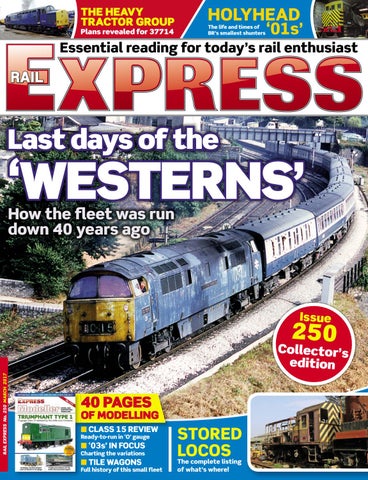
THE HEAVY TRACTOR GROUP Plans revealed for 37714
HOLYHEAD The life and times of BR’s smallest shunters
‘01s’
Essential reading for today’s rail enthusiast
Last days y of the
‘WESTERNS’ How the fleet was run down 40 years ago
Issue
25 0
RAIL EXPRESS No. 250 MARCH 2017
Collector’s edition
40 PAGES
OF MODELLING ■ CLASS 15 REVIEW Ready-to-run in ‘O’ gauge
■ ‘03s’ IN FOCUS Charting the variations C
■ TILE WAGONS
Full history of this small fleet
STORED LOCOS The complete listing of what’s where!
CONTENTS
Issue No. 250 March 2017
D250 FOR ISSUE 250! As we hit this major milepost in our history, what better excuse for a gratuitous shot of English Electric Type No. D250 in its early guise of all-over green livery without yellow warning panels on the nose end. The shot is taken at York sometime between the loco being new in December 1959 and around 1962, when those fitted with nose end ladders (disc-fitted Nos. D210-D324) had them removed. No. D250 went on to become No. 40050, which was withdrawn in August 1983 and cut up three months later. Colour Rail
8
16
18
22
28
30
HEADLINE NEWS
Overseas operators step in as British TOCs deem profit margins too low; New look for West Midlands; DRS gets first Class 88; Class 40 goes blue; New base for Northern Belle rake; New cab for Paddington DMU; Bi-mode finally fulfils potential; First freight from China arrives; HS2 fleet procurement begins; Channel Tunnel tanks; Design changes needed to Class 230 gensets; More Class 68s confirmed.
AN OXFORDSHIRE RENAISSANCE
The story behind the Bicester chord and the new Marylebone to Oxford service.
32
REVIEWS
33
EXPRESS MAILBAG
34
TIME TRAVELLER
75
LU WORLD
76
250 NOT OUT!
This month we notch up our 250th issue, and here we look back on some of the key dates and happenings from the past 21 years.
MODELLING
We have an in-depth look at the variations in the Class 03 fleet and how to model a Southern example, plus there’s a full history of the Redland tile wagons. Our main review is Little Loco’s ‘O’ gauge Class 15, along with new wagons from Dapol and Bachmann.
FROM ONLY
£21.50 NEVER MISS AN ISSUE... SUBSCRIBE TODAY – PAGE 86
Proposed Croxley Link in doubt again.
RAILTOURS
Track tours kick-start the new year; SRPS announces 2017 tours; UKR targets South Wales.
82
POWER BY THE HOUR
88
POWERSCENE
98
UNITARY AUTHORITY
0-60: CLASS 315
TfL Rail’s workhorses are put to the test.
March news from decades past.
PRESERVATION
THE ‘01’ STORY
The life and times of the Holyhead Breakwater Railway and its diminutive BR locos.
West Midlands coke traffic; Wabtec-built locos; Thameslink performance.compared.
78
LAST DAYS OF THE ‘WESTERNS’
How the much-loved fleet was run down 40 years ago at the end of 1976 and early 1977.
New books on ‘40s’, Tyneside, and allocations.
What locos are operational in 2017? DPS to stage anniversary ‘Deltic’ gala at the Bluebell Railway; the HTG details its plans for No. 37714.
Class 70s stored; GBRf ‘92s’ return to Caledonian Sleeper duties; Full listing of stored locos.
Our class-by-class round-up of notable workings.
Off-lease Class 319 go to Long Marston.
101 SHUNTER SPOT
RSS takes on new locos and new jobs.
102 COACH COMPARTMENT
Riviera moves to new base at Eastleigh Works.
103 WAGONS ROLL
First ‘shorty’ Touax hoppers leave WH Davis.
104 IRISH ANGLE
Boost for freight after Tara Mines investment.
IT is now 40 years since the last ‘Westerns’ were withdrawn – but the scale of the following they attracted was not always matched by the care they received from BR! Looking in very run-down condition, the now preserved No. D1015 leaves Totnes for Plymouth on August 25, 1976 and starts the climb of Rattery Bank with a load-12 train. DC Collection
NOSTALGIA
An atmospheric shot of No. D1041 at Paddington late in 1976, waiting to leave with an unknown working to the west. The loco represents the run-down state of many of the ‘Western’ fleet towards the end of their BR careers. Note the parcels in ‘BRUTES’ on the platforms, another chapter of railway history long since closed. All photos by DC Collection unless stated
‘Westerns’ Last days
of the
February 1977 saw the withdrawal of the last Class 52 ‘Westerns’ in BR service. To mark the 40th anniversary of their demise, David Russell looks back at the run down of these popular diesel-hydraulics.
T
HE ‘Westerns’ were, without doubt, the first diesel locos to attract a large following. While the other diesel-hydraulics based on the Western Region had been withdrawn a few years earlier, they did not attract large numbers of enthusiasts – and the ‘Hymeks’ and ‘Warships’ disappeared much more quietly in 1975 and 1972 respectively, although fortunately examples of both types were saved for preservation. The non-standard nature of the diesel-hydraulics meant that BR was keen to eliminate them from the network as soon as possible. Although the ‘Westerns’ outlived the other dieselhydraulics by almost two years, several members of the class only saw around ten years of active service before being confined to the scrapheap. The one with the shortest lifespan was No. D1032 Western Marksman, which emerged from Crewe Works in December 1963 and was stopped nine years and two months later in February 1973. Details of the early withdrawals, which were made after the transfer
22 RAIL EXPRESS March 2017
of various Brush Type 4 (Class 47) diesel-electrics to the Western Region, appear elsewhere in this feature. During the first half of 1973, a number of ‘47s’ were transferred from the London Midland Region to Landore, Swansea. These included Nos. 1943/52/54, which a few years later were to become well known Old Oak Common celebrities in the form of Nos. 47500 Great Western, 47508 Great Britain and 47510 Fair Rosamund. It was the introduction of Class 50s to the Western Region, released after the electrification of the northern section of the West Coast Main Line, that caused major inroads into the ‘Western’ fleet over the next two years. Some 34 Class 50s were transferred from the London Midland Region during 1974, with 11 ‘Westerns’ being taken out of service during that year, followed by a further 18 in 1975.
At the beginning of 1976, there were 34 members of the ‘Western’ class still in traffic. However, just three days into the year, this was reduced by one after No. D1055 Western Advocate was written off following a collision. On January 3, the loco was working a light engine move from Bescot to Worcester when it ran into the rear of a parcels train at Worcester Tunnel Junction, killing the driver and guard on board the ‘Western’. The incident occurred during a period when time interval working was in place after the failure of signalling equipment following storms. The loco was withdrawn two days later, and was dumped at Worcester for over two months before being moved to Swindon Works for scrapping. 1976 saw the decision to abandon the display of headcodes on the front of locos, and this resulted in the remaining
“Several members of the class only saw around ten years of active service before being confined to the scrapheap”
‘Westerns’ having their headcode boxes wound round to display their identities. Towards the end of the year, No. D1023 Western Fusilier received ‘domino dots’, as applied to various other classes, prior to working the ‘Western Talisman’ railtour on November 20 along the East Coast Main Line from King’s Cross to York – a first for the class. Reliability of Class 50s on the Western Region, which had been poor since their arrival, started to improve in early 1976, by which time the ‘Westerns’ had no booked passenger diagrams. Of course, as this was presectorisation era, this did not preclude such workings still occurring, and their use on passenger trains was quite commonplace – particularly during the first part of the year. For example, the southbound ‘Cornish Riviera’ was worked by a ‘Western’ on 12 occasions during January. Further withdrawals during the first four months of the year meant that by the time the summer 1976 timetable came into effect on May 3, there were only 25 members
NOSTALGIA
No. D1013 on shed at Old Oak Common in late 1976, surrounded by various Class 47 and 50 locos – types that would replace the ‘Westerns’. Left: The irony! The arrival of Class 50s from the London Midland Region in 1974 was the start of the end for the ‘Westerns’ – but here No. D1054 tops a then unnamed No. 50034 on the 08.35 Penzance to Paddington near Lostwithiel on July 27, 1976. Roger Geach
It is only September, but already there is evidence of No. D1023’s steam heating being used, as the loco calls at Reading on the 9th of that month in 1976 with a Paddington to Oxford service.
Right: Although booked passenger work had finished early in 1976, ‘Westerns’ were still in regular use for most of the year – particularly for summer-dated services. Here No. D1054 arrives at Liskeard on July 23, 1976 with a Penzance to Cardiff working.
of the class still in traffic: Nos. D1001/05/ 09/10/13/15/2123/28/33/ 36/37/41/48/51/53/54/ 56/58/65/68/70-72). During the same period, eight more Class 50s had been transferred in from the London Midland Region, with the final four following in May to coincide with the timetable change.
SUMMER SWAN SONG
The long, hot summer of 1976 afforded plenty of opportunity to travel behind ‘Westerns’, particularly in the West Country. The Saturday workings to and from Falmouth were covered in detail in our August 2016 issue (RE 243). But other holiday destinations were also frequented by the locos. One of these was Newquay, where the locos would appear on services from/to Paddington as well as cross-country workings, such as the 1M95/08.45 NewquayManchester. Regular workings to Penzance also took place, and with members of the class also outbased at St Blazey (Par) for the china clay workings. So Cornwall became a popular hotspot for dieselhydraulic followers. Paignton also saw frequent visits
by the surviving ‘Westerns’ during the Summer, the 08.30 from Paddington and 15.55 return on Saturdays being one service which a loco would regularly appear on. August 13 saw the appearance of a ‘Western’ on the Exmouth branch, possibly for the last time. No. D1001 Western Pathfinder was used to haul an empty stock working from Exeter to Lympstone Commando, which had opened earlier in the year. The coaches then formed a ‘Troopex’, which was hauled by No. 45102.
EARLY CASUALTIES
OFF REGION
Locos still ventured off the Western Region on passenger work during the year, including an appearance by No. D1009 Western Invader at Weymouth on August 14. It worked south from Bristol on the 06.50 Derby-Weymouth, returning north at 13.20. More frequent were workings to Birmingham New Street from Paddington via Banbury. Even into November, when the fleet had been reduced to 18 examples, they still appeared at regular intervals – with Nos. D1010 Western Campaigner, D1038 Western Nobleman and D1071 Western Renown all being observed at Birmingham during the course of the month.
❯
WITHDRAWAL of the ‘Westerns’ began in 1973, when 11 examples were switched off for the last time. These included the four locos (Nos. D1017-20) that had not been fitted with air brakes. As a consequence of the introduction of Mk.2a/b/c coaches, which were air-braked only, as well as air-braked freight trains, dual-braking of fleet had begun in 1968. No. D1066 Western Prefect was the first to be treated, but with the fleet due to be run down, a decision was made to only modify 70 members of the 74-strong class. The first loco to be stopped was No. D1032 Western Marksman in January 1973, although it was to be four months later before it was officially withdrawn. During this period, the loco was on decision and in need of bogie and engine attention as well as a major exam, and it was used as a ‘Christmas tree’ for parts at Laira depot, Plymouth. Final withdrawal came on May 6, when the first of the vacuum braked locos, No. D1019 Western Challenger, was also condemned having been taken out of traffic at Laira.
No. D1020 Western Hero was stopped at Laira in May, official withdrawal taking place the following month when No. D1018 Western Buccaneer was also removed from service. The last of the vacuum braked locos, No. D1017 Western Warrior, remained in service into July 1973, and was formally withdrawn on August 1. Its demise followed that of Nos. D1039 Western King and No. D1042 Western Princess, of which No. D1039 had been on decision since March and No. D1042 since April. Scrapping of the first ‘Westerns’ took place at Swindon Works the following year. No. D1018, which had moved north from Laira via Bristol St Philip’s Marsh, was cut up in March 1974. No. D1020, which had arrived at Swindon from Laira in December 1973, was scrapped the following month. Both locos had spent around ten years in service. Over the next five years or so, all the remaining ‘Westerns’, other than the seven examples that passed into preservation, were scrapped at Swindon.
March 2017 RAIL EXPRESS 23
OXFORD RAIL UNVEILS NEW 4MM ROLLING STOCK FOR 2017
No .1 55 DIESEL AND ELECTRIC ERA MODELLING O G
TRIUMPHANT TYPE 1
‘O’ gauge Class 15 released by the Little Loco Company
YOUR
40 PAGES
OF MODELLIN G
START
HERE!
Modelling a Southern Region Class 03 shunter in ‘OO’ gauge
Profiling the Redland roof tile traffic and associated wagons
Left: The second half of the 1980s saw Redland make use of the Speedlink network to distribute roof tiles across the UK. Among the assortment of wagons employed on the traffic were 15 OAAs, these all receiving short end extensions and lashing winches along the top of the solebars. Finished in the company’s pale green livery, they were a distinctive sight as proven by No. 100084 when photographed at Warrington in September 1989 en route to Carlisle Currock wagon shops for repair. David Ratcliffe
Editor’s comment
Simon Bendall Rail Express Modeller editor
7
Newsdesk: Oxford Rail 2017
18
D&E Files: Class 03 shunters
8
Newsdesk: Latest developments
22
Modelling: Unique Mk.3 TSCD
12
Reviews: Little Loco Class 15
26
D&E Files: Redland tile wagons
Oxford Rail has unveiled its first new items for 2017, this including the MoD Warwell wagons and classic 35t GLW tankers. There are also further liveries for the Mk.3 coaches, including ScotRail, and a road/rail Land Rover.
The N Gauge Society has announced its first RTR loco to mark its 50th anniversary, this being a Hunslet industrial. Dapol has unveiled more 'OO' gauge Class 73s while the Locomotion prototype HST is 'paused'.
The latest entrant to the ‘O’ gauge ready-to-run market is the Little Loco Company, its first release being the short-lived but popular BTH Type 1s, proceeds from which will help support the last survivor.
Although relatively straightforward when built, the Class 03s developed a multitude of detail differences over the years as modifications were carried out. The type’s complex history is charted here.
Wishing to add something different to his HST set, Daryl Harris-Saxton describes how he modelled the unique Mk.3 Trailer Standard Conductor Disabled coach, this being a 1990s experimental conversion.
The 1980s saw several interesting traffics conveyed by the Speedlink network, including the movement of roof tiles for Redland. David Ratcliffe describes this shortlived but highly modellable operation.
30
Modelling: Southern Class 03
Wishing to recall the sights of his youth, Stu Davies describes how to modify the Bachmann Class 03 into a Southern example, complete with high level brake pipes, as briefly used on Weymouth Quay.
33
EXPRESS RATING A breakdown of our Express rating system
good
Reviews: Dapol 7mm wagons
Recent weeks have seen Dapol release the first examples of its 7mm scale ‘traditional’ BR wagon range, these being snapped up in short order. One of the ubiquitous 12t ventilated vans is examined here.
15
T
HE boom in ready-to-run ‘O’ gauge models shows little sign of abating, with this issue bringing a new range of ‘traditional’ BR wagons from Dapol and the appearance of a fully finished Class 15 from newcomer the Little Loco Company. Few would ever have predicted seeing the BTH Type 1s available off the shelf but, with them selling rapidly, the senior scale is going through the same renaissance that ‘OO’ did in the early 2000s as better RTR models became available. Oxford Rail has announced its first new models for the year, this bringing unfortunate duplication as the new Warwell and 35t tank wagons will be competing against those from Hattons and Heljan respectively. In an increasingly crowded marketplace, and with subjects selected many months in advance of announcement, such clashes are fortunately still quite rare.
Reviews: Bachmann NSE brake vans
New from Bachmann is an interesting pair of brake vans in Network SouthEast blue, these being a mixed pair of BR and Southern designs. There is also a look at the exhibitions taking place in March.
poor
excellent
average
outstanding
Editor: Simon Bendall REMeditor@mortons.co.uk Contributing writer & modelmaker: Alex Carpenter Publisher: Tim Hartley Designer: Tim Pipes Reprographics: Jonathan Schofield, Paul Fincham Advertising: Fiona Leak Tel: 01507 529573, fleak@mortons.co.uk Customer services, back issues and subscriptions: Telephone: 01507 529529 (24hr answerphone) Fax: 01507 525263 Email: railexpress@mortons.co.uk
Like us on facebook facebook.com/RailExpressMag Follow us on twitter@railexpress Visit our website railexpress.co.uk Left: The London Toy Fair saw Oxford Rail unveil its new range for 2017, this including the Warwells in ‘OO’. Covering a range of variants, it will unfortunately be going head to head with the Hattons version with both models being due out towards the end of this year. On June 21, 1980, a freshly-refurbished No. MODA95528 was captured at York, it notably having an empty TOPS number panel at this time. Barham Collection
NEWSDESK
Oxford expands D&E rolling stock
Two new wagons have been announced, while the range of liveries on the new Mk.3 coaches has also increased.
THE London Toy Fair at the end of January saw Oxford Rail announce the first items in its 2017 range of ‘OO’ gauge models. As is the norm for the company, this will be the first of three announcements this year, the others taking place in late spring and the autumn, although they will not all necessarily contain D&E era items. Two new wagons of relevance to D&E modellers are included in the latest catalogue, these being the Ministry of Defence Warwell and the 35t GLW Class A and Class B tankers, as pioneered by Esso but also later utilised by other companies. Work on both models is well advanced with pre-production versions of the initial Warwell variants on show, while first samples of the tankers were due just after the event. With both subjects selected by Oxford some time ago to form a strategic part of its future plans, and with both already tooled, the company intends to press ahead with the two wagons despite the competing models from Hattons and Heljan.
Spanning the decades
The initial Warwells are currently planned for release in late spring/early summer and will cover the as-built appearance with diamond frame bogies. Priced £29.95, the launch liveries feature BR bauxite with other versions due in the second half of the year, including ones loaded with a Sherman tank and a steam roller at £39.95 each. Pictured here are
Supplement No. 155
two versions of the wagon, with and without lashing eyes in the deck. Oxford has also confirmed the refurbished version of the Warwell with Gloucester GPS bogies will be produced, the first examples of this variant being due at the end of this year in the form of a triple pack of differently numbered KWAs (£89.95). Future plans also include tooling up the well platform that is fitted when a Warrior armoured vehicle is carried. It is a similar story with the tankers with both the Class A and Class B variants planned, which will correctly include the dimensional differences between the two. Original and revised suspension will feature as required as will the differences in the valve layouts. Due out in the second half of the year and priced £19.95, three of each type are planned initially, the Class A receiving Esso colours with both types of suspension as well as Staveley Chemicals livery. The Class B, meanwhile, gets Esso black with original suspension, unbranded Esso black with TOPS numbering, and Regent black, the latter two with the revised springs.
Additional Mk.3s
Development work on the much anticipated Mk.3a coaches is continuing ahead of what is now expected to be a summer release. Livery samples of both the BR blue/grey and InterCity releases have been received and these are currently
undergoing evaluation and corrections as needed. Also delivered from China before the Toy Fair and shown here from both sides in black was the first engineering sample of the Mk.3a Restaurant Unclassified Buffet (RUB), this being the previouslyunseen fourth coach type that will make up the initial tranche of releases. Meanwhile, work on developing a realistic interior lighting system has been completed with Oxford now examining the options and pricing for including it in the Mk.3s. Two further significant liveries have also been announced in the form of Virgin Trains red/grey and ScotRail. Both are expected in the second half of the year with Virgin appearing on the First Open (FO), Tourist Standard Open (TSO) and Restaurant First Modular (RFM). Currently just one number on each is listed but more are expected to follow soon afterwards. The much requested 1980s ScotRail livery will grace the FO, TSO and the unique Composite Open (CO) with Oxford currently stating that the colours will be matched to the real things. Whether this will prove to be a colour match to Bachmann’s upcoming Mk.2f Driving Brake Standard Opens (DBSO) remains to be seen. The CO will feature half a first class and half a standard class interior, these being the FO and TSO seating mouldings cut in half; tooling costs precluding the creation of a fully accurate CO interior.
The final new livery is a single FO in the short-lived Stobart Pullman colours of 2008, which will doubtless appeal to the legion of fans of the haulier. Lastly, there will be additional numbers, as promised, for the BR blue/grey and InterCity coaches with one FO, a buffet and two TSOs for each.
More Carflats
Oxford’s stand at the Toy Fair afforded the first look at the Motorail-branded BR blue Carflat, this having arrived later than the bauxite versions shown at Warley. Retailer orders have been considerable, prompting Oxford to announce a new running number for each of the three liveries confirmed so far. These are due in late spring/summer. The final new announcement is a road-rail version of the Land Rover Defender, this taking the existing diecast body tooling and giving it a new chassis. This features rail wheels that can be posed raised or lowered along with an accompanying railing ramp that is designed to sit over ‘OO’ track. Release is planned for late 2017 and is priced £6.95 with liveries taking in BR yellow, Railtrack beige/blue and Network Rail white. An update on the Janus industrial shunter for Golden Valley Hobbies was also provided with news that the first model is now in production in China. This is the National Coal Board version, which should reach the UK in late February or early March, with the other liveries due to follow shortly. www.oxfordrail.com
March 2017 RAIL EXPRESS Modeller M7
D&E FILES
Redland roof tile wagons The second half of the 1980s saw Redland use the Speedlink wagonload network to distribute roof tiles across the country. David Ratcliffe details the history of this short-lived but highly modellable freight flow.
Some of the OAA conversions had one or two small Redland nameboards fixed to each side, as seen in this view of No. 100077 at Brandon in July 1987, this also showing the extended ends and strap winches to advantage. For the first few months of the traffic from East Anglia to Acton, the wagons had been loaded at the UKF Fertiliser depot in Dereham while the siding at Brandon was being refurbished and equipped with hard standing. All photos by the author
THE growth of British Rail's fast overnight Speedlink wagonload service attracted a number of new traffics to rail. One of these was the movement of roof tiles from Stirling to Gateshead Old Shops, where Redland had opened a distribution depot, the working commencing in 1985. Five OAA open wagons already equipped with 10 load-securing winches each side were further modified with end extensions to carry the tiles. Repainted in Redland's green livery with black and red lettering, the OAAs were forwarded from Stirling as far as Mossend in the consist of 6O56, the 15.10 Dundee to Dover. They then went forward to Tyneside on another trunk Speedlink service, 6E86/19.20 Mossend to Parkeston Quay, which ran via the Tyne Valley line and Tyne Yard. Final delivery was by 9P06, the 06.45 local trip from
Tyne Yard to Tyneside Central Freight Depot, with the Class 03 or 08 shunter based at the latter location placing the wagons in the nearby Old Shops sidings.
Rapid expansion
The success of this flow encouraged Redland to make greater use of rail and by the end of 1985, roof tile traffic had commenced from the company’s factories at Swaffham and Stanton, both in East Anglia, to Acton Freight Depot. The company also decided to lease the 12 Procor PNA bogie opens, numbered PR5300-11, which had been built in 1977 for the ICI charter train service from Runcorn to Willesden; a working that had ceased in 1984. After being fitted with additional cargo winches and repainted in Redland colours at Procor’s Horbury Junction works, the PNAs were all in tile traffic
by the end of 1986. Furthermore, an additional 10 OAAs had also been allocated to tile traffic, with all of these receiving the same winch and end modifications along with Redland green by late 1987. New tile flows from Bletchley to Totton, Rugby to Acton and Totton, and from Tiverton Junction to Cardiff Tidal Sidings all commenced in 1987, the traffic from Tiverton Junction originating at the company’s nearby factory in Burlescombe. However, with no other suitable airbraked open wagons available for hire, Standard Wagon was commissioned to fit a batch of 16 Railease bogie container flats with drop-side bodies. Numbered RLS92636-51, the modified wagons were recoded from PFA to PNA with the first leaving Standard's Heywood Works in December 1987. Early in 1988, Redland leased eight
WAGONS ASSIGNED TO REDLAND ROOF TILE TRAFFIC Wagon Nos. 100013/16/22/27/34/42/48/61/63/72/77/78/84-86 PR5300-11 RLS92636-51 200819/91, 200926/86, 201014/19/30/67, 210208/76/89/99, 210315/21/49/78 80 2796 033/50/53/60/70/79/80, 80 2796 135
TOPS Code OAA PNA PNA VDA
Design Code OA001C PN001B PN002A VD001A/C/D
Based at Brandon, Rugby, Stirling, Tiverton Jn. Bletchley, Brandon, Rugby, Tiverton Jn. Bletchley, Rugby, Tiverton Jn. Rugby/Stirling
IPB
IPE471
Brandon
Note: While all 15 OAAs listed received the same end extension modification, BR records failed to catch up and some remained shown as OA001B (extra winches but standard height ends).
M26 RAIL EXPRESS Modeller March 2017
three-door ferry vans (diagram E461) from VTG. However, the use of these eight IPBs proved to be short-lived and they were returned to the general VTG ferry pool in August of that year after the workings from Brandon, in Norfolk, came to an end. In addition to Acton, Cardiff, Gateshead, and Totton, Redland also established rail-served depots at Dewsbury Railway Street and Hull Freight Depot. Both of these were supplied from Bletchley and Rugby, while there was also occasional tile traffic to the Dor-to-Dor warehouse at Crawley.
Daily deliveries
The busiest of the depots were those at Acton, in West London, and at Totton (Eling Wharf), on the western outskirts of Southampton, where three or four wagonloads of tiles would arrive a day from Redland’s Vandyke factory at Leighton Buzzard (loaded onto rail at Bletchley Freight Depot), as well as five or six wagons a week carrying tiles and fittings from Redland’s Clifton factory in Rugby. A total of 16 VDA vans were hired from British Rail to carry the palletised fittings, with these vans also seeing occasional use in tile traffic from Stirling. As neither tile factory had its own rail connection, the traffic from Stirling was loaded onto rail in
Supplement No. 155
LU WORLD
Christopher Westcott & Piers Connor
Doubt over Croxley extension Funding problems are again dogging the planned Metropolitan Line extension into Watford Junction via the Croxley Link. THE Mayoral Business Plan published in December 2016 made no explicit reference to the Croxley Link extension, raising fears about the plan to run Metropolitan Line trains into Watford Junction station. If given the green light, the works will result in the closure of the Met’s existing Watford terminus and re-route the line to Watford Junction via the closed former British Rail Croxley Green branch and a new section of track. If completed, the project will provide better transport access to Watford Football Club’s Vicarage Road ground, and also to the local hospital campus – reducing reliance on road transport just as the population in the area is expected to grow by an anticipated 15% by 2030. The absence of any reference to the extension in the business plan has raised concerns that the project may be delayed or even cancelled, with Transport for London appearing to quietly forget about the project by failing to make any reference to it.
A DECADE OF PLANNING
The Croxley extension has been considered for more than a decade and in that time costs have ballooned. In 2005, when the project was first muted, the extension was estimated to cost £65 million. However, since then the project has stalled, typically due to funding challenges. By 2008, the work was estimated to cost £120 million, rising to £230 million by 2014 before management of the extension passed from Network Rail to TfL. Even then, costs had increased once more to an
A view of the closed Croxley Green branch at Watford West in April 2014 after clearance work as part of the proposed Metropolitan Line Croxley Link. Watford West is not planned to be reopened, although there would be a station nearby at Watford Vicarage Road. Note the track is still in place from when the line was officially closed in 2003, although the last services actually ran in 1996. Gumboot50/ Creative Commons
estimated £284.4 million. More recently, further studies have been undertaken by TfL, which has reached the conclusion that anticipated costs have been underestimated throughout the project. TfL believes that a more accurate figure to construct the link could be as high as £350 million. Once again, this would represent a significant funding shortfall that would need to be met by the Department for Transport, Hertfordshire County Council and TfL. The Mayor of London, Sadiq Khan, was questioned in January by members of the London Assembly Caroline Pidgeon and Tom Copley. They asked why reference to the extension was missing, while also seeking confirmation of when the extension would be completed. The mayor’s response was: “There is a growth fund in the TfL Business Plan for transport projects which will unlock growth and regeneration. The list of projects covered by the fund is still being reviewed, but could include
the Metropolitan Line Extension.” It is clear that Sadiq Khan has chosen his language very carefully. Reference to a provisional target completion date in 2020, plus that TfL continues to work with other bodies regarding affordability, that proposed projects continue to be reviewed and could include the Croxley extension all betray the fact that there is still some room for doubt.
ROCK AND A HARD PLACE
TfL faces a challenging decision in the coming months: commit to the extension and the concept that it represents value for money, and therefore commit to the costs that may continue to rise; or cancel the project and acknowledge that significant sums of money have been spent for little or no benefit. Examples of money already spent include the planning and design work, as well as London Underground having already purchased an additional ‘S’ Stock train for the extension. Sadiq Khan, who will ultimately be
signing off on the Croxley project, is therefore between a rock and a hard place. The mayor has committed not to increase passenger ticket prices until 2020. He is therefore depending on other means to raise income to fund transport improvement works. This inevitably includes a reliance on the existing trend of increasing passenger numbers. Undoubtedly the launch of the Elizabeth Line (Crossrail) in stages between December 2018 and December 2019 will release much needed additional capacity for passenger growth across the capital. However, the full effects of Brexit remain unknown. While ‘Remainers’ warn of businesses intending to relocate away from the UK, ‘Brexiteers’ claim that foreign businesses cannot wait to invest and relocate to London and the UK. A decision whether to commence construction is due no later than 2018, prompted by the impending expiration of compulsory purchase orders. Any later and there will have to be efforts made to extend these dates that will increase costs yet again. E
Tunnelling for Northern Line extension due to commence WHILE the future of the Croxley link remains in the balance, drilling work for the Northern Line extension to Battersea is due to begin in March. Two machines will each drill two miles (3.2km) creating 5.2 metre tunnels between Kennington and the Battersea development via Nine Elms. Both tunnel boring machines (TBMs) were given female names, as is traditional, with one called Helen and the other Amy in a ceremony on January 20. They have been named after Helen Sharman, the first British astronaut, and Amy Johnson, who in 1930 became the first female
pilot to fly from Britain to Australia. The two 650-tonne machines, built by NFM Technologies at Le Creusot in France, were deconstructed, shipped to Battersea, and then reconstructed on site. They are due to commence boring in March and are currently undergoing tests. They are anticipated to extract 300,000 tonnes of earth, which will be taken by barge to Goshems Farm, East Tilbury, to create arable farmland. The extension – which is expected to cost around £1.2bn to construct, £1bn of which comes from the private sector – is due to be completed in 2020.
The two tunnel boring machines that will be used on the Northern Line extension from Kennington to Battersea, pictured at Battersea on January 20 after being named Amy and Helen. TfL
March 2017 RAIL EXPRESS 75
PRESERVATION IN BRIEF CLASS 04 FOR MID-NORFOLK
OFFERED for sale towards the end of last year, the Churnet Valley Railway’s Class 04 No. D2334 has been sold and moved to a new home at the Mid-Norfolk Railway in early January. Once it has been returned to operational condition, it is planned to use the loco on shunting duties at Dereham. Class 04s were based at Dereham for shunting work in the 1960s, although No. D2334 spent all of its BR life allocated to Heaton, Gateshead and Darlington depots.
MID HANTS OFFERS DIESEL RUNNING DAYS
MONTHLY diesel operating days have been added to the Mid Hants Railway’s 2017 timetable. No. 33053 is booked to work three round trips on May 27/July 23/September 2, with No. 50027 Lion rostered to work on April 8/June 25/ August 19. ■ In a change to the list in last month’s issue, No. 31466 will now be operating at the East Lancs Railway on March 18/19 rather than 50015 Valiant. The following weekend will see either 40106 or 50015 in action there.
NEW ENGINE BLOCK FOR MAIN LINE 'WESTERN'
FOLLOWING its engine failure in December, a replacement engine block is being procured from Germany for the Diesel Traction Group’s No. D1015 Western Champion, which will be built up using components from the failed unit before being shipped to the UK for dropping into the loco. The DTG estimates the repairs will cost in the region of £50,000.
NEW HOME FOR INSPECTION SALOON UNDERFRAME
REDUCED to just an underframe after a fire in 2012, former LMS Inspection Saloon No. DM45036 is to move from the Chinnor & Princes Risborough Railway to the Tanat Valley Railway near Oswestry shortly. Initial plans are to restore the chassis, with a longer term aim of rebuilding the saloon.
‘CHOPPER’ LEAVES NNR
THE Class 20 Locomotive Society’s No. 20227 departed the North Norfolk Railway on January 23, being taken by road to Washwood Heath for repainting by Boden Rail. It is expected to lose its modern London Underground look with the more traditional LU colour scheme (as applied to classmate No. 20142) being suggested as its new livery.
CLASS 71 MOVES TO SHILDON
HAVING spent just over four years at Barrow Hill, Class 71 No. E5001 returned to Shildon on January 18. Cosmetic restoration work is due to begin in May.
TPO MOVEMENTS
A PAIR of Mk.1 Travelling Post Office vehicles, Nos. 80411/434, left the Gloucestershire-Warwickshire Railway during December, moving to the Vale of Berkeley Railway.
78 RAIL EXPRESS March 2017
David Russell
What’s operational in 2017? Our annual survey of working ex-British Rail diesels on heritage lines. OUR last review of operational preserved diesels featured in issue 237 in early 2016. Since then, a number of locos have been stopped for one reason or another, and others have returned to traffic, in some cases after a lengthy restoration, such as Class 40 No. D213 Andania.
OUT OF ACTION
One loco previously on the list of runners, No. 31255, has been removed following its sale to HNRC, although it remains at the Colne Valley Railway for the time being. Another Class 31 that has been deleted is No. D5631 (31207) at the North Norfolk Railway, which was taken out of traffic for bodywork repairs and a traction motor issue. The NNR’s resident ‘Rat’ No. 25057 also requires traction motor attention, although it has recently seen use as a static steam heat provider. Two other Sulzer Type 2s that are not currently in service are Nos. 26007 and D5401 (27056). The former was damaged in a derailment when being towed back from the Nene Valley Railway to Barrow Hill in October 2016, and has spent several months parked at GB Railfreight’s Peterborough depot awaiting movement. It finally departed back to Barrow Hill by road on January 16. No. D5401 has been stopped for attention to its bodywork at the Great Central Railway, where resident Class 45 No. D123 is out of use with an oil pump problem. Also out of action for bodywork repairs is No. 33021 at the Churnet Valley Railway, while sister ‘Crompton’ No. 33202 Dennis G. Robinson left the Spa Valey Railway for a private site in Essex in December and is receiving a full re-wire. Elsewhere in Essex, No. 47635 Jimmy Milne at the Epping Ongar Railway is undergoing roof repairs. The NRM’s Type 4 No. 47798 Prince William is currently out of traffic there and awaiting movement to Tyseley for attention
2016 RETURNEES
The number of operational preserved Class 20s remained static, as No. 20048 was taken out of service for attention to its bodywork at Butterley, but No. D8188 (20188) returned to the Severn Valley
OPERATIONAL PRESERVED DIESELS
(CLASS 14 UPWARDS) Class 14: Class 17: Class 20: Class 24: Class 25: Class 26: Class 27: Class 31: Class 33: Class 35: Class 37: Class 40: Class 41: Class 42: Class 44: Class 45: Class 46: Class 47: Class 50: Class 52: Class 55: Class 56: Class 73:
D9504/16/20/21/23/26/29/31/37/39/55, 14901. D8568. D8020/59, D8137/88, 20031/98, 20205/14/27. 5081. D5185, D5217, D7535, D7612/28/29, 25059. D5310/14/43, 26038. 27024/50. D5627, D5830, 5518/80, 31130, 31206/71/89, 31327, 31430/38/66. D6515/75, 6535, 33035/63, 33102/09/10/11, 33201. D7017/76. D6732, D6948, 6940/75, 37025/29/75, 37109/42, 37215/64/94, 37403/418, 37674, 37714. D213, 345, 40106/135. 41001. D832. D8 45041/60, 45108/33/49. D182. D1661, 47192, 47205/92, 47367/76, 47401, 47579/80/96, 47643, 47712/65/73, 47828. 50015/26/27/31/35/42/49. D1010/15/62. D9002/09, 55019/22. 56006/97, 56301. E6003/16/36, 73001, 73118/30, 73210.
Railway following engine repairs at Boden Rail’s Washwood Heath site. Also back in action is Class 14 No. D9523, which failed during the East Lancashire Railway’s ‘14s@50’ event in 2014, returned to use at the Nene Valley Railway’s gala in October. Various locos undertook their debut workings in preservation during the year, namely Nos. D213, 37403 Isle of Mull (which is on hire to DRS), 37714 and 47828. There was also the welcome return to service of a Class 44 and 46, neither of which had an example in traffic at the beginning of the year. Other locos that returned to use were Nos. 25059, 5580 (31162), D5627 (31203), D6515 (33012), 33035, 33111, D6948 (37248), 40135, 50026/31/49, D1010 and D9002 (55002).
CANDIDATES FOR 2017
At the beginning of last year, Rail Express listed nine locos that might return to traffic during the course of the year. Six of these did appear in service, and progress has been made on the other three (Nos. 37009/190 and 45132) – so perhaps they will be back in action during 2017?
CFPS ‘40’ PREPARED FOR REPAINT: The
Class 40 Preservation Society’s split-box No. 40135 has been moved to Loram Derby for repainting from BR green to blue livery. It is pictured in the preparation shed at Loram on January 21, from where it will be moved to the dedicated paint facility. Paul Bickerdyke
Four of the locos that we suggested might appear in 2015 have yet to return to traffic, but three of these (Nos. 40012 Aureol, D7018 and D9551) have all made major progress in the last year, the Class 14 having already undertaken test runs. It is earmarked to appear at the SVR’s gala in May. The fourth loco (Class 24 No. D5054/24054) moved back to the ELR from Barrow Hill on January 23, and work on returning it to traffic is due to begin imminently with a view to it being back in use later in the year. Other locos that might return to service in 2017 include Nos. D8000 (20050), 31414, D6501 (33002), D6700 (37350), D6737 (37037), 37227, D4 (44004) Great Gable, 46010, D1501 (47402) and 50007 Hercules. The Class 50 re-entered preservation after its purchase by the Class 50 Alliance, and had its main generator removed for overhaul on January 21. As in previous years, the accompanying list covers diesels and electro-diesels from Class 14 upwards, and includes locos that are stopped for short-term attention, such as ‘Hymek’ No. D7076. E
Second time lucky for ‘08’ WITH its planned sale to the embryonic Trawsfynydd & Blaenau Ffestiniog Railway having fallen through after the bidder failed to raise sufficient funds, No. 08757 has been re-sold to another bidder by DB Cargo. The loco was moved from Crewe Electric depot to a new home at the Telford Steam Railway on January 16. The next day No. 08359, which had been at Telford for use during the ‘Polar Express’ season, returned to its base at the Chasewater Railway.
POWER BY THE HOUR
Simon Bendall
Stored loco locations 2017 Our annual round-up finds the total number of stored locos has fallen over the past year, although several Class 70s make a new entry to the list, while three-quarters of the Class 60 fleet is now sidelined. THE beginning of 2017 saw 319 diesel and electric locos in store around the UK, giving a reduction of 26 from a year ago. Disposals remain at a low level, with just eight locos succumbing to the cutting torch in 2016. Three of
these were Class 08s – Nos. 08393, 08628 and 08886 – while main line casualties encompassed Nos. 20092, 37682, 47540, 58008 and 86902. The stored total was further reduced by the export of additional Class 86s to Eastern Europe, while
preservations did well, particularly if a shunter was required. On the down side, the Class 60s now make up almost a quarter of the overall total, with 74 of the 100 Brush machines in store – an increase of six from 12 months ago, with several of
the refurbished DB Cargo examples now included. The inclusion of Class 70s for the first time is also a sad reflection on the state of the rail freight market. The full location listing follows, correct to January 30, 2017. E
STORED LOCOS CLASS 08 08411 08442 08480 08500 08503 08536 08567 08568 08575 08578 08580 08593 08605 08623 08653 08678 08699 08701 08706 08709 08711 08714 08735 08737 08738 08742 08765 08782 08783
WA EH TO BO Bi* DF ZG ZH Lh LM Cv WA SP BS LM CS We LM CE Cv TE Hp EH CD Cv HY BH Dc Ek
08786 08798 08799 08802 08804 08824 08865 08872 08877 08879 08891 08904 08905 08918 08921 08939 08944 08994 Total: 47
BH Ea WY WA CE BH BH Ea BH ZG Lh Ey Hp BO Ek Cv BQ BO
CLASS 09 09006 09014 09023 09106 09107 09201 Total: 6
BO BO Ea KY Ek Hp
CLASS 20 20007
SK
20016 20035 20056 20063 20069 20081 20087 20088 20110 20121 20166 20301 20302 20303 20304 20305 20308 20309 20312 20903 20904 Total: 22
LM Gw Sc Bf Mn LM BQ LM BQ BH Ws BH BH BH BH BH BH BH BH BO BO
CLASS 31 31105 31128 31190 31235 31255 31285
DF BO WW Mn Cv BO
31454 31459 31461 31465 31468 31601 31602 Total: 13
CLASS 33 33025 33029 33030 Total: 3
CS CS CS
CLASS 37 37146 37165 37188 37194 37198 37207 37214 37255 37407 37413 37503 37510 37517 37670
UKRL’s base in Leicester is home to 10 stored Class 56s, which may or may not have a future depending on demands for traction. One of them is No. 56069, which still carries Fertis livery from its time working in France, and is pictured tucked around the back of Leicester depot on January 15, 2016. Paul Bickerdyke
84 RAIL EXPRESS March 2017
WW DF BO We We WW We
Ws CS BH Cb BO BH CS BO DF BH LR LR CS LR
37676 37703 37710 37712 37901 37905 37906 Total: 21
CS BT* CS CS SE LR LR
CLASS 47
47194 47236 47355 47368 47488 47492 47500 47501 47526 47701 47703 47714 47715 47727 47744 47761 47768 47769 47772 47776 47787
CS CS CS CS BO CS CS CD CS BO ZB* AH* Ws* WW BO SK CS BH CS CS CS
47790 47805 47810 47811 47813 47816 47818 47830 47841 47843 47847 47853 Total: 33
CD CD ZG BA KM BA ZG* BA ZG LR LR BH
CLASS 56
56007 56009 56018 56031 56032 56037 56038 56049 56051 56060 56065 56069 56077 56090 56091 56106
LR Bf LR LR LR LR LR WW WW LB LR LR LR WW WW LR
56128 WW 56311 WW Total: 18
CLASS 57 57001 57004 57005 57006 57008 57009 57010 57011 57012 Total: 9
CS Lg CS CS Lg Lg Lg ZG Lg
CLASS 58 58012 58023 Total: 2
Bf Bf
CLASS 60 60003 60004 60005 60006 60008 60009 60010 60011 60012
TO Ty Ty Ty TT TT TO TO TT
The list of stored locos includes some that would face a long way back to service – including No. 08593 at Moveright International’s base in Wishaw (Warwickshire), which is being stripped for spares but not going to be scrapped for the time being. The shunter is pictured on September 14, 2016. Paul Fuller
TRACTION & ROLLING STOCK
David Rapson
Powerscene Our authoritative class-by-class review of newsworthy locomotive workings.
CLASS 20
OUT of use since the autumn, Nos. 20118+20132 accompanied No. 73964 from Tonbridge West Yard to St Leonards on January 3 for attention. With no work to do transferring London Underground ‘S’ Stock, the quartet of Nos. 20096+20107 and 20314+20905 powered the 6Z20/ 09.32 Barrow Hill-Doncaster Hexthorpe on January 12, which conveyed
two of the barrier tank wagons.
CLASS 31
VETERAN Type 2 No. 31233 has seen use in 2017, despite fears for its future following the cancellation of its railtour scheduled for the week after Christmas. Having accompanied Nos. 73951+73952 to Thoresby Colliery Junction (see Class 73) on January 11, the loco remained at the High Marnham
test track until the evening of January 17, when No. 37800 arrived to ‘top and tail’ with the Class 31 on the movement of the new rail grinder back to Derby. By January 23, No. 31233 was ready to take an ultrasonic test train to Old Dalby and back matched with driving trailer No. 9714. Late that night, No. 31233 and the same coaches headed for Neville Hill, running via Grantham. On subsequent nights, the
loco undertook testing via Knottingley, Doncaster and York (January 24), visited Immingham soon after midnight on January 26, and set off that evening for Harrogate, Knaresborough, Ilkley and Bradford Forster Square, before returning to Derby early on January 27.
CLASS 37
WEST Coast Railways’ No. 37706 had charge of the 5Z45/02.28 Carnforth-
Former DRS Type 3 No. 37608 has been repainted into Europhoenix colours and named Andromeda, and the loco is now back in traffic. It was pictured approaching Freemans level crossing (near Bedlington, Northumberland) on January 23, ‘top and tailing’ with No. 37604 on the 1Q05/06.12 Derby to Tees Yard. Steve Porrett
Despite much more modern traction being laid up in store, Class 31 No. 31233 (which entered service in October 1960) soldiered on in traffic into 2017, with January 26 finding it at Knaresborough while working the 3Q92 test train from Neville Hill – which also visited Harrogate, Ilkley and Bradford Forster Square. Duncan McEvoy.
88 RAIL EXPRESS March 2017
TRACTION & ROLLING STOCK Manchester Victoria empty stock on January 21, and then ‘tailed’ the tour throughout the day with ‘Jubilee’ 4-6-0 No. 45690 Leander hauling the outward leg as the 1Z45/07.15 Manchester Victoria-Carlisle. On the return journey, the steam locomotive was replaced at Carnforth by No. 57314, while No. 37706 remained at the rear of the train. East Anglia welcomed the arrival of large logo blue No. 37403 Isle of Mull on January 24, but, after handling the 2J67/07.47 Lowestoft-Norwich next morning along with No. 37419, the popular Type 3 suffered a serious oil leak and was on its way back to Crewe that afternoon between classmates Nos. 37419 and 37405. This left the loco-hauled ‘short set’ without motive power until Nos. 37405+37419 returned on the 28th to restart the diagram two days later.
It is likely that No. 37254 will lose its InterCity livery shortly in favour of Colas house colours. At least much of the country was able to witness its passing during the month, as the locomotive covered many miles on test train duties. At Cardiff on January 3, along with No. 97303, it worked alone to Littlehampton and Bognor Regis on January 11, before being partnered by No. 37116 for a tour of Scotland. During the early hours of January 20, the duo covered the branches to North Berwick, Tweedbank and Milngavie, and the following night ventured to Wemyss Bay, Gourock, Ardrossan and Largs, before leaving Mossend bound for Inverness on January 21. That evening, at 19.30, the pair reached Elgin heading for Aberdeen, and later retraced their steps back from ‘The Granite City’.
NAME GAME LOCO NAMINGS 37608
Andromeda
by Simon Bendall
Eastleigh Works
10.01.17
Glasgow Works
10.16
Continuation of Europhoenix’s naming theme that began with the two Class 86/7s, the V-shaped constellation being best viewed in the northern hemisphere. Previously named Thornaby Demon as No. 37512.
DE-NAMINGS
158715 Haymarket
En route back towards Grangemouth, Nos. 37116 and 37254 passed Markinch on January 23, and travelled south along the Glasgow & South Western route to Carlisle two days later. They then headed to Heysham Harbour, and reached Blackpool North early on January 27, returning to Derby the next day. The resurrection of a handful of
Class 37s from preservation has seen a return to the main line of splitheadcode Type 3s, so the appearance of one at both ends of a test train is now possible. This occurred on January 17, when Nos. 37025 Inverness TMD and 37099 Merl Evans 1947-2016 visited Portsmouth Harbour, Littlehampton and Lymington Pier, having been noted bound for Weymouth
❯
March 2017 RAIL EXPRESS 89
TRACTION & ROLLING STOCK
Pairs of DB Cargo Class 90s remain in charge of the 4M25/06.06 Mossend-Daventry and 4S47/19.13 return, with Nos. 90035+90028 pictured up front of the southbound working on January 25 at Heamies Farm, Staffordshire. Brad Joyce
96 RAIL EXPRESS March 2017