WHEN SATURDAY CAME…
Recalling the golden years of locohauled holiday trains to Skegness
FAREWELL TO
‘D’ STOCK
LU workhorse bows out after 40 years
Essential reading for today’s rail enthusiast
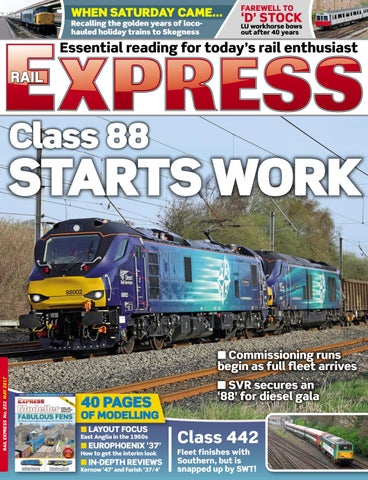
Class 88
STARTS WORK
RAIL EXPRESS No. 252 MAY 2017
■ Commissioning runs begin as full fleet arrives
40 PAGES
■ SVR secures an ‘88’ for diesel gala
OF MODELLING ■ LAYOUT FOCUS
East Anglia in the 1960s
■ EUROPHOENIX ‘37’ How to get the interim look
■ IN-DEPTH REVIEWS Kernow ‘47’ and Farish ‘37/4’
Class 442 Fleet finishes with
Southern, but is snapped up by SWT!
Issue No. 252 May 2017
CONTENTS
THEN THERE WERE TWO: Class 20 No. 20227 has become the second of the class to receive a retro London Transport maroon livery, joining No. 20142 which was so treated last year. The pair are seen at Castle Donington, Leicestershire, running light engine from Washwood Heath to the Midland Railway Centre-Butterley on April 3, 2017. Brad Joyce
8
HEADLINE NEWS Brexit and the effect on railways; First look at new Anglia fleet; First-MTR consortium wins South West Trains; Shunters escape scrapyard closure; New Penzance depot takes shape; DRS Class 88s commence trials; New South Eastern franchise to start in December 2018; New look for Class 230 DMU as Vivarail develops a batterypowered version; Hoppers damaged in East Somerset derailment; Freight paths freed up for passenger use.
17
WHEN SATURDAY CAME: SKEGNESS Looking back to the golden days of summerdated holiday trains to coastal resorts, kicking off with this look at the Lincolnshire outpost.
24
LU WORLD SPECIAL London Underground is bidding farewell to its District Line workhorse – the ‘D’ Stock. We detail its career history, with insight from a LU driver.
28
A TRIP DOWN MEMORY LANE Example main line duties from when the Class 08/09 fleet did more than just shunting.
31
0-60: CLASS 144 Putting a Northern ‘Pacer’ (and our columnist!) to the test in the Aire Valley.
32
REVIEWS New books on Class 08/09s, Class 50s, and life as a railwayman in the early 1970s.
33
EXPRESS MAILBAG ‘Westerns’ on freight; Pilot scheme diesels; Foreign-owned trains and operators.
34
TIME TRAVELLER May news from decades gone.
76
FFROM ONLY
££21.50 NEVER MISS AN ISSUE... SUBSCRIBE TODAY – PAGE 22
RAILTOURS Royal Scotsman itineraries announced; Celebrity ‘37’ to return to Highland haunts; Charity tour raises £50,000; Full diary for May.
78
PRESERVATION Early ‘37’ to be overhauled by UKRL; Ark Royal misses Bluebell gala; ‘Skinhead 31’ moves to Weardale; Heritage line freight photo special.
84
POWER BY THE HOUR Colas ‘67s’ start NR test train work; GBRf ‘73/9s’ resume solo sleeper working.
86
POWERSCENE Our class-by-class round-up of notable workings.
97
UNITARY AUTHORITY GWR Class 387/1s head west; More exThameslink Class 319s go in to store.
MODELLING Our main feature this month is an in-depth look at an ‘OO’ gauge layout based in the Fens in the 1960s. There is also news of Kernow’s Bulleiddesigned diesels, plus reviews including Dapol MJA wagons, Gaugemaster ‘73s’ and a Graham Farish ‘37/4’.
100 SHUNTER SPOT RSS continues to expand.
101 WAGONS ROLL ‘Seacows’ acquired by SVR; DIrect Rail Services puts DVTs into store at Longtown.
102 COACH COMPARTMENT Vintage Pullmans head south.
104 IRISH ANGLE Another DEMU car is scrapped.
DRS’ No. 88002 was the first of the new dual-mode class to start main line testing, initially light engine from Carlisle to Crewe, and then later hauling a rake of box wagons with diesel No. 68025 as insurance. The first of these loaded workings on April 3 is pictured at Oubeck, south of Lancaster, on April 3 with the 6Z88/05.36 Carlisle YardCrewe Gresty Green Up Loop. Cameron Walker
Editor’s Comment PRINT & DISTRIBUTION
Newstrade & distribution Marketforce UK Ltd, 5 Churchill Place, Canary Wharf, London, E14 5HU. 0203 787 9001 Printed by William Gibbons and Sons, Wolverhampton Published Third Friday of every month This issue April 21, 2017 Next issue May 19, 2017 Advertising deadline May 4, 2017 ISSN No 1362 234X
Paul Bickerdyke Rail Express Editor
© Mortons Media Group Ltd. All rights reserved. No part of this publication may be reproduced or transmitted in any form or by any means, electronic or mechanical, including photocopying, recording, or any information storage retrieval system without prior permission in writing from the publisher.
Seeing red
T
HE news that First-MTR has won the next South West Trains franchise raised more than a few eyebrows in the industry. Not only has First Group thus ousted its great rival Stagecoach from a franchise it has held since 1996, but the consortium’s future plans include bringing back 30-yearold Class 442s to Wessex while replacing the new Siemens-built Class 707s – which have not even started service with SWT yet. On the face of it, this seems like madness – illustrating the often-cited worst aspects of our privatised rail structure: a lack of continuity and long-term planning. Details of why First-MTR has decided to do this had yet to emerge as this issue went to press, but the national press is sure to have a field day when it comes out. There is speculation that the ‘707s’ might prove expensive to run, and so reordering elsewhere might be a cheaper alternative in the long run. If true, this could also have helped make Stagecoach’s bid more expensive than First-MTR’s, as the incumbent would be obliged to retain the trains it ordered from Siemens.
Rail Express is pleased to consider contributions for publication
We await clarity. But if the ‘707s’ are to leave SWT, then the question is where would they go? The thought of practically brand new units sat in store while other parts of the country are crying out for upgrades will be a PR disaster on a massive scale. SEASIDES ROCK As a break from the vagaries of the current railway scene, we also look back to the golden years of summer-dated loco-hauled travel – when freight locos came out in force to haul rakes of Mk.1s to coastal resorts around the country. Skegness is the destination this time, and with summer now just around the corner, it is one of those occasions when a time machine would come in very handy. Enjoy! Paul Bickerdyke
Want to know when your next edition of Rail Express is on the shelves?
Please do not send images that have already been sent to other publications. Prints & slides are sent at the owner’s risk and must be accompanied by a SAE for return. Digital images can be sent by email, but please bear in mind we may not be able to reply to every one, as we receive hundreds of images each week. Although care will be taken with submissions, Rail Express assumes no responsibility for loss/damage, however caused. Submitted material may also be used in connection with other Mortons Media Group projects or as content on the internet. Payment for material used will be made promptly. Please send digital submissions to RailExpressEditor@mortons.co.uk or via CD or DVD to the editorial address. IMPORTANT: Images should be ex-camera with no Photoshop manipulation.
ADVERTISING
Divisional advertising manager Sue Keily skeily@mortons.co.uk Advertising Fiona Leak Tel: 01507 529573 Email: fleak@mortons.co.uk Publishing director Dan Savage Publisher Tim Hartley Production editor Sarah Wilkinson Designer Tim Pipes Reprographics Jonathan Schofield Subscription manager Paul Deacon Circulation manager Steve O’Hara
EDITORIAL
Editor Paul Bickerdyke Tel: 01507 529540 Email: RailExpressEditor@mortons.co.uk Editorial address Rail Express Magazine, Mortons Media Group Ltd, PO Box 99, Horncastle, Lincolnshire LN9 6LZ
Scan this QR code for a reminder. Independent publisher since 1885
Like us on facebook facebook.com/RailExpressMag Follow us on twitter@railexpress Visit our website railexpress.co.uk
Member of the Professional Publishers Association Having trouble finding a copy of this magazine? Why not just ask your local newsagent to reserve you a copy each month
Simon Bendall Editor Rail Express Modeller
David Russell Preservation Unitary Authority Coach Compartment Railtours
Power by the Hour Shunter Spot Name Game Spectrum
David Rapson
Wagons Roll
LU World (with Piers Connor)
Powerscene
William Watson Gareth Bayer
Christopher Westcott
Irish Angle (with Alan McFerran)
‘Industry Witness’ News Writer
SAD DAY FOR WALES: The last train of Welsh coal for a Welsh power station ran on March 15 when No. 66511 hauled the 6C95/18.45 Cwmbargoed-Aberthaw. The loco is seen the following day near Bedlinog, grinding its way back up the valley with the 4C95/14.00 return empties to the Cwmbargoed washery, near Merthyr Tydfil. The washery will still deal with coal from the nearby opencast Ffos-y-Fran site, but Aberthaw will now only operate at peak times using imported Australian and Russian coal, which are said to be easier to burn and have fewer emissions issues than Welsh coal. Peter Slater
Like us on facebook facebook.com/RailExpressMag
HEADLINE NEWS
Brexit and the effect on railways The UK Parliament will regain legislative control over Britain’s railways when we leave the European Union.
By ‘Industry Witness’ STEPS to leave the European Union were formalised on March 29, when the Government gave notice under Article 50 of the Lisbon Treaty that it will cease to recognise European treaties after a two-year period. To bring this into effect, a Repeal Bill is to be presented to Parliament that will transfer aspects of European Law and Directives that apply to Britain. As far as our railways go, this action does not necessarily mean that the current basis for organising services will change. However, it does mean that future UK Governments will be able to pass new or amending laws to define the ownership, operation, and standards applied in the industry if they so wish. The EU’s First Railway Directive, which came into law in 1991, had the aim of creating a more efficient rail network by allowing greater competition. To achieve this, member states were required to ensure that the operation of infrastructure was separate from the provision of train services and run on a commercial basis. The mandate was optional for regional and urban passenger trains, such as the London Underground, which could continue to be operated as an integrated system. However, it led to the creation of Railtrack in 1994 and
its successor Network Rail. The original Directive was widened in 2001 and described as the First Railway Package. This made a more detailed provision for open access services and cross-border freight services, and the manner in which paths are allocated. Rail operators were also enabled to have access to the trans-European network on a non-discriminatory basis.
OPEN ACCESS PROMOTED
The European Commission assessed the effect of the Package in 2006 and found that the retention and growth of traffic had been best in countries where the rail freight market had been open for competition relatively early. New operators were shown to have achieved significantly better results than others in member states where the market remained a monopoly. Policy to allow the formation of new freight operating companies in Britain illustrated the point. As a result, the Second Railway Package of 2004 accelerated the liberalisation of rail freight services by fully opening the market to competition throughout the European Union from
2007. In addition, the package created the European Railway Agency, which introduced common procedures for accident investigation and established safety authorities in each member state. The Third Railway Package, adopted in October 2007, introduced open access rights for international rail passenger services – including rights to carry passengers between stations on routes within one country. The measures included regulations for passenger rights and the certification of train crews. Operators could pick up and set down passengers at any station on an international route, including at stations located in the same member state. The Fourth Railway Package was proposed in 2013. This provides the right of an operator from any member state to run services on domestic routes that are not designated as part of the International network. Implementation has not yet taken place, however.
“Electrification between Edinburgh and Glasgow has been delayed by having to comply with European standards”
NATIONAL CONTROL
The market liberalisation has been accompanied by the implementation of
Technical Standards for Interoperability (TSI), overseen by the European Rail Agency. This is not confined to International routes and applies to national networks operating domestic services. As an example, the TSI requirement was applied to passenger locomotives and rolling stock in 2014. These are comprehensive regulations, and new locomotives – such as the dual-mode Class 88 operated by DRS – have had to be compliant with the regulations. Infrastructure technical standards are also part of the procedure, and since 2015 they have applied to traction power supply systems. This has brought difficulty in Britain with its smaller loading gauge and the clearance allowed. Electrification between Edinburgh and Glasgow has been delayed and costs increased by the greater clearances for overhead wiring required under bridges and adjacent to platforms. It appears that Network Rail was not advised in a timely manner of these changes, which were agreed by the Rail Safety and Standards Board, who underestimated the implications of the new clearances. The effect of the Repeal Bill is that there will now be choice about those regulations that justify retention in the operation of railways in Britain and those that do not. E
First look at new Anglia fleet
Above: Inside an ‘Aventra’. Left: How Bombardier’s ‘Aventras’ will look.
GREATER Anglia has released these images of how its new trains should look when they are delivered from 2019. Swiss firm Stadler is supplying 38 three and four-car bi-mode ‘Flirt’ units for use on regional routes plus twenty 12-car EMU versions for inter-city and Standsted Express services; while Bombardier will supply 89 five-car and 22 ten-car ‘Aventra’ EMUs for West Anglia and Great Eastern routes – a total of more than 1,000 new carriages. Each will include free wi-fi, at-seat plug and USB points, air conditioning and passenger information screens.
8 RAIL EXPRESS May 2017
The exterior of a Stadler ‘Flirt’.
Inside an inter-city ‘Flirt’.
Follow us on twitter @railexpress
HEADLINE NEWS
First-MTR consortium wins South West Trains Incredibly, BR-built Class 442s are set to return while new Siemens-built Class 707s will be displaced. By ‘Industry Witness’ FIRST-MTR has been awarded the next South West Trains franchise to operate services from Waterloo, starting on August 20 for a period of seven years. The consortium ownership has a holding of 70% by First Group and 30% by the MTR Corporation of Hong Kong. In operational terms, the headline change is the return of 18 Class 442 ‘Wessex Electric’ sets for use on Portsmouth main line services, and the replacement of rolling stock used on local services with a fleet of new trains. Changes have taken place in the way passenger capacity is measured, as the reference to the number of seats has been changed to the amount of space available. This reflects the current design of rolling stock for metro services, where comfortable standing is seen as preferable to a cramped interior layout with 3+2 high density seating and a reduced seat pitch, which has also resulted in increased station dwell times. If station stops take longer, the capacity benefit of running longer trains disappears – while more standing space provides easier accommodation for bicycles, wheelchairs and those travelling with young children in push chairs.
CLASS 707s TO GO!
The Reading and Windsor routes are to receive new rolling stock with the introduction of 90 new trainsets made up of 750 vehicles, which will replace the Class 455 units built by BREL at York from 1982. This is despite recent technical enhancements to provide AC traction motors, with First-MTR judging that the need for a different interior design outweighs these engineering improvements. The Class 458 Alstom-built Juniper units, which date from 1998, are also to be replaced despite the extensive work undertaken to convert the fleet to five-car sets by incorporating vehicles from the compatible ex-Gatwick
Southern teamed up with the Branch Line Society to run a farewell tour for Class 442 stock on March 12, featuring units Nos. 442402+442408 from Victoria to Brighton via various sidings and loops along the way. Electro-diesel No. 73202 was added at Brighton to run through Hove Yard to Preston Park – seen leaving Hove Yard. Rather than go into retirement, many of the ‘442s’ are now set to be reused with the new SWT franchise. Jamie Squibbs
Express Class 460 units. More significantly, these new EMUs will also displace the new Siemensbuilt Class 707s, which are still being commissioned and are yet to enter service with SWT. Once in traffic later this year, they will only be used until the even newer stock begins to arrive – and where they will go after that is as yet unknown.
TWO DECADES OF CHANGE
It is worth reflecting on the changes that have taken place over the 21-year period that Stagecoach has operated the franchise. The company ran the first train service of the privatised era on February 4, 1996, and in that year there were 95 million passenger journeys with revenues of £274 million and a subsidy
paid by the then Office of Passenger Rail Franchising of £63 million. Twenty years later, the 2015 statistics reflect a significant change. There were then 238 million passenger journeys with revenues of £1,044 million and Stagecoach made a premium payment to the Department for Transport of £380 million. Its own profit was just £20 million – a return of 1.9%, which is insignificant considering the risks associated with a business of this size. In terms of rolling stock, little of the inherited fleet now remains following the replacement of Mk.1 vehicles by Siemensbuilt Class 444 and Class 450 units. The Class 442 ‘Wessex Electric’ sets were also exiled to the Brighton Main Line, but are now set to return.
Rolling stock that has been retained are the 22 Class 159 DMUs used on the route between Waterloo and Exeter, which have been augmented by the addition of 18 Class 158 units to a similar interior standard. The original Class 455 electric units also remain in use on suburban services. Significant improvements to the timetable are planned under First-MTR, with express services making fewer stops and a new Portsmouth to Weymouth service introduced. A simplification of the fares structure and introduction of mobile ticketing has been announced, with new concessionary travel for 16 to 18-yearolds, while Southampton Central station is to be rebuilt as part of a £90 million station improvement budget.
Shunters escape scrapyard closure
NEW PENZANCE DEPOT TAKES SHAPE: Steelwork has been erected at Long Rock, Penzance, to expand the existing depot for its new role as the base for Great Western Railway’s sleeper train operations – this view taken on March 31. The coaches and Class 57/6 locos have to move from Old Oak Common in London to make way for a new interchange station linking HS2 and Crossrail. It also coincides with the switch from HST to IEP operations – the Class 800 and 801 IEPs’ London base being at North Pole depot, which was formerly used by Eurostar until international services moved from Waterloo to St Pancras in 2007.
ALTHOUGH the Stockton scrapyard of TJ Thomson may be no more (see last month), the four Thomas Hill shunters based there and assigned Class 01/5 TOPS numbers all escaped, writes Simon Bendall. It is understood that Nos. 01555, 01567, 01568 and 01569 are all now owned by plant hire specialists Ed Murray & Sons, the company also owning No. 08598 and other industrials. All were removed to new locations during February, with No. 01568 heading to the Chasewater Railway on February 24, where it was undergoing repairs during March. Of the others, No. 01567 has been noted at the Cobra Railfreight terminal in Middlesbrough, while No. 01555 is believed to be at Hartlepool Steelworks and No. 01569 stored at Lackenby.
May 2017 RAIL EXPRESS 9
Like us on facebook facebook.com/RailExpressMag
HEADLINE NEWS IN BRIEF END FOR HIGHLAND OIL TRAINS SCOTTISH Fuels has confirmed that oil traffic to its depots in Fort William and Lairg will now be carried by road instead of rail. The decision has been made to save money, but critics claim that local roads are already too busy and now there will be ‘hundreds’ of extra tankers on the Highland roads. A spokesman for the fuel company said: “We can confirm that a decision has been taken… to reduce travel costs and improve stockholding efficiency. The depot in Lairg will now receive stock from our Inverness terminal by road. We estimate there will be 400 truck movements annually split between Fort William and Lairg.” There is also a fear that the owners of Fort William’s aluminium smelter may also stop using rail, thus bringing to an end all freight traffic on the 123-year-old West Highland Line.
LONDON FREIGHT TRAIN RETURNS TO CHINA FOLLOWING the arrival in January of the first freight to come overland by rail from China to London, April 10 saw the first departure from London on the 7,500 mile journey back to Yiwu in Zhejiang province. The train left the London Gateway rail terminal in Essex behind DB Cargo’s No. 66136 with 30 containers carrying British goods such as whisky, soft drinks, vitamins and pharmaceuticals. It headed first for the Channel Tunnel to then travel through France, Belgium, Germany, Poland, Belarus, Russia and Kazakhstan. The journey should take just over two weeks, but the containers need to swap wagons en route due to the different track gauges involved.
DRS Class 88s commence trials
Prometheus has become the first of the ten Stadler-built dual-mode locomotives to operate test runs over Network Rail metals.
No. 88002 had the honour of becoming the first of the class to haul a train on Network Rail metals, when it took insurance loco No. 68025 and a rake of box wagons from Carlisle to Crewe and back on April 3 – pictured passing Oubeck loop, south of Lancaster with the southbound trip. Cameron Walker
By Simon Bendall WITH static tests largely completed at Carlisle Kingmoor, No. 88002 Prometheus became the first Class 88 to venture onto the main line on March 20. The rather low-key outing was undertaken without a proper schedule, the loco running light from the DRS depot at Kingmoor to Upperby via Carlisle station so it could be turned in order to position the pantograph end under an inspection gantry. Departing Kingmoor around 12.30, it was back on shed some 45 minutes later, having run
on diesel power throughout. The following day saw the loco’s pantograph raised for the first time in Carlisle Yard as initial electric testing got underway. With this proving satisfactory, a week of main line light engine tests commenced from March 27, No. 88002 working the 0Z88/07.04 Kingmoor-Crewe via the West Coast Main Line before returning as the 0Z89/11.04 CreweKingmoor via Rainhill, Edge Hill, Huyton and Wigan North Western. These runs were mainly conducted on electric power, switching to diesel in order to get off and on Kingmoor and also around Edge Hill.
SCOTRAIL PREPARES FOR HSTS SCOTRAIL is seeking bidders for two contracts as part of its future operation of HST sets. The operator requires a road-rail shunter at two locations plus additional expertise for maintaining the fleet. Shunters are required for the movement of power cars and Mk.3 coaches at Haymarket and Inverness depots. The vehicle should be able to operate off the rails for storage when not in use. Additional expertise is needed to optimise maintenance of the new fleet of Class 43 locos and Mk.3 coaches that are due to be delivered to Scotland in 2017 and 2018. The contract will require the supplier to visit several existing HST operators to determine best practice.
PLANS FOR NEW NETWORK RAIL SLEEPER FACTORY A NEW factory to supply sleepers to the rail network across Britain could be built at Bescot, West Midlands, securing 100 jobs and ensuring Bescot remains a key location on the national railway map. The plan is to manufacture up to 600,000 sleepers per year – said to be 60% of Network Rail’s needs. The remaining 40% will be made at NR’s other factory in Doncaster. A final decision on the 15-year contract will be taken this spring.
10 RAIL EXPRESS May 2017
No. 88002 ran a series of light engine trips before the loaded run, this one on March 28 (the second day of trials) passing north through Penrith as the 0Z89/11.04 Crewe to Kingmoor via Edge Hill (Liverpool). Gordon Kirkby The final four Class 88s arrived at Workington on March 30 to join the six already at Kingmoor, arriving on the Atlantic with two more Class 68s. The convoy is seen awaiting departure to Carlisle formed of Nos. 88006, 88009, 88010, 68027, 88007 and 68026 – all headed by No. 66421. Gordon Kirkby
The outings were repeated again over the next three days, while the last day of March saw No. 88002 only run as far as Preston before heading home. With all going to plan, No. 88002 commenced loaded test runs from April 3, hauling a rake of box wagons and insurance loco No. 68025 Superb as the 6Z88/05.36 Carlisle Yard-Crewe Gresty Green Up Loop and 6Z89/10.53 return.
NEW ARRIVALS
With No. 88002 hogging the limelight, March 1 arrivals Nos. 88001 Revolution, 88003 Genesis, 88004 Pandora, 88005 Minerva and 88008 Ariadne remained on Kingmoor undergoing commissioning. They were joined by their remaining four classmates on March 30 following the arrival of the Atlantic at Workington Docks the previous night. This contained not only Nos. 88006 Juno, 88007 Electra, 88009 Diana and 88010 Aurora, but also the first two Class 68s of the next batch, Nos. 68026 and 68027. With all six of the Stadler Rail-built locos unloaded, No. 66421 was provided to haul the multi-million pound convoy away as the 0Z85/16.00 Workington Docks-Kingmoor. Notably, while the four Class 88s were fully branded, the two Class 68s only carried plain blue and no nameplates. It remains to be seen whether these two will be vinyled into TransPennine Express colours immediately, given the new Mk.5 locohauled stock is still some way off arriving in the UK. ■ No. 88002 was used to clear the West Coast Main Line in Cumbria on April 4, after No. 92032 failed while hauling No. 66727 and the 6S94/02.03 Dollands Moor-Irvine. The ‘88’ was purloined from its light engine test to drag the freight back into Grayrigg loop – reported to be a distance of only around 50 metres. No. 88002 was authorised to clear the line, but not to power the train forward to Carlisle. The ‘92’ was later rescued by No. 66424, the freight continued behind No. 66727, and No. 88002 carried on with its light engine run. E
May 2017 RAIL EXPRESS 11