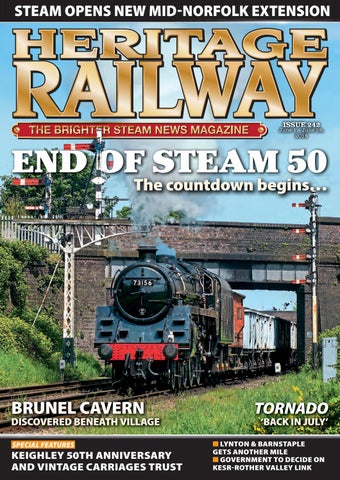
STEAM OPENS NEW MIDNORFOLK EXTENSION
ISSUE 242
June 1 – June 28, 2018
E END O OF STEAM 50
The countdown begins ns…
BRUNEL CAVERN
DISCOVERED BENEATH VILLAGE SPECIAL FEATURES
KEIGHLEY 50TH ANNIVERSARY AND VINTAGE CARRIAGES TRUST
TORNADO
‘BACK IN JULY’
■ LYNTON & BARNSTAPLE GETS ANOTHER MILE ■ GOVERNMENT TO DECIDE ON KESRROTHER VALLEY LINK
OPINION
LMS Jubilee No. 45690 Leander approaches Chinley with the Railway Touring Company’s ‘Coast to Coast Express’ on May 19. The engine carries a wreath in memory of West Coast Railways’ driver Albert Seymour who had recently passed away. The blue and white reflected the colours of his favourite football club, Manchester City. DAVE HUNT EDITORIAL
Editor Robin Jones 01507 529305 rjones@mortons.co.uk Deputy editor Brian Sharpe bsharpe@mortons.co.uk Assistant editor Gareth Evans gevans@mortons.co.uk Senior contributors Geoff Courtney, Cedric Johns Contributors Fred Kerr, Roger Melton Designer Tim Pipes Reprographics Paul Fincham, Jonathan Schofield Production editor Sarah Wilkinson Publisher Tim Hartley Editorial address Heritage Railway magazine, Mortons Media Ltd, PO Box 99, Horncastle, Lincs LN9 6LZ Website www.heritagerailway.co.uk
ADVERTISING
Advertising representative Andrew Bruce 01507 529310 abruce@mortons.co.uk Divisional advertising manager Sue Keily skeily@mortons.co.uk
CUSTOMER SERVICES
General Queries & Back Issues 01507 529529 Monday-Friday 8.30am-7pm Saturday 8.30am-12.30pm Answerphone 24H help@classicmagazines.co.uk www.classicmagazines.co.uk
DISTRIBUTION & PRINTING
Distribution Marketforce UK Ltd 5 Churchill Place, Canary Wharf London, E14 5HU 0203 787 9001 Printing William Gibbons & Sons, Wolverhampton
Independent publishers since 1885
MORTONS MEDIA GROUP LTD
Circulation manager Steve O’Hara Marketing manager Charlotte Park Subscription manager Paul Deacon Commercial director Nigel Hole Publishing director Dan Savage
ARCHIVE
Enquiries Jane Skayman 01507 529423 jskayman@mortons.co.uk
SUBSCRIPTION
Full subscription rates (but see page 30 for offer): (12 months 12 issues, inc post and packing) – UK £55.90. Export rates are also available – see page 30 for more details. UK subscriptions are zero-rated for the purposes of Value Added Tax. Enquires: subscriptions@mortons.co.uk
EDITORIAL CONTRIBUTIONS Contributions to this magazine should be clearly typed and ideally sent by email. Photographs, which should be clearly marked with the contributor’s name and address, are submitted at the owner’s risk. Mortons Media Group Ltd cannot be held responsible for loss or damage, however caused. All postal submissions must include an appropriate SAE for the return of all material. Opinions expressed in this magazine are not necessarily those of the editor or his staff. © Mortons Media Group Ltd. All rights reserved. No part of this publication may be reproduced or transmitted in any form or by any means, electronic or mechanical, including photocopying, recording, or any information storage retrieval system without prior permission in writing from the publisher. ISSN No 1466-3560
Published Every four weeks on a Friday. Advert deadline June 14, 2018 Next issue on sale June 29, 2018
Having trouble finding a copy of this magazine?
Dereham perseverance pays off
I
T is truly heartening in a year when we are commemorating half a century since the end of BR main line steam haulage, to see that mode of traction inching forward to reclaim yet more lost territory. I first visited the Mid-Norfolk Railway 21 years ago, and while at that stage it ran over a comparatively short length and had only diesels on offer, the huge potential was clear. It was typical of what we dubbed a New Generation Line, a breed of heritage railway operation which took off basically because a redundant line was available and reasonably intact. Unlike other lines in the heritage sector portfolio, such revival schemes did not have the benefit of being able to buy steam locomotives straight out of BR service, or even from the by-thenclosed Barry scrapyard, and so would struggle to have instant mass tourist appeal, relying on second-hand diesel traction. However, despite growing up in the shadow of far longer-established lines, the Mid-Norfolk slowly but surely battled on to reopen all the way from Dereham to the main line link at Wymondham, and has in recent years regularly seen steam either visit or be hired in. It is now turning its attention to its northern reaches, for long the domain of works trains or an occasional excursion. History was made with the first steam passenger train to Worthing Crossing, 3.8 miles from Dereham, a length long enough to be a heritage line by itself, and somewhat reminiscent of the 4.75 mile Keighley & Worth Valley Railway, which also marks its own 50th anniversary this year. The will is certainly there, and from what I have seen, the MNR has all the potential to take its place among the other big players. Disappointing, however, has been the decision of the Heritage Lottery Fund to turn down a grant application for a National Railway Museum scheme for the second time in six months. Over the past two decades, the Lottery has been one of the biggest benefactors to the sector, its strategically-placed grants making countless hitherto impossible projects possible.
Now, however, it has seen fit to refuse £9.5 million funding towards the NRM-backed scheme to build a new national-standard museum at Leicester North on the Great Central Railway, and to decline a £13.4 million grant towards the planned £50 million expansion of theYork museum itself. The 50th anniversary of the end of steam would have been the ideal opportunity to launch both these projects with major grant aid funding. The Leicester scheme would have provided a home for many National Collection artefacts at the end of a unique double-tracked heritage railway, in a central location well served by the road network and hugely accessible. Expanding theYork museum, a definitive hub of the sector, would have allowed it to go beyond showcasing its world-beating collection of historic locomotives and rolling stock, and have allowed thousands of documents and relics in its archives to go on display for the benefit and education of the public. I recently visited the NRM’s marvellous Search Engine facility, now in its 10th year, and within minutes was able to hold a drawing (see page 23) of one of Richard Trevithick’s first locomotives, which of course kicked off the steam age. How many other world-class museums can offer such facilities? The expansion programme would have allowed many more artefacts like this to have been exhibited. Not one trick but two seems to have been missed here by the Lottery, and I sincerely hope that in both cases alternative funding can be found, or we will all be the losers. In the meantime, I must thank Lady Judy McAlpine for the magnificent and touching memorial service at Fawley Hill for her late husband, railway megabenefactor Sir William McAlpine, with the many heartfelt speeches and readings from key sector members. Once-in-a-lifetime heroes of steam heritage like him are irreplaceable. Robin Jones Editor Heritagerailway.co.uk 3
CONTENTS ISSUE 242
June 1 – June 28, 2018
News
Headline News
6
6
Steam opens Mid-Norfolk’s latest northern extension to Worthing; stricken Tornado “back in July”; another mile of trackbed for Lynton & Barnstaple; Severn Valley to hold big End of Steam 50th anniversary event on August 4 and Swanage Railway’s LSWR T3 dismantling begins at Flour Mill workshops.
44
News
10
Isambard Kingdom Brunel atmospheric railway reservoir rediscovered beneath Starcross; sunshine farewell for Sir William McAlpine; £700k grant for Stockton & Darlington route scheme; a tube train back on Epping-Ongar; steam stars again in Trevithick country; Government to decide on Kent & East Sussex-Rother Valley link; Island Line to lose vintage Underground trains; last railway nursery line marks 30th anniversary; Tarka Valley Railway moves forward and management quits after mass volunteer walkout at miniature railway.
64
Regulars
Features
Subscribe Today
30
Centre
54
No. 45212 departing from Bath by Peter Foster.
Main Line Itinerary Main Line News
56
Swanage mogul makes main line passenger debut; Class 33 runs on Underground; A4 Bittern moves into Hornby’s old Margate HQ; Vintage Trains confident of hitting share issue target for TOC launch and Sherwood Forester hauls first Locomotive Services tour.
With Full Regulator
64
Don Benn reports on ‘Great Britain XI’ and Saphos Trains.
4 Heritagerailway.co.uk
68
Steam and heritage diesel railtours.
Platform
Seeking out steam’s last stands
The big anniversary this summer is the 50th anniversary of the end of British Rail main line steam culminating in the legendary ‘Fifteen Guinea Special’ of August 11, 1968. Trevor Gregg recalls in words and pictures his trips to North West of England to capture on film some of the steam specials that ran during those last few months of BR standard gauge steam operations after the rest of the UK had switched over to diesel and electric traction.
74
Where your views matter most.
Railwayana
82
Geoff Courtney’s regular column.
Up & Running
94
Guide to railways running in June.
The Month Ahead
106
46 Find us on www.facebook.com/heritagerailway
CONTENTS: LNER B1 4-6-0 No. 1264 crosses Linlithgow viaduct with empty stock from Bo’ness to Edinburgh for the Railway Touring Company’s ‘Great Britain XI’ tour on April 21. BEN COLLIER COVER: BR Standard 5MT 4-6-0 No. 73156 departs from Loughborough with a coal train during the Great Central Railway goods galore gala on May 13. PHIL JONES
Worth its weight in gold!
On June 29, 1968, the Keighley & Worth Valley Railway started public services, in doing so giving an unprecedented boost to the revivalist sector, in a summer in which one door closed and another opened, writes Robin Jones.
70
Katie debuts at Ravenglass Fifteen inches was considered the minimum practical gauge for a full-size, as opposed to a miniature, steam locomotive. Mark Smithers recounts the story of a pioneering engine of this gauge that barely survived but has returned to steam.
76
Museum on the move
An unusual claim for any museum: The origins, its collection and the achievements of the Vintage Carriages Trust over the last 50 years are explored by Rodney Towers on a visit to Ingrow, West Yorkshire.
84
Write to us: Heritage Railway, Mortons Media Ltd, PO Box 43, Horncastle, Lincs LN9 6LZ.
SUBSCRIBE
FROM JUST £20* *THAT’S JUST
£3.33 AN ISSUE
IF YOU PAY BY DIRECT DEBIT EVERY 6 MONTHS
See page 30
Heritagerailway.co.uk 5
HEADLINE NEWS
Steam reclaims more territory in Mid-Norfolk By Robin Jones
IN the year when the nation is commemorating the 50th anniversary of the end of BR standard gauge steam haulage, the Mid-Norfolk Railway has opened the latest length of its new northern extension. On Friday, May 18, Dennis Howell’s WR 0-6-0PT No. 9466, which in recent years has made the surviving section of the GER Wells-next-the-Sea branch a second home, top and tailed a special inaugural train of invited guests from Dereham station to the level crossing at Worthing, which lies north of the previous limit of special train operations at Hoe. The outbound train was hauled to Worthing by Class 04 D2334 and headed back to Dereham by steam. Further trains were run over the extension during the following weekend. On some of them, the 04 was paired with a DMU trailer car and No. 9466 was back in action on others. The railway does not plan at this stage to extend its regular timetabled services on the 11½-mile Dereham to Wymondham section to Worthing, but will run passenger trains there on gala
days and other special occasions. The distance from Dereham to Worthing is 3.8 miles – longer than many of the UK’s smaller standard gauge heritage lines. The big goal here is North Elmham, which the railway hopes to be able to run to in 2020, the 25th anniversary of the formation of the heritage line. Already works trains have reached the level crossing gates on the far side of the road from North Elmham station. Passenger services over the route from Wymondham to Wells-next-the-Sea ended in 1964. Part of the northernmost section of the route is occupied by the 10¼in gauge Wells & Walsingham Light Railway. The Mid-Norfolk Railway Preservation Trust formed in 1995 through the merger of the campaign groups and organisations that had been trying to restore passenger services over the route since 1974. For most of its early years, the MNR was a diesel-only operation, and still does not have a resident steam locomotive of its own, but in more recent times it has seen high-profile visits from main line engines and has hired-in others for its high season. The MNR has said in the past that one
Charlie Robinson, chairman of the MNR, welcomes guests back to Dereham station after the special run to Worthing crossing on May 19. GEORGE SAVILLE/MNR Right: Here at last! The crew of Class 04 shunter D2334 stand at Worthing crossing after making history with the May 18 VIP special reopening train from Dereham. JAMES GARTHWAITE/ MNR day it hopes to extend into Fakenham, but officially its ultimate current goal is a restored County School station, which it currently runs. First, however, it must lay a missing mile of track to get there. The separate Norfolk Orbital Railway scheme has the objective of extending both the north Norfolk Railway and MNR
so that they link up at Fakenham, thereby forming a circular rail route through the county. The MNR is appealing for volunteers to act as guards, crossing keepers and station staff. Anyone interested is invited to visit www.mnr.org.uk/volunteering
WR Hawksworth 0-6-0PT No. 9466 approaches Hoe crossing between Worthing and Dereham on Saturday, May 19 with a special to celebrate the opening to Worthing. STEVE TWEED/MNR
6 Heritagerailway.co.uk
Find us on www.facebook.com/heritagerailway
Tornado: July date set for swift return to service By Cedric Johns FOLLOWING Peppercorn A1 Pacific No. 60163 Tornado’s failure while hauling the 90mph ‘Ebor Flyer’ on April 14, investigations have continued and are now drawing to a close in readiness for the locomotive’s swift return to the main line. Its builder and owner, The A1 Steam Locomotive Trust, said that it will publish an update on key findings. Although the investigation is being treated as a priority, repairs are proceeding, the trust said, adding that it is grateful to suppliers who have responded quickly by manufacturing new components for the locomotive, and to Locomotive Services Limited – and its supremo Jeremy Hosking – for the loan of components obtained from the overhaul of A2 No. 60532 Blue Peter to help speed repairs. Thanks were also given to DB Cargo for its support in carrying out the investigation. It is anticipated that repairs will be completed in June to enable running-in activities to begin and a main line test run arranged. Assuming that all goes well, the engine will pick up its diary in July, beginning with the RAF100 trip from Lincoln to London on July 10. Operations director Graeme Bunker-James said: “We are pleased to say that progress is positive in returning Tornado to traffic. We apologise to those who have had their plans disrupted and hope that they will be able to travel behind the 4-6-2 very soon.” Following the RAF100 trip the A1 heads the London-Durham-Newcastle
‘Talisman’ on Saturday, July 21, the return journey being hauled by Class 55 Deltic D9009 Alycidon. This train is sold out. On Sunday, July 29, the locomotive’s 10th anniversary circulars offer a lunchtime and evening trip from Darlington around Yorkshire. Wednesday, August 1, sees another 10th anniversary train, ‘The Mad Hatter’ departing Darlington for York, Wakefield and Chester. ‘The Bard of Avon’ starts from Manchester Piccadilly via Stockport, Wilmslow and Crewe for Stratford-uponAvon, on Saturday, August 18. On August Bank Holiday Monday, August 27, the postponed ‘Canterbury Tale’ gets away from Peterborough calling at St Neots, Stevenage, Potters Bar and Finsbury Park bound for Canterbury and the Dover coastline. Looking further ahead ‘The Devonian’ departs Birmingham, calling at Stourbridge Junction, Worcester and Bristol before heading for Plymouth via Dawlish. On Saturday, September 29, the postponed ‘Ynys Mon’ starts from East Midlands and North Staffordshire stations to the North Wales coast. ‘The Auld Reekie’ travels from Yorkshire to Edinburgh on Sunday, October 7, with Alycidon working the return trip. On December 1, ‘The Christmas Border Raider’ departs from the West Midlands to the Carlisle Christmas market travelling via the Settle and Carlisle line. All profits raised by these trains will go towards keeping No. 60163 on the main line.
Lottery grant to extend First World War field railway at Apedale Valley THE Moseley Railway Trust has received £10,000 from the Heritage Lottery Fund to extend its Western Front field railway. The third of the trust’s award-winning Tracks to the Trenches events, which recreate the Western Front in Staffordshire using steam trains of the period, military vehicles and re-enactors, will be held at its Apedale Valley Light Railway home on July 13-15, when the extension will be completed. The grant will also allow a visit to Tracks to the Trenches by a draught horse team and a field gun and limber, and finally it will support a visiting steam locomotive of a type used on trench railways during the First World War. There is also a sub-project to recreate a wagon used for the transportation of heavy artillery pieces on 2ft gauge tracks. During
the war the mud meant absolutely everything was moved by rail – including the largest guns. Vanessa Harbar, head of HLF West Midlands, said: “The impact of the First World War was far reaching, touching and shaping every corner of the UK and beyond. HLF has already invested more than £94 million to more than 1900 projects – large and small – that are marking this global centenary. With our small grants programme, we are enabling even more communities like those involved in Tracks to the Trenches to explore the continuing legacy of this conflict and help local young people in particular to broaden their understanding of how it has shaped our modern world.” Details of the Tracks to the Trenches 2018 event are available at www.ww1-event.org Advance tickets are now on sale.
Locomotive owner John Savery (right) and engineer Geoff Phelps with the new boiler at the Flour Mill. BILL PARKER
T3 dismantling under way THE Flour Mill workshops at Bream in the Forest of Dean have begun the exploratory dismantling of the Swanage Railway’s LSWR T3 4-4-0 No. 563 to see if the former National Collection engine can be returned to steam. Staff at the market-leading expert in the restoration of Victorian steam locomotives have begun removing the boiler cladding and unbolting pipework so the boiler can be lifted in June. The 1893-built locomotive was
controversially gifted to the Purbeck line by the National Railway Museum, with the strict condition that if the railway ever finds it does not want it any longer, it has to be offered back. Meanwhile, the Flour Mill is building what is believed to be the first big standard gauge boiler built in the UK for many years. It has been contracted to build the boiler by John Savery, owner of Nene Valley Railway-based Polish Tkp 0-8-0T No. 5485.
Award for tram museum to highlight engineer THE National Tramway Museum has been awarded £74,500 from AIM Biffa Award for a new permanent exhibition ‘Holroyd Smith – Electrifying the Future’. The History Makers scheme funds museums to create new exhibitions that will inspire the public through the lives and achievements of extraordinary historical figures. It is managed by the Association of Independent Museums and Biffa Award, a multi-million pound fund that helps to build communities and transform lives through awarding grants to communities and environmental projects. The exhibition will explore the life, inspiration and inventions of Michael Holroyd Smith, pioneer in electric traction and versatile electrical and mechanical inventor. Smith is little known, except for his invention of the first electric street tramway in 1885, but the Crich museum’s archives show that Holroyd Smith should be recognised for much more than this. Smith influenced many other pioneers in the scientific and engineering worlds. His inventions
included a very early automobile and he was experimenting with flight as early as 1879. The exhibition will also look at practical problem solving in engineering, with displays and interactive activities aimed at families and school groups, as well as exploring career pathways in the modern engineering world. The Derbyshire museum’s Holroyd Smith Collection contains over 1000 items that are currently only available to researchers. The project will allow the museum to make more of this collection accessible to the public through the exhibition in the Great Exhibition Hall, alongside ‘Century of Trams’. Curator Laura Waters said: “The collection we have gives a fascinating look into the mind of Michael Holroyd Smith, his inventions and engineering skills to solve problems. “As our pioneer of electric tramways in this country, we know his story well, and now we’re looking forward to sharing that with many more people.”
A ‘rattler’ for display in the NRM? A ‘PACER’ DMU could be displayed at the National Railway Museum when the British Rail-era type is phased out in 2020, said director Judith McNicol. The classes 140, 141, 142, 143 and 144 railbuses, a hybrid with a bus body fitted on to a rail chassis, were built between 1980-87 with a life
Write to us: Heritage Railway, Mortons Media Ltd, PO Box 43, Horncastle, Lincs LN9 6LZ.
expectancy of 20 years, but despite constant derision from passengers, who knew them as ‘rattlers’, they are still in regular use. They will be phased out of main line service from this Christmas and it is suspected that some might find their way to heritage lines, while others will be scrapped. Heritagerailway.co.uk 7
HEADLINE NEWS
SVR ‘Black Five’ to star in special end of steam event By Paul Appleton STANIER ‘Black Five’ No. 45110, one of the stars of the end of steam ‘Fifteen Guinea Special’ on August 11, 1968, is to make a rare outdoor appearance as it takes part in the Severn Valley Railway’s ‘Last Days of Steam’ event on August 4, when it will be displayed at Kidderminster station. The 1935-built former LMS machine is normally to be found on display inside the Engine House at Highley, where it has been on display since October 2013. It last steamed in 2008, on a six-month boiler ‘ticket’ extension, which allowed it to participate in the 40th End of Steam anniversary commemorative events, after which it went on display at Barrow
Hill roundhouse, before returning home to the SVR. At one stage it was proposed that the celebrity ‘Black Five’ be overhauled in readiness for this year’s 50th anniversary of the end of BR main line steam, but with a long queue ahead of it in Bridgnorth works, and plenty of other ‘Black Fives’ currently in ticket, it has remained a static exhibit, although it is planned to start work on the Vulcan Foundry-built machine during the next few years.
Footplate crew gathering
Instead, its role in the SVR’s ‘Last Days of Steam’ event will be taken by sister locomotive, No. 45231 The Sherwood Forester, built by Armstrong Whitworth in 1936. It too lasted until the end of BR
steam, although it wasn’t in action on August 11, 1968. It was sold by BR straight into preservation at Carnforth and has recently joined Jeremy Hosking’s stable of locomotives at Crewe. Main line-registered No. 45231 will be joining the SVR’s working stud of locomotives for the summer season and is expected to arrive in mid-July and be available to work trains through to late September, meaning it will also start in the railway’s big September 20-23 autumn steam gala. The SVR’s 1968 tribute event will also feature Ivatt 4MT 2-6-0 No. 43106 on service trains, marking 40 years almost to the day since it moved to the SVR under its own power, straight out of BR service at Lostock Hall shed, on August 2, 1968.
The event on August 4 will also feature a gathering of footplate crews from the same day in 1968, and a re-creation of the ‘Master Neverers Association’ cleaning No. 45110.
➜ More details are available from www.lynton-rail.co.uk/story/oldstation-house-inn-update or by writing to: L&B Blackmoor Company Secretary, Barton House, Bishops Nympton, South Molton, EX36 4PJ.
ABOVE: The last train on the line, on September 29, 1935, headed by Lew and Yeo crossing the bridge over Dean Lane on to the section of trackbed just acquired by the Lynton & Barnstaple Railway Trust. RL KNIGHT/LBR
Iconic images
Kidderminster Railway Museum will be staging a large photographic display featuring images from the end of steam, while on the Saturday evening, the SVR will be running its own re-creation of the ‘Fifteen Guinea Special’ (additional charge applies). Other events will include trade and memorabilia stands, the Coal Yard Railway running with a suitable 1960s-built locomotive and other attractions still to be announced. ➜ Visit www.svr.co.uk for more details.
More trackbed bought for Lynton & Barnstaple By Robin Jones THE Lynton & Barnstaple Railway Trust has bought another half-mile of original trackbed near Lynton. The latest stretch is at Barbrook on the approach to the resort. The purchase reinforces the trust’s commitment to rebuilding the line from Woody Bay to Lynton after restoring services from Killington Lane to Blackmoor and Wistlandpound which has just received planning permission from the Exmoor National Park Authority. Furthermore, in May the trust bought the half-mile of the route that lies between Blackmoor and Wistlandpound from its trackbed-purchasing sister company Exmoor Associates. The Lynton & Barnstaple Railway Community Interest Company, which
operates the railway, exchanged shares it holds in Exmoor Associates for the third of a mile of the route it owned between Killington Lane and Parracombe Lane Head. Negotiations to buy the remaining sections of trackbed that the trust needs (about a quarter of the route from Killington Lane to Wistlandpound) are continuing. Meanwhile, the railway is making one big final push with its £1.75 million share issue to buy the Old Station House Inn, the former Blackmoor station, an adjacent six-bedroom house and eight acres of land. It is the intention to run the inn as a business with the railway running alongside and dividends will be paid when the business is sufficiently profitable. The share offer is only open until July and cannot be extended any further.
New-build Baldwin 2-4-2T Lyn sets off from Killington Lane on Sunday, the second day of the Lynton & Barnstaple Railway’s spring gala, with the four rebuilt original carriages. TONY NICHOLSON/LBR
J27 leads North Yorkshire Moors Railway steam engines comeback By Roger Melton NELPG’S veteran J27 0-6-0 was due to be released into traffic on the North Yorkshire Moors Railway on May 22, after a relatively short spell of problem free running in, both light engine up to Goathland and through to Pickering top and tailing with other locomotives. A major overhaul, mostly carried out by NELPG volunteers at Hopetown Works in Darlington, but completed at Grosmont, has seen major work undertaken, including the casting and fitting of a new inside cylinder block. No. 65894 is expected to run for most of the low season with a slightly-shortened Gresley teak train. NELPG will now turn its efforts to completing Q6 0-8-0 No. 63395, which is progressing more slowly. It has been the aim to have it ready for the peak season but it appears as though that target may slip. The day that No. 65894 had its in-steam inspection by the insurance company was a busy one for the NYMR boilersmiths as ‘Black Five’ No. 5428 Eric Treacy’s boiler was also in steam for an out-of-frames steam test for the insurance company boiler inspector. This test had been delayed because at a late stage in the overhaul some cracking was found in the copper firebox which needed welding repairs, and it was necessary to wait a while for the specialist copper welder to become available. It too successfully passed its test, and was expected to be craned back into the frames for the start of reassembly by the end of May. An in-steam examination by the
boiler inspector has been booked for early July with the expectation that the 4-6-0 will be ready to start running in almost immediately after, with the intention of having it ready for traffic by the peak season, although probably not Whitby registered until the autumn. Southern S15 4-6-0 No. 825’s boiler has been delivered to Grosmont but has been receiving some finishing touches prior to hydraulic and steam tests. These are expected to take place in June with reassembly following and the S15 hopefully entering traffic during the peak season. In the meantime, work continues on the mechanical overhaul but this too is approaching completion. Work has also picked up on Lambton 0-6-2T No. 29. A new cylinder block has been cast after errors were found in the first new casting, and the second casting has been sent to Teesside for machining. The bunker and cab rear have been repaired, repainted and lifted back onto the frames, but a setback has arisen with the discovery of cracks in two of the crankpins. These will have to be replaced, which will mean removing the affected wheelsets using the Grosmont wheeldrop, sending them away for the defective pins to be pressed out, and new pins made and pressed in. Work has already begun on new arrival Standard 9F No. 92134, with the cylinders and valve chests opened up and measured so that new piston and valve rings can be made and fitted. In addition, the injectors have been bolted in place and the pipework is being fitted.
Date set for US ‘Big Boy’ marathon tour in 2019 UNION Pacific has announced that a ‘Big Boy’ 4-8-8-4 will run in 2019, for the first time in 60 years. It was confirmed that No. 4014 will steam from its restoration base in Cheyenne, the capital city of Wyoming, to Ogden in Utah next May, for celebrations to mark the 150th anniversary of the first transcontinental railroad. It will be accompanied by the neverretired UP 4-8-4 No. 844 and the pair will re-enact the scene made famous by the two locomotives, the Central Pacific Jupiter and UP No. 119 on May 10, 1869 at Promontory Summit. Ogden is the closest UP point to Promontory, where the railroad was abandoned during the Second World War. UP steam manager Ed Dickens said No. 4014 will be seen in other locations
all over the system next year as it enters regular excursion service, billed as “the world’s largest operational steam locomotive,” displacing UP’s 4-6-6-4 Challenger No. 3985. Of the 25 Big Boy locomotives built in the 1940s, only eight survive. On July 23, 2013, UP announced that it had reacquired No. 4014 from the Southern California chapter of the Railway and Locomotive Historical Society, with the aim of restoring it to service. Since dismantling it, the UP Steam Team has cleaned, inspected and repaired nearly every part of the 4014 down to its smallest component. Part of the restoration has included converting the locomotive’s engine into an oil burner. The process of reassembling the locomotive has begun.
Dame Shirley Bassey OBE with the coach newly-named after her. SMR
The hills are alive... with the sound of Shirley Bassey! SINGER Shirley Bassey flew in from Monaco so she could visit the Snowdon Mountain Railway for a very special ceremony on May 17. The 81-year-old star, who was born in Bute Street in Cardiff’s Tiger Bay, was said to have held back tears when she unveiled a carriage named after her at the line’s waterfall halt. She is the fourth person to have a carriage named after them, following cycling supremo Sir David Brailsford,
bass-baritone Sir Bryn Terfel CBE and classical crossover singer Katherine Jenkins OBE. Before the unveiling, Dame Shirley was given a bronze commemorative medal by the railway’s commercial manager Vince Hughes. She said: “I’m proud of my Welsh roots and this honour keeps me forever connected to Wales and one of its most iconic locations.”
Furness 0-4-0 saddle tank No. 25 goes ‘home’ to trust FURNESS Railway 0-4-0ST No. 25 has been donated to the Furness Railway Trust. No. 25 is an unrestored sister locomotive to the trust’s A5 class 0-4-0 tender engine No. 20. When the type became obsolete on the Furness Railway, they were sent back to maker Sharp Stewart and converted into industrial saddle tanks for use at the Barrow Haematite Steel Co. at Barrow, then the biggest iron and steelworks in the world. Rendered redundant in the early Sixties, they were donated by the firm to local schools and plinthed for static display. No. 20 was acquired by the trust and back-converted into its original form
Write to us: Heritage Railway, Mortons Media Ltd, PO Box 43, Horncastle, Lincs LN9 6LZ.
as a tender engine with the aid of a £97,000 Lottery grant, and was formally relaunched into service by Lady Grania Cavendish at a ceremony on the Lakeside & Haverthwaite Railway on April 20, 1999. No. 25 ended up spending years at the former Steamtown museum in Carnforth, until it was acquired by the late Bert Hitchen, who intended to restore it to steam in its latter-day saddle tank format, to provide a contrast with No. 20. No. 25 has now been donated to the trust by Bert’s estate. Subject to a conservation inspection, the FRT intends to follow Bert’s vision and restore the new acquisition in its steelworks guise. Heritagerailway.co.uk 9
NEWS
Going underground! ‘Lost’Brunel reservoir found in Devon By Robin Jones JUST when we thought, with the opening of a major new Isambard Kingdom Brunel museum in Bristol, we knew all of his major works off by heart – another has been discovered. Added to BoxTunnel, the Royal Albert Bridge, Maidenhead Bridge, BristolTemple Meads, Sonning Cutting and the SS Great Britain can be added another – a huge underground reservoir at Starcross in Devon. Two 105ft long and 10ft wide caverns with a spectacular display of stalactites formed by dripping water from the roof, and linked by 120 arches, were discovered purely by chance in April as workmen carried out a flood defence scheme in the seaside village. The Environment Agency began work on the £4 million tidal defence scheme for Starcross and Cockwood in January. It aims to reduce the risk of tidal flooding to more than 650 residential and commercial properties. The work at Starcross includes the installation of new tidal flood gates at Generals Lane slipway and the tidal inlet at the north of Starcross.
10 Heritagerailway.co.uk
The project also includes raising the crest level of the slipway at the Starcross Fishing and Cruising Club and it was deemed necessary to reprofile the club’s car park. During this work, the Environment Agency’s contractors discovered that a manhole led to the large underground chamber beneath the existing car park, believed to be an underground reservoir associated with Brunel’s atmospheric railway.
National significance
Because of the national significance of the surprise discovery, work on a Devon County Council road widening scheme above the chamber has been stopped, and is unlikely to resume. Highways experts will have to go back to the drawing board because of the find. Archaeology specialists and engineers are carrying surveys of the chamber and the surrounding area. The Environment Agency is continuing work on other parts of the scheme while the chamber is surveyed.The chamber is a confined space and potentially unstable, and therefore the entrance to the chamber is blocked off
and the area fenced. Brunel built the atmospheric railway to overcome the high terrain south of Newton Abbot.The Bristol & Exeter Railway in collaboration with the GWR had reached Exeter in 1844 and wanted to go on to Plymouth, but feared that steam locomotives would struggle over the foothills of Dartmoor. With Brunel as its engineer, the South Devon Railway Company obtained its enabling Act of Parliament on July 4, 1844. Brunel had visited Ireland’s Dalkey Atmospheric Railway, built on the principles of a system devised by shipbuilders and engineers Jacob and Joseph Samuda in partnership with gas engineer Samuel Clegg, and had been impressed. It was agreed to adopt in on the South Devon Railway. The scheme consisted of a vacuum pipe laid between the rails, with the vacuum created by station steam engines in large pumping houses along the route. It is believed that the reservoir was built to serve the pumping house at Starcross, now Grade 1 listed, and used as the headquarters of the fishing and cruising club, after an earlier scheme
to turn it into an atmospheric railway museum failed in the Nineties. On September 13, 1847, passenger trains ran from Exeter toTeignmouth, and were extended to Newton Abbot by March 2 the following year.The highest speed recorded was an impressive average of 64mph over four miles.
"Rats ate the flap"
However, during the winter of 1847–48 the leather flap valve that sealed the traction pipe slot began to cause problems, allowing air into the pipe and diminishing the vacuum.The leather froze hard in frost after saturation in rain, and in hot and dry weather, the valve dried out, with the same outcome. Brunel had the leather treated with whale oil in an attempt to maintain flexibility, but to little avail. A popular story is that rats ate the flap. Brunel admitted defeat, and a SDR shareholders’meeting on August 29, 1848, they were told that he had advised abandonment of the atmospheric system.The GWR was asked to provide steam engines, and the atmospheric system was duly abandoned, a move implemented
Find us on www.facebook.com/heritagerailway
The scaffolding erected inside the Great Northern Shaft to allow repairs to take place. G BICKERDIKE/NETWORK RAIL Above: A contemporary painting of the short-lived South Devon Atmospheric Railway at Starcross. Left: The forgotten cavern beneath Starcross which is believed to have been built for Isambard Brunel’s atmospheric railway pumping station above. ENVIRONMENT AGENCY Below: Brunel’s Grade 1 listed Italianate-style building at Starcross which housed one of the pumps for his ill-fated South Devon Atmospheric Railway. The massive tower, with a chimney within, is now 50ft shorter then when built. It is believed that the underground reservoir just discovered by Environment Agency contractors who lifted a manhole cover was used to supply its stationary steam engine.
The top of Kilsby Tunnel’s Grade 2 listed Great Northern Shaft seen after the repair project began. G BICKERDIKE/NETWORK RAIL
Bright future for classic main line tunnel as ventilation shaft is restored A Grade 2-listed Victorian landmark on the West Coast Main Line near Rugby is being preserved for decades to come by Network Rail. Repair and maintenance work has been carried out inside the Great Northern Shaft which was built to provide light and ventilation inside the 1½-mile-long KilsbyTunnel in Northamptonshire. A huge scaffolding structure has been installed around the inside of the shaft, directly above the railway, so the work can be carried out while nearly 400 trains continue to travel daily at 110mph on line below. A protection deck, around 26ft above the track, has allowed workmen to complete brickwork repairs while working above 25,000v overhead lines on one of Europe’s busiest mixed use stretches of railway. The £3.5 million refurbishment
project, part of Network Rail’s Railway Upgrade Plan, has taken nine months and has included soot removal, brickwork repointing and repairs. Hasan Shah, scheme project manager at Network Rail ,said:“We’ve carefully planned the repairs to allow trains to run while we completed this essential work. “Not impacting passengers and freight was vital and the huge, complex scaffolding structure has allowed us to do this with around 400 trains a day travelling up to 40 metres below us.The result will be a Victorian local landmark preserved for decades to come.” The tunnel was built in the 1830s using an estimated 30 million bricks. It has two‘Great Shafts’and 12 ventilation shafts Around one million bricks were used to build the Great Northern Shaft which weighs over 4000 tons
Two-mile long Welsh valleys tunnel could be reopened as a cycleway that September and confirmed at an extraordinary general meeting of the company January 6, 1849. While considered a genius with his other major works, on this occasion Brunel had failed. Environment Agency project manager Rob Butler said:“There is a note on the listing for the structure that talks about underground chambers, but we were under the impression that they were actually underneath the structure of the nearby pump house.“ Laser scanning has been carried out to establish the size and shape of the caverns. The atmospheric system apart, Brunel’s nature-defying choice of a route for the railway hugging the base of the cliffs between Dawlish Warren and Teignmouth has remained a subject of perennial controversy, not least of all on the night of February 4, 2014, when amidst high winds and extremely rough seas, part of the sea wall at Dawlish was breached washing away around 130ft and the ballast under the railway immediately behind. The line was closed, and Network Rail launched a massive round-the-clock repair programme, while businesses
in Plymouth and beyond were said to have lost millions as a result. The line reopened on April 4, 2014, amidst calls to reopen the Southern Railway main line between Exeter, Okehampton and Plymouth, part of which is now the Dartmoor Railway, as a diversionary route in times of bad weather.
Crack team
In recent weeks, Network Rail has assembled a crack team of engineers to secure the future of the line between Exeter and Newton Abbot. So far, the Department forTransport has provided a total of £46 million to support repair work, and Network Rail is now undertaking a detailed geological and marine study to help it to safeguard the future of the line. Transport Secretary Chris Grayling said the government was determined to safeguard the line through Dawlish and Teignmouth. A preferred option is to build a 13ft causeway 30 yards out to sea between Holcombe and Teignmouth, away from crumbling cliffs, while installing ‘avalanche shelters’ elsewhere to protect the tracks from falling rocks.
THE two-mile RhonddaTunnel on the Rhondda & Swansea Bay Railway is set to be revived as the longest underground cyclepath in Europe. The railway opened from Treherbert through the tunnel under insurmountable terrain to PortTalbot and Aberavon in 1890, and five years later was extended to Swansea. It later became part of the GWR empire. In its heyday, the tunnel conveyed coal trains 1000ft below the mountain tops, but the gradual decline of the coal industry saw most of the line closed. The tunnel was closed due to a partial collapse on February 26, 1968, but the line had already been earmarked for closure under the Beeching Axe.The passenger service was maintained by buses until December 14, 1970, when the line was considered as permanently closed. The RhonddaTunnel Society was formed in the summer of 2014 with the initial aim to site the long-lost tunnel portal stone in a suitable location as near as possible to the entrance of the disused and buried RhonddaTunnel at Blaencwm. However, interest in the tunnel mushroomed to the point where it has been penciled in as part of a cyclepath, a proposal which has gathered widespread support, including
Write to us: Heritage Railway, Mortons Media Ltd, PO Box 43, Horncastle, Lincs LN9 6LZ.
The inside of the Rhondda Tunnel as pictured for the first time in around half a century. RHONDDA TUNNEL SOCIETY backing from Welsh actor Michael Sheen, and a £90,000 community grant. In January, surveyors said they were confident that the tunnel could be restored. A concrete seal was removed from one of the tunnel’s ventilation shaft in April, and on May 5, workmen broke through an 8ft-thick concrete wall after a week of drilling to gain access, so that a detailed examination of the tunnel fabric can be made by contractor Balfour Beatty. Tunnel owner Highways England has said that it is prepared to allow it to be developed into a cycle path. Heritagerailway.co.uk 11
NEWS
Go-ahead for RVR-KESR link now in hands of Government By Geoff Courtney THE completion of a project that has been eight years in the making marks another step forward by enthusiasts who have set their sights on the creation of a 14-mile heritage line straddling the KentEast Sussex border. Robertsbridge-based Rother Valley Railway has set its sights on linking up with the neighbouring Kent & East Sussex Railway, and one of the strands that is central to making that dream become reality is Government approval to build the two-mile link. Such approval is considered by the Department for Transport in the form of a Transport and Works Act order, and in April the RVR submitted its application for such an order to Transport Secretary Chris Grayling after eight years’ preparation and research. A total of 13 reports and schedules required for the order application covering nearly 1000 pages were finalised and submitted.
Final hurdle
Private funding to build the link is already available, so with the application approved, both the Rother Valley and Kent & East Sussex railways face what would be a final, albeit major, hurdle – the impasse between them and two farming families who are currently refusing to sell part of their land over which the new stretch would be constructed. Negotiations between the RVR, whose benefactors are providing the finance for the scheme, and the farmers have been ongoing for a considerable while, and are continuing. The two-mile gap, between the western end of the KESR at Austen’s Bridge and the eastern extremity of the RVR at Northbridge Street, is across fields the two families own. Bridging the gap is central to a major £4½ million project by the RVR that is well advanced and is transforming the railway’s base at Robertsbridge, beside
STEAM VETERAN: Former LBSCR A1X ‘Terrier’ No. 32678 is pictured with a KESR mixed train at Robertsbridge in the early 1950s. The 0-6-0T was built at Brighton in July 1880, worked the line’s last regular passenger train in January 1954, and was withdrawn from Brighton (75A) in October 1963 with more than 1.4 million miles on the clock. Saved for preservation, it arrived at the revived Kent & East Sussex Railway in 1988 and is now a much-loved member of the railway’s steam locomotive fleet. Within a few years the little locomotive may once again take passengers from Robertsbridge to Tenterden, thanks to current plans which aim to restore the link between the KESR and the Rother Valley Railway. The formation of the train behind the A1X leads to questions as to how passengers accessed the the Charing Cross-Hastings main line to which it is connected, into a steam railway complex with station, five-coach platform, engine and carriage sheds, and other facilities. The KESR currently runs trains for 10½ miles between Tenterden and Bodiam, although the track extends beyond there for nearly a mile to Junction Road and the trackbed a further short distance to Austen’s Bridge, and the RVR runs for ½ mile from Robertsbridge to Northbridge Street.
coach – the ‘Terrier’ does not appear to be departing, and even if it is, there is not enough room at the rear of the train for the carriage to have been beside the platform. Brian Janes, curator of the Colonel Stephens Railway Museum at Tenterden, said: “It is a little bit of a puzzle. Perhaps immediately prior to departure there was a shunting movement to pick up the brake van after collecting the wagons from the yard or loop. The passengers would thus have had a trip round the yards before departure. Such procedures would have been necessary, particularly with the morning departure, which is recorded as customarily having more than nine wagons, and so too long to assemble in the platform before departure.” COLONEL STEPHENS MUSEUM COLLECTION
Benefit to the economy
Details of an independent report recently released by the RVR showed that, if the gap was bridged and a 14-mile line between Robertsbridge and Tenterden created, the annual benefit to the local economy would be more than £4 million, up to 75 jobs would be created, and train operator Southeastern, which provides services to Robertsbridge main line station, would accrue additional yearly revenues of £600,000.
The original line opened in 1900 between Robertsbridge and Rolvenden, near Tenterden, was extended into Tenterden in 1903 and to Headcorn in 1905, and was for much of its life part of the Colonel Stephens’ light railway empire. It was closed to passengers by BR in January 1954 and to freight in 1961, and in 1974 KESR preservationists reopened the Tenterden-Rolvenden stretch, and reached the current terminus of Bodiam in 2000.
Bodmin & Wenford steam crane finds new home in Scotland
The redundant steam crane is seen at Bodmin General on May 9, being loaded for its 640-mile journey to Scotland. JIMMY JAMES
12 Heritagerailway.co.uk
THE Ferryhill Railway Heritage Trust in Aberdeen has saved Taylor Hubbard 10-ton six-wheel steam crane DRT 80169 which was declared surplus to requirements at the Bodmin & Wenford Railway. Built at Leicester in 1947, it spent most of its working life on the Western Region, before moving to Bodmin in 1981. It has now made the 640-mile journey to its new home by low-loader. The trust, which hopes to start steam operations on its site, has
installed its refurbished turntable, which was removed from the site in September 2016 and has been under repair at eBlast and RIM Fabrication in Kintore. An inspection revealed that parts of the turntable had suffered corrosion damage and about one-third of both ends had to be replaced during the £86,000 refurbishment. Trust chairman Jon Tyler, said: “The installation of the turntable opens up all sorts of opportunities.”
Find us on www.facebook.com/heritagerailway