FY25 Annual Report
Contributions from July 1, 2024, through June 30, 2025
Contributions from July 1, 2024, through June 30, 2025
The Morgan State University Foundation, Inc. (MSUF) is a separately incorporated 501(c)(3) nonprofit organization. The Foundation was established in 1971 to provide financial support and counsel for Morgan State University, a public higher educational institution in the State of Maryland. The Foundation is governed by the Foundation Board of Directors.
The Foundation exists solely for the purpose of promoting the growth, progress and general welfare of Morgan State University. The MSUF administers private donations in support of academic programs, student scholarships, faculty development, public service initiatives and other priorities of Morgan State University. Gifts made through the Foundation are tax-deductible to the full extent provided by law and are governed in accordance with donor intentions.
Executive Committee
Mr. Joseph S. Simms III – Chair
Mr. Mervin Bourne – Secretary
Mr. Craig I. Spencer – Treasurer I Chair, Finance and Audit & Compliance Committee(s)
Mr. Calvin H. Baker – Chair, Investment Committee
Lt. Col. (Ret.) Michael L. Bell – President, Morgan State University Alumni Association
Mr. David Brashear
Mr. Nicholas Edwards
Mr. Kevin Hawkins
Mr. Omar McIntosh
Ms. Stephanie Nellons-Paige
Ms. Trisch Smith
Mr. William Sherman II – Board of Regents Representative
Mr. Cyril Wallace
Ms. Dawn White
Morgan State University Foundation, Inc.
Board Members as of January 1, 2026
Dr. David K. Wilson – President, Morgan State University
Ms. Endia M. DeCordova, MBA –Executive Director, Morgan State University Foundation, Inc.
Vice President, Institutional Advancement, Morgan State University
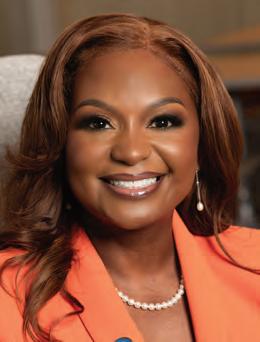
Dear Friends of Morgan,
Ms. Endia M. DeCordova, MBA
Morgan State University Class of 1999
Executive Director, Morgan State University Foundation, Inc.
Vice President, Institutional Advancement, Morgan State University
This year, we witnessed the extraordinary impact made when purpose and philanthropy align. Across Morgan State University, students accessed transformative learning opportunities that extended beyond the classroom—stepping into leadership, advancing research, securing internships, studying abroad and preparing for careers that will shape industries and communities. On national and global stages alike, they represented Morgan with distinction, confidence, pride and purpose.
In fiscal year 2025, the Morgan State University Foundation gained meaningful momentum, fueled by the generosity of the family of true believers in Morgan’s mission and the students we serve. Your support — through scholarships, academic initiatives, research and student programs — expanded access, eased financial uncertainty and reaffirmed that our students are not alone in pursuing their dreams.
The results are tangible. Students are graduating with invaluable, hands-on experience and conducting research that addresses real-world challenges.
They are engaging in global programs, leading campus organizations and stepping boldly into their careers. Every scholarship, endowed fund and program investment is a testament to the transformative power of your investment in Morgan’s future and to the success of those we serve.
This progress carries us forward into Transformation 2030, Morgan’s comprehensive strategic plan. Designed to expand our reach and strengthen institutional excellence, the plan positions Maryland’s Preeminent Public Research University and the nation’s third-largest HBCU for sustained impact. Your generosity plays an essential role in the achievement of every milestone. Each gift reinforces a simple but powerful truth: investing in Morgan students is investing in the future — one that cultivates tomorrow’s leaders, innovators, educators, researchers and changemakers.
As we look ahead, the Foundation remains focused on expanding scholarship support, strengthening the endowment and deepening donor engagement in ways that are purposeful, strategic and studentcentered. We are committed to operating with unwavering integrity while fulfilling Morgan’s longterm vision and maintaining our institutional priorities.
Above all, students remain at the center of our work. They are our “Why.” When they step into boardrooms, laboratories and classrooms, and onto the world stage, they do so with the confidence that comes from knowing a committed community stands behind them.
Thank you for believing in Morgan, for supporting our mission and for investing in possibility. Most of all, thank you for helping sustain the momentum that continues to elevate Morgan State University.
With gratitude,
Endia M. DeCordova, MBA
Vice President, Institutional Advancement, Morgan State University
Executive Director, Morgan State University Foundation
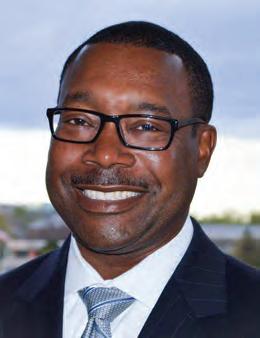
Dear Friends,
Joseph S. Simms III
Morgan State University Class of 1993 Board Chair, Morgan State University Foundation, Inc.
On behalf of the Morgan State University Foundation Board, I am proud to share our gratitude for the remarkable progress achieved during Fiscal Year 2025.
This year was defined by momentum made possible by the steadfast commitment of alumni, donors, corporate and nonprofit partners, and friends who believe in Morgan State University and, most importantly, in the promise of our students. Together, we raised more than $18 million in philanthropic support and saw an alumni participation rate of 11.8%, clear indicators of a community that is engaged and deeply invested in Morgan’s future.
Because of your partnership, the Foundation awarded $5.6 million in scholarships, directly supporting 2,600 students across the University. These investments did more than ease financial burden. They expanded access, increased opportunity and empowered students to pursue their academic and professional goals with confidence. Each scholarship awarded represents belief in potential, perseverance and possibility.
The Board remains deeply committed to ensuring that every gift entrusted to the Foundation is stewarded with care, transparency and purpose. We are proud to work in close partnership with the University and Foundation leadership to align philanthropy with Morgan’s strategic priorities, ensuring that generosity today translates into lasting impact tomorrow.
The momentum realized in FY25 firmly positions us to advance lockstep with Morgan into Transformation 2030, the University’s comprehensive campaign to expand its reach, strengthen its academic and research enterprise and secure long-term institutional excellence. This moment calls on all of us — alumni, donors, leaders and partners — to remain engaged with and united around a shared vision for Morgan’s continued rise.
Morgan State University has always been more than buildings and programs. It is a beacon of opportunity, a source of pride and a catalyst for change in Baltimore and beyond. It is an institution worthy of investment, advocacy and unwavering support.
Again, on behalf of the Board of Directors, I thank you for your generosity, your trust and your belief in Morgan. We are honored to do this work alongside you and look forward to the continued impact we will make together in the years ahead.
Sincerely,
Joseph S. Simms, III
Joseph S. Simms III Chair, Morgan State University Foundation Board
s When Daryl Graham stepped onto Morgan State University’s campus as an undergraduate in the spring of 1987, he had no way of knowing that the experience would grow his confidence, sharpen his sense of purpose and eventually place him at the helm of one of the nation’s most significant corporate commitments to HBCUs. What began as a transfer decision grounded in academic ambition has evolved into a story of actualization, one that now fuels Morgan Momentum and shapes pathways to opportunity for future generations. Today, as senior vice president of the HBCU Initiative at Strada Education Foundation — and as a proud Morgan graduate, Class of 1991 — Graham is helping expand access and increase upward economic mobility for thousands of students. His impact has come full circle: from a young student deeply shaped by Morgan’s culture of belonging to a philanthropic leader investing in Morgan students and students at other historically Black institutions who share the journey he once walked.
Graham’s decision to transfer to Morgan State was intentional. Drawn to the University’s strong accounting program and its partnerships with Ernst & Young and the National Association of Black Accountants (NABA), he saw Morgan as a place where he could grow and be challenged. His mother, recognizing both the opportunity and the community Morgan offered, connected him with alumni who encouraged him to choose their alma mater. Those relationships set the tone for Graham’s experience to choose Maryland’s foremost Historically Black College or University in pursuit of his degree. He soon discovered that Morgan was more than an institution; it was a community invested in his success.
From his first days on campus, Graham developed a network of mentors who shaped not only his academic trajectory but his sense of identity. Professors like Christanta Ricks-Johns, the first Black woman CPA in Maryland, who taught at Morgan for 27 years, and Louis Hutt, an executive on loan at Morgan, took time to reach beyond the classroom. They engaged with Graham in candid conversations that helped him develop both confidence and clarity. Their investment made an impression that stayed with him long after graduation.
“It really helped to shape who I am as a person,” he recalls. “It also helped me to think differently about who I am and what I’m capable of doing.”
Vital support came from other areas of campus life as well. As a member of Kappa Alpha Psi Fraternity, Inc., Alpha Iota Chapter, Graham experienced a deep sense of belonging that solidified his connection to the University. The brotherhood he found there strengthened his sense of purpose and provided lifelong relationships.
“When I step back on campus, or run into alumni anywhere in the world, it’s a level of family I wasn’t expecting to have,” he says. This grounding experience helped build the resilience, accountability and self-belief that have carried him through a 30-year career.
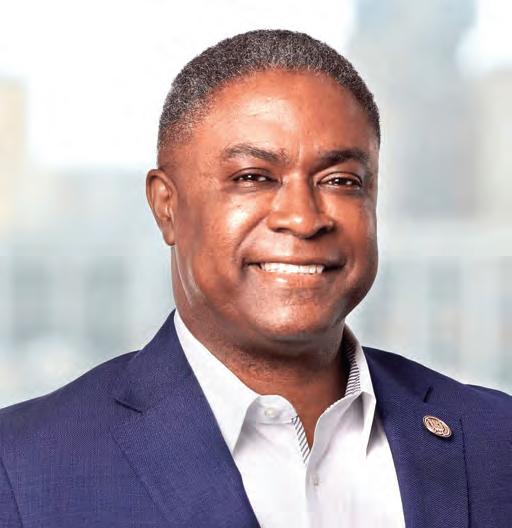
Daryl Graham
‘‘When I step back on campus, or run into alumni anywhere in the world, it’s a level of family I wasn’t expecting to have.”
As Graham advanced professionally — eventually holding senior roles at institutions such as JPMorgan Chase — he felt increasingly called to work that would allow him to benefit students directly. The desire to blend his corporate experience with his passion for education ultimately led him to Strada Education Foundation. There, he found a mission that meshed seamlessly with the values Morgan had instilled in him.
For a Black man from Baltimore who is a Morgan alum to lead one of the largest corporate HBCU initiatives in this country: if I can do it, so can you.”
In the wake of the COVID-19 pandemic and the nation’s racial reckoning in 2020, Strada’s leaders approached Graham with an opportunity to design a leadership development initiative centered on HBCUs. What began as a conversation quickly became one of the largest corporate investments in HBCUs today: an historic $25-million, eight-year commitment across 48 institutions, including Morgan State. For Graham, this work fulfilled a prediction his Morgan professor made years earlier: that he would one day help others rise.
“This gives me the chance to create the opportunities I once needed,” he reflects.
Strada’s approach under Graham’s leadership reflects a belief that opportunity extends beyond financial support. It is also about access, visibility and belonging. By intentionally supporting HBCU galas, leadership events and other convenings, Graham ensures students literally have a seat at the table: a place where introductions happen, networks form and confidence deepens.
“We want our scholars to sit with us,” he explains. “This is where things happen.”
Students who participate in these experiences often say they leave with a clearer sense of their path and the confidence to walk it. Strada’s involvement honors the cultural importance of HBCUs while equipping scholars with the tools and exposure needed to thrive in professional spaces.
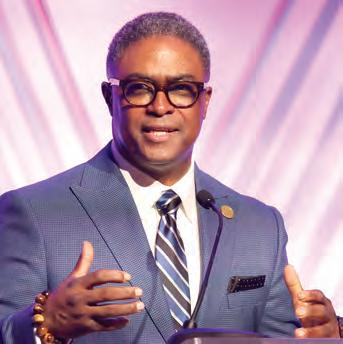
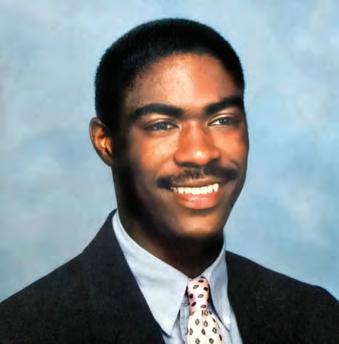
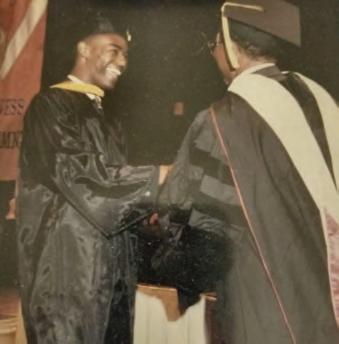
Although Graham’s work at Strada impacts students nationally, his commitment to Morgan is profoundly personal. In addition to Strada’s investment, he recently made his own transformative gift of $100,000 to Morgan State scholarships, demonstrating the
values he hopes other alumni will embrace: gratitude, responsibility and purposeful giving.
“Morgan poured into me,” he says. “Now it’s on me to pour into Morgan.”
His message to fellow alumni is simple: philanthropy is both a gesture of thanks and an investment in the future. He believes alumni wield significant economic influence and that collective giving can transform not only Morgan but entire communities.
As he looks ahead, Graham’s aspirations for his legacy are grounded in possibility and empowerment. He wants today’s students to experience the same transformation he did: to come to Morgan with one vision of themselves and leave with a dramatically expanded sense of what they can achieve.
“For a Black man from Baltimore who is a Morgan alum to lead one of the largest corporate HBCU initiatives in this country: if I can do it, so can you,” says Graham, who plans to make an additional gift to Morgan in the future, reinforcing his belief that his journey is more than a contribution; it represents a culmination of an investment shaped by opportunity, purpose and gratitude.
Through his work, his giving and his example, Daryl Graham is helping boost Morgan Momentum, proving that when alumni invest in the next generation, the impact reverberates far beyond campus.n
Scan to Give to Morgan Today

Statements Together With Report of Independent Public Accountants
For the Years Ended June 30, 2025, and 2024 REPORT OF INDEPENDENT PUBLIC ACCOUNTANTS ON THE AUDIT OF THE FINANCIAL STATEMENTS
To the Board of Directors
Morgan State University Foundation, Inc. Baltimore, Maryland
Opinion
We have audited the accompanying financial statements of Morgan State University Foundation, Inc. (the Foundation), which comprise the statement of financial position as of June 30, 2025, and the related statements of activities and change in net assets, functional expenses, and cash flows for the year then ended, and the related notes to the financial statements.
In our opinion, the financial statements referred to above present fairly, in all material respects, the financial position of Morgan State University Foundation, Inc. as of June 30, 2025, and the changes in its net assets and its cash flows for the year then ended in accordance with accounting principles generally accepted in the United States of America.
We conducted our audit in accordance with auditing standards generally accepted in the United States of America. Our responsibilities under those standards are further described in the Auditor’s Responsibilities for the Audit of the Financial Statements section of our report. We are required to be independent of the Foundation and to meet our other ethical responsibilities in accordance with the relevant ethical requirements relating to our audits. We believe that the audit evidence we have obtained is sufficient and appropriate to provide a basis for our audit opinion.
The financial statements of the Foundation for the year ended June 30, 2024, before the restatement described in Note 2, were audited by another auditor whose report dated August 26, 2024, expressed an unmodified opinion on those statements. As part of our audit of the year ended June 30, 2025, financial statements, we also audited the adjustments described in Note 2 that were applied to restate the 2024 financial statements and the beginning net assets of June
30, 2023. In our opinion, such adjustments are appropriate and have been properly applied. We were not engaged to audit, review, or apply any procedures to the 2024 financial statements of the Foundation other than with respect to the adjustments and, accordingly, we do not express an opinion or any other form of assurance on the 2024 financial statements as a whole.
Management is responsible for the preparation and fair presentation of the financial statements in accordance with accounting principles generally accepted in the United States of America, and for the design, implementation, and maintenance of internal control relevant to the preparation and fair presentation of financial statements that are free from material misstatement, whether due to fraud or error.
In preparing the financial statements, management is required to evaluate whether there are conditions or events, considered in the aggregate, that raise substantial doubt about the Foundation’s ability to continue as a going concern within one year after the date that the financial statements are available to be issued.
Our objectives are to obtain reasonable assurance about whether the financial statements as a whole are free from material misstatement, whether due to fraud or error, and to issue an auditor’s report that includes our opinion. Reasonable assurance is a high level of assurance but is not absolute assurance and therefore is not a guarantee that an audit conducted in accordance with generally accepted auditing standards will always detect a material misstatement when it exists. The risk of not detecting a material misstatement resulting from fraud is higher than for one resulting from error, as fraud may involve collusion, forgery, intentional omissions, misrepresentations, or the override of internal control. Misstatements, including omissions, are considered material if there is a substantial likelihood that, individually or in the aggregate, they would influence the judgment made by a reasonable user based on the financial statements.
In performing an audit in accordance with generally accepted auditing standards, we:
• Exercise professional judgment and maintain professional skepticism throughout the audit.
• Identify and assess the risks of material misstatement of the financial statements, whether due to fraud or error, and design and perform audit procedures responsive to those risks. Such procedures include examining, on a test basis, evidence regarding the amounts and disclosures in the financial statements.
• Obtain an understanding of internal controls rele vant to the audit in order to design audit procedures that are appropriate in the circumstances, but not for the purpose of expressing an opinion on the effectiveness of the Foundation’s internal controls. Accordingly, no such opinion is expressed.
• Evaluate the appropriateness of accounting policies used and the reasonableness of significant accounting estimates made by management, as well as evaluate the overall presentation of the financial statements.
• Conclude whether, in our judgment, there are conditions or events, considered in the aggregate, that raise substantial doubt about the Foundation’s ability to continue as a going concern for a reasonable period of time.
We are required to communicate with those charged with governance regarding, among other matters, the planned scope and timing of the audit, significant audit findings, and certain internal controls related matters that we identified during the audit.
Owings Mills, Maryland December 8, 2025

SBC
Public Accounts & Business Advisors 10200 Grand Central Avenue, Suite 250 Owings Mills, Maryland 21117 P 410.584.0060 F 410.584.0061
STATE UNIVERSITY FOUNDATION, INC. | Statements of Financial Position | Years Ended June 30,
Fair value is defined as the price that would be received to sell an asset or paid to transfer a liability in an orderly transaction between market participants at the measurement date. Generally accepted accounting principles in the United States (GAAP) establish a framework for measuring fair value. That framework provides a hierarchy that prioritizes the inputs to valuation techniques used to measure fair value.
That hierarchy gives the highest priority to unadjusted quoted prices in active markets for identical assets or liabilities (Level 1) and the lowest priority to unobservable inputs (Level 3). The three levels of the fair value hierarchy are described below:
Level 1: Unadjusted quoted prices in active markets for identical assets or liabilities.
Level 2: Inputs other than quoted prices that are observable for the asset or liability, either directly or indirectly.
Level 3: Inputs that are unobservable inputs that are supported by little or no market activity and that are significant to the measurement of the assets or liabilities.
Following is a description of the valuation methodologies used for assets measured at fair value on a recurring basis and recognized in the accompanying
statement of financial position, as well as the general classification of such instruments pursuant to the valuation hierarchy. There have not been changes in the methodologies used as of June 30, 2025 and 2024:
Cash, cash equivalents, money market and CDs: Valued at the closing price on the active market on which cash is traded and generally classified as Level 1 hierarchy.
Common stocks, U.S. government bonds and securities: Valued at the closing price reported on the active market on which the individual securities are traded and generally classified as Level 1 hierarchy.
Mutual funds and equity securities: Valued at the last quoted sales price, except securities traded on the Nasdaq Stock Market, Inc. (NASDAQ), which are valued in accordance with the NASDAQ Official Closing Price. Over the counter securities are valued at the mean between the latest bid and asked prices as furnished by dealers who make markets in such securities. Equities may be classified as Level 1 or Level 2.
Corporate and foreign bonds: Fair value is based upon quotes for similar securities; therefore, these investments are rendered Level 2.
The following table presents the Foundation’s fair value measurements of assets recognized in the accompanying statements of financial position that are measured at fair value on a recurring basis and the level within the GAAP fair value hierarchy in which the fair value measurements fall on June 30, 2025, and 2024:
There were no transfers between Level 1, 2 and Level 3 for the years ended June 30, 2025, and 2024.
MORGAN STATE UNIVERSITY FOUNDATION, INC.
Financial statements together with report of independent public accountants, by SBC – Certified Public Accounts & Business Advisors, for the years ended June 30, 2025, and 2024.
The full financial statements audit report conducted by SBC, the independent public accounting firm, is available online at givetomorgan.org.
MORGAN STATE UNIVERSITY FOUNDATION, INC. Unless otherwise indicated, all financial data in this report reflect fiscal year 2025, beginning July 1, 2024, and ending June 30, 2025.








*Percentages total more than 100% because of rounding.
Key/Legend:
MORGAN STATE UNIVERSITY FOUNDATION, INC.
Unless otherwise indicated, all financial data in this report reflect fiscal year 2025, beginning July 1, 2024, and ending June 30, 2025.
$5,616,460
2,600 Students awarded scholarships during the 2024-2025 academic year
(Each icon equals 25 students.)
Revenue
Total Assets
Accumulation for 13 Years –2013 to 2025
(Includes cash and cash equivalents, investments, investments – accumulated earnings, pledges receivable, net discount of amount and allowance of amount, prepaid expenses and other receivables)
Morgan State senior Niya Allen reflects on academic excellence, experiential learning and the power of philanthropy to shape her future.
s When Niya Allen walks into a room, she is keenly aware of the responsibility she carries, not just as a student but as a representative of Morgan State University. As a senior preparing for graduation while navigating the demands of rigorous academic work, Allen exemplifies leadership through her service in the President’s Leadership Circle, one of the University’s most distinguished experiential learning opportunities.
“I’ve learned how to carry myself with confidence in professional spaces,” Allen shares. “Being part of the President’s Leadership Circle pushed me to grow beyond the classroom and really see myself as a leader.”
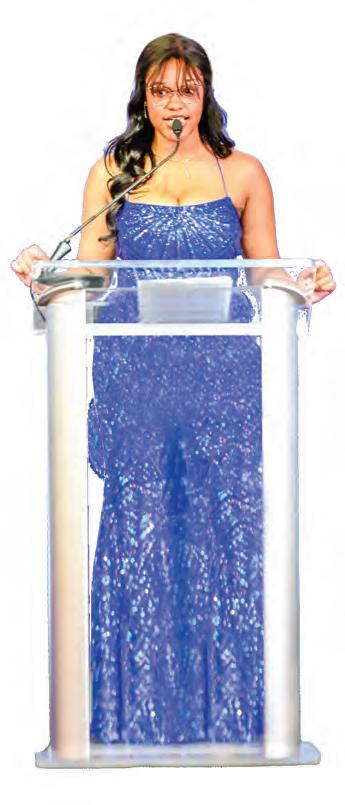
Allen came to Morgan drawn by its sense of community, its commitment to excellence and its promise of opportunity. From her earliest days on campus, she immersed herself in her studies, determined to make the most of every experience available to her.
‘‘
Being part of the President’s Leadership Circle pushed me to grow beyond the classroom and really see myself as a leader.”
That commitment soon opened doors to opportunities beyond traditional coursework, doors that placed her close to University leaders and donors and in high-level engagement venues typically unseen by undergraduates.
As an English major, Allen has academic interests that connect seamlessly with her role as a President’s Leadership Circle Fellow. While representing the University in this capacity, she is afforded the invaluable opportunity to hone applicable course skills, including strategic messaging, professional and interpersonal communications, facilitation, and public speaking. A proud legacy student, Allen follows in
the footsteps of both of her parents, Morgan alumni whose experiences helped guide her own decision to attend the University.
“Being able to study communications while actively practicing it in realworld settings has been incredibly meaningful,” she shares. “It’s helped me connect what I’m learning in the classroom to how Morgan tells its story.”
In her role with the President’s Leadership Circle, Allen has gained firsthand exposure to institutional advancement, donor stewardship and executive-level operations. She supported events, assisted with highprofile engagements and observed how philanthropy fuels Morgan’s mission. In doing so, she learned the importance of professionalism, discretion and preparation — skills that will follow her long after graduation.
“The President’s Leadership Circle taught me how to show up prepared, how to communicate clearly and how to be confident in spaces where important decisions are being made,” she explains. “Those experiences helped me understand how much work goes into sustaining a university like Morgan.”

That perspective reshaped Allen’s view of her own education. No longer just a student attending classes, she began to see herself as an active participant in Morgan’s broader ecosystem, one where alumni, donors, faculty and students work together to create opportunity. Witnessing the impact of philanthropy in real time left a lasting impression.
“Seeing donors invest in students like me made everything feel more real,” Allen says. “It reminded me that someone believed in my future enough to support it.”
Allen is also a Strada Education Foundation scholar, an experience she describes as both affirming and motivating. The scholarship support eased financial pressure and allowed her to remain focused on her academic goals while fully engaging with leadership opportunities like the President’s Leadership Circle. While she speaks humbly about the recognition, she understands its significance.
“Being a Strada scholar showed me that people and organizations beyond Morgan care about students’ success,” she reflects. “It made me want to work harder, not just for myself but to honor the investment that was made in me.”
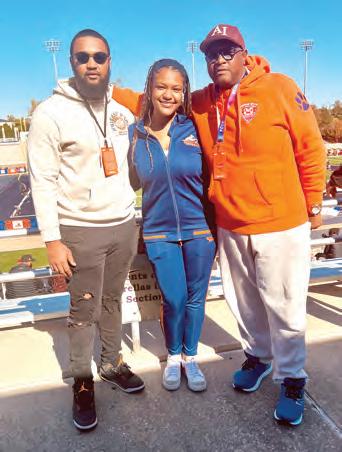
That investment is part of a larger philanthropic story, one that connects students like Allen with donors who believe deeply in Morgan’s future, including alumni and partners such as Morgan graduate Daryl Graham, whose support helps make transformative student experiences possible. For Allen, this connection reinforces a powerful lesson: access creates opportunity, and opportunity creates impact.
As she looks ahead to graduation, Allen aspires for more than a degree. She leaves Morgan with confidence, clarity and a deep appreciation for the systems of support that helped shape her journey. The skills she gained — professionalism, leadership and a strong sense of purpose — will help write her next chapter.
“Morgan helped me see what’s possible,” Allen says. “I’ve learned how to advocate for myself, how to lead with intention and how to give back in meaningful ways.”
Her story reflects the heart of Morgan Momentum: when students are supported, challenged and trusted with responsibility, they rise. And as Allen prepares to take her place among Morgan alumni, she does so ready not only to succeed but to one day invest in the next generation of Morgan Bears. n

Contributions July 1, 2024, through June 30, 2025
$1,000,000+
Bedford Falls Foundation
Goldman Sachs Foundation
International Foundation for Telemetering
Magic Johnson Enterprises
Robert Wood Johnson Foundation
$500,000+
U.S. Small Business Administration
$250,000+
Goldseker Foundation
Google, LLC
Strada Education Network
TJX Companies, Inc.
$100,000+
Annie E. Casey Foundation
The Boeing Company
Deloitte & Touche, LLP
Enterprise Mobility
Hannon Armstrong Foundation
Intel Foundation
Morgan State University Alumni Association
National Academy of Human Resources
National Association for Community College
Entrepreneurship
NewsCorp
Pfizer Foundation
Russ Potts Productions, Inc.
Thurgood Marshall College Fund
Wells Fargo Foundation
$50,000+
Aon Corporation
Cadence Foundation Fund
Charlotte W. Newcombe Foundation
The Columbus Foundation
Corning Incorporated Foundation
Legacy Foundation of Hartford
Northrop Grumman Corporation
The Patterson Family Foundation
Turner Construction Company
$25,000+
Aegon Transamerica Foundation
Ashburton Area Community Association Inc.
Baltimore Marketing Association Scholarship Foundation, Inc.
Barton Malow Company Foundation
Burroughs Wellcome Fund
Experian
Fund for Educational Excellence
HBCU Change
Health Management Associates, Inc.
HomeFree USA
Jack and Jill Foundation
John Hancock Mutual Life Insurance
Lockheed Martin Corporation
MSUAA Howard L. Cornish Metropolitan
Baltimore Chapter
National Action Council for Minorities in Engineering, Inc.
Pallas Foundation for National Security
Leadership
PNC Bank Corporation
Society of Actuaries
Standard Insurance Company
Stanley Black & Decker, Inc.
T. Rowe Price Foundation, Inc.
The Travelers Companies, Inc.
$10,000+
Amazon.com Services, LLC
Apple Computer, Inc.
Bermuda International Long Term Insurers and Reinsurers
BIC Educational Foundation
CareFirst BlueCross BlueShield
Bristol-Myers Squibb Company
Capital One Services, Inc.
Chubb Group
Cintas Corporation
Coinbase Inc.
Collins + Company
Combined Federal Campaign
Crew Baltimore
Gilead Sciences Inc.
Hardesty Hanover
Holder Construction Group, LLC
Howard University
IBM Corporation
Image Power Inc. Gaming Division
Leidos
M&T Bank
MSUAA Washington, DC Alumni Chapter
Mt. Lebanon Baptist Church, Inc.
National Black McDonald’s Owners’ Association
National Council on Alcoholism and Drug Dependency
The PAMS Social Club
PepsiCo
The Philip and Harriet Klein Foundation, Inc.
Prudential Financial
Service Coordination, Inc
Spencer Educational Foundation
State Farm Insurance Companies
Steve Silver Co.
W.F. Chesley Real Estate LLC
Wellington Management
Whiting-Turner Contracting Company
$1,000,000+
Mr. Ronald A. Willis
$250,000+
Mr. and Mrs. Martin R. Resnick †
$100,000+
Dr. and Mrs. Jerome Adams
Mr. Daryl A. Graham
Mr. Robert S. Thompson
Dr. David K. Wilson
$50,000+
Anonymous Donor
Mr. Rob Bachler, FSA, FCAS, MAAA
Mr. Calvin H. Baker and Mrs. Lidia Paz-Baker
Mr. James A. Perkins
Dr. Leonard C. Simmons †
$25,000+
Ms. Margaret W. Barroll and Mr. Hans E. Hartse
Mr. and Mrs. Mervin A. Bourne, Jr.
Mr. David J. Brashear and Mrs. Romica R. Brashear
Mr. Larry Poncho Brown
Ms. Endia M. DeCordova
Mrs. V’Nell A. DeCosta
Gen. (Ret.) and Mrs. Larry R. Ellis
Mrs. Mary F. Evans
Mr. Cecil E. Flamer
Mr. Joseph P. Goldberg
Mr. Joseph F. Greenidge, Jr.
Ms. Cheryl Y. Hitchcock
Dr. and Mrs. Freeman A. Hrabowski III
Ms. Madelyn P. Jennings
Dr. Edwin T. Johnson
Ms. Katherine E. Leonard
Dr. John Laws Nickens, Jr.
†Denotes deceased
Contributions July 1, 2024, through June 30, 2025
Mr. Antonio Parham
Dr. Jilma L. Patrick
Mr. Bolton G. Robert
Mr. Travis Robinson
Estate of Barbara J. Spraglin
Mr. and Mrs. Carl W. Turnipseed
Mr. James A. Ward and Mrs. Sheila P. Ward
Ms. Dawn White
Mr. Scott Widmeyer
$10,000+
Anonymous Donor
Ms. Swati Agrawal
Mr. John Angelos
Senator Bareehu O. Ashafa
Col.(Ret) and Mrs. Harold J. Bennett, Jr.
Mr. Richard O. Berndt
Ms. Barbara Blount Armstrong
The Honorable JoAnn Bowens
Mr. and Mrs. David J. Brashear
Ms. Alicia Collier
Ms. Shirley E. Cooke
Mr. Leonard C. Cornish
Ms. Barbara E. Crawley
Mr. Gregory A. Davis and Mrs. Wendy Bailey Davis
Ms. Adiaha E. Essien
Mr. Joseph A. Ford, Jr.
Mr. Johnny L. Graham
Ms. Rosalyn Gross
Mr. Berton Gunter
Drs. Cecil B. Harris and Delores M. Harris
The Honorable and Mrs. Peter C. Harvey
Ms. Linda Havard and Mr. M. Arthur Gensler
The Estate of Adele V. Holden †
The Rev. Marsha Evans Holmes
Mr. and Mrs. Larry E. Jennings, Jr.
Ms. Jacqueline V. Jones
Mrs. Brenda J. Joyce
Mr. Josh Lauring and Mrs. Oanh Lauring
Estate of Eleanor Warren Myers
Drs. Thomas Pinder and Esther G. Pinder
Mr. Michael Seibel
Mrs. Niru Shah
Dr. Ruthe T. Sheffey
Mr. and Mrs. Joseph S. Simms III
Mr. Joseph P. Solinsky and Mrs. Rita M. Solinsky
Mr. Walter R. Somerville, Jr.
Ms. Margaret Vincent
Gen. (Ret.) and Mrs. William E. Ward
Ms. Jamila D. Webb
Dr. Nicole A. Westrick
Stewarding a Community of
— Unique donors
— Given by faculty/staff 5,397 6,832 2,166 18,555 3,904 $3,480,204 $99,799
— Total contributions
— First-time donors
— Unique donors past 5 years
— Alumni donors
— Given by alumni
Administered by the Morgan State University Foundation, endowed chairs and professorships sustain academic excellence, advance pioneering research and uphold the University’s mission across diverse academic disciplines and fields of study in perpetuity.