Funding Opportunity Description
2026 International Joint Initiative for Research Harnessing Disruptive Technologies to Address Global Challenges
Funding Opportunity Description Goal
By supporting international, interdisciplinary, and transformative research, this call aims to harness the potential of disruptive technology to offer novel solutions to global challenges and accelerate progress towards achieving the SDGs.
Funding Opportunity Description Context
❑ The Sustainable Development Goals (SDGs), adopted by all UN member states in 2015 as part of the 2030 Agenda for Sustainable Development, are a call on countries to work together to address global challenges and promote lasting peace and prosperity.
❑ There has been global recognition that the world is behind on achieving the SDGs.
Funding Opportunity Description
Disruptive Technology
“An innovation whose application replaces or radically alters systems, processes and/or behavioursto have transformative economic or societalimpacts.The impact may be localized or far-reaching.Disruptive technology may include cutting-edge and novel innovations, or the application of an existing innovation in a new context, bringing about substantial change or paradigm shifts.”
Funding Opportunity Description Expectations for Funded Projects
✓ Address at least one of the SDGs or another recognized global challenge
✓ Focus on developing or implementing a disruptive technology, or research on the impact of a disruptive technology on society and/or economies
✓ Must be interdisciplinary, involving at least two of the following areas:
✓ natural sciences and engineering
✓ social sciences and humanities
✓ health and life sciences
✓ Expected to include appropriate stakeholders and end-users in their codevelopment and co-leadership
✓ May include non-academic stakeholders as team members or collaborators
✓ Encouraged to include and budget for members from non-Funding Organization countries, particularly the Global South
Funding Opportunity Description
Funding Organizations
Funding Organization Country
Dutch Research Council (NWO)
International Development Research Centre (IDRC)
The Netherlands
Canada (eligible countries: Ghana, Indonesia, Namibia, Peru, Rwanda, Zimbabwe)
National Science and Technology Council (NSTC) Taiwan
New Frontiers in Research Fund (NFRF)
NordForsk
Canada
Åland Islands, Denmark, Finland, the Faroe Islands, Greenland, Iceland, Norway, Sweden
São Paulo Research Foundation (FAPESP) Brazil
Swiss National Science Foundation (SNSF) Switzerland
Taighde Éireann – Research Ireland
UK Research and Innovation (UKRI)
Ireland
United Kingdom
Funding Opportunity Description Funding Principles
• The call uses a coordinated funding approach: for successful projects, each Funding Organization will award funding to a researcher on the team who is eligible to receive its support.
• Funding will be awarded according to the rules, regulations, terms and conditions of the Funding Organization.
• Eligible expenses may vary across a project team. Applicants must consult each relevant Funding Organization’s guidelines.
• Inclusion of team members from other countries/stakeholder communities is encouraged. Consult each funders’ guidelines for more details on eligibility.
Using the links in the competition overview, research teams should check the eligibility of expenses before submitting the full application.
Funding Opportunity Description Value and Duration
Value
The total amount of funding available to support each project will depend on the Funding Organizations that will be supporting the project.
Refer to the information provided in the annexes for information on the level of financial support available.
Duration Projects should be designed to be completed within three years.
One-year no-cost extensions may be available in some circumstances depending on the funding organization, by request and requiring appropriate justification.
Roles and Eligibility
2026 International Joint Initiative for Research Harnessing Disruptive Technologies to Address Global Challenges
Roles and Eligibility Project Team – Roles
Project teams will be composed of:
• Co-PIs who share responsibility for directing the project and coordinating proposed research activities;
▪ “Project Lead” (one of the co-PIs) who will be the primary contact point for the project as a whole.
• Co-applicants who contribute to executing the research project and whose research activities may be supported by funds awarded to the project by the Funding Organizations;
• Collaborators who contribute to executing the research project and whose research activities may not be supported by awarded funds.
Roles and Eligibility Project Team – Eligibility
✓ Teams must include a minimum of three co-PIs, each eligible to receive funding from a different participating FO.
▪ At least one co-PI must be eligible to apply to the NFRF program.
✓ Teams may include more than 3 co-PIs:
1. Individual(s) eligible to receive funds from additional funding organization(s); or
2. Individual(s) whose research activities will be supported through the grant issued to another co-PI.
✓ Applicants should form a transnational research project partnership.
✓ Project teams must be interdisciplinary and are encouraged to include at least one expert in social sciences or humanities among the co-PIs.
✓ Project teams are encouraged to support the next generation of researchers.
Roles and Eligibility Project Team – Eligibility (cont’d)
✓ Additional team members may be added at the LOI and full application stages, but the minimum eligibility requirements must be met at every stage of the competition.
✓ Individuals may participate as a co-PI on only one application to this competition.
Each Funding Organization may have additional eligibility rules for applicants and proposed projects. Review each funding organization’s eligibility rules, requirements, funding mandates, policies, eligible costs and procedure.
Evaluation Criteria
2026 International Joint Initiative for Research Harnessing Disruptive Technologies to Address Global Challenges
Evaluation Criteria Evaluation Criteria
✓ Fit-to-Program
✓ Interdisciplinarity
✓ EDI in Research Practice*
✓ Strength of the Project Consortium
✓ High Risk
✓ High Reward
✓ Feasibility
* Equity, diversity and inclusion (EDI) in research practice will only be evaluated at the full application stage.
• Weightings of the other criteria change between the LOI and Full Application stages
Evaluation Criteria
Fit-to-Program
• Disruptive technology must be central to the project
• The proposed research must also directly address at least 1 of the Sustainable Development Goals
Evaluation Criteria Interdisciplinarity
• Projects must be designed from an interdisciplinary perspective.
• Proposals must demonstrate that the interdisciplinary approach is reflected in the team.
• Proposals must explain how the different disciplinary perspectives, methodologies, and techniques will be integrated, implemented, and maintained throughout the project.
Evaluation Criteria Equity, Diversity and Inclusion in Research Practice*
EDI in research practice is a core element of the NFRF program.Applicants must clearly demonstrate their commitment to EDI in research practice.
Actions proposed are expected to:
• remove barriers and
• provide opportunities for the meaningful integration of individuals from all groups
Refer to the NFRF Best Practices in Equity, Diversity and Inclusion in Research Practice and Design
* Equity, diversity and inclusion (EDI) in research practice will only be evaluated at the full application stage
Evaluation Criteria Strength of the Project Consortium
Strength of the project consortium considers the “value add” of the collaborative approach of the team and refers to:
• knowledge, expertise, capacity and availability of the project team;
• how the approach builds on, integrates, and benefits from expertise, perspectives and resources of a wide variety of regions and disciplines, as appropriate.
Ꭓ The size of consortium is not an evaluation element.
✓ The focus is on the integration of the team and expertise required to achieve the proposed project’s objectives.
Evaluation Criteria
High Risk – Novelty of Approach / Scientific Rigour
High risk refers to the novelty and cogency of the proposed approach.
Proposals will have to explain:
• how the project is novel, as it relates to the latest methods, concepts, information and techniques, as well as other major projects currently underway; and
• why the approach is expected to lead to real change
Evaluation Criteria
High Reward – Anticipated Societal Impact
High reward is defined as the potential to create a significant and real societal change or impact,
• Proposals must explain the anticipated change or impact that is likely to result and its significance (including how it relates to at least one of the SDGs).
• Proposals must outline the major short-, medium- and long-term changes expected, the likelihood of their being achieved, and who (or what) will be affected by the changes.
Evaluation Criteria
Feasibility – Capacity to Execute the Project
Feasibility considers the soundness of the plan and the team’s ability to execute the activities. It includes elements such as:
• Building on current knowledge or prior art
• Work plan
• EDI considerations in research design (EDI-RD), where appropriate
• Approach to co-production with relevant stakeholders, where appropriate
• Positioning for uptake
• Value for money
• Environmental footprint
• Suitability of the research environment
• Management
• Resources
For more information on the criteria, refer to the evaluation matrices
Notice of Intent Requirements
2026 International Joint Initiative for Research Harnessing Disruptive Technologies to Address Global Challenges
NOI Stage Notice of Intent to Apply Deadline
You must submit a NOI to be eligible to create and submit a Letter of intent (LOI).
NOI deadline for submission to NFRF:
March 3, 2026
Check with the research administrator at your institution for internal deadlines.
The research administrator at the institution of the co-PI eligible to receive funding from NFRF is responsible for submitting the NOI by 8:00 p.m. eastern time on the deadline date.
• Late NOIs will not be accepted.
• An NOI cannot be changed after the RGO has submitted it.
NOI Stage Collection of Personal Information
The Canadian funding agencies collect self-identification data to monitor the equity of their programs and strengthen EDI in the research enterprise.
All co-PIs and co-applicants will be required to complete the questionnaire. The questions are framed from the Canadian perspective and may not be applicable to all participants. You may select “Prefer not to answer” for any or all questions.
Please consult the data collection policy for more information
NOI Stage NOI Requirements on the Convergence Portal
• Completed profiles for research team members
• Application title
• Language of the application
• Indigenous research (yes/no)
o Indicate whether the proposal involves Indigenous research
• Keywords (5-10)
• Fields of Research (up to 5)
• Summary of the proposal (maximum 2,500 characters)
NFRF-eligible Co-PI must initiate the application in Convergence.
• Sustainable Development Goals
o Identification of relevant Sustainable Development Goals
• Funding Organizations
o Note: Spanish State Research Agency (AEI) will not be participating directly in the call. Do not select it in Convergence.
• Participants (co-PIs and co-applicants)
• Collaborators
• Socio-economic objectives
o Indicate relevant socio-economic objectives
• Supporting documents (if applicable). Each of these documents is uploaded as a separate attachment following the instructions for attachments.
NOI Stage Summary of the Proposal
Maximum 2,500 characters
The Summary of the Proposal should:
• Include the objectives of the proposed project and summary of the research approach; and
• Describe how disruptive technology is central to the project. Indicate which of the SDGs the proposal addresses and how the anticipated changes and impacts will contribute to addressing a global challenge.
• Be written for a general audience.
If your application is successful, this summary may be used for promotional purposes outside the research community to inform the government, media and members of the public who request information about research funded by this call.
NOI Requirements Submitting the NOI
Only the NFRF-eligible co-PI is able to submit the NOI.
Review your NOI to ensure that it is complete.
From the Finalize Application section in the Convergence Portal, follow the prompts to submit the NOI.
After you accept the terms and conditions, the status of your submission will change to Received by Administrator.
Once your research administrator has approved and submitted your application, the application status will change to Received by Agency.
No changes can be made at that point.
Letter of Intent Requirements
2026 International Joint Initiative for Research Harnessing Disruptive Technologies to Address Global Challenges
LOI Stage Letter of Intent to Apply Deadline
You must have submitted a notice of intent to apply (NOI) by the deadline to be eligible to create and submit an LOI.
The research administrator at the institution of the co-PI eligible to receive funding from NFRF is responsible for submitting the LOI by 8:00 p.m. eastern time on the deadline date.
LOI deadline for submission to NFRF:
June 9, 2026
Check with the research administrator at your institution for internal deadlines.
• Late LOIs will not be accepted.
• An LOI cannot be changed after the RGO has submitted it.
LOI Stage LOI Requirements on the Convergence Portal
• Completed profiles for any additional members of the research team
• Any changes to the list of collaborators
• Reviewer exclusions (if applicable)
• Equity, diversity and inclusion in research design (EDI-RD)
o Indicate whether EDI considerations are appropriate for the project and whether and how they have been integrated into the proposed research.
• Proposed Budget
• Supporting documents. Each of these documents is uploaded as a separate attachment following the instructions for attachments.
• Research proposal (including diagrams and illustrations: maximum 10 pages if written in English; maximum 12 pages if written in French)
• References (maximum 5 pages if written in English; maximum 6 pages if written in French)
• Supplementary information for Funding Organizations (if applicable)
Review Process
2026 International Joint Initiative for Research Harnessing Disruptive Technologies to Address Global Challenges
Review Process Overview
NOI
Internal review Assess eligibility of teams to apply for funding from selected Funding Organizations
LOI
Assessment Using Distributed Peer Review (DPR)
Full Application
Multidisciplinary/ multisectoral review panel evaluation
Funding Organizations Committee Applications recommended for funding Funding Organizations Committee Identify applications to be invited to the full application stage
Review Process
LOI Stage: Distributed Peer Review Process (DPR)
Applicants are also the reviewers and review other proposals submitted to the same funding opportunity.
For this competition, all co-Principal Investigators (co-PIs) must be available and willing to act as reviewers.
o Maximum of 10 LOIs to review
o Read, rate and provide feedback
Timely, high-quality reviews are required for eligibility at the full application stage. If a co-PI misses the review deadline or submits consistently poor-quality reviews, the proposal the co-PI is part of will be deemed ineligible to proceed to the full application stage.
Review Process
LOI Stage: Selection Criteria
• Fit to Program (Pass/Fail)
• Interdisciplinarity (Pass/Fail)
• Strength of Project Consortium (30%)
• High Risk (25%)
• High Reward (25%)
• Feasibility (20%)
Review Process Evaluation matrices
Strength of Consortium, High Risk, High Reward and Feasibility are evaluated using a seven-point scale
For more information on the criteria refer to the evaluation matrices
STRAC Policy - New for 2026
2026 International Joint Initiative for Research Harnessing Disruptive Technologies to Address Global Challenges
STRAC
Policy - New for 2026
↘ In the application form, applicants will be asked if the proposed research grant aims to advance a STRA. If not, no further action is required.
↘ If so, all co-PIs, co-applicants and collaborators must complete attestation forms, available through a link in the application form, to certify they are not currently affiliated with an NRO.
↘ Those with named roles must provide the completed attestation forms to the NFRF-eligible co-PI, who must save them as a single PDF and upload it to the STRAC Attestation module of the application form.
↘ For applications aiming to advance a STRA, the inclusion of completed attestation forms is an eligibility issue. However, whether an application aims to advance a STRA or not will not affect merit review.
The attestation and the upload of the forms will happen as part of the full application submission.
STRAC Policy - New for 2026
↘ If an application aiming to advance a STRA is successful, any post-award additions of participants or collaborators will require completed attestation forms.
↘ Grantees must also inform SSHRC if the nature of their research evolves such that activities supported by the grant would aim to advance a STRA. Grant recipients cannot proceed with these new research activities until the appropriate granting agency’s approval has been obtained.
↘ For further guidance and FAQs: Tri-agency guidance on the Policy on Sensitive Technology Research and Affiliations of Concern (STRAC Policy) - Research security (nserc-crsng.gc.ca)
Information for RGOs
2026 International Joint Initiative for Research Harnessing Disruptive Technologies to Address Global Challenges
Information for RGOs
RGO role
RGOs can, in the Convergence Portal
• View NOIs, LOIs, and full applications from the lead NFRF-eligible co-PI (NPI) at their institution (including those that are expired, in progress, and submitted)
• Return submitted NOIs, LOIs, and full applications to the NPI
• Forward submitted LOIs, NOIs, and full applications to NFRF
Before forwarding an application to the agency, the RGO will be asked to confirm:
• the NFRF-eligible participants meet the eligibility requirements; and
• the proposed research project meets the eligibility requirements.
Information for RGOs
RGO role
By forwarding the application, the RGO will also be certifying on behalf of the institution, that the NFRFeligible co-PI
• Is (or will be) affiliated with the institution or organization;
• Has the necessary time and resources to carry out the activity;
• Will email NFRF-FNFR@chairs-chaires.gc.ca of any changes during the tenure of the grant, including changes in the composition of the team, such as the addition of new co-PIs, coapplicants, or collaborators.
Information for RGOs RGO role
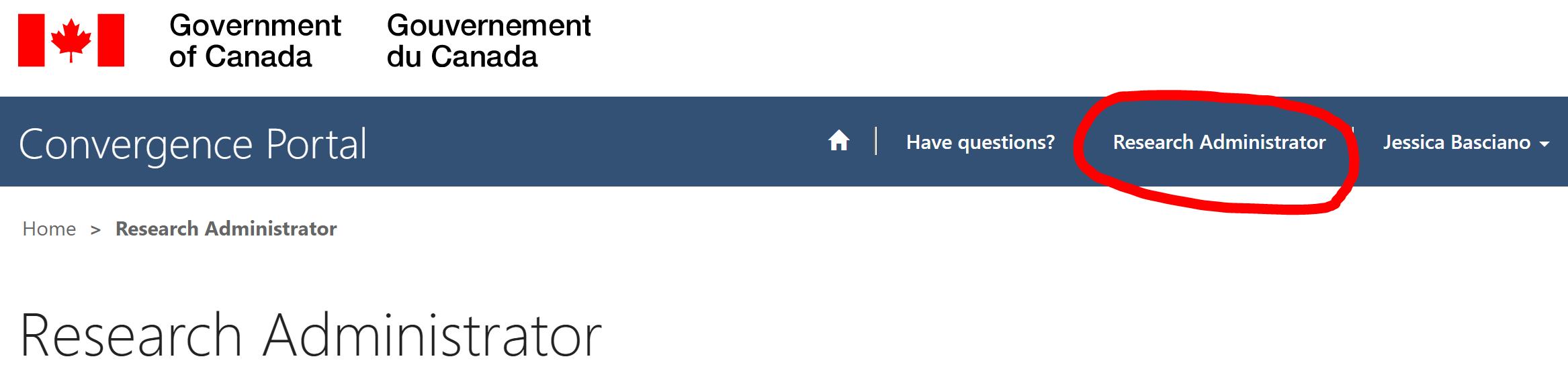
RGOs can use the Research Administrator button to access their institution’s applications.
If you have been assigned as an RGO by your institution, and you still don’t see the button, please contact websupport@chairs-chaires.gc.ca
Resources and Questions
2026 International Joint Initiative for Research Harnessing Disruptive Technologies to Address Global Challenges
Resources and Questions
Resources - Contacts
Program-related questions: NFRF-FNFR@chairs-chaires.gc.ca
Convergence Portal help: websupport@convergence.gc.ca 613-995-4273
Funding Organizations Contacts:
• Dutch Research Council (NWO): eagle@nwo.nl
• Fonds de recherche du Québec: marion.kuhn@frq.gouv.qc.ca
• International Development Research Centre (IDRC): educationandscience@idrc.ca
For Ghana: TBC
For Indonesia: TBC
For Namibia: grants@ncrst.na
For Peru: TBC
For Rwanda: research@ncst.gov.rw
For Zimbabwe: TBC
• NordForsk: bjornar.komissar@nordforsk.org; kristin.andersen@nordforsk.org
• São Paulo Research Foundation (FAPESP): chamada-NFRF@fapesp.br
• Swiss National Science Foundation (SNSF): International@snf.ch
• National Science and Technology Council (NSTC): yijiechen@nstc.gov.tw
• Taighde Éireann – Research Ireland: challenges@researchireland.ie
• UK Research and Innovation (UKRI): IIDTAC@esrc.ukri.org