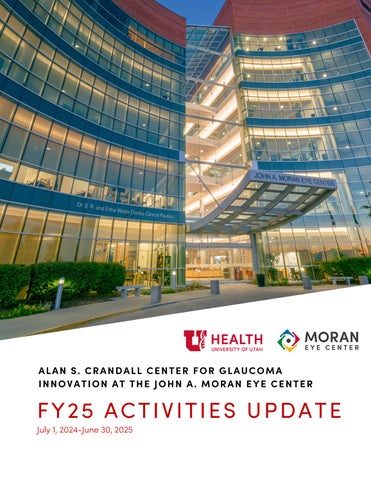
ALAN S. CRANDALL CENTER FOR GLAUCOMA INNOVATION AT THE JOHN A. MORAN EYE CENTER
FY25 ACTIVITIES UPDATE July 1, 2024-June 30, 2025
ALAN S. CRANDALL CENTER FOR GLAUCOMA INNOVATION
A cross-section of the optic nerve by Drs. Alejandra Bosco and Monica L. Vetter, University of Utah.
CONTENTS
1
Crandall Center Overview
17
Industry-Sponsored Research
2
Message from the Director
18
Research Grants
Collaboration Matrix
19
Clinical Research & Trials
Clinical Investigators
23
Publication Highlights
10 11 12
Research Investigators
15
Industry Collaborators
Crandall Center
OVERVIEW Nearly 80 million people are living with glaucoma, a blinding disease that could rob them of their eyesight. That number is projected to rise to 112 million people by 2040. Directed by Iqbal Ike K. Ahmed, MD, FRCSC, the Alan S. Crandall Center for Glaucoma Innovation, was created to reverse this trend by leveraging unique resources for research found only at the John A. Moran Eye Center. The Crandall Center is organized into four initiatives:
Glaucoma Therapeutics This initiative conducts research to assist companies in developing safe and effective diagnostics and therapeutics and is headed by Crandall Center Director Iqbal Ike K. Ahmed, MD, FRCSC.
Global Care This initiative works to find better ways to diagnose glaucoma and inexpensive yet effective ways to treat it in low-resource nations and is headed by Craig J. Chaya, MD, who also serves as medical director of Moran’s Global Outreach Division. Neuroprotection-Based Therapies This initiative is conducting research to develop new therapies to protect, restore, or regenerate the optic nerve and is directed by Crandall Center Associate Director of Science David Krizaj, PhD, of the Krizaj Laboratory.
Translational Research This initiative works to understand the biology and genetics of glaucoma to develop new treatments and is headed by Gregory S. Hageman, PhD, who also directs Moran’s Sharon Eccles Steele Center for Translational Medicine.
PAGE | 01
ALAN S. CRANDALL CENTER FOR GLAUCOMA INNOVATION
PAGE | 02
DIRECTOR’S YEAR IN REVIEW
It’s been an exciting and productive year for innovation at the Alan S. Crandall Center for Glaucoma Innovation. With an exceptional team and advisory board in place, we have focused on enhancing the infrastructure supporting our top-tier research. I’d like to share some of our enhanced capabilities and highlight key projects and collaborations that are taking us into the future of glaucoma care.
ALAN S. CRANDALL CENTER FOR GLAUCOMA INNOVATION
New Capabilities Broadcasting Wet Lab A new, state-of-the-art broadcasting wet lab supports cadaveric studies on new products in early design stages. The Crandall Center can provide real-time, livestreamed feedback on design and utility to companies and industry representatives. We record video from a microscope and video of the surgeon from an outside perspective simultaneously. A Leica M620 TTS highperformance microscope provides an in-line video camera and assistant scope on the side for co-viewing, as well as photo and video documentation. Operating Room (OR) Microscope A new OR microscope at the Moran Eye Center allows us to share live surgeries in a pre-clinical operating room. The Leica M820 F19 provides surgeons with a wide-angle observation system during live surgeries, which can be displayed on a larger screen for industry partners to attend and get a live view of their device being implanted. The system also features an AmScope 4k camera to allow recordings for experimental evidence, as well as an assistant scope for co-viewing. Micro-CT Imaging Protocol We have expanded our imaging services to include micro-computed tomography imaging of ocular tissues, providing high-resolution 3D images composed of twodimensional trans-axial projections, or “slices,” of a target specimen. GLP Studies The Crandall Center is now conducting Good Laboratory Practices (GLP) studies, as required by the FDA, for new products in the U.S. We are evaluating glaucoma drainage implants in compliance with ANSI Z80.27 and GLP standards. One study is ongoing, with an additional study pending pathology review. PAGE | 03
Below : The Crandall Center wet lab, the wet lab Leica microscope, and the OR microscope.
ALAN S. CRANDALL CENTER FOR GLAUCOMA INNOVATION
Outflow Measurement with iPerfusion Fiona S. McDonnell, PhD, is a leading expert in perfusion, which uses human donor tissue and animal tissue to gain insights into how the cells and tissues of the eye respond to drug treatment, surgical interventions, and other manipulations. The McDonnell Lab this year became first institution to house an iPerfusion 3 system, designed to measure ocular pressure and aqueous fluid outflow in both human and animal eyes. Dr. McDonnell worked with a biomedical engineer in the design and testing of the system, which provides critical, real-time quantitative data for glaucoma research. A second iPerfusion 3 is available as a core piece of equipment at Moran.
Watch now moraneye.link/iperfusion
Fiona McDonnell, PhD, and the iPerfusion 3 system.
PAGE | 04
ALAN S. CRANDALL CENTER FOR GLAUCOMA INNOVATION
Key Projects Novel Device and Therapeutics Research We’re working with device innovators worldwide to conduct pre-clinical research aimed at increasing surgical device precision and improving patient outcomes. Highlights include: Evaluating multiple classes of glaucoma procedures in ex vivo and preclinical models for Hexiris. We initiated a GLP rabbit study of a novel minimally invasive bleb-forming surgery (MIBS) procedure designed for slit-lamp delivery. Advanced collaboration with W.L. Gore & Associates on several glaucoma projects, including development of an expanded polytetrafluoroethylene (ePTFE)-based glaucoma drainage implant (GDI). The Crandall Center completed rabbit studies assessing the impact of ePTFE microarchitecture on wound healing in glaucoma surgery, as well as a GLP study of an ePTFE GDI. We also hosted wet labs with national opinion leaders to prepare for U.S. clinical trials and contributed to ongoing early feasibility studies. We are now preparing to launch studies on a novel ePTFE device for scleral reinforcement in glaucoma surgery. Assisting Vialase with ex vivo eye perfusion studies to refine femtosecond laser, imageguided, high-precision trabeculotomy (FLiGHT).
Ian Pitha, MD, PhD, in the Crandall Center laboratory.
PAGE | 05
ALAN S. CRANDALL CENTER FOR GLAUCOMA INNOVATION
Key Projects Neuroprotection-Based Therapy Crandall Center Associate Director of Science David Krizaj, PhD, is conducting preclinical research in advance of filing an investigational new drug application with the FDA for a neuroprotective therapy. This therapy is based on his impressive and growing body of work studying the calcium-permeable stretch-activated ion channel TRPV4. Dr. Krizaj has collaborated with the University of Utah Department of Chemistry and the College of Pharmacy on the new drug, and is currently working to develop an extended release version. The team has completed a pharmacokinetics evaluation to determine how the therapy moves through the body as well as a proof-of-principle study. It is now ready for large animal model testing within the year. The patented drugs are licensed to TMClear. At left: the University of Utah research team developing the glaucoma therapy includes, from upper left, Ryan E. Looper, PhD, Department of Chemistry; Paul Richard Sebahar, PhD, Department of Chemistry; Christopher Reilly, PhD, College of Pharmacy; and David Krizaj, PhD, Moran Eye Center. At bottom, an assay in the Reilly Lab.
Barbara Wirostko, MD, FARVO, with the iCare HOME2.
PAGE | 06
Polygenic Risk Score Study Barbara Wirostko, MD, FARVO, is leading this study with myself and Drs. Ian Pitha and Craig J. Chaya. We’re looking at whether higher polygenic risk scores (PRS) correlate to elevated intraocular pressure (IOP) and IOP fluctuation. This is aimed to help physicians make better decisions in managing IOP. The study will be conducted with glaucoma patients who have used or are currently using the iCare HOME2 to monitor their IOP daily. Participating patients would complete a saliva test to determine their PRS, which would then be compared to their IOP records.
ALAN S. CRANDALL CENTER FOR GLAUCOMA INNOVATION
Education Supercharged Training I’m passionate about education, and we have enhanced the quality of our educational experiences. We recently trained two Crandall Center glaucoma research fellows, Michael Jensen, MD, and Meghan Sharma, MD. Our new fellows for the coming year are Lieu Nguyen Lowrie, MD, and Charissa Tan, MD. Dr. Lowrie joins us from the University of Kansas School of Medicine while Dr. Tan joins us from the John A. Burns School of Medicine at the University of Hawaii. Our first Glaucoma Masterclass provided mentor-based didactic and hands-on training in interventional glaucoma, along with in-person wet labs and workshops. Our goals included growing the number of patients treated in each field; three months after the class, our participants reported a 63% increase in MIGS procedures. Our next class will be held in October 2025. In November of 2025, the Moran Eye Center will host the Interventional Glaucoma Consortium to bring together the top thought leaders in the interventional glaucoma space. This will offer a dedicated program for glaucoma fellows in partnership with Moran. Program chairs include myself and Drs. Rick Lewis, Arsham Sheybani, and Rachel Simpson. The IGC’s think tank–style format will encourage a select group of leading glaucoma specialists to exchange innovative ideas and education that promotes a proactive, not reactive, approach to patient care.
Fellowship graduates Meghan Sharma, MD, left, and Michael Jensen, MD.
Ike Ahmed, MD, FRCSC, speaks with Masterclass attendees. New fellows Lieu Nguyen Lowrie, MD, left, and Charissa Tan, MD.
PAGE | 07
ALAN S. CRANDALL CENTER FOR GLAUCOMA INNOVATION
Tanzania Glaucoma Fellowship We are working to change the trajectory of glaucoma in Tanzania as Dr. Craig J. Chaya directs a glaucoma fellowship training program at Bugando Medical Center. Dr. Chaya, other Moran glaucoma specialists, and former Moran fellows regularly travel to Mwanza to provide in-person surgical training to local ophthalmologists Nuru Mwambola, James Shimba, and Frank Sandi. The curriculum includes book work, a month-long, hands-on microsurgery training program for each physician at Aravind Eye Care System, regular evaluations, a journal club, and regular video calls. Once fully trained, these fellows can then train others, further increasing access to care in line with our commitment to creating sustainable eye care. I commend Dr. Chaya on the beginning of a pathway forward, as he sees this as the beginning of having a training center administered and managed by local Tanzanians.
Left to right: Drs. Charles Cole, Paul Chamberlain, James Shimba, Nuru Mwambola, Frank Sandi, and Craig Chaya.
PAGE | 08
ALAN S. CRANDALL CENTER FOR GLAUCOMA INNOVATION
Clinical Care Carrying Out Our Mission I recently had the privilege of assisting Gentry and her family. Gentry is a great student, a dancer, and has lost her vision in one eye. She and her mom came to Moran from across the country to save vision in her other eye, where she has cataracts, glaucoma, and iris and zonular abnormalities. I never want to lose sight of these cases, where we are making remarkable impacts one person at a time. Patients come to the Crandall Center with hope that is not established by walls and a building. Their hope is in us, our team. At the Moran Eye Center, we have the ability to help and to be available to anyone who needs us.
Watch now: https://moraneye.link/AhmedPatientStory
Gentry and her mother in their Kansas City home.
In closing, I want to acknowledge the deep gratitude I feel for each of our collaborators, industry clients, and philanthropists who support our work. I couldn’t be more pleased about the journey we’re on together. Sincerely,
Iqbal Ike K. Ahmed, MD, FRCSC Professor of Ophthalmology and Visual Sciences Director, Alan S. Crandall Center for Glaucoma Innovation Jack R. and Hazel M. Robertson Presidential Endowed Chair John A. Moran Eye Center, University of Utah PAGE | 09
Crandall Center
COLLABORATION MATRIX Jeff Pettey, MD, MBA CEO, John A. Moran Eye Center Professor and Chair, Department of Ophthalmology and Visual Sciences University of Utah
Paul S. Bernstein, MD, PhD Vice Chair, Clinical and Basic Science Research
Iqbal Ike K. Ahmed, MD, FRCSC Director, Alan S. Crandall Center for Glaucoma Innovation Director, Glaucoma Therapeutics Initiative Clinician Scientist
Gregory S. Hageman, PhD Director, Sharon Eccles Steele Center for Translational Medicine Director, Translational Research Initiative Sr. Research Scientist
Amanda Peral-Orantes, BS Administrative Manager
Craig J. Chaya, MD Division Chief & Senior Medical Director, David W. Bernolfo Center for Global Outreach Sr. Clinician Investigator Colleen Marshall, MPA Associate Director, Research
R. Evan Conrad, BS Lab Manager
Zachary W. Davis, PhD Cortical Mechanisms of Visual Perception Research Scientist Adam M. Dubis, PhD Artificial Intelligence and Imaging Research Scientist Fiona S. McDonnell, PhD Glaucoma Physiology & Outflow Research Scientist Brian C. Stagg, MD Glaucoma Informatics Research Scientist
David Krizaj, PhD Associate Director of Science, Crandall Center Director, Neuroprotection-Based Therapies Initiative Sr. Research Scientist
Ian F. Pitha, MD, PhD Associate Director, Crandall Center Sr. Research Scientist
Clinician Investigators Iqbal Ike K. Ahmed, MD, FRCSC Craig J. Chaya, MD Susan Chortkoff, MD Roya Garakani, DO Austin S. Nakatsuka, MD Ian F. Pitha, MD, PhD Rachel G. Simpson, MD Brian C. Stagg, MD Barbara M. Wirostko, MD, FARVO Norm A. Zabriskie, MD
W. Daniel Stamer, PhD Chair, Scientific Advisory Board Scientific Advisory Board Iqbal Ike K. Ahmed, MD, FRCSC Paul S. Bernstein, MD, PhD Jonathan Crowston, PhD C. Ross Ethier, PhD Sir Peng T. Khaw, MD, PhD Ingeborg Stalmans, MD, PhD Donald J. Zack, MD, PhD
Nick Mamalis, MD Director, Ophthalmic Pathology Laboratory Co-Director, Intermountain Ocular Research Center
PAGE | 10
Crandall Center
CLINICAL INVESTIGATORS
Iqbal Ike K. Ahmed, MD, FRCSC
Craig J. Chaya, MD
Austin S. Nakatsuka, MD Ian F. Pitha, MD, PhD
Barbara M. Wirostko, MD, FARVO
PAGE | 11
Susan Chortkoff, MD
Roya Garakani, DO
Rachel G. Simpson, MD Brian C. Stagg, MD
Norm A. Zabriskie, MD
Crandall Center
RESEARCH INVESTIGATORS Iqbal Ike K. Ahmed, MD, FRCSC Director, Crandall Center for Glaucoma Innovation Dr. Ahmed directs the center’s research and personally oversees its Glaucoma Therapeutics Initiative. A glaucoma, cataract, and anterior segment surgeon, Dr. Ahmed is recognized as one of the world’s top surgeons for complex eye conditions. He has conducted groundbreaking research in device development that has advanced the surgical treatment of diseases, including glaucoma and surgical complications.
Paul S. Bernstein, MD, PhD Vice Chair for Clinical and Basic Science Research Dr. Bernstein directs research efforts at the Moran Eye Center and studies the biophysics of nutritional interventions against inherited and acquired ocular disorders. He was among the first researchers to test the early diagnostic capabilities of fluorescence lifetime imaging ophthalmoscopy, a new non-invasive retinal imaging technique .
Zachary W. Davis, PhD Dr. Davis studies the mechanisms in the brain whereby visual information collected by the retina is processed and integrated by circuits and systems in the cortex to generate visual perception. He hopes to identify basic science principles underlying the normal healthy function of the visual system to understand how damage or disease can be mitigated or reversed.
PAGE | 12
ALAN S. CRANDALL CENTER FOR GLAUCOMA INNOVATION
Adam M. Dubis, PhD Dr. Dubis is a leader in data-driven research for health and medicine. He has commercialized several analytical tools while focusing on developing safer and more robust artificial intelligence models to support improved ophthalmic care and better understand disease progression. His lab applies deep learning techniques to retinal image and data analysis, and Dr. Dubis consults worldwide. Gregory S. Hageman, PhD Director, Sharon Eccles Steele Center for Translational Medicine Director, Translational Research Initiative Dr. Hageman has used a repository of patient and tissue resources to foster a robust understanding of AMD biology and to discover pathways, identify and validate therapeutic targets, and develop therapies for AMD. He is now using these resources to study glaucoma.
David Krizaj, PhD Associate Director of Science, Alan S. Crandall Center for Glaucoma Innovation Director, Neuroprotection-Based Therapies Initiative Dr. Krizaj studies the relationship between intracellular signaling pathways and neurotransmission in the retina. He has developed a potential neuroprotective therapy from researching how non-conventional signaling pathways, such as intracellular calcium stores, calcium transporters, and store-operated calcium channels, collaborate with voltage-operated signals to modulate graded exocytosis. Nick Mamalis, MD Director, Ophthalmic Pathology Laboratory Co-Director, Intermountain Ocular Research Center Dr. Mamalis evaluates all specimens submitted to the laboratory and performs research in the area of intra-ocular lenses and postoperative inflammation.
PAGE | 13
ALAN S. CRANDALL CENTER FOR GLAUCOMA INNOVATION
Fiona S. McDonnell, PhD Dr. McDonnell studies the physiology and anatomy of the conventional outflow pathway. Her projects include studying nanoparticles called extracellular vesicles and how they contribute to glaucoma, as well as examining the physiology of small vessels in the eye and their role in intraocular pressure regulation. She is an expert in perfusion of eyes to study outflow facility using iPerfusion technology. Ian F. Pitha, MD, PhD Associate Director, Alan S. Crandall Center for Glaucoma Innovation Dr. Pitha combines his training in pharmacology, models of glaucoma, and biomaterials to develop sustained drug delivery methods with the goal of improving glaucoma treatment. He studies the role of scleral cells in affecting scleral remodeling, with the goal of discovering approaches to alter scleral biomechanics to prevent glaucomatous vision loss. Brian C. Stagg, MD A glaucoma specialist and public health researcher, Dr. Stagg is a former National Clinician Scholar research fellow. His research focuses on using informatics to personalize glaucoma care and ensure that each patient gets appropriate treatment. Recent projects have included a clinical decision support system to streamline decision-making for clinicians.
PAGE | 14
Crandall Center
INDUSTRY COLLABORATORS Aequus Pharmaceuticals Aerie Pharmaceuticals Akorn Alcon Vision, LLC Allergan: AbbVie Apellis Aquea Health, Inc ArcScan Avisi Bausch & Lomb Bausch Health Beaver Visitec Beyeonics Bionode Carl Zeiss Meditec Centricity Vision Ciliatech CorNeat Vision Custom Surgical Elcon Medical Elios Vision ElutiMed Equinox Exhaura eyeFlow Eyelight Innovations
PAGE | 15
EyeQ EyeX Solutions Genentech Glaukos Heidelberg Engineering Heine Heru Hexiris Pharma Iantrek iCare InjectSense Iridex iStar Ivantis Johnson & Johnson Vision Katalyst Surgical Labtician Thea LayerBio Leica Microsystems Liberty Vision LifeLong Vision Long Bridge Medical, Inc. MicroOptx MST Surgical Myra Vision
New World Medical Ocular Instruments Ocular Therapeutix Oculo Oculus Omega Ophthalmics Omni Surgical System PLU Ophthalmic PolyActiva Ripple Therapeutics Sanoculis Santen ScienceBased Health Sight Sciences Smartlens, Inc. Stroma Thea Pharma ViaLase Vizzario W.L. Gore & Associates
Crandall Center
INDUSTRY-SPONSORED RESEARCH PRECLINICAL
Principal Investigator Iqbal Ike K. Ahmed, MD, FRCSC: Sponsor: Myra Vision Evaluation of the biocompatibility and surgical operability of a new glaucoma drainage device in the rabbit model. (Completed) Sponsor: Elios Vision Morphological changes of the trabecular meshwork and Schlemm’s canal after excimer laser trabeculostomy, goniotomy, and trabeculotomy in human cadaveric eyes. (Completed) Evaluation of the biocompatibility of glaucoma excimer laser treatment in a rabbit model. (Completed) Sponsor: EyeQ Side-by-side comparison of EyeQ nano ECP vs Endo Optiks E2 system in a cadaveric model. (Completed) Sponsor: ViaLase Optimizing outflow facility with ViaLase femtosecond laser trabeculotomy. (Ongoing in collaboration with Drs. Fiona McDonnell and Ian Pitha) Sponsor: Hexiris, Inc. Evaluating the performance and efficacy of the Hexiris MIST device in a cadaveric human model (Completed) Evaluating the benchtop and in-vitro performance of the Hexiris MIBS implant (Completed) Evaluation of the tissue response and surgical operability of a novel glaucoma implant in a rabbit model (Completed) PAGE | 16
Crandall Center
INDUSTRY-SPONSORED RESEARCH PRECLINICAL
Principal Investigator Ian Pitha, MD, PhD: Sponsor: W.L. Gore & Associates Impact of ePTFE morphology and structure on subconjunctival tissue response in a rabbit model. (Ongoing) A preliminary protocol was completed last year. Another, GLP rabbit protocol (the first conducted by the Crandall Center) was completed July 2025 and is pending final results and analyses. Studies conducted in compliance with Good Laboratory Practices regulations are intended to support applications for research and marketing permits for products regulated by the FDA. (Completed)
PAGE | 17
ALAN S. CRANDALL CENTER FOR GLAUCOMA INNOVATION
CLINICAL TRIALS Principal Investigator Iqbal Ike K. Ahmed, MD, FRCSC: Sponsor: Allergan Xen 63 Prospective Study (Ongoing) Sponsor: Alcon Vision, LLC Vivity for Patients Post Refractive Surgery (Ongoing) Sponsor: Glaukos iStent INFINITE in Adults with Primary Open Angle Glaucoma (Ongoing) Sponsor: iStar Miniject in Subjects with Open Angle Glaucoma (Ongoing) Sponsor: Glaukos Prospective, multicenter study of the PRESERFLO microshent in subjects with POAG who have failed previous medical and surgical treatment Delayed until Sept 2025 @ Moran Principal Investigator Craig J. Chaya, MD: Sponsor: Iantrek An observational registry study of safety and effectiveness outcomes through 24 months postoperatively following Cyclopen Micro-interventional Cyclodialysis System procedures in patients with POAG: the CREST Registry. (Ongoing) Sponsor: AbbVie AbbVie XEN Ab Ex - A prospective, multicenter clinical study to evaluate the safety and effectiveness of ab externo implantation of Glaucoma Gel Stent. (Ongoing) Principal Investigator Austin S. Nakatsuka, MD: Sponsor: Elios Vision A prospective, multicenter, non-randomized clinical trial designed to evaluate the safety and feasibility of the ELIOS System to reduce IOP in patients with primary open-angle glaucoma as a standalone procedure. (Ongoing) PAGE | 18
Crandall Center
RESEARCH GRANTS INVESTIGATOR-INITIATED CLINICAL RESEARCH GRANTS
Principal Investigator Craig J. Chaya, MD: Funding Sponsor: Iantrek Diurnal Evaluation of Intraocular Pressure in Patients Receiving Rndoscleral Supraciliary Biostent (Ongoing) Funding Sponsor: Alcon Vision, LLC Learning Curve Associated with Hydrus Microstent Implantation (Ongoing) Funding Sponsor: Alcon Vision, LLC 3 Year Outcomes of Combined Hydrus Microstent with iTrack Canaloplasty (Ongoing) Principal Investigator Zachary W. Davis, PhD: Funding Sponsor: Whitehall Foundation The Role of Spatiotemporal Cortical Interactions in Visual Perception Principal Investigator Fiona S. McDonnell, PhD: Funding Sponsor: NIH National Eye Institute Exosomes and Conv Outflow Homeostasis Funding Sponsor: Glaucoma Research Foundation Extracellular Vesicle Regulation of ECM in the Lamina Cribros
PAGE | 19
ALAN S. CRANDALL CENTER FOR GLAUCOMA INNOVATION
INVESTIGATOR-INITIATED NON-CLINICAL GRANTS
Principal Investigator Rachel G. Simpson, MD: Funding Sponsor: Alcon Vision, LLC Post-Operative Anterior Segment OCT Evaluation of Trabecular Microstent Positioning and the Impact on IOP (Ongoing) Principal Investigator Brian C. Stagg, MD: Funding Sponsor: PeriVision, Inc. VR Visual Field Usability Testing (Completed last year) Funding Sponsor: University of Michigan Sight Outcomes Research (SOURCE) Multicenter Ophthalmology EHR Repository (Completed) Funding Sponsor: Carl Zeiss Meditec Comparing OCT Acquisition Efficiency (Ongoing) Principal Investigator Zachary W. Davis, PhD: Funding Sponsor: Whitehall Foundation The Role of Spatiotemporal Cortical Interactions in Visual Perception
PAGE | 20
Crandall Center
CLINICAL RESEARCH & TRIALS INVESTIGATOR-INITIATED RESEARCH
Principal Investigator Iqbal Ike K. Ahmed, MD, FRCSC: Glaucoma Drainage Device and Endothelial Cell Loss Compare Trial (DECLARE) Principal Investigator Craig J. Chaya, MD: The Effectiveness of Various MIGS at the University of Utah: A Retrospective Review Retrospective Review of Cataract Surgery Outcomes Multi-Center GATT Retrospective Review Patterns of Blindness in the Navajo Nation Glaucoma Surgery in Patients with Uveitis Intraocular Pressure Measurements Associated with Physiologic Parameters Principal Investigator Fiona McDonnell, PhD: Collecting Trabecular Meshwork Tissue Discarded from Trabeculectomy to Study Open-Angle Glaucoma Principal Investigator Austin S. Nakatsuka, MD: Anterior Capsule Polishing and Negative Dysphotopsia A Prospective, Multicenter, Non-Randomized Clinical Trial Designed to Evaluate the Safety and PAGE | 21
ALAN S. CRANDALL CENTER FOR GLAUCOMA INNOVATION
Feasibility of the ELIOS System to Reduce Intraocular Pressure in Patients with Primary OpenAngle Glaucoma as a Standalone Procedure A Randomized Clinical Trial of Ab Interno Canaloplasty and Trabeculotomy with the OMNI® Surgical System Compared to Standard Medical Treatment in Pseudophakic Patients with Primary Open Angle Glaucoma (EVOLVE) Sponsored by Sight Sciences Runway Trial - A Prospective, Multi-Centre, Single Arm, Non-Comparative, 24-Month FollowUp, Clinical Trial to Study the Safety and Efficacy of MicroPulse® Technology for Transscleral Laser Principal Investigator Rachel G. Simpson, MD: Post-Operative Anterior Segment OCT Evaluation of Trabecular Microstent Positioning and the Impact on Intraocular Pressure Principal Investigator Brian C. Stagg, MD: Sight Outcomes Research (SOURCE) multicenter ophthalmology EHR repository Improving Glaucoma Care Using a Scalable Decision Support System Preliminary Design & Evaluation of Glaucoma Disease Manager Evaluation of the Moran Eye Center Tele-Retinal Diabetic Retinopathy Screening Program at Community Health Centers, Inc. Clinics Surveying User Experience with a Novel Head-Mounted Visual Field Perimeter Assessing Diurnal IOP rhythms: GAT vs iCareHOME Principal Investigator Barbara M. Wirostko, MD, FARVO: Pseudoexfoliation and Co-Morbidities Diurnal Evaluation of Intraocular Pressure in Patients Receiving Selective Laser Trabeculoplasty
PAGE | 22
ALAN S. CRANDALL CENTER FOR GLAUCOMA INNOVATION
iCARE Home: Diurnal Rhythms in Intraocular Pressure Usability and Demographic Data from a Large-Scale iCareHOME2 Patient Cohort
PAGE | 22
Crandall Center
PUBLICATION HIGHLIGHTS Below is a list of select collaborator publications between July 1, 2024, and June 30, 2025. Iqbal Ike K. Ahmed, MD, FRCSC Glaucoma Surgery Comparison: SIBS Microshunt Versus Gelatin 45 µm Microstent Versus Trabeculectomy as Primary Surgical Interventions 12-month Intraocular Pressure and Hypotensive Medications Outcomes after Phaco-ELIOS Procedure - A Real World Study Six-Month Outcomes from a Prospective, Randomized Study of iStent infinite Versus Hydrus in Open-Angle Glaucoma: The INTEGRITY Study Socioeconomic Status and Vision Care Utilization in Canada: A Systematic Review Cost-Effectiveness Analysis of Hydrus Microstent for Patients with Mild to Moderate Primary Open-Angle Glaucoma in Canada Effectiveness and Safety of the XEN45 Gel Stent Compared to Trabeculectomy in Primary Open-Angle Glaucoma: The Gold-Standard Pathway Study Update on Surgical Techniques Best Practices to Optimize Outcomes Following Gel Stent Implantation Transient Diagnostics and Therapeutic-Related Increase in Intraocular Pressure and Risk to the Glaucoma Patient Virtual Follow-Up after Cataract Surgery: Systematic Review
PAGE | 23
ALAN S. CRANDALL CENTER FOR GLAUCOMA INNOVATION
Comparative Effects of Glucagon-like Peptide 1 Receptor Agonists and Metformin on Glaucoma Risk in Patients with Type 2 Diabetes Mitomycin C 0.2 mg/ml vs. Mitomycin C 0.4mg/ml During the Implantation of an Ab Externo SIBS Microshunt: A Mega-Analysis Association Between Sociodemographic Factors and Self-reported Glaucoma in the National Health Interview Survey: A Population-Based Analysis Craig J. Chaya, MD Short-Term Outcomes of a Modified Safer Surgery Trabeculectomy Technique The Relationship Between Intraocular Pressure and Glaucoma: An Evolving Concept Surgical Outcomes, Ocular Safety and Tolerability of Bio-Interventional Cyclodialysis with Allograft Scleral Reinforcement: Clinical Experience of More than 240 Cases Susan Chortkoff, MD Early Morning Ocular Perfusion Pressure in Non-Arteritic Anterior Ischemic Optic Neuropathy Zachary W. Davis, PhD Macroscale Traveling Waves Evoked by Single-Pulse Stimulation of the Human Brain Horizontal Cortical Connections Shape Intrinsic Traveling Waves into Feature-Selective Motifs that Regulate Perceptual Sensitivity Adam M. Dubis, PhD OCT5k: A Dataset of Multi-Disease and Multi-Graded Annotations for Retinal Layers Roya Garakani, DO Silicone Oil and Glaucoma-Related Adverse Events in Pediatric Vitreoretinal Surgery Clinical Outcomes of Two Lenticule Thickness Types in Descemet Stripping Automated Endothelial Keratoplasty: One-Year Results PAGE | 24
ALAN S. CRANDALL CENTER FOR GLAUCOMA INNOVATION
Gregory S. Hageman, PhD Common Haplotypes within the Chromosome 1q31.3 Region Determine Systemic Concentrations of the Entire Complement Factor H Protein Family Dissecting the Biological Complexity of Age-Related Macular Degeneration: Is it One Disease, Multiple Separate Diseases, or a Spectrum? Levels of the HtrA1 Protein in Serum and Vitreous Humor Are Independent of Genetic Risk for Age-Related Macular Degeneration at the 10q26 Locus David Krizaj, PhD TRPV4 Activation by TGFβ2 Enhances Cellular Contractility and Drives Ocular Hypertension Consensus Recommendations for Studies of Outflow Facility and Intraocular Pressure Regulation Using Ex Vivo Perfusion Approaches Neuropsin, TRPV4, and Intracellular Calcium Mediate Intrinsic Photosensitivity in Corneal Epithelial Cells Resting Human Trabecular Meshwork Cells Experience Tonic Cation Influx TRPV4 Subserves Physiological and Pathological Elevations in Intraocular Pressure TRPV4 and Chloride Channels Mediate Volume Sensing in Trabecular Meshwork Cells Nick Mamalis, MD Immunohistochemical Findings of Lens Capsules Obtained from Patients with Dead Bag Syndrome Severe Intraocular Lens Tilt after the Yamane Technique Toxic Anterior Segment Syndrome: A 2012-2022 Update on the Most Common Causes
PAGE | 25
ALAN S. CRANDALL CENTER FOR GLAUCOMA INNOVATION
Fiona S. McDonnell, PhD Extracellular Vesicles as Emerging Players in Glaucoma: Mechanisms, Biomarkers, and Therapeutic Targets Consensus Recommendations for Studies of Outflow Facility and Intraocular Pressure Regulation Using Ex Vivo Perfusion Approaches Real-time effects of vasoregulators on distal outflow vessels in human anterior segments Aqueous Humor Angiography Austin S. Nakatsuka, MD Post-Operative Outcomes at One Year of STREAMLINE Microinvasive Glaucoma Surgery Combining Micro-Goniotomy and Focal Ab-Interno Canaloplasty. Jeff Pettey, MD, MBA Efficiency of a Polymer-Coated Phacoemulsification Tip in Cataract Surgery Comparison of Ultrasound Energy Delivered to the Anterior Segment Across Different Phacoemulsification Surgical Platforms Discrepancies in CDE and Measured Phaco Tip Energy: Comparison of Energy Produced in Longitudinal and Torsional Ultrasound Using Calorimetry Accuracy Assessment of Artificial Intelligence IOL Calculation Formulae: Utilizing the Heteroscedastic Statistics and the Eyetemis Analysis Tool The Effect of Patient Age on Some New and Older IOL Power Calculation Formulas Ian F. Pitha, MD, PhD Analysis of 2-Dimensional Regional Differences in the Peripapillary Scleral Fibroblast Cytoskeleton of Normotensive and Hypertensive Mouse Eyes
PAGE | 26
ALAN S. CRANDALL CENTER FOR GLAUCOMA INNOVATION
An Ex Vivo Model to Study Early Changes in Keratoconus Early Postoperative Conjunctival Complications Leading to Exposure of Surgically Implanted CorNeat EverPatch Devices The Mechanisms of Neuroprotection by Topical Rho Kinase Inhibition in Experimental Mouse Glaucoma and Optic Neuropathy The Relationship Between Intraocular Pressure and Glaucoma: An Evolving Concept Cyclic Strain Alters the Transcriptional and Migratory Response of Scleral Fibroblasts to TGFβ Brian C. Stagg, MD Disparities in Medicaid and Medicare Physician Reimbursements for Ophthalmic Procedures Vision Screening for Preschoolers with Commercial Insurance: Impact of Geography Access to Vision Care for Children from Immigrant and Nonimmigrant Households: Evidence from the National Survey of Children's Health 2018-2019 Patient-Centered Medical Homes and Vision Care for Children: A Cross-Sectional Analysis with Data from the National Survey of Children's Health 2018-2019 Identifiable Historic and Observable Factors May Predict Progression to Exfoliation Glaucoma in Newly Diagnosed Exfoliation Patients Gap Analysis of Glaucoma Examination Concept Representations within Standard Systemized Nomenclature of Medicine - Clinical Terms Uveitis-Glaucoma-Hyphema Syndrome from Subtle Malposition of a Hydrus Microstent Vision Loss in Children from Immigrant and Nonimmigrant Households: Evidence from the National Survey of Children's Health 2018-2020
PAGE | 27
ALAN S. CRANDALL CENTER FOR GLAUCOMA INNOVATION
Barbara M. Wirostko, MD, FARVO Identifiable Historic and Observable Factors May Predict Progression to Exfoliation Glaucoma in Newly Diagnosed Exfoliation Patients The Relationship Between Intraocular Pressure and Glaucoma: An Evolving Concept Using Multi-Layer Perceptron Driven Diagnosis to Compare Biomarkers for Primary Open Angle Glaucoma Glucagon-Like Peptide 1 Receptor Agonists: A Role in Glaucoma? Uveitis-Glaucoma-Hyphema Syndrome From Subtle Malposition of a Hydrus Microstent Incidence of Uveitis Following Initiation of Prostaglandin Analogs versus Other Glaucoma Medications: A Study from the Sight Outcomes Research Collaborative Repository Early Morning Ocular Perfusion Pressure in Non-Arteritic Anterior Ischemic Optic Neuropathy
PAGE | 28