

![]()


APR 11 State Agriscience Fair, Columbia
APR 15-17 State FFA Convention, Columbia
APR 16 Past State Officer and Sponsor Reception, Missouri FFA State Convention, Columbia
APR 22 Southeast District Trapshoot, Poplar Bluff
MAY 1 National Officer Candidate Applications Due
MAY 1 State Officer Mentor Applications Due
MAY 6 LEAD Conference Registration Due
MAY 6 Public Speaking Academy Registration Due
MAY 26-29 LEAD Conferences
MAY 28 Northeast District MVATA Teacher Meeting
JUN 2-4 Public Speaking Academy, UCM, Warrensburg
JUN 5-6 Area Officer Institute, Camp Rising Sun
JUN 10 Southeast District Planning Meeting, TRCC Sikeston Campus
JUN 12-14 HYMAX Academy, Camp Rising Sun
JUN 23-25 HYPE Academy, Jefferson City
JUL 13 State Fair Livestock Entries Due
JUL 15 National Band, Chorus and Talent Applications Due
JUL 20-23 MO ACTE Conference, Springfield
Officer • Chapter
Ivy Elwell • La Monte President
Seth Engeman • Montrose 1st Vice President
Ryatt Haggerman • Versailles Secretary
Vice Presidents
Harlee Beck • Chillicothe
Cierra Britton • Cuba
Sophie Geppert • North Callaway
Noah Groose • Dadeville
Cash Honeycutt • Orrick
Abigayle Lett • Odessa
Lindsay McDonald • Mount Vernon
Annie Neely • Lockwood
Taylor Nothdurft • Oak Ridge
Maddy Rash • Buffalo
Kolton Stolba • Willow Springs
Gage Swindler • Braymer
Braxton Watts • El Dorado Springs State Officer Mentor
Matthew Lakey • Ava
Department of Elementary & Secondary Education P.O. Box 480, Jefferson City, MO 65102 Phone (573) 751-3544
District Supervisors:
Teresa Briscoe, Lee Crabtree, Marie Davis, Keith Dietzschold, Lisa Evans, David Higgins & Jim Spencer

Missouri FFA Association Joann Pipkin, Director of Communications joann.pipkin@missouriffa.org (417) 827-2756
Brandelyn Twellman, Social Media Manager brandelyn.twellman@missouriffa.org
The Department of Elementary and Secondary Education does not discriminate on the basis of race, color, religion, gender, gender identity, sexual orientation, national origin, age, veteran status, mental or physical disability, or any other basis prohibited by statute in its programs and activities. Inquiries related to department programs and to the location of services, activities, and facilities that are accessible by persons with disabilities may be directed to the Jefferson State Office Building, Director of Civil Rights Compliance and MOA Coordinator (Title VI/Title VII/Title IX/504/ADA/ADAAA/Age Act/GINA/USDA Title VI), 5th Floor, 205 Jefferson Street, P.O. Box 480, Jefferson City, MO 65102-0480; telephone number 573-526-4757 or TTY 800-735-2966; email civilrights@dese.mo.gov.


51% of CAFNR students graudate debt free employed or enrolled in graduate/professional school


14 unique degree programs

$1.5 million awarded annually in student scholarships 98.8% the


Norborne FFA members participate in an egg-tastic Easter egg hunt.
State officers Harlee Beck and Abigayle Lett kicked off the Spring season with Norborne FFA members. During their chapter visit, they talked all things parliamentary procedure and ended with a competitive egg hunt.

Missouri FFA State Convention is on the horizon! The state officers are sharing the heart behind their Convention theme this year.
Click at right to listen!
Ivy Elwell | State President


Spring has arrived, and busy times are upon FFA members. Practicing for Career and Leadership Development Events and having chapter activities are just a few things on the list. Members and advisors are beginning to feel the stress. From early morning bus rides to long contest days, it has just begun. It is hard for members not to get caught up in contest season. We spend a lot of time and energy in preparation, at practice contests and participating in the contests themselves. We become eager to immediately check Judging Card after each contest, and when we don’t see the results we hoped for, it is easy to get down on ourselves.
It is important for FFA members to remember that our worth is not in the numbers. We don’t always have

to come in first to feel accomplished or successful. The reward can be making new friends while on a contest team, learning a whole other part of the agricultural industry through a contest or meeting different FFA members from different chapters before and after the contest. It is not all about winning or even moving on to state after districts. Take time to look at the little things. There is so much more that you are learning! The connections and memories you make will last a lifetime. And just a little reminder - our advisors feel the pressure and the stress, too. Take time to thank your advisor for all the extra hours they put in this time of year to make these opportunities possible for you.

TO: Charli Jo Baugh
You’ve always encouraged me to step out of my comfort zone to try new things, even when I was unsure of my ability to do them. You encouraged me to share my passion for agriculture and have helped me become the ag teacher I am today. Thank you for believing in me!
“Teaching agricultural education, plain and simple, is rewarding. What I love the most is seeing students develop and grow as they learn new skills and gain confidence in their abilities. Watching students progress from knowing little to nothing about a particular trade or agricultural concept to being able to perform complex tasks with ease is incredibly rewarding. It makes all the hard work and dedication of being a teacher worthwhile. In the agricultural classroom, students gain skills needed to succeed in life and years down the road, they will be thinking of their time with you in Ag Class when performing those tasks probably with a smile on their face. ”
Rylyn Small Agriculture Instructor, East Prairie

At Maysville, agriscience is turning everyday questions into real-world skills, giving every student a chance to grow, compete and discover a place in agriculture.
In a small classroom and shop in Maysville, Missouri, opportunity walks through the door in the most unexpected ways, sometimes even in a cardboard box filled with chicks.
That’s how interest in agriscience began in the Maysville agricultural education program. Years ago, before agriscience projects were a cornerstone of the program, a community member dropped off a handful of chicks with nowhere to go. There was no poultry setup and no formal plan.
Under the guidance of agricultural education teacher and FFA advisor Brandi Ellis, a couple of students took on a simple feed trial. Local businesses stepped in, donating feed, equipment and encouragement. What started as a one-time experiment quickly turned
into something much bigger. That first group went on to win at the state level and earn national recognition for their agriscience project. Something special had taken root.
“I was hooked after the first year,” Ellis says. “It showed me what was possible, even without having all the resources people think you need.”
Since then, agriscience at Maysville has grown into a defining part of the program. Each year, students are given a choice: a traditional FFA contest team or their own agriscience research project. For many, that choice opens a door they didn’t know existed. Between 20 and 40 students take on projects annually, transforming everyday questions into structured experiments.
“No matter what they choose, the goal is to get them to a state-level
experience,” Ellis says. “Every student deserves that opportunity.”
The projects themselves are as varied as the students behind them. In one corner of the program, students study animal systems— testing feed types, measuring growth rates or analyzing egg quality. In another, plant science takes center stage, with experiments on soil composition, lighting conditions and germination techniques. Others explore food safety, agricultural mechanics and even social issues affecting rural communities. There is no single path, only the expectation that students will ask questions and pursue answers.
What makes the program work is its flexibility. Without access to a

greenhouse or school farm, students turn their everyday experiences into research opportunities. Classroom labs double as experiments. Supervised Agricultural Experiences (SAEs), whether raising livestock, working part-time jobs or helping on family farms, become the foundation for deeper investigation.
“I honestly believe every student can have an agriscience project,” Ellis says. “You just take what they already have access to in their life and build from there.”
For one student, a single project on broiler chickens became an eyeopening introduction to research. What began as a class lab grew into a full study on how protein levels affect growth rates. Along the way, the student discovered not only the science behind the work, but also the unpredictability of it, as well as the need to adapt when things go wrong and the satisfaction of finding solutions.
Another student found a rhythm in plant science, completing multiple projects tied directly to a small
produce operation. Experiments on soil types, fruit DNA and plant growth conditions were practical, improving the work already being done at home. For some, the impact goes even deeper. One student used agriscience to transform both a family farm and personal confidence. Through years of projects focused on improving crop production, that student identified ways to correct soil pH levels in a blueberry patch, significantly increasing yield. But the most meaningful growth didn’t happen in the field. Instead, it happened in front of judges. Once unable to make eye contact during interviews, the student gradually built the confidence to stand alone, shake hands and speak with clarity and purpose.
That transformation is at the heart of Maysville’s agriscience program. The research matters, but so does everything surrounding it: the emails sent to industry professionals, conversations with local business owners, long days presenting projects to judges and community members. Behind the scenes, those connections often lead to opportunities far beyond the classroom.
Students are encouraged to reach out to professionals in their field of interest. In doing so, they begin building relationships that can turn into mentorships, internships or even future jobs. The program has also become a point of pride for the wider community. Whether it’s borrowing grow lights, using shared spaces, or getting advice from someone in the field, the community’s support reinforces a powerful lesson: success doesn’t require having everything—it requires using what you have and leaning on the people around you.
Agriscience offers an avenue for students who may not thrive in traditional contests, but still deserve the chance to succeed. It teaches critical thinking, problem-solving, and communication, all rooted in realworld application. More importantly, it gives students ownership. Their ideas, their questions, their work.
At Maysville, that’s enough. There may not be a school farm or a state-of-the-art lab, but there is something just as powerful: a belief that every student can do something meaningful. Sometimes, all it takes is a box of chicks and the willingness to try.

FFA TODAY: Tell us a little about yourself.
ALEX: I am originally from Ashland, but currently reside in Boonville with my husband, two cats and one dog. I was actively involved in the Englewood Hustlers 4-H club and the Ashland FFA Chapter throughout my youth, where I had a blast showing livestock and horses at the county fair, participating in Career Development Events and serving in various officer roles. I attended the University of Missouri where I completed a bachelors degree in Agribusiness Management with the idea that I would do marketing work for an agribusiness firm, but realized shortly after completing my degree my passion was in education. This is what made me return to MU to get my master’s degree in Agricultural Leadership, Communication and Education, which included a teaching certification. After completing my student teaching experience with Matt McCrory at Troy Buchanan High School, I taught high school agriculture at the Eldon Career Center
for two years before transitioning to my current role as senior academic advisor at the University of Missouri.
FFA TODAY: Tell us about your involvement in agriculture.
ALEX: I did not grow up on or around a farm, but absolutely loved animals! My involvement with 4-H developed meaningful friendships and a passion for animals, while my involvement in FFA showcased the impact agriculture had on the world and solidified my need to find a place within it. Previously, my involvement in agriculture has been a supporting role. As an ag teacher and FFA advisor, I helped students find their passion for agriculture and consider careers in that field. As an academic advisor, I help my students achieve the goal of being ag teachers or working in the ag industry. Recently, my involvement in ag has become more hands-on as my husband and I purchased a small row crop farm! We plan to continue building our farming operation to include more row crop acreage and a small cow/calf herd.
HOMETOWN: Ashland, Missouri
FFA CHAPTER: Ashland FFA
COLLEGE: University of Missouri, B.S. Agribusiness Management, M.S. Agricultural Leadership, Communication and Education
OCCUPATION: Senior Academic Advisor, University of Missouri
FFA TODAY:: Can you share about your current occupation?
ALEX: I am a senior academic advisor at the University of Missouri for the Agricultural Education and Hospitality Management programs. My job is to help students have a successful college experience. I am able to help students choose classes each semester, decide which student organizations to get involved in, apply for and accept internships and fulltime jobs and everything in between! I also have the privilege of teaching a public speaking course, doing some recruiting for my programs and advising for Sigma Alpha, a professional agricultural sorority.
FFA TODAY: What was your favorite part of FFA?
ALEX: My favorite part of FFA has always been attending National FFA Convention! Seeing blue jackets from across the nation gathered in one spot to celebrate
CONTINUED FROM PREVIOUS PAGE
the accomplishments of students, advisors and stakeholders involved in agriculture will always give me goosebumps.
FFA TODAY: What activities were you involved in while in FFA?
ALEX: I was a member of several CDE teams: Poultry Judging, Dairy Cattle Evaluation, Horse Evaluation and Farm Management. I also had the privilege of serving as the secretary, vice president and president of the Ashland FFA Chapter, vice president of the Area IV Association and the greatest honor was getting to serve as the 2015-2016 Missouri FFA State Secretary.
FFA TODAY: What was the greatest lesson you learned in FFA?
ALEX: To step outside of your comfort zone! Whether is it attending National FFA Convention out of state, applying for that officer position
and interviewing or trying that new contest you know nothing about, FFA provides the scaffolding to help you be successful as long as you are willing to put in the effort.
FFA TODAY: How did FFA impact where you are today?
ALEX: I give FFA and my ag teacher and FFA Advisor, Rebekah Hammett, full credit for where I am today. FFA provided the opportunities for student growth, but Mrs. Hammett pushed me to take advantage of them, grew my confidence in myself and my abilities and set high standards I still hold myself to today.
FFA TODAY: Who is your biggest influence?
ALEX: My parents, Mike and Kim Stichnote. Even though they had a limited understanding of FFA when I first became involved, they always pushed me to try my best and take advantage of every opportunity!

FFA TODAY: What advice do you have for current FFA members?
ALEX: If you are interested in something, try it out! Write the speech, fill out the proficiency application, go to Washington Leadership Conference. The best things happen when you step outside your comfort zone!


Chase Hall shares how he has built a high-tech path in agriculture.
Chase Hall is taking agriculture to new heights. The Clarksville native recently earned the National FFA Agricultural Services Proficiency Award, a recognition that reflects not just achievement, but momentum.
A graduate of Clopton R-III High School, Hall grew up rooted in agriculture and is no stranger to hard work or long days in the field. He began his Supervised Agricultural Experience working for his family’s business alongside his brother, gaining firsthand knowledge of the industry. But what started as a learning opportunity quickly evolved into something more.
Hall soon stepped into ownership, launching Hall Ag Services, LLC, an agricultural drone spraying business that blends innovation with practical farm needs. Since its founding, the business has expanded rapidly, serving farmers across Northeast Missouri. In 2023, Hall covered 6,500 acres. By 2024, that number had more than doubled to 13,500 acres, with over 15 customers relying on his services. The business continues to grow year after year.
Using a fleet of three drones, Hall provides fungicide and pesticide applications, along with granular spreading for cover crops, fertilizers and other agricultural inputs.
Behind the scenes, he manages every aspect of the operation, including finances, marketing, scheduling and equipment maintenance. His approach is rooted in precision, using data to optimize coverage areas and ensure efficient, safe application of customer-provided chemicals.
Hall’s involvement in the Clopton FFA Chapter, under the guidance of advisor Kaylee Conderman, played a key role in shaping his leadership and business skills. He has remained active in his community, balancing entrepreneurship with a commitment to local agriculture.
Looking ahead, Hall has set ambitious goals. He plans to continue growing his business while also incorporating real-time crop health data into his services, offering farmers even more insight and value.
His long-term vision includes continuing to grow Hall Ag Services while also returning to manage and expand his family’s farm.
As technology continues to reshape agriculture, Hall is positioning himself at the intersection of tradition and innovation, building a business that not only serves today’s farmers, but also helps define the future of the industry.

Golden Owl finalists announced.
Agricultural education is crucial to the future of Missouri’s ag industry. The heart of Missouri ag ed? Our teachers. Teachers are responsible for cultivating students’ curiosity to learn, sense of responsibility to solve challenges and resilience to keep going in tough situations. It’s a big task, but Missouri’s ag teachers are some of the best at doing it.
To honor the dedication of our teachers, the Missouri FFA Foundation is proud to partner with Nationwide® and FCS Financial to offer the Golden Owl Award® program. Through the program, students, parents, fellow teachers and others can nominate outstanding agricultural teachers across our state.
This year’s program accepted nominations from September through December. More than 500 nominations were received! From those nominations, 18 teachers were honored as semi-finalists with a presentation that included a $250 check and Golden Owl swag. They were also recognized on social media during National FFA Week. Those semi-finalists moved onto a second round of competition from which seven finalists across the state were chosen. In March, each finalist was surprised with a ceremony at school and received a $500 check.
Here is a snapshot of the 2026 finalists:
Jarred Sayre received both his Bachelors and Masters degrees from the University of Missouri. He kicked off his career in Clark County, returning to his alma mater in Milan, where he has taught for 26 years. He plays a critical role in his program and school, but also in his community,
serving in various committee roles and organizations in Milan. Jarred has worked diligently to expand Milan’s program ensuring it meets the diverse needs of his school and community.
Johnny Viebrock has taught agriculture for 29 years, both at the high school and post-secondary levels. He has called Smithville home for the last 26 years, retaining 100% FFA membership in his chapter for the majority of this time. Johnny and his wife are active in their community and try to live out the example of “Living to Serve” for his students and others. They even grow thousands of mums for their students’ fall sale on their personal land. Johnny says his greatest impact on the agriculture industry is simply teaching his students about Missouri’s largest industry, agriculture, with the hope for all to be informed consumers.
Shelby Haag has spent the last seven years serving students through agricultural education after earning her Master’s degree in agricultural leadership, communication and education from the University of Missouri. At Northwest High School, Shelby has worked to grow and strengthen the agriculture program, increasing enrollment and expanding course offerings while creating opportunities for students to develop real-world skills. Her program is deeply rooted in community involvement, hosting events such as a “Thank a Farmer” lunch, meal packing initiatives, and an antique tractor pull that brings hundreds of people into the small community each year. Shelby is also heavily involved in the
profession, serving in numerous leadership roles and committees while mentoring both beginning teachers and student teachers.
Throughout his career as an agricultural educator, Jon Wilson has demonstrated a deep commitment to both his students and his community. Working alongside his FFA members, Jon has led numerous service projects that support local traditions and strengthen community connections. In addition to his classroom and community efforts, Jon has served agricultural education in Missouri through leadership roles, including serving as a legislative liaison, and an advocate for the industry at both state and national levels.
Nick Nordwald has dedicated 29 years to agricultural education, teaching in Charleston, Sikeston and East Prairie before returning to Sikeston Career and Technology Center. Throughout his career, Nick has focused on creating meaningful opportunities for students to explore careers in agriculture. Since returning to Sikeston, he has expanded the programming to include veterinary science and agriculture business courses, established a new agricultural mechanics shop and helped secure a 150-acre farm that will serve as a hands-on learning laboratory for students. Nick has also been involved in professional leadership, serving in multiple roles within the Missouri Vocational Agriculture Teachers Association and participating in national initiatives
such as the National Agriscience Teacher Ambassador program.
Kristy Sivils has dedicated the past 25 years to agricultural education, teaching in several Missouri communities including Chadwick, Pierce City, Monett, and Aurora. Throughout her career, she has focused on growing strong agricultural education programs while creating opportunities for students to succeed both in and outside the classroom. Her leadership extends beyond the classroom including serving as president of the Missouri Vocational Agriculture Teachers Association and working

with organizations such as the Lawrence County Youth Fair, Farm Bureau and Missouri Farmers Care. Kristy’s programs have consistently emphasized student involvement, community service and hands-on learning, helping students develop skills that prepare them for successful futures.
Jack Green has spent the past 19 years in agricultural education, teaching both at the secondary and post-secondary levels. After 10 years as an agricultural educator at Milan High School, Jack now teaches at North Central Missouri College, where he continues to prepare the next generation of agricultural professionals. Throughout his career, Jack has been involved in promoting


the profession through leadership roles with the Missouri Vocational Agriculture Teachers Association, service on state committees and mentoring fellow educators. His work extends beyond the classroom through community involvement, livestock judging, mentorship and service within multiple community organizations.
At this year’s Missouri FFA State Convention, all seven finalists will be recognized, with one named the Missouri Agriculture Educator of the Year. That winner will receive a $3,000 cash prize and the Golden Owl Award trophy.
To learn more about the Golden Owl program, including this year’s honorees, visit https://missouriffa.org/ mo-ffa-foundation/golden-owl


By
Carrollton, Missouri FFA members showed the depth of their compassion and community spirit by contributing several handmade projects to the annual Help Cancer Fund Auction at the Carrollton Country Club. Each year, this special event brings together a collection of handcrafted items, themed baskets and meaningful contributions from local students, organizations and community members.
This year, the Carroll County Help Cancer Fund Auction raised about $96,000. Through the live auction, the community raised more than $42,000. The group took in an additional $25,000 from the online auction and the rest was made by generous monetary donations from the community. More than just an auction, the event serves as a lifeline for local cancer patients and
their families, providing financial support, resources and heartfelt encouragement during some of life’s most difficult moments.
For the Carrollton FFA Chapter, taking part in this cherished event is far more than donating items; it’s a chance for members to pour their talents, time and creativity into something that truly touches lives. Their 14+ years of involvement stand as a reflection of the organization’s core values: leadership, personal growth and a commitment to serving others.
“[FFA] gives me the opportunity to take part in activities regular schools can’t,” says Kacie Swearingin, Carrollton FFA member.
This year’s auction opened for online bidding at 8 a.m. on Wednesday, Feb. 25 and continued through 6 p.m. Saturday, Feb. 28. Among the many heartfelt contributions was one of Swearingin’s favorite creations: a soft
blanket crocheted in shades of blue, black and gold. After more than three months of dedicated work, she donated it with the hope that it might bring warmth and comfort to someone who truly needs it.
“I was happy to donate the blanket I made to help someone in need and am so glad to be a part of the Help Cancer Fund Auction,” she says.
Swearingin’s passion and kindness earned her recognition as the Missouri Area 6 Service‐Learning Agricultural Proficiency Winner — an honor that reflects not only her craftsmanship, but also her generous heart.
Carrollton FFA members Jackson Davis and Carter Germann also made a meaningful contribution by crafting a solid walnut, wall‐mounted blanket rack. Their collaboration with Swearingin truly embodied the “living
CONTINUED ON NEXT PAGE
to serve” line of the FFA motto, showing how agricultural education reaches far beyond the classroom. The hand‐built piece added both beauty and value to the auction.
Another touching contribution came from Carrollton FFA member Trevor Tague. He created two unique wall pieces showcasing intricate wood grains centered around a cross, a symbol of faith, strength and compassion. His artwork stands as a reminder of his generosity and the positive difference one person can make.
Carrollton FFA member Saige Horine also brought heartfelt sweetness to the auction by baking homemade chocolate chip cookies and brownies in honor of her aunt Carla‐Horine Hardwick’s cancer journey. Baking is part of her Supervised Agricultural Experience (SAE), where she shares treats with the community. Through her thoughtful tribute, Horine has quite literally brought warmth, love and comfort into the lives around her.
Through contributions like Swearingin’s and the combined efforts of the entire Carrollton FFA Chapter, the Help Cancer Fund Auction continues to grow in its impact each year. Their involvement is a powerful testament of the compassion of young people and the incredible ways they support their community and neighbors.
EDITOR’S NOTE: Michaela Miller is an FFA in the USA Reporter. Article and photos used with permission.
Test your knowledge of agricultural education, leadership and facts from across the Show-Me State!
1. How many FFA members are currently in Missouri?
A. 15,000
B. 22,000
C. 27,000
D. 40,000
2. How many schools in Missouri offer agricultural education programs?
A. 150
B. 245
C. 365
D. 500
3. What is the official motto of the National FFA Organization?
A. Learn, Lead, Succeed
B. Learning to Do; Doing to Learn; Earning to Live; Living to Serve
C. Grow Through Knowledge
D. Agriculture for All
4. In what year was the National FFA Organization founded?
A. 1917
B. 1928
C. 1935
D. 1948
5. What major act helped establish agricultural education programs in schools?
A. Morrill Act
B. GI Bill
C. Smith-Hughes Act
D. Education Reform Act
6. How much student labor income is generated annually through SAE programs in Missouri?
A. $25 million
B. $50 million
C. $76 million
D. $100 million
7. What percentage of Missouri agricultural education graduates are placed after high school?
A. 82%
B. 88%
C. 91%
D. 95%

8. How does Missouri rank nationally in FFA membership?
A. Top 3
B. Top 5
C. Top 10
D. Top 20
9. What is a popular tradition during National FFA Week in Missouri?
A. Hosting concerts
B. Driving tractors to school
C. Planting trees statewide
D. Statewide field trips
10. Which of the following is a career pathway supported by FFA?
A. Veterinary medicine
B. Engineering
C. Agribusiness
D. All of the above


SHIPPED DIRECTLY TO YOUR HOME
SOCKS ARE PROUDLY MADE IN THE USA PROUDLY


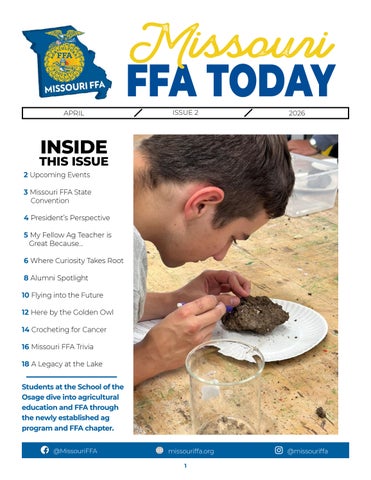
How a non-traditional agricultural education program connects students, community and real-world careers at the School of the Osage.
At the School of the Osage, a new agricultural education program is redefining what “ag” looks like for this generation of students. Still in its infancy, the program is built not on tradition, but on transformation.
“There wasn’t a formal agricultural education program or FFA chapter here before,” explains Jacob Blank, School of the Osage advisor. “But there was a strong foundation in industrial arts and technical education. This program really grew out of that.”
Rather than replacing what already worked, Blank says the goal was to evolve it.
“The transition was less about replacing industrial arts and more about expanding it,” he said. “Skills like problem solving, construction and mechanics all fit naturally into agriculture. We just broadened the scope to include more agriculture.”
That shift didn’t happen overnight. It was a collaborative effort between administration, the school board and the community. “Their willingness to invest in something new made this possible,” Blank says.
Located near the Lake of the Ozarks, students explore agriculture through a unique regional lens.
“We’re able to tie in natural resources and environmental stewardship in ways that are specific to our area,” Blank says. “That makes learning more relevant.”
It’s that relevance that defines the program as non-traditional. Many students aren’t from farming backgrounds and, for some, this is their first exposure to agriculture. “We focus heavily on agricultural literacy and showing students that agriculture impacts everyone,” Blank explains. “It’s about making it relatable, whether that’s food systems, animal care or the
environment.”
According to Blank, the handson approach is what resonates with students the most. “They like being able to actually do something with what they’re learning,” he says. “And beyond that, there’s a real sense of belonging.”
That sense of purpose is captured in the program’s theme: “Creating a Legacy at the Lake.” For Blank, it’s more than a slogan. “We’re building something from the ground up,” he says. “The ‘legacy’ piece is about creating something that lasts, and the ‘lake’ reflects who we are as a community.”
With strong support behind it and a clear vision ahead, the program continues to grow.
“At the end of the day, our goal is to prepare students for success— whether that’s in agriculture or beyond,” Blank says. “We want this to be a place they’re proud to call home.”